1. Introduction
Models for describing and forecasting currency exchange rates (CERs) encompass a wide range of complementary methodologies. Within the macroeconomic and econometric framework, structural models based on economic fundamentals have demonstrated improved forecasting performance over recent decades for particular currencies and prediction horizons [
1]. Adaptive autoregressive moving average (ARMA) models combined with differential evolution algorithms have also exhibited strong predictive capabilities [
2]. More recently, autoregressive integrated moving average (ARIMA) models, recurrent neural networks (RNNs) of the Elman type, and long short-term memory (LSTM) networks have been successfully employed for CER forecasting, yielding promising results [
3]. Furthermore, differential empirical mode decomposition (EMD) coupled with support vector regression (SVR) has been proposed to enhance exchange-rate predictions, outperforming both Markov-switching generalized autoregressive conditional heteroskedasticity (MS-GARCH) and Markov-switching regression (MSR) models in simulation studies [
4]. Forecasting approaches based on fuzzy logic theory have likewise been developed and empirically validated, demonstrating high predictive efficiency [
5].
More recently, the rapidly evolving landscape of artificial intelligence has introduced deep learning paradigms to financial forecasting, including Long Short-Term Memory (LSTM) networks, Temporal Convolutional Networks (TCNs), and Transformer-based attention mechanisms [
6,
7]. To handle the high non-stationarity of currency markets, hybrid frameworks combining signal decomposition techniques—such as Variational Mode Decomposition (VMD) or Wavelet Transforms—with deep neural networks have also been widely adopted [
8]. While these advanced AI architectures excel at capturing complex, nonlinear spatio-temporal patterns without structural prior assumptions, they operate largely as black-box models. Consequently, they lack economic interpretability and often experience severe predictive degradation when confronted with sudden regime shifts or out-of-distribution market shocks [
9].
In the continuous-time finance literature, CER dynamics are frequently modeled through stochastic processes such as geometric Brownian motion (GBM) and its jump–diffusion extensions, which capture both multiplicative growth and abrupt discontinuities in price movements [
10,
11]. Stochastic volatility frameworks, including the Heston model and its variants, explicitly account for the interaction between asset prices and volatility and have been extensively applied to foreign exchange markets [
12]. Additionally, regime-switching models provide a flexible mechanism for representing structural changes and varying market conditions in financial time series. Collectively, these approaches highlight the multidisciplinary nature of CER research and underscore the significant economic importance of exchange-rate dynamics in the global financial system (see, for example, [
13] and the references therein).
Despite these advances, several fundamental challenges persist across both statistical and machine learning methodologies. Classical time-series models (such as ARMA/ARIMA) rely on strict linearity assumptions, making them ill-equipped for volatile currency dynamics. Although GARCH-type models successfully address volatility clustering and conditional heteroscedasticity, they are structurally designed for short-memory processes and fail to capture persistent memory dependencies extending over long horizons [
14]. Continuous-time models (e.g., GBM and Heston), while mathematically tractable and interpretable, rely on memoryless Markovian assumptions that contradict the temporal dependencies observed in real markets. Conversely, while deep learning models capture nonlinear patterns, their lack of explicit physical or mathematical memory kernels renders them vulnerable to overfitting and parameter instability during structural market breaks.
Motivated by these limitations, increasing attention has been directed toward the empirical evidence of power-law behavior, self-similarity, and scaling properties in financial markets [
15,
16,
17]. Such findings have encouraged the development of mathematical models capable of reproducing heavy-tailed distributions and scale-invariant dynamics that are not adequately described by conventional Gaussian-based frameworks. Concurrently, fractional calculus has emerged as a powerful mathematical tool for modeling systems with memory and nonlocal interactions. By extending differentiation and integration to non-integer orders, fractional operators provide a natural mechanism for incorporating long-range dependence and hereditary effects, thereby offering a richer description of complex dynamical systems than their integer-order counterparts [
18]. These properties have motivated recent developments of fractional models in economics, quantitative finance, and stochastic financial systems, where memory effects and nonlocal dynamics play an important role in describing market behavior [
19,
20,
21,
22].
Within the financial domain, fractional models based on fractional Brownian motion, fractional stochastic processes, and fractional differential equations have been proposed to capture persistent temporal correlations in asset-price dynamics [
14,
15]. Their relevance is particularly evident when empirical estimates of the Hurst exponent (
H) differ significantly from the benchmark value of
, indicating the presence of long-range dependence and deviations from the classical random-walk hypothesis across multiple time scales [
23,
24]. These empirical observations provide statistical evidence of persistent behavior in financial time series and motivate the use of mathematical operators capable of incorporating non-local temporal interactions. In this context, fractional derivatives offer a suitable framework because their inherent memory kernels allow the current system state to depend on its previous evolution, providing a mathematical representation of hereditary effects observed in complex dynamical systems.
In this work, we propose a stochastic fractional power-law model for CER forecasting. The proposed framework incorporates nonlocal temporal effects through Caputo fractional derivatives, whose formulation naturally accommodates classical initial conditions and thereby facilitates a direct financial interpretation of exchange-rate dynamics. Compared with fractional formulations based on other definitions of fractional derivatives, the Caputo operator provides a more direct treatment of classical initial conditions, allowing the model to be initialized using the observed exchange-rate value and making it particularly convenient for data-driven applications involving financial time series. In addition, nonlinear scaling properties are introduced through a power-law structure, enabling the model to capture complex behaviors frequently observed in financial time series. By combining fractional-order dynamics, power-law scaling, and stochastic perturbations within a unified framework, the proposed approach offers both analytical flexibility and computational tractability, providing a tractable framework for investigating CER dynamics and forecasting.
The central idea of this work is to construct an explicit analytical calibration expression under the fractional chain-rule framework adopted in this study and employ it for parameter estimation using historical exchange-rate data. The role of this expression is restricted to providing a tractable parameterization for the calibration procedure and is not intended to establish a general exact closed-form solution of the nonlinear problem involving the standard Caputo derivative. In particular, the fractional order
q, the power-law exponent
, and the growth-rate parameter
are treated as free parameters to be estimated. The calibration procedure is carried out by fitting the analytical calibration expression to daily observations from currency pairs such as EUR/MXN and EUR/CAD. In addition, the volatility parameter
is estimated from the training dataset using the standard deviation of logarithmic returns, a widely adopted measure of exchange-rate variability [
25,
26]. Once the model parameters have been estimated, the forecasting stage is performed through stochastic simulations based on a fractional numerical integration scheme, incorporating the stochastic component within the standard numerical framework for stochastic differential equations [
27,
28,
29,
30,
31]. Particular attention is devoted to assessing the influence of fractional-order dynamics, governed by the fractional order
q, and nonlinear scaling properties, controlled by the exponent
, on forecasting performance. Furthermore, the empirical stabilization of the Monte Carlo ensemble mean is examined as the number of stochastic realizations increases.
To investigate the effects of memory and nonlinear scaling on forecasting performance, four distinct modeling scenarios were considered: (i) linear and non-fractional (, ), (ii) nonlinear and non-fractional (, ), (iii) linear and fractional (, ), and (iv) nonlinear and fractional (, ). For both currency exchange rates analyzed, the non-fractional models exhibited the most stable forecasting behavior, with relatively small deviations and only minor differences between the linear and nonlinear formulations. Their performance was also largely insensitive to the length of the training period. In contrast, the fractional models displayed considerable variability when calibrated using short training datasets, indicating a higher sensitivity to parameter estimation and memory effects. However, this instability progressively diminished as the training period increased, resulting in reduced forecasting variability. Moreover, within the fractional framework, the incorporation of nonlinear scaling () consistently improved predictive performance relative to the linear fractional case. For sufficiently long training periods, the nonlinear fractional model achieved a modest but noticeable improvement in forecasting accuracy compared with both non-fractional scenarios, highlighting the potential benefits of combining long-memory dynamics with power-law scaling in exchange-rate prediction.
The remainder of the paper is organized as follows:
Section 2 presents the mathematical formulation of the model,
Section 3 describes the data and methodology,
Section 4 presents the results,
Section 5 discusses the findings, and
Section 6 concludes the study.
2. Mathematical Model
The proposed model is based on a stochastic fractional power-law formulation aimed at describing the intricate dynamics of CER time series. The key feature of the model is the incorporation of long-memory effects through Caputo fractional derivatives, which introduce temporal nonlocality into the governing equation. Among the various definitions of fractional derivatives, the Caputo operator is adopted because it naturally accommodates classical initial conditions expressed in terms of observable exchange-rate values while preserving the memory effects characteristic of fractional-order systems. As a result, the evolution of the exchange rate is influenced not only by its current value but also by its past trajectory, allowing the model to account for persistent dependence structures across multiple time scales. This fractional-memory mechanism is complemented by a power-law nonlinear term, providing additional flexibility to represent the scaling behavior commonly observed in financial data.
2.1. Model Formulation
During the training phase, the CER dynamics are assumed to follow a fractional differential equation of the form
where
represents the CER at time
t,
is a scaling parameter associated with the growth rate,
is the power-law exponent governing the nonlinear elasticity of the process, and the operator
denotes the Caputo fractional derivative of order
which is defined as follows [
32]
The parameter q controls the degree of memory in the system: lower values of q correspond to stronger long-range dependence, while recovers the classical integer-order dynamics.
For parameter-estimation purposes, an explicit analytical expression associated with Equation (
1) is constructed under the fractional chain-rule framework described in the following subsection. Because such chain rules are not universal identities for the standard Caputo derivative, the resulting expression is adopted specifically as a calibration expression within the particular chain-rule framework considered in this work. It is subsequently fitted to the historical data to estimate the parameters
.
2.2. Analytical Treatment of the Deterministic Model
In this section, explicit analytical expressions are presented for the deterministic fractional power-law model. For the linear case
, the standard Mittag–Leffler solution is employed. For the nonlinear case
, an explicit expression is constructed under the fractional chain-rule framework adopted from [
33] and is employed as a tractable analytical expression for parameter calibration.
2.2.1. Case
When
, Equation (
1) reduces to a linear fractional differential equation, whose corresponding solution is given by [
34,
35]
where
denotes the one-parameter Mittag–Leffler function and
.
2.2.2. Case
For the nonlinear case, let us consider the following transformation
Therefore, Equation (
1) is rewritten as
It is well known that the Caputo fractional derivative of the function
exists for real values of
n, although additional care is required when
n is non-integer. Following Lemma 13 of [
33], and assuming that
is Caputo differentiable while
is continuously differentiable with respect to
u, the fractional chain rule is given by
Alternative formulations of the fractional chain rule exist in the literature, depending on the adopted definition of the fractional derivative. The present work is developed consistently within the framework of [
33]. Then the fractional derivative in (
5) gives the following result
Finally, Equation (
5) can be reduced as
This equation admits a solution that can be expressed via a fractional power series. More explicitly, if we propose
computing
[
36] then
Substituting in (
8) we obtain
Reverting the transformation yields the explicit analytical expression adopted for parameter calibration:
In the present work, this expression is employed specifically as an analytical calibration function for estimating the parameters . Because its derivation relies on the particular fractional chain-rule assumption stated above, it is not claimed as a general exact closed-form solution of the nonlinear problem involving the standard Caputo derivative.
2.3. Stochastic Extension
To account for market randomness and volatility in predictive simulations, the model is extended by introducing a stochastic term, leading to a fractional stochastic differential equation of the form
where
denotes Gaussian white noise and
controls the relative intensity of the stochastic perturbation. In this formulation, the random contribution is introduced as a multiplicative perturbation of the deterministic power-law term. Consequently, the effective stochastic coefficient is
.
The white-noise process is understood in the generalized sense as the formal time derivative of a standard Wiener process
,
Consequently, the stochastic forcing is interpreted through the formal relation
where the stochastic increment on the right-hand side is understood in the Itô sense. Accordingly, a formal stochastic differential representation of the model is
Equation (
15) is a compact formal representation of the deterministic fractional contribution and the stochastic Wiener contribution. It should not be interpreted as an ordinary differential identity. The parameter
measures the relative intensity of the random perturbation, whereas
represents the effective stochastic coefficient.
This fractional stochastic power-law structure enables the model to simultaneously represent nonlocal temporal effects, nonlinear scaling behavior, and stochastic fluctuations commonly observed in foreign exchange markets. The stochastic formulation adopted in this work is intended as a phenomenological modeling framework for numerical forecasting and should not be interpreted as a complete theoretical treatment of stochastic fractional differential equations. Accordingly, no claims regarding the general existence, uniqueness, or well-posedness of the proposed stochastic formulation are made in the present work.
2.4. Interpretation of Parameters
The parameters of the proposed model possess clear financial and mathematical interpretations within the context of CER dynamics.
The parameter represents the deterministic growth (or drift) rate of the process and governs the overall tendency of the exchange rate to appreciate or depreciate over time. Consequently, it captures the long-term directional component of the CER evolution.
The exponent characterizes the nonlinear scaling properties of the model. In the particular case , the governing equation reduces to a linear formulation. In contrast, values within the interval introduce sublinear dynamics, moderating the growth rate as the exchange rate increases and thereby providing additional flexibility to reproduce the nonlinear behavior frequently observed in financial markets.
The fractional order serves as a memory parameter. Through the Caputo fractional derivative, it quantifies the influence of past states on the current evolution of the process. Smaller values of q correspond to stronger memory effects and more pronounced long-range dependence, implying that historical information exerts a persistent impact on future dynamics. Conversely, when , the model reduces to the classical integer-order formulation, in which memory effects are absent.
Finally, the standard deviation of the logarithmic returns is employed as an empirical proxy for the relative stochastic-intensity parameter .
Taken together, these parameters provide a flexible and interpretable framework capable of simultaneously capturing deterministic trends, nonlinear scaling behavior, long-memory effects, and stochastic variability, all of which are fundamental characteristics of real-world CER dynamics.
3. Methodology
This section presents the dataset, calibration methodology, and numerical procedures employed to evaluate the proposed stochastic fractional power-law model. The methodological framework combines analytical modeling, parameter estimation, and numerical simulations to assess the forecasting capabilities of the model under different dynamical configurations.
The proposed approach consists of three interconnected stages: data preprocessing, parameter calibration through nonlinear optimization, and stochastic forecasting via a FORK-2-based stochastic discretization. First, historical exchange-rate data are processed and divided into training and testing periods. Next, the model parameters are estimated by fitting the analytical expression associated with the deterministic fractional model to the training data. Finally, stochastic simulations are performed using a fractional numerical scheme to generate out-of-sample forecasts. This integrated framework enables a systematic investigation of the effects of long-range memory and nonlinear scaling on CER dynamics, while also providing a quantitative assessment of the predictive performance and stability of the proposed model.
3.1. Data Description
The empirical analysis is carried out using historical CER data for the EUR/MXN and EUR/CAD exchange-rate pairs. Daily closing prices are employed in order to capture the short- and medium-term dynamics of exchange-rate movements while providing a sufficiently large dataset for calibration and forecasting purposes.
The data were obtained from the Bank of Mexico [
37] and the European Central Bank [
38], covering the 2023 calendar year. Prior to the analysis, the time series were preprocessed to ensure data quality and consistency. This preprocessing stage included the removal of missing observations, the synchronization of trading days across datasets, and the construction of homogeneous time series suitable for parameter estimation and numerical simulation.
The selected currency pairs exhibit distinct market characteristics, thereby providing a comparative setting for examining model behavior across two distinct currency contexts of the proposed model under different market environments. Specifically, EUR/CAD corresponds to an exchange rate involving two major developed economies and is generally characterized by relatively moderate fluctuations. In contrast, EUR/MXN is associated with an emerging-market currency and typically exhibits higher volatility and stronger sensitivity to external economic and financial factors. Consequently, the analysis of both exchange rates allows for assessing the ability of the proposed fractional stochastic framework to capture a broad range of dynamic behaviors observed in foreign exchange markets.
3.2. Preprocessing
Prior to model calibration, the CER time series were preprocessed to ensure temporal consistency and suitability for both parameter estimation and numerical simulation.
Because foreign exchange markets are closed on weekends and certain public holidays, the raw datasets contain gaps corresponding to non-trading days. To construct uniformly sampled time series compatible with the numerical implementation of the proposed model, missing observations were completed using a forward-fill procedure. Under this approach, each missing value was replaced by the most recent available observation; for example, the exchange rates corresponding to Saturday and Sunday were assigned the closing value recorded on the preceding Friday.
The forward-fill procedure was adopted solely to obtain a uniformly sampled daily time series required by the numerical formulation of the proposed fractional differential model, which assumes constant temporal increments. The authors acknowledge that this preprocessing introduces repeated observations during non-trading days and therefore may influence certain statistical properties of the resulting series. Consequently, this preprocessing step should be interpreted as a practical modeling decision rather than as a statistically neutral transformation.
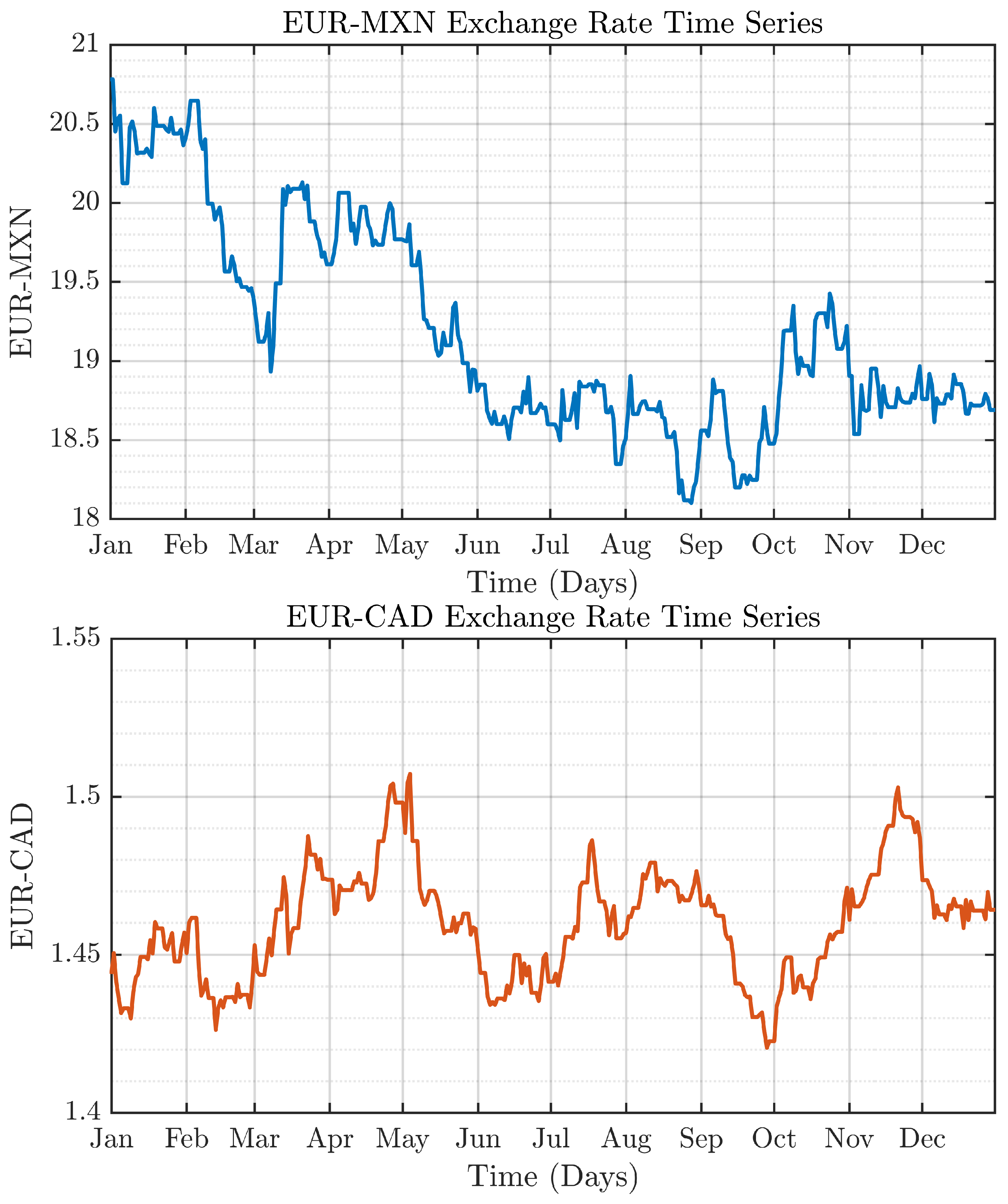
Figure 1 illustrates the evolution of the EUR/MXN and EUR/CAD exchange rates over the period under consideration. Both series display pronounced temporal patterns, including persistent trends, short-term fluctuations, and episodes of heightened volatility, highlighting the complex dynamics that motivate the exploration of memory-based stochastic modeling approaches.
The EUR/MXN exchange rate exhibits greater variability and more pronounced fluctuations throughout the observation period, reflecting the higher sensitivity of emerging-market currencies to external shocks, shifts in investor sentiment, and episodes of global financial uncertainty. Such characteristics often lead to larger deviations from long-term trends and increased volatility in response to changes in economic and geopolitical conditions. In contrast, the EUR/CAD exchange rate displays comparatively smoother dynamics, characterized by lower-amplitude fluctuations and a more stable temporal evolution. This behavior is consistent with the typical features of exchange rates involving developed-market currencies, which generally benefit from greater market liquidity, stronger institutional frameworks, and lower susceptibility to abrupt market disruptions.
These contrasting patterns illustrate the coexistence of distinct dynamical regimes within foreign exchange markets and underscore the challenges associated with developing forecasting models that remain effective across different market environments. Moreover, the presence of persistent trends, heterogeneous volatility structures, and temporal dependence in both exchange-rate series provides strong motivation for employing modeling frameworks capable of simultaneously capturing long-memory effects, nonlinear scaling behavior, and stochastic fluctuations. Such features are essential for achieving a more realistic representation of the complex mechanisms governing CER dynamics.
3.3. Statistical Properties and Long-Range Dependence
Before calibrating the proposed model, an exploratory analysis was performed to investigate whether the selected CER series exhibit indications compatible with persistent temporal dependence. The purpose of this analysis is solely to provide qualitative motivation for exploring a fractional-order modeling framework. It is not intended to constitute a formal statistical demonstration of long-range dependence.
To quantify the degree of temporal dependence, the Hurst exponent (
H) was estimated using the Rescaled Range (R/S) analysis method [
39]. The Hurst exponent is a widely used indicator of persistence and long-memory behavior in time series. Specifically,
corresponds to a classical random-walk process with no long-term correlations, whereas values in the range
indicate persistent dynamics, implying that past trends tend to be followed by similar future movements [
40]. Conversely, values
characterize antipersistent behavior, where increases are more likely to be followed by decreases and vice versa. Therefore, the estimation of
H provides valuable insight into the memory structure of the CER series and serves as an empirical basis for the incorporation of fractional dynamics into the proposed forecasting model.
As shown in
Table 1, the estimated Hurst exponents for both EUR/MXN and EUR/CAD are greater than the random-walk benchmark of
, suggesting the possible presence of persistent temporal dependence. This indication is considerably stronger for the EUR/CAD exchange rate than for EUR/MXN, whose estimated value remains close to the random-walk threshold.
The estimated Hurst exponents should be interpreted as exploratory indicators of temporal scaling rather than as formal proof of long-range dependence. In particular, the EUR/MXN estimate remains close to the random-walk benchmark , and therefore provides only weak evidence of persistence. Moreover, classical rescaled-range estimates may be affected by finite-sample effects, short-range autocorrelation, trends, and structural changes. Accordingly, no inference regarding the existence of long-range dependence is drawn exclusively from these estimates, and they play no role in either parameter estimation or model validation.
It is also important to emphasize that the empirical Hurst exponent H is not directly identified with the fractional order q. No universal one-to-one relationship exists between these quantities for the nonlinear Caputo model considered here. The Hurst exponent is used only as an exploratory measure of persistence, whereas q is independently estimated through the calibration of the fractional dynamical model.
3.4. Model Calibration
The parameters of the proposed model, , were estimated by fitting the analytical calibration expression obtained under the fractional chain-rule framework to the historical CER data.
Specifically, parameter estimation was performed by minimizing the sum of squared residuals (SSR) between the observed CER values and the model solution. The objective function is defined as
where
denotes the observed CER at time
, and
corresponds to the analytical expression obtained in
Section 2.2. For a fixed training window, minimizing the SSR is equivalent to minimizing the mean squared error (MSE), since both objective functions differ only by the constant factor
.
The resulting nonlinear optimization problem was solved in MATLAB R2024a Update 1 using the fmincon function from the Optimization Toolbox (version 24.1) with the interior-point algorithm. A single optimization run was performed for each currency pair, model configuration, and training window.
The initial estimate of the growth-rate parameter was obtained by a least-squares fit of an exponential function to the training data.
which provided the initial value
. The optimization vector was then constructed according to the corresponding model configuration, while the admissible parameter ranges were defined by the optimization constraints.
The optimization was carried out subject to
depending on the model configuration under consideration. Unless otherwise specified, the stopping criteria and convergence tolerances correspond to the default settings of MATLAB R2024a Update 1.
This calibration procedure enables the model to capture both the memory effects (through q) and the nonlinear scaling behavior (through ) present in CER dynamics.
3.5. Numerical Implementation
The predictive simulations were performed using a stochastic discretization constructed from the coefficients of the explicit two-stage Fractional-Order Runge–Kutta (FORK-2) method proposed for deterministic Caputo fractional differential equations in [
31]. The theoretical consistency, stability, and convergence properties of the original FORK-2 formulation apply to deterministic fractional differential equations.
In the present work, the stochastic contribution is incorporated computationally through independent Itô increments at each stage. The resulting procedure is therefore referred to as a FORK-2-based stochastic discretization and is adopted as the computational scheme for generating the stochastic trajectories used in the forecasting experiments.
The deterministic FORK-2 formulation employs specific weight coefficients defined in terms of the Gamma function. For a fractional order
, the algorithm defines the step size
and employs the following stage coefficients:
To incorporate the stochastic nature of CER, we introduce a multiplicative noise term [
41,
42]. The stages of the FORK-2-based stochastic discretization are defined as
Expanding the stage contribution shows that the adopted discretization contains the deterministic increment
and the stochastic increment
, corresponding to the deterministic and stochastic contributions considered in Equation (
15), respectively.
To incorporate the stochastic component of the model, an independent Wiener increment is generated at each time step as
where the random variables
are independent. Consequently,
The scaling of the Wiener increment is independent of the fractional order q. The parameter q affects the deterministic fractional increment and the coefficients of the FORK-2 method, but it does not modify the conventional scaling of the stochastic increment.
The deterministic coefficients employed above are inherited from the FORK-2 formulation for Caputo fractional differential equations. The scheme is employed as an application-oriented computational discretization, and its empirical behavior is assessed through the stabilization of the resulting Monte Carlo ensemble mean as the number of realizations increases.
3.6. Forecasting Strategy
For each forecasting experiment, the model parameters q, , and were estimated using the selected historical training window, while was obtained from the corresponding logarithmic returns. Once the parameters had been calibrated, the final observation of the training period was adopted as the initial condition.
During the forecasting stage, the fractional operator is reinitialized at . Consequently, is taken as the lower terminal of the Caputo operator for the numerical propagation. Under this convention, the pre-forecast trajectory is not explicitly included in the fractional convolution after the forecast origin. Its influence is incorporated indirectly through the calibrated parameters q, , , and , as well as through the initial exchange-rate value .
This forecasting convention distinguishes between parameter-based historical information and pathwise fractional memory. The former is retained through calibration, whereas the latter is restarted at the forecast origin. Therefore, the current implementation should be interpreted as a reinitialized short-horizon fractional forecast rather than as a continuation of the complete historical Caputo trajectory.
4. Results
This section presents the results obtained from applying the proposed stochastic fractional power-law model to real CER data. The primary objective of the analysis is to evaluate the extent to which fractional dynamics and nonlinear scaling contribute to the accurate representation and forecasting of exchange-rate behavior under different market conditions.
To facilitate a systematic assessment, the results are organized around three key aspects of the proposed framework: the impact of the fractional order on memory effects and forecasting accuracy, the influence of the power-law exponent on the nonlinear dynamics of the model, and the robustness and stability of the stochastic simulations. Both qualitative and quantitative analyses are performed, including comparisons among the different modeling scenarios and forecasting horizons. This comprehensive evaluation provides insight into the individual and combined contributions of memory, nonlinear scaling, and stochastic variability to the predictive performance of the proposed model.
4.1. Monte Carlo Stability Analysis
To evaluate the stability of the stochastic simulations, the absolute change between means was analyzed as a function of the number of Monte Carlo runs.
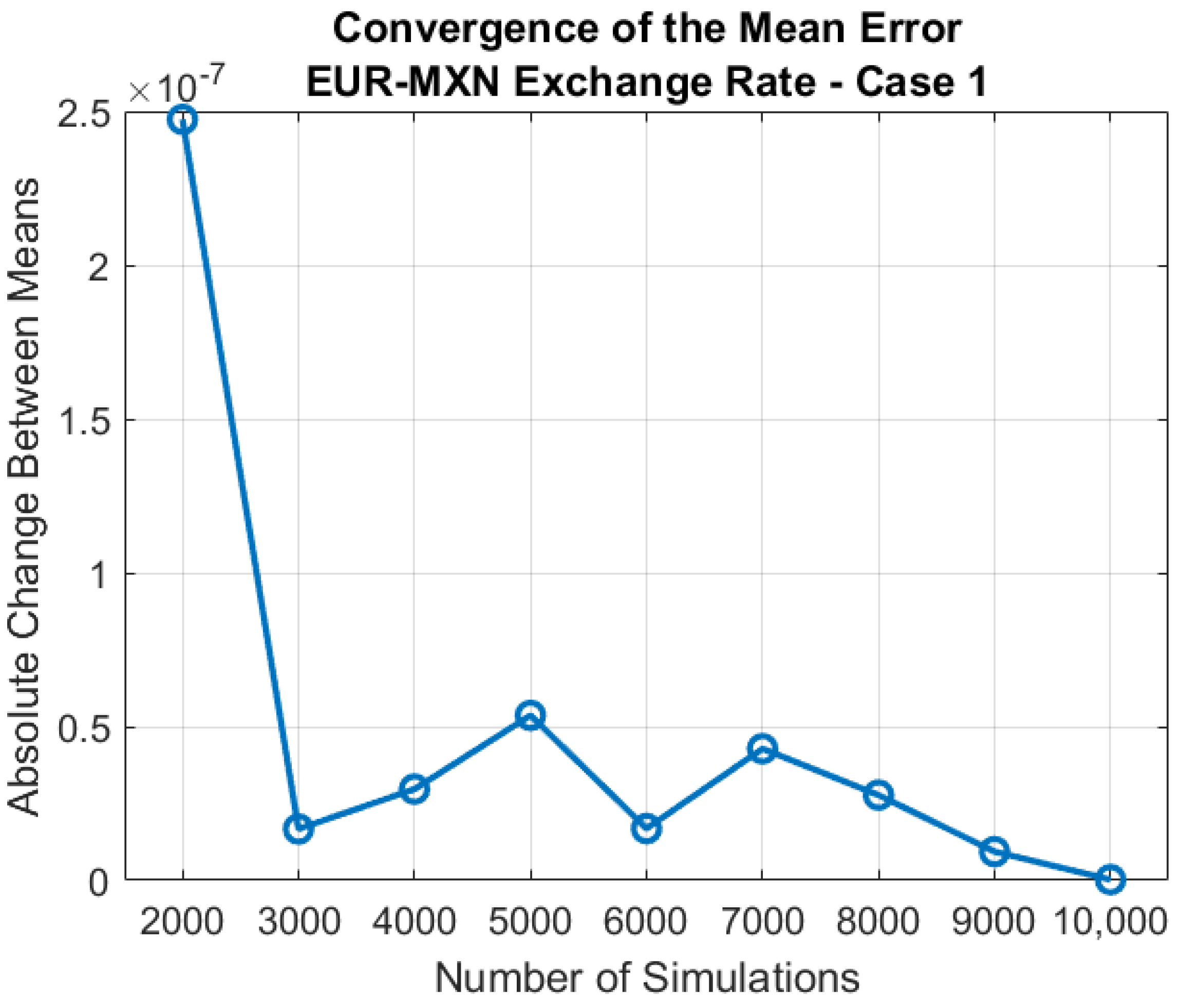
As illustrated in
Figure 2, the absolute variation between successive ensemble-mean estimates decreases as the number of Monte Carlo realizations increases. This quantity measures the numerical stabilization of the Monte Carlo estimator and should not be interpreted as the forecasting error with respect to the observed exchange-rate series.
Under the experimental conditions considered, changes in the estimated ensemble-mean trajectory become progressively small as the number of realizations approaches . Therefore, simulations were adopted as a practical ensemble size, providing an empirically stable estimate while maintaining a reasonable computational cost. Comparable stabilization patterns were observed in the remaining forecasting configurations.
4.2. Model Calibration and Scenarios
The influence of fractional memory and nonlinear scaling was investigated by considering four model configurations:
Case 1: Non-fractional and linear (, );
Case 2: Non-fractional and nonlinear (, );
Case 3: Fractional and linear (, );
Case 4: Fractional and nonlinear (, ).
4.3. Sensitivity Analysis
To investigate the influence of the model parameters on the exchange-rate dynamics, a local sensitivity analysis was performed considering Case 4, where the fractional order, nonlinear exponent, and scaling parameter are simultaneously estimated. This configuration was selected because it represents the most general formulation of the proposed model.
The analysis was carried out using the calibrated parameters obtained from the twelve training windows considered in the forecasting stage, corresponding to historical periods from one to twelve months. For each training window, the parameters q, , and were individually perturbed by applying relative variations of , , , , and , while maintaining the remaining parameters unchanged.
The effect of each perturbation was quantified through the relative variation in the sum of squared residuals (SSR), defined as
where
represents the error obtained with the calibrated parameter value and
corresponds to the error after applying the perturbation
. The resulting sensitivity values were averaged over the twelve training windows in order to obtain an overall measure of parameter influence.
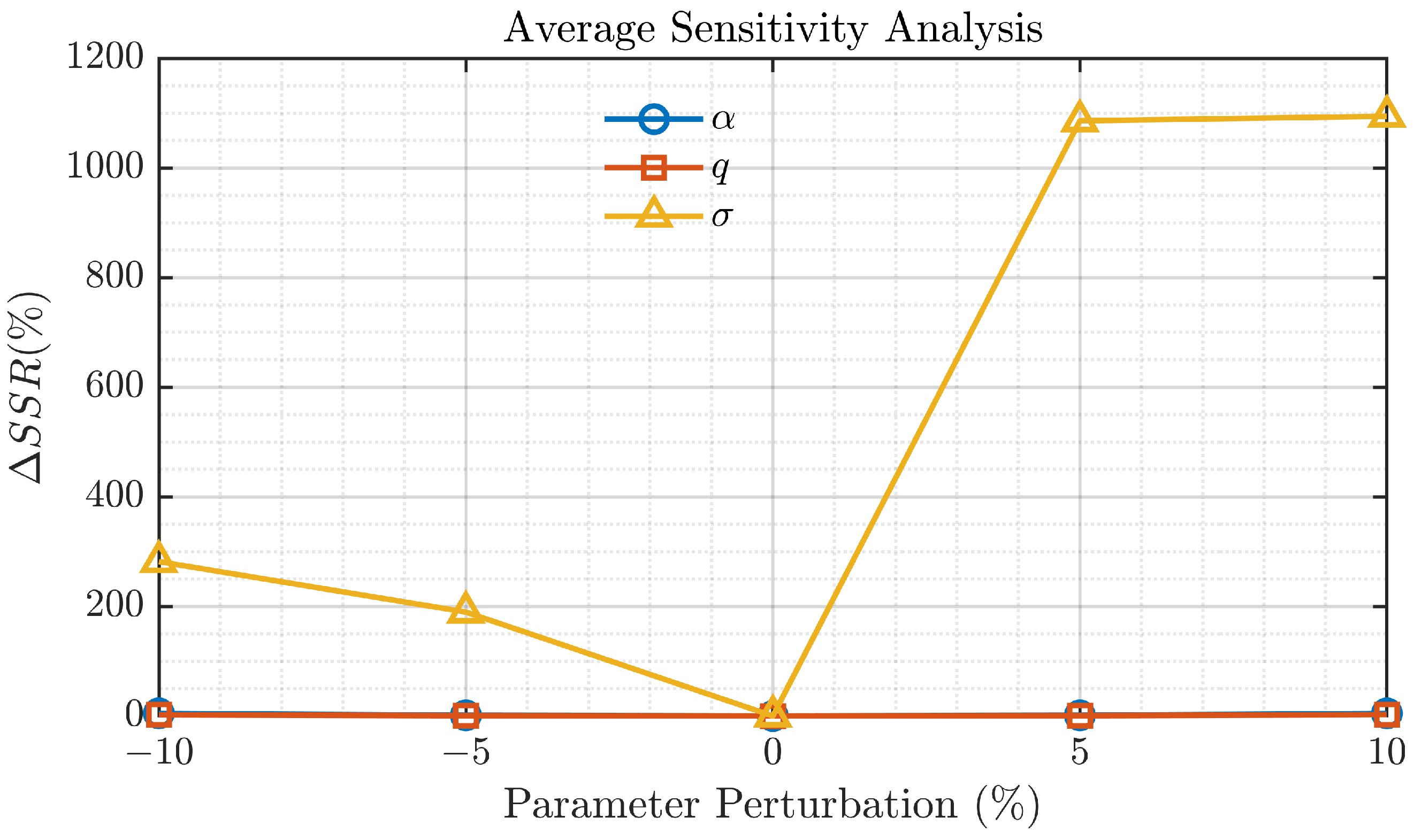
The averaged sensitivity results are presented in
Figure 3 and summarized in
Table 2. The analysis shows that the nonlinear exponent
is the parameter with the highest influence on the model dynamics, producing the largest variations in the SSR after perturbation. This behavior is associated with the role of
in controlling the nonlinear scaling relationship of the power-law formulation.
It should be noted that both the fractional order q and the nonlinear exponent are constrained to the interval . Therefore, perturbations that resulted in parameter values outside this admissible range were projected onto the feasible domain. Consequently, the sensitivity response for these parameters is limited by the mathematical constraints of the proposed formulation rather than by the perturbation procedure itself.
Although the fractional order q introduces memory effects into the system and determines the magnitude of the deterministic contribution, their influence on the model error was lower compared with the nonlinear exponent.
4.4. Predictive Performance
The predictive performance of the proposed model was evaluated by comparing the simulated exchange-rate trajectories with the observed CER data corresponding to the first two weeks of 2024 for both the EUR/MXN and EUR/CAD currency pairs. To analyze the effect of the calibration period on forecasting accuracy, the model was trained using twelve different historical windows, ranging from one to twelve months immediately preceding the prediction interval. This strategy enables a systematic assessment of how the amount of historical information influences parameter estimation and predictive performance.
As discussed previously, the volatility parameter
was estimated separately for each training period using the standard deviation of the logarithmic returns, given by
where
denotes the logarithmic return associated with the exchange rate
, and
represents the mean of the logarithmic returns over the corresponding training window. This procedure provides a data-driven estimate of market volatility and allows the stochastic component of the model to adapt to the prevailing conditions of each calibration period.
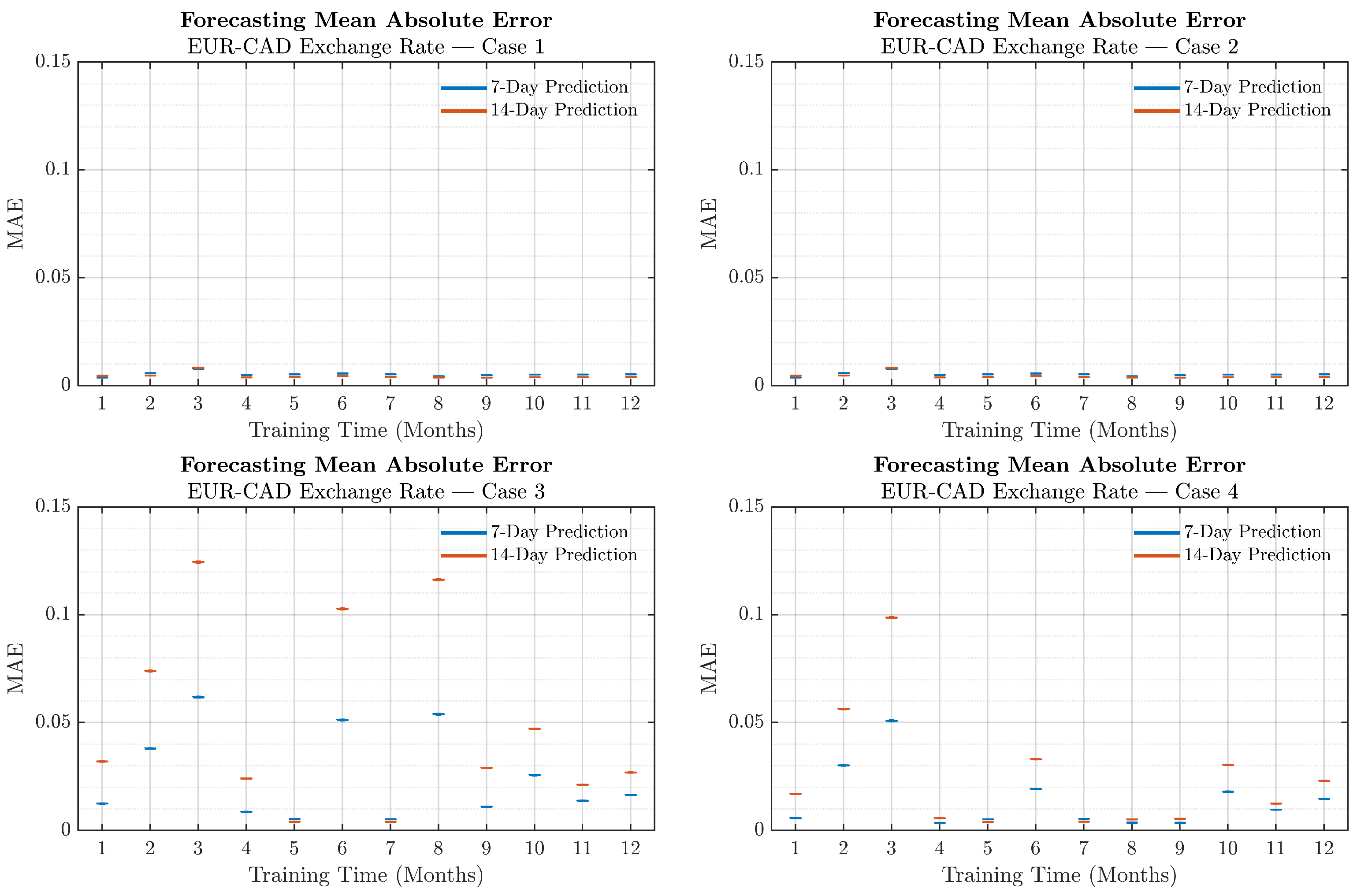
After estimating the model parameters for each training window and for each of the four considered scenarios, a Monte Carlo ensemble consisting of stochastic realizations was generated. The forecast trajectory was then obtained by averaging all simulated paths, and its predictive accuracy was assessed by computing the mean absolute error with respect to the observed exchange-rate values during the first two weeks of 2024.
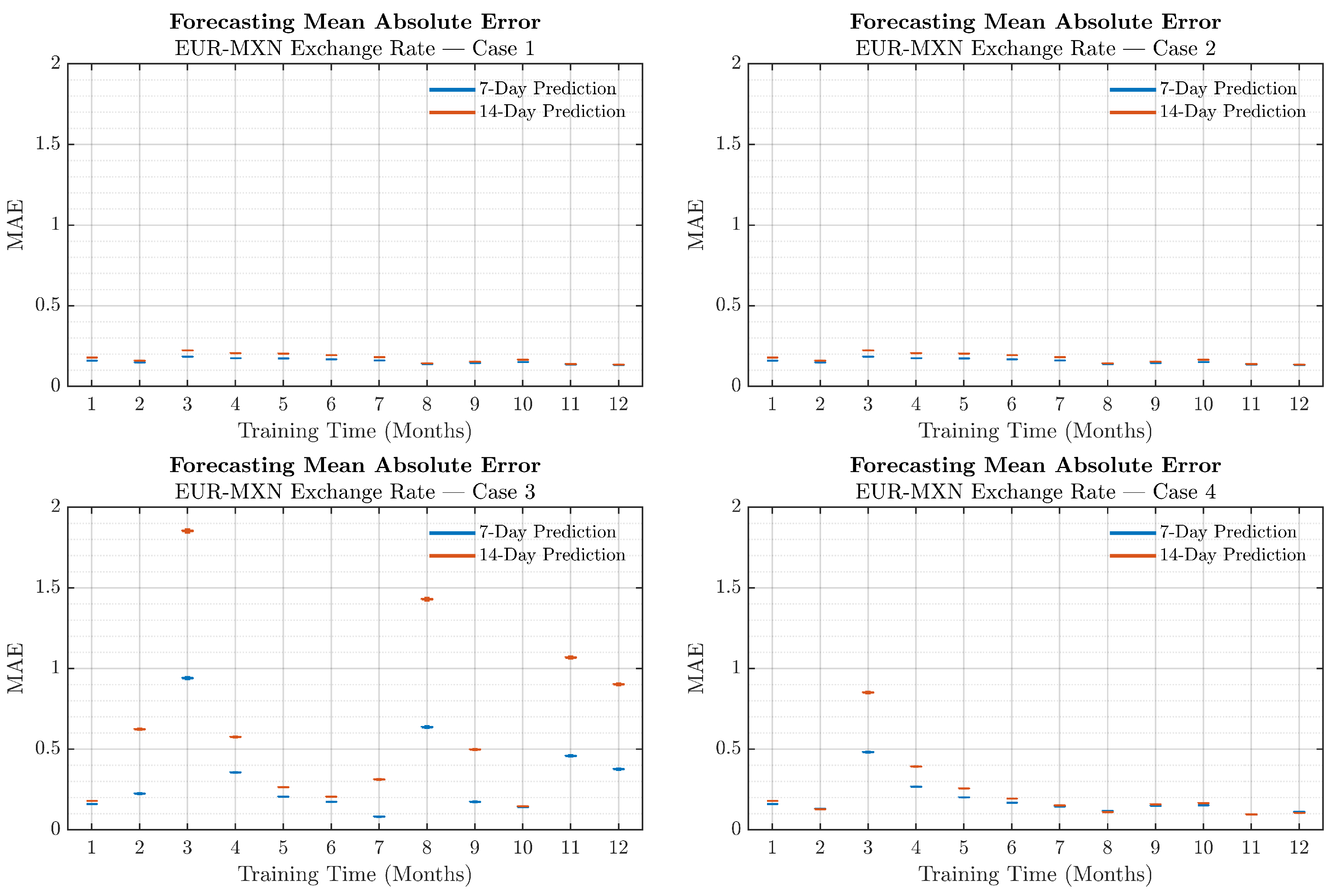
The resulting forecasting errors for the EUR/MXN and EUR/CAD exchange rates are presented in
Figure 4 and
Figure 5, respectively. The reported MAE values are presented as descriptive performance measures intended to facilitate the comparative evaluation of the proposed model configurations. No statistical hypothesis testing or inference regarding the significance of the observed differences is performed in the present study.
Figure 4 presents the distribution of mean forecasting deviations obtained for the EUR/MXN exchange rate across different training periods and for two prediction horizons: one week and two weeks ahead. The results reveal that the non-fractional models exhibit greater stability, with relatively consistent forecasting errors across all training windows. Moreover, only minor differences are observed between the one-week and two-week forecasting horizons, with the former showing a slight improvement in accuracy.
In contrast, the fractional models display a stronger dependence on the length of the training period. For shorter calibration windows, forecasting deviations are generally larger and more variable; however, a clear improvement is observed as the training period increases. This behavior suggests that the estimation of long-memory effects benefits from a larger amount of historical information. An additional noteworthy result is the superior performance of the nonlinear fractional formulation relative to the linear fractional case. The incorporation of the power-law exponent () consistently reduces forecasting deviations, indicating that nonlinear scaling plays a significant role in enhancing predictive accuracy when memory effects are present. Furthermore, for sufficiently long training periods, the nonlinear fractional model achieves forecasting errors comparable to, and in some cases smaller than, those obtained with the non-fractional formulations.
Figure 5 displays the corresponding results for the EUR/CAD exchange rate. Overall, the forecasting behavior closely mirrors that observed for the EUR–MXN series. In particular, the non-fractional models remain the most stable across different training windows, while the fractional models benefit substantially from longer calibration periods. Likewise, the nonlinear fractional scenario consistently outperforms the linear fractional case, reinforcing the conclusion that the combined incorporation of memory effects and nonlinear scaling can improve forecasting performance when sufficient historical data are available for model calibration.
5. Discussion
The results presented in the previous section provide insight into the comparative behavior of fractional-order and integer-order formulations for CER modeling. The discussion is therefore focused on the specific contribution of fractional dynamics and nonlinear scaling within the proposed framework, rather than on establishing universal superiority over alternative forecasting approaches. Accordingly, the comparisons presented throughout this section should be interpreted descriptively, emphasizing relative forecasting behavior among the proposed configurations rather than statistical significance of the observed differences.
5.1. Effect of Nonlinearity
The results highlight the influence of the power-law exponent within the proposed modeling framework. In particular, the nonlinear specification () introduces additional structural flexibility relative to the linear case. This effect is more noticeable in the fractional formulations, where the nonlinear term is associated with changes in predictive performance across the analyzed training windows. By contrast, in the non-fractional setting, variations in produce only limited changes in the forecasting results, suggesting that nonlinear scaling alone does not substantially modify the model behavior under the conditions considered.
These findings indicate that the power-law term can provide a more adaptable representation of CER dynamics by allowing the deterministic component to respond nonlinearly to the current exchange-rate level. However, this additional flexibility should not be interpreted as evidence of uniformly superior predictive capacity. Rather, the results suggest that the contribution of the nonlinear term depends on its interaction with the fractional dynamics and on the calibration window employed. Accordingly, the power-law structure is best understood as a mechanism that expands the range of admissible model behaviors within the proposed framework.
5.2. Interpretation of Results
The comparison among the four model configurations shows that the fractional and nonlinear extensions affect both predictive accuracy and stability. The simulated trajectories reproduce several qualitative features of the observed CER series, including directional movements and short-term fluctuations. Nevertheless, the degree of agreement with the empirical data varies according to the selected currency pair, training-window length, and model configuration.
The fractional formulations generally display greater sensitivity to calibration than their integer-order counterparts, particularly when short training windows are used. This behavior suggests that the inclusion of fractional-order dynamics increases the dependence of the forecasts on parameter estimation and on the amount of historical information available. At the same time, for some of the longer calibration windows, the nonlinear fractional model yields modest reductions in forecasting error. These results therefore support a conditional interpretation: fractional dynamics may be useful under specific calibration conditions, but they do not provide a uniform advantage across all experiments.
The joint inclusion of deterministic drift, nonlinear scaling, fractional-order dynamics, and stochastic perturbations provides an interpretable framework for examining different mechanisms that may influence CER evolution. However, the empirical agreement observed in the present experiments should not be regarded as formal proof that the underlying market process is governed by the proposed fractional structure.
5.3. Role of Fractional Dynamics
A central aspect of this study is the comparison between fractional-order and integer-order formulations. The parameter q introduces nonlocal temporal dependence through the Caputo derivative and therefore modifies the way in which previous states contribute to the current evolution of the model.
The results indicate that the inclusion of changes the forecasting behavior relative to the corresponding integer-order cases. However, the fractional models do not consistently outperform the integer-order formulations. The integer-order cases generally exhibit greater predictive stability across the analyzed training windows, whereas the fractional cases are more sensitive to calibration length and parameter estimation. Potential improvements are observed only for particular configurations and sufficiently long training periods.
It is also important to emphasize that, in the present forecasting implementation, the Caputo operator is reinitialized at the beginning of each prediction interval. Consequently, the complete historical fractional convolution is not explicitly propagated during forecasting. Instead, historical information is incorporated indirectly through the calibrated parameters together with the last observed exchange-rate value used as the initial condition. Therefore, the proposed methodology should be interpreted as a reinitialized fractional forecasting framework, where the influence of past observations is retained through parameter calibration rather than through the explicit continuation of the complete Caputo memory kernel. This distinction reflects a characteristic of the forecasting strategy adopted in this work and should not be interpreted as an intrinsic limitation of Caputo fractional derivatives themselves.
Accordingly, the results should not be interpreted as confirming that CER series possess long-range dependence or as validating the Caputo formulation uniquely. The estimated Hurst exponents provide only exploratory evidence of possible persistence, while the fractional order q is independently determined through model calibration. No direct one-to-one relationship between the estimated Hurst exponent and the fitted fractional order is assumed in this work.
The variability of the estimated fractional order across training windows suggests that the effective contribution of the fractional term depends on the historical period used for calibration. No single value of q was found to be universally optimal, and the estimated values should therefore be interpreted as window-dependent model parameters rather than as direct empirical measures of market memory. The fact that the calibrated values remain below one indicates that the optimization procedure frequently favors a fractional specification within the adopted parameter bounds. However, this result alone does not establish the presence of genuine long-range dependence in the underlying CER series, nor does it imply that the forecasting stage preserves the complete historical fractional memory.
5.4. Practical Implications
From a practical perspective, the proposed framework offers a mathematically interpretable approach for comparing integer-order and fractional-order CER models under common calibration and simulation conditions. The analytical calibration expression constructed under the fractional chain-rule framework adopted in this study provides a tractable parameterization for estimating , while is independently estimated from the observed logarithmic returns. The role of this analytical expression is restricted to parameter calibration and it is not claimed as a general exact closed-form solution of the nonlinear problem involving the standard Caputo derivative.
This interpretability constitutes a useful feature relative to highly parameterized black-box approaches. Nevertheless, the present study does not establish a general computational or predictive advantage over machine learning, econometric, or conventional stochastic models, since no formal comparison of execution times or external forecasting benchmarks was conducted. The principal practical contribution of the proposed framework therefore lies in its transparent structure and in its ability to isolate the effects of fractional-order dynamics and nonlinear scaling within a controlled model comparison.
The results also indicate that the fractional formulations may require longer calibration windows to achieve stable predictive behavior. Consequently, their practical use should account for parameter sensitivity, data availability, and the characteristics of the selected forecasting period.
5.5. Limitations and Future Work
The proposed framework has several limitations. First, the stochastic component is based on Gaussian noise, which may be insufficient to represent extreme events, tail risk, and heavy-tailed return distributions commonly observed in financial markets. The inclusion of a power-law drift term does not, by itself, demonstrate that the model reproduces heavy-tailed empirical distributions. Consequently, the current formulation may underestimate the probability and magnitude of abrupt market movements.
A further limitation concerns the analytical expression employed during parameter calibration. This expression is constructed under the specific fractional chain-rule framework adopted in this study and is used as a tractable calibration function rather than as a general exact closed-form solution of the nonlinear standard Caputo problem. Consequently, the estimated parameters and the subsequent empirical results should be interpreted within this modeling framework. A rigorous treatment of the corresponding nonlinear Caputo problem without the adopted chain-rule assumption would require a different theoretical and computational approach and remains an important direction for future investigation.
The numerical treatment of the stochastic fractional model introduces an additional limitation. The computational scheme employed in this study extends a deterministic FORK-2 formulation by incorporating Wiener increments at the numerical stages. Although this procedure provides a practical mechanism for generating stochastic trajectories, a formal strong- or weak-convergence analysis, a mean-square stability characterization, and a demonstration of the complete preservation of the nonlocal memory structure have not been established for this stochastic extension. Consequently, the reported forecasts should be interpreted as conditional on the adopted temporal discretization. Future work should focus on the development and validation of a dedicated numerical integrator for stochastic fractional power-law equations.
The empirical design is limited to two currency pairs, a single forecasting origin, and short prediction horizons. Accordingly, the conclusions are restricted to the comparative behavior observed under the specific experimental conditions considered. A broader assessment would require rolling-origin or walk-forward validation across multiple periods, including distinct volatility regimes and structural market conditions. In addition, the comparisons among forecasting configurations are descriptive, and no statistical inference regarding the significance of the observed differences is performed.
The preprocessing and calibration procedures also introduce limitations. Forward-filling weekends and holidays produces repeated observations in the uniformly spaced daily series, which may affect estimated statistical quantities and calibrated model parameters. Moreover, the calibration procedure relies on a single optimization run for each model configuration and training window; therefore, the sensitivity of the fitted parameters to alternative optimization initializations was not assessed.
The model also does not explicitly incorporate regime-switching dynamics, exogenous shocks, or time-varying volatility structures. These factors can play an important role in CER behavior and may not be fully represented within the current formulation. The local sensitivity analysis provides information on the influence of parameter perturbations around the calibrated solutions, but it does not constitute a formal global identifiability or parameter-uncertainty analysis.
Future research may therefore consider alternative stochastic processes with non-Gaussian noise, regime-switching mechanisms, adaptive or time-varying parameter estimation, formal uncertainty quantification, and rolling-origin forecasting experiments. Comparisons with external benchmarks such as random-walk, ARIMA, GBM, and volatility-based models would also be useful for assessing the practical competitiveness of the proposed framework beyond the internal comparison pursued in this work.
6. Conclusions
This work proposed a stochastic fractional power-law framework for CER forecasting and compared its fractional-order formulations with the corresponding integer-order cases. The model combines a deterministic power-law drift, fractional-order dynamics, and multiplicative stochastic perturbations within a common mathematical structure.
The results show that the fractional formulations do not provide a uniform forecasting advantage over their integer-order counterparts. The integer-order models generally exhibit greater predictive stability across the analyzed training windows. In contrast, the fractional cases are more sensitive to calibration length and parameter estimation, particularly when relatively short historical windows are used. Nevertheless, for some of the longer calibration periods, the nonlinear fractional formulation produces modest reductions in forecasting error relative to the corresponding integer-order configurations.
The nonlinear exponent increases the structural flexibility of the deterministic component, but this additional flexibility does not necessarily imply improved forecasting performance. Its contribution depends on the interaction with the fractional order and on the calibration conditions. Similarly, the estimated Hurst exponents should be interpreted only as exploratory indicators of possible persistence and not as formal validation of the Caputo derivative or as direct estimators of the fractional order q.
The study is also subject to several limitations. The stochastic component assumes Gaussian noise, the numerical stochastic extension has not been supported by a formal convergence analysis, and the empirical validation is restricted to two currency pairs, one forecasting origin, and short prediction horizons. Furthermore, no external benchmark comparison or computational-time analysis was conducted. The analytical expression employed for parameter estimation is used as a calibration expression under the fractional chain-rule framework adopted in this study and is not claimed as a general exact closed-form solution of the nonlinear standard-Caputo problem. Therefore, the results do not establish universal forecasting superiority, heavy-tail reproduction, or practical efficiency relative to alternative methods.
The main contribution of this work lies in the controlled comparison between integer-order and fractional-order formulations within the same stochastic power-law framework. This comparison provides evidence that fractional-order dynamics and nonlinear scaling can modify predictive behavior and may be beneficial under specific calibration conditions, while also revealing the increased sensitivity and reduced stability associated with the fractional cases.
Future research should extend the empirical evaluation to multiple forecasting origins and market regimes, incorporate non-Gaussian noise and regime-switching mechanisms, develop numerical methods specifically validated for stochastic fractional equations, and compare the proposed framework with established forecasting benchmarks. Within these limitations, the model provides an interpretable setting for investigating the effects of fractional dynamics and nonlinear scaling in CER modeling.




 ,
,