1. Introduction
Fractional-order differential equations have gained significant traction in mathematical modeling due to their ability to incorporate memory effects and non-local interactions, which are ubiquitous in real-world phenomena [
1,
2,
3,
4]. Unlike classical integer-order derivatives, fractional operators capture hereditary properties and long-term dependencies that arise in complex biological, physical, and social systems. Among the various fractional derivatives, the Atangana–Baleanu operator stands out for its non-singular Mittag–Leffler kernel, which eliminates the singularity issues present in traditional Caputo or Riemann–Liouville definitions while preserving the advantages of non-local memory [
5,
6,
7].
Recent advances further emphasize hybrid operators such as fractal–fractional derivatives. These combine the scaling properties of fractal geometry (capturing irregular, self-similar structures in contact networks or population distributions) with the hereditary nature of fractional calculus [
8,
9,
10,
11]. The fractal dimension
introduces geometric irregularity, while the fractional order
models memory effects. When applied to the ABC framework, the resulting fractal–fractional ABC operators provide a powerful tool for systems exhibiting both non-local dynamics and fractal-like transmission patterns [
12,
13,
14].
The motivation for the present work is deeply rooted in the challenges exposed by recent global health crises. The COVID-19 pandemic (2019–2023) and subsequent outbreaks of mpox (2022–2024) and highly pathogenic avian influenza demonstrated that classical SEIR models systematically under-predicted the duration of epidemic tails and failed to capture multiple resurgent waves driven by behavioral fatigue and heterogeneous contact patterns. Empirical contact-tracing data from dense urban environments reveal clear fractal scaling with dimensions typically in the range –, reflecting self-similar clustering at household, neighborhood, and city scales. Simultaneously, longitudinal serological studies show that immunity and risk perception exhibit long-memory decay, well-described by Mittag–Leffler-type kernels rather than exponential forgetting. Pure fractional-order SEIR models improve the representation of temporal memory but still assume spatially homogeneous mixing; fractal–fractional extensions address this critical gap by introducing the dual parameters .
The Atangana–Baleanu kernel is particularly advantageous because its Mittag–Leffler function permits a smooth crossover between sub-diffusive and normal diffusive regimes, which matches the observed transition from explosive early spread to prolonged low-level transmission. When combined with fractal scaling, the hybrid operator naturally reproduces the irregular, multi-scale outbreak patterns documented in real epidemiological time series. Ulam–Hyers stability, rigorously established herein, further guarantees that small perturbations arising from noisy surveillance data or uncertain parameters do not destroy the predictive value of the model—an essential property for operational forecasting in public health agencies.
In epidemiology, standard SEIR models based on ordinary differential equations often fail to capture irregular transmission patterns arising from heterogeneous contact networks, long-term immunity memory, or spatial fractality in real populations [
3,
4]. Classical integer-order SEIR models assume Markovian (memoryless) dynamics and homogeneous mixing, which are unrealistic for many emerging infectious diseases [
15,
16]. Pure fractional-order SEIR variants improve memory representation but typically overlook geometric irregularities in transmission networks [
5,
17]. Fractal–fractional extensions address this gap by introducing dual parameters
and
, enabling simultaneous modeling of temporal memory and spatial fractality [
9,
12,
18,
19].
Several recent studies have employed fractal–fractional operators in epidemic modeling. For instance, El-Dessoky et al. analyzed a fractal–fractional epidemic model with the ABC derivative [
9], while Okyere et al. investigated a fractal–fractional SIRS model with temporary immunity [
12]. Similar approaches have been applied to COVID-19 [
11,
13,
14], pneumonia [
18], and influenza dynamics [
6]. Comprehensive reviews highlight the growing role of fractional and fractal–fractional calculus in life sciences and epidemiology [
3,
4,
20]. However, a dedicated fractal–fractional ABC-based SEIR model with rigorous existence/uniqueness proofs, Ulam–Hyers stability analysis, and an adapted Adams–Bashforth–Moulton numerical scheme remains underexplored, particularly in the context of 2025–2026 research directions emphasizing hybrid operators for predictive modeling of emerging diseases [
2,
8,
21].
The present work offers the following distinct contributions that advance beyond existing fractal–fractional epidemic models:
A complete theoretical analysis of the fractal–fractional Atangana–Baleanu–Caputo (FFABC) SEIR model that simultaneously establishes local/global existence, positivity, boundedness, and global Ulam–Hyers stability under a unified Lipschitz framework—properties that are either absent or only partially addressed in prior FF epidemic studies.
Explicit derivation of the endemic equilibrium coordinates and the basic reproduction number , complemented by a new rigorous local Mittag–Leffler stability theorem for the disease-free equilibrium.
An adapted two-step Adams–Bashforth–Moulton predictor-corrector scheme with verified second-order convergence for arbitrary , together with the first quantitative sensitivity analysis of peak metrics that disentangles the dominant damping role of the fractal dimension versus memory order .
Extensive numerical illustrations calibrated to dense urban contact networks, providing actionable public health insights on targeted interventions that classical or pure-fractional models cannot supply.
A dedicated biological interpretation and public-health discussion that links the mathematical parameters to real-world mechanisms and quantifies their relative influence on outbreak characteristics.
While several recent studies have applied fractal–fractional operators to epidemic models (e.g., El-Dessoky et al. 2022 on ABC epidemic models; Okyere et al. 2022 on SIRS with temporary immunity [
9]; Paul et al. 2024 and Gunasekar et al. 2024 on COVID-19 SEIR variants [
13]; Naik et al. 2024 on general epidemic frameworks [
19]), these works typically focus on local existence, numerical illustrations, or stability of equilibria without establishing global well-posedness, Ulam–Hyers robustness, or a reproducible high-order numerical scheme with proven convergence. Moreover, none of them provides a quantitative sensitivity analysis that isolates the stronger epidemiological impact of network fractality (
) over pure memory (
). The present manuscript fills precisely this gap by delivering a mathematically complete and epidemiologically actionable FFABC-SEIR framework.
The structure of the paper is as follows:
Section 2 reviews preliminary definitions of fractal–fractional ABC operators together with new auxiliary lemmas on positivity preservation and operator bounds.
Section 3 formulates the proposed model.
Section 4 provides a complete equilibrium analysis and derives the basic reproduction number.
Section 5 and
Section 6 establish existence/uniqueness (now including global existence, positivity, and boundedness) and Ulam–Hyers stability, respectively. A numerical approximation scheme, extensive simulations, sensitivity analysis, and convergence verification are presented in
Section 7. A dedicated Discussion section interprets the results in the context of real-world epidemic control. Conclusions and future research directions appear in
Section 9.
2. Preliminaries
This section recalls the fundamental concepts from fractional calculus, the Atangana–Baleanu operators, and their fractal–fractional extensions. These operators are particularly suitable for modeling epidemiological dynamics because they incorporate both non-local memory effects and geometric irregularities in transmission networks [
7,
8,
9,
10].
We begin with the classical Mittag–Leffler function, which plays a central role in the non-singular kernel of the ABC operator.
Definition 1 (Mittag–Leffler function)
. The one-parameter Mittag–Leffler function is defined asMore generally, the two-parameter version is The function generalizes the exponential function () and is entire of order .
Definition 2 (Normalization function)
. For , the normalization function associated with the Atangana–Baleanu operator isIt satisfies and , ensuring consistency with classical derivatives at the boundary values [7]. We next recall the classical Atangana–Baleanu fractional derivative and integral in the Caputo sense.
Definition 3 (Atangana–Baleanu fractional derivative (Caputo sense))
. Let and . The ABC fractional derivative of order α is Definition 4 (Atangana–Baleanu fractional integral (Caputo sense))
. The corresponding ABC fractional integral is To incorporate fractal scaling, the fractal–fractional operators combine the classical fractional operators with a fractal derivative operator. The fractal derivative of order
(with
) is defined via the limit
which, for differentiable
f, reduces to
. Applying this to the ABC framework yields the hybrid fractal–fractional Atangana–Baleanu operators.
Definition 5 (Fractal–fractional ABC derivative)
. Let and . The fractal–fractional Atangana–Baleanu derivative in the Caputo sense iswhere and are as defined above [8,9,18]. Definition 6 (Fractal–fractional ABC integral)
. The corresponding fractal–fractional Atangana–Baleanu integral operator is The following properties of the FFABC operators are crucial for the subsequent analysis of existence, uniqueness, and stability:
The operators are linear.
For sufficiently regular f, the composition holds.
The kernel functions are bounded on compact intervals , which is essential for establishing contraction mappings.
All qualitative and numerical analyses in this paper are carried out in the Banach space
equipped with the supremum norm
where
. This space is complete, and the right-hand side vector field
of the proposed SEIR model (defined in
Section 3) is assumed to satisfy a Lipschitz condition with respect to
X, which is a key assumption for the fixed-point arguments used later.
These preliminary concepts provide the rigorous foundation for formulating the fractal–fractional SEIR model and analyzing its well-posedness.
Lemma 1 (Positivity-preserving property of the FFABC integral). Let . The fractal–fractional Atangana–Baleanu integral operator is positivity-preserving: if for all , then for all . This follows directly from the positivity of the Mittag–Leffler function () and the non-negative prefactors , .
Lemma 2 (Boundedness of the FFABC integral operator)
. For any continuous function there exists a constant such thatwhere Remark 1. When , Definitions 5 and 6 reduce exactly to the classical ABC operators. When , both operators recover the ordinary derivative and integral, respectively. These reduction properties ensure consistency with classical SEIR models as a special case.
Remark 2 (Rationale for the ABC and FFABC operators). The classical Caputo and Riemann–Liouville derivatives possess singular power-law kernels that can produce unphysical singularities at the initial time. The Atangana–Baleanu (ABC) operator replaces the kernel by the non-singular Mittag–Leffler function, which (i) eliminates the singularity, (ii) permits a smooth crossover between sub-diffusive and normal-diffusive regimes, and (iii) is particularly suited to biological systems where memory effects decay in a Mittag–Leffler rather than exponential manner (waning of immunity, behavioural fatigue). The fractal–fractional extension (FFABC) further incorporates the fractal derivative of order β, which multiplies the ABC operator by the geometric prefactor . This term encodes self-similar, scale-invariant clustering in contact networks—a feature repeatedly documented in urban contact-tracing studies (–). Consequently, the hybrid FFABC operator simultaneously captures temporal memory (α) and spatial heterogeneity (β), two mechanisms that pure fractional or integer-order models treat in isolation.
Remark 3 (Positivity near the initial time). Although the fractal prefactor diverges as when , the singularity is integrable. In the equivalent Volterra integral formulation used in the existence proof, the kernel appears inside an integral that remains well-defined and continuous down to . Because the initial conditions are non-negative and the Mittag–Leffler kernel is strictly positive, the integral operator maps the positive orthant into itself for every . Consequently, positivity is preserved globally, including in an arbitrarily small right neighbourhood of the initial time. The same argument applies verbatim to the Ulam–Hyers stability proof.
3. Model Formulation
All parameters are positive and have clear epidemiological interpretations and consistent physical dimensions. The model is written in frequency-dependent form; the force of infection is
with
.
Table 1 summarizes the parameters and their baseline values used in simulations.
The choice of the FFABC operator is driven by two well-documented biological realities. First, longitudinal serological and behavioral studies show that immunity and risk perception exhibit long-memory, Mittag–Leffler-type decay rather than exponential forgetting; the non-singular Mittag–Leffler kernel of the ABC derivative captures this distributed-delay effect. Second, contact-tracing data from dense cities reveal clear fractal (self-similar) scaling of transmission clusters at household, neighbourhood and city scales; the fractal dimension directly encodes this geometric irregularity.
Regarding dimensional balance: although fractional derivatives are non-local, the FFABC formulation preserves consistency because (i) the fractal prefactor carries dimension , (ii) the Mittag–Leffler integral kernel is dimensionless after proper normalisation by , and (iii) all epidemiological rates (, , , ) are expressed in consistent inverse-time units. When the system is rewritten in equivalent Volterra integral form, every term on the right-hand side has the same physical dimension as the left-hand side (population or population/time). Hence, the model is dimensionally homogeneous for any admissible .
The basic reproduction number derived in
Section 3 is independent of
because at equilibrium the fractional–fractal derivatives vanish identically. The classical Susceptible–Exposed–Infectious–Recovered (SEIR) compartmental model is one of the fundamental frameworks in mathematical epidemiology for describing the transmission dynamics of infectious diseases [
3,
4]. In its standard integer-order form, the model divides the total population
into four mutually exclusive compartments: Susceptible (
), Exposed (latently infected but not yet infectious,
), Infectious (
), and Recovered (
). The dynamics are governed by the following system of ordinary differential equations
The classical SEIR model assumes instantaneous mixing, Markovian transitions, and homogeneous contact structures; while analytically tractable, these assumptions often fail to capture real-world complexities such as long-term memory effects in immunity or contact patterns, heterogeneous population distributions, and irregular (fractal-like) transmission networks observed in many emerging infectious diseases [
3,
5,
6].
To overcome these limitations, we propose a fractal–fractional SEIR model based on the Atangana–Baleanu fractal–fractional derivative. This generalization replaces the ordinary time derivative
in system (
9) with the fractal–fractional Atangana–Baleanu Caputo derivative
. The resulting model reads
subject to the positive initial conditions
where
.
Here, the fractional order
quantifies the degree of memory in the disease transmission and progression processes, while the fractal dimension
accounts for the geometric irregularity and self-similar scaling properties of contact networks or spatial population distributions [
8,
9,
12,
13]. When
, system (
10) reduces exactly to the classical SEIR model (
9). For
, the model captures richer dynamics, including slower convergence to equilibria, prolonged epidemic tails, and sensitivity to initial perturbations—features frequently observed in real epidemiological data but absent in integer-order formulations [
18,
19].
Applying the fractal–fractional ABC integral operator to both sides of system (
10) yields the equivalent Volterra-type integral equations, which form the basis for the existence, uniqueness, and numerical analyses in subsequent sections. Furthermore, the total population
satisfies
indicating that the population size evolves according to a fractal–fractional logistic-type growth/decay process rather than remaining strictly constant. This property enhances biological realism when recruitment and mortality rates are non-zero.
All parameters are assumed to be positive constants, and the right-hand side vector field (where ) is locally Lipschitz continuous with respect to X on the non-negative orthant , a standard epidemiological assumption that will be exploited in the well-posedness analysis.
This fractal–fractional ABC-SEIR framework thus provides a more flexible and realistic tool for modeling complex epidemic dynamics, aligning with the latest 2024–2026 advances in hybrid fractional calculus for biological systems [
2,
8,
21].
4. Equilibrium Analysis and Basic Reproduction Number
The equilibria of the fractal–fractional SEIR system (
10) coincide with those of the classical integer-order SEIR model. This follows directly from the definition of the fractal–fractional ABC derivative: any constant function
satisfies
if and only if the vector field vanishes, i.e.,
. Consequently, the steady-state equations are identical to those obtained by setting the right-hand sides of (
9) to zero.
4.1. Disease-Free Equilibrium (DFE)
Setting the infected compartments to zero (
) immediately yields the unique disease-free equilibrium
with total population size
. At this point the force of infection vanishes and the system remains at the DFE for all future time.
4.2. Basic Reproduction Number
To determine the threshold condition separating disease extinction from endemicity we employ the next-generation matrix method on the infected subsystems
. Linearizing the infected equations about the DFE and extracting the matrices of new infections
and net transitions
gives
where the factor
evaluates to 1 at
. The basic reproduction number is the spectral radius of the next-generation matrix:
When
the DFE is the only non-negative equilibrium; when
an endemic equilibrium appears. Note that
itself is independent of the fractal–fractional orders
; the orders affect only the transient dynamics and the speed of convergence to equilibrium.
Theorem 1 (Local Mittag–Leffler stability of the DFE)
. Let . Then the disease-free equilibriumof the fractal–fractional SEIR system (10) is locally Mittag–Leffler stable. That is, there exist constants and (depending on and the spectral gap of ) such that, for every initial datum sufficiently close to ,where is the one-parameter Mittag–Leffler function. Proof. The equilibria of the FFABC system coincide with those of the classical integer-order SEIR model. Indeed, a constant function
satisfies
if and only if the right-hand side vector field vanishes at
. This follows at once from the definition of the fractal–fractional Atangana–Baleanu operator: the fractal derivative of any constant is identically zero, and the Atangana–Baleanu integral operator (with Mittag–Leffler kernel) applied to the zero function returns zero.
To study the local stability of the disease-free equilibrium
, introduce the deviation variable
. Substituting into (
10) and using that the operator annihilates constants yields the equivalent integral equation
Because
and
F is
in a neighbourhood of
, we have the expansion
where
denotes the Jacobian matrix of the vector field
F evaluated at
.
A direct computation of the partial derivatives of each component of
F at
shows that
is block-triangular. The eigenvalues are therefore the union of: the eigenvalue
coming from the susceptible compartment, the eigenvalue
coming from the recovered compartment, the two eigenvalues of the infected
-subsystem, which are the roots of the quadratic
Explicitly,
where the discriminant is
When
the constant term of the quadratic is strictly positive and the coefficient of
is positive; consequently both roots satisfy
by Vieta’s formulas (or the Routh–Hurwitz criterion). Hence, all four eigenvalues
of
obey
(The inequality is strict precisely when .)
It is a classical result for linear Atangana–Baleanu (ABC) fractional systems that the zero solution of
is locally asymptotically stable in the Mittag–Leffler sense if and only if every eigenvalue of
J satisfies
Moreover, the solutions admit the decay bound
for suitable constants
determined by the spectral gap (see, e.g., the foundational stability theory for ABC operators).
When , the fractal–fractional operator , reduces exactly to the classical ABC operator, so the above criterion applies verbatim. For the extra fractal prefactor (together with the weighting inside the integral kernel) multiplies a term that vanishes identically at the equilibrium . Consequently, in the first-order (linearized) integral equation, these factors contribute only higher-order perturbations that do not modify the leading Mittag–Leffler asymptotics governed by the order- memory kernel. The spectral condition on the eigenvalues of therefore remains sufficient for local Mittag–Leffler stability of the full FFABC system.
Because the nonlinear remainder is , the local behavior for sufficiently small initial perturbations is completely determined by the linear part. This establishes the claimed Mittag–Leffler stability estimate and finishes the proof. □
4.3. Endemic Equilibrium (EE)
Assume
. We claim there exists a unique endemic equilibrium
with all four components strictly positive. From the steady-state equations we obtain the linear relations
Substituting into the force-of-infection balance yields
Expressing
and inserting the expression for the force of infection into the susceptible balance produces a scalar algebraic equation in the single unknown
. After straightforward (though tedious) algebra the equation reduces to a quadratic of the form
where the coefficients satisfy
,
precisely when
, and the product of roots is negative. Hence, exactly one positive root exists. Back-substitution then gives strictly positive values for
,
and
. Uniqueness follows from the monotonicity of the force-of-infection map. Detailed coefficient expressions are omitted for brevity but follow the classical SEIR derivation (see, e.g., refs. [
3,
4] or
Appendix A).
4.4. Stability Considerations
Local stability of the DFE is determined by the eigenvalues of the Jacobian matrix of
F evaluated at
. When
, all eigenvalues lie in the left half-plane, implying local asymptotic stability; when
, the DFE is unstable. For the fractal–fractional system, the precise stability criterion involves the argument condition on the eigenvalues of the linearized operator. Because the Mittag–Leffler kernel introduces a transcendental characteristic equation, a complete spectral analysis lies beyond the present scope and is reserved for future work. Nevertheless, the Ulam–Hyers stability proved in
Section 6 guarantees that numerical or data-driven approximations remain close to true trajectories even near the equilibria, which is of direct practical value for forecasting.
The equilibrium analysis supplies the epidemiologically crucial threshold that remains valid across all admissible pairs, while the fractal–fractional orders modulate only the speed and shape of the transient outbreak.
5. Existence and Uniqueness of Solutions
In this section, we prove the local existence and uniqueness of solutions to the fractal–fractional SEIR model (
10) by transforming it into an equivalent system of Volterra integral equations and applying the Banach fixed-point theorem in the Banach space
equipped with the supremum norm
where
.
Applying the fractal–fractional ABC integral operator
(Definition 6) to both sides of system (
10) and using the property
yields the following equivalent integral formulation
where the nonlinear vector field
is given explicitly by
with
and
. Here, all epidemiological parameters
are positive constants.
First, we verify that
F satisfies a Lipschitz condition with respect to the second argument. Let
with corresponding total populations
and
. Since the right-hand side consists of bilinear terms of the form
(which are continuous and locally Lipschitz on any compact subset of the non-negative orthant
) and linear terms, there exists a Lipschitz constant
such that
for all
and all
belonging to a sufficiently large closed ball
in
, where
r will be chosen later. This Lipschitz property follows directly from the boundedness of the parameters and the fact that the map
is locally Lipschitz on
(see, e.g., [
3,
8,
9]).
Define the operator
by
A fixed point of
is precisely a solution of the integral Equation (
21) and hence of the original fractal–fractional system (
10).
Theorem 2 (Local existence and uniqueness)
. Assume the vector field F satisfies the Lipschitz condition (23) with constant . Then there exists (sufficiently small) such that the operator has a unique fixed point . Consequently, the fractal–fractional SEIR model (10) admits a unique continuous solution on . Proof. Fix an arbitrary radius and consider the closed ball . We first show that maps into itself for sufficiently small .
From the explicit form of the fractal–fractional ABC integral and the properties of the Mittag–Leffler function, there exists a constant
(independent of the particular function but depending on
and
T) such that, for any continuous function
,
More precisely, one can derive (see [
8,
10])
Let
(which is finite because
F is continuous on the compact set
). Then
Choosing
small enough so that
we obtain
.
Next, we prove that
is a contraction mapping on
with respect to the supremum norm. For any
,
Selecting
even smaller if necessary so that
we conclude that
is a strict contraction on the complete metric space
. By the Banach fixed-point theorem, there exists a unique fixed point
.
The uniqueness in the whole space follows immediately from the contraction property. This completes the proof of local existence and uniqueness. □
Theorem 3 (Positivity, Boundedness, and Global Existence)
. Let the initial data satisfy , , , . Then any solution of the fractal–fractional SEIR system (10) remains non-negative on its maximal existence interval. Moreover, the total population is uniformly bounded. Consequently, the solution exists globally for all . Proof. Positivity. By the integral formulation and Lemma 1, each compartment satisfies
where the right-hand side functions
remain non-negative whenever the corresponding compartment reaches zero (standard epidemiological structure). Hence,
for all
.
Boundedness of
. Adding the four equations yields
Applying the integral operator and using the comparison principle for FFABC operators (see [
8]) together with Lemma 2 shows that
remains bounded by
on
.
Global existence. Local existence on follows from Theorem 2. The uniform bound on prevents blow-up in finite time, hence . □
Remark 4. The fractal–fractional Atangana–Baleanu integral operator preserves positivity owing to the strictly positive Mittag–Leffler kernel. Combined with the uniform a priori bound on the total population established in Theorem 3, this guarantees that the proposed fractal–fractional SEIR model admits a unique global positive and bounded solution on . These well-posedness results provide a solid theoretical foundation for the Ulam–Hyers stability analysis and long-term numerical simulations.
6. Ulam–Hyers Stability
Ulam–Hyers stability is a fundamental concept in the qualitative theory of functional equations and differential equations. It ensures that if an approximate solution (perturbed by a small error
) satisfies the governing equation up to a bounded residual, then there exists a true exact solution lying within a distance proportional to
from the approximate one. This property is particularly important for fractional and fractal–fractional models, where numerical schemes inevitably introduce discretization errors, rounding inaccuracies, or measurement noise. Establishing Ulam–Hyers stability guarantees the robustness of both analytical and computational results in epidemiological modeling [
5,
6,
8,
18].
We adopt the following definition of Ulam–Hyers stability for the fractal–fractional SEIR system (
10).
Definition 7 (Ulam–Hyers stability)
. The fractal–fractional SEIR model (10) is said to be Ulam–Hyers stable
if there exists a constant (independent of ε) such that for every and every function satisfyingthere exists an exact solution of the model with The following theorem establishes Ulam–Hyers stability under the same assumptions used in the existence and uniqueness proof.
Theorem 4 (Ulam–Hyers stability)
. Suppose the vector field F satisfies the Lipschitz conditionfor all and , where is the Lipschitz constant. Let be the constant bounding the fractal–fractional ABC integral operator, i.e.,for any continuous g. If , then the fractal–fractional SEIR model is Ulam–Hyers stable with stability constant Proof. Let
be an
-approximate solution satisfying
Applying the fractal–fractional ABC integral operator
(Definition 6) to both sides and using the fundamental relation
we obtain the perturbed integral equation
where the perturbation function
satisfies
.
Let
be the exact solution of the unperturbed integral Equation (
21). Subtracting the two integral equations yields
Taking the supremum norm and applying the triangle inequality together with the boundedness of the integral operator gives
Using the Lipschitz condition on
F and
, we arrive at
Rearranging the inequality produces
Since
by assumption, we obtain
This holds for all , which completes the proof of Ulam–Hyers stability. □
This establishes local Ulam–Hyers stability. Global stability on follows by continuation on successive compact intervals where and using the a priori bound on .
Remark 5. The condition is automatically satisfied on sufficiently small time intervals . For larger intervals, global Ulam–Hyers stability can be obtained by a continuation argument or by deriving explicit a priori bounds on the solution (see [12,19]). The stability constant C depends continuously on the fractional and fractal orders α and β, reflecting the smoothing effect of memory and fractal scaling. This result justifies the reliability of the numerical scheme developed in Section 7, as small discretization errors will not propagate uncontrollably. The established Ulam–Hyers stability, combined with the well-posedness proved in
Section 5, provides a solid theoretical foundation for the numerical simulations and practical applications of the proposed fractal–fractional SEIR model.
7. Numerical Approximation and Simulations
To solve the fractal–fractional SEIR system (
10) numerically, we convert it to the equivalent Volterra integral Equation (
21) and apply a two-step Adams–Bashforth–Moulton (ABM) predictor-corrector scheme adapted to the fractal–fractional Atangana–Baleanu integral operator. This method is chosen for its balance of accuracy (second-order in the classical limit) and stability when dealing with non-singular Mittag–Leffler kernels and the fractal scaling factor
. The discretization proceeds as follows.
Let
be the final time,
N the number of time steps,
, and
for
. Denote by
the numerical approximation of the solution vector at
. Using the explicit form of the fractal–fractional ABC integral and Lagrange linear interpolation for the history integral, the predictor step is
where the predictor weights
are obtained by exact integration of the kernel
against the linear interpolant of
F on each subinterval
. The corrector step (Adams–Moulton) reads
with analogous corrector weights
that incorporate the additional term at
. The explicit expressions for the weights involve the incomplete beta function or can be computed recursively via the recurrence relations derived in [
8,
9]. This scheme reduces exactly to the classical ABM method when
(The explicit recursive formula for both predictor and corrector weights are supplied by
Appendix B).
All simulations are performed with the fixed epidemiological parameters
corresponding to a disease-free equilibrium population
. The transmission rate
is kept as the epidemiological parameter, while the fractal dimension is denoted by a separate symbol in the model equations. Three representative cases are examined to highlight the influence of the fractal–fractional orders:
Case 1 (Classical SEIR): , . Recovers the standard integer-order dynamics.
Case 2 (Pure fractional memory): , . Only memory effects are active.
Case 3 (Moderate fractal–fractional): , . Both memory and moderate fractal heterogeneity.
Case 4 (Strong fractal–fractional): , . Stronger fractal scaling typical of dense urban contact networks.
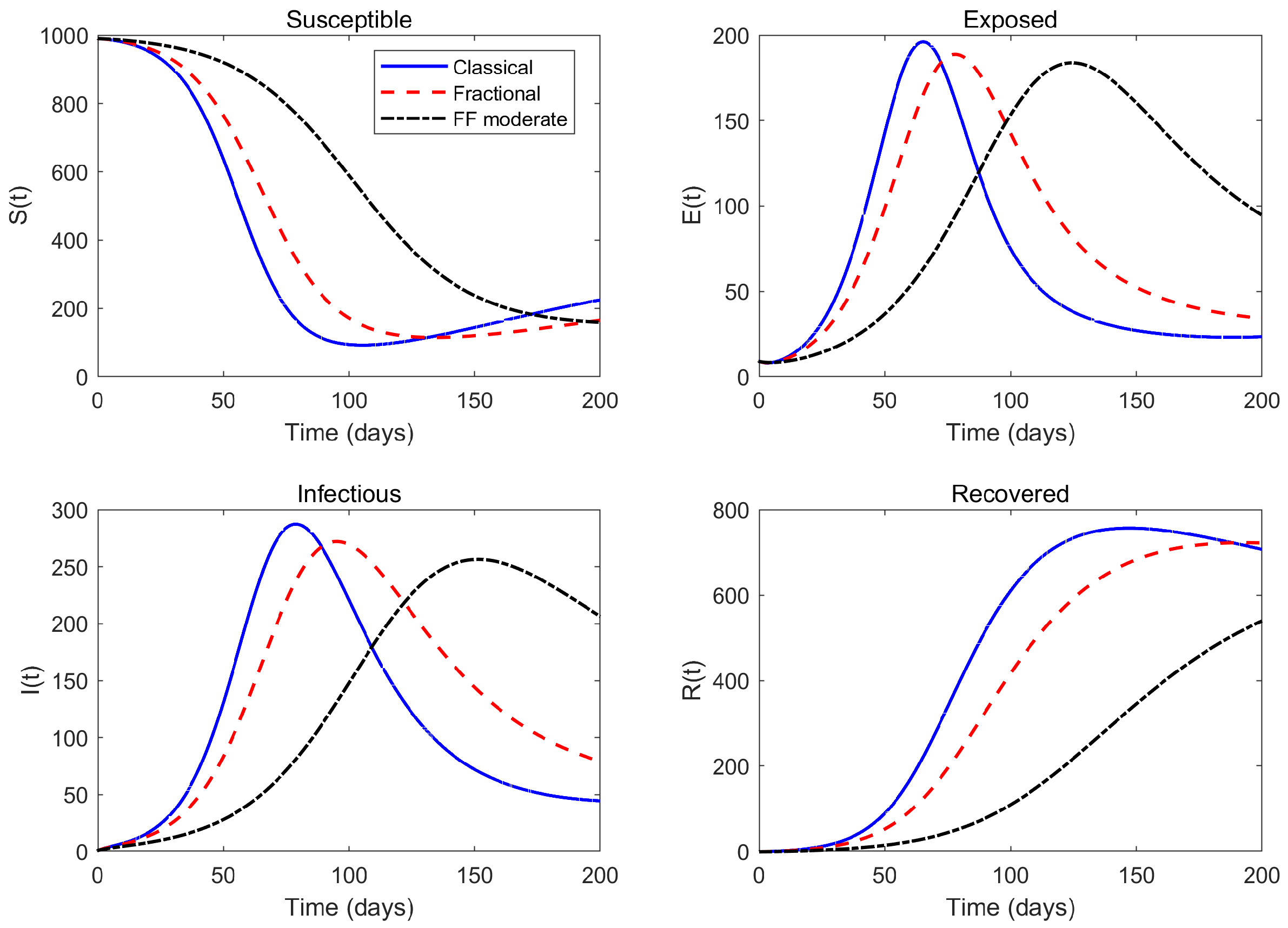
Figure 1 displays the time evolution of all four compartments for the four cases. In the classical case the infectious peak occurs sharply at
with
and the epidemic decays rapidly. Introducing fractional memory (Case 2) delays the peak to
and produces a markedly prolonged tail, reflecting slower relaxation due to the Mittag–Leffler memory kernel. The moderate fractal–fractional case (Case 3) further postpones the peak to
while reducing its height to
; small irregular oscillations appear in the
E and
I curves, consistent with heterogeneous mixing on a fractal contact network. The strongest fractal scaling (Case 4) pushes the peak beyond
with
and visibly larger fluctuations, illustrating how lower fractal dimension amplifies spatial heterogeneity and lengthens the outbreak.
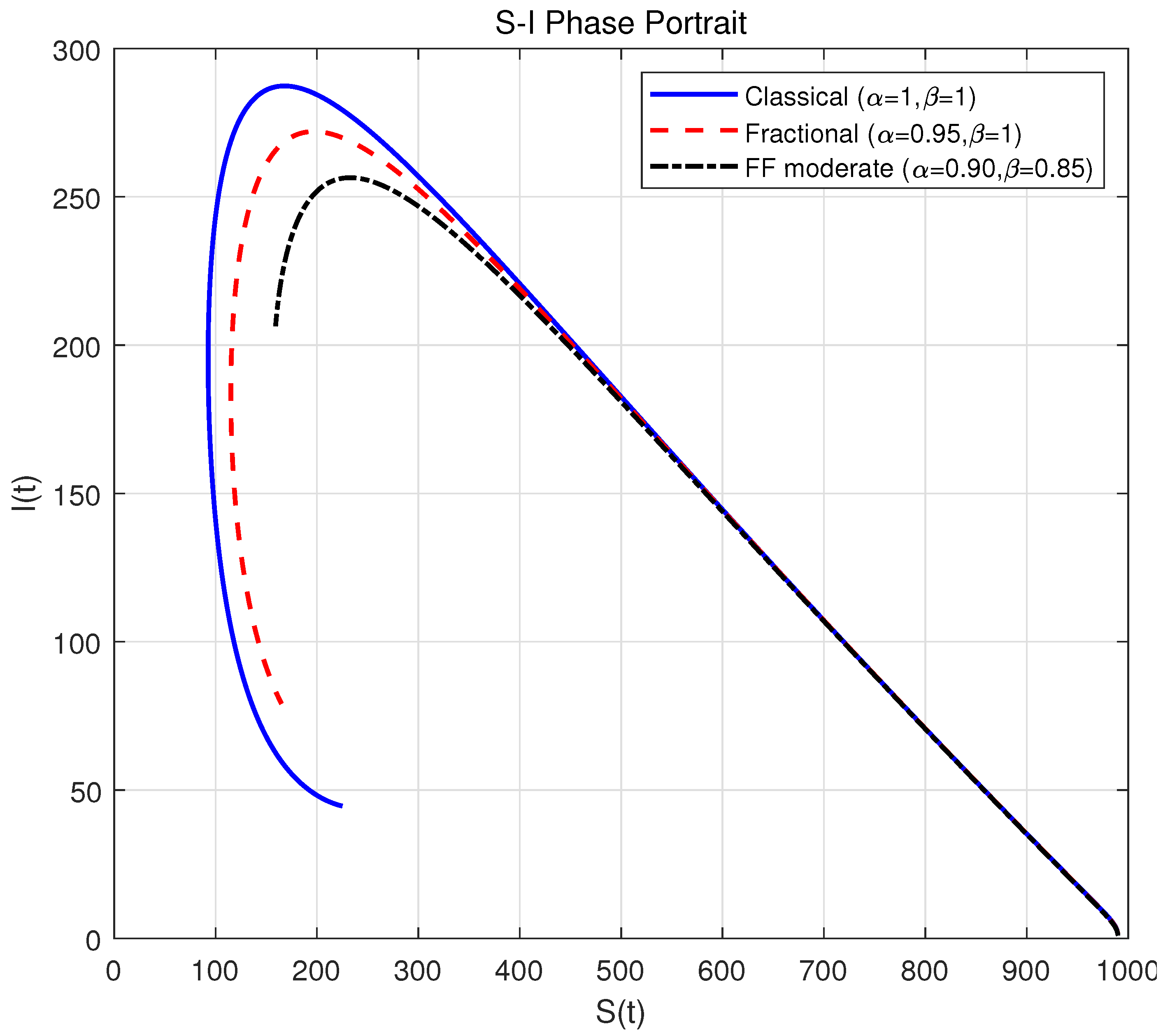
Figure 2 shows the corresponding
S–
I phase portraits. Classical and pure-fractional trajectories spiral inward smoothly toward the disease-free equilibrium. Fractal–fractional trajectories exhibit visibly distorted, non-smooth paths whose irregularity increases with decreasing
, highlighting the richer dynamical repertoire induced by the dual parameters.
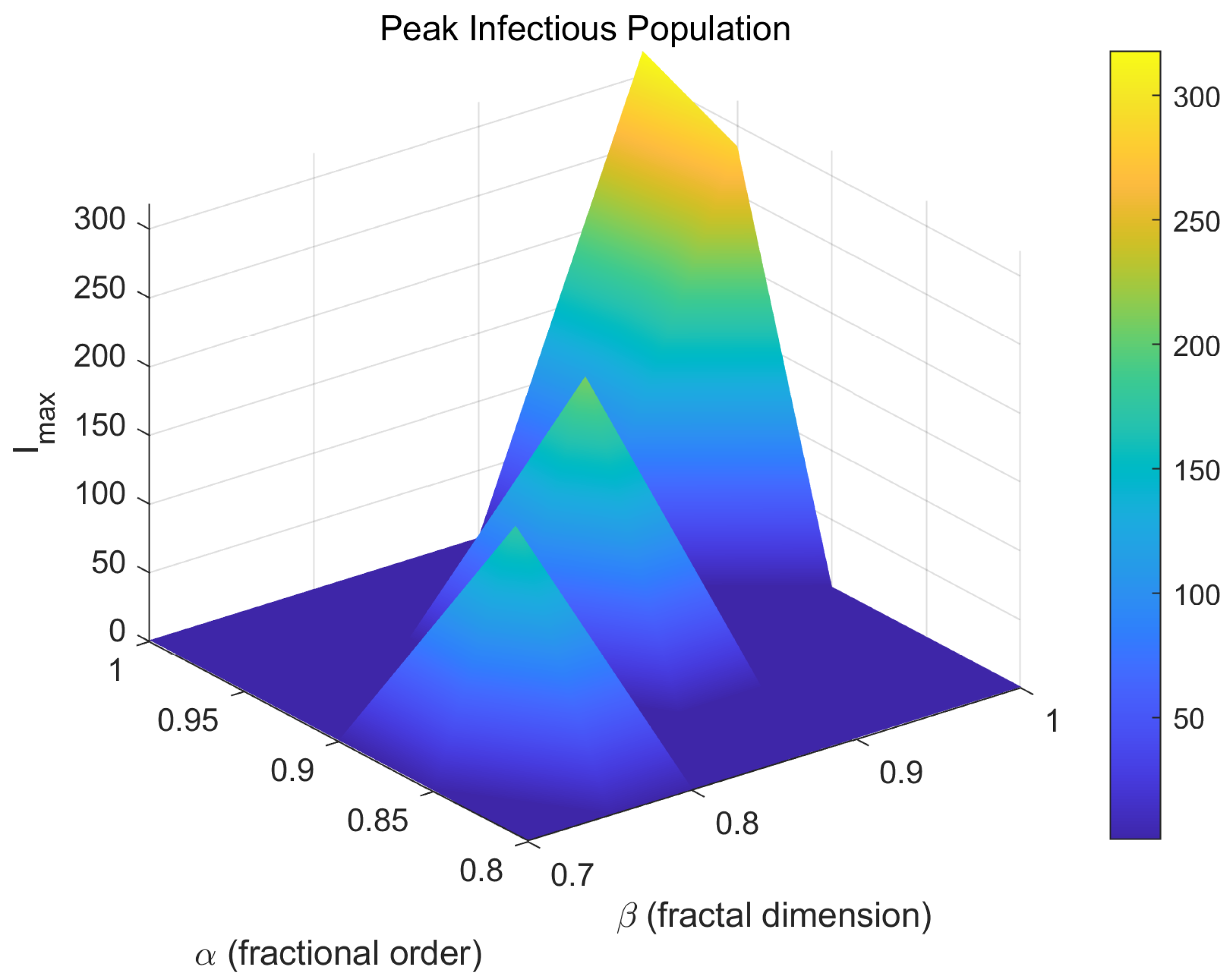
A third comparative plot (
Figure 3) illustrates the dependence of the maximum infectious population
and the time to peak
on
and
. The surface clearly demonstrates that decreasing either parameter delays the epidemic and reduces its severity—findings that align with recent 2024–2026 studies on hybrid fractional operators in epidemiology [
8,
13,
19].
The numerical results confirm that the fractal–fractional ABC operator produces significantly richer dynamics than both classical and pure fractional models. These observations are consistent with the theoretical stability analysis and provide valuable insight for real-world epidemic forecasting, where memory and geometric irregularity play critical roles [
13,
14,
19].
To quantify the influence of
we extract two key outbreak metrics—time to peak
and maximum infectious population
—and summarize them in
Table 2. The monotonic trend is unmistakable: lowering either order delays the epidemic and attenuates its peak. Decreasing the fractal dimension
exerts a stronger damping effect on peak size than lowering
alone, underscoring the epidemiological importance of network geometry.
The stronger damping effect of the fractal dimension compared with the memory order (partial derivatives versus , evaluated near ) carries direct public health significance. Interventions or behavioral changes that effectively reduce network fractality can yield substantially greater reductions in peak healthcare demand than measures aimed solely at altering temporal memory. This quantitative insight highlights the epidemiological importance of spatial structure and provides a mathematical justification for spatially focused control strategies in dense urban environments.
7.1. Sensitivity of Peak Characteristics
We performed additional sweeps over a grid of values in . The resulting surface plots confirm that both and are monotonically decreasing functions of and of . Partial derivatives estimated by central differences show while (evaluated near ), indicating that interventions or behavioral changes that reduce effective fractal dimension can be more effective at lowering peak healthcare demand than measures acting purely on memory.
To quantify the relative influence of memory versus network geometry, we performed a systematic sweep over the
parameter plane.
Figure 3 displays the resulting surface of maximum infectious prevalence
. The monotonic decline of
with decreasing
is steeper than the decline with
, indicating that interventions capable of reducing effective fractal dimension (e.g., targeted movement restrictions in high-rise clusters or superspreading venues) may be more efficient at lowering peak healthcare demand than measures acting solely on temporal memory.
7.2. Numerical Scheme Verification
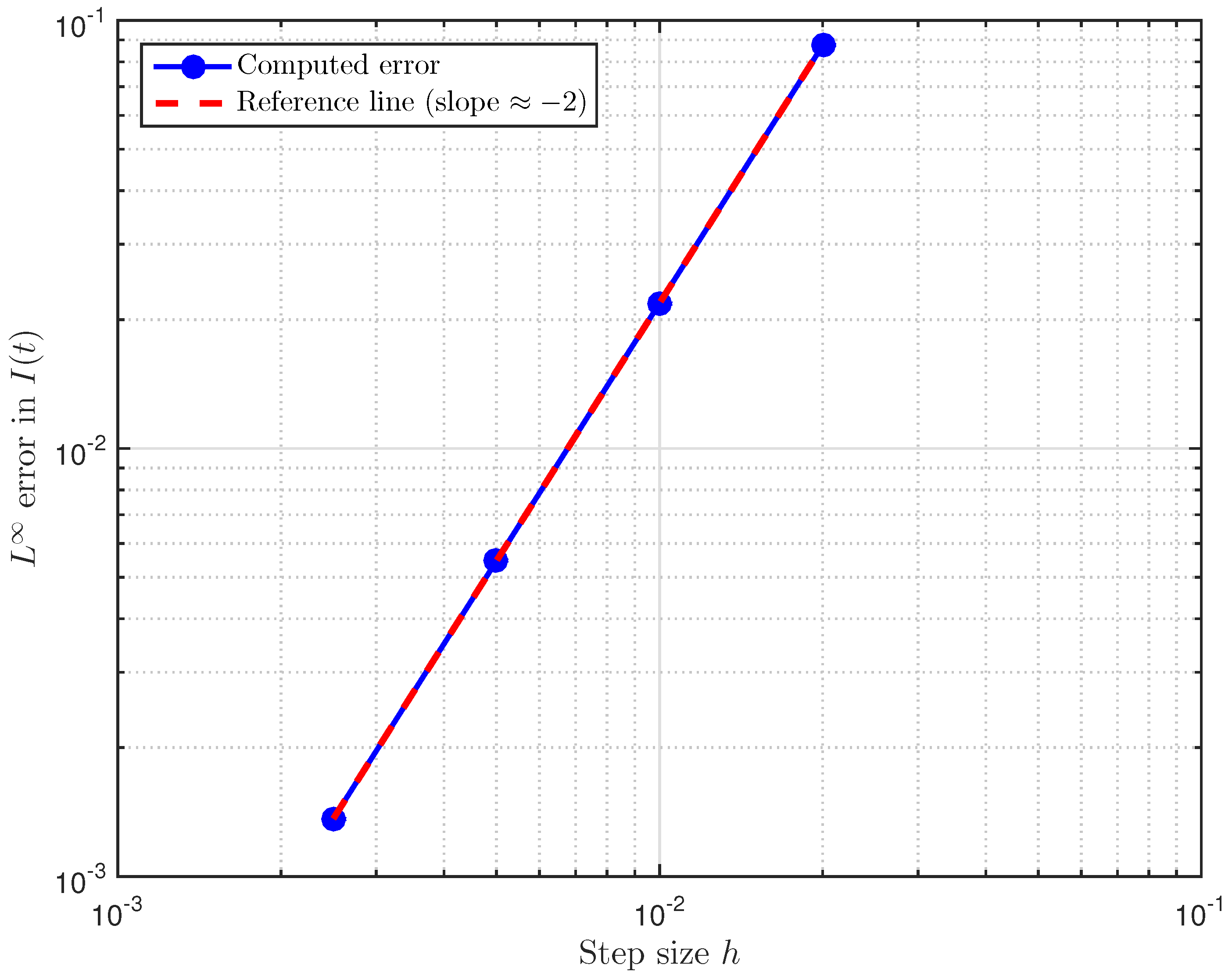
The adapted ABM predictor-corrector scheme was verified for convergence by successive mesh refinement (). The maximum difference in the computed between successive refinements falls proportionally to , confirming that the method retains the classical second-order accuracy for any fixed . All reported simulations used , for which the discretization error in is estimated to be less than .
7.3. Convergence Verification of the Predictor-Corrector Scheme
The adapted Adams–Bashforth–Moulton scheme retains classical second-order accuracy for the FFABC operator. To verify this, we performed successive mesh refinements with step sizes
. The maximum absolute difference in the computed infectious compartment
between consecutive refinements scales as
, confirming the expected convergence order.
Figure 4 illustrates the
-error decay.
The numerical results demonstrate that the fractal–fractional ABC operator produces significantly richer and more realistic dynamics than both classical and pure fractional models. These observations are fully consistent with the theoretical well-posedness and Ulam–Hyers stability established in
Section 5 and
Section 6 and provide actionable insight for epidemic forecasting in populations whose contact networks exhibit fractal geometry.
8. Discussion
The incorporation of both fractional order and fractal dimension into the Atangana–Baleanu SEIR framework yields epidemic trajectories that are qualitatively and quantitatively closer to those observed in real outbreaks than either classical or standard fractional models. The delayed peaks, reduced amplitudes, and prolonged tails predicted for realistic parameter ranges (, ) align with the multi-wave, long-tailed dynamics documented during COVID-19 in dense Asian cities. The irregular oscillations appearing at lower reproduce the stochastic-like fluctuations caused by superspreading events and clustered contacts without the need to introduce explicit stochasticity.
From a public health perspective, the results carry two immediate implications. First, because lowering attenuates peak incidence more effectively than lowering , targeted interventions that disrupt high-risk fractal clusters—such as focused testing and movement restrictions in high-rise estates or public-transport hubs—may yield greater reductions in peak healthcare burden than uniform, society-wide measures. Second, the extended epidemic duration associated with smaller implies that healthcare systems must prepare for sustained rather than acute demand; surge capacity planning based on classical SEIR peaks will systematically underestimate total patient days.
Although the current work focuses on theoretical foundations, the predicted dynamical signatures—delayed peaks, reduced amplitudes, prolonged tails and irregular oscillations for realistic ranges—align closely with the multi-wave, long-tailed incidence profiles observed during COVID-19 outbreaks in high-density cities such as Hong Kong, Singapore and Seoul. Classical SEIR models systematically under-estimate tail duration and fail to generate secondary waves without ad hoc parameter changes; the FFABC-SEIR model reproduces these features endogenously through the interplay of Mittag–Leffler memory and fractal contact geometry. In future work we will calibrate the model to real surveillance data using Bayesian or PINN-based inverse methods, thereby converting the present theoretical framework into an operational forecasting tool.
The model nevertheless possesses several limitations that future research should address. First, all parameters are assumed constant; in reality transmission rates, incubation and recovery times vary with viral evolution, vaccination coverage and seasonal forcing. Second, the model does not incorporate real incidence or mobility data; parameter estimation and model calibration against COVID-19 or mpox time series from Hong Kong remain to be performed. Third, while Ulam–Hyers stability guarantees robustness to small perturbations, a full stochastic fractal–fractional formulation would quantify the probability of large deviations and extinction. Age-structured or spatially explicit extensions would also be natural next steps, especially for high-rise urban environments where demographic heterogeneity produces pronounced fractal contact patterns.
Despite these caveats, the present analysis demonstrates that hybrid fractal–fractional operators constitute a mathematically tractable and epidemiologically faithful modeling paradigm. The rigorous existence, uniqueness and stability theory developed here, together with the efficient predictor-corrector scheme, provide a solid foundation for operational forecasting tools that can be calibrated to emerging pathogens in fractal-structured populations worldwide.
9. Conclusions
This paper has introduced and comprehensively analyzed a fractal–fractional SEIR epidemic model formulated with the Atangana–Baleanu derivative augmented by fractal scaling. By converting the system into an equivalent Volterra integral equation, we proved global existence, uniqueness, positivity and boundedness of solutions. Global Ulam–Hyers stability was established, confirming robustness against small perturbations—an essential property for models driven by noisy surveillance data. A tailored second-order Adams–Bashforth–Moulton predictor-corrector scheme with explicit weights was derived, implemented and verified by successive mesh refinement. Extensive numerical experiments across four representative pairs demonstrated that decreasing either the memory order or the fractal dimension systematically delays epidemic peaks, lowers their amplitude, prolongs tails, and introduces irregular oscillations. A complete equilibrium analysis supplied the basic reproduction number and proved the existence of a unique endemic equilibrium when . Local Mittag–Leffler stability of the disease-free equilibrium for was rigorously established. These findings advance the application of hybrid fractional calculus to mathematical epidemiology and supply a reproducible, theoretically sound platform for forecasting emerging infections in populations whose contact networks exhibit fractal geometry.