Article

A Stochastic Service System with N-Policy, Bernoulli Interruption Vacations and Patient Server
1
School of Mathematical Sciences, Chongqing University of Technology, Chongqing 400054, China
2
Faculty of Science, Civil aviation Flight University of China, Chengdu 641419, China
*
Author to whom correspondence should be addressed.
Axioms 2026, 15(7), 479; https://doi.org/10.3390/axioms15070479 (registering DOI)
Submission received: 24 May 2026 / Revised: 23 June 2026 / Accepted: 24 June 2026 / Published: 26 June 2026
(This article belongs to the Special Issue Advances in Mathematical Models and Applications)

Abstract

This paper studies a stochastic service system with N-policy, Bernoulli interruption vacations, and a patient server. When the number of waiting customers reaches the threshold N during a vacation, the server interrupts the vacation with probability p ( 0 p 1 ) , otherwise continuing the vacation until its completion. If the system is empty when a vacation ends, the server waits for a patience period before starting a new vacation. Service station failures occur during service, and interrupted service resumes after repair. We derive the Laplace transform expressions for the transient queue length probabilities and recursive formulas for the stationary queue length distribution. In addition, cost optimization models for the threshold N and the vacation length T are developed, both without and with an average waiting time constraint. Using the Particle Swarm Optimization algorithm, numerical examples under phase-type distributions illustrate how the probability p affects the optimal control policy.

1. Introduction

In the field of queueing theory, the fundamental aim is to investigate various strategic control mechanisms to increase the flexibility and efficiency of an operating system while achieving optimal cost. In industrial production, the switching between the dormant state and the working state of the queueing system requires a certain cost. For example, when computer numerical control (CNC) machine tools provide machining services, in addition to the necessary labour costs, there are costs for purchasing raw materials and tools, depreciation costs when the machine is turned on, etc. If the number of processed products is too small, it will not be able to obtain sufficient profit, resulting in system losses. Therefore, the manager often switches between states only after the system has accumulated an adequate number of customers (N-policy [1]), workload (D-policy [2]), or has been dormant for a long enough period (T-policy [3]). The dormant period is called “vacation” time; it was proposed by Levy and Yechiali [4] for efficient utilization of the server’s idle time.
In reality, services are not continuous, and it is a fact that services may be interrupted. Especially in manual services, continuous work can lead to physical and mental stress on the server, which can reduce the efficiency of work. The same is true for non-manual services. Therefore, the vacation queueing model is closer to practice. The vacation queueing model can also allow for the server to make full use of the idle state to engage in other auxiliary work, which helps reduce resource loss and cost. The study of vacation queueing systems has been a hot research topic in the field of queueing theory for nearly half a century. Many research results have been obtained, see e.g., Tian and Zhang [5], Ke et al. [6], Jyothsna et al. [7], Fiems [8], and Zhu and Wang [9]. There are two common types of vacations: single and multiple vacations [4]. Whether the vacation ends or not is usually controlled by various threshold strategies. For example, Kella [10] studied an M / G / 1 queue with multiple vacations and N-policy. Liu et al. [11] proposed the single-vacation M / G / 1 queue with D-policy.
However, in classical single vacation queues, the server cannot fully utilize the time waiting for the customer after returning to an empty system, which may affect system revenue, while in multiple vacation queues, the server will start another vacation after returning to an empty system. If the vacation time is too long, it will still increase customer waiting times and cause system congestion. Therefore, Boxma et al. [12] and Yechiali [13] respectively introduced the patient server to the M / G / 1 queue and M X / G / 1 queue—that is, the server activates a patience period and lies dormant after returning to an empty system from a vacation. The service station is activated immediately if a customer arrives before the patience period expires. Otherwise, another vacation begins. Wan and Lan [14] introduced the unreliable service station to the model by Boxma et al. [12] and discussed reliability metrics for the queueing system. Taking the length of the patience period to zero or infinity, the vacation mechanism can degenerate to the existing multiple and single vacation mechanisms, respectively.
With the progress of science and technology and the integration and complexity of modern machines, it is increasingly difficult for a single threshold strategy to meet practical needs. Scholars have conducted a lot of generalization studies on the model of having a single control strategy, and proposed e.g., min ( N , T ) -policy [15], min ( N , D ) -policy [16], min ( m , N ) -policy [17], etc. Min ( N , T ) -policy is one of the more widely used extension strategies, and it means that the server returns immediately once N customers arrive or the vacation time T expires, whichever occurs first. One of its generalized strategies, known as the min ( N , V ) -policy, is the most widely used policy in the N-policy-based promotion model. Under min ( N , V ) -policy control, the single vacation case involves the server returning to an empty system and remaining idle until the first customer arrives before providing service. In contrast, the multiple-vacation case indicates that the server returns and starts a new vacation if no arrivals are waiting. Hur et al. [18] considered an M / G / 1 queue under multiple vacations and min ( N , V ) -policy control by fixing the vacation length as T and demonstrated that min ( N , T ) -policy was more economically efficient than a single N- or T-policy. Li and Liu [19] discussed a multiple-vacation M / G / 1 queue under min ( N , V ) -policy in a random environment. Jiang et al. [20] further applied the M / G / 1 queueing model under the min ( N , T ) -policy to optimize the power consumption of sensor nodes and reduce energy losses of wireless sensors, demonstrating the application value of min ( N , T ) -policy.
In addition, since repairable queueing systems are complicated, most studies assume that service equipment will always be available, but this ideal scenario rarely exists in practice. The failure of service equipment due to age, wear and tear, corrosion, and other factors is unavoidable. The service is often interrupted by failures of the service facility, and only after it is repaired can the service be resumed. This strong practical background has led scholars to investigate repairable queueing systems with unreliable service stations. How the system manager can design the system properly and maintain its normal operation is essential for studying repairable queueing systems. Using the embedded Markov chain method, Gray et al. [21] studied the multiple vacations queue where the service station may fail during operation. Ke [22] proposed an M / G / 1 queue under min ( N , T ) -policy and unreliable server and determined the optimal thresholds of N and T. Wu et al. [23] investigated a single-vacation M / G / 1 queue with min ( N , V ) -policy and unreliable service station and obtained the optimal threshold N * . Assuming that service station failures can occur during busy periods, Senthil and Arumuganathan [24] investigated an M X / G / 1 retrial queue with unreliable server and analysed its queueing metrics and reliability metrics in detail. Jailaxmi et al. [25] further discussed the performance metrics of the multiple-vacation M X / G / 1 retrial queue by introducing the N-policy to the queueing model proposed by Senthil and Arumuganathan [24]. More discussion concerning repairable queueing systems can be found in Tang [26], Choudhury and Deka [27], Boualem [28], Wang et al. [29], and Kumar and Jain [30].
It is noted that min ( N , V ) -policy is usually combined with classical single-vacation or multiple-vacation mechanisms to control the queueing system. Therefore, the queue with min ( N , V ) -policy has the characteristics described above in the classical vacation mechanism—that is, in the classical single vacation mechanism, the time during which the server returns and waits for the customer to arrive is not fully utilized, while in the multiple vacations mechanism, the long vacation time increases the customers’ waiting time and even causes system congestion. In addition, when the waiting queue length reaches a pre-set threshold N, the vacation does not need to be interrupted immediately for various reasons. Continuing the server’s vacation may result in a higher vacation payoff. Considering the above facts and inspired by Kella [10], Wan and Lan [14], Hur et al. [18], Wu et al. [23], and Gnedenko and Kovalenko [31], we develop a new repairable queueing model: an N-policy M / G / 1 with Bernoulli interruption vacations and a patient server. It aims to make min ( N , V ) -policy more realistic and flexible in its application. Bernoulli interruption vacations mean that, once the queue size reaches N before V expires, V is interrupted with probability p ( 0 p 1 ) . Since the service is resumed from the interrupted point after repair and the breakdown process is assumed to be a stationary Poisson process, the influence of server breakdowns can be incorporated through a classical total probability decomposition or equivalently through an effective service time argument. This idea can be traced back to the classical work of Gnedenko and Kovalenko [31] and has been further adopted in later studies on queueing systems with unreliable servers.
The main contributions are given below:
(1)
This paper develops an M / G / 1 repairable queue that combines an N-policy, Bernoulli interruption vacations, and a patient server. The model extends the work of Wan and Lan [14], Hur et al. [18], and Wu et al. [23]. It helps managers schedule the startup policies of services more flexibly.
(2)
Utilizing analytical techniques different from the embedded Markov chain and the supplementary variable, we perform a transient and stationary queue size analysis for arbitrary initial queue size, employing the Laplace transform and the total probability decomposition technique.
(3)
We obtain recursive stationary queue length probabilities and use them to compute performance measures, including the expected queue length and busy cycle quantities. These stationary probabilities are further used to illustrate why capacity design based only on the expected queue length can be misleading.
(4)
Cost models for the one-dimensional threshold policy N and the two-dimensional policy ( N , T ) , both without and with an average waiting time constraint, are developed. Optimal values under phase-type distributions are obtained by the PSO algorithm from the perspectives of both managers and customers, which is conducive to balancing the interests of managers and customers.
The remainder of the paper is organized as follows: The next section concentrates on model descriptions and preliminaries. Section 3 performs the transient and stationary analysis of the queue size. Section 4 discusses the system capacity optimization design with a numerical example. In Section 5, under a given cost structure model and PH distributions, several numerical examples without and with the constraint of average waiting time are presented to investigate the optimal thresholds N * and ( N * , T * ) (the vacation time is fixed as T). The effects of the probability p on N * and ( N * , T * ) are discussed. Section 6 concludes the paper and outlines research directions in the future.

2. Model Description and Preliminaries

2.1. Model Description

The assumptions listed below are made for formulating an N-policy M / G / 1 repairable queue with Bernoulli interruption vacations and a patient server.
(1)
Arrival process and service process: A server (service station) provides service and the system offers infinite waiting space for customers under the FCFS discipline. The customer arrival process is a Poisson process with parameter λ   ( λ > 0 ) . In other words, the inter-arrival times τ n ( n = 1 , 2 , ) have the same cumulative distribution function (CDF) R ( t ) = 1 exp ( λ t ) . The service times χ n ( n = 1 , 2 , ) have the same CDF S ( t ) and finite mean E [ χ ] .
(2)
Bernoulli interruption vacation mechanism under N -policy and a patient server: The server takes a vacation V once the system is empty. V has CDF V ( t ) with a finite mean E [ V ] . (i) If the length of the waiting line reaches a pre-set threshold N before V expires, then the server interrupts V with probability p   ( 0 p 1 ) and returns or continues V with p ¯ ( = 1 p ) until V ends. (ii) If there are arrivals during V, but fewer than N arrivals, the server returns and starts the service station when V ends. (iii) After returning to an empty system from a vacation, the server activates a patience period U with distribution U ( t ) and a finite mean E [ U ] . The server remains idle during U and waits for the first arrival. If a customer arrives before U expires, U is interrupted, and the service station is activated to offer service immediately. Otherwise, another vacation begins when U expires (i.e., no customer arrives until U expires).
(3)
Stochastic failures: During service, the service station may fail randomly. Let X denote the time to failure or, equivalently, the inter-breakdown time during operation, and assume that X is exponentially distributed with rate ω   ( ω > 0 ) . Once a failure occurs, the customer’s service is interrupted and the service station enters repair immediately. Let Z denote the repair or recovery time of the service station, with distribution Z ( t ) and finite mean E [ Z ] . After repair is completed, the interrupted customer resumes service from the point of interruption; hence the elapsed effective service is cumulative.
(4)
Furthermore, assume that repairs make the service station “as good as new” and all stochastic processes mentioned above are independent. In addition, to calculate the transient distribution of system size, suppose that if at least one customer is on hold at the first moment, the service is started at once. Otherwise, the server will remain idle to the first one arrives.
Application: We illustrate the application of this model with an example of a lean production system Since customers are very sensitive to delivery dates, Just-In-Time is a typical feature in this system. Orders will be affected if equipment downtime affects a production process, harming the enterprise’s efficiency and reputation. The enterprise organizes the preventive maintenance of production equipment by maintenance specialists during vacations or the production off-season. This action can reduce the amount of unplanned downtime, ensure on-time delivery as much as possible, and lower the cost of breakdown maintenance. Thus, whenever the production task is completed, the system manager starts a preventive maintenance period of random length, during which, if N customers are accumulated, the maintenance is terminated with probability p immediately or the maintenance is continued with probability p ¯ (because some overhauls cannot be interrupted at any time) until the completion of this round of maintenance. Then, the manager starts processing the waiting orders. Suppose that no orders need to be processed by the end of the maintenance; in that case, the manager waits for a random time (common in business practice), after which there are still no orders (i.e., the system is in the off-season), and then restarts overhauling the equipment. During the working period, production will be interrupted due to various unforeseen conditions, such as lack of raw materials and improper maintenance of the production equipment, and the equipment will resume working again once the problem is solved. In this lean production system, preventive maintenance time, the orders, the manager, the production equipment, and the manager’s random waiting time correspond to vacation time, the customers, the server, the service station, and the patience period in queueing terminology, respectively.
Moreover, some notations used in our work are provided in Table 1 below

2.2. Preliminaries

For the later mathematical analysis, we first provide several definitions, as shown below.
Definition 1
(Generalized service time for a customer). This is the period from the moment a customer receives service until the service is finished, including the time for repairs, and is denoted by the symbol χ ˜ .
Let S ˜ ( t ) = P { χ ˜ t } be the CDF of χ ˜ , and Z ( k ) ( t ) be the k-fold convolution of Z ( t ) . Using a similar argument in Boualem [28] and the result in Tang [26], we get
S ˜ ( t ) = k = 0 0 t Z k t x e ω x ω x k k ! d S ( x ) .
Furthermore, the Laplace–Stieltjes transform (LST) of S ˜ ( t ) is s ˜ ( α ) = 0 e α t d S ˜ ( t ) = s ( α + ω ω z ( α ) ) , where z ( α ) = 0 e α t d Z ( t ) . E [ χ ˜ ] = E [ χ ] 1 + ω E [ Z ] represents the first moment of χ ˜ .
Definition 2
(Server’s generalized busy period). It is the time span from when the server begins service until the system becomes empty, including the time for repairs.
Definition 3
(System idle period). It is the period between the moment the last customer leaves and the arrival of the next customer. Let τ ^ i denote the i-th ( i 1 ) system idle period, and its CDF is R ( t ) = 1 e λ t . The LST of R ( t ) is determined as r ( α ) = 0 e α t d R ( t ) .
Let b ˜ < i > ( i 1 ) denote the generalized busy period starting with i customers, and B ˜ i ( t ) denote the CDF of b ˜ < i > . In particular, B ˜ ( t ) is the CDF of b ˜ , and b ˜ ( α ) = 0 e α t d B ˜ ( t ) . Then, Lemma 1 follows.
Lemma 1
(see [26]). Let ( α ) be the real part of α. For ( α ) > 0 and | z | < 1 , b ˜ ( α ) is the unique solution to z = s ˜ ( α + λ ( 1 z ) ) , then
B ˜ t = m = 1 0 t λ x m 1 m ! e λ x d S ˜ m x , t 0 , lim t B ˜ t = lim α 0 + b ˜ α = 1 , λ 1 + ω E [ Z ] E [ χ ] 1 , ϖ < 1 , λ 1 + ω E [ Z ] E [ χ ] > 1 , E [ b ˜ ] = λ 1 + ω E [ Z ] E [ χ ] λ 1 λ 1 + ω E [ Z ] E [ χ ] , λ 1 + ω E [ Z ] E [ χ ] < 1 , , λ 1 + ω E [ Z ] E [ χ ] 1 ,
Let L ( t ) denote the system size at epoch t. For j 1 , the joint distribution of b ˜ and L ( t ) is defined as H j ( t ) = P 0 t < b ˜ ; L ( t ) = j . Its boundary conditions are H 1 ( 0 ) = 1 and H j ( 0 ) = 0 , j 2 . Then Lemma 2 follows.
Lemma 2
(see [26]). For α > 0 , let h j * α = 0 e α t H j ( t ) d t denote the Laplace transform (LT) of H j ( t ) , the recurrence formulas of h j * ( α ) are written as
h 1 * α = b ˜ α 1 s ˜ α + λ α + λ s ˜ α + λ ,
h j * α = b ˜ α s ˜ α + λ 0 [ 1 S ˜ ( t ) ] e ( α + λ ) t λ t j 1 j 1 ! d t + 1 s ˜ α + λ j 1 m = 1 h j m * α b ˜ m α b ˜ α m k = 0 0 λ b ˜ α t k k ! e α + λ t d S ˜ t , j > 1 ,
where b ˜ ( α ) is determined in Lemma 1, and m = k j = 0 if j < k .

3. Queue Size Analysis

3.1. Transient Behavior of Queue Size

For i , j = 0 , 1 , , under the initial condition L ( 0 ) = i , let p i j ( t ) = P { L ( t ) = j | L ( 0 ) = i } denote the probability that the queue size equals j at an arbitrary epoch t, and its LT is p i j * ( α ) = 0 e α t p i j ( t ) d t .
Theorem 1.
For α > 0 and i 0 , the conclusions are drawn as follows:
p 00 * ( α ) = 1 r ( α ) α 1 + r ( α ) b ˜ ( α ) 1 v ( α + λ ) u ( α + λ ) 1 v ( α + λ ) u ( α + λ ) Δ ( α ) ,
p i 0 * ( α ) = 1 r ( α ) α · [ b ˜ ( α ) ] i 1 v ( α + λ ) u ( α + λ ) 1 v ( α + λ ) u ( α + λ ) Δ ( α ) ,
where
v ( α + λ ) = 0 e α + λ t d V ( t ) , u ( α + λ ) = 0 e α + λ t d U ( t ) , v n ( α ) = 0 e ( α + λ ) t ( λ t ) n n ! d V ( t ) , Δ ( α ) = n = 1 N 1 [ b ˜ ( α ) ] n v n ( α ) + p ¯ n = N [ b ˜ ( α ) ] n v n ( α ) + p [ b ˜ ( α ) ] N 0 e α t V ¯ ( t ) d R ( N ) ( t ) + r ( α ) b ˜ ( α ) v ( α + λ ) [ 1 u ( α + λ ) ] .
Proof. 
Let l 0 = Π 0 = Λ 0 = 0 , l n = i = 1 n τ i , Π k = m = 1 k V m , Λ k = m = 1 k U m , i , m , n , k 1 , and R ( t ) S ( t ) = 0 t R ( t x ) d S ( x ) = 0 t S ( t x ) d R ( x ) . Since the start and end moments of the generalized busy period of the server are moments of renewal. For i 1 , the following Equation (6) can be derived.
p i 0 ( t ) = P { b ˜ < i > t < b ˜ < i > + τ ^ 1 } + P { b ˜ < i > + τ ^ 1 t ; L ( t ) = 0 } = 0 t R ¯ ( t x ) d B ˜ ( i ) ( x ) + P { b ˜ < i > + τ ^ 1 t ; L ( t ) = 0 } ,
where the first term of Equation (6) is interpreted as the probability of t being in τ ^ 1 . Suppose there is no arrival in the first ( k 1 ) vacations and patient periods. The last term in Equation (6) is further divided into four cases according to the number of arrivals in V k . They indicate the probabilities that t lies after the end of V k and the system is empty (see Figure 1, Figure 2, Figure 3 and Figure 4).
The sum of probabilities of the above four scenarios occurring is given by
k = 1 n = 1 N 1 P { b ˜ < i > + Π k + Λ k 1 t ; Π k 1 + Λ k 1 τ 1 ; τ 1 + l n 1 Π k + Λ k 1 < τ 1 + l n ; L ( t ) = 0 } + p k = 1 P { b ˜ < i > + Π k 1 + Λ k 1 + l N t ; Π k 1 + Λ k 1 τ 1 ; τ 1 + l N 1 Π k + Λ k 1 ; L ( t ) = 0 } + p ¯ k = 1 n = N P { b ˜ < i > + Π k + Λ k 1 t ; Π k 1 + Λ k 1 τ 1 ; τ 1 + l n 1 Π k + Λ k 1 < τ 1 + l n ; L ( t ) = 0 } + k = 1 P { b ˜ < i > + τ 1 t ; Π k + Λ k 1 τ 1 < Π k + Λ k ; L ( t ) = 0 } = k = 1 n = 1 N 1 0 t 0 t x 0 t x y λ z n n ! e λ y + z p n 0 t x y z · d V ( z ) d V ( k 1 ) ( y ) U ( k 1 ) ( y ) d B ˜ ( i ) ( x ) + p k = 1 0 t 0 t x 0 t x y V ¯ ( z ) e λ y p N 0 t x y z · d R ( N ) ( z ) d V ( k 1 ) ( y ) U ( k 1 ) ( y ) d B ˜ ( i ) ( x ) + p ¯ k = 1 n = N 0 t 0 t x 0 t x y λ z n n ! e λ y + z p n 0 t x y z · d V ( z ) d V ( k 1 ) ( y ) U ( k 1 ) ( y ) d B ˜ ( i ) ( x ) + k = 1 0 t 0 t x 0 t x y U ¯ ( z ) e λ y p 10 t x y z · d R ( z ) d V ( k ) ( y ) U ( k 1 ) ( y ) d B ˜ ( i ) ( x ) .
Substituting Equation (7) into Equation (6) yields the decomposition of p i 0 ( t ) . It follows from the expression of p i 0 ( t ) that this leads to convolutions and infinite sums over repeated cycles. The Laplace transform is useful here because it converts convolutions into products and converts the repeated vacation–patience cycles into a compact geometric factor. This allows the transient probabilities to be written in closed transform form. Then taking the LT of p i 0 ( t ) gives
p i 0 * ( α ) = [ b ˜ ( α ) ] i 1 r ( α ) α + ζ j ( α ) 1 v ( α + λ ) u ( α + λ ) ,
where
ζ j ( α ) = n = 1 N 1 p n 0 * ( α ) v n ( α ) + p · p N 0 * ( α ) 0 e α t V ¯ ( t ) d R ( N ) ( t ) + p ¯ n = N p n 0 * ( α ) v n ( α ) + r ( α ) v ( α + λ ) [ 1 u ( α + λ ) ] p 10 * ( α ) .
Since the system size is 0 at the initial moment, the server waits until the first one arrives before providing service. Hence
p 00 ( t ) = P { 0 t < τ ^ 1 } + P { τ ^ 1 + b ˜ 1 t ; L ( t ) = 0 } = R ¯ ( t ) + 0 t p 10 ( t x ) d R ( x ) = R ¯ ( t ) + p 10 ( t ) R ( t ) .
Noting that
0 e α t [ 1 R ( t ) ] d t = 1 α 0 ( 1 R ( t ) ) d ( e α t ) = 1 α e α t ( 1 R ( t ) ) | 0 0 e α t d ( 1 R ( t ) ) = 1 α 1 + 0 e α t d R ( t ) = 1 r ( α ) α ,
we take the LT on Equation (9) to obtain
p 00 * ( α ) = 1 r ( α ) α + p 10 * ( α ) r ( α ) .
From Equations (8) and (10), we obtain
p 00 * ( α ) = 1 r ( α ) 1 + r ( α ) b ˜ ( α ) α + r ( α ) b ˜ ( α ) ζ j ( α ) 1 v ( α + λ ) u ( α + λ ) .
According to Equations (8) and (11), the relation between p i 0 * ( α ) and p 00 * ( α ) is given by
p i 0 * ( α ) = [ b ˜ ( α ) ] i 1 r ( α ) p 00 * ( α ) 1 r ( α ) α , i 1 .
Substituting Equation (12) into Equation (11) gives Equation (4), and then substituting Equation (4) back into (12) yields Equation (5).   □
Theorem 2.
For α > 0 and i 0 , the following conclusions hold:
(1) 
For j = 1 , 2 , , N 1 , then
p 0 j * ( α ) = r ( α ) h j * ( α ) + h j * ( α ) r ( α ) b ˜ ( α ) v ( α + λ ) 1 u ( α + λ ) + η j ( α ) + δ j ( α ) 1 v ( α + λ ) u ( α + λ ) Δ ( α ) ,
p i j * ( α ) = k = 1 i h j i + k * ( α ) [ b ˜ ( α ) ] k 1 + [ b ˜ ( α ) ] i 1 h j * ( α ) r ( α ) b ˜ ( α ) v ( α + λ ) 1 u ( α + λ ) + η j ( α ) + δ j ( α ) 1 v ( α + λ ) u ( α + λ ) Δ ( α ) ;
(2) 
For j = N , N + 1 , , then
p 0 j * ( α ) = r ( α ) h j * ( α ) + h j * ( α ) r ( α ) b ˜ ( α ) v ( α + λ ) 1 u ( α + λ ) + p ¯ η j ( α ) + δ j ( α ) 1 v ( α + λ ) u ( α + λ ) Δ ( α ) ,
p i j * ( α ) = k = 1 i h j i + k * ( α ) [ b ˜ ( α ) ] k 1 + [ b ˜ ( α ) ] i 1 h j * ( α ) r ( α ) b ˜ ( α ) v ( α + λ ) 1 u ( α + λ ) + p ¯ η j ( α ) + δ j ( α ) 1 v ( α + λ ) u ( α + λ ) Δ ( α ) ,
where Δ ( α ) and v n ( α ) are defined in Theorem 1,
η j ( α ) = b ˜ ( α ) 0 e ( α + λ ) t ( λ t ) j j ! V ¯ ( t ) d t , δ j ( α ) = n = 1 N 1 k = 1 n h j n + k * ( α ) [ b ˜ ( α ) ] k v n ( α ) + p ¯ n = N k = 1 n h j n + k * ( α ) [ b ˜ ( α ) ] k v n ( α ) + p k = 1 N h j N + k * ( α ) [ b ˜ ( α ) ] k 0 e α t V ¯ ( t ) d R ( N ) ( t ) .
Proof. 
(1) For j = 1 , 2 , , N 1 , having queue size j at epoch t is equivalent to t in a vacation or the server’s generalized busy period, and the queue size equals j.
p 0 j ( t ) = P { τ ^ 1 t < τ ^ 1 + b ˜ 1 ; L ( t ) = j } + P { τ ^ 1 + b ˜ 1 + τ ^ 2 t ; L ( t ) = j } = 0 t H j ( t x ) d R ( x ) + P { τ ^ 1 + b ˜ 1 + τ ^ 2 t ; L ( t ) = j } ,
where the first term is the probability that t falls in the first generalized busy period with queue size j, while the second term involves five mutually exclusive scenarios. These scenarios are as follows: Scenario 1: Epoch t lies in V k and at least j arrivals have occurred. Scenario 2: 1 n N 1 arrivals occur during V k , the server returns when V k ends, and the subsequent generalized busy period has queue size j at t. Scenario 3: N arrivals occur before V k ends and the vacation is interrupted with probability p. Scenario 4: At least N arrivals occur, but the vacation is not interrupted, with probability p ¯ , and the server returns only when V k ends. Scenario 5: No arrivals occur during V k , an arrival occurs during the patience period U k , and the subsequent generalized busy period has queue size j at t. The five terms in Equation (19) correspond respectively to these cases. We write Scenario 1 in detail as a representative calculation:
Scenario 1: The number of arrivals before V k expires is at least j. Epoch t lies in V k and the queue size is j.
The probability of Scenario 1 is as follows:
k = 1 P { τ ^ 1 + b ˜ 1 + Π k 1 + Λ k 1 t < τ ^ 1 + b ˜ 1 + Π k + Λ k 1 ; Π k 1 + Λ k 1 τ ^ 2 < Π k + Λ k 1 ; τ ^ 1 + b ˜ 1 + τ ^ 2 + l j 1 t < τ ^ 1 + b ˜ 1 + τ ^ 2 + l j } = k = 1 0 t 0 t x λ ( t x y ) j j ! e λ t x V ¯ ( t x y ) · d V ( k 1 ) ( y ) U ( k 1 ) ( y ) d R ( x ) B ˜ ( x ) .
The probabilities of the remaining four scenarios are obtained similarly to the analysis of p 00 ( t ) . Hence
p 0 j ( t ) = 0 t H j ( t x ) d R ( x ) + k = 1 0 t 0 t x λ ( t x y ) j j ! e λ t x V ¯ ( t x y ) · d V ( k 1 ) ( y ) U ( k 1 ) ( y ) d R ( x ) B ˜ ( x ) + k = 1 n = 1 N 1 0 t 0 t x 0 t x y λ z n n ! e λ y + z p n j t x y z · d V ( z ) d V ( k 1 ) ( y ) U ( k 1 ) ( y ) d R ( x ) B ˜ ( x ) + p k = 1 0 t 0 t x 0 t x y V ¯ ( z ) e λ y p N j t x y z · d R ( N ) ( z ) d V ( k 1 ) ( y ) U ( k 1 ) ( y ) d R ( x ) B ˜ ( x ) + p ¯ k = 1 n = N 0 t 0 t x 0 t x y λ z n n ! e λ y + z p n j t x y z · d V ( z ) d V ( k 1 ) ( y ) U ( k 1 ) ( y ) d R ( x ) B ˜ ( x ) + k = 1 0 t 0 t x 0 t x y U ¯ ( z ) e λ y p 1 j t x y z · d R ( z ) d V ( k ) ( y ) U ( k 1 ) ( y ) d R ( x ) B ˜ ( x ) .
For i 1 , it follows that
p i j ( t ) = P b ˜ i > t 0 ; L ( t ) = j + P b ˜ i t ; L ( t ) = j = k = 1 i H j i + k ( t ) B ˜ ( k 1 ) ( t ) + P b ˜ i t ; L ( t ) = j ,
where the second term in Equation (20) follows similarly from the decomposition in (17). Then taking the LT of p 0 j ( t ) and p i j ( t ) yields
p 0 j * ( α ) = h j * ( α ) r ( α ) + r ( α ) b ˜ ( α ) ϑ j ( α ) 1 v ( α + λ ) u ( α + λ ) ,
p i j * ( α ) = k = 1 i h j i + k * ( α ) b ˜ k 1 ( α ) + b ˜ i ( α ) ϑ j ( α ) 1 v ( α + λ ) u ( α + λ ) ,
where
ϑ j ( α ) = 0 e ( α + λ ) t ( λ t ) j j ! V ¯ ( t ) d t + n = 1 N 1 p n j * ( α ) v n ( α ) + p ¯ n = N p n j * ( α ) v n ( α ) + p · p N j * ( α ) 0 e α t V ¯ ( t ) d R ( N ) ( t ) + r ( α ) v ( α + λ ) [ 1 u ( α + λ ) ] p 1 j * ( α ) .
From Equations (21) and (22), for i 1 , p 0 j * ( α ) and p i j * ( α ) relate as
p i j * ( α ) = k = 1 i h j i + k * ( α ) [ b ˜ ( α ) ] k 1 + [ b ˜ ( α ) ] i 1 r ( α ) p 0 j * ( α ) r ( α ) h j * ( α ) .
Substituting Equation (23) into (21) gives Equation (13), then substituting Equation (13) into (23) yields (14).
(2)  For j = N , N + 1 , , the proof is similar to that of (1).    □

3.2. Recurrence Formulas for Stationary Queue Size Distribution

According to the results in Theorems 1 and 2 above, this section derives Theorem 3 by performing mathematical calculations.
Theorem 3.
Define p j = lim t P { L ( t ) = j } for j = 0 , 1 , 2 , , then
(1) 
If ρ ˜ 1 , then p j = 0 ;
(2) 
If ρ ˜ < 1 , then the recurrence formulas are
p 0 = ( 1 ρ ˜ ) 1 v ( λ ) u ( λ ) p ¯ λ E [ V ] + p m = 1 N 0 R ( m ) ( t ) d V ( t ) + v ( λ ) 1 u ( λ ) ,
p j = λ ( 1 ρ ˜ ) h j v ( λ ) 1 u ( λ ) + η j + δ j p ¯ λ E [ V ] + p m = 1 N 0 R ( m ) ( t ) d V ( t ) + v ( λ ) 1 u ( λ ) , j = 1 , 2 , N 1 ,
p j = λ ( 1 ρ ˜ ) h j v ( λ ) 1 u ( λ ) + p ¯ η j + δ j p ¯ λ E [ V ] + p m = 1 N 0 R ( m ) ( t ) d V ( t ) + v ( λ ) 1 u ( λ ) , j = N , N + 1 , ,
where
ρ ˜ = λ 1 + ω E [ Z ] E [ χ ] , v n = 0 ( λ t ) n n ! e λ t d V ( t ) , η j = 0 e λ t ( λ t ) j j ! V ¯ ( t ) d t , δ j = n = 1 N 1 k = 1 n h j n + k v n + p k = 1 N h j N + k 0 V ¯ ( t ) d R ( N ) ( t ) + p ¯ n = N k = 1 n h j n + k v n , h j = lim α 0 + h j * ( α ) = 1 s ˜ ( λ ) 0 1 S ˜ ( t ) ( λ t ) j 1 ( j 1 ) ! e λ t d t + 1 s ˜ ( λ ) m = 1 j 1 h j m 1 i = 0 m 0 ( λ t ) i i ! e λ t d S ˜ ( t ) .
Proof. 
Note that by exchanging the limit and summation (justified by dominated convergence), we have
p j = i = 0 P { L ( 0 ) = i } lim t p i j ( t ) ,
and
lim t p i j ( t ) = lim α 0 + α p i j * ( α ) .
Next, we calculate lim α 0 + α p i j * ( α ) .
(1)
If ρ ˜ = 1 , since lim α 0 + b ˜ ( α ) = 1 , then
lim α 0 + 1 v ( α + λ ) u ( α + λ ) Δ ( α ) = 1 v ( λ ) u ( λ ) n = 1 N 1 v n p 0 V ¯ ( t ) d R ( N ) ( t ) p ¯ n = N v n 1 u ( λ ) v ( λ ) = 0 ,
and
lim α 0 + d d α 1 v ( α + λ ) u ( α + λ ) Δ ( α ) = E [ b ˜ ] + 1 λ p ¯ λ E [ V ] + p m = 1 N 0 R ( m ) ( t ) d V ( t ) + 1 u ( λ ) v ( λ ) .
By the conclusion in Lemma 1, substituting E [ b ˜ ] = into Equation (28) gives
lim α 0 + d d α 1 v ( α + λ ) u ( α + λ ) Δ ( α ) = .
Then applying L’Hospital’s rule yields p j = lim α 0 + α p i j * ( α ) = 0 . Thus, for j 0 , we obtain p j = 0 .
(2)
When ρ ˜ > 1 , for i , j = 0 , 1 , 2 , , we know that lim α 0 + b ˜ ( α ) = ϖ ( 0 < ϖ < 1 ) and lim α 0 + 1 v ( α + λ ) u ( α + λ ) Δ ( α ) 0 . Equation lim α 0 + α p i j * ( α ) = 0 can be obtained through a simple mathematical operation.
(3)
When ρ ˜ < 1 , from Lemma 1, we notice that lim α 0 + b ˜ ( α ) = 1 and E [ b ˜ ] = ρ ˜ λ ( 1 ρ ˜ ) , substituting E [ b ˜ ] into Equation (28) yields
lim α 0 + d Δ ( α ) d α = 1 λ 1 ρ ˜ p ¯ λ E [ V ] + p m = 1 N 0 R ( m ) ( t ) d V ( t ) + v ( λ ) 1 u ( λ ) ,
and employing L’Hospital’s rule again yields the desired Equations (24)–(26).
Finally, to validate the obtained results, we will prove that j = 0 p j = 1 under the steady-state condition ρ ˜ < 1 . After some calculation, we obtain
j = 0 p j = ( 1 ρ ˜ ) 1 v ( λ ) u ( λ ) + λ v ( λ ) 1 u ( λ ) j = 1 h j + j = 1 η j p j = N η j + j = 1 δ j p ¯ λ E [ V ] + v ( λ ) 1 u ( λ ) + p m = 1 N 0 R ( m ) ( t ) d V ( t ) = 1 ,
where
j = 1 η j = v ( λ ) 1 λ + E [ V ] , j = N η j = E [ V ] 1 λ m = 1 N 0 R ( m ) ( t ) d V ( t ) , j = 1 δ j = j = 1 h j p ¯ λ E [ V ] + p m = 1 N 0 R ( m ) ( t ) d V ( t ) , j = 1 h j = E [ b ˜ ] = ρ ˜ λ ( 1 ρ ˜ ) .
Thus j = 0 p j = 1 for ρ ˜ < 1 .    □

3.3. Stochastic Decomposition Properties

According to the results obtained in Theorem 3 above, we get the probability generating function (PGF) P ( z ) of p j and the expected queue size as follows.
Theorem 4.
For ρ ˜ < 1 and | z | < 1 , we have
P ( z ) = ( 1 ρ ˜ ) ( 1 z ) s ˜ ( λ ( 1 z ) ) s ˜ ( λ ( 1 z ) ) z · 1 v ( λ ) u ( λ ) 1 u ( λ ) v ( λ ) z + p ¯ v ( λ ( 1 z ) ) v ( λ ) + p z N 1 v ( λ ) p n = 1 N 1 ( z N z n ) v n 1 z p ¯ λ E [ V ] + p m = 1 N 0 R ( m ) ( t ) d V ( t ) + v ( λ ) 1 u ( λ ) ,
and the expected queue size, represented by L ¯ , is
L ¯ = ρ ˜ + λ 2 E [ χ ˜ 2 ] 2 1 ρ ˜ + p ¯ λ 2 E [ V 2 ] + p N ( N 1 ) 0 R ( N ) ( t ) d V ( t ) + n = 2 N 1 0 λ t n ( n 2 ) ! e λ t d V ( t ) 2 p ¯ λ E [ V ] + p m = 1 N 0 R ( m ) ( t ) d V ( t ) + v ( λ ) 1 u ( λ ) ,
where s ˜ ( λ ( 1 z ) ) = 0 e λ ( 1 z ) t d S ˜ ( t ) , E [ V 2 ] and E [ χ ˜ 2 ] are the second moments of V and χ ˜ .
Proof. 
With the help of p j , j = 0 , 1 , 2 , obtained in Theorem 3 and by definition of PGF, we have
P ( z ) = j = 0 z j p j = ( 1 ρ ˜ ) 1 v ( λ ) u ( λ ) + λ v ( λ ) 1 u ( λ ) j = 1 z j h j p ¯ λ E [ V ] + p m = 1 N 0 R ( m ) ( t ) d V ( t ) + v ( λ ) 1 u ( λ ) + λ ( 1 ρ ˜ ) j = 1 z j η j p j = N z j η j + j = 1 z j δ j p ¯ λ E [ V ] + p m = 1 N 0 R ( m ) ( t ) d V ( t ) + v ( λ ) 1 u ( λ ) .
By a direct calculation, it follows that
j = 1 z j η j = 1 λ ( 1 z ) z v ( λ ( 1 z ) ) + ( 1 z ) v ( λ ) ,
j = N z j η j = 1 λ ( 1 z ) z N 1 v ( λ ) + v ( λ ( 1 z ) ) v ( λ ) n = 1 N 1 z N z n v n ,
j = 1 z j δ j = j = 1 z j h j n = 1 N 1 1 z n 1 z v n + p 1 z N 1 z 0 V ¯ ( t ) d R ( N ) ( t ) p n = N 1 z n 1 z v n ,
j = 1 z j h j = z 1 s ˜ λ 1 z λ s ˜ λ 1 z z .
Then substituting (34)–(37) into (33) yields Equation (31), and L ¯ in Equation (32) is computed by L ¯ = d d z P z | z = 1 .    □

3.4. Some Other Queueing Performance Metrics

This section presents some other critical performance metrics. Within a busy cycle L C , denote by B ˜ , I, L Z , L B , L U and L V the respective lengths of: the server’s generalized busy period; its idle period (including patience and vacation); repair time; service time; actual patience period; and actual vacation time.
  • The average waiting time W ¯ q for any customer
Employing the Little formula yields
W ¯ q = L ¯ λ E [ χ ˜ ] = λ E [ χ ˜ 2 ] 2 1 ρ ˜ + p ¯ λ 2 E [ V 2 ] + p N ( N 1 ) 0 R ( N ) ( t ) d V ( t ) + n = 2 N 1 0 λ t n ( n 2 ) ! e λ t d V ( t ) 2 λ p ¯ λ E [ V ] + p m = 1 N 0 R ( m ) ( t ) d V ( t ) + v ( λ ) 1 u ( λ ) ,
  • The expected queue size at the start of B ˜
Let Q b represent the number of arrivals at the start moment of B ˜ , and obviously Q b equals the number of arrivals during I, similar to the transient analysis in Theorem 1, the distribution of Q b is
P Q b = 1 = v ( λ ) 1 u ( λ ) 1 v ( λ ) u ( λ ) , P Q b = n = v n 1 v ( λ ) u ( λ ) , 2 n N 1 , P Q b = N = p 0 R ( N ) ( t ) d V ( t ) 1 v ( λ ) u ( λ ) , P Q b = n = p ¯ v n 1 v ( λ ) u ( λ ) , n N + 1 .
Hence, the mean value of Q b is
E [ Q b ] = n = 1 n P Q b = n = p ¯ λ E [ V ] + p m = 1 N 0 R ( m ) ( t ) d V ( t ) + v ( λ ) 1 u ( λ ) 1 v ( λ ) u ( λ ) .
  • The expected length of B ˜
From Lemma 1, the expected length of B ˜ starting from one customer is determined by E [ b ˜ ] . So the expected length of B ˜ starting from Q b customers is determined by
E [ B ˜ ] = E [ b ˜ ] E [ Q b ] = ρ ˜ p ¯ λ E [ V ] + p m = 1 N 0 R ( m ) ( t ) d V ( t ) + v ( λ ) 1 u ( λ ) λ 1 ρ ˜ 1 v ( λ ) u ( λ ) .
  • The expected length of I
E [ I ] = E [ Q b ] λ = p ¯ λ E [ V ] + p m = 1 N 0 R ( m ) ( t ) d V ( t ) + v ( λ ) 1 u ( λ ) λ 1 v ( λ ) u ( λ ) .
  • The expected length of L C
L C consists of I and subsequent B ˜ . Then the expected length of L C is
E [ L C ] = E [ I ] + E [ B ˜ ] = p ¯ λ E [ V ] + p m = 1 N 0 R ( m ) ( t ) d V ( t ) + v ( λ ) 1 u ( λ ) λ 1 ρ ˜ 1 v ( λ ) u ( λ ) .
  • The expected length of L Z due to failures within B ˜
E L Z = E [ Z ] E [ B ˜ ] E [ X ] + E [ Z ] = ω E [ Z ] E [ χ ] p ¯ λ E [ V ] + p m = 1 N 0 R ( m ) ( t ) d V ( t ) + v ( λ ) 1 u ( λ ) 1 ρ ˜ 1 v ( λ ) u ( λ ) .
  • The expected length of L B within B ˜
E L B = E [ X ] E [ B ˜ ] E [ X ] + E [ Z ] = E [ χ ] p ¯ λ E [ V ] + p m = 1 N 0 R ( m ) ( t ) d V ( t ) + v ( λ ) 1 u ( λ ) 1 ρ ˜ 1 v ( λ ) u ( λ ) .
  • The expected length of L U within L C
If there is an arrival before the expiration of U, then the service station is started immediately. Thus
E [ L U ] = 1 λ k = 1 P Π k + Λ k 1 τ 1 < Π k + Λ k = v ( λ ) 1 u ( λ ) λ 1 v ( λ ) u ( λ ) .
  • The expected length of L V within L C
E [ L V ] = E [ I ] E [ L H ] E [ L U ] = p ¯ λ E [ V ] + p m = 1 N 0 R ( m ) ( t ) d V ( t ) λ 1 v ( λ ) u ( λ ) .
  • The steady-state probability for each state
Let P V , P U , P B and P Z denote the steady-state probabilities for vacation, patience, service, and repair states, respectively, then
P V = E [ L V ] E [ L C ] = 1 ρ ˜ p ¯ λ E [ V ] + p m = 1 N 0 R ( m ) ( t ) d V ( t ) p ¯ λ E [ V ] + p m = 1 N 0 R ( m ) ( t ) d V ( t ) + v ( λ ) 1 u ( λ ) ; P U = E [ L U ] E [ L C ] = v ( λ ) 1 ρ ˜ 1 u ( λ ) p ¯ λ E [ V ] + p m = 1 N 0 R ( m ) ( t ) d V ( t ) + v ( λ ) 1 u ( λ ) ; P B = E [ L B ] E [ L C ] = λ E [ χ ] ; P Z = E [ L Z ] E [ L C ] = λ ω E [ Z ] E [ χ ] .

4. System Capacity Optimization Design

This section aims to study the system capacity optimization design and illustrate the application of stationary queue length distribution. As is commonly understood, a large capacity may waste resources and increase costs, while a small capacity can lead to system overload and customer churn. Thus, studying system capacity optimization is of great significance. The complexity of the system often makes it challenging to get expressions of the stationary queue size that are convenient for numerical calculations. Therefore, the size of the capacity space is designed by employing the expected queue size in many practical cases. Next, we will demonstrate the irrationality of this using the numerical experiment discussed below.
To facilitate the discussion, let χ and Z obey exponential distributions with rates μ and 1 β , respectively. By performing an inversion of Laplace on the LST s ˜ ( α ) = 0 e α t d S ˜ ( t ) = s ( α + ω ω z ( α ) ) , Equation (1) can be updated as
S ˜ ( t ) = 1 μ β 1 x 1 x 1 x 2 x 1 e x 1 t + x 2 β 1 x 2 x 2 x 1 e x 2 t ,
where   x 1 = β 1 + ω + μ + β 1 + ω + μ 2 4 β 1 μ 2 , x 2 = β 1 + ω + μ β 1 + ω + μ 2 4 β 1 μ 2 .
According to Theorems 3, h j can be re-expressed as the following recursive equation that is convenient for numerical calculations. For j 1 ,
h j = ( λ + x 1 ) ( λ + x 2 ) D 1 x 1 ( λ + x 2 ) + D 2 x 2 ( λ + x 1 ) × D 1 λ λ λ + x 1 j + D 2 λ λ λ + x 2 j + m = 1 j 1 h j m D 1 λ λ + x 1 m + 1 + D 2 λ λ + x 2 m + 1 ,
where D 1 = ( β 1 x 1 ) μ x 1 x 2 x 1 , D 2 = ( x 2 β 1 ) μ x 2 x 2 x 1 .
Furthermore, let the other random variables U and V obey exponential distributions with rates of σ and θ , respectively, then { p j , j = 0 , 1 , 2 , } and L ¯ can be rewritten as
p 0 = ( 1 ρ ˜ ) 1 θ σ ( λ + θ ) ( λ + σ ) p ¯ λ θ + p m = 1 N λ λ + θ m + λ θ ( λ + θ ) ( λ + σ ) ,
p j = λ ( 1 ρ ˜ ) h j λ θ ( λ + θ ) ( λ + σ ) + 1 λ λ λ + θ j + 1 + δ j p ¯ λ θ + p m = 1 N λ λ + θ m + λ θ ( λ + θ ) ( λ + σ ) , j = 1 , 2 , N 1 ,
p j = λ ( 1 ρ ˜ ) h j λ θ ( λ + θ ) ( λ + σ ) + p ¯ 1 λ λ λ + θ j + 1 + δ j p ¯ λ θ + p m = 1 N λ λ + θ m + λ θ ( λ + θ ) ( λ + σ ) , j = N , N + 1 , ,
L ¯ = ρ ˜ + λ 2 μ ω β 2 + ( 1 + ω β ) 2 μ 2 1 ρ ˜ + 2 p ¯ λ 2 θ 2 + p N ( N 1 ) λ λ + θ N + n = 2 N 1 n ( n 1 ) θ λ n λ + θ n + 1 2 p ¯ λ θ + p m = 1 N λ λ + θ m + λ θ ( λ + θ ) ( λ + σ ) ,
where ρ ˜ = λ 1 + ω β μ , δ j = h j p N λ λ + θ N + p ¯ λ θ + p n = 1 N 1 n θ λ n ( λ + θ ) n + 1 .
Setting N = 5 , λ = 1.2 , μ = 2 , ω = 0.5 , β = 0.4 , θ = 10 , σ = 0.1 , p = 0.3 . Implement a numerical algorithm to solve Equations (40)–(42). The numerical results of { p j , j = 0 , 1 , 2 , } are shown in Table 2. And Equation (43) leads to L ¯ = 2.7924 .
Table 2 indicates that p j approaches 0 if j exceeds a certain level. Let M represent the size of the system capacity design and P L o s s = 1 j = 0 M p j denote the probability of customer loss. Then
P L > L ¯ = 1 j = 0 L ¯ p j = 1 j = 0 3 p j = 1 0 . 7088 = 0 . 2912 .
Equation (44) shows that, if we design the system capacity based on L ¯ , there is a 29.12 % chance that the system will lose customers due to a lack of waiting space. Therefore, L ¯ is not a sufficient consideration in the system capacity design, and the optimal capacity can be reasonably designed using the stationary queue-size distribution.
Table 2 shows that the capacity value is M under any probability constraint, e.g., if it is required that P L o s s does not exceed 1 % , i.e., P L o s s = 1 j = 0 M p j 0.01 , then M 15 ; if it is required that P L o s s does not exceed 0.1 % , then M 22 .

5. Cost Optimization

5.1. Cost Model and Objective Function

Cost analysis enables managers to enhance system performance cost-effectively. The cost components of this model are defined as follows:
C 0 : System fixed cost in a busy cycle (e.g., system start-up and shutdown);
C 1 : Holding cost per customer per unit time;
C Z : Repair cost rate for working failures;
C U : Cost rate during the server’s patience period;
C B : Service cost rate (including labor and materials);
C V : Vacation cost rate.
Then the expected cost function C ( N ) is defined as follows:
C ( N ) = C 1 L ¯ + C 0 E [ L C ] + C B P B + C Z P Z + C U P U + C V P V ,
where L ¯ , E [ L C ] , P B , P Z , P U and P V are given in Section 3.
Since Equation (45) is a highly nonlinear and complex function, it is a challenge to obtain the exact optimum of the function through mathematical analysis. In the following, we will conduct numerical experiments using MATLAB R2023b software to solve the optimization problems without and with average waiting time constraints under PH distributions.

5.2. Optimal Control Policies Without an Average Waiting Time Constraint

This section determines the minimizing threshold N and the joint threshold-vacation policy ( N , T ) without imposing an average waiting time constraint under PH distributions. We also discuss how the Bernoulli interruption probability p affects the optimal policy and the minimum expected cost.

5.2.1. One-Dimensional Optimal Threshold N

Example 1.
PH distribution is a powerful tool for stochastic model analysis because of its ease of analytical treatment and ability to approximate any positive-valued distribution. Assume that (i) the random variables χ, Z, U and V follow different PH distributions with representations η , S , σ , Z , ϑ , U and υ , V , respectively; (ii) the column vectors V 0 = Ve and U 0 = Ue are given, where e is the all-ones column vector; (iii) I denotes the identity matrix. Based on Equation (45), the one-dimensional cost function C ( N ) is rewritten as
C ( N ) = C 1 Γ + p ¯ λ 2 E [ V 2 ] + p N ( N 1 ) n = 0 N 1 [ N ( N 1 ) n ( n 1 ) ] λ n υ [ ( λ I V ) 1 ] n + 1 V 0 2 p ¯ λ E [ V ] + p m = 1 N 1 υ n = 0 m 1 λ [ ( λ I V ) 1 ] n + 1 V 0 + ψ + 1 ρ ˜ λ C 0 1 υ ( λ I V ) 1 V 0 ϑ ( λ I U ) 1 U 0 + C U υ ( λ I V ) 1 V 0 1 ϑ ( λ I U ) 1 U 0 p ¯ λ E [ V ] + p m = 1 N [ 1 υ n = 0 m 1 λ [ ( λ I V ) 1 ] n + 1 V 0 ] + ψ + λ E [ χ ] C B + C Z ω E [ Z ] + C V 1 ρ ˜ p ¯ λ E [ V ] + p m = 1 N [ 1 υ n = 0 m 1 λ [ ( λ I V ) 1 ] n + 1 V 0 ] p ¯ λ E [ V ] + p m = 1 N 1 υ n = 0 m 1 λ [ ( λ I V ) 1 ] n + 1 V 0 + ψ ,
where ρ ˜ = λ 1 + ω E [ Z ] E [ χ ] , Γ = ρ ˜ + λ 2 E [ χ ˜ 2 ] 2 1 ρ ˜ , E [ χ i ] = ( 1 ) i i ! η S i e , i = 1 , 2 , E [ χ ˜ 2 ] = ω E [ Z 2 ] E [ χ ] + 1 + ω E [ Z ] 2 E [ χ 2 ] , E [ Z ] = σ Z 1 e , E [ Z 2 ] = 2 σ Z 2 e , E [ V ] = υ V 1 e , ψ = υ ( λ I V ) 1 V 0 1 ϑ ( λ I U ) 1 U 0 .
Fix the system parameters λ = 0.8 , ω = 1 , and the specific forms of random variables χ, Z, U and V are defined as follows:
  • The service time of a customer χ
    η = 0.5 , 0.1 , 0.4 , S = 10 0.2 3.5 0.3 3 0.7 0.1 1.5 2 , S 0 = 6.3 2 0.4 .
  • The repair time of the service station Z
    σ = 0.2 , 0.8 , Z = 15 9.8 3.2 6.3 , Z 0 = 5.2 3.1 .
  • The patience period of the server U
    ϑ = 0.65 , 0.35 , U = 4 3.5 8 8.1 , U 0 = 0.5 0.1 .
  • The vacation time of the server V
    υ = 0.85 , 0.15 , V = 6.6 6.5 9.8 9.9 , V 0 = 0.1 0.1 .
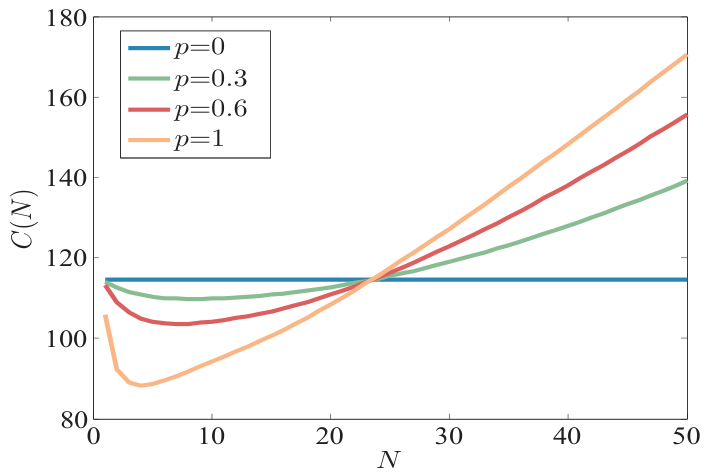
Then set the cost parameters C 0 = 140 , C 1 = 5 , C Z = 50 , C B = 80 , C U = 70 , C V = 20 , and calculate C ( N ) for different p and N. The computed results are recorded in Table 3, which are further illustrated in Figure 5, where the horizontal and vertical axes are respectively N and C ( N ) .
Table 3 and Figure 5 indicate that (i) when p = 0 , C ( N ) is always 114.5214 for each N, i.e., it is independent of the discrete decision variable N; (ii) when p = 0.3 , 0.6 , and 1, the one-dimensional optimal solutions N * are respectively 8, 7, and 4, and the corresponding optimal function values are respectively 109.7833 , 103.5353 and 88.3141 ; (iii) both N * and C ( N * ) decrease as p increases; and (iv) when 1 N 23 , C ( N ) decreases as p increases, and when N 24 , C ( N ) increases as p increases.

5.2.2. Joint Optimization of the Threshold N and Vacation Length T

Example 2.
Let the vacation length V be fixed as T ( T 0 ) , and distributions of the other variables are consistent with the variables in Example 1. Thus the two-dimensional cost function C ( N , T ) is given below:
C ( N , T ) = C 1 Γ + p ¯ λ 2 T 2 + p N ( N 1 ) 1 n = 0 N 1 λ T n n ! e λ T + n = 2 N 1 λ T n ( n 2 ) ! e λ T 2 p ¯ λ T + p m = 1 N 1 n = 0 m 1 λ T n n ! e λ T + e λ T 1 ϑ ( λ I U ) 1 U 0 + 1 ρ ˜ λ 1 e λ T ϑ ( λ I U ) 1 U 0 C 0 + C U e λ T 1 κ ( λ I U ) 1 U 0 p ¯ λ T + p m = 1 N 1 n = 0 m 1 λ T n n ! e λ T + e λ T 1 ϑ ( λ I U ) 1 U 0 + λ E [ χ ] C B + C Z ω E [ Z ] + 1 ρ ˜ C V p ¯ λ T + p m = 1 N 1 n = 0 m 1 λ T n n ! e λ T p ¯ λ T + p m = 1 N 1 n = 0 m 1 λ T n n ! e λ T + e λ T 1 ϑ ( λ I U ) 1 U 0 ,
where Γ , E [ Z ] and E [ χ ] are given in Equation (46).
All parameter values are shown in Example 1. Using Algorithm 1 ( i.e., PSO algorithm), we can compute the optimal vacation length T N * corresponding to each N and function value C ( N , T N * ) respectively.
For each fixed integer N, the continuous decision variable T is optimized by the PSO algorithm. The population size is M = 30 and the search dimension is dim = 1. The maximum number of iterations is K = 50 , and the search interval is T [ 0 , 30 ] with lower bound l b = 0 and upper bound u b = 30 . The learning factors are c 1 = c 2 = 1.5 , the fixed inertia weight is ω = 0.8 , and the maximum flying speed is v max = 1 . The algorithm is implemented directly in MATLAB rather than by calling a MATLAB PSO toolbox routine.
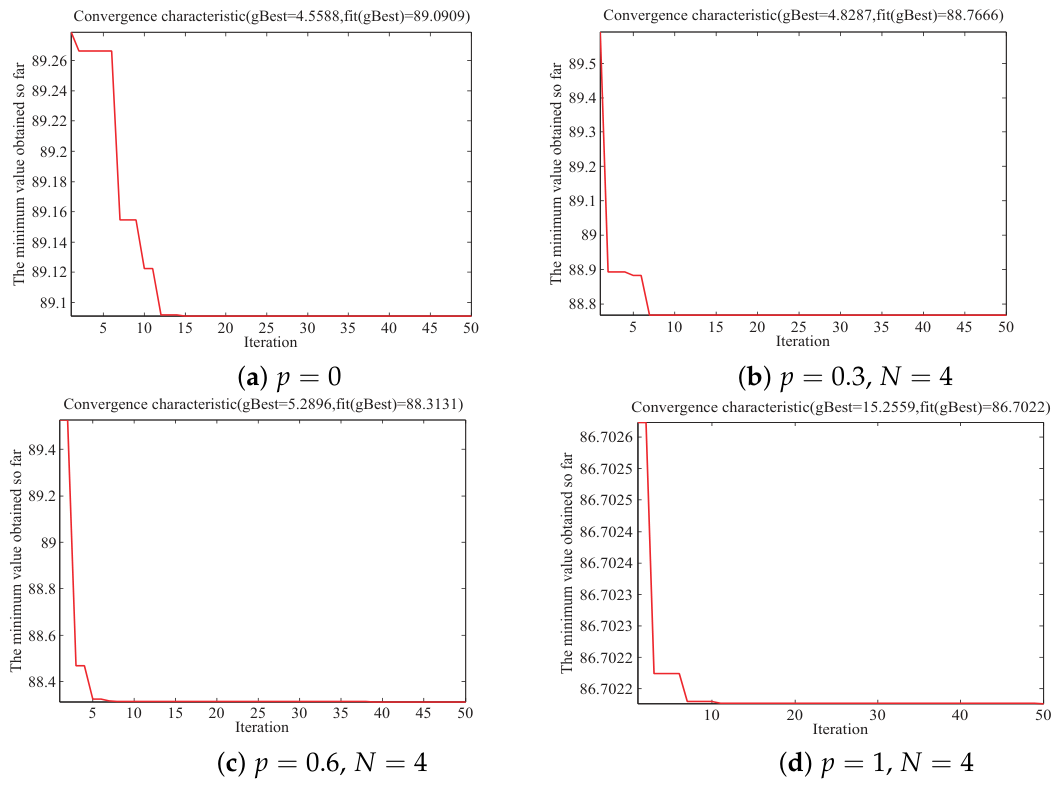
Table 4 depicts the numerical results and Figure 6 shows several iterative processes of searching for the minimum expected cost.
Algorithm 1 Determining the T N * and C ( N , T N * ) .
Require: Fitness function =  C ( N , T N ) , lower bound l b and upper bound u b , population size M, maximum number of iterations K, maximum flying speed V max , learning factors c 1 and c 2 , and inertia factor ω .
Ensure:  T N * , C ( N , T N * ) .
1:
for  i = 1 : M  do
2:
      Initializing velocity V i d and position X i d for each particle i through
V i d = V max + 2 V max r a n d ( ) , X i d = l b + r a n d ( ) ( u b l b ) .
3:
      Evaluating particle i and setting p B e s t i = X i d .
4:
end for
5:
g B e s t i = p B e s t i , k = 0 .
6:
while  k < K  do
7:
       k = k + 1 ;
8:
      for  i = 1 : M  do
9:
            Updating the velocity and position of particle i through
V i d = ω V i d + c 1 r a n d ( ) ( p B e s t i X i d ) + c 2 r a n d ( ) ( g B e s t i X i d ) ,
X i d = X i d + V i d .
10:
           Evaluating particle i,
11:
           if  f i t ( X i d ) < f i t ( p B e s t i )  then
12:
            p B e s t i = X i d .
13:
           end if
14:
     end for
15:
     if  f i t ( p B e s t i ) < f i t ( g B e s t i )  then
16:
            g B e s t i = p B e s t i .
17:
     end if
18:
end while
19:
Print T N * = g B e s t i and C ( N , T N * ) = f i t ( g B e s t i ).
Table 4 shows that (i) when p = 0 , C ( N , T ) is independent of N, the optimal vacation length is 4.5588 and the optimal function value is 89.0909 ; (ii) when p = 0.3 , 0.6 and 1, the two-dimensional optimal solutions ( N * , T * ) are ( 4 , 4.8287 ) , ( 4 , 5.2896 ) and ( 4 , 15.2559 ) , respectively, and the corresponding optimal function values C ( N * , T * ) are 88.7666 , 88.3131 and 86.7022 , respectively; and (iii) N * in ( N * , T * ) is insensitive to p, and T * increases as p increases, while C ( N * , T * ) decreases as p increases.

5.3. Optimal Control Policies Under Average Waiting Time Constraints

It is well known that setting a threshold N can reduce the cost due to frequent transitions in system states. However, it may also increase the expected waiting time W ¯ q . In practical production, W ¯ q is an essential indicator for customers to evaluate the system. In particular, when W ¯ q is excessive, it can reduce customer satisfaction and even lead to system congestion and customer loss.
Therefore, cost optimization under the expected waiting time constraint is highly significant. As far as we know, in many previous studies of queueing systems, scholars have rarely considered the effects of the waiting time threshold on the optimal control policies and the corresponding minimum costs. Hence, our goal here is to determine threshold N * and threshold and vacation length ( N * , T * ) minimizing the cost under the constraint of W ¯ q .

5.3.1. Constrained Optimization of the Threshold N

Example 3.
Based on Equation (46), the symbolic representation of the problem for the one-dimensional cost function with the W ¯ q constraint is determined by
min N C ( N ) , s . t . W ¯ q W ¯ q 0 ,
where C ( N ) and ψ are determined by Equation (46) and W ¯ q 0 denotes the constraint threshold (when W ¯ q 0 = + , Equation (48) is equivalent to Equation (46) without the waiting time constraint),
W ¯ q = λ E [ χ ˜ 2 ] 2 1 ρ ˜ + p ¯ λ 2 E [ V 2 ] + p N ( N 1 ) n = 0 N 1 [ N ( N 1 ) n ( n 1 ) ] λ n υ [ ( λ I V ) 1 ] n + 1 V 0 2 λ p ¯ λ E [ V ] + p m = 1 N [ 1 υ n = 0 m 1 λ [ ( λ I V ) 1 ] n + 1 V 0 ] + ψ .
Fix p = 0.9 , and the other parameter values are consistent with those in Example 1 above. The function values of C ( N ) and W ¯ q for various W ¯ q 0 and N are reported in Table 5.
As shown in Table 5, (i) when W ¯ q 0 = + , 6.2 , and 6 , respectively, the one-dimensional optimal solutions N * are 5 , 4 , and 3 , and the corresponding optimal function values C ( N * ) are 93.7920 , 94.2246 , and 95.8129 , respectively; (ii) N * decreases as W ¯ q 0 decreases, while the corresponding C ( N * ) increases as W ¯ q 0 decreases; (iii) N * and C ( N * ) are influenced by the level of constraint, i.e., the stricter constraint leads to a smaller value of N * and a larger C ( N * ) .
These results suggest that system managers need to start the system earlier and incur higher costs in actual industrial production to reduce customer waiting time and thus increase customer satisfaction. The results are consistent with our expectations.

5.3.2. Constrained Joint Optimization of the Threshold N and Vacation Length T

Example 4.
Based on Equation (47), the two-dimensional cost function with W ¯ q constraint is
min ( N , T ) C ( N , T ) , s . t . W ¯ q W ¯ q 0 ,
where C ( N , T ) is stated in Equation (47),
W ¯ q = λ E [ χ ˜ 2 ] 2 1 ρ ˜ + p ¯ λ 2 T 2 + p N ( N 1 ) 1 n = 0 N 1 λ T n n ! e λ T + n = 2 N 1 λ T n ( n 2 ) ! e λ T 2 λ p ¯ λ T + p m = 1 N 1 n = 0 m 1 λ T n n ! e λ T + e λ T 1 ϑ ( λ I U ) 1 U 0 .
Fix p = 0.9 , and the other parameter values are the same as in Example 2. Table 6 lists C ( N , T N * ) , T N * and W ¯ q for each N and W ¯ q 0 .
Table 6 reveals that (i) when W ¯ q 0 = + , 4 , and 3.5 , the two-dimensional optimal solutions ( N * , T * ) are ( 4 , 6.6129 ) , ( 3 , 6.1130 ) , and ( 2 , 5.2167 ) , respectively, and the corresponding optimal function values C ( N * , T * ) are 87.4972 , 87.9156 , and 90.5880 , respectively; (ii) similarly, stricter constraints lead to larger C ( N * , T * ) and smaller N * and T * . The results mean that it would be more costly for system managers to reduce W ¯ q and increase customer satisfaction, which is in line with our expected results.
These results suggest that, in some systems where customers are not sensitive to waiting time, system managers can disregard the expected waiting time constraint and directly choose the threshold value that minimizes the cost of starting service. In systems such as hospitals, transportation, and lean manufacturing enterprises, where customers are more sensitive to waiting time, system managers can adopt a control policy with the lowest cost of starting service within the acceptable waiting time of customers.

6. Conclusions

This paper investigated an M / G / 1 repairable queue with an N-policy, Bernoulli interruption vacations, and a patient server. Under Poisson failures and resumable service, the repair interruptions were incorporated through a generalized completion-time representation. On this basis, we derived transient queue length probabilities by a renewal decomposition and Laplace transforms and then obtained recursive stationary queue length probabilities under the stability condition. The stationary distribution was further used to discuss capacity design, showing that a design based only on the expected queue length may underestimate the probability of customer loss when the waiting space is finite.
The numerical results illustrate several managerial implications. A larger Bernoulli interruption probability p generally makes the server more responsive to accumulated demand and can reduce the minimum expected cost in the reported examples. For the one-dimensional policy, the optimal threshold N decreases as p increases, while for the joint policy ( N , T ) , the optimal vacation length T changes together with p and the waiting time requirement. When an average waiting time constraint is imposed, stricter constraints force the system to activate service earlier, which reduces customer waiting but increases the minimum operating cost. Thus, the proposed policy can help managers to balance operating cost, vacation benefit, reliability loss, and customer waiting-time sensitivity.
Future work may extend the model to discrete-time systems, multi-server systems, state-dependent arrival processes, or reliability-control policies in which preventive maintenance and corrective repair are optimized jointly.

Author Contributions

Methodology, R.L.; software, W.W.; validation, Y.H. and W.W.; formal analysis, R.L.; data curation, Y.H.; writing—original draft preparation, R.L.; writing—review and editing, Y.H.; funding acquisition, R.L. All authors have read and agreed to the published version of the manuscript.

Funding

This work is supported by the General program of Chongqing Natural Science Foundation of China (CSTB2022NSCQ-MSX1160).

Data Availability Statement

Data are contained within the article.

Conflicts of Interest

The authors declare no conflicts of interest.

References

  1. Yadin, M.; Naor, P. Queueing systems with a removable service station. Oper. Res. 1963, 14, 393–405. [Google Scholar] [CrossRef][Green Version]
  2. Balachandran, K.R. Control policies for a single server system. Manag. Sci. 1973, 19, 1013–1018. [Google Scholar] [CrossRef]
  3. Heyman, D.P. T-policy for the M/G/1 queue. Manag. Sci. 1977, 23, 775–778. [Google Scholar] [CrossRef]
  4. Levy, Y.; Yechiali, U. Utilization of idle time in an M/G/1 queueing system. Manag. Sci. 1975, 22, 202–211. [Google Scholar] [CrossRef]
  5. Tian, N.; Zhang, Z.G. Vacation Queueing Models: Theory and Applications; Springer: New York, NY, USA, 2006. [Google Scholar]
  6. Ke, J.C.; Wu, C.H.; Zhang, Z.G. Recent developments in vacation queueing models: A short survey. Int. J. Operat. Res. 2010, 7, 3–8. [Google Scholar]
  7. Jyothsna, K.; Kumar, P.V.; Laxmi, P.V. Bat algorithm for optimizing a working vacation queue with impatient clients and secondary service. Opsearch 2024, 62, 777–796. [Google Scholar] [CrossRef]
  8. Fiems, D. Queues with working vacations: A survey. Mathematics 2025, 13, 1894. [Google Scholar] [CrossRef]
  9. Zhu, S.; Wang, J.T. Strategic joining in a single-server Markovian queue with Bernoulli working vacations. J. Syst. Sci. Complex. 2025, 38, 1683–1706. [Google Scholar] [CrossRef]
  10. Kella, O. The threshold policy in the M/G/1 queue with server vacations. Nav. Res. Logist. 1989, 36, 111–123. [Google Scholar] [CrossRef]
  11. Liu, Q.L.; Tang, Y.H.; Yu, M.M.; Wu, W.Q. Analysis of M(λ1,λ2)/G/1 queue with uninterrupted single vacation and server’s workload controlled D-policy. J. Ind. Manag. Optim. 2023, 19, 4523–4550. [Google Scholar] [CrossRef]
  12. Boxma, O.J.; Schlegel, S.; Yechiali, U. A note on an M/G/1 queue with a waiting server, timer and vacations. Am. Math. Soc. Transl. 2002, 207, 25–35. [Google Scholar] [CrossRef]
  13. Yechiali, U. On the MX/G/1 queue with a waiting server and vacations. Sankhya 2004, 66, 159–174. [Google Scholar]
  14. Wan, S.Y.; Lan, S.J. Reliability analysis of an M/G/1 repairable queueing system with vacation and patient server. J. Appl. Math. Comput. 2023, 69, 4333–4352. [Google Scholar] [CrossRef]
  15. Alfa, A.S.; Frigui, I. Discrete NT-policy single server queue with Markovian arrival process and phase type service. Eur. J. Oper. Res. 1996, 88, 599–613. [Google Scholar] [CrossRef]
  16. Luo, L.; Tang, Y.H.; Wu, W.Q.; Yu, M.M. Optimal control policy of M/G/1 queueing system with delayed randomized multiple vacations under the modified Min(N, D)-policy control. J. Oper. Res. Soc. China 2023, 11, 857–874. [Google Scholar]
  17. Lee, H.W.; Park, J.O. Optimal strategy in N-policy production system with early set-up. J. Oper. Res. Soc. 1997, 48, 306–313. [Google Scholar] [CrossRef]
  18. Hur, S.; Kim, J.S.; Kang, C.W. An analysis of the M/G/1 system with N and T policy. Appl. Math. Model. 2003, 27, 665–675. [Google Scholar] [CrossRef]
  19. Li, J.; Liu, L.W. On an M/G/1 queue in random environment with Min(N,V)-policy. RAIRO-Oper. Res. 2018, 52, 61–77. [Google Scholar] [CrossRef]
  20. Jiang, F.C.; Huang, D.C.; Yang, C.T.; Lin, C.H.; Wang, K.H. Design strategy for optimizing power consumption of sensor node with Min(N, T) policy M/G/1 queueing models. Int. J. Commun. Syst. 2012, 25, 652–671. [Google Scholar] [CrossRef][Green Version]
  21. Gray, W.J.; Wang, P.P.; Scott, M. A vacation queueing model with service breakdowns. Appl. Math. Model. 2000, 24, 391–400. [Google Scholar] [CrossRef]
  22. Ke, J.C. Optimal NT policies for M/G/1 system with a startup and unreliable server. Comput. Indus. Eng. 2006, 50, 248–262. [Google Scholar] [CrossRef]
  23. Wu, W.Q.; Tang, Y.H.; Yu, M.M. Analysis of an M/G/1 queue with N-policy, single vacation, unreliable service station and replaceable repair facility. Opsearch 2015, 52, 670–691. [Google Scholar] [CrossRef]
  24. Senthil, K.M.; Arumuganathan, R. An MX/G/1 retrial queue with two-phase service subject to active server breakdowns and two types of repair. Int. J. Oper. Res. 2010, 8, 261–291. [Google Scholar] [CrossRef]
  25. Jailaxmi, V.; Arumuganathan, R.; Rathinasamy, A. An MX/G/1 retrial queue with two phase service under active server breakdowns, two types of repair and multiple vacations with N-policy. Int. J. Oper. Res. 2013, 18, 35–61. [Google Scholar] [CrossRef]
  26. Tang, Y.H. A single-server M/G/1 queueing system subject to breakdowns: Some reliability and queueing problems. Microelectron. Reliab. 1997, 37, 315–321. [Google Scholar] [CrossRef]
  27. Choudhury, G.; Deka, M. A batch arrival unreliable server delaying repair queue with two phases of service and Bernoulli vacation under multiple vacation policy. Qual. Technol. Quantitat. Manag. 2018, 15, 157–186. [Google Scholar]
  28. Boualem, M. Insensitive bounds for the stationary distribution of a single server retrial queue with server subject to active breakdowns. Adv. Oper. Res. 2014, 12, 985453. [Google Scholar]
  29. Wang, J.T.; Liu, B.; Li, J.H. Transient analysis of an M/G/1 retrial queue subject to disasters and server failures. Eur. J. Oper. Res. 2008, 189, 1118–1132. [Google Scholar] [CrossRef]
  30. Kumar, A.; Jain, M. Cost optimization of an unreliable server queue with two stage service process under hybrid vacation policy. Math. Comput. Simul. 2023, 204, 259–281. [Google Scholar] [CrossRef]
  31. Gnedenko, B.V.; Kovalenko, I.N. Introduction to Queueing Theory, 2nd ed.; Kotz, S., Trans.; Birkhäuser: Boston, MA, USA, 1989. [Google Scholar] [CrossRef]
Figure 1. n 1 n N 1 arrivals occur before V k expires, after which the server returns.
Axioms 15 00479 g001
Figure 2. When N customers arrive before V k expires, the server interrupts V k with probability p and returns to the system immediately.
Axioms 15 00479 g002
Figure 3. When N customers arrive before V k expires, the server does not interrupt V k with probability p ¯ and waits until V k ends, with n N arrivals in V k .
Axioms 15 00479 g003
Figure 4. No customer arrives in V k , and a customer arrives before U k expires.
Axioms 15 00479 g004
Figure 5. Variation curves of C ( N ) with respect to N and p.
Axioms 15 00479 g005
Figure 6. Iterative processes of searching for the minimum expected cost.
Axioms 15 00479 g006
Table 1. Main notation used in the model.
SymbolMeaning
NQueue length threshold for vacation interruption or service activation
pProbability of interrupting a vacation when the queue length reaches N
VVacation time
Upatience period
XTime to failure, or inter-breakdown time during operation of service station
ZRepair or recovery time after service station failure
χ Actual service time of the customer
χ ˜ Generalized service time of the customer including service station repairs
L ( t ) Queue length at time t
p i j ( t ) The transient probability P { L ( t ) = j L ( 0 ) = i }
W ¯ q Average/mean waiting time of a customer
C ( N ) , C ( N , T ) Expected cost function under the threshold policy N and joint threshold-vacation policy ( N , T )
Table 2. Numerical results of p j under different j.
j01234567
p j 0.27620.19410.13760.10090.07470.05550.04130.0307
j89101112131415
p j 0.02280.01700.01260.00940.00700.00520.00390.0029
j1617181920212223
p j 0.00210.00160.00120.00090.00070.00050.00040.0003
j24252627282930
p j 0.00020.00010.00010.00010.00010.00000.0000
Table 3. Numerical results of C ( N ) under different N and p.
p = 0 p = 0.3 p = 0.6 p = 1 p = 0 p = 0.3 p = 0.6 p = 1
N C ( N ) C ( N ) C ( N ) C ( N ) N C ( N ) C ( N ) C ( N ) C ( N )
1114.5214114.1017113.2119105.903011114.5214109.9903104.578695.4840
2114.5214112.6283109.058992.298912114.5214110.1440105.026996.6887
3114.5214111.5752106.517888.980713114.5214110.3276105.519497.8939
4114.5214110.8382104.981888.3141
5114.5214110.3408104.102688.676823114.5214114.2766114.0414113.7417
6114.5214110.0262103.666489.514624114.5214114.8610115.1821115.5840
7114.5214109.8514103.535390.587325114.5214115.4764116.3653117.4592
8114.5214109.7833103.616691.7746
9114.5214109.7963103.845893.010149114.5214137.9270153.7601168.3163
10114.5214109.8705104.177694.254650114.5214139.1264155.5834170.5818
Table 4. Numerical results for C ( N , T N * ) and T N * under different N.
p = 0 p = 0.3 p = 0.6 p = 1
N T N * C N , T N * T N * C N , T N * T N * C N , T N * T N * C N , T N *
14.558889.09094.995990.69205.698293.328912.0905104.7060
24.558889.09094.809789.46705.202589.926113.497690.2082
34.558889.09094.805388.90875.236888.601514.790887.0386
44.558889.09094.828788.76665.289688.313115.255986.7022
54.558889.09094.792288.81945.218188.46289.241887.4712
64.558889.09094.743588.92155.017388.71345.968788.2916
74.558889.09094.668889.00394.812288.90455.116688.7404
84.558889.09094.612789.05234.682289.01064.789289.0723
94.558889.09094.585889.07564.613689.05974.650389.0375
104.558889.09094.575289.08554.575189.07994.592589.0723
Table 5. Numerical results of C ( N ) under different W ¯ q 0 and N.
W ¯ q W ¯ q 0 = + W ¯ q W ¯ q 0 = 6.2 W ¯ q W ¯ q 0 = 6
N C ( N ) W ¯ q C ( N ) W ¯ q C ( N ) W ¯ q
1110.05647.2800____________
299.81786.2301____________
395.81295.973895.81295.973895.81295.9738
494.22466.018194.22466.0181______
593.79206.2002____________
693.97836.4510____________
794.51686.7362____________
895.26067.0370____________
996.12267.3426____________
1097.04837.6460
Table 6. Numerical results for C ( N , T N * ) , T N * and W ¯ q under different N and W ¯ q 0 .
W ¯ q W ¯ q 0 = + W ¯ q W ¯ q 0 = 4 W ¯ q W ¯ q 0 = 3.5
N T N * C N , T N * W ¯ q T N * C N , T N * W ¯ q T N * C N , T N * W ¯ q
17.293999.39253.94217.293999.39253.94215.812399.68883.5000
26.241678.29503.67366.241690.42103.67365.216790.58803.5000
36.469287.89984.05006.113087.91564.00002.950691.06623.5000
46.612987.49724.47063.940888.69224.00002.274693.28043.5000
56.287087.89054.79413.300489.78034.00002.117394.15763.5000
65.554388.42784.90173.111190.28614.00002.075694.42593.5000
75.020888.78624.87423.050090.46374.00002.064994.51973.5000
84.759688.96514.83273.030790.53024.00002.062494.73533.5000
94.641689.04324.80533.025090.54564.00002.061994.49893.5000
104.590889.07424.79083.023590.55114.00002.061894.49963.5000
Disclaimer/Publisher’s Note: The statements, opinions and data contained in all publications are solely those of the individual author(s) and contributor(s) and not of MDPI and/or the editor(s). MDPI and/or the editor(s) disclaim responsibility for any injury to people or property resulting from any ideas, methods, instructions or products referred to in the content.