1. Introduction
Let
be a finite graph. A
proper partition of
G is a partition of
V into nonempty independent sets. The
graphical Stirling number , introduced by Duncan and Peele [
1], counts proper partitions of
G into exactly
k blocks. The associated
graphical Bell number is
.
For the edgeless graph , every set partition is proper; hence, and . Throughout, denotes the Stirling number of the second kind, that is, the number of partitions of an n-element set into k nonempty blocks. We use the standard boundary conventions , for , and whenever or . In particular, for . The brace symbol is standard for this quantity and is not a binomial coefficient, for which we reserve .
The partition polynomial is defined by
. Its coefficients are related to the chromatic polynomial through the classical falling-factorial expansion
, where
. Consequently, graphical Stirling numbers interpolate between partition enumeration and graph coloring. Applications of graph coloring include register allocation [
2], scheduling, and frequency assignment.
Explicit formulas for graphical Stirling and Bell numbers are known for relatively few graph families. Duncan and Peele [
1] proved that if
T is a tree on
n vertices, then
. Galvin and Thanh [
3] extended this observation to forests by showing that
depends only on the order of
F and its number of connected components. Kereskenyi-Balogh and Nyul [
4] computed graphical Bell numbers for several classical graph families. For complete multipartite graphs, Allagan and Serkan [
5] established
. Beyond these families, explicit closed forms remain limited.
The purpose of this paper is to derive exact formulas for graphical Stirling and Bell numbers in three graph families whose independence structure can be described completely.
These three families were selected because their independence structure can be written in closed form, which is what makes exact enumeration possible: for most graphs, no such description is available, and even
for
has no elementary product form. Beyond enumeration, the graphical Stirling numbers determine the partition polynomial
and, through the falling-factorial expansion above, the chromatic polynomial
; the families studied here therefore supply exactly solvable test cases for both partition counting and coloring, with the latter relevant to applications such as register allocation [
2] and frequency assignment.
We distinguish three levels of contribution. The product factorization of
is due to Allagan and Serkan [
5]; the Stirling-number convolution (
1) below is an immediate refinement that follows directly from the partite-class structure of independent sets, and is included for completeness. The formulas for
and
require additional combinatorial input: the identification of the admissible mixed blocks for
, and the center-block decomposition for
. The probabilistic representation of
and its analytic consequences are, to our knowledge, new.
For the complete multipartite graph
, we prove
which refines the Bell-number identity of Allagan and Serkan [
5].
For the graph
, obtained by deleting a perfect matching from the complete bipartite graph, we prove
where
X and
Y are independent
random variables. This representation yields several consequences, including log-convexity of the sequence
and the lower bound
.
For the Mycielskian star graph
, we obtain
Two direct evaluations are
and
.
Several sequences arising from these formulas occur in the OEIS. For
, the sequence
is A000051
https://oeis.org/A000051, accessed on 20 June 2026 [
6]. The values
coincide with A096376
https://oeis.org/A096376, accessed on 20 June 2026 [
7] after the index shift
, and therefore also with A116735
https://oeis.org/A116735, accessed on 20 June 2026 [
8] through the relation recorded there. We do not know a direct combinatorial explanation for this coincidence. The Bell-numbersequence
is, to the best of our knowledge, not currently listed in the OEIS; as the database is updated continually, this status may change.
The paper is organized as follows.
Section 2 contains the main structural formulas and their proofs. Computational verification and OEIS correspondence tables are collected in
Appendix A.
2. Main Results
We begin with complete multipartite graphs, whose independence structure admits an exact decomposition across the partite classes.
2.1. Complete Multipartite Graphs
The structural point is simple: in a complete multipartite graph, no independent set can meet two partite classes, so a proper partition is just an independent choice of an ordinary set partition within each class. The next theorem records the resultingconvolution.
Theorem 1. Let be the complete ℓ-partite graph with partite classes , where . Then, for every ,and consequently Proof. In a complete multipartite graph, every edge joins vertices belonging to distinct partite classes. Hence, an independent set is contained entirely within a single class . It follows that every block of a proper partition of G is contained in exactly one partite class.
Fix a proper partition of
G into
k blocks and let
denote the number of blocks contained in
. As
, each
satisfies
, and
. Conversely, given positive integers
with sum
k, a proper partition of
G is obtained by independently partitioning each
into
nonempty blocks. The number of such partitions is
for
, and the choices are independent across partite classes. Therefore, the number of proper
k-partitions is exactly the quantity in (
4).
Summing (
4) over all
k and using the bijection between proper partitions of
G and independent choices of set partitions within each partite class gives
which proves (
5). □
The Bell-number identity (
5) was established in [
5]. Formula (
4) provides the corresponding graphical Stirling numbers and will be used repeatedly in the sequel.
Example 1. For , Theorem 1 gives . Thus, , , and . Hence, , in agreement with Theorem 1.
We record three special cases that will be referenced later.
Proof. Applying Theorem 1 with
and
yields
Substituting
,
,
, and
and simplifying gives the stated expression. Direct verification at
gives
, and the closed form also evaluates to 0. □
Proof. Applying Theorem 1 with and yields the convolution formula. Substituting the classical expressions for with , including , and simplifying proves the identity. For , both sides equal 0. □
Proof. Applying Theorem 1 with
and
gives
The only compositions of 5 into three positive parts are
and
, each occurring in three permutations. Using
yields
Substituting the classical formulas for
and
and simplifying gives the closed form. For
, both sides equal 0. □
2.2. Complete Bipartite Graphs with a Removed Perfect Matching
We next consider the graph obtained from by deleting a fixed perfect matching. The deleted matching is the only source of possible mixed independent blocks, and this yields an exact convolution formula. Specifically, the only edges removed are , so the sole way an independent block can span both sides is to consist of a single matched pair ; everything else is partitioned within one side. Counting how many matched pairs are used as blocks produces the binomial convolution below.
Theorem 2. Let , where is a perfect matching between the bipartition classes and . For every ,where if or . Consequently, Proof. In , the edge is present exactly when . Hence, a proper block meeting both U and V can contain only vertices of the form and for a common index i. Such a mixed block cannot contain any further vertex, as and are edges for . Thus, the mixed blocks in any proper partition are precisely some collection of isolated pairs .
Choose
s of these matched pairs. This gives
choices. After the chosen pairs are fixed as blocks, the remaining vertices in
U and
V cannot form additional mixed blocks, as
s was chosen to be the total number of mixed blocks. The remaining
vertices of
U may therefore be partitioned into
j nonempty blocks, and the remaining
vertices of
V into
nonempty blocks. This gives
choices. Summing over
j and
s proves (
6).
Summing (
6) over
k gives
, where
. The inner double sum is the Cauchy product
. Hence,
, and the change of index
gives (
7). □
The Bell-number convolution also has a compact probabilistic form. For the statements involving , we regard as the empty graph and use the standard convention .
Theorem 3 (Poisson moment representation)
. Let X and Y be independent random variables. For every , Proof. By the binomial theorem and independence,
. Dobinski’s identity gives
for
; see, for example, [
9]. Thus,
, which is
by (
7). □
Remark 1. Representation (8) is not simply a restatement of the convolution (7). By turning a combinatorial sum into a moment, it makes standard moment inequalities available: Jensen and Cauchy–Schwarz applied to yield, with no further computation, the sharp bound and the log-convexity of (Corollaries 4 and 5), neither of which is apparent from (7). Whether other families admit analogous moment representations is open; the construction here uses the bipartite product structure of , which is what makes the two sides contribute independent Poisson factors. Graphs built from two interacting independent families of vertices are the natural place to look for similar identities.
Corollary 4 (Log-convexity)
. For all , .
Proof. Set . As , Cauchy–Schwarz gives . The claim now follows from Theorem 3. □
Corollary 5 (Sharp lower bound)
. For all , , with equality if and only if .
Proof. Let . Then . For , Jensen’s inequality gives . The case is immediate. Equality holds for and . For , the function is strictly convex on , while Z is not almost surely constant because and . Hence, the inequality is strict for . □
Corollary 6 (Two-sided bound)
. Proof. The lower bound is Corollary 5. For the upper bound, as
we have
; hence,
. Taking expectations and using independence,
By the binomial theorem, Dobinski’s identity
, and the Bell recurrence
, we obtain
, which gives the stated upper bound. □
Theorem 4 (Moment–Laplace identity)
. Let X and Y be independent random variables, and define for . Then, for every real ,and the series converges absolutely. Moreover, F is on , all left derivatives at 0 exist, andFor every , the series in (9) diverges.
Proof. Fix
. As
almost surely,
, so
is finite. Conditioning on
Y and using the moment generating function
for a
random variable (see, e.g., [
10]) gives
, which proves (
9). As
implies
, the summand is bounded by
, so the convergence is absolute.
For
, differentiation under the expectation is justified by dominated convergence on compact subintervals of
; for each fixed
n, the derivative is
. Taking
and using monotone convergence gives
. Theorem 3 then gives (
10).
If
, the ratio of successive terms in the series in (
9) is
, which tends to infinity as
. Thus, the series diverges. □
Remark 2 (Laplace transform and moment recovery)
. Theorem 4 provides a Laplace-transform representation of the Bell numbers . For , . Moreover, the left derivatives at the origin recover the moments: for every . Thus, is the moment sequence of the random variable . Furthermore, Theorem 4 shows that the series representation above converges for all and diverges for every .
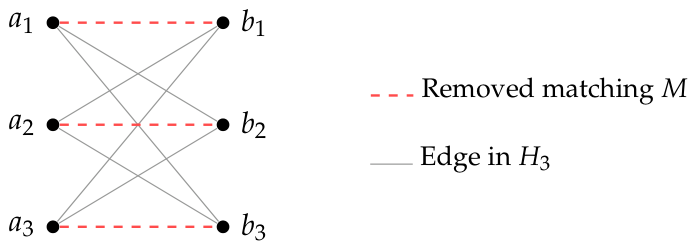
Example 2. Consider with vertex sets and and matching . The graph is depicted in Figure 1. Applying (6) with and gives . The ten valid proper3-partitions are the following: 2.3. Mycielskian Star Graphs
Let
be the star on
vertices, with center
c and leaves
, where
. Its Mycielskian
(in the sense of Mycielski [
11]) has vertex set
, where
and
. Its edge set is
. Thus,
,
, and
.
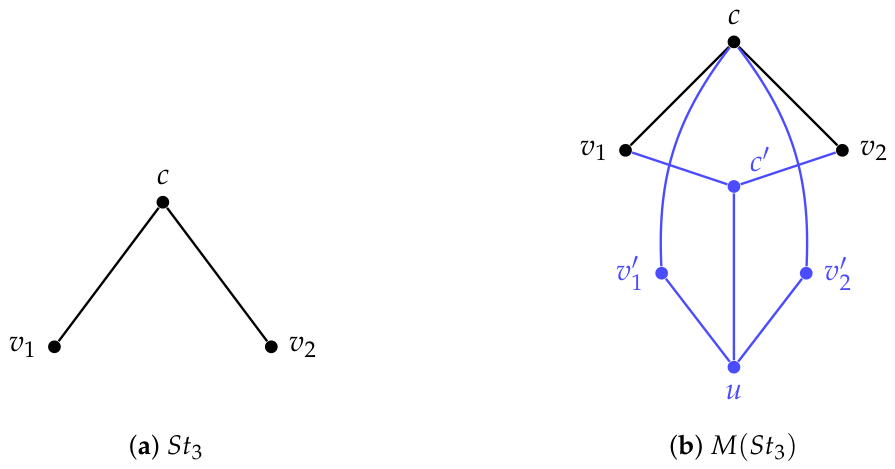
Figure 2 shows
and
.
Remark 3. Unlike the trees of Duncan–Peele [1] and the forests of Galvin–Thanh [3], where depends only on the order and the number of components, is not a tree, and, in fact, not chordal: for the vertices induce a 4-cycle. It is, however, triangle-free, being the Mycielskian of a triangle-free graph. The closed form below therefore reflects the specific center-block structure of rather than membership in a known class for which graphical Stirling numbers factor.
The next result counts proper partitions by isolating the block containing the original center c. The idea is that c is adjacent to every leaf and to every leaf copy, so its block is forced to be one of only three possibilities; conditioning on which one occurs reduces the count, in each case, to an ordinary set partition of an edgeless remainder.
Theorem 5 (Structural formula)
. Let and . For every integer q,where if or .
Proof. The only edges of are , , , , and , for . In particular, every subset of is independent: L and are each independent, and there are no edges between L and , because every edge incident to a vertex of goes to one of c, , or u. Let be the block containing c in a proper partition. As c is adjacent to every vertex in , no such vertex lies in . As , the block is exactly one of , , and .
Suppose first that . The block containing u has the form for a unique subset , because u is nonadjacent to all vertices of L and adjacent to all vertices of . If , the remaining vertices form the edgeless set of size , and they must be partitioned into nonempty blocks. This gives partitions for each fixed A; hence, in this case.
The case gives the same contribution. Indeed, the map fixing c and interchanging with u and with is an automorphism of , as it sends the edge types , , , , and to edge types of the same graph.
It remains to consider
. As
, the vertices
and
u lie in distinct blocks. The block containing
has the form
for a unique subset
, and the block containing
u has the form
for a unique subset
. If
and
, the remaining vertices form the edgeless set
of size
, and they must be partitioned into
nonempty blocks. This gives the double sum in (
11). The three cases are mutually exclusive and exhaustive, so the formula follows. □
Lemma 1 (Stirling–binomial recurrence)
. For integers and , .
Proof. Both sides count partitions of into nonempty blocks. Choose the j elements of that do not lie in the block containing ; these j elements must form the remaining k blocks. Summing over j gives the identity. □
Proposition 1 (Simplified closed form)
. For , with ,and, consequently, Proof. The double sum in (
11) satisfies
by Vandermonde’s identity. Reindexing with
gives
, which equals
by Lemma 1 with
and
. This proves (
12). Summing over
q gives (
13). □
Remark 4. The double sum in Theorem 5 collapses to the single Stirling number appearing in Proposition 1. The remaining single sum is left in convolution form. This remaining sum
is a Stirling analogue of a binomial transform; the two indices
a and
both vary with
a, so Lemma 1 and Vandermonde’s identity do not apply, and it does not reduce to a single Stirling number for general
q. We therefore regard (
12) as the simplest closed form. It does collapse for specific
q, as the two corollaries below show.
Corollary 7 (Bell numbers of
)
. For , .
Proof. This is (
13) with
. □
Corollary 8 (Growth bracket for
)
. For ,
with ,
Proof. Both bounds use Corollary 7. The lower bound drops the nonnegative sum. For the upper bound, for , so . □
Corollary 9 (Partition polynomial of
)
. Let . For , .
Proof. Multiply (
12) by
and sum over
q. As
, the asserted formula follows. □
Corollary 10. For , .
Proof. Set
in (
12). As
for
and
for
, we obtain
. □
Corollary 11. For , .
Proof. Set
in (
12). As
is nonzero only when
, the single sum contributes 2. Also,
. Hence,
. □
Example 3. For the star is a single edge (), and its Mycielskian is the 5-cycle . Proposition 1 with gives , matching , and , in agreement with Table A2.
2.4. Sequence Identifications
By Corollary 1,
is OEIS A384980
https://oeis.org/A384980, accessed on 20 June 2026 [
12] (
:
). By Corollary 2,
is OEIS A384981
https://oeis.org/A384981, accessed on 20 June 2026 [
13]. By Corollary 3,
is OEIS A384988
https://oeis.org/A384988, accessed on 20 June 2026 [
14]. The triangle
is OEIS A385432
https://oeis.org/A385432, accessed on 20 June 2026 [
15], and the triangle
is OEIS A385437
https://oeis.org/A385437, accessed on 20 June 2026 [
16]; its row sums give
.
Proposition 2. For , the values agree with the corresponding terms of OEIS A000051 https://oeis.org/A000051, accessed on 20 June 2026 [6].
In the next statement, denotes the n-th term of the OEIS sequence A096376, and the n-th term of A116735.
Proposition 3. For , the graphical Stirling number satisfies , which coincides with the shifted OEIS sequence . Moreover, as OEIS records the relation for , we obtain .
Proof. As , substitution gives . The OEIS relation then yields . □
Remark 5. The sequence : 11, 106, 1695, 39,325, 1,224,464, … for is, to the best of our knowledge, not currently listed in the OEIS and is a natural candidate for submission; as the database is updated continually, this status may change. The closed form is given by Corollary 7.
3. Conclusions
We established explicit formulas for graphical Stirling and Bell numbers for three graph families whose independence structure admits a complete combinatorial description; see
Table 1 for a summary.
For the complete multipartite graph
, every independent set is contained in a single partite class. This yields the convolution Formula (
4) for the graphical Stirling numbers and the product identity
.
For the graph
, where
M is a perfect matching, the mixed blocks of a proper partition are exactly the matched pairs
. This structure leads to the convolution Formula (
7),
Theorem 3 identifies this quantity as the moment
of two independent
random variables
X and
Y. The moment representation yields the log-convexity inequality
and the sharp lower bound
. It also gives the Laplace-transform identity (
9) for
.
For the Mycielskian star graph
, the partition structure is governed by the block containing the original center
c. The three-case decomposition of Theorem 5, combined with Vandermonde’s convolution and Lemma 1, yields the closed form (
12),
Summing over
q gives the Bell-number Formula (
13). Two special evaluations follow directly:
(A000051
https://oeis.org/A000051, accessed on 20 June 2026) and
(A116735
https://oeis.org/A116735, accessed on 20 June 2026).
The resulting formulas provide exact enumerative descriptions for each family and reduce their graphical Bell and Stirling numbers to classical Stirling and Bell numbers. Several associated integer sequences appear in the OEIS, while the Bell-number sequence appears not to be currently recorded.
Two limitations should be noted. First, our exact formulas rest on a closed description of the independent sets, and the three families above are chosen precisely because such a description is known. The same method does not directly apply to graph families whose independent sets do not admit a tractable closed-form description. Second, while we obtain the bounds from Corollary 6 and from Corollary 8, we do not determine precise first-order asymptotics. We expect that a saddle-point analysis of the Poisson moment should yield the leading growth of . We also leave open the asymptotic question of whether . Natural further directions include extending the center-block method to Mycielskians of arbitrary trees, where the leaf structure is no longer uniform, and to iterated Mycielskians , where even the independence structure of is already substantially more involved.