

Intuitionistic Fuzzy Decision Tree Temporal Logic and Its Application in Engineering Decision-Making


Abstract
1. Introduction
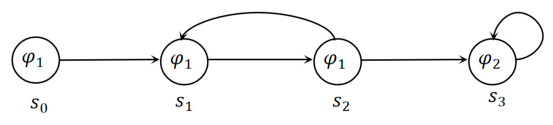
2. Weighted Intuitionistic Fuzzy Kripke Structure
- (1)
- ;
- (2)
- ;
- (3)
- If , then,
- (1)
- is a countable, non-empty set of states;
- (2)
- is an intuitionistic fuzzy transition distribution function;
- (3)
- is an intuitionistic fuzzy distribution function for initial states;
- (4)
- is a countable, non-empty set of atomic propositions;
- (5)
- L is a labeling function. For any and denotes the intuitionistic fuzzy satisfaction value of the atomic proposition p at state .
- (1)
- is an intuitionistic fuzzy Kripke structure (IFKS);
- (2)
- is a set of weight functions, with , denoting the number of decision attributes. For any , the weight function assigns a specific cost or benefit to each transition relation .
3. Formal Description of Optimal Engineering Decision-Making
- (1)
- Cost-weighted composition operation:
- (2)
- Benefit-weighted composition operation:
- (1)
- ;
- (2)
- .
- (1)
- ;
- (2)
- .
- (1)
- For cost-type attributes: Among all schemes with the same cost (where schemes are in one-to-one correspondence with paths in the WIFKS), select the maximum intuitionistic fuzzy measure (i.e., path reachability) of the feasible schemes, and perform the cost-weighted composition operation () on this maximum measure and the corresponding cost. The minimum value from the resulting set of composite scores is defined as the cost expectation of the cost attribute, and the set of paths corresponding to this minimum value constitutes the optimal decision scheme set for the attribute.
- (2)
- For benefit-type attributes: Among all schemes with the same benefit, select the maximum intuitionistic fuzzy measure (path reachability) of the feasible schemes, and perform the benefit-weighted composition operation () on this maximum measure and the corresponding benefit. The maximum value from the resulting set of composite scores is defined as the benefit expectation of the benefit attribute, and the set of paths corresponding to this maximum value forms the optimal decision scheme set for the attribute.
- (1)
- Cost Expectation on Π for Cost-Type Attributes:
- (2)
- Expected Path Set in for Cost-Type Attributes:
- (3)
- Benefit Expectation on for Benefit-Type Attributes:
- (4)
- Expected Path Set in for Benefit-Type Attributes:
- (1)
- Preference weight set: , where. In particular, if there is no preference for the weights of decision attributes, ;
- (2)
- For any , let label the index of in ; for any with , let denote the cumulative weight of path with respect to attribute . Let be the set of cumulative weights of all finite paths in with respect to . The normalized weight corresponding to is defined as:If is a cost-type attribute:If is a benefit-type attribute:
- (3)
- Multi-attribute decision-making score set: . The multi-attribute decision-making score for is defined as:
- (4)
- Multi-attribute optimal decision-making score function: ;
- (5)
- Multi-attribute optimal decision scheme function:
4. Intuitionistic Fuzzy Decision Tree Temporal Logic
4.1. Syntax and Semantics of IFDTL
- State Formulas of IFDTL:
- (1)
- For all }, if , then ;
- (2)
- For all , ;
- (3)
- (4)
- For all , .
- (1)
- ;
- (2)
- ;
- (3)
- ;
- (4)
- ;
- (5)
- ;
- (6)
- ;
- (7)
- ;
- (8)
- ;
- (9)
- ;
- (10)
- ;
- (11)
- ;
- (12)
- .
- (13)
- ;
- (14)
- ;
- (15)
- ;
- (16)
- .
4.2. Logical Properties of IFDTL
- (1)
- ;
- (2)
- .
- (1)
- ;
- (2)
- .
- (1)
- ;
- (2)
- .
5. IFDTL Model Checking
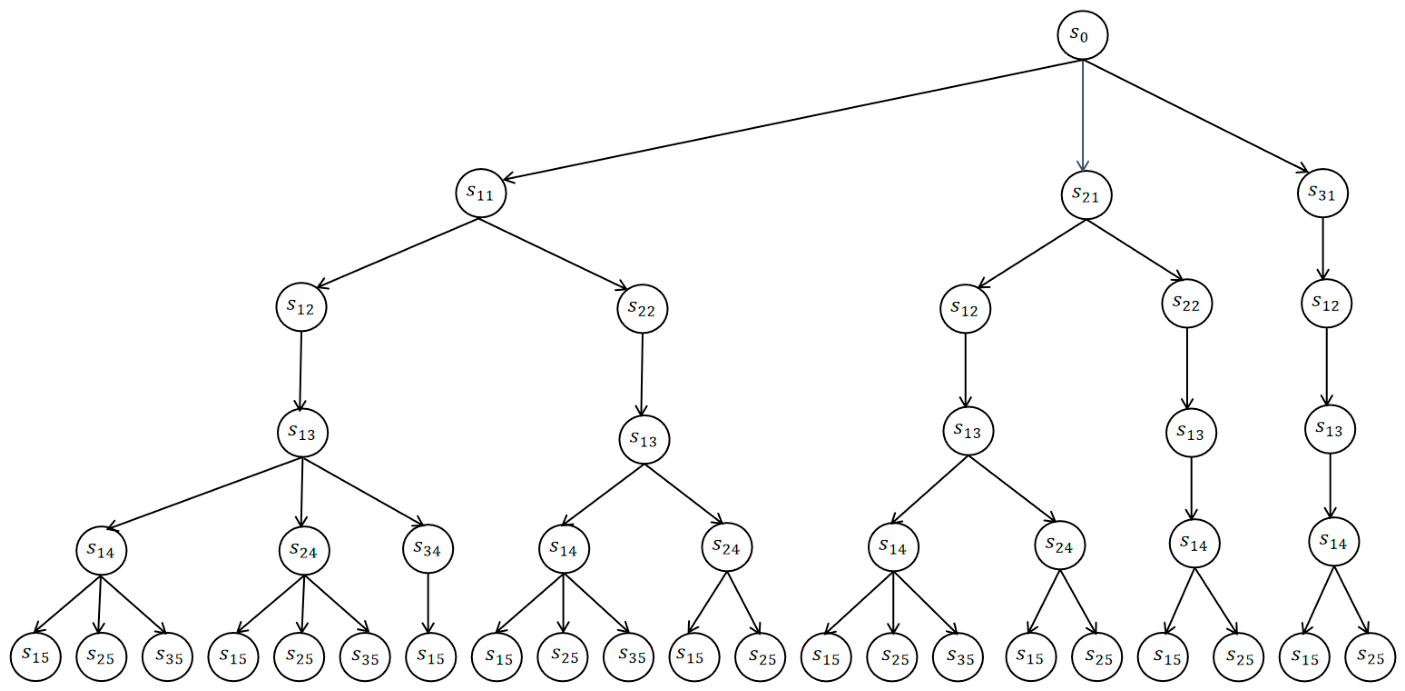
5.1. Decision Generation Tree of WIFKS
- (1)
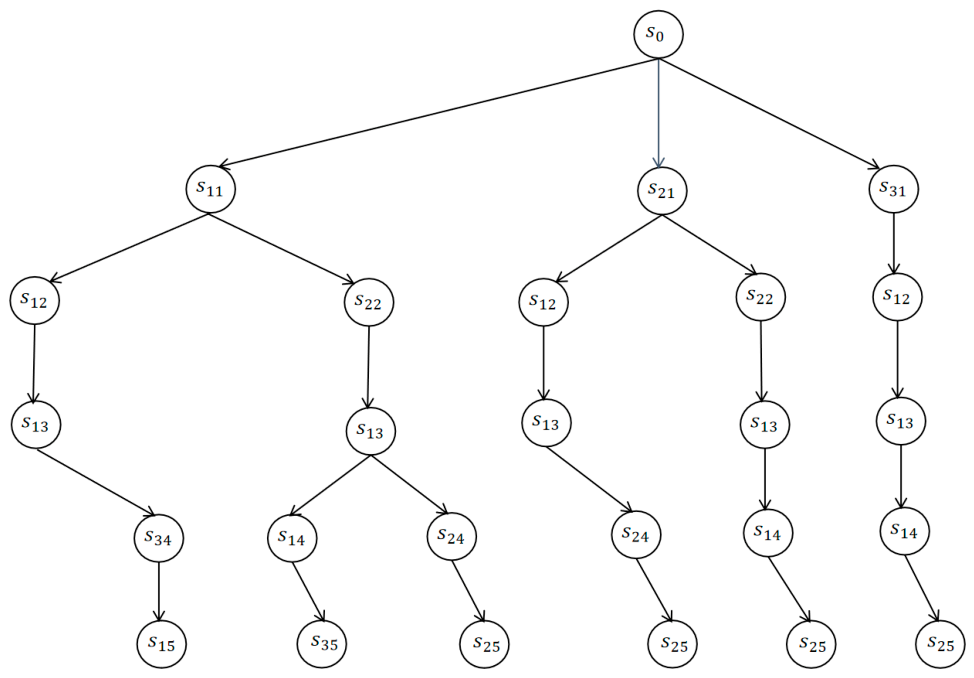
- The root node of DGT is an initial state of ;
- (2)
- DGT is a tree obtained by expanding via breadth-first search (BFS);
- (3)
- Any path in DGT satisfies , and with such that .
| Algorithm 1 Solution algorithm for decision generation tree of WIFKS. |
| Input: IFDTL path formula , WIFKS , weight constraint predicate . |
| Computation Steps: 1: // is a queue 2: Let be an initial state where 3: 4: 5: 6: 7: while do//BFS on 8: 9: if and then 10: 11: end if 12: if 13: SORTED_INSERT(EP, s, )//Insert s into EP in ascending order of Ŵ_k(s) 14: 15: CONTINUE 16: end if 17: //Set backtracking node 18: while do 19: 20: if //Direct ancestor duplicate 21: 22: BREAK 23: end if 24: //Continue backtracking 25: end while 26: if //No duplicate ancestor found 27: for all where do 28: ADD(, ) 29: 30: 31: 32: //Backtracking pointer 33: end for 34: end if 35: end while |
| Output: Decision Generation Tree (DGT), decision table EP. |
- (1)
- For any , if and , then is a path in DGT;
- (2)
- If , such that and .
5.2. Single-Attribute Engineering Decision-Making Problems Based on IFDTL Model Checking
| Algorithm 2 Solution algorithm for single-attribute engineering decision-making problems. |
| Input: IFDTL path formula , WIFKS , weight constraint predicate . |
| Computation Steps: 1: Call Algorithm 1 to obtain DGT and EP 2: //Initialize decision scheme set and optimal path set 3: //Initialize expected score according to attribute type 4: if attribute is a cost-type attribute, then 5: 6: else if attribute is a benefit-type attribute, then 7: 8: end if 9: for each in EP do//Traverse all weight nodes in the decision table EP 10: for each S_List do//Backtrack to generate complete decision paths for all valid states 11: //Obtain complete path 12: Collect all feasible decision schemes 13: end for // Calculate the maximum IFP value of paths in the current weight node set 14: // Update optimal evaluation results for cost-type attribute 15: if attribute is a cost-type attribute, then 16: 17: if then 18: 19: 20: end if // Update optimal evaluation results for benefit-type attribute 21 else if attribute is a benefit-type attribute, then 22: 23: if 24: 25: 26: end if 27: end if 28: end for |
| Output: . |
5.3. Multi-Attribute Engineering Decision-Making Problems Based on IFDTL Model Checking
| Algorithm 3 Solution algorithm for multi-attribute engineering decision-making problems. |
| Input: IFDTL path formula , WIFKS , decision attribute set , weight constraint predicates , preference weights . |
| Computation Steps: // Step 1: Run modified Algorithm 1 1: Modify Step 9 of Algorithm 1: Replace condition with Modify Step 30 of Algorithm 1: Compute for all Run modified Algorithm 1 to obtain the decision generation tree DGT //Step 2: Initialize outputs 2: //Collect all valid decision paths 3: for each leaf node in DGT do 4: // 5: 6: end for //Precompute min/max cumulative weights for each attribute 7: for each do 8: if is a cost-type attribute, then 9: 10: else if is a benefit-type attribute, then 11: 12: end if 13: end for //Evaluate each decision scheme 14: for each do 15: //Initialize decision score 16: for each do 17: if is a cost-type attribute, then 18: 19: else if is a benefit-type attribute, then 20: //Weight normalization 21: end if 22: //Accumulate weighted score 23: end for 24: //Add from Algorithm 1 25: if then 26: 27: //Replace with new optimal 28: else if then 29: //Add to optimal set 30: end if 31: end for |
| Output: . |
6. IFDTL Modeling and Verification of Health and Wellness Tourism Planning
6.1. Description of the Health and Wellness Tourism Planning Case
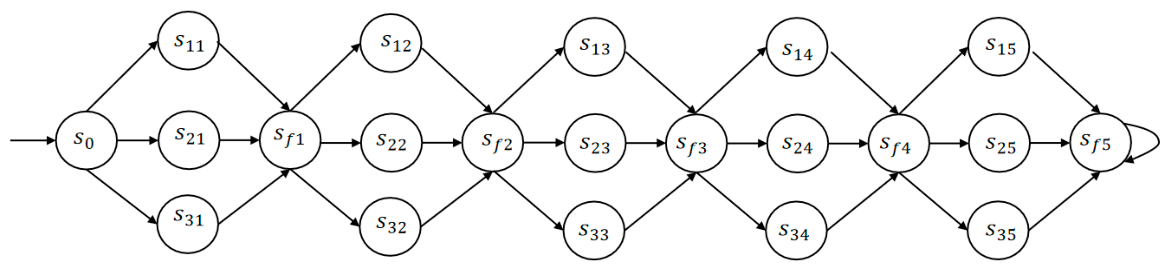
6.2. Modeling of the Multi-Attribute Engineering Decision-Making Case
- (1)
- State set
- (2)
- Intuitionistic fuzzy transition function : According to the data in Table 2, we have . This setting arises because is a virtual node, and the transition from to is regarded as having maximum possibility.
- (3)
- Intuitionistic fuzzy initial distribution : .
- (4)
- Set of atomic propositions .
- (5)
- Labeling function : , , , , .
- (6)
- Investment increment weight : According to the data in Table 1, we have, ; For all .
- (7)
- Decision attribute set . Where denote investment increment, construction period increment, tourist expectation increment, and satisfaction increment, respectively.
6.3. Single-Attribute Engineering Decision-Making Case Based on IFDTL Model Checking
- The formalization of “project completion” in IFDTL is:
- The set of decision schemes for “completing the project within 900,000 yuan” is formalized as the IFDTL formula: .
- The optimal score for “completing the project within 900,000 yuan” is formalized as: .
- The set of optimal decision schemes for “completing the project within 900,000 yuan” is formalized as: .
- (1)
- The optimal decision score is (0.891,0.100),
- (2)
- The optimal engineering scheme is .
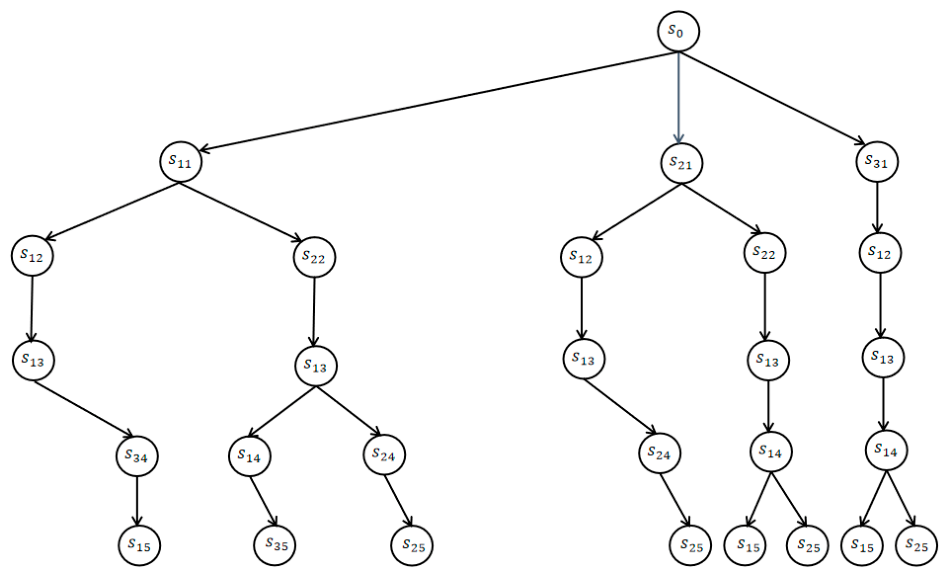
6.4. Multi-Attribute Engineering Decision-Making Case Based on IFDTL Model Checking
- (1)
- Project completion is formalized as the IFDTL formula: .
- (2)
- The weight constraint predicate is: .
- (3)
- The importance ratio of project duration to expected tourist volume for engineering decision-making is set to 4:6, that is, the preference weight is .
- (4)
- The optimal score for completing the project with expected tourist volume no less than 55,000 and total cost within 900,000 yuan is formalized as the IFDTL formula: .
- (5)
- The set of optimal decision schemes for completing the project with expected tourist volume no less than 55,000 and total cost within 900,000 yuan is formalized as the IFDTL formula: .
- (1)
- The optimal decision score is .
- (2)
- The optimal engineering scheme is .
- (1)
- The optimal decision score is ,
- (2)
- The optimal engineering scheme is .
6.5. Analysis of Case Results
- (1)
- IFKS⊂WIFKS. A WIFKS is a 2-tuple , where is an IFKS, and is a set of weight functions. Obviously, if the weight set in WIFKS is ignored, WIFKS degenerates into an IFKS. That is to say, IFKS is a special case of WIFKS. In the case, incremental weights, incremental durations, incremental expected tourist numbers, and incremental satisfaction rates at different stages of various schemes are considered, which cannot be characterized by IFKS. Therefore, IFKS⊂WIFKS.
- (2)
- IFCTL⊂IFDTL. IFDTL extends IFCTL by introducing the operators, , which are used to compute feasible schemes, optimal decision scores, and optimal decision schemes. In contrast, IFCTL can only verify functional properties such as “the project will eventually be completed” (), and compute , then only evaluate its intuitionistic fuzzy measure. In the case study, however, IFDTL was used to model and compute . Therefore, IFCTL⊂IFDTL.
- (3)
- The introduction of quality constraint operators enhances the expressive power of temporal logic. In model checking of GPoTL and IFCTL, information fusion is performed only by simple conjunction “∧” or disjunction “∨” between the system property formula and the path reachability degree , which causes information loss and asynchrony and cannot reflect the importance degrees of system properties and path reachability to the overall decision [18,19]. However, in the IFDTL model checking proposed in this paper, the system property formula is used for functional selection to obtain the path set (Algorithm 1). Then, the path reachability degree is fused with attribute weights (cost, benefit) in a weighted manner (cost attribute composition “”, benefit attribute composition “”, Definition 4, Algorithm 2). The fusion result always contains three kinds of information: system properties, path reachability, and attribute weights of decision schemes, and the information is consistently associated with corresponding paths. This is embodied in the calculation of and in the case. In multi-attribute engineering decision-making based on IFDTL model checking, weighted fusion of IFP(Π) with multi-attribute weights ensures lossless, synchronous and preference-aware information fusion (Algorithm 3). This is specifically reflected in the processes of solving and in the case.
- (4)
- The introduction of decision-making behaviors enhances the expressive power of temporal logic. PoTL, GPoTL and IFTL do not consider the selection of decision-making behaviors, which makes them unable to characterize the interactive information between the system and the external environment. This paper draws on the ideas in references [8,9] and introduces the selection of decision-making behaviors into IFCTL. For example, in the case, there are three implementation levels (normal, priority, emergency) at each stage of the project. Selecting different construction levels at different stages yields different decision schemes. Such decision-making behavior selection describes the interaction between the system and the environment, and effectively enhances the expressive power of temporal logic.
- (5)
- By using intuitionistic fuzzy measures, IFDTL can quantify incomplete information of the system. In IFDTL model checking, the path reachability degree is an intuitionistic fuzzy number . The maximum feasible scheme measured by the intuitionistic fuzzy measure on the satisfiable scheme set is also an intuitionistic fuzzy number. The weighted fusion result of and cumulative weight is an intuitionistic fuzzy number. The optimal decision scores , are all intuitionistic fuzzy numbers. These intuitionistic fuzzy numbers contain not only the uncertainty information described by membership degree and non-membership degree but also the incomplete information described by hesitation degree. For example, the case result show the following: The possibility that scheme is the optimal decision scheme is 81.5%. The possibility that it cannot be the optimal scheme is 17.4%. Meanwhile, the hesitation degree 1 − 0.815 − 0.174 = 1.1% represents the uncertain possibility of whether it can be regarded as the optimal scheme.
7. Conclusions and Future Work
Author Contributions
Funding
Data Availability Statement
Conflicts of Interest
References
- Clarke, E.M.; Emerson, E.A. Design and synthesis of synchronization skeletons using branching time temporal logic. In Logics of Programs: Logic of Programs 1981; Kozen, D., Ed.; Lecture Notes in Computer Science; Springer: Berlin/Heidelberg, Germany, 1982; Volume 131, pp. 52–71. [Google Scholar]
- Clarke, E.M.; Emerson, E.A.; Sifakis, J. Model checking: Algorithmic verification and debugging. Commun. ACM 2009, 52, 74–84. [Google Scholar] [CrossRef] [Scilit]
- Bianco, A.; De Alfaro, L. Model checking of probabilistic and nondeterministic systems. In Proceedings of the International Conference on Foundations of Software Technology and Theoretical Computer Science; Springer: Berlin/Heidelberg, Germany, 1995; pp. 499–513. [Google Scholar]
- Valiev, M.; Dekhtyar, M. Complexity of verification of nondeterministic probabilistic multiagent systems. Autom. Control Comput. Sci. 2011, 45, 390–396. [Google Scholar] [CrossRef] [Scilit]
- Baier, C.; Kwiatkowska, M. Model checking for a probabilistic branching time logic with fairness. Distrib. Comput. 1998, 11, 125–155. [Google Scholar] [CrossRef] [Scilit]
- Kwiatkowska, M.; Norman, G.; Parker, D. PRISM: Probabilistic symbolic model checker. In Proceedings of the International Conference on Modelling Techniques and Tools for Computer Performance Evaluation; Springer: Berlin/Heidelberg, Germany, 2002; pp. 200–204. [Google Scholar]
- Pan, H.; Li, Y.; Cao, Y.; Ma, Z. Model checking fuzzy computation tree logic. Fuzzy Sets Syst. 2015, 262, 60–77. [Google Scholar] [CrossRef] [Scilit]
- Li, Y.M.; Li, L.J. Model checking of linear-time properties based on possibility measure. IEEE Trans. Fuzzy Syst. 2013, 21, 842–854. [Google Scholar] [CrossRef] [Scilit]
- Li, Y.M.; Li, Y.N.; Ma, Z.Y. Computation tree logic model checking based on possibility measures. Fuzzy Sets Syst. 2015, 262, 44–59. [Google Scholar] [CrossRef] [Scilit]
- Li, Y.M.; Ma, Z.Y. Quantitative computation tree logic model checking based on generalized possibility measures. IEEE Trans. Fuzzy Syst. 2015, 23, 2034–2047. [Google Scholar] [CrossRef] [Scilit]
- Li, Y.M. Quantitative model checking of linear-time properties based on generalized possibility measures. Fuzzy Sets Syst. 2017, 320, 17–39. [Google Scholar] [CrossRef] [Scilit]
- Liang, C.J.; Li, Y.M. Model checking of generalized possibilistic linear temporal logic with fuzzy tenses. Acta Electron. Sin. 2017, 45, 2971–2977. [Google Scholar] [CrossRef] [Scilit]
- Fan, Y.H.; Li, Y.M. Realizability of fuzzy linear temporal logic. Acta Electron. Sin. 2018, 46, 341–346. [Google Scholar]
- Zhao, J.; Li, Y.M. Two paradigms of generalized possibility computing tree logic. J. Front. Comput. Sci. Technol. 2016, 10, 1475–1484. [Google Scholar] [CrossRef]
- Li, D.; Li, Y.M. The relationship between generalized possibility computation tree logic and computation tree logic. J. Front. Comput. Sci. Technol. 2017, 11, 1681–1688. [Google Scholar] [CrossRef]
- Li, Y.M.; Shi, Z.K.; Li, Z.H. Approximation theory of fuzzy systems based upon genuine many-valued implications—SISO cases. Fuzzy Sets Syst. 2002, 130, 147–157. [Google Scholar] [CrossRef] [Scilit]
- Li, Y.M.; Wei, J.L. Possibilistic fuzzy linear temporal logic and its model checking. IEEE Trans. Fuzzy Syst. 2021, 29, 1899–1913. [Google Scholar] [CrossRef] [Scilit]
- Yu, X.; Li, Y.; Geng, S.; Li, H. Fuzzy computation tree temporal logic with quality constraints and its model checking. Axioms 2024, 13, 832. [Google Scholar] [CrossRef] [Scilit]
- Yu, X.F.; Li, Y.M.; Geng, S.L. Fuzzy linear temporal logic with quality constraints. Mathematics 2024, 12, 3148. [Google Scholar] [CrossRef] [Scilit]
- Li, Y.; Liu, W.; Wang, J.; Yu, X.; Li, C. Model checking of possibilistic linear-time properties based on generalized possibilistic decision processes. IEEE Trans. Fuzzy Syst. 2023, 31, 3495–3506. [Google Scholar] [CrossRef] [Scilit]
- Liu, W.N.; Li, Y.M. Optimal strategy model checking in possibilistic decision processes. IEEE Trans. Syst. Man Cybern. Syst. 2023, 53, 6620–6632. [Google Scholar] [CrossRef] [Scilit]
- Liu, W.; Wang, J.; He, Q.; Li, Y. Model checking computation tree logic over multi-valued decision processes and its reduction techniques. Chin. J. Electron. 2024, 33, 1399–1411. [Google Scholar] [CrossRef] [Scilit]
- Atanassov, K.T. Intuitionistic fuzzy sets. Fuzzy Sets Syst. 1986, 20, 87–96. [Google Scholar] [CrossRef] [Scilit]
- Zadeh, L.A. Fuzzy sets. Inf. Control 1965, 8, 338–353. [Google Scholar] [CrossRef] [Scilit]
- Yu, X.F.; Li, C.; Li, Y.M. Computation tree logic of intuitionistic fuzzy measures. J. Front. Comput. Sci. Technol. 2017, 11, 1523–1530. [Google Scholar] [CrossRef]
- Yu, X.F.; Li, C.; Geng, S.L. Research on reasoning and application of intuitionistic fuzzy linear temporal logic. Fuzzy Syst. Math. 2023, 37, 54–68. [Google Scholar]
- Wang, Z.X.; Huang, N.; Tang, Z.L. Fuzzy multi-attribute decision-making method based on cumulative score function and accuracy function. Math. Pract. Theory 2013, 43, 167–174. [Google Scholar]
- Frigeri, A.; Pasquale, L.; Spoletini, P. Fuzzy time in linear temporal logic. ACM Trans. Comput. Log. 2014, 15, 1–22. [Google Scholar] [CrossRef] [Scilit]



| Model | KS | PKS | GPKS | GPKS | PDP | IFKS | WIFKS |
| Temporal Logics | LTL | PoLTL | GPoLTL | QFLTL | GPoLTL | IFLTL | —— |
| CTL | PoCTL | GPoCTL | QFCTL | GPoCTL | IFCTL | IFDTL | |
| Measure | Boolean algebra | Possibility measure | Generalized possibility measure | Generalized possibility measure | Generalized possibility measure | Intuitionistic fuzzy measure | Intuitionistic fuzzy measure |
| Application of Model Checking | Functional modeling and verification of classical Boolean systems. | Modeling and verification of function and performance in general uncertain systems. | Modeling and verification of function and performance in general uncertain systems. | Modeling and verification of complex uncertain systems with quality constraints. | Possibility decision-making for open systems interacting with the environment. | Modeling and verification of uncertain systems with incomplete information. | Modeling and verification of systems with incomplete information and quality constraints. |
| Research Methods | Applicable Scenarios | Core Capabilities | Limitations |
|---|---|---|---|
| Temporal-Intuitionistic Approach (IFDTL-based) | Phased and dynamic wellness tourism planning scenarios involving temporal constraints, uncertain information and dynamic interactions | 1. Characterize the sequential execution logic, phase transition rules and temporal decision constraints in planning; 2. Combine intuitionistic fuzzy measures to quantify hesitant uncertainty and incomplete evaluation information; 3. Support the modeling of dynamic interaction behaviors between the system and the external environment | The theoretical system is relatively complex, and its effectiveness needs to be verified by formal derivation |
| Multi-Criteria Optimization Method | Static, single-objective or multi-objective scheme screening and ranking scenarios | 1. Realize static weighting of decision indicators; 2. Complete the ranking of scheme advantages and disadvantages under multiple indicators | It cannot characterize the temporal relations, process evolution and temporal logic constraints in the planning process, and does not support dynamic interaction modeling |
| Standard Fuzzy Inference Method | Scenarios of simple fuzzy information reasoning and single-dimensional uncertain information processing | Realize the reasoning and simple quantification of basic fuzzy information | It is difficult to model phased execution rules and dynamic interaction behaviors, and cannot quantify hesitant uncertainty and incomplete information |
| Intuitionistic Fuzzy Knowledge System (IFKS) | Scenarios of simple intuitionistic fuzzy information characterization without multi-index weight differences | Characterize basic intuitionistic fuzzy information (membership degree, non-membership degree, hesitation degree) | It cannot integrate multi-dimensional attribute weights, has weak expressive power, and cannot adapt to complex planning scenarios with differentiated multi-index weights |
| Implementation Level | Planning Preparation | Core Process 1 | Core Process 2 | Final Process | Planning Completion |
|---|---|---|---|---|---|
| Normal | |||||
| Priority | |||||
| Emergency |
| Implementation Level | Planning Preparation | Core Process 1 | Core Process 2 | Final Process | Planning Completion |
|---|---|---|---|---|---|
| Normal | |||||
| Priority | |||||
| Emergency |
| Scheme ID | Decision Scheme | Cumulative Cost | Feasibility |
|---|---|---|---|
| 0 | 81 | (0.88,0.11) | |
| 1 | 83 | (0.88,0.11) | |
| 2 | 85 | (0.82,0.17) | |
| 3 | 84 | (0.83,0.16) | |
| 4 | 86 | (0.83,0.16) | |
| 5 | 88 | (0.82,0.17) | |
| 6 | 89 | (0.76,0.23) | |
| 7 | 85 | (0.82,0.17) | |
| 8 | 87 | (0.82,0.17) | |
| 9 | 89 | (0.82,0.17) | |
| 10 | 88 | (0.82,0.17) | |
| 11 | 90 | (0.82,0.17) | |
| 12 | 84 | (0.85,0.14) | |
| 13 | 86 | (0.85,0.14) | |
| 14 | 88 | (0.82,0.17) | |
| 15 | 87 | (0.83,0.16) | |
| 16 | 89 | (0.83,0.16) | |
| 17 | 88 | (0.82,0.17) | |
| 18 | 90 | (0.82,0.17) | |
| 19 | 88 | (0.78,0.21) | |
| 20 | 90 | (0.78,0.21) |
| Total Investment Amount | Scheme ID | Membership Degree | Non-Membership Degree |
|---|---|---|---|
| 81 | 0.88 | 0.11 | |
| 83 | 1 | 0.88 | 0.11 |
| 84 | 3 | 0.85 | 0.14 |
| 12 | |||
| 85 | 2 | 0.82 | 0.17 |
| 7 | |||
| 86 | 4 | 0.85 | 0.14 |
| 13 | |||
| 87 | 8 | 0.83 | 0.16 |
| 15 | |||
| 88 | 5 | 0.82 | 0.17 |
| 10 | |||
| 14 | |||
| 17 | |||
| 19 | |||
| 89 | 6 | 0.83 | 0.16 |
| 9 | |||
| 16 | |||
| 90 | 11 | 0.82 | 0.17 |
| 18 | |||
| 20 |
| Scheme ID | Decision Scheme | Cost | Expected Tourists | Feasibility |
|---|---|---|---|---|
| 6 | 89 | 6 | (0.76,0.23) | |
| 9 | 89 | 6.1 | (0.82,0.17) | |
| 11 | 90 | 5.6 | (0.82,0.17) | |
| 16 | 89 | 6.2 | (0.83,0.16) | |
| 17 | 88 | 5.5 | (0.82,0.17) | |
| 18 | 90 | 5.7 | (0.82,0.17) | |
| 19 | 88 | 5.6 | (0.78,0.21) | |
| 20 | 90 | 5.8 | (0.78,0.21) |
| ID | Decision Scheme | Feasibility | ||||
|---|---|---|---|---|---|---|
| 6 | 89 | 79 | 6 | 77 | (0.76,0.23) | |
| 9 | 89 | 79 | 6.1 | 76 | (0.82,0.17) | |
| 11 | 90 | 71 | 5.6 | 80 | (0.82,0.17) | |
| 16 | 89 | 79 | 6.2 | 75 | (0.83,0.16) | |
| 18 | 90 | 71 | 5.7 | 79 | (0.82,0.17) | |
| 20 | 90 | 71 | 5.8 | 78 | (0.78,0.21) |
Disclaimer/Publisher’s Note: The statements, opinions and data contained in all publications are solely those of the individual author(s) and contributor(s) and not of MDPI and/or the editor(s). MDPI and/or the editor(s) disclaim responsibility for any injury to people or property resulting from any ideas, methods, instructions or products referred to in the content. |
© 2026 by the authors. Licensee MDPI, Basel, Switzerland. This article is an open access article distributed under the terms and conditions of the Creative Commons Attribution (CC BY) license.
Share and Cite
Yu, X.; Zhao, J.; Ma, F.; Wang, L.; Li, H. Intuitionistic Fuzzy Decision Tree Temporal Logic and Its Application in Engineering Decision-Making. Axioms 2026, 15, 456. https://doi.org/10.3390/axioms15060456
Yu X, Zhao J, Ma F, Wang L, Li H. Intuitionistic Fuzzy Decision Tree Temporal Logic and Its Application in Engineering Decision-Making. Axioms. 2026; 15(6):456. https://doi.org/10.3390/axioms15060456
Chicago/Turabian StyleYu, Xianfeng, Jianhua Zhao, Famin Ma, Lei Wang, and Huirong Li. 2026. "Intuitionistic Fuzzy Decision Tree Temporal Logic and Its Application in Engineering Decision-Making" Axioms 15, no. 6: 456. https://doi.org/10.3390/axioms15060456
APA StyleYu, X., Zhao, J., Ma, F., Wang, L., & Li, H. (2026). Intuitionistic Fuzzy Decision Tree Temporal Logic and Its Application in Engineering Decision-Making. Axioms, 15(6), 456. https://doi.org/10.3390/axioms15060456