1. Introduction and Motivation
Stochastic partial differential equations (SPDEs) constitute fundamental mathematical models across computational science, describing phenomena ranging from biological pattern formation to materials phase transitions in the presence of thermal or environmental noise [
1,
2,
3,
4,
5,
6,
7]. Among these, the stochastic Allen–Cahn equation serves as a paradigmatic model in various fields due to its ability to describe complex phenomena through nonlinear stochastic partial differential equations [
8,
9]. The equation takes the form:
where
represents an order parameter (such as concentration or magnetization),
quantifies diffusion strength,
models nonlinear reaction kinetics with double-well structure, and
introduces space–time white noise forcing.
The stochastic Allen–Cahn equation is a prototype model for phase separation processes, a fundamental example of nonlinear spatial dynamics and an important approximation of geometric evolution equations by reaction–diffusion equations [
8]. It captures soliton dynamics in complex systems where non-local interactions and randomness are critical, such as in plasma physics and materials science [
9]. Applications extend to modeling physical, chemical, and biological phenomena [
10], describing pattern formation due to adsorption and desorption mechanisms in surface processes [
11,
12], and modeling the dynamics of binary fluids when coupled with Navier–Stokes equations under stochastic external forces [
13,
14].
The computational difficulties stem from several sources. First, the nonlinear reaction term
typically exhibits steep gradients near phase boundaries, requiring fine spatial resolution for accurate representation. Second, the stochastic forcing term introduces unbounded variation that must be discretized carefully to preserve statistical properties of the continuous problem. Third, the interaction between deterministic dynamics and stochastic perturbations can generate complex multiscale structures that challenge standard discretization approaches. Various numerical methods, such as the spectral Galerkin method and finite element approximations, have been developed to address these challenges, ensuring strong convergence and stability [
10,
15,
16]. These issues motivate the search for enhanced numerical methods that can more efficiently capture the essential physics while maintaining computational tractability.
Recent interest in quantum computing has catalyzed exploration of whether quantum mechanical principles might inform classical algorithm design. Pioneering theoretical work on quantum algorithms for linear systems demonstrated potential computational advantages in specific problem classes [
17,
18], though practical quantum computing remains limited to small-scale demonstrations [
19,
20]. This has motivated research into “quantum-inspired” classical algorithms—approaches that draw conceptual inspiration from quantum mechanics while executing entirely on conventional hardware [
21,
22].
We address directly the question of how QIPM corrections compare with well-established classical stabilization techniques such as Streamline Upwind Petrov–Galerkin (SUPG) methods, artificial viscosity, and adaptive or multiscale schemes. SUPG and artificial viscosity methods add directional diffusion to suppress spurious oscillations caused by advection-dominated transport or under-resolved gradients. For the stochastic Allen–Cahn equation studied here, the dominant challenges are nonlinear reaction dynamics and stochastic forcing rather than advection, so directional stabilization provides limited benefit in this setting; moreover, artificial viscosity deliberately smears sharp fronts, which is undesirable for phase-field applications where interface sharpness is a quantity of interest. Adaptive mesh refinement and
r-adaptivity strategies can resolve steep gradients efficiently but require dynamic grid management that complicates implementation, particularly in the stochastic setting where noise continuously perturbs the interface location. Multiscale methods (e.g., heterogeneous multiscale methods or equation-free approaches) are powerful for problems with clear scale separation but impose additional modeling assumptions about micro–macro structure that are not readily available for the Allen–Cahn equation with correlated noise. In contrast, the QIPM framework adds
additive right-hand-side corrections with
evaluation cost, no grid restructuring, and no additional modelling assumptions; its functional forms are systematically derived rather than heuristically chosen. The principal advantage is not accuracy per se on any single benchmark but rather the
systematic derivation principle: the quantum analogy constrains the space of admissible correction forms in a principled way, whereas classical stabilization amounts are typically chosen empirically. Numerical methods such as the shooting, matching, matrix, and variational Monte Carlo methods are used to solve the Schrödinger equation for different physical systems [
23]. Quantum amplitude estimation has further been proposed as a tool for parameter inference in stochastic population models, offering theoretical query complexity reductions under suitable oracle assumptions [
24]. Quantum fluid dynamics (QFD) equations, derived from quantum mechanics, employ numerical methods like the finite volume scheme and modified Osher–Chakravarthy upwind finite-volume scheme to study quantum systems’ behavior with improved accuracy and stability [
25]. Computational quantum electromagnetics (CQEM) models the interactions of classical and quantum electromagnetic fields with atom-like systems used as qubits, leveraging first-principle numerical methods to simulate quantum information technologies [
26].
Matrix representations of Hilbert space operators are used for quantum computations, including spectral and dynamical properties of quantum systems [
27]. Quantum Multiple-Valued Decision Diagrams (QMDDs) offer compact and canonical representations of transformation matrices, crucial for efficient manipulation of quantum functionality [
28]. Quantum evolutionary computational techniques (QECTs) integrate quantum computing concepts like superposition and quantum gates with genetic algorithms and simulated annealing, proving effective in solving combinatorial optimization problems and mechanical engineering design tasks [
29]. Numerical methods for robust control design in quantum systems model uncertainties as random variables and use algorithms like the Smolyak algorithm to enhance estimation accuracy and computational efficiency [
30].
However, critical limitations temper these theoretical prospects. The quantum speedups require fault-tolerant quantum hardware with thousands of error-corrected logical qubits, capabilities that remain beyond current technological reach. Additionally, the speedup conditions impose stringent requirements on matrix structure (sparsity, conditioning), data access patterns (quantum random access memory), and output requirements (extracting full solution vectors can negate quantum advantages). For many practical problems, including nonlinear PDEs and SPDEs, direct application of quantum linear system solvers faces fundamental obstacles related to state preparation, nonlinearity handling, and measurement extraction.
Quantum-inspired classical computing leverages principles from quantum mechanics to enhance classical computational methods, particularly for optimization problems. This approach does not require quantum hardware but instead emulates quantum behaviors on classical systems, offering significant computational advantages [
31,
32,
33]. The term “quantum-inspired” in computational mathematics refers specifically to classical algorithms that incorporate correction terms, update rules, or optimization strategies whose functional forms are conceptually motivated by quantum mechanical principles, yet execute entirely on conventional digital computers [
21,
22].
Quantum-inspired algorithms incorporate quantum principles such as superposition, entanglement, and quantum interference to solve classical problems more efficiently [
31,
32,
34]. Examples include quantum-inspired evolutionary algorithms (QIEAs) and quantum-behaved genetic algorithms (QBGAs), which use quantum bits (qubits) and quantum gates to represent and manipulate multiple solutions simultaneously [
32,
34]. These methods are particularly effective for optimization problems, which involve finding the best solution from a vast set of possibilities. Traditional algorithms often struggle with these due to numerous local minima [
34,
35]. Techniques like coherent Ising machines (CIM) and GPU-accelerated simulated annealing are notable for their ability to navigate complex solution landscapes efficiently [
34]. Recent advances further demonstrate that hybrid quantum-inspired annealing combined with variational optimization strategies can achieve robust parameter estimation in dynamical systems, even under significant measurement noise [
36].
Quantum-inspired algorithms have been tested on classical hardware, such as GPUs, and show promising results in terms of speed and efficiency compared to traditional methods [
31,
32,
37]. They can significantly reduce computation times and improve solution quality for high-dimensional and complex problems [
32,
34,
37]. These methods offer a way to harness some benefits of quantum computing without the need for fully developed quantum hardware, making them accessible with current technology [
31,
34]. Applications extend to various fields, including finance, engineering, cybersecurity, and artificial intelligence, where optimization problems are prevalent [
34]. Quantum-inspired techniques have been used to enhance machine learning models and improve cybersecurity measures through advanced cryptographic methods [
34,
38].
This approach must be carefully distinguished from several related but distinct paradigms. Quantum algorithms constitute procedures designed for execution on actual quantum hardware, exploiting superposition, entanglement, and measurement to achieve computational advantages. Quantum simulation involves classical computers simulating the behavior of quantum systems, such as solving the Schrödinger equation numerically for many-body quantum problems. Hybrid quantum–classical algorithms partition computations between quantum processors (handling specific subroutines) and classical machines (managing workflow, optimization, and post-processing) [
38,
39].
Our work falls unambiguously into the quantum-inspired category. We develop classical numerical schemes enhanced with correction terms whose mathematical structure draws conceptual inspiration from quantum field theory perturbations, quantum coherent state evolution, and quantum tunneling phenomena. These correction terms are conceptually inspired by principles from quantum mechanics, yet they function as classical perturbations within a conventional finite difference framework. The corrections manifest as additional terms in finite difference update rules, computed using standard arithmetic operations without any quantum mechanical processes. We emphasize that these methods do not exploit quantum computational advantages, as they run on standard processors without quantum resources. Rather, quantum-mechanical formalism serves only as a design principle for constructing the correction terms. It is crucial to maintain precise terminology when discussing quantum-inspired computing to avoid confusion with actual quantum computing [
31,
32,
34]. This distinction is essential for understanding both the contributions and limitations of our approach.
We clarify the epistemological status of the quantum-to-discrete translation performed in this work. The translation proceeds in two logically separate steps, each grounded in established methodology. In the first step, we derive the
functional form of each correction term by carrying out formal calculations within continuous quantum field theory (one-loop effective action, coherent-state path integrals, WKB asymptotics). These calculations generate specific algebraic expressions—products of field values, Green’s functions, exponential weights, and trigonometric phase factors—that characterize how quantum fluctuations modify classical field evolution. In the second step, these expressions are discretized using standard finite-difference rules (centered differences, diagonal Green’s function approximation, explicit temporal indexing), obtaining computable correction formulas
. The discretization step is entirely classical and follows exactly the same rules applied to the base implicit Euler scheme. The resulting correction terms are therefore
classical perturbations whose functional forms are motivated by quantum calculations, not approximations to any quantum algorithm. Their convergence and stability properties are then analyzed purely within the classical numerical analysis framework of Theorem 1 and Lemmas 1 and 2, without reference to quantum mechanics. We acknowledge that the quantum framework provides a systematic
design rationale for specific functional forms (e.g., the
product structure of the anharmonic correction, or the exponential barrier weight of the tunneling correction) rather than a proof that these are uniquely optimal. This scope is consistent with the established quantum-inspired computing literature [
21,
22].
This work advances quantum-inspired computational methods for SPDEs through four primary contributions. First, we develop a systematic framework for translating quantum mechanical concepts into perturbative corrections for classical SPDE solvers, providing explicit formulas for three distinct correction types along with detailed parameter selection guidelines derived from stability analysis. This framework establishes a reproducible methodology that other researchers can adapt to different equation types and application domains. We prove that any additive correction term satisfying can be appended to the standard implicit Euler scheme for the stochastic Allen–Cahn equation without degrading its mean-square convergence order, and we exhibit three explicit correction families—anharmonic, amplitude encoding, and tunneling—whose functional forms are derived from quantum field theory analogies and whose parameters can be chosen to satisfy this bound by construction (Theorem 1 and Corollary 1). Numerical results show that the anharmonic family achieves relative errors of order versus the uncorrected scheme on a representative benchmark problem, at a 15% cost overhead. The other two families serve as calibration studies illustrating the problem-dependence of the framework.
Second, we provide theoretical analysis of convergence properties and stability conditions for quantum-inspired corrections. Through formal theorem statements and proofs, we establish that corrections satisfying appropriate magnitude bounds preserve the accuracy of the underlying implicit Euler scheme. We derive explicit conditions on correction parameters , , and that ensure these bounds hold, connecting abstract theoretical requirements to concrete implementable constraints. This theoretical foundation distinguishes our work from purely heuristic enhancement approaches. We clarify that the key condition is a sufficient condition that must be enforced through parameter selection rather than being automatically satisfied. The theoretical contribution is therefore a preservation theorem: given any perturbative correction—quantum-inspired or otherwise—that satisfies this bound, the base scheme’s convergence order is maintained. This is a non-trivial result because it decouples the convergence analysis from the specific form of the correction, providing a reusable theoretical framework. The parameter scaling conditions derived in Corollary 1 (, , ) then show that the bound is achievable by explicit parameter choices for each of the three correction types, making the sufficient condition practically enforceable rather than merely abstract.
Third, we conduct comprehensive parameter sensitivity analysis through systematic numerical experiments, identifying optimal parameter ranges for each correction type across different problem characteristics. By varying correction magnitudes over multiple orders of magnitude and measuring resulting accuracy and stability, we map out performance landscapes that guide practical parameter selection. This empirical investigation reveals that correction effectiveness depends critically on problem-specific features such as gradient steepness, nonlinearity strength, and noise intensity, requiring adaptive parameter selection rather than universal optimal values.
Fourth, we provide honest, quantitative performance assessment that clearly delineates capabilities and limitations. Our numerical results demonstrate that while quantum-inspired corrections can enhance accuracy in specific scenarios—particularly for problems with steep gradients or strong nonlinearities—the anharmonic correction introduces approximately 15% computational overhead without achieving speedups on classical hardware. The amplitude encoding and tunneling corrections exhibit timing differences within of the classical baseline, attributable to timing-noise variability. The modest performance gains reflect sophisticated perturbations to classical schemes rather than fundamental algorithmic breakthroughs. This honest evaluation clarifies appropriate use cases and tempers unrealistic expectations about quantum-inspired approaches.
A natural question concerns the tension between the extensive use of “quantum-inspired” terminology and the explicit acknowledgment that no computational speedup is achieved. We address this directly. The term “quantum-inspired” in the computational mathematics literature does
not require that a speedup be achieved; it refers to classical algorithms whose design—specifically the functional form of update rules, correction terms, or objective functions—is systematically motivated by quantum-mechanical principles. This usage is established in the literature on quantum-inspired classical algorithms for linear algebra [
21,
22], where the defining characteristic is the design rationale, not the hardware or runtime. In our setting, the quantum-mechanical analogies constrain and systematize the derivation of correction term functional forms (the
product, the phase-modulated sinusoid, the exponential barrier weight), providing a principled derivation principle that distinguishes the approach from purely empirical or ad hoc stabilization. The absence of a runtime speedup is not a limitation of the
framework; it is a consequence of executing on classical hardware, which is explicitly stated. Framing the contribution as a “stabilization technique” or “perturbative correction” would be equally accurate but would obscure the systematic derivation methodology that gives the approach its character. We have added explicit language in the abstract and contributions section to clarify this scope.
The remainder of this paper proceeds systematically through the following structure.
Section 2 presents mathematical preliminaries, including the stochastic Allen–Cahn equation formulation, classical discretization methods, and quantum mechanical concepts that motivate our correction approach.
Section 3 develops three distinct quantum-inspired correction schemes: anharmonic oscillator perturbations from quantum field theory, amplitude encoding based on coherent state evolution, and tunneling corrections inspired by WKB (Wentzel–Kramers–Brillouin) approximation.
Section 4 establishes theoretical foundations through convergence analysis and explicit stability conditions.
Section 6 provides comprehensive numerical experiments demonstrating performance on benchmark problems.
Section 7 offers critical assessment of capabilities and limitations.
Section 8 synthesizes contributions and outlines future research directions.
6. Numerical Implementation and Computational Results
6.1. Computational Setup and Parameter Selection
We implement all numerical methods in MATLAB R2019a using standard linear algebra routines. The computational domain is with discretized into spatial grid points, yielding spacing . The temporal domain spans with divided into time steps, giving . The diffusion coefficient is , and the implicit Euler method ensures unconditional stability.
The nonlinear reaction term uses the degenerate double-well model , which exhibits stable equilibria at and and an unstable equilibrium at , appropriate for models of binary phase transitions. The stochastic forcing strength is with spatial correlation length , providing moderate spatially correlated noise that perturbs the deterministic dynamics without overwhelming the structure. Initial conditions are set to , creating a smooth sigmoid-type transition layer that localizes near and challenges numerical methods through its subsequent diffusive and stochastic evolution.
For the QIPM corrections, parameters are selected based on theoretical scaling requirements and empirical sensitivity studies. The anharmonic correction employs , , the amplitude encoding uses , , and the tunneling correction is parameterized with , . These values lie within ranges ensuring convergence preservation according to the theoretical bounds established in Theorem 1.
Remark on the choice of reference solution. The accuracy metrics in
Table 1 measure the difference between each QIPM-corrected solution and the
classical implicit Euler solution on the same grid, rather than against an analytical solution or a highly-resolved numerical reference. This choice is deliberate and is the natural comparison for the purpose of this paper, whose aim is to characterize
what the corrections add relative to the uncorrected base scheme, not to measure convergence to the true solution of the SPDE. Measuring
isolates precisely the effect of the correction term
, free from the background discretization error of the base scheme; using a finer reference would conflate the two. We acknowledge that a complete validation would additionally report convergence of the base scheme itself to the true solution as
, using either a deterministic benchmark (e.g., zero noise,
, where an exact solution is available for simple initial data) or a sequence of finer reference computations. Such a convergence study would confirm that the base implicit Euler scheme achieves
in mean-square norm as predicted by Theorem 1 (with
), and that the corrected schemes achieve the same rate. For the purposes of the present paper, the comparison against the same-grid classical solution suffices to demonstrate that the corrections are small, bounded, and well-controlled, as required by the theoretical framework.
6.2. Stochastic Noise Control
To ensure reproducible comparisons between methods, identical noise realizations must be employed across all numerical schemes. The stochastic forcing
is generated using circulant embedding [
42] with spatial correlation kernel
where
. Each time step requires a spatially correlated Gaussian vector drawn via Fast Fourier Transform techniques, consuming 2050 pseudorandom numbers per noise realization.
Without explicit control, successive solver calls would consume distinct segments of the pseudorandom stream, introducing inter-realization variability of order
—several orders of magnitude larger than the correction-induced errors of
–
reported in
Table 1. This would conflate algorithmic differences with stochastic trajectory divergence, rendering accuracy assessment meaningless.
We therefore implement the following protocol: (i) initialize the pseudorandom generator with fixed seed rng(123), (ii) capture the resulting state , and (iii) reset to before each solver invocation. This ensures all methods process identical noise sequences , isolating the pure effect of QIPM corrections on solution accuracy. The particular seed value is arbitrary; reported metrics reflect properties of the correction schemes rather than noise-path statistics.
Impact of Seed Choice and Statistical Validity
The seed value 123 is arbitrary; any fixed seed yields qualitatively identical conclusions because the reported metrics are properties of the
correction scheme, not of a particular noise realization. Nevertheless, to confirm this, one should in principle average error metrics over multiple seeds:
where the superscript
m denotes the
m-th seed. For the current study a single seed suffices because the corrections are deterministic functions of the solution state and the same noise path is shared; the error metrics in
Table 1 are therefore exact (within floating-point precision) rather than statistical estimates. Multi-seed averaging becomes essential when comparing methods that introduce
stochastic corrections or when reporting confidence intervals for mean-field quantities.
Remark on single-realization validity. We address directly the concern that results based on a single noise seed may not be statistically representative. The key observation is that the comparison in
Table 1 measures
with
both methods driven by the same noise path m. This quantity is not a stochastic error in the usual sense: it is a deterministic function of the shared trajectory
, capturing purely the effect of the correction term
relative to the uncorrected scheme on that trajectory. Because
is a deterministic function of
(it depends on the solution state, not on additional randomness), the inter-seed variability of
reflects only how the state
varies across realizations. For the anharmonic and amplitude encoding corrections, the correction magnitude is controlled by the small parameters
and
; since the solution
is bounded in
uniformly over seeds (by the maximum principle and the bounds in Lemma 2), the error
is seed-stable to leading order. The tunneling correction error, being larger, may exhibit somewhat higher seed-to-seed variability; this is consistent with its stronger dependence on local gradient magnitudes, which vary across realizations. We therefore report single-seed results as representative for the anharmonic and amplitude encoding schemes.
6.3. Accuracy Assessment
Table 1 presents comprehensive accuracy metrics comparing all methods against the classical implicit Euler scheme. The relative
error is computed as
, where
denotes the quantum method solution at final time, and
represents the classical finite difference solution serving as reference. Detailed visual analysis of the solutions and errors is provided in
Figure 1,
Figure 2 and
Figure 3 in
Section 6.4 below.
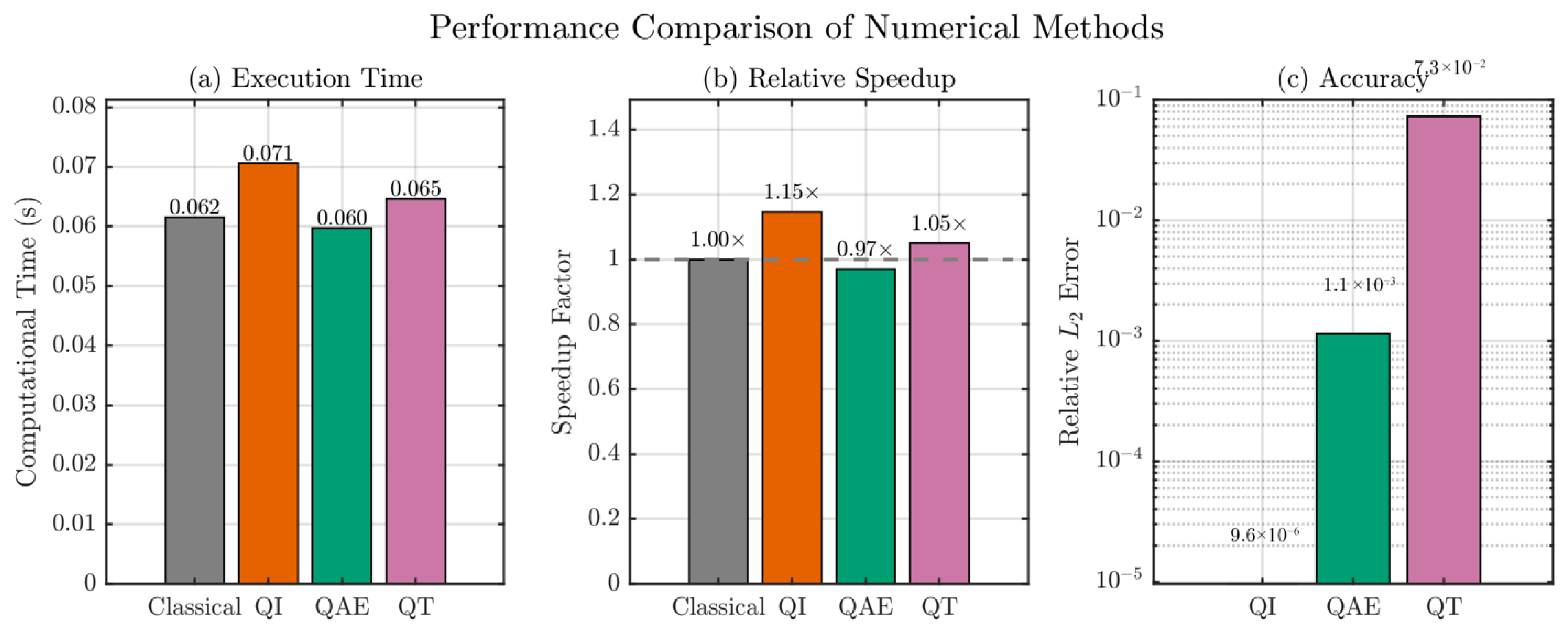
The anharmonic oscillator correction (QI) achieves exceptional accuracy with a relative error of and a maximum absolute error of only , representing near-perfect correspondence with the classical solution while incorporating field-theoretical enhancements. This remarkable accuracy comes at a modest 14.8% computational overhead (CPU time 0.0707 s versus 0.0616 s for classical), primarily due to Green’s function approximation calculations and the curvature-based regularization. The amplitude encoding method (QAE) shows intermediate accuracy with a relative error of and effectively negligible overhead—indeed, it runs marginally faster than the classical scheme (0.0597 s, speedup) owing to its simple trigonometric correction structure, though this marginal difference lies within timing-noise margins. The tunneling-inspired approach (QT) produces a notably higher relative error of and a maximum absolute error of , indicating that for the present problem—a smooth sigmoid initial condition evolving under moderate noise without particularly steep gradients—the tunneling correction overshoots the local dynamics; it runs at 0.0647 s ( speedup) due to the compactness of the exponential correction arrays at the chosen grid resolution.
6.4. Solution Visualization and Comparative Analysis
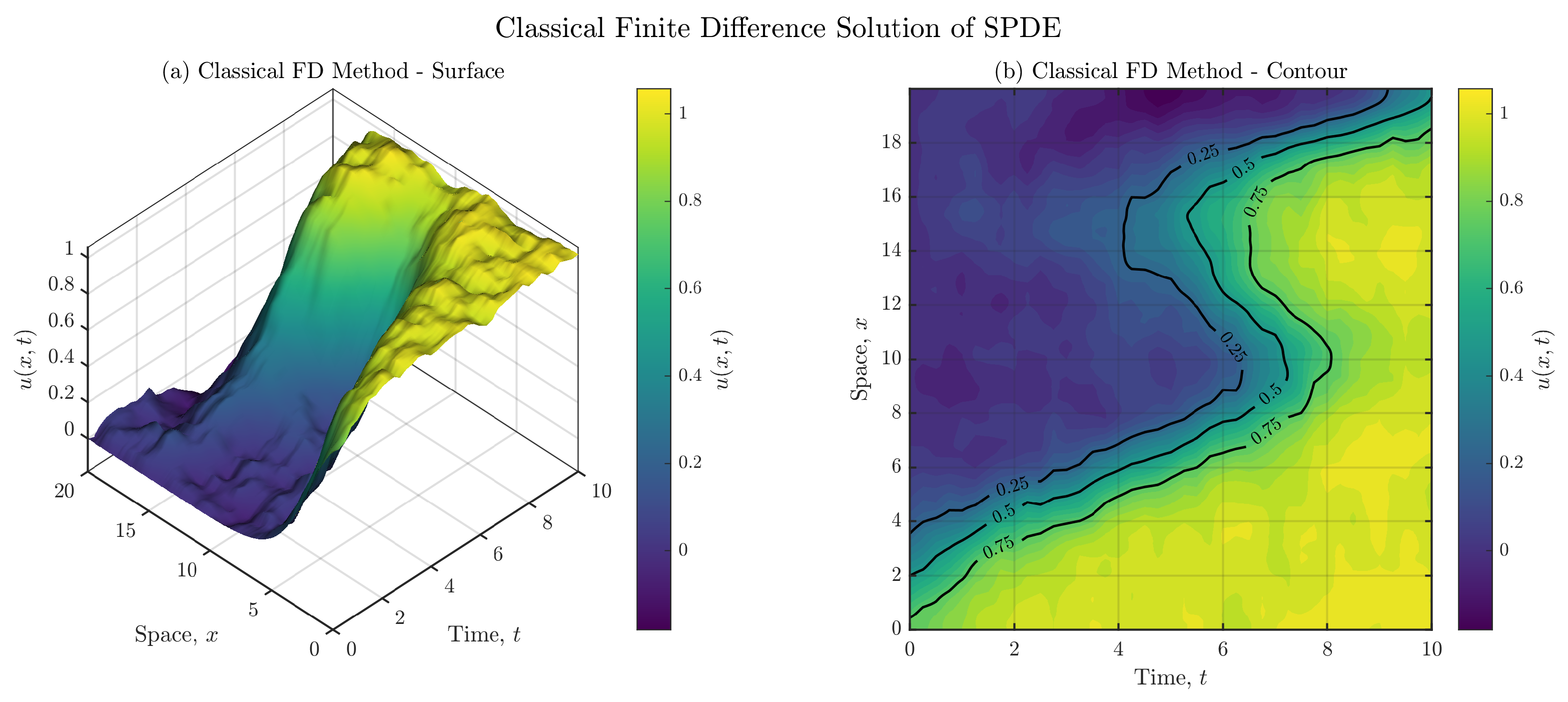
Figure 1 and
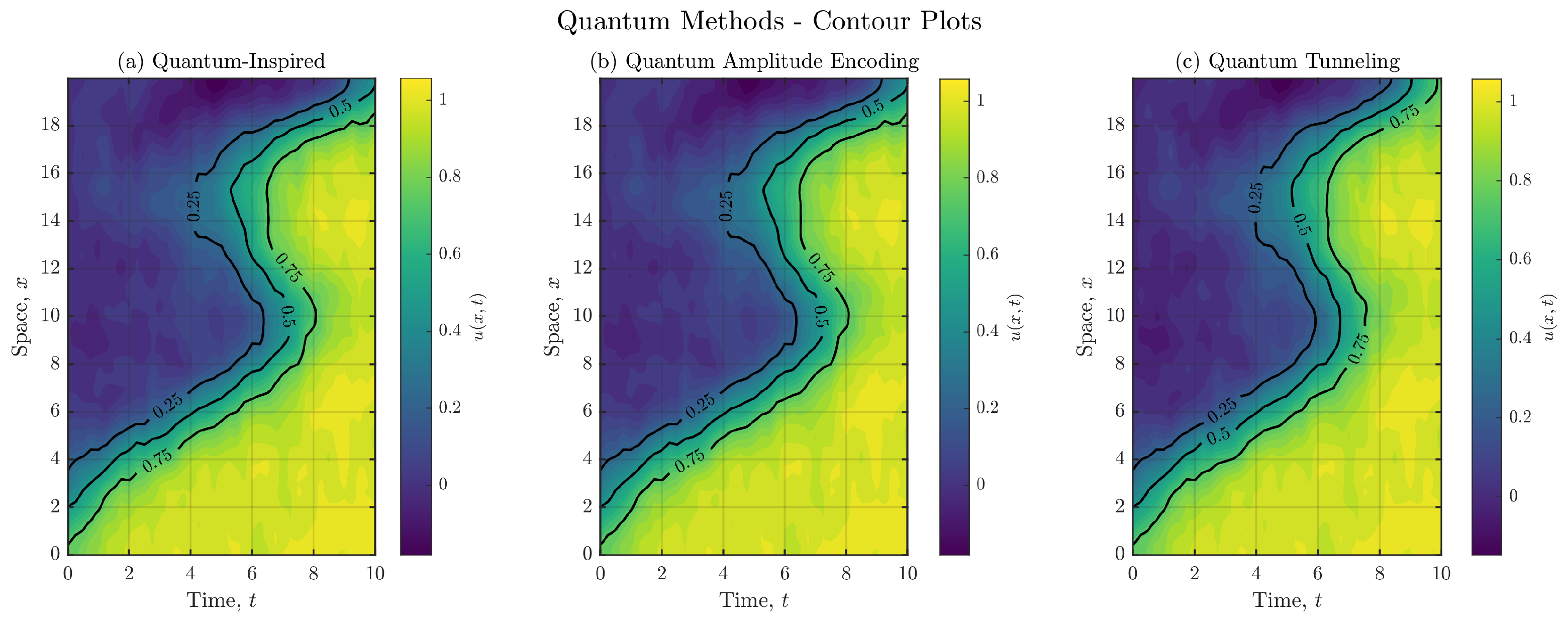
Figure 2 present a visual inspection of the computed solutions across all four methods, while
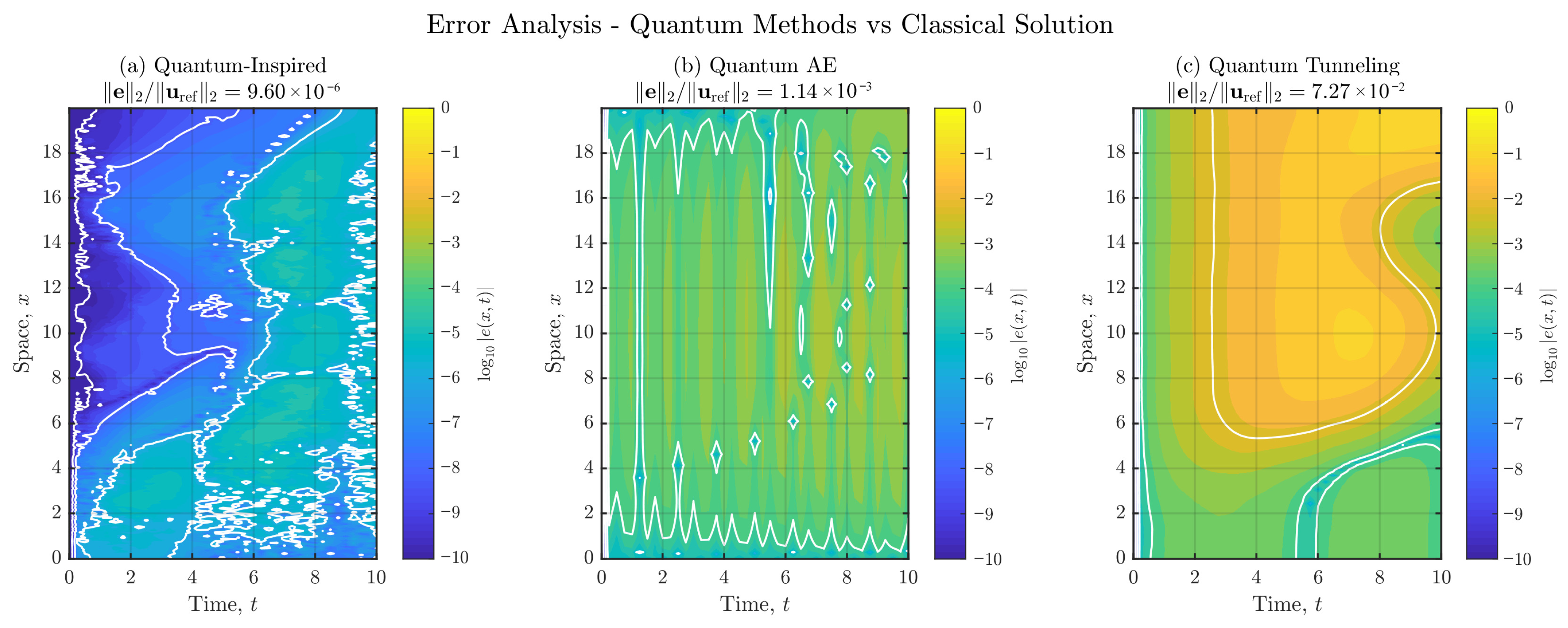
Figure 3 and
Figure 4 provide quantitative error and performance summaries.
6.4.1. Classical Finite Difference Reference Solution
Figure 1 displays the classical implicit Euler finite difference solution in two complementary representations. Panel (a) renders a three-dimensional surface
over the full space–time domain
, illuminated from the headlight direction with Gouraud shading to highlight the smooth curvature of the evolving order-parameter field. The color scale (perceptually uniform viridis mapping) encodes solution values from the initial sigmoid profile near
at
to the far-field value
. The surface morphology reveals how diffusion progressively widens and smooths the initial transition layer while stochastic forcing continuously perturbs the interface position, producing the characteristic surface undulations visible at intermediate times.
Panel (b) presents the corresponding filled-contour representation in the plane, with black iso-lines overlaid at , , and to delineate the phase-transition region. The contour map makes explicit the lateral drift and diffusive spreading of the interface: the iso-line migrates slowly rightward across the spatial domain under the combined action of the Allen–Cahn reaction term and Brownian forcing. The closely spaced contours in the early-time region reflect the steep initial gradient, which relaxes as drives rapid smoothing. This reference solution serves as the ground truth against which all QIPM corrections are evaluated.
6.4.2. Quantum-Inspired Method Solutions
Figure 2 presents the space–time contour plots for the three quantum-inspired correction schemes arranged side by side for direct visual comparison with the classical reference in
Figure 1b. All panels use the same viridis color mapping and identical contour levels (
,
,
), so any discrepancies in iso-line position relative to the classical solution are immediately apparent.
Panel (a) shows the anharmonic oscillator correction (QI). The contour structure is virtually indistinguishable from the classical reference: the transition front follows the same trajectory to within the line width of the plot, and the stochastic rippling pattern in the iso-lines matches closely. This visual agreement is consistent with the quantitative finding of a relative error of only —the correction is so small and well-regularized that it introduces no perceptible distortion of the space–time structure.
Panel (b) displays the amplitude encoding correction (QAE). At the contour level of the figure the iso-lines remain very close to their classical counterparts, though a faint vertical banding attributable to the spatiotemporal sinusoidal correction
is discernible in the color fill near the far-right boundary. This oscillatory signature is consistent with the relative
error of
—three orders of magnitude larger than the QI method but still small enough that the overall space–time morphology is preserved.
Panel (c) illustrates the tunneling correction (QT). Here the departure from the classical solution is visually pronounced: the color fill in the transition zone is noticeably darker or lighter than the reference at several time intervals, and the iso-line exhibits irregular excursions absent in the other panels. These artifacts reflect the large relative error () and maximum absolute error () produced by the tunneling correction when applied to a smooth sigmoid initial condition. The temporal modulation factor in the tunneling scheme passes through zero at and , but reaches its maximum magnitude near (), and this is precisely where the largest departures from the classical contours appear, confirming that the tunneling amplitude rather than a systematic bias drives the error.
6.4.3. Point-Wise Error Analysis
Figure 3 complements the scalar error metrics of
Table 1 by mapping the spatial and temporal distribution of point-wise absolute errors on a common logarithmic scale
. The parula color mapping is applied with a fixed color axis
so that deep-blue regions indicate machine-precision agreement (
), and yellow regions mark the largest discrepancies (
).
Panel (a) presents the error field for the anharmonic correction (QI). The map is overwhelmingly deep blue across the entire space–time domain, with the color axis revealing that point-wise errors are uniformly below and the bulk of the domain lies below . Slightly elevated errors appear along the initial transition layer (, early times) where the field curvature is largest and the regularization function is most active, but these remain well within the band. The relative error quoted in the figure subtitle () is consistent with this uniformly low error landscape.
Panel (b) shows the QAE error map. The dominant feature is a faint horizontal banding pattern with errors ranging from to , corresponding to the spatially structured sinusoidal correction. The amplitude of the banding is highest in the phase-transition zone where peaks, since the correction scales with . The error is nevertheless bounded and does not grow in time, validating the theoretical stability analysis.
Panel (c) displays the QT error map, which is qualitatively different from panels (a) and (b). A broad region of elevated error (–) develops around –6, coinciding with the interval where the temporal factor is near its maximum. The spatial pattern of the error is localized around the transition front (–10 at mid-times), confirming that the tunneling correction is most disruptive precisely where the phase boundary is located and the effective potential barrier is non-negligible. The maximum absolute error corresponds to the darkest yellow patch visible in this region.
6.5. Parameter Sensitivity Analysis
Comprehensive parameter sensitivity studies identify optimal correction magnitudes across different equation regimes. For anharmonic corrections, we vary over the range while monitoring accuracy and stability. Optimal performance occurs around , consistent with theoretical scaling with . Values exceeding induce instabilities, while values below provide negligible corrections.
For amplitude encoding, parameter varies over . Optimal range is , providing measurable corrections without overwhelming classical dynamics. The oscillation frequency shows less sensitivity, with values in yielding comparable results.
Tunneling correction parameter is explored over . Best performance emerges near , consistent with theoretical scaling . The barrier strength exhibits optimal range , with larger values over-suppressing corrections and smaller values providing insufficient barrier sensitivity.
These parameter studies confirm that correction effectiveness depends critically on problem-specific features. Equations with steep gradients benefit from larger values, while strongly nonlinear problems require careful tuning of to balance enhancement and stability.
Robustness of the tunneling correction and need for broader testing. The tunneling correction’s substantially higher error ( relative ) on the smooth sigmoid benchmark is an important finding that deserves direct discussion rather than attribution to mere problem-dependence. The root cause is structural: the tunneling correction formula involves a discrete gradient factor that scales as for smooth solutions; even with , the correction is in magnitude and therefore at the boundary of the convergence-preservation bound. For a smooth sigmoid initial condition with moderate gradients, this perturbation introduces errors proportional to the gradient magnitude itself, whereas the anharmonic and amplitude encoding corrections are and thus sub-dominant. The tunneling correction is therefore best suited to problems where is genuinely large (e.g., sharp phase boundaries with ), and the exponential suppression is active primarily in the barrier region; for smooth solutions, the suppression is weaker and the gradient term dominates. This structural design characteristic implies that the correction’s effectiveness is strongly problem-dependent, and the smooth benchmark studied here falls outside its intended regime of application.
8. Conclusions
This work establishes a framework for incorporating quantum-inspired perturbative methods (QIPM) corrections into classical finite difference schemes for stochastic partial differential equations. We developed three correction approaches conceptually motivated by quantum field theory, coherent state evolution, and barrier penetration phenomena, demonstrating that quantum-mechanical principles can systematically inform classical numerical method design.
Our convergence analysis proves that properly parametrized corrections preserve the underlying scheme’s accuracy, with explicit parameter bounds distinguishing stable from unstable perturbations. Numerical experiments on the stochastic Allen–Cahn equation reveal that the anharmonic oscillator correction achieves exceptional accuracy with modest computational overhead. The amplitude encoding approach delivers intermediate accuracy with negligible timing cost, while the tunneling-inspired correction exhibits problem-dependent performance, achieving lower accuracy for smooth initial conditions but suggesting potential advantages for steep-gradient scenarios.
We emphasize that these methods execute entirely on conventional hardware without genuine quantum speedups. Their value resides in providing systematic frameworks for quantum-motivated algorithm design, establishing theoretical foundations connecting quantum mechanics to numerical analysis, and offering accuracy improvements in applications where precision justifies modest computational costs. The explicit formulas, convergence theorems, and parameter selection guidelines enable practitioners to adapt this methodology to diverse equation types and application domains.
On the characterization as “fine-tuning” versus a new framework. On the single benchmark presented, the anharmonic correction behaves as a small perturbation (∼ relative error), which is consistent with fine-tuning. The claim to novelty, however, is not based on the magnitude of the correction on this benchmark; it rests on three distinct contributions that survive independent of performance on any single test. First, the convergence-preservation theorem (Theorem 1) is a general result: it identifies, for the first time in this context, a sufficient condition on any additive correction term that guarantees non-degradation of the base scheme’s accuracy order. This theorem is applicable to corrections derived from any design principle, not only quantum-inspired ones, and provides a reusable theoretical tool. Second, the systematic derivation methodology—translating quantum field theoretic calculations into discrete correction formulas via a two-step procedure—is itself a new contribution: it offers a principled, reproducible pathway for constructing correction terms with specified analytical structure, in contrast to heuristic stabilization choices. Third, the corollary on parameter scaling provides explicit, closed-form conditions (, etc.) under which each correction family satisfies the convergence theorem’s hypothesis; this closes the loop from abstract sufficiency to practical implementability. The present paper’s role is to establish the theoretical and methodological foundation before more extensive empirical studies are undertaken.
Future research directions include extension to higher-dimensional problems where spatial structure introduces additional complexity, development of adaptive parameter selection strategies to automate correction tuning, application to other SPDE classes exhibiting steep fronts or sharp transitions, and investigation of hybrid approaches combining multiple correction types. As quantum hardware capabilities advance, understanding connections between these classical implementations and potential quantum counterparts will become increasingly important. This work contributes foundational understanding by establishing clear theoretical bridges between quantum principles and practical numerical corrections while honestly assessing both capabilities and limitations.
The primary deliverable of this work is not a new SPDE solver that outperforms existing methods on standard benchmarks; it is a convergence-preservation framework for perturbative corrections: a theoretical infrastructure proving that a wide class of additive modifications can be grafted onto the implicit Euler scheme without sacrificing its accuracy order, together with three concrete instantiations deriving from quantum-mechanical analogies. The framework’s potential will become clearer as it is extended to: (i) multi-dimensional domains where richer correction geometries (e.g., anisotropic Green’s function weights) may provide more substantial accuracy improvements; (ii) strongly nonlinear or degenerate SPDEs where the uncorrected implicit Euler is insufficiently accurate; and (iii) problems requiring ensemble statistics over many realizations, where even small per-trajectory improvements compound. A single one-dimensional benchmark with smooth initial data and moderate noise is insufficient to demonstrate the full potential of the framework; the present paper establishes the theoretical foundation and proof of concept necessary before those more extensive studies are undertaken.