
A Unified Matrix-Based Approach to the Explicit Iterations and Global Dynamics of Linear Rational Functions


Abstract
1. Introduction
2. Preliminaries
3. A Generic Case: Hyperbolic and Elliptic Dynamics
3.1. The Case : Hyperbolic Dynamics
3.1.1. The Case : Hyperbolic Attractor
3.1.2. The Case : Hyperbolic Attractor
3.2. The Case : Elliptic Dynamics
3.2.1. The Real Valued Case: Elliptic Involution
3.2.2. The Complex Valued Case: Elliptic Quasiperiodicity
4. A Nongeneric Case
5. Discussion
- We consider given by (1). Then, using identification (3) along with (2), we get (4), which givesRelationship (24) between a composition and its representation as a matrix product gives (6)Of course, we derive again from (7). This is a key observation in this paper that iterations of linear rational functions are reduced to iterations of linear one (25). The rest of the paper is a standard analysis of (25).
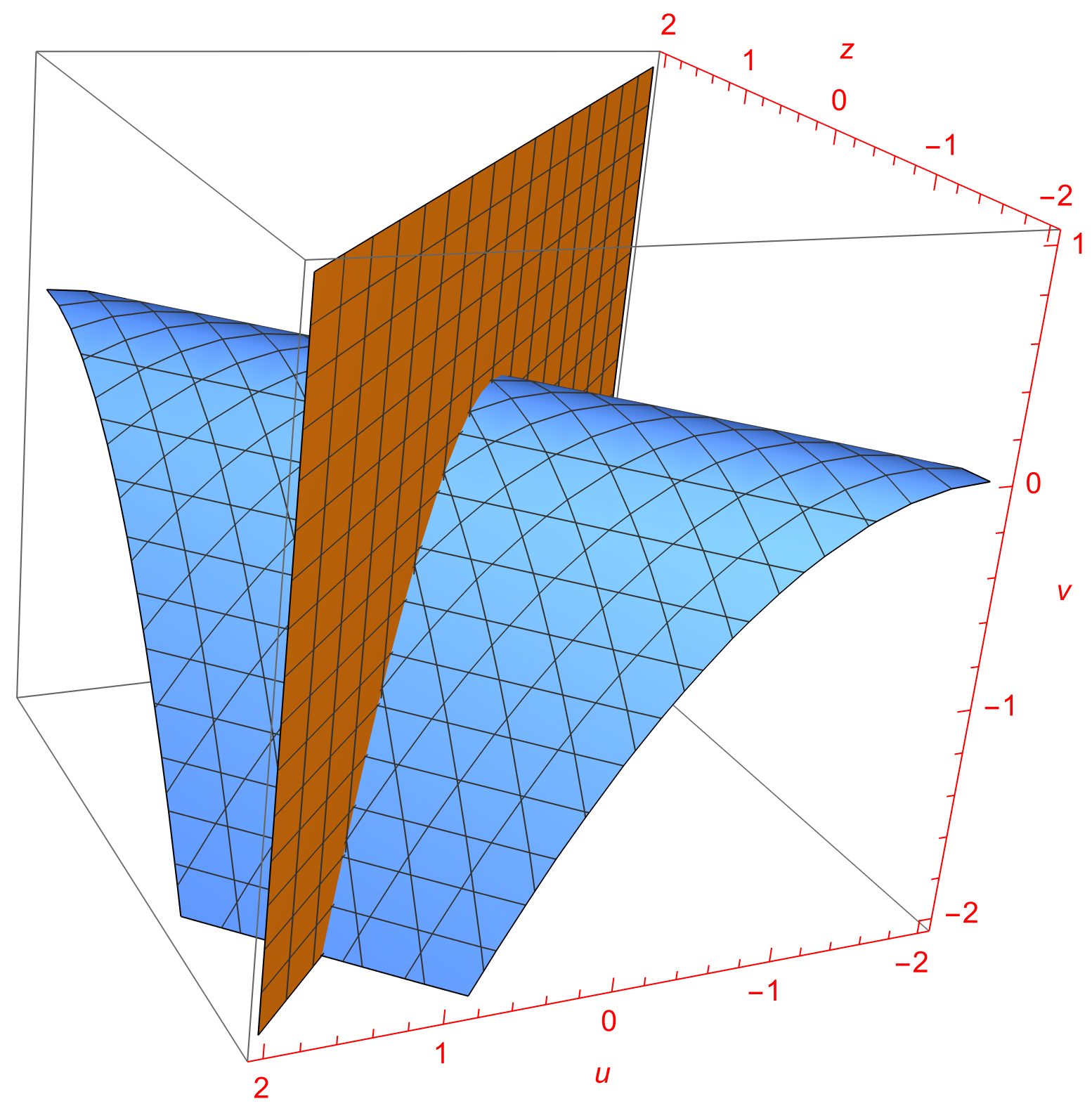
- The surfaces (15) and (21) are bifurcation surfaces where dynamics of given by (1) are changing; see Remarks 6 and 9. Their intersection is a constant mapwhere several bifurcations occur. We observe that assuming (5), we can takeThis allows us to visualize the surfaces (15) and (21) (see Figure 1)in . The intersection of (26) is a parabolic curvealong with the corresponding constant functionThe bifurcation surfaces (15) and (21) split into 4 domains where dynamics of are studied in the above sections; see Table 1. We note that this study is also given on these surfaces. We observe that (5) requires thatdoes not hold. Moreover, we haveandSo, (28) holds on the bifurcation surfaces (15) and (21) only along the curve (27), which is their intersection.
- The approach of this paper is directly adapted to complex valued functions for . It would be interesting to consider quaternion valued cases. This is, of course, non-trivial due to a non-commutativity affecting the determinant and eigenvalue definitions. Also, for instance, functionsandare different. Quaternion linear dynamical systems are studied in [22].
- Extending these results to time scale cases like in [7] is also a promising investigation.
- Results of this paper can be applied to periodic sequences of linear rational functionswith for a and all . An asymptotic casecan be also investigated.
- Results of this paper give explicit expansions of solutions of a perturbed functioni.e.,where can be explicitly computed for any , for a sufficiently smooth function and for a small parameter .
- We can scale coefficients of so thatSince , we haveand then, we can takefor , mod, mod. We also know that coefficients of satisfyfor all . Thus, we also havefor , mod, mod. Consequently, the sequence has an accumulation point. This implies that the omega limit set for a generic iteration of is nonempty. This justifies our main results, since dynamics of are either with a global attractor, with periodic orbits, or with quasiperiodic orbits. In all of these cases, for a generic iteration of .
6. Conclusions
Funding
Data Availability Statement
Acknowledgments
Conflicts of Interest
References
- Fečkan, M.; Khelifa, A.; Halim, Y.; Alsulami, I.M. Note on iterations of nonlinear rational functions. Axioms 2025, 14, 450. [Google Scholar] [CrossRef]
- Elaydi, S. An Introduction to Difference Equations, 3rd ed.; Springer Science+Business Media, Inc.: New York, NY, USA, 2005. [Google Scholar]
- Beardon, A.F. Iteration of Rational Functions; Springer: New York, NY, USA, 2000. [Google Scholar]
- Kocic, V.L.; Ladas, G. Global Behavior of Nonlinear Difference Equations of Higher Order with Applications; Springer Science & Business Media: Dordrecht, The Netherlands, 1993; Volume 256. [Google Scholar]
- Kulenovic, M.R.; Ladas, G. Dynamics of Second Order Rational Difference Equations: With Open Problems and Conjectures; Chapman and Hall/CRC: Boca Raton, FL, USA, 2001. [Google Scholar]
- Cushing, J.M. Matrix Models for Population, Diseases, and Evolutionary Dynamics; Student Mathematical Library, AMS: Providence, RI, USA, 2024; Volume 106. [Google Scholar]
- Bohner, M.; Warth, H. The Beverton–Holt dynamic equation. Appl. Anal. 2007, 86, 1007–1015. [Google Scholar] [CrossRef]
- Amleh, A.M.; Camouzis, E.; Ladas, G. On the dynamics of a rational difference equation, part I. Int. J. Differ. Equ. 2008, 3, 1–35. [Google Scholar]
- Elsayed, E.M. On the solutions and periodic nature of some systems of difference equations. Int. J. Biomath. 2014, 7, 1450067. [Google Scholar] [CrossRef]
- Gümüş, M. Global asymptotic behavior of a discrete system of difference equations with delays. Filomat 2023, 37, 251–264. [Google Scholar] [CrossRef]
- Kara, M.; Yazlik, Y.; Touafek, N.; Akrour, Y. On a three-dimensional system of difference equations with variable coefficients. J. Appl. Math. Inform. 2021, 39, 1533–1565. [Google Scholar]
- Touafek, N. On a general system of difference equations defined by homogeneous functions. Math. Slovaca 2021, 71, 697–720. [Google Scholar] [CrossRef]
- Halim, Y.; Bayram, M. On the solutions of a higher-order difference equation in terms of generalized Fibonacci sequences. Math. Methods Appl. Sci. 2016, 39, 2974–2982. [Google Scholar] [CrossRef]
- Halim, Y. A system of difference equations with solutions associated to Fibonacci numbers. Int. J. Differ. Equ. 2016, 11, 65–77. [Google Scholar]
- Hamioud, H.; Dekkar, I.; Touafek, N. Solvability of a third-order system of nonlinear difference equations via a generalized Fibonacci sequence. Miskolc Math. Notes 2024, 25, 271–285. [Google Scholar] [CrossRef]
- Halim, Y.; Rabago, J.F.T. On the solutions of a second-order difference equations in terms of generalized Padovan sequences. Math. Slovaca 2018, 68, 625–638. [Google Scholar] [CrossRef]
- Kara, M.; Yazlik, Y. On eight solvable systems of difference equations in terms of generalized Padovan sequences. Miskolc Math. Notes 2021, 22, 695–708. [Google Scholar] [CrossRef]
- Kara, M.; Yazlik, Y. Representation of solutions of eight systems of difference equations via generalized Padovan sequences. Int. J. Nonlinear Anal. Appl. 2021, 12, 447–471. [Google Scholar]
- Halim, Y.; Khelifa, A.; Berkal, M. Solutions of a system of two higher-order difference equations in terms of Lucas sequence. Univers. J. Math. Appl. 2019, 2, 202–211. [Google Scholar] [CrossRef]
- Taşkara, N.; Büyük, H. On the solutions of three-dimensional difference equation systems via pell numbers. Avrupa Bilim Teknol. Derg. 2022, 34, 433–440. [Google Scholar] [CrossRef]
- Guckenheimer, J.; Holmes, P. Nonlinear Oscillations, Dynamical Systems, and Bifurcations of Vector Fields; Springer: New York, NY, USA, 1983. [Google Scholar]
- Dilna, N.Z.; Fečkan, M.; Wang, J.R. Note on quaternion linear dynamical systems. J. Math. Sci. 2024, 278, 950–962. [Google Scholar] [CrossRef]


Disclaimer/Publisher’s Note: The statements, opinions and data contained in all publications are solely those of the individual author(s) and contributor(s) and not of MDPI and/or the editor(s). MDPI and/or the editor(s) disclaim responsibility for any injury to people or property resulting from any ideas, methods, instructions or products referred to in the content. |
© 2026 by the author. Licensee MDPI, Basel, Switzerland. This article is an open access article distributed under the terms and conditions of the Creative Commons Attribution (CC BY) license.
Share and Cite
Fečkan, M. A Unified Matrix-Based Approach to the Explicit Iterations and Global Dynamics of Linear Rational Functions. Axioms 2026, 15, 424. https://doi.org/10.3390/axioms15060424
Fečkan M. A Unified Matrix-Based Approach to the Explicit Iterations and Global Dynamics of Linear Rational Functions. Axioms. 2026; 15(6):424. https://doi.org/10.3390/axioms15060424
Chicago/Turabian StyleFečkan, Michal. 2026. "A Unified Matrix-Based Approach to the Explicit Iterations and Global Dynamics of Linear Rational Functions" Axioms 15, no. 6: 424. https://doi.org/10.3390/axioms15060424
APA StyleFečkan, M. (2026). A Unified Matrix-Based Approach to the Explicit Iterations and Global Dynamics of Linear Rational Functions. Axioms, 15(6), 424. https://doi.org/10.3390/axioms15060424