Article

On the Girth of Tanner QC-LDPC Cycle Codes: An Algebraic Number Theory Approach

1
School of Computer, Henan University of Engineering, Zhengzhou 451191, China
2
School of Mathematical Sciences, Shanghai Jiao Tong University, Shanghai 200240, China
*
Author to whom correspondence should be addressed.
Axioms 2026, 15(5), 384; https://doi.org/10.3390/axioms15050384
Submission received: 4 April 2026 / Revised: 17 May 2026 / Accepted: 18 May 2026 / Published: 21 May 2026

Abstract

Tanner quasi-cyclic low-density parity-check (QC-LDPC) codes form an important family of structured LDPC codes with favorable girth properties. This paper studies the girth of Tanner ( 2 ,   L ) -regular QC-LDPC codes (referred to as Tanner QC-LDPC cycle codes) for arbitrary integers L > 2 and develops a novel algebraic number theoretic method to determine the girth for all sufficiently large primes p with p 1 ( mod 2 L ) . We first analyze the case L = 3 and prove that the girth is 12 for every prime p 1 ( mod 6 ) through exhaustive resultant computations. We then extend the method to arbitrary L and obtain a clear classification: when L is even, the girth is exactly 8 for all admissible primes; when L is odd, the girth attains the maximum value 12 for all sufficiently large admissible primes. The proof transforms cycle existence conditions into polynomial equations and applies resultant theory. This approach converts the infinite task of checking all primes into a finite set of algebraic checks. Numerical simulations show that the Tanner ( 2 ,   5 ) -regular non-binary code over GF ( 64 ) achieves a coding gain of approximately 0.2 dB over the 5G LDPC code of equivalent binary length.

1. Introduction

Low-density parity-check (LDPC) codes were first introduced by Gallager in the 1960s and later rediscovered in the 1990s [1,2]. Owing to their capacity-approaching performance and low-complexity encoding and decoding, LDPC codes have become an important class of error-correcting codes in modern communication systems [3,4,5,6,7,8,9,10,11,12,13]. Among the various constructions and designs of LDPC codes, quasi-cyclic LDPC (QC-LDPC) codes have attracted considerable attention from both academia and industry [14,15]. The quasi-cyclic (QC) structure enables efficient encoding via shift registers and supports high-speed decoding through parallel processing, while reducing implementation complexity compared to random-like counterparts [16,17,18,19]. These features make QC-LDPC codes well suited for practical applications, including satellite communications, optical communications, storage systems, and wireless communications [20,21,22,23,24].
Within the family of QC-LDPC codes, a notable subclass was introduced by Tanner in 2001 [25]. Constructed algebraically using finite fields, these codes, referred to as Tanner ( J ,   L ) -regular QC-LDPC codes, guarantee the absence of cycles of length four, the shortest possible cycles in a Tanner graph [26]. This property provides a favorable foundation for achieving strong error-correction performance. In addition, their highly regular structure facilitates theoretical analysis and systematic code design and construction. Owing to these advantages, Tanner ( J ,   L ) -regular QC-LDPC codes have attracted significant research attention in the field of coding theory [27].
The girth, defined as the length of the shortest cycle in the Tanner graph, critically influences the performance of LDPC codes under iterative decoding. A larger girth generally improves error correction capability, especially in the error-floor region. For Tanner ( J ,   L ) -regular QC-LDPC codes with code length L p (where p is a prime and p 1 ( mod J L ) ), the maximum possible girth is known to be 12. Previous studies have investigated the girth distribution for specific parameter pairs, including ( J ,   L ) = ( 3 ,   5 ) [28], ( 3 ,   7 ) [29], ( 3 ,   11 ) [30], ( 3 ,   13 ) [31], ( 3 ,   17 ) [32], ( 3 ,   19 ) [33], and ( 3 ,   23 ) [34]. These works transformed the existence of short cycles into polynomial equations and applied the Euclidean division algorithm to determine whether solutions exist, thereby obtaining the girth distribution. In [27], a computer search for primes p up to certain bounds was conducted. The results reveal that most codes achieve the maximum girth 12, with only finitely many exceptions. Nevertheless, a general theoretical proof for arbitrary parameters remains unavailable.
In this paper, we focus on the case J = 2 and arbitrary integer L > 2 , namely Tanner ( 2 ,   L ) -regular QC-LDPC codes, which we refer to as Tanner QC-LDPC cycle codes in the following. We develop a novel approach based on algebraic number theory to determine the girth for all sufficiently large primes p. Our main contributions are as follows:
  • We rigorously prove that for all primes p 1 ( mod 6 ) , the girth of Tanner ( 2 ,   3 ) -regular QC-LDPC codes is exactly 12.
  • We extend our analysis to all integers L > 2 and establish a clear parameter-dependent classification: when L is odd, the girth attains the maximum value of 12 for all sufficiently large primes; when L is even, the girth is exactly 8.
  • Our approach transforms the problem of cycle existence into polynomial equations and employs advanced tools such as resultant theory. This converts an infinite task (verifying all primes) into a finite set of algebraic checks. Consequently, we obtain a powerful and generalizable template for analyzing the girth of other structured LDPC code families.
The remainder of this paper is structured as follows. Section 2 reviews the definition of Tanner ( 2 ,   L ) -regular QC-LDPC codes and provides the necessary algebraic preliminaries. Section 3 presents a detailed analysis of the ( 2 ,   3 ) -regular case. Section 4 extends the method to arbitrary L. Section 5 presents numerical simulation results, and Section 6 concludes the paper.

2. Preliminaries

2.1. Prime Fields

Let L > 2 be an integer and p a prime with p 1 ( mod 2 L ) . Denote by F p the prime field of order p, and let α be a primitive 2 L -th root of unity in F p ; i.e., α 2 L = 1 and α k 1 for any 1 k < 2 L . For such an α to exist, the multiplicative group F p × (which is cyclic of order p 1 ) must contain an element of order 2 L . This is equivalent to the condition 2 L ( p 1 ) ; i.e., p 1 ( mod 2 L ) . Primes satisfying this congruence are called admissible primes. The condition ensures that both α (order 2 L ) and β = α 2 (order L) are well-defined elements in F p , which are essential for the algebraic construction of the code and for the subsequent cycle analysis.
The primitive root α F p has three elementary properties needed later.
  • The order of α is 2 L by definition, α 2 L = 1 , and no smaller positive exponent gives 1.
  • For α L , we have ( α L ) 2 = α 2 L = 1 . If α L = 1 , then α would have order dividing L, contradicting that its order is 2 L (since L < 2 L ). Thus α L 1 , and the only element of order 2 in F p is 1 . Hence
    α L = 1 .
  • Set β = α 2 . Then β L = α 2 L = 1 . If β k = 1 for some k < L , then α 2 k = 1 with 2 k < 2 L , again contradicting that α has order 2 L . Thus β has order exactly L in the multiplicative group F p × .
These facts relate cycle structures to algebraic equations over F p . In particular, β will appear naturally when we examine cycles in the Tanner graph, where terms like α 2 l arise.

2.2. Definition and Computation of the Resultant

We now recall a classical algebraic tool that will be essential in our analysis: the resultant of two polynomials. This tool provides a criterion for detecting common roots. More importantly, it allows us to reduce the infinite task of checking all primes to a finite set of algebraic conditions.
Definition 1.
Let
F ( x ) = a m x m + a m 1 x m 1 + + a 0 , a m 0 ,
G ( x ) = b n x n + b n 1 x n 1 + + b 0 , b n 0
be polynomials over a field. The resultant Res ( F , G ) is the determinant of the ( m + n ) × ( m + n ) Sylvester matrix:
Res ( F , G ) = det a m a m 1 a 0 0 0 0 a m a m 1 a 0 0 0 0 a m a m 1 a 0 b n b n 1 b 0 0 0 0 b n b n 1 b 0 0 0 0 b n b n 1 b 0 ,
where the first n rows come from F and the last m rows from G.
The following proposition summarizes several classical properties of the resultant that we will need [35].
Proposition 1.
The resultant satisfies:
1. 
Res ( F , G ) = 0 iff F and G have a common root in the algebraic closure of the coefficient field.
2. 
If F , G Z [ x ] are coprime over Q [ x ] , then only finitely many primes p can be such that F and G share a common root modulo p; any such prime must divide Res ( F ,   G ) .
3. 
Over C , write F ( x ) = a m i = 1 m ( x r i ) and G ( x ) = b n j = 1 n ( x s j ) . Then
Res ( F , G ) = a m n i = 1 m G ( r i ) = ( 1 ) m n b n m j = 1 n F ( s j ) .
Example 1.
Take F ( x ) = x 2 3 x + 2 = ( x 1 ) ( x 2 ) and G ( x ) = x 2 . The Sylvester matrix ( m = 2 , n = 1 ) is
1 3 2 1 2 0 0 1 2 ,
whose determinant is 0, confirming that F and G share the root x = 2 .
Example 2.
Let F ( x ) = x 2 + x + 1 and G ( x ) = 2 x 1 . The Sylvester matrix is
1 1 1 2 1 0 0 2 1 .
Expanding the determinant:
1 · det 1 0 2 1 1 · det 2 0 0 1 + 1 · det 2 1 0 2 = 1 · 1 1 · ( 2 ) + 1 · 4 = 7 0 .
Thus F and G have no common root.

2.3. Tanner QC-LDPC Cycle Codes

The parity-check matrix H of a QC-LDPC cycle code is a 2 × L block matrix, where each block is a p × p circulant permutation matrix (CPM). Specifically,
H = I ( p 0 , 0 ) I ( p 0 , 1 ) I ( p 0 , L 1 ) I ( p 1 , 0 ) I ( p 1 , 1 ) I ( p 1 , L 1 ) ,
where I ( s ) denotes the p × p identity matrix cyclically shifted to the right by s positions ( 0 s < p ). The null space of H defines a binary ( 2 ,   L ) -regular QC-LDPC code of length L p . It is easy to see that H can be uniquely determined by the following matrix
P = p 0 , 0 p 0 , 1 p 0 , L 1 p 1 , 0 p 1 , 1 p 1 , L 1 .
There exists a one-to-one correspondence between H and P . The matrix P consisting of the shift values ( p j , l ) in H is called the exponent matrix (or base matrix). For the construction proposed by Tanner in [25], the shift values are defined algebraically using α as
p j , l = α j L + 2 l F p , j = 0 , 1 , l = 0 , 1 , , L 1 .
Here, the exponent ( j L + 2 l ) is computed as an integer, and the result is reduced modulo p to obtain an element in F p , which is then interpreted as an integer shift in { 0 , 1 , 2 , , p 1 } .
Explicitly, the two rows of the exponent matrix are
p 0 , l = α 2 l , p 1 , l = α L + 2 l = α L · α 2 l , l = 0 , 1 , , L 1 .
As established in the previous subsection, we have α L = 1 in F p . Consequently, the exponent matrix simplifies to
P = 1 α 2 α 4 α 2 ( L 1 ) 1 α 2 α 4 α 2 ( L 1 ) .
Given the exponent matrix P , the parity-check matrix H of size 2 p × L p can be constructed as above. Its null space yields a Tanner QC-LDPC cycle code of length L p with p 1 ( mod 2 L ) .

2.4. Cycle Characterization of QC-LDPC Codes

The Tanner graph of an LDPC code is bipartite, with variable nodes on one side and check nodes on the other. A cycle is a closed walk that alternates between the two types of vertices; consequently, every cycle has even length. Thus a cycle of length 2 n consists of n variable nodes and n check nodes.
For the Tanner QC-LDPC cycle code, whose parity-check matrix H is a 2 × L array of p × p CPMs, any cycle of length 2 n can be represented by a sequence of index pairs
( j 0 , l 0 ) , ( j 1 , l 1 ) , , ( j n 1 , l n 1 ) ,
where j m { 0 , 1 } indicates the row block (check node block) and l m { 0 , 1 , , L 1 } the column block (variable node block). The sequence must satisfy the adjacency conditions
j m j m + 1 , l m l m + 1 for all m ,
with indices taken cyclically modulo n. The first condition ensures alternation between variable and check nodes as required in a bipartite graph, while the second prevents trivial back-and-forth paths within the same column block.
A well-known algebraic criterion gives a necessary and sufficient condition for such a cycle to exist [36]. Let p j , l be the shift value of the CPM in the j-th row block and l-th column block. Then the cycle of length 2 n represented by the sequence above exists in the Tanner graph if and only if
m = 0 n 1 p j m , l m p j m + 1 , l m 0 ( mod p ) .
Intuitively, as one traverses the cycle, the shift values accumulate. The condition requires that the total sum of these differences be congruent to zero modulo p. In our girth analysis, Equation (1) serves as the main algebraic tool.

2.5. Girth Constraints

A known result states that for fully-connected QC-LDPC codes constructed from CPMs, the girth cannot exceed 12 [14]. Consequently, to determine the exact girth of Tanner QC-LDPC cycle codes, it suffices to check whether cycles of lengths 4, 6, 8, and 10 exist. The absence of all such cycles would imply a girth of at least 12, which then forces the girth to be exactly 12.
The following lemma shows that two of these candidate lengths (namely, 6 and 10) are automatically impossible due to the alternating pattern of row indices.
Lemma 1
(Parity Lemma). For Tanner QC-LDPC cycle codes, any cycle of length 2 n must satisfy that n is even. In other words, only cycles whose half-length is even can occur.
Proof. 
Recall that a cycle of length 2 n is represented by a sequence of row indices j 0 , j 1 , , j n 1 with j m { 0 , 1 } . The condition j m j m + 1 for each m forces the row indices to alternate between 0 and 1. Hence
j m + 1 j m + 1 ( mod 2 )
for all m. Applying this recurrence repeatedly gives
j n j 0 + n ( mod 2 ) .
For the cycle to close, we must have j n = j 0 , which implies n 0 ( mod 2 ) . Therefore n is even.  □
An immediate consequence of Lemma 1 is that cycles of length 6 ( n = 3 ) and length 10 ( n = 5 ) cannot exist in Tanner QC-LDPC cycle codes. The only candidate cycle lengths that survive the parity constraint are 4 ( n = 2 ), 8 ( n = 4 ), and 12 ( n = 6 ). Since a cycle of length 12 would already achieve the maximum possible girth, our task reduces to proving the absence of cycles of length 4 and 8. The former will be ruled out for all L, while the latter will be shown to depend on the parity of L.

3. The Base Case: L = 3

We first analyze the case L = 3 in detail. This serves a twofold purpose: it illustrates the main ideas of our approach in a concrete setting, and it provides results that will later be recovered as a special case of the general theory.

3.1. Exponent Matrix for L = 3

For L = 3 , the exponent matrix takes the form
P = 1 α 2 α 4 1 α 2 α 4 .
Since L = 3 , we have α L = α 3 = 1 by the property established in Section 2. Consequently,
α 4 = α · α 3 = α , α 5 = α 2 · α 3 = α 2 .
Substituting these into P gives a cleaner form:
P = 1 α 2 α 1 α 2 α .

3.2. Absence of Cycles of Length 4

Theorem  1.
For L = 3 , no cycle of length 4 exists for any prime p 1 ( mod 6 ) .
Proof. 
A cycle of length 4 corresponds to n = 2 in the cycle representation. Let the cycle be given by ( j 0 , l 0 ) , ( j 1 , l 1 ) with j 0 j 1 and l 0 l 1 . By symmetry, we may assume j 0 = 0 and j 1 = 1 ; the opposite case follows by swapping the two rows.
Plug p j , l = α 3 j + 2 l into the cycle condition (1):
( α 2 l 0 α L + 2 l 0 ) + ( α L + 2 l 1 α 2 l 1 ) 0 ( mod p ) .
Recall that L = 3 and α L = α 3 = 1 , so α L + 2 l = α L · α 2 l = α 2 l . Substituting this,
( α 2 l 0 + α 2 l 0 ) + ( α 2 l 1 α 2 l 1 ) = 2 α 2 l 0 2 α 2 l 1 0 ( mod p ) .
Since p > 2 (as p 1 ( mod 6 ) implies p 7 ), the factor 2 is invertible in F p . Thus we obtain
α 2 ( l 0 l 1 ) 1 ( mod p ) .
Now set β = α 2 . Because α has order 6, the element β has order 3: indeed β 3 = α 6 = 1 , and β 1 since otherwise α would have order dividing 2. Equation (4) becomes β l 0 l 1 = 1 , which forces l 0 l 1 to be a multiple of 3.
But l 0 , l 1 { 0 , 1 , 2 } and l 0 l 1 , so | l 0 l 1 | { 1 , 2 } . Neither 1 nor 2 is divisible by 3. Hence no pair ( l 0 , l 1 ) satisfies the required condition. This proves that no cycle of length 4 exists.  □

3.3. Absence of Cycles of Length 8

For cycles of length 8 we have n = 4 . By Lemma 1, the row indices must alternate. Up to swapping the two rows, the only possible row pattern is ( 0 , 1 , 0 , 1 ) . Let ( l 0 , l 1 , l 2 , l 3 ) be the corresponding column indices, which must satisfy
l 0 l 1 , l 1 l 2 , l 2 l 3 , l 3 l 0 .
Theorem 2.
For L = 3 , no cycle of length 8 exists for any prime p 1 ( mod 6 ) .
Proof. 
Substitute the row pattern ( 0 , 1 , 0 , 1 ) into the cycle condition (1):
( p 0 , l 0 p 1 , l 0 ) + ( p 1 , l 1 p 0 , l 1 ) + ( p 0 , l 2 p 1 , l 2 ) + ( p 1 , l 3 p 0 , l 3 ) 0 ( mod p ) .
Using p 0 , l = α 2 l and p 1 , l = α 2 l (since α L = 1 ), each term simplifies:
p 0 , l p 1 , l = α 2 l ( α 2 l ) = 2 α 2 l , p 1 , l p 0 , l = α 2 l α 2 l = 2 α 2 l .
Thus the condition becomes
2 α 2 l 0 2 α 2 l 1 + 2 α 2 l 2 2 α 2 l 3 0 ( mod p ) .
Since p > 2 , the factor 2 is invertible. Dividing by 2 yields
α 2 l 0 α 2 l 1 + α 2 l 2 α 2 l 3 0 ( mod p ) .
Let β = α 2 , which has order 3 as established in Section 2. Equation (5) rewrites as
β l 0 β l 1 + β l 2 β l 3 0 ( mod p ) .
We now examine all 4-tuples ( l 0 , l 1 , l 2 , l 3 ) with each l i { 0 , 1 , 2 } that satisfy the adjacency constraints. There are finitely many such tuples. For each tuple, define the polynomial
F l 0 , l 1 , l 2 , l 3 ( x ) = x l 0 x l 1 + x l 2 x l 3 Z [ x ] .
Equation (6) requires that β be a root of this polynomial.
A primitive third root of unity β satisfies the cyclotomic polynomial Φ 3 ( x ) = x 2 + x + 1 = 0 . For a given F, consider the resultant R = Res ( F , Φ 3 ) , which is an integer. If R 0 , then F and Φ 3 are coprime over Q [ x ] . By Proposition 1, only primes dividing R can possibly admit a common root of F and Φ 3 modulo p.
To compute R, we use the product formula
Res ( F , Φ 3 ) = F ( ω ) F ( ω 2 ) ,
where ω and ω 2 are the complex primitive third roots of unity. Moreover, using the relation ω 2 = 1 ω , any polynomial can be reduced modulo Φ 3 to a linear form A ω + B , and we obtain the convenient formula
Res ( F , Φ 3 ) = A 2 A B + B 2 .
We enumerate all admissible column sequences and compute their resultants. Table 1 lists each valid 4-tuple ( l 0 , l 1 , l 2 , l 3 ) , the corresponding polynomial F ( x ) , its reduction A x + B modulo Φ 3 , and the resultant R = A 2 A B + B 2 . Sequences that reduce to the zero polynomial, such as ( 0 , 1 , 1 , 0 ) and ( 0 , 2 , 2 , 0 ) , are omitted because they violate the adjacency constraints.
From Table 1, the set of non-zero resultants is
R = { 9 , 12 } .
The prime divisors of these numbers are 2 and 3 only, since 9 = 3 2 and 12 = 2 2 · 3 .
Recall that p must satisfy p 1 ( mod 6 ) . The smallest such prime is p = 7 , and all admissible primes are at least 7. For any admissible prime p 7 , we have p > 3 , so p does not divide any element of R . By Proposition 1, if a prime p does not divide Res ( F , Φ 3 ) , then F and Φ 3 cannot share a common root in F p . Since Res ( F , Φ 3 ) R for every admissible column sequence and p 7 divides none of these resultants, Equation (6) has no solution.
Therefore, no cycle of length 8 exists for any prime p 1 ( mod 6 ) .  □

3.4. Main Result for L = 3

Combining the analysis of cycles of length 4 (Theorem 1) and cycles of length 8 (Theorem 2), we obtain the following result.
Theorem 3.
For Tanner ( 2 , 3 ) -regular QC-LDPC codes, the girth is 12 for every prime p satisfying p 1 ( mod 6 ) .
Proof. 
Theorem 1 shows that no cycle of length 4 exists for any admissible prime. Theorem 2 shows that no cycle of length 8 exists for any admissible prime. By Lemma 1, cycles of length 6 or 10 are impossible. Since the maximum possible girth for QC-LDPC codes is 12, the girth must be exactly 12.  □

4. Generalization to Arbitrary L

Having established the girth result for L = 3 in detail, we now extend the analysis to arbitrary integers L > 2 . The general case exhibits a clean dichotomy: the girth depends crucially on the parity of L.

4.1. General Cycle Conditions

Recall from Section 2 that, for any admissible L, the element β = α 2 has order exactly L in F p × . This observation plays an important role in our subsequent analysis of cycles of length 4 and 8.

4.1.1. Absence of Cycles of Length 4 for All L

For a cycle of length 4, represented by ( j 0 , l 0 ) , ( j 1 , l 1 ) with j 0 j 1 and l 0 l 1 , substituting p j , l = α j L + 2 l into the cycle condition (1) gives
( α 2 l 0 α L + 2 l 0 ) + ( α L + 2 l 1 α 2 l 1 ) = 2 ( α 2 l 0 α 2 l 1 ) 0 ( mod p ) ,
since α L = 1 . Dividing by 2 (invertible for p > 2 ) yields α 2 ( l 0 l 1 ) 1 ( mod p ) . Let β = α 2 , which has order L in F p × . Then β l 0 l 1 = 1 , which implies L ( l 0 l 1 ) . Because l 0 , l 1 { 0 , 1 , , L 1 } and l 0 l 1 , we have 0 < | l 0 l 1 | < L , so L cannot divide ( l 0 l 1 ) . This contradiction shows that no cycle of length 4 exists.
Theorem 4.
For any integer L > 2 , Tanner ( 2 , L ) -regular QC-LDPC codes have no cycles of length 4 for any admissible prime p (i.e., any prime p 1 ( mod 2 L ) ).
Proof. 
As derived above, a cycle of length 4 would require β l 0 l 1 = 1 with β of order L and 0 < | l 0 l 1 | < L , which is impossible. Hence no cycle of length 4 exists.  □

4.1.2. Condition for Cycles of Length 8

For a cycle of length 8, we have n = 4 . By Lemma 1, the row indices must alternate. Since there are only two rows (indices 0 and 1) and the cycle length is 8, up to swapping the two rows and cyclic shifts, the row pattern can be taken as ( 0 , 1 , 0 , 1 ) . Let ( l 0 , l 1 , l 2 , l 3 ) be the corresponding column indices, which must satisfy the adjacency constraints:
l 0 l 1 , l 1 l 2 , l 2 l 3 , l 3 l 0 .
Recall that p j , l = α j L + 2 l . Using α L = 1 , we have
p 0 , l = α 2 l , p 1 , l = α L + 2 l = α L α 2 l = α 2 l .
Substituting the row pattern into the cycle condition (1) and simplifying yields
2 α 2 l 0 2 α 2 l 1 + 2 α 2 l 2 2 α 2 l 3 0 ( mod p ) .
Since p > 2 , the factor 2 is invertible. Dividing by 2 yields
α 2 l 0 α 2 l 1 + α 2 l 2 α 2 l 3 0 ( mod p ) .
Let β = α 2 , which has order L in F p × . Then (7) becomes
β l 0 β l 1 + β l 2 β l 3 0 ( mod p ) .
Equation (8) is the fundamental condition for the existence of a cycle of length 8. Thus, the existence problem reduces to determining whether there exists a primitive L-th root of unity β F p × and a column sequence ( l 0 , l 1 , l 2 , l 3 ) (satisfying the adjacency constraints l 0 l 1 , l 1 l 2 , l 2 l 3 , l 3 l 0 ) such that Equation (8) holds.

4.2. The Even L Case: Explicit Construction of Cycles of Length 8

When L is even, we can explicitly construct column sequences that satisfy Equation (8) for any admissible prime p. This shows that cycles of length 8 always exist, so the girth is at most 8. Together with the absence of cycles of length 4 (Theorem 4), the girth is exactly 8.
Theorem 5.
Let L > 2 be an even integer. Then for every admissible prime p (i.e., p 1 ( mod 2 L ) ), Tanner ( 2 , L ) -regular QC-LDPC codes have cycles of length 8. Consequently, the girth is exactly 8.
Proof. 
Write L = 2 m with m 2 (since L > 2 and even). Consider the column sequence
( l 0 , l 1 , l 2 , l 3 ) = ( 0 , 1 , m , m + 1 ) .
We first verify the adjacency constraints:
  • l 0 = 0 1 = l 1 ;
  • l 1 = 1 m because m 2 ;
  • l 2 = m m + 1 = l 3 ;
  • l 3 = m + 1 0 because m + 1 3 .
All constraints are satisfied.
Now compute the left-hand side of Equation (8). Since β has order L = 2 m , we have β m = ( α 2 ) m = α 2 m = α L = 1 . Then β m + 1 = β m · β = β . Substituting:
β 0 β 1 + β m β m + 1 = 1 β + ( 1 ) ( β ) = 1 β 1 + β = 0 .
Thus Equation (8) holds for this column sequence, establishing the existence of a cycle of length 8.
Since cycles of length 4 are absent by Theorem 4, and cycles of odd length are impossible by Lemma 1, the girth cannot be less than 6. The existence of a cycle of length 8 shows that the girth is at most 8. Therefore the girth is exactly 8.  □
Remark 1.
The construction ( 0 , 1 , m , m + 1 ) works for any even L 4 . For L = 2 , the construction is not covered by our analysis since L > 2 is assumed throughout.

4.3. The Odd L Case: Absence of Cycles of Length 8 for Sufficiently Large p

When L is odd, the simple construction from the even case fails because L / 2 is not an integer. In fact, for odd L, we can prove that cycles of length 8 do not exist for all sufficiently large admissible primes. The proof uses algebraic number theory, specifically properties of resultants.
Lemma 2.
Let L > 2 be an odd integer and let ζ be a primitive L-th root of unity in C . For any integers l 0 , l 1 , l 2 , l 3 { 0 , 1 , , L 1 } satisfying l 0 l 1 , l 1 l 2 , l 2 l 3 , and l 3 l 0 (the adjacency constraints for a length-8 cycle), the following holds:
ζ l 0 ζ l 1 + ζ l 2 ζ l 3 0 .
Consequently, the polynomial F ( x ) = x l 0 x l 1 + x l 2 x l 3 is not divisible by the cyclotomic polynomial Φ L ( x ) over Q , and thus Res ( F , Φ L ) 0 .
Proof. 
Assume, for contradiction, that ζ l 0 ζ l 1 + ζ l 2 ζ l 3 = 0 . Rearranging gives
ζ l 0 + ζ l 2 = ζ l 1 + ζ l 3 .
This is a vanishing sum of four L-th roots of unity with coefficients ± 1 . Since L is odd, it is well known (see, e.g., [37], Theorem 6 or the classification of vanishing sums of roots of unity of small weight) that any such relation implies that the multisets { ζ l 0 , ζ l 2 } and { ζ l 1 , ζ l 3 } are equal. Indeed, for an odd integer L > 2 , no non-trivial linear relation ζ a + ζ b ζ c ζ d = 0 with distinct ζ a , ζ b , ζ c , ζ d can exist because the cyclotomic field Q ( ζ ) does not contain the relation 1 = ζ k , and the only way to cancel four terms is pairwise equality.
Therefore we must have either
ζ l 0 = ζ l 1 and ζ l 2 = ζ l 3 ,
or
ζ l 0 = ζ l 3 and ζ l 2 = ζ l 1 .
In the first case, ζ l 0 = ζ l 1 implies l 0 l 1 ( mod L ) , which contradicts the adjacency constraint l 0 l 1 . In the second case, ζ l 0 = ζ l 3 implies l 0 = l 3 (since all indices lie in { 0 , , L 1 } ), contradicting l 3 l 0 ; similarly ζ l 2 = ζ l 1 contradicts l 1 l 2 . Both possibilities are impossible under the given constraints. Hence our assumption must be false, and ζ l 0 ζ l 1 + ζ l 2 ζ l 3 0 .
If Φ L ( x ) divided F ( x ) , then F ( ζ ) = 0 , contradicting the above. Thus Φ L F and, by irreducibility of Φ L , F and Φ L are coprime; consequently their resultant is non-zero.  □
Theorem 6.
Let L > 2 be an odd integer. Then there exists a constant C ( L ) (depending only on L) such that for every prime p 1 ( mod 2 L ) with p > C ( L ) , Tanner ( 2 , L ) -regular QC-LDPC codes have no cycles of length 8. Consequently, the girth is 12 for all such primes. Moreover, for any fixed odd L, the constant C ( L ) can be computed explicitly from the finite set of resultants arising from all admissible column sequences.
Proof. 
For each admissible column sequence ( l 0 , l 1 , l 2 , l 3 ) (satisfying the adjacency constraints), define the polynomial
F ( x ) = x l 0 x l 1 + x l 2 x l 3 Z [ x ] .
By Lemma 2, Φ L does not divide F over Q , and hence the resultant R = Res ( F , Φ L ) is a non-zero integer. There are only finitely many such admissible sequences, so the set
R L = { Res ( F , Φ L ) ( l 0 , l 1 , l 2 , l 3 ) is admissible }
is a finite set of non-zero integers. Define C ( L ) to be the maximum prime divisor of the absolute values of the elements in R L ; if all resultants are ± 1 , set C ( L ) = 2 .
Now let p 1 ( mod 2 L ) be a prime with p > C ( L ) . Since p > C ( L ) , p does not divide any R R L . In F p , the element β = α 2 is a primitive L-th root of unity, hence satisfies Φ L ( β ) = 0 . If a cycle of length 8 existed, Equation (8) would give F ( β ) = 0 for some admissible sequence ( l 0 , l 1 , l 2 , l 3 ) . Then β would be a common root of F and Φ L modulo p, which by the property of resultants (Proposition 1) would force p to divide Res ( F , Φ L ) . But this contradicts p > C ( L ) , since p does not divide any resultant in R L . Hence no cycle of length 8 can exist.
Together with Theorem 4 (absence of 4 cycles) and Lemma 1 (no cycles of odd half-length), the girth is at least 12. Since 12 is the maximum possible girth for QC-LDPC codes, the girth is exactly 12 for all admissible primes p > C ( L ) .  □
Remark 2.
The constant C ( L ) can be made explicit by computing all resultants for the given L. For L = 3 , we have R 3 = { 9 , 12 } , so C ( 3 ) = 3 . Since admissible primes satisfy p 7 , the condition p > C ( 3 ) is automatically satisfied, which explains why the result for L = 3 holds for all admissible primes. For odd L 100 , computational verification shows that C ( L ) is finite and can be readily determined; for larger odd L, the theorem guarantees the existence of such a constant, though its explicit value may require further computation. In practice, for any fixed odd L, the finitely many primes that divide any non-zero resultant are typically very small and rarely satisfy the admissibility condition p 1 ( mod 2 L ) . Hence, the sufficiently large condition is almost always satisfied for all admissible primes; any exceptional cases can be checked by direct computation.

4.4. Summary of General Results

Combining Theorems 4–6, we obtain a complete classification of the girth of Tanner ( 2 ,   L ) -regular QC-LDPC codes.
Theorem 7
(Main Theorem). For Tanner ( 2 , L ) -regular QC-LDPC codes with L > 2 :
  • If L is even, the girth is exactly 8 for every admissible prime p (i.e., every prime p 1 ( mod 2 L ) ).
  • If L is odd, there exists a finite constant C ( L ) depending only on L such that for every admissible prime p > C ( L ) , the girth is exactly 12. For L = 3 , we have C ( 3 ) = 3 ; since the smallest admissible prime is 7, the result holds for all admissible primes in this case.
Proof. 
The absence of cycles of length 4 for all L follows from Theorem 4. For even L, Theorem 5 provides an explicit construction of cycles of length 8; therefore, the girth is exactly 8 (as cycles of length 4 are impossible and odd-length cycles cannot occur). For odd L, Theorem 6 shows that cycles of length 8 do not exist for sufficiently large admissible primes. Together with the parity lemma (Lemma 1), which rules out cycles of length 6 and 10, this forces the girth to be at least 12. Since the maximum possible girth for QC-LDPC codes is 12, the girth is exactly 12 for all primes p 1 ( mod 2 L ) with p > C ( L ) . The special case L = 3 was verified directly in Section 3.  □
This classification agrees perfectly with the numerical observations presented in [27], where the authors computed girths for L 32 and p 200,000. Our theoretical results provide a rigorous explanation for those observations and extend them to all L and all sufficiently large p.

5. Numerical Results

The preceding theoretical analysis shows that Tanner ( 2 , L ) -regular QC-LDPC codes have favorable girth properties. These properties make them well suited for constructing non-binary LDPC codes, which outperform their binary counterparts under higher-order modulation and at small-to-medium block lengths. In this section, we construct a non-binary LDPC code based on this structure and compare its performance against a 5G standard LDPC code of comparable effective bit length. All simulations are conducted over the additive white Gaussian noise (AWGN) channel with binary phase-shift keying (BPSK) modulation. The non-binary code uses fast Fourier transform based q-ary sum-product algorithm (FFT-QSPA) for decoding, while the 5G code employs the standard sum-product algorithm (SPA); both use a maximum of 50 iterations.
We construct a Tanner ( 2 , L ) -regular QC-LDPC code with parameters L = 5 and p = 31 , which satisfies p 1 ( mod 2 L ) since 31 1 ( mod 10 ) . The primitive 10th root of unity in F 31 is chosen as 27 (since 27 5 1 ( mod 31 ) and 27 10 1 ( mod 31 ) ). The exponent matrix is given by
P = 1 16 8 4 2 30 15 23 27 29 .
The resulting binary parity-check matrix H bin has size 62 × 155 . To obtain a non-binary LDPC code over GF ( 64 ) , we replace each non-zero entry in H bin with a non-zero element of GF ( 64 ) selected according to a fixed random seed. Using a computer algebra system, we verified that the resulting 62 × 155 parity-check matrix H NB over GF ( 64 ) has full row rank 62; hence, the code dimension is 155 62 = 93 . The code is denoted as the Tanner ( 2 , 5 ) -regular LDPC ( 155 , 93 ) code over GF ( 64 ) .
For the binary image, each symbol in GF ( 64 ) is represented as a 6-bit vector using the primitive polynomial x 6 + x + 1 and the standard power basis. Specifically, if γ is a primitive element of GF ( 64 ) satisfying γ 6 = γ + 1 , then any field element γ i is mapped to the 6-bit binary representation of i (with the zero element mapped to the all-zero vector). This mapping is fixed and used throughout the simulations. The binary image of the code therefore has length 155 × 6 = 930 bits and information length 93 × 6 = 558 bits, exactly matching the parameters of the 5G LDPC reference code.
Before proceeding to the simulation, we verify that the Tanner ( 2 , 5 ) -regular QC-LDPC code with p = 31 indeed has girth 12. The admissibility condition p 1 ( mod 10 ) holds since 31 1 ( mod 10 ) . We take α = 27 as a primitive 10th root of unity in F 31 (since 27 5 = 14,348,907 1 ( mod 31 ) and 27 10 1 ). Then β = α 2 = 27 2 = 729 16 ( mod 31 ) is a primitive 5th root of unity. For every admissible column sequence ( l 0 , l 1 , l 2 , l 3 ) (with l i { 0 , 1 , 2 , 3 , 4 } and l 0 l 1 , l 1 l 2 , l 2 l 3 , l 3 l 0 ), we computed E = β l 0 β l 1 + β l 2 β l 3 in F 31 and found E 0 in all cases. Hence no cycle of length 8 exists. By Theorem 4, there are no 4 cycles, and by Lemma 1, cycles of length 6 or 10 are impossible. Therefore the girth is exactly 12, confirming the theoretical prediction for this parameter set.
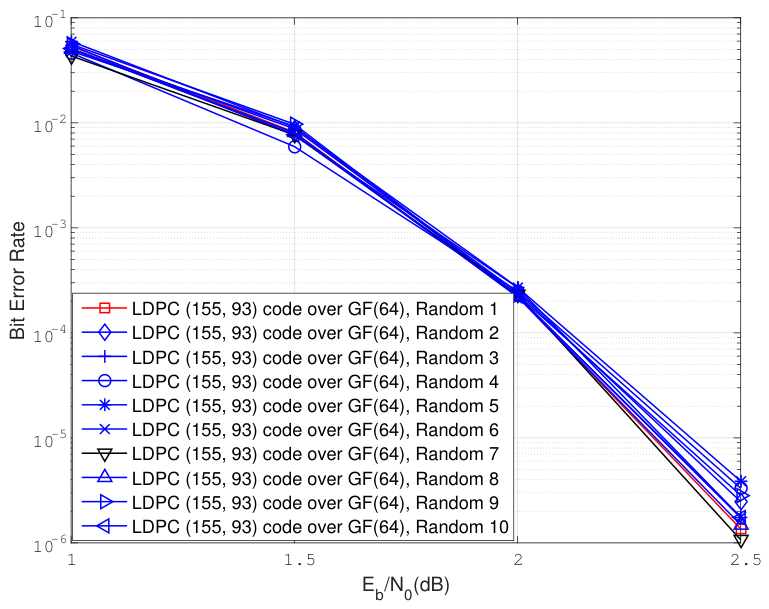
Since the non-binary extension relies on randomly selected non-zero elements from GF(64), it is important to examine whether the performance is sensitive to a particular random choice. To this end, we generated ten independent sets of random non-zero field elements and constructed ten distinct non-binary LDPC codes based on the same Tanner (2,5)-regular graph and block length ( 155 ,   93 ) . Figure 1 compares the resulting BER curves of these ten distinct non-binary LDPC codes. The curves overlap almost perfectly; at a BER of 10 5 , the maximum SNR difference among the ten realizations is below 0.05 dB, and the standard deviation is negligible. These results demonstrate that the randomness of the non-zero element assignment has a minimal impact on the error rate performance. This stability can be attributed to the fact that the underlying binary Tanner graph has girth 12 and no cycles of length 4 or 8, which already provides a favorable structure; the specific non-zero values mainly affect the decoding dynamics through the message update rules but do not introduce additional short cycles. Nevertheless, further performance improvements may be achievable by optimizing the selection of non-zero field elements (e.g., using algebraic constructions or computer search) rather than random selection. This remains an interesting direction for future research. Hence, the representative random assignment used in the main simulations adequately reflects the typical behavior, and our conclusions are robust to the choice of random non-zero field elements.
For comparison, we select a 5G LDPC (930, 558) code as specified in [38]. Both codes are simulated over the AWGN channel with BPSK modulation. The non-binary code is decoded using the FFT-QSPA with 50 iterations; the 5G code uses the standard SPA with the same number of iterations. All simulation results are averaged over at least 10 7 transmitted bits with a fixed random seed for channel noise, ensuring reproducibility.
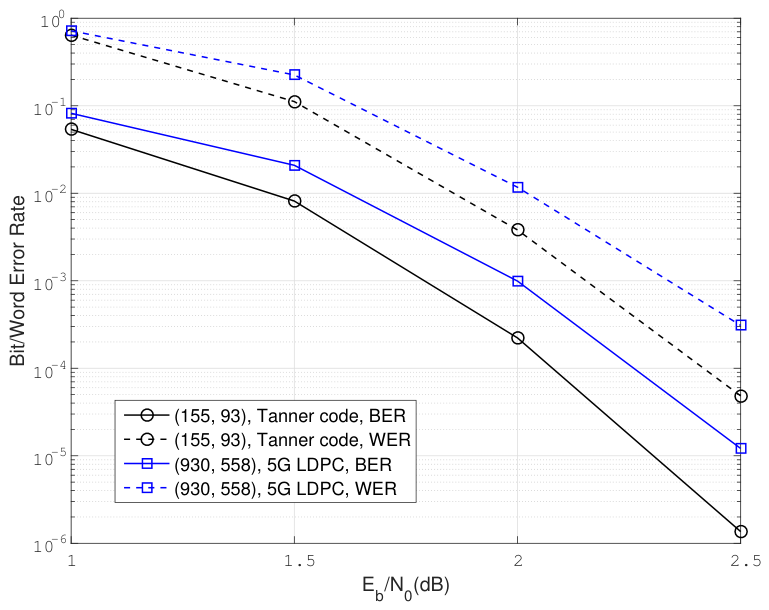
Figure 2 shows the bit error rate (BER) and word error rate (WER) performance. For the Tanner ( 2 ,   5 ) -regular LDPC ( 155 ,   93 ) code over GF ( 64 ) , the BER reaches 10 5 at E b / N 0 2.3 dB, while the 5G LDPC code requires approximately 2.5 dB to achieve the same BER. For this particular code instance and simulation setup, this corresponds to a coding gain of about 0.2 dB in favor of the proposed non-binary code (different random choices of the non-zero field entries may yield slightly different gains, as discussed earlier in this section).
The superior performance can be attributed to the girth of the underlying binary Tanner graph (which is 12 for this parameter set, as verified in the previous paragraph) and the benefits of a larger alphabet.
The simulation results demonstrate that Tanner ( 2 , L ) -regular QC-LDPC codes, when extended to non-binary alphabets, can outperform standard binary codes such as the 5G LDPC code at equivalent binary block lengths. The girth advantage (maximum girth 12 for odd L) translates into fewer short cycles, which directly benefits iterative decoding. These results confirm the practical potential of Tanner QC-LDPC cycle codes for non-binary applications. Further performance improvements may be achievable by optimizing the selection of non-zero field elements (rather than random selection) or by using the masking technique described in [27] to further reduce the number of short cycles.

6. Conclusions

In this paper, we proposed an algebraic number theoretic approach to determine the girth of Tanner ( 2 , L ) -regular QC-LDPC codes and obtained a complete classification. For even L > 2 , the girth is exactly 8 for every admissible prime; for odd L > 2 , the girth attains the maximum value 12 for all sufficiently large admissible primes. The special case L = 3 is proven to have girth 12 for all admissible primes via exhaustive resultant computation, yielding R = { 9 , 12 } . These theoretical results rigorously explain and extend previously reported numerical observations. Moreover, simulation results demonstrate that a Tanner ( 2 , L ) -regular non-binary code outperforms a 5G LDPC code of the same effective length under iterative decoding. This highlights the practical potential of Tanner QC-LDPC cycle codes for non-binary applications.
Future research will focus on extending the method to larger J values, optimizing the selection of non-zero field elements for non-binary constructions, and evaluating the error-floor performance of the proposed codes. The girth properties established in this paper are particularly relevant to the error-floor region, where short cycles are known to cause performance degradation. The absence of cycles of length 4 (for all L) and of length 8 (for odd L and sufficiently large p) suggests a potentially high error-floor performance. A detailed error-floor analysis and simulation are left for future research.

Author Contributions

Conceptualization, H.Y. and H.X.; methodology, H.Y. and H.X.; software, H.X.; validation, H.Y. and H.X.; formal analysis, H.Y. and H.X.; investigation, H.X.; resources, M.Z.; data curation, M.Z.; writing—original draft preparation, H.Y., M.X. and H.X.; writing—review and editing, H.Y., M.Z., Z.Y., M.X. and H.X.; supervision, Z.Y.; project administration, H.Y. and H.X.; funding acquisition, H.Y., M.Z., Z.Y., M.X. and H.X. All authors have read and agreed to the published version of the manuscript.

Funding

This work was supported in part by the National Natural Science Foundation of China (Grant No. 12026231), the Development Project of Henan Provincial Department of Science and Technology (Grant Nos. 262102210213 and 262102210222), the Natural Science Foundation of Henan (Grant Nos. 262300421785 and 262300420301), Henan Provincial Joint Fund for Scientific and Technological Research and Development (Grant Nos. 252103810206, 252103810208, and 252103810011), Key Research and Development Special Project of Henan Province (Grant No. 261111211200), and the Young Backbone Teacher Training Program of Henan Provincial Higher Education Institutions (Grant No. 2025GGJS141).

Data Availability Statement

The data that support the findings of this research are available from the corresponding author upon reasonable request.

Conflicts of Interest

The authors declare no conflicts of interest.

Abbreviations

The following abbreviations are used in this manuscript:
LDPCLow-density parity-check
QC-LDPCQuasi-cyclic LDPC
pA prime with p 1 ( mod 2 L )
F p Prime field of order p
F p × Multiplicative group
Q Rational number
C Complex field
F ( x ) , F , G ( x ) , G Polynomial over a field
Res ( F , G ) Resultant of the polynomials F and G
Z [ x ] Polynomial ring over the integers
Q [ x ] Polynomial ring over the rational numbers
H Parity-check matrix
P Exponent matrix (or base matrix)
CPMCirculant permutation matrix
Φ L ( x ) , Φ L Cyclotomic polynomial
φ ( L ) Euler’s totient function
AWGNAdditive white Gaussian noise
BPSKBinary phase shift keying
FFT-QSPAFast Fourier transform-based q-ary sum-product algorithm
SPASum-product algorithm
BERBit error rate
WERWord error rate

References

  1. Gallager, R. Low-density parity-check codes. IRE Trans. Inf. Theory 1962, 8, 21–28. [Google Scholar] [CrossRef]
  2. MacKay, D. Good error-correcting codes based on very sparse matrices. IEEE Trans. Inf. Theory 1999, 45, 399–431. [Google Scholar] [CrossRef]
  3. Li, J.; Lin, S.; Abdel-Ghaffar, K.; Ryan, W.E.; Costello, D.J., Jr. LDPC Code Designs, Constructions, and Unification; Cambridge University Press: New York, NY, USA, 2017. [Google Scholar]
  4. Huang, Q.; Tang, L.; He, S.; Xiong, Z.; Wang, Z. Low-complexity encoding of quasi-cyclic codes based on Galois fourier transform. IEEE Trans. Commun. 2014, 62, 1757–1767. [Google Scholar] [CrossRef]
  5. Bharadwaj, K.; Garani, S.S. Efficient Encoding Algorithm and Architecture for 2-D Quasi-Cyclic LDPC Codes with Applications to 2-D Magnetic Recording. IEEE Trans. Magn. 2025, 61, 3100424. [Google Scholar] [CrossRef]
  6. Wang, X.; Ge, T.; Li, J.; Su, C.; Hong, F. Efficient Multi-Rate Encoder of QC-LDPC Codes Based on FPGA for WIMAX Standard. Chin. J. Electron. 2017, 26, 250–255. [Google Scholar] [CrossRef]
  7. Khodaiemehr, H.; Kiani, D. Construction and Encoding of QC-LDPC Codes Using Group Rings. IEEE Trans. Inf. Theory 2017, 63, 2039–2060. [Google Scholar] [CrossRef]
  8. Mahdi, A.; Paliouras, V. On the Encoding Complexity of Quasi-Cyclic LDPC Codes. IEEE Trans. Signal Process. 2015, 63, 6096–6108. [Google Scholar] [CrossRef]
  9. Tseng, C.F.; Tarng, J.H. Low-Complexity and Piecewise Systematic Encoding of Non-Full-Rank QC-LDPC Codes. IEEE Commun. Lett. 2015, 19, 897–900. [Google Scholar] [CrossRef]
  10. Zhang, Q.; Chen, B.; Zhuang, T.; Jiang, Y.; Xia, S.T. Revolving NBP-like decoders for cyclic and quasi-cyclic LDPC codes. IEEE Trans. Commun. 2026, 74, 598–611. [Google Scholar] [CrossRef]
  11. Qing, H.; Xuan, H.; Lisha, L.; Kui, C.; Xiaohu, T. Two bit-serial architectures for check node update in min-sum decoding of LDPC codes. China Commun. 2026, 23, 142–150. [Google Scholar] [CrossRef]
  12. Gershon, Y.; Cassuto, Y. In-Memory Bit Error Rate Estimation Using Syndromes of LDPC Codes. IEEE J. Sel. Areas Inf. Theory 2026, 7, 161–174. [Google Scholar] [CrossRef]
  13. De Weerdt, B.; Deligiannis, N. Neural Rate-Adaptive LDPC Decoding for the Slepian-Wolf Problem. IEEE Open J. Signal Process. 2026, 7, 456–471. [Google Scholar] [CrossRef]
  14. Fossorier, M. Quasi-cyclic low-density parity-check codes from circulant permutation matrices. IEEE Trans. Inf. Theory 2004, 50, 1788–1793. [Google Scholar] [CrossRef]
  15. Smarandache, R.; Mitchell, D.G.M.; Gomez-Fonseca, A. Structural Analysis of Generalized Quasi-Cyclic LDPC Codes: Rank, Design, and Generator Matrices. IEEE Trans. Inf. Theory 2026, 72, 253–267. [Google Scholar] [CrossRef]
  16. Jiang, X.; Xia, X.G.; Lee, M.H. Efficient Progressive Edge-Growth Algorithm Based on Chinese Remainder Theorem. IEEE Trans. Commun. 2014, 62, 442–451. [Google Scholar] [CrossRef]
  17. He, X.; Zhou, L.; Du, J. PEG-Like Design of Binary QC-LDPC Codes Based on Detecting and Avoiding Generating Small Cycles. IEEE Trans. Commun. 2018, 66, 1845–1858. [Google Scholar] [CrossRef]
  18. Sariduman, A.; Pusane, A.E.; Taskin, Z.C. On the Construction of Regular QC-LDPC Codes with Low Error Floor. IEEE Commun. Lett. 2020, 24, 25–28. [Google Scholar] [CrossRef]
  19. Wu, X.; Jiang, M.; Zhao, C. A Parity Structure for Scalable QC-LDPC Codes with All Nodes of Degree Three. IEEE Commun. Lett. 2017, 21, 1913–1916. [Google Scholar] [CrossRef]
  20. Yin, L.; Zhai, X.; Fang, Y.; Han, G. A multi-high-rate structured algebraic QC-LDPC code for 3D TLC NAND flash memory. IEEE Trans. Commun. 2025, 73, 10028–10043. [Google Scholar] [CrossRef]
  21. Li, Y.; Xue, J.; Wu, X.; Zhang, Y.; Zhang, Y. Application of LDPC code in PM-DQPSK system of consumer Internet of Things networks. IEEE Trans. Consum. Electron. 2025, 71, 5950–5959. [Google Scholar] [CrossRef]
  22. Gong, J.; Lu, Z.; Wang, L.; Chu, X.; Wen, X. A Reusable and Efficient Architecture for QC-LDPC Encoder with Less Expansion Factors. IEEE Trans. Very Large Scale Integr. VLSI Syst. 2023, 31, 2089–2101. [Google Scholar] [CrossRef]
  23. Zhang, G.; Lou, M.; Sun, A.; Fang, Y. Dual-Diagonal QC-LDPC Codes Free of Small Cycles from GCD Framework via Negative Coefficients. IEEE Commun. Lett. 2024, 28, 2724–2728. [Google Scholar] [CrossRef]
  24. Hu, M.; Zhai, X.; Tao, S.; Han, G. Hierarchical Globally Coupled LDPC Codes and Adaptive Two-Phase Decoding for NAND Flash Memories. IEEE Commun. Lett. 2026, 30, 1915–1919. [Google Scholar] [CrossRef]
  25. Tanner, R.M.; Sridhara, D.; Fuja, T.E. A class of group-structured LDPC codes. In Proceedings of the International Symposion Communication Theory and Applications; ACM: New York, NY, USA, 2001; pp. 365–370. [Google Scholar]
  26. Tanner, R.M. A recursive approach to low complexity codes. IEEE Trans. Inf. Theory 1981, 27, 533–547. [Google Scholar] [CrossRef]
  27. Xu, H.; Li, H.; Bai, B.; Zhu, M.; Zhang, B. Tanner (J, L) quasi-cyclic LDPC codes: Girth analysis and derived codes. IEEE Access 2019, 7, 944–957. [Google Scholar] [CrossRef]
  28. Kim, S.; No, J.; Chung, H.; Shin, D. On the girth of Tanner (3,5) quasi-cyclic LDPC codes. IEEE Trans. Inf. Theory 2006, 52, 1739–1744. [Google Scholar]
  29. Gholami, M.; Mostafaiee, F. On the girth of Tanner (3,7) quasi-cyclic LDPC codes. Trans. Comb. 2012, 1, 1–16. [Google Scholar]
  30. Xu, H.; Bai, B.; Feng, D.; Sun, C. On the girth of Tanner (3,11) quasi-cyclic LDPC codes. Finite Fields Their Appl. 2017, 46, 65–89. [Google Scholar] [CrossRef]
  31. Xu, H.; Li, H.; Feng, D.; Zhang, B.; Zhu, H. On the girth of Tanner (3, 13) quasi-cyclic LDPC codes. IEEE Access 2019, 7, 5153–5179. [Google Scholar] [CrossRef]
  32. Xu, H.; Duan, Y.; Miao, X.; Zhu, H. Girth analysis of Tanner’s (3, 17)-regular QC-LDPC codes based on Euclidean division algorithm. IEEE Access 2019, 7, 94917–94930. [Google Scholar] [CrossRef]
  33. Zhou, M.; Zhu, H.; Xu, H.; Zhang, B.; Xie, K. A note on the girth of (3, 19)-regular Tanner’s quasi-cyclic LDPC codes. IEEE Access 2021, 9, 28582–28590. [Google Scholar] [CrossRef]
  34. Wang, Q.; Che, J.; Li, H.; Luo, Z.; Zhang, B.; Liu, H. Tanner (3, 23)-regular QC-LDPC codes: Cycle structure and girth distribution. IEEE Access 2024, 12, 26591–26609. [Google Scholar] [CrossRef]
  35. Silverman, J.H. The Arithmetic of Elliptic Curves; Springer: Berlin/Heidelberg, Germany, 2009. [Google Scholar]
  36. Xu, H.; Zhang, X.D.; Li, H.; Zhu, H.; Zhang, B.; Liu, H. A cyclic-shift based method for counting cycles of quasi-cyclic LDPC codes. Electron. Lett. 2024, 60, e13085. [Google Scholar] [CrossRef]
  37. Conway, J.H.; Jones, A.J. Trigonometric Diophantine equations (On vanishing sums of roots of unity). Acta Arith. 1976, 30, 229–240. [Google Scholar] [CrossRef]
  38. 3GPP TS 38.212; 5G NR; Multiplexing and Channel Coding (Release 15) V15.3.0. ETSI: Sophia Antipolis, France, 2018.
Figure 1. Bit error rate performance of ten Tanner ( 2 , 5 ) -regular LDPC ( 155 , 93 ) codes over GF ( 64 ) with different random non-binary field element assignments.
Axioms 15 00384 g001
Figure 2. Bit/Word error rate performance of the Tanner ( 2 , 5 ) -regular LDPC ( 155 , 93 ) code over GF ( 64 ) and 5G LDPC (930, 558) code under AWGN channel with BPSK modulation.
Axioms 15 00384 g002
Table 1. Resultants of F ( x ) = x l 0 x l 1 + x l 2 x l 3 with Φ 3 ( x ) = x 2 + x + 1 for admissible column sequences.
( l 0 , l 1 , l 2 , l 3 ) F ( x ) Reduced Form Ax + B R
(0, 1, 0, 1) 2 2 x 2 x + 2 12
(0, 1, 0, 2) x 2 x + 2 0 x + 3 9
(0, 1, 2, 1) x 2 2 x + 1 3 x + 0 9
(0, 2, 0, 1) x 2 x + 2 0 x + 3 9
(0, 2, 0, 2) 2 x 2 + 2 2 x + 4 12
(0, 2, 1, 2) 2 x 2 + x + 1 3 x + 3 9
(1, 0, 1, 0) 2 x 2 2 x 2 12
(1, 0, 1, 2) x 2 + 2 x 1 3 x + 0 9
(1, 0, 2, 0) x 2 + x 2 0 x 3 9
(1, 2, 0, 2) 2 x 2 + x + 1 3 x + 3 9
(1, 2, 1, 0) x 2 + 2 x 1 3 x + 0 9
(1, 2, 1, 2) 2 x 2 + 2 x 4 x + 2 12
(2, 0, 1, 0) x 2 + x 2 0 x 3 9
(2, 0, 2, 0) 2 x 2 2 2 x 4 12
(2, 0, 2, 1) 2 x 2 x 1 3 x 3 9
(2, 1, 0, 1) x 2 2 x + 1 3 x + 0 9
(2, 1, 2, 0) 2 x 2 x 1 3 x 3 9
(2, 1, 2, 1) 2 x 2 2 x 4 x 2 12
Disclaimer/Publisher’s Note: The statements, opinions and data contained in all publications are solely those of the individual author(s) and contributor(s) and not of MDPI and/or the editor(s). MDPI and/or the editor(s) disclaim responsibility for any injury to people or property resulting from any ideas, methods, instructions or products referred to in the content.