On the Girth of Tanner QC-LDPC Cycle Codes: An Algebraic Number Theory Approach


Abstract
1. Introduction
- We rigorously prove that for all primes , the girth of Tanner -regular QC-LDPC codes is exactly 12.
- We extend our analysis to all integers and establish a clear parameter-dependent classification: when L is odd, the girth attains the maximum value of 12 for all sufficiently large primes; when L is even, the girth is exactly 8.
- Our approach transforms the problem of cycle existence into polynomial equations and employs advanced tools such as resultant theory. This converts an infinite task (verifying all primes) into a finite set of algebraic checks. Consequently, we obtain a powerful and generalizable template for analyzing the girth of other structured LDPC code families.
2. Preliminaries
2.1. Prime Fields
- The order of is by definition, , and no smaller positive exponent gives 1.
- For , we have . If , then would have order dividing L, contradicting that its order is (since ). Thus , and the only element of order 2 in is . Hence
- Set . Then . If for some , then with , again contradicting that has order . Thus has order exactly L in the multiplicative group .
2.2. Definition and Computation of the Resultant
- 1.
- iff F and G have a common root in the algebraic closure of the coefficient field.
- 2.
- If are coprime over , then only finitely many primes p can be such that F and G share a common root modulo p; any such prime must divide .
- 3.
- Over , write and . Then
2.3. Tanner QC-LDPC Cycle Codes
2.4. Cycle Characterization of QC-LDPC Codes
2.5. Girth Constraints
3. The Base Case: L = 3
3.1. Exponent Matrix for L = 3
3.2. Absence of Cycles of Length 4
3.3. Absence of Cycles of Length 8
3.4. Main Result for L = 3
4. Generalization to Arbitrary L
4.1. General Cycle Conditions
4.1.1. Absence of Cycles of Length 4 for All L
4.1.2. Condition for Cycles of Length 8
4.2. The Even L Case: Explicit Construction of Cycles of Length 8
- ;
- because ;
- ;
- because .
4.3. The Odd L Case: Absence of Cycles of Length 8 for Sufficiently Large p
4.4. Summary of General Results
- If L is even, the girth is exactly 8 for every admissible prime p (i.e., every prime ).
- If L is odd, there exists a finite constant depending only on L such that for every admissible prime , the girth is exactly 12. For , we have ; since the smallest admissible prime is 7, the result holds for all admissible primes in this case.
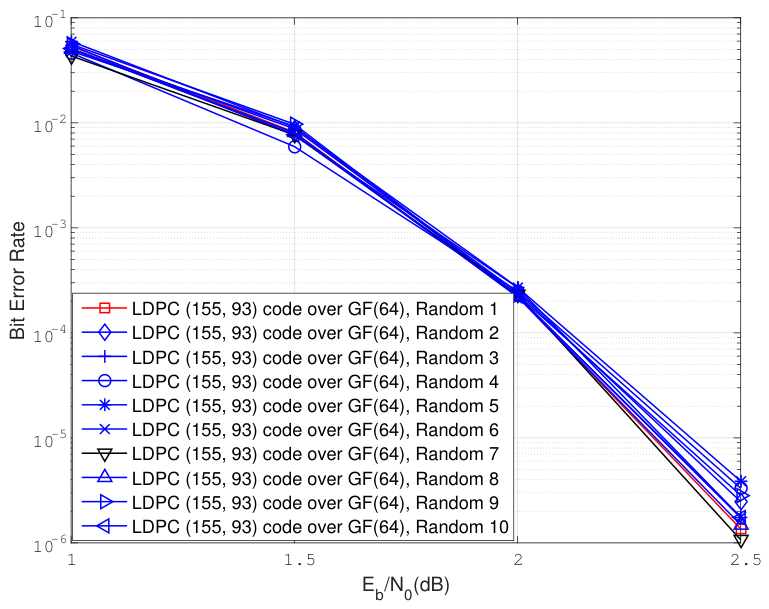
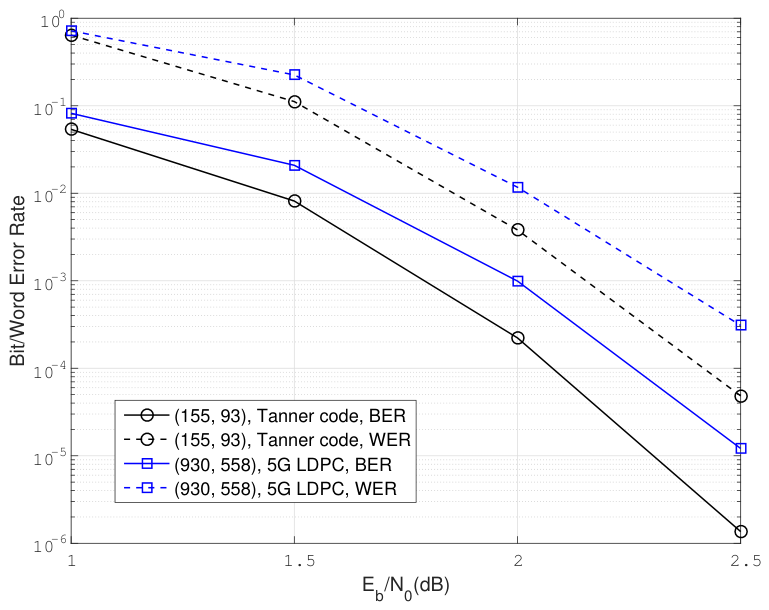
5. Numerical Results
6. Conclusions
Author Contributions
Funding
Data Availability Statement
Conflicts of Interest
Abbreviations
| LDPC | Low-density parity-check |
| QC-LDPC | Quasi-cyclic LDPC |
| p | A prime with |
| Prime field of order p | |
| Multiplicative group | |
| Rational number | |
| Complex field | |
| Polynomial over a field | |
| Resultant of the polynomials F and G | |
| Polynomial ring over the integers | |
| Polynomial ring over the rational numbers | |
| Parity-check matrix | |
| Exponent matrix (or base matrix) | |
| CPM | Circulant permutation matrix |
| Cyclotomic polynomial | |
| Euler’s totient function | |
| AWGN | Additive white Gaussian noise |
| BPSK | Binary phase shift keying |
| FFT-QSPA | Fast Fourier transform-based q-ary sum-product algorithm |
| SPA | Sum-product algorithm |
| BER | Bit error rate |
| WER | Word error rate |
References
- Gallager, R. Low-density parity-check codes. IRE Trans. Inf. Theory 1962, 8, 21–28. [Google Scholar] [CrossRef]
- MacKay, D. Good error-correcting codes based on very sparse matrices. IEEE Trans. Inf. Theory 1999, 45, 399–431. [Google Scholar] [CrossRef]
- Li, J.; Lin, S.; Abdel-Ghaffar, K.; Ryan, W.E.; Costello, D.J., Jr. LDPC Code Designs, Constructions, and Unification; Cambridge University Press: New York, NY, USA, 2017. [Google Scholar]
- Huang, Q.; Tang, L.; He, S.; Xiong, Z.; Wang, Z. Low-complexity encoding of quasi-cyclic codes based on Galois fourier transform. IEEE Trans. Commun. 2014, 62, 1757–1767. [Google Scholar] [CrossRef]
- Bharadwaj, K.; Garani, S.S. Efficient Encoding Algorithm and Architecture for 2-D Quasi-Cyclic LDPC Codes with Applications to 2-D Magnetic Recording. IEEE Trans. Magn. 2025, 61, 3100424. [Google Scholar] [CrossRef]
- Wang, X.; Ge, T.; Li, J.; Su, C.; Hong, F. Efficient Multi-Rate Encoder of QC-LDPC Codes Based on FPGA for WIMAX Standard. Chin. J. Electron. 2017, 26, 250–255. [Google Scholar] [CrossRef]
- Khodaiemehr, H.; Kiani, D. Construction and Encoding of QC-LDPC Codes Using Group Rings. IEEE Trans. Inf. Theory 2017, 63, 2039–2060. [Google Scholar] [CrossRef]
- Mahdi, A.; Paliouras, V. On the Encoding Complexity of Quasi-Cyclic LDPC Codes. IEEE Trans. Signal Process. 2015, 63, 6096–6108. [Google Scholar] [CrossRef]
- Tseng, C.F.; Tarng, J.H. Low-Complexity and Piecewise Systematic Encoding of Non-Full-Rank QC-LDPC Codes. IEEE Commun. Lett. 2015, 19, 897–900. [Google Scholar] [CrossRef]
- Zhang, Q.; Chen, B.; Zhuang, T.; Jiang, Y.; Xia, S.T. Revolving NBP-like decoders for cyclic and quasi-cyclic LDPC codes. IEEE Trans. Commun. 2026, 74, 598–611. [Google Scholar] [CrossRef]
- Qing, H.; Xuan, H.; Lisha, L.; Kui, C.; Xiaohu, T. Two bit-serial architectures for check node update in min-sum decoding of LDPC codes. China Commun. 2026, 23, 142–150. [Google Scholar] [CrossRef]
- Gershon, Y.; Cassuto, Y. In-Memory Bit Error Rate Estimation Using Syndromes of LDPC Codes. IEEE J. Sel. Areas Inf. Theory 2026, 7, 161–174. [Google Scholar] [CrossRef]
- De Weerdt, B.; Deligiannis, N. Neural Rate-Adaptive LDPC Decoding for the Slepian-Wolf Problem. IEEE Open J. Signal Process. 2026, 7, 456–471. [Google Scholar] [CrossRef]
- Fossorier, M. Quasi-cyclic low-density parity-check codes from circulant permutation matrices. IEEE Trans. Inf. Theory 2004, 50, 1788–1793. [Google Scholar] [CrossRef]
- Smarandache, R.; Mitchell, D.G.M.; Gomez-Fonseca, A. Structural Analysis of Generalized Quasi-Cyclic LDPC Codes: Rank, Design, and Generator Matrices. IEEE Trans. Inf. Theory 2026, 72, 253–267. [Google Scholar] [CrossRef]
- Jiang, X.; Xia, X.G.; Lee, M.H. Efficient Progressive Edge-Growth Algorithm Based on Chinese Remainder Theorem. IEEE Trans. Commun. 2014, 62, 442–451. [Google Scholar] [CrossRef]
- He, X.; Zhou, L.; Du, J. PEG-Like Design of Binary QC-LDPC Codes Based on Detecting and Avoiding Generating Small Cycles. IEEE Trans. Commun. 2018, 66, 1845–1858. [Google Scholar] [CrossRef]
- Sariduman, A.; Pusane, A.E.; Taskin, Z.C. On the Construction of Regular QC-LDPC Codes with Low Error Floor. IEEE Commun. Lett. 2020, 24, 25–28. [Google Scholar] [CrossRef]
- Wu, X.; Jiang, M.; Zhao, C. A Parity Structure for Scalable QC-LDPC Codes with All Nodes of Degree Three. IEEE Commun. Lett. 2017, 21, 1913–1916. [Google Scholar] [CrossRef]
- Yin, L.; Zhai, X.; Fang, Y.; Han, G. A multi-high-rate structured algebraic QC-LDPC code for 3D TLC NAND flash memory. IEEE Trans. Commun. 2025, 73, 10028–10043. [Google Scholar] [CrossRef]
- Li, Y.; Xue, J.; Wu, X.; Zhang, Y.; Zhang, Y. Application of LDPC code in PM-DQPSK system of consumer Internet of Things networks. IEEE Trans. Consum. Electron. 2025, 71, 5950–5959. [Google Scholar] [CrossRef]
- Gong, J.; Lu, Z.; Wang, L.; Chu, X.; Wen, X. A Reusable and Efficient Architecture for QC-LDPC Encoder with Less Expansion Factors. IEEE Trans. Very Large Scale Integr. VLSI Syst. 2023, 31, 2089–2101. [Google Scholar] [CrossRef]
- Zhang, G.; Lou, M.; Sun, A.; Fang, Y. Dual-Diagonal QC-LDPC Codes Free of Small Cycles from GCD Framework via Negative Coefficients. IEEE Commun. Lett. 2024, 28, 2724–2728. [Google Scholar] [CrossRef]
- Hu, M.; Zhai, X.; Tao, S.; Han, G. Hierarchical Globally Coupled LDPC Codes and Adaptive Two-Phase Decoding for NAND Flash Memories. IEEE Commun. Lett. 2026, 30, 1915–1919. [Google Scholar] [CrossRef]
- Tanner, R.M.; Sridhara, D.; Fuja, T.E. A class of group-structured LDPC codes. In Proceedings of the International Symposion Communication Theory and Applications; ACM: New York, NY, USA, 2001; pp. 365–370. [Google Scholar]
- Tanner, R.M. A recursive approach to low complexity codes. IEEE Trans. Inf. Theory 1981, 27, 533–547. [Google Scholar] [CrossRef]
- Xu, H.; Li, H.; Bai, B.; Zhu, M.; Zhang, B. Tanner (J, L) quasi-cyclic LDPC codes: Girth analysis and derived codes. IEEE Access 2019, 7, 944–957. [Google Scholar] [CrossRef]
- Kim, S.; No, J.; Chung, H.; Shin, D. On the girth of Tanner (3,5) quasi-cyclic LDPC codes. IEEE Trans. Inf. Theory 2006, 52, 1739–1744. [Google Scholar]
- Gholami, M.; Mostafaiee, F. On the girth of Tanner (3,7) quasi-cyclic LDPC codes. Trans. Comb. 2012, 1, 1–16. [Google Scholar]
- Xu, H.; Bai, B.; Feng, D.; Sun, C. On the girth of Tanner (3,11) quasi-cyclic LDPC codes. Finite Fields Their Appl. 2017, 46, 65–89. [Google Scholar] [CrossRef]
- Xu, H.; Li, H.; Feng, D.; Zhang, B.; Zhu, H. On the girth of Tanner (3, 13) quasi-cyclic LDPC codes. IEEE Access 2019, 7, 5153–5179. [Google Scholar] [CrossRef]
- Xu, H.; Duan, Y.; Miao, X.; Zhu, H. Girth analysis of Tanner’s (3, 17)-regular QC-LDPC codes based on Euclidean division algorithm. IEEE Access 2019, 7, 94917–94930. [Google Scholar] [CrossRef]
- Zhou, M.; Zhu, H.; Xu, H.; Zhang, B.; Xie, K. A note on the girth of (3, 19)-regular Tanner’s quasi-cyclic LDPC codes. IEEE Access 2021, 9, 28582–28590. [Google Scholar] [CrossRef]
- Wang, Q.; Che, J.; Li, H.; Luo, Z.; Zhang, B.; Liu, H. Tanner (3, 23)-regular QC-LDPC codes: Cycle structure and girth distribution. IEEE Access 2024, 12, 26591–26609. [Google Scholar] [CrossRef]
- Silverman, J.H. The Arithmetic of Elliptic Curves; Springer: Berlin/Heidelberg, Germany, 2009. [Google Scholar]
- Xu, H.; Zhang, X.D.; Li, H.; Zhu, H.; Zhang, B.; Liu, H. A cyclic-shift based method for counting cycles of quasi-cyclic LDPC codes. Electron. Lett. 2024, 60, e13085. [Google Scholar] [CrossRef]
- Conway, J.H.; Jones, A.J. Trigonometric Diophantine equations (On vanishing sums of roots of unity). Acta Arith. 1976, 30, 229–240. [Google Scholar] [CrossRef]
- 3GPP TS 38.212; 5G NR; Multiplexing and Channel Coding (Release 15) V15.3.0. ETSI: Sophia Antipolis, France, 2018.



| Reduced Form | R | ||
|---|---|---|---|
| (0, 1, 0, 1) | 12 | ||
| (0, 1, 0, 2) | 9 | ||
| (0, 1, 2, 1) | 9 | ||
| (0, 2, 0, 1) | 9 | ||
| (0, 2, 0, 2) | 12 | ||
| (0, 2, 1, 2) | 9 | ||
| (1, 0, 1, 0) | 12 | ||
| (1, 0, 1, 2) | 9 | ||
| (1, 0, 2, 0) | 9 | ||
| (1, 2, 0, 2) | 9 | ||
| (1, 2, 1, 0) | 9 | ||
| (1, 2, 1, 2) | 12 | ||
| (2, 0, 1, 0) | 9 | ||
| (2, 0, 2, 0) | 12 | ||
| (2, 0, 2, 1) | 9 | ||
| (2, 1, 0, 1) | 9 | ||
| (2, 1, 2, 0) | 9 | ||
| (2, 1, 2, 1) | 12 |
Disclaimer/Publisher’s Note: The statements, opinions and data contained in all publications are solely those of the individual author(s) and contributor(s) and not of MDPI and/or the editor(s). MDPI and/or the editor(s) disclaim responsibility for any injury to people or property resulting from any ideas, methods, instructions or products referred to in the content. |
© 2026 by the authors. Licensee MDPI, Basel, Switzerland. This article is an open access article distributed under the terms and conditions of the Creative Commons Attribution (CC BY) license.
Share and Cite
Yu, H.; Zhou, M.; Yu, Z.; Xu, M.; Xu, H. On the Girth of Tanner QC-LDPC Cycle Codes: An Algebraic Number Theory Approach. Axioms 2026, 15, 384. https://doi.org/10.3390/axioms15050384
Yu H, Zhou M, Yu Z, Xu M, Xu H. On the Girth of Tanner QC-LDPC Cycle Codes: An Algebraic Number Theory Approach. Axioms. 2026; 15(5):384. https://doi.org/10.3390/axioms15050384
Chicago/Turabian StyleYu, Haipeng, Manjie Zhou, Zhongyang Yu, Mengmeng Xu, and Hengzhou Xu. 2026. "On the Girth of Tanner QC-LDPC Cycle Codes: An Algebraic Number Theory Approach" Axioms 15, no. 5: 384. https://doi.org/10.3390/axioms15050384
APA StyleYu, H., Zhou, M., Yu, Z., Xu, M., & Xu, H. (2026). On the Girth of Tanner QC-LDPC Cycle Codes: An Algebraic Number Theory Approach. Axioms, 15(5), 384. https://doi.org/10.3390/axioms15050384