1. Introduction
Domination-type parameters form one of the central topics of modern graph theory and arise naturally in applications such as facility location, monitoring of communication networks, and deployment of emergency or defense resources [
1,
2]. Such models are also relevant for large-scale networked systems, where limited resources must be placed at selected nodes in order to provide local protection, monitoring, or recovery capacity. In communication, transportation, and infrastructure networks, failures or attacks at one node may have to be compensated by nearby protected nodes. Although the present paper is theoretical, cylindrical grids provide a regular product graph model in which one can study how local protection rules give rise to global resource requirements. This makes them a useful test class for understanding periodic protection patterns in structured networks. For broader perspectives on large-scale graph processing and modern graph-based learning methods, see for example [
3,
4]. Among these parameters, Roman domination has received considerable attention since its introduction by Cockayne et al. [
5]. A Roman dominating function assigns labels from
to vertices so that each vertex labeled 0 is protected by a neighboring vertex labeled 2, and the minimum total weight of such a labeling defines the Roman domination number
.
Several stronger variants of Roman domination have been introduced in order to model more robust protection mechanisms. These include double Roman domination [
6,
7], triple Roman domination [
8], and related higher-order extensions. A unified framework covering these variants was proposed by Abdollahzadeh Ahangar et al. [
8] under the name
-Roman domination. In this setting, vertices receive labels from
subject to local neighborhood constraints depending on both the assigned weight and the number of positively labeled neighbors. The corresponding minimum total weight defines the
-Roman domination number
.
Roman-type domination parameters have been investigated on numerous graph classes, including trees, cycles, grids, and Cartesian product graphs (see, for example, refs. [
9,
10]).
Cartesian products of paths and cycles play a particularly important role in domination theory, since their regular structure supports periodic constructions while still exhibiting nontrivial combinatorial behavior [
11,
12,
13]. Among such graphs, cylindrical grids
form a natural intermediate class between cycles, rectangular grids, and toroidal graphs.
Recent work on
-Roman domination has focused mainly on general bounds, extremal graph classes, and complexity questions. Valenzuela-Tripodoro et al. [
14] studied the
-multiple Roman domination framework as a common generalization of double, triple, and quadruple Roman domination. They derived sharp bounds and exact values for several graph classes and considered the corresponding decision problem. Khalili et al. [
15] further developed the general theory of
-Roman domination by proving upper and lower bounds for arbitrary graphs and trees, characterizing extremal cases, and establishing NP-completeness for bipartite and chordal graphs.
For double Roman domination, Anu and Lakshmanan [
16] studied Cartesian products in detail. They improved a general lower bound for products
when one factor has an efficient dominating set, derived general upper bounds, and obtained exact values for several products involving complete graphs and cycles.
The present paper follows this direction, but works in the more general -Roman domination framework and focuses specifically on cylindrical grids . This setting permits more refined constructions than those obtained from general graph bounds alone. In particular, periodic labelings, ceiling-type assignments, and packing-based reductions can be adapted to the geometry of the cylinder and compared asymptotically as functions of k, m, and n.
More recently,
-Roman domination on cylindrical grids has been studied in [
17,
18]. In ref. [
17], the connection between
-Roman domination and efficient domination was used to obtain explicit periodic
-Roman dominating functions for
and
. Besides constructive upper bounds, lower bounds based on local neighborhood constraints and efficient domination were also established. In particular, for cylindrical grids one obtains a general lower bound of the form
except in the efficient cases where the corresponding local optimum is attained. These lower bounds make it possible to compare the asymptotic behaviour of the constructed upper bounds with the best-known general lower estimates.
The analysis was extended in [
18] to cylindrical grids
for
. In particular, explicit linear constructions, uniform ceiling-type bounds, and packing-based refinements were developed and systematically compared depending on the parameter
k and the length of the path. The obtained lower bounds furthermore showed that several of these constructions are asymptotically close to optimal for fixed small circumferences.
In this paper, we continue this avenue of research by extending the analysis to a general class of cylindrical graphs. Our approach combines three complementary techniques: periodic linear labeling along the cycle direction, uniform ceiling-type constructions based on neighborhood size, and packing-based refinements exploiting disjoint closed neighborhoods.
We first consider the case , where several competing constructions yield different upper bounds depending on the parameter k. A comparison of these bounds shows that linear, uniform, and packing-based constructions become optimal in different parameter regimes. We then extend the linear constructions obtaining general bounds for graphs of the form , where .
Motivated by the observation that decompositions into blocks of length five yield the smallest asymptotic slopes with respect to n for , we then derive a unified family of upper bounds depending on the residue class of m modulo 5. This leads to explicit estimates for valid for arbitrary cylindrical grids. In the special case , these results yield new upper bounds for the double Roman domination number, together with a comparison between the multiple-based constructions and the general residue-class construction.
The paper is organized as follows. In
Section 2 we introduce notation and basic definitions.
Section 3 presents three types of upper bounds for
and compares their efficiency for different values of
k.
Section 4 extends the linear constructions to multiples of
, and develops general modulo-5 upper bounds for arbitrary cylindrical grids.
Section 5 specializes these results to the double Roman domination number and compares the resulting estimates. Concluding remarks and directions for future research are given in the final section.
2. Preliminaries
Throughout the paper we consider finite simple graphs , where denotes the vertex set and denotes the edge set of G. For a vertex , the open neighborhood of v is defined as while the closed neighborhood of v is
For a subset we write
Let
be a function. For any subset
we define
The
weight of
f is given by
We next recall the definition of a
-Roman dominating function [
8]. Let
. A function
is called a
-Roman dominating function if for every vertex
with
we have
where the
active neighborhood of vertex
v is defined as
The minimum possible weight of such a function is called the
-Roman domination number of
G and is denoted by
Intuitively, the condition can be interpreted in terms of military defense. Vertices with positive labels represent defended cities containing military units, while the value assigned to a vertex corresponds to the defensive strength stationed at that location. A vertex v with is not sufficiently protected on its own and therefore requires reinforcement from its closed neighborhood.
The term measures the number of neighboring cities that already contain military units. The additional term in the requirement accounts for the fact that active neighboring cities may have to send units to support the attacked city, while still maintaining sufficient protection in the local neighborhood.
For example, let
and suppose that a vertex
v has three active neighbors. Then the
-Roman domination condition requires
Thus the cities in the closed neighborhood of
v collectively contain at least eight military units: five units provide the basic required level of defense, while the additional three units correspond to the three active neighboring cities that may need to contribute reinforcements without compromising local protection.
The parameter generalizes several well-known domination-type invariants. In particular, for it coincides with the classical Roman domination number, while for it coincides with the double Roman domination number.
Since the graphs studied in this paper belong to the class of cylindrical grids, we briefly recall the definition of the Cartesian product. For graphs G and H, Cartesian product has vertex set , where vertices and are adjacent whenever either and , or and .
Let denote the cycle on m vertices and the path on n vertices. The Cartesian product is called a cylindrical grid. Throughout the paper we interpret as the cyclic direction and as the longitudinal direction of the cylinder. Vertices of will be denoted by , where For each j, the subgraph induced by is called the j-th fibre of . We identify each fibre with its vertex set whenever convenient.
Periodic constructions along the cyclic direction play a central role in the analysis of -Roman domination on cylindrical grids. In particular, decompositions into blocks of length five will serve as the main building blocks in several later constructions.
We now describe an explicit periodic construction for the base case
, which was introduced in [
18]. This construction will serve as a reference configuration in
Section 5, where it will be used to derive general upper bounds for
for arbitrary cylindrical grids and to obtain corresponding consequences for double Roman domination.
Consider the following periodic labeling pattern:
The entry in row
i and column
j of Equation (
1) represents the weight assigned to the vertex
of the cylindrical grid. Thus entries equal to 0 correspond to vertices without stationed units, while entries equal to
correspond to vertices carrying the maximum defensive strength used in this pattern. The positive entries in Equation (
1) form a periodic diagonal arrangement along the path direction. From one fibre to the next, the position of the label
is shifted cyclically by two rows modulo 5. Consequently, every fibre in the displayed periodic block contains exactly one vertex with positive weight, and the whole pattern repeats with period five.
Since the pattern is periodic, it is enough to verify the
-Roman domination condition on one block of five consecutive fibres, together with the boundary corrections described below. With this choice of the shifts, every vertex of weight 0 in the interior of the periodic pattern has exactly one vertex of weight
in its closed neighborhood. Moreover, this vertex of weight
is the only active vertex in that closed neighborhood. Hence, for every vertex
v with
whose closed neighborhood is fully contained in the periodic part of the construction, we have
Therefore
so the
-Roman domination condition is satisfied for all interior vertices of weight 0.
Vertices in the first and last fibres, as well as vertices whose closed neighborhoods meet these boundary fibres, have to be checked separately, because one neighbouring fibre in the path direction is missing. This is the reason for adding boundary corrections. The following concrete example illustrates this correction for
, and it will serve as a reference configuration for the modulo-5 constructions used later. It is obtained by taking eight consecutive fibres from the periodic labeling in Equation (
1) and then adding two boundary corrections, shown in bold, in the first and last fibres. These bold entries, both equal to
k, compensate for the missing neighbouring fibres beyond the two ends of the path and ensure that the
-Roman domination condition remains valid at the boundary.
Finally, we recall a simple extension principle that allows periodic constructions on smaller cylindrical grids to be lifted to larger ones. Since cylindrical graphs are invariant under cyclic shifts along the direction, many constructions of -Roman dominating functions can be obtained by repeating a fixed pattern.
More precisely, let
r be a divisor of
m and suppose that a
-Roman dominating function is defined on
. By repeating this labeling periodically along the cycle direction, we obtain a
-Roman dominating function on
, where
and
. The weight of the resulting labeling is
t times the weight of the original one. Consequently,
This observation will be used repeatedly in the sequel to extend constructions from small base circumferences to their multiples.
For later reference, we recall that explicit constructive upper bounds for the base circumferences
were obtained in [
17,
18]. Together with the new construction for
developed in
Section 3, these base estimates are the ingredients used in Theorem 5.
3. Upper Bounds for
We now derive an upper bound for
by constructing a suitable
-Roman dominating function. Theorem 1 completes the analysis of the base cylindrical grids
with
, extending previous work that covered the cases
[
17] and
[
18]. The resulting estimate is given below.
Proof. We define a periodic labeling using the pattern
Observe that the pattern requires a modification at the boundary. Let
be such that
. Then we set
where the indices are taken to be modulo 9, and all other vertices of the last fibre
are labeled 0.
The matrix, together with the adjustment of the last fibre, gives a -RDF of the desired weight; therefore, the proof is complete. ☐
It turns out that for larger values of k, a more efficient strategy is to distribute the weight uniformly among all vertices. We will show in the subsequent analysis that such a uniform assignment yields a better upper bound compared to more irregular constructions. This observation motivates us to consider weight functions that assign equal contributions across the graph.
Based on this approach, we obtain the following result for the -Roman domination number of the Cartesian product .
Proof. For each interior fibre
,
, assign weight
to each vertex of the fibre.
On each boundary fibre (i.e.,
and
), assign weight
to each of its nine vertices. Thus, each boundary fibre receives total weight
This assignment ensures that every vertex
v in an interior fibre satisfies
since the closed neighborhood of an interior vertex consists of five vertices, implying
.
On the other hand, every boundary vertex
v satisfies
because the closed neighborhood of a boundary vertex consists of its two neighbors in the same fibre, the vertex itself, and its unique neighbor in the adjacent interior fibre.
Therefore,
f is a
-RDF. Its total weight is at most the contribution of the interior fibres, which equals
plus the contribution of the two boundary fibres, which equals
Hence,
Using the inequalities
and
, we obtain
and
Substituting these bounds yields
Therefore,
which completes the proof. ☐
The construction described above is not tight, as the neighborhood sums frequently exceed the minimum required by the -Roman domination condition. This excess allows for further optimization. In particular, for certain values of k, one can improve the bound by increasing the base weights to and then reducing the weight by one on vertices belonging to a suitably chosen packing set. This motivates the following notion.
Definition 1. A set is called a packing if for every pair of distinct vertices . The maximum cardinality of a packing in G is called the packing number of G and is denoted by .
Packing sets will be used to decrease the weight on selected vertices while preserving the Roman domination condition, which leads to improved upper bounds.
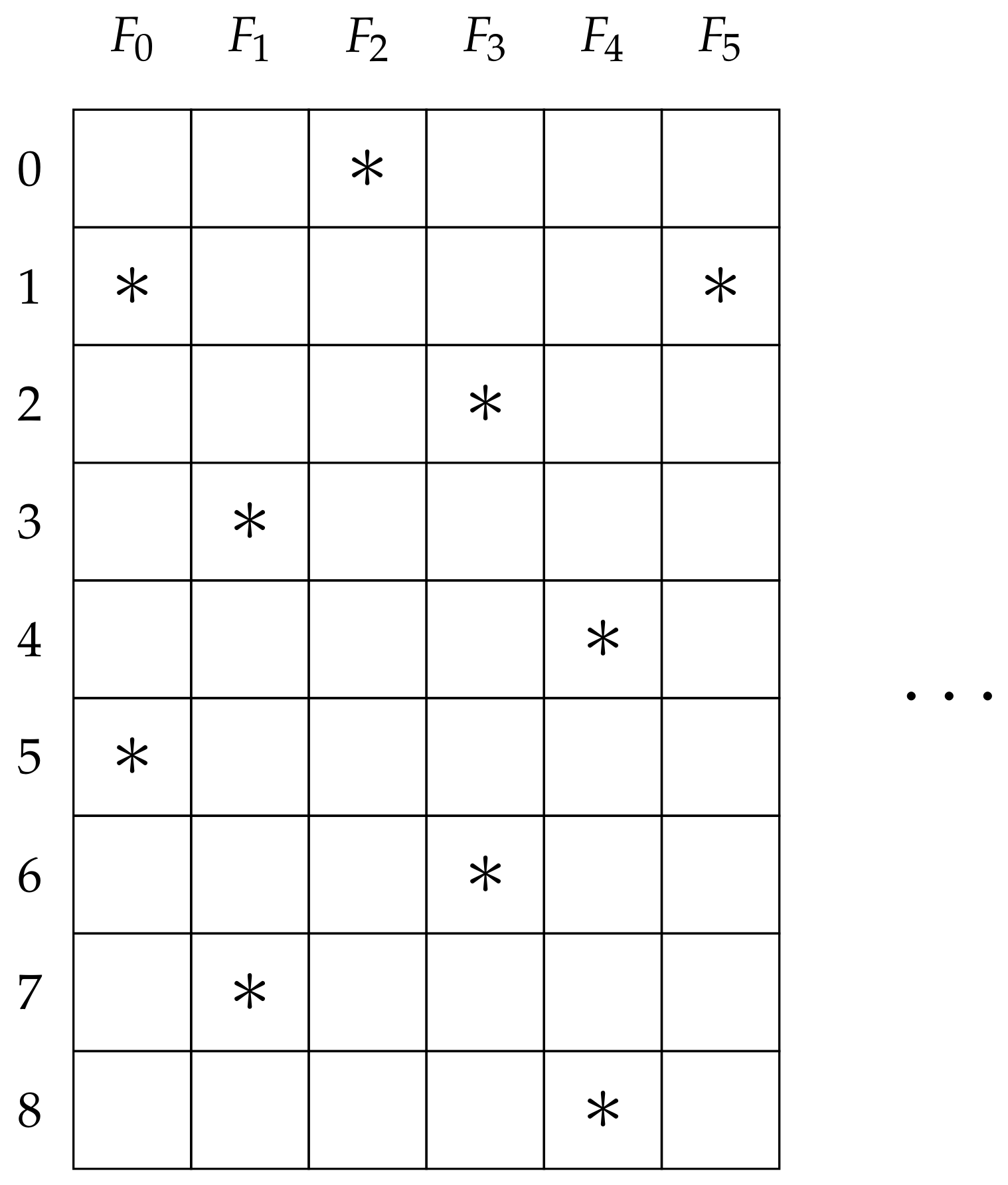
Lemma 1. Let . The packing number of is Proof. We first construct a packing of the required size. In fibres with two selected vertices, we choose vertices at cycle distance 4 in
. For every intermediate fibre we select one vertex, shifted one position along the cycle, regarding to the previous intermediate fibre. See
Figure 1.
For optimality, let
S be an arbitrary packing of
, and write
The construction form
Figure 1 has average density
, since its periodic pattern selects
vertices in every three consecutive fibres. We show that no packing can have larger density.
Clearly, for every fibre . Suppose first that for some i. Then the three selected vertices in must be mutually at cyclic distance 3 in , say in rows modulo 9. Their closed neighborhoods cover the whole fibre . Hence no vertex from either neighbouring fibre or can belong to S. Thus a fibre with three selected vertices is isolated between two empty neighbouring fibres. The local density of such a configuration is therefore at most , which is smaller than . Consequently, fibres with three selected vertices cannot improve on the density of the displayed construction.
It remains to consider the case in which each fibre contains at most two selected vertices. We claim that three consecutive fibres cannot all contain two selected vertices. Suppose, to the contrary, that
Let
. Since
S is a packing, the two vertices in
must be at a cyclic distance of at least 3. Moreover, any vertex of
must avoid the rows
a and
b, because vertices in the same row in adjacent fibres are adjacent. It must also avoid the rows adjacent to
a and
b on the cycle, because otherwise the corresponding closed neighborhoods would intersect at a vertex of
. Thus the two vertices in
forbid the six rows
of modulo 9 in the neighbouring fibre
. Only three rows remain available. Among these three rows, two are necessarily at a cyclic distance of at most 2, so two packing vertices cannot be placed in
, which constitutes a contradiction.
Hence, in the case
for all fibres, every three consecutive fibres contribute at most five vertices. This gives density at most
, with at most two additional vertices in a remaining block of one or two fibres. Therefore
Together with the construction described above, this proves the lemma. ☐
The role of Lemma 1 in the sequel is to make it possible to reduce the weight of a suitable labeling on many vertices simultaneously. The reason is that packing vertices have pairwise disjoint closed neighborhoods, so a local reduction at the packing vertices cannot accumulate in any single closed neighborhood.
Remark 1. The packing-based reductions used below rely on the following simple principle. Suppose that a labeling f satisfiesfor every vertex v, where denotes the active neighborhood with respect to f. If S is a packing, then the closed neighborhoods of distinct vertices of S are pairwise disjoint. Consequently, decreasing the weight of each vertex in S by one affects every closed neighborhood by at most one unit. Moreover, the reduction cannot increase the number of active neighbors. Therefore, the reduction still guarantees the -Roman domination condition for the modified labeling. This is the mechanism used in the packing-based estimates below. We now state an upper bound for that uses both the uniform ceiling-type labeling and the packing reduction principle described above.
Proof. For every interior fibre
, assign to each of its vertices the value
For the boundary fibres, namely
and
, assign the same value to all nine vertices in the fibre, where each vertex receives weight
This labeling is defined so that for every vertex
v we have
Let
S be a maximum packing of
. By Lemma 1, we have
As shown above, the initial ceiling-type labeling has one unit of slack in every closed neighborhood relevant to the
-Roman domination condition. Since
S is a packing, Remark 1 implies that the weight at each vertex of
S can be reduced by one without violating the
-Roman domination condition. Hence, the modified labeling remains a
-RDF. Consequently,
which establishes Inequality (
7).
and
Moreover,
Substituting these bounds yields
This completes the proof. ☐
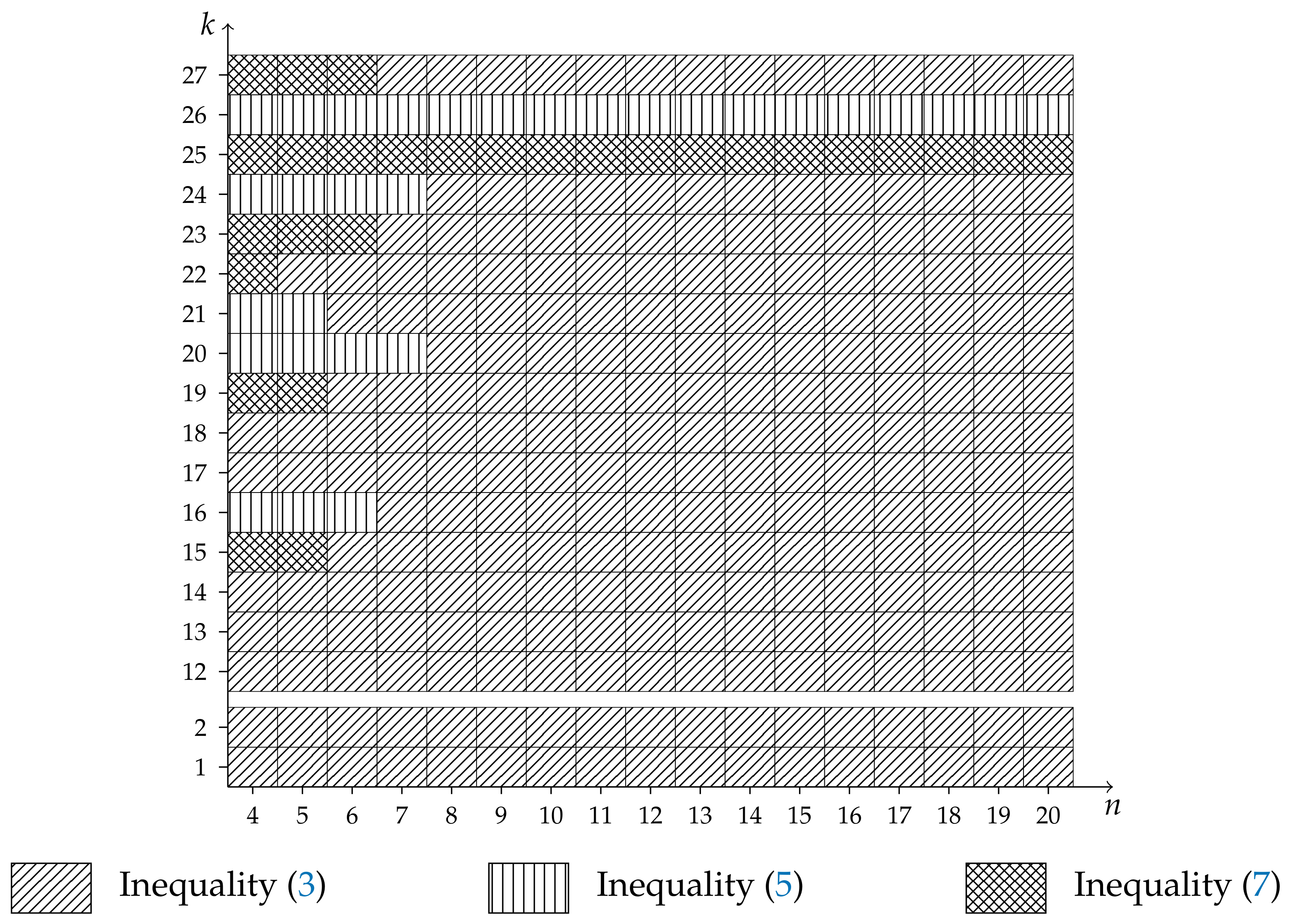
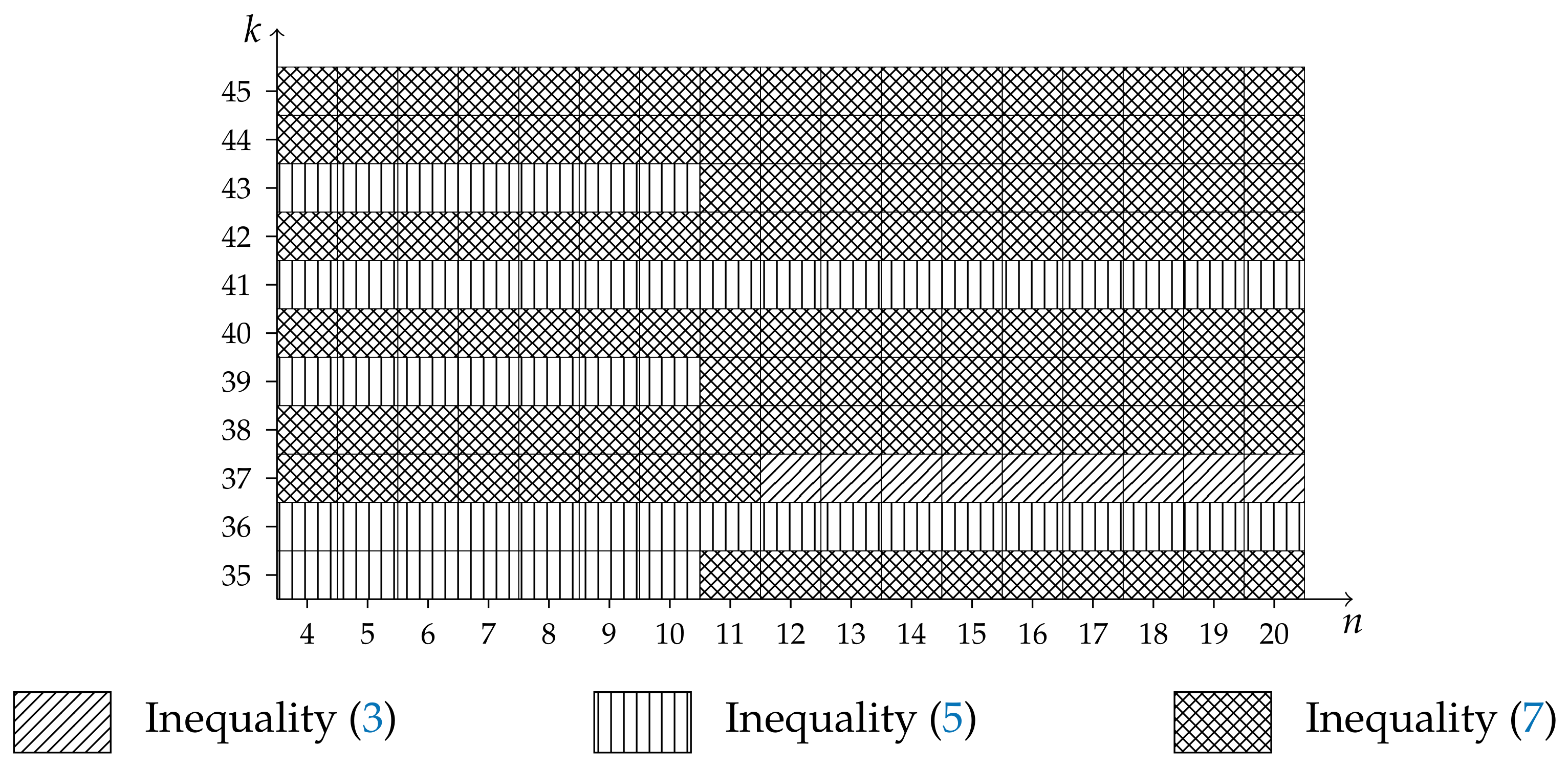
To illustrate the transition from the linear bound to the uniform and packing-based constructions, we present in
Figure 2 and
Figure 3 the optimal bounds for selected ranges of the parameter
k. The first figure focuses on small and intermediate values, namely
, where the linear bound dominates for very small
k, while uniform Inequality (
5) and packing-based Inequality (
7) begin to appear in restricted regions as
k increases.
The second figure illustrates the situation for larger values of
k, namely
. In this regime, linear Inequality (
3) is no longer competitive, and the comparison is primarily between Inequalities (
5) and (
7). We observe that the optimal bound depends on both
k and
n, with the uniform construction typically prevailing for larger values of
n, while the packing-based construction may yield improvements for smaller values of
n.
These figures clearly demonstrate the transition thresholds between the different constructions and motivate the precise comparison given in Theorem 4.
Theorem 4. For sufficiently large k, at least one of the Inequalities (
5)
or (
7)
improves the linear Inequality (
3).
More precisely: if , then for and all sufficiently large n, Inequality (
5)
is the smallest among (
3), (
5),
and (
7);
if , then for and all sufficiently large n, Inequality (
7)
is the smallest among (
3), (
5),
and (
7).
Proof. Fix k and compare the three bounds as functions of n.
Inequality (
3) has the form
Let
Then Inequality (
5) equals
Let
Since
Inequality (
7) equals
Therefore, for sufficiently large
n, the smallest bound is determined by comparing the linear coefficients
Comparing
with
shows that
holds when
and
.
In the remaining residue classes, comparing
with
shows that
holds for all
.
Finally, if
, then
, and hence
so Inequality (
5) is asymptotically smaller than Inequality (
7).
If
, then
, and therefore
so Inequality (
7) is asymptotically smaller than Inequality (
5).
Thus, for sufficiently large
n, Inequality (
5) is the smallest among (
3), (
5), and (
7) whenever
and
, while Inequality (
7) is the smallest among these three bounds whenever
and
. This completes the proof. ☐
4. General Upper Bound for
The constructions derived for the base cases
(see
Section 3 and [
17,
18]) are local and periodic along the cycle direction. In each case, the labeling is confined to a fixed number of consecutive rows and depends only on neighborhood conditions inside this block. Consequently, these patterns can be replicated independently along the cycle whenever the circumference is a multiple of
. This observation allows us to extend all previously obtained bounds to the graphs
,
, …,
.
4.1. Linear Constructions
The periodic nature of the linear constructions allows them to be replicated along the cycle direction. This observation leads to a unified formulation of the bounds for all circumferences that are multiples of .
Theorem 5. Let and . For the following bounds hold: Proof. We partition the cycle of into t consecutive blocks of size 3, 4, …, or 9, according to the value of m.
Let , where . Partition the cycle of into t consecutive blocks, each inducing a copy of . On every such block we apply the corresponding construction for .
For
, the construction is given in the present paper, while for
we use the constructions established in our earlier work on cylindrical grids
(see [
17,
18]).
Since each construction is defined locally within a block and depends only on adjacency relations inside that block, it remains valid when repeated periodically along the cycle. Moreover, the blocks are disjoint in the cycle direction, so the total weight equals the sum of the contributions of all t blocks.
Consequently,
which yields the stated bounds for
by substituting the corresponding estimates for
. ☐
As observed above, the same cylindrical graph may admit several distinct decompositions into blocks of admissible sizes . Each such decomposition yields a valid upper bound obtained by repeating the corresponding base construction. Since these bounds are not necessarily equal, it is natural to compare them in order to determine which decomposition provides the best estimate.
To compare these bounds, we first consider their asymptotic behavior as functions of n for fixed k. More precisely, we determine the linear coefficient (slope) with respect to n in each case. This comparison identifies which construction is asymptotically strongest as .
However, the bounds also contain additive terms depending on
k and on residue classes of
n. These terms do not affect the asymptotic slope, but they may influence which estimate is numerically best for moderate values of
n. For this reason, the asymptotic comparison below is complemented in
Section 5 by an explicit finite comparison in the double Roman case. If
, then each bound is of the form
, and hence its slope equals
times the slope of the corresponding base bound for
.
From the expressions in Theorem 5, we obtain the following slopes:
(Note that the slopes for
and
are equal.) Since the factor
m is common to all expressions, it suffices to compare the normalized slopes
A direct comparison shows that for all
we have
Hence, among all admissible constructions, the decomposition with
(i.e.,
) yields the smallest slope for every
.
For
, however, we have
so in this case the decomposition with
gives the smallest slope.
Consequently, for sufficiently large n, the best linear bound is obtained from the decomposition whenever , and from when .
The case
corresponds to classical Roman domination and has already been extensively studied in the literature [
12,
13,
19]. We therefore focus on the general case
and use the above observations to derive upper bounds for arbitrary cylindrical graphs
.
Motivated by the fact that the decomposition yields the smallest slope for all , we take the construction for as a starting point and extend it to general values of m. More precisely, we modify the periodic pattern of width 5 by locally removing certain rows and adjusting the remaining labels so that the -Roman domination condition is preserved. In this way, we obtain constructions for all residue classes of m modulo 5, which allows us to derive upper bounds for all cylindrical graphs . This leads to the following theorem.
Theorem 6. Let and . For , Proof. For , the claim follows directly from Theorem 5.
Assume now that
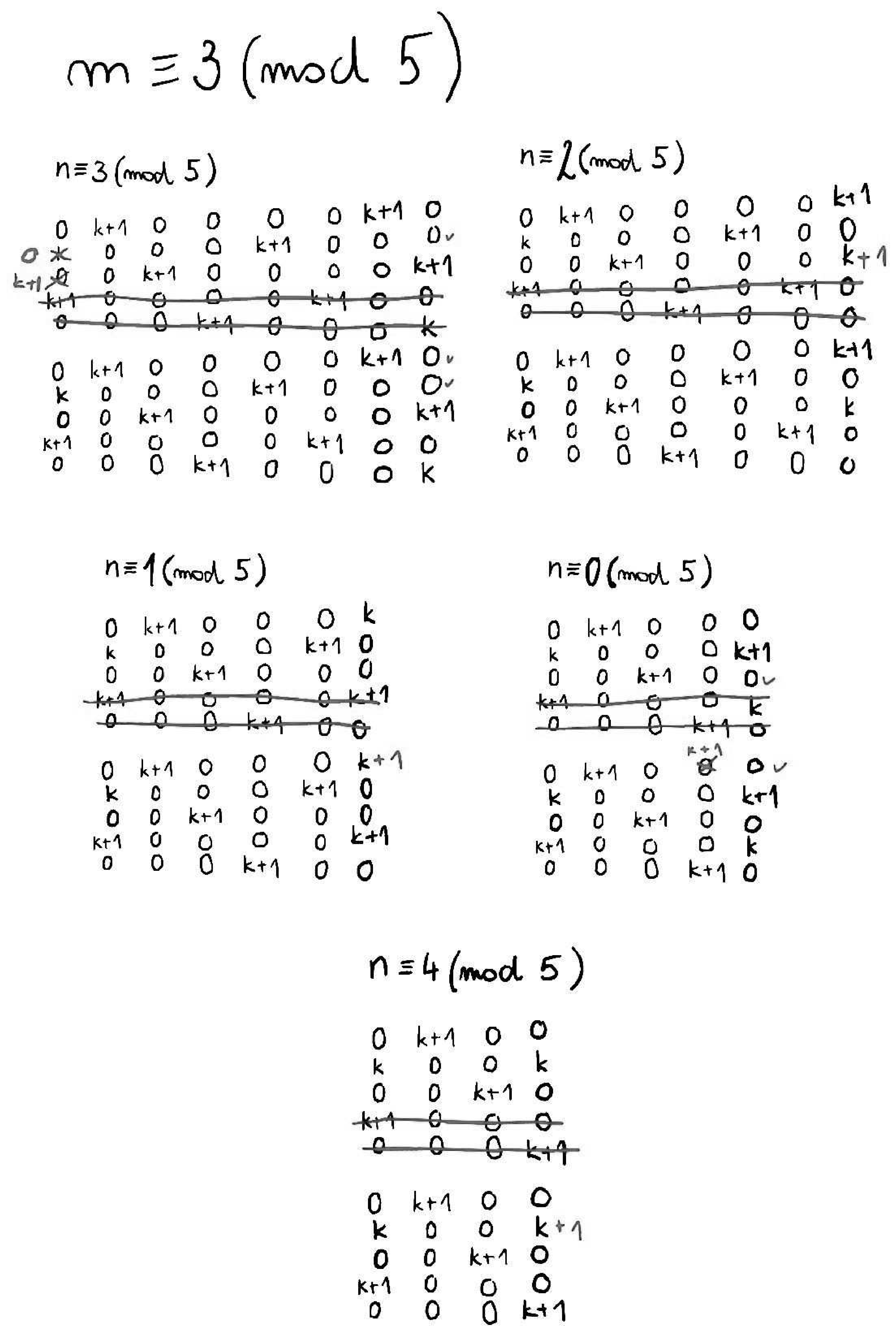
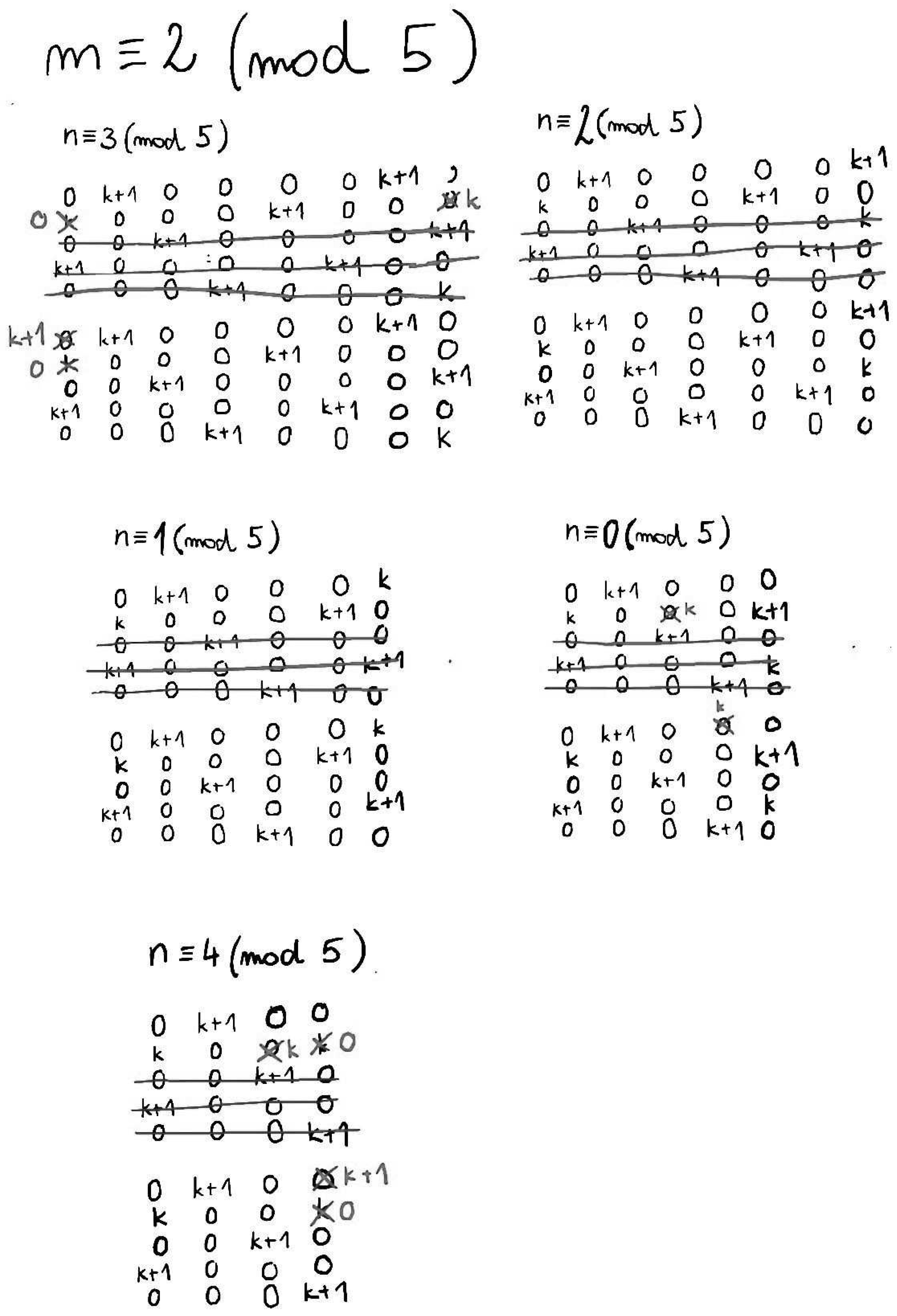
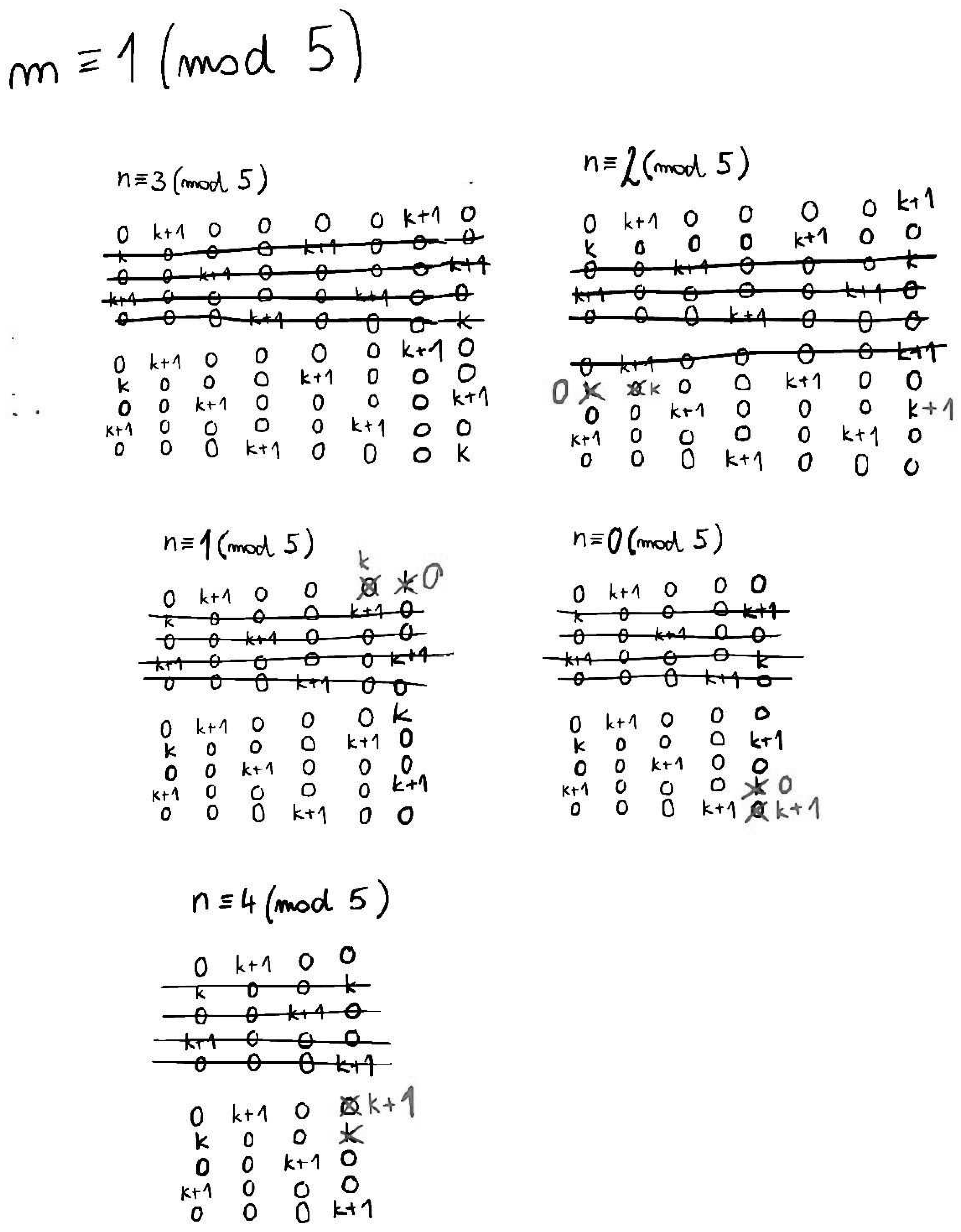
. In each residue class, we obtain a labeling on
from the periodic labeling on the next larger cylinder
, where
is chosen so that
. We then delete
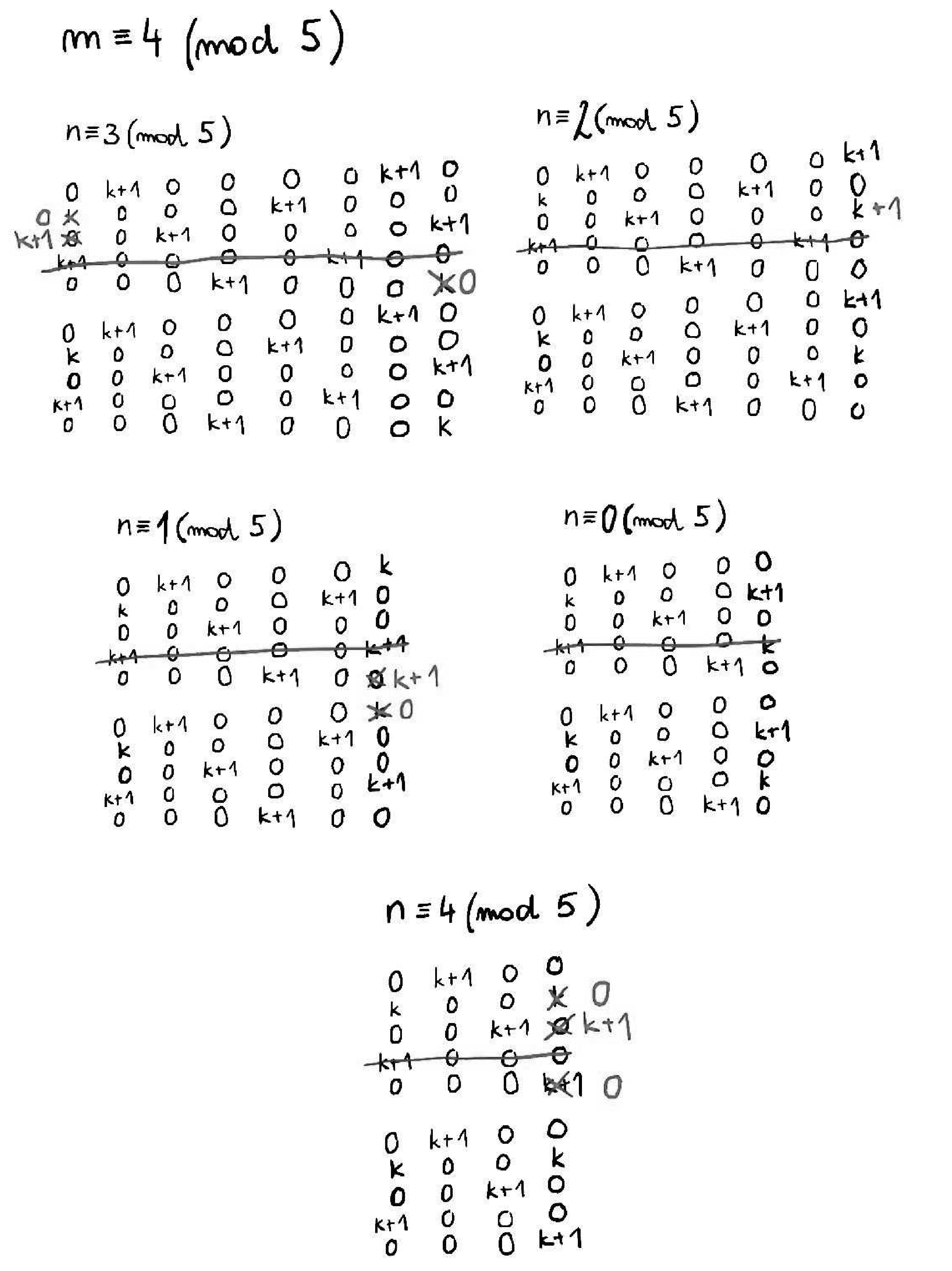
consecutive rows and modify the labels only in a bounded neighborhood of the deleted rows. The explicit local constructions for the residue classes of
m and
n modulo 5 are given in
Appendix A. In each case, only the vertices in the neighborhood of the deleted rows are affected, while the remaining part of the labeling stays periodic. The local corrections guarantee that every zero-labeled vertex still receives desired total weight from its closed neighborhood. Thus the resulting labeling is a valid
-Roman dominating function on
, and the stated upper bounds follow. ☐
For clarity,
Table 1 summarizes the five residue classes appearing in Theorem 6. The first term in each row corresponds to the construction obtained from the next larger multiple of 5, while the subtracted terms represent the savings obtained by deleting rows and applying local corrections.
As a simple illustration, consider
. Since
, Theorem 6 gives
The same residue class also contains the first exceptional circumference not covered by the multiple-based constructions, namely
. Since
, Theorem 6 yields
Thus the modulo-5 construction provides an explicit bound even for circumferences such as 11, 13, and 17, which are not multiples of any of the base values
. The optimality of these bounds remains open, but the example illustrates the flexibility of the residue-class method.
4.2. Uniform Constructions
The uniform ceiling-type constructions obtained for the base cases can likewise be extended to general cylindrical graphs. By repeating the corresponding periodic pattern along the cycle direction, we obtain a unified upper bound of the following form.
Proof. Let
We assign weight
a to every vertex in each interior fibre
,
. On the two boundary fibres
and
, we assign weight
b to every vertex.
We first verify that this labeling is a
-RDF. Let
v be an interior vertex. If
v belongs to a fibre
with
, then all vertices in
have weight
a, and hence
If
v belongs to
or
, then one of its neighbors lies in a boundary fibre and therefore has weight
b, while the remaining vertices in
have weight
a. Thus
Since
every interior vertex satisfies the required condition.
For a boundary vertex
v, its closed neighborhood contains the vertex itself, its two neighbors on the cycle in the same fibre, and one neighbor in the adjacent interior fibre. Hence
By the definition of
b, we have
and therefore
Since a boundary vertex has at most three neighbors, the
-Roman domination condition also holds at every boundary vertex.
Thus the constructed labeling is a valid
-RDF on
. Its total weight is the sum of the contributions of the interior and boundary fibres. There are
interior fibres, each containing
m vertices of weight
a, so their total contribution equals
The two boundary fibres together contain
vertices of weight
b, so their total contribution equals
Consequently,
as claimed. ☐
4.3. Packing Constructions
The packing-based refinements developed in the previous subsections can be extended to larger cylindrical graphs. The key idea is that vertices forming a packing can have their weights reduced simultaneously without violating the -Roman domination condition, which leads to an improvement of the basic ceiling-type upper bound. This yields the following general estimate.
Theorem 8. For ,where denotes the packing number of . Proof. Let
We define a labeling
f by assigning weight
to every vertex of each interior fibre
,
, and weight
to every vertex of the two boundary fibres.
Let
v be an interior vertex. If
v belongs to a fibre
with
, then all vertices in
have weight
, and hence
If
v belongs to
or
, then one of its neighbors lies in a boundary fibre and has weight
, while the remaining four vertices in
have weight
. Thus
Since
it follows that every interior vertex satisfies the required condition.
On the other hand, for every boundary vertex
v,
Thus the neighborhood sums exceed the minimum requirement by at least one unit at the relevant vertices, which creates the necessary slack.
Let S be a maximum packing of . By the definition of packing, the closed neighborhoods of distinct vertices of S are pairwise disjoint. The labeling constructed above has one extra unit of slack in every closed neighborhood relevant to the -Roman domination condition. Therefore, by Remark 1, decreasing the weight of every vertex of S by one preserves the -Roman domination condition.
The total weight of the resulting
-RDF is obtained from the original ceiling-type construction by subtracting exactly one for each vertex of the packing set
S. The original construction has total weight
and the reduction contributes
Consequently,
which proves the theorem. ☐
5. Upper Bounds for the Double Roman Domination Number of
For small values of k, numerical comparison of all derived bounds shows that the linear constructions consistently provide the smallest upper estimates among the three families (linear, uniform, and packing-based). In particular, for the linear bounds dominate in all relevant parameter ranges considered above. Therefore, we state explicitly only the consequence of the linear construction for the double Roman domination number.
For circumferences that are multiples of , the linear constructions from Theorem 5 yield the following bounds.
On the other hand, substituting into Theorem 6 yields a residue-class bound that applies to all cylindrical grids.
It is natural to compare Corollaries 1 and 2. The first one is based on constructions tailored to special circumferences, whereas the second one applies to all cylindrical grids. Hence the residue-class bound of Corollary 2 has a wider range of applicability, but it is not always numerically smaller for small values of m.
To determine which estimate is stronger, we compare the linear coefficients with respect to n. For large n, the dominant term determines which construction provides the better bound.
Corollary 1. Let and . Then the following bounds hold: Corollary 2. Let and . Then Theorem 9. Let and .
- 1.
If , then the bounds from Corollaries 1 and 2 coincide.
- 2.
For , , the comparison is as follows:
- 3.
For , and for sufficiently large n the bound from Corollary 2 is strictly smaller than every applicable bound from Corollary 1.
Proof. We compare the dominant linear coefficients in n appearing in Corollaries 1 and 2.
For Corollary 1, admissible decompositions
with
yield asymptotic slopes reduced to the set
For Corollary 2 the asymptotic slopes are from the set
If
, both constructions yield the same bound. Therefore, assume that
. Among the slopes arising from Corollary 2, the largest one equals
while among the admissible slopes from Corollary 1 the smallest one equals
A direct comparison shows that
if and only if
that is, if and only if
. Hence for every
with
, the residue-class construction has strictly smaller slope than any construction from Corollary 1. Consequently, Corollary 2 yields the better bound for all sufficiently large
n in this range.
It remains to compare the finitely many cases directly. For each admissible value of m in this range, we evaluated the explicit expressions from Corollaries 1 and 2 and compared the resulting bounds as functions of n for all .
More precisely, for every fixed m we first determined all applicable decompositions with and selected the smallest corresponding bound from Corollary 1. We then compared this bound with the residue-class bound from Corollary 2. Since both expressions are linear functions of n up to periodic floor terms, their difference can be analyzed explicitly. In particular, by comparing the linear coefficients in n we determined the asymptotic ordering of the bounds, and for the remaining cases we computed the exact values of the difference for in order to identify the transition points where the ordering changes.
We illustrate the above comparison procedure in the case
. The admissible decompositions
yield from Corollary 1 the bound
Since
, Corollary 2 gives
Comparing the two expressions for
shows that the multiple-based bound is smaller for
, while the residue-class bound is smaller for
. ☐
Theorem 9 shows that the multiple-based constructions remain optimal only for a small number of exceptional circumferences, while the residue-class construction provides the strongest general upper bounds for all sufficiently large m and n. Together, the two approaches therefore yield effective estimates for for all cylindrical grids.
6. Conclusions
In this paper, we studied -Roman domination on cylindrical grids and developed several constructive upper bounds based on three different approaches: linear periodic constructions, uniform ceiling-type assignments, and packing-based refinements. For the special case , we compared these three families in detail and showed that their relative performance depends essentially on the parameter k. For small values of k, the linear constructions provide the best bounds, whereas for larger values of k the uniform and packing-based constructions become asymptotically superior.
We then extended the linear constructions to all cylindrical grids whose circumference is a multiple of one of the values , obtaining a unified family of explicit upper bounds. Motivated by the fact that blocks of length five give the smallest asymptotic slope for , we further derived a general residue-class construction depending on . This yielded upper bounds for for all cylindrical grids and, in particular, explicit consequences for the double Roman domination number.
For , we showed that the linear constructions provide the strongest bounds among the three general families considered here. This allowed us to compare in detail the multiple-based bounds and the modulo-5 construction. The comparison shows that the residue-class construction is asymptotically best for all sufficiently large admissible circumferences, while the multiple-based constructions remain optimal only in several exceptional small cases.
The obtained upper bounds should be viewed in relation to the known density-type lower estimates for cylindrical grids. In earlier work, lower bounds based on local neighborhood constraints and efficient domination show that the natural benchmark for
is of the order
Thus the constructions developed in the present paper have the correct linear dependence on both
m and
n, while the remaining gap is mainly reflected in the precise leading constants and in additive boundary terms. Closing this gap remains one of the main challenges for future work.
In this way, the present paper completes the analysis of the previously untreated base case and closes the remaining gap in the sequence of periodic constructions for cylindrical grids with small fixed circumferences. Combined with the earlier results for , the constructions developed here now provide a unified framework for constructive upper bounds on -Roman domination for all cylindrical grids.
The obtained results also refine several previously known bounds for double Roman domination on Cartesian product graphs. In particular, Corollary 1 improves Theorem 3.3 of Anu and Lakshmanan [
16] for cylindrical graph families of the form
.
More generally, the present paper extends such product-based results from the special case to the full -Roman domination framework and shows that constructions adapted to cylindrical grids lead to sharper estimates than those obtained from general Cartesian product techniques alone.
There are several natural directions for future work. First, the general bounds in Theorem 6 are formulated only in terms of the residue class of
m modulo 5. However, the terminal corrections also depend on the residue class of
n modulo 5, because the periodic pattern is truncated differently at the two ends of the path. The constructions collected in
Appendix A illustrate this dependence.
For example, in the case and , the local correction allows a saving of at both ends of the path. In the uniform statement of Theorem 6, however, we use a correction that is valid for all values of n: one obtains a saving of at one end and at the other end. Thus a separate treatment of the five residue classes of n modulo 5 could slightly improve the additive constants in the main theorem. Such refinements would not change the asymptotic slope in n, but they could sharpen the bounds for fixed and moderate values of n.
Second, the comparison carried out for the double Roman domination number suggests that several small circumferences still deserve special attention. In particular, the graphs , , and are not multiples of any of the base circumferences considered in the multiple-based construction. Although the modulo-5 construction provides explicit upper bounds for these graphs, it is not clear whether these bounds are optimal, or even asymptotically best among constructions adapted to these particular circumferences.
A possible way to treat these missing cases would be to develop tailored constructions for , , and , and to combine them with packing-based refinements. This would require determining the corresponding packing numbers , , and Then one could compare the resulting linear coefficients in n with those of the general modulo-5 construction, as was done above for the double Roman case. This remains an interesting open problem.
Finally, another challenging direction is to determine exact values, or at least asymptotically tight formulas, for
for fixed small values of
k. The periodic structure of cylindrical grids suggests that sharper characterizations may be possible, especially for double and triple Roman domination. A possible approach to obtain exact formulae is to use the algebraic method as in [
19,
20]. While the method is universal it is computationaly intensive, and consequently, only some partial results for relative small
m are obtained until now.