
Article

Divergence-Oriented Distance Measures for Complex Picture Fuzzy Information with Applications in Renewable Energy Source Selection and Decision Analysis

1
Department of Statistics and Operations Research, College of Science, Qassim University, Buraydah 52571, Saudi Arabia
2
Department of Mathematics, College of Science, Qassim University, Buraydah 51452, Saudi Arabia
*
Author to whom correspondence should be addressed.
Axioms 2026, 15(5), 317; https://doi.org/10.3390/axioms15050317
Submission received: 20 February 2026 / Revised: 1 April 2026 / Accepted: 23 April 2026 / Published: 28 April 2026
(This article belongs to the Special Issue Recent Advances in Fuzzy Theory Applications)

Abstract

Distance measures play a crucial role in fuzzy decision-making, pattern recognition, and uncertainty modeling. However, some existing distance measures for Complex Picture Fuzzy Sets (CPiFSs) have shown limitations and may produce counterintuitive results in certain cases. Moreover, only a few studies have explored such measures. To overcome these issues, in this study, some novel measures of distance for CPiFSs are proposed to effectively handle two-dimensional uncertainty characterized by amplitude and phase components. The proposed measures are developed by integrating both magnitude and phase information in a unified mathematical framework, ensuring improved discrimination capability and structural consistency. We rigorously prove that the suggested measures fulfill the essential properties of a distance function. Additionally, the normalization characteristics and stability behavior are analytically examined to ensure robustness in practical implementations. The proposed measure of distance is then applied to a multi-criteria decision-making (MCDM) case study, where alternatives are evaluated under Complex Picture Fuzzy information to demonstrate its practical effectiveness and ranking consistency. Using a CPiFS-based TOPSIS framework, distances from the positive and negative ideal solutions are computed via the developed metric, and the relative closeness coefficient is employed to obtain a stable and discriminative ranking of alternatives. Furthermore, comparative analysis with several existing distance measures demonstrates the stability and superiority of the proposed method in distinguishing complex fuzzy information.

1. Introduction

In classical set theory, set membership follows a strict two-valued logic, implying that an element is either a member of the set or completely outside it. Such a crisp framework is often inadequate for modeling real-world problems characterized by uncertainty, vagueness, and imprecision, including decision-making processes, medical diagnosis, and pattern recognition. To tackle the inherent limitations, Zadeh [1] pioneered the concept of Fuzzy Sets (FSs) theory, which permits elements to possess varying degrees of membership within the interval [0, 1], thereby providing a more flexible and realistic mathematical tool for handling uncertainty. In the framework of FSs, each element is associated with a membership degree (MD) that quantifies the extent to which it belongs to the set. These membership degrees are typically represented by real numbers in the interval [0, 1], where 0 denotes non-membership, 1 indicates full membership, and intermediate values correspond to varying levels of partial membership. Following its introduction, FSs theory has attracted considerable attention from researchers and has been widely applied in diverse domains, including pattern recognition [2], medical problems [3], fuzzy controlled servo systems [4], fuzzy c-means clustering [5], and MAGDM problems [6]. To overcome the lack of an explicit representation of non-membership in FSs, Atanassov [7] pioneered the idea of Intuitionistic Fuzzy Sets (IFSs). An IFS is characterized by a MD ( W : B [ 0 , 1 ] ) and an NMD ( N : B [ 0 , 1 ] ), subject to the constraint 0 W ( σ i ) + N ( σ i ) 1 for all σ i B . This paradigm has been extensively investigated by numerous researchers from different perspectives, leading to substantial theoretical developments and practical applications across a wide range of disciplines [8,9,10,11,12]. Subsequently, Yager [13] introduced PFSs, where the MD and NMD fulfill the constraint 0 W 2 ( σ i ) + N 2 ( σ i ) 1 . Theoretical directions (like aggregation operators and relations in [14,15]) and practical directions (like information measures in [16,17] and applications in MCDM [18,19]) of PFSs were improved. However, if the MD is 0.7 and the NMD is 0.9, such a pair does not satisfy the admissibility conditions of either IFSs or PFSs. Specifically, for IFSs, the sum 0.7 + 0.9 = 1.6 > 1 , which violates the constraint 0 W ( σ i ) + N ( σ i ) 1 . Likewise, for PFSs, the squared sum 0.7 2 + 0.9 2 = 1.3 > 1 , which contravenes the condition 0 W 2 ( σ i ) + N 2 ( σ i ) 1 . Therefore, this situation cannot be accommodated within the frameworks of either intuitionistic or Pythagorean fuzzy sets. This limitation highlights the necessity for a more general framework capable of accommodating a wider range of membership and non-membership pairs. To this end, Yager [20] further generalized PFSs and proposed the idea of q-rung orthopair fuzzy sets (q-ROFSs), introducing the condition 0 W q ( σ i ) + N q ( σ i ) 1 for all σ i B . When the parameter q is set to 3, this particular subclass of q-ROFSs is known as Fermatean Fuzzy Sets (FFSs) [21]. Although FSs have been progressively extended through IFSs, PFSs, FFSs, and q-ROFSs, these frameworks still face limitations in representing uncertainty in certain complex situations. For instance, in voting scenarios, where an individuals response may involve support, hesitation, opposition, and refusal, more than two membership functions are needed to capture the full spectrum of opinions, which goes beyond the capabilities of the existing models. To overcome this limitation, Cuong [22] proposed Picture Fuzzy Sets (PiFSs), which incorporate three functions to capture different aspects of uncertainty: membership ( W ), non-membership ( N ), and neutral degrees ( Z ). Within PiFSs, the combined values of these three degrees must satisfy the condition 0 W ( σ i ) + Z ( σ i ) + N ( σ i ) 1 . A key advantage of PiFSs is the inclusion of a “neutrality” degree, which enriches the framework capability to model complex and nuanced decision-making processes. This feature is particularly beneficial in fields like medical diagnosis [23], pattern recognition [24], investment selection [25] and social choices [26].
In view of the understanding at this stage, it is observed that the extended versions of FSs and PiFSs can address the inconsistency, vagueness/ambiguity of the information in the application fields but with the non-inclusiveness in the time period and robustness of the data, it sometimes would not be possible to deal with these kinds of models. However, the periodicity/repeatedness and the uncertainty/inexactness of the data can be dealt with, with the help of the complex number framework at the same time. For handling such situations, the idea of a Complex Fuzzy Sets (CFSs) was given by Ramot et al. [27]. The CFSs are characterized by a complex-valued membership function, i.e.,  ψ ( σ i ) e i 2 π ( μ ψ ( σ i ) ) , and fulfill the condition 0 ψ ( σ i ) , μ ψ ( σ i ) 1 . As discussed earlier, although CFSs offer several advantages, there remain situations where relying solely on a complex-valued membership function is insufficient, making it difficult or even impossible to adequately address certain problems. To address this limitation, Alkouri and Salleh [28] introduced Complex Intuitionistic Fuzzy Sets (CIFSs), in which both the MD and NMD are indicated as complex-valued quantities, i.e.,  ψ ( σ i ) e i 2 π ( μ ψ ( σ i ) ) , θ ( σ i ) e i 2 π ( ν θ ( σ i ) ) , and fulfill the condition 0 ψ ( σ i ) + θ ( σ i ) 1 and 0 μ ψ ( σ i ) + ν θ ( σ i ) 1 . For example, if the complex-valued MD and NMD are selected as 0.8 e i 2 π ( 0.7 ) and 0.4 e i 2 π ( 0.6 ) , respectively, this case cannot be accommodated by CIFSs. This is because the sum of the magnitudes 0.8 + 0.4 = 1.2 > 1 and the sum of the phase components 0.7 + 0.6 = 1.3 > 1 both exceed the admissible limits imposed by the CIFS framework, violating its defining constraints. To handle such situations, Ullah et al. [29] introduced the idea of Complex Pythagorean Fuzzy Sets (CPFSs). In this framework, the constraint is relaxed such that the sum of the squares of the magnitudes (as well as the corresponding phase components) of the complex-valued MD and NMD must be less than or equal to one, i.e.,  ψ ( σ i ) e i 2 π ( μ ψ ( σ i ) ) , θ ( σ i ) e i 2 π ( ν θ ( σ i ) ) and fulfill the condition 0 ψ 2 ( σ i ) + θ 2 ( σ i ) 1 and 0 μ ψ 2 ( σ i ) + ν θ 2 ( σ i ) 1 . To build upon CIFSs and CPFSs, Liu et al. [30] introduced the idea of Complex q-Rung Orthopair Fuzzy Sets (Cq-ROFSs) whose constraint is that 0 ψ q ( σ i ) + θ q ( σ i ) 1 and 0 μ ψ q ( σ i ) + ν θ q ( σ i ) 1 . When the parameter q is set to 3, this particular subclass of CFSs is known as Complex Fermatean Fuzzy Sets (CFFSs) [31]. However, CIFSs are limited in handling partially ignored or abstained information, as they only indicate the MD and NMD of an element in the complex plane and do not account for neutral or refusal choices. To solve such a limitation, the idea of Complex Picture Fuzzy Sets (CPiFSs) was introduced by Akram et al. [32], where Hamacher weighted/ordered weighted averaging aggregation operators along with geometric operators are proposed. Further, Liu et al. [33] presented the CPiF-based power aggregation operators for an MCDM problem to cover the time period parameter of data.
In the following subsection (Section 1.1), we review distance/divergence measures across these models and pinpoint the specific gaps that motivate our Jensen–Shannon-based measures for CPiFSs.

1.1. Related Work

Distance and divergence measures constitute fundamental research topics in fuzzy set theory and have attracted considerable attention from scholars [34,35]. To date, numerous distance and divergence measures have been developed for various extensions, including IFSs, PFSs, FFSs, and PiFSs. For instance, Gohain et al. [36] proposed a symmetric distance measure for IFSs and demonstrated its effectiveness in practical applications like clustering and pattern recognition. Peng et al. [37] pioneered a novel class of measures for PFSs and demonstrated the applicability of these measures in several domains, like medical diagnostic, clustering analysis, and pattern classification problems. Ganie et al. [38] pioneered some new measure of distance within the FFS framework that incorporates all three components of the model. The authors further demonstrated the effectiveness of the proposed measure in pattern classification problems. In recent years, considerable research efforts have been devoted to the development of distance and similarity measures for advanced complex-valued fuzzy frameworks, including CFSs, CIFSs, CPFSs, CFFSs, and CPiFSs, with the aim of enhancing their applicability in complex decision-making and information-processing environments. For instance, Alkouri and Salleh [39] pioneered some measures of distance for CFS information. Rani and Garg [40] pioneered a new measure of distance based on CIFSs and demonstrated their applicability in decision-making problems, particularly in the areas of pattern recognition and medical diagnostics. An analysis of Hamming and Hausdorff 3D measures distance through CPFSs and their application in pattern classification and medical analysis have been presented by Wu et al. [41]. Liu et al. [42] presented a series of novel distance measures for CFFSs, along with their corresponding weighted forms, constructed on the basis of Hamming, Euclidean, Hausdorff, and Hellinger distances. Furthermore, the authors developed both decision-making and clustering algorithms grounded in the proposed measures, and validated their effectiveness through several practical applications. Zhu et al. [43] pioneered novel measures of distance for CPiFSs and discussed the applications in pattern recognition, medical diagnosis and clustering. Additional investigations on the distance measures of IFSs, PFSs, FFSs, q-ROFSs, PiFSs, CFSs, CIFSs, CPFSs, CFFSs, and CPiFSs are illustrated in Table 1.
TOPSIS (Technique for Order Preference by Similarity to Ideal Solution) is a widely utilized approach for solving MCDM and MCGDM problems. The fundamental objective of TOPSIS is to identify the alternative that has the shortest distance from the ideal best solution and the farthest distance from the ideal worst solution [48]. Over time, numerous generalizations of TOPSIS have been developed to solve MCDM problems under various fuzzy and uncertain environments, thereby enhancing its flexibility and effectiveness in handling imprecise and complex information. Based on divergence measures of G-TSFSs, Yang et al. [55] developed a novel TOPSIS technique for selection the optimal solar energy systems. A new circular IFSs TOPSIS method through novel distance measures for the selection of hospital location have presented in the work of Xu and Wen [56]. Althuniyan et al. [57] combined the concept of fermatean neutrosophic sets and vague soft sets to adopt a new TOPSIS technique for the solar panel selection problem. Kahraman and Alkan [58,59] developed a novel TOPSIS method under circular IFSs and applied it to the supplier and hospital location selection problem. Ruan [60] combined the concept of FFSs and HFSs to propose some novel distance measures. Based on FHFSs, the authors developed the TOPSIS method for choosing a suitable logistics transfer station. Akram et al. [61] generalized the TOPSIS method to accommodate complex spherical fuzzy information in decision-making environments, thereby enhancing its capability to manage multidimensional uncertainty. Similarly, Garg et al. [62] developed a new TOPSIS approach based on complex interval-valued q-ROFSs, providing a more flexible structure for modeling uncertainty. Furthermore, Wang et al. [63] proposed a TOPSIS framework under interval-valued q-rung dual hesitant FSs, further broadening the applicability of TOPSIS in advanced fuzzy decision-making contexts. In this study, our contribution goes beyond the formulation of enhanced distance measures for CPiFSs. We further embed these theoretical developments into a practical decision-making framework by proposing an extended TOPSIS methodology. The proposed approach integrates the newly developed distance measures to evaluate the similarity and dissimilarity between alternatives in a more comprehensive and discriminative manner. By incorporating these advanced measures within the TOPSIS structure, the precision, reliability, and applicability of the decision-making process are significantly improved. To demonstrate its effectiveness and practical relevance, the proposed extended TOPSIS method is applied to a real-world case study concerning renewable energy source selection, highlighting its capability to handle Complex Picture Fuzzy information in sustainable energy planning.

1.2. Research Gap

The manuscript clearly identifies that CPiFSs have emerged as a powerful extension of fuzzy frameworks capable of modeling two-dimensional periodic uncertainty. While several distance measures exist for PiFSs, these approaches do not extend to the Complex Picture Fuzzy environment where both amplitude and phase information must be considered simultaneously. Moreover, the literature lacks a Jensen–Shannon divergence-based distance measure specifically constructed for CPiFSs. Existing measures also suffer from key limitations, such as the following:
  • Numerous existing distance measures of CPiFSs do not fully satisfy the axiomatic definition.
  • Some existing distance measures of CPiFSs have limitations, such as providing similar findings when analyzing differences across separate CPiFSs, which might result in unreasonable solutions.
  • The available literature provides instances of utilizing the Jensen–Shannon divergence to define a distance measure for CPiFSs.
CPiFSs provide an advanced framework for representing two-dimensional uncertainty by incorporating amplitude and phase terms within membership, abstinence, and non-membership functions. However, in this article, inspired by Jensen–Shannon divergence, we develop a novel measure of distance for CPiFSs. Moreover, we also propose a normalized version and demonstrate its applicability in various numerical scenarios. Finally, we suggest the TOPSIS approach on the basis of novel distance measures and prove its efficacy in practical implementations.

1.3. Research Motivation and Contributions

The motivation of this study arises from the need to develop a mathematically rigorous and discriminative distance measure capable of handling the multidimensional and periodic nature of information represented by CPiFSs. In view of the existing literature and characteristics of the CPiFSs, the prime objective of the manuscript is to introduce novel measure of distance for the first time under a Complex Picture Fuzzy environment. The primary contributions of the current study are outlined below:
  • Novel Jensen–Shannon Divergence-Based Distance: A novel Jensen–Shannon divergence-based distance measure is formulated for CPiFSs, integrating amplitude and phase information within a unified mathematical framework.
  • Rigorous Axiomatic Validation: The proposed measures of distance fulfill the axiomatic properties of a distance function, confirming their validity and effectiveness in quantifying the differences between CPiFSs.
  • Normalized Version: A normalized version of the distance measure is developed to enhance comparability and computational stability across diverse decision environments.
  • Correction of Counter-Intuitive Results: The proposed measure resolves inconsistencies and unreasonable ranking behaviors observed in some existing distance methods.
  • Enhanced TOPSIS MADM Approach: A decision-making TOPSIS-based framework on the developed distance measure is designed and validated for improved reliability and stability in high-uncertainty environments.
  • Applications of Proposed Distance measures: The practical application of the novel CPiF distance measure in renewable energy source selection is the focus of this case study.
  • Comparative Analysis: Through pattern recognition problem, the developed CPiF measure of distance is compared with several existing measures of IFSs, PFSs, FFSs, CIFSs, CPFSs, and CFFSs.
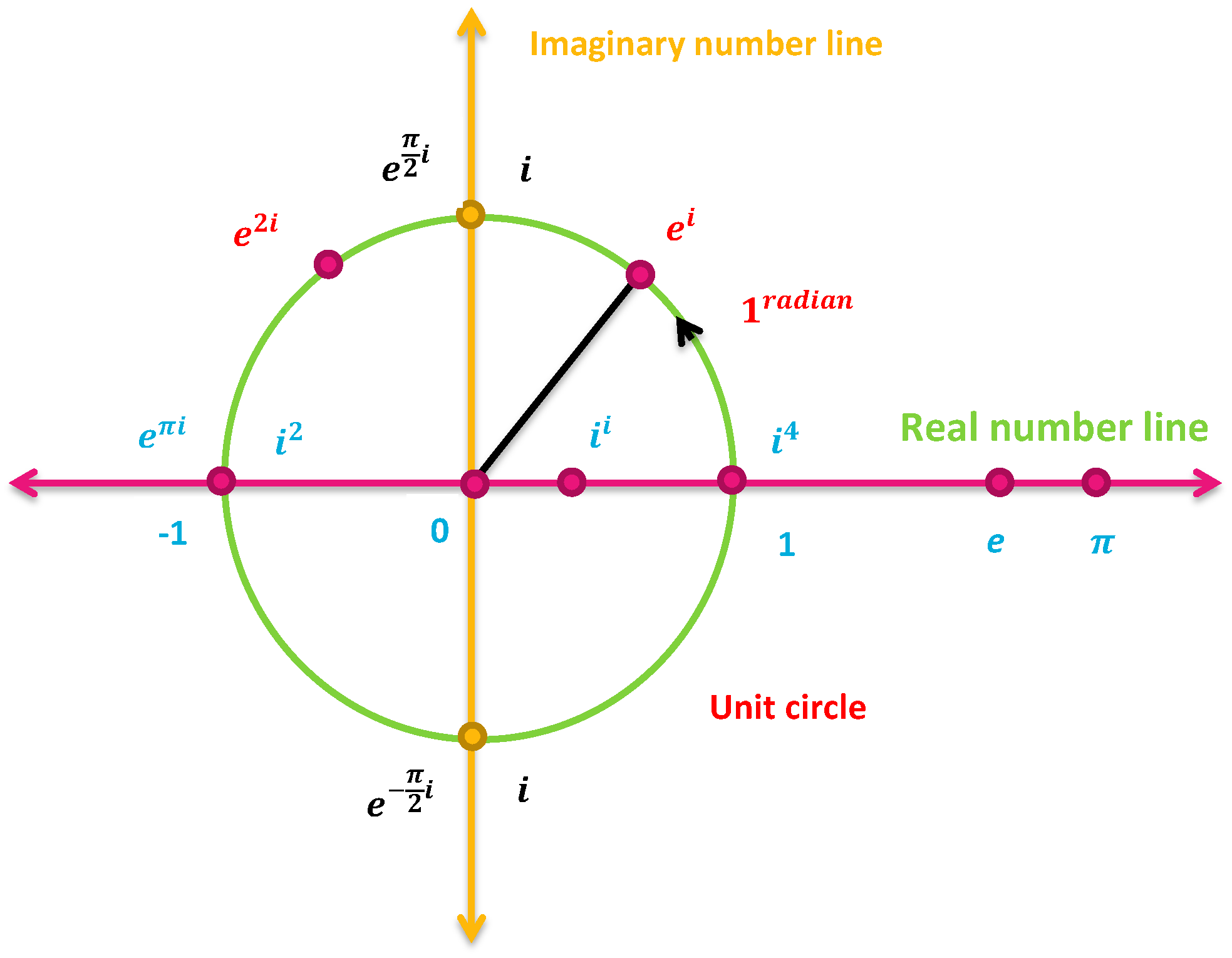
  • Sensitivity Analysis: To illustrate the sensitivity analysis and graphically represent the proposed methods, several examples are provided, in which the geometrical structure of the unit disc in the complex plane is shown in Figure 1.

1.4. Comparative Analysis of Fuzzy Set Models

CPiFSs represent an advanced generalization of several existing fuzzy frameworks, including FSs, IFSs, PiFSs, and their complex extensions such as CFSs and CIFSs. The proposed CPiFS model is capable of handling multiple dimensions of uncertainty, including membership, non-membership (falsity), hesitation, neutrality, and periodicity. Moreover, CPiFSs can be reduced to simpler models, such as IFSs and CIFSs, by assigning zero values to the neutral and phase terms. This demonstrates the flexibility and generality of the proposed framework. Table 2 presents a comparative analysis of various fuzzy set models based on their ability to represent key characteristics such as uncertainty, falsity, hesitation, periodicity, and neutrality. It is evident that CPiFSs provide a more comprehensive structure compared to existing models, making them suitable for handling complex and ambiguous information in decision-making problems. The characteristics listed in Table 2 are established based on the definitions and properties reported in the existing literature on fuzzy sets and their extensions.

2. Mathematical Terminologies

This section provides a brief overview of CPiFSs, encompassing their formal definition, fundamental properties, and basic binary operations essential for subsequent developments. Moreover, we review the definition of the distance function and Jensen–Shannon divergence with some existing distance measures for CPiFSs. Unless stated otherwise, throughout this paper, we assume that B = { σ 1 , σ 2 , σ 3 , , σ k } denotes a universal set of discourse (UOD), and that C P i F S ( B ) represents the collection of all CPiFSs on B .

2.1. Basics of Picture Fuzzy Sets

In this section, we recall some underlying definitions such as PiFSs, CFSs, CIFSs, CPFSs, CFFSs, Cq-ROFSs, and CPiFSs. Since various abbreviations and symbols of concept are utilized in this study, for better understanding, Table 3 and Table 4 list all the abbreviated and symbol concepts that appear in this paper.
Definition 1.
Let B = { σ 1 , σ 2 , σ 3 , , σ k } be a UOD. A PiFSs ℑ in B is elaborated as
= σ i , W ( σ i ) , Z ( σ i ) , N ( σ i ) | σ i B ,
where W , Z , N : B [ 0 , 1 ] indicate the membership, neutral (abstention) and non-membership degrees of each element in B , respectively. For any σ i B it follows that 0 W ( σ i ) + Z ( σ i ) + N ( σ i ) 1 and H = 1 W ( σ i ) Z ( σ i ) N ( σ i ) , where H ( σ i ) indicates the degree of refusal of σ i B in ℑ.
Definition 2.
A CFSs ℑ in B is an ordered pair given by
= σ i , W ( σ i ) | σ i B ,
where W : B { d : d C , | d | 1 } indicate the degree of complex-valued membership and is defined by W = ψ ( σ i ) e i 2 π ( μ ψ ( σ i ) ) , where 0 ψ ( σ i ) , μ ψ ( σ i ) 1 . Moreover, the hesitancy degree is referred to as H ( σ i ) = R ( σ i ) e i 2 π ( M R ( σ i ) )
Definition 3.
A CIFSs ℑ on a UOD B = { σ 1 , σ 2 , σ 3 , , σ k } is demonstrated as follows:
= σ i , W ( σ i ) , N ( σ i ) | σ i B ,
where W , N : B { d : d C , | d | 1 } denote the complex-valued MD and NMD, respectively, where each value lies within the unit disk of the complex plane. These functions are formally defined as
W = ψ ( σ i ) e i 2 π ( μ ψ ( σ i ) ) , N = θ ( σ i ) e i 2 π ( ν θ ( σ i ) )
where both ψ ( σ i ) and θ ( σ i ) denote the amplitude terms such that ψ ( σ i ) , θ ( σ i ) [ 0 , 1 ] and 0 ψ ( σ i ) + θ ( σ i ) 1 . Similarly, μ ψ ( σ i ) and ν θ ( σ i ) represent the phase term such that μ ψ ( σ i ) , ν θ ( σ i ) [ 0 , 1 ] and 0 μ ψ ( σ i ) + ν θ ( σ i ) 1 .
Moreover, the hesitancy degree is referred to as H ( σ i ) = R ( σ i ) e i 2 π ( M R ( σ i ) ) , where R ( σ i ) = 1 ψ ( σ i ) θ ( σ i ) and M R ( σ i ) = 1 μ ψ ( σ i ) ν θ ( σ i ) .
Definition 4.
Consider a UOD B = { σ 1 , σ 2 , σ 3 , , σ k } , then a Cq-ROFSs ℑ in B is described as
= σ i , W ( σ i ) , N ( σ i ) | σ i B ,
where W ( σ i ) , N : B { d : d C , | d | 1 } represent the complex-valued MD and NMD, respectively, and are defined by
W ( σ i ) = ψ ( σ i ) e i 2 π ( μ ψ ( σ i ) ) , N ( σ i ) = θ ( σ i ) e i 2 π ( ν θ ( σ i ) )
where ψ ( σ i ) , θ ( σ i ) [ 0 , 1 ] and 0 ψ q ( σ i ) + θ q ( σ i ) 1 . Similarly, μ ψ ( σ i ) , ν θ ( σ i ) [ 0 , 1 ] and 0 μ ψ q ( σ i ) + ν θ q ( σ i ) 1 . Moreover, the hesitancy degree is referred to as H ( σ i ) = R ( σ i ) e i 2 π ( M R ( σ i ) ) , where R ( σ i ) = 1 ψ q ( σ i ) θ q ( σ i ) q and M R ( σ i ) = 1 μ ψ q ( σ i ) ν θ q ( σ i ) q .
The Cq-ROFSs introduced in Definition 4 encompass several notable special cases, which can be obtained by selecting specific values of the parameter q or imposing particular constraints on the membership and non-membership functions. These special cases include:
  • By setting q = 2 , a Cq-ROFSs reduces to a CPFSs, where the MD and NMD satisfy the squared-sum constraint specific to CPFSs.
  • By setting q = 3 , a Cq-ROFSs reduces to a CFFSS, in which the MD and NMD satisfy the cubic-sum constraint characteristic of CFFSs.
Definition 5.
A CPiFSs ℑ in B is in the shape given by
= σ i , W ( σ i ) , Z ( σ i ) , N ( σ i ) | σ i B ,
where W , Z , N : B { d : d C , | d | 1 } represent the degree of complex-valued membership, neutral and non-membership, respectively, and are defined by
W ( σ i ) = ψ ( σ i ) e i 2 π ( μ ψ ( σ i ) ) , Z ( σ i ) = Ψ ( σ i ) e i 2 π ( δ Ψ ( σ i ) ) , N ( σ i ) = θ ( σ i ) e i 2 π ( ν θ ( σ i ) )
where ψ ( σ i ) , Ψ ( σ i ) , θ ( σ i ) [ 0 , 1 ] and 0 ψ ( σ i ) + Ψ ( σ i ) + θ ( σ i ) 1 . Similarly, μ ψ ( σ i ) , δ Ψ ( σ i ) , ν θ ( σ i ) [ 0 , 1 ] and 0 μ ψ ( σ i ) + δ Ψ ( σ i ) + ν θ ( σ i ) 1 . Moreover, the rejection degree of σ i B is defined as H ( σ i ) = R ( σ i ) e i 2 π ( M R ( σ i ) ) , where R ( σ i ) = 1 ψ ( σ i ) Ψ ( σ i ) θ ( σ i ) and M R ( σ i ) = 1 μ ψ ( σ i ) δ Ψ ( σ i ) ν θ ( σ i ) .
Definition 6.
For 1 and 2 C P i F S ( B ) , the following binary operations are as follows:
  • 1 2 if and only if ψ 1 ( σ i ) ψ 2 ( σ i ) , Ψ 1 ( σ i ) Ψ 2 ( σ i ) and θ 1 ( σ i ) θ 2 ( σ i ) , for amplitude terms and μ ψ 1 ( σ i ) μ ψ 2 ( σ i ) , δ Ψ 1 ( σ i ) δ Ψ 2 ( σ i ) and ν θ 1 ( σ i ) ν θ 2 ( σ i ) , for phase terms.
  • 1 = 2 if and only if 1 2 and 1 2 .
  • 1 = σ i , θ 1 ( σ i ) e i 2 π ( ν θ 1 ( σ i ) ) , Ψ 1 ( σ i ) e i 2 π ( δ Ψ 1 ( σ i ) ) , ψ 1 ( σ i ) e i 2 π ( μ ψ 1 ( σ i ) ) | σ i B .
  • 1 2 = { σ i , min { W 1 ( σ i ) , W 2 ( σ i ) } , max { Z 1 ( σ i ) , Z 2 ( σ i ) } , max { N 1 ( σ i ) , N 2 ( σ i ) } | σ i B } .
  • 1 2 = { σ i , max { W 1 ( σ i ) , W 2 ( σ i ) } , min { Z 1 ( σ i ) , Z 2 ( σ i ) } , min { N 1 ( σ i ) , N 2 ( σ i ) } | σ i B } .
  • 1 2 = { ( ψ 1 + ψ 2 ψ 1 ψ 2 ) e i 2 π ( μ ψ 1 + μ ψ 2 μ ψ 1 μ ψ 2 ) , ( Ψ 1 + Ψ 2 Ψ 1 Ψ 2 ) e i 2 π ( δ Ψ 1 + δ Ψ 2 δ Ψ 1 δ Ψ 2 ) , ( θ 1 + θ 2 θ 1 θ 2 ) e i 2 π ( ν θ 1 + ν θ 2 ν θ 1 ν θ 2 ) } .
  • 1 2 = { ψ 1 e i 2 π ( μ ψ 1 ) · ψ 2 e i 2 π ( μ ψ 2 ) , ( Ψ 1 + Ψ 2 Ψ 1 Ψ 2 ) e i 2 π ( δ Ψ 1 + δ Ψ 2 δ Ψ 1 δ Ψ 2 ) , ( θ 1 + θ 2 θ 1 θ 2 ) e i 2 π ( ν θ 1 + ν θ 2 ν θ 1 ν θ 2 ) } .
  • τ 1 = ( 1 ( 1 ψ 1 ) τ ) e i 2 π ( 1 ( 1 μ ψ 1 ) τ ) , Ψ 1 τ e i 2 π ( δ Ψ 1 ) τ , θ 1 τ e i 2 π ( δ θ 1 ) τ , τ > 0 .
  • 1 τ = ψ 1 τ e i 2 π ( δ ψ 1 ) τ , ( 1 ( 1 Ψ 1 ) τ ) e i 2 π ( 1 ( 1 δ Ψ 1 ) τ ) , ( 1 ( 1 θ 1 ) τ ) e i 2 π ( 1 ( 1 ν θ 1 ) τ ) , τ > 0 .
Proposition 1.
Let 1 and 2 be two CPiFSs as defined in Definition 5 and 0 τ , τ 1 , τ 2 1 , then
1. 
1 τ 1 τ 2 = 1 τ 1 τ 2 .
2. 
τ ( 1 2 ) = τ 1 τ 1 .
3. 
1 2 τ = 1 τ 2 τ .
4. 
τ 1 1 τ 2 1 = ( τ 1 + τ 2 ) 1 .
5. 
1 τ 1 1 τ 2 = 1 τ 1 + τ 2 .
6. 
1 2 = 2 1 .
Proof. 
These properties can be trivially proved. □

2.2. Jensen–Shannon Divergence

In [64], a novel measure of distance called the Jensen–Shannon divergence was proposed to distinguish between two probability distributions P = { p 1 , p 2 , p 3 , , p k } and Q = { q 1 , q 2 , q 3 , , q k } .
Definition 7.
Considering two probability distributions P = { p 1 , p 2 , p 3 , , p k } and Q = { q 1 , q 2 , q 3 , , q k } , the Jensen–Shannon divergence between P and Q is defined as
J S D ( P , Q ) = 1 2 K L D ( P , ( P + Q ) 2 ) + K L D ( Q , ( P + Q ) 2 )
where K L D ( P , Q ) represents the Kullback–Leibler divergence and is defined as
K L D ( P , Q ) = j = 1 k p j l o g p j q j
J S D ( P , Q ) can also be expressed utilizing the following equation:
J S D ( P , Q ) = S E P + Q 2 1 2 S E ( P ) 1 2 S E ( Q ) = 1 2 j = 1 k p j l o g 2 p j p j + q j + j = 1 k q j l o g 2 q j p j + q j
where S E ( P ) , S E ( Q ) , and  S E ( P + Q 2 ) represent the Shannon entropy, defined as
S E ( P ) = j = 1 k p j l o g p j , S E ( Q ) = j = 1 k q j l o g q j , S E ( P + Q 2 ) = j = 1 k p j + q j 2 l o g p j + q j 2 .

2.3. The Existing PiF and CPiF Measures of Distance

This section recalls the existing definitions of distance function with the existing distance measures of PiFSs and CPiFSs.
Definition 8
([65]). Let C P i F S ( B ) be the collection of all CPiFSs over B , then for any CPiFSs 1 , 2 , 3 C P i F S ( B ) , distance measure D I M : C P i F S ( B ) × C P i F S ( B ) [ 0 , 1 ] is real-valued and holds the following axioms:
a. 
0 ≤ D I M ( 1 , 2 ) ≤ 1, for  1 , 2 B ;
b. 
D I M ( 1 , 2 ) = 0 if 1 = 2 for 1 , 2 B ;
c. 
D I M ( 1 , 2 ) = D I M ( 2 , 1 ) for 1 , 2 B ;
d. 
If 1 2 3 , then D I M ( 1 , 3 ) ≤ D I M ( 1 , 2 ) + D I M ( 2 , 3 ) for 1 , 2 , 3 B .
Definition 9.
Let 1 and 2 be two PiFSs, then the distance measures of Singh et al. [66] between PiFSs 1 and 2 are as follows:
D 1 ( 1 , 2 ) = 1 1 4 k i = 1 k | W 1 ( σ i ) W 2 ( σ i ) | + | Z 1 ( σ i ) Z 2 ( σ i ) | + | N 1 ( σ i ) N 2 ( σ i ) | + | H 1 ( σ i ) H 2 ( σ i ) |
D 2 ( 1 , 2 ) = 1 1 4 k i = 1 k | W 1 ( σ i ) W 2 ( σ i ) | 2 + | Z 1 ( σ i ) Z 2 ( σ i ) | 2 + | N 1 ( σ i ) N 2 ( σ i ) | 2 + | H 1 ( σ i ) H 2 ( σ i ) | 2 2
D 3 ( 1 , 2 ) = 1 4 k i = 1 k min | W 1 ( σ i ) W 2 ( σ i ) | , | Z 1 ( σ i ) Z 2 ( σ i ) | , | N 1 ( σ i ) N 2 ( σ i ) | , | H 1 ( σ i ) H 2 ( σ i ) | max W 1 ( σ i ) W 2 ( σ i ) | , | Z 1 ( σ i ) Z 2 ( σ i ) | , | N 1 ( σ i ) N 2 ( σ i ) | , | H 1 ( σ i ) H 2 ( σ i ) | .
Definition 10.
Let 1 and 2 be two PiFSs, then the cosine distance measures of Wei [67] between PiFSs 1 and 2 are as follows:
D 4 ( 1 , 2 ) = 1 k i = 1 k cos π 2 max | W 1 ( σ i ) W 2 ( σ i ) | , | Z 1 ( σ i ) Z 2 ( σ i ) | , | N 1 ( σ i ) N 2 ( σ i ) |
D 5 ( 1 , 2 ) = 1 k i = 1 k cos π 2 max ( | W 1 ( σ i ) W 2 ( σ i ) | , | Z 1 ( σ i ) Z 2 ( σ i ) | , | N 1 ( σ i ) N 2 ( σ i ) | , | H 1 ( σ i ) H 2 ( σ i ) | )
D 6 ( 1 , 2 ) = 1 k i = 1 k cot π 4 + π 4 max | W 1 ( σ i ) W 2 ( σ i ) | , | Z 1 ( σ i ) Z 2 ( σ i ) | , | N 1 ( σ i ) N 2 ( σ i ) |
D 7 ( 1 , 2 ) = 1 k i = 1 k cot π 4 + π 4 max ( | W 1 ( σ i ) W 2 ( σ i ) | , | Z 1 ( σ i ) Z 2 ( σ i ) | , | N 1 ( σ i ) N 2 ( σ i ) | , | H 1 ( σ i ) H 2 ( σ i ) | ) .
Definition 11.
Let 1 and 2 be two PiFSs, then the cosine distance measures of Singh and Ganie [68] between PiFSs 1 and 2 are as follows:
D 8 ( 1 , 2 ) = 1 k i = 1 k 2 1 max | W 1 ( σ i ) W 2 ( σ i ) | , | Z 1 ( σ i ) Z 2 ( σ i ) | , | N 1 ( σ i ) N 2 ( σ i ) | 1
D 9 ( 1 , 2 ) = 1 k i = 1 k ( 2 1 1 2 | W 1 ( σ i ) W 2 ( σ i ) | + | Z 1 ( σ i ) Z 2 ( σ i ) | + | N 1 ( σ i ) N 2 ( σ i ) | 1 ) .
Definition 12.
Let 1 and 2 be two CPiFSs, then the distance measures of Dhumras et al. [65] between CPiFSs 1 and 2 are as follows:
D 10 ( 1 , 2 ) = 1 1 6 k i = 1 k | A 1 | + 1 2 π | P 1 | + | A 2 | + 1 2 π | P 2 | + | A 3 | + 1 2 π | P 3 |
D 11 ( 1 , 2 ) = 1 i = 1 k | A 1 | + 1 2 π | P 1 | + | A 2 | + 1 2 π | P 2 | + | A 3 | + 1 2 π | P 3 | i = 1 k | B 1 | + 1 2 π | Q 1 | + | B 2 | + 1 2 π | Q 2 | + | B 3 | + 1 2 π | Q 3 |
where in Equation (10) and in Equation (11), | A 1 | = | ψ 1 ( σ i ) ψ 2 ( σ i ) | , | P 1 | = | μ ψ 1 ( σ i ) μ ψ 2 ( σ i ) | , | A 2 | = | Ψ 1 ( σ i ) Ψ 2 ( σ i ) | , | P 2 | = | δ Ψ 1 ( σ i ) δ Ψ 2 ( σ i ) | , | A 3 | = θ 1 ( σ i ) θ 2 ( σ i ) , | P 3 | = ν θ 1 ( σ i ) ν θ 2 ( σ i ) , | B 1 | = | ψ 1 ( σ i ) + ψ 2 ( σ i ) | , | Q 1 | = | μ ψ 1 ( σ i ) + μ ψ 2 ( σ i ) | , | B 2 | = | Ψ 1 ( σ i ) + Ψ 2 ( σ i ) | , | Q 2 | = | δ Ψ 1 ( σ i ) + δ Ψ 2 ( σ i ) | , | B 3 | = θ 1 ( σ i ) + θ 2 ( σ i ) , and | Q 3 | = ν θ 1 ( σ i ) + ν θ 2 ( σ i ) .

3. Jensen–Shannon Divergence DMs of CPiFSs

In this section, we propose a novel class of distance measures for CPiFSs, drawing inspiration from the Jensen–Shannon divergence. Furthermore, we derive and rigorously analyze the key properties and distinctive characteristics of these newly introduced distance measures, highlighting their theoretical consistency and applicability.
Definition 13.
Let 1 = { σ i , ψ 1 ( σ i ) e i 2 π ( μ ψ 1 ( σ i ) ) , Ψ 1 ( σ i ) e i 2 π ( δ Ψ 1 ( σ i ) ) , θ 1 ( σ i ) e i 2 π ( ν θ 1 ( σ i ) ) | σ i B } and 2 = { σ i , ψ 2 ( σ i ) e i 2 π ( μ ψ 2 ( σ i ) ) , Ψ 2 ( σ i ) e i 2 π ( δ Ψ 2 ( σ i ) ) , θ 2 ( σ i ) e i 2 π ( ν θ 2 ( σ i ) ) | σ i B } be two CPiFSs on B , then the distance measure between CPiFSs 1 and 2 in three dimensions is denoted by D I M 1 ( 1 , 2 ) and the distance measure in four dimensions is denoted by D I M 2 ( 1 , 2 ) , and defined as follows:
D I M 1 ( 1 , 2 ) = 1 2 [ ψ 1 ( σ i ) l o g 2 ψ 1 ( σ i ) ψ 1 ( σ i ) + ψ 2 ( σ i ) + ψ 2 ( σ i ) l o g 2 ψ 2 ( σ i ) ψ 1 ( σ i ) + ψ 2 ( σ i ) + Ψ 1 ( σ i ) l o g 2 Ψ 1 ( σ i ) Ψ 1 ( σ i ) + Ψ 2 ( σ i ) + Ψ 2 ( σ i ) l o g 2 Ψ 2 ( σ i ) Ψ 1 ( σ i ) + Ψ 2 ( σ i ) + θ 1 ( σ i ) l o g 2 θ 1 ( σ i ) θ 1 ( σ i ) + θ 2 ( σ i ) + θ 2 ( σ i ) l o g 2 θ 2 ( σ i ) θ 1 ( σ i ) + θ 2 ( σ i ) ] + 1 2 π 1 2 [ μ ψ 1 ( σ i ) l o g 2 μ ψ 1 ( σ i ) μ ψ 1 ( σ i ) + μ ψ 2 ( σ i ) + μ ψ 2 ( σ i ) l o g 2 μ ψ 2 ( σ i ) μ ψ 1 ( σ i ) + μ ψ 2 ( σ i ) + δ Ψ 1 ( σ i ) l o g 2 δ Ψ 1 ( σ i ) δ Ψ 1 ( σ i ) + δ Ψ 2 ( σ i ) + δ Ψ 2 ( σ i ) l o g 2 δ Ψ 2 ( σ i ) δ Ψ 1 ( σ i ) + δ Ψ 2 ( σ i ) + ν θ 1 ( σ i ) l o g 2 ν θ 1 ( σ i ) ν θ 1 ( σ i ) + ν θ 2 ( σ i ) + ν θ 2 ( σ i ) l o g 2 ν θ 2 ( σ i ) ν θ 1 ( σ i ) + ν θ 2 ( σ i ) ]
D I M 2 ( 1 , 2 ) = 1 2 [ ψ 1 ( σ i ) l o g 2 ψ 1 ( σ i ) ψ 1 ( σ i ) + ψ 2 ( σ i ) + ψ 2 ( σ i ) l o g 2 ψ 2 ( σ i ) ψ 1 ( σ i ) + ψ 2 ( σ i ) + Ψ 1 ( σ i ) l o g 2 Ψ 1 ( σ i ) Ψ 1 ( σ i ) + Ψ 2 ( σ i ) + Ψ 2 ( σ i ) l o g 2 Ψ 2 ( σ i ) Ψ 1 ( σ i ) + Ψ 2 ( σ i ) + θ 1 ( σ i ) l o g 2 θ 1 ( σ i ) θ 1 ( σ i ) + θ 2 ( σ i ) + θ 2 ( σ i ) l o g 2 θ 2 ( σ i ) θ 1 ( σ i ) + θ 2 ( σ i ) + R 1 ( σ i ) l o g 2 R 1 ( σ i ) R 1 ( σ i ) + R 2 ( σ i ) + R 2 ( σ i ) l o g 2 R 2 ( σ i ) R 1 ( σ i ) + R 2 ( σ i ) ] + 1 2 π 1 2 [ μ ψ 1 ( σ i ) l o g 2 μ ψ 1 ( σ i ) μ ψ 1 ( σ i ) + μ ψ 2 ( σ i ) + μ ψ 2 ( σ i ) l o g 2 μ ψ 2 ( σ i ) μ ψ 1 ( σ i ) + μ ψ 2 ( σ i ) + δ Ψ 1 ( σ i ) l o g 2 δ Ψ 1 ( σ i ) δ Ψ 1 ( σ i ) + δ Ψ 2 ( σ i ) + δ Ψ 2 ( σ i ) l o g 2 δ Ψ 2 ( σ i ) δ Ψ 1 ( σ i ) + δ Ψ 2 ( σ i ) + ν θ 1 ( σ i ) l o g 2 ν θ 1 ( σ i ) ν θ 1 ( σ i ) + ν θ 2 ( σ i ) + ν θ 2 ( σ i ) l o g 2 ν θ 2 ( σ i ) ν θ 1 ( σ i ) + ν θ 2 ( σ i ) + M R 1 ( σ i ) l o g 2 M R 1 ( σ i ) M R 1 ( σ i ) + M R 2 ( σ i ) + M R 2 ( σ i ) l o g 2 M R 2 ( σ i ) M R 1 ( σ i ) + M R 2 ( σ i ) ]
Theorem 1.
The proposed measures D I M 1 (12) and D I M 2 (13) provide a valid distance metric for CPiFSs.
Proof. 
We take D I M 1 as a representative example to illustrate and verify the validity of the axioms (a–d) outlined in Definition 8.
a.
Given two CPiFSs 1 and 2 in B , then we have
D I M 1 ( 1 , 2 ) = 1 2 [ ψ 1 ( σ i ) l o g 2 ψ 1 ( σ i ) ψ 1 ( σ i ) + ψ 2 ( σ i ) + ψ 2 ( σ i ) l o g 2 ψ 2 ( σ i ) ψ 1 ( σ i ) + ψ 2 ( σ i ) + Ψ 1 ( σ i ) l o g 2 Ψ 1 ( σ i ) Ψ 1 ( σ i ) + Ψ 2 ( σ i ) + Ψ 2 ( σ i ) l o g 2 Ψ 2 ( σ i ) Ψ 1 ( σ i ) + Ψ 2 ( σ i ) + θ 1 ( σ i ) l o g 2 θ 1 ( σ i ) θ 1 ( σ i ) + θ 2 ( σ i ) + θ 2 ( σ i ) l o g 2 θ 2 ( σ i ) θ 1 ( σ i ) + θ 2 ( σ i ) ] + 1 2 π 1 2 [ μ ψ 1 ( σ i ) l o g 2 μ ψ 1 ( σ i ) μ ψ 1 ( σ i ) + μ ψ 2 ( σ i ) + μ ψ 2 ( σ i ) l o g 2 μ ψ 2 ( σ i ) μ ψ 1 ( σ i ) + μ ψ 2 ( σ i ) + δ Ψ 1 ( σ i ) l o g 2 δ Ψ 1 ( σ i ) δ Ψ 1 ( σ i ) + δ Ψ 2 ( σ i ) + δ Ψ 2 ( σ i ) l o g 2 δ Ψ 2 ( σ i ) δ Ψ 1 ( σ i ) + δ Ψ 2 ( σ i ) + ν θ 1 ( σ i ) l o g 2 ν θ 1 ( σ i ) ν θ 1 ( σ i ) + ν θ 2 ( σ i ) + ν θ 2 ( σ i ) l o g 2 ν θ 2 ( σ i ) ν θ 1 ( σ i ) + ν θ 2 ( σ i ) ]
= 1 2 [ ( ψ 1 ( σ i ) + ψ 2 ( σ i ) ) ψ 1 ( σ i ) ψ 1 ( σ i ) + ψ 2 ( σ i ) l o g 2 ψ 1 ( σ i ) ψ 1 ( σ i ) + ψ 2 ( σ i ) + ψ 2 ( σ i ) ψ 1 ( σ i ) + ψ 2 ( σ i ) l o g 2 ψ 2 ( σ i ) ψ 1 ( σ i ) + ψ 2 ( σ i ) + ( Ψ 1 ( σ i ) + Ψ 2 ( σ i ) ) ψ 1 ( σ i ) Ψ 1 ( σ i ) + Ψ 2 ( σ i ) l o g 2 ψ 1 ( σ i ) Ψ 1 ( σ i ) + Ψ 2 ( σ i ) + Ψ 2 ( σ i ) Ψ 1 ( σ i ) + Ψ 2 ( σ i ) l o g 2 Ψ 2 ( σ i ) Ψ 1 ( σ i ) + Ψ 2 ( σ i ) + ( θ 1 ( σ i ) + θ 2 ( σ i ) ) θ 1 ( σ i ) θ 1 ( σ i ) + θ 2 ( σ i ) l o g 2 θ 1 ( σ i ) θ 1 ( σ i ) + θ 2 ( σ i ) + θ 2 ( σ i ) θ 1 ( σ i ) + θ 2 ( σ i ) l o g 2 θ 2 ( σ i ) θ 1 ( σ i ) + θ 2 ( σ i ) ] + 1 2 π 1 2 [ ( μ ψ 1 ( σ i ) + μ ψ 2 ( σ i ) ) μ ψ 1 ( σ i ) μ ψ 1 ( σ i ) + μ ψ 2 ( σ i ) l o g 2 μ ψ 1 ( σ i ) μ ψ 1 ( σ i ) + μ ψ 2 ( σ i ) + μ ψ 2 ( σ i ) μ ψ 1 ( σ i ) + μ ψ 2 ( σ i ) l o g 2 μ ψ 2 ( σ i ) μ ψ 1 ( σ i ) + μ ψ 2 ( σ i ) + ( δ Ψ 1 ( σ i ) + δ Ψ 2 ( σ i ) ) δ Ψ 1 ( σ i ) δ Ψ 1 ( σ i ) + δ Ψ 2 ( σ i ) l o g 2 δ Ψ 1 ( σ i ) δ Ψ 1 ( σ i ) + δ Ψ 2 ( σ i ) + δ Ψ 2 ( σ i ) δ Ψ 1 ( σ i ) + δ Ψ 2 ( σ i ) l o g 2 δ Ψ 2 ( σ i ) δ Ψ 1 ( σ i ) + δ Ψ 2 ( σ i ) + ( ν θ 1 ( σ i ) + ν θ 2 ( σ i ) ) ν θ 1 ( σ i ) ν θ 1 ( σ i ) + ν θ 2 ( σ i ) l o g 2 ν θ 1 ( σ i ) ν θ 1 ( σ i ) + ν θ 2 ( σ i ) + ν θ 2 ( σ i ) ν θ 1 ( σ i ) + ν θ 2 ( σ i ) l o g 2 ν θ 2 ( σ i ) ν θ 1 ( σ i ) + ν θ 2 ( σ i ) ] = 1 2 1 + 2 ( 1 S E ( 1 1 + 2 , 2 1 + 2 ) )
Since 1 S E ( λ , 1 λ ) | λ ( 1 λ ) | for 0 λ 1 (see [69]), then we have
D I M 1 ( 1 , 2 ) = 1 2 1 + 2 | 1 1 + 2 2 1 + 2 | = 1 2 V D 1 , 2
where V D 1 , 2 is the variational distance such that 0 V D 1 , 2 2 (see [70,71]).
Therefore, we obtain 0 D I M 1 ( 1 , 2 ) 1 .
b.
Given two CPiFSs 1 and 2 in B such that 1 = 2 , then we have
ψ 1 ( σ i ) = ψ 2 ( σ i ) , Ψ 1 ( σ i ) = Ψ 2 ( σ i ) , θ 1 ( σ i ) = θ 2 ( σ i ) and μ ψ 1 ( σ i ) = μ ψ 1 ( σ i ) , δ Ψ 1 ( σ i ) = δ Ψ 1 ( σ i ) , ν θ 1 ( σ i ) = ν θ 1 ( σ i )   i = 1 , 2 , , k . So, we have
D I M 1 ( 1 , 2 ) = 1 2 [ ψ 1 ( σ i ) l o g 2 ψ 1 ( σ i ) ψ 1 ( σ i ) + ψ 2 ( σ i ) + ψ 2 ( σ i ) l o g 2 ψ 2 ( σ i ) ψ 1 ( σ i ) + ψ 2 ( σ i ) + Ψ 1 ( σ i ) l o g 2 Ψ 1 ( σ i ) Ψ 1 ( σ i ) + Ψ 2 ( σ i ) + Ψ 2 ( σ i ) l o g 2 Ψ 2 ( σ i ) Ψ 1 ( σ i ) + Ψ 2 ( σ i ) + θ 1 ( σ i ) l o g 2 θ 1 ( σ i ) θ 1 ( σ i ) + θ 2 ( σ i ) + θ 2 ( σ i ) l o g 2 θ 2 ( σ i ) θ 1 ( σ i ) + θ 2 ( σ i ) ] + 1 2 π 1 2 [ μ ψ 1 ( σ i ) l o g 2 μ ψ 1 ( σ i ) μ ψ 1 ( σ i ) + μ ψ 2 ( σ i ) + μ ψ 2 ( σ i ) l o g 2 μ ψ 2 ( σ i ) μ ψ 1 ( σ i ) + μ ψ 2 ( σ i ) + δ Ψ 1 ( σ i ) l o g 2 δ Ψ 1 ( σ i ) δ Ψ 1 ( σ i ) + δ Ψ 2 ( σ i ) + δ Ψ 2 ( σ i ) l o g 2 δ Ψ 2 ( σ i ) δ Ψ 1 ( σ i ) + δ Ψ 2 ( σ i ) + ν θ 1 ( σ i ) l o g 2 ν θ 1 ( σ i ) ν θ 1 ( σ i ) + ν θ 2 ( σ i ) + ν θ 2 ( σ i ) l o g 2 ν θ 2 ( σ i ) ν θ 1 ( σ i ) + ν θ 2 ( σ i ) ] = 1 2 [ ψ 1 ( σ i ) l o g 2 ψ 1 ( σ i ) ψ 1 ( σ i ) + ψ 1 ( σ i ) + ψ 1 ( σ i ) l o g 2 ψ 1 ( σ i ) ψ 1 ( σ i ) + ψ 1 ( σ i ) + Ψ 1 ( σ i ) l o g 2 Ψ 1 ( σ i ) Ψ 1 ( σ i ) + Ψ 1 ( σ i ) + Ψ 1 ( σ i ) l o g 2 Ψ 1 ( σ i ) Ψ 1 ( σ i ) + Ψ 1 ( σ i ) + θ 1 ( σ i ) l o g 2 θ 1 ( σ i ) θ 1 ( σ i ) + θ 1 ( σ i ) + θ 1 ( σ i ) l o g 2 θ 1 ( σ i ) θ 1 ( σ i ) + θ 1 ( σ i ) ] + 1 2 π 1 2 [ μ ψ 1 ( σ i ) l o g 2 μ ψ 1 ( σ i ) μ ψ 1 ( σ i ) + μ ψ 1 ( σ i ) + μ ψ 1 ( σ i ) l o g 2 μ ψ 1 ( σ i ) μ ψ 1 ( σ i ) + μ ψ 1 ( σ i ) + δ Ψ 1 ( σ i ) l o g 2 δ Ψ 1 ( σ i ) δ Ψ 1 ( σ i ) + δ Ψ 1 ( σ i ) + δ Ψ 1 ( σ i ) l o g 2 δ Ψ 1 ( σ i ) δ Ψ 1 ( σ i ) + δ Ψ 1 ( σ i ) + ν θ 1 ( σ i ) l o g 2 ν θ 1 ( σ i ) ν θ 1 ( σ i ) + ν θ 1 ( σ i ) + ν θ 1 ( σ i ) l o g 2 ν θ 1 ( σ i ) ν θ 1 ( σ i ) + ν θ 1 ( σ i ) ] = 0
It follows that D I M 1 ( 1 , 2 ) = 0 if 1 = 2 .
c.
Given two CPiFSs 1 and 2 in B , then by Definition 13 D I M 1 ( 1 , 2 ) as follows:
D I M 1 ( 1 , 2 ) = 1 2 [ ψ 1 ( σ i ) l o g 2 ψ 1 ( σ i ) ψ 1 ( σ i ) + ψ 2 ( σ i ) + ψ 2 ( σ i ) l o g 2 ψ 2 ( σ i ) ψ 1 ( σ i ) + ψ 2 ( σ i ) + Ψ 1 ( σ i ) l o g 2 Ψ 1 ( σ i ) Ψ 1 ( σ i ) + Ψ 2 ( σ i ) + Ψ 2 ( σ i ) l o g 2 Ψ 2 ( σ i ) Ψ 1 ( σ i ) + Ψ 2 ( σ i ) + θ 1 ( σ i ) l o g 2 θ 1 ( σ i ) θ 1 ( σ i ) + θ 2 ( σ i ) + θ 2 ( σ i ) l o g 2 θ 2 ( σ i ) θ 1 ( σ i ) + θ 2 ( σ i ) ] + 1 2 π 1 2 [ μ ψ 1 ( σ i ) l o g 2 μ ψ 1 ( σ i ) μ ψ 1 ( σ i ) + μ ψ 2 ( σ i ) + μ ψ 2 ( σ i ) l o g 2 μ ψ 2 ( σ i ) μ ψ 1 ( σ i ) + μ ψ 2 ( σ i ) + δ Ψ 1 ( σ i ) l o g 2 δ Ψ 1 ( σ i ) δ Ψ 1 ( σ i ) + δ Ψ 2 ( σ i ) + δ Ψ 2 ( σ i ) l o g 2 δ Ψ 2 ( σ i ) δ Ψ 1 ( σ i ) + δ Ψ 2 ( σ i ) + ν θ 1 ( σ i ) l o g 2 ν θ 1 ( σ i ) ν θ 1 ( σ i ) + ν θ 2 ( σ i ) + ν θ 2 ( σ i ) l o g 2 ν θ 2 ( σ i ) ν θ 1 ( σ i ) + ν θ 2 ( σ i ) ] = 1 2 [ ψ 2 ( σ i ) l o g 2 ψ 2 ( σ i ) ψ 1 ( σ i ) + ψ 2 ( σ i ) + ψ 1 ( σ i ) l o g 2 ψ 1 ( σ i ) ψ 1 ( σ i ) + ψ 2 ( σ i ) + Ψ 2 ( σ i ) l o g 2 Ψ 2 ( σ i ) Ψ 1 ( σ i ) + Ψ 2 ( σ i ) + Ψ 1 ( σ i ) l o g 2 Ψ 1 ( σ i ) Ψ 1 ( σ i ) + Ψ 2 ( σ i ) + θ 2 ( σ i ) l o g 2 θ 2 ( σ i ) θ 1 ( σ i ) + θ 2 ( σ i ) + θ 1 ( σ i ) l o g 2 θ 1 ( σ i ) θ 1 ( σ i ) + θ 2 ( σ i ) ] + 1 2 π 1 2 [ μ ψ 2 ( σ i ) l o g 2 μ ψ 2 ( σ i ) μ ψ 1 ( σ i ) + μ ψ 2 ( σ i ) + μ ψ 1 ( σ i ) l o g 2 μ ψ 1 ( σ i ) μ ψ 1 ( σ i ) + μ ψ 2 ( σ i ) + δ Ψ 2 ( σ i ) l o g 2 δ Ψ 2 ( σ i ) δ Ψ 1 ( σ i ) + δ Ψ 2 ( σ i ) + δ Ψ 1 ( σ i ) l o g 2 δ Ψ 1 ( σ i ) δ Ψ 1 ( σ i ) + δ Ψ 2 ( σ i ) + ν θ 2 ( σ i ) l o g 2 ν θ 2 ( σ i ) ν θ 1 ( σ i ) + ν θ 2 ( σ i ) + ν θ 1 ( σ i ) l o g 2 ν θ 1 ( σ i ) ν θ 1 ( σ i ) + ν θ 2 ( σ i ) ] = D I M 1 ( 2 , 1 )
d.
Given three CPiFSs 1 , 2 and 3 in B , then four suppositions are given as
S 1 : ψ 1 ( σ i ) ψ 2 ( σ i ) ψ 3 ( σ i ) S 2 : ψ 3 ( σ i ) ψ 2 ( σ i ) ψ 1 ( σ i ) S 3 : ψ 2 ( σ i ) min { ψ 1 ( σ i ) , ψ 3 ( σ i ) } S 4 : ψ 2 ( σ i ) max { ψ 1 ( σ i ) , ψ 3 ( σ i ) } .
When considering the supposition S 1 , then we have
| ψ 1 ( σ i ) ψ 2 ( σ i ) | + | ψ 2 ( σ i ) ψ 3 ( σ i ) | | ψ 1 ( σ i ) ψ 3 ( σ i ) | = ψ 2 ( σ i ) ψ 1 ( σ i ) + ψ 3 ( σ i ) ψ 2 ( σ i ) + ψ 1 ( σ i ) ψ 3 ( σ i ) = 0
When considering the supposition S 2 , then we have
| ψ 1 ( σ i ) ψ 2 ( σ i ) | + | ψ 2 ( σ i ) ψ 3 ( σ i ) | | ψ 1 ( σ i ) ψ 3 ( σ i ) | = ψ 1 ( σ i ) ψ 2 ( σ i ) + ψ 2 ( σ i ) ψ 3 ( σ i ) ψ 1 ( σ i ) + ψ 3 ( σ i ) = 0
Thus the triangle inequality holds true under the suppositions S 1 and S 2 , i.e.,
| ψ 1 ( σ i ) ψ 3 ( σ i ) | | ψ 1 ( σ i ) ψ 2 ( σ i ) | + | ψ 2 ( σ i ) ψ 3 ( σ i ) |
When considering the supposition S 3 , then we have to elaborate the following conditions:
0 ψ 1 ( σ i ) ψ 2 ( σ i ) and 0 ψ 3 ( σ i ) ψ 2 ( σ i )
Then
| ψ 1 ( σ i ) ψ 2 ( σ i ) | + | ψ 2 ( σ i ) ψ 3 ( σ i ) | | ψ 1 ( σ i ) ψ 3 ( σ i ) | = ψ 1 ( σ i ) ψ 2 ( σ i ) + ψ 3 ( σ i ) ψ 2 ( σ i ) ψ 1 ( σ i ) + ψ 3 ( σ i ) , if ψ 3 ( σ i ) ψ 1 ( σ i ) ψ 1 ( σ i ) ψ 2 ( σ i ) + ψ 3 ( σ i ) ψ 2 ( σ i ) + ψ 1 ( σ i ) ψ 3 ( σ i ) , if ψ 1 ( σ i ) < ψ 3 ( σ i ) = 2 min { ψ 1 ( σ i ) , ψ 3 ( σ i ) } ψ 2 ( σ i ) 0
When considering the supposition S 4 , then we have to elaborate the following conditions:
ψ 1 ( σ i ) ψ 2 ( σ i ) 0 and ψ 3 ( σ i ) ψ 2 ( σ i ) 0
Then
| ψ 1 ( σ i ) ψ 2 ( σ i ) | + | ψ 2 ( σ i ) ψ 3 ( σ i ) | | ψ 1 ( σ i ) ψ 3 ( σ i ) | = ψ 2 ( σ i ) ψ 1 ( σ i ) + ψ 2 ( σ i ) ψ 3 ( σ i ) ψ 1 ( σ i ) + ψ 3 ( σ i ) , if ψ 3 ( σ i ) ψ 1 ( σ i ) ψ 2 ( σ i ) ψ 1 ( σ i ) + ψ 2 ( σ i ) ψ 3 ( σ i ) + ψ 1 ( σ i ) ψ 3 ( σ i ) , if ψ 1 ( σ i ) < ψ 3 ( σ i ) = 2 ψ 2 ( σ i ) max { ψ 1 ( σ i ) , ψ 3 ( σ i ) } 0
Together the suppositions S 1 , S 2 , S 3 , and  S 4 , then we have
| ψ 1 ( σ i ) ψ 3 ( σ i ) |     | ψ 1 ( σ i ) ψ 2 ( σ i ) |   +   | ψ 2 ( σ i ) ψ 3 ( σ i ) |
Similarly, we can prove that
| Ψ 1 ( σ i ) Ψ 3 ( σ i ) |     | Ψ 1 ( σ i ) Ψ 2 ( σ i ) |   +   | Ψ 2 ( σ i ) Ψ 3 ( σ i ) | , | θ 1 ( σ i ) θ 3 ( σ i ) |     | θ 1 ( σ i ) θ 2 ( σ i ) |   +   | θ 2 ( σ i ) θ 3 ( σ i ) | , | μ ψ 1 ( σ i ) μ ψ 3 ( σ i ) |     | μ ψ 1 ( σ i ) μ ψ 2 ( σ i ) |   +   | μ ψ 2 ( σ i ) μ ψ 3 ( σ i ) | , | δ Ψ 1 ( σ i ) δ Ψ 3 ( σ i ) |     | δ Ψ 1 ( σ i ) δ Ψ 2 ( σ i ) |   +   | δ Ψ 2 ( σ i ) δ Ψ 3 ( σ i ) | , | ν θ 1 ( σ i ) ν θ 3 ( σ i ) |     | ν θ 1 ( σ i ) ν θ 2 ( σ i ) |   +   | ν θ 2 ( σ i ) ν θ 3 ( σ i ) | .
In summary, we proved that D I M 1 ( 1 , 3 ) D I M 1 ( 1 , 2 ) + D I M 1 ( 2 , 3 ) . Since D I M 1 satisfies all axioms of Definition 8, it is a distance function of CPiFSs. Similarly, we can prove the axioms of Definition 8 for D I M 2 .
Definition 14.
The three-dimensional normalized distance measure and four-dimensional normalized distance measure between two CPiFSs 1 and 2 are respectively denoted by D I M 3 ( 1 , 2 ) and D I M 4 ( 1 , 2 ) , and defined as follows:
D I M 3 ( 1 , 2 ) = 1 n i = 1 n 1 2 [ ψ 1 ( σ i ) l o g 2 ψ 1 ( σ i ) ψ 1 ( σ i ) + ψ 2 ( σ i ) + ψ 2 ( σ i ) l o g 2 ψ 2 ( σ i ) ψ 1 ( σ i ) + ψ 2 ( σ i ) + Ψ 1 ( σ i ) l o g 2 Ψ 1 ( σ i ) Ψ 1 ( σ i ) + Ψ 2 ( σ i ) + Ψ 2 ( σ i ) l o g 2 Ψ 2 ( σ i ) Ψ 1 ( σ i ) + Ψ 2 ( σ i ) + θ 1 ( σ i ) l o g 2 θ 1 ( σ i ) θ 1 ( σ i ) + θ 2 ( σ i ) + θ 2 ( σ i ) l o g 2 θ 2 ( σ i ) θ 1 ( σ i ) + θ 2 ( σ i ) ] + 1 2 π 1 2 [ μ ψ 1 ( σ i ) l o g 2 μ ψ 1 ( σ i ) μ ψ 1 ( σ i ) + μ ψ 2 ( σ i ) + μ ψ 2 ( σ i ) l o g 2 μ ψ 2 ( σ i ) μ ψ 1 ( σ i ) + μ ψ 2 ( σ i ) + δ Ψ 1 ( σ i ) l o g 2 δ Ψ 1 ( σ i ) δ Ψ 1 ( σ i ) + δ Ψ 2 ( σ i ) + δ Ψ 2 ( σ i ) l o g 2 δ Ψ 2 ( σ i ) δ Ψ 1 ( σ i ) + δ Ψ 2 ( σ i ) + ν θ 1 ( σ i ) l o g 2 ν θ 1 ( σ i ) ν θ 1 ( σ i ) + ν θ 2 ( σ i ) + ν θ 2 ( σ i ) l o g 2 ν θ 2 ( σ i ) ν θ 1 ( σ i ) + ν θ 2 ( σ i ) ]
D I M 4 ( 1 , 2 ) = 1 n i = 1 n 1 2 [ ψ 1 ( σ i ) l o g 2 ψ 1 ( σ i ) ψ 1 ( σ i ) + ψ 2 ( σ i ) + ψ 2 ( σ i ) l o g 2 ψ 2 ( σ i ) ψ 1 ( σ i ) + ψ 2 ( σ i ) + Ψ 1 ( σ i ) l o g 2 Ψ 1 ( σ i ) Ψ 1 ( σ i ) + Ψ 2 ( σ i ) + Ψ 2 ( σ i ) l o g 2 Ψ 2 ( σ i ) Ψ 1 ( σ i ) + Ψ 2 ( σ i ) + θ 1 ( σ i ) l o g 2 θ 1 ( σ i ) θ 1 ( σ i ) + θ 2 ( σ i ) + θ 2 ( σ i ) l o g 2 θ 2 ( σ i ) θ 1 ( σ i ) + θ 2 ( σ i ) + R 1 ( σ i ) l o g 2 R 1 ( σ i ) R 1 ( σ i ) + R 2 ( σ i ) + R 2 ( σ i ) l o g 2 R 2 ( σ i ) R 1 ( σ i ) + R 2 ( σ i ) ] + 1 2 π 1 2 [ μ ψ 1 ( σ i ) l o g 2 μ ψ 1 ( σ i ) μ ψ 1 ( σ i ) + μ ψ 2 ( σ i ) + μ ψ 2 ( σ i ) l o g 2 μ ψ 2 ( σ i ) μ ψ 1 ( σ i ) + μ ψ 2 ( σ i ) + δ Ψ 1 ( σ i ) l o g 2 δ Ψ 1 ( σ i ) δ Ψ 1 ( σ i ) + δ Ψ 2 ( σ i ) + δ Ψ 2 ( σ i ) l o g 2 δ Ψ 2 ( σ i ) δ Ψ 1 ( σ i ) + δ Ψ 2 ( σ i ) + ν θ 1 ( σ i ) l o g 2 ν θ 1 ( σ i ) ν θ 1 ( σ i ) + ν θ 2 ( σ i ) + ν θ 2 ( σ i ) l o g 2 ν θ 2 ( σ i ) ν θ 1 ( σ i ) + ν θ 2 ( σ i ) + M R 1 ( σ i ) l o g 2 M R 1 ( σ i ) M R 1 ( σ i ) + M R 2 ( σ i ) + M R 2 ( σ i ) l o g 2 M R 2 ( σ i ) M R 1 ( σ i ) + M R 2 ( σ i ) ]
Now, we prove some other properties of the proposed CPiF distance measures as given below.
Property 1.
For 1 , 2 C P i F S ( B ) the proposed CPiF distance measures defined in Equations (12)–(15) satisfy the following properties:
P1. 
D I M 1 ( 1 , 2 ) = D I M 1 ( 1 , 2 ) ,
P2. 
D I M 1 ( 1 , 2 ) = D I M 1 ( 1 , 2 ) ,
P3. 
D I M 1 ( 1 2 , 1 2 ) = D I M 1 ( 1 , 2 ) .
Proof. 
Here, we will prove only part (P1), and other parts can be proved along similar lines. Consider two CPiFSs 1 and 2 as defined in Definition 5.
P1.
Now, we shall make the use of distance measure D I M 1 given in Equation (12). The distance measures between two CPiFSs 1 and 2 is given by
D I M 1 ( 1 , 2 ) = 1 2 [ ψ 1 ( σ i ) l o g 2 ψ 1 ( σ i ) ψ 1 ( σ i ) + θ 2 ( σ i ) + θ 2 ( σ i ) l o g 2 θ 2 ( σ i ) ψ 1 ( σ i ) + θ 2 ( σ i ) + Ψ 1 ( σ i ) l o g 2 Ψ 1 ( σ i ) Ψ 1 ( σ i ) + Ψ 2 ( σ i ) + Ψ 2 ( σ i ) l o g 2 Ψ 2 ( σ i ) Ψ 1 ( σ i ) + Ψ 2 ( σ i ) + θ 1 ( σ i ) l o g 2 θ 1 ( σ i ) θ 1 ( σ i ) + ψ 2 ( σ i ) + ψ 2 ( σ i ) l o g 2 ψ 2 ( σ i ) θ 1 ( σ i ) + ψ 2 ( σ i ) ] + 1 2 π 1 2 [ μ ψ 1 ( σ i ) l o g 2 μ ψ 1 ( σ i ) μ ψ 1 ( σ i ) + ν θ 2 ( σ i ) + ν θ 2 ( σ i ) l o g 2 ν θ 2 ( σ i ) μ ψ 1 ( σ i ) + ν θ 2 ( σ i ) + δ Ψ 1 ( σ i ) l o g 2 δ Ψ 1 ( σ i ) δ Ψ 1 ( σ i ) + δ Ψ 2 ( σ i ) + δ Ψ 2 ( σ i ) l o g 2 δ Ψ 2 ( σ i ) δ Ψ 1 ( σ i ) + δ Ψ 2 ( σ i ) + ν θ 1 ( σ i ) l o g 2 ν θ 1 ( σ i ) ν θ 1 ( σ i ) + μ ψ 2 ( σ i ) + μ ψ 2 ( σ i ) l o g 2 μ ψ 2 ( σ i ) ν θ 1 ( σ i ) + μ ψ 2 ( σ i ) ] = 1 2 [ θ 1 ( σ i ) l o g 2 θ 1 ( σ i ) θ 1 ( σ i ) + ψ 2 ( σ i ) + ψ 2 ( σ i ) l o g 2 ψ 2 ( σ i ) θ 1 ( σ i ) + ψ 2 ( σ i ) + Ψ 1 ( σ i ) l o g 2 Ψ 1 ( σ i ) Ψ 1 ( σ i ) + Ψ 2 ( σ i ) + Ψ 2 ( σ i ) l o g 2 Ψ 2 ( σ i ) Ψ 1 ( σ i ) + Ψ 2 ( σ i ) + ψ 1 ( σ i ) l o g 2 ψ 1 ( σ i ) ψ 1 ( σ i ) + θ 2 ( σ i ) + θ 2 ( σ i ) l o g 2 θ 2 ( σ i ) ψ 1 ( σ i ) + θ 2 ( σ i ) ] + 1 2 π 1 2 [ ν θ 1 ( σ i ) l o g 2 ν θ 1 ( σ i ) ν θ 1 ( σ i ) + μ ψ 2 ( σ i ) + μ ψ 2 ( σ i ) l o g 2 μ ψ 2 ( σ i ) ν θ 1 ( σ i ) + μ ψ 2 ( σ i ) + δ Ψ 1 ( σ i ) l o g 2 δ Ψ 1 ( σ i ) δ Ψ 1 ( σ i ) + δ Ψ 2 ( σ i ) + δ Ψ 2 ( σ i ) l o g 2 δ Ψ 2 ( σ i ) δ Ψ 1 ( σ i ) + δ Ψ 2 ( σ i ) + μ ψ 1 ( σ i ) l o g 2 μ ψ 1 ( σ i ) μ ψ 1 ( σ i ) + ν θ 2 ( σ i ) + ν θ 2 ( σ i ) l o g 2 ν θ 2 ( σ i ) μ ψ 1 ( σ i ) + ν θ 2 ( σ i ) ] = D I M 1 ( 1 , 2 ) .
Similar proof can be done for D I M 2 , D I M 3 , and  D I M 4 .

4. Numerical Comparison of the Proposed Measures of Distance

In this section, we first provide a few examples for validating the properties of distance measure through numerical computations. After that, we evaluate the rationality of proposed distance measures against existing methods through numerical case studies.
Example 1.
Define three CPiFSs 1 , 2 , 3 in universal set B = { σ 1 , σ 2 } as
1 = σ 1 , 0.25 e i 2 π ( 0.18 ) , 0.30 e i 2 π ( 0.35 ) , 0.45 e i 2 π ( 0.47 ) , σ 2 , 0.60 e i 2 π ( 0.80 ) , 0.38 e i 2 π ( 0.12 ) , 0.02 e i 2 π ( 0.08 )
2 = σ 1 , 0.25 e i 2 π ( 0.18 ) , 0.30 e i 2 π ( 0.35 ) , 0.45 e i 2 π ( 0.47 ) , σ 2 , 0.60 e i 2 π ( 0.80 ) , 0.38 e i 2 π ( 0.12 ) , 0.02 e i 2 π ( 0.08 )
3 = σ 1 , 0.10 e i 2 π ( 0.40 ) , 0.70 e i 2 π ( 0.50 ) , 0.20 e i 2 π ( 0.10 ) , σ 2 , 0.55 e i 2 π ( 0.90 ) , 0.15 e i 2 π ( 0.06 ) , 0.30 e i 2 π ( 0.04 )
Utilize the distance measure D I M 3 as given in Equation (14) between the CPiFSs 1 , 2 , and  3 . Then, we obtain the following results:
D I M 3 ( 1 , 2 ) = D I M 3 ( 2 , 1 ) = 0
D I M 3 ( 1 , 3 ) = D I M 3 ( 3 , 1 ) = 0.2228690461
D I M 3 ( 2 , 3 ) = D I M 3 ( 3 , 2 ) = 0.2228690461
It is seen that the distance measure D I M 3 define in Equation (14) holds the property (b) and (c) of Definition 8.
Example 2.
Define three CPiFSs 1 , 2 , 3 such that 1 2 3 in universal set B = { σ 1 , σ 2 } as
1 = σ 1 , 0.02 e i 2 π ( 0.15 ) , 0.18 e i 2 π ( 0.75 ) , 0.80 e i 2 π ( 0.08 ) , σ 2 , 0.12 e i 2 π ( 0.46 ) , 0.22 e i 2 π ( 0.17 ) , 0.66 e i 2 π ( 0.37 )
2 = σ 1 , 0.14 e i 2 π ( 0.18 ) , 0.22 e i 2 π ( 0.77 ) , 0.64 e i 2 π ( 0.05 ) , σ 2 , 0.28 e i 2 π ( 0.50 ) , 0.33 e i 2 π ( 0.20 ) , 0.39 e i 2 π ( 0.30 )
3 = σ 1 , 0.28 e i 2 π ( 0.20 ) , 0.56 e i 2 π ( 0.79 ) , 0.16 e i 2 π ( 0.01 ) , σ 2 , 0.36 e i 2 π ( 0.62 ) , 0.44 e i 2 π ( 0.33 ) , 0.20 e i 2 π ( 0.05 )
The results obtained by using the distance measure D I M 3 as given in Equation (14) between the CPiFSs 1 , 2 , and  3 are as follows:
D I M 3 ( 1 , 2 ) = 0.1355827312
D I M 3 ( 2 , 3 ) = 0.2001400609
D I M 3 ( 1 , 3 ) = 0.3027263536
So, D I M 3 ( 1 , 2 ) + D I M 3 ( 2 , 3 ) = 0.3335237657 and 0.3027263536 < 0.3335237657 . Thus we show that D I M 3 ( 1 , 3 ) < D I M 3 ( 1 , 2 ) + D I M 3 ( 2 , 3 ) and hence it is evident that the proposed distance measure D I M 3 holds the property (d) of Definition 8.
Example 3.
Define two CPiFSs 1 and 2 in B = { σ } as
1 = σ , α e i 2 π ( β ) , β e i 2 π ( α ) , η e i 2 π ( η ) and 2 = σ , β e i 2 π ( α ) , α e i 2 π ( β ) , η e i 2 π ( η )
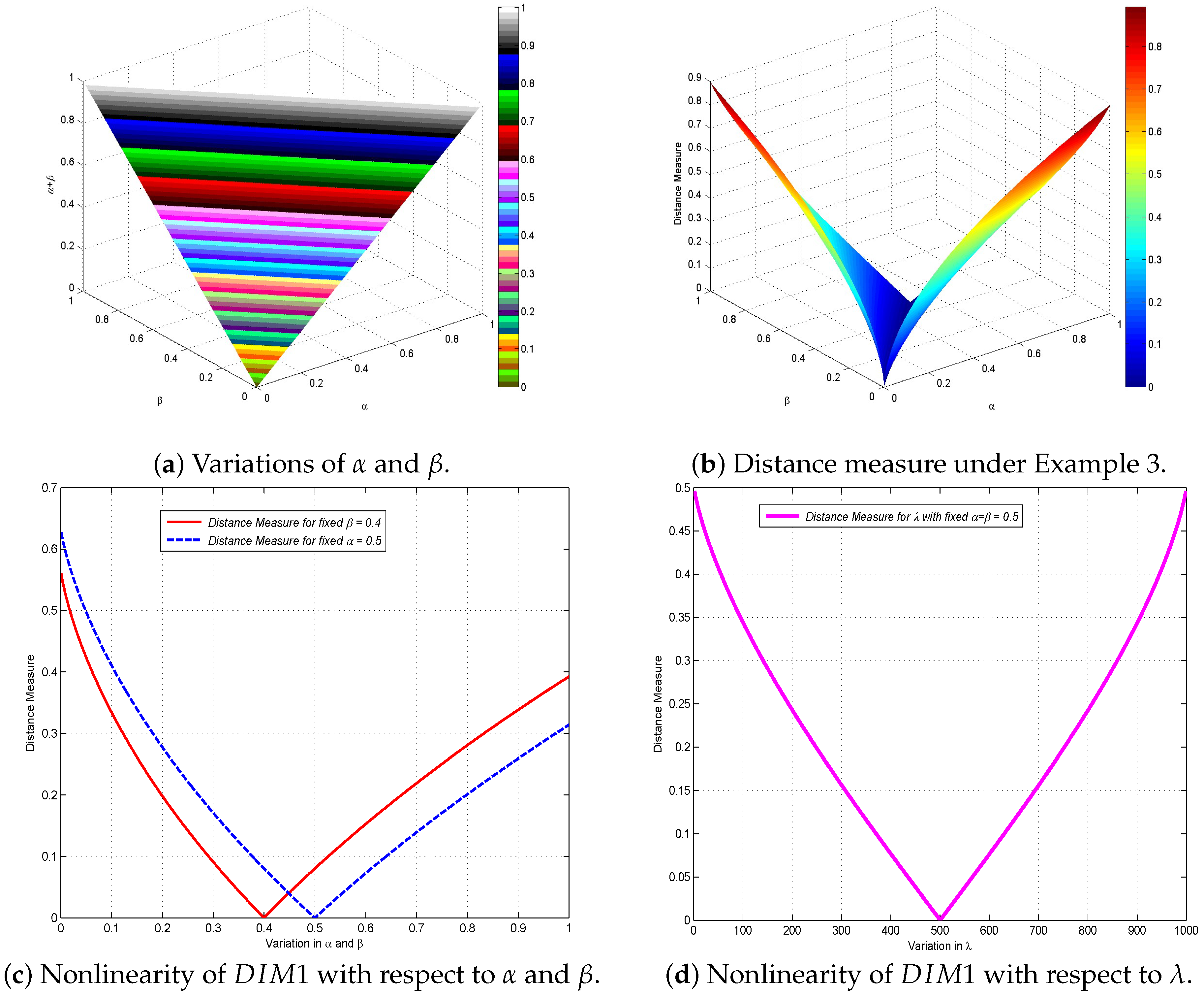
The degree of membership, neutral, and non-membership are α, β, and η [ 0 , 1 ] , and fulfill the condition 0 α + β + η 1 , and we choose η = 0 under the example as elaborated in Figure 2a. Figure 2b illustrates that when α, β belongs to the closed interval [0, 1], 0 D I M 1 ( 1 , 2 ) 1 . When α = β , D I M 1 ( 1 , 2 ) = 0 ; α = 0 , β = 1 or α = 1 , β = 0 , D I M 1 ( 1 , 2 ) < 1 . Thus the results verify the property (a) of Definition 8. Moreover, consider the two CPiFSs 1 and 2 given by 1 = σ , α e i 2 π ( β ) , β e i 2 π ( α ) , η e i 2 π ( η ) and 2 = σ , λ e i 2 π ( 1 λ ) , ( 1 λ ) e i 2 π ( λ ) , η e i 2 π ( η ) , then for a fixed value of α = 0.5 and varied β or fixed β = 0.4 and varied α, Figure 2c portrays the nonlinear behavior of the distance defined in Equation (12). Meanwhile, the values of λ and 1 λ for 2 change as λ varies within the interval [0, 1], and thus for fixed α = β = 0.5 and varied λ, Figure 2d show the nonlinearity of the distance measure D I M 1 .
Example 4.
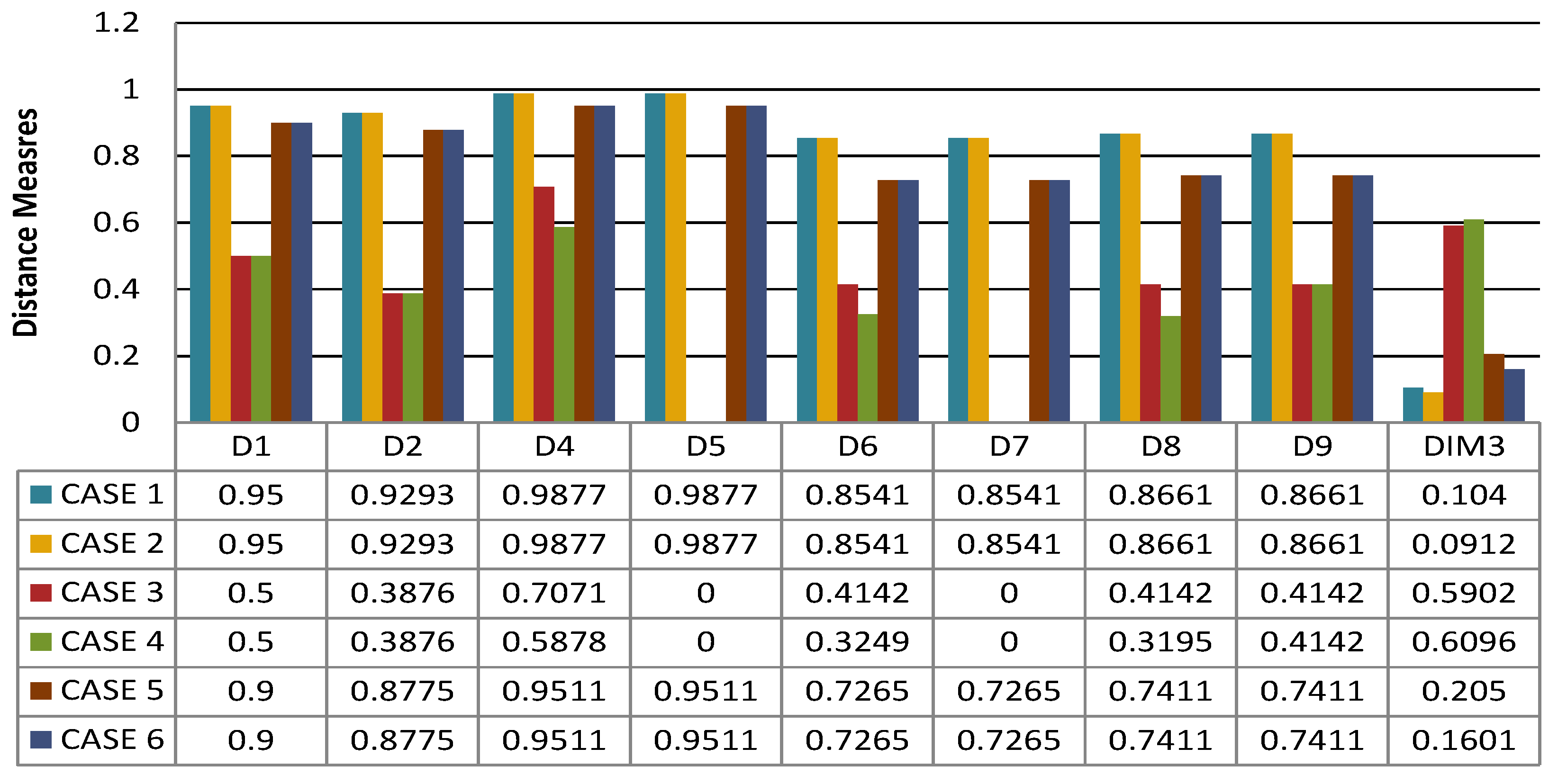
For illustrating the effectiveness of the introduced novel distance measure D I M 3 , a comparative analysis between the existing PiF distance measures in the literature and the introduced novel distance measures is done. Table 5 show the six distinct CPiFSs. In order to evaluate the effectiveness and feasibility of the presented distance measures with some of the existing PiF measures, we first convert the CPiFSs into the simple PiFSs by taking the phase terms equal to zero. Table 6 and Figure 3 show the results for both the proposed CPiF measure of distance and existing PiF measures f distance for all cases. From Table 6, we deduce the following conclusions:
  • For CASE 1, CASE 2 and CASE 5, CASE 6, the PiF measures of distance D 1 , D 2 , D 4 , D 5 , D 6 , D 7 , D 8 , and  D 9 produce the same distance values.
  • For CASE 3 and CASE 4, the PiF measures of distance D 1 and  D 9 yield the same distance values.
  • The PiF distance measure D 3 assigns a distance value of 0 for all six cases. Similarly, for CASE 3 and CASE 4, D 5 and D 7 compute a distance result equal to 0.
  • The proposed CPiF measure of distance D I M 3 overcomes the limitations of the existing PiF distance measures and gives the most reasonable results for all six different cases.
Example 5.
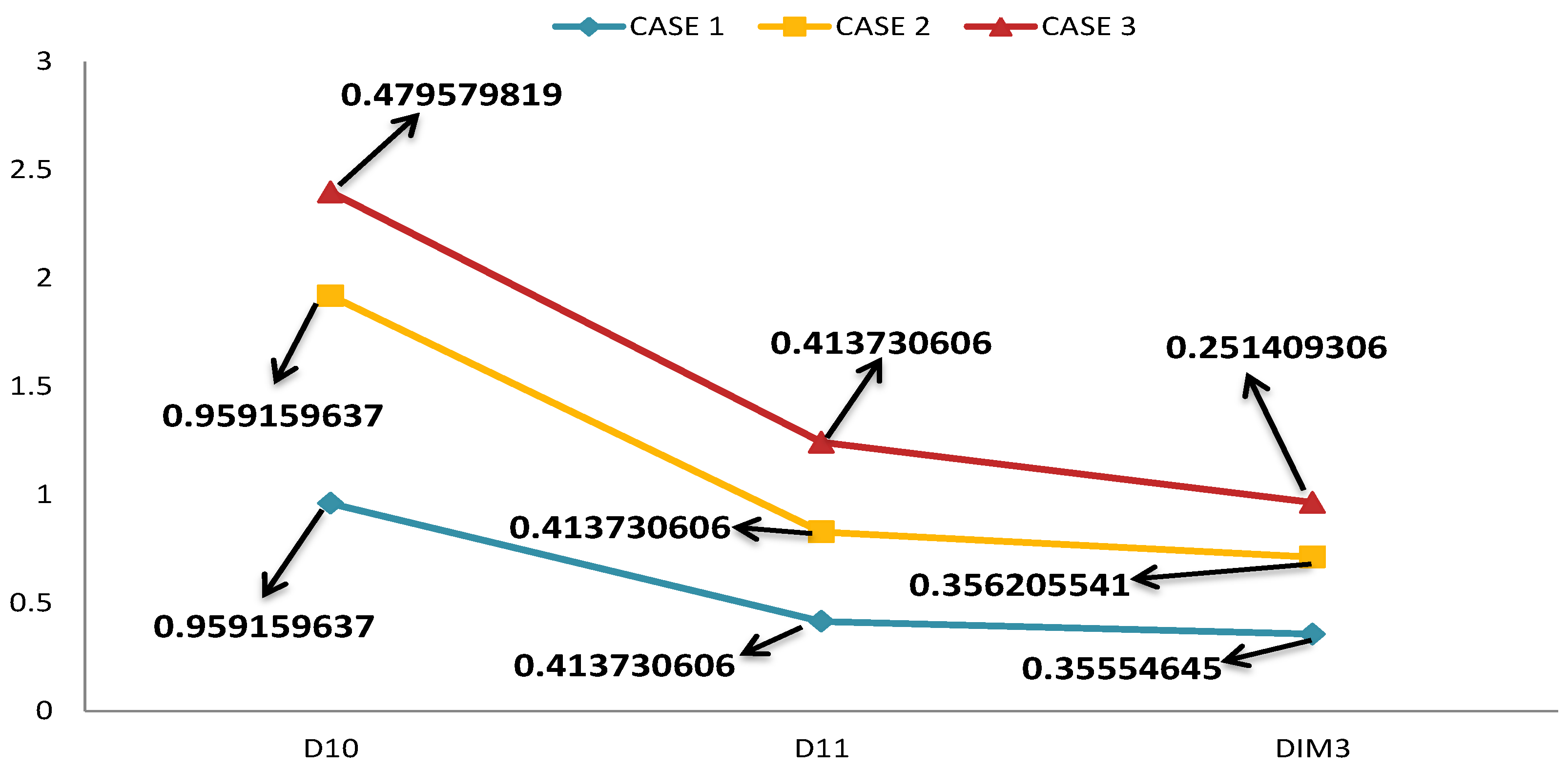
For three different cases CASE 1, CASE 2, and CASE 3, the specific values of membership, non-membership, and neutral degrees of two CPiFSs 1 and 2 are given in Table 7. Accordingly, the results of the existing CPiF measures of distance D 10 , D 11 and proposed CPiF distance measure D I M 3 for three cases are tabulated in Table 8, and the graphical results are shown in Figure 4. From Table 8, it follows that the existing CPiF distance measure D 10 produces identical results in CASE 1 and CASE 2. Likewise, the existing CPiF measure of distance D 11 produces the same results for all three cases. In spite of these difficulties, the CPiF distance measure D I M 3 shows enhanced effectiveness in differentiating between diverse cases.

5. Complex Picture Fuzzy TOPSIS Methodology

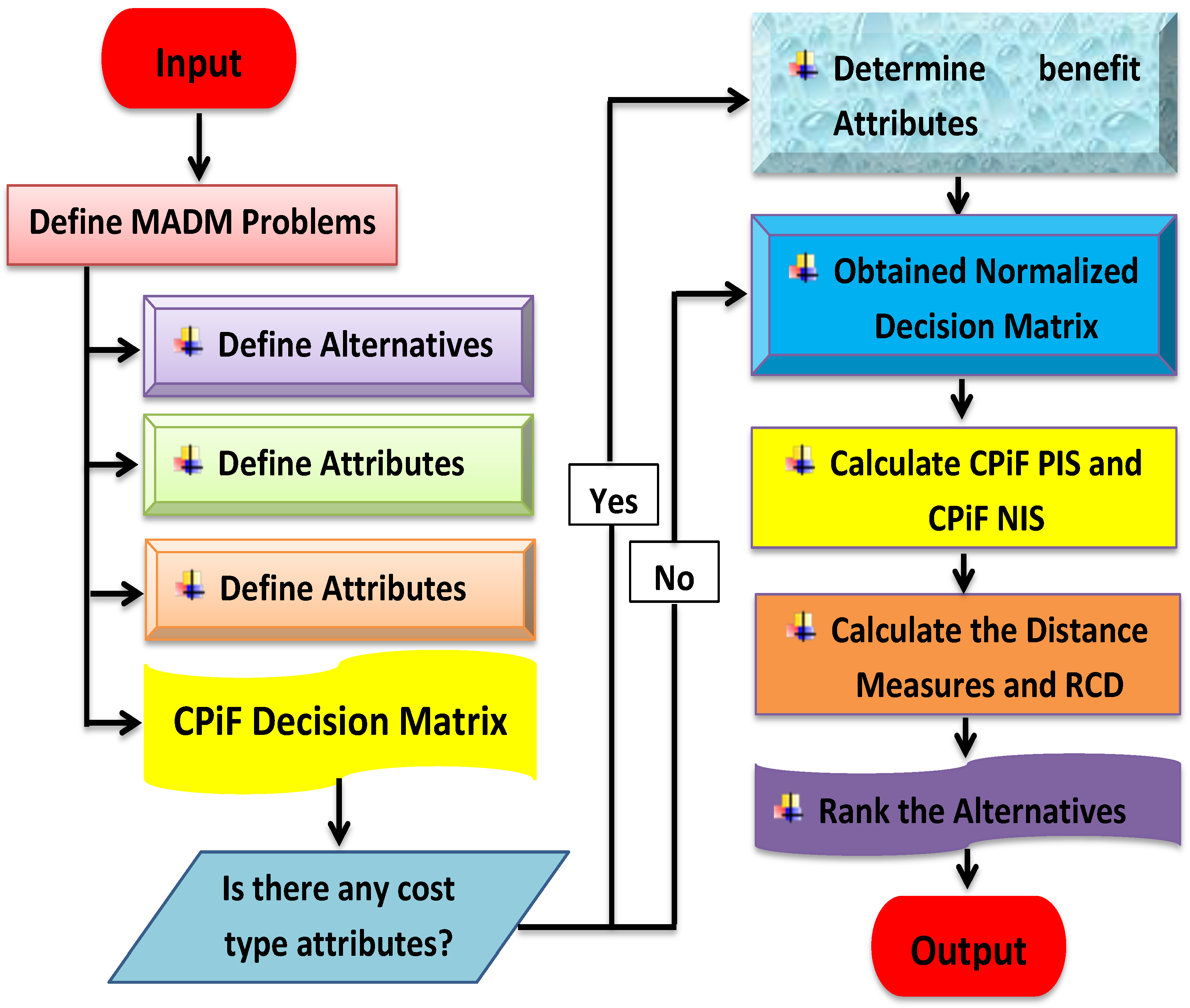
In this section, we present an extension of the TOPSIS method that integrates the newly proposed CPiFS distance measures. We then demonstrate the applicability and effectiveness of this extended TOPSIS framework through a real-world case study. Consider a MADM problem under a CPiF framework involving x alternatives A j ( j = 1 , 2 , , x ) and y criteria C l ( l = 1 , 2 , , y ). Suppose a decision expert evaluates a set of alternatives using multiple distinct criteria. Each alternative is assessed within the CPiFS framework, and the evaluation results are represented in the form of CPiFNs, i.e.,  j l = W j l , Z j l , N j l , where W j l , Z j l , N j l [ 0 , 1 ] respectively represent the degree of membership, degree of neutrality, and degree of non-membership of the alternative A j on the criteria C l . The procedural steps for resolving the CPiF-TOPSIS methodology are outlined in Algorithm 1, where the workflow diagram of the CPiF-TOPSIS methodology is shown in Figure 5.
Algorithm 1 The steps involved to evaluate optimal result using the CPiF-TOPSIS technique.
Step 1.
Input: Establish a MADM problem comprising x alternatives A j ( j = 1 , 2 , , x ) and y criteria C l ( l = 1 , 2 , , y ) in the framework of CPiFNs.
Step 2.
Based on the assessments provided by the decision expert, each alternative can be categorized, and a CPiF decision matrix D = ( j l ) x × y can be constructed as follows:
D = 11 12 1 y 21 22 2 y x 1 x 2 x y .
Step 3.
Transform the decision matrix D as given in the above Step 2 to normalize decision matrix D ^ = ( ^ j l ) x × y = W ^ j l , Z ^ j l , N ^ j l by the formula given below:
D ^ = ^ j l = j l , if A j is a benefit type criteria j l , if A j is a cos t type criteria
where j l is the complement of j l .
Step 4.
Calculate the CPiF PIS and CPiF NIS by formula given below:
A + = P I S = σ i , max 1 j x W A j ( σ i ) , min 1 j x Z A j ( σ i ) , min 1 j x N A j ( σ i ) | σ i B
A = N I S = σ i , min 1 j x W A j ( σ i ) , max 1 j x Z A j ( σ i ) , max 1 j x N A j ( σ i ) | σ i B .
Step 5.
By utilizing the formula given in Equation (14), compute the CPiF distance measure between each alternative A j ( j = 1 , 2 , , x ) with CPiF PIS A + and CPiF NIS A .
Step 6.
Calculate the relative closeness degree (RCD) R j of alternatives A j ( j = 1 , 2 , , x ) to CPiF ideal solution by the formula given below:
R j = D I M 3 ( A j , A ) D I M 3 ( A j , A ) + D I M 3 ( A j , A + )
where D I M 3 is the CPiF distance measure as defined in Equation (14). Moreover, based on the results of RCD ( R j ), rank the alternatives A j ( j = 1 , 2 , , x ) in descending order.
Step 7.
Output: The alternative corresponding to the highest relative closeness degree (RCD) ( R j ) value is considered the optimal choice.

6. Applications of Novel Distance Measures

In this section, we shall examine the mathematical evaluation on selecting the most suitable renewable energy source under the CPiF TOPSIS method. The applications of renewable energy source are inspired by a previous study [72], which is extended by the utilization of the proposed CPiF distance measure based on the TOPSIS method.

6.1. Application in the Selection of Renewable Energy Source

The government of Pakistan seeks to reduce reliance on imported energy by promoting the development of domestic renewable energy sources. Given the country’s limited reserves of oil and natural gas, diversifying the energy mix and prioritizing renewable resources is essential for achieving energy security. Pakistan possesses substantial potential in renewable energy, making it a strategic avenue for sustainable development and energy independence. In this section, we formulate a MADM problem aimed at selecting the most suitable renewable energy source for Pakistan. For this, we apply the proposed CPiF TOPSIS-based distance measures.

Evaluation by CPiF TOPSIS Method

The following steps are adopted to select the most suitable renewable energy source using the extended CPiF TOPSIS-based distance measure.
Step 1.
Input: In this step, we consider the selection of the most suitable renewable energy source for the country Pakistan. The evaluation process considers renewable energy alternatives, including geothermal energy ( A 1 ), solar energy ( A 2 ), biomass energy ( A 3 ), hydropower energy ( A 4 ), and wind energy ( A 5 ). Figure 6 shows the alternatives involved in renewable energy sources. The criteria and sub-criteria influencing the selection process, as identified by the expert, are presented in Table 9.
The subsequent steps involve the application of the CPiF TOPSIS method, incorporating the proposed CPiF distance measure, to rank the suitable renewable energy source based on their overall suitability.
Step 2.
The decision matrix of decision expert on the alternatives A j ( j = 1 , 2 , , 5 ) based on the predefined criteria C 1 , C 2 , and C 3 are tabulated in the form of CPiFSs information as given in Table 10.
Step 3.
Since the criteria C 1 is cost type where C 2 and C 3 are benefit type. So, we normalize the CPiF decision matrix given in Table 10. The normalized CPiF decision matrix is represented in Table 11.
Step 4.
Compute the CPiF PIS ( A + ) and CPiF NIS ( A ) applying Equations (16) and (17) respectively, as given below:
A + = 0.70 e i 2 π ( 0.65 ) , 0.10 e i 2 π ( 0.05 ) , 0.05 e i 2 π ( 0.22 ) , 0.80 e i 2 π ( 0.50 ) , 0.05 e i 2 π ( 0.20 ) , 0.05 e i 2 π ( 0.05 ) 0.82 e i 2 π ( 0.90 ) , 0.06 e i 2 π ( 0.02 ) , 0.04 e i 2 π ( 0.05 ) ,
A = 0.02 e i 2 π ( 0.08 ) , 0.35 e i 2 π ( 0.40 ) , 0.70 e i 2 π ( 0.60 ) , 0.05 e i 2 π ( 0.10 ) , 0.25 e i 2 π ( 0.70 ) , 0.85 e i 2 π ( 0.65 ) 0.02 e i 2 π ( 0.05 ) , 0.33 e i 2 π ( 0.55 ) , 0.90 e i 2 π ( 0.54 ) .
Step 5.
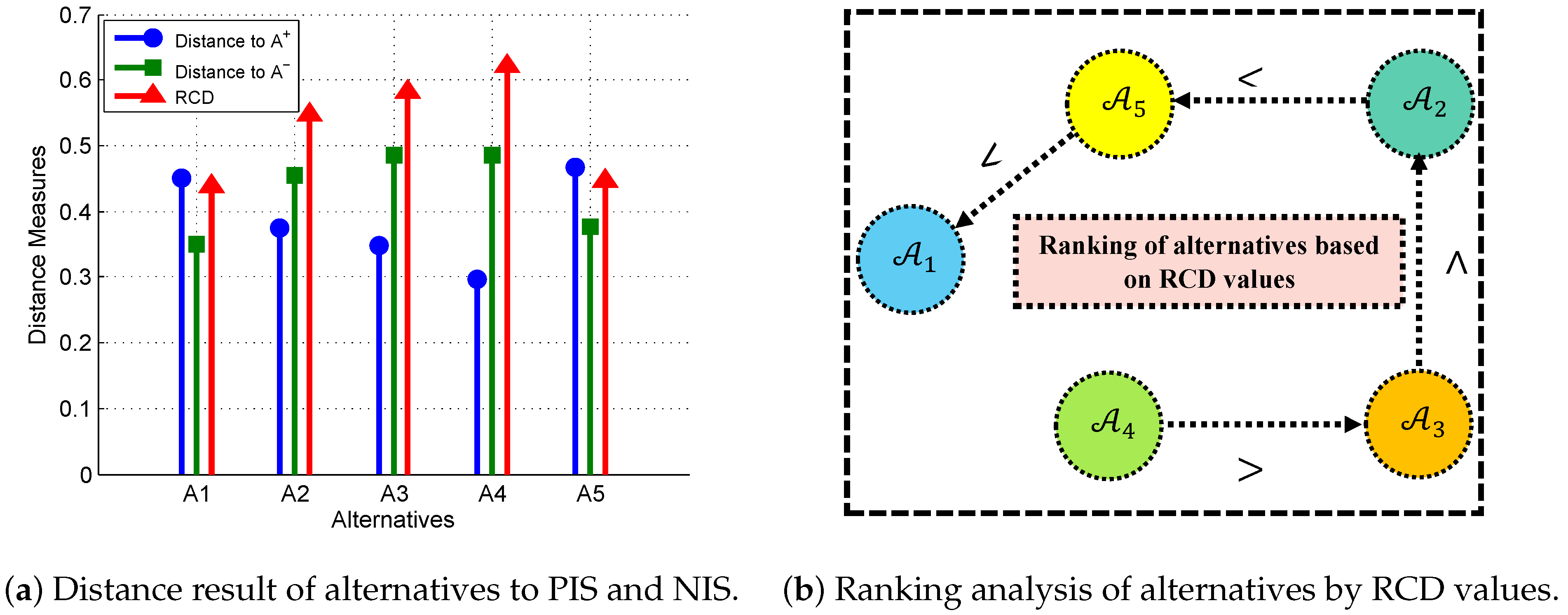
Utilizing Equation (14), determine the CPiF distances between the alternatives A j ( j = 1 , 2 , , x ) and the CPiF PIS ( A + ) and CPiF NIS ( A ). The calculated results are tabulated in Table 12, and the graphical result is outlined in Figure 7.
Step 6.
Through Equation (18), we calculate the RCD of alternatives A j ( j = 1 , 2 , , x ) to the CPiF ideal solution and rank the alternatives in descending order. The result and ranking analysis are indicated as follows:
R 1 = 0.4375795126 , R 2 = 0.5480481948 , R 3 = 0.5824198301 , R 4 = 0.6205539601 , R 5 = 0.4462884647 ,
A 4 > A 3 > A 2 > A 5 > A 1 .
Step 7.
Output: Since the alternative A 4 is the highest RCD value, the alternative A 4 (hydropower energy) is the most optimal choice.
The CPiF-TOPSIS analysis provides a clear ranking of the five renewable energy alternatives for Pakistan based on economic, technical, and environmental criteria. The RCD values indicate the comparative performance of each alternative with respect to the CPiF PIS and NIS. From the above RCD values and ranking order, we show that:
  • Hydropower energy ( A 4 ) achieves the highest RCD value, indicating the closest proximity to the CPiF ideal solution and the farthest distance from the negative ideal solution. Hence, it is the most suitable renewable energy alternative.
  • Biomass energy ( A 3 ) and solar energy ( A 2 ) also perform strongly, reflecting balanced technical efficiency and environmental compatibility.
  • Wind energy ( A 5 ) shows moderate performance.
  • Geothermal energy ( A 1 ) has the lowest RCD value, meaning it is comparatively less suitable under the considered criteria.
It is important to note that, according to the TOPSIS principle, the alternative with the highest RCD value is the optimal choice. Therefore, based on the computed results, hydropower energy ( A 4 ) should be selected as the most appropriate renewable energy source for Pakistan.

7. Comparative Study with Existing Measures

In this section, we conduct a comparative analysis between the proposed distance measure and several existing measures. The selected benchmarks for comparison include distance measures developed for IFSs [73,74,75], PFSs [76], FFSs [38], CIFSs [77], CPFSs [41], and CFFSs [42].

Comparison Through Pattern Classification Problem

Pattern classification refers to the process of assigning an unknown pattern to one of several known categories. In fuzzy environments, this task is typically carried out using compatibility measures such as distance, similarity, accuracy, or correlation metrics. In the subsequent example, we compare our proposed distance measure with existing distance measures.
Example 6.
Consider four unknown patterns P i ( i = 1 , 2 , 3 , 4 ) and the pattern to be tested Q , given as CPiFSs.
P 1 = σ 1 , 0.26 e i 2 π ( 0.38 ) , 0.22 e i 2 π ( 0.22 ) , 0.52 e i 2 π ( 0.40 ) , σ 2 , 0.41 e i 2 π ( 0.60 ) , 0.39 e i 2 π ( 0.30 ) , 0.20 e i 2 π ( 0.10 )
P 2 = σ 1 , 0.40 e i 2 π ( 0.70 ) , 0.30 e i 2 π ( 0.20 ) , 0.30 e i 2 π ( 0.10 ) , σ 2 , 0.15 e i 2 π ( 0.50 ) , 0.65 e i 2 π ( 0.10 ) , 0.20 e i 2 π ( 0.40 )
P 3 = σ 1 , 0.60 e i 2 π ( 0.10 ) , 0.20 e i 2 π ( 0.15 ) , 0.20 e i 2 π ( 0.75 ) , σ 2 , 0.50 e i 2 π ( 0.20 ) , 0.20 e i 2 π ( 0.30 ) , 0.30 e i 2 π ( 0.50 )
P 4 = σ 1 , 0.08 e i 2 π ( 0.15 ) , 0.86 e i 2 π ( 0.25 ) , 0.06 e i 2 π ( 0.60 ) , σ 2 , 0.80 e i 2 π ( 0.05 ) , 0.15 e i 2 π ( 0.55 ) , 0.05 e i 2 π ( 0.40 )
Q = σ 1 , 0.10 e i 2 π ( 0.70 ) , 0.78 e i 2 π ( 0.10 ) , 0.12 e i 2 π ( 0.20 ) , σ 2 , 0.75 e i 2 π ( 0.30 ) , 0.15 e i 2 π ( 0.10 ) , 0.10 e i 2 π ( 0.60 )
Classification Rule: Compute the proposed and existing distance measures between Q and P i ( i = 1 , 2 , 3 , 4 ). Assign Q to unknown patterns P i ( i = 1 , 2 , 3 , 4 ) for which Q exhibits the minimum distance result.
  • Comparison with IFSs, PFSs, and FFSs
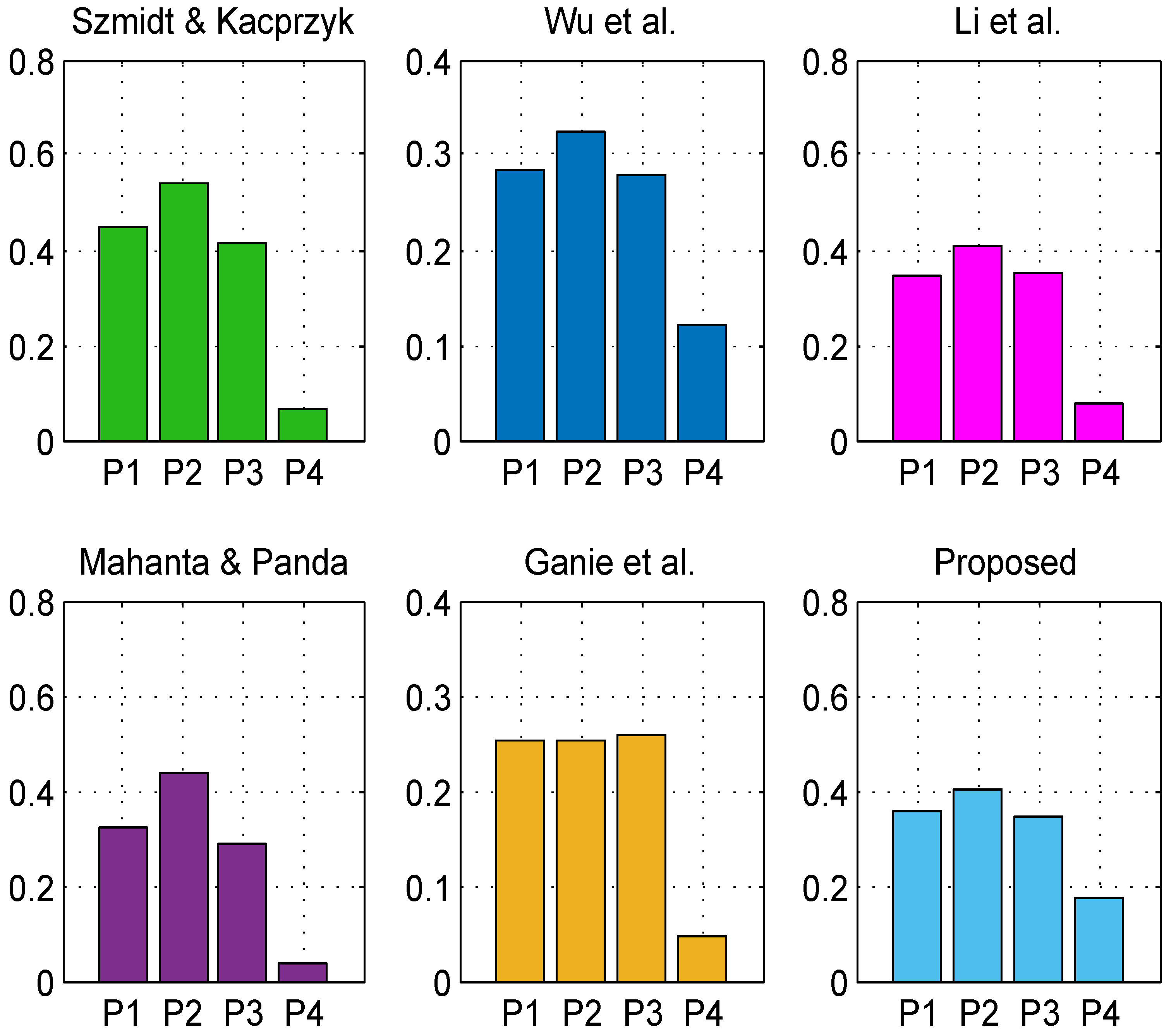
To check the consistency of the method with some existing studies of IFSs [73,74,75], PFSs [76], FFSs [38], we conduct a comparative study. To compare the proposed measure of distance with existing IFSs, PFSs, and FFSs, we take the amplitude and complex grade of the neutral membership of each CPiFSs zero. The corresponding obtained results are listed in Table 13 and Figure 8. By using the existing and proposed distance measures, it is determined that the pattern Q exhibits the minimum distance result with P 4 . The proposed method aligns with this consensus, further validating the classification of Q into the category P 4 .
  • Comparison with CIFSs, CPFSs, and CFFSs
Here, we study the comparison of the proposed measure with some existing measures of CIFSs [77], CPFSs [41], and CFFSs [42]. For this purpose, first, we convert the CPiFSs into CIFSs, CPFSs, and CFFSs by taking the amplitude and phase grade of the neutral membership equal to zero of each CPiFSs. The corresponding results of the classification of various distance measures are discussed below:
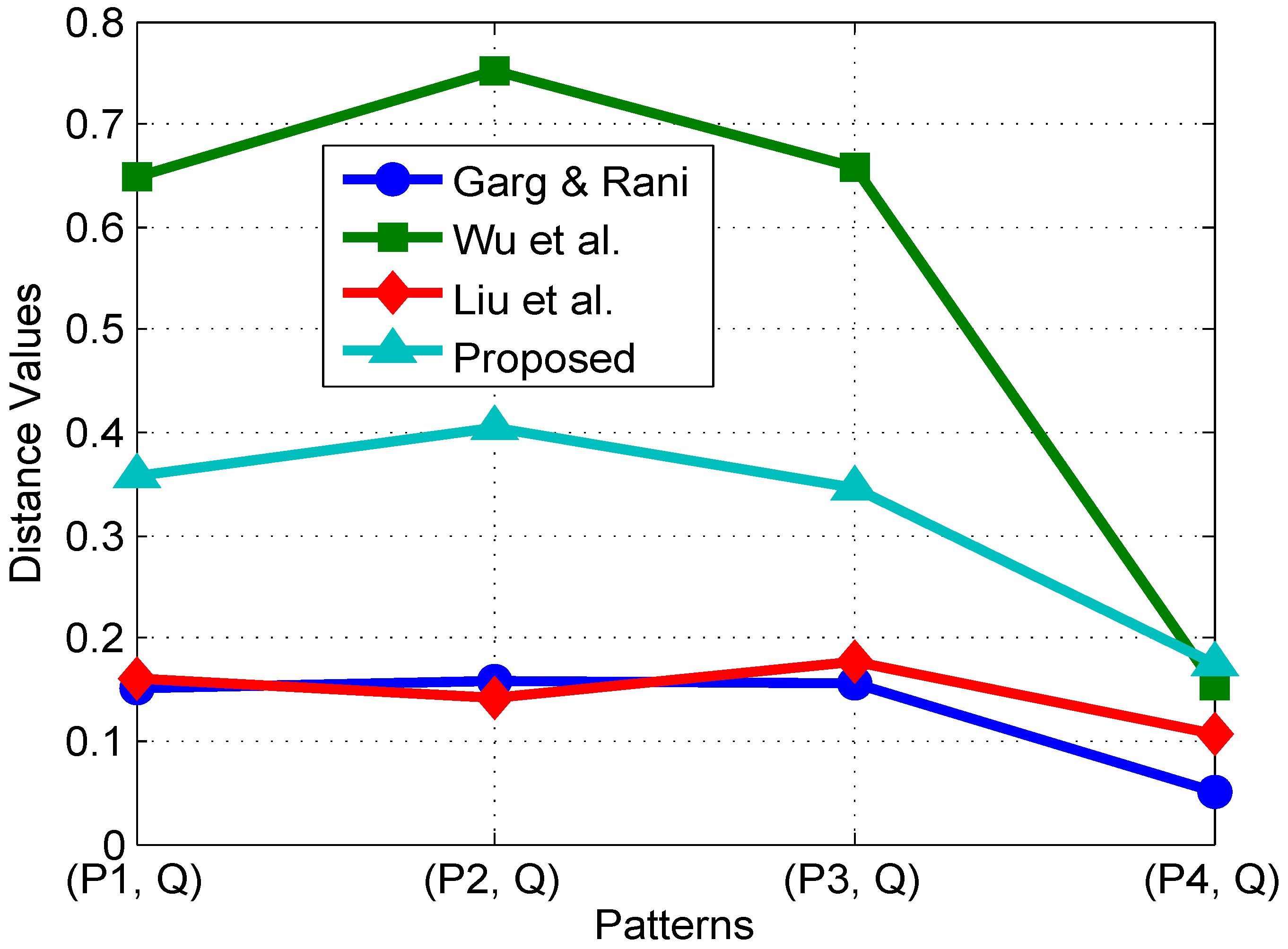
  • By using the CIF distance method proposed by Garg and Rani [77] to the given information, we get the distance results of unknown patterns P i ( i = 1 , 2 , 3 , 4 ) with Q as: ( P 1 , Q ) = 0.15126 , ( P 2 , Q ) = 0.15744 , ( P 3 , Q ) = 0.15560 , and ( P 4 , Q ) = 0.05035 . Hence, the ranking is P 2 > P 3 > P 1 > P 4 . From this, we conclude that the unknown pattern matches with the pattern P 4 and the proposed measure gives consistent results along with the measure of Garg and Rani [77].
  • By using the CPF distance method proposed by Wu et al. [41] to the given information, we get the results of the classification of various similarity measures of unknown patterns P i ( i = 1 , 2 , 3 , 4 ) with Q as: ( P 1 , Q ) = 0.64910 , ( P 2 , Q ) = 0.75110 , ( P 3 , Q ) = 0.65735 , and ( P 4 , Q ) = 0.15310 . Based on the calculations it is seen that the pattern Q exhibits the smallest value with P 4 .
  • By performing the CFF distance method proposed by Liu et al. [42], we get the measurement value of the unknown patterns P i ( i = 1 , 2 , 3 , 4 ) with Q as: ( P 1 , Q ) = 0.16027 , ( P 2 , Q ) = 0.14262 , ( P 3 , Q ) = 0.17768 , and ( P 4 , Q ) = 0.10743 . Thus, ( P 4 , Q ) < ( P 2 , Q ) < ( P 1 , Q ) < ( P 3 , Q ) . Hence, it is seen that the pattern Q exhibits the smallest value again with P 4 .
Figure 9 shows the summarized results of the CIF distance method proposed by Garg and Rani [77], the CPF distance method proposed by Wu et al. [41], and the CFF distance method proposed by Liu et al. [42]. From it, we conclude that the pattern Q exhibits the smallest value with P 4 for the proposed and all existing methods, which validates the feasibility of the method.

8. Conclusions

In this study, the Jensen–Shannon divergence measures for CPiFSs have been proposed to overcome the limitations of existing measures in handling uncertainty with amplitude and phase information simultaneously. The developed measure effectively incorporates the structural characteristics of complex picture fuzzy information and satisfies essential axiomatic properties of distance function. Through numerical comparison, we establish the effectiveness of the suggested measure of distance over the existing measures of IFSs, PFSs, FFSs, CIFSs, CPFSs, and CFFSs. The applicability of the developed measure of distance in MADM and pattern recognition problems highlights its practical significance. In particular, its integration within the TOPSIS framework demonstrates its effectiveness in evaluating and ranking alternatives, such as the selection of optimal renewable energy sources under complex and uncertain environments. A comparative analysis with several existing distance measures demonstrates that the proposed measure provides more consistent and discriminative results, especially in situations where phase components significantly influence decision outcomes.
In the future, we will show the applicability of the suggested measures of distance for CPiFSs in medical diagnosis and clustering. We will also modify our principles in this analysis based on CPiFSs for complex spherical fuzzy sets, and complex T-spherical fuzzy sets. For example, in applications, different attributes often have different importance in decision making, while the importance of each attribute is treated equally in the proposed method. Therefore, we will further explore the weighted form of these distance measures to consider the difference between CPiFSs.

Author Contributions

Z.A.A. conceptualized, investigated, analyzed, formulated the problem, and wrote the initial draft. R.J. validated, conceptualized, supervised, and analyzed the work. Finally, both authors revised, checked, and approved. All authors have read and agreed to the published version of the manuscript.

Funding

This research received no external funding.

Institutional Review Board Statement

This article does not contain any studies with human participants or animals performed by any of the authors.

Data Availability Statement

The original contributions presented in this study are included in the article.

Acknowledgments

The Researchers would like to thank the Deanship of Graduate Studies and Scientific Research at Qassim University for financial support (QU-APC-2026).

Conflicts of Interest

The authors declare no conflicts of interest.

References

  1. Zadeh, L. Fuzzy Sets. Inf. Control 1965, 8, 338–353. [Google Scholar] [CrossRef]
  2. Pal, S.K.; Dutta-Majumder, D.K. Fuzzy Mathematical Approach to Pattern Recognition; Halsted Press: Ultimo, Australia, 1986. [Google Scholar]
  3. Mardani, A.; Hooker, R.E.; Ozkul, S.; Yifan, S.; Nilashi, M.; Sabzi, H.Z.; Fei, G.C. Application of decision making and fuzzy sets theory to evaluate the healthcare and medical problems: A review of three decades of research with recent developments. Expert Syst. Appl. 2019, 137, 202–231. [Google Scholar] [CrossRef]
  4. Pozna, C.; Precup, R.E.; Horváth, E.; Petriu, E.M. Hybrid particle filter–particle swarm optimization algorithm and application to fuzzy controlled servo systems. IEEE Trans. Fuzzy Syst. 2022, 30, 4286–4297. [Google Scholar] [CrossRef]
  5. Chen, H.; Gao, X.; Wu, Q. An enhanced fuzzy time series forecasting model integrating fuzzy c-means clustering, the principle of justifiable granularity, and particle swarm optimization. Symmetry 2025, 17, 753. [Google Scholar] [CrossRef]
  6. Riaz, M.; Davvaz, B.; Fakhar, A.; Firdous, A. Hesitant fuzzy soft topology and its applications to multi-attribute group decision-making: M. Riaz et al. Soft Comput. 2020, 24, 16269–16289. [Google Scholar] [CrossRef]
  7. Atanassov, K.T.; Atanassov, K.T. Intuitionistic Fuzzy Sets; Springer: Berlin/Heidelberg, Germany, 1999. [Google Scholar]
  8. Szmidt, E.; Kacprzyk, J. Group decision making under intuitionistic fuzzy preference relations. In Proceedings of the IPMU: Information Processing and Management of Uncertainty in Knowledge-Based Systems, Paris, France, 6–10 July 1998; pp. 172–178. [Google Scholar]
  9. Xu, Z.; Chen, J.; Wu, J. Clustering algorithm for intuitionistic fuzzy sets. Inf. Sci. 2008, 178, 3775–3790. [Google Scholar] [CrossRef]
  10. Xue, Y.; Deng, Y.; Garg, H. Uncertain database retrieval with measure–Based belief function attribute values under intuitionistic fuzzy set. Inf. Sci. 2021, 546, 436–447. [Google Scholar] [CrossRef]
  11. De, S.K.; Biswas, R.; Roy, A.R. An application of intuitionistic fuzzy sets in medical diagnosis. Fuzzy Sets Syst. 2001, 117, 209–213. [Google Scholar] [CrossRef]
  12. Khatibi, V.; Montazer, G.A. Intuitionistic fuzzy set vs. fuzzy set application in medical pattern recognition. Artif. Intell. Med. 2009, 47, 43–52. [Google Scholar] [CrossRef]
  13. Yager, R.R. Pythagorean fuzzy subsets. In Proceedings of the 2013 Joint IFSA World Congress and NAFIPS Annual Meeting (IFSA/NAFIPS); IEEE: New York, NY, USA, 2013; pp. 57–61. [Google Scholar]
  14. Garg, H. Confidence levels based Pythagorean fuzzy aggregation operators and its application to decision-making process. Comput. Math. Organ. Theory 2017, 23, 546–571. [Google Scholar] [CrossRef]
  15. Hashmi, M.R.; Riaz, M. A novel approach to censuses process by using Pythagorean m-polar fuzzy Dombi’s aggregation operators. J. Intell. Fuzzy Syst. 2020, 38, 1977–1995. [Google Scholar] [CrossRef]
  16. Nguyen, X.T.; Nguyen, V.D.; Nguyen, V.H.; Garg, H. Exponential similarity measures for Pythagorean fuzzy sets and their applications to pattern recognition and decision-making process. Complex Intell. Syst. 2019, 5, 217–228. [Google Scholar] [CrossRef]
  17. Peng, X.; Garg, H. Multiparametric similarity measures on Pythagorean fuzzy sets with applications to pattern recognition. Appl. Intell. 2019, 49, 4058–4096. [Google Scholar] [CrossRef]
  18. Abdullah, L.; Goh, P. Decision making method based on Pythagorean fuzzy sets and its application to solid waste management. Complex Intell. Syst. 2019, 5, 185–198. [Google Scholar] [CrossRef]
  19. Akram, M.; Ilyas, F.; Garg, H. Multi-criteria group decision making based on ELECTRE I method in Pythagorean fuzzy information. Soft Comput. 2020, 24, 3425–3453. [Google Scholar] [CrossRef]
  20. Yager, R.R. Generalized orthopair fuzzy sets. IEEE Trans. Fuzzy Syst. 2016, 25, 1222–1230. [Google Scholar] [CrossRef]
  21. Senapati, T.; Yager, R.R. Fermatean fuzzy sets. J. Ambient Intell. Humaniz. Comput. 2020, 11, 663–674. [Google Scholar] [CrossRef]
  22. Cuong, B.C.; Kreinovich, V. Picture fuzzy sets-a new concept for computational intelligence problems. In Proceedings of the 2013 Third World Congress on Information and Communication Technologies (WICT 2013); IEEE: New York, NY, USA, 2013; pp. 1–6. [Google Scholar]
  23. Dutta, P. Medical diagnosis based on distance measures between picture fuzzy sets. Int. J. Fuzzy Syst. Appl. (IJFSA) 2018, 7, 15–36. [Google Scholar] [CrossRef]
  24. Ganie, A. A picture fuzzy distance measure and its application to pattern recognition problems. Iran. J. Fuzzy Syst. 2023, 20, 71–85. [Google Scholar]
  25. Liu, M.; Zeng, S.; Balezentis, T.; Streimikiene, D. Picture fuzzy weighted distance measures and their application to investment selection. Amfiteatru Econ. 2019, 21, 682–695. [Google Scholar] [CrossRef]
  26. Shah, J.A.; Sukheja, D.; Bhatnagar, P.; Jain, A. A decision-making problem using dissimilarity measure in picture fuzzy sets. Mater. Today Proc. 2023, 80, 3405–3410. [Google Scholar] [CrossRef]
  27. Ramot, D.; Milo, R.; Friedman, M.; Kandel, A. Complex fuzzy sets. IEEE Trans. Fuzzy Syst. 2002, 10, 171–186. [Google Scholar] [CrossRef]
  28. Alkouri, A.M.J.S.; Salleh, A.R. Complex intuitionistic fuzzy sets. AIP Conf. Proc. 2012, 1482, 464–470. [Google Scholar] [CrossRef]
  29. Ullah, K.; Mahmood, T.; Ali, Z.; Jan, N. On some distance measures of complex Pythagorean fuzzy sets and their applications in pattern recognition. Complex Intell. Syst. 2020, 6, 15–27. [Google Scholar] [CrossRef]
  30. Liu, P.; Mahmood, T.; Ali, Z. Complex q-rung orthopair fuzzy aggregation operators and their applications in multi-attribute group decision making. Information 2019, 11, 5. [Google Scholar] [CrossRef]
  31. Chinnadurai, V.; Thayalan, S.; Bobin, A. (r1997) distance measures of complex fermatean fuzzy number and their application to multi-criteria decision-making problem. Appl. Appl. Math. Int. J. (AAM) 2023, 18, 14. [Google Scholar]
  32. Akram, M.; Bashir, A.; Garg, H. Decision-making model under complex picture fuzzy Hamacher aggregation operators: M. Akram et al. Comput. Appl. Math. 2020, 39, 226. [Google Scholar] [CrossRef]
  33. Liu, P.; Akram, M.; Bashir, A. Extensions of power aggregation operators for decision making based on complex picture fuzzy knowledge. J. Intell. Fuzzy Syst. 2021, 40, 1107–1128. [Google Scholar] [CrossRef]
  34. Garg, H.; Dutta, D.; Dutta, P.; Gohain, B. An extended group decision-making algorithm with intuitionistic fuzzy set information distance measures and their applications. Comput. Ind. Eng. 2024, 197, 110537. [Google Scholar] [CrossRef]
  35. Liu, Z. A distance measure of fermatean fuzzy sets based on triangular divergence and its application in medical diagnosis. J. Oper. Intell. 2024, 2, 167–178. [Google Scholar] [CrossRef]
  36. Gohain, B.; Chutia, R.; Dutta, P. Distance measure on intuitionistic fuzzy sets and its application in decision-making, pattern recognition, and clustering problems. Int. J. Intell. Syst. 2022, 37, 2458–2501. [Google Scholar] [CrossRef]
  37. Peng, X.; Yuan, H.; Yang, Y. Pythagorean fuzzy information measures and their applications. Int. J. Intell. Syst. 2017, 32, 991–1029. [Google Scholar] [CrossRef]
  38. Ganie, A.H.; Gheith, N.E.M.; Al-Qudah, Y.; Ganie, A.H.; Sharma, S.K.; Aqlan, A.M.; Khalaf, M.M. An innovative Fermatean fuzzy distance metric with its application in classification and bidirectional approximate reasoning. IEEE Access 2024, 12, 4780–4791. [Google Scholar] [CrossRef]
  39. Alkouri, A.U.M.; Salleh, A.R. Linguistic variable, hedges and several distances on complex fuzzy sets. J. Intell. Fuzzy Syst. 2014, 26, 2527–2535. [Google Scholar] [CrossRef]
  40. Rani, D.; Garg, H. Distance measures between the complex intuitionistic fuzzy sets and their applications to the decision-making process. Int. J. Uncertain. Quantif. 2017, 7, 423–439. [Google Scholar] [CrossRef]
  41. Wu, D.L.; Zhu, Z.; Ullah, K.; Liu, L.; Wu, X.; Zhang, X. Analysis of Hamming and Hausdorff 3D distance measures for complex pythagorean fuzzy sets and their applications in pattern recognition and medical diagnosis. Complex Intell. Syst. 2023, 9, 4147–4158. [Google Scholar] [CrossRef]
  42. Liu, Z.; Zhu, S.; Senapati, T.; Deveci, M.; Pamucar, D.; Yager, R.R. New distance measures of complex Fermatean fuzzy sets with applications in decision making and clustering problems. Inf. Sci. 2025, 686, 121310. [Google Scholar] [CrossRef]
  43. Zhu, S.; Liu, Z.; Letchmunan, S.; Ulutagay, G.; Ullah, K. Novel distance measures on complex picture fuzzy environment: Applications in pattern recognition, medical diagnosis and clustering. J. Appl. Math. Comput. 2025, 71, 1743–1775. [Google Scholar] [CrossRef]
  44. Wu, X.; Tang, H.; Zhu, Z.; Liu, L.; Chen, G.; Yang, M.S. Nonlinear strict distance and similarity measures for intuitionistic fuzzy sets with applications to pattern classification and medical diagnosis. Sci. Rep. 2023, 13, 13918. [Google Scholar] [CrossRef]
  45. Hussain, Z.; Alam, S.; Hussain, R.; ur Rahman, S. New similarity measure of Pythagorean fuzzy sets based on the Jaccard index with its application to clustering. Ain Shams Eng. J. 2024, 15, 102294. [Google Scholar] [CrossRef]
  46. Sahoo, L. Similarity measures for Fermatean fuzzy sets and its applications in group decision-making. Decis. Sci. Lett. 2022, 11, 167–180. [Google Scholar] [CrossRef]
  47. Wang, D.; Yuan, Y.; Liu, Z.; Zhu, S.; Sun, Z. Novel distance measures of q-rung orthopair fuzzy sets and their applications. Symmetry 2024, 16, 574. [Google Scholar] [CrossRef]
  48. Ganie, A.H.; Al-Qudah, Y.; Salleh, Z.; Alhawarat, A. A Novel Picture Fuzzy Similarity Measure: Theory and Practical Applications. IEEE Access 2025, 13, 133426–133437. [Google Scholar] [CrossRef]
  49. Zhu, S.; Liu, Z.; Ur Rahman, A. Novel distance measures of picture fuzzy sets and their applications. Arab. J. Sci. Eng. 2024, 49, 12975–12988. [Google Scholar] [CrossRef]
  50. Mahmood, T.; Ur Rehman, U. A novel approach towards bipolar complex fuzzy sets and their applications in generalized similarity measures. Int. J. Intell. Syst. 2022, 37, 535–567. [Google Scholar] [CrossRef]
  51. Yang, K.; Shu, L.; Yang, G. Complex intuitionistic fuzzy ordered weighted distance measure. Comput. Appl. Math. 2022, 41, 353. [Google Scholar] [CrossRef]
  52. Wang, D.; Letchmunan, S.; Liao, J.; Qiu, H.; Liu, Z. Construction of new similarity measures for complex pythagorean fuzzy sets and their applications in decision-making problems. J. Intell. Decis. Mak. Inf. Sci. 2025, 2, 156–173. [Google Scholar] [CrossRef]
  53. Khan, Z.; Hussain, F.; Ullah, I.; Rahim, T.; Khan, M.; Jan, R.; Mekawy, I. Optimizing algorithms and decision making problems through novel distance techniques with complex fermatean fuzzy numbers. Partial Differ. Equ. Appl. Math. 2025, 15, 100776. [Google Scholar] [CrossRef]
  54. Khan, Z.; Hussain, F.; Rahim, T.; Jan, R.; Boulaaras, S. Distance measure and its application to decision making, medical diagnosis, and pattern recognition problems under complex picture fuzzy sets. Eur. Phys. J. Plus 2024, 139, 243. [Google Scholar] [CrossRef]
  55. Yang, M.S.; Akhtar, Y.; Ali, M. Divergence Measures for Globular T-Spherical Fuzzy Sets with Application in Selecting Solar Energy Systems. Symmetry 2025, 17, 872. [Google Scholar] [CrossRef]
  56. Xu, C.; Wen, Y. New measure of circular intuitionistic fuzzy sets and its application in decision making. AIMS Math. 2023, 8, 24053–24074. [Google Scholar] [CrossRef]
  57. Althuniyan, N.; Al-shboul, A.; Aljohani, S.; Wang, K.L.; Wong, K.B.; Alhazaymeh, K.; Aiady, S.S. Decision-Making with Fermatean Neutrosophic Vague Soft Sets Using a Technique for Order of Preference by Similarity to Ideal Solution. Axioms 2025, 14, 381. [Google Scholar] [CrossRef]
  58. Kahraman, C.; Alkan, N. Circular intuitionistic fuzzy TOPSIS method with vague membership functions: Supplier selection application context. Notes Intuitionistic Fuzzy Sets 2021, 27, 24–52. [Google Scholar] [CrossRef]
  59. Alkan, N.; Kahraman, C. Circular intuitionistic fuzzy TOPSIS method: Pandemic hospital location selection. J. Intell. Fuzzy Syst. 2021, 42, 295–316. [Google Scholar] [CrossRef]
  60. Ruan, C.Y.; Chen, X.J.; Gong, S.C.; Ali, S.; Almutairi, B. A decision-making framework based on the Fermatean hesitant fuzzy distance measure and TOPSIS. AIMS Math. 2024, 9, 2722–2755. [Google Scholar] [CrossRef]
  61. Akram, M.; Kahraman, C.; Zahid, K. Extension of TOPSIS model to the decision-making under complex spherical fuzzy information. Soft Comput. 2021, 25, 10771–10795. [Google Scholar] [CrossRef]
  62. Garg, H.; Ali, Z.; Mahmood, T. Algorithms for complex interval-valued q-rung orthopair fuzzy sets in decision making based on aggregation operators, AHP, and TOPSIS. Expert Syst. 2021, 38, e12609. [Google Scholar] [CrossRef]
  63. Wang, J.; Xu, W.; Xu, Y.; Li, L.; Feng, X. A novel multi-attribute group decision-making method based on interval-valued q-rung dual hesitant Fuzzy Sets and TOPSIS. In LISS 2021, Proceedings of the 11th International Conference on Logistics, Informatics and Service Sciences; Springer: Singapore, 2022; pp. 237–247. [Google Scholar]
  64. Xiao, F. A distance measure for intuitionistic fuzzy sets and its application to pattern classification problems. IEEE Trans. Syst. Man Cybern. Syst. 2019, 51, 3980–3992. [Google Scholar] [CrossRef]
  65. Dhumras, H.; Shukla, V.; Bajaj, R.K.; Driss, M.; Boulila, W. On similarity measures of complex picture fuzzy sets with applications in the field of pattern recognition. IEEE Access 2024, 12, 83104–83117. [Google Scholar] [CrossRef]
  66. Singh, P.; Mishra, N.K.; Kumar, M.; Saxena, S.; Singh, V. Risk analysis of flood disaster based on similarity measures in picture fuzzy environment. Afr. Mat. 2018, 29, 1019–1038. [Google Scholar] [CrossRef]
  67. Wei, G. Some cosine similarity measures for picture fuzzy sets and their applications to strategic decision making. Informatica 2017, 28, 547–564. [Google Scholar] [CrossRef]
  68. Singh, S.; Ganie, A.H. Applications of picture fuzzy similarity measures in pattern recognition, clustering, and MADM. Expert Syst. Appl. 2021, 168, 114264. [Google Scholar] [CrossRef]
  69. Gallager, R.G. Information Theory and Reliable Communication; Springer: Vienna, Austria, 1968; Volume 588. [Google Scholar]
  70. Toussaint, G. Sharper lower bounds for discrimination information in terms of variation (corresp.). IEEE Trans. Inf. Theory 1975, 21, 99–100. [Google Scholar] [CrossRef]
  71. Lin, J. Divergence measures based on the Shannon entropy. IEEE Trans. Inf. Theory 2002, 37, 145–151. [Google Scholar] [CrossRef]
  72. Khan, A.; Khan, S.; Rahimzai, A.A.; Abdullah, S. Framework development of continuous non-linear Diophantine fuzzy sets and its application to renewable energy source selection. Sci. Rep. 2025, 15, 18878. [Google Scholar] [CrossRef]
  73. Szmidt, E.; Kacprzyk, J. Distances between intuitionistic fuzzy sets. Fuzzy Sets Syst. 2000, 114, 505–518. [Google Scholar] [CrossRef]
  74. Wu, Y.; Wang, Z.; Zhang, L. A Novel Clark distance-based decision-making algorithm on intuitionistic fuzzy sets. Electronics 2024, 13, 3481. [Google Scholar] [CrossRef]
  75. Li, X.; Liu, Z.; Han, X.; Liu, N.; Yuan, W. An intuitionistic fuzzy version of hellinger distance measure and its application to decision-making process. Symmetry 2023, 15, 500. [Google Scholar] [CrossRef]
  76. Mahanta, J.; Panda, S. Distance measure for Pythagorean fuzzy sets with varied applications. Neural Comput. Appl. 2021, 33, 17161–17171. [Google Scholar] [CrossRef]
  77. Garg, H.; Rani, D. Some results on information measures for complex intuitionistic fuzzy sets. Int. J. Intell. Syst. 2019, 34, 2319–2363. [Google Scholar] [CrossRef]
Figure 1. Geometrical structure of the unit disc.
Axioms 15 00317 g001
Figure 2. Validation of distance properties through graphical representation.
Axioms 15 00317 g002
Figure 3. Comparison plot for the proposed CPiF and existing PiF distance measures in Example 4.
Axioms 15 00317 g003
Figure 4. Comparison plot for the proposed CPiF and existing CPiF distance measures in Example 5.
Axioms 15 00317 g004
Figure 5. Flow chart of the above implementation steps.
Axioms 15 00317 g005
Figure 6. Renewable energy options for the defined alternatives.
Axioms 15 00317 g006
Figure 7. Results of A j ( j = 1 , 2 , , x ) to A + and A with ranking based on RCD values.
Axioms 15 00317 g007
Figure 8. Comparison results of proposed and existing studies of IFSs [73,74,75], PFSs [76], and FFSs [38].
Axioms 15 00317 g008
Figure 9. Comparison results of proposed and existing studies of CIFSs [77], CPFSs [41], and CFFSs [42].
Axioms 15 00317 g009
Table 1. Literature review of distance measures for different fuzzy models with applications.
AuthorsFuzzy ModelsApplicationsDecision Methods
Wu et al. [44]IFSsPattern classification and Medical diagnosisTOPSIS method
Hussain et al. [45]PFSsClusteringTOPSIS method
Laxminarayan Sahoo [46]FFSsPattern classification problem viz. personnel appointmentMCDM method
Wang et al. [47]q-ROFSsPattern recognition and multi-criteria decision-makingMCDM method
Zhu et al. [48,49]PiFSsMedical diagnosis and Pattern recognitionMADM method
Mahmood and Rehman [50]Bipolar CFSsMedical diagnosis and Pattern recognitionMADM method
Yang et al. [51]CIFSsCorona virus vaccine selection for COVID-19MCGDM method
Wang et al. [52]CPFSsMedical diagnosis and Pattern recognitionDM method
Khan et al. [53]CFFSsTelecommunication and Medical diagnosisMADM method
Khan et al. [54]CPiFSsMedical diagnosis and Pattern recognitionMADM method
Table 2. Structural comparison of fuzzy set models.
ModelsUncertaintyFalsityHesitationPeriodicityNeutrality
FSs [1]××××
IFSs [7]××
PFSs [13]××
FFSs [21]××
PiFSs [22]×
CFSs [27]×××
CIFSs [28]×
CPFSs [29]×
CFFSs [31]×
CPiFSs [32]
Table 3. Abbreviations and acronyms.
ItemsDescription
FSsFuzzy Sets
IFSsIntuitionistic Fuzzy Sets
PFSsPythagorean Fuzzy Sets
FFSsFermatean Fuzzy Sets
CFSsComplex Fuzzy Sets
CIFSsComplex Intuitionistic Fuzzy Sets
CPFSsComplex Pythagorean Fuzzy Sets
CFFSsComplex Fermatean Fuzzy Sets
MCDMMulti Criteria Decision Making
MADMMulti Attribute Decision Making
MDMembership Degree
NMDNon-Membership Degree
JSDJensen–Shannon Divergence
RCDRelative Closeness Degree
Table 4. Symbols list.
SymbolMeaning
B Non-empty fixed set
W Membership term
Z Neutral term
N Non-membership term
A j Alternatives
C l Criteria
R j Relative Closeness Degree
P i Unknown Patterns
A + Positive Ideal Solution
A Negative Ideal Solution
D Decision Matrix
D ^ Normalized Decision Matrix
Table 5. Two CPiFSs under six distinct cases in Example 4.
CPiFSsCASE 1CASE 2
1 σ 1 , 0.3 e i 2 π ( 0.5 ) , 0.0 e i 2 π ( 0.2 ) , 0.7 e i 2 π ( 0.3 ) σ 1 , 0.3 e i 2 π ( 0.8 ) , 0.0 e i 2 π ( 0.1 ) , 0.7 e i 2 π ( 0.1 )
2 σ 1 , 0.4 e i 2 π ( 0.6 ) , 0.0 e i 2 π ( 0.3 ) , 0.6 e i 2 π ( 0.1 ) σ 1 , 0.2 e i 2 π ( 0.7 ) , 0.0 e i 2 π ( 0.1 ) , 0.8 e i 2 π ( 0.2 )
CPiFSsCASE 3CASE 4
1 σ 1 , 0.5 e i 2 π ( 0.1 ) , 0.0 e i 2 π ( 0.5 ) , 0.5 e i 2 π ( 0.4 ) σ 1 , 0.4 e i 2 π ( 0.3 ) , 0.0 e i 2 π ( 0.1 ) , 0.6 e i 2 π ( 0.6 )
2 σ 1 , 0.0 e i 2 π ( 0.2 ) , 0.0 e i 2 π ( 0.4 ) , 0.0 e i 2 π ( 0.4 ) σ 1 , 0.0 e i 2 π ( 0.8 ) , 0.0 e i 2 π ( 0.1 ) , 0.0 e i 2 π ( 0.1 )
CPiFSsCASE 5CASE 6
1 σ 1 , 0.1 e i 2 π ( 0.5 ) , 0.4 e i 2 π ( 0.2 ) , 0.5 e i 2 π ( 0.3 ) σ 1 , 0.4 e i 2 π ( 0.4 ) , 0.4 e i 2 π ( 0.1 ) , 0.2 e i 2 π ( 0.5 )
2 σ 1 , 0.2 e i 2 π ( 0.1 ) , 0.5 e i 2 π ( 0.2 ) , 0.3 e i 2 π ( 0.7 ) σ 1 , 0.2 e i 2 π ( 0.4 ) , 0.5 e i 2 π ( 0.3 ) , 0.3 e i 2 π ( 0.3 )
Table 6. The comparison results calculated by the proposed CPiF and existing PiF distance measures.
Distance MethodsCASE 1CASE 2CASE 3CASE 4CASE 5CASE 6
D 1 [66]0.95000.95000.50000.50000.90000.9000
D 2 [66]0.92930.92930.38760.38360.87750.8775
D 3 [66]0.00000.00000.00000.00000.00000.0000
D 4 [67]0.98770.98770.70710.58780.95110.9511
D 5 [67]0.98770.98770.00000.00000.95110.9511
D 6 [67]0.85410.85410.41420.32490.72650.7265
D 7 [67]0.85410.85410.00000.00000.72650.7265
D 8 [68]0.86610.86610.41420.31950.74110.7411
D 9 [68]0.86610.86610.41420.41420.74110.7411
D I M 3 0.10400.09120.59020.60960.20500.1601
Table 7. Two CPiFSs for three cases in Example 5.
CPiFSsCASE 1
MembershipNeutralityNon-Membership
1 0.60 e i 2 π ( 0.30 ) 0.10 e i 2 π ( 0.50 ) 0.30 e i 2 π ( 0.20 )
2 0.20 e i 2 π ( 0.80 ) 0.40 e i 2 π ( 0.10 ) 0.40 e i 2 π ( 0.10 )
CPiFSsCASE 2
MembershipNeutralityNon-Membership
1 0.10 e i 2 π ( 0.60 ) 0.70 e i 2 π ( 0.20 ) 0.20 e i 2 π ( 0.20 )
2 0.50 e i 2 π ( 0.10 ) 0.40 e i 2 π ( 0.60 ) 0.10 e i 2 π ( 0.30 )
CPiFSsCASE 3
MembershipNeutralityNon-Membership
1 0.30 e i 2 π ( 0.15 ) 0.05 e i 2 π ( 0.25 ) 0.15 e i 2 π ( 0.10 )
2 0.10 e i 2 π ( 0.40 ) 0.20 e i 2 π ( 0.05 ) 0.20 e i 2 π ( 0.05 )
Table 8. The results of proposed and existing CPiF measures in Example 5.
Distance MethodsCASE 1CASE 2CASE 3
D 10 [65]0.9591596370.9591596370.479579819
D 11 [65]0.4137306060.4137306060.413730606
D I M 3 0.355546450.3562055410.251409306
Table 9. Criteria and sub-criteria for renewable energy.
CriteriaSub-Criteria
Economical Criterion ( C 1 )Investment CostMaintenance and Operation CostFuel Cost
Installation CostPayback Period
Technical Criterion ( C 2 )AvailabilityCapacityResource Density
Energy EfficiencyGrid Compatibility
Environmental Criterion ( C 3 )Air PollutionNoise PollutionWater Consumption
Land use ImpactImpact on Biodiversity
Table 10. CPiF decision matrix of alternatives by decision maker.
Criteria ( C l )Alternatives ( A j )
C 1 A 1 = 0.70 e i 2 π ( 0.60 ) , 0.10 e i 2 π ( 0.20 ) , 0.10 e i 2 π ( 0.10 ) A 2 = 0.65 e i 2 π ( 0.50 ) , 0.15 e i 2 π ( 0.12 ) , 0.04 e i 2 π ( 0.33 )
A 3 = 0.60 e i 2 π ( 0.25 ) , 0.20 e i 2 π ( 0.35 ) , 0.12 e i 2 π ( 0.08 ) A 4 = 0.55 e i 2 π ( 0.40 ) , 0.35 e i 2 π ( 0.40 ) , 0.02 e i 2 π ( 0.20 )
A 5 = 0.05 e i 2 π ( 0.22 ) , 0.10 e i 2 π ( 0.05 ) , 0.70 e i 2 π ( 0.65 )
C 2 A 1 = 0.60 e i 2 π ( 0.50 ) , 0.15 e i 2 π ( 0.30 ) , 0.10 e i 2 π ( 0.20 ) A 2 = 0.70 e i 2 π ( 0.40 ) , 0.20 e i 2 π ( 0.25 ) , 0.05 e i 2 π ( 0.35 )
A 3 = 0.55 e i 2 π ( 0.15 ) , 0.25 e i 2 π ( 0.55 ) , 0.10 e i 2 π ( 0.30 ) A 4 = 0.80 e i 2 π ( 0.25 ) , 0.10 e i 2 π ( 0.70 ) , 0.05 e i 2 π ( 0.05 )
A 5 = 0.05 e i 2 π ( 0.10 ) , 0.05 e i 2 π ( 0.20 ) , 0.85 e i 2 π ( 0.65 )
C 3 A 1 = 0.12 e i 2 π ( 0.05 ) , 0.33 e i 2 π ( 0.55 ) , 0.48 e i 2 π ( 0.28 ) A 2 = 0.35 e i 2 π ( 0.90 ) , 0.30 e i 2 π ( 0.02 ) , 0.20 e i 2 π ( 0.05 )
A 3 = 0.82 e i 2 π ( 0.18 ) , 0.14 e i 2 π ( 0.36 ) , 0.04 e i 2 π ( 0.36 ) A 4 = 0.66 e i 2 π ( 0.70 ) , 0.11 e i 2 π ( 0.15 ) , 0.08 e i 2 π ( 0.05 )
A 5 = 0.02 e i 2 π ( 0.18 ) , 0.06 e i 2 π ( 0.26 ) , 0.90 e i 2 π ( 0.54 )
Table 11. Normalized CPiF decision matrix of alternatives by decision maker.
Criteria ( C l )Alternatives ( A j )
C 1 A 1 = 0.10 e i 2 π ( 0.10 ) , 0.10 e i 2 π ( 0.20 ) , 0.70 e i 2 π ( 0.60 ) A 2 = 0.04 e i 2 π ( 0.33 ) , 0.15 e i 2 π ( 0.12 ) , 0.65 e i 2 π ( 0.50 )
A 3 = 0.12 e i 2 π ( 0.08 ) , 0.20 e i 2 π ( 0.35 ) , 0.60 e i 2 π ( 0.25 ) A 4 = 0.02 e i 2 π ( 0.20 ) , 0.35 e i 2 π ( 0.40 ) , 0.55 e i 2 π ( 0.40 )
A 5 = 0.70 e i 2 π ( 0.65 ) , 0.10 e i 2 π ( 0.05 ) , 0.05 e i 2 π ( 0.22 )
C 2 A 1 = 0.60 e i 2 π ( 0.50 ) , 0.15 e i 2 π ( 0.30 ) , 0.10 e i 2 π ( 0.20 ) A 2 = 0.70 e i 2 π ( 0.40 ) , 0.20 e i 2 π ( 0.25 ) , 0.05 e i 2 π ( 0.35 )
A 3 = 0.55 e i 2 π ( 0.15 ) , 0.25 e i 2 π ( 0.55 ) , 0.10 e i 2 π ( 0.30 ) A 4 = 0.80 e i 2 π ( 0.25 ) , 0.10 e i 2 π ( 0.70 ) , 0.05 e i 2 π ( 0.05 )
A 5 = 0.05 e i 2 π ( 0.10 ) , 0.05 e i 2 π ( 0.20 ) , 0.85 e i 2 π ( 0.65 )
C 3 A 1 = 0.12 e i 2 π ( 0.05 ) , 0.33 e i 2 π ( 0.55 ) , 0.48 e i 2 π ( 0.28 ) A 2 = 0.35 e i 2 π ( 0.90 ) , 0.30 e i 2 π ( 0.02 ) , 0.20 e i 2 π ( 0.05 )
A 3 = 0.82 e i 2 π ( 0.18 ) , 0.14 e i 2 π ( 0.36 ) , 0.04 e i 2 π ( 0.36 ) A 4 = 0.66 e i 2 π ( 0.70 ) , 0.11 e i 2 π ( 0.15 ) , 0.08 e i 2 π ( 0.05 )
A 5 = 0.02 e i 2 π ( 0.18 ) , 0.06 e i 2 π ( 0.26 ) , 0.90 e i 2 π ( 0.54 )
Table 12. CPiF distance measure from A j ( j = 1 , 2 , , x ) to A + and A .
AlternativesCPiF Distance Measure
Distance Measure to A + Distance Measure to A
A 1 0.45088586750.3508023313
A 2 0.37517707770.4549492176
A 3 0.34821191080.4856684694
A 4 0.29707236800.4858383406
A 5 0.46792289320.3771432890
Table 13. Distance results of existing and proposed measures between P i ( i = 1 , 2 , 3 , 4 ) and Q .
MethodsResults of Q with P i ( i = 1 , 2 , 3 , 4 )Ranking AnalysisClassification
( P 1 , Q ) ( P 2 , Q ) ( P 3 , Q ) ( P 4 , Q )
Szmidt and Kacprzyk [73]0.450000.540000.415000.06500 P 2 > P 1 > P 3 > P 4 P 4
Wu et al. [74]0.284630.324740.277640.12196 P 2 > P 1 > P 3 > P 4 P 4
Li et al. [75]0.344160.410750.350980.07540 P 2 > P 3 > P 1 > P 4 P 4
Mahanta and Panda [76]0.322830.437430.287260.03977 P 2 > P 1 > P 3 > P 4 P 4
Ganie et al. [38]0.254200.253380.259070.04606 P 3 > P 1 > P 2 > P 4 P 4
Proposed0.356630.404180.346790.17412 P 2 > P 1 > P 3 > P 4 P 4
Disclaimer/Publisher’s Note: The statements, opinions and data contained in all publications are solely those of the individual author(s) and contributor(s) and not of MDPI and/or the editor(s). MDPI and/or the editor(s) disclaim responsibility for any injury to people or property resulting from any ideas, methods, instructions or products referred to in the content.