Article

Application of Lie Group Transformation to Laminar Magnetohydrodynamic Flow Between Two Infinite Parallel Plates Under Uniform Magnetic Field

Department of Engineering Mathematics and Physics, Faculty of Engineering, Alexandria University, Alexandria 21544, Egypt
*
Author to whom correspondence should be addressed.
Axioms 2026, 15(4), 254; https://doi.org/10.3390/axioms15040254
Submission received: 28 February 2026 / Revised: 24 March 2026 / Accepted: 26 March 2026 / Published: 31 March 2026
(This article belongs to the Section Mathematical Analysis)

Abstract

This study aims to advance the understanding of laminar magnetohydrodynamic (MHD) fluid flow between two parallel plates subjected to a uniform transverse magnetic field, motivated by its significant applications in engineering and industrial systems such as nuclear reactor cooling, MHD generators, and electromagnetic pumping devices. The governing equations are simplified using a one-parameter Lie group symmetry transformation, which exploits the inherent symmetry properties of the system to reduce the original unsteady partial differential equations to a system of ordinary differential equations. The reduced equations are solved exactly under appropriate boundary and initial conditions, ensuring mathematically consistent and physically realistic solutions. A comprehensive analysis is conducted to examine the influence of key physical parameters, along with the applied magnetic field, on the velocity, temperature, and concentration profiles. The selected parameter ranges encompass a broad spectrum of physically relevant cases, enabling a detailed assessment of their effects. The results indicate that the transverse magnetic field exerts a damping effect on the flow, reducing the velocity profile due to the Lorentz force. Moreover, an increase in the Schmidt number accelerates the achievement of a steady-state concentration, while higher Prandtl numbers reduce the temperature profile. In contrast, the radiation parameter enhances the temperature distribution. In addition, the skin-friction coefficient is presented graphically, and the Nusselt number is evaluated to characterize the heat transfer performance. Overall, the findings provide valuable insight into the effects of magnetic, thermal, and solutal parameters on laminar MHD flow between parallel plates.

1. Introduction

Hydrodynamic flow, which refers to the motion of fluids, is a fundamental area of fluid mechanics. It involves the study of how fluids behave under the impact of various forces, velocities, and pressure gradients. Understanding hydrodynamic behavior is essential, as it provides engineers and researchers with critical insights into how fluids respond to different physical conditions. This foundational knowledge not only aids in solving classical fluid problems but also serves as the basis for more advanced fields, such as magneto hydrodynamics (MHD). In MHD, the presence of magnetic fields interacting with electrically conducting fluids introduces additional forces, Lorentz force, which significantly alters flow characteristics [1]. Therefore, understanding of hydrodynamic principles is essential for accurately modeling and analyzing MHD flows, which are integral to numerous studies and modern technologies, including mixed boundary value problems [2,3], plasma confinement systems [4,5,6], electromagnetic pumps [7,8,9,10], and liquid metal cooling in high-performance reactors [11,12,13,14].
The Lie group is adopted to analyze the presented study. This method offers an efficient way to study nonlinear partial differential equations by reducing the number of independent variables by converting them into simpler, equivalent ordinary differential equations [15,16,17,18,19,20,21]. Many researchers have successfully used Lie symmetry methods to study complex problems such as fluid flow and heat transfer, showing their effectiveness in simplifying nonlinear systems and obtaining exact or numerical solutions. For example, Boutrous et al. [22] applied Lie symmetry methods to study steady viscous flow near a stagnation point on a heated stretching sheet in a porous medium. They found that velocity and Prandtl numbers control boundary-layer thickness and heat flux, while permeability reduces velocities and increases temperature distribution. Sivasankaran et al. [23] used Lie group analysis to study free convective heat and mass transfer on an inclined surface, showing how thermal and solutal Grashof numbers, Schmidt numbers, and Prandtl numbers affect temperature, velocity, and concentration. Abd-el-Malek and Amin [24] also applied the method to nonlinear inviscid flows with free surfaces under gravity. It is found that the free surface varied parabolically with distance and the gravity reduces the vertical velocity over time. Hamad et al. [25] examined natural convection of Cu, Al2O3, and Ag nanofluids and found Cu and Ag to be more effective for cooling. Hamad and Ferdows [26] studied the flow of a nanofluid with heat absorption/generation and suction/blowing towards a heated porous stretching sheet and Rashidi et al. [27] studied the free convective flow of a nanofluid past a chemically reacting horizontal plate in a porous medium. Both studies present velocity, temperature, and concentration profiles considering the effect of various values of parameters, for example, Lewis number Le, Brownian motion parameter Nb, thermophoresis parameter Nt, suction/injection parameter, heat generation/absorption parameter, and Prandtl number Pr. Abd-el-Malek et al. [28] used the Lie group method to study unsteady natural convection along a vertical plate, while Hanafy et al. [29], applied one-parameter Lie group transformations to steady laminar natural convection around a vertical cylinder. In both studies, the symmetry reduction converted the equations into ODEs, which were then solved numerically using the implicit Runge–Kutta method.
Lie group methods have also been applied to MHD flow. Salem and Fathy [30] extended Boutrous et al. [22] by adding MHD effects, mass transfer, variable viscosity, thermal conductivity, and radiation. They reported that increasing the velocity ratio increases velocity but decreases temperature and concentration. They found that fluid suction improves heat and mass transfer, while injection reduces them. Rosmila et al. [31] analyzed MHD free convection over a porous vertical sheet with thermal stratification and observed that velocity and temperature vary with nanofluid type, demonstrating its usefulness for cooling. Nagendramma et al. [32] studied a steady, laminar boundary layer with triple diffusion over a stretching sheet and showed that friction increases with higher Lewis numbers but decreases with buoyancy ratios, while the Nusselt and Sherwood numbers display the opposite trend. Shafiq and Khalique [33] analyzed the heat transfer in the inclined MHD boundary-layer flow of a UCM liquid along a stretching plate with heat generation/absorption and reported velocity enhancement due to the Deborah number; they also found that in the triple diffusion case, parameters significantly impact friction, heat, and mass transfer rates. Ahmad et al. [34] examined the steady incompressible MHD flow of hyperbolic tangent fluid over a stretchable sheet and found that various physical parameters influence velocity, temperature, skin friction, and the local Nusselt number. They concluded that the Nusselt number decreases with increasing thermal radiation, while higher radiation enhances heat transfer and reduces the momentum boundary layer thickness.
In the present study, the Lie group transformation method is employed to explore the governing equations of MHD fluid flow between two parallel plates subjected to a uniform magnetic field. Unlike conventional numerical techniques, this approach reduces the governing nonlinear partial differential equations directly to a system of ordinary differential equations, which are then solved exactly under the specified boundary conditions. This analytical framework eliminates the need for additional assumptions and highlights the effectiveness of symmetry-based methods in addressing complex fluid flow problems. Notably, ref. [35] investigates the three-dimensional flow of a viscous incompressible liquid layer driven by thermocapillary forces and establishes conditions for unique solvability and finite-time collapse using exact solutions of the Navier–Stokes equations. To validate the accuracy of the present findings, a systematic comparison with previously published results has been carried out. The observed agreement demonstrates the consistency and reliability of the derived solutions. This work explores the combined effects of physical parameters, namely the Schmidt number (Sc), Prandtl number (Pr), radiation parameter (R), Hartmann number (Ha), porous medium permeability (η), Grashof number (Gr), and solutal Grashof number (Gc) on the velocity, temperature, and concentration profiles of the flow under a constant magnetic field. In addition, the behavior of skin friction and the Nusselt number is examined to evaluate the shear stress and heat transfer characteristics of the system. Examining the effect of such a wide range of variables adds significant strength to our study, as it allows for a more complete understanding of the flow behavior under different physical conditions. The study of laminar MHD flow has important engineering applications, including nuclear reactors, where magnetic fields are used to control liquid metal coolants for improved stability and heat transfer. It is also relevant in power generation, industrial processes such as metallurgy and polymer extrusion, and in biomedical applications where magnetic fields influence blood flow and enhance targeted drug delivery, further underscoring the significance of this study.

2. Formulation of the Mathematical Model

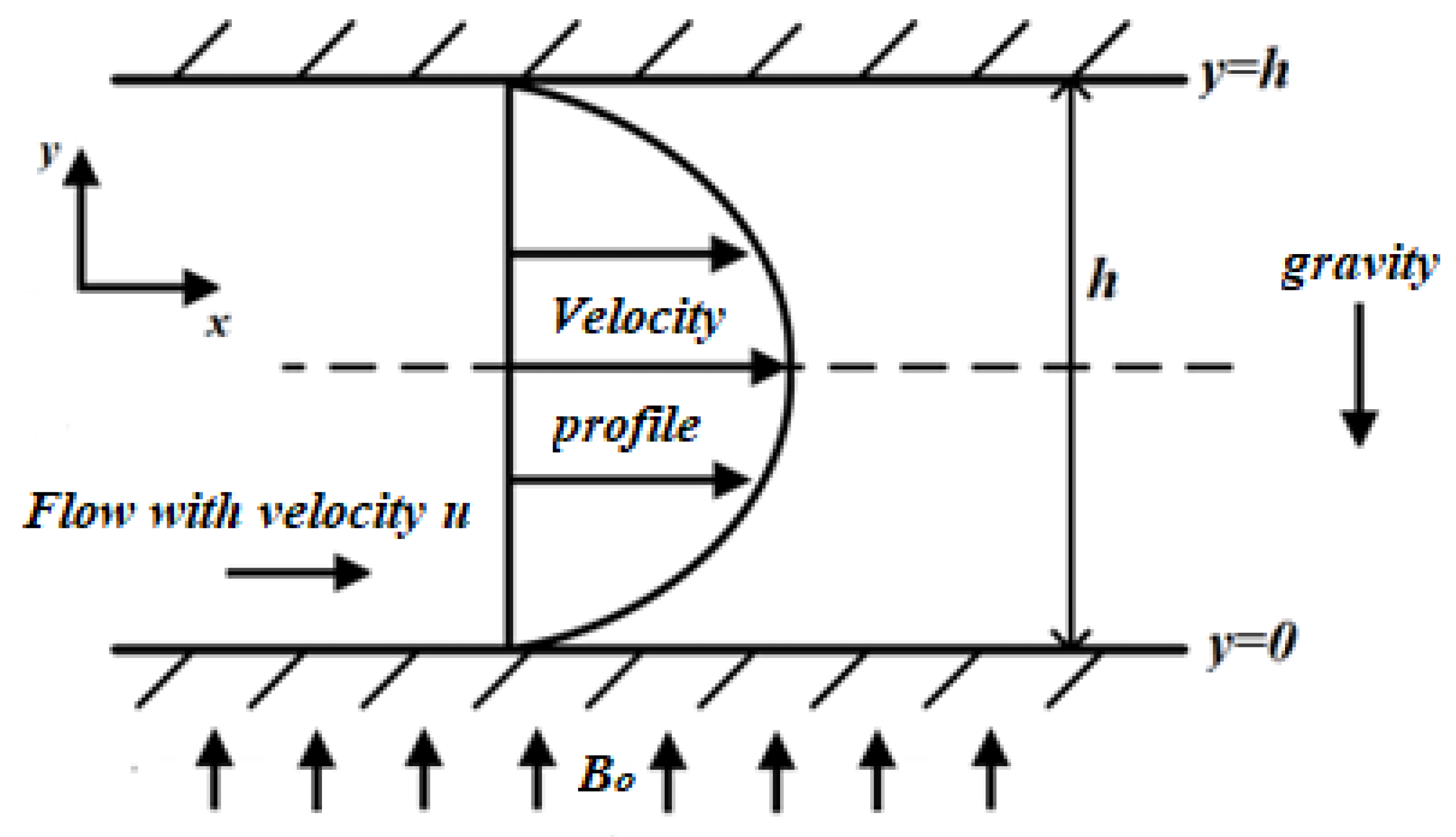
The analysis mathematically models the motion of an electrically conducting, laminar fluid confined between two parallel plates, with an external constant magnetic field applied, leading to MHD effects on the velocity, temperature, and concentration fields as shown in Figure 1. The distance between the two plates equals h, plate one at y = 0 and plate two at y = h. The flow is driven in the x-direction, and a constant magnetic field Bo is applied perpendicular to the flow direction in the y-direction.
Since the two plates are extended in the x and z direction, the flow velocity in the x direction u, temperature T, and concentration C are functions of y and t only, and the system is essentially two-dimensional. The following equations representing the described flow, as given by Kalpana et al. [36], are:
Conservation of momentum,
u t = g β T ( T T o ) + g β C ( C C o ) + ν 2 u y 2 σ ρ B o 2 u ν η u
where g   is the acceleration due to gravity, β T is the thermal expansion coefficient, β C is the concentration expansion coefficient, ν is kinematic viscosity, σ is electrical conductivity, ρ is fluid density, and η is the permeability of the porous medium.
Conservation of energy,
T t = λ ρ c p 2 T y 2 1 ρ c p q y
where λ is the coefficient of thermal conductivity, c p is the specific heat at constant pressure, and q is radiative heat flux.
Using the Rosseland approximation introduced in [37], the radiative heat flux is q =   16 σ T o 3 3 K 2 T y 2 where σ is the Stefan–Boltzmann coefficient and K is the mean absorption coefficient.
T t = λ ρ c p 2 T y 2 + 16 σ T o 3 3 K ρ c p 2 T y 2
The Navier–Stokes approximation for concentration, which was first formulated by Fick [38], is
C t = D 2 C y 2
where D   is the mass diffusivity.
Initial and boundary conditions are:
  F o r t = 0 ,             u = 0 ,     T = T w , C = C w                                       a t     y = 0 ,                                                           u = 0                                                                                                           a t     y = 1 F o r t 0 ,               T = T o , C = C o ,                                                                   a t     y = 1
where h is the distance between the two and they are kept at a steady temperature and concentration T w > T o and C w > C o , where T o and C o are the values of temperature and concentration of the fluid, respectively, and T w and C w are the temperature and concentration of the lower plate. The fluid is initially at rest between the two plates and subsequently increases due to the presence of the magnetic field.
The dimensionless parameters are defined as:
t = ν t h 2 ,   y = y h , u = u u o , T = T T o T w T o , C = C C o C w C o , G r = g β T h 2 T w T o u o ν , G c = g β c h 2 C w C o u o ν , p r = μ c p λ , S c = ν D , H a = B o h σ μ , R = 16 σ T o 3 3 λ k
where G r is the Grashof number, G c is the solutal Grashof number, p r is the Prandtl number, S c is the Schmidt number, H a is the Hartmann number, and R is the radiative parameter.
Substituting by the above non-dimensional parameters in Equations (1), (3) and (4) reduces the system to the following dimensionless form:
u t = 2 u y 2 + G r T + G C C H a 2 + h 2 η u
T t = 1 + R P r 2 T y 2
C t = 1 S c 2 C y 2
In contrast to [39], where viscous energy dissipation was taken into account, the present study neglects this effect to simplify the governing model, as shown in Equation (7). For dimensionless quantities, given the following initial and boundary conditions:
F o r t = 0 ,           u = 0 ,     T = 1 , C = 1                                             a t     y = 0 ,                                                 u = 0                                                                                                         a t     y = 1 F o r t 0 ,         T = 0 ,     C = 0 ,                                                                         a t     y = 1
Here, the Lie group analysis method is employed to reduce the number of independent variables and derive a suitable solution for the governing equations.

3. Utilization of the Lie Group Transformation Method

The classical Lie group transformation is utilized to obtain similarity solutions. The corresponding infinitesimal generator (or vector field) is defined as follows:
X φ y + τ t + θ u + ψ T + π C
where φ , τ , θ , ψ and π are functions in ( y , t ; u , T , C ) . The corresponding one-parameter Lie group infinitesimal transformations of ( y , t ; u , T , C ) leaving the obtained system of equations invariant is given by:
y ~ = y + ε φ   ( y , t ; u , T , C ) , t ~ = t + ε τ     ( y , t ; u , T , C ) , u ~ = u + ε θ   ( y , t ; u , T , C ) ,       T ~ = T + ε ψ   ( y , t ; u , T , C ) , C ~ = C + ε π   ( y , t ; u , T , C )
where ε is the Lie group parameter, φ = y ~ ε ε = 0 , τ = t ~ ε ε = 0 , θ = u ~ ε ε = 0 , ψ = T ~ ε ε = 0 and π = C ~ ε ε = 0 .
Write Equations (6)–(8) in the form
Δ 1 u t u y y G r T G C C + H a 2 + h 2 η u ,
Δ 2 T t 1 + R P r T y y ,
Δ 3 C t 1 S c C y y .
where
u t = u t , T t = T t , C t = C t , u y y = 2 u y 2 , T y y = 2 T y 2 , C y y = 2 C y 2
A vector field X is the generator of the symmetry transformations for the system of Equations (6)–(8) if
X [ 2 ]   ( Δ i ) Δ 0 0 ;   i = 1,2 , 3
where
X [ 2 ] ζ z + φ r + θ u + λ υ + ψ T + π C + θ z u z + θ r u r + λ z υ z + λ r υ r + ψ z T z + ψ r T r + π z C z + π r C r + θ r r u r r + ψ r r T r r + λ r r υ r r + π r r C r r +
Apply the second prolongation (16) to Equations (6)–(8), giving:
θ t = θ y y + G r ψ + G c λ h 2 η + H a 2 η ,         ψ t = 1 + R P r   ψ y y , π t = 1 S c   π y y .
where
    θ i = D i θ u y D i φ u t D i τ ,     π i = D i π C y D i φ C t D i τ ,     ψ i = D i ψ T y D i φ T t D i τ .    
Additionally, i can be replaced with y and t, and:
θ y y = D y θ y u y y D y φ u y t D y τ , ψ y y = D y ψ y T y y D y φ T y t D y τ , π y y = D y π y C y y D y φ C y t D y τ .
Substituting from (18) and (19) into (17) yields a set of extended equations that result in a system of determining equations:
θ c = θ T = 0 , φ c = φ T = φ u = φ t = 0 , τ c = τ T = τ u = τ y = 0 , ζ c = ζ T = ζ u = ζ y = ζ t = 0 , π u = π T = π t = 0 , ψ c = ψ u = ψ t = 0 , τ t = 2 φ y ,
θ t = θ y y G r T θ u G c C θ u + 1 k + H a 2 u θ u + 2 G r T φ y + 2 G c C φ y 2 h 2 η + H a 2 u φ y + G r ψ G c π 1 k + H a 2 θ .  
These equations lead to:
θ = c 1 u ,     ψ = c 1 T ,     π = c 1 C ,     φ = c 2 ,     τ = c 3 .
Then, the basic Lie symmetry generators are:
X 1 u u + T T + C C ,     X 2 y ,       X 3 t .                                                          
according to the given boundary conditions (9). The linear combination of X 1 and X 3 gives the only accepted generator that keeps the system invariant for the introduced specific boundary conditions.

4. Reduction to the Ordinary Differential System

The linear combination of X1 and X3 gives the following characteristic equation
d u c 1 u = d T c 1 T = d C c 1 C = d t c 3 = d y 0
To demonstrate bounded exponential growth, let c 1 c 3 = a , then
u = e a t   R 1 y , T = e a t   R 2 y ,     C = e a t   R 3 ( y ) .
The system of Equations (6)–(8) is transformed into an equivalent system of ordinary differential equations as shown below:
R 1 + R 1 h 2 η + H a 2 R 1 + G r R 2 + G c R 3 = 0 ,
1 + R P r R 2 + R 2 = 0 ,
1 S c R 3 + R 3 = 0 .
Based on the conditions presented in Equation (9), the corresponding initial conditions for the resulting system of ordinary differential equations are formulated as follows:
      R 1 = 0 ,     R 2 = 1 , R 3 = 1                                         a t     y = 0 ,       R 1 = 0 ,                                                                                                     a t       y = 1
Equations (26)–(28) constitute second-order linear homogeneous ordinary differential equations subject to the boundary conditions (29). The system admits exact analytical solutions, with the integration constants uniquely determined from the prescribed boundary conditions, leading to the expressions for R 1 , R 2 , and R 3 . This guarantees the existence and uniqueness of the solution within the present formulation.

5. Validation of the Results

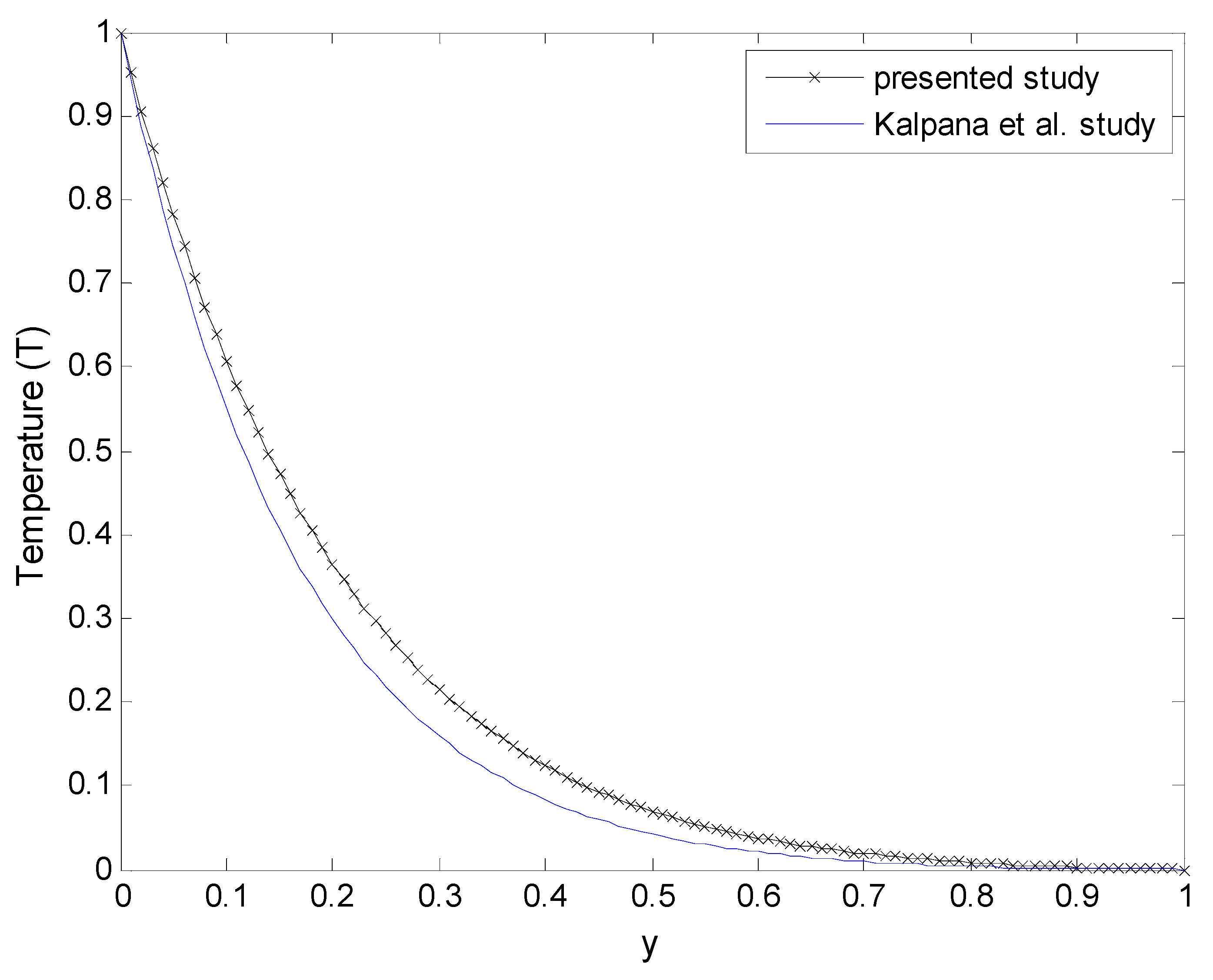
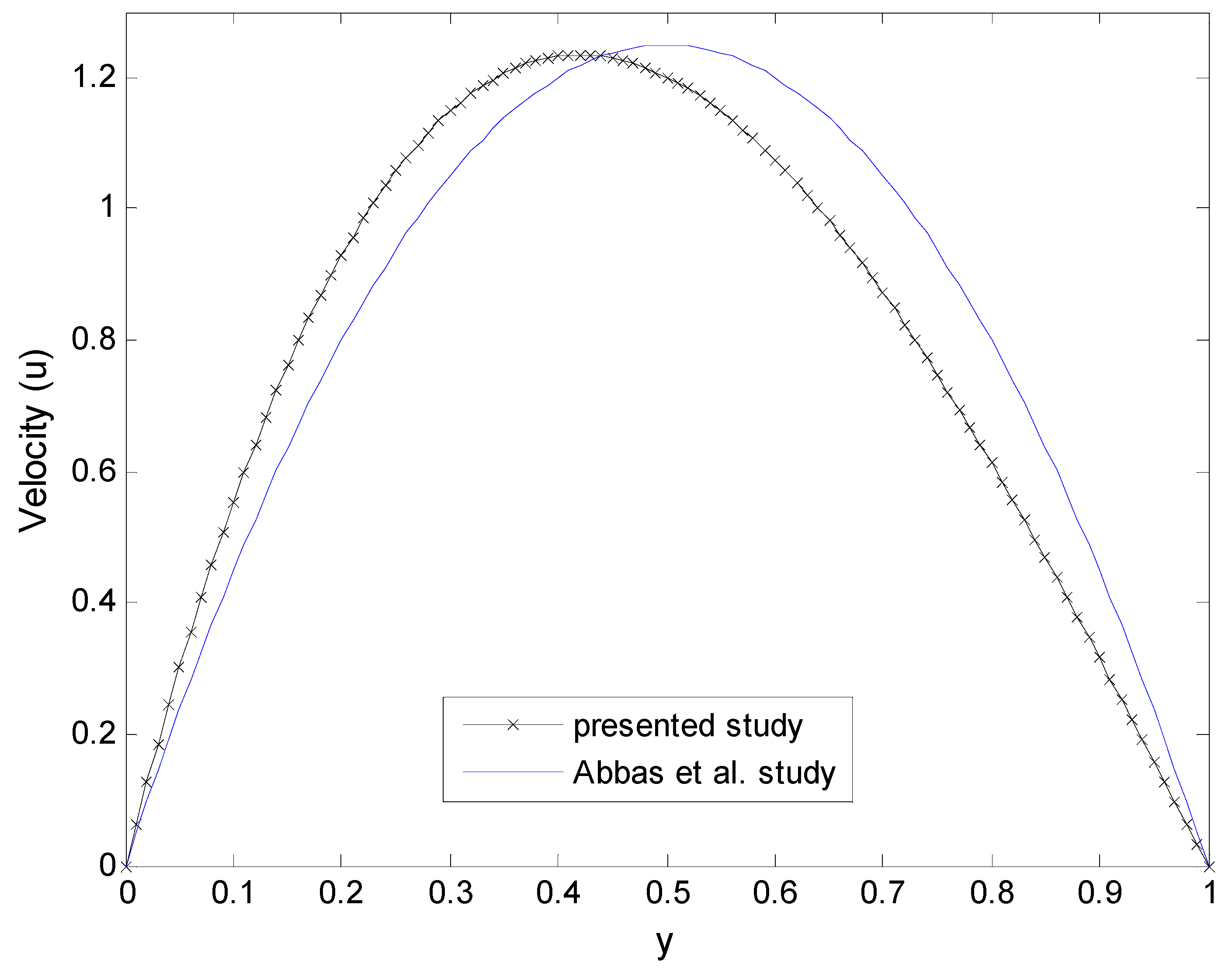
A comparison is made with the earlier works of Kalpana et al. [36] and Abbas et al. [40]. In [36], a finite-difference scheme was applied, which required multiple iterations and approximations to obtain temperature and velocity fields. In [40], the Homotopy Perturbation Method (HPM) was used, combining homotopy with classical perturbation techniques. The accuracy of this method depends on the chosen initial approximations and problem parameters.
Figure 2 and Figure 3 present a direct comparison between the present solutions and previous studies for Ha = 0.1, Gc = 1, Gr = 1, Pr = 0.7, R = 2, and Sc = 0.3. The slight discrepancies observed in the temperature and velocity profiles arise from the iterations and approximations inherent in the finite-difference and perturbation methods. Nevertheless, the overall agreement is good, confirming the validity and reliability of the present analysis.

6. Results and Discussion

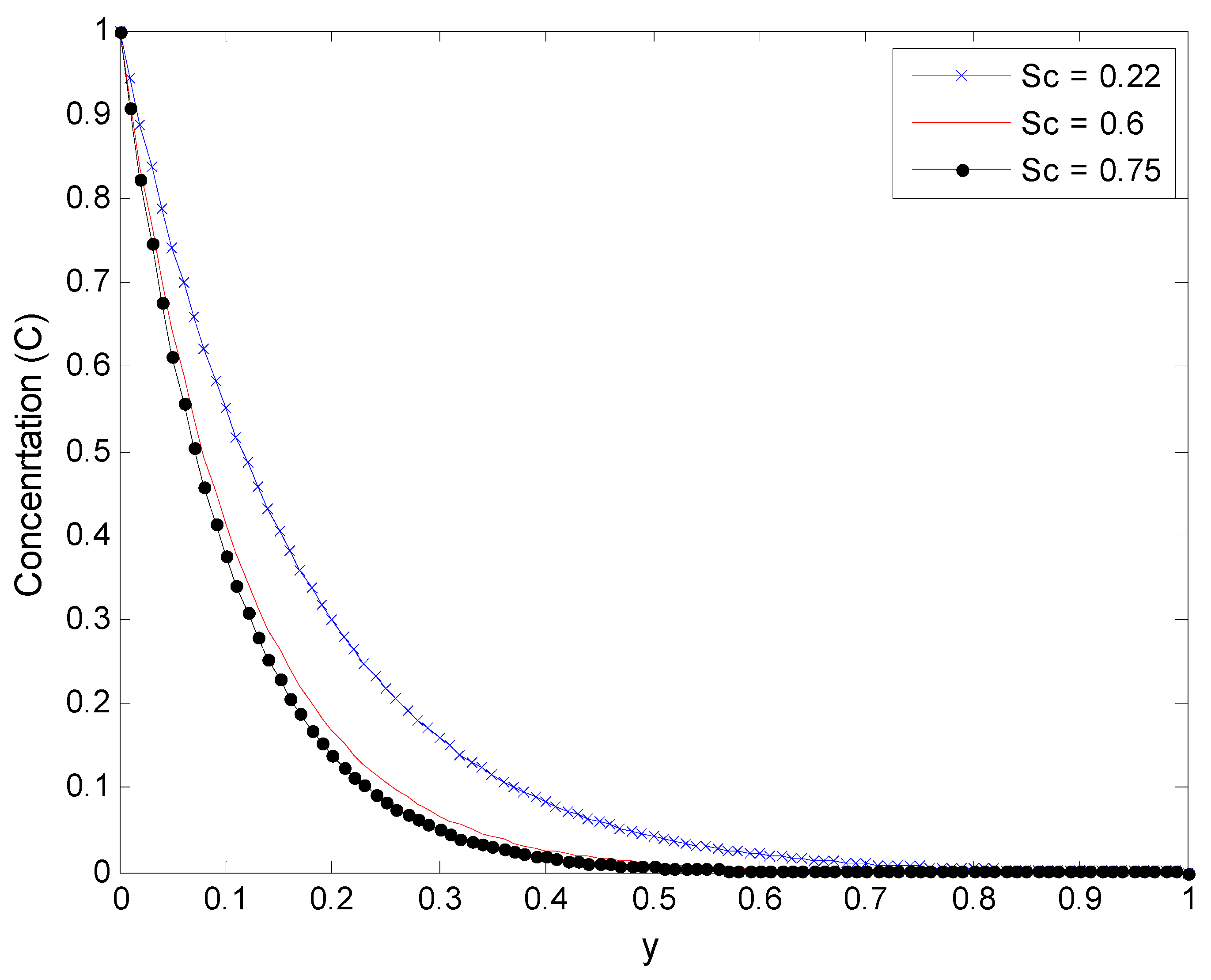
In this study, the effects of governing parameters including the Schmidt number (Sc), Prandtl number (Pr), radiation parameter (R), Hartmann number (Ha), permeability of the porous medium (η), Grashof number (Gr), and solutal Grashof number (Gc) on the concentration, temperature, and velocity profiles are investigated. The chosen parameter ranges in this section ensure coverage of all relevant cases, providing a more complete understanding of their effects. We considered Sc = 0.22, 0.6, and 0.78, corresponding to hydrogen, water vapor, and carbon dioxide, to ensure that the analysis covers a representative range from fast to slow diffusing and different mass transfer situations. To capture both gas and liquid convection behaviors, three representative Pr are considered: 0.7 for air, 2 for intermediate liquid, and 7 for water. The radiation parameter (R) is varied to 1, 2, and 3 to represent gradually stronger radiation effects. This range indicates how radiation enhances heat conduction. We examine three Hartmann numbers, 0.5, 1, and 1.5, to represent the effect of a weak-to-moderate magnetic field. The permeability parameter is taken as 0.2, 0.4, and 0.6, with lower values indicating a more permeable medium and weaker resistance, and higher values indicating stronger resistance. Finally, the thermal and solutal Grashof numbers are set as 2, 4, and 6 to cover different levels of buoyancy effects.
Figure 4 presents the concentration profiles corresponding to various Schmidt numbers (Sc), which significantly influence the concentration distribution. Since the Schmidt number is defined as the ratio of momentum diffusivity to mass diffusivity, a higher Sc value, such as 0.78, indicates lower mass diffusivity, which leads to a reduction in the concentration. In contrast, a lower Sc value, like 0.22, leads to a higher concentration.
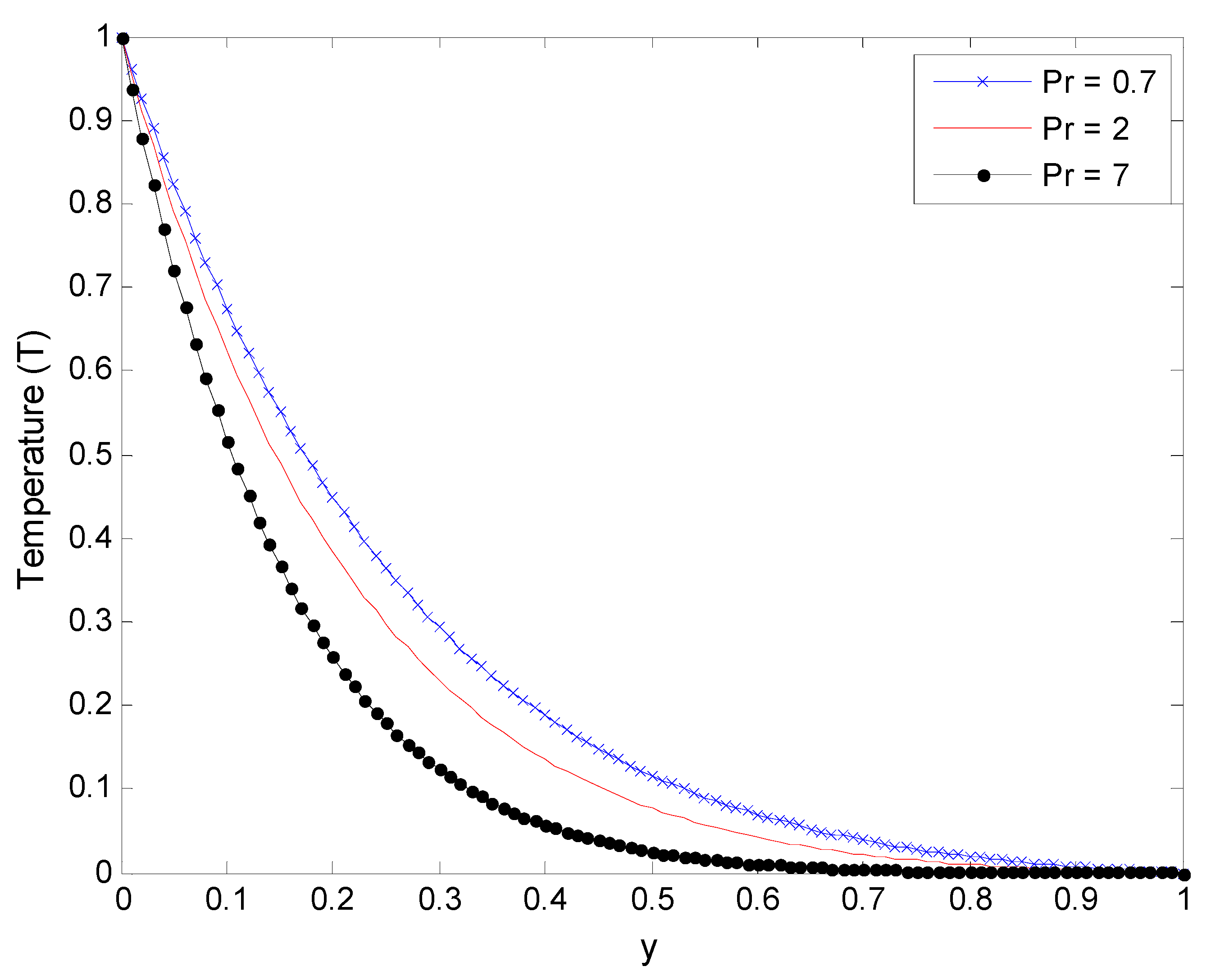
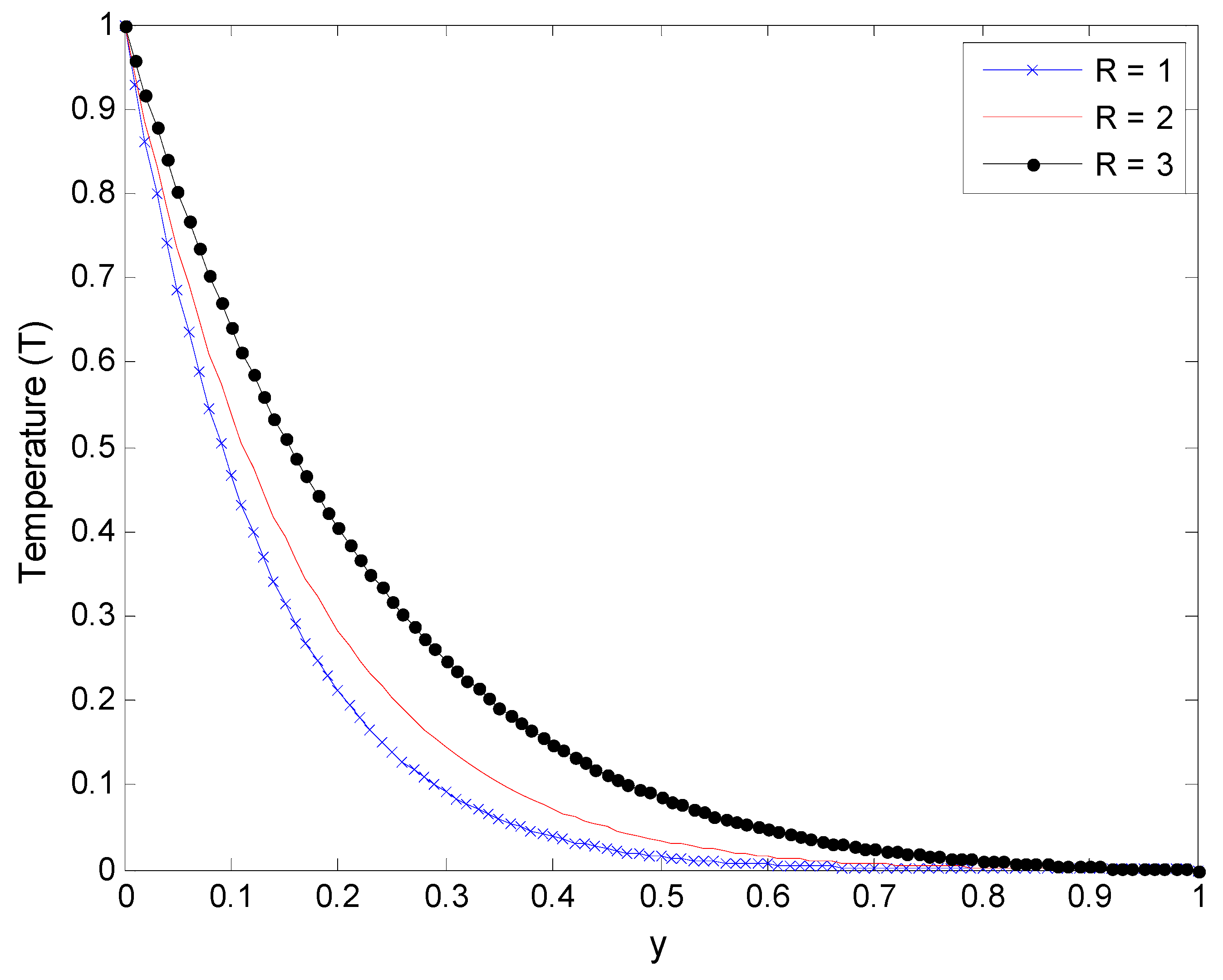
Figure 5 and Figure 6 illustrate the influence of the Prandtl number (Pr) and the radiation parameter (R) on the temperature distribution. Figure 5 shows that the temperature distribution is reduced with increasing Pr. Physically, an increase in the Prandtl number corresponds to a fluid with relatively higher viscosity and lower thermal diffusivity.
As a result, fluids with larger Pr values adjust more quickly from the wall temperature to the initial temperature, as observed in Figure 5, whereas fluids with smaller Pr values adjust more slowly. Overall, increasing the Prandtl number reduces the thickness of the thermal boundary layer. Figure 6 shows that the temperature distribution is significantly influenced by the radiation parameter. As the radiation parameter (R) increases, radiation generates extra heat in addition to normal conduction to the system, which raises the temperature profile throughout the flow region.
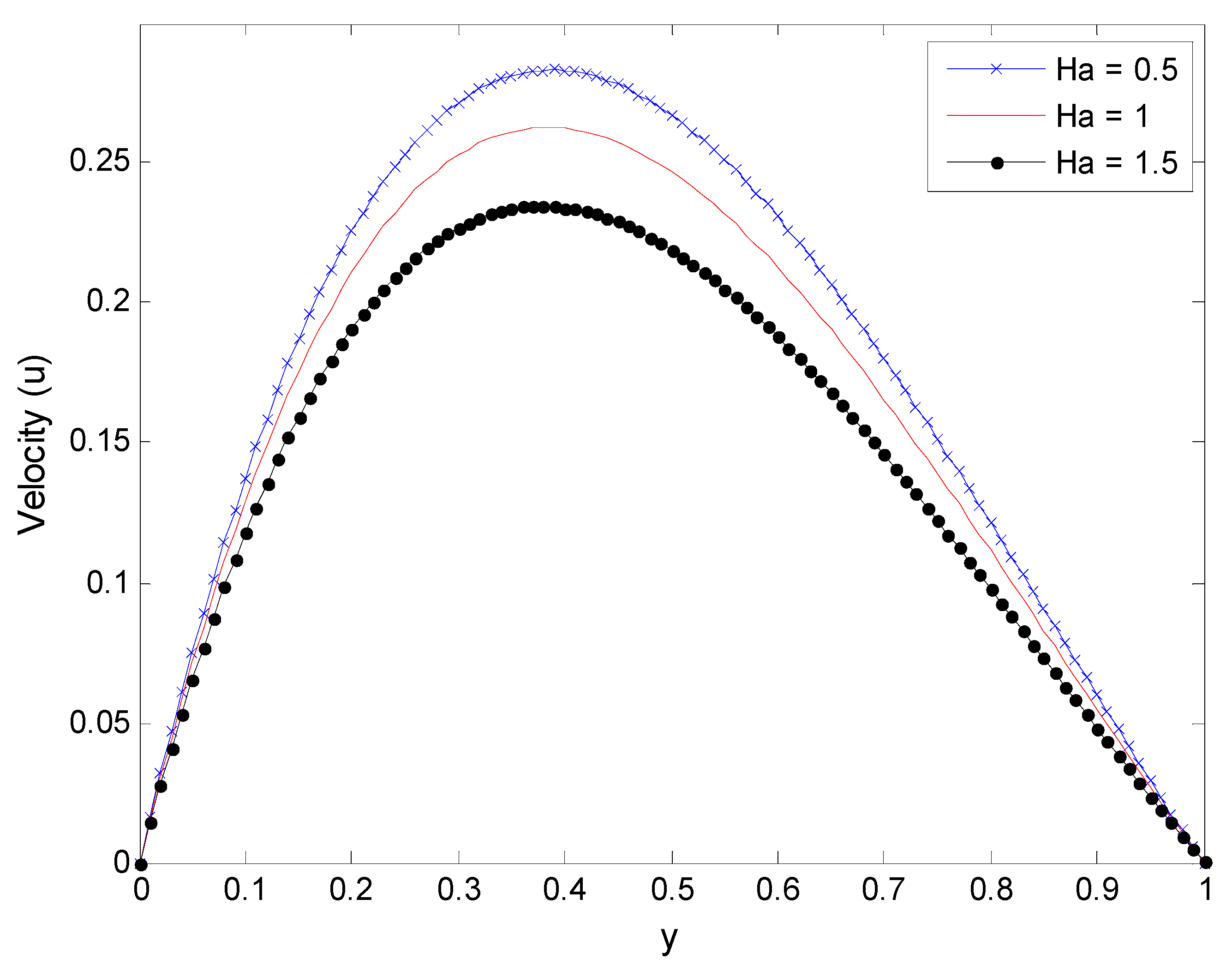
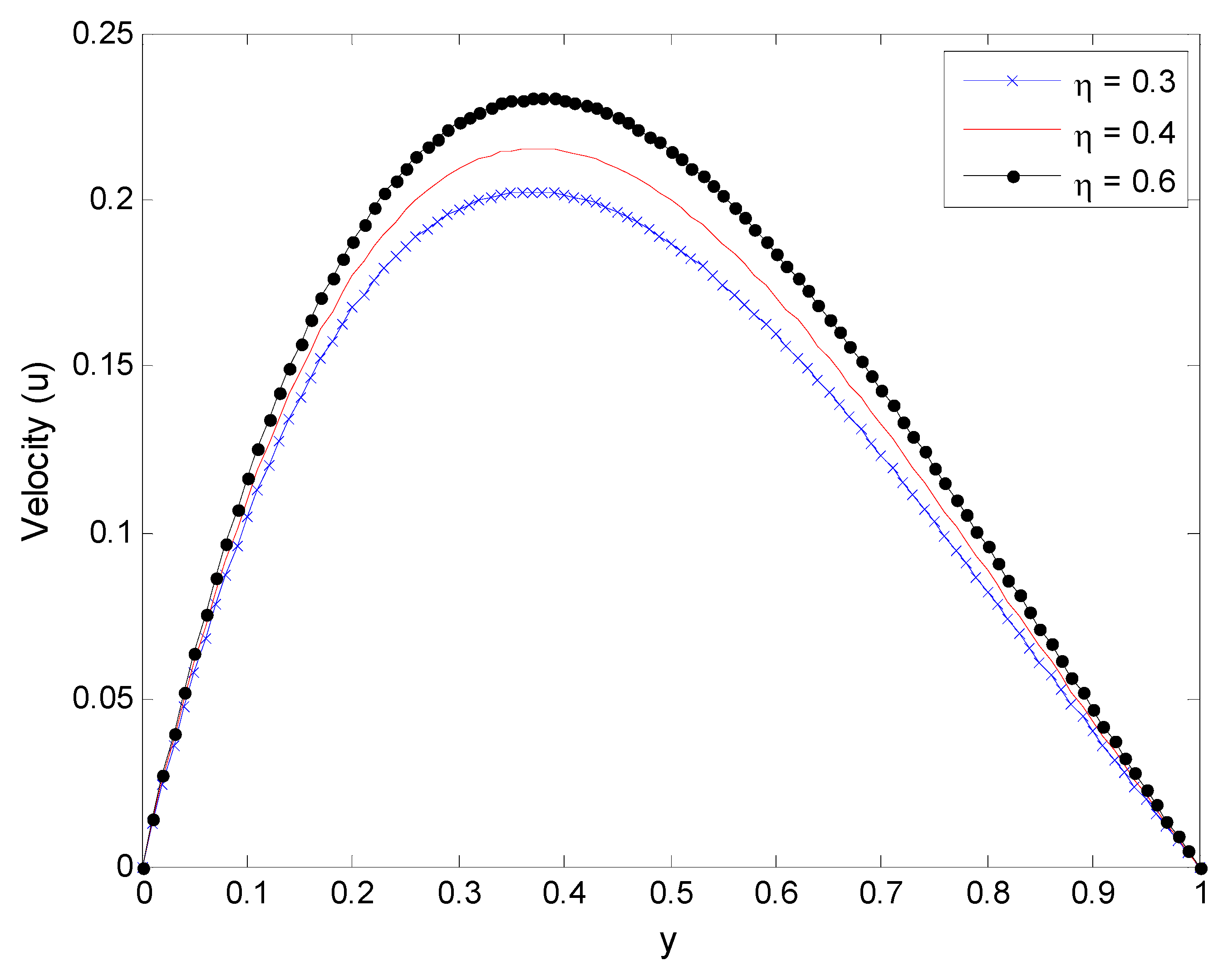
Figure 7, Figure 8, Figure 9 and Figure 10 illustrate the influence of different governing parameters on the velocity profile. Figure 7 highlights the effect of the Hartmann number (Ha), which quantifies the impact of the applied magnetic field. The magnetic field induces a Lorentz force that opposes the fluid motion, thereby suppressing momentum transfer. As Ha increases, this opposing force becomes stronger, resulting in a noticeable damping of the velocity profile. Figure 8 presents the role of porous medium permeability, which determines the ease with which the fluid penetrates the medium. A higher permeability corresponds to weaker resistance offered by the porous structure, allowing the fluid to move more freely and leading to an increase in the velocity distribution.
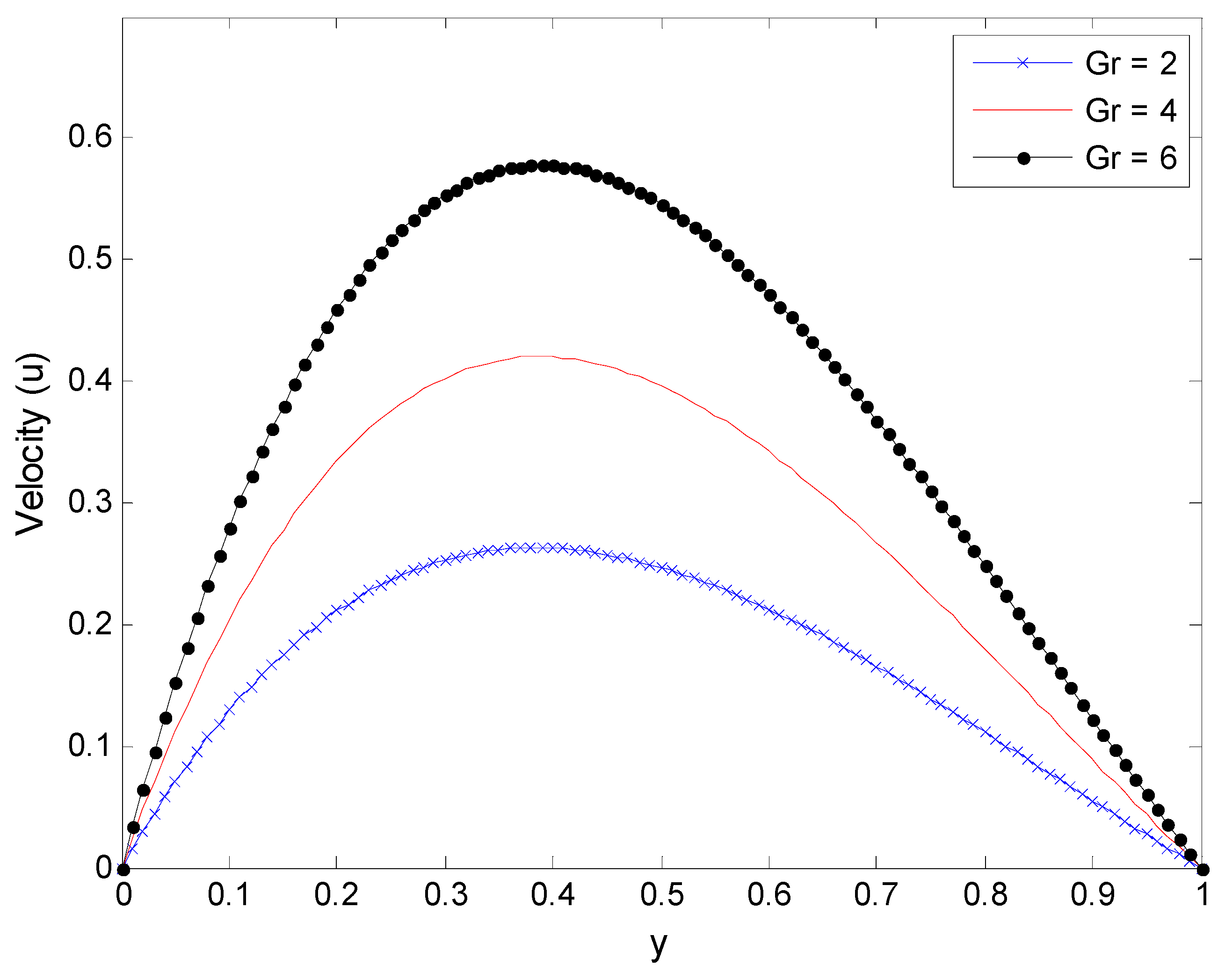
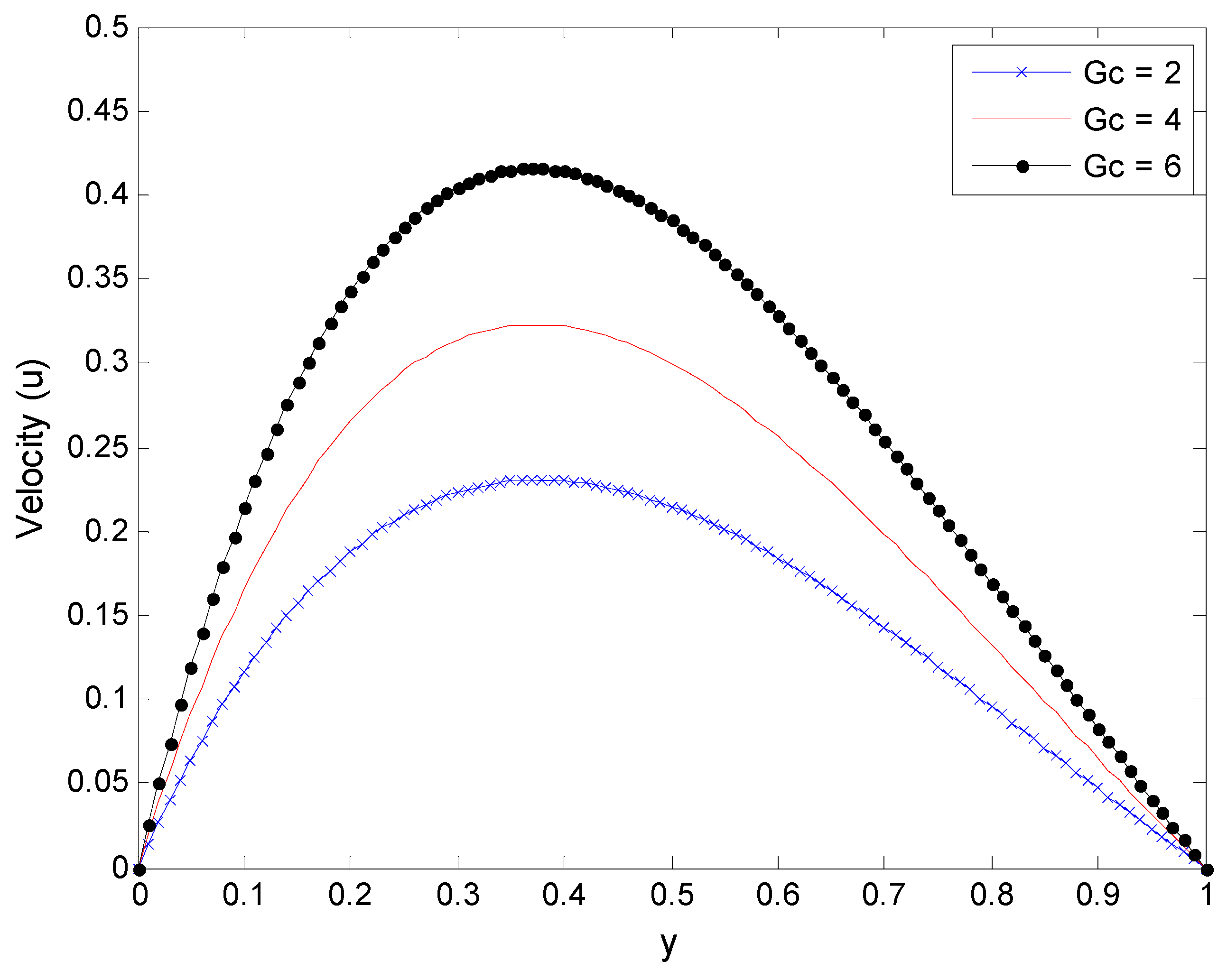
Figure 9 and Figure 10 illustrate the impact of the Grashof number (Gr) and the solutal Grashof number (Gc) on the fluid velocity. The Grashof number represents the ratio of thermal buoyancy forces to viscous forces in natural convection, whereas the solutal Grashof number characterizes the influence of buoyancy forces resulting from concentration gradients relative to viscous forces. An increase in either Gr or Gc increases the buoyancy effects, thereby enhancing the velocity profile.
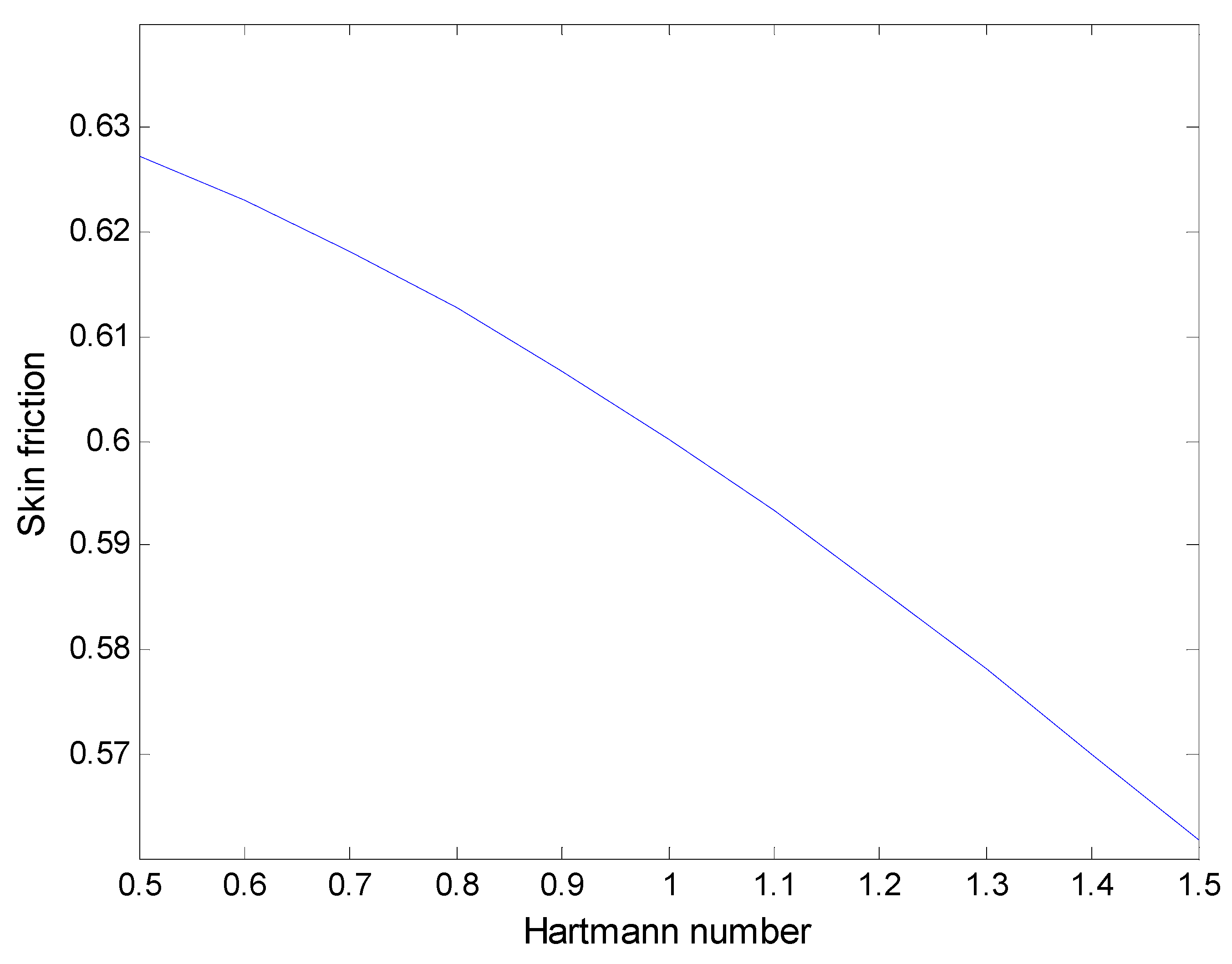
The effect of the Hartmann number (Ha) on skin friction (Cf) is illustrated in Figure 11. Skin friction refers to the drag force arising from viscous shear stresses between the two parallel plates and the fluid. It is observed that skin friction decreases as Ha increases. Physically, a stronger magnetic field enhances the Lorentz force, which acts in opposition to the fluid motion. This resistive force reduces velocity gradients near the wall. As skin friction is directly proportional to the wall velocity gradient, the reduction in velocity gradients with increasing Ha results in a corresponding decrease in skin friction.
Table 1 presents the effects of the Prandtl number and the radiation parameter on the Nusselt number (Nu). The Nusselt number is a dimensionless quantity that characterizes the ratio of convective to conductive heat transfer at a boundary. The Nusselt number decreases with an increasing Prandtl number but increases with a higher radiation parameter. The result aligns well with the findings of [36], demonstrating the strong consistency between the temperature distributions of both studies.

7. Conclusions

The governing equations for laminar MHD flow between two parallel plates are analyzed using the one-parameter Lie group scaling transformation, a powerful method for solving nonlinear partial differential equations. An exact solution to the reduced ordinary differential equations is obtained under the specified boundary conditions. A comparison with previous studies is presented to validate the results. However, establishing a direct comparison between the Lie group method employed in this study and the numerical methods reported in earlier work proves challenging. Nevertheless, the results show good agreement with this study, demonstrating the efficiency of the Lie group method in reducing the system and obtaining solutions without additional assumptions.
The effects of the Schmidt number (Sc), Prandtl number (Pr), radiation parameter (R), Hartmann number (Ha), porous medium permeability (η), Grashof number (Gr), and solutal Grashof number (Gc) on the velocity field, thermal boundary layer, and concentration distribution are investigated and illustrated graphically. The chosen parameter ranges encompass diverse cases, thereby enabling a comprehensive analysis of their influence. It is observed that an increase in the Sc leads to a reduction in concentration, while the temperature decreases with a higher Pr and lower radiation parameter. A higher Hartmann number enhances the Lorentz force, thereby reducing the velocity. Conversely, increasing the permeability of the porous medium decreases flow resistance, resulting in a higher velocity. Moreover, increases in both the Gr and Gc lead to an enhancement in velocity. The effect of the Hartmann (Ha) number on skin friction is illustrated graphically. It is observed that as Ha increases, the skin friction decreases.
A possible extension of the present work is to reanalyze the mathematical model for cases with variable wall temperatures. Such an investigation would further demonstrate the efficiency of the Lie group technique in generating symmetry transformations and vector fields capable of producing solutions under more generalized boundary conditions.

Author Contributions

A.M.H. was responsible for calculations, software, and manuscript writing. M.B.A.-e.-M. was responsible for validating the calculations, checking the accuracy of plotted results, and editing the writing. N.A.B. was accountable for writing, reviewing and editing. All authors have read and agreed to the published version of the manuscript.

Funding

This research received no external funding.

Data Availability Statement

Data are contained within the article.

Acknowledgments

The authors sincerely thank the reviewers for their thoughtful and constructive feedback, which greatly contributed to improving the quality of this paper in its current form.

Conflicts of Interest

The authors declare no conflicts of interest.

References

  1. Ershkov, S.; Leshchenko, D. Solving procedure for the dynamics of charged particle in variable (time-dependent) electromagnetic field. Z. Angew. Math. Phys. 2020, 71, 77. [Google Scholar] [CrossRef]
  2. Alekseev, G.V.; Brizitskii, R.V.; Pukhnachev, V.V. Solvability of the inhomogeneous mixed boundary value problem for stationary magnetohydrodynamic equations. Dokl. Phys. 2014, 59, 467–471. [Google Scholar] [CrossRef]
  3. Alekseev, G. Mixed Boundary Value Problems for Stationary Magnetohydrodynamic Equations of a Viscous Heat-Conducting Fluid. J. Math. Fluid Mech. 2016, 18, 591–607. [Google Scholar] [CrossRef]
  4. Pastukhov, V.P.; Chudin, N.V. Plasma convection near the threshold for MHD instability in nonparaxial magnetic confinement systems. Plasma Phys. Rep. 2001, 27, 907–921. [Google Scholar] [CrossRef]
  5. Cooper, W.A.; Isaev, M.Y.; Okamura, S.; Yamazaki, K. MHD stability of 3D plasma confinement systems with finite plasma current. J. Plasma Fusion Res. 2002, 5, 57–62. [Google Scholar]
  6. Tsventoukh, M.M. Convective plasma stability consistent with MHD equilibrium in magnetic confinement systems with a decreasing field. Plasma Phys. Rep. 2010, 36, 876–890. [Google Scholar] [CrossRef]
  7. Wang, P.-J.; Chang, C.-Y.; Chang, M.-L. Simulation of two-dimensional fully developed laminar flow for a magneto-hydrodynamic (MHD) pump. Biosens. Bioelectron. 2004, 20, 115–121. [Google Scholar] [CrossRef]
  8. Ghassemi, M.; Rezaeinezhad, H.; Shahidian, A. Analytical analysis of flow in a magnetohydrodynamic pump (MHD). In Proceedings of the 2008 14th Symposium on Electromagnetic Launch Technology; IEEE: New York, NY, USA; pp. 1–4.
  9. Al-Habahbeh, O.; Al-Saqqa, M.; Safi, M.; Khater, T.A. Review of magnetohydrodynamic pump applications. Alex. Eng. J. 2016, 55, 1347–1358. [Google Scholar] [CrossRef]
  10. Yousofvand, R.; Derakhshan, S.; Ghasemi, K.; Siavashi, M. MHD transverse mixed convection and entropy generation study of electromagnetic pump including a nanofluid using 3D LBM simulation. Int. J. Mech. Sci. 2017, 133, 73–90. [Google Scholar] [CrossRef]
  11. Roelofs, F. (Ed.) Thermal Hydraulics Aspects of Liquid Metal Cooled Nuclear Reactors; Woodhead Publishing: Cambridge, UK, 2018. [Google Scholar]
  12. Suarez, D.; De Les Valls, E.M.; Batet, L. On the use of CFD to obtain head loss coefficients in hydraulic systems and its application to liquid metal MHD flows in nuclear fusion reactor blankets. Plasma Phys. Control. Fusion 2021, 63, 124002. [Google Scholar] [CrossRef]
  13. Sun, Z.; Al Salami, J.; Khodak, A.; Saenz, F.; Wynne, B.; Maingi, R.; Hanada, K.; Hu, C.; Kolemen, E. Magnetohydrodynamics in free surface liquid metal flow relevant to plasma-facing components. Nucl. Fusion 2023, 63, 076022. [Google Scholar] [CrossRef]
  14. Smolentsev, S.; Aduloju, S.; Fan, Y.; Jiang, Y.; Suarez, D. Overview of Magnetohydrodynamic Studies for Liquid Metal Systems of a Fusion Power Reactor at Oak Ridge National Laboratory. Nucl. Sci. Eng. 2025, 1–16. [Google Scholar] [CrossRef]
  15. Ovsiannikov, L.V. Group Analysis of Differential Equations; Academic Press: New York, NY, USA, 1982. [Google Scholar]
  16. Hill, J.M. Solutions of Differential Equations by Means of One-Parameter Groups; Pitman: London, UK, 1982; Volume 63. [Google Scholar]
  17. Stephani, H. Differential Equations: Their Solution Using Symmetries; Cambridge University Press: Cambridge, UK, 1989. [Google Scholar]
  18. Bluman, G.W.; Kumei, S. Symmetries and Differential Equations; Springer: New York, NY, USA, 1989. [Google Scholar]
  19. Steeb, W.H. Invertible Point Transformations and Nonlinear Differential Equations, 1st ed.; World Scientific: London, UK, 1993. [Google Scholar]
  20. Olver, P.J. Applications of Lie Groups to Differential Equations, 2nd ed.; Springer: New York, NY, USA, 1993. [Google Scholar]
  21. Hydon, P.E. Symmetry Methods for Differential Equations; Cambridge University Press: New York, NY, USA, 2000. [Google Scholar]
  22. Boutros, Y.Z.; Abd-el-Malek, M.B.; Badran, N.A.; Hassan, H.S. Lie-group method of solution for steady two-dimensional boundary-layer stagnation-point flow towards a heated stretching sheet placed in a porous medium. Meccanica 2006, 41, 681–691. [Google Scholar] [CrossRef]
  23. Sivasankaran, S.; Bhuvaneswari, M.; Kandaswamy, P.; Ramasami, E.K. Lie group analysis of natural convection heat and mass transfer in an inclined surface. Nonlinear Anal. Model. Control 2006, 11, 201–212. [Google Scholar] [CrossRef]
  24. Abd-El-Malek, M.B.; Amin, A.M. Lie group analysis of nonlinear inviscid flows with a free surface under gravity. J. Comput. Appl. Math. 2014, 258, 17–29. [Google Scholar] [CrossRef]
  25. Hamad, M.A.A.; Pop, I.; Md Ismail, A.I. Magnetic field effects on free convection flow of a nanofluid past a vertical semi-infinite flat plate. Nonlinear Anal. Real World Appl. 2011, 12, 1338–1346. [Google Scholar] [CrossRef]
  26. Hamad, M.A.A.; Ferdows, M. Similarity solution of boundary layer stagnation-point flow towards a heated porous stretching sheet saturated with a nanofluid with heat absorption/generation and suction/blowing: A lie group analysis. Commun. Nonlinear Sci. Numer. Simul. 2011, 17, 132–140. [Google Scholar] [CrossRef]
  27. Rashidi, M.M.; Momoniat, E.; Ferdows, M.; Basiriparsa, A. Lie group solution for free convective flow of a nanofluid past a chemically reacting horizontal plate in porous media. Math. Probl. Eng. 2014, 2014, 239082. [Google Scholar] [CrossRef]
  28. Abd-El-Malek, M.B.; Badran, N.A.; Amin, A.M.; Hanafy, A.M. Lie Symmetry Group for Unsteady Free Convection Boundary-Layer Flow over a Vertical Surface. Symmetry 2021, 13, 175. [Google Scholar] [CrossRef]
  29. Hanafy, A.M.; Abd-El-Malek, M.B.; Badran, N.A. Study of Steady Natural Convective Laminar Fluid Flow over a Vertical Cylinder Using Lie Group Transformation. Symmetry 2024, 16, 1558. [Google Scholar] [CrossRef]
  30. Salem, A.M.; Fathy, R. Effects of variable properties on MHD heat and mass transfer flow near a stagnation point towards a stretching sheet in a porous medium with thermal radiation. Chin. Phys. B 2012, 21, 054701. [Google Scholar] [CrossRef]
  31. Rosmila, A.B.; Kandasamy, R.; Muhaimin, I. Lie symmetry group transformation for MHD natural convection flow of nanofluid over a linearly stretching sheet in the presence of thermal stratification. Appl. Math. Mech. 2012, 33, 593–604. [Google Scholar] [CrossRef]
  32. Nagendramma, V.; Durgaprasad, P.; Sivakumar, N.; Rao, B.M.; Raju, C.S.K.; Shah, N.A.; Yook, S.-J. Dynamics of Triple Diffusive Free Convective MHD Fluid Flow: Lie Group Transformation. Mathematics 2022, 10, 2456. [Google Scholar] [CrossRef]
  33. Shafiq, A.; Khalique, M.D. Lie group analysis of upper convected Maxwell fluid flow along stretching surface. Alex. Eng. J. 2020, 59, 2533–2541. [Google Scholar] [CrossRef]
  34. Ahmad, S.; Diyar, R.; Zeb, S. Lie group analysis of hyperbolic tangent fluid flow in the presence of thermal radiation. Heat Transf. 2022, 51, 3067–3081. [Google Scholar] [CrossRef]
  35. Pukhnachov, V.V. Model of a viscous layer deformation by thermocapillary forces. Eur. J. Appl. Math. 2002, 13, 205–224. [Google Scholar] [CrossRef]
  36. Kalpana, G.; Vadiraj, G.; Hegde, S.; Madhura, K.R. Heat and Mass Transfer of MHD Fluid Flow Under the Influence of Radiative Effect and Different Pressure Gradients; Institute of Scholars (InSc): Karnataka, India, 2020. [Google Scholar]
  37. Rosseland, S. Theoretical Astrophysics; Oxford University Press: Oxford, UK, 1936. [Google Scholar]
  38. Fick, A. Über diffusion. In Poggendorff’s Annalen der Physik und Chemie; Wiley: Hoboken, NJ, USA, 1855; Volume 94, pp. 59–86. [Google Scholar]
  39. Baranovskii, E.S. The Stationary Navier-Stokes-Boussinesq system with a regularized dissipation function. Math. Notes 2024, 115, 670–682. [Google Scholar] [CrossRef]
  40. Abbas, W.; Magdy, M.M.; Abdelgaber, K.M.; Abdeen, M.A.M. Unsteady Magnetohydrodynamic Flow with Heat and Mass Transfer between Two Parallel Walls under Variable Magnetic Field. High Temp. 2020, 58, 284–291. [Google Scholar] [CrossRef]
Figure 1. Schematic of the flow configuration.
Axioms 15 00254 g001
Figure 2. Comparison of the temperature profile in the present study with Kalpana et al. [36].
Axioms 15 00254 g002
Figure 3. Comparison of the velocity profile in the present study with Abbas et al. [40].
Axioms 15 00254 g003
Figure 4. Concentration profile corresponding to different values of Schmidt number.
Axioms 15 00254 g004
Figure 5. Temperature profile for different values of Prandtl number (R = 1).
Axioms 15 00254 g005
Figure 6. The temperature profile for different values of the radiation parameter (Pr = 7).
Axioms 15 00254 g006
Figure 7. The velocity profile for different values of the Hartmann number (Gr = 2, Gc = 2, η =0.6, Pr = 7, Sc = 0.75, R = 2).
Axioms 15 00254 g007
Figure 8. The velocity profile for different values of the porous medium (Gr = 2, Gc = 2, Ha = 1, Pr = 7, Sc = 0.75, R = 2).
Axioms 15 00254 g008
Figure 9. The velocity profile for different values of the Grashof number (Gc = 2, η =0.6, Ha = 1, Pr = 7, Sc = 0.75, R = 2).
Axioms 15 00254 g009
Figure 10. The velocity profile for different values of the solutal Grashof number (Gr = 2, η = 0.6, Ha = 1, Pr = 7, Sc = 0.75, R = 2).
Axioms 15 00254 g010
Figure 11. Effect of the Hartmann number (Ha) on the skin-friction coefficient (at Gc = 1, Gr = 1, η = 0.6, Pr = 0.7, Sc = 0.3, R = 2).
Axioms 15 00254 g011
Table 1. Computing the values of the Nusselt number for different values of the Prandtl number and the radiation parameter.
PrRNu
710.5788
210.6421
0.710.8805
0.720.921
0.730.9410
Disclaimer/Publisher’s Note: The statements, opinions and data contained in all publications are solely those of the individual author(s) and contributor(s) and not of MDPI and/or the editor(s). MDPI and/or the editor(s) disclaim responsibility for any injury to people or property resulting from any ideas, methods, instructions or products referred to in the content.