Article

Leader-Following Consensus of One-Sided Lipschitz Multi-Agent Systems with Delay and Stochastic Perturbation


1
School of Information and Electronic Engineering, Shandong Technology and Business University, Yantai 264005, China
2
Key Laboratory of Sensing Technology and Control in Universities of Shandong, Shandong Technology and Business University, Yantai 264005, China
Axioms 2026, 15(3), 240; https://doi.org/10.3390/axioms15030240
Submission received: 15 January 2026 / Revised: 11 March 2026 / Accepted: 21 March 2026 / Published: 23 March 2026
(This article belongs to the Section Mathematical Analysis)

Abstract

This paper is concerned with the leader-following consensus of time-delay multi-agent systems (MASs) with stochastic perturbation over a directed network. Different from existing literature subject to the conventional Lipschitz condition, the one-sided Lipschitz nonlinear MASs with delay are discussed. First, to address the challenge, in combination with current and delay information, the composite control law is constructed. By employing the Lyapunov function and using the Itô formula, this proves that the followers can eventually track the leader. Second, in the presence of external disturbance, sufficient conditions are established for the H-infinity leader-following consensus of one-sided Lipschitz nonlinear stochastic MASs. Further, the method to handle the one-sided Lipschitz nonlinearities is directly applicable to the stochastic MASs with conventional Lipschitz nonlinear dynamics, and the corresponding results are easily obtained. Finally, the relationship between one-sided Lipschitz scalars and time-delay parameters are presented, and the simulation results are given to verify the theoretical algorithms.

1. Introduction

Recently, the research on cooperative control [1,2] for multi-agent systems (MASs) has seen a surge in interest due to its wide applications such as transportation control [3], energy management [4,5], consensus [6,7], formation containment control [8,9], and data-driven control [10,11]. Consensus problems, as the most fundamental issues, have always been the current research hotspots. During the last few decades, notable success in the field of consensus control has been achieved. In actual environments, stochastic perturbation inherently exists and directly influences the stability of the system [12]. Accordingly, the consensus control of MASs under stochastic perturbation becomes more meaningful and challenging. Specifically, large numbers of stochastic consensus results of single-integrator and double-integrator MASs can be found in [13,14,15,16,17]. In contrast with low-order dynamics, the achievements for high-order stochastic consensus problems are more significant [18,19,20,21,22,23]. Thus, our attention will be focused on the leader-following consensus for high-order nonlinear time-delay MASs with stochastic perturbation.
In practical applications, state delay and communication delay inherently exist, and numerous important conclusions have been derived for the stochastic consensus of MASs with time delays. For example, Zhou et al. [24] studied the H-infinity consensus control for stochastic nonlinear MASs subject to state delay and external disturbance. Considering unbounded multiple delays, Ren et al. [25] proposed impulsive pinning control protocols to achieve mean square exponential consensus for nonlinear MASs with stochastic perturbation. Yang et al. [26] developed a dual-stage impulsive approach to discuss the stochastic leader-following consensus of delayed nonlinear MASs, in which randomly occurring uncertainties and stochastic perturbation were considered. Further, in the presence of input and output delays, a distributed predictive control protocol for solving the leader-following consensus of stochastic nonlinear MASs was proposed in [27]. Zhang et al. [28] designed an event-triggered impulsive control protocol to resolve the bipartite consensus for stochastic delayed signed MASs with unbounded delays. By applying the stochastic differential method, Zhang et al. [29] put forward a self-triggered impulsive control protocol to investigate the leader-following consensus of delayed stochastic MASs with input saturation. For heterogeneous linear MASs with uniform delays, the stochastic leader-following control was solved in [30] by employing the scalar Lambert equation.
It should be mentioned that one-sided Lipschitz nonlinear characteristics emerge in physics, biology, and economics. To address this issue, many researchers have started to pay attention to the consensus problems of the one-sided Lipschitz condition. Hence, a large volume of interesting results have been reported. In [31], a robust control law was explored to study the consensus of one-sided Lipschitz nonlinear MASs with amplitude-bounded disturbances. Further, Agha et al. [32] overcame the obstacle [31] where the information of the communication network was required, and designed a dynamic adaptive law to investigate the consensus with bounded disturbances. By introducing the communication restoration mechanism and dwell time, Razaq et al. [33] extended the consensus results of one-sided Lipschitz nonlinear MASs over a fixed topology to switching topologies. Based on an observer-based protocol, Razaq et al. [34] deeply investigated the leader-following consensus for switching topologies in higher MASs with one-sided Lipschitz nonlinearities. Subsequently, Gu et al. [35] showed that the stochastic leader-following consensus of one-sided Lipschitz nonlinear MASs over switching topologies was dealt with by proposing proportional-integral laws. Moreover, Zhang and Ma [36] proved that the stochastic bipartite leader-following consensus for one-sided Lipschitz nonlinear MASs was addressed by an intermittent impulsive law. Considering that MASs may suffer from deception attacks, Zhang et al. [37] developed an impulsive law to handle the stochastic leader-following consensus with one-sided Lipschitz nonlinearities.
Nevertheless, in the absence of delays, most of the existing works concerning stochastic consensus problems are focused on MASs with a conservative Lipschitz condition [38,39,40,41,42,43,44,45,46]. How to develop a leader-following control law for time-delay stochastic MASs remains to be investigated in the presence of a one-sided Lipschitz condition. And therefore, it is of significance to study the H-infinity leader-following consensus of one-sided Lipschitz nonlinear MASs with stochastic perturbation and delays. The contributions of this paper are presented below.
(1) A composite control protocol is constructed to address the stochastic consensus of time-delay MASs over a directed network. Note that the stochastic consensus problems were handled in references [25,29,35,38] where the network topology was undirected, which is a more stringent assumption than ours.
(2) Taking into account both state delay and communication delay, we consider the H-infinity leader-following consensus of high-order nonlinear MASs subject to external disturbance and stochastic perturbation.
(3) Compared with existing works considering conventional Lipschitz nonlinearities [38,39,40,41,42,43,44,45,46], the stochastic leader-following consensus problems with one-sided Lipschitz nonlinear condition have been investigated in this paper, where the results are more practical. Moreover, simulation results confirm the efficacy and feasibility of the time-delay composite control protocol.
The rest of this paper is structured as follows. Section 2 presents the preliminaries and problem formulation. Section 3 designs a composite control protocol. A simulation is illustrated to verify the effectiveness of the controller designed in Section 4. Section 5 shows the conclusions.

2. Preliminaries and Problem Formulation

2.1. Preliminaries and Notations

The network topology G = V , E , H is modeled by M nodes. E = ( V × V ) denote edges and the adjacency matrix is H = [ h i j ] R M × M for h i j = 1 if ( i , j ) E and h i j = 0 otherwise. The Laplacian matrix L = [ l i j ] R M × M is l i j = h i j with i j and l i i = j = 1 , j i M h i j [47]. Besides, the leader adjacency matrix is denoted by C = diag { c 1 , c 2 , , c M } for c i = 1 if the leader is a neighbour of node i, otherwise, c i = 0 . The topology and corresponding matrix are G ¯ and S = L + C . For an n-dimensional square summable function, it lies in the set L 2 ( [ 0 , + ] , R n ) . Besides, the notation A > 0 indicates a positive-definite matrix. Let diag { c 1 , c 2 , , c M } , Tr { A } , λ max ( A ) and E { . } be the diagonal matrix, trace of matrix A, maximum eigenvalue of matrix A, and expectation operator.

2.2. Problem Formulation

Consider the following one-sided Lipschitz MASs with M agents, the dynamics of each follower is given by
d z i ( t ) = [ H 1 z i ( t ) + J 1 z i ( t τ ( t ) ) + ε ( t ) g ( t , z i ( t ) ) + H 2 u i ( t ) + D v i ( t ) ] d t + r ( t , z i ( t ) ) d ω ( t ) ,
where H 1 R n × n , J 1 R n × n , H 2 R n × q , D R n × f . z i ( t ) R n is the state, u i ( t ) R q is the control input, v i ( t ) R f is the perturbation belonging to L 2 ( [ 0 , + ] , R f ) , i = 1 , 2 , , M , and ω ( t ) is a scalar Brownian motion. g ( t , z i ( t ) ) denotes the one-sided Lipschitz nonlinear function and r ( t , z i ( t ) ) is the continuous differentiate function. The delay τ ( t ) satisfies 0 τ ( t ) τ ˜ , τ ˙ ( t ) ) τ 1 < 1 , where τ ˜ and τ 1 are known constants. Furthermore, ε ( t ) is the Bernoulli-distribution white sequence satisfying that Pr { ε ( t ) = 1 } = ε 1 , Pr { ε ( t ) = 0 } = 1 ε 1 for ε 1 [ 0 , 1 ] .
The dynamic of the leader is presented as
d z 0 ( t ) = [ H 1 z 0 ( t ) + J 1 z 0 ( t τ ( t ) ) + ε ( t ) g ( t , z 0 ( t ) ) ] d t + r ( t , z 0 ( t ) ) d ω ( t ) ,
where z 0 ( t ) R n denotes the state of the leader which is bounded and r ( t , z 0 ( t ) ) represents the continuous differentiate function. g ( t , z 0 ( t ) ) is the one-sided Lipschitz nonlinear function. It is worth noting that the leader has no control input, namely u 0 ( t ) = 0 . Moreover, g ( t , z i ( t ) ) and g ( t , z 0 ( t ) ) are given by Assumption 1.
Assumption 1.
For y 1 , y 2 R n and scalars b 1 , b 2 , b 3 R , the one-sided Lipschitz function g ( . ) satisfies
< g ( t , y 1 ) g ( t , y 2 ) , y 1 y 2 > b 1 y 1 y 2 2 , ( g ( t , y 1 ) g ( t , y 2 ) ) T ( g ( t , y 1 ) g ( t , y 2 ) ) b 2 y 1 y 2 2 + b 3 < y 1 y 2 , g ( t , y 1 ) g ( t , y 2 ) > .
Remark 1.
If the function g ( . ) in Assumption 1 is assumed to satisfy the conventional Lipschitz condition, then the condition is changed to g ( t , y 1 ) g ( t , y 2 ) μ y 1 y 2 . Clearly, the one-sided Lipschitz condition is much milder than the conventional Lipschitz condition [31,32,33,34,35,36,37]. Specially, the scalar μ satisfies μ > 0 , while the scalars b 1 , b 2 , b 3 in Assumption 4 can be negative or zero.
Assumption 2.
The communication topology contains a directed spanning tree with the leader as the root.
Assumption 3.
Among the time-delay MASs (1) and (2), the rank of H 2 is equal to q.
Assumption 4.
For y 1 , y 2 R n and scalar ϕ 1 > 0 , the function r ( . ) in (1) and (2) satisfies the Lipschitz condition, it has
Tr [ ( r ( t , y 1 ) r ( t , y 2 ) ) T ( r ( t , y 1 ) r ( t , y 2 ) ) ] ϕ 1 y 1 y 2 2 .
Remark 2.
Assumption 2 is commonly utilized for the leader-following consensus with one leader [13,21,29,30,35,44,45]. Assumption 3 is used to create the matrix transformation [9,48]. Assumption 4 is the conventional condition to deal with the stochastic consensus problems, see [38,49].

3. Leader-Following Consensus Design Condition

Inspired by [50], to address the leader-following consensus problem, a time-delay control law is developed as
u i ( t ) = G 1 [ j = 1 M h i j ( z i ( t ) z j ( t ) ) + c i ( z i ( t ) z 0 ( t ) ) ] G 2 [ j = 1 M h i j ( z i ( t τ ( t ) ) z j ( t τ ( t ) ) ) + c i ( z i ( t τ ( t ) ) z 0 ( t τ ( t ) ) ) ] ,
where G 1 and G 2 are the control gain matrices, and let p i ( t ) = z i ( t ) z 0 ( t ) be the consensus error.
Remark 3.
In [26,38], a control protocol is designed to research the stochastic leader-following consensus problem. Different from the protocols in [26,38], based on only the current state information, the developed protocol (3) is constructed depending on both the current and time-delay relative states. Besides, it is difficult to handle the nonuniform delays in one-sided Lipschitz nonlinear MASs, and in this paper, the communication channels are considered to share the same delays. Moreover, the control protocol (3) implicitly assumes uniform gain structures for all followers.
Definition 1.
The leader-following consensus of stochastic MASs (1) and (2) is said to be achieved if lim t E { p i ( t ) 2 } = lim t E { z i ( t ) z 0 ( t ) 2 } = 0 , i = 1 , 2 , , M .
From (1)–(3), it has
d p i ( t ) = [ H 1 ( t ) p i ( t ) + J 1 ( t ) p i ( t τ ( t ) ) + ε ( t ) g ˜ ( p i ( t ) ) + D v i ( t ) ] d t H 2 G 2 [ j = 1 M h i j ( p i ( t τ ( t ) ) p j ( t τ ( t ) ) ) + c i p i ( t τ ( t ) ) ] d t H 2 G 1 [ j = 1 M h i j ( p i ( t ) p j ( t ) ) + c i p i ( t ) ] d t + r ˜ ( p i ( t ) ) d w ( t ) ,
where g ˜ ( p i ( t ) ) = g ( t , z i ( t ) ) g ( t , z 0 ( t ) ) , r ˜ ( p i ( t ) ) = r ( t , z i ( t ) ) r ( t , z 0 ( t ) ) .
By introducing p ( t ) = [ p 1 T ( t ) , p 2 T ( t ) , , p M T ( t ) ] T , from (4), it yields
d p ( t ) = { [ I M H 1 S H 2 G 1 ] p ( t ) + [ I M J 1 S H 2 G 2 ] p ( t τ ( t ) ) + ε 1 g ˜ ( p ( t ) ) + ( ε ( t ) ε 1 ) g ˜ ( p ( t ) ) + ( I M D ) v ( t ) } d t + r ˜ ( p ( t ) ) d w ( t ) ,
where
g ˜ ( p ( t ) ) = [ g ˜ T ( p 1 ( t ) ) , g ˜ T ( p 2 ( t ) ) , , g ˜ T ( p M ( t ) ) ] T , r ˜ ( p ( t ) ) = [ r ˜ T ( p 1 ( t ) ) , r ˜ T ( p 2 ( t ) ) , , r ˜ T ( p M ( t ) ) ] T , v ( t ) = [ v 1 T ( t ) , v 2 T ( t ) , , v M T ( t ) ] T .
Theorem 1.
For the time-delay MASs (1) and (2) with v i ( t ) = 0 , under the control law (3) with known constants ε 1 , ϕ 1 , δ 1 , δ 2 , τ 1 , b 1 , b 2 , b 3 , if there exist matrices E > 0 , F > 0 , X 1 , X 2 and parameter λ 1 > 0 , such that the following conditions
Θ 11 Θ 12 Θ 13 ( 1 τ 1 ) ( I M F ) 0 2 δ 2 ( I M I n ) < 0 , E < λ 1 I n ,
where
Θ 11 = I M ( E H 1 + H 1 T E + F + ( λ 1 ϕ 1 + 2 δ 1 b 1 + 2 δ 2 b 2 ) I n ) S H 2 X 1 S T X 1 T H 2 T , Θ 12 = I M E J 1 S H 2 X 2 , Θ 13 = ε 1 ( I M E ) + ( δ 2 b 3 δ 1 ) ( I M I n ) ,
hold, thus the leader-following consensus with stochastic perturbation is achieved and the gain matrices can be given by H 2 E ¯ = E H 2 , G 1 = E ¯ 1 X 1 and G 2 = E ¯ 1 X 2 .
Proof. 
Construct Lyapunov–Krasovskii functions as follows:
V ( t ) = p T ( t ) ( I M E ) p ( t ) + t τ ( t ) t p T ( s ) ( I M F ) p ( s ) d s .
Calculating the derivative of V ( t ) along the trajectories of (5) yields
d V ( t ) = L V ( t ) d t + r ˜ ( p ( t ) ) V ( t ) p d w ( t ) ,
and it is obtained that
L V ( t ) = 2 p T ( t ) ( I M E ) [ I M H 1 S H 2 G 1 ) ] p ( t ) + 2 p T ( t ) ( I M E ) [ I M J 1 S H 2 G 2 ) ] p ( t τ ( t ) ) + 2 p T ( t ) ( I M E ) [ ( ε ( t ) ε 1 ) g ˜ ( p ( t ) ) + ε 1 g ˜ ( p ( t ) ) ] + Tr [ r ˜ T ( p ( t ) ) ( I M E ) r ˜ ( p ( t ) ) ] + p T ( t ) ( I M F ) p ( t ) ( 1 τ ˙ ( t ) ) p T ( t τ ( t ) ) ( I M F ) p ( t τ ( t ) ) ,
by Assumption 4, it gives
Tr [ r ˜ T ( p ( t ) ) ( I M E ) r ˜ ( p ( t ) ) ] λ max ( E ) Tr [ r ˜ T ( p ( t ) ) r ˜ ( p ( t ) ) ] λ 1 ϕ 1 p T ( t ) p ( t ) ,
and by Assumption 1, there exist two positive scalars δ 1 , δ 2 , such that the following two inequalities are satisfied
0 2 δ 1 [ b 1 p T ( t ) p ( t ) g ˜ T ( p ( t ) ) p ( t ) ] , 0 2 δ 2 [ b 2 p T ( t ) p ( t ) + b 3 g ˜ T ( p ( t ) ) p ( t ) g ˜ T ( p ( t ) ) g ˜ ( p ( t ) ) ] ,
substitute (10) and (11) into (9), we have
L V ( t ) 2 p T ( t ) ( I M E H 1 S E H 2 G 1 ) p ( t ) + 2 p T ( t ) ( I M E J 1 S E H 2 G 2 ) p ( t τ ( t ) ) + 2 p T ( t ) ( I M E ) [ ( ε ( t ) ε 1 ) g ˜ ( p ( t ) ) + ε 1 g ˜ ( p ( t ) ) ] + λ 1 ϕ 1 p T ( t ) p ( t ) + 2 δ 1 [ b 1 p T ( t ) p ( t ) g ˜ T ( p ( t ) ) p ( t ) ] + 2 δ 2 [ b 2 p T ( t ) p ( t ) + b 3 g ˜ T ( p ( t ) ) p ( t ) g ˜ T ( p ( t ) ) g ˜ ( p ( t ) ) ] + p T ( t ) ( I M F ) p ( t ) ( 1 τ 1 ) p T ( t τ ( t ) ) ( I M F ) p ( t τ ( t ) ) .
Further, there exists E { ε ( t ) ε 1 } = 0 , and let ψ ( t ) = [ p T ( t ) , p T ( t τ ( t ) ) , g ˜ T ( p ( t ) ) ] T , it yields
E { L V ( t ) } E { ψ T ( t ) Σ ψ ( t ) } ,
where
Σ = Σ 11 Σ 12 Σ 13 ( 1 τ 1 ) ( I M F ) 0 2 δ 2 ( I M I n ) ,
with
Σ 11 = I M ( E H 1 + H 1 T E + F + ( λ 1 ϕ 1 + 2 δ 1 b 1 + 2 δ 2 b 2 ) I n ) S E H 2 G 1 S T G 1 T H 2 T E , Σ 12 = I M E J 1 S E H 2 G 2 , Σ 13 = ε 1 ( I M E ) + ( δ 2 b 3 δ 1 ) ( I M I n ) .
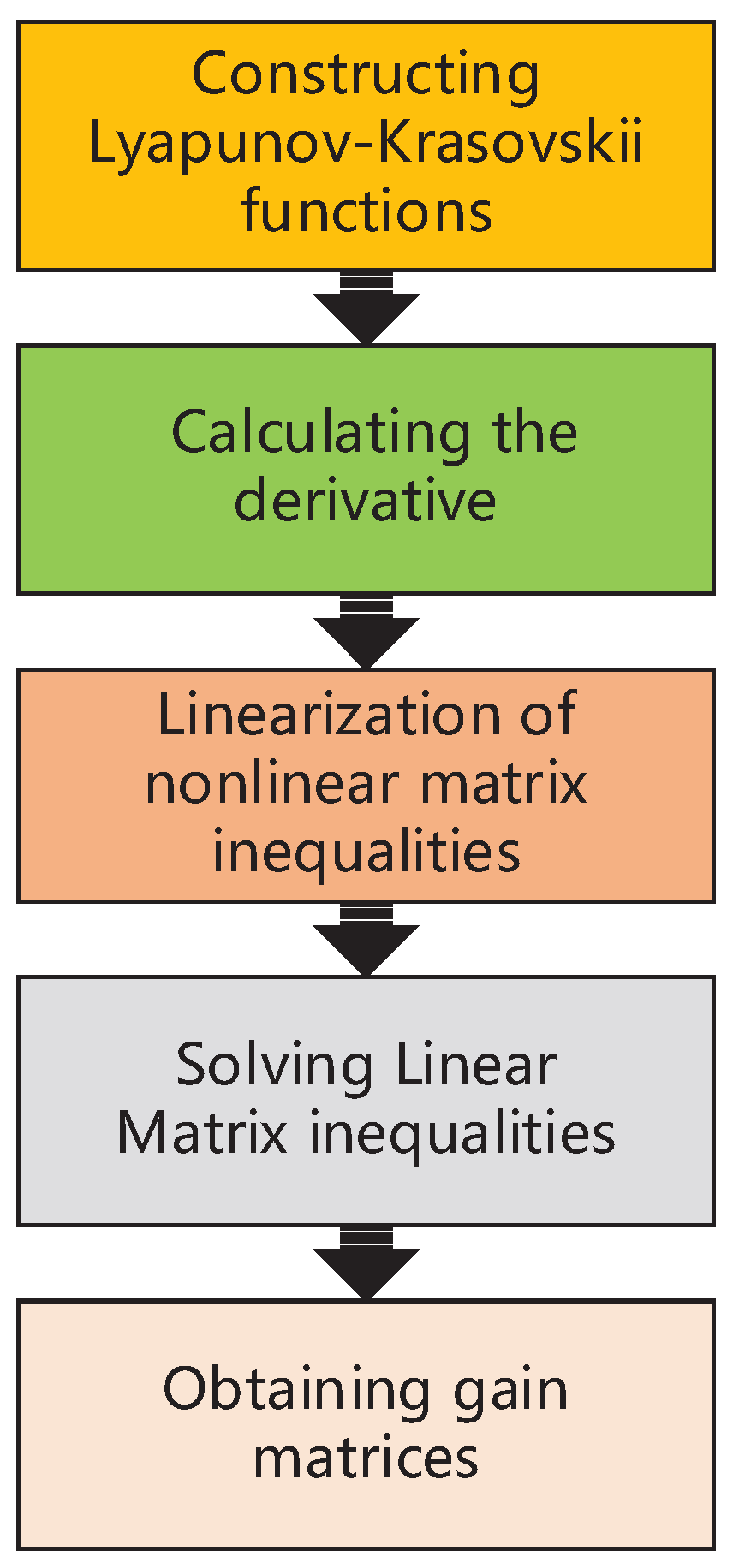
With the condition H 2 E ¯ = E H 2 , G 1 = E ¯ 1 X 1 and G 2 = E ¯ 1 X 2 in Theorem 1, one obtains E H 2 G 1 = H 2 X 1 and E H 2 G 2 = H 2 X 2 . Thus, conditions (10) and (14) can be rewritten as inequalities (6). Then, we are able to obtain d E { V ( t ) } d t 0 and the stochastic leader-following consensus problem of one-sided Lipschitz MASs is solved. Besides, a flow chart to present the solving process is shown in Figure 1. This proof is finished. □
Next, when v i ( t ) 0 , the H-infinite leader-following consensus problem of one-sided Lipschitz MASs with delay and stochastic perturbation is further discussed.
Theorem 2.
For the time-delay MASs (1) and (2), under the control law (3) with known constants ε 1 , ϕ 1 , δ 1 , δ 2 , τ 1 , b 1 , b 2 , b 3 , if there exist matrices E > 0 , F > 0 , X 1 , X 2 and parameters λ 1 > 0 , β > 0 , such that the following conditions
Λ 11 Λ 12 Λ 13 I M E D ( 1 τ 1 ) ( I M F ) 0 0 2 δ 2 ( I M I n ) 0 β 2 ( I M I f ) < 0 , E < λ 1 I n ,
where
Λ 11 = I M ( E H 1 + H 1 T E + F + ( λ 1 ϕ 1 + 2 δ 1 b 1 + 2 δ 2 b 2 + 1 ) I n ) S H 2 X 1 S T X 1 T H 2 T , Λ 12 = I M E J 1 S H 2 X 2 , Λ 13 = ε 1 ( I M E ) + ( δ 2 b 3 δ 1 ) ( I M I n ) ,
hold, thus the H-infinite stochastic leader-following consensus with perturbation is achieved and the gain matrices can be given by H 2 E ¯ = E H 2 , G 1 = E ¯ 1 X 1 and G 2 = E ¯ 1 X 2 .
Proof. 
By discussing the H-infinite performance in (5) with v ( t ) 0 , the performance function is constructed as
J = E 0 [ p T ( t ) p ( t ) β 2 v T ( t ) v ( t ) ] d t = E 0 [ p T ( t ) p ( t ) β 2 v T ( t ) v ( t ) + L V ( t ) ] d t E V ( ) + V ( 0 ) = E 0 [ p T ( t ) p ( t ) β 2 v T ( t ) v ( t ) + L V ( t ) ] d t ,
let θ ( t ) = [ p T ( t ) , p T ( t τ ( t ) ) , g ˜ T ( p ( t ) ) , v T ( t ) ] T , and following the line of proof in Theorem 1, then we can arrive at
J 0 E θ T ( t ) Γ θ ( t ) d t ,
where
Γ = Γ 11 Γ 12 Γ 13 I M E D ( 1 τ 1 ) ( I M F ) 0 0 2 δ 2 ( I M I n ) 0 β 2 ( I M I f ) ,
with
Γ 11 = I M ( E H 1 + H 1 T E + F + ( λ 1 ϕ 1 + 2 δ 1 b 1 + 2 δ 2 b 2 + 1 ) I n ) S E H 2 G 1 S T G 1 T H 2 T E , Γ 12 = I M E J 1 S E H 2 G 2 , Γ 13 = ε 1 ( I M E ) + ( δ 2 b 3 δ 1 ) ( I M I n ) .
Taking the same method in the proof of Theorem 1, it yields E H 2 G 1 = H 2 X 1 and E H 2 G 2 = H 2 X 2 . Thus, condition (18) can be rewritten as inequalities (15). Thus, J 0 is derived for t > 0 . This means the H-infinite stochastic leader-following consensus problem of the one-sided Lipschitz MASs is solved. This proof is finished. □
Remark 4.
In the presence of delay and external perturbation, the sufficient condition to solve the H-infinite stochastic leader-following consensus of one-sided Lipschitz MASs is derived. Particularly, the conventional Lipschitz condition can be viewed as a special case of the one-sided Lipschitz condition and a sufficient condition for handling the conventional Lipschitz MASs can easily obtained.
Corollary 1.
For the time-delay MASs (1) and (2) with the conventional Lipschitz condition g ( t , y 1 ) g ( t , y 2 ) μ y 1 y 2 , under the control law (3) with known constants ε 1 , ϕ 1 , τ 1 , μ, if there exist matrices E > 0 , F > 0 , X 1 , X 2 and parameters λ 1 > 0 , β > 0 , such that the following conditions
Ψ 11 I M E J 1 S H 2 X 2 ε 1 ( I M E ) I M E D ( 1 τ 1 ) ( I M F ) 0 0 ( I M I n ) 0 β 2 ( I M I f ) < 0 , E < λ 1 I n ,
where
Ψ 11 = I M ( E H 1 + H 1 T E + F + ( λ 1 ϕ 1 + μ 2 + 1 ) I n ) S H 2 X 1 S T X 1 T H 2 T ,
hold, thus the H-infinite stochastic leader-following consensus with perturbation is achieved and the gain matrices can be given by H 2 E ¯ = E H 2 , G 1 = E ¯ 1 X 1 and G 2 = E ¯ 1 X 2 .
Proof. 
From Assumption 1 and the Lipschitz condition g ( t , y 1 ) g ( t , y 2 ) μ y 1 y 2 , it is obtained that the one-sided Lipschitz condition can be turned to the Lipschitz condition when δ 1 = 0 , δ 2 = 0.5 , b 3 = 0 , b 2 = μ 2 . Taking the same method in the proof of Theorems 1 and 2, the results can be derived. □
Remark 5.
It should be pointed out that the computational complexity of solving LMIs (6), (15), and (19) will increase when the number M increases. Moreover, the LMIs (6), (15), and (19) are not solvable when the selection of simulation parameters are unreasonable. For instance, when the delay τ 1 is too large, the consensus error curve will not converge and the system will be unstable.

4. Simulation Results

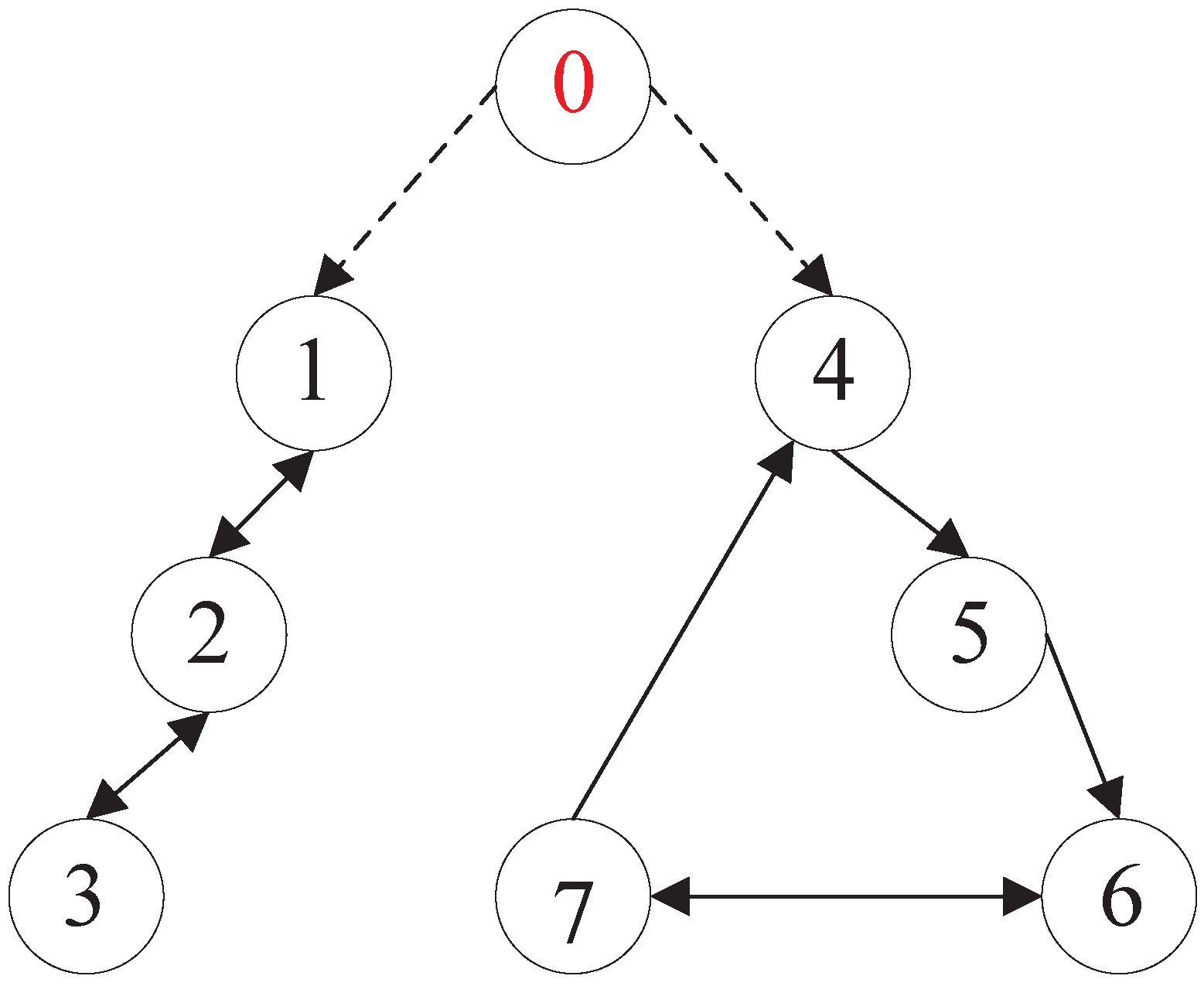
In this section, three simulations are given to illustrate the validity of the main results. Agent 0 denotes the leader and the followers are represented by nodes 1–7 in Figure 2. The dashed arrows indicate the communication from the leader to followers and the solid arrows indicate the relationship between followers. There exists a directed spanning tree in Figure 2, thus Assumption 2 is satisfied.
Example 1.
This example is used to verify the effectiveness of Theorem 1. Consider the time-delay MASs (1) and (2) with
H 1 = 1 2 0 3 , J 1 = 0.2 0.2 0.4 0.6 , H 2 = 1 2 , g ( t , z i ( t ) = [ 0.5 sin ( z i 1 ( t ) ) , 0.5 sin ( z i 2 ( t ) ) ] T , r ( t , z i ( t ) ) = [ 0.2 sin ( z i 1 ( t ) ) , 0.2 sin ( z i 2 ( t ) ) ] T ,
further, we set ε 1 = 0.7 , ϕ 1 = 0.5 , δ 1 = 0.8 , δ 2 = 0.8 .
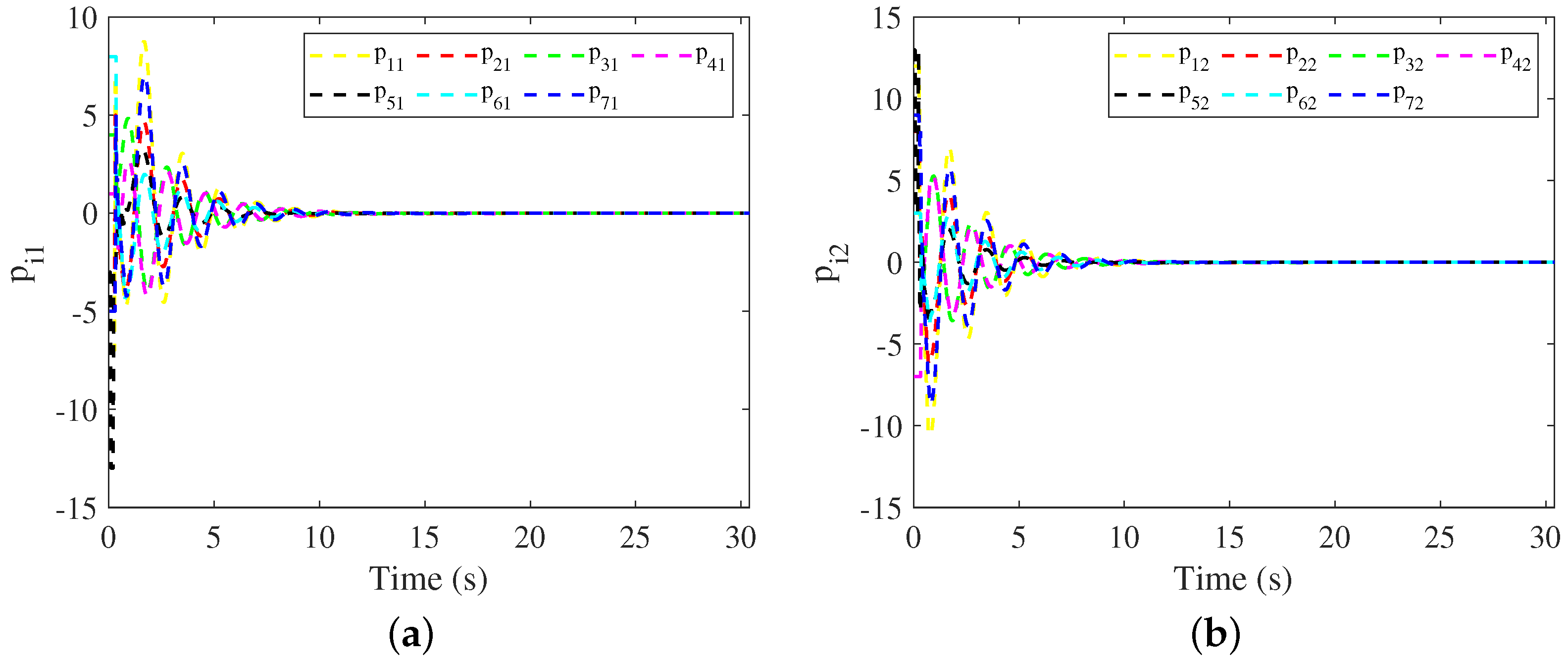
Case 1: Let τ ( t ) = 0.45 sin ( t ) , and τ 1 = 0.45 . When b 1 = 0 , b 2 = 99 , and b 3 = 100 , solving the linear matrix inequalities (LMIs) (6), it yields
E = 114.2307 2.1040 2.1040 117.3867 , F = 180.7763 136.1721 136.1721 440.0747 , X 1 = 3.5219 6.4497 , X 2 = 7.3154 10.4182 , λ 1 = 175.8383 ,
and the gain matrices G 1 and G 2 can be calculated as
G 1 = 0.0297 0.0545 , G 2 = 0.0618 0.0880 .
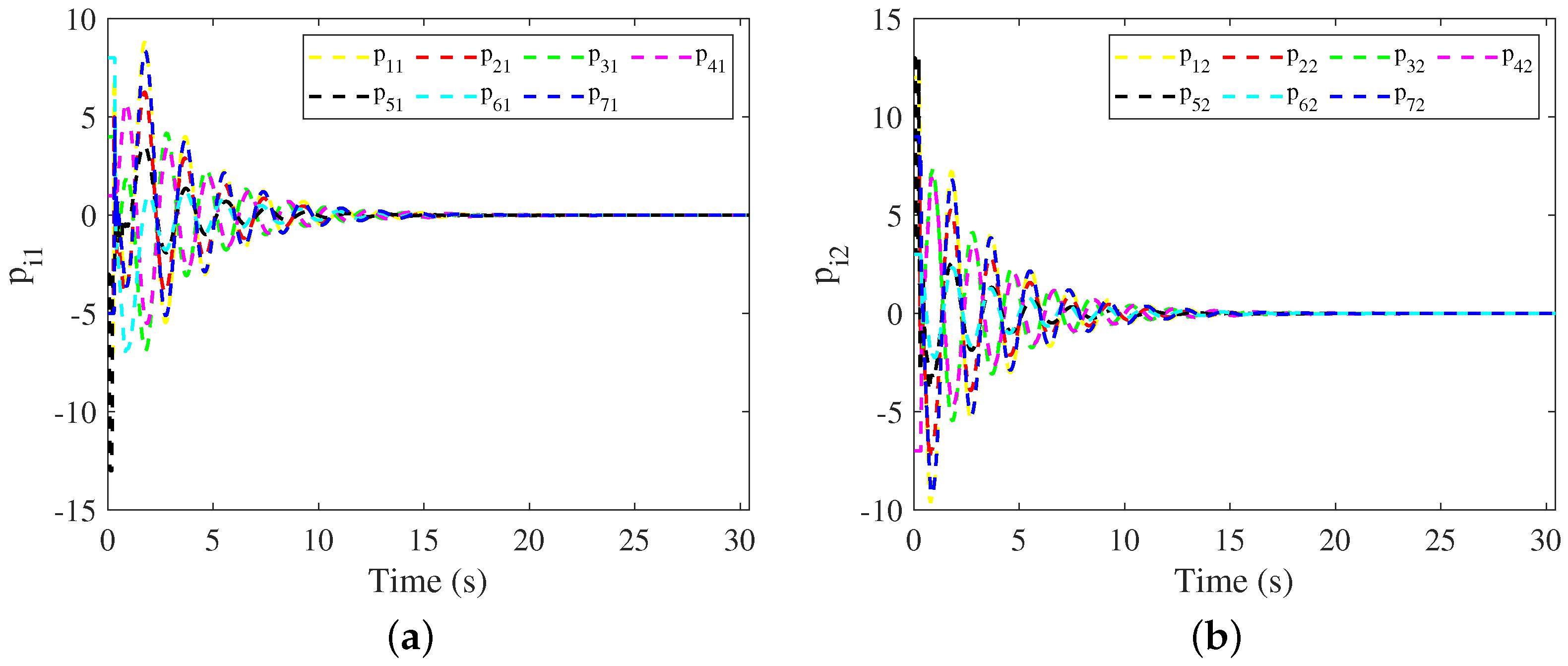
Case 2: Let τ ( t ) = 0.45 sin ( t ) , and τ 1 = 0.45 . When b 1 = 0.3 , b 2 = 0.5 and b 3 = 0.4 , solving the LMIs (6), it yields
E = 0.5523 0.1680 0.1680 0.8043 , F = 1.0290 0.4110 0.4110 2.6278 , X 1 = 0.0881 0.0734 , X 2 = 0.0403 0.0590 , λ 1 = 1.3519 ,
and the gain matrices G 1 and G 2 can be calculated as
G 1 = 0.0991 0.0827 , G 2 = 0.0453 0.0664 .
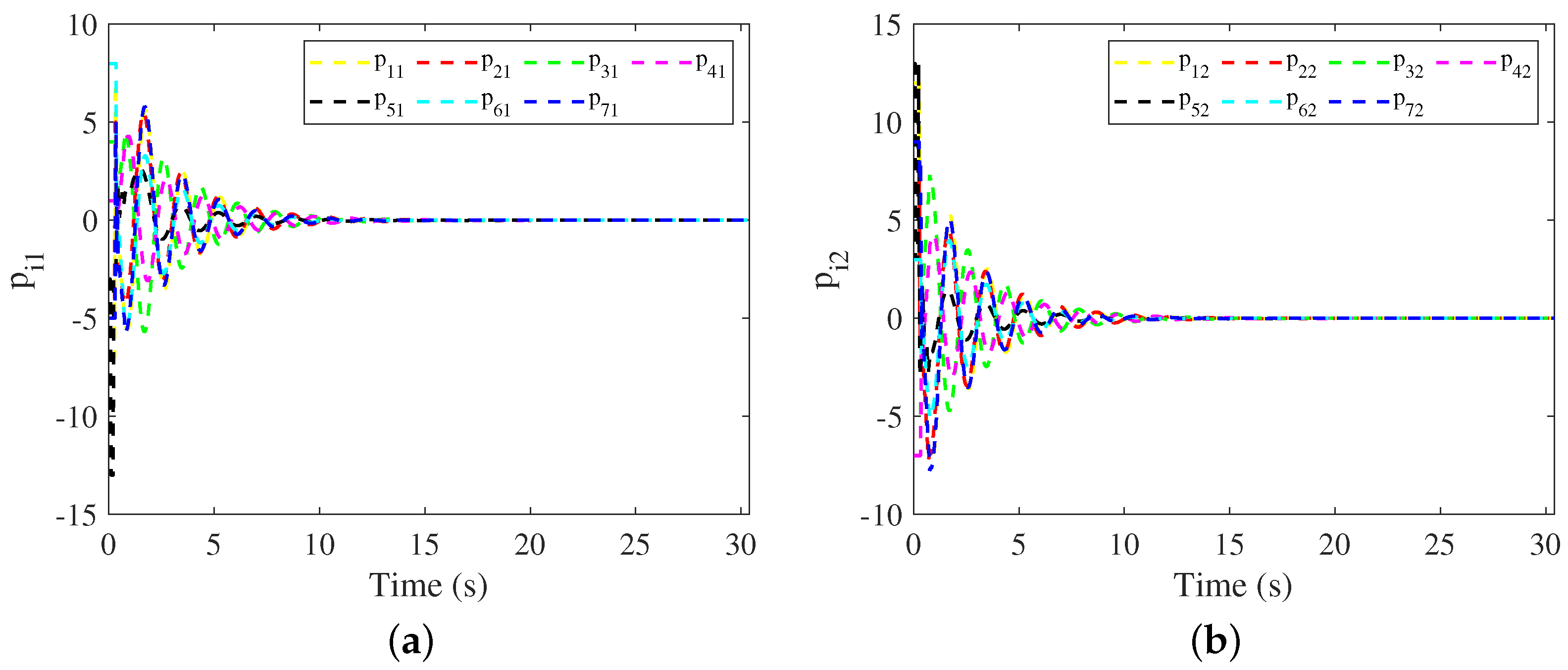
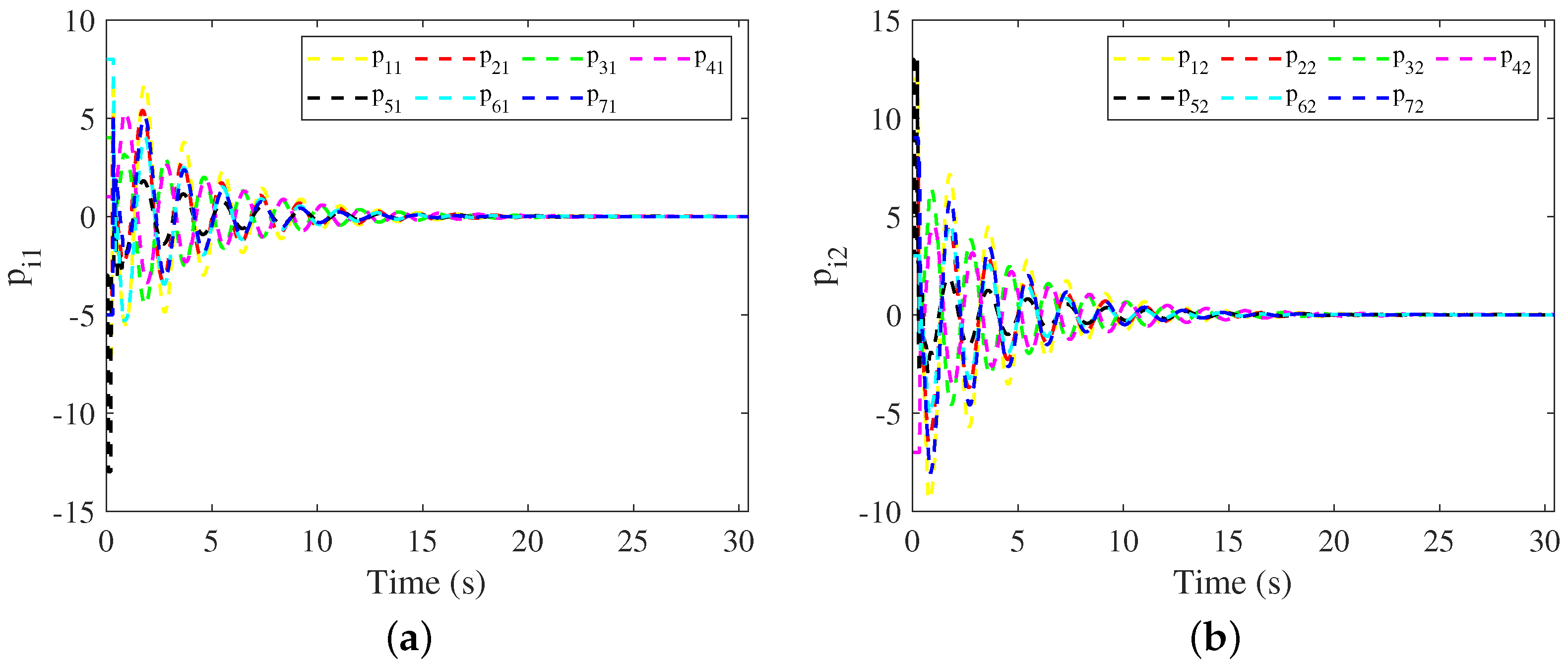
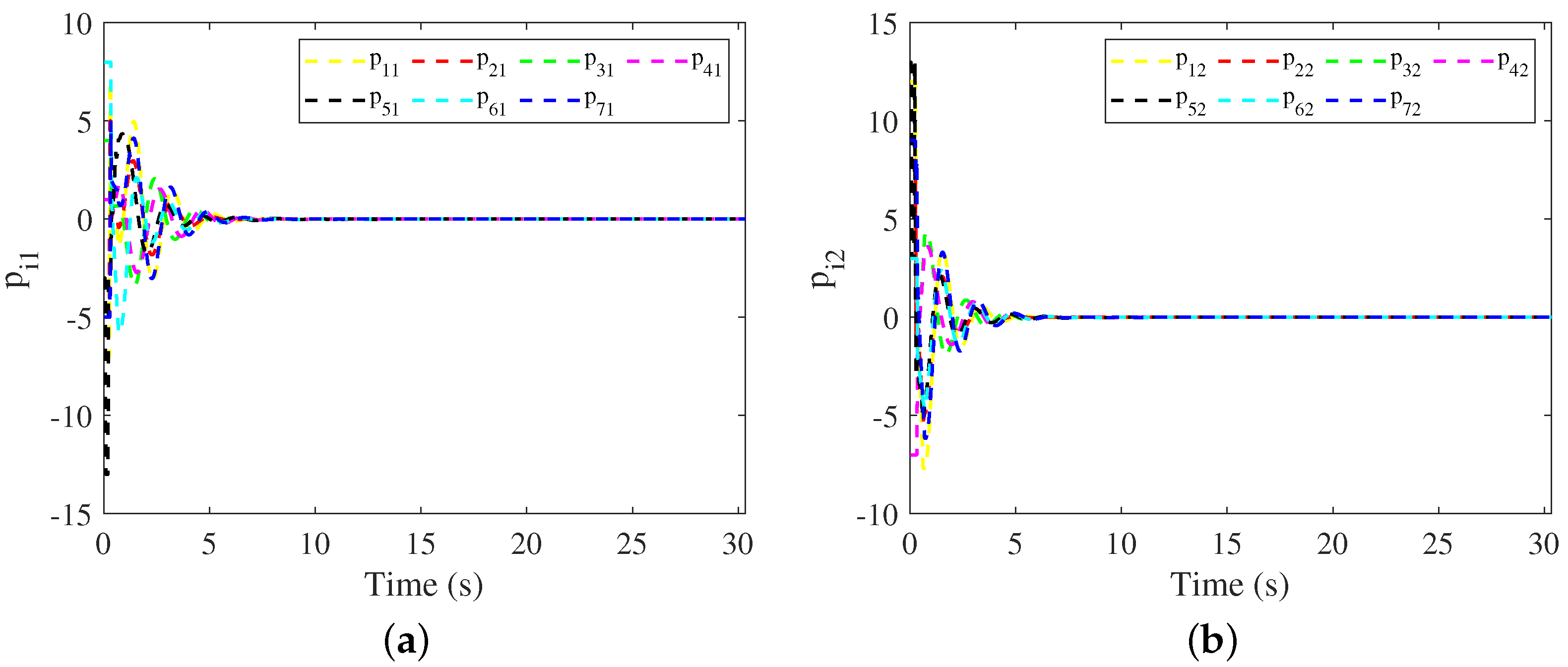
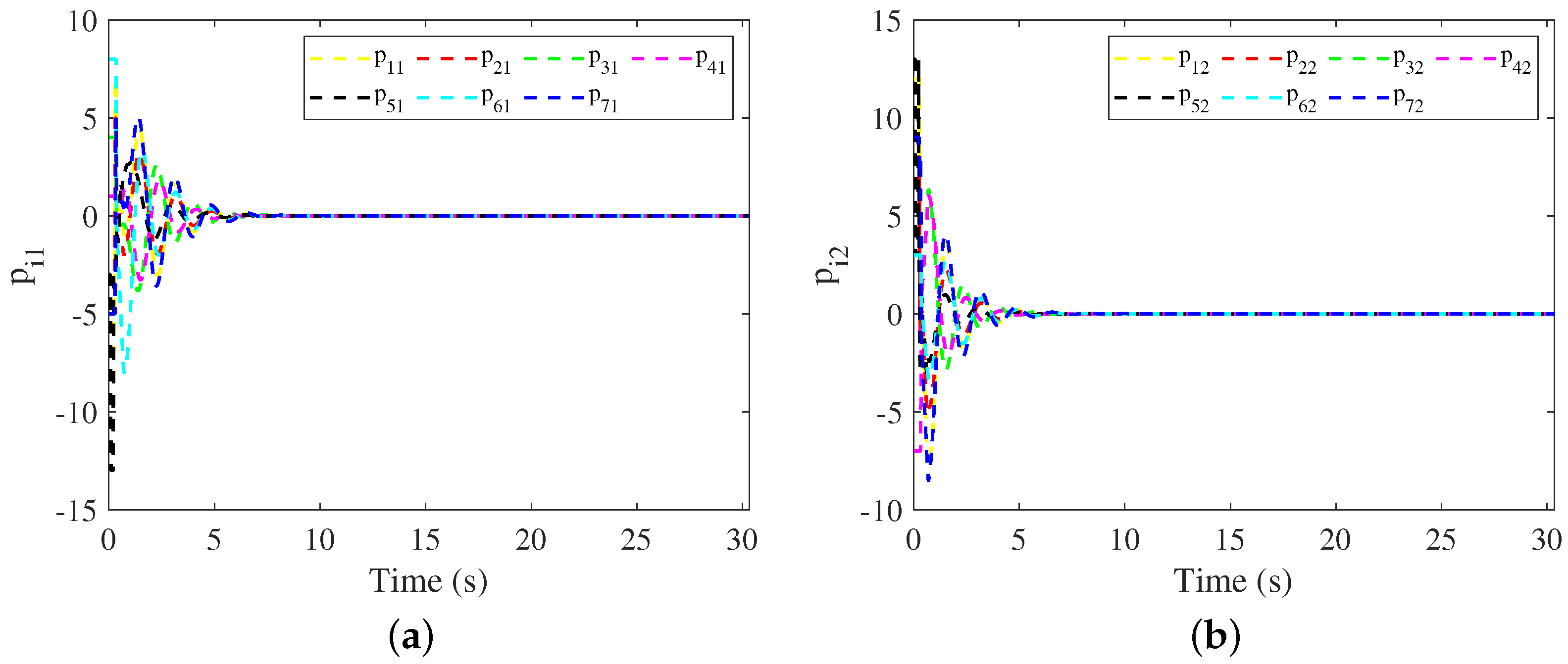
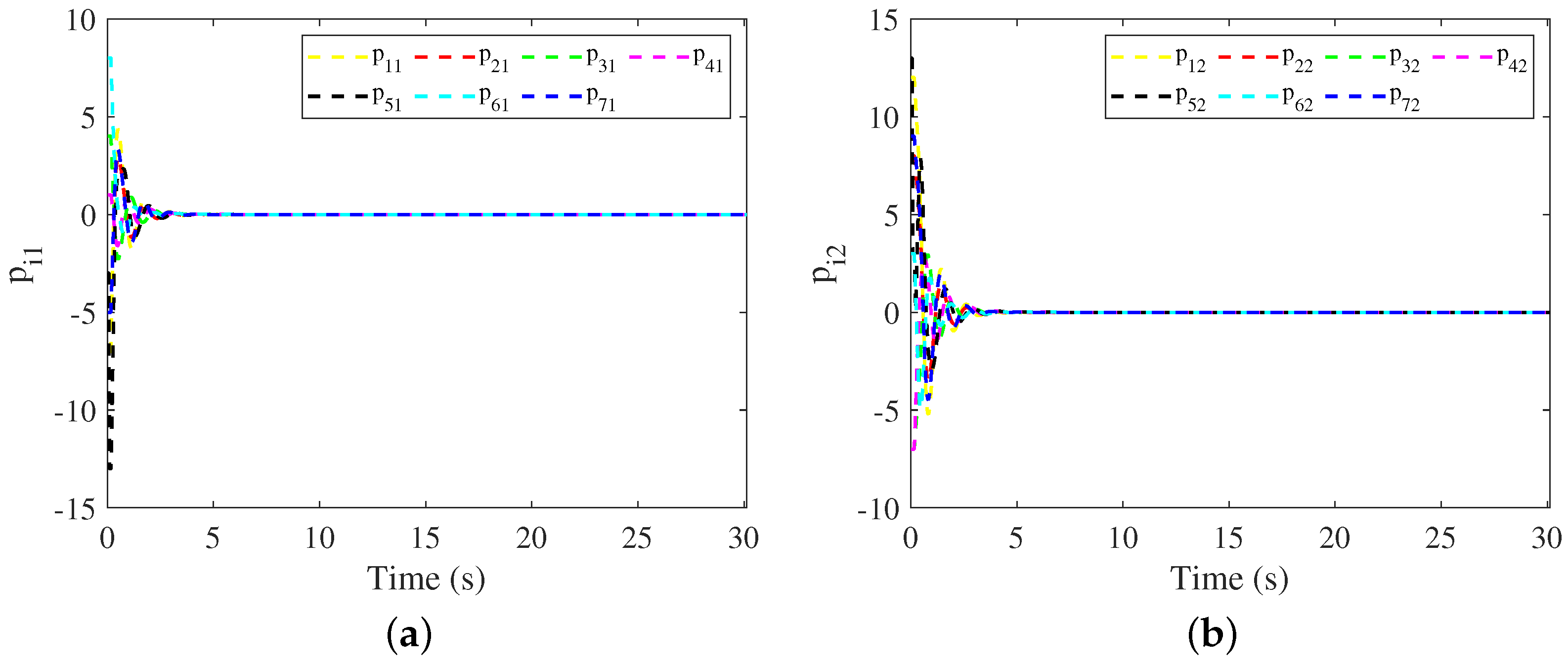
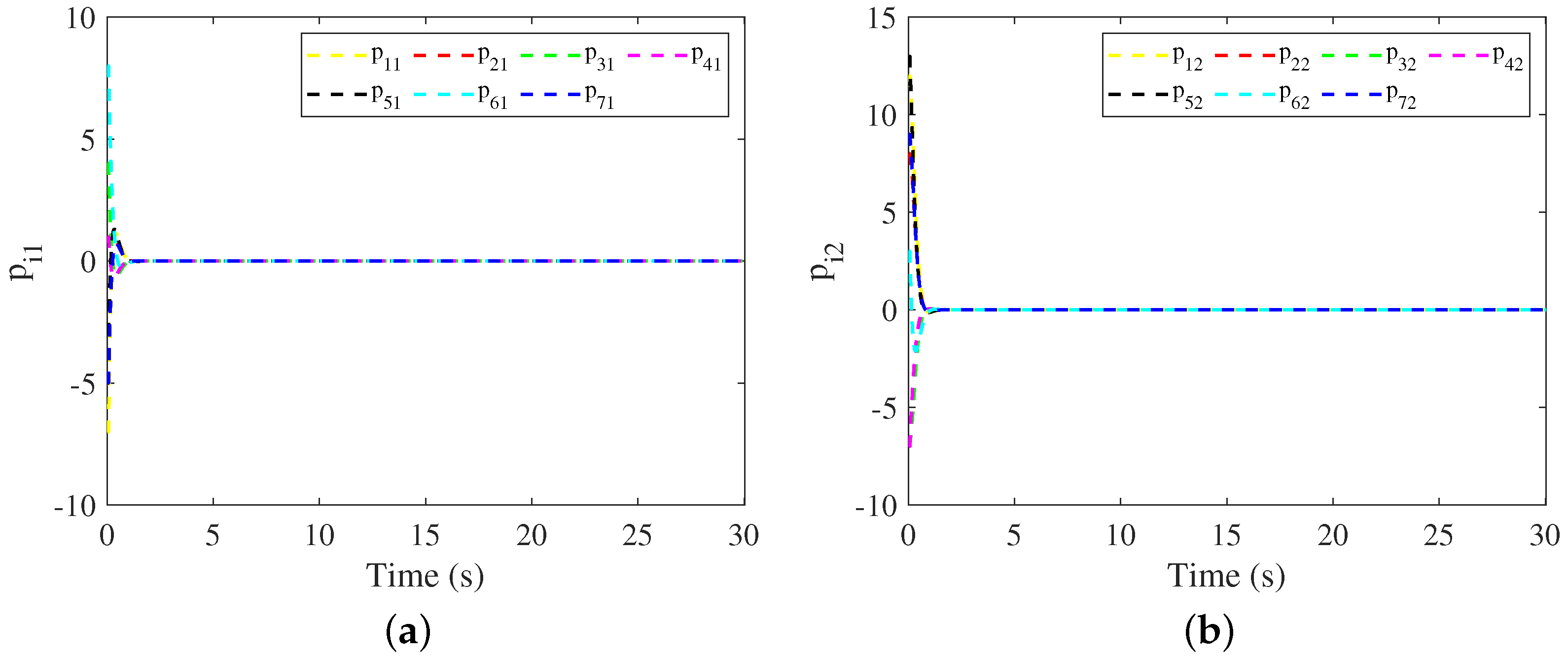
Note that p i 1 ( t ) and p i 2 ( t ) denote the leader-following consensus errors of the ith follower in the simulation figures through the paper. The error curves are respectively shown in Figure 3, Figure 4, Figure 5 and Figure 6 when b 1 = 0 , b 2 = 99 , b 3 = 100 and b 1 = 0.3 , b 2 = 0.5 , b 3 = 0.4 for τ 1 = 0.45 . It can be seen that the leader-following consensus is achieved with stochastic perturbation and delay in Figure 3, Figure 4, Figure 5 and Figure 6. In all figures, the errors p i 1 , p i 2 between followers 1–7 and leader 0 are represented by yellow, red, green, magenta, black, cyan, and blue dashed lines, respectively.
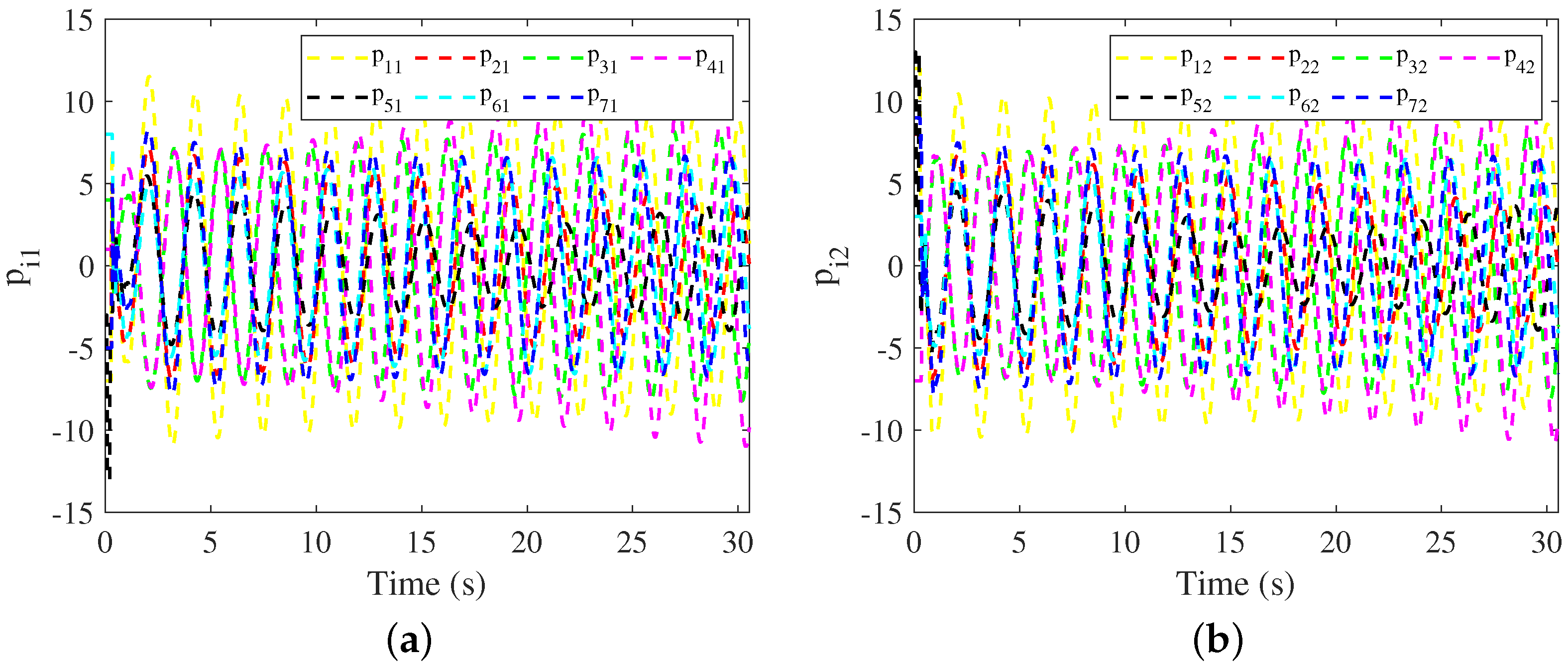
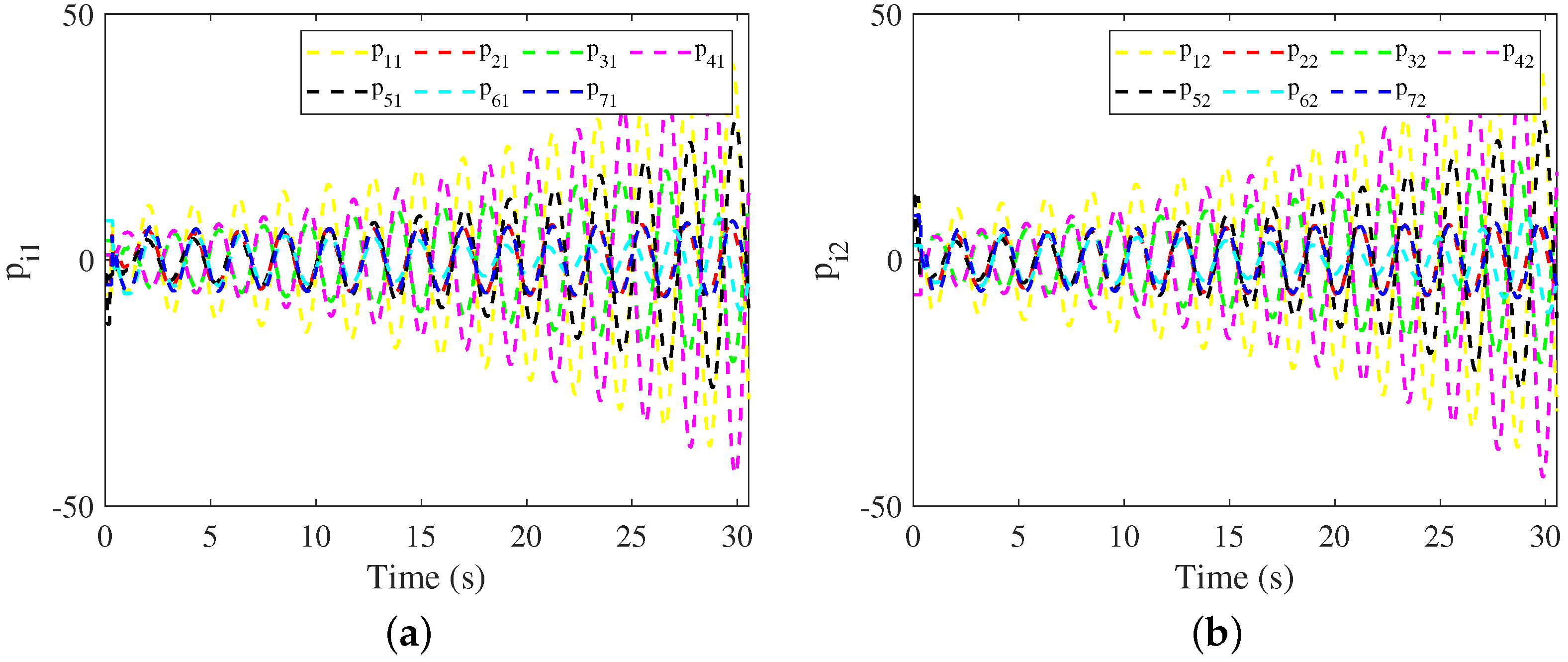
Case 3: Let τ ( t ) = 0.55 sin ( t ) , and τ 1 = 0.55 . When b 1 = 0 , b 2 = 99 , b 3 = 100 , and b 1 = 0.3 , b 2 = 0.5 , b 3 = 0.4 , the error curves are shown in Figure 7 and Figure 8, respectively. It is not difficult to see that the error curves do not converge and the leader-following consensus is not achieved.
Example 2.
This example is used to verify the effectiveness of Theorem 2. Consider the time-delay MASs (1) and (2) with
H 1 = 2 1.5 0.1 3 , J 1 = 0.3 0.3 0.5 0.6 , H 2 = 1 2 , D = 0.02 0.02 , g ( t , z i ( t ) = [ 0.3 sin ( z i 1 ( t ) ) , 0.3 sin ( z i 2 ( t ) ) ] T , r ( t , z i ( t ) ) = [ 0.1 sin ( z i 1 ( t ) ) , 0.1 sin ( z i 2 ( t ) ) ] T ,
further we set ε 1 = 0.5 , ϕ 1 = 0.5 , δ 1 = 0.6 , δ 2 = 0.6 and τ ( t ) = 0.3 sin ( t ) , then τ 1 = 0.3 .
Case 1: when b 1 = 0 , b 2 = 99 , and b 3 = 100 , solving the LMIs (15), it yields
E = 112.7304 12.6231 12.6231 131.6650 , F = 239.1202 21.0135 21.0135 331.0726 , X 1 = 1.8583 21.0485 , X 2 = 9.4727 11.0399 , λ 1 = 286.7518 , β = 14.5891 ,
and the gain matrices G 1 and G 2 can be calculated as
G 1 = 0.0135 0.1525 , G 2 = 0.0687 0.0800 .
Case 2: when b 1 = 0.3 , b 2 = 0.5 and b 3 = 0.4 , solving the LMIs (15), it yields
E = 1.2559 0.2250 0.2250 1.5934 , F = 2.1622 0.4073 0.4073 3.7293 , X 1 = 0.0967 0.1517 , X 2 = 0.1120 0.1312 , λ 1 = 2.7871 , β = 1.6122 ,
and the gain matrices G 1 and G 2 can be calculated as
G 1 = 0.0567 0.0889 , G 2 = 0.0656 0.0769 .
The consensus errors are shown in Figure 9 and Figure 10 when b 1 = 0 , b 2 = 99 , b 3 = 100 and b 1 = 0.3 , b 2 = 0.5 , b 3 = 0.4 , respectively. It can be observed that, in the presence of delay, the H-infinite leader-following consensus is achieved with stochastic perturbation.
Example 3.
This example is used to verify the effectiveness of Corollary 1. When the one-sided Lipschitz condition in Assumption 1 is turned to the Lipschitz condition g ( t , y 1 ) g ( t , y 2 ) μ y 1 y 2 . Consider the time-delay MASs (1) and (2) with
H 1 = 5 3 5 3 , J 1 = 1 2 0.4 0.6 , H 2 = 1 2 , D = 0.05 0.05 , g ( t , z i ( t ) = [ 0.2 sin ( z i 1 ( t ) ) , 0.2 sin ( z i 2 ( t ) ) ] T , r ( t , z i ( t ) ) = [ 0.1 sin ( z i 1 ( t ) ) , 0.1 sin ( z i 2 ( t ) ) ] T ,
further we set ε 1 = 0.7 , ϕ 1 = 0.5 and μ = 1 .
Case 1: When τ ( t ) = 0.11 sin ( t ) and τ 1 = 0.11 , solving the LMIs (19), it yields
E = 1.3675 0.0421 0.0421 1.4306 , F = 3.7164 1.7446 1.7446 3.9389 , X 1 = 0.2382 0.5452 , X 2 = 0.0247 0.2566 , λ 1 = 2.7871 , β = 1.6122 ,
and the gain matrices G 1 and G 2 can be calculated as
G 1 = 0.1641 0.3756 , G 2 = 0.0170 0.1768 .
Case 2: When τ ( t ) = 0.01 sin ( t ) and τ 1 = 0.01 , solving the LMIs (19), it yields
E = 0.7371 0.0474 0.0474 0.8083 , F = 1.4824 0.7476 0.7476 1.7650 , X 1 = 0.1973 0.1288 , X 2 = 0.0059 0.1382 , λ 1 = 1.2344 , β = 1.2386 ,
and the gain matrices G 1 and G 2 can be calculated as
G 1 = 0.2372 0.1549 , G 2 = 0.0071 0.1661 .
The consensus errors are shown in Figure 11 and Figure 12 when τ ( t ) = 0.11 sin ( t ) and τ ( t ) = 0.01 sin ( t ) , respectively. It can be observed that, in the presence of delay, the H-infinite leader-following consensus of Lipschitz MASs is achieved with stochastic perturbation.

5. Conclusions

In this paper, the H-infinity leader-following consensus issue for one-sided Lipschitz-type nonlinear MASs with stochastic perturbation is investigated under a directed topology. To deal with state and communication delays, a composite controller is developed, which is combined with the current state and delay information. By utilizing matrix transformation and inequality techniques, the sufficient conditions based on LMIs for guaranteeing the asymptotic stability have been derived. Moreover, to demonstrate the effectiveness of our provided methods, three examples have been presented. Particularly, the study of quantifying the Markovian topological characteristics is more challenging. In future work, we aim at examining the event triggered consensus problems subject to stochastic MASs with Markovian switching networks and cyber-attacks [23,39,51] or large-scale MASs with explicit performance objectives [52].

Funding

This research was supported by grants from the Shandong Provincial Natural Science Foundation (No. ZR2024QF255) and the Yantai Science and Technology Innovation Development Plan (No. 2024YT06000226).

Data Availability Statement

No new data were created or analyzed in this study. Data sharing is not applicable to this article.

Conflicts of Interest

The author declares no conflicts of interest.

References

  1. Hui, J. Coordinated discrete-time super-twisting sliding mode controller coupled with time-delay estimator for PWR-based nuclear steam supply system. Energy 2024, 301, 131536. [Google Scholar] [CrossRef]
  2. Hui, J. Discrete-time sliding mode prescribed performance controller via Kalman filter and disturbance observer for load following of a pressurized water reactor. Energy 2024, 302, 131767. [Google Scholar] [CrossRef]
  3. Zhao, N.; Zhao, X.; Xu, N.; Zhang, L. Resilient event-triggered control of connected automated vehicles under cyber attacks. IEEE/CAA J. Autom. Sin. 2023, 10, 2300–2302. [Google Scholar] [CrossRef]
  4. Jiang, X.; Zhou, T.; Wang, F. Distributed self-triggered secondary control for islanded microgrids. Int. J. Electr. Power Energy Syst. 2025, 172, 111193. [Google Scholar] [CrossRef]
  5. Li, T.; Xing, L.; Zhang, M.; Sun, B.; Wen, C. Distributed control of multi-bus DC microgrids for current sharing and voltage regulation. IEEE Trans. Smart Grid. 2026, 17, 61–70. [Google Scholar] [CrossRef]
  6. Lu, X.; Wang, T.; Zhao, Y.; Zhang, J. Consensus of multi-agent systems under binary-valued measurements: An event-triggered coordination approach. Automatica 2025, 176, 112255. [Google Scholar] [CrossRef]
  7. Bi, C.; Xu, X.; Liu, L.; Feng, G. Consensus of multi-agent systems under unbounded communication delays via adaptive distributed observers. IEEE Trans. Control Netw. Syst. 2025, 12, 1613–1625. [Google Scholar] [CrossRef]
  8. Zhu, Z.; Jiang, Y.; Liu, Z.; Wang, F. Fuzzy adaptive group formation-containment tracking control of nonlinear multiagent systems with intermittent actuator faults. IEEE Trans. Fuzzy Syst. 2025, 33, 1455–1465. [Google Scholar] [CrossRef]
  9. Zhou, T.; Liu, C.; Wang, W. Nonfragile robust H containment control for multi-agent systems with a time-varying delay. J. Frankl. Inst. 2024, 361, 106732. [Google Scholar] [CrossRef]
  10. Zhou, Y.; Wen, G.; Zhou, J.; Yang, T. Data-driven fault-tolerant bipartite consensus tracking for multi-agent systems with a non-autonomous leader. IEEE/CAA J. Autom. Sin. 2025, 12, 279–281. [Google Scholar] [CrossRef]
  11. Alsalti, M.; Lopez, V.; Müller, M. Notes on data-driven output-feedback control of linear MIMO systems. IEEE Trans. Autom. Control 2025, 70, 6143–6150. [Google Scholar] [CrossRef]
  12. Wu, X.; Tang, Y.; Zhang, W. Stability analysis of stochastic delayed systems with an application to multi-agent systems. IEEE Trans. Autom. Control 2016, 61, 4143–4149. [Google Scholar] [CrossRef]
  13. Zhang, Y.; Li, R.; Zhao, W.; Huo, X. Stochastic leader-following consensus of multi-agent systems with measurement noises and communication time-delays. Neurocomputing 2018, 282, 136–145. [Google Scholar] [CrossRef]
  14. Djaidja, S.; Wu, Q.; Cheng, L. Stochastic consensus of single-integrator multi-agent systems under relative state-dependent measurement noises and time delays. Int. J. Robust Nonlinear Control 2017, 27, 860–872. [Google Scholar] [CrossRef]
  15. Ji, H.; Zhang, H.; Ye, Z.; Zhang, H.; Xu, B.; Chen, G. Stochastic consensus control of second-order nonlinear multiagent systems with external disturbances. Trans. Control Netw. Syst. 2018, 5, 1585–1596. [Google Scholar] [CrossRef]
  16. Chang, J.; Shi, H.; Zhu, S.; Zhao, D.; Sun, Y. Time cost for consensus of stochastic multiagent systems with pinning control. IEEE Trans. Syst. Man Cybern. Syst. 2023, 53, 94–104. [Google Scholar] [CrossRef]
  17. Li, M.; Wu, Z.; Deng, F.; Guo, B. Active disturbance rejection control to consensus of second-order stochastic multiagent systems. IEEE Trans. Control Netw. Syst. 2023, 10, 993–1004. [Google Scholar] [CrossRef]
  18. Liu, L.; Sun, H.; Ma, L.; Zhang, J.; Bo, Y. Quasi-consensus control for a class of time-varying stochastic nonlinear time-delay multiagent systems subject to deception attacks. IEEE Trans. Syst. Man Cybern. Syst. 2021, 51, 6863–6873. [Google Scholar] [CrossRef]
  19. Li, W.; Wang, H.; Liu, L.; Feng, G. Distributed mean-nonovershooting control of stochastic nonlinear multi-agent systems. Automatica 2025, 179, 112397. [Google Scholar] [CrossRef]
  20. Wen, B.; Huang, J.; Su, X.; Yang, Y. Consensus control of nonlinear stochastic multiagent systems with unknown and time-varying control coefficients based on novel Nussbaum functions. IEEE Trans. Syst. Man Cybern. Syst. 2025, 55, 2264–2276. [Google Scholar] [CrossRef]
  21. Li, K.; Hua, C.; You, X.; Ahn, C.K. Leader-following consensus control for uncertain feedforward stochastic nonlinear multiagent systems. IEEE Trans. Neural Netw. Learn. Syst. 2023, 34, 1049–1057. [Google Scholar] [CrossRef] [PubMed]
  22. Guo, X.; Zhang, H.; Sun, J.; Liu, X. Cooperative control for stochastic multiagent systems with deferred dynamic constraints via a novel universal barrier function approach. IEEE Trans. Cybern. 2024, 54, 1806–1815. [Google Scholar] [CrossRef]
  23. Li, K.; Hua, C.; You, X.; Xu, Z. Distributed consensus of feedforward nonlinear stochastic multiagent systems subject to actuator attacks. IEEE Trans. Cybern. 2025, 55, 4842–4851. [Google Scholar] [CrossRef]
  24. Zhou, J.; Sang, C.; Li, X.; Fang, M.; Wang, Z. H consensus for nonlinear stochastic multi-agent systems with time delay. Appl. Math. Comput. 2018, 325, 41–58. [Google Scholar] [CrossRef]
  25. Ren, H.; Peng, Y.; Deng, F.; Zhang, C. Impulsive pinning control algorithm of stochastic multi-agent systems with unbounded distributed delays. Nonlinear Dyn. 2018, 92, 1453–1467. [Google Scholar] [CrossRef]
  26. Yang, S.; Liu, Y.; Xiao, Y.; Wu, T. Consensus of delayed multi-agent dynamical systems with stochastic perturbation via dual-stage impulsive approach. Nonlinear Dyn. 2019, 30, 893–903. [Google Scholar] [CrossRef]
  27. Deng, D.; He, P.; Shi, P.; Kovács, L. Distributed consensus of nonlinear stochastic multi-agent systems with input and output delays via predictive control. Nonlinear Dyn. 2024, 112, 21227–21239. [Google Scholar] [CrossRef]
  28. Zhang, W.; Zhou, Z.; Hong, N. Multi-leader bipartite consensus of stochastic delayed signed networks with event-triggered unbounded delayed impulses. IEEE Trans. Circuits Syst. II Express Briefs 2023, 70, 1049–1053. [Google Scholar] [CrossRef]
  29. Zhang, W.; Gong, B.; Wang, X.; Li, H. Leader-following consensus of stochastic delayed multiagent systems with input saturation under self-triggered impulsive control. Sci. China Technol. Sci. 2025, 68, 1420404. [Google Scholar] [CrossRef]
  30. Battilotti, S.; Cacace, F.; Califano, C.; d’Angelo, M. Stochastic leader-following for heterogeneous linear agents with communication delays. IEEE Trans. Autom. Control 2023, 68, 5706–5713. [Google Scholar] [CrossRef]
  31. Rehan, M.; Jameel, A.; Ahn, C.K. Distributed consensus control of one-sided Lipschitz nonlinear multiagent systems. IEEE Trans. Syst. Man Cybern. Syst. 2018, 48, 1297–1308. [Google Scholar] [CrossRef]
  32. Agha, R.; Rehan, M.; Ahn, C.K.; Mustafa, G.; Ahmad, S. Adaptive distributed consensus control of one-sided Lipschitz nonlinear multiagents. IEEE Trans. Syst. Man Cybern. Syst. 2019, 49, 568–578. [Google Scholar] [CrossRef]
  33. Razaq, M.A.; Rehan, M.; Ahn, C.K.; Khan, A.Q.; Tufail, M. Consensus of one-sided Lipschitz multiagents under switching topologies. IEEE Trans. Syst. Man Cybern. Syst. 2021, 51, 1485–1495. [Google Scholar] [CrossRef]
  34. Razaq, M.A.; Rehan, M.; Ahn, C.K.; Hong, K.S. Observer-based relative-output feedback consensus of one-sided Lipschitz multi-agent systems subjected to switching graphs. IEEE Trans. Control Netw. Syst. 2022, 9, 1875–1886. [Google Scholar] [CrossRef]
  35. Gu, H.; Liu, K.; Zhu, G.; Lü, J. Leader-following consensus of stochastic dynamical multi-agent systems with fixed and switching topologies under proportional-integral protocols. Asian J. Control 2023, 25, 662–676. [Google Scholar] [CrossRef]
  36. Zhang, Z.; Ma, T.; Wu, Y. Bipartite intermittent impulsive consensus of one-sided Lipschitz multi-agent systems under random disturbance. Commun. Nonlinear Sci. Numer. Simul. 2026, 152, 109465. [Google Scholar] [CrossRef]
  37. Zhang, Z.; Ma, T.; Su, X.; Ma, X. Impulsive consensus of one-sided Lipschitz multi-agent systems with deception attacks and stochastic perturbation. IEEE Trans. Artif. Intell. 2024, 5, 1328–1338. [Google Scholar] [CrossRef]
  38. Hu, M.; Guo, L.; Hu, A.; Yang, Y. Leader-following consensus of linear multi-agent systems with randomly occurring nonlinearities and uncertainties and stochastic disturbances. Neurocomputing 2015, 149, 884–890. [Google Scholar] [CrossRef]
  39. Liu, J.; Yin, T.; Yue, D.; Karimi, H.R.; Cao, J. Event-based secure leader-following consensus control for multiagent systems with multiple cyber attacks. IEEE Trans. Cybern. 2021, 51, 162–173. [Google Scholar] [CrossRef] [PubMed]
  40. Ur Rehman, A.; Huang, T.; Rehan, M.; Wu, X.; Zhang, W. New results on cooperative optimal consensus control of multiagents using LPV approach for Lipschitz nonlinear systems under digraphs. IEEE Trans. Syst. Man Cybern. Syst. 2024, 54, 5655–5666. [Google Scholar] [CrossRef]
  41. Ur Rehman, A.; Shi, P.; Wu, X.; Huang, T.; Zhang, W. Robust leaderless consensus control of multiagent systems with Lipschitz nonlinearity via LPV scheme under fixed and switching topologies. IEEE Syst. J. 2024, 18, 379–390. [Google Scholar] [CrossRef]
  42. Yang, W.; Dong, J. Observer-based adaptive consensus for Lipschitz nonlinear multiagent systems via asynchronous event-triggered strategy. IEEE Trans. Autom. Sci. Eng. 2025, 22, 2734–2745. [Google Scholar] [CrossRef]
  43. Xian, C.; Zhao, Y.; Wu, Z.; Wen, G.; Pan, J. Event-triggered distributed average tracking control for Lipschitz-type nonlinear multiagent systems. IEEE Trans. Cybern. 2023, 53, 779–792. [Google Scholar] [CrossRef]
  44. Li, S.; Chen, Y.; Liu, P. Double event-triggered leader-following consensus and fault detection for Lipschitz nonlinear multi-agent systems via periodic sampling strategy. Nonlinear Dyn. 2023, 111, 8293–8311. [Google Scholar] [CrossRef]
  45. Lui, D.; Petrillo, A.; Santini, S. Bipartite tracking consensus for high-order heterogeneous uncertain nonlinear multi-agent systems with unknown leader dynamics via adaptive fully-distributed PID control. IEEE Trans. Netw. Sci. Eng. 2023, 10, 1131–1142. [Google Scholar] [CrossRef]
  46. Huang, J. Adaptive output synchronization for a class of uncertain nonlinear multi-agent systems over switching networks. IEEE Trans. Autom. Control 2024, 69, 2645–2651. [Google Scholar] [CrossRef]
  47. Mesbahi, M.; Egerstedt, M. Graph Theoretic Methods in Multiagent Networks; Princeton University Press: Princeton, NJ, USA, 2010. [Google Scholar]
  48. Wang, Z.; Yang, F.; Ho, D.; Liu, X. Robust H control for networked systems with random packet losses. IEEE Trans. Syst. Man Cybern. Part B Cybern. 2007, 37, 916–924. [Google Scholar] [CrossRef]
  49. Tan, X.; Cao, J.; Li, X.; Alsaedi, A. Leader-following mean square consensus of stochastic multi-agent systems with input delay via event-triggered control. IET Control Theory Appl. 2018, 12, 299–309. [Google Scholar] [CrossRef]
  50. Chen, L.; Liu, C.; Chu, Z.; Lopes, A.; Chen, Y. Leader-follower weighted consensus of nonlinear fractional-order multiagent systems using current and time delay state information. IEEE Trans. Syst. Man Cybern. Syst. 2024, 54, 5814–5823. [Google Scholar] [CrossRef]
  51. Waezizadeh, T.; Mehrpooya, A. A stochastic model for dynamics of two populations and its stability. In Proceedings of the 47th Annual Iranian Mathematics Conference (AIMC47), Karaj, Iran, 28–31 August 2016; Volume 10681071, pp. 28–31. [Google Scholar]
  52. Huang, M.; Caines, P.; Malhamé, R. Large-population cost-coupled LQG problems with nonuniform agents: Individual-mass behavior and decentralized ε-Nash equilibria. IEEE Trans. Autom. Control 2007, 52, 1560–1571. [Google Scholar] [CrossRef]
Figure 1. A flow chart to present the solving process.
Axioms 15 00240 g001
Figure 2. The communication topology.
Axioms 15 00240 g002
Figure 3. Leader-following consensus error when ε 1 = 0.7 , ϕ 1 = 0.5 , δ 1 = 0.8 , δ 2 = 0.8 , b 1 = 0 , b 2 = 99 , b 3 = 100 and τ 1 = 0.45 in Theorem 1. (a) p i 1 ( t ) , (b) p i 2 ( t ) .
Axioms 15 00240 g003
Figure 4. Leader-following consensus error when ε 1 = 0.7 , ϕ 1 = 0.5 , δ 1 = 0.8 , δ 2 = 0.8 , b 1 = 0 , b 2 = 99 , b 3 = 100 and τ 1 = 0.45 in [50]. (a) p i 1 ( t ) , (b) p i 2 ( t ) .
Axioms 15 00240 g004
Figure 5. Leader-following consensus error when ε 1 = 0.7 , ϕ 1 = 0.5 , δ 1 = 0.8 , δ 2 = 0.8 , b 1 = 0.3 , b 2 = 0.5 , b 3 = 0.4 and τ 1 = 0.45 in Theorem 1. (a) p i 1 ( t ) , (b) p i 2 ( t ) .
Axioms 15 00240 g005
Figure 6. Leader-following consensus error when ε 1 = 0.7 , ϕ 1 = 0.5 , δ 1 = 0.8 , δ 2 = 0.8 , b 1 = 0.3 , b 2 = 0.5 , b 3 = 0.4 and τ 1 = 0.45 in [50]. (a) p i 1 ( t ) , (b) p i 2 ( t ) .
Axioms 15 00240 g006
Figure 7. Leader-following consensus error when ε 1 = 0.7 , ϕ 1 = 0.5 , δ 1 = 0.8 , δ 2 = 0.8 , b 1 = 0 , b 2 = 99 and b 3 = 100 for τ 1 = 0.55 . (a) p i 1 ( t ) , (b) p i 2 ( t ) .
Axioms 15 00240 g007
Figure 8. Leader-following consensus error when ε 1 = 0.7 , ϕ 1 = 0.5 , δ 1 = 0.8 , δ 2 = 0.8 , b 1 = 0.3 , b 2 = 0.5 and b 3 = 0.4 for τ 1 = 0.55 . (a) p i 1 ( t ) , (b) p i 2 ( t ) .
Axioms 15 00240 g008
Figure 9. Leader-following consensus error when ε 1 = 0.5 , ϕ 1 = 0.5 , δ 1 = 0.6 , δ 2 = 0.6 , b 1 = 0 , b 2 = 99 , b 3 = 100 and τ 1 = 0.3 . (a) p i 1 ( t ) , (b) p i 2 ( t ) .
Axioms 15 00240 g009
Figure 10. Leader-following consensus error when ε 1 = 0.5 , ϕ 1 = 0.5 , δ 1 = 0.6 , δ 2 = 0.6 , b 1 = 0.3 , b 2 = 0.5 , b 3 = 0.4 and τ 1 = 0.3 . (a) p i 1 ( t ) , (b) p i 2 ( t ) .
Axioms 15 00240 g010
Figure 11. Leader-following consensus error when ε 1 = 0.7 , ϕ 1 = 0.5 , μ = 1 and τ 1 = 0.11 . (a) p i 1 ( t ) , (b) p i 2 ( t ) .
Axioms 15 00240 g011
Figure 12. Leader-following consensus error when ε 1 = 0.7 , ϕ 1 = 0.5 , μ = 1 and τ 1 = 0.01 . (a) p i 1 ( t ) , (b) p i 2 ( t ) .
Axioms 15 00240 g012
Disclaimer/Publisher’s Note: The statements, opinions and data contained in all publications are solely those of the individual author(s) and contributor(s) and not of MDPI and/or the editor(s). MDPI and/or the editor(s) disclaim responsibility for any injury to people or property resulting from any ideas, methods, instructions or products referred to in the content.