1. Introduction
Periodic GARCH (Generalized Autoregressive Conditional Heteroscedasticity) models, introduced by Bollerslev (1996, [
1]), represent a significant advancement in volatility modeling by allowing conditional variances to evolve according to periodic structures. By incorporating seasonality and cyclical effects, these models provide a natural framework for analyzing financial time series characterized by recurrent volatility patterns, such as exchange rates (e.g., Epaphra, 2017 [
2]), energy prices (e.g., Chung, 2024 [
3]), and agricultural commodities (e.g., Yuan et al., 2020 [
4]). The inclusion of periodic components enables a refined representation of time-dependent risk dynamics. Nevertheless, despite their flexibility, classical periodic GARCH models remain limited in their ability to capture asymmetric volatility responses, commonly referred to as the leverage effect, where negative shocks exert a stronger influence on volatility than positive shocks of the same magnitude.
The leverage effect—wherein negative shocks exert a disproportionately larger impact on future volatility than positive shocks—is a well-documented stylized fact of financial markets. It has been formally incorporated into the GARCH literature through seminal asymmetric specifications, most notably Nelson’s (1991, [
5]) Exponential GARCH (EGARCH) model and Zakoïan’s (1994, [
6]) Threshold GARCH (TGARCH) model. These frameworks provide a flexible and empirically validated mechanism for capturing asymmetric volatility responses. The EGARCH model, by specifying the logarithm of conditional variance, accommodates asymmetry without imposing positivity constraints on parameters. In contrast, the TGARCH model introduces regime-dependent effects driven by the sign of past innovations. The relevance of these asymmetric mechanisms persists in environments with periodic or cyclical volatility patterns. This is evidenced by the development of periodic EGARCH and periodic asymmetric GARCH models (see, e.g., Ghezal et al., 2021 [
7]; Sadoun and Bentarzi, 2020 [
8]). These extensions underscore that leverage, asymmetry, and periodicity are deeply interconnected features of many financial time series. This interconnection motivates the development of more general modeling frameworks that can integrate GARCH-type asymmetric feedback with stochastic volatility dynamics within a periodic structure—precisely the aim of the proposed PlogAG-SV model. A related and fundamental limitation of many classical GARCH models is the requirement of positivity constraints on parameters to guarantee a non-negative conditional variance. While mathematically convenient for ensuring admissibility, these constraints can artificially restrict the model’s flexibility and hinder its ability to adapt to complex empirical features such as pronounced nonlinearities, structural breaks, and strong periodic patterns. This limitation has been a primary motivation for the development of logarithmic volatility models, most notably the EGARCH and log-GARCH families. By modeling the logarithm of conditional variance, these frameworks inherently bypass the need for restrictive positivity constraints while preserving a coherent and interpretable volatility process.
To address these shortcomings, the asymmetric periodic logGARCH (PlogGARCH) model was introduced by Ghezal [
9] in “QMLE for Periodic Time-Varying Asymmetric logGARCH Models.” This formulation allows volatility to respond asymmetrically to positive and negative innovations while eliminating traditional positivity constraints on volatility parameters. By modeling the logarithm of volatility and permitting periodic parameter variation, the PlogGARCH framework effectively captures both cyclical behavior and leverage effects observed in financial markets. The introduction of a threshold mechanism further enhances the model’s ability to distinguish between volatility regimes driven by the sign of past shocks. Despite these advantages, PlogGARCH models remain fundamentally observation-driven and may be insufficient for capturing more intricate latent volatility dynamics.
In parallel, stochastic volatility (SV) models have emerged as a powerful alternative for modeling financial volatility since the seminal contribution of Taylor (1982, [
10]), introducing latent stochastic processes that provide a richer and more flexible structure than traditional GARCH-type models. Nevertheless, standard SV formulations often face difficulties in capturing asymmetric volatility responses to positive and negative shocks. This shortcoming motivated the development of threshold and regime-switching stochastic volatility models, notably the Threshold Stochastic Volatility (TSV) model of Breidt (1994, [
11]) and its subsequent extensions by So et al. (2002, [
12]) and Chen et al. (2008, [
13]), which further enhanced robustness through nonlinear and heavy-tailed specifications. More recently, Markov-switching and threshold-based stochastic volatility models have been proposed to account for regime-dependent volatility dynamics and structural changes in financial markets, providing additional flexibility in capturing abrupt shifts and asymmetric behavior (see, e.g., Ghezal, Balegh, and Zemmouri [
14]).
Within this broader literature on nonlinear and asymmetric SV dynamics, Ghezal and Alzeley (2024, [
15]) proposed the Periodic Threshold Autoregressive Stochastic Volatility (PTAR-SV) model, explicitly integrating periodicity into a threshold-based stochastic volatility framework. This model successfully captures periodic volatility clustering and establishes strict periodic stationarity, enabling a detailed analysis of autocovariance structures and higher-order moments. However, the PTAR-SV specification relies on Gaussian innovations and does not fully accommodate leverage effects, thereby motivating the development of more general periodic stochastic volatility models that explicitly incorporate asymmetric volatility feedback.
Although periodicity, asymmetry, logarithmic GARCH feedback, and stochastic volatility have each been studied extensively in isolation, their integration into a single coherent framework gives rise to a fundamentally new class of volatility models. Specifically, the proposed PlogAG-SV model synthesizes the observation-driven asymmetric feedback of a log-GARCH structure with a latent stochastic volatility process, with both components governed by periodic coefficients. This synthesis creates a distinct nonlinear dynamic system in which observed return shocks and latent volatility innovations interact and amplify each other across periodic cycles. Consequently, the resultant volatility dynamics cannot be replicated by existing purely observation-driven (e.g., standard GARCH) or purely latent-variable (e.g., basic SV) specifications.
Therefore, it is crucial to emphasize that the PlogAG-SV model represents a substantive and structural advance rather than a marginal extension of existing periodic stochastic volatility models. A key distinction lies in its comparison with the PTAR-SV model of Ghezal and Alzeley (2024, [
15]), in which regime shifts are driven solely by a threshold autoregressive mechanism within the latent volatility equation, assuming Gaussian innovations. In contrast, the PlogAG-SV framework incorporates an explicit asymmetric logarithmic feedback channel that directly depends on the magnitude and sign of past observed returns. This fundamental addition profoundly alters the volatility transmission mechanism by enabling realized market shocks (past returns) to dynamically interact with and drive the latent stochastic volatility process, all within a periodic coefficient structure. Consequently, the model simultaneously enriches both the time-varying periodic patterns and the asymmetric (leverage) effects in volatility dynamics. Furthermore, although recent studies have begun to integrate logarithmic feedback into stochastic volatility frameworks, exemplified by the logGARCH-SV model of Guerbyenne et al. (2024, [
16]) and the log-threshold SV model of Alraddadi (2025, [
17]), these contributions generally maintain an assumption of time-invariant (non-periodic) dynamics. The PlogAG-SV model advances this line of research by concurrently embedding three key features: periodicity, asymmetric logarithmic feedback, and a latent stochastic volatility component, within a single nonlinear system. This tripartite integration raises novel theoretical questions, specifically regarding the conditions for strict periodic stationarity and the existence of higher-order moments—conditions that are inherent to the integrated structure and cannot be obtained as direct corollaries from earlier, less general models. Consequently, the PlogAG-SV framework establishes a novel class of asymmetric periodic stochastic volatility models, thereby broadening the theoretical and empirical scope of both observation-driven log-GARCH specifications and latent threshold-based stochastic volatility models. This integrated structure offers a more flexible and empirically grounded representation of volatility dynamics, particularly suited for modeling exchange rates—and financial series in emerging markets more generally—where periodic patterns, asymmetric shocks, and abrupt regime shifts frequently coexist and interact.
In this study, we propose an extension of the periodic logGARCH framework by introducing the Periodic Logarithmic Asymmetric GARCH–Stochastic Volatility (PlogAG-SV) model. This new specification captures both periodicity and asymmetry through periodically varying parameters combined with a threshold mechanism within a stochastic volatility setting. Let
denote the observed process defined by the system:
where
and
represent two independent sequences of zero-mean, unit-variance random variables that are independently and identically distributed (i.i.d.
). We assume that the probability of
equaling zero is zero. The parameters
and
are periodic functions, with period
d, meaning that for all
, the parameter vector satisfies
, where
. This periodic structure allows the model parameters to vary systematically across cycles while repeating every
d observations. The notation
denotes the indicator function, defined as
if the event
A holds and 0 otherwise. In the present specification, asymmetry arises from the potentially distinct values of
and
, which allow positive and negative past returns to exert different effects on the latent log-volatility. The variable
is referred to as the
volatility of
. This formulation enhances the model’s ability to capture complex volatility dynamics while avoiding conventional positivity constraints typically imposed in variance-based specifications. Such flexibility allows the PlogAG-SV model to adapt more naturally to financial time series characterized by structural asymmetry and cyclical variation, such as the Algerian Dinar–Euro exchange rate examined in this study. By integrating periodicity and asymmetric feedback within a latent volatility framework, the model provides a coherent structure for representing evolving market uncertainty. It is worth noting that seasonal patterns and conditional heteroskedasticity can, in principle, also be modeled within a traditional ARIMA framework augmented with seasonal components and GARCH-type errors. Such approaches are widely employed in applied time-series analysis. However, ARIMA-type specifications primarily focus on linear dependence in the conditional mean, with volatility dynamics typically incorporated in an observation-driven manner. In contrast, the PlogAG-SV framework embeds periodicity and asymmetry directly within a latent stochastic volatility system, allowing nonlinear feedback between past shocks and future volatility innovations under strict cyclical stability conditions. Accordingly, the proposed approach should be viewed not merely as an alternative seasonal mean specification, but as a structural extension of volatility modeling itself.
The specification in (
1) reveals that the proposed PlogAG-SV model is not a simple extension of existing periodic or threshold stochastic volatility models, but a structurally integrated system. The periodic coefficient structure governs both the asymmetric logarithmic feedback component and the latent stochastic volatility dynamics, thereby coupling observed return shocks with latent volatility innovations across cycles. Unlike the PTAR-SV model of Ghezal and Alzeley (2024), where regime changes arise solely from a threshold mechanism within the latent equation, the present formulation explicitly incorporates asymmetric feedback through the sign-dependent coefficients
and
. Moreover, in contrast to periodic logGARCH-type models, volatility is no longer purely observation-driven but evolves within a latent stochastic system subject to periodic stability conditions. This dual-layer interaction generates stationarity and higher-moment properties that cannot be recovered as special cases of earlier frameworks. Consequently, the PlogAG-SV specification defines a distinct class of asymmetric periodic stochastic volatility models.
The main objective of this study is to develop and analyze a new class of periodic asymmetric stochastic volatility models that jointly incorporate logarithmic GARCH-type feedback, leverage effects, and latent stochastic volatility dynamics under periodic parameterization. Specifically, the paper aims to (i) introduce the PlogAG-SV model, (ii) establish rigorous theoretical conditions for strict periodic stationarity and the existence of higher-order moments, (iii) propose a feasible QMLE-based estimation procedure, and (iv) assess the finite-sample and empirical performance of the model through Monte Carlo simulations and an application to the Algerian dinar–euro exchange rate.
The structure of this paper is as follows:
Section 2 explores the probabilistic properties of the proposed model, focusing on strict stationarity, second-order stationarity, and the existence of higher-order moments.
Section 3 outlines the estimation of model parameters using a sequential Monte Carlo method. In
Section 4, a simulation study is conducted to evaluate the performance of the proposed estimation approach.
Section 5 presents empirical results from the application of the model to the Algerian dinar–euro exchange rate, followed by a discussion. Lastly,
Section 6 offers concluding remarks and suggestions for future research.
2. Stationarity and Moment Conditions for the PlogAG-SV Model
To conduct a rigorous probabilistic analysis of the proposed PlogAG-SV model, it is crucial to establish conditions ensuring its fundamental properties, notably strict periodic stationarity and the existence of higher-order moments. Related results have been extensively studied for asymmetric and symmetric AR-SV models (see, e.g., [
11,
18]) as well as for periodic and Markov-switching TAR-SV frameworks (see, e.g., [
9,
15]). Compared to the PTSV model, the PlogAG-SV process exhibits a more involved probabilistic structure due to the explicit dependence of the log-volatility on past observations, which induces correlation between the innovation
and the log-volatility sequence
. Nevertheless, the model remains analytically more tractable than asymmetric PGARCH-type processes. As revealed by the second equation of (
1), the existence of a strictly causal solution is closely linked to the stability of an associated periodic threshold autoregressive (PTAR) process, introduced below:
Here, the effective intercept term
serve as scaling factors for volatility and are defined by the following expression:
where
is an i.i.d. sequence with mean zero and variance
, defined as:
This formulation highlights the essential role of the parameters
as fundamental volatility scaling factors, intricately integrating the expected values of log-transformed past observations, conditioned on their respective signs. The interplay of these factors, combined with contributions from
, captures the dynamic structure of the model. By applying the model (
2) in the stationarity analysis, the ensuing theorem ensures the existence of a unique causal solution, thereby confirming the model’s stationarity. This crucial result guarantees the preservation of fundamental statistical properties, providing a robust platform for deep theoretical analysis and practical implementation, strengthening the model’s relevance in research and real-world applications.
Theorem 1.
Let the PlogAG-SV model be defined as in (1). This model admits a unique solution that is strictly periodically stationary and periodically ergodic. The solution can be written in a nonanticipative form as:The series inside the exponent converges almost surely, as long as the following condition is satisfied:Moreover, ifIn this case, the solution mentioned earlier also exhibits periodic stationarity of the second order. Proof. To establish the desired properties of the model, we leverage the inherent periodic characteristics of the original process
, which is already known to exhibit strict periodic stationarity and periodic ergodicity. We first analyze the framework of (
1) and identify its structural similarities to the process analyzed by Ghezal and Alzeley (refer to [
15]). Their research concluded that when certain conditions are satisfied, specifically (
4) and (
5), the resulting process retains both periodic strict stationarity and periodic ergodicity. By applying their theoretical insights and the relevant moment conditions to our model, we can assert that (
1) mirrors these properties. Consequently, we can confirm that it achieves both periodic strict stationarity and second-order periodic stationarity, alongside periodic ergodicity. This line of reasoning successfully concludes our proof. □
Grasping the conditions that guarantee the finiteness of specific moments is essential for evaluating the model’s dynamics and confirming its practical relevance. The upcoming theorem outlines a sufficient criterion for the moments to remain finite and presents a clear formula for the -th moment, which plays a critical role in understanding the model’s statistical behavior.
Example 1.
Let’s apply the condition (4) to various specific cases, similar to the examples in the provided table. In this condition, the effect of past shocks is expressed through the functions and , depending on whether the previous shock is positive or negative, along with the independent factor . To illustrate how this condition applies to some standard models, we present the following cases: Table 1 shows that SV models and non-SV models share the same fundamental condition for ensuring stationarity, but with slight variations in the parameters involved. In both SV and non-SV models, the conditions depend on controlling the effects of past shocks and volatility through the parameters
and
Theorem 2.
Let represent a strictly periodically stationary solution of the equation given in (1). Assuming that the first-order moments of satisfy for any , we can establish a sufficient condition for the finiteness of as follows:This condition effectively controls the growth of the process, ensuring that the higher-order moments remain bounded. Moreover, the explicit expression for the -th moment of is derived as Proof. To demonstrate this theorem, we begin by analyzing the conditions that guarantee the finiteness of the moments for the stochastic process . The core idea is to inspect the structural components of the model and apply well-established probabilistic tools. Given that the process is strictly periodically stationary, we assume that the expectation is finite for any . This assumption forms the basis for establishing the necessary conditions for the finiteness of the higher-order moments . The approach hinges on evaluating the product of expectations over past observations, which are encapsulated within an exponential function. More specifically, each expectation in the product reflects how past realizations of the process contribute to the current value, thus ensuring that the product converges. The periodicity of the process plays a crucial role in simplifying the complex dependencies across time, allowing us to handle these expressions analytically. By carefully applying these principles and leveraging the periodic stationarity of the process, we derive a closed-form expression for the -th moment. This expression involves both the initial moments and the series of expectations governed by the coefficients , and , along with the dynamics of the underlying process. Thus, the sufficient condition outlined ensures that the moments remain finite. □
- 1.
When the process
is viewed as a periodically stationary solution of (
1) and satisfies the condition (
5), it exhibits the characteristics of a weak white noise process. This classification means that although the process maintains a stable mean and variance over time, it lacks any linear temporal correlation. Essentially, while the underlying model imposes a structure,
retains a level of randomness and unpredictability, a hallmark of weak white noise. From a practical standpoint, this property implies that despite the influence of the model’s framework, the process resists any long-term, predictable pattern, which is a desirable feature in many stochastic systems. The absence of linear dependencies over time suggests that each observation in the series remains independent from others in a linear sense, ensuring that the process doesn’t exhibit trends or autocorrelations that could undermine its randomness. This weak white noise behavior is not merely an artifact of stationarity and ergodicity but plays a pivotal role in reinforcing the validity and robustness of the model. It ensures that, despite being governed by periodicity and conditions like (
5), the process maintains the level of unpredictability necessary for applications that rely on capturing random fluctuations. Moreover, it supports the model’s utility in scenarios where preserving randomness within a structured, yet stationary, framework is crucial for accurate long-term predictions or simulations.
- 2.
In the special case where , the model undergoes a significant transformation by eliminating the influence of past volatility shocks on current volatility levels. This decoupling results in a model where the current volatility is entirely independent of historical fluctuations, simplifying the dynamics considerably. The absence of these terms effectively converts the model into a standard log-transformed stochastic volatility framework, where volatility evolves according to a constant scaling factor, devoid of feedback from past observations. This reduction to a simpler structure emphasizes the role of the constant term c and the core components and , which now dictate the volatility evolution without interference from previous shocks. As such, the model’s behavior in this case aligns more closely with classical volatility models, offering a clearer understanding of volatility in its purest form. From a theoretical perspective, this scenario provides an idealized baseline for analyzing fundamental volatility properties, allowing for a cleaner examination of the model without the complexities introduced by asymmetric feedback mechanisms. It serves as a useful benchmark for comparison when reintroducing the and terms, making it easier to assess the impact of past volatility on future behavior. This simplified framework can also aid in practical applications, where isolating the influence of constant terms may be critical for studying volatility under neutral conditions.
- 3.
When , the PlogAG-SV model demonstrates a unique symmetry that simplifies its overall behavior and dynamics. This symmetry effectively neutralizes the distinction between positive and negative past observations, meaning that their effects on current volatility become equivalent. As a result, the process is influenced in a balanced manner, reducing the complexity of its evolution over time. From a probabilistic standpoint, this symmetry significantly streamlines the verification of periodic stationarity and the existence of higher-order moments. The mathematical expressions governing these properties become more tractable due to the uniform treatment of past shocks, making it easier to check the conditions for stability and moment finiteness. This scenario provides valuable insight into the model’s structure, highlighting how symmetrical behavior in volatility can simplify the intricate relationships between past observations and present fluctuations. Such insights can be especially useful in practical applications, where the symmetric case allows for more intuitive interpretations of the model’s performance, and the conditions required for ensuring practical feasibility—such as moment convergence—are easier to establish.
- 4.
In the analysis of the stochastic process , a deep understanding of higher-order moments becomes essential, especially when examining the kurtosis, which reflects the "tailedness” or extremity of the probability distribution. The Theorem 2 provides insights into the finiteness of the -th moment, a key factor in controlling the tail behavior of the distribution. This is significant because if higher-order moments, such as the -th moment, remain bounded, it ensures that the model avoids excessive kurtosis, which would otherwise suggest instability or heavy-tailed characteristics. From a practical standpoint, the kurtosis is critical in distinguishing between normal and extreme volatility events in the model. When kurtosis is excessively high, it may signal the presence of rare but impactful deviations, which could complicate predictions and create challenges in modeling real-world phenomena. By offering a closed-form expression for the -th moment, the theorem ensures that the model’s tail behavior remains within a manageable range, providing a safeguard against extreme deviations and enhancing the model’s applicability. Furthermore, the finiteness of these higher moments contributes to the model’s overall statistical soundness, preventing erratic behavior in scenarios requiring stability and predictability. This control over the distribution’s tail not only ensures statistical rigor but also reinforces the model’s reliability for use in fields such as finance or risk management, where understanding and mitigating the impact of rare, extreme events is crucial.
3. Advanced Quasi-Likelihood Estimation for Periodic logAG-SV Models
Parameter estimation in periodic logAG-SV models is inherently challenging due to the latent nature of volatility, the presence of nonlinear asymmetric dynamics, and the non-Gaussian structure of the innovations. These challenges are further intensified by the periodic specification of the model, which induces time-varying parameter heterogeneity and complex dependence patterns across cycles. As a result, exact likelihood-based estimation methods are often computationally infeasible or numerically unstable in such settings (see, e.g., [
19]).
In this study, parameter estimation is conducted exclusively via Quasi-Maximum Likelihood Estimation (QMLE). No alternative or parallel estimation procedure is employed. The quasi-log-likelihood function is evaluated using Kalman filter–based recursions under a Gaussian quasi-likelihood approximation. The use of QMLE is motivated by tractability considerations and by its well-established consistency properties under mild regularity conditions, even when the true innovation distribution deviates from normality. The Gaussian assumption is adopted solely as an approximation device for likelihood evaluation and does not impose distributional restrictions on the underlying innovation process. Let
represent the vector of parameters in the periodic logAG-SV model, where
and
is the true, but unknown, parameter set. To estimate this, consider a sample
, drawn from a distinct, causal, and strictly periodically stationary solution of the model. The quasi-likelihood function, central to this estimation, is formulated based on the innovations at each time step, encapsulating the volatility dynamics and periodicity inherent in the model. The innovation-based quasi-likelihood function can be expressed as:
where
is the innovation at time
. This term represents the difference between the observed logarithmic squared value,
, and the linear predictor
, calculated from previous observations. The state-space representation used for QMLE is linear in the observation equation and conditionally linear in the state equation after quasi-linearization. This structure justifies the use of Kalman filter–based likelihood evaluation despite the asymmetric specification of the model.
3.1. Role of Innovations in QMLE
Innovations play a critical role by adjusting for the variability in the observed data. The term
accounts for the expected error across time steps, ensuring a balanced approach to model fit. As the quasi-likelihood function is maximized, the QMLE solution
is obtained:
Thus, parameter estimation in this study is performed solely through maximization of the quasi-log-likelihood defined above. No Sequential Monte Carlo (SMC), particle filtering, or simulation-based likelihood approximation is used in the estimation or maximization procedure.
Once the QMLE estimator is obtained, competing specifications can be compared using an information criterion. In practice, model selection is conducted using the Bayesian Information Criterion (BIC), defined as , where denotes the total number of estimated parameters and represents the sample size. The BIC is preferred because it imposes a heavier penalty on model complexity than the Akaike Information Criterion (AIC), making it particularly suitable for periodic frameworks in which the parameter dimension increases with the number of cycles. Under standard regularity conditions, the BIC provides consistent model selection and tends to favor more parsimonious specifications. In contrast, the multivariate Ljung–Box test serves a different purpose, namely the detection of residual serial dependence. It is therefore employed as a diagnostic tool rather than a model selection criterion. Accordingly, the BIC is used to compare competing PlogAG-SV specifications, whereas residual-based tests are applied solely to assess the adequacy of the selected model.
3.2. Recursive Estimation via Kalman Filter–Based Recursions
The evaluation of the quasi-log-likelihood relies on Kalman filter–type recursions adapted to the nonlinear and asymmetric structure of the PlogAG-SV model. At each time step, the conditional predictor and its associated mean squared error are updated recursively. Specifically, the conditional predictor is given by
where the indicator functions
and
capture the asymmetric response of the model to different regimes. The recursive update for
, which represents the deviation of the observed data from the predicted value, is given by:
adjusting for the discrepancy between the model’s forecast and the actual data. The error evolves dynamically as:
where
reflects the adaptive nature of the model’s variance at each time step,
The term
is crucial for this adaptation and is defined as:
incorporating the variability of the prediction error into the model. This recursive update ensures that the Kalman filter remains flexible, adapting to changes in the system’s behavior, even under substantial variability in the underlying dynamics. The process starts by initializing the system with
and
, which form the basis for the Kalman filter’s initial state estimation.
3.3. Numerical Optimization and Robustness Considerations
Since the quasi-log-likelihood function does not admit a closed-form maximizer, numerical optimization techniques are employed to obtain the QMLE estimator
. Such approaches are standard in stochastic volatility settings and are known to ensure reliable convergence properties, even in high-dimensional and periodic frameworks (see, e.g., Aknouche, [
20]; Boussaha and Hamdi, [
21]).
For completeness only, particle filtering or smoothing algorithms may be employed in separate robustness checks to approximate latent volatility paths under extreme nonlinear or non-Gaussian scenarios. However, these simulation-based methods are not used for parameter estimation, likelihood evaluation, or model comparison in the empirical results reported in this paper.
4. Performance Evaluation of logAG-SV, Symmetric PlogG-SV, and PlogAG-SV
Models: A Monte Carlo Simulation Study
In this section, we assess the finite-sample performance of the proposed QMLE-based estimation procedure through Monte Carlo simulations. For each Monte Carlo replication, synthetic data were generated from the specified periodic data-generating process, and parameters were re-estimated using exactly the same QMLE procedure described in
Section 3, i.e., quasi-log-likelihood maximization evaluated via Kalman filter–based recursions under a Gaussian quasi-likelihood approximation. No alternative estimation algorithm was used at any stage of the simulation exercise. The analysis focuses on three competing specifications: the asymmetric logAG-SV model, the symmetric PlogG-SV model, and the proposed PlogAG-SV framework. The simulation design consists of 500 independent replications with a sample size of
. The periodic dimension is fixed at
, implying that each time-varying parameter is allowed to take two regime-specific values. The true parameter values (TV) were calibrated to satisfy the strict periodic stability condition in (
4) and the higher-moment condition in (
5), thereby ensuring the existence of a unique causal and periodically stable solution. Periodicity was introduced by specifying regime-dependent parameters that alternate across sub-periods, generating a predetermined seasonal variance structure. Asymmetry was incorporated by assigning distinct values to the parameters
and
, while the conditional variance was recursively generated from the latent volatility equation. Under this design, both the periodic structure and the asymmetry mechanism are intrinsically embedded in the data-generating process rather than arising from incidental estimation noise. All simulations and numerical optimizations were implemented in MATLAB R2018a (9.4.0.813654).
Table 2 reports the Tv, the average estimates across replications, and the associated empirical standard errors.
The results reveal clear differences in estimation accuracy across the three models. Overall, the PlogAG-SV specification yields parameter estimates that are closest to the true values and exhibits the smallest standard errors for most parameters. For example, the estimates of the regime-specific parameters and , corresponding to the two periodic sub-periods implied by are very close to their corresponding true values, indicating a strong ability to capture both periodic and asymmetric volatility effects. The symmetric PlogG-SV model performs satisfactorily but shows a tendency to slightly underestimate some parameters, particularly in the second regime, suggesting limitations in capturing asymmetric dynamics. In contrast, the standard logAG-SV model provides estimates for a restricted set of parameters and is characterized by relatively larger standard errors, reflecting its reduced flexibility in more complex settings. Taken together, these findings indicate that incorporating both periodicity and asymmetry, as in the PlogAG-SV model, leads to improved estimation precision compared to its symmetric and non-periodic counterparts.
5. Stochastic Modeling of Algerian Dinar-Euro Exchange Rate Fluctuations Using the PlogAG-SV Framework
The study of exchange rate fluctuations is crucial for understanding economic stability and forecasting future market trends. The Algerian Dinar-Euro exchange rate exhibits complex dynamics that require advanced mathematical models to capture the underlying patterns influencing these fluctuations. One such model is the PlogAG-SV model, which stands out for its ability to handle periodic time-variations in volatility along with asymmetric effects, providing a robust framework for analyzing non-linear stochastic behaviors in financial data. The PlogAG-SV model integrates periodicity in volatility with stochastic volatility and threshold effects, accounting for sudden changes that occur when exchange rate movements exceed or fall below certain levels. These unique features make the PlogAG-SV model well-suited for analyzing complex financial time series such as the Algerian Dinar-Euro exchange rate.
In this study, we apply the PlogAG-SV model to daily (trading-day) Algerian Dinar–Euro exchange rate data covering the period from 3 January 2000, to 29 September 2011, extending previous work by Alzeley and Ghezal [
22]. After excluding non-trading days (weekends and official holidays), the final sample consists of 3,055 equally spaced daily observations. The data frequency is therefore strictly daily, and time throughout the empirical analysis is measured in sequential trading days rather than calendar dates. This representation is consistent with the stochastic volatility framework adopted in this study, which relies on equally spaced time increments. The dataset has been previously examined in the literature using various stochastic volatility models, providing a solid empirical foundation for applying the PlogAG-SV framework. The dataset has been previously examined in the literature using various stochastic volatility models, providing a solid empirical foundation for applying the PlogAG-SV framework. We begin with a thorough descriptive statistical analysis of the exchange rate series, laying the groundwork for a deeper investigation into the stochastic and dynamic volatility patterns exhibited by the data, with a special focus on the model’s ability to uncover periodic patterns and abrupt changes in volatility.
5.1. Exploratory Analysis of the Dinar Exchange Rate Against the Euro
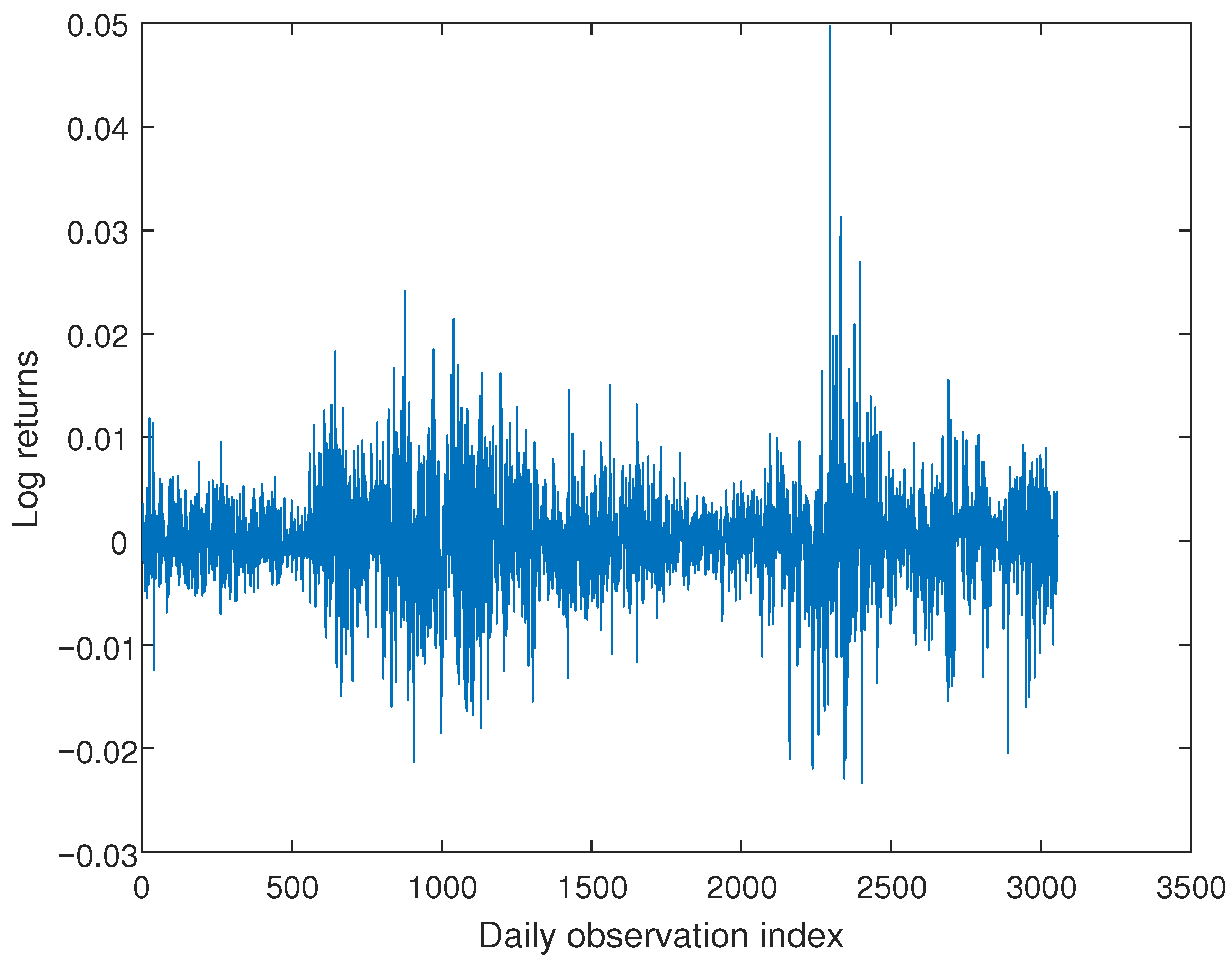
Prior to formal modeling, we undertake an exploratory analysis of the Algerian dinar–euro exchange rate to characterize its key statistical and dynamic properties. This preliminary investigation enables us to identify and visualize salient features typical of financial returns, such as volatility clustering, heavy-tailed distributions, serial dependence, and potential periodic (e.g., day-of-the-week) patterns. The subsequent figures provide a comprehensive visual and descriptive summary of the daily log-return series. The evidence they present motivates and justifies the subsequent adoption of a flexible modeling framework capable of capturing asymmetric, periodic, and stochastic volatility dynamics. The following figure introduces the overall fluctuations in log returns, serving as the foundational time series for the analysis.
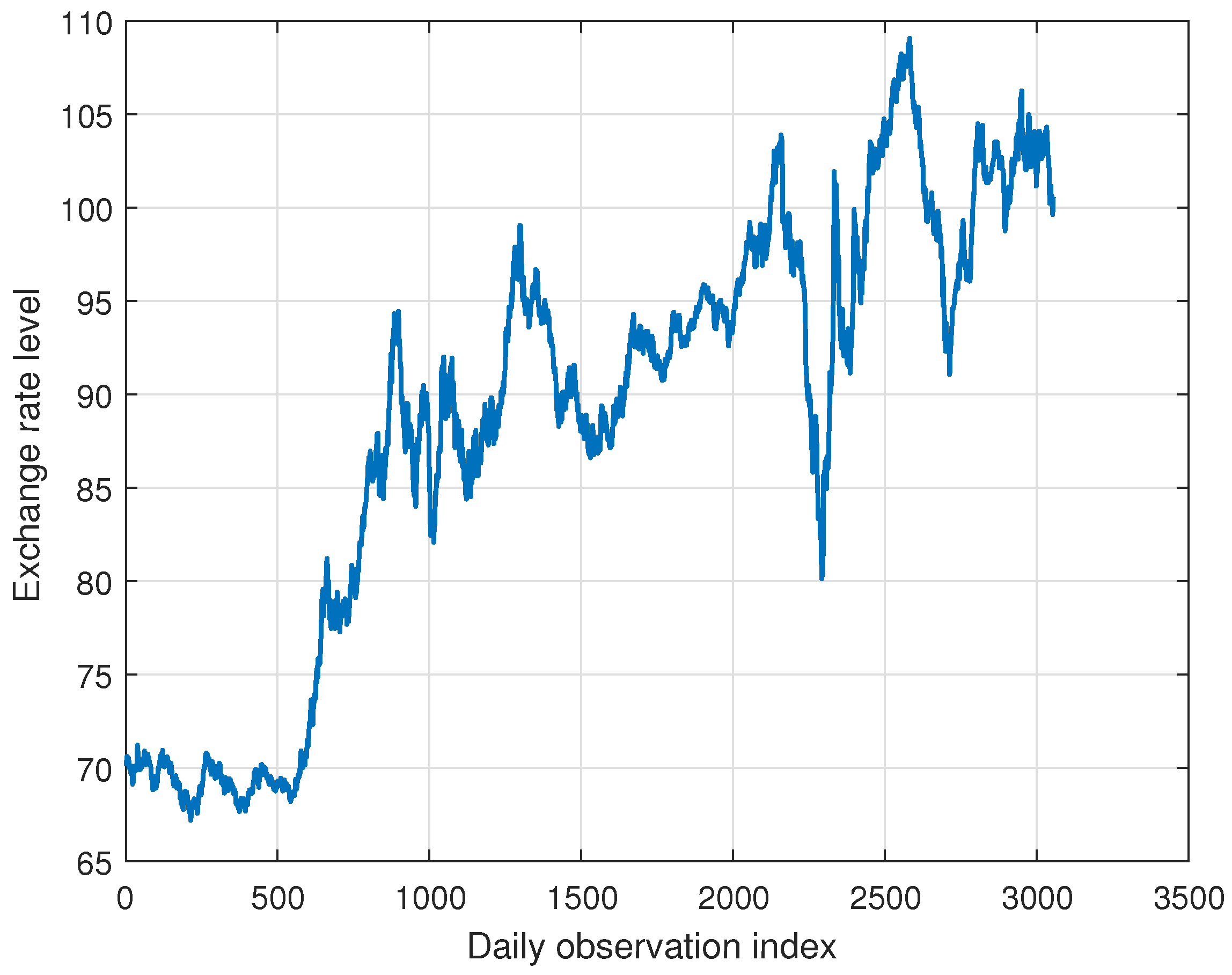
Figure 1 illustrates the time series of the Algerian dinar–euro exchange rate over the study period. A clear upblued, indicating a gradual depreciation of the dinar in the long run. This trend is punctuated by phases of acceleration and periods of relative stability, suggesting the presence of structural changes rather than purely random fluctuations. Such behavior highlights the non-stationary nature of the series, thereby justifying its transformation into logarithmic returns to achieve stationarity and allow for a more accurate analysis of its probabilistic properties. After establishing that the series is non-stationary in levels, it becomes necessary to proceed with the analysis of returns.
Figure 2 illustrates the time series of log returns, revealing pronounced fluctuations with alternating periods of calm and heightened variability, a preliminary indication of time-varying volatility. This visual inspection sets the foundation for a more detailed examination of the distributional and dependence characteristics of the data. Following the analysis of the temporal dynamics of the series, attention is turned to the distributional properties of the return series.
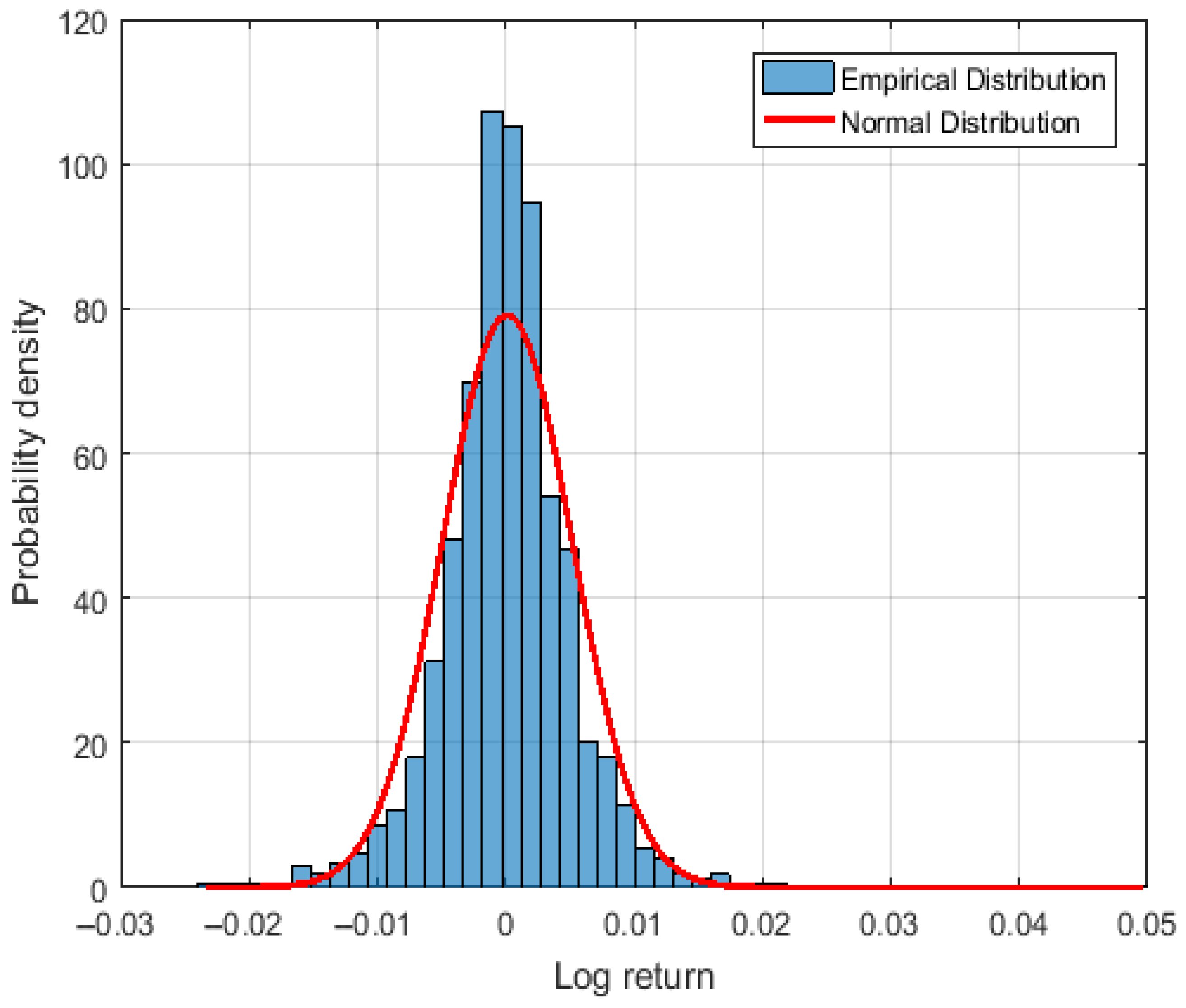
The histogram presented in
Figure 3 shows that the distribution of log returns is centered around zero but exhibits heavier tails than the normal distribution, suggesting the frequent occurrence of extreme exchange rate movements. This departure from normality reinforces the need for stochastic volatility models capable of capturing asymmetric and non-Gaussian behavior. Although the histogram in
Figure 3 provides visual evidence of heavy-tailed behavior, a rigorous assessment of the distributional characteristics requires formal statistical measures. Accordingly,
Table 3 reports descriptive statistics and normality tests to complement the visual inspection with quantitative evidence.
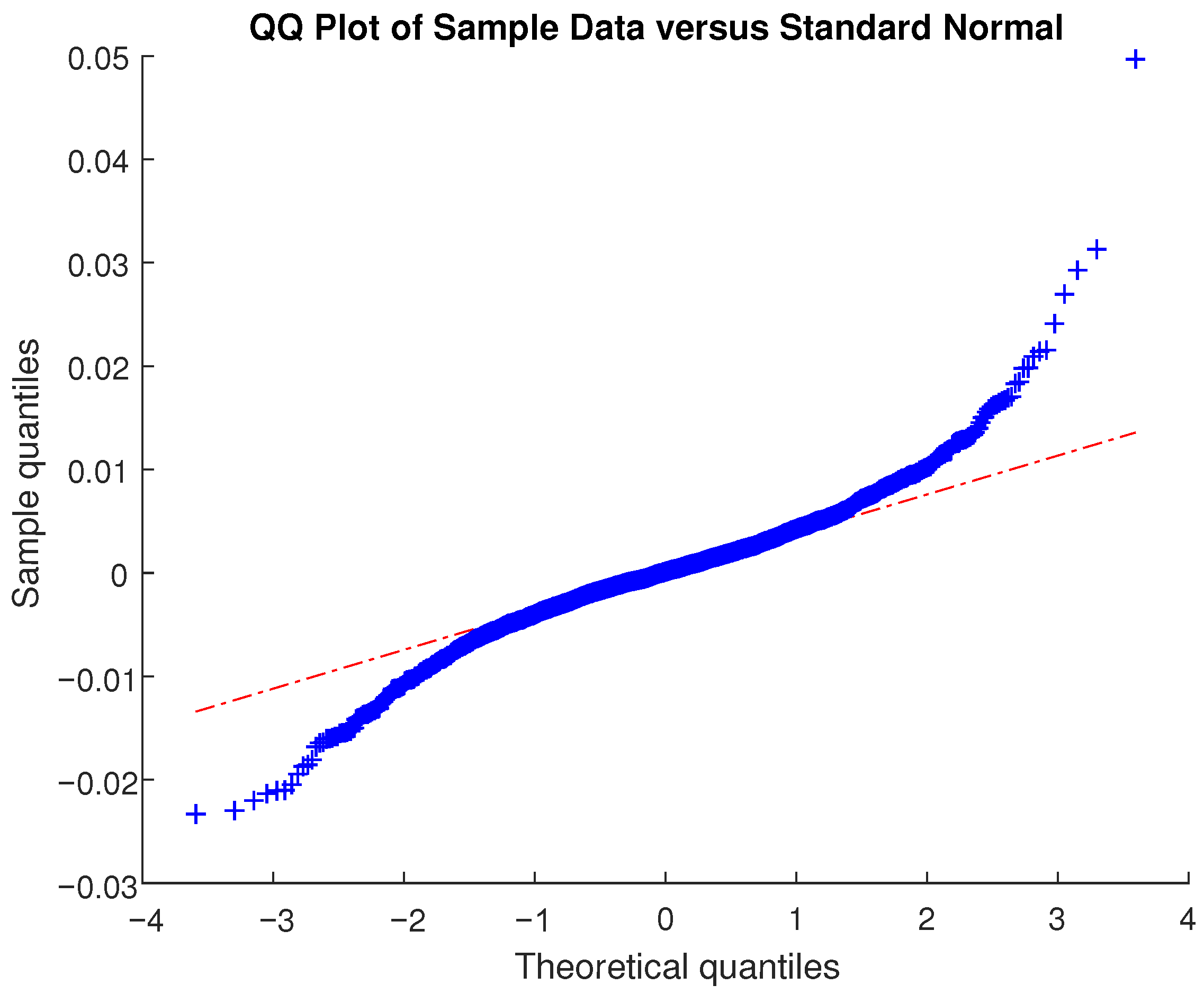
Table 3 reports the descriptive statistics of both the exchange rate series in levels and its logarithmic returns, enabling a comparison between the behavior of the series in levels and the probabilistic properties of returns. For the exchange rate levels, the mean is 88.611 with a relatively moderate standard deviation. The kurtosis value of 2.130, which is below the normal benchmark of 3, suggests a distribution that is less leptokurtic than the normal distribution. However, the Jarque–Bera statistic (232.46) strongly rejects the null hypothesis of normality, likely reflecting the presence of trend and non-stationarity in the level series. In contrast, the return series exhibits markedly different characteristics. The mean is close to zero (0.011), consistent with the efficient market hypothesis. Nevertheless, the relatively high standard deviation compared to the mean indicates substantial volatility. More importantly, the kurtosis value of 8.967—well above the normal benchmark—reveals pronounced heavy-tailed behavior and a higher probability of extreme observations. The Jarque–Bera statistic of 4597 decisively rejects the normality assumption. To visually assess the deviation of the distribution from normality, a QQ plot is employed.
The QQ plot in
Figure 4 compares the distribution of the log returns to a standard normal distribution. This helps in assessing the normality of the data. Deviations from the straight line suggest non-normality, which can be crucial in identifying fat tails or other distributional properties often present in financial time series. This analysis aids in justifying the need for more sophisticated models to capture the distribution of returns.
Moving on to
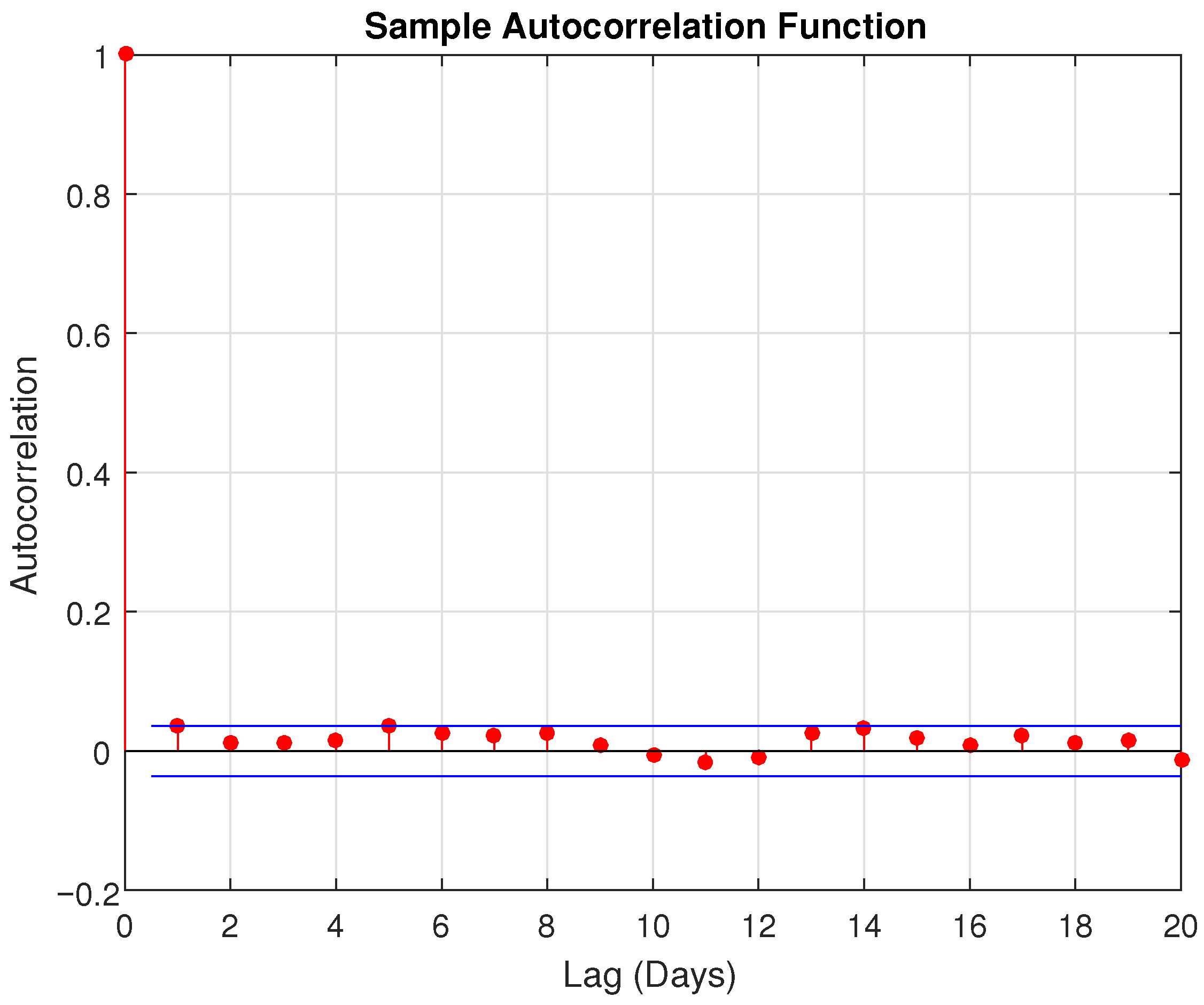
Figure 5, the autocorrelation plot provides insight into the presence of any correlation between current and past values of the log returns. By examining different lags, it becomes possible to identify if the returns follow any predictable pattern or if they are uncorrelated over time. This step is crucial for determining whether past movements have an impact on future returns, a key aspect in modeling financial time series.
The partial autocorrelation plot in
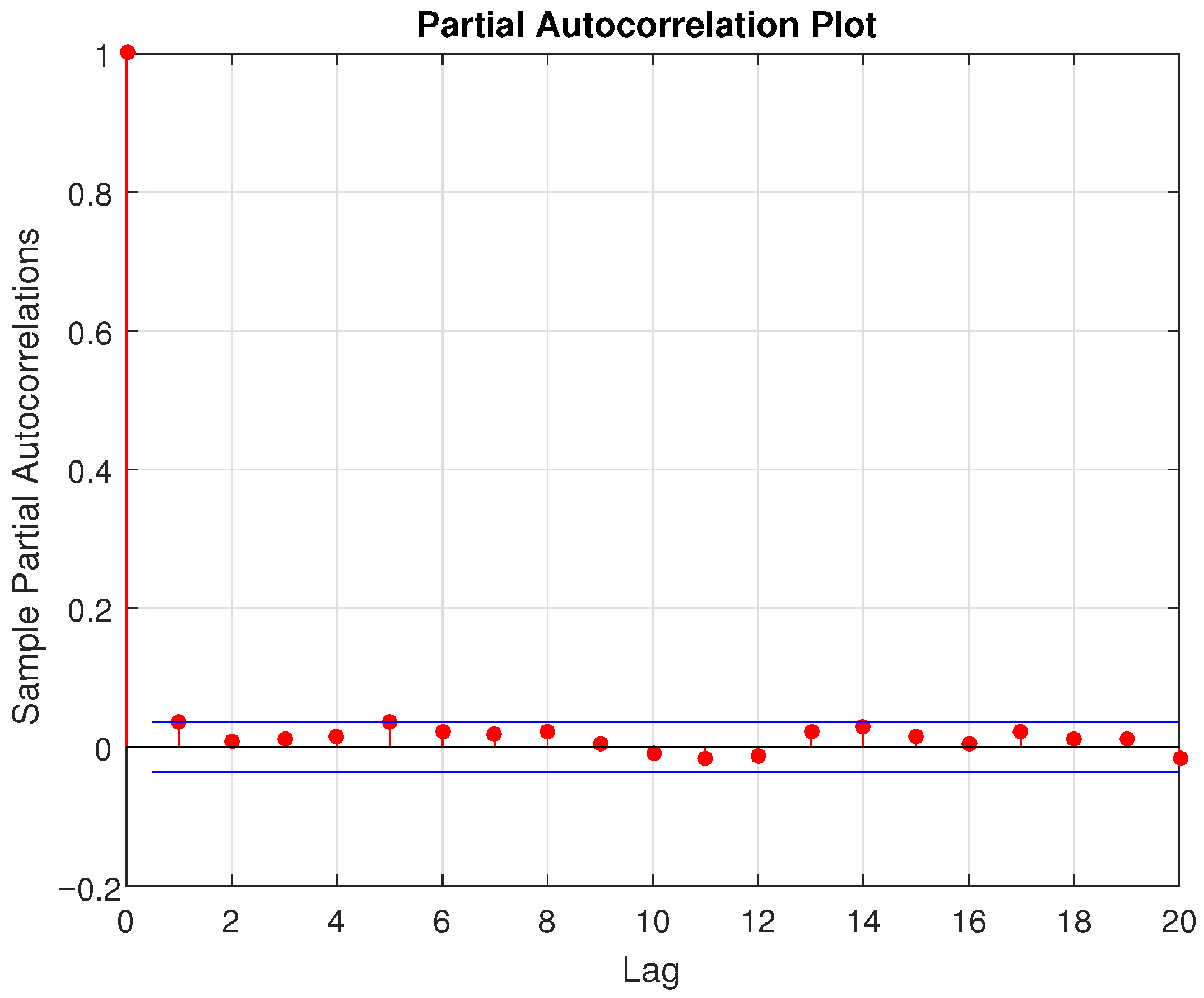
Figure 6 offers more detailed insights into the dependency structure by removing the influence of intermediary lags. This allows us to pinpoint the lags at which log returns are most significantly correlated with themselves, helping in model specification, particularly when deciding how many lagged terms to include. In the present case, however, the empirical evidence does not support the inclusion of additional ARMA dynamics. It is worth noting that the lack of linear autocorrelation seen in
Figure 5 and
Figure 6 is not due to any pre-whitening or decorrelation procedure. Instead, the autocorrelation and partial autocorrelation functions were directly computed from the raw logarithmic returns series. This observation reflects a well-known empirical feature of exchange rate returns: linear dependence in the conditional mean is generally weak or negligible, while the conditional variance often exhibits strong dependence. For this reason, no additional ARMA terms were included or estimated in the mean equation, as the ACF and PACF plots do not display visually significant spikes. Rather, the time dependence is captured through a variance component that is both periodic and asymmetric. In our Monte Carlo simulations, a zero-mean process without ARMA dynamics was used solely to isolate and evaluate the performance of the variance mechanism. This specification choice is therefore empirically motivated. Since linear dependence in the mean appears to be weak, attention shifts to modeling the conditional variance dynamics.
The rolling volatility plot in
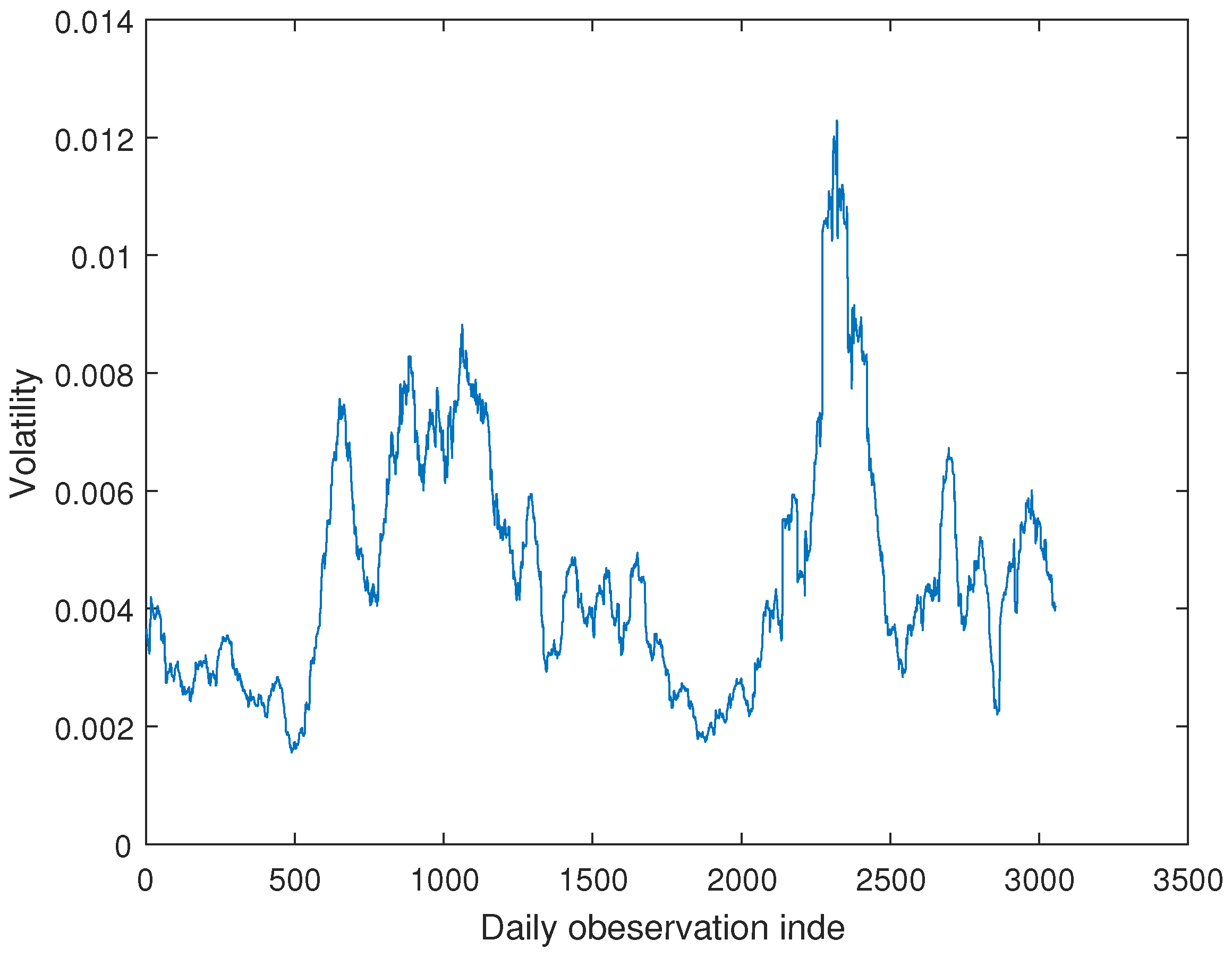
Figure 7 shows the standard deviation of log returns over time, giving a clearer representation of how volatility evolves dynamically. By averaging over a rolling window, we can observe smoother trends in the volatility. This step is key for understanding how volatility behaves over time, particularly when modeling stochastic volatility as in the PlogAG-SV framework. After establishing the presence of time-varying volatility, we proceed to test for weekly periodicity.
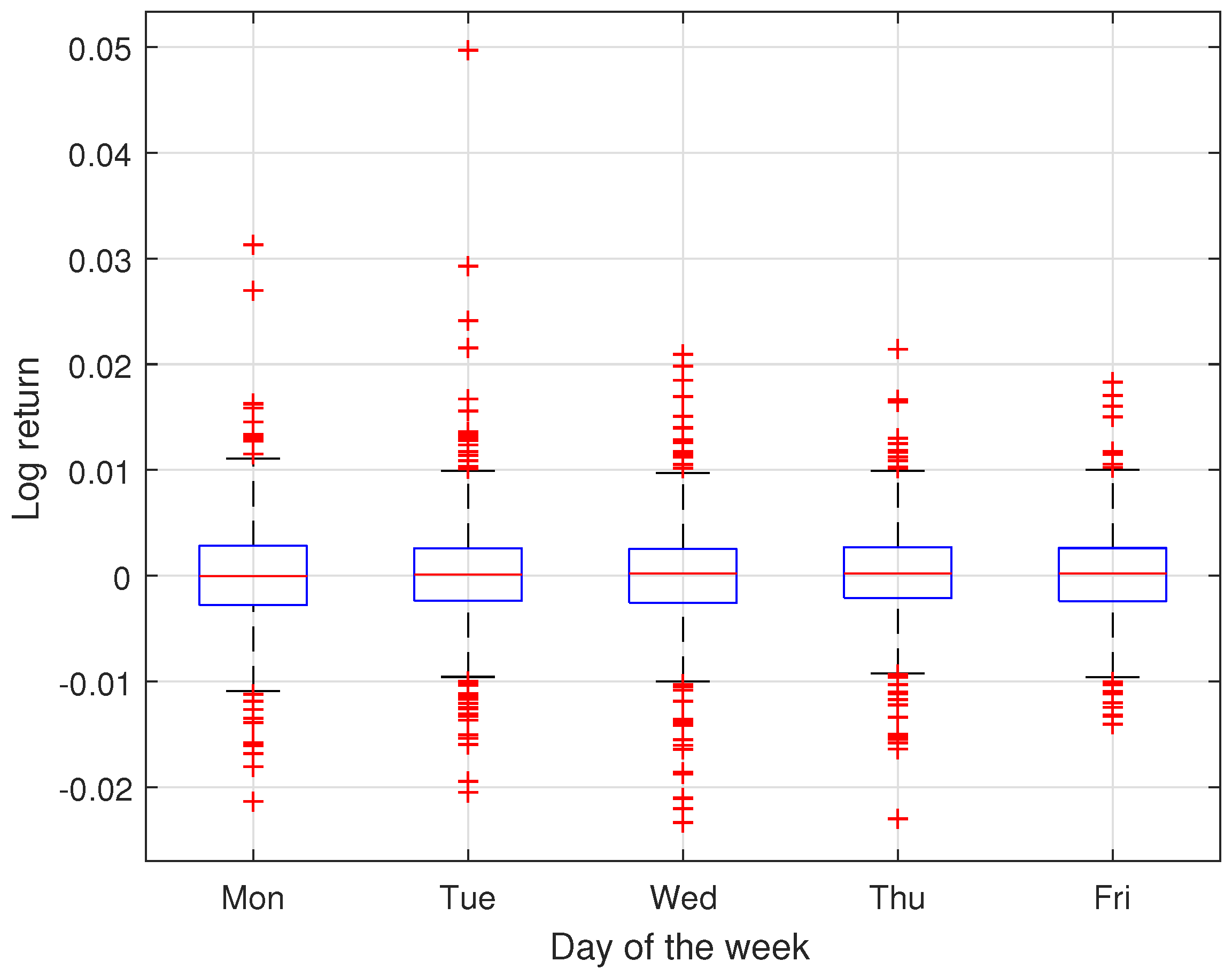
Figure 8 reveals noticeable differences in return dispersion across the days of the week. Certain days—often midweek—exhibit higher volatility levels compared to the beginning or end of the week. This provides visual evidence of weekly periodicity in variance dynamics. Having characterized the periodic structure, the analysis now proceeds to evaluate the adequacy of the estimated model.
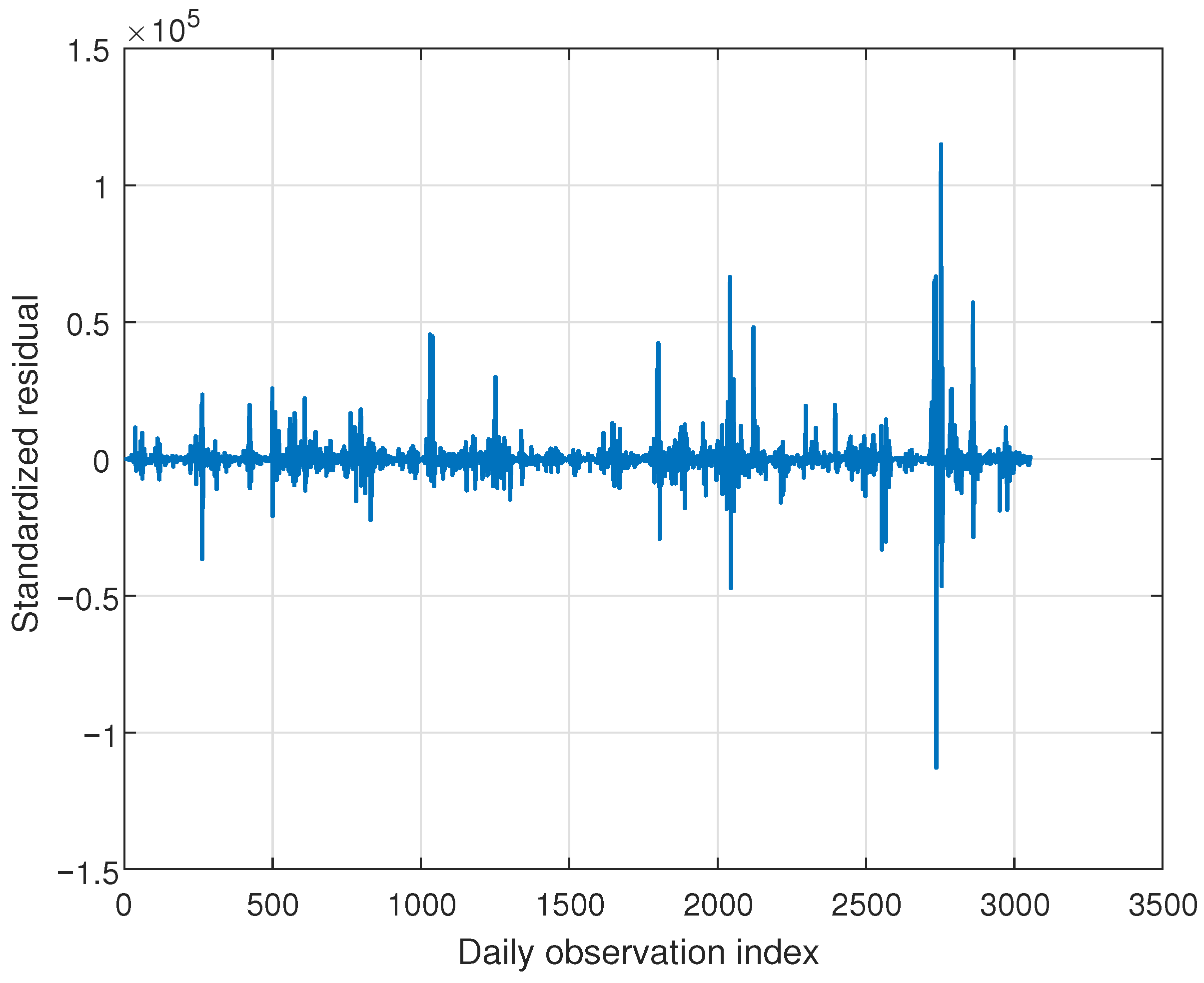
Figure 9 shows that the standardized residuals are centered around zero and do not exhibit any discernible systematic pattern, suggesting that the model adequately captures the conditional mean dynamics.
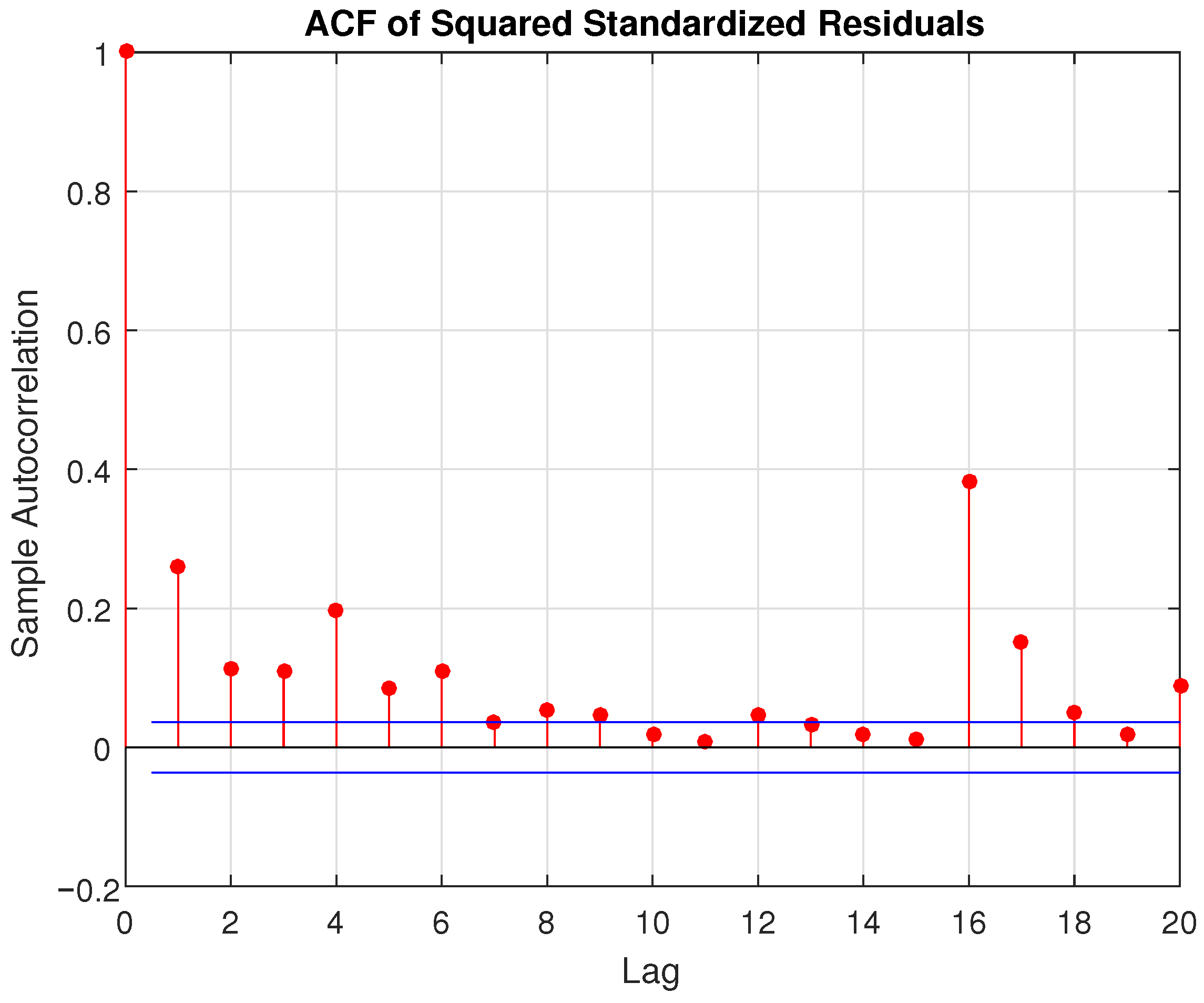
Figure 10 presents a diagnostic evaluation of the adequacy of the conditional variance specification. The autocorrelation function of the standardized residuals shows that the estimated coefficients remain within the statistical confidence bounds for nearly all lags, with no evidence of systematic or persistent dependence. Having established the adequacy of the variance specification, we next examine whether volatility dynamics display asymmetric responses to past shocks. Specifically, we assess whether negative and positive returns of comparable magnitude generate different levels of subsequent conditional volatility.
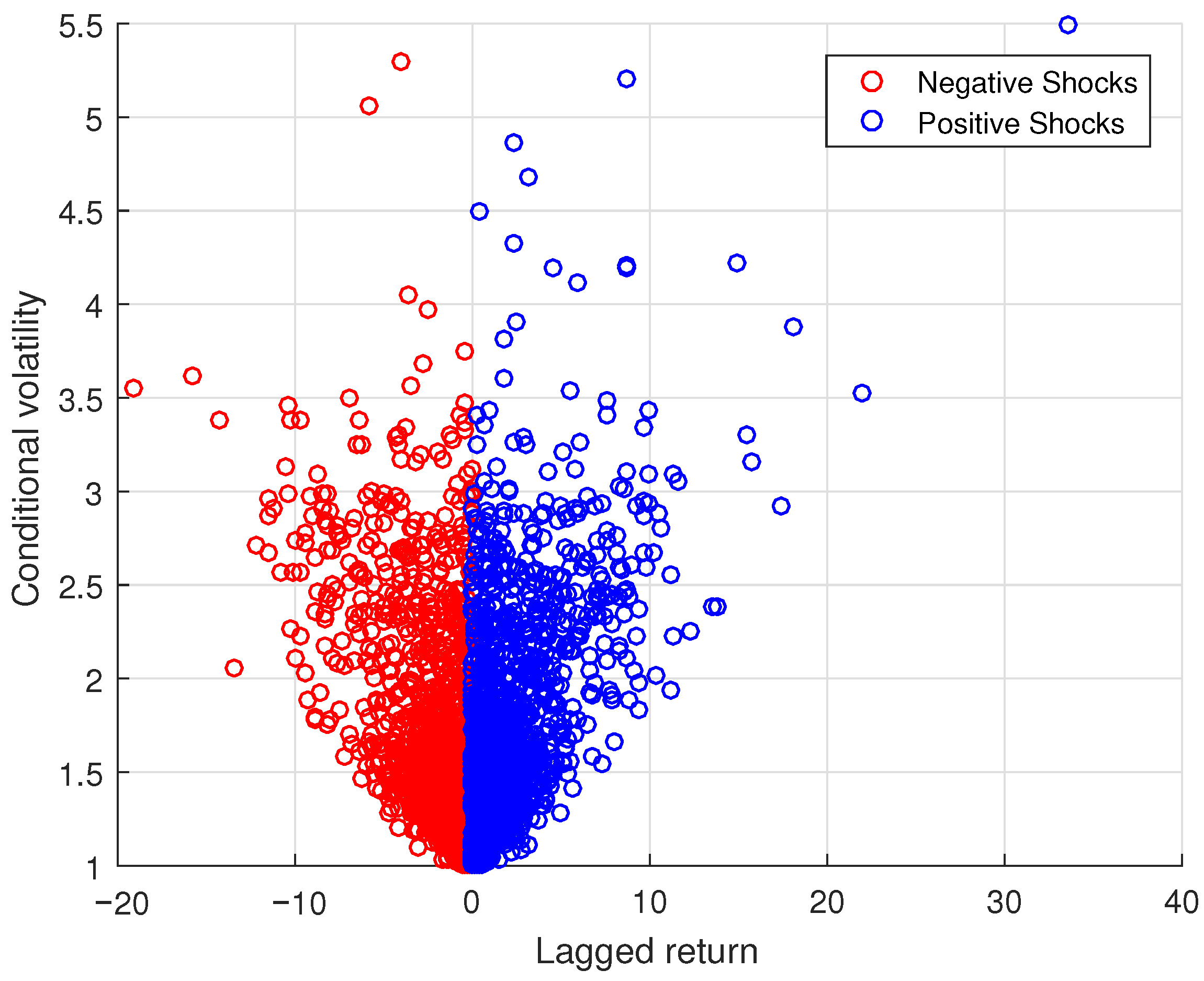
Figure 11 illustrates the relationship between lagged returns and subsequent conditional volatility, distinguishing between negative and positive shocks. A clear asymmetry emerges: negative shocks are associated with higher subsequent volatility than positive shocks of comparable magnitude. This pattern is consistent with the well-documented leverage effect in financial markets, whereby negative news increases uncertainty and risk perceptions more strongly than positive news. The dispersion of observations corresponding to negative returns reveals a sharper and more pronounced volatility response, indicating that downward movements in the Algerian dinar–euro exchange rate exert a stronger influence on future volatility dynamics. These findings provide empirical support for incorporating asymmetric effects within the PlogAG-SV framework. By capturing differential responses to shocks, the model gains greater flexibility and improves its ability to represent nonlinear volatility transmission mechanisms in the Algerian foreign exchange market.
5.2. Estimation Results for the Dinar Exchange Rate
Against the Euro
This subsection presents the empirical results from estimating the proposed periodic PlogAG-SV model using Algerian dinar–euro exchange rate returns. To evaluate the empirical relevance of incorporating periodicity and asymmetry, the results are systematically benchmarked against those from the standard logAG-SV model. The estimation explicitly accounts for the day-of-the-week periodic structure embedded in the PlogAG-SV specification. This enables an investigation into whether key features of volatility—including its persistence, level, and asymmetric response to shocks—exhibit significant variation across trading days. Such an analysis provides deeper insights into the temporal heterogeneity of exchange rate volatility. The estimated parameters and their standard errors are reported in
Table 4.
Table 4 presents the parameter estimates for the periodic PlogAG-SV model alongside those of its aperiodic counterpart, the standard logAG-SV model. The estimates confirm that the periodic model satisfies the conditions for strict periodic stationarity, whereas the aperiodic model meets the conventional (non-periodic) stability conditions. This alignment validates our theoretical results and is consistent with established empirical findings in financial econometrics. A detailed analysis of the periodic parameters reveals substantial day-of-the-week heterogeneity in volatility dynamics. Specifically, the persistence measures in the PlogAG-SV model—primarily governed by the periodic autoregressive coefficients
and the asymmetric feedback parameters
and
—are systematically lower than the constant persistence parameter of the standard logAG-SV model. This indicates that volatility shocks dissipate more rapidly under the periodic specification. Notably, the estimated persistence levels for Tuesday and Wednesday are markedly higher than those for Monday, Thursday, and Friday. This pattern suggests that midweek volatility shocks exhibit greater persistence, whereas shocks occurring at the beginning and end of the trading week fade more quickly. This finding demonstrates the PlogAG-SV model’s capacity to uncover nuanced asymmetric and periodic volatility transmission channels that are inherently obscured by aperiodic model specifications. In summary, these results affirm that the periodic PlogAG-SV framework delivers a more nuanced and empirically grounded representation of volatility dynamics. It successfully captures the heterogeneous propagation of shocks across different trading days, representing a clear and significant advancement over the standard logAG-SV benchmark. To further evaluate the out-of-sample forecasting performance of the proposed model, we examine its ability to capture extreme risks (tail events) by comparing the Value-at-Risk (VaR) coverage rates of the PlogAG-SV model with those of the standard logAG-SV model across multiple confidence levels.
Table 5 reports the empirical coverage probabilities of the Value-at-Risk (VaR) forecasts generated by the standard logAG-SV and the proposed PlogAG-SV models across various confidence levels. Overall, both models produce coverage rates that are close to their nominal (theoretical) levels, suggesting that their predictive distributions are reasonably well calibrated. A closer inspection, however, shows that the PlogAG-SV model consistently attains marginally higher and more accurate empirical coverage at all confidence levels. This enhancement is most pronounced at the more extreme 95% and 99% levels, where precise modeling of the distribution tails is paramount. The superior performance of the PlogAG-SV model can be attributed to its integrated capacity to capture both periodic (day-of-the-week) patterns and asymmetric (leverage) effects in volatility. This dual mechanism grants the model greater flexibility to adapt to the evolving structure of daily returns in the Algerian dinar–euro exchange rate. These findings indicate that, relative to the standard aperiodic benchmark, the periodic asymmetric (PlogAG-SV) specification yields more reliable VaR forecasts and demonstrates superior predictive accuracy, particularly in the presence of periodic fluctuations and asymmetric responses to market shocks. To further assess the relative in-sample goodness-of-fit of the competing volatility models,
Table 6 presents a comparative evaluation based on the maximized log-likelihood values for the Algerian dinar–euro exchange rate return series.
According to the Bayesian Information Criterion (BIC), the PlogAG-SV model demonstrates superior performance, attaining the lowest BIC value among all fitted models (
Table 6). The BIC decreases markedly when transitioning from standard symmetric models to those incorporating asymmetry and periodicity. Although both the standard logAG-SV and the symmetric periodic logG-SV (PlogG-SV) models offer improvements over basic benchmarks, their BIC values remain substantially higher than that of the proposed PlogAG-SV model. This indicates that jointly accounting for periodicity and asymmetry achieves a more favorable trade-off between model fit and parsimony. Notably, despite its greater parametric complexity, the significant reduction in BIC for the PlogAG-SV model confirms that this additional complexity is strongly supported by the data. These results provide compelling empirical evidence for the proposed periodic asymmetric stochastic volatility framework in modeling the log-returns of the Algerian dinar–euro exchange rate.
5.3. Summary of Empirical Results
The empirical results consistently indicate that the Algerian dinar–euro exchange rate exhibits pronounced cyclical and asymmetric volatility dynamics. The estimation results reveal significant day-of-the-week variation in volatility persistence and shock transmission, with midweek volatility displaying greater continuity relative to the beginning and end of the week. Diagnostic assessments confirm the adequacy of both the conditional mean and variance specifications, as no statistically significant residual serial dependence is detected. Moreover, model comparisons based on information criteria and Value-at-Risk (VaR) coverage tests demonstrate that incorporating both cyclicality and asymmetry yields substantial improvements in goodness-of-fit and tail risk forecasting performance. Taken together, these findings provide strong empirical support for the proposed PlogAG-SV framework and underscore the importance of modeling volatility as a cyclical and asymmetric stochastic process to achieve a more accurate representation of exchange rate dynamics.
5.4. Discussion
The empirical findings of this study align with, and meaningfully extend, prior research on asymmetric and periodic stochastic volatility models. Beyond a descriptive comparison of competing specifications, a detailed examination of the estimated parameters provides deeper insight into the underlying volatility mechanisms. The periodic persistence coefficients indicate that volatility clustering is not homogeneous across sub-periods, implying that shock propagation depends on the temporal structure of the market. In addition, the estimated asymmetry parameters reveal that negative shocks exert a stronger and more persistent impact on volatility than positive shocks of comparable magnitude, with this effect varying systematically across trading days. These results support the hypothesis that periodic market structure and asymmetric information transmission jointly shape volatility persistence. From a risk management perspective, this dynamic interaction helps explain the superior Value-at-Risk (VaR) performance of the proposed PlogAG-SV model, as the joint modeling of periodicity and asymmetry enables a more accurate representation of tail behavior.
These findings are consistent with the periodic logGARCH framework developed by Ghezal (2021, [
9]) and the PTAR-SV structure proposed by Ghezal and Alzeley (2024, [
15]), both of which emphasize periodic stability and time-varying volatility parameters. However, unlike the PTAR-SV specification, the proposed PlogAG-SV model directly embeds asymmetric logarithmic feedback within a periodic stochastic volatility framework, allowing for a more flexible interaction between observed returns and latent volatility innovations. Compared with the threshold-based periodic volatility model (logTG-SV) introduced by Alraddadi (2025, [
17]), which primarily captures regime-dependent nonlinear adjustments, the present framework explicitly integrates periodic heterogeneity into the variance dynamics itself. This structural feature makes the model particularly well suited to financial markets where calendar-related effects play a systematic role in volatility transmission.
Empirically, the results confirm that fluctuations in the Algerian dinar–euro exchange rate are not only asymmetric but also exhibit pronounced periodic heterogeneity across trading days. The substantial improvement in BIC values and VaR coverage performance suggests that neglecting periodic structure may lead to misspecified persistence dynamics and potentially biased downside risk evaluation. More broadly, these findings contribute to the growing literature on nonlinear stochastic volatility modeling in emerging markets, where structural frictions, liquidity constraints, and market segmentation often generate recurring periodic patterns. Nevertheless, several limitations should be acknowledged. First, the empirical analysis is based on a single exchange rate series, which may limit the generalizability of the conclusions. Second, the model assumes independently and identically distributed innovations and does not explicitly account for structural breaks or regime-switching mechanisms. Third, although quasi-maximum likelihood estimation provides consistent estimators under standard regularity conditions, small-sample distortions may arise in highly nonlinear environments. These considerations open avenues for future research involving multi-asset extensions, regime-dependent periodic structures, and more flexible innovation distributions.