1. Introduction
The geometry of curves and surfaces in Lorentzian manifolds plays a central role in differential geometry and relativistic physics. Among such spaces, Minkowski three-space
provides the simplest yet most fundamental model for spacetime geometry, serving as a natural arena for the investigation of relativistic trajectories, worldlines, and ruled world sheets. Classical curve theory in
has been extensively developed through Lorentzian extensions of the Frenet–Serret formalism, uncovering a wide range of geometric phenomena governed by curvature and torsion invariants [
1,
2,
3]. Nevertheless, the Frenet frame requires non-vanishing curvature and exhibits intrinsic rotational behavior, which may limit its effectiveness in both theoretical investigations and applied contexts.
For curves constrained to surfaces, the Darboux frame offers a natural alternative by incorporating surface geometry via geodesic curvature, normal curvature, and geodesic torsion [
1,
4]. In Lorentzian geometry, Darboux frames have been successfully employed in the analysis of space-like and time-like curves on surfaces, as well as in the study of the associated ruled surfaces [
5]. Despite these advantages, the Darboux frame still inherits rotational features from Frenet theory, which can obscure geometric interpretation, particularly in settings where causal structure is essential.
Rotation-minimizing (RM) frames, originally introduced by Bishop in the Euclidean context, provide an alternative framing that suppresses unnecessary rotation of the normal plane along a curve [
6]. RM frames have found applications in geometric modeling, computer graphics, elastic rod theory, and numerical curve evolution [
7,
8]. Their extension to Lorentzian and pseudo-Riemannian manifolds has revealed smoother behavior and improved analytical stability when compared with Frenet frames [
3,
9], making them especially suitable for the study of relativistic curves and surfaces.
Inspired by these developments, ruled surfaces generated by RM frame vector fields have been investigated in both Euclidean and Lorentzian settings [
10,
11]. Such surfaces naturally arise in swept surface modeling, spacetime world sheet descriptions, and flux surfaces in relativistic field theories [
12,
13,
14,
15,
16]. In Minkowski space, the causal nature of the generating curve significantly affects both intrinsic and extrinsic surface geometry, producing behaviors absent in the Euclidean case [
17,
18]. However, a unified RM-based formulation adapted to curves lying on surfaces, analogous to the classical Darboux theory, has not yet been fully developed.
More recently, RM Darboux frames have been introduced as a synthesis of Darboux surface adaptation and RM minimal rotation [
11,
19,
20]. These frames yield simplified curvature expressions and provide clearer insight into curve surface interactions in Lorentzian manifolds. They have also demonstrated potential applications in relativistic kinematics, magnetic curve theory, and geometric evolution problems in pseudo-Riemannian spaces [
21]. These considerations have motivated the formulation of a unified and systematic RM Darboux framework in Minkowski three-space.
The objective of this work is to establish such a unified rotation-minimizing Darboux framework for curves and relativistic ruled surfaces in . We derive the evolution equations of the Lorentzian RM Darboux frame for unit speed non-null curves and obtain explicit relations linking RM curvature functions with classical Frenet and Darboux invariants. Using this framework, several families of ruled surfaces are constructed via RM frame vectors, and complete characterizations of developability, minimality, and flatness are formulated purely in terms of RM curvature data. The results emphasize the decisive role of causal character in shaping surface geometry and demonstrate that the RM Darboux approach provides a powerful and geometrically meaningful tool for modeling curve-driven geometries in Lorentzian space.
The novelty of the present work lies in the development of a fully unified rotation minimizing (RM) Darboux framework for curves and ruled surfaces in Minkowski three-space. Unlike existing RM-based approaches, the proposed formulation systematically integrates surface adaptation with minimal normal plane rotation in a Lorentzian setting. Within this framework, we derive explicit relations between RM curvature functions and the classical Frenet and Darboux invariants, and we establish the necessary and sufficient conditions for developability, minimality, and flatness expressed purely in terms of RM curvature quantities. Furthermore, a complete geometric classification of RM ruled surfaces is obtained via the behavior of their parametric curve families, providing a unified and transparent description that extends and generalizes the previously known results in Minkowski space. In particular, the unified RM Darboux formulation and the resulting classification criteria are genuinely new, while several existing RM- and Darboux-based ruled surface constructions appear as special cases of the present theory. The incremental gain over the prior works lies in the systematic characterization of geometric properties using RM curvature functions alone, independent of specific causal types or ad hoc assumptions on the generating curves.
The structure of the paper is as follows.
Section 2 presents the necessary geometric background in Minkowski three-space
and introduces a unified treatment of the Frenet, Darboux, and Lorentzian RM Darboux frames for unit speed non-null curves, together with their evolution equations and invariant relations. In
Section 3, a general family of RM ruled surfaces is constructed using RM Darboux frame vector fields, and explicit formulas for the fundamental forms, unit normal vector, and curvature invariants are obtained. Developability, minimality, and flatness conditions are characterized in terms of RM curvature functions and director coefficients.
Section 4 is devoted to the geometric classification of RM ruled surfaces through the analysis of their parametric curves, providing criteria for geodesic, asymptotic, and principal curve families.
Section 5 presents several explicit space-like and time-like examples that illustrate the theoretical results and highlight the impact of causal character on surface geometry. Finally,
Section 6 summarizes the main conclusions and outlines possible directions for future research.
2. Geometric Preliminaries and RM Darboux Frames
This section introduces the fundamental concepts from the theory of curves and surfaces in Minkowski three-space that will be required in the sequel. We briefly review Lorentzian, Frenet, and Darboux frames and then present the rotation-minimizing (RM) Darboux frame, which plays a central role in our construction. Standard surface invariants and curvature formulas are also recalled for completeness.
Let
denote Minkowski three-space equipped with the Lorentzian inner product
which induces a pseudo-Euclidean geometry of signature
.
A vector
is said to be time-like, space-like, or light-like accordingly as
respectively [
1,
2].
Consider a smooth non-null curve
parametrized by arc length
s, satisfying
The unit tangent vector of
is denoted by
. If the curvature
of
does not vanish, the principal normal vector
and the binormal vector
are defined by
with causal signatures
The Lorentzian Frenet–Serret equations are given by [
1,
4]
where
and
denote the curvature and torsion of
, respectively.
Let
be an oriented regular surface with a unit normal vector field
n. For a curve
lying on
M, the associated Darboux frame
is defined by
The evolution of this frame is governed by the Lorentzian Darboux equations
where
,
, and
denote the geodesic curvature, normal curvature, and geodesic torsion, respectively [
1,
4].
A different choice of moving frame is obtained by minimizing the rotation of the normal plane along the curve. The Lorentzian rotation-minimizing (RM) Darboux frame
satisfies
where
and
are the RM curvature functions. In contrast to the Frenet and Darboux frames, this framing avoids superfluous rotation of the normal vectors and remains well defined in degenerate situations [
3,
6,
9,
11,
19].
Let
be a regular parametrization of a surface
. The first fundamental form of
M is expressed as
with coefficients
The second fundamental form is given by
where
and
n denotes the unit normal vector field of
M. The Gaussian curvature
K and mean curvature
H are defined by
whenever
. Here, the factor
accounts for the causal character of the unit normal vector and ensures that the curvature expressions are valid for both space-like and time-like surfaces in Minkowski space. These quantities describe the intrinsic and extrinsic geometry of surfaces in Minkowski space [
2,
4].
Definition 1. Let be a smooth non-null curve and let be a smooth non-zero vector field along δ. A surface is said to be a ruled surface
if it admits a parametrizationwhere δ is called the base curve and is referred to as the director vector field [22,23,24,25]. Remark 1. The Frenet frame considered here is defined for non-null curves whose principal normal vector is also non-null. Space-like curves admitting a null principal normal, commonly referred to as pseudo-null curves, are not included in this setting. Since the standard Frenet construction degenerates in that case, such curves fall outside the scope of the present analysis.
Throughout this paper, we work with curves that are non-null and parametrized by arc length, unless explicitly stated otherwise. The corresponding RM Darboux frame is assumed to be orthonormal with respect to the Minkowski metric. All geometric quantities are considered only on parameter domains where the relevant curvature functions are well defined and no denominators vanish. Accordingly, the formulas for the first and second fundamental forms, as well as for the Gaussian and mean curvatures of the associated ruled surfaces, are valid only away from singularities of the parametrization. It is also noted that the causal type of the ruled surface may depend on the parameters , and all geometric expressions are interpreted locally according to this causal behavior.
The symbols , , and indicate the causal characters of the RM Darboux frame vectors T, U, and V, respectively, with satisfying . Similarly, and denote the causal characters of the director vector field and the unit normal vector field n of the ruled surface. The introduction of these sign parameters enables a uniform formulation of the results for both space-like and time-like configurations within the Lorentzian framework of .
Remark 2. The scope of the present work is confined to non-null curves and ruling directions in Minkowski three-space. Configurations involving light-like elements are excluded, since the RM Darboux frame cannot be constructed in a regular manner in such cases. Furthermore, all statements and classifications are to be understood on regular regions of the parameter domain, excluding points where the ruled surface parametrization becomes degenerate.
3. Construction of General RM Ruled Surfaces with Lorentzian Normalization
Let
be a unit speed non null curve endowed with the Lorentzian RM Darboux frame
, where
Let
,
, be smooth functions satisfying the Lorentzian normalization condition
A surface
is called a general RM ruled surface if it admits a parametrization
where the director vector field
is given by
The ruled surface is classified as spacelike or time-like according to the causal character of the induced metric on its tangent plane, or equivalently by the sign of
, where
n denotes the unit normal vector field of the surface. The causal character of the director vector field
influences the surface geometry but is not sufficient on its own to define the causal type of the surface.
Using the RM Darboux equations, the derivative of
is computed as
For
, we have
Then the coefficients of the first fundamental form
are given by
where
Lemma 1. Let be a general RM ruled surface. The (unnormalized) normal vector field of Φ is defined bywhere × denotes the Lorentzian cross product in . The corresponding unit normal vector field iswhereand α, β and γ are given by (6). Proof. Let
be a general RM ruled surface along the unit speed curve
endowed with the Lorentzian RM Darboux frame
. Differentiating
with respect to
s and
v, we obtain
Using the RM Darboux equations, the derivative of the director field is written as
where
By definition, the unnormalized normal vector field of
is
Substituting
and
and using the Lorentzian cross-product relations of the RM frame, we obtain
and
Hence,
Using the orthonormality of the RM Darboux frame, we compute
which coincides with (
7). Provided that
, the unit normal vector field is defined by
By construction, it satisfies
which completes the proof. □
Remark 3. The explicit expression of the normal vector shows that its direction is governed by both the intrinsic geometry of the base curve through the RM curvatures and and the choice of the director field coefficients . In particular, the causal character of the normal vector may vary along the surface depending on the sign of Δ, which reflects the interaction between the ruling direction and the RM evolution of the normal plane. Moreover, when , the normal vector reduces toshowing that the normal direction along the striction curve depends only on the normal components of the ruling and is independent of the RM curvature functions. Geometrically, the condition ensures the non-degeneracy of the tangent plane along the surface. Variations in the sign of Δ may lead to changes in the causal character of the unit normal vector, reflecting the interaction between the ruling direction and the evolution of the RM normal plane along the base curve. Accordingly, all curvature expressions and classification results are understood to hold only on parameter domains where , while points with correspond to singular or degenerate configurations and are excluded from the analysis. Lemma 2. Let be a general RM ruled surface with unit normal vector n. Then the coefficients of the second fundamental form are given bywhere Δ given by (
7).
Proof. Let
be a general RM ruled surface along a unit speed non-null curve
endowed with the Lorentzian RM Darboux frame
. The first partial derivatives of
are
Differentiating once more with respect to
s and
v yields
Using the RM Darboux equations, the derivative of the tangent vector is
and the derivative of the director field is written as
where
Let
n denote the unit normal vector field of the surface. By definition, the coefficients of the second fundamental form are given by
Since
, it follows immediately that
Using
and the expression
we obtain
Substituting the explicit expressions of
and
and using the orthonormality of the RM frame, we compute
which yields the stated expression for
M. From
and
, we have
A direct computation gives
Substituting this into the expression of
L yields the desired formula. Combining the above computations completes the proof. □
Theorem 1. Let be a regular general RM ruled surface in . Then the Gaussian and the mean curvature of Φ is given bywhere Δ given by (7) and Theorem 2. A general RM ruled surface is developable if and only if Equivalently, this condition can be expressed as Proof. A ruled surface is developable if and only if the tangent plane remains constant along each ruling, which is equivalent to
Substituting
and using (
4), the stated condition follows by direct computation, taking into account the causal signs of the RM frame. □
Corollary 1. If and are constants, then the general RM ruled surface is developable if and only if Proof. For constant coefficients, all derivative terms vanish, and the developability condition reduces immediately to the stated relation. □
Theorem 3. Let be a regular general RM ruled surface in . Then the Gaussian curvature of Φ along the striction curve is given bywhere Theorem 4. Let be a regular general RM ruled surface in . Then Φ is developable along the striction curve if and only if Proof. Along the striction curve, the Gaussian curvature is given by (
12). Since
is regular, the denominator of (
12) is non-zero. Therefore,
This proves the claim. □
Theorem 5. Let be a regular general RM ruled surface in . Then Φ is minimal if and only iffor all , where Θ and Ψ are defined in (
11).
Corollary 2. A regular general RM ruled surface is minimal if and only if Corollary 3. Along the striction curve , the ruled surface Φ is minimal if and only if Corollary 4. If the director field has constant components then a general RM ruled surface is minimal if and only ifand Corollary 5. If the ruling direction is orthogonal to the tangent vector then Φ is minimal if and only if Remark 4. The minimality conditions show that RM ruled surfaces balance the curvature of the base curve and the variation of the ruling direction. In particular, minimality forces a strong compatibility between the RM curvatures and the director field coefficients , generalizing classical results for Frenet based ruled surfaces to the Lorentzian RM framework.
Theorem 6. Let be a regular general RM ruled surface in . The mean curvature of Φ along the striction curve is given bywhereandMoreover, Φ is minimal along the striction curve if and only if Proof. From the general expression of the mean curvature
substituting the fundamental coefficients evaluated along the striction curve
yields the explicit Formula (
15). Since
is regular, the denominator in (
15) is non-zero. Therefore,
if and only if the numerator of (
15) vanishes, which leads directly to condition (
16). This completes the proof. □
Corollary 6. If the ruling direction is orthogonal to the tangent vector then Φ is minimal along the striction curve if and only if Corollary 7. If the director coefficients are constant then minimality along the striction curve is equivalent to Remark 5. Along the striction curve, the contribution of the second derivative disappears from the mean curvature. Thus, minimality at is governed purely by the interaction between the RM curvature functions and the orientation of the ruling direction encoded in .
4. Classification of RM Ruled Surfaces by Curve Properties
This section is devoted to the geometric analysis of rotation-minimizing (RM) ruled surfaces in Minkowski three-space from both intrinsic and extrinsic points of view. The classification is carried out by examining the geometric nature of the parametric foliations induced by the surface coordinates. In particular, we determine precise conditions under which the coordinate curves associated with the base parameter and the ruling parameter constitute geodesics, asymptotic curves, or principal curvature lines. The characterization is obtained through the fundamental forms expressed with respect to the RM Darboux frame, allowing all criteria to be written explicitly in terms of the RM curvature functions and the director field components. This approach generalizes classical classifications based on Frenet frames and demonstrates the effectiveness of RM techniques in Lorentzian geometry.
Let
be a regular general RM ruled surface in
, where the director field is expanded relative to the RM Darboux frame as
Theorem 7. The parametric curves corresponding to the s-parameter are geodesics on Φ if and only if the conditionis satisfied. Proof. A curve on a surface is geodesic precisely when its acceleration has no component in the tangent direction orthogonal to the curve. For the
s-curves, the second derivative is given by
. Requiring the tangential projection orthogonal to
to vanish leads to the scalar condition
Substituting the RM frame decomposition of
and simplifying yields the stated relation. □
Theorem 8. The ruling curves (v-curves) of Φ are geodesics if and only if the director field is constant along the base curve; that is, Proof. A surface curve is geodesic when its acceleration vector is normal to the surface. Along each ruling, one has and . Hence, the absence of tangential acceleration occurs exactly when vanishes identically, which is equivalent to . □
Corollary 8. Whenever the ruling curves of Φ are geodesics, the surface reduces to a cylindrical ruled surface with a constant ruling direction.
Proof. From Theorem 8, , so the director field does not vary along . Consequently, the surface is cylindrical. □
Theorem 9. The s-curves of Φ define asymptotic directions if and only ifEquivalently, the following conditions hold: Proof. The normal curvature along the
s-curves is expressed as
Thus the asymptotic condition
is equivalent to
. Since
L depends affinely on the ruling parameter
v, its vanishing for all
forces both the constant and linear coefficients to be zero, yielding the stated conditions. □
Theorem 10. For every regular general RM ruled surface, the ruling curves are asymptotic lines.
Proof. The normal curvature in the direction of the rulings is
For ruled surfaces, the second fundamental coefficient
N vanishes identically. Hence,
, and all
v-curves are asymptotic. □
Theorem 11. The coordinate curves corresponding to both parameters form principal curvature lines if and only if Proof. For a parametrized surface, the condition that the coordinate curves coincide with principal directions is equivalent to the vanishing of the mixed coefficient of the second fundamental form. Thus , which is equivalent to . □
Corollary 9. If both families of parametric curves on a general RM ruled surface are principal curvature lines then the surface is developable.
Remark 6. From a physical viewpoint, ruled surfaces in Minkowski space may be interpreted as world sheets traced by the transport of a spatial or temporal direction along a worldline. Within this interpretation, the rulings represent instantaneous propagation directions, while the s-curves describe the evolution of the generating trajectory. The preceding result shows that when both foliations align with principal directions, the induced world sheet has zero Gaussian curvature, corresponding to a flat, non-accelerating relativistic surface.
Remark 7. The classification (Table 1) reveals that RM ruled surfaces retain the intrinsic flatness characteristic of ruled geometries, while the RM Darboux frame enables a concise and transparent description of geodesic, asymptotic, and principal directions solely in terms of RM curvature data and director coefficients. This constitutes a natural Lorentzian extension of classical Frenet-based results. 5. Explicit Examples and Visualizations
In this section, we illustrate the theoretical developments by constructing several explicit examples of rotation-minimizing (RM) ruled surfaces in Minkowski three-space . Both space-like and time-like base curves are considered. For each case, the corresponding RM Darboux frame is determined explicitly, together with the associated RM curvature functions, and the resulting ruled surfaces are visualized.
Example 1. This example illustrates RM ruled surfaces generated by spacelike base curves and highlights the role of constant RM curvature functions in simplifying the surface geometry.
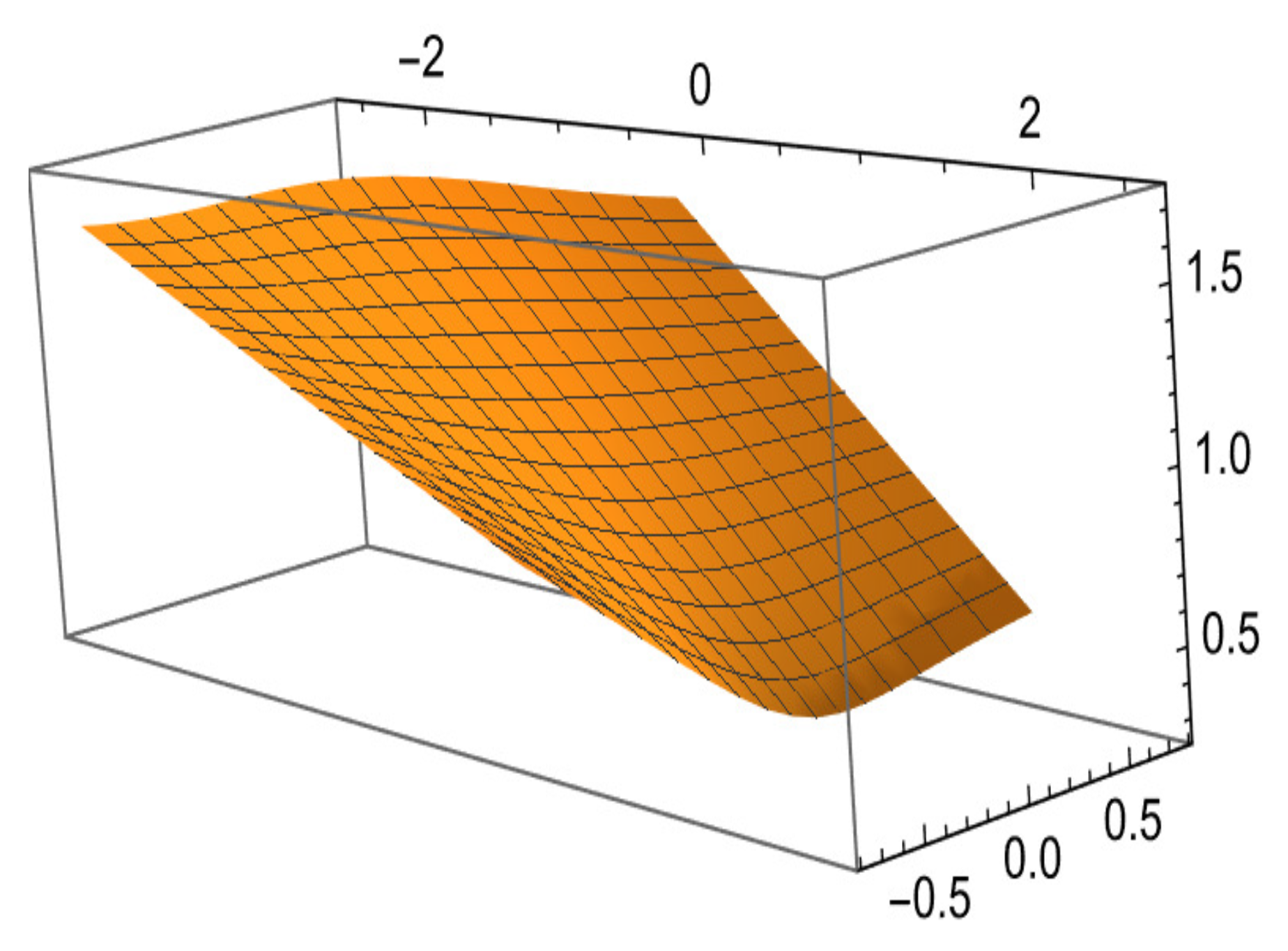
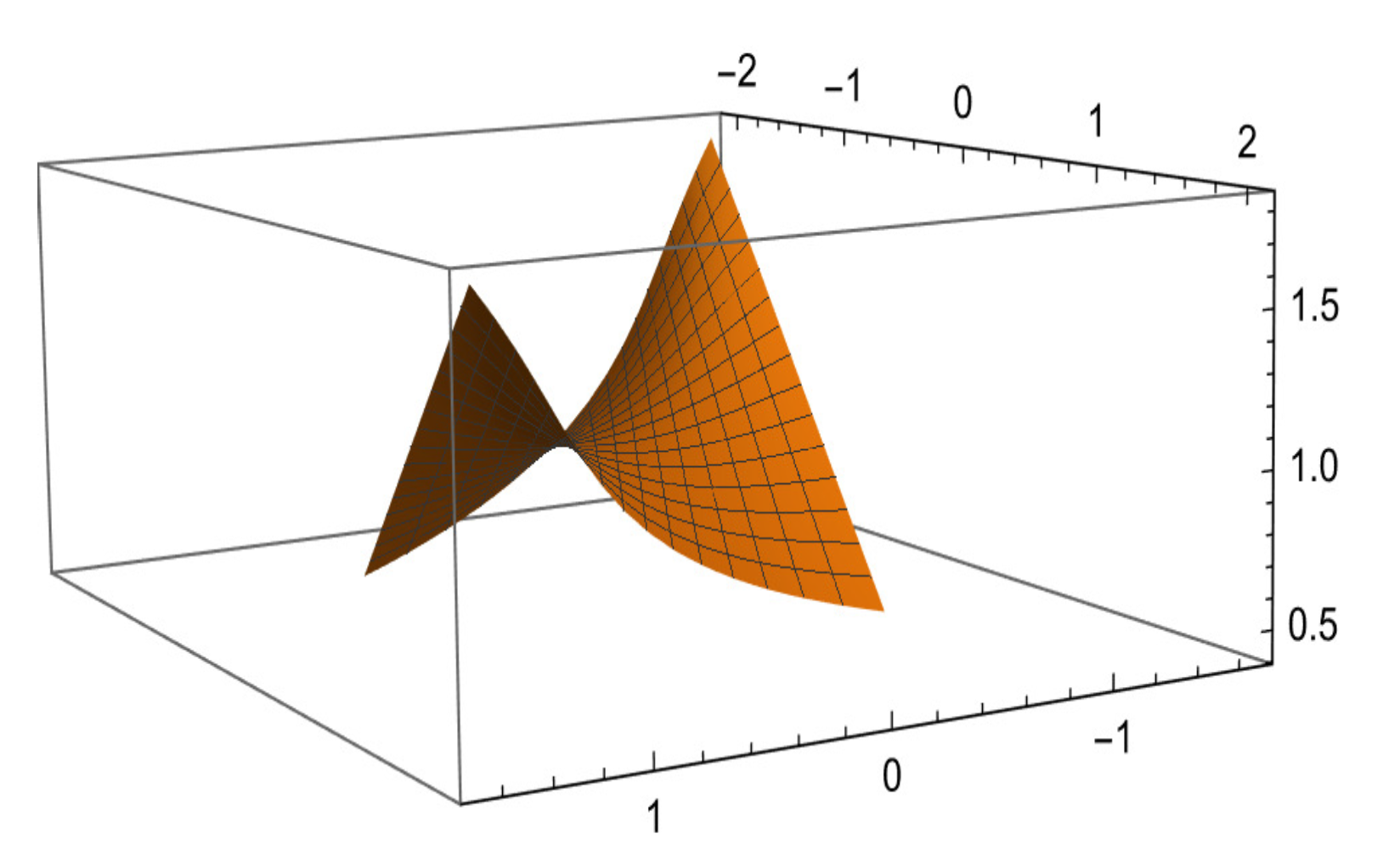
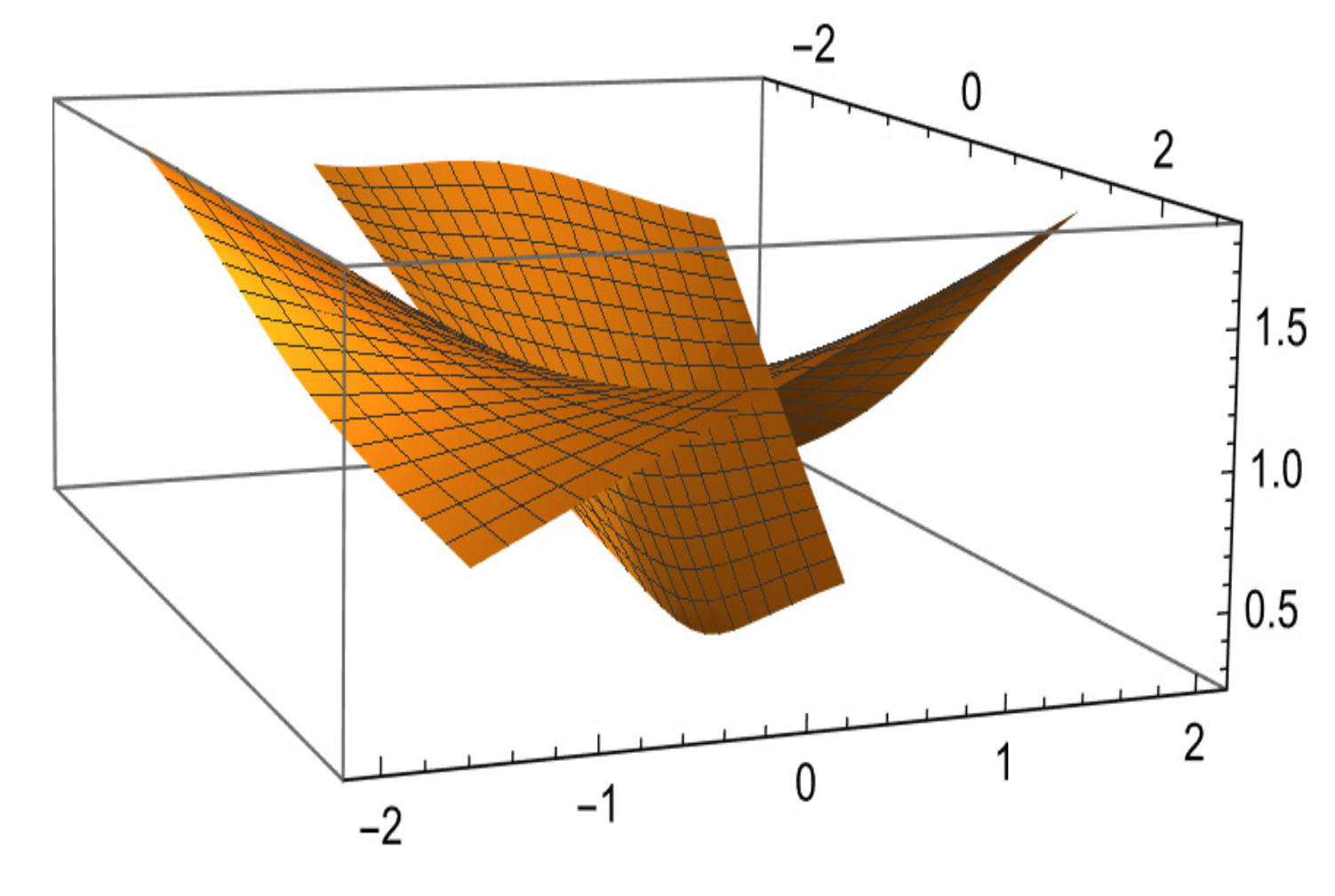
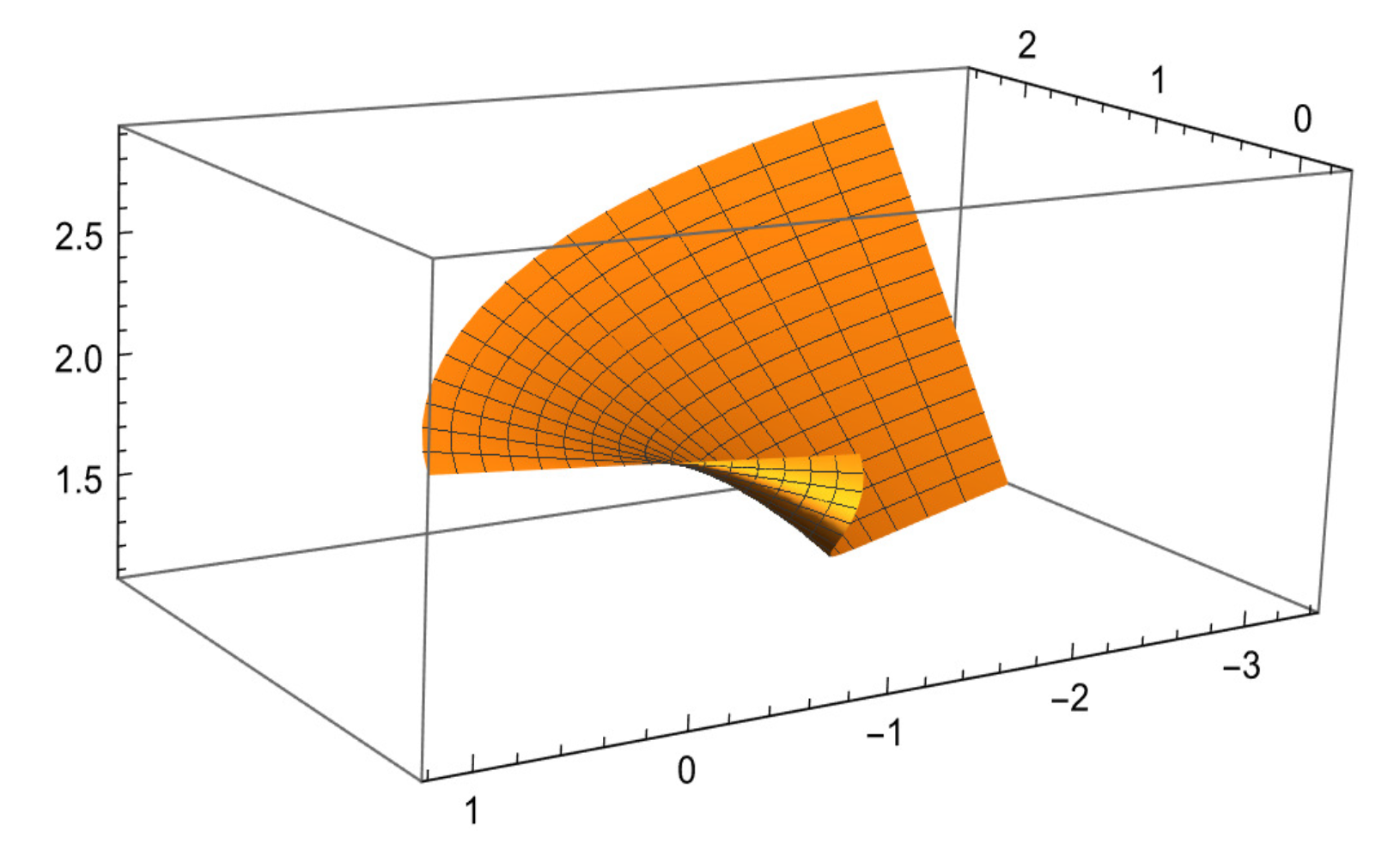
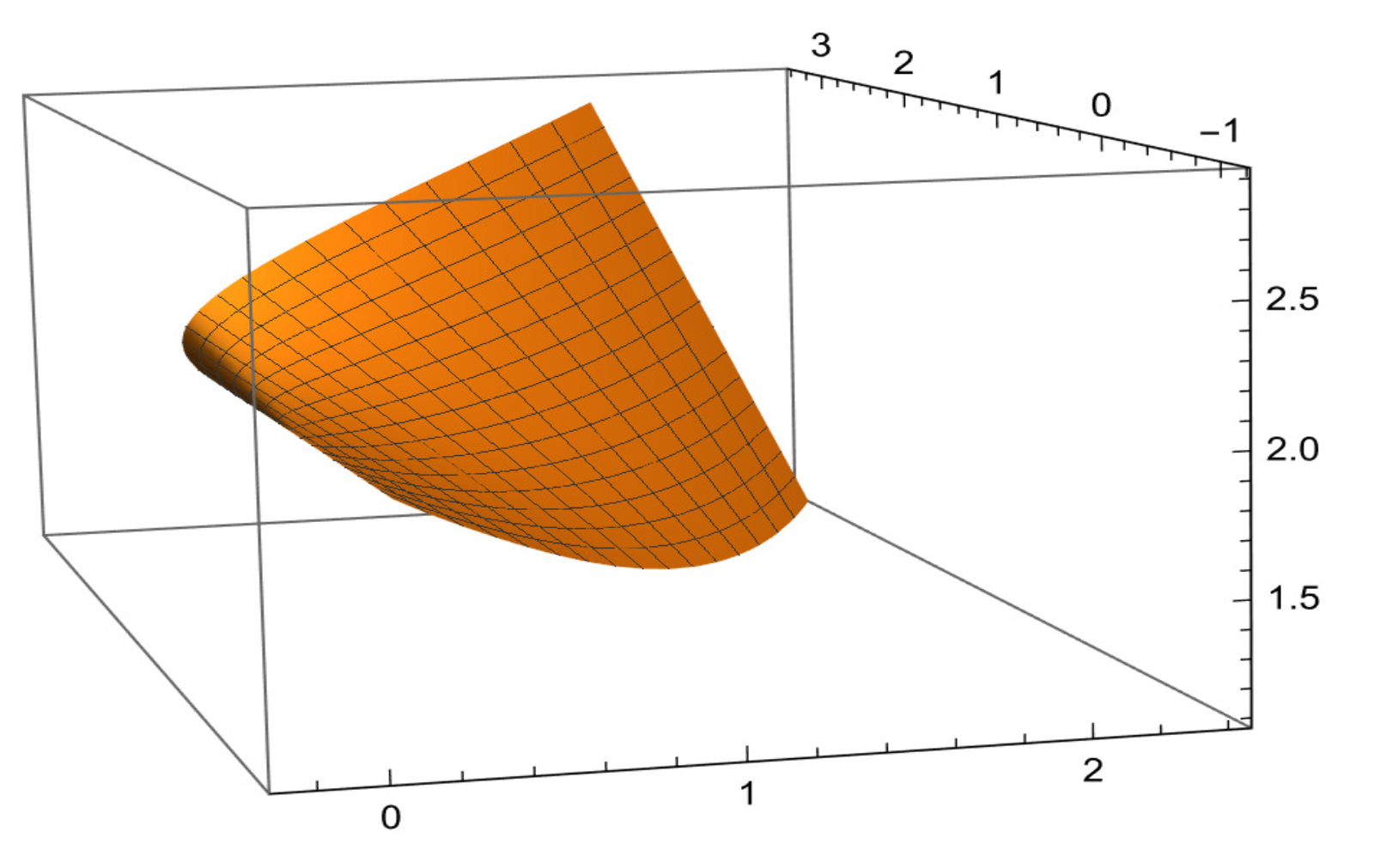
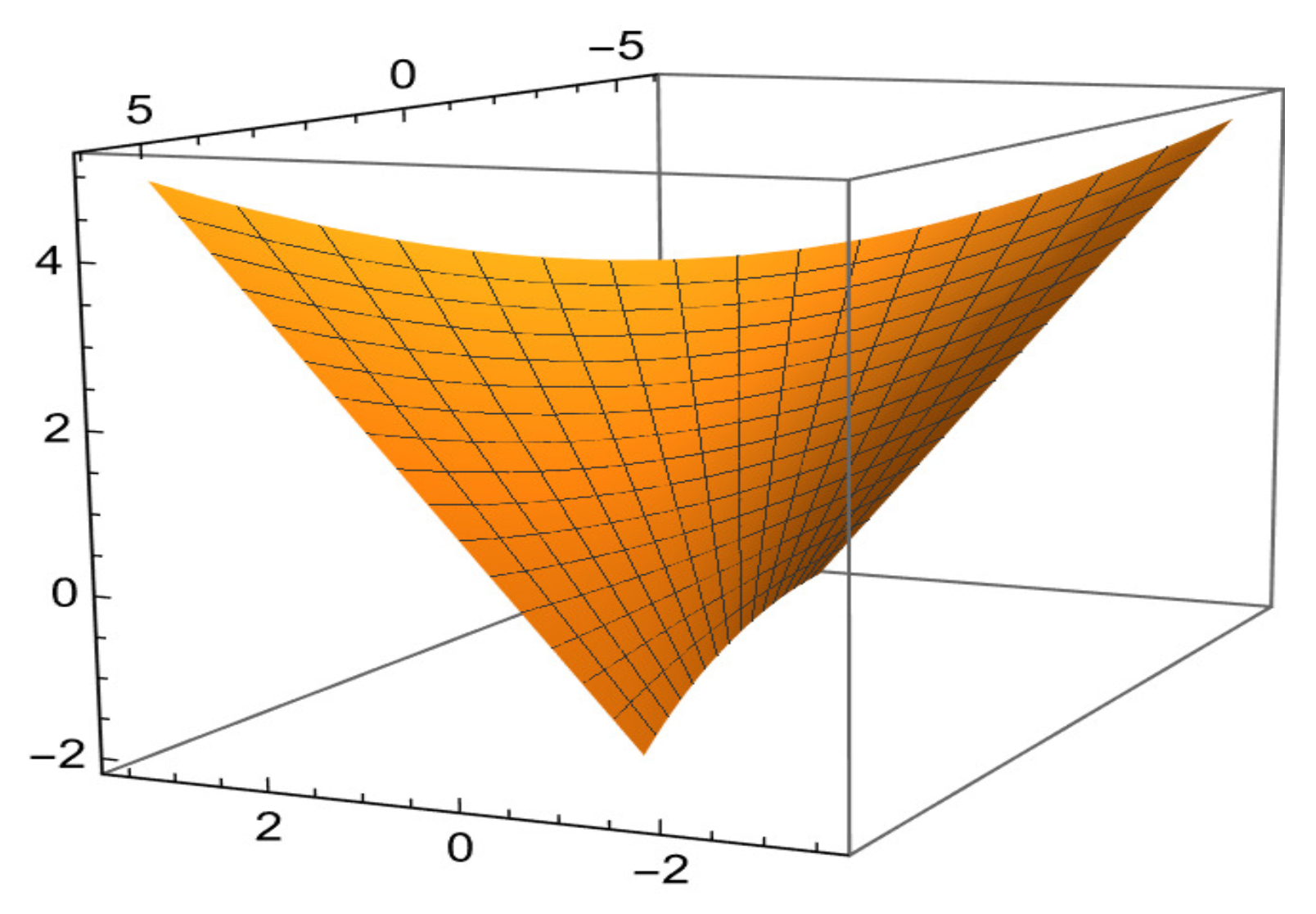
Let δ be a space-like curve lying on a space-like surface M, defined byThe Darboux frame of δ takes the formwhere . A direct computation yieldsHence, the angle function reduces to a constant , and one may choose and . The resulting RM ruled surfaces generated by and are given bywhich are depicted in Figure 1, Figure 2 and Figure 3. Example 2. This example considers a space-like base curve contained in a time-like plane and illustrates how the causal character of the ambient surface influences the associated RM Darboux frame and the geometry of the resulting RM ruled surface. In particular, it highlights the interaction between a space-like generating curve and a time-like supporting plane within the unified RM Darboux framework.
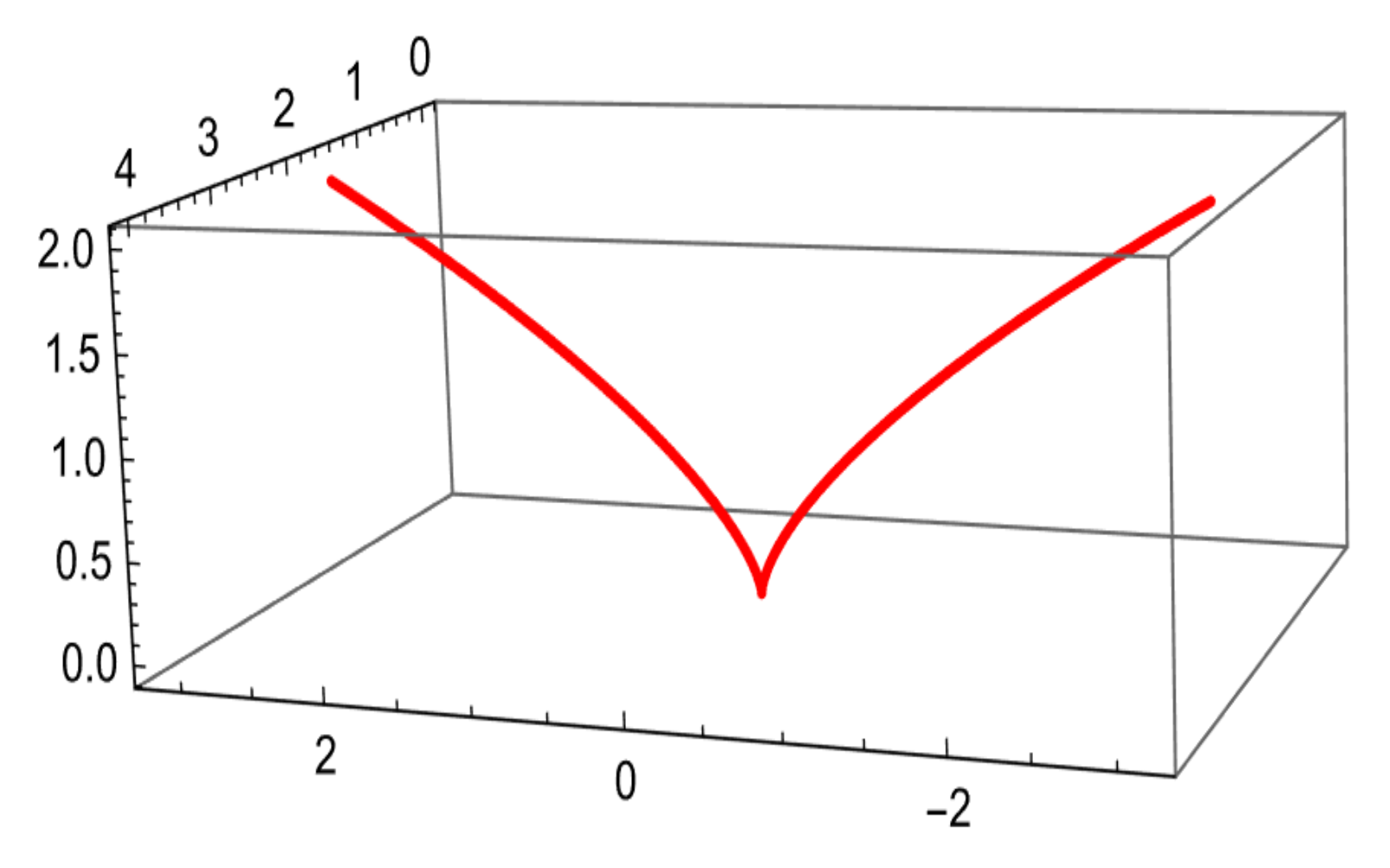
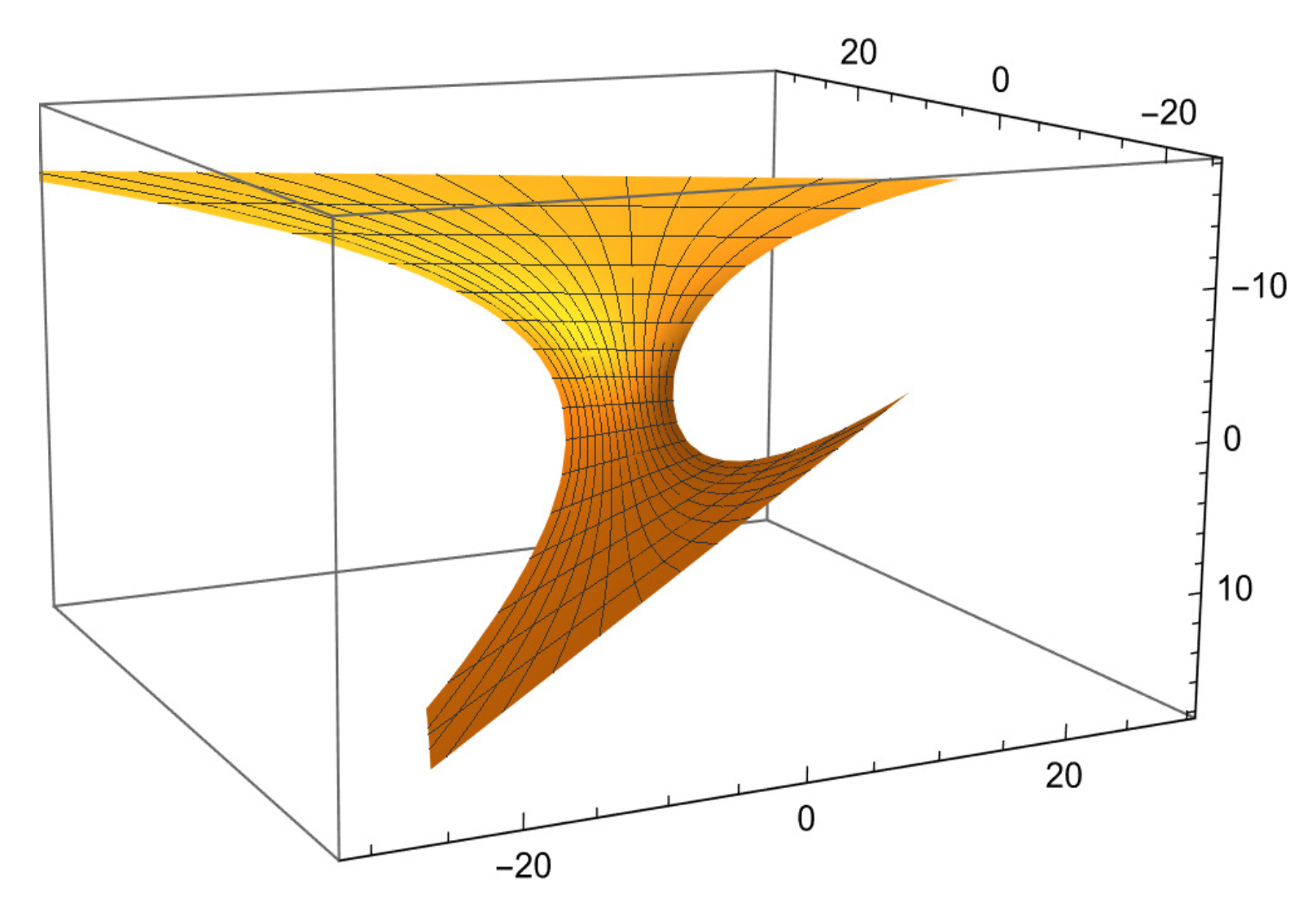
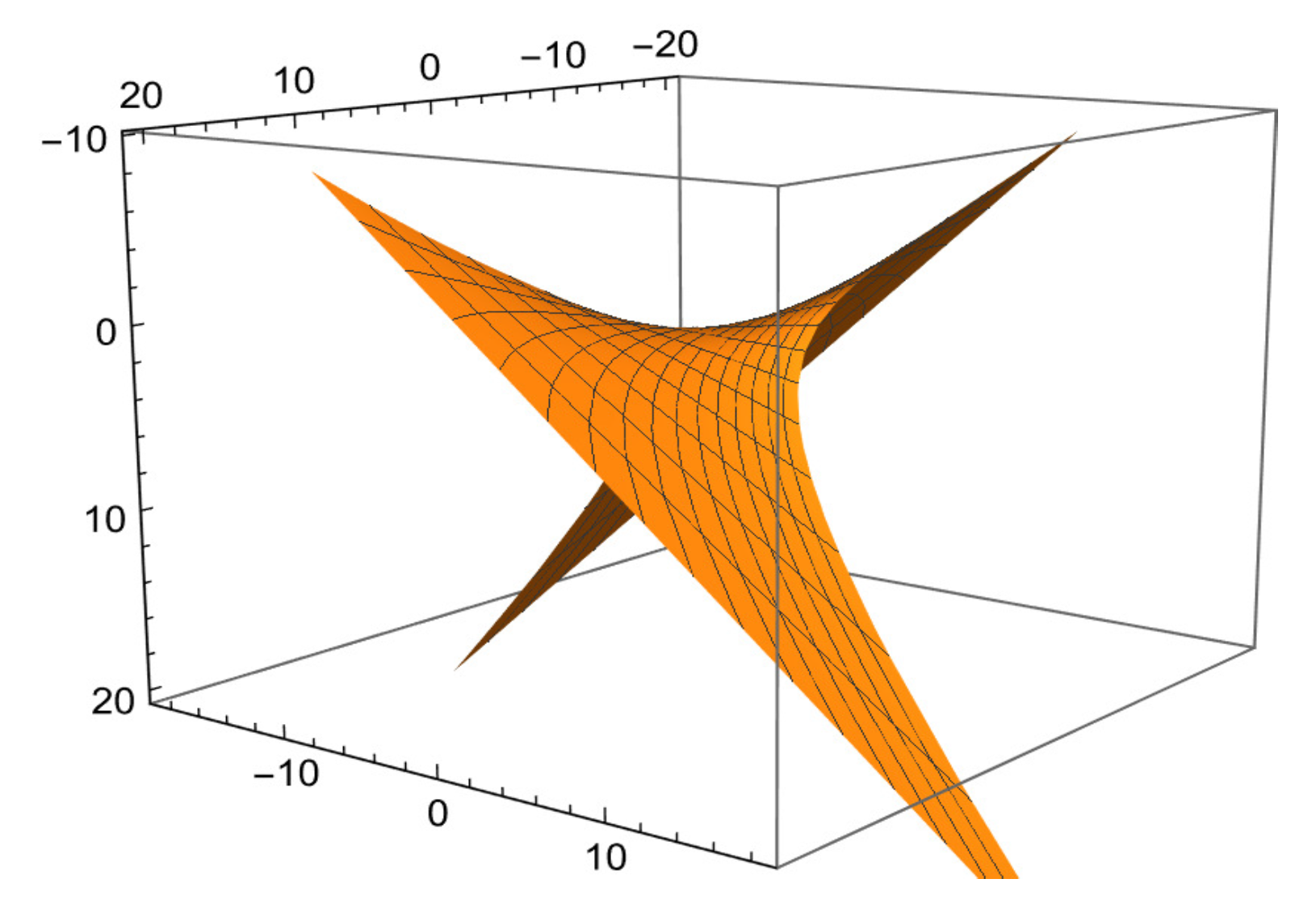
Consider the space-like curvecontained in the time-like plane . The Darboux frame of μ is given bywhere . The corresponding Darboux invariants satisfyThus is constant, and the RM Darboux frame coincides withChoosing the director field , the RM ruled surface is expressed asas illustrated in Figure 4, Figure 5 and Figure 6. Example 3. This example illustrates the general theory for RM ruled surfaces with variable director coefficients and provides explicit conditions for developability and minimality within the unified RM Darboux framework.
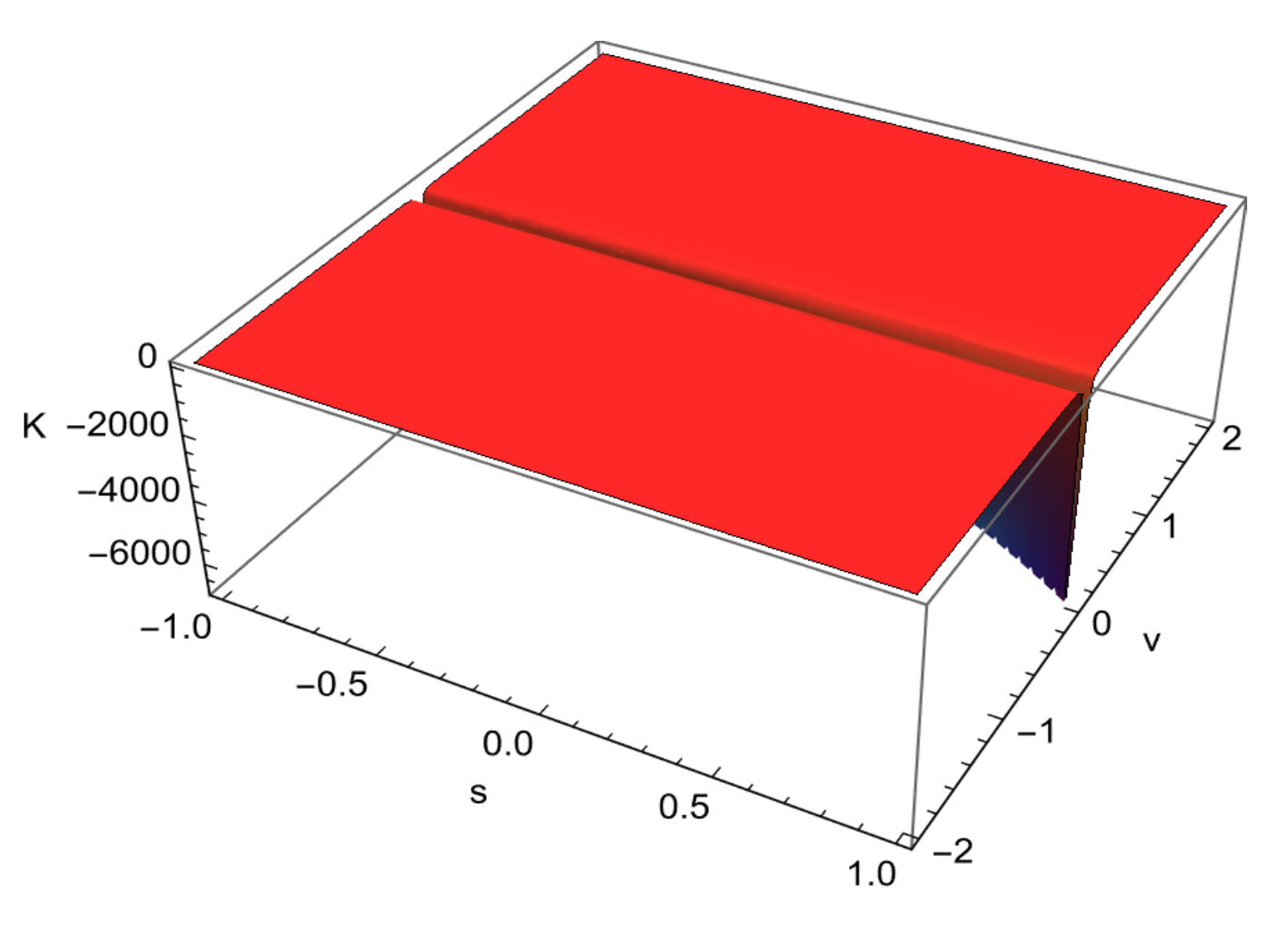
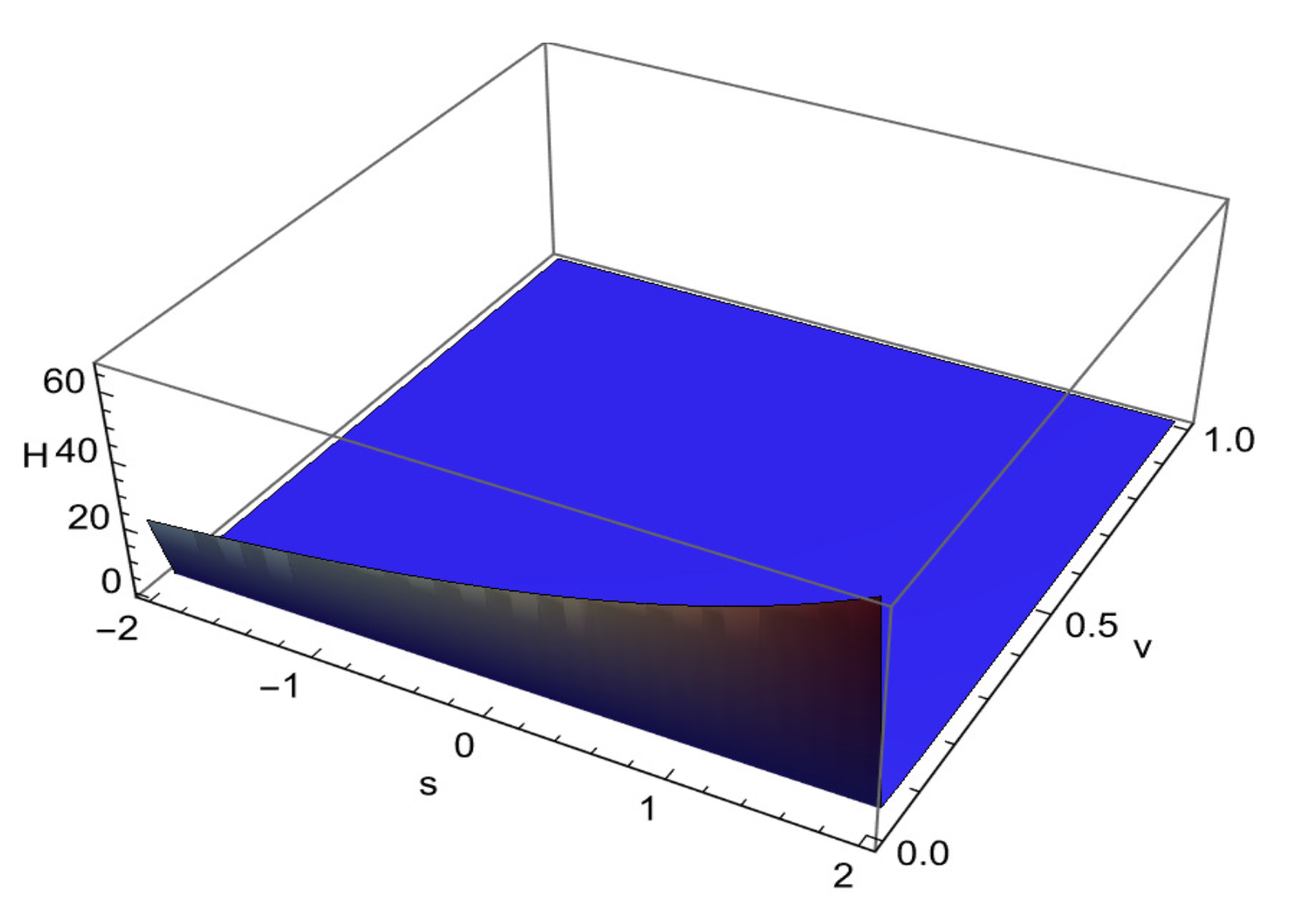
Let ω be the space-like curvelying on a spacelike surface M. Its Darboux frame is given bywhere . The associated invariants satisfyand, hence, . The RM Darboux frame vectors and curvature functions are then obtained asThe RM ruled surface generated by ω is defined bywhereIts parametrization is (see Figure 7, Figure 8 and Figure 9)The Gaussian curvature and mean curvatures can be computed as (see Figure 10 and Figure 11)where As a comment on the results obtained in the above example, the RM ruled surface satisfies the following properties:
- (a)
is developable if and only if
- (b)
is minimal if and only if the same quantity vanishes.
- (c)
If , then the director field lies in and the surface is non-tangent along .
- (d)
If or , then reduces to a -type or -type RM ruled surface, respectively, and is developable.
- (e)
If , then is a cylindrical surface and hence developable.
6. Conclusions
This work has introduced a comprehensive geometric framework based on the rotation minimizing (RM) Darboux construction for the study of curves and ruled surfaces in Minkowski three-space . By combining the surface adapted features of the classical Darboux frame with the minimal twisting property inherent to RM frames the resulting formulation offers a coherent and conceptually clear approach for analyzing curve-induced surface geometries within a Lorentzian context.
For unit speed non-null curves, the Lorentzian RM Darboux frame was constructed and its evolution equations were established explicitly. The corresponding RM curvature functions were related in a precise manner to the Frenet and Darboux invariants, thereby clarifying their geometric interpretation in Minkowski space. These relations emphasize the stability and interpretability of RM frames, especially in degenerate situations such as vanishing curvature or cases where classical frames exhibit unnecessary rotational behavior.
Using the RM Darboux frame as a generating mechanism, a broad family of ruled surfaces was defined through general director vector fields expressed in terms of RM frame vectors. For this class of RM ruled surfaces, closed form expressions for the first and second fundamental forms, the surface normal, and the Gaussian and mean curvatures were derived. Developability, minimality, and flatness were characterized by necessary and sufficient conditions written entirely in terms of RM curvature functions and director coefficients. These criteria extend well known results for ruled surfaces and demonstrate how the causal nature of both the base curve and the ruling direction governs the intrinsic and extrinsic geometry of the surface.
A further contribution of this work is the geometric classification of RM ruled surfaces via the behavior of their parametric curves. Explicit conditions were obtained under which the u- and v-curves defined geodesics, asymptotic directions, or principal curvature lines. This analysis provides a unified Lorentzian generalization of classical Frenet-based classifications and shows that RM ruled surfaces naturally reflect intrinsic flatness while allowing a transparent description of principal and asymptotic foliations through RM invariants.
Several illustrative space-like and time-like examples were presented to validate the theoretical development and to highlight the practical advantages of the RM Darboux approach. These examples confirm that the proposed framework leads to simplified curvature representations and facilitates a clearer geometric understanding of relativistic ruled surfaces.
In summary, the RM Darboux formulation developed here constitutes a flexible and effective tool for the geometric modeling and analysis of ruled surfaces generated by curves in Minkowski space. Future investigations may address RM-based surface evolutions, inextensible and variational flows, extensions to higher-dimensional Lorentzian manifolds, and potential applications to relativistic kinematics, world sheet geometry, and related structures arising in mathematical physics.
Author Contributions
Conceptualization, M.B.-A., G.A., E.S. and S.S.; methodology, M.B.-A., G.A., E.S. and S.S.; software, M.B.-A., G.A., E.S. and S.S.; validation, M.B.-A., G.A., E.S. and S.S.; formal analysis, M.B.-A., G.A., E.S. and S.S.; investigation, M.B.-A., G.A., E.S. and S.S.; resources, M.B.-A., G.A., E.S. and S.S.; data curation, M.B.-A., G.A., E.S. and S.S.; writing—original draft preparation, M.B.-A., G.A., E.S. and S.S.; writing—review and editing, M.B.-A., G.A. and E.S.; visualization, M.B.-A., G.A., E.S. and S.S.; supervision, M.B.-A., G.A., E.S. and S.S.; project administration, M.B.-A., G.A., E.S. and S.S.; funding acquisition, E.S. All authors have read and agreed to the published version of the manuscript.
Funding
This work was supported and funded by the Deanship of Scientific Research at Imam Mohammad Ibn Saud Islamic University (IMSIU) (grant number IMSIU-DDRSP2602).
Data Availability Statement
Data are contained within the article.
Conflicts of Interest
The authors declare no conflicts of interest.
References
- O’Neill, B. Semi–Riemannian Geometry with Applications to Relativity; Academic Press: New York, NY, USA, 1983. [Google Scholar]
- López, R. Differential geometry of curves and surfaces in Lorentz–Minkowski space. Int. Electron. J. Geom. 2014, 7, 44–107. [Google Scholar] [CrossRef]
- Etayo, F. Rotation minimizing vector fields and frames in Riemannian manifolds. In Geometry, Algebra and Applications: From Mechanics to Cryptography; Springer Proceedings in Mathematics & Statistics; Springer: Cham, Switzerland, 2016; Volume 161. [Google Scholar]
- do Carmo, M.P. Differential Geometry of Curves and Surfaces, 2nd ed.; Dover Publications: Mineola, NY, USA, 2016. [Google Scholar]
- Ali, A.T.; López, R. Slant helices in Minkowski space . J. Korean Math. Soc. 2011, 48, 159–167. [Google Scholar] [CrossRef]
- Bishop, L.R. There is more than one way to frame a curve. Am. Math. Mon. 1975, 82, 246–251. [Google Scholar] [CrossRef]
- Hanson, A.J.; Ma, H. Parallel transport approach to curve framing. Indiana Univ. Math. J. 1995, 44, 651–669. [Google Scholar]
- Farouki, R.T.; Giannelli, C.; Sampoli, M.L.; Sestini, A. Rotation–minimizing osculating frames. Comput. Aided Geom. Des. 2014, 31, 27–42. [Google Scholar] [CrossRef]
- da Silva, L.C.B. Rotation minimizing frames and spherical curves in simply isotropic and pseudo-isotropic 3-spaces. Tamkang J. Math. 2020, 51, 31–52. [Google Scholar] [CrossRef]
- Li, Y.; Chen, Z.; Nazra, S.H.; Abdel-Baky, R.A. Singularities for timelike developable surfaces in Minkowski 3-space. Symmetry 2023, 15, 277. [Google Scholar] [CrossRef]
- Solouma, E.; Al-Dayel, I.; Khan, M.A.; Abdelkawy, M. Investigation of special type-Π Smarandache ruled surfaces due to the rotation minimizing Darboux frame in E3. Symmetry 2023, 15, 2207. [Google Scholar] [CrossRef]
- Capovilla, R.; Guven, J. Geometry of relativistic strings. Class. Quantum Grav. 2020, 37, 075003. [Google Scholar]
- Guven, J. Conformal geometry of curves and surfaces. Phys. Rev. D 2019, 99, 025013. [Google Scholar] [CrossRef]
- Solouma, E.; Al-Dayel, I.; Abdelkawy, M.A. Ruled surfaces and their geometric invariants via the orthogonal modified frame in Minkowski 3-space. Mathematics 2025, 13, 940. [Google Scholar] [CrossRef]
- Solouma, E.; Saber, S.; Marin, M.; Baskonus, H.M. Geometric invariants and evolution of RM–Hasimoto surfaces in Minkowski 3-space . Mathematics 2025, 13, 3420. [Google Scholar] [CrossRef]
- Messaoudi, M.; Solouma, E.; Alshehri, M.N.; Aljohani, A.F.; Marin, M. Lorentzian structure and curvature analysis of osculating type–2 ruled surfaces via the type–2 Bishop frame. Mathematics 2025, 13, 3464. [Google Scholar] [CrossRef]
- Alghanemi, A.; Matar, G.; Saloom, A. The differential geometry of a space curve via a constant vector in R3. Axioms 2025, 14, 190. [Google Scholar] [CrossRef]
- Monterde, J. Relativistic elastic curves in Minkowski space. J. Geom. Phys. 2022, 173, 104446. [Google Scholar]
- Solouma, E.; Al-Dayel, I.; Khan, M.A.; Lazer, Y.A.A. Characterization of imbricate–ruled surfaces via the rotation minimizing Darboux frame in Minkowski 3-space . AIMS Math. 2024, 9, 13028–13042. [Google Scholar] [CrossRef]
- Solouma, E.; Saber, S.; Baskonus, H.M. Exploring harmonic evolute geometries derived from tubular surfaces in Minkowski 3-space using the RM Darboux frame. Mathematics 2025, 13, 2329. [Google Scholar] [CrossRef]
- Chen, B.-Y.; Aloui, F.; Khan, M.A.; Choudhary, M.A. Magnetic curves in differential geometry: A comprehensive survey. Mathematics 2025, 13, 3849. [Google Scholar] [CrossRef]
- Struik, D.J. Lectures on Classical Differential Geometry; Addison-Wesley: Boston, MA, USA, 1961. [Google Scholar]
- Aldossary, M.T.; Abdel-Baky, R.A. Sweeping surface due to the rotation minimizing Darboux frame in Euclidean 3-space E3. AIMS Math. 2023, 8, 447–462. [Google Scholar] [CrossRef]
- Li, Y.; Abdel-Aziz, H.S.; Serry, H.M.; El-Adawy, F.M.; Saad, M.K. Geometric visualization of evolved ruled surfaces via an alternative frame in Lorentz–Minkowski 3-space. AIMS Math. 2024, 9, 25619–25635. [Google Scholar] [CrossRef]
- Turgut, A.; Hacisalihoglu, H.H. Spacelike ruled surfaces in Minkowski 3-space. Commun. Fac. Sci. Univ. Ank. Ser. A1 Math. Stat. 1997, 46, 83–91. [Google Scholar]
Figure 1.
The RM ruled surface .
Figure 1.
The RM ruled surface .
Figure 2.
The RM ruled surface .
Figure 2.
The RM ruled surface .
Figure 3.
Combination of RM ruled surface together with .
Figure 3.
Combination of RM ruled surface together with .
Figure 4.
The base curve .
Figure 4.
The base curve .
Figure 5.
The RM ruled surface with , , and .
Figure 5.
The RM ruled surface with , , and .
Figure 6.
The RM ruled surface with , , and .
Figure 6.
The RM ruled surface with , , and .
Figure 7.
The RM ruled surface associated with the base curve .
Figure 7.
The RM ruled surface associated with the base curve .
Figure 8.
The RM ruled surface with , , .
Figure 8.
The RM ruled surface with , , .
Figure 9.
The RM ruled surface with , , .
Figure 9.
The RM ruled surface with , , .
Figure 10.
The Gaussian curvature of RM ruled surface .
Figure 10.
The Gaussian curvature of RM ruled surface .
Figure 11.
The mean curvature of RM ruled surface .
Figure 11.
The mean curvature of RM ruled surface .
Table 1.
Geometric classification of general RM ruled surfaces according to the behavior of their parametric curve families. All characterizing conditions are expressed solely in terms of RM curvature functions and director field coefficients.
Table 1.
Geometric classification of general RM ruled surfaces according to the behavior of their parametric curve families. All characterizing conditions are expressed solely in terms of RM curvature functions and director field coefficients.
| Curve Family | Geometric Property | Characterizing Condition |
|---|
| s-curves | Asymptotic | |
| s-curves | Geodesic | |
| s-curves | Principal | |
| v-curves | Asymptotic | Identically () |
| v-curves | Geodesic | |
| v-curves | Principal | |
| Disclaimer/Publisher’s Note: The statements, opinions and data contained in all publications are solely those of the individual author(s) and contributor(s) and not of MDPI and/or the editor(s). MDPI and/or the editor(s) disclaim responsibility for any injury to people or property resulting from any ideas, methods, instructions or products referred to in the content. |