


Abstract
We consider two steady-state heat conduction systems called, S and , in a multidimensional bounded domain D for the Poisson equation with source energy g. In one system, we impose mixed boundary conditions (temperature b on the boundary , heat flux q on and an adiabatic condition on ). In the other system, the condition on is replaced by a convective heat flux condition with coefficient . For each of these systems, we consider three associated optimization problems and , , where the variable is the source energy g, the heat flux q and the environmental temperature b, respectively. In the particular case where D is a rectangle, the explicit continuous optimization variables and the corresponding state of the systems are known. In the present work, by using a finite difference scheme, we obtain the discrete systems and and discrete optimization problems and , , where h is the space step in the discretization. Explicit discrete solutions are found, and convergence and estimation errors results are proved when h goes to zero and when goes to infinity. Moreover, some numerical simulations are provided in order to test theoretical results. Finally, we note that the use of a three-point finite-difference approximation for the Neumann or Robin boundary condition at the boundary improves the global order of convergence from to .
MSC:
35C05; 49J20; 49K20; 49M25; 65N15; 65N30
1. Introduction
We consider a multidimensional bounded domain whose regular boundary consists of three disjoint portions with for . We define two stationary heat conduction problems and with mixed boundary conditions which are given by (1) and (2), and by (1) and (3), respectively:
where g is the internal energy of the system in , the environmental temperature on , q is the heat flux on and, is the convective heat coefficient on We assume that , and These problems correspond to stationary Stefan problems [1,2]. Notice that mixed boundary conditions play an important role in several applications, e.g., heat conduction and electric potential problems [3].
The variational formulation of the elliptic problems and , corresponding to (1), (2) and (1), (3), respectively, can be found in [2,4,5]. In general, solutions of mixed elliptic boundary value problems are not very regular [6], but there are cases in which they are regular [7,8,9]. Other theoretical optimization problems on the subject have been studied in [10,11].
We define the optimization problems and , associated to the systems and , respectively (see [4,12,13,14,15]).
The distributed optimization problems and on the constant internal energy g are formulated as:
where and are given by
with and . For each , and denote the unique solutions to the systems and , respectively, for given data and . Here and throughout this section, denotes the standard norm.
The boundary optimization problems and on the constant heat flux q on are defined as:
where and are given by
with and . For each , we denote with and the unique solutions to the systems and respectively, for data and . Here and throughout this section, denotes the standard norm.
The boundary optimization problems and on the constant temperature b in an external neighborhood of are set as
where and , given by
with and . For every , the functions and are the unique solutions of systems and respectively, for data and . Here and throughout this section, denotes the standard norm in .
In [16], explicit solutions to the continuous systems and were derived, together with the associated optimization problems and for , in the particular case where the domain is a rectangle. These explicit solutions serve as a rigorous benchmark for assessing the accuracy and reliability of numerical methods.
The aim of this paper is three-fold: (i) to obtain explicit solutions to the systems and in a rectangular domain; (ii) to derive explicit discrete solutions for the optimization problems and , , using finite difference methods; and (iii) to estimate the order of convergence of the discrete solutions by comparison with the exact explicit ones.
It is worth mentioning that there are several articles available in the literature that obtain explicit discrete solutions of some optimization problems [17,18]. For example, in [19], exact formulas are derived for the solution of an optimal boundary control problem governed by the one-dimensional heat equation where the control function measures the distance of the final state from the target. In [20] a finite element approximation is applied for some kind of parabolic optimal control problems with Neumann boundary conditions. Some numerical experiments are carried out setting a rectangular domain.
This paper is organized as follows: in Section 2 we obtain the discrete explicit solution to the systems and by the finite difference method. In Section 3, we obtain explicit discrete solutions to the discrete distributed optimization problems associated with and , respectively, where the variable is the internal energy g. In Section 4, we define discrete boundary optimization problems where the variable is the heat flux q, associated with and , respectively, obtaining the discrete explicit solutions. In the same manner, in Section 5, we derive explicit discrete solutions to the discrete boundary optimal control problems associated with and , respectively, where the optimization variable is b. In all cases, when the step discretization goes to zero, convergence results are obtained by also estimating the order of convergence of the approximate solutions. In Section 6, we carry out some numerical simulations in order to illustrate the theoretical convergence results obtained in the previous sections. Finally, in Section 7, we analyze the order of convergence of the discrete systems associated with and by considering a modified approximation of the Neumann boundary condition on , which leads to an improved convergence order.
The explicit continuous solutions of the systems and the associated optimal control problems in a rectangular domain are already available in the literature; in particular, they are given in [16].
The novelty of the present work can be summarized as follows: (i) the derivation of explicit discrete solutions for the state and the control variables; (ii) a rigorous analysis of the convergence of the discrete solutions, including the estimation of their orders of convergence; and (iii) an improved approximation of the boundary conditions in the discrete framework.
2. Discrete Systems for and
In this section we obtain the discrete explicit solutions to the systems and in a rectangular domain in the plane with and . Its boundaries for are defined by:
and
According to [16], the continuous solutions, in , for the systems and defined by (1), (2) and (1), (3) are given by:
As a consequence of the symmetry of domain and the boundary conditions, the solutions u and of systems and are independent of variable y, and therefore, we work with one-dimensional problems.
Given , we define:
Here, n is the number of subintervals of , h is the uniform mesh size, , and denotes the discrete approximation of the temperature at the node , . Since the temperature is constant along the y-direction, approximates for any .
We apply the classical finite-difference method to the system described by Equations (1) and (2). Since the boundary condition on prescribes , we immediately obtain .
For the interior nodes, we use the classical centered second-order finite-difference approximation:
and from the differential Equation (1), we impose that
To incorporate the Neumann boundary condition on , we use a backward finite difference for the first derivative:
which, using the boundary condition , leads to assuming that
Taking into account (16) and (18), the resulting discretization leads to the discrete linear system
where denotes the vector of unknowns, A is the associated tridiagonal coefficient matrix:
and is the vector of independent terms:
The square matrix A is invertible and its inverse matrix is given by
Then, the linear system has a unique solution:
As and , it follows that:
Then, the continuous solution of system can be approximated by the piecewise linear interpolant obtained from the nodal values computed by the finite difference scheme. More precisely, we define
with
The following lemma shows that the discrete solution provides a first-order accurate approximation of the exact solution u and its derivative with respect to x.
Lemma 1.
- (a)
- For every grid point with , , the following comparison holds:
- (i)
- if then .
- (ii)
- if then .
- (b)
- The approximation error satisfies first-order estimates in the H-norm, namely,where the constants and , which do not depend on h, are given by and
Proof.
- (a)
- (b)
The norm can be computed analogously. □
We next apply the classical finite-difference method to the system defined by Equations (1) and (3). For each , we set and denote by the approximate value of at for .
The Robin boundary condition on is approximated by a classical forward finite-difference scheme, namely,
Taking into account that , we impose that
Moreover, at the interior nodes we use the approximation given in (16), while the Neumann boundary condition at is discretized according to (17).
Then, we obtain the linear system :
where the vector of unknowns is given by , the tridiagonal coefficient matrix of order is defined as:
and
It can be seen that the square matrix is invertible and its inverse matrix is given by
Then, the linear system has a unique solution:
As a consequence, the continuous solution of system given by (13) can be approximated in by the discrete function , defined as the piecewise linear interpolation of the nodal values obtained from the finite-difference system .
for ,
Notice that when for every .
Lemma 2.
Let be the solution of problem , where is the convective heat transfer coefficient appearing in the Robin boundary condition, and let denote its piecewise linear discrete approximation defined in (27). Then, for each mesh size h, the following error estimates hold:
where and are positive constants independent of h.
Remark 1.
Notice that when , where is the constant appearing in Lemma 1. This shows that the error bound associated with the convective boundary condition converges to the one obtained for the Dirichlet problem as .
3. Distributed Optimization Problem with Variable
In this section we obtain discrete optimal solutions to the continuous optimization problem and in the rectangular domain for the case where the optimization variable is g.
3.1. Discrete Problem Associated with
Taking into account that and the desired state in (6) are constants, according to [16], the continuous quadratic functional cost for problem is explicitly given by:
Then, the solution to the distributed optimization problem is defined by:
and the continuous optimization state when is
We define the discrete distributed optimization problem for the constant internal energy g as
where the discrete cost function is given by:
Here, denotes the discrete approximation corresponding to the internal energy g (see (22)), h is the discretization step defined in (14), is the desired target, and is a regularization parameter.
Taking into account that the variable g is constant results in:
and from algebraic work, it follows that
Lemma 3.
For any given internal energy , the following estimate holds for the discrete cost functional :
where is a constant independent of h.
From the optimality condition we obtain the following result:
Lemma 4.
- (a)
- The explicit expression for the optimal variable is given by:where
- (b)
- In addition, the following error estimates hold:where and do not depend on h.
Lemma 5.
Let us consider the solution of the system given by (1) and (2) for and the discrete solution defined by (22) for and for , where is the optimal value of the problem given by (34). We have:
where and are positive constants that are independent of parameter h.
3.2. Discrete Problem Associated with
From [16], we know that the continuous quadratic functional cost in (6) for the optimization problem is explicitly given by:
where is defined by (28). Moreover, the continuous optimal distributed variable denoted by is given by
The continuous associated state is established by:
We define the discrete cost function as
where function , given in (27), denotes the discrete approximation corresponding to the internal energy g, is the discretization step, is the desired target, and is a constant parameter. We set the following discrete optimization problem on the constant internal energy g as
The discrete cost function is explicitly given by
where is given by (39).
Lemma 6.
For and , the following estimate holds
where
is a constant independent of
Proof.
It follows immediately from expression (43). □
Remark 2.
when , where is given in Lemma 3.
Lemma 7.
- (a)
- The explicit expression for the optimal control is given by:where
- (b)
- In addition, the following error estimates hold:where and do not depend on h.
Remark 3.
When , we have , where and are given by (35) and (45), respectively, for . As an immediate consequence it follows that and when , where and are defined in Lemma 4.
Lemma 8.
Let us consider , the function given by (13) for where is the optimal variable of problem given by (40), and , the function defined by (27) for where is the optimal control of given by (44). We have:
where and are positive constants independent of parameter
Proof.
Remark 4.
and when , where and are given in Lemma 5.
Remark 5. 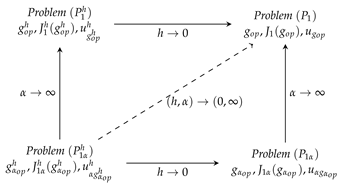
In [21] the double convergence when of optimal control problem was studied, obtaining a commutative diagram that relates the continuous and discrete optimal control problems , , and as in the following scheme:
4. Boundary Optimization Problem with Variable
4.1. Discrete Problem Associated with
Under the same considerations given in Section 3.1 and taking into account Formula (9), for a given , we obtain the following quadratic cost function:
Then, the boundary optimal control of problem , called , and the associated continuous optimal state are given by:
Associated with , we define the approximate discrete distributed optimal control problem on the constant heat flux q as
where the discrete cost function is defined by
where , given in (22), denotes the discrete approximation for a fixed constant flux q, h is the spatial step, and (the desired state). From the definition of the norm over Q, it results that:
and working algebraically, we get
Lemma 9.
Given and , we have
where is a constant independent of
Proof.
It follows immediately from expression (51) for . □
Lemma 10.
Let us consider
- (a)
- The explicit expression for the optimal variable is given by:with
- (b)
- The following error estimates hold:where and are constants independent of h.
Proof.
□
Lemma 11.
Consider , the solution of (1) and (2) for , and , the discrete solution given by (22) for each where is the optimal variable of the problem given by (53). Then, we have:
where and do not depend on the parameter
4.2. Discrete Problem Associated with
If we suppose that the desired state is constant in (9), the quadratic cost function for optimal control problem is explicitly given by:
where
Then, the continuous boundary optimization control, called , and the associated state are:
Remark 6.
Define the discrete cost function as:Notice that for all and when .
Working algebraically, the cost function can be written explicitly as:
Lemma 12.
For each and , we have:
with
a constant independent of
Proof.
It follows immediately from expression (64). □
Lemma 13.
Let us consider
- (a)
- The explicit expression for optimal control is given by:with
- (b)
- The following error estimates hold:where and do not depend on h.
Proof.
□
Lemma 14.
Let us consider the solution of (1) and (3) for and the discrete solution given in (27) for and . Then, we have:
Proof.
Similarly to what was done in Lemma 12, we obtain
□
Remark 7.
The constants verify that , when for each
Remark 8. 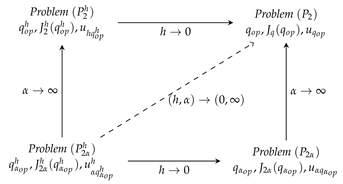
The double convergence when of the optimal control of problem holds. The relationship among optimal control problems , , and is given by the following diagram:
5. Boundary Optimization Problem with Variable
5.1. Discrete Problem Associated with
In this section we consider the boundary optimal control problem given by (10). Taking into account expression (12), for a given constant b, we get
Then, the boundary optimal variable of problem , called , and the associated continuous optimal state, are given respectively by:
We define the discrete optimal control problem on the constant temperature b as
where the discrete cost function is defined as:
where is given in (22) for a fixed constant b, h is the spatial step, and (the desired state) is constant.
Notice that the cost function can be explicitly written as:
Lemma 15.
Let and ; we have:
where
does not depend on
Proof.
It follows from expression (74) for . □
Lemma 16.
Let us consider .
- (a)
- The explicit expression for the optimal variable is given by:
- (b)
- The following error estimates hold:where and do not depend on h.
Proof.
- (a)
- According to (74) we haveThen, Formula (76) for follows immediately.
- (b)
- Moreover, taking into account Formulas (72) and (74) for and and Formulas (73) and (76) for and , respectively, it follows thatIn addition, the expression can be rewritten asTherefore, it follows that estimate (16) is given by
□
Lemma 17.
Let us consider , the solution of (1), (3) for , and , the discrete solution given in (27) for and Then, we have:
where and are constants that do not depend on h.
Proof.
Working algebraically, we obtain
Then, we obtain estimate with
In a similar manner, we get that estimate holds with
□
5.2. Discrete Problem Associated with
From [16], we know that the continuous quadratic functional cost in (6) for the optimization problem is explicitly given by:
where is defined by (72). Moreover, the continuous optimal boundary control is given by
The continuous associated state is established by:
Define the discrete cost function as:
where is the solution of given in (27) for a fixed b. We set the following discrete optimization problem as
Working algebraically leads us to write as follows:
Lemma 18.
For and , we have
with
Proof.
It arises immediately from (85). □
Lemma 19.
Let us consider .
- (a)
- The explicit expression for optimal control is given by:where is given in (76).
- (b)
- The following error estimates hold:where and do not depend on h.
Proof.
□
Lemma 20.
Let us consider , the solution of (1) and (3) for , and , the discrete solution given in (27) for and Then, we have:
Proof.
Similarly to what was done in Lemma 12, we obtain
□
Remark 9.
The constants obtained in the estimates of the previous lemmas verify that when for .
Remark 10. 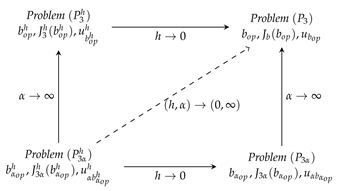
The double convergence when of the optimal control of problem holds. The relationship among the optimal control of problems , , and is given by the following diagram:
6. Numerical Results
We carried out some numerical simulations in order to illustrate the theoretical results obtained in the previous sections for the optimal control problems and for .
Throughout this section we consider the domain , i.e, .
Before analyzing the optimal control problems we illustrate the behavior of the continuous state of the systems and and the discrete state of the systems and .
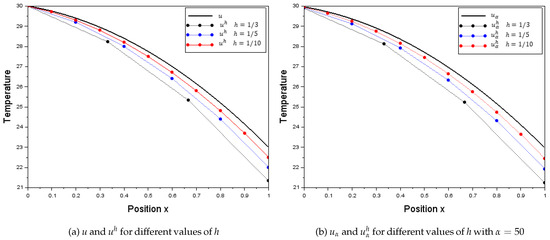
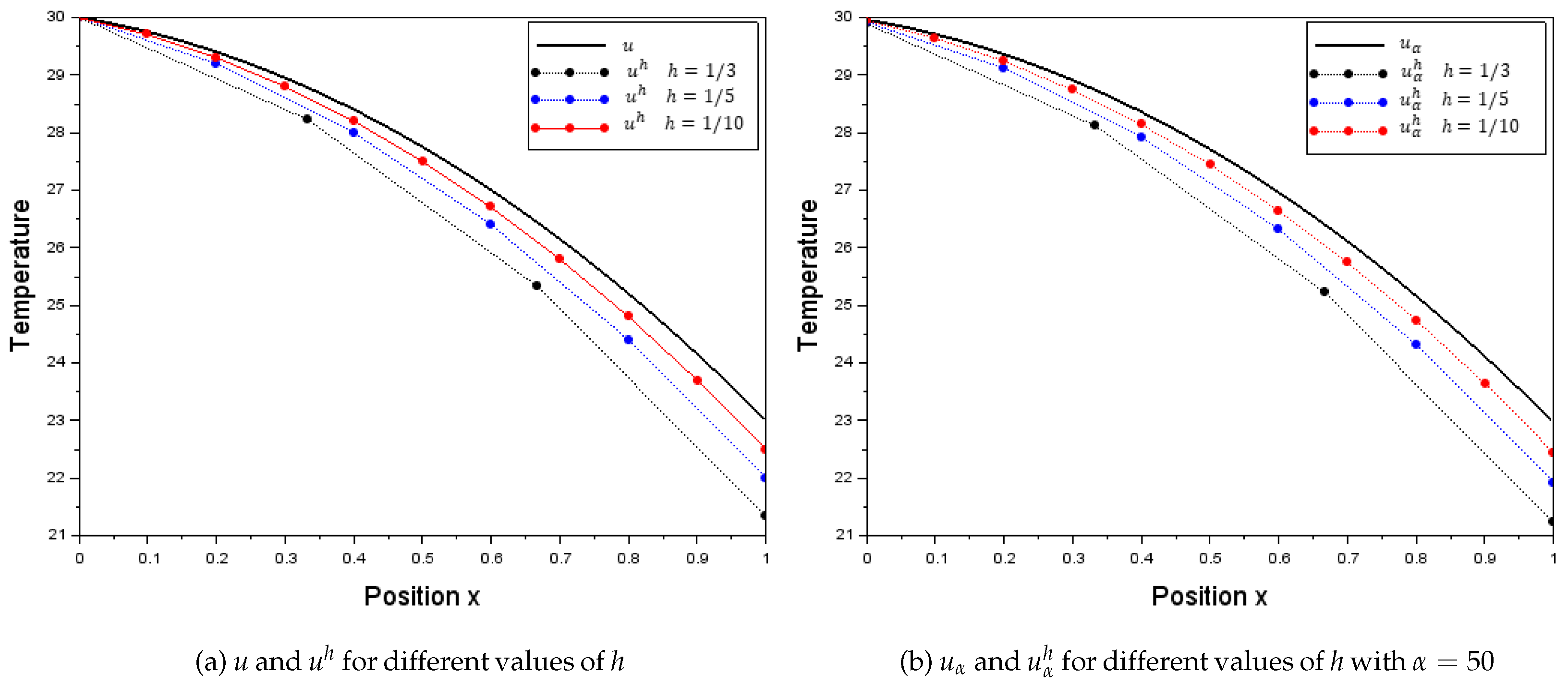
In Figure 1a we plotted the state of system u given by (13) and the approximate discrete function defined by (22) against the position x for . As we saw in Lemma 1 for each fixed x, the functions increase and get closer to the limit as h decreases. In a similar manner, in Figure 1b, for , we obtained system given by (13) and the approximate discrete function defined by (27) against the position x for . Notice that as h decreases, the functions increase and get closer to the limit as it was proved in Lemma 2.
Figure 1.
State of systems , , and using , , and .
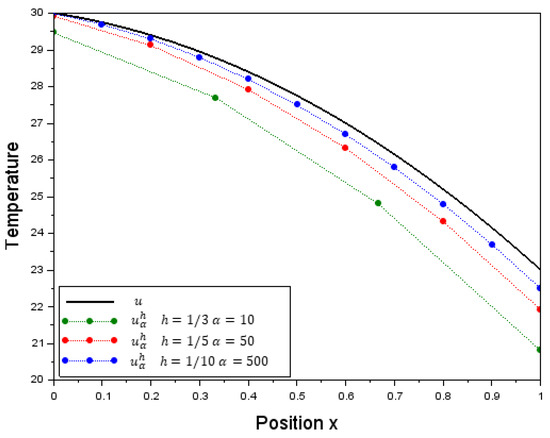
In addition in order to visualize the double convergence of when , in Figure 2 we plotted u and for and .
Figure 2.
Plot of u and against for different values of .
Table 1 illustrates that the errors exhibit a linear rate of convergence. Indeed, each refinement step in which the mesh size h is divided by two produces an error that is approximately halved, confirming the expected first-order behavior.
Table 1.
errors for and for different values of .
6.1. Control Variable g
In this subsection we obtain some computational examples for the optimal distributed control problems , , and . For each plot, we set and .
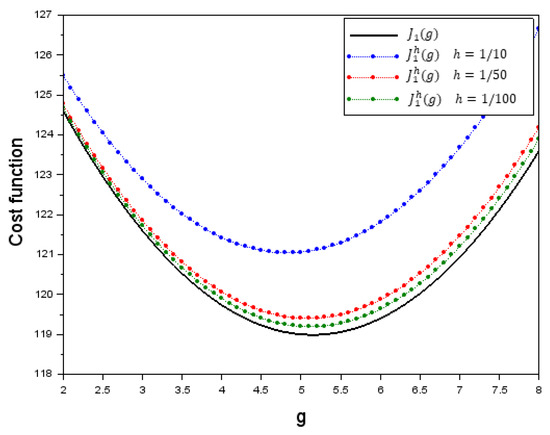
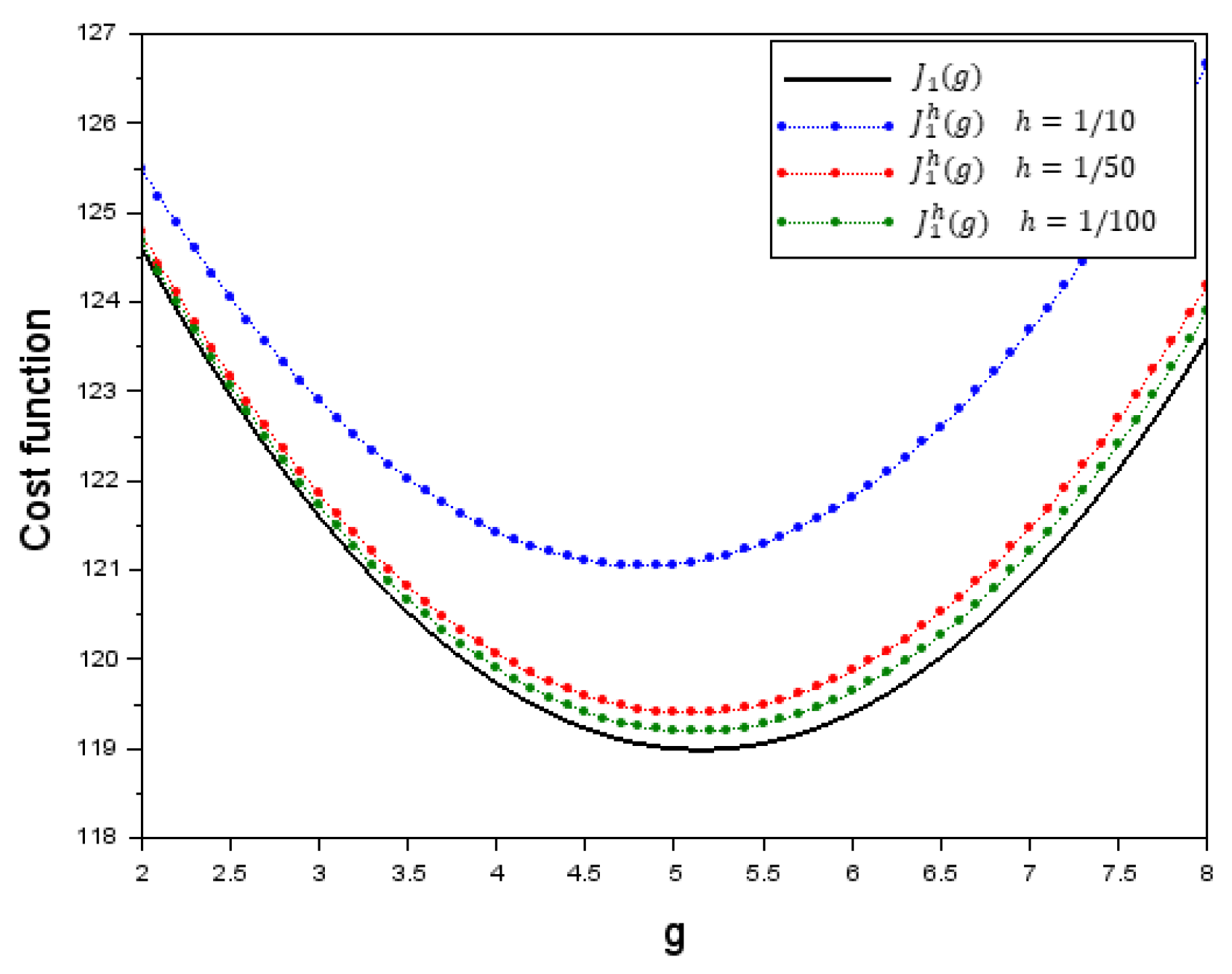
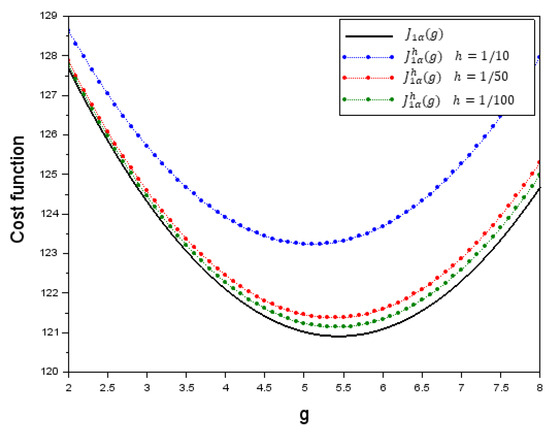
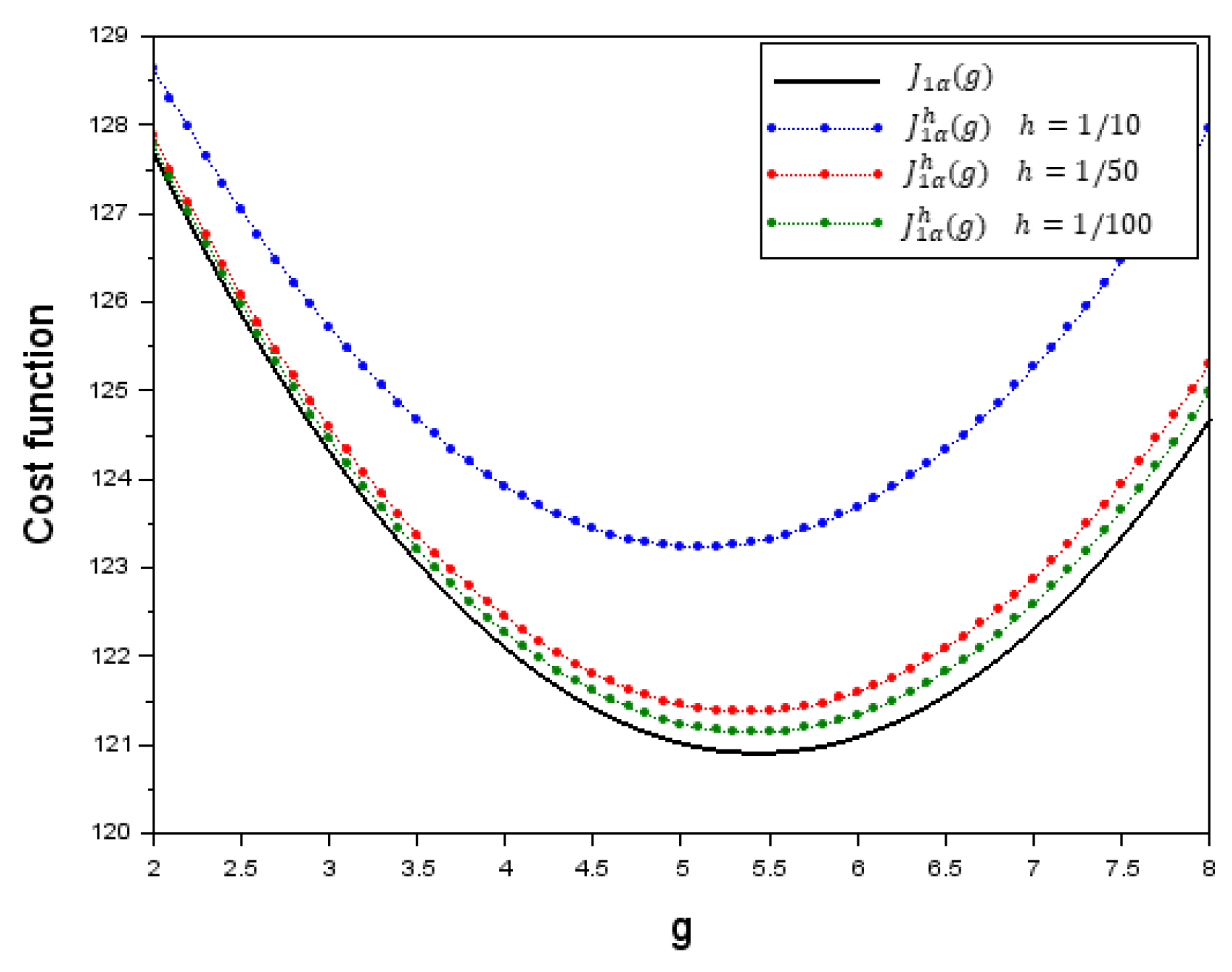
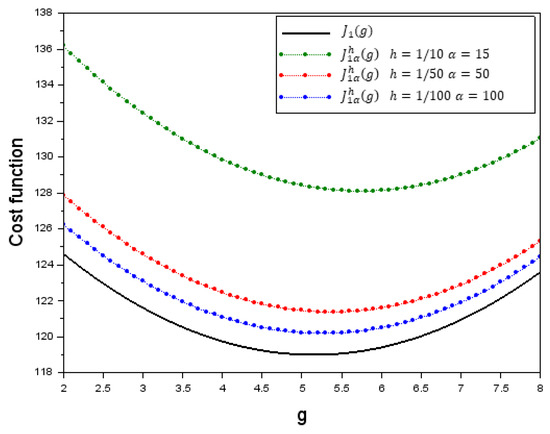
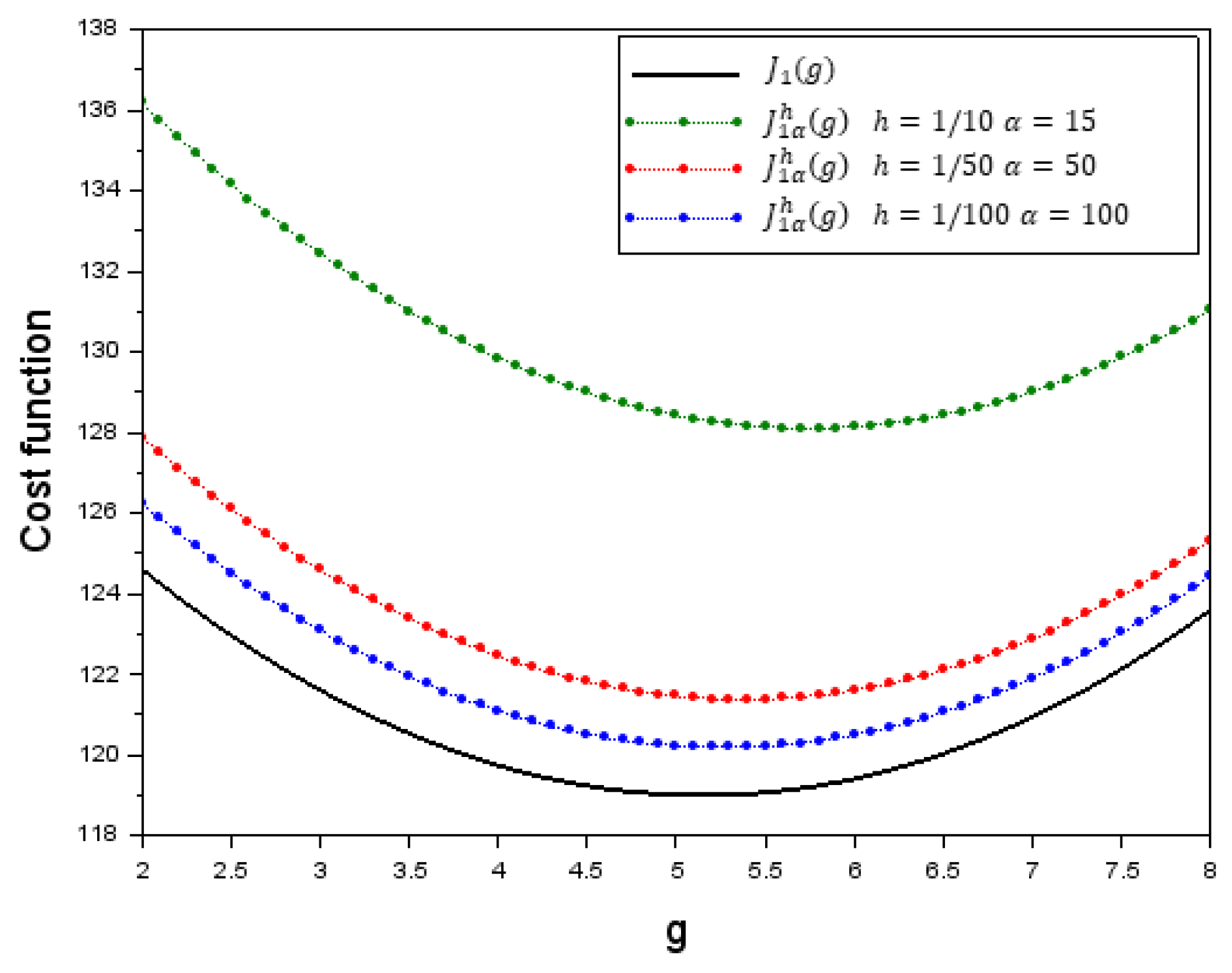
In Figure 3 we plotted the continuous quadratic cost function given by (28) and the discrete cost function obtained in (32) against g for , and . Notice that as h decreases, the function also decreases to the limit function in agreement with Lemma 3. In a similar manner in Figure 4, for , we obtain the continuous function and the discrete functions for and observing the convergence of as h decreases to zero. Moreover, Figure 5 shows the double convergence of when . We illustrate how gets closer to as the value of h decreases and the value of increases.
Figure 3.
Plot of and against g.
Figure 4.
Plot of and for against g.
Figure 5.
Plot of and against g.
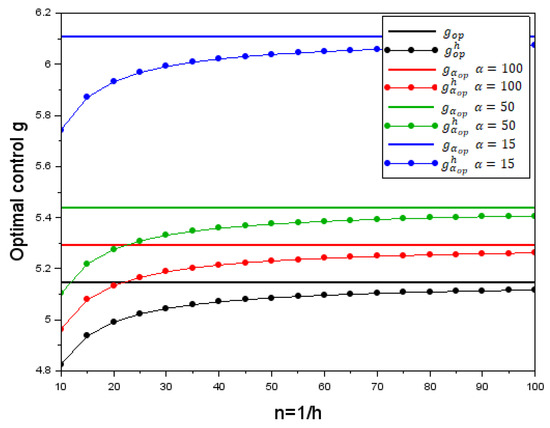
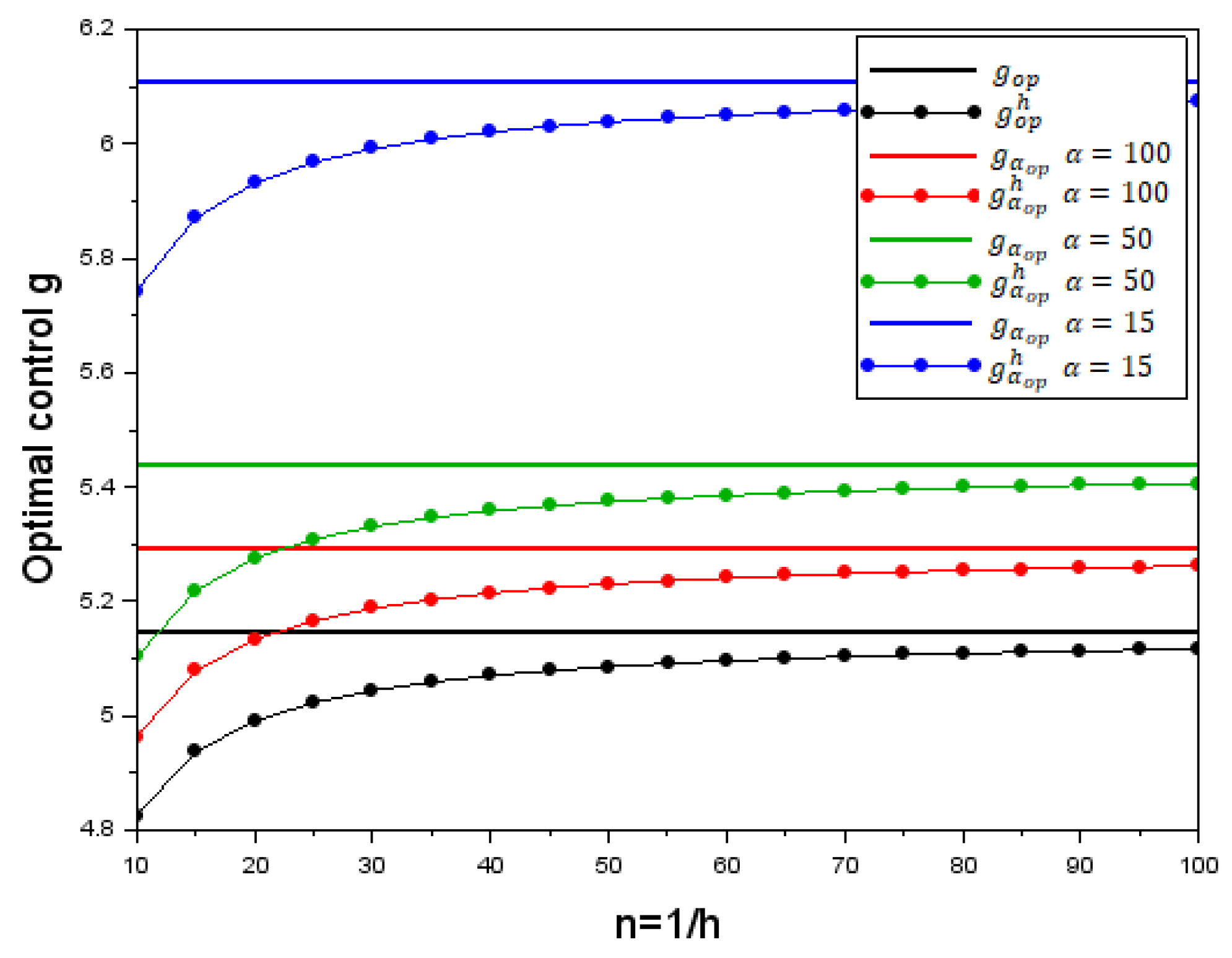
In Figure 6 we plotted the continuous optimal control for problem given by (29) and optimal control given by (40) for . Notice that as increases, decreases to the limit . In addition, we set different values of n between and . Recalling that , for each h, we obtained the optimal discrete control to problem defined by (4) and the optimal discrete control to problem given by (40) for . For each fixed, we observe the discrete solution when , i.e., .
Figure 6.
Plot of , , and against .
6.2. Control Variable q
In this subsection we ran some computational examples for the optimal boundary control problems , , and . For each plot, we set and .
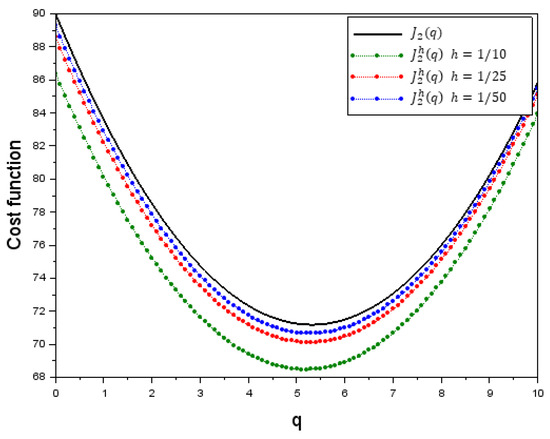
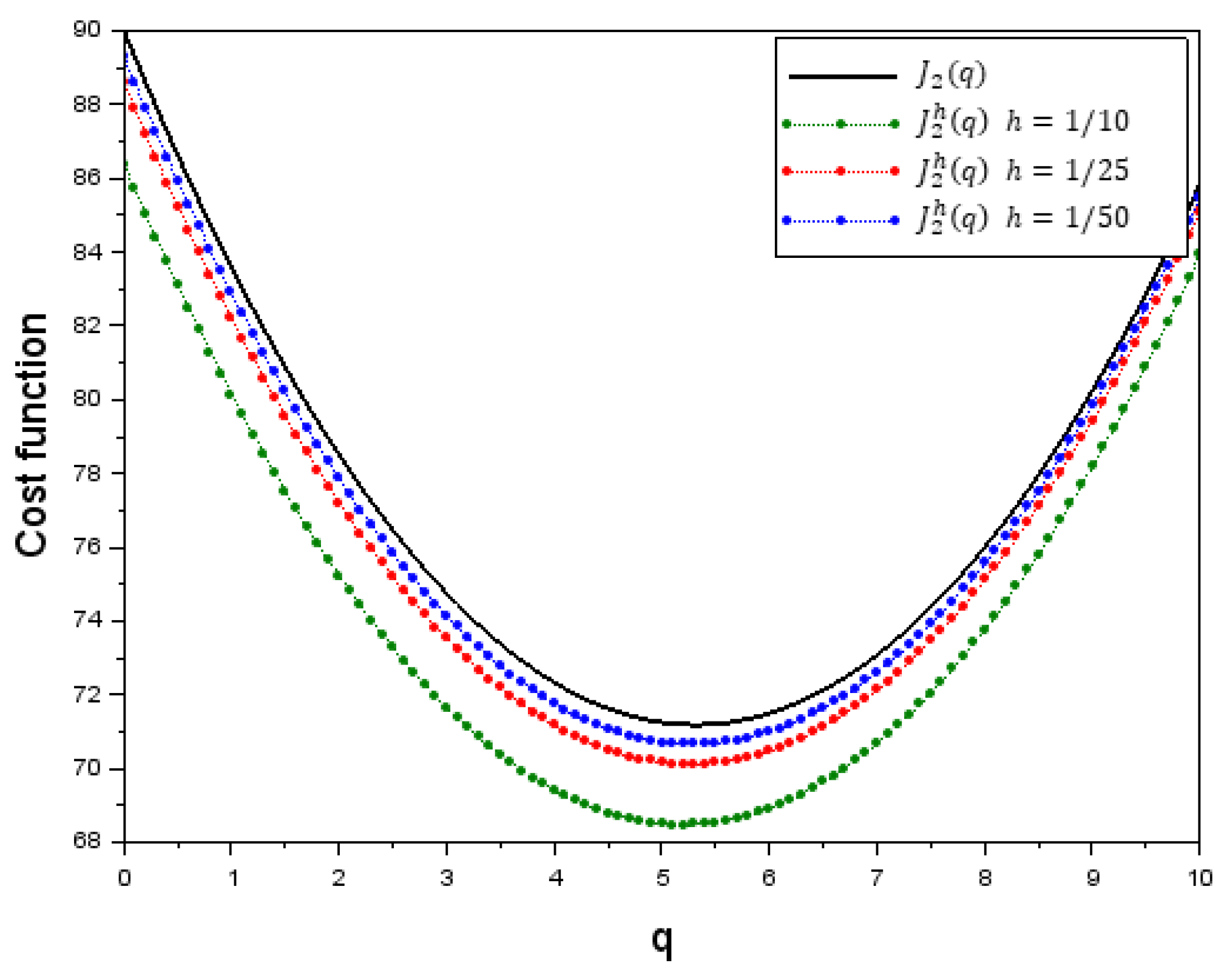
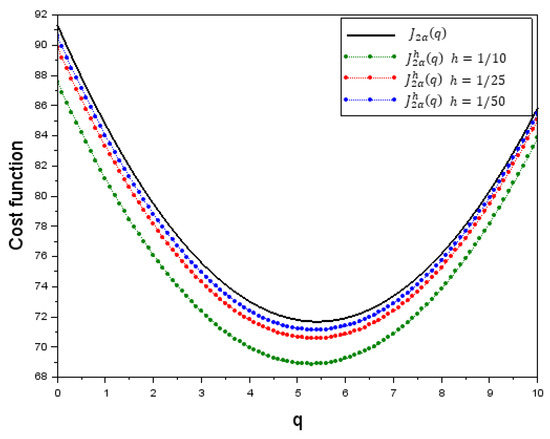
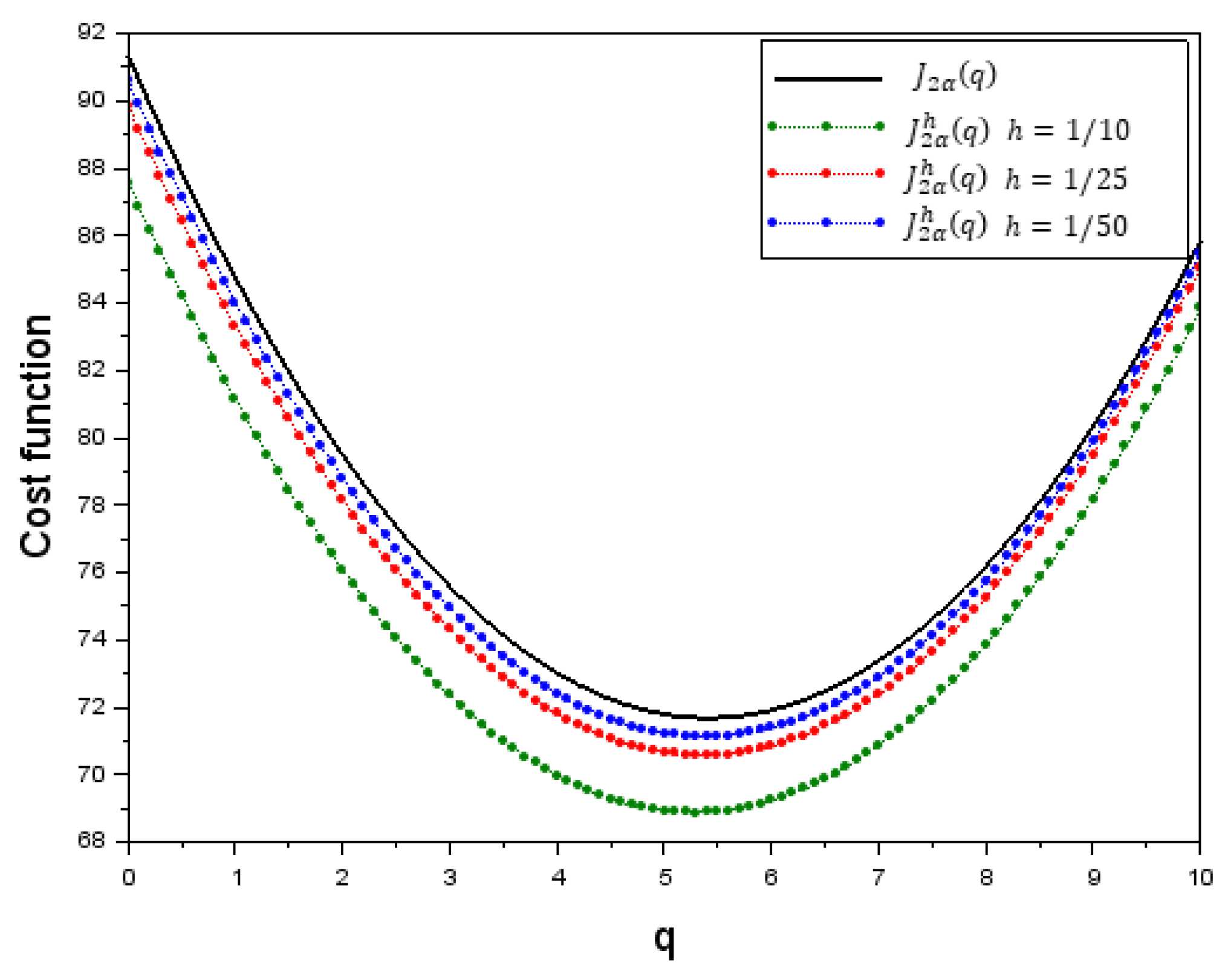
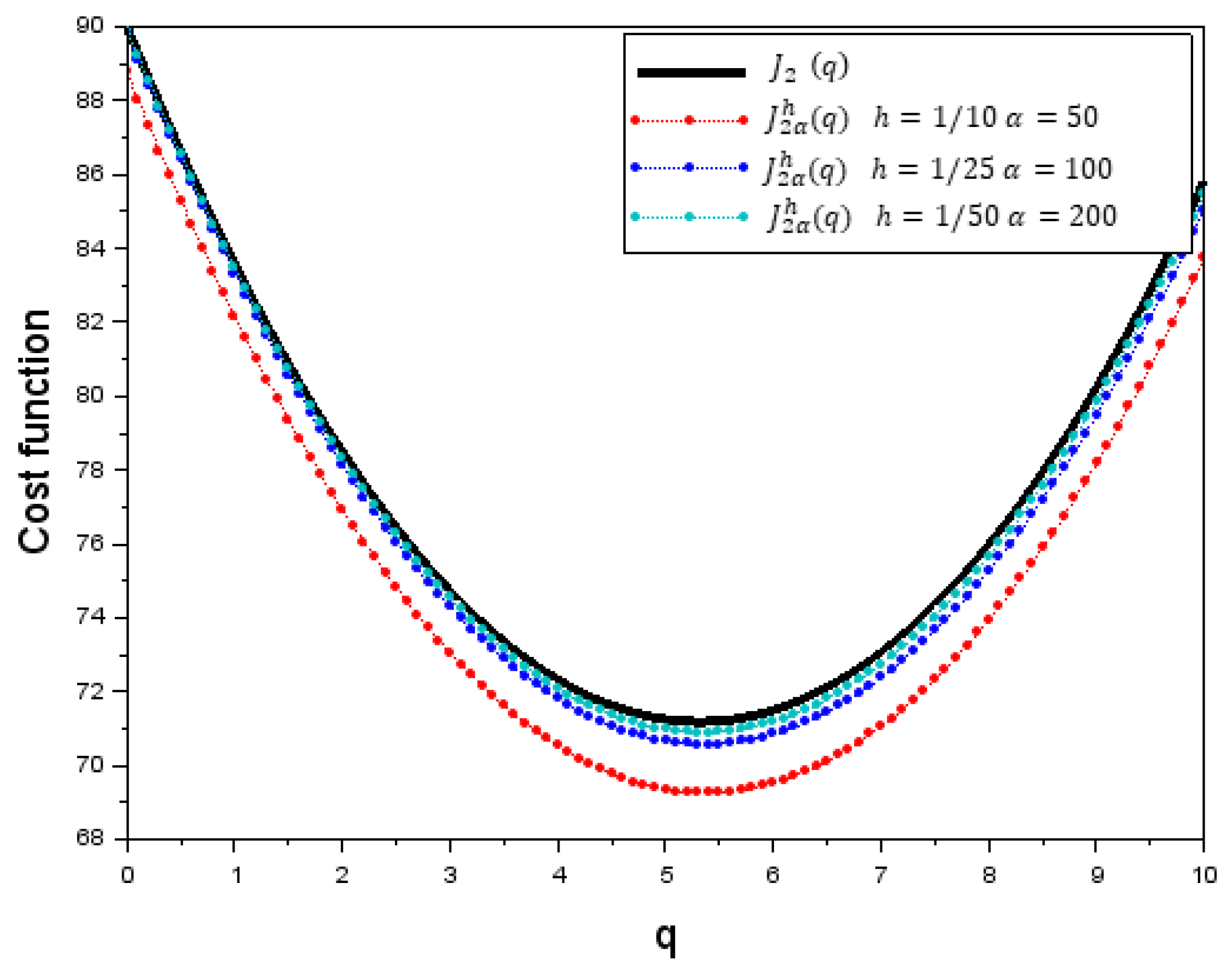
In Figure 7 we plotted the continuous quadratic cost function given by (49) and the discrete cost function obtained in (51) against q for , and . Observe that as h decreases, function also decreases to the limit function . In a similar way, in Figure 8, for , we obtained the continuous function and the discrete functions for and . The convergences and when are in agreement with Lemmas 9 and 12, respectively.
Figure 7.
Plot of and against q.
Figure 8.
Plot of and for against q.
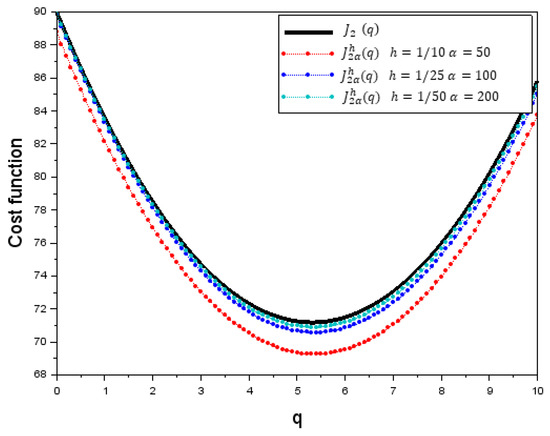
Moreover, Figure 9 shows the double convergence of when . We illustrate how gets closer to as the value of h decreases and the value of increases.
Figure 9.
Plot of and against q.
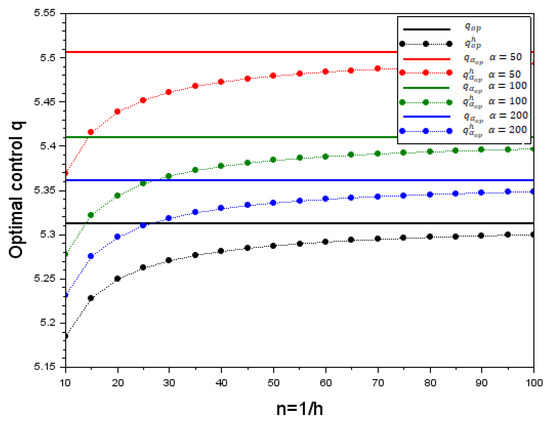
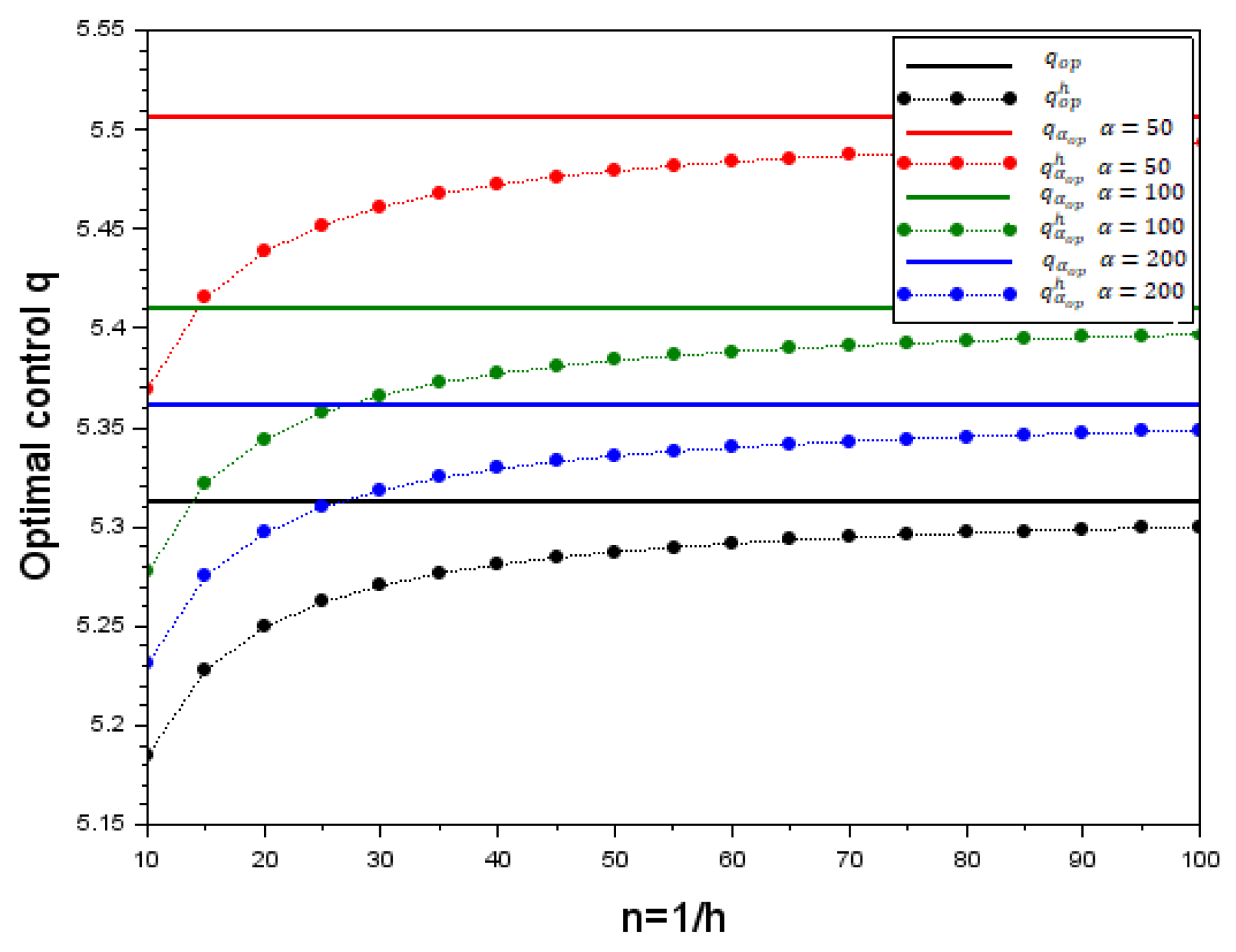
In Figure 10 we plotted the continuous optimal control for problem given by (50) and optimal control given by (62) for . Notice that as increases, decreases to the limit . In addition, we set different values of n between and . Recalling that , for each h, we obtained the optimal discrete control to problem defined by (53) and the optimal discrete control to problem given by (66) for . For each fixed, we observe the discrete solution when , i.e., .
Figure 10.
Plot of , , and against .
6.3. Control Variable b
In this section we obtain some computational examples for the optimal distributed control problems , , and . For each plot, we set and .
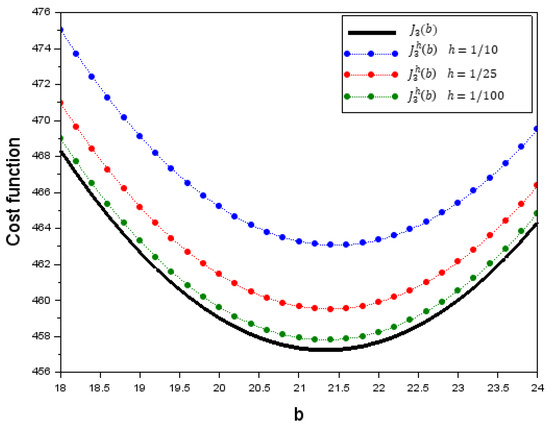
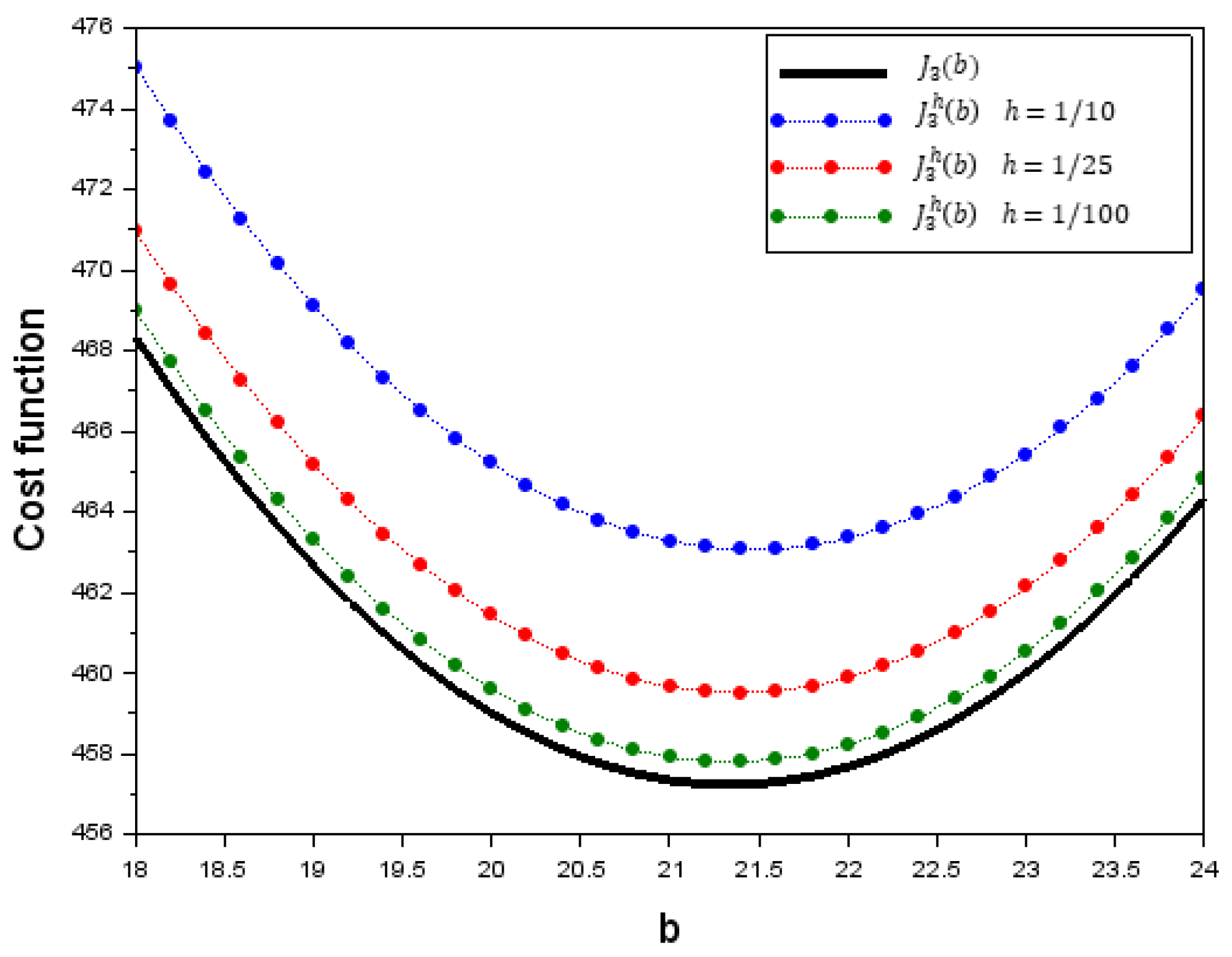
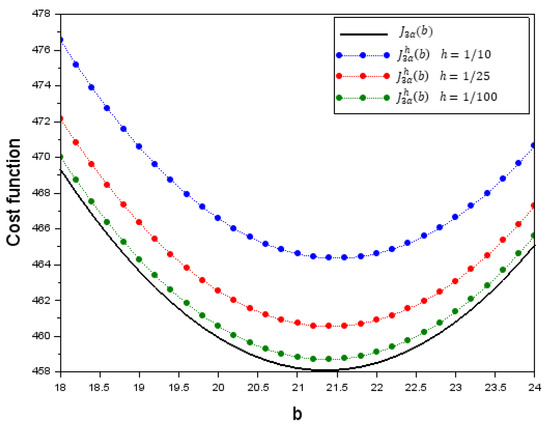
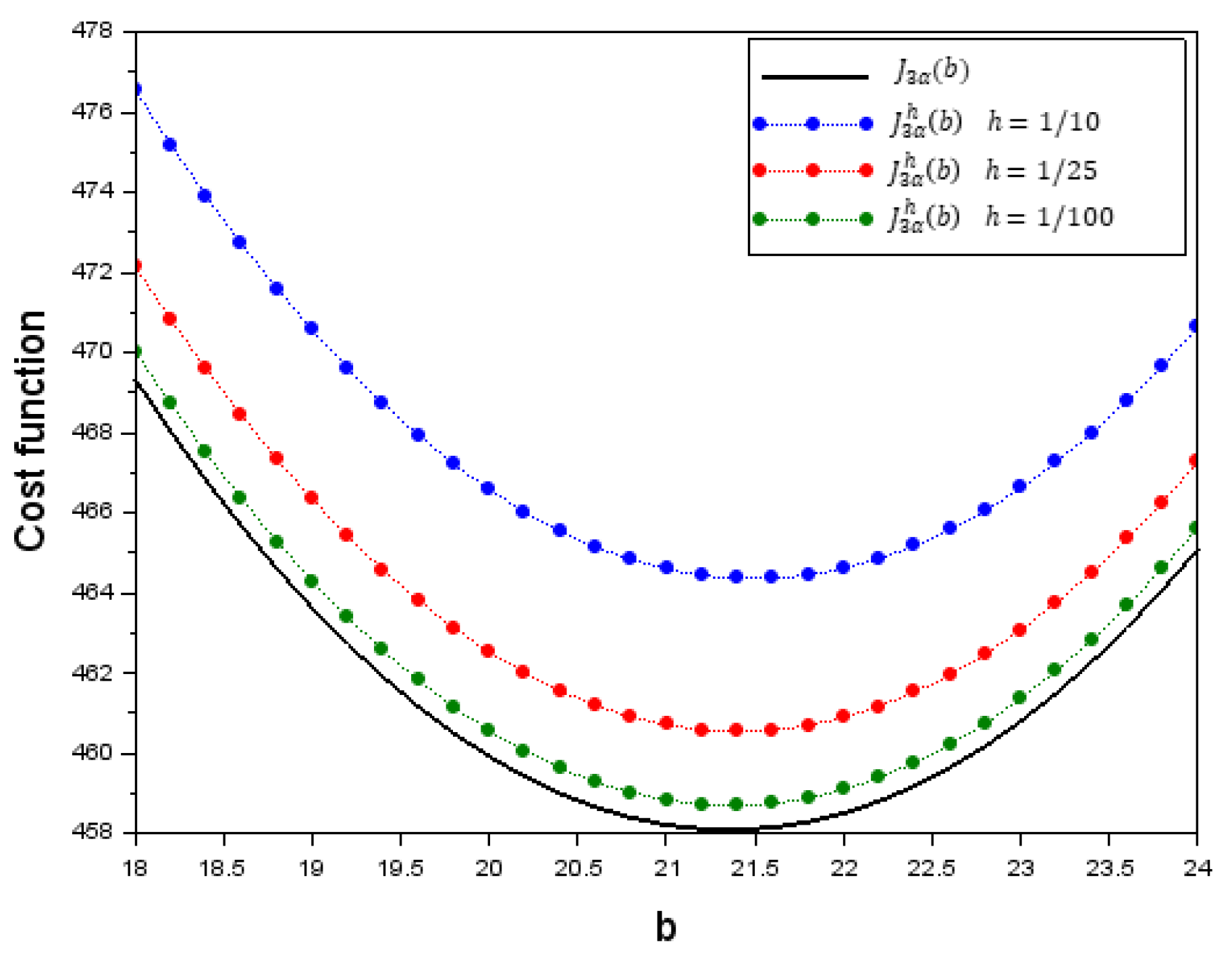
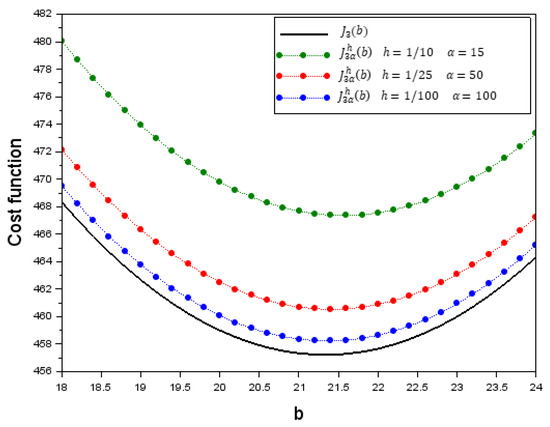
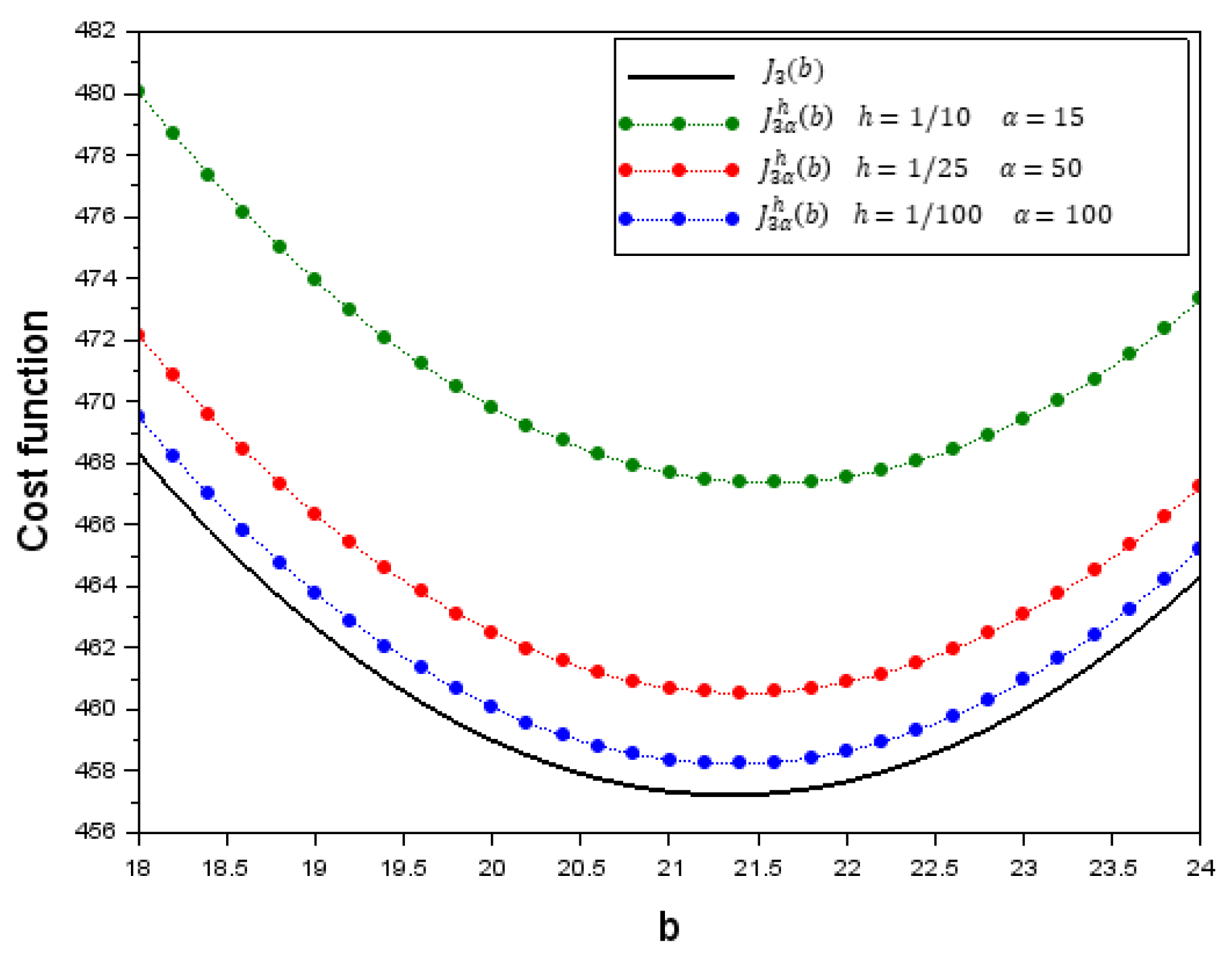
In Figure 11 we plotted the continuous quadratic cost function given by (72) and the discrete cost function obtained in (74) against g for , and . Notice that as h decreases, function also decreases to the limit function in agreement with Lemma 15. In a similar manner, in Figure 12, for , we obtained the continuous function and the discrete functions for and . Observe the convergence of as . Moreover, Figure 13 shows the double convergence of when . We illustrate how gets closer to as the value of h decreases and the value of increases.
Figure 11.
Plot of and against b.
Figure 12.
Plot of and for against b.
Figure 13.
Plot of and against b.
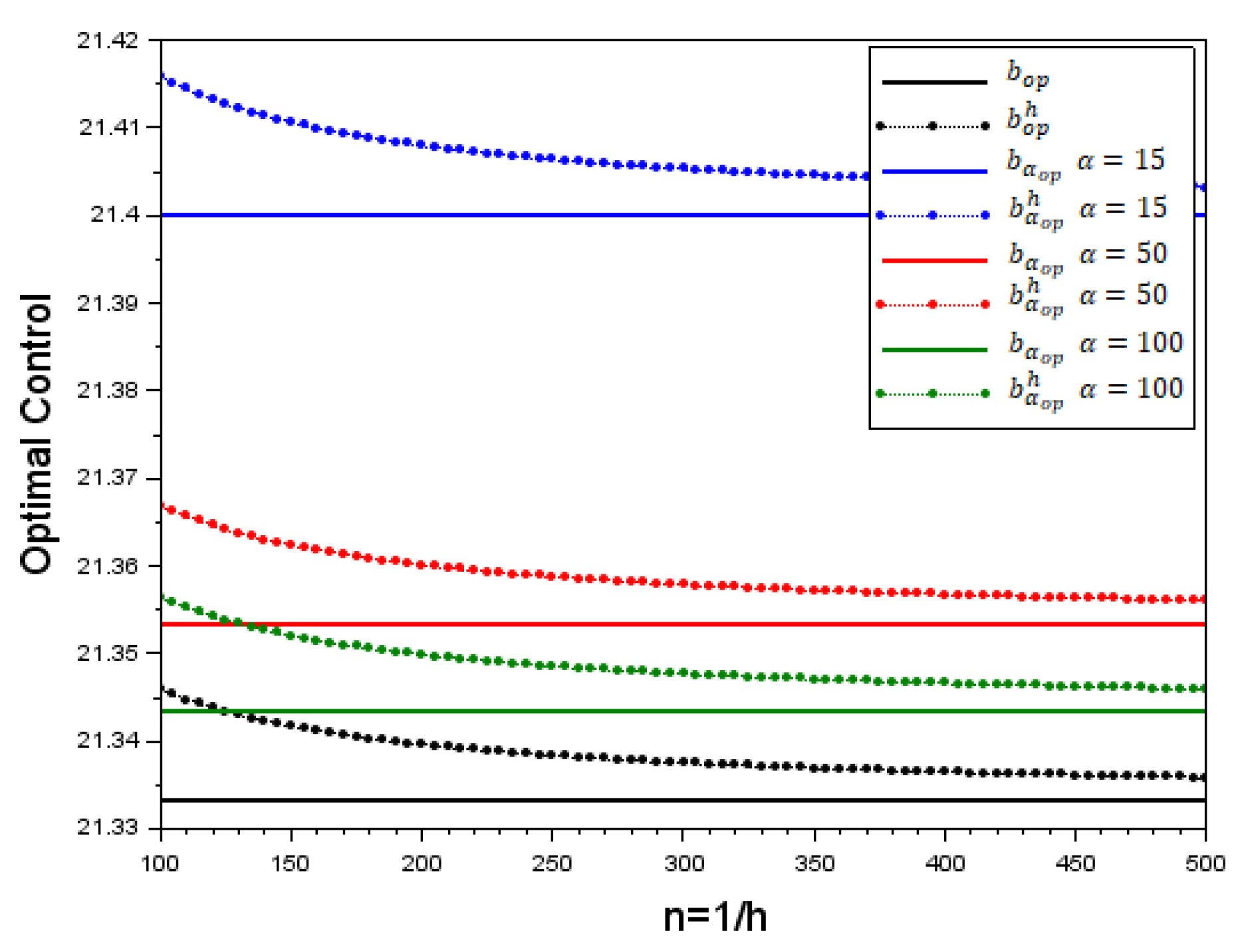
In Figure 14 we plotted the continuous optimal control for problem given by (73) and optimal control given by (82) for . Notice that as increases, decreases to the limit . In addition, we set different values of n between and . Recalling that , for each h, we obtained the optimal discrete control to problem defined by (76) and the optimal discrete control to problem given by (87) for . For each fixed, we observe the discrete solution decreases to when .
Figure 14.
Plot of , , and against .
7. Improvement of the Order of Convergence
In this section, we introduce alternative discrete solutions and associated with systems and , respectively, and analyze the order of convergence of to u and of to as . The Neumann boundary condition on is approximated by a three-point backward finite-difference scheme. Moreover, for the discrete solution , the Robin boundary condition on is approximated by a three-point forward finite-difference scheme. These higher-order boundary approximations lead to an improved order of accuracy.
We consider the system defined by Equations (1) and (2). From this system, we define the discrete problem , where for a fixed , approximates , for . Notice that from the Dirichlet condition on , it follows immediately that .
For the interior nodes, we employ the classical centered second-order finite-difference approximation given in (15), which leads to the discrete system (16) for , .
For the Neumann boundary condition on , we use the three-point backward approximation
Thus, the discrete Neumann condition can be written as
In addition, from (16) for , we obtain
Subtracting the two previous equations, it follows that
Therefore, the system given by (16) together with (94) can be written as
where is the vector of unknowns, A is the matrix given by (20) and is the vector of independent terms:
Notice that system (95) differs from (19) in the last component of the vector of independent terms. Solving the linear system gives
Taking into account that for
and
the linear approximation is given by , i.e.,
In the following lemma, we give some bounds for the approximate function
Lemma 21.
The following bounds hold:
where and .
Proof.
From the definition of the norm in space H and using the expressions (13) and (100) for functions u and , respectively, it follows that
where
Note that, within each subinterval, depends only on x and the index i, but not on y, since both u and are constant along the y-direction.
A direct computation yields
Then,
As a consequence, from (101), it follows that
and then
In addition,
where
for . Then,
Therefore, from (104), we have
and finally
□
Remark 11.
We emphasize that by improving the approximation of the Neumann boundary condition on , the convergence order of the error is increased to second order, namely, . The improvement is entirely due to the modification in the last component of vectors and in systems and , respectively, where a term of order appears. This enhancement leads to a more accurate numerical approximation while remaining fully consistent with the theoretical convergence results established in [10,22].
Remark 12.
The linear system (95) obtained by using the three-point backward finite-difference approximation for the Neumann boundary condition on can be equivalently interpreted by introducing a ghost point outside the computational domain and assuming that the discrete differential equation holds at the boundary node . Indeed, assuming that the equation is satisfied at , we have
while the Neumann boundary condition is approximated by
Eliminating the ghost value from these two expressions yields
which coincides with the boundary equation obtained in (94). Hence, the three-point backward finite-difference approximation of the Neumann condition is consistent with the ghost-point formulation and leads to the same discrete system.
Analogously to the analysis of system , we propose a new discrete approximation for system and study the order of convergence of to as . The associated discrete system employs a three-point backward finite-difference approximation for the Neumann boundary condition on and a three-point forward finite-difference approximation for the Robin boundary condition on , leading to improved accuracy.
We consider system defined by Equations (1) and (3) and define .
For the interior nodes, , we employ the classical centered second-order finite-difference approximation given in (15):
For the Robin boundary at , we use the three-point forward approximation:
Combining this expression with the interior equation at yields the simplified discrete condition
For the Neumann boundary at we use the three-point backward approximation:
Combining with the interior equation for gives
The system given by (105), (107) and (109) can be rewritten as
where is the vector of unknowns, is the matrix given by (25) and is the vector of independent terms:
It should be noted that only the first and last components of differ from those in given by (26).
The solution of system (110) is given by
We define the linear interpolation on each subinterval by
where
From the previous expressions, we derive the following lemma.
Lemma 22.
The following bounds hold:
where and .
8. Conclusions
Applying the finite difference method, we derived discrete systems and and discrete optimization problems and , , where is a parameter that represents the heat transfer coefficient on a portion of the boundary of the domain. Explicit discrete solutions were obtained, and convergence results as discretization step and parameter were proved. Error estimations were also obtained as a function of step h. Some numerical computations were provided in order to illustrate the theoretical results.
The obtained results showed that the proposed numerical approach provided first-order accurate approximations for both state systems and and associated optimal control problems and , , and that the discrete solutions converged to the corresponding continuous ones as discretization step .
Finally, for systems and , an alternative discretization of the Neumann boundary condition on and of the Robin boundary condition on for was considered. By modifying the approximation of these boundary conditions, the order of convergence of the numerical solution was improved, leading to a more accurate approximation.
A main limitation of the present work is that the analysis is restricted to rectangular domains, which allows the derivation of explicit solutions and simplifies the numerical implementation. As a future development, the proposed methodology is expected to be extended to more general domains, including polar and spherical coordinate systems.
Author Contributions
Conceptualization, D.A.T.; writing—original draft preparation, J.B. and M.C.O.; mathematical analysis, J.B., M.C.O. and D.A.T.; writing—review and editing, J.B., M.C.O. and D.A.T.; supervision, D.A.T.; software, M.C.O.; validation, J.B. and M.C.O. All authors have read and agreed to the published version of the manuscript.
Funding
This research received no external funding.
Data Availability Statement
Data are contained within the article.
Acknowledgments
The authors would like to thank the support of project O06-24CI1901 from Universidad Austral, Rosario, Argentina, and project PIP Nº 11220220100532 from CONICET.
Conflicts of Interest
The authors declare no conflicts of interest.
References
- Tarzia, D.A. Numerical analysis for the heat flux in a mixed elliptic problem to obtain a discrete steady-state two-phase Stefan problems. SIAM J. Numer. Anal. 1996, 33, 1257–1265. [Google Scholar] [CrossRef] [Scilit]
- Tabacman, E.D.; Tarzia, D.A. Sufficient and/or necessary condition for the heat transfer coefficient on γ1 and the heat flux on γ2 to obtain a steady-state two-phase Stefan problem. J. Differ. Equ. 1989, 77, 16–37. [Google Scholar]
- Haller-Dintelman, R.; Meyer, C.; Rehberg, J.; Schiela, A. Hölder continuity and optimal control for nonsmooth elliptic problems. Appl. Math. Optim. 2009, 60, 397–428. [Google Scholar] [CrossRef] [Scilit]
- Gariboldi, C.M.; Tarzia, D.A. Convergence of distributed optimal controls on the internal energy in mixed elliptic problems when the heat transfer coefficient goes to infinity. Appl. Math. Optim. 2003, 47, 213–230. [Google Scholar] [CrossRef] [Scilit]
- Gariboldi, C.M.; Tarzia, D.A. Convergence of boundary optimal control problems with restrictions in mixed elliptic Stefan-like problems. Adv. Differ. Equ. Control Process. 2008, 1, 113–132. [Google Scholar]
- Grisvard, P. Elliptic Problems in Non-Smooth Domains; Pitman: London, UK, 1985. [Google Scholar]
- Azzam, A.; Kreyszig, E. On solutions of elliptic equations satisfying mixed boundary conditions. SIAM J. Math. Anal. 1982, 13, 254–262. [Google Scholar] [CrossRef] [Scilit]
- Lanzani, L.; Capogna, L.; Brown, R. The mixed problem in Lp for some two-dimensional Lipschitz domains. Math. Ann. 2008, 342, 91–124. [Google Scholar] [CrossRef] [Scilit]
- Shamir, E. Regularization of mixed second order elliptic problems. Isr. J. Math. 1968, 6, 150–168. [Google Scholar] [CrossRef] [Scilit]
- Hinze, M. A variational discretization concept in control constrained optimization: The linear-quadratic case. Comput. Optim. Appl. 2005, 30, 45–61. [Google Scholar] [CrossRef] [Scilit]
- Wachsmuth, D.; Wachsmuth, G. Regularization error estimates and discrepancy principle for optimal control problems with inequality constraints. Control Cybern. 2011, 40, 1125–1158. [Google Scholar]
- Barbu, V. Optimal Control of Variational Inequalities; Pitman Advanced Publishing Program: Boston, MA, USA, 1984. [Google Scholar]
- Lions, J. Contrôle Optimal de Systèmes Gouvernés par des Équations aux Dérivées Partielles; Dunod: Paris, France, 1968. [Google Scholar]
- Neittaanmäki, P.; Sprekels, J.; Tiba, D. Optimization of Elliptic Systems: Theory and Applications; Springer: New York, NY, USA, 2006. [Google Scholar]
- Tröltzsch, F. Optimal Control of Partial Differential Equations: Theory, Methods and Applications; American Mathematical Society: Providence, RI, USA, 2010. [Google Scholar]
- Bollati, J.; Gariboldi, C.M.; Tarzia, D.A. Explicit solutions for distributed, boundary and distributed-boundary elliptic optimal control problems. J. Appl. Math. Comput. 2020, 64, 283–311. [Google Scholar] [CrossRef] [Scilit]
- Angel, E. Discrete invariant imbedding and elliptic boundary-value problems over irregular regions. J. Math. Anal. Appl. 1968, 23, 471–484. [Google Scholar] [CrossRef] [Scilit]
- Arnal, A.; Monterde, J.; Ugail, H. Explicit polynomial solutions of fourth order linear elliptic partial differential equations for boundary based smooth surface generation. Comput. Aided Geom. Des. 2011, 28, 382–394. [Google Scholar] [CrossRef] [Scilit]
- Lang, J.; Schmitt, B.A. Exact discrete solutions of boundary control problems for the 1D heat equation. J. Optim. Theory Appl. 2023, 196, 1106–1118. [Google Scholar] [CrossRef] [Scilit]
- Yang, C.; Sun, T. Second-order time discretization for reaction coefficient estimation of bilinear parabolic optimization problem with Neumann boundary conditions. Comput. Math. Appl. 2023, 140, 211–224. [Google Scholar] [CrossRef] [Scilit]
- Tarzia, D.A. Double convergence of a family of discrete distributed mixed elliptic optimal control problems with a parameter. In Proceedings of the 27th IFIP TC 7 Conference on System Modelling and Optimization, CSMO 2015, IFIP AICT 494; Bociu, L., Desideri, J., Habbal, A., Eds.; Springer Nature: Singapore, 2016; pp. 493–504. [Google Scholar]
- Casas, E.; Mateos, M. Uniform convergence of the FEM. Application to state constrained control problems. Comput. Appl. Math. 2002, 21, 67–100. [Google Scholar]

Disclaimer/Publisher’s Note: The statements, opinions and data contained in all publications are solely those of the individual author(s) and contributor(s) and not of MDPI and/or the editor(s). MDPI and/or the editor(s) disclaim responsibility for any injury to people or property resulting from any ideas, methods, instructions or products referred to in the content. |
© 2026 by the authors. Licensee MDPI, Basel, Switzerland. This article is an open access article distributed under the terms and conditions of the Creative Commons Attribution (CC BY) license.