


Abstract
The efficient minus domination problem (EMDP) and the efficient signed domination problem (ESDP) are domination-type problems in graphs. These problems are known to be NP-complete on chordal graphs and polynomially solvable on chain interval graphs, while the complexity on proper interval graphs remained open. By exploiting the totally unimodular structure of the closed-neighborhood matrix induced by a proper interval ordering, we obtain linear programming formulations under which both the EMDP and ESDP become polynomially solvable. The same perspective naturally extends to vertex-weighted settings and to other domination variants defined by similar neighborhood constraints.
Keywords:
efficient minus domination; efficient signed domination; proper interval graphs; totally unimodular matrices; consecutive ones property; linear programming; graph domination; polynomial-time algorithms MSC:
05C69; 05C75; 90C05
1. Introduction
Signed domination and minus domination are natural extensions of classical domination in which vertices are assigned values from or , respectively, subject to constraints on closed neighborhoods. These notions have been extensively investigated in the literature; for example, see [1,2,3,4,5,6,7].
A particularly restrictive and intriguing version is the efficient variant, in which the neighborhood constraint is strengthened from an inequality to an equality. An efficient signed (respectively, minus) dominating function of a graph satisfies
The equality requirement leads to substantially different structural and algorithmic behavior from the classical domination problems.
It is useful to distinguish two independent aspects of these domination variants. The first concerns the label set assigned to vertices, such as for signed domination and for minus domination. The second concerns the form of the neighborhood constraint imposed on the labeling. Classical domination uses the inequality , efficient domination strengthens this to the equality , and reverse domination considers the reversed inequality .
Lu, Peng, and Tang [8] initiated the systematic study of the efficient minus domination problem (EMDP) and the efficient signed domination problem (ESDP). They showed that both problems are NP-complete on chordal and chordal bipartite graphs, and obtained linear-time algorithms only for the very restricted class of chain interval graphs. In their conclusion, they explicitly asked whether EMDP and ESDP are polynomially solvable on interval graphs, in particular on proper interval graphs.
Proper interval graphs form one of the most structured subclasses of interval graphs. They admit a proper interval ordering in which every closed neighborhood forms a consecutive block [9,10,11]. Matrices arising from such orderings have the consecutive ones property. This property is a classical source of totally unimodular matrices in combinatorial optimization [12,13,14]. Such matrices play a central role in linear programming (LP), since totally unimodular (TU) constraint matrices guarantee the integrality of extreme points of the associated polyhedra.
In the existing literature, three types of domination variants have been studied for signed and minus domination: the classical versions based on inequality constraints, efficient versions based on equality constraints, and reverse versions based on reversed inequalities. These problems have almost exclusively been investigated on unweighted graphs, typically from the perspective of existence and optimization of feasible labelings.
Weighted formulations, in which vertex weights are incorporated into the objective function, have received little attention despite arising naturally from an optimization perspective. This motivates the weighted formulations considered in this paper. From the polyhedral viewpoint adopted in this paper, these variants differ only in the type of neighborhood constraint while sharing the same underlying matrix structure.
In this paper, we solve the open problem posed in [8] by proving that both the EMDP and ESDP are polynomial-time solvable on proper interval graphs. Under a proper interval ordering, the closed-neighborhood matrix is totally unimodular, which provides natural linear programming formulations for both the unweighted and vertex-weighted versions.
Consequently, efficient minus and signed domination on proper interval graphs admit a clean polyhedral characterization, linking domination theory with classical results in combinatorial optimization and extending the theory from the traditional unweighted setting to a weighted framework.
The contributions of this paper can be summarized as follows.
First, we resolve the open problem posed by Lu, Peng, and Tang by proving that both the efficient minus domination problem (EMDP) and the efficient signed domination problem (ESDP) are polynomial-time solvable on proper interval graphs.
Second, we formulate these problems as linear programs based on the closed-neighborhood matrix of the graph.
Third, by combining the totally unimodular structure of this matrix with the Hoffman–Kruskal theorem, we show that the LP relaxations already yield integral optimal solutions.
Fourth, we demonstrate that this totally unimodular viewpoint extends naturally to a broader family of domination-type problems, including classical signed domination, classical minus domination, reverse signed domination, reverse minus domination, and their vertex-weighted versions.
The remainder of the paper is organized as follows: Section 2 introduces the necessary background, while Section 3 develops linear programming formulations and exploits the totally unimodular structure of the closed-neighborhood matrix of proper interval graphs to derive polynomial-time solvability together with algorithmic aspects and a broader TU framework.
2. Preliminaries
This section recalls several concepts that will be used to reveal the totally unimodular structure of the closed-neighborhood matrix of proper interval graphs.
2.1. Neighborhoods and Labelings
Throughout this paper, denotes a simple undirected graph with vertex set and edge set E. For a vertex , the open neighborhood of v is
and the closed neighborhood is
Let and let be a labeling function of G. For any , define
so that denotes the sum of labels over the closed neighborhood of v.
For an unweighted graph G, the labeling weight of f is . For a vertex-weighted graph with , the labeling weight of f is
2.2. Y-Domination, Signed Domination, and Minus Domination
A labeling is a Y-dominating function if
The Y-domination problem is to find a Y-dominating function of G with minimum labeling weight.
A function is a signed dominating function if
The signed domination problem is to find a signed dominating function of G with minimum labeling weight.
A function is a minus dominating function if
Analogously, the minus domination problem is to find a minus dominating function of G with minimum labeling weight.
2.3. Reverse Domination Variants
A labeling is a reverse Y-dominating function if
The reverse Y-domination problem is to find a Y-dominating function of G with maximum labeling weight.
A function is a reverse signed dominating function if
The reverse signed domination problem is to find a reverse signed dominating function of G with maximum labeling weight.
A function is a reverse minus dominating function if
Similarly, the reverse minus domination problem is to find a reverse minus dominating function of G with maximum labeling weight.
These variants differ only in the direction of the neighborhood inequality and will later be treated within the same linear programming framework.
2.4. Efficient Domination Variants
A labeling is an efficient Y-dominating function if
Bange et al. [2] proved that for any fixed Y, if an unweighted graph G admits an efficient Y-dominating function, then all such functions have the same labeling weight . Hence, on unweighted graphs, the efficient Y-domination problem is a feasibility problem.
On a vertex-weighted graph , the efficient Y-domination problem is to find an efficient Y-dominating function with minimum labeling weight.
Efficient signed domination (respectively, efficient minus domination) is efficient Y-domination with (respectively, ).
On unweighted graphs, the efficient signed domination problem (ESDP) and efficient minus domination problem (EMDP) are feasibility problems.
On a vertex-weighted graph , the ESDP (respectively, EMDP) is to find an efficient signed (respectively, minus) dominating function with minimum labeling weight.
2.5. Interval Graphs and Proper Interval Graphs
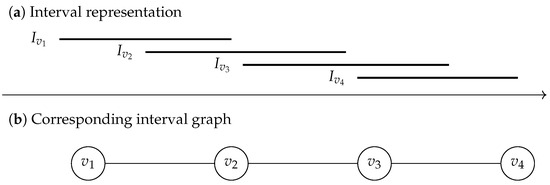
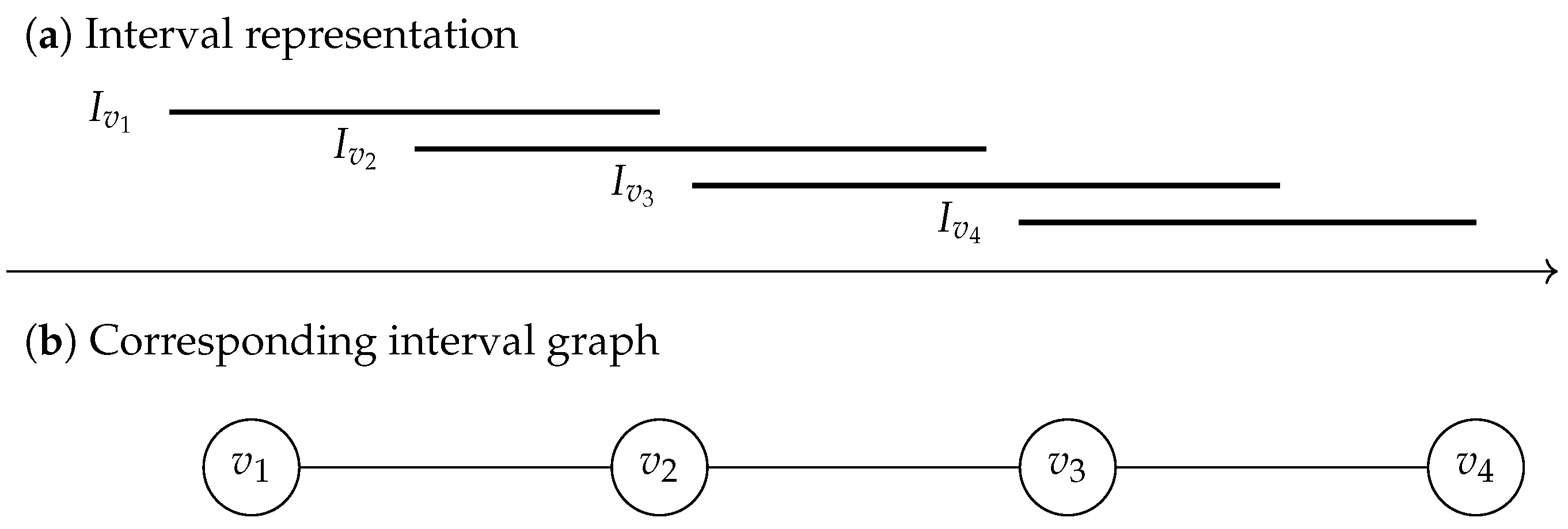
A graph G is an interval graph if each vertex can be assigned an interval on the real line such that if and only if . See Figure 1 for an example.
Figure 1.
(a) Interval representation of a graph; (b) Corresponding interval graph. Two vertices are adjacent if and only if their intervals intersect.
An interval graph is a proper interval graph if no interval properly contains another.
Proper interval graphs admit an ordering , called a proper interval ordering, in which every closed neighborhood forms a consecutive block of vertices (see, e.g., [9,10,11]).
2.6. Linear Programming and Totally Unimodular Matrices
A linear program (LP) consists of a linear objective function together with a finite collection of linear constraints. The set of all points that satisfy the constraints is called the feasible region. Geometrically, the feasible region is a polyhedron, that is, a set obtained as the intersection of finitely many linear inequality or equality constraints.
A point in the feasible region is an extreme point if it cannot be written as a nontrivial convex combination of two distinct feasible points, or equivalently, if it is not contained in the relative interior of any line segment of feasible points. Extreme points play a central role in linear programming because whenever an LP has an optimal solution, it has an optimal solution attained at an extreme point of the feasible region.
A polyhedron is integral (or an integer polyhedron) if every extreme point is an integer point. In this case, solving the LP automatically yields an integer optimal solution, even though integrality was not imposed explicitly.
An integer linear program (ILP) is an LP with the additional requirement that the variables take integer values. In general, such integrality constraints are necessary to guarantee integer solutions. However, when the feasible region is an integer polyhedron, these additional constraints are not needed, since solving the LP already yields an integer extreme-point solution.
A matrix is totally unimodular (TU) if every square submatrix has determinant in .
A fundamental property of totally unimodular matrices is the following classical result (see, e.g., Schrijver [12] and Hoffman and Kruskal [15]). If a linear program is described by linear constraints with coefficients that form a totally unimodular matrix and bounds that are integers, then the feasible region of the LP is an integer polyhedron.
3. Linear Programming Approach
In this section, we reformulate the efficient minus domination problem and the efficient signed domination problem using the constraint matrix arising from the closed-neighborhood structure of a graph. This viewpoint expresses the neighborhood-sum constraints in a compact linear form and enables the use of tools from linear programming and polyhedral combinatorics.
Since the domination conditions are entirely determined by closed neighborhoods, the problem can be formulated naturally by the corresponding matrix. Let be a graph with . We define the closed-neighborhood matrix of G to be the 0–1 matrix , given by
For a labeling , let be the vector with for . Then, the neighborhood-sum constraints
can be expressed compactly as
where denotes the all-ones vector.
Let be a vertex-weight function and let .
3.1. Integer Linear Programming Formulations
We first formulate the ESDP and EMDP as integer linear programs.
In the ESDP, the labeling satisfies for each i. Therefore, the ESDP on can be formulated as
In the EMDP, the labeling satisfies for each i. Hence, the EMDP on can be formulated as
3.2. LP Relaxations
We next consider linear programming relaxations of the above integer programs.
For EMDP, we relax the integrality requirement to the box constraint
This yields the LP relaxation
Let
denote the feasible region of this relaxation.
For the ESDP, the domain constraint can be expressed by introducing variables with
Consequently, corresponds to , and we relax this to
Substituting into gives
Moreover,
so minimizing is equivalent to minimizing . Hence, the LP relaxation of the ESDP can be written as
Let
denote the feasible region of this relaxation.
We now analyze the structure of these feasible regions.
3.3. Totally Unimodular Structure and Integrality
We now show why the LP relaxations derived above already produce integral optimal solutions. The argument relies on a classical theorem of Hoffman and Kruskal concerning totally unimodular matrices.
Definition 1.
A polyhedron is box-integer if for every pair of integral vectors with , the intersection
has only integral extreme points.
Theorem 1
(Hoffman and Kruskal [12,15]). Let be an integral matrix. Then, the polyhedron
is box-integer for every integral vector if and only if is totally unimodular.
Theorem 2.
Let be totally unimodular and let be integral. Then, the polyhedron
is box-integer.
Proof.
The system is equivalent to
Since is also totally unimodular, the result follows from Theorem 1. □
Corollary 1.
Let be totally unimodular and let be integral. Then, the polyhedron
is box-integer.
Proof.
The equality system is equivalent to
The corollary follows from Theorems 1 and 2. □
Under a proper interval ordering, the closed-neighborhood matrix has the consecutive ones property for rows, and as such is totally unimodular [9,13,14].
Recall the feasible region
Since is totally unimodular and the right-hand side is integral, Corollary 1 implies that is box-integer. Hence, every extreme point satisfies . Consequently, the LP relaxation of EMDP already yields an optimal efficient minus dominating function whenever a feasible solution exists.
Recall the feasible region
Observe that the ith component of equals . Hence, the right-hand side vector has entries
If an efficient signed dominating function exists, then must be odd for every i; thus, this vector is integral.
Since is totally unimodular, Corollary 1 implies that is box-integer. Thus, every extreme point satisfies , resulting in . Consequently, the LP relaxation of ESDP already yields an optimal efficient signed dominating function whenever a feasible solution exists. In particular, no integer programming techniques are required.
3.4. Polynomial-Time Solvability
Theorem 3.
The efficient minus domination problem (EMDP) and efficient signed domination problem (ESDP) are both polynomial-time solvable on proper interval graphs. Moreover, the same holds for their vertex-weighted versions. In particular, each problem can be solved in time, where and ω is the matrix multiplication exponent.
Proof.
As shown in the previous subsections, due to the totally unimodular structure of the closed-neighborhood matrix under a proper interval ordering, both problems admit linear programming formulations with feasible regions that are box-integer. Hence, every optimal extreme point of the LP relaxation is integral, and solving the LP relaxations yields an optimal solution.
Each of the resulting LP relaxations has variables and constraints. Therefore, these problems are solvable in polynomial time by standard polynomial-time algorithms for linear programming.
Moreover, applying a recent deterministic LP algorithm [16] yields a running time of
where is the dual matrix multiplication exponent and is the accuracy parameter. Under the current best-known bounds and [17], the running time becomes
for constant accuracy parameter , since . □
3.5. A Totally Unimodular Framework
The arguments in the previous sections rely on the equality system
which arises naturally in the efficient variants of signed and minus domination. In this form, the right-hand side is integral whenever a feasible solution exists and the Hoffman–Kruskal theorem applies directly through the totally unimodular structure of the closed-neighborhood matrix.
However, classical and reverse domination variants impose inequality constraints of the form
Although these systems are not presented in equality form, they can be transformed into the same framework by the introduction of slack variables.
For example, a system of the form
can be rewritten as
where . This system can be expressed in matrix form as
The augmented matrix
is obtained from by appending unit columns (up to sign). Since total unimodularity is preserved under such operations, this matrix remains totally unimodular. Therefore, the Hoffman–Kruskal theorem implies that the corresponding polyhedron is box-integer.
This shows that the totally unimodular structure of the closed-neighborhood matrix is not restricted to the efficient variants. The same linear programming framework applies uniformly to domination problems defined by different label sets (signed or minus) and different types of neighborhood constraints (classical, efficient, or reverse) as well as to their vertex-weighted versions.
4. Conclusions
We have settled the open problem posed by Lu, Peng, and Tang by showing that both the efficient minus domination problem and the efficient signed domination problem are polynomial-time solvable on proper interval graphs. An important point is that this argument is independent of whether the objective is a minimization or a maximization problem.
The key insight is that the closed-neighborhood matrix of a proper interval graph possesses a totally unimodular structure, which allows these problems to be handled naturally through linear programming. In particular, the LP relaxations already yield integral optimal solutions, and no integer programming machinery is required.
Beyond the efficient variants, the discussion in Section 3.5 shows that this totally unimodular viewpoint applies more broadly to a range of domination-type problems, including classical and reverse versions as well as their vertex-weighted forms. From this perspective, proper interval graphs provide a natural setting in which domination problems can be studied uniformly through polyhedral methods. This viewpoint places domination problems within the scope of polyhedral combinatorics.
It is natural to ask whether a similar approach could extend beyond proper interval graphs. For general interval graphs, the structural properties required to establish total unimodularity may fail. Moreover, circular-arc graphs do not admit a linear interval ordering, and the corresponding closed-neighborhood matrices generally lack the structural structure exploited in our proofs. Therefore, a direct extension of our method to circular-arc graphs does not appear immediate and would require additional structural insights.
The connection between domination theory and polyhedral combinatorics may be useful for investigating further domination variants on structured graph classes through linear programming and polyhedral techniques [12].
Funding
This research received no external funding.
Data Availability Statement
Data are contained within the article.
Conflicts of Interest
The author declares no conflicts of interest.
References
- Dunbar, J.E.; Haynes, T.W.; Hedetniemi, S.T.; Slater, P.J. Signed domination in graphs. J. Graph Theory 1995, 19, 509–516. [Google Scholar]
- Bange, D.W.; Barkauskas, A.E.; Host, L.H.; Slater, P.J. Generalized domination and efficient domination in graphs. Discret. Math. 1996, 159, 1–11. [Google Scholar] [CrossRef] [Scilit]
- Dunbar, J.; Hedetniemi, S.T.; Henning, M.A.; McRae, A. Minus domination in graphs. Discret. Math. 1999, 199, 35–47. [Google Scholar] [CrossRef] [Scilit]
- Henning, M.A. Signed and minus domination in graphs: A survey. Discret. Math. 2004, 278, 109–125. [Google Scholar] [CrossRef] [Scilit]
- Lee, C.-M.; Lo, C.-C. On the complexity of reverse minus and signed domination on graphs. J. Interconnect. Netw. 2015, 15, 1550008. [Google Scholar] [CrossRef] [Scilit]
- Haynes, T.W.; Hedetniemi, S.T.; Henning, M.A. (Eds.) Structures of Domination in Graphs; Developments in Mathematics; Springer: Cham, Switzerland, 2021; Volume 66. [Google Scholar]
- Bhyravarapu, S.; Kanesh, L.; Mohanapriya, A.; Purohit, N.; Sadagopan, N.; Saurabh, S. On the parameterized complexity of minus domination. In SOFSEM 2024: Theory and Practice of Computer Science; Lecture Notes in Computer Science; Springer: Cham, Switzerland, 2024; pp. 96–110. [Google Scholar]
- Lu, C.-L.; Peng, S.-T.; Tang, C.-Y. Efficient minus and signed domination in graphs. Theor. Comput. Sci. 2003, 301, 381–397. [Google Scholar] [CrossRef] [Scilit]
- Brandstädt, A.; Le, V.B.; Spinrad, J.P. Graph Classes: A Survey; SIAM: Philadelphia, PA, USA, 1999. [Google Scholar]
- Golumbic, M.C. Algorithmic Graph Theory and Perfect Graphs, 2nd ed.; Elsevier: Amsterdam, The Netherlands, 2004. [Google Scholar]
- Roberts, F.S. Indifference graphs. In Proof Techniques in Graph Theory; Academic Press: New York, NY, USA, 1969; pp. 139–146. [Google Scholar]
- Schrijver, A. Theory of Linear and Integer Programming; John Wiley & Sons: Chichester, UK, 1998. [Google Scholar]
- Fulkerson, D.; Gross, O. Incidence matrices and interval graphs. Pac. J. Math. 1965, 15, 835–855. [Google Scholar] [CrossRef] [Scilit]
- Booth, K.S.; Lueker, G.S. Testing for the consecutive ones property, interval graphs, and graph planarity using PQ-tree algorithms. J. Comput. Syst. Sci. 1976, 13, 335–379. [Google Scholar] [CrossRef] [Scilit]
- Hoffman, A.J.; Kruskal, J.B. Integral boundary points of convex polyhedra. In Linear Inequalities and Related Systems; Annals of Mathematics Studies, No. 38; Princeton University Press: Princeton, NJ, USA, 1956; pp. 223–246. [Google Scholar]
- Van den Brand, J. A deterministic linear program solver in current matrix multiplication time. In Proceedings of the Fourteenth Annual ACM-SIAM Symposium on Discrete Algorithms; Society for Industrial and Applied Mathematics: Philadelphia, PA, USA, 2020; pp. 259–278. [Google Scholar]
- Williams, V.V.; Xu, Y.; Xu, Z.; Zhou, R. New bounds for matrix multiplication: From alpha to omega. In Proceedings of the 2024 Annual ACM-SIAM Symposium on Discrete Algorithms (SODA); Society for Industrial and Applied Mathematics: Philadelphia, PA, USA, 2024; pp. 3792–3835. [Google Scholar]
Disclaimer/Publisher’s Note: The statements, opinions and data contained in all publications are solely those of the individual author(s) and contributor(s) and not of MDPI and/or the editor(s). MDPI and/or the editor(s) disclaim responsibility for any injury to people or property resulting from any ideas, methods, instructions or products referred to in the content. |
© 2026 by the author. Licensee MDPI, Basel, Switzerland. This article is an open access article distributed under the terms and conditions of the Creative Commons Attribution (CC BY) license.