
Article

Dynamics of Powdery Mildew Transmission in Cashew Plants Under Lévy Noise: A Nonlinear Stochastic Model

by
Albert Kouchéré Guidzavaï
1,
Hamadjam Abboubakar
2,3,*,
Joseph Mbang
1 and
Rashid Jan
4
1
Department of Mathematics, Faculty of Science, The University of Yaounde I, Yaounde P.O. Box 812, Cameroon
2
Department of Computer Engineering, University Institute of Technology, The University of Ngaoundéré, Ngaoundéré P.O. Box 455, Cameroon
3
Department of Applied Mathematics and Computer Science, School of Geology and Mining Engineering, The University of Ngaoundéré, Meiganga P.O. Box 115, Cameroon
4
Department of Mathematics, College of Science, Qassim University, Buraydah 51452, Saudi Arabia
*
Author to whom correspondence should be addressed.
Axioms 2026, 15(2), 143; https://doi.org/10.3390/axioms15020143
Submission received: 21 November 2025 / Revised: 10 February 2026 / Accepted: 13 February 2026 / Published: 15 February 2026
(This article belongs to the Section Mathematical Analysis)

Abstract

Powdery Mildew is a global plant disease caused by fungal species, causing powdery growth on various parts of plants. This study aims to develop, evaluate and simulate the transmission dynamics of Powdery Mildew in cashew plants using a stochastic differential equation with Lévy noise. After providing some preliminary definitions of stochastic differential equations, we first consider the model without noise. We prove positivity, compute the basic reproduction number, R 0 , the PMD-free equilibrium, and the existence of a unique endemic equilibrium point whenever R 0 > 1 . After that, we formulate the stochastic model under Lévy noise. For this model, we also prove the positivity of the solutions and show that it is possible to extend the disease when S s < 1 . We also found the condition that ensures the persistence of the disease if S 0 s > 1 . To simulate the model, we build a stochastic model numerical scheme and do a number of numerical simulations to support the theoretical findings we have gotten.

1. Introduction

The cashew tree (Anacardium occidentale) is a tiny tree that belongs to the family Anacardiaceae. It is grown primarily in tropical regions and produces cashew nuts and cashew apples. This plant contains 67 genera on average and 500 species. Exudation occurs on leaves, flowers, and fruits. It is defined by resinous canals in the cortex and wood [1]. The exact origin of the cashew tree’s natural and cultivated spread of the cashew tree is unclear in the literature. In fact, Cerrados of central Brazil and the Amazon are the centers of dissemination of Anacardium species [2], however, northeast Brazil produces a species on an economic basis. Other writers claim that the commercial species originated in northeastern Brazil [1]. Cashew is a major horticultural crop that contributes significantly to the rural agricultural economy, especially in marginal and degraded soils.
Cashew is now grown in 32 countries, including 7 in Latin America, 8 in Asia, and 17 in Africa and Australia [3,4,5]. Cashew nuts are grown in Brazil, India, Vietnam, Mozambique, Tanzania, Indonesia, Sri Lanka, and other tropical countries in Asia and Africa. Guinea-Bissau, Ghana, Nigeria, Mali, Guinea, Thailand, Sri Lanka, Malaysia, Colombia, Senegal, Togo, Kenya, Madagascar, Mexico, Peru, Gambia, Honduras, Angola, Myanmar, El Salvador, Dominican Republic, China, Malawi, Bangladesh, Kyrgyzstan, Belize, and Vietnam are among the other nations that produce cashews [3,6,7,8,9,10]. It was brought to India in the sixteenth century. India was the first country to capitalize on the international cashew trade in the early twentieth century. Cashew nut output in India is predicted to be 6.70 million tons on a surface area of 10.34 million hectares. Cashew nut exports are valued at around 5009 million rupees. (2015–2016) for 0.96 million tons of cashew kernels and 11.677 million tons of cashew nut shell liquid (CSNL). The cashew business employs over a million people, with 90% of them being women [4].
Mathematical models play a key role in analyzing and understanding the spread of viruses or diseases in general and those of plants in particular, enabling decision-makers to make better disease control decisions and react in good time. It is an important approach to better understand the dynamics of plant diseases, as indicated in numerous studies [11,12,13,14]. Several authors have modeled the transmission dynamics of Powdery Mildew [15,16,17,18,19]. In [16], the authors develop the dynamics of the Powdery Mildew Erysiphe necator, taking into account climatic variations (temperature, wind speed and direction), the evolution of the plant and the pathogen. Xu et al. [17] modeled apple shoot Powdery Mildew epidemics. In their work, the severity of the disease is taken into account. However, the effects of meteorological variables are only taken into account for two aspects of the fungus’ life. The weather conditions that influence the development of the disease and the fungus are taken into account in their work. Authors of [20] presented the dynamics of Blumeria graminis transmission on wheats taking into account the weather conditions of the host. The model clearly simulates the outbreak of the disease. In order to validate the model, a simulation was carried out on winter wheat from northern Italy (1991–1998). Alemneh et al. in [21] formulated and studied an eco-epidemiological model for the transmission dynamics of corn stripe virus disease in maize plants. The study demonstrated that in order to decrease disease spread, interaction between infected maize and vulnerable leafhoppers must be reduced, either through the use of pesticides or by removing and burning infected maize before the leafhoppers arrive. In order to develop management strategies for Powdery Mildew in mango, Sinha et al. [22] used logistic and Gompertz growth models to describe the development pattern of Powdery Mildew on Dashehari and Amrapali mango cultivars. In the work, quantitative aspect on intrinsic infection rate and maximum severity of Powdery Mildew were obtained. It concluded that, the maximum growth rate of the disease occurs between 7th and 8th week after the onset of the disease. In [23], the authors modeled the interaction between Powdery Mildew outbreaks and tomato growth dynamics, with a time step of one day. The considered compartments are the amount of healthy, diseased and defoliated leaf area of a diseased plant relative to that of a healthy crop. Sall et al. in [24] formulated a mathematical model that describes the progression of this grapevine disease (Uncinula necator), from bud break to fruit softening, on the leaves and fruits of the Carignane cultivar. The model considers seasonal environmental factors as well as the timing of infection onset when predicting fungal colonization of leaves and fruits. He constructs the Vanderplanck equation for the development of illnesses. The fundamental infection rate fluctuates according to the levels of ambient temperature and humidity. Kumar et al. [25] formulate a fractional model that simulates fungal diseases using Caputo-Fabrizio. The aim is to use fractional derivatives to see the impact of the use of fungicides on fungal diseases. The existence and uniqueness of the solution of the model have been proved. The stability of the model has been demonstrated using the Adams-Bashforth algorithm.
In reference [26], a study on mosaic epidemic in plants using two different models were proposed. The authors of [27] proposed a mathematical analysis related to stability and optimal control of plant fungal diseases. Finally, more recently, in [15], the SIR model is used, adapted to capture the unique characteristics of Powdery Mildew disease (PMD) transmission. The sensitivity of the parameters to each variable was ascertained using the partial rank correlation coefficient (PRCC). The production and quality of cashew nuts were impacted by the increased rate of Powdery Mildew transmission caused by contact rates between sensitive cashew plants and infected Oidium anacardii Noack fungus.
Moreover, real life is full of randomness and stochasticity, so the use of stochastic models can bring more real benefits than deterministic models. Stochastic biological systems and stochastic epidemic models have been examined by writers of [28,29] in order to achieve this goal; for instance, stochastic white noise disturbances surrounding the positive endemic equilibrium of epidemic models researched. Beretta et al. [28] studied the spread of infectious diseases and introduced white noise to represent stochastic disturbances. They proved that the stochastic model led to extinction even if the deterministic counterpart predicted persistence. Imhof and Walcher in [30] gave an approach for including stochastic perturbations in the model. They modeled the effect of random fluctuations on the chemostat model while simulating the stochastic chemostat model. Then, in [31], the authors proposed a stochastic S I R model and perform the analysis (existence and uniqueness of solutions) and then the asymptotic behavior of this solution. More recently, Ain et al. [32] modeled a cholera epidemic caused by acute diarrhoea in humans. They first modeled the system of ordinary differential equations, then the system of stochastic differential equations under the effect of Lévy noise, and based on their findings, they created two stochastic model thresholds to predict whether the sickness will disappear or continue.
Throughout the literature cited above, we find that many of the others neglect the compartmental aspects and mathematical analyses of the model. In particular, previous studies have often focused on observational data or isolated factors, lacking a detailed mathematical framework to understand the overall transmission dynamics. This work is one of the first comprehensive analyzes of disease transmission dynamics that takes into account the stochastic approach. Powdery Mildew disease occurs randomly in cashew plants. This is consistent with the stochastic model, which assumes that infections occur randomly in different compartments. Therefore, we introduce the stochastic approach to modeling this disease. Based on the above work, in this research study, we model the dynamics of a nonlinear stochastic model of Powdery Mildew transmission in cashew plants under Lévy noise. We draw on the work of [15] while incorporating Lévy’s noise stochastic approach [32] for our model formulation. The presence of multiplicative noise allows us to capture the proportional effect of environmental fluctuations on epidemic dynamics, guarantees the positivity of solutions, and introduces extinction and persistence mechanisms that are absent from deterministic or additive noise models. Brownian multiplicative noise and Lévy jumps effectively reduce the basic reproduction number by introducing additional dissipative terms. Their combined effect can stabilize the disease-free equilibrium even when the deterministic model predicts persistent endemicity. Multiplicative noise and environmental variations are more than just disturbances in complex epidemic systems; they help to stabilize dynamics, lower persistence thresholds, and hasten the shift to positive health states. For further explanation, see for example [33,34,35,36]. More Realistic Modeling of Complex Environments: Since physical, biological, and engineering systems are rarely perfectly Gaussian, it is more appropriate for simulating real-world noise. Creation of Non-Gaussian Transitions: Instead of the exponential Kramers-like rule usually associated with Gaussian noise, Lévy noise alters the escape mechanism of systems, leading to power-law scaling of exit times. Increased Simulation/Generative Model Efficiency: Compared to Brownian motion, Lévy noise enables faster sampling and better state space exploration in some computer situations (such as generative modeling). These benefits are often mentioned in relation to systems where discontinuous “jumpy” activity cannot be captured by Gaussian white noise, particularly in gene regulatory switches and neural modeling [37,38,39,40].
The remaining work is organized as follows: Section 2 is devoted to usefull definitions on Stochastic differential equations. Model formulation without noise and its basic results are done in Section 3. The formulation and analysis of the stochastic model under Lévy Noise are done in Section 4. Numerical scheme and numerical simulations are performed in Section 5. A conclusion round up the work.

2. Initial Definitions and Useful Results

This section introduces the basic concepts and prerequisites used throughout this document.
Definition 1
([41,42]). A Wiener process is a continuos-time stochastic process W t t 0 satisfied the following:
a.
W 0 = 0 , a.s.
b.
The function t W t is almost surely everywhere continuous, (for 0 s t ).
c.
W t has independent increments ans W t W s N ( 0 , t s ) , where N denotes the normal distribution.
Definition 2
(Generalisation of Itô’s process [42]). Let W s 1 ,…, W t k , s 0 be the independent Wiener processes built on the filtered probability space Ω , F , F t : 0 t T , P . For all i 1 , 2 , , m , we define the process x i by
x t i = x 0 i + 0 t b s i d s + k = 1 n 0 t σ s i , k d W s k ,
where
i.
x 0 1 , x 0 2 , , x 0 m , are F 0 m e a s u r a b l e ,
ii.
The process b i , i 1 , 2 , , m and σ i , k and k 1 , 2 , , n are F 0 a d a p t e d ,
iii.
P i = 1 m 0 T b s i d s < = 1 ,
iv.
P 0 T σ s i , k σ s i , k d s < = 1 , i , j 1 , 2 , , m and k , k 1 , 2 , , n .

3. Model Formulation

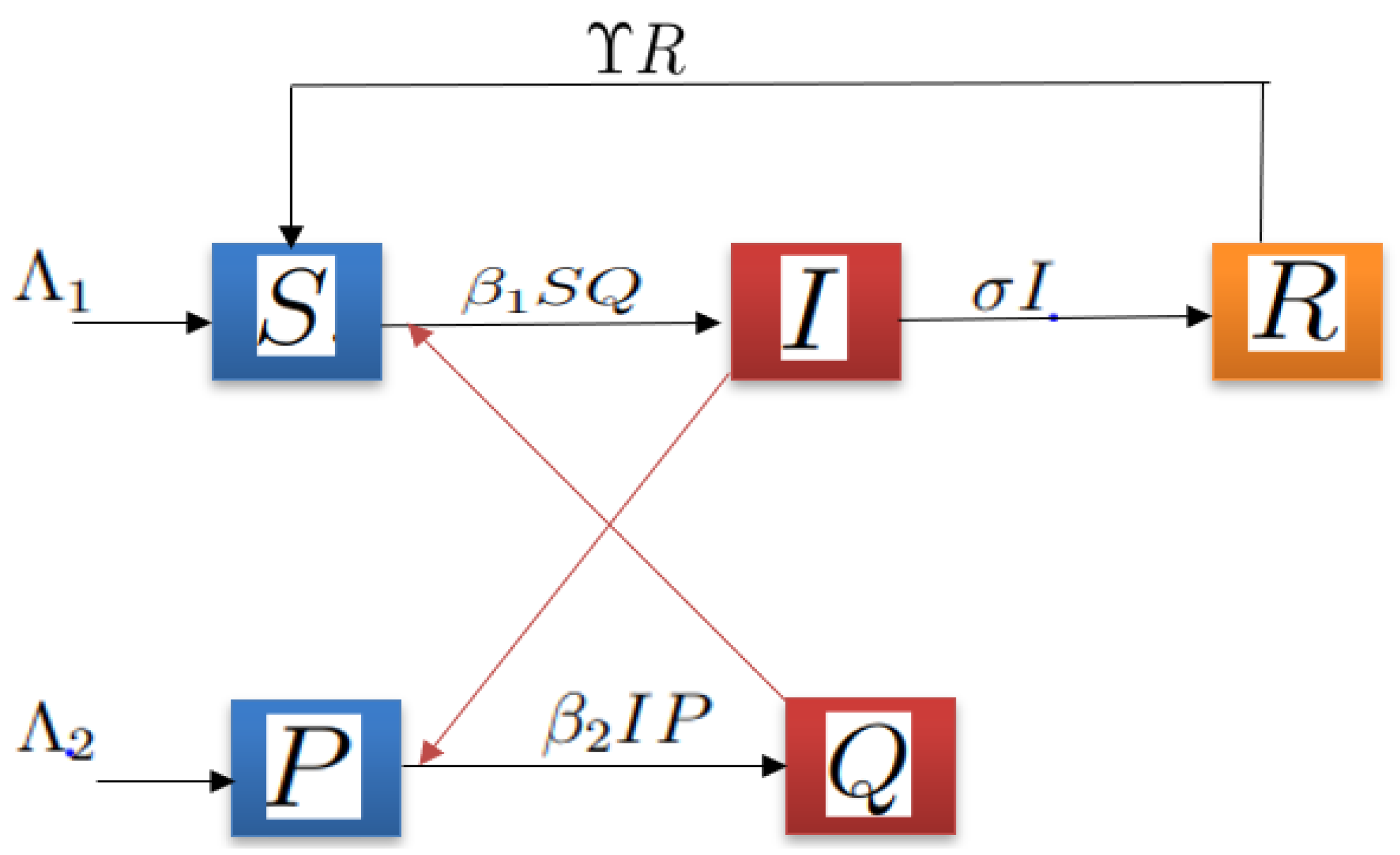
Cashew crops around the world are seriously threatened by Powdery Mildew disease (PMD), which reduces yields and damages the economy. Three subpopulations of cashew plants—susceptible S ( t ) , infected I ( t ) , and recovered R ( t ) —make up the host population. The total population of cashew plants is determined by the formula N ( t ) = S ( t ) + I ( t ) + R ( t ) . The agents that cause disease, fungi, are divided into susceptible P ( t ) and infected Q ( t ) subpopulations. The overall population of fungi is determined by the formula M = P ( t ) + Q ( t ) . Figure 1 depicts the model diagram, while the model equations which translate the disease transmission dynamics are given by Equation (2).
d S d t = Λ 1 β 1 S Q μ S , d I d t = β 1 S Q σ + ϱ + μ I , d R d t = σ I Υ + μ R , d P d t = Λ 2 β 2 I P ν P , d Q d t = β 2 I P ν Q ,
whose initial condition is: S ( 0 ) = S 0 > 0 , I ( 0 ) = I 0 0 , R ( 0 ) = R 0 0 , P ( 0 ) = P 0 > 0 and Q ( 0 ) = Q 0 0 .
The description of the model parameters are given in Table 1.

3.1. Positivity of Solution and Invariant Region

Theorem 1.
The solution ( S ( t ) , I ( t ) , R ( t ) , P ( t ) , Q ( t ) ) of model (2) with initial condition ( S ( 0 ) , I ( 0 ) , R ( 0 ) , P ( 0 ) , Q ( 0 ) ) exists and is unique under the Lipschitz and continuity conditions for all t 0 .
Proof. 
Let Y be a vector such as,
Y ( t ) = S ( t ) I ( t ) R ( t ) P ( t ) Q ( t ) and g ( Y ( t ) , t ) = Λ 1 β 1 S ( t ) Q ( t ) μ S ( t ) β 1 S ( t ) Q ( t ) σ + ϱ + μ I ( t ) σ I ( t ) Υ + μ R ( t ) Λ 2 β 2 I ( t ) P ( t ) ν P ( t ) β 2 I ( t ) P ( t ) ν Q ( t ) .
The function g ( Y ( t ) , t ) has polynomials dependent on S , I , R , P and Q. She is a continuous Lipschitzian function in Y on any compact subset of R 5 [45,46]. By the Lipschitz condition [47] for any Y , X R 5 , ∃ L > 0 so that the inequality g ( Y ( t ) , t ) g ( X ( t ) , t ) L Y X is true for all t. Then, according to Picard-Lindelöf theorem [48], the Y ( t ) solution of system exists and is unique t 0 . □
From this proof, our model has a predictable deterministic part, but we can introduce stochastic elements as a disturbance, contributing to the understanding of the uncertainty system.
Proposition 1.
Let Y ( t ) = ( S ( t ) , I ( t ) , R ( t ) , P ( t ) , Q ( t ) ) t . If the initial condition is such Y ( 0 ) > 0 , then the solution Y ( t ) of system (2) is bounded and positive for all t 0 .
Proof. 
Let N ( t ) = S ( t ) + I ( t ) + R ( t ) . d d t S ( t ) + I ( t ) + R ( t ) = Λ 1 μ N ( t ) σ I ( t ) . This implies d d t N ( t ) Λ 1 μ N ( t ) . Solving this, we obtain
0 N ( t ) Λ 1 μ + N ( 0 ) e x p ( μ t ) .
As t we have 0 < N ( t ) Λ 1 μ .
Also considering the fungi population M ( t ) = P ( t ) + Q ( t ) , we have: d d t M ( t ) = Λ 2 ν M ( t ) . Solving this, we obtain
0 M ( t ) = Λ 2 ν + M ( 0 ) e x p ( ν t ) .
As t we have 0 M ( t ) = Λ 2 ν . Hence, the feasible solution set for the PMD model is given by
Ω = ( S ( t ) , I ( t ) , R ( t ) , P ( t ) , Q ( t ) ) R + 5 : N ( t ) Λ 1 μ , M ( t ) = Λ 2 ν .
The presence of a feasible solution for the model, which remains positively invariant in R + 5 suggests the model’s epidemiological and mathematical soundness. This well-posed characteristic of the model allows us to conduct additional mathematical analysis confidently. This completes the proof. □

3.2. PMD Free Equilbrium Point and Basic Reproduction Number

The equilibrium point of model where there are no infected nodes is determined by setting the model system (2) to zero and establishing S = 0 , I = 0 , R = 0 , P = 0 and Q = 0 . Hence, the DFE point for the model (2) is E 0 = Λ 1 μ , 0 , 0 , Λ 2 ν , 0 .
Calculating R 0 involves considering the disease compartments as follows:
Y ˙ i = F i ( y ) V i ( y ) .
The Diekmann et al. [49,50,51] approach and and used in articles such as [14,15,52], the number of basic reproductions R 0 for the model system (2) is:
F V 1 = F i ( E 0 ) y j V i ( E 0 ) y j 1 = 0 β 1 Λ 1 μ ν β 2 Λ 2 ν ( σ + ϱ + μ ) 0 .
Hence, de base reproduction is
R 0 = β 1 β 2 Λ 1 Λ 2 μ ν 2 ( σ + ϱ + μ ) = R 01 × R 02 ,
where R 01 = β 1 Λ 1 μ , and R 02 = β 2 Λ 2 ν 2 ( σ + ϱ + μ ) .
Both expressions can be biologically interpreted as R 01 is the quantity of Oidium anacardii noack fungi infected by a typical infectious cashew plant. R 02 is the amount of cashew plants infected by a typical infective fungus Oidium anacardii noak.
Setting the equations on the right side of the system (5) equal to 0, we find an endemic equilibrium (EE). As a consequence, solving the foolowing system
0 = Λ 1 β 1 S Q μ S , 0 = β 1 S Q σ + ϱ + μ I , 0 = σ I Υ + μ R , 0 = Λ 2 β 2 I P ν P , 0 = β 2 I P ν Q .
gives the EE point E = ( S , I , R , P , Q ) where
S = Λ 1 [ β 2 ν ( R 0 2 1 ) + ( β 1 Λ 2 + μ ν ) ] β 1 β 2 Λ 2 ( R 0 2 1 ) + μ [ β 2 ν ( R 0 2 1 ) + ( β 1 Λ 2 + μ ν ) ] , I = ν 2 ( R 0 2 1 ) β 1 Λ 2 + μ ν , R = σ ν 2 ( R 0 2 1 ) ( Υ + μ ) ( β 1 Λ 2 + μ ν ) , P = Λ 2 ( β 1 Λ 2 + μ ν ) β 2 ν 2 ( R 0 2 1 ) + ν ( β 1 Λ 2 + μ ν ) , Q = Λ 2 β 2 ( R 0 2 1 ) β 2 ν ( R 0 2 1 ) + ( β 1 Λ 2 + μ ν )
Hence, the endemic equilibrium point exists if and only if R 0 > 1 .
Theorem 2.
For the PMD system (2), there is a single point EE if R 0 > 1 .

4. Stochastic Model and Its Analysis

Here we introduce stochastic perturbations in accordance with d’Imhof et al. [30]. Taking into account the derivatives S ( t ) , I ( t ) , R ( t ) , P ( t ) and Q ( t ) of the model (2), we assume that white noise is a perturbation proportional to S ( t ) , I ( t ) , R ( t ) , P ( t ) and Q ( t ) . In particular, we incorporate continuous Gaussian noise (Brownian motion) and discontinuous Lévy jump noise to reflect persistent small perturbations and rare large shocks, respectively [53]. We then add a Lévy noise (as in [32,54]) to the model (2), which gives the following stochastic model:
d S = Λ 1 β 1 S ( t ) Q ( t ) μ S ( t ) d t + γ 1 S ( t ) d ϖ 1 ( t ) + κ 1 , d I = β 1 S ( t ) Q ( t ) σ + ϱ + μ I ( t ) d t + γ 2 I ( t ) d ϖ 2 ( t ) + κ 2 , d R = σ I ( t ) Υ + μ R ( t ) d t + γ 3 R ( t ) d ϖ 3 ( t ) + κ 3 , d P = Λ 2 β 2 I ( t ) P ( t ) ν P ( t ) d t + γ 4 P ( t ) d ϖ 4 ( t ) + κ 4 , d Q = β 2 I ( t ) P ( t ) ν Q ( t ) d t + γ 5 Q ( t ) d ϖ 5 ( t ) + κ 5 ,
where
κ 1 = Y Γ 1 ( y ) S ( t ) M ˜ ( d t , d y ) , κ 2 = Y Γ 2 ( y ) I ( t ) M ˜ ( d t , d y ) , κ 3 = Y Γ 3 ( y ) R ( t ) M ˜ ( d t , d y ) , κ 4 = Y Γ 4 ( y ) P ( t ) M ˜ ( d t , d y ) , κ 5 = Y Γ 5 ( y ) Q ( t ) M ˜ ( d t , d y ) .
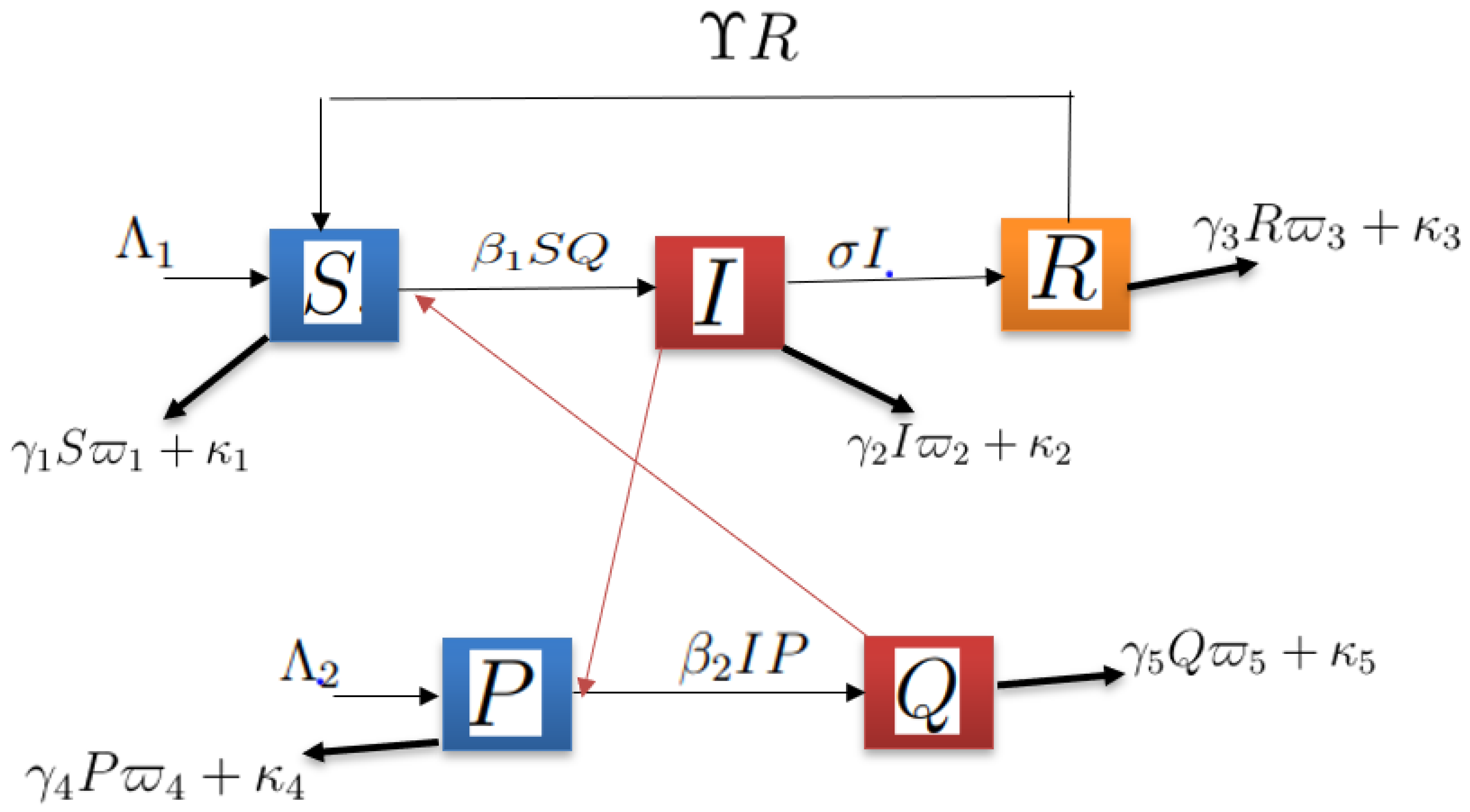
In (7), ϖ j ( t ) , for j = 1 , 2 , , 5 , represent Brownian movements which have biological significance and justify environmental fluctuations. Γ j is the noise intensity for all j. κ i , i = 1 , 2 , , 5 model sudden jumps. M ˜ is the compensated Poisson random measure such that M ˜ ( d t , d y ) = M ˜ ( d t , d y ) ϑ ( d y ) d t and ϑ ( . ) is the intensity measure. where ϑ is defined on a measurable subset Y [ 0 , + ) with the condition > ϑ ( Y ) and Γ j represents the intensity of the jump ( Γ j 0 ) . S ( t ) , I ( t ) , R ( t ) , P ( t ) , and Q ( t ) represent the values of the state model variables just before the jump. Biologically speaking, jumps represent rare events; for example, pesticide use permits to destroy infected plants, while ecological disasters have negative effects on plants.
The comparmental diagram of the S I R P Q stochastic model is represented in Figure 2.
Using the system (7) as a basis for analysis, we seek to answer the following question: Does Lévy noise affect the model dynamics?
Different approaches from the literature can be used to present Lévy processes (see [41,42,55,56]).
That is the problem:
d y = g ( y , t ) d t , y ( t 0 ) = y 0 .
When we introduce (9) white noise and its integral, we find Brownian motion, which is an EDS. The general description of an EDS is:
d G ( t , ϑ ) = g ( Y ( t , ϑ ) , t ) + g ( G ( t , ϑ ) , t ) d B ( t , ϑ ) .
For more information on parameters and variables, please refer to [42,55,56].
Remark 1.
In our model, we first consider Gaussian (Wiener) noise, which is characterized by continuous trajectories, small amplitude fluctuations, normal distribution (thin tails), and no discontinuous jumps, but limited in our context of powdery mildew modeling because: It does not capture sudden epidemic spread, it underestimates extreme events (heavy rain, strong winds), it ignores sudden changes in temperature, It does not model discontinuous human interventions, which is why we have also introduced Lévy noise, which is characterized by: Discontinuous trajectories with jumps, Heavy-tailed distribution, Captures rare but major impact events, Combines continuous fluctuations + discrete jumps. Lévy noise is appropriate for our model because it has several advantages: it models explosive epidemic spread, captures extreme weather events, represents phytosanitary interventions, and reflects long-distance spore dispersal. In concrete terms, moderate and continuous rain (Gaussian noise) and a sudden tropical storm (Lévy noise) have very different impacts on the spread of powdery mildew spores. The biological incorporation of Lévy noise for powdery mildew in our model can be explained firstly by the mechanisms of spore propagation (- sudden strong winds carrying spores over long distances, - torrential rains dispersing spores over large areas, - introduction of infected plants from other regions, - Swarming of insect vectors); secondly by extreme weather events (abrupt rainy seasons, tropical storms, Harmattan (dry wind from the Sahara)); and further by phytosanitary interventions, etc. [57,58].

4.1. Positive Global Solution of the Stochastic Model

In this section, we show that the stochastic epidemic model (7) has a global positive solution. To do this, we shall assume two hypotheses in order to reduce the scope of the study. Consequently, we will show that the positive solution of model (7) exists, is global, and is unique.
To establish the existence of a positive global solution for our stochastic epidemic model with jumps, and for the sake of making the calculation more practical, we imposed two assumptions that are standard in mathematics. Let the following two assumptions apply.
Hypothesis 1.
M > 0 T M > 0 such that
G B i ( ϑ 1 , y ) B i ( ϑ 2 , y ) 2 ϑ ( d y ) T M ϑ 1 ϑ 2 2 , i = 1 , 2 , 3 , 4 , 5
with ϑ 1 ϑ 2 M where
B 1 ( ϑ , y ) = Γ 1 ( y ) ϑ for ϑ = S ( t 1 ) , B 2 ( ϑ , y ) = Γ 2 ( y ) ϑ for ϑ = I ( t 1 ) ,
B 3 ( ϑ , y ) = Γ 3 ( y ) ϑ for ϑ = R ( t 1 ) , B 4 ( ϑ , y ) = Γ 4 ( y ) ϑ for ϑ = P ( t 1 ) ,
B 5 ( ϑ , y ) = Γ 5 ( y ) ϑ for ϑ = Q ( t 1 ) .
Hypothesis 2.
for 1 < Γ j ( x ) , log ( Γ i ( x ) + 1 ) Θ with Θ R + , j = 1 , , 4 .
Even though the biological foundations are not discussed in our work, these assumptions are essential to prove the existence and uniqueness of a global positive solution to our stochastic model (see for example [32,59]).
Theorem 3.
For any initial condition in R + 5 , the solution S ( t ) , I ( t ) , R ( t ) , P ( t ) and Q ( t ) of system (7) is in R + 5 for any t 0 .
Proof. 
The system admits a local solution unique on [ 0 , r f ) by Hypothesis 1 ( see [59] for further explanation). For global solution, it suffices to show that r f = . For more information, let j 0 N be used, so that all possible solutions to the problem lie inside 1 j 0 , j 0 . Furthermore, assuming j j 0 , we define stopping time:
r j = inf t [ 0 , r f ) : 1 j min S ( t ) , I ( t ) , R ( t ) , P ( t ) , Q ( t ) , or , j max S ( t ) , I ( t ) , R ( t ) , P ( t ) , Q ( t )
where r f increases as j , set r = lim j r j , we also set inf = and obtain r r f . If the hypothesis that r = is true, then r f = . To conclude, let us prove that r = . Suppose r , then T R and ε ( 0 , 1 ) check P r T > ε . So j 1 N with j 1 j 0 such that
P r j T ε , j j 1 .
Let Φ a Lyapunov function defined by
Φ = a 1 ( S a 1 log S a 1 1 ) ( 1 I + log I ) + ( R 1 log R ) + ( P log P 1 ) + ( 1 + Q log Q ) ,
where a 1 is a constant to be obtained. Using of Itô’ formula, we have
d Φ ( S , I , R , P , Q ) = D V ( S , I , R , P , Q ) d t + γ 1 ( S a 1 ) d ϖ 1 ( t ) + γ 2 ( I 1 ) d ϖ 2 ( t ) + γ 3 ( R 1 ) d ϖ 3 ( t ) + γ 4 ( P 1 ) d ϖ 4 ( t ) + γ 5 ( Q 1 ) d ϖ 5 ( t ) + G a 1 log ( 1 + Γ 1 ( y ) ) + Γ 1 ( y ) S M ˜ ( d t , d y ) + G log ( 1 + Γ 2 ( y ) ) + Γ 2 ( y ) I M ˜ ( d t , d y ) + G log ( 1 + Γ 3 ( y ) ) + Γ 3 ( y ) R M ˜ ( d t , d y ) + G Γ 4 ( y ) P log ( 1 + Γ 4 ( y ) ) M ˜ ( d t , d y ) + G Γ 5 ( y ) Q log ( 1 + Γ 5 ( y ) ) M ˜ ( d t , d y ) ,
where D Φ : R + 5 R + from Equation (14) is defined and using Hypothesis 2, we have:
D Φ = 1 a 1 S Λ 1 β 1 S Q μ S + a 1 2 γ 1 2 + 1 1 I β 1 S Q σ + ϱ + μ I + 1 2 γ 2 2 + 1 1 R σ I Υ + μ R + 1 2 γ 3 2 + 1 1 P Λ 2 β 2 I P ν P + 1 2 γ 4 2 + 1 1 Q β 2 I P ν Q + 1 2 γ 5 2 = Λ 1 β 1 S Q μ S Λ 1 a 1 S + β 1 a 1 Q + μ a 1 + a 1 2 γ 1 2 + β 1 S Q σ + ϱ + μ I β 1 S Q 1 I + σ + ϱ + μ + 1 2 γ 2 2 + σ I Υ + μ R σ I 1 R + Υ + μ + 1 2 γ 3 2 + Λ 2 β 2 I P ν P Λ 2 1 P + β 2 I + ν + 1 2 γ 4 2 + β 2 I P ν Q β 2 I P 1 Q + ν + 1 2 γ 5 2 + G a 1 Γ 1 ( y ) a 1 log ( 1 + Γ 1 ( y ) ) ϑ ( d y ) + G Γ 2 ( y ) log ( 1 + Γ 2 ( y ) ) ϑ ( d y ) + G Γ 3 ( y ) log ( 1 + Γ 3 ( y ) ) ϑ ( d y ) + G Γ 4 ( y ) log ( 1 + Γ 4 ( y ) ) ϑ ( d y ) + G Γ 5 ( y ) log ( 1 + Γ 5 ( y ) ) ϑ ( d y ) .
Let a 1 = ν β 1 . Thus 1 S + I + R ,
D Φ Λ 1 + μ a 1 + a 1 2 γ 1 2 + σ + ϱ + 2 μ + 1 2 γ 2 2 + Υ + 1 2 γ 3 2 + Λ 2 + 2 ν + 1 2 γ 4 2 + 1 2 γ 5 2 + G a 1 Γ 1 ( y ) a 1 log ( 1 + Γ 1 ( y ) ) ϑ ( d y ) + G Γ 2 ( y ) log ( 1 + Γ 2 ( y ) ) ϑ ( d y ) + G Γ 3 ( y ) log ( 1 + Γ 3 ( y ) ) ϑ ( d y ) + G Γ 4 ( y ) log ( 1 + Γ 4 ( y ) ) ϑ ( d y ) + G Γ 5 ( y ) log ( 1 + Γ 5 ( y ) ) ϑ ( d y ) .
Consequently, for this theorem, the formulation of the proof is similar to those of [60]. However, the proof of the theorem is complete. □

4.2. Stochastic Threshold and Disease Extinction Conditions

Eradicating an infectious disease means developing progressive strategies while examining the mode of transmission.
Let the stochastic model’s (7) extinction threshold be:
S s = β 2 + β 1 σ ν σ + ϱ + μ + 1 2 γ 2 2 + G Γ 2 ( y ) log ( 1 + Γ 2 ( y ) ) ϑ ( d y ) .
The stochastic threshold Ss is written as the sum of two quantities S s = S s 1 + S s 2 , where S s 1 is the number of cashew plants infected by a typical infectious fungus Oidium anacardii noak, with Lévy jumps and fluctuation intensity, given by
S s 1 = β 1 σ ν σ + ϱ + μ + 1 2 γ 2 2 + G Γ 2 ( y ) log ( 1 + Γ 2 ( y ) ) ϑ ( d y ) ,
and S s 2 is the number of Oidium anacardii noack fungi infected by typical infectious cashew plants, with fluctuations characterized by Lévy jumps, given by
S s 2 = β 2 σ + ϱ + μ + 1 2 γ 2 2 + G Γ 2 ( y ) log ( 1 + Γ 2 ( y ) ) ϑ ( d y ) .
We will use the following concept in the remainder of this document:
K ( t ) = 1 t 0 t K ( s ) d s .
Lemma 1.
Let ( S ( t ) , I ( t ) , R ( t ) , P ( t ) , Q ( t ) ) the solution of model (7) with initial conditions ( S 0 , I 0 , R 0 , P 0 , Q 0 ) R + 5 ,
t h e n , lim t ( S ( t ) + I ( t ) + R ( t ) + P ( t ) + Q ( t ) ) / t = 0 a . s .
thus, if μ > ( γ 1 2 γ 2 2 γ 3 2 γ 4 2 γ 5 2 ) 2 , then
lim t 0 t S ( u ) d Γ 1 ( u ) t = 0 ; lim t 0 t I ( u ) d Γ 2 ( u ) t = 0 ; lim t 0 t R ( u ) d Γ 3 ( u ) t = 0 ; lim t 0 t P ( u ) d Γ 4 ( u ) t = 0 ; lim t 0 t Q ( u ) d Γ 5 ( u ) t = 0 .
So the solution of (7)
lim t sup Q ( t ) = 0 = lim t sup I ( t ) ; lim t sup R ( t ) = 0 ; lim t sup S ( t ) = Λ 1 μ ; lim t sup P ( t ) = Λ 2 ν ; a . s .
Proof. 
Model (7) gives
S + I + R + P + Q = Λ 1 μ ( S + I + R ) ϱ I Υ R + Λ 2 ν ( P + Q ) + γ 1 S d ϖ 1 + γ 2 I d ϖ 2 + γ 3 R d ϖ 3 + γ 4 P d ϖ 4 + γ 5 Q d ϖ 5 .
Solving this equation gives
S ( t ) + I ( t ) + R ( t ) + P ( t ) + Q ( t ) = Λ 1 μ + S 0 + I 0 + R 0 Λ 1 μ e μ t I 0 1 ϱ e μ t R 0 1 Υ e μ t + Λ 2 ν + P 0 + Q 0 Λ 2 ν e ν t + γ 1 0 t S ( s ) e μ ( t s ) d ϖ 1 ( s ) + γ 2 0 t I ( s ) e μ ( t s ) d ϖ 2 ( s ) + γ 3 0 t R ( s ) e μ ( t s ) d ϖ 3 ( s ) + γ 4 0 t P ( s ) e ν ( t s ) d ϖ 4 ( s ) + γ 5 0 t Q ( s ) e ν ( t s ) d ϖ 5 ( s ) .
Define Y ( t ) = Y 0 + B ( t ) K ( t ) + N ( t ) with Y 0 = S 0 + I 0 + R 0 + P 0 + Q 0 ,
B ( t ) = Λ 1 μ 1 e μ t + Λ 2 ν 1 e ν t ,
K ( t ) = S 0 + I 0 + R 0 1 e μ t + P 0 + Q 0 1 e ν t         + I 0 1 ϱ e μ t + R 0 1 Υ e μ t ,
N ( t ) = γ 1 0 t S ( s ) e μ ( t s ) d ϖ 1 ( s ) + γ 2 0 t I ( s ) e μ ( t s ) d ϖ 2 ( s ) + γ 3 0 t R ( s ) e μ ( t s ) d ϖ 3 ( s )         + γ 4 0 t P ( s ) e ν ( t s ) d ϖ 4 ( s ) + γ 5 0 t Q ( s ) e ν ( t s ) d ϖ 5 ( s ) ,
where N ( 0 ) = 0 . From Equation (22), Y ( t ) S ( t ) + I ( t ) + R ( t ) + P ( t ) + Q ( t ) a.s. t > 0 . One can see that B ( t ) and N ( t ) are continuous adapted increasing processes on t 0 with B ( 0 ) = N ( 0 ) . Using Theorem 3.4 [61], we have lim t Y ( t ) < a.s.
Hence > lim t sup ( S ( t ) + I ( t ) + R ( t ) + P ( t ) + Q ( t ) ) a . s .
We can easily obtain from the above inequality
lim t S ( t ) t = 0 , lim t I ( t ) t = 0 , lim t R ( t ) t = 0 , lim t P ( t ) t = 0 , lim t Q ( t ) t = 0 , a . s .
N 1 ( t ) = 0 t S ( s ) d ϖ 1 ( s ) , N 2 ( t ) = 0 t S ( s ) d ϖ 2 ( s ) , N 3 ( t ) = 0 t S ( s ) d ϖ 3 ( s ) ,
N 4 ( t ) = 0 t S ( s ) d ϖ 4 ( s ) , N 5 ( t ) = 0 t S ( s ) d ϖ 5 ( s ) .
By means of quadratic variations:
N 1 ( t ) , N 1 ( t ) = 0 t S 2 ( s ) d ( s ) sup t 0 S 2 ( t ) t .
In accordance with Theorem 3.4 [61] and the use of quadratic variations, we have
lim t 0 t S ( s ) d ϖ 1 ( s ) t = 0 , lim t 0 t I ( s ) d ϖ 2 ( s ) t = 0 , lim t 0 t R ( s ) d ϖ 3 ( s ) t = 0 ,
lim t 0 t P ( s ) d ϖ 4 ( s ) t = 0 , lim t 0 t Q ( s ) d ϖ 5 ( s ) t = 0 , a . s .
The proof is now complete. □
Theorem 4.
If S s < 1 , then for a solution of system (7) with the initial condition in R + 5 , we get
lim t S ( t ) = Λ 1 μ , a . s . ; lim t I ( t ) = 0 , a . s . ; lim t R ( t ) = 0 , a . s . ; lim t P ( t ) = Λ 2 ν , a . s . ; lim t Q ( t ) = 0 , a . s .
This means that the disease will go away in the course of time.
Proof. 
Integrating system (7), we have:
S ( t ) S ( 0 ) t = Λ 1 β 1 S Q μ S + γ 1 0 t S ( z ) d ϖ 1 ( z ) t + 1 t 0 t G Γ 1 ( y ) S ( t ) M ˜ ( d t , d y ) d z , I ( t ) I ( 0 ) t = β 1 S Q ( σ + ϱ + μ ) I + γ 2 0 t I ( z ) d ϖ 2 ( z ) t + 1 t 0 t G Γ 2 ( y ) I ( t ) M ˜ ( d t , d y ) d z , R ( t ) R ( 0 ) t = σ I ( Υ + μ ) R + γ 3 0 t R ( z ) d ϖ 3 ( z ) t + 1 t 0 t G Γ 3 ( y ) R ( t ) M ˜ ( d t , d y ) d z , P ( t ) P ( 0 ) t = Λ 2 β 2 I P ν P + γ 4 0 t P ( z ) d ϖ 4 ( z ) t + 1 t 0 t G Γ 4 ( y ) P ( t ) M ˜ ( d t , d y ) d z , Q ( t ) Q ( 0 ) t = β 2 I P ν Q + γ 5 0 t Q ( z ) d ϖ 5 ( z ) t + 1 t 0 t G Γ 5 ( y ) Q ( t ) M ˜ ( d t , d y ) d z .
From the last relation of (25), we obtain.
Q = β 2 ν I P 1 ν Q ( t ) Q ( 0 ) t + γ 5 ν 0 t Q ( z ) d ϖ 5 ( z ) t + G log ( 1 + Γ 5 ( y ) ) M ˜ ( d t , d y ) , = β 2 ν I P + N 1 ( t )
with N 1 ( t ) = 1 ν Q ( t ) Q ( 0 ) t + γ 5 ν 0 t Q ( z ) d ϖ 5 ( z ) t + G log ( 1 + Γ 5 ( y ) ) M ˜ ( d t , d y ) .
Using Itô formula at Φ = log ( I ( t ) ) gives us the following expressions:
d log ( I ( t ) ) = D Φ d t + γ 2 d ϖ 2 ( t ) + G log ( 1 + Γ 2 ( y ) ) M ˜ ( d t , d y ) ,
where
D Φ = β 1 S Q I σ + ϱ + μ γ 2 2 2 d t G Γ 2 ( y ) log ( 1 + Γ 2 ( y ) ) ϑ ( d y ) .
From Equation (27) we have
d log I = β 1 S Q I σ + ϱ + μ + γ 2 2 2 d t G Γ 2 ( y ) log ( 1 + Γ 2 ( y ) ) ϑ ( d y ) + γ 2 d ϖ 2 ( t ) + G log ( 1 + Γ 2 ( y ) ) M ˜ ( d t , d y ) , β 1 Q I σ + ϱ + μ + γ 2 2 2 d t G Γ 2 ( y ) log ( 1 + Γ 2 ( y ) ) ϑ ( d y ) + γ 2 d ϖ 2 ( t ) + G log ( 1 + Γ 2 ( y ) ) M ˜ ( d t , d y ) .
By integrating Equation (28) and dividing the result by t, we get:
log I log I ( 0 ) t β 1 Q I σ + ϱ + μ + γ 2 2 2 G Γ 2 ( y ) log ( 1 + Γ 2 ( y ) ) ϑ ( d y ) + γ 2 d ϖ 2 ( t ) t + G log ( 1 + Γ 2 ( y ) ) M ˜ ( d t , d y ) t ,
Replacing expression (26) in Equation (29) gives:
log I t β 1 β 2 ν I P + N 1 ( t ) I σ + ϱ + μ + γ 2 2 2 G Γ 2 ( y ) log ( 1 + Γ 2 ( y ) ) ϑ ( d y ) + log I ( 0 ) t + γ 2 d ϖ 2 ( t ) t + G log ( 1 + Γ 2 ( y ) ) M ˜ ( d t , d y ) t , β 1 β 2 ν P σ + ϱ + μ + γ 2 2 2 G Γ 2 ( y ) log ( 1 + Γ 2 ( y ) ) ϑ ( d y ) + β 1 N 1 ( t ) I + log I ( 0 ) t + γ 2 d ϖ 2 ( t ) t + G log ( 1 + Γ 2 ( y ) ) M ˜ ( d t , d y ) t .
What’s more, N j ( t ) = γ j t 0 t f j d ϖ j + G log ( 1 + Γ 2 ( y ) ) M ˜ ( d t , d y ) t for j = 1 , 2 , 3 , 4 , 5 . f 1 = S ,…, f 5 = Q are continuous local martingale functions and are all zero at t = 0 . If t and use Lemma 1, we get
lim sup t + 1 t N j ( t ) = 0 .
lim sup t + log I ( t ) t S s 1 σ + ϱ + μ + γ 2 2 2 + G Γ 2 ( y ) log ( 1 + Γ 2 ( y ) ) ϑ ( d y ) < 0 , a . s .
From (31), we get
lim t + I = 0 , a . s .
Knowing that lim sup t + 1 t N 1 ( t ) = 0 and introducing the (32) relationship into (26), we have:
lim t + Q = 0 , a . s .
A similar result yields:
lim t + R = 0 , a . s .
So, from system (25) and using relations (33) and (34),
lim t + S = Λ 1 μ , a . s .
By integrating and then dividing by t, The result is similar to the previous one:
lim t + P = Λ 2 ν , a . s
This ends the proof. □
The threshold S s is a parameter for controlling the disease. When this S s is less than 1, over time the disease will decrease or even disappear from the environment, but with fluctuations, which means that the disease may reappear from time to time. However, in the long term, it will be controllable and will not impact the plants.

4.3. Conditions for Disease Persistence

Definition 3
([59,62]). The inequality (37) is an indication of whether the model is persistent or not
lim t + inf 1 t 0 t F ( s ) d s > 0 a . s .
Using references [59,63], we evaluate the persistence of the disease taking into account the result of Theorem 3.4 [61] for this section.
Lemma 2.
Suppose k C ( [ 0 , ) × Ω , ( 0 , ) ) and K C ( [ 0 , ) × Ω , R ) ϶ lim t K ( t ) t = 0 a . s . if t 0
log k ( t ) η 0 t η 0 t k ( r ) d r + K ( t ) , a . s . ,
then
lim t k ( t ) η 0 η , a . s . , where η R + , η 0 R + .
Let
S 0 s = Λ 1 Λ 2 β 2 V 1 V 2 V 4 ,
where
V 1 = μ + d + γ 1 2 + Y Γ 1 ( y ) log ( 1 + Γ 1 ( y ) ) ϑ ( d y ) , V 2 = μ + σ + ϱ + γ 2 2 + G Γ 2 ( y ) log ( 1 + Γ 2 ( y ) ) ϑ ( d y ) , V 4 = ν + γ 4 2 + F Γ 4 ( y ) log ( 1 + Γ 4 ( y ) ) ϑ ( d y )
S 0 s is the density of susceptible cashew plants infected by fungi, with fluctuations characterized by Lévy jumps over time. This threshold is a rate that allows us to discuss the behaviour of the disease in the environment. Specifically, when this quantity is greater than 1, the disease will persist in the environment, with a fluctuation movement. It is therefore a parameter for controlling the disease in a host population.
Theorem 5.
If S 0 s > 1 , then for any initial value ( S 0 , I 0 , R 0 , P 0 , Q 0 ) R + 5 , the disease I ( t ) and Q ( t ) has the axiom
lim t inf ( I ( t ) + Q ( t ) ) 2 Λ 1 Λ 2 β 2 S 0 s 1 U β a . s . ,
where U β = max U 1 β 1 , U 4 β 2 ,
U 1 = Λ 1 Λ 2 β 2 μ + γ 1 2 2 + Y Γ 1 ( y ) log ( 1 + Γ 1 ( y ) ) ϑ ( d y ) ,
U 4 = U 1 Λ 1 Λ 2 β 2 ν + γ 4 2 2 + F Γ 4 ( y ) log ( 1 + Γ 4 ( y ) ) ϑ ( d y ) .
We can then say that the disease will prevail over the crops.
Proof. 
Let set K 1 = U 1 ln S U 2 ln I U 4 ln P , with U 1 , U 2 , U 4 real numbers.
d K 1 = L K 1 U 1 γ 1 d ϖ 1 ( t ) U 2 γ 2 d ϖ 2 ( t ) U 4 γ 4 d ϖ 4 ( t ) U 1 G Γ 1 ( y ) log ( 1 + Γ 1 ( y ) ) M ˜ ( d t , d y ) U 2 G Γ 2 ( y ) log ( 1 + Γ 2 ( y ) ) M ˜ ( d t , d y ) U 4 G Γ 4 ( y ) log ( 1 + Γ 4 ( y ) ) M ˜ ( d t , d y ) ,
where
L K 1 = U 1 Λ 1 S + U 1 β 1 Q + U 1 μ + U 1 γ 1 2 2 + G Γ 1 ( y ) log ( 1 + Γ 1 ( y ) ) ϑ ( d y ) U 2 β 1 S Q I + U 2 ( σ + ϱ + μ ) + U 2 γ 2 2 2 + G Γ 2 ( y ) log ( 1 + Γ 2 ( y ) ) ϑ ( d y ) U 4 Λ 2 P + U 4 β 2 I + U 4 ν + U 4 γ 4 2 2 + F Γ 4 ( y ) log ( 1 + Γ 4 ( y ) ) ϑ ( d y ) U 1 Λ 1 S U 4 Λ 2 P + U 1 μ + γ 1 2 2 + G Γ 1 ( y ) log ( 1 + Γ 1 ( y ) ) ϑ ( d y ) + U 2 σ + ϱ + μ + γ 2 2 2 + G Γ 2 ( y ) log ( 1 + Γ 2 ( y ) ) ϑ ( d y ) + U 4 ν + γ 4 2 2 + F Γ 4 ( y ) log ( 1 + Γ 4 ( y ) ) ϑ ( d y ) + U 1 β 1 Q + U 4 β 2 I
Let U β = max U 1 β 1 , U 4 β 2 , and
U 1 = U 2 Λ 1 β 2 μ + γ 1 2 2 + Y Γ 1 ( y ) log ( 1 + Γ 1 ( y ) ) ϑ ( d y ) ,
U 2 = U 2 Λ 1 β 2 σ + ϱ + μ + γ 2 2 2 + G Γ 2 ( y ) log ( 1 + Γ 2 ( y ) ) ϑ ( d y ) ,
U 4 = U 1 Λ 2 β 2 ν + γ 4 2 2 + F Γ 4 ( y ) log ( 1 + Γ 4 ( y ) ) ϑ ( d y ) .
Let
V 1 = μ + γ 1 2 2 + Y Γ 1 ( y ) log ( 1 + Γ 1 ( y ) ) ϑ ( d y ) ,
V 2 = σ + ϱ + μ + γ 2 2 2 + G Γ 2 ( y ) log ( 1 + Γ 2 ( y ) ) ϑ ( d y ) ,
V 4 = ν + γ 4 2 2 + F Γ 4 ( y ) log ( 1 + Γ 4 ( y ) ) ϑ ( d y ) ,
thus
L K 1 2 ( Λ 1 Λ 2 β 2 ) 2 Λ 1 Λ 2 β 2 V 1 V 2 V 4 + 2 Λ 1 Λ 2 β 2 + U β ( I ( t ) + Q ( t ) ) = 2 Λ 1 Λ 2 β 2 Λ 1 Λ 2 β 2 V 1 V 2 V 4 1 + U β ( I ( t ) + Q ( t ) ) = 2 Λ 1 Λ 2 β 2 S 0 s 1 + U β ( I ( t ) + Q ( t ) ) .
K 1 ( S ( t ) , I ( t ) , P ( t ) ) K 1 ( S ( 0 ) , I ( 0 ) , P ( 0 ) ) t 2 Λ 1 Λ 2 β 2 S 0 s 1 + U β ( I ( t ) + Q ( t ) ) U 1 γ 1 2 ϖ 1 ( t ) t U 2 γ 2 2 ϖ 2 ( t ) t U 4 γ 4 2 ϖ 4 ( t ) t U 1 G Γ 1 ( y ) S log ( 1 + Γ 1 ( y ) ) M ˜ ( d t , d y ) t U 2 G Γ 2 ( y ) I log ( 1 + Γ 2 ( y ) ) M ˜ ( d t , d y ) t U 4 G Γ 4 ( y ) P log ( 1 + Γ 4 ( y ) ) M ˜ ( d t , d y ) t 2 Λ 1 Λ 2 β 2 S 0 s 1 + U β ( I ( t ) + Q ( t ) ) + ϕ ( t )
with
ϕ ( t ) = U 1 G Γ 1 ( y ) S log ( 1 + Γ 1 ( y ) ) M ˜ ( d t , d y ) t U 2 G Γ 2 ( y ) I log ( 1 + Γ 2 ( y ) ) M ˜ ( d t , d y ) t U 4 G Γ 4 ( y ) P log ( 1 + Γ 4 ( y ) ) M ˜ ( d t , d y ) t .
From strong law as stated in Theorem 3.4 [61], we obtain that
lim t ϕ ( t ) = 0 .
Equation (43), we get
( I ( t ) + Q ( t ) ) 2 Λ 1 Λ 2 β 2 S 0 s 1 U β ϕ ( t ) U β + 1 U β K 1 ( S ( t ) , I ( t ) , P ( t ) ) K 1 ( S ( 0 ) , I ( 0 ) , P ( 0 ) ) t ,
Then, we have
lim t inf ( I ( t ) + Q ( t ) ) 2 Λ 1 Λ 2 β 2 S 0 s 1 U β a . s .
due to Lemma 2 and Equation (45). Finally, lim t inf ( I ( t ) + Q ( t ) ) 0 . This completes the proof. □

4.4. Mean First Passage Time (MFPT)

Let T S I the MFPT of S to I. Let E 0 = Λ 1 μ , 0 , 0 , Λ 2 ν , 0 . The following approximates the dynamics of infected individuals:
d I = Π I ( t ) d t + γ 2 I ( t ) d ϖ 2 ( t ) ,
with
Π = β 1 S Q ( σ + ρ + μ ) .
Setting Z ( t ) = ln I ( t ) , we thus obtain
d Z ( t ) = Π γ 2 2 2 d t + γ 2 d W ( t ) .
If I c is the number of infected plants such that I c > I 0 : = I ( 0 ) , then the TMPP T ( Z ) is obtained by solving the following differential equation:
γ 2 2 2 d 2 T ( Z ) d t 2 + Π γ 2 2 2 d T ( Z ) d t + 1 = 0 .
Direct resolution of the above equation is given by:
T S I = 2 2 Π γ 2 2 ln I c ln I 0
with 2 Π > γ 2 2 .
An analog reasoning permits one to have
T I R = 2 2 ( σ + ρ + μ ) + γ 2 2 ln I 0 ln I r
with I r < I 0 is the number of plants recovered.
Remark 2.
Mean first passage times are significantly influenced by the level of multiplicative noise. Noise that is sufficiently strong can prevent the invasion of infection by making the MFPT endless, while dramatically expediting the transition to the cured state.

5. Numerical Scheme and Simulations

5.1. Numerical Scheme

Here we present the numerical simulations. The numerical solution strategy for system [55] uses the numerical approach established in the paper. We have taken n N and x Y . For the period of time [ 0 , T ] , we have considered the constant step size Δ t = T N . Another, for i 1 , 2 , 3 , 4 , 5 and N i n = S i n + I i n + R i n + P i n + Q i n and Δ Z i , n = Δ W ( t n + 1 ) W ( t n ) = Δ t α i , n . More, Δ L n = L ( t n + 1 ) L ( t n ) , a Poisson distribution. Consequently, the numerical solution of model (7) is obtained by Milstein’s algorithm in the following form
S n + 1 = S n + Λ 1 β 1 S n Q n μ S n Δ t + γ 1 S n ϖ 1 , n + γ 1 2 2 S n ( Δ ϖ 1 , n 2 Δ t ) Γ 1 ( x ) S n Δ n , I n + 1 = I n + β 1 S n Q n σ + ϱ + μ I n Δ t + γ 2 I n ϖ 2 , n + γ 2 2 2 I n ( Δ ϖ 2 , n 2 Δ t ) Γ 2 ( x ) I n Δ n R n + 1 = R n + σ I n Υ + μ R n Δ t + γ 3 R n ϖ 3 , n + γ 3 2 2 R n ( Δ ϖ 3 , n 2 Δ t ) Γ 3 ( x ) R n Δ n , P n + 1 = P n + Λ 2 β 2 I n P n ν P n Δ t + γ 4 P n ϖ 4 , n + γ 4 2 2 P n ( Δ ϖ 4 , n 2 Δ t ) Γ 4 ( x ) P n Δ n , Q n + 1 = Q n + β 2 I n P n ν Q n Δ t + γ 5 Q n ϖ 5 , n + γ 5 2 2 Q n ( Δ ϖ 5 , n 2 Δ t ) Γ 5 ( x ) Q n Δ n .
To obtain numerical solutions to the model, several other numerical methods can be used in addition to the above technique, such as the PPTEM (positive preserving truncated Euler-Maruyama) method [32]. For example, the PPTEM approach can be used to treat complex physical phenomena [56].
In the next subsection, we perform class simulations by adding Lévy noise to the stochastic model at the infection rate. Using MATLAB R2018b (MATLAB 9.5) software, we used the Lévy noise perturbation given by the function β t = β 1 + 0.01 n o i s e for the Figure 3 and Figure 4, where n o i s e is a function that generates Lévy noise from the stable Lévy distribution.
Remark 3.
Even if we did not use real data to calibrate the model, the parameter values used in the simulations were taken from the literature (see [15,43]).

5.2. Simulation Results

5.2.1. Disease Extinction

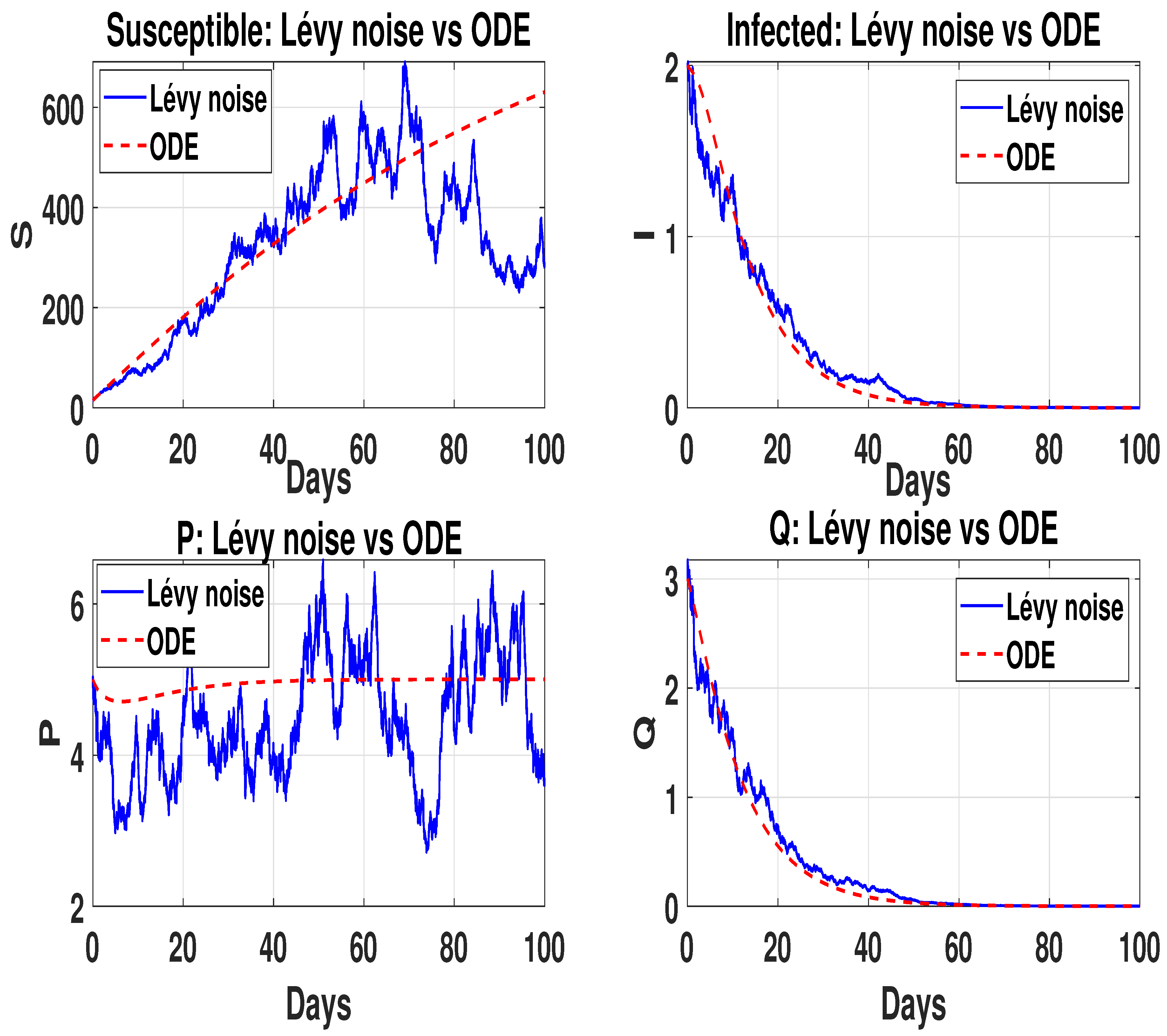
Here, the parameter values correspond exactly to those in Table 1. In Figure 3, we present a comparison between the deterministic (ODE) and stochastic (SDE) model solutions on the same graph. We observe that both approaches show that susceptible cashew plants grow exponentially when S s < 1 , while infected cashew plants tend toward zero over time under this same condition. Analogous behavior is observed for the fungi: the susceptible fungal population increases, while the infected population asymptotically decreases toward zero. These numerical results confirm Theorem 4, which was analytically demonstrated. Consequently, when S s < 1 , the disease gradually dies out and the growth of cashew plants becomes significant. This consistency demonstrates that the deterministic and stochastic dynamics are closely related. As a result, the trajectories of both systems asymptotically converge to the disease-free equilibrium (DFE).

5.2.2. Persistence of the Disease

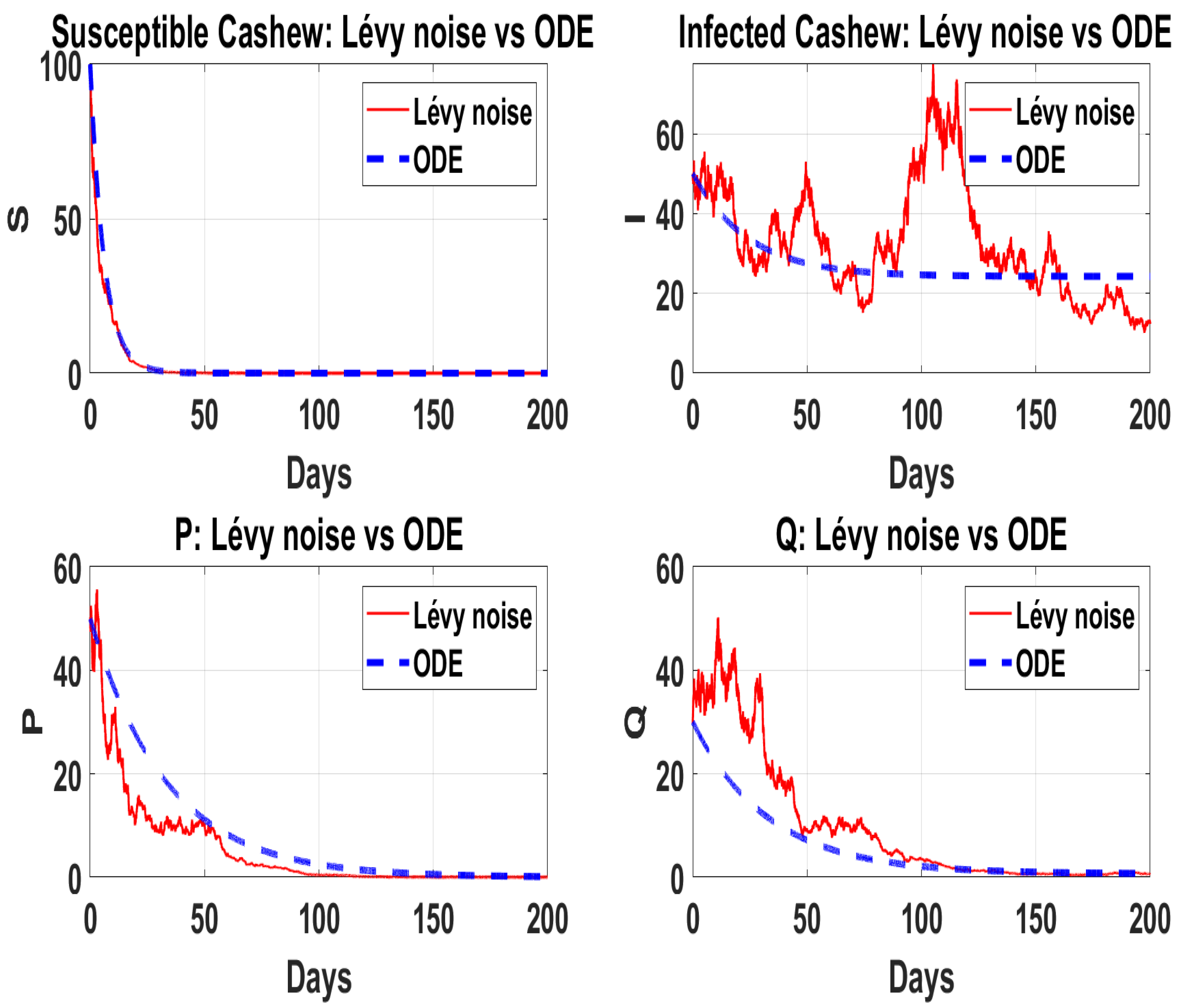
Figure 4 presents a comparison between the stochastic dynamics incorporating Lévy noise and the deterministic (ODE) solution of the cashew-fungus interaction model, encompassing cashew plant compartments ( S , I , R ) and Oidium anacardii Noack fungus compartments ( P , Q ) . In this case in Figure 4, the end state is that the total number of susceptible cashew plants and susceptible fungi are decreasing, while the number of infected plants is increasing, justifying the fact that the disease is spreading. This is in line with Theorem 5, when S 0 s > 1 , the disease will persist over time.
The solution behaviour of the perturbed model shows that the curves fluctuate around the equilibrium point (EE) of the deterministic model. The results for both systems under the condition of S 0 s > 1 are presented in Figure 4.

6. Conclusions

This study aimed to predict the transmission dynamics of Powdery Mildew (PMD), which poses a significant global threat to young cashew plantations, resulting in production losses and economic damage. In the first part of this study, we presented a deterministic model to describe the spread of Powdery Mildew among cashew seedling populations. The model is based on the Susceptible-Infectious-Recovered (SIR) framework for Powdery Mildew and the Susceptible-Infectious (PQ) framework for seedlings, which have been adapted to better understand PMD transmission. From this model, the disease-free and endemic equilibria were calculated, and the basic reproduction number R 0 for Powdery Mildew disease was calculated using the next-generation matrix method.
In the second phase, continuing from the deterministic system, we created a stochastic differential equation model taking into account Lévy noise. Our findings demonstrate that the suggested stochastic model has a unique global solution. On the one hand, using an appropriate Lyapunov function, we established that the model is stable if S 0 s > 1 . In contrast, if S s < 1 , the sickness will subside in the cashew habitat. Finally, the model helped us identify two thresholds. These two factors ( S 0 s , S s ) will decide whether the sickness will die off or endure. A series of graphs were created to validate the analytical findings. Finally, mathematical reasoning has improved our understanding of Powdery Mildew disease transmission. Under stochastic effects, our study demonstrates that the global solution of the model is unique, as is its stability.
In future works, we plan to extend the present model by integrating:
1.
The spatial and environmental aspects (climate, temperature) that can significantly influence Powdery Mildew disease;
2.
A form of noise other than Lévy noise, which will allow us to better understand the unpredictability of epidemic patterns;
3.
Use of real data from a city or country to make the simulations practical.
Finally, we will include controls in the model to reduce or eradicate this disease, which has a significant impact on production yields. These different aspects will allow us later to build a much more complete model.

Author Contributions

Conceptualization, A.K.G., H.A. and J.M.; methodology, A.K.G. and H.A.; software, A.K.G.; validation, A.K.G., H.A., J.M. and R.J.; formal analysis, A.K.G., H.A., J.M. and R.J.; investigation, A.K.G., H.A. and R.J.; resources, A.K.G., H.A., J.M. and R.J.; data curation, A.K.G. and H.A.; writing—original draft preparation, A.K.G. and H.A.; writing—review and editing, A.K.G., H.A., J.M. and R.J.; visualization, A.K.G., H.A., J.M. and R.J.; supervision, H.A. and J.M.; project administration, H.A. and J.M.; funding acquisition, H.A. All authors have read and agreed to the published version of the manuscript.

Funding

This research received no external funding.

Data Availability Statement

The sources of data used in this work are mentioned in the text.

Acknowledgments

The authors would like to thank the Editor-in-Chief and the distinguished Reviewers for their comments, recommendations, and suggestions, which helped them to improve their work. The second author also thanks the Skolabwandjan kingdom for providing him with all the necessary logistics during his research stay at the School of Geology and Mining Engineering of Meiganga-Cameroon.

Conflicts of Interest

The authors declare that they have no conflicts of interest.

References

  1. Bezerra, M.A.; Lacerda, C.F.d.; Gomes Filho, E.; de Abreu, C.E.; Prisco, J.T. Physiology of cashew plants grown under adverse conditions. Braz. J. Plant Physiol. 2007, 19, 449–461. [Google Scholar] [CrossRef]
  2. Mitchell, J.D.; Mori, S.A. The Cashew and Its Relatives; New York Botanical Garden: Bronx, NY, USA, 1987. [Google Scholar]
  3. Nair, K.P.; Nair, K.P. Cashew nut (Anacardium occidentale L.). In Tree Crops: Harvesting Cash from the World’s Important Cash Crops; Springer: Berlin/Heidelberg, Germany, 2021; pp. 27–77. [Google Scholar]
  4. Panda, H. The Complete Book on Cashew (Cultivation, Processing & By-Products): Cashew Nut Processing Industry in India, Cashew Nut Processing Plant, Cashew Nut Processing Projects, Cashew Nut Processing with CNSL Business, Cashew Nut Shell Liquid Product and Uses, Cashew Nut Small Business Manufacturing, Cashew Nuts Processing Small Business Project, Cashew Processing Unit, Food Processing Business List; Asia Pacific Business Press Inc.: Delhi, India, 2013. [Google Scholar]
  5. Dendena, B.; Corsi, S. Cashew, from seed to market: A review. Agron. Sustain. Dev. 2014, 34, 753–772. [Google Scholar] [CrossRef]
  6. Azam-Ali, S.; Judge, E. Small-Scale Cashew Nut Processing; ITDG Schumacher Centre for Technology and Development Bourton on Dunsmore: Coventry, UK, 2001; pp. 1–70. [Google Scholar]
  7. Agboka, K.M.J.; Soro, D.; Agboka, K.; Okorie, B.C.; Amankwah, A.A.; Mendy, P.A. Identification of Potential Future Areas for Sustainable Cashew (Anacardium occidentale L.) Nut Production in Togo Using the Maxent Model. J. Geogr. Environ. Earth Sci. Int. 2024, 28, 116–127. [Google Scholar] [CrossRef]
  8. Dimoso, N.; Kassim, N.; Makule, E. Cashew apple in Tanzania: Status of utilization, challenges, and opportunities for sustainable development. F1000Research 2024, 11, 1354. [Google Scholar] [CrossRef]
  9. Sierra-Baquero, P.; Catarino, S.; Costa, G.J.; Barai, A.; Correia, Z.; Ferreira, M.R.; Varón-Devia, E.; Romeiras, M.M.; Catarino, L.; Duarte, M.C.; et al. Insights into the cashew production system in Guinea-Bissau: Implications for agroecosystem sustainability. Front. Sustain. Food Syst. 2024, 8, 1439820. [Google Scholar] [CrossRef]
  10. Awé, D.V.; Noiha, N.V.; Vroh, B.T.A.; Zapfack, L. Biodiversity Management under Cashew Agro-ecosystems in Central Africa: A case study from Cameroon. Open J. Agric. Res. 2021, 1, 45–61. [Google Scholar] [CrossRef]
  11. Abboubakar, H.; Banbeto, S.A.G.; Jan, R.; Fandio, R.; Fouda, H.P.E.; Khan, I.; Khan, M.S. Fractional order modeling of hepatitis B virus transmission with imperfect vaccine efficacy. Sci. Rep. 2025, 15, 14245. [Google Scholar] [CrossRef]
  12. Bove, F.; Savary, S.; Willocquet, L.; Rossi, V. Modelling the effect of partial resistance on epidemics of downy mildew of grapevine. Eur. J. Plant Pathol. 2021, 161, 847–864. [Google Scholar] [CrossRef]
  13. Kranz, J. Epidemics of Plant Diseases: Mathematical Analysis and Modeling; Springer Science & Business Media: Berlin/Heidelberg, Germany, 2012; Volume 13. [Google Scholar]
  14. Abboubakar, H.; Guidzavaï, A.K.; Yangla, J.; Damakoa, I.; Mouangue, R. Mathematical modeling and projections of a vector-borne disease with optimal control strategies: A case study of the Chikungunya in Chad. Chaos Solitons Fractals 2021, 150, 111197. [Google Scholar] [CrossRef]
  15. Mrope, F.; Mgandu, F.A.; Nyerere, N. Modeling the Transmission Dynamics of Powdery Mildew Disease in Cashew Plants. Model. Earth Syst. Environ. 2025, 11, 182. [Google Scholar] [CrossRef]
  16. Calonnec, A.; Cartolaro, P.; Naulin, J.M.; Bailey, D.; Langlais, M. A host-pathogen simulation model: Powdery mildew of grapevine. Plant Pathol. 2008, 57, 493–508. [Google Scholar]
  17. Xu, X. Modelling and forecasting epidemics of apple powdery mildew (Podosphaera leucotricha). Plant Pathol. 1999, 48, 462–471. [Google Scholar] [CrossRef]
  18. Savary, S.; Delbac, L.; Rochas, A.; Taisant, G.; Willocquet, L. Analysis of nonlinear relationships in dual epidemics, and its application to the management of grapevine downy and powdery mildews. Phytopathology 2009, 99, 930–942. [Google Scholar] [PubMed]
  19. Jeger, M. Mathematical analysis and modeling of spatial aspects of plant disease epidemics. In Epidemics of Plant Diseases: Mathematical Analysis and Modeling; Springer: Berlin/Heidelberg, Germany, 1990; pp. 53–95. [Google Scholar]
  20. Rossi, V.; Giosuè, S. A dynamic simulation model for powdery mildew epidemics on winter wheat. EPPO Bull. 2003, 33, 389–396. [Google Scholar] [CrossRef]
  21. Alemneh, H.T.; Makinde, O.D.; Mwangi Theuri, D. Ecoepidemiological model and analysis of MSV disease transmission dynamics in maize plant. Int. J. Math. Math. Sci. 2019, 2019, 7965232. [Google Scholar] [CrossRef]
  22. Sinha, P.; Varma, A. Growth models for powdery mildew development of mango. Ann. Plant Prot. Sci. 2002, 10, 84–87. [Google Scholar]
  23. Chelal, J.; Hau, B. Modelling the interaction between powdery mildew epidemics and host dynamics of tomato. Eur. J. Plant Pathol. 2015, 142, 461–479. [Google Scholar] [CrossRef]
  24. Sall, M.A. Epidemiology of grape powdery mildew: A model. Phytopathology 1980, 70, 338–342. [Google Scholar] [CrossRef]
  25. Kumar, P.; Erturk, V.S.; Govindaraj, V.; Kumar, S. A fractional mathematical modeling of protectant and curative fungicide application. Chaos Solitons Fractals X 2022, 8, 100071. [Google Scholar] [CrossRef]
  26. Kumar, P.; Erturk, V.S.; Almusawa, H. Mathematical structure of mosaic disease using microbial biostimulants via Caputo and Atangana–Baleanu derivatives. Results Phys. 2021, 24, 104186. [Google Scholar] [CrossRef]
  27. Anggriani, N.; Putri, L.N.; Supriatna, A. Stability analysis and optimal control of plant fungal epidemic: An explicit model with curative factor. In Proceedings of the Symposium on Biomathematics (SYMOMATH 2014); American Institute of Physics: College Park, MD, USA, 2015; Volume 1651, pp. 40–47. [Google Scholar]
  28. Beretta, E.; Kolmanovskii, V.; Shaikhet, L. Stability of epidemic model with time delays influenced by stochastic perturbations. Math. Comput. Simul. 1998, 45, 269–277. [Google Scholar] [CrossRef]
  29. Carletti, M. On the stability properties of a stochastic model for phage–bacteria interaction in open marine environment. Math. Biosci. 2002, 175, 117–131. [Google Scholar] [CrossRef] [PubMed]
  30. Imhof, L.; Walcher, S. Exclusion and persistence in deterministic and stochastic chemostat models. J. Differ. Equ. 2005, 217, 26–53. [Google Scholar] [CrossRef]
  31. Jiang, D.; Yu, J.; Ji, C.; Shi, N. Asymptotic behavior of global positive solution to a stochastic SIR model. Math. Comput. Model. 2011, 54, 221–232. [Google Scholar] [CrossRef]
  32. Ain, Q.T.; Din, A.; Qiang, X.; Kou, Z. Dynamics for a Nonlinear Stochastic Cholera Epidemic Model under Lévy Noise. Fractal Fract. 2024, 8, 293. [Google Scholar] [CrossRef]
  33. Valenti, D.; Denaro, G.; Spagnolo, B.; Mazzola, S.; Basilone, G.; Conversano, F.; Brunet, C.; Bonanno, A. Stochastic models for phytoplankton dynamics in Mediterranean Sea. Ecol. Complex. 2016, 27, 84–103. [Google Scholar] [CrossRef]
  34. Spezia, S.; Curcio, L.; Fiasconaro, A.; Pizzolato, N.; Valenti, D.; Spagnolo, B.; Lo Bue, P.; Peri, E.; Colazza, S. Evidence of stochastic resonance in the mating behavior of Nezara viridula (L.). Eur. Phys. J. B 2008, 65, 453–458. [Google Scholar] [CrossRef]
  35. Su, T.; Kao, Y.; Jiang, D. Dynamical behaviors of a stochastic SIR epidemic model with reaction–diffusion and spatially heterogeneous transmission rate. Chaos Solitons Fractals 2025, 195, 116283. [Google Scholar] [CrossRef]
  36. Spagnolo, B.; Spezia, S.; Curcio, L.; Pizzolato, N.; Fiasconaro, A.; Valenti, D.; Lo Bue, P.; Peri, E.; Colazza, S. Noise effects in two different biological systems. Eur. Phys. J. B 2009, 69, 133–146. [Google Scholar] [CrossRef]
  37. Parisi, G. Nobel lecture: Multiple equilibria. Rev. Mod. Phys. 2023, 95, 030501. [Google Scholar] [CrossRef]
  38. Stassi, R.; De Liberato, S.; Garziano, L.; Spagnolo, B.; Savasta, S. Quantum control and long-range quantum correlations in dynamical Casimir arrays. Phys. Rev. A 2015, 92, 013830. [Google Scholar] [CrossRef]
  39. Kato, Y.; Nakao, H. Quantum coherence resonance. New J. Phys. 2021, 23, 043018. [Google Scholar] [CrossRef]
  40. Augello, G.; Valenti, D.; Pankratov, A.L.; Spagnolo, B. Lifetime of the superconductive state in short and long Josephson junctions. Eur. Phys. J. B 2009, 70, 145–151. [Google Scholar] [CrossRef]
  41. Skorokhod, A.V. Asymptotic Methods in the Theory of Stochastic Differential Equations; American Mathematical Soc.: Ann Arbor, MI, USA, 2009; Volume 78. [Google Scholar]
  42. Evans, L.C. An Introduction to Stochastic Differential Equations; American Mathematical Soc.: Ann Arbor, MI, USA, 2012; Volume 82. [Google Scholar]
  43. Fantaye, A.K. Modelling and stability analysis of cotton leaf curl virus (clcuv) transmission dynamics in cotton plant. J. Appl. Math. 2022, 2022, 6988197. [Google Scholar] [CrossRef]
  44. Adeniran, A.; Onanaye, A.; Adeleke, O. Mathematical model for spread and control of cocoa black pod disease. Contemp. Math. 2023, 4, 549–568. [Google Scholar] [CrossRef]
  45. Kawamura, A. Lipschitz continuous ordinary differential equations are polynomial-space complete. Comput. Complex. 2010, 19, 305–332. [Google Scholar] [CrossRef]
  46. Honary, T.; Mahyar, H. Approximation in Lipschitz algebras. Quaest. Math. 2000, 23, 13–19. [Google Scholar] [CrossRef]
  47. Korneichuk, N.P.; Polovina, A. Algebraic-polynomial approximation of functions satisfying a Lipschitz condition. Math. Notes Acad. Sci. USSR 1971, 9, 254–257. [Google Scholar] [CrossRef]
  48. Schlage-Puchta, J.C. Optimal version of the Picard–Lindelöf theorem. Electron. J. Qual. Theory Differ. Equ. 2021, 2021, 1–8. [Google Scholar] [CrossRef]
  49. Diekmann, O.; Heesterbeek, H.; Britton, T. Mathematical Tools for Understanding Infectious Disease Dynamics; Princeton University Press: Princeton, NJ, USA, 2013; Volume 7. [Google Scholar]
  50. Diekmann, O.; Heesterbeek, J.A.P.; Metz, J.A.J. On the definition and the computation of the basic reproduction ratio R 0 in models for infectious diseases in heterogeneous populations. J. Math. Biol. 1990, 28, 365–382. [Google Scholar] [CrossRef]
  51. Diekmann, O.; Heesterbeek, J.; Roberts, M. The construction of next-generation matrices for compartmental epidemic models. J. R. Soc. Interface 2010, 7, 873–885. [Google Scholar] [CrossRef]
  52. Mapinda, J.J.; Mwanga, G.G.; Nyerere, N.; Masanja, V.G. A mathematical Model to assess the Role of Neglected Control Techniques in the Dynamics of Banana Xanthomonas Wilt Disease. Int. J. Adv. Sci. Res. Eng. 2022, 8, 107–123. [Google Scholar] [CrossRef]
  53. Li, Z.; Wu, W.; Zhao, Y. Dynamics and control of a Lévy noise-driven stochastic SAIRV epidemic model. AIP Adv. 2025, 15, 095220. [Google Scholar] [CrossRef]
  54. Cheng, Y.; Li, M.; Zhang, F. A dynamics stochastic model with HIV infection of CD4+ T-cells driven by Lévy noise. Chaos Solitons Fractals 2019, 129, 62–70. [Google Scholar] [CrossRef]
  55. Zhu, Y.; Wang, L.; Qiu, Z. Dynamics of a stochastic cholera epidemic model with Lévy process. Phys. A Stat. Mech. Its Appl. 2022, 595, 127069. [Google Scholar] [CrossRef]
  56. Mao, X.; Wei, F.; Wiriyakraikul, T. Positivity preserving truncated Euler–Maruyama method for stochastic Lotka–Volterra competition model. J. Comput. Appl. Math. 2021, 394, 113566. [Google Scholar] [CrossRef]
  57. Bailey, B.A.; Doney, S.C.; Lima, I.D. Quantifying the effects of dynamical noise on the predictability of a simple ecosystem model. Environ. Off. J. Int. Environ. Soc. 2004, 15, 337–355. [Google Scholar] [CrossRef]
  58. Yang, A.; Wang, H.; Zhang, T.; Yuan, S. Stochastic switches of eutrophication and oligotrophication: Modeling extreme weather via non-Gaussian Lévy noise. Chaos Interdiscip. J. Nonlinear Sci. 2022, 32, 043116. [Google Scholar] [CrossRef]
  59. Din, A.; Li, Y. Lévy noise impact on a stochastic hepatitis B epidemic model under real statistical data and its fractal–fractional Atangana–Baleanu order model. Phys. Scr. 2021, 96, 124008. [Google Scholar] [CrossRef]
  60. Abdeslami, M.M.; Basri, L.; Caraballo, T.; Fatini, M.E. Lévy noise impact on a stochastic epidemic model with healing, relapse and vaccination. Int. J. Biomath. 2024, 2450076. [Google Scholar] [CrossRef]
  61. Mao, X. Stochastic Differential Equations and Applications; Elsevier: Amsterdam, The Netherlands, 2007. [Google Scholar]
  62. Berrhazi, B.e.; El Fatini, M.; Caraballo Garrido, T.; Pettersson, R. A stochastic SIRI epidemic model with Lévy noise. Discret. Contin. Dyn. Syst.-Ser. B 2018, 23, 3645–3661. [Google Scholar] [CrossRef]
  63. Song, Y.; Liu, P.; Din, A. A Novel Stochastic Model for Human Norovirus Dynamics: Vaccination Impact with Lévy Noise. Fractal Fract. 2024, 8, 349. [Google Scholar] [CrossRef]
Figure 1. Diagram of the model for plant ( S , I , R ) and vector ( P , Q ) populations.
Axioms 15 00143 g001
Figure 2. Diagram of the S I R P Q stochastic model.
Axioms 15 00143 g002
Figure 3. We can see that when R 0 = 0.0136 < 1 , the trajectories of Susceptible Cashew S and susceptible Fungi P are increasing, while those of I and Q are decreasing. This justifies the idea that the disease will gradually disappear from the environment when R 0 < 1 .
Axioms 15 00143 g003
Figure 4. Graphing deterministic and stochastic systems with parametric values. According to this figure, when R 0 = 1.3029 , the trajectories of susceptible cashew nuts S and Fungi P decrease significantly, while the classes of infected cashew plants I and infected Fungi Q, even though initially they show a decreasing behavior, stabilize at some point; they would never tend to zero. This supports the idea that Powdery Mildew will persist in the environment when R 0 > 1 . Hence the term epidemic over time.
Axioms 15 00143 g004
Table 1. Meaning of model parameter.
ParameterMeaningValueSource
Λ 1 Replanting rate of cashew plants0.97 [15,43]
Λ 2 Oidium anacardii Noack fungal recruitment rate0.02 [15,21]
σ Recovery rate of infected cashew plants0.09 [15,44]
β 1 Effective contact rate between infected fungi 0.000007  [15,43]
and susceptible cashew
β 2 Effective contact rate between susceptible fungi0.000005 [15,43]
and infected cashew plants
Υ Cashew plants’ rate of reverting to a vulnerable state0.07 [15]
μ Natural death rate of cashew plants0.04 [15,43]
ν Natural death rate of Oidium anacardii Noack fungi0.03 [15,43]
ϱ Disease induced death rate of cashew plants0.4 [15]
Disclaimer/Publisher’s Note: The statements, opinions and data contained in all publications are solely those of the individual author(s) and contributor(s) and not of MDPI and/or the editor(s). MDPI and/or the editor(s) disclaim responsibility for any injury to people or property resulting from any ideas, methods, instructions or products referred to in the content.