
Article

A Unified Framework for the Upper and Lower Discretizations of Fuzzy Implications

School of Artificial Intelligence, Taizhou University, Taizhou 318000, China
Axioms 2026, 15(1), 19; https://doi.org/10.3390/axioms15010019
Submission received: 28 November 2025 / Revised: 21 December 2025 / Accepted: 25 December 2025 / Published: 26 December 2025
(This article belongs to the Special Issue Advances in Fuzzy Logic and Fuzzy Implications)

Abstract

In this paper, we investigate the discretization of fuzzy implications using rounding functions. Our discretization method is a unified framework of the upper and lower discretization methods of Munar-Covas et al. Furthermore, we examine the extent to which the essential properties of these fuzzy implications are preserved in our discretization process.

1. Introduction

During the past three decades, discrete fuzzy connectives have been intensively investigated. Mas, Mayor, and Torrens [1] examined uninorms and t-operators on finite totally ordered sets, while they [2] characterized bisymmetrical, commutative, and smooth operators on finite chains. They also introduced non-commutative operators similar to pseudo-smooth uninorms [3] and investigated smooth t-subnorms and boundary weak t-norms [4]. Mayor, Suñer, and Torrens [5] established a representation theorem for discrete copulas on finite chains using permutation matrices. Ruiz-Aguilera and Torrens [6] pinpointed smooth discrete uninorms. In 2004, Mas, Monserrat, and Torrens [7] studied S- and R-implications on finite chains. They [8] later provided a comprehensive survey on fuzzy implication functions in 2007, which included discrete implications. De Baets et al. [9] and De Baets and Mesiar [10] explored t-norms on finite and continuous scales. Li, Liu, and Fodor [11] detailed weakly smooth uninorms. Fodor [12] classified smooth binary operations on chains. Godo and Torra [13] delved into ordinal aggregation, as did Mas, Monserrat, and Torrens [14] with kernel operators. Su and Liu [15] and Su and Zhao [16] discussed annihilator and autodistributive operators on finite chains, respectively. Qiao [17,18] introduced the concept of discrete overlap functions. In 2023, Munar, Massanet, and Ruiz-Aguilera [19] gave a thorough review of logical connectives on finite chains. In 2024, Munar et al. [20] presented a survey on the enumeration of classes of discrete logical connectives and aggregation functions, including new findings.

Motivation of the Present Paper

Let Ł n and Γ n denote the finite chains { 0 , 1 , , n } and { 0 , 1 n , 2 n , , 1 } , respectively.
Our motivation is fueled by two key considerations.
  • Munar-Covas, Massanet, and Ruiz-Aguilera [21] questioned the necessity of studying discrete implications, given that fuzzy logic operators in [0, 1] can generate discrete operators through transformations. Previous literature has only addressed conversions between t-norms and discrete t-norms [22], and copulas and discrete copulas [23,24,25]. Specifically, these studies [22,23,24,25] have been conducted under the condition that the restriction of a t-norm and a copula on Γ n translates into a discrete t-norm and a discrete copula, respectively. As mentioned in [21], no additional studies have been identified that conduct an in-depth investigation of this question. Therefore, this research topic warrants further exploration and dedication.
  • Munar-Covas, Massanet, and Ruiz-Aguilera [21] proposed the upper and lower discretization methods to investigate if the conversion from fuzzy to discrete implications retains key properties. These two methods are based on the ceiling and floor functions, respectively. They suggested that it is essential to explore alternative discretization methods. We noted that ceiling and floor functions are two specific cases of rounding method. In this paper, inspired by this idea, we attempt to establish a unified framework for Munar-Covas et al.’s upper and lower discretization methods. This directly motivates the present work.
The rest of the paper is organized as follows: In Section 2, we recall some concepts, notations, and previous work. In Section 3, we introduce the concept of γ -rounding function. In Section 4, we propose a discretization method of fuzzy implications based on the γ -rounding functions. In the last section, this study is summarized.

2. Preliminaries

2.1. Fuzzy Implications

Definition 1
([26]). A bivariate function I : [ 0 , 1 ] 2 [ 0 , 1 ] is called a fuzzy implication if it satisfies u , v , w [ 0 , 1 ] ,
(I1) 
I ( u , v ) I ( w , v ) for all w u ;
(I2) 
I ( u , v ) I ( u , w ) for all v w ;
(I3) 
I ( 1 , 0 ) = 0 and I ( 0 , 0 ) = I ( 1 , 1 ) = 1 .
Some interesting properties for fuzzy implications are presented [19,21,26].
(NP)
The left neutrality principle
I ( 1 , u ) = u , u [ 0 , 1 ] .
(IP)
The identity principle
I ( u , u ) = 1 , u [ 0 , 1 ] .
(OP)
The ordering principle
I ( u , v ) = 1 u v , u , v [ 0 , 1 ] .
(CB)
The consequent boundary
I ( u , v ) v , u , v [ 0 , 1 ] .

2.2. Discrete Implications

Fuzzy implications generalize classical implication to fuzzy logic; see [26] for a comprehensive study on [0, 1]. Dedicated sections for implications on Γ n are provided in [7], and for those on Ł n in [8,21].
Definition 2
([7,8,21]). A bivariate function I n : Ł n 2 Ł n is called a discrete implication if it satisfies u , v , w Ł n ,
(DI1) 
I n ( u , v ) I n ( w , v ) for all w u ;
(DI2) 
I n ( u , v ) I n ( u , w ) for all v w ;
(DI3) 
I n ( n , 0 ) = 0 and I n ( 0 , 0 ) = I n ( n , n ) = n .
Some properties for discrete implications are presented [7,8,21].
(NP)
The left neutrality principle
I n ( n , u ) = u , u Ł n .
(IP)
The identity principle
I n ( u , u ) = 1 , u Ł n .
(OP)
The ordering principle
I n ( u , v ) = 1 u v , u , v Ł n .
(CB)
The consequent boundary
I n ( u , v ) v , u , v Ł n .
Definition 3
([22]). A unary operator f : Ł n Ł n is k-smooth (or simply smooth when k = 1 ) if it satisfies
0 | f ( u + 1 ) f ( u ) | k
for all u Ł n { n } .
Definition 4
([22]). A binary operator f : Ł n 2 Ł n is k-smooth (or simply smooth when k = 1 ) if it satisfies
0 | f ( u + 1 , v ) f ( u , v ) | k
for all u Ł n { n } and v Ł n , and
0 | f ( u , v + 1 ) f ( u , v ) | k
for all u Ł n and v Ł n { n } .

2.3. The Upper and Lower Discretizations of a Fuzzy Implication

Definition 5
([21]). Let a R . The floor and ceiling functions are defined, respectively, as
a = max { s Z | s a } ,
a = min { s Z | s a } .
Based on floor and ceiling functions, Munar-Covas et al. [21] introduced the following upper and lower discretizations of a fuzzy implication.
Definition 6
([21]). Let I be a fuzzy implication; the upper and lower discretizations of I on Ł n are defined, respectively, as
I n i , j = n · I ( i n , j n ) , i , j Ł n ;
I n i , j = n · I ( i n , j n ) , i , j Ł n .

3. γ -Rounding Functions

Munar-Covas et al.’s upper and lower discretizations of fuzzy implications are based on the ceiling and floor functions, respectively. We study the unification of the ceiling and floor functions. We introduce the concept of the γ -rounding function as a unifying generalization of ceiling and floor functions. Moreover, basic properties of the γ -rounding functions are acquired.
Definition 7.
Let a R and γ [ 0 , 1 ] . The γ-rounding function is defined as
[ a ] γ = a , if a a γ , a , if a a < γ .
When γ = 1 , the 1-rounding function is the floor function, i.e., [ a ] 1 = a .
When γ = 0 , the 0-rounding function is the ceiling function, i.e., [ a ] 0 = a .
We present a lemma regarding essential properties of the rounding function.
Lemma 1.
Let a , b R . The following statements hold true:
(1) 
For all γ [ 0 , 1 ] , the function f ( a ) = [ a ] γ is increasing.
(2) 
If γ 1 γ 2 , then [ a ] γ 2 [ a ] γ 1 .
(3) 
For all γ ( 0 , 1 ) , a b 1 [ a b ] γ a b + 1 .
(4) 
For all γ ( 0 , 1 ) , a b 1 [ a ] γ [ b ] γ a b + 1 .
Proof. 
(1) follows directly from the definition of the γ -rounding function given in Definition 7.
(2) follows directly from the fact that if γ 1 γ 2 , then a a γ 2 a a γ 1 and a a γ 1 a a γ 2 .
(3) Given a , b R , we can decompose each number into its integer and fractional parts as a = n + μ and b = m + ν , where n , n Z and μ , ν [ 0 , 1 ) . Then a = n , b = m , and [ a b ] γ = [ n m + μ ν ] γ . The value of [ a b ] γ depends on the value of the fractional term μ ν relative to the threshold γ . We consider the following cases:
In Case I, μ ν γ , it follows that [ a b ] γ = n m + 1 ;
In Case II, 0 μ ν < γ , it follows that [ a b ] γ = n m ;
In Case III, γ 1 μ ν < 0 , it follows that [ a b ] γ = n m ;
In Case IV, μ ν < γ 1 , it follows that [ a b ] γ = n m 1 .
Therefore, a b 1 = n m 1 [ a b ] γ n m + 1 = a b + 1 .
(4) Given a , b R , we can decompose each number into its integer and fractional parts a = n + μ and b = m + ν , where n , m Z and μ , ν [ 0 , 1 ) . Then a = n and b = m . We analyze the expression [ a ] γ [ b ] γ by considering three distinct cases based on the values of μ and ν with respect to γ .
In Case I, μ γ and ν γ ; then [ a ] γ [ b ] γ = n + 1 ( m + 1 ) = n m ,
a b = n m + μ ν = n m , if μ ν 0 , n m 1 , if μ ν < 0 ,
and
a b = n m + μ ν = n m + 1 , if μ ν 0 , n m , if μ ν < 0 .
Therefore a b 1 [ a ] γ [ b ] γ = n m a b + 1 .
In Case II, μ γ and ν < γ ; then μ ν < 0 , [ a ] γ [ b ] γ = n + 1 m , a b = n m + μ ν = n m , and a b = n m + μ ν = n m . Therefore, a b + 1 = [ a ] γ [ b ] γ = a b + 1 .
In Case III, μ < γ and ν < γ ; then [ a ] γ [ b ] γ = n m ,
a b = n m + μ ν = n m , if μ ν 0 , n m 1 , if μ ν < 0 ,
and
a b = n m + μ ν = n m + 1 , if μ ν 0 , n m , if μ ν < 0 .
Therefore, a b 1 [ a ] γ [ b ] γ = n m a b + 1 . □
Remark 1.
When γ = 1 , [ a ] γ [ b ] γ 1 [ a b ] γ [ a ] γ [ b ] γ ; when γ = 0 , [ a ] γ [ b ] γ [ a b ] γ [ a ] γ [ b ] γ + 1 (see Lemma II.1 of [21]).

4. Discretization of Fuzzy Implications

Munar-Covas, Massanet, and Ruiz-Aguilera [21] proposed upper and lower discretizations of fuzzy implications. In this section, we unify these two discretizations.

4.1. Discretization Method

Definition 8.
Let I be a fuzzy implication function and γ [ 0 , 1 ] . The γ-rounding-based discretization of I is defined as
I n γ ( i , j ) = n · I ( i n , j n ) γ .
When γ = 1 , the 1-rounding-based discretization of I is the lower discretization of I, i.e., I n 1 = I n .
When γ = 0 , the 0-rounding-based discretization of I is the upper discretization of I, i.e., I n 0 = I n .
Proposition 1.
Let I be a fuzzy implication and γ [ 0 , 1 ] . Then the γ-rounding-based discretization I n γ on Ł n is a discrete implication.
Proof. 
Since 0 I ( u , v ) 1 , u , v [ 0 , 1 ] . Therefore, 0 n · I ( u , v ) n . Then 0 [ n · I ( u , v ) ] γ n , u , v , γ [ 0 , 1 ] .
I decreases with the first argument and increases with the second. Applying Lemma 1(1), I n γ also decreases with the first argument and increases with the second. Moreover,
(1)
I n γ ( 0 , 0 ) = [ n · I ( 0 , 0 ) ] γ = [ n · 1 ] γ = [ n ] γ = n ,
(2)
I n γ ( n , n ) = [ n · I ( 1 , 1 ) ] γ = [ n · 1 ] γ = [ n ] γ = n ,
(3)
I n γ ( n , 0 ) = [ n · I ( 1 , 0 ) ] γ = [ n · 0 ] γ = [ 0 ] γ = 0 .
The relationship between γ -rounding-based discretization and upper and lower discretizations is as follows.
Theorem 1.
For any 0 γ 1 γ 2 1 , it holds that I n I n γ 2 I n γ 1 I n , i.e.,
I n ( i , j ) I n γ 2 ( i , j ) I n γ 1 ( i , j ) I n ( i , j ) i , j Ł n .
Proof. 
Given that 0 γ 1 γ 2 1 , Lemma 1(2) implies the following chain of inequalities for all i , j Ł n :
n · I ( i n , j n ) = n · I ( i n , j n ) 1 n · I ( i n , j n ) γ 2 n · I ( i n , j n ) γ 1 n · I ( i n , j n ) 0 = n · I ( i n , j n )
This establishes the pointwise ordering I n ( i , j ) I n γ 2 ( i , j ) I n γ 1 ( i , j ) I n ( i , j ) for all i , j Ł n . Thus I n I n γ 2 I n γ 1 I n . □
The following example demonstrates that γ -rounding-based discretizations for different values of γ are distinct operators and may not always coincide.
Example 1.
Let Ł 5 = { 0 , 1 , 2 , 3 , 4 , 5 } and consider the Reichenbach implication I R C ( u , v ) = 1 u + u v , u , v [ 0 , 1 ] . Using the γ-rounding-based discretization from Equation (17), we obtain a family of discretization operations parameterized by γ.
The value of γ acts as a rounding threshold that determines when the non-integer implication value is rounded up to the next integer. As γ increases, this threshold becomes stricter, meaning fewer values are rounded up. This effect is systematically demonstrated by comparing Table 1, which shows the general form, with the specific discretizations in Table 2, Table 3, Table 4, Table 5 and Table 6.
The non-integer implication values in Table 1 are the points where the γ-threshold is critical. They partition the interval γ [ 0 , 1 ] into the following five sub-intervals:
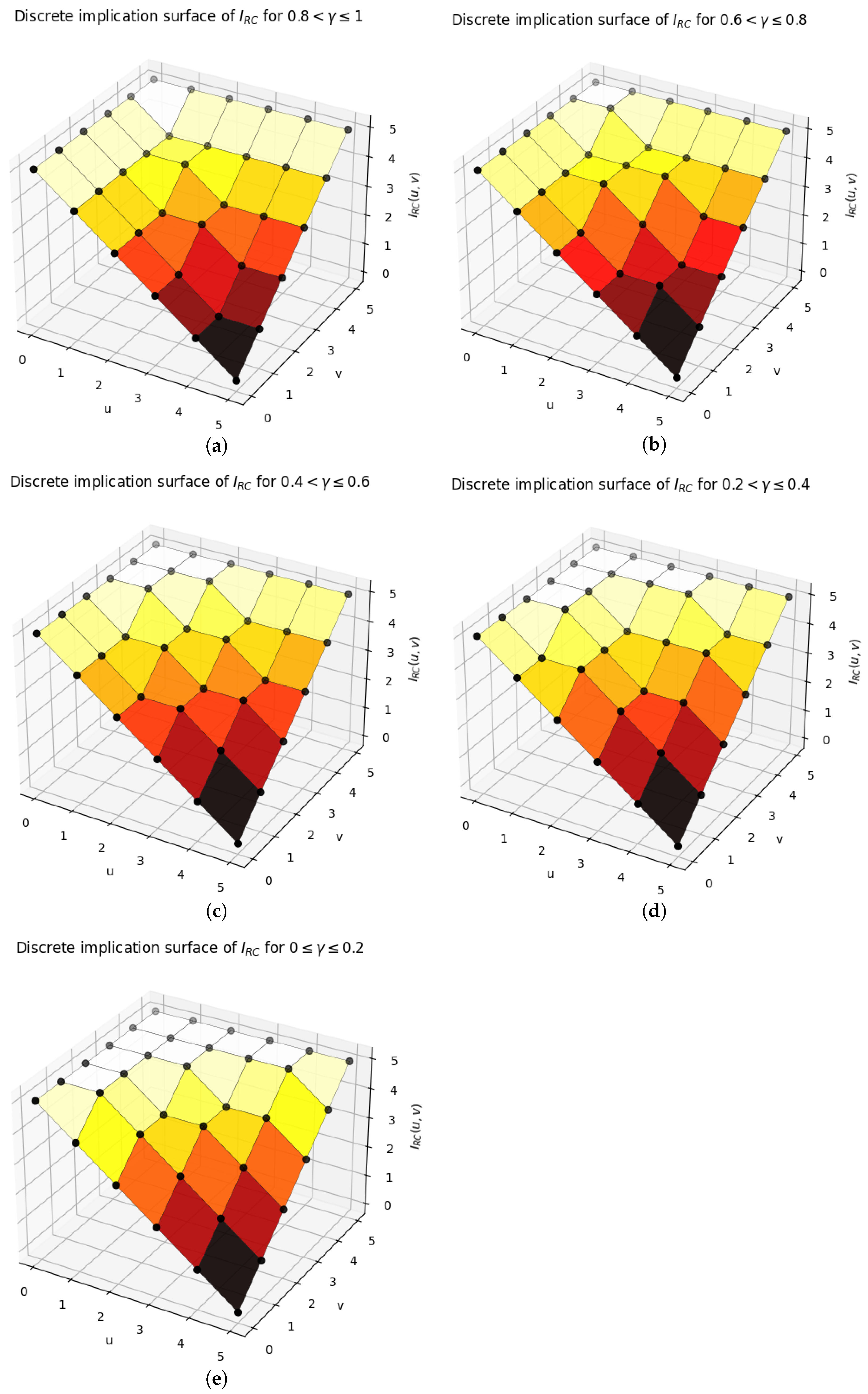
When 0.8 < γ 1 , the γ-rounding-based discretization of I R C is given in Table 2. The high threshold means that a value is rounded up only if it is strictly greater than 0.8. By inspecting the intermediate values in Table 1, we find that no term is rounded up to the next integer. As a result, each element of Table 2 is simply the floor of the corresponding non-integer implication value, i.e., I n γ ( i , j ) = I R C ( i , j ) for all i , j L 5 .
When 0.6 < γ 0.8 , the γ-rounding-based discretization of I R C is given in Table 3. The reduction of the threshold to 0.6 is sufficient to round [ 4.8 ] γ up to 5, [ 3.8 ] γ up to 4, and [ 1.8 ] γ up to 2. The effect of this is immediately visible in Table 3 when compared with Table 2. The entry corresponding to ( u , v ) = ( 1 , 4 ) increases from 4 to 5. Similarly, the entries for ( u , v ) = ( 2 , 2 ) and ( u , v ) = ( 3 , 3 ) increase from 3 to 4, and the entry for ( u , v ) = ( 4 , 1 ) increases from 1 to 2.
When 0.4 < γ 0.6 , the γ-rounding-based discretization of I R C is given in Table 4. With the threshold lowered to 0.4, the terms [ 4.6 ] γ and [ 2.6 ] γ are now rounded up to 5 and 3, respectively. Consequently, there are two distinct changes compared with Table 3: two entries increase from 4 to 5, and two other entries increase from 2 to 3.
When 0.2 < γ 0.4 , the γ-rounding-based discretization of I R C is given in Table 5. The reduction of the threshold to 0.2 triggers two rounding events: [ 4.4 ] γ is promoted to 5, and [ 3.4 ] γ is promoted to 4. Compared with Table 4, two entries increase from 4 to 5, and two other entries increase from 3 to 4.
When 0 γ 0.2 , the γ-rounding-based discretization of I R C is given in Table 6. When the threshold γ is reduced to this final interval, the rounding-up condition is universally satisfied for all non-integer terms. This causes the γ-rounding mechanism to transition into a simple ceiling operation, i.e., I n γ ( i , j ) = I R C ( i , j ) for all i , j L 5 .
Figure 1 shows the discrete implication surfaces of I R C generated by applying γ-rounding functions with different γ values.
In essence, the parameter γ provides a fine-grained control mechanism for the discretization. By adjusting γ, we can selectively determine which non-integer values are rounded up and which are rounded down. This flexibility positions the γ-rounding method as a powerful generalization: the floor operation corresponds to the extreme case where all values are rounded down, while the ceiling operation corresponds to the opposite extreme where all are rounded up. This demonstrates the remarkable flexibility and tunability of the γ-rounding-based method.

4.2. Preservation of Properties Through the Discretization Process

4.2.1. Smoothness

Munar-Covas et al. [21] demonstrated that continuity does not always imply smoothness. They provided a sufficient condition to ensure smoothness.
Proposition 2
(Proposition IV.1 of [21]). Let I be a fuzzy implication and the forward difference operations in each variable of I, Ξ 1 : ( Ł n { n } ) × Ł n [ 0 , 1 ] and Ξ 2 : Ł n × ( Ł n { n } ) [ 0 , 1 ] are given by
Ξ 1 ( i , j ) = I ( i n , j n ) I ( i + 1 n , j n ) ,
Ξ 2 ( i , j ) = I ( i n , j + 1 n ) I ( i n , j n ) .
If
0 Ξ 1 ( i , j ) 1 n , ( i , j ) ( Ł n { n } ) × Ł n ,
0 Ξ 2 ( i , j ) 1 n , ( i , j ) Ł n × ( Ł n { n } ) ,
then I n and I n are smooth.
The condition stated in Proposition 3 is sufficient to ensure the smoothness of I n γ for all γ [ 0 , 1 ] .
Proposition 3.
Let I be a fuzzy implication. If
0 Ξ 1 ( i , j ) k n , ( i , j ) ( Ł n { n } ) × Ł n ,
0 Ξ 2 ( i , j ) k n , ( i , j ) Ł n × ( Ł n { n } ) ,
then I n γ is k-smooth for any γ [ 0 , 1 ] .
Proof. 
From Lemma 1 (4), if Ξ ( i , j ) < k n , then
I n γ ( i , j ) I n γ ( i + 1 , j ) = n · I ( i n , j n ) γ n · I ( i + 1 n , j n ) γ n · I ( i n , j n ) n · I ( i + 1 n , j n ) + 1 = n · I ( i n , j n ) I ( i + 1 n , j n ) + 1 k .
Since [ a + m ] γ = [ a ] γ + m for all a R , m Z and r [ 0 , 1 ] .
I n γ ( i , j ) I n γ ( i + 1 , j ) = n · I ( i n , j n ) γ n · I ( i + 1 n , j n ) γ = k + n · I ( i + 1 n , j n ) γ n · I ( i + 1 n , j n ) γ = k + n · I ( i + 1 n , j n ) γ n · I ( i + 1 n , j n ) γ = k .
The k-smoothness of I n γ with respect to the second argument can be established via an analogous deductive process, which considers two cases with Ξ 2 . □
Example 2.
Consider the discretization of Reichenbach implication, I R C ( u , v ) = 1 u + u v , u , v [ 0 , 1 ] , on Ł 5 (see Example 1). From Table 2, Table 3, Table 4, Table 5 and Table 6, we know that the γ-rounding-based discretization of I R C is smooth for any γ [ 0 , 1 ] . It is easy to verify that max i , j Ξ 1 ( i , j ) = 0.16 < 1 5 , ( i , j ) ( Ł 5 { 5 } ) × Ł 5 , and max i , j Ξ 2 ( i , j ) = 0.16 < 1 5 , ( i , j ) Ł 5 × ( Ł 5 { 5 } ) .
To illustrate the nuanced effect of γ , consider the following example. It shows that both possibilities can occur. On one hand, there exists an implication for which neither the lower ( γ = 1 ) nor the upper ( γ = 0 ) discretization is smooth, yet its γ -rounding-based discretization is smooth for some γ ( 0 , 1 ) . On the other hand, there also exists an implication for which both the lower and upper discretizations are smooth, but its γ -rounding-based discretization is not smooth for some γ ( 0 , 1 ) .
Example 3.
We first construct two continuous functions, f 1 and f 2 , over the domain [ 0 , 3 ] 2 .
Function f 1 is defined as follows: its values on the lattice L 3 = { 0 , 1 , 2 , 3 } are given in Table 7. For all other points ( u , v ) [ 0 , 3 ] 2 , the function is defined by bilinear interpolation. Let i = u , j = v , t = u i , and s = v j . The value is then given by
f 1 ( u , v ) = ( 1 t ) ( 1 s ) · f ( i , j ) + t ( 1 s ) · f ( i + 1 , j ) + ( 1 t ) s · f ( i , j + 1 ) + t s · f ( i + 1 , j + 1 )
From this continuous function, we can construct an implication operator I by scaling
I ( x , y ) = f 1 ( n x , n y ) n .
For this implication I, it is evident that the γ = 0.5 -rounding-based discretization on L 3 is not smooth, whereas the upper ( γ = 0 ) and lower ( γ = 1 ) discretization methods are both smooth.
Similarly, we consider a second function f 2 . Its values on L 3 are given in Table 8, and its values elsewhere are also defined by Equation (26). The corresponding implication operator, constructed via Equation (27), is denoted by J. In contrast to I, for this implication J, the γ = 0.5 -rounding-based discretization of J on L 3 is smooth, while neither the upper ( γ = 0 ) nor lower ( γ = 1 ) discretization method of J is smooth.
Proposition 4
(Proposition 3.11 of [27]). Let I n be a discrete implication on Ł n , and I n satisfies OP, i.e., I n ( i , j ) = 1 i j . I n is smooth if and only if I n ( i , j ) = min ( n i + j , n ) .

4.2.2. Neutrality Principle

Munar-Covas et al. [21] gave the following results for I n γ with γ = 0 and γ = 1 .
Proposition 5
(Proposition IV.6 of [21]). Let I be a fuzzy implication.
(1) 
I n satisfies (NP) if, and only if, I ( 1 , i n ) i 1 n , i n for all i Ł n ;
(2) 
I n satisfies (NP) if, and only if, I ( 1 , i n ) i n , i + 1 n for all i Ł n .
Corollary 1
(Corollary IV.6.1 of [21]). Let I be a fuzzy implication. If I satisfies (NP), I n and I n also satisfy (NP).
Let us now look at the neutrality principle (NP) for I n γ with γ ( 0 , 1 ) .
Proposition 6.
Let I be a fuzzy implication and r ( 0 , 1 ) . I n γ satisfies (NP) if, and only if, I ( 1 , i n ) i 1 + γ n , i + γ n for all i Ł n .
Proof. 
It follows from
I n γ ( n , i ) = i n · I ( n n , i n ) γ = i i 1 + γ n · I ( n n , i n ) < i + γ i 1 + γ n I ( n n , i n ) < i + γ n
for all i Ł n . □
Corollary 2.
Let I be a fuzzy implication, and I n γ be its γ-rounding-based discretization. If I satisfies (NP), then I n γ satisfies (NP).
Proof. 
It follows directly from Theorem 1 and Corollary 1. □

4.2.3. Identity Principle

Proposition 7.
Let I be a fuzzy implication and γ ( 0 , 1 ) . I n γ satisfies (IP) if, and only if, I ( i n , i n ) i 1 + γ n , i + γ n for all i Ł n .
Proof. 
It follows from
I n γ ( i , i ) = i n · I ( i n , i n ) γ = i i 1 + γ n · I ( i n , i n ) < i + γ i 1 + γ n I ( i n , i n ) < i + γ n
for all i Ł n . □
Corollary 3.
Let I be a fuzzy implication, and I n γ be its γ-rounding-based discretization. If I satisfies (IP), then I n γ satisfies (IP).
Proof. 
It follows directly from Theorem 1 and Corollary IV.7.1 of [21]. □
Example 4.
Let Ł 3 = { 0 , 1 , 2 , 3 } , Γ 3 = { 0 , 1 / 3 , 2 / 3 , 1 } , and consider the discretization of Reichenbach implication, I R C ( u , v ) = 1 u + u v , u , v [ 0 , 1 ] , on Ł 3 . I R C ( 1 , 1 ) = I R C ( 0 , 0 ) = 1 , I R C ( 1 3 , 1 3 ) = I R C ( 2 3 , 2 3 ) = 7 9 . For any γ [ 0 , 1 ] , γ n , 1 + γ n 1 + γ n , 2 + γ n = . Then the discretization of Reichenbach implication on Ł 3 does not satisfy (IP) for any γ [ 0 , 1 ] .

4.2.4. Ordering Principle

Proposition 8.
Let I be a fuzzy implication and γ ( 0 , 1 ) . I n γ satisfies (OP) if, and only if, I ( i n , j n ) n 1 + γ n for all i j and I ( i n , j n ) < n 1 + γ n for all i > j .
Proof. 
For all i , j Ł n with i j ,
I n γ ( i , j ) = 1 n · I ( i n , j n ) γ = n n · I ( i n , j n ) n 1 + γ I ( i n , j n ) n 1 + γ n .
For all i , j Ł n with i < j ,
I n γ ( i , j ) < 1 n · I ( i n , j n ) γ < n n · I ( i n , j n ) γ n 1 n · I ( i n , j n ) < n 1 + γ I ( i n , j n ) < n 1 + γ n .
Corollary 4.
Let I be a fuzzy implication, and γ ( 0 , 1 ) . If I satisfies (OP) and I ( u , v ) < n 1 + γ n for all u , v [ 0 , 1 ] with u > v , then I n γ satisfies (OP).
Proof. 
It follows directly from Proposition 8. □
Example 5.
Let Ł 3 = { 0 , 1 , 2 , 3 } . We consider the discretization of the Reichenbach implication, I R C ( u , v ) = 1 u + u v for all u , v [ 0 , 1 ] , on Ł 3 . The γ-rounding-based discretization of I R C on Ł 3 is presented in Table 9. It is straightforward to verify that this discretization satisfies the property (OP) for any γ [ 0 , 1 / 3 ] , but fails to satisfy (OP) for any γ ( 1 / 3 , 1 ] .

4.2.5. Consequent Boundary

Proposition 9.
Let I be a fuzzy implication and γ ( 0 , 1 ) . I n γ satisfies (CB) if, and only if, I ( i n , j n ) j 1 + γ n for all i , j Ł n .
Proof. 
It follows from
I n γ ( i , j ) j n · I ( i n , i n ) γ j n · I ( i n , j n ) j 1 + γ I ( i n , j n ) j 1 + γ n
for all i , j Ł n . □
Corollary 5.
Let I be a fuzzy implication, and γ ( 0 , 1 ) . If I satisfies (CB), then I n γ satisfies (CB).
Proof. 
It follows directly from Proposition 9. □
Example 6.
Let Ł 4 = { 0 , 1 , 2 , 3 , 4 } , Γ 4 = { 0 , 1 / 4 , 1 / 2 , 3 / 4 , 1 } and consider the discretization of Goguen implication,
I G G ( u , v ) = 1 , if u v , v u , if u > v ,
on Ł 4 . The result of I G G on Γ 4 and its γ-rounding-based discretization on Ł 4 are given in Table 10 and Table 11, respectively.
It is easy to check that I G G ( i 4 , j 4 ) j 1 + γ 4 for all i , j Ł n and γ [ 0 , 1 ] , and its γ-rounding-based discretization on Ł 4 satisfy (IP) for any γ [ 0 , 1 ] .

5. Conclusions

In this paper, we discussed the discretizations of fuzzy implications. We studied under which conditions some important properties of fuzzy connectives are preserved through the discretization process using the γ -rounding functions, and obtained the following results:
(1)
The proposed discretization method serves as a unified framework encompassing the upper and lower discretizations of Munar-Covas et al. [21], as these two are specific instances of the broader approach.
(2)
The framework maintains the properties of (NP), (IP), and (CB) for the proposed discretization. However, preserving (OP) for the proposed discretization requires an additional condition. Table 12 summarizes the preservation of the aforementioned properties.
In fuzzy inference and decision-making systems, modeling human-like graded reasoning is often essential. Discretizing fuzzy implications while preserving key logical properties is critical, as it ensures that the resulting automated decisions remain consistent and justifiable. This work introduces a unified and controllable discretization paradigm that offers parameterized strategies, empowering designers to tailor the process to specific needs while guaranteeing the preservation of fundamental logical properties.
The following promising directions remain open for future research:
(1)
Generalizing the framework to other classes of fuzzy connectives (e.g., fuzzy aggregation operators and overlap functions) and exploring whether similar preservation theorems hold;
(2)
Investigating discretizations based on other rounding functions (such as stochastic rounding methods) and comparing their structural and algebraic properties;
(3)
Exploring potential applications of the proposed discrete models in areas such as discrete fuzzy systems, granular computing, fuzzy-rough hybrid systems with discrete domains, and approximate reasoning with limited precision.

Funding

This research was funded by the Zhejiang Provincial Natural Science Foundation of China under Grant No. LMS25A010011.

Institutional Review Board Statement

Not applicable.

Informed Consent Statement

Not applicable.

Data Availability Statement

Data are contained within the article.

Acknowledgments

The author would like to thank the anonymous reviewers for their insightful comments and suggestions. Their feedback has significantly improved the quality and clarity of this paper. The author particularly thankful for the guidance on improving and adding Examples 1, 3, and 5.

Conflicts of Interest

The author declares no conflict of interest.

References

  1. Mas, M.; Mayor, G.; Torrens, J. t-Operators and uninorms on a finite totally ordered set. Int. J. Intell. Syst. 1999, 14, 909–922. [Google Scholar] [CrossRef]
  2. Mas, M.; Monserrat, M.; Torrens, J. On bisymmetric operators on a finite chain. IEEE Trans. Fuzzy Syst. 2003, 11, 647–651. [Google Scholar] [CrossRef]
  3. Mas, M.; Monserrat, M.; Torrens, J. On left and right uninorms on a finite chain. Fuzzy Sets Syst. 2004, 146, 3–17. [Google Scholar] [CrossRef]
  4. Mas, M.; Monserrat, M.; Torrens, J. Smooth t-subnorms on finite scales. Fuzzy Sets Syst. 2011, 167, 82–91. [Google Scholar] [CrossRef]
  5. Mayor, G.; Suñer, J.; Torrens, J. Copula-like operations on finite settings. IEEE Trans. Fuzzy Syst. 2005, 13, 468–477. [Google Scholar] [CrossRef]
  6. Ruiz-Aguilera, D.; Torrens, J. A characterization of discrete uninorms having smooth underlying operators. Fuzzy Sets Syst. 2015, 268, 44–58. [Google Scholar] [CrossRef]
  7. Mas, M.; Monserrat, M.; Torrens, J. S-implications and R-implications on a finite chain. Kybernetika 2004, 40, 3–20. [Google Scholar]
  8. Mas, M.; Monserrat, M.; Torrens, J.; Trillas, E. A survey on fuzzy implication functions. IEEE Trans. Fuzzy Syst. 2007, 15, 1107–1121. [Google Scholar] [CrossRef]
  9. De Baets, B.; Fodor, J.; Ruiz-Aguilera, D.; Torrens, J. Idempotent uninorms on finite ordinal scales. Int. J. Uncertain. Fuzziness Knowl.-Based Syst. 2009, 17, 1–14. [Google Scholar] [CrossRef]
  10. De Baets, B.; Mesiar, R. Discrete triangular norms. In Topological and Algebraic Structures in Fuzzy Sets: A Handbook of Recent Developments in the Mathematics of Fuzzy Sets; Springer: Dordrecht, The Netherlands, 2003; Volume 20, pp. 389–400. [Google Scholar]
  11. Li, G.; Liu, H.-W.; Fodor, J. On weakly smooth uninorms on finite chain. Int. J. Intell. Syst. 2015, 30, 421–440. [Google Scholar] [CrossRef]
  12. Fodor, J. Smooth associative operations on finite ordinal scales. IEEE Trans. Fuzzy Syst. 2000, 8, 791–795. [Google Scholar] [CrossRef] [PubMed]
  13. Godo, L.; Torra, V. On aggregation operators for ordinal qualitative information. IEEE Trans. Fuzzy Syst. 2000, 8, 143–154. [Google Scholar] [CrossRef]
  14. Mas, M.; Monserrat, M.; Torrens, J. Kernel aggregation functions on finite scales. constructions from their marginals. Fuzzy Sets Syst. 2014, 241, 27–40. [Google Scholar] [CrossRef]
  15. Su, Y.; Liu, H.-W. Discrete aggregation operators with annihilator. Fuzzy Sets Syst. 2017, 308, 72–84. [Google Scholar] [CrossRef]
  16. Su, Y.; Zhao, B. Characterizing autodistributive aggregation operations defined on finite linearly ordered scales. Fuzzy Sets Syst. 2021, 414, 85–93. [Google Scholar] [CrossRef]
  17. Qiao, J. Discrete overlap functions: Basic properties and constructions. Int. J. Approx. Reason. 2022, 149, 161–177. [Google Scholar] [CrossRef]
  18. Qiao, J. D-overlap functions: Construction, characterization and ordinal sum representation. Inf. Sci. 2023, 627, 1–19. [Google Scholar] [CrossRef]
  19. Munar, M.; Massanet, S.; Ruiz-Aguilera, D. A review on logical connectives defined on finite chains. Fuzzy Sets Syst. 2023, 462, 108469. [Google Scholar] [CrossRef]
  20. Munar, M.; Couceiro, M.; Massanet, S.; Ruiz-Aguilera, D. A survey on the enumeration of classes of logical connectives and aggregation functions defined on a finite chain, with new results. Fuzzy Sets Syst. 2024, 490, 109023. [Google Scholar] [CrossRef]
  21. Munar-Covas, M.; Massanet, S.; Ruiz-Aguilera, D. Why are discrete implications necessary? An analysis through the discretization process. IEEE Trans. Fuzzy Syst. 2023, 31, 1484–1496. [Google Scholar] [CrossRef]
  22. Mayor, G.; Torrens, J. Triangular norms on discrete settings. In Logical, Algebraic, Analytic and Probabilistic Aspects of Triangular Norms; Elsevier Science BV: Amsterdam, The Netherlands, 2005; pp. 189–230. [Google Scholar]
  23. Carley, H. Maximum and minimum extensions of finite subcopulas. Commun. Stat.-Theory Methods 2002, 31, 2151–2166. [Google Scholar] [CrossRef]
  24. Kolesárová, A.; Mesiar, R.; Mordelová, J.; Sempi, C. Discrete copulas. IEEE Trans. Fuzzy Syst. 2006, 14, 698–705. [Google Scholar] [CrossRef]
  25. Nelsen, R.B. An Introduction to Copulas (Springer Series in Statistics); Springer: New York, NY, USA, 2006. [Google Scholar]
  26. Baczynski, M.; Jayaram, B. Fuzzy Implications; Springer: Heidelberg, Germany, 2008. [Google Scholar]
  27. Su, Y. Smooth implications on a finite chain. Kybernetika 2019, 55, 668–674. [Google Scholar] [CrossRef]
Figure 1. Graphical representation of I R C for different γ .
Axioms 15 00019 g001
Table 1. The γ -rounding-based discretization of I R C .
v012345
u
0555555
14 [ 4.2 ] γ [ 4.4 ] γ [ 4.6 ] γ [ 4.8 ] γ 5
23 [ 3.4 ] γ [ 3.8 ] γ [ 4.2 ] γ [ 4.6 ] γ 5
32 [ 2.6 ] γ [ 3.2 ] γ [ 3.8 ] γ [ 4.4 ] γ 5
41 [ 1.8 ] γ [ 2.6 ] γ [ 3.4 ] γ [ 4.2 ] γ 5
5012345
Table 2. The γ -rounding-based discretization of I R C for 0.8 < γ 1 .
v012345
u
0555555
1444445
2333445
3223345
4112345
5012345
Table 3. The γ -rounding-based discretization of I R C for 0.6 < γ 0.8 .
v012345
u
0555555
1444455
2334445
3223445
4122345
5012345
Table 4. The γ -rounding-based discretization of I R C for 0.4 < γ 0.6 .
v012345
u
0555555
1444555
2334455
3233445
4123345
5012345
Table 5. The γ -rounding-based discretization of I R C for 0.2 < γ 0.4 .
v012345
u
0555555
1445555
2344455
3233455
4123445
5012345
Table 6. The γ -rounding-based discretization of I R C for 0 γ 0.2 .
v012345
u
0555555
1455555
2344555
3234455
4123455
5012345
Table 7. A function f 1 on Ł 3 .
v0123
u
03333
122.733
211.22.73
30123
Table 8. A function f 2 on Ł 3 .
v0123
u
03333
11.8333
21.21.833
301.21.83
Table 9. The γ -rounding-based discretization of I R C on Ł 3 .
v0123
u
03333
12 7 3 γ 8 3 γ 3
21 5 3 γ 7 3 γ 3
30123
Table 10. I G G on Γ 4 .
v0 1 4 1 2 3 4 1
u
011111
1 4 01111
  1 2 0 1 2 111
  3 4 0 1 3 2 3 11
  10 1 4 1 2 3 4 1
Table 11. The γ -rounding-based discretization of I G G on Ł 4 .
v01234
u
044444
104444
202444
30 4 3 γ 8 3 γ 44
401234
Table 12. Preservation of some properties of an implication through the proposed discretization process.
I I n r Result
NPCorollary 2
IPCorollary 3
OPCorollary 4
CBCorollary 5
The symbol √ denotes that the property is preserved; ★ denotes that extra conditions have to be considered to preserve the property.
Disclaimer/Publisher’s Note: The statements, opinions and data contained in all publications are solely those of the individual author(s) and contributor(s) and not of MDPI and/or the editor(s). MDPI and/or the editor(s) disclaim responsibility for any injury to people or property resulting from any ideas, methods, instructions or products referred to in the content.