1. Introduction
The present paper is devoted to the study of abstract evolution equations in modular function spaces of the type
. Our aim is to extend the theory of strongly continuous semigroups and their infinitesimal generators to the modular framework and, in particular, to establish modular analogues of the fundamental results of semigroup theory developed for Banach spaces by Engel and Nagel [
1] and Pazy [
2].
We consider the autonomous abstract Cauchy problem
where
denotes the (possibly unbounded) infinitesimal generator of a strongly continuous semigroup
acting on
. Equation (
1) is the modular counterpart of the classical linear evolution problem in Banach spaces; however, convergence, continuity, and differentiability are formulated here in the modular sense.
Working in modular spaces broadens the classical semigroup theory to a flexible analytical setting that can accommodate nonstandard growth and heterogeneous structures. The modular approach, developed systematically by Khamsi and Kozłowski [
3], is based on a convex regular modular
and the topology of modular convergence. Within this framework, Bachar [
4] established modular versions of key tools for linear evolution, including the construction of strongly continuous semigroups, the treatment of resolvents via Laplace-type representations, and operator bounds expressed through the growth function associated with
. These developments connect the classical semigroup theory of Engel–Nagel [
1] and Pazy [
2] with the nonlinear modular analysis of Khamsi–Kozłowski [
3].
In this paper, we investigate generation, continuity, and spectral properties of strongly continuous semigroups on . We identify conditions that ensure the existence of generators, derive modular resolvent representations together with explicit bounds, and justify the regularization of semigroup orbits in the modular topology. The results show that many structural features of the classical theory persist in once the norm topology is replaced by modular convergence. Under a standard -type assumption, the modular is equivalent to the associated Luxembourg norm, so the functional analysis result of the classical theory is preserved. Nevertheless, in this work, we formulate our a priori exponential bounds for the semigroup, the Laplace-type resolvent representations, and the generator domain characterizations primarily in modular form rather than in terms of the Luxembourg norm, since is the natural energy functional arising from the evolution problem and yields slightly sharper and more transparent quantitative estimates, which are particularly convenient from the numerical viewpoint. This effect is illustrated in Example 1, where a simple multiplication semigroup is used to demonstrate the potential difficulties that may occur in a purely Luxembourg norm-based numerical analysis. In this setting, the Luxembourg norm requires solving a nontrivial implicit equation, whereas the modular behavior is given explicitly and yields sharper and more transparent estimates.
The paper is organized as follows.
Section 2 recalls the main concepts for
, including convex regular modulars,
-continuity, the
-type condition, and the associated growth function.
Section 3 develops the abstract evolution equation and semigroup framework in
: we formulate the notion of solution in the modular sense, construct strongly continuous semigroups from
-bounded generators via their exponential series, derive modular exponential bounds, and Laplace-type resolvent representations with explicit constants, and establish domain inclusion and generator identities using Steklov regularization.
2. Modular Spaces and Notation
We recall the fundamental notions of modular function spaces that form the analytical foundation of our work. The presentation follows the general framework of [
3], the formulation in [
4]. These concepts provide the functional setting for studying
-continuity, modular convergence, and the generation of semigroups in
.
Let
be a finite interval endowed with the Lebesgue
-algebra
, and denote by
the space of all extended real-valued measurable functions on
. A mapping
, as introduced in Definition 3.1 of [
3], is called a regular convex function pseudomodular if it is nontrivial, even, convex, monotone, orthogonally subadditive, and satisfies both the Fatou property and order continuity on the underlying lattice. If, in addition,
implies that
almost everywhere (
-a.e.), then
is called a regular convex function modular. We denote by
M the set of measurable functions that are finite
-a.e., identifying functions that coincide outside a
-null set.
Definition 1 (Convex regular modular [
3,
4])
. A mapping is called a convex regular modular
if, for all and ,- (i)
if and only if ρ-a.e.;
- (ii)
whenever ;
- (iii)
.
Given a convex regular modular
, the associated modular function space is defined by
The space
is equipped with the Luxembourg norm
and the topology of
-continuity is induced by the modular itself.
Throughout, we assume the
-type condition
which ensures the topological equivalence between
and
. In particular, the convexity estimate
holds. The corresponding growth function is given by
and remains finite for all
under assumption (
3). Moreover, the Fatou property yields the lower semicontinuity
We next recall the notions of -bounded operators and strongly continuous semigroups.
Definition 2 (
-bounded operator [
4])
. A linear operator is called -bounded
if there exists a constant such that The smallest such constant is referred to as the-bound
of B. Definition 3 (Strongly continuous semigroup [
3,
4])
. A family of operators on is called a strongly continuous semigroup
if the following conditions hold:- (i)
;
- (ii)
for all ;
- (iii)
for each , the function is continuous on .
If only conditions (i)–(ii) are satisfied,
is said to possess the algebraic semigroup property. The infinitesimal generator
B of
is defined by
Lemma 1 ([
3,
4])
. If is ρ-bounded with constant , then there exists such that The space , endowed with the topology of -continuity, serves as the functional setting for all subsequent developments. This framework will be used to construct strongly continuous semigroups, to analyze their spectral properties, and to derive resolvent estimates in the modular space .
3. The Abstract Evolution Equation and Semigroup Framework
Let
be a strongly continuous semigroup on
with infinitesimal generator
in the modular sense, as discussed in [
3,
4]. Throughout this section, we study the autonomous abstract Cauchy problem in the sense of
,
-a.e.,
Equation (7) provides the abstract framework for the analysis of linear evolution processes generated by the semigroup
on
. In this setting, the dynamics of the system are governed by the generator
B, and the semigroup
yields the modular representation
whenever
. Our aim is to establish conditions ensuring
-continuity, exponential boundedness, and modular resolvent representations for strongly continuous semigroups acting in the space
. The results presented in Theorems 1 and 2 constitute modular analogues of the classical results of Engel and Nagel [
1].
Definition 4. A ρ-continuous function is called a solution of the abstract evolution Equation (7) with initial value if the following conditions are satisfied:
- (i)
u is right-differentiable at in the modular sense, i.e., there exists such that - (ii)
for every there exists such that and the mapping is ρ-continuous on ;
- (iii)
for all ;
- (iv)
the evolution equation holds in the modular sense,
In order to illustrate the role of
-bounded operators in the theory of semigroups, we next show that such operators naturally give rise to strongly continuous semigroups via their exponential series representation. This construction provides the appropriate analogue of the classical bounded generator theorem from Banach-space semigroup theory as developed in [
1,
2], and it ensures that the essential features of the classical theory, such as strong continuity, the semigroup property, and the existence of an infinitesimal generator, carry over to the modular setting. The modular counterpart of this result was studied in detail in [
4], where it is shown that the boundedness condition on the operator suffices to guarantee the existence of a well-defined strongly continuous semigroup together with the corresponding convergence properties of its exponential series.
Lemma 2. Let ρ be a convex, regular modular satisfying the -type condition, and let be ρ-bounded with constant in the sense of Definition 2. For definewhere the series converges in the modular topology. Then is a strongly continuous semigroup on , , for all , and Proof. The proof follows the modular semigroup construction developed in [
4]. Since
satisfies the
-type condition, the growth function
is finite for all
, increasing, convex, and submultiplicative [
4]. We use the following convexity-scaling inequality: if
and
, then
which follows from convexity of
and the property
.
For
, set
and
. Applying (
9) to
gives
Since
B is
-bounded,
, and hence
The series defining
therefore converges in the modular topology, and inequality (
8) follows.
To verify the semigroup property, define the partial sums
For
, the algebraic Cauchy product gives
For each fixed
k,
as
, and
. Applying (
9) to
and using
gives
By dominated convergence in the modular sense, it follows that
and hence
for all
. Since
, the family
satisfies the algebraic semigroup property.
To show strong continuity at
, define
. From the definition of
,
Applying (
9) and using
yields
Hence
is continuous at
, and by the semigroup property, on all
.
Finally, for
we compute
Using the
-boundedness of
B gives
Thus,
in
for all
, and
B is the infinitesimal generator of the strongly continuous semigroup
. □
We now consider the integral (Laplace) representation of the resolvent under the growth hypothesis of Lemma 2. The corresponding -boundedness estimate for the resolvent depends on the modular growth function and on the -boundedness constant of the generator B. Let denote a threshold to be specified below. The precise bound is stated in the following Theorem; its magnitude is quantified in terms of and , and an explicit estimate is provided in Remark 2.
Theorem 1 (Laplace resolvent)
. Under the hypotheses and notation of Lemma 2, let and setIf , then for every the Laplace integralexists in and defines a linear ρ–bounded operator withwhere Proof. Fix
and
. For
set
where the integral is taken in the Bochner sense [
3]. Let
be a partition of
and define
By the Lebesgue dominated convergence theorem for Bochner integrals, we have
that is,
in the Luxembourg norm
; see [
3] for details. Moreover, since the modular
satisfies the
-type condition, norm convergence implies modular convergence, and hence
Normalize
so that
, and write
Using the growth function estimation
and the convexity of
, we obtain
By Lemma 2,
for all
. Consequently,
Moreover, since
, we have
If
, then
, and by the homogeneity of
we have
. Hence
If
, then
and
. The
-type condition implies that the growth function
is submultiplicative,
and monotone in
t. For
, write
with
and
, where
denotes the floor of
t, i.e., the greatest integer less than or equal to
t. Then
Combining the above inequalities, we obtain
Passing to the limit along the partition and using the Fatou property of
for Bochner integrals under the
-type condition (see [
3]), we obtain
To pass from
T to ∞, observe that for
the same estimate yields
Hence, the sequence
is Cauchy in the modular topology of
. Since
satisfies the
-type condition, it follows that
and thus
is also Cauchy in the Luxembourg norm. Therefore,
that is,
in the Luxembourg norm. By the
-type condition, this implies modular convergence as well, namely
By the lower semicontinuity of
and the preceding bound, we obtain
Consequently,
is
-bounded with bound
. Linearity follows directly from the linearity of the Bochner integral. □
It is often necessary to control the behavior of the resolvent as approaches the origin. In particular, for applications in spectral analysis, it is important to know that the prefactor remains bounded on compact subintervals of . This guarantees that the resolvent family does not lose its -boundedness when passing to small values of , so that only the constants in the estimates are affected, while the essential operator properties such as linearity, existence, and domain inclusion remain unchanged. The following remark makes this uniformity explicit.
Remark 1. Let . For all the constant is uniformly bounded byFor we simply have , so the bound is trivial. Hence the resolvent remains a ρ-bounded linear operator for every , where the threshold is chosen so that . Only the multiplicative constant in the bound depends on the growth function and on the range of λ. To use the resolvent bounds effectively later, it is convenient to give explicit estimates for under the -type condition and to indicate which growth constant yields the sharper bound.
Remark 2. Assume ρ satisfies the -type condition and, in Proposition 2
, take . Then, for , Next, we establish explicit bounds together with the smallest λ factor. Since the -type condition implies the finiteness and submultiplicativity of , see Lemma 3.1 in [3] and also [5,6], for , where stands for the ceiling function, i.e., . Consequently, valid whenever . Since and is submultiplicative, , hence the alternative bound When applying Lemma 1
, the resolvent estimate takes the form and, equivalently, if one prefers .
Which bound is sharper? Since , we have , hence for any fixed λ, Therefore, on the common admissible range , Thus, the bound with is uniformly sharper than the one with .
In particular, one may chooseso that for all . With this choice, the resolvent estimate holds with the sharper bound, namely Before the next result we regularize the semigroup orbit by the short-time Steklov average
This standard regularization places
in the generator’s domain
, legitimizes differentiation with respect to
t in the modular space
, and will be used to justify generator identities in
.
Theorem 2. Under the hypotheses and notation of Lemma 2, let and define by (
10)
for and . Then is ρ-continuous on , and for every , withMoreover, the mapping is ρ-continuous on every bounded interval, andFinally, for each fixed one haswhere Proof. Fix
and
. By the semigroup’s algebraic properties,
where
We first show that the integral in (
12) is well defined in
. For each
,
by Lemma 2, hence
. The growth estimate together with Lemma 1 yields, for
,
Thus, the map
is measurable and bounded on
. Since
satisfies the
-type condition,
is complete with respect to the Luxembourg norm
. Hence
is Bochner integrable in the Banach space
, and the integrals in (
12) and (
10) are well defined.
We show that
and
Using the algebraic properties
(i)–
(ii) of the semigroup given in Definition 3, we have
Hence,
To justify the next step, note that by the substitution
,
Using the identity
we obtain
Reparametrizing both integrals over
by
and
yields
Hence,
where
Since the semigroup
S is strongly continuous on
, we have
By the
-boundedness of the semigroup and Proposition 2, there exists
such that
where
. Hence, using (
4),
Fix
and let
be a partition with mesh
Set the weights
, so that
and
. Define
Since
is convex, we have
Moreover, using the pointwise bound above,
so
is uniformly bounded for refinements of the partition.
Since
is strongly continuous on
, the step functions
converge to
in
as
on
. Hence,
By the Fatou lower semicontinuity (
6),
Since
is continuous and bounded on
, the right-hand side equals
Therefore, we obtain the modular averaging inequality
Finally, since
as
and is bounded on
by
, we conclude that
Therefore
as
, i.e.,
in
; in particular,
pointwise on
. Let
. Using
we obtain
By the growth function bound of the modular,
since
as
. Hence,
This shows that
and that identity (
13) holds. We now prove that
is
-continuous on
. Since
and
is strongly continuous, we have, for any
,
which implies
Thus,
is
-continuous on
. We now verify (
11). From (
10),
For
, we compute
Let
. By the growth estimate for
and inequality (
4),
where
. Thus,
is integrable on every finite interval
.
Fix
and define
. Using (
4), one has
so
. By the scalar Lebesgue differentiation theorem,
Applying the convexity of
, we obtain
Hence, in the modular sense,
that is,
Therefore,
for a.e.
in
.
Finally, using convexity of
and
-continuity of
at
, we obtain
This completes the proof. □
Before stating the corollary, we recall the admissible range for
. Under the
-type condition and with
, Remark 2 shows that
is finite already for
(or, equivalently, for
, using
). Hence, the resolvent estimate from Lemma 1 remains valid on this enlarged half-line, with the small-
prefactor
given in Remark 2. In the proof below, however, we employ the Laplace representation
which requires
. Once the domain inclusion and resolvent identity have been established in this range, the explicit bounds for
allow us to extend the estimates to the full region
, which will be the framework for the subsequent spectral analysis in
.
Corollary 1. Under the hypotheses of Proposition 2, for every , the Laplace resolventis well defined in , belongs to , and satisfieswhereandMoreover, and on . Proof. The existence of
as a Bochner integral in
and the estimate (
14) follow directly from Lemma 1 with the same
and
. The prefactor
coincides with that obtained there and equals 1 for
.
We now derive an integral identity for
that will be useful later. Fix
and recall the Steklov regularization (
10),
By Theorem 2,
for every
,
is
-continuous on
, and
while
On any finite interval
, the mapping
belongs to
(equivalently,
), using the
-type condition on
to compare the modular and the Luxembourg norm and to guarantee Bochner integrability of
in
. Hence, the modular fundamental theorem of calculus (Bochner integration by parts) applies to
on
and yields
Using
a.e., we obtain
Letting
and using the modular dominated convergence theorem (which applies because
is
-bounded and satisfies the growth estimate (
8)), we pass to the limit in each term and obtain
As
, the boundary term at
T satisfies
since
, and the boundary term at 0 equals
. Hence
We now prove that
and that the resolvent identity holds. Set
For
, using the semigroup property and a change in variables, we obtain
Hence
Dividing by
h gives
We show that the right-hand side converges in (in the modular sense) to as .
First, note that
Moreover, by the definition of
u and the growth estimate (
8), the family
converges in
to
u as
, and
-bounded for small
by dominated convergence in the modular sense. Hence
For the second term in (
16), set
In the proof of Theorem 2, we established the modular averaging inequality
Since
as
and
is integrably bounded on
, the same argument with the weights
yields
Thus
Combining these two limits in (
16), we obtain
By the definition of the infinitesimal generator in the modular sense, this shows that
and
Since
, we have proved that
and that
on
, which completes the proof. □
We now illustrate the abstract framework with a simple but very flexible class of examples, namely multiplication semigroups associated with integral modulars. Starting from a general convex modular
of integral type, we obtain a natural
-bounded semigroup
and can then specialize to the Orlicz–Luxembourg setting. This will also allow us to compare, in a concrete situation, the simplicity of modular estimates with the implicit character of the Luxembourg norm. Let
be a
-finite measure space and let
be a convex function modular on
of the form
where for a.e.
the function
is increasing on
. Consider a bounded measurable function
and, for
, define
Then, using only the monotonicity of
and the fact that
, we obtain for each
Hence
is
-bounded with bound 1. If, in addition, the modular
satisfies the
-type condition (
3), then the associated growth function
is finite for all
, the standing assumptions of this paper are fulfilled, and we can regard
as a strongly continuous semigroup in the sense of Definition 3. In this case, all the results developed in this section (exponential bounds, resolvent representation, domain characterization) apply directly to this family. The proof uses only the explicit modular
and no norm structure.
A particularly important example of this abstract construction is provided by the classical Orlicz setting. Let
be convex and increasing, satisfy
, and fulfill a
-type condition, and set
Then
is the corresponding Orlicz space with Luxembourg norm
and modular convergence is equivalent to convergence in
. In particular, the inequality
implies that
is also bounded with respect to the Luxembourg norm, but this information is encoded only indirectly through the implicit infimum in the definition of
. Indeed, if we fix
and
, then
If
, then by definition
Since
and
is increasing, we obtain
Hence, for every
we have
Since
and
is increasing,
so every
is also admissible for
. Therefore
In other words,
This computation shows that, even in this very simple multiplication setting, establishing boundedness in the Luxembourg norm already requires working with the implicit infimum in the norm definition and exploiting the special structure of
, whereas the corresponding modular estimate follows in a single step from the explicit integral form of
together with the monotonicity of
. In the next example, we illustrate this difficulty by a numerical simulation of the Luxembourg norm for a multiplication semigroup, highlighting the role of modular estimates.
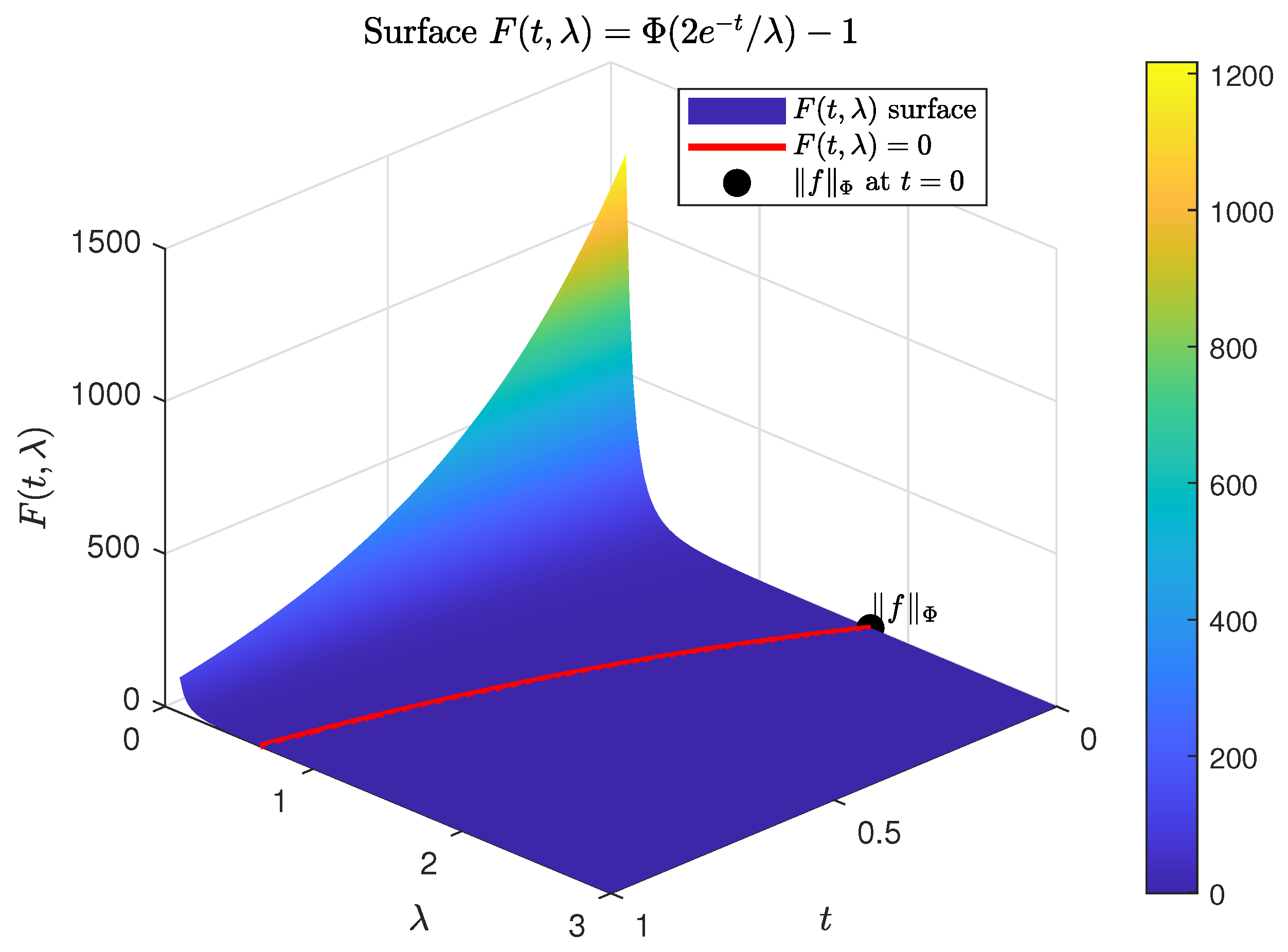
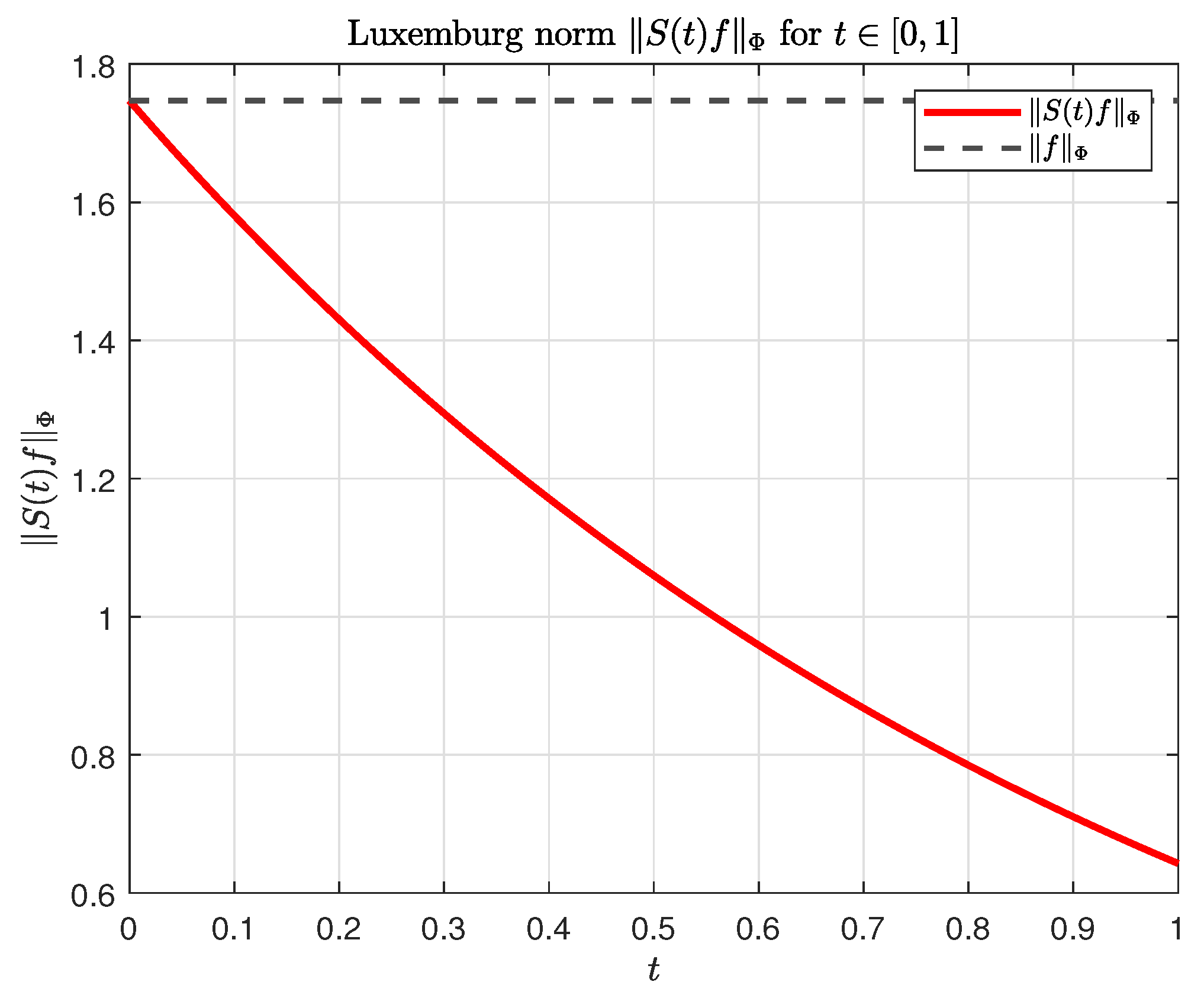
Example 1. To illustrate this difference numerically, let with Lebesgue measure and considerThen , Φ
is increasing and convex on , and one easily checks thatso Φ
satisfies a -type condition. The associated modular isand the Luxembourg norm is Take the constant function on and the multiplication semigroup with , so thatFor this choice,and for every ,Thus, the ρ-boundedness of is obtained immediately from the modular estimate. In contrast, the Luxembourg norm of f is determined by the implicit equationthat is,This nonlinear equation has no closed-form solution and must be solved numerically to obtain . Likewise, for each fixed the norm is given implicitly byThus, even for this very simple constant function and a bounded multiplication semigroup, the Luxembourg norm leads to transcendental equations, whereas the corresponding modular estimates are immediate. This concrete example explains why, in practice, semigroup bounds are more naturally derived at the modular level, even in -type condition settings where the Luxembourg norm is available. To visualize this implicit dependence. Figure 1 shows the surfacetogether with the zero level set corresponding to . Figure 2 displays the graph of on and the horizontal line . Both plots underline that obtaining the Luxembourg norm requires solving a nontrivial implicit equation, while the modular behavior is given explicitly.