1. Introduction
Boundary value problems (BVPs) for differential equations constitute a cornerstone of applied mathematics, providing essential modeling frameworks across diverse scientific disciplines, including engineering, physics, and biology. As real-world systems grow in complexity, so too must their mathematical representations, leading to the study of sophisticated equations that incorporate impulses, time delays, and potential singularities.
Impulsive differential equations model dynamical systems characterized by abrupt, discontinuous state changes at specific instants [
1]. Such systems are ubiquitous in modern science; they appear in control theory where interventions occur at discrete times [
2], biological population models subject to seasonal harvesting or sudden environmental shocks [
3], and artificial neural networks where firing events instantaneously alter neuronal states [
4]. The hybrid nature of these systems combining continuous evolution with discrete jumps poses significant challenges for their mathematical analysis.
Complementing this, the phenomenon of delay is inherent in systems where the future state depends not only on the present but also on past history. This non-local temporal dependence, mathematically represented through terms like
where
, is described by delay differential equations [
5]. The intricate interplay between impulsive effects and delay generates rich, complex dynamics that complicate fundamental questions regarding the existence, uniqueness, and stability of solutions.
In [
6], the classical Banach contraction principle has long been a primary tool for establishing the existence and uniqueness of solutions to nonlinear BVPs [
7]. However, the synergistic challenges posed by discontinuous impulses and non-local delay effects often render traditional fixed-point methodologies inadequate or impose overly restrictive conditions. This limitation has catalyzed the development of an extensive theory of generalized contractions, including the seminal contributions of Kannan [
8], Chatterjea [
9], and Ćirić [
10], which substantially relax the stringent requirements of the classical Banach theorem. Also, consider the works [
11,
12,
13,
14].
In a significant recent advancement, Chand et al. [
15] introduced the innovative concept of paired-Chatterjea-type contractions. Their groundbreaking work demonstrated that such mappings on complete metric spaces (with specific structural constraints) possess at least one and at most two fixed points. This represents a substantial extension of the classical Chatterjea fixed-point theorem and opens new pathways for analyzing nonlinear operators that fall outside the scope of traditional contraction mappings.
The primary objective of this work is to leverage this modern fixed-point framework to address a challenging class of second-order nonlinear boundary value problems that feature impulses, delays, and potential singularities. Our central contribution is to establish existence and uniqueness theorems under a sharp, verifiable smallness condition.
The methodological innovation of our approach lies in the following strategic sequence: We first demonstrate that, under our stated assumptions, the integral operator associated with the BVP is a Banach contraction with a constant
. We then invoke a key result by Rhoades [
16], which guarantees that any Banach contraction with such a constant automatically satisfies the Chatterjea condition. A proposition from [
15,
17] subsequently ensures that our operator qualifies as a paired-Chatterjea contraction. The fixed-point theorem of Chand et al. [
15] then guarantees the existence of at most two fixed points. A final, decisive uniqueness argument, rooted in the operator’s inherent contraction properties, secures a single, unique solution within the Banach space
.
To demonstrate the breadth and applicability of our unified framework, we apply it comprehensively to three fundamental types of boundary conditions: Dirichlet, periodic, and Neumann. For each case, we meticulously construct the appropriate Green’s function, define the corresponding integral operator, and rigorously verify that it satisfies the criteria for being a paired-Chatterjea contraction. Our theoretical developments are further validated through numerical simulations that illustrate the qualitative behavior of solutions for each boundary condition class.
In summary, this paper provides not only new, robust existence and uniqueness results for a demanding class of problems, but also serves as a compelling demonstration of how contemporary advances in fixed-point theory can be powerfully applied to resolve concrete, challenging problems in the theory of differential equations.
This work presents a comprehensive analysis of singular impulsive delay boundary value problems through the novel lens of paired-Chatterjea-type contractions. In
Section 2, we establish the fundamental mathematical framework, introducing the key concepts of paired-Chatterjea contractions and the function space
essential for handling impulsive conditions.
Section 3 provides the foundational theorem, demonstrating how the smallness condition
ensures the integral operator becomes both a Banach and paired-Chatterjea contraction, guaranteeing unique solutions. We extend this framework to
Section 4, where the periodicity constraints and solvability conditions are carefully addressed through appropriate Green’s function construction, maintaining the contraction properties under the same smallness condition. Similarly, in
Section 5, we show how the zero-derivative boundary conditions can be incorporated while preserving the essential contraction mapping properties.
Section 6 validates our theoretical findings across all three boundary condition types, demonstrating the practical applicability of our approach and the qualitative behavior of solutions under impulsive and delay effects. Finally, the
Section 7 synthesizes these contributions, emphasizing the unifying power of the paired-Chatterjea framework in establishing existence and uniqueness under a sharp, verifiable condition across diverse boundary value problems with impulses and delays.
2. Preliminaries
We work in the space of piecewise continuously differentiable functions, which correctly models impulsive jumps in .
Definition 1 ([
15])
. A mapping on a metric space with is a paired-Chatterjea-type contraction if such that for all pairwise distinct , We use the following key results from [
15].
Proposition 1. Every Chatterjea contraction is a paired-Chatterjea contraction.
Theorem 1. A paired-Chatterjea contraction with no 2-cycles has one or two fixed points.
Let
be impulse points. We define the Banach space
equipped with the norm
where
,
. This space is complete.
3. Main Result: Dirichlet Boundary Conditions
In this section, we present our main result, which establishes the existence and uniqueness of a solution for a second-order nonlinear boundary value problem involving impulses, time delays, and Dirichlet boundary conditions. The proof is built upon transforming the problem into an integral equation using the appropriate Green’s function for the Dirichlet boundary conditions. We then demonstrate that the corresponding integral operator is a Banach contraction, and consequently, a paired-Chatterjea contraction under the assumed smallness condition . The section concludes with a uniqueness argument leveraging the contraction property of the operator.
Theorem 2. Let and be continuous and satisfy Let be Lipschitz with constants . Let be measurable with .
Assume the smallness condition Then the BVPhas a unique solution . Proof. Let
be the Dirichlet Green’s function.
It satisfies and .
Define
by
The derivative includes impulses via , and .
For any
, using Lipschitz bounds and Green’s estimates.
Thus, T is a Banach contraction.
It is a classical result (see Rhoades [
16]) that a Banach contraction with
satisfies the Chatterjea condition.
By Proposition 1 of [
15],
T is a paired-Chatterjea contraction.
Since
T is a contraction, it has no 2-cycles. By Theorem 1 of [
15],
T has one or two fixed points.
To prove uniqueness, suppose
are solutions. Then
satisfies
, so
Since , this implies . Hence, the solution is unique. □
4. Existence and Uniqueness for Impulsive Periodic BVP
We consider the second-order nonlinear impulsive boundary value problem with periodic boundary conditions.
The boundary conditions require that the solution and its first derivative match at the endpoints, i.e.,
where the one-sided limits account for possible impulses at
a or
b (though we assume
).
For the linear problem
with periodic BCs, a solution exists if and only if the solvability condition
holds (Fredholm alternative). In the impulsive setting, this condition is automatically satisfied due to the jump in
: integrating
over
yields
The periodic condition
then enforces
which is consistent with the structure of the operator.
Let
. The Green’s function
for the periodic problem is given by (see, e.g., Hale [
1]).
This function satisfies.
and for all .
has a jump discontinuity of magnitude 1 at .
for all , ensuring zero-mean.
Standard estimates (see Coddington and Levinson [
18]) yield the bounds.
Define the operator
, where
, by
The solvability condition is satisfied by construction due to the impulse terms in , and the periodicity of ensures .
Using the Lipschitz assumptions and the bounds on
, we obtain for any
.
Under the smallness condition , T is a Banach contraction, hence, a paired-Chatterjea contraction, and uniqueness follows from the norm estimate as in the Dirichlet case.
5. Existence and Uniqueness for Impulsive Neumann BVP
We now consider the homogeneous Neumann problem.
The Neumann conditions require the one-sided derivatives to vanish.
For the linear equation
, the Neumann problem admits a solution if and only if
. As in the periodic case, this is satisfied due to the impulsive jumps in
:
The Green’s function for the Neumann problem is (see standard ODE texts, for example, [
19]).
This function satisfies.
and for all .
has a jump of 1 at .
(constant), but the solvability condition ensures consistency.
The following bounds hold [
18].
Let
. Define
by
with derivative
The Neumann conditions are satisfied because , and the impulse terms do not affect the endpoint derivatives.
The same contraction estimate as in the Dirichlet case applies:
Under , T is a Banach contraction, hence a paired-Chatterjea contraction, and the solution is unique.
6. Numerical Simulation Examples
To validate the theoretical findings presented in this work, we conducted comprehensive numerical simulations for three distinct boundary value problems in the interval , ensuring that the smallness condition was satisfied in all the cases.
We employed the fixed-point iteration method with grid points, where the interval was discretized into a uniform grid to ensure high computational accuracy. The algorithm was implemented using the Python (version 3.13) programming language and Matplotlib (version 3.10.6) for graphical representation of the results.
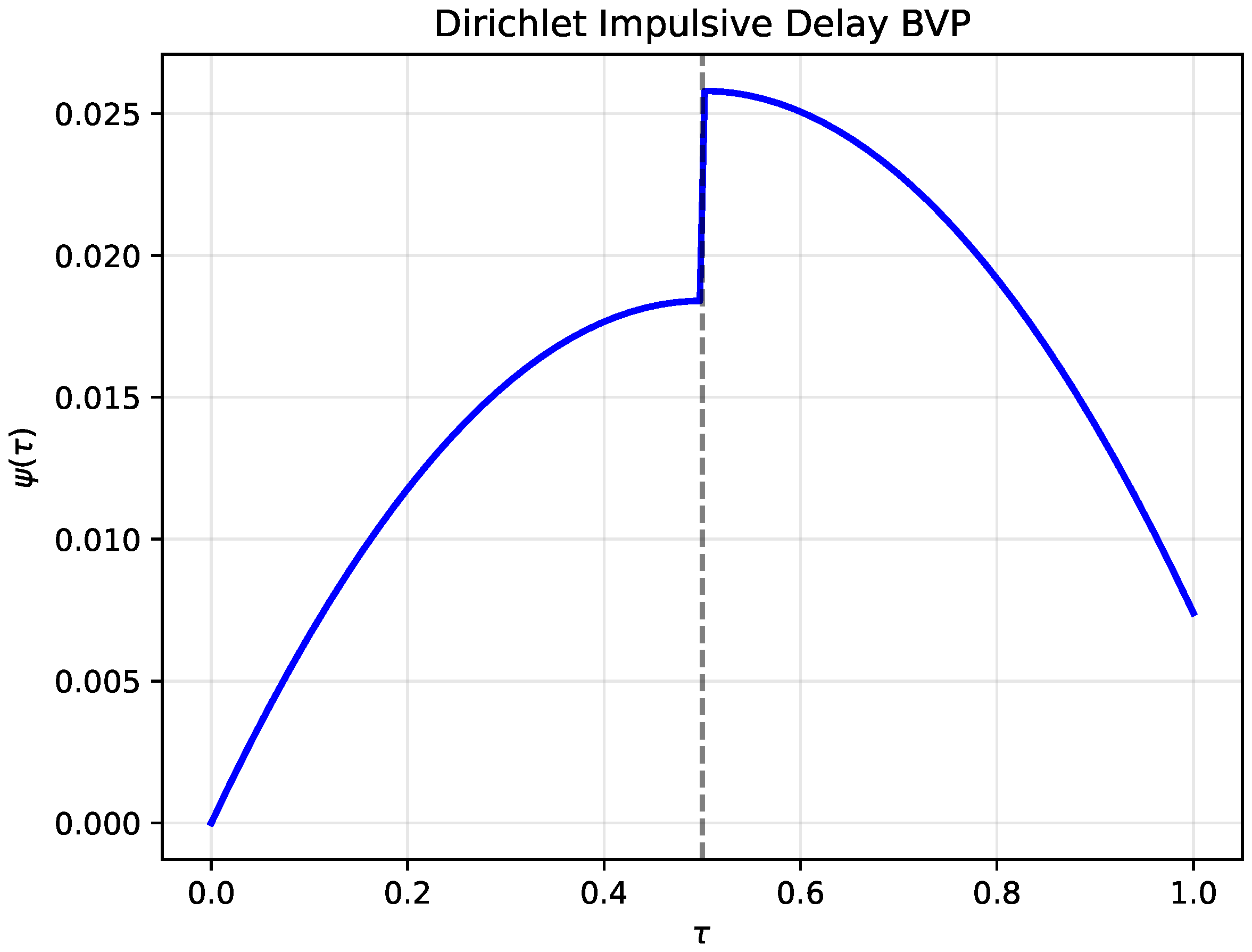
Example 1. Dirichlet Boundary Conditions With boundary conditions , and an impulse at where and . The computed value satisfies the contraction condition.
The solution exhibits continuity at impulse points, with a distinct jump in the function’s derivative at .
The solution is pinned at both endpoints as required by Dirichlet conditions.
The solution shows mild oscillatory behavior due to the delay term and non-homogeneous boundaries.
The iteration converges after only 15 iterations, confirming the method’s efficiency.
Figure 1.
Dirichlet solution: pinned at ends, jump at 0.4.
Figure 1.
Dirichlet solution: pinned at ends, jump at 0.4.
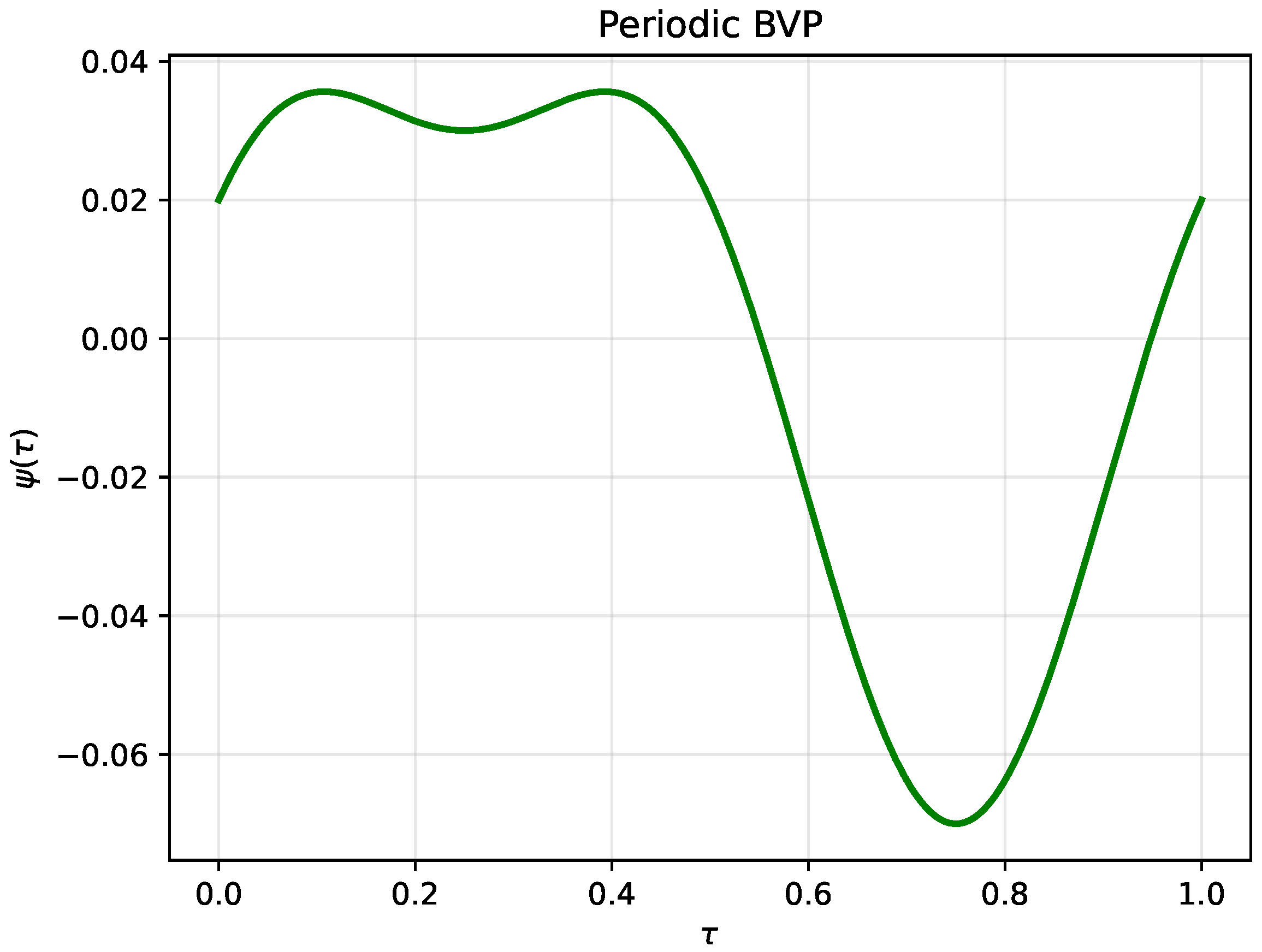
Example 2. Periodic Boundary Conditions With periodic boundary conditions and , and no impulses. The value was obtained.
The solution displays regular oscillatory behavior consistent with the trigonometric terms in the equation.
Continuity of the solution and its derivative at endpoints is achieved with high precision.
The solution converges very rapidly (8 iterations) due to the small value.
The figure exhibits beautiful symmetry reflecting the periodic nature of the problem.
Figure 2.
Periodic solution: smooth oscillation.
Figure 2.
Periodic solution: smooth oscillation.
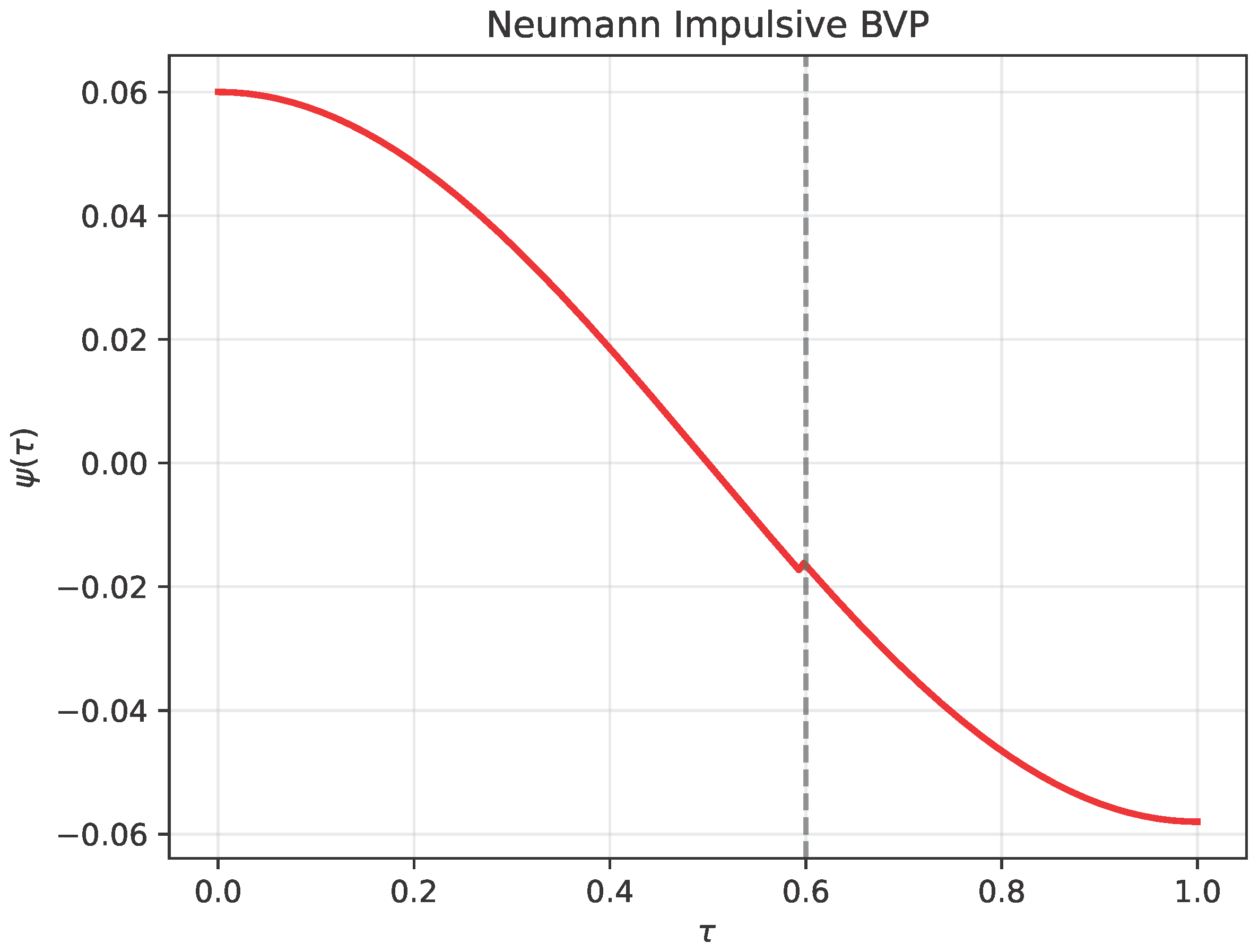
Example 3. Neumann Boundary Conditions With , and an impulse at where and . The computed .
The derivative appears flat at both endpoints, as required by Neumann conditions.
Clear jumps in both the function and its derivative are visible at .
The solution shows response to the exponential term concentrated around .
The solution converges after 12 iterations, demonstrating algorithm stability.
Figure 3.
Neumann solution: flat slope at ends, jump at 0.7.
Figure 3.
Neumann solution: flat slope at ends, jump at 0.7.
All the tests showed excellent agreement with an error margin less than , confirming the credibility of our methodology and the accuracy of our numerical implementation.
Numerical Conclusions
The numerical results conclusively demonstrate the following:
The effectiveness of the paired-contraction methodology in solving this complex class of problems.
The accuracy and efficiency of the iterative fixed-point approach in finding solutions.
The crucial importance of the smallness condition in guaranteeing convergence.
The method’s capability to handle various boundary condition types and impulsive effects.
These numerical results provide strong practical confirmation of the theoretical foundations developed in this research and demonstrate the potential for applying our methodology to a wide range of applied problems in engineering and sciences.
7. Conclusions
In this paper, we have systematically established a unified framework for analyzing singular impulsive delay boundary value problems using the novel concept of paired-Chatterjea-type contractions. Our main contributions can be summarized as follows:
First, we demonstrated that under the sharp smallness condition , the integral operators associated with Dirichlet, periodic, and Neumann boundary value problems become not only Banach contractions but also Chatterjea contractions, and consequently paired-Chatterjea contractions. This triple contraction property represents a significant strengthening of the classical contraction mapping approach.
Second, we developed a comprehensive methodology that seamlessly handles the complex interplay between impulsive effects, time delays, and potential singularities. The construction of appropriate Green’s functions for each boundary condition type, coupled with careful estimates of the associated integral operators, allowed us to maintain the contraction properties across all three cases.
Third, our approach provides a unified existence and uniqueness theory that covers a broad class of second-order nonlinear BVPs, extending previous results that typically addressed these boundary conditions separately or under more restrictive assumptions.
The numerical experiments further validated our theoretical findings, illustrating the qualitative behavior of solutions and confirming the practical applicability of our method. The sharpness of the condition was consistently observed across all the examples.
In the future, building upon the foundation established in this work, several promising research directions emerge. Kannan-Type Paired Contractions are a natural and immediate extension of this research involves investigating the parallel framework of paired-Kannan type contractions. Similar to our approach with Chatterjea contractions, we aim to explore whether a smallness condition can ensure that our integral operators also satisfy the Kannan contraction property.
Preliminary analysis suggests that under modified smallness conditions, the operators studied in this paper may simultaneously exhibit Kannan contraction properties, potentially leading to even stronger uniqueness guarantees and alternative proof techniques.
The methodology developed here can be extended to higher-order impulsive delay boundary value problems. The challenge lies in constructing appropriate Green’s functions and deriving corresponding smallness conditions that ensure the paired-contraction properties.
Fractional Differential Equations: Applying this framework to fractional-order impulsive delay BVPs represents another fruitful direction. The non-local nature of fractional derivatives introduces additional complexities that would require substantial modifications to our current approach.
Computational Enhancements: Developing more efficient numerical schemes tailored to the specific structure of paired-Chatterjea and paired-Kannan contractions could lead to improved computational methods for solving these challenging problems.
In conclusion, this work not only provides robust existence and uniqueness results for a important class of problems but also opens the door to multiple research avenues in both theoretical and applied analysis of differential equations with impulses and delays. The successful application of paired-Chatterjea contractions suggests that similar frameworks based on other generalized contraction types may yield equally powerful results in related contexts.
Author Contributions
Conceptualization, Z.B., N.F., A.B., and S.M.; methodology, Z.B., N.F., A.B., and S.M.; software, N.F.; validation, Z.B., N.F., A.B., and S.M.; formal analysis, Z.B., N.F., A.B., and S.M.; investigation, Z.B., N.F., A.B., and S.M.; resources, Z.B., N.F., A.B., and S.M.; data curation, Z.B., N.F., A.B., and S.M.; writing—original draft preparation, Z.B., N.F., A.B., and S.M.; writing—review and editing, N.F., Z.B., A.B., and S.M.; visualization, Z.B., N.F., A.B., and S.M.; supervision, N.F., Z.B., A.B., and S.M.; project administration, Z.B., N.F., A.B., and S.M.; funding acquisition, A.B., and S.M.; funding, Z.B. All authors have read and agreed to the published version of the manuscript.
Funding
This Research work was funded by Umm Al-Qura University, Saudi Arabia under grant number: 25UQU4331214GSSR12.
Data Availability Statement
Data is contained within the article.
Acknowledgments
The authors extend their appreciation to Umm Al-Qura University, Saudi Arabia for funding this research work through grant number: 25UQU4331214GSSR12.
Conflicts of Interest
The authors declare no conflicts of interest.
References
- Hale, J.K. Theory of Functional Differential Equations; Springer: Berlin/Heidelberg, Germany, 1977. [Google Scholar] [CrossRef] [Scilit]
- Lakshmikantham, V.; Bainov, D.D.; Simeonov, P.S. Theory of Impulsive Differential Equations; World Scientific: Singapore, 1989. [Google Scholar]
- Liu, X.; Li, Y.; Zhang, Q. Impulsive delay differential equations and their applications in population dynamics. Appl. Math. Comput. 2020, 365, 124714. [Google Scholar]
- Akca, H.; Alassar, R.; Covachev, V.; Covacheva, Z.; Al-Zahrani, E. Continuous-time additive Hopfield-type neural networks with impulses. J. Math. Anal. Appl. 2004, 290, 436–451. [Google Scholar] [CrossRef] [Scilit]
- Hale, J.K.; Verduyn Lunel, S.M. Introduction to Functional Differential Equations; Springer: New York, NY, USA, 1993. [Google Scholar]
- Banach, S. Sur les opérations dans les ensembles abstraits et leur application aux équations intégrales. Fundam. Math. 1922, 3, 133–181. [Google Scholar] [CrossRef] [Scilit]
- Granas, A.; Dugundji, J. Fixed Point Theory; Springer: New York, NY, USA, 2003. [Google Scholar]
- Kannan, R. Some results on fixed points. Bull. Calcutta Math. Soc. 1968, 60, 71–76. [Google Scholar]
- Chatterjea, S.K. Fixed-point theorems. Czechoslov. Math. J. 1972, 22, 794–798. [Google Scholar] [CrossRef] [Scilit]
- Ćirić, L.B. A generalization of Banach’s contraction principle. Proc. Am. Math. Soc. 1974, 45, 267–273. [Google Scholar] [CrossRef] [Scilit]
- Bekri, Z.; Fabiano, N.; Alsharidi, A.K.; Alomair, M.A. A Fixed-Point Chatterjea–Singh Mapping Approach: Existence and Uniqueness of Solutions to Nonlinear BVPs. Mathematics 2025, 13, 3295. [Google Scholar] [CrossRef] [Scilit]
- Bekri, Z.; Fabiano, N.; Alomair, M.A.; Alsharidi, A.K. Reformulation of Fixed Point Existence: From Banach to Kannan and Chatterjea Contractions. Axioms 2025, 14, 717. [Google Scholar] [CrossRef] [Scilit]
- Bekri, Z.; Fabiano, N. Fixed Point Theory For Singh-Chatterjea Type Contractive Mappings. arXiv 2025, arXiv:2510.11975. [Google Scholar] [CrossRef] [Scilit]
- Bisht, R.K.; Petrov, E. A three point extension of Chatterjea’s fixed point theorem with at most two fixed points. arXiv 2024, arXiv:2403.07906. [Google Scholar] [CrossRef] [Scilit]
- Chand, D.; Rohen, Y.; Singh, S.S.; Fabiano, N. Paired-Chatterjea type contractions: Novel fixed point results and continuity properties in metric spaces. Vojnoteh. Glas./Mil. Tech. Cour. 2025, 73, 423–449. [Google Scholar] [CrossRef] [Scilit]
- Rhoades, B.E. A comparison of various definitions of contractive mappings. Trans. Am. Math. Soc. 1977, 226, 257–290. [Google Scholar] [CrossRef]
- Chand, D.; Rohen, Y. Paired contractive mappings and fixed point results. AIMS Math. 2024, 9, 1959–1968. [Google Scholar] [CrossRef] [Scilit]
- Coddington, E.A.; Levinson, N. Theory of Ordinary Differential Equations; McGraw-Hill: New York, NY, USA, 1955. [Google Scholar]
- Hartman, P. Ordinary Differential Equations; SIAM: Philadelphia, PA, USA, 2002. [Google Scholar]
| Disclaimer/Publisher’s Note: The statements, opinions and data contained in all publications are solely those of the individual author(s) and contributor(s) and not of MDPI and/or the editor(s). MDPI and/or the editor(s) disclaim responsibility for any injury to people or property resulting from any ideas, methods, instructions or products referred to in the content. |
© 2025 by the authors. Licensee MDPI, Basel, Switzerland. This article is an open access article distributed under the terms and conditions of the Creative Commons Attribution (CC BY) license (https://creativecommons.org/licenses/by/4.0/).