


Abstract
In this paper, we investigate a fuzzy Hilfer fractional evolution equation of type and order subject to nonlocal conditions. Using the infinitesimal generator of a strongly continuous cosine family, we define a mild solution for the proposed system. The existence and uniqueness of such mild solutions are established through Schauder’s fixed-point theorem and the Banach contraction principle. An illustrative application to a fuzzy fractional wave equation is presented to demonstrate the effectiveness of the developed approach. The main contribution of this study lies in the unified treatment of fuzzy Hilfer fractional evolution equations under nonlocal conditions, which generalizes and extends several existing results and provides a solid analytical foundation for modeling systems with memory and uncertainty.
Keywords:
fuzzy Hilfer fractional derivative; evolution equation; mild solution; Schauder’s fixed-point theorem MSC:
34A08; 34A12; 34G99; 34K99; 34A60
1. Introduction
In recent times, researchers have increasingly recognized the considerable importance of fuzzy fractional equations as powerful tools for modeling various phenomena characterized by uncertainty and historical dependency. By merging fractional calculus with fuzzy set theory, these equations effectively capture the inherent uncertainty found in a variety of domains, including engineering, physics, biology, economics, and control systems [1,2].
In particular, fractional evolution equations employ fractional derivatives—notably, Caputo derivatives—due to their intrinsic capacity to incorporate memory effects into mathematical formulations. This feature makes these equations suitable for tackling complicated initial and boundary value problems in which the current state relies significantly on past states. Additionally, the integration of fuzzy set theory into these equations enhances their flexibility by allowing parameters, initial conditions, and solutions to be represented as fuzzy numbers, thus more accurately reflecting real-world uncertainties [3,4].
Non-local boundary conditions represent a significant improvement in the theory of fuzzy fractional evolution equations. Unlike classical boundary conditions, which focus exclusively on individual boundary points, non-local conditions include integral or functional relationships that reflect broader interactions within the system. This extension increases the applicability of such equations, providing more realistic frameworks for modeling complex scenarios where boundary interactions are influenced by the overall state of the system [5].
Studying the mild solutions to fuzzy fractional evolution equations subject to non-local boundary conditions is critical to ensuring the accuracy and predictability of these mathematical models. Researchers have employed various fixed-point methods—such as Schauder’s, Krasnoselskii’s, and Darbo’s fixed-point theorems—along with measures of non-compactness to derive robust criteria for the existence and uniqueness of solutions. These theoretical advancements have significantly expanded the practical utility of fuzzy fractional equations, enhancing their effectiveness in solving real-world problems [6].
The study of existence and uniqueness findings for fractional difference equations of the nabla and delta types under fixed point frameworks has seen significant interest in recent advances in discrete fractional calculus. For example, Dimitrov and Jonnalagadda [7] used Banach, Brouwer, and Leray–Schauder fixed-point theorems to prove existence findings for nabla fractional problems with anti-periodic boundary conditions. Dimitrov explored numerous positive solutions for nabla fractional equations under summation boundary conditions in another recent study [8]. Moreover, mixed delta-nabla frameworks have been investigated: Using Banach and Schauder theorems, Reunsumrit and Sitthiwirattham [9] examined delta–nabla difference equations with mixed boundary conditions.
Additionally, Dimitrov and Jonnalagadda [10] made a significant contribution that emphasises the robustness and qualitative behaviour of discrete fractional models by examining the existence, uniqueness, and stability of solutions for nabla fractional difference equations under multipoint summation boundary conditions.
Several notable contributions have significantly advanced the theory and application of fuzzy fractional evolution equations. El Ghazouani et al. [11] discussed the non-local Cauchy problem for fuzzy fractional evolution equations within an arbitrary Banach space for fractional order , defined as
where is a linear operator and is a continuous function. They employed Schauder’s fixed-point theorem to derive criteria for the existence and uniqueness of mild fuzzy solutions. Their work provided a clear methodological framework and they offered practical examples to demonstrate the applicability of their theoretical findings.
In a related study, Airou, El Mfadel, and Elomari [12] examined the existence of two distinct types of fuzzy mild solutions for fuzzy fractional evolution equations under Caputo’s generalized Hukuhara differentiability. Their analysis utilized fuzzy strongly continuous semigroups and a novel version of Krasnoselskii’s fixed-point theorem specifically tailored to fuzzy metric spaces, thus enriching theoretical understanding and expanding potential applications by clearly distinguishing different types of solutions within fuzzy metric spaces.
Moreover, El Ghazouani, Elomari, and Melliani [13] explored the qualitative behaviours and existence of mild solutions to fuzzy boundary value problems with non-local conditions for Caputo-type fractional differential equations of order , defined as
where is the infinitesimal generator of a strongly continuous semigroup on and are continuous. Their approach combined Darbo’s fixed-point theorem with the measure of non-compactness, addressing the generalized Ulam-Hyers stability. The study demonstrated broad applicability and improved upon previous findings, as well as providing illustrative examples to validate the theoretical results.
Real-world systems that exhibit memory, non-local interactions, and uncertainty find a natural representation in fractional models employing the Hilfer derivative. For example, Bulavatsky [14] demonstrated the utility of the Hilfer operator in modeling anomalous diffusion processes, deriving analytical solutions that describe complex transport in heterogeneous media.
Further highlighting its relevance, Ramalakshmi [15] constructed a -Hilfer fractional order model to investigate the transmission dynamics and optimal control measures of the Hepatitis B virus. The study showed how the fractional order parameter affects the efficiency of control measures as well as the spread of infection. In a related domain, Borja-Jaimes et al. [16] provided a comprehensive review on the use of fractional calculus in modeling energy storage systems for electric vehicles, emphasizing the improved predictive accuracy for components like batteries and supercapacitors. These studies collectively affirm the broad relevance of Hilfer-type fractional frameworks across physics, biology, and engineering, thereby motivating the theoretical developments for fuzzy fractional systems with nonlocal conditions presented herein. The analytical complexity of nonlinear fractional differential equations, compounded by the fuzzy framework, often precludes closed-form solutions. This reality bifurcates the research landscape into two complementary paths: the qualitative analysis of solutions establishing their existence, uniqueness, and stability and the quantitative or numerical approximation of these solutions through computational techniques. While the present work is firmly positioned within the former category, providing rigorous theoretical guarantees of existence and uniqueness under suitable conditions, it simultaneously acknowledges the indispensable role of numerical and engineering advances in validating and implementing such theoretical results. In this regard, recent developments in computational and applied fractional calculus such as the adaptive dynamic programming based finite time control of fractional order chaotic systems [17] and the realization of fractional order current mode multifunction filters using the Oustaloup numerical approximation [18]. Motivated by this modeling imperative, we direct our focus to the following fuzzy Hilfer fractional evolution equation incorporating non-local conditions:
where is a fuzzy Hilfer–Caputo fractional derivative of order and type , and . Furthermore, is a continuous function. Let be an infinitesimal generator of a strongly continuous cosine family of uniformly bounded linear operators defined on a fuzzy Banach space . Also, let be the Banach space of continuous and bounded functions from into is given as follows, endowed with the topology
In addition, as is cosine family on , then there exists where
The decision to employ non-local conditions, encapsulated by the functionals and , is substantiated by their physical and practical relevance, extending beyond a purely theoretical exercise. Consider the following illustrative scenarios:
- Within continuum mechanics, the initial configuration of a material might be defined by a spatial average across its domain, naturally leading to a non-local specification.
- In the context of infectious disease modeling, the seed number of infections could be derived from an aggregate of cases reported over a preceding period or from interconnected populations.
- For engineered systems, the initial state might be determined by a control input that aggregates historical sensor data.
Such non-local conditions offer a superior descriptive capability for these contexts compared to classical local initial conditions (), as they inherently account for distributed influences, cumulative historical data, and feedback mechanisms. Consequently, the resulting models possess enhanced robustness for application-oriented problems. From an analytical perspective, incorporating non-local conditions introduces additional complexity, particularly in proving solution existence and uniqueness, which constitutes a central objective of the present work.
The originality of our contribution is thus highlighted by two key aspects. Firstly, this work represents a pioneering analysis of a fuzzy Hilfer fractional evolution equation in the higher-order range , specifically formulated with non-local conditions. The Hilfer operator serves as a generalization that interpolates between the Riemann-Liouville and Caputo derivatives, thus providing a more versatile modeling tool via the parameter . Secondly, the synthesis of this sophisticated fractional calculus with the formalism of fuzzy set theory and non-local conditions yields a comprehensive framework. This integrated approach is adept at modeling complex systems that concurrently display hereditary properties (through the fractional derivative), epistemic uncertainties (through fuzzy-valued mappings), and global dependencies (through the non-local initial conditions). To our knowledge, this particular confluence of features has not been previously explored in the literature, thereby signifying a substantive extension of the current theoretical landscape.
The impetus for our investigation arises from the demand for advanced mathematical models capable of capturing the intricate dynamics of systems characterized by memory effects, imprecision, and global interactions. Although fuzzy fractional evolution equations subject to local conditions have received considerable attention, numerous real-world processes are more faithfully represented by conditions that incorporate information from the system’s state across a temporal continuum or at multiple instances, rather than being confined to a single initial point. This conceptual shift is embodied in the use of non-local conditions.
The structure of this work is as follows. In Section 2, we recall several preliminary notions and lemmas needed for our analysis. Section 3 is devoted to establishing the concept of a mild solution for (1), where the operator is assumed to be the infinitesimal generator of a strongly continuous cosine family . In Section 4, we investigate the existence and uniqueness of the mild solution through the application of fixed point techniques. Section 5 provides a numerical example to demonstrate the effectiveness of the obtained theoretical results.
2. Preliminaries
The purpose of this part is to provide some basic concepts and mathematical background on fractional operators of the Hilfer type, cosine family theory, and fuzzy-number-valued functions. The primary findings covered in the parts that follow must be formulated using these ideas.
Definition 1
([19]). A fuzzynumber is a fuzzy subset that satisfies the following essential properties:
- (a)
- Normality: There exists at least one point such that .
- (b)
- Fuzzy convexity: For all and every , the inequalityholds.
- (c)
- Upper semi-continuity: The membership function x is upper semi-continuous on .
- (d)
- Compact support: The support of x, defined byis a compact subset of .
- The set of all fuzzy numbers defined on the real line is denoted by .
We denote the space of all fuzzy numbers on by .
For all , the -cut of an element is defined by
where, denotes the upper bound and denotes the lower bound of the fuzzy number x.
The distance function that measures the separation between two fuzzy numbers is expressed as
Note that this distance function satisfies the following properties:
- (i)
- The metric is translation invariant, that is,
- (ii)
- The metric is homogeneous with respect to scalar multiplication, namely,
- (iii)
- The metric satisfies the triangle-type inequality,
Since, denoted of all fuzzy number on the real line, the operations of addition and scalar multiplication for fuzzy numbers on , where. are defined as follows:
where
is the Minkowski sum of and , and
Definition 2
([20]). For , the generalized Hukuhara () difference of x and y, denoted by , is characterized as the element where
In terms of -cuts, we have
where, denotes the upper bound and denotes the lower bound of the fuzzy number x.
Let the set of all triangular fuzzy numbers in denote by , then we take as a subspace of the metric space , which is a complete metric space.
Furtheremore, as demonstrated by Bede and Stefanini [20], if , then the difference always occurs in and . Let be a subset of , and denote by the set of all continuous mappings .
Let be a fuzzy-valued function. The -cut of f is given by
Definition 3
([21]). Let and define h such that . Then, the generalized Hukuhara derivative of a fuzzy-valued function at , denoted is defined as
where, ⊖ denoted the generalized Hukuhara difference, and is the Hausdorff norm on fuzzy numbers.
Definition 4
([3]). Let and , with and both differentiable at . We say that:
- 1.
- at f is -differentiable if
- 2.
- at f is -differentiable if
Theorem 1
([3]). Let , , and . Suppose that is differentiable at t and the fuzzy-valued function is -differentiable at t. Then,
Definition 5
([22]). Let and assume that is -differentiable at , without changing its type of differentiability on . Moreover, suppose that both and are differentiable at . We say that:
- 1.
- at f is -twice differentiable if
- 2.
- at f is -twice differentiable if
Definition 6
([23]). Let . The following is the definition of the fuzzy Riemann–Liouville integral of a fuzzy-valued function f
Definition 7.
Let be a fuzzy-valued function. Then, we define
and, if , then
Definition 8
([24]). Let , and let be the space of all continuous fuzzy-valued functions from into . The fuzzy Hilfer fractional derivative of order α and type β is defined by
if there is a -derivative , where and .
Definition 9
([25]). Let and for any . Then, , where and , and the finite limits are and , where The Laplace transform is defined as follows:
Here denotes the real part of α, is the space of n-times absolutely continuous functions on , and , denote the Riemann–Liouville fractional derivative and integral, respectively.
Definition 10
([24]). If is continuous and is absolutely continuous, then
Definition 11
([24]). Let be a fuzzy-valued function and . We define the Caputo derivative of as
and, if , then
Furthermore, we say that f is -differentiable at if
and we say that f is -differentiable at , if
Definition 12
([26]). [Fuzzy Laplace Transform] Let be a continuous function such that
is integrable on . Then, the fuzzy Laplace transform of f, denoted by , is defined by
Additionally, f is considered exponentially bounded of order if there are constants and such that
Lemma 1
([26]). [Convolution Theorem] If is piecewise continuous and of exponential order a, and is piecewise continuous, then their convolution satisfies
Definition 13
([26]). The family of bounded linear operators maps the Banach space and has just one parameter. Such a family is referred to as a strongly continuous cosine family if and only if
- (i)
- ;
- (ii)
- for all ; and
- (iii)
- is a continuous on for any .
In particular, the strongly continuous cosine family (which is connected to the sine family ) is defined by
Lemma 2
([26]). If is an infinitesimal generator of a strongly continuous cosine family on a Banach space , then there exist constants and such that
Moreover, for every and (the resolvent set of ), we obtain
for all , where the operator is the resolvent of and .
The operator is characterized by
where . It is evident that the infinitesimal generator is a closed, densely defined operator in .
Definition 14.
The definition of Mainardi’s Wright-type function when is as follows:
for which we have
3. Structure of Mild Solution
In this stage, we provide the structure of a mild solution utilizing the cosine family operators and the Laplace transform.
Lemma 3.
Proof.
Taking , according to Definition 8, we have
From Definition 10, we also have
Therefore, applying the operators to both sides of the equation simultaneously, and utilizing Equations (5) and, leads us to the following result:
The proof is complete. □
Lemma 4.
Ifsatisfies the integral Equation (4), then
such that . Additionally,
where is a probability density function defined according to Definition 14.
Proof.
For , before taking the Laplace transformation of both sides of System , if we assume , then we obtain
Applying the Laplace transform to both sides of (4), we obtain
By Lemma 2 and as , we can write
Let . If Mainardi’s Wright-type function (defined in Definition 14) refers to , and
where is the one-sided stable probability defined as follows
Therefore, we obtain the following formula:
Hence, in our situation,
As , and the Laplace inverse transform yields , we can write
Similarly, as , according to the Laplace transform of the Riemann–Liouville fractional derivative (3), we get and obtain
Finally, we can achieve the required outcome using the inverse Laplace transform, and the proof is concluded. □
Definition 15.
A function is considered to be a mild solution of (1) if it satisfies
The following auxiliary lemmas are obtained by standard arguments based on the properties of fractional cosine families.
Lemma 5.
The following estimates for and hold for any fixed and :
Lemma 6.
For any and , the operators and are strongly continuous.
Lemma 7.
Suppose that and are compact for every . Then, for any , the operators and are compact.
Lemma 8.
For each and , the following formula is true if holds:
Furthermore, according to the assumption and letting ,
Proof.
As for and , it can be calculated that
Thus, we obtain
Additionally, for any , we get
□
Prior to discussing our significant findings, we offer the following hypotheses.
- The function is continuous for almost all , and the function is strongly measurable for all .
- Let . There exist , such that for all we have
- Let . There exist , such that for all we have
- is continuous and there exist constants be triangular fuzzy numbers such that
Remark 1.
Considering the recognized connections between the Riemann–Liouville fractional derivative and the Caputo fractional derivative, for , we obtain
4. Existence and Uniqueness Results
The existence and uniqueness of solutions to problem (1) are summarized in this section.
Theorem 2.
Assume hypotheses and
Then, the Cauchy problem has a mild fuzzy solution in the space .
Proof.
Let us define the set
where,
Here, is a Beta function. Clearly, is non-empty, convex, bounded, and closed.
Consider the operator defined by
Due to the continuity of the related functions and the basic characteristics of fractional integrals, the operator introduced in Equation (8) is properly defined. Therefore, proving the existence of a fixed point of the operator , which corresponds to a solution of the given equation, is sufficient.
We proceed in two phases to establish that the operator satisfies the hypotheses of the Banach contraction principle, thereby ensuring the existence and uniqueness of a fixed point.
- Step 1:
- . For , by and (1) we getThis indicates that .
- Step 2:
- is a contraction.From Equations and , and by assumptions and , we haveBy , we can writeThen, the inequality becomesThus, is relevant, which ensures that has a unique fixed point and is the unique fuzzy mild solution to problem on . Therefore, the proof is complete.
□
Our final result in this section is concerned with proving the existence of a solution to problem (1) by applying Schauder’s fixed-point theorem.
Theorem 3.
Assume that hold. Then, the operator defined by equation has at least one fixed point. Thus, the fuzzy fractional Cauchy problem admits at least one mild solution.
Proof.
Step 1: .
As in Step 1 of the proof of Theorem 4.1, indeed maps into itself.
- Step 2:
- is continuous. Let in . For any , considerBy the continuity of the mappings , , and , it holds thatwhen . Therefore, the operator is continuous on .
- Step 3:
- maps bounded sets into equicontinuous sets. Let be a bounded set. For any and for ,To evaluate the first term,As for the second term,Additionally,where and . Furthermore, by the continuity of and , we can show that . Thus, is uniformly equicontinuous over . Combined with its uniform boundedness, the Arzelà–Ascoli theorem implies that is compact.
□
The use of both Banach and Schauder fixed point theorems in this study serves distinct purposes and offers complementary insights. The Banach contraction principle guarantees a unique mild solution under the condition , which is explicitly computable from system parameters. This is particularly advantageous when precise control over the solution’s uniqueness is required, such as in control theory or well-posed dynamical systems. However, its applicability is limited to contraction mappings, which may not hold for highly nonlinear or non-Lipschitz nonlinearities .
In contrast, Schauder’s fixed-point theorem ensures existence without requiring contractivity, making it suitable for systems where nonlinearities are only continuous or bounded. This is especially useful in fuzzy settings where the metric structure may not readily yield contraction constants. The trade-off, however, is that uniqueness is not guaranteed, and additional compactness conditions must be verified. In the context of fuzzy Hilfer fractional systems, the combination of both theorems provides a robust framework: Banach’s theorem ensures uniqueness under stricter conditions, while Schauder’s theorem broadens the class of admissible nonlinearities.
5. Applied Examples
Consider the fuzzy Hilfer-type fractional evolution equation
with fuzzy initial conditions
where , , , , and . Let the final time be . Furthermore, the operator generates a cosine family with bound . To verify the hypotheses, let be defined by
where . To verify the Lipschitz-type condition in assumption , we estimate
Taking the supremum with respect to the fuzzy metric , where, denotes the Hausdorff-type supremum metric on the -cuts of fuzzy sets, that is
We obtain
Hence, the modulus of continuity is given by
which is constant with respect to t and belongs to for any finite a and . Therefore, satisfies assumption .
- Verification of Hypotheses:
- is continuous and strongly measurable holds.
- is Lipschitz with respect to , with for hold.
- We define two non-linear mappings , where , as follows:These mappings are continuous and fuzzy-valued for all . We now compute their respective moduli of continuity with respect to the fuzzy metric .
- Lipschitz Continuity of : For , we estimateHence,which implies that is Lipschitz with modulus .
- Lipschitz Continuity of : For , we consider the inequalityThus,which shows that is Lipschitz with modulus .
- Computation of the Existence Constant : Considering the estimateswe compute
- Discussion of the results: As in Figure 1, all of the assumptions – are met; therefore, the problem admits a unique mild fuzzy solution according to the existence and uniqueness theorem.
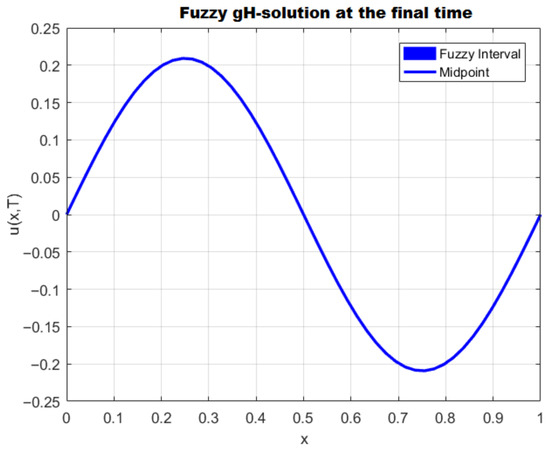
Figure 1.
The fuzzy mild solution .
Figure 1.
The fuzzy mild solution .
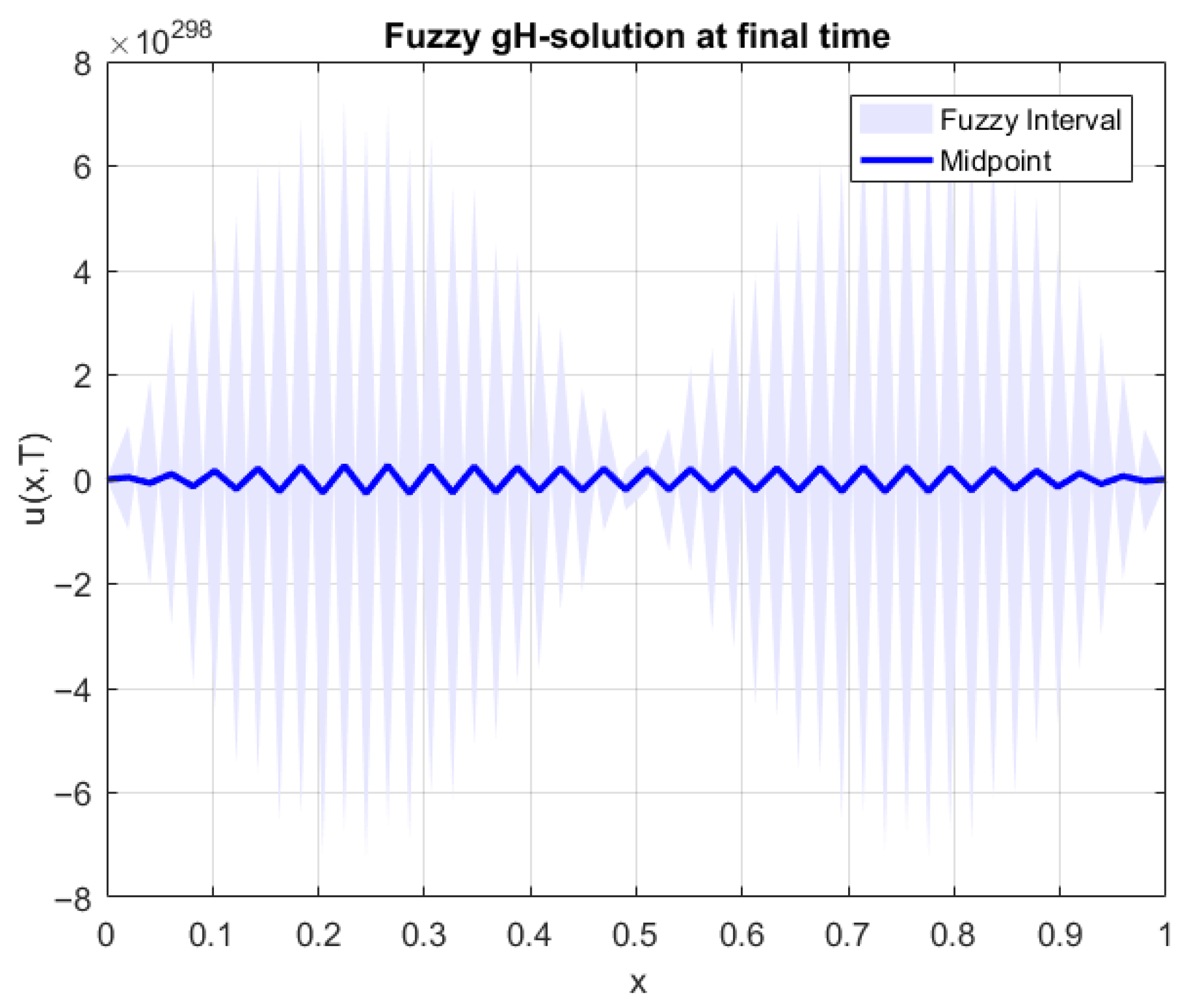
The development of the fuzzy solution interval is demonstrated through numerical simulations using , , and . These simulations demonstrate how uncertainty propagates as a result of fractional dynamics and non-linearity.
The numerical distribution of the fuzzy -solution at the final time T is shown in Figure 2. The answer calculated using the generalized Hukuhara framework is shown as a solid line, representing the fuzzy solution’s midpoint, while the shaded fuzzy interval shows the fuzzy function’s lower and upper limits. There is noticeable oscillatory behavior in the picture, which symmetrically declines towards the borders and is especially focused near the mid-domain. While the breadth of the fuzzy interval rises dramatically in certain locations—particularly near and —the midpoint solution stays regular, suggesting increasing uncertainty and unpredictability in the fuzzy state.
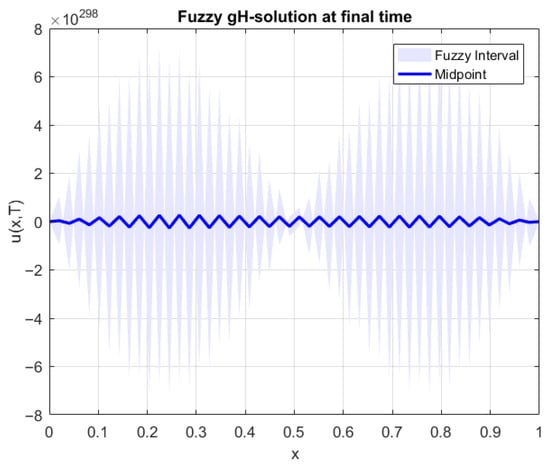
Figure 2.
Fuzzy -Hilfer fractional derivative numerical solution.
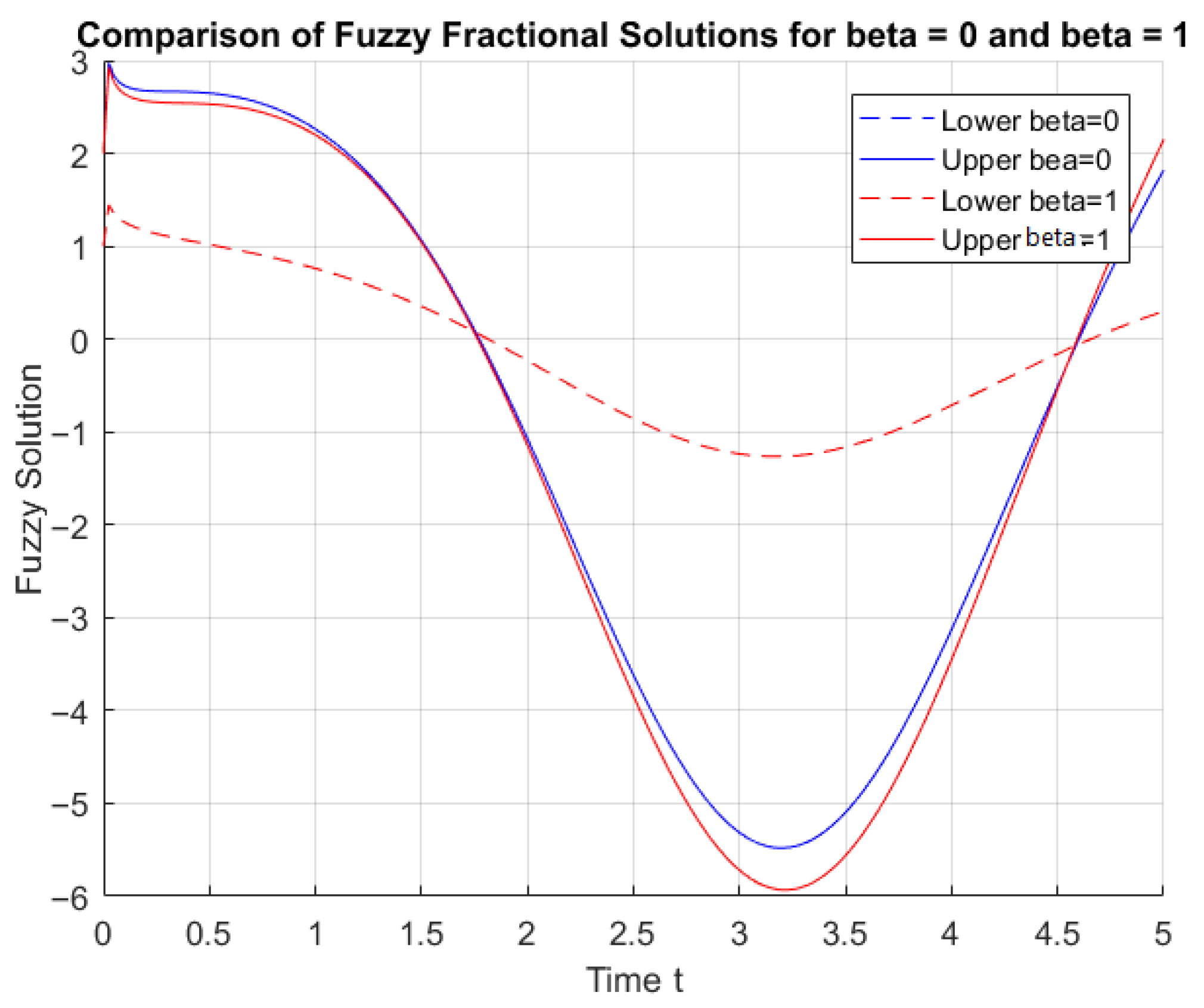
The numerical results in Figure 3 demonstrate that the fuzzy solution for the Hilfer-type fractional differential equation with order displays dynamic behavior under two distinct settings of the type parameter; namely, and . The solution—represented as a fuzzy interval bounded by its lower and upper routes—was computed using the integral form with cosine family operators and a convolution kernel defined by a probability density function. For , which corresponds to the Riemann–Liouville-type Hilfer derivative, the solution develops more quickly and has a wider range in its fuzzy limits, indicating higher sensitivity to the initial conditions and greater propagation of uncertainty. This is to be expected, as the Riemann–Liouville derivative gives greater weight to the system’s prior conduct. In contrast, in the situation where , the Caputo-type behavior leads to smoother dynamics and a shorter fuzzy range. This implies that the influence of the initial data deteriorates more gradually and that the solution behaves more consistently over time. Moreover, the apparent oscillations in the solution are caused by the cosine family , which regulates the structure of the underlying evolution system. These oscillations are superimposed on top of a generally increasing trend due to the non-linearity in the source term and the interaction with the fractional kernel.
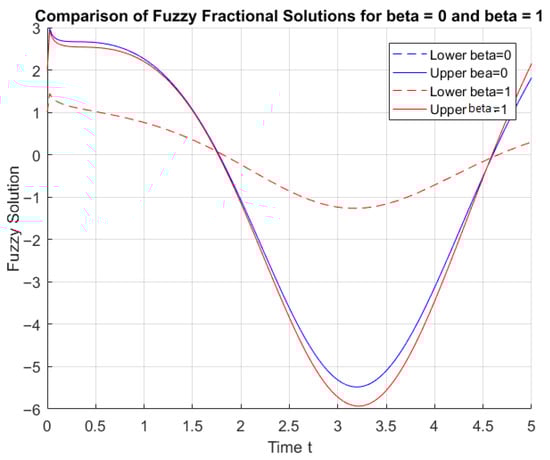
Figure 3.
Comparison of fuzzy fractional solutions for and .
Overall, the comparison reveals that the qualitative behavior of the fuzzy fractional solution is significantly influenced by the type parameter . The choice between and when modelling uncertain dynamical systems in real-world scenarios should be based on the required sensitivity and memory properties.
6. Conclusions
In this article, we considered a Hilfer fractional derivative and demonstrated the existence and uniqueness of mild solutions to fractional fuzzy problems of order 1–2. To date, this problem has not been the subject of any scientific investigation. The Banach contraction theorem was used to demonstrate the existence and uniqueness of the mild solution, which can be verified if certain predetermined requirements (–)are satisfied. Furthermore, under the same assumptions, we also used Schauder’s fixed-point theorem to demonstrate the existence of a mild solution. Finally, we applied our findings to create a graphic representation of a fuzzy fractional wave equation through a numerical example.
The theoretical results established in this study may find applications in modeling real-world systems that exhibit both memory and uncertainty. Diffusion processes in porous or heterogeneous media, fuzzy control systems where actuator dynamics contain hereditary effects, and viscoelastic materials with fuzzy constitutive parameters are examples of potential fields. In addition, the suggested fuzzy Hilfer framework might be used to analyse energy storage models in electrical and electrochemical systems, population dynamics, and epidemic propagation under unclear data. These uses demonstrate the adaptability of the current method and its capacity to operate as a link between real-world modelling problems and abstract fractional theory.
Further research might look at a number of interesting avenues. One possible extension is to explore the controllability and Hyers-Ulam stability of fuzzy Hilfer-Katugampola fractional systems using nonlinear Leray-Schauder alternative approaches and measurements of noncompactness. Additionally, it would be beneficial to study impulsive and stochastic versions of fuzzy Hilfer models and to create numerical algorithms that mimic memory and uncertainty in real-world systems.
A significant direction for future work involves extending the present results to more complex settings. This includes generalizing the problem to multi-dimensional fuzzy Banach spaces and considering time-dependent operators . In multi-dimensional settings, the fuzzy metric structure and the analysis of -cuts become more complex, requiring careful extension of the current framework. For time-dependent operators, the strongly continuous cosine family would need to be replaced by a two-parameter evolution system , complicating the representation of mild solutions and requiring techniques from evolution semigroup theory. Key mathematical challenges in such generalizations include establishing uniform bounds for time-dependent generators, handling non-autonomous nonlinearities, and ensuring the compactness of solution operators in the absence of time-translation invariance. Successfully overcoming these challenges would significantly broaden the applicability of the results to non-autonomous and spatially complex physical and engineering systems. Overall, these developments would strengthen fuzzy fractional analysis’s usefulness in physics, engineering, and biological systems.
Author Contributions
Methodology, K.N.A.; formal analysis, S.A.; investigation, S.A. and K.N.A.; resources, K.N.A.; writing—original draft, S.A.; writing—review & editing, K.N.A.; supervision, K.N.A. All authors have read and agreed to the published version of the manuscript.
Funding
The researchers would like to thank the Deanship of Graduate Studies and Scientific Research at Qassim University for the financial support (QU-APC-2025).
Data Availability Statement
No new data were created or analyzed in this study. Data sharing is not applicable to this article.
Conflicts of Interest
The authors declare no conflict of interest. The funders had no role in the design of the study; in the collection, analyses, or interpretation of data; in the writing of the manuscript; or in the decision to publish the results.
References
- Anastassiou, G.A. Fuzzy Mathematics: Approximation Theory; Studies in Fuzziness and Soft Computing; Springer: Berlin/Heidelberg, Germany, 2010. [Google Scholar] [CrossRef]
- Bede, B. Mathematics of Fuzzy Sets and Fuzzy Logic; Springer: Berlin/Heidelberg, Germany, 2013. [Google Scholar]
- Allahviranloo, T.; Abbasbandy, S.; Sedaghatfar, O.; Darabi, P. On fuzzy solutions for heat equation based on generalized Hukuhara differentiability. Fuzzy Sets Syst. 2015, 265, 1–23. [Google Scholar] [CrossRef]
- El Ghazouani, A.; Elomari, M.; Melliani, S.; Chadli, L.S. Existence and uniqueness results for a semilinear fuzzy fractional elliptic equation. Filomat 2023, 37, 9315–9326. [Google Scholar] [CrossRef]
- Kaleva, O. Fuzzy differential equations. Fuzzy Sets Syst. 1987, 24, 301–317. [Google Scholar] [CrossRef]
- Sivasankar, S.; Udhayakumar, R.; Hari Kishor, M.; Alhazmi, S.E.; Al-Omari, S. A New Result Concerning Nonlocal Controllability of Hilfer Fractional Stochastic Differential Equations—Via Measures of Noncompactness. Mathematics 2022, 11, 159. [Google Scholar] [CrossRef]
- Dimitrov, N.D.; Jonnalagadda, J.M. Existence Results for Nabla Fractional Problems with Anti-Periodic Boundary Conditions. Mathematics 2025, 13, 2487. [Google Scholar] [CrossRef]
- Dimitrov, N.D. Multiple Positive Solutions of Nabla Fractional Equations with Summation Boundary Conditions. Mathematics 2025, 13, 3210. [Google Scholar] [CrossRef]
- Reunsumrit, J.; Sitthiwirattham, T. Existence Results of Fractional Delta–Nabla Difference Equations via Mixed Boundary Conditions. Adv. Differ. Equ. 2020, 2020, 370. [Google Scholar] [CrossRef]
- Dimitrov, N.D.; Jonnalagadda, J.M. Existence, Uniqueness, and Stability of Solutions for Nabla Fractional Difference Equations. Fractal Fract. 2024, 8, 591. [Google Scholar] [CrossRef]
- El Ghazouani, A.; Amir, F.I.A.; Elomari, M.; Melliani, S. On the existence and uniqueness of fuzzy mild solution of fractional evolution equations. Kragujev. J. Math. 2025, 49, 949–966. [Google Scholar] [CrossRef]
- Airou, I.; El Mfadel, A.; Elomari, M. Existence of mild solutions for fuzzy fractional evolution equations via Krasnosel’skii fixed point theorem. Sahand Commun. Math. Anal. 2025, 22, 93–108. [Google Scholar]
- El Ghazouani, A.; Elomari, M.; Melliani, S. Existence and qualitative behavior of mild solutions for fuzzy boundary value problem with nonlocal conditions. Filomat 2024, 38, 7609–7626. [Google Scholar] [CrossRef]
- Bulavatsky, V.M. Closed form of the solutions of some boundary-value problems for anomalous diffusion equation with Hilfer’s generalized derivative. Cybern. Syst. Anal. 2014, 50, 570–577. [Google Scholar] [CrossRef]
- Ramalakshmi, K.; Vadivoo, B.S.; Nisar, K.S.; Alsaeed, S. The Θ-Hilfer fractional order model for the optimal control of an infectious disease. Results Appl. Math. 2024, 13, 100496. [Google Scholar] [CrossRef]
- Borja-Jaimes, V.; Valdez-Martínez, J.S.; Beltrán-Escobar, M.; Cruz-Rojas, A.; Gil-Velasco, A.; Coronel-Escamilla, A. A Review of Fractional Order Calculus Applications in Electric Vehicle Energy Storage and Management Systems. Mathematics 2025, 13, 2920. [Google Scholar] [CrossRef]
- Vu, M.T.; Kim, S.H.; Pham, D.H.; Thanh, H.L.N.N.; Pham, V.H.; Roohi, M. Adaptive Dynamic Programming-Based Intelligent Finite-Time Flexible SMC for Stabilizing Fractional-Order Four-Wing Chaotic Systems. Mathematics 2025, 13, 2078. [Google Scholar] [CrossRef]
- Sen, F.; Kircay, A. Realization of Fractional-Order Current-Mode Multifunction Filter Based on MCFOA for Low-Frequency Applications. Fractal Fract. 2025, 9, 377. [Google Scholar] [CrossRef]
- Hoa, N.V.; Vu, H.; Duc, T.M. Fuzzy fractional differential equations under Caputo-Katugampola fractional derivative approach. Fuzzy Sets Syst. 2019, 375, 70–99. [Google Scholar] [CrossRef]
- Bede, B.; Gal, S.G. Generalizations of the differentiability of fuzzy-number-valued functions with applications to fuzzy differential equations. Fuzzy Sets Syst. 2005, 151, 581–599. [Google Scholar] [CrossRef]
- Bede, B.; Stefanini, L. Generalized differentiability of fuzzy valued functions. Fuzzy Sets Syst. 2013, 230, 119–141. [Google Scholar] [CrossRef]
- Allahviranloo, T. Fuzzy Fractional Differential Operators and Equations; Studies in Fuzziness and Soft Computing; Springer: Berlin/Heidelberg, Germany, 2021; Volume 397. [Google Scholar] [CrossRef]
- Podlubny, I. Fractional Differential Equations; Academic Press: New York, NY, USA, 1999. [Google Scholar]
- Chen, X.; Gu, H.; Wang, X. Existence and uniqueness for fuzzy differential equation with Hilfer-Katugampola fractional derivative. Adv. Differ. Equ. 2020, 2020, 241. [Google Scholar] [CrossRef]
- Kilbas, A.A.; Srivastava, H.M.; Trujillo, J.J. Theory and Applications of Fractional Differential Equations; Elsevier: Amsterdam, The Netherlands, 2006. [Google Scholar]
- Travis, C.C.; Webb, G.F. Cosine families and abstract nonlinear second order differential equations. Acta Math. Hung. 1978, 32, 75–96. [Google Scholar] [CrossRef]
Disclaimer/Publisher’s Note: The statements, opinions and data contained in all publications are solely those of the individual author(s) and contributor(s) and not of MDPI and/or the editor(s). MDPI and/or the editor(s) disclaim responsibility for any injury to people or property resulting from any ideas, methods, instructions or products referred to in the content. |
© 2025 by the authors. Licensee MDPI, Basel, Switzerland. This article is an open access article distributed under the terms and conditions of the Creative Commons Attribution (CC BY) license (https://creativecommons.org/licenses/by/4.0/).