


Abstract
Let G be a simple connected graph with edge set and vertex set . The weighted Mostar index of a graph G is defined as , where denotes the number of vertices closer to u than to v for an edge in G. In this paper, we obtain the upper bound and lower bound of the weighted Mostar index among all bicyclic graphs and characterize the corresponding extremal graphs.
MSC:
05C09; 05C35; 05C92; 92E10
1. Introduction
All graphs considered in this paper are finite, undirected, connected and simple. We refer the readers to [1] for the terminology and notations. Let G be a connected graph with edge set and vertex set . Call u a pendant vertex in G, if . Call a pendant edge in G, if or . A connected graph is called a unicyclic graph if the number of edges equals the number of vertices. A connected graph is called a bicyclic graph if the number of edges is 1 more than the number of vertices. A cycle with k edges is called a k-cycle. For denotes the distance between u and v in G, namely the length of the shortest path connecting u and v. For , the distance between the edge e and the vertex x, denoted by , is defined as For , the distance between and , denoted by , is defined as the least distance between one vertex in and the other vertex in . For , denotes the number of vertices closer to u than to v for an edge in G.
The Mostar index [2] of a graph G is defined as
Some properties and applications of the Mostar index have been reported in [3,4,5,6,7,8,9,10,11,12,13]. The weighted Mostar index [14] of a graph G is defined as
This topological index has been extensively studied in the mathematical literature. Kandan [15] computed the weighted Mostar index for a conical and generalized gear graph. Asmat [16] obtained the upper bound of the weighted Mostar index for trees with a given diameter and the corresponding extremal graph. Zhen [17] obtained the extremal values of the weighted Mostar index among trees and unicyclic graphs with a given order.
In this paper, we obtain the upper bound and lower bound of the weighted Mostar index among all bicyclic graphs and characterize the corresponding extremal graphs.
Theorem 1.
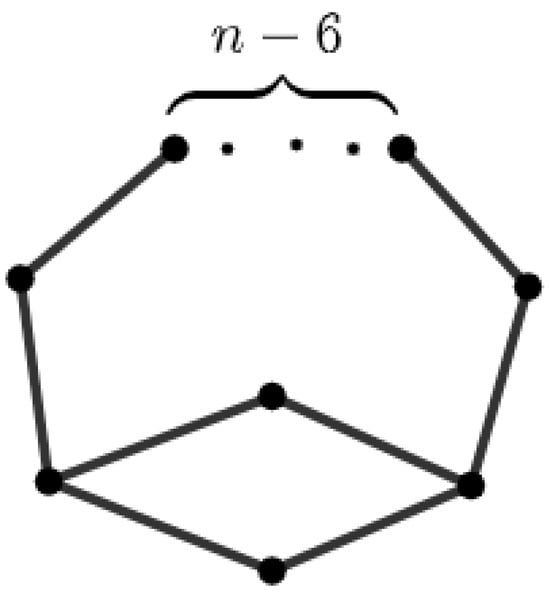
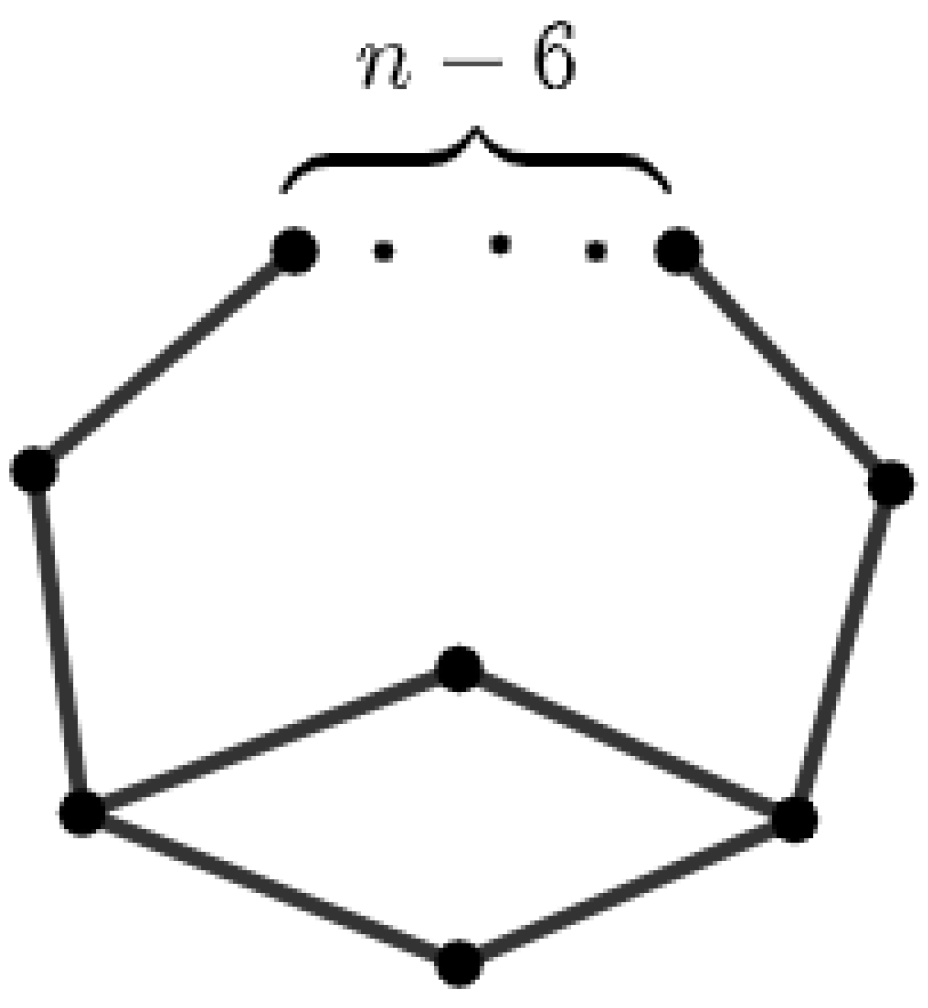
Figure 1.
Graph .
Theorem 2.
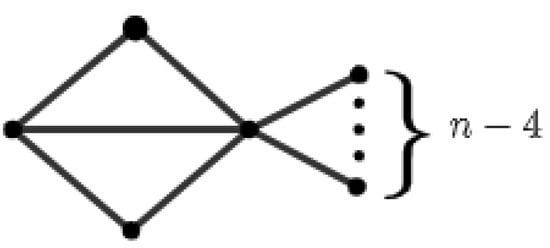
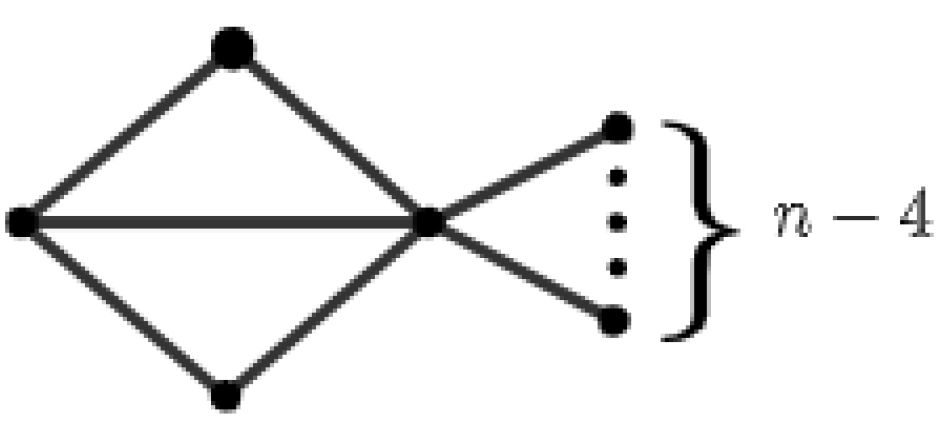
Figure 2.
Graph .
Theorem 1 is proved in Section 3. The proof mainly refers to the proof of the lower bound of Mostar index for bicyclic graphs in [12]. We extend this method to the weighted Mostar index and improve this method. Theorem 2 is proved in Section 4. The method of proving the upper bound of Mostar index for bicyclic graphs by defining the deficit of edges in [12] is not applicable here. We use a method different from that in [12] to find the upper bound of weighted Mostar index among all bicyclic graphs.
2. Preliminaries
For convenience, we denote by the contribution of the edge to the Mostar index of graph G, and by the contribution of the edge to the weighted Mostar index of graph G.
Let G be a unicyclic graph with order n. Let C be the unique cycle in G and . For , denote by the component of which contains w, where and are the two edges incident to w in C. Let e be an edge in C. If k is even, there exists an edge in C such that , then is called the parallel edge of e. If k is odd, there exists a vertex in C such that , then is called the symmetric vertex of e. Conversely, if , define , then say that e is symmetric about v.
Theta graph consists of two vertices, and , which are connected by three internally disjoint paths, , , and of lengths a, b, and c, respectively. We assume that .
Lemma 1.
([2]) Let G be a connected graph with order n, and , then
with the equality if and only if e is a pendant edge in G.
Lemma 2.
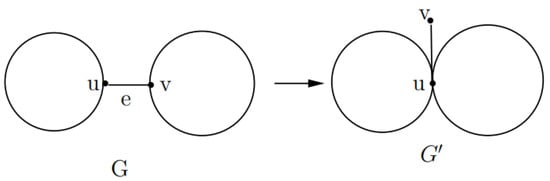
Let G be a connected graph, and be a cut edge but not a pendant edge in G. Let be the graph obtained from G by contracting the edge into a vertex u, and adding a pendant edge to this vertex (see Figure 3). Then .
Figure 3.
Transformation of cut edge.
Proof.
It is clear that . By Lemma 1, we have , then . The sum of the degrees of the two end vertices of each edge (except ) incident to u or v becomes larger, but the contribution to the Mostar index stays unchanged, so the contribution to the weighted Mostar index becomes larger. Furthermore, for the remaining edges, the contributions to the weighted Mostar index stay unchanged. Thus, . □
Lemma 3.
([11]) Let G be a unicyclic graph with order n, and C be the unique cycle in G.
- (1)
- If is even and , thenwhere and are the two components of .
- (2)
- If is odd and , thenwhere and are the two components of .
3. Proof of Theorem 1
In this section, we start by calculating the weighted Mostar index of graph to find the bicyclic graph with the minimum weighted Mostar index.
Lemma 4.
If n is odd, then ; if n is even, then .
Proof.
If n is odd, then is even. For each edge e of , we have . Thus, . If n is even, then is odd. The central edge on has a contribution of 0 and each remaining edge of has a contribution of 1 to . Thus, . □
A path in a graph G is called a pendant path if one of the two vertices of and is a pendant vertex and the other one has degree at least 3, and each remaining vertex of P has degree 2.
Lemma 5.
Let G be a bicyclic graph with order . If G has at least two pendant paths or one pendant path with order at least 3, then .
Proof.
Let G be a bicyclic graph with order , if G has at least two pendant paths, then . If G has one pendant path with order at least 3, then . □
Lemma 6.
Let G be a bicyclic graph with order . If G has no pendant path or only one pendant path with order 2, then , with the equality if and only if .
Proof.
Let G be a bicyclic graph with order . If G has no pendant path or only one pendant path with order 2, then G consists of a graph which has no pendant edge, and possibly an extra vertex attached to by a single edge. Hence, or .
Suppose that has exactly two cycles, and , with lengths a and b, respectively. Let and be the two terminal vertices on the path of length t connecting the two cycles, where is in and is in . Clearly, . If , then . Let , be the edges incident with in , and let , be the edges incident with in . We distinguish three cases.
Case 1: If , then , , . For each of these four edges, the sum of degrees of the end vertices is at least 5, so we have
Case 2: If , and the pendant edge is attached to any vertex on the path, then , , . We have
Case 3: If , and the pendant edge is attached to any vertex on one cycle, say , then , ,, . We have
Suppose that , let ,, be the three paths of , and , be the two vertices of degree 3 of . Let ,, be the edges incident with , where is in , is in , and is in . denotes the contribution of the three edges to . By symmetry, the edges incident with have the same contribution.
In , for , the number of vertices closer to than to is equal to the number of vertices closer to than to on and . The remaining vertices on are all closer to than to , then .
For , the number of vertices closer to than to is equal to the number of vertices closer to than to on and . If is even, among the remaining vertices on , vertices are closer to than to , and vertices are closer to than to , then . Similarly, if is odd, we can also obtain .
For , the number of vertices closer to than to is equal to the number of vertices closer to than to on and . If , then vertices on are all closer to than to , thus . If , let be any vertex on , where i denotes the length of the path from to on , and . Note that if , then and if , then , so among the vertices on , vertices are closer to than to , and no vertex is closer to than to , thus . If , then .
Case 1: . In , we have . If , then . Considering the contributions of the six edges incident to and in to , we obtain
If , then , , , . Considering the contributions of the pendant edge and the six edges incident to and in to , we know that
Case 2: . In , we have . If , then , we obtain
If , then . If , then , thus . When n is odd, is odd, then we have
When n is even, is even, then we find
If , then , , , . We obtain
Case 3: . In , we have . If , it is clear that the contribution of each edge incident to or to is . Each central edge on the path with an odd length has a contribution of 0 and each remaining edge has a contribution of at least 1 to . Thus, if , then
If , then .
If , then , ,,. We obtain
If , then If and the pendant edge is incident to or , then , thus
If and the pendant edge is incident to the center vertex of , then we have , , thus
If and the pendant edge is incident to a vertex x in , where , then , , thus
□
Finally, Theorem 1 can be proved by Lemmas 4–6.
4. Proof of Theorem 2
Based on the definition of bicyclic graphs, bicyclic graphs can be divided into two types: is the set of bicyclic graphs of order n with exactly two cycles. us the set of bicyclic graphs of order n with three cycles. In this section, for every type of bicyclic graph, we obtain the bicyclic graph with the maximum weighted Mostar index.
denotes the graph obtained from and by identifying one vertex. denotes the unicyclic graph on n vertices with a cycle of length k, where pendant vertices are incident to a fixed vertex on the cycle, and we call the fixed vertex the center vertex of .
Theorem 3.
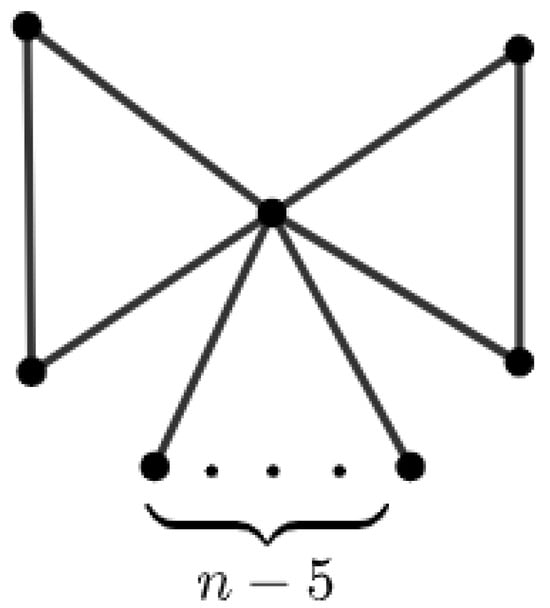
Let and , then , with the equality if and only if (see Figure 4).
Figure 4.
Graph .
Proof.
Let , where is a unicyclic graph of order with -cycle, and is a unicyclic graph of order with -cycle. By Lemma 2, we can easily obtain , where is a unicyclic graph of order with -cycle, and all cut edges are pendant edges. Let C be the unique cycle of . Note that
Let u be the common vertex of and , and let p be the number of pendant edges attached at u in . D denotes the sum of the degrees of all vertices on C, and denotes the sum of the degrees of the end vertices of the edge e.
If is odd, is the symmetric edge of u on C, and let . It is clear that . By Lemma 3, we obtain
For each , we obtain . By and , then
with the equality if and only if .
If is even, by Lemma 3, for each , we find . Then
with the equality if and only if .
Thus, we have , with the equality if and only if , where the common vertex of and is the center vertex of .
Let denote the unique cycle of and f be a pendant edge of ,
, . Note that
If is odd, then is even, we have
Then,
If is even, then is odd, we have
By , then
So .
Thus, , with the equality if and only if , where the common vertex of and is the center vertex of . By symmetry, we have , with the equality if and only if and , where the common vertex of and is the center vertex of and .
Hence, is the bicyclic graph with the maximum weighted Mostar index in , and it is clear that
This completes the proof of Theorem 3. □
Theorem 4.
Let and , then , with the equality if and only if .
Proof.
Let and , then G contains a subgraph isomorphic to , and we assume that . If G is the bicyclic graph with the maximum weighted Mostar index, by Lemma 2.2, we know that all cut edges are pendant edges. We distinguish five cases.
Case 1: .
Let p denote the number of pendant edges in G. We have by . For each edge e in , we have ; for each edge e in , we have ; for each pendant edge e, we have . Since these equations cannot hold at the same time, we know that
Case 2: , , .
Let and be two vertices of degree 3 of . Clearly, ; for each edge e (except ) incident to or in , we have ; for each remaining edge e in , we have ; for each pendant edge e, we have . We reveal
Case 3: , , .
Let and be two vertices of degree 3 of . is the vertex of degree 2 on , is the neighbor of on , and is the neighbor of on . If there is at least one pendant edge attached at the vertices of degree 2 of , then , , , ; for each pendant edge e, we have . We find
If there is no pendant edge attached at vertices of degree 2 of , then we have , , , ; for each pendant edge e, we have . We obtain
Case 4: , , .
If there is at least one pendant edge attached at the vertices of degree 2 of , then for each edge e in , we have ; for each pendant edge e, we have . We obtain
If all pendant edges are attached at , where is a vertex of degree 3 of , then for each edge e incident to in , we have ; for each remaining edge e in , we have ; for each pendant edge e, we have . We find
If all pendant edges are attached at and , where and are the vertices of degree 3 of , then for each edge e in , we have ; for each pendant edge e, we have . We have
Case 5: , , .
Let and be two vertices of degree 3 of , and let and be two vertices of degree 2 of . denotes the number of pendant edges attached at , where . It is clear that . Without a loss of generality, we assume that , , then
for each pendant edge e, we have
By , , and , we obtain
with the equality if and only if , and , i.e., .
This completes the proof of Theorem 4. □
Finally, Theorem 2 can be proved by Theorems 3 and 4.
5. Conclusions and a Further Research Problem
In this paper, firstly, by dividing the bicyclic graphs into two types according to the number of pendant paths, we determine the lower bound of the weighted Mostar index among all bicyclic graphs with order and characterize the corresponding extremal graphs. Secondly, we divide the bicyclic graphs into two types based on the definition of bicyclic graphs and Theta graph, and find its upper bound for every type of bicyclic graph, then we obtain the upper bound of the weighted Mostar index for bicyclic graphs with order and the graph that achieves the upper bound. Based on the bicyclic graphs, we can consider the related research of tricyclic graphs. The following is a further research problem:
Problem 1. Among all tricyclic graphs with order n, identify the graphs with the largest and smallest weighted Mostar index.
Author Contributions
Writing—original draft, Y.H.; Writing—review and editing, M.L. All authors have read and agreed to the published version of the manuscript.
Funding
This work was supported by National Natural Science Foundation of China (No. 11961040).
Data Availability Statement
Data are contained within the article.
Conflicts of Interest
The authors declare that they have no conflicts of interest.
References
- Bondy, J.A.; Murty, U.S.R. Graph Theory; Springer: Berlin, Germany, 2008. [Google Scholar]
- Došlić, T.; Martinjak, I.; Škrekovski, R.; Tipurić Spužević, S.; Zubac, I. Mostar index. J. Math. Chem. 2018, 56, 2995–3013. [Google Scholar] [CrossRef] [Scilit]
- Ali, A.; Došlić, T. Mostar index: Results and perspectives. Appl. Math. Comput. 2021, 404, 126–245. [Google Scholar] [CrossRef] [Scilit]
- Dehgardi, N.; Azari, M. More on Mostar index. Appl. Math. E-Notes. 2020, 20, 316–322. [Google Scholar]
- Deng, K.; Li, S. Extremal catacondensed benzenoids with respect to the Mostar index. J. Math. Chem. 2020, 58, 1437–1465. [Google Scholar] [CrossRef] [Scilit]
- Deng, K.; Li, S. On the Extremal Mostar Indices of Trees with a Given Segment Sequence. Bull. Malays. Math. Sci. Soc. 2022, 45, 593–612. [Google Scholar] [CrossRef] [Scilit]
- Ghorbani, M.; Rahmani, S.; Eslampoor, M. Some new results on Mostar index of graphs. Iran. J. Math. Chem. 2020, 11, 33–42. [Google Scholar]
- Hayat, F.; Zhou, B. On cacti with large Mostar index. Filomat 2019, 33, 4865–4873. [Google Scholar] [CrossRef] [Scilit]
- Hayat, F.; Zhou, B. On Mostar index of trees with parameters. Filomat 2019, 33, 6453–6458. [Google Scholar] [CrossRef] [Scilit]
- Huang, S.; Li, S.; Zhang, M. On the extremal Mostar indices of hexagonal chains. Match-Commun. Math. Comput. Chem. 2020, 84, 249–271. [Google Scholar]
- Liu, G.; Deng, K. The maximum Mostar indices of unicyclic graphs with given diameter. Appl. Math. Comput. 2023, 439, 127636. [Google Scholar] [CrossRef] [Scilit]
- Tepeh, A. Extremal bicyclic graphs with respect to Mostar index. Appl. Math. Comput. 2019, 355, 319–324. [Google Scholar] [CrossRef] [Scilit]
- Xiao, Q.; Zeng, M.; Tang, Z.; Hua, H.; Deng, H. The hexagonal chains with the first three maximal Mostar indices. Discrete Appl. Math. 2021, 288, 180–191. [Google Scholar] [CrossRef] [Scilit]
- Arockiaraj, M.; Clement, J.; Tratnik, N. Weighted Mostar indices as measures of molecular peripheral shapes with applications to graphene, graphyne and graphdiyne nanoribbons. SAR QSAR Environ. Res. 2020, 31, 187–208. [Google Scholar] [CrossRef] [Scilit] [PubMed]
- Kandan, P.; Subramanian, S.; Rajesh, P. Weighted Mostar indices of certain graphs. Adv. Math. 2021, 10, 3093–3111. [Google Scholar] [CrossRef] [Scilit]
- Asmat, F.; Asmat, H.; Askar, S. On weighted vertex and edge Mostar index for trees and cacti with fixed parameter. Eur. J. Pure Appl. Math. 2023, 16, 1794–1808. [Google Scholar] [CrossRef] [Scilit]
- Zhen, Q. Sum-weighted Mostar Index of Trees and Unicyclic Graphs. J. Lanzhou Jiaotong Univ. 2023, 42, 139–143. [Google Scholar]
Disclaimer/Publisher’s Note: The statements, opinions and data contained in all publications are solely those of the individual author(s) and contributor(s) and not of MDPI and/or the editor(s). MDPI and/or the editor(s) disclaim responsibility for any injury to people or property resulting from any ideas, methods, instructions or products referred to in the content. |
© 2024 by the authors. Licensee MDPI, Basel, Switzerland. This article is an open access article distributed under the terms and conditions of the Creative Commons Attribution (CC BY) license (https://creativecommons.org/licenses/by/4.0/).