Abstract
Recently, Appell-type polynomials have been investigated and applied in several ways. In this paper, we consider a new extension of Appell-type Changhee polynomials. We introduce two-variable generalized Appell-type -Changhee polynomials (2VGATCHP). The generating function, series representations, and summation identities related to these polynomials are explored. Further, certain symmetry identities involving two-variable generalized Appell-type -Changhee polynomials are established. Finally, Mathematica was used to examine the zero distributions of two-variable truncated-exponential Appell-type Changhee polynomials.
Keywords:
two-variable general polynomials; Changhee polynomials; Appell-type Changhee polynomials; generalized Changhee polynomials; zero distribution MSC:
05A10; 11B68; 33B10; 33E20
1. Introduction and Preliminaries
Many special polynomials and numbers have created many spirited applications in several fields such as mathematics, mathematical modeling, statistics, mathematical physics, applied mathematics, and engineering [1,2,3,4,5,6,7,8,9,10]. Recently, Changhee polynomials and numbers have been frequently used and applied in many branches of mathematics, especially in areas such as mathematical physics, mathematical modeling, fractional analysis, and analytical number theory, for example, Adel et al. [1] introduced a numerical investigation for a fractional model of pollution for a system of lakes using the spectral collocation method (SCM) based on Appell-type Changhee polynomials. Adel et al. [2] presented a high-dimensional chaotic Lorenz system, providing a numerical treatment using Appell-type Changhee polynomials. Khater et al. [7] investigated the non-Newtonian nanofluid flow across an exponentially stretching sheet with viscous dissipation, providing a numerical study using an SCM based on Appell–Changhee polynomials.
Let be the set of real numbers, denotes the set of complex numbers, denotes the set of integer numbers, and , is the field of p-adic rational numbers and is the completion of the algebraic closure of , where denotes the ring of p-adic integers and p is a fixed prime number.
The Changhee polynomials (ChP) [11,12] are defined by
When , are called the Changhee numbers.
The Changhee polynomials of order are defined by
When , are called the Changhee numbers of order .
Lee et al. [13] introduced Appell-type Changhee polynomials (ATCHP), which are defined as
and have the following explicit relation:
where are the corresponding Appell-type Changhee numbers.
Lim and Qi [14] introduced Appell-type -Changhee polynomials, which are defined by the generating function
and the explicit relation
where are the corresponding Appell-type -Changhee numbers.
The Appell-type -Changhee polynomials of order (ATCHP) [14] are defined by
and have the following explicit relation:
where are the corresponding Appell-type -Changhee numbers of order . Note that
Further, the ATCHP satisfy the following recurrence relation:
Due to the importance of the special functions of two variables in applications, a general class of the two-variable polynomials, namely, the two-variable general polynomials (2VGP) , is presented in [15]. These polynomials are defined by the generating function
where
The 2VGP satisfy the following operators:
and
respectively.
Moreover, the 2VGP meet the following identities:
Some members of the 2VGP are mentioned in Table 1.
Table 1.
Some members of 2VGP class .
Note that
where are called the first-kind Stirling numbers [22] and given by
The following recurrence relation defines the second-kind Stirling numbers:
which also can be given by
The generating relation of the sum of integer powers [22] is given by
Due to the exigency of discussing some significant problems in various fields or mathematical interests, recently, a noteworthy number of new generalized and hybrid special polynomials and numbers have been considered [15,19,21,23,24,25,26,27,28,29]. Over the past few years, research on Changhee polynomials and their generalizations has been actively conducted by many researchers. For instance, Kim et al. [12] investigated some results on Changhee numbers and polynomials. Kim et al. [30] introduced higher-order Changhee numbers and polynomials and examined some related properties. Lee et al. [13] established the Appell-type Changhee polynomials and numbers. Lim and Qi [14] introduced Appell-type -Changhee polynomials and explored some related identities. Kim et al. [11] presented a note on nonlinear Changhee differential equations. Pathan and Khan [31] discussed the Appell type -Changhee–Hermite polynomials and their properties. Nahid et al. [32] studied truncated-exponential-based Appell-type Changhee polynomials. Rim et al. [33] defined twisted Changhee polynomials and found some relationships between Euler polynomials, Stirling numbers of the first and the second kind, and these polynomials. Jang et al. [34] investigated twisted Changhee polynomials and numbers and also discussed some properties. Kim et al. [35] introduced Changhee–Genocchi polynomials and numbers and investigated some explicit identities.
Motivated by the above-mentioned works, in this article, over the hybridization of the Appell-type -Changhee polynomials with two-variable general polynomials, we produce a new attractive and useful class of mixed special polynomials called two-variable generalized Appell-type -Changhee polynomials. Additionally, certain series representations and some other properties related to these polynomials are investigated. Next, some symmetry identities involving our produced polynomials are obtained. Further, the zero distributions of certain related members are discussed.
2. Two-Variable Generalized Appell-Type -Changhee Polynomials
In this section, through the help of the monomiality principle, we commingle the ATCHP with the 2VGP to create a class of a more generalized family of hybrid polynomials called two-variable generalized Appell-type -Changhee polynomials by means of a generating function and series definition. Further, we also derive certain properties and summation formulae for these polynomials.
Here, we consider the generating functions (7) and (10), and assume that such that . According to the monomiality principle [36,37] and utilizing identities (12) and (17), we define the 2VGATCHP of order as
Next, we present some special members of the two-variable generalized Appell-type -Changhee family as:
- Choosing in (23) gives the two-variable generalized Appell-type Changhee polynomials of order which are defined by
- Setting in (24) giveswhere are called the two-variable truncated-exponential-Appell-type Changhee polynomials of order s.
- Setting in (25), we obtainwhere are called the truncated-exponential Appell-type Changhee polynomials [32].
- Setting in (23), we obtainwhere are called the Gould–Hopper Appell-type -Changhee polynomials of order .
- Setting in (23), we obtainwhere are called the two-variable Laguerre Appell-type -Changhee polynomials of order .
- Setting in (23), we obtainwhere are called the two-variable truncated-exponential Appell-type -Changhee polynomials (ETATCHP) of order .
- Setting in (23), we obtainwhere are called the Hermite–Appell-based Appell-type -Changhee polynomials of order .
- Setting in (23), we obtainwhere are called the Fubini Appell-type -Changhee polynomials of order .
From (32), we reach the following theorem.
Theorem 1.
For , , we have
Similarly, we can obtain
From (36), we obtain the following theorem.
Theorem 2.
Let , . Then, we have
From (38), the following theorem is obtained.
Theorem 3.
For , , we have
In (23), replacing by and by , we have
From (40), the following theorem is obtained.
Theorem 4.
For , , we have
In view of (23), we can write
From (42), we acquire the following theorem.
Theorem 5.
For , , we have
Similarly, we have
Taking in (46), we obtain
Replacing by in (23), we obtain
Now, replacing by z in Equation (48), comparing the resultant equation with Equation (48) and simplifying, we have
From (49), the following theorem is obtained.
Theorem 6.
For and , we have
Multiplying the right-hand side of (23) by , we have
From (51), we obtain
where denotes the generalized tangent numbers [38]. From (52), the following theorem is obtained.
Theorem 7.
For and , we have
3. Symmetry Identities
The importance of the two-variable forms of the special polynomials in applications and the work of Yang [39] and Özarslan [40] on symmetry identities motivate us to consider symmetry identities for more general families. In this section, symmetry identities for the 2VGATCHP are derived. Further, by considering different members of the 2VGP , the symmetry identities for certain members belonging to this family are also derived.
Let us consider
Clearly, is symmetric with respect to the parameters and ; therefore, can be written as
Similarly, we have
Theorem 8.
For , and , we have
Next, note that
and let
Obviously, is symmetric with respect to the parameters and . We can rewrite as
which upon applying identity (58), becomes
Similarly, we can obtain
Theorem 9.
For , , and , we have
Suppose that
where represents the Euler numbers [41].
Similarly, we can obtain
Theorem 10.
For , , and , we have
In view of the special cases of the 2VGP given in Table 1, in Section 2 we defined certain members of 2VGATCHP , such as two-variable truncated-exponential Appell-type Changhee polynomials of order s, Gould–Hopper Appell-type -Changhee polynomials of order , two-variable Laguerre Appell-type -Changhee polynomials of order , two-variable truncated-exponential Appell-type -Changhee polynomials of order , Hermite–Appell-based Appell-type -Changhee polynomials of order , and Fubini Appell-type -Changhee polynomials of order . Next, according to the results (9), (10) and (57), the symmetry identities for the corresponding special members can be obtained.
- Symmetry identities for the two-variable truncated-exponential Appell-type Changhee polynomials of order s are obtained as
- Symmetry identities for the Gould–Hopper Appell-type -Changhee polynomials of order are obtained as
- Symmetry identities for the Hermite–Appell-based Appell-type -Changhee polynomials of order .
Similarly, the symmetry identities for the other special members of the two-variable generalized Appell-type -Changhee family can be obtained.
4. Computer Modeling and Zeros
Over the past few years, there has been increasing interest in solving mathematical problems with the aid of computers. The software Mathematica is used to show the behavior of these newly introduced polynomials and to examine the related zeros. This section aims to demonstrate the benefit of using numerical investigation and computer experiments to support theoretical predictions and to discover new interesting patterns of the zeros of the ETATCHP of order for certain values of the indices and parameters.
Upon utilizing (29) and with the help of Mathematica, we can expand explicitly. Here, we mention a few members of for , , and :
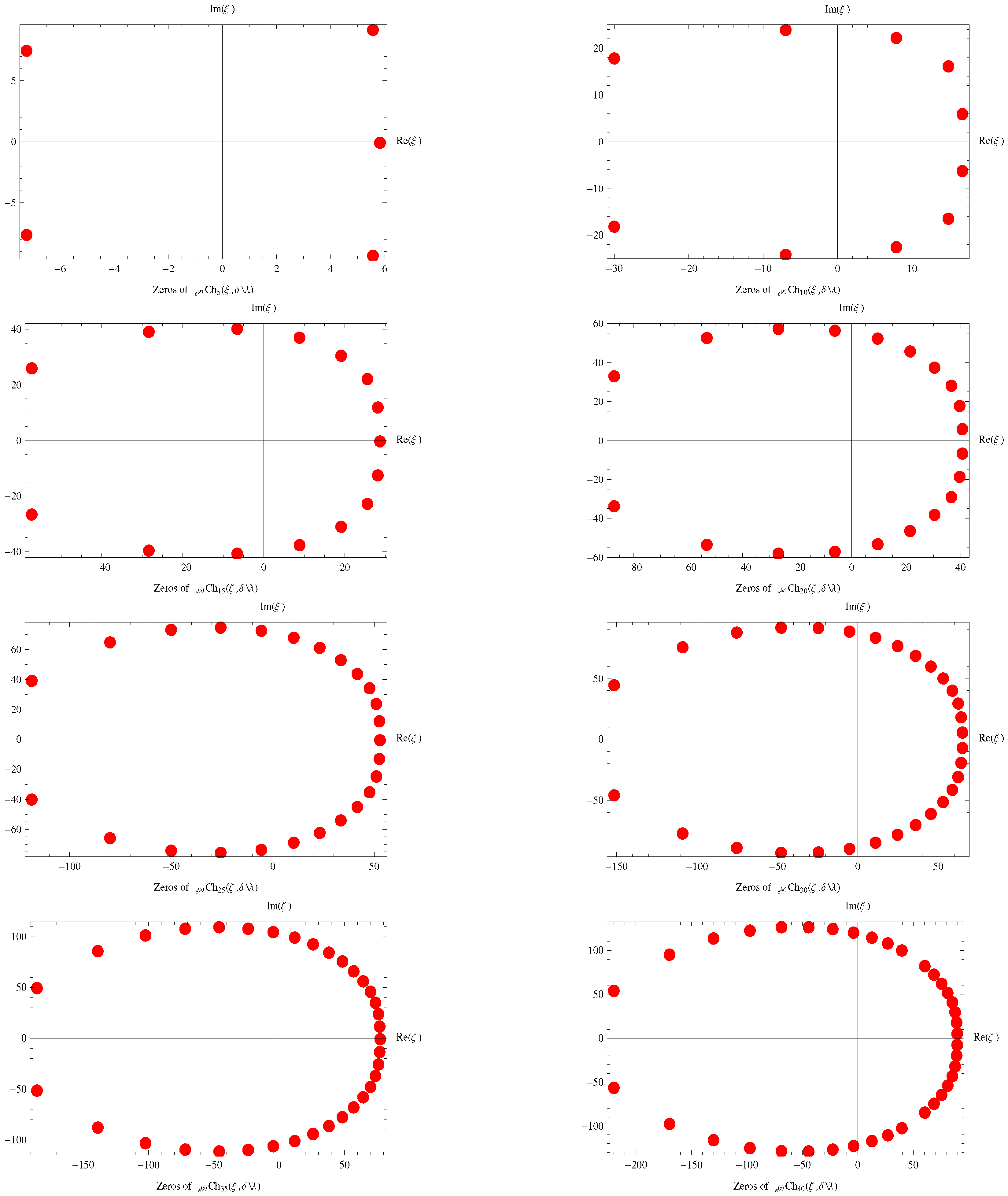
Approximate solutions satisfying the ETATCHP , for certain values, i.e., for , and 40 are investigated and presented in Figure 1.
Figure 1.
Zero distribution of ETATCHP , for , and 40.
We note that the ETATCHP of degree has zeros with the following properties:
- If is odd, the ETATCHP has one real zero and complex zeros.
- If is even, the ETATCHP has complex zeros.
- The zeros of the ETATCHP are symmetric with respect to the real axis.
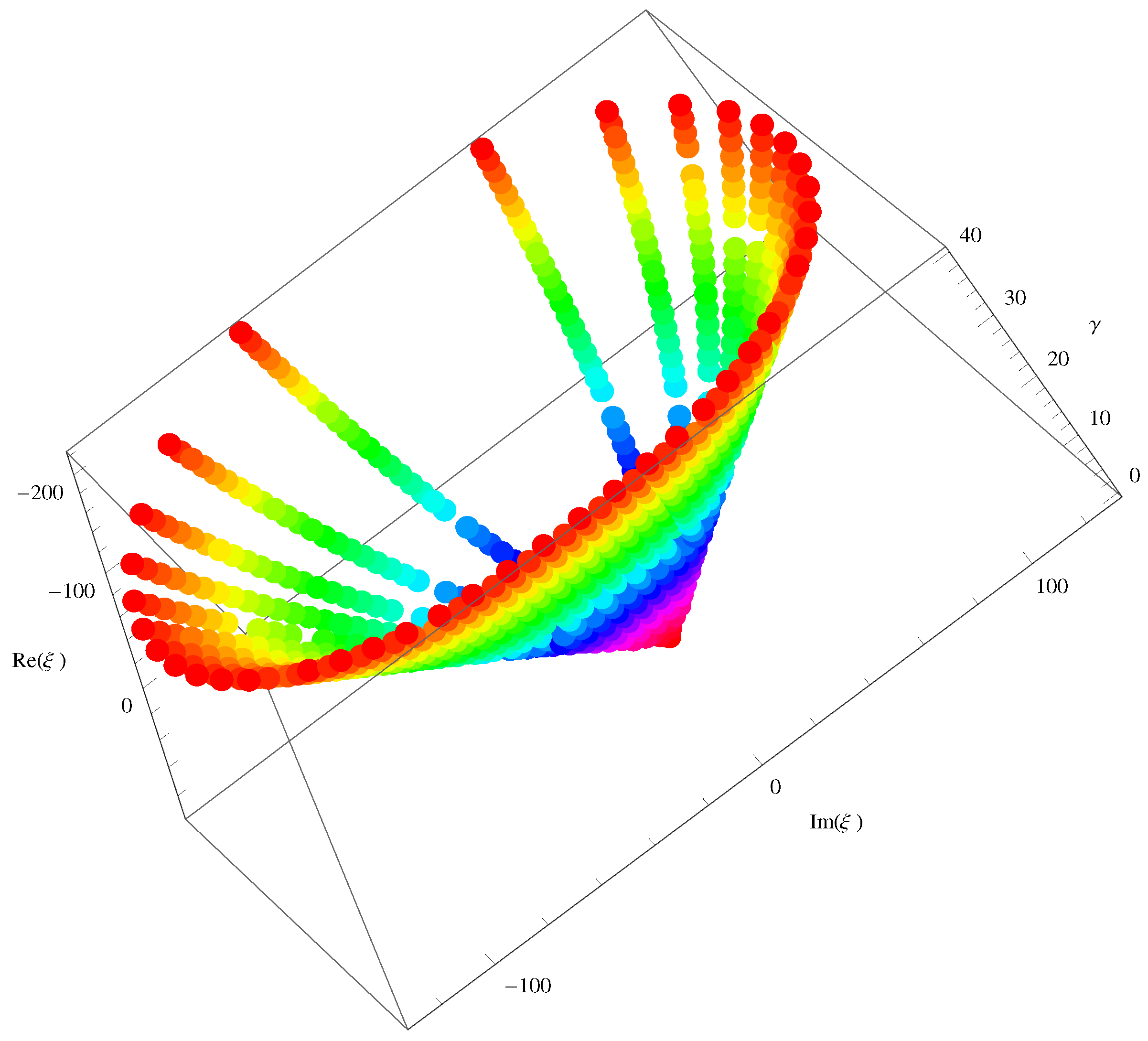
The stacks of zeros of ETATCHP for of 3D form are presented in Figure 2.
Figure 2.
Stacks of zeros of .
5. Conclusions
Recently, the hybrid versions of special polynomials and numbers have been studied by numerous researchers [15,19,21,23,25,26,27,28,29]. In this paper, we established a new generalized class of hybrid special polynomials called two-variable generalized Appell-type -Changhee polynomials. We defined the generating function and derived some helpful series representations for these polynomials. In addition, we investigated some related summations and symmetry identities. Further, we presented some considerable special cases of the two-variable generalized Appell-type -Changhee family, such as the two-variable truncated-exponential-Appell-type Changhee polynomials, Gould–Hopper Appell-type -Changhee polynomials, two-variable Laguerre Appell-type -Changhee polynomials, two-variable truncated-exponential Appell-type -Changhee polynomials, Hermite–Appell-based Appell-type -Changhee polynomials of order , and Fubini Appell-type -Changhee polynomials. Moreover, we examined the zeros of two-variable truncated-exponential Appell-type -Changhee polynomials and discussed the behavior of these zeros. We obtained that the zeros of these polynomials are distributed uniformly, and symmetric with respect to the real axis; see Figure 1. The stacked plot of the distribution of the zeros can be also viewed in Figure 2. Our established class is a generalization of many other published forms related to Changhee polynomials. The degenerate form of the generalized Appell-type -Changhee polynomials and related applications can be considered in further studies.
Author Contributions
Conceptualization, A.M., R.A.A.-J. and W.F.H.A.-s.; software, A.M.; validation, R.A.A.-J. and W.F.H.A.-s.; investigation, A.M.; resources, A.M.; writing—original draft preparation, A.M.; writing—review and editing, A.M.; visualization, W.F.H.A.-s.; supervision, R.A.A.-J. All authors have read and agreed to the published version of the manuscript.
Funding
This work was supported by the Deanship of Scientific Research at Najran University, under the Distinguished Research Funding program grant code (NU/DRP/SERC/12/4).
Informed Consent Statement
Not applicable.
Data Availability Statement
Data are contained within the article.
Acknowledgments
The authors are thankful to the Deanship of Scientific Research at Najran University for funding this work under the Distinguished Research Funding program grant code (NU/DRP/SERC/12/4).
Conflicts of Interest
The authors declare no conflicts of interest.
References
- Adel, M.; Khader, M.M.; Babatin, M.M.; Youssef, M.Z. Numerical investigation for the fractional model of pollution for a system of lakes using the SCM based on the Appell type Changhee polynomials. AIMS Math. 2023, 8, 31104–31117. [Google Scholar] [CrossRef]
- Adel, M.; Khader, M.M.; Algelany, S. High-Dimensional Chaotic Lorenz System: Numerical Treatment Using Changhee Polynomials of the Appell Type. Fractal Fract. 2023, 7, 398. [Google Scholar] [CrossRef]
- Al-Jawfi, R.A.; Al-Helali, B.M.; Ahmed, A.M. Fractal image compression using self-organizing mapping. Appl. Math. 2014, 5, 1810–1819. [Google Scholar] [CrossRef]
- Benbernou, S.; Gala, S.; Ragusa, M.A. On the regularity criteria for the 3D magnetohydrodynamic equations via two components in terms of BMO space. Math. Methods Appl. Sci. 2014, 37, 2320–2325. [Google Scholar] [CrossRef]
- Bell, E.T. Exponential polynomials. Ann. Math. 1934, 35, 258–277. [Google Scholar] [CrossRef]
- Boas, R.B.; Buck, R.C. Polynomial Expansions of Analytic Functions; Springer: Berlin, Germany, 2013. [Google Scholar]
- Khader, M.M.; Babatin, M.M.; Megahed, A.M. Non-Newtonian nanofluid flow across an exponentially stretching sheet with viscous dissipation: Numerical study using an SCM based on Appell—Changhee polynomials. Bound. Val. Prob. 2023, 2023, 77. [Google Scholar] [CrossRef]
- Zhuang, L.; Xu, A.; Wang, X. A prognostic driven predictive maintenance framework based on Bayesian deep learning. Reliab. Eng. Syst. Saf. 2023, 234, 109181. [Google Scholar] [CrossRef]
- Wang, W.; Cui, Z.; Chen, R.; Wang, Y.; Zhao, X. Regression analysis of clustered panel count data with additive mean models. Stat. Pap. 2023, 2023, 1–22. [Google Scholar] [CrossRef]
- Zhou, S.; Xu, A.; Tang, Y.; Shen, L. Fast Bayesian inference of reparameterized gamma process with random effects. IEEE Trans. Reliab. 2023; in press. [Google Scholar] [CrossRef]
- Kim, D.S.; Kim, T. A note on nonlinear Changhee differential equations. Russ. J. Math. Phys. 2016, 23, 88–92. [Google Scholar] [CrossRef]
- Kim, D.S.; Kim, T.; Seo, J.J. A note on Changhee polynomials and numbers. Adv. Stud. Theor. Phys. 2013, 7, 993–1003. [Google Scholar] [CrossRef]
- Lee, J.G.; Jang, L.-C.; Seo, J.-J.; Choi, S.-K.; Kwon, H.I. On Appell-type Changhee polynomials and numbers. Adv. Differ. Equ. 2016, 1, 160. [Google Scholar] [CrossRef][Green Version]
- Lim, D.; Qi, F. On Appell type λ-Changhee polynomials. J. Nonlinear Sci. Appl. 2016, 9, 1872–1876. [Google Scholar] [CrossRef]
- Khan, S.; Raza, N. General-Appell polynomials within the context of monomiality principle. Int. J. Anal. 2013, 2013, 328032. [Google Scholar] [CrossRef]
- Gould, H.W.; Hopper, A.T. Operational formulas connected with two generalizations of Hermite polynomials. Duke. Math. J. 1962, 29, 51–63. [Google Scholar] [CrossRef]
- Cocolicchio, D.; Dattoli, G.; Srivastava, H.M. Advanced special functions and applications. In Proceedings of the First Melfi School on Advanced Topics in Mathematics and Physics, Melfi, Italy, 9–12 May 1999; Aracne Editrice: Rome, Italy, 2000. [Google Scholar]
- Dattoli, G.; Migliorati, M.; Srivastava, H.M. A class of Bessel summation formulas and associated operational methods. Fract. Calc. Appl. Anal. 2004, 7, 169–176. [Google Scholar]
- Khan, S.; Yasmin, G.; Khan, R.; Hassan, N.A.M. Hermite-based Appell polynomials: Properties and applications. J. Math. Anal. Appl. 2009, 351, 756–764. [Google Scholar] [CrossRef]
- Kilar, N.; Simsek, Y. A new family of Fubini type numbers and polynomials associated with Apostol-Bernoulli numbers and polynomials. J. Korean Math. Soc. 2017, 54, 1605–1621. [Google Scholar]
- Srivastava, H.M.; Srivastava, R.; Muhyi, A.; Yasmin, G.; Islahi, H.; Araci, S. Construction of a new family of Fubini-type polynomials and its applications. Adv. Differ. Equ. 2021, 2021, 36. [Google Scholar] [CrossRef]
- Deeba, E.Y.; Rodriguez, D.M. Srirling’s series and Bernoulli numbers. Amer. Math. Mon. 1991, 98, 423–426. [Google Scholar] [CrossRef]
- Wani, S.A.; Choi, J. Truncated exponential based Frobenius-Genocchi and truncated exponential based Apostol type Frobenius-Genocchi polynomials. Montes Taurus J. Pure Appl. Math. 2022, 4, 85–96. [Google Scholar]
- Kim, D.S.; Kim, T.; Lee, H. A note on degenerate Euler and Bernoulli polynomials of complex variable. Symmetry 2019, 11, 1168. [Google Scholar] [CrossRef]
- Srivastava, H.M.; Özarslan, M.A.; Yılmaz, B. Some families of differential equations associated with the Hermite-based Appell polynomials and other classes of Hermite-based polynomials. Filomat 2014, 28, 695–708. [Google Scholar] [CrossRef]
- Srivastava, H.M.; Araci, S.; Khan, W.A.; Acikgoz, M. A note on the truncated-exponential based Apostol-type polynomials. Symmetry 2019, 11, 538. [Google Scholar] [CrossRef]
- Yasmin, G.; Islahi, H.; Muhyi, A. Certain results on a hybrid class of the Boas-Buck polynomials. Adv. Differ. Equ. 2020, 2020, 362. [Google Scholar] [CrossRef]
- Yasmin, G.; Muhyi, A. Certain results of hybrid families of special polynomials associated with Appell sequences. Filomat 2019, 33, 3833–3844. [Google Scholar] [CrossRef]
- Muhyi, A. A new class of Gould-Hopper-Eulerian-type polynomials. Appl. Math. Sci. Eng. 2022, 30, 283–306. [Google Scholar] [CrossRef]
- Kim, D.S.; Kim, T.; Seo, J.J.; Lee, S. Higher-order Changhee numbers and polynomials. Adv. Stud. Theor. Phys. 2014, 8, 365–373. [Google Scholar] [CrossRef][Green Version]
- Pathan, M.A.; Khan, W.A. On λ-Changhee—Hermite polynomials. Analysis 2022, 42, 57–69. [Google Scholar] [CrossRef]
- Nahid, T.; Alam, P.; Choi, J. Truncated-Exponential-Based Appell-Type Changhee Polynomials. Symmetry 2020, 12, 1588. [Google Scholar] [CrossRef]
- Rim, S.H.; Park, J.J.; Pyo, S.S.; Kwon, J. The n-th twisted Changhee polynomials and numbers. Bull. Korean Math. Soc. 2015, 52, 741–749. [Google Scholar] [CrossRef]
- Jang, L.C.; Ryoo, C.S.; Seo, J.J.; Kwon, H.I. Some properties of the twisted Changhee polynomials and their zeros. Appl. Math. Comput. 2016, 274, 169–177. [Google Scholar] [CrossRef]
- Kim, B.M.; Jeong, J.; Rim, S.H. Some explicit identities on Changhee-Genocchi polynomials and numbers. Adv. Stud. Theor. Phys. 2014, 8, 365–373. [Google Scholar] [CrossRef][Green Version]
- Steffensen, J.F. The poweriod, an extension of the mathematical notion of power. Acta. Math. 1941, 73, 333–366. [Google Scholar] [CrossRef]
- Dattoli, G. Hermite—Bessel and Laguerre–Bessel functions: A by-product of the monomiality principle. Adv. Spec. Funct. Appl. 1999, 1, 147–164. [Google Scholar]
- Bildirici, C.; Acikgoz, M.; Araci, S. A note on analogues of tangent polynomials. J. Algebra Number Theory Acad. 2014, 4, 21. [Google Scholar]
- Yang, S.L. An identity of symmetry for the Bernoulli polynomials. Discrete Math. 2008, 308, 550–554. [Google Scholar] [CrossRef]
- Özarslan, M.A. Hermite-based unified Apostol-Bernoulli, Euler and Genocchi polynomials. Adv. Differ. Equ. 2013, 2013, 116. [Google Scholar] [CrossRef]
- Rainville, E.D. Special Functions; Reprint of 1960 first edition; Chelsea Publishig Co.: Bronx, NY, USA, 1971. [Google Scholar]
Disclaimer/Publisher’s Note: The statements, opinions and data contained in all publications are solely those of the individual author(s) and contributor(s) and not of MDPI and/or the editor(s). MDPI and/or the editor(s) disclaim responsibility for any injury to people or property resulting from any ideas, methods, instructions or products referred to in the content. |
© 2024 by the authors. Licensee MDPI, Basel, Switzerland. This article is an open access article distributed under the terms and conditions of the Creative Commons Attribution (CC BY) license (https://creativecommons.org/licenses/by/4.0/).