1. Introduction
A hypergraph
consists of a pair, where
is the vertex set and
is the hyperedge set of
. Each hyperedge in
is a nonempty subset of the vertex set
. A hypergraph is said to be a linear hypergraph if
for all
. A hypergraph
is a
k-uniform hypergraph (or
k-hypergraph) [
1,
2] if the cardinality of each of its hyperedges is
k where
. When
, it turns into an ordinary graph. The degree of a vertex
,
is defined as the number of hyperedges that contain the vertex
v. A hypergraph in which every vertex
has degree
r is said to be an
r-regular hypergraph. If a hypergraph is both
k-uniform and
r-regular, we refer to it as a
-regular hypergraph (or
-hypergraph). In [
2], the authors focus on the characteristics of
-hypergraphs. A
k-hypergraph
with
n vertices is said to be a complete
k-hypergraph
if
is the collection of all possible
k-subsets of
[
3]. In such a hypergraph, there are
hyperedges. The complement of
k-hypergraph
is the
k-hypergraph
, where the vertex set remains the same and the hyperedge set
. The adjacency matrix [
4] of
,
, is a square matrix of order
n such that, for all
One of the earliest applications of spectral graph theory is the study of molecular orbital energy levels of
-electrons in conjugated hydocarbons [
5]. It involves graphs representing conjugated hydrocarbons and approximating the total
-electron energy from their eigenvalues. In 1978, Gutman [
6] introduced the concept of graph energy, further expanding this area of study. Later, Nikiforov [
7] extended the concept of graph energy to matrices. The energy of a matrix
M is the sum of its singular values, which is also known as trace norm of
M,
. The singular values of a matrix
M are the square roots of the eigenvalues of
, where
is the conjugate transpose of
M. The singular values of a real symmetric matrix are the moduli of its eigenvalues. Graph energy is one of the most studied spectrum-based invariants in the literature. The first upper bound on energy of a graph was established by McClelland [
8]. Later, Koolen and Moulton [
9] improved this bound. Recent studies have indicated an increasing interest in the energy of hypergraphs, where the energy of
is defined based on the connectivity matrices of
.
In 2020, Cardoso and Trevisan [
10] introduced the concept of
k-hypergraph energy based on the incidence energy and the signless Laplacian energy of
k-hypergraphs. In [
11], the authors provided several significant results on the adjacency energy of hypergraphs. In the past few years, studies have expanded to explore Laplacian energy and distance energy [
12,
13] of hypergraphs. Motivated by these studies, the present paper aims to establish bounds of adjacency energy
of hypergraph
. Let
be the eigenvalues of adjacency matrix of
, and also let
be the decreasing arrangement of the absolute values of the eigenvalues of
, then
The Frobenius norm of a matrix
is defined as
, while the max norm of a matrix given by
.
This paper is devoted to the study of the energy of hypergraphs. Because determining the exact values for the energy of a hypergraph is challenging, it is useful to obtain bounds based on the structural and spectral properties of hypergraphs. In
Section 3, we obtain various bounds for the adjacency energy of hypergraphs in terms of the number of vertices, maximum degree, eigenvalues, and Frobenius norm of the adjacency matrix. In hypergraph theory, giving an expression for the number of closed walks of length 2 (that is, trace
) is a complex task. Using graph-theoretical techniques, we determine the number of closed walks of length 2 for a linear
k-hypergraph. Additionally, we compute bounds for the number of closed walks of length 2 of the
k-hypergraphs; this modifies the existing bounds for the energy of hypergraphs, which makes it computationally easier. In
Section 4, we derive Nordhaus–Gaddum-type inequalities for the adjacency energy of
k-hypergraphs. Throughout this paper, we consider only simple hypergraphs.
2. Preliminaries
This section gives basic definitions, results, and notations used in the main results.
Lemma 1 ([
14])
. If be a k-hypergraph of n vertices and m edges. Then Definition 1 ([
15])
. Let and Q be two matrices of any order. Then the Kronecker product of P and Q is a block matrix, Lemma 2 ([
16])
. Let is a symmetric block matrix. Then the spectrum of M is the union of spectra of and . Lemma 3 ([
17])
. If are real numbers such that , thenEquality holds if and only if Theorem 1 ([
18])
. Let and be two vertices of a hypergraph . Then the number of walks of length l from to of is , the th entry of the matrix . Lemma 4 ([
11])
. Let and δ be the maximum and minimum degree of a k-hypergraph with spectral radius . Then Lemma 5 ([
19])
. Let M be any matrix of order n, be the characteristic polynomial of M, and be the t-subset of . Then the coefficient of in iswhere is the collection of matrices obtained by replacing the rows and columns that correspond to the elements of of M with zeros, and assigning −1 to the corresponding diagonal entries. The following notations are used in this paper. A matrix with entries either 0 or is referred to as a matrix. We write if j takes all the integer values satisfying the condition . Let and be the all-ones matrix and identity matrix of order n, respectively, and denote all-ones matrix of order . The column vector with all entries equal to one is denoted by . Let M be a square matrix of order n. The characteristic polynomial of a matrix M is denoted by , where and is the collection of all possible t-subset of .
3. Lower and Upper Bounds for Energy of Hypergraphs
This section focuses on the bounds for the energy of a hypergraph in terms of the number of vertices, maximum degree, Frobenius norm, and eigenvalues of . Recalling that , we can deduce the following results on the eigenvalues of k-hypergraphs, which helps to derive the subsequent theorems.
, implies that
,
and
,
Hence,
Let
be the negative eigenvalues of
. Since
,
Proposition 1. Let be a hypergraph on n vertices. Then Proof. Since
, we obtain
Therefore, we have
Consider
Let
and
be the roots of the quadratic equation
, then
will lies in between
and
, since
. Therefore, (
1) holds. □
The following theorems present the bounds for the energy of hypergraph as functions of spectral and structural parameters such as eigenvalues, maximum degree, and Frobenius norm of the adjacency matrix of , which can be identified from the corresponding hypergraph.
Theorem 2. Let be a nonsingular hypergraph of order n such that ThenEquality holds if , . Proof. Since
, we have
where
. Taking summation
i from 2 to
n, we obtain
Therefore, we obtain
Equality holds, if for all . Therefore, , where . □
Corollary 1. Let be the maximum degree of the k-hypergraph . Then Proof. Consider the function
which is a decreasing function on
for
. From Lemma 4
, we obtain
□
The proof of the following proposition can be deduced by using similar arguments of Theorem 2.
Proposition 2. Let be a nonsingular hypergraph of order n such that ThenEquality holds if , . In [
11], the authors established an upper bound
. The following theorem provides a more precise bound for the energy of hypergraphs.
Theorem 3. Let be a hypergraph and the first p positive eigenvalues of is denoted as . Then Proof. Consider,
Since
and
, we obtain
Hence,
Hence, the theorem holds. □
Lemma 6. Let be a hypergraph of order n with eigenvalues . ThenEquality holds if and only if is a -hypergraph and the equality holds if and only if Proof. From the Rayleigh–Ritz theorem for the Hermitian matrix, we obtain
Hence,
The adjacency matrix of a
-hypergraph has constant row sum
. Consequently,
is an eigenvalue; its corresponding eigenvector is
. Therefore, equality
is achieved when
is a
-hypergraph. Conversely, if the equality
holds, then
. Hence, the row sum is equal to a constant. Thereby,
is a
-hypergraph. By Lemma 3, we have
Equality holds if and only if . □
Theorem 4. Let be a k-hypergraph of order n such that is a matrix, . ThenEquality holds if and only if either , is a -regular hypergraph with two distinct eigenvalues , or is a -regular hypergraph with three distinct eigenvalues and , Proof. First, notice that
Now, applying Cauchy–Schwartz inequality, we obtain
Hence,
Consider the function
Then the function
is strictly decreasing in the interval
. From Lemma 6 and in the view that
A is a
matrix, we have
. Since
f is a decreasing function
, (
2) holds.
Now, if the equality in (
2) holds, then
must hold. From Lemma 6,
is a
-regular hypergraph. Now, since the equality in (
3) must also hold, for
,
.
Then there are only three possible cases.
In the first case, as it has only two distinct eigenvalues, 1 and , both with multiplicity .
In the second case, has two distinct eigenvalues with and , .
In the third case, and . □
Lemma 7. Let be a connected k-hypergraph on n vertices and m edges such that any two edges of share at most 1 vertex. And let be the diagonal entry of corresponding to vertex . Then, Proof. By Theorem 1, gives the number of walks of length two starting and ending on vertex . Suppose that
Case I: . Then either must be adjacent to more than vertices or can traverse to the neighboring edge through edge and traverse back to another edge . This is a contradiction since the edges of share at most one vertex.
Case II: . That is, does not have vertices at a distance of length 1. This contradicts the definition of the degree of a vertex in the k-hypergraph. This contradicts our assumption. Hence the theorem holds. □
The following theorem allows us to reformulate the bounds in Proposition 1 and Theorem 3 of linear k-hypergraph in terms of uniformity and number of edges. By determining the bounds for the sum of the squares of the adjacency eigenvalues of a k-hypergraph, we establish the bounds for the Frobenius norm, which is utilized in most of the theorems. The proof of the following theorem is the direct consequence of Lemmas 1 and 7.
Theorem 5. Let be a connected k-hypergraph on n vertices and m edges such that any two vertices of share at most 1 vertex. Then Theorem 6. Let be a connected k-hypergraph with n vertices and m edges, and be the adjacency eigenvalues of :Equality in the upper bounds holds if and only if the intersection of any two edges must contain vertices. Proof. Let be the edge set of . If , , then consider that the closed walks of length 2 starting from vertex has to traverse back and forth through the same edge. From Theorem 5,the total number of such walk is For , let . Then there are two additional walks starting from , say and . Therefore, for each such intersection, there are additional walks starting from .
Since
is a simple
k-hypergraph, the cardinality of the intersection of any two edges must be less than or equal to
. Hence, the maximum number of possible walks for a vertex is
. Then the total number of possible walks from all vertices in the intersection is
. If there are
m edges, there are only
ways in which the intersection of two edges can be taken. Therefore,
□
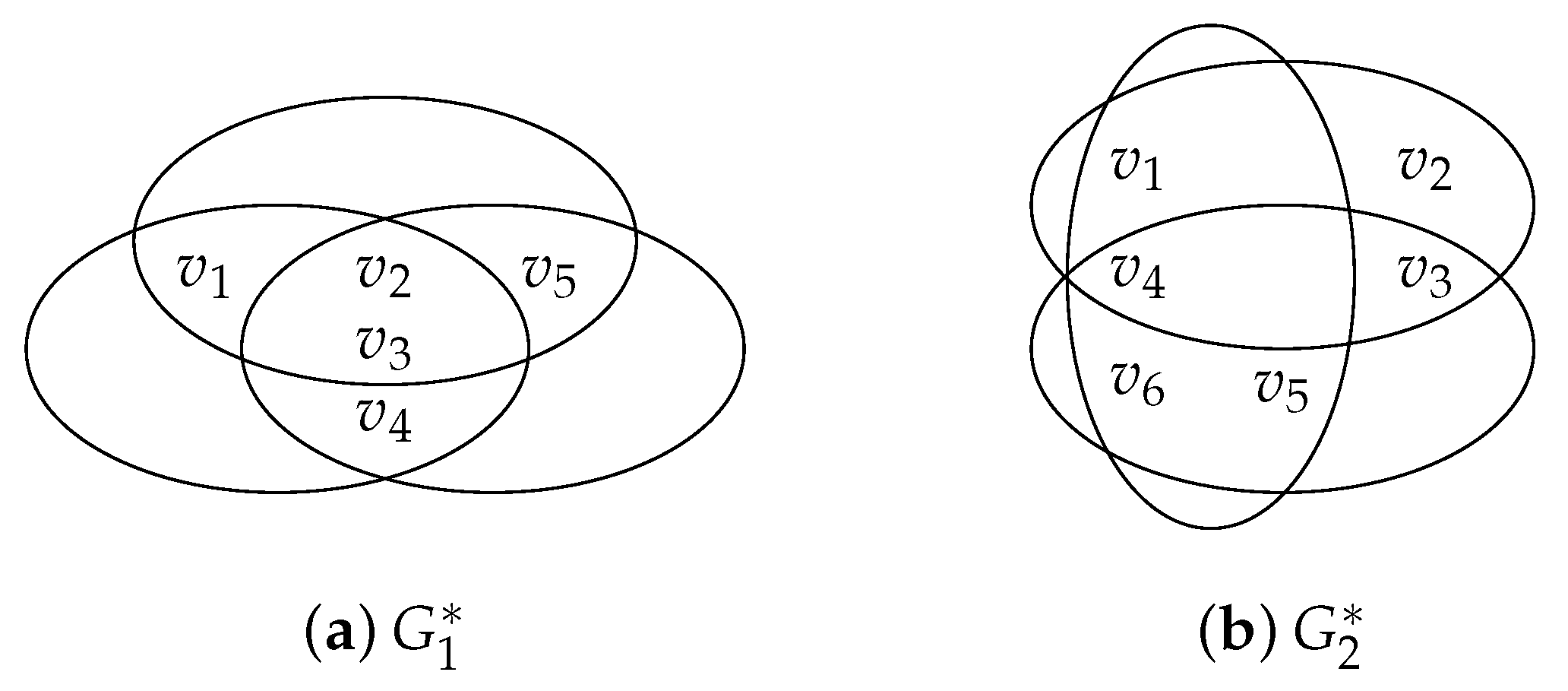
Example 1. From Figure 1a, it is clear that the intersection of any two edges of contains vertices. ThenFor (Figure 1b), the intersection of the edges and contains only vertices. Then Lemma 8. Let be a symmetric matrix with diagonal entries as 0 and be the -subset of . Then, the determinant of the matrix obtained by replacing the rows and columns that correspond to the elements of of M with zeros, and assigning -1 to the corresponding diagonal entries, is , where
Proof. For any arbitrary , the required matrix will be of the form , where is an matrix whose p-th and q-th diagonal is 1, , and all the other entries are zero. Note that we can obtain a diagonal matrix by interchanging the p-th and q-th rows of . As a result, the determinant of the matrix is equal to . □
The following proposition gives the relation between energy, coefficient of the characteristic polynomial, and the Frobenius norm of the adjacency matrix of . It directly follows from Lemmas 5 and 8.
Proposition 3. Let be a k-hypergraph with eigenvalues . Then the coefficient of of is given by