Abstract
This study utilizes the axodes invariants to derive novel hyperbolic proofs of the Euler–Savary and Disteli formulae. The inflection circle, which is widely recognized, is situated on the hyperbolic dual unit sphere, in accordance with the principles of the kinematic theory of spherical locomotions. Subsequently, a timelike line congruence is defined and its spatial equivalence is thoroughly studied. The formulated assertions degenerate into a quadratic form, which facilitates a comprehensive understanding of the geometric features of the inflection line congruence.
MSC:
53A15; 53A17; 53A25; 53A35
1. Introduction
Line geometry has an alliance with spatial locomotions and has thus found implementations in mechanism layout and robot kinematics. In locomotion, it is interested in inspecting the essential characteristics of the line path from the connotations of ruled surface. It is well known in spatial locomotions that the instantaneous screw axis ) of a movable body traces a couple of ruled surfaces, named the mobile and immobile axodes, with as its tracing line in the movable space and in the steady space, respectively. Through locomotion, the axodes slide and roll relative to each other in a specific path such that the contact amidst the axodes is permanently maintained on the length of the two matting rulings (one being in all axodes), which define the at any instant. It is essential that not only does an assured locomotion confer a rise to a unique set of axodes but the converse furthermore stratifies. This shows that, should the axodes of any locomotion be renowned, the evident locomotion can be reconstructed without knowledge of the physical features of the mechanism, their explications, given dimensions, or the manners by which they are united. There exists major literature on the topic including sundry monographs [1,2,3,4,5].
On the other hand, dual numbers have been employed to study the locomotion of a line space; and they may even serve as more effective tools for this purpose. According to the E. Study map in the theory of dual numbers, it may be concluded that there exists a bijection between the set of the dual points on dual unit sphere () in the dual 3-space and the set of all directed lines in Euclidean 3-space . By use of this map, a one-parameter set of points (a dual curve ) on can be associated with a one-parameter set of directed lines (ruled surface) in [6,7,8,9,10,11,12]. In the Minkowski three-space , since the Lorentzian metric can be positive, negative or zero. Conversely, in the Euclidean three-space , the metric is exclusively positive definite. Therefore, the kinematic and geometrical clarifications hold significant importance in [13,14,15,16,17,18,19].
In this paper, we utilized the E. Study map for investigating the kinematic-geometry of a timelike () line trajectory in one-parameter hyperbolic spatial locomotions. Then, we gained new dual versions of Euler–Savary formula (), resulting in distinct statements that are based on the axode invariants. Lastly, we explored a theoretical narration of the infliction circle of planar locomotions.
2. Preliminaries
In this section, we list notations of dual Lorentzian vectors and E. Study map (See [13,14,15,16,17,18,19]): A non-null oriented line L in Minkowski 3-space can be appointed by a point and a normalized vector of L, that is, . To have coordinates for L, one must have the moment vector in . If is reciprocal by any point , on L, this offers that is independent of on L. The two non-null vectors and satisfy that
The 6-component of and are the normalized Plűcker coordinates of L [1,2,3,4].
A dual number is a number , where , is a dual unit with , and . Thus, the set
with the Lorentzian scalar product
explain dual Lorentzian three-space . Then, a point has dual coordinates . If , the norm of is
So, if (), the vector is a (spacelike ()) dual unit vector. Then,
The dual hyperbolic, and Lorentzian (de Sitter space) unit spheres with the center , respectively, are [13,14,15,16,17,18,19]:
and
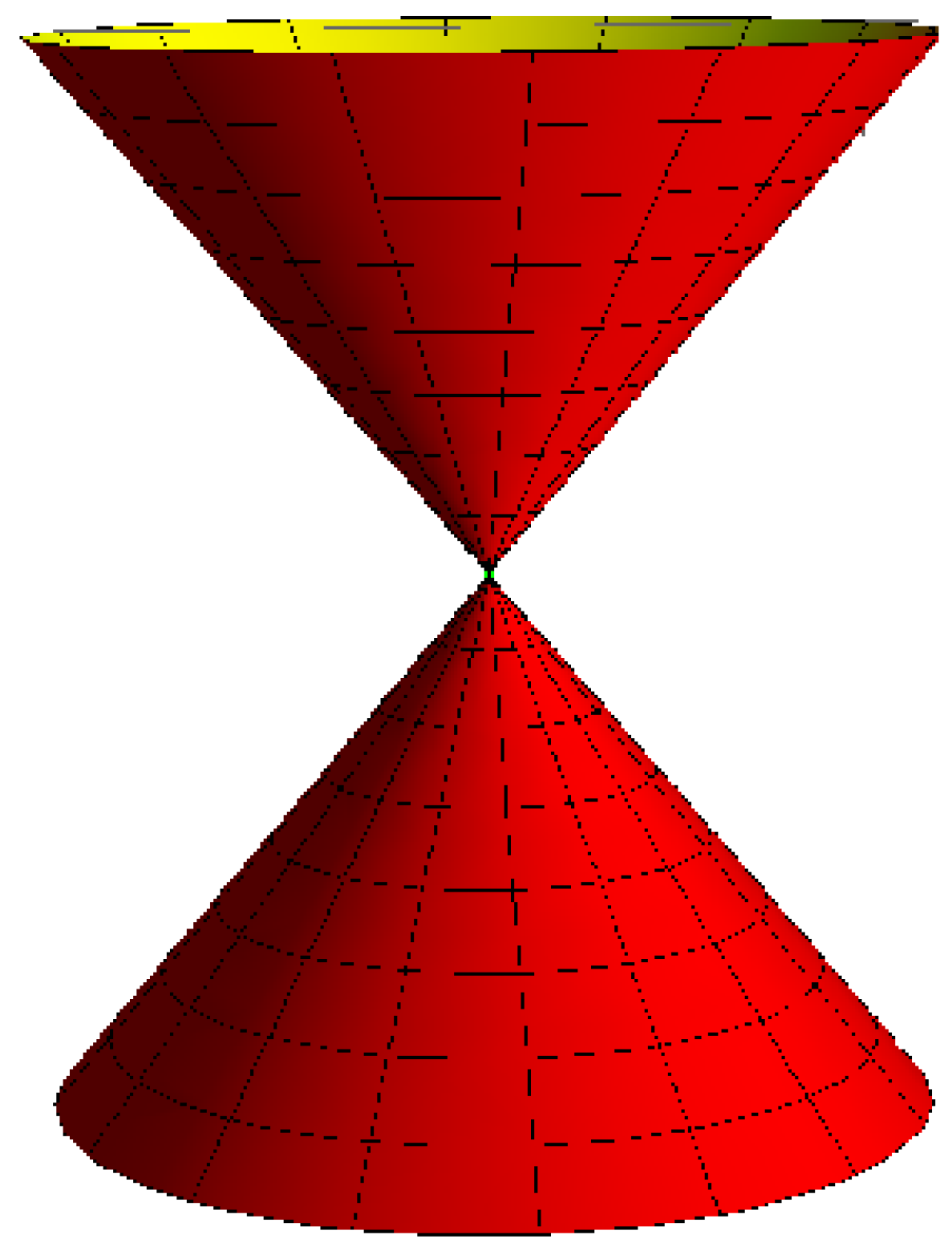
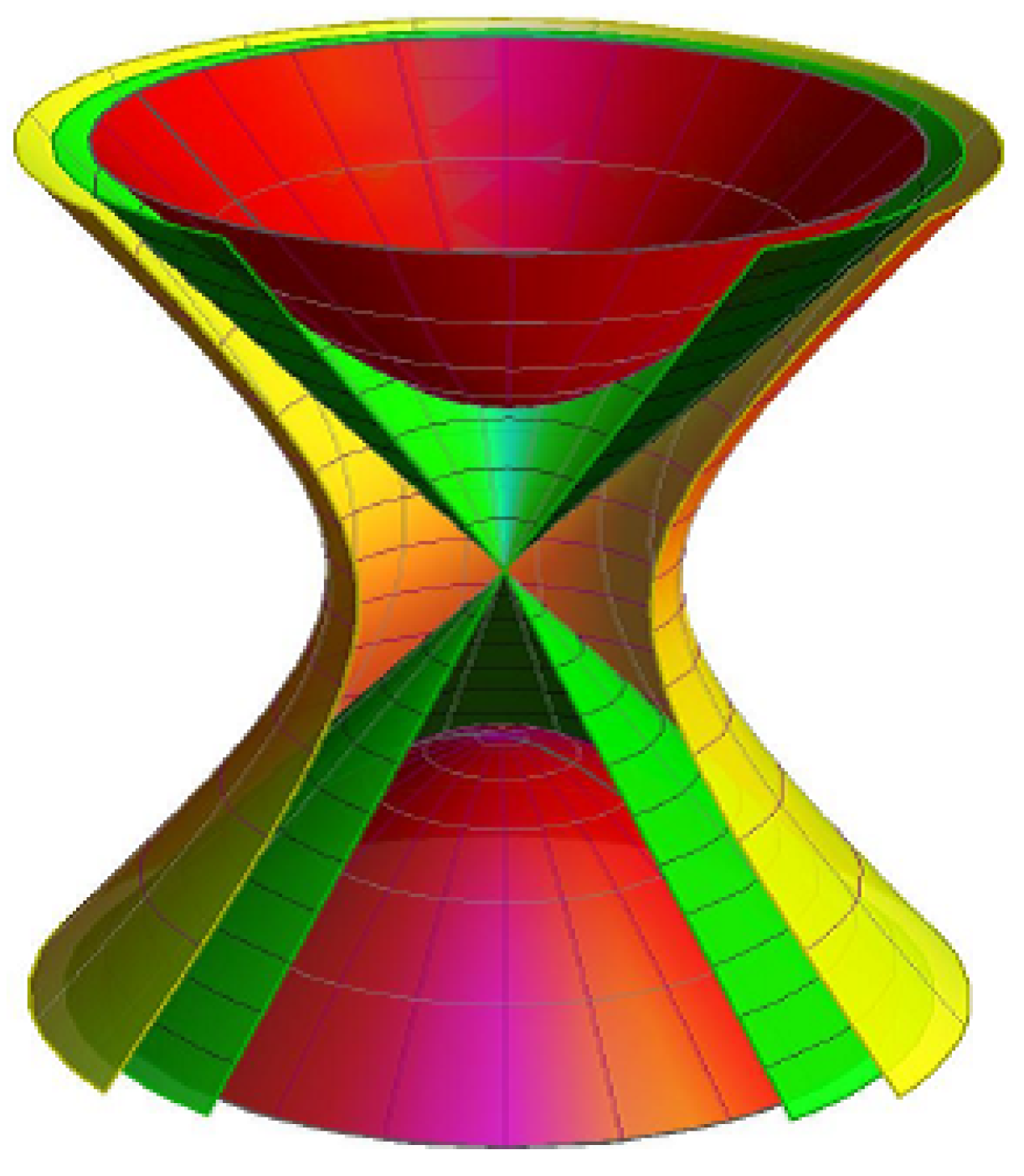
Therefore, presented here is the map provided by E. Study: the ring-shaped hyperboloid may be bijectively mapped to the set of lines. Similarly, the common asymptotic cone can be bijectively mapped to the set of null-lines. Lastly, the oval-shaped hyperboloid can be bijectively mapped to the set of lines (see Figure 1). Then, a regular curve on matches a ruled surface in . Also, a regular curve on matches a or ruled surface in [13,14,15,16,17,18,19].
Figure 1.
The dual hyperbolic and dual Lorentzian unit spheres.
Hyperbolic Dual Spherical Locomotions
Let us address that and are two hyperbolic centered at the origin in . Let = {;()}, and ;(),,} be two orthonormal dual frames of and , respectively. If we say is stationary, whereas the elements of are functions of a real parameter (say the time). Then, we say that moves on This is a one-parameter Lorentzian dual spherical () locomotion and will signalize by . Via the E. Study map, the hyperbolic and matches the hyperbolic line spaces (mobile) and (immobile), respectively. Therefore, is the mobile hyperbolic line space against the hyperbolic immobile space , because at any instant the instantaneous screw axis () of creates a mobile axode in , and immobile axode in . Therefore, we insert an orthonormal dual frame ;(),,}, which is specified as follows: we set , as the and as the joint central normal of two disjoint screw axes. A third dual unit vector is designated as . Then,
The set is the relative Blaschke frame, and and are intersected at the joint striction (central) point of the axodes . The dual arc length of is
is the first order asset of the locomotions . We set to represent , since they are equal to each other. Then,
is the distribution parameter () of the axodes. Via the E. Study map: for the locomotion the axodes have the in mutual; that is the mobile axode osculating with the immobile axode along the in the first order (compared with [1,2,3]). For the Blaschke formulae with respect to , we find
where is the Darboux vector, and
is the radii of curvature of the axodes . , and are the curvature (construction) functions of the axodes. By setting , the Disteli-axes () of the axodes is
where is a Lorentzian dual angle (radius of curvature) among and . Then,
Equation (14) is a novel dual hyperbolic version of the formula (Compared with [1,2,3]). Via the real and the dual parts, respectively, we attain
and
Equation (15) in conjuction with (16) are new Disteli formulae () for the axodes of the locomotion .
Now let us assume that is stabilized in . Then,
where
is the relative Darboux vector. is the relative radii of curvature; , and are the rotational angular speed and translational angular speed of the locomotion , as well they are both invariants in kinematics, respectively. As a result, the following corollary can be stated:
Corollary 1.
For the locomotion , at any instant , the pitch is
In this study, we deviate from the exclusive use of translational locomotion, namely when . Moreover, we impose the condition of excluding zero divisors, denoted by . Consequently, our investigation will solely focus on non-torsional locomotions, ensuring that the axodes associated with these motions are non-developable ruled surfaces, characterized by .
3. Timelike Line with Particular Trajectories
Through the locomotion , any fixed line connected with the mobile space -space, normally, creates a ruled surface () in the immobile -space. Then,
where
The velocity and the acceleration vectors of , respectively, are
and
So, we have
The dual arc-length of the dual curve is
Then, the of is
Moreover, the Balschke frame is
where
The dual unit vectors , , and are three simultaneous alternately orthogonal lines in Minkowski three-space . Their joint point is the central point on the ruling . is the mutual orthogonal to and , and it is named the central tangent of () at the central point. The trace of is the striction curve. The line is the central normal of at . So, the Blaschke formulae are
where is the Darboux vector, and
is the radii of curvature of . The tangent vector of is
which is a (a ) curve if (). , and are construction parameters of the ruled surface . Under the hypothesis that , we specify the as follows:
where is radii of curvature through and . Then,
Further, we may have
where is the dual curvature, and is the dual torsion of the dual curve . Via Equations (26) and (31), is a tangential developable surface if and only if , that is,
which represents that the developable conditions of a line trajectory are only founded on , and h.
Theorem 1.
For the locomotion , the line trajectory has torsional rulings at those instants at which it belongs to the quadratic line complex pointed out by Equation (35).
In any quadratic line complex the lines of this complex passing through a point mostly form a quadratic cone. Primarily, for some points, this cone reduces to a couple of planes. Such points are the singular points of the line complex. Thus, when is a cone, the conditions are , and define a quadratic line congruence given by the mutual lines of the two quadratic line complexes (, and ).
Theorem 2.
For the locomotion , the set of lines correlated with the mobile axode are rulings of a quadratic cone in . Moreover, this family of lines belong to a quadratic line congruence.
3.1. The Euler–Savary and Disteli Formulae
In the context of planar locomotions, the formula associates the locus of a point to its curvature center and is the main ingredient for a graphical structure producing one assigned the other [1,2,3]. In 1914, Disteli [20] assigned a curvature axis for the ruling of a ruled surface and extended the planar formula to spatial locomotions. However, the of a line trajectory had been acquired in [4,5,6,7,8,21], around inscription should be refind as follows: we shall define a new manner to have by dual function approximations. Thus, we request the line , which at a steady dual angle from a steady line . So, if is the dual angle of ( ), and (), then
For is steady up to the 2nd order at , we have
and
Hence, for the 1st order , and for the 2nd order . Therefore, will be steady in the 2nd approximation if and only if is the of (), that is,
Corollary 2.
() is a steady- ruled surface if and only if .
Via this corollary, and based on Equation (34), it can be concluded that the rulings of () are the constant dual angle with respect to the if and only if . Therefore, the ruled surface () is generated locally by a one-parameter hyperbolic spatial locomotion with pitch along the steady , This locomotion is performed by the line , which is positioned at a constant hyperbolic distance and a constant angle relative to . This indicates that the striction curve of () can be classified as either a or cylindrical helix. The corollary shown below can be used to identify the circumstances of steady .
Corollary 3.
() is a steady ruled surface if and only if
Furthermore, from Equations (32) and (39), we find that
So, is the osculating circle of . Further, it can be seen from Equations (22), (27) and (32) that
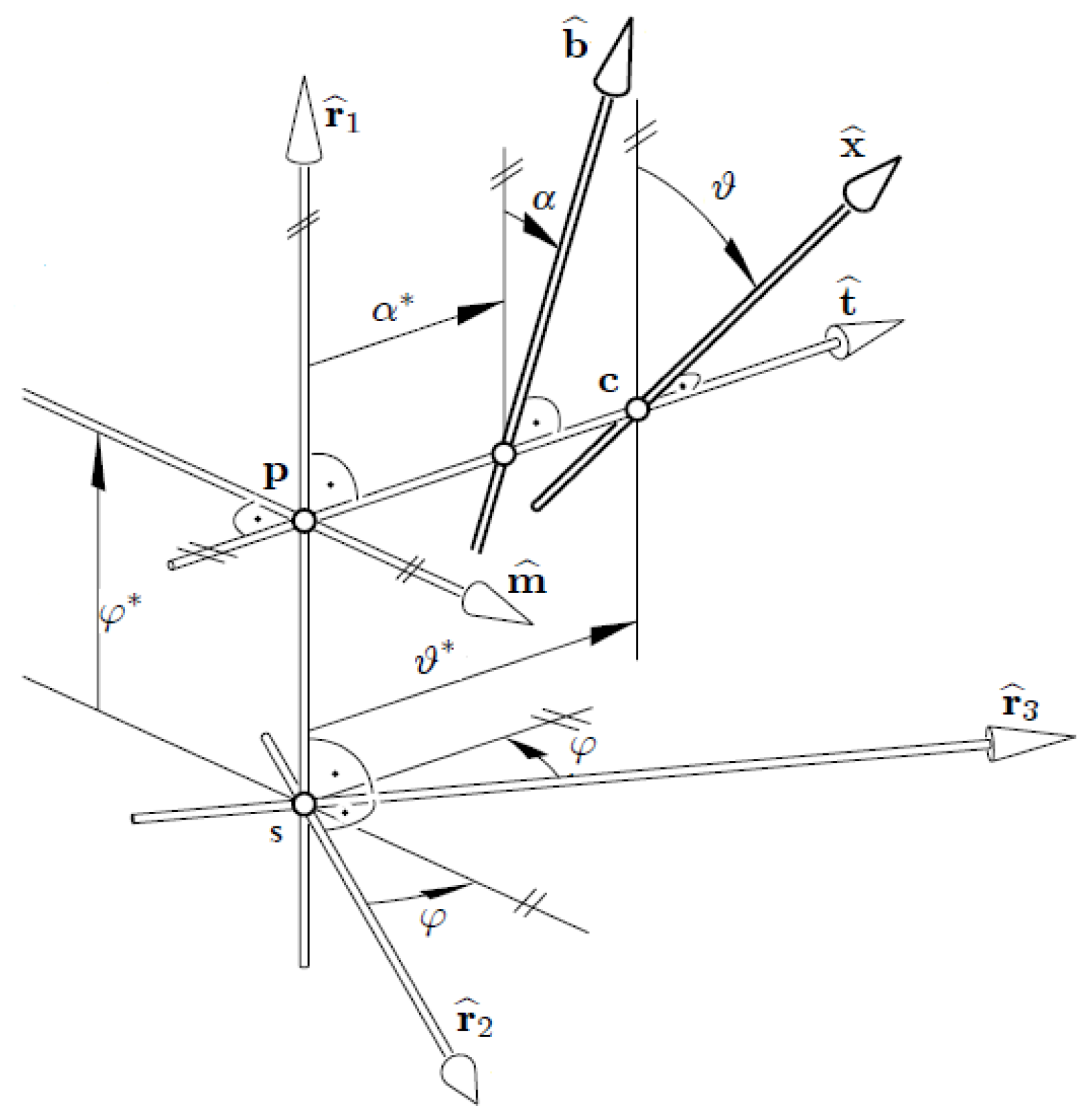
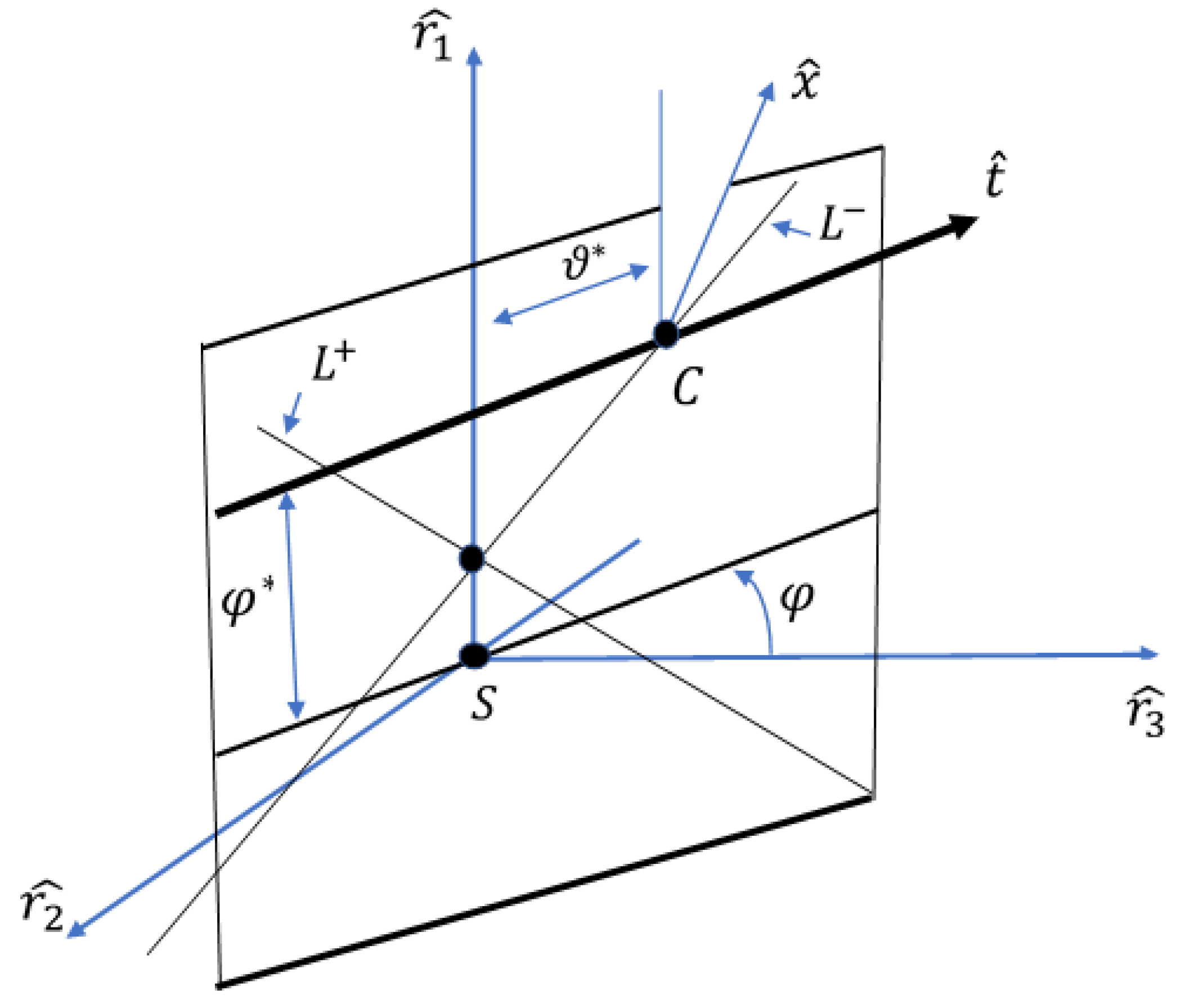
Then, all , and belong to a line congruence whose focus line is the line . This can be realized as follows: we set with respect to the set by its intercept distance , control on the and the angle , control with respect to . We set the dual angle , which realizes the attitude of over . These dual angles are all estimated relative to the (see Figure 2). The following governs the signals: and are via the right-hand screw rule with the thumb pointing on ; the sense of is such that , and , are explained with the thumb in the direction of the . Since is a dual unit vector, we can write out the components of in the following form:
Therefore, the Blaschke frame of can be written as
Comparably, the is
Substituting from Equations (23) and (45) into the third term of Equation (38) yields
Into Equation (46) we substitute from Equation (43) to obtain
Equation (47) is a new hyperbolic formula that fastens a ruled surface and its osculating circle in terms of the dual angle as well as the second order invariant . Via the real and the dual parts, respectively, we obtain
and
Equation (48) with (49) are novel in the context of one-parameter hyperbolic spatial locomotions. The former equation establishes a relationship between the positions of the line in the space and the denoted as . Based on the information provided in Figure 2, the presence of the signal (+ or −) in Equation (49) indicates whether the positions of the are located on the positive or negative direction of the mutual central normal .
Figure 2.
Position relation of and .
However, we can derive the Equation (47) as follows: the hyperbolic radii of curvature can be written as (see Figure 2):
Then, we have
Substituting Equation (51), into Equation (33), with awareness of (43), we obtain
After some algebraic manipulations, we find
as asserted. Moreover, in the case of axodes, it is possible to derive a second dual formulation of the formulae in the following manner: from Equations (22) and (43), one finds facilely
Moreover, from Equation (44) we have
A simple computation offers that
and
The amalgamation of Equations (44) and (57) leads to
Then, by equating the coefficients of , and in Equations (56) and (58), we have
and
Substituting this into the left hand side of Equation (53), one finds
Finally, by substituting into Equation (59), one obtains
Equation (62) presents a novel hyperbolic dual variant of the widely recognized formula in the context of conventional spherical kinematics, as discussed in References [1,2,3,4,5,6,7,8,9,21]. This narrative provides a link between the two axodes in the locomotion of . It should be noted that the striction point is the origin of the relative Blaschke frame, denoted as , see Figure 2.
3.2. A Timelike Line Congruence
We present a method for locating a line congruence. Therefore, from the real and the dual parts of in Equation (43), respectively, we obtain
and
Since , we possess the system of linear equations in (i = 1, 2, 3):
The coefficient matrix of unknowns (i = 1, 2, 3) is the skew-adjoint matrix
and thus its rank is 2 with , and (k is an integer). The rank of the augmented matrix
is also 2. Hence, this system possesses an infinite number of solutions that are specified by
Since can be arbitrary, we may then put . In this affair, we have
which is the base (director) surface of the line congruence. Let be a point on the directed line . We can write that
where . Given that and are two independent variables, it may be said that is a line congruence in -space in general. If we define and as the parameter for locomotion, then can be considered as a ruled in -space. As a result, the director surface represented by Equation (69) is constrained by the striction curve on (), which implies that
The curvature and torsion can be given by
Then, is a () or () cylindrical helix with the as its axis. Further, the ruled surface is
The constants h, and can control the shape of . In the case of , and , we attain
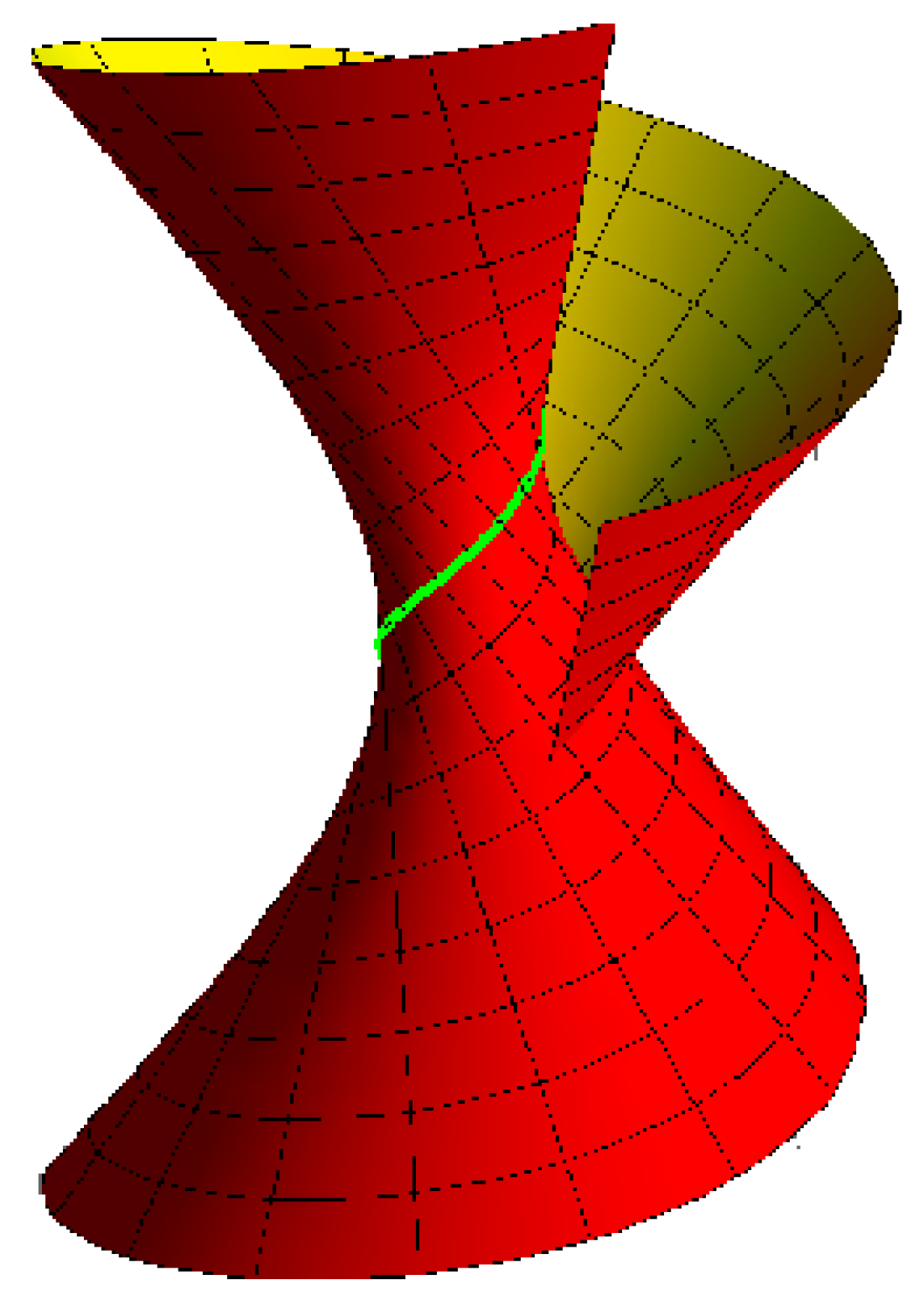
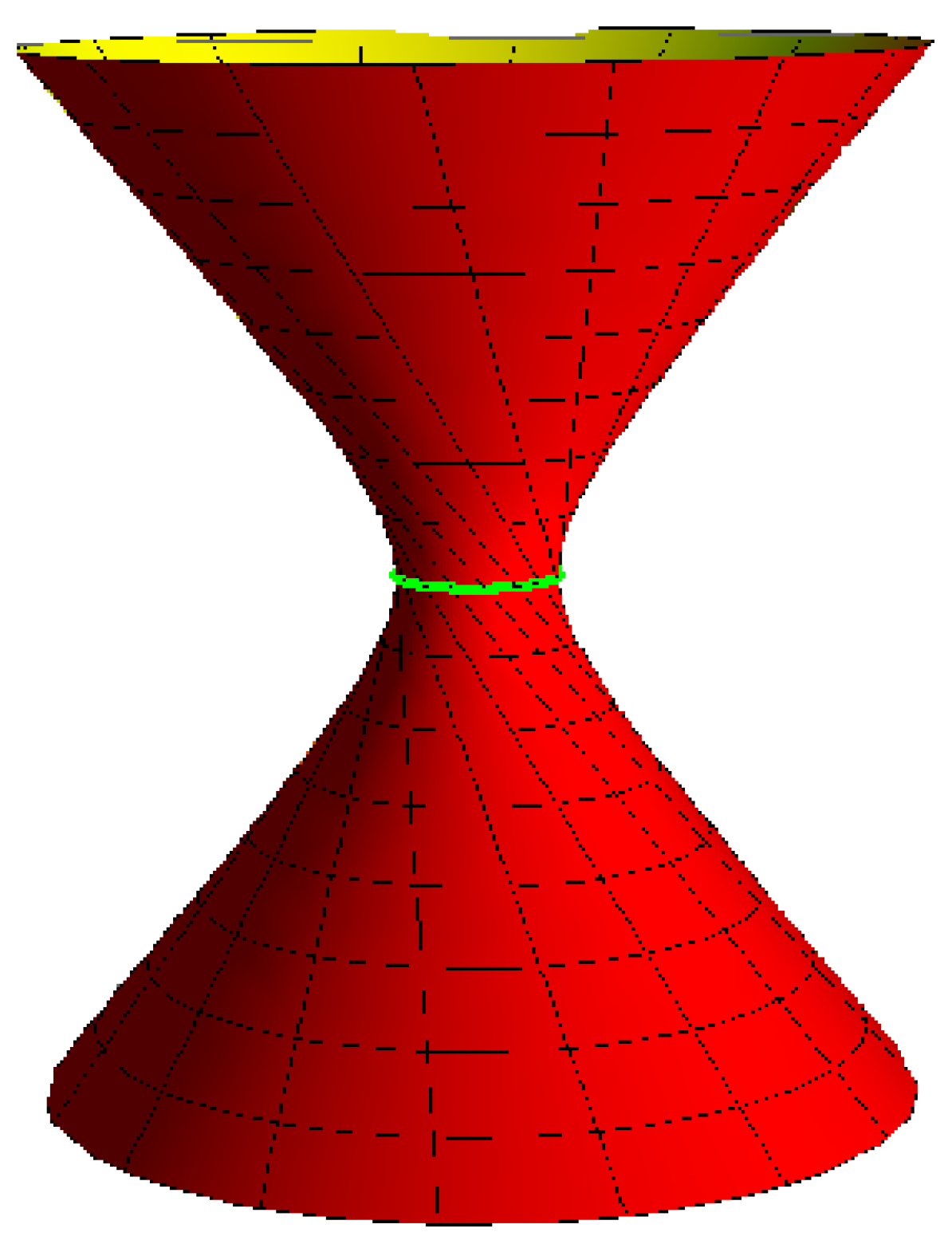
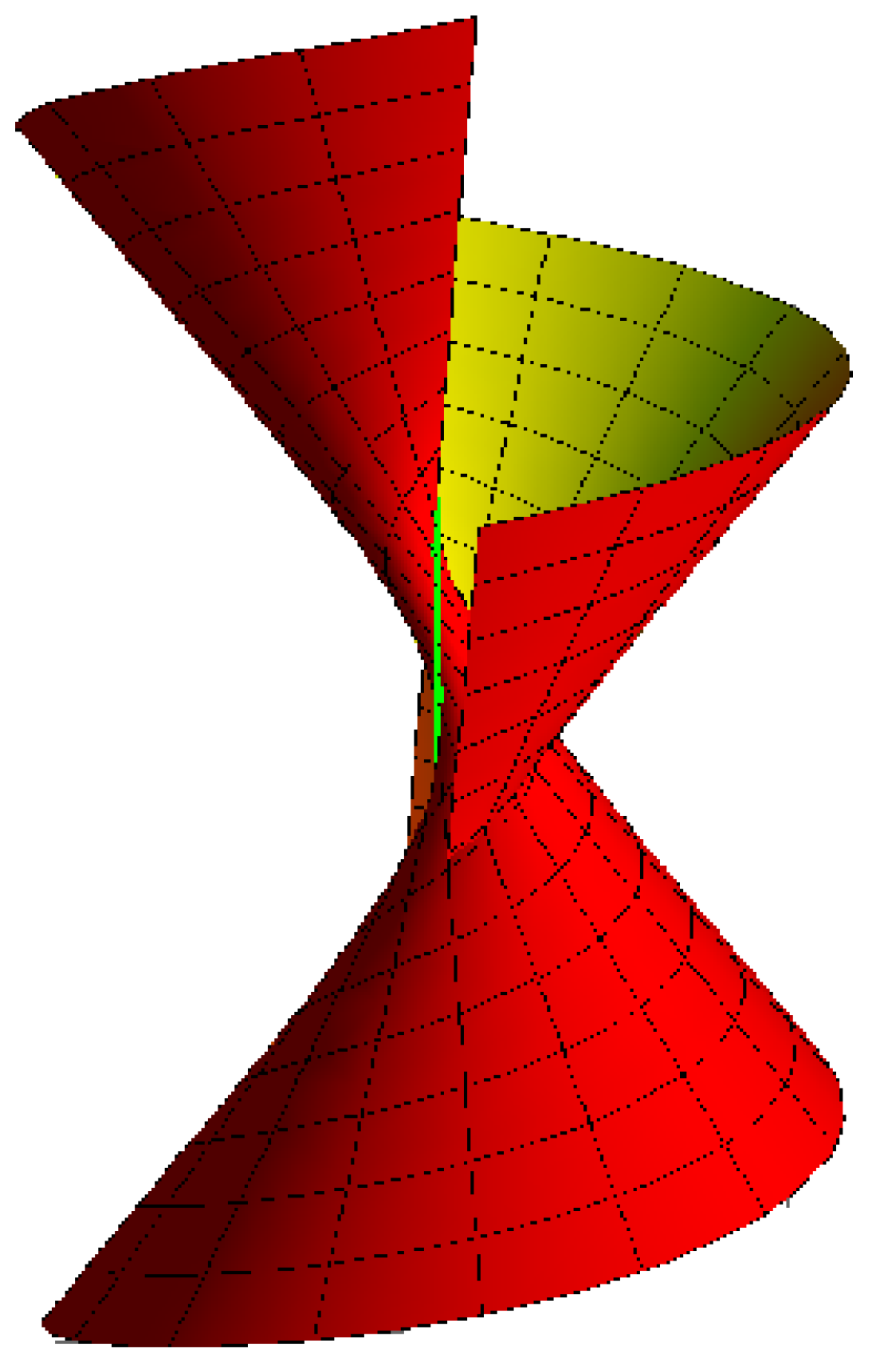
where , and . So, is a two-parameter family of one-sheeted hyperboloids. The intersection of each hyperboloid and the plane is a one-parameter family of Lorentzian cylinder : which is the envelope of . The ruled surface can be classified into 4-kinds via their striction curves:
- (a)
- Archimedes with its striction curve is a cylindrical helix for , , , and (Figure 3).
Figure 3. Archimedes. - (b)
- Lorentzian sphere with its striction curve is a circle for , , , and (Figure 4).
Figure 4. Lorentzian sphere. - (c)
- helicoid with its striction curve is a line for , , , , and (Figure 5).
Figure 5. helicoid. - (d)
- cone with its striction curve is a stationary point for , , , and (Figure 6).
Figure 6. cone.
4. Inflection Timelike Line Congruence
This section demonstrates how a line congruence, which we refer to as an inflection line congruence, is the spatial equivalent of the inflection circle of planar kinematics. Hence, we establish that the locus comprising the entire set of lines exhibiting a dual geodesic curvature of zero corresponds to the spatial equivalent of the circle of inflection for planar locomotios. Then, from Equation (34), we have
Furthermore, from Equations (30) and (33), we can see that
In this particular case, the lines denoted as , , and represent the Blaschke frame. These lines intersect at the striction point of the ruled surface denoted as . Based on the Equations (31) and (76), it may be inferred that the striction curve is a curve, that is, . Given that , we can derive the ODE from Equation (29). Furthermore, by setting , the solution of the ODE is obtained as follows:
Since , from Equation (29) we have the ODE, . Moreover, we may write , and the solution of the ODE becomes
for dual constants , , and . Since , we obtain , and , it shows that can be specified by
for dual constants , and satisfying . We make change the coordinates by
Then, turns into
for . Let be a point on , then
which yields that
So, if we take , h signaling the pitch of the locomotion . Then,
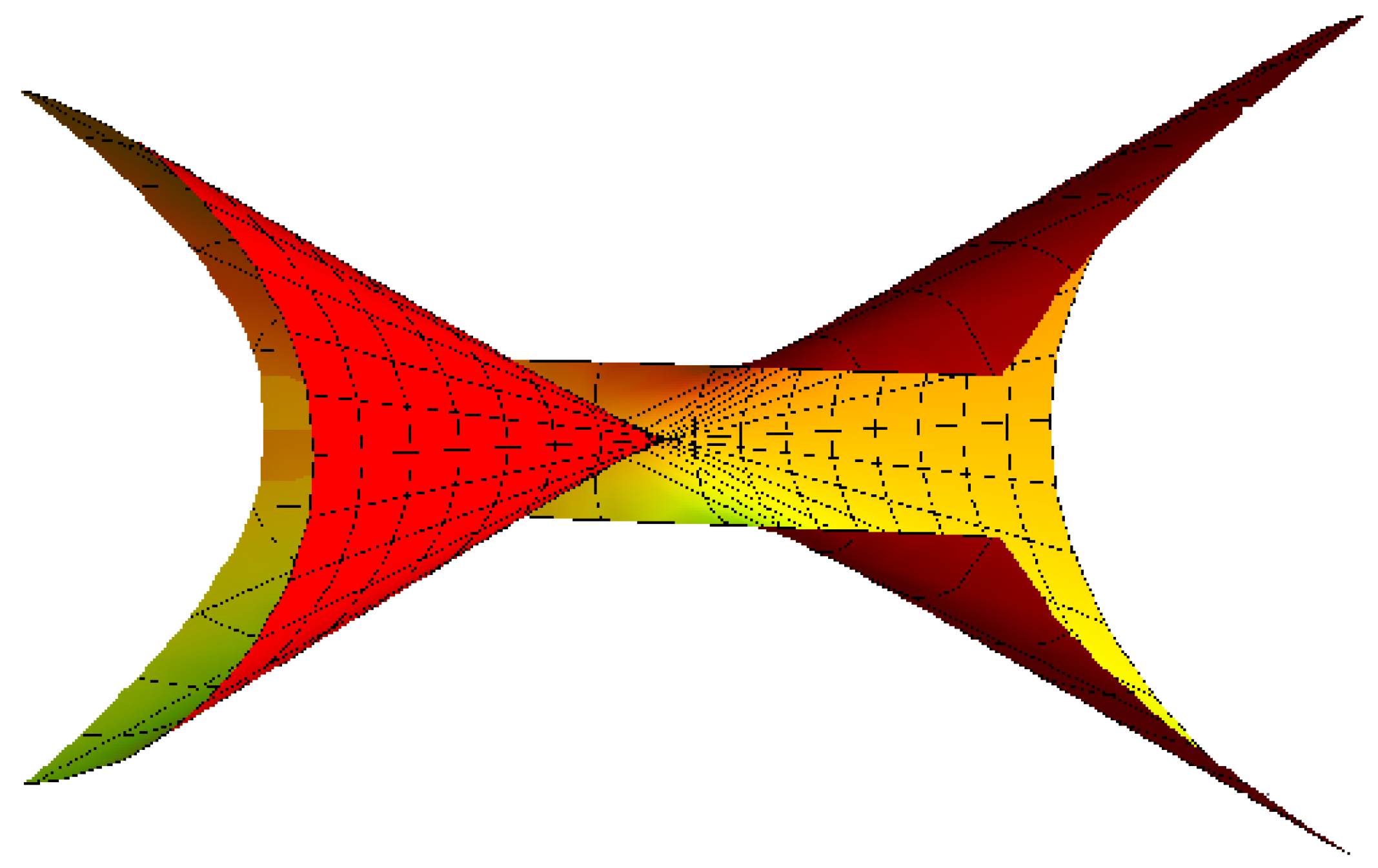
which is a one-parameter family of helicoid of the second kind; where for , , , a member is shown in (Figure 7).
Figure 7.
A helicoid of the 2nd kind.
For more kinematic analysis of the inflection line congruence , from Equation (30) we can write the equation
which is a curve of third degree. The real part of Equation (84) recognizes a inflection cone for the real spherical part of and is pointed out by
The mutual lines of the inflection cone with a real hyperbolic unit sphere concentrated at the head of the cone defines a hyperbolic spherical curve. Furthermore, there is a plane for each line, united with each ruling of a inflection cone, given by the dual part of Equation (84):
where and are the hyperbolic direction cosines of the line and and are specified by
where . Equation (84) represents a third-degree equation, it follows that the line congruence can be traced by all common lines of two cubic line complexes, as described by Equations (85) and (86). Therefore, the Plückerian coordinates that describe the lines may be expressed by the Equations (21), (85) and (86). In general, these coordinates represent a ruled surface in the fixed space . However, from Equations (63), (64), (85) and (86), respectively, we obtain
and
If the Equation (88) is resolved with respect to , we have
Hence, from Equations (89) and (90), we attain
Equation (91) is linear in and of the line . Hence, the lines in a stationary direction within the -space can be found on the plane denoted as . As illustrated in Figure 8, the angle serves to differentiate the central normal . Consequently, Equation (91) yields two lines and within the plane : (where and align with the inflection circle in planar locomotions). Also, if the distance on the central normal from the is taken as the independent parameter, we obtain
We remark that (or will alternate its place if is realized as a various value, but constant. Further, the plane is various if of (or has various value, but consent. Consequently, the collection of all lines , and pointed out by Equation (92) is an inflection congruence for all values of .
Figure 8.
inflection line congruence.
However, the ownerships of this inflection congruence are clarified as follows: via Figure 8, the two lines and are intersected on the at distance . For the orientation , these lines passing through the origin ( and attain the minimal slope is For , the lines are parallel and located on opposite sides of the at a specific distance . Furthermore, if the Equation (88) is resolved with respect to , we obtain
By substituting Equation (93) into Equation (63), we find
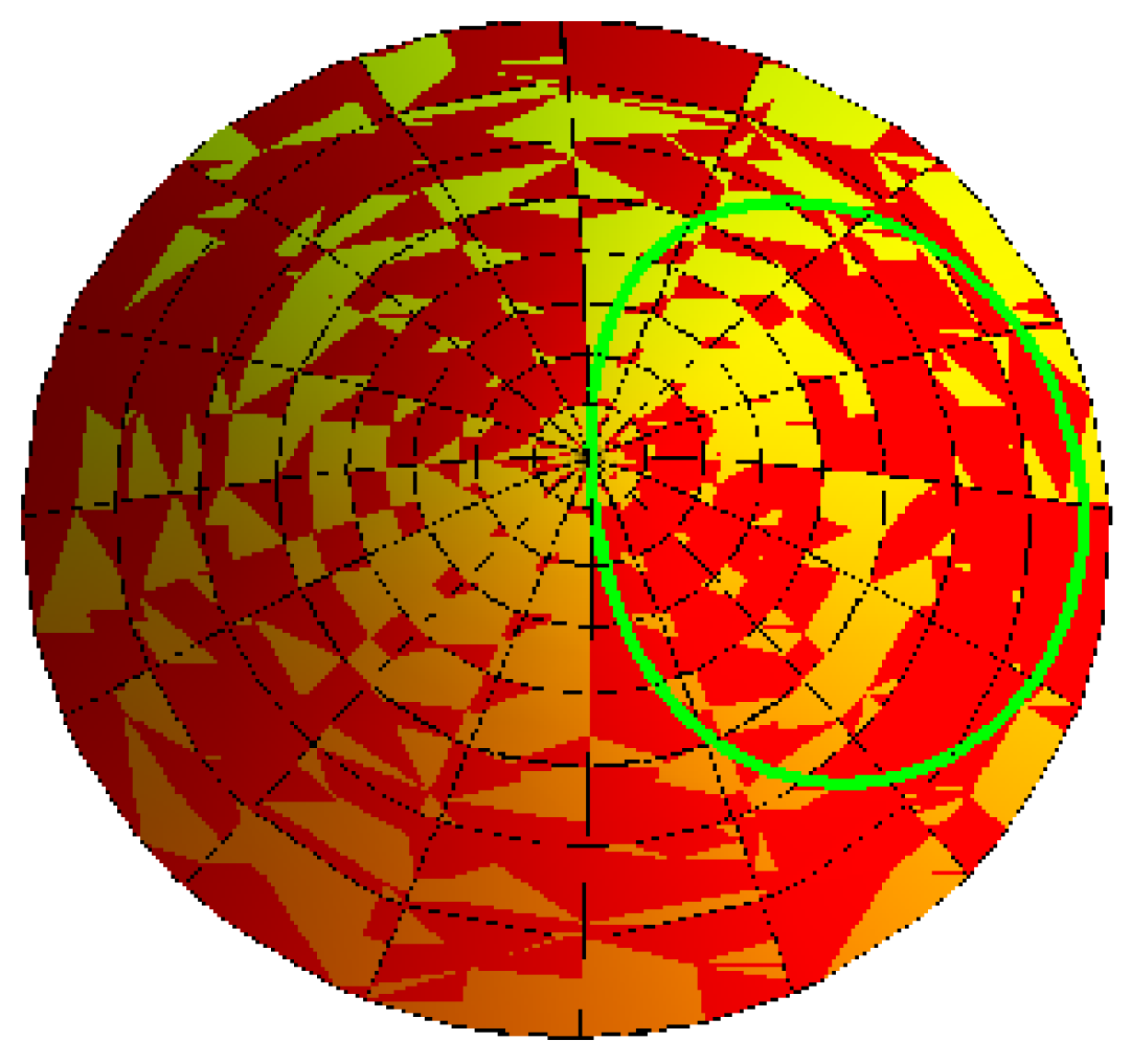
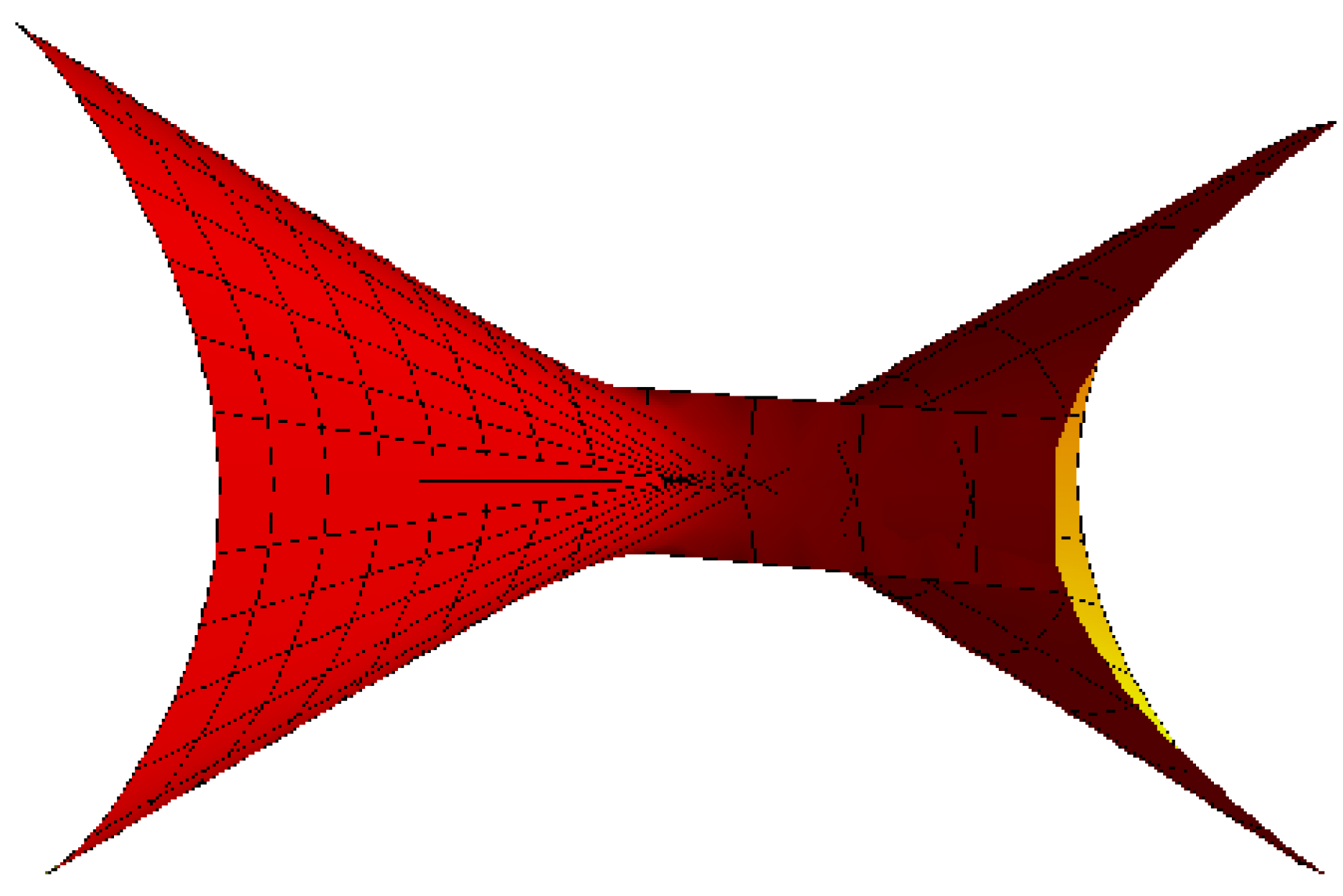
Equation (94) appears the inflection curve of the hyperbolic spherical part of the locomotion . Further, from the Equations (70), (90) and (94), we obtain
For epitome, via Equations (94) and (95), we have
- (1)
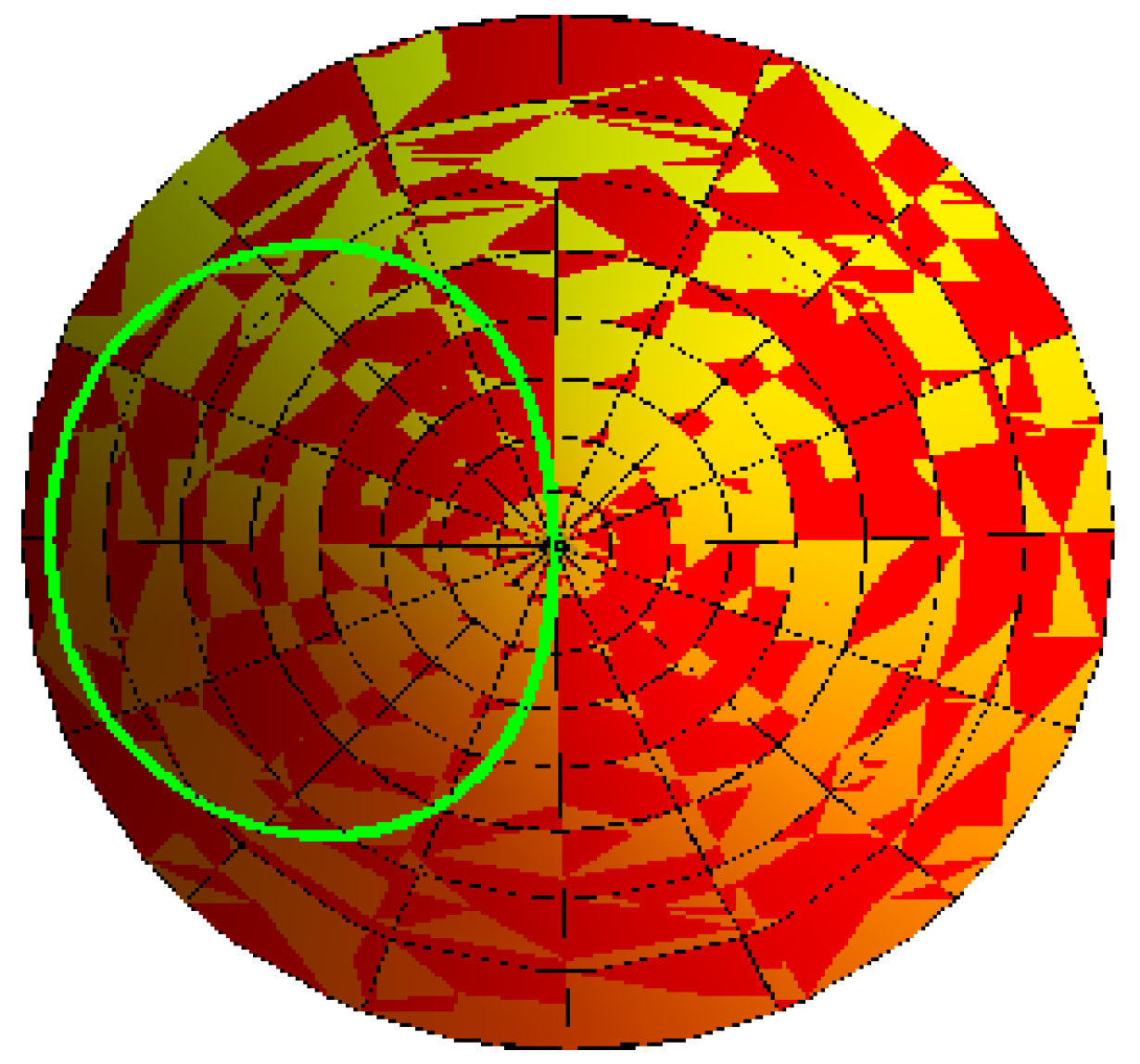
- Hyperbolic spherical inflection curve with its inflection timelike ruled surface: for , , (Figure 9 and Figure 10).
Figure 9. Hyperbolic inflection curve with .
Figure 10. Inflection ruled surface. - (2)
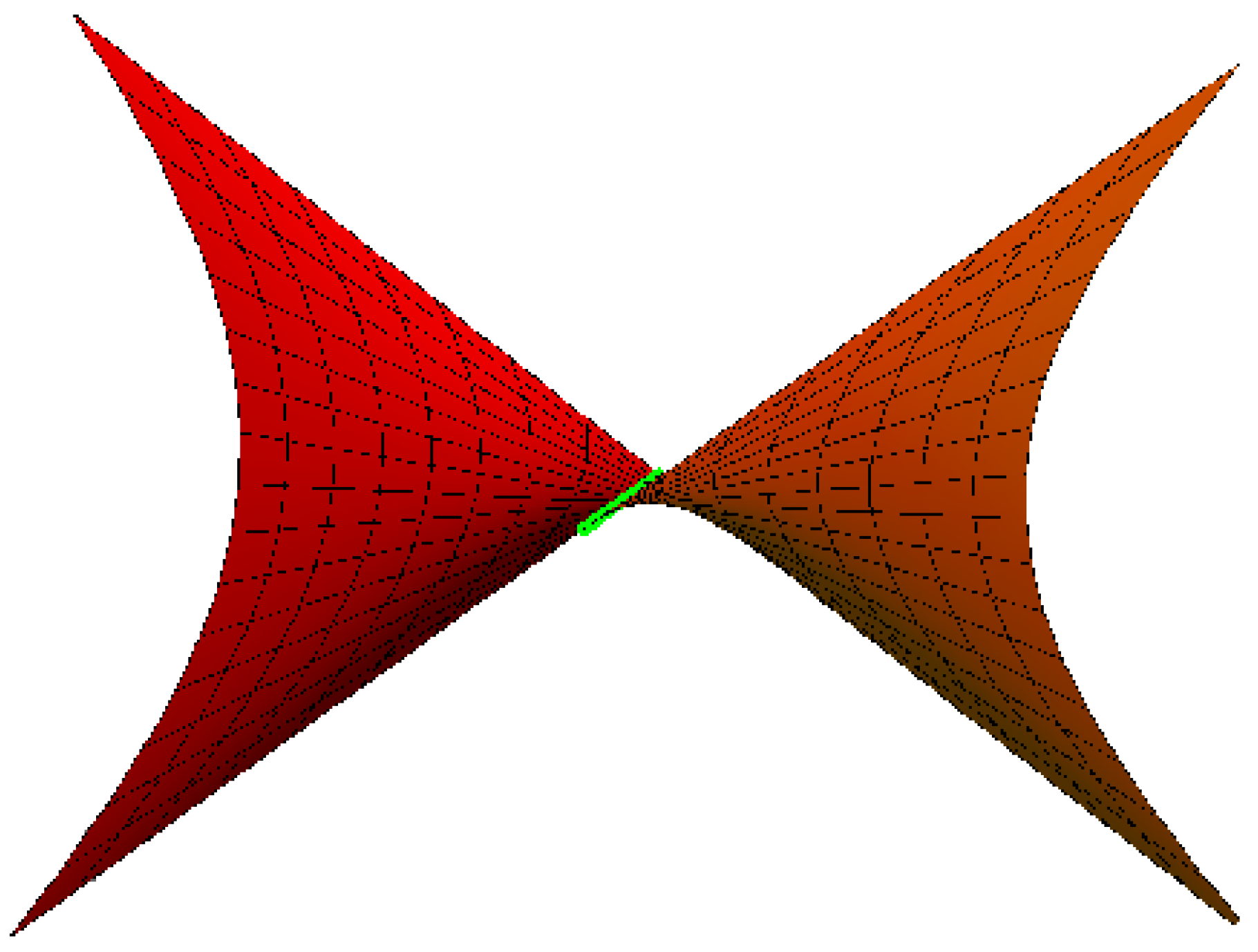
- Hyperbolic spherical inflection curve with its inflection ruled surface: for , , (Figure 11 and Figure 12).
Figure 11. Hyperbolic inflection curve with .
Figure 12. Inflection ruled surface.
5. Conclusions
In this paper, the kinematic-geometry of a trajectory is defined in terms of the axodes invariants of one-parameter hyperbolic spatial locomotion. Then, a new of a line-trajectory is gained in distinct forms. In symmetry with the plane and spherical locomotions, a new congruence is pointed and investigated in detail. The main result in this paper is to generalize the formula in the hyperbolic locomotion. We introduced the dual angle, which is represented in Equation (36), and we restricted it to be steady up to 2nd order. Hence, we obtain Equation (39), which introduces the . Through this equation, we gave corollary 2 and corollary 3. Also, we reformulated formula for the axodes in a new form given in Equations (47)–(49). Furthermore, in Section 4 of this work, we defined and studied inflection line congruence, which is the spatial synonym of the inflection circle of planer kinematics. The findings presented in this study have the potential to make significant contributions to the field of spatial locomotion, as well as offer practical applications in the domains of mechanical mathematics and engineering. In our forthcoming research, we intend to explore various applications of the kinematic-geometry of one-parameter hyperbolic spatial locomotion in conjunction with singularity theory, submanifold theory, etc., in [22,23,24,25] in order to derive additional novel findings and properties.
Author Contributions
Conceptualization, R.A.A.-B. and A.A.A.; methodology, R.A.A.-B. and A.A.A.; software, R.A.A.-B. and A.A.A.; validation, R.A.A.-B.; formal analysis, R.A.A.-B. and A.A.A.; investigation, R.A.A.-B. and A.A.A.; resources, R.A.A.-B.; data curation, R.A.A.-B. and A.A.A.; writing—original draft preparation, R.A.A.-B. and A.A.A.; writing—review and editing, A.A.A.; visualization, R.A.A.-B. and A.A.A.; supervision, R.A.A.-B.; project administration, R.A.A.-B.; funding acquisition, A.A.A. All authors have read and agreed to the published version of the manuscript.
Funding
This research was funded by Princess Nourah bint Abdulrahman University Researchers Supporting Project number (PNURSP2023R337).
Data Availability Statement
Our manuscript has no associated data.
Acknowledgments
The authors would like to acknowledge the Princess Nourah bint Abdulrahman University Researchers Supporting Project number (PNURSP2023R337), Princess Nourah bint Abdulrahman University, Riyadh, Saudi Arabia.
Conflicts of Interest
The authors declare that there is no conflict of interest regarding the publication of this paper.
References
- Bottema, O.; Roth, B. Theoretical Kinematics; North-Holland Press: New York, NY, USA, 1979. [Google Scholar]
- Karger, A.; Novak, J. Space Kinematics and Lie Groups; Gordon and Breach Science Publishers: New York, NY, USA, 1985. [Google Scholar]
- Pottman, H.; Wallner, J. Computational Line Geometry; Springer: Berlin/Heidelberg, Germany, 2001. [Google Scholar]
- Stachel, H. On spatial involute gearing, TU Wien, Geometry Preprint No 119. In Proceedings of the 6th International Conference on Applied Informatics, Eger, Hungary, 27–31 January 2004. [Google Scholar]
- Dooner, D.; Garcia, R.G.; Martinez, J.M.R. On spatial relations to the Euler–Savary formula. Mech. Mach. Theory 2023, 189, 105427. [Google Scholar] [CrossRef]
- Abdel-Baky, R.A.; Al-Solamy, F.R. A new geometrical approach to one-parameter spatial motion. J. Eng. Math. 2008, 60, 149–172. [Google Scholar] [CrossRef]
- Ayyilidiz, N.; Yalcin, S.N. On instantaneous invariants in dual Lorentzian space kinematics. Arch. Mech. 2010, 62, 223–238. [Google Scholar]
- Figlioini, G.; Stachel, H.; Angeles, J. The computational fundamentals of spatial cycloidal gearing. In Computational Kinematics: Proceedings of the 5th International Workshop on Computational Kinematics, Duisburg, Germany, 6–8 May 2009; Kecskeméthy, A., Müller, A., Eds.; Springer: Berlin/Heidelberg, Germany, 2009; pp. 375–384. [Google Scholar]
- Turhan, T.; Ayyıldız, N. A study on geometry of spatial kinematics in Lorentzian space. Süleyman Demirel Üniversitesi Fen Bilimleri Enstitüsü Dergisi 2017, 21, 808–811. [Google Scholar] [CrossRef]
- Zhang, X.; Zhang, J.; Pang, B.; Zhao, W. An accurate prediction method of cutting forces in 5-axis áank milling of sculptured surface. Int. J. Mach. Tools Manuf. 2016, 104, 26–36. [Google Scholar] [CrossRef]
- Ekinci, Z.; Uğurlu, H.H. Blaschke approach to Euller-Savary formulae. Konuralp J. Math. 2016, 4, 95–115. [Google Scholar]
- Özyilmaz, E. Some results on space-like line congruences and their space-like parameter ruled surface. Turk. J. Math. 1999, 23, 333–344. [Google Scholar]
- Tosun, M.; Gungor, M.A.; Okur, I. On the One-Parameter Lorentzian Spherical Motions and Euler-Savary Formula. ASME J. Appl. Mech. 2007, 74, 972–977. [Google Scholar] [CrossRef]
- Gungor, M.A.; Ersoy, S.; Tosun, M. Dual Lorentzian spherical motions and dual Euler–Savary formula. Eur. J. Mech. A/Solids 2009, 28, 820–826. [Google Scholar] [CrossRef]
- Palavar, S.; Bilici, M. Dual ruled surface constructed by the pole curve of the involute curve. Int. J. Open Probl. Compt. Math. 2022, 15, 39–53. [Google Scholar]
- Rawya, H.A.; Ali, A. Geometry of the line space associated to a given dual ruled surface. AIMS Math. 2022, 7, 8542–8557. [Google Scholar] [CrossRef]
- Saad, M.K.; Ansari, A.Z.; Akram, M.; Alharbi, F. Spacelike surfaces with a common line of curvature in Lorentz-Minkowski 3-space. Wseas Trans. Math. 2021, 20, 207–217. [Google Scholar] [CrossRef]
- Inalcik, A.; Ersoy, S. Ball and Burmester points in Lorentzian sphere kinematics. Kuwait J. Sci. 2015, 42, 50–63. [Google Scholar]
- Alluhaibi, N.S.; Abdel-Baky, R.A.; Naghi, M.F. On the Bertrand offsets of timelike ruled surfaces in Minkowski 3-space. Symmetry 2022, 14, 673. [Google Scholar] [CrossRef]
- Disteli, M. Uber des Analogon der Savaryschen Formel und Konstruktion in der kinematischen Geometrie des Raumes. Z. Math. Phys. 1914, 62, 261–309. [Google Scholar]
- Önder, M.; Uğurlu, H.H.; Caliskan, A. The Euler–Savary analogue equations of a point trajectory in Lorentzian spatial motion. Proc. Natl. Acad. Sci. India Sect. Phys. Sci. 2013, 83, 163–169. [Google Scholar] [CrossRef][Green Version]
- Nazra, S.; Abdel-Baky, R.A. Singularities of non-lightlike developable surfaces in Minkowski 3-space. Mediterr. J. Math. 2023, 20, 45. [Google Scholar] [CrossRef]
- Li, Y.; Tuncer, O. On (contra) pedals and (anti)orthotomics of frontals in de Sitter 2-space. Math. Meth. Appl. Sci. 2023, 1, 1–15. [Google Scholar] [CrossRef]
- Li, Y.; Aldossary, M.T.; Abdel-Baky, R.A. Spacelike circular surfaces in Minkowski 3-Space. Symmetry 2023, 15, 173. [Google Scholar] [CrossRef]
- Li, Y.; Chen, Z.; Nazra, S.H.; Abdel-Baky, R.A. Singularities for timelike developable surfaces in Minkowski 3- Space. Symmetry 2023, 15, 277. [Google Scholar] [CrossRef]
Disclaimer/Publisher’s Note: The statements, opinions and data contained in all publications are solely those of the individual author(s) and contributor(s) and not of MDPI and/or the editor(s). MDPI and/or the editor(s) disclaim responsibility for any injury to people or property resulting from any ideas, methods, instructions or products referred to in the content. |
© 2023 by the authors. Licensee MDPI, Basel, Switzerland. This article is an open access article distributed under the terms and conditions of the Creative Commons Attribution (CC BY) license (https://creativecommons.org/licenses/by/4.0/).