
Article

Garnet Geochemistry of the Tietangdong Breccia Pipe, Yixingzhai Gold Deposit, North China Craton: Constraints on Hydrothermal Fluid Evolution


1
Hebei Key Laboratory of Strategic Critical Mineral Resources, Hebei GEO University, Shijiazhuang 052161, China
2
College of Earth Sciences, Hebei GEO University, Shijiazhuang 052161, China
3
State Key Laboratory of Geological Processes and Mineral Resources, China University of Geosciences, 29 Xueyuan Road, Beijing 100083, China
4
Institute of Earth Sciences, China University of Geosciences, Beijing 100083, China
5
Ore Deposit and Exploration Center (ODEC), School of Resources and Environmental Engineering, Hefei University of Technology, Hefei 230009, China
6
Anhui Province Engineering Research Center for Mineral Resources and Mine Environments, Hefei 230009, China
*
Authors to whom correspondence should be addressed.
Minerals 2025, 15(12), 1290; https://doi.org/10.3390/min15121290
Submission received: 3 November 2025 / Revised: 28 November 2025 / Accepted: 6 December 2025 / Published: 9 December 2025

Abstract

The Yixingzhai deposit is a giant gold system containing four cryptovolcanic breccia pipes, several of which host significant porphyry-type gold orebodies at depth. A key exploration target is the Tietangdong cryptovolcanic breccia pipe, characterized by skarn alteration in its upper zones. However, the evolution of early hydrothermal fluids and their implications for gold enrichment potential remain poorly understood. This study employs an integrated approach—combining petrography, electron probe microanalysis, laser ablation-inductively coupled plasma–mass spectrometry (LA-ICP-MS), and LA-ICP-MS elemental mapping—to analyze zoned garnets within the Tietangdong skarn, with the aim of deciphering changes in magmatic–hydrothermal composition and physicochemical conditions, as well as their influence on gold enrichment. Textural and compositional data reveal three distinct generations of garnets. Garnets from generations I and III consist of a grossular–andradite solid solution and commonly exhibits optical anisotropy. In contrast, generation II garnet is predominantly andraditic and optically homogeneous. LA-ICP-MS elemental mapping of generations I and III indicates that both generations contain significant Al and Fe, with their optical anisotropy attributed to a high degree of Fe3+/Al3+ cationic ordering. Compared to generations I and III, generation II garnet displays distinct geochemical characteristics, including enrichment in Fe, As, Sn, W, and U, patterns enriched in light rare earth elements, a positive Eu anomaly, and a wide range of Y/Ho ratios. Garnets from generations I and III crystallized under relatively high-pressure, high-temperature, and low-oxygen fugacity conditions, whereas generation II garnets formed under lower pressure–temperature conditions and higher oxygen fugacity. Moreover, concentrations of Co, Ni, and Cu increase systematically from generation I to generation III. We interpret the sharp compositional break at generation II as recording of the pulsed injection of magmatic–hydrothermal fluids, which enhanced the potential for gold mineralization. The zoning patterns in garnet provide a robust record of the temporal evolution of physicochemical conditions and fluid composition in the hydrothermal system.

1. Introduction

Garnet, as one of the principal minerals in skarn systems, is commonly employed as a tracer of hydrothermal processes. Its general chemical formula is X3Y2[SiO4]3, where the X-site represents dodecahedrally coordinated divalent cations (e.g., Mg2+, Fe2+, Mn2+, Ca2+), the Y-site represents octahedrally coordinated trivalent cations (e.g., Al3+, Fe3+, Cr3+, V3+), and the Z-site is tetrahedrally coordinated, typically occupied by Si4+ (e.g., [1,2,3,4]). The elemental zoning patterns within garnet are of significant importance for tracing the transport and enrichment mechanisms of hydrothermal fluids (e.g., [2,5,6,7,8]).
Skarn garnets primarily belong to the andradite–grossular solid-solution series, often exhibiting considerable compositional variability. This is reflected in their optical properties, which manifest as both isotropic and anisotropic characteristics [9,10,11]. Garnet in skarn frequently occurs as oscillatory twins, which are typically associated with optical anisotropy. Furthermore, isotropic and anisotropic domains often alternate, forming rhythmic zoning patterns [3]. The optical anisotropy in garnet can be attributed to two primary factors: a reduction in symmetry caused by cationic or (OH)-group substitutions in the crystal structure, and plastic deformation induced by stress (e.g., [9,10,11,12,13,14,15,16]). Advances in in situ trace element analysis and elemental mapping techniques have provided powerful tools for deciphering detailed magmatic and hydrothermal processes [17,18,19,20]. Consequently, the application of in situ trace element analysis on garnet has enabled detailed investigations into the ore-forming processes of numerous typical skarn deposits (e.g., [3,9]).
The Yixingzhai gold deposit is situated on the northern margin of the North China Craton and is a representative gold deposit within the Northeastern Shanxi gold-polymetallic metallogenic belt. Its cumulative identified gold resources exceed 110 tonnes [21]. Cryptovolcanic breccia pipes within the Yixingzhai mining district serve as critical ore-hosting structures, acting as major conduits for regional magmatic–hydrothermal activity [3] and are key targets for deep exploration. For instance, the Hewan porphyry Au system has contributed an additional 57 tonnes of Au resources [22]. The Tietangdong cryptovolcanic breccia pipe, specifically, contains skarn-cemented breccias in its upper sections, while gabbro and felsite intrusions are encountered at depth [23]. The pipe hosts economically significant gold mineralization manifested in two main styles, namely quartz vein type, and breccia-hosted type (e.g., [3,23,24,25,26,27]), making it a focal point for deep exploration (e.g., [22,23]). Therefore, investigating the Tietangdong breccia pipe is significant for deciphering the gold mineralization processes at Yixingzhai and for guiding regional gold exploration. Preliminary study of the skarn alteration within Tietangdong has identified three distinct generations of garnet with differing optical characteristics. Detailed analysis of the optical properties and geochemistry of garnet holds significant potential for reconstructing the history of hydrothermal fluid evolution within the cryptovolcanic breccia pipe.
In this study, we conducted field investigations, petrographic observations, and in situ major and trace element analyses (EPMA, LA-ICP-MS, and LA-ICP-MS elemental mapping) of garnets from the Tietangdong cryptovolcanic breccia pipe at Yixingzhai. We analyzed the optical characteristics, major and trace element compositions, and their interrelationships for different garnet generations. Furthermore, we discuss the origins of optical anomalies in garnet, their formation conditions, and the evolution of the magmatic–hydrothermal fluid. Our research demonstrates that the zoning structures of garnet within the cryptovolcanic breccia pipe can effectively track changes in magmatic–hydrothermal fluid.

2. Regional Geology

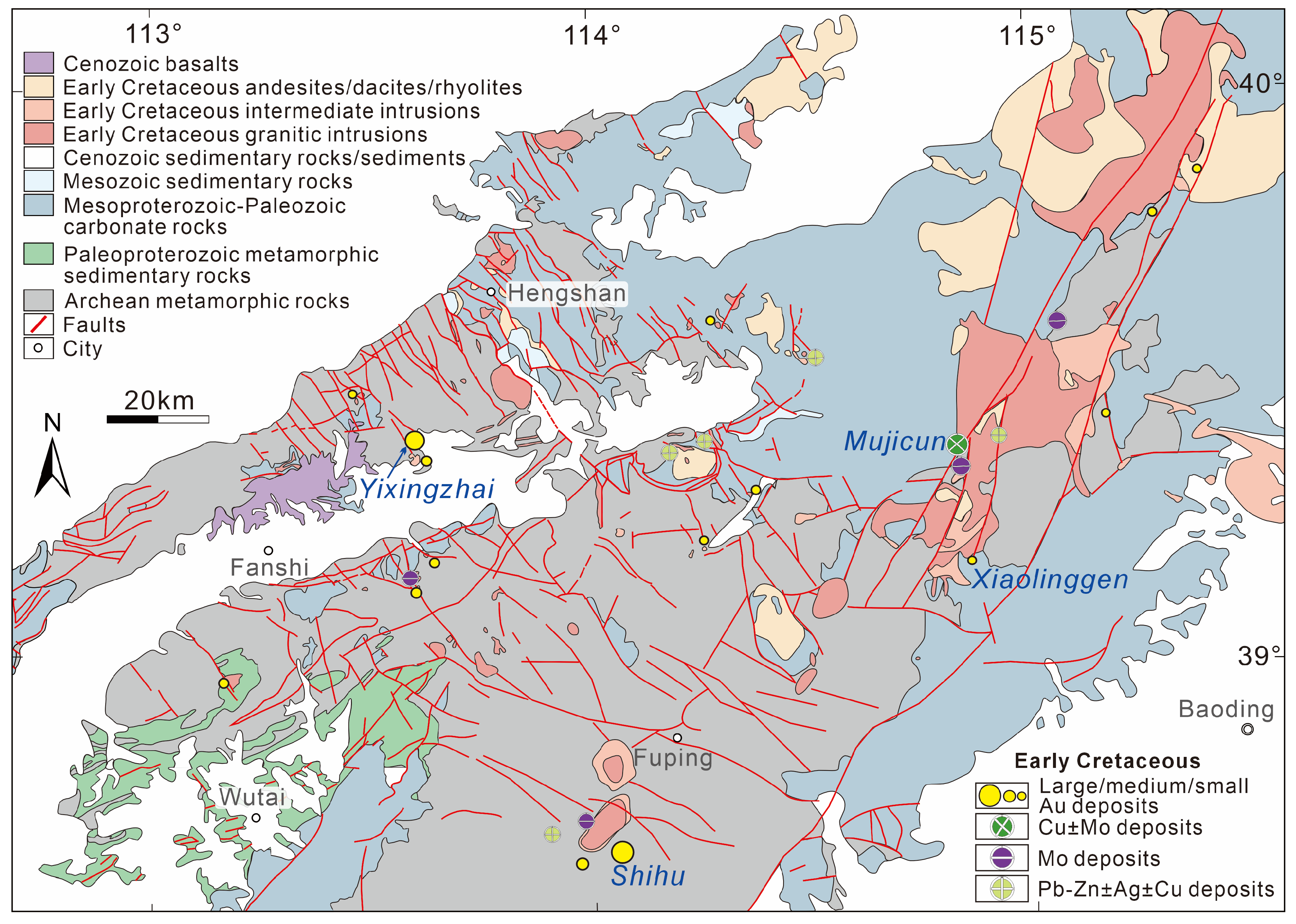
The Yixingzhai gold deposit in Fanshi County, Shanxi Province, lies within the central part of the North China Craton, on the western edge of the Mesozoic Taihang Mountains (Figure 1 and Figure 2). Its formation is closely linked to the destruction of the North China Craton [3,25,28,29,30].
Regional stratigraphy (Figure 2) comprises a sequence of exposed lithologies ranging from the Archean to the Cenozoic. The oldest rocks are Archean metamorphic rocks of the Wutai Group’s Zhujiafang Formation, which predominantly consist of Neoarchean hornblende granulite, hornblende plagioclase gneiss, biotite plagioclase gneiss, and plagioclase amphibolite [22]. Paleoproterozoic metamorphic sedimentary rocks are represented by the thick carbonate and siliceous units of the Hutuo Group [32], as well as low-grade metamorphic clastic–carbonate assemblages of the Wutai Group, which are notable for a basal tillite [33]. The Mesoproterozoic to Paleozoic sequence is characterized by carbonate and clastic lithologies, including dolomite, limestone, shale, sandstone, and siltstone. The Mesozoic strata are a complex continental volcanic-sedimentary succession primarily composed of terrigenous clastic rocks and intermediate-to-felsic volcanic rocks. This series is tectonically and genetically linked to silver–gold mineralization [34]. Overlying these are the Cenozoic strata, which include Neogene basalt of the Fanshi Formation and Quaternary unconsolidated sediments.
The regional tectonic framework is dominated by deep, northeast–east (NEE)- and northwest (NW)-trending faults. The NEE-trending faults are characterized by low-angle, layer-parallel shear zones resulting primarily from compression. In contrast, the NW-trending deep faults were formed by vertical crustal movements during the Yanshanian period and later exhibited transtensional characteristics due to subsequent tectonic influences. These two fault sets intersect within the basement, forming a crust-cutting structural framework that provides the tectonic conditions for Mesozoic magmatic activity and silver–gold polymetallic mineralization [22].
The region contains intrusive, subvolcanic, and extrusive magmatic rocks from the pre-Wutai, Wutai, Lüliang, Yanshanian, and Himalayan periods [29]. Among these, Yanshanian magmatism is the most closely associated with the area’s mineralization. The Yanshanian magmatic rocks primarily consist of dioritic complexes, acidic rocks, and derivative differentiated acidic, intermediate, and basic dikes. Early Cretaceous magmatic and volcanic rocks include granitic and intermediate intrusions, as well as andesites, dacites, and rhyolites (Figure 2). Cenozoic magmatic activity resulted in the formation of basalts (Figure 2). The region’s mineral resources include gold, copper, molybdenum, and silver (Figure 2).

3. Deposit Geology

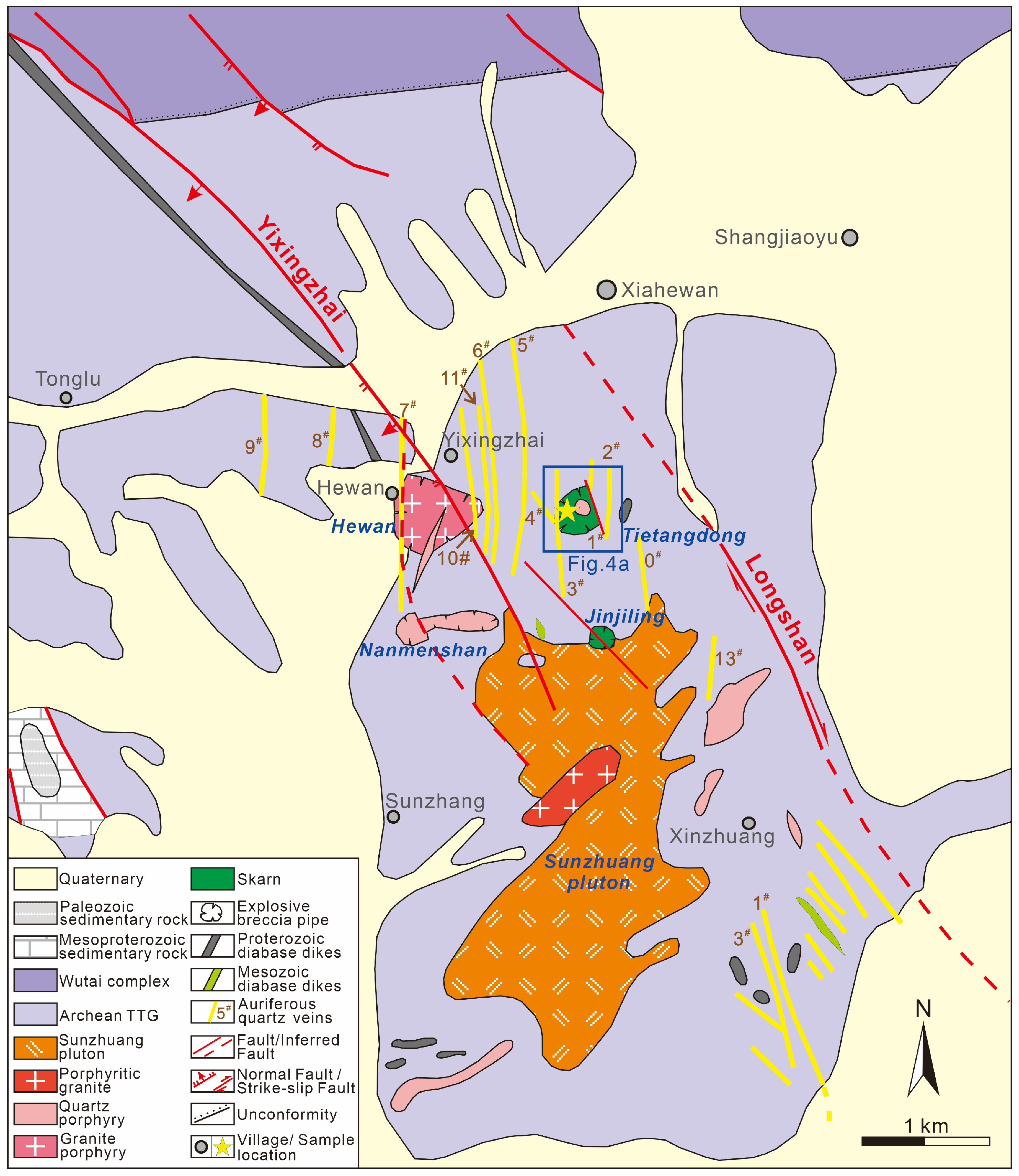
The basement of the Yixingzhai mining area is composed of Archean tonalite–trondhjemite–granodiorite (TTG) gneisses, which are intruded by northwest-trending Proterozoic diabase dikes. The Archean TTG is overlain by Mesoproterozoic and Paleozoic sedimentary rocks, which are mainly found in the southwestern part of the mining area, with minor remnants preserved within collapse breccia pipes [3]. The primary faults within the mining area are the northwest-trending Yixingzhai and Longshan faults [24,35,36]. Their derivative north–northwest-trending faults serve as the main controlling structures for both rock and mineralization, with gold-bearing quartz veins commonly distributed along these faults [29]. Mineralization-related magmatic rocks consist of Early Cretaceous intermediate-felsic intrusive and subvolcanic rocks. The Sunzhuang quartz monzonite pluton, which is closely associated with mineralization, is located in the south-central part of the mining area. It is composed of pyroxene diorite, quartz monzodiorite, and granite, with a zircon U-Pb age of 134 ± 1 Ma [26]. Cretaceous granitic porphyry, quartz porphyry, felsite, diorite porphyrite, and diabase porphyrite, occurring as small stocks and dikes, are widely distributed throughout the mining area. The Yixingzhai gold deposit contains four cryptovolcanic breccia pipes (Figure 3): the Hewan, Nanmenshan, Jinjiling, and Tietangdong pipes, with the last being the most representative [37]. The Tietangdong breccia pipe is composed mainly of skarn breccia, quartz porphyry, and felsite [27,37]. LA-ICP-MS U-Pb dating of zircon from the quartz porphyry and felsite yielded an age of 141 ± 1 Ma [37] and 139.1 ± 0.7 Ma [23], respectively. Garnet from massive skarn and skarn breccia yielded LA-ICP-MS U-Pb ages ranging from 138.1 ± 0.6 Ma to 140 ± 2 Ma [23,37].
The Yixingzhai gold deposit is characterized by multiple ore genesis types, including porphyry, quartz vein, altered rock, breccia, and skarn types [37,38], with porphyry and quartz vein types being the most significant. The Yixingzhai Gold Mine is an underground operation that utilizes shaft and tunnel development, with shrinkage stoping and cut-and-fill as the primary methods; it yielded approximately 1.5 tonnes of gold in 2020. The gold-bearing quartz veins are arranged in a roughly north–south direction, with a higher density in the west and a lower density in the east (Figure 3). They are predominantly simple monovein-type structures, with minor compound veins and stockworks. The veins are typically 500–2000 m long (Figure 3), and are steeply dipping. The porphyry-type mineralization is best represented by the Hewan large altered porphyry gold orebody, which has an additional gold resource of over 57 tons [22]. The gold mineralization intensity within the Hewan porphyry decreases outwards from the center. The altered porphyry is highly fractured and is filled with numerous fine veinlets of sulfides and quartz. These veinlets are associated with intense pyrite–sericite alteration on their margins [22].

4. Tietangdong Cryptoexplosive Breccia Pipe

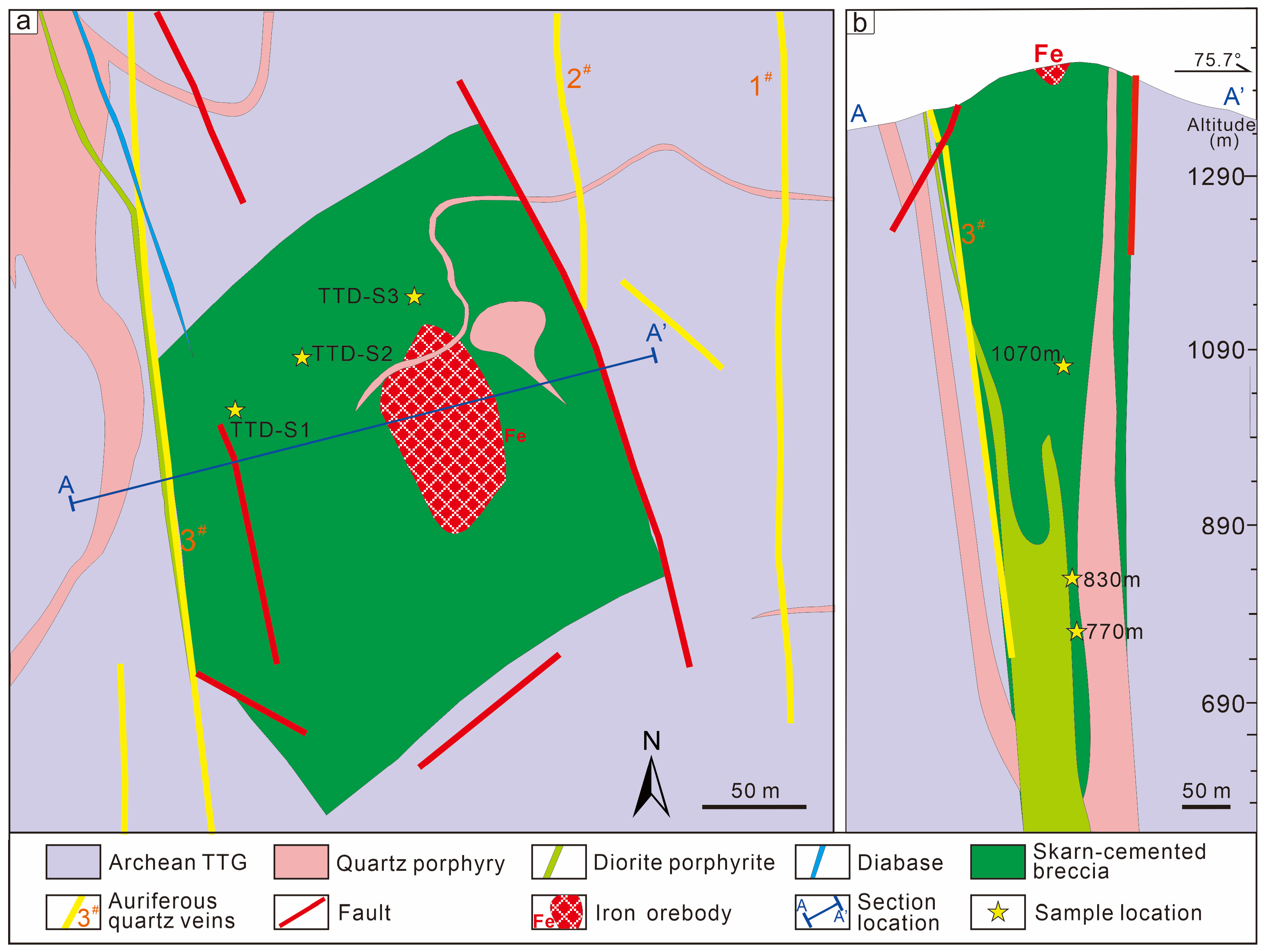
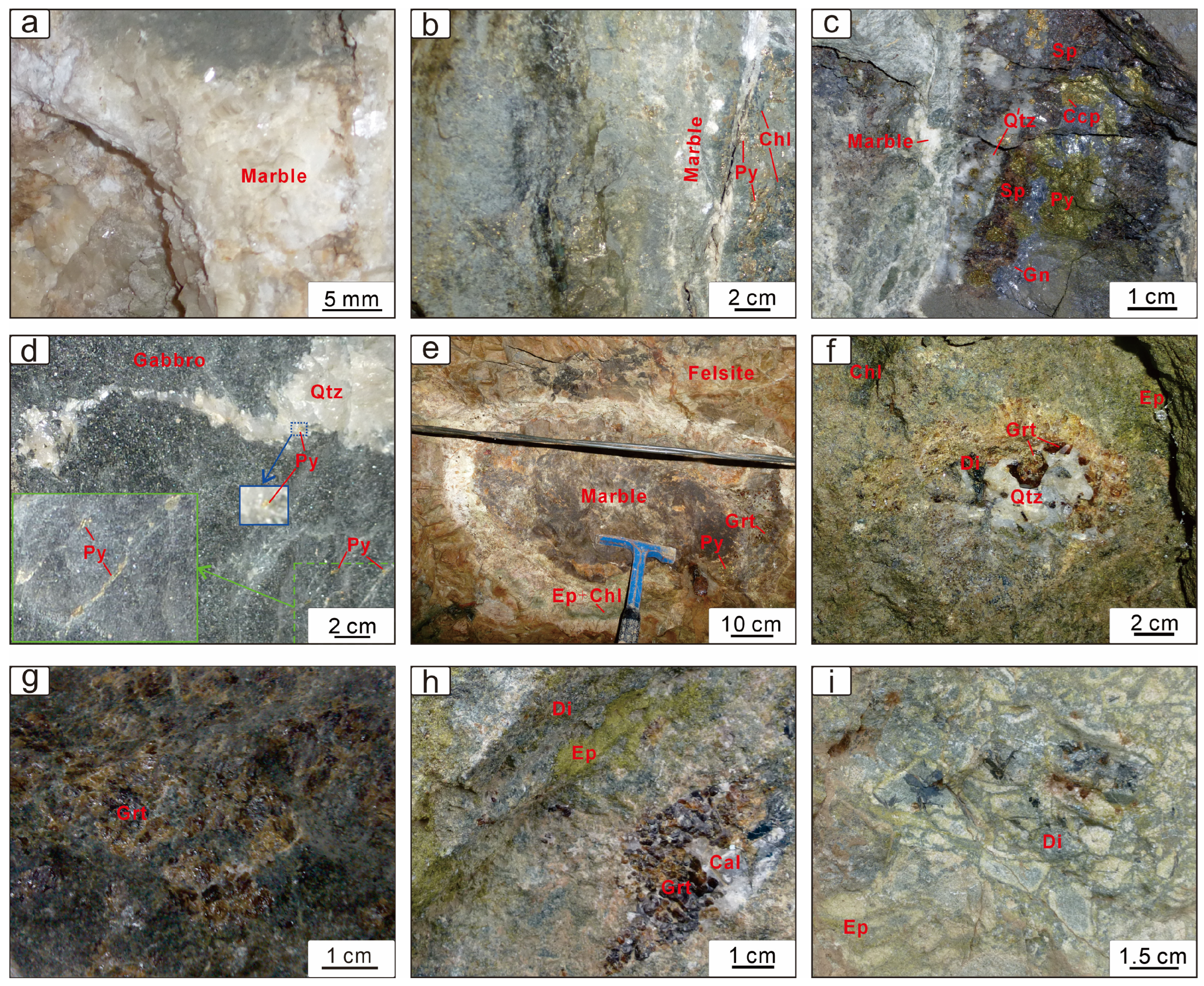
The Tietangdong cryptovolcanic breccia pipe is exposed in the central part of the mining area, located at the intersection of three fault systems (Figure 4a). It covers a surface area of approximately 0.05 km2, exhibits a funnel-shaped, pipe-like morphology, and dips at an angle greater than 80° [3]. The breccia pipe exhibits a vertically zoned lithological profile [23]. The 510 m level is characterized by silica-cemented gneiss breccia, while the 770 m level consists of marble with chlorite–pyrite alteration (Figure 5a,b) and local sulfide–quartz veins (Figure 5c). The 830 m level exposes gabbro intruded by pyrite and quartz–pyrite veins (Figure 5d). Skarn development is prominent at the 1070 m level along the felsite–marble breccia contact, marked by an assemblage of garnet, epidote, chlorite, and pyrite (Figure 5e). Furthermore, euhedral garnets are present within local epidote skarn at this level (Figure 5f). An outer annular structure surrounding the surface expression of the pipe is infilled with quartz porphyry, while an inner annular zone hosts gold mineralization [3]. The core of the pipe at its top is characterized by a magnetite and specularite iron ore body (Figure 4). Towards the pipe’s margins, the lithology transitions inward from fractured and cataclastic rock to cryptovolcanic breccia cemented by skarn mineral associations. The breccia clasts consist of limestone and TTG, among others [3], while the skarn mineral associations include garnet, diopside–epidote, and diopside–garnet–epidote (Figure 5g–i).

5. Samples and Analytical Methods

The garnet samples collected in this study were all obtained from the Tietangdong cryptoexplosive breccia pipe (Figure 3). The lithology of the sample is garnet skarn (TTD-S2). The specimen measures approximately 6 × 8 × 5 cm. This study utilized an UOP UPT203i polarizing microscope (Chongqing HeavyZhongguang Industrial Co., Ltd., Chongqing, China) with transmitted and reflected light to characterize the petrographic features of garnet, while electron probe microanalysis (EPMA) and laser ablation-inductively coupled plasma-mass spectrometry (LA-ICP-MS) were employed to determine its chemical composition.
Major element measurements in garnet were performed using a JEOL JXA-8230 electron probe micro-analyzer (EPMA; Japan Electron Optics Laboratory Co., Ltd., Tokyo, Japan) at the Hebei GEO University, Shijiazhuang, China. The operating conditions were 15 kV accelerating voltage and a beam current of 20 nA. The beam diameter ranged from 2 to 5 um. Relatively short counting times of 20 s on peak and 5 s on background, suitable for determining concentrations of major elements, were used. Matrix corrections were performed by the ZAF procedures [39].
The analyses of the garnets were carried out at the Microarea Analysis Laboratory of Ore Deposit and Exploration Center (OEDC), School of Resources and Environmental Engineering, Hefei University of Technology. The laser ablation system used for the analysis was the Photon Machines Analyte HE (Photon Machines, Omaha, NE, USA), equipped with a Coherent 193 nm ArF excimer laser (Coherent Corp., Pittsburgh, PA, USA) and coupled with an Agilent 7900 ICP-MS (Agilent Technologies, Santa Clara, CA, USA). Laser ablation surface mapping was performed in line-scan mode, with each scan line parallel and consistent in width with the laser beam diameter. The line-scan laser beam diameter was set to 30 μm, and the stage translation speed was 30 μm/s. The laser repetition rate was 10 Hz, and the laser energy density was maintained at 2–3 J/cm2. Approximately 40 s of spot ablation was performed on the external standard sample NIST610 at the beginning and end of the sample scanning process. For detailed analytical methods and procedures, refer to [17].
A total of 29 point analyses were performed using EPMA and LA-ICP-MS on garnets from different generations. Based on the discrepancies in the optical properties of the garnet, three distinct generations of garnet were identified (refer to Section 7.1 Garnet optical anomaly). In situ analytical points were selected from the central regions of the garnet grains within each generation, avoiding the margins and inclusions. These data can be found in Supplementary Material S1. Additionally, one-laser ablation surface mapping analyses were conducted on garnets of varying generation. Garnet end-member calculation was based on [40]. The figures in this paper were created using the CorelKit (20250920) software [41].

6. Results

6.1. Garnet Petrography

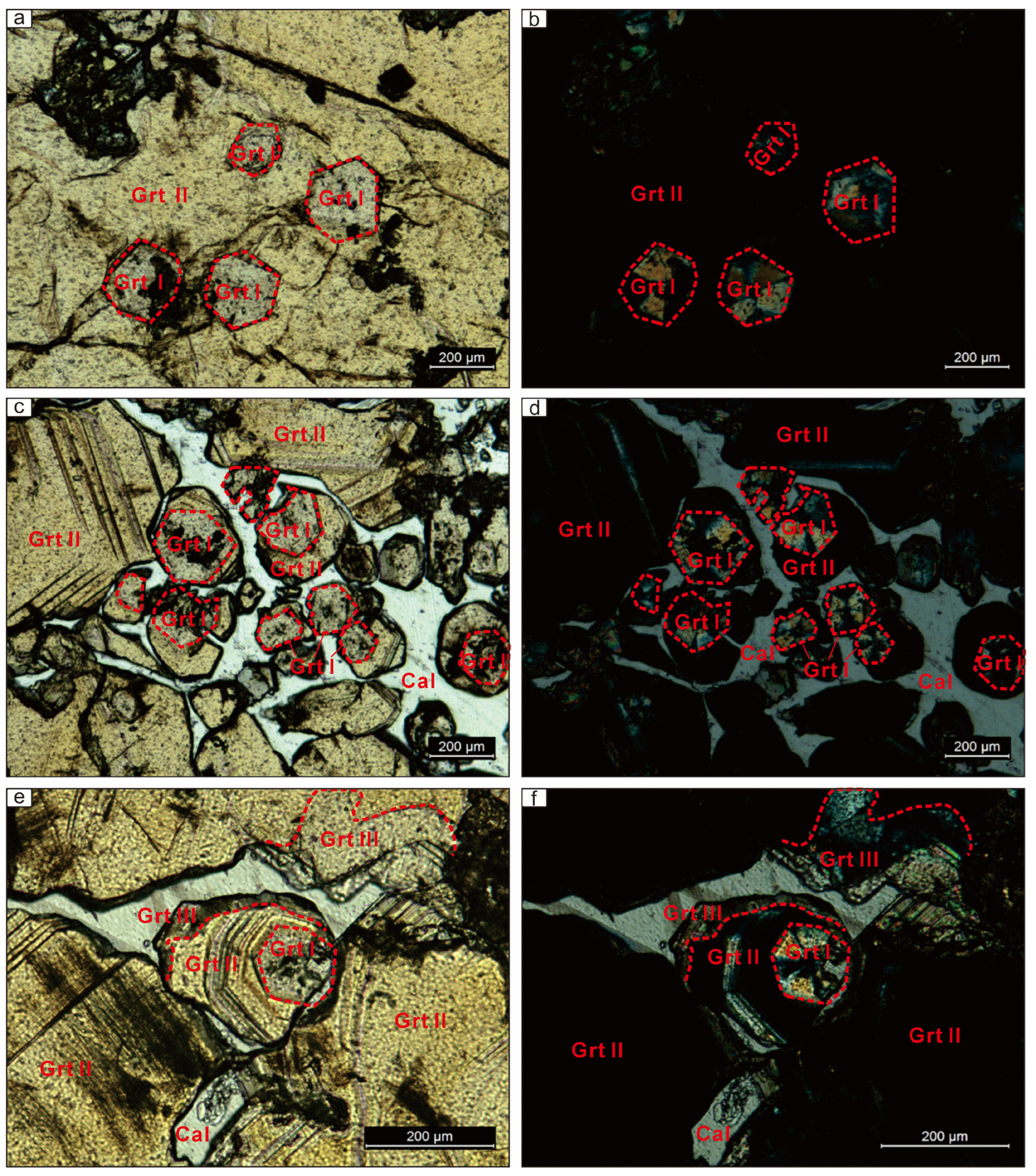
Garnet commonly occurs as brecciated aggregates or relict phenocrysts, often replaced by epidote and calcite. In hand specimen, garnet predominantly exhibits a brown color, with minor occurrences in yellowish-green and honey-yellow hues. It displays a dodecahedral crystal form and is euhedral to subhedral (Figure 5c,f–h). The brownish garnet grains are generally coarse, ranging from 0.3 to 1 cm in size. Under plane-polarized light, these grains appear light yellow to colorless and exhibit high positive relief (Figure 6). Colorless garnet is optically anisotropic, whereas light yellow garnet is isotropic (Figure 6). Based on optical characteristics and replacement relationships, the garnet can be divided into three generations (Grt I, Grt II, Grt III). Grt I typically displays well-developed crystal forms, contains twins, and is optically anisotropic, showing incomplete extinction under cross-polarized light (Figure 6). Grt II either overgrows Grt I crystals or forms independent crystals. It is predominantly isotropic, though local anisotropic zones occur as concentric bands (Figure 6c–f). Grt III garnet forms rims around Grt II crystals or replaces them, resulting in irregular, embayed replacement textures (Figure 6e,f). Some Grt I and Grt II grains are fractured and cemented by calcite (Figure 6c,d).

6.2. Garnet Chemistry

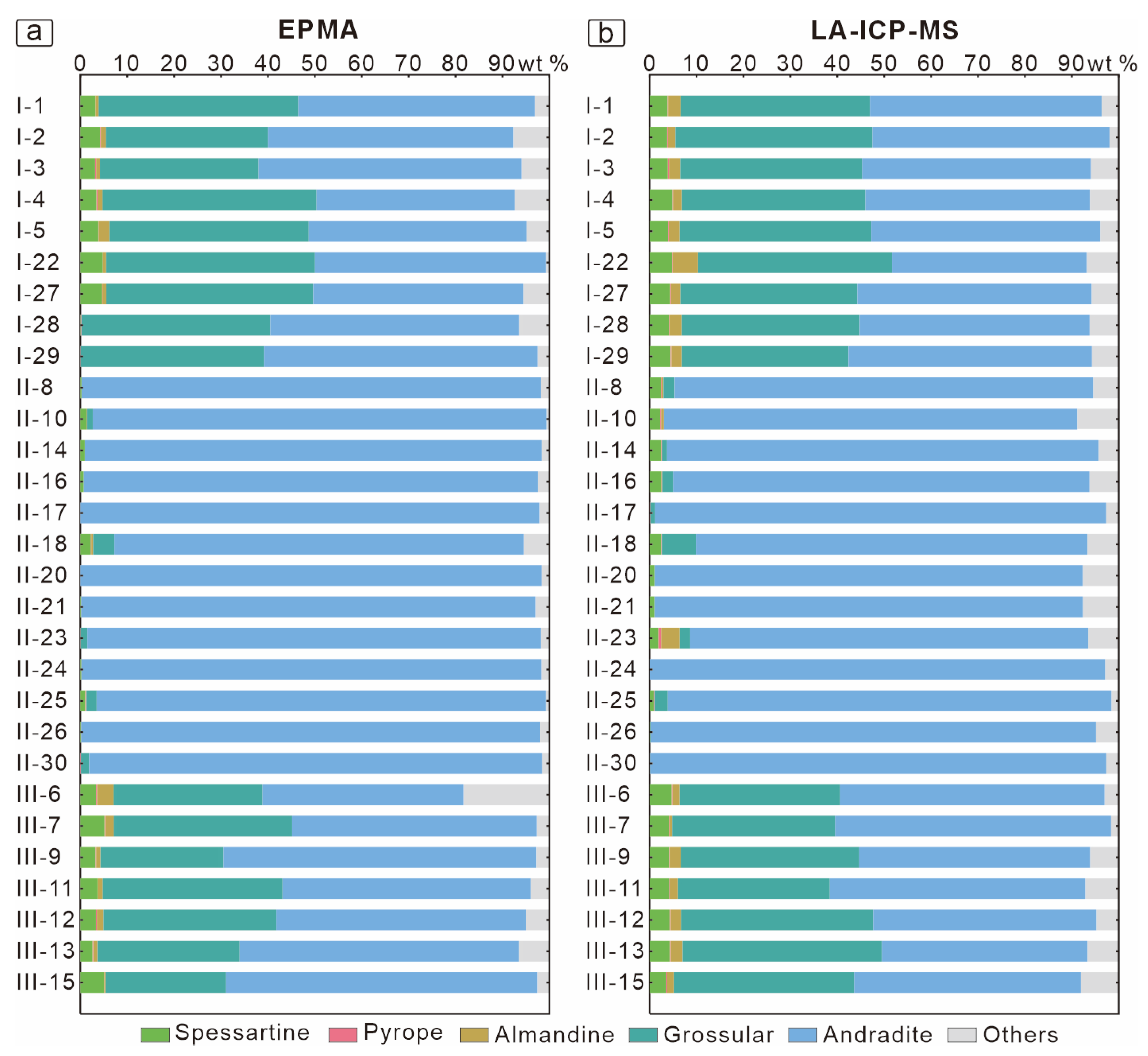
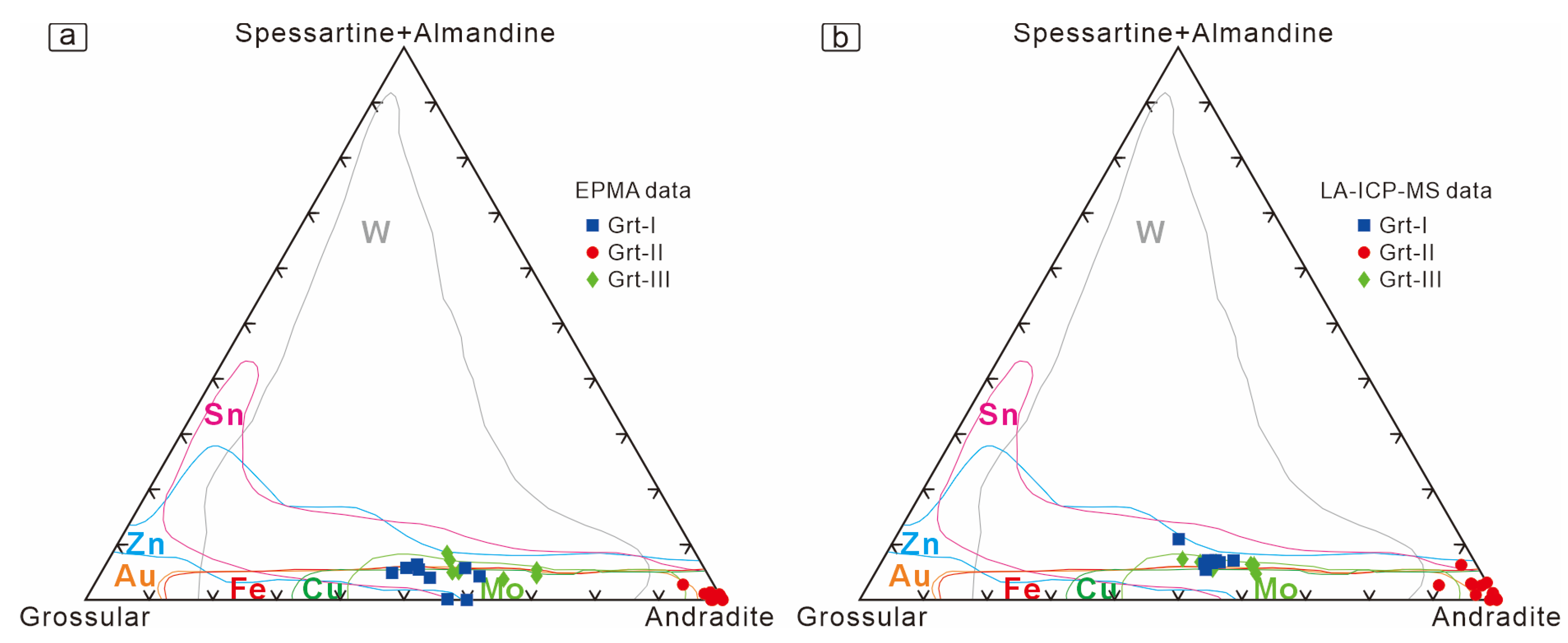
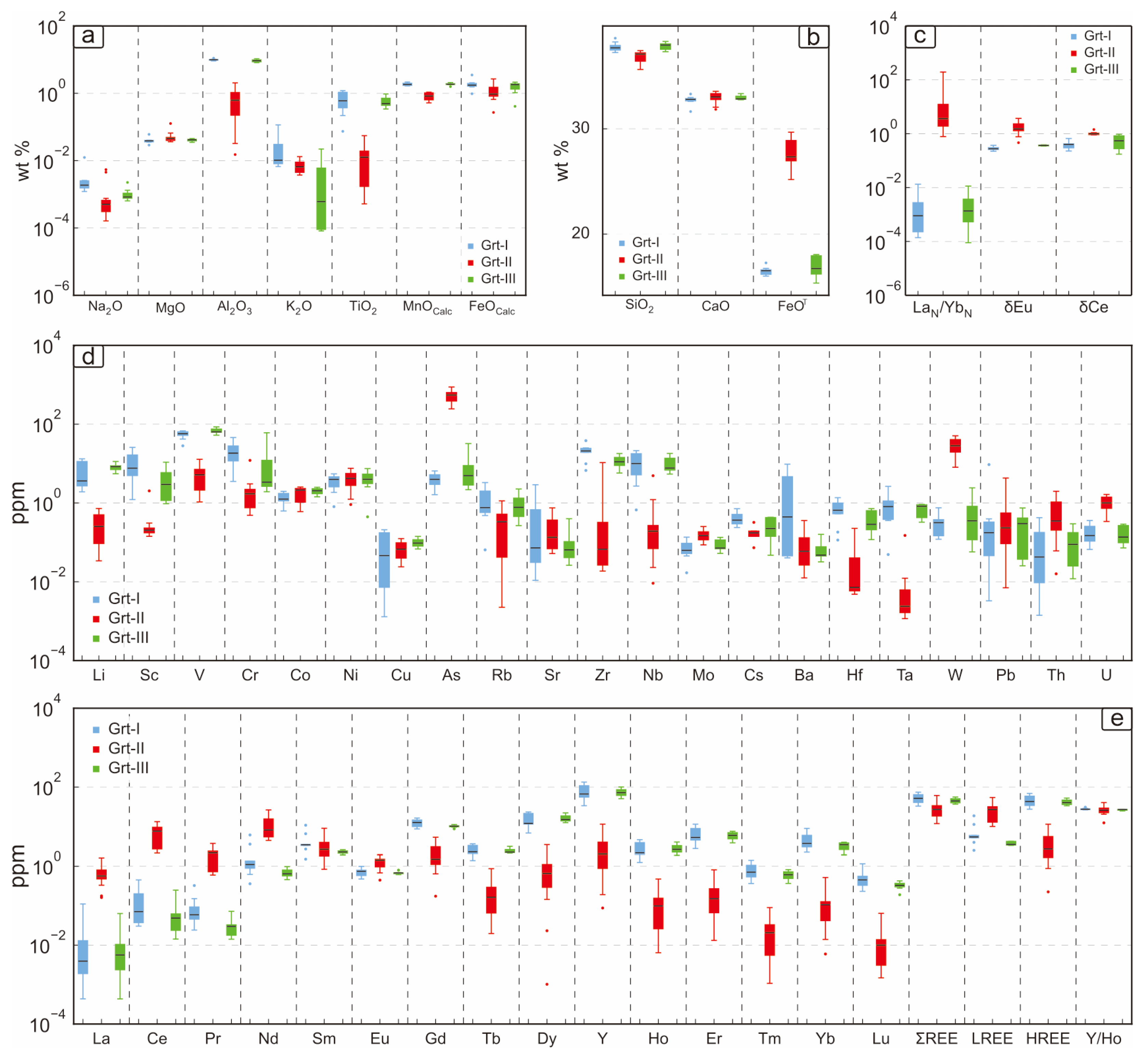
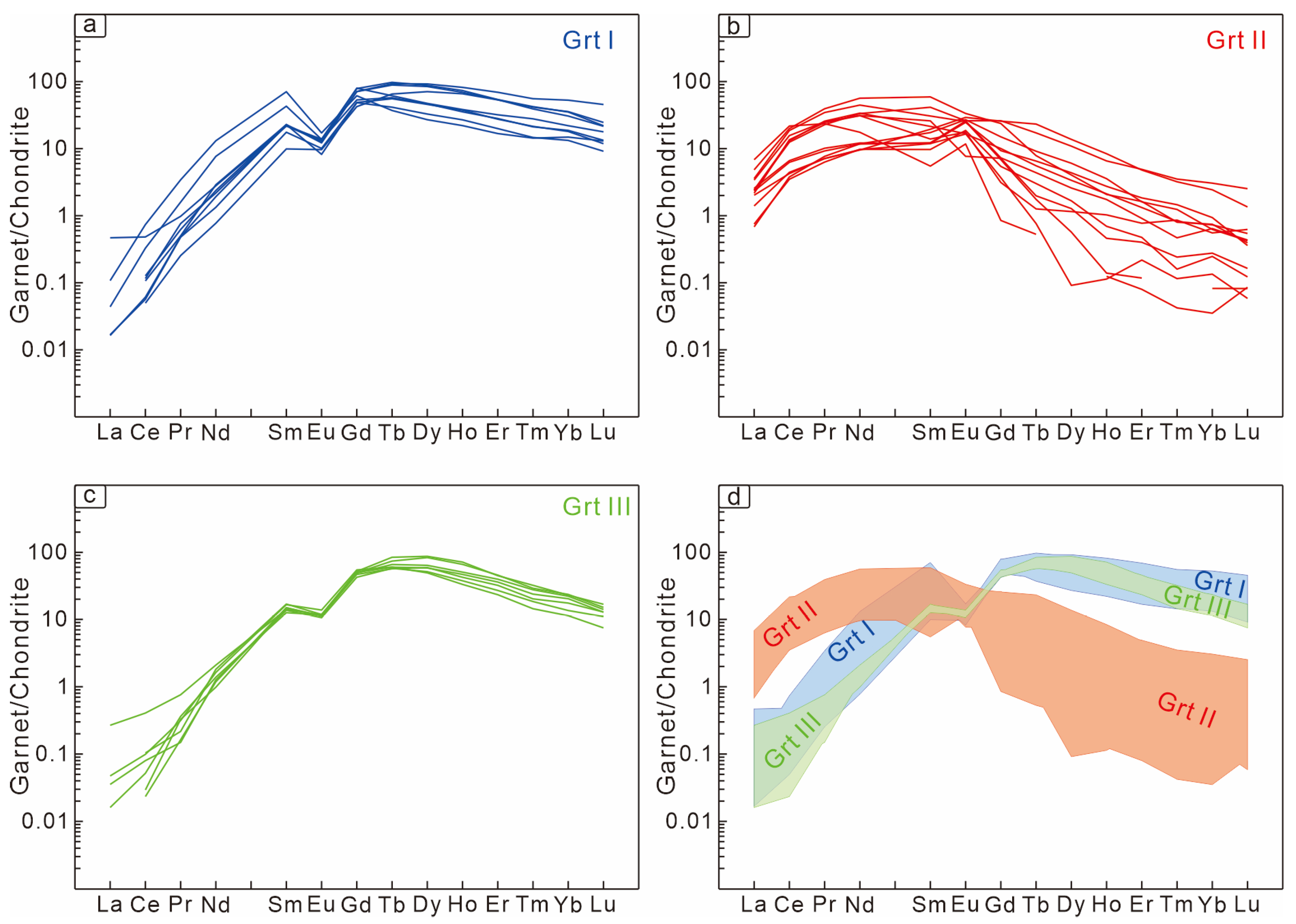
A total of twenty-nine in situ chemical analyses of garnet were acquired via EPMA and LA-ICP-MS. The dataset comprises nine analyses from Generation I (Grt I), thirteen from Generation II (Grt II), and seven from Generation III (Grt III). Calculated end-member compositions from both analytical methods are consistent, as illustrated in stacked compositional diagrams (Figure 7 and Figure 8). LA-ICP-MS results indicate that Grt II (And83–97Gro0–7Alm0–4Spe0–3) is predominantly andraditic. In contrast, Grt I (And42–52Gro36–42Alm2–5Spe4–5) and Grt III (And44–59Gro32–43Alm1–3Spe4–5) represent solid-solution mixtures between grossular and andradite (Figure 7 and Figure 8). Grt I and III are enriched in Na2O, Al2O3, TiO2, MnOCalc, FeOCalc, and SiO2 but depleted in FeOT (FeOTotal), whereas Grt II is enriched in FeOT and depleted in Na2O, Al2O3, TiO2, MnOCalc, FeOCalc, and SiO2 (Figure 9a–c). Grt I and III also share similar trace element characteristics, showing relative enrichment in Li, Sc, V, Cr, Rb, Y, Zr, Nb, Hf, Ta, and HREEs (heavy rare earth elements). Grt II is relatively enriched in As, Mo, W, Th, U, and LREEs (light rare earth elements) (excluding Sm) (Figure 9d,e). Contents of Co, Ni, and Cu show an increasing trend from Grt I to III, whereas K, Ba, and Sm display a decreasing trend (Figure 9). The REE patterns of Grt I and III are similar, generally exhibiting LREE depletion and HREE enrichment (left-leaning pattern). Grt II displays LREE enrichment and HREE depletion (right-leaning pattern) (Figure 9e and Figure 10). Most Grt I and III show pronounced negative Eu and Ce anomalies, while Grt II predominantly exhibit positive Eu and Ce anomalies (Figure 9c and Figure 10). Grt II shows a wider range of Y/Ho ratios compared to Grt I and III (Figure 9e). Compared to Grt I, Grt III shows decreasing trends in Na2O, K2O, Sc, Cr, Rb, Zr, Cs, Ba, Hf, and REEs (rare earth elements), alongside increasing trends in FeOT, V, Co, Ni, and As (Figure 9).

6.3. Garnet Element Mapping

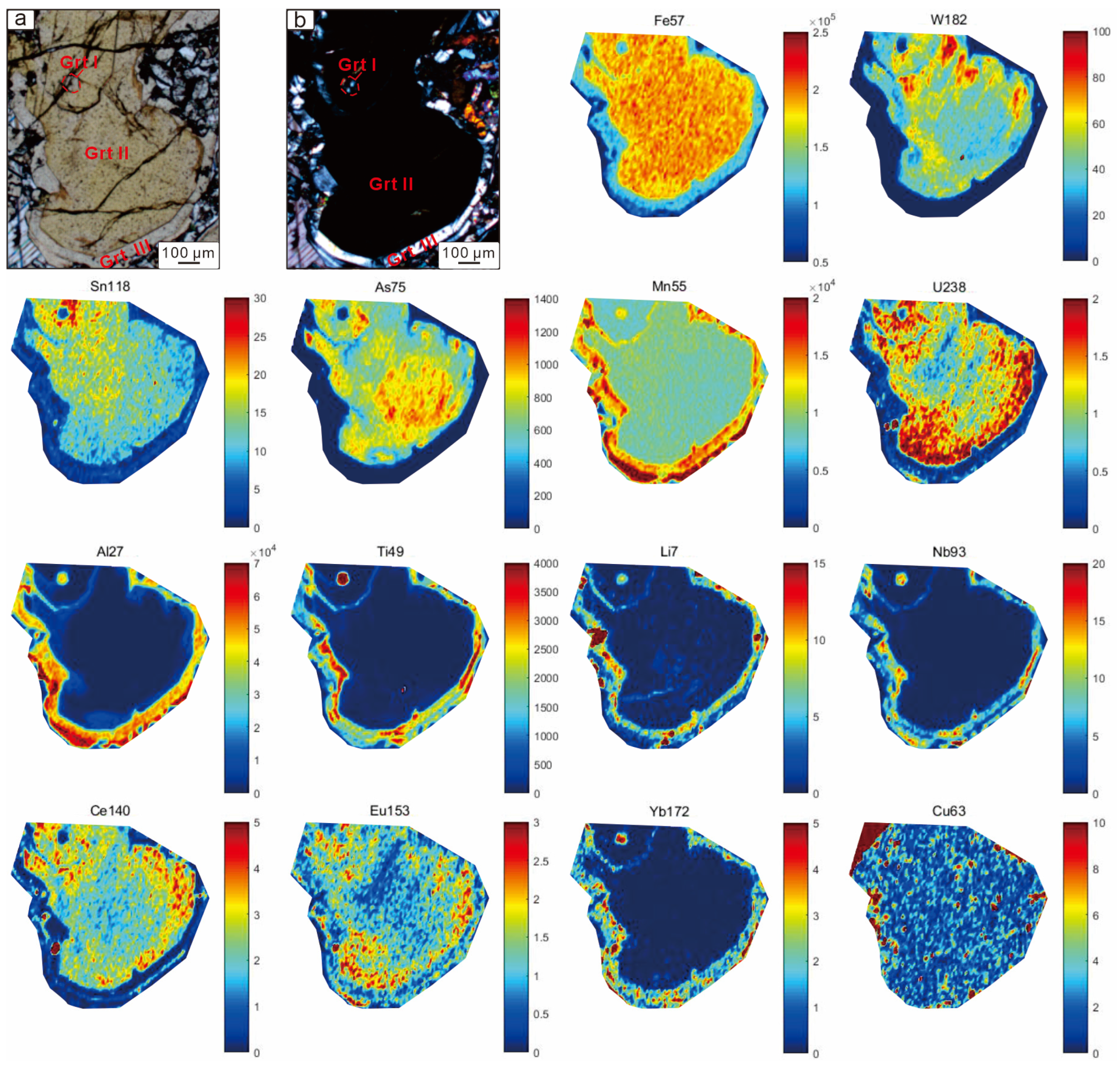
This study conducted LA-ICP-MS element mapping on typical garnets from generations I to III, with the mapping results presented in Figure 11 and Supplementary Material S2. Grt II is characterized by elevated concentrations of Fe, W, Sn, As, U, Ce, and Pr, coupled with depleted levels of Al, Mn, Ti, V, Sc, Li, Eu, Gd to Yb (HREEs), Hf, Nb, Ta, and Zr. In contrast, Grt I and III share a similar geochemical signature, defined by low concentrations of Fe, W, Sn, As, U, Ce, and Pr, and high concentrations of Al, Mn, Ti, V, Sc, Li, Eu, Gd to Yb (HREEs), Hf, Nb, Ta, and Zr. Compared to Grt I, the rim of Grt III garnet exhibits localized zones with higher concentrations of Mg, Ba, and the chalcophile elements Cu, Co, Ni, and Zn. Furthermore, fractures within garnet and contact zones with carbonate minerals are marked by anomalously high concentrations of Ca, Mg, and Ba.

7. Discussions

7.1. Garnet Optical Anomaly

Garnet in skarn commonly exhibits optical anisotropy (optical anomalies) [9,11,15]. Such anisotropy is observed in Generation I and III garnets from the Tietangdong breccia pipe. The optical anomalies in garnet are typically attributed to several factors: (a) external stress [43]; (b) substitution between Al3+ and Fe3+ in the octahedrally coordinated Y-site [44]; (c) substitution of Ca2+ in the dodecahedrally coordinated X-site by Fe2+, Mg2+, Mn2+, or REE3+ (magneto-optical effects) [45,46]; (d) substitution of Si4+ in the tetrahedrally coordinated Z-site by anionic groups such as OH or F [16,47]. Garnets formed in deformed metamorphic rocks often display weak or no optical anisotropy [48]. All three garnet generations show no evidence of significant deformation or undulatory extinction, and twinning or zonal anisotropy does not exhibit a consistent relationship with fractures in the mineral (Figure 6). Therefore, external stress is ruled out as the cause of the optical anomalies observed in Grt I and III. The garnets in this study are predominantly composed of andradite and grossular end-members, with low contents of Fe2+, Mg, Mn, and REE (Figure 9). Furthermore, some garnets enriched in OH, F, or REE do not invariably exhibit optical anisotropy [43]. Consequently, ionic substitutions at the dodecahedral (X-site) and tetrahedral (Z-site) positions are excluded as the primary influencing factors.
X-ray diffraction analysis confirms the presence of ionic ordering in anisotropic garnets [49]. The ordering of Fe3+/Al3+ at the octahedral (Y-site) position leads to a reduction in the structural symmetry of garnet [12,50,51]. Mixing free energies calculations indicate that there are miscibility gaps between grandite and andradite only below ~430 K [52]. The formation of compositional oscillations is probably due to kinetic hindering of thermodynamically stable complete solid solutions [52]. Lower crystallization temperatures also promote stronger cation ordering, resulting in more pronounced optical anisotropy [49]. At similar temperatures, strong anisotropy is associated with a high degree of cation ordering [49]. The crystallization temperatures for Grt I and III are interpreted to be higher than that of Grt II (see Section 7.2.1). Elemental mapping of Grt I and III reveals high concentrations of both Al and Fe (predominantly as Fe3+) (Figure 11), indicating that their Al3+/Fe3+ substitution ratio falls within the range typical for optically anomalous garnets [49]. Therefore, the optical anomalies in Grt I and III from Tietangdong are likely associated with a high degree of Fe3+/Al3+ ordering.

7.2. Formation Conditions of Multi-Stage Garnets

Zonal structures in skarn garnets provide a complete record of the composition, properties, and evolutionary processes of the hydrothermal fluids [53]. Although garnet zoning and compositional variations may not follow a consistent pattern, their formation is controlled by fluid evolution and the prevailing physicochemical conditions [53,54,55]. As the principal end-members of skarn garnet, the relative proportions of grossular and andradite are highly sensitive to variations in hydrothermal fluid temperature, pH, oxygen fugacity, and salinity [53,54]. In this study, LA-ICP-MS mapping results for a single garnet crystal containing three generations (Figure 11; Supplementary Material S2) reveal distinct elemental zonation patterns for Fe, Al, Mn, Ti, Ce, and Eu. The elemental changes between different garnet generations are abrupt, lacking any gradual transitional trends. This suggests that the three garnet generations are not the products of continuous crystallization under physicochemical equilibrium. Instead, they likely formed from fluids with significantly different compositions and under distinct physicochemical conditions.

7.2.1. Temperature

Temperature is typically one of the principal factors influencing mineral crystallization. Experimental studies on the formation of garnet through contact metasomatism between igneous and carbonate rocks indicate that andradite primarily forms within a temperature range of 450–600 °C, whereas grossular predominantly crystallizes between 550 and 700 °C [56]. This observation that andradite has a lower crystallization temperature than grossular is further supported by other experimental investigations and petrographic evidence (e.g., [57,58,59,60]). Among the three generations of garnet, Grt I and Grt III exhibit similar grossular-to-andradite ratios (Figure 7). In contrast, Grt II is characterized by the highest proportion of andradite (Figure 7). Consequently, Grt II likely crystallized within a relatively lower temperature range.

7.2.2. Oxygen Fugacity

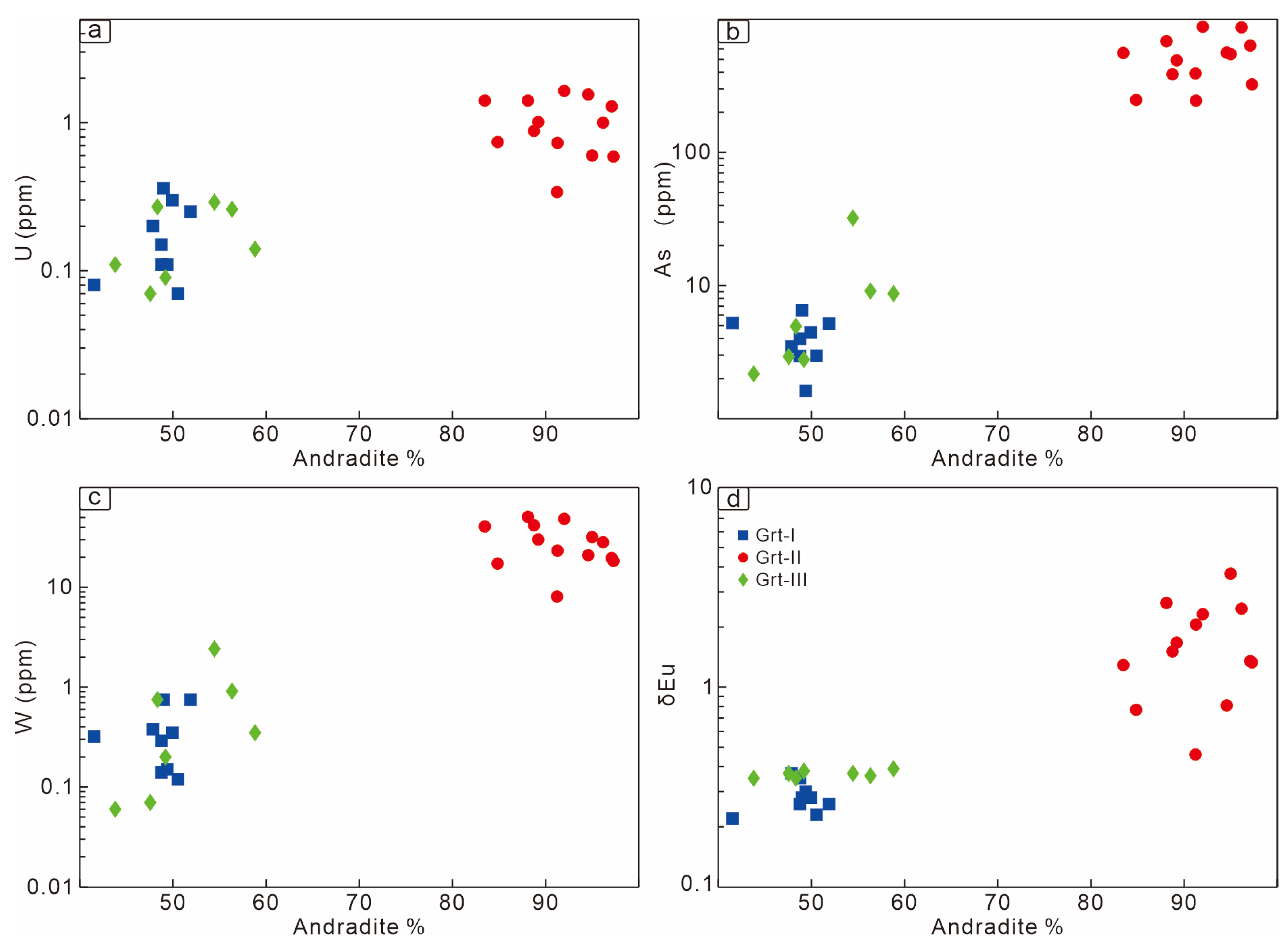
Garnets dominated by the grossular–andradite solid solution form under weakly oxidized to oxidized conditions, with a higher proportion of andradite indicating a more strongly oxidizing environment [56,61,62,63]. The andradite content in the three garnet generations ranges from 42% to 97% (Figure 7), corresponding to moderately to strongly oxidized conditions. Among these, Grt II, with the highest andradite proportion (83%–97%) (Figure 7), crystallized under the most strongly oxidizing conditions. Grt II is also enriched in Fe, As, Sn, W, and U relative to Grt I and Grt III (Figure 9, Figure 11 and Figure 12a–c, Supplementary Material S2). The enrichment of many of these elements is linked to high oxygen fugacity, as evidenced by substitution mechanisms such as As5+ + Fe3+ for Si4+ [64], Sn4+ for Fe3+ [65,66,67], and W6+ for Fe3+ [5,9,68,69]. Correlation analysis among the three garnet generations shows strong positive correlations between U and Fe3+ (0.82), As (0.88), and W (0.90) (Supplementary Material S3), suggesting that the incorporation of U, likely controlled by oxygen fugacity, may occur via substitution for Fe3+. In contrast, Grt I (42%–52%) and III (44%–59%) (Figure 7), characterized by lower andradite contents, formed under moderately oxidized conditions.

7.2.3. pH

Theoretical calculations indicate that under weakly acidic conditions, hydrothermal fluids are relatively enriched in LREEs and exhibit a positive Eu anomaly, whereas under neutral to weakly alkaline conditions, the fluids are relatively enriched in HREEs [70]. Experimental studies on the metasomatic reaction between magma and carbonate rocks suggest that grossular readily crystallizes in moderately to acidic solutions, whereas andradite forms in solutions with a pH range of 4.0–11.0 [56]. Grt II, which is predominantly andraditic, displays a distinct positive Eu anomaly and is enriched in LREEs (Figure 9), indicating formation under weakly acidic conditions associated with episodic acidic magmatic hydrothermal activity [71]. In contrast, Grt I and III garnets, characterized by similar grossular-to-andradite ratios and negative Eu anomalies (Figure 7 and Figure 9c), are likely formed under neutral conditions. Their formation may be related to the influence of carbonate rocks or meteoric water [72].

7.2.4. Water–Rock Interaction

Grossular tends to grow slowly in low water/rock (W/R) ratio environments approaching fluid–rock equilibrium, whereas andradite is favored in high W/R ratio environments and exhibits rapid growth rates [63,73,74]. A Y/Ho ratio in garnet fluctuating around 28 is indicative of weak water–rock interaction, whereas a ratio > 28 suggests a more intense reaction [75,76,77]. The grossular component in Grt II is significantly lower than in Grt I and III (Figure 7), and it concurrently exhibits a higher Y/Ho ratio and a wider range of fluctuation (Figure 9e). This implies that Grt I and III formed in a relatively low W/R ratio environment. In contrast, Grt II formed under conditions of a higher W/R ratio, facilitating more intense water–rock interaction and rapid crystal growth.

7.2.5. Fluid Composition

Variations in mineral composition are widely considered to reflect changes in the chemical environment during crystallization (e.g., [19,78,79,80,81,82]). Grt II is characterized by a significantly higher andradite content compared to Grt I and III, and is enriched in LREEs (except for Sm) (Figure 9, Figure 11 and Figure 12a–c, Supplementary Material S2). Statistical analysis of large geochemical datasets from skarn garnets indicates that the degree of LREE enrichment is controlled by the andradite content [2,83]. This can be explained by the rapid growth of andradite under high water/rock ratios, where crystal growth outpaces lattice diffusion and surface adsorption [63,73,74,84]. Therefore, the observed LREE enrichment (excluding Sm) in Grt II may not accurately reflect a higher abundance of these elements in the hydrothermal fluid.
It is generally accepted that the total rare earth element (REE) content and Eu anomaly in garnet are not primarily controlled by its major-element composition but instead reflect the REE characteristics of the melt or hydrothermal fluid from which it crystallized [68,83]. The ionic radius of the X2+ site in garnet typically ranges from 0.89 to 1.12 Å, which is similar to the ionic radii of six-coordinated REE3+ (0.86–1.03 Å), facilitating substitution [75,85]. Eu2+ can directly substitute for X2+, while REE3+ and Eu3+ are incorporated via coupled substitution mechanisms [63,86]. During skarn alteration, Eu2+ becomes the dominant species in fluids at temperatures above approximately 250 °C [87]. In hydrothermal fluids, Eu2+ can form stable complexes with chloride (e.g., EuCl42−), whereas other trivalent REEs do not form stable chloride complexes under similar conditions [88]. Consequently, the Eu anomaly in garnet is interpreted to mirror the Eu anomaly of the hydrothermal fluid, with a more pronounced positive Eu anomaly generally indicating higher chloride concentrations in the fluid [83,88,89]. At the Tietangdong breccia pipe, a positive Eu anomaly is observed exclusively in Grt II, suggesting that the magmatic–hydrothermal fluid responsible for its formation had an elevated chloride concentration. Grt III exhibits a moderately higher δEu value compared to Grt I (Figure 9c, Figure 10 and Figure 12d), implying that the former precipitated from a fluid with a relatively higher chloride concentration.
Generations I and III garnet exhibit similar grossular–andradite endmember proportions. Consequently, their compositional evolution from early to late stages can be used to track changes in the composition of the magmatic–hydrothermal fluid. The concentrations of K and Ba in garnet show a general decreasing trend from Grt I to III (Figure 9). The variation in K may be related to potassic alteration, as evidenced at Tietangdong by the replacement of plagioclase rims and the development of fine potassium feldspar veins in altered gneiss, leptynite, and meta-diabase clasts within breccias [90]. The variation in Ba may be associated with late-stage carbonate alteration, suggested by the similar distribution patterns of Ba and Mg in garnet elemental maps (Supplementary Material S2). Gold content in garnet is typically very low [6], and Au was not analyzed by LA-ICP-MS in this study. As a highly chalcophile element, Au preferentially partitions into metal or sulfide phases. It shares geochemical affinities with other chalcophile elements and is highly mobile in hydrothermal fluids [91,92,93,94,95]. Therefore, this study infers the mobilization and enrichment behavior of Au from that of chalcophile elements. The contents of Co, Ni, and Cu in garnet show an increasing trend from Grt I to III (Figure 9). Local high-concentration zones of chalcophile elements (e.g., Cu, Ni, Zn, Mo) are present in Grt II. Furthermore, the rims of Grt III exhibit more extensive areas of enrichment in Cu, Co, Ni, and Zn. This indicates a trend of increasing chalcophile element concentrations in the hydrothermal fluid over time. These observations suggest the injection of a pulse of magmatic–hydrothermal fluid enriched in chalcophile elements after the formation of Grt I.

7.3. Evolution of the Hydrothermal Fluid

Compositional zoning from core to rim in garnet does not follow a unified evolutionary trend and thus lacks direct significance for indicating metal mineralization types. Instead, it reflects changes in formation environment and fluid composition [96]. The three garnet generations at Tietangdong indicate that Grt I and III formed under similar physicochemical conditions, whereas Grt II records an abrupt shift in formation environment (Table 1).
The initial magmatic–hydrothermal fluid at Tietangdong interacted with carbonate rocks under closed-system conditions, leading to a progressive increase in pH toward neutral, with low Cl contents and oxygen fugacity. Pressure and temperature were relatively high, under a low water/rock ratio environment, resulting in the formation of euhedral Grt I grossular–andradite garnet. The subsequent influx of a pulse of magmatic fluid characterized by high oxygen fugacity, high Cl content, and weak acidity increased the system pressure and triggered a cryptic explosion. The subsequent pressure release induced fluid boiling, which further elevated oxygen fugacity [54,96], intensified water–rock reaction, and potentially introduced meteoric water at shallow depths, analogous to the Hewan porphyry system [36]. These processes collectively caused cooling of the hydrothermal fluid, ultimately leading to the precipitation of Grt II andradite-rich garnet overgrowths on the rims of Grt I. This fluid pulse also elevated the concentrations of Cl and chalcophile elements (e.g., Co, Ni, Cu) in the system. As fluid mixing ceased, mineral crystallization progressed, and the carbonate host rocks continued to neutralize the acidic fluid; the crystallization of andradite also consumed substantial Fe3+, lowering the system’s oxygen fugacity. The system re-entered a closed state, allowing pressure and temperature to rise again under low water/rock ratio conditions. This culminated in the formation of Grt III grossular–andradite garnet on the rims of Grt II crystals.

7.4. Implications for Mineralization

The Grossular + Andradite + (Spessartine + Almandine) ternary diagram for garnet is widely utilized for the qualitative classification or discrimination of various skarn metal types. However, the data points correspond to all three garnet generations at the Tietangdong plot across multiple classification fields designated for W, Sn, Mo, Fe, Cu, Au, and Zn deposits (Figure 8). Consequently, this diagram does not provide effective discrimination of the skarn metal type at Tietangdong, although it yields some distinction regarding the physicochemical nature of the parent hydrothermal fluids. The andradite endmember proportions in the three garnet generations range from 42% to 97%, indicating formation from an oxidizing hydrothermal fluid. The pulsed hydrothermal event associated with Grt II further elevated the oxygen fugacity of the system. In oxidizing hydrothermal fluids, chloride complexes are important for the transport of Au [97,98,99]. The pulsed magmatic–hydrothermal fluids may also introduce Cl and Au. An increase in oxygen fugacity enhances the solubility of Au in the fluid [100]. Consequently, the oxidizing nature and elevated chlorine content of the pulsed magmatic fluids likely contributed to gold enrichment.

8. Conclusions

(1) The optical anomalies observed in Generations I and III garnets from the Tietangdong cryptoexplosive breccia pipe are potentially attributable to a higher degree of Fe3+/Al3+ cation ordering.
(2) Compared to Grt I and III, Grt II is predominantly composed of andradite and is enriched in elements such as Fe, As, Sn, W, and U. It exhibits a pronounced positive Eu anomaly and a wide range of Y/Ho ratios. The contents of Co, Ni, and Cu in Grt II are lower than those in Grt III but higher than those in Grt I. These characteristics may be attributed to pulsed melt-fluid injections, which elevated oxygen fugacity and increased the concentrations of chlorine and chalcophile elements in the hydrothermal system, thereby enhancing gold mineralization potential.

Supplementary Materials

The following supporting information can be downloaded at https://www.mdpi.com/article/10.3390/min15121290/s1; Supplementary Material S1: Garnet data; Supplementary Material S2: Garnet elemental mapping image; Supplementary Material S3: Element correlation heat map and hierarchical clustering map of LA-ICP-MS analysis of three generations of garnet.

Author Contributions

Methodology, X.L.; Software, F.W.; Investigation, F.W.; Data curation, J.Z. (Junwu Zhang), F.W. and X.L.; Writing—original draft, J.Z. (Junwu Zhang); Writing—review & editing, J.Z. (Junwu Zhang), J.L. and J.Z. (Juquan Zhang); Supervision, F.W. and X.L. All authors have read and agreed to the published version of the manuscript.

Funding

This study is financially supported by the National Natural Science Foundation of China (No. U2444208) and Hebei GEO University Youth Project (QN201708).

Data Availability Statement

The original contributions presented in this study are included in the article/Supplementary Materials. Further inquiries can be directed to the corresponding authors.

Conflicts of Interest

The authors declare no conflict of interest.

References

  1. Bi, R.; Wang, F.; Zhang, W. Whole Rock, Mineral Chemistry during Skarn Mineralization-Case Study from Tongshan Cu-Mo Skarn Profile. Appl. Sci. 2023, 13, 8118. [Google Scholar] [CrossRef]
  2. Wen, G.; Qiu, J.; Hofstra, A.H.; Harlov, D.E.; Ren, Z.; Li, J. Revealing the role of crystal chemistry in REE fractionation in skarn garnets: Insights from lattice-strain theory. Contrib. Miner. Pet. 2024, 179, 18. [Google Scholar] [CrossRef]
  3. Zhang, J.Q.; Li, S.R.; Santosh, M.; Luo, J.Y.; Li, C.L.; Song, J.Y.; Lu, J.; Liang, X. The genesis and gold mineralization of the crypto-explosive breccia pipe in the Yixingzhai gold region, central North China Craton. Geol. J. 2020, 55, 5664–5680. [Google Scholar] [CrossRef]
  4. Kang, J.; Choi, S.; Seo, J.; Kim, S.; Kim, G.; Cho, S.; Lee, G.; Lee, Y.J. A genetic model of the giant Sangdong W–Mo skarn deposit in the Taebaeksan Basin, South Korea. Ore Geol. Rev. 2022, 150, 105187. [Google Scholar] [CrossRef]
  5. Park, C.; Song, Y.; Kang, I.; Shim, J.; Chung, D.; Park, C. Metasomatic changes during periodic fluid flux recorded in grandite garnet from the Weondong W-skarn deposit, South Korea. Chem. Geol. 2017, 451, 135–153. [Google Scholar] [CrossRef]
  6. Somarin, K.A. Garnet composition as an indicator of Cu mineralization: Evidence from skarn deposits of NW Iran. J. Geochem. Explor. 2004, 81, 47–57. [Google Scholar] [CrossRef]
  7. He, L.; Liang, T.; Wang, D.; Zhang, J.; Liu, B. Skarn Formation and Zn–Cu Mineralization in the Dachang Sn Polymetallic Ore Field, Guangxi: Insights from Skarn Rock Assemblage and Geochemistry. Minerals 2024, 14, 193. [Google Scholar] [CrossRef]
  8. Kilic, A.D.; Konakci, N.; Sasmaz, A. Garnet Geochemistry of Pertek Skarns (Tunceli, Turkey) and U-Pb Age Findings. Minerals 2024, 14, 539. [Google Scholar] [CrossRef]
  9. Fei, X.; Zhang, Z.; Cheng, Z.; Santosh, M. Factors controlling the crystal morphology and chemistry of garnet in skarn deposits: A case study from the Cuihongshan polymetallic deposit, Lesser Xing’an Range, NE China. Am. Miner. 2019, 104, 1455–1468. [Google Scholar] [CrossRef]
  10. Shtukenberg, A.G.; Popov, D.Y.; Punin, Y.O. Growth ordering and anomalous birefringence in ugrandite garnets. Miner. Mag. 2005, 69, 537–550. [Google Scholar] [CrossRef]
  11. Shtukenberg, A.G.; Punin, Y.O.; Frank-Kamenetskaya, O.V.; Kovalev, O.G.; Sokolov, P.B. On the origin of anomalous birefringence in grandite garnets. Miner. Mag. 2001, 65, 445–459. [Google Scholar] [CrossRef]
  12. Akizuki, M. Origin of optical variations in grossular-andradite garnet. Am. Miner. 1984, 69, 328–338. [Google Scholar]
  13. Griffin, D.T.; Hatch, D.M.; Phillips, W.R.; Kulaksiz, S. Crystal chemistry and symmetry of a birefringent tetragonal pyralspite75-grandite25garnet. Am. Miner. 1992, 77, 399–406. [Google Scholar]
  14. Lessing, P.; Standish, R.P. Zoned Garnet from Crested Butte, Colorado. Am. Miner. 1973, 58, 840–842. [Google Scholar]
  15. McAloon, B.P.; Hofmeister, A.M. Single-crystal IR spectroscopy of grossular-andradite garnets. Am. Miner. 1995, 80, 1145–1156. [Google Scholar] [CrossRef]
  16. Rossman, G.R.; Aines, R.D. Spectroscopy of a birefringent grossular from Asbestos, Quebec, Canada. Am. Miner. 1986, 71, 779–780. [Google Scholar]
  17. Wang, F.Y.; Ge, C.; Ning, S.Y.; Nie, L.Q.; Zhong, G.X.; White, N.C. A new approach to LA-ICP-MS mapping and application in geology. Acta Petrol. Sin. 2017, 33, 3422–3436, (In Chinese with English abstract). [Google Scholar]
  18. Zhao, H.; Shao, Y.; Zhang, Y.; Cao, G.; Zhao, L.; Zheng, X. Big data mining on trace element geochemistry of sphalerite. J. Geochem. Explor. 2023, 252, 107254. [Google Scholar] [CrossRef]
  19. Zhang, J.; Li, L.; Wang, F.; Niu, S.; Zhang, J.; Liang, X. Controlling factors for Co enrichment in mineral deposits: Insights from magnetite trace element big data. Ore Geol. Rev. 2025, 183, 106694. [Google Scholar] [CrossRef]
  20. Wang, J.; Li, L.; Santosh, M.; Yan, G.; Shen, J.; Yuan, M.; Alam, M.; Wang, Z.; Li, S. Spatial distribution and chemical characteristics of bastnäsite and monazite provide insights into the Bayan Obo deposit, the world’s largest rare earth element mineralization. Lithos 2025, 514–515, 108215. [Google Scholar] [CrossRef]
  21. Zhang, H.Q.; Wang, Y.W.; Sun, R.L.; Yang, W.L.; Chen, Y. Characteristics of porphyry metallogenic system and orebody localization regularities of Yixingzhai gold deposit. Miner. Depos. 2025, 44, 299–316, (In Chinese with English abstract). [Google Scholar]
  22. Liu, X.G. Metallogenic characteristics and genesis analysis of Yixingzhai gold deposit in the Fanshi County of Shanxi, China. Miner. Resour. Geol. 2022, 36, 299–309, (In Chinese with English abstract). [Google Scholar]
  23. Bai, X.M. Geological characteristics, geochronology, and prospecting direction of the Tietangdong cryptoexplosive breccia pipe in the Yixingzhai Gold Deposit, Shanxi Province. Gold 2022, 43, 9–18, (In Chinese with English abstract). [Google Scholar]
  24. Zhang, L.; Gao, W.; Deng, X. Geology and Geochronology of Magmatic–Hydrothermal Breccia Pipes in the Yixingzhai Gold Deposit: Implications for Ore Genesis and Regional Exploration. Minerals 2024, 14, 496. [Google Scholar] [CrossRef]
  25. Zhang, J.; Li, S.; Santosh, M.; Niu, S.; Li, Q.; Lu, J. The magmatic–hydrothermal mineralization systems of the Yixingzhai and Xinzhuang gold deposits in the central North China Craton. Ore Geol. Rev. 2017, 88, 416–435. [Google Scholar] [CrossRef]
  26. Li, S.; Santosh, M.; Zhang, H.; Luo, J.; Zhang, J.; Li, C.; Song, J.; Zhang, X. Metallogeny in response to lithospheric thinning and craton destruction: Geochemistry and U–Pb zircon chronology of the Yixingzhai gold deposit, central North China Craton. Ore Geol. Rev. 2014, 56, 457–471. [Google Scholar] [CrossRef]
  27. Shao, Y.; Zhang, Y.; Zhang, J.; Ding, Z.; Chen, X.; Liu, Z. Formation mechanism of breccia pipe type in Yixingzhai gold deposit. J. Cent. South Univ. Technol. 2008, 15, 89–94. [Google Scholar] [CrossRef]
  28. Li, L.; Li, C.; Li, Q.; Yuan, M.; Zhang, J.; Li, S.; Santosh, M.; Shen, J.; Zhang, H. Indicators of decratonic gold mineralization in the North China Craton. Earth-Sci. Rev. 2022, 228, 103995. [Google Scholar] [CrossRef]
  29. Li, S.; Santosh, M. Metallogeny and craton destruction: Records from the North China Craton. Ore Geol. Rev. 2014, 56, 376–414. [Google Scholar] [CrossRef]
  30. Zhang, J.; Li, S.; Santosh, M.; Li, Q.; Niu, S.; Li, Z.; Zhang, X.; Jia, L. Timing and origin of Mesozoic magmatism and metallogeny in the Wutai-Hengshan region: Implications for destruction of the North China Craton. J. Asian Earth Sci. 2015, 113, 677–694. [Google Scholar] [CrossRef]
  31. Li, L.; Li, S.; Santosh, M.; Zhu, J.; Suo, X. Early Jurassic decratonic gold metallogenesis in the eastern North China Craton: Constraints from S-Pb-C-D-O isotopic systematics and pyrite Rb-Sr geochronology of the Guilaizhuang Te-Au deposit. Ore Geol. Rev. 2018, 92, 558–568. [Google Scholar] [CrossRef]
  32. Yin, L.; Meng, F.; Kong, F.; Niu, C. Microfossils from the Paleoproterozoic Hutuo Group, Shanxi, North China: Early evidence for eukaryotic metabolism. Precambrian Res. 2020, 342, 105650. [Google Scholar] [CrossRef]
  33. Chen, Y.; Chen, W.; Li, Q.; Santosh, M.; Li, J. Discovery of the Huronian Glaciation Event in China: Evidence from glacigenic diamictites in the Hutuo Group in Wutai Shan. Precambrian Res. 2019, 320, 1–12. [Google Scholar] [CrossRef]
  34. Zhou, S.Z. The typomorphic characteristic of pyrite from the Kanggultage gold deposit and the significance to Au ore prospecting. Geol. Prospect. 1999, 35, 6–8+23, (In Chinese with English abstract). [Google Scholar]
  35. Gao, W.; Deng, X.; Chen, L.; Zhang, L.; Li, Y.; Luo, T.; Li, J. Halogen fractionation during vapor-brine phase separation revealed by in situ Cl, Br, and I analysis of scapolite from the Yixingzhai gold deposit, North China Craton. Am. Miner. 2024, 109, 408–421. [Google Scholar] [CrossRef]
  36. Zhao, S.; Hu, H.; Jin, X.; Deng, X.; Robinson, P.T.; Gao, W.; Zhang, L. Chemical and boron isotopic composition of tourmaline from the Yixingzhai gold deposit, North China Craton: Proxies for ore fluids evolution and mineral exploration. Am. Miner. 2024, 109, 1443–1460. [Google Scholar] [CrossRef]
  37. Zhang, L.Z.; Chen, L.; Wang, G.P.; Deng, X.D.; Li, J.W. Garnet U-Pb dating constraints on the timing of breccia pipes formation and genesis of gold mineralization in Yixingzhai gold deposit, Shanxi province. Earth Sci. 2020, 45, 108–117, (In Chinese with English abstract). [Google Scholar]
  38. Zhang, L.Z. Element geochemistry and age of the altered-porphyry gold mineralization in Yixingzhai gold deposit, Fanshi city, Shanxi Province. Geol. Miner. Resour. South China 2018, 34, 134–141, (In Chinese with English abstract). [Google Scholar]
  39. Jurek, K.; Hul Nsk, V. The use and accuracy of the ZAF correction procedure for the microanalysis of glasses. Mikrochim. Acta 1980, 73, 183–198. [Google Scholar] [CrossRef]
  40. Locock, A.J. An Excel spreadsheet to recast analyses of garnet into end-member components, and a synopsis of the crystal chemistry of natural silicate garnets. Comput. Geosci. 2008, 34, 1769–1780. [Google Scholar] [CrossRef]
  41. Zhang, J.; Liang, X.; Wang, F.; Wang, H.; Fan, Y.; Ba, T.; Meng, X. CorelKit: An extensible CorelDraw VBA program for geoscience drawing. J. Earth Sci. 2023, 34, 735–757. [Google Scholar] [CrossRef]
  42. Meinert, L.D.; Dipple, G.M.; Nicolescu, S. World skarn deposits. In One Hundredth Anniversary Volume; Hedenquist, J.W., Thompson, J.F.H., Goldfarb, R.J., Richards, J.P., Eds.; Society of Economic Geologists, Inc.: Littleton, CO, USA, 2005. [Google Scholar]
  43. McAloon, B.P.; Hofmeister, A.M. Single-crystal absorption and reflection infrared spectroscopy of birefringent grossular-andradite garnets. Am. Miner. 1993, 78, 957–967. [Google Scholar]
  44. Griffin, D.; Tversky, A. The Weighing of Evidence and the Determinants of Confidence. Cogn. Psychol. 1992, 24, 411. [Google Scholar] [CrossRef]
  45. Gaspar, M.; Knaack, C.; Meinert, L.D.; Moretti, R. REE in skarn systems: A LA-ICP-MS study of garnets from the Crown Jewel gold deposit. Geochim. Cosmochim. Acta 2008, 72, 185–205. [Google Scholar] [CrossRef]
  46. Boffa Ballaran, T.; Carpenter, M.A.; Geiger, C.A.; Koziol, A.M. Local structural heterogeneity in garnet solid solutions. Phys. Chem. Miner. 1999, 26, 554–569. [Google Scholar] [CrossRef]
  47. Manning, C.E.; Bird, D.K. Fluorian garnets from the host rocks of the Skaergaard Intrusion; implications for metamorphic fluid composition. Am. Miner. 1990, 75, 859–873. [Google Scholar]
  48. Hofmeister, A.M.; Schaal, R.B.; Campbell, K.R.; Berry, S.L.; Fagan, T.J. Prevalence and origin of birefringence in 48 garnets from the pyrope-almandine -grossularite-spessartine quaternary. Am. Mineral. 1998, 83, 1293–1301. [Google Scholar] [CrossRef]
  49. Zhang, J.M.; Cao, Z.M. An Investigation of Birefringence of Garnets from a Skarn Deposit. Geol. Sci. 1988, 3, 229–238+304, (In Chinese with English abstract). [Google Scholar]
  50. Takéuchi, Y.; Haga, N.; Umizu, S.; Sato, G. The derivative structure of silicate garnets in grandite. Z. Fur Krist. Mater. 1982, 158, 53–100. [Google Scholar] [CrossRef]
  51. Gali, S. Grandite garnet structures in connection with the growth mechanism. Z. Für Krist.-Cryst. Mater. 1983, 163, 43–52. [Google Scholar] [CrossRef]
  52. Becker, U.; Pollok, K. Molecular simulations of interfacial and thermodynamic mixing properties of grossular-andradite garnets. Phys. Chem. Miner. 2002, 29, 52–64. [Google Scholar] [CrossRef]
  53. Wang, W.; Wang, M.F.; Liu, K.; Guo, X.N. The current status and prospects of the study of garnet in skarn for hydrothermal fluid evolution tracing and mineralization zoning. Acta Petrol. et Mineral. 2016, 35, 147–161, (In Chinese with English abstract). [Google Scholar]
  54. Jamtveit, B.; Wogelius, R.A.; Fraser, D.G. Zonation patterns of skarn garnets: Records of hydrothermal system evolution. Geology 1993, 21, 113–116. [Google Scholar] [CrossRef]
  55. Meinert, L.D. Application of skarn deposit zonation models to mineral exploration. Explor. Min. Geol. 1997, 6, 185–208. [Google Scholar]
  56. Liang, X.J. Characteristics and metasomatism mechanism of garnet of grossularite-andradite series. Acta Petrol. et Mineral. 1994, 13, 342–352, (In Chinese with English abstract). [Google Scholar]
  57. Taylor, B.E.; Liou, J.G. The low-temperature stability of andradite in C-O-H fluids. Am. Miner. 1978, 63, 378–393. [Google Scholar]
  58. Gutzmer, J.; Pack, A.; Lüders, V.; Wilkinson, J.; Beukes, N.; Niekerk, H. Formation of jasper and andradite during low-temperature hydrothermal seafloor metamorphism, Ongeluk Formation, South Africa. Contrib. Miner. Pet. 2001, 142, 27–42. [Google Scholar] [CrossRef]
  59. Kostić, B.; Srećković-Batoćanin, D.; Filipov, P.; Tančić, P.; Sokol, K. Anisotropic grossular–andradite garnets: Evidence of two stage skarn evolution from Rudnik, Central Serbia. Geol. Carpathica 2021, 72, 17–25. [Google Scholar] [CrossRef]
  60. Zhao, S.; Xu, B.; Zhao, Y. Age determination of gem-quality green vanadium grossular (Var. Tsavorite) from the Neoproterozoic metamorphic mozambique belt, Kenya and Tanzania. Crystals 2025, 15, 9. [Google Scholar] [CrossRef]
  61. Amthauer, G.; Rossman, G.R. The hydrous component in andradite garnet. Am. Mineral. 1998, 83, 835–840. [Google Scholar] [CrossRef]
  62. Jiang, X.; Chen, X.; Zheng, Y.; Gao, S.; Zhang, Z.; Zhang, Y.; Zhang, S. Decoding the oxygen fugacity of ore-forming fluids from garnet chemistry, the Longgen skarn Pb-Zn deposit, Tibet. Ore Geol. Rev. 2020, 126, 103770. [Google Scholar] [CrossRef]
  63. Smith, M.P.; Henderson, P.; Jeffries, T.E.R.; Long, J.; Williams, C.T. The Rare Earth Elements and Uranium in Garnets from the Beinn an Dubhaich Aureole, Skye, Scotland, UK: Constraints on Processes in a Dynamic Hydrothermal System. J. Petrol. 2004, 45, 457–484. [Google Scholar] [CrossRef]
  64. Charnock, J.M.; Polya, D.A.; Gault, A.G.; Wogelius, R.A. Direct EXAFS evidence for incorporation of As5+ in the tetrahedral site of natural andraditic garnet. Am. Miner. 2007, 92, 1856–1861. [Google Scholar] [CrossRef]
  65. Chen, J.; Halls, C.; Stanley, C.J. Tin-bearing skarns of South China: Geological setting and mineralogy. Ore Geol. Rev. 1992, 7, 225–248. [Google Scholar] [CrossRef]
  66. Nekrasov, I.Y. Features of tin mineralization in carbonate deposits, as in Eastern Siberia. Int. Geol. Rev. 1971, 13, 1532–1542. [Google Scholar] [CrossRef]
  67. McIver, J.R.; Mihalik, P. Stannian andradite from “Davib Ost”, South West Africa. Can. Mineral. 1975, 13, 217–221. [Google Scholar]
  68. Xu, J.; Ciobanu, C.L.; Cook, N.J.; Zheng, Y.; Sun, X.; Wade, B.P. Skarn formation and trace elements in garnet and associated minerals from Zhibula copper deposit, Gangdese Belt, southern Tibet. Lithos 2016, 262, 213–231. [Google Scholar] [CrossRef]
  69. Dhivya, L.; Janani, N.; Palanivel, B.; Murugan, R. Li+ transport properties of W substituted Li7La3Zr2O12 cubic lithium garnets. AIP Adv. 2013, 3, 082115. [Google Scholar] [CrossRef]
  70. Bau, M. Rare-earth element mobility during hydrothermal and metamorphic fluid-rock interaction and the significance of the oxidation state of europium. Chem. Geol. 1991, 93, 219–230. [Google Scholar] [CrossRef]
  71. Sakai, H.; Gamo, T.; Kim, E.S.; Shitashima, K.; Yanagisawa, F.; Tsutsumi, M.; Ishibashi, J.; Sano, Y.; Wakita, H.; Tanaka, T.; et al. Unique chemistry of the hydrothermal solution in the mid-Okinawa Trough Backarc Basin. Geophys. Res. Lett. 1990, 17, 2133–2136. [Google Scholar] [CrossRef]
  72. Browne, P.R.L. Hydrothermal alteration in active geothermal fields. Annu. Rev. Earth Planet. Sci. 1978, 6, 229–248. [Google Scholar] [CrossRef]
  73. Jamtveit, B.; Hervig, R.L. Constraints on Transport and Kinetics in Hydrothermal Systems from Zoned Garnet Crystals. Science 1994, 263, 505–508. [Google Scholar] [CrossRef]
  74. Watson, E.B. Surface enrichment and trace-element uptake during crystal growth. Geochim. Cosmochim. Acta 1996, 60, 5013–5020. [Google Scholar] [CrossRef]
  75. Shannon, R.D. Revised effective ionic radii and systematic studies of interatomic distances in halides and chalcogenides. Acta Cryst. 1976, A32, 751–767. [Google Scholar] [CrossRef]
  76. Anders, E. Pre-biotic organic matter from comets and asteroids. Nature 1989, 342, 255–257. [Google Scholar] [CrossRef]
  77. Bau, M.; Dulski, P. Distribution of yttrium and rare-earth elements in the Penge and Kuruman iron-formations, Transvaal Supergroup, South Africa. Precambrian Res. 1996, 79, 37–55. [Google Scholar] [CrossRef]
  78. Zhong, S.; Seltmann, R.; Zhu, J.; McClenaghan, S. Editorial: Accessory mineral geochemistry and its application in mineral exploration. Front. Earth Sci. 2023, 11, 1230816. [Google Scholar] [CrossRef]
  79. Liang, X.; Wang, F.; Zhang, L.; Zhou, T.; Fan, Y.; Guo, X.; Zhang, J. Separation of iron and copper in skarn deposits from the Yueshan ore field, eastern China: The control of magma physicochemical conditions. Ore Geol. Rev. 2024, 174, 106316. [Google Scholar] [CrossRef]
  80. Feng, Y.; Chen, H.; Kuang, H.; Li, R.; Xiao, B.; Wu, C.; Zheng, H.; Feng, R.; Shakouri, M.; Pan, Y. Enrichment mechanism of heavy rare earth elements in magmatic-hydrothermal titanite: Insights from SXAS/XPS experiments and first-principles calculations and implications for regolith-hosted HREE deposits. Am. Miner. 2025, 110, 1415–1427. [Google Scholar] [CrossRef]
  81. Wang, F.; Liang, X.; Zhang, L.; Zhou, T.; Fan, Y.; Guo, X.; Guo, Y.; Zhang, J. Fe-Cu separation in skarn deposits: Insights from magmatic and hydrothermal titanite. Lithos 2025, 514–515, 108218. [Google Scholar] [CrossRef]
  82. Mehrabi, B.; Ghasemi Siani, M.; Zhang, R.; Neubauer, F.; Lentz, D.R.; Fazel, E.T.; Karimi Shahraki, B. Mineralogy, petrochronology, geochemistry, and fluid inclusion characteristics of the Dardvay skarn iron deposit, Sangan mining district, NE Iran. Ore Geol. Rev. 2021, 134, 104146. [Google Scholar] [CrossRef]
  83. Wang, Y.; Duan, D. REE Distribution Character in Skarn Garnet and Its Geological Implication. Acta Sci. Nat. Univ. Pekin. 2021, 57, 446–458, (In Chinese with English abstract). [Google Scholar]
  84. Tao, R.; Hong, Z.; Xingchun, Z.; Weiguang, Z. REE geochemistry of garnets from the Langdu skarn copper deposit. Earth Sci. Front. 2010, 17, 348–358, (In Chinese with English abstract). [Google Scholar]
  85. Goldschmit, V.M. Geochemistry; Clarendon Press: Oxford, UK, 1954; 730p. [Google Scholar]
  86. Carlson, W.D. Rates and mechanism of Y, REE, and Cr diffusion in garnet. Am. Miner. 2012, 97, 1598–1618. [Google Scholar] [CrossRef]
  87. Sverjensky, D.A. Europium redox equilibria in aqueous solution. Earth Planet. Sci. Lett. 1984, 67, 70–78. [Google Scholar] [CrossRef]
  88. Allen, D.E.; Seyfried, W.E. REE controls in ultramafic hosted MOR hydrothermal systems: An experimental study at elevated temperature and pressure. Geochim. Cosmochim. Acta 2005, 69, 675–683. [Google Scholar] [CrossRef]
  89. Zhao, P.L.; Yuan, S.D.; Yuan, Y.B. Geochemical characteristics of garnet in the Huangshaping polymetallic deposit, southern Hunan: Implications for the genesis of Cu and W-Sn mineralization. Acta Petrol. Sin. 2018, 34, 2581–2597, (In Chinese with English abstract). [Google Scholar]
  90. Jing, S.H. On the minerogenetic conditions and ore resource of the Yixingzhai gold ore deposit in Fanshi County, Shanxi Province. Bull. Shenyang Inst. Geol. Miner. Resour. Chin. Acad. Geol. Sci. 1986, 13, 126–134, (In Chinese with English abstract). [Google Scholar]
  91. Mungall, J.E.; Brenan, J.M. Partitioning of platinum-group elements and Au between sulfide liquid and basalt and the origins of mantle-crust fractionation of the chalcophile elements. Geochim. Cosmochim. Acta 2014, 125, 265–289. [Google Scholar] [CrossRef]
  92. Pokrovski, G.S.; Akinfiev, N.N.; Borisova, A.Y.; Zotov, A.V.; Kouzmanov, K. Gold speciation and transport in geological fluids: Insights from experiments and physical-chemical modelling. In Gold-Transporting Hydrothermal Fluids in the Earth’s Crust; Garofalo, P.S., Ridley, J.R., Eds.; Geological Society of London: London, UK, 2014; pp. 1–64. [Google Scholar]
  93. Sarah Jane, B. Chalcophile Elements. In Encyclopedia of Geochemistry; White, W.M., Ed.; Encyclopedia of Earth Sciences Series; Springer: Cham, Switzerland, 2016; pp. 1–5. [Google Scholar]
  94. Wang, Z.C.; Wang, Y.; Wang, X.; Cheng, H.; Xu, Z. Metasomatized lithospherie mantle and gold mineralization. Earth Sci. 2021, 46, 4197–4229, (In Chinese with English abstract). [Google Scholar]
  95. Williams-Jones, A.E.; Bowell, R.J.; Migdisov, A.A. Gold in Solution. Elements 2009, 5, 281–287. [Google Scholar] [CrossRef]
  96. Yao, Y.; Chen, J.; Lu, J.J.; Zhang, R.Q.; Zhao, L.H. Composition, Trace Element and Infrared Spectrum of Garnet from Three Types of W-Sn Bearing Skarns in the South of China. Acta Mieralogica Sin. 2013, 33, 315–328, (In Chinese with English abstract). [Google Scholar]
  97. Stefánsson, A.; Seward, T.M. Stability of chloridogold(I) complexes in aqueous solutions from 300 to 600 °C and from 500 to 1800 bar. Geochim. Cosmochim. Acta 2003, 67, 4559–4576. [Google Scholar] [CrossRef]
  98. Wang, D.Z.; Zhang, L.; Zhen, S.M.; Bai, H.J.; Cha, Z.J. Restrictions on gold mineraization by zircon oxygen fugacitfrom the Paleozoic-Mesozoic magmatic rocks in the Zhangiiakou district, northern margin of the North China Craton. Acta Petrol. Sin. 2024, 40, 2519–2537, (In Chinese with English abstract). [Google Scholar]
  99. Tagirov, B.R.; Trigub, A.L.; Filimonova, O.N.; Kvashnina, K.O.; Nickolsky, M.S.; Lafuerza, S.; Chareev, D.A. Gold Transport in Hydrothermal Chloride-Bearing Fluids: Insights from in Situ X-ray Absorption Spectroscopy and ab Initio Molecular Dynamics. ACS Earth Space Chem. 2019, 3, 240–261. [Google Scholar] [CrossRef]
  100. Guo, H.; Audétat, A.; Dolejš, D. Solubility of gold in oxidized, sulfur-bearing fluids at 500–850 °C and 200–230 MPa: A synthetic fluid inclusion study. Geochim. Cosmochim. Acta 2018, 222, 655–670. [Google Scholar] [CrossRef]
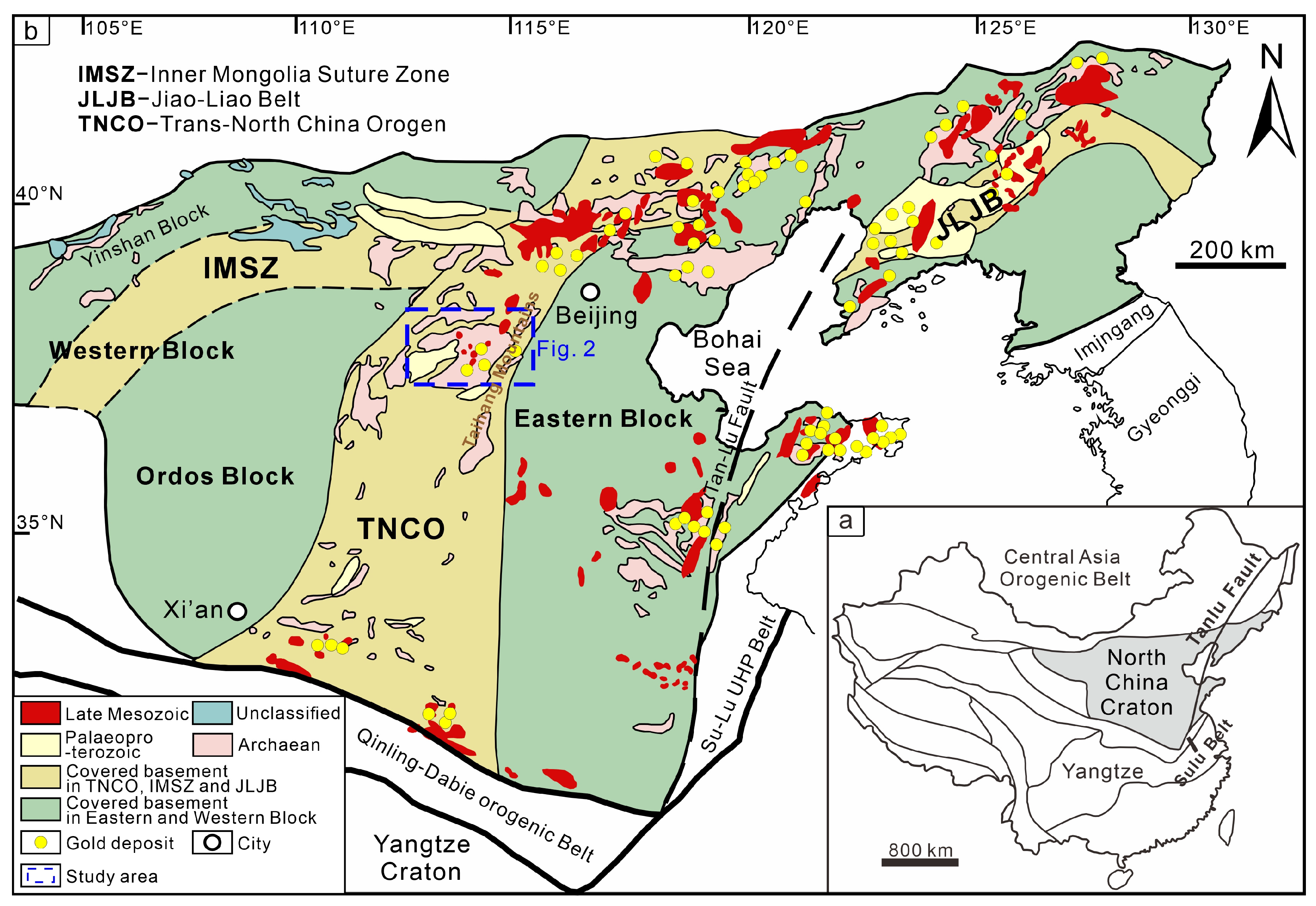
Figure 1. Distribution map of major gold deposits in the North China Craton (modified from [28,31]). (a) Location map of the North China Craton. (b) Locations of major gold deposits and the study area in the North China Craton.
Minerals 15 01290 g001
Figure 2. Regional geological map (modified from [25]).
Minerals 15 01290 g002
Figure 3. Regional geological map of Yixingzhai gold mining area (modified from [3]).
Minerals 15 01290 g003
Figure 4. Geological characteristics of the Tietangdong cryptoexplosive breccia pipe (modified from [3]). (a) Geological map of the Tietangdong breccia pipe. (b) Cross-section of the Tietangdong breccia pipe.
Minerals 15 01290 g004
Figure 5. Petrographic and mineralogical characteristics of the Tangdong cryptovolcanic breccia pipe. (a) Marble at the 770 m level. (b) Chlorite and pyrite occurring along the margins of the marble at the 770 m level. (c) Pyrite, chalcopyrite, galena, sphalerite, and quartz veins within fractures in the marble at the 770 m level. (d) Gabbro at the 830 m level crosscut by pyrite-bearing quartz veins and pyrite veins. (e) Garnet, epidote, chlorite, and pyrite observed in the contact zone between felsite and marble breccia at the 1070 m level. (f) Chlorite–epidote skarn containing garnet and quartz at the 1070 m level. (g) Garnet skarn at the surface. (h) Diopside garnet epidote skarn at the surface. (i) Breccia cemented by diopside and epidote at the surface. Abbreviation: Grt—Garnet; Di—Diopside; Ep—Epidote; Chl—Chlorite; Qtz—quartz; Cal—Calcite; Py—Pyrite; Ccp—chalcopyrite; Gn—Galena; Sp—Sphalerite.
Minerals 15 01290 g005
Figure 6. Petrographic characteristics of garnets from different generations. (a,c,e) are photographs under plane-polarized light; (b,d,f) are photographs under cross-polarized light. Abbreviations: Grt I, Grt II, Grt III represent Generation I, II, and III of garnet, respectively. Cal—Calcite.
Minerals 15 01290 g006
Figure 7. Stacked plots of end-member composition for garnets of different generations based on EPMA (a) and LA-ICP-MS (b) data.
Minerals 15 01290 g007
Figure 8. Ternary diagram of Grossular + Andradite + (Spessartine + Almandine) for garnets of different generations. (a) Garnet ternary diagram based on EPMA data. (b) Garnet ternary diagram based on LA-ICP-MS data. The basemap for (a,b) is after [42]. The principal types of skarn-related metal mineralization are indicated in the ternary diagram by the element labels (W, Sn, Mo, Fe, Cu, Au, and Zn) and their corresponding colored fields.
Minerals 15 01290 g008
Figure 9. Compositional variations in multi-generational garnets revealed by LA-ICP-MS analysis. (a,b) Box plots of garnet oxide compositions. (ce) Box plots of garnet trace elements and related parameters. The subscript ‘Calc’ denotes the calculated oxide value, derived from the original data using the methodology of [40]. FeOT refers to total FeO analyzed by LA-ICP-MS.
Minerals 15 01290 g009
Figure 10. Rare earth element characteristics of garnets from different generations. (ac) are the rare earth element patterns for garnet generations I, II, and III (Grt I, Grt II, Grt III), respectively. (d) is a comparison plot of the rare earth element patterns for the three garnet generations.
Minerals 15 01290 g010
Figure 11. Garnet element distribution map. The unit of the color bar legend is ppm. (a) Plane-polarized light image. (b) Cross-polarized light image. The remaining figures are LA-ICP-MS element mapping images. Abbreviations: Grt I, Grt II, Grt III represent Generations I, II, and III of garnet, respectively.
Minerals 15 01290 g011
Figure 12. Covariation diagram 1 of garnet compositions (LA-ICP-MS). (ad) display scatter plots of U, As, W, and δEu values versus andradite content, respectively. Abbreviations: Grt I, Grt II, Grt III represent Generations I, II, and III of garnet, respectively.
Minerals 15 01290 g012
Table 1. Genetic conditions of three garnet generations.
Garnet GenerationEnd-MemberTemperatureOxygen FugacitypHWater–Rock ReactionFluid Composition
Grt IAnd42–52Gro36–42Alm2–5Spe4–5HigherMediumNeutralWeakLow Cl
Grt IIAnd83–97Gro0–7Alm0–4Spe0–3LowerHighWeakly acidicStrongHigh Cl;
Increase in Co, Ni, and Cu Contents
Grt IIIAnd44–59Gro32–43Alm1–3Spe4–5HigherMediumNeutralWeakLow Cl
Note: And = andradite; Gro = grossularite; Alm = Almandine; Spe = Spessartite.
Disclaimer/Publisher’s Note: The statements, opinions and data contained in all publications are solely those of the individual author(s) and contributor(s) and not of MDPI and/or the editor(s). MDPI and/or the editor(s) disclaim responsibility for any injury to people or property resulting from any ideas, methods, instructions or products referred to in the content.