

A Review on Greensand Reservoirs’ Petrophysical Controls
 ,
,
Abstract
1. Introduction
- Key physical and mineralogical controls on porosity, permeability, and irreducible water saturation;
- Measurement and interpretation challenges, particularly in log analysis and saturation modelling;
- Recent advances in core–log integration and workflow development for more reliable reservoir characterisation.

| Reservoir Type | Reservoir Name | Location | Geological Period or Epoch | Porosity * (%v/v) | Permeability * (mD) | Glauconite Content * (%v/v) | Ref. |
|---|---|---|---|---|---|---|---|
| Oil | Matulla Formation from Nezzazat Group | Lower Senonian, Gulf of Suez, Egypt | Upper Cretaceous | 3.5 to 25 | <1 to 90 | 20 to 45 | [8] |
| Oil and gas | Glauconite member from Mannville Group | Lake Newell, Southern Alberta, Canada | Lower Cretaceous | 9 to 33 | 10 to 10,200 | Not available | [22] |
| Tight oil | Albian “A” Sand Formation from Greensand Group | North Celtic Sea Basin | Lower Cretaceous | ≤30 | ≤50 | ≤45 | [23] |
| Oil | Pona Reservoir, Chonta Formation | Peruvian forest region | Cretaceous | 1 to 20 | 1 to 1000 | Not available | [24] |
| Tight oil | Caballos Formation | Putumayo Basin, Colombia | Lower Cretaceous | 2 to 19 | 0.01 to 1200 | 10 to 60 | [25] |
| Tight oil | Mardie Greensand Formation | Carnarvon Basin, Australia | Early Cretaceous | 15 to 28 | 0 to 100 | Not available | [14,15] |
| Oil | Hermod and Ty Formations | Siri Canyon, Danish North Sea | Palaeocene | 25 to 40 | 60 to 1000 | 20 to 30 | [26] |
| Tight gas | Magallanes Formation | Campo Indio field, Austral Basin, Argentina | Upper Cretaceous | 15 to 35 | 0.01 to 1 | Not able to be determined ** | [9,10] |
| Tight gas | Zona Glauconitica | Austral-Magallanes Basin, Chile | Palaeocene | 10 to 25 | 0.001 to 1 | Not able to be determined ** | [18] |
| Tight oil | Upper T of Napo Formation | Oriente Basin, Ecuador | Cretaceous | 5 to 20 | ≤500 | 10 to 40 | [27] |
2. Geological and Mineral Framework of Greensands
2.1. Mineral Composition and Diagenesis
2.2. Diagenetic Alteration and Textural Controls
2.3. Microstructure and Dual Porosity
3. Greensand Measurement Challenges
3.1. Mineralogical Analysis
3.2. Porosity
3.3. Permeability
3.4. Irreducible Water Saturation
3.5. Water Saturation Modelling
4. Impact of Greensand Well Logs
5. Interpretation Framework for Greensand Reservoirs
5.1. Greensands’ Petrophysical Controls
5.2. Interpretation Workflows and Tool Recommendations
6. Conclusions and Perspectives
Author Contributions
Funding
Acknowledgments
Conflicts of Interest
References
- Dodge, W.S.; Shafer, J.L.; Klimentidis, R.E. Capillary pressure: The key to producible porosity. In Proceedings of the 37th SPWLA Annual Logging Symposium, New Orleans, LA, USA, 16–19 June 1996; p. SPWLA-1996-J. [Google Scholar]
- Rueslåtten, H.; Eidsemo, T.; Slot-Petersen, C. NMR studies of iron-rich sandstone oil reservoir. In Proceedings of the International Symposium of Society of Core Analysts, The Hague, The Netherlands, 14–16 September 1998; p. SCA-9821. [Google Scholar]
- Durand, C.; Cerepi, A.; Brosse, E. Effect of pore-lining chlorite on petrophysical properties of low-resistivity sandstone reservoir. In Proceedings of the 2000 SPE Annual Technical Conference and Exhibition, Dallas, TX, USA, 1–4 October 2000; p. SPE-63070. [Google Scholar] [CrossRef]
- Bansal, U.; Banerjee, S.; Nagendra, R. Is the rarity of glauconite in Precambrian Bhuima Basin in India related to its chloritization? Precambrian Res. 2020, 336, 105509. [Google Scholar] [CrossRef]
- Thompson, G.R.; Hower, J. The mineralogy of glauconite. Clays Clay Miner. 1975, 23, 289–300. [Google Scholar] [CrossRef]
- Odin, G.S.; Letolle, R. Glauconitisation and phosphatization environments: A tentative comparison. SEPM Spec. Publ. 1980, 29, 227–237. [Google Scholar]
- Harder, H. Boron content of sediments as a tool in facies analysis. Sediment. Geol. 1969, 4, 153–175. [Google Scholar] [CrossRef]
- Patchett, J.G.; Wiley, R.; El Bahr, M. Modeling the effects of glauconite on some openhole logs from the lower Senonian in Egypt. In Proceedings of the SPWLA 34th Annual Logging Symposium, Calgary, AB, Canada, 13–16 June 1993; p. SWPLA-1993-RR. [Google Scholar]
- Archie, G.E. The electrical resistivity log as an aid in determining some reservoir characteristics. Trans. AIME 1942, 146, 54–62. [Google Scholar] [CrossRef]
- Worthington, P.F. The evolution of shaly-sand concepts in reservoir evaluation. Log Anal. 1985, 26, 23–40. [Google Scholar]
- Waxman, M.H.; Smits, L.J.M. Electrical conductivities in oil-bearing shaly sands. Soc. Pet. Eng. J. 1968, 8, 107–122. [Google Scholar] [CrossRef]
- Clavier, C.; Coates, G.; Dumanoir, J. Theoretical and experimental bases for the dual-water model for interpretation of shaly sands. Soc. Pet. Eng. J. 1984, 24, 153–167. [Google Scholar] [CrossRef]
- Worthington, P.F. Net pay—What is it? What does it do? How do we quantify it? How do we use it? In Proceedings of the SPE Asia Pacific Oil and Gas Conference & Exhibition. Jakarta, Indonesia, 4–6 August 2009; p. SPE-123561. [Google Scholar] [CrossRef]
- Hatcher, G.B.; Chen, H.; Rahman, S.S.; Hogg, P.F. Evaluating formation damage risks in a glauconitic sandstone reservoir: A case history from the offshore North West Shelef of Australia. In Proceedings of the SPE Asia Pacific Oil and Gas Conference, Adelaide, Australia, 28–31 October 1996; p. SPE-37014. [Google Scholar] [CrossRef]
- Zhang, Y.; Salisch, H.A.; Arns, C. Permeability evaluation in a glauconite-rich formation in the Carnarvon Basin, Western Australia. Geophysics 2000, 65, 46–53. [Google Scholar] [CrossRef]
- Thomas, W.H.; Ringen, J.K.; Rasch, S.O. Effect of glauconite on petrophysical properties as revealed by core analysis. In Proceedings of the International Symposium of the Society of Core Analysts, Pau, France, 21–24 September 2003; p. SCA2003-32. [Google Scholar]
- Klein, J.D.; Little, L.; Scheihing, M.; Seifert, D. Formation evaluation and permeability prediction in a highly heterogeneous reservoir: The Kuparuk C-Sand. In Proceedings of the SWPLA 47th Annual Logging Symposium, Veracruz, Mexico, 4–7 June 2006; p. SPWLA-2006-FFF. [Google Scholar]
- Hossain, Z. Rock-Physics Modelling of the North Sea Greensand. Ph.D. Thesis, Technical University of Denmark, Kongens Lyngby, Denmark, 2011. [Google Scholar]
- Prayoga, O.A.; Wicaksono, B.; Setyoko, S.; Wibowo, A.; Wijaksono, E.; Sulistyono; Momem, M.; Zulmi, I. Integrated analysis for reservoir characterization of low resistivity glauconitic shaly sand reservoir of Miocene Ngryong Sandstone: Implications for saturation modelling at low contrast hydrocarbon pay zone. In Proceedings of the 2nd SPWLA Asia Pacific Technical Symposium, Bogor, Indonesia, 26–27 November 2018; p. SPWLA-2018-1810. [Google Scholar]
- Nong, K.; Chen, S.; Ren, Z.; Zeng, M. Analysis on glauconite research trends based on citespace knowledge graph. Minerals 2024, 14, 1260. [Google Scholar] [CrossRef]
- Dasi, E.; Rudmin, M.; Banerjee, S. Glauconite applications in agriculture: A review of recent advances. Appl. Clay Sci. 2024, 253, 107368. [Google Scholar] [CrossRef]
- Broger, K.; Syhlonyk, G. Glauconite sandstone exploration: A case study from the Lake Newell project, Southern Alberta, Canada. In Proceedings of the AAPG Annual Convention, Denver, CO, USA, 12–15 June 1994. [Google Scholar]
- Taber, D.R.; Vickers, M.K.; Winn, R.D., Jr. The definition of the Albian ‘A’ Sand reservoir fairway and aspects of associated gas accumulation in the North Celtic Sea Basin. Geol. Soc. Lond. Spec. Publ. 1995, 93, 227–244. [Google Scholar] [CrossRef]
- Garamendi, R.; Atau, H. Estrategia de explotacion en reservorios de bajo restablecimiento de presion. In Proceedings of the INGEPET 1999, Lima, Peru, 26–29 October 1999. [Google Scholar]
- Diaz, E.; Prasad, M.; Mavko, G.; Dvorkin, J. Effect of glauconite on the elastic properties, porosity and permeability of reservoir rocks. Lead. Edge 2003, 22, 42–45. [Google Scholar] [CrossRef]
- Hossain, Z.; Grattoni, C.A.; Solymar, M.; Fabricius, I.L. Petrophysical properties of greensand as predicted from NMR measurements. Pet. Geosci. 2011, 17, 111–125. [Google Scholar] [CrossRef]
- Yang, X.F.; Ma, Z.Z.; Zhou, Y.B.; Zhang, Z.W.; Liu, Y.M.; Wang, D.D.; Zhao, Y.B. Reservoir characteristics and hydrocarbon accumulation of the glauconitic sandstone in the Tarapoa Block, Oriente Basin, Ecuador. J. Pet. Sci. Eng. 2019, 173, 558–568. [Google Scholar] [CrossRef]
- López-Quirós, A.; Escutia, C.; Sánchez-Navas, A.; Nieto, F.; Garcia-Casco, A.; Martín-Algarra, A.; Evangelinos, D.; Salabarnada, A. Glaucony authigenesis, maturity and alteration in the Weddell Sea: An indicator of paleoenvironmental conditions before the onset of Antarctic glaciation. Sci. Rep. 2019, 9, 13580. [Google Scholar] [CrossRef]
- Odin, G.S.; Matter, A. De glauconiarum origin. Sedimentology 1981, 28, 611–641. [Google Scholar] [CrossRef]
- Baldermann, A.; Warr, L.N.; Grathoff, G.H.; Dietzel, M. The rate and mechanism of deep-sea glauconite formation at the Ivory Coast-Ghana marginal ridge. Clays Clay Miner. 2013, 61, 258–276. [Google Scholar] [CrossRef]
- López-Quirós, A.; Sánchez-Navas, A.; Nieto, F.; Escutia, C. New insights into the nature of glauconite. Am. Mineral. 2020, 105, 674–686. [Google Scholar] [CrossRef]
- Navarro-Perez, D.J. Improved Reservoir Characterisation of a Chilean Tight Sandstone Reservoir. Ph.D. Thesis, University of Leeds, Leeds, UK, 2024. [Google Scholar]
- Wilson, L.; Wilson, M.J.; Green, J.; Patey, I. The influence of clay mineralogy on formation damage in North Sea reservoir sandstone: A review with illustrative examples. Earth-Sci. Rev. 2014, 134, 70–80. [Google Scholar] [CrossRef]
- Hossain, Z.; Fabricius, I.L.; Christense, H.F. Elastic and nonelastic deformation of greensand. Lead. Edge 2009, 28, 86–88. [Google Scholar] [CrossRef]
- Atahualpa, G. Efecto de la Glauconita en las Propiedades Petrofísicas del Reservorio Arenisca “T” Superior del Bloque Tarapoa. Bachelor’s Thesis, Universidad Central de Ecuador, Quito, Ecuador, 2013. [Google Scholar]
- Guanochanga, J. Modelo Geológico, Caracterización Petrofísica y Cálculo de Reservas, en la Arenisca “T” Superior del Campo Mariann 4A y Mariann Norte en el Bloque Tarapoa. Bachelor’s Thesis, Universidad Central de Ecuador, Quito, Ecuador, 2013. [Google Scholar]
- Pittman, E.D. Porosity, diagenesis and productive capability of sandstone reservoirs. Soc. Econ. Paleontol. Mineral. (SEPM) Spec. Publ. 1979, 26, 159–173. [Google Scholar]
- Slot-Petersen, C.; Eidesmo, T.; White, J.; Rueslatten, H.G. NMR formation evaluation applications in a complex low-resistivity hydrocarbon reservoir. In Proceedings of the SPWLA 39th Annual Logging Symposium, Keystone, CO, USA, 26–29 May 1998; p. SPWLA-1998-TT. [Google Scholar]
- Markley, M.; Seminario, F.; Gabulle, J.; Luquez, J. Microporosity and laminations in Non-Archie reservoirs create challenges for water-saturation computation and reserves evaluation: Camisea, Peru. In Proceedings of the SPE Latin American & Caribbean Petroleum Engineering Conference, Lima, Peru, 1–3 December 2010; p. SPE-139424. [Google Scholar] [CrossRef]
- Hossain, Z.; Mukerji, T.; Dvorkin, J.; Fabricius, I.L. Rock physics model of glauconite greensand from the North Sea. Geophysics 2011, 76, E199–E209. [Google Scholar] [CrossRef]
- Hugget, J.M. Glauconites. In Encyclopedia of Geology; Alderton, D., Scott, A.E., Eds.; Academy Press: Cambridge, MA, USA, 2021; pp. 334–340. [Google Scholar]
- Burst, J.F. Mineral heterogeneity in “glauconite pellets”. Am. Mineral. J. Earth Planet. Mater. 1958, 43, 481–497. [Google Scholar]
- Hower, J. Some factors concerning the nature and origin of glauconite. Am. Mineral. J. Earth Planet. Mater. 1961, 46, 313–334. [Google Scholar]
- Cimbalnikova, A. Chemical variability and structural heterogeneity of glauconites. Am. Mineral. J. Earth Planet. Mater. 1971, 56, 1385–1392. [Google Scholar]
- Cimbalnikova, A. Influence of 10Å/14Å interlayering on the layer charge of glauconites. Am. Mineral. J. Earth Planet. Mater. 1971, 56, 1393–1398. [Google Scholar]
- Abudelgawad, G.; Page, A.L.; Lund, L.J. Chemical weathering of glauconite. Soil Sci. Soc. Am. J. 1975, 39, 567–571. [Google Scholar] [CrossRef]
- El-Amamy, M.M.; Page, A.L.; Abudelgawad, G. Chemical and mineralogical properties of glauconitic soils as related to potassium depletion. Soil Sci. Soc. Am. J. 1982, 46, 426–430. [Google Scholar] [CrossRef]
- McPhee, C.; Reed, J.; Zubizarreta, I. Core Analysis: A Best Practice Guide, 64; Elsevier: Amsterdam, The Netherlands, 2015. [Google Scholar]
- Navarro-Perez, D. Quantifying the porosity of natural reservoirs with nuclear magnetic resonance. Nat. Rev. Earth Environ. 2023, 4, 599. [Google Scholar] [CrossRef]
- Coates, G.R.; Xiao, L.; Prammer, M.G. NMR Logging Principles and Applications; Elsevier Science: Houston, TX, USA, 1999. [Google Scholar]
- Hossain, Z.; Zhou, Y. Petrophysics and rock physics modeling of diagenetically altered sandstone. Interpretation 2015, 3, 107–120. [Google Scholar] [CrossRef]
- Navarro-Perez, D.; Fisher, Q.; Allshorn, S.; Grattoni, C.; Lorinczi, P. Multi-salinity core flooding study in clay-bearing sandstones, a contribution to geothermal reservoir characterisation. Adv. Geosci. 2024, 62, 71–80. [Google Scholar] [CrossRef]
- Van Olphen, H.; Fripiat, J.J. Data handbook for clay materials and other non-metallic minerals. Soil Sci. 1979, 131, 62. [Google Scholar] [CrossRef]
- Timur, A. An investigation of permeability, porosity, and residual water saturation relationships. In Proceedings of the SPWLA 9th Annual Logging Symposium, New Orleans, LA, USA, 23–26 June 1968; p. SPWLA-1968-J. [Google Scholar]
- Kenyon, W.E. Petrophysical principals of applications of NMR logging. Log ASnal. 1997, 38, 21–43. [Google Scholar]
- Kozeny, J. Ueber kapillare Litung des Wassers im Boden. Sitz.-Berichte Der Kais. Akad. Der Wiss. Wien 1927, 136, 271–306. [Google Scholar]
- Hossain, Z.; Cohen, A.J. Relationship among porosity, permeaility, electrical and elastic properties. In Proceedings of the 2012 SEG Annual Meeting, Las Vegas, NV, USA, 4–9 November 2012; p. SEG-2012-1496. [Google Scholar]
- Zhang, Y.J.; Lollback, P.A.; Rojahn, J.S.; Salisch, H.A.; Stuart, W.J. A methodology for estimating permeability from well logs in a formation of complex lithology. In Proceedings of the SPE Asia Pacific Oil and Gas Conference and Exhibition, Adelaide, Australia, 28–31 October 1996; p. SPE-37025-MS. [Google Scholar] [CrossRef]
- Simpson, G.A.; Fishman, N.S.; Hari-Roy, S. New Nuclear Magnetic Resonance Log T2 Cut-off Interpret Parameters for the Unconventional Tight Oil of the Bakken Petroleum System Using 2-D NMR Core Laboratory Measurements on Native State and Post-Cleaned Core Samples. In Proceedings of the SPWLA 59th Annual Logging Symposium, London, UK, 2–6 June 2018; p. SPWLA-2018-GGGG. [Google Scholar]
- Cluff, R.M.; Byrnes, A.P. Relative permeability in tight gas sandstone reservoirs—The “permeability jail” model. In Proceedings of the SPWLA 51st Annual Logging Symposium, Perth, Australia, 19–23 June 2010; p. SPWLA-20120-58470. [Google Scholar]
- Weaver, C.E. Clays, Muds, and Shales; Elsevier: Amsterdam, The Netherlands, 1989. [Google Scholar]
- Pratama, E.; Ismail, M.S.; Ridha, S. An integrated workflow to characterize and evaluate low resistivity pay and its phenomenon in a sandstone reservoir. J. Geophys. Eng. 2017, 14, 513–519. [Google Scholar] [CrossRef]
- Worthington, P.F. Recognition and evaluation of low-resistivity pay. Pet. Geosci. 2000, 6, 77–92. [Google Scholar] [CrossRef]
- Sneider, R.M. Worldwide examples of low resistivity pay. Houst. Geol. Soc. Bull. 2003, 45, 47–59. [Google Scholar]
- Bardon, C.; Pied, B. Formation water saturation in shaly sands. In Proceedings of the SWPLA 10th Annual Logging Symposium, Houston, TX, USA, 25–28 May 1969; p. SWPLA-1969-Z. [Google Scholar]
- Hossain, Z.; Mukerji, T.; Fabricius, I.L. Vp-Vs relationship and amplitude variation with offset modeling of glauconitic greensand. Geophys. Prospect. 2012, 60, 117–137. [Google Scholar] [CrossRef]
- Gonzalez-Gonzalez, A.; Valderrama, J.M.; Gschaider, C.T.; Carcamo, R.A.; Verdugo-Dobronic, M.; Canessa, N.D.; Perez-Perez, A.; Velasquez-Arauna, A.; Sanchez-Ojeda, J.; Ahumada-Villar, M.; et al. Desarrollo del play tight gas zona glauconitica, Bloque Arenal, Cuenca de Magallanes—Chile: Caso estudio. In Proceedings of the 10° Congreso de Exploracion y Desarrollo de Hidrocarburos, Mendoza, Argentina, 5–9 November 2018. [Google Scholar]
- Aimar, E.; Cevallos, M.; Cangini, A.; Mas-Cattapan, F.; Vega, V. Extension y desarrollo de los reservorios de baja permeabilidad del yacimiento Campo Indio, Formación Magallanes (Maastricchtiano Tardío-Daniano), Cuenca Austral Argentina. In Proceedings of the 10° Congreso de Exploracion y Desarrollo de Hidrocarburos, Mendoza, Argentina, 5–9 November 2018. [Google Scholar]
- Kennedy, W.D.; Herrick, D.C. Conductivity models for Archie rocks. Geophysics 2012, 77, WA109–WA128. [Google Scholar] [CrossRef]
- Eslinger, E.; Pevear, D. Clay Minerals for Petroleum Geologists and Engineers, SEPM Short Course 22; Society for Sedumentary Geology: Tulsa, OK, USA, 1988. [Google Scholar]
- Schlumberger. ECS Elemental Capture Spectroscopy Sonde. 2006. Available online: https://www.slb.com/-/media/files/fe/brochure/ecs-brochure (accessed on 26 February 2021).




| Clay Mineral Group | CEC (MEQ/100 g) | Surface Area (m2/g) 1 |
|---|---|---|
| Smectite | 70–130 | 800 |
| Illite | 25–40 | 30 |
| Chlorite | 10–40 | 15 |
| Kaolinite | 3–15 | 15 |
| Name | Equation | Reference |
|---|---|---|
| Timur and Coates (TC) | [54] | |
| Schlumberger–Doll (SRD) | [55] | |
| Kozeny | [56] | |
| Modified Kozeny’s to include macroporosity range | [40] | |
| Worthington’s modified Kozeny’s equation | [57] | |
| Modified Kozeny’s as a function of rock type | [51] |
| Method | Comments | Ref. |
|---|---|---|
| Log NMR permeability with SRD and Timur–Coates (TC) equations. |
| [1] |
| Electrofacies pattern linked to permeability transforms algorithm using core porosity and permeability. |
| [58] |
| NMR permeability with the Timur–Coates equation. |
| [2] |
| Log NMR permeability with the Timur–Coates equation. |
| [38] |
| Artificial neural network technique to estimate permeability. |
| [15] |
| Density Constrained Stochastic Modelling (DCSM). |
| [17] |
| Modified Kozeny’s equation to include the whole macroporosity range of T2 times. |
| [40] |
| Empirical correlation of permeability with the electrical formation factor—Worthington’s modified Kozeny’s equation. |
| [57] |
| Modified Kozeny’s equation by including two factors, a and b, dependent on the rock type, instead of the specific surface area or surface relaxivity, and as a function of porosity. |
| [51] |
| Swirr Range 1 (%v/v) | T2 Cut-Off Value (ms) | Technique Used | Ref. |
|---|---|---|---|
| 12–78 | 10 to 30 | Centrifuge air/brine drainage capillary pressure and NMR T2 distribution. | [1] |
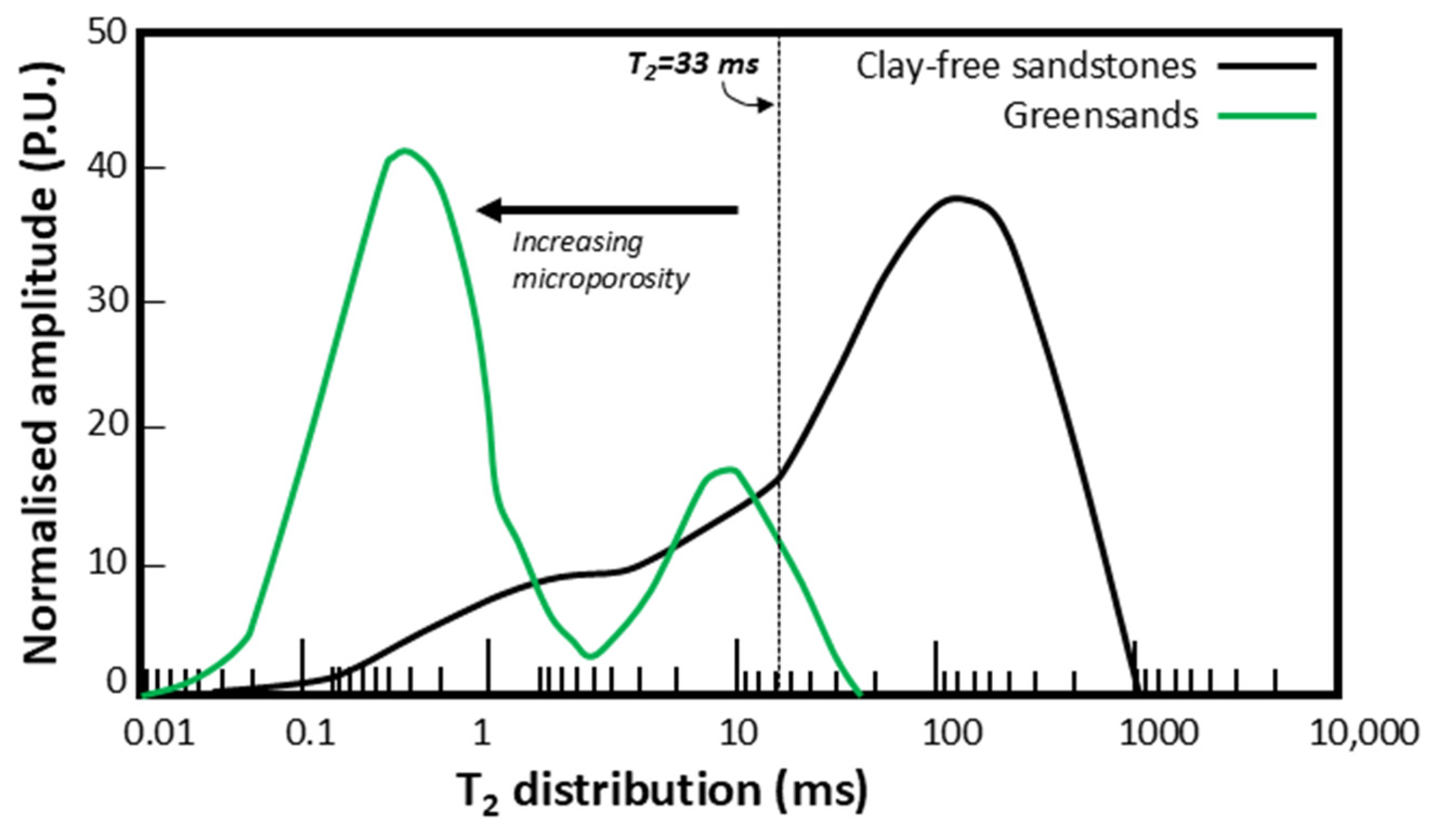
| 27–55 | 33 | Decane–brine saturation, Karl Fischer titration, and NMR T2 distribution | [2] |
| 27–41 | 33 and 10 for chlorite zones | Karl Fischer titration and NMR T2 distribution | [38] |
| 22–41 | 5.2 and 3.7 | Centrifuge air/brine drainage capillary pressure and NMR T2 distribution. | [40] |
| Location | Model | Ref. |
|---|---|---|
| Trimble Field, MS, USA | Pseudo-Archie using m = 1.8 and n = 1.77 | [63] |
| Nini Field, North Sea | Pseudo-Archie using a = 1.67, m = 1.18, n = 2.4 and Rw = 0.077 ohm·m. | [66] |
| Trembul Field, Indonesia | Waxman–Smits using a = 1.0, m = 1.76, n = 1.79 and Rw = 0.19 ohm·m @148 °F. | [19] |
| Glauconite Formation, Southern Chile | Simandoux using a = 1, m = 2.09, n = 1.66. | [67] |
| Magallanes Formation, Southern Argentina | Pseudo-Archie using a = 0.8–0.82, m = 1.4–1.6, n = 1.4–1.6 and Rw = 0.3 ohm·m @150 °F. | [68] |
| Model | Equation | Ref. |
|---|---|---|
| Archie | [9,69] | |
| Simandoux | [62,65] | |
| Waxman–Smits | [10,11] |
| Well Log | Greensand Effect | Causes | Petrophysical Estimation | Reference |
|---|---|---|---|---|
| Gamma-ray | Higher response than clean and shaly sandstone. | High presence of potassium. Greensands can contain other clay minerals, such as chlorite, siderite, and pyrite. Higher boron content than other clay minerals. | The shale or clay volume calculated is overestimated. | [17,27,35] |
| Deep resistivity | Lower response similar to freshwater zones. | High cation cation-exchange capacity (CEC), meaning lower resistivity. Large amount of bound water in the glauconitic grains. | The hydrocarbon zone is not easily identified. The water saturation is overestimated. | [8,35,71] |
| Neutron porosity | Higher response than sandstone. | Large thermal neutron absorption cross-section because of its high iron content. Higher boron content than other clay minerals. | Neutron porosity is overestimated. | [8,17] |
| Bulk density | Higher response than sandstone. | Glauconite is denser than sandstone. Iron presence. | Density porosity is underestimated. | [8,17,25,71] |
| Photoelectric factor | Higher response than sandstone. | Relatively high molecular weight. Iron presence. | It can be used to identify the glauconitic sandstone lithology. | [8,35] |
| NMR tool | T2 decays faster. | Paramagnetic effect of the iron content of greensand. | Bulk mobile fluid underestimated. T2 cut-off value needs to be lower than 30 ms. | [1,2,38] |
| Reservoir Property | Challenge | Recommended Tool/Approach (Including Core-Based Methods) |
|---|---|---|
| Porosity | Microporosity retention; poor intergranular sorting | NMR (adjusted T2 cut-offs), brine–helium porosity comparison, SEM image calibration |
| Permeability | Pore-throat obstruction by glauconite and chlorite; poor sorting | NMR-based models (Timur–Coates, SDR), SSA estimation, core–log regression |
| Saturation | Overestimated Sw from resistivity; non-Archie behaviour | Waxman–Smits or dual-water models; field-calibrated m and n; CEC measurement |
| Clay Volume | GR over-response due to high K; mineral misidentification | Spectral gamma-ray, PEF logs, clay typing via mineralogical analysis (XRD, SEM) |
| Rock Typing | Electrofacies overlap; textural heterogeneity | Multi-mineral log inversion; unsupervised clustering; thin-section validation |
| Net Pay Determination | Inconsistent cut-offs for Swirr and porosity | NMR calibration, capillary pressure curves, core-calibrated net pay criteria |
| Reservoir Quality Mapping | Misleading poro–perm trends; variable Swirr | Integration of digital rock physics, electrofacies models, and cross-plots |
| Logging Environment | High sensitivity to salinity, temperature, and iron content | In situ environmental corrections, formation-specific interpretation templates |
Disclaimer/Publisher’s Note: The statements, opinions and data contained in all publications are solely those of the individual author(s) and contributor(s) and not of MDPI and/or the editor(s). MDPI and/or the editor(s) disclaim responsibility for any injury to people or property resulting from any ideas, methods, instructions or products referred to in the content. |
© 2025 by the authors. Licensee MDPI, Basel, Switzerland. This article is an open access article distributed under the terms and conditions of the Creative Commons Attribution (CC BY) license (https://creativecommons.org/licenses/by/4.0/).
Share and Cite
Navarro-Perez, D.; Fisher, Q.; Lorinczi, P.; Velásquez Arauna, A.; Valderrama Puerto, J. A Review on Greensand Reservoirs’ Petrophysical Controls. Minerals 2025, 15, 1280. https://doi.org/10.3390/min15121280
Navarro-Perez D, Fisher Q, Lorinczi P, Velásquez Arauna A, Valderrama Puerto J. A Review on Greensand Reservoirs’ Petrophysical Controls. Minerals. 2025; 15(12):1280. https://doi.org/10.3390/min15121280
Chicago/Turabian StyleNavarro-Perez, Daniela, Quentin Fisher, Piroska Lorinczi, Aníbal Velásquez Arauna, and Jose Valderrama Puerto. 2025. "A Review on Greensand Reservoirs’ Petrophysical Controls" Minerals 15, no. 12: 1280. https://doi.org/10.3390/min15121280
APA StyleNavarro-Perez, D., Fisher, Q., Lorinczi, P., Velásquez Arauna, A., & Valderrama Puerto, J. (2025). A Review on Greensand Reservoirs’ Petrophysical Controls. Minerals, 15(12), 1280. https://doi.org/10.3390/min15121280