Article

Fluid Inclusion Constraints on the Formation Conditions of the Evevpenta Au–Ag Epithermal Deposit, Kamchatka, Russia


by
Pavel S. Zhegunov
1,2,*,
Sergey Z. Smirnov
3,
Elena O. Shaparenko
1,3,
Alexey Yu. Ozerov
1 and
Ricardo Scholz
2
1
Institute of Volcanology and Seismology, Far Eastern Branch of the Russian Academy of Sciences, 683023 Petropavlovsk-Kamchatsky, Russia
2
Departamento de Geologia, Escola de Minas, Universidade Federal de Ouro Preto, Ouro Preto MG-35400-000, Brazil
3
Sobolev Institute of Geology and Mineralogy, Siberian Branch of the Russian Academy of Sciences, 630090 Novosibirsk, Russia
*
Author to whom correspondence should be addressed.
Minerals 2025, 15(11), 1196; https://doi.org/10.3390/min15111196
Submission received: 23 September 2025 / Revised: 2 November 2025 / Accepted: 10 November 2025 / Published: 13 November 2025

Abstract

The Evevpenta gold–silver epithermal deposit, belonging to an adularia–sericite or low-sulfidation type, is in the northern part of the Kamchatka Peninsula within the Oligocene–Quaternary Central Kamchatka volcanic belt. Variously native gold, silver, and Au–Ag chalcogenides, including calaverite, petzite, hessite, acanthite, uytenbogaardtite-petrovskaite, and naumannite, constitute its Au–Ag mineralization. Extensive fluid inclusion studies, involving fluid inclusion petrography, Raman spectroscopy, and microthermometry, revealed that quartz from gold-bearing adularia–quartz veins crystallized from low-salinity fluids (T ice melting from −0.1 to −3.3 °C) at moderate to low temperatures (140 to 364 °C). The mineralizing fluids consisted of Na, K, and Mg sulfate and bicarbonate-bearing aqueous solutions and low-density CO2. The gold-bearing mineral assemblages were formed within narrower temperature ranges. The gold–telluride–quartz assemblage was deposited between 325 and 175 °C, while the telluride–sulfide–quartz formed between 219 and 258 °C. Possible influx of meteoric waters led to progressive cooling and a decrease in salinity from the early to late fluid generations during mineral deposition. Overall data on ore and associated with metasomatic alteration mineralogy indicate that the ore formation occurred under relatively reduced or neutral conditions from weakly acidic to near-neutral aqueous solutions, possessing relatively high sulfur and tellurium fugacity.

1. Introduction

Epithermal gold and silver deposits hold significant importance in the global and Russian reserves of these metals [1,2,3]. These shallow deposits (formation depth < 1 km), genetically related to volcanic zones, form low- to intermediate-temperature hydrothermal solutions originating from the mixing of magmatic fluids and meteoric water [4,5,6]. Several classification schemes for epithermal deposits are available in the literature [6,7,8]. Our study follows the system that distinguishes the two main deposit types, namely adularia–sericite (corresponding to the low- and intermediate-sulfidation types) and acid–sulfate (corresponding to the high-sulfidation type) [9,10]. The assessment of the formation conditions of epithermal deposits is based on data from fluid inclusion studies [6,7,8,11,12,13]. The study of fluid inclusions allows the determination of the temperature, pressure, salt composition, and concentration of salts in the ore-forming fluids. The development of methods such as Raman spectroscopy, laser ablation inductively coupled plasma mass spectrometry (LA–ICP–MS), and gas chromatography–mass spectrometry (GC–MS) has contributed to a growing number of studies on fluid composition and to a deeper understanding of the formation conditions of epithermal deposits [12,14,15,16,17].
Kamchatka Peninsula hosts numerous epithermal deposits, which represent potentially important sources of gold [10,18]. These deposits are in volcanic belts stretching along the Kuril–Kamchatka subduction zone and are in the geodynamic setting of an island arc [10,18]. Most of the well-studied epithermal Au–Ag deposits in Kamchatka are in the southern part of the peninsula and are relatively accessible, such as the Asachinskoye, Aginskoye, and Rodnikovoye [16,17,19,20,21,22,23,24,25,26]. Studies of these deposits involve an assessment of the temperature, fluid pressure, and chemical composition of the ore-forming fluids. The composition of the aqueous fluids was predominantly assessed using microthermometry of fluid inclusions, specifically through measurements of eutectic and ice-melting temperatures [19,20,21,23,25]. However, information on the chemical composition of fluid inclusions studied using Raman spectroscopy, LA–ICP–MS, and GC–MS is rather limited.
The northern part of the Kamchatka Peninsula, known as the North Kamchatka Ore District, contains numerous promising epithermal Au–Ag deposits and ore occurrences. However, these are currently not mined and are relatively underexplored because of their restricted accessibility. As a result, information on the mineralogy and formation conditions of epithermal Au–Ag deposits in northern Kamchatka is fragmentary. One of the promising deposits in the North Kamchatka Ore District is the Evevpenta epithermal Au–Ag deposit. It is situated 800 km north of the city of Petropavlovsk–Kamchatsky (Kamchatka Region, Russia). The Evevpenta deposit is located within the Central Kamchatka Volcanic Belt (CKVB) and is associated with a Miocene–Pliocene volcanic sequence from intermediate to acidic composition. The deposit was discovered in 1994 and, ever since, it has been explored by geologists of different mining companies (CJSC Polamos, OJSC Kamgeo, JSC Rosgeo). Possible resources of gold at the Evevpenta deposit were estimated at approximately 13 tons [27]. The Evevpenta refers to the group of the adularia–sericite epithermal systems; the initial data on the mineral composition of the ores were obtained earlier, but the conditions of formation have not been studied [27,28,29].
The aim of this study is a comprehensive investigation of the mineral formation conditions in adularia–quartz veins from various parts of the Evevpenta deposit, using constraints obtained from fluid inclusion studies. The study of the evolution of the mineral-forming conditions is an important aspect of gold metallogeny for determining genetic ore-forming processes [30]. The results obtained supplement the existing knowledge of volcanogenic Au–Ag epithermal ore formation in Kamchatka and fill the knowledge gaps on epithermal Au–Ag deposits in the North Kamchatka Ore District.

2. Geology and Mineral Associations of the Evevpenta Deposit

The Kuril–Kamchatka island-arc system is located on the northeastern margin of the Eurasian continent [31]. The northern segment of this system is the Kamchatka Peninsula, which constitutes an active continental margin (Figure 1a). The basement of the Kamchatka Peninsula exhibits a complex accretionary structure and incorporates intensely deformed Cretaceous–Paleogene island-arcs, ophiolitic, and marginal continental terranes [32,33,34]. The basement structures are unconformably overlain by volcanic sequences of three volcanic belts of distinct age intervals: the Koryak-West Kamchatka Volcanic Belt (Eocene–Oligocene), the Central Kamchatka Volcanic Belt (Oligocene–Quaternary), and the East Kamchatka Volcanic Belt (Pliocene–Quaternary) [32].
The Central Kamchatka Volcanic Belt extends approximately 1800 km in a northeasterly direction along the peninsula and is controlled by the Main Kamchatka Deep Fault [36]. The CKVB hosts a significant number of Au–Ag epithermal and Cu-porphyry occurrences [32,34,36]. The Evevpenta deposit is in northern Kamchatka within the CKVB (Figure 1b). The deposit is confined to the Kichiga volcano–tectonic depression, situated near the junction of the Lesnaya uplift, a Cretaceous–Paleogene basement high, and the CKVB. The spatial distribution of the Evevpenta deposit and associated ore occurrences is controlled by nodes of intersection between the northeast-striking Main Kamchatka Deep Fault and higher-order submeridional faults [27].
The ore deposit area incorporates three structural levels. The lower structural level (constituting the basement) comprises Upper Cretaceous volcano-sedimentary formations of the Iruney basalt complex, intruded by Miocene diorites of the Emivayam plutonic complex. The basement rocks are not exposed in the mining area, but outcrop to the southwest of it. The middle structural level consists of the Miocene Umuvayam and Miocene–Pliocene Tolyatovayam volcanic complexes (Figure 1c,d). Volcanic rocks of both complexes are similar and comprise andesite, dacite, associated tuffs and ignimbrites, which are intruded by subvolcanic andesites, dacitic andesites, and rhyodacite stocks. The upper structural level consists of Quaternary sediments of various origins. The ore bodies are hosted within subvolcanic bodies belonging to the Umuvayam and Tolyatovayam volcanic complexes. Ore bodies are surrounded by metasomatic alteration halos, including argillic alteration, quartz-sericite and quartz-adularia alteration, pyritization, and peripheral propylitization.
The Evevpenta deposit can be further divided into two parts, Central and Northern (Figure 1c), which are characterized by different textures of the adularia–quartz veins and slightly different mineralization [28]. In the Central part of the Evevpenta deposit, ore mineralization is found in veins, vein swarms, and hydrothermal breccia bodies formed by explosive fluid discharge. The vein swarms and hydrothermal breccia bodies range in thickness up to 35 m, with individual veins ranging from 0.9 to 2.8 m thick. The ore bodies trend east–west, showing a steep southwest dip (60–90°), and can be traced along strike up to 300 m. Within the Northern part of the deposit, the ore bodies consist of vein swarms, with individual veins being up to 0.5 m thick and hydrothermal breccia bodies (<2 m in thickness). These ore bodies trend broadly east–west and dip southeast at 45–70°.

3. Materials and Methods

3.1. Materials

The samples selected for this study were collected from the adularia–quartz veins in exploration trenches and are presented in Table 1. In the first stage, thin and polished sections were prepared to characterize the mineral composition and perform petrographic analysis using optical microscopy and scanning electron microscopy. Subsequently, double-polished wafers (0.3–0.5 mm thick) were produced for fluid inclusion studies in quartz using optical microscopy, Raman spectroscopy, and microthermometry.

3.2. Methods

3.2.1. Optical Microscopy

Study of quartz textures and fluid inclusion petrography were performed using a Nikon LV100N (Nikon, Tokyo, Japan) polarized light microscope equipped with a digital camera (Institute of Volcanology and Seismology, Far Eastern Branch of the Russian Academy of Sciences (IVS FEB RAS), Petropavlovsk–Kamchatsky, Russia) and an Olympus BX53M (Olympus, Tokyo, Japan) microscope (Sobolev Institute of Geology and Mineralogy, Siberian Branch of the Russian Academy of Sciences (IGM SB RAS), Novosibirsk, Russia). Part of the petrographic research on fluid inclusions was conducted using transmitted light microscopy with a Zeiss Axio Scope A1 microscope (Carl Zeiss AG, Jena, Germany) at the Laboratory of Microscopy and Microanalysis (Universidade Federal de Ouro Preto (UFOP), Ouro Preto, Brazil). At room temperature, fluid inclusions were classified by genetic type (primary, pseudosecondary, and secondary) and phase composition following specific criteria [37,38,39]. Secondary inclusions occur along healed fractures transecting quartz grains, usually their sizes are less than 2 μm, and exhibit limited distribution; consequently, they were excluded from analysis. Primary inclusions > 8–10 μm were selected for further investigation.

3.2.2. Scanning Electron Microscopy (SEM–EDS)

The morphology and chemical composition of the minerals prepared as polished sections and coated with carbon were studied using a Tescan Vega 3 (Tescan, Brno, Czech Republic) scanning electron microscope (IVS FEB RAS) with a tungsten cathode equipped with an X-Max 80 mm2 energy dispersion detector at an accelerating voltage of 10–20 keV, a beam current of 0.75 nA, and an accumulation time of 20 s. The detection limit was 0.1 wt.%. The SED–EDS microanalysis was standardized using the following standards: pure metals (Au, Ag, Mo), synthetic InAs, CdTe, PbSe, stoichiometric minerals of known composition: pyrite (FeS2), chalcopyrite (CuFeS2), sphalerite (ZnS), rhodonite (MnSiO3). Spectral lines for element analysis were selected based on the excitation conditions (10 or 20 keV) and the presence (or absence) of significant peak overlaps. Analytical lines of higher energy, mainly from the K- or L-series, were primarily chosen. The energy-dispersive spectra were processed using the AzTec 3.1 software (Oxford Instruments, Abingdon, UK).

3.2.3. Microthermometry

The most suitable fluid inclusions, showing no visible evidence of decrepitation or leakage, were studied by microthermometric methods. Homogenization temperatures, eutectic melting, and ice melting temperatures were measured using a Linkam THMSG–600 (Linkam, Redhill, UK) heating-freezing stage (−196 °C to +600 °C; IGM SB RAS), with measurement accuracy of ±0.1 °C below 0 °C and ±5 °C above 0 °C. Salt system composition was estimated from eutectic temperatures following binary H2O–salt system principles [40]. Salinity was determined based on ice melting temperatures.

3.2.4. Raman Spectroscopy

The phase composition of individual fluid inclusions was determined by Raman spectroscopy using a Horiba J.Y. LabRAM HR800 (Horiba, Kyoto, Japan) spectrometer equipped with a 532 nm solid-state laser (50 mW output; IGM SB RAS, and Geomodel Resource Center, St. Petersburg State University, St. Petersburg, Russia). Mineral vibrational spectra were processed and analyzed with the ArDI web application [41,42] and the open-access RRUFF Raman database [43]. CO2 density in fluid inclusions was determined from Fermi dyad distance (1385–1285 cm−1) using the empirical calibration [44].

4. Results

4.1. Mineral Composition of the Evevpenta Deposit Ores

Previous research and this study have identified 18 ore and 8 gangue minerals in the Evevpenta deposit (Table 2) [27,28,29]. The previous research defined a gold–telluride–quartz assemblage in the Central part of the deposit and a telluride–sulfide–quartz assemblage in the Northern part [28].

4.1.1. The Central Part of the Evevpenta Deposit

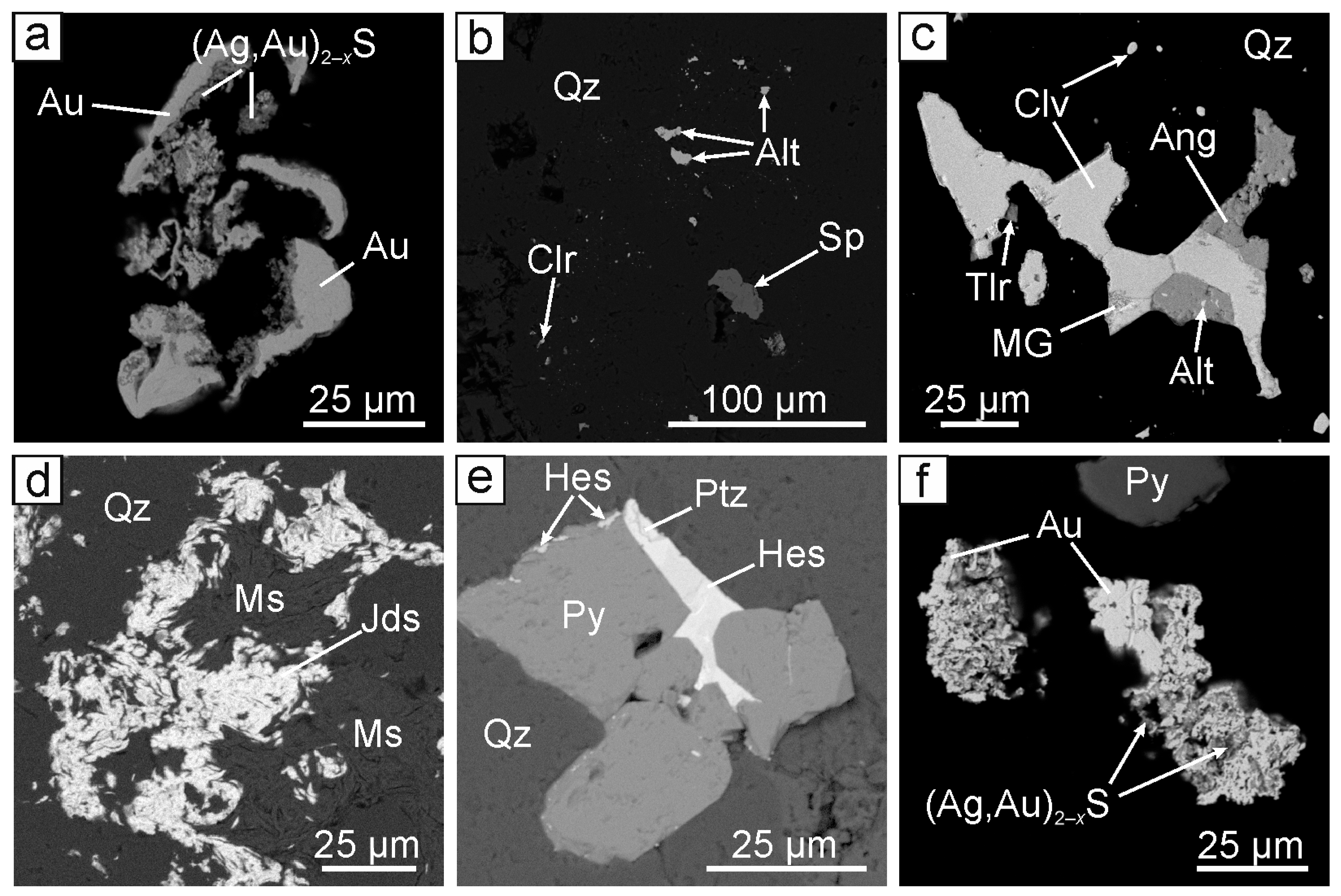
On the Central part of the Evevpenta deposit, the veins are composed of fine- to medium-grained quartz with varying amounts of adularia and chalcedony. The ore veins exhibit lattice bladed, crustiform banded, colloform banded, and brecciated textures. Banding is expressed by variations in quartz crystallinity and/or by bands enriched with adularia. In brecciated aggregates, fragments of host rock or earlier-generation quartz are cemented by later-stage quartz. Ore mineralization occurs as disseminated and aggregates with an uneven distribution. The abundance of ore minerals within the veins is less than 1%. Collectively, the ore minerals form the gold-bearing gold–telluride–quartz mineral assemblage (Figure 2a–c). In this assemblage, native gold (Au,Ag) is associated with sphalerite (ZnS), galena (PbS), tellurides, including calaverite (AuTe2), altaite (PbTe), petzite (Ag3AuTe2), coloradoite (HgTe), and hessite (Ag2Te), as well as naumannite (Ag2Se), acanthite (Ag2S), and uytenbogaardtite–petrovskaite [(Ag,Au)2–xS] (Table 2). Native gold forms dendritically shaped grains ranging in size from a few micrometers up to 150 μm (Figure 2a). The native gold fineness varies widely from 462 to 976‰, with a bimodal distribution showing distinct intervals of 450‰–600‰ and 800‰–1000‰. The ores contain “mustard” native gold (low-reflectivity, rusty to brownish-yellow native gold [45]). It forms angular, microporous grains (20–140 µm), and in some cases rims of calaverite (Figure 2c). The “mustard” native gold is consistently purer, exhibiting a narrow fineness range from 906‰ to 1000‰. Gold and silver sulfides are also present, occurring either as intermediate solid solutions or fine intergrowths of uytenbogaardtite and petrovskaite with a generalized formula of (Ag,Au)2–xS (Figure 2a). These phases form rims around native gold grains and are also found in vugs within the quartz matrix. The secondary (supergene) mineral association consists of anglesite (PbSO4), wulfenite (PbMoO4), tellurite/paratellurite (TeO2), jarosite [KFe3+3(SO4)2(OH)6], minerals of the kaolinite group [Al2Si2O5(OH)4], iron oxides and hydroxides, as well as rare occurrences of bornite (Cu5FeS4), covellite (CuS), and chlorargyrite (AgCl) (Table 2).

4.1.2. The Northern Part of the Evevpenta Deposit
On the Northern part of the Evevpenta deposit, the veins are composed of cryptocrystalline to fine-grained quartz with subordinate amounts of chalcedony, muscovite, adularia, and carbonates. The veins exhibit colloform banded, brecciated, and crustiform banded textures. Banding is expressed by variations in the crystallinity of quartz. Ore mineralization has a disseminated distribution and is highly heterogeneous, with locally occurring zones significantly enriched in ore minerals. The abundance of ore minerals within the veins is 2%. Collectively, the ore minerals form the gold-bearing telluride–sulfide–quartz mineral assemblage (Figure 2d–f). In this assemblage, the most common ore mineral is pyrite (FeS2), which is disseminated throughout the quartz matrix and occasionally forms segregation. Less common are chalcopyrite (CuFeS2), galena (PbS), sphalerite (ZnS), and acanthite (Ag2S) (Table 2). Petzite (Ag3AuTe2) and hessite (Ag2Te) are associated with pyrite segregations (Figure 2e). Native gold (Au,Ag) is rare, forming dendritically shaped grains up to 100 μm in size (Figure 2f). The fineness of the native gold varies from 608 to 909‰. Rims of uytenbogaardtite–petrovskaite series sulfides [(Ag,Au)2–xS] develop along the margins of the native gold grains. These veins sometimes contain an opaque, earthy phase ranging from black to bluish black in color with a dull, submetallic luster, chemically corresponding to MoS2. This mineral phase occurs as micro-grained (1–25 μm), powdery colloidal aggregates that form rounded masses and tabular crystals intergrown with minerals of the muscovite group (Figure 2d). This mineral phase was identified as jordisite, a low- to medium-temperature polymorph of MoS2 [46]. Secondary (supergene) minerals present include wulfenite (PbMoO4), gypsum (CaSO4 · 2H2O), jarosite [KFe3+3(SO4)2(OH)6], and iron oxides and hydroxides (Table 2).

4.2. The Adularia–Quartz Vein Textures and Sequence of Mineral Formation

Based on the analysis of mineral relationships, a sequence of mineral formation at the Evevpenta deposit is proposed. Previous studies have shown that mineral formation occurred in two main stages, hypogenic (hydrothermal, primary) and supergenic (secondary) [28]. This study refines the paragenetic sequence of hypogene mineral assemblage based on the adularia–quartz vein textures.

4.2.1. The Central Part of the Evevpenta Deposit

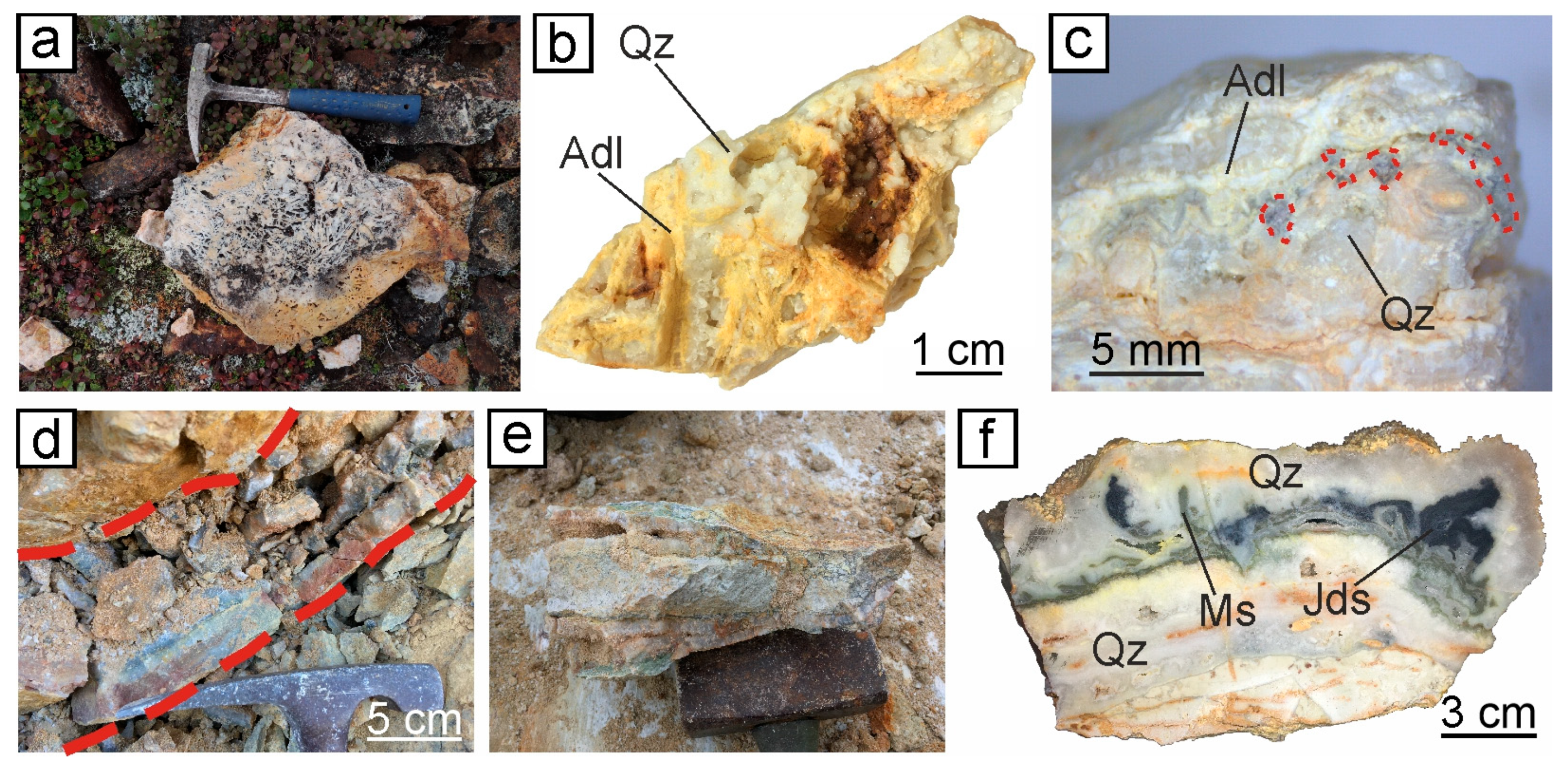
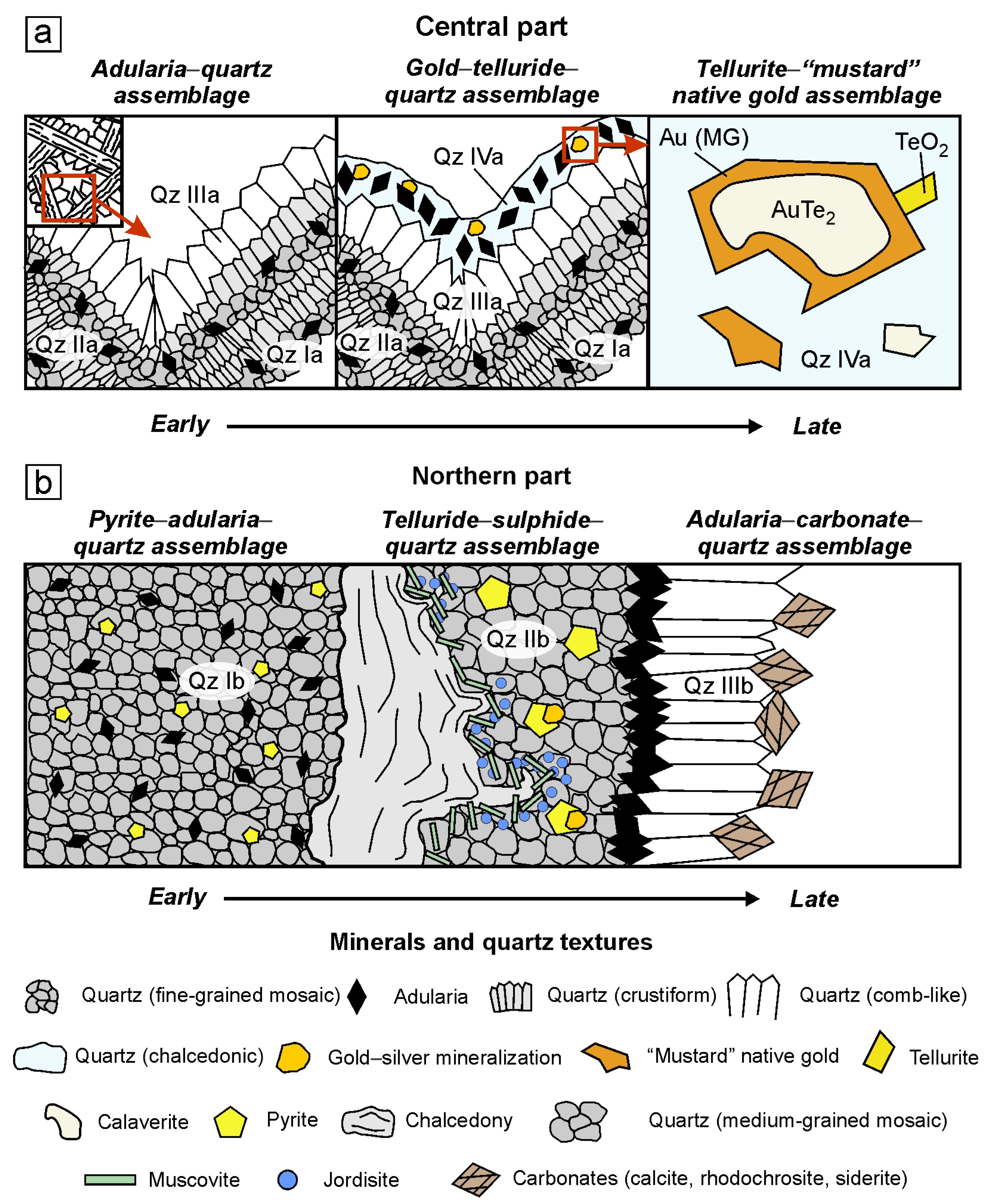
In the Central part, most veins consist of adularia–quartz aggregates forming macroscopic parallel or intersecting plates, i.e., lattice bladed texture (Figure 3a,b) [47,48,49]. Three successive mineral assemblages are distinguished in the adularia–quartz veins: adularia–quartz, gold–telluride–quartz, and tellurite–“mustard” native gold (Figure 4a). These assemblages contain four successive generations of quartz: first-generation quartz (Qz Ia), second-generation quartz (Qz IIa), third-generation quartz (Qz IIIa), and fourth-generation quartz (Qz IVa) (Figure 4a).
The adularia–quartz mineral assemblage forms the major framework of the lattice bladed textured veins, where plates are composed of fine-grained mosaic quartz Qz Ia and adularia crystals (Figure 4a). The quartz plates have a yellow color due to partial argillization of adularia (Figure 3b,c). Transparent fine-grained quartz Qz IIa overgrows the plates, forming crustiform textures, while the remaining space is filled with medium-grained comb-like quartz Qz IIIa (Figure 4a). This mineral assemblage is barren of ore minerals.
The gold–telluride–quartz mineral assemblage formed after the deposition of the crustiform quartz Qz IIa and comb quartz Qz IIIa (Figure 4a). It consists of fine-grained chalcedonic quartz Qz IVa and adularia and contains abundant ore minerals. The gangue minerals form rhythmic colloform banded, grayish white formations, and zones enriched with ore mineralization form dark gray or black spots (Figure 3c). Within these zones, the chalcedonic quartz Qz IVa is saturated with abundant, even submicroscopic, impregnation of ore minerals (native gold and silver, Au–Ag chalcogenides, sphalerite, galena, altaite, and coloradoite).
The tellurite–“mustard” native gold mineral assemblage (Figure 2c) represents the late-stage gold-bearing paragenesis (Figure 4a). Detailed mineralogical study of ores from the Evevpenta deposit has shown that pseudomorphic replacement of calaverite (AuTe2) leads to the development of an assemblage composed of “mustard” native gold (Au) coexisting with tellurite or paratellurite (TeO2) [29]. No paragenetically linked quartz was observed.

4.2.2. The Northern Part of the Evevpenta Deposit

The adularia–quartz veins in the Northern part have colloform banded, crustiform, comb-like, and breccia textures (Figure 3d–f). Three successive mineral assemblages are distinguished in the adularia–quartz veins: pyrite–adularia–quartz, telluride–sulfide–quartz, and adularia–carbonate–quartz assemblages (Figure 4b). These assemblages contain three successive generations of quartz: first-generation quartz (Qz Ib), second-generation quartz (Qz IIb), and third-generation quartz (Qz IIIb) (Figure 4b).
The pyrite–adularia–quartz mineral assemblage crystallized first and formed the vein selvages (Figure 4b). This mineral assemblage is composed of fine-grained mosaic quartz Qz Ib and contains disseminated small rhombic adularia crystals with subordinate pyrite impregnation.
The telluride–sulfide–quartz mineral assemblage contains medium-grained mosaic quartz Qz IIb, which includes minor amounts of chalcedony and muscovite, with disseminated ore mineralization (Figure 4b). The ore minerals are represented mainly by pyrite, with less common galena, sphalerite, chalcopyrite, native gold, and Au–Ag chalcogenides, including petzite, hessite, acanthite, uytenbogaardtite, and petrovskaite. Quartz aggregates enriched with muscovite in this assemblage have a dull gray-green color that sharply contrasts with the black or bluish black jordisite (Figure 3f).
The adularia–carbonate–quartz mineral assemblage is the latest and fills the central parts of veins (Figure 4b). This assemblage consists of fine-grained adularia and coarse-grained transparent quartz Qz IIIb with a comb-like texture. Late carbonates, including siderite, calcite, and rhodochrosite, occupy residual voids or cement fragments of preceding mineral assemblages. This mineral assemblage is barren of ore minerals.

4.3. Fluid Inclusion Types

4.3.1. The Central Part of the Evevpenta Deposit

Fluid inclusions for this study were selected from quartz, belonging to different generations. Quartz Qz IIa and Qz IIIa of the adularia–quartz assemblage, and in Qz IVa of the gold–telluride–quartz assemblage were studied at the Central part of the Evevpenta deposit (Figure 4a). First-generation quartz Qz Ia is fine-grained and does not contain fluid inclusions.
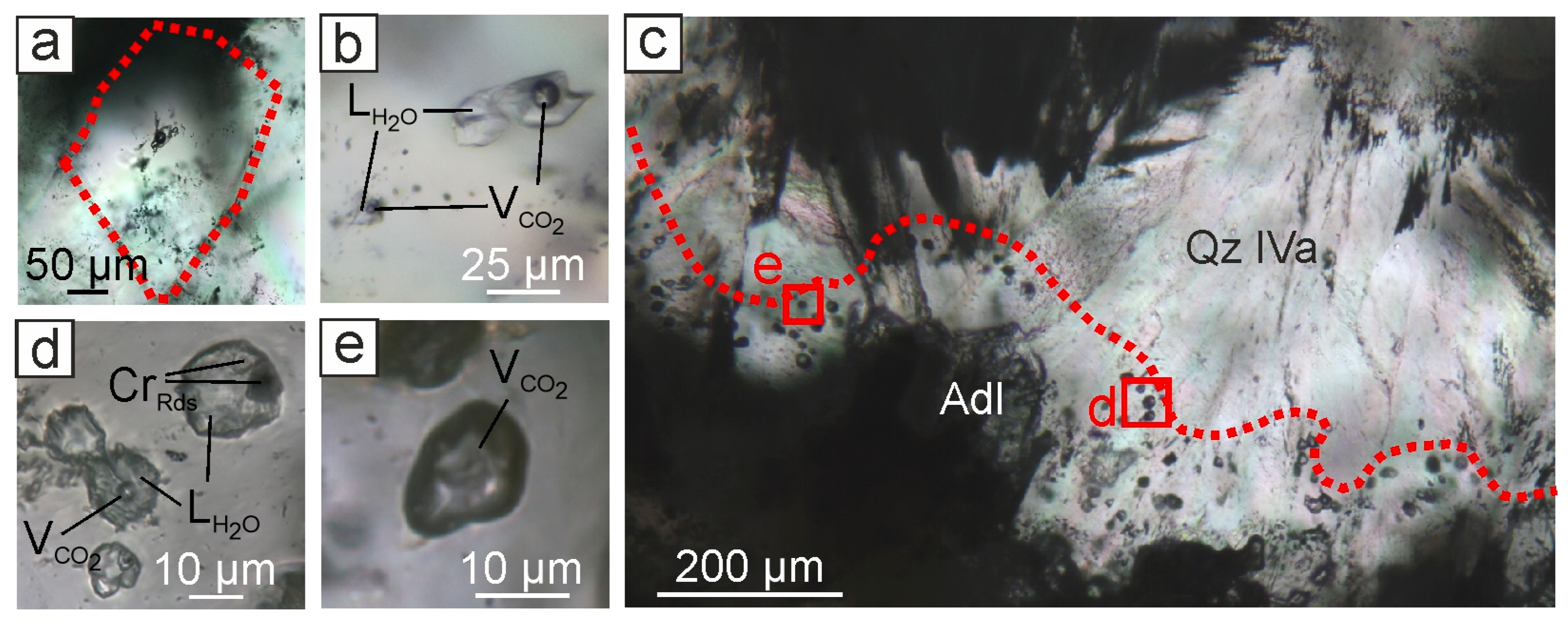
Quartz Qz IIa and Qz IIIa host sparse fluid inclusions assemblages (FIA) composed at room temperature of two-phase vapor–liquid (40–50 vol.% of vapor) inclusions (Figure 5a,b). Commonly, FIA occur as small groups of randomly distributed fluid inclusions, and rarely, single fluid inclusions were observed (Figure 5b). The inclusions are usually confined to the quartz grain cores, and occasionally are aligned with crystal main axes (Figure 5a). Their sizes vary from 10 to 50 μm. They have subisometric, elongated, or flattened irregular shapes.
Quartz Qz IVa hosts abundant fluid inclusions ranging from 8 to 20 μm, which are distributed along growth zones, primarily in the latest ones (Figure 5c) and typically exhibiting subisometric to spherical morphologies. Four types of fluid inclusions compose FIA in quartz Qz IVa. The first type is composed of two-phase fluid inclusions containing liquid and crystal phase and lacking vapor bubbles at room temperature, the second type consists of those, which at room temperature contain liquid, vapor and crystalline phase, the third type comprises fluid inclusions composed at room temperature of vapor and liquid phases (20–80 vol.% of vapor), and the fourth type is composed of fluid inclusions containing a single vapor phase (Figure 5d,e). The first type dominates in quartz Qz IVa. All inclusion types are frequently observed in a single growth zone. This means that all inclusions were trapped simultaneously. Variable phase proportions indicate heterogeneous entrapment of solid, liquid, and vapor phases.

4.3.2. The Northern Part of the Evevpenta Deposit

Fluid inclusions in the Northern part were studied in quartz Qz IIb of the telluride–sulfide–quartz assemblage and quartz Qz IIIb of the adularia–carbonate–quartz assemblage (Figure 4b). First-generation quartz Qz Ib is fine-grained and does not contain fluid inclusions.
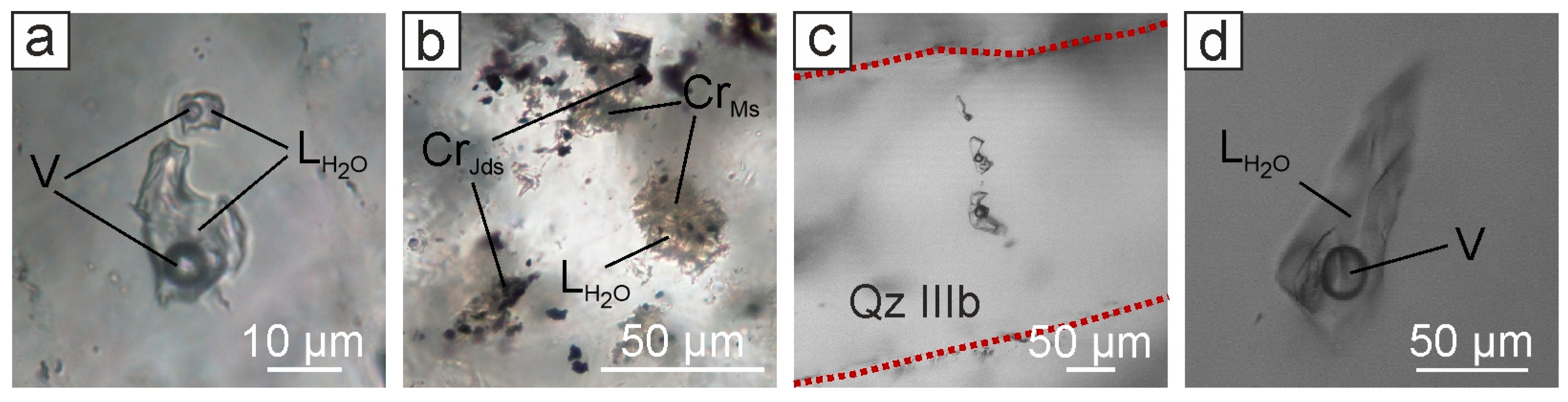
Quartz Qz IIb contains abundant fluid inclusions occupying central grain areas. The fluid inclusions exhibit subisometric to complex morphologies, with sizes varying from 8 to 40 μm. Two types of fluid inclusions compose FIA in quartz Qz IIb (Figure 6a). Two-phase inclusions containing at room temperature vapor and liquid phases (20–40 vol.% of vapor) compose the first one, while the second type consists of two-phase fluid inclusions containing at room temperature liquid and crystalline phases. Crystal-bearing inclusions lack vapor bubbles and contain scaly or fibrous crystalline phases, occasionally including opaque ore minerals (Figure 6b).
FIAs in the quartz Qz IIIb occur as small groups of irregularly distributed fluid inclusions and sometimes single inclusions (Figure 6c). The fluid inclusions have an elongated shape and sizes ranging from 10 to 50 μm. They are located along the main axis of the quartz crystals and are often found in the crystal heads. Only two-phase fluid inclusions (Figure 6d), containing at room temperature vapor and liquid phases (30 vol.% of vapor), are observed in these FIAs.

4.4. Raman Spectroscopy of Fluid Inclusions

4.4.1. The Central Part of the Evevpenta Deposit

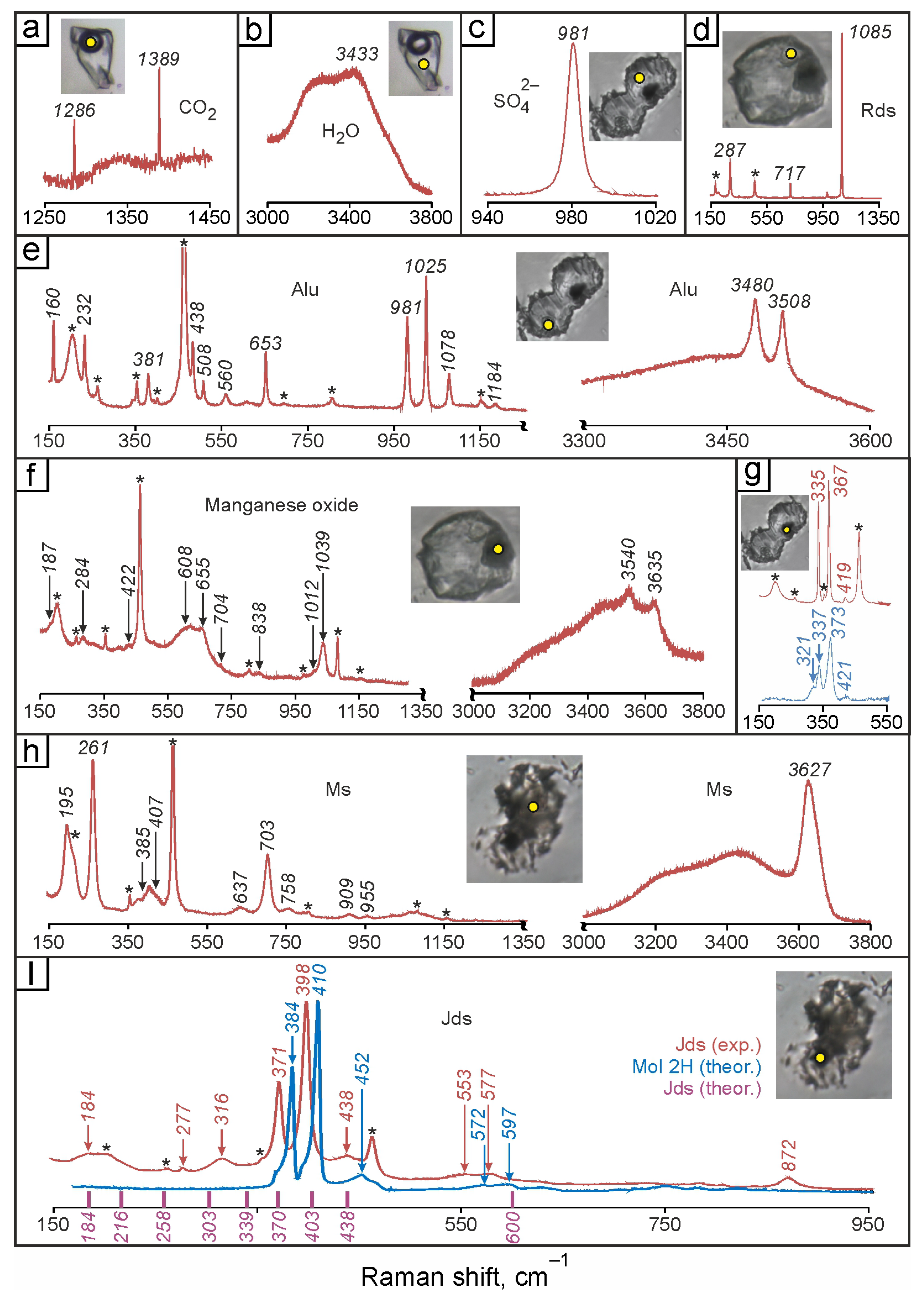
Raman spectroscopy of vapor bubbles of vapor–liquid fluid inclusions in quartz Qz IIa and Qz IIIa revealed two intense bands at 1286 and 1389 cm−1 (Figure 7a). These bands constitute the characteristic Fermi dyad of carbon dioxide (CO2) [50]. CO2 density estimated based on Fermi dyad distance in quartz Qz IIa hosted fluid inclusions ranged from 0.047 to 0.094 g/cm3 (four determinations), and in quartz Qz IIIa, it was 0.094 g/cm3 (one determination). A broad asymmetric band with a maximum near 3430 cm−1 (Figure 7b), corresponding to the O–H bond vibrations of liquid water, is recorded for the liquid phase. A narrow peak at 981 cm−1 (Figure 7c), corresponding to the aqueous sulfate ion (SO42–), is consistently observed in these fluid inclusions [50,51].
The liquid phase of the first, second, and third type fluid inclusions in quartz Qz IVa also consists of H2O with dissolved sulfates (SO42–). Raman spectroscopic study of the vapor phase in these inclusions typically revealed no signals exceeding the detection limit. Low-density (0.036 g/cm3, one determination) carbon dioxide (CO2) was detected in a two-phase vapor–liquid inclusion. Raman spectra of crystalline phases, which are frequently presented in the first and second type fluid inclusions, exhibit an intense band near 1085 cm−1, as well as pronounced peaks near 717 and 287 cm−1, corresponding to rhodochrosite (Figure 7d). Another phase, also frequent in fluid inclusions, is characterized by peaks at 160, 232, 483, and 653 cm−1 (Figure 7e). Moreover, this phase shows pronounced lines at 981, 1025, and 1078 cm−1, associated with vibrational modes of sulfate ions (SO42–), and two intense bands at 3480 and 3508 cm−1, associated with O–H vibrations. This spectral signature is characteristic of alunite-group minerals. Black opaque phases are less common. One such phase is characterized by weak lines at 150–450 cm−1 and 800–1050 cm−1, and pronounced bands near 600 to 660 cm−1 and at 1039 cm−1 (Figure 7f). Fainter bands at 3540 and 3635 cm−1, corresponding to O–H stretching vibrations, are also observed. These peaks are attributed to manganese oxides [52]. In a single case, the opaque phase was characterized by strong peaks at 335 and 367 cm−1, which may be assigned to argentopyrite (AgFe2S3) (Figure 7g).

4.4.2. The Northern Part of the Evevpenta Deposit

Spectroscopic study of the vapor phase in first type fluid inclusions in quartz Qz IIb and Qz IIIb at the Northern part, does not reveal the presence of CO2, N2, SO2, H2S, CH4, or other gas species. The liquid phase in all the studied fluid inclusions represents an aqueous solution. Crystalline phases within the second type fluid inclusions are characterized by peaks at 400–200 cm−1, 800–600 cm−1, 1000–900 cm−1, as well as a narrow band at 3627 cm−1 (attributed to O–H vibrations) (Figure 7h). The set of these lines is typical of muscovite. The Raman spectrum of opaque mineral within the second type fluid inclusions exhibits a strong peak at 398 cm−1, moderate peaks at 371 and 438 cm−1 (350–600 cm−1 region), and weak bands at 553 and 557 cm−1 (Figure 7i). Figure 7i and Appendix A, Table A1 show that the Raman spectra of molybdenum sulfide differ slightly from the spectrum of molybdenite. The major lines within 370–420 cm−1 are systematically shifted to lower wavenumbers. This spectral signature is most consistent with the spectrum of jordisite (MoS2) theoretically calculated by the equations suggested after Chukanov and Vigasina [53].
Figure 7. Selected Raman spectra of fluid inclusions at room temperature: (a) carbon dioxide (CO2); (b) water (H2O); (c) sulfate ion (SO42–); (d) rhodochrosite (Rds); (e) alunite (Alu); (f) manganese oxide; (g) argentopyrite (Agpy) (the red spectrum—experimental, blue—theoretical after [43]); (h) muscovite (Ms); (i) jordisite (Jds) (the red spectrum—experimental, blue—theoretical for molybdenite–2H (Mol) [43], purple lines correspond to the position bands of jordisite [53]). Yellow circles mark analytical points; asterisks (*) denote quartz peaks.
Minerals 15 01196 g007

4.5. Microthermometry of Fluid Inclusions

Results of microthermometric studies of 52 individual fluid inclusions in quartz of the adularia–quartz veins from the Central and the Northern part of the Evevpenta deposit are summarized in Table 3.

4.5.1. The Central Part of the Evevpenta Deposit

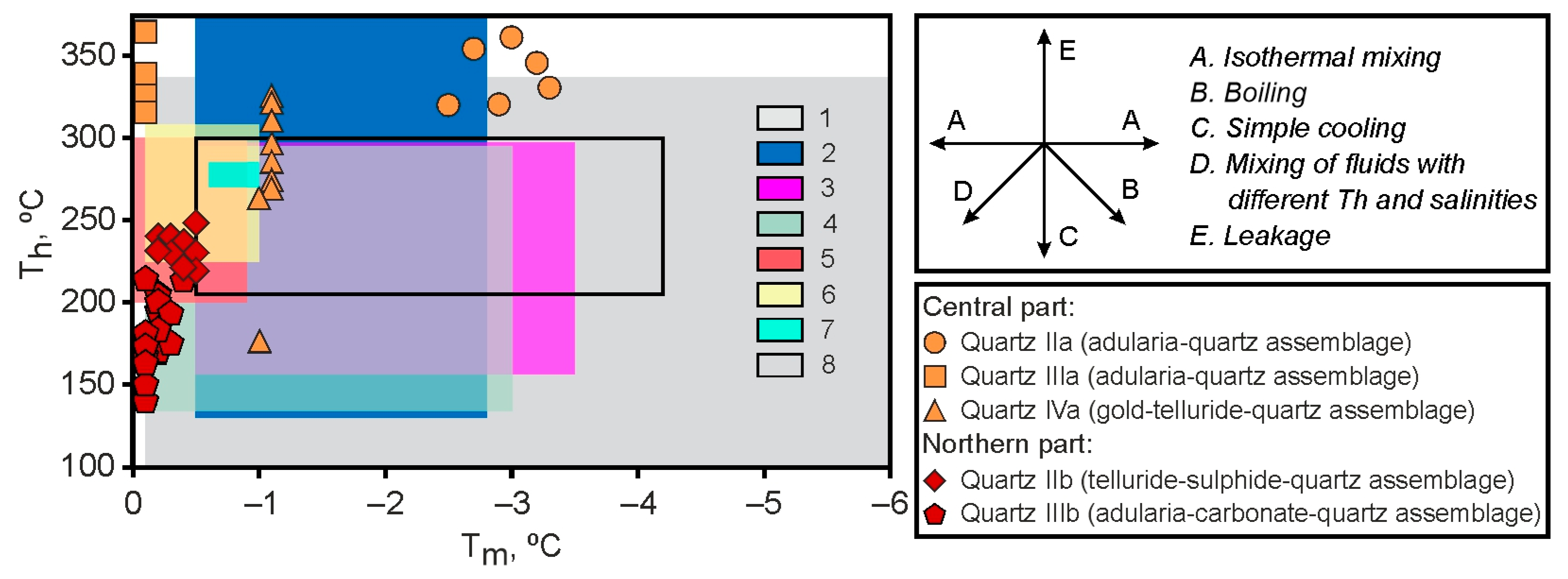
Primary two-phase vapor–liquid fluid inclusions in quartz Qz IIa and Qz IIIa from the early barren adularia–quartz assemblage were studied. Eutectic temperature was recorded between −8.5 and −5.5 °C after complete freezing of fluid inclusions in quartz Qz IIa and ice melted upon further heating at temperatures ranging from −3.3 to −2.5 °C. These inclusions homogenize into liquid within a narrow range between 320 and 360 °C (Table 3). Eutectic melting of fluid inclusions in quartz Qz IIIa is observed between −6.0 and −5.5 °C. Further heating results in the final ice melting at −0.1 °C. These inclusions homogenize into liquid between 315 and 364 °C (Table 3).
Studies of the gold-bearing gold–telluride–quartz mineral assemblage within quartz Qz IVa were performed exclusively on primary two-phase vapor–liquid inclusions of the third type. Following complete freezing, the eutectic melting is observed between −8.0 and −5.5 °C. Upon heating, the ice crystal finally melts between −1.1 and −1.0 °C. Homogenization to the liquid phase occurs over a wide temperature range of 175 to 325 °C (Table 3).

4.5.2. The Northern Part of the Evevpenta Deposit

In the gold-bearing telluride–sulfide–quartz mineral assemblage within quartz Qz IIb, microthermometric experiments were performed exclusively on primary two-phase vapor–liquid inclusions of the second type. Eutectic melting was observed between −6.0 and −5.0 °C, and ice melting occurred upon heating from −0.5 to −0.2 °C. Homogenization of these inclusions into liquid occurred between 219 and 248 °C (Table 3).
Primary two-phase vapor–liquid fluid inclusions in quartz Qz IIIb from the late barren adularia–carbonate–quartz mineral assemblage demonstrate eutectic temperatures between −7.0 and −5.0 °C. The last ice melting occurred between −0.4 and −0.1 °C. Homogenization into liquid was observed at 140–214 °C (Table 3).

5. Discussion

5.1. Composition and P–T Conditions of Ore-Forming Fluids

In the studied samples from the Central part of the Evevpenta deposit, early quartz Qz IIa and Qz IIIa of the barren adularia–quartz assemblage contain two-phase vapor–liquid inclusions that homogenize into liquid upon heating. The relative consistency of homogenization temperatures of these inclusions and the lack of inclusions with contrasting liquid to vapor ratios suggest that homogeneous liquid aqueous fluid is responsible for assemblages containing the quartz Qz IIa and Qz IIIa. FIAs in the late quartz Qz IVa of the gold-bearing gold–telluride–quartz mineral assemblage, on the contrary, contain vapor-rich and liquid-rich inclusions. Their coexistence within single growth zones and single FIAs provides evidence for crystallization of the quartz Qz IVa bearing mineral assemblages in a heterogeneous fluid mixture comprising gas and liquid phases. FIAs containing coexisting vapor-rich and liquid-rich inclusions are also found in quartz from gold-bearing ores of epithermal Au–Ag deposits, such as Asachinskoe (Kamchatka, Russia) and Kupol (Chukchi Peninsula, Russia) [22,54]. The presence of gaseous CO2 and liquid H2O indicates that the quartz types Qz IIa, Qz IIIa, and Qz IVa formed from an aqueous fluid with a minor CO2 content. Similarly, in the Northern part of the Evevpenta deposit, quartz Qz IIb of the gold-bearing telluride–sulfide–quartz assemblage and the late quartz Qz IIIb of the barren adularia–carbonate–quartz assemblage were formed from an aqueous fluid, but with negligible CO2 contents.
The high eutectic temperatures characteristic of FIAs in all studied quartz generations indicate the absence of components that depress temperatures of eutectic melting. Traditionally, K-Na chlorides are considered dominant in the aqueous fluids of adularia–sericite type epithermal Au–Ag deposits [8,9]. Eutectic melting in these systems occurs below −10–−21 °C [40]. Aqueous solutions in the studied fluid inclusions start melting at temperatures between −8 and −5 °C. Such temperatures are consistent with binary aqueous solutions of potassium bicarbonate and magnesium sulfate, as well as with ternary systems containing Na, K, and Mg sulfates [40]. Eutectic solutions in the binary Na, K, and Mg sulfate aqueous systems melt at −1.2, −1.6, and −4.8 °C, respectively [55]. However, the eutectic temperature in the Na2SO4–H2O system can decrease down to −3.6 °C through metastable ice–heptahydrate formation [55]. In MgSO4–H2O systems, metastable ice–hydrate assemblages form, lowering eutectic temperatures down to −8 °C [55]. Eutectic melting depression may also occur in multicomponent solutions: the addition of MgSO4 to Na2SO4–H2O lowers the eutectic point to −5 °C, while KHCO3 addition drops it below −6 °C, making it closer to the values in Table 3. This is consistent with systematic findings of the 981 cm−1 band in the Raman spectra of the aqueous phase of fluid inclusions. The presence of sulfate and bicarbonate ions in the solutions is also supported by the occurrence of daughter crystals of rhodochrosite and alunite, which were identified within inclusions in quartz Qz IVa. The detection of daughter crystals of argentopyrite and manganese oxides can be regarded as evidence for the presence of the corresponding metals in the solutions. At the Northern part, in quartz Qz IIb, crystal-bearing fluid inclusions containing muscovite and jordisite are notable. Many inclusions contain so many muscovite crystals that they resemble crystallized melt inclusions in igneous minerals (Figure 6b). These phases are presumably daughter crystals: numerous daughter phases can form when these minerals have low solubility [38]. Consequently, the entrapped fluids could have possessed elevated concentrations of K, Al, Si, and Mo.
As precise compositional data for fluid inclusions are not available, and ionic composition estimations give only general knowledge about fluid chemistry, determining their true salinity is challenging. Using the NaCl-equivalent concept is not suitable, as it usually gives underestimated values for sulfate and carbonate aqueous solutions. Assuming binary K bicarbonate and Mg sulfate systems mineralization for ice-melting temperatures, for the Central part, quartz Qz IIa may correspond to 7–13 wt.% (expressed by concentration of the corresponding salt). Mineralization of inclusions in quartz Qz IIIa decreases sharply and can be estimated as 0.3–0.4 wt.%, while in quartz Qz IVa it increases slightly up to around 3–4 wt.%. Quartz Qz IIb and Qz IIIb in the Northern part contain diluted solutions, for which mineralization can be estimated between 0.3 and 2 wt.%. A similar discrepancy is demonstrated in the adularia–sericite epithermal Au–Ag deposits of the Arykevaam volcanic field (Chukchi Peninsula, Russia): microthermometric salinity values (expressed as NaCl-equiv.) are consistently lower than those determined by gas and ion chromatography combined with ICP–MS [56].
Estimating mineralization temperatures of epithermal deposits requires accounting for their depths of formation [57,58,59,60]. Such mineralization typically occurs at ≤1 km depth within zones of active mixing between endogenous and meteoric fluids [12,61]. Hydrothermal mineralization models must account for low pressures and chemically contrasting fluid interactions. Under these low-pressure conditions, homogenization temperatures of primary fluid inclusions may approximate quartz crystallization temperatures, as pressure corrections are negligible in epithermal systems [38,39,61,62,63]. However, as the reference data, which would make possible the estimation of density based on microthermometric data, are not available for the discussed aqueous solution compositions, reliable estimation of pressure is not possible.
Thus, the results of the comprehensive study of fluid inclusions in the quartz of the Evevpenta deposit indicate that the quartz formed over a wide range of temperatures (364–140 °C) and salinities (Tm −3.3–−0.1 °C) (Table 3, Figure 8). The quartz of the early, barren adularia–quartz assemblage in the Central part of the deposit recorded the highest temperatures and highest salinities. These fluids were the most saturated with CO2. Notably, low-density CO2 was also reported in the medium-temperature (>300 °C) early mineral assemblages at the Korrida epithermal Au–Ag deposit (Chukchi Peninsula, Russia) [64]. Quartz in gold-bearing mineral assemblages crystallized within narrower temperature intervals: gold–telluride–quartz from 325 to 175 °C, and telluride–sulfide–quartz from 219 to 258 °C (Table 3, Figure 8). These temperature ranges are well-correlated with the temperatures of gold-bearing mineral assemblages in many other deposits of the Kamchatka Peninsula [10]. Figure 8 shows a general trend of gradual decrease in temperature and salinity of the solutions from the early to the late mineral associations, as well as from the Central to the Northern part of the Evevpenta deposit. This trend may indicate the dilution of hydrothermal fluids by cold, surficial meteoric waters, which is one of the favorable mechanisms for the formation of rich epithermal ores [61]. Differences in fluid salinity in FIAs from Qz IIa and Qz IIIa quartz at similar homogenization temperatures may indicate a process of isothermal dilution by deep, heated meteoric waters, analogous to that described for the Glojeh epithermal silver- and base metal-rich deposit (Iran) [65]. The increase in salinity with a concurrent decrease in homogenization temperature (from Qz IIIa to Qz IVa) can be interpreted as a result of fluid boiling. This conclusion is consistent with the heterogeneous composition of fluid inclusions in the quartz Qz IVa. The boiling is widely documented in many epithermal deposits [22,24,65]. In the Northern part of the Evevpenta deposit, the trend of hydrothermal fluid dilution by meteoric waters from the early Qz IIb to the late Qz IIIb quartz is most pronounced.
The presence of sulfate ions in the fluid inclusion solutions from the Evevpenta deposit is noteworthy. Based on the genetic model for epithermal deposits [9], the occurrence of sulfate ions in adularia–sericite type epithermal systems can be a consequence of two main processes: (1) the oxidation of H2S at shallow levels of epithermal systems (also referred to as “solfateric alteration”); (2) the supergene oxidation of sulfides. Both of these mechanisms are considered to be common in the upper parts of epithermal systems, which may enhance the Evevpenta deposit potential at depth [9,11]. The second mechanism, involving the effects of a strong oxidant on primary ores, is characterized by intense development of jarosite and alunite and is typical of tropical climatic zones [66]. Therefore, the first oxidation mechanism involving H2S is preferable; for instance, it was implemented at the Kupol epithermal Au–Ag deposit (Chukchi Peninsula, Russia) [67]. In the shallow zone of epithermal Au–Ag deposits, the sulfide sulfur of the Au(HS)2 complex oxidizes and sulfate ions are formed, which is a recognized mechanism of gold deposition [68].

5.2. Formation Conditions Comparison: The Evevpenta Epithermal Au–Ag Deposit and Reference Epithermal Au–Ag Deposits from the Kamchatka Region and Northeast Russia

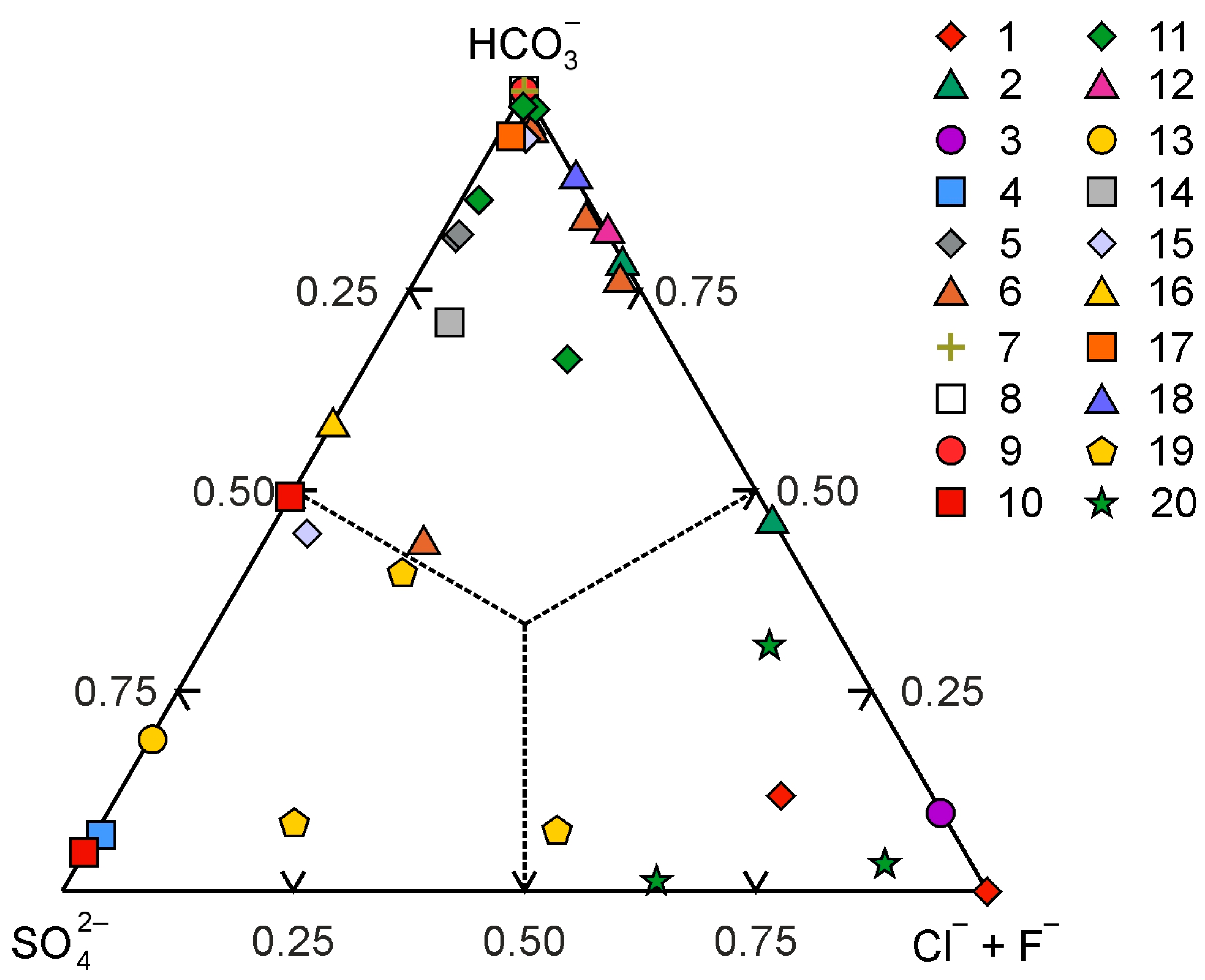
The study of fluid inclusions in quartz and analysis of published data show that the Evevpenta deposit has formation parameters similar to other deposits on the Kamchatka Peninsula: (1) a wide homogenization temperature range (95–365 °C), corresponding to low- to medium-temperature conditions; (2) a narrow homogenization temperature range (160–260 °C) for gold-bearing mineral assemblages; and (3) low to moderate fluid salinity (Tm 0.0 to −6.0 °C) (Figure 8, Table 4). Major volatile components in the mineralizing fluids of the deposits were H2O and CO2 [17]. The key characteristic of the Evevpenta deposit is the bicarbonate-sulfate fluid composition, a feature that contrasts with the chloride-dominated epithermal systems previously known in Kamchatka (Table 4). FIAs involving bicarbonate-sulfate waters together with chloride fluids are also documented for numerous adularia–sericite type epithermal Au–Ag deposits in the Northeast Russia [13,62,67,69]. This trend is illustrated in the diagram showing the anionic composition of fluid inclusions in quartz from epithermal deposits in the Kamchatka region and Northeast Russia (Figure 9). According to the work of Bortnikov et al. [13], deposits with minimal fluid salinity and maximum concentrations of sulfates, bicarbonates, and CO2 are located at the maximum distance from magmatic (porphyry) centers (e.g., Valunistoe, Zhil’noe, Arykevaam).
Table 4. Fluid characteristics of Kamchatka epithermal deposits: composition and formation parameters.
Deposit (Type)Th, °CTe, °CTm, °CSalinity, wt.% (NaCl-eq.)Fluid ChemistryReferences
Evevpenta (adularia–sericite)140–364−8.5–−5.0−3.3–−0.1Sulfates and bicarbonates of Na, K, MgThis study
Rodnikovoe (adularia–sericite)150–260−2.8–−0.61.0–3.0[19]
160–265−1.5–−0.50.8–2.5[16]
Asachinskoe (adularia–sericite)95–320−56.0–−10.0−6.0–−0.10.2–9.2Chlorides of Na, K, Ca, Mg, Fe[22]
157–337−1.5–−0.61.0–2.6[21]
Mutnovskoe (adularia–sericite)156–297−3.5–−0.50.8–5.7[20]
Baranyevskoe (adularia–sericite)226–298−49.0–−27.0−0.7–−0.20.4–1.2Chlorides of Na, K, Ca, Mg, Fe; carbonate of K[25]
225–305−35.0–−24.0−0.8–−0.10.4–1.2Chlorides of Na, K, Ca, Mg, Fe[26]
210–308−1.0–−0.60.5–1.7[17]
Aginskoe (adularia–sericite)200–300−0.9 − 0.00.4–1.6[23]
Lazurnoe (adularia–sericite)270–285–22.5–−21.7−1.0–−0.61.0–1.7Chlorides of Na[17]
Kumroch (adularia–sericite)205–300−32.0–−29.5−4.2–−0.50.9–6.8Chlorides of Na, K, Fe[17]
Maletoyvayam (acide–sulfate)173–290−3.0–−0.61.0–5.0[17]
135–295−38.0–−23.0−2.5–−0.10.2–4.3Chlorides of Na, K, Ca, Mg, Fe; carbonate of K[24]
Note: Th—homogenization temperatures; Te—eutectic temperature; Tm—ice-melting temperature.
At the Evevpenta deposit, the gold-bearing mineral assemblages contain a significant accumulation of diverse Au–Ag minerals, including native gold, silver, as well as sulfides and tellurides of Au–Ag, while among gangue minerals, adularia is present (Table 2). At the same time, the ores lack selenium-bearing mineralization, enargite, as well as gangue alunite and kaolinite, which are indicator minerals for acid–sulfate epithermal deposits [7,8]. Selenium serves as an indicator in epithermal systems: the presence of abundant selenide minerals (especially gold selenides, such as auroselenide, AuSe) indicates a high oxidizing potential of the environment [64,70,71]. The presence of Au and Ag chalcogenides in the ores of the Evevpenta deposit indicates relatively high sulfur and tellurium fugacity, while the absence of selenium-bearing mineralization, enargite, and alunite suggests that the gold ore assemblages formed under relatively reduced to neutral conditions. Another indicator of the formation conditions is metasomatic alteration. At the Evevpenta deposit, the metasomatic alteration of the host rocks is represented by propylitic, argillic, and quartz-adularia alterations, which also indicates the participation of weakly acidic to near-neutral solutions in the mineral formation and restricts the pH to ~4–8 [72]. It is inferred that the primary dissolved form of gold in such solutions was likely the Au(HS)2 complex, while silver may have been transported as both chloride and hydrosulfide complexes [68,73]. The great diversity of Au–Ag minerals and the high fineness of native gold observed at the Evevpenta deposit are characteristic of the late mineralization stage in evolved epithermal systems [10,25,74].
Therefore, comparison with extensive data from previously studied epithermal deposits in the region and around the world leads to the conclusion that the Evevpenta deposit is an adularia–sericite (or low-sulfidation) epithermal Au–Ag deposit in its formation conditions and ore mineral associations, and is analogous to low-sulfidation epithermal Au–Ag deposits such as Asachinskoe, Valunistoe, Zhil’noe [10,13,17].
Figure 9. The bulk anionic composition of fluid inclusions in quartz from epithermal adularia–sericite type Au–Ag deposits in the Northeast Russia, determined by gas and ion chromatography combined with ICP–MS. 1—Televeem [13,75]; 2—Kapelka [13,75]; 3—Juliette [76,77]; 4—Yunoe [78]; 5—Kupol [67]; 6—Tikhoe [77]; 7—Valunistoe [79]; 8—Ognennyy [69]; 9—Gornyy [69]; 10—Zhil’noe [69]; 11—Dvoynoe [80]; 12—Ol’cha [62]; 13—Magnitnoe [62]; 14—Birkachan [62]; 15—Burgali [62]; 16—Severnoe Burgali [62]; 17—Yuzhnoe Burgali [62]; 18—Promezhutochnoe [81]; 19—Arykevaam [56]; 20—Kaenmyvaam [56].
Minerals 15 01196 g009

6. Conclusions

A comprehensive study on the formation conditions of the Evevpenta deposit has been conducted for the first time using fluid inclusion analysis. The following conclusions can be drawn:
(1)
The adularia–quartz veins formed at temperatures ranging from 140 to 364 °C, consistent with low- to medium-temperature mineralization conditions, from low-salinity fluids (Tm from −0.1 to −3.3 °C). Gold-bearing mineral assemblages crystallized within narrower temperature intervals: gold–telluride–quartz from 325 to 175 °C, and telluride–sulfide–quartz from 219 to 258 °C. A decrease in mineralization temperature was observed from early to late mineral assemblages, as well as within each individual assemblage. The Central part of the deposit is characterized by higher-temperature and relatively concentrated fluids, whereas the Northern part experienced lower-temperature and significantly more diluted fluids.
(2)
The primary components of the fluids were H2O and low-density CO2, with the early mineral assemblages being more enriched in CO2. The fluids contained bicarbonates and sulfates of Na, K, and Mg. This fluid inclusion composition is not typical for epithermal deposits in Kamchatka, although the presence of bicarbonates and sulfates is frequently noted in fluid inclusions from quartz in adularia–sericite type Au–Ag deposits of the Northeast Russia. The sulfate signature is likely due to near-surface oxidation of H2S.
(3)
The presence in the ores of mineral assemblages of native gold and silver with sulfides and Au–Ag tellurides, and gangue adularia, in combination with the development of propylitic and argillic metasomatic alterations, indicates that mineralization occurred under reduced to neutral conditions at a relatively high fugacity of sulfur and tellurium. The low- to medium-temperature range, low fluid salinity, and the specific ore mineral assemblages confirm that the Evevpenta deposit belongs to the adularia–sericite (or low-sulfidation) type of epithermal systems.
The conduct of detailed studies of fluid inclusions and mineralogical investigation of the ores of promising deposits in the poorly studied North Kamchatka Ore District represents an important step towards understanding the functioning of ore-forming epithermal systems and expanding the knowledge of the region’s metallogeny.

Author Contributions

Conceptualization P.S.Z., S.Z.S. and E.O.S.; methodology P.S.Z., S.Z.S., E.O.S., A.Y.O. and R.S.; investigation P.S.Z., S.Z.S., E.O.S., A.Y.O. and R.S.; resources P.S.Z. and S.Z.S.; writing—original draft preparation, P.S.Z., S.Z.S. and E.O.S.; writing—review and editing, P.S.Z., S.Z.S., E.O.S., A.Y.O. and R.S.; visualization, P.S.Z. and E.O.S. All authors have read and agreed to the published version of the manuscript.

Funding

The work was carried out according to the state assignment of the IVS FEB RAS within the framework of the research topic “Mineralization in the suprasubduction zone of the Northern Pacific” (No FWME-2024-0004). Thermobarogeochemical studies were carried out within the framework of the scientific research work of IGM SB RAS “Mantle-crustal fluid-magmatic systems in the continental and island-arc lithosphere, their evolution and ore content (based on fluid and molten inclusions in minerals and isotopic and geochemical data)” (No 122041400312-2). The Nikon LV100N instrument from the Laboratory of Petrology and Geochemistry of the IVS FEB RAS was purchased as part of the Nauka instrument base replenishment program. Part of the research conducted at UFOP was supported by CNPq (Conselho Nacional de Desenvolvimento Científico e Tecnológico—project 310072/2021-2) and Fapemig (Fundação de Amparo à Pesquisa do Estado de Minas Gerais—projects PPM-00588-18, APQ-00764-23, and APQ-02529-24).

Data Availability Statement

The original contributions presented in this study are included in the article. Further inquiries can be directed to the corresponding author.

Acknowledgments

The authors are grateful to G.A. Palyanova for her expert advice and help with this paper, which was instrumental in enhancing our research. We wish to thank our colleagues A.S. Moskovsky, L.A. Semerikov, and P.E. Schweigert for their participation in the field research. The authors are grateful to S.V. Moskaleva, E.Yu. Plutakhina, and Sh.S. Kudaeva for their assistance with the SEM study. A portion of the Raman spectroscopy research was performed at the Geomodel Resource Center of St. Petersburg State University with analytical support by V.N. Bocharov, to whom we are grateful. We are also grateful to A.A. Tomilenko, D.S. Bukhanova, E.S. Zhitova, and A.V. Kutyrev for their consultations on the research topic. We thank I.R. Nizametdinov for his technical assistance in conducting the research. Finally, we appreciate the reviewers for their constructive comments, which significantly improved the manuscript quality. P.S. Zhegunov acknowledged the GCUB International Mobility Program (GCUB-Mob) for Master’s scholarship (No. 23109.000346/2022-19).

Conflicts of Interest

The authors declare no conflicts of interest.

Appendix A

Table A1. The position of the bands in the Raman spectrum of jordisite and molybdenite.
ResultsTheoretical Data [53]
Shift, cm−1
Jordisite Jordisite Molybdenite
148 sh
184 sh184 sh
216
258 sh
277 w285
303 w
316 w
339 w
371 s370 (h-MoS2)382 s
398 s403 (h-MoS2)408 s
438 w438 sh451
553 w
577 w
600 w
872 w
Note: sh—shoulder, s—strong band, w—weak band.

References

  1. Singer, D.A. World class base and precious metal deposits: A quantitative analysis. Econ. Geol. 1995, 90, 88–104. [Google Scholar] [CrossRef]
  2. Frimmel, H.E. Earth’s continental crustal gold endowment. Earth Planet. Sci. Lett. 2008, 267, 45–55. [Google Scholar] [CrossRef]
  3. Volkov, A.V.; Sidorov, A.A. Economic implications of epithermal gold-silver deposits. Her. Russ. Acad. Sci. 2013, 83, 365–374. [Google Scholar] [CrossRef]
  4. Hedenquist, J.W.; Lowenstern, J.B. The role of magmas in the formation of hydrothermal ore deposits. Nature 1994, 370, 519–527. [Google Scholar] [CrossRef]
  5. White, N.C.; Hedenquist, J.W. Epithermal gold deposits: Styles, characteristics and exploration. Publ. SEG Newsl. 1995, 23, 9–13. [Google Scholar] [CrossRef]
  6. John, D.A.; Vikre, P.G.; du Bray, E.A.; Blakely, R.J.; Fey, D.L.; Rockwell, B.W.; Mauk, J.L.; Anderson, E.D.; Graybeal, F.T. Descriptive Models for Epithermal Gold-Silver Deposits; USGS Scientific Investigation Report 2010-5070-Q; United States Government Publishing Office: Washington, DC, USA, 2018; p. 247. [CrossRef]
  7. Sillitoe, R.; Hedenquist, J. Linkages between volcanotectonic settings, ore-fluid compositions, and epithermal precious metal deposits. Soc. Econ. Geol. Spec. Publ. 2003, 10, 315–343. [Google Scholar] [CrossRef]
  8. Simmons, S.F.; White, N.C.; John, D.A. Geological characteristics of epithermal precious and base metal deposits. Econ. Geol. 2005, 100, 485–522. [Google Scholar] [CrossRef]
  9. Heald, P.; Foley, N.K.; Hayba, D.O. Comparative anatomy of volcanic-hosted epithermal deposits; acid-sulfate and adularia-sericite types. Econ. Geol. 1987, 82, 1–26. [Google Scholar] [CrossRef]
  10. Bortnikov, N.S.; Tolstykh, N.D. Epithermal Deposits of Kamchatka, Russia. Geol. Ore Depos. 2023, 65, 124–152. [Google Scholar] [CrossRef]
  11. Hedenquist, J.W.; Arribas, A.; Gonzalez-Urien, E.J. Exploration for epithermal gold deposits. Rev. Econ. Geol. 2000, 13, 245–277. [Google Scholar] [CrossRef]
  12. Bodnar, R.J.; Lecumberri-Sanchez, P.; Moncada, D.; Steele-Maclnnes, P. Fluid Inclusions in Hydrothermal Ore Deposits. Reference Module in Earth Systems and Environmental Sciences. In Treatise on Geochemistry, 2nd ed.; Elsevier: Amsterdam, The Netherlands, 2014; pp. 119–142. [Google Scholar]
  13. Bortnikov, N.S.; Volkov, A.V.; Savva, N.E.; Prokofiev, V.Y.; Kolova, E.E.; Dolomanova-Topol’, A.A.; Galyamov, A.L.; Murashov, K.Y. Epithermal Au-Ag-Se-Te deposits of the Chukchi peninsula (Arctic zone of Russia): Metallogeny, mineral assemblages, and fluid regime. Russ. Geol. Geophys. 2022, 63, 435–457. [Google Scholar] [CrossRef]
  14. Takács, Á.; Molnár, F.; Turi, J.; Mogessie, A.; Menzies, J.C. Ore Mineralogy and Fluid Inclusion Constraints on the Temporal and Spatial Evolution of a High-Sulfidation Epithermal Cu-Au-Ag Deposit in the Recsk Ore Complex, Hungary. Econ. Geol. 2017, 112, 1461–1481. [Google Scholar] [CrossRef]
  15. Banks, D.A.; Bozkaya, G.; Bozkaya, O. Direct observation and measurement of Au and Ag in epithermal mineralizing fluids. Ore Geol. Rev. 2019, 111, 102955. [Google Scholar] [CrossRef]
  16. Tolstykh, N.; Shapovalova, M.; Shaparenko, E.; Bukhanova, D. The Role of Selenium and Hydrocarbons in Au-Ag Ore Formation in the Rodnikovoe Low-Sulfidation (LS) Epithermal Deposit, Kamchatka Peninsula, Russia. Minerals 2022, 12, 1418. [Google Scholar] [CrossRef]
  17. Shapovalova, M.; Shaparenko, E.; Tolstykh, N. Geochemistry and Fluid Inclusion of Epithermal Gold-Silver Deposits in Kamchatka, Russia. Minerals 2025, 15, 2. [Google Scholar] [CrossRef]
  18. Petrenko, I.D. Gold-Silver Formation of Kamchatka; VSEGEI: St. Peterburg, Russia, 1999; 112p. (In Russian) [Google Scholar]
  19. Takahashi, R.; Matsueda, H.; Okrugin, V.M. Hydrothermal gold mineralization at the Rodnikovoe deposit in South Kamchatka, Russia. Resour. Geol. 2002, 52, 359–369. [Google Scholar] [CrossRef]
  20. Takahashi, R.; Matsueda, H.; Okrugin, V.M.; Ono, S. Polymetallic and Au-Ag Mineralizations at the Mutnovskoe Deposit in South Kamchatka, Russia. Resour. Geol. 2006, 56, 141–156. [Google Scholar] [CrossRef]
  21. Takahashi, R.; Matsueda, H.; Okrugin, V.M.; Ono, S. Epithermal Gold-Silver Mineralization of the Asachinskoe Deposit in South Kamchatka, Russia. Resour. Geol. 2007, 57, 354–373. [Google Scholar] [CrossRef]
  22. Borovikov, A.; Lapukhov, A.; Borisenko, A.; Seryotkin, Y. The Asachinskoe epithermal Au-Ag deposit in Southern Kamchatka: Physicochemical conditions of formation. Russ. Geol. Geophys. 2009, 50, 693–702. [Google Scholar] [CrossRef]
  23. Andreeva, E.D.; Matsueda, H.; Okrugin, V.M.; Takahashi, R.; Ono, S. Au-Ag-Te Mineralization of the Low-Sulfidation Epithermal Aginskoe Deposit, Central Kamchatka, Russia. Resour. Geol. 2013, 63, 337–349. [Google Scholar] [CrossRef]
  24. Sidorov, E.G.; Borovikov, A.A.; Tolstykh, N.D.; Bukhanova, D.S.; Chubarov, V.M. Gold mineralization at the Maletoyvayam Deposit (Koryak Highland, Russia) and Physicochemical Conditions of its Formation. Minerals 2020, 10, 1093. [Google Scholar] [CrossRef]
  25. Tolstykh, N.; Bukhanova, D.; Shapovalova, M.; Borovikov, A.; Podlipsky, M. The gold mineralization of the Baranyevskoe Au-Ag epithermal deposit in Central Kamchatka. Minerals 2021, 11, 1225. [Google Scholar] [CrossRef]
  26. Yakich, T.Y.; Nikolaeva, A.N.; Bukhanova, D.S.; Maximov, P.N.; Sinkina, E.A.; Kutyrev, A.V.; Sarsekeeva, E.M.; Zhegunov, P.S.; Levochskaya, D.V.; Rudmin, M.A. Mineral Features of the Copper Association of the Baranevskoe Epithermal Deposit (Central Kamchatka). Bull. Tomsk Polytech. Univ. Geo Assets Eng. 2022, 333, 74–87. (In Russian) [Google Scholar] [CrossRef]
  27. Slyadnev, B.I.; Borovtsov, A.K.; Sidorenko, V.I.; Sapozhnikova, L.P. The State Geological Map of the Russian Federation. Scale 1: 1,000,000 (Third Generation); The Koryak-Kuril Series. Sheet O–58–Ust-Kamchatsk. Explanatory Note; VSEGEI Cartographic Factory: St. Petersburg, Russia, 2013; p. 256. (In Russian) [Google Scholar]
  28. Zhegunov, P.S.; Kutyrev, A.V.; Zhitova, E.S.; Moskaleva, S.V.; Schweigert, P.E. First Data on the Mineralology of the Evevpenta Epithermal Silver–Gold Ore Occurrence, Kamchatka, Russia. J. Volcanol. Seismol. 2024, 18, 149–164. [Google Scholar] [CrossRef]
  29. Zhegunov, P.S.; Zhitova, E.S.; Kutyrev, A.V.; Schweigert, P.E.; Gribushin, K.A.; Moskaleva, S.V. Mustard Gold of the Evevpenta Epithermal Gold-Silver Occurrence (Kamchatka). Proc. of the Russ. Min. Soc. 2024, 153, 38–54. (In Russian) [Google Scholar] [CrossRef]
  30. Goryachev, N.A.; Pirajno, F. Gold deposits and gold metallogeny of Far East Russia. Ore Geol. Rev. 2014, 59, 123–151. [Google Scholar] [CrossRef]
  31. Avdeiko, G.P.; Popruzhenko, S.V.; Palueva, A.A. Modern tectonic structure of the Kuril-Kamchatka region and magma formation conditions. In Geodynamics and Volcanism of the Kuril-Kamchatka Island-Arc System; The Institute of Volcanology & Geochemistry (IVGiG) FEB RAS: Petropavlovsk-Kamchatsky, Russia, 2001; pp. 9–34. (In Russian) [Google Scholar]
  32. Khanchuk, A.I. (Ed.) Geodynamics, Magmatism and Metallogeny of the East of Russia; Dalnauka: Vladivostok, Russia, 2006; Volume 1–2. (In Russian) [Google Scholar]
  33. Shapiro, M.S.; Solovyov, A.V. Kinematic model of the formation of the Olyutorsko-Kamchatsky folded region. Russ. Geol. Geophys. 2009, 50, 863–880. (In Russian) [Google Scholar] [CrossRef]
  34. Nokleberg, W.J. (Ed.) Metallogenesis and Tectonics of Northeast Asia; U.S. Geological Survey Professional Paper 1765; U.S. Geological Survey: Reston, VA, USA, 2010; 610p. Available online: https://pubs.er.usgs.gov/publication/pp1765 (accessed on 17 July 2025).
  35. Tsukanov, N.V. Tectonic-stratigraphic terranes, Kamchatka active margins: Structure, composition and geodynamics. In Proceedings of the Annual Conference “Volcanism and Related Processes”, IVS FEB RAS, Petropavlovsk-Kamchatsky, Russia, 30 March–1 April 2015; pp. 97–103. (In Russian). [Google Scholar]
  36. Goryachev, N.A.; Volkov, A.V.; Sidorov, A.A.; Gamyanin, G.N.; Savva, N.E.; Okrugin, V.M. Au-Ag mineralization of volcanogenic belts of Northeast Asia. Litosfera 2010, 3, 36–50. (In Russian) [Google Scholar]
  37. Ermakov, N.P. Geochemical Systems of Fluid Inclusions in Minerals; Nedra: Moscow, Russia, 1972; 376p. (In Russian) [Google Scholar]
  38. Roedder, E. Fluid Inclusions in Minerals; Mir: Moscow, Russia, 1987; Volume 1–2. (In Russian) [Google Scholar]
  39. Melnikov, F.P.; Prokofiev, V.Y.; Shatagin, N.N. Thermobarogeochemistry: University Textbook; Akademicheskii Prospekt: Moscow, Russia, 2008; 222p. (In Russian) [Google Scholar]
  40. Borisenko, A.S. A Study of Salt Composition of Solutions Trapped in Vapor-Liquid Inclusions Using Cryometric Method. Russ. Geol. Geophys. 1977, 8, 16–27. (In Russian) [Google Scholar]
  41. ArDi (Advanced spectRa Deconvolution Instrument). Available online: https://ardi.fmm.ru/ (accessed on 22 September 2025).
  42. Shendrik, R.Y.; Plechov, P.Y.; Smirnov, S.Z. ArDI—The system of mineral vibrational spectroscopy data processing and analysis. New Data Miner. 2024, 58, 26–35. (In Russian) [Google Scholar]
  43. RRUFF: Database of Raman Spectroscopy, X-Ray Diffraction and Chemistry of Minerals. Available online: https://rruff.info/ (accessed on 22 September 2025).
  44. Mironov, N.L.; Tobelko, D.P.; Portnyagin, M.V. Estimation of CO2 Content in the Gas Phase of Melt Inclusions Using Raman Spectroscopy: Case Study of Inclusions in Olivine from the Karymsky Volcano (Kamchatka). Russ. Geol. Geophys. 2020, 61, 600–610. [Google Scholar] [CrossRef]
  45. Tolstykh, N.D.; Palyanova, G.A.; Bobrova, O.V.; Sidorov, E.G. Mustard Gold of the Gaching Ore Deposit (Maletoyvayam Ore Field, Kamchatka, Russia). Minerals 2019, 9, 489. [Google Scholar] [CrossRef]
  46. Staples, L.W. Ilsemannite and jordisite. Am. Min. 1951, 36, 609–614. [Google Scholar]
  47. Shakhov, F.N. Ore Textures; Izd-vo AN SSSR: Moscow, Russia, 1961; 180p. (In Russian) [Google Scholar]
  48. Dong, G.; Morrison, G.; Jaireth, S. Quartz textures in epithermal veins, Queensland; classification, origin and implication. Econ. Geol. 1995, 90, 1841–1856. [Google Scholar] [CrossRef]
  49. Etoh, J.; Izawa, E.; Watanabe, K.; Taguchi, S.; Sekine, R. Bladed quartz and its relationship to gold mineralization in the Hishikari low-sulfidation epithermal gold deposit, Japan. Econ. Geol. 2002, 97, 1841–1851. [Google Scholar] [CrossRef]
  50. Frezzotti, M.L.; Tecce, F.; Casagli, A. Raman spectroscopy for fluid inclusion analysis. J. Geochem. Explor. 2012, 112, 1–20. [Google Scholar] [CrossRef]
  51. Walter, B.F.; Steele-MacInnis, M.; Markl, G. Sulfate brines in fluid inclusions of hydrothermal veins: Compositional determinations in the system H2O–Na–Ca–Cl–SO4. Geoc. Cosm. Acta 2017, 209, 184–203. [Google Scholar] [CrossRef]
  52. Bernardini, S.; Bellatreccia, F.; Municchia, A.C. Raman spectra of natural manganese oxides. Jour. of Ram. Spect. 2019, 50, 873–888. [Google Scholar] [CrossRef]
  53. Chukanov, N.V.; Vigasina, M.F. Raman spectra of minerals. In Vibrational (Infrared and Raman) Spectra of Minerals and Related Compounds; Springer: Cham, Switzerland, 2020; pp. 741–1257. [Google Scholar] [CrossRef]
  54. Prokof’ev, V.Y.; Volkov, A.V.; Sidorov, A.A.; Savva, N.E.; Kolova, E.E.; Uyutnov, K.V.; Byankin, M.A. Geochemical peculiarities of ore-forming fluid of the Kupol Au-Ag epithermal deposit (Northeastern Russia). Dokl. Earth Sci. 2012, 447, 1310–1313. [Google Scholar] [CrossRef]
  55. Kirgintsev, A.N.; Trushnikova, L.N.; Lavrent’eva, V.G. Solubility of Inorganic Substances in Water: Handbook; Khimiya: Saint Petersburg, Russia, 1972; 248p. (In Russian) [Google Scholar]
  56. Volkov, A.V.; Prokofiev, V.Y.; Sidorov, A.A.; Galyamov, A.L.; Wolfson, A.A.; Sidorova, N.V. Conditions for the Au–Ag Epithermal Mineralization in the Arykevaam Volcanic Field, Central Chukotka. J. Volcanol. Seismol. 2020, 14, 220–228. [Google Scholar] [CrossRef]
  57. Sherlock, R.L. Hydrothermal alteration of volcanic rocks at the McLaughlin gold deposit, northern California. Can. J. Earth Sci. 1996, 33, 493–508. [Google Scholar] [CrossRef]
  58. Vikre, P.G. Sinter-vein correlations at Buckskin Mountain, National district, Humboldt County, Nevada. Econ. Geol. 2007, 102, 193–216. [Google Scholar] [CrossRef]
  59. Simpson, M.P.; Mauk, J.L. Hydrothermal alteration and veins at the epithermal Au-Ag deposits and prospects of the Waitekauri area, Hauraki goldfield, New Zealand. Econ. Geol. 2011, 106, 945–973. [Google Scholar] [CrossRef]
  60. Simpson, M.P.; Palinkas, S.S.; Mauk, J.L.; Bodnar, R.J. Fluid inclusion chemistry of adularia-sericite epithermal Au-Ag deposits of the southern Hauraki Goldfield, New Zealand. Econ. Geol. 2015, 110, 763–786. [Google Scholar] [CrossRef]
  61. Wilkinson, J.J. Fluid inclusions in hydrothermal ore deposits. Lithos 2001, 55, 229–272. [Google Scholar] [CrossRef]
  62. Volkov, A.V.; Sidorov, A.A.; Savva, N.E. Epithermal Mineralization in the Kedon Paleozoic Volcano-Plutonic Belt, Northeast Russia: Geochemical Studies of Au–Ag Mineralization. J. Volcanol. Seismol. 2017, 11, 1–19. [Google Scholar] [CrossRef]
  63. Bodnar, R.J.; Reynolds, T.J.; Kuehn, C.A. Fluid inclusion systematics in epithermal systems. In Geology and Geochemistry of Epithermal Systems; Berger, B.R., Bethke, P.M., Eds.; Society of Economic Geologists: Chelsea, UK, 1985; pp. 73–97. [Google Scholar] [CrossRef]
  64. Kolova, E.E.; Savva, N.E.; Zhuravkova, T.V.; Glukhov, A.N.; Palyanova, G.A. Au-Ag-S-Se-Cl-Br Mineralization at the Corrida Deposit (Russia) and Physicochemical Conditions of Ore Formation. Minerals 2021, 11, 144. [Google Scholar] [CrossRef]
  65. Mehrabi, B.; Siani, M.; Goldfarb, R.; Azizi, H.; Ganerod, M.; Marsh, E. Mineral assemblages, fluid evolution, and genesis of polymetallic epithermal veins, Glojeh district, NW Iran. Ore Geol. Rev. 2016, 78, 41–57. [Google Scholar] [CrossRef]
  66. Sillitoe, R.H. Supergene oxidation of epithermal gold-silver mineralization in the Deseado massif, Patagonia, Argentina: Response to subduction of the Chile Ridge. Miner. Deposita 2019, 54, 381–394. [Google Scholar] [CrossRef]
  67. Volkov, A.V.; Prokof’ev, V.Y.; Savva, N.E.; Sidorov, A.A.; Bayankin, M.A.; Uyutnov, K.V.; Kolova, E.E. Ore Formation at the Kupol Epithermal Gold-Silver Deposit in Northeastern Russia Deduced from Fluid Inclusion Study. Geol. Ore Depos. 2012, 54, 295–303. [Google Scholar] [CrossRef]
  68. Karpov, I.K.; Kravtsova, R.G.; Chudnenko, K.V.; Artimenko, M.V. A physicochemical model for the volcanic hydrothermal ore-forming system of epithermal gold-silver deposits, Northeastern Russia. J. Geochem. Explor. 2000, 69–70, 323–325. [Google Scholar] [CrossRef]
  69. Volkov, A.V.; Prokofiev, V.Y.; Sidorov, A.A.; Vinokurov, S.F.; Elmanov, A.A.; Murashov, K.Y.; Sidorova, N.V. The Conditions of Generation for the Au–Ag Epithermal Mineralization in the Amguema–Kanchalan Volcanic Field, Eastern Chukotka. J. Volcanol. Seismol. 2019, 13, 335–347. [Google Scholar] [CrossRef]
  70. Savva, N.E.; Pal’yanova, G.A.; Byankin, M.A. The problem of genesis of gold and silver sulfides and selenides in the Kupol deposit (Chukotka Peninsula, Russia). Rus. Geol. Geophys. 2012, 53, 457–466. [Google Scholar] [CrossRef]
  71. Tolstykh, N.; Vymazalova, A.; Tuhy, M.; Shapovalova, M. Conditions of formation of Au-Se-Te mineralization in the Gaching ore occurrence (Maletoyvayam ore field), Kamchatka, Russia. Miner. Mag. 2018, 82, 649–674. [Google Scholar] [CrossRef]
  72. Zharikov, V.A.; Rusinov, V.L. Metasomatism and Metasomatic Rocks; Nauchny Mir: Moscow, Russia, 1998; 492p. (In Russian) [Google Scholar]
  73. Pal’yanova, G.A. Physicochemical modeling of the coupled behavior of gold and silver in hydrothermal processes: Gold fineness, Au/Ag ratios and their possible implications. Chem. Geol. 2008, 255, 399–413. [Google Scholar] [CrossRef]
  74. Zhuravkova, T.V.; Palyanova, G.A.; Kalinin, Y.A.; Goryachev, N.A.; Zinina, V.Y.; Zhitova, L.M. Physicochemical conditions of formation of gold and silver paragenesis at the Valunistoe deposit (Chukchi Peninsula). Rus. Geol. Geophys. 2019, 60, 1247–1256. [Google Scholar] [CrossRef]
  75. Prokof’ev, V.Y.; Volkov, A.V.; Kal’ko, I.A.; Nikolaev, Y.N.; Sidorov, A.A.; Vlasov, E.A.; Wolfson, A.A.; Sidorova, N.V. Conditions of Formation of Ag–Au Epithermal Mineralization in the Ustveem Ore Cluster (Central Chukotka). Bull. North-East. Sci. Cent. Far East. Branch Russ. Acad. Sci. 2019, 3, 19–26. (In Russian) [Google Scholar] [CrossRef]
  76. Prokof’ev, V.Y.; Ali, A.A.; Volkov, A.V.; Savva, N.E.; Kolova, E.E.; Sidorov, A.A. Geochemical peculiarities of ore forming fluid of the Juliette Au–Ag epithermal deposit (Northeastern Russia). Dokl. Earth Sci. 2015, 460, 87–91. [Google Scholar] [CrossRef]
  77. Kolova, E.E.; Volkov, A.V.; Prokof’ev, V.Y.; Savva, N.E.; Ali, A.A.; Sidorov, A.A. Features of the Ore-Forming Fluid at the Tikhoye Au–Ag Epithermal Deposit (Northeast Russia). Dokl. Earth Sci. 2015, 463, 566. (In Russian) [Google Scholar] [CrossRef]
  78. Prokof’ev, V.Y.; Savva, N.E.; Volkov, A.V.; Sidorov, A.A. Formation Features of Devonian Gold–Silver Epithermal Mineralization in Pipe-Shaped Ore Bodies. Dokl. Earth Sci. 2012, 443, 468–472. (In Russian) [Google Scholar]
  79. Volkov, A.V.; Prokof’ev, V.Y.; Vinokurov, S.F.; Andreeva, O.V.; Kiseleva, G.D.; Galyamov, A.L.; Murashov, K.Y.; Sidorova, N.V. Valunistoe Epithermal Au–Ag Deposit (East Chukotka, Russia): Geological Structure, Mineralogical–Geochemical Peculiarities and Mineralization Conditions. Geol. Ore Depos. 2020, 62, 97–121. [Google Scholar] [CrossRef]
  80. Volkov, A.V.; Savva, N.E.; Kolova, E.E.; Prokof’ev, V.Y.; Murashov, K.Y. Dvoinoe Au–Ag epithermal deposit, Chukchi peninsula, Russia. Geol. Ore Depos. 2018, 60, 527–545. [Google Scholar] [CrossRef]
  81. Volkov, A.V.; Prokof’ev, V.Y. Formation Conditions and Composition of Ore-Forming Fluids in the Promezhutochnoe Gold and Silver Deposit (Central Chukchi Peninsula, Russia). Russ. Geol. Geophys. 2011, 52, 1448–1460. [Google Scholar] [CrossRef]
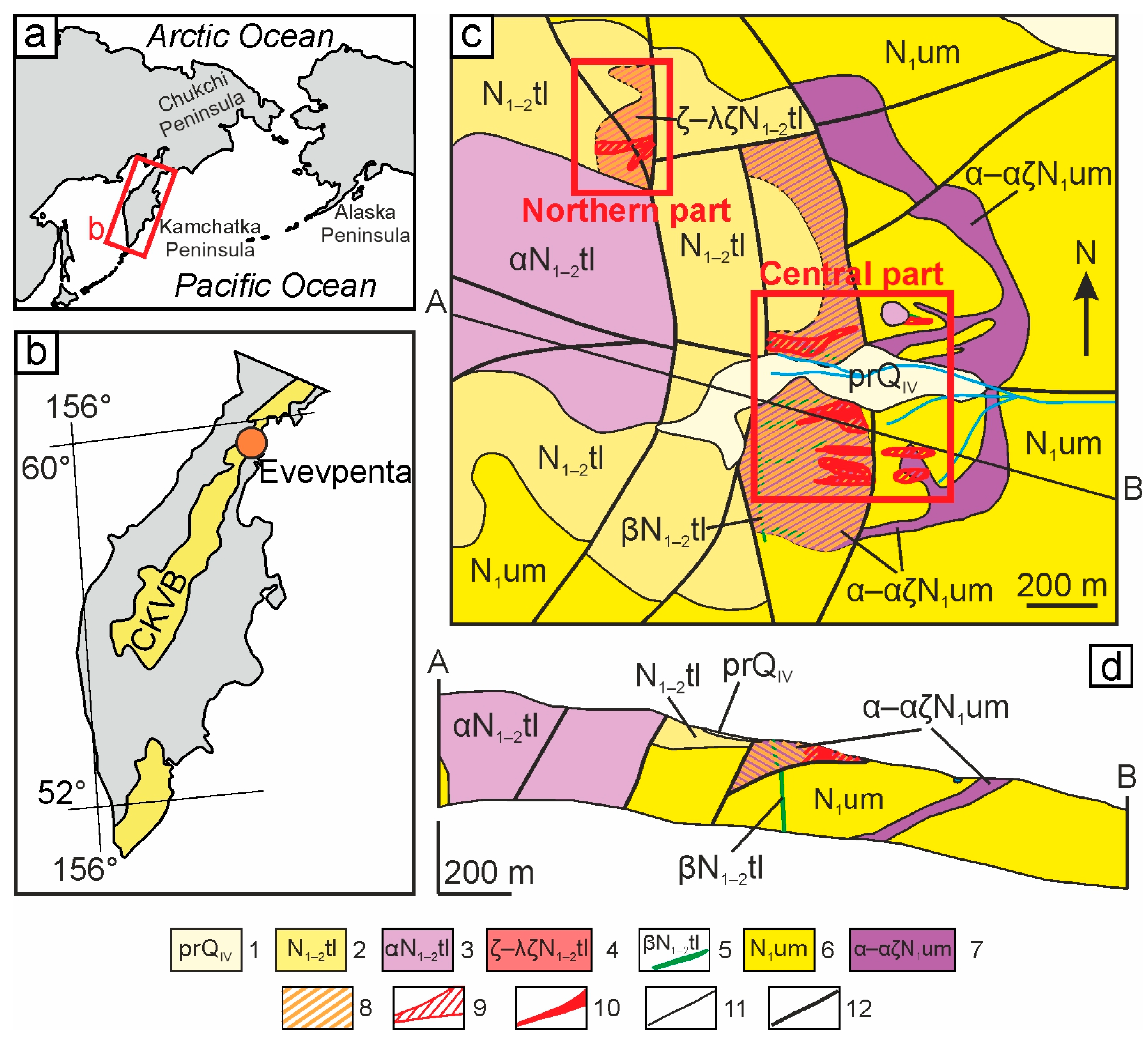
Figure 1. Geological setting and location of the Evevpenta deposit: (a) geographical location of the Kamchatka Peninsula in the North Pacific region; (b) location of the Evevpenta deposit within the Kamchatka Peninsula; (c) geological map of the Evevpenta deposit; (d) cross-section A–B. The geological structure and cross-section after unpublished data of JSC Rosgeo, position of the Central Kamchatka Volcanic Belt (CKVB) after [35]. 1—proluvial Quaternary sediments; 2—cover formations of the Tolyatovayam volcanic complex; 3—subvolcanic bodies of the Tolyatovayam complex (andesites); 4—subvolcanic bodies of the Tolyatovayam complex (dacites and rhyodacites); 5—dikes of the Tolyatovayam complex (basalts); 6—cover formations of the Umuvayam volcanic complex; 7—subvolcanic bodies of the Umuvayam complex (andesites and dacitic andesites); 8—argillic metasomatic alteration zones; 9—veinlent zones; 10—vein bodies, vein zones; 11—geological boundaries; 12—faults.
Minerals 15 01196 g001
Figure 2. SEM–EDS backscattered electron images of the ore minerals in the adularia–quartz veins in the Central (ac) and the Northern (df) parts of the Evevpenta deposit: (a) native gold (Au) rimmed by sulfides (Ag,Au)2–xS; (b) association of sphalerite (Sp), altaite (Alt) and coloradoite (Clr) in quartz (Qz); (c) calaverite (Clv) with a rim of “mustard” native gold (MG) in association with tellurite (Tlr), altaite (Alt), anglesite (Ang) in quartz (Qz); (d) association of jordisite (Jds) and muscovite (Ms) in quartz (Qz); (e) association of pyrite (Py), petzite (Ptz) and hessite (Hes) in quartz (Qz); (f) native gold (Au) rimmed by sulfides Au–Ag [(Ag,Au)2–xS].
Minerals 15 01196 g002
Figure 3. Textural features of adularia–quartz veins and veins on the Central (ac) and the Northern (df) parts of the Evevpenta deposit: (a,b) samples of an adularia–quartz vein of a lattice bladed texture; (c) black clusters of ore minerals (red borders) in a sample of a lattice bladed texture; (d) quartz vein (red borders); (e) quartz veinlents of a crustiform texture; (f) sample of quartz veins of a colloform banded texture containing jordisite and muscovite. Abbreviations: Qz—quartz, Adl—adularia, Jds—jordisite, Ms—muscovite.
Minerals 15 01196 g003
Figure 4. Mineral relationships and textural features of the adularia–quartz veins in the Central (a) and the Northern (b) parts of the Evevpenta deposit. Qz Ia, Qz IIa, Qz IIIa, Qz IVa—quartz of the first, second, third, and fourth generations, respectively, in the Central part, and Qz Ib, Qz IIb, Qz IIIb—quartz of the first, second, and third generations, respectively, in the Northern part of the Evevpenta deposit.
Minerals 15 01196 g004
Figure 5. Types of primary fluid inclusions in quartz Qz IIa, Qz IIIa (a,b) and Qz IVa (ce) from the Central part of the Evevpenta deposit: (a) fluid inclusion in the central part of the quartz grain (the red lines represent the grain boundary); (b) FIA of two-phase vapor–liquid inclusion; (c) zonally arranged fluid inclusions (the red lines represent the growth zone); (d) FIA of crystal-bearing fluid inclusions without vapor bubbles, two-phase vapor–liquid inclusion; (e) single-phase vapor inclusion. Abbreviations: Qz IVa—quartz of the fourth generation, Adl—adularia, LH2O—liquid phase (water), VCO2—vapor phase (carbon dioxide), CrRds—rhodochrosite crystal.
Minerals 15 01196 g005
Figure 6. Types of primary fluid inclusions in quartz Qz IIb (a,b) and Qz IIIb (c,d) from the Northern part of the Evevpenta deposit: (a) FIA of two-phase vapor–liquid inclusions; (b) crystal-bearing fluid inclusion of muscovite and ore minerals without vapor bubble; (c) FIA of two-phase vapor–liquid inclusions (the red lines represent grain boundaries); (d) two-phase vapor–liquid inclusion. Abbreviations: Qz IIIb—quartz of the third generation, LH2O—liquid phase (water), V—vapor phase, CrMs—muscovite crystals, CrJds—jordisite crystal.
Minerals 15 01196 g006
Figure 8. The diagram of homogenization temperature (Th) versus ice melt temperature (Tm) for the Evevpenta deposit and epithermal Au–Ag deposits at the Kamchatka Peninsula. 1—Asachinskoe [21,22]; 2—Rodnikovoe [16,19]; 3—Mutnovskoe [20]; 4—Maletoyvayam [17,24]; 5—Aginskoe [23]; 6—Baranyevskoe [17,25,26]; 7—Lazurnoe [17]; 8—Kumroch [24]. The fluid evolution paths as a result of different geological processes, based on [61].
Minerals 15 01196 g008
Table 1. List of samples.
SampleTextureNumber of Samples Studied
Double-Polished WafersThin
Sections
Polished
Sections
Central part
101096Lattice bladed, colloform224
101168Lattice bladed122
Northern part
205015Colloform-crustiform banded433
205074/2Colloform-crustiform banded323
Table 2. Mineral composition of Evevpenta ores (after Slyadnev et al. [27], Zhegunov et al. [28,29], and this study).
MainMinorTrace
OrePyrite (FeS2)Calaverite (AuTe2), native gold (Au,Ag), chalcopyrite (CuFeS2), galena (PbS), sphalerite (ZnS), acanthite (Ag2S), altaite (PbTe), hessite (Ag2Te), petzite (Ag3AuTe2), jordisite (MoS2)Uytenbogaardtite–petrovskaite (Ag,Au)2–xS, native silver (Ag,Au), coloradoite (HgTe), naumannite (Ag2Se),
argentopyrite (AgFe2S3) *
Supergene (secondary)Iron oxidesPyrolusite (MnO2), jarosite [KFe3(SO4)2(OH)6]Bornite (Cu5FeS4), covellite (CuS), anglesite (PbSO4), chlorargyrite (AgCl), Br-bearing chlorargyrite [Ag(Cl,Br)], wulfenite (PbMoO4), tellurite/paratellurite (TeO2), spionkopite (Cu39S28), minerals of the kaolinite group [Al2(Si2O5)(OH)4], gypsum (CaSO4 · 2H2O)
GangueQuartz (SiO2)Adularia (KAlSi3O8), calcite (CaCO3), rhodochrosite (MnCO3), siderite (FeCO3), muscovite [KAl2(AlSi3O10)(OH)2] Baryte (BaSO4), celestine (SrSO4), alunite [KAl3(SO4)2(OH)6] *
* Only as daughter phases in fluid inclusions.
Table 3. Summary of fluid inclusion microthermometric data from the Evevpenta deposit.
Mineral AssemblageQuartz
Generation
Number of MeasurementsFIA TypeTh, °CTe, °CTm, °C
Central part
Adularia–quartzQz IIa6VL320–360−8.5–−5.5−3.3–−2.5
338
Qz IIIa7VL315–364−6.0–−5.5−0.1
331
Gold–telluride–quartzQz IVa10VL175–325−8.0–−5.5−1.1–−1.0
280
Northern part
Telluride–sulfide–quartzQz IIb9VL219–248−6.0–−5.0−0.5–−0.2
233
Adularia–carbonate–quartzQz IIIb20VL140–214−7.0–−5.0−0.4–−0.1
183
Note: VL—two-phase vapor–liquid fluid inclusions; Th—range of homogenization temperatures/mean values; Te—eutectic temperature; Tm—ice-melting temperature; Qz IIa, Qz IIIa, Qz IVa—quartz of the second, third, and fourth generations, respectively, in the Central part, and Qz IIb, Qz IIIb—quartz of the second and third generations, respectively, in the Northern part of the Evevpenta deposit.
Disclaimer/Publisher’s Note: The statements, opinions and data contained in all publications are solely those of the individual author(s) and contributor(s) and not of MDPI and/or the editor(s). MDPI and/or the editor(s) disclaim responsibility for any injury to people or property resulting from any ideas, methods, instructions or products referred to in the content.