1. Introduction
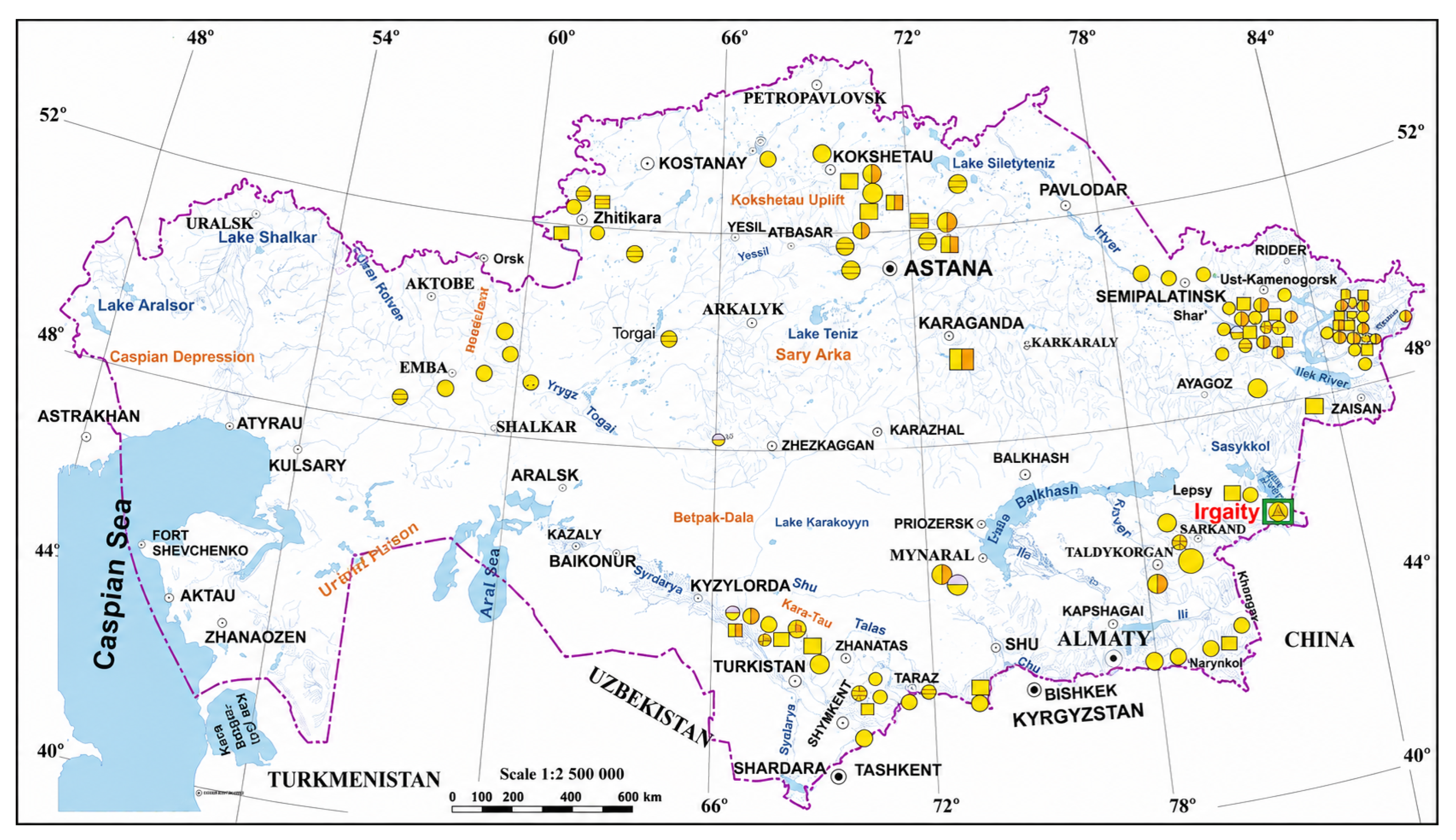
The ongoing depletion of placer deposits containing readily recoverable gold, which is amenable to conventional evaluation and extraction techniques, has driven the search for more resource-efficient approaches to mineral resource development. Consequently, greater emphasis is being placed on the accurate assessment and effective recovery of fine and ultrafine gold, which constitutes a significant but often underutilized component of placer gold resources (
Figure 1).
Placer gold deposits are among the most widespread secondary gold systems on Earth, forming where hypogene gold is released by weathering and subsequently concentrated by fluvial processes. Their global importance lies not only in production, but also in their value for tracing bedrock sources and reconstructing transport, supergene modification, and reworking histories [
1,
2]. A major modern theme is that placer gold is not always a simple detrital product. Reviews and case studies show that gold particles may be modified by supergene and biogenic processes, and some placers contain micro-scale authigenic overgrowths or rims. In New Zealand, Australia, Canada, and Cameroon, placer gold research has shown that particle morphology, alloy chemistry, and inclusion suites can preserve source signatures and overprint histories [
2,
3]. Special attention is now shifting to micro- and nano-gold. Recent work from high-grade orogenic systems demonstrates that Au nanoparticles can occur with amorphous silica and carbon phases, providing a mechanistic bridge to fine gold transport and deposition. In placer settings, microchemical studies from Cameroon and elsewhere show that grains can contain micron-scale pure gold rims, Ag depletion zones, and nano- to micro-scale precipitates formed during weathering and supergene evolution [
4,
5]. The most informative placer provinces for micro-/nano-gold studies include Cameroon, Arizona, and Canadian placer systems, with additional classic fine-gold recovery literature from Yukon and other regions [
1,
2,
3,
6]. Overall, the field is moving from simple placer taxonomy toward a microanalytical, process-based understanding of how gold is liberated, transformed, transported, and reprecipitated in surficial environments [
1,
2].
Current estimates indicate that gold production in Kazakhstan is predominantly derived from primary (lode) deposits, whereas placer deposits contribute a comparatively minor share. Specifically, placer gold is estimated to account for approximately 5%10% of total national production. This trend is attributed to the substantial depletion of conventional placer deposits, the continuous shift in the mining industry toward primary (lode) ore processing, and the low technological recoverability of fine and ultrafine gold in placer deposits. As a result, the resource potential of placer deposits, particularly those containing fine and ultrafine gold, remains significantly underestimated.
Fine (particle sizes of 10 µm and larger) and ultrafine gold (less than 10 µm) are characterized by specific physicochemical properties that require the application of alternative approaches for their quantitative assessment, which differ markedly from those used for gravity-recoverable gold. Ultrafine gold, for example, is not amenable to recovery by conventional gravity methods due to its extremely small hydraulic size. Consequently, it does not form enriched concentrations within the lower stratigraphic horizons of host sediments. During placer formation, fine and ultrafine gold may be transported in several forms, including free native particles of fine fractions, dissolved species, and phases associated with clastic material. In addition, its physical properties differ fundamentally from those of coarser gold fractions due to the “size effect”. This leads to potential inaccuracies in analytical results obtained by atomic absorption and fire assay methods, as these techniques may not adequately account for the atypical behavior of submicron gold particles.
The significance of ultrafine gold has been recognized since the 1970s. N.V. Petrovskaya observed that fine gold particles (0.5–10 μm) are far more widespread than visually detectable gold grains, emphasizing that this form of native gold is likely ubiquitous and may constitute a substantial proportion of total gold resources [
7]. Similarly, B.M. Osovetsky identified a range of minerals that act as concentrators of nanogold, including sulfides, platinoids, goethite, quartz, halides, clay minerals, magnetite, carbonates, and feldspars [
8,
9,
10].
The potential for the discovery of large-volume placer deposits enriched in fine and ultrafine gold in Kazakhstan was first proposed in 2005 [
11]. This hypothesis was based on analogies with multilayer placer systems developed in depressions such as Bolshoy Kuranakh (e.g., Nagiminskaya and Petrovskaya placers), as well as on comparable geological and geomorphological conditions identified within Kazakhstan. Subsequent investigations by V.G. Moiseenko, A.F. Mironyuk, and co-authors [
12,
13,
14,
15,
16,
17,
18] demonstrated that placers of this type are characterized by the coexistence of fine and very fine gold with ultrafine fractions, with the latter often occurring in significantly greater abundance. These findings underscore the importance of targeted investigations into ultrafine gold within such depositional environments.
The Irgaity River placer deposit is characterized by extensive accumulations of fine and ultrafine gold within alluvial sediments. Deposits of this type have received growing attention owing to their resource potential and the technical challenges associated with the recovery of finely dispersed precious metals. The Irgaity placer differs markedly from conventional channel-confined placer deposits in both morphology and scale. The gold-bearing system exhibits a broad, laterally extensive distribution of mineralization, with widths of up to 1500 m, a traced length exceeding 12.5 km, and productive sediments reaching 60–70 m in thickness. These dimensions indicate a large placer system with substantial resource potential. The scale of the Irgaity placer is notable and approaches that of the giant auriferous alluvial systems documented in the Kolyma Basin of the Russian Far East, where gold-bearing placer systems may extend for up to 30 km along their depositional axes [
19,
20]. This comparison highlights the unusually large dimensions of the Irgaity placer relative to conventional channel-confined placer deposits.
Gold mineralization at the Irgaity placer displays a well-defined stream-like distribution pattern, controlled by a paleovalley and forming elongated mineralized flows. This characteristic is of fundamental importance for mineral prospecting, exploration strategies, and geological-economic modeling, as it necessitates the application of approaches distinct from those traditionally employed for conventional placer systems. The genesis of the placer is complex and polygenetic, involving the interplay of several processes, including mechanical transport of clastic material, chemical precipitation of gold, and its sorption onto mineral substrates. This combination of mechanisms largely accounts for the widespread occurrence of ultrafine gold within the deposit. The Irgaity River placer establishes a representative example of a large placer, distinguished by the presence of fine and ultrafine gold. The development of such deposits has the potential to significantly expand the mineral resource base of the country and may effectively revitalize placer gold exploration and mining, provided that appropriate technological solutions are implemented. This study presents the results of an investigation focused on diverse characteristics of fine and ultrafine gold discovered in sediments of the alluvial fan of the Irgaity River (North Dzhungar region, southern Kazakhstan).
For the first time, we apply a thermal activation method to achieve secondary remobilization and quantitative assessment of dispersed and ultrafine gold, including nanoparticles and atomically dispersed forms hosted in the mineral matrix of placer sands and their processing tailings. This work provides the first quantitative estimates of such gold fractions in Irgaity placer sands and associated tailings and demonstrates, for the first time, that a significant, previously unaccounted gold reserve can be mobilized from these materials using controlled thermal treatment.
2. Geological Setting
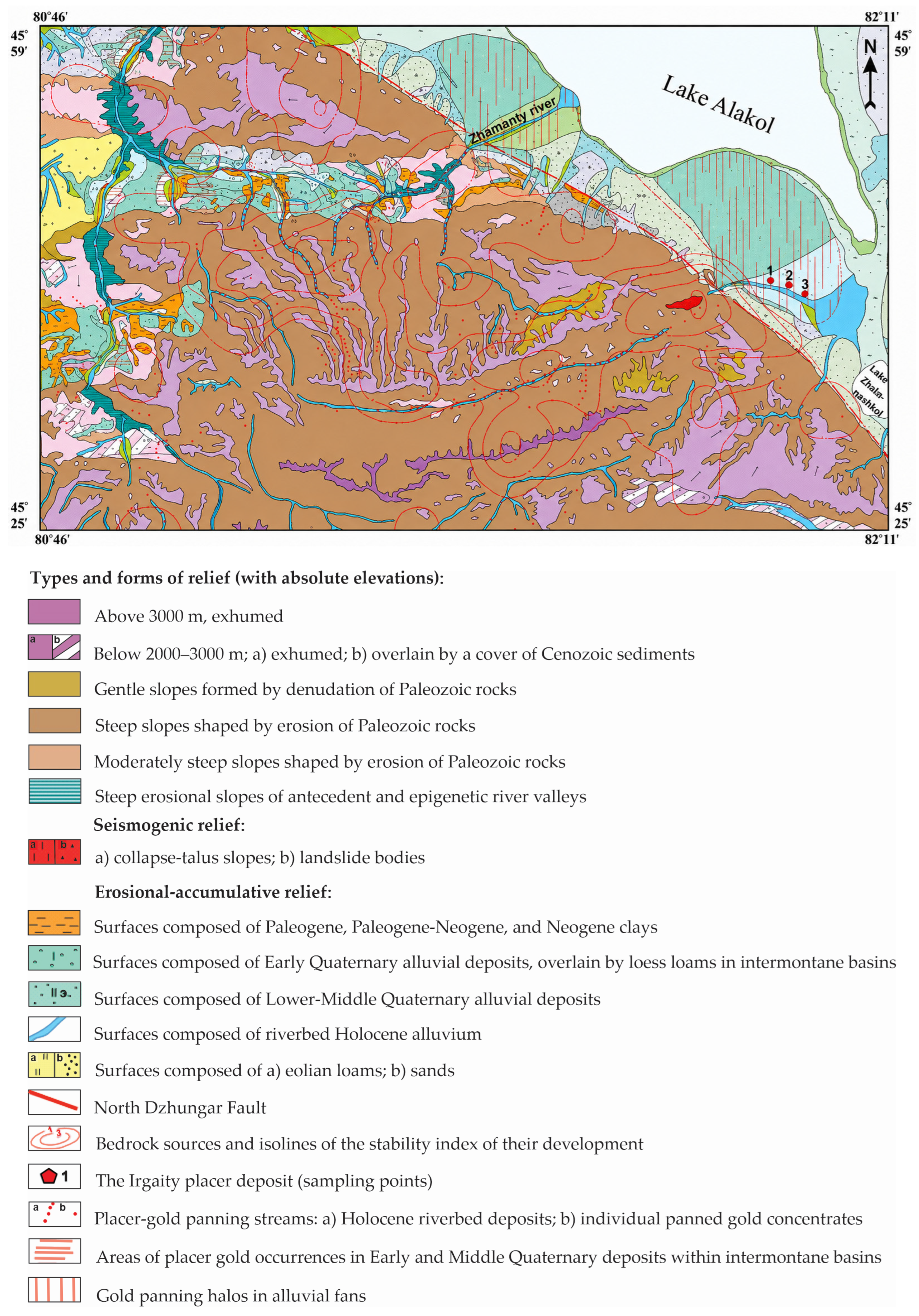
The Irgaity deposit area is situated between the North Dzhungar Synclinorium and the Alakol Depression. It is characterized by the juxtaposition of an intensively deformed Paleozoic folded basement and an overlying succession of Cenozoic sedimentary formations (
Figure 2).
The Paleozoic basement comprises Devonian-Carboniferous terrigenous and carbonate-siliceous sequences, including siltstones, sandstones, conglomerates, clay-siliceous shales, jasperoids, and limestones, with subordinate occurrences of intermediate volcanic rocks. Structurally, these rocks are tightly folded into a system of linear folds with predominantly sublatitudinal orientations and are bound by the major North Dzhungar Fault. Intrusive magmatism is weakly expressed and does not appear to have played a significant role in ore formation. The Cenozoic cover consists of Paleogene, Neogene, and Quaternary deposits, which are extensively developed within the Alakol Depression and adjacent foothill areas. Of particular importance for placer gold mineralization are the Quaternary alluvial—proluvial sediments of alluvial fans, composed of thick accumulations of gravels, pebbles, and sands.
The mountainous sector of the study area, associated with the zone of active neotectonic uplift of the Dzhungar Alatau, represents a region of intense denudation and constitutes the principal source of clastic material transport, including gold. The primary sources of placer gold in the region are related to Paleozoic folded complexes and are represented by hydrothermal mineralization localized within tectonic fault zones.
The primary sources of placer gold on the northern slopes of the Dzhungar Alatau are numerous quartz-vein bodies and pyritization zones containing free native gold of placer-forming fractions, which form a sub-latitudinal belt controlled by intensely deformed rocks in the axial part of the Tastau synclinorium. In the Irgaity River basin, more than 200 gold-bearing quartz-vein bodies, stockwork-like quartzification zones, and pyritization zones have been documented by previous researchers (Tretyakov, Peregudov and others), who also identified free native gold in panning concentrates from these occurrences. Detailed field photographs and descriptions of these vein systems are provided in those works and are beyond the scope of the present study, which focuses on the characterization and processing of the placer material itself.
The distribution of Paleozoic rocks is structurally controlled by the North Dzhungar Fault, a major regional structure characterized by a steep dip and predominantly normal-fault displacement. Middle Paleozoic strata are deformed into a system of compressed linear folds with mainly sublatitudinal and, less frequently, northwestern orientations. These folds are generally linear and symmetrical, with limb dip angles ranging from 45° to 80°.
The principal ore-bearing structures comprise quartz vein bodies, stockwork zones of silicification, and zones of sulfide mineralization, predominantly characterized by pyritization. Collectively, these features define an extensive gold-bearing belt of sublatitudinal strike associated with the axial zone of the Tastau synclinorium. Within these structures, free native gold in placer-forming size fractions is widely developed.
Within the Irgaity River basin, more than 200 gold occurrences have been identified, represented by quartz veins and zones of hydrothermally altered rocks. Geochemical sampling confirms the presence of free gold, supporting their interpretation as primary sources of placer material.
Genetically, the mineralization is attributed to hydrothermal quartz veins and quartz-sulphides (pyrite) and is spatially controlled by zones of intense tectonic deformation. The advanced degree of erosion of these primary sources, driven by tectonic uplift and active denudation, has facilitated the disintegration of ore bodies, the release of gold, and its subsequent concentration within Quaternary alluvial—proluvial fan deposits, including those of the Irgaity placer system.
2.1. Geomorphology of the Studied Area
Three principal geomorphological zones can be distinguished within the studied sector of the Dzhungar Alatau: (1) a surrounding plain zone, (2) a piedmont transitional zone, and (3) a mountainous zone of intensive neotectonic uplift.
The plain zone, encompassing a lacustrine-bog lowland, the modern lake floodplain, and an alluvial—proluvial plain, occupies the central part of the Alakol Depression. The relief is predominantly accumulative, formed under conditions of sustained relative subsidence. Sedimentary processes dominated throughout the Cenozoic, resulting in the development of thick sedimentary sequences.
The transitional zone extends along the mountain front and includes piedmont alluvial fans and intermontane plains. Its relief developed through the accumulation of alluvial—proluvial material transported by both ephemeral and perennial streams from the mountainous area, followed by subsequent dissection of the depositional surface by younger erosional processes. This zone includes alluvial fans of the Tentek, Zhamanty, and Irgaity rivers, the latter encompassing the study area. These fan systems formed at the outlets of river valleys where they debouch from mountainous terrains into the Alakol Depression. They are predominantly of Early to Middle Quaternary age and consist of thick accumulations of sandy and boulder-pebble sediments, with total thicknesses ranging from several tens to several hundreds of meters. Morphologically, the fan surfaces exhibit a characteristic radial expansion downslope in the direction of fluvial transport. Incision by modern valleys has resulted in the development of steep erosional slopes, with incision depths varying from 10–15 m to 50–100 m. The longitudinal extent of the alluvial fans along the flow direction typically ranges from 8–10 km to 10–15 km, while their lateral dimensions reach 10–20 km.
The zone of intensive tectonic uplift, situated south of the Alakol Depression, comprises mountainous terrains developed on Paleozoic bedrock. This zone is characterized by active erosion and denudation processes and constitutes the principal source area for clastic material supply, including placer-forming gold.
2.2. Discovery History of Placer Gold Mineralization
The northern part of the Dzhungar Alatau is distinguished from adjacent regions by the widespread development of placer gold mineralization. Gold extraction in this area dates back to antiquity. Within river valleys, remnants of ancient mining activities attributed to the Saka-Wusun period have been identified, alongside evidence of later, pre-revolutionary exploitation conducted by Chinese and Russian operators.
During the 1930s–1950s, gold was mined by small-scale mining cooperatives (artels) along the Tentek, Zhamanty, and Irgaity Rivers and their tributaries. Archival data indicate that in 1936–1937, six mining blocks located within above-floodplain terraces of the Irgaity River were exploited, yielding a total of 33.15 kg of gold, with grades in the auriferous sands ranging from 0.7 to 2.47 g/t. Nuggets weighing from several tens of grams up to 250 g were also recovered. The depth of mining operations was generally constrained by the groundwater table.
In 1940, geologist G. V. Tsaplin reported in a memorandum to the Head of the Geological Administration that fractures and pothole-like depressions in the bedrock of the Irgaity River, despite their limited dimensions (0.2 to 4–5 m), yielded up to 1.5 kg of gold (RGF, archival record no. 1162, 1948).
In 1978, the “Kazakhstan” artel “Kazzoloto” mining and mineral processing enterprise undertook an attempt to exploit terrace placers of the Irgaity River in its upper reaches. Subsequently, in 2006–2008, exploration work aimed at evaluating the potential of the Irgaity River alluvial fan for hosting fine and ultrafine gold was conducted by Laton Geoservice LLP. The results of these investigations have been partially published and partially form the basis for the present study.
3. Geology of the Irgaity Placer
Within the alluvial fan succession, four stratigraphic units of different ages have been distinguished. The basal unit (QI1) is composed of reddish-brown gravels and is characterized by rhythmic bedding expressed by the alternation of gravel layers with varying clast sizes and gravel-sand horizons. Its thickness reaches up to 12 m. This unit is overlain by a pale-colored succession (QI2?), consisting of pebble and boulder-pebble deposits interbedded with coarse-grained sands. Well-developed rhythmic bedding and locally preserved cross-bedding are characteristic features of this unit, which attains a thickness of approximately 14 m. Middle-Upper Pleistocene sediments (QII–III) occur above these deposits, represented by fine- to medium-sized pebble facies with alternating gravelly and pebbly layers and a thickness ranging from 5 to 8 m. The sequence is capped by modern and Late Quaternary boulder-pebble deposits with a maximum thickness of approximately 2 m.
The clastic material in all stratigraphic units is predominantly well rounded and consists mainly of shale, jasperoid, porphyrite, and hornfels pebbles, with subordinate amounts of quartz and granitoid fragments. The rhythmic stratification, lateral persistence of individual beds, and occurrence of crossbedding collectively indicate deposition within a subaqueous deltaic environment.
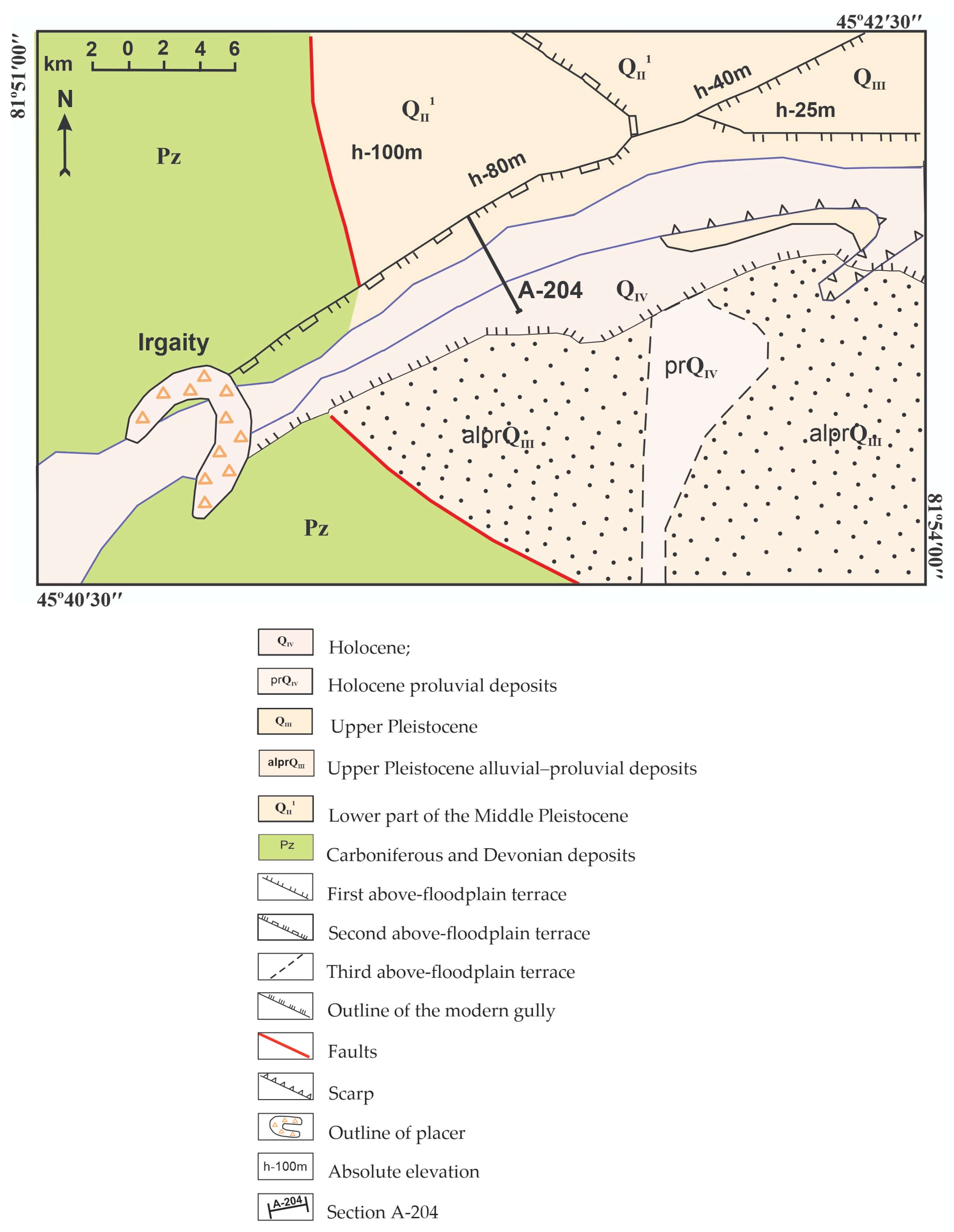
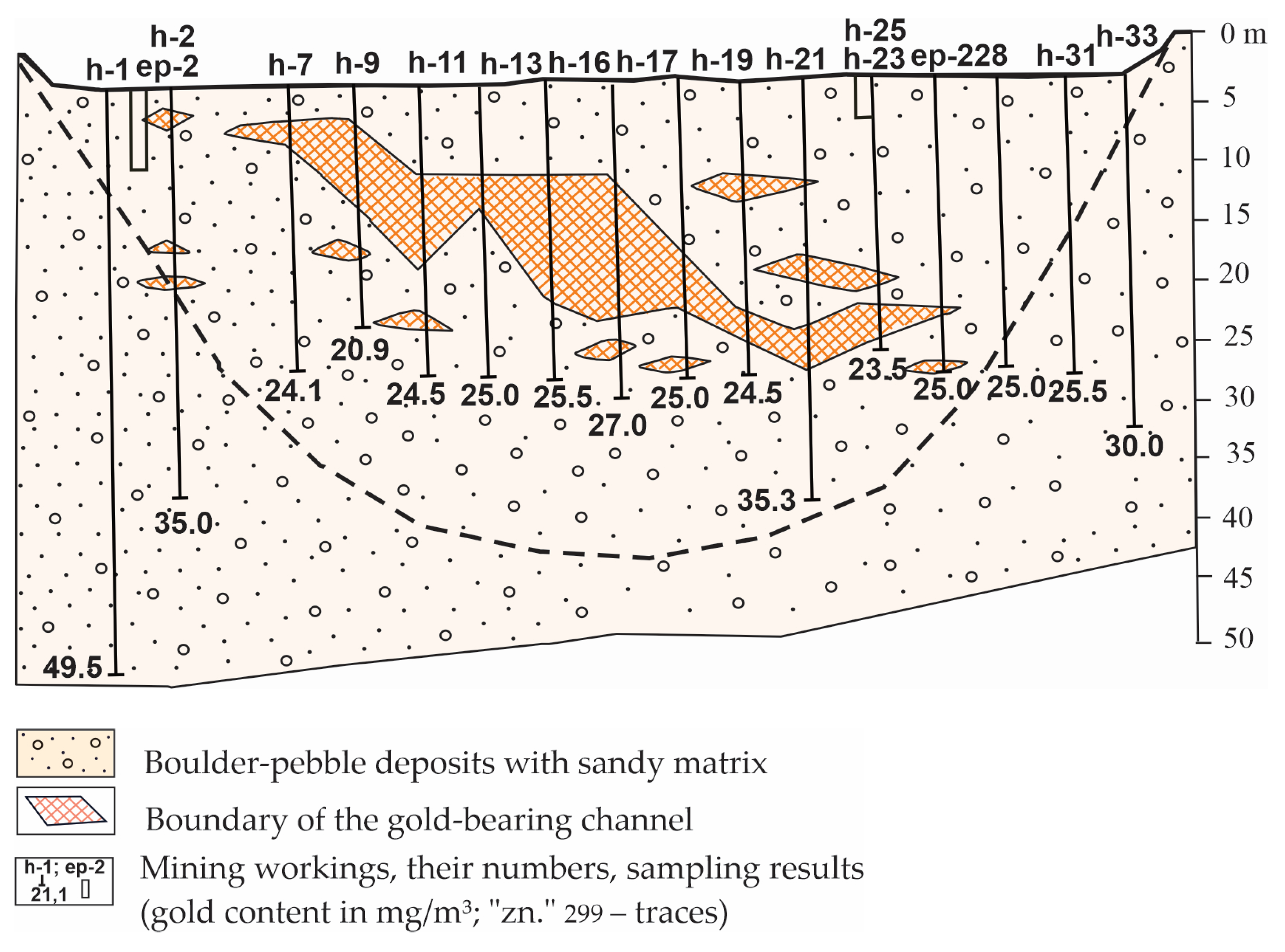
Placer gold mineralization has been identified throughout all stratigraphic levels of the succession. The spatial distribution of gold exhibits a channelized pattern, with enriched zones confined to a paleovalley extending from the mountain outlet of the Irgaity River across the alluvial fan. The gold-bearing corridor attains a width of up to approximately 1.5 km and can be traced for a minimum distance of 12.5 km (
Figure 3 and
Figure 4).
The primary sources of placer gold along the northern slopes of the Dzhungar Alatau are represented by numerous quartz-vein systems and pyritized zones containing free native gold of placer-forming grain sizes. These ore-bearing formations are concentrated within a sublatitudinal metallogenic belt structurally controlled by intensely deformed rocks of the axial zone of the Tastau synclinorium.
Within the Irgaity River basin, previous investigations [
11] have documented more than 200 gold occurrences associated with quartz veins, stockwork-style silicification zones, and pyritization zones. Results of panned-concentrate sampling confirmed the presence of free native gold, supporting the interpretation that these mineralized bodies constitute the principal sources of placer gold within the study area.
The erosional maturity of the primary gold sources, evaluated using indicators such as the depth of erosional dissection and the preservation state of oxidation zones and weathering profiles, is considered high. This reflects the effects of active neotectonic uplift and intensive denudation, which promoted the destruction of mineralized bodies, the release of gold particles, and the subsequent formation and enrichment of placer deposits.
The structural characteristics and distribution patterns of fine and ultrafine gold within the Irgaity alluvial fan were investigated by LLP “Laton Geoservice”. The study focused on lithofacies controls of sedimentation, assessment of gold grades within the deposits, characterization of the grain-size distribution of gold, and the development of efficient extraction and recovery technologies.
Previous studies documented the occurrence of gold-bearing unconsolidated sediments extending to depths of 60–70 m. Reported gold concentrations vary from trace values to exceptionally high grades of up to 866 g/t. Based on these investigations, the forecast resources of fine and ultrafine placer gold within the study area were estimated at approximately 95.3 t, indicating the substantial mineral resource potential of the Irgaity alluvial fan placer system.
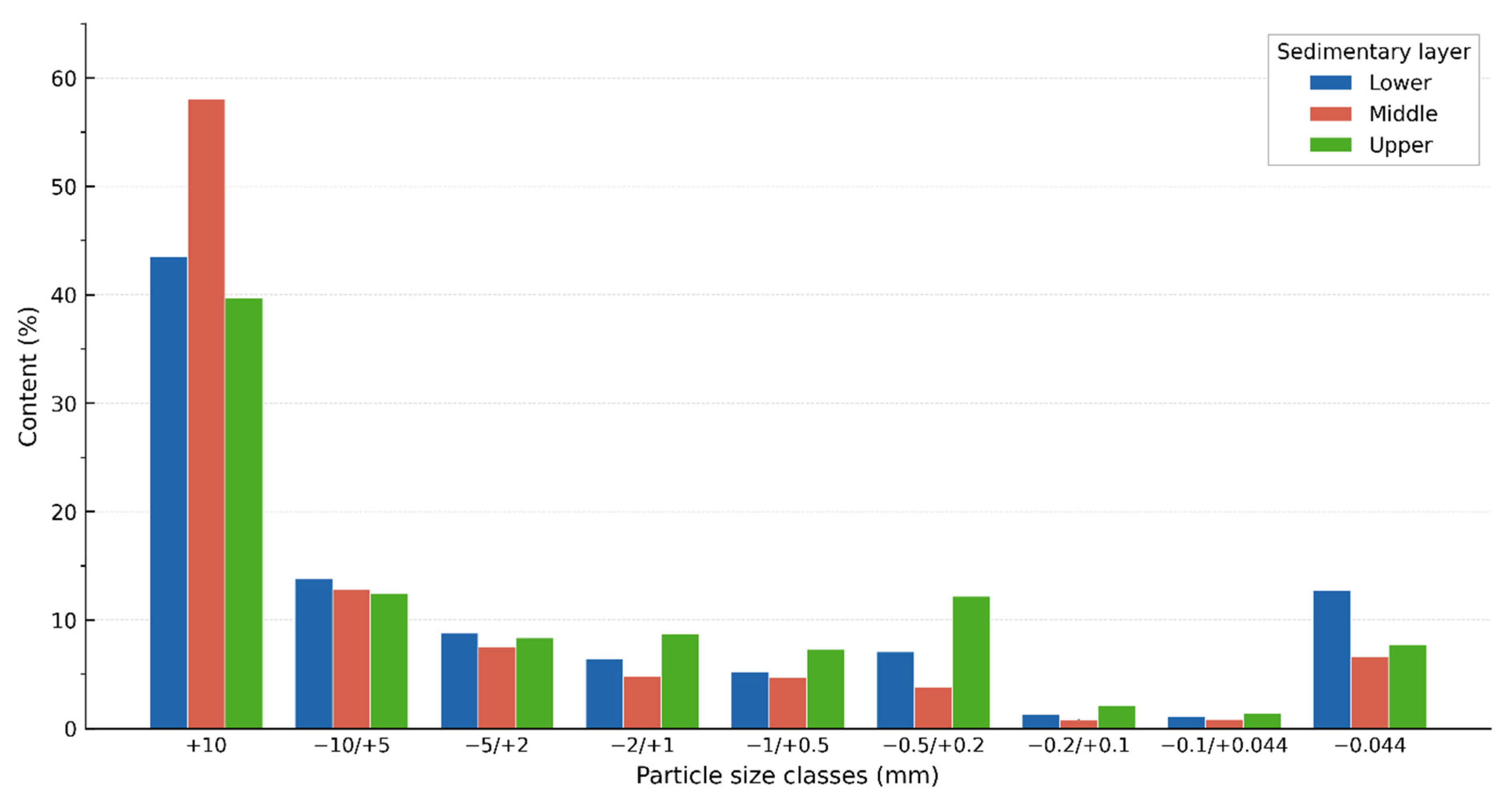
The grain-size distribution of productive sediments within the large placer deposit of the Irgaity River alluvial fan has been studied, and the results are presented in
Table 1 and summarized in
Figure 5. This dataset provides valuable information for evaluating sedimentological controls on gold concentration and for assessing the relationship between diverse particle-size fractions and the distribution of economically significant gold mineralization.
From the perspective of gold mineralization potential, the −1/+0.2 mm size fractions are of particular interest, as native gold in alluvial placer deposits is commonly concentrated within this grain size range. The upper horizon is characterized by a higher cumulative proportion of these fractions (27.6%), suggesting a greater potential for gold enrichment and a more favorable distribution of gold-bearing material compared to the underlying horizons (
Figure 5).
4. Methodology
4.1. Sampling Strategy
The overall methodology employed in this study was based on a sequential, multi-stage approach integrating literature review, assessment of previous exploration results, and comprehensive field and laboratory studies. The first stage involved a critical analysis of published data concerning the geological structure of placer deposits containing fine and ultrafine gold, with particular emphasis on the geological, sedimentological, and geomorphological factors controlling their formation and localization. The second stage focused on evaluating the degree of previous exploration and geological knowledge of placer gold mineralization within the Irgaity area, which had been identified as a prospective target by earlier studies conducted by A.B. Begalinov, A.V. Tretyakov, and others [
11,
14,
15,
17,
18]. The third stage comprised detailed field investigations, including the collection of mineralogical and technological samples, followed by a series of laboratory analyses aimed at characterizing the composition of the sediments, determining the distribution and morphology of gold particles, and evaluating the technological parameters relevant to gold recovery.
The Irgaity placer deposit is regarded as a highly prospective target for the identification and evaluation of large-volume placer gold mineralization hosted within Neogene-Quaternary alluvial fan deposits developed in intermontane basins. In recent years, gold-bearing sediments have been explored by a limited number of drill traverses reaching depths of 30–40 m. Trace quantities of gold were detected throughout the entire sedimentary succession, even though sample processing was performed using conventional extraction techniques. Within the Irgaity River alluvial fan, the explored placer body is approximately 240 m wide and is characterized by an overburden thickness of 10–15 m and productive sand horizons reaching up to 12 m in thickness. The average gold grade is about 0.3 g/t.
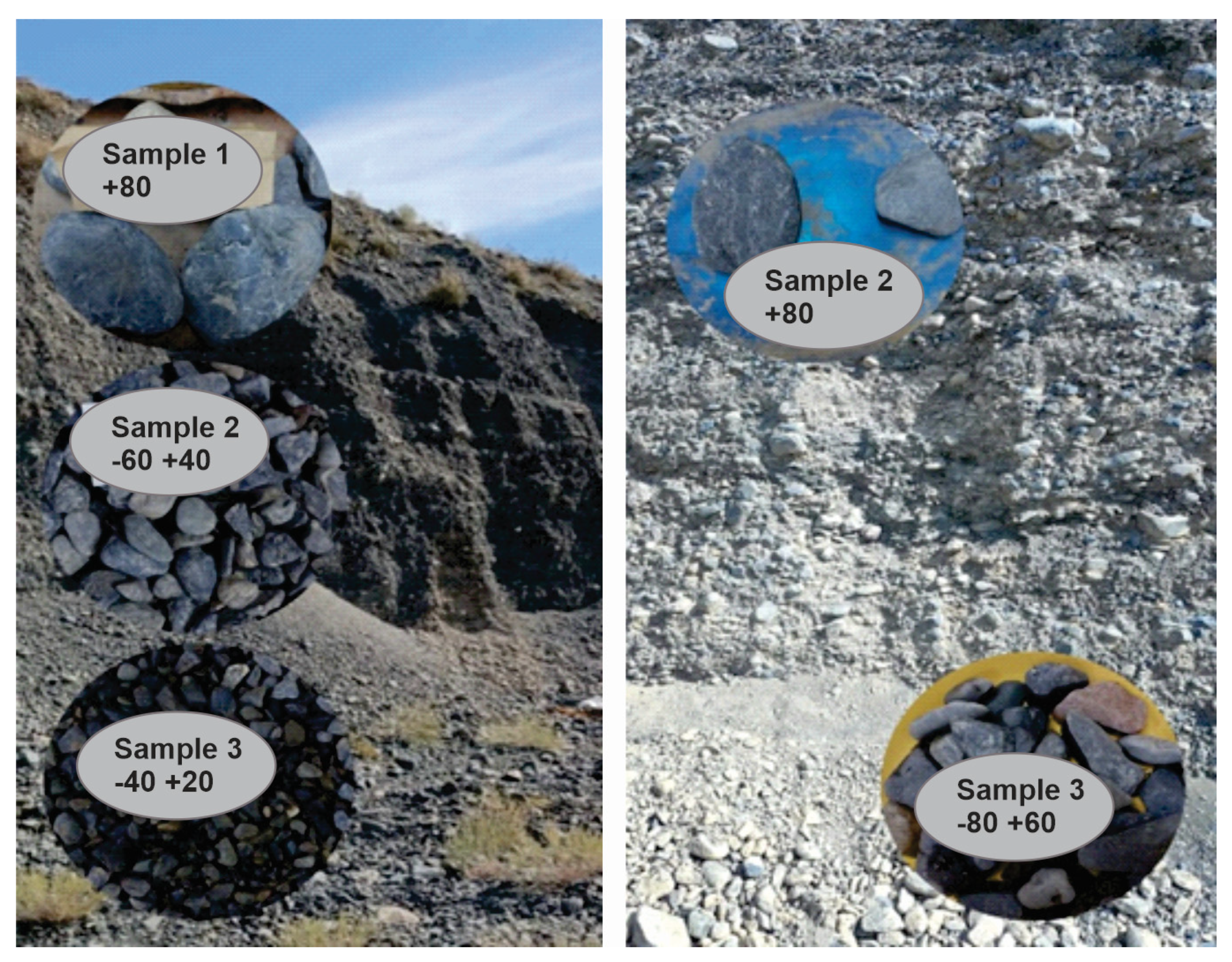
To characterize the vertical distribution of gold-bearing sediments and to carry out bench testing on gold recovery, three representative samples were collected from the upper (S1), middle (S2), and lowest (S3) parts of the sedimentary succession (
Figure 6). Each of these samples, weighing 100–120 kg, was composed of sand—gravel—pebble material and was collected from a natural exposure along the bank of the Irgaity River.
The Irgaity alluvial fan forms a flat accumulation surface gently inclined toward Lake Alakol. No natural outcrops that expose the central (axial) part of the fan are present at the surface. The only natural incision that exposes the fan deposits to a significant depth (up to 25–30 m) is the Irgaity River canyon, which is located on the eastern flank of the fan and does not expose its central, more prospective parts. Given these constraints, sample locations were selected based on (i) accessibility and safety, (ii) coverage of the main lithostratigraphic units previously identified by Tretyakov et al. [
11], which differ in clast size, matrix color, and bedding characteristics, and (iii) representation of vertical and lateral variability within the exposed flank. Channel samples were collected from different stratigraphic levels and positions to capture this variability. Consequently, the investigated samples characterize the flank of the deposit rather than its central portion. While representative of the exposed flank sequences, they may not fully reflect the most gold-rich central part of the fan. This limitation is acknowledged, and our conclusions on gold grade, particle-size distribution, and processing behavior are therefore primarily applicable to the sampled flank area.
4.2. Analytical Investigations
Initial mineralogical and technological investigations were conducted at KRIC NTK LLP in Stepnogorsk, Kazakhstan. Analytical determinations, including atomic absorption spectroscopy (AAS) and phase composition analyses, were performed in accredited laboratories at EcoLux LLP, Reaktiv LLP, and the K.I. Satpayev Institute of Geological Sciences, Almaty. These analyses provided the base geochemical and mineralogical data necessary for evaluating the composition of the placer sediments and the characteristics of the associated gold mineralization.
Comprehensive mineralogical studies of the placer sands, including the characterization of gold in beneficiation products, were conducted at the laboratory of LLP “KRIC-NTK”, Stepnogorsk, Kazakhstan [
22]. The development and optimization of recovery technology for fine and ultrafine gold were based on laboratory-scale processing of large-volume bulk samples. The technological testing program involved wet screening of the samples into 11 particle-size fractions, followed by the separate beneficiation of each fraction using gravity concentration equipment to produce concentrate and tailing products.
The resulting concentrates were subsequently subjected to in-depth mineralogical study carried out at the Imaging and Analysis Centre (IAC) at the Natural History Museum (NHM, London, UK). To verify the occurrence, morphology, and mineral associations of fine gold, high-resolution analyses were conducted using scanning electron microscopy (Tescan TIMA SEM), FEI Quanta FEG-SEM, and JEOL 8530F electron microprobe analysis (EMPA) (JEOL, Tokyo, Japan), providing confirmation of the presence and distribution of submicron and nanoscale gold within the placer sediments and their precise chemical composition.
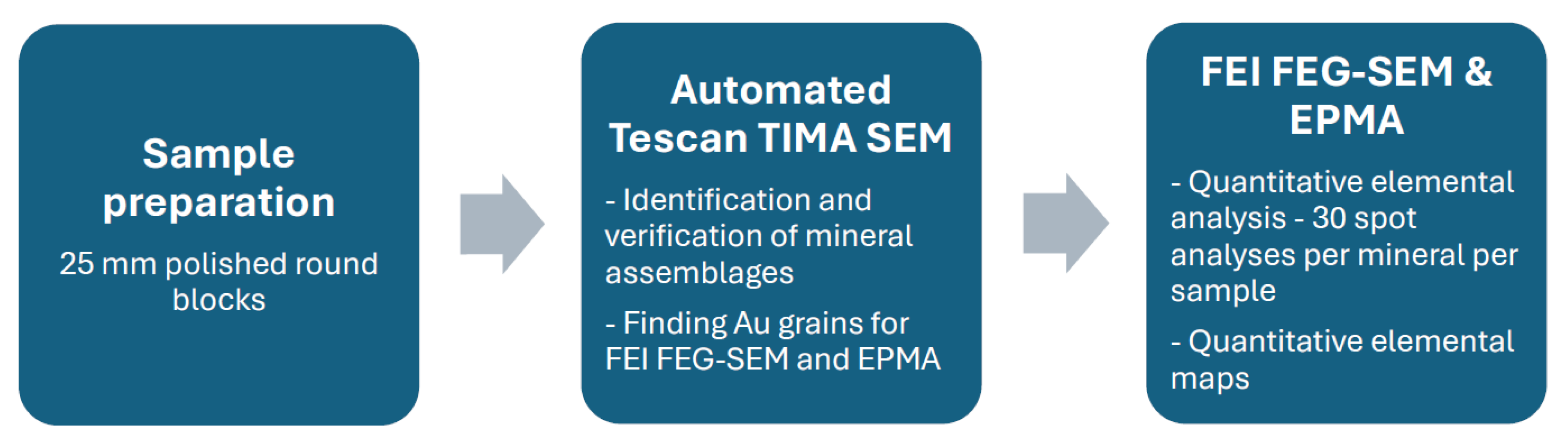
Loose mineral concentrates from mineral processing stages were embedded into epoxy resin mounts of 25 mm in diameter, and after solidification, the resulting round mounts were polished and carbon-coated for subsequent analyses.
Figure 7 shows the analytical flow that was applied to all polished mounts at IAC (NHM, London).
4.2.1. Automated Mineralogy
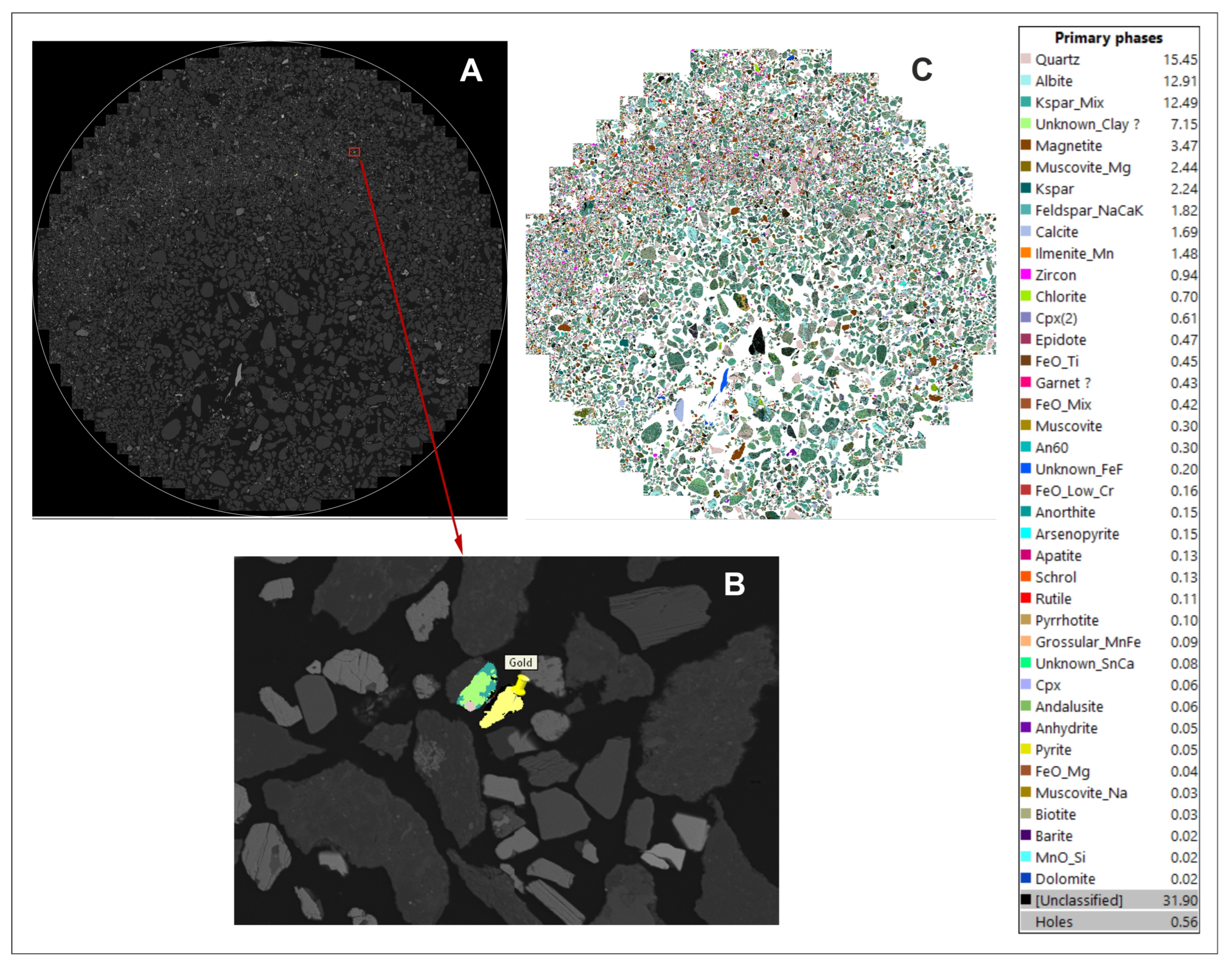
Automated mineralogy has been performed using a Tescan TIMA Scanning Electron Microscope (SEM) (Tescan, Brno, Czech Republic) at the Natural History Museum, London, UK (
Figure 8). The field emission instrument is equipped with four EDAX Element 30 Energy Dispersive X-ray Spectroscopy (EDS) detectors (EDAX, Mahwah, NJ, USA) and was operated at 25 kV accelerating voltage, 13–14 nA probe current, and a working distance of 15 mm. Mineralogy was determined by collecting Back Scattered Electron Maps (BSE) combined with EDS analysis at 5 µm pixel resolution with a total of 1000 X-ray counts per pixel. Following the mineral classification, we performed a Bright Phase Search optimized for gold. This was achieved by setting the minimum BSE brightness to 75% and by assigning a Au phase filter, acquired from a Au standard, and only phases that met these thresholds were analyzed. The blocks were scanned with 0.5 µm pixel resolution and when the specified BSE threshold was obtained, an EDS point was placed on the mineral to determine its composition. When Au peaks were identified, the grain of interest was then analyzed along with the surrounding 30 µm area.
4.2.2. Scanning Electron Microscopy
Selected gold-bearing grains were analyzed with a FEI Quanta 650 FEG-SEM equipped with a Bruker Quantax energy-dispersive spectrometry (EDS) system (Bruker, Madison, WI, USA), Esprit 2.6 software, and an annular, high-sensitivity XFlash FlatQUAD silicon drift detector (Bruker, Berlin, Germany). An accelerating voltage of 6 kV and a probe current of ~490 pA resulted in an input count rate of ∼76,000 cps at ∼11% dead time. Hyperspectral imaging datasets, which provided complete spectra for each pixel of the SEM image, were acquired at a pixel size of 6.5–7.1 nm with a dwell time of 128 µs for 34–59 min. The background was removed, and X-ray line families with overlapping peaks were deconvolved using stored line profiles through an automated routine.
4.2.3. Electron Microprobe Analysis
Compositional analyses were acquired at the Natural History Museum, London, UK on an electron microprobe JEOL 8530 equipped with five tunable wavelength dispersive spectrometers. The operating conditions were a 40 degree take-off angle and a beam energy of 25 keV. The beam current was set to 20 nA and a focused beam was used. Elements were acquired by using the following crystals: LIFH for Fe, Cu, and Zn; LIFL for Au and Hg; PETL for Ag, Pb, Bi, S and Mo; and TAPL for As. The standards were chalcopyrite for Fe, Cu, and S; willemite for Zn; pure gold for Au; Hg-telluride for Hg; pure silver for Ag; alamosite glass for Pb; Bi-telluride for Bi; pure molybdenum for Mo; and Ni-arsenide for As. The on-peak counting time was 10 s for Au, Ag, Pb, Bi, S, Mo, 20 s for Cu, Zn, Hg, and 40 s for As. Element maps were acquired using the same beam conditions but with a dwell time of 200 ms per pixel and organized in five passes with major elements acquired first. Off-peak acquisition was not performed but backgrounds were modelled after the MAN (mean atomic number) background intensity data was calibrated and continuum absorption corrected for all elements [
23,
24]. Unknown and standard intensities were corrected for deadtime using the simple single-term correction method [
25]. Interference corrections were applied accordingly using standards that do not contain the interfering analyte [
26]. The Phi-Rho-Z matrix correction algorithm utilized was Armstrong/Brown/Scott-Love [
27]. Analytical totals are generally higher than 100 wt.% when analyzing mixtures of pure elements as matrix correction protocols in electron beam techniques are limited in these analytical scenarios. Using alloys rather than pure elements as primary standards could improve analytical totals, but it is beyond the scope of this manuscript.
5. Results and Discussion
5.1. Preliminary Mineralogical Study
Initial mineralogical analyses revealed that gold is predominantly concentrated in particle-size fractions finer than 0.5 mm and is closely associated with sulfide minerals, including pyrite, arsenopyrite, chalcopyrite, and cinnabar, with less frequent occurrences in association with pyrrhotite and pentlandite. Gold particles are mainly characterized by platy and flaky morphologies, whereas irregular and massive forms are less common. In addition to well-rounded grains typical of placer environments, particles that preserve primary ore-related morphologies were identified. Gold color varies from bright yellow, indicative of high fineness, to greenish yellow, reflecting lower fineness. Intergrowths of gold with pyrite and quartz were observed, and many grains are partially coated by iron and manganese hydroxides.
5.2. Development of the Processing Flow Sheet
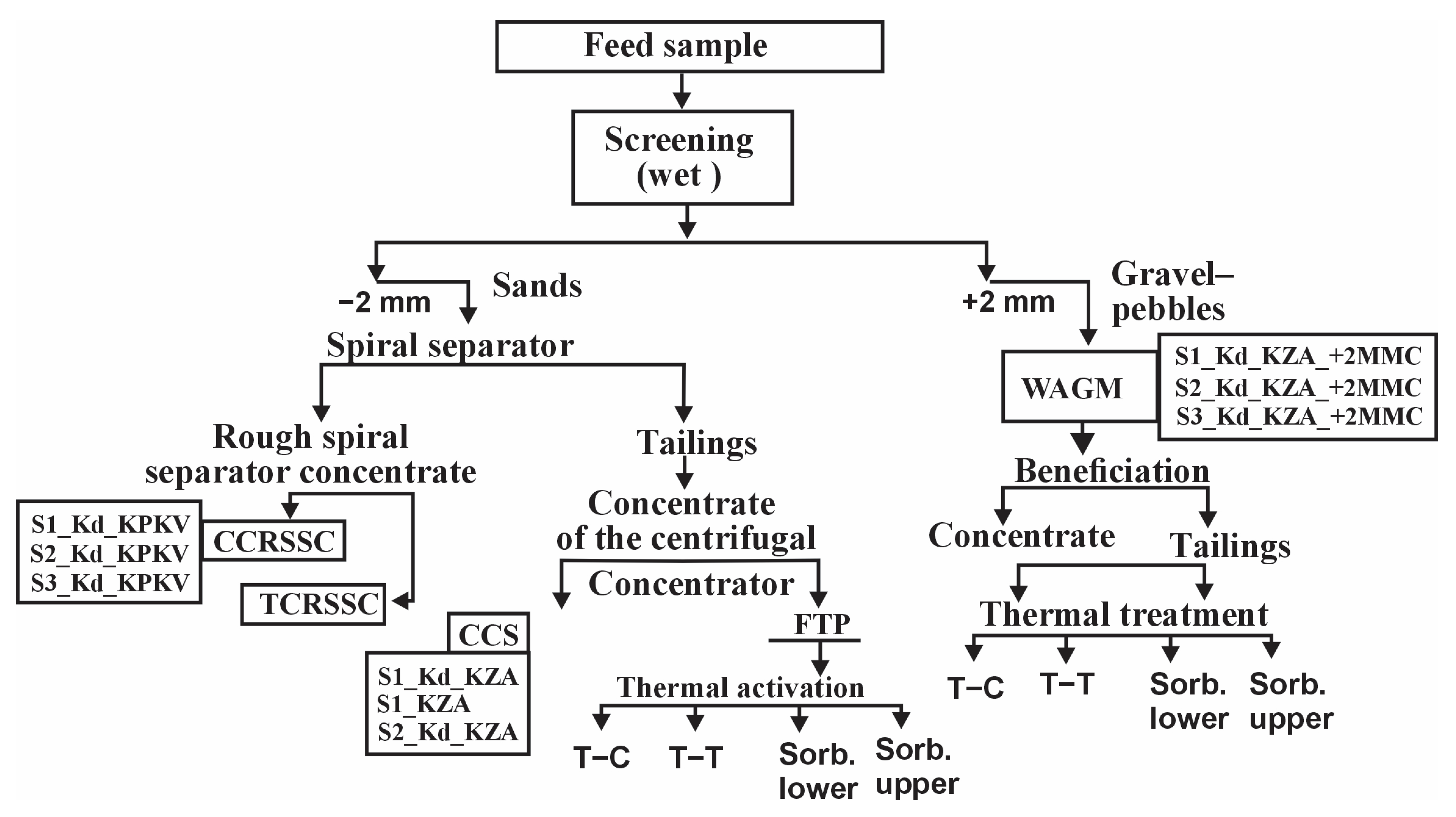
Prior to beneficiation, the bulk samples were weighed and their moisture content determined. The material was then subjected to wet screening to separate a coarse gravel fraction (>2 mm) from the sand–clay fraction. The coarse fraction was processed in a wet autogenous grinding mill for 1.5 h to remove secondary carbonate—clay coatings from the surfaces of clasts. Following screening, both the sand fraction derived from the milled gravel material and the naturally occurring sandy fraction were processed using centrifugal gravity concentrators.
Figure 9 shows the full processing flow sheet.
Gravity concentration was carried out using a vibrating spiral separator as the primary beneficiation stage. The tailings from the spiral separator were subsequently processed using a centrifugal concentrator to recover additional gold particles that were not captured during the initial gravity separation stage. The resulting products included the spiral cleaner concentrate (KPKV) and the centrifugal concentrator concentrate (KZA), both of which were subjected to further cleaning and upgrading to produce final concentrates. Kd_KPKV samples represent the final upgraded concentrate derived from the cleaned spiral concentrate (KPKV). This product is characterized by the presence of relatively coarse gold particles, predominantly exceeding 75 μm in size. Kd_KZA samples represent the final upgraded concentrate obtained from the centrifugal concentrator concentrate (KZA). Gold particles in this product are predominantly fine to ultrafine, ranging from <10 μm to approximately 70 μm in size.
A two-stage beneficiation scheme incorporating thermal activation analysis of tailings was applied. The proposed processing flow sheet enabled continuous treatment of the entire field-collected sample without prior reduction, with all operations, from feeding of the bulk sample to the production of a representative laboratory aliquot, performed within a single integrated “screening-beneficiation” cycle. Material disintegration was carried out using a wet autogenous grinding mill, whereas particle-size classification was performed at cut-off sizes of 2 and 5 mm. The two-stage beneficiation approach provided efficient recovery of native gold over a broad range. During the first stage, free gold particles larger than 10 μm were recovered using a cascade arrangement of a vibrating screw separator and a vibro-centrifugal concentrator. The second stage focused on the extraction of ultrafine gold from the tailings generated during the initial concentration stage, thereby maximizing overall gold recovery from the placer material.
The results summarized in
Table 2 indicate that the thermally treated product represents the principal concentrate of the second processing stage, accounting for 0.47–0.51 kg (73.14%–80.70% of the collective concentrate) and achieving a gold recovery of 53%–86%. This confirms the efficiency of thermal activation for concentrating ultrafine gold.
The application of a two-stage processing scheme is justified, as thermal activation of gravity tailings facilitates the recovery of a significant fraction of ultrafine gold that remains unrecovered after the initial gravity separation stage, thereby substantially increasing the overall gold recovery of the process.
5.3. Determination of Finely Dispersed Gold in Beneficiation Tailings
The content of finely dispersed gold (FDG) in beneficiation tailings was quantified using a thermal activation technique applied to large bulk samples (500–1000 g). The method is based on thermal destruction of the mineral matrix, aggregation of micron-sized gold particles, and volatilization of nanoscale gold species, followed by their capture on specialized sorbents.
The thermal activation procedure and sorbent production follow the methods described in Utility Model Patent RK No. 7613 and related patent publications [
29]. Wheat flour is placed in a thermal activator and heated to 450 °C for 1 h under oxygen-limited conditions. Gases evolved during heating (CO
2, CO, CH
4, N
2O, etc.) are removed while maintaining near-atmospheric pressure in the activator. This treatment induces decomposition and restructuring of the mineral matrix hosting ultrafine and nanoscale gold, promoting aggregation of micron-sized particles and mobilization of highly dispersed gold species, which are subsequently adsorbed onto a carbon-rich sorbent produced in situ from the wheat flour [
30]. The resulting sorbent exhibits a highly porous surface with micro- and macropores accounting for ~40% of the total pore area (17.47% micropores, 22.59% macropores) and a specific surface area of 22,975 cm
2/cm
3. Its methylene blue adsorption capacity is 352 mg/g, i.e., 1.5 times higher than that of conventional activated carbon used in the food and medical industries. Gold loaded onto the sorbent can be recovered by standard hydrometallurgical or pyrometallurgical methods analogous to those used for loaded activated carbon in gold processing.
The thermal activation procedure included the following stages: (i) collection of representative bulk samples (500–1000 g); (ii) thermal decomposition of the mineral matrix; (iii) aggregation of micron-sized gold particles; (iv) transfer of nanoscale gold into the gaseous phase; and (v) sorption of volatile gold species. Quantitative determination of gold in the micron-sized, submicron, and nanoscale fractions was subsequently carried out using scintillation and chemical analytical methods. The results of scintillation analysis of the final beneficiation tailings are summarized in
Table 3.
5.3.1. Mineralogical Characteristics of Gold
Native gold was identified in all investigated samples, although its abundance was low. Gold occurs predominantly as isolated micron-sized grains measuring 20–40 μm. Sample 1 contained three gold grains, Sample 2 contained nine grains, and Sample 3 contained five grains. A notable exception was identified in Sample 3, where a well-rounded flake-shaped grain, measuring 192 × 120 × 24 μm, was observed. The grain exhibits a brownish-yellow color and a slightly rough, corticated surface, indicating prolonged mechanical transport and reworking.
The heavy-mineral concentrates associated with gold contain magnetite, ilmenite, chromite, zircon, rutile, pyrite, and arsenopyrite. This mineral assemblage is consistent with derivation from mineralized bedrock sources and subsequent concentration within the alluvial system. Scintillation and thermal activation analyses demonstrate that gold mineralization in the Irgaity placer is dominated by finely dispersed forms, including micron-sized, submicron-sized, and nanoscale particles. The estimated distribution of gold among these fractions is summarized in
Table 4.
The results provide the first evidence that fine and ultrafine gold constitute the dominant form of gold mineralization within the Irgaity placer and, more broadly, within this region. The study further demonstrates that the physical and technological behavior of gold changes significantly with decreasing particle size. In particular, the transition from visible and recoverable native gold to submicron and nanoscale forms requires alternative analytical approaches beyond conventional mineralogical and gravity-concentration techniques.
To address this challenge, a thermal activation-based approach was developed and implemented. The methodology required the design, construction, and testing of specialized equipment, including a thermal activator and gold-selective sorbent materials. Furthermore, a patented method for the quantitative determination of finely dispersed gold was developed, representing a significant advancement in exploration and evaluation techniques for gold-bearing sediments [
28].
5.3.2. Technological Implications
Gravity concentration tests yielded relatively low gold recovery rates, particularly for fine-grained and mineral-bound gold. These results indicate that only a minor proportion of the gold occurs as free native particles recoverable by conventional gravity methods. Instead, most of the gold is present in finely dispersed forms associated with mineral matrices, and therefore requires the development of specialized extraction technologies.
The investigation of processing products from the gold-bearing placer deposit Irgaity demonstrated that gold is predominantly concentrated in the final concentrate products obtained during the treatment of both the fine fraction (−2 mm) using a spiral separator and the coarse fraction (+2 mm) using a centrifugal concentrator. The absence of reliably detectable gold in the feed material, intermediate products, and tailings can be attributed to its low overall abundance and predominantly fine-grained to microscopic occurrence. These characteristics result in a dilution effect and a stochastic distribution of gold particles within analytical subsamples, reducing the probability of detection. The preferential concentration of gold in the cleaner and final concentrates demonstrates the efficiency of the gravity separation circuit in upgrading the heavy-mineral fraction and producing concentrates with gold contents above the detection limits of the analytical methods employed.
The particle-size characteristics of these concentrate samples indicate that the spiral separation circuit preferentially recovers coarser gold, whereas the centrifugal concentration stage is particularly effective for the recovery of fine and ultrafine gold particles remaining in the spiral separator tailings.
5.4. Mineralogical Investigation of Fine Gold
Application of the TESCAN TIMA (TESCAN, Tokyo, Japan) automated mineralogical system using a customized “gold search” protocol enabled the identification of Au-bearing particles in four of the nine mineral processing concentrate samples analyzed. All identified particles were subsequently characterized using field-emission scanning electron microscopy (FEG-SEM; Bruker, Billerica, MA, USA) and electron microprobe analysis (JEOL Ltd., Tokyo, Japan) to determine their morphology and chemical composition.
In addition to native gold, several types of gold-bearing alloys were identified. Representative compositions of the Au-bearing particles from each sample are summarized below. In sample S1_Kd-KZA+2MMC (P33919_1), isolated gold particles were identified within arsenopyrite. This sample also contains discrete grains of a Au-Bi alloy.
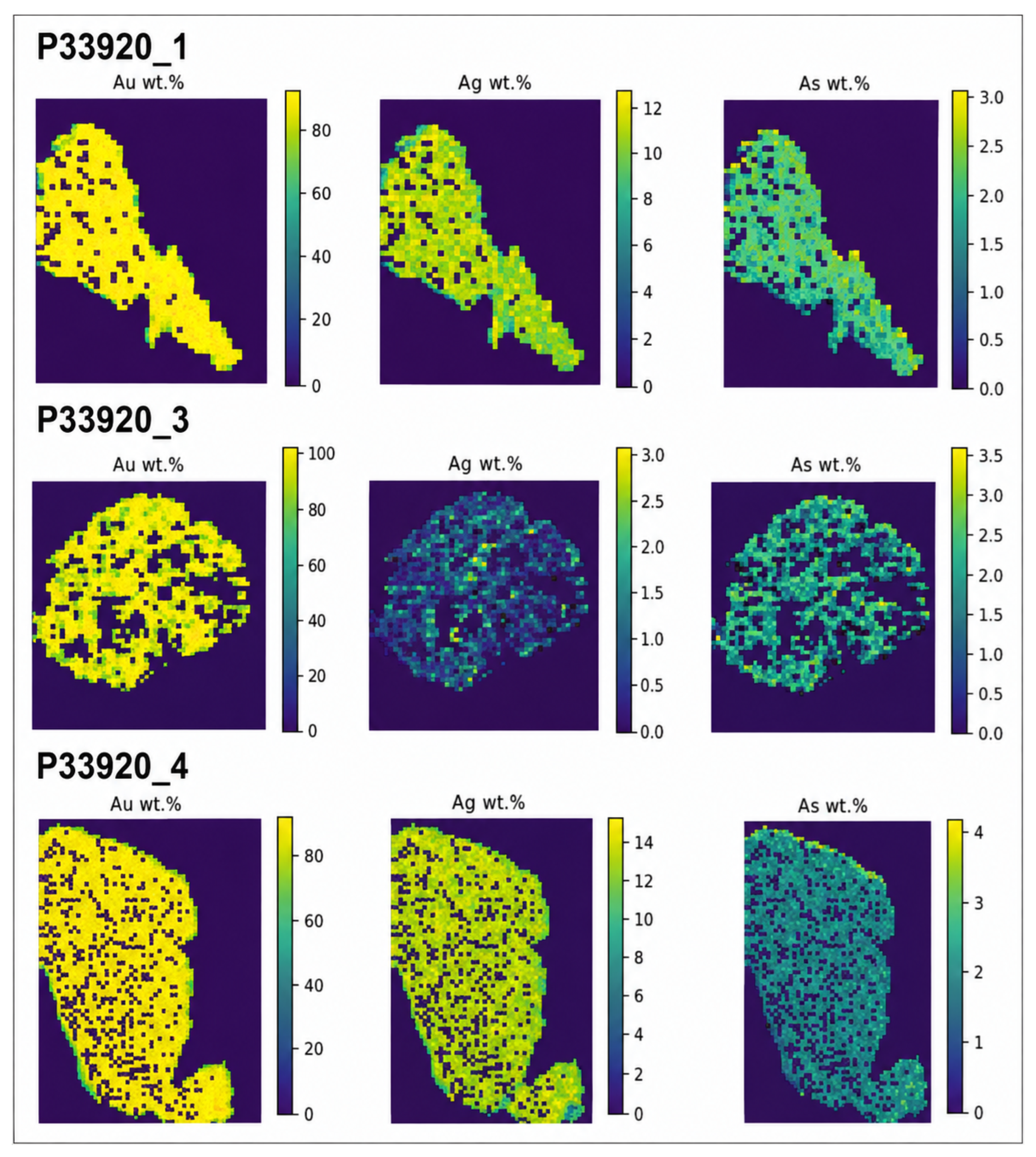
Sample S1-Kd_KPKV (P33920) contained multiple Au-bearing particles exhibiting compositional variability. Grains 1 and 4 (P33920_1 and P33920_4) display similar compositions, with Au contents ranging from 87 to 90 wt.%, Ag from 11 to 14 wt.%, As approximately 2 wt.%, and Hg from 0.2 to 0.7 wt.%. The presence of both As and Hg is of particular importance for the design and optimization of the processing flowsheet. In contrast, grains 2 and 3 are composed predominantly of native gold with minor Ag-bearing inclusions. This compositional diversity is illustrated by the elemental distribution maps shown in
Figure 10, which include Au, Hg, Fe, Cu, Zn, Ag, Pb, Bi, S, Mo, and As. Quantitative analytical data are summarized in
Table 5. Individual point analyses of the identified Au-bearing particles are provided in Electronic
Table S1, whereas complete elemental distribution maps are presented in Electronic
Figure S1.
Au-bearing particles identified in samples S1-Kd-KZA (P33921_1) and S3_Kd_KPKV (P33926_1) exhibit similar chemical compositions, characterized by Au contents of 93–96 wt.%, Ag contents of 4–7 wt.%, and As contents of 1.8–1.9 wt.%. In addition to these major constituents, all analyzed particles contain trace to minor concentrations of other elements, including Hg (0.2–1.0 wt.%), Fe (0.3–0.7 wt.%), Pb (~0.2 wt.%), Bi (0.2–0.3 wt.%), and Mo (~0.2 wt.%). These results indicate that the Au-bearing particles are compositionally heterogeneous and commonly occur as complex Au-Ag-As alloys with minor concentrations of additional metallic impurities.
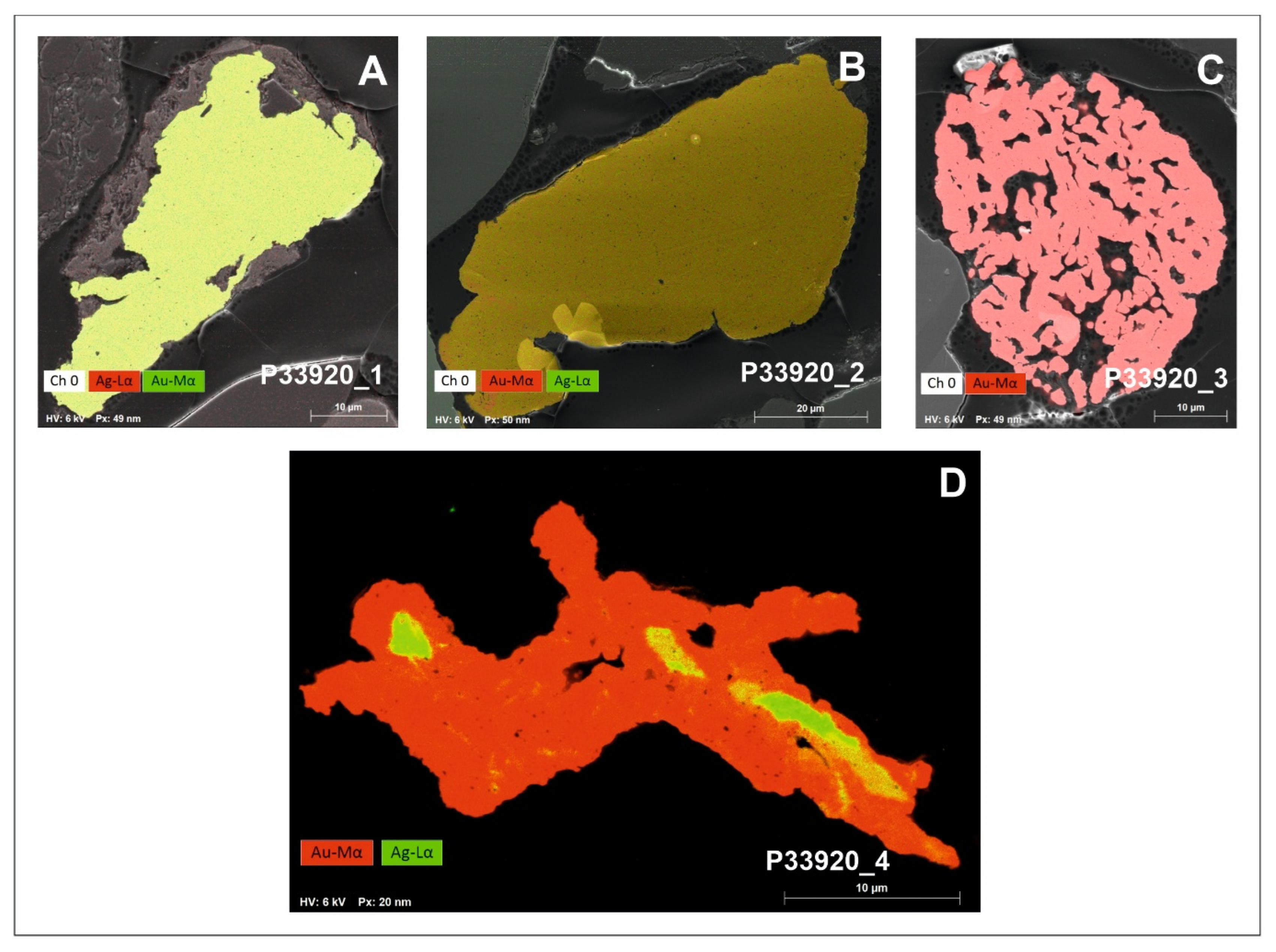
High-resolution compositional mapping using a Bruker FEI FEG-SEM provided detailed characterization of the internal structure and elemental distribution of the larger Au-bearing particles. The resulting quantitative elemental maps reveal distinct Au-Ag compositional zonation within several particles, indicating complex growth histories and/or post-depositional modification processes.
Sample S1_Kd_KPKV exhibited the greatest compositional variability among the analyzed concentrates, particularly within larger Au-bearing particles reaching up to approximately 70 μm in length. Grains P33920_1 and P33920_2 are characterized by heterogeneous Au-Ag alloy compositions, whereas grain P33920_3 consists predominantly of native gold. Grain P33920_4 is composed mainly of native gold but contains well-defined zones enriched in native silver. These compositional relationships are illustrated in
Figure 11, which presents the spatial distribution of major elements using false-colour elemental maps.
Several particles display irregular, “brain-like” morphologies, which may reflect secondary gold precipitation, recrystallization, or alteration processes. The observed variability in the composition and internal zonation of Au-bearing particles has important implications for mineral processing. In particular, the presence of significant silver concentrations within some particles highlights the potential for silver recovery as a valuable by-product, while the occurrence of arsenic-bearing phases necessitates consideration of arsenic removal and environmental management during beneficiation.
5.5. Irgaity in the Context of Global Alluvial Gold Systems
The results from the Irgaity placer demonstrate that gold mineralization is dominated by fine, ultrafine, submicron, and nanoscale forms, rather than by coarse, easily gravity-recoverable particles. This is consistent with a growing body of evidence indicating that many placer deposits host substantial amounts of fine-dispersed gold (FDG; <10 µm) that cannot be effectively studied or recovered by conventional gravity-concentration methods [
1]. A prominent example is the buried Bolshoy Kuransk placer in Yakutia (Russia), where total gold reserves are estimated at 162.7 t, but only 68.1 t are recoverable by gravity methods, while 94.6 t (58.14%) belong to non-gravitatable size classes represented by fine-dispersed gold [
31]. The Irgaity data extend this pattern into southeastern Kazakhstan, showing that a large proportion of gold in this system occurs in fractions that are effectively invisible to standard placer evaluation and processing.
In Kazakhstan, targeted studies on FDG in placers have been carried out in the South Altai, North Tien Shan, West Kalba, and North Dzhungar regions. These investigations have shown that FDG occurs both in free form and as gold bound within rock fragments and minerals, predominantly quartz. In the South Altai, the most prospective areas for such deposits are graben-like depressions filled with Paleogene, Neogene, and Quaternary sediments (Takyr graben, May-Kapchagay graben, Prirechnaya depression). The Takyr graben, the most thoroughly studied area, hosts a blanket-like gold-bearing zone extending ~11 km in length and up to 4.5 km in width, with mineralization associated with Eocene-age Turangan and Tuzkabak formations. The petrographic composition of the clastic material is dominated by quartz, calcite, feldspars, and kaolinite-mica minerals, with gold grades ranging from 0.47 to 8.75 g/t, as well as elevated silver (up to 30 g/t), tellurium (191 g/t), and organic carbon (1.3%–12%). Primary gold sources are orogenic deposits of the Sarytau gold district at higher elevations.
The Irgaity placer shares several key characteristics with these Kazakhstani FDG-rich systems: (i) a strong association of gold with sulfide minerals (pyrite, arsenopyrite, chalcopyrite, cinnabar) and quartz; (ii) a predominance of fine particle-size fractions (<0.5 mm) hosting the bulk of gold; (iii) the presence of gold bound in mineral matrices rather than only as free grains; and (iv) relatively low apparent grades in bulk samples, with gold concentrated in heavy-mineral concentrates. However, Irgaity is distinguished by the exceptionally high proportion of submicron and nanogold fractions (up to ~80% of counted particles in some samples) and by the compositional heterogeneity of Au-bearing particles, which include Au–Ag-As alloys with minor Hg, Bi, Pb, and Mo. This suggests that, in addition to mechanical comminution and transport, supergene and possibly bio-mediated processes may have contributed to the formation and redistribution of ultrafine gold in the Irgaity system.
Such processes are increasingly recognized in other placer provinces. In Cameroon, placer gold grains commonly display irregular morphologies, mechanical abrasion, and strong compositional variability, reflecting proximal source areas and complex supergene modification, including bacterial interaction and secondary gold precipitation [
3]. In New Zealand and Australia, fine placer gold is frequently transformed by transport, recrystallization, clay coating, and particle attenuation, resulting in complex toroidal and spheroidal morphologies that reduce effective density and hinder gravity recovery [
6]. These observations underscore that fine and ultrafine gold in placers is not merely a “residual” fraction but often the product of dynamic post-depositional processes that modify grain size, morphology, and chemistry.
The Irgaity data further highlight the limitations of conventional gravity-based processing for such systems. Gravity concentration tests yielded relatively low gold recovery rates, particularly for fine-grained and mineral-bound gold, confirming that only a minor proportion of gold occurs as free native particles recoverable by standard methods. Instead, most gold is present in finely dispersed forms associated with mineral matrices, requiring specialized extraction technologies. The application of thermal activation to gravity tailings enabled the recovery of a significant fraction of ultrafine gold that remained unrecovered after initial gravity separation, thereby substantially increasing overall gold recovery. This approach is consistent with broader recommendations that alternative methods, such as enhanced gravity devices, flotation, or chemical/bio-hydrometallurgical routes, are needed to recover fine gold from low-grade ores and tailings [
1].
From a global perspective, the Irgaity placer exemplifies a class of deposits where economic evaluation and resource estimation based solely on visible and coarse gold will significantly underestimate total gold endowment. The predominance of submicron and nanoscale gold, combined with heterogeneous Au-Ag-As compositions and alloy zonation, indicate that Irgaity shares characteristics with both FDG-rich placers in Kazakhstan and ultrafine-gold systems described in Cameroon, Australia, and New Zealand. However, the combination of (i) extremely high proportions of submicron/nanogold, (ii) complex Au-Ag-As alloy chemistry, and (iii) demonstrable recovery of ultrafine gold via thermal activation marks Irgaity as a distinctive case within this emerging category of fine-gold-dominated placer systems.
These findings have important implications for exploration, resource assessment, and processing. They suggest that similar graben-hosted, sulfide-associated placer systems in Kazakhstan and Central Asia may host significant “hidden” gold resources in fine and ultrafine fractions, which can only be quantified and recovered using specialized analytical and metallurgical techniques. The Irgaity study thus provides both a methodological framework and a geological model for identifying and evaluating comparable deposits regionally and globally.
It is well established that gold in primary (bedrock) ores occurs predominantly as very fine particles, and that only secondary processes—including mechanical, biochemical, and chemical processes—lead to the formation of coarser gold grains [
32,
33]. In this context, the amount of nanoscale gold particles in magmatic and metamorphic rocks is likely to be substantial. Nanoscale gold can also form under exogenous conditions, being released from minerals during weathering, transport in water or air flows, and related processes. The unique properties of gold as a mineral species include its high malleability and relatively low hardness (microhardness values typically in the range of 35–55 kg/mm
2) [
10]. These properties enable gold to flatten even under minimal external stresses, forming very thin plates in the marginal parts of grains. The edges of such gold particles are commonly intersected by numerous microcracks, grooves, and scratches characteristic of the near-surface layer of the metal, which promotes the detachment of fine microparticles, a proportion of which fall within the nanoscale range (particularly in thickness).
The hypothesis that very fine, including colloidal, gold particles are generated in watercourses through abrasion of coarser gold grains during transport is actively supported by international researchers [
32,
33]. In addition to mechanical abrasion, supergene processes, including chemical dissolution, reprecipitation, and microbially mediated transformation, can further modify gold grain size and morphology, contributing to the formation of ultrafine and nanoscale particles [
1,
6].
At the Irgaity placer, the dominance of submicron and nanogold fractions, their association with sulphide minerals, and the compositional heterogeneity of Au-Ag-As particles suggest that both mechanical comminution and secondary chemical/biochemical processes have played important roles in the formation and redistribution of ultrafine gold.
6. Conclusions
The mineralogical and technological investigations of representative samples from the Irgaity placer deposit support the following conclusions:
A previously unrecognized placer gold occurrence has been identified in this part of Kazakhstan. The mineralization is hosted by coarse-grained alluvial sediments and is characterized by relatively low average gold grades of 0.3–0.4 g/t.
The principal feature of the Irgaity placer is its exceptional scale. The mineralized alluvial system reaches widths of up to 1.5 km, extends for at least 12.5 km, and contains productive sediments 60–70 m thick.
The Irgaity placer represents a large-volume gold resource in which a significant proportion of the metal occurs as fine and ultrafine particles. This mode of occurrence differentiates the deposit from many conventional placer systems and presents specific challenges for mineral processing.
The predominance of finely dispersed gold explains the limited efficiency of traditional gravity concentration methods and highlights the importance of detailed mineralogical characterization and specialized recovery technologies.
Particle-size analyses of processing concentrates indicate that spiral separation preferentially recovers coarser gold particles, whereas centrifugal concentration effectively recovers fine and ultrafine gold remaining in the spiral separator tailings.
The proposed processing flowsheet achieved gold recoveries of 53%–86% from thermally treated concentrates. These results demonstrate that thermal activation enhances the liberation and recovery of ultrafine gold. However, further optimization of the flowsheet is required to improve recovery efficiency and operational consistency.
Under the conditions evaluated in this study, the Tescan TIMA “Bright Phase Search” workflow, optimized using a 75% minimum BSE brightness threshold and a Au phase filter calibrated from a gold standard, successfully detected all gold-bearing grains present in the analyzed mounts.
Automated mineralogical and microanalytical investigations revealed that gold occurs as native gold and as Au-Ag-As-bearing alloys. Silver is commonly present and associated with gold-bearing particles, with concentrations reaching up to 14 wt.%. The presence of silver-rich phases indicates the potential for by-product silver recovery, while the occurrence of arsenic-bearing phases should be considered during process design and environmental management.
The combination of substantial resource potential, large-scale mineralization, and the successful recovery of fine and ultrafine gold demonstrates that the Irgaity placer is a promising target for further resource evaluation and technological development. The deposit provides an important example of a large-volume placer system in which economic mineralization is dominated by finely dispersed precious metals.
The results of this study indicate that micro-sized and ultrafine gold are likely much more widespread in natural settings than currently recognized, occurring in mineralized occurrences of many formation types even where they do not form significant concentrations. This suggests that new ore types, in which gold is almost entirely represented by nanoscale particles, may be identified in the future. Systematic exploration for such deposits has not yet been undertaken, but this is expected to become an important task. Ongoing work is focused on testing and refining the proposed thermal activation methodology on various types of gold placer deposits. Future research will aim to (i) scale up the technology from laboratory to pilot and, potentially, industrial scale, and (ii) systematically evaluate its applicability and economic efficiency in different placer gold systems, including those dominated by fine and ultrafine gold. These efforts will help to define the full resource potential of fine-gold-bearing placers and to optimize recovery strategies for such deposits.
Supplementary Materials
The following supporting information can be downloaded at:
https://www.mdpi.com/article/10.3390/min16080853/s1, Figure S1: Elemental maps (from left to right: Au, Hg, Fe, Cu, Zn, Ag, Pb, Bi, S, Mo, As and total, in wt. %) for samples of the Irgaity deposit; Table S1: Eprobe data-individual samples.
Author Contributions
Conceptualization, G.O., A.D., R.S., K.T. and M.M.; methodology, A.D., A.T., V.P., K.T. and M.M.; software, S.A., S.T. and M.A.; validation, A.D., K.T. and M.M.; formal analysis, S.A., A.T. and S.T.; investigation, A.D., S.A., A.T., V.P., C.B. and E.A.C.-C.; resources, A.T., C.B., E.A.C.-C. and M.A.; data curation, S.A., R.S., C.B. and M.M.; writing—original draft preparation, G.O., A.D., S.A., V.P., C.B., E.A.C.-C., S.T. and M.A.; writing—review and editing, R.S., A.T., K.T. and M.M.; visualization, S.A., S.T. and M.A.; supervision, G.O., A.D. and R.S.; project administration, G.O.; funding acquisition, G.O. All authors have read and agreed to the published version of the manuscript.
Funding
This research was funded by the Committee of Science of the Ministry of Science and Higher Education of the Republic of Kazakhstan (Grant No. 235/GF24-26 AP23485052).
Data Availability Statement
Acknowledgments
Tobias Salge is thanked for his help with the Bruker FEI FEG-SEM analysis.
Conflicts of Interest
Alexander Tretyakov is an employee of Geomonitoring Systems LLP and Valeriy Peregudov is an employee of Kritz-NTK LLP. The paper reflects the views of the scientists and not the company.
References
- Mitchell, C.J.; Evans, E.J.; Styles, M.T. A Review of Gold Particle-Size and Recovery Methods; British Geological Survey Technical Report WC/97/14; British Geological Survey: Nottingham, UK, 1997. [Google Scholar]
- Chapman, R.J.; Craw, D.; Moles, N.R.; Banks, D.A.; Grimshaw, M.R. Evaluation of the contributions of gold derived from hypogene, supergene and surficial processes in the formation of placer gold deposits. Geol. Soc. Spec. Publ. 2022, 516, 291–311. [Google Scholar] [CrossRef] [Scilit]
- Ateh, K.I.; Suh, C.E.; Shuster, J.; Shemang, E.M.; Vishiti, A.; Reith, F.; Southam, G. Alluvial gold in the Bétaré Oya drainage system, east Cameroon. J. Sediment. Environ. 2021, 6, 201–212. [Google Scholar] [CrossRef] [Scilit]
- Petrella, L.; Thébaud, N.; Fougerouse, D.; Tattitch, B.; Martin, L.A.J.; Turner, S.; Suvorova, A.; Gain, S. Nanoparticle suspensions from carbon-rich fluid make high-grade gold deposits. Nat. Commun. 2022, 13, 3795. [Google Scholar] [CrossRef] [Scilit] [PubMed]
- Ketchaya, Y.B.; Zhou, T.; Hamukwaya, S.L.; Santosh, M.; Li, B.; Quaye, J.A. Supergene gold transformations of the placer gold deposits from the Gamba district in northern Cameroon: Implications for secondary and nano-particulate gold formations. Ore Geol. Rev. 2024, 166, 105948. [Google Scholar] [CrossRef] [Scilit]
- Melchiorre, E.B.; Orwin, P.M.; Reith, F.; Rea, M.A.D.; Yahn, J.; Allison, R. Biological and geochemical development of placer gold deposits. Minerals 2018, 8, 56. [Google Scholar] [CrossRef] [Scilit]
- Bespaev, K.A.; Globa, V.A.; Abishev, V.M.; Gulyaeva, N.Y. Placer Deposits of Kazakhstan: A Reference Book; Information & Presentation Center MS of the RK: Almaty, Kazakhstan, 2014. [Google Scholar]
- Golovenko, J.V. Analysis of the Features of the Formation of the Structure of Gold Nanoclusters During Crystallization Processes. Ph.D. Thesis, Altai State University, Barnaul, Russia, 2012. [Google Scholar]
- Petrovskaya, N.V. Native Gold (General Characteristics, Typomorphism, Questions of Genesis); Nauka: Moscow, Russia, 1973; p. 347. [Google Scholar]
- Osovetskiy, B.M. Natural Nanogold; Perm University Press: Perm, Russia, 2013; p. 176. [Google Scholar]
- Begalinov, A.B.; Tretyakov, A.V.; Begalinov, A.A. Prospects for detecting large-volume gold placers in Kazakhstan. Izv. NAS RK Ser. Geol. 2005, 6, 32–43. [Google Scholar]
- Moiseenko, V.G. The role of nanoscale gold in the formation of precious metal placers. In Proceedings of the XIV International Meeting on the Geology of Placers and Deposits of Weathering Crust (RCB-2010), Novosibirsk, Russia, 2–10 September 2010; pp. 283–286. [Google Scholar]
- Mironyuk, A.F.; Moiseenko, V.G.; Voropaeva, E.N.; Ostapenko, N.S.; Radomsky, S.M. Gold content in minerals of gold-bearing placers of the Amur region. Dokl. Earth Sci. 2005, 405, 652–654. [Google Scholar]
- Tretyakov, A.V.; Peregudov, V.V.; Gilev, Y.N.; Mamonov, E.P. Forms of occurrence of gold in placer sands of the Shalkudysu River basin (Southern Kazakhstan). Geol. Prot. Miner. Resour. 2011, 1, 35–39. [Google Scholar]
- Kurguzkin, E.V.; Tretyakov, A.V.; Peregudov, V.V. Some features and gold content of the Eocene deposits of the Takyr-Kaldzhir Formation in Eastern Kazakhstan. In Proceedings of the XVI International Meeting on the Geology of Placers and Deposits of Weathering Crust, Voronezh, Russia, 13–18 September 2021; Pleiades Publishing: New York, NY, USA, 2021; pp. 52–54. [Google Scholar]
- Peregudov, V.V.; Shautenov, M.R.; Begalinov, A.B.; Tretyakov, A.V.; Kurguzkin, E.V. A new type of gold in pebble formations of placers. In Proceedings of the XXVI National Scientific and Technical Conference “Scientific Foundations and Practice of Processing Ores and Man-Made Raw Materials”, Yekaterinburg, Russia, 26–27 May 2021; Dnipro University of Technology: Dnipro, Ukraine, 2021; pp. 41–46. [Google Scholar]
- Begalinov, A.B.; Shautenov, M.R.; Peregudov, V.V.; Tretyakov, A.V. Preliminary results on the enrichment of the Takyr-Kaldzhir gold placer. Min. Mag. Kazakhstan 2023, 6, 39–46. [Google Scholar]
- Begalinov, A.; Peregudov, V.; Tretyakov, A.; Shautenov, M.; Almenov, T.; Bektur, B.; Sakhipova, K. Polygenic gold mineralization in quartz-pebble formations on the Takyr-Kaljir site of the Southern Altai, East Kazakhstan Region. Min. Miner. Depos. 2023, 17, 32–41. [Google Scholar] [CrossRef] [Scilit]
- Garnett, R.H.T.; Bassett, N.C. Placer deposits. In One Hundredth Anniversary Volume; Hedenquist, J.W., Thompson, J.F.H., Goldfarb, R.J., Richards, J.P., Eds.; Society of Economic Geologists: Littleton, CO, USA, 2005. [Google Scholar] [CrossRef] [Scilit]
- Tchapko, V. Placer and hardrock gold deposits of the central Kolyma area, Magadan region, northeast Russia. In Proceedings of the Geology and Mineral Deposits of the Russian Far East Symposium; Alaska Miners Association: Fairbanks, AK, USA, 1995; Volume 1, pp. 29–35. [Google Scholar]
- Tretyakov, A.V. Gold-Bearing Capacity of Placers in Eastern Kazakhstan. Ph.D. Thesis, K.I. Satpayev Institute of Geological Sciences, Almaty, Kazakhstan, 2007; 278p. [Google Scholar]
- Peregudov, V.V.; Begalinov, A.B.; Shautenov, M.R.; Almenov, T.M. Sampling Technology and Sample Processing with Mineralogical Analysis for Gold; Kazakh-Russian International University: Almaty, Kazakhstan, 2024; p. 138. [Google Scholar]
- Donovan, J.J.; Tingle, T.N. An improved mean atomic number background correction for quantitative microanalysis. Microsc. Microanal. 1996, 2, 1–7. [Google Scholar] [CrossRef] [Scilit]
- Donovan, J.J.; Singer, J.W.; Armstrong, J.T. A new EPMA method for fast trace element analysis in simple matrices. Am. Mineral. 2016, 101, 1839–1853. [Google Scholar] [CrossRef] [Scilit]
- Donovan, J.J.; Moy, A.; von der Handt, A.; Gainsforth, Z.; Maner, J.L.; Nachlas, W.; Fournelle, J.A. New method for dead time calibration and a new expression for correction of WDS intensities for microanalysis. Microsc. Microanal. 2023, 29, 1096–1110. [Google Scholar] [CrossRef] [Scilit] [PubMed]
- Donovan, J.J.; Snyder, D.A.; Rivers, M.L. An improved interference correction for trace element analysis. In Proceedings of the Annual Meeting of the Electron Microscopy Society of America; San Francisco Press: San Francisco, CA, USA, 1992; p. 1646. [Google Scholar]
- Armstrong, J.T. Quantitative analysis of silicate and oxide minerals: Comparison of Monte Carlo, ZAF and phi-rho-z procedures. Anal. Microbeam 1988, 1988, 239–246. [Google Scholar]
- Peregudov, V.V.; Bekenova, G.K.; Ozhogin, G.A.; Levin, L.V. Method of Quantitative Assessment of Fine Gold in Geological and Technological Samples. Kazakhstan Patent No. 8912, 7 March 2024. [Google Scholar]
- Peregudov, V.V.; Bekenova, G.K.; Ozhogin, G.A.; Levin, V.L. Thermal Activator. Kazakhstan Patent No. 7613, 25 November 2022. [Google Scholar]
- Peregudov, V.V.; Bekenova, G.K.; Ozhogin, G.A.; Levin, L.V. Method of Obtaining Sorbent. Kazakhstan Patent No. 8519, 13 October 2023. [Google Scholar]
- Amosov, R.A.; Bashlykova, T.V.; Moskovets, I.A.; Bezrodnykh, V.I. Assessment of Losses of Fine and Ultrafine Gold during Pan Sampling of Placer Deposits. Gorn. Zhurnal 2002, 2, 38–41. [Google Scholar]
- Reith, F.; Nolze, G.; Saliwan-Neumann, R.; Etschmann, B.; Kilburn, M.R.; Brugger, J. Unravelling the formation histories of placer gold and platinum-group mineral particles from Corrego Bom Successo, Brazil: A window into noble metal cycling. Gondwana Res. 2019, 76, 246–259. [Google Scholar] [CrossRef] [Scilit]
- Hough, R.M.; Noble, R.R.P.; Reich, M. Natural gold nanoparticles. Ore Geol. Rev. 2011, 42, 55–61. [Google Scholar] [CrossRef] [Scilit]
| Disclaimer/Publisher’s Note: The statements, opinions and data contained in all publications are solely those of the individual author(s) and contributor(s) and not of MDPI and/or the editor(s). MDPI and/or the editor(s) disclaim responsibility for any injury to people or property resulting from any ideas, methods, instructions or products referred to in the content. |




 ,
, 
 Deposits of alluvial placers;
  deposits of alluvial placers of ancient valleys;
  deposits of alluvial–deluvial placers;
  deposits of eluvial–deluvial placers;
  manifestations of alluvial placers;
  manifestations of alluvial placers of ancient valleys;
  manifestations of alluvial–deluvial placers;
  manifestations of eluvial–deluvial placers;
  manifestations of coastal-marine placers;
  manifestations of man-made placers;
  manifestations of placer gold content in cones of outflow;
  manifestations of lake-coastal placers.