1. Introduction
High-purity quartz (HPQ) refers to quartz resources that, after mineral processing and chemical purification, achieve SiO
2 purity of no less than 99.995% while maintaining fluid inclusion content that meets the requirements for downstream material processing [
1,
2,
3]. Owing to its corrosion resistance, thermal stability, high optical transparency, superior insulation, and low thermal expansion, high-purity quartz serves as an indispensable foundational material for strategic emerging industries, including photovoltaics, semiconductors, optical fiber communications, and aerospace [
4].
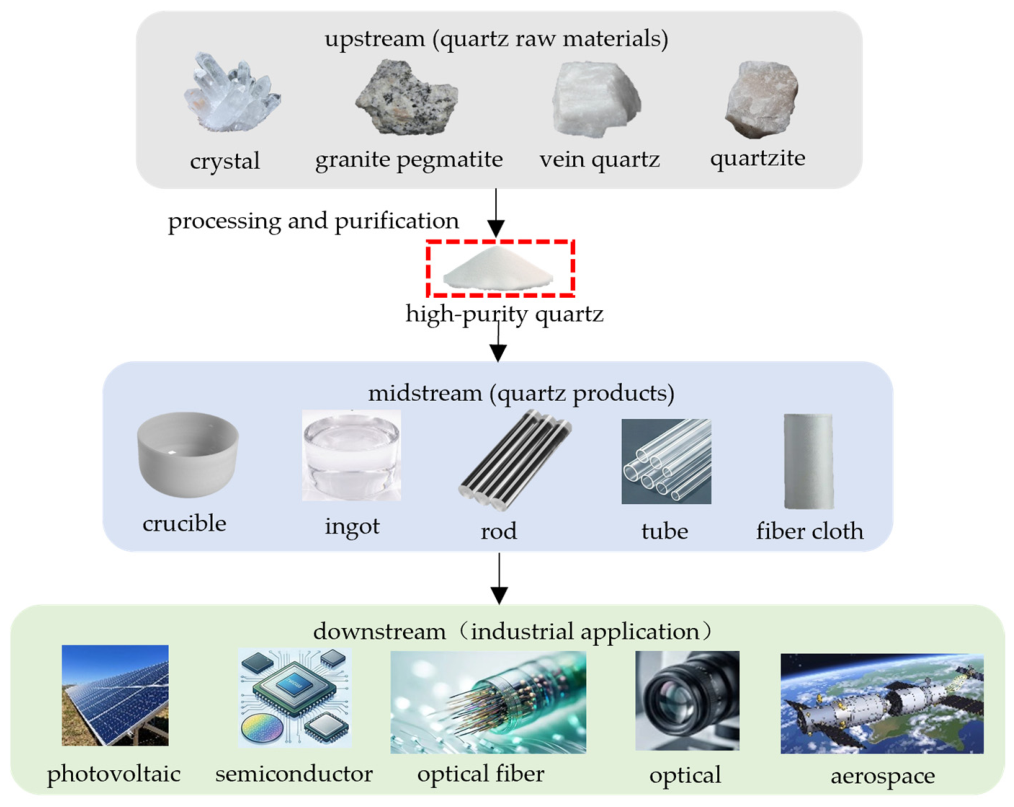
Figure 1 illustrates the integrated upstream and downstream industrial chain of high-purity quartz.
The primary sources of natural high-purity quartz include natural crystal, granitic pegmatite, vein quartz, and quartzite [
5]. Although vein quartz formed through metamorphic hydrothermal crystallization has a high SiO
2 content, it often contains numerous fluid inclusions [
6]. These inclusions degrade both the transparency and the overall quality of fused quartz glass. In contrast, quartz derived from pegmatoid granite and early-stage granitic pegmatites forms under conditions that naturally minimize fluid inclusions. Consequently, these sources offer superior potential for HPQ production. A preeminent example is the Sibelco-operated Spruce Pine deposit in the United States, which is globally recognized as the leading granitic pegmatite source for HPQ. Although the raw ore typically contains only 30% quartz, with the remainder consisting of gangue minerals such as feldspar and mica, advanced mineral processing and purification can effectively enrich the material, thereby yielding high-value industrial products [
7].
Impurities in natural quartz are commonly classified into two categories, inclusion impurities and lattice-bound impurities [
8]. Inclusion impurities which include solid mineral inclusions and fluid inclusions are mechanically encapsulated within quartz grains and can be effectively removed by conventional beneficiation processes, such as crushing, grinding, flotation, magnetic separation, and multi-stage acid leaching [
9,
10,
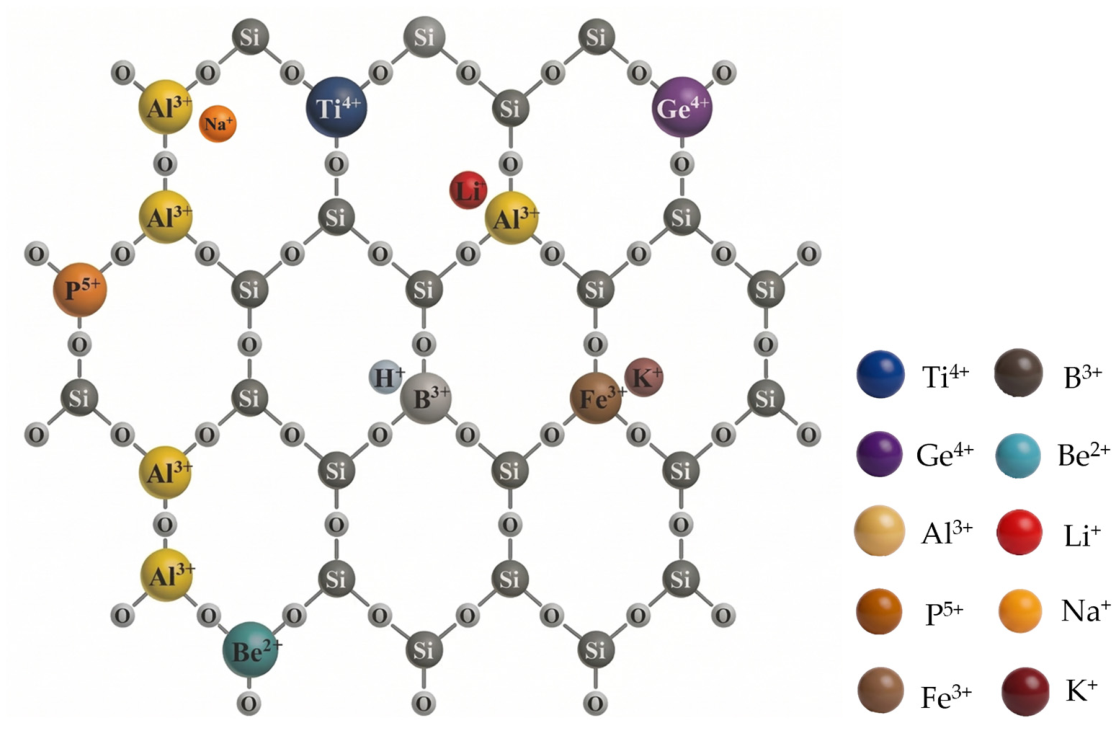
11]. Lattice-bound impurities, by contrast, pose a fundamentally greater challenge. These elements are incorporated into the quartz crystal structure at the atomic level, where they occupy specific crystallographic sites within the continuous three-dimensional SiO
2 tetrahedral network. The principal substitution mechanism involves the isomorphous replacement of Si
4+ by cations of similar ionic radius and compatible charge, most notably Ti
4+, Al
3+, B
3+, and Fe
3+. Because the substitution of Si
4+ by trivalent cations creates a local negative charge deficit, charge compensation is maintained through the incorporation of monovalent interstitial cations primarily Li
+, Na
+, and K
+, which reside within the helical channels parallel to the quartz c-axis [
12,
13,
14].
Figure 2 illustrates the lattice impurity distribution within high-purity quartz. Additionally, hydrogen-related structural defects primarily in the form of hydroxyl groups (≡Si–OH)—are introduced through the interaction of quartz with aqueous geological fluids and can profoundly affect both the infrared transmission and the high-temperature behavior of quartz glass [
15]. Because these impurity atoms are tightly bound by strong covalent Si–O–Si bonds [
16], they resist extraction by conventional physical and chemical processing methods and thus represent the ultimate barrier, limiting the purity of conventional quartz products to approximately 99.998% [
17].
High-temperature chlorination roasting is widely recognized as a highly effective method to overcome the 4N purity bottleneck and achieve the 4N8 (99.998%+) grades required for advanced applications [
18,
19]. The underlying principle involves the selective reaction of chlorine-containing gases Cl
2 or HCl with lattice-bound impurities at elevated temperatures to form volatile metal chlorides. Due to their low boiling or sublimation points, these chlorides vaporize and escape the SiO
2 matrix into the gas stream, effectively separating them from the quartz host. This technique is widely considered the proprietary core of the IOTA-grade production process developed by Sibelco. Despite its industrial success, published research remains largely empirical, often focusing on isolated conditions or specific elements. A unified, quantitative mechanistic framework encompassing the full spectrum of lattice impurities is still lacking [
20].
A rigorous understanding of chlorination roasting requires systematic investigation through the complementary lenses of thermodynamics and kinetics. Thermodynamic analysis, based on Gibbs free energy change
calculations for each chlorination reaction, provides the fundamental criterion for determining reaction spontaneity under specific temperatures and atmospheres [
21]. By modeling reactions of lattice impurity oxides using standard-state data
,
, and
, the critical transition temperature where
shifts from positive to negative can be quantitatively determined. This thermodynamic boundary defines the minimum temperature required for a specific impurity removal reaction to become feasible. However, thermodynamic feasibility is a necessary but insufficient condition for effective purification. In practice, the degree of purification achieved within industrial timeframes is governed by kinetic factors, primarily the diffusion rates of impurity atoms through the solid quartz lattice to reactive interfaces [
22].
Consequently, a holistic understanding of chlorination roasting necessitates integrating thermodynamic viability with the quantitative assessment of diffusion activation energies, the identification of rate-determining steps, and the prediction of removal rates across varying temperatures and holding times. Despite the experimental and thermodynamic investigations reported for selected impurity elements during chlorination roasting, most studies are confined to individual elements or specific conditions, and a systematic comparison across the full impurity spectrum remains absent [
23,
24,
25]. While thermodynamic analyses have established the feasibility of certain chlorination reactions, they typically treat the reactions under idealized conditions without addressing the kinetic constraints governing actual removal rates within industrially relevant timeframes. Moreover, the DFT and molecular dynamics approaches recently adopted to investigate chlorination mechanisms at the atomic scale, though methodologically novel, are inherently limited in representativeness: lattice impurities in natural quartz occur at ppm levels, whereas unit-cell doping simulations involve concentrations orders of magnitude higher, leading to unrealistic impurity interactions that do not reflect the true dilute solid-solution state. These atomic-scale models also cannot capture the long-range diffusion behaviors or macroscopic kinetic trends critical for process design. The present study addresses these limitations by integrating thermodynamic and kinetic analyses for seven key impurities under unified conditions, providing a holistic understanding of the removal process and a quantitative basis for process optimization.
This study addresses these significant knowledge gaps by conducting a comprehensive and integrated thermodynamic–kinetic investigation of lattice impurity removal from high-purity quartz during high-temperature chlorination roasting. To achieve these objectives, we first establish a thermodynamic feasibility map for the chlorination of seven principal impurity species, systematically evaluating the effects of chlorinating agents and carbonaceous reductants on reaction spontaneity and critical temperatures. We then elucidate solid-state diffusion mechanisms to quantitatively determine activation energies, diffusion coefficients, and rate-controlling steps for each impurity, with theoretical removal rates further predicted using the shrinking-core diffusion model. Finally, we synthesize these thermodynamic and kinetic findings into a hierarchy of removal difficulty and propose a temperature-staged, atmosphere-segmented strategy for ultra-deep quartz purification. The novelty of this work is threefold. First, unlike previous studies that focused on individual elements, this work provides a systematic investigation covering all major lattice impurities, establishing a clear hierarchy of chlorination removal difficulty that offers practical guidance for process design. Second, through quantitative analysis of diffusion activation energies and rate-controlling steps, we reveal the distinct temperature-dependent mobility of different impurity types, providing a mechanistic basis for understanding their removal behaviors. Third, based on these thermodynamic and kinetic differences, we propose a temperature-staged, atmosphere-segmented roasting strategy that enables targeted removal under optimized conditions, offering industrially actionable guidance for overcoming the purity bottleneck in high-purity quartz production.
3. Results
3.1. Thermodynamic Analysis of Impurity Chlorination Reactions
The thermodynamic feasibility of removing lattice-bound impurities via chlorination roasting was systematically evaluated for seven key elements Ti, Al, B, Fe, Li, Na, and K across six distinct reaction systems: Cl2; HCl; Cl2 with carbon yielding CO2; Cl2 with excess carbon yielding CO; HCl with carbon and O2 yielding CO2; and HCl with carbon and O2 yielding CO. Standard-state thermodynamic parameters were calculated via HSC Chemistry software 6.0, incorporating full heat capacity Cp(T) integration over the 0–1750 °C temperature range.
3.1.1. Chlorination with Cl2 (Without Carbon)
The standard-state thermodynamic parameters and critical temperatures for impurity chlorination in Cl
2 atmosphere are presented in
Table 1.
Table 1.
Standard-state thermodynamic parameters and critical temperatures for impurity chlorination with Cl2.
Table 1.
Standard-state thermodynamic parameters and critical temperatures for impurity chlorination with Cl2.
| Reaction System | ΔH°298 (kJ/mol) | ΔS°298 (J/mol·K) | ΔG°298 (kJ/mol) | Tc (°C) |
|---|
| TiO2 + 2Cl2(g) → TiCl4(g) + O2(g) | +181.51 | +61.63 | +164.68 | 2610 |
| Al2O3 + 3Cl2(g) → 2AlCl3(g) + 1.5O2(g) | +506.43 | +215.47 | +447.58 | 2087 |
| B2O3 + 3Cl2(g) → 2BCl3(g) + 1.5O2(g) | +465.84 | +164.39 | +420.94 | 2559 |
| Fe2O3 + 3Cl2(g) → 2FeCl3(g) + 1.5O2(g) | +316.89 | +239.79 | +251.39 | 1053 |
| Li2O + Cl2(g) → 2LiCl(g) + 0.5O2(g) | +206.61 | +268.06 | +133.39 | 498 |
| Na2O + Cl2(g) → 2NaCl(g) + 0.5O2(g) | +52.40 | +265.40 | −20.10 | −78 |
| K2O + Cl2(g) → 2KCl(g) + 0.5O2(g) | −65.51 | +265.11 | −137.93 | Spontaneous |
Under pure Cl2, the four substitutional impurities Ti, Al, B, and Fe exhibit large positive ΔG°298 values, indicating thermodynamic infeasibility at ambient temperature. Their critical temperatures Tc are correspondingly high: Fe requires 1053 °C, falling within the upper limit of practical roasting, whereas Al, B, and Ti require 2087 °C, 2559 °C, and 2610 °C, respectively—temperatures that far exceed conventional furnace capabilities. In contrast, the charge-compensating alkali metals display markedly more favorable thermodynamics. The chlorination of K2O is spontaneous across all temperatures with ΔH < 0 and ΔS > 0. Na2O exhibits an endothermic enthalpy change ΔH = +52.40 kJ/mol but is driven by a sufficiently large entropy increase ΔS = +265.40 J/mol·K to yield a negative ΔG°298, corresponding to a theoretical Tc of −78 °C. Li2O requires moderate heating, achieving spontaneity at a Tc of 498 °C. This thermodynamic favorability hierarchy K > Na > Li > Fe > B ≈ Al > Ti correlates inversely with the thermodynamic stability of their respective oxides.
3.1.2. Chlorination with HCl (Without Carbon)
Table 2 presents the thermodynamic parameters for chlorination in HCl atmosphere.
Table 2.
Standard-state thermodynamic parameters and critical temperatures for impurity chlorination with HCl.
Table 2.
Standard-state thermodynamic parameters and critical temperatures for impurity chlorination with HCl.
| Reaction System | ΔH°298 (kJ/mol) | ΔS°298 (J/mol·K) | ΔG°298 (kJ/mol) | Tc (°C) |
|---|
| TiO2 + 4HCl(g) → TiCl4(g) + 2H2O(g) | +67.39 | −66.29 | +85.49 | Never |
| Al2O3 + 6HCl(g) → 2AlCl3(g) + 3H2O(g) | +335.25 | +23.59 | +328.80 | 15,143 |
| B2O3 + 6HCl(g) → 2BCl3(g) + 3H2O(g) | +294.66 | −27.49 | +302.16 | Never |
| Fe2O3 + 6HCl(g) → 2FeCl3(g) + 3H2O(g) | +145.70 | +47.91 | +132.62 | 2882 |
| Li2O + 2HCl(g) → 2LiCl(g) + H2O(g) | +149.55 | +204.10 | +93.80 | 461 |
| Na2O + 2HCl(g) → 2NaCl(g) + H2O(g) | −4.66 | +201.44 | −59.69 | Spontaneous |
| K2O + 2HCl(g) → 2KCl(g) + H2O(g) | −122.57 | +201.15 | −177.52 | Spontaneous |
The HCl system reveals a fundamentally different thermodynamic landscape from that of Cl2. Critically, TiO2 and B2O3 exhibit negative ΔS values of −66.29 and −27.49 J/mol·K, respectively, which renders ΔG permanently positive at all temperatures. Thus, these reactions are thermodynamically impossible regardless of temperature. For Al2O3, although ΔS is positive at +23.59 J/mol·K, its magnitude is so small that the extrapolated critical temperature is an unattainably high 15,143 °C. Fe2O3 fares marginally better, with a critical temperature of 2882 °C that still lies far beyond practical limits. These results demonstrate that HCl alone is an ineffective chlorinating agent for all four substitutional impurities.
Conversely, the alkali metals remain highly amenable to HCl chlorination. The chlorination of K2O and Na2O is spontaneous across all temperatures, both exhibiting exothermic ΔH < 0. Meanwhile, Li2O achieves spontaneity at a Tc of 461 °C slightly lower than its Cl2 counterpart at 498 °C indicating a marginal thermodynamic advantage for HCl-driven lithium extraction at moderate temperatures.
3.1.3. Chlorination with Cl2 and Stoichiometric Carbon (C → CO2)
The addition of carbonaceous reductant fundamentally transforms the thermodynamic feasibility of substitute-type impurity chlorination.
Table 3 presents the parameters for the CO
2-producing pathway.
Table 3.
Standard-state thermodynamic parameters and critical temperatures for chlorination of impurity oxides with Cl2 and stoichiometric carbon (C → CO2).
Table 3.
Standard-state thermodynamic parameters and critical temperatures for chlorination of impurity oxides with Cl2 and stoichiometric carbon (C → CO2).
| Reaction System | ΔH°298 (kJ/mol) | ΔS°298 (J/mol·K) | ΔG°298 (kJ/mol) | Tc |
|---|
| TiO2 + 2Cl2(g) + C → TiCl4(g) + CO2(g) | −211.97 | +64.59 | −229.62 | Spontaneous |
| Al2O3 + 3Cl2(g) + 1.5C → 2AlCl3(g) + 1.5CO2(g) | −83.79 | +219.90 | −143.86 | Spontaneous |
| B2O3 + 3Cl2(g) + 1.5C → 2BCl3(g) + 1.5CO2(g) | −124.38 | +168.82 | −170.50 | Spontaneous |
| Fe2O3 + 3Cl2(g) + 1.5C → 2FeCl3(g) + 1.5CO2(g) | −273.34 | +244.21 | −340.05 | Spontaneous |
| Li2O + Cl2(g) + 0.5C → 2LiCl(g) + 0.5CO2(g) | +9.87 | +269.54 | −63.75 | Spontaneous |
| Na2O + Cl2(g) + 0.5C → 2NaCl(g) + 0.5CO2(g) | −144.34 | +266.88 | −217.24 | Spontaneous |
| K2O + Cl2(g) + 0.5C → 2KCl(g) + 0.5CO2(g) | −262.26 | +266.58 | −335.07 | Spontaneous |
The sequestration of liberated oxygen as CO2 transforms all reactions into exothermic processes. For all impurities except Li2O, ΔH < 0. Li2O has a small positive ΔH of +9.87 kJ/mol but a large positive ΔS that ensures ΔG < 0 at all temperatures. Consequently, all seven impurity chlorination reactions become fully spontaneous across the entire temperature range. The thermodynamic driving force is particularly strong for Fe at −340.05 kJ/mol at 25 °C and K at −335.07 kJ/mol, whereas Ti exhibits the least negative ΔG°298 at −229.62 kJ/mol among the substitutional impurities. This result underscores the indispensable role of carbon in enabling the removal of Al, B, and Ti, and in significantly enhancing the removal of Fe.
3.1.4. Chlorination with Cl2 and Excess Carbon (C → CO)
When carbon is supplied in excess, the reaction proceeds via the CO-producing pathway.
Table 4 summarizes the thermodynamic parameters for this system.
Table 4.
Standard-state thermodynamic parameters and critical temperatures for chlorination of impurity oxides with Cl2 and excess carbon (C → CO).
Table 4.
Standard-state thermodynamic parameters and critical temperatures for chlorination of impurity oxides with Cl2 and excess carbon (C → CO).
| Reaction System | ΔH°298 (kJ/mol) | ΔS°298 (J/mol·K) | ΔG°298 (kJ/mol) | Tc (°C) |
|---|
| TiO2 + 2Cl2(g) + 2C → TiCl4(g) + 2CO(g) | −39.89 | +239.21 | −105.23 | Spontaneous |
| Al2O3 + 3Cl2(g) + 3C → 2AlCl3(g) + 3CO(g) | +174.33 | +481.83 | +42.72 | 94 |
| B2O3 + 3Cl2(g) + 3C → 2BCl3(g) + 3CO(g) | +133.74 | +430.75 | +16.08 | 38 |
| Fe2O3 + 3Cl2(g) + 3C → 2FeCl3(g) + 3CO(g) | −15.22 | +506.15 | −153.47 | Spontaneous |
| Li2O + Cl2(g) + C → 2LiCl(g) + CO(g) | +95.91 | +356.85 | −1.56 | Spontaneous |
| Na2O + Cl2(g) + C → 2NaCl(g) + CO(g) | −58.30 | +354.19 | −155.05 | Spontaneous |
| K2O + Cl2(g) + C → 2KCl(g) + CO(g) | −176.21 | +353.89 | −272.88 | Spontaneous |
Compared with the CO2 pathway, the CO-producing reactions are thermodynamically less favorable. For Al2O3 and B2O3, the reactions become endothermic with ΔH > 0. However, the exceptionally large ΔS values of +481.83 and +430.75 J/mol·K, respectively, arising from the substantial increase in the number of gaseous molecules, enable spontaneity at relatively modest critical temperatures, specifically Tc = 94 °C and 38 °C. Meanwhile, TiO2 chlorination remains spontaneous at all temperatures with a ΔG°298 of −105.23 kJ/mol. The reactions for Fe2O3, Na2O, and K2O are fully spontaneous and exothermic with ΔH < 0, whereas Li2O attains spontaneity solely by virtue of its massive entropy increase of +356.85 J/mol·K. These results demonstrate that while excess carbon yielding CO is thermodynamically viable for most impurities, the stoichiometric CO2 pathway provides a superior initial thermodynamic driving force. Consequently, controlling the precise addition of carbonaceous reductants to favor CO2 formation is recommended for optimizing industrial efficiency.
3.1.5. Chlorination with HCl and Carbon to CO2
The combination of HCl atmosphere with carbon and supplementary O
2 to produce CO
2 was also evaluated.
Table 5 presents the thermodynamic parameters.
Table 5.
Standard-state thermodynamic parameters and critical temperatures for chlorination of impurity oxides with HCl and carbon (C → CO2).
Table 5.
Standard-state thermodynamic parameters and critical temperatures for chlorination of impurity oxides with HCl and carbon (C → CO2).
| Reaction System | ΔH°298 (kJ/mol) | ΔS°298 (J/mol·K) | ΔG°298 (kJ/mol) | Tc (°C) |
|---|
| TiO2 + 4HCl(g) + C + O2(g) → TiCl4(g) + 2H2O(g) + CO2(g) | −326.10 | −63.33 | −308.80 | Spontaneous |
| Al2O3 + 6HCl(g) + C + O2(g) → 2AlCl3(g) + 3H2O(g) + CO2(g) | +224.55 | +112.38 | +193.85 | Never |
| B2O3 + 6HCl(g) + C + O2(g) → 2BCl3(g) + 3H2O(g) + CO2(g) | −98.83 | −24.54 | −92.13 | Spontaneous |
| Fe2O3 + 6HCl(g) + C + O2(g) → 2FeCl3(g) + 3H2O(g) + CO2(g) | −247.78 | +50.86 | −261.68 | Spontaneous |
| Li2O + 2HCl(g) + C + O2(g) → 2LiCl(g) + H2O(g) + CO2(g) | −243.93 | +207.05 | −300.49 | Spontaneous |
| Na2O + 2HCl(g) + C + O2(g) → 2NaCl(g) + H2O(g) + CO2(g) | −398.15 | +204.39 | −453.98 | Spontaneous |
| K2O + 2HCl(g) + C + O2(g) → 2KCl(g) + H2O(g) + CO2(g) | −516.06 | +204.10 | −571.81 | Spontaneous |
This reaction system yields mixed results. For Ti, B, Fe, Li, Na, and K, the reactions are exothermic and fully spontaneous, with remarkably negative ΔG°298 values particularly for K at −571.81 kJ/mol and Na at −453.98 kJ/mol. However, the Al2O3 reaction, which generates CO rather than CO2 due to stoichiometric constraints, exhibits a positive ΔH of +224.55 kJ/mol and a positive ΔG°298 of +193.85 kJ/mol, remaining thermodynamically unfavorable across the entire investigated temperature range. For TiO2 and B2O3, the negative ΔS values of −63.33 and −24.54 J/mol·K, respectively, mean that increasing temperature reduces the thermodynamic driving force, although ΔG remains negative across the entire temperature range.
3.1.6. Chlorination with HCl and Excess Carbon to CO
Table 6 presents the results when HCl is combined with carbon and limited O
2 to produce CO.
Table 6.
Standard-state thermodynamic parameters and critical temperatures for chlorination of impurity oxides with HCl and excess carbon (C → CO).
Table 6.
Standard-state thermodynamic parameters and critical temperatures for chlorination of impurity oxides with HCl and excess carbon (C → CO).
| Reaction System | ΔH°298 (kJ/mol) | ΔS°298 (J/mol·K) | ΔG°298 (kJ/mol) | Tc (°C) |
|---|
| TiO2 + 4HCl(g) + C + 0.5O2(g) → TiCl4(g) + 2H2O(g) + CO(g) | −43.31 | +22.50 | −49.46 | Spontaneous |
| Al2O3 + 6HCl(g) + C + 0.5O2(g) → 2AlCl3(g) + 3H2O(g) + CO(g) | +224.55 | +112.38 | +193.85 | Never |
| B2O3 + 6HCl(g) + C + 0.5O2(g) → 2BCl3(g) + 3H2O(g) + CO(g) | +183.96 | +61.30 | +167.21 | 2732 |
| Fe2O3 + 6HCl(g) + C + 0.5O2(g) → 2FeCl3(g) + 3H2O(g) + CO(g) | +35.00 | +136.69 | −2.34 | Spontaneous |
| Li2O + 2HCl(g) + C + 0.5O2(g) → 2LiCl(g) + H2O(g) + CO(g) | −133.23 | +118.27 | −165.54 | Spontaneous |
| Na2O + 2HCl(g) + C + 0.5O2(g) → 2NaCl(g) + H2O(g) + CO(g) | −115.36 | +290.23 | −194.64 | Spontaneous |
| K2O + 2HCl(g) + C + 0.5O2(g) → 2KCl(g) + H2O(g) + CO(g) | −233.28 | +289.93 | −312.47 | Spontaneous |
This system is the least favorable among the carbon-assisted pathways. Al2O3 remains thermodynamically infeasible with ΔG°298 = +193.85 kJ/mol, whereas B2O3 chlorination requires a prohibitive Tc of 2732 °C to achieve spontaneity. Although the chlorination of alkali metals, Fe2O3, and TiO2 remains spontaneous, the thermodynamic driving forces are substantially weaker than those in the corresponding Cl2 + C systems. These findings unequivocally confirm that HCl-based carbochlorination offers no thermodynamic advantage over Cl2-based systems; consequently, it is deemed unsuitable for industrial-scale HPQ purification.
3.1.7. Temperature Dependence of Gibbs Free Energy
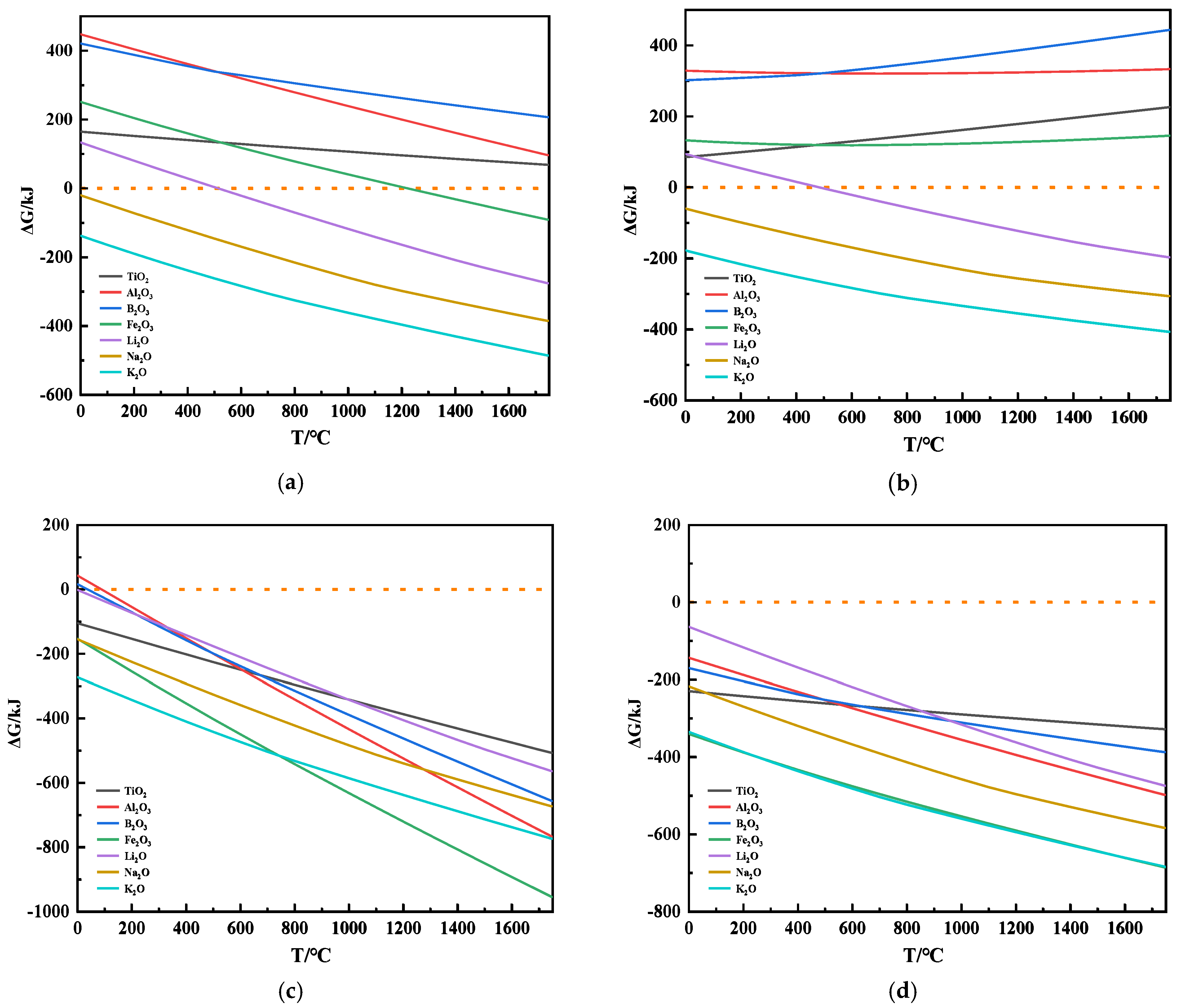
To elucidate the temperature dependence of reaction spontaneity across the industrial roasting spectrum, the Gibbs free energy change ΔG°
T was modeled for each of the six reaction systems over the temperature range of 0–1750 °C. These calculations were performed using HSC Chemistry software, incorporating rigorous heat capacity C
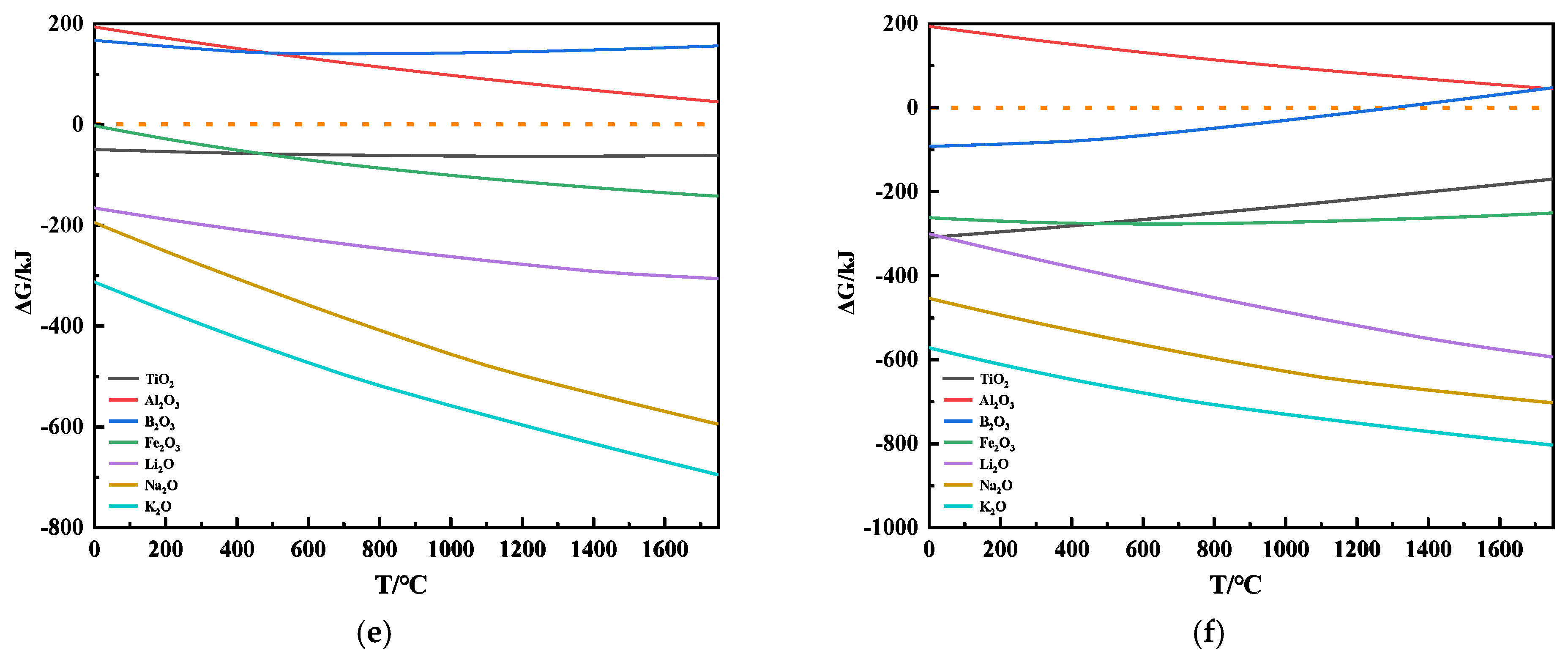
p(T) integration to ensure thermodynamic accuracy at elevated temperatures. The resulting ΔG-T relationships, presented in
Figure 3a–f, provide a comprehensive map of the thermodynamic landscape governing lattice impurity removal from quartz.
Figure 3.
Temperature dependence of the standard Gibbs free energy change (ΔG°) for chlorination reactions of impurity oxides (TiO2, Al2O3, B2O3, Fe2O3, Li2O, Na2O, K2O) under different atmospheres: (a) Cl2; (b) HCl; (c) Cl2 + excess carbon (C → CO); (d) Cl2 + stoichiometric carbon (C → CO2); (e) HCl + carbon (C → CO); (f) HCl + carbon (C → CO2); The dashed line indicates ΔG° = 0.
Figure 3.
Temperature dependence of the standard Gibbs free energy change (ΔG°) for chlorination reactions of impurity oxides (TiO2, Al2O3, B2O3, Fe2O3, Li2O, Na2O, K2O) under different atmospheres: (a) Cl2; (b) HCl; (c) Cl2 + excess carbon (C → CO); (d) Cl2 + stoichiometric carbon (C → CO2); (e) HCl + carbon (C → CO); (f) HCl + carbon (C → CO2); The dashed line indicates ΔG° = 0.
Figure 3a for pure Cl
2 illustrates that the ΔG curves for K, Na, and Li exhibit steep negative slopes, reflecting positive entropy changes with ΔS > 0. Consequently, the thermodynamic driving force for alkali removal is significantly enhanced at elevated temperatures as the −TΔS term becomes dominant. In contrast, substitutional impurities Ti, Al, B, and Fe maintain positive ΔG values across most of the investigated range. Fe crosses the spontaneity threshold where ΔG = 0 at approximately 1326 °C, consistent with
Table 1, whereas Ti, Al, and B remain thermodynamically infeasible throughout the entire temperature interval.
Figure 3b for pure HCl demonstrates that TiO
2 and B
2O
3 exhibit positive slopes, indicative of negative entropy changes with ΔS < 0. This characteristic renders their chlorination thermodynamically impossible regardless of temperature. Al
2O
3 and Fe
2O
3 exhibit near-zero slopes with negligible ΔS, resulting in physically unattainable critical temperatures.
Figure 3c–f for carbochlorination systems reveal that the addition of carbon, especially via the CO
2 pathway, ensures spontaneity for all substitutional impurities across the full temperature spectrum. The ΔG curves are shifted significantly into the negative region, with the driving force intensifying at higher temperatures due to the favorable entropy contributions in the Cl
2 + C configurations.
3.2. Kinetic Analysis of Impurity Diffusion and Removal Rates
While thermodynamics defines whether a reaction can occur, kinetics determines the practical extent of impurity removal achievable within finite processing times. This section presents the diffusion activation energies , identifies the rate-determining steps, and provides theoretical removal rate predictions for all impurities.
3.2.1. Diffusion Activation Energies and Rate-Controlling Steps
Table 7 presents the compiled activation energies and identified rate-controlling steps for each impurity.
The activation energies span a wide range, from approximately 90–120 kJ/mol for Na+ to 300–400 kJ/mol for Ti4+, reflecting fundamental differences in migration mechanisms. Charge-compensating alkali metals migrate via interstitial channels without requiring bond rupture with the Si–O framework and therefore exhibit the lowest barriers. Among them, Na+ has the lowest because its ionic radius of 0.102 nm optimally matches the quartz c-axis channel dimensions, thereby minimizing both electrostatic trapping and steric hindrance. Although K+ has weaker electrostatic binding, it exhibits a higher of 150–180 kJ/mol due to steric constraints arising from its larger ionic radius of 0.138 nm.
For substitutional impurities, activation energies are significantly higher, as diffusion necessitates the dissociation of metal–oxygen bonds from the quartz lattice. Ti4+ possesses the highest of 300–400 kJ/mol among all investigated species, a consequence of its robust Ti–O bonds of length 0.196 nm, its stable isovalent substitution, and the substantial energy required to reconstruct the surrounding Si–O tetrahedral network. Conversely, Fe3+ benefits from its reduction to Fe2+ under reducing conditions. This chemical transition lowers the from 200–260 kJ/mol to 150–180 kJ/mol, effectively shifting its kinetic behavior toward the more mobile range of alkali metals.
Al3+ removal is governed by a distinctive two-stage kinetic regime. During the initial phase, typically below 1100 °C, the process is limited by the diffusion of charge-compensating alkali cations Na+, Li+, or K+. It is only after the departure of these compensators and the resulting disruption of local electroneutrality that the Al3+ species itself can dissociate and migrate. This second stage is characterized by a significantly higher activation energy of 250–300 kJ/mol, reflecting the energy required to overcome the destabilized lattice environment.
It should be emphasized that the activation energies for substitutional impurities are estimated from analogous silicate systems rather than measured directly for the specific quartz feedstock used in this study. The reported ranges reflect the inherent uncertainty in these estimates, which arises from differences in impurity coordination environments, lattice strain effects, and variations in experimental conditions across studies. While these uncertainties may affect the absolute values of the predicted diffusion coefficients and removal rates, they are unlikely to alter the relative ranking of impurity difficulty or the qualitative trends in temperature dependence, as the differences in activation energies between impurity types are substantially larger than the estimated uncertainties within each type.
3.2.2. Temperature Dependence of Diffusion Coefficients
Table 8 presents the relative diffusion coefficients (
) for each impurity across the temperature range 900–1300 °C.
The calculated kinetic data reveal two decisive trends. First, at lower temperatures in the range of 900–1000 °C, the diffusion coefficients of high species, notably Al and Ti, are severely suppressed relative to their values at 1100 °C, whereas low alkalis maintain substantial mobility. For instance, at 900 °C, the relative diffusivity of Ti is only 0.003, indicating near-complete kinetic immobilization within the quartz lattice. Second, at elevated temperatures in the range of 1200–1300 °C, high impurities exhibit exponential surges in diffusivity due to the nature of the Arrhenius relationship. Specifically, Ti exhibits a 110-fold increase in diffusivity between 1100 and 1300 °C, in stark contrast to the mere 1.7-fold increase observed for Na. This “diffusion crossover” effect underscores the absolute necessity of high-temperature roasting for extracting recalcitrant substitutional impurities.
3.2.3. Theoretical Removal Rate Predictions
Table 9 presents the theoretically predicted removal rates (
, %) for each impurity at selected temperatures and a holding time of 4 h, calculated using the shrinking-core diffusion model with
= 50 μm.
The predicted removal rates align closely with the activation energy hierarchy. Alkali metals, particularly Na, can be nearly completely removed with efficiency exceeding 99% at 1100 °C within 4 h. In contrast, substitutional impurities require higher temperatures. Under reducing conditions at 1200 °C, Fe achieves approximately 68% removal. Al reaches only about 38% under the same conditions and requires 1300 °C to achieve approximately 65% removal. Ti is predicted to reach only about 28% removal even at 1300 °C for 4 h, necessitating extended holding times such as approximately 45% at 8 h and approximately 65% at 16 h.
3.3. Integrated Thermodynamic–Kinetic Difficulty Ranking
Table 10 synthesizes the thermodynamic and kinetic analyses into a unified difficulty ranking for the removal of lattice impurities from high-purity quartz.
The integrated difficulty ranking presented in
Table 10 combines two criteria: thermodynamic feasibility and kinetic feasibility. The thermodynamic criterion is based on the standard Gibbs free energy change (ΔG°) and the critical temperature (T
c) for chlorination under the most favorable conditions—impurities with more negative ΔG° and lower T
c are considered more thermodynamically favorable. The kinetic criterion is based on the diffusion activation energy and the predicted removal rate at 1100 °C over 4 h—impurities with lower
and higher predicted removal rates are considered more kinetically facile. The overall ranking is primarily qualitative and intended to provide a comparative assessment of removal difficulty across different impurity types, rather than an absolute measure.
The integrated ranking confirms that Na is the most facile impurity to extract, governed synergistically by highly favorable thermodynamics and the lowest activation energy barrier. Conversely, Ti proves to be the most recalcitrant, severely handicapped by the dual constraints of highly unfavorable thermodynamics and the highest interstitial diffusion barrier. The distinct position of K is particularly illustrative: despite exhibiting the most robust thermodynamic driving force across all evaluated systems, its actual extraction is kinetically slower than Na due to severe steric hindrance within the quartz c-axis channels. This kinetic-thermodynamic inversion elegantly underscores the critical necessity of adopting a coupled thermodynamic–kinetic evaluation framework for designing high-purity quartz refinement processes.
3.4. Experimental Verification
The validity and practical utility of any theoretical model ultimately rest on its ability to account for experimental observations.
Table 11 compares the theoretically predicted removal rates from this study with the experimental results reported in the companion chlorination roasting study, which was conducted on a natural quartz concentrate under comparable conditions including HCl atmosphere, temperature range of 1150 °C, and holding time of 4 h.
The high degree of convergence between theoretical predictions and experimental results validates the robustness of the proposed thermodynamic–kinetic framework. Several specific deviations, however, merit further discussion. The experimental Na removal at 99.7% nearly mirrors the theoretical prediction of approximately 99%, confirming that Na extraction is both thermodynamically and kinetically facile. Conversely, the experimental K removal at 95.5% is notably higher than the theoretical forecast of approximately 70% at 1100 °C. This discrepancy suggests that the intrinsic for K+ in this specific quartz feedstock may be lower than the idealized literature values, or that structural heterogeneities such as grain boundaries and micro-cracks not accounted for in the idealized spherical particle model provide accelerated transport pathways for the larger K+ ion.
The experimental Fe removal at 81.2% significantly outpaces the theoretical prediction for Fe3+, appearing closer to the prediction for Fe2+ under reducing conditions. Several factors may contribute to this discrepancy. First, a substantial fraction of Fe in natural quartz may exist as sub-microscopic oxide inclusions or along grain boundaries rather than as true substitutional lattice-bound Fe3+. These non-lattice forms are inherently more accessible to chlorination and do not require the high activation energy for lattice dissociation, and thus can be removed more readily than the model assumes. Second, the HCl atmosphere utilized in the empirical study may possess sufficient reducing character to facilitate the Fe3+ to Fe2+ transition more effectively than assumed in the model, thereby lowering the effective activation energy for iron chlorination. Third, the activation energy estimate for Fe3+ (200–260 kJ/mol) may overestimate the actual barrier for the specific quartz feedstock used in this study, as the value is derived from analogous silicate systems rather than measured directly. These factors collectively explain why the experimental Fe removal exceeds the theoretical prediction, and highlight the importance of detailed feedstock characterization for accurate process prediction. In contrast, the remarkable agreement regarding Ti, with both theory and experiment indicating negligible extraction, unambiguously identifies Ti as the primary kinetic bottleneck and validates the high activation energy of 300–400 kJ/mol adopted in the kinetic model.
4. Discussion
The results detailed in
Section 3 establish a rigorous quantitative framework for elucidating the removal dynamics of lattice impurities during the high-temperature chlorination roasting of quartz. This section interprets these findings through the dual lenses of atomistic and process-level mechanisms, correlates the theoretical predictions with available empirical benchmarks, and synthesizes these insights into an optimized, industrially applicable process strategy.
4.1. The Thermodynamic–Kinetic Mismatch
This study identifies a significant mismatch between thermodynamic driving forces and kinetic diffusion rates for certain impurities, notably the alkali metals K, Na, and Li. Although the chlorination driving forces follow the order K > Na > Li, with ΔG° values of −151.5, −27.1, and +194.5 kJ/mol, respectively, experimental results reveal a different hierarchy. Removal rates reach 99.7% for Na and 95.5% for K, whereas Li removal remains substantially lower. This contradiction is resolved by the kinetic parameters: the diffusion activation energy for Na+, approximately 105 kJ/mol, is significantly lower than that for K+, approximately 165 kJ/mol. Physically, the Na+ ion, with a radius of about 0.102 nm, is optimally sized for the quartz c-axis channels. Conversely, the smaller Li+, with a radius of 0.076 nm, experiences electrostatic trapping due to Coulombic interaction with channel-wall oxygen anions, whereas the larger K+, with a radius of 0.138 nm, faces steric obstruction. Consequently, the kinetic advantage of Na+ more than compensates for its thermodynamic disadvantage relative to K+.
Practical process optimization must therefore address kinetic barriers, specifically solid-state diffusion, rather than relying solely on thermodynamic driving forces. Although maximizing reagent use or temperature may fail to yield optimal results, impurities with rapid kinetics, such as Na, enable effective removal under mild conditions, thereby facilitating energy savings and reduced equipment demands.
4.2. Titanium: The Most Recalcitrant Impurity
Titanium is the most thermodynamically and kinetically recalcitrant species investigated. Chlorination of TiO2 requires the highest critical temperature of 2610 °C. Despite exothermic carbochlorination, the kinetic barrier remains formidable, with an activation energy of approximately 300 to 400 kJ/mol. The removal efficiency at 1300 °C after 4 h is only about 28 percent, requiring roughly 16 h to achieve 65 percent extraction. This stability stems from isovalent Ti4+ substitution for Si4+. Unlike heterovalent Al3+, charge-neutral Ti4+ integrates into the lattice without compensation. The Ti–O bond length of about 0.196 nm is only slightly longer than the Si–O bond length of about 0.161 nm, and the lack of electrostatic destabilization creates a massive dissociation energy barrier.
As the primary bottleneck for purity, reducing Ti concentration below 1 ppm requires strategies beyond single-stage roasting. These include maximizing temperatures to at least 1300 °C, extending holding time, and reducing particle size, since removal rates scale inversely with the square of the particle radius according to the shrinking-core model. Thermal cycling through the α–β quartz transition at 573 °C can also create defects that facilitate diffusion. Ultimately, selecting low-titanium feedstock remains the most reliable industrial strategy.
4.3. The “Alkali-First, Al-Follows” Mechanism: Coupled Diffusion as the Key to Aluminum Removal
Aluminum is the most ubiquitous lattice impurity in quartz. Direct chlorination of Al2O3 with Cl2 is energetically prohibitive, with ΔG° = +619.7 kJ/mol and Tc = 2087 °C. Even during spontaneous carbochlorination, kinetic barriers remain formidable: the diffusion activation energy for Al3+ reaches 250–300 kJ/mol, yielding only approximately 38% theoretical removal efficiency at 1200 °C over 4 h. This study identifies an alkali-first, Al-follows mechanism in which heterovalent Al3+ is electrostatically pinned by charge-compensating Li+, Na+, or K+. Dissociation is suppressed until alkali depletion disrupts local electroneutrality. Removal thus follows a two-stage process: alkali migration and volatilization create a metastable center, followed by Al3+ mobilization into interstitial vacancies.
Corroborating this mechanism, significant Al removal only succeeds after alkali depletion. Single-stage roasting reduced Al by approximately 10%, near the theoretical estimate of about 15%, whereas subsequent acid leaching dropped Al from 87 μg/g to 35.29 μg/g by dissolving mobilized, surface-enriched aluminum. Practically, Al extraction requires prior alkali removal. Processes using HCl, which is thermodynamically superior for alkali chlorination, and optimized holding times synergistically improve outcomes. Furthermore, because Na+ is the fastest diffuser, the feedstock Na to Li ratio determines purification difficulty, as Na+-compensated sites activate more rapidly.
The proposed “alkali-first, Al-follows” mechanism is derived from the combined thermodynamic and kinetic analysis presented in this study, and is also supported by the experimental trends observed in the validation tests, where significant Al removal was only achieved after substantial depletion of alkali metals. This interpretation provides a plausible explanation for the coupled diffusion behavior based on the charge-compensation requirement for heterovalent substitution. However, it should be emphasized that direct experimental evidence, such as in-situ monitoring of the sequential migration of individual impurity species or high-resolution depth-profiling of partially roasted samples, is not yet available. Therefore, the proposed mechanism should be regarded as a working hypothesis supported by theoretical analysis and indirect experimental evidence. More detailed experimental investigations are currently underway to further validate this mechanism.
4.4. The Dual Role of Carbon: Thermodynamic Enabler and Kinetic Promoter
Carbon addition transforms impurity chlorination from energetically prohibitive to spontaneous by replacing oxygen liberation with more stable carbon monoxide or carbon dioxide formation, shifting reaction enthalpy toward the exothermic region. Kinetically, carbon acts as a multi-modal facilitator. On one hand, it generates a localized reducing atmosphere, i.e., a CO-rich microenvironment, at or near the particle surface through its reaction with residual oxygen or CO2. This gaseous reducing agent can promote the reduction of Fe3+ to Fe2+, either at the surface or after partial migration of the iron species. Since Fe2+ exhibits a lower chlorination activation energy compared with Fe3+, this transition facilitates the subsequent chlorination and volatilization of iron. Thus, the role of carbon in iron removal should be understood primarily as a generator of in situ reducing conditions rather than as a direct solid reductant. On the other hand, by reacting with lattice oxygen, carbon generates surface oxygen vacancies, creating a defect-mediated transport network that reduces macroscopic diffusion barriers.
While essential for aluminum and titanium removal, carbon stoichiometry requires rigorous control. Excess carbon favoring carbon monoxide over carbon dioxide diminishes thermodynamic gains: titanium chlorination enthalpy shifts from −40.2 kJ/mol for the carbon dioxide pathway to +126.5 kJ/mol for the carbon monoxide pathway. Optimal loading should target carbon dioxide formation, permitting a marginal excess to compensate for the Boudouard reaction, C + CO2 ⇌ 2CO, while avoiding gross excess to maintain maximum driving force.
It is important to acknowledge the limitations of applying the present equilibrium thermodynamic analysis to the actual reaction system. The calculations assume ideal conditions and do not account for kinetic constraints such as mass transport, gas flow dynamics, or incomplete contact between the carbonaceous reductant and quartz particles. Furthermore, in practical operation, the CO/CO2 ratio is governed by reaction equilibrium and kinetics under the given conditions, particularly the Boudouard equilibrium, and cannot be independently prescribed. The CO2 and CO pathways analyzed in this study should therefore be regarded as idealized thermodynamic bounds that provide useful theoretical guidance for understanding the system, rather than exact representations of the actual gas composition. These considerations are essential when applying the thermodynamic predictions to industrial process design.
4.5. The Segmented Roasting Strategy: A Temperature-Staged, Atmosphere-Optimized Process
This study formulates a mechanistically informed, segmented roasting strategy recognizing that optimal conditions for kinetically facile species such as alkali metals diverge from those required for recalcitrant impurities like aluminum and titanium. Single-stage isothermal roasting that forces a compromise between these conflicting requirements results in suboptimal extraction or excessive energy expenditure.
The proposed segmented roasting strategy comprises two principal stages, summarized schematically in
Figure 1 (to be inserted) and detailed in
Table 12.
Stage 1, operating at 900 to 1100 °C in an HCl atmosphere, targets charge-compensating alkali metals including sodium, potassium, and lithium, as well as structural hydroxyl groups. HCl is thermodynamically superior to Cl2 for alkali chlorination, for example with Na2O giving −65.1 kJ/mol versus −27.1 kJ/mol. High relative diffusivities in the range of 0.20 to 1.00 at these temperatures ensure removal with minimal energy costs. Additionally, the α → β quartz phase transition at 573 °C during ramp-up induces lattice defects that act as kinetic activators for all species.
Stage 2, operating at 1100 to 1300 °C in a Cl2 plus carbon atmosphere, targets refractory impurities. Transitioning to Cl2 and anhydrous conditions precludes BCl3 hydrolysis, while carbon provides essential facilitation. Thermal trajectories must match the feedstock profile: 1100 to 1200 °C for iron and boron extraction, 1200 to 1300 °C for aluminum mobilization, and at least 1300 °C for titanium reduction. Titanium-rich materials necessitate extended holding times of 8 h or more to overcome extreme diffusion barriers.
It is important to acknowledge the limitations of the present theoretical framework. The activation energies for substitutional impurities are estimated from analogous silicate systems rather than measured directly for the specific feedstock, and the diffusion model relies on simplifying assumptions regarding particle size distribution and pre-exponential factors. The proposed mechanisms are primarily derived from modeling and theoretical analysis
5. Conclusions
This study established a comprehensive and integrated thermodynamic–kinetic framework for the removal of lattice-bound impurities from high-purity quartz during high-temperature chlorination roasting. By systematically evaluating the behavior of seven key impurity species, namely Ti, Al, B, Fe, Li, Na, and K, the investigation provided quantitative insights into the fundamental mechanisms governing deep purification. The primary conclusions are summarized as follows:
Thermodynamic analysis demonstrated that carbonaceous reductants are indispensable for overcoming the 4N purity bottleneck. While direct chlorination of substitutional impurities such as Ti, Al, and B is energetically prohibitive under standard roasting conditions, the addition of carbon transforms these reactions into spontaneous processes by facilitating the formation of CO2 or CO. The thermodynamic feasibility hierarchy was found to correlate inversely with oxide stability following the order K > Na > Li > Fe > B ≈ Al > Ti, though the stoichiometric CO2 pathway provides a superior driving force compared to the excess carbon CO pathway.
Kinetic modeling identified solid-state diffusion of impurity ions through the SiO2 lattice as the rate-determining step for the entire purification process. A significant diffusion crossover effect was observed: while low activation energy species like Na+ maintain high mobility at moderate temperatures, the diffusion coefficients of high activation energy species including Ti and Al increase exponentially with temperature. This necessitates the application of temperatures reaching 1200 to 1300 °C to achieve industrially viable extraction rates for recalcitrant substitutional impurities.
The study elucidated critical atomistic mechanisms that dictate purification efficiency. Titanium was identified as the ultimate purification bottleneck due to its robust isovalent substitution, high activation energy ranging from 300 to 400 kJ/mol, and highly unfavorable thermodynamics. Conversely, aluminum removal was shown to follow an alkali-first, Al-follows coupled diffusion mechanism, where the migration of Al3+ is suppressed until the depletion of charge-compensating alkali cations disrupts local electroneutrality.
The theoretical framework was validated through a high degree of convergence with experimental results, confirming its robustness for process prediction. The results indicate that while alkali metals can be removed with over 99 percent efficiency at 1100 °C, the reduction of Ti and Al requires a more aggressive thermal strategy.
Based on these findings, A mechanistically informed, segmented roasting strategy is proposed, comprising a medium-temperature stage from 900 to 1100 °C in HCl atmosphere for the efficient removal of kinetically facile alkalis and hydroxyl groups, followed by a high-temperature stage from 1100 to 1300 °C utilizing Cl2 and carbon to mobilize refractory substitutional species such as Al and Ti. This optimized pathway provides a scientific basis for achieving ultra-deep quartz purification. Regarding industrial feasibility, the proposed strategy requires operation at elevated temperatures with Cl2-containing atmospheres, which poses challenges in terms of energy consumption, reactor materials resistant to chlorine corrosion, and chlorine handling safety. The strategy should be adapted based on feedstock characteristics—ores with lower levels of refractory impurities may potentially require only the lower-temperature stage, thereby reducing energy demands. Engineering solutions for chlorine recycling and reactor design are essential for industrial-scale implementation.
In conclusion, this research demonstrates that the ultra-high purification of quartz is not a monolithic engineering challenge amenable to a single, universal solution. Instead, it is a nuanced, multi-element problem that necessitates an impurity-targeted, thermodynamically informed, and kinetically optimized strategic roadmap. By synthesizing chemical spontaneity with solid-state migration dynamics, the integrated framework developed herein provides both the fundamental mechanistic insights and the quantitative engineering guidance essential for the rational design of next-generation high-purity quartz production processes.