Article

Geology, Fluid Inclusion and Stable Isotope Characteristics of the Litun Skarn Iron Deposit in the North China Craton, Eastern China


1
Mineral Resources Investigation Institute of Hunan Province, Changsha 410014, China
2
Shandong Provincial Research Institute of Coal Geology Planning and Exploration, Jinan 250104, China
3
The First Geological Brigade of Hebei Bureau of Geology and Mineral Resources Exploration, Handan 056000, China
4
Langfang Integrated Natural Resources Survey Center, China Geological Survey, Langfang 065000, China
*
Author to whom correspondence should be addressed.
Minerals 2026, 16(7), 703; https://doi.org/10.3390/min16070703 (registering DOI)
Submission received: 5 June 2026 / Revised: 3 July 2026 / Accepted: 3 July 2026 / Published: 5 July 2026
(This article belongs to the Section Mineral Deposits)

Abstract

The North China Craton hosts abundant skarn iron resources, yet the regional large-scale mineralization mechanism remains incompletely understood. The Litun deposit is a newly discovered skarn iron deposit in the North China Craton. Integrated field geological investigations, petrographic observations, fluid inclusion microthermometry and stable isotope geochemistry are applied to constrain evaporite contributions to metallogenic processes. Four mineralization stages are identified: skarn, oxide, sulfide, and carbonate. Early skarn-stage fluids are iron-rich magmatic hydrothermal fluids with high temperatures (498 to >550 °C), high salinities (18.6 to 59.4 wt% NaCl eqv.), and magmatic δ18O values of 8.3 to 10.8‰. Subsequent oxide to late carbonate stages record continuous infiltration of meteoric water, supported by H–O isotopic trends of rising meteoric water proportions. Pyrite from the magnetite ores has δ34SV-CDT values between 12.0 and 15.0‰, significantly higher than those of pyrite in the Litun diorite (−0.8 to 1.1‰), indicating the contributions of sulfur from evaporites (δ34SV-CDT 26.9 to 28.6‰) in the mineralization process. Moreover, vein pyrite formed in later stages displays even higher δ34S values (17.3 to 20.9‰), demonstrating progressive enrichment of evaporite-derived sulfur as hydrothermal activity evolves. Synchronous rises in meteoric water fraction and evaporite sulfur proportion indicate evaporites are delivered into the ore-forming system via meteoric water mixing. The mixing of meteoric water containing dissolved evaporites and iron-rich magmatic-hydrothermal fluids may be the major mechanism of magnetite precipitation in the Litun deposit.

1. Introduction

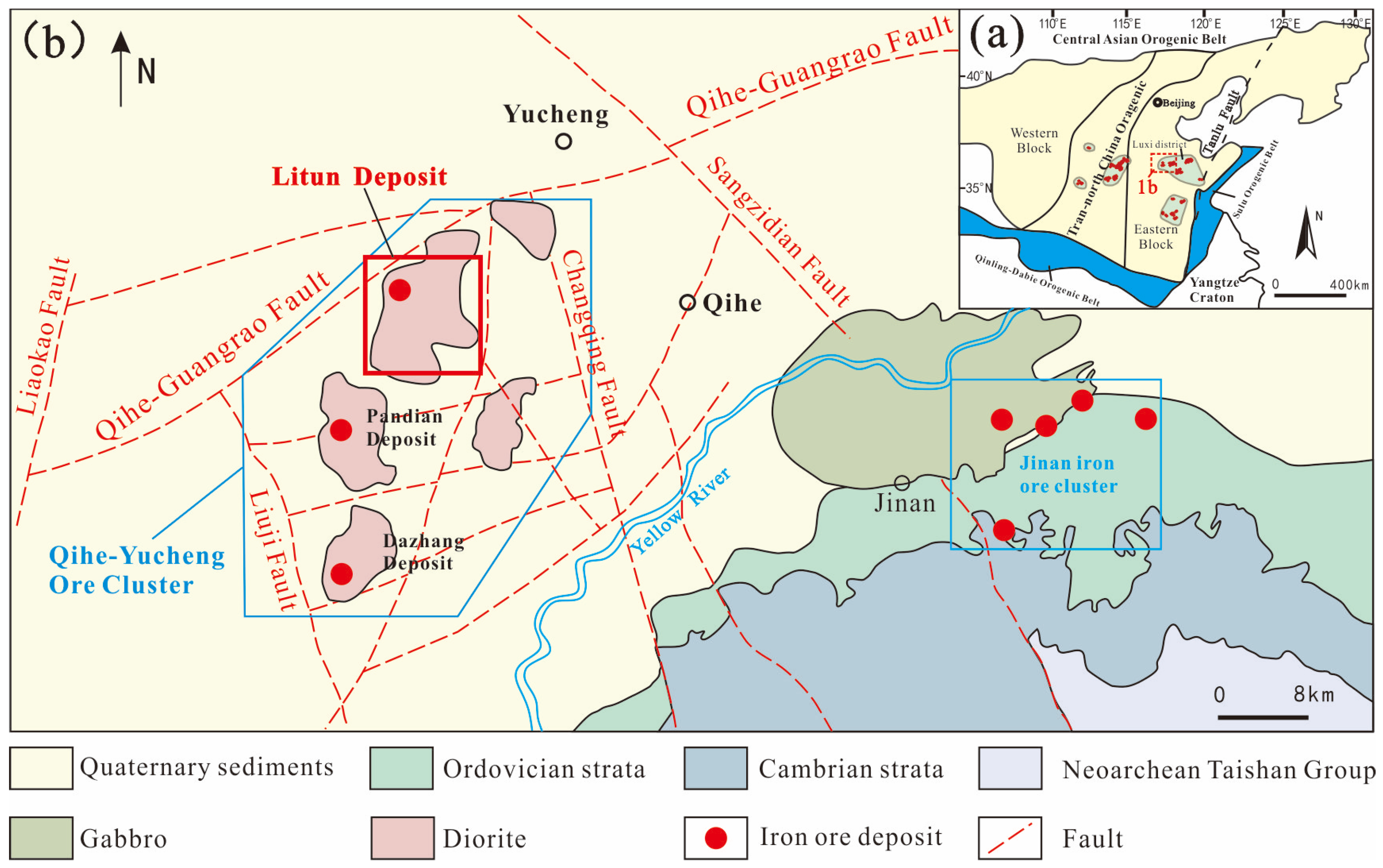
Skarn deposits serve as the preeminent source of high-grade iron ore in China, comprising 57% of the country’s total reserves [1]. The North China Craton (NCC), which hosts no fewer than 128 skarn iron deposits that occur at scales ranging from small to large, is an important skarn iron metallogenic belt in China. The skarn iron deposits within the NCC have yielded a substantial supply of high-grade iron ores, boasting total proven reserves exceeding 2800 Mt [2]. These deposits are mainly clustered in five districts: Hanxing, Taiyuan, Linfen, Xuhuai, and Luxi iron ore districts (Figure 1a).
The skarn iron deposits within the NCC are associated with the Cretaceous intermediate intrusions and are characterized by their occurrence at the interface between the ore-related intrusions and Mesozoic marine carbonates [2,3]. These deposits exhibit comparable mineralization and alteration characteristics, including intensive albitization within ore-related diorite, and the presence of magnesium skarn mineralogy such as pyroxene, actinolite, tremolite, and biotite [4,5,6]. Previous studies have suggested that the extensively distributed evaporites within the Ordovician strata of the NCC exert a critical control on and contribute substantially to large-scale skarn-type iron mineralization [1]. However, sulfates are rarely detected in skarn-type iron deposits within the Luxi area [7]. As one of the major metallogenic belts of the NCC, the Luxi metallogenic province remains poorly constrained with respect to whether evaporites contributed to skarn mineralization in this area, as well as the specific modes of evaporite participation and associated metallogenic mechanisms. These key scientific issues require further systematic research.
Figure 1. Regional geology of the studied area. (a) Major tectonic units of the North China Craton (after [2]). (b) Sketch geological and tectonic map of Luxi district (after [6]).
Minerals 16 00703 g001
The Litun deposit is a newly discovered skarn iron deposit with considerable potential for prospecting within the NCC. In this deposit, all the ore bodies are well-developed in stratiform-like or lenticular shape at the contact zone between the Mesozoic monzodiorite and the Carboniferous strata. The Litun deposit serves as a representative skarn iron deposit, exhibiting similar mineralization and alteration characteristics to those of skarn iron deposits within the NCC. Consequently, this deposit offers a valuable chance to obtain fresh perspectives on the metallogenic processes of skarn iron deposits within the NCC. In this research, we present field investigations, petrographic observations, microthermometry and stable isotope to constrain the evolution of ore-forming hydrothermal fluids. On this basis, we discuss the magnetite precipitation mechanism in the Litun deposit and enhance the understanding of the metallogenesis of the regional skarn iron deposits within the NCC.

2. Regional Geology

The NCC, which ranks among the most ancient cratons globally, has the Central Asian Orogenic Belt to its northern side, the Qinling-Dabie Orogenic Belt to its southern boundary, and the Qilianshan Orogenic Belt to its western periphery (Figure 1a). The NCC basement chiefly comprises Paleoarchean–Paleoproterozoic amphibolite–granulite facies gneisses, unconformably capped by unmetamorphosed Mesoproterozoic volcano sedimentary sequences and late Paleoproterozoic–Late Paleozoic shallow-marine carbonate deposits [2,8]. During the Ordovician period, the NCC underwent a significant regression, leading to the widespread formation of evaporites. These Ordovician strata primarily host regional skarn iron mineralization, which boasts substantial iron reserves and numerous deposits of sedimentary gypsum [9].
The Luxi district, which is located in the southeastern region of the NCC (Figure 1a), exhibits similar stage evolution characteristics to the NCC. The Luxi district is based on Neoarchean gneiss, amphibolite, and trondhjemite–tonalite–granodiorite (TTG), which are unconformably overlain by sedimentary sequences consisting of Precambrian–Ordovician marine carbonates and shales, Carboniferous–Permian terrestrial clastic rocks, and Mesozoic sedimentary rocks (Figure 1b). Under the tectonic background of Mesozoic–Cenozoic NCC destruction, the Luxi district experienced extensive igneous activity, large-scale basin faulting, and accelerated crustal uplift [2,10]. The Mesozoic mineralization in the Luxi district was closely related to the Mesozoic intermediate-mafic magmatic intrusions, mainly producing iron deposits. The metallogenic types in the Luxi district are mainly skarn iron ore, comprising four ore clusters: Jinan, Zibo, Laiwu, and Qihe-Yucheng [2,7,11].
The Qihe-Yucheng ore cluster, situated in the northwestern portion of the Luxi district (Figure 1b), is an area where breakthroughs have been made in deep ore exploration in the Luxi district in recent years. The area has great metallogenic potential—Litun, Pandian and Dazhang skarn iron deposits have been discovered successively—which is expected to become another important rich iron ore-producing area in the Luxi district after Laiwu, Zibo, and Jinan. The magmatic rocks within this region mainly comprise Mesozoic diorite intrusive rocks with a crystallization age of about 126 Ma [12].

3. Deposit Geology

The Litun deposit is located at the northern extremity of the Qihe-Yucheng ore cluster (Figure 1b). The ore field’s surface is extensively overlaid with Quaternary sediments and Paleogene sandy conglomerate. As revealed by drilling, the strata within the ore mining region are composed of the Ordovician Majiagou Formation, the Carboniferous Yuemengou Formation, and the Permian Shihezi Formation (Figure 2). The Majiagou Formation is made up of dolomitic limestones with interbeds of evaporite. The Carboniferous Yuemengou Formation mainly consists of mudstone, siltstone, limestone, and thin layers of coal. The Permian Shihezi Formation is composed of sandstone and mudstone.
The magmatic rocks that relate to the Litun deposit are monzodiorite, which is medium-grained and consists of hornblende (about 30%), plagioclase (about 55%), K-feldspar (about 10%), quartz (about 2%), and biotite (about 2%). The fresh monzodiorite sample yielded a concordant U–Pb age of 130.0 ± 2.3 Ma using LA-ICP-MS dating for zircon [13].
According to diamond drilling, the Litun deposit is made up of five unexposed ore deposits that are located between 1100 and 1500 m below the current surface. The ore bodies are well-developed in stratiform-like or lenticular shape at the contact zone between the Litun monzodiorite and the Carboniferous Yuemengou Formation (Figure 2) and are dominated by massive magnetite ores (>80% magnetite), with minor disseminated ores (30 to 80% magnetite). Metal minerals are dominantly magnetite, with minor pyrrhotite, pyrite, and chalcopyrite; gangue minerals are mainly garnet, pyroxene, epidote, actinolite, tremolite, chlorite, quartz, and calcite, with minor apatite and biotite. Skarn assemblages are well-developed, and areas rich in these assemblages also exhibit well-developed ore bodies.
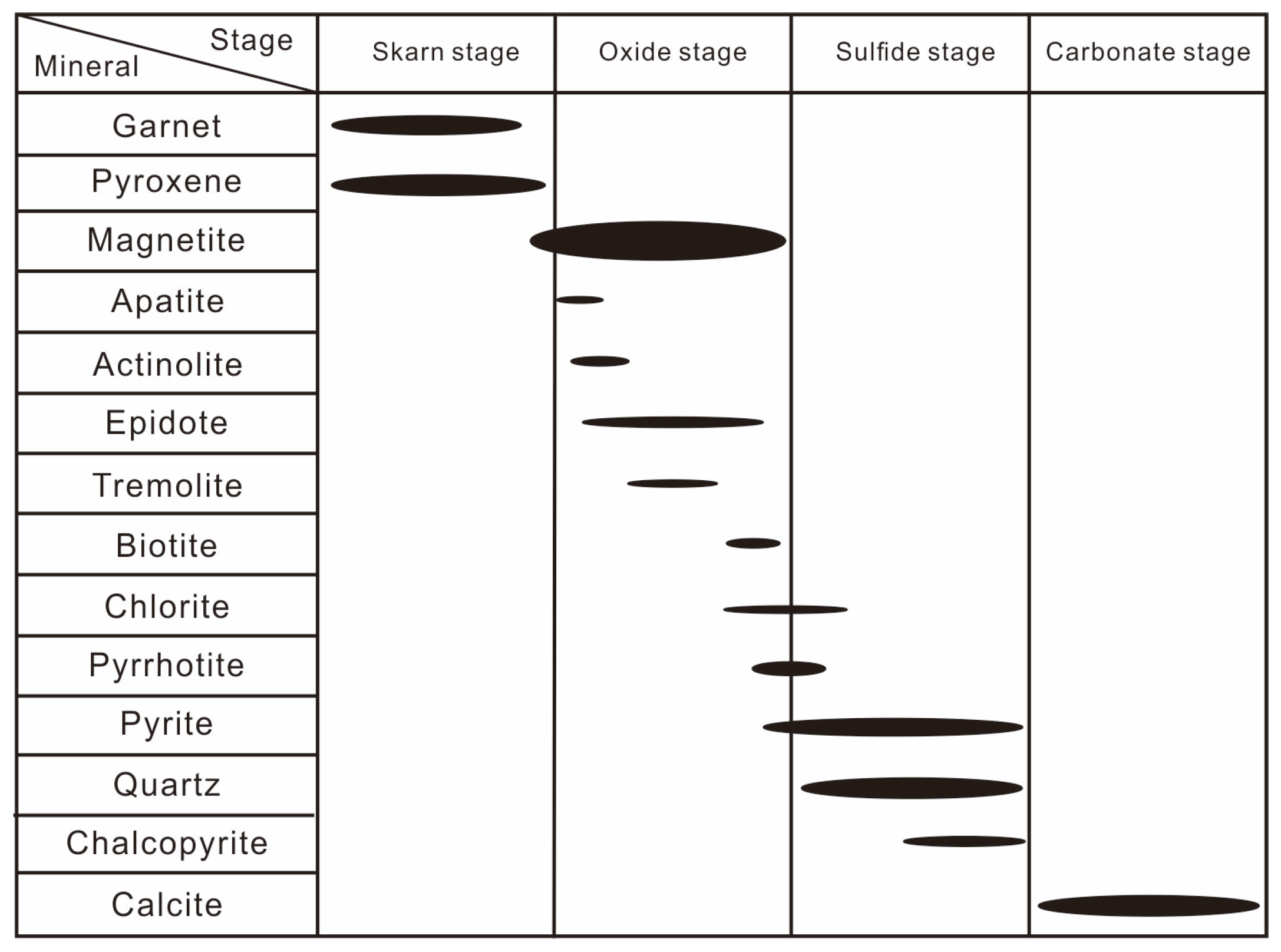
Geological evidence, microscopic examinations, cross-cutting features, and replacement relationships suggest that the mineralization process in the Litun deposit includes the following four stages: the skarn, oxide, sulfide, and carbonate stage (Figure 3).
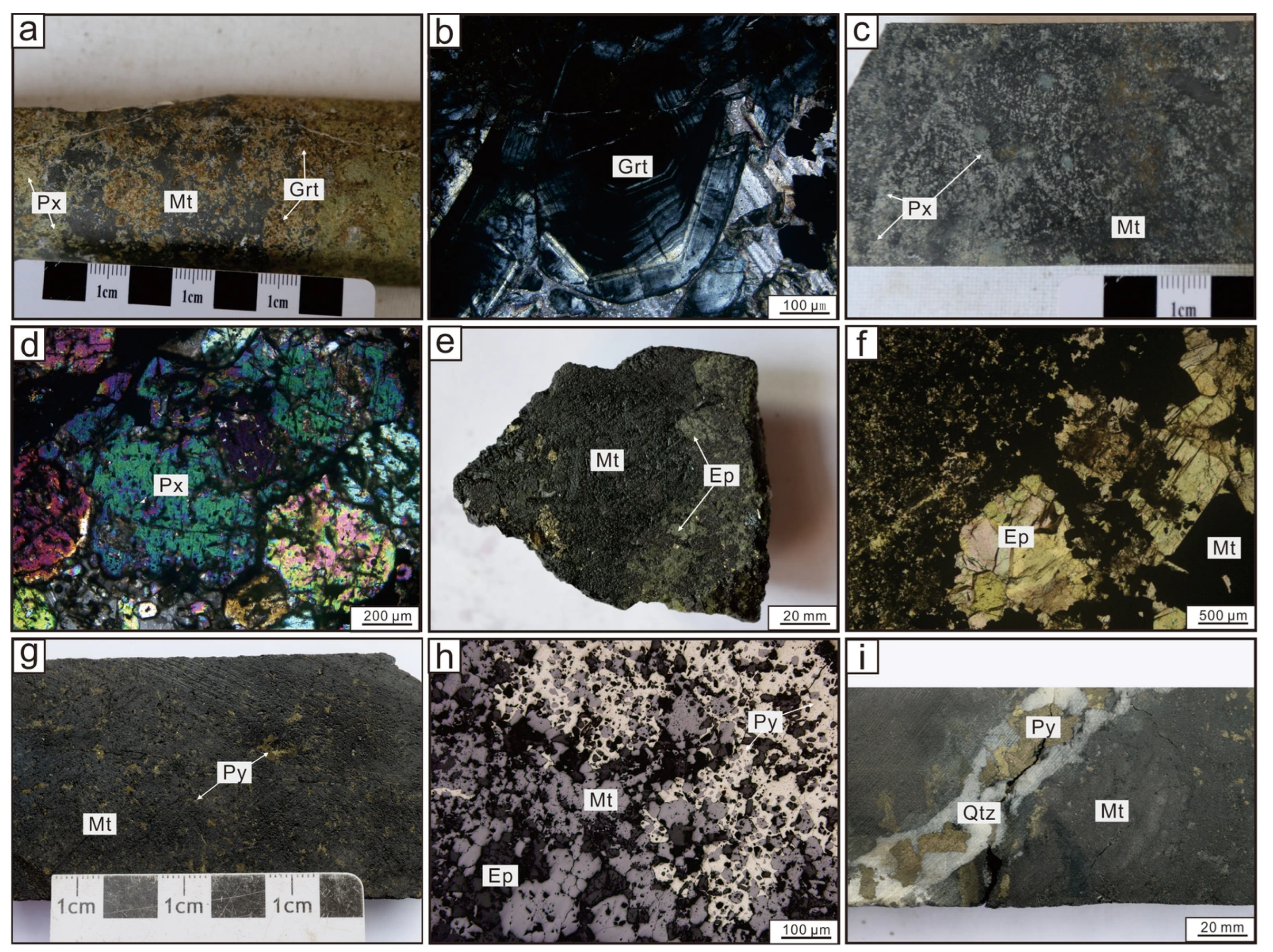
Skarn stage: In the early stage, it was intensely developed within the monzodiorite and sedimentary rocks. The skarn stage of alteration is associated with anhydrous assemblages that contain abundant garnet and pyroxene. Most garnets are medium- to coarse-grained dodecahedral grossular, brown to yellow, with a high degree of idiomorphism (Figure 4a), and are optically zoned (Figure 4b). The pyroxenes are subhedral diopsidic pyroxenes, light green to dark green, and light green under the microscope in plane-polarized light (Figure 4c,d).
Oxide stage (main iron mineralization stage): Characterized by substantial magnetite precipitation, along with a smaller quantity of hydrous assemblages (Figure 4e), such as actinolite, epidote, tremolite, and chlorite. Epidote is mostly green, euhedral to subhedral, with fine grains (Figure 4f). There is minor pyrite coexisting with magnetite in the later stage of magnetite precipitation (Figure 4g,h).
Sulfide stage: Distinguished by the formation of abundant quartz and pyrite with minor pyrrhotite, chalcopyrite, and chlorite. The quartz-pyrite veins crosscut the oxide stage massive ores (Figure 4i) and the skarn stage skarn assemblages.
Carbonate stage: The last stage, associated with the formation of calcite. The calcite veins are visible cutting through the skarn assemblages, massive iron ores, and quartz–pyrite veins. The carbonate stage represents the latest hydrothermal fluid event.

4. Samples and Analytical Methods

Three hundred and fifty-eight samples, including ores, skarn, and ore-related monzodiorite, were collected from drill cores in the Litun deposit. All samples were examined petrographically under a microscope and then were selected for microthermometry and stable isotopic analyses.

4.1. Fluid Inclusion Analysis

A total of 59 drill core samples spanning the four key stages of mineralization were first subjected to detailed petrographic studies. The work focused on fluid inclusions hosted in garnet, pyroxene, epidote, quartz and calcite. After this systematic screening, 12 representative doubly polished thin sections were chosen for microthermometric analysis.
Microthermometric measurements were made using a Linkam THMS-600 heating–freezing stage (from −196 to 550 °C) at the Fluid Inclusion Lab of China University of Geosciences, Beijing. Accuracy of the measurements was ensured by calibration at −56.6 °C and 0 °C, using synthetic fluid inclusion standards and pure water. The heating/freezing rate was generally 0.5 to 10 °C/min but had decreased to less than 0.2 °C/min near the phase transformations. The uncertainties of the temperature measurements were ±0.1 °C and ±2 °C for final ice melting and homogenization temperatures, respectively.

4.2. Isotope Analysis

Based on the microscopic studies, thirteen garnet, pyroxene, epidote, quartz, and calcite samples were carefully handpicked using a binocular microscope and then were analyzed for hydrogen and oxygen isotopes using a MAT-253 mass spectrometer (Thermo Fisher Scientific, Bremen, Germany)in the Analytical Laboratory of Beijing Research Institute of Uranium Geology, China. The hydrogen isotope analysis of fluid inclusions in anhydrous silicate and hydrous silicate samples was conducted using the method of [14]. The water of the fluid inclusions was released by the thermal decrepitation method and then reacted with Zn at 400 °C to produce H2. The hydrous silicate samples were inserted into quartz tubes containing zinc reagent and then heated to 1200 °C to generate water and H2 gases. Oxygen isotope analysis employed the BrF5 method of [15]. Oxygen gas was liberated by the quantitative reaction of the samples with BrF5 in externally heated nickel reaction vessels. The results adopted SMOW as the standard, with an analytic precision of ±1‰ for δD and ±0.2‰ for δ18O.
Eighteen pyrite samples were collected from the main ore body and ore-related monzodiorite at 1417 to 1543 m below the present surface. After petrographic examination, the pyrite mineral grains were crushed, washed in distilled water, dried, and then handpicked to >99% purity under a binocular microscope. Sulfur isotopic analyses were performed on SO2 gases extracted by conventional off-line methods from the pyrite. Fifteen milligrams of pyrite powder were taken, mixed with 150 milligrams of CuO powder, and heated under vacuum at 1050 °C to get SO2 for isotopic analysis. Sulfur isotope compositions of the extracted SO2 were determined on the Finnigan MAT-251 gas stable isotope ratio mass spectrometers (Thermo Fisher Scientific, Bremen, Germany) in the Analytical Laboratory of Beijing Research Institute of Uranium Geology, China. The results are reported in standard δ notation in ‰ relative to Canyon Diablo troilite (CDT). The precision was ±0.2‰ or better.

5. Results

5.1. Fluid Inclusion Petrography

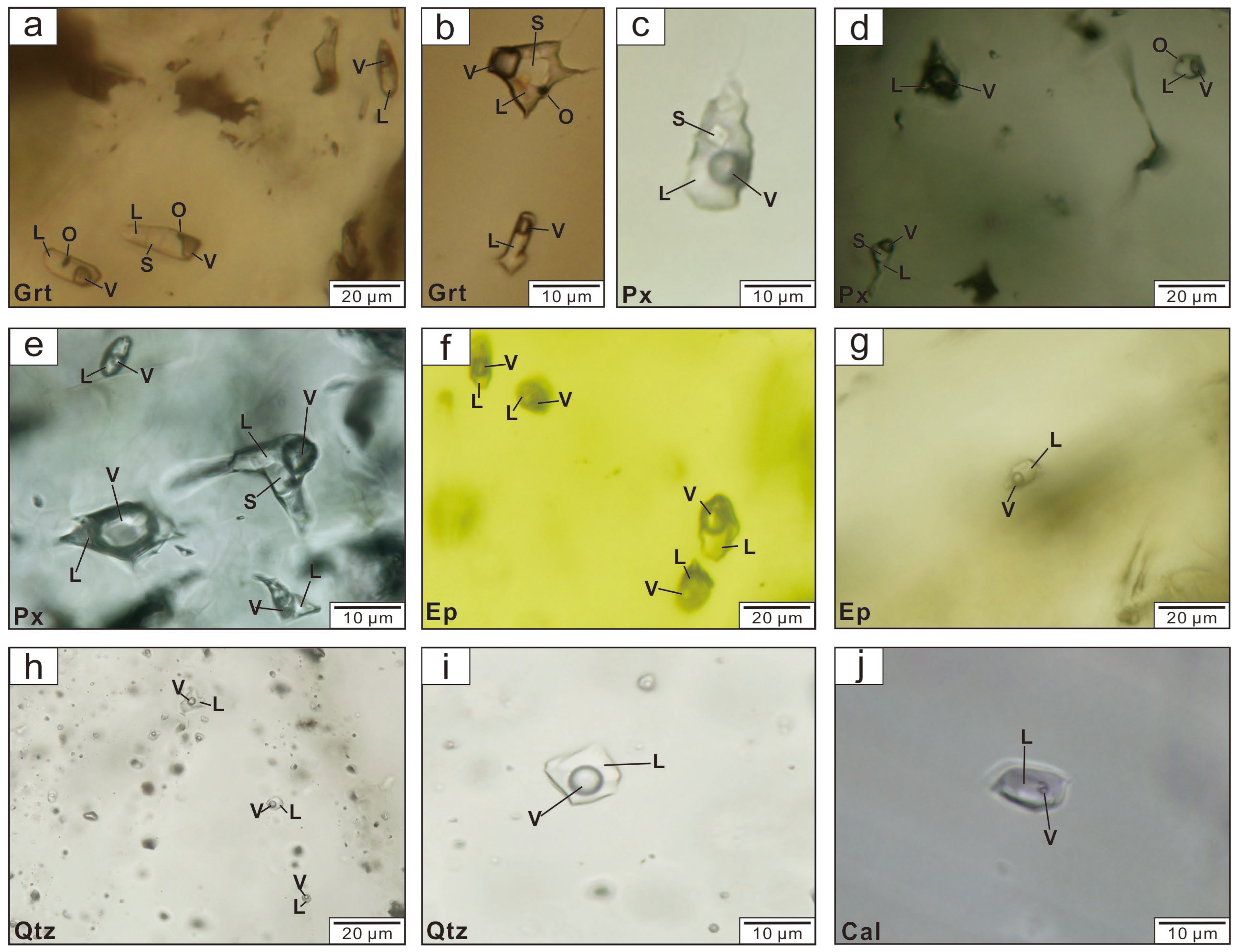
In the Litun skarn iron deposit, fluid inclusions are observed within minerals such as garnet, pyroxene, epidote, quartz, and calcite. The fluid inclusions are mainly round, oval, or irregular in shape and are distributed in clusters or in isolation, indicating a possible primary origin for these fluid inclusions [16]. Fluid inclusions are categorized into three types according to their characteristics at room temperature: daughter mineral-bearing multiple-phase inclusions (LVS type); two-phase, vapor-rich, aqueous inclusions (VL type); two-phase, liquid-rich, aqueous inclusions (LV type). LVS-type inclusions are composed of liquid (L), vapor (V), and a cubic halite crystal (S), or occasionally opaque minerals (O) at room temperature. The characteristics of these types of inclusions at different stages are summarized below.
Skarn stage: The anhydrous skarn minerals contain abundant LVS-type (Figure 5a–c) and LV-type fluid inclusions (Figure 5a,b,d,e) and a small amount of VL-type fluid inclusions (Figure 5d,e). They predominantly occur in clusters of fluid inclusions (Figure 5a), with minor isolated fluid inclusions. LVS- and LV-type fluid inclusions coexist in the same crystal with rare VL fluid inclusions, which are also seen in pyroxene (Figure 5d,e). Some LVS-type fluid inclusions contain opaque minerals (Figure 5a,b,d), measuring ≤2 μm in diameter and exhibiting a yellow hue. These opaque minerals are assumed to be pyrite or pyrrhotite (cf. [17]). The majority of these inclusions range in size from 6 to 40 μm and have irregular or oval shapes. At room temperature, LV-type fluid inclusions contain vapor bubbles comprising between 10% and 40% of their volume, whereas, in VL-type fluid inclusions, these bubbles occupy a larger portion, ranging from 60% to 85% of the total volume at room temperature.
Oxide stage: The fluid inclusions in the epidote are mainly the LV type (Figure 5f,g). These inclusions occur in both clustered (Figure 5f) and isolated (Figure 5g) distributions. Their sizes range from 6 to 20 µm, with oval or negative crystals, and irregular shapes. In these inclusions, the volume occupied by vapor bubbles ranges from 10% to 35% at room temperature.
Sulfide stage: Quartz crystals from the sulfide stage predominantly consist of LV-type fluid inclusions (Figure 5h,i). These LV-type fluid inclusions are mostly round or oval in shape, contain a vapor bubble (10 to 20 vol%), and measure between 4 to 8 µm in size. These inclusions occur in both clustered (Figure 5h) and isolated (Figure 5i) distributions.
Carbonate stage: Calcite from the carbonate stage exclusively contains the LV-type fluid inclusions (Figure 5j). These inclusions are generally isolated, with a round or oval shape, and measure between 4 and 8 µm in diameter. In these inclusions, the volume occupied by vapor bubbles ranges from 4% to 20% at room temperature.

5.2. Fluid Inclusion Microthermometry

The microthermometric characteristics of the fluid inclusions from different mineralization stages are described below, with the results of the microthermometry summarized in Figure 6 and Table 1. No aqueous–carbonic inclusions or saline minerals apart from halite were observed. Additionally, the primary LV-type fluid inclusions exhibited initial melting temperatures close to −21 °C. Therefore, these fluid inclusions likely pertain to the NaCl–H2O system. The salinities (expressed as wt% NaCl eqv.) of LV- and LVS-type fluid inclusions were calculated by means of the ice melting temperatures [18] and the melting temperatures of halite [19], respectively.
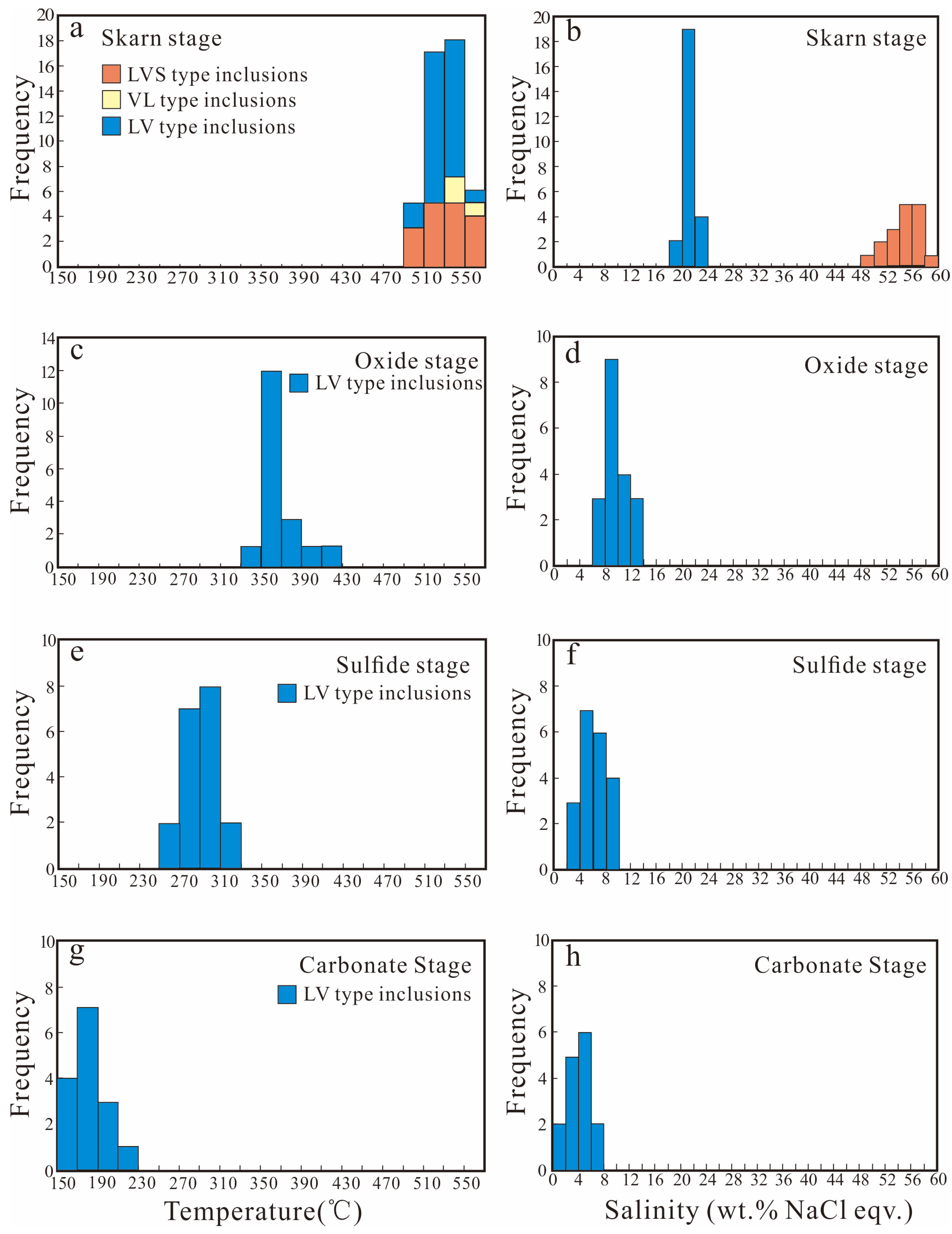
Skarn stage: The LVS-type fluid inclusions from the skarn stage show final homogenization temperatures of 501.2 to >550 °C, with a mode at 510 to 550 °C (Figure 6a). The halite dissolution temperature values are between 416.7 °C and 497.3 °C, corresponding to salinities of 49.30 to 59.40 wt% NaCl eqv., with a mode at 54 to 58 wt% NaCl eqv. (Figure 6b). The final homogenization temperatures of the LV-type fluid inclusions from the skarn stage range from 498.4 to >550 °C, with a mode at 510 to 550 °C (Figure 6a). Their final ice melting temperatures are between −21.0 °C and −15.1 °C, corresponding to salinities of 18.63 to 23.05 wt% NaCl eqv., with a mode at 20 to 22 wt% NaCl eqv. (Figure 6b). The VL-type fluid inclusions from the skarn stage show final homogenization temperatures of 545.1 to >550 °C, and no final ice-melting point temperature was obtained. A number of skarn-stage fluid inclusions could not achieve full homogenization within the upper temperature limit (550 °C) of the Linkam THMS-600 stage. These over-limit data were not eliminated during statistics; for plotting in Figure 6a, all censored Th values (>550 °C) were assigned to the highest temperature bin (550 to 570 °C). Accordingly, all reported homogenization temperatures of skarn-stage fluids are only minimum estimates of real trapping temperatures.
Oxide stage: The epidote LV-type fluid inclusions have homogenization temperatures of 364.1 to 435.7 °C, with a mode at 350 to 370 °C (Figure 6c). The final ice-melting temperatures vary from −9.2 °C to −4.0 °C, corresponding to salinities of 6.45 to 13.07 wt% NaCl eqv., with a mode at 8 to 10 wt% NaCl eqv. (Figure 6d).
Sulfide stage: In this stage, only LV-type fluid inclusions were observed in quartz crystals. The homogenization temperatures of all the LV-type inclusions are between 286.5 and 338.2 °C, with a mode at 290 to 310 °C (Figure 6e). The final ice-melting temperatures vary from −6.6 to −2.2 °C, corresponding to salinities of 3.06 to 9.98 wt% NaCl eqv., with a mode at 4 to 6 wt% NaCl eqv. (Figure 6f).
Carbonate stage: Only LV-type fluid inclusions are recognized in the calcite from the carbonate stage, and they show final homogenization temperatures between 150.2 and 212.5 °C, with a mode at 170 to 190 °C (Figure 6g). The final melting temperatures of ice vary from −3.8 to −0.7 °C, with salinities ranging from 1.23 to 6.16 wt% NaCl eqv., with a mode at 4 to 6 wt% NaCl eqv. (Figure 6h).

5.3. Hydrogen and Oxygen Isotopes

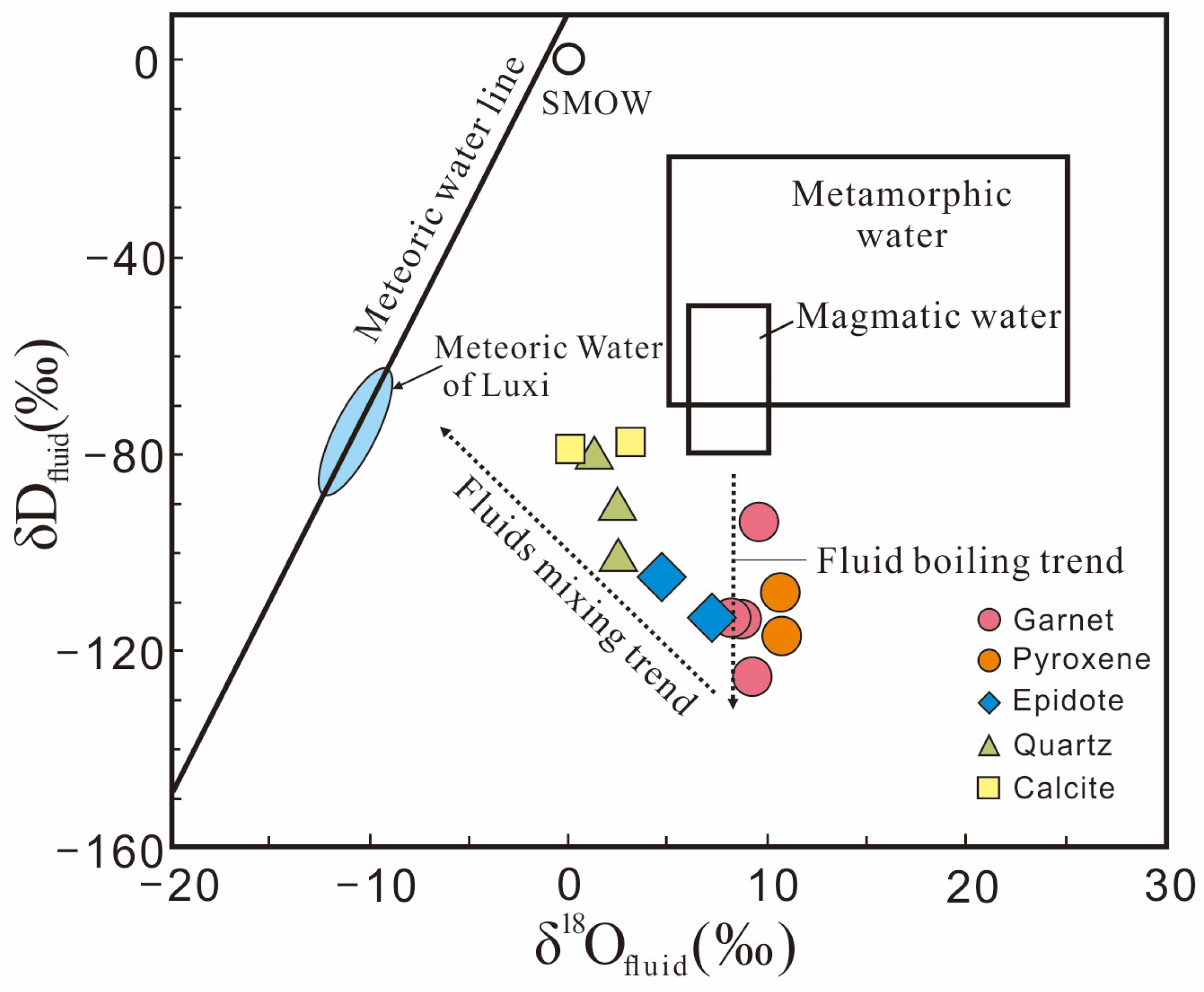
For the analysis of hydrogen and oxygen isotopes, the samples were identical to those used in petrographic and microthermometric examinations. The hydrogen and oxygen isotopic characteristics of the fluid inclusions and host minerals from different stages are described below, and the isotope data are presented in Table 2. The δDV-SMOW values for the epidote of the oxide stage are between −148.7 and −140.5‰. According to the fractionation equations for epidote [20], combined with the fluid inclusion microthermometric results, the δDfluid values for the oxide stage were calculated to be −112.6 to −104.4‰. The δDfluid values range from −125.0 to −93.4‰ for the skarn stage, from −101.5 to −80.7‰ for the sulfide stage, and from −79.3 to −77.9‰ for the carbonate stage.
The δ18OV-SMOW values range from 6.3 to 7.6‰ for garnet, 8.7 to 8.8‰ for pyroxene, 4.7 to 7.2‰ for epidote, 7.8 to 9.2‰ for quartz and 13.4 to 10.5‰ for calcite. Combining with the fractionation equations for garnet, pyroxene [21], epidote [22], quartz [23] and calcite [24], these δ18OV-SMOW values and the fluid inclusion microthermometric results indicate that δ18Ofluid values are 8.3 to 10.8‰ for the skarn stage, 4.6 to 7.4‰ for the oxide stage, 1.3 to 2.7‰ for the sulfide stage and 0.3 to 3.2‰ for the carbonate stage.

5.4. Sulfur Isotope

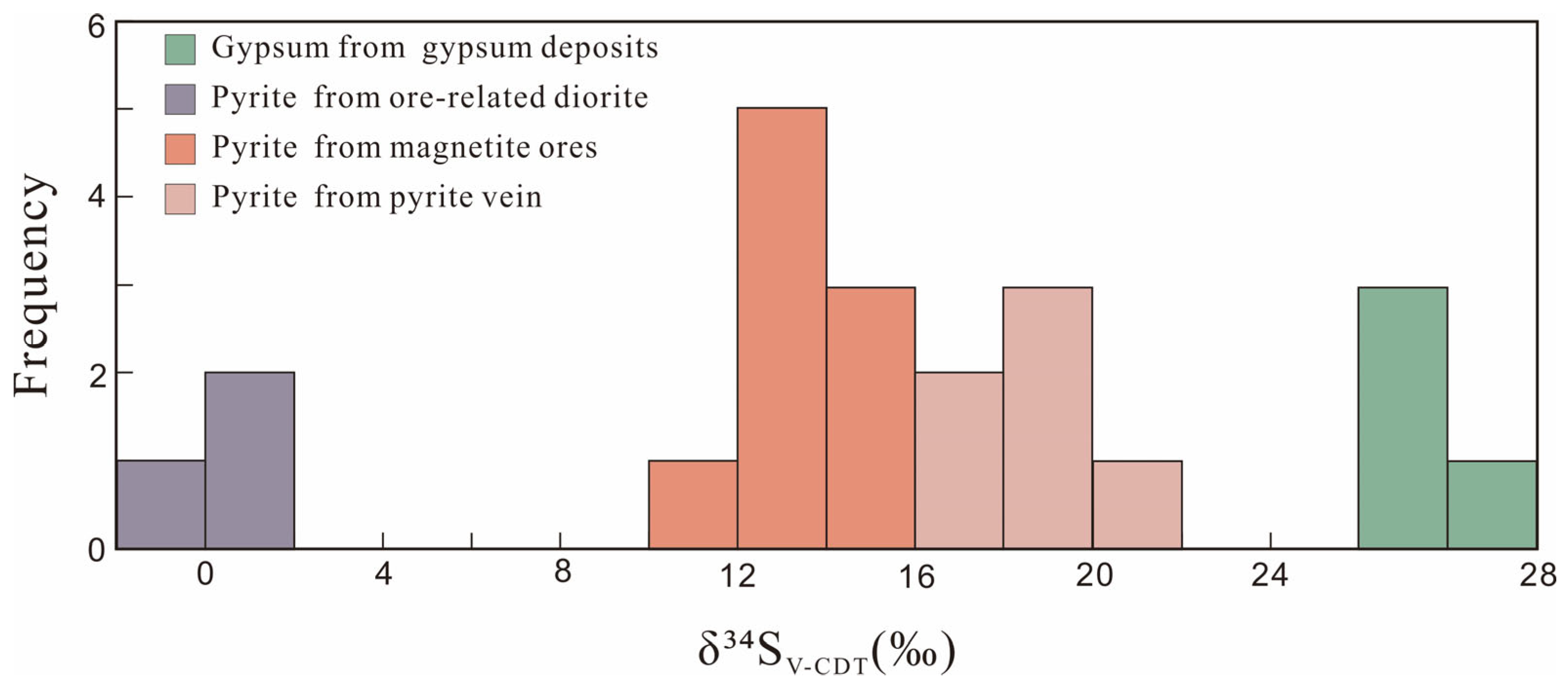
Sulfur isotopic results of nine pyrites coexisting with magnetite from the magnetite ores, six pyrites from pyrite veins, and three pyrites from the ore-related monzodiorite in the Litun deposit are exhibited in Table 3. The δ34SV-CDT values of nine pyrite samples from the magnetite ores range from 12.0 to 15.0‰, six pyrite samples from the pyrite veins are between 17.3 and 20.9‰, and three pyrite from the ore-related monzodiorite are between −0.8 and 1.1‰.

6. Discussion

6.1. Sources and Evolution of Ore-Forming Fluids

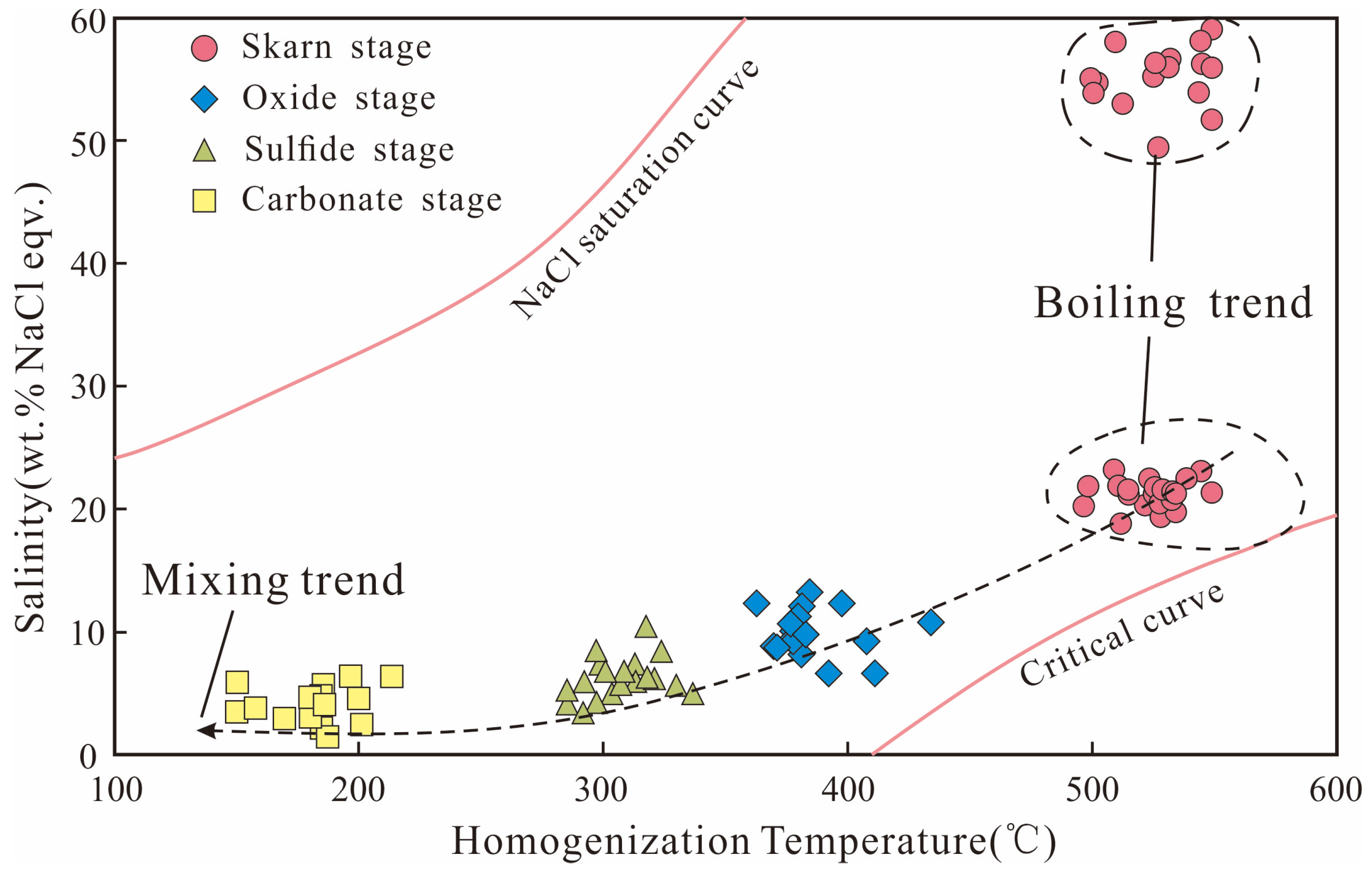
In the skarn stage, the fluid inclusions found within the garnet and pyroxene generally formed at temperatures mostly above 500 °C, similar to the characteristics of magmatic-hydrothermal fluid [26,27,28,29]. The ore-forming fluids during the skarn stage show relatively high and constant δ18Ofluid values (8.3 to 10.8‰), which align with the values typically observed in magmatic fluids (5.5 to 10.0‰; [30,31,32]). This indicates that the ore-forming fluids during the skarn stage were primarily of magmatic origin, without appreciable contribution from external fluids. However, the δDfluid values of the garnet and pyroxene are markedly lower compared to those of typical magmatic fluids (−80 to −40‰; [33]) and fall under the fields of magmatic water (Figure 7). The relatively low δDfluid values in the skarn stage may have been related to boiling, which will decrease the δDfluid values of residual magmatic water by Rayleigh fractionation [34], together with early magmatic degassing before fluid exsolution. Moreover, LVS-, LV-, and VL-type fluid inclusions coexist within a small area of garnet or pyroxene grains (Figure 5d,e); all inclusions display oval shapes, no secondary inclusion trails are visible, confirming synchronous trapping of these three inclusion types as one fluid inclusion assemblage. No petrographic textures recording heterogeneous entrapment or post-entrapment modification were recognized, though we acknowledge that the upper heating stage limit of 550 °C prevents full homogenization testing of VL-type inclusions. These assemblages exhibit comparable homogenization temperatures (498.4 to >550 °C, Figure 8), along with different salinities and homogenization modes (to liquid and vapor), further indicating the occurrence of the boiling effect of fluids during the skarn stage. The universal presence of yellow, opaque minerals (inferred to be pyrite or pyrrhotite) within fluid inclusions from the skarn stage (Figure 5a,b,d) suggests that hydrothermal fluids during the skarn stage possess a significant amount of iron. Thus, the hydrothermal fluids during the skarn stage exhibit characteristics of iron-rich, high-temperature, and high-salinity magmatic-hydrothermal fluids.
During the oxide stage, the fluid inclusions within epidote recorded cooler (364.1 to 435.7 °C) and more dilute (6.45 to 13.07 wt% NaCl eqv.) characteristics of the ore-forming fluids (Figure 8). Compared with the fluids of the skarn stage, the ore-forming fluids of the oxide stage have higher δDfluid (−112.6 to −104.4‰) values and lower δ18Ofluid (4.7 to 7.4‰) values, and these trends could indicate the mixing of meteoric water and magmatic-hydrothermal fluids. The incorporation of meteoric water into ore-forming fluids may be the primary factor contributing to the significant simultaneous decline in both temperature and salinity of the hydrothermal fluids in the oxide stage. During the sulfide stage, there was a continuous infiltration of meteoric water into the hydrothermal fluid, as evidenced by the hydrogen and oxygen isotopic compositions, which exhibit an approximately linear trend converging towards the isotopic field of Mesozoic meteoric water in the Luxi district (Figure 7). As a result, the temperature cooled to a range of 286.5 to 338.2 °C and the salinity decreased to values spanning from 3.06 to 9.98 wt% NaCl eqv. (Figure 8). The hydrothermal fluids in the carbonate stage are marked by the lowest temperatures (150.2 to 212.5 °C, Figure 8) and salinities (1.23 to 6.16 wt% NaCl eqv., Figure 8). The hydrogen and oxygen isotopic compositions, which resemble the values of meteoric water (Figure 7), indicate that more meteoric water entered and dominated the hydrothermal system in the carbonate stage.

6.2. Source of Sulfur

The presence of sulfides (including pyrite, chalcopyrite, and pyrrhotite) and the absence of sulfate minerals (e.g., gypsum and anhydrite) in the deposit indicate that sulfur is primarily present in the hydrothermal fluid as S2-. Consequently, the δ34SV-CDT values of sulfides can be considered to represent the total sulfur value (δ34S∑S) within the hydrothermal fluid [38]. The δ34SV-CDT values of pyrite from the magnetite ores range from 12.0 to 15.0‰, much higher than the values of pyrite from the ore-related monzodiorite (−0.8 to 1.1‰, Table 3). This indicates the contributions of sulfur from crustal sources with high δ34S values. Evaporites are widely distributed within the Ordovician strata of the NCC, containing sulfate with high δ34S values (26.9 to 28.6‰; Figure 9). The Litun deposit is closely associated with the Majiagou Formation containing evaporites. Considering the geological characteristics and sulfur isotopic composition, it is suggested that evaporites from the Ordovician Majiagou Formation have provided substantial quantities of sulfur to the metallogenic system in the Litun deposit. Pyrite from the ore-related monzodiorite with low δ34SV-CDT values (−0.8 to 1.1‰, Figure 9) indicate that evaporites were not assimilated by the magma. The low δ18Ofluid in the skarn and oxide stage (4.7 to 10.8‰; Table 2) suggests that assimilation of evaporites through fluid–wall rock interaction is unlikely [39]. Mixing meteoric water containing dissolved evaporites may be an available pathway for incorporating evaporites into ore-forming fluids [17]. Dissolved evaporite sulfate was introduced into the hydrothermal system via infiltrating meteoric water, and thermochemical sulfate reduction (TSR) occurred at 360 to 440 °C, generating abundant H2S. Thus, both dissolved SO42− and reduced H2S coexisted in the fluid, and the solid sulfate phases were completely consumed during TSR, resulting in no preserved sulfate minerals in the deposit. Pyrite from the pyrite veins has higher δ34SV-CDT values (17.3 to 20.9‰; Table 3) than pyrite from magnetite ores (12.0 to 15.0‰; Table 3). We constructed a two-endmember mass balance model with magmatic sulfur (δ34S = 0‰) and evaporite sulfate sulfur (δ34S = 27.8‰) as endmembers to quantitatively constrain sulfur mixing ratios. Calculations show that magnetite-ore pyrite contains ~45% to 55% evaporite-derived sulfur, while vein pyrite incorporates ~65% to 75% evaporite sulfur. It further indicates that the proportion of sulfur derived from evaporites is increasingly significant as meteoric water continues to infiltrate.

6.3. Mechanism of Magnetite Precipitation

The transport form of iron within ore-forming fluids is a crucial factor in understanding the mechanism for magnetite precipitation. Previous studies in fluids exsolution from magma have shown that iron is predominantly dissolved in the form of Cl- complexes and that neither the composition of the melt nor the oxygen fugacity affects the transport form [40]. Among hydrothermal solutions that have equilibrated with mineral assemblages ranging from fayalite–magnetite–quartz to hematite–magnetite, ferrous iron generally significantly predominates over ferric iron [41]. Therefore, iron mainly exists as ferrous chloride complexes in magmatic-hydrothermal fluids [17]. The temperature (498.4 to >550 °C, Figure 8) and oxygen isotope characteristics (δ18Ofluid 8.3 to 10.8‰) of ore-forming fluids suggest that the fluids in the skarn stage are predominantly magmatic-hydrothermal fluids, with no involvement from other fluids. The presence of yellow, opaque minerals (inferred to be pyrite or pyrrhotite) within fluid inclusions during the skarn stage further confirms that iron is dominated by ferrous chloride complexes in the hydrothermal fluids during the skarn stage.
Ferrous iron appears to be the predominant redox state in hydrothermal fluids during the skarn stage, yet magnetite precipitated in ore-forming fluids is ubiquitously ferric-iron bearing. This latter process raises major questions concerning the sufficient oxidation of Fe2+ to Fe3+ in magmatic-hydrothermal environments related to skarn iron deposits. The higher δDfluid (−112.6 to −104.4‰) and lower δ18Ofluid (4.7 to 7.4‰) in the oxide stage suggest a mixture of meteoric water and magmatic fluids. Pyrite from magnetite ores exhibits δ34SV-CDT values (12.0 to 15.0‰; Table 3) that are significantly higher than those of sulfur of magmatic origin, indicating the involvement of sulfates from evaporites in the mineralization process. Furthermore, the increases in the percentages of meteoric water in the ore-forming fluids over time (Figure 7) are similar to marked increases in the proportion of sulfur derived from evaporites, indicating that evaporites have been incorporated into ore-forming fluids by mixing meteoric water. The sulfates from evaporites can serve as crucial oxidant, facilitating the precipitation of substantial quantities of iron from hydrothermal fluids in the form of magnetite [42].
The stoichiometric redox reaction governing this oxidation–precipitation process is balanced as follows:
12Fe2+ + SO42− + 12H2O = 4Fe3O4↓ + H2S + 22H+
In this reaction, evaporite-derived sulfate oxidizes dissolved ferrous chloride complexes to generate magnetite containing Fe3+, while sulfate reduction releases H2S that subsequently combines with residual Fe2+ to form pyrite. This coupled reaction mechanism matches the widespread intergrowth textures of magnetite and pyrite observed in thin sections (Figure 4g,h), which record synchronous precipitation of the two minerals during oxide-stage mineralization.
Therefore, we infer that the mixing of meteoric water containing dissolved evaporites and iron-rich magmatic-hydrothermal fluids may be the primary precipitation mechanism of magnetite in the Litun deposit.

6.4. Significance for the Regional Metallogeny

Magmatic-hydrothermal iron deposits are spatially controlled by evaporite sequences. Within the Middle-Lower Yangtze metallogenic belt, magmatic intrusions linked to iron oxide–apatite (IOA) deposits frequently intrude and crosscut the Triassic gypsum–salt strata, and iron mineralization occurs adjacent to these formations. Magmatic intrusions related to IOA deposits contain massive melt relics of sedimentary anhydrite, with extensive hydrothermal anhydrite occurring in orebodies [43]. Sulfides in these deposits show high δ34S signatures. For instance, pyrite from the Zhonggu ore field yields δ34S values ranging from 11.43‰ to 19.80‰ [42]. Assimilation of abundant Triassic evaporites by ascending magmas is regarded as the primary genetic factor for the formation of such IOA deposits [43].
Large-scale iron mineralization within the NCC is spatially tightly coupled with Middle Ordovician evaporite-bearing carbonate successions. These skarn-type iron deposits are mainly hosted in contact zones and their surrounding areas between magmatic intrusions and the above-mentioned Middle Ordovician evaporite-bearing carbonate successions. Hydrothermal anhydrite occurs scarcely in most skarn deposits, especially in skarn iron deposits within the North China Craton. However, the sulfur isotopic characteristics of these deposits (e.g., the Baijian deposit, 16.1 to 21.8‰ [39]; the Xishimen deposit, 14.0 to 18.6‰ [17]) robustly confirm the contribution of evaporites in the mineralization process. Fluid–wall rock interaction may represent the dominant mechanism for evaporite involvement in mineralization of the Baijian deposit. For the Litun deposit, leaching of evaporites by meteoric water followed by mixing into the ore-forming system constitutes a vital mechanism through which evaporites contribute to ore formation. The absence of hydrothermal sulfate minerals in deposits may result from the limited solubility of evaporites in circulating ore-forming hydrothermal fluids and meteoric water. Nevertheless, the vital role of evaporites in iron ore genesis cannot be ignored. Collectively, the involvement of evaporites may play a key role in large-scale skarn iron mineralization in the NCC.

7. Conclusions

The Litun deposit is located at the contact zones between the Litun monzodiorite and the Carboniferous Yuemengou Formation. The mineralization processes include the following four stages: the skarn, oxide, sulfide, and carbonate stages. The hydrothermal fluids in the skarn stage exhibit characteristics of iron-rich, high-temperature, and high-salinity magmatic-hydrothermal fluids. Meteoric water was involved in the oxide stages and percentages of meteoric water gradually increased during later stages. Sulfates from evaporites have been incorporated into ore-forming hydrothermal fluids by mixing meteoric water containing dissolved evaporites. The mixing of meteoric water containing dissolved evaporites and iron-rich magmatic-hydrothermal fluids may be the major mechanism of magnetite precipitation in the Litun deposit. The involvement of evaporites has significantly contributed to the formation of the Litun deposit and is also a key factor in the extensive skarn iron mineralization in the North China Craton.

Author Contributions

Z.Z. and L.S.: contributed equally to this research. Conceptualization, Z.Z. and L.S.; field investigation, L.Z. and Y.L.; experimental and data analysis, N.C. and W.H.; writing—original draft preparation, Z.Z.; writing—review and editing, Z.Z. and L.S.; visualization, Y.Z. (Yang Zhao) and X.W.; project administration, L.S.; funding acquisition, Y.Z. (Yuzhen Zhu). All authors have read and agreed to the published version of the manuscript.

Funding

This research was funded by the Shandong Provincial Natural Science Foundation (Grant number ZR2022QD073) and a special research award fund project of the Shandong Bureau of Coal Geology (Grant number HBC210).

Data Availability Statement

The data we are using for this article are open access and public.

Acknowledgments

We thank Jiyun Guan, Kang Sun, Niannian Li, Ke Tian, and Huijun Zhang for their invaluable support during the field trip and laboratory work. We also sincerely appreciate the Academic Editor Paul Alexandre and the three anonymous reviewers for their insightful comments and constructive suggestions that greatly improved this manuscript.

Conflicts of Interest

The authors declare no conflicts of interest.

References

  1. Zhang, Z.C.; Li, H.; Li, J.; Song, X.Y.; Hu, H.; Li, L.; Chai, F.; Hou, T.; Xu, D. Geological settings and metallogenesis of high-grade iron deposits in China. Sci. China Earth Sci. 2021, 64, 691–715. [Google Scholar] [CrossRef]
  2. Duan, Z.; Li, J.W. Zircon and titanite U-Pb dating of the Zhangjiawa iron skarn deposit, Luxi district, North China Craton: Implications for a craton-wide iron skarn mineralization. Ore Geol. Rev. 2017, 89, 309–323. [Google Scholar] [CrossRef]
  3. Liang, X.; Wang, F.Y.; Zhang, J.Q.; Zhang, L.; Zhou, T.F.; Fan, Y.; Qin, C.; Zhang, J.W. Enrichment of cobalt at Baijian skarn Fe-Co deposit in the Handan-Xingtai region, North China Craton: Insights from mineral trace elements and pyrite sulfur isotopes. J. Asian Earth Sci. 2024, 273, 106265. [Google Scholar] [CrossRef]
  4. Zhang, H.D.; Wang, D.Q.; Liu, J.C.; Yang, J.K. Geology, geochronology, and fluid evolution of the Pingshun skarn iron deposit, southern Taihang Mountains. Arab. J. Geosci. 2019, 12, 497. [Google Scholar] [CrossRef]
  5. Wen, G.; Li, J.W.; Hofstra, A.H.; Koenig, A.E.; Cui, B.Z. Textures and compositions of clinopyroxene in an Fe skarn with implications for ore-fluid evolution and mineral-fluid REE partitioning. Geochim. Cosmochim. Acta 2020, 290, 104–123. [Google Scholar] [CrossRef]
  6. Zhang, Z.N.; Cao, Y.; Zhu, Y.Z.; Pang, Z.S.; Shen, L.J.; Guan, J.Y.; Guo, C.F. Enrichment mechanism of iron in the Dazhang skarn iron deposit, Shandong Province: Evidence from fluid inclusions and hydrogen-oxygen isotopes. Miner. Depos. 2022, 41, 91–105, (In Chinese with English abstract). [Google Scholar] [CrossRef]
  7. Xie, Q.H.; Zhang, Z.C.; Hou, T.; Jin, Z.L.; Santosh, M. Geochemistry and oxygen isotope composition of magnetite from the Zhangmatun deposit, North China Craton: Implications for the magmatic-hydrothermal evolution of Cornwall-type iron mineralization. Ore Geol. Rev. 2017, 88, 57–70. [Google Scholar] [CrossRef]
  8. Chen, Y.H.; Lan, T.G.; Gao, W.; Shu, L.; Tang, Y.W.; Hu, H.L. In-situ texture and geochemistry of apatite from the Jinling and Zhangjiawa iron skarn deposits, eastern North China Craton: Implications for ore-forming processes and formation of high-grade ores. Ore Geol. Rev. 2023, 158, 105483. [Google Scholar] [CrossRef]
  9. Cai, B.J.; Li, X.; Wei, S.; Cui, Y.; He, J. Features of the middle Ordovician evaporates and its control over endogenic iron(sulfur) deposits in Han-Xing district, Hebei. Bull. Inst. Geomech. Cags 1987, 10, 1–84, (In Chinese with English abstract). [Google Scholar]
  10. Zhu, R.X.; Chen, L.; Wu, F.Y.; Liu, J.L. Timing, scale and mechanism of the destruction of the North China Craton. Sci. China Earth Sci. 2011, 54, 789–797. [Google Scholar] [CrossRef]
  11. Xie, Q.H.; Zhang, Z.C.; Jin, Z.L.; Santosh, M.; Han, L.; Wang, K.Y.; Zhao, P.; He, H.H. The high-grade Fe skarn deposit of Jinling, North China Craton: Insights into hydrothermal iron mineralization. Ore Geol. Rev. 2021, 138, 104395. [Google Scholar] [CrossRef]
  12. Zhu, Y.Z.; Zhang, Z.N.; Shen, L.J.; Li, X.Y.; Sun, K.; Guo, C.F.; Wang, X.D.; Shen, Y.; Gao, Z.J.; Shao, Y.B. First report on zircon U-Pb age (125.9 Ma) of the quartz monzonite from the Pandian skarn iron deposit in the Luxi area, Eastern China. China Geol. 2022, 5, 185–187. [Google Scholar] [CrossRef]
  13. Shen, L.J.; Zhu, Z.Y.; Wang, H.H.; Li, S.; Gao, Z.J.; Zhang, X.B.; Zhou, M.L. Geochemical characteristics and geological significance of Litun iron ore deposit in Qihe-Yucheng area, Shandong Province. Geol. Rev. 2021, 67, 84–98, (In Chinese with English abstract). [Google Scholar] [CrossRef]
  14. Kyser, T.K.; O’Neil, J.R. Hydrogen isotope systematics of submarine basalts. Geochim. Cosmochim. Acta 1984, 48, 2123–2133. [Google Scholar] [CrossRef]
  15. Clayton, R.N.; Mayeda, T.K. The use of bromine pentafluoride in the extraction of oxygen from oxides and silicates for isotopic analysis. Geochim. Cosmochim. Acta 1963, 27, 43–52. [Google Scholar] [CrossRef]
  16. Roedder, E. Fluid inclusions. Rev. Mineral. Geochem. 1984, 12, 644. [Google Scholar]
  17. Wen, G.; Bi, S.J.; Li, J.W. Role of evaporitic sulfates in iron skarn mineralization: A fluid inclusion and sulfur isotope study from the Xishimen deposit, Handan-Xingtai district, North China Craton. Miner. Depos. 2017, 52, 495–514. [Google Scholar] [CrossRef]
  18. Bodnar, R.J. Revised equation and table for determining the freezing point depression of H2O-NaCl solutions. Geochim. Cosmochim. Acta 1993, 57, 683–684. [Google Scholar] [CrossRef]
  19. Hall, D.L.; Sterner, S.M.; Bodnar, R.J. Freezing point depression of NaCl-KCl-H2O solutions. Econ. Geol. 1988, 83, 197–202. [Google Scholar] [CrossRef]
  20. Chacko, T.; Riciputi, R.; Cole, R.; Horita, J. A new technique for determining equilibrium hydrogen isotope fractionation factors using the ion microprobe: Application to the epidote-water system. Geochim. Cosmochim. Acta 1999, 63, 1–10. [Google Scholar] [CrossRef]
  21. Zheng, Y.F. Calculation of oxygen isotope fractionation in anhydrous silicate minerals. Geochim. Cosmochim. Acta 1993, 57, 1079–1091. [Google Scholar] [CrossRef]
  22. Zheng, Y.F. Calculation of oxygen isotope fractionation in hydroxyl-bearing silicates. Earth Planet. Sci. Lett. 1993, 120, 247–263. [Google Scholar] [CrossRef]
  23. Clayton, R.N.; O’Neil, J.R.; Mayeda, T.K. Oxygen isotope exchange between quartz and water. J. Geophys. Res. 1972, 77, 3057–3067. [Google Scholar] [CrossRef]
  24. O’Neil, J.R.; Clayton, R.; Mayeda, T. Oxygen isotope fractionation in divalent metal carbonates. J. Chem. Phys. 1969, 51, 5547–5558. [Google Scholar] [CrossRef]
  25. Duan, Z. The Mineralization and Mechanism of the Iron Skarn Deposits in Laiwu District, Shandong Province. Ph.D. Thesis, China University of Geosciences, Wuhan, China, 2019. [Google Scholar]
  26. Meinert, L.D.; Dipple, G.M.; Nicolescu, S. World Skarn Deposits. In Economic Geology 100th Anniversary Volume, 1st ed.; Hedenquist, J.W., Thompson, J.F.H., Goldfarb, R.J., Richards, J.P., Eds.; Society of Economic Geologists: Littleton, CO, USA, 2005; pp. 299–336. [Google Scholar] [CrossRef]
  27. Cao, Y.; Du, Y.; Gao, F.; Hu, L.; Xin, F.; Pang, Z. Origin and evolution of hydrothermal fluids in the Taochong iron deposit, Middle–Lower Yangtze Valley, Eastern China: Evidence from microthermometric and stable isotope analyses of fluid inclusions. Ore Geol. Rev. 2012, 48, 225–238. [Google Scholar] [CrossRef]
  28. Cao, Y.; Zheng, Z.J.; Du, Y.L.; Gao, F.P.; Qin, X.L.; Yang, H.; Lu, Y.H.; Du, Y.S. Ore geology and fluid inclusions of the Hucunnan deposit, Tongling, Eastern China: Implications for the separation of copper and molybdenum in skarn deposits. Ore Geol. Rev. 2017, 81, 925–939. [Google Scholar] [CrossRef]
  29. Xue, L.W.; Wang, G.W.; Tang, L.G.; Cao, Y.; Du, J.G.; Du, Y.S.; Luo, L.; Cheng, H.T. Genesis and hydrothermal evolution of the Zhazigou skarn W (Mo) deposit, East Qinling, China: Constraints from fluid inclusions and H–O–S–Pb isotopes. Ore Geol. Rev. 2021, 138, 104374. [Google Scholar] [CrossRef]
  30. Li, W.; Xie, G.Q.; Mao, J.W.; Zhu, Q.Q.; Zheng, J.H. Mineralogy, Fluid Inclusion, and Stable Isotope Studies of the Chengchao Deposit, Hubei Province, Eastern China: Implications for the Formation of High-Grade Fe Skarn Deposits. Econ. Geol. 2019, 114, 325–352. [Google Scholar] [CrossRef]
  31. Masoumipour, Z.; Jamali, H.; Harris, C.; Lentz, D.R.; Yousefi, F. Origin and evolution of the ore-forming fluids in the southern Abbas Abad iron skarn deposit, NE Isfahan, Central Iran: Insights from geology, fluid inclusions, and C-O isotopes. J. Geochem. Explor. 2023, 248, 107194. [Google Scholar] [CrossRef]
  32. Taylor, H.P. Oxygen and hydrogen isotope relationships in hydrothermal mineral deposits. In Geochemistry of Hydrothermal Ore Deposits, 1st ed.; Barnes, H.L., Ed.; John Wiley & Sons: New York, NY, USA, 1997; Volume 12, pp. 229–302. [Google Scholar]
  33. Sheppard, S.M. Characterization and isotopic variations in natural waters. Rev. Mineral. Geochem. 1986, 16, 165–183. [Google Scholar] [CrossRef]
  34. Shmulovich, K.I.; Landwehr, D.; Simon, K.; Heinrich, W. Stable isotope fractionation between liquid and vapour in water–salt systems up to 600 °C. Chem. Geol. 1999, 157, 343–354. [Google Scholar] [CrossRef]
  35. Taylor, H.P. The application of oxygen and hydrogen isotope studies to problems of hydrothermal alteration and ore deposition. Econ. Geol. 1974, 69, 843–883. [Google Scholar] [CrossRef]
  36. Zhang, G.L. The Application of the Stable Isotope to Geology, 1st ed.; Shaanxi Science and Technology Publishing House: Xi’an, China, 1985; pp. 1–267. (In Chinese) [Google Scholar]
  37. Wilkinson, J.J. Fluid inclusion in hydrothermal ore deposits. Lithos 2001, 55, 229–272. [Google Scholar] [CrossRef]
  38. Zheng, Y.F.; Chen, J.F. Stable Isotope Geochemistry, 1st ed.; Science Press: Beijing, China, 2000; pp. 1–247. (In Chinese) [Google Scholar]
  39. Wen, G.; Deng, X.D.; Zhou, R.J.; Duan, Z.; Cui, B.Z.; Li, J.W. Geology, geochronology and stable isotope studies at the Baijian Fe-(Co) skarn deposit, eastern China, with implications for ore genesis and regional Fe skarn metallogeny. Ore Geol. Rev. 2024, 166, 105935. [Google Scholar] [CrossRef]
  40. Zajacz, Z.; Halter, W.E.; Pettke, T.; Guillong, M. Determination of fluid/melt partition coefficients by LA-ICPMS analysis of co-existing fluid and silicate melt inclusions: Controls on element partitioning. Geochim. Cosmochim. Acta 2008, 72, 2169–2197. [Google Scholar] [CrossRef]
  41. Scholten, L.; Schmidt, C.; Lecumberri-Sanchez, P.; Newville, M.; Lanzirotti, A.; Sirbescu, M.L.C.; Steele-MacInnis, M. Solubility and speciation of iron in hydrothermal fluids. Geochim. Cosmochim. Acta 2019, 252, 126–143. [Google Scholar] [CrossRef]
  42. Duan, C.; Li, Y.H.; Mao, J.W.; Zhu, Q.Q.; Xie, G.Q.; Wan, Q.; Jian, W.; Hou, K.J. The role of evaporite layers in the ore-forming processes of iron oxide-apatite and skarn Fe deposits: Examples from the middle-lower Yangtze River metallogenic Belt, East China. Ore Geol. Rev. 2021, 138, 104352. [Google Scholar] [CrossRef]
  43. Li, W.T.; Audétat, A.; Zhang, J. The role of evaporites in the formation of magnetite–apatite deposits along the Middle and Lower Yangtze River, China: Evidence from LA-ICP-MS analysis of fluid inclusions. Ore Geol. Rev. 2015, 67, 264–278. [Google Scholar] [CrossRef]
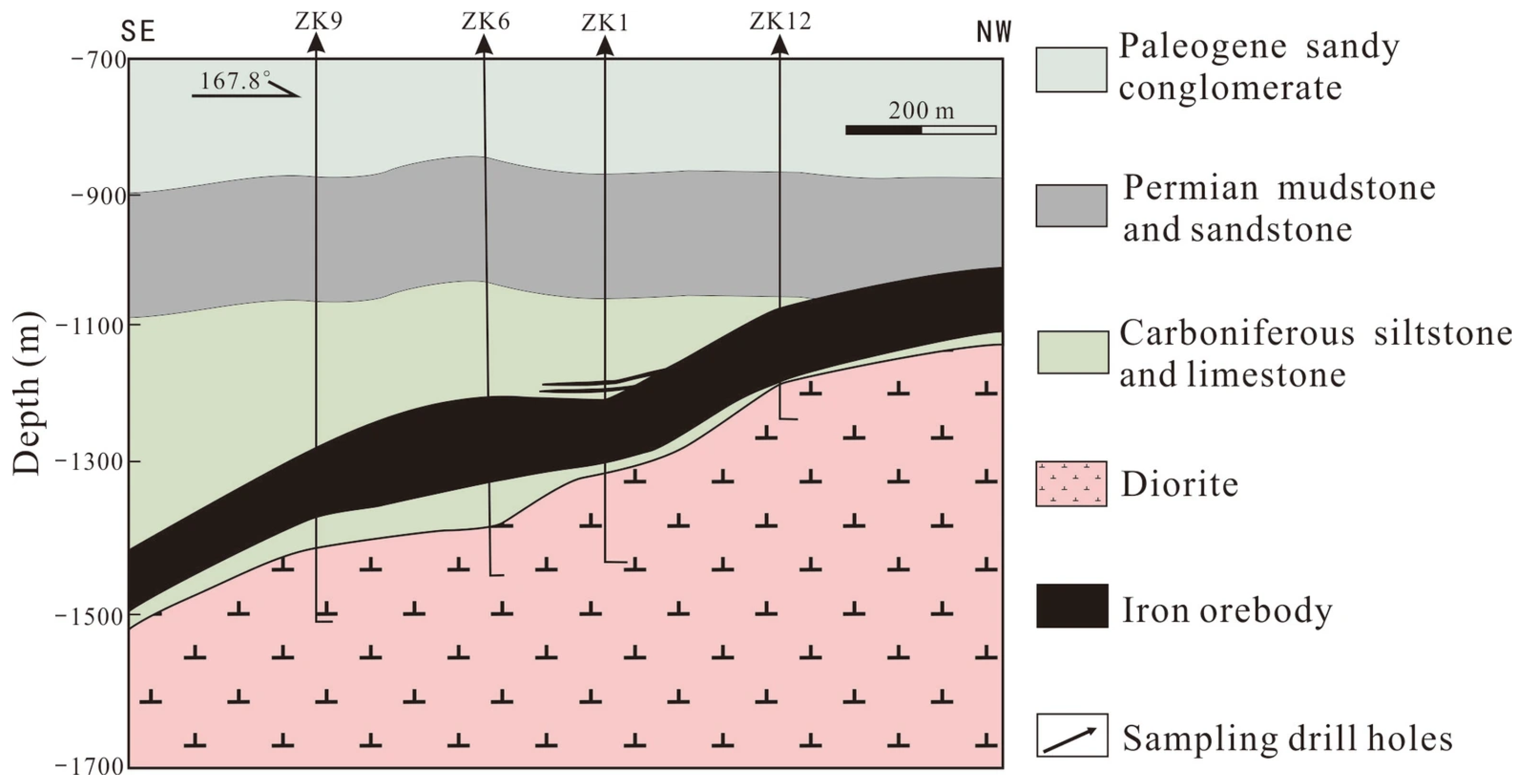
Figure 2. Geological cross-section of the Litun deposit (after [13]).
Minerals 16 00703 g002
Figure 3. Paragenetic sequence diagram of the Litun deposit. The thickness of horizontal lines represents relative mineral abundance; thicker lines correspond to higher mineral content during each metallogenic stage.
Minerals 16 00703 g003
Figure 4. Photographs of representative samples of different stages in the Litun deposit. (a) Skarn assemblages with magnetite (hand specimen). (b) Garnet with medium- to coarse-grained dodecahedral texture, full extinction under cross-polarized light (cross-polarized light). (c) Dark green pyroxenes with magnetite (hand specimen). (d) Pyroxene exhibits second-order blue-green and orange-red interference colors under cross-polarized light (cross-polarized light). (e) Magnetite with minor epidote (hand specimen). (f) Magnetite is intergrown with the euhedral granular epidote (plane-polarized transmitted light). (g) Massive magnetite ore (hand specimen). (h) Pyrite coexisting with magnetite and epidote (reflected light). (i) Quartz–pyrite veins cut across magnetite ore (hand specimen). Grt = garnet, Px = pyroxene, Mt = magnetite, Ep = epidote, Qtz = quartz, Py = pyrite.
Minerals 16 00703 g004
Figure 5. Photographs of representative primary fluid inclusions from the Litun deposit. (a) Fluid inclusion assemblage in garnet of the skarn stage. (b) Coexistence of LVS- and LV-type fluid inclusions in garnet. (c) LVS-type fluid inclusion in pyroxene. (d,e) Coexistence of LVS-, LV-, and VL-type fluid inclusions in the same crystal of pyroxene. (f) LV-type fluid inclusions clustered in epidote. (g) Isolated LV-type fluid inclusions in epidote. (h) LV-type fluid inclusions clustered in quartz. (i) LV-type fluid inclusions in quartz. (j) LV-type fluid inclusions in calcite. L = liquid, V = vapor, S = solid, O = opaque mineral, Grt = garnet, Px = pyroxene, Ep = epidote, Qtz = quartz, Cal = calcite.
Minerals 16 00703 g005
Figure 6. Frequency histogram of total homogenization temperatures and salinities of fluid inclusions from the skarn stage (a,b), oxide stage (c,d), sulfide stage (e,f), and carbonate stage (g,h). Out-of-limit data were retained in statistics, with all Th > 550 °C grouped into the 550–570 °C bin for Figure 6a plotting.
Minerals 16 00703 g006
Figure 7. δ18O vs. δD plots of the isotopic compositions of fluid inclusions from the Litun deposit (base drawing according to [35]). The range of Mesozoic meteoric water in the Luxi is from [36]. Boiling trend: Rayleigh H-isotope fractionation at skarn temperatures, tracking δD reduction of residual fluid by vapor escape. Mixing trend: binary mixing of primary magmatic fluid and local Mesozoic meteoric water, showing isotopic shift to low-δD–δ18O meteoric endmember.
Minerals 16 00703 g007
Figure 8. Diagram of homogenization temperatures vs. salinity of fluid inclusions from the Litun deposit (Base drawing according to [37]).
Minerals 16 00703 g008
Figure 9. Histogram of δ34S values for the Litun deposit.
Minerals 16 00703 g009
Table 1. Summary of microthermometric data for primary fluid inclusions from the Litun deposit.
StageHost MineralTypeNTm-ice (°C)Tm-NaCl (°C)Th (°C)Salinity (wt% NaCl eqv.)
Skarn stageGarnetLVS7 436.8 to 486.7501.2 to >550.051.65 to 57.98
LV12−21.0 to −15.1 510.7 to >550.018.63 to 23.05
DiopsideLVS10 416.7 to 497.3502.4 to >550.049.30 to 59.40
VL3  545.1 to >550.0 
LV14−19.9 to −15.7 498.4 to 540.519.21 to 22.31
Oxide stageEpidoteLV18−9.2 to −4.0 364.1 to 435.76.45 to 13.07
Sulfide stageQuartzLV19−6.6 to −2.2 286.5 to 338.23.06 to 9.98
Carbonate StageCalciteLV15−3.8 to −0.7 150.2 to 212.51.23 to 6.16
Tm-ice= temperature of final ice melting; Tm-NaCl = halite dissolution temperature; Th = temperature of homogenization; N = the number of inclusions.
Table 2. The hydrogen and oxygen isotope data of the Litun deposit.
SampleMineralCalculation Temperature (°C)δDV-SMOW (‰)δDfluid (‰)δ18OV-SMOW (‰)δ18Ofluid (‰)
15Garnet530 −113.46.88.8
16Garnet −93.47.69.6
181Garnet −112.96.38.3
180Garnet −1257.39.3
63Diopside −107.48.710.7
184Diopside −116.48.810.8
18Epidote400−148.7−112.67.27.4
50Epidote−140.5−104.44.54.7
475Quartz315 −80.77.81.3
477Quartz −90.69.12.6
326Quartz −101.59.22.7
29Calcite190 −77.913.43.2
485Calcite −79.310.50.3
Note: for anhydrous minerals (garnet, diopside, quartz, calcite), only δDfluid is listed (δDV-SMOW blank); epidote shows both mineral δDV-SMOW and modeled δDfluid.
Table 3. Sulfur isotope data of pyrite from the Litun deposit.
SampleSample DescriptionMineralδ34SV-CDT (‰)
506MonzodioritePyrite1.1
508MonzodioritePyrite0.8
127-2MonzodioritePyrite−0.8
28Magnetite orePyrite15.0
44Magnetite orePyrite14.2
45Magnetite orePyrite12.7
46Magnetite orePyrite13.2
47Magnetite orePyrite13.3
48Magnetite orePyrite13.0
49Magnetite orePyrite12.0
53Magnetite orePyrite14.1
54Magnetite orePyrite12.6
30Pyrite veinPyrite19.8
31Pyrite veinPyrite17.3
32Pyrite veinPyrite18.1
33Pyrite veinPyrite18.7
35Pyrite veinPyrite17.5
522Pyrite veinPyrite20.9
SWZ-2 *Ordovician gypsum deposits in North ChinaGypsum27.8
SWZ-3 *Ordovician gypsum deposits in North ChinaGypsum27.3
SWZ-4 *Ordovician gypsum deposits in North ChinaGypsum26.9
SWZ-7 *Ordovician gypsum deposits in North ChinaGypsum28.6
* data are from [25].
Disclaimer/Publisher’s Note: The statements, opinions and data contained in all publications are solely those of the individual author(s) and contributor(s) and not of MDPI and/or the editor(s). MDPI and/or the editor(s) disclaim responsibility for any injury to people or property resulting from any ideas, methods, instructions or products referred to in the content.