Article

Sustainable Recovery of Copper and Silver from End-of-Life Photovoltaic Panels by Leaching with Aqueous Solutions of Quaternary Imidazolium Salts

by
Monserrat Martínez
1,2,*,
Yecid P. Jiménez
2,3,4 and
Pía C. Hernández
2,3,4
1
Escuela de Ciencias de la Tierra, Facultad de Ingeniería, Universidad Andres Bello, Quillota 980, Viña del Mar 2531015, Chile
2
Departamento de Ingeniería Química y Procesos de Minerales, Facultad de Ingeniería, Universidad de Antofagasta, Av. Angamos 601, Antofagasta 1270300, Chile
3
Centro de Economía Circular en Procesos Industriales (CECPI), Facultad de Ingeniería, Universidad de Antofagasta, Av. Angamos 601, Antofagasta 1270300, Chile
4
Advanced Mining Technology Center (AMTC), University of Chile, Av. Tupper 2007 (AMTC Building), Santiago 8330015, Chile
*
Author to whom correspondence should be addressed.
Minerals 2026, 16(6), 654; https://doi.org/10.3390/min16060654 (registering DOI)
Submission received: 11 May 2026 / Revised: 12 June 2026 / Accepted: 18 June 2026 / Published: 20 June 2026

Abstract

The exponential increase in photovoltaic panel (PV) waste highlights the urgent need to develop efficient and sustainable recycling processes. It is estimated that by 2030, 8 million tons of PV modules will reach their end-of-life stage, posing a significant environmental challenge and requiring the development of green technologies for resource recovery. This study assessed the performance of imidazolium-based ionic liquids (ILs) as “designer solvents” for the selective leaching of copper and silver from disused PV panels. Specifically, four quaternary imidazolium salts were evaluated: [Bmim]HSO4, [Emim]HSO4, [Bmim]Cl, and [Emim]Cl. Leaching tests were conducted on silicon wafers containing 0.28% Ag and 0.19% Cu under varying temperatures (25, 50, and 80 °C), IL concentrations (20% and 60% v/v), and hydrogen peroxide (H2O2) dosages (0% and 3% v/v) as an oxidizing agent. The results identified [Bmim]HSO4 as the most effective leaching agent. The system achieved a maximum copper extraction of 96.70% at 60% v/v concentration and 80 °C. For silver, the highest extraction of 45.13% was obtained using [Bmim]HSO4 at 20% v/v and 80 °C. The addition of H2O2 was crucial, demonstrating a clear synergistic effect with the imidazolium-based ILs by promoting oxidative dissolution. These findings confirm that imidazolium-based ionic liquids represent a promising and environmentally friendly alternative for the recovery of high-value metals in the circular economy of photovoltaic recycling.

1. Introduction

Photovoltaic systems have expanded rapidly due to global clean-energy demands, reaching 1865 GW of installed capacity in 2024 and projected to exceed 4500 GW by 2050 [1,2,3]. Crystalline silicon modules account for about 80% of global production and are composed mainly of glass, polymers, and small but valuable amounts of silver and copper [4,5]. Their limited lifetime of 20–25 years will generate up to 80 million tons of photovoltaic module waste by 2050, raising concerns about end-of-life management and resource depletion [6,7].
Crystalline silicon photovoltaic modules account for nearly 80% of global production and consist mainly of glass, polymers and small yet valuable metallic fractions, particularly silver and copper [4,5]. The need to develop effective recycling routes arises from the presence of these strategic metals, which reach concentrations of approximately 0.8% and 0.77% in monocrystalline and polycrystalline (Si-C) solar cells, respectively [8].
The need to develop effective recycling routes arises from the presence of strategic metals and silicon, which represents the highest-cost component in the modules. Recently, photovoltaic waste silicon (wSi) has gained unprecedented attention as an anode material for lithium-ion batteries due to its ultra-high theoretical capacity of 4200 mAh/g [9,10,11]. However, its industrial utilization is hindered by surface oxide layers and metallic contamination that degrade its electrochemical performance. In this context, the selective leaching of impurities such as copper and silver using ionic liquids not only allows for the recovery of precious metals but also acts as a critical purification stage for the subsequent upcycling of silicon into advanced nanostructures, such as nanorods or nanowires, through molten salt electrolysis processes [9,11].
Several mechanical, thermal and chemical strategies have been applied to treat end-of-life photovoltaic panels [4]. Among them, hydrometallurgical approaches have shown particularly strong potential for recovering valuable materials, with leaching emerging as one of the most effective methods. Early studies demonstrated silver dissolution using nitric acid and electrolysis [12,13], while later work reported higher efficiencies, including 94% Ag recovery through leaching–precipitation [14]. Combined thermal–chemical routes have also enabled the recovery of silicon and copper [15], and sequential hydrometallurgical processing has achieved complete recovery of aluminum and silver [16]. At an industrial scale, the Full Recovery End Life Photovoltaic Project (FRELP) integrated mechanical and chemical treatments, reaching recovery rates of up to 98% for glass, 99% for copper and 94% for silver [17].
The leaching of Ag and Cu has traditionally depended on oxidizing and complexing agents such as cyanide, halides, thiosulfate, thiourea, ferricyanide, and nitric, hydrochloric, and sulfuric acids [18,19,20,21,22]. In recent years, the field has expanded through the evaluation of alternative leaching agents, including ionic liquids, deep eutectic solvents, and quaternary imidazolium salts, capable of selectively dissolving copper or silver. In particular, ionic liquids and quaternary imidazolium salts have shown potential to replace more hazardous reagents due to their stability, low volatility, and tunable solvation properties. Likewise, various studies have highlighted the development of more sustainable leaching agents with greater selectivity towards the dissolution of both metals [23,24,25,26,27,28,29,30,31,32,33].
In this context, the ionic liquids [Bmim]HSO4, [Emim]HSO4, [Bmim]Cl, and [Emim]Cl were selected to evaluate the combined effect of anion chemistry and cation structure on metal leaching from thermally treated photovoltaic residues [23,26,28,34,35]. Hydrogen sulfate-based ionic liquids provide an acidic medium that may favor the dissolution of oxidized metallic phases [26,36,37], while chloride-based ionic liquids can promote metal solubilization through complex formation [26,27,35]. In addition, the comparison between [Bmim]+ and [Emim]+ enables the assessment of alkyl chain length effects on viscosity, ionic mobility, and mass transfer [28,38,39]. This selection provides a systematic basis for analyzing how acidity, complexation capacity, and transport properties influence the recovery of valuable metals from end-of-life photovoltaic panels.
Numerous studies have demonstrated the effectiveness of quaternary imidazolium salts for metal recovery, operating not as pure ionic liquids but predominantly as aqueous systems whose reactivity is strongly influenced by oxidants such as H2O2. Wstawski et al. [37] reported substantial improvements in Cu dissolution using 0.5 M imidazolium solutions combined with H2O2, achieving dissolved copper concentrations close to 10 g/dm3 and significantly accelerated kinetics. Li et al. [40] achieved up to 93.6% Cu extraction using aqueous mixtures of [Bmim]HSO4 (20% v/v) and 2 M H2O2, demonstrating high performance under environmentally favorable conditions. Complementarily, Domańska-Zelazna et al. [41] showed that although the ILs are initially employed nearly in pure form, the extraction occurs in biphasic IL–aqueous systems with additives such as Dodecyl Dimethyl Ammonium Chloride (DDACl) and H2O2, achieving 60%–100% dissolution of Cu, Ag, Al, Fe and Zn depending on the system. Other studies reinforce this trend, including the selective dissolution of Cu and Ag from WEEE, with extraction efficiencies of 86.2% for Cu and 47.3% for Ag [28]. Finally, Rodríguez et al. [42] reported that the ionic liquid [Bmim]HSO4 exhibits a Cu2+ leaching efficiency comparable to that of sulfuric acid, confirming its potential as a viable alternative in leaching processes.
Metal recovery from photovoltaic waste has been addressed exclusively through conventional inorganic acid leaching, and no studies to date have evaluated the use of quaternary imidazolium salts for the direct dissolution of Cu and Ag from photovoltaic modules. This gap is notable considering the demonstrated performance of these systems in other e-waste streams, such as printed circuit boards. In response, this work introduces, for the first time, a hydrometallurgical strategy based on aqueous solutions of quaternary imidazolium salts to assess their leaching capability toward Cu and Ag in photovoltaic waste. The experimental program evaluates [Bmim]HSO4, [Emim]HSO4, [Bmim]Cl and [Emim]Cl at 20%–60% v/v, temperatures of 25, 50 and 80 °C, and under oxidative conditions ranging from 0 to 3% v/v H2O2. Overall, the results position these salts as an innovative, selective, and environmentally favorable alternative to conventional mineral-acid-based leaching processes.

2. Materials and Methods

2.1. Reagents

Ionic liquids used in this study included 1-butyl-3-methylimidazolium hydrogen sulfate ([Bmim]HSO4, >95% purity), 1-ethyl-3-methylimidazolium hydrogen sulfate ([Emim]HSO4, >95% purity), 1-butyl-3-methylimidazolium chloride ([Bmim]Cl, >98% purity), and 1-ethyl-3-methylimidazolium chloride ([Emim]Cl, >98% purity). All ionic liquids were purchased from Merck (Darmstadt, Germany) and used without further purification. Hydrogen peroxide (H2O2, 30% v/v) was purchased from Winkler (Santiago, Chile). Deionized water with a conductivity of 0.054 μS/cm was also used.

2.2. Photovoltaic Panel

A 310 W polycrystalline silicon (c-Si) photovoltaic panel, Enertik brand, model PS-310, with 120 cells, was used. The panel dimensions are 1684 × 1002 × 35 mm, and its net weight is 19 kg.

2.3. Photovoltaic Panel Preparation Process

2.3.1. Photovoltaic Panel Downsizing

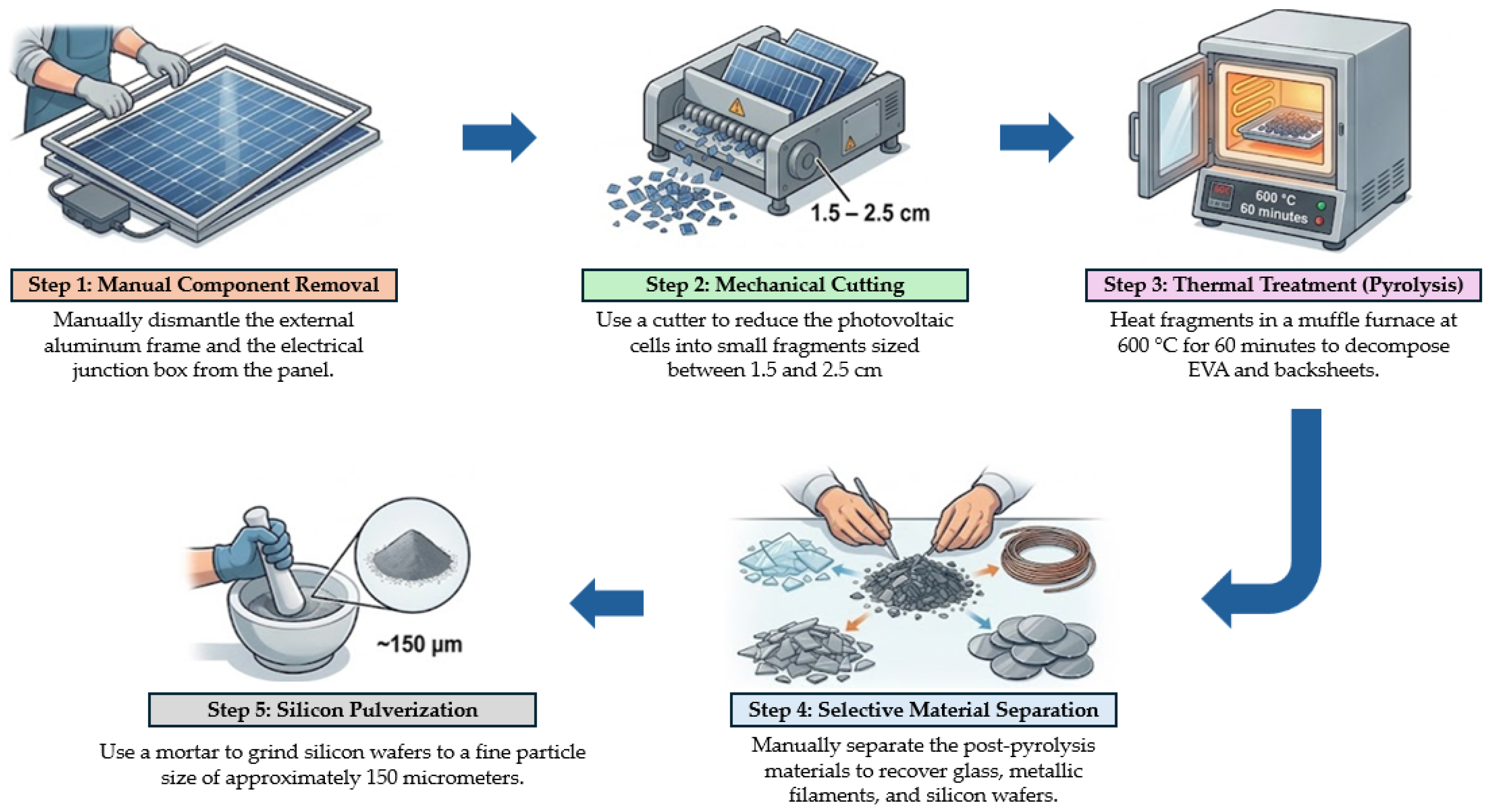
The moving parts of the photovoltaic panel, including the aluminum frame and junction box, are manually dismantled. The photovoltaic cells are then cut into relatively small sizes of approximately 1.5 to 2.5 cm using a cutter.

2.3.2. Thermal Treatment

Tests were carried out using a ball mill, roller crusher and jaw crusher; however, the expected particle diameters were not achieved. Since the results of the mechanical treatment were not satisfactory for the size reduction in the photovoltaic panels, it was decided to apply a thermal treatment in order to improve the liberation of the materials. In this context, a pyrolysis process was implemented to evaluate its effectiveness in the decomposition of the ethylene-vinyl acetate (EVA) encapsulant and the back sheet, composed of Tedlar Polyester Tedlar (TPT) or Tedlar-Polyester-EVA (TPE), since these materials hinder the recovery of the panel components. However, the EVA and back sheet will still present a challenge in their removal. These polymers encapsulate and adhere to the different layers of the photovoltaic panel, so their removal is key to accessing the glass, silicon and metals, thus enabling the recycling of these components. A muffle furnace is used to carry out the pyrolysis process of the photovoltaic panels. The material is gradually heated to a temperature of 600 °C for 60 min, then the temperature is kept constant for 5 min. Several studies indicate that the decomposition of EVA is achieved at two temperature ranges: the first primary decomposition occurs in a temperature range of 310 to 390 °C, and the secondary decomposition at a temperature range of 410–510 °C [14,43]. The incineration of the TPT, TPE, and encapsulant also occurs at two stages: the first stage in a temperature range of 330–340 °C, and the next stage of decomposition occurs in a temperature range of 390 to 510 °C. The thermal treatment was carried out in a muffle furnace under an oxidizing atmosphere, using ambient air as the reaction medium. Unlike thermal treatments performed under inert atmospheres, such as nitrogen or argon [44], ambient air was selected to promote the decomposition of the polymeric layers and the partial oxidation of metallic phases exposed after EVA encapsulant and backsheet degradation.

2.3.3. Separation of Materials

After incineration of the encapsulant and the back sheet, a manual separation of the materials obtained in the pyrolysis process is performed. The fine glass fraction is recovered directly; the filaments are extracted while the silicon wafers are subjected to pulverization using a mortar to obtain a passing particle size Tyler mesh n°100 (~150 μm) and subsequent homogenization by the cone-quartering method. This allows us to obtain samples of approximately 20 g.

2.3.4. Characterization and Chemical Analysis

The filaments and silicon wafer fines are sent to the laboratory for analysis by atomic absorption spectrometry (AAS, Agilent Technologies 240 AA, Santa Clara, CA, USA) to determine the concentration of the valuable metals (silver and copper), while the structural characterization is performed by X-ray diffraction (XRD, Bruker model D8 Advance, Karlsruhe, Germany), FE-SEM coupled with an elemental dispersive energy analyzer (EDS, Hitachi SU5000, Tokyo, Japan) and X-ray fluorescence (XRF, Siemens model SRS3000, Munich, Germany).
The methodological description of the preparation of the panels is summarized and detailed in Figure 1 below.

2.4. Hydrometallurgical Tests

Leaching Process

Tests were carried out under different conditions, varying parameters such as the concentration of the quaternary imidazolium salts, temperature, type of quaternary imidazolium salt, and/or the alkyl chain length.
The leaching process is carried out using 2 g of pulverized silicon wafer sample particles in a 40 mL beaker with thermal jacket, connected to a thermostatic bath. The tests are conducted at temperatures of 25 °C, 50 °C and 80 °C. The volume of the leaching solution will be 30 mL. The quaternary imidazolium salts are [Bmim]Cl, [Emim]Cl, [Bmim]HSO4 and [Emim]HSO4, with concentrations of 20% and 60% v/v. In addition, H2O2 (3% v/v) is incorporated as an oxidant. The solid/liquid ratio is 1:15 in all tests. The leaching process is carried out in a magnetic stirrer at 400 rpm for 48 h. At the end of the process, the pulp is filtered with a vacuum pump and Buchner funnel; the solid is separated from the liquid, and the concentration of silver and copper is analyzed by AAS in liquid samples. All assays are performed in triplicate.
The pH of the solutions is measured at the beginning and at the end of each test using a pH meter (Milwaukee MW-150 pH meter, Winkler, Rocky Mount, NC, USA). Additionally, leaching tests are carried out without ionic liquid (blank control) and without H2O2, in order to evaluate the influence of these reagents while keeping the other parameters constant. The details of the experimental model are presented in Table 1.
To quantify the efficiency of the proposed hydrometallurgical system, the metal leaching efficiency (%) was determined, representing the percentage of copper or silver extracted from the solid matrix into the leaching solution. This value was calculated using Equation (1):
M e t a l   L e a c h i n g   r a t e   ( % ) = M e t a l   E x t r a c t e d   i n t o   l e a c h i n g   s o l u t i o n   ( g ) T o t a l   m e t a l     i n   t h e   p u l v e r i z e d   s i l i c o n   w a f e r   s a m p l e   ( g ) × 100 %
The experimental design considered four ionic liquid types, three temperature levels, two H2O2 concentrations, and two ionic liquid concentrations to evaluate their influence on metal leaching efficiency.
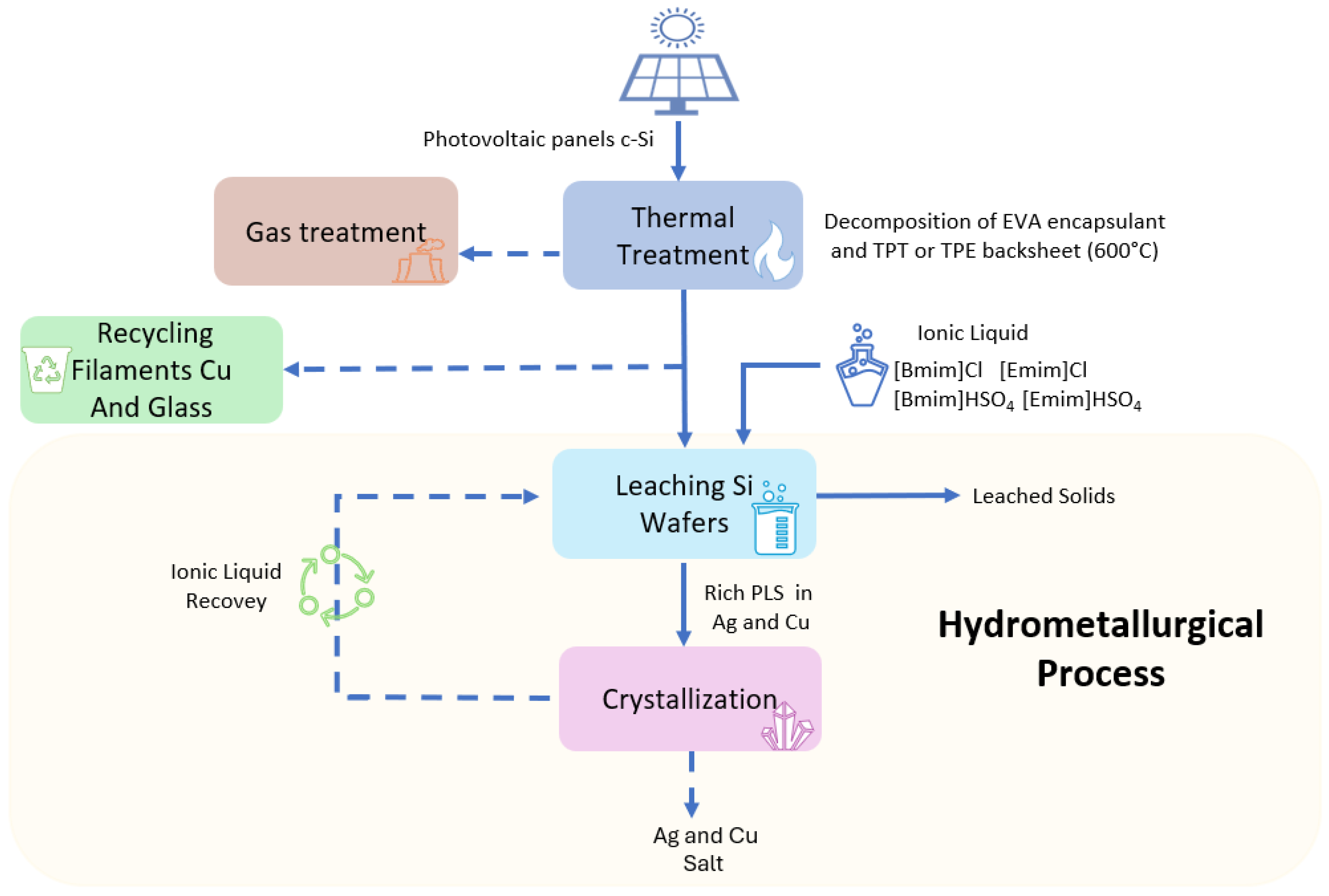
The methodological description of the above procedures is summarized and detailed in Figure 2.

3. Results and Discussions

3.1. Thermal Treatment

Tests conducted as part of this research indicate that grinding and crushing methods are not effective in reducing the size of photovoltaic panel fragments due to the flexibility provided by the EVA encapsulant. This material prevents the release of panel components, representing a significant challenge for recycling processes. The flexibility of EVA is due to its thermal expansion during the PV process, which requires the material to adapt to temperature variations [45]. Although chemical treatments with solvents exist for the removal of EVA, they have not achieved completely satisfactory results [44]. Considering the limitations of mechanical treatment, thermal treatment was evaluated as an alternative strategy to promote the separation and recovery of valuable materials from photovoltaic panels. The preliminary results obtained after thermal treatment showed an average mass loss of 11.96%, mainly attributed to the decomposition of EVA, TPT, and TPE layers, as reported in Table S1. Mass distribution of recovered photovoltaic panel components after thermal treatment, included in the Supplementary Materials. This result is in line with the findings reported in several investigations [4,5], which indicate that the percentage of EVA, TPT and TPE in a photovoltaic panel varies between 10% and 12%. The starting compound is a copolymer of ethyl and vinyl acetate, whose chemical formula is observed in Equation (2):
C H 2 C H 2 X C H 2 C H O C O C H 3 Y     C H 3 C O O H + C H 2 C H 2 X C H = C H Y
During pyrolysis or thermal degradation, vinyl acetate (present in EVA) decomposes into acetic acid ( C H 3 C O O H ) and a residual polymer, which is polyethylene modified with double bonds ( C H 2 C H 2 ) X [ C H = C H ] Y . This process occurs because the vinyl acetate moiety of the copolymer thermally decomposes, releasing acetic acid and leaving a more unsaturated structure in the base polymer. The study by Farrell et al. [43] suggests taking advantage of the calorific values of the polymers present in a c-Si photovoltaic panel, which are comparable to those of biodiesel and natural gas. This reinforces the feasibility of tertiary recycling, such as pyrolysis, to generate a fuel capable of facilitating the delamination of more photovoltaic panels, thus contributing to the circular economy and increasing their recycling rates.
On the other hand, the thermal treatment under an oxidizing atmosphere represents a relevant chemical pre-activation step, since, in addition to promoting EVA removal and panel delamination [28], it favors the partial transformation of native metals into more reactive oxidized phases [26,28]. This condition is important for the subsequent hydrometallurgical stage, as metal oxides may exhibit more favorable dissolution behavior than their pure metallic counterparts in acidic media [26]. In this context, ionic liquids based on the hydrogen sulfate anion, such as [Bmim]HSO4, may contribute to the dissolution of these oxides by generating an acidic environment through proton release in aqueous media [46]. In addition, the imidazolium cation may favor the stabilization of metallic species in solution, particularly for noble metals such as silver. Therefore, the use of ambient air during thermal treatment not only serves a physical function by removing the polymeric layers, but also chemically conditions the metallic matrix, facilitating its subsequent leaching with [Bmim]HSO4 and H2O2 [28].

3.2. Characterization of Photovoltaic Panel Samples

3.2.1. XRD Characterization of Silicon Wafers

The X-ray diffraction characterization results of the pulverized silicon wafer sample, provided in the Supplementary Materials as Figure S1, show that the predominant crystalline phase corresponds to silicon (Si), with a relative abundance of 58.5%. This confirms that the main matrix of the residue retains its siliceous nature even after thermal pretreatment. In addition to this major phase, secondary crystalline phases were identified, including silver oxide (Ag2O), lead silicate (Pb3SiO5), and lead oxide (PbO), with relative abundances of 2.7%, 21.6%, and 9.8%, respectively. The presence of these phases suggests the coexistence of metallic and oxide compounds associated with the conductive layers and residual components of the photovoltaic cell structure. The presence of these phases can be directly related to the effect of the thermal treatment applied at 600 °C, which promotes the degradation of the polymeric fraction, especially the EVA encapsulant, thereby facilitating the physical liberation of the silicon cells and metallic contacts [4]. However, besides promoting module delamination, this treatment may also induce mineralogical transformations and changes in the oxidation state of the metallic elements present, depending on the atmosphere under which the process is carried out [4,6].
The formation of lead silicate during thermal delamination can be attributed to an oxidation mechanism followed by a solid-state reaction [25]. Under the oxidizing atmosphere used during thermal treatment at 600 °C, Pb-containing solder residues may be partially oxidized to PbO [6,28,39]. Subsequently, PbO may react at the solid–solid interface with SiO2-rich phases originating from the surface of the silicon wafer and/or the glass fraction, promoting the formation of lead silicate phases [26]. The simultaneous identification of PbO and lead silicate suggests that oxidation and silicate formation processes may occur concurrently during thermal treatment [7].
From a hydrometallurgical perspective, the presence of lead silicate is relevant because Pb incorporated into a silicate structure may exhibit greater chemical stability and lower leachability than metallic Pb or free PbO [7,8,44]. In addition, in acidic ionic-liquid-based media such as [Bmim]HSO4, Pb dissolution may be limited by the possible formation of PbSO4, a low-solubility compound, thereby favoring Pb retention in the silicon-rich solid residue [23,29,31,42,46]. Therefore, the formation of lead silicate may act as a chemical barrier during Pb removal and should be considered in the design of selective purification strategies for recovered silicon, such as chemical etching with KOH or complex acid mixtures [4,5,12,44].
In this context, the literature indicates that under inert conditions, such as argon or nitrogen, thermal treatment at 600 °C enables the efficient removal of the polymeric encapsulant while minimizing the oxidation of metallic phases and silicon [44]. In contrast, when the process is performed under an oxidizing atmosphere, the presence of oxygen promotes the oxidation of metals such as copper, leading to the formation of species such as Cu2O and CuO [4,6], whereas silver, although thermodynamically more resistant, may also form oxidized species under certain conditions of temperature, oxygen availability, and residual matrix composition. Consequently, the identification of Ag2O in the analyzed sample is consistent with the treatment conditions and with previously reported studies, suggesting that this phase does not necessarily correspond solely to the original composition of the photovoltaic residue, but may have been generated or favored during thermal pretreatment [4]. This finding is particularly relevant from a recycling perspective, given that silver constitutes one of the most economically valuable metals present in photovoltaic panels.

3.2.2. Characterization by SEM

Pulverized Silicon Wafer Sample
The EDS analysis confirmed the presence of Si, Ag, Cu, Al, Sn, and Pb in the pulverized silicon wafer sample, in agreement with the typical composition of crystalline silicon (c-Si) photovoltaic panels reported in the literature [4,14]. Si was the major element (38.56%), which is consistent with its role as the base semiconductor material. Although a pure silicon cell contains more than 95% Si [5,14], the lower content observed here can be explained by the heterogeneous nature of the pulverized sample, which may include remnants of glass, polymers, and other module components.
In addition, Ag (0.28%) and Cu (0.19%) were detected, corresponding to 0.28 g of Ag and 0.19 g of Cu per 100 g of sample. These values are consistent with both the XRF results and the ranges reported for commercial photovoltaic modules. Indeed, concentrations on the order of 0.08% Cu and 0.22% Ag have been reported for commercial modules, while values of up to 0.77% Cu and 0.8% Ag have been found in specific cell fractions, indicating that the results obtained in this study fall within the expected order of magnitude [4]. The identification of these metals is particularly relevant, since silver is mainly associated with the front contacts and copper with the conductive filaments, making both of them priority targets for recovery. Likewise, the presence of Al, Sn, and Pb is also consistent with the typical module structure, where Al is associated with the frame and Sn and Pb with the soldering materials, all of which may influence subsequent recycling stages [14].
Filaments
Although SEM-EDS analysis confirmed that the filaments correspond to a predominantly metallic fraction composed mainly of copper (Cu) [7,14], they were not considered in the leaching stage of this study. This decision is supported by the fact that the filaments exhibited a Cu content of 91.1%, as determined by atomic absorption spectroscopy (AAS), demonstrating that they represent a relatively concentrated metallic fraction clearly differentiated from the pulverized silicon wafer sample. In addition, the elemental analysis detected the presence of tin (Sn) and lead (Pb), which are associated with the solder coatings typically used in photovoltaic ribbons [7,14]. Considering that these solder alloys melt at temperatures close to 215 °C [29], the thermal treatment applied at 600 °C likely altered or partially removed these surface coatings, leaving the metallic copper core more exposed [6,14]. Therefore, the filaments constitute a stream with physicochemical characteristics distinct from those of the pulverized fraction and can be treated through specific recovery routes, such as mechanical separation, smelting, or selective hydrometallurgical processes designed for high-grade metallic fractions.
In contrast, the pulverized silicon wafer sample fraction exhibited a much more heterogeneous composition, containing 38.56% Si, 0.28% Ag, and 0.19% Cu, in addition to the presence of Al, Sn, and Pb in lower proportions [4,8]. This indicates that, unlike the filaments, the valuable metals in this fraction are much more dispersed within a complex matrix, representing a greater technical challenge for selective recovery [2,7,14,43,46]. For this reason, the present study focused the leaching stage on the pulverized wafers, where the recovery of valuable metals requires a more selective chemical strategy [46]. In this context, excluding the filaments from the leaching experiments allowed the study to focus on the most complex fraction and the one that is most representative of the hydrometallurgical challenge associated with photovoltaic panel recycling.

3.3. Leaching Tests

Copper and silver extractions corresponding to leaching conditions with and without hydrogen peroxide are shown in Table 2.

3.3.1. Analysis of Leaching Conditions for the Extraction of Copper and Silver from Pulverized Silicon Wafers

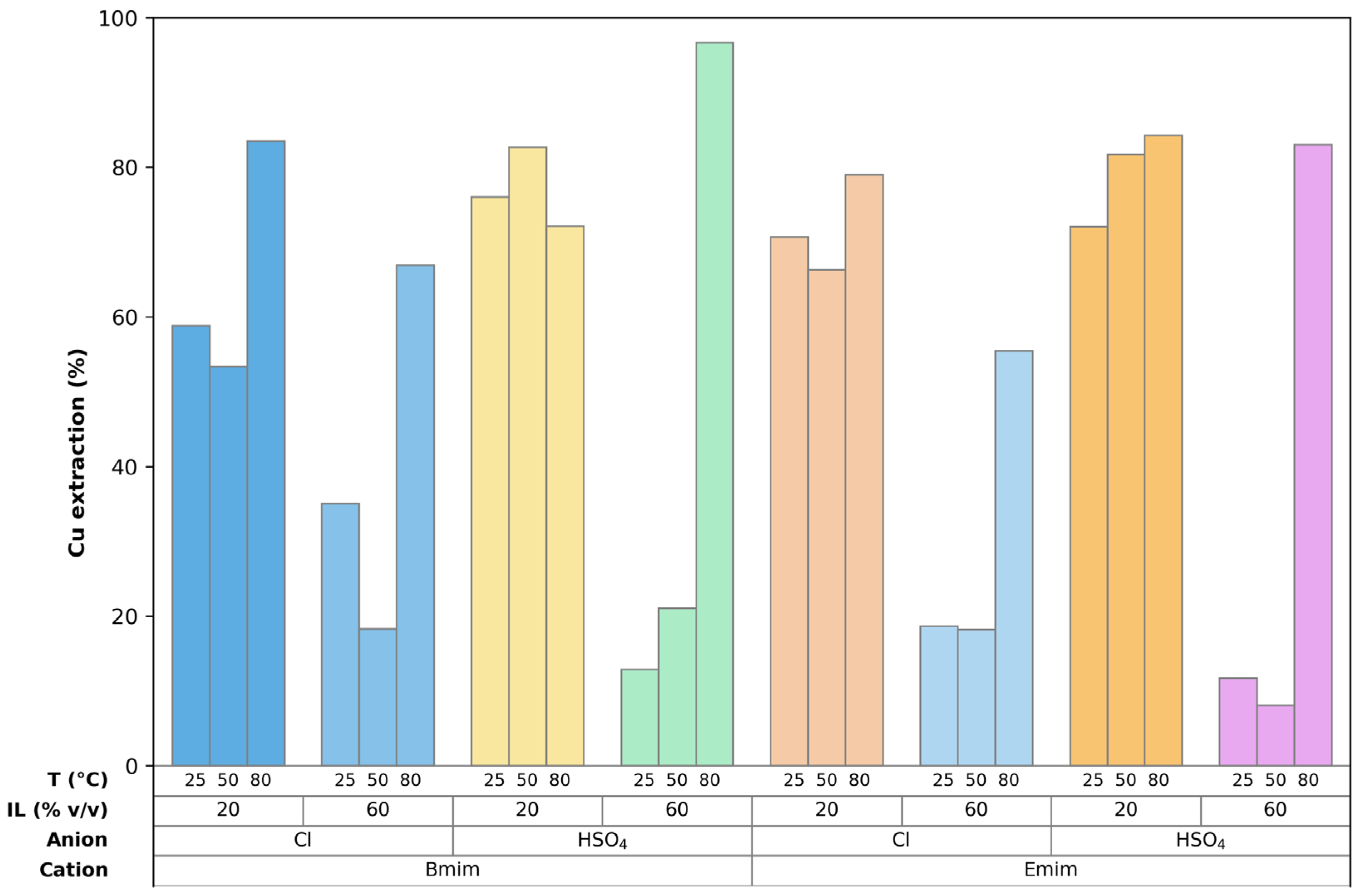
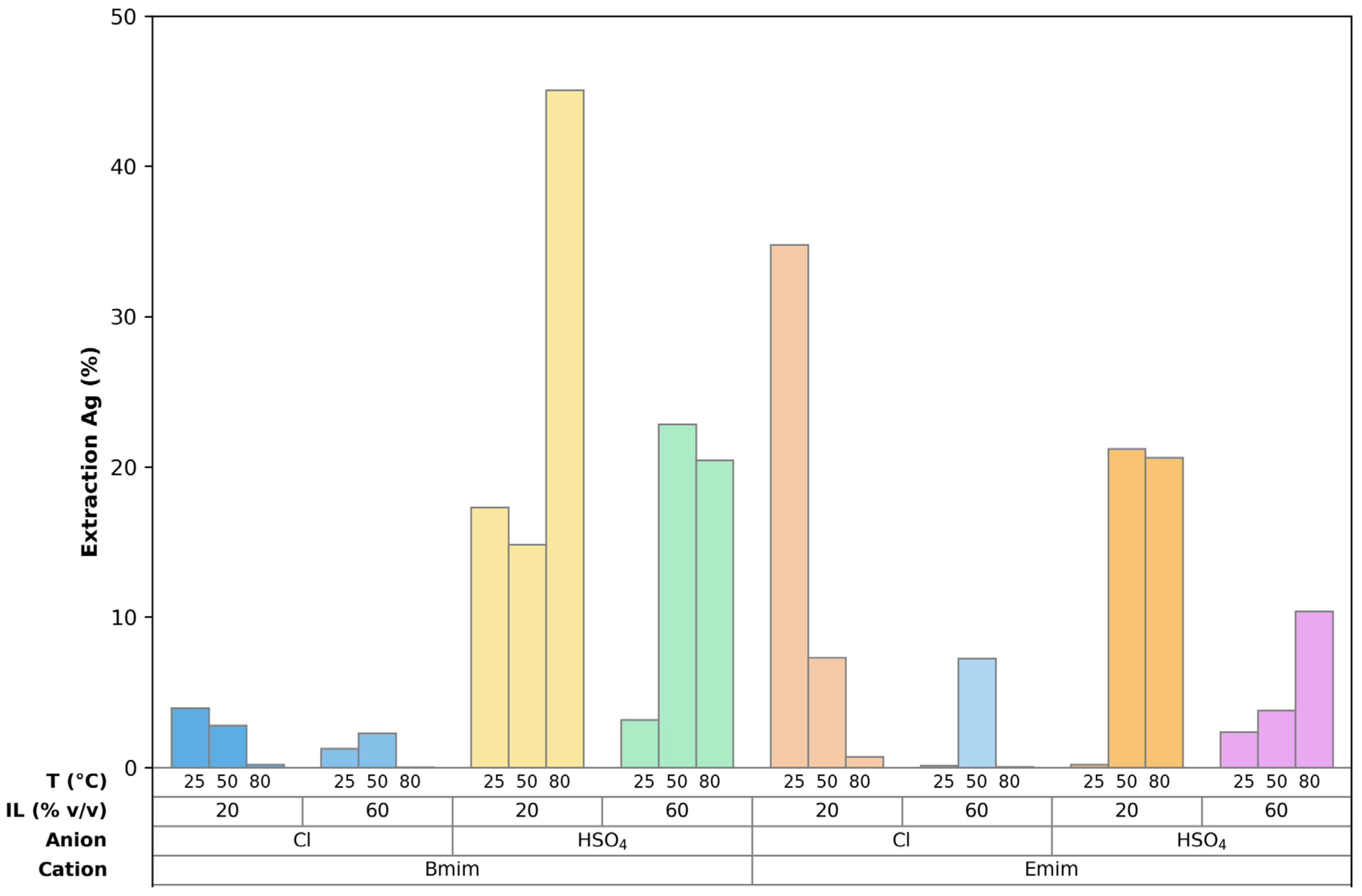
Figure 3 and Figure 4 present the results of all the leaching tests performed under various experimental conditions using hydrogen peroxide as the oxidizing agent. The copper and silver extractions obtained under each of the conditions evaluated are shown.
Optimal copper leaching tests were obtained with [Bmim]HSO4 at 60% concentration and 80 °C, achieving 96.7% extraction. When replacing the cation with [Emim]HSO4 under the same conditions, the extraction reached 83.05%. The addition of H2O2 proved essential, facilitating the dissolution of copper in an acidic medium generated by the ionic liquid anion itself, eliminating the need for additional sulfuric acid. For the ionic liquids with Cl anion, [Bmim]Cl and [Emim]Cl, a maximum extraction of 83.49% and 78.98%, respectively, was obtained at 80 °C and 20% concentration.
In silver extraction, the systems with HSO4 showed higher efficiency compared to Cl, due to the generation of a favorable acidic medium. The highest silver extraction (45.13%) was achieved with [Bmim]HSO4 at 20% concentration and 80 °C, while systems with Cl presented values close to zero. Temperature was a key factor, increasing silver extraction up to 34.93% with [Emim]HSO4 at 20% concentration when going from 25 °C to 80 °C. Also, high concentrations of ionic liquids (60%) reduced the efficiency of the process due to increased viscosity, which limited ionic diffusion and metal solubilization. In terms of cation, both [Bmim] and [Emim] showed similar trends, although the influence of anion and temperature was more determinant in leaching efficiency.

3.3.2. Effect of Temperature

The results obtained in the leaching tests (Figure 3) show that the increase in temperature has a significant effect on the improvement of copper extraction, in all the systems evaluated, especially at 80 °C. In most of the evaluated systems, the higher temperature led to a substantial increase in copper extraction, reaching up to 96.70% under specific conditions with 60% concentration of [Bmim]HSO4. This behavior suggests that increasing temperature favors the solubility and reactivity of the compounds, which facilitates copper leaching, as demonstrated by Whitehead et al. [23], who investigated the use of [Bmim]HSO4 to leach copper sulfide ores. In their study, they observed a clear temperature dependence, highlighting that an increase in temperature from 60 °C to 70 °C increased copper extraction by 30%. This finding supports the hypothesis that copper stabilization by HSO4 ion plays a key role in the process. Although metal leaching by ionic liquids has shown significant advances, the specialized literature on its application to electronic waste, especially photovoltaic panels, is still limited. In this context, Chen et al. [30] confirmed that in the leaching process of circuit boards with [Bmim]HSO4, the copper extraction rate increased from 64.40% to 93.27% as the temperature was raised from 40 °C to 60 °C. This result agrees with the observation that the leaching rate improves with increasing temperature, since the chemical reaction rate accelerates with thermal increase, which is consistent with the behaviors observed in this investigation for the four ionic liquids evaluated. As for the tests at intermediate temperatures (50 °C), moderate behavior was observed in terms of extraction efficiency, while at 25 °C the extraction percentages were considerably lower.
As shown in Figure 4, silver extraction follows the same trend observed for copper, increasing with temperature and reaching its maximum at 80 °C. The highest Ag recovery (45.13%) was obtained with 20% [Bmim]HSO4, whereas chloride-based systems yielded extraction values close to zero under most conditions. However, percentage extractions cannot be directly compared with those reported by Whitehead et al. [23] because the initial metal contents differ substantially. Whitehead processed high-grade minerals (e.g., 20.31 wt% Cu in chalcopyrite; 18.72 g/t Ag in natural ores), while our sputtered wafers contain only 0.19 wt% Cu and 0.28 wt% Ag (3.8 mg Cu and 5.6 mg Ag per 2 g). Thus, similar percentages correspond to very different absolute quantities of metal dissolved. To address this, we report the absolute leached mass and solution concentrations. Copper dissolution ranged from 0.31 to 3.68 mg (10–122 mg/L), values consistent with the intrinsically low metal content of photovoltaic residues. Even in absolute terms, [Bmim]HSO4 outperforms the Cl-based systems, in agreement with the mechanistic tendencies described by Whitehead, but now normalized for differences in initial composition.

3.3.3. Effect of Peroxide (With and Without Presence)

As seen in Table 2, in most cases, copper extraction is considerably higher when H2O2 is used as the oxidizing agent compared to conditions without this agent. The copper extraction values without H2O2 are low, and even almost negligible in several cases, highlighting the crucial role of H2O2 as the extraction agent. For most combinations of cation, anion and concentration, the presence of H2O2 at higher temperatures (80 °C) generates the highest recoveries. For example, with [Bmim]Cl at a concentration of 20%, the extraction reached 83.49% at 80 °C with H2O2, while without this agent the extraction was only 2.26%. Similarly, with [Bmim]HSO4 at 60% concentration, the extraction was almost complete, reaching 96.70% at 80 °C with H2O2, while without H2O2 no extraction was observed. This effect can also be attributed to the solubility of oxygen in an aqueous solution of ionic liquid, as proposed by Sheldon [47] and confirmed by Hu et al. [25] in their study on the leaching of chalcopyrite using an aqueous solution of 1-hexyl-3-methyl-imidazolium hydrogen sulfate ([Hmim]HSO4) with H2O2 as oxidant. Likewise, it was demonstrated by the comparative study of Chen et al. [30] on the leaching of copper from printed circuit boards with ionic liquids, indicating that the oxygen released by the decomposition of H2O2 reacts with copper to form cuprous oxide, which subsequently reacts with the aqueous solution to produce copper sulfate (CuSO4), thus favoring leaching. This behavior was also evidenced by Barrueto et al. [28,46] in their research on the leaching of metals from printed circuit boards using ionic liquids and He et al. [34] in the comparative study on the efficiency of copper leaching from used cell phones using different types of ionic liquids. The reaction formula is summarized in Equation (3):
C u + 2 H + + H 2 O 2 C u 2 + + 2 H 2 O
In acidic ionic liquid systems, the leaching mechanism can be understood based on the specific role of each reagent. In aqueous solution, the hydrogensulfate-based ionic liquid acts as a proton source, since the HSO4 anion dissociates and releases H+, thereby generating an acidic medium. At the same time, H2O2 acts as the oxidizing agent, either directly or through its decomposition into O2, which promotes the oxidation of metallic copper into soluble ionic species. Under these conditions, copper dissolution can be represented by the ionic reaction shown in Equation (3).
This occurs as reported by Dong et al. [36], who studied the leaching of copper from chalcopyrite using the ionic liquid [Bmim]HSO4, with dissolved oxygen as an oxidant. According to Whitehead et al. [23], [Bmim]HSO4 acts as an acid in aqueous solution, while hydrogen peroxide also functions as an oxidant in this process. On the other hand, H2O2 is confirmed as an essential factor in silver leaching, since its absence leads to significantly lower or even zero extraction under all conditions evaluated. This effect is particularly evident in systems with HSO4, where the presence of H2O2 substantially increases silver extraction compared to assays without this reagent. These results agree with the studies of Wstawski et al. [37], who investigated the leaching of Cu+2 from e-waste using hydrogen sulfate ionic liquids and observed a positive effect of H2O2 on metal extraction, where the increase in Ag+ content during leaching is noticeable when the oxidant is present, reaching concentrations between 1.5 and 2 mg at 23 °C and 75 °C, respectively. These values correspond to a leaching efficiency of approximately 15% to 20% in systems with hydrogen sulfate ionic liquids. The addition of H2O2 accelerates the process by acting as an oxidizing agent, promoting the dissolution of silver and favoring its incorporation into the liquid phase. From a technological perspective, the extraction of copper from photovoltaic panel recycling is significantly more efficient compared to that of silver. In particular, the leaching process using the ionic liquid [Bmim]HSO4 at a concentration of 60% and a temperature of 80 °C allows reaching a maximum extraction rate of 96.70% for copper. In contrast, silver extraction under optimum conditions employing [Bmim]HSO4 at 20% and at the same temperature reaches a maximum of 45.13%.

3.3.4. Ionic Liquid Concentration

To evaluate the effect of ionic liquid concentration on the leaching process, preliminary reference tests were conducted in the absence of ionic liquid, as shown in Table 2. These control experiments were not designed to reproduce an equivalent hydrogensulfate-based system, but rather to isolate the specific contribution of H2O2 when no ionic liquid is present. Under these conditions, copper extraction remained very low, reaching only 0.24% at 25 °C and 5.76% at 50 °C, while all other experimental parameters were kept constant. In contrast, when the quaternary imidazolium salts were added at concentrations of 20% and 60% under the same temperature conditions, a substantial increase in copper extraction was observed (Figure 3), clearly demonstrating the key role of the ionic liquid in enhancing the oxidative dissolution promoted by H2O2. However, the results indicate that a 20% concentration is, in general, more efficient than higher concentrations of 60%. For example, using [Bmim]Cl at a concentration of 20% and a temperature of 80 °C in the presence of H2O2, copper extraction reached 83.49%. In contrast, the same ionic liquid with a concentration of 60% under the same conditions achieved a lower extraction of 66.92%. Similarly, with [Emim]HSO4 at 20% concentration and 50 °C, the extraction was 81.74%, whereas, when increasing the concentration to 60% at the same temperature, the extraction decreased drastically to 8.08%. To analyze the effect of ionic liquid concentration, it is necessary to consider the behavior of the quaternary imidazolium salts in aqueous solution, which is the actual medium used in this study. For the acidic salts [Bmim]HSO4 and [Emim]HSO4, the leaching mechanism can be explained by the ability of the HSO4 anion to dissociate in water, releasing H+ and enabling the solution to behave as an acid. This proton-release mechanism requires an aqueous environment, since proton hydration cannot occur in undiluted ionic liquids, as reported by Barrueto et al. [28,46]. Therefore, the enhanced copper dissolution observed at 20% ionic liquid concentration is attributed to the higher availability of hydrated protons in the aqueous medium, rather than to the intrinsic properties of the pure ionic liquid. Furthermore, according to Dong et al. [36], acidic ionic liquids play a role in the copper leaching process similar to that of nitric acid. In both cases, hydrogen peroxide acts as an oxidizing agent, as does nitrate [23].
Accordingly, Equation (4) should be interpreted as an overall molecular representation of copper dissolution in a sulfate medium, where acidity is generated by dissociation of the hydrogensulfate ionic liquid and the oxidizing conditions arise from hydrogen peroxide decomposition. In contrast, Equation (3) describes the ionic pathway of the process, while Equation (4) summarizes the overall reaction in the presence of sulfate species and molecular oxygen. Under these conditions, hydrogen peroxide facilitates copper dissolution by promoting its conversion into soluble Cu2+ species, as represented in Equation (4).
2 C u + 2 H 2 S O 4 + O 2   2 C u S O 4 + 2 H 2 O
On the other hand, the basic quaternary imidazolium salts [Bmim]Cl and [Emim]Cl display a concentration-dependent behavior similar to that of the acidic salts, although they consistently exhibit lower copper extraction efficiencies. This is because [Bmim]Cl and [Emim]Cl have lower acidity compared to the HSO4 anion. These results suggest that higher concentrations of the quaternary imidazolium salts do not necessarily lead to higher extraction efficiencies, possibly due to secondary effects such as increased solution viscosity or diffusion limitations [31,34,46]. Furthermore, the concentration of the quaternary imidazolium salts plays a crucial role in the efficiency of silver leaching. In general, 20% solutions yield higher extraction efficiencies than 60% solutions. Although the hydrogensulfate anion is the key reactive species, viscosity data for aqueous mixtures of [Bmim]HSO4 demonstrate that viscosity increases sharply as the ionic liquid concentration rises, from approximately 5.8 mPa·s at low concentrations to more than 516 mPa·s near 60% [38]. This substantial increase in viscosity limits the diffusion of H2O2 and hydrated HSO4 species in the aqueous phase, thereby reducing the dissolution rate. As a result, higher salt concentrations can negatively affect the leaching process, which explains why 20% solutions consistently outperform their 60% counterparts. For example, in the [Bmim]HSO4 system at 80 °C, silver extraction decreases significantly from 45.13% to 17.83% when the concentration increases from 20% to 60%. This behavior indicates that higher viscosity reduces the mobility of metal ions in solution, affecting the leaching kinetics and limiting the efficiency of the process, as in copper extraction.

3.3.5. Effect of Anion Variation

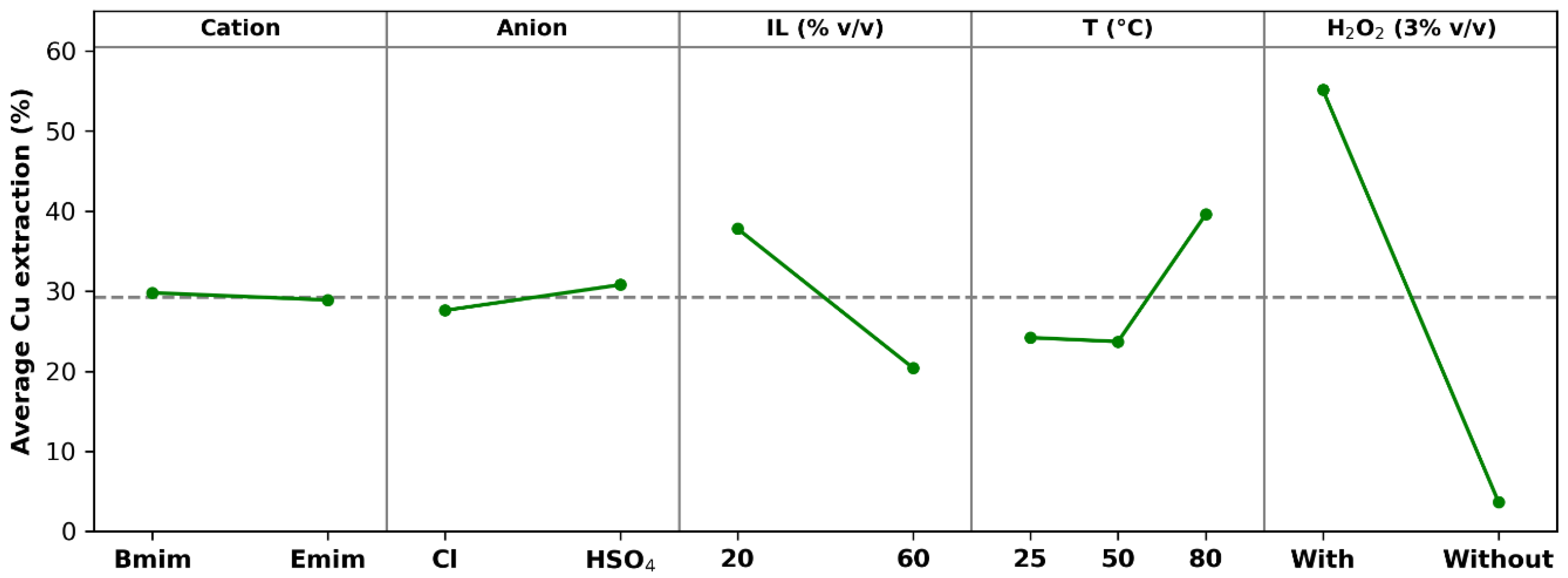
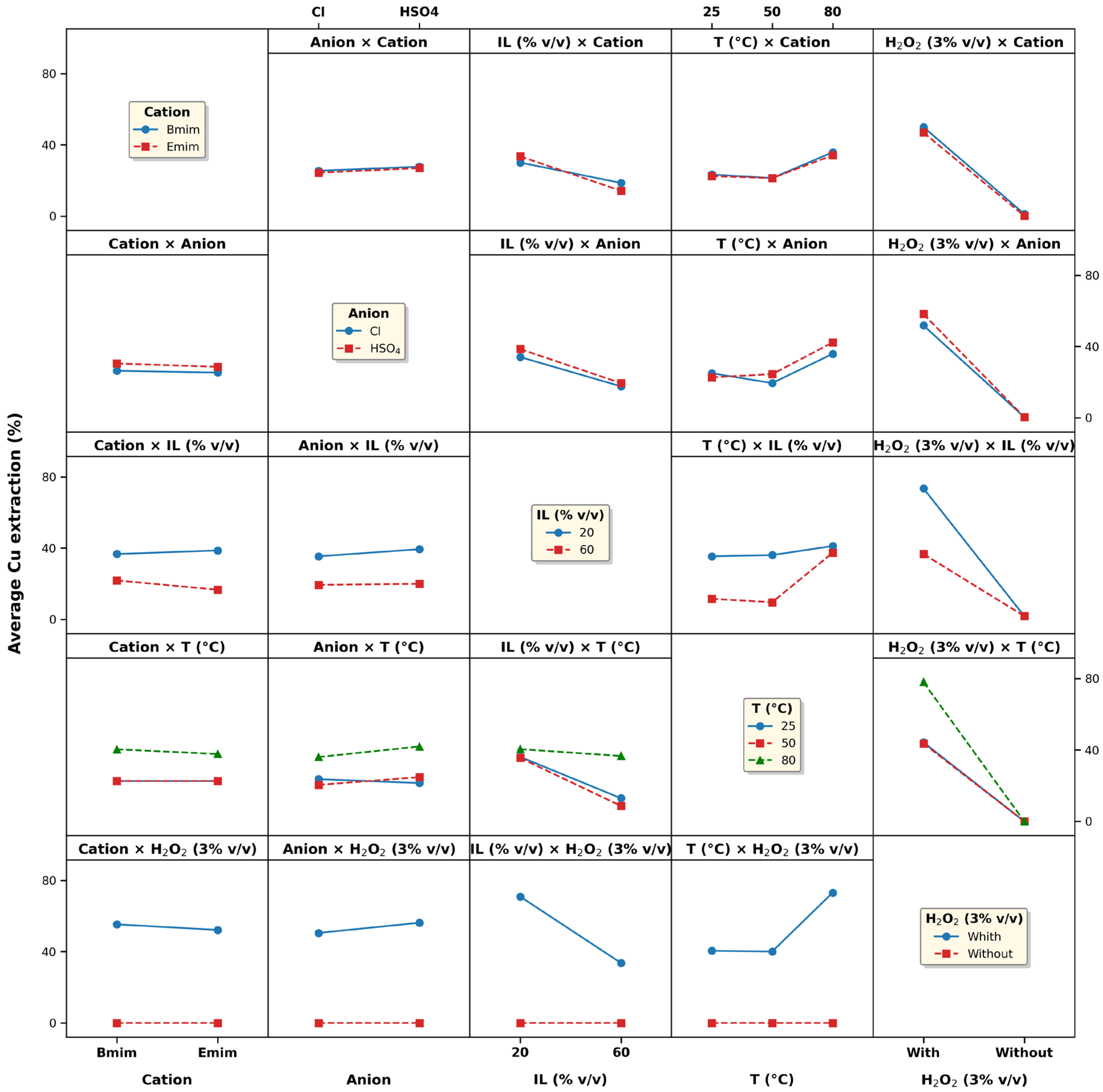
According to the main effects plot for copper extraction (Figure 5) and the interaction plot (Figure 6), the quaternary imidazolium salts containing the HSO4 anion exhibit a strong selectivity toward copper dissolution. This behavior is mainly attributed to the highly acidic environment generated by hydrogensulfate species in aqueous solution, which promotes the solubilization of the metal. This mechanism closely resembles the well-established leaching behavior of sulfuric acid, the most widely used lixiviant in the mining industry. As reported by Liu et al. [48], sulfuric acid achieves extraction efficiencies between 90% and 99% in both column and batch leaching tests of low-grade copper ores, since the acidic pH facilitates the release and stabilization of Cu2+ ions in solution. The results obtained in the present work follow the same trend. When quaternary imidazolium salts of acidic character were combined with hydrogen peroxide as the oxidizing agent, copper extraction ranged from 8.08% to 96.70%, with the salts containing the HSO4 anion showing the highest efficiencies under most experimental conditions. In contrast, the quaternary imidazolium salts containing chloride produced significantly lower extraction values, between 18.26% and 83.49%, which is consistent with their limited ability to generate acidic conditions favorable for metal dissolution.
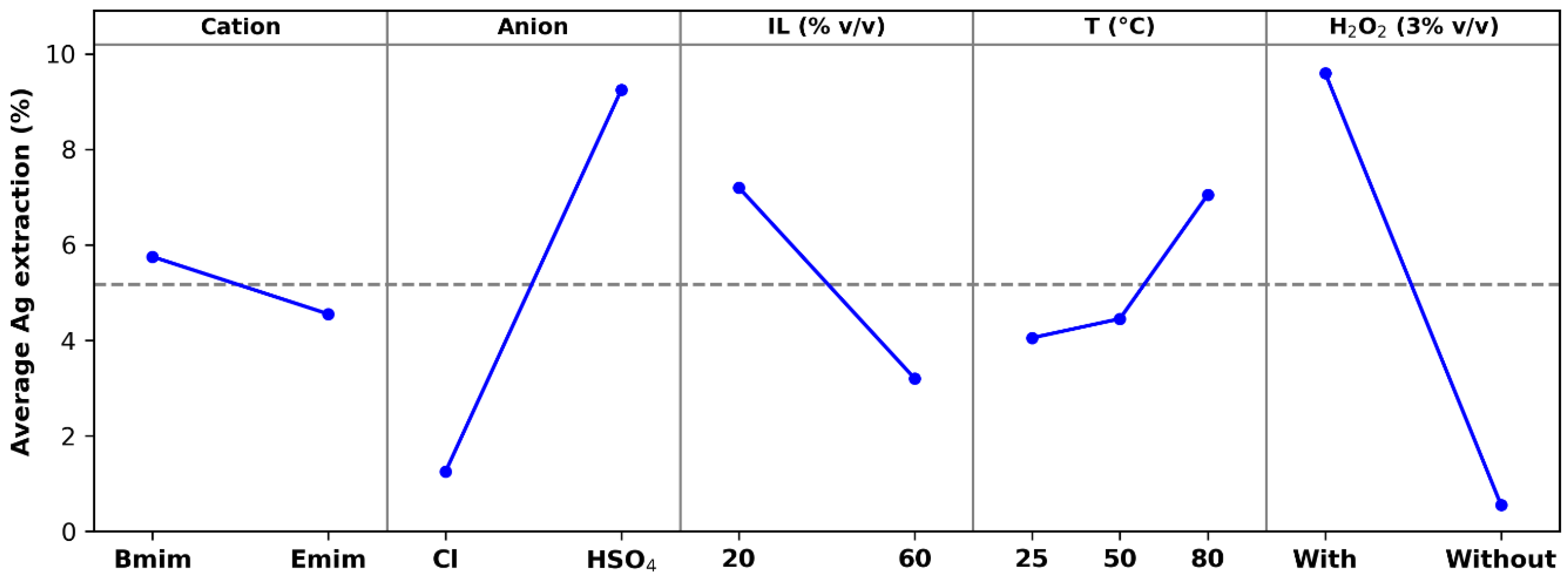
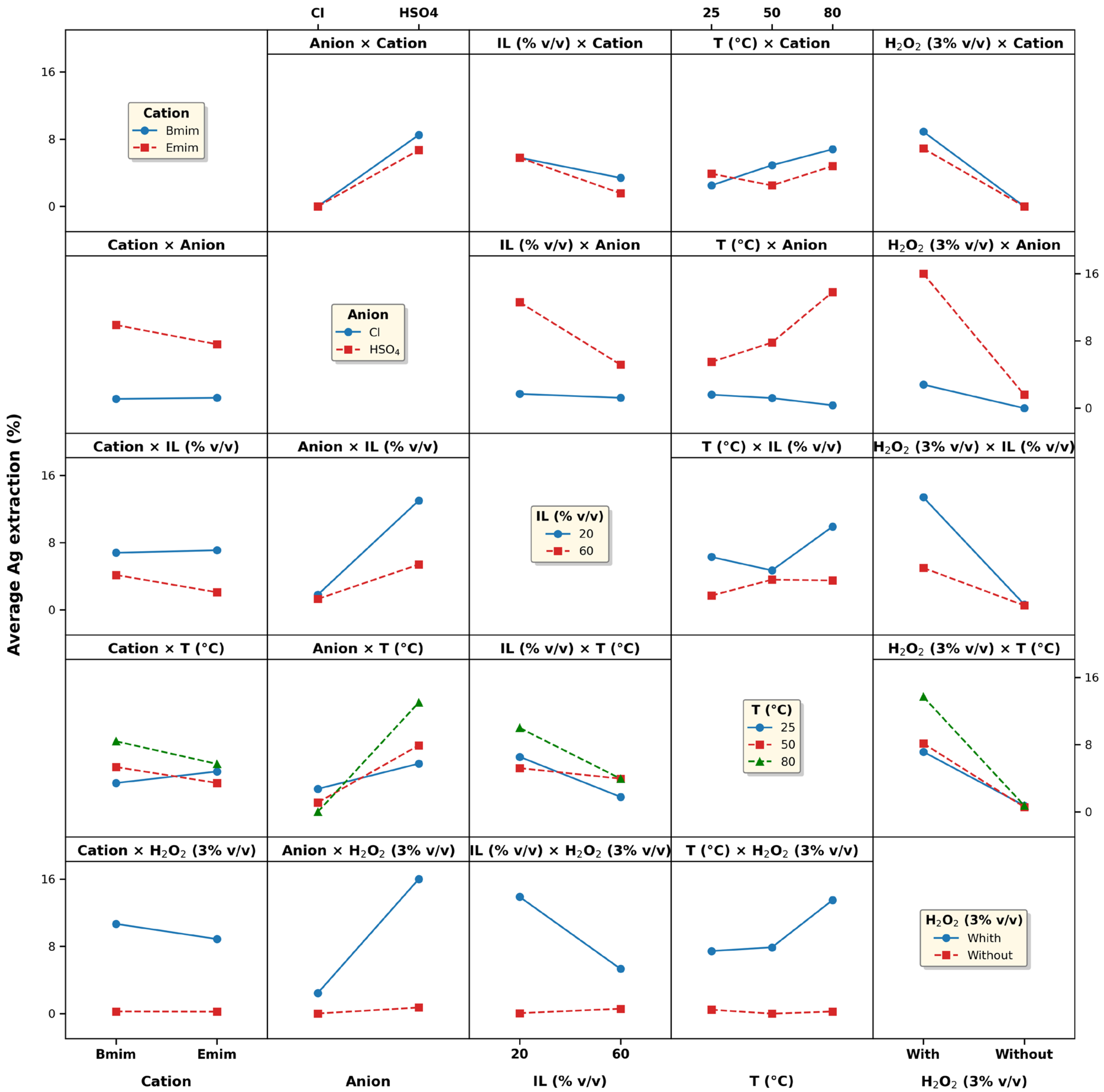
A similar pattern is observed for silver extraction. The main effects plot in Figure 7 and the interaction plot in Figure 8 demonstrate that the anion plays a decisive role in the dissolution of the metal. Systems containing the HSO4 anion consistently show markedly higher extraction compared with those containing chloride. This performance suggests that the chemical environment generated by hydrogen sulfate provides more favorable conditions for silver solubilization. Previous studies have shown that silver leaching is more efficient in acidic media, and in this context, the quaternary imidazolium salt based on hydrogen sulfate ([Bmim]HSO4) has been proposed as a suitable alternative to sulfuric acid in thiourea leaching systems because of its acidic and hydrophilic nature [49]. Taken together, these results confirm that quaternary imidazolium salts containing the hydrogen sulfate anion offer conditions that strongly enhance the dissolution of both copper and silver. Both sulfuric acid and hydrogen sulfate salts rely on the same active anionic species in solution, and they follow similar dissolution mechanisms. Therefore, directing the discussion toward a comparison between sulfuric acid and hydrogen sulfate salts at different concentrations is appropriate and provides a solid explanation for the experimental results obtained in this study.
Previous studies have confirmed its efficacy in the extraction of silver and other precious metals when used in combination with oxidizing agents such as Fe2O3, H2O2 or KHSO5. In particular, Whitehead et al. [35] have reported near 50% silver recovery using [Bmim]HSO4 in combination with peroxomonosulfate (HSO5) without additional complexing agents. The efficiency of the process increased significantly, reaching approximately 70% extraction by increasing the temperature to 50 °C, and was further improved by incorporating thiourea as a leaching agent, demonstrating its fundamental role in the formation of soluble complexes that favor silver dissolution. Likewise, when Fe+3 was used as an oxidizing agent in a solution of [Bmim]HSO4 with thiourea at 25 °C, 60% silver extraction was achieved [23]. On the other hand, the systems with Cl show considerably lower rates, with values close to zero in most of the evaluated conditions, reaching its maximum silver extraction rate of 7.49% with the operational conditions of [Emim]Cl at 20% concentration and a temperature of 25 °C, this can be attributed to the fact that in the solid of the leaching process this precipitating silver. On the other hand, the systems with Cl present considerably lower extraction rates, with values close to zero in most of the conditions evaluated. The maximum silver extraction recorded in these systems was 7.49%, obtained under operational conditions of [Emim]Cl at 20% concentration and at a temperature of 25 °C. This result suggests that, during the leaching process, silver could be precipitating in solid phase, which would limit its extraction in solution.
Furthermore, as shown in Figure 5, the presence of hydrogen peroxide is the predominant factor in copper extraction during leaching, followed by temperature (80 °C) and the concentration of quaternary imidazolium salts. In contrast, the type of cation and anion has a less significant influence on metal extraction. At 80 °C and 20% concentration of quaternary imidazolium salts, the copper extraction rates were 83.49% with [Bmim]Cl, 72.17% with [Bmim]HSO4, 78.98% with [Emim]Cl and 84.25% with [Emim]HSO4. In the absence of hydrogen peroxide, these rates decreased drastically to 2.26%, 0.00%, 0.00% and 3.13%, respectively, highlighting the importance of this oxidizing agent in the process.
On the other hand, in Figure 7, in silver leaching, the HSO4 anion showed significantly higher extraction compared to Cl, confirming its ability to generate an optimal acidic environment for metal dissolution. It was determined that the 20% concentration of quaternary imidazolium salts is more efficient than 60%, due to a lower viscosity that facilitates the diffusion of the reagents. Also, silver extraction increased with temperature, reaching its maximum at 80 °C. Finally, hydrogen peroxide proved to be the most determining factor in the extraction of silver, since its absence considerably reduced the efficiency of the process, confirming its essential role in the oxidation and dissolution of the metal.
Figure 6 presents a matrix of line plots to visualize the effect of different factors and their interactions on copper extraction efficiency in leaching tests performed with ionic liquids and hydrogen peroxide. In all plots, the y-axis represents the average percentage of Cu extraction, while the x-axis varies according to the parameter or combination of variables evaluated.
Process efficiency was analyzed as a function of key operational variables, such as the type of quaternary imidazolium salts cation and anion, their concentration (% v/v), reaction temperature (°C) and the presence or absence of H2O2 (3% v/v). The results indicate that the [Bmim] cation promotes higher extraction levels compared to the [Emim] cation, particularly when used in conjunction with the HSO4 anion. A decrease in leaching efficiency was also observed with increasing quaternary imidazolium salt concentration from 20% to 60%, suggesting that high concentrations may increase solution viscosity and hinder mass transport to the solid surface.
Regarding temperature, a positive effect was evidenced as this parameter was increased, with the best results being achieved at 80 °C. However, the factor that showed the greatest impact on process efficiency was the addition of H2O2. Its presence significantly improved Cu extraction in all conditions evaluated, while its absence led to notably lower or even null yields.
Based on the analysis of the variables and their interactions, it is concluded that the optimal conditions for maximizing copper recovery are obtained using a 60% v/v [Bmim]HSO4 solution of [Bmim]HSO4, at a temperature of 80 °C and in the presence of 3% v/v H2O2. This combination generates a favorable synergy between the ionic liquid and the oxidizing agent, allowing for more efficient leaching. The results support the potential of this strategy as a technically and environmentally viable alternative for the recycling of photovoltaic panel waste.
On the other hand, Figure 8 shows a matrix of line graphs illustrating the individual and combined effect of different operational variables on silver (Ag) extraction efficiency during leaching tests with ionic liquids and hydrogen peroxide. The y-axis of each graph represents the average percentage of Ag extraction, while the x-axis varies as a function of the parameter evaluated or the interaction between variables.
When analyzing the silver data independently, the extraction values obtained are generally lower within the silver dataset, reaching a maximum of approximately 45.13%. Among the variables evaluated, the [Emim] cation shows a superior performance compared with [Bmim] under several conditions, particularly when combined with the hydrogensulfate anion. In addition, the concentration of the quaternary imidazolium salt has a clear influence on silver recovery. A lower concentration (20% v/v) consistently favors silver dissolution, whereas increasing the concentration to 60% v/v leads to a marked decrease in extraction efficiency. These trends refer exclusively to the silver leaching results and are therefore valid, as they are interpreted on the basis of the initial silver content and the specific experimental conditions for this metal. With respect to temperature, a positive effect on silver extraction is identified, although less pronounced than in the case of copper. Conditions at 80 °C generated higher recovery percentages in some combinations, but with greater variability. For its part, the addition of H2O2 at 3% v/v also increased extraction efficiency compared to its absence, although its impact was more moderate than in the copper leaching system. The synergy between IL and H2O2 appears to be limited in the case of silver, suggesting lower reactivity or a need for more aggressive conditions to facilitate its dissolution.
The most effective conditions for silver recovery correspond to the use of [Bmim]HSO4 at 20% v/v, at a temperature of 80 °C and in the presence of H2O2. However, the efficiencies obtained were considerably lower than those reported for copper. These results indicate that, while it is possible to partially recover silver contained in photovoltaic panel waste using this leaching system, further optimization of the process will be required, possibly through the use of more specific complexing agents or adjustments in reaction time and agitation. Overall, this analysis provides an experimental basis for the development of differentiated strategies for the valorization of critical metals present in solar panels at the end of their useful life.

3.3.6. Effect of Cation Variation (Alkyl Chain Size)

The comparative evaluation of the [Emim] and [Bmim] cations showed that the cation structure in quaternary imidazolium salts exerts a measurable effect on metal extraction [39]. In general, the [Emim] cation, which has a shorter alkyl chain than [Bmim], exhibited higher efficiency in Cu extraction, in agreement with the findings reported by Huang et al. [50] and He et al. [34] who indicated that simpler cationic structures promote greater ionic mobility and improved leaching performance. Likewise, Tokuda et al. [39] observed that imidazolium salts with shorter hydrocarbon chains exhibit higher transport coefficients and diffusivity, whereas Barrueto et al. [28] emphasized that increasing the alkyl chain length decreases cation–anion dissociation, thereby reducing the molar conductivity and ionic character of the system.
This behavior can be directly associated with the lower macroscopic viscosity of [Emim]-based salts compared with those based on [Bmim] [39]. Transport data indicate that the sum of the ionic self-diffusion coefficients is systematically higher for [Emim] salts, since shorter alkyl chains reduce internal friction and facilitate ionic transport [39]. This feature is particularly relevant in heterogeneous systems such as pulverized silicon wafer samples, where leaching is often controlled by diffusional phenomena at the solid–liquid interface [34,40,50]. In this context, lower viscosity enhances the mass transfer of the oxidant (H2O2) toward the metallic surface, as well as the migration of the leached species (Cu2+ and Ag+) into the bulk solution, thereby improving the overall kinetics of the process [25,34,38].
In addition, imidazolium-based ionic liquids exhibit a surface tension significantly lower than that of water [23]. The reduction in surface tension improves the wettability of the solid surface and decreases the hydrophobic resistance at the solid–solution interface, thereby facilitating the penetration of the leaching agent into the porous and complex matrix of the pulverized wafer [24,26]. As a result, both electron transfer and effective contact between the reagent and the metallic phases are enhanced, contributing to more efficient leaching than that observed with conventional molecular solvents.
These trends explain why, under certain experimental conditions (80 °C and 20% v/v), [Emim]HSO4 achieved slightly higher copper extraction than [Bmim]HSO4 [25]. However, for Ag, [Bmim]HSO4 showed marginally better performance under the same conditions. This behavior suggests that silver extraction may be additionally influenced by the chemical stability of the solvent under highly oxidizing media [29]. It has been reported that imidazolium cations with longer alkyl chains exhibit greater resistance to the oxidative degradation caused by H2O2, which could allow [Bmim]HSO4 to maintain for a longer time the oxidative conditions required for the dissolution of silver, a more noble and less reactive metal than copper [29]. Likewise, it has been suggested that imidazolium cations may participate in the dissolution of residual metal oxides, such as Ag2O or CuO, through mechanisms associated with carbene formation at the C2 position of the ring, stabilizing metallic species through carbon–metal interactions [33].

4. Conclusions

This study demonstrated that thermal pre-treatment via pyrolysis at 600 °C is essential to decompose the EVA encapsulant and liberate metallic fractions. Higher temperatures significantly improved leaching, with optimal recoveries at 80 °C. The best performance for copper (96.70%) was achieved using 60% [Bmim]HSO4, whereas silver reached its maximum extraction (45.13%) at a lower salt concentration of 20%, due to the negative impact of high viscosity on silver diffusion.
Hydrogen peroxide proved to be an essential oxidizing agent, confirming a strong synergistic effect with the quaternary imidazolium salts. The hydrogensulfate anion (HSO4) was superior to chloride by generating a self-sustaining acidic environment favorable for metal solubilization. While cation mobility generally favored [Emim] systems, the [Bmim] cation provided better results under the optimal Ag recovery condition.
Overall, these salts show promise as selective and environmentally friendly agents for recycling photovoltaic waste. While further optimization is needed for silver recovery, possibly through the use of specific complexing agents, this research provides a solid experimental basis for tunable and sustainable leaching pathways that do not rely on conventional mineral acids. Nevertheless, future work should include direct pH monitoring, H2O2 consumption analysis, viscosity measurements, and post-leaching residue characterization by XRD, SEM-EDS, and XPS to experimentally validate the proposed leaching mechanism in greater depth.

Supplementary Materials

The following supporting information can be downloaded at: https://www.mdpi.com/article/10.3390/min16060654/s1, Table S1: Mass distribution of recovered photovoltaic panel components after thermal treatment; Table S2: Copper (Cu) leached mass and concentration for all leaching tests; Table S3: Silver (Ag) leached mass and concentration in the leachate; Figure S1: Diffractogram of the pulverized silicon wafer sample; Figure S2: SEM image of the pulverized silicon wafer sample before the leaching step. (A) main image, and (B: 1, 2, 3, 3, 4, 5 and 6) elemental maps (scale in A and B 200 μm); Figure S3: EDS profile, corresponding to pulverized silicon wafer sample of silicon wafers; Figure S4: SEM image of the filaments (D) main image, and (E: 1, 2, 3, 4, 5 and 6) elemental maps (scale in D and E 500 μm); Figure S5: EDS profile, corresponding to filament sample; Figure S6: Copper concentration obtained from all leaching tests using pulverized silicon wafer sample under different operating conditions. Four quaternary imidazolium salts ([Bmim]HSO4, [Emim]HSO4, [Bmim]Cl, and [Emim]Cl) were evaluated at concentrations of 20% and 60% (v/v) and temperatures of 25 °C, 50 °C, and 80 °C. In all experiments, the H2O2 concentration was maintained at 3% (v/v); Figure S7: Copper leached obtained from all leaching tests using pulverized silicon wafer sample under different operating conditions. Four quaternary imidazolium salts ([Bmim]HSO4, [Emim]HSO4, [Bmim]Cl, and [Emim]Cl) were evaluated at concentrations of 20% and 60% (v/v) and temperatures of 25 °C, 50 °C, and 80 °C. In all experiments, the H2O2 concentration was maintained at 3% (v/v); Figure S8: Silver concentration obtained from all leaching tests using pulverized silicon wafer sample under different operating conditions. Four quaternary imidazolium salts ([Bmim]HSO4, [Emim]HSO4, [Bmim]Cl, and [Emim]Cl) were evaluated at concentrations of 20% and 60% (v/v) and temperatures of 25 °C, 50 °C, and 80 °C. In all experiments, the H2O2 concentration was maintained at 3% (v/v); Figure S9: Silver leached obtained from all leaching tests using pulverized silicon wafer sample under different oper-ating conditions. Four quaternary imidazolium salts ([Bmim]HSO4, [Emim]HSO4, [Bmim]Cl, and [Emim]Cl) were evalu-ated at concentrations of 20% and 60% (v/v) and temperatures of 25 °C, 50 °C, and 80 °C. In all experiments, the H2O2 concentration was maintained at 3% (v/v).

Author Contributions

M.M. Vergara: Investigation, Data curation, Resources, Methodology, Experimental test. P.C.H.: Investigation, Validation, Reviewing and Supervision. Y.P.J.: Conceptualization, Investigation, Resources, Writing- Reviewing and Editing, Supervision. All authors have read and agreed to the published version of the manuscript.

Funding

This research was funded by ANID-Chile through Fondecyt Project No. 1221428 and ANID Projects CIA250010. M.M. also acknowledges financial support from the National Agency for Research and Development (ANID) through the National Doctorate Scholarship, DOCTORADO BECAS CHILE/2021, No. 21210107.

Data Availability Statement

The original contributions presented in this study are included in the article and Supplementary Materials. Further inquiries can be directed to the corresponding author.

Acknowledgments

M. Martínez, Y. P. Jimenez, and P. Hernández would like to thank the Department of Chemical Engineering and Mineral Processes at the Universidad de Antofagasta for making this work possible. M.M. also acknowledges the infrastructure and support provided by the Doctorado en Ingeniería de Procesos de Minerales at the Universidad de Antofagasta. In addition, M.M. would like to thank CICECO, University of Aveiro, João Coutinho, and Nicolas Schaeffer for their guidance in this work.

Conflicts of Interest

The authors declare no conflicts of interest.

References

  1. IRENA. Renewable Capacity Statistics 2025; International Renewable Energy Agency: Abu Dhabi, United Arab Emirates, 2025. [Google Scholar]
  2. Ghosh, S.; Yadav, R. Future of Photovoltaic Technologies: A Comprehensive Review. Sustain. Energy Technol. Assess. 2021, 47, 101410. [Google Scholar] [CrossRef]
  3. Venkatachary, S.K.; Samikannu, R.; Murugesan, S.; Dasari, N.R.; Subramaniyam, R.U. Economics and Impact of Recycling Solar Waste Materials on the Environment and Health Care. Environ. Technol. Innov. 2020, 20, 101130. [Google Scholar] [CrossRef]
  4. Martínez, M.; Barrueto, Y.; Jimenez, Y.P.; Vega-Garcia, D.; Jamett, I. Technological Advancement in Solar Photovoltaic Recycling: A Review. Minerals 2024, 14, 638. [Google Scholar] [CrossRef]
  5. Sah, D.; Chitra; Lodhi, K.; Kant, C.; Srivastava, S.K.; Kumar, S. Extraction and Analysis of Recovered Silver and Silicon from Laboratory Grade Waste Solar Cells. Silicon 2022, 14, 9635–9642. [Google Scholar] [CrossRef]
  6. Padoan, F.C.S.M.; Altimari, P.; Pagnanelli, F. Recycling of End of Life Photovoltaic Panels: A Chemical Prospective on Process Development. Sol. Energy 2019, 177, 746–761. [Google Scholar] [CrossRef]
  7. Heath, G.A.; Silverman, T.J.; Kempe, M.; Deceglie, M.; Ravikumar, D.; Remo, T.; Cui, H.; Sinha, P.; Libby, C.; Shaw, S.; et al. Research and Development Priorities for Silicon Photovoltaic Module Recycling to Support a Circular Economy. Nat. Energy 2020, 5, 502–510. [Google Scholar] [CrossRef]
  8. Maani, T.; Celik, I.; Heben, M.J.; Ellingson, R.J.; Apul, D. Environmental Impacts of Recycling Crystalline Silicon (c-SI) and Cadmium Telluride (CDTE) Solar Panels. Sci. Total Environ. 2020, 735, 138827. [Google Scholar] [CrossRef] [PubMed]
  9. Wang, L.; Bao, Y.; Liu, H.; Xi, F.; Yu, J.; Lu, J.; Chen, X.; Ma, W.; Li, S. Upcycling of Photovoltaic Silicon Waste via Molten Salt Electrolysis for the Synthesis of High-Performance Silicon Nanowire Anodes. Carbon Neutraliz. 2026, 5, e70138. [Google Scholar] [CrossRef]
  10. Wang, B.; Bao, Y.; Xi, F.; Chen, X.; Lu, J.; Du, N.; Li, S.; Luo, B.; Ma, W. Reconstructing Oxide Layers on Photovoltaic Waste Silicon to Enable High Initial Coulombic Efficiency Silicon Anodes. Chem. Eng. J. 2026, 539, 177308. [Google Scholar] [CrossRef]
  11. Liu, H.; Wang, L.; Qiao, T.; Xi, F.; Chen, X.; Lu, J.; Li, X.; Ma, W.; Li, S. Molten Salt Electrochemical Synthesis of NiSi2–SiNRs Anodes from Photovoltaic Waste Silicon. Int. J. Miner. Metall. Mater. 2026, 33, 657–668. [Google Scholar] [CrossRef]
  12. Klugmann-Radziemska, E.; Ostrowski, P.; Drabczyk, K.; Panek, P.; Szkodo, M. Experimental Validation of Crystalline Silicon Solar Cells Recycling by Thermal and Chemical Methods. Sol. Energy Mater. Sol. Cells 2010, 94, 2275–2282. [Google Scholar] [CrossRef]
  13. Tao, J.; Yu, S. Review on Feasible Recycling Pathways and Technologies of Solar Photovoltaic Modules. Sol. Energy Mater. Sol. Cells 2015, 141, 108–124. [Google Scholar] [CrossRef]
  14. Dias, P.R.; Benevit, M.G.; Veit, H.M. Photovoltaic Solar Panels of Crystalline Silicon: Characterization and Separation. Waste Manag. Res. J. Sustain. Circ. Econ. 2016, 34, 235–245. [Google Scholar] [CrossRef] [PubMed]
  15. Wang, T.-Y.; Hsiao, J.-C.; Du, C.-H. Recycling of Materials from Silicon Base Solar Cell Module. In Proceedings of the 2012 38th IEEE Photovoltaic Specialists Conference, Austin, TX, USA, 3–8 June 2012; IEEE: New York, NY, USA, 2012; pp. 2355–2358. [Google Scholar]
  16. Lee, C.-H.; Hung, C.-E.; Tsai, S.-L.; Popuri, S.R.; Liao, C.-H. Resource Recovery of Scrap Silicon Solar Battery Cell. Waste Manag. Res. J. Sustain. Circ. Econ. 2013, 31, 518–524. [Google Scholar] [CrossRef] [PubMed]
  17. Ercole, P. FRELP 2 Project—Full Recovery End of Life Photovoltaic. In Proceedings of the 32nd European Photovoltaic Solar Energy Conference and Exhibition, Munich, Germany, 20–24 June 2016; pp. 1775–1783. [Google Scholar]
  18. Chmielewski, A.G.; Urbański, T.S.; Migdał, W. Separation Technologies for Metals Recovery from Industrial Wastes. Hydrometallurgy 1997, 45, 333–344. [Google Scholar] [CrossRef]
  19. Gramatyka, P.; Nowosielski, R.; Sakiewicz, P. Recycling of Waste Electrical and Electronic Equipment. J. Achiev. Mater. Manuf. Eng. 2007, 20, 535–538. [Google Scholar]
  20. Kołodzziej, B.; Adamski, Z. A Ferric Chloride Hydrometallurgical Process for Recovery of Silver from Electronic Scrap Materials. Hydrometallurgy 1984, 12, 117–127. [Google Scholar] [CrossRef]
  21. Quinet, P.; Proost, J.; Van Lierde, A. Recovery of Precious Metals from Electronic Scrap by Hydrometallurgical Processing Routes. Min. Metall. Explor. 2005, 22, 17–22. [Google Scholar] [CrossRef]
  22. Tuncuk, A.; Stazi, V.; Akcil, A.; Yazici, E.Y.; Deveci, H. Aqueous Metal Recovery Techniques from E-Scrap: Hydrometallurgy in Recycling. Miner. Eng. 2012, 25, 28–37. [Google Scholar] [CrossRef]
  23. Whitehead, J.A.; Zhang, J.; Pereira, N.; McCluskey, A.; Lawrance, G.A. Application of 1-Alkyl-3-Methyl-Imidazolium Ionic Liquids in the Oxidative Leaching of Sulphidic Copper, Gold and Silver Ores. Hydrometallurgy 2007, 88, 109–120. [Google Scholar] [CrossRef]
  24. Carlesi, C.; Cortes, E.; Dibernardi, G.; Morales, J.; Muñoz, E. Ionic Liquids as Additives for Acid Leaching of Copper from Sulfidic Ores. Hydrometallurgy 2016, 161, 29–33. [Google Scholar] [CrossRef]
  25. Hu, J.; Tian, G.; Zi, F.; Hu, X. Leaching of Chalcopyrite with Hydrogen Peroxide in 1-Hexyl-3-Methyl-Imidazolium Hydrogen Sulfate Ionic Liquid Aqueous Solution. Hydrometallurgy 2017, 169. [Google Scholar] [CrossRef]
  26. Aguirre, C.L.; Toro, N.; Carvajal, N.; Watling, H.; Aguirre, C. Leaching of Chalcopyrite (CuFeS2) with an Imidazolium-Based Ionic Liquid in the Presence of Chloride. Miner. Eng. 2016, 99, 60–66. [Google Scholar] [CrossRef]
  27. Barton, I.F.; Hiskey, J.B. Chalcopyrite Leaching in Novel Lixiviants. Hydrometallurgy 2022, 207, 105775. [Google Scholar] [CrossRef]
  28. Barrueto, Y.; Hernández, P.; Jiménez, Y.; Morales, J. Leaching of Metals from Printed Circuit Boards Using Ionic Liquids. J. Mater. Cycles Waste Manag. 2021, 23, 2028–2036. [Google Scholar] [CrossRef]
  29. Schaeffer, N.; Passos, H.; Billard, I.; Papaiconomou, N.; Coutinho, J.A.P. Recovery of Metals from Waste Electrical and Electronic Equipment (WEEE) Using Unconventional Solvents Based on Ionic Liquids. Crit. Rev. Environ. Sci. Technol. 2018, 48, 859–922. [Google Scholar] [CrossRef]
  30. Chen, M.; Huang, J.; Ogunseitan, O.A.; Zhu, N.; Wang, Y. Comparative Study on Copper Leaching from Waste Printed Circuit Boards by Typical Ionic Liquid Acids. Waste Manag. 2015, 41, 142–147. [Google Scholar] [CrossRef] [PubMed]
  31. Chen, M.; Wang, J.; Huang, J.; Chen, H. Behaviour of Zinc during the Process of Leaching Copper from WPCBs by Typical Acidic Ionic Liquids. RSC Adv. 2015, 5, 34921–34926. [Google Scholar] [CrossRef]
  32. Chen, M.; Zhang, S.; Huang, J.; Chen, H. Lead during the Leaching Process of Copper from Waste Printed Circuit Boards by Five Typical Ionic Liquid Acids. J. Clean. Prod. 2015, 95, 142–147. [Google Scholar] [CrossRef]
  33. Binnemans, K.; Jones, P.T. Ionic Liquids and Deep-Eutectic Solvents in Extractive Metallurgy: Mismatch Between Academic Research and Industrial Applicability. J. Sustain. Metall. 2023, 9, 423–438. [Google Scholar] [CrossRef]
  34. He, J.; Yang, J.; Tariq, S.M.; Duan, C.; Zhao, Y. Comparative Investigation on Copper Leaching Efficiency from Waste Mobile Phones Using Various Types of Ionic Liquids. J. Clean. Prod. 2020, 256, 120368. [Google Scholar] [CrossRef]
  35. Whitehead, J.A.; Zhang, J.; McCluskey, A.; Lawrance, G.A. Comparative Leaching of a Sulfidic Gold Ore in Ionic Liquid and Aqueous Acid with Thiourea and Halides Using Fe(III) or HSO5− Oxidant. Hydrometallurgy 2009, 98, 276–280. [Google Scholar] [CrossRef]
  36. Dong, T.; Hua, Y.; Zhang, Q.; Zhou, D. Leaching of Chalcopyrite with Brønsted Acidic Ionic Liquid. Hydrometallurgy 2009, 99, 33–38. [Google Scholar] [CrossRef]
  37. Wstawski, S.; Emmons-Burzyńska, M.; Rzelewska-Piekut, M.; Skrzypczak, A.; Regel-Rosocka, M. Studies on Copper(II) Leaching from e-Waste with Hydrogen Sulfate Ionic Liquids: Effect of Hydrogen Peroxide. Hydrometallurgy 2021, 205, 105730. [Google Scholar] [CrossRef]
  38. Bhattacharjee, A.; Varanda, C.; Freire, M.G.; Matted, S.; Santos, L.M.N.B.F.; Marrucho, I.M.; Coutinho, J.A.P. Density and Viscosity Data for Binary Mixtures of 1-Alkyl-3-Methylimidazolium Alkylsulfates + Water. J. Chem. Eng. Data 2012, 57, 3473–3482. [Google Scholar] [CrossRef]
  39. Tokuda, H.; Hayamizu, K.; Ishii, K.; Susan, M.A.B.H.; Watanabe, M. Physicochemical Properties and Structures of Room Temperature Ionic Liquids. 2. Variation of Alkyl Chain Length in Imidazolium Cation. J. Phys. Chem. B 2005, 109, 6103–6110. [Google Scholar] [CrossRef] [PubMed]
  40. Li, X.; Li, X.; Shi, X.; Li, G.-Y.; Nie, C.; Yan, S.; Zhu, X. Innovative Closed-Loop Copper Recovery Strategy from Waste Printed Circuit Boards through Efficient Ionic Liquid Leaching. Sep. Purif. Technol. 2024, 338, 126530. [Google Scholar] [CrossRef]
  41. Domańska, U.; Wiśniewska, A.; Dąbrowski, Z. Recovery of Strategic Metals from Waste Printed Circuit Boards with Deep Eutectic Solvents and Ionic Liquids. Processes 2024, 12, 530. [Google Scholar] [CrossRef]
  42. Rodríguez, M.; Ayala, L.; Robles, P.; Sepúlveda, R.; Torres, D.; Carrillo-Pedroza, F.R.; Jeldres, R.I.; Toro, N. Leaching Chalcopyrite with an Imidazolium-Based Ionic Liquid and Bromide. Metals 2020, 10, 183. [Google Scholar] [CrossRef]
  43. Farrell, C.; Osman, A.I.; Zhang, X.; Murphy, A.; Doherty, R.; Morgan, K.; Rooney, D.W.; Harrison, J.; Coulter, R.; Shen, D. Assessment of the Energy Recovery Potential of Waste Photovoltaic (PV) Modules. Sci. Rep. 2019, 9, 5267. [Google Scholar] [CrossRef] [PubMed]
  44. Kang, S.; Yoo, S.; Lee, J.; Boo, B.; Ryu, H. Experimental Investigations for Recycling of Silicon and Glass from Waste Photovoltaic Modules. Renew. Energy 2012, 47, 152–159. [Google Scholar] [CrossRef]
  45. Li, X.; Liu, H.; You, J.; Diao, H.; Zhao, L.; Wang, W. Back EVA Recycling from C-Si Photovoltaic Module without Damaging Solar Cell via Laser Irradiation Followed by Mechanical Peeling. Waste Manag. 2022, 137, 312–318. [Google Scholar] [CrossRef] [PubMed]
  46. Barrueto, Y.; Hernández, P.; Jiménez, Y.P.; Morales, J. Properties and Application of Ionic Liquids in Leaching Base/Precious Metals from e-Waste: A Review. Hydrometallurgy 2022, 212, 105895. [Google Scholar] [CrossRef]
  47. Sheldon, R. Catalytic Reactions in Ionic Liquids. Chem. Commun. 2001, 2399–2407. [Google Scholar] [CrossRef] [PubMed]
  48. Liu, M.; Wen, J.; Tan, G.; Liu, G.; Wu, B. Experimental Studies and Pilot Plant Tests for Acid Leaching of Low-Grade Copper Oxide Ores at the Tuwu Copper Mine. Hydrometallurgy 2016, 165, 227–232. [Google Scholar] [CrossRef]
  49. Ghandi, K. A Review of Ionic Liquids, Their Limits and Applications. Green Sustain. Chem. 2014, 04, 44–53. [Google Scholar] [CrossRef]
  50. Huang, J.; Chen, M.; Chen, H.; Chen, S.; Sun, Q. Leaching Behavior of Copper from Waste Printed Circuit Boards with Brønsted Acidic Ionic Liquid. Waste Manag. 2014, 34, 483–488. [Google Scholar] [CrossRef] [PubMed]
Figure 1. Photovoltaic panel preparation process.
Minerals 16 00654 g001
Figure 2. Diagram of the thermal and hydrometallurgical treatment process for the recovery of Cu and Ag from photovoltaic panels. The segmented line represents the proposed stages considered for evaluation in a future research phase.
Minerals 16 00654 g002
Figure 3. Leaching test results of pulverized silicon wafer sample from Cu extraction photovoltaic panel at different operating conditions: Four ionic liquids based on quaternary imidazolium salts ([Bmim]HSO4, [Emim]HSO4, [Bmim]Cl, and [Emim]Cl) were evaluated at concentrations of 20% and 60% (v/v) and temperatures of 25 °C, 50 °C, and 80 °C. In all experiments, the H2O2 concentration was kept constant at 3% (v/v).
Minerals 16 00654 g003
Figure 4. Leaching test results of Ag extraction photovoltaic panel pulverized silicon wafer sample at different operating conditions: Four ionic liquids based on quaternary imidazolium salts ([Bmim]HSO4, [Emim]HSO4, [Bmim]Cl, and [Emim]Cl) were evaluated at concentrations of 20% and 60% (v/v) and temperatures of 25 °C, 50 °C, and 80 °C. In all experiments, the H2O2 concentration was kept constant at 3% (v/v).
Minerals 16 00654 g004
Figure 5. Main effects plot for Cu extraction (Adjusted means). he dashed horizontal line represents the overall mean Cu extraction, used as a reference to compare the effect of each factor level.
Minerals 16 00654 g005
Figure 6. Plots of the intersections of the different factors (cation; anion, temperature, hydrogen peroxide and quaternary imidazolium salts concentration) for copper extraction.
Minerals 16 00654 g006
Figure 7. Main effects plot for Ag extraction (Adjusted means). he dashed horizontal line represents the overall mean Ag extraction, used as a reference to compare the effect of each factor level.
Minerals 16 00654 g007
Figure 8. Plots of the intersections of the different factors (cation; anion, temperature, hydrogen peroxide and quaternary imidazolium salts concentration) for silver extraction.
Minerals 16 00654 g008
Table 1. Experimental model of leaching tests under different operational conditions: varying parameters of IL concentration, temperature, IL type and/or alkyl chain length and hydrogen peroxide.
Experimental FactorLevels Evaluated
Ionic liquid type[Bmim]Cl, [Emim]Cl, [Bmim]HSO4, [Emim]HSO4
Temperature, T (°C)25, 50, 80
H2O2 concentration (% v/v)0, 3
Ionic liquid concentration (% v/v)20, 60
Table 2. Leaching test parameters of pulverized photovoltaic panel wafers with metal extraction results.
CationAnionIL (% v/v) T (°C)H2O2 (3% v/v)Extraction Cu (%) Extraction Ag (%)
BmimCl2025With 58.864.09
Without0.430.02
50With53.372.77
Without1.260.12
80With83.490.00
Without2.260.23
6025With35.051.33
Without2.920.05
50With18.322.33
Without1.180.02
80With66.920.00
Without0.000.00
HSO42025With76.021.04
Without2.130.32
50With82.6714.99
Without0.000.00
80With72.1745.13
Without0.000.00
6025With12.872.16
Without0.321.07
50With21.0821.03
Without0.001.88
80With96.7017.83
Without0.002.84
EmimCl2025With70.687.49
Without1.980.05
50With66.320.84
Without0.990.04
80With78.980.00
Without0.000.00
6025With18.637.20
Without1.890.05
50With18.260.05
Without1.420.04
80With55.480.00
Without0.860.00
HSO42025With72.0719.45
Without1.311.67
50With81.7419.93
Without2.140.63
80With84.2534.93
Without3.130.00
6025With11.760.54
Without0.001.88
50With8.082.85
Without0.281.07
80With83.0510.37
Without0.610.10
Disclaimer/Publisher’s Note: The statements, opinions and data contained in all publications are solely those of the individual author(s) and contributor(s) and not of MDPI and/or the editor(s). MDPI and/or the editor(s) disclaim responsibility for any injury to people or property resulting from any ideas, methods, instructions or products referred to in the content.