Article

V-, Zr-, La- and Ni-Modified Dealuminated Beta Zeolites: Impact of Framework Substitution on Ni-Catalyzed CO2 Reforming of CH4


by
Gema Gil-Muñoz
and
Juan Alcañiz-Monge
*
MCMA Group, Department of Inorganic Chemistry and Materials Institute (IUMA), Faculty of Sciences, University of Alicante, 03080 Alicante, Spain
*
Author to whom correspondence should be addressed.
Minerals 2026, 16(6), 601; https://doi.org/10.3390/min16060601
Submission received: 10 April 2026 / Revised: 21 May 2026 / Accepted: 2 June 2026 / Published: 3 June 2026

Abstract

This study investigates the influence of isomorphous substitution of Aluminum by V, Zr, La, and Ni in Beta zeolite frameworks used as supports for Ni-based dry reforming of methane catalysts. The research focuses on how the nature of the incorporated metal affects catalytic activity and long-term stability. Catalysts were synthesized using both co-impregnation and sequential impregnation strategies. Physicochemical characterization—including gas adsorption, X-ray diffraction, transmission electron microscopy, and H2 temperature-programmed reduction—revealed distinct structural roles for each metal. Results indicate that V primarily occupies T-vacancy sites within the dealuminated Beta framework, whereas Ni resides as charge-compensating extra-framework species or highly dispersed NiO clusters. Zr and La tend to form highly dispersed oxide species or occupy enlarged silanol nests. Notably, the addition of La2O3 was found to significantly enhance the long-term stability of the catalysts during the dry reforming of methane process. V-modified catalysts exhibited the highest activity but suffered from low stability; conversely, Zr incorporation offered the best overall performance, balancing high activity with enhanced stability, achieving 85% CO2 and 75% CH4 conversion, with no detectable carbon deposition after 98 h on stream.

1. Introduction

The dry reforming of methane (DRM) has garnered sustained attention due to the escalating interest in strategies that simultaneously address greenhouse gas mitigation and sustainable energy generation [1,2]. DRM converts CH4 and CO2 into CO and H2, thereby valorizing two major greenhouse gases into high-value chemical feedstocks. Among the active metals employed in this reaction, Ni remains the most widely used owing to its high intrinsic activity and cost-effectiveness compared to noble metals [1,2,3]. Nevertheless, Ni-based catalysts are prone to deactivation via particle sintering at high temperatures and coke formation [3,4]. Mitigating these phenomena requires preventing the thermal agglomeration of Ni nanoparticles while employing supports that promote carbon gasification through enhanced oxygen mobility or basicity. Recent reports particularly emphasize that designing catalysts with stronger metal–support interactions and improved coke resistance is a central challenge for developing next-generation DRM technologies [3,4].
In this context, zeolites represent an attractive class of supports due to their high surface area and acidity [5], together with their thermal robustness and rigid microporous frameworks [6], which facilitate high metal dispersion and inhibit Ni mobility. Structural modification via dealumination has been extensively explored to tailor these materials for catalytic applications [7]. Specifically, González et al. [8] demonstrated that the Beta zeolite (*BEA) framework undergoes more facile aluminum removal during HNO3 treatment compared to mordenite (MOR) or ZSM-5 (MFI), highlighting the unique susceptibility of the BEA topology to acid leaching. Furthermore, the capacity of zeolites for isomorphous substitution enables the incorporation of various metallic cations—such as Mg, Ti, Sn, and Ga—tailored to specific catalytic requirements [9,10]. This approach is particularly relevant for DRM, as the lattice-confined metals can achieve a higher degree of stability against sintering. For DRM, the incorporation of Ni into the zeolitic framework is of paramount importance; recent studies by He et al. [11] and Zhou et al. [12] have reported the successful isomorphous substitution of Ni into the Beta framework, significantly enhancing metal–support interactions by anchoring the active sites within the crystalline structure. These findings underscore the relevance of exploring additional heteroatom substitutions in BEA to further optimize catalytic stability and resistance to deactivation.
However, the inherent acidity of zeolitic supports often necessitates the incorporation of basic promoters to facilitate carbon gasification and suppress coking. Among various metal oxides, La2O3 has been widely investigated for its ability to neutralize acid sites and promote the continuous cleaning of the active surface via the formation of lanthanum oxycarbonates. Recent research, including works by Gil-Muñoz et al. [13] and Quindimil et al. [14], has focused on the synergistic incorporation of La and Ni into Beta zeolites to develop robust catalysts capable of operating under the severe conditions characteristic of DRM.
To further advance the design of multi-functional catalysts, it is necessary to explore heteroatoms that address the distinct kinetic limitations of DRM. Considering these precedents, the present work focuses on the investigation of the isomorphous substitution of framework aluminum in Beta zeolite by Ni and La. Additionally, this study explores the incorporation of zirconium, a metal frequently utilized in isomorphous substitution [15] that has demonstrated promising results as a promoter in DRM processes, enhancing the catalytic stability by modulating the oxygen storage capacity of the support [16]. Furthermore, vanadium was selected for its recognized affinity for hydrocarbons [17] to specifically lower the energy barrier for the methane activation step. In this study, these metals are not only selected based on their reported performances but also critically evaluated in light of the latest advances in DRM catalyst design, ensuring a scientifically grounded rationale for each substitution. Ultimately, the objective of this research is clearly defined as evaluating the synergistic effect of how the incorporation of these heteroatoms into the *BEA framework influences the structural properties, the nature of the active sites, and catalytic stability, providing new insights into the design of high-performance catalysts for sustainable energy production.

2. Materials and Methods

2.1. Zeolite and Chemicals

Commercial ammonium–Beta zeolite (BEA, Si/Al = 12.5) was supplied by Alfa Aesar (Thermo Fisher Scientific; Waltham, MA, USA). The protonated form (H−BEA) was obtained by calcination at 550 °C in air for 2 h and was subsequently used as the starting material for post-synthesis modifications. The following reagents were employed as precursors: Zr(NO3)4·5H2O and VOSO4·5H2O (Merck; Darmstadt, Germany) as cationic sources, Ni(NO3)2·6H2O (Merck; Darmstadt, Germany) as the active phase precursor, and La(NO3)3·6H2O (Merck; Darmstadt, Germany) as a basic dopant.

2.2. Zeolite Treatments

The modification of Beta was carried out following the two-step process reported elsewhere [18,19,20]: (i) the acid dealumination of the commercial zeolite to create vacant T-atom sites and (ii) cation incorporation via liquid-phase substitution. Thus, protonated Beta was dealuminated by a standard literature procedure (20 mL of concentrated HNO3 (12 M) per gram of zeolite, 80 °C, and 20 h) [18,19,20,21]. Under these conditions, the removal of Al is complete, as reported by Baran et al. [20] and Wang et al. [21], among other authors. The resulting dealuminated Beta was centrifuged, washed with deionized water, and dried at 150 °C overnight, obtaining the dealuminated form of the zeolite (denoted as deAl-Beta).
For the incorporation of Zr, V, Ni, and La cations, the deAl-Beta (500 mg) was suspended in an ethanol solution (50 mL) with 0.60 mmol of the cationic precursor (Zr(NO3)4·5H2O (255 mg); VOSO4·5H2O (150 mg); La(NO3)3·6H2O (260 mg); Ni(NO3)2·6H2O (175 mg)). This slurry was refluxed for 8 h and then heated under stirring until dryness, washed with ethanol, and dried at 100 °C. Finally, the powder was calcined (at 1 °C min−1 to 600 °C, for 6 h) [22,23]. The nomenclature of the isomorphously substituted deAl-Beta includes the initial of the zeolite (B for Beta) followed by the incorporated cation (La, Zr, V, and Ni). The pristine zeolite is denoted as β.

2.3. Catalyst Preparation

Two series of catalysts were synthesized via wet impregnation of deAl-Beta, employing Ni(NO3)2·6H2O and La(NO3)3·6H2O (Merck) as metal precursors. The first series consisted of monometallic Ni catalysts supported on the aforementioned zeolites. The second series comprised bimetallic Ni−La2O3 catalysts, which were prepared via co-impregnation to achieve a nominal loading of 10 wt% Ni and 20 wt% La2O3 (relative to the reduced state).
Regarding the BNi support, two specific samples were prepared: LaBNi, impregnated solely with the La precursor, and NiLaBNi, synthesized by co-impregnation of Ni and La to reach the target 10 wt% Ni loading. Furthermore, a sequential impregnation strategy was evaluated for the NiBLa catalyst; in this case, La was first incorporated into the deAl-Beta zeolite and calcined at 600 °C for 3 h, followed by the subsequent impregnation of the Ni precursor.
For all samples, 500 mg of support was stirred with the appropriate precursor solutions, dried overnight at 100 °C, and calcined in air at 600 °C for 3 h. Before catalytic testing, all materials underwent a reduction treatment as described in Section 2.4.
The nomenclature system (see Table A1, Appendix A) denotes catalyst composition as follows: Ni is indicated first, followed by La (when present), and finally the zeolite support designation. For example, NiLaBZr represents a catalyst containing nickel and lanthanum oxide (La2O3) supported on dealuminated Beta zeolite with Zr incorporated. For reduced samples, the letter “R” is appended to the catalyst designation (e.g., NiLaBZr R denotes a reduced catalyst comprising nickel and La2O3 supported on BZr zeolite).

2.4. Support and Catalyst Characterization

Atomic Si/M determination of the zeolites was performed by inductively coupled plasma optical emission spectroscopy (ICP-OES) using solutions of the zeolite samples. The solid samples were refluxed in acidic media (HNO3/HF 5:1) for 6 h, and the aliquots taken from the resulting solutions were then diluted with deionized water up to a volume of 50 cm3.
Sample porosity was analyzed through N2 (−196 °C) and CO2 (0 °C) adsorption using a 3FLEX (Micromeritics Instrument Corporation, Norcross, GA, USA) and an Autosorb-6 (Anton Paar, Boynton Beach, FL, USA). After degassing at 250 °C under vacuum for 4 h, pore structures were evaluated according to [24]. The Dubinin–Radushkevich (DR) equation [25] was used to calculate narrow (<0.7 nm) and total (<2 nm) micropore volumes from CO2 and N2 isotherms, respectively. Additionally, mesopore volumes were determined by the BJH method [26] and specific surface areas by the BET equation [27].
Crystalline structures of the calcined, reduced, and spent catalysts were analyzed via powder X-ray diffraction (PXRD) (Panalytical Empyrean, Malvern Panalytical, Almelo, The Netherlands, Cu Kα radiation). Data were collected between 5° and 70° with a step size of 0.025° every 3 s (λ = 0.15418 nm). Additionally, transmission electron microscopy (TEM) (JEOL JEM-2010, 300 keV, JEOL Ltd., Tokyo, Japan) was employed to identify nickel nanoparticles and carbon nanotubes.
Structural analysis of the zeolitic materials was performed using a Jasco FTIR 4700 IRT 5200 spectrometer equipped with a DRIFTS (diffuse reflectance infrared Fourier transform spectroscopy) cell (Hachioji, Tokio, Japan). Spectra were acquired in the 4000–400 cm−1 range with a 4 cm−1 resolution, integrating 60 scans per measurement. Other techniques included temperature-programmed reduction (H2-TPR), and methane reactivity (CH4-TPR). For the H2-TPR analyses, 30 mg of sample was placed in a quartz reactor and exposed to a 30 cm3/min flow of 5% H2/Ar. The temperature was ramped from ambient to 900 °C at a heating rate of 10 °C/min using a Micromeritics Pulse Chemisorb 2705 system (Micromeritics Instrument Corporation, Norcross, GA, USA).
CH4 reactivity of the reduced catalysts was measured using a simultaneous thermal analyzer (SDT Q600, TA Instruments, New Castle, DE, USA). For the experiments, approximately 15 mg of sample, previously reduced in the same equipment, was subjected to a heat treatment at a heating rate of 20 °C/min up to 850 °C under a flow of 40 cm3/min of CH4 (10 vol% in He).

2.5. Catalytic Test

The experimental apparatus comprised a furnace-heated reactor coupled with an Agilent 8860 Gas Chromatograph (GC). For each experiment, 90 mg of catalyst was loaded and reduced in situ under a 10% H2/He stream at 800 °C for 1 h. Subsequently, the atmosphere was switched to He while the reactor temperature was adjusted to the reaction setpoint of 700 °C. The catalytic performance was evaluated using a CH4/CO2/He feed (1/1/2 molar ratio) at a total flow rate of 80 cm3/min, corresponding to a weight hourly space velocity (WHSV) of 58 L gcat−1h−1. To ensure analytical accuracy and protect the GC column, water was removed from the effluent via a condenser prior to analysis. The conversion percentages of CO2 and CH4 were calculated from the chromatogram using the following equations:
X C O 2 % = F C O 2   i n i m o l F C O 2   r e a m o l F C O 2   i n i m o l × 100    X C H 4 % =   F C H 4   i n i m o l F C H 4   r e a c m o l F C H 4   i n i m o l × 100
Here, F C O 2   i n i m o l and F C H 4   i n i m o l are the inlet molar flows of CO2 and CH4 of the mixture that pass through the bypass, corresponding to the initial concentration, while F C O 2   r e a m o l and F C H 4   r e a m o l are the molar flows of the same after passing through the reactor, corresponding to the final concentration. For post-reaction samples, the designation “DRM” is appended to the nomenclature.

3. Results and Discussion

3.1. Characterization of Catalyst

3.1.1. Crystalline Phases Identification by Powder X-Ray Diffraction

The amount of metal incorporated via isomorphous substitution, as determined by ICP-OES, is shown in Table 1.
Table 1 reveals that the dealumination process achieved complete Al removal from the Beta framework, as has been previously reported in the literature [20,21]. On the other hand, the Si/M ratio confirms that the incorporation of each metal was considerable, with V showing the highest incorporation into the Al-vacant sites, near the theoretical Si/M ratio of 12.5. The amounts of each metal after calcination correspond to 12.3, 8.6, 5.9, and 5.3 wt% of La, Zr, V, and Ni, respectively.
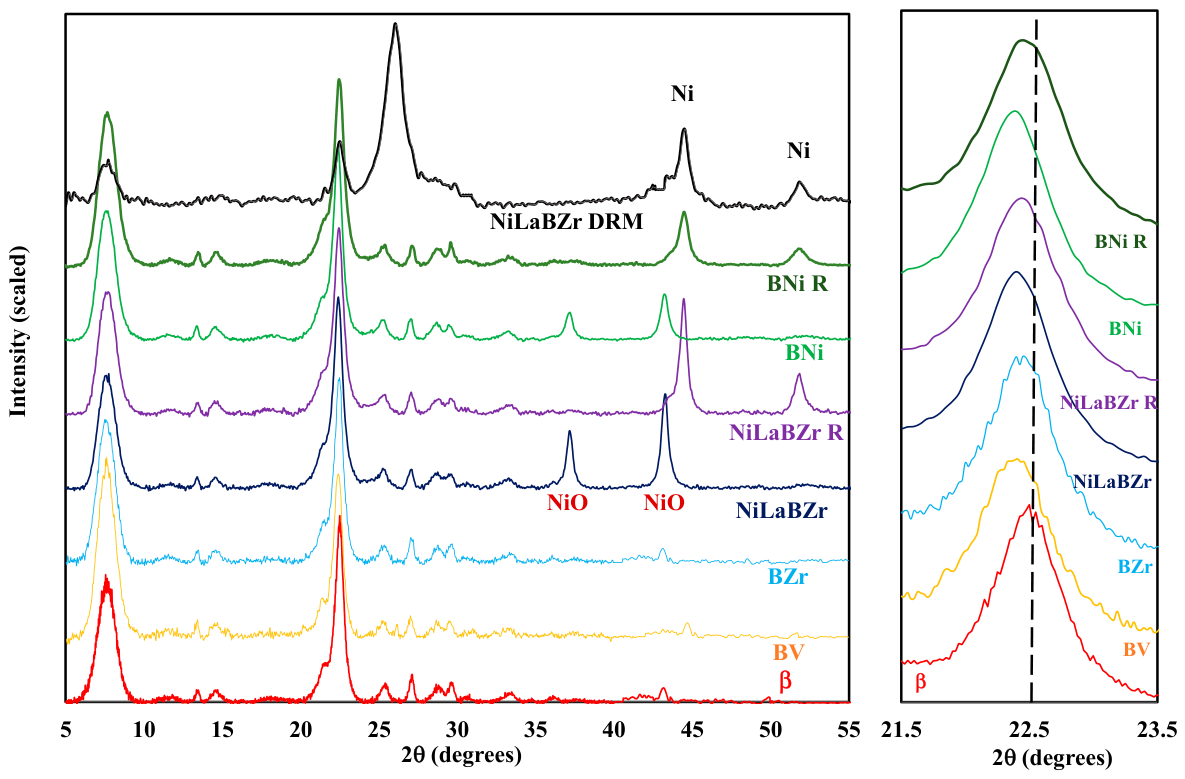
The crystalline structures of the zeolites were examined by powder X-ray diffraction (PXRD), as shown in Figure 1 for the parent H-Beta and the Zr-, V-, and Ni-modified samples. The diffraction pattern of the La-substituted Beta is not displayed for clarity, given its close similarity to those of the Zr- and V-containing materials. For comparison, the PXRD profiles of the NiLaBZr catalyst (10 wt% Ni and 20 wt% La2O3) in both calcined and reduced (800 °C) states are also included, along with the reduced BNi reference.
All materials exhibit the characteristic reflections of the BEA framework (JCPDS 48-0074), confirming that the crystalline structure is preserved following metal incorporation. The samples retain high crystallinity, displaying intense, well-defined peaks. This robustness underscores the remarkable structural stability of the Beta zeolite, which remains intact even after severe treatments such as acid dealumination (HNO3) and high-temperature calcination in air (600 °C) or reduction under H2 (800 °C), consistent with previous reports [20,28,29]. Notably, no reflections corresponding to ZrO2, V2O5, or La2O3 are detected, indicating that these species are either highly dispersed or incorporated into the zeolite framework [21,30]. In contrast, the Ni-substituted sample (BNi) shows distinct NiO reflections, confirming that part of the Ni is present as extra-framework oxide nanoparticles. A similar behavior is observed for the impregnated NiLaBZr catalyst: following calcination, two additional reflections appear at 37.3° (111) and 43.4° (200), which are characteristic of cubic NiO [18]. The absence of characteristic La2O3 reflections in this sample is particularly striking, given that its loading is twice that of NiO, strongly indicating a high degree of lanthanum dispersion across the support surface. This superior dispersion of the lanthanum phase is crucial, as it provides a robust interfacial area that promotes the anchoring of nickel species, ultimately favoring higher Ni dispersion and preventing crystallite agglomeration during the subsequent reduction and reaction stages. However, despite the fact that BNi contains around 5 wt% Ni (compared to 10 wt% Ni in the impregnated NiLaBZr catalyst), the NiO peak intensity in BNi is significantly lower than expected if all Ni were present as external oxide phases. Based on the relative metal loadings, the NiO signal in BNi would be anticipated to reach roughly 50% of that in NiLaBZr; yet, the observed intensity is far below this value. This discrepancy strongly suggests that a fraction of Ni in the BNi sample is incorporated into the zeolite framework or occupies highly dispersed sites that do not give rise to detectable NiO reflections.
Figure 1 (right panel) presents a magnified view of the main BEA reflection, the (302) peak at 22.5° 2θ for H-Beta [6], along with its modified and reduced counterparts. The position of this reflection provides valuable information on lattice contraction or expansion induced by framework alterations [31]. As shown, the incorporation of V, Zr, and Ni into the Beta zeolite results in a slight shift of the (302) peak toward lower 2θ values, indicating an expansion of the unit cell and suggesting successful metal incorporation. An analogous behavior has been previously reported by Penkova et al. [32] for Ni-modified deAl-Beta.
The observed trend in peak shifts (V ≥ Ni > Zr), however, cannot be rationalized solely on the basis of simple ionic radii. According to Shannon’s effective ionic radii, the size sequence is Zr4+ (0.59 Å) > Ni2+ (0.55 Å) > Al3+ (0.39 Å) > V5+ (0.36 Å) [33]. For La3+, its substantially larger radius (0.85 Å) strongly suggests that it remains in extra-framework positions rather than substituting into tetrahedral sites. In general, the substitution of a larger cation should increase the T–O–T distances, expand the unit cell, and, following Bragg’s law, shift reflections to lower 2θ values. The Goldschmidt 15% rule [34] further predicts that V5+ is the only cation capable of comfortably replacing Al3+ in tetrahedral sites; Zr4+, Ni2+, and La3+ are all size-mismatched and therefore excluded from isomorphous substitution. Paradoxically, V5+ is the smallest cation in the series and would not be expected, a priori, to induce any framework expansion. Equally counterintuitive is the case of Ni2+: despite being disallowed by the 15% rule, its incorporation also produces a measurable shift toward lower diffraction angles. These discrepancies clearly demonstrate that the structural evolution of the BEA framework cannot be interpreted on the basis of ionic size alone.
The distinct peak-shift patterns observed for Ni-, Zr-, and V-modified samples reflect fundamentally different modes of interaction with the zeolitic framework. Vanadium is well known to undergo isomorphous substitution for framework Al [20], directly perturbing the T–O–T connectivity and producing detectable lattice expansion. In contrast, Ni2+ does not enter tetrahedral positions. Śrębowata et al. [35] reported that Ni2+ is incorporated into vacant T-atom sites of the deAl-Beta framework as pseudo-tetrahedral and extra-framework octahedral Ni2+ species due to ligand-field stabilization effects. Consequently, Ni2+ resides mainly as charge-compensating extra-framework species or as highly dispersed NiO clusters within the channels, as shown in Figure 1. Nevertheless, the high polarizing power of Ni2+ and its interaction with dealumination-induced defects can distort nearby Si–O bonds, creating structural perturbations similar to those of framework-incorporated V. This is consistent with observations by He et al. [11], where the d(302) shift to 22.34° in dealuminated Ni/SiBeta was attributed to Ni occupying T-vacant sites in the BEA structure.
Zr4+, on the other hand, is only marginally capable of tetrahedral substitution because its size and preferred coordination impose substantial strain on T–O–T bond angles. As a result, Zr tends to form highly dispersed oxide species or occupy enlarged silanol-nest cavities, interacting weakly with the lattice. In agreement with this, Li et al. [15] reported that the incorporation of zirconium into the framework of zeolites does not modify the crystalline structure of the parent zeolites. This scenario is consistent with the absence of detectable ZrO2 reflections in PXRD and with the minimal peak shifts observed [21]. The magnitude of the structural perturbation therefore reflects not only ionic size but also each metal’s preferred coordination geometry, electronic structure, and mode of interaction with defect sites.
The framework distortion induced by V5+ arises primarily from its tendency to form vanadyl (V=O) species or adopt higher coordination numbers (CN = 5–6) through interactions with water molecules or nearby silanol groups, as reported by Chao et al. [36] for V–MCM-41 and by Dzwigaj et al. [37] for V-Beta. These square-pyramidal or distorted-octahedral geometries increase the effective ionic radius of vanadium, making it larger than Al3+ in practice. Additionally, the nature of the d-orbitals and associated electronic repulsions leads to longer V–O bond distances compared with Al–O (1.73–1.75 Å), thus forcing a local expansion of the framework to accommodate the altered polyhedral environment.
To assess catalytic suitability, structural changes occurring after reduction were also characterized by PXRD. Hydrogen treatment successfully converted NiO to metallic Ni (JCPDS–ICDD 4-0850), as indicated by the appearance of reflections at 44.6° (111) and 51.9° (200) and the disappearance of NiO-related peaks. This transition is particularly pronounced in the NiBZr sample, where stronger metallic Ni reflections reveal a higher concentration of reduced Ni species compared with BNi.

3.1.2. Framework Structural Modifications Analyzed by DRIFTS

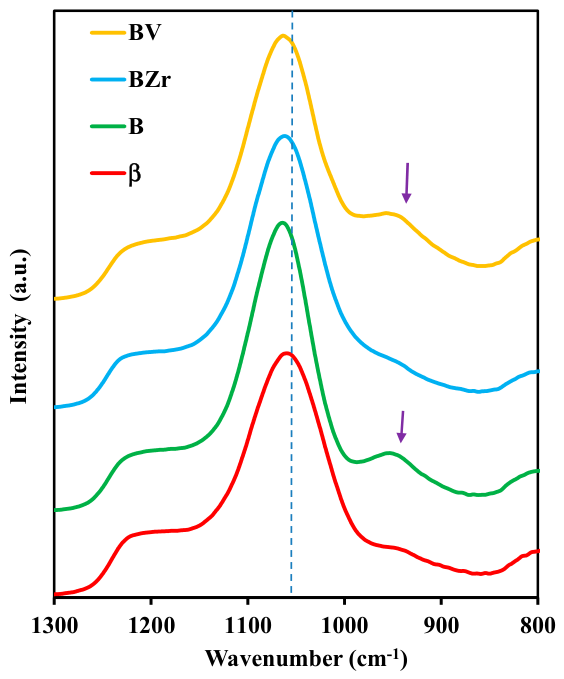
The framework structural modifications induced by aluminum extraction and the subsequent post-synthetic functionalization with V and Zr (as well as Ni and La, which yielded analogous spectral profiles to Zr) were evaluated via mid-IR spectroscopy, with the representative spectra of parent and modified Beta zeolites in the T–O–T vibration region (1300–800 cm−1) are presented in Figure 2.
The FTIR spectra of the Beta zeolites exhibit the characteristic vibrational fingerprint of the BEA framework in the 1300–800 cm−1 region. The bands located at 1250–1150 cm−1 and 1150–980 cm−1 are assigned to the external and internal asymmetric stretching modes (νas-ext and νas-int) of the T–O–T linkages, respectively [38]. The former reflects the connectivity between secondary building units, whereas the latter is dominated by the primary TO4 tetrahedral vibrations. Notably, the internal asymmetric stretching band centered near 1080 cm−1 undergoes a pronounced blue shift in the dealuminated and metal-incorporated samples. This shift is consistent with the removal of framework Al and the consequent structural rearrangement, wherein shorter and stronger Si–O bonds increasingly govern the vibrational response of the lattice.
The emergence of a distinct band at approximately 960 cm−1 in the deAl-Beta sample (B) constitutes a sensitive spectroscopic indicator of rearrangements induced by Al extraction. The removal of framework Al3+ generates vacant T sites that are subsequently stabilized by vicinal silanol groups, leading to the formation of well-defined silanol nests. As demonstrated by Baran et al. [20,37], FTIR analysis confirms that the near-complete extraction of framework Al produces vacancy sites associated with these Si–OH groups. The 960 cm−1 vibration, commonly attributed to the stretching mode of the Si–OH moieties within such defects, thus provides direct evidence of localized lattice opening and the creation of anchoring environments suitable for the subsequent introduction of metal species [20,37].
Upon the incorporation of V, Zr, Ni, or La into the deAl-Beta zeolite, the 960 cm−1 band exhibits element-specific behavior. While this band vanishes completely in the Zr-, Ni-, and La-modified materials, it persists—and even increases slightly in intensity—upon vanadium incorporation. The disappearance of the 960 cm−1 feature following Zr4+, Ni2+, or La3+ addition is consistent with the titration of silanol-nest defects by these cationic species, as previously reported by Zhang et al. [39] and Penkova et al. [32]. Owing to their strong affinity for hydroxyl groups and their relatively large ionic radii, which hinder effective insertion into tetrahedral framework positions, these cations readily condense with silanol groups (e.g., for Zr: ≡ Si–OH + Zr species → ≡ Si–O–Zr…). This reaction effectively passivates the vacancy and consumes the Si–OH groups responsible for the 960 cm−1 vibration. As a result, Zr, Ni, and La are stabilized predominantly as extra-framework species or, in the case of Ni, as small oxide clusters confined within the zeolite cavities, in agreement with previous PXRD results.
In contrast, the evolution of the 960 cm−1 band in the V-containing sample (BV) provides strong evidence for the isomorphous substitution of vanadium into the framework. The ionic radius of V5+ closely matches that of the tetrahedral vacancy sites formed upon Al removal; as demonstrated by Dzwigaj et al. [37,40,41], this enables vanadium to occupy T positions and generate Si–O–V linkages. Importantly, the vibrational frequency of framework Si–O–V bonds lies within the same region as the silanol-nest vibration (~960 cm−1). Consequently, the intensified band observed in the BV catalyst results from a superposition of two contributions: residual silanol nests and newly formed framework Si–O–V vibrations. This behavior stands in stark contrast to the complete suppression of the 960 cm−1 feature observed for the bulkier Zr and Ni species, thereby underscoring the distinct incorporation mechanism of vanadium.

3.1.3. Pore Texture

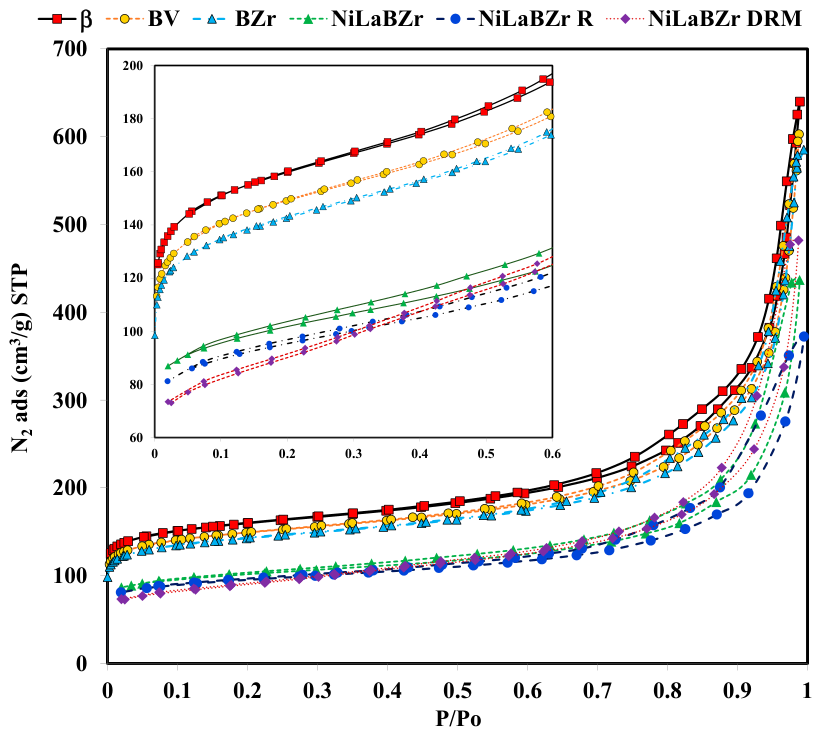
The textural properties of all samples were characterized by N2 adsorption at −196 °C and CO2 adsorption at 0 °C. Figure 3 displays the N2 adsorption isotherms for representative samples, including the parent Beta, V- and Zr-substituted deAl-Beta, and the catalyst (10 wt% Ni and 20 wt% La2O3 supported on BZr) in its calcined state, following H2 reduction, and after the DRM test. Table 1 summarizes the textural characterization results for all samples. The most relevant features of the N2 adsorption–desorption isotherms are as follows [42]: (i) the uptake at P/P0 < 0.3, which reflects the intrinsic micropore volume; (ii) the sharpness of the isotherm knee, associated with the micropore size distribution; (iii) the slope at higher relative pressures (P/P0 > 0.3), which provides information on mesoporosity; and (iv) the presence of a hysteresis loop, indicative of mesopore-assisted capillary condensation. All samples exhibit substantial uptake in the low-pressure region, confirming the predominance of microporosity [42], together with well-developed mesoporosity evidenced by the pronounced adsorption step in the P/P0 range of 0.75–0.95.
As shown in Figure 3, dealumination and subsequent metal incorporation result in only a slight decrease in N2 uptake (BV and BZr vs. β). The uniform decrease across the entire pressure range indicates a proportional reduction in all pore types. This loss can be partly attributed to the mass contribution of the substituted metal oxides (~3–8 wt%), which do not add to the pore volume yet are included in the mass-normalized porosity calculations. In the case of NiLaBZr, the attenuation of the isotherm is more pronounced owing to the substantial loading of supported Ni and La2O3 (~30 wt%), which further dilutes the apparent porosity of the composite.
The textural parameters derived from N2 and CO2 adsorption (Table 2) are fully consistent with the isotherm analysis discussed above. It is important to emphasize that the micropore volume obtained from N2 adsorption (VN2) accounts for all the micropores up to approximately 2 nm, while the CO2 adsorption data (VCO2) selectively probe ultramicropores smaller than 0.7 nm [24,43]. For the parent Beta zeolite (β), the similar values of VN2 and VCO2 indicate a narrow micropore size distribution centered around ∼1 nm, alongside a substantial contribution of meso- and macroporosity. In the BV and BZr samples, both micropore volumes remain comparable to each other and are only slightly reduced relative to the parent material, confirming—together with PXRD—that dealumination, metal substitution, and subsequent calcination do not significantly compromise the intrinsic porous architecture of the Beta zeolite. Similar results have been reported by Wang et al. [21] for Zr-Beta zeolite; the post-treatment did not significantly modify the porosity of the pristine material.
Upon incorporation of Ni and La into the isomorphously substituted supports (e.g., BZr), all textural parameters decrease proportionally to the loading of supported metal oxides. This observation indicates that impregnation, calcination, and reduction predominantly contribute to an apparent mass dilution rather than extensive pore blocking. As a result, the reduced catalysts retain a substantial BET surface area, which remains fully suitable for heterogeneous catalytic applications.

3.1.4. Temperature-Programmed Reduction Analysis: H2-TPR

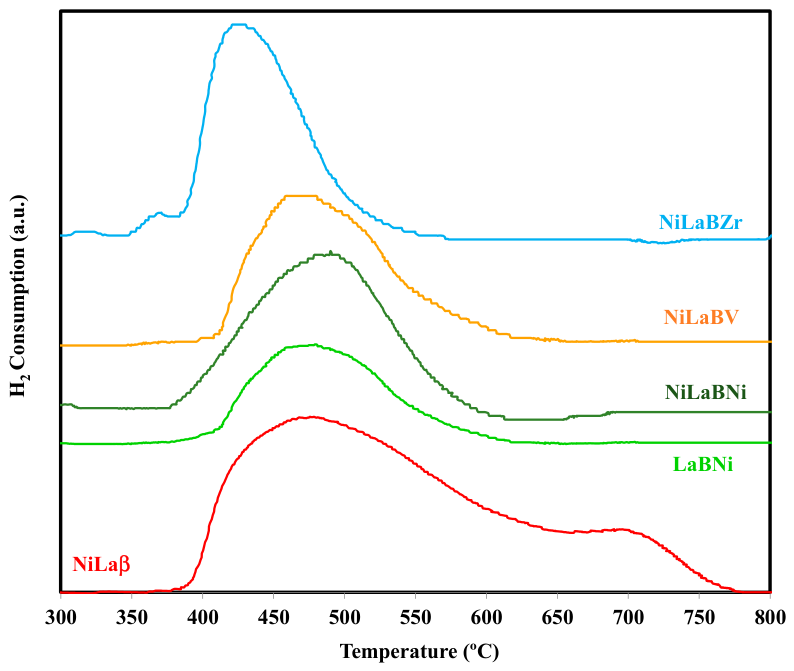
Following the calcination of the nickel-impregnated precursors, a hydrogen-mediated reduction is essential to transform NiO into supported metallic Ni nanoparticles, which serve as the active phase for the DRM reaction [3]. Consequently, the distinct catalytic performances observed across the various supports can be attributed to disparities in the reducibility of NiO. The corresponding H2-TPR profiles are illustrated in Figure 4.
The temperature-dependent reduction of NiO has been widely reported to reflect the presence of different NiO species under varying local environments [44,45,46,47]. Reduction below 500 °C is generally attributed to NiO particles weakly interacting with the support, consistent with their placement on the external surface of the support grains [44,45]. Features appearing at temperatures up to ~650 °C are commonly associated with NiO species confined within the support porosity [46]. In contrast, reduction at higher temperatures is typically assigned to more strongly bonded crystalline phases formed during calcination through solid-state interactions between NiO and zeolitic or silica-based supports [47].
It is worth noting first that similar reduction profiles have been reported for the parent Beta zeolite [48,49]. This sample (NiLaβ) exhibits the most thermally complex reduction pattern. A broad peak centered around 480 °C is observed, which can be assigned to NiO species weakly interacting with the external surface or located within the accessible porosity of the zeolite. Most notably, a well-defined shoulder/secondary peak appears at approximately 700–750 °C. The presence of this high-temperature feature indicates that a fraction of Ni is strongly interacting with the zeolite framework, likely forming nickel aluminate–type phases (NiAl2O4) [47] or highly confined Ni species within the channels. In such cases, reduction is significantly hindered by the strong metal–support interaction [3].
For the remaining samples containing deAl-Beta, the reduction profile becomes notably simpler. The main peak remains within a similar temperature range (~450–500 °C), but the high-temperature peak (>700 °C) nearly disappears. This observation clearly indicates that dealumination reduces the number of sites where Ni can form phases that are difficult to reduce (such as aluminate-type species). In the case of the samples where Ni was incorporated via isomorphous substitution (LaBNi) and the impregnated sample containing the same Ni loading (up to 10 wt%), the peak shapes are remarkably similar. This is consistent with Ni being anchored to the support in the same manner in both cases, reinforcing the conclusion that Ni does not isomorphously replace Al in the framework.
The reduction behavior of the V-containing sample follows a pattern similar to that of NiLaBNi, albeit with a slight increase in hydrogen consumption at higher temperatures (550–650 °C). This is likely due to the reduction of V5+ surface species to V4+, as reported by Fornés et al. [50]. Notably, the NiBLa profile (not included for the sake of clarity) was found to be analogous to that of LaBNi. The most pronounced change is observed in the Zr-modified sample. The main reduction peak shifts significantly to lower temperatures, centering around 430–440 °C. In addition, small early reduction events appear (350–380 °C), indicating that zirconium facilitates the reduction of nickel. Zhukova et al. [51] showed that the incorporation of Zr in their supports increases the Ni2+ reducibility and the Ni0 formation due to its coordination in the form of NiO with high metal–support interaction. This suggests that Zr either weakens the interaction between Ni and the zeolite support or promotes the formation of smaller, more highly dispersed NiO species that reduce more readily. Overall, Zr enhances Ni dispersion and decreases the strength of the Ni–support interaction.

3.1.5. Analysis of Ni Nanoparticles and Carbon Nanotubes by TEM

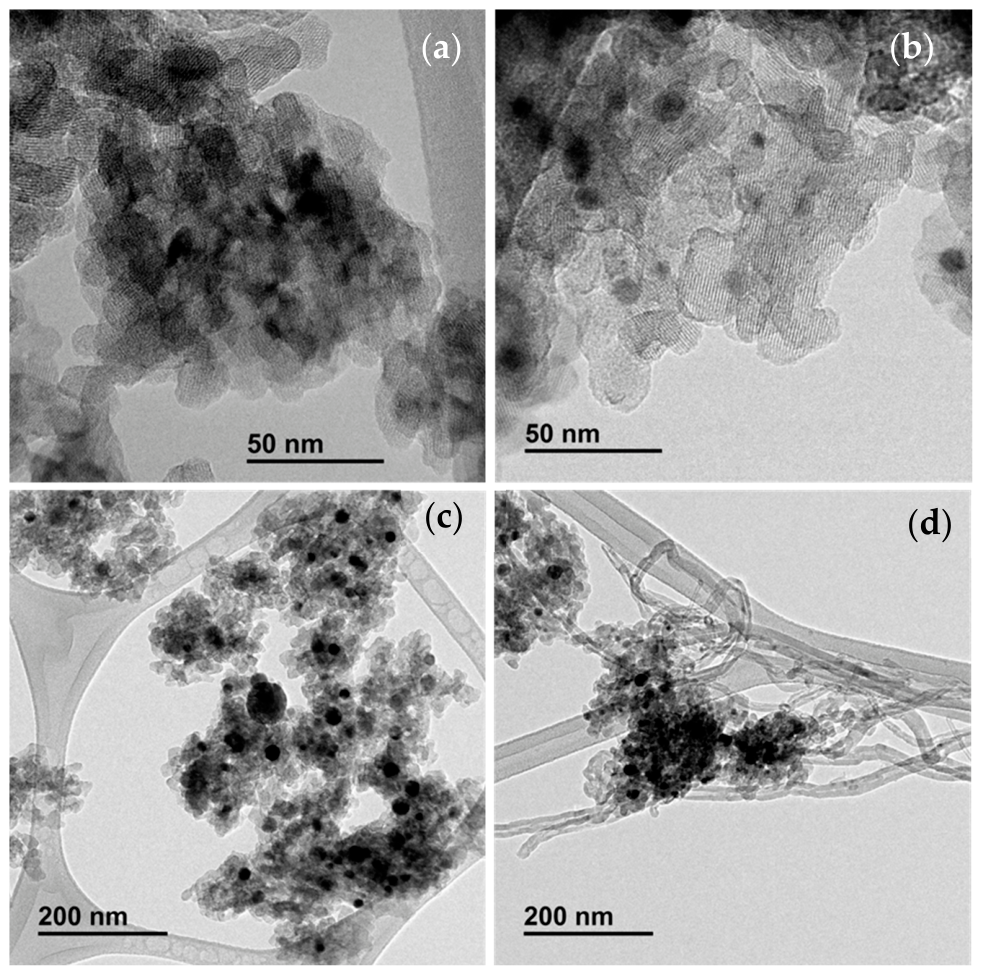
Figure 5 presents representative TEM micrographs of the NiLaBZr and LaBNi catalysts. For NiLaBZr, TEM images are shown for the calcined, reduced, and post-reaction states, whereas for LaBNi, only the catalyst after DRM is presented. It should be noted that the remaining catalysts exhibited similar morphologies in their calcined and reduced states. In all reduced and spent catalysts, Ni nanoparticles are clearly discernible as dark circular features. This contrasts with the calcined sample (Figure 5a), where such features are absent, thereby confirming the aforementioned identification of metallic nickel.
The Ni nanoparticles show a relatively uniform size distribution (average size of 10–20 nm), aligning with the trends observed by Bacariza et al. [48]. In their study of different zeolite structures, Beta-supported systems also exhibited particularly small Ni nanoparticles.
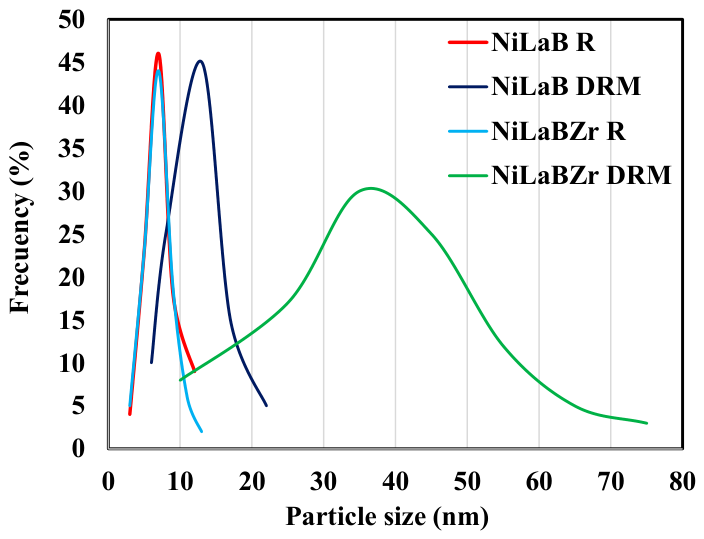
As shown in Figure 5c, the Ni nanoparticle size increases after the DRM reaction, suggesting that sintering occurs during the process. To provide quantitative evidence of the catalyst’s structural evolution, particle size distribution histograms were constructed from TEM micrographs of reduced catalysts derived from the impregnated sample (acting as a reference) and the isomorphous substituted sample (NiLaBZr) (Figure 6). Additionally, key statistical parameters such as the average particle size (dp), standard deviation (σ), particle size range, and the total number of particles measured (N) are included in Table 3 to provide a rigorous numerical comparison between the reduced and spent states.
Initially, after the reduction step, both the impregnated system (NiLaβ R) and the isomorphously substituted system (NiLaBZr R) exhibited high metallic dispersion with average particle sizes of 7.4 and 7.2 nm, respectively. This similarity is expected as the nickel species were incorporated similarly across both matrices, leading to homogeneous Ni0 distributions. However, after the DRM reaction, a significant divergence in stability was observed. While the NiLaβ catalyst demonstrated high sintering resistance (increasing only to 11.2 nm), the NiLaBZr system showed a significant shift in the particle size distribution, with the average diameter increasing sharply to 44.5 nm. Paradoxically, in this specific system, the presence of Zr appears to favor Ni0 growth rather than inhibiting it. This significant growth, evidenced by the broad distribution curve, suggests a severe sintering process occurring under reaction conditions, likely driven by particle migration and Ostwald ripening. The quantitative data confirm that while initial dispersion is excellent in both cases, the thermal stability of the Ni sites is significantly compromised by the Zr substitution during the DRM process. Nevertheless, it is noteworthy that no carbon nanotubes were observed on either catalyst (NiLaβ and NiLaBZr). In contrast, the LaBNi sample clearly exhibits the formation of carbon nanotubes. While several authors [52,53] have reported that carbon nanotube growth is significantly inhibited for Ni particles below 10 nm, both catalysts in this study (Figure 5c,d) display Ni nanoparticle sizes larger than 10 nm. These results indicate that the differences in carbon formation are likely due to a stronger interaction between the active Ni centers (where CH4 activation occurs) and La2O3 in the NiLaBZr sample, which promotes the gasification of carbonaceous deposits.

3.2. Catalytic Activity and Stability

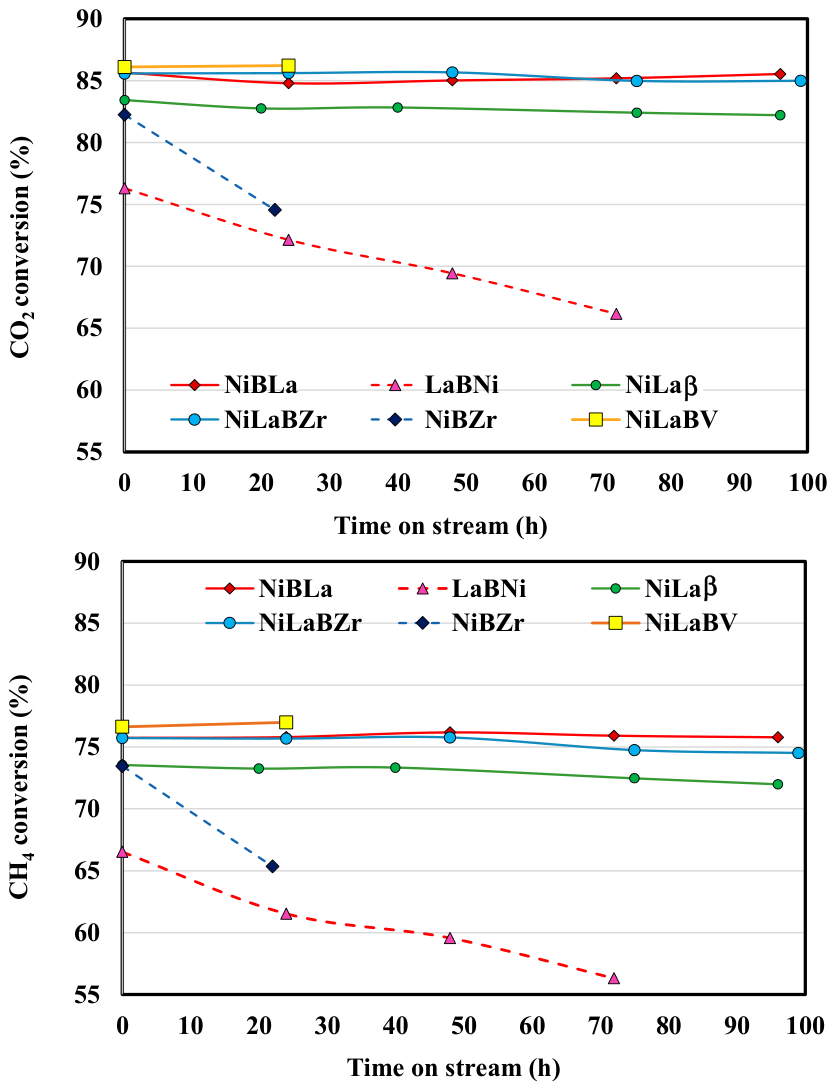
Figure 7 illustrates the catalytic activity of 10 wt% Ni supported on Beta and isomorphously substituted deAl-Beta zeolite catalysts (with the exception of the Ni-substituted deAl-Beta, which contains 5.3 wt% Ni). Conversions were measured at 700 °C following reduction in H2 at 800 °C for 1 h. Preliminary results indicate that the synthesis of Ni-supported deAl-Beta catalysts was successful; most samples exhibit CH4 and CO2 conversions approaching the thermodynamic limits for both gases at 700 °C and 1 bar (76% and 86%, respectively [54]). Given the high weight hourly space velocity (WHSV) of 58 L/(g·h), these results demonstrate that Ni° dispersed over Beta and deAl-Beta supports exhibits superior catalytic activity. Furthermore, the differences in conversion and selectivity observed for NiBZr, LaBNi, and NiLaBV compared to the other catalysts cannot be attributed to their pore texture, Ni° particle size, or metal dispersion, as gas adsorption and TEM studies confirmed that all catalysts exhibit similar values for these parameters.
Another significant observation is that the addition of La2O3 not only enhanced the stability of all catalysts, as anticipated, but also led to a measurable increase in catalytic activity. For instance, the performance of NiBZr and NiLaBZr is compared in Figure 6. As illustrated, NiBZr initially exhibits a slightly lower conversion rate (approximately 2% lower) than its La-promoted counterpart, NiLaBZr. More importantly, the lower catalytic stability of NiBZr results in reactor plugging due to the extensive formation of carbon nanotubes. At 700 °C, carbonaceous deposits arise predominantly from methane decomposition rather than the Boudouard reaction [1,2,3]. This deposition is closely associated with the high catalytic activity of metallic Ni centers, which promotes the rapid dissociation of CH4. In contrast, NiLaBZr does not show significant carbon deposit formation even after 98 h of DRM (see Figure 5c). The structural evolution of the catalyst post-reaction (98 h) provides key mechanistic insights. PXRD patterns of the spent sample exhibit distinct peaks between 2θ = 25° and 32°, characteristic of La2O3 and La2O2CO3 [55]. The identification of the La2O2CO3 phase underscores the dynamic role of lanthanum in the catalytic cycle; this oxycarbonate species acts as a scavenger for surface carbon, promoting its gasification and mitigating deactivation. Such observations are consistent with previous reports highlighting the bifunctional nature of La-modified catalysts in enhancing long-term stability [13,16]. However, this does not rule out the potential presence of pyrolytic carbon deposits on the nickel nanoparticles of other catalysts, which could eventually lead to deactivation.
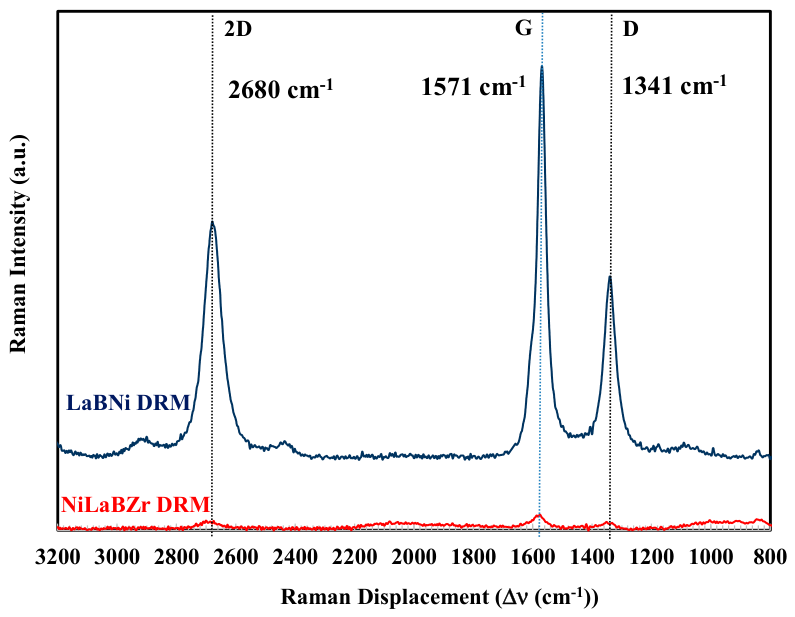
Raman spectroscopy has been shown to be highly effective for the identification of dispersed carbonaceous nanostructures. As illustrated in Figure 8, the Raman spectra of most spent catalysts display the two characteristic bands of graphene-like carbon materials: the D band at 1341 cm−1, which arises from structural disorder, and the G band at 1571 cm−1, originating from graphitic domains [56]. This finding is in good agreement with the TEM images (Figure 5d), where carbon nanotubes were clearly observed. The structural order of the deposited carbon can be assessed using the intensity ratio of these two bands (ID/IG) [56]. The LaBNi sample shows a notably more intense G band compared to the D band, indicating a high degree of graphitization. In contrast, the NiLaBZr catalyst yields very weak Raman signals, consistent with the minimal carbon deposition detected by TEM (Figure 5c).
Further structural information can be derived from the second-order 2D band (also referred to as G′) [56]. Unlike the D band, the 2D band does not rely on defect-induced activation and is particularly sensitive to the layer stacking arrangement of carbon. In the LaBNi catalysts, a sharp and symmetric 2D peak is observed. The corresponding I2D/IG ratio is approximately 0.6, which is below 1.0—a value typically associated with multi-walled carbon nanotubes (MWCNTs) or few-layer graphitic structures. This observation rules out the presence of single-layer graphene, which would exhibit an I2D/IG ratio of 2 or higher [57]. Taken together, these results indicate that the carbon species deposited on these catalysts consist predominantly of carbon nanotubes.
To minimize carbon deposition, the support should promote carbon gasification [2,3,18,48]. In this regard, zeolites exhibit distinct behavior compared to other basic supports concerning their activity toward the gasification of deposited carbon. Various strategies have been employed to facilitate this process, including the incorporation of promoter oxides such as Mg and Ca [58], Ce [59], Zr [60], or La [61]. Based on these considerations and the promising results reported in previous studies for La-containing perovskite-based Ni catalysts [16,62], this promotional strategy was adopted.
However, the presence of La2O3 does not inherently guarantee the prevention of carbon deposition, as catalytic performance is also significantly influenced by the synthesis methodology. Specifically, co-impregnation of Ni and La was performed on Beta (NiLaB) and isomorphous Beta supports (BZr and BV) to ensure intimate contact between the two species. In contrast, the isomorphously substituted supports BNi and BLa were prepared via sequential impregnation with La or Ni, respectively. Consequently, the co-impregnated samples (NiLaβ, NiLaBZr, and NiBLa) achieved both higher conversion rates and enhanced catalytic stability (Figure 6). Conversely, LaBNi exhibited lower conversion efficiency and progressive deactivation due to carbon deposition (see Figure 5d). These results suggest that La impregnation fails to achieve adequate contact with all the previously incorporated isomorphous Ni, likely due to the limited accessibility of the La species to reach Ni species occupying T-vacant sites within the BEA framework. Accordingly, these findings corroborate the previous PXRD and FTIR observations, indicating that a fraction of the Ni resides in these T-vacant sites.
Regarding the NiLaBV catalyst, although it exhibited one of the highest initial catalytic activities, it demonstrated poor stability. Despite being synthesized via co-impregnation (analogous to the β and BZr samples), this material promoted excessive carbon nanotube production. While this deposition did not result in an immediate loss of catalytic activity, it led to reactor plugging, necessitating the termination of the experiment. This behavior is a direct consequence of the support’s properties, specifically the presence of isomorphous vanadium within the Beta zeolite framework. Vanadium was incorporated due to its high affinity for hydrocarbons [17]; however, these results indicate that it also exhibits a high affinity for CH4, accelerating carbon formation. Consistent with the behavior observed for the LaBNi catalyst, the insufficient interaction between the impregnated La species and the Ni species located at the T-sites hinders the carbon gasification/removal mechanism. These results highlight that the main limitation of using isomorphously substituted zeolites to anchor Ni and metal promoters at the T-sites lies in achieving effective contact with the basic La2O3 gasifying agent.
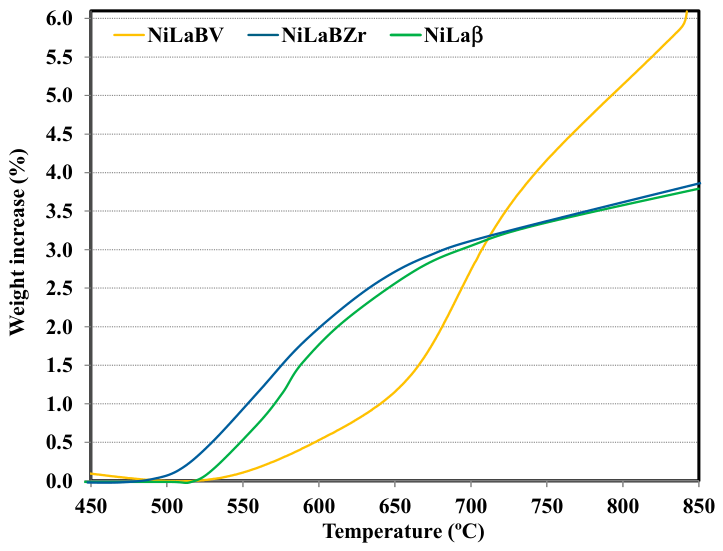
To further investigate the aforementioned observations, a thermogravimetric analysis (TGA) was performed to evaluate the reactivity of the reduced catalysts toward CH4. Figure 9 illustrates the weight gain profiles for the NiLaBV, NiLaBZr, and NiLaβ samples. Consistent with the high affinity of metallic Ni° sites for methane decomposition [1], all catalysts exhibited a progressive weight increase starting at 500 °C, attributed to the formation of carbonaceous deposits.
Despite a uniform Ni loading (10 wt%), significant differences were observed regarding both the onset temperatures of weight gain and the kinetics of carbon formation, as reflected by the distinct slopes of the thermogravimetric curves. The NiLaBZr and NiLaβ catalysts exhibited similar behavior, which is consistent with their synthesis via the co-impregnation of Ni and La onto the zeolitic support; this likely results in comparable Ni° nanoparticle distributions (Figure 5b) and, consequently, similar behavior toward CH4. However, the Zr-modified catalyst showed a lower onset temperature, indicating higher initial reactivity. This enhanced activity is attributed to the improved reducibility of NiO in the presence of Zr (Figure 4), which may favor the formation of smaller, more reactive Ni° crystallites [63].
In contrast, the V-modified catalyst displayed a characteristic induction period [64]. While its onset temperature was similar to that of NiLaβ, it initially exhibited lower methane cracking activity before undergoing a sharp increase in weight gain above 650 °C. This suggests that the presence of vanadium initially inhibits Ni° activity toward methane at lower temperatures. More notably, at temperatures exceeding 700 °C—where the other catalysts showed a progressive decrease in their weight gain rate, likely due to deactivation by carbon encapsulation—the V-modified catalyst showed a continuous increase in weight. This behavior indicates that, unlike Zr, V directly participates in methane cracking at elevated temperatures, consistent with its known affinity for hydrocarbons [17]. These results corroborate the performance observed during DRM. Although the addition of V led to excessive carbon accumulation in this context, it highlights the potential of V as a promoter for CH4 activation, provided it can be integrated into a redox cycle (e.g., with La2O3) to facilitate the continuous removal of deposited carbon.
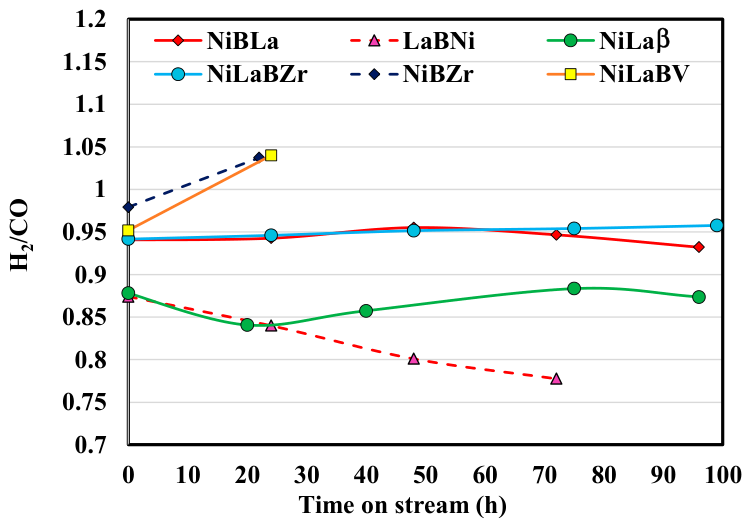
The H2/CO molar ratio serves as a critical metric for evaluating catalytic selectivity and durability in the dry reforming of methane. Figure 10 shows the evolution of the H2/CO molar ratio as a function of time on stream during DRM at 700 °C over the reduced Ni-series. Catalysts NiLaBZr and NiBLa exhibited superior performance, maintaining stable profiles near 0.95 for 100 h, indicating high resistance to deactivation and effective suppression of the reverse water–gas shift (RWGS) reaction. Conversely, NiLaBV and NiBZr showed ratios exceeding 1.0, signaling the prevalence of methane cracking and subsequent carbon deposition, while NiLaβ and LaBNi displayed lower, declining ratios (0.77–0.88) characteristic of dominant RWGS activity and progressive loss of active sites. These findings demonstrate that despite similar support frameworks and porosities, the specific nature of the extra-framework cations is the primary driver of intrinsic selectivity, as they fundamentally modulate the kinetic balance between CH4 and CO2 and activation.

4. Conclusions

The systematic investigation of metal-modified Beta zeolites demonstrates that the framework possesses remarkable structural and textural robustness, maintaining high crystallinity and its intrinsic porous architecture despite rigorous acid dealumination (HNO3) and high-temperature calcination processes. PXRD and textural analyses confirmed that the incorporation of Zr, V, La, and Ni resulted in only marginal reductions in surface area, without compromising the zeolite’s structural integrity. While Zr, V, and La appeared as highly dispersed or framework-incorporated species, Ni was partially present as extra-framework NiO nanoparticles. This was further elucidated by FT-IR analysis of the 960 cm−1 band, which suggested that Zr4+, Ni2+, and La3+ primarily interact with silanol-nest defects, whereas the V-modified sample provided strong evidence for isomorphous substitution into the zeolite T-sites. Furthermore, H2-TPR studies revealed that dealumination effectively suppresses the formation of irreducible nickel–aluminate phases, thereby enhancing Ni2+ reducibility, a process further promoted by the presence of Zr.
Regarding catalytic performance, the addition of La2O3 proved instrumental in enhancing both thermal stability and activity, particularly when a co-impregnation strategy was employed. Consequently, the co-impregnated NiLaβ and NiLaBZr catalysts achieved an optimal balance between high conversion and long-term stability.
In contrast, although the V-modified catalyst (NiLaBV) exhibited the highest initial activity, it underwent rapid deactivation. This instability is attributed to the strong affinity of V species for hydrocarbons at elevated temperatures, which promotes direct methane cracking and leads to the rapid encapsulation of active sites by carbonaceous deposits. Moreover, the insufficient interaction between the impregnated La species and V, located at framework T-sites, hinders the carbon gasification/removal mechanism. This behavior highlights the limitations of the isomorphous substitution process in the zeolite framework in the context of DRM.

Author Contributions

Conceptualization, G.G.-M. and J.A.-M.; methodology, G.G.-M. and J.A.-M.; investigation, G.G.-M.; writing—original draft preparation, G.G.-M.; writing—review and editing, J.A.-M. All authors have read and agreed to the published version of the manuscript.

Funding

The authors would like to thank the financial support from the European Union (FEDER Funds), Generalitat Valenciana (grant No. PROMETEO CIPROM/2021/70), and Universidad de Alicante (Ayuda para la utilización de los servicios técnicos de investigación (UAUSTI25), REF: UASTI25-13).

Data Availability Statement

Data are contained within the article.

Conflicts of Interest

The authors declare no conflicts of interest.

Appendix A

Table A1. Summary of the nomenclature of supports and catalysts.
SampleZeolite SupportImpregnated (wt%)Treatment
Nickel La2O3
bBeta com.---
NiLab b1020Calcination at 600 °C, 3 h
NiLab Rb1020H2 reduction at 800 °C, 1 h
NiLab DRM b1020CH4/CO2 at 700 °C, 96 h
BDe-Aluminate--HNO3
BZrB--Impr Zr & Calcination at 600 °C, 3 h
NiLaBZrBZr1020Calcination at 600 °C, 3 h
NiLaBZr RBZr1020H2 reduction at 800 °C, 1 h
NiLaBZr DRMBZr1020CH4/CO2 at 700 °C, 98 h
BVB--Impr. V & Calcination at 600 °C, 3 h
NiLaBVBV1020Calcination at 600 °C, 3 h
NiLaBV RBV1020H2 reduction at 800 °C, 1 h
NiLaBV DRMBV1020CH4/CO2 at 700 °C, 26 h
BNiB5-Impr. Ni & Calcination at 600 °C, 3 h
LaBNiBNi520Calcination at 600 °C, 3 h
LaBNi RBNi520H2 reduction at 800 °C, 1 h
LaBNi DRMBNi520CH4/CO2 at 700 °C, 72 h
BLaB-12Impr. Ni & Calcination at 600 °C, 3 h
NiBLaBLa1012Calcination at 600 °C, 3 h
NiBLa RBLa1012H2 reduction at 800 °C, 1 h
NiBLa DRMBLa1012CH4/CO2 at 700 °C, 96 h

References

  1. Bradford, M.C.J.; Vannice, M.A. CO2 Reforming of CH4. Catal. Rev. 1999, 41, 1–42. [Google Scholar] [CrossRef]
  2. Usman, M.; Wan-Daud, W.M.A.; Abbas, H.F. Dry reforming of methane: Influence of process parameters. A review. Renew. Sustain. Energy Rev. 2015, 45, 710–744. [Google Scholar] [CrossRef]
  3. Wang, C.; Wang, Y.; Chen, M.; Liang, D.; Yang, Z.; Cheng, W.; Tang, Z.; Wang, J.; Zhang, H. Recent advances during CH4 dry reforming for syngas production: A mini review. Int. J. Hydrogen Energy 2021, 46, 5852–5874. [Google Scholar] [CrossRef]
  4. Zhu, H.; Chen, H.; Zhang, M.; Liang, C.; Duan, L. Recent advances in promoting dry reforming of methane using nickel-based catalysts. Catal. Sci. Technol. 2024, 14, 1712. [Google Scholar] [CrossRef]
  5. Pavlović, J.; Rajić, N. Engineering Zeolite Acidity and Porosity for Improved Esterification: A Review of Mechanisms, Kinetics, and Sustainability Processes. Minerals 2026, 16, 179. [Google Scholar] [CrossRef]
  6. Corma, A. From Microporous to Mesoporous Molecular Sieve Materials and Their Use in Catalysis. Chem. Rev. 1997, 97, 2373–2420. [Google Scholar] [CrossRef]
  7. Verboekend, D.; Vilé, G.; Pérez-Ramírez, J. Hierarchical Y and USY Zeolites Designed by Post-Synthetic Strategies. Adv. Funct. Mater. 2012, 22, 916–928. [Google Scholar] [CrossRef]
  8. González, M.D.; Cesteros, Y.; Salagre, P. Comparison of dealumination of zeolites beta, mordenite and ZSM-5 by treatment with acid under microwave irradiation. Microporous Mesoporous Mater. 2011, 144, 162–170. [Google Scholar] [CrossRef]
  9. Gómez-Hortigüela, L.; Pérez-Pariente, J. Synthesis and Properties of Zeolite Materials Guided by Periodic Considerations. In Structure and Bonding; Springer: Berlin/Heidelberg, Germany, 2019; Volume 182, pp. 53–88. [Google Scholar]
  10. Pornsetmetakul, P.; Maineawklang, N.; Wattanakit, C. Preparation of Metal-Supported Nanostructured Zeolite Catalysts and their Applications in the Upgrading of Biomass-Derived Furans: Advances and Prospects. ChemPlusChem 2024, 89, e202400343. [Google Scholar] [CrossRef] [PubMed]
  11. He, D.; Wu, S.; Cao, X.; Chen, D.; Zhang, L.; Zhang, Y.; Luo, Y. Dynamic trap of Ni at elevated temperature for yielding high-efficiency methane dry reforming catalyst. Appl. Catal. B Environ. Energy 2024, 346, 123728. [Google Scholar] [CrossRef]
  12. Zhou, X.; Wu, S.; Luo, Y.; Zhu, L.; He, D. Unraveling Active Ni Sites over Dealuminated beta Zeolite for Propane Dehydrogenation. Energy Fuels 2023, 37, 450–458. [Google Scholar] [CrossRef]
  13. Gil-Muñoz, G.; Alcañiz-Monge, J. Tailoring Ni/Beta zeolite catalysts for efficient dry methane reforming: A study on pretreatment and reaction conditions. ChemEngineering 2026, 10, 46. [Google Scholar] [CrossRef]
  14. Quindimil, A.; De-La-Torre, U.; Pereda-Ayo, B.; González-Marcos, J.A.; González-Velasco, J.R. Ni catalysts with La as promoter supported over Y- and BETA- zeolites for CO2 methanation. Appl. Catal. B Environ. 2018, 238, 393–403. [Google Scholar] [CrossRef]
  15. Li, G.; Gao, L.; Sheng, Z.; Zhan, Y.; Zhang, C.; Ju, J.; Zhang, Y.; Tang, Y. A Zr-Al-Beta zeolite with open Zr(IV) sites: An efficient bifunctional Lewis–Brønsted acid catalyst for a cascade reaction. Catal. Sci. Technol. 2019, 9, 4055–4065. [Google Scholar] [CrossRef]
  16. Gil-Muñoz, G.; Alcañiz-Monge, J. Examining the effect of zirconium doping in lanthanum nickelate perovskites on their performance as catalysts for dry methane reforming. J. Environ. Chem. Eng. 2025, 13, 115387. [Google Scholar] [CrossRef]
  17. Drzewiecka-Matuszek, A.; Tokarz-Sobieraj, R.; Witko, M.; Rutkowska-Zbik, D. Comparison of Catalytic Properties of Vanadium Centers introduced into BEA Zeolite and Present on (010) V2O5 Surface–DFT Studies. Catalysts 2020, 10, 1080. [Google Scholar] [CrossRef]
  18. Cheng, Q.; Yao, X.; Ou, L.; Hu, Z.; Zheng, L.; Li, G.; Morlanes, N.; Cerrillo, J.L.; Castaño, P.; Li, X.; et al. Highly efficient and estable methane dry reforming enabled by a single-site cationic Ni catalyst. J. Am. Chem. Soc. 2023, 145, 25109–25119. [Google Scholar] [CrossRef] [PubMed]
  19. Najfach, A.J.; Almquist, C.B.; Edelmann, R.E. Effect of Manganese and zeolite composition on zeolite-supported Ni catalysts for dry reforming of methane. Catal. Today 2021, 369, 31–47. [Google Scholar] [CrossRef]
  20. Baran, R.; Millot, Y.; Onfroy, T.; Krafft, J.M.; Dzwigaj, S. Influence of the nitric acid treatment on Al removal, framework composition and acidity of BEA zeolite investigated by XRD, FTIR and NMR. Microporous Mesoporous Mater. 2012, 163, 122–130. [Google Scholar] [CrossRef]
  21. Wang, J.; Okumura, K.; Jaenicke, S.; Chuah, G.K. Post-synthesized zirconium-containing Beta zeolite in Meerwein–Ponndorf–Verley reduction: Pros and cons. Appl. Catal. A Gen. 2015, 493, 112–120. [Google Scholar] [CrossRef]
  22. Inoue, H.; Hatanaka, N.K.; Kidena, S.; Murata, S.; Nomura, M. Reforming of Methane with Carbon Dioxide over Nickel-Loaded Zeolite Catalysts. J. Jpn. Petrol. Inst. 2002, 45, 314–320. [Google Scholar] [CrossRef][Green Version]
  23. Jeong, H.; Kim, K.I.; Ki, D.; Song, I.K. Effect of promoters in the methane reforming with carbon dioxide to synthesis gas over Ni/HY catalysts. J. Mol. Catal. A Chem. 2006, 246, 43–48. [Google Scholar] [CrossRef]
  24. Cazorla-Amorós, D.; Alcañiz-Monge, J.; Linares-Solano, A. Characterization of Activated Carbon Fibers by CO2 Adsorption. Langmuir 1996, 12, 2820–2824. [Google Scholar] [CrossRef]
  25. Dubinin, M.M. Porous structure and adsorption properties of active carbons. Chem. Phys. Carbon 1966, 2, 51–120. [Google Scholar]
  26. Barrett, E.P.; Joyner, L.S.; Halenda, P.P. The Determination of Pore Volume and Area Distributions in Porous Substances. I. Computations from Nitrogen Isotherms. J. Am. Chem. Soc. 1951, 73, 373–380. [Google Scholar] [CrossRef]
  27. Brunauer, S.; Emmett, P.H.; Teller, E. Adsorption of Gases in Multimolecular Layers. J. Am. Chem. Soc. 1938, 60, 309–319. [Google Scholar] [CrossRef]
  28. Omegna, A.; Vasic, M.; van Bokhoven, J.A.; Pirngruber, G.; Prins, R. Dealumination and realumination of microcrystalline zeolite beta: An XRD, FTIR and quantitative multinuclear (MQ) MAS NMR study. Phys. Chem. Chem. Phys. 2004, 6, 447–452. [Google Scholar] [CrossRef]
  29. Tang, B.; Dai, W.; Sun, X.; Wu, G.; Guan, N.; Hunger, M.; Li, L. Mesoporous Zr-Beta zeolites prepared by a post-synthetic strategy as a robust Lewis acid catalyst for the ring-opening aminolysis of epoxides. Green Chem. 2015, 17, 1744–1755. [Google Scholar] [CrossRef]
  30. Jiang, T.; Qu, Z.; Yin, X.; Yu, Y.; Tang, M.; Wang, N.; Sun, Q. Silanol Nest-Anchored Oligomeric Vanadium Oxides for Highly Stable and Efficient Propane Dehydrogenation. ChemCatChem 2026, 18, 01845. [Google Scholar] [CrossRef]
  31. Dai, W.; Lei, Q.; Wu, G.; Guan, N.; Hunger, M.; Li, L. Spectroscopic Signature of Lewis Acidic Framework and Extraframework Sn Sites in Beta Zeolites. ACS Catal. 2020, 10, 14135–14146. [Google Scholar] [CrossRef]
  32. Penkova, A.; Dzwigaj, S.; Kefirov, R.; Hadjiivanov, K.; Che, M. Effect of the Preparation Method on the State of Nickel Ions in BEA Zeolites. A Study by Fourier Transform Infrared Spectroscopy of Adsorbed CO and NO, Temperature-Programmed Reduction, and X-Ray Diffraction. J. Phys. Chem. C 2007, 111, 8623–8631. [Google Scholar] [CrossRef]
  33. Shannon, R.D. Revised Effective Ionic Radii and Systematic Studies of Interatomic Distances in Halides and Chalcogenides. Acta Crystallogr. Sect. A 1976, 32, 751–767. [Google Scholar] [CrossRef]
  34. Ghojavand, S.; Dib, E.; Mintova, S. Flexibility in zeolites: Origin, limits, and evaluation. Chem. Sci. 2023, 14, 12430–12446. [Google Scholar] [CrossRef]
  35. Srebowata, A.; Baran, R.; Lomot, D.; Lisovytskiy, D.; Onfroy, T.; Dzwigaj, S. Remarkable Effect of Postsynthesis Preparation Procedures on Catalytic Properties of Ni-Loaded BEA Zeolites in Hydrodechlorination of 1,2-Dichloroethane. Appl. Catal. B 2014, 147, 208–220. [Google Scholar] [CrossRef]
  36. Chao, K.J.; Wu, C.N.; Chang, H.; Lee, L.J.; Hu, S.F. Incorporation of Vanadium in Mesoporous MCM-41 and Microporous AFI Zeolites. J. Phys. Chem. B 1997, 101, 33. [Google Scholar] [CrossRef]
  37. Dzwigaj, S.; Millot, Y.; Krafft, J.M.; Popovych, N.; Kyriienko, P. Incorporation of Silver Atoms into the Vacant T-Atom Sites of the Framework of SiBEA Zeolite as Mononuclear Ag(I) Evidenced by XRD, FTIR, NMR, DR UV–vis, XPS, and TPR. J. Phys. Chem. C 2013, 117, 12552–12559. [Google Scholar] [CrossRef]
  38. Zholobenko, V.L.; Holmes, S.H.; Cundy, C.S.; Dwyer, J. Synthesis of MCM-41 materials: An in situ FTIR study. Microporous Mesoporous Mater. 1997, 11, 83–86. [Google Scholar] [CrossRef]
  39. Zhang, M.; Zhong, C.; Wu, H.; Yan, X.; Yan, S.; Han, J.; Wang, X.; Liu, J.; Ren, L. Silanol Nest Engineering Facilitates Migration-Driven Trapping of Strong Lewis Acid Sites in Self-Pillared Zeolites. Inorg. Chem. 2025, 64, 17045–17057. [Google Scholar] [CrossRef]
  40. Dzwigaj, S.; Matsuoka, M.; Anpo, M.; Che, M. A comparative study of V species in beta zeolite by photoluminescence, diffuse reflectance UV-Visible and 51V NMR spectroscopies. Catal. Lett. 2001, 72, 211–214. [Google Scholar] [CrossRef]
  41. Dzwigaj, S.; Matsuoka, M.; Anpo, M.; Che, M. Evidence of Three Kinds of Tetrahedral Vanadium (V) Species in VSi beta Zeolite by Diffuse Reflectance UV−Visible and Photoluminescence Spectroscopies. J. Phys. Chem. B 2000, 104, 6012–6020. [Google Scholar] [CrossRef]
  42. Thommes, M.; Kaneko, K.; Neimark, A.V.; Olivier, J.P.; Rodriguez-Reinoso, F.; Rouquerol, J.; Sing, K.S.W. Physisorption of gases, with special reference to the evaluation of the surface area and pore size distribution (IUPAC Technical Report). Pure Appl. Chem. 2015, 87, 1051–1069. [Google Scholar] [CrossRef]
  43. Alcañiz-Monge, J.; Román-Martínez, M.C. Fundamentals of vapors adsorption onto activated carbon fibers assessed by the comparative analysis of N2 and CO2 adsorption. Sep. Purif. Technol. 2012, 85, 83–89. [Google Scholar] [CrossRef]
  44. Tang, M.; Xu, L.; Fan, M. Effect of Ce on 5 wt% Ni/ZSM-5 catalysts in the CO2 reforming of CH4 reaction. Int. J. Hydrogen Energy 2014, 39, 15482–15496. [Google Scholar] [CrossRef]
  45. Chen, Z.; Mao, L.; Fang, X.; Xu, X.; Xu, J.; Wang, X. Methane Dry Reforming over Ni/NiO Supported on Ce-, Zr-, and Al-Modified Y2O3 for Hydrogen Production. Catalysts 2023, 13, 430. [Google Scholar] [CrossRef]
  46. Zhang, J.; Xin, Z.; Meng, X.; Tao, M. Synthesis, Characterization and Properties of Anti-Sintering Nickel Incorporated MCM-41 Methanation Catalysts. Fuel 2013, 109, 693–701. [Google Scholar] [CrossRef]
  47. Soghrati, E.; Ong, T.K.C.; Poh, C.K.; Kawi, S.; Borgna, A. Zeolite supported nickel phyllosilicate catalyst for CO hydrogenolysis of cyclic ethers and polyols. Appl. Catal. B Environ. 2018, 235, 130–142. [Google Scholar] [CrossRef]
  48. Bacariza, C.; Karam, L.; El Hassan, N.; Lopes, J.M.; Henriques, C. Carbon Dioxide Reforming of Methane over Nickel-Supported Zeolites: A Screening Study. Processes 2022, 10, 1331. [Google Scholar] [CrossRef]
  49. Wang, S.; He, B.; Tian, R.; Sun, C.; Dai, R.; Li, X.; Wu, X.; An, X.; Xie, X. Ni-hierarchical Beta zeolite catalysts were applied to ethanol steam reforming: Effect of sol gel method on loading Ni and the role of hierarchical structure. Mol. Catal. 2018, 453, 64–73. [Google Scholar] [CrossRef]
  50. Fornés, V.; López, C.; López, H.H.; Martínez, A. Catalytic performance of mesoporous VOx/SBA-15 catalysts for the partial oxidation of methane to formaldehyde. Appl. Catal. A 2003, 249, 345–354. [Google Scholar] [CrossRef]
  51. Zhukova, A.; Fionov, Y.; Chuklina, S.; Mikhalenko, I.; Fionov, A.V.; Isaikina, O.; Zhukov, D.Y.; de Lima, A.M. CO2 Reforming of Ethanol over Ni/Al2O3-(Zr–Yb)O2 Catalysts: The Effect of Zr:Al Ratio on Nickel Activity and Carbon Formation. Energy Fuels 2024, 38, 482–498. [Google Scholar] [CrossRef]
  52. Lee, J.H.; Lee, E.G.; Joo, O.S.; Jung, K.D. Stabilization of Ni/Al2O3 catalyst by Cu addition for CO2 reforming of methane. Appl. Catal. A Gen. 2004, 269, 1–6. [Google Scholar] [CrossRef]
  53. Maneerung, T.; Hidajat, K.; Kawi, S. LaNiO3 perovskite catalyst precursor for rapid decomposition of methane: Influence of temperature and presence of H2 in feed stream. Catal. Today 2011, 171, 24–35. [Google Scholar] [CrossRef]
  54. Wang, F.; Han, B.; Zhang, L.; Xu, L.; Yu, H.; Shi, W. CO2 reforming with methane over small-sized Ni@SiO2 catalysts with unique features of sintering-free and low carbon. Appl. Catal. B Environ. 2018, 235, 26–35. [Google Scholar] [CrossRef]
  55. Pereñíguez, R.; González-De la Cruz, V.M.; Holgado, J.P.; Caballero, A. Synthesis and characterization of a LaNiO3 perovskite as precursor for methane reforming reactions catalysts. Appl. Catal. B Environ. 2010, 93, 346–353. [Google Scholar] [CrossRef]
  56. Tuinstra, F.; Koenig, J.L. Raman spectrum of graphite. J. Chem. Phys. 1970, 53, 1126. [Google Scholar] [CrossRef]
  57. Zou, B.; Wang, X.X.; Huang, X.X.; Wang, J.N. Continuous synthesis of graphene sheets by spray pyrolysis and their uses as catalysts for fuel cells. Chem. Commun. 2015, 51, 741–744. [Google Scholar] [CrossRef] [PubMed]
  58. Hambali, H.U.; Jalil, A.A.; Abdulrasheed, A.A.; Siang, T.J.; Abdullah, T.A.T.; Ahmad, A.; Voet, D.-V.N. Fibrous spherical Ni-M/ZSM-5 (M: Mg, Ca, Ta, Ga) catalysts for methane dry reforming: The interplay between surface acidity-basicity and coking resistance. Int. J. Energy Res. 2020, 44, 5696–5712. [Google Scholar] [CrossRef]
  59. Gao, N.; Cheng, M.; Quan, C.; Zheng, Y. Syngas production via combined dry and steam reforming of methane over Ni-Ce/ZSM-5 catalyst. Fuel 2020, 273, 117702. [Google Scholar] [CrossRef]
  60. Rahmani, F.; Haghighi, M.; Yafaeian, Y.; Estifae, P. Hydrogen production via CO2 reforming of methane over ZrO2-Doped Ni/ZSM-5 nanostructured catalyst prepared by ultrasound assisted sequential impregnation method. J. Power Sources 2014, 272, 816–827. [Google Scholar] [CrossRef]
  61. Gil-Muñoz, G.; Alcañiz-Monge, J. Exploring the role of zeolites as nickel supports in dry methane reforming. Int. J. Hydrogen Energy 2026, 245, 155723. [Google Scholar] [CrossRef]
  62. Gil-Muñoz, G.; Alcañiz-Monge, J. Unusual redox dynamics of Nb in the perovskite LaNbxNi1-xO3 and its impact on the dry catalytic reforming of methane. Fuel 2025, 390, 134720. [Google Scholar] [CrossRef]
  63. Li, Y.; Zhang, B.; Xiaowei, X.; Liu, J.; Xu, Y.; Shen, W. Novel Ni catalysts for methane decomposition to hydrogen and carbon nanofibers. J. Catal. 2006, 238, 412–424. [Google Scholar] [CrossRef]
  64. Vyazovkin, S.; Burnham, A.L.; Favergeon, L.; Koga, N.; Moukhina, E.; Pérez-Maqueda, L.A.; Sbirrazzuoli, N. ICTAC Kinetics Committee recommendations for analysis of multi-step kinetic. Thermochim. Acta 2020, 689, 178597. [Google Scholar] [CrossRef]
Figure 1. PXRD patterns of calcined H-Beta (β) and V-, Zr-, and Ni-modified samples (BV, BZr, and BNi) derived from deAl-Beta. Also included are the reduced BNi catalyst, the calcined and reduced states of the NiLa catalyst (10 wt% Ni, 20 wt% La2O3) supported on BZr, as well as its state after undergoing the DRM reaction at 700 °C for 98 h.
Minerals 16 00601 g001
Figure 2. DRIFT spectra of pristine β, deAl-Beta (B), and Zr- and V-modified samples.
Minerals 16 00601 g002
Figure 3. N2 adsorption–desorption isotherms at −196 °C in H-Beta support and V- and Zr-substituted deAl-Beta and the NiLaBZr catalyst after undergoing calcination, reduction, and DRM reaction.
Minerals 16 00601 g003
Figure 4. H2-TPR profiles of the calcined Ni 10 wt% supported samples (LaBNi Ni 5 wt%).
Minerals 16 00601 g004
Figure 5. 200 kV TEM micrographs of LaNiBZr after undergoing (a) calcination, (b) reduction in H2 at 800 °C, and (c) 98 h of DRM, as well as (d) LaBNi after 72 h of DRM.
Minerals 16 00601 g005
Figure 6. Particle size distribution of NiLaβ-impregnated and NiLaBZr catalysts in their reduced (R) and post-reaction (DRM) states.
Minerals 16 00601 g006
Figure 7. CO2 and CH4 conversion versus time on stream at 700 °C for the reduced Ni series (10 wt% Ni, except LaBNi with 5 wt%) during DRM. Conditions: WHSV: 58 L/(g·h); catalyst weight: 90 mg (180 mg LaBNi); CH4/CO2/He ratio: 1/1/2.
Minerals 16 00601 g007
Figure 8. Raman spectra of catalysts NiLaBZr and LaBNi after the DRM reaction at 700 °C.
Minerals 16 00601 g008
Figure 9. CH4-TPR of reduced NiLaBV, NiLaBZr, and NiLaβ catalysts by thermogravimetry.
Minerals 16 00601 g009
Figure 10. Evolution of the H2/CO molar ratio as a function of time on stream during DRM at 700 °C over the reduced Ni series.
Minerals 16 00601 g010
Table 1. Atomic ratios of Si with the rest of the cations on the pristine (β), deAl-Beta (B), and isomorphously substituted Beta (BNi, BV, BZr, and BLa).
SupportSi/AlSi/MM (wt%)
β12.5-3.2
B>60k--
BNi>60k16.55.3
BV>60k13.55.9
BZr>60k16.48.5
BLa>60k16.512.3
Table 2. Porous texture of H-Beta, V- and Zr-substituted deAl-Beta, and catalyst (Ni 10 wt% and La2O3 20 wt%) supported on BZr calcined at 600 °C, after H2 reduction treatment at 800 °C, and after DRM reaction at 700 °C for 98 h.
ZeoliteSBET (m2/g)VN2 1 (cm3/g)VCO2 2 (cm3/g)Vmeso (cm3/g)Vtotal 3 (cm3/g)
β5900.260.250.390.99
BV5600.240.260.420.93
BZr5300.230.240.430.91
NiLaBZr cal3570.160.190.290.63
NiLaBZr red2770.150.150.250.54
NiLaBZr DRM 98 h2750.140.120.350.70
1 Specific total micropore volume; 2 specific narrow micropore volume (<0.7 nm); 3 specific total pore volume.
Table 3. Statistical TEM data for NiLaβ and NiLaZ catalysts in reduced (R) and spent (DRM) states: average particle size (dp), standard deviation (σ), and sampling size (N).
ParameterNiLaβ RNiLaβ DRMNiLaBZr RNiLaBZr DRM
Average particle size (dp), nm7.411.27.244.5
Standard Deviation (σ), nm±1.8±3.1±1.6±13.2
Size range, nm4.0–14.56.0–22.04.0–12.515–85
Number of particles counted (N)85756560
Disclaimer/Publisher’s Note: The statements, opinions and data contained in all publications are solely those of the individual author(s) and contributor(s) and not of MDPI and/or the editor(s). MDPI and/or the editor(s) disclaim responsibility for any injury to people or property resulting from any ideas, methods, instructions or products referred to in the content.