Article

Geochronology of Phosphorus-Bearing Minerals and Uranium Enrichment Mechanism of Upper Triassic Yanchang Formation Chang 73 Sub-Member in Ordos Basin
1
School of Earth and Planetary Sciences, East China University of Technology, Nanchang 330013, China
2
State Key Laboratory Breeding Base of Nuclear Resources and Environment, East China University of Technology, Nanchang 330013, China
3
Research Institute of Petroleum Exploration and Development, Beijing 100083, China
*
Author to whom correspondence should be addressed.
Minerals 2026, 16(5), 499; https://doi.org/10.3390/min16050499 (registering DOI)
Submission received: 24 March 2026 / Revised: 15 April 2026 / Accepted: 6 May 2026 / Published: 9 May 2026
(This article belongs to the Section Mineral Geochemistry and Geochronology)

Abstract

The Chang 73 sub-member of the Yanchang Formation in Ordos Basin represents an important layer of uranium-rich source rocks. Exploring the genesis of phosphorus-bearing minerals and the mechanism of uranium enrichment are of great significance for deciphering basin evolution and uranium mineralization. The geochronology of phosphorus-bearing minerals and uranium enrichment mechanisms is investigated by using electron microscopy, laser ablation inductively coupled plasma mass spectrometry, U-Pb geochronology, and geochemical analysis. Results indicate the following: (1) The formation of phosphorus-bearing minerals can be divided into two independent stages. During the early sedimentary-diagenetic stage, influenced primarily by volcanic activity, volcanic ash tends to serve as the main source of both phosphorus and uranium. The coupling of high primary productivity and organic matter decomposition synergistically contributes to promoting apatite precipitation. During the Late Cretaceous hydrothermal diagenesis stage, the U-Pb isotopic systems of apatite were reset, yielding ages of 84 ± 2 Ma and 68 ± 1 Ma. This event also significantly modified the REE distribution patterns, resulting in flattened chondrite-normalized patterns and obvious LREE depletion. (2) Uranium enrichment in phosphorus-bearing minerals, which is closely associated with their formation, occurred through a two-stage process. During the sedimentary stage, U6+ was reduced to U4+ and incorporated into the mineral lattice via isomorphous substitution for Ca2+ or adsorbed onto mineral surfaces through complexation. Whereas the subsequent hydrothermal diagenesis stage led to further uranium enrichment as hydrothermal fluids introduced additional U6+, which was reduced to U4+ under anoxic conditions and incorporated into the apatite lattice via isomorphous substitution for Ca2+ or precipitated as discrete uranium minerals.

1. Introduction

In this study, “phosphorus-bearing minerals” refer to apatite and collophane formed during lacustrine sedimentary-diagenetic processes, rather than igneous phosphate minerals. Research on the genetic mechanisms of phosphorus-bearing minerals provides critical information regarding the evolution of Earth’s environments. Early studies proposed various single-factor mechanisms for phosphorus enrichment, and studies on the genetic mechanisms of phosphorus-bearing minerals have shifted from single controlling factors to multi-factor coupling models since the late 20th century. This paradigm emphasizes that the formation of phosphorus-bearing minerals is governed by the complex interplay of local and global factors, with redox conditions being identified as a particularly key control on the phosphorus cycle in sedimentary environments [1,2]. Recent advances further underscore the systematic complexity of these processes, revealing mechanisms such as microbial polyphosphate dynamics and redox-mediated “sink switching” between organic and iron-bound phosphorus, which are regulated by dynamic redox fluctuations [3,4].
Although the multi-factor coupling model provides a macroscopic genetic framework, its specific processes and relative importance in different sedimentary environments remain poorly understood. The Chang 73 sub-member of the Yanchang Formation in the Ordos Basin represents a typical intracontinental lacustrine sedimentary system. Its uranium-rich hydrocarbon source rocks contain a characteristic mineral assemblage, including pyrite (indicating anoxic conditions), collophane, and apatite. The co-occurrence of these minerals provides a unique opportunity to investigate the coupled biogeochemical cycles of phosphorus and uranium in a paleolake setting. Previous studies on this interval have proposed both direct and indirect biological pathways for the formation of apatite [5,6,7]. However, there is currently a lack of comprehensive analyses linking mineral genesis to multifactor controls.
Previous studies on the Chang 7 Member of the Yanchang Formation in the Ordos Basin have recognized the importance of volcanic ash input, high primary productivity, and uranium–phosphorus coupling in the formation of organic-rich shales. However, these studies relied primarily on petrographic and geochemical evidence. Therefore, to elucidate the genesis of phosphorus-bearing minerals and the mechanism of uranium enrichment in this lacustrine setting, this study focuses on the Chang 73 sub-member. We employ an integrated approach including detailed petrographic observations via thin-section petrography, single-mineral U-Pb dating, and elemental-isotopic analysis via LA-ICP-MS. The novelty of this study is mainly reflected in the following two aspects. First, U-Pb dating of phosphorus-bearing minerals was carried out for the first time in the Chang 73 sub-member. Second, the obtained U-Pb ages (84 ± 2 Ma and 68 ± 1 Ma) provide direct geochronological evidence for a Late Cretaceous hydrothermal event in the Yanchang Formation of the Ordos Basin, and a two-stage genetic model for the phosphorus-bearing minerals is established accordingly.

2. Regional Geological Background

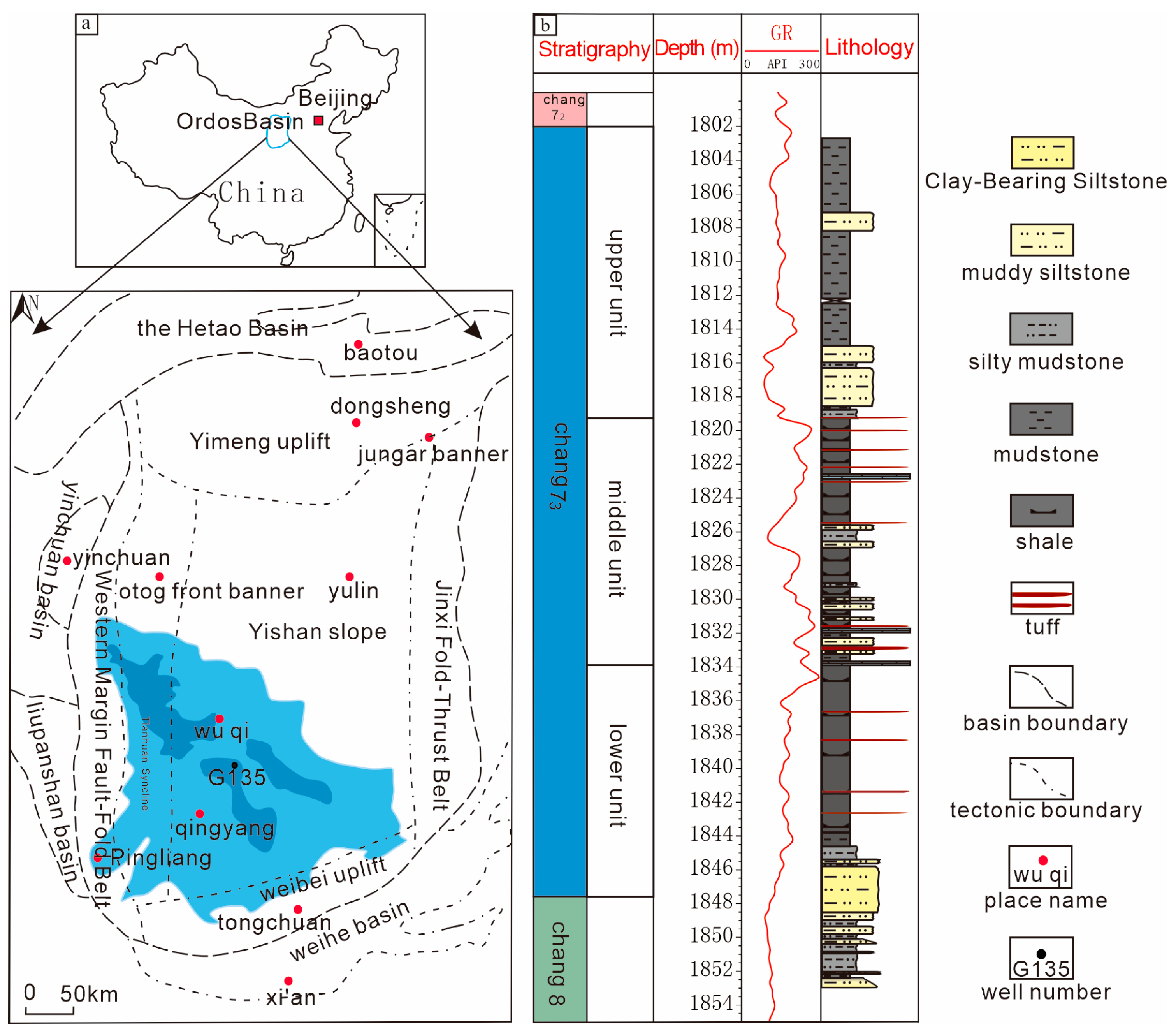
The Ordos Basin, the second largest basin in China, covering an area of approximately 370,000 km2, is situated in the western North China Platform [8]. Its broad geographical boundaries are defined by the Yinshan and Qinling Mountains to the north and south and the Lyuliang, Helan, and Liupan Mountains to the east and west [9]. The basin comprises six secondary structural units: the Jinxi Fold-Thrust Belt, Weibei Uplift, Western Margin Fault-Fold Belt, Tianhuan Syncline, Yimeng Uplift, and Yishan Slope (Figure 1a). The Late Triassic Indosinian orogeny led to significant changes in the tectonic framework of the basin, resulting in its expansion and the formation of a vast intracontinental depression lake basin with extensive area [10,11]. The basin sedimentation was dominated by fluvio-lacustrine terrigenous clastics, which collectively constituted a complex stratigraphic succession [12]. From top to bottom, the strata can be subdivided into 10 different members, and each member has unique geological characteristics and sedimentary environments, which jointly record the geological history and environmental changes of the Ordos Basin during the Late Triassic. The Chang 73 sub-member of the Yanchang Formation was deposited in a semi-deep to deep lacustrine environment and consisted of organic-rich black shales with thicknesses ranging from several meters to tens of meters [9,13,14,15]. The Chang 73 sub-member is the lowermost part of the Chang 7 member, which belongs to the middle interval of the Yanchang Formation (Figure 1b). It conformably overlies the Chang 8 member, which consists mainly of gray-green, fine-grained sandstones deposited in a delta-front environment. Above the Chang 73 sub-member, the Chang 72 and Chang 71 sub-members are characterized by dark mudstones interbedded with thin siltstones and tuff layers, followed by the Chang 6 member dominated by thick-bedded sandstones of a braided delta system. The transition from the underlying Chang 8 sandstones to the organic-rich black shales of the Chang 73 sub-member reflects a rapid lake transgression and anoxic deep-water conditions driven by intense subsidence and volcanic activity. The subsequent upward change from black shales to coarser clastics records a progressive lake regression and the progradation of deltaic systems during the Late Triassic.

3. Materials and Methods

Core samples analyzed in this study were collected from the LY10, G135, and Zhu80 boreholes in the Ordos Basin (Figure 1). Nineteen samples were collected from the Chang 73 sub-member of the Yanchang Formation (Table 1). Representative samples enriched in pyrite, collophane, and apatite were selected for detailed petrographic observation and analytical characterization. The analytical techniques employed included (1) petrographic examination using a Zeiss Axio Imager.M2m (Carl Zeiss Microscopy Deutschland GmbH, Oberkochen, Germany)transmitted-reflected light polarizing microscope, (2) microscopic morphology observation and elemental mapping via a Nova NanoSEM 450 (Thermo Fisher Scientific, Hillsboro, OR, USA) field-emission scanning electron microscope (SEM) coupled with an energy-dispersive X-ray spectrometer (EDS), and (3) in situ U-Pb dating and trace element geochemical analysis of single minerals using a GeoLas HD 193 nm laser (Coherent Corp., Saxonburg, PA, USA) ablation system coupled with an Agilent 7900 (Agilent Technologies, Inc., Santa Clara, CA, USA) inductively coupled plasma mass spectrometer (LA-ICP-MS). Both collophane and apatite grains were selected for analysis. These two phosphate minerals were analyzed separately. They were not pooled into a single analytical batch; each mineral phase was treated independently. For 7 phosphorus-bearing mineral samples, 15–25 individual spots were analyzed by laser ablation inductively coupled plasma mass spectrometry (LA-ICP-MS) to obtain U-Pb ages and trace element concentrations. All analyses were conducted at the State Key Laboratory of Nuclear Resources and Environment, East China University of Technology.
Before the analysis, the core samples were prepared into standard rock slices with a thickness of about 0.03 mm for polarizing microscope analysis. Representative core samples were selected, polished, and carbon-coated to prepare scanning electron microscope analysis samples. Phosphate-bearing minerals were selected from core samples by crushing, heavy liquid separation and magnetic separation, fixed on epoxy resin targets, and polished to make chronology analysis targets.
Geochronological determination and elemental geochemical analysis of phosphorus-bearing minerals were carried out by using GeoLasHD 193 nm laser ablation system and Agilent 7900 mass spectrometer. High purity He was used as the carrier gas, and high purity Ar was used as the compensation gas. Before the analysis of the sample, the signal intensity of 238U in Nist610 was maximized by optimizing the flow rate of carrier gas and compensation gas, and the signal intensity ratio of Th0 to Th was kept below 1%, so that the instrument achieved the highest sensitivity, minimum oxide production, lowest background value, and stable signal. The U/Th signal intensity ratio of NIST SRM 610 (approximately 1) was used to monitor the completeness of vaporization during laser ablation. The ICP-MS data were collected by a four-peak method with one mass peak and one point. The single point residence time was set to 6 ms (Si, Ti, Nb, Ta, and REE), 15 ms (204Pb, 206Pb, 207Pb, and 208Pb), and 10 ms (232Th and 238U). A NIST 610 standard was analyzed every 10 sample spots, and 29Si was used as the internal standard to correct for laser energy drift both within and between individual analyses, as well as to quantify trace element concentrations. The Pb isotopic ratios, U-Pb apparent ages, and trace element concentrations of individual mineral spots were processed using the ICPMSDataCal 3.5 program, while concordia diagrams were plotted using the ISOPLOT 3.0 program.

4. Results

4.1. Petrological and Mineralogical Characteristics of Yanchang Formation

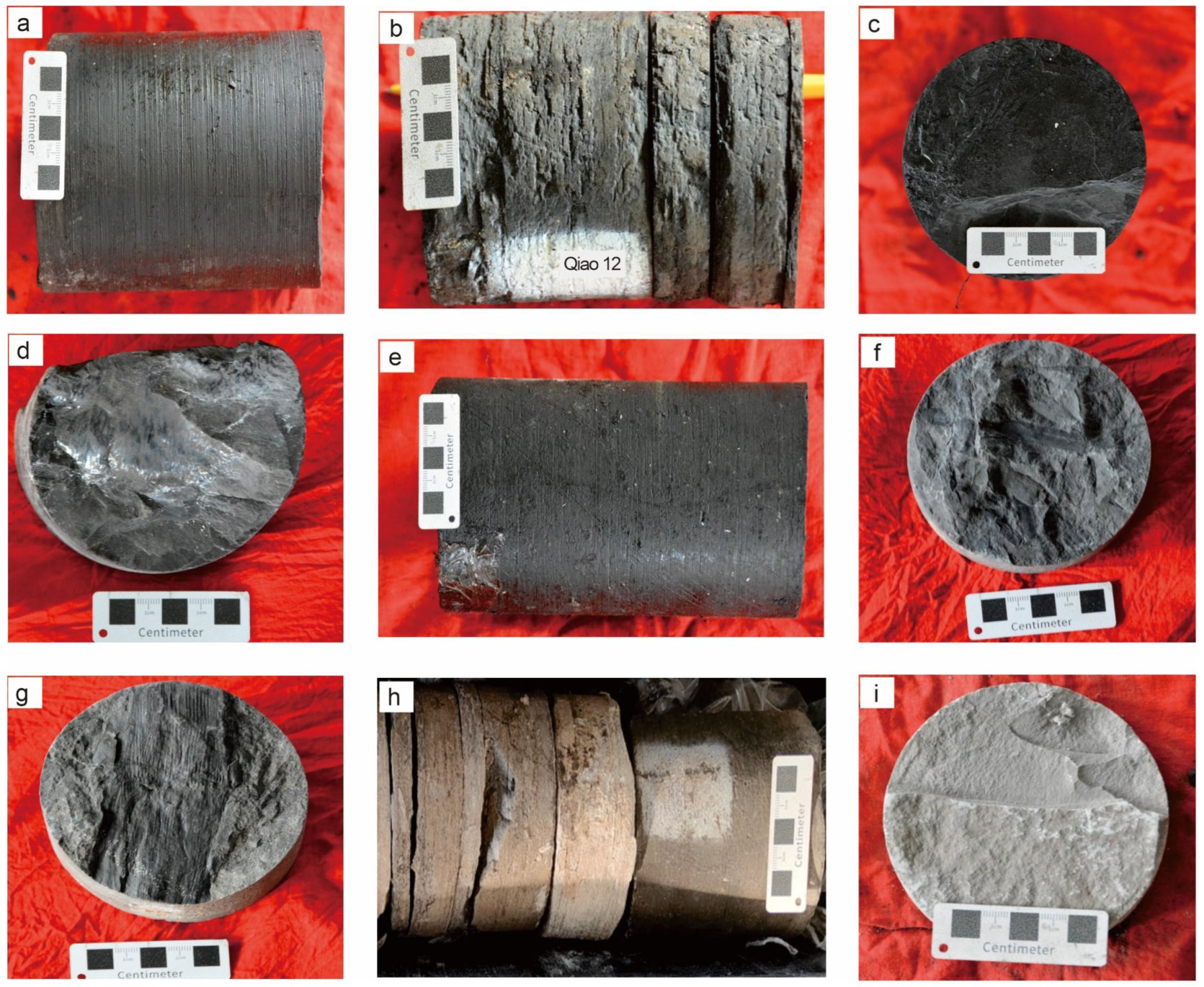
Based on visual core inspection, the Chang 73 sub-member consists mainly of black organic-rich shale, dark gray to light gray mudstone, argillaceous siltstone, and thin-bedded grayish-yellow tuff. Vertically, it is characterized by frequent interbedding of thick-bedded organic-rich shale with dark mudstone, siltstone, and fine-grained sandstone (Figure 1b). The black organic-rich shale is rich in pyrite and phosphorus-bearing minerals. The core exhibits parallel stratification, well-developed laminae, and distinct bedding planes (Figure 2a,e). Sharp contacts occur between organic-rich shale and siltstone or tuff layers, and transitional contacts are occasionally observed between mudstone and silty mudstone. Individual beds of organic-rich shale are several meters to tens of meters thick and tend to part easily along bedding planes. The organic carbon content (TOC) of these strata ranges from 0.30% to 32.25% [17], and the main body is in the oil window stage (Ro = 0.8~1.3%). The organic matter type mainly belongs to type II, which has strong hydrocarbon generation potential [18]. Dark gray–light gray mudstone and light gray argillaceous siltstone are well developed (Figure 2b). From some core sections, light gray mudstone interbedded with dark gray siltstone occurs in some core intervals. Polarized light microscopy shows that the dark gray siltstone is mainly composed of quartz and feldspar, with minor mica and lithic fragments. The particles are mostly subangular to subcircular with abundant plant debris and carbon debris (Figure 2f,g). The core also contains a small amount of tuff in some intervals, and some core samples exhibit a sliding interface (Figure 2d). The thin-bedded, grayish-yellow tuff is 2–5 cm thick and locally light brown due to weathering or oxidation (Figure 2i). The tuff is mainly composed of pyroclastic material, including feldspar and quartz crystal fragments, and also contains clay minerals formed by the alteration of pyroclastic material.
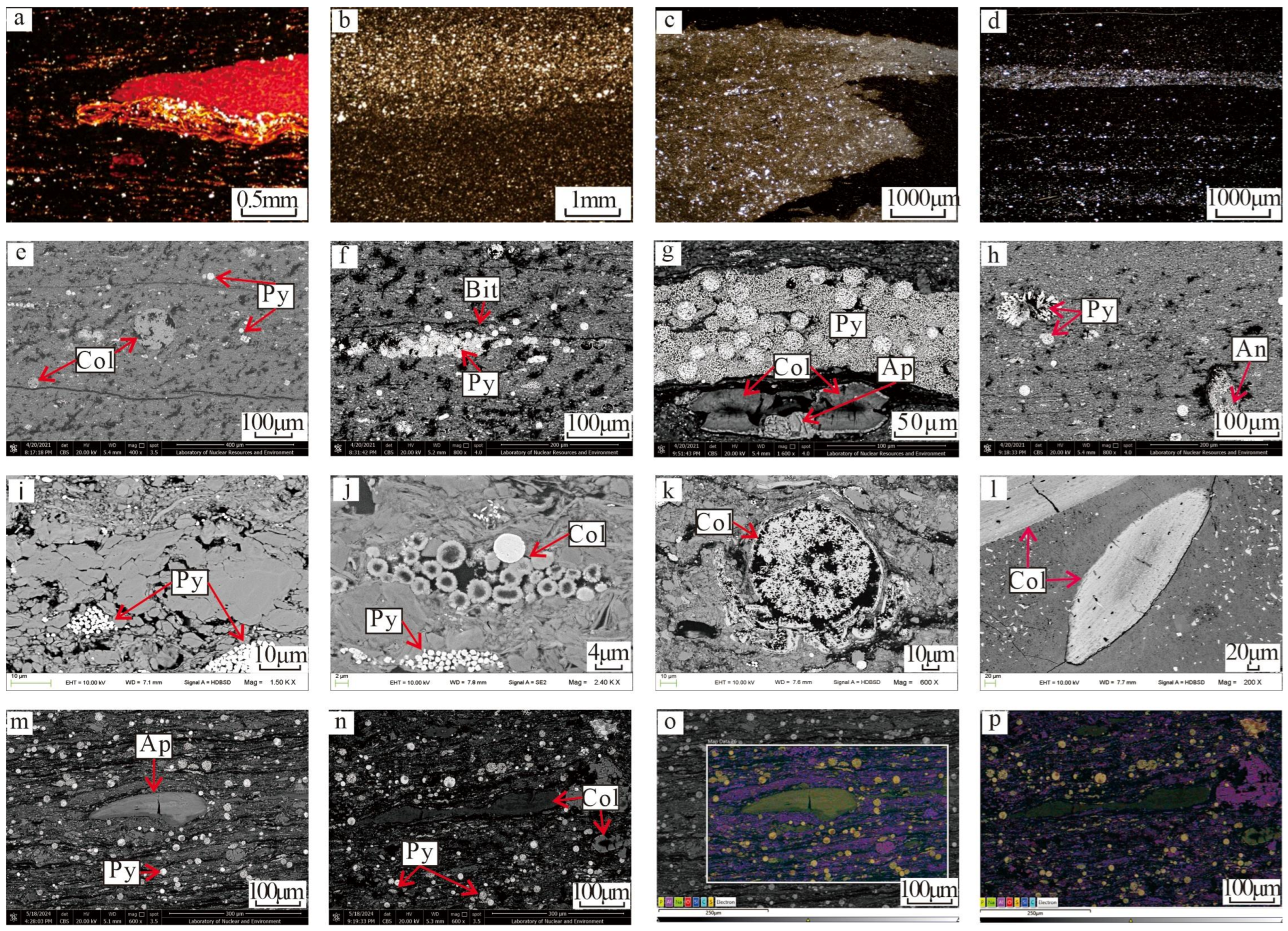
Polarizing microscopy revealed that the organic-rich shale of the Chang 73 sub-member of the Yanchang Formation is dark black, with argillaceous texture, bioclastic structure, and horizontal lamina (Figure 3a). The tuff is grayish yellow, with a tuffaceous structure and a thin-layer structure; its layer thickness ranges from 0.3 to 1.3 mm (Figure 3b,c). Scanning electron microscopy (SEM) observations reveal abundant authigenic minerals including pyrite, collophanite, apatite, and organic matter. Pyrite predominantly occurs as micron-scale framboidal aggregates (Figure 3g), with subordinate radially arranged euhedral crystals (Figure 3h). The collophanite mainly presents three morphological characteristics: I. spherical granules (diameter 50–130 μm), dense micropores on the surface (Figure 3e); II. layered or lenticular, partially intergrown with apatite (Figure 3l,o); and III. irregular clumps or bioclastic aggregation structures with honeycomb or porous structures on the surface (Figure 3k). Bitumen exhibits no defined morphology, occurring as irregularly disseminated particles (Figure 3f).

4.2. Characteristics of Phosphorus-Bearing Mineral Elements

In this paper, a total of seven phosphorus-bearing mineral target samples were selected for systematic study in the analysis of phosphorus-bearing mineral elements and isotopes. The inductively coupled plasma mass spectrometry analysis showed that the content of Sr, U, and Y elements in phosphorus-bearing mineral samples changed significantly (Table 2). The Sr contents of G135-116 and G135-136 samples were significantly higher (average values of 14,294.50 ppm and 10,580.65 ppm, respectively) than those of other samples (average values ranging from 497.83 to 946.69 ppm). The U contents of samples G135-136 and G135-116 were also higher than those of other samples (the average values were 367.83 ppm and 185.05 ppm, respectively). The average content of Th ranges from 4.39 ppm to 38.29 ppm. The contents of Pb and Rb elements in seven phosphorus-bearing mineral target samples show low abundance characteristics. The contents of Pb are 0.2~66.2 ppm (average content 4.22 ppm), and the contents of Rb are 0.01~41.1 ppm (average content 0.52 ppm). The Th/U ratios of samples G135-136 and G135-116 were extremely low (0.04 and 0.03, respectively), while the Th/U ratio of sample LY10-174 was higher (1.77).
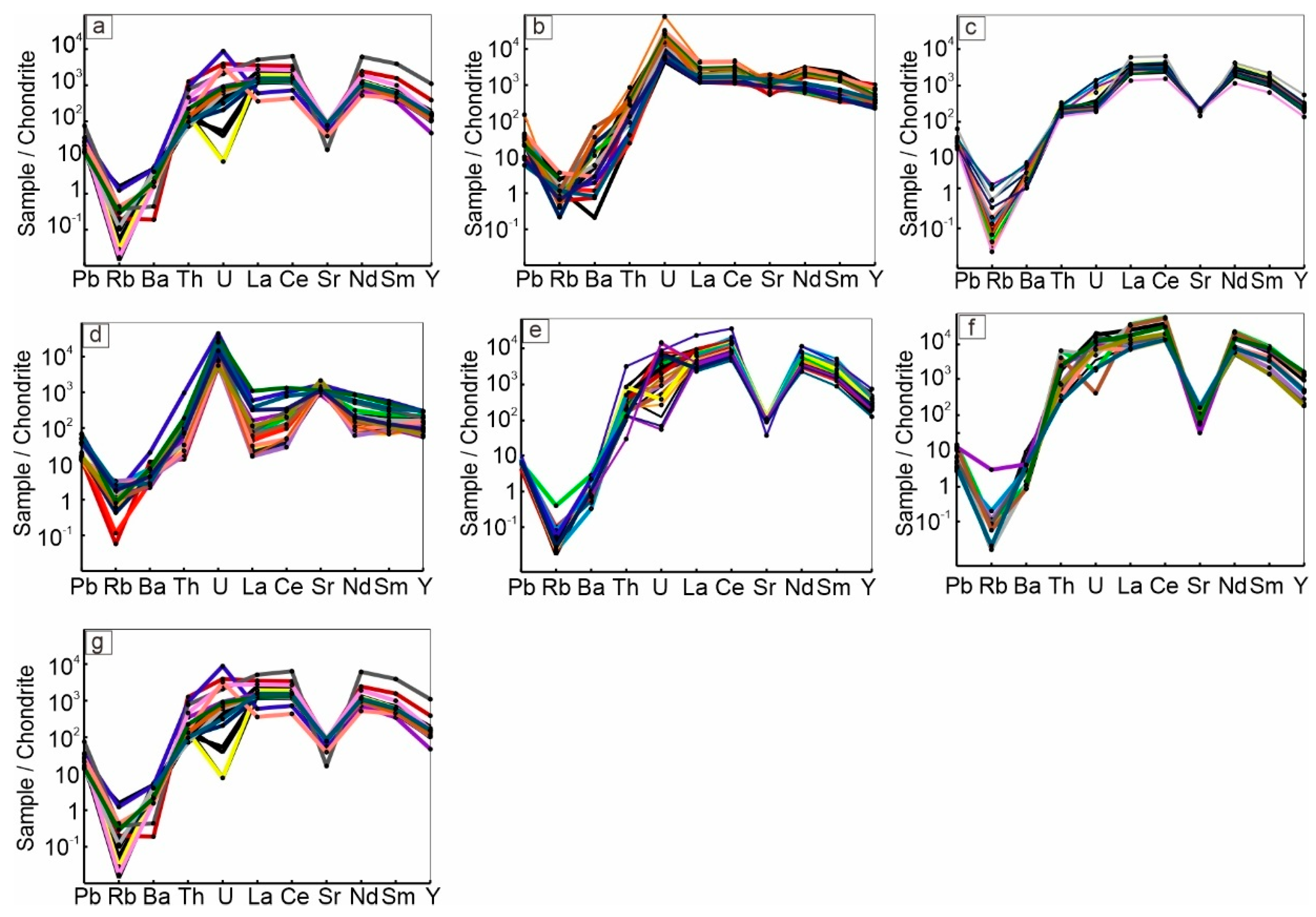
Based on chondrite-normalized trace element data [19], the spider diagram reveals positive and negative anomalies (Figure 4). Specifically, U, Th, La, Ce, and Y show positive anomalies, whereas trace elements such as Rb and Ba show negative anomalies. The spider diagrams of samples G135-136 and G135-116 show significant enrichment of U and Sr (Figure 4b,d). Overall, the phosphorus-bearing mineral samples are characterized by significant uranium enrichment.
Table 3 and Table 4 show that the average ΣREE of sample LY10-174 reaches 8690.85 ppm, significantly higher than the ΣREE of typical sedimentary rocks (e.g., 173.2 ppm in North American shale). In contrast, sample G135-116 has the lowest ΣREE (673.91 ppm), indicating weak rare earth differentiation. The light rare earth element (LREE) content in phosphorus-bearing mineral samples ranges from 513.48 ppm to 8047.75 ppm, with an average of 3319.46 ppm. Specifically, sample LY10-174 has a ΣLREE value of 8047.75 ppm, accounting for 92.6% of its total rare earth content. In contrast, the heavy rare earth element (HREE) content ranges from 146.38 ppm to 793.4 ppm, averaging 347 ppm. The (La/Yb)N ratios of the phosphorus-bearing mineral samples range from 1.04 to 26.88 (Table 4), indicating variable degrees of light rare earth enrichment and fractionation. Sample LY10-174 shows the highest (La/Yb)N value (26.88), demonstrating strong LREE/HREE fractionation, whereas sample G135-116 exhibits the lowest (La/Yb)N, reflecting a nearly flat REE pattern.
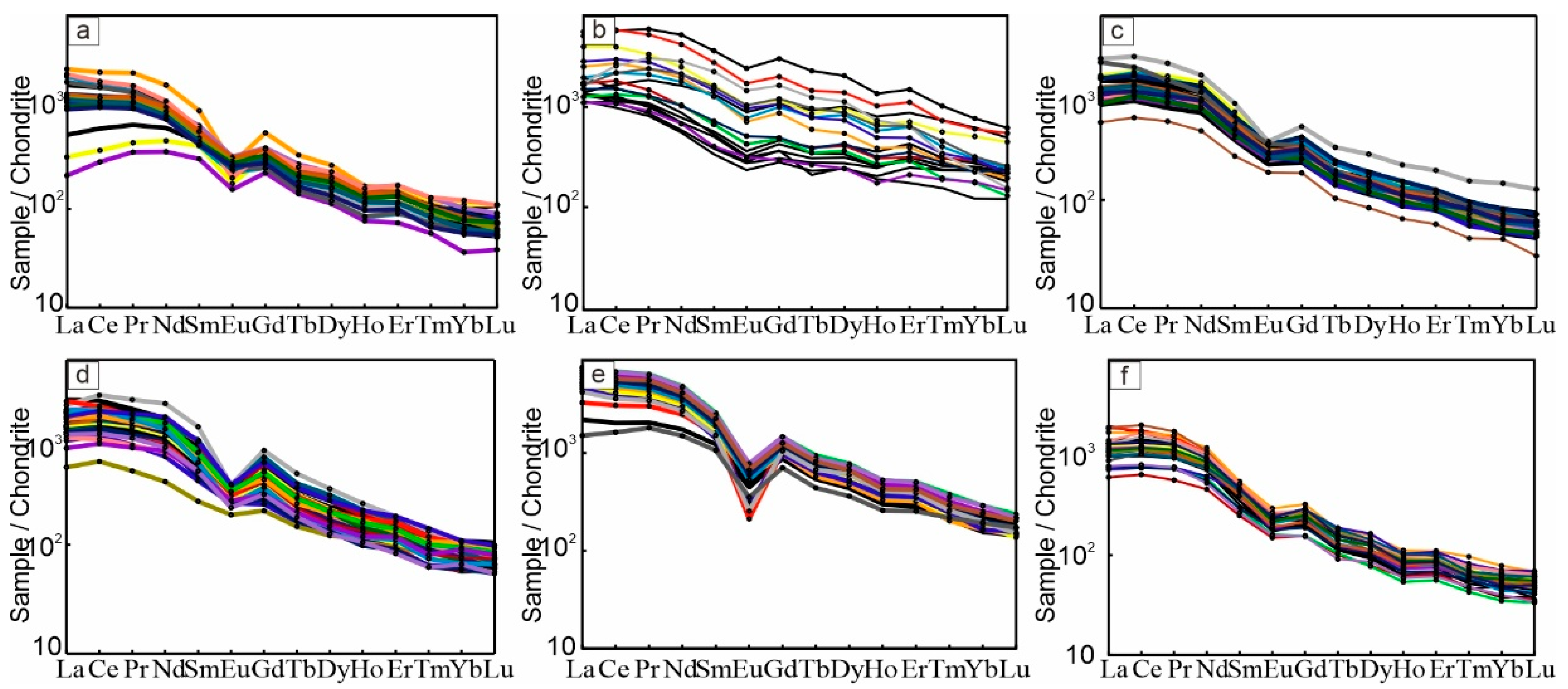
Based on chondrite-normalization of rare earth elements [20], samples LY10-178, LY10-144, LY10-159, LY10-174, and LY10-176 exhibit consistently right-skewed patterns (Figure 5a,c–f), indicating light rare earth enrichment and heavy rare earth depletion. In contrast, samples G135-136 show relatively flat distribution patterns (Figure 5b).

4.3. Formation Timing of Phosphorus-Bearing Minerals

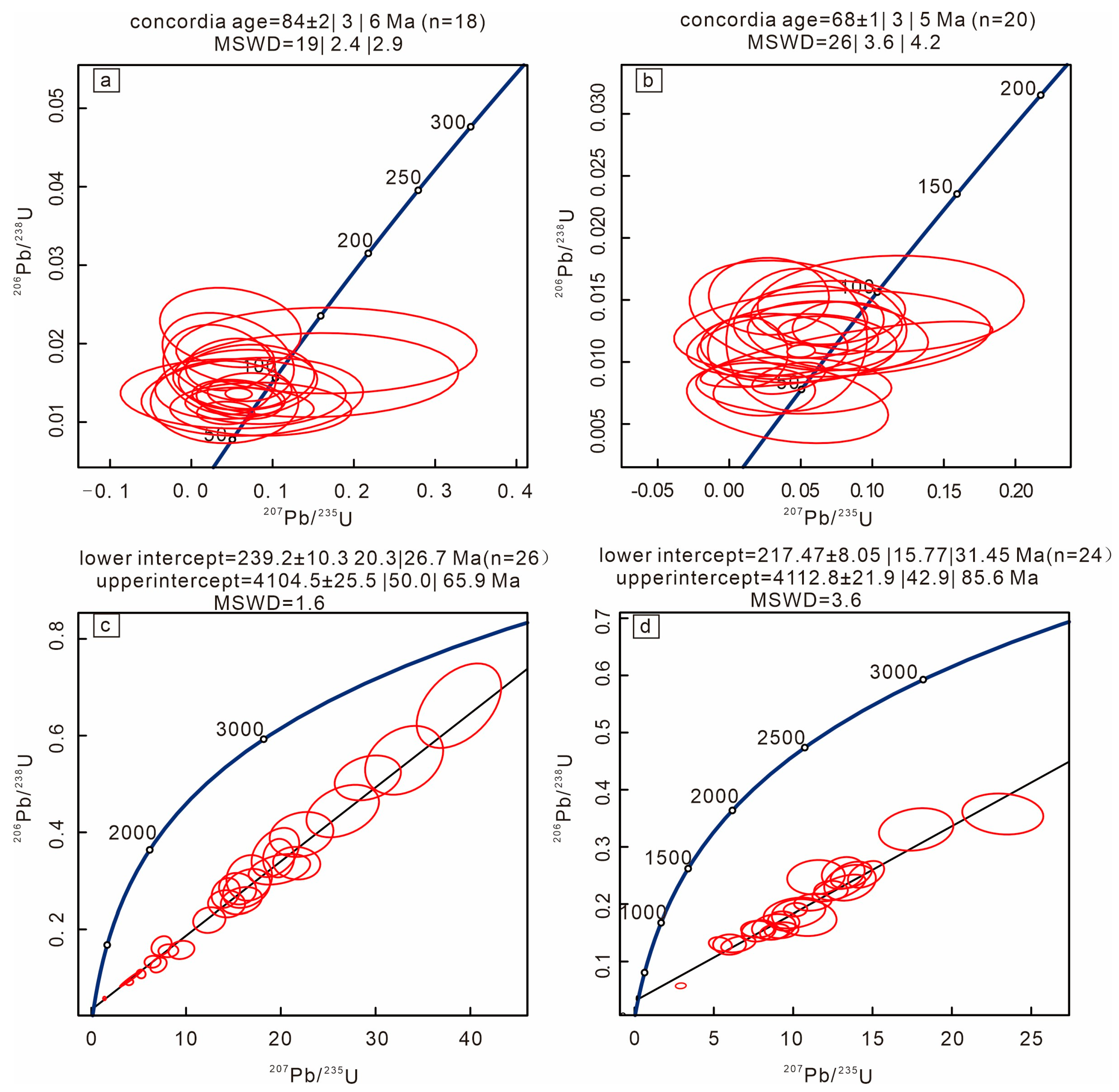
The LA-ICP-MS isotope results of phosphorus-bearing minerals (Table 5, Table S1) show that most of the data errors are between 2% and 10%, and the measurement accuracy of the data is high. The 207Pb/235U isotope ratio ranges from 0.0130 to 68.9136, and the 206Pb/238U isotope ratio ranges from 0.00670 to 0.79399. According to the 207Pb/235U and 206Pb/238U ratios, the U-Pb ages of each sample were calculated, and the Tera–Wasserburg concordia diagrams (Figure 6) were drawn. The dating data can be divided into two groups: (1) the Mid-Late Triassic age group, where sample LY10-178 has an age of 239.2 ± 10.3 Ma, and sample LY10-174 has an age of 217 ± 8.05 Ma, and (2) the Late Cretaceous age group, where sample G135-136 has an age of 68 ± 1 Ma, and sample G135-116 has an age of 84 ± 2 Ma. The ages of the Late Cretaceous group are significantly lower than those of the other samples.

5. Discussion

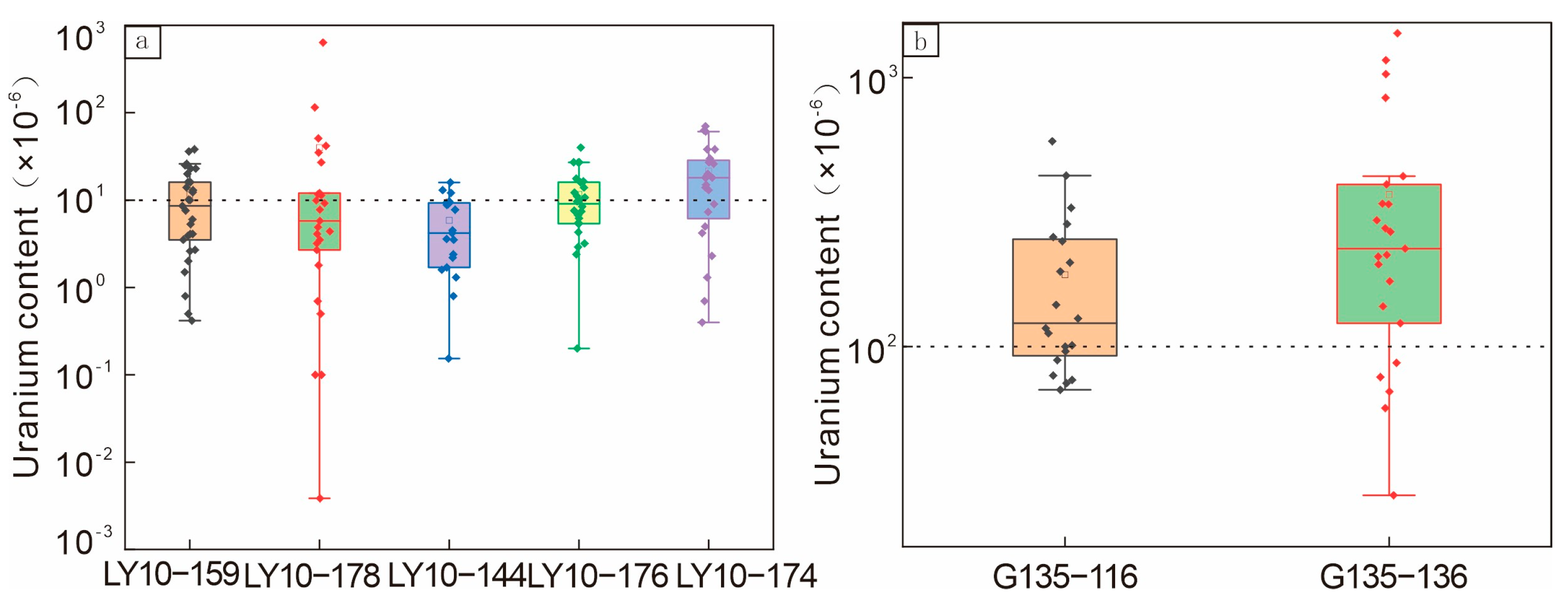
The U-Pb dating results of the phosphorus-bearing minerals (Table 5, Figure 6) clearly reveal two distinct ages: (1) a Middle to Late Triassic group (LY10-178: 239.2 ± 10.3 Ma; LY10-174: 217 ± 8.05 Ma), whose ages are consistent with the depositional period of the Yanchang Formation, and (2) a Late Cretaceous group (G135-136: 68 ± 1 Ma; G135-116: 84 ± 2 Ma). The delineation of these two age clusters provides the most direct evidence for distinguishing the early sedimentary-diagenetic stage from the later hydrothermal diagenesis stage. Correspondingly, the geochemical characteristics of these two sample groups also exhibit systematic differences (Figure 7).
In these samples, uranium concentrations vary significantly. The samples in Figure 7a have uranium concentrations ranging from 0.1 to 636 ppm (median: 8.8 ppm). In contrast, Figure 7b shows uranium concentrations between 28 and 1460 ppm (median: 202 ppm). The phosphorus-bearing mineral samples G135-116 and G135-136 display uranium distribution patterns distinctly different from those of other phosphorus-rich samples, characterized by a wider variation range and a significantly higher median value (Figure 7). These two samples not only were reset to the late Cretaceous but also presented geochemical characteristics such as high Sr contents, low Th/U ratios, and flat rare earth distribution patterns, indicating that they have experienced the late hydrothermal diagenesis stage.
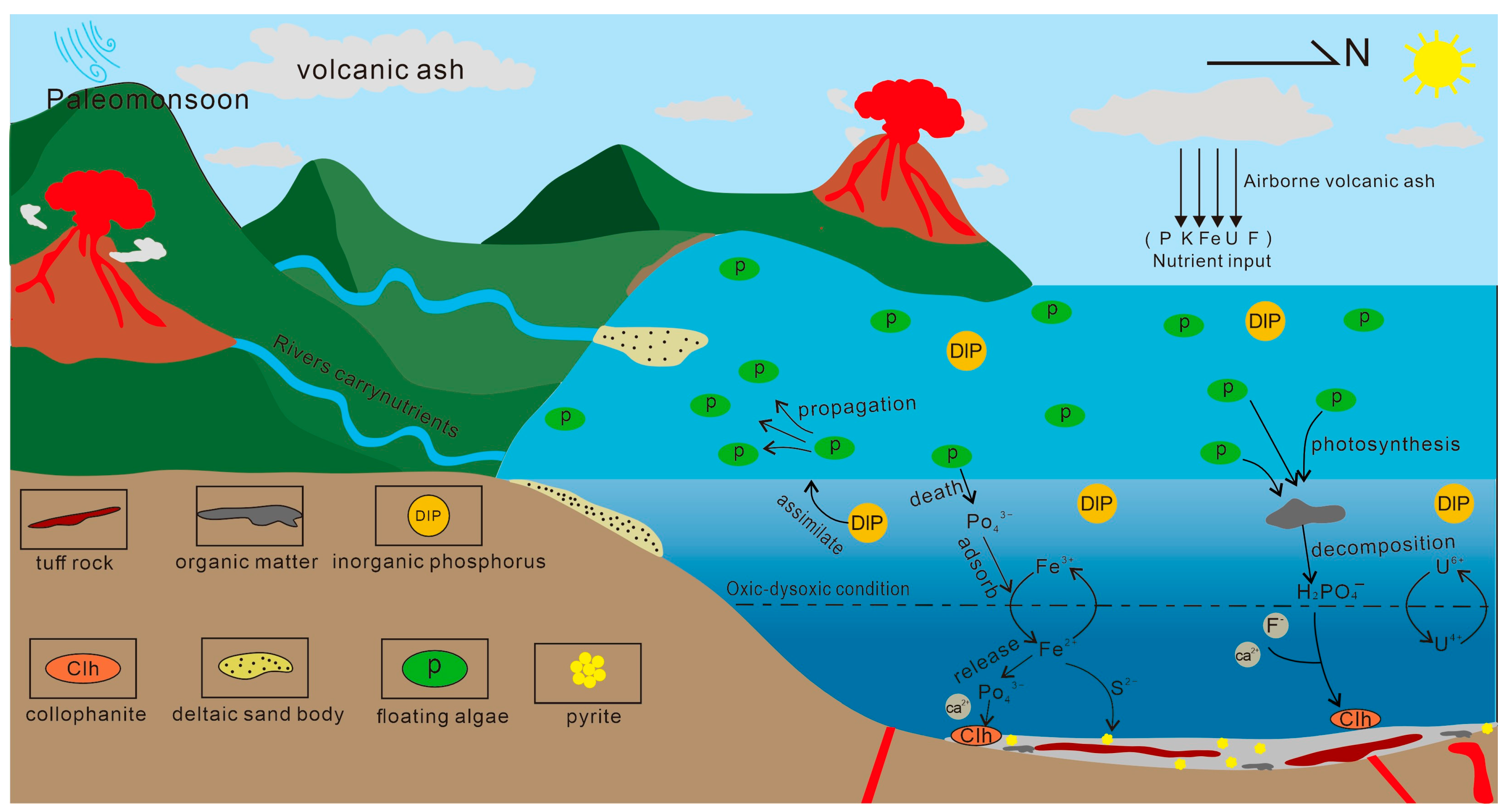
The formation of phosphorus-bearing minerals in the Chang 73 sub-member of the Yanchang Formation, Ordos Basin, can be divided into two main stages: an early sedimentary-diagenetic stage and a later hydrothermal alteration stage. During the early sedimentary-diagenetic stage, the precipitation of phosphorus minerals was controlled by multiple factors including source material supply, primary productivity, redox conditions, sedimentation rate, and organic matter enrichment (Figure 8). During the Late Cretaceous, some of the samples underwent hydrothermal diagenesis, resulting in further uranium enrichment, resetting of U-Pb ages, and the development of a distinct suite of geochemical signatures.

5.1. Formation Process of Phosphorus-Bearing Minerals

  • Provenance input and sedimentary tectonic setting: Thin-bedded and laminated tuff layers are extensively developed in the Chang 73 sub-member of the Yanchang Formation in the Ordos Basin, indicating intense volcanic activity during this period (Figure 2i). Previous studies have shown that volcanic activity around the basin is the main source of phosphorus in phosphorus-bearing minerals [7,21]. During the Middle-Late Triassic, the subduction–collision event between the South Qinling Block and the Mianlue oceanic crust triggered intense volcanic activity. This subduction-induced episodic uplift of the Qinling orogenic belt resulted in significant modifications to the tectonic framework and depositional environment of the Ordos Basin [22]. Steep slope topography appears in the southwest of the basin, accompanied by strong depression, and an alluvial fan-delta sedimentary system is developed. During this period, the lake basin area and water body of Ordos Basin reached its peak, which provided conditions for the accumulation of sediments. During the Middle-Late Triassic period, the prevailing southwest–northeast paleomonsoon transported large amounts of volcanic ash toward the Ordos Basin. The volcanic ash was input into the lake basin through atmospheric deposition or surface runoff, providing the material source foundation for the phosphorus-bearing minerals in the Chang 73 sub-member of the Yanchang Formation in the Ordos Basin.
  • High primary productivity drives the phosphorus cycle: In this study, scanning electron microscope (SEM) observations of black shales from the Chang 73 sub-member revealed co-occurrence of algal organic matter residues and phosphorus-bearing minerals (Figure 3e,k). The study of microfossils in the Chang 73 sub-member of the Yanchang Formation shows that the algae assemblage is dominated by cyanobacteria, chlorophyta, and acritarchs [23,24]. The presence of these biogenic structures provides direct micro-scale evidence for high primary productivity in the paleo-lake. Primary productivity refers to the ability of plankton to produce organic matter through photosynthesis. The level of primary productivity is mainly controlled by the composition and abundance of plankton groups. The Tonga volcanic eruption (VEI 6) in 2022 provides a modern analogy for studying the coupling relationship between volcanic activity and primary productivity. Satellite remote sensing data reveal an 800% increase in phytoplankton biomass, measured as chlorophyll-a concentration, within three months following the volcanic eruption, confirming that nutrients such as Fe and Si released from the volcanic ash can significantly enhance marine biological productivity [25]. Analogous to this modern process, frequent volcanic activities during the Middle-Late Triassic period led to substantial volcanic ash input into the lakes of the Ordos Basin. The abundant nutrient elements provided favorable conditions for the large-scale proliferation of plankton. The plankton absorbed dissolved phosphorus from the water to build their biomass. After their death and subsequent settling, the biogenic phosphorus was transformed into collophane or apatite during early diagenesis, thereby completing the critical geochemical cycle from biological productivity to the precipitation of phosphorus minerals.
  • Organic matter enrichment and phosphorus regeneration: Studies demonstrate that organic matter enrichment serves as a critical factor in phosphorus mineral formation with elevated primary productivity exhibiting a strong positive correlation with organic matter accumulation [6]. Biological activities (e.g., plankton proliferation and organic matter degradation) facilitate reactive phosphorus release and drive apatite precipitation, a mechanism consistent with biomineralization processes documented in black shales [26]. During diagenesis, the decomposition of organic matter releases structurally bound phosphorus, which migrates via molecular diffusion to pore waters proximal to the sediment–water interface, ultimately driving hydroxyapatite precipitation under supersaturation conditions. Following mass mortality of planktonic organisms, biogenic phosphorus undergoes recrystallization into bioclast-derived apatite during early diagenesis. Following the death of massive plankton, biogenic phosphorus recrystallizes into apatite during early diagenesis. Concurrently, the decomposition of organic matter consumes oxygen, creating a more reducing local sedimentary environment. These reducing conditions facilitate the formation and preservation of phosphate minerals [27].
  • Modulation of redox conditions: The widespread occurrence of framboidal pyrite and the negative δEu anomaly in phosphorus-bearing mineral samples from the organic-rich shale of the Chang 73 sub-member in the Yanchang Formation, Ordos Basin, jointly indicate a reducing depositional environment. The formation, accumulation, and preservation of phosphate rocks require specific environmental conditions and involve complex biogeochemical processes. During early diagenesis, the formation of phosphate is usually related to the redox conditions in the sedimentary environment [28].
  • Low deposition rate promotes phosphorus enrichment: The sedimentation rate is also a key factor affecting the formation of apatite, and a lower sedimentation rate is conducive to the enrichment of phosphorus-bearing minerals [29]. When sedimentation rates are low, reduced sediment accumulation prolongs the residence time of phosphorus at the sediment–water interface. This amplifies phosphorus recycling and its subsequent release into pore water, creating favorable conditions for the genesis of authigenic minerals such as apatite [30]. Under low sedimentation rate conditions, sediment layers exhibit reduced thickness and relatively unconsolidated structures. This enables phosphate in pore waters to more readily interact with carbonate minerals in the sediments, triggering chemical reactions that promote the formation of phosphorus-bearing minerals.
In the late hydrothermal diagenesis stage, the U-Pb ages of samples G135-136 and G135-116 are 68 ± 1 Ma and 84 ± 2 Ma (Late Cretaceous), respectively, which are significantly later than the sedimentary age of Yanchang Formation (Middle-Late Triassic). The unique geochemical characteristics of samples G135-136 and G135-116 may indicate that they experienced a special geological process, which caused the age of some phosphorus-bearing minerals to be reset to the thermal event time. The ratios of light and heavy rare earth elements of G135-136 and G135-116 are significantly reduced (mean values are 3.2 and 5.9, respectively), which are much lower than other samples. The rare earth distribution curve shows that the sample G135-136 is relatively uplifted, showing a flat distribution pattern, which is in sharp contrast to the right-leaning distribution pattern of other samples. The average U values of samples G135-136 and G135-116 are 367.83 ppm and 185.05 ppm, respectively, and the average Sr values are 10,582.65 ppm and 14,294.5 ppm, respectively, which are significantly higher than the average values of other samples. In Tera–Wasserburg concordia diagrams, samples G135-136 and G135-116 exhibit significantly discordant data points deviating from the concordia line (G135-136 MSWD = 26; G135-116 MSWD = 19), indicating a partially open U-Pb isotope system. Three fracture sets developed in the Yanchang Formation of the Ordos Basin, corresponding to Phase II of the Yanshanian Orogeny, Phase III of the Yanshanian Orogeny, and Phase III of the Himalayan Orogeny [31]. Direct evidence for a hydrothermal event, such as fluid inclusions, has not yet been obtained in this study. However, the ages of samples G135-116 and G135-136 broadly coincide with the timing of the Yanshanian orogenic movements in the region. On this basis, it is inferred that the extensional tectonic setting during the late Yanshanian Orogeny may have facilitated the upwelling of deep seated hydrothermal fluids. Hydrothermal fluids derived from deep-seated sources likely transported uranium as soluble U6+ species. When these fluids infiltrated the organic-rich shales of the Chang 73 sub-member, U6+ was reduced to U4+. Given that the ionic radius of U4+ is similar to that of Ca2+, U4+ entered the apatite lattice via isomorphous substitution for Ca2+, resulting in significant uranium enrichment. In addition, the hydrothermal fluids altered the rare earth element (REE) patterns of the phosphate minerals. Light rare earth elements (LREEs) were preferentially leached relative to heavy rare earth elements (HREEs), because LREEs form more stable soluble complexes with ligands such as Cl, F, and CO32− and are thus more easily mobilized and removed from the mineral lattice. This process resulted in low (La/Yb)n ratios for samples G135-136 and G135-116.
The formation of phosphorus-containing minerals in the Chang 73 sub-member of the Yanchang Formation in the Ordos Basin represents a complex multi-stage process. During early sedimentary diagenesis, it was collectively controlled by multiple factors including provenance supply, high primary productivity, reducing conditions, low sedimentation rates, and organic matter enrichment. A subsequent hydrothermal diagenesis stage driven by late Yanshanian deep-seated tectonism further modified these minerals. The synergistic effects of these mechanisms ultimately drove the formation and enrichment of phosphatic minerals in the Chang 73 sub-member of the Yanchang Formation.

5.2. Mechanisms of Uranium Enrichment in Phosphorus-Bearing Minerals

The formation process of phosphorus-bearing minerals in the Chang 73 sub-member of the Yanchang Formation in Ordos Basin is closely related to the enrichment of uranium. Table 2 and Figure 4 show that U is generally enriched in the phosphorus-containing mineral samples of the Chang 73 sub-member of the Yanchang Formation. The U content of samples G135-136 and G135-116 is significantly higher than that of other samples, and the geochemical characteristics of these two samples are significantly different from those of other samples. This phenomenon indicates that the formation process of phosphorus-bearing minerals may play a key role in the enrichment of uranium.
The general chemical formula of apatite is Ca5(PO4)3(F,OH,Cl). Based on the anion species, it can be further classified as hydroxylapatite, chlorapatite, or fluorapatite [32]. Fluorapatite is the most common apatite mineral in sedimentary rocks, and its crystal structure belongs to the hexagonal system [7]. The particularity of the apatite crystal structure makes many elements replace the position of Ca2+ by isomorphism, which makes apatite have strong element substitution ability and provides a basis for uranium enrichment. The mechanism of uranium immobilization by phosphate involves two distinct pathways: at low uranium concentrations, adsorption is enhanced via the formation of a ternary surface complex (FePO4UO2), while elevated concentrations of either uranium or phosphate lead to the direct precipitation of low-solubility minerals [33].
The uniqueness of apatite is that its structure can accommodate and adapt to the substitution of cation and anion sites [34]. Sequential chemical extraction and α-track etching analyses collectively establish that collophane is the predominant host for uranium in the Chang 7 member hydrocarbon source rocks of the Yanchang Formation, Ordos Basin [35]. Further investigation into the uranium occurrence revealed that it is incorporated into collophane primarily through isomorphism, independent minerals, and ionic adsorption [36]. During the middle and late Triassic, a large amount of volcanic ash entered the water body and precipitated U6+. U6+ has high solubility and migration ability [37], which can migrate from the lake basin water into the sediment pore water. U6+ enriched fluids migrating into pore waters undergo reduction to U4+ under anoxic conditions. Given the similarity in crystallographic radii between U4+ and Ca2+, U4+ readily undergoes isomorphous substitution, replacing Ca2+ within the crystal lattice of phosphatic minerals. This substitution mechanism facilitates uranium enrichment in phosphatic minerals and provides favorable conditions for its long-term stabilization.
During the formation of phosphorus-bearing minerals in the Chang 7 Member of the Yanchang Formation, Ordos Basin, complexation also played a significant role in uranium enrichment. Uranyl ions (UO22+) are a common form of uranium in aqueous solutions that can complex with phosphate ions (PO43−) in phosphorus-containing minerals. The uranium atom forms multiple coordinate bonds with oxygen atoms from phosphate groups, thereby forming stable complexes [38]. The depositional environment of the Yanchang Formation provided favorable conditions for this enrichment, where organic matter and phosphorus-bearing minerals supplied abundant ligands for uranium complexation and subsequent precipitation. Furthermore, both the sedimentation rate and the redox conditions critically influenced the enrichment process, collectively promoting the sequestration of uranium within the phosphorus-bearing minerals.
In the early sedimentary diagenesis stage of phosphorus-bearing minerals in the Chang 73 sub-member of the Yanchang Formation in the Ordos Basin, the volcanic ash caused by frequent volcanic activities during the Middle-Late Triassic provided a rich source of uranium. The uranium element in the volcanic ash was dissolved in the lake basin water, and the water rich in U6+ was precipitated. U6+-enriched fluids migrating into sediment pore waters undergo reduction to U4+ under reducing conditions. A portion of this U4+ precipitates as insoluble uranium minerals co-deposited with phosphatic minerals, while another fraction incorporates into the crystal lattice of phosphatic minerals via isomorphic substitution for Ca2+. In addition, the complexation reaction also plays an important role in the enrichment of uranium. The phosphate oxygen atoms in phosphorus-bearing minerals form a stable complex with uranium, which promotes the enrichment and migration of uranium in apatite. Tectonic activity during the late Yanshanian orogeny triggered the ascent of deep-seated hydrothermal fluids. Interaction of these fluids with early-diagenetic phosphorus-bearing minerals notably elevated uranium content in samples G135-136 and G135-116.

6. Conclusions

  • The phosphorus-bearing minerals in the Chang 73 sub-member of the Yanchang Formation in the Ordos Basin primarily occur as collophane and apatite. Collophane exhibits pelletal, laminar, lenticular, or bioclastic morphologies.
  • The age of phosphorus-bearing minerals in the Chang 73 sub-member of the Yanchang Formation in the Ordos Basin can be divided into two stages: Middle-Late Triassic (217 ± 8.05 Ma and 239.2 ± 10.3 Ma) and Late Cretaceous (68 ± 1 Ma and 84 ± 2 Ma).
  • During the sedimentary diagenesis stage, the formation of phosphorus-bearing minerals is controlled by many factors, such as material source, primary productivity level, redox environment, deposition rate, and organic matter enrichment. In the stage of hydrothermal transformation, the hydrothermal activity in the late Yanshanian Orogeny led to the opening of the U-Pb system of some phosphorus-bearing minerals, and the age of phosphorus-bearing minerals was reset to the time of the thermal event. The formation of phosphorus-bearing minerals in the sub-member of the Yanchang Formation results from the synergistic interplay between sedimentary diagenesis and hydrothermal modification, reflecting the complex geological evolution history of the Ordos Basin.
  • Uranium enrichment in the phosphorus-bearing minerals occurred in two stages. The early sedimentary-diagenetic stage resulted in initial uranium enrichment, whereas a Late Cretaceous hydrothermal event caused further enrichment. This later stage is directly evidenced by the high uranium contents and reset U-Pb ages of samples G135-116 and G135-136.

Supplementary Materials

The following supporting information can be downloaded at: https://www.mdpi.com/article/10.3390/min16050499/s1, Table S1: Supplementary data of LA-ICP-MS isotope ratios for phosphorus-bearing minerals in the Chang 73 submember of the Yanchang Formation.

Author Contributions

Conceptualization, C.D.; investigation, C.D.; resources, C.D.; supervision, C.D., L.W. and L.X.; funding acquisition, C.D. and L.W.; writing—original draft, H.B.; writing—review and editing, H.B., C.D. and L.X.; visualization, H.B. and L.X. All authors have read and agreed to the published version of the manuscript.

Funding

This research was funded by Deep Earth Probe and Mineral Resources Exploration-National Science and Technology Major Project, grant number 2025ZD1006803, and PetroChina’s Science and Technology Program, grant number 2023DJ84.

Data Availability Statement

Dataset available on request from the authors.

Acknowledgments

The authors sincerely thank the State Key Laboratory Breeding Base of Nuclear Resources and Environment for their technical support. We are also grateful to the two anonymous reviewers for their constructive comments that improved this manuscript.

Conflicts of Interest

The authors declare that this study received funding from PetroChina. The funder was not involved in the study design, collection, analysis, interpretation of data, the writing of this article or the decision to submit it for publication.

References

  1. Arthur, M.; Jenkyns, H. Phosphorites and paleoceanography. Oceanol. Acta 1980, 1980 SP, 1–51. [Google Scholar]
  2. Schenau, S.J.; Slomp, C.P.; De Lange, G.J. Phosphogenesis and active phosphorite formation in sediments from the Arabian Sea oxygen minimum zone. Mar. Geol. 2000, 169, 1–20. [Google Scholar] [CrossRef]
  3. Zirks, E.; Krom, M.; Schmiedl, G.; Katz, T.; Xiong, Y.; Alcott, L.J.; Poulton, S.W.; Goodman-Tchernov, B. Redox evolution and the development of oxygen minimum zones in the Eastern Mediterranean Levantine basin during the early Holocene. Geochim. Cosmochim. Acta 2021, 297, 82–100. [Google Scholar] [CrossRef]
  4. Ye, Z.; Zhou, H.; Gao, H. A review on genesis of authigenic carbonate fluorapatite in marine sediments. Mar. Geol. Quat. Geol. 2025, 45, 109–121. [Google Scholar] [CrossRef]
  5. Chen, Q. Biological effects in the process of sedimentary mineralization. Adv. Earth Sci. 1990, 5, 12–14. [Google Scholar] [CrossRef]
  6. Chen, Q.; Chen, M.; Li, J. Microbial-organic effects on formation of the sedimentary apatite. Chin. J. Geol. 2000, 35, 316–324. [Google Scholar]
  7. Yuan, W.; Liu, G.; Luo, W.; Li, C.; Xu, L.; Niu, X.; Ai, J.-y. Species and formation mechanism of apatites in the 7th member of Yanchang Formation organic-rich shale of Ordos Basin, China. Nat. Gas Geosci. 2016, 27, 1399–1408. [Google Scholar] [CrossRef]
  8. Dai, J.; Li, J.; Luo, X.; Zhang, W.; Hu, G.; Ma, C.; Guo, J.; Ge, S. Stable carbon isotope compositions and source rock geochemistry of the giant gas accumulations in the Ordos Basin, China. Org. Geochem. 2005, 36, 1617–1635. [Google Scholar] [CrossRef]
  9. Sun, M.; Feng, C.; Li, Y. Characteristics and Paleoenvironment of High-Quality Shale in the Triassic Yanchang Formation, Southern Margin of the Ordos Basin. Minerals 2023, 13, 1075. [Google Scholar] [CrossRef]
  10. He, D.; Cang, X.; Zhang, G.; Zhao, W.; Zhao, Z.; Liu, X.; Bao, H.; Fan, L.; Zou, S.; Kai, B.; et al. Scope, nature, and exploration significance of Ordos Basin during geological historical periods, NW China. Pet. Explor. Dev. 2025, 52, 757–771. [Google Scholar] [CrossRef]
  11. Guo, Y.; Li, W.; Guo, B.; Zhang, Q.; Chen, Q.; Wang, R.; Liu, X.; Ma, Y.; Li, Z.; Zhang, M.; et al. Sedimentary systems and palaeogeography evolution of Ordos Basin. J. Palaeogeogr. 2019, 21, 293–320. [Google Scholar] [CrossRef]
  12. Liu, Z.; Shen, F.; Zhu, X.; Li, F.; Tan, M. Formation Conditions and Sedimentary Characteristics of a Triassic Shallow Water Braided Delta in the Yanchang Formation, Southwest Ordos Basin, China. PLoS ONE 2015, 10, e0119704. [Google Scholar] [CrossRef]
  13. Wang, F.; Tian, J.; Fan, L.; Chen, R.; Qiu, J. Evolution of Sedimentary Fillings in Triassic Yanchang Formation and Its Response to Indosinian Movement in Ordos Basin. Nat. Gas Geosci. 2010, 21, 882–889. [Google Scholar] [CrossRef]
  14. Zhou, Q.; Liu, J.; Zhang, D.; Li, C.; Xiao, Y.; Chen, G.; Lyu, C. Microscopic enrichment and porosity-permeability reduction mechanism of residual oil in tight sandstone reservoirs: An insight from Chang 8 Member, Yanchang Formation, Ordos Basin, China. J. Pet. Explor. Prod. Technol. 2024, 14, 1365–1393. [Google Scholar] [CrossRef]
  15. Xi, K.; Li, K.; Cao, Y.; Lin, M.; Niu, X.; Zhu, R.; Wei, X.; You, Y.; Liang, X.; Feng, S. Laminae combination and shale oil enrichment patterns of Chang 73 sub-member organic-rich shales in the Triassic Yanchang Formation, Ordos Basin, NW China. Petrol. Explor. Dev. 2020, 47, 1244–1255. [Google Scholar] [CrossRef]
  16. Wang, M.; Wu, B.; Li, Y.; Liu, C.; Hao, X.; Liu, M.; Zhang, W.; Li, Q.; Yao, L.; Zhang, X. Experimental study on possibility of deep uranium-rich source rocks providing uranium source in Ordos Basin. Earth Sci. 2022, 47, 224–239. [Google Scholar] [CrossRef]
  17. Liu, H.; Zou, C.; Qiu, Z.; Yin, S.; Yang, Z.; Wu, S.; Zhang, G.; Chen, Y.; Ma, F.; Li, S.; et al. Sedimentary Depositional Environment and Organic Matter Enrichment Mechanism of Lacustrine Black Shales: A case study of the Chang 7 member in the Ordos Basin. Acta Sedimentol. Sin. 2023, 41, 1810–1829. [Google Scholar] [CrossRef]
  18. Pu, B.; Wang, F.; Wang, K.; Sun, J.; Li, Y.; Shi, B.; Zhao, W.; Guo, X. The enrichment conditions and model of shale gas reservoir in the Chang 7 member of Mesozoic Yanchang Formation in Yan’an, Ordos Basin. Geol. China 2023, 50, 1285–1298. [Google Scholar] [CrossRef]
  19. Sun, S.-S.; McDonough, W. Chemical and Isotopic Systematics of Oceanic Basalts: Implications for Mantle Composition and Processes; Geological Society of London: London, UK, 1989; Volume 42. [Google Scholar]
  20. Wakita, H.; Rey, P.; Schmitt, R. Abundances of the 14 rare-earth elements and 12 other trace elements in Apollo 12 samples—Five igneous and one breccia rocks and four soils. In Proceedings of the Second Lunar Science Conference, Geochimica et Cosmochimica Acta, 02/01; MIT Press: Cambridge, MA, USA, 1971. [Google Scholar]
  21. Zhang, W.; Yang, H.; Peng, P.; Yang, Y.; Zhang, H.; Shi, X. The Influence of Late Triassic volcanism on the development of Chang 7 high grade hydrocarbon source rock in Ordos Basin. Geochimica 2009, 38, 573–582. [Google Scholar] [CrossRef]
  22. Wang, J.; Liu, C.; Li, H.; Wu, T.; Wu, J. Geochronology, Potential Source and Regional Implications of Tuff Intervals in Chang-7 Member of Yanchang Formation, South of Ordos Basin. Acta Sedimentol. Sin. 2017, 35, 691–704. [Google Scholar] [CrossRef]
  23. Liu, H.; Zou, C.; Qiu, Z.; Pan, S.; Zhang, W.; Jing, Z.; Hao, J.; Yin, S.; Wu, S.; Li, S.; et al. Sedimentary enrichment factors of extraordinarily high organic matter in the sub-member 3 of Member 7 of Yanchang Formation, Ordos Basin. Acta Pet. Sin. 2022, 43, 1520–1541. [Google Scholar] [CrossRef]
  24. Gan, D.; Bian, C.; Yang, W.; Liu, L.; Dong, J.; Zhuang, W.; Li, Y.; Wang, J. Phosphatized planktonic green algae fossils in the source rocks of the Chang 7 member of the Yanchang Formation in the ordos Basin. Acta Micropalaeontol. Sin. 2023, 40, 327–349. [Google Scholar] [CrossRef]
  25. Barone, B.; Letelier, R.M.; Rubin, K.H.; Karl, D.M. Satellite Detection of a Massive Phytoplankton Bloom Following the 2022 Submarine Eruption of the Hunga Tonga-Hunga Haʻapai Volcano. Geophys. Res. Lett. 2022, 49, e2022GL099293. [Google Scholar] [CrossRef]
  26. Skinner, H.; Catherine, W. A review of apatites, iron and manganese minerals and their roles as indicators of biological activity in black shales. Precambrian Res. 1993, 61, 209–229. [Google Scholar] [CrossRef]
  27. El Bamiki, R.; Raji, O.; Ouabid, M.; Elghali, A.; Khadiri Yazami, O.; Bodinier, J.-L. Phosphate Rocks: A Review of Sedimentary and Igneous Occurrences in Morocco. Minerals 2021, 11, 1137. [Google Scholar] [CrossRef]
  28. Pufahl, P.K.; Groat, L.A. Sedimentary and Igneous Phosphate Deposits: Formation and Exploration: An Invited Paper. Econ. Geol. 2017, 112, 483–516. [Google Scholar] [CrossRef]
  29. Zhao, M.; Mills, B.J.W.; Poulton, S.W.; Wan, B.; Xiao, K.-Q.; Guo, L.; Guo, Z. Drivers of the global phosphorus cycle over geological time. Nat. Rev. Earth Environ. 2024, 5, 873–889. [Google Scholar] [CrossRef]
  30. Cortina, A.; Filippelli, G.; Ochoa, D.; Sierro, F.J.; Flores, J.-A.; Grimalt, J.O. Climate-driven changes in sedimentation rate influence phosphorus burial along continental margins of the northwestern Mediterranean. Palaeogeogr. Palaeoclimatol. Palaeoecol. 2018, 500, 106–116. [Google Scholar] [CrossRef]
  31. Xiao, Z.; Lu, J.; Li, Y.; Zhang, H.; Yin, X.; Zhou, X. Characteristics of Fractures and Their Controls on Yanchang Formation Reservoir in Ordos Basin. Xinjiang Pet. Geol. 2023, 44, 535–542. [Google Scholar] [CrossRef]
  32. Tan, H.; Ming, R.; Huang, X.; Qi, L.; Gao, J.; Meng, Y.; Xie, H. Research progress on chemical composition of apatite: Application in petrogenesis, ore genesis and mineral exploration. Acta Petrol. Sin. 2022, 38, 3067–3087. [Google Scholar] [CrossRef]
  33. Singh, A.; Ulrich, K.-U.; Giammar, D.E. Impact of phosphate on U(VI) immobilization in the presence of goethite. Geochim. Cosmochim. Acta 2010, 74, 6324–6343. [Google Scholar] [CrossRef]
  34. Hughes, J.M.; Rakovan, J. The Crystal Structure of Apatite, Ca5(PO4)3(F,OH,Cl). Rev. Mineral. Geochem. 2002, 48, 1–12. [Google Scholar] [CrossRef]
  35. Qin, Y.; Zhang, W.; Peng, P.; Zhou, Z. Occurrence and concentration of uranium in the hydrocarbon source rocks of Chang 7 member of Yanchang Formation, Ordos basin. Acta Petrol. Sin. 2009, 25, 2469–2476. [Google Scholar]
  36. Zhang, B.; Wu, B.; Liu, C.; Qin, X. Occurrence of Uranium in Hydrocarbon of Chang-7 Member of Yanchang Formation of Ordos Basin. Northwest. Geol. 2011, 44, 124–132. [Google Scholar] [CrossRef]
  37. Li, Y.; Duan, C.; Zhao, Y.; Pei, H.; Ren, S. The Role of Oxidizing Reducing Barrier in Mineralization of Hydrothermal Uranium Ore. Acta Geol. Sin. 2016, 90, 201–218. [Google Scholar] [CrossRef]
  38. Nie, X.; Dong, F.; Liu, M.; Li, X.; Huang, W.; Wang, C.; Lu, X. Microbial mechanism on distribution, renewal, and maintenance of soil organic carbon pool in karst area. Acta Microbiol. Sin. 2022, 62, 2198–2211. [Google Scholar] [CrossRef]
Figure 1. Ordos Basin tectonic map and G135 borehole histogram. (a) Structural diagram of Ordos Basin [16] (modified after Wang et al. 2022). The map shows the geographical location of the Ordos Basin and the location of the G135 borehole. (b) G135 borehole histogram. The main lithology is sandstone and shale.
Minerals 16 00499 g001
Figure 2. Core samples of the Chang 73 sub-member of Yanchang Formation. (a) Black organic-rich shale, lamination, Qiao12 well, depth of 2386.32 m. (b) Light gray mudstone, bedding development, Qiao12 well, depth of 2378.75 m. (c) Black organic-rich shale, Qiao 12 well, depth of 2403.45 m. (d) Dark gray argillaceous siltstone, visible sliding interface, Huan36-1 well depth of 2403 m. (e) Black organic-rich shale, Qiao 12 well, depth of 2403.45 m. (f) Light gray mudstone, visible 2 cm diameter plant rhizome debris, Huan36-1 well, depth of 2037.4 m. (g) Deep gray argillaceous siltstone, plant debris diameter of about 0.5–0.6 cm, Hua87-1 well, depth of 2039.8 m. (h) Grayish yellow tuff, thin-bedded, Qiao12 well, depth of 2413.32 m. (i) Light brown tuff, Huan36-1 Well, depth of 2378.75 m.
Minerals 16 00499 g002
Figure 3. Core microscopic characteristics of the Chang 73 sub-member of the Yanchang Formation. (a) Black organic-rich shale, Zhu80 well, depth of 2268.14 m. (b) Tuff, Zhu80 well, depth of 2234.46 m. (c) Tuff, G135 well, depth of 1843 m. (d) Silt laminae, G135, depth of 1845 m. (e) Globular collophanite, G135, depth of 1838.75 m. (f) Framboidal pyrite, G135, depth of 1838.75 m. (g) Apatite and collophanite, G135, depth of 1834.10 m. (h) Radial pyrite, G135, depth of 1838.75 m. (i) Framboidal pyrite, Zhu80 well, depth of 2269.30 m. (j) Collophanite, Zhu80 well, depth of 2245.30 m. (k) Collophanite, Zhu80 well, depth of 2261 m. (l) Lenticular collophane, Zhu80 well, depth of 2264.40 m. (m) Apatite, Zhu80 well, depth of 2264.80 m. (n) Zhu80 well depth of 2264.80 m, EDS. (o) Collophanite, Zhu80 well, depth of 2267.65 m. (p) Zhu80 well, depth of 2267.65 m, EDS. Col—collophane; Ap—apatite; Py—pyrite; Bit—bitumen; An—anorthite. (ad) Polarized light microscope. (en) Scanning electron microscope. (o,p) Energy-dispersive X-ray spectroscopy.
Minerals 16 00499 g003
Figure 4. Chondrite-normalized trace element spider diagram of phosphorus-bearing minerals. (a) LY10-178, depth: 1727.10 m. (b) G135-136, depth: 1819.15 m. (c) LY10-144, depth: 1721.10 m. (d) G135-116, depth: 1823.15 m. (e) LY10-159, depth: 1724.30 m. (f) LY10-174, depth: 1726.90 m. (g) LY10-176, depth: 1727.30 m.
Minerals 16 00499 g004
Figure 5. Rare earth element distribution diagram of phosphorus-bearing minerals. (a) LY10-178, depth: 1727.10 m. (b) G135-136, depth: 1819.15 m. (c) LY10-144, depth: 1721.10 m. (d) LY10-159, depth: 1724.30 m. (e) LY10-174, depth: 1726.90 m. (f) LY10-176, depth: 1727.30 m. Light rare earth elements: La, Ce, Pr, Nd, Sm, and Eu; heavy rare earth elements: Gd, Tb, Dy, Ho, Er, Tm, Yb, and Lu.
Minerals 16 00499 g005
Figure 6. U-Pb harmonic diagram of phosphorus-bearing minerals in the Chang 73 sub-member of the Yanchang Formation. (a) G135-116, depth: 1823.15 m, age: 84 ± 2 Ma, geological period: Late Cretaceous. (b) G135-136, depth: 1819.15 m, age: 68 ± 1 Ma, geological period: Late Cretaceous. (c) LY10-178, depth: 1727.10 m, age: 239.2 ± 10.3 Ma, geological period: Middle Triassic. (d) LY10-174, depth: 1726.90 m, age: 217 ± 8.05 Ma, geological period: Late Triassic.
Minerals 16 00499 g006
Figure 7. Comparison of uranium content in phosphorus-bearing minerals from different genetic stages. (a) Samples of Middle-Late Triassic, representing the sedimentary-diagenetic stage. (b) Late Cretaceous samples, representing the late hydrothermal diagenesis stage.
Minerals 16 00499 g007
Figure 8. The formation process model of the sedimentary diagenesis stage of phosphorus-bearing minerals. During the Middle–Late Triassic, frequent volcanic activity delivered volcanic ash rich in phosphorus and uranium into the lake basin, which enhanced primary productivity and thereby stimulated the phosphorus cycle. The decomposition of organic matter released phosphorus, while the reducing environment caused the reduction of iron oxides to Fe2+, releasing adsorbed phosphorus. Together, these processes led to phosphorus saturation in the pore water, ultimately resulting in its precipitation with calcium ions to form early phosphorus-bearing minerals.
Minerals 16 00499 g008
Table 1. Sample Information of Core Samples from the Chang 7 Member of the Yanchang Formation, Ordos Basin.
Sample IDBoreholeDepth (m)Stratigraphic UnitAnalysis Performed
LY10-144LY101721.10Chang 73 sub-memberREE, trace elements
LY10-159LY101724.30Chang 73 sub-memberREE, trace elements
LY10-174LY101726.90Chang 73 sub-memberU-Pb dating, REE, trace elements
LY10-176LY101727.30Chang 73 sub-memberREE, trace elements
LY10-178LY101727.10Chang 73 sub-memberU-Pb dating, REE, trace elements
G135-136G1351819.15Chang 73 sub-memberU-Pb dating, REE, trace elements
G135-116G1351823.15Chang 73 sub-memberU-Pb dating, REE, trace elements
G135-66G1351834.10Chang 73 sub-memberScanning electron microscopy
G135-49G1351838.75Chang 73 sub-memberScanning electron microscopy
G135-029G1351843Chang 73 sub-memberThin-section petrography
G135-19G1351845Chang 73 sub-memberThin-section petrography
Zhu80-57Zhu802269.30Chang 73 sub-memberScanning electron microscopy
Zhu80-62Zhu802268.14Chang 73 sub-memberThin-section petrography
Zhu80-66Zhu802267.65Chang 73 sub-memberScanning electron microscopy
Zhu80-70Zhu802264.80Chang 73 sub-memberScanning electron microscopy
Zhu80-88Zhu802264.40Chang 73 sub-memberScanning electron microscopy
Zhu80-94Zhu802261Chang 73 sub-memberScanning electron microscopy
Zhu80-132Zhu802245.30Chang 73 sub-memberScanning electron microscopy
Zhu80-154Zhu802234.46Chang 73 sub-memberThin-section petrography
Table 2. Trace elements of phosphorus-bearing minerals in the Chang 73 sub-member of the Yanchang Formation (ppm).
Sample PbRbBaThULaCeSrNdSmY
LY10-178max66.200.4321.1062.70636.001610.005170.001028.003660.00750.002185.00
min1.710.010.430.260.1021.7073.00427.0087.0025.1094.30
mean4.930.069.2311.2239.99485.661270.30852.87723.77133.21352.47
G135-136max22.801.30258.0053.001460.001880.005240.0021,600.003730.00961.005160.00
min0.720.050.800.0428.0095.50507.00265.00360.0066.80343.00
mean6.710.4551.5115.68367.83751.592148.5710,580.651188.91257.421343.74
LY10-144max4.400.4417.007.1315.90624.001695.001123.00849.00151.30448.00
min1.170.010.170.040.150.310.78463.000.850.425.96
mean1.950.057.574.395.71310.26860.40946.69483.8886.99225.59
G135-116max8.401.1578.0048.00580.00345.001092.0023,600.00530.00110.00601.00
min1.470.159.500.6769.005.1023.809380.0036.7013.10113.00
mean3.650.4720.105.52185.0552.17223.3914,294.50158.7834.89306.25
LY10-159max4.530.2510.4039.8038.001333.003010.00895.001199.00237.00604.00
min0.790.021.830.930.4286.80258.00330.00170.0034.8093.20
mean3.090.015.236.4611.59423.461168.62754.15653.36122.08278.84
LY10-174max8.8941.1081.00127.0070.002565.006210.001677.003090.00503.002030.00
min2.260.010.124.090.4069.20256.00252.00179.0024.5034.10
mean5.722.5710.8638.2921.601570.333745.75497.831903.71324.84817.97
LY10-176max8.100.138.2026.6640.00667.001820.00878.00758.00106.50298.00
min0.200.011.262.580.20204.00583.00627.00292.0048.30122.60
mean3.510.032.996.8811.33395.031097.03770.13530.1381.65182.28
Table 3. Rare earth elements of phosphorus-bearing minerals in the Chang 73 sub-member of the Yanchang Formation (ppm).
Sample LaCePrNdSmEuGdTbDyHoErTmYbLu
LY10-178Max1610.05170.0772.03660.0750.092.1670.079.5436.083.6212.026.7138.319.4
Min21.773.015.287.025.13.234.54.522.73.86.90.72.50.3
Mean485.71270.3167.9723.8133.222.4114.413.071.613.133.64.122.63.2
G135-136Max1880.05240.0747.03730.0961.0250.01051.0158.9939.0178.3459.047.1235.025.0
Min95.5507.098.9360.066.817.274.410.161.312.332.03.517.52.6
Mean751.62148.6273.51188.9257.462.8263.537.2228.843.8118.013.878.49.9
LY10-144Max624.01695.0221.7849.0151.325.4122.914.584.915.146.97.146.57.3
Min0.30.80.10.90.40.20.90.10.80.30.50.10.50.1
Mean310.3860.4114.2483.987.019.372.28.345.88.321.52.614.92.1
G135-116Max345.01092.0139.0530.0110.028.0100.014.297.019.862.99.265.49.2
Min5.123.84.536.713.13.214.02.214.53.612.11.810.41.1
Mean52.2223.435.7158.834.98.633.35.739.38.630.94.533.24.8
LY10-159Max1333.03010.0341.01199.0237.031.0191.021.4115.121.256.96.941.95.5
Min86.8258.038.2170.034.89.033.23.719.84.19.61.05.80.8
Mean423.51168.6154.3653.4122.120.2103.411.559.710.626.53.017.32.4
LY10-174Max2565.06210.0778.03090.0503.057.0382.058.1373.075.0210.027.7180.022.2
Min69.2256.039.6179.024.56.519.31.36.41.13.10.42.20.5
Mean1570.33745.8469.11903.7324.834.0270.731.5170.030.776.58.748.66.3
LY10-176Max667.01820.0210.0758.0106.523.987.310.957.810.728.73.319.83.1
Min204.0583.068.2292.048.310.640.04.323.24.211.21.47.71.1
Mean395.01097.0135.8530.181.716.263.47.036.46.617.12.112.21.8
Table 4. REE characteristics of phosphorus-bearing minerals in the Chang 73 sub-member of the Yanchang Formation (ppm).
SampleΣREEΣLREEΣHREELREE:HREEδEuδCe(La:Yb)N
LY10-1783078.972803.26275.7110.170.611.0620.78
G135-1365476.104682.70793.405.900.731.136.81
LY10-1442050.601874.99175.6110.680.761.0914.68
G135-116673.91513.48160.433.200.781.111.04
LY10-1592776.402542.01234.3910.850.571.1016.74
LY10-1748690.858047.75643.1012.510.381.0426.88
LY10-1762402.212255.83146.3815.410.671.1322.48
δEu = Eun/(Smn × Gdn)1/2; δCe = Cen/(Lan × Prn) 1/2; (La/Yb)N = chondrite-normalized La/Yb ratio.
Table 5. LA-ICP-MS isotope ratio of phosphorus-bearing minerals in the Chang 73 sub-member of the Yanchang Formation.
SampleIsotope RatioSampleIsotope RatioSampleIsotope Ratio
207Pb/235U1s%206Pb/238U1s%207Pb/235U1s%206Pb/238U1s%207Pb/235U1s%206Pb/238U1s%
LY10-17822.89846.20.333394.2LY10-1789.51215.90.157534.9LY10-14424.55965.80.325025
LY10-1784.041140.090562.7LY10-17838.79674.70.66185.4LY10-14420.93953.90.340614.1
LY10-17815.83195.60.2594.4LY10-17815.44325.20.283464.7LY10-14439.58274.20.579234.1
LY10-17829.17684.90.512573.7LY10-14426.76814.60.40964.6G135-1360.054434.70.012346.6
LY10-17819.85016.70.323614LY10-14468.91364.30.793994.4G135-1360.072062.80.0122911.6
LY10-1781.39474.40.057182.6LY10-14426.51554.30.379664.6G135-1360.024559.40.0075810.3
LY10-17816.38676.20.284075.8LY10-14412.83994.30.222413.8G135-1360.070415.20.013065.6
LY10-1788.13365.30.155833.5LY10-14424.645650.407074.6G135-1360.075934.00.012129.4
LY10-1786.46995.40.133083.8LY10-1449.64968.40.183456.4G135-1360.055638.60.013229.0
LY10-17812.45215.60.218924.9LY10-14424.12664.70.381935.1G135-1360.048164.50.0137413.2
LY10-1785.25493.70.107823.4LY10-1445.1426.40.097684.1G135-1360.047142.70.0117919.9
LY10-1784.195211.40.098657.1LY10-1446.73088.20.113025.4G135-1360.069020.80.012145.2
LY10-17814.27475.60.252584.5LY10-14414.99075.20.260736.1G135-1360.027762.00.015298.3
LY10-17819.76983.40.346664.7LY10-14417.80466.10.295246.4G135-1360.045161.90.0081111.5
LY10-1787.41255.90.166144.9LY10-14417.9145.60.31614.2G135-1360.040770.70.0067019.8
LY10-17833.01265.10.548945.3LY10-14429.46524.30.433924G135-1360.047460.10.0111010.2
LY10-17826.53165.90.443995LY10-14423.34985.70.388794.5G135-1360.069131.90.013987.5
LY10-17819.42665.30.358355.8LY10-14411.68415.30.191244.5G135-1160.099328.90.017507.0
LY10-1787.0950.126255LY10-14430.18055.40.492545.2G135-1160.153046.90.0159913.7
LY10-17814.1944.30.274624.6LY10-14417.17644.60.255146.2G135-1160.071645.20.012087.9
LY10-17822.18596.20.395614.8LY10-14423.1825.50.353795G135-1160.085553.40.0116511.9
LY10-17821.67444.70.336234.1LY10-14431.198450.477524G135-1160.067950.30.0156910.9
LY10-17816.67045.90.305786.3LY10-14419.54596.50.255546.8G135-1160.071729.50.013976.7
G135-1160.034981.50.0166914.0G135-1160.040891.20.0125617.1G135-1160.048173.80.022059.4
G135-1160.042334.30.011165.3G135-1160.075074.40.0132315.4G135-1160.047746.60.017347.8
G135-1160.166245.50.0191211.7G135-1160.055373.70.0148112.2G135-1160.045472.90.0182912.6
G135-1160.0515110.10.0136113.3G135-1160.058936.50.012817.7G135-1160.058240.10.013137.1
Disclaimer/Publisher’s Note: The statements, opinions and data contained in all publications are solely those of the individual author(s) and contributor(s) and not of MDPI and/or the editor(s). MDPI and/or the editor(s) disclaim responsibility for any injury to people or property resulting from any ideas, methods, instructions or products referred to in the content.