
Geochronology of Phosphorus-Bearing Minerals and Uranium Enrichment Mechanism of Upper Triassic Yanchang Formation Chang 73 Sub-Member in Ordos Basin
Abstract
1. Introduction
2. Regional Geological Background
3. Materials and Methods
4. Results
4.1. Petrological and Mineralogical Characteristics of Yanchang Formation
4.2. Characteristics of Phosphorus-Bearing Mineral Elements
4.3. Formation Timing of Phosphorus-Bearing Minerals
5. Discussion
5.1. Formation Process of Phosphorus-Bearing Minerals
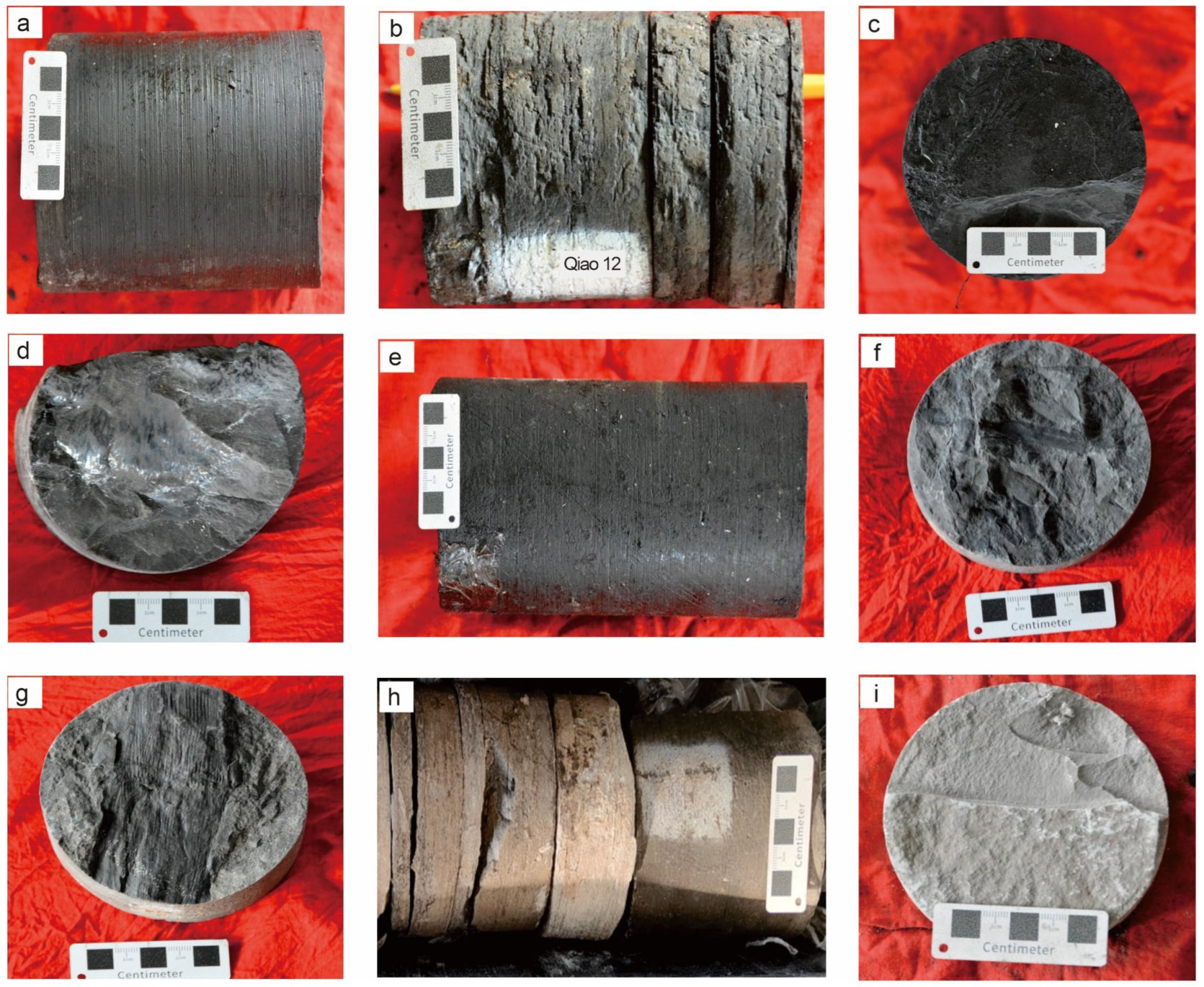
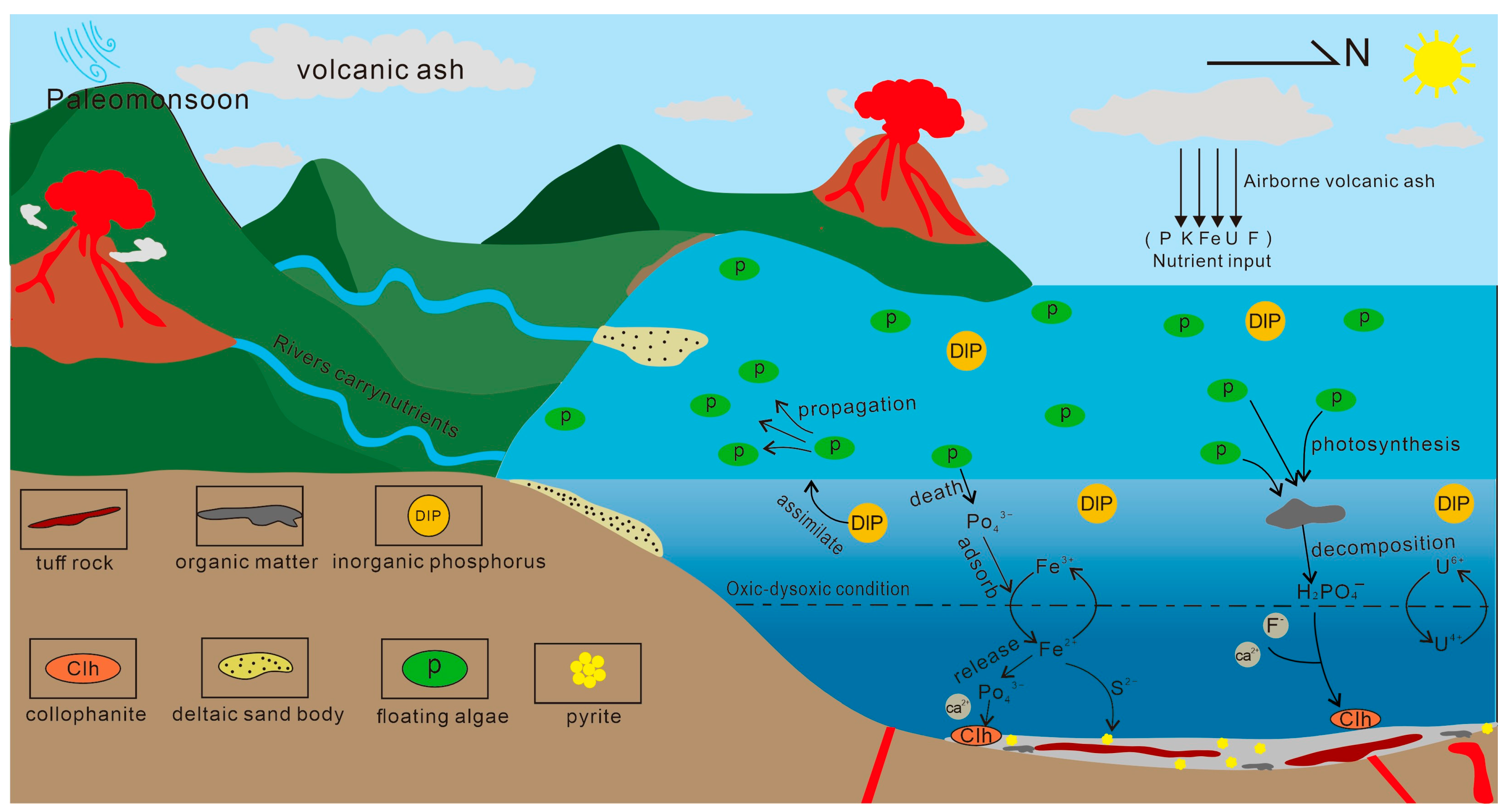
- Provenance input and sedimentary tectonic setting: Thin-bedded and laminated tuff layers are extensively developed in the Chang 73 sub-member of the Yanchang Formation in the Ordos Basin, indicating intense volcanic activity during this period (Figure 2i). Previous studies have shown that volcanic activity around the basin is the main source of phosphorus in phosphorus-bearing minerals [7,21]. During the Middle-Late Triassic, the subduction–collision event between the South Qinling Block and the Mianlue oceanic crust triggered intense volcanic activity. This subduction-induced episodic uplift of the Qinling orogenic belt resulted in significant modifications to the tectonic framework and depositional environment of the Ordos Basin [22]. Steep slope topography appears in the southwest of the basin, accompanied by strong depression, and an alluvial fan-delta sedimentary system is developed. During this period, the lake basin area and water body of Ordos Basin reached its peak, which provided conditions for the accumulation of sediments. During the Middle-Late Triassic period, the prevailing southwest–northeast paleomonsoon transported large amounts of volcanic ash toward the Ordos Basin. The volcanic ash was input into the lake basin through atmospheric deposition or surface runoff, providing the material source foundation for the phosphorus-bearing minerals in the Chang 73 sub-member of the Yanchang Formation in the Ordos Basin.
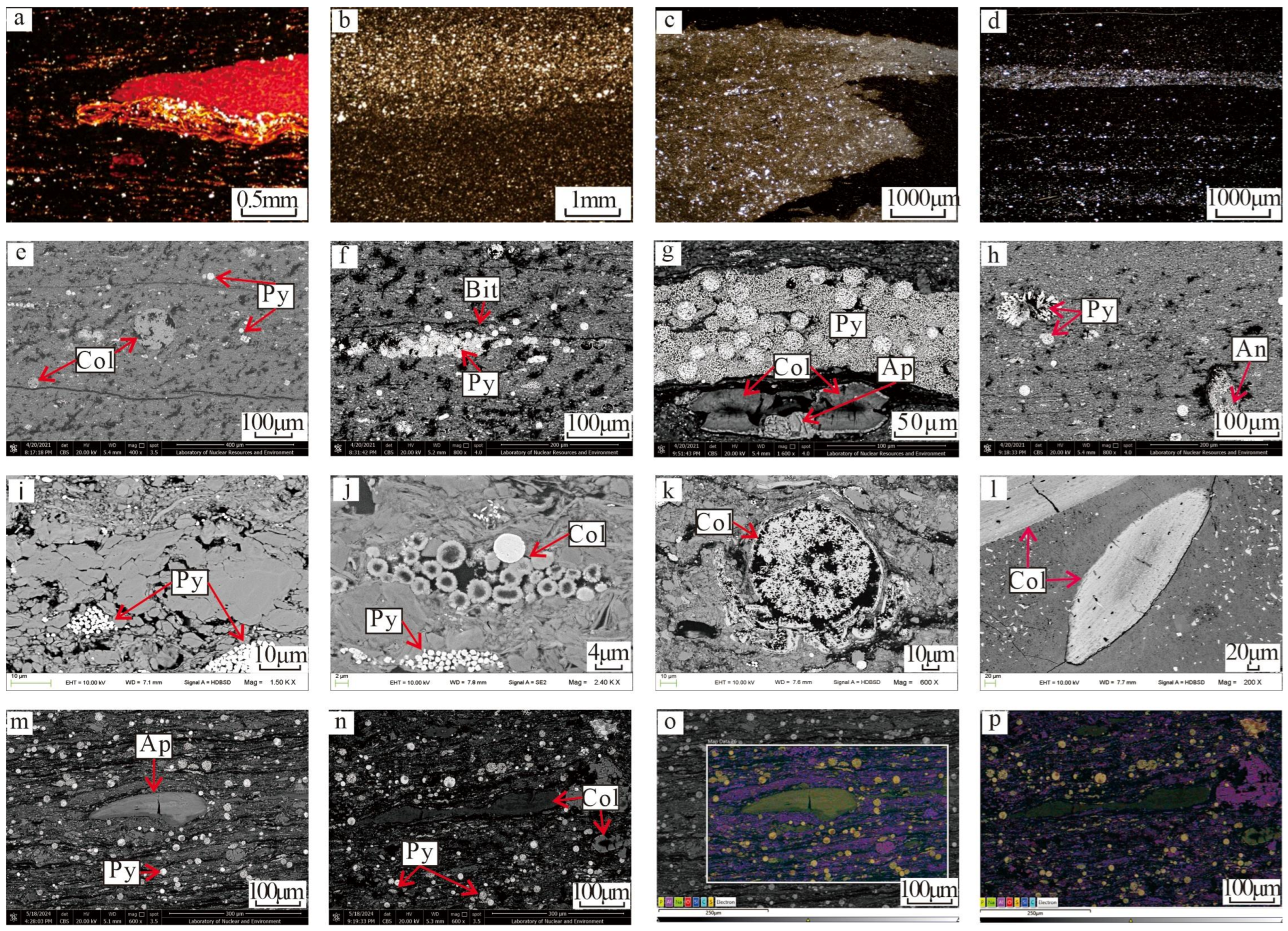
- High primary productivity drives the phosphorus cycle: In this study, scanning electron microscope (SEM) observations of black shales from the Chang 73 sub-member revealed co-occurrence of algal organic matter residues and phosphorus-bearing minerals (Figure 3e,k). The study of microfossils in the Chang 73 sub-member of the Yanchang Formation shows that the algae assemblage is dominated by cyanobacteria, chlorophyta, and acritarchs [23,24]. The presence of these biogenic structures provides direct micro-scale evidence for high primary productivity in the paleo-lake. Primary productivity refers to the ability of plankton to produce organic matter through photosynthesis. The level of primary productivity is mainly controlled by the composition and abundance of plankton groups. The Tonga volcanic eruption (VEI 6) in 2022 provides a modern analogy for studying the coupling relationship between volcanic activity and primary productivity. Satellite remote sensing data reveal an 800% increase in phytoplankton biomass, measured as chlorophyll-a concentration, within three months following the volcanic eruption, confirming that nutrients such as Fe and Si released from the volcanic ash can significantly enhance marine biological productivity [25]. Analogous to this modern process, frequent volcanic activities during the Middle-Late Triassic period led to substantial volcanic ash input into the lakes of the Ordos Basin. The abundant nutrient elements provided favorable conditions for the large-scale proliferation of plankton. The plankton absorbed dissolved phosphorus from the water to build their biomass. After their death and subsequent settling, the biogenic phosphorus was transformed into collophane or apatite during early diagenesis, thereby completing the critical geochemical cycle from biological productivity to the precipitation of phosphorus minerals.
- Organic matter enrichment and phosphorus regeneration: Studies demonstrate that organic matter enrichment serves as a critical factor in phosphorus mineral formation with elevated primary productivity exhibiting a strong positive correlation with organic matter accumulation [6]. Biological activities (e.g., plankton proliferation and organic matter degradation) facilitate reactive phosphorus release and drive apatite precipitation, a mechanism consistent with biomineralization processes documented in black shales [26]. During diagenesis, the decomposition of organic matter releases structurally bound phosphorus, which migrates via molecular diffusion to pore waters proximal to the sediment–water interface, ultimately driving hydroxyapatite precipitation under supersaturation conditions. Following mass mortality of planktonic organisms, biogenic phosphorus undergoes recrystallization into bioclast-derived apatite during early diagenesis. Following the death of massive plankton, biogenic phosphorus recrystallizes into apatite during early diagenesis. Concurrently, the decomposition of organic matter consumes oxygen, creating a more reducing local sedimentary environment. These reducing conditions facilitate the formation and preservation of phosphate minerals [27].
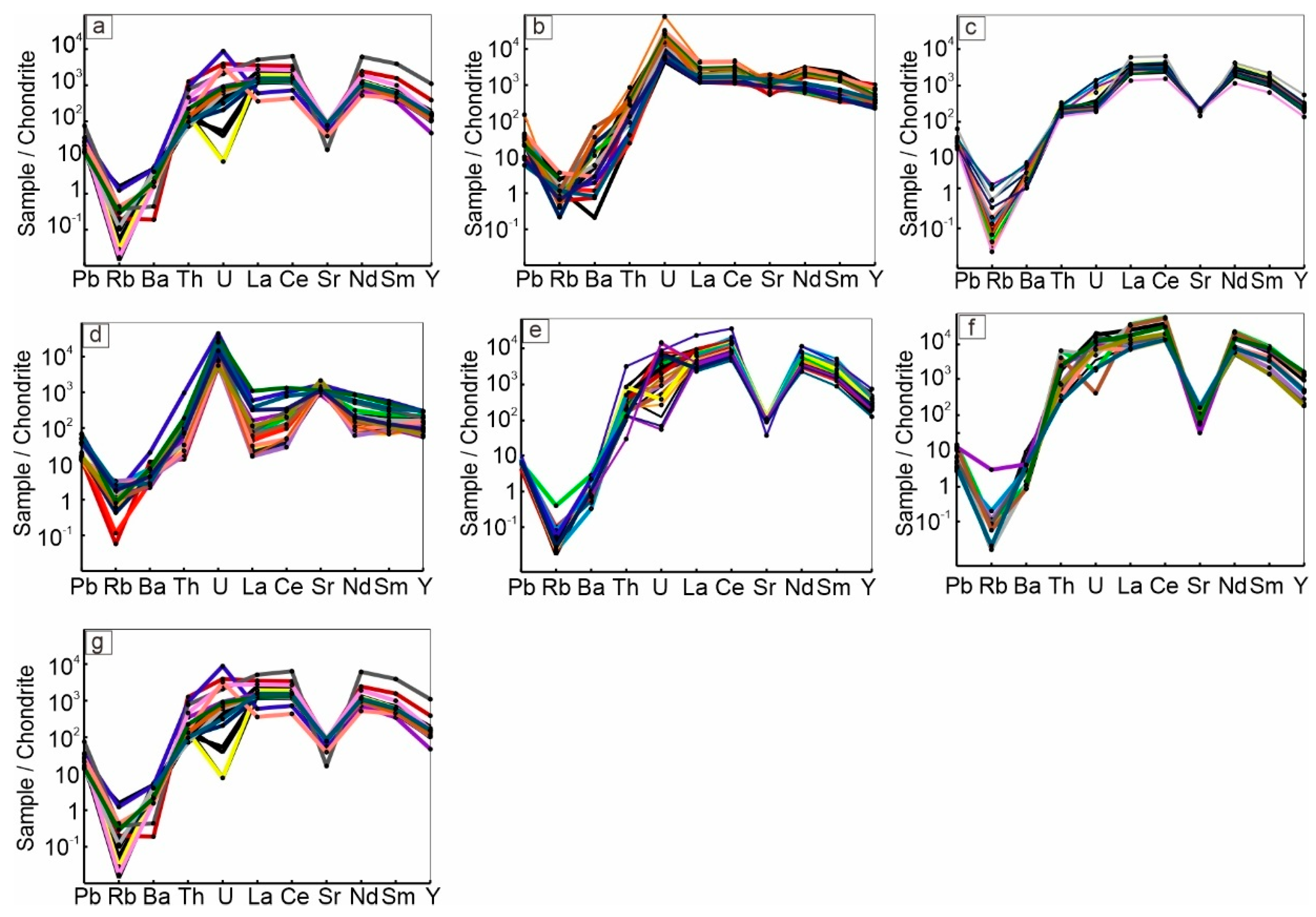
- Modulation of redox conditions: The widespread occurrence of framboidal pyrite and the negative δEu anomaly in phosphorus-bearing mineral samples from the organic-rich shale of the Chang 73 sub-member in the Yanchang Formation, Ordos Basin, jointly indicate a reducing depositional environment. The formation, accumulation, and preservation of phosphate rocks require specific environmental conditions and involve complex biogeochemical processes. During early diagenesis, the formation of phosphate is usually related to the redox conditions in the sedimentary environment [28].
- Low deposition rate promotes phosphorus enrichment: The sedimentation rate is also a key factor affecting the formation of apatite, and a lower sedimentation rate is conducive to the enrichment of phosphorus-bearing minerals [29]. When sedimentation rates are low, reduced sediment accumulation prolongs the residence time of phosphorus at the sediment–water interface. This amplifies phosphorus recycling and its subsequent release into pore water, creating favorable conditions for the genesis of authigenic minerals such as apatite [30]. Under low sedimentation rate conditions, sediment layers exhibit reduced thickness and relatively unconsolidated structures. This enables phosphate in pore waters to more readily interact with carbonate minerals in the sediments, triggering chemical reactions that promote the formation of phosphorus-bearing minerals.
5.2. Mechanisms of Uranium Enrichment in Phosphorus-Bearing Minerals
6. Conclusions
- The phosphorus-bearing minerals in the Chang 73 sub-member of the Yanchang Formation in the Ordos Basin primarily occur as collophane and apatite. Collophane exhibits pelletal, laminar, lenticular, or bioclastic morphologies.
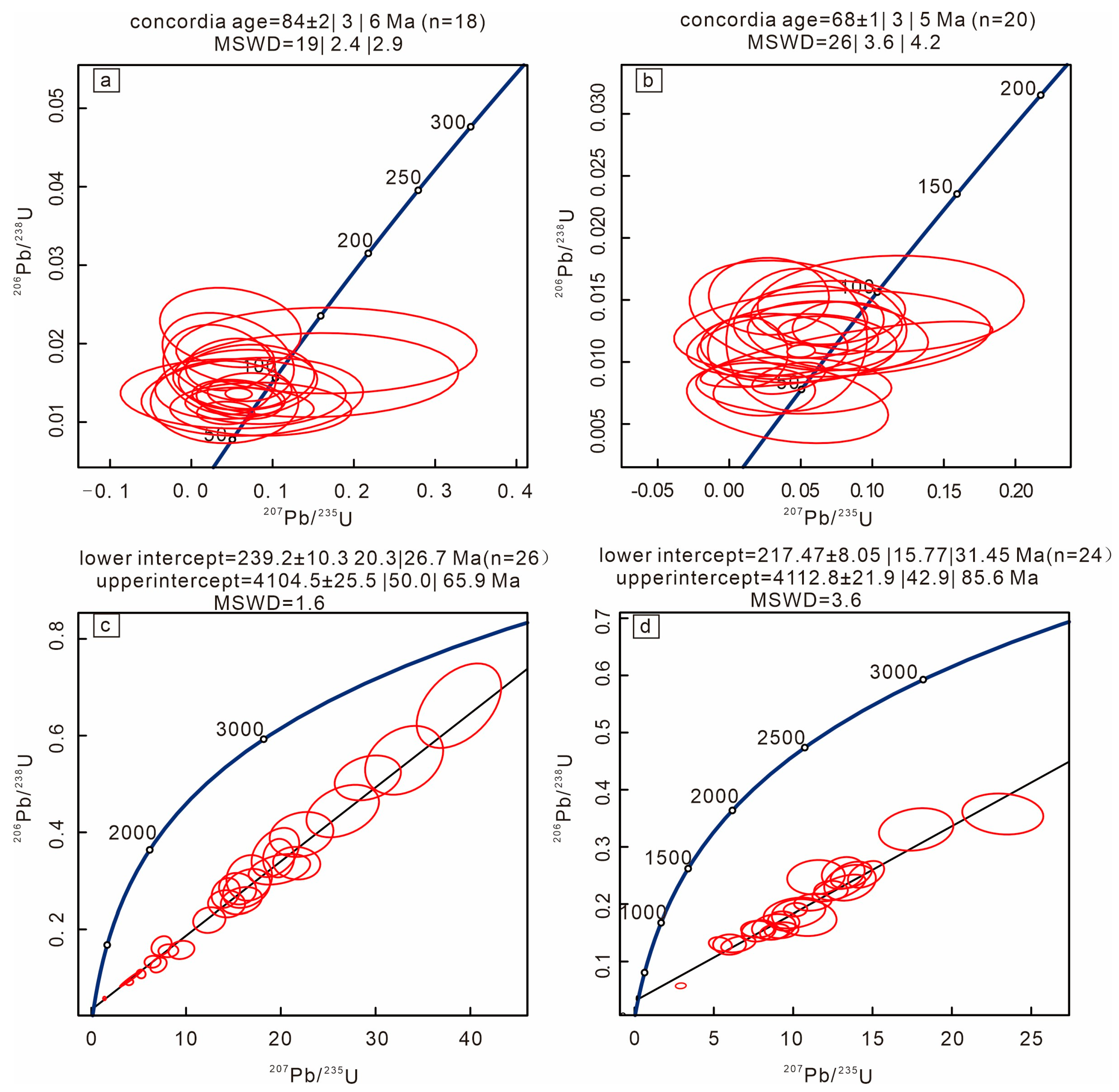
- The age of phosphorus-bearing minerals in the Chang 73 sub-member of the Yanchang Formation in the Ordos Basin can be divided into two stages: Middle-Late Triassic (217 ± 8.05 Ma and 239.2 ± 10.3 Ma) and Late Cretaceous (68 ± 1 Ma and 84 ± 2 Ma).
- During the sedimentary diagenesis stage, the formation of phosphorus-bearing minerals is controlled by many factors, such as material source, primary productivity level, redox environment, deposition rate, and organic matter enrichment. In the stage of hydrothermal transformation, the hydrothermal activity in the late Yanshanian Orogeny led to the opening of the U-Pb system of some phosphorus-bearing minerals, and the age of phosphorus-bearing minerals was reset to the time of the thermal event. The formation of phosphorus-bearing minerals in the sub-member of the Yanchang Formation results from the synergistic interplay between sedimentary diagenesis and hydrothermal modification, reflecting the complex geological evolution history of the Ordos Basin.
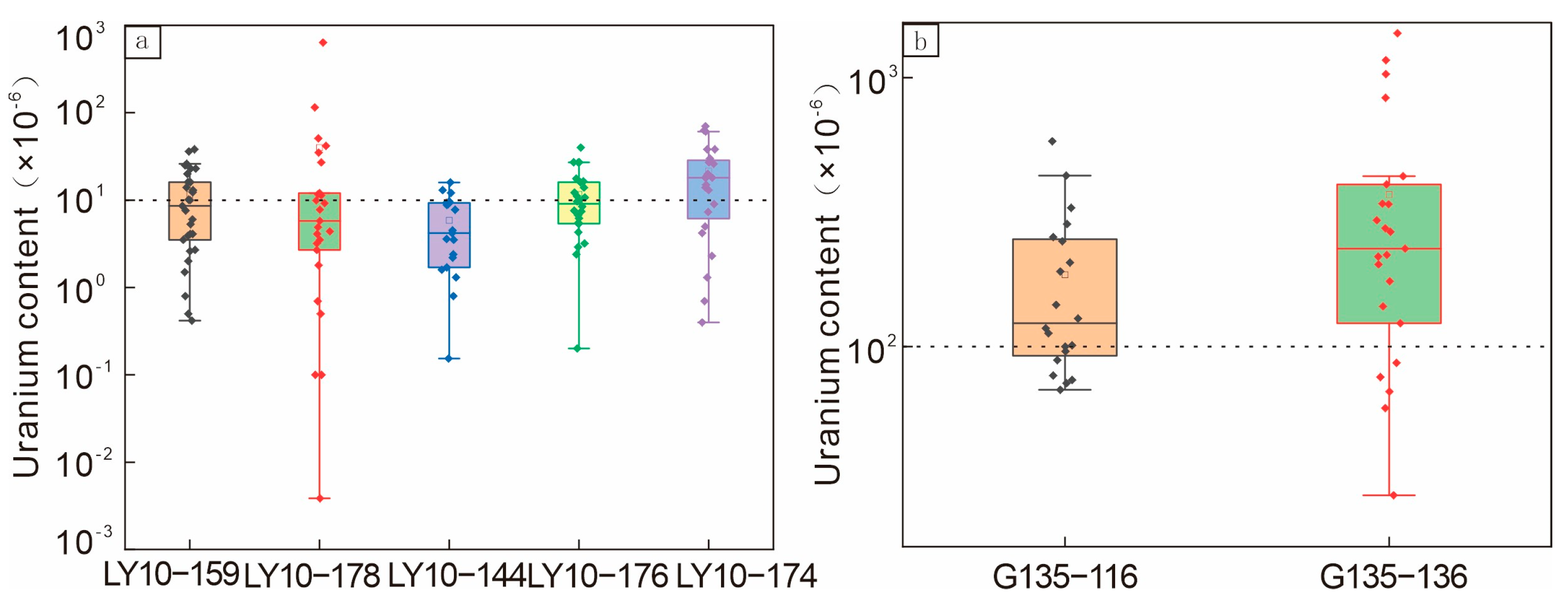
- Uranium enrichment in the phosphorus-bearing minerals occurred in two stages. The early sedimentary-diagenetic stage resulted in initial uranium enrichment, whereas a Late Cretaceous hydrothermal event caused further enrichment. This later stage is directly evidenced by the high uranium contents and reset U-Pb ages of samples G135-116 and G135-136.
Supplementary Materials
Author Contributions
Funding
Data Availability Statement
Acknowledgments
Conflicts of Interest
References
- Arthur, M.; Jenkyns, H. Phosphorites and paleoceanography. Oceanol. Acta 1980, 1980 SP, 1–51. [Google Scholar]
- Schenau, S.J.; Slomp, C.P.; De Lange, G.J. Phosphogenesis and active phosphorite formation in sediments from the Arabian Sea oxygen minimum zone. Mar. Geol. 2000, 169, 1–20. [Google Scholar] [CrossRef]
- Zirks, E.; Krom, M.; Schmiedl, G.; Katz, T.; Xiong, Y.; Alcott, L.J.; Poulton, S.W.; Goodman-Tchernov, B. Redox evolution and the development of oxygen minimum zones in the Eastern Mediterranean Levantine basin during the early Holocene. Geochim. Cosmochim. Acta 2021, 297, 82–100. [Google Scholar] [CrossRef]
- Ye, Z.; Zhou, H.; Gao, H. A review on genesis of authigenic carbonate fluorapatite in marine sediments. Mar. Geol. Quat. Geol. 2025, 45, 109–121. [Google Scholar] [CrossRef]
- Chen, Q. Biological effects in the process of sedimentary mineralization. Adv. Earth Sci. 1990, 5, 12–14. [Google Scholar] [CrossRef]
- Chen, Q.; Chen, M.; Li, J. Microbial-organic effects on formation of the sedimentary apatite. Chin. J. Geol. 2000, 35, 316–324. [Google Scholar]
- Yuan, W.; Liu, G.; Luo, W.; Li, C.; Xu, L.; Niu, X.; Ai, J.-y. Species and formation mechanism of apatites in the 7th member of Yanchang Formation organic-rich shale of Ordos Basin, China. Nat. Gas Geosci. 2016, 27, 1399–1408. [Google Scholar] [CrossRef]
- Dai, J.; Li, J.; Luo, X.; Zhang, W.; Hu, G.; Ma, C.; Guo, J.; Ge, S. Stable carbon isotope compositions and source rock geochemistry of the giant gas accumulations in the Ordos Basin, China. Org. Geochem. 2005, 36, 1617–1635. [Google Scholar] [CrossRef]
- Sun, M.; Feng, C.; Li, Y. Characteristics and Paleoenvironment of High-Quality Shale in the Triassic Yanchang Formation, Southern Margin of the Ordos Basin. Minerals 2023, 13, 1075. [Google Scholar] [CrossRef]
- He, D.; Cang, X.; Zhang, G.; Zhao, W.; Zhao, Z.; Liu, X.; Bao, H.; Fan, L.; Zou, S.; Kai, B.; et al. Scope, nature, and exploration significance of Ordos Basin during geological historical periods, NW China. Pet. Explor. Dev. 2025, 52, 757–771. [Google Scholar] [CrossRef]
- Guo, Y.; Li, W.; Guo, B.; Zhang, Q.; Chen, Q.; Wang, R.; Liu, X.; Ma, Y.; Li, Z.; Zhang, M.; et al. Sedimentary systems and palaeogeography evolution of Ordos Basin. J. Palaeogeogr. 2019, 21, 293–320. [Google Scholar] [CrossRef]
- Liu, Z.; Shen, F.; Zhu, X.; Li, F.; Tan, M. Formation Conditions and Sedimentary Characteristics of a Triassic Shallow Water Braided Delta in the Yanchang Formation, Southwest Ordos Basin, China. PLoS ONE 2015, 10, e0119704. [Google Scholar] [CrossRef]
- Wang, F.; Tian, J.; Fan, L.; Chen, R.; Qiu, J. Evolution of Sedimentary Fillings in Triassic Yanchang Formation and Its Response to Indosinian Movement in Ordos Basin. Nat. Gas Geosci. 2010, 21, 882–889. [Google Scholar] [CrossRef]
- Zhou, Q.; Liu, J.; Zhang, D.; Li, C.; Xiao, Y.; Chen, G.; Lyu, C. Microscopic enrichment and porosity-permeability reduction mechanism of residual oil in tight sandstone reservoirs: An insight from Chang 8 Member, Yanchang Formation, Ordos Basin, China. J. Pet. Explor. Prod. Technol. 2024, 14, 1365–1393. [Google Scholar] [CrossRef]
- Xi, K.; Li, K.; Cao, Y.; Lin, M.; Niu, X.; Zhu, R.; Wei, X.; You, Y.; Liang, X.; Feng, S. Laminae combination and shale oil enrichment patterns of Chang 73 sub-member organic-rich shales in the Triassic Yanchang Formation, Ordos Basin, NW China. Petrol. Explor. Dev. 2020, 47, 1244–1255. [Google Scholar] [CrossRef]
- Wang, M.; Wu, B.; Li, Y.; Liu, C.; Hao, X.; Liu, M.; Zhang, W.; Li, Q.; Yao, L.; Zhang, X. Experimental study on possibility of deep uranium-rich source rocks providing uranium source in Ordos Basin. Earth Sci. 2022, 47, 224–239. [Google Scholar] [CrossRef]
- Liu, H.; Zou, C.; Qiu, Z.; Yin, S.; Yang, Z.; Wu, S.; Zhang, G.; Chen, Y.; Ma, F.; Li, S.; et al. Sedimentary Depositional Environment and Organic Matter Enrichment Mechanism of Lacustrine Black Shales: A case study of the Chang 7 member in the Ordos Basin. Acta Sedimentol. Sin. 2023, 41, 1810–1829. [Google Scholar] [CrossRef]
- Pu, B.; Wang, F.; Wang, K.; Sun, J.; Li, Y.; Shi, B.; Zhao, W.; Guo, X. The enrichment conditions and model of shale gas reservoir in the Chang 7 member of Mesozoic Yanchang Formation in Yan’an, Ordos Basin. Geol. China 2023, 50, 1285–1298. [Google Scholar] [CrossRef]
- Sun, S.-S.; McDonough, W. Chemical and Isotopic Systematics of Oceanic Basalts: Implications for Mantle Composition and Processes; Geological Society of London: London, UK, 1989; Volume 42. [Google Scholar]
- Wakita, H.; Rey, P.; Schmitt, R. Abundances of the 14 rare-earth elements and 12 other trace elements in Apollo 12 samples—Five igneous and one breccia rocks and four soils. In Proceedings of the Second Lunar Science Conference, Geochimica et Cosmochimica Acta, 02/01; MIT Press: Cambridge, MA, USA, 1971. [Google Scholar]
- Zhang, W.; Yang, H.; Peng, P.; Yang, Y.; Zhang, H.; Shi, X. The Influence of Late Triassic volcanism on the development of Chang 7 high grade hydrocarbon source rock in Ordos Basin. Geochimica 2009, 38, 573–582. [Google Scholar] [CrossRef]
- Wang, J.; Liu, C.; Li, H.; Wu, T.; Wu, J. Geochronology, Potential Source and Regional Implications of Tuff Intervals in Chang-7 Member of Yanchang Formation, South of Ordos Basin. Acta Sedimentol. Sin. 2017, 35, 691–704. [Google Scholar] [CrossRef]
- Liu, H.; Zou, C.; Qiu, Z.; Pan, S.; Zhang, W.; Jing, Z.; Hao, J.; Yin, S.; Wu, S.; Li, S.; et al. Sedimentary enrichment factors of extraordinarily high organic matter in the sub-member 3 of Member 7 of Yanchang Formation, Ordos Basin. Acta Pet. Sin. 2022, 43, 1520–1541. [Google Scholar] [CrossRef]
- Gan, D.; Bian, C.; Yang, W.; Liu, L.; Dong, J.; Zhuang, W.; Li, Y.; Wang, J. Phosphatized planktonic green algae fossils in the source rocks of the Chang 7 member of the Yanchang Formation in the ordos Basin. Acta Micropalaeontol. Sin. 2023, 40, 327–349. [Google Scholar] [CrossRef]
- Barone, B.; Letelier, R.M.; Rubin, K.H.; Karl, D.M. Satellite Detection of a Massive Phytoplankton Bloom Following the 2022 Submarine Eruption of the Hunga Tonga-Hunga Haʻapai Volcano. Geophys. Res. Lett. 2022, 49, e2022GL099293. [Google Scholar] [CrossRef]
- Skinner, H.; Catherine, W. A review of apatites, iron and manganese minerals and their roles as indicators of biological activity in black shales. Precambrian Res. 1993, 61, 209–229. [Google Scholar] [CrossRef]
- El Bamiki, R.; Raji, O.; Ouabid, M.; Elghali, A.; Khadiri Yazami, O.; Bodinier, J.-L. Phosphate Rocks: A Review of Sedimentary and Igneous Occurrences in Morocco. Minerals 2021, 11, 1137. [Google Scholar] [CrossRef]
- Pufahl, P.K.; Groat, L.A. Sedimentary and Igneous Phosphate Deposits: Formation and Exploration: An Invited Paper. Econ. Geol. 2017, 112, 483–516. [Google Scholar] [CrossRef]
- Zhao, M.; Mills, B.J.W.; Poulton, S.W.; Wan, B.; Xiao, K.-Q.; Guo, L.; Guo, Z. Drivers of the global phosphorus cycle over geological time. Nat. Rev. Earth Environ. 2024, 5, 873–889. [Google Scholar] [CrossRef]
- Cortina, A.; Filippelli, G.; Ochoa, D.; Sierro, F.J.; Flores, J.-A.; Grimalt, J.O. Climate-driven changes in sedimentation rate influence phosphorus burial along continental margins of the northwestern Mediterranean. Palaeogeogr. Palaeoclimatol. Palaeoecol. 2018, 500, 106–116. [Google Scholar] [CrossRef]
- Xiao, Z.; Lu, J.; Li, Y.; Zhang, H.; Yin, X.; Zhou, X. Characteristics of Fractures and Their Controls on Yanchang Formation Reservoir in Ordos Basin. Xinjiang Pet. Geol. 2023, 44, 535–542. [Google Scholar] [CrossRef]
- Tan, H.; Ming, R.; Huang, X.; Qi, L.; Gao, J.; Meng, Y.; Xie, H. Research progress on chemical composition of apatite: Application in petrogenesis, ore genesis and mineral exploration. Acta Petrol. Sin. 2022, 38, 3067–3087. [Google Scholar] [CrossRef]
- Singh, A.; Ulrich, K.-U.; Giammar, D.E. Impact of phosphate on U(VI) immobilization in the presence of goethite. Geochim. Cosmochim. Acta 2010, 74, 6324–6343. [Google Scholar] [CrossRef]
- Hughes, J.M.; Rakovan, J. The Crystal Structure of Apatite, Ca5(PO4)3(F,OH,Cl). Rev. Mineral. Geochem. 2002, 48, 1–12. [Google Scholar] [CrossRef]
- Qin, Y.; Zhang, W.; Peng, P.; Zhou, Z. Occurrence and concentration of uranium in the hydrocarbon source rocks of Chang 7 member of Yanchang Formation, Ordos basin. Acta Petrol. Sin. 2009, 25, 2469–2476. [Google Scholar]
- Zhang, B.; Wu, B.; Liu, C.; Qin, X. Occurrence of Uranium in Hydrocarbon of Chang-7 Member of Yanchang Formation of Ordos Basin. Northwest. Geol. 2011, 44, 124–132. [Google Scholar] [CrossRef]
- Li, Y.; Duan, C.; Zhao, Y.; Pei, H.; Ren, S. The Role of Oxidizing Reducing Barrier in Mineralization of Hydrothermal Uranium Ore. Acta Geol. Sin. 2016, 90, 201–218. [Google Scholar] [CrossRef]
- Nie, X.; Dong, F.; Liu, M.; Li, X.; Huang, W.; Wang, C.; Lu, X. Microbial mechanism on distribution, renewal, and maintenance of soil organic carbon pool in karst area. Acta Microbiol. Sin. 2022, 62, 2198–2211. [Google Scholar] [CrossRef]





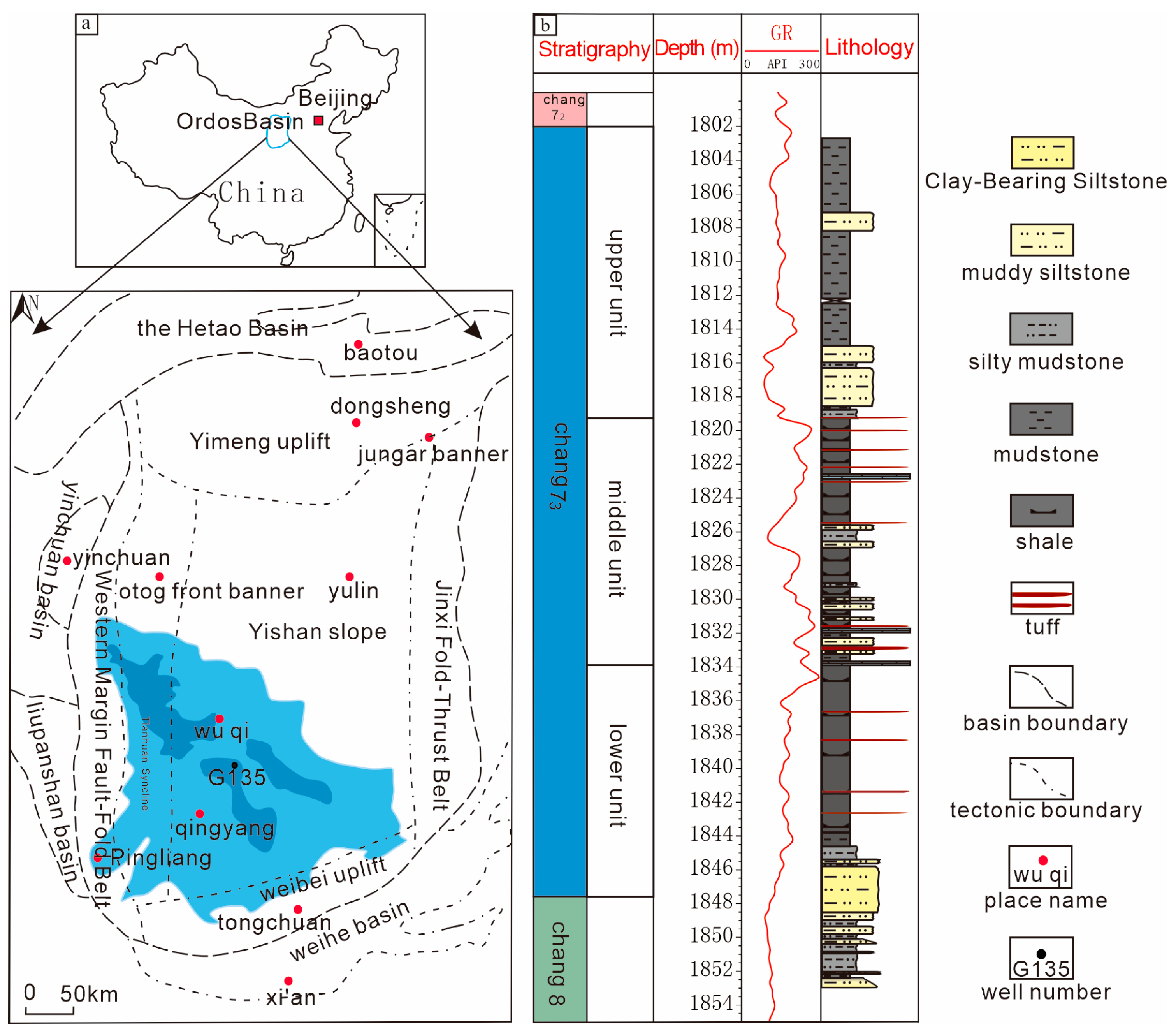
| Sample ID | Borehole | Depth (m) | Stratigraphic Unit | Analysis Performed |
|---|---|---|---|---|
| LY10-144 | LY10 | 1721.10 | Chang 73 sub-member | REE, trace elements |
| LY10-159 | LY10 | 1724.30 | Chang 73 sub-member | REE, trace elements |
| LY10-174 | LY10 | 1726.90 | Chang 73 sub-member | U-Pb dating, REE, trace elements |
| LY10-176 | LY10 | 1727.30 | Chang 73 sub-member | REE, trace elements |
| LY10-178 | LY10 | 1727.10 | Chang 73 sub-member | U-Pb dating, REE, trace elements |
| G135-136 | G135 | 1819.15 | Chang 73 sub-member | U-Pb dating, REE, trace elements |
| G135-116 | G135 | 1823.15 | Chang 73 sub-member | U-Pb dating, REE, trace elements |
| G135-66 | G135 | 1834.10 | Chang 73 sub-member | Scanning electron microscopy |
| G135-49 | G135 | 1838.75 | Chang 73 sub-member | Scanning electron microscopy |
| G135-029 | G135 | 1843 | Chang 73 sub-member | Thin-section petrography |
| G135-19 | G135 | 1845 | Chang 73 sub-member | Thin-section petrography |
| Zhu80-57 | Zhu80 | 2269.30 | Chang 73 sub-member | Scanning electron microscopy |
| Zhu80-62 | Zhu80 | 2268.14 | Chang 73 sub-member | Thin-section petrography |
| Zhu80-66 | Zhu80 | 2267.65 | Chang 73 sub-member | Scanning electron microscopy |
| Zhu80-70 | Zhu80 | 2264.80 | Chang 73 sub-member | Scanning electron microscopy |
| Zhu80-88 | Zhu80 | 2264.40 | Chang 73 sub-member | Scanning electron microscopy |
| Zhu80-94 | Zhu80 | 2261 | Chang 73 sub-member | Scanning electron microscopy |
| Zhu80-132 | Zhu80 | 2245.30 | Chang 73 sub-member | Scanning electron microscopy |
| Zhu80-154 | Zhu80 | 2234.46 | Chang 73 sub-member | Thin-section petrography |
| Sample | Pb | Rb | Ba | Th | U | La | Ce | Sr | Nd | Sm | Y | |
|---|---|---|---|---|---|---|---|---|---|---|---|---|
| LY10-178 | max | 66.20 | 0.43 | 21.10 | 62.70 | 636.00 | 1610.00 | 5170.00 | 1028.00 | 3660.00 | 750.00 | 2185.00 |
| min | 1.71 | 0.01 | 0.43 | 0.26 | 0.10 | 21.70 | 73.00 | 427.00 | 87.00 | 25.10 | 94.30 | |
| mean | 4.93 | 0.06 | 9.23 | 11.22 | 39.99 | 485.66 | 1270.30 | 852.87 | 723.77 | 133.21 | 352.47 | |
| G135-136 | max | 22.80 | 1.30 | 258.00 | 53.00 | 1460.00 | 1880.00 | 5240.00 | 21,600.00 | 3730.00 | 961.00 | 5160.00 |
| min | 0.72 | 0.05 | 0.80 | 0.04 | 28.00 | 95.50 | 507.00 | 265.00 | 360.00 | 66.80 | 343.00 | |
| mean | 6.71 | 0.45 | 51.51 | 15.68 | 367.83 | 751.59 | 2148.57 | 10,580.65 | 1188.91 | 257.42 | 1343.74 | |
| LY10-144 | max | 4.40 | 0.44 | 17.00 | 7.13 | 15.90 | 624.00 | 1695.00 | 1123.00 | 849.00 | 151.30 | 448.00 |
| min | 1.17 | 0.01 | 0.17 | 0.04 | 0.15 | 0.31 | 0.78 | 463.00 | 0.85 | 0.42 | 5.96 | |
| mean | 1.95 | 0.05 | 7.57 | 4.39 | 5.71 | 310.26 | 860.40 | 946.69 | 483.88 | 86.99 | 225.59 | |
| G135-116 | max | 8.40 | 1.15 | 78.00 | 48.00 | 580.00 | 345.00 | 1092.00 | 23,600.00 | 530.00 | 110.00 | 601.00 |
| min | 1.47 | 0.15 | 9.50 | 0.67 | 69.00 | 5.10 | 23.80 | 9380.00 | 36.70 | 13.10 | 113.00 | |
| mean | 3.65 | 0.47 | 20.10 | 5.52 | 185.05 | 52.17 | 223.39 | 14,294.50 | 158.78 | 34.89 | 306.25 | |
| LY10-159 | max | 4.53 | 0.25 | 10.40 | 39.80 | 38.00 | 1333.00 | 3010.00 | 895.00 | 1199.00 | 237.00 | 604.00 |
| min | 0.79 | 0.02 | 1.83 | 0.93 | 0.42 | 86.80 | 258.00 | 330.00 | 170.00 | 34.80 | 93.20 | |
| mean | 3.09 | 0.01 | 5.23 | 6.46 | 11.59 | 423.46 | 1168.62 | 754.15 | 653.36 | 122.08 | 278.84 | |
| LY10-174 | max | 8.89 | 41.10 | 81.00 | 127.00 | 70.00 | 2565.00 | 6210.00 | 1677.00 | 3090.00 | 503.00 | 2030.00 |
| min | 2.26 | 0.01 | 0.12 | 4.09 | 0.40 | 69.20 | 256.00 | 252.00 | 179.00 | 24.50 | 34.10 | |
| mean | 5.72 | 2.57 | 10.86 | 38.29 | 21.60 | 1570.33 | 3745.75 | 497.83 | 1903.71 | 324.84 | 817.97 | |
| LY10-176 | max | 8.10 | 0.13 | 8.20 | 26.66 | 40.00 | 667.00 | 1820.00 | 878.00 | 758.00 | 106.50 | 298.00 |
| min | 0.20 | 0.01 | 1.26 | 2.58 | 0.20 | 204.00 | 583.00 | 627.00 | 292.00 | 48.30 | 122.60 | |
| mean | 3.51 | 0.03 | 2.99 | 6.88 | 11.33 | 395.03 | 1097.03 | 770.13 | 530.13 | 81.65 | 182.28 |
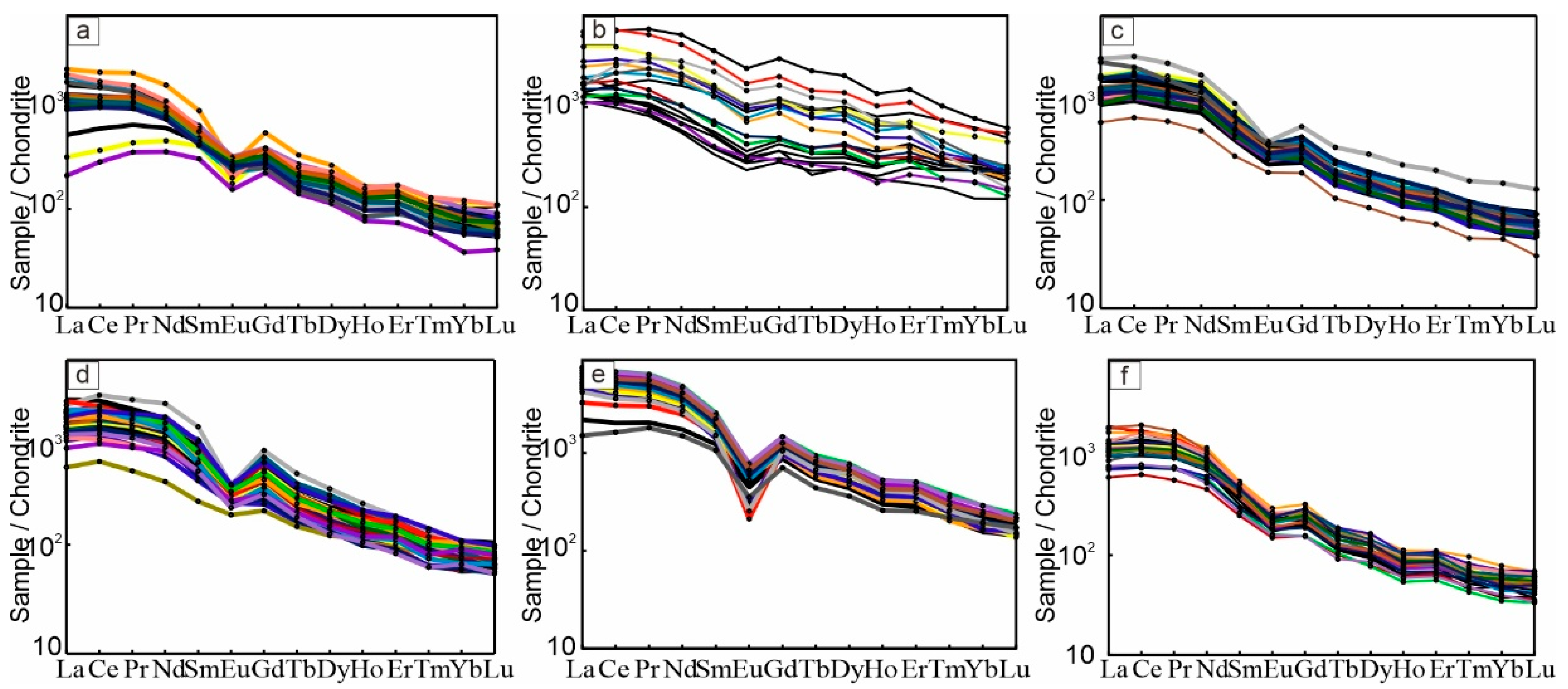
| Sample | La | Ce | Pr | Nd | Sm | Eu | Gd | Tb | Dy | Ho | Er | Tm | Yb | Lu | |
|---|---|---|---|---|---|---|---|---|---|---|---|---|---|---|---|
| LY10-178 | Max | 1610.0 | 5170.0 | 772.0 | 3660.0 | 750.0 | 92.1 | 670.0 | 79.5 | 436.0 | 83.6 | 212.0 | 26.7 | 138.3 | 19.4 |
| Min | 21.7 | 73.0 | 15.2 | 87.0 | 25.1 | 3.2 | 34.5 | 4.5 | 22.7 | 3.8 | 6.9 | 0.7 | 2.5 | 0.3 | |
| Mean | 485.7 | 1270.3 | 167.9 | 723.8 | 133.2 | 22.4 | 114.4 | 13.0 | 71.6 | 13.1 | 33.6 | 4.1 | 22.6 | 3.2 | |
| G135-136 | Max | 1880.0 | 5240.0 | 747.0 | 3730.0 | 961.0 | 250.0 | 1051.0 | 158.9 | 939.0 | 178.3 | 459.0 | 47.1 | 235.0 | 25.0 |
| Min | 95.5 | 507.0 | 98.9 | 360.0 | 66.8 | 17.2 | 74.4 | 10.1 | 61.3 | 12.3 | 32.0 | 3.5 | 17.5 | 2.6 | |
| Mean | 751.6 | 2148.6 | 273.5 | 1188.9 | 257.4 | 62.8 | 263.5 | 37.2 | 228.8 | 43.8 | 118.0 | 13.8 | 78.4 | 9.9 | |
| LY10-144 | Max | 624.0 | 1695.0 | 221.7 | 849.0 | 151.3 | 25.4 | 122.9 | 14.5 | 84.9 | 15.1 | 46.9 | 7.1 | 46.5 | 7.3 |
| Min | 0.3 | 0.8 | 0.1 | 0.9 | 0.4 | 0.2 | 0.9 | 0.1 | 0.8 | 0.3 | 0.5 | 0.1 | 0.5 | 0.1 | |
| Mean | 310.3 | 860.4 | 114.2 | 483.9 | 87.0 | 19.3 | 72.2 | 8.3 | 45.8 | 8.3 | 21.5 | 2.6 | 14.9 | 2.1 | |
| G135-116 | Max | 345.0 | 1092.0 | 139.0 | 530.0 | 110.0 | 28.0 | 100.0 | 14.2 | 97.0 | 19.8 | 62.9 | 9.2 | 65.4 | 9.2 |
| Min | 5.1 | 23.8 | 4.5 | 36.7 | 13.1 | 3.2 | 14.0 | 2.2 | 14.5 | 3.6 | 12.1 | 1.8 | 10.4 | 1.1 | |
| Mean | 52.2 | 223.4 | 35.7 | 158.8 | 34.9 | 8.6 | 33.3 | 5.7 | 39.3 | 8.6 | 30.9 | 4.5 | 33.2 | 4.8 | |
| LY10-159 | Max | 1333.0 | 3010.0 | 341.0 | 1199.0 | 237.0 | 31.0 | 191.0 | 21.4 | 115.1 | 21.2 | 56.9 | 6.9 | 41.9 | 5.5 |
| Min | 86.8 | 258.0 | 38.2 | 170.0 | 34.8 | 9.0 | 33.2 | 3.7 | 19.8 | 4.1 | 9.6 | 1.0 | 5.8 | 0.8 | |
| Mean | 423.5 | 1168.6 | 154.3 | 653.4 | 122.1 | 20.2 | 103.4 | 11.5 | 59.7 | 10.6 | 26.5 | 3.0 | 17.3 | 2.4 | |
| LY10-174 | Max | 2565.0 | 6210.0 | 778.0 | 3090.0 | 503.0 | 57.0 | 382.0 | 58.1 | 373.0 | 75.0 | 210.0 | 27.7 | 180.0 | 22.2 |
| Min | 69.2 | 256.0 | 39.6 | 179.0 | 24.5 | 6.5 | 19.3 | 1.3 | 6.4 | 1.1 | 3.1 | 0.4 | 2.2 | 0.5 | |
| Mean | 1570.3 | 3745.8 | 469.1 | 1903.7 | 324.8 | 34.0 | 270.7 | 31.5 | 170.0 | 30.7 | 76.5 | 8.7 | 48.6 | 6.3 | |
| LY10-176 | Max | 667.0 | 1820.0 | 210.0 | 758.0 | 106.5 | 23.9 | 87.3 | 10.9 | 57.8 | 10.7 | 28.7 | 3.3 | 19.8 | 3.1 |
| Min | 204.0 | 583.0 | 68.2 | 292.0 | 48.3 | 10.6 | 40.0 | 4.3 | 23.2 | 4.2 | 11.2 | 1.4 | 7.7 | 1.1 | |
| Mean | 395.0 | 1097.0 | 135.8 | 530.1 | 81.7 | 16.2 | 63.4 | 7.0 | 36.4 | 6.6 | 17.1 | 2.1 | 12.2 | 1.8 |
| Sample | ΣREE | ΣLREE | ΣHREE | LREE:HREE | δEu | δCe | (La:Yb)N |
|---|---|---|---|---|---|---|---|
| LY10-178 | 3078.97 | 2803.26 | 275.71 | 10.17 | 0.61 | 1.06 | 20.78 |
| G135-136 | 5476.10 | 4682.70 | 793.40 | 5.90 | 0.73 | 1.13 | 6.81 |
| LY10-144 | 2050.60 | 1874.99 | 175.61 | 10.68 | 0.76 | 1.09 | 14.68 |
| G135-116 | 673.91 | 513.48 | 160.43 | 3.20 | 0.78 | 1.11 | 1.04 |
| LY10-159 | 2776.40 | 2542.01 | 234.39 | 10.85 | 0.57 | 1.10 | 16.74 |
| LY10-174 | 8690.85 | 8047.75 | 643.10 | 12.51 | 0.38 | 1.04 | 26.88 |
| LY10-176 | 2402.21 | 2255.83 | 146.38 | 15.41 | 0.67 | 1.13 | 22.48 |
| Sample | Isotope Ratio | Sample | Isotope Ratio | Sample | Isotope Ratio | |||||||||
|---|---|---|---|---|---|---|---|---|---|---|---|---|---|---|
| 207Pb/235U | 1s% | 206Pb/238U | 1s% | 207Pb/235U | 1s% | 206Pb/238U | 1s% | 207Pb/235U | 1s% | 206Pb/238U | 1s% | |||
| LY10-178 | 22.8984 | 6.2 | 0.33339 | 4.2 | LY10-178 | 9.5121 | 5.9 | 0.15753 | 4.9 | LY10-144 | 24.5596 | 5.8 | 0.32502 | 5 |
| LY10-178 | 4.0411 | 4 | 0.09056 | 2.7 | LY10-178 | 38.7967 | 4.7 | 0.6618 | 5.4 | LY10-144 | 20.9395 | 3.9 | 0.34061 | 4.1 |
| LY10-178 | 15.8319 | 5.6 | 0.259 | 4.4 | LY10-178 | 15.4432 | 5.2 | 0.28346 | 4.7 | LY10-144 | 39.5827 | 4.2 | 0.57923 | 4.1 |
| LY10-178 | 29.1768 | 4.9 | 0.51257 | 3.7 | LY10-144 | 26.7681 | 4.6 | 0.4096 | 4.6 | G135-136 | 0.0544 | 34.7 | 0.01234 | 6.6 |
| LY10-178 | 19.8501 | 6.7 | 0.32361 | 4 | LY10-144 | 68.9136 | 4.3 | 0.79399 | 4.4 | G135-136 | 0.0720 | 62.8 | 0.01229 | 11.6 |
| LY10-178 | 1.3947 | 4.4 | 0.05718 | 2.6 | LY10-144 | 26.5155 | 4.3 | 0.37966 | 4.6 | G135-136 | 0.0245 | 59.4 | 0.00758 | 10.3 |
| LY10-178 | 16.3867 | 6.2 | 0.28407 | 5.8 | LY10-144 | 12.8399 | 4.3 | 0.22241 | 3.8 | G135-136 | 0.0704 | 15.2 | 0.01306 | 5.6 |
| LY10-178 | 8.1336 | 5.3 | 0.15583 | 3.5 | LY10-144 | 24.6456 | 5 | 0.40707 | 4.6 | G135-136 | 0.0759 | 34.0 | 0.01212 | 9.4 |
| LY10-178 | 6.4699 | 5.4 | 0.13308 | 3.8 | LY10-144 | 9.6496 | 8.4 | 0.18345 | 6.4 | G135-136 | 0.0556 | 38.6 | 0.01322 | 9.0 |
| LY10-178 | 12.4521 | 5.6 | 0.21892 | 4.9 | LY10-144 | 24.1266 | 4.7 | 0.38193 | 5.1 | G135-136 | 0.0481 | 64.5 | 0.01374 | 13.2 |
| LY10-178 | 5.2549 | 3.7 | 0.10782 | 3.4 | LY10-144 | 5.142 | 6.4 | 0.09768 | 4.1 | G135-136 | 0.0471 | 42.7 | 0.01179 | 19.9 |
| LY10-178 | 4.1952 | 11.4 | 0.09865 | 7.1 | LY10-144 | 6.7308 | 8.2 | 0.11302 | 5.4 | G135-136 | 0.0690 | 20.8 | 0.01214 | 5.2 |
| LY10-178 | 14.2747 | 5.6 | 0.25258 | 4.5 | LY10-144 | 14.9907 | 5.2 | 0.26073 | 6.1 | G135-136 | 0.0277 | 62.0 | 0.01529 | 8.3 |
| LY10-178 | 19.7698 | 3.4 | 0.34666 | 4.7 | LY10-144 | 17.8046 | 6.1 | 0.29524 | 6.4 | G135-136 | 0.0451 | 61.9 | 0.00811 | 11.5 |
| LY10-178 | 7.4125 | 5.9 | 0.16614 | 4.9 | LY10-144 | 17.914 | 5.6 | 0.3161 | 4.2 | G135-136 | 0.0407 | 70.7 | 0.00670 | 19.8 |
| LY10-178 | 33.0126 | 5.1 | 0.54894 | 5.3 | LY10-144 | 29.4652 | 4.3 | 0.43392 | 4 | G135-136 | 0.0474 | 60.1 | 0.01110 | 10.2 |
| LY10-178 | 26.5316 | 5.9 | 0.44399 | 5 | LY10-144 | 23.3498 | 5.7 | 0.38879 | 4.5 | G135-136 | 0.0691 | 31.9 | 0.01398 | 7.5 |
| LY10-178 | 19.4266 | 5.3 | 0.35835 | 5.8 | LY10-144 | 11.6841 | 5.3 | 0.19124 | 4.5 | G135-116 | 0.0993 | 28.9 | 0.01750 | 7.0 |
| LY10-178 | 7.09 | 5 | 0.12625 | 5 | LY10-144 | 30.1805 | 5.4 | 0.49254 | 5.2 | G135-116 | 0.1530 | 46.9 | 0.01599 | 13.7 |
| LY10-178 | 14.194 | 4.3 | 0.27462 | 4.6 | LY10-144 | 17.1764 | 4.6 | 0.25514 | 6.2 | G135-116 | 0.0716 | 45.2 | 0.01208 | 7.9 |
| LY10-178 | 22.1859 | 6.2 | 0.39561 | 4.8 | LY10-144 | 23.182 | 5.5 | 0.35379 | 5 | G135-116 | 0.0855 | 53.4 | 0.01165 | 11.9 |
| LY10-178 | 21.6744 | 4.7 | 0.33623 | 4.1 | LY10-144 | 31.1984 | 5 | 0.47752 | 4 | G135-116 | 0.0679 | 50.3 | 0.01569 | 10.9 |
| LY10-178 | 16.6704 | 5.9 | 0.30578 | 6.3 | LY10-144 | 19.5459 | 6.5 | 0.25554 | 6.8 | G135-116 | 0.0717 | 29.5 | 0.01397 | 6.7 |
| G135-116 | 0.0349 | 81.5 | 0.01669 | 14.0 | G135-116 | 0.0408 | 91.2 | 0.01256 | 17.1 | G135-116 | 0.0481 | 73.8 | 0.02205 | 9.4 |
| G135-116 | 0.0423 | 34.3 | 0.01116 | 5.3 | G135-116 | 0.0750 | 74.4 | 0.01323 | 15.4 | G135-116 | 0.0477 | 46.6 | 0.01734 | 7.8 |
| G135-116 | 0.1662 | 45.5 | 0.01912 | 11.7 | G135-116 | 0.0553 | 73.7 | 0.01481 | 12.2 | G135-116 | 0.0454 | 72.9 | 0.01829 | 12.6 |
| G135-116 | 0.0515 | 110.1 | 0.01361 | 13.3 | G135-116 | 0.0589 | 36.5 | 0.01281 | 7.7 | G135-116 | 0.0582 | 40.1 | 0.01313 | 7.1 |
Disclaimer/Publisher’s Note: The statements, opinions and data contained in all publications are solely those of the individual author(s) and contributor(s) and not of MDPI and/or the editor(s). MDPI and/or the editor(s) disclaim responsibility for any injury to people or property resulting from any ideas, methods, instructions or products referred to in the content. |
© 2026 by the authors. Licensee MDPI, Basel, Switzerland. This article is an open access article distributed under the terms and conditions of the Creative Commons Attribution (CC BY) license.
Share and Cite
Bai, H.; Dai, C.; Wang, L.; Xiang, L. Geochronology of Phosphorus-Bearing Minerals and Uranium Enrichment Mechanism of Upper Triassic Yanchang Formation Chang 73 Sub-Member in Ordos Basin. Minerals 2026, 16, 499. https://doi.org/10.3390/min16050499
Bai H, Dai C, Wang L, Xiang L. Geochronology of Phosphorus-Bearing Minerals and Uranium Enrichment Mechanism of Upper Triassic Yanchang Formation Chang 73 Sub-Member in Ordos Basin. Minerals. 2026; 16(5):499. https://doi.org/10.3390/min16050499
Chicago/Turabian StyleBai, Haihui, Chaocheng Dai, Lan Wang, and Long Xiang. 2026. "Geochronology of Phosphorus-Bearing Minerals and Uranium Enrichment Mechanism of Upper Triassic Yanchang Formation Chang 73 Sub-Member in Ordos Basin" Minerals 16, no. 5: 499. https://doi.org/10.3390/min16050499
APA StyleBai, H., Dai, C., Wang, L., & Xiang, L. (2026). Geochronology of Phosphorus-Bearing Minerals and Uranium Enrichment Mechanism of Upper Triassic Yanchang Formation Chang 73 Sub-Member in Ordos Basin. Minerals, 16(5), 499. https://doi.org/10.3390/min16050499