


Abstract
Geochemical anomaly detection is a critical stage in mineral exploration, playing a key role in predicting potential mineral targets. Traditional methodologies often struggle to integrate the spatial structure of geochemical data with underlying geological constraints effectively. To address this limitation, we propose GeoCLA, a geochemical anomaly detection framework that integrates Convolutional Neural Networks (CNNs), Bidirectional Long Short-Term Memory (BiLSTM) networks, and an Attention Mechanism (AM). This integrated spatial-attention architecture captures complex correlations among multiple features to improve anomaly identification. The method constructs spatial sequential samples from geochemical data. The CNNs extract local spatial patterns, the BiLSTM models sequential dependencies, and the AM enhances the representation of critical features. Anomaly scores are computed using the reconstruction error between the model output and the original data. In addition, a fault-distance weighting factor is incorporated to build a comprehensive anomaly evaluation index. The proposed model was applied to the Hatu gold district in Xinjiang, China. Both visual analysis and quantitative evaluation demonstrate effectiveness, achieving a ROC-AUC of 0.86 and a mineral occurrence coverage rate of 97% within moderate-to-high anomaly prospective areas, significantly outperforming baseline methods.
1. Introduction
In mineral resource exploration, growing demand and the shift toward deep and concealed deposits have challenged traditional Mineral Prospectivity Mapping (MPM) methods [1]. The formation and spatial distribution of mineral resources are controlled by multiple geological processes, reflected in complex structures, polygenetic mineralization, and prolonged ore-forming events [2,3]. Consequently, reliance on single-source data or simplistic models reduces mapping accuracy and fails to meet the precision requirements of modern exploration [4]. Geochemical methods, as a core approach to mineral information extraction, play an indispensable role in metallic mineral prospecting and offer significant scientific and practical value [5]. However, advances in detection technologies and the accumulation of multi-source datasets have shifted the focus of geochemical research toward the effective analysis of complex data characterized by high dimensionality, nonlinearity, and uncertainty [6]. This evolution highlights the urgent need for methodological innovation to address increasingly complex exploration environments.
As a core component of exploration geochemistry, geochemical anomaly identification has evolved from classical statistical approaches to intelligent computational methods. Early studies relied mainly on traditional statistical techniques, which established the foundational framework of the field [7,8], including the element ratio method [9,10]. However, as the complexity of geochemical data became better understood, these approaches proved limited in their ability to handle non-normal and non-linear distributions. To address these shortcomings, robust statistical methods and multivariate geostatistics were introduced. Applications such as discriminant analysis [11], anomaly detection based on the median and Interquartile Range (IQR), and Kriging techniques [12] have improved the ability to distinguish subtle relationships between geochemical background values and anomalies.
With advances in computational technology, machine learning has fundamentally transformed geochemical anomaly identification. Unlike traditional statistical methods, machine learning does not require strict distributional assumptions and can adaptively model complex nonlinear relationships and high-order feature interactions. Supervised learning methods, particularly Support Vector Machine (SVM) [13] and Random Forest (RF) [14], are widely used. SVM performs well on high-dimensional, small-sample geochemical datasets; however, its effectiveness depends on kernel selection and parameter tuning and remains sensitive to inherent data noise. In exploration datasets with substantial uncertainty, its generalization capability must be carefully controlled to avoid overfitting [15]. RF enhances robustness and mitigates overfitting through ensemble learning, yet it still struggles to capture the spatial continuity of geochemical anomalies [16,17]. A further limitation of supervised approaches lies in training data composition. These methods require labeled positive samples (known mineral deposits) and negative samples [18]. However, mineralization is inherently rare, leading to severely imbalanced training datasets with few positive examples. This imbalance represents a major bottleneck in applying supervised learning to geochemical anomaly identification [19,20].
Deep learning, a major branch of machine learning, provides powerful tools for spatial feature extraction [21]. Unsupervised models, such as Variational Autoencoders (VAEs), can effectively learn low-dimensional latent representations of geochemical data [22]. Although these models capture intrinsic data distributions, they do not explicitly model global spatial relationships, and the link between latent space features and specific metallogenic processes remains unclear [23]. Graph Neural Networks (GNNs) can learn spatial associations among elements controlled by geological structures through node-based information propagation and aggregation. However, further research is needed to determine how to represent multi-scale geological processes comprehensively, from local mineralization to regional background patterns [24].
CNNs have significantly enhanced spatial feature extraction by effectively identifying complex anomalous patterns through strong local feature capabilities [5]. However, when geochemical anomalies are controlled by deep-seated, large-scale geological structures, their detection requires integrating long-range elemental distribution information—an area where CNNs are limited in modeling long-term dependencies [25]. To address this limitation, Long Short-Term Memory (LSTM) networks were introduced to capture long-range sequential dependencies [26]. CNN-LSTM encoder–decoder architectures enable collaborative feature extraction [27] and have been introduced in geosciences, including seismic signal analysis [28], landslide displacement prediction [29], and geothermal fracture density estimation [29]. However, standard LSTM process sequences in a single direction, limiting their ability to capture bidirectional spatial context. To address this issue, BiLSTM networks are used to model both forward and backward dependencies, enabling more comprehensive extraction of spatial relationships in geochemical data. Nevertheless, as sequence length increases, the CNN-BiLSTM models may still suffer from information attenuation. Attention Mechanisms mitigate this issue by assigning greater weight to the most informative parts of the sequence, allowing the model to focus selectively on critical features. Therefore, integrating an Attention Mechanism into the CNN-BiLSTM framework provides an effective solution to information dilution in long-sequence processing.
Fault structures exert a strong control on mineralization [18,30,31]. They act as conduits for ore-forming fluids and provide favorable sites for precipitation and enrichment [32]. As a result, many large and super-large deposits are preferentially localized near faults [18,33]. In geochemical anomaly identification, classical approaches typically rely on concentration thresholds of individual elements while overlooking structural controls. This may lead to false-positives (non-mineralized anomalies misidentified as ore-related) or false negatives (overlooking true mineralization signals), thereby reducing exploration efficiency and accuracy [34]. Introducing a fault-distance weighting factor offers a practical improvement. By quantifying the spatial distance between sampling points and fault structures, anomaly intensity can be adjusted according to structural proximity. This strategy explicitly incorporates geological constraints into anomaly evaluation [35], aligns results more closely with actual geological reality, and enhances mineral prospectivity prediction [36]. Accordingly, integrating geological constraints with a CNN-BiLSTM-Attention framework holds strong potential. Such an approach can simultaneously capture local spatial patterns, long-range spatial-sequential dependencies, and structurally significant features, enabling more accurate detection of deep, fault-controlled geochemical anomalies.
Based on the above considerations, this study proposes GeoCLA, a hybrid framework integrating CNNs, BiLSTM networks, and an Attention Mechanism, while incorporating geological constraints to embed domain knowledge. The main contributions are as follows:
- (1)
- A geochemical anomaly identification framework. GeoCLA uses CNNs to extract local spatial-structural features and BiLSTM to model sequential patterns in geochemical element distributions. The Attention Mechanism enhances sensitivity to key mineralization signals, enabling deep fusion of spatial and sequential information. This framework provides a robust approach for refined anomaly detection in complex geological settings.
- (2)
- Systematic application and validation. The model is evaluated through a case study in the Hatu region, Xinjiang, China. Both qualitative and quantitative analyses demonstrate its superiority in anomaly identification accuracy and spatial pattern representation, confirming its practical value for geoscientific data analysis and mineral prospectivity assessment.
- (3)
- Practical implications for mineral exploration. By improving the precision of anomaly delineation and target identification, GeoCLA reduces exploration uncertainty, minimizes ineffective drilling, and lowers early-stage investment risks. The framework also shortens exploration cycles, providing a cost-effective and efficient basis for subsequent mineral resource development.
2. Study Area and Data
2.1. Geological Setting
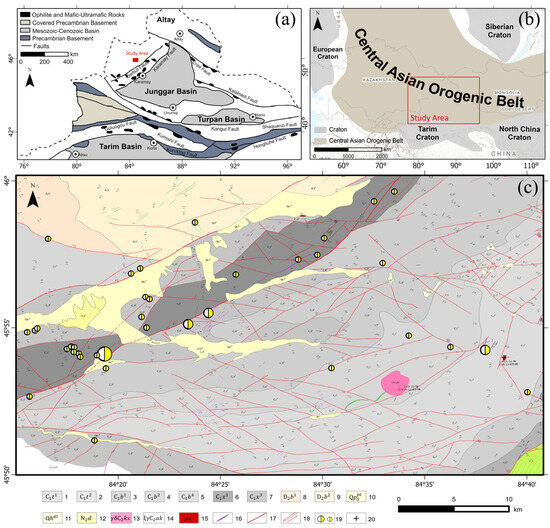
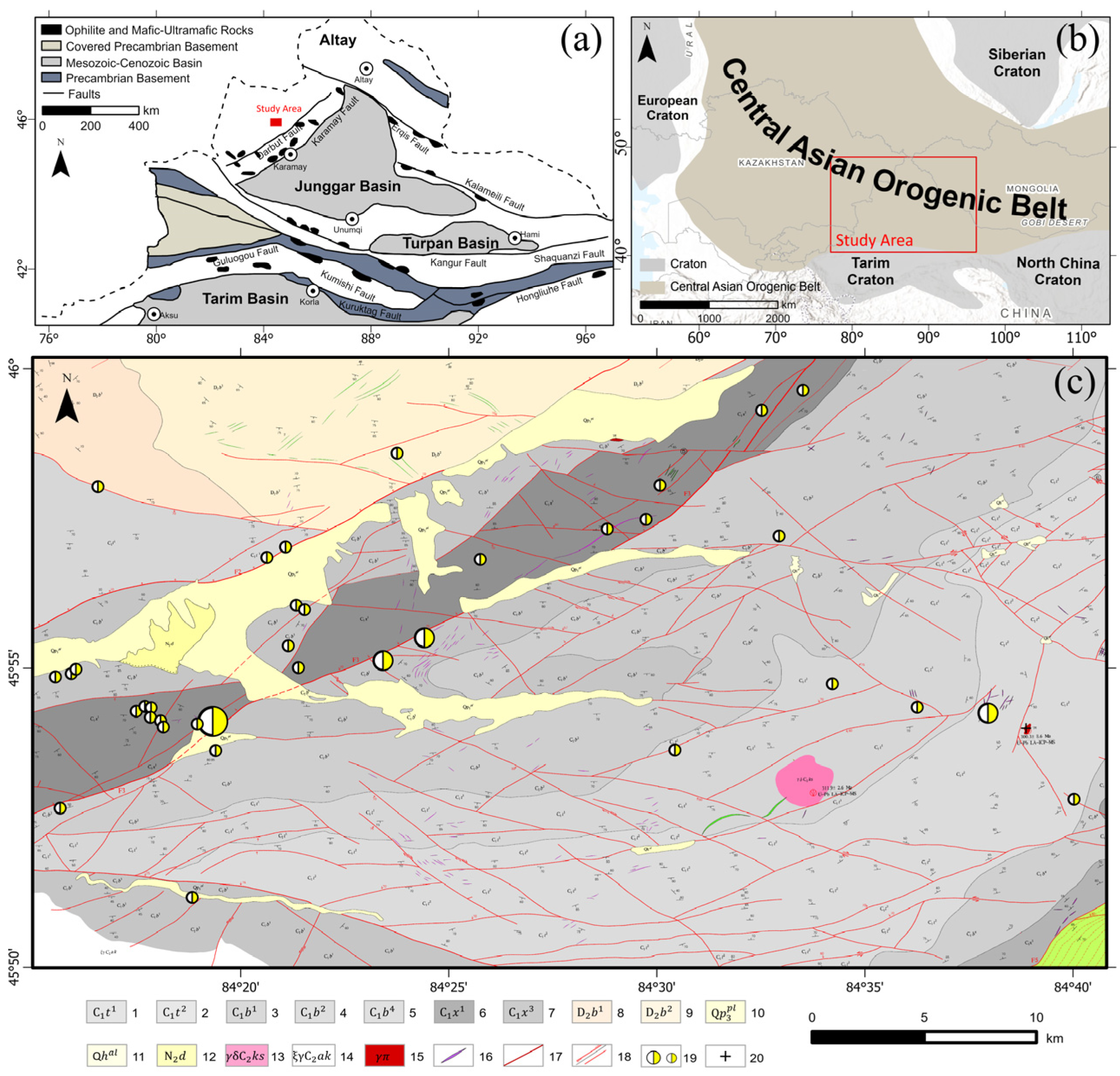
The study area (84°14′43″ E to 84°40′12″ E, 45°49′43″ N to 46°1′42″ N) is located on the northwestern margin of the West Junggar Basin in the Xinjiang Uygur Autonomous Region, China. It lies within the West Junggar Terrane (Figure 1a) at the southwestern edge of the Central Asian Orogenic Belt (CAOB) (Figure 1b) [37] and covers approximately 730 km2. The CAOB, the world’s largest Phanerozoic accretionary orogenic belt, experienced multiple stages of paleo-oceanic subduction, terrane accretion, and post-collisional extension from the Paleozoic to the Mesozoic. These processes produced a complex tectonic framework and abundant metallogenic systems [38]. The Hatu region represents the principal gold concentration area within the West Junggar Basin and is centered on the large Hatu gold field. Tectonically, it belongs to the Tangbale-Kalamaili Paleozoic composite island arc belt (Figure 1c). The stratigraphic framework is dominated by the Middle Carboniferous Northwest Kelasu, Baogutu, and Tailegula formations, forming the main volcanic-sedimentary sequence. Basalts and tuffs of the Tailegula Formation constitute the principal lithological hosts controlling regional gold mineralization [39]. In the western West Junggar Basin, the lower carboniferous volcanic-sedimentary assemblages exhibit significant gold-related alteration, which progressively evolved into the extensive Hatu gold mineralization belt through prolonged geological processes.
Figure 1.
Geotectonic setting and geological maps of the study area. (a) Simplified geological map of West Junggar [40], (b) simplified geological map of the Central Asian Orogenic Belt (CAOB) [41,42], and (c) geological map of the Hatu area [43]. Legend: 1—First lithological member of the Tailegula Formation; 2—Second lithological member of the Tailegula Formation; 3—First lithological member of the Baogutu Formation; 4—Second lithological member of the Baogutu Formation; 5—Fourth lithological member of the Baogutu Formation; 6—First lithological member of the Xibeikulas Formation; 7—Third lithological member of the Xibeikulas Formation; 8—First lithological member of the Balrek Formation; 9—Second lithological member of the Balrek Formation; 10—Diluvium layer (Upper Pleistocene); 11—Fluvial deposits; 12—Dushanzi Formation; 13—Kushkuduk sequence granodiorite; 14—Akbastao sequence K-feldspar granite; 15—Granite porphyry; 16—Quartz vein; 17—Regional fault; 18—Translational fault/general fault; 19—Au deposit; 20—Cu-Mo deposit.
The Hatu deposit (~300 Ma), classified as a typical orogenic gold system [44,45], is the largest of its kind in the West Junggar region. Current estimates indicate more than 200 t of gold reserves, with grades ranging from 0.65 to 16.64 g/t, reflecting strong heterogeneity. Underground mining has already intercepted mineralization at depths exceeding 1200 m. The main metallogenic event of the Hatu gold belt is constrained to the Late Carboniferous. Within the study area, 151 gold deposits and occurrences have been identified, including 17 deposits, 80 prospects, and 54 mineralized sites, of which 39 are major ore-producing localities. Other mineral commodities are sparse; the only exception is a porphyry Cu-Mo deposit, which is currently not economically viable. Mineralization mainly occurs as gold-bearing quartz veins hosted in volcaniclastic and mafic volcanic rocks [46]. The Hatu, Anqi, and Dalabute faults, trending SW-NE, constitute the region’s principal fault system [47]. Among them, the Anqi fault zone is the main ore-controlling structure. Major gold orebodies, such as Hatu, Qi-III, and Qi-V, are distributed along this zone. Their geometry and spatial distribution are controlled by NW- and EW-trending secondary faults associated with the Anqi fault, which act as primary conduits for ore-bearing hydrothermal fluids.
As hydrothermal fluids migrated along the Anqi fault zone and interacted with Lower Carboniferous volcanic-sedimentary sequences, they produced characteristic alteration assemblages, including silicification, pyritization, sericitization, and propylitization. Reductive geochemical barriers—such as carbonaceous material, framboidal pyrite, and graphite within the intensely altered hanging wall (IAZ)—facilitated the precipitation of auriferous pyrite (Py1–Py3) and subsequent gold enrichment. Some fluids also precipitated minerals in shallow fractures during ascent, forming gold-bearing quartz veins [48]. Gold mineralization is closely associated with arsenopyrite and silver (e.g., electrum). The Qi-II deposit additionally exhibits quartz–Cu–Ag–Au mineralization (malachite + chalcopyrite) and beresitization (argillic alteration). Detailed characterization of alteration processes, such as tourmalinization and sericitization, is therefore essential for selecting effective geochemical indicators for gold exploration. In the study area, gold mineralization occurs mainly in hydrothermal quartz veins and altered feldspathic tuffs [49]. These rocks are enriched in pathfinder elements, notably Cu, Ag, As, and Sb. In the Hatu region, gold distribution strongly correlates with Ag, As, and Sb anomalies. Consequently, the Au-Ag-As-Sb assemblage is considered the principal indicator suite for exploration [50].
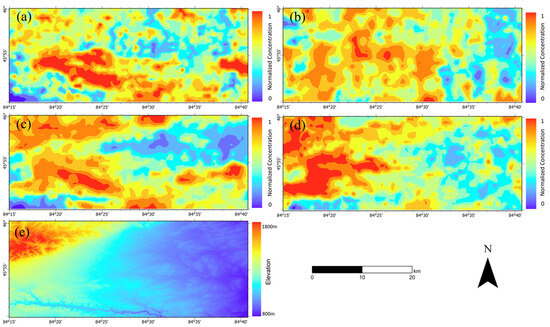
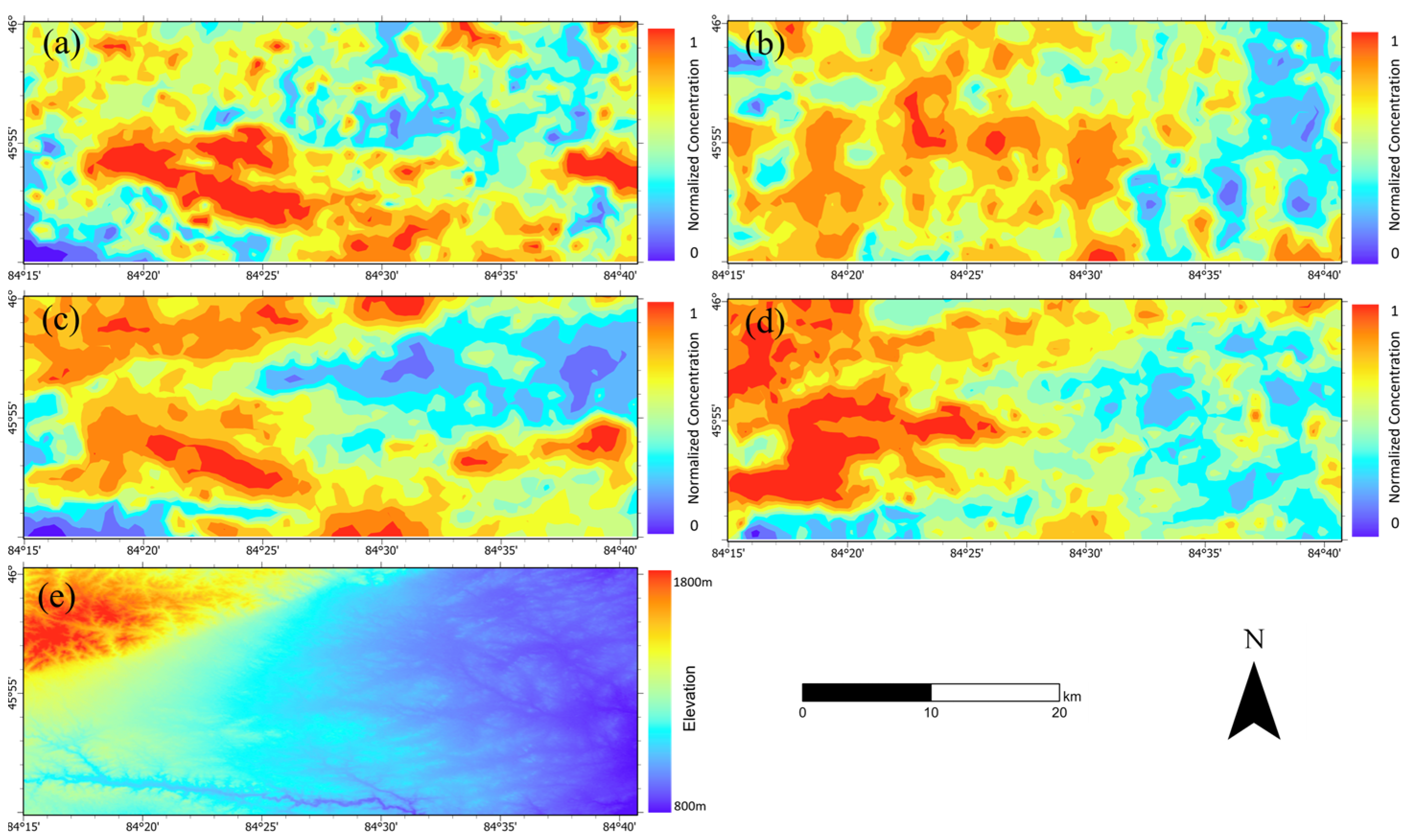
To assess the potential influence of anthropogenic mechanical dispersion (e.g., mining activities) on elemental anomalies [51], this study integrated topographic data with the spatial distribution of the Au-Ag-As-Sb indicator suite derived from Kriging interpolation (Figure 2). The topography shows higher elevations in the northwestern part of the study area, gradually decreasing towards the southeast. Comparison with elemental distributions indicate that high-concentration zones are mainly located in the elevated northwestern region. These zones also show strong spatial coincidence with the principal SW-NE-trending fault system and associated secondary structures [52]. This spatial relationship suggests that the anomalies are controlled by natural tectonic and denudational processes, rather than anthropogenic disturbance, thereby supporting the reliability of the sampling data [53].
Figure 2.
(a–d) Spatial distribution of Au, Ag, As, and Sb normalized concentrations and (e) topographic map of the study area.
2.2. Data and Preprocessing
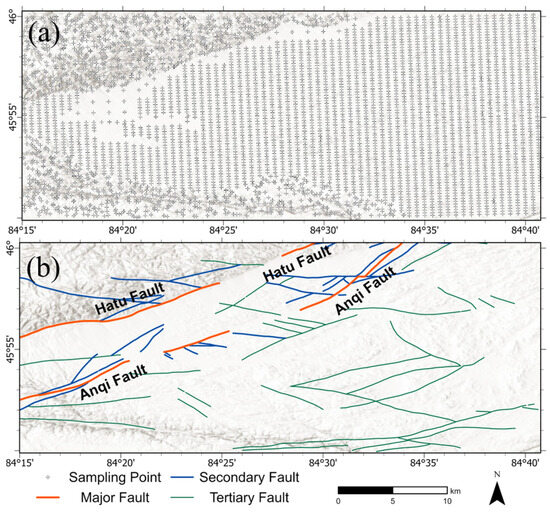
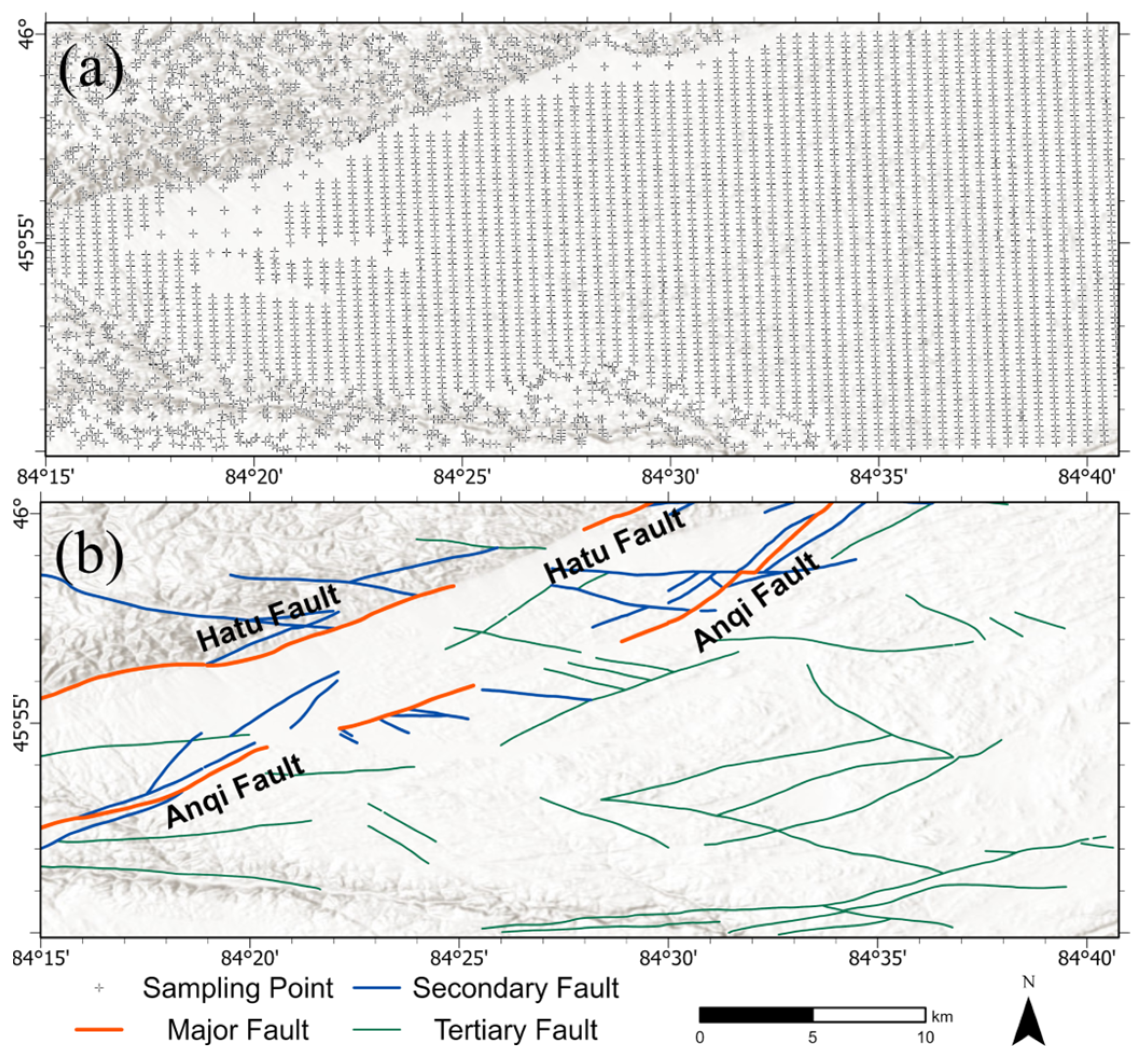
This study uses a 1:50,000-scale geochemical exploration dataset, consisting of 4725 sampling points (Figure 3a). The dataset includes concentrations of 16 elements—Au, Ag, Sn, Pb, B, Cu, Zn, Cr, Ni, Co, Mn, As, Sb, Bi, W, and Mo—measured in ppm [54]. A grid-based sampling program was conducted across the study area, yielding 4725 valid samples (soil, rock chips, and stream sediments) with an average density of ~7.5 samples/km2. Rock chip samples were collected from eluvial (residual) bedrock horizons, while stream sediment samples were taken from riverbeds or banks at depths of 10–30 cm. Soil samples targeted the B-horizon (illuvial) or C-horizon (parent material) within Quaternary deposits of semi-arid plains, typically at depths of 10–50 cm. To reduce aeolian contamination and enhance mineralization-related signatures, all samples were field-sieved to the −4 to +40 mesh fraction.
Figure 3.
Distribution of (a) geochemical sampling points and (b) faults in the study area [43,54].
Samples were processed following a standardized protocol (collection, sieving, splitting, weighing, and secure transportation). Total concentrations of 16 elements were analyzed using a combination of chemical spectroscopy, atomic emission spectrometry (AES), atomic fluorescence spectrometry (AFS), atomic absorption spectrometry (AAS), and polarography. All procedures strictly complied with the Chinese standard Specification for Geochemical Reconnaissance Survey (DZ/T 0011–91) [22]. Analytical precision and detection limits met the required benchmarks, ensuring the reliability and comparability of the dataset.
To process the concentration data of Au, Ag, As, and Sb, outliers were identified and removed using the 3σ rule [55] and the IQR method [56]. Geochemical sampling points were treated as spatial centers, and a K-Dimensional Tree (KD-Tree) data structure was constructed to build a spatial index [57]. A dynamic-radius search was then applied to retrieve neighboring points, ensuring that each sequence contained a fixed number of spatial neighbors. For each central point, neighboring samples were ranked by distance, and the closest points were selected according to a predefined window size. Missing values were handled using local mean imputation to preserve data continuity. This procedure generated geochemical spatial-pattern datasets structured according to spatial neighborhood relationships.
Because gold mineralization in the Hatu area is structurally controlled by major regional faults (Figure 3b) [39], fault data were integrated into the model as an essential geological constraint. These structures were classified into three hierarchical levels: Primary structures correspond to major faults, such as the Hatu and Anqi faults, which exert a dominant structural control. Secondary structures include subordinate faults adjacent to the main fault zones. Tertiary structures comprise small-to-medium-scale NE-trending faults near the primary structures and distal E-W secondary faults. Structures lacking clear geological significance were excluded from this classification [43]. For each sampling point, the minimum distance to all mapped faults was calculated and normalized. Based on experimental evaluation, weights of 0.6, 0.3, and 0.1 were assigned to primary, secondary, and tertiary faults, respectively, to construct a composite fault-distance factor [48]. Finally, based on geological empirical knowledge, this composite factor was linearly combined with the model-derived geochemical anomaly scores. This integration preserves the intrinsic anomaly patterns while enhancing anomalies proximal to major faults, thereby reflecting the geological principle of structural control on mineralization [30] without overriding the data-driven nature of the model.
3. Methods
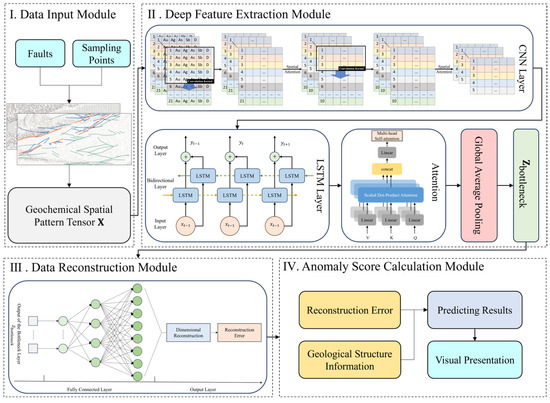
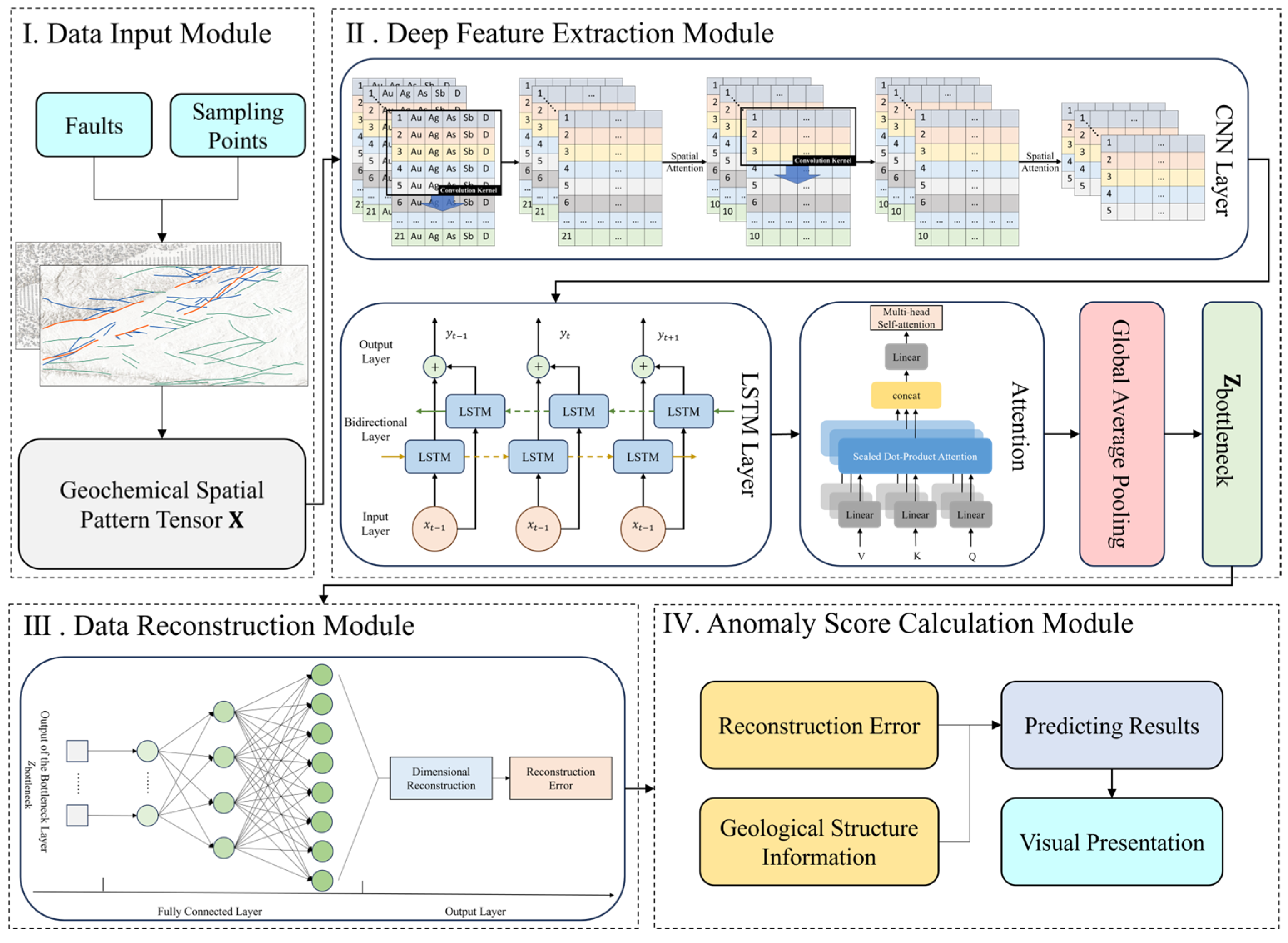
The proposed methodology consists of four core modules (Figure 4): Input Data Module, Deep Feature Extraction Module, Data Reconstruction Module, and Anomaly Score Calculation Module. In the Input Data Module, raw geochemical concentrations are preprocessed to construct spatial neighborhood-based pattern data, forming the input tensor . The Deep Feature Extraction Module adopts a hybrid architecture combining CNNs, BiLSTM networks, and an Attention Mechanism. An encoder and a bottleneck layer are used to extract and fuse high-level features. The Data Reconstruction Module employs a decoder to reconstruct the learned representation into sequences with the original dimensions. Finally, in the Anomaly Score Calculation Module, reconstruction errors are computed and normalized to produce the anomaly scores [58]. These scores are then fused with fault-distance constraints through weighted integration to generate a comprehensive anomaly index. Mineral prospectivity results are subsequently visualized using Kriging for spatial interpolation.
Figure 4.
Framework of the proposed method.
3.1. Input Data Module
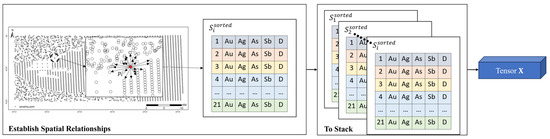
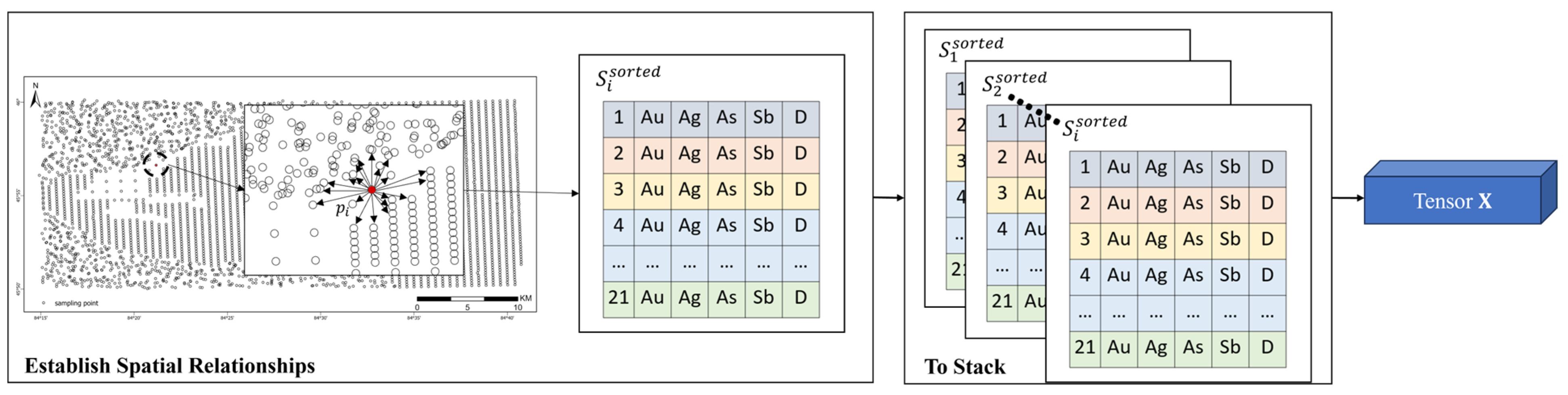
The Input Data Module transforms discrete geochemical sampling points into spatially structured sequences, forming geochemical spatial-pattern data [59]. After preprocessing, a KD-Tree-based spatial indexing algorithm [57] is applied (Figure 5).
Figure 5.
Flowchart of the data input process.
First, Euclidean distances between sampling points are computed from planar coordinates to define spatial neighborhoods. A dynamic radius search is adopted: starting from an initial search radius , the radius search range for each center point is iteratively expanded according to:
where is the iteration number and is the search radius at iteration . The process stops when at least 21 neighboring points are identified or the radius exceeds .
For each center point , the 21 nearest neighbors (including ) are selected and sorted in ascending order of distance:
where is the Euclidean distance between and , returns indices in ascending order, and indicates the selection of the 21 nearest neighbors (including the center point itself, whose distance is always zero).
Because BiLSTM networks are insensitive to absolute positional information, positional embeddings are incorporated. The distance from each neighbor to the center point is normalized by the local maximum distance to form an additional independent feature channel :
By traversing all sampling points and stacking the resulting sequences, a three-dimensional tensor :
is constructed, where is the number of samples, is the neighborhood window size, and is the number of features (the four geochemical elements plus the positional embedding). Tensor , centered on each sampling point, integrates geochemical concentrations and relative spatial distances of neighboring samples, providing the structural input required for learning spatial patterns of geochemical anomalies.
Upon completion of dataset construction, the spatial sequence data are split into training and validation sets at a 4:1 ratio. During training, a batch size of 32 is used, and the samples are randomly shuffled to improve model robustness and generalization.
3.2. Deep Feature Extraction Module
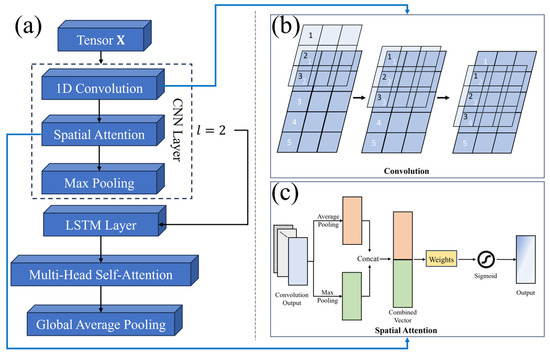
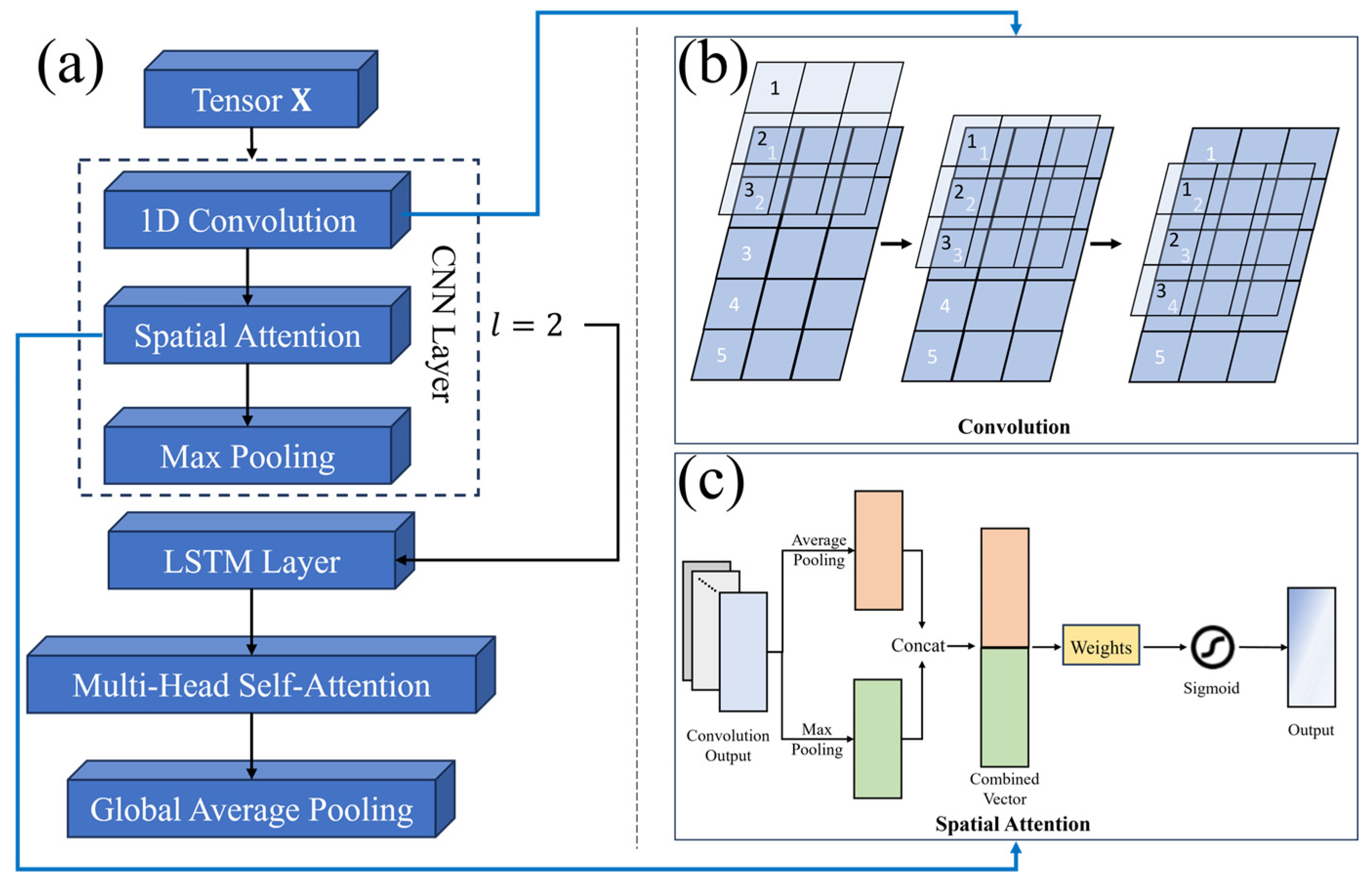
The Deep Feature Extraction Module (Figure 6a) constitutes the core of the model. It is designed to identify local anomalies and distance-dependent correlation patterns within geochemical spatial-pattern tensor . The module follows an encoder architecture, which includes One-Dimensional Convolutional Neural Network (1D-CNN) layers, BiLSTM layer, and MHSA layer, followed by a bottleneck layer that produces a compact latent representation.
Figure 6.
Framework of (a) the deep feature extraction module, (b) 1D convolution operation and (c) spatial attention mechanism.
To capture local correlations and variability in spatial sequences, two 1D convolutional layers are applied for low-level feature extraction. Given the dataset size, sequences in are organized into mini-batches. Convolution kernels are applied along the sequence dimension (Figure 6b) to extract local spatial relationships among neighboring samples. Although 1D convolution does not explicitly encode directional information, it preserves local geochemical variability and correlations, enhancing anomaly discrimination relative to background values. The convolution operation is defined as follows:
where denotes the dot product, is the kernel size, and represent the kernel weights and biases, and is the feature vector at position .
Because geochemical anomalies are spatially heterogeneous, conventional CNNs may introduce noise by assigning equal importance to all positions [60]. To address this limitation, convolution outputs are refined using a spatial attention mechanism that adaptively reweights features, focusing on the key neighboring points that contribute most to anomaly characterization. This mechanism reshapes the feature maps in the spatial domain and dynamically enhances responses associated with mineralization-related patterns. The spatial attention mechanism (Figure 6c) is defined as:
where is the input feature matrix composed of local sequence features ; and are the query, key, and value matrices obtained through linear projections; and is the scaling factor.
After attention-based recalibration, a max-pooling layer is applied to further extract salient features and down-sample , thereby improving translation invariance with respect to spatial anomaly patterns. The max-pooling operation is defined as:
where is the pooled feature at position , is the index set of the -th pooling window, and is the feature vector at the position in .
The pooled output is then passed through a second convolutional layer with the same structure as the first but with doubled output channels, further compressing the sequence to obtain . After dimensional transposition, a feature sequence is generated, where each serves as the input data at step of the BiLSTM layer and retains encoded spatial-distance information.
The BiLSTM layer compensates for the limited ability of CNNs to model long-range dependencies [61]. It processes radial spatial sequences extending from anomaly centers toward background regions, utilizing a bidirectional gating mechanism to capture distance-dependent relationships. The BiLSTM reads the sequence in both forward and backward directions. Its internal gating units selectively retain or discard key features within the radial sequence, and the forward and backward hidden states are concatenated to effectively capture long-range dependencies. The calculation is given by:
and the final hidden state at step t is obtained by concatenation:
To further enhance global dependency modeling beyond the local receptive field of the CNNs and the sequential structure of the BiLSTM, an MHSA mechanism is introduced to model global correlations between any two positions in the sequence. The hidden states are stacked into a feature matrix , and attention is computed as:
where , and are learnable parameter matrices. The spatial attention mechanism following the CNNs focuses on local importance weighting, enhancing mineralization-related signals while suppressing background noise. In contrast, MHSA captures global dependencies between any two sequence positions, highlighting key feature nodes that contribute most to anomaly recognition [62]. Together, they provide complementary local-global feature modeling.
After multi-level feature extraction and fusion, Global Average Pooling (GAP) aggregates high-dimensional features into a bottleneck layer. It forces the model to discard noise and redundant information, retaining only the most discriminative and representative feature patterns and yielding a compact latent representation .
3.3. Data Reconstruction Module
The Data Reconstruction Module corresponds to the decoder of the model. Its primary function is to map the latent vector , produced by the encoder’s bottleneck layer, back to the original data space and generate the reconstructed output , which has the same dimensions as the input . The difference between the reconstructed data and the original input data , referred to as the reconstruction error, serves as a key indicator of geochemical anomalies.
The decoder progressively restores the data structure through two fully connected layers. First, the low-dimensional latent vector is projected into a higher-dimensional hidden space; it is then further expanded to match the original input dimensions:
where and are weight matrices, and are bias vectors, and is the intermediate hidden representation. The sigmoid function constrains each feature to the range [0, 1], ensuring consistency with the normalized input data.
3.4. Anomaly Score Calculation Module
This module establishes an anomaly evaluation framework that integrates geological constraints.
First, the Euclidean distance from each sampling point to the nearest fault is computed. A fault influence score is then derived using a negative exponential decay function. This function models the decay of the ore-controlling influence of faults with increasing distance: the closer a location is to a fault zone, the higher the probability of mineralization, whereas the influence decreases with distance:
where controls the decay rate. In this study, is set to 0.5 times the average fault spacing to ensure a meaningful spatial gradient. The score ; values close to 1 indicate stronger structural influence and favorable mineralization conditions at that point.
The final anomaly score is obtained by linearly combining the geochemical reconstruction score and the fault influence score:
where is the weight coefficient, and is the geochemical anomaly score defined as the Mean Squared Error (MSE) between the normalized input and the reconstructed sequence. Based on geological considerations, , ensuring that the model remains primarily geochemically data-driven while incorporating geological structural constraints as a refinement.
4. Result
4.1. Experiment Setup and Evaluation Metrics
In the experiments, the convolution kernel size was set to 5 in the first CNN layer and 3 in the second. The spatial attention module used a single head, while MHSA module employed 4 heads. During training, a cosine annealing scheduler was applied with an initial learning rate of 0.001 and a weight decay of . An early stopping strategy was implemented to prevent overfitting.
Model performance was evaluated using the Receiver Operating Characteristic (ROC) curve and the Area Under the Curve (AUC), which are widely adopted metrics in statistics and machine learning [63,64]. These metrics quantify the trade-off between the True Positive Rate (TPR) and the False Positive Rate (FPR), defined as:
where TP, FP, TN, and FN denote true positives, false positives, true negatives, and false negatives, respectively. TPR measures the proportion of correctly identified positive instances, whereas FPR measures the proportion of actual negatives incorrectly classified as positive. The ROC curve plots TPR against FPR across varying thresholds; curves closer to the upper-left corner indicate better discrimination. The distribution of predicted probabilities for ground-truth samples is also analyzed to assess model confidence.
For highly imbalanced datasets, the Precision–Recall (PR) curve provides a more informative evaluation metric [65]. Gold anomaly detection is inherently imbalanced because gold has an extremely low crustal abundance (typically 1–4 ppb), while economically significant mineralization requires enrichment factors several orders of magnitude (–) higher [66]. The PR curve evaluates performance through the relationship between Precision and Recall, defined as:
where precision measures the proportion of true positives among all instances predicted as positive, while Recall (identical to TPR) represents the proportion of actual positives correctly identified. The PR curve is obtained by plotting Precision against Recall at varying classification thresholds. The area under the PR curve, commonly reported as Average Precision (AP), is computed as the weighted mean of precision values across recall levels and serves as a summary performance metric used to evaluate the experimental models.
In addition, this study evaluates the spatial distribution of known gold deposits across different anomaly levels. Anomaly scores are categorized by percentiles, and the concentration of mineral occurrences within each anomaly class is analyzed. This approach provides a practical assessment of model effectiveness in mineral prospectivity mapping.
4.2. Baseline Methods
To evaluate the performance of GeoCLA, a comparative analysis was conducted between the proposed model (with and without geological fault constraints) and three well-established anomaly detection methods: CNNs [67], One-Class Support Vector Machine (OCSVM) [68], and Isolation Forest (IF) [69]. These models are widely used in anomaly detection and provide a reliable benchmark. For fairness, all methods were trained using the same dataset, and the performance was assessed using the metrics described in Section 4.1.
- (1)
- CNNs: Convolutional Neural Networks model was implemented as a deep-learning baseline for spatial feature extraction. Unlike GeoCLA, it does not include BiLSTM or AM. The architecture consists of three convolutional layers, with output dimensions aligned to those of the GeoCLA encoder. The same training strategy was applied.
- (2)
- OCSVM: One-Class Support Vector Machine is an unsupervised method based on statistical learning theory and kernel mapping. It projects data into a high-dimensional feature space and learns a compact decision boundary to distinguish normal samples from anomalies. The anomaly proportion parameter was set to 0.05 to control boundary sensitivity.
- (3)
- IF: Isolation Forest is a tree-based ensemble method designed for anomaly detection. Similar to RF, it handles high-dimensional data without requiring labels [70]. The model was configured with 100 isolation trees and an anomaly proportion of 5%, enabling efficient training through single-pass tree construction.
4.3. Performance of Anomaly Detection
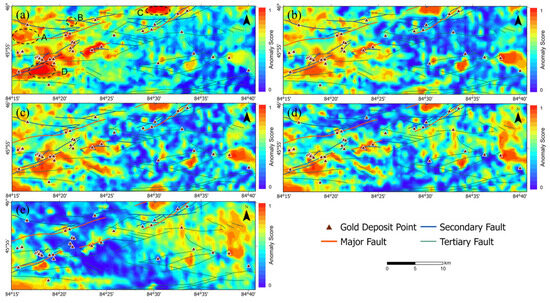
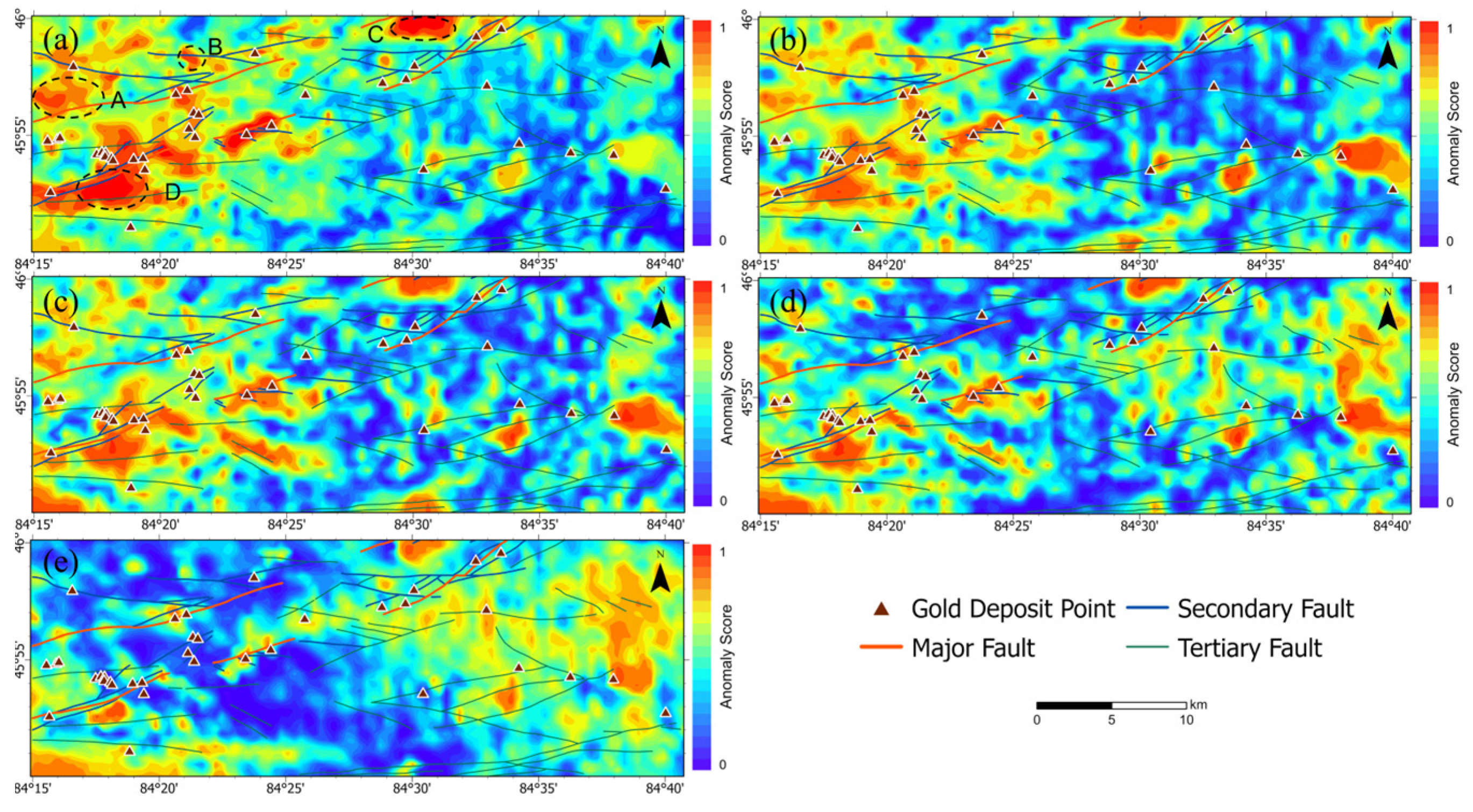
Application of GeoCLA in the study area (Figure 7a) shows that the identified anomaly zones are strongly correlated with known gold deposits, effectively delineating prospective mineralization areas. In the western sector, the main anomaly belt trends SW-NE, consistent with the strike of the major Hatu and Anqi faults. This zone encompasses the core Hatu gold field and conforms to the structural control of mineralization, demonstrating reliable large-scale anomaly detection. In the eastern sector, smaller anomalies correspond to scattered mineral occurrences, indicating that the model can also detect weak, localized signals. Based on the results, four anomaly targets (A–D) were delineated. All are located near major faults, with targets C and D exhibiting the highest intensities and largest spatial extents.
Figure 7.
Anomaly distribution obtained using (a) GeoCLA, (b) GeoCLA without geological constraints, (c) IF, (d) OCSVM, and (e) CNNs. A–D are delineated anomaly targets.
To assess the role of geological constraints, GeoCLA without fault integration (Figure 7b) was compared with the full model (Figure 7a). Although both approaches show similar overall anomaly trends, the unconstrained model exhibits reduced predictive accuracy in the western high-anomaly zone, primarily due to the absence of structural information. In contrast, the full model produces continuous and coherent anomaly patches in the core mineralized area, capturing a higher density of known deposits. Moreover, incorporating geological constraints suppresses spurious anomalies in the eastern areas distant from major faults, while maintaining strong correspondence with localized mineral occurrences.
4.4. Comparative Analysis
To further evaluate model performance, GeoCLA was compared with three classical anomaly detection models: IF, OCSVM, and CNNs. The anomaly maps (Figure 7) show clear differences among the methods. In the eastern sector of the study area, characterized mainly by background or low-anomaly values, IF (Figure 7c), OCSVM (Figure 7d), and CNNs (Figure 7e) produce numerous scattered and spurious anomalies. In contrast, GeoCLA (Figure 7a) achieves higher precision, with detected anomalies closely associated with known gold occurrences. OCSVM and CNNs, in particular, exhibit a higher tendency toward false positives in this region. In the western sector, corresponding to the core Hatu gold field and trending SW-NE, GeoCLA significantly outperforms the baseline models. It delineates coherent high-anomaly zones that cover nearly the entire mineralized area and encompass most known deposits. Moreover, the orientation of the detected anomalies aligns closely with the strike of the Hatu and Anqi faults. By comparison, CNNs fail to capture the core mineralized zone, while IF and OCSVM generate fragmented patterns that do not clearly reflect the structural control of fault systems.
After sorting the comprehensive anomaly scores in ascending order, the prospecting areas were classified into three levels—low, medium, and high—using a 1:2:2 ratio. The distribution of the 36 known gold deposits across these levels is summarized in Table 1. For CNNs, OCSVM, IF, and GeoCLA, respectively, the numbers of deposits located in low-prospectivity areas are 9, 4, 2, and 1. In medium-prospectivity areas, the counts are 15, 9, 9, and 7; in high-prospectivity areas, they are 12, 23, 25, and 28. GeoCLA identifies 28 deposits (78%) within high-anomaly areas, and 35 deposits (97%) within the combined medium- and high-anomaly zones. This performance exceeds that of the baseline models, indicating that the proposed method provides more accurate and effective anomaly delineation.
Table 1.
Comparison of gold deposit coverage rates across different prospectivity levels.
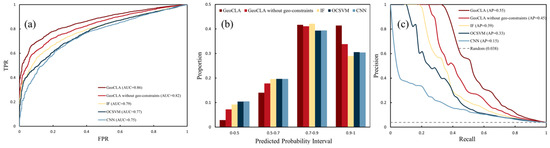
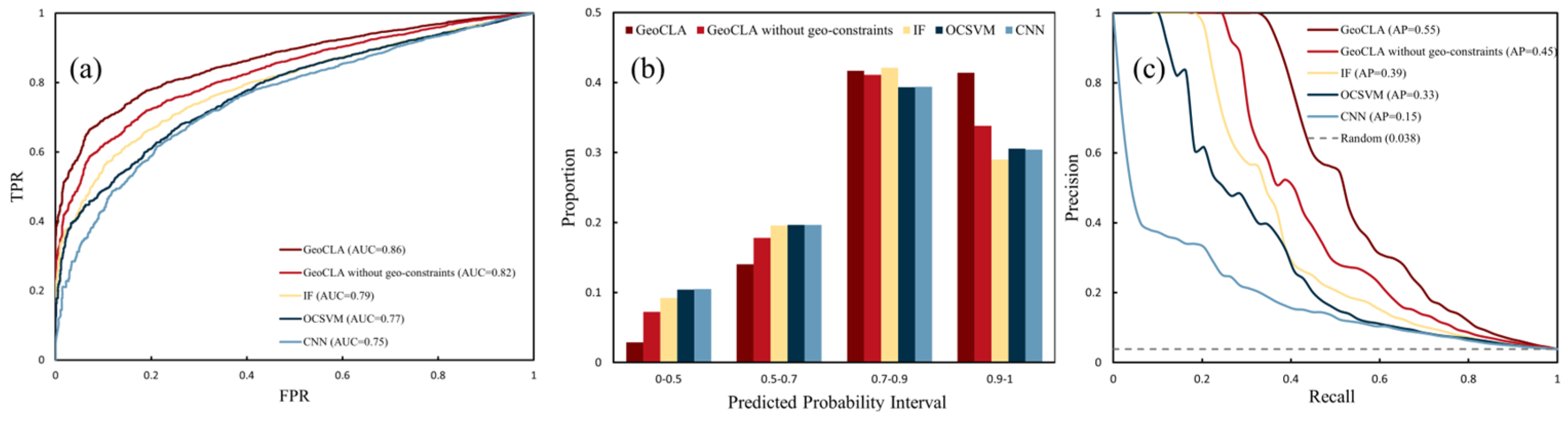
Regarding evaluation metrics, the ROC-AUC analysis (Figure 8a) shows that GeoCLA achieves an AUC of 0.86, outperforming the version without geological fault constraints (AUC = 0.82). This confirms the added value of integrating multi-source geological information. The baseline models yield lower AUC values: 0.77 for OCSVM, 0.79 for IF, and 0.75 for CNNs.
Figure 8.
Comparison of (a) ROC-AUC values, (b) predicted probability distributions for true positive samples, and (c) PR-AP values among different methods.
To assess discriminative confidence, the predicted probability distribution for true positive samples was analyzed (Figure 8b). For GeoCLA, approximately 41% of true positives fall within the high-confidence interval (0.9–1.0), and another 41% within the sub-high interval (0.7–0.9), while the proportions in lower intervals (0.5–0.7 and 0–0.5) decrease markedly. This pattern indicates strong confidence and stability in identifying mineralization-related anomalies. Compared with other methods, GeoCLA shows a higher concentration of true positives in the 0.9–1.0 range and fewer in lower-confidence intervals (0–0.5 and 0.5–0.7). This discrepancy further demonstrates that GeoCLA identifies gold-related geochemical anomalies in the Hatu region with greater confidence, reflecting superior discriminative consistency and robustness in anomaly detection.
From the perspective of AP based on the PR curve (Figure 8c), comparison against a random baseline provides a rigorous benchmark for highly imbalanced datasets. Despite the scarcity of positive samples, GeoCLA achieves an AP substantially higher than the random baseline (0.038), with performance rankings consistent with the ROC-AUC results. Comparison between the full GeoCLA model (AP = 0.55) and the ablation variant without fault constraints (AP = 0.45) shows a 10-percentage-point improvement, highlighting the effectiveness of incorporating geological structural information. Moreover, the superior PR curve trajectory of the integrated framework indicates that it maintains high precision as recall increases, demonstrating strong robustness. Overall, both the multi-model comparison and the ablation analysis confirm the competitive advantage of GeoCLA in mineral prospectivity mapping.
5. Discussion
Classical approaches to geochemical anomaly identification have achieved meaningful progress but remain limited in spatial feature extraction and in the integration of geological constraints. To address this gap, this study proposes GeoCLA, which combines CNNs for local spatial feature extraction, BiLSTM for sequential dependency modeling, and an AM to enhance critical feature representation, forming a multi-level learning framework. A fault-distance weighting factor is further incorporated as a geological constraint, enabling the integration of data-driven signals with structural priors.
The strong performance of GeoCLA arises from the complementarity and synergy of its components in detecting mineralization-related anomalies. CNNs extract local elemental associations and spatial variability among neighboring samples, while the BiLSTM compensates for the CNNs’ limited receptive field by modeling long-range dependencies and capturing spatially zoned evolutionary trends through its gating mechanism. A key distinction of GeoCLA from purely data-driven approaches is the incorporation of the fault-distance factor as a geological constraint. The ablation study (Figure 7a vs. Figure 7b) shows that removing this structural constraint results in numerous scattered, geologically inconsistent anomalies in the low-background eastern sector.
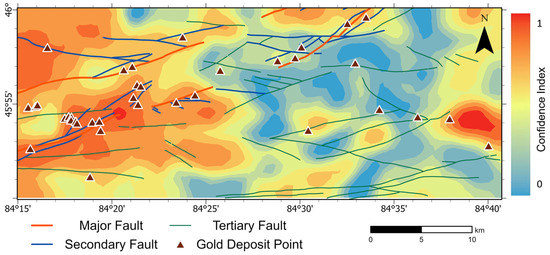
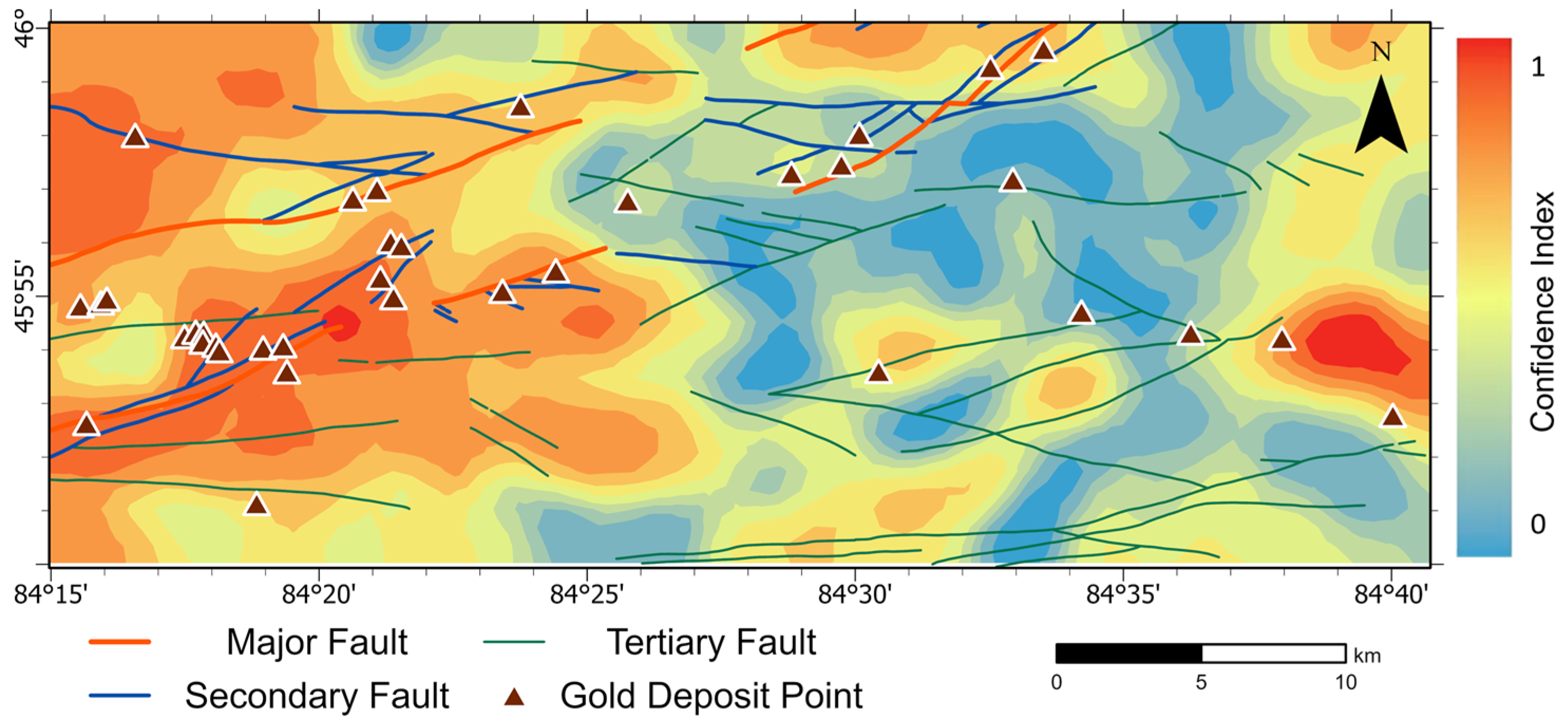
Despite its overall success, the proposed method shows reduced performance consistency in the eastern sector, where known NW-SE-trending deposits are only partially identified. In contrast, the unconstrained CNN model captures these eastern ore points but produces numerous fragmented, geologically inconsistent pseudo-anomalies. To investigate this discrepancy, the Confidence Index (CI) distribution was mapped (Figure 9) [71,72]. The results show extensive high-confidence zones (red) in the western region, highlighting GeoCLA’s strong capability to learn mineralization patterns controlled by major fault systems and maintain predictive stability. In contrast, confidence decreases markedly (blue/green zones) in the eastern sector and near some omitted deposits. This pattern suggests that eastern mineralization may be controlled by secondary or conjugate fault systems distinct from those in the west. The lack of fine-scale structural constraints likely leads to prediction instability and an increased risk of false negatives. This issue warrants further investigation.
Figure 9.
Map of confidence index distribution for the GeoCLA method.
GeoCLA still has several limitations. First, its cascaded architecture increases parameter count and computational complexity, requiring high-quality training data and posing a risk of overfitting in data-scarce settings. Second, geological constraints are currently incorporated through linear weighting and expert-driven feature fusion, which may not fully capture the nonlinear interactions and spatial heterogeneity between fault systems and mineralization processes. Third, the model is primarily designed for surface geochemical anomalies, and it is inherently limited in predicting deep or concealed orebodies. Finally, as the model has been developed and tested in the Hatu gold district, its transferability to other geological settings and deposit types requires further assessment through additional case studies.
Furthermore, because denudation and erosion likely transport pathfinder elements downslope, current surface geochemical anomalies may be laterally displaced from the underlying primary mineralized quartz veins. This potential topographic offset must be accounted for drill targeting.
To address these limitations, the current fault-distance weighting scheme should evolve beyond a simplified linear, expert-based approach. Future work should explore nonlinear fusion strategies and integrate multi-source geological data, such as fault attributes, lithological boundaries, alteration zones, and geophysical anomalies, to build a more comprehensive, knowledge-driven framework.
6. Conclusions
This study proposes the GeoCLA geochemical anomaly detection framework and validates it in the Hatu gold district, Xinjiang. The model integrates CNNs for local spatial feature extraction, BiLSTM for sequential dependency modeling, and an AM to enhance critical feature representation. Geological fault-distance constraints are incorporated to construct a comprehensive anomaly evaluation index. The results demonstrate high accuracy in ore-point identification and effective delineation of prospective zones. In addition to defining broader target areas, four high-priority anomaly targets were identified for future exploration. Overall, the study confirms that combining advanced spatial feature learning with geological constraints provides an effective strategy for detecting ore-related geochemical anomalies in complex geological settings. Future research should focus on integrating additional multi-source geological data, refining the model architecture, and validating its generalizability across diverse geological environments.
Author Contributions
Conceptualization, Y.Z., Y.W. and Y.N.; methodology, Y.Z., Y.W. and S.W. (Shibo Wen); software, Y.Z., Y.W. and S.W. (Shibo Wen); validation, Y.Z., Y.W., S.W. (Shibo Wen), Y.N., S.W. (Shaohui Wang) and J.W.; formal analysis, Y.Z., Y.W. and S.W. (Shibo Wen); investigation, Y.Z., Y.W. and S.W. (Shibo Wen); data curation, Y.Z., S.W. (Shibo Wen), G.Z. and J.W.; writing—original draft preparation, Y.Z., Y.W., S.W. (Shibo Wen) and J.W.; writing—review and editing, Y.Z. and Y.W.; visualization, Y.Z.; supervision, Y.W.; project administration, Y.W.; funding acquisition, Y.W.; resources, S.W. (Shaohui Wang) and G.Z. All authors have read and agreed to the published version of the manuscript.
Funding
This research was supported by the National Key R&D Program of China (2021YFC2901805, 2021YFC2901801, 2023YFC2907105, 2023YFC2906903), the Science and Technology Research Project of Shandong Provincial Bureau of Geology and Mineral Resources (KY202502), the Key Project of R & D of Xinjiang Uygur Autonomous Region of China (2022A03010-4), the Key Science & Technology Support Project of Ministry of Natural Resources of China (ZKKJ202419), Shandong Provincial Natural Science Foundation Project (ZR2025QC416), and Open Project of Science and Technology Innovation Platform from Department of Natural Resources of Shandong Province, and Xinjiang Tianchi Talent Program.
Data Availability Statement
Data will be made available on request.
Conflicts of Interest
The authors declare that they have no known competing financial interests or personal relationships that could have appeared to influence the work reported in this paper.
References
- Jooshaki, M.; Nad, A.; Michaux, S. A systematic review on the application of machine learning in exploiting mineralogical data in mining and mineral industry. Minerals 2021, 11, 816. [Google Scholar] [CrossRef] [Scilit]
- Ge, Z.; Gu, X.; Zhang, Y.; Ma, C.; Hao, D.; Zheng, Y.; Zhang, X.; Wang, L.; Liu, M.; Chen, W. Ore mineralogy, fluid inclusion geochemistry, and zircon U-Pb geochronology of the Nanmingshui gold deposit in East Junggar, Xinjiang, Northwest China: Implications for ore genesis. Minerals 2023, 13, 1296. [Google Scholar] [CrossRef] [Scilit]
- An, F.; Qiu, T.; Zhang, H.; Yuan, H.; Zhu, Y. New precise age constraints of the Hatu gold belt, west Junggar, NW China: Implications for a 300 Ma magmatic hydrothermal event in post-collisional setting. GSA Bull. 2024, 136, 4342–4352. [Google Scholar] [CrossRef] [Scilit]
- Zuo, R. A nonlinear controlling function of geological features on magmatic–hydrothermal mineralization. Sci. Rep. 2016, 6, 27127. [Google Scholar] [CrossRef] [Scilit]
- Zuo, R.; Xiong, Y.; Wang, J.; Carranza, E.J.M. Deep learning and its application in geochemical mapping. Earth-Sci. Rev. 2019, 192, 1–14. [Google Scholar] [CrossRef] [Scilit]
- Wang, J.; Zuo, R. Uncertainty quantification in geochemical mapping: A review and recommendations. Geochem. Geophys. Geosystems 2024, 25, e2023GC011301. [Google Scholar] [CrossRef] [Scilit]
- Beus, A.A.; Grigorian, S.V. Geochemical Exploration Methods for Mineral Deposits; Applied Pub.: Wilmette, IL, USA, 1977. [Google Scholar]
- Levinson, A.A. Introduction to Exploration Geochemistry; Applied Publishing Ltd.: Wilmette, IL, USA, 1974. [Google Scholar]
- Botbol, J.M.; Sinding-Larsen, R.; McCammon, R.B.; Gott, G. A regionalized multivariate approach to target selection in geochemical exploration. Econ. Geol. 1978, 73, 534–546. [Google Scholar] [CrossRef] [Scilit]
- McCammon, R.B.; Botbol, J.M.; Sinding-Larsen, R.; Bowen, R.W. Characteristic analysis—1981: Final program and a possible discovery. J. Int. Assoc. Math. Geol. 1983, 15, 59–83. [Google Scholar] [CrossRef] [Scilit]
- Royer, J.-J. Proximity analysis: A method for multivariate geodata processing. Application to geochemical processing. Sci. Terre Série Inform. 1984, 20, 223–243. [Google Scholar]
- Sandjivy, L. The factorial kriging analysis of regionalized data. Its application to geochemical prospecting. In Geostatistics for Natural Resources Characterization: Part 1; Springer: Dordrecht, The Netherlands, 1984; pp. 559–571. [Google Scholar]
- Zuo, R.; Carranza, E.J.M. Support vector machine: A tool for mapping mineral prospectivity. Comput. Geosci. 2011, 37, 1967–1975. [Google Scholar] [CrossRef] [Scilit]
- Wang, Z.; Zuo, R.; Dong, Y. Mapping geochemical anomalies through integrating random forest and metric learning methods. Nat. Resour. Res. 2019, 28, 1285–1298. [Google Scholar] [CrossRef] [Scilit]
- Chen, Y.; Wu, W.; Zhao, Q. A bat-optimized one-class support vector machine for mineral prospectivity mapping. Minerals 2019, 9, 317. [Google Scholar] [CrossRef] [Scilit]
- Liu, G.; Zhou, X.; Li, Q.; Shi, Y.; Guo, G.; Zhao, L.; Wang, J.; Su, Y.; Zhang, C. Spatial distribution prediction of soil As in a large-scale arsenic slag contaminated site based on an integrated model and multi-source environmental data. Environ. Pollut. 2020, 267, 115631. [Google Scholar] [CrossRef] [Scilit]
- Anvari, K.; Benndorf, J. Automated 3D multivariate domaining of a mine tailings deposit using a continuity-aware geostatistical–AI workflow. Minerals 2025, 15, 1249. [Google Scholar] [CrossRef] [Scilit]
- Kreuzer, O.P.; Roshanravan, B.; Buckingham, A.J.; Core, D.P.; Konecke, B.A.; McDwyer, D.; Mustard, R. Controls, expressions, and discovery potential of gold mineralization in the Central-Eastern Yilgarn Craton, Western Australia: New insights from an integrated targeting study. Minerals 2025, 15, 1255. [Google Scholar] [CrossRef] [Scilit]
- Ning, Y.; Wang, Y.; Lu, J.; Tian, J.; Wang, C.; Sheng, S.; Wen, S.; Wang, S.; Dong, Y. Mineral prospectivity mapping for multi-source geoscience data: A novel unsupervised deep learning method. Ore Geol. Rev. 2025, 186, 106866. [Google Scholar] [CrossRef] [Scilit]
- Xu, Y.; Li, Z.; Xie, Z.; Cai, H.; Niu, P.; Liu, H. Mineral prospectivity mapping by deep learning method in Yawan-Daqiao area, Gansu. Ore Geol. Rev. 2021, 138, 104316. [Google Scholar] [CrossRef] [Scilit]
- Wang, S.; Cao, J.; Yu, P.S. Deep learning for spatio-temporal data mining: A survey. IEEE Trans. Knowl. Data Eng. 2022, 34, 3681–3700. [Google Scholar] [CrossRef] [Scilit]
- Wen, S.; Wang, Y.; Chen, X.; Tian, J.; Wang, C.; Feng, Y.; Ning, Y. A metric-learning enhanced variational autoencoder for unsupervised detection of geochemical anomalies in the Hatu gold belt, Xinjiang, China. Ore Geol. Rev. 2025, 187, 107017. [Google Scholar] [CrossRef] [Scilit]
- Craddock, P.R.; Srivastava, P.; Datir, H. Enhanced mineral quantification and uncertainty analysis from downhole spectroscopy logs using variational autoencoders. Petrophysics SPWLA J. Form. Eval. Reserv. Descr. 2021, 62, 614–629. [Google Scholar]
- Zuo, R.; Xu, Y. Graph deep learning model for mapping mineral prospectivity. Math. Geosci. 2023, 55, 1–21. [Google Scholar] [CrossRef] [Scilit]
- Guan, Q.; Ren, S.; Chen, L.; Yao, Y.; Hu, Y.; Wang, R.; Feng, B.; Gu, L.; Chen, W. Recognizing multivariate geochemical anomalies related to mineralization by using deep unsupervised graph learning. Nat. Resour. Res. 2022, 31, 2225–2245. [Google Scholar] [CrossRef] [Scilit]
- Graves, A.; Schmidhuber, J. Framewise phoneme classification with bidirectional LSTM networks. In Proceedings of the 2005 IEEE International Joint Conference on Neural Networks (IJCNN), Montreal, QC, Canada, 31 July–4 August 2005; pp. 2047–2052. [Google Scholar]
- Ng, Y.H.; Hausknecht, M.; Vijayanarasimhan, S.; Vinyals, O.; Toderici, G. Beyond short snippets: Deep networks for video classification. In Proceedings of the IEEE Conference on Computer Vision and Pattern Recognition (CVPR), Boston, MA, USA, 7–12 June 2015; pp. 4694–4702. [Google Scholar] [CrossRef] [Scilit]
- Cao, W.; Guo, X.; Tian, F.; Shi, Y.; Wang, W.; Sun, H.; Ke, X. Seismic velocity inversion based on CNN-LSTM fusion deep neural network. Appl. Geophys. 2021, 18, 499–514. [Google Scholar] [CrossRef] [Scilit]
- Yasin, Q.; Liu, B.; Majdański, M.; Golsanami, N. Fracture density prediction using CNN-LSTM deep neural network for geologically complex geothermal reservoirs. In Proceedings of the 84th EAGE Annual Conference & Exhibition, Vienna, Austria, 5–8 June 2023; pp. 1–5. [Google Scholar] [CrossRef] [Scilit]
- Hagemann, S.G.; Groves, D.I.; Ridley, J.R.; Vearncombe, J.R. The Archean lode gold deposits at Wiluna, Western Australia; high-level brittle-style mineralization in a strike-slip regime. Econ. Geol. 1992, 87, 1022–1053. [Google Scholar] [CrossRef] [Scilit]
- Tripp, G.I.; Vearncombe, J.R. Fault/fracture density and mineralization: A contouring method for targeting in gold exploration. J. Struct. Geol. 2004, 26, 1087–1108. [Google Scholar] [CrossRef] [Scilit]
- Hammond, K.J.; Evans, J.P. Geochemistry, mineralization, structure, and permeability of a normal-fault zone, Casino mine, Alligator Ridge district, north central Nevada. J. Struct. Geol. 2003, 25, 717–736. [Google Scholar] [CrossRef] [Scilit]
- Xu, Z.; Ding, Z.; Gu, G.; Jiang, J.; Wang, L.; Niu, X. Deep exploration of Jiaodong type gold deposit, taking Shanhou gold deposit, southern part of Zhaoping fault as an example. Front. Earth Sci. 2022, 10, 939375. [Google Scholar] [CrossRef] [Scilit]
- Chen, L.; Guan, Q.; Feng, B.; Yue, H.; Wang, J.; Zhang, F. A multi-convolutional autoencoder approach to multivariate geochemical anomaly recognition. Minerals 2019, 9, 270. [Google Scholar] [CrossRef] [Scilit]
- Xiao, F.; Chen, J.; Hou, W.; Wang, Z.; Zhou, Y.; Erten, O. A spatially weighted singularity mapping method applied to identify epithermal Ag and Pb-Zn polymetallic mineralization associated geochemical anomaly in Northwest Zhejiang, China. J. Geochem. Explor. 2018, 189, 122–137. [Google Scholar] [CrossRef] [Scilit]
- Lindagato, P.; Li, Y.; Yang, G.; Fenghao, D.; Wang, Z. Application of geostatistical analyst methods in discovering concealed gold and pathfinder elements as geochemical anomalies related to ore mineralisation. Geologos 2018, 24, 95–109. [Google Scholar] [CrossRef] [Scilit]
- Liu, Y.; Zhou, K.; Zhang, N.; Wang, J. Maximum entropy modeling for orogenic gold prospectivity mapping in the Tangbale-Hatu belt, western Junggar, China. Ore Geol. Rev. 2018, 100, 133–147. [Google Scholar] [CrossRef] [Scilit]
- Chen, X.; Dong, S.; Shi, W.; Ding, W.; Zhang, Y.; Li, B.; Shao, Z.; Wang, Y. Construction of the continental Asia in Phanerozoic: A review. Acta Geol. Sin.-Engl. Ed. 2022, 96, 26–51. [Google Scholar] [CrossRef] [Scilit]
- Shen, P.; Pan, H.; Zhu, H. Two fluid sources and genetic implications for the Hatu gold deposit, Xinjiang, China. Ore Geol. Rev. 2016, 73, 298–312. [Google Scholar] [CrossRef] [Scilit]
- Han, S.; Zhou, Z.; Deng, X.; Wu, Y.; Chen, X.; Aibai, A.; Wang, Y.; Jia, X.; Chen, Y. Geology and S-Pb isotope geochemistry of the Hatu gold deposit in West Junggar, NW China: Insights into ore genesis and metal source. Acta Geochim. 2024, 43, 1205–1222. [Google Scholar] [CrossRef] [Scilit]
- Jahn, B.-m.; Windley, B.; Natal’in, B.; Dobretsov, N. Phanerozoic continental growth in Central Asia. J. Asian Earth Sci. 2004, 23, 599–603. [Google Scholar] [CrossRef] [Scilit]
- Şengör, A.M.C.; Natal’in, B.A.; Burtman, V.S. Evolution of the Altaid tectonic collage and Palaeozoic crustal growth in Eurasia. Nature 1993, 364, 299–307. [Google Scholar] [CrossRef] [Scilit]
- Feng, Y.; Wang, Y.; Wang, C.; Tian, J.; Wen, S.; Zhou, Y.; Cheng, Y. A fuzzy gold mineral prediction model integrating with knowledge-driven and data-driven: A case study of the Hatu region in Xinjiang, China. Minerals 2024, 14, 1209. [Google Scholar] [CrossRef] [Scilit]
- Goldfarb, R.J.; Pitcairn, I. Orogenic gold: Is a genetic association with magmatism realistic? Miner. Depos. 2023, 58, 5–35. [Google Scholar] [CrossRef] [Scilit]
- Groves, D.; Condie, K.; Goldfarb, R.; Hronsky, J.; Vielreicher, R. Secular changes in global tectonic processes and their influence on the temporal distribution of gold-bearing mineral deposits. Econ. Geol. 2005, 100, 203–224. [Google Scholar] [CrossRef]
- Royer, J.-J.; Camara, N. Mineralogical, petrological, 3D modeling study and geostatistical mineral resources estimation of the Zone C gold prospect, Kofi (Mali). Minerals 2025, 15, 843. [Google Scholar] [CrossRef] [Scilit]
- Liu, L.; Zhou, J.; Jiang, D.; Zhuang, D.; Mansaray, L.R.; Hu, Z.; Ji, Z. Mineral resources prospecting by synthetic application of TM/ETM+, Quickbird and Hyperion data in the Hatu area, West Junggar, Xinjiang, China. Sci. Rep. 2016, 6, 21851. [Google Scholar] [CrossRef] [Scilit]
- Zhang, N.; Zhou, K. Mineral prospectivity mapping with weights of evidence and fuzzy logic methods. J. Intell. Fuzzy Syst. 2015, 29, 2639–2651. [Google Scholar] [CrossRef] [Scilit]
- Wang, L.; Zhu, Y. Multi-stage pyrite and hydrothermal mineral assemblage of the Hatu gold district (west Junggar, Xinjiang, NW China): Implications for metallogenic evolution. Ore Geol. Rev. 2015, 69, 243–267. [Google Scholar] [CrossRef] [Scilit]
- Zhou, S.; Zhou, K.; Cui, Y.; Wang, J.; Ding, J. Exploratory data analysis and singularity mapping in geochemical anomaly identification in Karamay, Xinjiang, China. J. Geochem. Explor. 2015, 154, 171–179. [Google Scholar] [CrossRef] [Scilit]
- Kelley, K.D.; Hudson, T. Natural versus anthropogenic dispersion of metals to the environment in the Wulik River area, western Brooks Range, northern Alaska. Geochem. Explor. Environ. Anal. 2007, 7, 87–96. [Google Scholar] [CrossRef] [Scilit]
- Sæther, O.M.; Roberts, D.; Reimann, C. Structural control of strontium concentrations in stream sediments: An example from major fault zones in central Norway. Geochem. Explor. Environ. Anal. 2005, 5, 183–188. [Google Scholar] [CrossRef] [Scilit]
- Carranza, E.J.M. Geochemical anomaly and mineral prospectivity mapping in GIS. In Handbook of Exploration and Environmental Geochemistry; Elsevier: Amsterdam, The Netherlands, 2008; Volume 11. [Google Scholar]
- Feng, Y.; Wang, Y.; Wang, C.; Tian, J.; Zeng, Z.; Cheng, Y.; Wen, S. Automated geochemical anomaly detection using self-organizing map and metric learning. Nat. Resour. Res. 2025, 34, 2915–2932. [Google Scholar] [CrossRef] [Scilit]
- Greaves, M.; Caillon, N.; Rebaubier, H.; Bartoli, G.; Bohaty, S.; Cacho, I.; Clarke, L.; Cooper, M.; Daunt, C.; Delaney, M. Interlaboratory comparison study of calibration standards for foraminiferal Mg/Ca thermometry. Geochem. Geophys. Geosystems 2008, 9, 8. [Google Scholar] [CrossRef] [Scilit]
- Zuo, R.; Wang, J.; Xiong, Y.; Wang, Z. The processing methods of geochemical exploration data: Past, present, and future. Appl. Geochem. 2021, 132, 105072. [Google Scholar] [CrossRef] [Scilit]
- Ram, P.; Sinha, K. Revisiting kd-tree for nearest neighbor search. In Proceedings of the 25th ACM SIGKDD International Conference on Knowledge Discovery & Data Mining, Anchorage, AK, USA, 4–8 August 2019; pp. 1378–1388. [Google Scholar] [CrossRef] [Scilit]
- Liu, Y.; Xu, L.; Yang, S.; Zhao, D.; Li, X. Adversarial sample attacks and defenses based on LSTM-ED in industrial control systems. Comput. Secur. 2024, 140, 103750. [Google Scholar] [CrossRef] [Scilit]
- Zuo, R.; Carranza, E.J.M.; Wang, J. Spatial analysis and visualization of exploration geochemical data. Earth-Sci. Rev. 2016, 158, 9–18. [Google Scholar] [CrossRef] [Scilit]
- Chen, L.; Guan, Q.; Xiong, Y.; Liang, J.; Wang, Y.; Xu, Y. A Spatially Constrained Multi-Autoencoder approach for multivariate geochemical anomaly recognition. Comput. Geosci. 2019, 125, 43–54. [Google Scholar] [CrossRef] [Scilit]
- Wang, Z.; Li, T.; Zuo, R. Leucogranite mapping via convolutional recurrent neural networks and geochemical survey data in the Himalayan orogen. Geosci. Front. 2024, 15, 101715. [Google Scholar] [CrossRef] [Scilit]
- Zhang, Q.; Yang, Y. Rest: An efficient transformer for visual recognition. Adv. Neural Inf. Process. Syst. 2021, 34, 15475–15485. [Google Scholar] [CrossRef] [Scilit]
- Simpson, A.J.; Fitter, M.J. What is the best index of detectability? Psychol. Bull. 1973, 80, 481. [Google Scholar] [CrossRef] [Scilit]
- Zuo, R.; Xiong, Y. Big data analytics of identifying geochemical anomalies supported by machine learning methods. Nat. Resour. Res. 2018, 27, 5–13. [Google Scholar] [CrossRef] [Scilit]
- Davis, J.; Goadrich, M. The relationship between Precision-Recall and ROC curves. In Proceedings of the 23rd International Conference on Machine Learning (ICML), Pittsburgh, PA, USA, 25–29 June 2006; pp. 233–240. [Google Scholar]
- McLeish, D.F.; Williams-Jones, A.E.; Vasyukova, O.V.; Clark, J.R.; Board, W.S. Colloidal transport and flocculation are the cause of the hyperenrichment of gold in nature. Proc. Natl. Acad. Sci. USA 2021, 118, e2100689118. [Google Scholar] [CrossRef] [Scilit]
- Zhang, C.; Zuo, R.; Xiong, Y. Detection of the multivariate geochemical anomalies associated with mineralization using a deep convolutional neural network and a pixel-pair feature method. Appl. Geochem. 2021, 130, 104994. [Google Scholar] [CrossRef] [Scilit]
- Chen, Y.; Wu, W. Application of one-class support vector machine to quickly identify multivariate anomalies from geochemical exploration data. Geochem. Explor. Environ. Anal. 2017, 17, 231–238. [Google Scholar] [CrossRef] [Scilit]
- Wang, J.; Zhou, Y.; Xiao, F. Identification of multi-element geochemical anomalies using unsupervised machine learning algorithms: A case study from Ag–Pb–Zn deposits in north-western Zhejiang, China. Appl. Geochem. 2020, 120, 104679. [Google Scholar] [CrossRef] [Scilit]
- Zheng, C.; Chen, Y.; Du, X. A robust soft voting ensemble of the isolation forest model, extended isolation forest model and generalized isolation forest model for multivariate geochemical anomaly recognition. Ore Geol. Rev. 2025, 185, 106787. [Google Scholar] [CrossRef] [Scilit]
- Yousefi, M.; Lindsay, M.D.; Kreuzer, O. Mitigating uncertainties in mineral exploration targeting: Majority voting and confidence index approaches in the context of an exploration information system (EIS). Ore Geol. Rev. 2024, 165, 105930. [Google Scholar] [CrossRef] [Scilit]
- Wang, S.; Wang, Y.; Tian, J.; Ning, Y.; An, Z.; Zhang, G. WTCNN–Transformer: An unsupervised model for mineral prospectivity mapping based on wavelet transform, convolutional neural network, and transformer. Ore Geol. Rev. 2026, 191, 107215. [Google Scholar] [CrossRef] [Scilit]

Disclaimer/Publisher’s Note: The statements, opinions and data contained in all publications are solely those of the individual author(s) and contributor(s) and not of MDPI and/or the editor(s). MDPI and/or the editor(s) disclaim responsibility for any injury to people or property resulting from any ideas, methods, instructions or products referred to in the content. |
© 2026 by the authors. Licensee MDPI, Basel, Switzerland. This article is an open access article distributed under the terms and conditions of the Creative Commons Attribution (CC BY) license.