New Model to Predict Nickel Extraction from Lateritic Ores During the Roasting–Reduction of the Caron Process

 ,
,  ,
,  , , ,
, , ,  , and
, and 
Abstract
1. Introduction
2. Materials and Methods
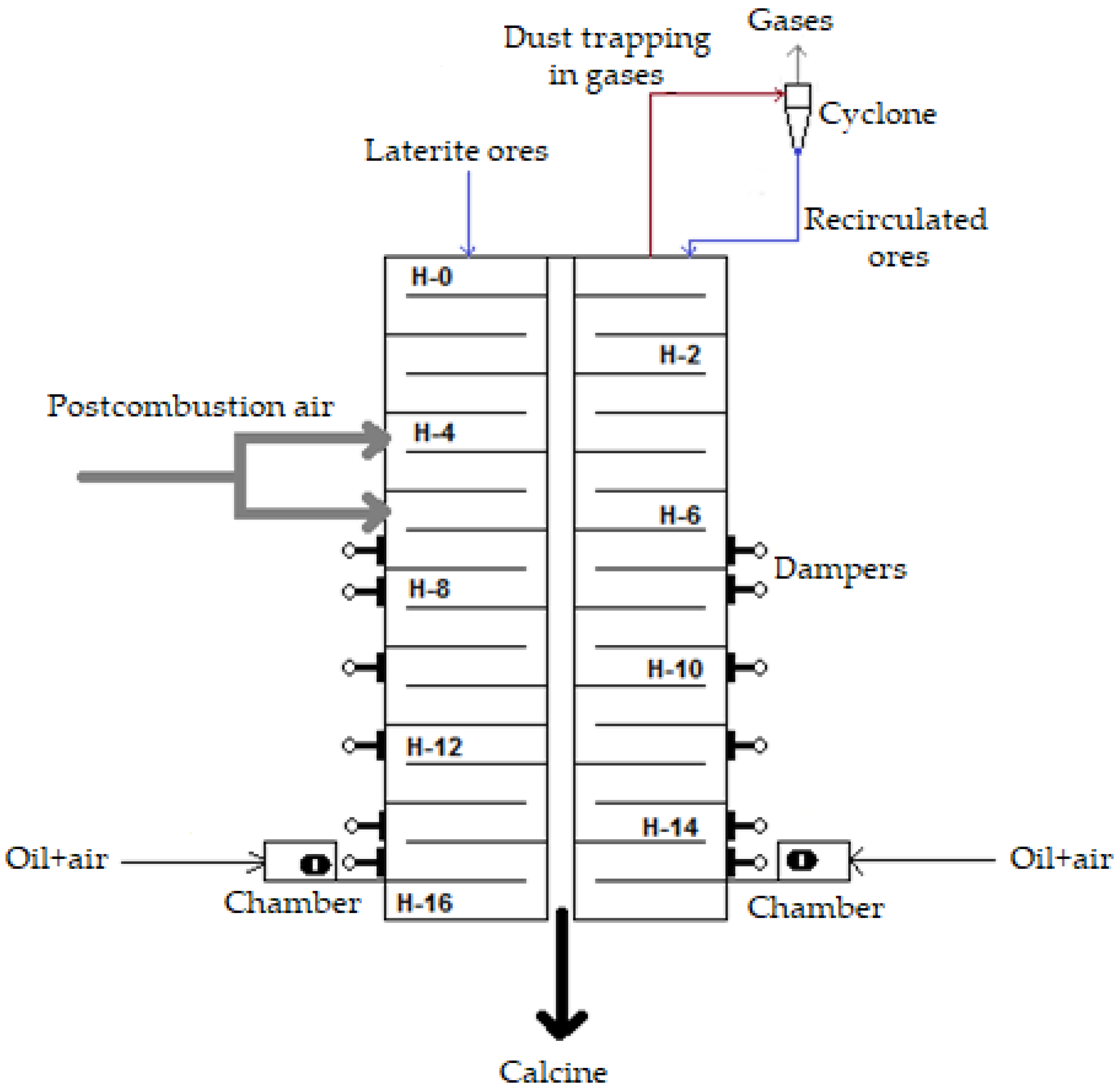
2.1. Experimental Data
2.2. Analytical Techniques
2.3. Methodology for the Evaluation of the New Mathematical Model
- (a)
- Substitute the unconverted fraction of nickel in Equation (1) by incorporating the kinetic model based on TH-6, based on the experiences obtained by Angulo et al. [26]; see Equations (7) and (8).where:t is residence time, min.
- (b)
- Substitute Equation (6) in Equation (8) and evaluate the new and conventional model based on experimental results obtained at pilot scale.
- (c)
- Determine the percentage of error of the new model, with respect to the conventional one, with Equation (9).
- (d)
- Analysis and interpretation of the results obtained.
3. Results and Discussion
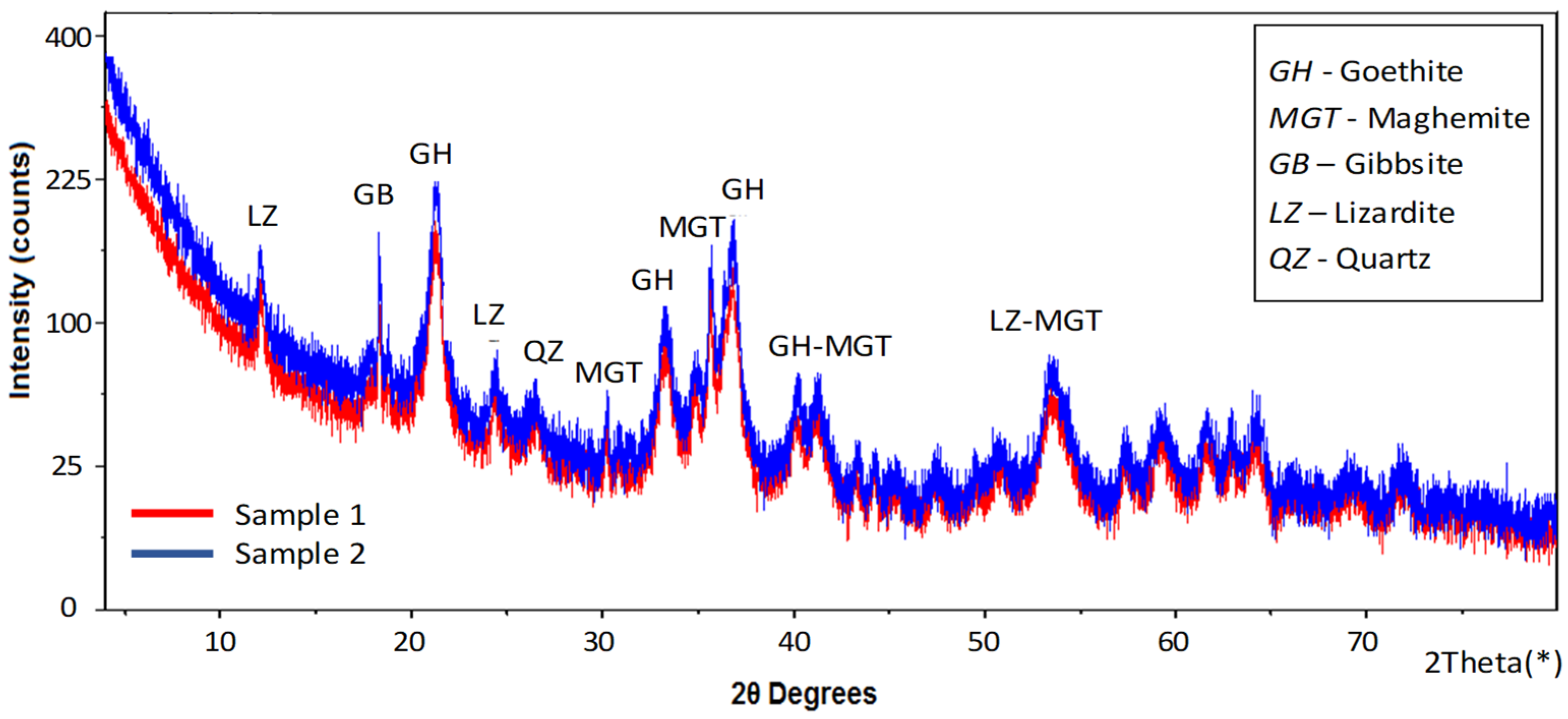
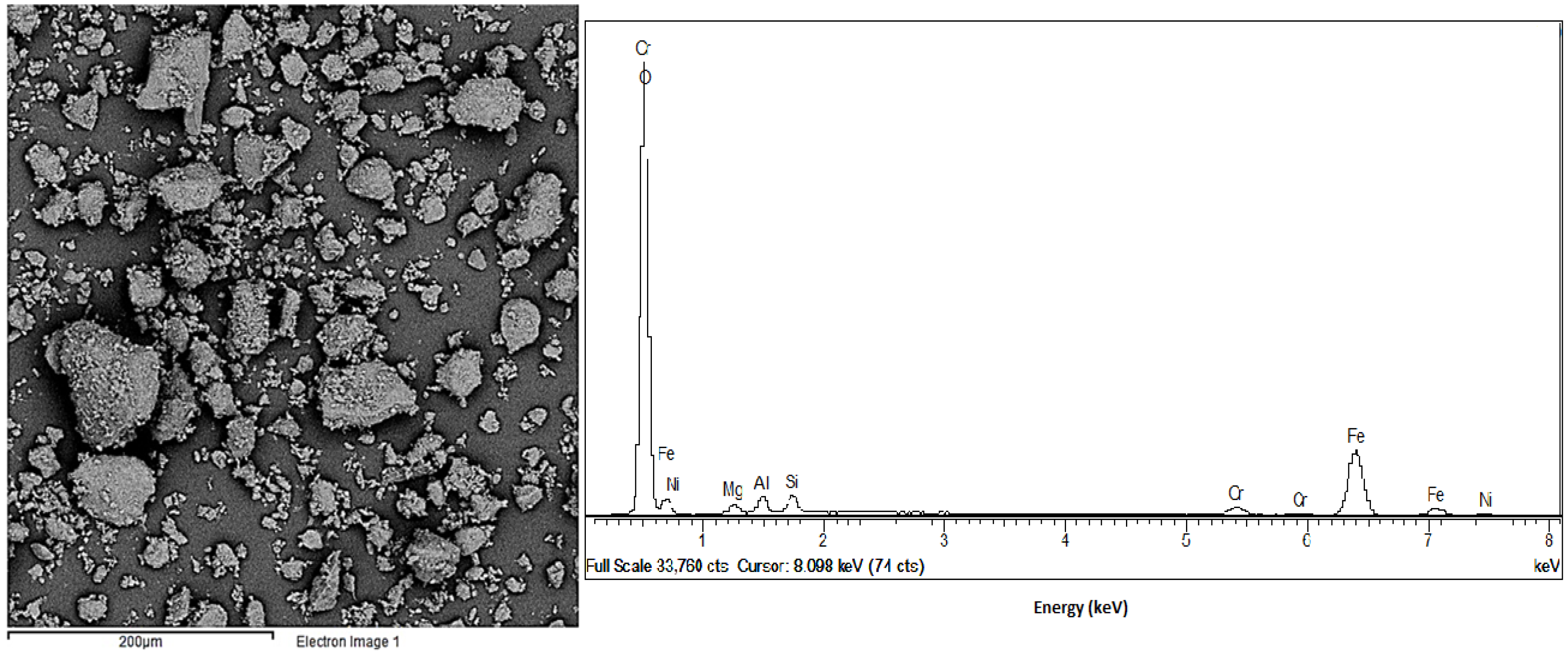
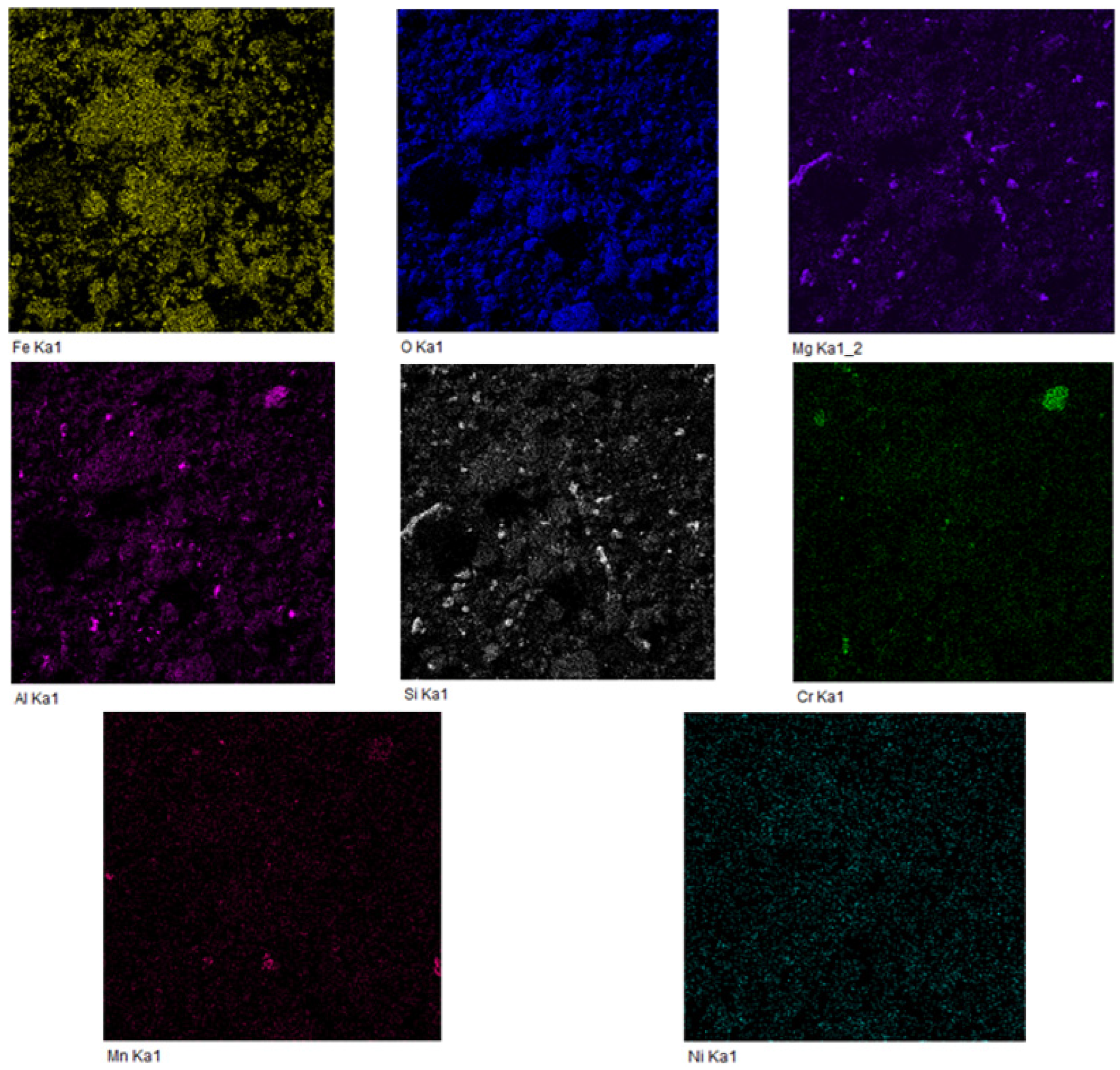
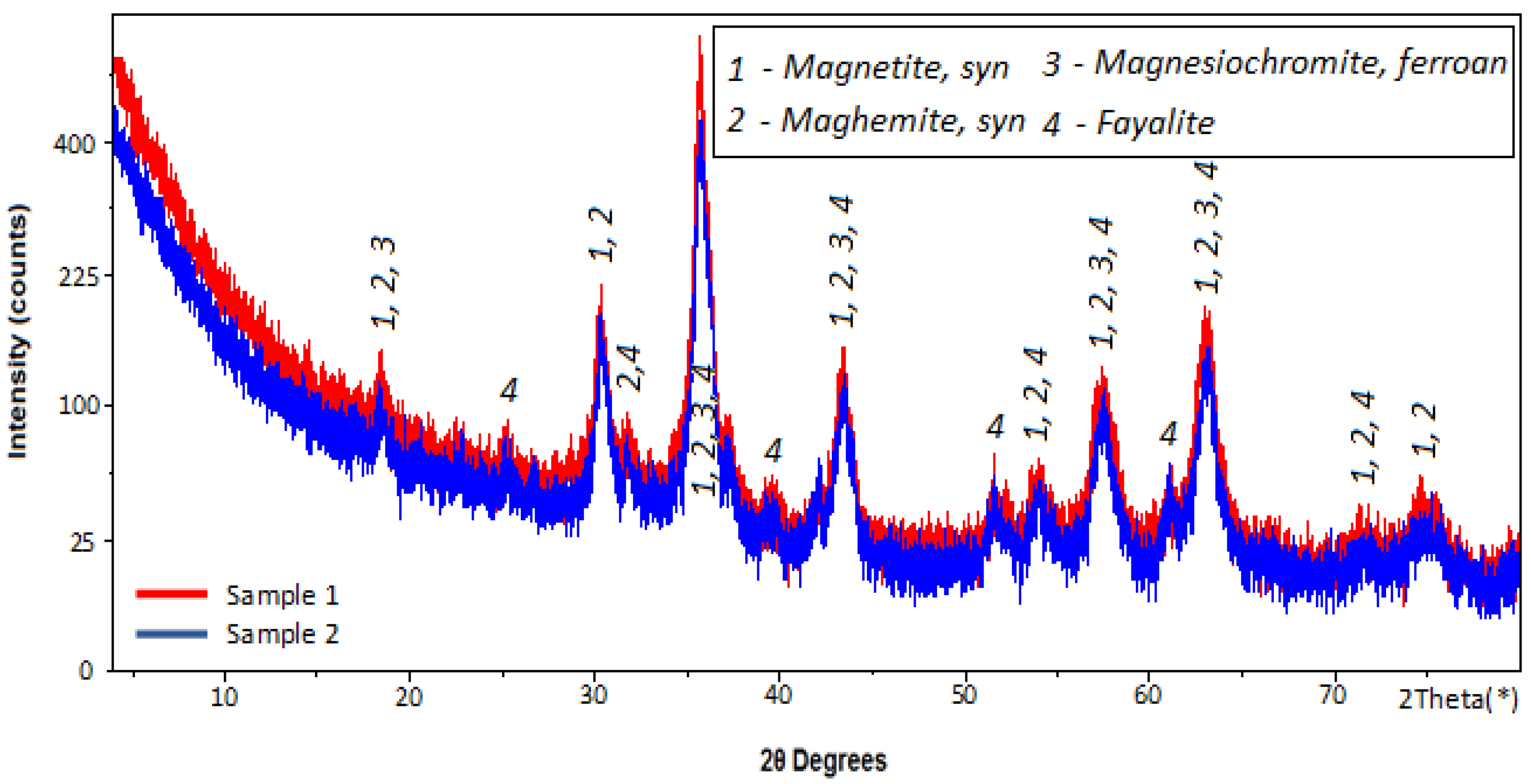
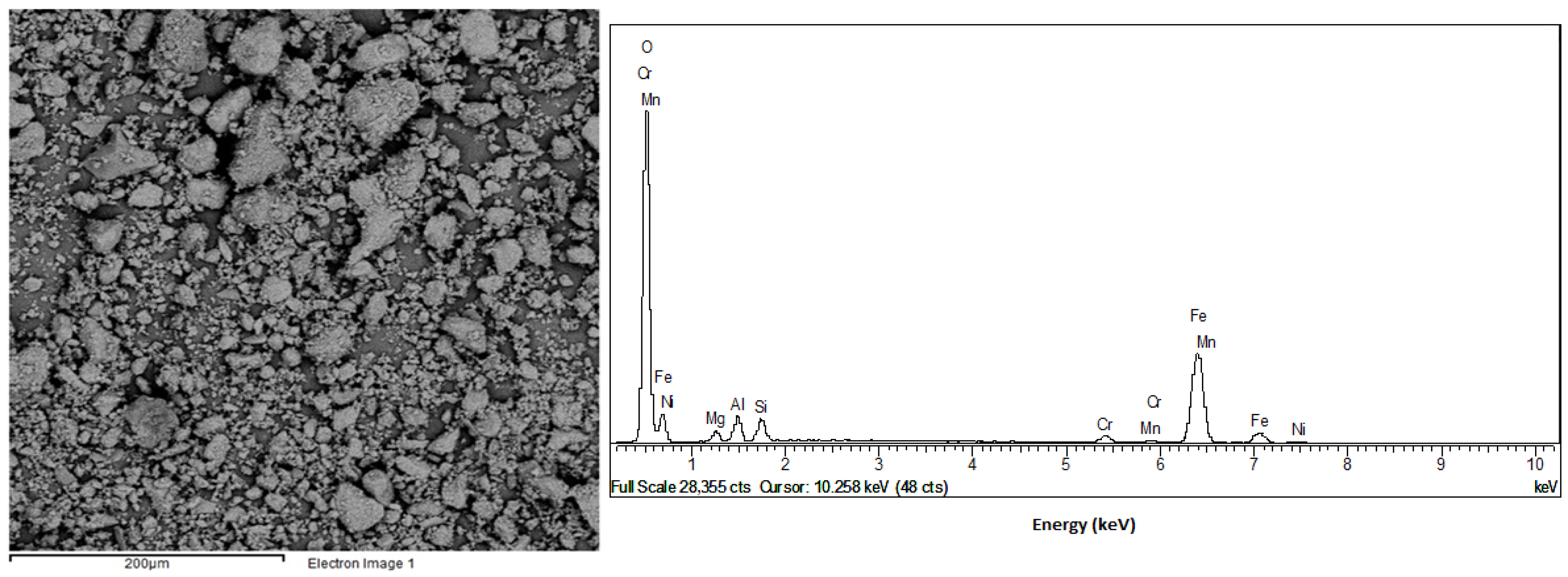
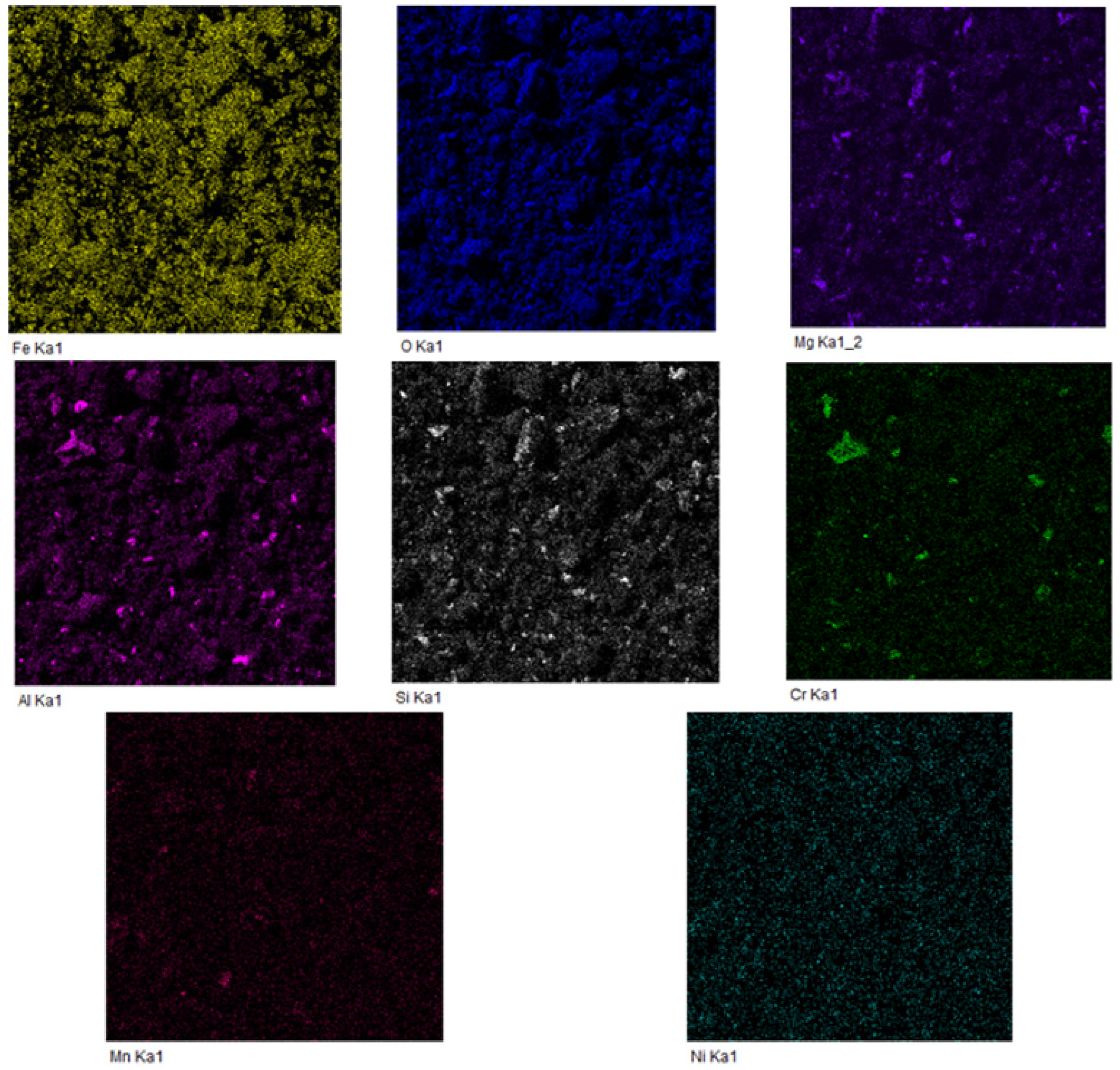
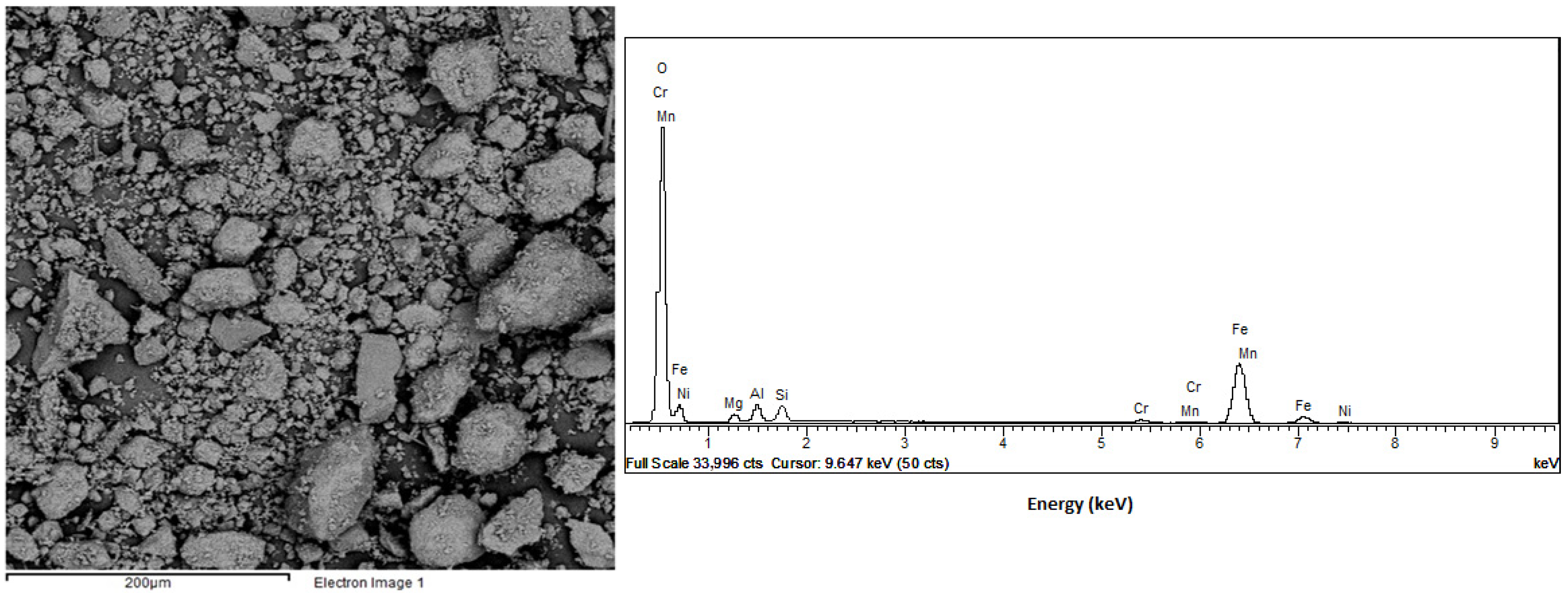
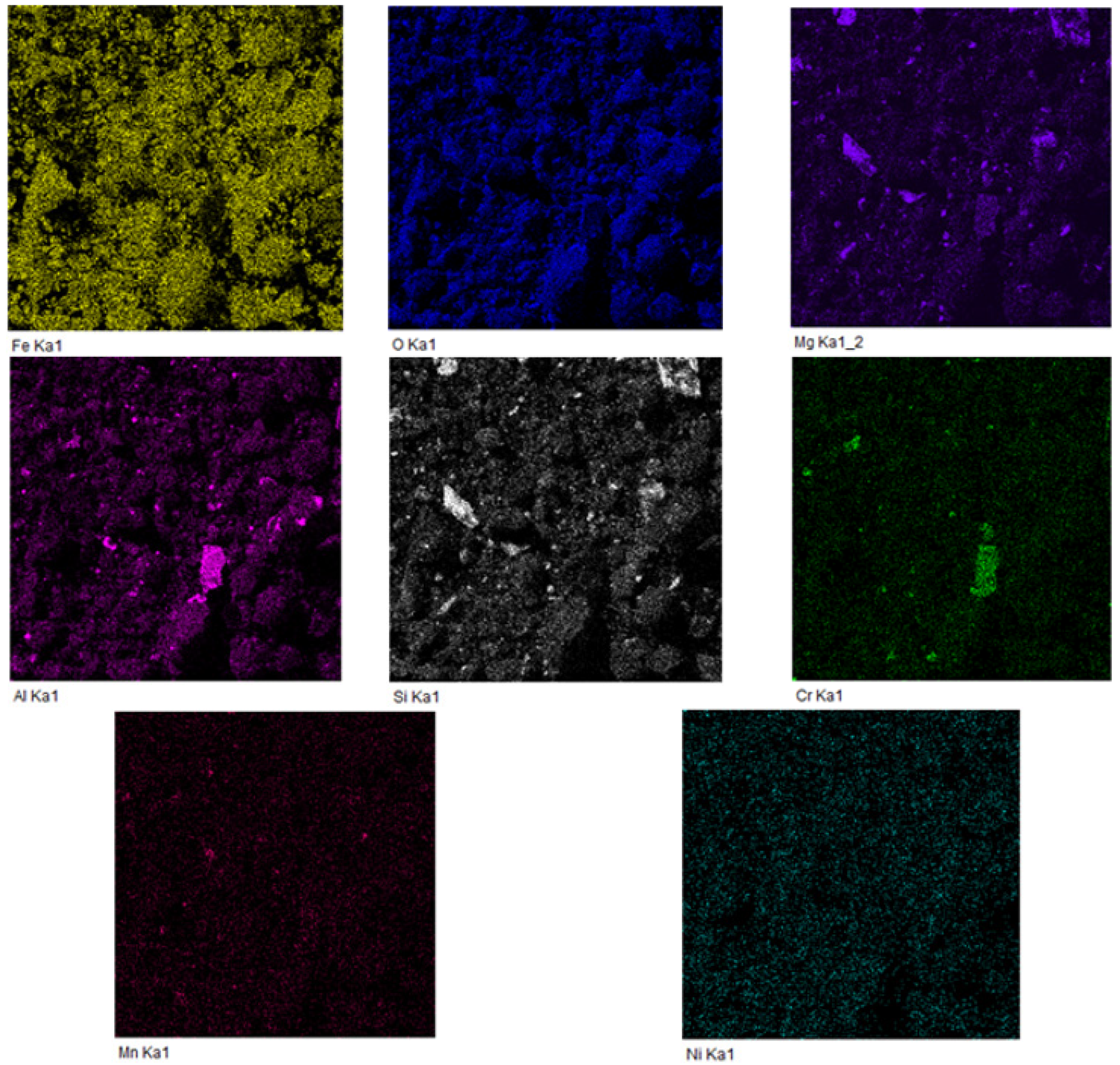
3.1. Mineralogical Characteristics of Lateritic Ore Before and After the Roasting/Reduction Process
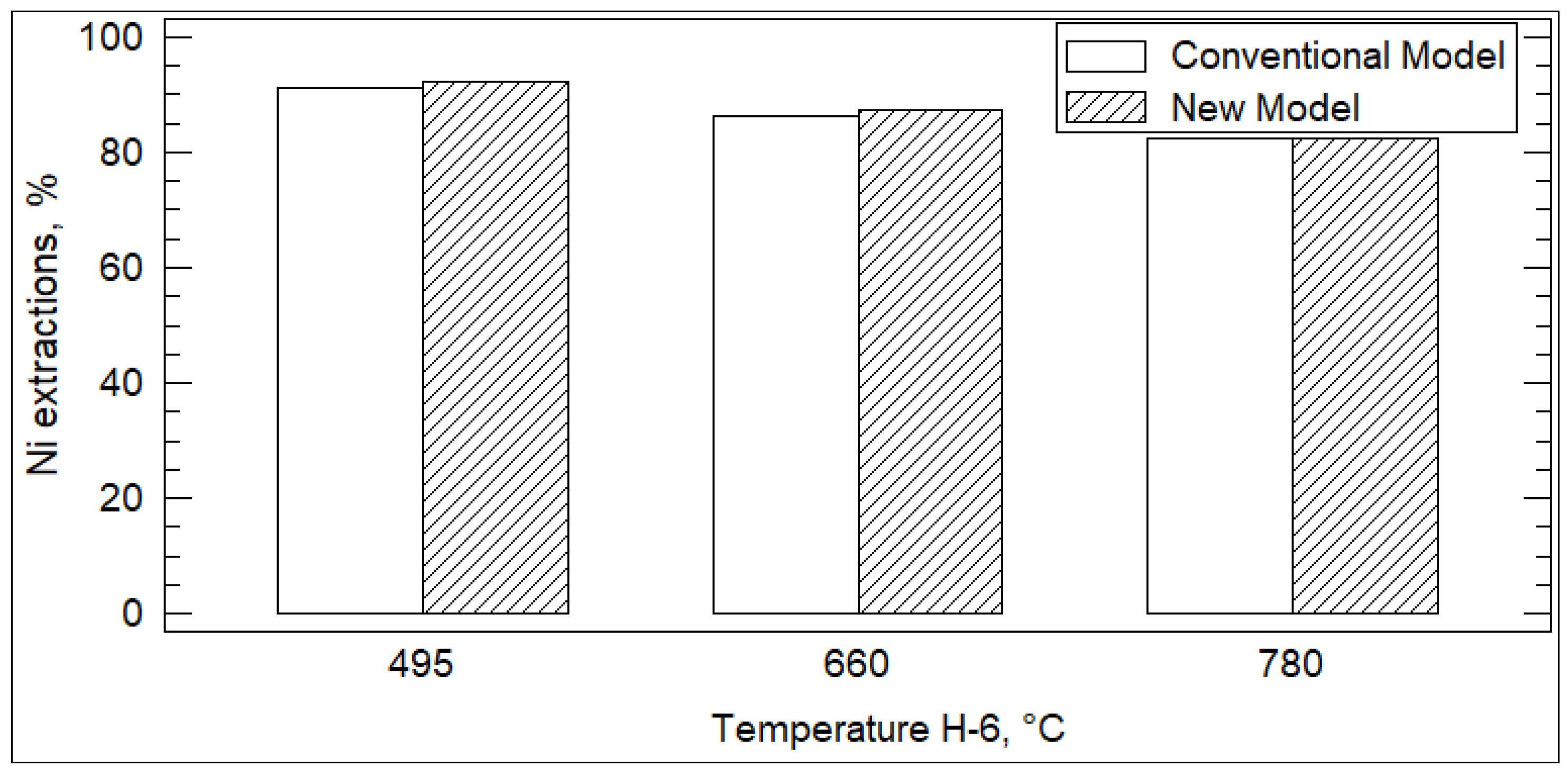
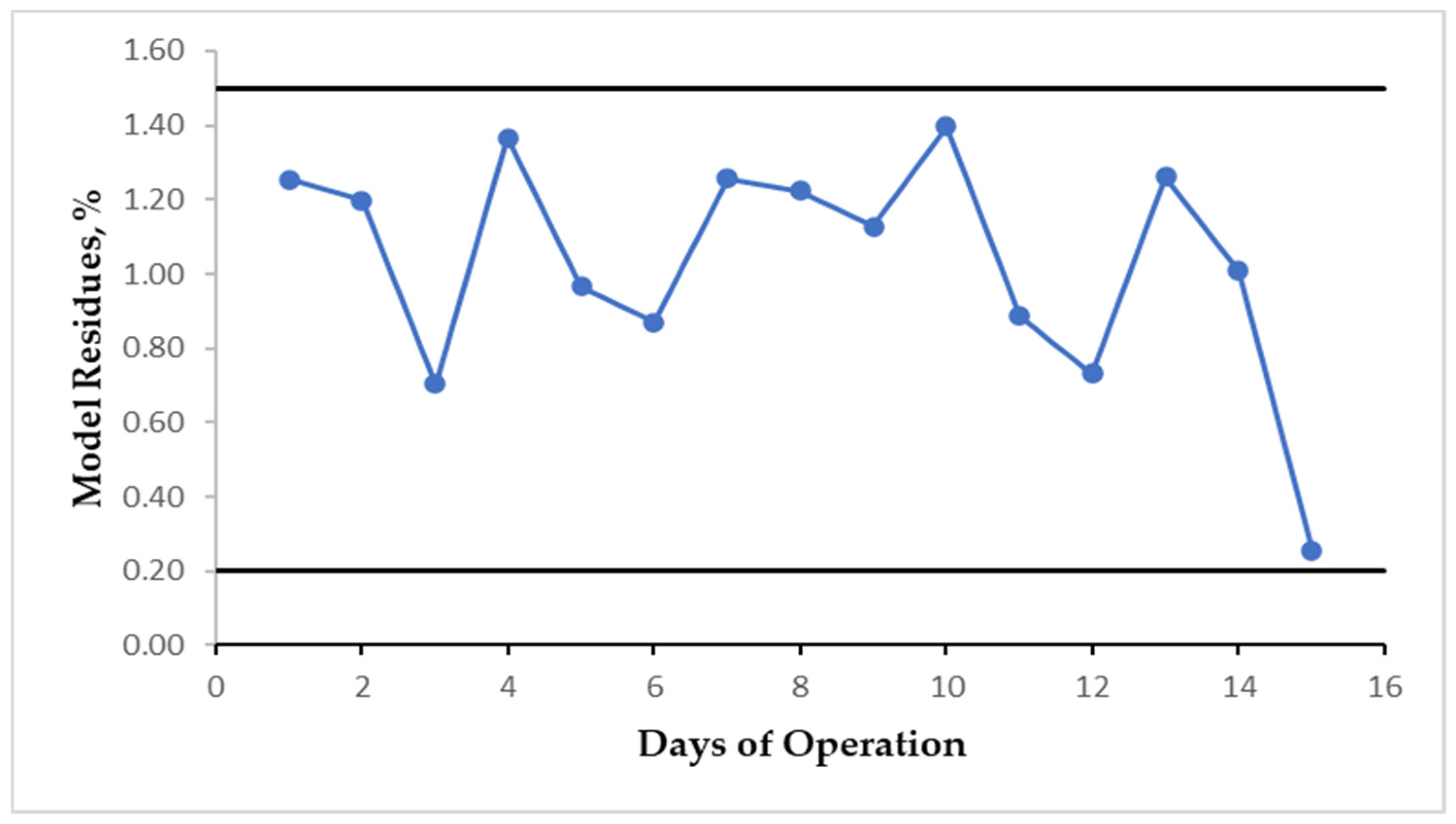
3.2. Evaluating the Effectiveness of the New Model
4. Conclusions
Author Contributions
Funding
Data Availability Statement
Acknowledgments
Conflicts of Interest
Appendix A

| Days of Operation | N° | Reduced/Leached Mineral, % | Ni Extraction by Equation (1), % | TH-6, °C | k Equation (6), min−1 | Ni Extraction by Equation (8), % | Error, % | |
|---|---|---|---|---|---|---|---|---|
| Ni | Fe | |||||||
| 1 | 1 | 0.123 | 48.16 | 91.39 | 498 | 0.0296 | 92.35 | 1.05 |
| 2 | 0.128 | 46.79 | 90.78 | 495 | 0.0297 | 92.20 | 1.56 | |
| 3 | 0.122 | 45.53 | 90.97 | 493 | 0.0298 | 92.03 | 1.16 | |
| 4 | 0.125 | 46.83 | 91.01 | 492 | 0.0298 | 92.27 | 1.39 | |
| 2 | 5 | 0.126 | 47.33 | 91.03 | 496 | 0.0297 | 92.26 | 1.36 |
| 6 | 0.120 | 47.03 | 91.40 | 491 | 0.0299 | 92.33 | 1.01 | |
| 7 | 0.121 | 47.45 | 91.41 | 494 | 0.0298 | 92.33 | 1.01 | |
| 8 | 0.125 | 48.15 | 91.25 | 499 | 0.0296 | 92.33 | 1.18 | |
| 3 | 9 | 0.115 | 48.62 | 92.03 | 500 | 0.0295 | 92.38 | 0.38 |
| 10 | 0.120 | 48.16 | 91.60 | 490 | 0.0299 | 92.53 | 1.01 | |
| 11 | 0.120 | 47.28 | 91.45 | 492 | 0.0298 | 92.35 | 0.98 | |
| 12 | 0.117 | 48.38 | 91.85 | 498 | 0.0296 | 92.39 | 0.58 | |
| 4 | 13 | 0.131 | 46.83 | 90.57 | 499 | 0.0296 | 92.11 | 1.70 |
| 14 | 0.125 | 46.07 | 90.86 | 499 | 0.0296 | 91.98 | 1.24 | |
| 15 | 0.127 | 46.24 | 90.75 | 500 | 0.0295 | 91.99 | 1.37 | |
| 16 | 0.129 | 45.82 | 90.51 | 500 | 0.0295 | 91.91 | 1.55 | |
| 5 | 17 | 0.121 | 46.30 | 91.19 | 498 | 0.0296 | 92.05 | 0.93 |
| 18 | 0.119 | 46.17 | 91.32 | 494 | 0.0297 | 92.12 | 0.88 | |
| 19 | 0.117 | 44.29 | 91.10 | 490 | 0.0299 | 91.88 | 0.86 | |
| 20 | 0.123 | 44.11 | 90.60 | 492 | 0.0298 | 91.80 | 1.32 | |
| Average | 0.123 | 46.77 | 91.15 | 496 | 0.0297 | 92.18 | 1.13 | |
| Days of Operation | N° | Reduced/Leached Mineral, % | Ni Extraction by Equation (1), % | TH-6, °C | k Equation (6), min−1 | Ni Extraction by Equation (8), % | Error, % | |
|---|---|---|---|---|---|---|---|---|
| Ni | Fe | |||||||
| 1 | 1 | 0.195 | 47.05 | 86.03 | 665 | 0.0234 | 87.13 | 1.27 |
| 2 | 0.189 | 46.77 | 86.38 | 662 | 0.0235 | 87.17 | 0.91 | |
| 3 | 0.189 | 46.65 | 86.35 | 660 | 0.0236 | 87.21 | 1.00 | |
| 4 | 0.182 | 47.81 | 87.17 | 664 | 0.0234 | 87.37 | 0.23 | |
| 2 | 5 | 0.192 | 47.36 | 86.34 | 655 | 0.0238 | 87.59 | 1.45 |
| 6 | 0.200 | 47.73 | 85.88 | 665 | 0.0234 | 87.31 | 1.67 | |
| 7 | 0.194 | 48.38 | 86.49 | 656 | 0.0237 | 87.82 | 1.54 | |
| 8 | 0.199 | 48.42 | 86.15 | 665 | 0.0234 | 87.49 | 1.56 | |
| 3 | 9 | 0.194 | 47.99 | 86.38 | 660 | 0.0236 | 87.57 | 1.38 |
| 10 | 0.195 | 46.75 | 85.95 | 662 | 0.0235 | 87.16 | 1.42 | |
| 11 | 0.189 | 47.02 | 86.46 | 665 | 0.0234 | 87.12 | 0.77 | |
| 12 | 0.194 | 47.52 | 86.24 | 655 | 0.0238 | 87.63 | 1.61 | |
| 4 | 13 | 0.190 | 45.85 | 86.04 | 657 | 0.0237 | 87.11 | 1.24 |
| 14 | 0.183 | 48.43 | 87.27 | 655 | 0.0238 | 87.87 | 0.69 | |
| 15 | 0.189 | 46.42 | 86.28 | 660 | 0.0236 | 87.15 | 1.01 | |
| 16 | 0.194 | 47.08 | 85.97 | 661 | 0.0235 | 87.29 | 1.53 | |
| 5 | 17 | 0.193 | 48.28 | 86.53 | 658 | 0.0236 | 87.72 | 1.37 |
| 18 | 0.194 | 47.73 | 86.30 | 660 | 0.0236 | 87.50 | 1.38 | |
| 19 | 0.197 | 46.63 | 85.76 | 662 | 0.0235 | 87.13 | 1.59 | |
| 20 | 0.195 | 47.57 | 86.19 | 661 | 0.0235 | 87.42 | 1.43 | |
| Average | 0.192 | 47.37 | 86.29 | 660 | 0.0237 | 87.40 | 1.25 | |
| Days of Operation | N° | Reduced/Leached Mineral, % | Ni Extraction by Equation (1), % | TH-6, °C | k Equation (6), Min−1 | Ni Extraction by Equation (8), % | Error, % | |
|---|---|---|---|---|---|---|---|---|
| Ni | Fe | |||||||
| 1 | 1 | 0.241 | 48.72 | 83.76 | 779 | 0.0191 | 82.46 | 1.56 |
| 2 | 0.233 | 48.33 | 83.42 | 781 | 0.0190 | 82.21 | 1.45 | |
| 3 | 0.237 | 48.58 | 83.50 | 778 | 0.0191 | 82.46 | 1.25 | |
| 4 | 0.235 | 47.94 | 83.55 | 775 | 0.0192 | 82.39 | 1.40 | |
| 2 | 5 | 0.229 | 47.72 | 83.87 | 775 | 0.0192 | 82.31 | 1.87 |
| 6 | 0.239 | 49.19 | 83.71 | 777 | 0.0192 | 82.73 | 1.17 | |
| 7 | 0.234 | 48.84 | 83.77 | 779 | 0.0191 | 82.50 | 1.51 | |
| 8 | 0.253 | 48.53 | 82.36 | 783 | 0.0190 | 82.17 | 0.23 | |
| 3 | 9 | 0.271 | 49.43 | 81.11 | 785 | 0.0188 | 82.39 | 1.58 |
| 10 | 0.276 | 48.27 | 81.08 | 780 | 0.0190 | 82.24 | 1.43 | |
| 11 | 0.268 | 48.78 | 81.15 | 782 | 0.0190 | 82.32 | 1.43 | |
| 12 | 0.270 | 48.01 | 80.84 | 779 | 0.0191 | 82.20 | 1.68 | |
| 4 | 13 | 0.273 | 48.45 | 80.98 | 783 | 0.0189 | 82.14 | 1.44 |
| 14 | 0.271 | 48.16 | 80.90 | 785 | 0.0188 | 81.93 | 1.26 | |
| 15 | 0.263 | 47.96 | 81.01 | 781 | 0.0190 | 82.07 | 1.31 | |
| 16 | 0.265 | 47.39 | 80.83 | 781 | 0.0190 | 81.85 | 1.27 | |
| 5 | 17 | 0.259 | 47.84 | 82.04 | 779 | 0.0191 | 82.13 | 0.12 |
| 18 | 0.246 | 48.14 | 82.77 | 777 | 0.0192 | 82.35 | 0.50 | |
| 19 | 0.261 | 49.05 | 82.21 | 774 | 0.0193 | 82.84 | 0.75 | |
| 20 | 0.255 | 48.09 | 82.23 | 777 | 0.0192 | 82.33 | 0.12 | |
| Average | 0.254 | 48.37 | 82.26 | 780 | 0.0191 | 82.30 | 1.17 | |
References
- He, P.; Pan, Y.; Peng, Y.; Chen, L.; Zuo, L.; Song, H. Exploring the Development Potential of Critical Metals in New Energy Vehicles: Evidence from Megacity Shanghai, China. Sustainability 2025, 17, 8388. [Google Scholar] [CrossRef]
- Wang, Z.; Shao, H.; Chao, B.; Yang, T. Policy Evolution of China’s Critical Metals: An Integrated Analysis of Instruments and Networks. Sustainability 2025, 17, 9001. [Google Scholar] [CrossRef]
- Tauakelov, C.A.; Rakhimbayev, B.S.; Yskak, A.; Valiev, K.K.; Tastanov, Y.A.; Ibrayev, M.K.; Bulaev, A.G.; Daribayeva, S.A.; Kazbekova, K.A.; Joldassov, A.A. Treatment of Refractory Oxidized Nickel Ores (ONOs) from the Shevchenkovskoye Ore Deposit. Metals 2025, 15, 876. [Google Scholar] [CrossRef]
- Topak, A.; Toprak Döşlü, S. Electrochemical Tuning of Ni-Fe Catalysts Using Various Techniques for Efficient Hydrogen Evolution in Alkaline Media. Processes 2025, 13, 644. [Google Scholar] [CrossRef]
- Lv, W.; Makuza, B.; Wang, F.; Marcuson, S.; Barati, M. A Review of Direct Reduction–Magnetic Separation Process for Ferronickel Production from Nickel Laterite. J. Sustain. Metall. 2025, 11, 3–28. [Google Scholar] [CrossRef]
- Valencia, F.; Rabbani, M.; Fahimi, A.; Vahidi, E. Assessing the environmental burden of nickel sulfate for batteries: A life cycle perspective. Resour. Conserv. Recycl. 2025, 215, 108130. [Google Scholar] [CrossRef]
- Wang, M.; Fan, Q.; Bai, Z.; Yuan, S.; Li, Y.; Han, Y. Semi-industrial experiment on efficient preparation of nickel-iron alloy from laterite nickel ore: A suspension roasting pre-reduction electric furnace melting (SRPEF) process. J. Taiwan Inst. Chem. Eng. 2025, 173, 106164. [Google Scholar] [CrossRef]
- Liu, R.; Cai, P.; Chen, X. Knowledge Structure and Frontier Evolution of Research on Nickel Deposits. Minerals 2025, 15, 464. [Google Scholar] [CrossRef]
- Correa-Cala, Y.; Toro, N.; Silvente, Y.O.; Angulo-Palma, H.J.; Reyes, R.S.A.; Ramirez, A.D.; Pedrera, C.H.; Salazar, I.; Gallegos, S.; Galleguillos-Madrid, F.M.; et al. Modeling and Systematic Analysis of Grinding Behavior for Overburden, Saprolite, and Their Mixtures. Appl. Sci. 2025, 15, 10740. [Google Scholar] [CrossRef]
- Caetano, G.C.; Ostroski, I.C.; de Barros, M.A.S.D. Lateritic nickel and cobalt recovery routes: Strategic technologies. Miner. Process. Extr. Metall. Rev. 2025, 46, 400–414. [Google Scholar] [CrossRef]
- Caron, M.H. Fundamental and practical factors in ammonia leaching of nickel and cobalt ores. JOM-J. Miner. Met. Mater. Soc. 1950, 2, 67–90. [Google Scholar] [CrossRef]
- Angulo Palma, H.J.; Saldana, M.; Legrá, Á.L.; Urgellés, A.L.; Pedrera, C.H.; Gallegos, S.; Galleguillos, M.F.M.; Toro, N. Kinetic behaviour of the roasting/selective reduction process with the use of a mixture of bituminous coal and fuel oil as the additive. Hem. Ind. 2025, 79, 69–77. [Google Scholar] [CrossRef]
- Rojas Vargas, A.; Magaaña Haynes, M.E.; del Toro Alvarez, D.; Angulo Palma, H.J.; Yasir AlJaberi, F.; Dawood Salman, A.; Mohsen Alardhi, S.; Mohammed, M.M.; Gabor’ Gyurika, I.; Ihsan Ali, O. Nickel Mining: Studying the Kinetics and Modeling of Extraction Process from Laterite Ore. S. Afr. J. Chem. Eng. 2025, 53, 362–372. [Google Scholar] [CrossRef]
- Ilyas, S.; Srivastava, R.R.; Kim, H.; Ilyas, N.; Sattar, R. Extraction of nickel and cobalt from a laterite ore using the carbothermic reduction roasting-ammoniacal leaching process. Sep. Purif. Technol. 2020, 232, 115971. [Google Scholar] [CrossRef]
- Angulo Palma, H.J.; Legrá, Á.L.; Urgellés, A.L.; Pedrera, C.H.; Gallegos, S.; Galleguillos, M.F.M.; Toro, N. Use of a mixture of coal and oil as an additive for selective reduction of lateritic ore by the Caron process. Hem. Ind. 2024, 78, 17–27. [Google Scholar] [CrossRef]
- Véliz Jardines, A.I.; Miranda López, J. Desarrollo de investigaciones sobre la tecnología Caron durante el procesamiento de las lateritas de baja ley de níquel y de los escombros lateríticos, clasificados como: Menas o minerales no industriales. Tecnol. Química 2022, 42, 361–383. [Google Scholar]
- Mano, E.S.; Caner, L.; Petit, S.; Chaves, A.P.; Mexias, A.S. Ni-smectitic ore behaviour during the Caron process. Hydrometallurgy 2019, 186, 200–209. [Google Scholar] [CrossRef]
- Chen, J.-h.; Jak, E.; Hayes, P. Investigation of the reduction roasting of saprolite ores in the Caron process: Microstructure evolution and phase transformations. Miner. Process. Extr. Metall. 2019, 130, 148–159. [Google Scholar] [CrossRef]
- Rhamdhani, M.; Chen, J.; Hidayat, T.; Jak, E.; Hayes, P. Advances in research on nickel production through the Caron process. In Proceedings of the European Metallurgical Conference 2009; Harre, J., Ed.; GDMB: Clausthal-Zellerfeld, Germany, 2009; pp. 899–914. [Google Scholar]
- Rojas Vargas, A.; Sánchez Guillen, C.; Magaña Haynes, M.E.; Hernández Pedrera, C. Extracción potencial de níquel y cobalto con mineral laterítico de mina “Pinares de Mayarí” en la tecnología Caron. Parte II. Tecnol. Química 2022, 42, 405–419. [Google Scholar]
- Chen, J.; Jak, E.; Hayes, P. Investigation of the reduction roasting of saprolite ores in the Caron process: Reaction mechanisms and reduction kinetics. Miner. Process. Extr. Metall. 2019, 130, 425–432. [Google Scholar] [CrossRef]
- Coello-Velázquez, A.L.; Arteaga, V.Q.; Menéndez-Aguado, J.M.; Pole, F.M.; Llorente, L. Use of the Swebrec Function to Model Particle Size Distribution in an Industrial-Scale Ni-Co Ore Grinding Circuit. Metals 2019, 9, 882. [Google Scholar] [CrossRef]
- Angulo Palma, H.J.; Terencio Guevara, P.L.; Legrá Legrá, A.; Videaux Arcia, L. Análisis especiales en un horno de reducción de níquel a escala de Planta Piloto. Tecnol. Química 2017, 37, 484–499. [Google Scholar]
- Chang-Cardona, A.R.; Jorge, A.M.; Toirac-Suárez, M.M. Modelos multivariables para predecir el extractable de níquel por la composición mineralógica de la mena tecnológica en el proceso Caron. Minería Y Geol. 2005, 21, 1–32. [Google Scholar]
- Angulo Palma, H.J.; Legrá Legrá, A.; Lamorú Urgellés, A.; Gálvez, E.; Castillo, J. Post-combustion Effect on Nickel and Cobalt Extractions from the Caron Process. In Proceedings of the Fourth International Conference on Inventive Material Science Applications. Advances in Sustainability Science and Technology; Bindhu, V., Tavares, J.M.R.S., Ţălu, Ş., Eds.; Springer: Singapore, 2021; pp. 515–527. [Google Scholar] [CrossRef]
- Angulo Palma, H.J.; Toro, N.; Castillo, J.; Galleguillos Madrid, F.M.; Salazar, I.; Jamett, I.; Salinas-Rodríguez, E.; Saldana, M. New Evidence of the Effect of Post-Combustion During Roasting/Reduction of Nickel-Bearing Lateritic Ores. Processes 2025, 13, 2602. [Google Scholar] [CrossRef]
- Rhamdhani, M.; Hayes, P.; Jak, E. Nickel laterite Part 1–microstructure and phase characterisations during reduction roasting and leaching. Miner. Process. Extr. Metall. 2009, 118, 129–145. [Google Scholar] [CrossRef]
- Valix, M.; Cheung, W. Effect of sulfur on the mineral phases of laterite ores at high temperature reduction. Miner. Eng. 2002, 15, 523–530. [Google Scholar] [CrossRef]


| Authors (Year) | Equations | Equation Nº | Parameters (R2) |
|---|---|---|---|
| Chang, Arce and Toirac (2005) [24] | (2) | L/S: Limonite/serpentine ratio in the ore fed to the furnace (0.4101) | |
| Chang, Arce and Toirac (2005) [24] | (3) | of the lateritic ore fed to the furnace (0.4080) | |
| Angulo et al. (2021) [25] | (4) | : temperature of the hearth six of the furnace, °C Reducing additive: 2.5% fuel oil (0.9637) | |
| Angulo et al. (2025) [26] | (5) | : temperature of the hearth six of the furnace, °C Reducing additive: Mixture of 2% bituminous coal and 1.25% fuel oil (0.9892) |
| Main Operating Variables | |
| Laterite ore feeding, kg/h | 750 |
| Amount of hearth (H) | 17 |
| Amount of chamber | 2 |
| Temperature in H-0, °C * | 205–285 |
| Temperature in H-4, °C * | 350–460 |
| Temperature in H-6, °C * | 495–780 |
| Temperature in H-9, °C | 675 |
| Temperature in H-11, °C | 718 |
| Temperature in H-13, °C | 742 |
| Temperature in H-15, °C | 780 |
| Temperature in chamber, °C | 1380–1400 |
| Fuel fed by the chamber | Fuel oil |
| Reducing additive | Mixture of 2% bituminous coal and 1.25% fuel oil |
| Residence time, min | 80 |
| Days of continuous operation | 15 |
| Reaction rate constant values | |
| No post-combustion H-6 (TH-6 = 495 °C, min−1) | 0.0298 |
| Low post-combustion H-6 (TH-6 = 660 °C, min−1) | 0.0240 |
| High post-combustion H-6 (TH-6 = 780 °C, min−1) | 0.0190 |
| Characteristics of Lateritic Ore | |
|---|---|
| Limonite/serpentine ratio | 3/1 |
| Mass content of Ni and Fe, % (σ) | 1.17 and 39.32 (<0.42) |
| Mass content of MgO, SiO2 and Al2O3, % (σ) | 2.83, 7.79 and 8.08 (<0.52) |
| Moisture content, % (σ) | 3.66 (<0.23) |
| Degree of homogenization, % | ≥90 |
| Particle size < 75 μm, % | 84–88 |
| Electron Microscope | |
| Detectors | Secondary and backscattered electrons |
| Acceleration voltage | 20 kV |
| Working distance | 15 mm |
| Beam current | At position 10 |
| Stage inclination | 0 degrees |
| X-ray microanalysis | |
| Processor | PT 5 |
| Acquisition time | 30 s (live time) |
| Swept area | Rectangular, inscribed |
| XRD | |
|---|---|
| Sweep; Angular registration | Gonio type |
| Angular registration | [°2θ] from 4.0042° to 79.9962° |
| Step distance | 0.0080° |
| Radiation | Cu |
| Filter | Ni |
| Potential difference and current | 40 kV and 30 mA |
| Calibration checked | External silicon standard scanning |
Disclaimer/Publisher’s Note: The statements, opinions and data contained in all publications are solely those of the individual author(s) and contributor(s) and not of MDPI and/or the editor(s). MDPI and/or the editor(s) disclaim responsibility for any injury to people or property resulting from any ideas, methods, instructions or products referred to in the content. |
© 2026 by the authors. Licensee MDPI, Basel, Switzerland. This article is an open access article distributed under the terms and conditions of the Creative Commons Attribution (CC BY) license.
Share and Cite
Angulo-Palma, H.J.; Salazar, I.; Saldana, M.; Castillo, J.; Madrid, F.M.G.; Leiva, W.; Salinas-Rodríguez, E.; Sales-Cruz, M.; Toro, N. New Model to Predict Nickel Extraction from Lateritic Ores During the Roasting–Reduction of the Caron Process. Minerals 2026, 16, 278. https://doi.org/10.3390/min16030278
Angulo-Palma HJ, Salazar I, Saldana M, Castillo J, Madrid FMG, Leiva W, Salinas-Rodríguez E, Sales-Cruz M, Toro N. New Model to Predict Nickel Extraction from Lateritic Ores During the Roasting–Reduction of the Caron Process. Minerals. 2026; 16(3):278. https://doi.org/10.3390/min16030278
Chicago/Turabian StyleAngulo-Palma, Hugo Javier, Iván Salazar, Manuel Saldana, Jonathan Castillo, Felipe M. Galleguillos Madrid, Williams Leiva, Eleazar Salinas-Rodríguez, Mauricio Sales-Cruz, and Norman Toro. 2026. "New Model to Predict Nickel Extraction from Lateritic Ores During the Roasting–Reduction of the Caron Process" Minerals 16, no. 3: 278. https://doi.org/10.3390/min16030278
APA StyleAngulo-Palma, H. J., Salazar, I., Saldana, M., Castillo, J., Madrid, F. M. G., Leiva, W., Salinas-Rodríguez, E., Sales-Cruz, M., & Toro, N. (2026). New Model to Predict Nickel Extraction from Lateritic Ores During the Roasting–Reduction of the Caron Process. Minerals, 16(3), 278. https://doi.org/10.3390/min16030278