Formation of Niujuan Ag-Au Deposit, North China Craton: Constraints from Pyrite Textures and In-Situ Trace Element and H-O-S Isotope Geochemistry


Abstract
1. Introduction
2. Geological Setting
2.1. Regional Geology

2.2. Deposit Geology
3. Sampling and Analytical Methods
3.1. Sample Characteristics
3.2. Analytical Methods
4. Results
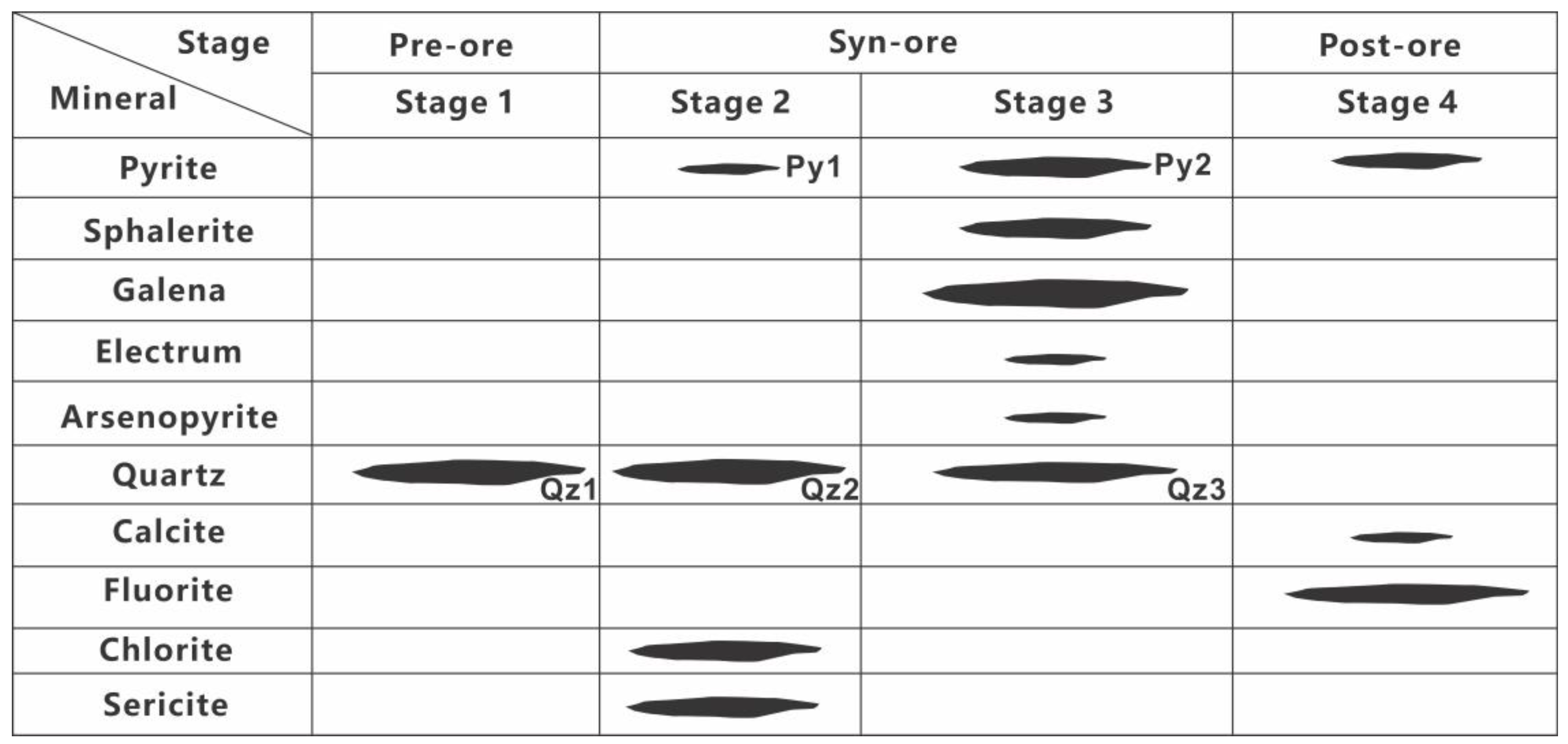
4.1. Mineralization Stages
- (1)
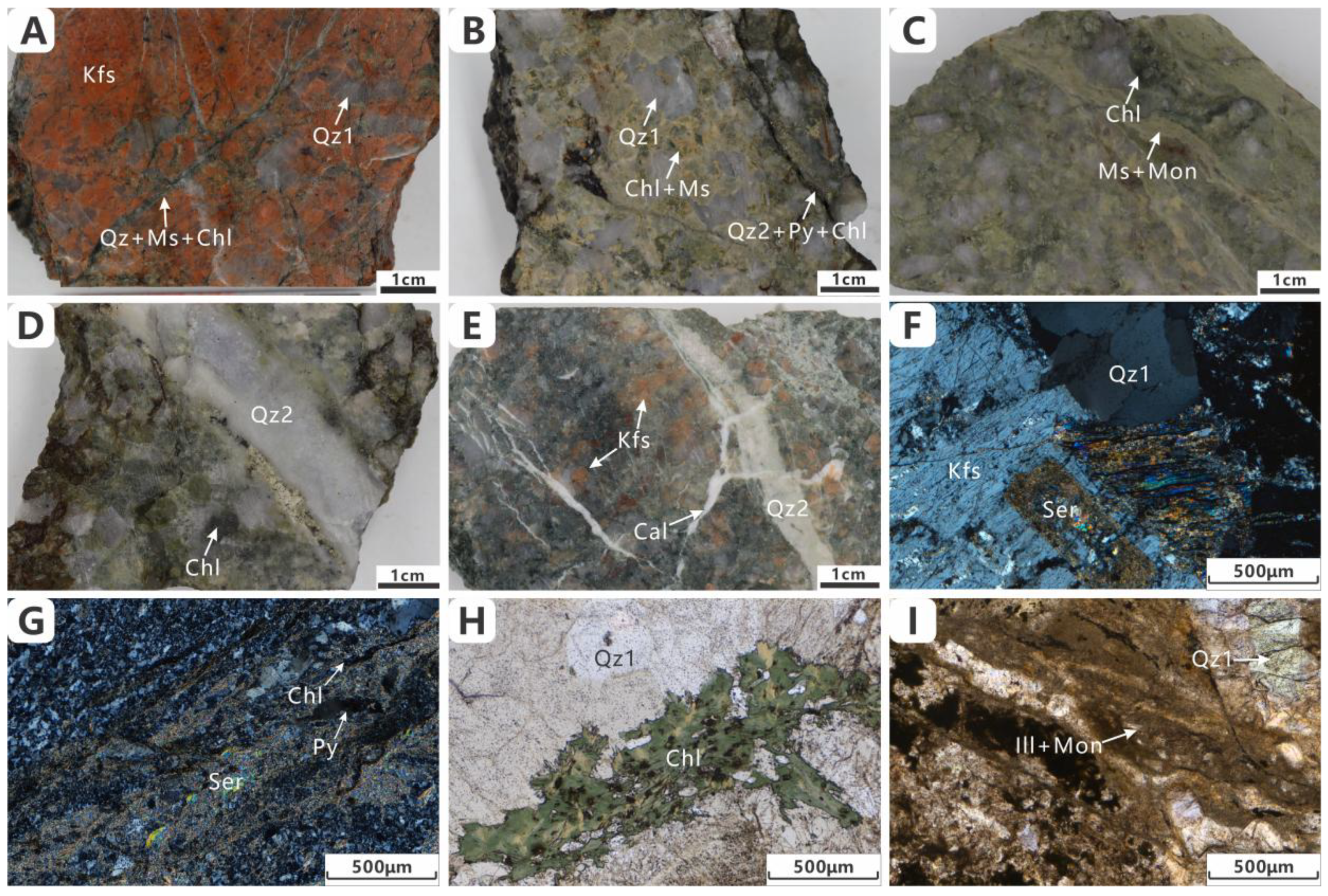
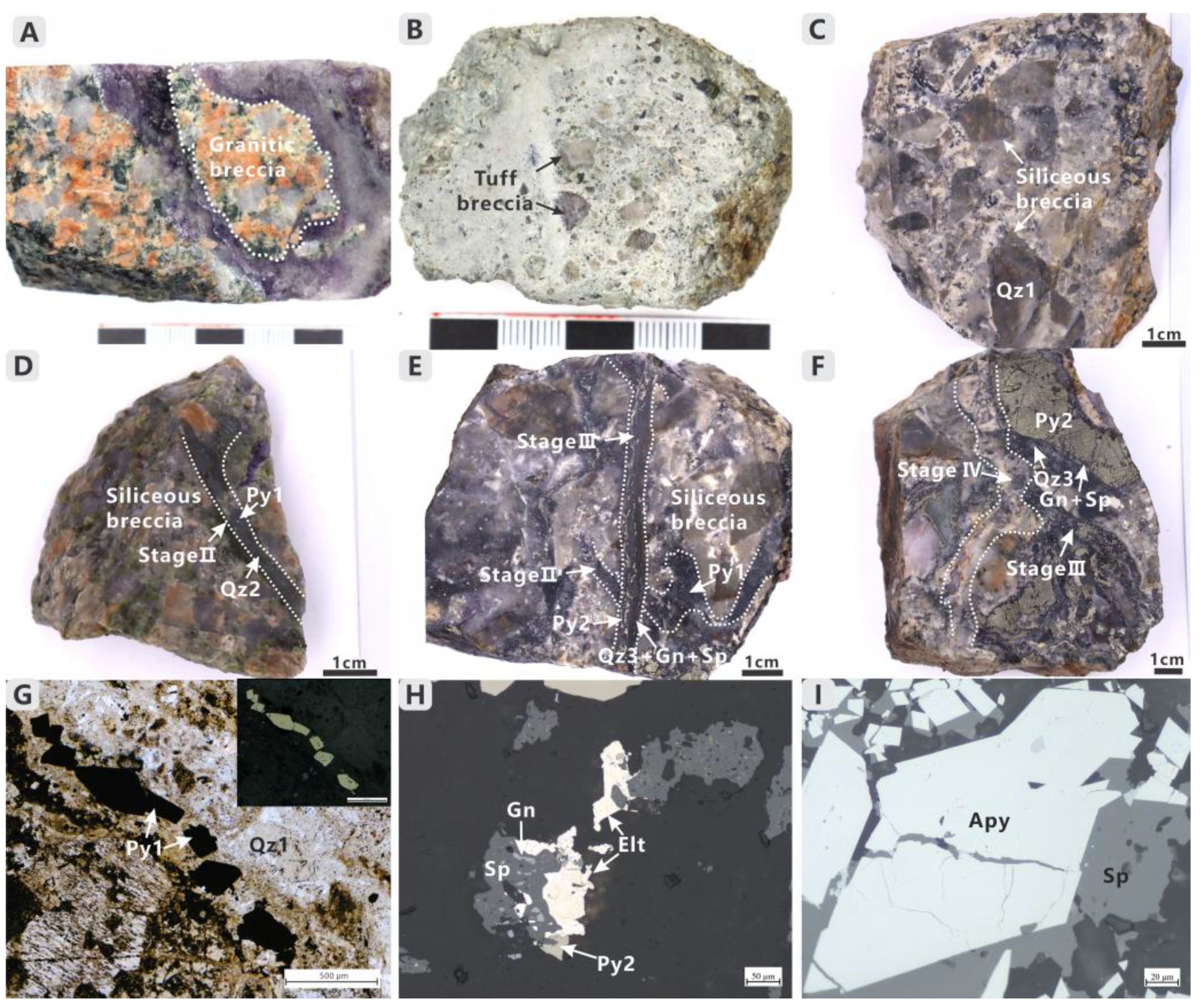
- Pre-ore siliceous breccia stage (stage 1): This stage is characterized by the formation of hydrothermal breccia that was cemented by fine-grained quartz. Much breccia is developed and can be classified into three types based on its composition: granitic breccia (Figure 4A), tuffaceous breccia (Figure 4B), and siliceous breccia (Figure 4C).
- (2)
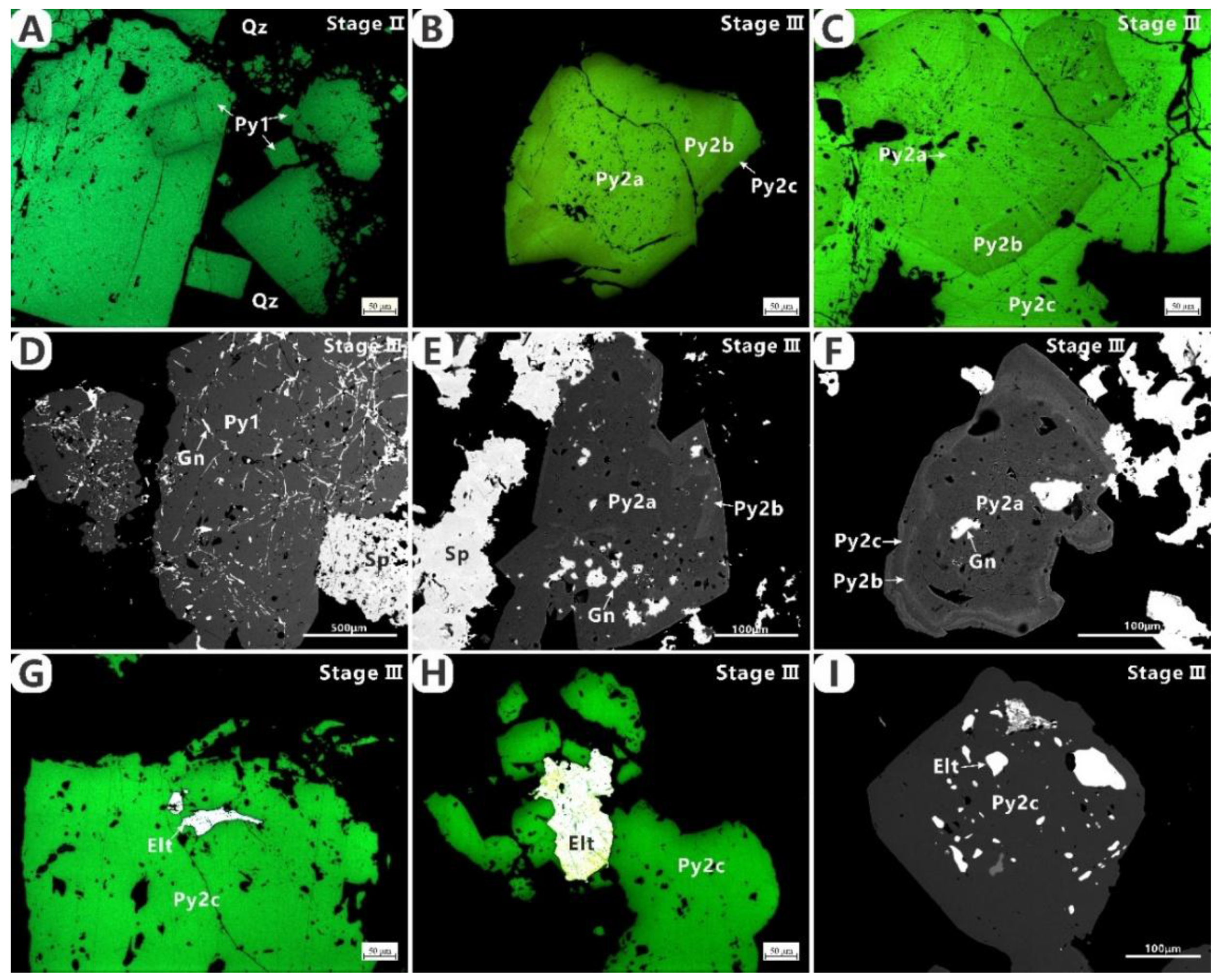
- Syn-ore quartz-pyrite stage (stage 2): The quartz vein/veinlets occurring as smoky gray in color cut through early siliceous rocks (Figure 4D), with widths ranging from 0.1 to 3 cm. The mineral composition is relatively simple; only quartz and minor pyrite (Py1) were identified. Py1 occurs mainly as fine-grained euhedral or sub-euhedral grains (Figure 4G). Chlorite and sericite occur in the veins during this stage (Figure 3G,H).
- (3)
- Syn-ore polymetallic sulfide stage (stage 3): This represents the main mineralization stage. Except for quartz, abundant sulfides precipitated, including galena, sphalerite, pyrite, chalcopyrite, and arsenopyrite. Fine-grained electrum was commonly hosted within pyrite (Figure 4E,F).
- (4)
- Post-ore fluorite-calcite stage (stage 4): This stage is characterized by the development of fluorite with different colors. These veins, approximately 1–2 cm wide, consist primarily of fluorite with minor calcite (Figure 4F).
4.2. Microscopic Texture Characteristics of Pyrite
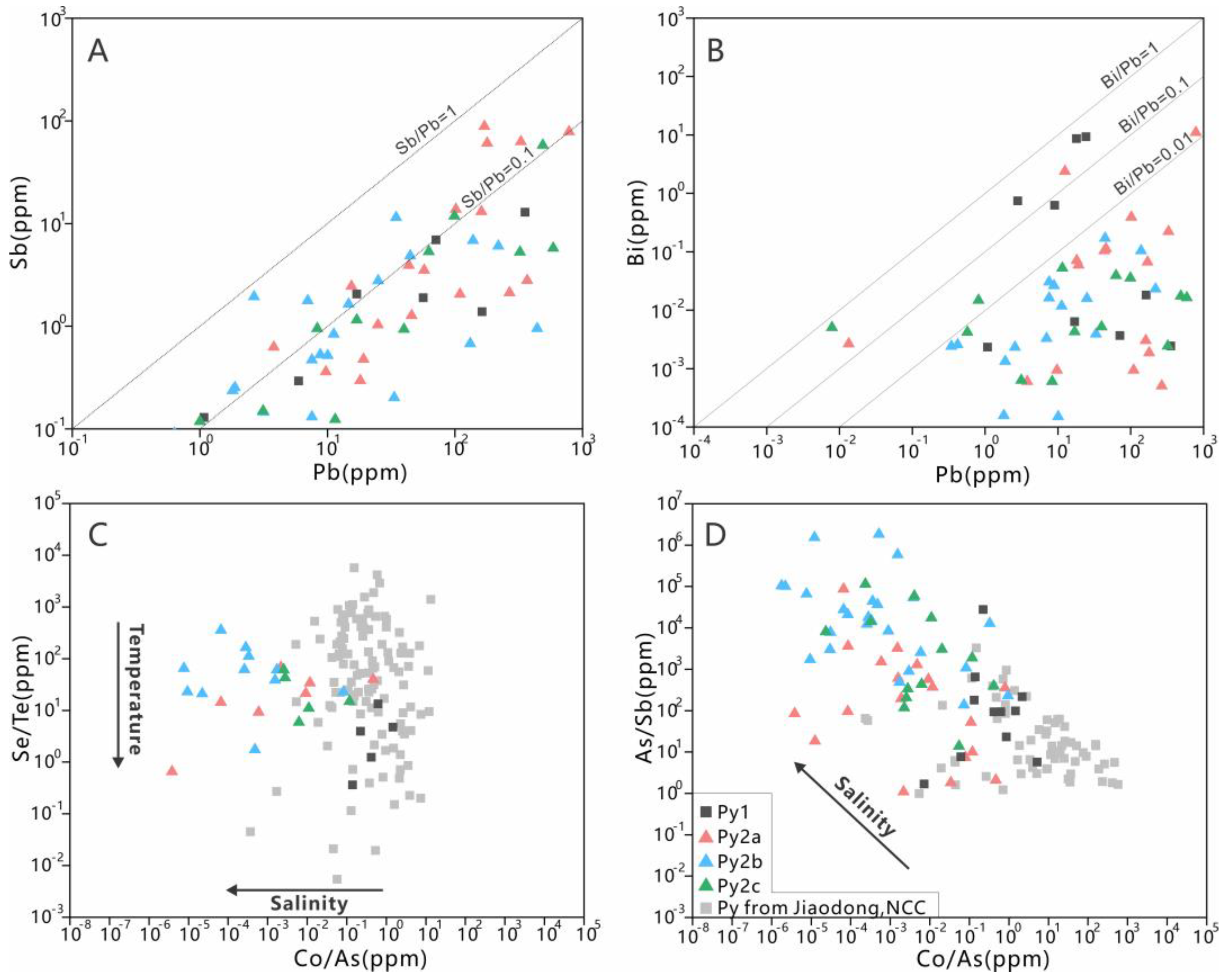
4.3. Trace Element Composition
4.4. Sulfur Isotope Composition
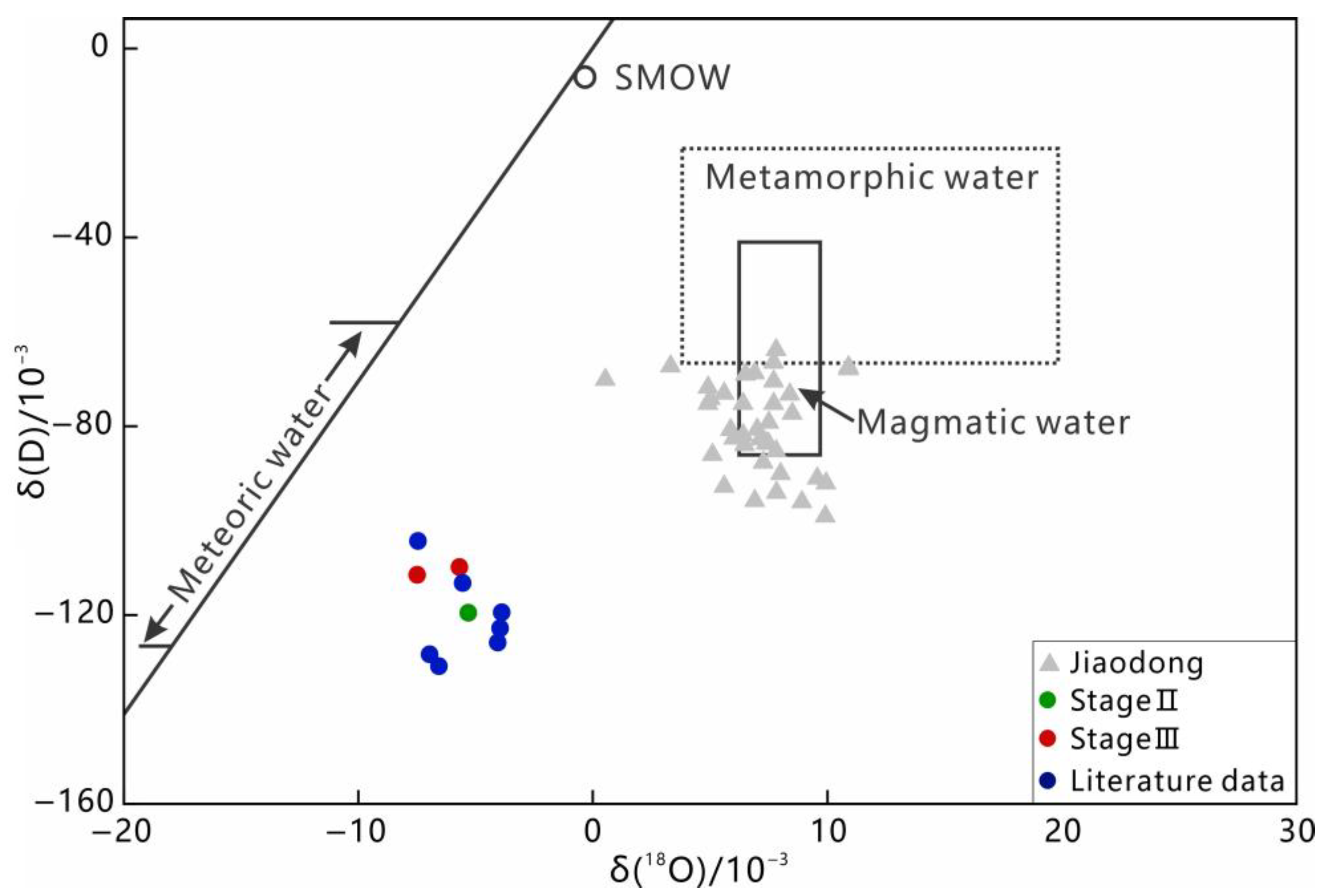
4.5. Hydrogen and Oxygen Isotope Composition
5. Discussion
5.1. Characteristics of Trace Element Composition in Pyrite
5.2. Sources of Metals and Fluids
5.3. Genesis of Ore Deposit
6. Conclusions
- (1)
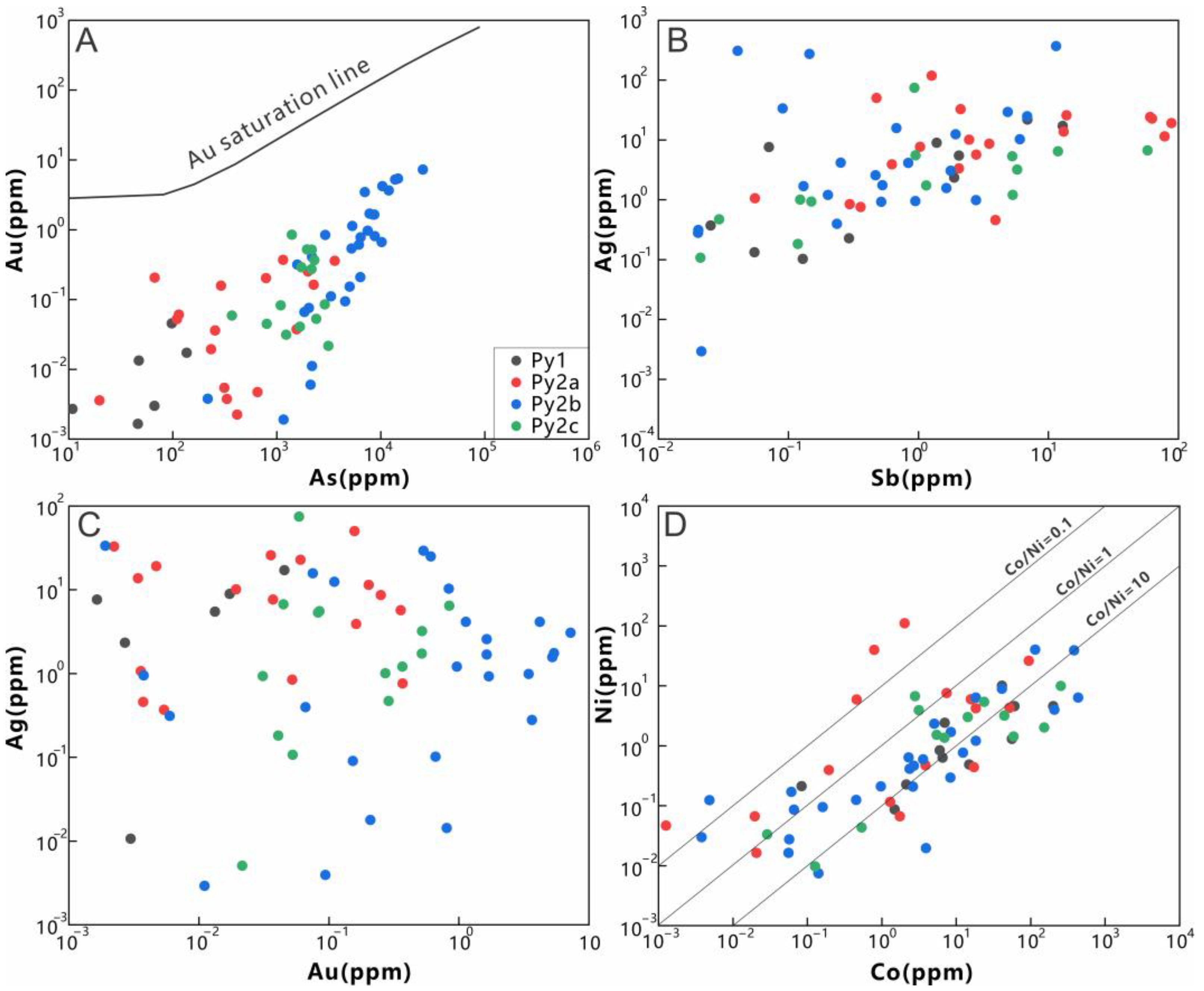
- Pyrite from the main mineralization stage of the Niujuan deposit contains low concentrations of invisible gold, with an average of 1.4 ppm, whereas silver contents are significantly higher, averaging 38 ppm. The combined effects of wall-rock sulfidation and fluid boiling are interpreted to have played a key role in promoting Au-Ag precipitation.
- (2)
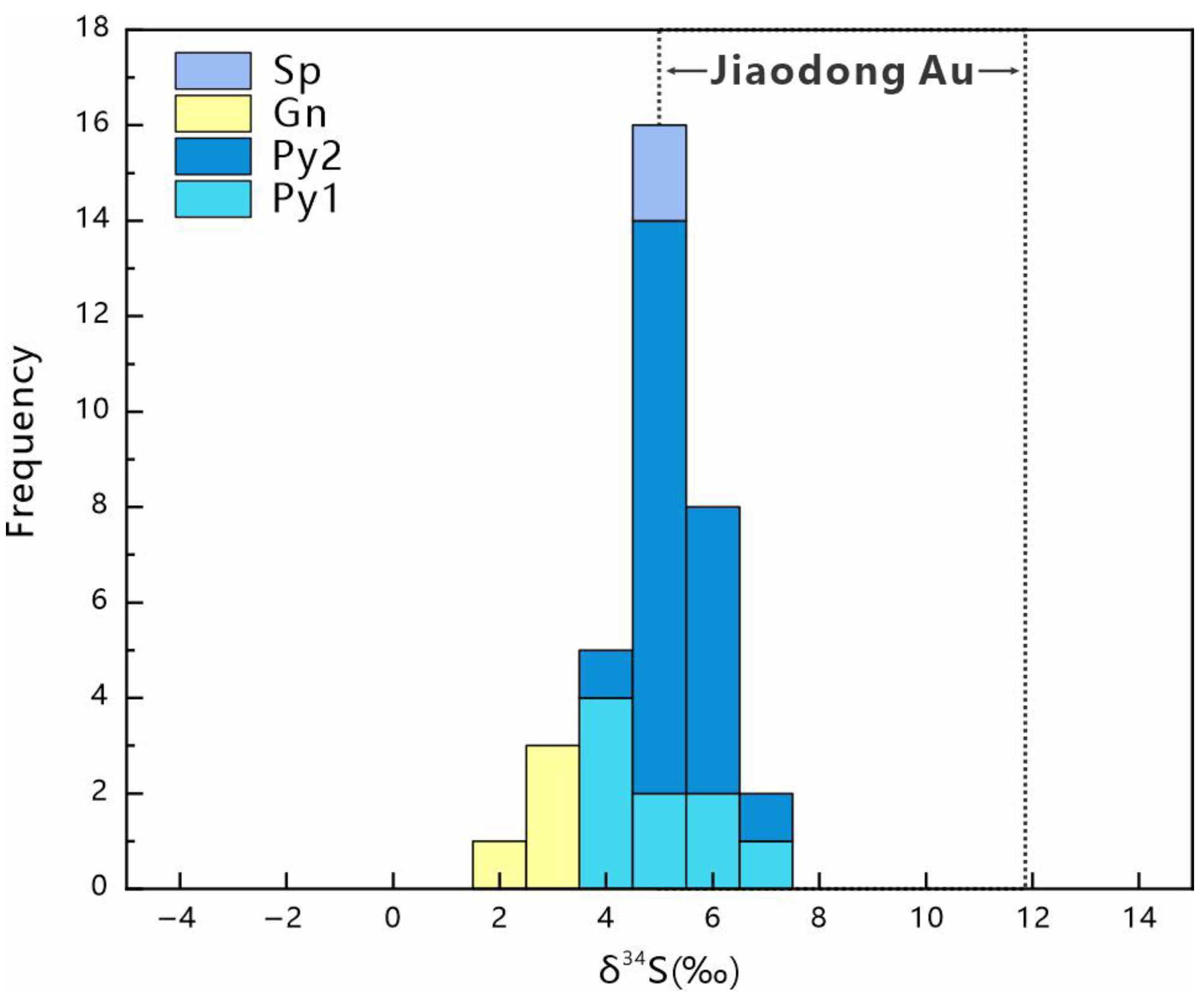
- The Ag-Au deposits in the northern North China Craton, exemplified by the Niujuan deposit, formed during the Yanshanian period in response to the rollback of the Paleo-Pacific plate. Mineralization is associated with magmatic–hydrothermal fluids with variable contributions from meteoric water. These deposits formed earlier than the Au-only deposits in Jiaodong Province, and differences in formation depth are inferred to have been a primary factor controlling the contrasting ore-forming fluid compositions.
Author Contributions
Funding
Data Availability Statement
Acknowledgments
Conflicts of Interest
References
- Zhai, M.G. Formation, Tectonic evolution and metallogenesis of North China Craton. Miner. Depos. Geol. 2010, 29, 24–36. [Google Scholar] [CrossRef]
- Qin, K.Z.; Han, R.; Hui, K.X.; Li, Z.; Kan, Q.; Wang, L.; Gao, S.; Zhao, J.X. Types, spatial-temporal distribution, and exploration potential of silver deposits in China. Acta Petrol. Sin. 2025, 41, 383–415. [Google Scholar] [CrossRef]
- Zhang, L.C.; Bai, Y.; Zhu, M.T.; Huang, K. Regional Differences of Au deposits on the North China Craton. Acta Geol. Geophys. Sin. 2018, 40, 363–380. [Google Scholar]
- Deng, J.; Wang, Q.; Zhang, L.; Xue, S.; Liu, X.; Yang, L.; Yang, L.; Qiu, K.; Liang, Y. Metallogenetic model of Jiaodong-type Au deposits, eastern China. Earth Sci. 2023, 66, 2287–2310. [Google Scholar] [CrossRef]
- Bao, Z.; Sun, W.; Li, C.; Zhao, Z. U-Pb dating of hydrothermal zircon from the Dongping gold deposit in North China: Constraints on the mineralization processes. Ore Geol. Rev. 2014, 61, 107–119. [Google Scholar] [CrossRef]
- Wang, D.Z.; Liu, J.; Zhai, D.G.; Zhen, S.M.; Wang, J. Study on molybdenite Re-Os and zircon U-Pb ages of the Dongping tellurium-gold deposit in Hebei Province. Front. Earth Sci. 2020, 27, 405–419. [Google Scholar] [CrossRef]
- Fan, G.H.; Li, J.W.; Deng, X.D.; Gao, W.S.; Li, S.Y. Age and origin of the Dongping Au-Te deposit in the North China Craton revisited: Evidence from paragenesis, geochemistry, and in situ U-Pb geochronology of garnet. Econ. Geol. 2021, 116, 963–985. [Google Scholar] [CrossRef]
- Mills, S.E.; Tomkins, A.G.; Weinberg, R.F.; Fan, H.R. Implications of pyrite geochemistry for gold mineralisation and remobilisation in the Jiaodong gold district, northeast China. Ore Geol. 2015, 71, 150–168. [Google Scholar] [CrossRef]
- Ye, T.; Li, N. The application of pyrite LA-ICP-MS trace element analysis to Au deposits. Geol. Sci. 2015, 50, 1178–1199. [Google Scholar]
- Yang, L.Q.; Deng, J.; Wang, Z.L.; Guo, L.N.; Li, R.H.; Groves, D.I.; Danyushevsky, L.V.; Zhang, C.; Zheng, X.L.; Zhao, H. Relationships between gold and pyrite at the Xincheng gold deposit, Jiaodong Peninsula, China: Implications for gold source and deposition in a brittle epizonal environment. Econ. Geol. 2016, 111, 105–126. [Google Scholar] [CrossRef]
- Fan, H.R.; Li, X.H.; Zuo, Y.B.; Chen, L.; Liu, S.; Hu, F.; Feng, K. In-situ LA-(MC)-ICPMS and (Nano) SIMS trace elements and sulfur isotope analyses on sulfides and application to confine metallogenic process of ore deposit. Acta Petrol. Sin. 2018, 34, 3479–3496. [Google Scholar]
- Zhang, H.Y.; Zhao, Q.; Zhao, G.; Hong, J.X.; Liu, J.; Zhai, D.G. In situ LA-ICP-MS trace element analysis of pyrite and its application in study of Au deposit. Miner. Depos. Geol. 2022, 41, 1182–1199. [Google Scholar] [CrossRef]
- Xiao, J.; Xie, Z.; Xia, Y.; Lan, T.; Zhang, L.; Pan, L.; Hu, H.; Wang, H.; Tan, Q.; Xu, Y. Predominant fracture gold in the Jiaodong gold province, China: Constraints on gold mineralization processes. Ore Geol. Rev. 2024, 165, 105915. [Google Scholar] [CrossRef]
- Fan, H.; Lan, T.; Li, X.; Santosh, M.; Yang, K.; Hu, F.; Feng, K.; Hu, H.; Peng, H.; Zhang, Y. Conditions and processes leading to large-scale gold deposition in the Jiaodong province, eastern China. Sci. China Earth Sci. 2021, 51, 1504–1523. [Google Scholar] [CrossRef]
- Li, X.H.; Fan, H.R.; Yang, K.F.; Hollings, P.; Liu, X.; Hu, F.F.; Cai, Y.C. Pyrite textures and compositions from the Zhuangzi Au deposit, southeastern North China Craton: Implication for ore-forming processes. Contrib. Mineral. Petrol. 2018, 173, 73. [Google Scholar] [CrossRef]
- Fan, H.R.; Xie, Y.H.; Wang, Y.L. The properties of magmatic hydrothermal fluid of huashan granitic batholith in western henan province and their relationship to gold mineralization. Acta Petrol. Sin. 1993, 9, 136–145. [Google Scholar]
- Fan, H.R.; Xie, Y.H.; Zheng, X.Z.; Wang, Y.L. Ore-forming fluids in hydrothermal breccia-related gold mineralization in Qiyugou, Henan Province. Acta Petrol. Sin. 2000, 16, 559–563. [Google Scholar]
- Fan, H.R.; Xie, Y.H.; Zhai, M.G.; Jin, C.W. A three stage fluid flow model for Xiaoqinling lode gold metallogenesis in the Henan and Shaanxi provinces, central China. Acta Petrol. Sin. 2003, 19, 260–266. [Google Scholar] [CrossRef]
- Mao, J.; He, Y.; Ding, T. Carbon, Mantle Fluids Involved in Metallogenesis of Jiaodong (East Shandong) Gold District: Evidence of C, O and H Isotopes. Miner. Depos. Geol. 2002, 21, 121–128. [Google Scholar] [CrossRef]
- Zhu, R.; Fan, H.; Li, J.; Meng, Q.; Li, S.; Zeng, Q. Decratonic Au deposits. Sci. China Earth Sci. 2015, 58, 1523–1537. [Google Scholar] [CrossRef]
- Li, J.W.; Bi, S.J.; Selby, D.; Chen, L.; Vasconcelos, P.; Thiede, D.; Zhou, M.F.; Zhao, X.F.; Li, Z.K.; Qiu, H.N. Giant Mesozoic gold provinces related to the destruction of the North China Craton. Earth Planet. Sci. Lett. 2012, 349, 26–37. [Google Scholar] [CrossRef]
- Chen, Y.J. Metallogenic time and tectonic setting of the Jiaodong gold province, eastern China. Acta Petrol. Sin. 2004, 20, 907–922. [Google Scholar]
- Chen, Y.J.; Tang, G.J.; Pirajno, F.; Qi, J.P.; Lin, Z.J. Hydrothermal metallogeny of the Shanggong gold deposit, east Qinling: Radiogenic isotope geochemistry. Miner. Rocks 2004, 24, 22–27. [Google Scholar] [CrossRef]
- Jiang, S.Y.; Dai, B.Z.; Jiang, Y.H.; Zhao, H.X.; Hou, M.L. Jiaodong and Xiaoqinling: Two orogenic gold provinces formed in different tectonic settings. Acta Petrol. Sin. 2009, 25, 2727–2738. [Google Scholar]
- Goldfarb, R.J.; Groves, D.I. Orogenic gold: Common or evolving fluid and metal sources through time. Lithos 2015, 233, 2–26. [Google Scholar] [CrossRef]
- Yan, X.; Chen, B.; Duan, X.; Wang, Z. Geochronology and ore genesis of the Niujuan-Yingfang Pb-Zn-Ag deposit in Fengning, Northern North China Craton: Constraints from fluid inclusions, HOS isotopes and fluorite Sr-Nd isotopes. J. Earth Sci. 2021, 32, 81–102. [Google Scholar] [CrossRef]
- Li, Y.J.; Li, S.R.; Santosh, M.; Mo, X.; Gao, K.B.; Ma, Y. Isotope geochemistry and geochronology of the Niujuan silver deposit, northern North China Craton: Implications for magmatism and metallogeny in an extensional tectonic setting. Ore Geol. Rev. 2017, 90, 36–51. [Google Scholar] [CrossRef]
- Zeng, Q.; Wang, Y.; Yang, J.; Guo, Y.; Yu, B.; Zhou, L.; Qiu, H. Spatial-temporal distribution and tectonic setting of gold deposits in the Northern margin gold belt of the North China Craton. Int. Geol. Rev. 2021, 63, 941–972. [Google Scholar] [CrossRef]
- Su, R.; Sun, G.S.; Du, M.Y. Geochemical characteristics of biotites from amphibolites in JianPing Group, south-eastern Chifeng and their geological implications. Glob. Geol. 2015, 34, 307–311. [Google Scholar]
- Dong, C.Y.; Wan, Y.S.; Zhang, Y.H.; Yang, Z.Q.; Liu, D.Y. 3.3-3.1 Ga magmatism recorded in an outcrop of the Dongshan Complex in the Anshan area, North China Craton: Evidence from geochemistry and SHRIMP zircon dating. Acta Petrol. Sin. 2013, 29, 414–420. [Google Scholar]
- Nie, F.J.; Jiang, S.H.; Su, X.X.; Wang, X.L. Geological features and origin of gold deposits occurring in the Baotou-Bayan Obo district, south-central Inner Mongolia, People’s Republic of China. Ore Geol. Rev. 2002, 20, 139–169. [Google Scholar] [CrossRef]
- Nie, F.J. Type and distribution of gold deposits along the northern margin of the North China Craton, People’s Republic of China. Int. Geol. Rev. 1997, 39, 151–180. [Google Scholar] [CrossRef]
- Gao, M.; Gao, F. Retrogressive Metamorphism of Archean Granulites and Evidence of Rb-Sr Isochron Age in Zhangjiakou and Xuanhua Regions. J. Hebei Coll. Geol. 1988, 11, 11–19. [Google Scholar]
- Wang, Q.C. On the age of Hongqiyingzi Group and geological thermal events in undergone. Sci. Geol. Sin. 1992, 1, 17–24. [Google Scholar]
- Zhai, M.G. 2.1~1.7 Ga geological event group and its geotectonic significance. Acta Petrol. Sin. 2004, 20, 1343–1354. [Google Scholar]
- Yan, X.; Chen, B.; Wang, Z.Q.; Duan, X. The Petrogenesis of the Two-Stage A-Type Granites from the Niujuan Silver Deposit in the Northern Margin of North China Craton and Their Tectonic Implications. Acta Petrol. Sin. 2019, 35, 558–588. [Google Scholar] [CrossRef]
- Li, Y.J.; Li, S.G.; Yuan, M.W. Thermophysical Characteristics of Pyrite in the Fengning Silver-Polymetallic Deposit, Hebei Province, and Their Indicative Significance; China Mining Association: Beijing, China, 2023. [Google Scholar] [CrossRef]
- Li, J.M.; Gong, E.P.; Yao, Y.Z.; Liang, J.H. The geological-geochemical characteristics and metallogeny of Fengning silver-polymetallic ore deposit, north Hebei province. Geol. Prospect. Forum 2006, 4, 241–247. [Google Scholar]
- Li, Y.J. Metallogenic Process and Potential of the Silver-Polymetallic System in Fengning, Northern Hebei Province: Constraint of Geochronology, Geochemistry and Genetic Mineralogy; China University of Geosciences: Beijing, China, 2020. [Google Scholar] [CrossRef]
- Gao, K.B. Characteristics of Hydrogen and Oxygen Isotopes, Fluid Inclusions and Fluid Evolution of the Fengning Ag(Au) Deposit, Hebei Province: Comparing with Decratonic Au Deposits; China University of Geosciences: Beijing, China, 2018. [Google Scholar]
- Liu, Y.S.; Hu, Z.C.; Gao, S.; Günther, D.; Xu, J.; Gao, C.; Chen, H. In situ analysis of major and trace elements of anhydrous minerals by LA-ICP-MS without applying an internal standard. Chem. Geol. 2008, 257, 34–43. [Google Scholar] [CrossRef]
- Crowe, D.E.; Vaughan, R.G. Characterization and use of isotopically homogeneous standards for in situ laser microprobe analysis of 34S/32S ratios. Am. Mineral. 1996, 81, 187–193. [Google Scholar] [CrossRef]
- Clayton, R.N.; Mayeda, T.K. The Use of Bromine Pentafluoride in the Extraction of Oxygen from Oxides and Silicates for Isotopic Analysis. Geochim. Cosmochim. Acta 1963, 27, 43–52. [Google Scholar] [CrossRef]
- Zhu, Q.; Cook, N.J.; Xie, G.; Ciobanu, C.L.; Jian, W.; Wade, B.P.; Xu, J. Gamma-enhancement of reflected light images: A rapid, effective tool for assessment of compositional heterogeneity in pyrite. Am. Mineral. 2021, 106, 497–505. [Google Scholar] [CrossRef]
- Li, S.-S.; Li, L.; Li, S.-R.; Santosh, M.; Alam, M. The Age and Mineralization Processes of Decratonic Lode Gold Deposits in the Southern North China Craton: Constraints from Trace Elements, in-situ S-Pb Isotopes and Rb-Sr Geochronology of Pyrite from the Chen’er Gold Deposit. Ore Geol. Rev. 2022, 145, 104888. [Google Scholar] [CrossRef]
- Tan, J.; Wei, J.; Li, Y.; Fu, L.; Li, H.; Shi, W.; Tian, N. Origin and Geodynamic Significance of Fault-Hosted Massive Sulfide Gold Deposits from the Guocheng-Liaoshang Metallogenic Belt, Eastern Jiaodong Peninsula: Rb-Sr Dating, and H-O-S-Pb Isotopic Constraints. Ore Geol. Rev. 2015, 65, 687–700. [Google Scholar] [CrossRef]
- Mills, S.E.; Tomkins, A.G.; Weinberg, R.F.; Fan, H.-R. Anomalously Silver-Rich Vein-Hosted Mineralisation in Disseminated-Style Gold Deposits, Jiaodong Gold District, China. Ore Geol. Rev. 2015, 68, 127–141. [Google Scholar] [CrossRef]
- Zhang, L.C.; Shen, Y.C.; Zou, W.L.; Li, H.M. Ore-Forming Geological and Geochemical Characteristics and Genesis of the Dazhuangzi Gold Deposit. Geol. Resour. 2002, 11, 16–22. [Google Scholar] [CrossRef]
- Ma, W.-D.; Fan, H.-R.; Liu, X.; Yang, K.-F.; Hu, F.-F.; Zhao, K.; Cai, Y.-C.; Hu, H.-L. Hydrothermal Fluid Evolution of the Jintingling Gold Deposit in the Jiaodong Peninsula, China: Constraints from U-Pb Age, CL Imaging, Fluid Inclusion and Stable Isotope. J. Asian Earth Sci. 2018, 160, 287–303. [Google Scholar] [CrossRef]
- Wang, C.M.; Deng, J.; Santosh, M.; Carranza, E.J.M. Timing, tectonic implications and genesis of gold mineralization in the Xincheng gold deposit, China: C-H-O isotopes, pyrite Rb-Sr and zircon fission track thermochronometry. Ore Geol. Rev. 2014, 65, 123–138. [Google Scholar] [CrossRef]
- Xue, J.L.; Li, S.R.; Pang, Z.S.; Tao, W.; Sun, W.Y.; Chen, H.; Zhang, Y.Q. Ore-Forming Fluids, Sources of Materials in the Denggezhuang Gold Deposit, Jiaodong Peninsula and Implications for Ore Genesis. Acta Petrol. Sin. 2018, 34, 1453–1468. [Google Scholar]
- Wang, Y.W. A study on hydrogen and oxygen isotope geochemistry of gold deposits in China. J. Precious Metall. Geol. 1993, 2, 169–180. [Google Scholar] [CrossRef]
- Bi, X.; Hu, R.Z.; Peng, J.T.; Li, H.L.; Hu, X.Y. REE and HFSE Geochemical Characteristics of Pyrites in Yao’an Gold Deposit: Tracing Ore Forming Fluid Signatures. Bull. Mineral. Petrol. Geochem. 2004, 23, 1–4. [Google Scholar] [CrossRef]
- Large, R.R.; Maslennikov, V.V.; Robert, F.; Danyushevsky, L.V.; Chang, Z. Multistage sedimentary and metamorphic origin of pyrite and gold in the giant Sukhoi Log deposit, Lena gold province, Russia. Econ. Geol. 2007, 102, 1233–1267. [Google Scholar] [CrossRef]
- Reich, M.; Deditius, A.; Chryssoulis, S.; Li, J.W.; Ma, C.Q.; Parada, M.A.; Barra, F.; Mittermayr, F. Pyrite as a record of hydrothermal fluid evolution in a porphyry copper system: A SIMS/EMPA trace element study. Geochim. Cosmochim. Acta 2013, 104, 42–62. [Google Scholar] [CrossRef]
- Reich, M.; Kesler, S.E.; Utsunomiya, S.; Palenik, C.S.; Chryssoulis, S.L.; Ewing, R.C. Solubility of gold in arsenian pyrite. Geochim. Cosmochim. Acta 2005, 69, 2781–2796. [Google Scholar] [CrossRef]
- Gregory, D.D.; Large, R.R.; Halpin, J.A.; Baturina, E.L.; Lyons, T.W.; Wu, S.; Danyushevsky, L.; Sack, P.J.; Chappaz, A.; Maslennikov, V.V.; et al. Trace Element Content of Sedimentary Pyrite in Black Shales. Econ. Geol. 2015, 110, 1389–1410. [Google Scholar] [CrossRef]
- Cook, N.; Ciobanu, C.L.; George, L.; Zhu, Z.Y.; Wade, B.; Ehrig, K. Trace Element Analysis of Minerals in Magmatic-Hydrothermal Ores by Laser Ablation Inductively-Coupled Plasma Mass Spectrometry: Approaches and Opportunities. Minerals 2016, 6, 111. [Google Scholar] [CrossRef]
- Zhu, Z.Y.; Cook, N.J.; Yang, T.; Ciobanu, C.L.; Zhao, K.D.; Jiang, S.Y. Mapping of sulfur isotopes and trace elements in sulfides by LA-(MC)-ICP-MS: Potential analytical problems, improvements and implications. Minerals 2016, 6, 110. [Google Scholar] [CrossRef]
- Liang, Q.L.; Xie, Z.; Song, X.Y.; Wirth, R.; Xia, Y.; Cline, J. Evolution of invisible Au in arsenian pyrite in Carlin-type Au deposits. Econ. Geol. 2021, 116, 515–526. [Google Scholar] [CrossRef]
- Li, W.; Cook, N.J.; Xie, G.Q.; Mao, J.W.; Ciobanu, C.L.; Li, J.W.; Zhang, Z.Y. Textures and trace element signatures of pyrite and arsenopyrite from the Gutaishan Au-Sb deposit, south China. Miner. Depos. 2019, 54, 591–610. [Google Scholar] [CrossRef]
- Loftus-Hills, G.D.; Solomon, M. Cobalt, Nickel and Selenium in Sulphides as Indicators of Ore Genesis. Miner. Depos. 1967, 2, 228–242. [Google Scholar] [CrossRef]
- Price, B.J. Phase Relations and Mineral Assemblages in the System Fe-Co-Ni-S. Can. Mineral. 1972, 11, 759–768. [Google Scholar]
- Bralia, A.; Sabatini, G.; Troja, F. A revaluation of the Co/Ni ratio in pyrite as geochemical tool in ore genesis problems. Miner. Depos. 1979, 14, 353–374. [Google Scholar] [CrossRef]
- Cao, G.S.; Zhang, Y.; Chen, H. Trace elements in pyrite from orogenic Au deposits: Implications for metallogenic mechanism. Acta Petrol. Sin. 2023, 39, 2330–2346. [Google Scholar] [CrossRef]
- Fleet, M.E.; Mumin, A.H. Gold-bearing arsenian pyrite and marcasite and arsenopyrite from Carlin Trend Au deposits and laboratory synthesis. Am. Mineral. 1997, 82, 182–193. [Google Scholar] [CrossRef]
- Deditius, A.P.; Reich, M.; Kesler, S.E.; Utsunomiya, S.; Chryssoulis, S.L.; Walshe, J.; Ewing, R.C. The coupled geochemistry of Au and As in pyrite from hydrothermal ore deposits. Geochim. Cosmochim. Acta 2014, 140, 644–670. [Google Scholar] [CrossRef]
- Wu, Y.F.; Fougerouse, D.; Evans, K.; Reddy, S.M.; Saxey, D.W.; Guagliardo, P.; Li, J.W. Gold, arsenic, and copper zoning in pyrite: A record of fluid chemistry and growth kinetics. Geology 2019, 47, 641–644. [Google Scholar] [CrossRef]
- Xie, Z.; Xia, Y.; Cline, J.S.; Pribil, M.J.; Koenig, A.; Tan, Q.; Wei, D.; Wang, Z.; Yan, J. Magmatic origin for sediment-hosted Au deposits, Guizhou Province, China: In situ chemistry and sulfur isotope composition of pyrites, Shuiyindong and Jinfeng deposits. Econ. Geol. 2018, 113, 1627–1652. [Google Scholar] [CrossRef]
- Hofstra, A.H.; Cline, J.S. Characteristics and models for Carlin type Au deposits. Rev. Econ. Geol. 2000, 13, 163–220. [Google Scholar] [CrossRef]
- Cook, N.J.; Ciobanu, C.L.; Meria, D.; Silcock, D.; Wade, B. Arsenopyrite-pyrite association in an orogenic goldore: Tracing mineralization history from textures and trace elements. Econ. Geol. 2013, 108, 1273–1283. [Google Scholar] [CrossRef]
- Large, R.R.; Danyushevsky, L.; Hollit, C.; Maslennikov, V.; Meffre, S.; Gilbert, S.; Bull, S.; Scott, R.; Emsbo, P.; Thomas, H.; et al. Gold and trace element zonation in pyrite using a laser imaging technique: Implications for the timing of gold in orogenic and Carlin-style sediment-hosted deposits. Econ. Geol. 2009, 104, 635–668. [Google Scholar] [CrossRef]
- Gopon, P.; Douglas, J.O.; Auger, M.A.; Hansen, L.; Wade, J.; Cline, J.S.; Robb, L.J.; Moody, M.P. A nanoscale investigation of Carlin-type Au deposits: An atom-scale elemental and isotopic perspective. Econ. Geol. 2019, 114, 1123–1133. [Google Scholar] [CrossRef]
- Li, W.; Cook, N.J.; Xie, G.Q.; Mao, J.W.; Ciobanu, C.L.; Fu, B. Complementary textural, trace element and isotope analysis of sulfides constrain ore-forming processes for the slate-hosted Yuhengtang Au deposit, South China. Econ. Geol. 2021, 116, 1825–1848. [Google Scholar] [CrossRef]
- Chang, Z.; Large, R.R.; Maslennikov, V. Sulfur isotopes in sediment-hosted orogenic Au deposits: Evidence for an early timing and a seawater sulfur source. Geology 2008, 36, 971–974. [Google Scholar] [CrossRef]
- Meffre, S.; Large, R.R.; Scott, R.; Woodhead, J.; Chang, Z.; Gilbert, S.E.; Danyushevsky, L.V.; Maslennikov, V.; Hergt, J.M. Age and pyrite Pb-isotopic composition of the giant Sukhoi Log sediment-hosted gold deposit, Russia. Geochim. Cosmochim. Acta 2008, 72, 2377–2391. [Google Scholar] [CrossRef]
- Ohmoto, H. Stable isotope geochemistry of ore deposits: Reviews in Mineralogy and Geochemistry. Rev. Mineral. 1986, 16, 491–559. [Google Scholar]
- Seal, R.R. Sulfur isotope geochemistry of sulfide minerals. Rev. Mineral. Geochem. 2006, 61, 633–677. [Google Scholar] [CrossRef]
- Phillips, G.N.; Powell, R. Formation of Au deposits: A metamorphic devolatilization model. J. Metamorph. Geol. 2010, 28, 689–718. [Google Scholar] [CrossRef]
- Hu, H.L.; Fan, H.R.; Santosh, M.; Liu, X.; Cai, Y.C.; Yang, K.F. Ore-forming processes in the Wang’ershan gold deposit (Jiaodong, China): Insight from microtexture, mineral chemistry and sulfur isotope compositions. Ore Geol. Rev. 2020, 123, 103600. [Google Scholar] [CrossRef]
- Li, L.; Santosh, M.; Li, S.-R. The “Jiaodong Type” Gold Deposits: Characteristics, Origin and Prospecting. Ore Geol. Rev. 2015, 65, 589–611. [Google Scholar] [CrossRef]
- Liu, F.S.; Zhang, G.H. Genesis of the Niuquan Hot-Spring Type Ag-(Au) Deposit in Hebei Province. J. Precious Met. Geol. 1996, 5, 48–58. [Google Scholar]
- Chen, W.J.; Liu, H.T.; Zhang, D.H. Fluid inclusion’s characteristics of the Niujuan silve deposit in Fengning, Hebei, and its geological significance. Miner. Resour. Geol. 2007, 21, 12–16. [Google Scholar] [CrossRef]
- Xiao, T.T. The Sources of Ore-Forming Materials for Gold Deposits in the Northern Margin of the North China Craton: Constraints from Hg-S Isotopes and Pyrite Trace Elements; Jilin University: Changchun, China, 2024. [Google Scholar] [CrossRef]
- Mao, J.; Liu, P.; Goldfarb, R.J.; Goryachev, N.A.; Pirajno, F.; Zheng, W.; Zhou, M.; Zhao, C.; Xie, G.; Yuan, S.; et al. Cretaceous large-scale metal accumulation triggered by post-subductional large-scale extension, East Asia. Ore Geol. Rev. 2021, 136, 104270. [Google Scholar] [CrossRef]
- Wang, S.Q.; Liu, X.W. Geological characteristics and ore-controlling significance of the cryptoexploed breccia in Niujuan silver deposit Hebei Province. Geol. Prospect. Forum 2009, 24, 139–141. [Google Scholar] [CrossRef]
- Fan, L. Geological characteristics and ore-controlling factors of Niujuanzi silver-gold deposit in Fengning County, Hebei. Miner. Resour. Geol. 2021, 35, 50–57. [Google Scholar] [CrossRef]
- Seward, T.M. Thio complexes of gold and the transport of gold in hydrothermal ore solutions. Geochim. Cosmochim. Acta 1973, 37, 379–399. [Google Scholar] [CrossRef]
- Stefánsson, A.; Seward, T.M. Experimental determination of the stability and stoichiometry of sulphide complexes of silver (I) in hydrothermal solutions to 400 °C. Geochim. Cosmochim. Acta 2003, 67, 1395–1413. [Google Scholar] [CrossRef]
- Román, N.; Reich, M.; Leisen, M.; Morata, D.; Barra, F.; Deditius, A.P. Geochemical and Micro-Textural Fingerprints of Boiling in Pyrite. Geochim. Cosmochim. Acta 2019, 246, 60–85. [Google Scholar] [CrossRef]
- Keith, M.; Haase, K.M.; Chivas, A.R.; Klemd, R. Phase Separation and Fluid Mixing Revealed by Trace Element Signatures in Pyrite from Porphyry Systems. Geochim. Cosmochim. Acta 2022, 329, 185–205. [Google Scholar] [CrossRef]





| Sample | Elevation | Sample Details |
|---|---|---|
| 7609-690.2 | +555 m | Galena-pyrite veins |
| 7610-695.6 | +549 m | Galena-sphalerite-pyrite veins |
| 7611-780.65 | +441 m | Colloidal sphalerite within green fluorite |
| 7613-572.1 | +683 m | Galena-pyrite vein cutting through quartz-pyrite vein |
| 7614-1066 | +1066 m | Quartz-pyrite stockworks |
| NJ1-4 | +1065 m | Banded siliceous veins |
| NJ2-4 | +1065 m | Breccia type ore |
| NJ2-6 | +1065 m | Galena-pyrite veins cutting through granite breccia |
| NJ6-14 | +1150 m | Polymetallic sulfide veins cutting siliceous breccia |
| N6-21 | +1150 m | Electrum-bearing ore |
| NJ6-13 | +1150 m | Disseminated pyrite-bearing ore |
| ZK74-8-966.8 | +233 m | Quartz-galena-pyrite vein-type ore |
| QZ604851-77.06 | +982 m | Quartz-galena-sphalerite vein-type ore |
| Sample No. | Type | Mn ppm | Co ppm | Ni ppm | Cu ppm | Zn ppm | As ppm | Ag ppm | Sb ppm | Au ppm | Pb ppm |
|---|---|---|---|---|---|---|---|---|---|---|---|
| 7609-646.1-24 | Py1 | 106.5 | 41.1 | 10.1 | 3.1 | 0.4 | 47.3 | 5.5 | 2.1 | 0.0 | 17.0 |
| 7610-692.4-8 | Py1 | 50.8 | 0.1 | 0.2 | 2.7 | 2.5 | 11.7 | 21.8 | 6.9 | 0.0 | 71.0 |
| 7610-692.4-9 | Py1 | 0.6 | 60.7 | 4.6 | 0.1 | 0.4 | 28.2 | 0.1 | 0.1 | 0.0 | 1.1 |
| 7611-780.65-7 | Py1 | 61.4 | 201.6 | 4.6 | 309.5 | 23.4 | 136.4 | 8.9 | 1.4 | 0.0 | 163.2 |
| 7613-590.8-13 | Py1 | 13.6 | 7.0 | 2.4 | 0.4 | 2.1 | 52.2 | 0.2 | 0.3 | 0.0 | 6.0 |
| 7613-572.1-2 | Py1 | 6.4 | 56.0 | 1.3 | 3.4 | 1.2 | 10.9 | 2.3 | 1.9 | 0.0 | 56.5 |
| 7613-572.1-3 | Py1 | 9.5 | 6.0 | 0.8 | 218.0 | 9.4 | 98.1 | 17.1 | 12.9 | 0.0 | 355.4 |
| 7614-1066-7 | Py1 | 0.3 | 14.9 | 0.5 | 0.2 | 0.6 | 66.6 | 0.0 | 0.0 | 0.0 | 9.0 |
| 7614-1066-8 | Py1 | 3.1 | 2.1 | 0.2 | 0.8 | 0.4 | 5.1 | 0.1 | 0.1 | 0.0 | 18.0 |
| 7614-1066-9 | Py1 | 1.9 | 1.5 | 0.1 | 0.9 | 0.9 | 2.4 | 0.4 | 0.0 | 0.0 | 2.8 |
| 7614-1063-10 | Py1 | 0.1 | 6.6 | 0.6 | 4.1 | 1.2 | 46.3 | 7.6 | 0.1 | 0.0 | 24.3 |
| 7609-377.2-18 | Py2a | 0.2 | 0.5 | 5.9 | 2.6 | 0.4 | 291.4 | 50.2 | 0.5 | 0.2 | 19.2 |
| 7609-377.2-19 | Py2a | 8.4 | 7.4 | 7.6 | 29.2 | 1.2 | 67.0 | 118.4 | 1.3 | 0.2 | 45.7 |
| 7609-673.3-6 | Py2a | 0.1 | 0.0 | 0.0 | 1.1 | 0.0 | 332.9 | 0.5 | 3.9 | 0.0 | 43.6 |
| 7609-673.3-7 | Py2a | 1.1 | 3.9 | 0.5 | 36.4 | 11.8 | 114.5 | 22.7 | 62.8 | 0.1 | 329.1 |
| 7611-832.55-1 | Py2a | 0.2 | 15.7 | 5.9 | 75.8 | 4.2 | 19.8 | 1.1 | 0.1 | 0.0 | 12.5 |
| 7611-832.55-3 | Py2a | 52.7 | 94.2 | 26.2 | 54.7 | 15.5 | 791.8 | 11.4 | 78.5 | 0.2 | 785.4 |
| NJ6-28-10 | Py2a | 5.3 | 0.9 | 0.0 | 1.4 | 54.0 | 1553.3 | 7.6 | 1.0 | 0.0 | 24.9 |
| NJ6-28-13 | Py2a | 0.2 | 0.0 | 0.1 | 1.2 | 0.6 | 233.7 | 10.1 | 2.5 | 0.0 | 15.4 |
| NJ2-4-14 | Py2a | 0.2 | 1.3 | 0.1 | 0.4 | 0.4 | 110.2 | 0.8 | 0.3 | 0.1 | 18.1 |
| NJ2-6-51-10 | Py2a | 458.7 | 18.4 | 4.2 | 5.3 | 1.6 | 1997.1 | 8.6 | 3.5 | 0.3 | 57.3 |
| NJ4-1-54-13 | Py2a | 0.2 | 0.0 | 0.0 | 4.3 | 0.2 | 255.9 | 25.8 | 13.8 | 0.0 | 101.8 |
| NJ6-21-2 | Py2a | 0.1 | 0.0 | 0.0 | 0.1 | 0.2 | 314.5 | 0.4 | 0.0 | 0.0 | 0.0 |
| 7609.662.7-1 | Py2a | 285.3 | 0.1 | 0.0 | 39.1 | 0.6 | 66.9 | 24.2 | 60.8 | 0.0 | 179.0 |
| 7610-695.5-2 | Py2a | 1.0 | 0.0 | 0.0 | 6.5 | 0.4 | 0.8 | 13.7 | 13.1 | 0.0 | 160.8 |
| 7611-708.45-10 | Py2a | 1.2 | 0.8 | 39.8 | 1.3 | 1522.9 | 416.4 | 32.8 | 2.1 | 0.0 | 267.5 |
| 7611-708.45-11 | Py2a | 3.4 | 2.0 | 110.0 | 0.7 | 2683.2 | 4.3 | 3.3 | 2.1 | 0.0 | 109.4 |
| 7609-646.1-26 | Py2a | 53.2 | 0.2 | 0.4 | 1.3 | 231.9 | 2272.4 | 3.9 | 0.6 | 0.2 | 3.8 |
| 7609.662.7-2 | Py2a | 185.7 | 52.2 | 4.3 | 41.0 | 0.8 | 654.3 | 19.1 | 88.4 | 0.0 | 170.0 |
| 7609.662.7-3 | Py2a | 62.1 | 1.7 | 0.1 | 1.0 | 0.7 | 1154.1 | 0.8 | 0.4 | 0.4 | 9.7 |
| NJ2-6-51-8 | Py2a | 419.2 | 17.3 | 0.4 | 5.3 | 2.9 | 3613.1 | 5.7 | 2.8 | 0.4 | 368.5 |
| 7609-377.2-17 | Py2b | 0.3 | 18.3 | 1.2 | 45.1 | 0.5 | 6176.1 | 25.0 | 6.9 | 0.6 | 138.4 |
| 7609-646.1-25 | Py2b | 43.6 | 0.1 | 0.2 | 0.7 | 1.4 | 2045.0 | 15.7 | 0.7 | 0.1 | 131.6 |
| 7609-646.1-27 | Py2b | 9.5 | 0.1 | 0.0 | 0.3 | 0.1 | 1851.8 | 0.4 | 0.2 | 0.1 | 1.8 |
| 7609-690.4-5 | Py2b | 0.2 | 207.9 | 4.0 | 0.4 | 0.0 | 217.4 | 0.9 | 0.9 | 0.0 | 441.4 |
| 7610-675.2-7 | Py2b | 0.3 | 382.4 | 39.2 | 0.5 | 27.0 | 1165.6 | 33.5 | 0.1 | 0.0 | 0.6 |
| 7610-675.2-8 | Py2b | 97.2 | 115.5 | 40.1 | 6.4 | 0.1 | 1577.0 | 370.3 | 11.5 | 0.3 | 34.5 |
| 7611-780.65-8 | Py2b | 0.1 | 41.1 | 8.9 | 9.5 | 0.3 | 7043.5 | 1.0 | 2.8 | 3.4 | 25.1 |
| NJ1-4-49-13 | Py2b | 0.3 | 2.4 | 0.4 | 8.7 | 4.2 | 8410.8 | 2.6 | 0.5 | 1.6 | 7.6 |
| NJ1-4-49-14 | Py2b | 0.2 | 1.0 | 0.2 | 27.3 | 0.3 | 14,686.8 | 1.8 | 0.5 | 5.4 | 8.8 |
| NJ1-4-49-15 | Py2b | 0.2 | 2.7 | 0.5 | 16.9 | 0.1 | 10,358.1 | 4.1 | 0.8 | 4.2 | 11.2 |
| NJ1-4-49-16 | Py2b | 0.1 | 8.5 | 1.7 | 13.0 | 0.4 | 25,455.8 | 3.1 | 1.8 | 7.3 | 7.0 |
| NJ1-4-49-17 | Py2b | 13.2 | 5.1 | 2.3 | 4.6 | 414.1 | 2937.8 | 10.3 | 6.0 | 0.8 | 219.0 |
| NJ2-6-51-9 | Py2b | 17.4 | 12.4 | 0.8 | 12.0 | 3.2 | 13,805.1 | 1.6 | 1.6 | 5.2 | 14.7 |
| NJ2-8-1 | Py2b | 11.4 | 2.6 | 0.2 | 11.4 | 6.3 | 7817.6 | 0.9 | 0.5 | 1.7 | 10.1 |
| NJ2-8-5 | Py2b | 4.0 | 3.6 | 0.6 | 5.7 | 0.4 | 7481.3 | 1.2 | 0.2 | 1.0 | 33.4 |
| NJ6-28-11 | Py2b | 0.1 | 0.2 | 0.1 | 1.2 | 0.4 | 5039.6 | 0.1 | 0.0 | 0.2 | 0.0 |
| NJ6-28-12 | Py2b | 0.7 | 0.0 | 0.0 | 1.2 | 5.2 | 3326.9 | 12.5 | 1.9 | 0.1 | 2.7 |
| NJ2-4-15 | Py2b | 0.1 | 18.4 | 6.4 | 16.1 | 0.4 | 11,944.7 | 0.3 | 0.0 | 3.6 | 0.4 |
| NJ4-4-56-2 | Py2b | 0.1 | 3.9 | 0.0 | 3.7 | 0.0 | 10,223.5 | 0.1 | 0.0 | 0.7 | 0.2 |
| NJ4-4-56-3 | Py2b | 0.2 | 2.3 | 0.6 | 7.2 | 4.2 | 6418.8 | 274.0 | 0.1 | 0.8 | 3.2 |
| NJ4-4-56-4 | Py2b | 0.4 | 8.4 | 0.3 | 7.0 | 18.6 | 2186.9 | 309.5 | 0.0 | 0.4 | 2.6 |
| NJ4-1-54-11 | Py2b | 0.2 | 0.1 | 0.1 | 5.6 | 0.5 | 8692.2 | 1.7 | 0.1 | 1.6 | 7.6 |
| NJ6-21-1 | Py2b | 2.0 | 0.5 | 0.1 | 5.0 | 0.2 | 5338.1 | 4.1 | 0.3 | 1.1 | 1.9 |
| 7609-377.2-22 | Py2b | 2.7 | 434.2 | 6.4 | 55.0 | 19.0 | 5258.3 | 29.2 | 4.9 | 0.5 | 44.6 |
| NJ4-8-58-6 | Py2b | 0.1 | 4.6 | 0.0 | 1.7 | 0.5 | 8770.4 | 0.0 | 0.0 | 0.8 | 0.1 |
| NJ4-8-58-7 | Py2b | 0.0 | 0.1 | 0.0 | 1.4 | 0.0 | 6360.6 | 0.0 | 0.0 | 0.2 | 0.0 |
| NJ4-8-58-8 | Py2b | 0.0 | 0.0 | 0.1 | 0.7 | 0.2 | 2186.3 | 0.0 | 0.0 | 0.0 | 0.0 |
| NJ4-8-58-9 | Py2b | 0.0 | 0.1 | 0.0 | 0.5 | 0.5 | 4555.6 | 0.0 | 0.0 | 0.1 | 0.0 |
| NJ2-8-2 | Py2b | 0.2 | 0.0 | 0.0 | 0.1 | 0.4 | 2120.6 | 0.3 | 0.0 | 0.0 | 0.3 |
| NJ1-4-49-12 | Py2c | 2.1 | 23.8 | 5.4 | 7.5 | 0.5 | 2166.3 | 1.0 | 0.1 | 0.3 | 11.5 |
| NJ1-4-49-18 | Py2c | 51.7 | 44.2 | 3.2 | 6.1 | 16.5 | 801.2 | 6.7 | 58.1 | 0.0 | 488.6 |
| NJ6-14-66-5 | Py2c | 2.5 | 0.5 | 0.0 | 0.3 | 0.5 | 1675.4 | 0.2 | 0.1 | 0.0 | 1.0 |
| NJ6-14-66-6 | Py2c | 2.5 | 152.5 | 2.0 | 4.5 | 17.3 | 370.3 | 74.4 | 0.9 | 0.1 | 39.8 |
| NJ6-14-66-7 | Py2c | 0.3 | 58.8 | 1.4 | 2.9 | 0.7 | 2906.6 | 5.5 | 1.0 | 0.1 | 8.3 |
| NJ2-8-3 | Py2c | 0.4 | 0.6 | 0.0 | 1.1 | 3.7 | 2404.7 | 0.1 | 0.0 | 0.1 | 0.6 |
| NJ2-8-4 | Py2c | 131.4 | 0.0 | 0.0 | 0.5 | 0.3 | 1230.3 | 0.9 | 0.2 | 0.0 | 3.1 |
| NJ4-1-54-12 | Py2c | 0.0 | 7.0 | 1.4 | 1.0 | 0.0 | 1724.0 | 0.5 | 0.0 | 0.3 | 0.8 |
| 7611-780.65-9 | Py2c | 0.3 | 0.1 | 0.0 | 0.2 | 0.3 | 3137.6 | 0.0 | 0.0 | 0.0 | 0.0 |
| 7611-780.65-10 | Py2c | 0.2 | 14.3 | 3.0 | 3.4 | 0.4 | 2306.0 | 1.2 | 5.3 | 0.4 | 62.6 |
| 7610-730.4-5 | Py2c | 5.6 | 3.1 | 3.9 | 211.8 | 205.7 | 1399.4 | 6.4 | 11.8 | 0.8 | 99.2 |
| 7613-572.1-4 | Py2c | 28.8 | 5.4 | 1.5 | 15.9 | 1.6 | 1961.7 | 3.2 | 5.8 | 0.5 | 590.1 |
| 7613-572.1-5 | Py2c | 39.8 | 255.2 | 9.9 | 5.2 | 0.5 | 2171.2 | 1.7 | 1.2 | 0.5 | 17.0 |
| 7613-572.1-6 | Py2c | 10.3 | 2.8 | 6.7 | 70.0 | 5.7 | 1095.0 | 5.3 | 5.3 | 0.1 | 322.8 |
| Deposit | Sample | Mineral | δ34S | Data Soure | Deposit | Sample | Mineral | δ34S | Data Soure |
|---|---|---|---|---|---|---|---|---|---|
| Niujuan | 7609-646.1-1 | Py1 | 3.8 | Jiaodong | 20XC02-2 | pyrite | 5.2 | [15] | |
| 7609-646.1-2 | Py1 | 4.1 | 20XC02-3 | pyrite | 5.1 | ||||
| 7610-695.6-1 | Py1 | 5.9 | 20XC02-4 | pyrite | 5.4 | ||||
| 7610-695.6-2 | Py1 | 3.9 | 20XC02-4 | pyrite | 5.4 | ||||
| 7613-590.8-1 | Py1 | 4.1 | 20XC02-5 | pyrite | 5.0 | ||||
| 7613-590.8-2 | Py1 | 4.9 | 20QJ34-20 | pyrite | 7.0 | ||||
| 7614-1066-1 | Py1 | 6.1 | 20QJ34-21 | pyrite | 6.4 | ||||
| 7614-1066-2 | Py1 | 6.7 | 20QJ34-22 | pyrite | 5.2 | ||||
| NJ2-4-1 | Py2a | 5.1 | C800-6/2 | pyrite | 5.1 | [45] | |||
| NJ1-4-1 | Py2b | 6.4 | C800-6/3 | pyrite | 5.2 | ||||
| NJ1-4-2 | Py2b | 5.1 | LK10 | pyrite | 9.7 | [46] | |||
| NJ1-4-3 | Py2b | 5.5 | LK12 | pyrite | 9.5 | ||||
| NJ2-4-4 | Py2b | 6.0 | LK14 | pyrite | 9.3 | ||||
| NJ4-4-1 | Py2b | 5.2 | LK15 | pyrite | 9.7 | ||||
| NJ4-4-2 | Py2b | 5.0 | TK1 | pyrrhotite | 9.7 | ||||
| 7609-646.1-1 | Py2c | 6.0 | TK4 | pyrrhotite | 10.6 | ||||
| 7609-646.1-2 | Py2c | 4.7 | K2 | pyrite | 8.5 | ||||
| 7609-646.1-3 | Py2c | 5.8 | K3 | pyrite | 9.1 | ||||
| 7609-673.3-1 | Py2c | 4.3 | 141 | pyrite | 10.7 | [47] | |||
| 7609-673.3-2 | Py2c | 5.0 | 432 | pyrite | 11.7 | ||||
| 7611-708.45-1 | Py2c | 6.2 | 494 | pyrite | 11.3 | ||||
| 7611-708.45-2 | Py2c | 6.6 | 102 | pyrite | 8.5 | ||||
| 7611-780.65-1 | Py2c | 4.8 | 111 | pyrite | 8.7 | ||||
| 7611-780.65-2 | Py2c | 5.0 | 431 | pyrite | 10.6 | ||||
| 7611-780.65-3 | Py2c | 5.0 | 517 | pyrite | 8.8 | ||||
| NJ1-4-4 | Py2c | 5.4 | 782 | pyrite | 11.0 | ||||
| NJ1-4-5 | Py2c | 5.3 | 501 | pyrite | 10.3 | ||||
| NJ6-14-1 | Py2c | 4.7 | 503 | pyrite | 11.8 | ||||
| NJ6-14-2 | Py2c | 5.2 | 505 | pyrite | 10.5 | ||||
| NJ-11 | Pyrite | 4.2 | [26] | 506 | pyrite | 11.2 | |||
| NJ-69 | Pyrite | 5.7 | TW-1 | pyrite | 11.2 | [48] | |||
| NJ-71-1 | Pyrite | 5.6 | TW-2 | pyrite | 10.5 | ||||
| NJ-72 | Pyrite | 4.4 | X-11 | Galena | 9.1 | ||||
| NJ-73 | Pyrite | 4.0 | DZ-013 | pyrite | 10.5 | ||||
| NJ-71-2 | Galena | 2.5 | DZ-015 | pyrite | 11.5 | ||||
| NJ-74 | Galena | 3.1 | 15JT-10-1 | pyrite | 5.5 | [49] | |||
| 5-73-5 | Galena | 2.4 | [27] | 15JT-07-1 | pyrite | 5.7 | |||
| 5-73-5 | Sphalerite | 5.2 | 15JT07-2 | pyrite | 5.6 | ||||
| 5-73-4 | Sphalerite | 5.3 | 15JT-O5 | pyrite | 6.1 | ||||
| 5-73-4 | Galena | 3.1 | 15JT-21 | pyrite | 5.9 | ||||
| 1-73-5 | Pyrite | 2.6 | 15JT-25 | pyrite | 6.0 | ||||
| 1-77-6 | Pyrite | 3.6 | 15JT-27 | pyrite | 5.5 | ||||
| 5-71-3 | Pyrite | 4.7 |
| Deposit | Mineral | Stage | d18OV-SMOW‰ | T (°C) | d18Ofluid (‰) | δDfluid (‰) | Data Soure |
|---|---|---|---|---|---|---|---|
| Niujuan | Quartz | II | 2.7 | 270 | −5.3 | −119.5 | This Study |
| Quartz | III | 3.3 | 250 | −5.7 | −109.8 | ||
| Quartz | III | 1.5 | 250 | −7.5 | −111.5 | ||
| Quartz | 5.3 | −2.8 | - | [26] | |||
| Quartz | 4.0 | −4.1 | −125.8 | ||||
| Quartz | 1.5 | −6.6 | −130.8 | ||||
| Quartz | 4.1 | −4.0 | −122.8 | ||||
| Quartz | 1.1 | −7.0 | −128.3 | ||||
| Quartz | 3.0 | −3.9 | −119.4 | [27] | |||
| Quartz | 2.5 | −5.6 | −113.2 | ||||
| Quartz | 0.6 | −7.5 | −104.3 | ||||
| Jiaodong | Quartz | 10.2 | 7.8 | −63.8 | [18] | ||
| Quartz | 13.0 | 10.9 | −67.8 | ||||
| Quartz | 13.4 | 10.9 | −67.4 | ||||
| Quartz | 13.7 | 8.5 | −77.2 | ||||
| Quartz | 13.4 | 7.5 | −79.1 | ||||
| Quartz | 13.2 | 7.7 | −66.4 | ||||
| Quartz | 12.8 | 7.7 | −70.4 | ||||
| Quartz | 13.1 | 7.0 | −80.6 | ||||
| Quartz | 12.3 | 7.8 | −94.0 | [50] | |||
| Quartz | 12.0 | 8.0 | −90.0 | ||||
| Quartz | 13.0 | 8.9 | −96.0 | ||||
| Quartz | 12.9 | 9.6 | −91.0 | ||||
| Quartz | 13.1 | 9.9 | −92.0 | ||||
| Quartz | 12.4 | 9.9 | −99.0 | ||||
| Quartz | 12.1 | 3.3 | −67.2 | ||||
| Quartz | 14.4 | 5.6 | −73.0 | ||||
| Quartz | 13.7 | 4.9 | −75.2 | ||||
| Quartz | 15.3 | 6.5 | −68.9 | ||||
| Quartz | 13.7 | 4.9 | −71.7 | ||||
| Quartz | 16.7 | 0.5 | −70.1 | ||||
| Quartz | 13.8 | 5.0 | −74.1 | ||||
| Quartz | 14.4 | 5.6 | −92.7 | ||||
| Quartz | 15.2 | 6.4 | −81.8 | ||||
| Quartz | 13.9 | 5.1 | −86.0 | ||||
| Quartz | 15.7 | 6.9 | −95.7 | ||||
| Quartz | 14.8 | 7.1 | −82.7 | [51] | |||
| Quartz | 15.2 | 7.5 | −83.6 | ||||
| Quartz | 15.9 | 7.3 | −87.6 | ||||
| Quartz | 14.8 | 5.9 | −80.7 | ||||
| Quartz | 15.6 | 6.5 | −83.9 | ||||
| Quartz | 14.1 | 7.4 | −83.5 | [52] | |||
| Quartz | 13.1 | 6.4 | −75.2 | ||||
| Quartz | 14.1 | 7.8 | −85.2 | ||||
| Quartz | 13.8 | 7.7 | −75.2 | ||||
| Quartz | 13.0 | 6.0 | −82.5 | ||||
| Quartz | 15.0 | 6.9 | −68.7 | ||||
| Quartz | 15.8 | 8.4 | −73.2 |
Disclaimer/Publisher’s Note: The statements, opinions and data contained in all publications are solely those of the individual author(s) and contributor(s) and not of MDPI and/or the editor(s). MDPI and/or the editor(s) disclaim responsibility for any injury to people or property resulting from any ideas, methods, instructions or products referred to in the content. |
© 2026 by the authors. Licensee MDPI, Basel, Switzerland. This article is an open access article distributed under the terms and conditions of the Creative Commons Attribution (CC BY) license.
Share and Cite
Liu, C.; Cao, R.; Li, W.; Liu, X.; Huang, K.; Pan, W.; Cui, W.; Cui, L. Formation of Niujuan Ag-Au Deposit, North China Craton: Constraints from Pyrite Textures and In-Situ Trace Element and H-O-S Isotope Geochemistry. Minerals 2026, 16, 264. https://doi.org/10.3390/min16030264
Liu C, Cao R, Li W, Liu X, Huang K, Pan W, Cui W, Cui L. Formation of Niujuan Ag-Au Deposit, North China Craton: Constraints from Pyrite Textures and In-Situ Trace Element and H-O-S Isotope Geochemistry. Minerals. 2026; 16(3):264. https://doi.org/10.3390/min16030264
Chicago/Turabian StyleLiu, Chunlai, Ruiming Cao, Wei Li, Xiaoxuan Liu, Ke Huang, Wei Pan, Wei Cui, and Linan Cui. 2026. "Formation of Niujuan Ag-Au Deposit, North China Craton: Constraints from Pyrite Textures and In-Situ Trace Element and H-O-S Isotope Geochemistry" Minerals 16, no. 3: 264. https://doi.org/10.3390/min16030264
APA StyleLiu, C., Cao, R., Li, W., Liu, X., Huang, K., Pan, W., Cui, W., & Cui, L. (2026). Formation of Niujuan Ag-Au Deposit, North China Craton: Constraints from Pyrite Textures and In-Situ Trace Element and H-O-S Isotope Geochemistry. Minerals, 16(3), 264. https://doi.org/10.3390/min16030264