Article

Decoding the Structural Architecture of the Northern Copper Belt (Carajás Province) and Bacajá Domain Using Airborne Geophysics (Brazil)


by
Luiz Fernandes Dutra
1,
Gustavo Henrique Coelho de Melo
2,
Brener Otávio Luiz Ribeiro
2 and
Filipe Altoé Temporim
2,*
1
Departamento de Geologia, Escola de Minas, Universidade Federal de Ouro Preto, Rua Nove, S/N, Morro do Cruzeiro, Ouro Preto 35402-163, MG, Brazil
2
Programa de Pós-Graduação em Evolução Crustal e Recursos Naturais (Postgraduate Program in Crustal Evolution and Natural Resources), Departamento de Geologia, Escola de Minas, Universidade Federal de Ouro Preto, Rua Nove, S/N, Morro do Cruzeiro, Ouro Preto 35402-163, MG, Brazil
*
Author to whom correspondence should be addressed.
Minerals 2026, 16(3), 240; https://doi.org/10.3390/min16030240
Submission received: 27 January 2026 / Revised: 14 February 2026 / Accepted: 23 February 2026 / Published: 26 February 2026
(This article belongs to the Section Mineral Exploration Methods and Applications)

Abstract

Copper is a critical metal for the global energy transition. Yet, declining discovery rates and increasing demand necessitate more efficient mineral exploration strategies grounded in a mineral systems approach. The Carajás Province (Amazonian Craton, Brazil) is one of the world’s premier copper-producing regions, hosting several iron oxide–copper–gold (IOCG) and related deposits. The Northern Copper Belt (NCB), located near the boundary between the Carajás and Bacajá domains, records a multiphase deformational and metallogenetic evolution from the Neoarchaean to Paleoproterozoic. Despite extensive previous studies, uncertainties remain regarding the geometry, depth, and continuity of the regional structures that control copper mineralization, as well as the nature of the tectonic boundary between the Carajás and Bacajá domains. As a result, through an integration of airborne magnetic, gravity, gamma-ray spectrometry, morpholineament, and spatial analyses, we characterized the tectono-structural framework of the NCB and the southern Bacajá Domain. This will provide new constraints on the geodynamic evolution of this world-class copper metallogenic belt, elucidating crustal-scale structures and patterns of hydrothermal alteration and fluid pathways, and enhancing understanding of the potential for further discoveries.

1. Introduction

Copper may represent the most important metal in the global energy transition due to its properties and applicability in renewable energy technologies [1]. However, copper supply appears unable to keep pace with increasing metal demand, as expenditures on mineral exploration and the number of new ore-deposit discoveries have decreased in recent years [2,3,4]. These challenges demand more effort in mineral exploration planning, particularly within a mineral system approach, where different temporal and spatial scales determine the architecture to form mineral systems [4,5].
In this scenario, the Carajás Province in the Amazonian Craton, Brazil, stands out as one of the most prolific copper-producing regions globally, accounting for the majority of Brazil’s copper production [6,7]. The Carajás Domain, north of Carajás Province, hosts several large-tonnage iron oxide–copper–gold (IOCG) deposits, in addition to smaller Cu(–Au) systems such as volcanogenic massive sulfide (VHMS) and granite-related deposits, which together represent its main copper sources [6,8]. These deposits are spatially associated with two major WNW–ESE trans-lithospheric shear zones: the Canaã and Cinzento shear zones [9,10]. The first, located at the contact between the Carajás and Rio Maria domains, contains the Southern Copper Belt (e.g., Sossego, Cristalino, and Bacaba) with around 1 Gt of copper ore. In contrast, the second encompasses the Northern Copper Belt. The Northern Copper Belt (NCB) contains more than 2 Gt of copper ore, including the giant deposits such as Salobo, Igarapé Bahia, Furnas, Paulo Afonso, Gameleira and Pojuca.
The NCB is located close to the boundary between the Carajás Domain and the Paleoproterozoic Bacajá Domain. From the Neoarchean to the Paleoproterozoic, the NCB region developed multiple hydrothermal systems that gave rise to distinct styles of copper–(gold) mineralization. It includes Neoarchean VHMS (e.g., Pojuca; [11]), late Neoarchean (ca. 2.55 Ga) IOCG deposits (e.g., Salobo, Grota Funda, GT-46; [12,13,14]) and Paleoproterozoic (ca. 1.88 Ga) IOCG (e.g., Paulo Afonso; [15]) and granite-related deposits (e.g., Gameleira; [16]). The complex geodynamic evolution of the NCB directly reflects copper metallogenesis and, consequently, its high exploration potential [12,17,18].
Despite extensive metallogenetic and structural research in the Carajás Province over recent decades [19], uncertainties remain regarding the geometry, depth, and continuity of crustal-scale structures, particularly along the NCB and the Carajás–Bacajá domain boundary. These structures control the distribution of ore deposits and are key constraints on the region’s subsurface architecture, yet their expression across multiple spatial scales and their regional continuity are still not fully understood. Regional gravity, magnetic and seismic data revealed no distinction between the Carajás and Bacajá domains, suggesting they share a common lithosphere [20,21]. However, these data do not allow us to rule out discontinuity between the two domains [21].
Apart from age and deposit type, the unique architecture of the NCB appears to be a major control on the ore deposits in the region. Together, these gaps in understanding hinder a deep comprehension of the geodynamic evolution of this world-class metallogenic belt.
In this paper, we used airborne geophysics, morpholineament, and spatial analysis to unravel the tectono-structural framework of the NCB in the Carajás Province and the southern Bacajá Domain. We focus on understanding the spatial distribution of hydrothermal facies and ore-controlling structures to provide constraints on fluid pathways during the development of hydrothermal deposits in the NCB [22,23,24,25].

2. Geological Setting

The Amazonian Craton is divided into several tectonic provinces that date from the Archean to the early Neoproterozoic [26]. In this context, the Archean Carajás Province (Carajás and Rio Maria domains) and the Paleoproterozoic Transamazonian Province (Santana do Araguaia, Bacajá, Careuru, and Lourenço domains, and the Amapá Block) are located in the central-eastern part of the craton [27].

2.1. Carajás Domain (Carajás Province)

The Carajás Domain represents the northern sector of the Carajás Province. Its basement, represented by Xingu Complex, calc-alkaline granite and TTG association, is mainly composed of Mesoarchean gneisses, migmatites, granulites, and granitoids, dated between 3.0 and 2.85 Ga [27,28]. Rio Novo Group, a Mesoarchean greenstone belt, encompasses metavolcanic–sedimentary sequences that unconformably overlie the basement units in the western Carajás Domain (Figure 1; [29]).
The basement units are covered by Neoarchean metavolcano-sedimentary sequences (Aquiri Group, Liberdade Group, and Itacaiúnas Supergroup), including mafic to felsic volcanic and volcaniclastic units, banded iron formations, and siliciclastic strata [19,30]. This succession is interpreted to have formed in a rift-related environment [30,31]. These units are intruded by Neoarchean mafic–ultramafic rocks that occur widely throughout the Carajás Domain [32], and by A2- and A1-type granites that express an extensive felsic magmatism by 2.76–2.73 Ga and ca. 1.88 Ga, respectively [27].
The Neoarchean rocks are also unconformably overlain by the Paleoproterozoic sedimentary sequences of the Águas Claras Formation [33,34]. Uatumã Group represents a Paleoproterozoic volcanism and plutonism coeval with A1-type granite [35,36,37]. Structurally, the Carajás Domain is characterized by major NW–SE to WNW–ESE trending transtensional shear zones, chiefly represented by the Carajás, Cinzento, and Canaã zones [38]. These zones define the principal deformation framework of the Carajás Domain [38].

2.2. Bacajá Domain (Transamazonian Province)

The Bacajá Domain consists predominantly of Archean–Paleoproterozoic terranes that experienced significant growth during the Transamazonian Orogeny (ca. 2.1–2.0 Ga; [19,33]). The Cajazeiras Complex and Novolândia Granulite represent Archean remnants. Cajazeiras Complex comprises granulites and orthogneisses derived from Mesoarchean protoliths [27,39,40]. This complex was extensively reworked during the Transamazonian Orogeny [27,39,40]. In turn, Novolândia Granulite is a metavolcano-sedimentary sequence composed of pelitic–psammitic paragneiss interlayered with mafic volcanic rocks and banded iron formation [40].
Paleoproterozoic magmatism is widespread at Bacajá, encompassing the Vila União Group and Bacajaí Complex. Vila União Group is composed of orthogneiss intercalated with granulite [29]. Bacajaí Complex comprises enderbite, charnockite, granulite and tonalite [27,39,40].
Misteriosa Sequence is composed of quartzite and mica-schist [27]. This unit lacks detailed studies about its origin and age [41]. Arapari Suite is the most widespread intrusion in the Bacajá Domain. It represents a late- to post-collisional magmatism, consisting of charnockite, granite, charnoenderbite and granodiorite with I-type affinity [39,40]. Lastly, Igarapé Carapanã Gabbro is an intrusive body interpreted as the final Paleoproterozoic magmatism [40]. It is an undeformed, unmetamorphosed and homogeneous gabbroic assemblage [40].
A comparative summary of the main geological, structural, metamorphic, and metallogenetic characteristics of the Carajás and Bacajá domains is presented in Table 1.
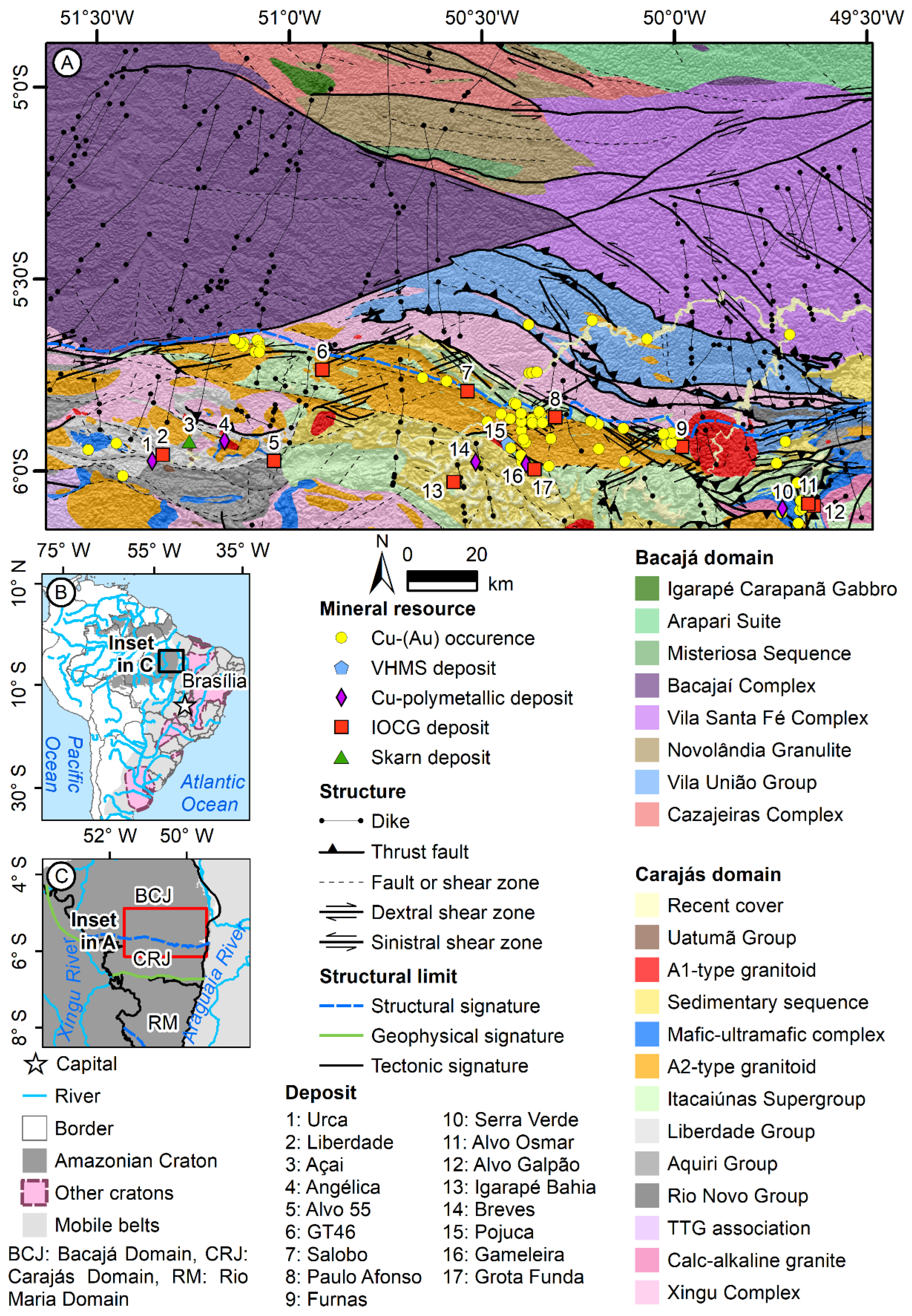
Figure 1. (A) Simplified geological map showing hydrothermal and occurrences deposits in the Carajás and Bacajá domains. The deposit location was compiled from [20,25,42,43]. (B) Location of tectonic domains in the Amazonian Craton. (C) Tectonic compartmentation of the Carajás and Transamazonian provinces after [29,39,40,44,45]. Structural limits based on [46].
Minerals 16 00240 g001

3. Materials and Methods

3.1. Dataset

Airborne gamma-ray spectrometric and magnetometric surveys provided by the Geological Survey of Brazil (GSB, https://geosgb.sgb.gov.br/ (accessed on 8 November 2025)) were used in this study. Five surveys include this data: Oeste de Carajás (1125), Rio Maria (1129), Tucuruí (1097), Anapu-Tuerê (1064) and Rio Bacajá (1133) [51,52,53,54,55]. These were conducted and pre-processed by LASA Prospecções S/A between June 2014 and June 2015 (Oeste de Carajás), January and November 2014 (Rio Maria), April and July 2010 (Tucuruí), August and October 2004 (Anapu-Tuerê) and October 2014 and March 2016 (Rio Bacajá). Flight lines were spaced 500 m apart (N–S) with 10 km tie lines (E–W) and a terrain clearance of 100 m. Magnetometry used a Scintrex CS-3 (10 Hz, 0.001 nT resolution), while gamma ray data were collected with a 256-channel Exploranium GR-820 and Pico Envirotec GRS 410 (1 Hz). Aircraft speed averaged 256–266 km/h, yielding measurements every 7.1–7.4 m (magnetometry) and 71–74 m (gamma-ray). Magnetic data corrections included parallax diurnal variation, International Geomagnetic Reference Field (IGRF) removal, leveling, and micro-leveling. Gamma-ray corrections included dead time, background removal (aircraft, cosmic, atmospheric radon), height, Compton effect, and conversion to elemental concentrations [51,52,53,54,55].
Gravity data are from the airborne Carajás gravimetric survey (Project 1123) [56]. N–S flight lines were spaced 3 km apart, with E–W control lines at 12 km. Mean sensor clearance was 900 m above the surface. Two fixed-wing aircraft were used: the western portion was surveyed with a GT-2A gravimeter aboard the PR-FAS aircraft at 275 km/h, and the eastern portion with a GSS3 Graviton-M aboard the PP-AGP at 274 km/h. Measurements were restored every 0.1 and 0.5 s. The data were corrected for latitude, free-air, Eötvös, dynamic acceleration, and Bouguer effects [56].
Data were interpolated with the minimum curvature technique [57] on regular grids of 100 m using Geosoft Oasis Montaj 2025.1. Gamma-ray spectrometry data were merged with the grid leveling method of Minty [58], which estimates a base-level shift and scaling factor to align grids to the same absolute level.
Topographic data came from the Brazilian National Institute for Spatial Research’s Topodata (INPE’s Topodata database), derived from refined SRTM (Shuttle Radar Topography Mission) data resampled from 3 arcseconds (~90 m) to 1 arcsecond (~30 m) using geostatistical interpolation [59]. The database is freely available from INPE (http://www.dsr.inpe.br/topodata/ (accessed on 17 October 2025)).

3.2. Gamma-Ray Spectrometry Techniques

Gamma-ray spectrometry consists of the measurement of the naturally occurring radioactive elements potassium (K, %), equivalent uranium (eU, ppm), and equivalent thorium (eTh, ppm) at the Earth’s surface. These elements exhibit distinct geochemical behaviors [60,61]. While eTh is generally immobile, K and eU are mobile, and their enrichment is primarily associated with hydrothermal alteration [60,61,62]. However, in tropical and subtropical climates, weathering may also lead to K adsorption onto clay minerals [61].
Ratio grids enhance geochemical contrasts and reduce environmental artifacts from vegetation and soil moisture [61]. Hydrothermal alteration zones, with enriched K, eU, Fe, and other elements [63], can thus be mapped using radiometric ratios such as K/eTh, eU/eTh, and the F-parameter [64]. The F-parameter (F = K ∙ eU/eTh) is a robust geochemical index for mapping hydrothermal alteration. It highlights altered areas by comparing K and eU enrichment relative to the eTh/eU and eTh/K ratios [65]. Potassium (Kd) and uranium (eUd) deviations [66] were also used to enhance the local variation in K and eU, normalizing by the mean contents in each geological unit. This procedure minimizes lithological background effects [66,67].

3.3. Magnetic and Gravimetric Technique

Multiple heights of upward continuation (UC; 0.5, 1, 5 and 10 km) were applied to the total magnetic field and Bouguer anomaly before multi-scale edge mapping to suppress shallow signals and highlight deeper sources and structures [68]. This approach highlights magnetic and gravity structures at different depths, with the lower UC level (UC = 0.5 km) mapping short-wavelength near-surface sources, whereas a higher level (UC = 10 km) marks deeper/long-wavelength bodies.
The geophysical discontinuities observed in the magnetic and gravity data are used to map shallow- to deep-seated structures, including faults, shear zones, mafic–ultramafic intrusions, and geological contacts. Moreover, truncation or deflection in these geophysical data may also indicate the location of fault or shear zones [69]. In this context, edge-detection techniques were applied to delineate magnetic and gravity lineaments, using vertical and horizontal derivatives to enhance responses from both shallow and deep sources [70].
Among edge enhancement methods, the Logistics Horizontal Gradient (LTHG) method [71] was applied to delineate magnetic and gravimetric lineaments. LTHG applies a logistic function to the first-order derivative of the total horizontal gradient, equalizing shallow and deep anomalies and maximizing amplitudes along body margins. Even in noisy data or complex settings, it outperforms other methods in edge identification and border definition [71].

3.4. Morpholineament

Rock texture (e.g., sedimentary bedding and foliation) and geological structures (e.g., contact, foliation, fault, shear zone, and fold) are commonly expressed as morpholineaments, which are linear to slightly curvilinear geomorphological features [72,73,74,75]. Three hillshade maps derived from SRTM data with a vertical exaggeration factor of 15 and azimuths of 0°, 45° and 335° were used to map the morpholineaments as proposed by Domingos [76] and Dutra et al. [24]. The illumination angles were orthogonally selected to the orientation of the main structural features in the region. Major regional topographic features, including valleys, ridgelines, and drainage patterns, were emphasized in the morpholineament mapping.

3.5. Spatial Analysis

The orientation of the lineaments obtained from magnetic, gravimetric, and topographic data was processed using the Moving Average Rose Diagram (MARD) method [77]. This program generates smooth rose diagrams by applying a moving-average filter that removes noise from angular datasets using a low-pass filter, thereby enhancing the recognition of statistically significant trends in orientation. The code for Excel Add-ins was ported to Python 3.12.7 and used to plot rose diagrams using the Plotly package [78]. The default settings were used for plotting: an average window of 9, a weighting factor of 0.90, and equal area.

4. The Northern Copper Belt: Geological and Metallogenetic Evolution

The NCB is marked by a complex geodynamic evolution with superposition of distinct tectono-magmatic events from the Neoarchean to the Paleoproterozoic. Its structural framework is defined by the Carajás, Cinzento and Canaã shear zones.
The WNW–ESE Cinzento and Carajás shear zones comprise regional-scale structures that host most deposits of the NCB. The IOCG Igarapé Bahia [17,79,80,81] and Grota Funda [13], the VHMS Pojuca [11] and the Cu–polymetallic Gameleira [16] deposits occur along or to the north of the Carajás Shear Zone. The volcanosedimentary sequences of the Itacaiúnas Supergroup chiefly host these deposits. Conversely, Salobo [12,17], GT-46 [14], Furnas [82], Paulo Afonso [15] and other mineral occurrences (i.e., QT-02 and AN-34 [25]) are hosted within Neoarchean granitoids and minor volcanosedimentary sequences along the Cinzento Shear Zone. In the western part of the NCB, the Urca, Açaí, Liberdade, Angélica, and Alvo 55 copper deposits [43] occur, but their geology remains poorly characterized.
Early copper syngenetic mineralization is recognized at VHMS Pojuca and part of the Igarapé Bahia deposit, likely associated with the depositions of the Itacaiúnas Supergroup at 2.76–2.73 Ga [11,80]. The IOCG deposits in the NCB have primarily formed at ca. 2.55 Ga together with extensive K-Fe (biotite–grunerite–almandite–magnetite) hydrothermal alteration halos associated with an Archean regional, mantle-involved, hydrothermal event [18,81,83]. The formation of the Paulo Afonso and Gameleira deposits, however, is mainly associated with a younger Paleoproterozoic event at 1.88 Ga [15,16]. Deep and shallow structures and their connections, forming translithospheric structures, appear to provide a fertile framework for copper metallogenesis in the NCB [25]. These structures define networks that exert primary control over the spatial intensity of hydrothermal alteration and ore deposition [25].

5. Results

5.1. Regional Magnetic and Gravity Signatures

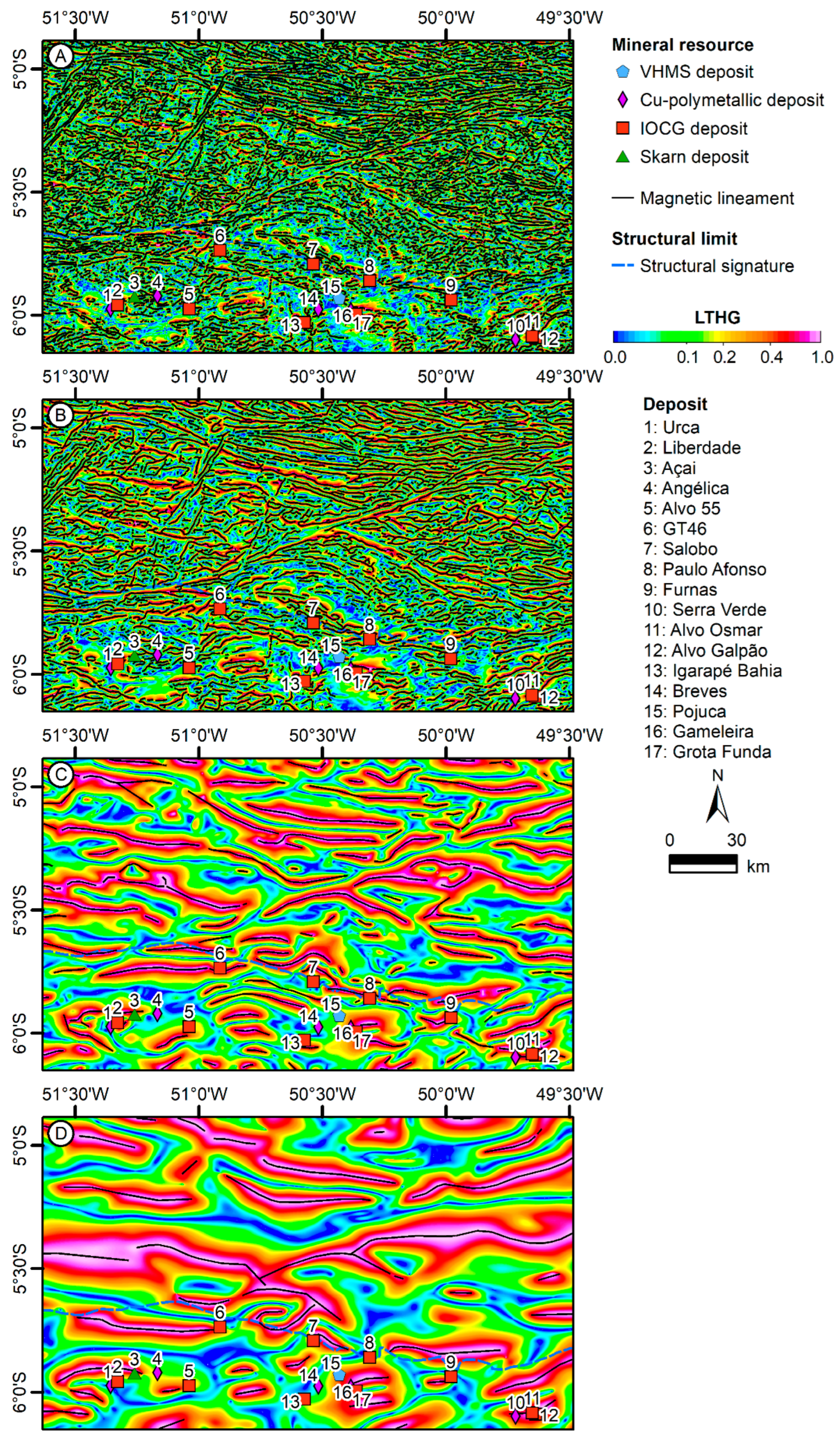
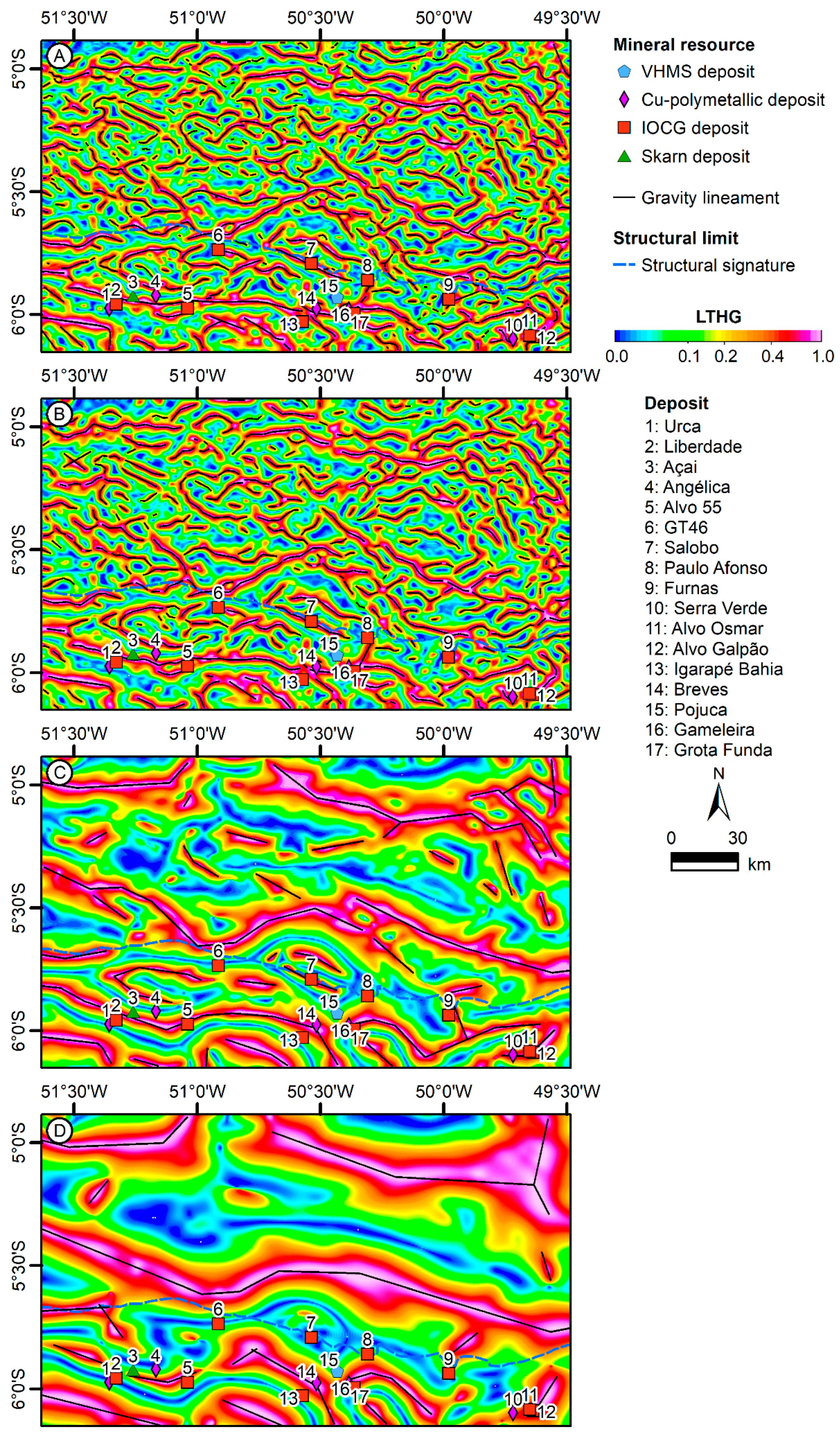
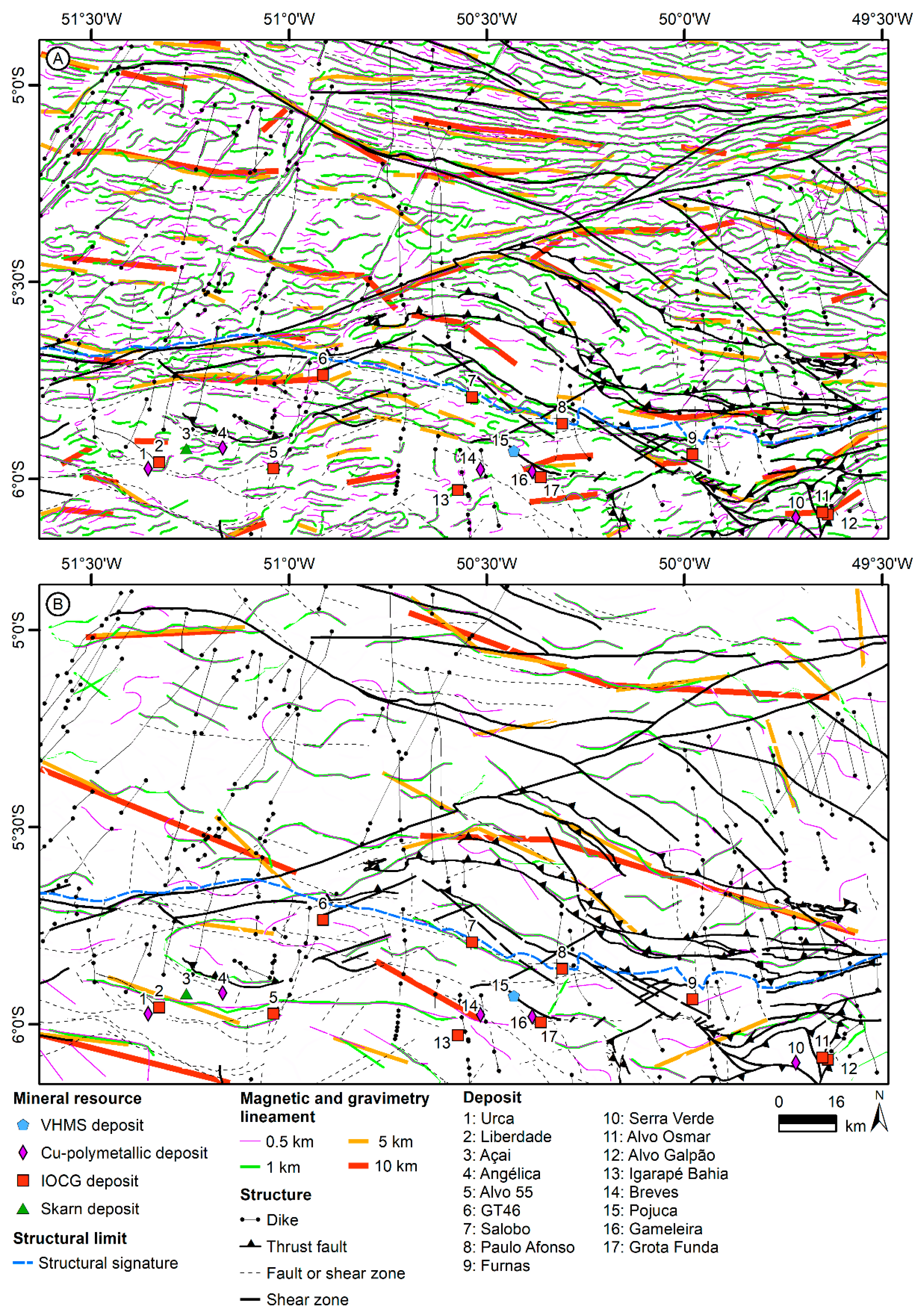
The maximum signal amplitudes in the LTHG maps were used for mapping magnetic and gravity lineaments from multiple UC airborne magnetic and gravity data, respectively. The magnetic and gravity lineaments typically exhibit slightly curved to sigmoidal geometries, especially in the shallower UCs (0.5 and 1 km). In contrast, at 5 and 10 km UCs, most lineaments are straight to lightly curved (Figure 2 and Figure 3).
Moreover, increasing the UC level results in a decrease in the number of magnetic and gravity lineaments and a concomitant increase in their length (Figure 2 and Figure 3). This pattern results from the attenuation of short-wavelength components of the potential-field anomalies, which reduces spatial resolution and promotes the merging of smaller features. In total, 5251 magnetic lineaments were interpreted in the 0.5 km UC, with an average length of 2.9 km, and 2507 lineaments with 4.7 km in the 1 km UC (Figure 2A,B). This amount decreases to 394 lineaments with an average length of 5.7 km at the 5 km UC, and to 137 lineaments with an average length of 8.8 km at the 10 km UC (Figure 2C,D). A similar pattern is observed for gravity lineaments (Figure 3), which decrease from 455 in the 0.5 km UC to 340 (1 km UC), 80 (5 km UC) and 31 (10 km UC), while their lengths increase from 8.3 km (0.5 km UC) to 9.4 km (1 km UC), 17.3 km (5 km UC) and 28.0 km (5 km UC).
The mapped magnetic and gravity lineaments were grouped by length (Figure 4). Lineaments with lengths greater than the third-quartile value of the distribution were defined as the longest lineaments. In general, some of the longest magnetic and gravity lineaments are spatially associated with regional shear zones, faults, contacts or mafic intrusion suites. Interestingly, the longest magnetic lineaments are more common in the Bacajá Domain than in the Carajás Domain, even disregarding those related to mafic intrusions (Figure 4A).
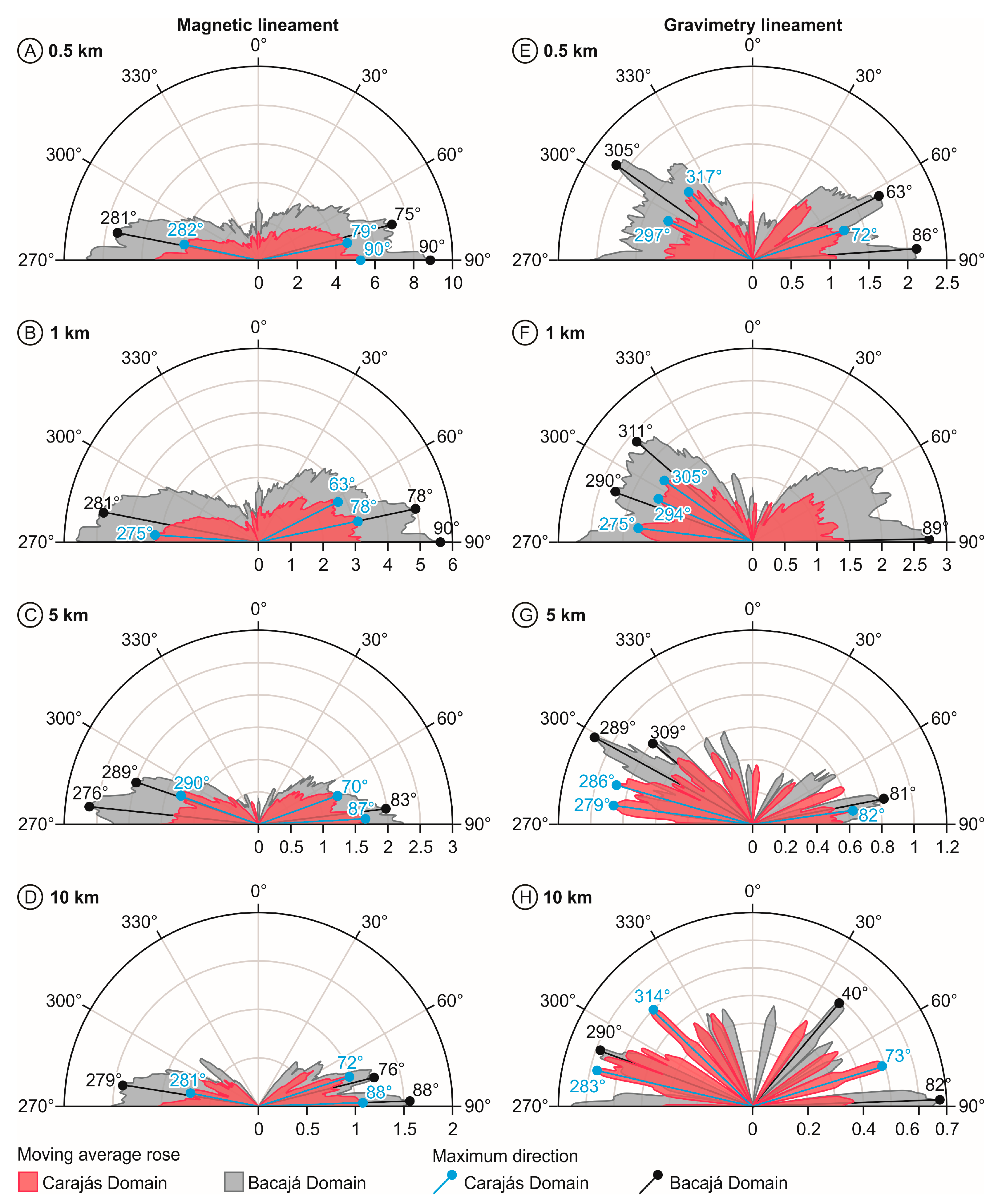
The analysis of magnetic and gravity lineament azimuths reveals a similar structural framework in the Carajás and Bacajá domains, characterized by low variance at the same UC level (Figure 5). The dominant structural strike in both domains is roughly E–W (63–114°), followed by lineaments trending NW–SE (305–314 °) and NE–SW (50–58°). The N–S set is the least frequent and is mainly mapped by magnetic lineaments at 0.5 km UC, close to the NE-trending mafic intrusion suite in the northwest portion of the Bacajá Domain.
In the Carajás Domain, magnetic lineaments are strongly oriented to E–W direction at shallower (0.5 km and 1 km-UC: 63–112°) and deeper levels (5 km and 10 km UC: 70–110°; Figure 5A–D). The UC level increase resulted in a decrease in N–S magnetic lineaments. Concerning the Bacajá Domain (Figure 5A–D), its maximum directions are similar to those of the Carajás Domain, which varies around 0–4°, resulting in magnetic lineaments primarily oriented in the E–W direction (76–109°). This orientation difference decreases as the UC level increases (Figure 5).
Gravity lineament in the Carajás Domain consistently displays a dominant orientation of 305–317° (or 125–137°) at all UC levels, in addition to the E–W set (72–117°). These same main clusters at NW–SE and E–W are also observed in the Bacajá Domain at azimuths of 305–311° (or 125–131°) and 63–110°. In contrast to magnetic lineaments, the relative frequency of the N–S set increases with increasing UC level (Figure 5E–H), but with short lengths (<27 km, Figure 2C,D). Our results indicate that the gravity lineaments are rotated approximately 1° to 20° relative to the magnetic lineaments in both domains and at the same UC level.
Figure 2. Interpreted magnetic lineament in the LTHG of the upward-continued magnetic data from (A) 0.5 km, (B) 1 km, (C) 5 km and (D) 10 km.
Minerals 16 00240 g002
Figure 3. Gravity lineament mapped in the LTHG applied to upward-continued gravity data from (A) 0.5 km, (B) 1 km, (C) 5 km, and (D) 10 km.
Minerals 16 00240 g003
Figure 4. Longest (A) magnetic and (B) gravity lineaments.
Minerals 16 00240 g004
Figure 5. Moving rose diagrams of the (AD) magnetic and (EH) gravity lineaments in multiple upward continuation levels.
Minerals 16 00240 g005

5.2. Morpholineaments

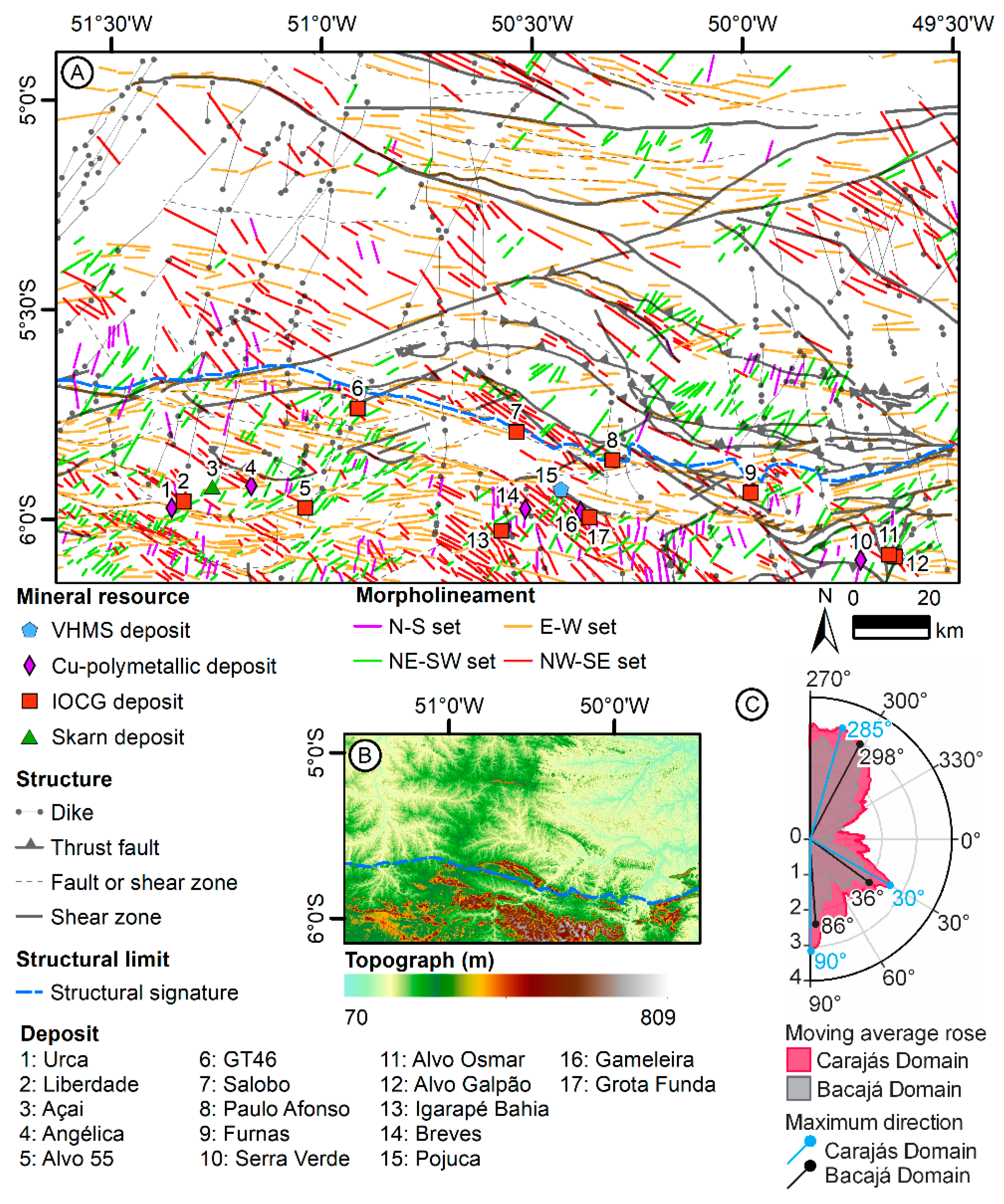
Morpholineaments present lengths between 0.3 and 41.5 km (Figure 6), with the main population in the range of 2.8 and 5.8 km (Q1–Q3 interval range). Most morpholineaments were mapped in the Carajás Domain due to the higher altitude amplitude (Figure 6B). The low-altitude variation in the Bacajá Domain hinders mapping morpholineaments. Overall, morpholineament is spatially related to regional structures, such as shear zones and faults (Figure 6A). However, several morpholineaments were identified far from mapped structures, especially in the Carajás Domain and between shear zone corridors (north of 5°20′ S) or perpendicular to the regional shear zone (between 51° and 50°30′ W at 5°30′ S) in the Bacajá Domain (Figure 6A).
In the Carajás and Bacajá domains, morpholineaments exhibit two dominant orientations: (i) E–W, with azimuths of 86–118° and 90–105° for each domain, and (ii) NE–SW, with azimuths of ~30° and 36°, respectively. This structural trend is similar to the main directions of the magnetic and gravity lineaments, especially at the shallower UC level (Figure 5).
Figure 6. Morpholineament (A) and topography (B) maps in the Northern Carajás Domain and Southern Bacajá Domain, after [59]. (C) Moving rose diagram of the morpholineament.
Minerals 16 00240 g006

5.3. Gamma-Ray Spectrometry Signatures

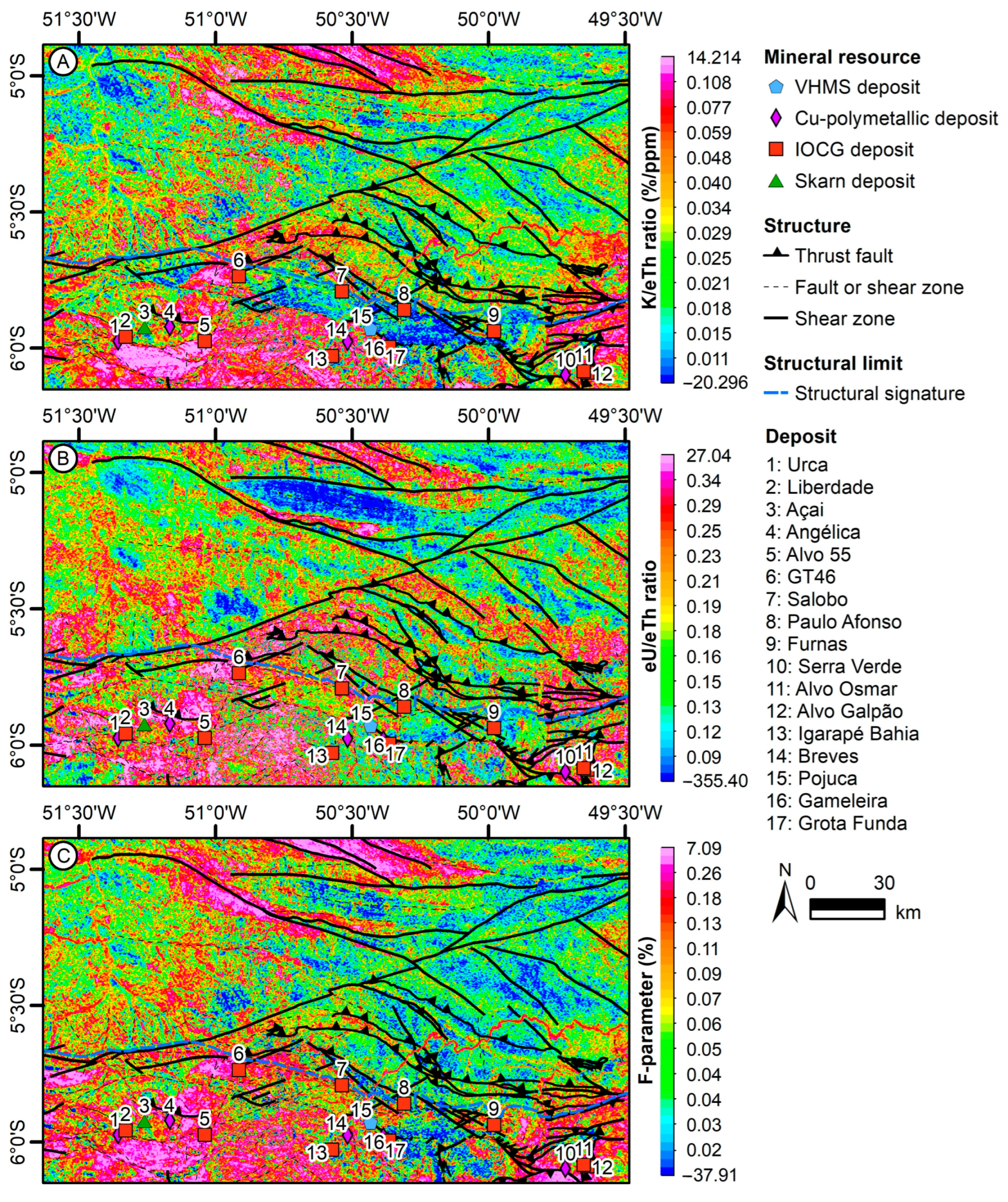
The radiometric ratios (K/eTh, eU/eTh and F-parameter) and deviation (Kd and eUd) were used to evaluate potential hydrothermally altered areas, which may be indicated by high ratio and deviation values. Overall, the high values of K/eTh, eU/eTh, and the F-parameter (Figure 7) are mainly located in the Carajás Domain. In the Bacajá Domain, the larger areas with high radiometric ratio values are found in the Cazajeiras (5° S, 50°30′ W), Bacajaí (5°10′ S, 51° W; 5°30′ S, 51°10′ W) and Vila Santa Fé (5°30′ S, 50° W) complexes, Misteriosa Sequence (5°10′ S, 50°40′ W) and Vila União Group (5°35′ S, 50°40′ W). The areas are notably close to regional shear zones.
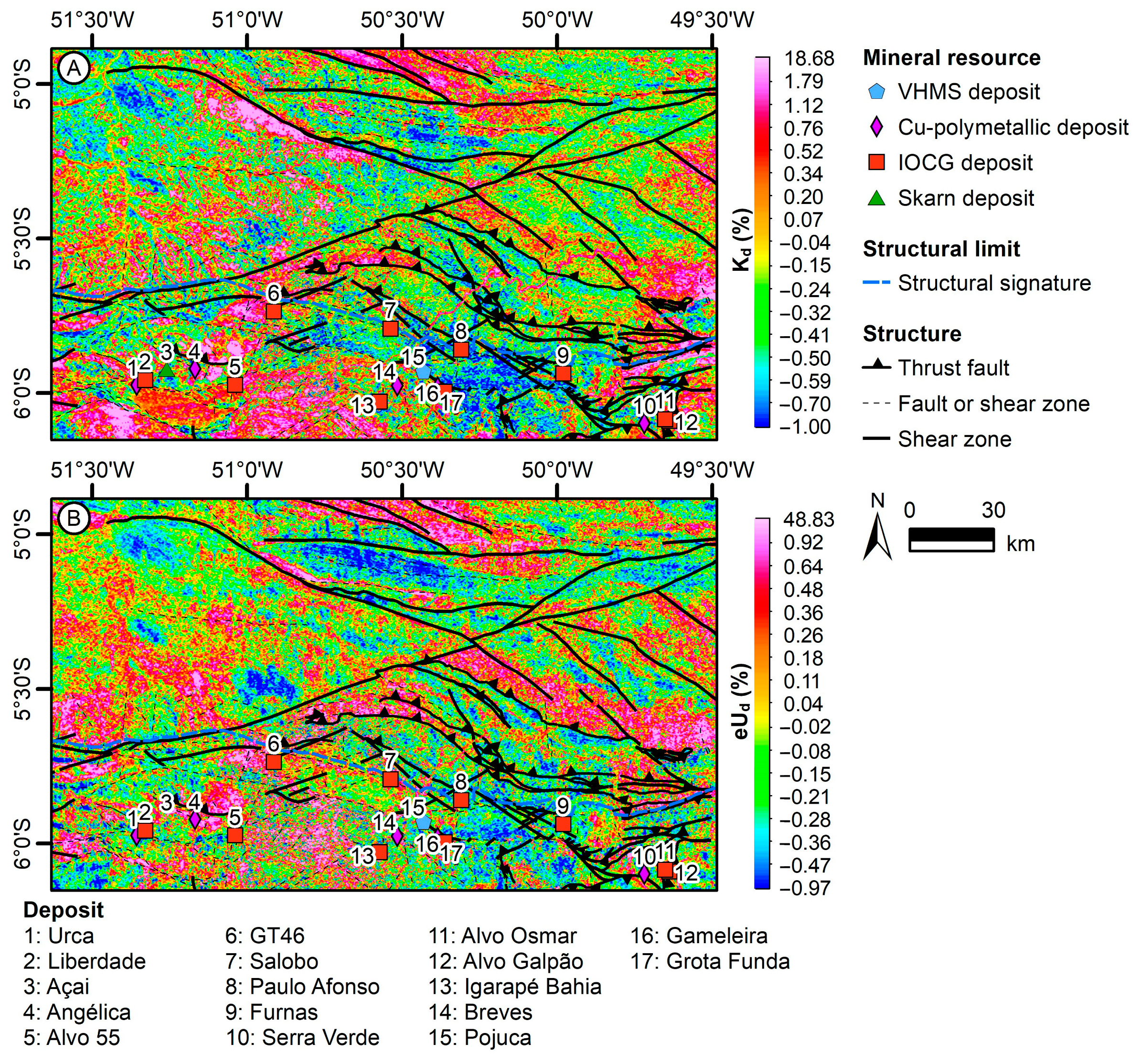
The high values in the deviation maps (Kd and eUd) are placed in areas similar to those of the radiometric ratios. In the Carajás Domain, Kd and eUd highlight a widespread area with strong K and eU enrichment close to the hydrothermal deposits (Figure 8). In the Bacajá Domain, the Bacajaí Complex exhibits high deviation values in its central and southern portions (5°30′ S, 51°15′ W, and 5°10′ S, 51°0′ W). Cajazeiras Complex shows strong NE-trending anomalies in K and eU (5° S, 50°30′ W), which continue to the northern portion of the Vila Santa Fé Complex. This unit also shows strong eU and moderate K enrichments close to the contact with the Vila União Group (50°30′ S, 50° W).
Hydrothermally altered areas were also evaluated using statistical analysis of radiometric ratios (K/eTh, eU/eTh, and F-parameter; Figure 7) and deviation maps (Kd and eUd; Figure 8). These areas typically exhibit anomalous concentrations of K and eU, expressed as values exceeding the sum of the sample mean (µ) and its standard deviation (σ) [24]. Therefore, the µ + σ thresholds were calculated within each unit for ratio maps to minimize primary lithological background effects [67], while for the deviation maps, the same approach was derived from the regional dataset, as deviation maps inherently suppress lithological effects [24,66].
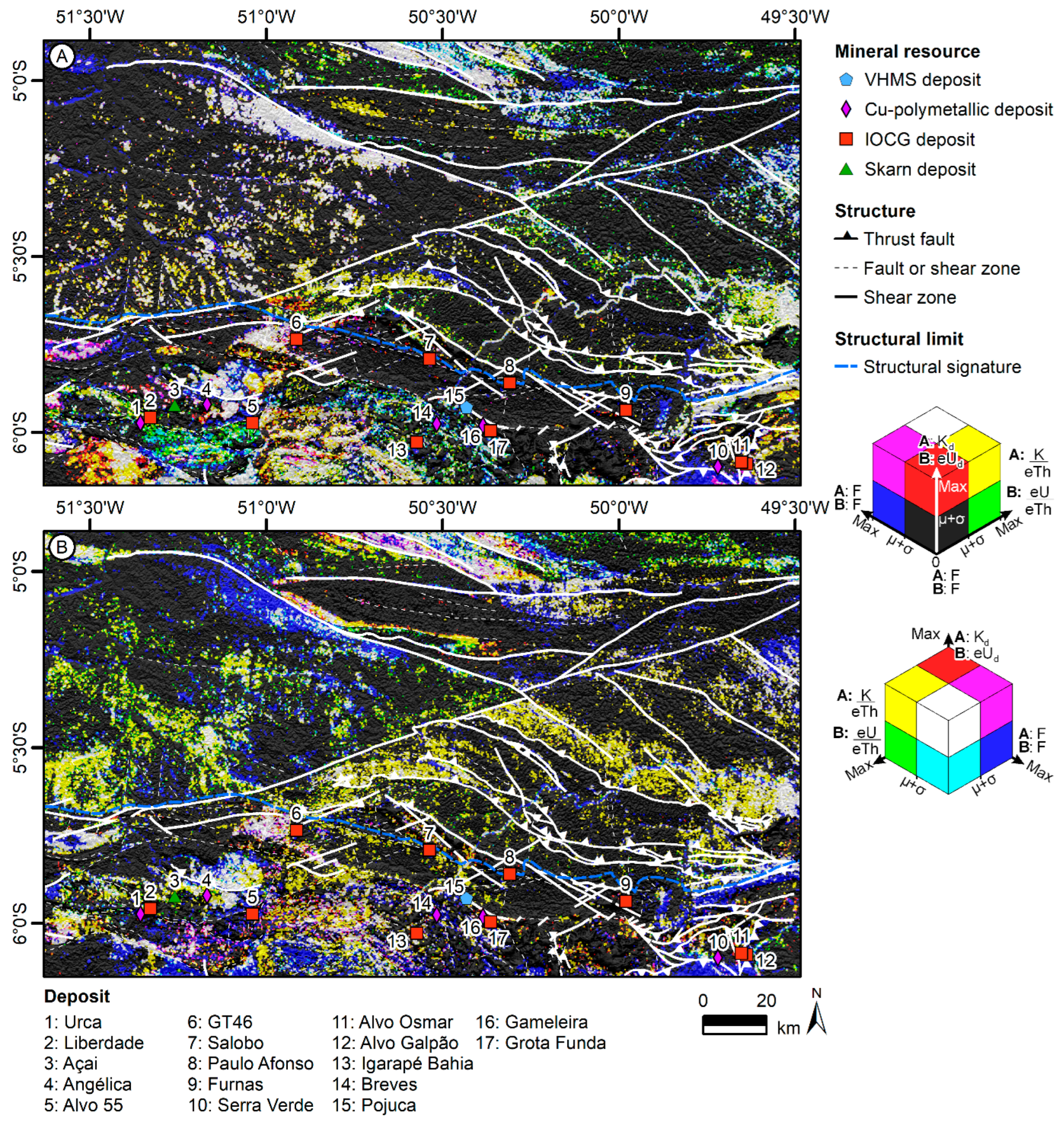
The radiometric parameters were grouped based on the main radioelement that fingerprints hydrothermal alteration. Thus, the K-based parameters include the K/eTh ratio, Kd, and the F-parameter, while the eU-based parameters include the eU/eTh ratio, eUd, and the F-parameter. Anomalous values were filtered to create a ternary map of K- and eU-based parameters (Figure 9).
Our results show that the northern portion of the Carajás is marked by anomalous values in the K- and eU-based parameters (Figure 9). The hydrothermal deposits in the Northern Copper Belt are mostly correlated with both K- and eU-based parameters. Only Paulo Afonso and Furnas are spatially related to diminished areas, whereas continuous areas envelop the other deposits.
In the Bacajá Domain, several areas have anomalous values in K- and eU-based parameters (Figure 9), especially in the Bacajaí Complex, Cajazeiras Complex, Novolândia Granulite, Vila União Group and Vila Santa Fé Complex. In this description, we only considered the most expensive white areas to define a regional geophysical signature. These areas mark the anomalous radiometric values in the three analyzed parameters, maximizing the probability for hydrothermally altered areas.
Bacajaí Complex exhibits potential hydrothermally altered areas in these southern and northeastern portions. The southern Bacajaí Complex (5°30′ S, 51°10′ W) shows several medium-sized areas with oval and circular shapes in both K- and eU-based parameters. In turn, the northeastern Bacajaí Complex exhibits a large area with strong K enrichment (5°10′ S, 51°0′ W; Figure 9B) following an NE-trending shear zone in the tectonic contact with Cajazeiras Complex and Novolândia Granulite. This same geophysical and tectonic signature is found in Cajazeiras Complex and Novolândia Granulite, which present strong K (Figure 9A) and eU enrichments (5°S, 50°30′ W; Figure 9B). Vila Santa Fé Complex shows and circle-shaped K- and eU-enriched areas in its eastmost portion (5°15′ S, 49°30′ W), in the eastern border of the study area. This area is cut by an NE-trending shear zone. The NW-trending shear zone is seen to be related to strongly K- and eU-enriched areas only in the Carajás Province (5°45′ S, 51°35′ W; Figure 9).

6. Discussion

6.1. Tectonic Framework in the Transition of the Carajás and Bacajá Domains

The consistent appearance of magnetic and gravity lineaments across all UC levels indicates that the causative structures are rooted in the deep to middle crust, ruling out a shallow origin and highlighting their association with long-lived basement structures [84,85]. The similarity in lineament patterns across multiple depths also implies that the lithosphere beneath the Carajás and Bacajá domains shares a typical structural architecture or has broadly similar deformation phases and reactivations [69,85].
The tectonic framework of the Carajás Domain, particularly in the transition with the Bacajá Domain, has been a subject of extensive debate in recent years [19,20,21,39]. Tavares et al. [19] interpret the boundary between these domains as a major tectonic contact formed during the Transamazonian Orogeny between 2.09 and 2.06 Ga. Motta et al. [20], using airborne and satellite-borne potential field data, proposed that Carajás and Bacajá domains share the same crustal block formed before ca. 2.1 Ga Transamazonian Orogeny. Similarly, Costa et al. [21], using seismic topography, interpreted a similar lithospheric crust without clear evidence for a boundary between the Bacajá and Carajás domains.
Our findings provide new constraints in this debate. The strong correlation between the lineament azimuths and their low angular variance on the Carajás and Bacajá domains supports a shared structural framework. However, subtle angular offsets may reflect differences in the composition and behavior of the crust, such as variations in density, magnetic susceptibility, and lithospheric anisotropy, that can produce a slight reorientation of geophysical structures [84,86,87]. These offsets may also reflect deformation associated with oblique convergence, transpression, or overprinting of Paleoproterozoic or late shear systems on older Archean crust [69,87].
The dominant E–W and subsidiary NW–SE and NE–SW lineament sets are consistent in the Carajás and Bacajá domains and across geophysical methods. Such low-variance structural trends typically delineate regional high-strain corridors [88]. The persistence of these trends across UC levels suggests a long-lived, coherent field that remained stable through Carajás-Bacajá’s tectonic evolution. The contrasting behavior of N–S lineaments, with the gravity lineaments becoming more prominent at deep levels as shallow magnetic lineaments diminish, suggests a scale-dependent structural inheritance [85]. In this context, gravity lineaments may be interpreted as deeper lithospheric structures, whereas magnetic lineaments capture shallower susceptibility contrasts. This behavior indicates that these fabrics were formed under different tectonic stress regimes and have different mechanical significance.
Morpholineaments in both domains frequently align with regional shear zones and faults, indicating that the regional structural corridors partly shape surface geomorphology. Nonetheless, many morpholineaments occur outside mapped structures or intersect trends, suggesting the presence of previously unrecognized basement discontinuities or the shallow reactivation of structural weakness zones. Detailed field mapping and petrological–geochemical studies are required to further constrain the nature and significance of these features. These weak zones may be related to local strain amplification [85]. Their dominant E–W and NE–SW orientations closely match the magnetic and gravimetric lineaments at shallow UC levels, suggesting that the development of surface lineaments is broadly consistent with the deeper structural grain that characterizes both the Carajás and Bacajá domains.
Despite the presence of several geophysical and morphostructural indicators supporting a continuous crustal framework between the Carajás and Bacajá domains, the existence of a tectonic suture cannot be ruled out. A deep, cryptic suture may be present but remain undetectable within the available potential-field data due to subdued contrast in physical properties (density, magnetic susceptibility) of the structure relative to its surrounding layers [84,89], overprinting by younger deformation and/or because it is buried beneath extensive lithosphere fabric (long wavelength) [84,87]. Consequently, even with extensive multilevel UC lineament analysis, the identification of a narrow, gradational, or compositionally subtle boundary may not be achievable [84,89]. Rather than indicating the absence of this boundary, the apparent structural continuity observed in the results may reflect the intrinsic limitations of existing datasets in mapping weak or deeply buried crustal discontinuities. Similarly, the existence of a suture zone between the two domains has been proposed based on extensive and detailed petrological work supported by precise geochronology and radiogenic isotope data [39]. Our results provide a crustal-scale structural framework consistent with these interpretations, thereby reinforcing the proposed tectonic boundary between the Carajás and Bacajá domains.

6.2. Metallogenetic Implications for the Copper Systems in the NCB

Giant mineral systems commonly display unique geophysical signatures due to a single crustal architecture [90]. Large mineral provinces form in distinct settings where tectonic configurations, reactive host rocks and deep crustal to lithospheric structures serve as pathways for fluid and melt migration on a regional to local scale [91]. In this context, the NCB seems to assemble most of these geological attributes, and this is expressed clearly in its geophysical signature.
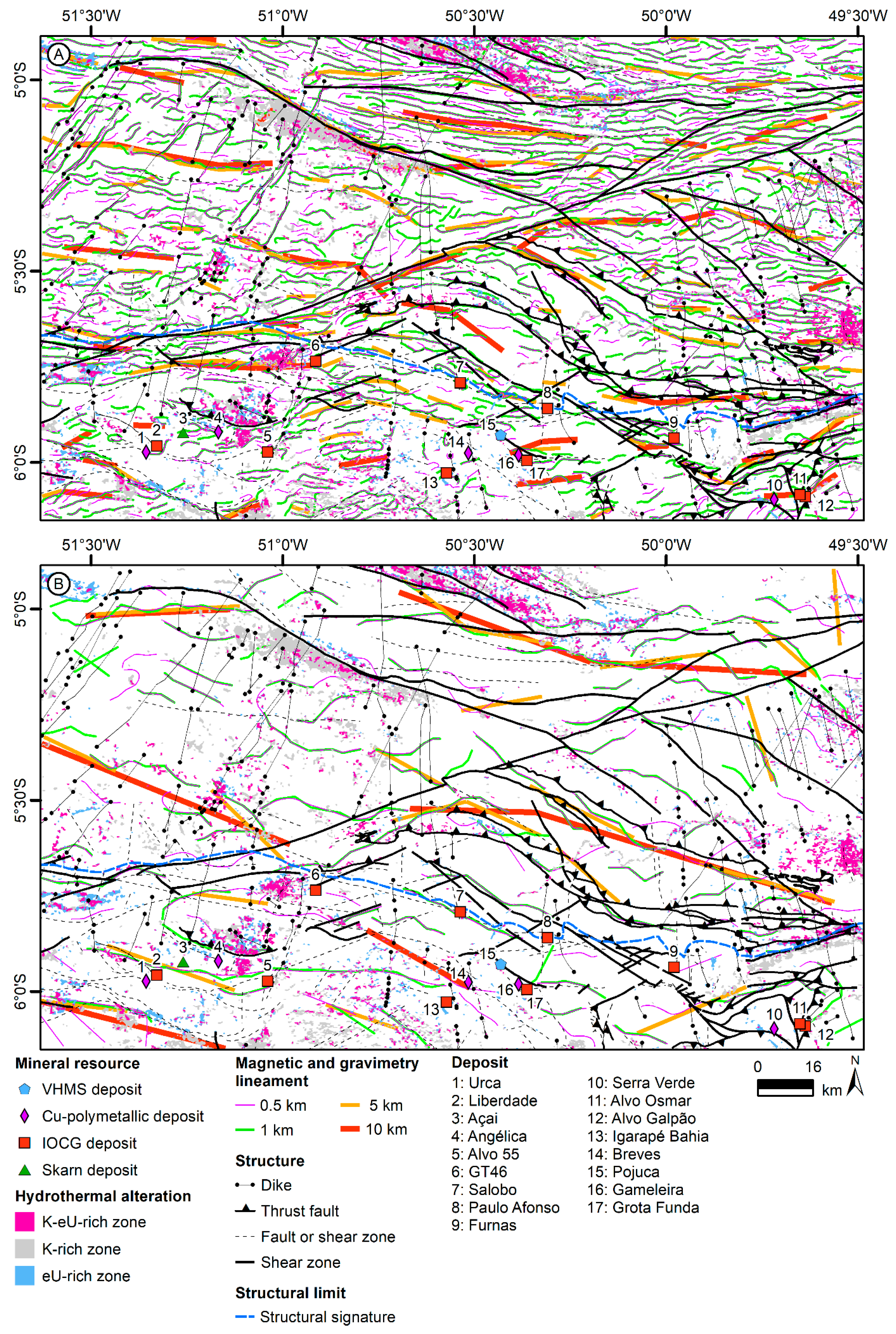
Radiometric data reveal extensive K- and eU-enriched zones in both the Carajás and Bacajá domains, with the most continuous anomalies concentrated in the Carajás Domain. The anomalies occur chiefly associated with both E–W and WNW–ESE shear zones, magnetic and gravity lineaments (Figure 10). Statistical thresholding of the radiometric parameters reveals multiple large, coherent alteration halos that correlate with areas of high K metasomatism and eU concentration. These alteration zones may correlate with hydrothermal systems. The highly correlated responses of radiometric, magnetic, and gravity signatures indicate that hydrothermal alteration in the NCB has been significantly guided by the crustal structural grain and deep-seated fluid-flow pathways.
The IOCG deposits of the NCB are remarkably associated with deep-seated structures revealed by magnetic and gravity lineaments in the UC. In this case, the Neoarchean (i.e., 2.55 Ga) Salobo, GT-46, Grota Funda, Igarapé Bahia, and Furnas are ductilely deformed and are primarily associated with WNW–ESE shear zones. These results are similar to those reported by Dutra et al. [24] for the Southern Copper Belt, including IOCG and hydrothermal nickel deposits.
Figure 10. Spatial correlation among possible hydrothermally altered areas, structures and longest (A) magnetic and (B) gravity lineaments.
Minerals 16 00240 g010
Another remarkable geophysical signature of the NCB is its position adjacent to a pronounced break in both magnetic and gravity anomalies, particularly evident in the 5 km and 10 km upward-continued datasets. This may represent a limit between the Carajás and Bacajá domains, even though these two domains share the same lithosphere. IOCG deposits commonly form in the margins of cratons or lithospheric boundaries [92,93]. In this setting, the metasomatized subcontinental lithospheric mantle could be responsible for fluid generation for the IOCG mineralization [92,93]. The location of the NCB, similar to that of the Southern Copper Belt, might be related to these cratonic and lithospheric margins, which provide an excellent scenario for IOCG genesis.
Conversely, for the VHMS deposit (i.e., Pojuca), this control is not so clear, firstly because there is only one VHMS deposit in the area. Even the syngenetic part of the Igarapé Bahia deposit has been overprinted by later IOCG mineralization [80]. Secondly, morpholineaments are more abundant and variable southwards within the Itacaiúnas Supergroup and the Águas Claras Formation. In this sense, early syngenetic mineralization in the Carajás Domain has probably been affected and modified by later hydrothermal events and structures.
Interestingly, the Paleoproterozoic IOCG (e.g., Paulo Afonso) and Cu–polymetallic deposits (e.g., Gameleira) seem to take place along the intersection of deep E–W (5 km and 10 km UC) and shallow NE–SW structures. The Paleoproterozoic mineral system at Carajás Domain, apart from mineral deposit type, is commonly formed in a shallower crustal level under brittle conditions (e.g., [94]). These structures also appear in the GT-46, which records younger hydrothermal events [95], and Furnas. Thus, the intersection between shallow and deep structures favors the formation of both Paleoproterozoic IOCG and Cu–polymetallic deposits.
In terms of mineral exploration potential, our results demonstrate that the geophysical signatures of the NCB extend northward into the Bacajá Domain. Potential-field lineaments aligned with gamma-ray spectrometry anomalies reflecting K and eU enrichment, indicating zones where crustal-scale structures and hydrothermal alteration processes interacted. In this context, priority areas for future investigation in the Bacajá Domain include intersections between deep-seated E–W and shallow NE–SW structures, particularly where these coincide with K and eU anomalies. These structural intersections may represent preferential pathways for fluid circulation and localized alteration. However, these ingredients may not be sufficient to form copper deposits similar to those observed in the NCB. The protracted evolution of the Carajás Domain, including early syngenetic mineralization overprinted by later hydrothermal events, likely played a critical role in forming the copper deposits in the NCB [81].

7. Conclusions

Overall, the Carajás and Bacajá domains share a coherent, long-lived structural framework that exerted fundamental control over crustal deformation and mineralization processes. Our conclusions are summarized below:
  • Lineaments are linked to deep- to shallow-crustal features, recording a long-lived tectonic evolution with multiple deformation and reactivation events in both Carajás and Bacajá domains.
  • The low angular variability of lineament orientations defines a structural continuum between both domains, with minor offsets reflecting differences in crustal properties and reactivation history.
  • Persistent structural trends in geophysical and morpholineament data indicate that both domains were affected by the same regional deformation regime, influencing mineralization patterns.
  • Potassium (K) and equivalent uranium (eU) anomalies are spatially associated with hydrothermal alteration zones and shear-related structures that control mineralization.
  • Structural complexity exerted a first-order control on fluid pathways during IOCG formation, defining the architecture of the hydrothermal system.
  • The close spatial relationship between alteration zones and major tectonic structures indicates that these structures acted as both conduits and traps for metal-bearing fluids.
  • Integrated geophysical, geological, and structural analyses are essential to improve mineral exploration targeting in the region.

Author Contributions

Conceptualization, L.F.D. and G.H.C.d.M.; methodology, L.F.D. and B.O.L.R.; software, L.F.D.; validation, G.H.C.d.M. and F.A.T.; formal analysis, L.F.D.; investigation, L.F.D. and B.O.L.R.; resources, L.F.D., G.H.C.d.M., B.O.L.R. and F.A.T.; data curation, L.F.D. and B.O.L.R.; writing—original draft preparation, L.F.D., G.H.C.d.M. and B.O.L.R.; writing—review and editing, L.F.D., G.H.C.d.M., B.O.L.R. and F.A.T.; visualization, L.F.D.; supervision, L.F.D., G.H.C.d.M., B.O.L.R. and F.A.T.; project administration, F.A.T. All authors have read and agreed to the published version of the manuscript.

Funding

This research received no external funding.

Data Availability Statement

The data presented in this study is available on request from the corresponding author.

Acknowledgments

We would like to express our gratitude to the Programa de Pós-Graduação em Evolução Crustal e Recursos Naturais (Postgraduate Program in Crustal Evolution and Natural Resources) at the Federal University of Ouro Preto. We also thank the Geological Survey of Brazil and the Brazilian National Institute for Spatial Research for making the airborne geophysical and topographic data freely available. Additionally, the authors gratefully acknowledge constructive reviews by anonymous reviewers.

Conflicts of Interest

The authors declare no conflicts of interest.

References

  1. Fernanda Soares, A.; Giovinazzo Spers, R.; De Oliveira Santos Jhunior, R. Projection of Global Copper Demand in the Context of Energy Transition. Resour. Policy 2025, 103, 105567. [Google Scholar] [CrossRef]
  2. Jowitt, S.M.; McNulty, B.A. Battery and Energy Metals: Future Drivers of the Minerals Industry? SEG Discov. 2021, 127, 11–18. [Google Scholar] [CrossRef]
  3. Schodde, R. Mineral Deposit Exploration—Discovery Trends: 1900–2023. SEG Discov. 2025, 142, 19–35. [Google Scholar] [CrossRef]
  4. McCuaig, T.C.; Hronsky, J. The Mineral Systems Concept: The Key to Exploration Targeting. Appl. Earth Sci. 2017, 126, 77–78. [Google Scholar] [CrossRef]
  5. Hagemann, S.G.; Lisitsin, V.A.; Huston, D.L. Mineral System Analysis: Quo Vadis. Ore Geol. Rev. 2016, 76, 504–522. [Google Scholar] [CrossRef]
  6. Xavier, R.P.; Soares Monteiro, L.V.; Moreto, C.P.N.; Pestilho, A.L.S.; de Melo, G.H.C.; Delinardo da Silva, M.A.; Aires, B.; Ribeiro, C.; Freitas e Silva, F.H. The Iron Oxide Copper-Gold Systems of the Carajás Mineral Province, Brazil. In Geology and Genesis of Major Copper Deposits and Districts of the World: A Tribute to Richard H. Sillitoe; Hedenquist, J.W., Harris, M., Camus, F., Eds.; Society of Economic Geologists: Littleton, CO, USA, 2012; Volume 16, ISBN 978-1-62949-041-0. [Google Scholar]
  7. Juliani, C.; Monteiro, L.V.S.; Fernandes, C.M.D. Potencial Mineral: Cobre. In Recursos Minerais no Brasil: Problemas e Desafios; Melfi, A.J., Misi, A., Campos, D.d.A., Cordani, U.G., Eds.; Academia Brasileira de Ciências: Rio de Janeiro, Brazil, 2006; pp. 134–154. [Google Scholar]
  8. Monteiro, L.V.S.; Xavier, R.P.; Roberto Souza Filho, C.; Moreto, C.P.N. Metalogênese Da Província Carajás. In Metalogênese das Províncias Tectônicas Brasileiras; Silva, M.d.G.d., Rocha Neto, M.B.d., Jost, H., Kuyumjian, R.M., Eds.; CPRM—Serviço Geológico do Brasil: Belo Horizonte, Brazil, 2014; pp. 43–92. ISBN 978-85-7499-221-1. [Google Scholar]
  9. Pinheiro, R.V.L.; Holdsworth, R.E. Evolução Tectonoestratigráfica Dos Sistemas Transcorrentes Carajás e Cinzeiro, Cinturão Itacaiúnas, Na Borda Leste Do Cráton Amazônico. Rev. Bras. Geociências 2000, 30, 597–606. [Google Scholar] [CrossRef]
  10. Delinardo-Silva, M.A.; Monteiro, L.V.S.; Moreto, C.P.N.; Faustinoni, J.; Santos, T.J.S.; Sousa, S.D.; Xavier, R.P. From Source to Sink: U-Pb Geochronology and Lithochemistry Unraveling the Missing Link Between Mesoarchean Anatexis and Magmatism in the Carajás Province, Brazil. Minerals 2025, 15, 265. [Google Scholar] [CrossRef]
  11. Schwarz, M.; Frantz, J.C. Depósito de Cu-Zn Pojuca Corpo Quatro: IOCG Ou VMS? Pesqui. Geociências 2013, 40, 5. [Google Scholar] [CrossRef]
  12. Melo, G.H.C.d.; Monteiro, L.V.S.; Xavier, R.P.; Moreto, C.P.N.; Santiago, E.S.B.; Dufrane, S.A.; Aires, B.; Santos, A.F.F. Temporal Evolution of the Giant Salobo IOCG Deposit, Carajás Province (Brazil): Constraints from Paragenesis of Hydrothermal Alteration and U-Pb Geochronology. Miner. Depos. 2017, 52, 709–732. [Google Scholar] [CrossRef]
  13. Hunger, R.B.; Xavier, R.P.; Moreto, C.P.N.; Gao, J.F. Hydrothermal Alteration, Fluid Evolution, and Re-Os Geochronology of the Grota Funda Iron Oxide Copper-Gold Deposit, Carajás Province (Pará State), Brazil. Econ. Geol. 2018, 113, 1769–1793. [Google Scholar] [CrossRef]
  14. Toledo, P.I.d.F.; Moreto, C.P.N.; Xavier, R.P.; Gao, J.; Matos, J.H.d.S.N.d.; Melo, G.H.C.d. Multistage Evolution of the Neoarchean (ca. 2.7 Ga) Igarapé Cinzento (GT-46) Iron Oxide Copper-Gold Deposit, Cinzento Shear Zone, Carajás Province, Brazil. Econ. Geol. 2019, 114, 1–34. [Google Scholar] [CrossRef]
  15. Paula, F.d.C.; Melo, G.H.C.d.; Xavier, R.P. O Depósito de Cobre Paulo Afonso: Um Exemplo de Mineralização IOCG Paleoproterozoica No Setor Norte Da Província Carajás, Cráton Amazônico. In Proceedings of the 51th Brazilian Congress of Geology; Sociedade Brasileira de Geologia: Belo Horizonte, Brazil, 2024; p. 673. [Google Scholar]
  16. Pimentel, M.M.; Lindenmayer, Z.G.; Laux, J.H.; Armstrong, R.; de Araújo, J.C. Geochronology and Nd Isotope Geochemistry of the Gameleira Cu-Au Deposit, Serra Dos Carajás, Brazil: 1.8–1.7 Ga Hydrothermal Alteration and Mineralization. J. S. Am. Earth Sci. 2003, 15, 803–813. [Google Scholar] [CrossRef]
  17. Melo, G.H.C.d.; Monteiro, L.V.S.; Xavier, R.P.; Moreto, C.P.N.; Santiago, E. Tracing Fluid Sources for the Salobo and Igarapé Bahia Deposits: Implications for the Genesis of the Iron Oxide Copper-Gold Deposits in the Carajás Province, Brazil. Econ. Geol. 2019, 114, 697–718. [Google Scholar] [CrossRef]
  18. Toledo, P.I.d.F.; Moreto, C.P.N.; Monteiro, L.V.S.; de Melo, G.H.C.; Matos, F.M.V.; Xavier, R.P.; Carvalho, J.A.; Filho, C.A.M.; Navarro, M.S.; de Carvalho Lana, C. Breaking Up the Temporal Link between Granitic Magmatism and Iron Oxide-Copper–Gold (IOCG) Deposits in the Carajás Mineral Province, NW Brazil. Miner. Depos. 2024, 59, 601–625. [Google Scholar] [CrossRef]
  19. Tavares, F.M.; Trouw, R.A.J.; da Silva, C.M.G.; Justo, A.P.; Oliveira, J.K.M. The Multistage Tectonic Evolution of the Northeastern Carajás Province, Amazonian Craton, Brazil: Revealing Complex Structural Patterns. J. S. Am. Earth Sci. 2018, 88, 238–252. [Google Scholar] [CrossRef]
  20. Motta, J.G.; Souza Filho, C.R.d.; Carranza, E.J.M.; Braitenberg, C. Archean Crust and Metallogenic Zones in the Amazonian Craton Sensed by Satellite Gravity Data. Sci. Rep. 2019, 9, 2565. [Google Scholar] [CrossRef] [PubMed]
  21. Costa, I.S.L.; Rocha, M.P.; Klein, E.L.; Vasquez, M.L. Lithospheric Structure of the Southern Amazonian Craton from Multiple-Frequency Seismic Tomography: Preliminary Insights on Tectonic and Metallogenic Implications. J. S. Am. Earth Sci. 2020, 101, 102608. [Google Scholar] [CrossRef]
  22. Haddad-Martim, P.M.; de Souza Filho, C.R.; Carranza, E.J.M. Spatial Analysis of Mineral Deposit Distribution: A review of Methods and Implications for Structural Controls on Iron Oxide-Copper-Gold Mineralization in Carajás, Brazil. Ore Geol. Rev. 2017, 81, 230–244. [Google Scholar] [CrossRef]
  23. Skirrow, R.G.; Murr, J.; Schofield, A.; Huston, D.L.; van der Wielen, S.; Czarnota, K.; Coghlan, R.; Highet, L.M.; Connolly, D.; Doublier, M.; et al. Mapping iron Oxide Cu-Au (IOCG) Mineral Potential in Australia Using a Knowledge-Driven Mineral Systems-Based Approach. Ore Geol. Rev. 2019, 113, 103011. [Google Scholar] [CrossRef]
  24. Dutra, L.F.; Louro, V.H.A.; Monteiro, L.V.S. The Southern IOCG and Hydrothermal Nickel Mineralization Trend of the Carajás Mineral Province: Airborne Geophysical and Remote Sensing Evidences for Structural Controls and Hydrothermal Signature. J. Appl. Geophys. 2023, 213, 105016. [Google Scholar] [CrossRef]
  25. Oliveira, J.K.M.d.; Silva, A.M.; Tavares, F.M.; Lima Costa, I.S. Mapping Cu–Au Mineral Potential (IOCG and Cu–Au Polymetallic) in the Northern Copper Belt, Carajás Mineral Province: A Data-Driven, Mineral Systems-Based Approach. Ore Geol. Rev. 2025, 185, 106770. [Google Scholar] [CrossRef]
  26. Santos, J.O.S. Geotectônica Dos Escudos Das Guianas e Brasil-Central. Geotectonics of the Guyana and Central Brazilian Shields. In Geologia, Tectônica e Recursos Minerais do Brasil; Bizzi, L.A., Schobbenhaus, C., Vidotti, R.M., Gonçalves, J.H., Eds.; CPRM: Brasília, Brazil, 2003; pp. 169–226. [Google Scholar]
  27. Vasquez, M.L.; da Rosa-Costa, L.T. (Eds.) Geologia e Recursos Minerais Do Estado Do Pará: Sistema de Informações Geográficas—SIG: Texto explicativo Dos Mapas Geológico e Tectônico e de Recursos Minerais Do Estado Do Pará 1:1.000.000; CPRM-Serviço Geológico do Brasil: Belém, Brazil, 2008.
  28. Silva, M.A.D.; Monteiro, L.V.S.; Santos, T.J.S.; Moreto, C.P.N.; Sousa, S.D.; Faustinoni, J.M.; Melo, G.H.C.; Xavier, R.P.; Toledo, B.A.M. Mesoarchean Migmatites of the Carajás Province: From Intra-Arc Melting to Collision. Lithos 2021, 388–389, 106078. [Google Scholar] [CrossRef]
  29. Costa, U.A.P.; Paula, R.R.d.; Silva, D.P.B.; Barbosa, J.d.P.d.O.; Silva, C.M.G.d.; Tavares, F.M.; Oliveira, J.K.M.d.; Justo, A.P. Programa Geologia do Brasil-PGB. Mapa de Integração Geológico-Geofísica da ARIM Carajás; CPRM-Serviço Geológico do Brasil: Belém, Brazil, 2016.
  30. DOCEGEO. Revisão Litoestratigráfica Da Província Mineral de Carajás—Litoestratigrafia e Principais Depósitos Minerais. In Proceedings of the 35th Congresso Brasileiro de Geologia; Sociedade Brasileira de Geologia: Belém, Brazil, 1988; pp. 11–54. [Google Scholar]
  31. Martins, P.L.G.; Toledo, C.L.B.; Silva, A.M.; Chemale, F.; Santos, J.O.S.; Assis, L.M. Neoarchean Magmatism in the Southeastern Amazonian Craton, Brazil: Petrography, Geochemistry and Tectonic Significance of Basalts from the Carajás Basin. Precambr. Res. 2017, 302, 340–357. [Google Scholar] [CrossRef]
  32. Mansur, E.T.; Ferreira Filho, C.F. Magmatic Structure and Geochemistry of the Luanga Mafic–Ultramafic Complex: Further constraints for the PGE-Mineralized Magmatism in Carajás, Brazil. Lithos 2016, 266–267, 28–43. [Google Scholar] [CrossRef]
  33. Salgado, S.S.; Caxito, F.D.A.; Queiroga, G.N.; De Castro, M.P. Stratigraphy, Petrography and Tectonics of the Manganese-Bearing Buritirama Formation, Northern Carajás Domain, Amazon Craton. Braz. J. Geol. 2019, 49, e20180106. [Google Scholar] [CrossRef]
  34. Araújo Filho, R.C.; Nogueira, A.C.R.; Araújo, R.N. New Stratigraphic Proposal of a Paleoproterozoic Siliciclastic Succession: Implications for the Evolution of the Carajás Basin, Amazonian Craton, Brazil. J. S. Am. Earth Sci. 2020, 102, 102665. [Google Scholar] [CrossRef]
  35. Trunfull, E.F.; Hagemann, S.G.; Xavier, R.P.; Moreto, C.P.N. Critical Assessment of Geochronological Data from the Carajás Mineral Province, Brazil: Implications for Metallogeny and Tectonic Evolution. Ore Geol. Rev. 2020, 121, 103556. [Google Scholar] [CrossRef]
  36. Teixeira, M.F.B.; Dall’Agnol, R.; Santos, J.O.S.; Kemp, A.; Evans, N. Petrogenesis of the Paleoproterozoic (Orosirian) A-Type Granites of Carajás Province, Amazon Craton, Brazil: Combined in situ Hf–O isotopes of Zircon. Lithos 2019, 332–333, 1–22. [Google Scholar] [CrossRef]
  37. Teixeira, W.; Reis, N.J.; Bettencourt, J.S.; Klein, E.L.; Oliveira, D.C. Intraplate Proterozoic Magmatism in the Amazonian Craton Reviewed: Geochronology, Crustal Tectonics and Global Barcode Matches. In Dyke Swarms of the World: A Modern Perspective; Srivastava, R.K., Ernst, R.E., Peng, P., Eds.; Springer: Singapore, 2019; pp. 111–154. [Google Scholar]
  38. Pinheiro, R.V.L.; Kadekaru, K.; Soares, A.V.; Freitas, C.; Ferreira, S.N.; Matos, F.M.V. Carajás, Brazil—A Short Tectonic Review. In Proceedings of the 13th Simpósio de Geologia da Amazônia; Sociedade Brasileira de Geologia: Belém, Brazil, 2013; pp. 1086–1089. [Google Scholar]
  39. Neri, A.S.D.S.; Dall’Agnol, R.; Dantas, E.L.; Feio, G.R.L.; Almeida, J.D.A.C.D.; Galarza, M.A. Rhyacian Magmatism at the Southern Bacajá Domain: Implications for the Crustal Evolution of the SE Amazonian Craton and Columbia Assembly. Precambr. Res. 2025, 430, 107926. [Google Scholar] [CrossRef]
  40. Macambira, E.M.B.; Ricci, P.S.F.; Anjos, G.C. Geologia e Recursos Minerais Da Folha Repartimento, SB.22-X-A; Serviço Geológico do Brasil: Belém, Brazil, 2019; p. 102. [Google Scholar]
  41. Silva, A.S.d. Metamorfismo de UHT e HP no Domínio Bacajá, Cráton Do Amazonas. Master’s Dissertation, Universidade de Brasília, Brasília, Brazil, 2021. [Google Scholar]
  42. Prado, E.M.G.; de Souza Filho, C.R.; Carranza, E.J.M.; Motta, J.G. Modeling of Cu-Au Prospectivity in the Carajás Mineral Province (Brazil) Through Machine Learning: Dealing with Imbalanced Training Data. Ore Geol. Rev. 2020, 124, 103611. [Google Scholar] [CrossRef]
  43. Silva, A.R.d.C.; Oliveira, J.K.M.d.; Souza Gaia, S.M.d.; Tavares, F.M.; Lima, R.B.; Silva, C.M.G.d. Mapa de Prospectividade Para Cobre e Ouro Do Setor Aquiri, Oeste Da Província Mineral de Carajás. 2023. Available online: https://rigeo.sgb.gov.br/handle/doc/24509 (accessed on 13 December 2025).
  44. Vasquez, M.L.; Sousa, C.S.; Carvalho, J.M.d.A. (Eds.) Mapa Geológico e de Recursos Minerais Do Estado Do Pará, Escala 1:1.000.000. Programa Geologia Do Brasil (PGB), Integração, Atualização e Difusão De Dados Da Geologia Do Brasil, Mapas Geológicos Estaduais; CPRM-Serviço Geológico do Brasil, Superintendência Regional de Belém: Belém, Brazil, 2008.
  45. Oliveira, J.K.M.; Tavares, F.M.; Costa, I.S.L. Mapa Geológico-Geofísico Do Lineamento Cinzento. 2018. Available online: https://rigeo.sgb.gov.br/handle/doc/20334 (accessed on 4 December 2025).
  46. Vasquez, M.L.; Chaves, C.L.; Melo, E.M.; Oliveira, J.K.M.d. Geologia e Recursos Minerais Das Folhas São Domingos, SB.21-Z-A-II e Jardim Do Ouro, SB.21-Z-A-III: Estado Do Pará. Escala 1:100.000; Companhia de Pesquisa de Recursos Minerais (CPRM): Belém, Brazil, 2014.
  47. Souza, H.P.T.D.; Fernandes, C.M.D.; Lopes, R.D.F.; Amireault, S.; Saraiva, R.S.D.C.; Paresqui, B.G.S. Multistage Mineralizing Episodes of the Proterozoic World-Class Volta Grande Gold Deposit, Amazonian Craton, Northern Brazil: Implications for the Bacajá Domain Metallogenesis. J. S. Am. Earth Sci. 2024, 137, 104860. [Google Scholar] [CrossRef]
  48. Klein, E.L.; Rosa-Costa, L.T.d.; Vasques, M.L. Metalogênese Da Borda Oriental do Cráton Amazônico. In Metalogênese das Províncias Tectônicas Brasileiras; CPRM—Serviço Geológico do Brasil: Belo Horizonte, Brazil, 2014; pp. 171–194. [Google Scholar]
  49. Klein, E.L.; Carvalho, J.M.d.A. Recursos Minerais. In Geologia e Recursos Minerais do Estado do Pará: Sistema de Informações Geográficas—SIG: Texto Explicativo dos Mapas Geológico e Tectônico e de Recursos Minerais do Estado do Pará 1:1.000.000; Vasquez, M.L., da Rosa-Costa, L.T., Eds.; CPRM-Serviço Geológico do Brasil, Superintendência Regional de Belém: Belém, Brazil, 2008; pp. 217–262. [Google Scholar]
  50. Neri, A.S.D.S. Petrografia e Evolução Crustal Da Porção Sul Do Domínio Bacajá, Cráton Amazônico: Evolução Policíclica Do Mesoarqueano Ao Riaciano. Ph.D. Thesis, Universidade Federal do Pará, Belém, Brazil, 2025. [Google Scholar]
  51. GSB—Geological Survey of Brazil. Projeto Aerogeofísico Rio Maria: Relatório Final Do Levantamento e Processamento Dos Dados Magnetométricos e Gamaespectrométricos; Prospectors Aerolevantamentos e Sistemas: Rio de Janeiro, Brazil, 2015; p. 47.
  52. GSB—Geological Survey of Brazil. Projeto Aerogeofísico Oeste de Carajás: Relatório Final Do Levantamento e Processamento Dos Dados Magnetométricos e Gamaespectrométricos; Programa Geologia do Brasil—PGB; Lasa Prospecções: Rio de Janeiro, Brazil, 2015; p. 127.
  53. GSB—Geological Survey of Brazil. Projeto Aerogeofísico Tucuruí; Lasa Prospecções: Rio de Janeiro, Brazil, 2010; p. 62.
  54. GSB—Geological Survey of Brazil. Projeto Aerogeofísico Anapu-Tuerê: Relatório Final Do Levantamento e Processamento Dos Dados Magnetométricos e Gamaespectrométricos; Programa Geologia do Brasil—PGB; Lasa Engenharia e Prospecções S.A.: Rio de Janeiro, Brazil, 2004.
  55. GSB—Geological Survey of Brazil. Projeto Aerogeofísico Rio Bacajá: Relatório Final Do Levantamento e Processamento Dos Dados Magnetométricos e Gamaespectrométricos; Lasa Prospecções: Rio de Janeiro, Brazil, 2016; p. 84.
  56. GSB—Geological Survey of Brazil. Levantamento Aerogravimétrico Carajás: Relatório Final Do Levantamento e Processamento Dos Dados Magnetométricos e Gravimétricos; Programa Geologia do Brasil—PGB; Lasa Prospecções, Microsurvey Aerogeofísica: Rio de Janeiro, Brazil, 2015; p. 71.
  57. Briggs, I.C. Machine Contouring Using Minimum Curvature. Geophysics 1974, 39, 39–48. [Google Scholar] [CrossRef]
  58. Minty, B. Automatic Merging of Gridded Airborne Gamma-Ray Spectrometric Surveys. Explor. Geophys. 2000, 31, 47–51. [Google Scholar] [CrossRef]
  59. Valeriano, M.d.M.; Rossetti, D.d.F. Topodata: Brazilian Full Coverage Refinement of SRTM Data. Appl. Geogr. 2012, 32, 300–309. [Google Scholar] [CrossRef]
  60. Dickson, B.L.; Scott, K.M. Interpretation of Aerial Gamma-Ray Surveys—Adding the Geochemical Factors. AGSO J. Aust. Geol. Geophys. 1997, 17, 187–200. [Google Scholar]
  61. Wilford, J.R.; Bierwirth, P.N.; Craig, M.A. Application of Airborne Gamma-Ray Spectrometry in Soil/Regolith Mapping and Applied Geomorphology. AGSO J. Aust. Geol. Geophys. 1997, 17, 201–216. [Google Scholar]
  62. Ribeiro, V.B.; Mantovani, M.; Louro, V.H.A. Aerogamaespectrometria e Suas Aplicações No Mapeamento Geológico. Terrae Didat. 2014, 10, 29–51. [Google Scholar] [CrossRef]
  63. Montreuil, J.F.; Potter, E.G.; Corriveau, L.; Davis, W.J. Element Mobility Patterns in Magnetite-Group IOCG Systems: The Fab IOCG System, Northwest Territories, Canada. Ore Geol. Rev. 2016, 72, 562–584. [Google Scholar] [CrossRef]
  64. Efimov, A.N. Multiplikativnyi Pokazatel Dlja Vydelenija Endogennych Rud Po Aerogamma-Spektromtriceskim Dannym. In Naucno-Proizvodatvennoje Objedinenie “Geofizeka”; USSR: Leningrad, Russia, 1978. [Google Scholar]
  65. Gnojek, I.; Přichystal, A. A New Zinc Mineralization Detected by Airborne Gamma-Ray Spectrometry in Northern Moravia (Czechoslovakia). Geoexploration 1985, 23, 491–502. [Google Scholar] [CrossRef]
  66. Saunders, D.F.; Burson, K.R.; Branch, J.F.; Thompson, C.K. Relation of Thorium-Normalized Surface and Aerial Radiometric Data to Subsurface Petroleum Accumulations. Geophysics 1993, 58, 1417–1427. [Google Scholar] [CrossRef]
  67. Wellman, P. Gamma-Ray Spectrometric Data: Modelling to Map Primary Lithology. Explor. Geophys. 1999, 30, 167–172. [Google Scholar] [CrossRef]
  68. Gabtni, H.; Jallouli, C. Regional-Residual Separation of Potential Field: An Example from Tunisia. J. Appl. Geophys. 2017, 137, 8–24. [Google Scholar] [CrossRef]
  69. Kohanpour, F.; Lindsay, M.D.; Occhipinti, S.; Gorczyk, W. Structural Controls on Proterozoic Nickel and Gold Mineral Systems Identified from Geodynamic Modelling and Geophysical Interpretation, East Kimberley, Western Australia. Ore Geol. Rev. 2018, 95, 552–568. [Google Scholar] [CrossRef]
  70. Pilkington, M.; Tschirhart, V. Practical Considerations in the Use of Edge Detectors for Geologic Mapping Using Magnetic Data. Geophysics 2017, 82, J1–J8. [Google Scholar] [CrossRef]
  71. Pham, L.T.; Oksum, E.; Do, T.D. Edge Enhancement of Potential Field Data Using the Logistic Function and the Total Horizontal Gradient. Acta Geod. Geophys. 2019, 54, 143–155. [Google Scholar] [CrossRef]
  72. Clark, C.D.; Wilson, C. Spatial Analysis of Lineaments. Comput. Geosci. 1994, 20, 1237–1258. [Google Scholar] [CrossRef]
  73. Šilhavý, J.; Minár, J.; Mentlík, P.; Sládek, J. A New Artefacts Resistant Method for Automatic Lineament Extraction Using Multi-Hillshade Hierarchic Clustering (MHHC). Comput. Geosci. 2016, 92, 9–20. [Google Scholar] [CrossRef]
  74. Florinsky, I.V. Lineaments and Faults. In Digital Terrain Analysis in Soil Science and Geology; Elsevier: Amsterdam, The Netherlands, 2016; pp. 353–376. [Google Scholar]
  75. Sartorato, G.B. Análise Estatística de Lineamentos Extraídos de Imagem LANDSAT-TM Da Porção Norte Do Quadrilátero Ferrífero, Minas Gerais. Master’s Dissertation, Universidade Estadual de Campinas, Campinas, Brazil, 1998. [Google Scholar]
  76. Domingos, F.H.G. The Structural Setting of the Canaã Dos Carajás Region and Sossego-Sequeirinho Deposits, Carajás—Brazil. Ph.D. Thesis, Durham University, Durham, UK, 2009. [Google Scholar]
  77. Munro, M.A.; Blenkinsop, T.G. MARD—A Moving Average Rose Diagram Application for the Geosciences. Comput. Geosci. 2012, 49, 112–120. [Google Scholar] [CrossRef]
  78. Plotly Technologies Inc. Collaborative Data Science. 2015. Available online: https://plot.ly (accessed on 14 October 2025).
  79. Dreher, A.M.; Xavier, R.P.; Taylor, B.E.; Martini, S.L. New Geologic, Fluid Inclusion and Stable Isotope Studies on the Controversial Igarapé Bahia Cu–Au Deposit, Carajás Province, Brazil. Miner. Depos. 2008, 43, 161–184. [Google Scholar] [CrossRef]
  80. de Melo, G.H.C.; Monteiro, L.V.S.; Xavier, R.P.; Moreto, C.P.N.; Arquaz, R.M.; Silva, M.A.D. Evolution of the Igarapé Bahia Cu-Au deposit, Carajás Province (Brazil): Early Syngenetic Chalcopyrite Overprinted by IOCG Mineralization. Ore Geol. Rev. 2019, 111, 102993. [Google Scholar] [CrossRef]
  81. Melo, G.H.C.d.; Monteiro, L.V.S.; Hunger, R.B.; Toledo, P.I.F.; Xavier, R.P.; Zhao, X.F.; Su, Z.K.; Moreto, C.P.N.; Jesus, S.d.S.G.P.d. Magmatic-Hydrothermal Fluids Leaching Older Seafloor Exhalative Rocks to form the IOCG Deposits of the Carajás Province, Brazil: Evidence from Boron Isotopes. Precambr. Res. 2021, 365, 106412. [Google Scholar] [CrossRef]
  82. Alves, M.A.; Monteiro, L.V.S. Fluid System and Metallogenetic Evolution of the Furnas Deposit, Province Carajás, Brazil. In Proceedings of the Boletim de Resumos; 1st Simpósio da Pós-Graduação do Instituto de Geociências—USP; Instituto de Geociências—USP: São Paulo, Brazil, 2019; p. 17. [Google Scholar]
  83. Teixeira, N.A.; Campos, L.D.; de Paula, R.R.; Lacasse, C.M.; Ganade, C.E.; Monteiro, C.F.; Lopes, L.B.L.; de Oliveira, C.G. Carajás Mineral Province—Example of Metallogeny of a Rift Above a Cratonic Lithospheric Keel. J. S. Am. Earth Sci. 2021, 108, 103091. [Google Scholar] [CrossRef]
  84. Dufréchou, G.; Harris, L.B. Tectonic Models for the Origin of Regional Transverse Structures in the Grenville Province of SW Quebec Interpreted from Regional Gravity. J. Geodyn. 2013, 64, 15–39. [Google Scholar] [CrossRef]
  85. Samsu, A.; Cruden, A.R.; Micklethwaite, S.; Grose, L.; Vollgger, S.A. Scale Matters: The Influence of Structural Inheritance on Fracture Patterns. J. Struct. Geol. 2020, 130, 103896. [Google Scholar] [CrossRef]
  86. Dentith, M.; Mudge, S.T. Chapter 3: Gravity and Magnetic Methods. In Geophysics for the Mineral Exploration Geoscientist; Cambridge University Press: Cambridge, UK, 2014; pp. 85–192. ISBN 978-0-521-80951-1. [Google Scholar]
  87. Tschirhart, V.; Pehrsson, S.; Card, C.; Potter, E.G.; Powell, J.; Pană, D. Interpretation of Buried Basement in the Southwestern Athabasca Basin, Canada, from Integrated Geophysical and Geological Datasets. Geochem. Explor. Environ. Anal. 2021, 21, geochem2019-061. [Google Scholar] [CrossRef]
  88. Montsion, R.M.; Perrouty, S.; Lindsay, M.D.; Jessell, M.W.; Frieman, B.M. Mapping Structural Complexity Using Geophysics: A New Geostatistical Approach Applied to Greenstone Belts of the Southern Superior Province, Canada. Tectonophysics 2021, 812, 228889. [Google Scholar] [CrossRef]
  89. Austin, J.R.; Blenkinsop, T.G. The Cloncurry Lineament: Geophysical and Geological Evidence for a Deep Crustal Structure in the Eastern Succession of the Mount Isa Inlier. Precambr. Res. 2008, 163, 50–68. [Google Scholar] [CrossRef]
  90. Heinson, G.; Didana, Y.; Soeffky, P.; Thiel, S.; Wise, T. The Crustal Geophysical Signature of a World-Class Magmatic Mineral System. Sci. Rep. 2018, 8, 10608. [Google Scholar] [CrossRef]
  91. Richards, J.P. Giant Ore Deposits Formed by Optimal Alignments and Combinations of Geological Processes. Nat. Geosci. 2013, 6, 911–916. [Google Scholar] [CrossRef]
  92. Groves, D.I.; Bierlein, F.P.; Meinert, L.D.; Hitzman, M.W. Iron Oxide Copper-Gold (IOCG) Deposits Through Earth History: Implications for Origin, Lithospheric Setting, and Distinction from Other Epigenetic iron Oxide Deposits. Econ. Geol. 2010, 105, 641–654. [Google Scholar] [CrossRef]
  93. Skirrow, R.G. Iron Oxide Copper-Gold (IOCG) Deposits—A Review (Part 1): Settings, Mineralogy, Ore Geochemistry and Classification. Ore Geol. Rev. 2022, 140, 104569. [Google Scholar] [CrossRef]
  94. Moreto, C.P.N.; Monteiro, L.V.S.; Xavier, R.P.; Creaser, R.A.; DuFrane, S.A.; Melo, G.H.C.; Delinardo da Silva, M.A.; Tassinari, C.C.G.; Sato, K. Timing of Multiple Hydrothermal Events in the Iron Oxide–Copper–Gold Deposits of the Southern Copper Belt, Carajás Province, Brazil. Miner. Depos. 2015, 50, 517–546. [Google Scholar] [CrossRef]
  95. Silva, M.d.G.; Teixeira, J.B.G.; Pimentel, M.M.; Vasconcelos, P.M.; Arielco, A.; Rocha, W.d.J.S.d.F. Geologia e Mineralizacões de Fe-Cu-Au Do Alvo GT 46 (Igarapé Cinzento), Carajás. In Caracterização de Distritos Mineiros da Amazônia; Queiróz, E.T., Ramos, W.B., Eds.; DNPM-CT-Mineral-ADIMB: Brasília, Brazil, 2005; pp. 93–152. [Google Scholar]
Figure 7. Gamma-ray ratio map of the Northern Carajás Domain and Southern Bacajá Domain: K/eTh (A), eU/eTh (B) and F-parameter (C).
Minerals 16 00240 g007
Figure 8. Potassium (A) and uranium (B) deviation maps of the Northern Carajás Domain and Southern Bacajá Domain.
Minerals 16 00240 g008
Figure 9. Interpreted regional hydrothermal overprint in the Northern Carajás Domain and Southern Bacajá Domain by (A) K-based parameters (Kd, K/eTh and F-parameter) and (B) eU-based parameters (eUd, eU/eTh and F-parameter). The dark gray area does not present significant metasomatism or it is absent (values < µ + σ), whereas the colorful region shows anomalous radiometric parameter values (≥µ + σ). The white area indicates anomalous radiometric values for the three analyzed parameters.
Minerals 16 00240 g009
Table 1. Summary of the main geological, lithological, structural, metamorphic, geochronological, and metallogenetic characteristics of the Carajás and Bacajá domains.
FeatureCarajás DomainBacajá Domain
LithologyMesoarchean TTG basement, Neoarchean metavolcano-sedimentary rocks, Neoarchean granitic and mafic–ultramafic suites, Paleoproterozoic granite suites and sedimentary covers [19,35]Meso- to Neoarchean metamorphic complexes, Siderian greenstone belts, Rhyacian–Orosirian granitoids and charnockites [39]
Rock agePredominantly Archean (>2.5 Ga) with significant events in the Mesoarchean (3.08–2.83 Ga) and Neoarchean (2.76–2.54 Ga) events [35]Primarily Paleoproterozoic (2.26–1.95 Ga), with older Archean to Siderian basement (3.0–2.5 Ga) [39,47]
Host rocks of mineralizationItacaiúnas Supergroup, Mesoarchean basement granitoids/gneisses, and Neoarchean granitoids and gabbro host the primary mineral systems [6,8,35]Siderian greenstone belt, Rhyacian granite and metasedimentary sequence [47,48,49]
MineralizationDeposits of IOCG, Fe, Mn, Ni-Co, PGE-Cr, and Au-PGE [6,8,35]Limited and less well-documented mineral endowment compared to Carajás Province, mainly comprising Au, Mn, Ni and Sn [47,48,49]
Structural dataControlled by three major WNW–ESE to NW–SE strike–slip and transtensional shear zones (Cinzento, Carajás and Canaã) [19]Dominated by extensive NW–SE to WNW–ESE transcurrent shear zones [39,41,50]
MetamorphismGenerally low-grade (greenschist to amphibolite facies), though high-grade events are recorded in the basementHigh-grade metamorphism [39]
GeochronologyMesoarchean (3.08–2.83 Ga), Neoarchean (2.76–2.54 Ga), and Paleoproterozoic (2.06 Ga, 1.88 Ga) events [35]Mesoarchean (3.0–2.5 Ga), Rhyacian magmatism (2.21–1.98 Ga) and metamorphic peaks between 2.23 and 2.05 Ga [39,41,50]
Disclaimer/Publisher’s Note: The statements, opinions and data contained in all publications are solely those of the individual author(s) and contributor(s) and not of MDPI and/or the editor(s). MDPI and/or the editor(s) disclaim responsibility for any injury to people or property resulting from any ideas, methods, instructions or products referred to in the content.