Article

Detrital Zircon Trace Elements, U-Pb Geochronology and Its Geological Significance of the “Huoshan Sandstone” in Xiweikou Area of the Eastern Margin of Ordos Basin


1
College of Petroleum Engineering, Xi’an Shiyou University, Xi’an 710065, China
2
Engineering Research Center of Development and Management for Low to Ultra-Low Permeability Oil & Gas Reservoirs in West China, Ministry of Education, Xi’an 710065, China
3
Zhidan Oil Production Plant, Yanchang Oil Field Co., Ltd., Yanan 717500, China
4
School of Earth Sciences and Engineering, Xi’an Shiyou University, Xi’an 710065, China
5
Jingbian Oil Production Plant, Yanchang Oil Field Co., Ltd., Yanan 717500, China
6
School of Petroleum Engineering, China University of Petroleum (East China), Qingdao 266580, China
*
Author to whom correspondence should be addressed.
Minerals 2026, 16(2), 225; https://doi.org/10.3390/min16020225
Submission received: 16 December 2025 / Revised: 11 February 2026 / Accepted: 19 February 2026 / Published: 23 February 2026
(This article belongs to the Section Mineral Geochemistry and Geochronology)

Abstract

Determining the age and origin of the “Huoshan Sandstone” holds significant geological implications for the stratigraphic division and correlation of Precambrian sequences in the North China Craton, provenance analysis, reconstruction of tectonic–sedimentary patterns, and paleogeographic settings restoration. This paper investigates the petrology, zircon U-Pb dating, Hf isotopes analysis, and zircon microzonation geochemistry of the “Huoshan Sandstone”. The “Huoshan Sandstone” is grayish-white, light gray, light yellow, purplish-red quartzitic sandstone and quartz sandstone, with a quartz content ranging from 85.5% to 97.8%. The quartz grains exhibit relatively straight contact edges, characteristic of low-grade metamorphosed quartzite. The protolith of the “Huoshan Sandstone” is a medium-grained quartz sandstone with dominant grain sizes of 0.30~0.50 mm, exhibiting well-rounded to subrounded grains and highly developed siliceous cementation characterized by secondary overgrowth. The zircon Th/U ratio confirms that the zircons in the “Huoshan Sandston” are mainly magmatic zircons. Most zircons exhibit extreme HREE enrichment and left-sloping REE patterns, and show significant positive Ce anomalies (Ce/Ce* of 1.06~290.68) and negative Eu anomalies (Eu/Eu* of 0.065~0.61). The age range of zircon 207Pb/206Pb is 1770 ± 20~2732 ± 16 Ma, and there are two obvious peaks at 1800 and 2500 Ma in the U-Pb age frequency histogram, the age of the intersection point on the concordia line is 2521 ± 31 Ma, and the age of the intersection point on the lower part of the line is 1829 ± 22 Ma. These two ages correspond to the timing of Neoarchean TTG gneiss formation through oceanic crust partial melting in the central North China Craton, and the ~1.85 Ga Paleoproterozoic thermal metamorphic event recorded in the Zhongtiao Group of the same region, respectively. The maximum depositional age of the “Huoshan Sandstone”, constrained by the youngest detrital zircon U-Pb ages at 1770 ± 20 Ma, indicates that its sedimentation occurred after 1770 ± 20 Ma (Late Late Paleoproterozoic). Furthermore, as it underlies the red shales of the Cambrian Mantou Formation as a distinct tectonic layer, it must have formed prior to the deposition of the Cambrian Mantou Formation. In addition, in situ Lu-Hf isotopic analyses of these zircons yielded two-stage model ages, mainly between 2.5 and 2.8 Ga, suggesting the provenance to be the Precambrian basement of the Zhongtiao Mountain region in the central North China Craton. It is inferred that the Precambrian strata in the Zhongtiao Mountain area were involved in the process of subduction, collage, and collision of the two continental blocks of the eastern and western parts of the North China Craton, and further confirmation is provided that the final collision of the two continental blocks to form the central orogenic belt occurred in the late Palaeoproterozoic.

1. Introduction

Precambrian strata, distinguished by their substantial thickness, an absence of fossil remains (barren bed), ancient depositional age, and structural complexity, have persistently represented a challenging and comparatively underexplored domain within geological research. Nonetheless, these strata archive approximately 90% of Earth’s evolutionary history, preserving the oldest known rocks and stratigraphic records, critical tectonic evolution events, and economically significant mineral resources. As such, Precambrian terrains continue to constitute a fundamental focus of scholarly inquiry in the geosciences [1]. In recent years, significant progress has been made in the study of Meso-Neoproterozoic chronostratigraphy in China, providing candidate reference sections and reliable data for establishing a standard stratigraphic framework for the Meso-Neoproterozoic of China [2,3,4,5,6,7]. Precise geochronological data have accurately constrained the age of the Mesoproterozoic Changcheng System to 1800–1600 Ma and that of the Jixian System to 1600–1400 Ma [8].
The Mesoproterozoic Changcheng System is extensively developed in the Ordos Basin and its adjacent areas, where it regionally unconformably overlies the Neoarchean-Paleoproterozoic crystalline basement [9,10]. This non-conformity is confirmed in both drill cores from within the basin and outcrop profiles along its margins [11]. The sedimentary association characteristics, particularly the clastic rock assemblages represented by brownish-red and gray-white quartzites and quartz sand (conglomeratic) stones, exhibit significant lithostratigraphic comparability with the standard Changcheng System profile in the Yanshan region along the northern margin of the North China Craton (NCC) [11]. This provides an important basis for the stratigraphic division and regional correlation of the Mesoproterozoic strata in the Ordos Block.
In the Zhongtiao Mountain area of Shanxi Province, on the eastern margin of the Ordos Basin, a distinct set of stable quartzites underlies the red shales of the Cambrian Mantou Formation. Outcrops at Xiweikou and Hangaoshan clearly show these quartzites unconformably overlying the Sushui complex. Early researchers referred to this metamorphosed quartz sandstone unit by different names: Dr. S. Yamane designated it as the “Huoshan Sandstone”, while Dr. E. Norin called it the “Hangao Sandstone” [12]. Although preliminary studies of this stratigraphic sequence were conducted in the early 20th century [12,13,14,15], systematic investigations remain limited, several leaving key questions unresolved. Its stratigraphic classification is highly debated, being variably attributed to the Sinian [13] or Cambrian System [12,14,15]. The stratigraphic attribution of the “Huoshan Sandstone” remains contentious due to its lithological homogeneity, absence of diagnostic fossils and marker beds, and critically, a lack of high-precision geochronological constraints. Paleogeographic and lithofacies analyses offer only indirect and often ambiguous age inferences, serving merely as auxiliary constraints. Thus, definitive stratigraphic attribution is fundamentally hindered by the absence of both biostratigraphic indicators and reliable geochronological data.
Detrital zircon U-Pb geochronology combined with trace-element and Hf isotope analysis offers a powerful approach to resolve this controversy. By examining zircon age spectra and geochemical signatures, this method not only constrains the maximum depositional age of the strata but also traces the tectonic affinity of the source region, thereby illuminating basin–mountain coupling and sedimentary–tectonic paleogeographic patterns [1,16,17,18,19,20,21,22,23,24,25,26,27]. Accordingly, this study focuses on a representative outcrop at Xiweikou, Hejin, Shanxi Province, integrating field observation, petrography, LA-ICP-MS detrital zircon U-Pb dating, and trace-element analysis. The work aims to determine the formation age of the “Huoshan Sandstone”, establish new chronological constraints for regional stratigraphic correlation, and provide insights into the Neoproterozoic–Early Paleozoic tectonic–sedimentary evolution of the western NCC.

2. Regional Geology

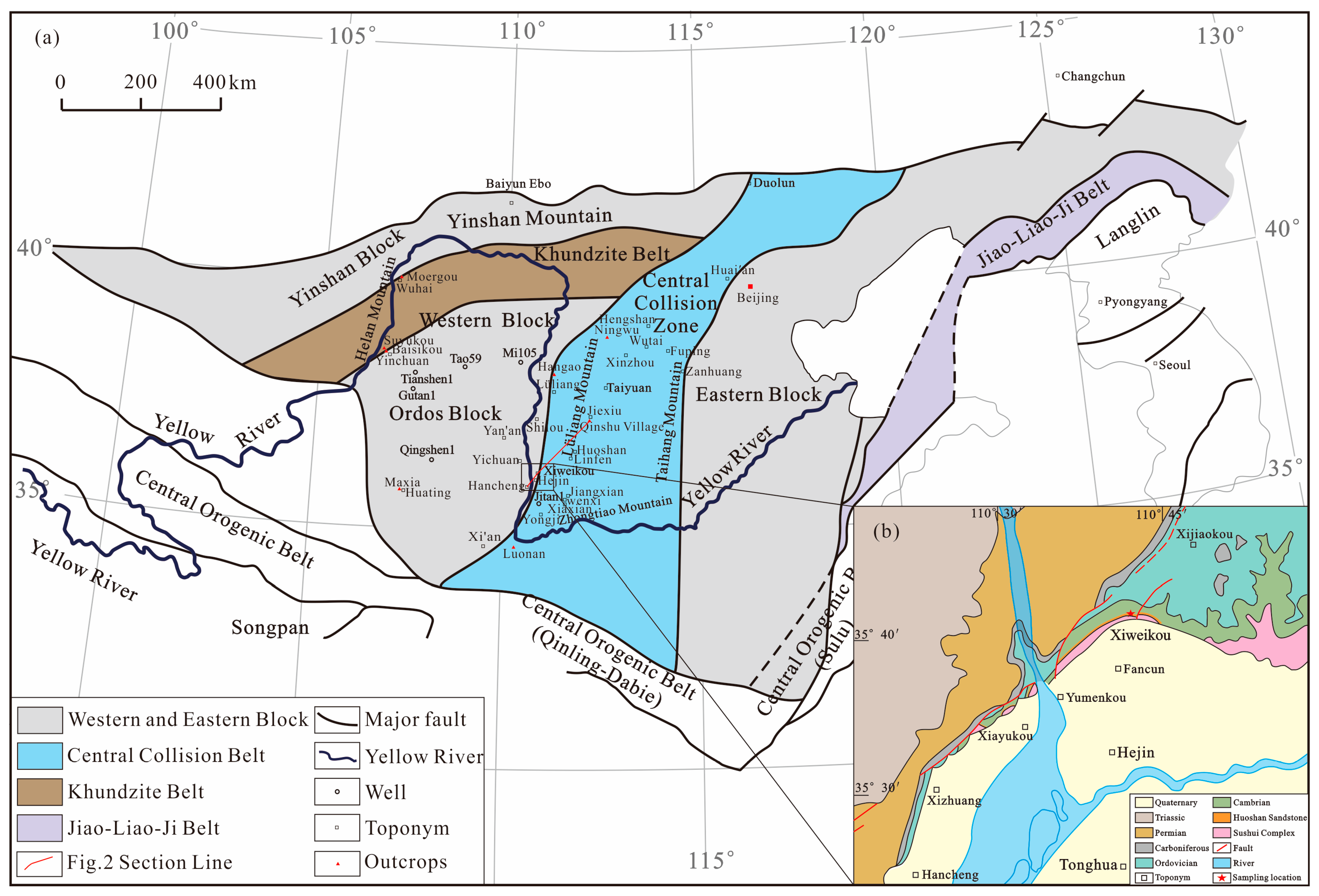
The NCC is bounded to the north by the Late Paleozoic Tianshan–Inner Mongolia–Greater Hinggan orogenic belt, to the west by the Early Paleozoic Qilian orogenic belt, to the south by the Qinling–Dabie orogenic belt, and to the east by the Sulu high-pressure metamorphic belt (Figure 1a). The “Huoshan Sandstone” is widely distributed across the NCC, extending from the Huoshan and Lüliang Mountain ranges in Shanxi Province southward to Hancheng City in Shaanxi Province and northward to the Ordos–Daqing Mountain area of Inner Mongolia. Regionally, this unit predominantly overlies Archean gneisses with non-conformity, and underlies Cambrian strata containing diverse trilobite biozones, demonstrating variable stratigraphic positions beneath different Cambrian horizons [28] (Figure 1b). The specific Cambrian unit above it varies spatially, from the upper Maozhuang to basal Xuzhuang Formation in the Huoshan area, predominantly the Xuzhuang Formation in the Lüliang Mountains, and the Zhangxia through Gushan Formations west of the Lüliang Mountains, showing a regional east-to-west and south-to-north younging trend.
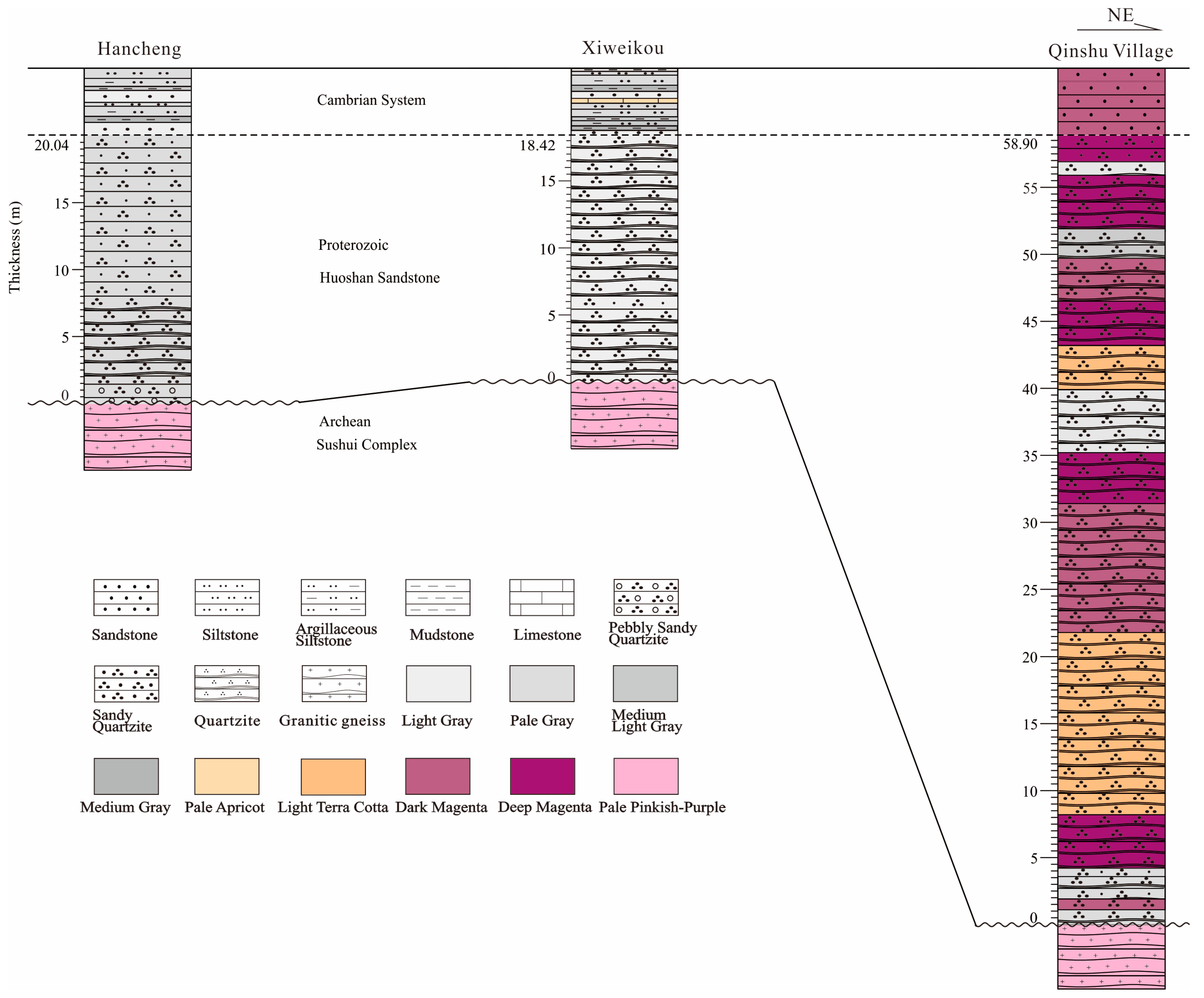
The residual thickness of the “Huoshan Sandstone” shows marked regional variability, thinning westward from a maximum of 60–100 m in the Huoshan area, through 20–40 m in the Lüliang Mountains, to less than 20 m or even pinch-out west of the Lüliang Mountains. The stratigraphic correlation diagram of the “Huoshan Sandstone” along the Hancheng City–Xiweikou (Hejin City)–Qinshu Village (Jiexiu City) transect shows that the residual thicknesses of the closely spaced Hancheng and Xiweikou sections differ little, while a decreasing trend in residual thickness is evident from Qinshu Village to Xiweikou (Figure 2). Lithologically, the unit is dominated by grayish-white, massive to medium-thick-bedded quartzite at Hancheng and Xiweikou, contrasting with the interbedded purplish-red, grayish-white, white, and flesh-red quartzites at Jiexiu City (Figure 2).
The study area lies on the southeastern margin of the Ordos Block, adjacent to a north–south trending Paleoproterozoic tectonic zone to the east (Figure 1b). This zone exposes, from north to south, the Hengshan, Wutai, and Fuping Complexes; the Lüliang Complex in its central part; and the Sushui complex in the Zhongtiao region to the south. These complexes consist of Neoarchean to Paleoproterozoic tonalite–trondhjemite-granodiorite (TTG) rocks [29,30]. The zircon U-Pb dating samples of the “Huoshan Sandstone” were collected from the Xiweikou outcrop (35°43′0.53″ N, 110°43′52.8″ E), located approximately 15 km north of Hejin City, Shanxi Province (Figure 1b). The outcrop belt extends about 5 km along National Highway 209, from the Xiweikou Toll Station to Xipo Town.
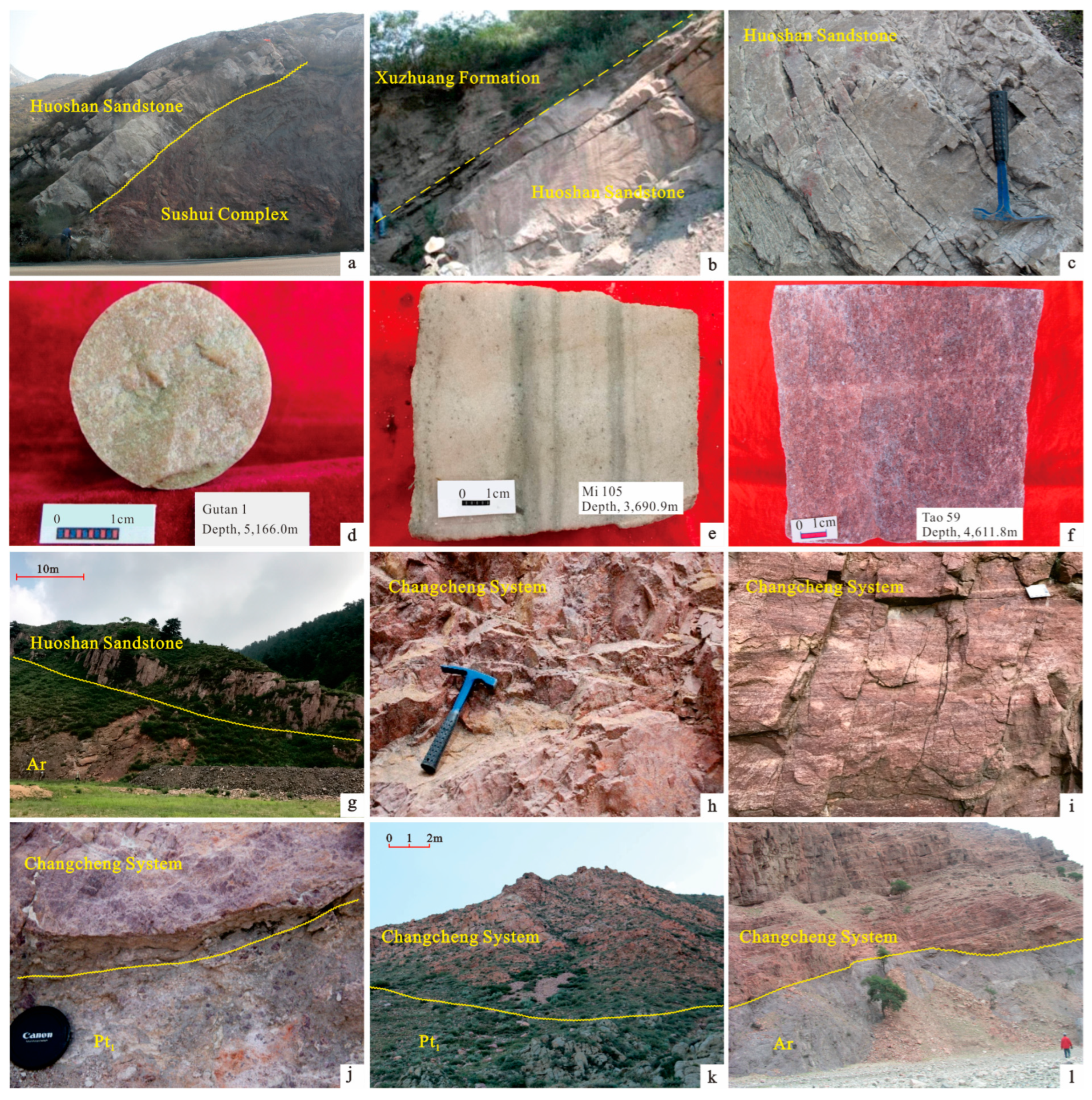
The Xiweikou area and its vicinity form a macroscopic anticlinal structure with a hinge trending nearly NEE. The exposed strata form the northern limb of the anticline, displaying a south-to-north succession of Archaean, Proterozoic, Cambrian, Ordovician, Carboniferous, Permian, and Triassic System, while being overlain by Quaternary deposits in the southern part. At Xiweikou, the “Huoshan Sandstone” is stratigraphically situated between the Early Precambrian metamorphic basement complex rocks and Cambrian strata, exhibiting a nonconformity with the underlying basement rocks and a disconformity with the overlying Cambrian System (Figure 3). The Sushui complex, a major component of the basement rocks in southern NCC, crops out as a NE-SW-trending belt along the northwestern flank of the Zhongtiao Mountains, extending through the Jiangxian, Wenxi, Xiaxian, Xiezhou, and Yongji areas [10]. It is predominantly composed of metamorphosed and deformed TTG [31,32,33,34,35] suites and calc-alkaline granitic rocks [36,37,38,39], with formation ages ranging from the Neoarchean to Paleoproterozoic [32,37,38,40,41,42,43]. The complex is in disconformable contact with overlying Early to Middle Proterozoic strata. In the Xiweikou area of Hejin, located on the southeastern margin of the Ordos Basin, the Sushui complex (Figure 3a) is sporadically outcropped and consists mainly of monzogranitic gneiss, which is overlain by the “Huoshan Sandstone”. The Cambrian succession consists mainly of dark gray to gray mudstones, silty mudstones, and yellowish-to-pale gray, thin-bedded quartz sandstones with calcareous cement, occasionally intercalated with thin limestone layers (Figure 3b). The “Huoshan Sandstone” is mainly grayish-white, thick-bedded to massive quartzite (Figure 3c), with a thickness of 18.42 m (Figure 2). Rock assemblages lithologically comparable to the “Huoshan Sandstone” are widely distributed across the interior and periphery of the Ordos Basin (Figure 2). For example, the Changcheng System revealed by wells such as Gutan 1 (Figure 3d), Mi105 (Figure 3e), Tao 59 (Figure 3f), Qingshen 1, and Tianshen 1 within the basin predominantly consists of gray-white to brown-red quartz sandstones. Regional stratigraphic correlation indicates that the Changcheng System’s Yunmengshan Formation on the eastern margin (Figure 3g), the Gaoshanhe Formation (Figure 3h) on the southern–southwestern margins (Figure 3i) and in the Xiaoqinling area, and the Huangqikou Formation (Figure 3j,k) on the western–northwestern margins (Figure 3l) all develop a suite of rock assemblages characterized by purple-red to gray-white, thick- to very thick-bedded quartzitic sandstones, quartzites, and quartz (conglomeratic) sandstones. These assemblages unconformably overlie the Neoarchean to Paleoproterozoic metamorphic basement. This set of highly mature quartz sandstone assemblages exhibits continuous spatial distribution, collectively constituting the first regional sedimentary cover of the Ordos Block. Previous studies [44,45] have shown that the Precambrian basement complexes, including the Sushui complex, share consistent rock assemblages (dominated by TTG gneisses and calc-alkaline granitoids), similar formation ages (Neoarchean to Paleoproterozoic), and comparable metamorphic–deformational characteristics. These basement complexes amalgamated and consolidated into a unified ancient continent by the end of the Archean. The formation of this stable block provided a robust tectonic foundation for the extensive deposition of the Changcheng System.

3. Petrographic Features

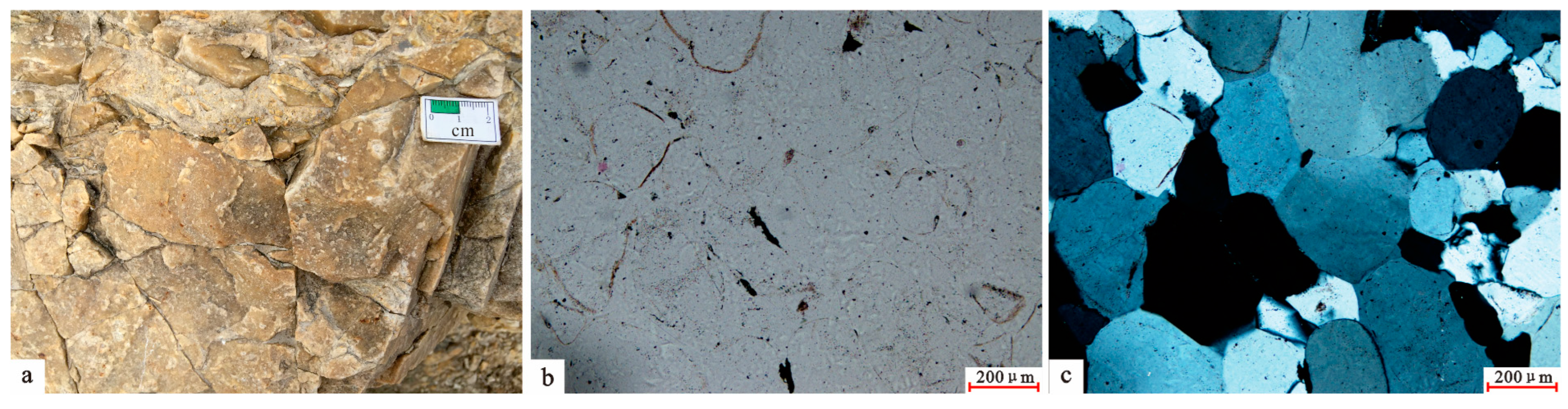
The “Huoshan Sandstone” at Xiweikou is primarily composed of quartzite interbedded with quartzitic sandstone and quartz sandstone. It exhibits large-scale tabular cross-bedding, rhythmic bedding, and herringbone cross-bedding. On fresh surfaces, closely interlocked polygonal quartz grains are visible, displaying pronounced glittering reflections under sunlight. The main mineral is quartz, with content ranging from 85.5% to 97.8%. The lithic fragment content varies between 1.0% and 2.5%, while the mica content is about 0.5%. The muddy matrix content is around 0.5%, and the siliceous secondary overgrowth cement content ranges from 2.0% to 10.0%, forming an overgrowth cementation texture. The maximum grain size is 0.7 mm, with the primary grain size range being 0.30–0.50 mm. The original quartz sandstone shows good roundness, predominantly subrounded, with quartz overgrowth cementation. Due to recrystallization, the boundaries of these quartz overgrowths become less distinct. After cementation and recrystallization, the quartz grains develop relatively straight or gently undulating boundaries that interlock with each other, demonstrating characteristic metamorphic rock features (Figure 4).

4. Analytical Methods and Sample Characteristics

4.1. Analytical Methods

Zircon separation was performed at the laboratory of the Hebei Institute of Regional Geological and Mineral Survey. The procedures involved conventional sample crushing, elutriation, electromagnetic, and heavy liquid separation. Subsequently, zircon grains with large sizes, well-developed crystal forms, and minimal fractures/inclusions were hand-picked under a binocular microscope. The selected zircons were then mounted in epoxy resin, polished, and cleaned to expose grain surfaces, and finally prepared as target mounts.
The zircon cathodoluminescence (CL) imaging, LA-ICP-MS zircon U-Pb dating, zircon microzonation of trace elements, and Hf isotope were conducted using a Quanta450 FEG (Thermo Fisher Scientific, Waltham, MA, USA) at the National Key Laboratory of Continental Evolution and Early Life, Northwestern University. U-Pb dating spot selection was performed based on zircon CL images. The zircon U-Pb dating was carried out using an Agilent 7500a ICP-MS (Agilent Technologies, Inc., Santa Clara, CA, USA) connected to a Geolas-193 UV laser ablation system (Lambda Physik AG, Goettingen, Germany). The analytical conditions included the following: laser beam diameter of 30 μm, frequency of 8 Hz, single-spot ablation mode, and Helium as the carrier gas. ICP-MS data were acquired in peak-hopping mode and processed using Glitter software (version 4.0). The Harvard zircon 91500 standard was used as an external calibrant for isotopic fractionation correction. Concordia diagrams, weighted mean age calculations, and plotting were performed using Isoplot (version 3, [46]). For zircon trace element concentration calculations, NIST610 glass (the Standard Reference Material (SRM), developed by the National Institute of Standards and Technology (NIST), is a type of synthetic silicate glass) was used as an external standard with Si as an internal calibrant [46,47,48,49,50]. In situ zircon Lu-Hf isotope analysis was conducted using a Nu Plasma HR multi-collector inductively coupled plasma mass spectrometer (MC-ICP-MS) manufactured by Nu Instruments Ltd. (Wrexham, UK), coupled with a GeoLas200M laser ablation system produced by MicroLas Lasersystem GmbH (Goettingen, Germany). The laser ablation parameters were set as follows: a pulse frequency of 10 Hz, a laser beam diameter of 44 μm, an energy density of 10 J/cm2, and an ablation duration of approximately 50 s [51].
In situ Lu-Hf isotope determination of zircon was carried out using 176Lu/175Lu = 0.02669 and 176Yb/172Yb = 0.5886 for isobaric interference correction when calculating the measured 176Lu/177Hf and 176Hf/177Hf ratios [52]. The decay constant of 176Lu (1.867 × 10⁻¹¹ yr−1) was used for the calculation of εHf(t) values. The current 176Hf/177Hf of chondrites is 0.282772, and 176Lu/177Hf is 0.0332 [53]. The calculation of the Hf-depleted mantle model age (TDM1) uses the current depleted mantle 176Hf/177Hf = 0.28325 and 176Lu/177Hf = 0.0384 [54]. The single-stage Hf model age was calculated relative to the depleted mantle reservoir. For the two-stage Hf model age (TDM2), an average continental crustal 176Lu/177Hf value of 0.015 was used in the calculation [55].

4.2. Sample Characteristics

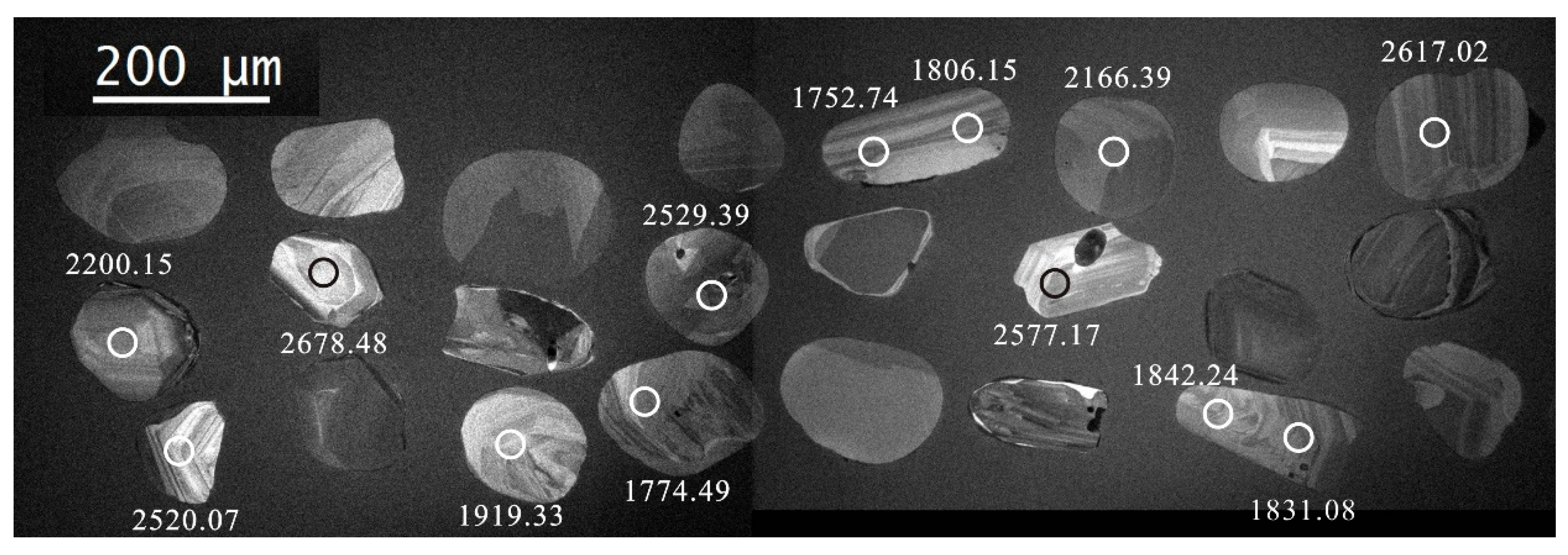
Zircon grains separated from the “Huoshan Sandstone” at Xiweikou are light yellow to colorless and transparent, with grain sizes ranging from 80 to 300 μm. They show considerable diversity in both crystal morphology and roundness, predominantly exhibiting elliptical and elongated prismatic shapes with subrounded to angular features. Based on detrital transport characteristics, it is inferred that these zircons have undergone moderate transport distance. Cathodoluminescence (CL) imaging reveals that most zircon grains display weak oscillatory or sector zoning with significant variations in luminescence intensity, consistent with a magmatic origin. In contrast, some grains exhibit irregular, patchy, or uniformly gray and dull luminescence with vague or absent zoning. A minority of grains show core–rim structures, and some have distinct, relatively bright gray secondary overgrowths on their rims, characteristic of metamorphic zircon [56] (Figure 5).

5. Analysis of Results

A total of 170 zircon grains from two samples in this study were analyzed, with 104 spots achieving >95% concordance, listed in Supplementary Table S1. For age calculation and plotting, data points with 98%–99% concordance were preferentially selected.

5.1. Zircon Th/U Characteristics

U-Pb dating was performed on 53 zircon spots, with detailed analytical results presented in Supplementary Table S1. The samples exhibit Th contents ranging from 10.79 × 10⁻⁶ to 745.58 × 10⁻⁶ and U contents ranging from 20.30 × 10⁻⁶ to 1409.70 × 10−6. The Th/U ratios vary between 0.12 and 1.00, with 95 spots showing Th/U > 0.4 and 9 spots falling within the 0.1~0.4 range. No spots have Th/U ratios below 0.1. According to the Th/U criteria for zircon origin [57,58,59,60], magmatic zircons typically exhibit higher Th/U ratios (>0.4), whereas metamorphic zircons show lower values (<0.1). Therefore, the zircons in the “Huoshan Sandstone” are predominantly of magmatic origin.

5.2. Zircon U-Pb Dating Results

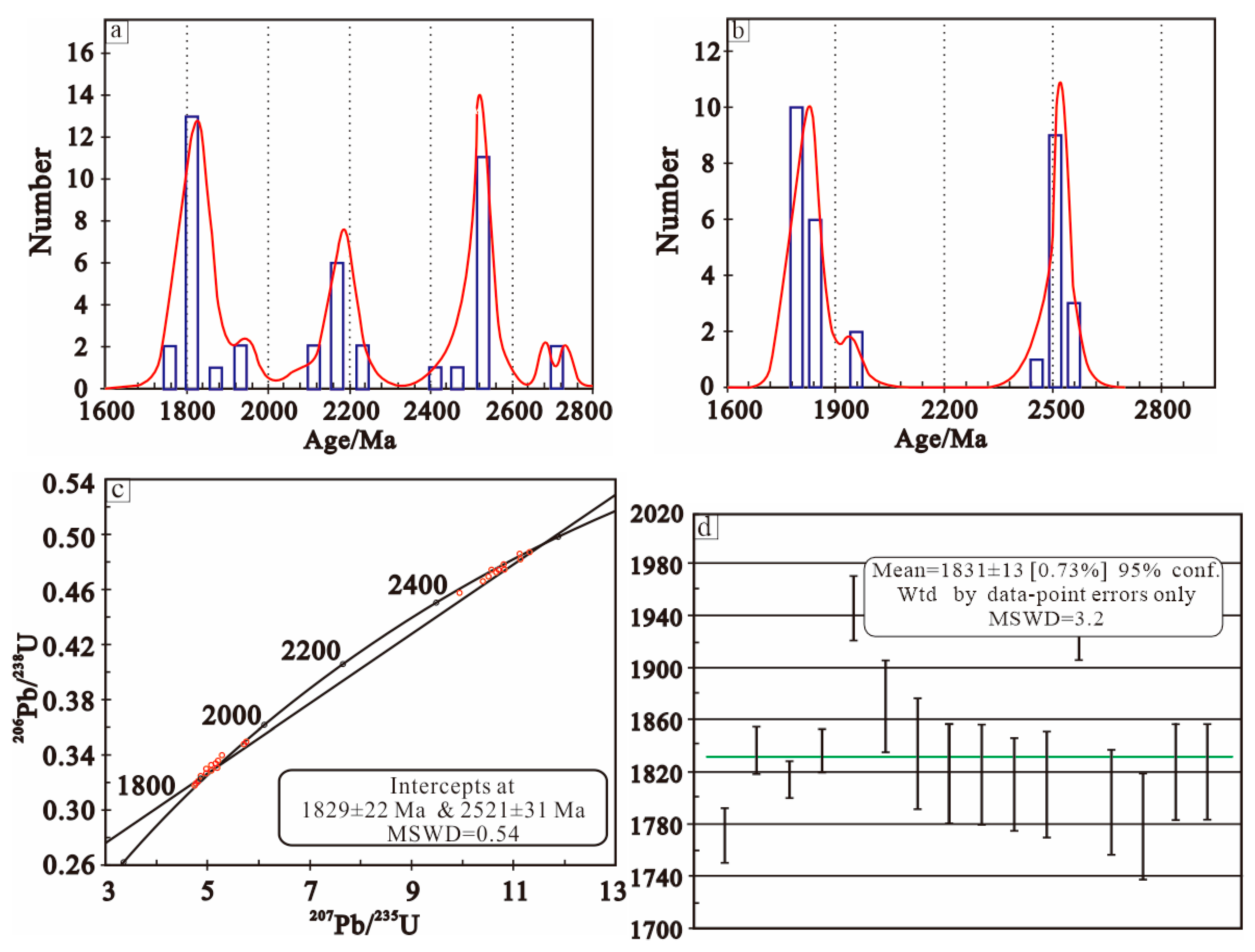
The U-Pb Concordia diagram of 104 zircon analyses from the “Huoshan Sandstone” shows that the 207Pb/206Pb ages range from 1618 ± 13 to 2995 ± 91 Ma (Figure 6a). Of these, 50 analyses demonstrate 98%–99% concordance, yielding ages between 1770 ± 20 and 2732 ± 16 Ma. The age spectrum shows dominant peaks at 1800 Ma and 2500 Ma (Figure 6b), with concordant analyses defining intercept ages of 2521 ± 31 Ma (upper) and 1829 ± 22 Ma (lower) (Figure 6c). The 1800 Ma population gives a weighted mean age of 1831 ± 13 Ma (Figure 6d).

5.3. Rare Earth Elements in Zircon

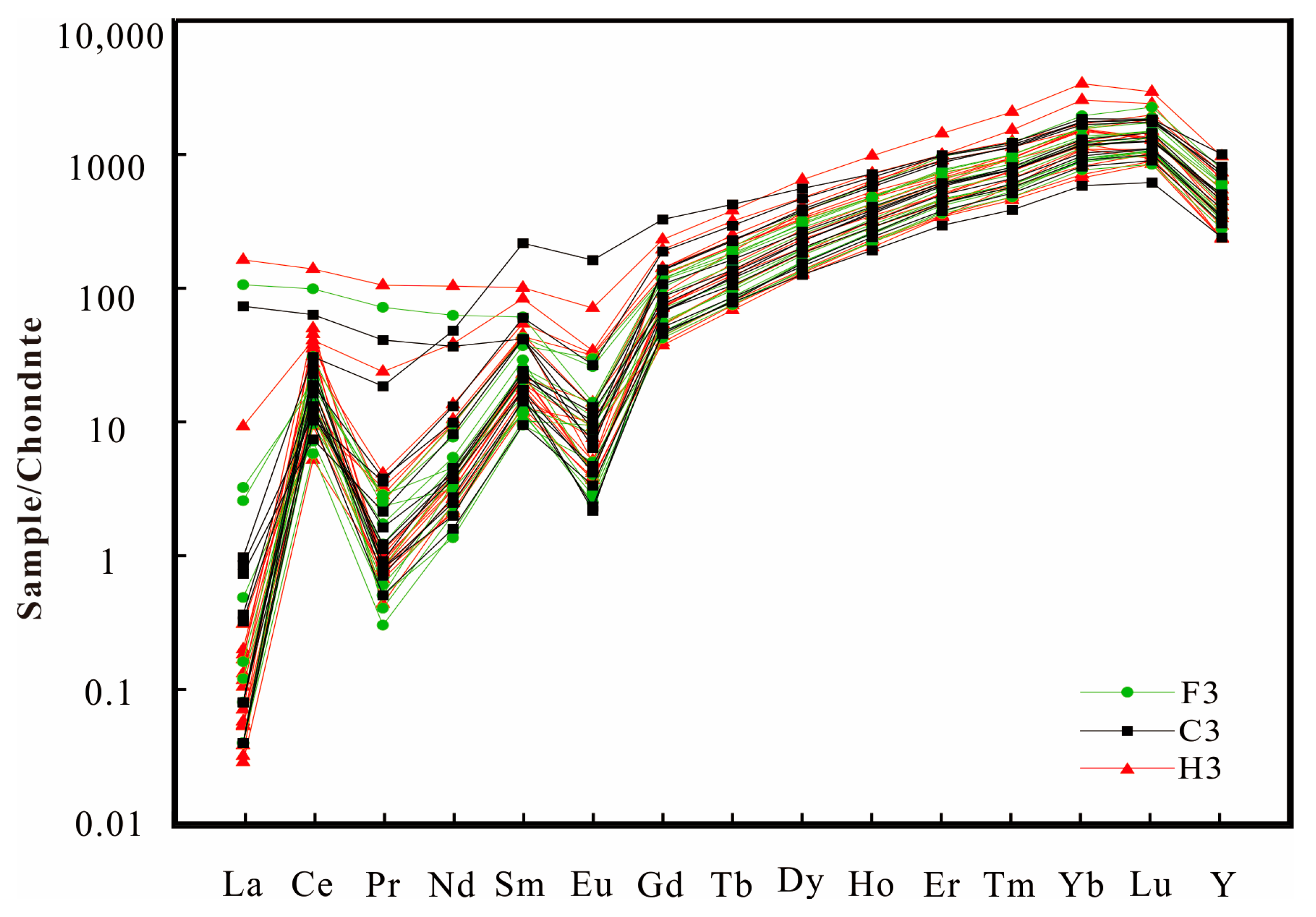
Magmatic zircons are characterized by significant light rare earth (LREE) depletion, extreme heavy rare earth (HREE) enrichment, strong positive Ce anomalies, and marked negative Eu anomalies, with granitic zircons being typical representatives (Supplementary Table S2) [61,62,63,64,65]. With the exception of three samples, the 39 analyzed zircons in the study area exhibit high ΣREE contents ranging from 249.9 to 2484.11 μg/g, showing extreme HREE enrichment with left-sloping REE patterns. These zircons display negative Eu anomalies (Eu/Eu* = 0.065–0.61) and obvious positive Ce anomalies (Ce/Ce* = 1.06–290.68), consistent with typical magmatic zircon REE characteristics [66,67]. The average ΣREE content of the three other samples is 1973.49 μg/g. While their HREE contents are similar to those of magmatic zircons, they exhibit significantly higher LREE concentrations, along with pronounced negative Eu anomalies (Eu/Eu* = 0.19~0.47) and negligible Ce anomalies (Ce/Ce* = 1.06–1.15) (Figure 7). These characteristics, which are largely similar to those of magmatic zircons, indicate a strong genetic inheritance from the aforementioned magmatic zircons. Therefore, these zircons should be classified as inherited zircons. The observed differences may be attributed to either subsequent hydrothermal alteration of the inherited zircons or the erosion of LREE-rich mineral inclusions (e.g., monazite) within them [67]. Based on trace element signatures, the zircons are thus categorized as magmatic zircons and inherited zircons.

5.4. Lu-Hf in Zircon

According to the zircon Hf isotope data presented in Supplementary Table S3, the 176Yb/177Hf and 176Lu/177Hf ratios of the zircons range from 0.011040 to 0.046345 and from 0.000305 to 0.001148, respectively. The 176Lu/177Hf ratios are generally lower than 0.002, indicating negligible accumulation of radiogenic Hf after the formation of these zircons. Consequently, the measured 176Hf/177Hf ratios can be considered representative of their initial isotopic composition at the time of crystallization. The 176Hf/177Hf ratios of the studied zircon samples vary from 0.281283 to 0.281582. The corresponding εHf(t) values, calculated using the 207Pb/206Pb age of each analytical spot, range from −5.88 to 5.4. The two-stage Hf model ages (TDM2) of the samples span from 2518 to 2860 Ma. These characteristics are consistent with the Hf isotopic signatures and two-stage model ages of the Zhongtiao Mountain TTG gneisses as reported by [69].

6. Discussion

6.1. The Maximum Depositional Age of the “Huoshan Sandstone”

There are multiple methods for determining the maximum depositional age (MDA) of stratigraphic units using detrital zircons [70,71,72,73]. The youngest single-grain age of detrital zircons is widely regarded as a key indicator for constraining the MDA [16,74,75,76,77]. Of the 104 zircon U-Pb age spots from the “Huoshan Sandstone”, the youngest concordance age is 1618 ± 13 Ma. Among the 50 zircon spots with concordance levels 98%–99%, the youngest age obtained is 1770 ± 20 Ma. The maximum depositional age of the “Huoshan Sandstone”, as constrained by the youngest zircon U-Pb ages (1770 ± 20 Ma), indicates that its sedimentation occurred after 1770 ± 20 Ma (Late Paleoproterozoic). This is consistent with field relationships: the unit lies unconformably on the Sushui complex and is disconformably overlain by Cambrian strata, with a clear metamorphic grade contrast between the lithified sandstone and the unmetamorphosed Cambrian shales, confirming a significant pre-Cambrian depositional age.

6.2. Provenance Analysis

Detrital zircons are widely present in sedimentary rocks and are primarily derived from granitic rocks in the source region. As a result, they can provide valuable insights into the age and composition of the sediment source [16,78]. The conventional approach of using detrital zircon U-Pb dating for provenance analysis involves comparing the age spectra of detrital zircons from sedimentary rocks with the ages of crystalline rock masses in surrounding orogenic belts. If the ages match, they can be interpreted as one of the potential sediment sources [79].
Throughout the NCC, TTG rocks exhibit a nearly continuous distribution from 3.8 Ga to 2.5 Ga [69,80,81,82], with a prominent peak occurring at approximately 2.53 Ga [83]. Regionally, TTG gneisses in the Fuping complex crystallized at 2.52~2.48 Ga [84,85], while those in the Lüliang Complex formed at ~2.5 Ga and were later metamorphosed between 1.95 and 1.85 Ga [86]. The Sushui complex in the Zhongtiao region comprises TTG gneisses from two episodes, ~2.7 Ga [87] and 2.56~2.36 Ga [83], interpreted to have originated from partial melting of hydrated basaltic crust in a Neoarchean island-arc setting [88,89,90]. These units, together with the Jiangxian and Zhongtiao groups, register a widespread Paleoproterozoic metamorphic event at ~1.85 Ga [91,92], which is consistently recorded in other central NCC terranes (e.g., Huai’an, Hengshan, Wutai, Fuping, Zanhuang) with ages clustered between 1.88 and 1.80 Ga [89,93,94,95,96,97].
In this study, the upper intercept age of 2521 ± 31Ma, obtained through ICP-MS U-Pb age concordia analysis of the “Huoshan Sandstone” is consistent with the ages documented in the central NCC, and the zircons exhibit magmatic characteristics. These results suggest that the detrital zircons in the ‘Huoshan Sandstone’ were most likely derived from Neoarchean TTG gneisses generated by partial melting of oceanic crust [88,89,90]. This study obtained a lower intercept age of 1829 ± 22 Ma through ICP-MS U-Pb zircon dating of the “Huoshan Sandstone”, consistent with previously reported metamorphic ages from the Zhongtiao Group. This suggests that zircons in the “Huoshan Sandstone” also recorded the Paleoproterozoic thermal metamorphic event at ~1.85 Ga. The timing of this event shows strong consistency with metamorphic ages documented in other areas of the central zone of the NCC. Synthesizing the above research, the provenance of the “Huoshan Sandstone” is inferred to have been derived from the Paleoproterozoic Sushui complex, Jiangxian Group, and Zhongtiao Group exposed in the central NCC: (1) most zircons in the “Huoshan Sandstone” are of magmatic origin, consistent with the TTG gneisses in the Zhongtiao Mountains that originated from partial melting of oceanic crust; (2) the peak U-Pb zircon ages of 2.5 Ga and 1.85 Ga obtained from ICP-MS analysis correspond well with the magmatic intrusion age and subsequent metamorphic age, respectively, documented in the central NCC.

6.3. Geological Significance

6.3.1. Stratigraphic Classification and Correlation

As established, outcrops of the Changcheng System within the Ordos Basin and adjacent regions consistently exhibit an unconformable contact with the underlying basement. The lithology of these outcrops closely aligns with that of the Xiweikou “Huoshan Sandstone”, and together they constitute the earliest Precambrian clastic sedimentary sequence in the area. Based on the integration of regional geological data, core observations (Figure 3), and a well-constrained maximum depositional age of 1770 ± 20 Ma, this study formally assigns the “Huoshan Sandstone” to the Mesoproterozoic Changcheng System.

6.3.2. Tectonic Depositional Patterns

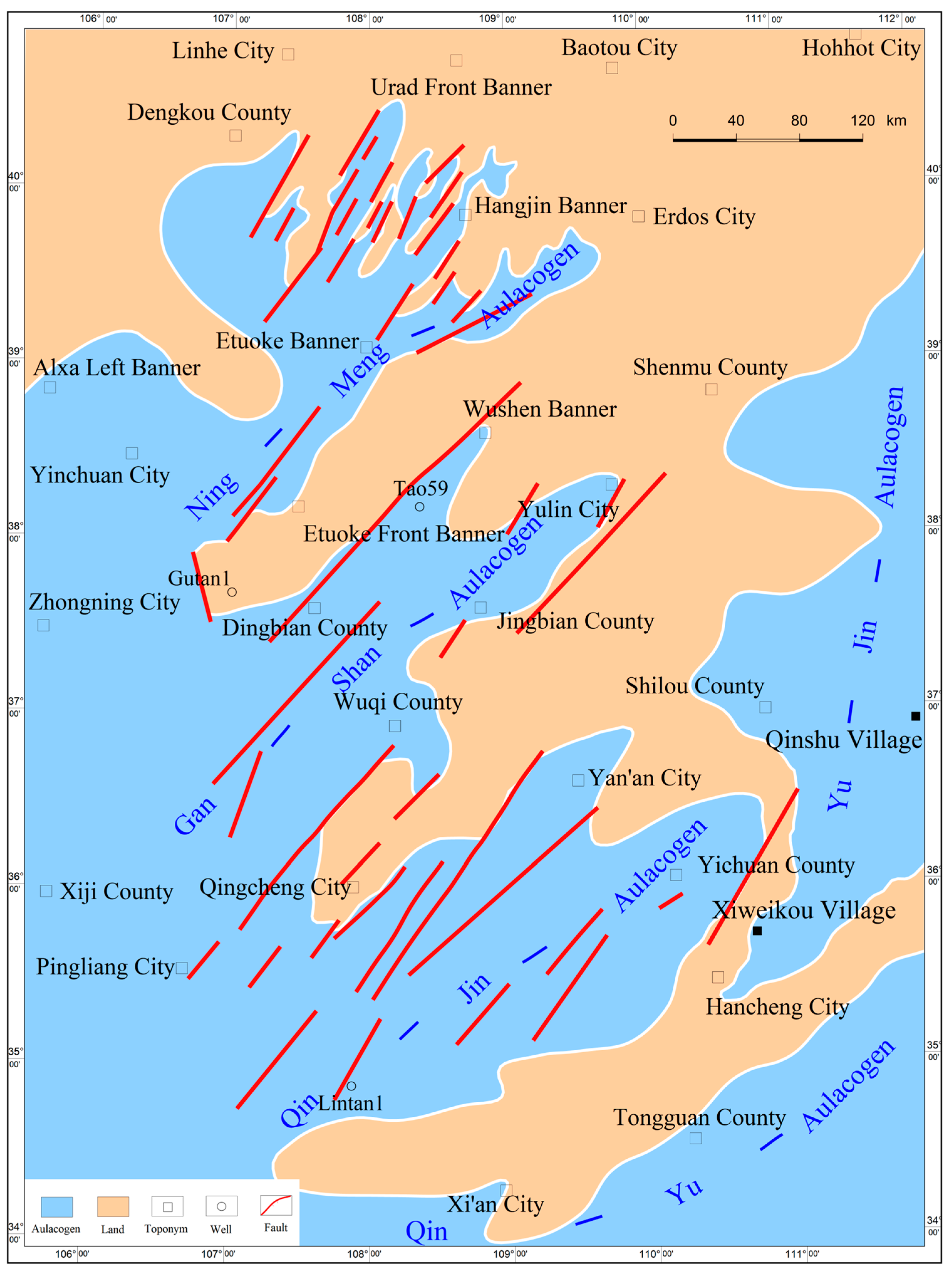
Feng et al. [91] proposed that a series of NE-trending aulacogens developed in the Mesoproterozoic Ordos region, sequentially named (from NW to SE) the Ningxia–Inner (Ning–Meng) Mongolia Aulacogen; Gansu–Shaanxi (Gan–Shan) Aulacogen; Shanxi–Shaanxi (Qin–Jin) Aulacogen; and Shaanxi–Henan (Qin–Yu) Aulacogen. In contrast, areas such as the Lüliang Mountains and the Huoshan region were considered erosional uplifts without aulacogen development.
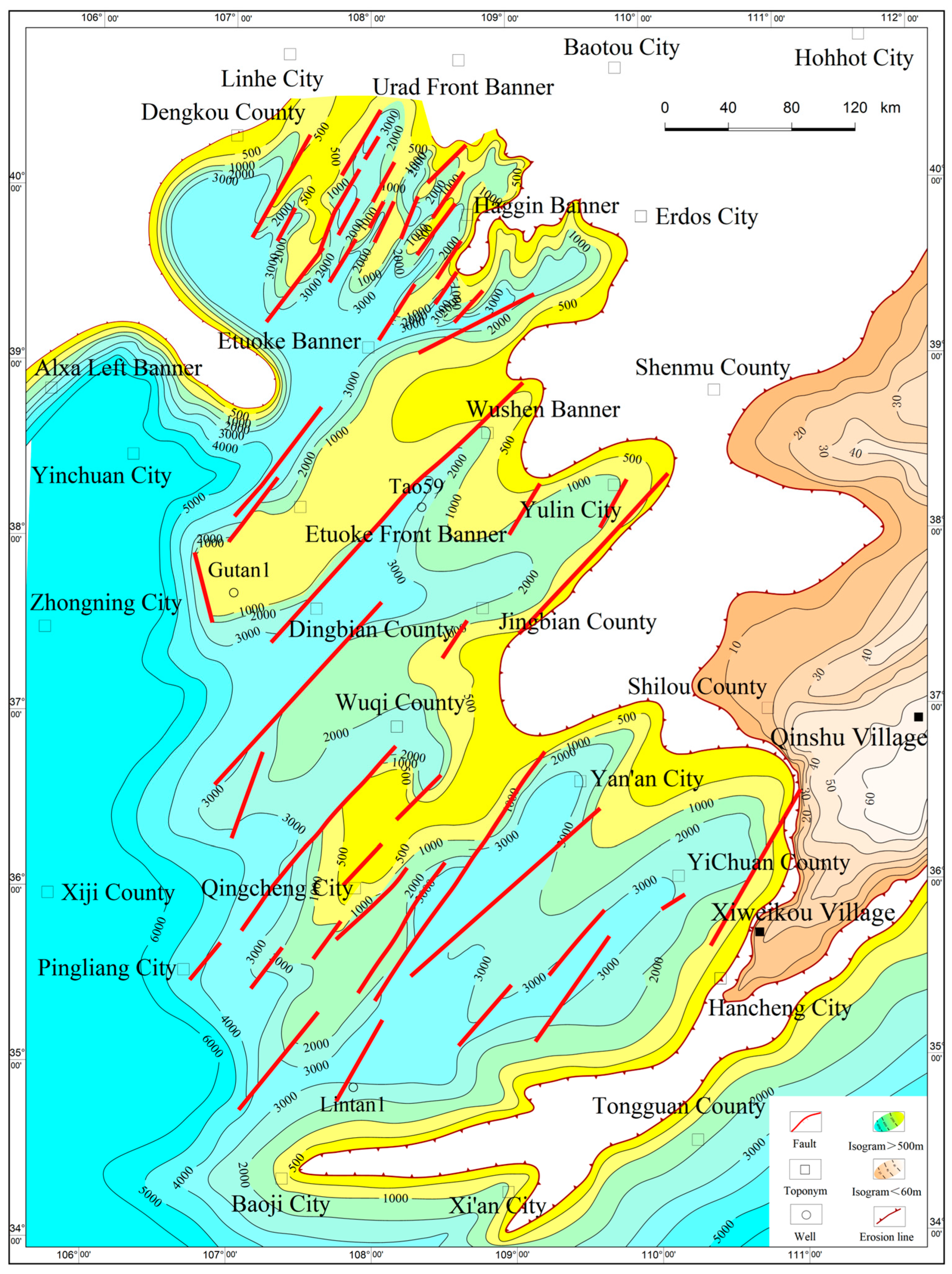
This study, however, reveals that the “Huoshan Sandstone” is widely developed across these same regions—the Lüliang Mountains, Huoshan Mountain, Taihang Mountains, and Yunzhong Mountain in northern Shanxi. Its residual thickness generally ranges from several meters to tens of meters, with maximum thickness exceeding 100 m. Spatially, the unit shows a systematic thinning trend westward, northward, and southward, leading to pinch-out in some areas, while thickening eastward (Figure 8). The closely spaced linear gradient zones in the residual-thickness isolines of the Changcheng System (Figure 8) reflect a depositional margin likely controlled by syn-sedimentary faults.
Based on this residual-thickness distribution pattern, this study proposes that these extensive regions likely constituted a Proterozoic Henan–Shanxi (Yu–Jin) Aulacogen (Figure 9). Aeromagnetic data from the Ordos Block reveal a NE-trending aeromagnetic negative belt, accompanied by local positive anomalies, along the eastern block margin, extending from Huashan (Shaanxi) through Shilou, Lüliang, and Wutai (Shanxi) to Fuping (Hebei) [91,92]. The spatial correspondence between this aeromagnetic belt and the inferred “Yu–Jin Aulacogen” provides key geophysical support for its existence. The local aeromagnetic highs are attributed to magmatic activity associated with the initial rifting of the aulacogen, which is supported by prior evidence confirming multiple magmatic events in these areas predating the deposition of the Changcheng System. However, the eastward extension of this Yu–Jin Aulacogen and its potential connections with either the Qin–Jin Aulacogen or Qin–Yu Aulacogen require further in-depth analysis. These findings hold significant implications for reconstructing the Proterozoic tectonic–sedimentary framework of the Ordos region.
Moreover, aulacogens represent favorable settings for the development of Proterozoic hydrocarbon source rocks [93]. Their spatial distribution provides crucial guidance for identifying prospective exploration zones and optimizing targets in ancient deep petroleum reservoirs.

6.3.3. Tectonic Evolution

The NCC’s Precambrian assembly remains debated, primarily between models of late Archean amalgamation of micro-blocks [94,95,96,97] and Paleoproterozoic collision between eastern and western blocks along the Central Orogenic Belt [29,30,98,99,100,101,102,103,104,105,106,107,108,109,110,111,112]. The western block formed at ~1.95 Ga through the collision and amalgamation of the Yinshan and Ordos micro-blocks along the Khondalite Belt [30]. Detrital zircon data from the Changcheng System sandstones in the northern Ordos Block reveal prominent age peaks at ~2.5 Ga and 1.9 Ga, indicating intense ~2.5 Ga magmatism and subsequent tectonic-thermal reworking during the 1.95~1.85 Ga [113]. Metamorphic ages of ~1.85 Ga obtained from various regions across the NCC represent its final amalgamation event. This Paleoproterozoic collision, characterized by continent–continent orogeny, drove the suturing of the disparate Archean basement blocks of the craton [80]. It marks both the final cratonization of the craton and its incorporation into the global Columbia (Nuna) supercontinent [114,115]. Subsequently, the NCC transitioned to a stable period of sedimentary cover development, shifting from a collisional orogeny to a prolonged extensional regime [96].
The zircon U-Pb dating results from this study indicate that detrital zircons in the “Huoshan Sandstone” record a Neoarchean (~2.5 Ga) collision and a Paleoproterozoic (~1.85 Ga) metamorphic event. These signals likely reflect the tectonic collision between the eastern and western blocks of the NCC, which led to the formation of the Central Orogenic Belt. Thus, the findings of this study may serve as additional evidence supporting the late Paleoproterozoic collision–amalgamation of the eastern and western blocks along the central zone of the NCC. The subsequent sedimentation requires the prior development of a sedimentary basin. The ~1.85 Ga tectonothermal event indicates the onset of extensional tectonics following the consolidation of the Archean basement in the NCC. During the initial deposition of the Changcheng System, geological units with 1.9~1.8 Ga age signatures—products of continent–continent collision—remained at deep crustal levels, unexposed at the surface. Progressive intensification of extensional tectonics, coupled with prolonged weathering and erosion, eventually exhumed these units, enabling them to serve as provenances for the Changcheng System. This interpretation aligns precisely with the established evolutionary framework of the NCC’s Early Precambrian basement. These results can provide fundamental data for research on the Precambrian tectonic evolution of the NCC, a major scientific issue in Earth sciences.

7. Conclusions

(1) The “Huoshan Sandstone” in Xiweikou is lithologically classified as quartzite, exhibiting low-grade metamorphic characteristics. Its protolith was medium-grained quartz sandstone.
(2) Most zircons are of magmatic origin, with two distinct peaks in the zircon U-Pb age frequency histogram at approximately 1.80 Ga and 2.5 Ga. The upper intercept age is 2521 ± 31 Ma, while the lower intercept age is 1829 ± 22 Ma. The maximum depositional age of 1770 ± 20 Ma indicates that its sedimentation occurred after 1770 ± 20 Ma (the late Paleoproterozoic). Furthermore, as it underlies the red shales of the Cambrian Mantou Formation as a distinct tectonic layer, it must have formed prior to the deposition of the Cambrian Mantou Formation. The detrital zircons were likely sourced from Precambrian strata exposed in the Zhongtiao Mountains of the central NCC, including the Sushui complex, Jiangxian Group, and Zhongtiao Group.
(3) These findings provide further evidence supporting the collision and amalgamation of the eastern and western blocks of the NCC along the central orogenic belt during the late Paleoproterozoic.

Supplementary Materials

The following supporting information can be downloaded at https://www.mdpi.com/article/10.3390/min16020225/s1: Table S1: Zircon LA-ICP-MS U-Th-Pb dating results of “Huoshan Sandstone” in Xiweikou.; Table S2: Rare Element Contents (×10−6) of Zircons from the “Huoshan Sandstone”; Table S3: Lu-Hf isotopic compositions of Zircons from the “Huoshan Sandstone”.

Author Contributions

Conceptualization, C.W. and C.T.; methodology, C.W.; software, C.Z.; vali-dation, C.W., C.T., and C.Z.; formal analysis, L.W.; investigation, C.W., C.T., and C.Z.; resources, X.Z.; data curation, C.Z. and X.Z.; writing—original draft preparation, C.W. and C.T.; writing—review and editing, C.W. and C.T.; visualization, C.Z.; supervision, C.T. and L.W.; project administration, C.Z. and X.Z.; funding acquisition, C.T. All authors have read and agreed to the published version of the manuscript.

Funding

This research received no external funding.

Data Availability Statement

Data are contained within the article.

Acknowledgments

The authors would like to express their sincere gratitude to Yanchang Oil Field Co., Ltd. for material support and for providing access to laboratory facilities that were essential for the successful completion of this study. Additionally, heartfelt thanks are extended to the Xi’an Shiyou University and the Engineering Research Center of Development and Management for Low to Ultra-Low Permeability Oil & Gas Reservoirs in West China, Ministry of Education, for the invaluable educational foundation and academic support that significantly contributed to the development of this work. The authors also express their sincere appreciation to the anonymous reviewers for their valuable and constructive comments.

Conflicts of Interest

Chuang Zhang and Xue Zhou are employees Yanchang Oil Field Co., Ltd. The authors declare that they have no known competing financial interests or personal relationships that could have appeared to influence the work reported in this paper.

References

  1. Dai, Y.R.; Chen, J.S.; Zhang, J.W.; Li, H.B.; Liu, W.P.; Wang, K. Comparative application of detrital zircon U-Pb dating for stratigraphic delineation: The “Taojiahe Formation” of the Neoproterozoic Fanjingshan Group as an example. Acta Sedimentol. Sin. 2024, 42, 2006–2019. [Google Scholar]
  2. Gao, L.Z.; Zhang, H.; Zhang, C.H.; Yin, C.Y. SHRIMP zircon ages: Basis for refining the chronostratigraphic classification of the Meso- and Neoproterozoic strata in North China old land. Acta Geosci. Sin. 2008, 29, 366–376. [Google Scholar]
  3. Diwu, C.R.; Sun, Y.; Liu, Y.J.; Han, W.; Dai, M.N.; Li, Y.X. The protolith nature of quartz sandstone from Changlongshan Formation in Liujiang area, Qinhuangdao City: Evidence of U-Pb and Hf-isotope from detrital zircon. Acta Petrol. Miner. 2011, 30, 1–12. [Google Scholar]
  4. Zhang, H.; Gao, L.Z.; Zhou, H.R.; Song, B. Chronology progress of the Guandaokou and Luoyu Groups in the southern margin of North China Craton: Constraints on zircon U-Pb dating of tuff by means of the SHRIMP. Atca Petrol. Sin. 2019, 35, 2470–2486. [Google Scholar]
  5. Zhang, H.; Zhou, H.R.; Ding, X.Z.; Zhang, C.H.; Gao, L.Z.; Song, B. SHRIMP zircon U-Pb dating of tuff in the Guandaokou Group: Implications for the Meso-Neoproterozoic chronostratigrphic framework of the North China Craton. Acta Petrol. Miner. 2025, 44, 745–766. [Google Scholar]
  6. Wang, M.; Zhou, H.R.; Zhang, H. Mesoproterozoic stratigraphic attribution and tectnonic evolution in the southern margin of the North China Craton: Evidence from the detrital zircon U-Pb geochronology and zircon trace elements. Acta Geol. Sin. 2020, 94, 1027–1045. [Google Scholar]
  7. Kuang, H.W.; Liu, Y.Q.; Geng, Y.S.; Peng, N.; Wang, Y.C.; Chen, X.S.; Liu, Y.X.; Yang, F.J.; Zhao, F.H.; Liu, P.J.; et al. Research advances, a subdivision and correlation of the Meso-Neoproterozoic stratigraphy in China. Acta Geol. Sin. 2023, 97, 3861–3901. [Google Scholar]
  8. Li, H.K.; Zhang, J.; Tian, H.; Zhou, H.Y.; Xiang, Z.Q.; Liu, H. Recent advances in the study of the Meso-to Neoproterozoic chronostratigraphy of the Yanliao Aulacogen on the northern margin of hre North China Craton. Geol. Surv. Res. 2020, 43, 127–136. [Google Scholar]
  9. Shaanxi Bureau of Geology and Mineral Resources. Regional Geology of Shaanxi Province; Geological Publishing House: Beijing, China, 1989; pp. 1–698. [Google Scholar]
  10. Shanxi Bureau of Geology and Mineral Resources. Regional Geology of Shanxi Province; Geological Publishing House: Beijing, China, 1989; pp. 1–780. [Google Scholar]
  11. Feng, J.P.; Ouyang, Z.J. Tectono-Sedimentary Characteristics and Petroleum Geology of the Meso-Neoproterozoic in the Ordos Region; Geological Publishing House: Beijing, China, 2023; pp. 1–189. [Google Scholar]
  12. Zhang, J.Q. Comparison and age of Huoshan sandstone in Shanxi Province. Geol. Rev. 1959, 19, 488–491. [Google Scholar]
  13. Gao, Z.X.; Hsiung, Y.H.; Kao, P. Preliminary notes on the Sinian Stratigraphy of North China. Bull. Geol. Soc. China 1934, 13, 243–288. [Google Scholar] [CrossRef]
  14. Liang, Y.Z. On the caprock of Shanxi platform from the discussion of Huoshan Sandstone. Geol. Rev. 1960, 6, 262–267. [Google Scholar]
  15. Mei, M.X. The age attribution of Huoshan sandstone on the north China platform is discussed from the point of petrogenesis. J. Stratigr. 1993, 17, 224–227. [Google Scholar]
  16. Cawood, P.A.; Hawkesworth, C.J.; Dhuime, B. Detrital zircon record and tectonic setting. Geology 2012, 40, 875–878. [Google Scholar] [CrossRef]
  17. Jian, D.C.; Williams, S.; Yu, S.; Zhao, G.C. Quantifying the link between the detrital zircon record and tectonic settings. J. Geophys. Res. Solid Earth 2022, 127, e2022JB024606. [Google Scholar] [CrossRef]
  18. Barham, M.; Kirkland, C.L.; Handoko, A.D. Understanding ancient tectonic settings through detrital zircon analysis. Earth Planet. Sci. Lett. 2022, 583, 117425. [Google Scholar] [CrossRef]
  19. Xu, Y.J.; Du, Y.S.; Yang, H.M. Prospects of Sediment Provenance Analysis. Geol. Sci. Technol. Inf. 2007, 26, 26–32. [Google Scholar]
  20. Bhatia, M.R. Plate tectonics and geochemical composition of sandstones. J. Geol. 1983, 91, 611–627. [Google Scholar] [CrossRef]
  21. Wang, C.S.; Li, X.H. Sedimentary Basin: From Principles to Analyses; Higher Education Press: Beijing, China, 2003. [Google Scholar]
  22. Weltje, G.J.; Eynatten, H.V. Quantitative provenance analysis of sediments: Review and outlook. Sediment. Geol. 2004, 171, 1–11. [Google Scholar] [CrossRef]
  23. Andersen, T. Detrital zircons as tracers of sedimentary provenance: Limiting conditions from statistics and numerical simulation. Chem. Geol. 2005, 216, 249–270. [Google Scholar] [CrossRef]
  24. Gehrels, G.E.; Dickinson, W.R.; Ross, G.M.; Stewart, J.H.; Howell, D.G. Detrital zircon reference for Cambrian to Triassic miogeoclinal strata of western North America. Geology 1995, 23, 831–834. [Google Scholar] [CrossRef]
  25. Carter, A.; Moss, S.J. Combined detrital zircon fission-track and U-Pb dating: A new approach to understanding hinter-land evolution. Geology 1999, 27, 235–238. [Google Scholar] [CrossRef]
  26. Weislogel, A.L.; Graham, S.A.; Chang, E.Z.; Wooden, J.L.; Gehrels, G.E.; Yang, H. Detrital zircon provenance of the Late Triassic Songpan-Ganzi complex: Sedimentary record of collision of the North and South China blocks. Geology 2006, 34, 97–100. [Google Scholar] [CrossRef]
  27. Li, S.Y.; Wei, X.; Xie, W.; Cheng, C.; Li, M.; Hu, B.; Chai, G.L. From source to sink: Couping relation between the Dabie Shan Orogen provenance and Mesozoic sediments of the south-margin of Hefei Basin, based on the evidence of detrital zircon ages. J. Palaeogeogr. (Chin. Ed.) 2019, 21, 82–106. [Google Scholar]
  28. Bureau of Geology and Mineral Resources of Shanxi Province. Stratigraphy (lithostratic) of Shanxi Province, Multiple Classification and Correlation of the Stratigraphy of China (14); China University of Geosciences Press: Beijing, China, 1997. [Google Scholar]
  29. Zhao, G.C.; Sun, M.; Wilde, S.A.; Li, S.Z. Late Archean to Paleoproterozoic evolution of the North China Craton: Key issues revisited. Precambrian Res. 2005, 136, 177–202. [Google Scholar] [CrossRef]
  30. Zhao, G.C.; Wilde, S.A.; Sun, M.; Xia, X.P.; Zhang, J.; He, Y.H. SHRIMP U-Pb zircon geochronology of the Huai’an Complex: Constraints on late Archean to paleoproterozoic magmatic and metamorphic events in the Trans-North China Orogen. Am. J. Sci. 2008, 308, 270–303. [Google Scholar] [CrossRef]
  31. Bai, J.; Dai, F.Y.; Yan, Y.Y. Precambrian crustal evolution of the Zhongtiao mountains. Earth Sci. Front. 1997, 4, 281–289. [Google Scholar]
  32. Tian, W.; Liu, S.W.; Liu, C.H.; Yu, S.Q.; Li, Q.G.; Wang, Y.R. Zircon SHRIMP geochronology and geochemistry of TTG rocks in Sushui Complex from Zhongtiao Mountains with its geological implications. Prog. Nat. Sci. 2006, 16, 492–500. [Google Scholar]
  33. Zhang, R.Y. The composition and evolution of the Sushui complex in the Zhongtiao Mountains, the south of North China Craton. Ph.D. Dissertation, Northwest University, Xi’an, China, 2015. [Google Scholar]
  34. Diwu, C.R. Crustal growth and evolution of Archean continental crust in the southern North China Craton. Acta Petrol. Sin. 2021, 37, 317–340. [Google Scholar]
  35. Si, B.W.; Diwu, C.R.; Wang, T.Y.; Gan, B.P. Late Paleoproterozoic tectonothermal events in the North China Craton as revealed by rutile U-Pb dating of the Sushui Complex. Precambrian Res. 2024, 410, 107495. [Google Scholar] [CrossRef]
  36. Sun, D.Z.; Hu, W.X.; Tang, M.; Zhao, F.Q.; Condie, K.C. Origin of Late Archean and Early Proterozoic rocks and associated mineral deposits from the Zhongtiao Mountains, east-central China. Precambrian Res. 1990, 47, 287–306. [Google Scholar] [CrossRef]
  37. Tian, W.; Liu, S.W.; Zhang, H.F. Paleoproterozoic potassic granitoids in the Sushui complex from the Zhongtiao Mountains, northern China: Geochronology. geochemistry and petrogenesis. Acta Geol. Sin. 2006, 80, 875–885. [Google Scholar]
  38. Yang, C.H.; Du, L.L.; Song, H.X.; Duan, Q.S.; Wang, J.L.; Huang, Z.Q.; Ren, L.D.; Geng, Y.S.; Wang, Y.B. Geochronology and petrogenesis of Neoarchean Yanzhuang syenogranites from Sushui Complex in the Zhongtiao Mountains: Implications for the crustal evolution of the North China Craton. Earth Sci. 2020, 45, 3161–3178. [Google Scholar]
  39. Zhang, R.Y.; Zhai, M.G.; Zhao, Y. Geochronology, geochemistry and isotopic composition of the 2.18~2.16Ga granitoid rocks from the north western Zhongtiao Mountain region: Implications for the middle Paleoproterozoic tectonic evolution of the southern North China Craton. Lithos 2023, 440–441, 107020. [Google Scholar] [CrossRef]
  40. Yu, S.Q.; Liu, S.W.; Tian, W.; Li, Q.G.; Feng, Y.G. SHRIMP zircon U-Pb chronology and geochemistry of the Henglingguan and Beiyu Granitoids in the Zhongtiao Mountains, Shanxi Province. Acta Geol. Sin. 2006, 80, 912–924. [Google Scholar]
  41. Wang, J.Q.; Liu, X.; Diwu, C.R. LA-ICP-MS zircon U-Pb dating and Hf isotopic compositions of rocks from the Sushui complex in Shanxi-Shaanxi border area and their geological significance. Geol. Bull. China 2017, 36, 392–401. [Google Scholar]
  42. Zhang, R.Y.; Sun, Y.; Zhang, S.H. Early Precambrian geological events in the Zhongtiao Mountain, China: Implication for the evolution of Neoarchean to Paleoproterozoic crust in the southern segment of North China Craton. Int. Geol. Rev. 2021, 63, 1030–1050. [Google Scholar] [CrossRef]
  43. Shi, B.S.; Liu, J.Z.; Li, Y.Q.; Zhu, K.; Zhang, L.; Hu, J.H.; Liu, J.W. Geochronological and geochemical comparison of Precambrian meta-mafic volcanics in Zhongtiao Mountain and Luliangshan regions in Shanxi, North China Craton. Acta Geochim. 2021, 40, 325–347. [Google Scholar] [CrossRef]
  44. Diwu, C.R.; Zhang, C.L.; Sun, Y. Archean Continental Crust in the Southern North China Craton. Main Tectonic Events and Metallogeny of the North China Craton; Zhai, M.G., Zhao, Y., Zhao, T.P., Eds.; Springer: Singapore, 2016; pp. 29–44. [Google Scholar]
  45. Wan, Y.S.; Liu, D.Y.; Dong, C.Y.; Xie, H.Q.; Ren, P. Formation and Evolution of Archean Continental Crust of the North China Craton. Precambrian Geology of China; Zhai, M.G., Ed.; Springer: Berlin/Heidelberg, Germany, 2015; pp. 59–136. [Google Scholar]
  46. Ludwig, K.R. Isoplot 3.0-A geochronological toolkit for Microsoft Excel. Berkeley Geochronol. Cent. Spec. Publ. 2003, 4, 1–70. [Google Scholar]
  47. Wiedenbeck, M.P.; Allé, F.; Corfu, W.L.; Griffin, M.; Meier, F.; Oberli, A.V.; Quant, A.V.; Roddick, J.C.; Spiegel, W. Three natural zircon standards for U-Th-Pb, Lu-Hf, trace element and REE analyses. Geostands Geoanal. Res. 1995, 19, 1–23. [Google Scholar] [CrossRef]
  48. Sláma, J.; Košler, J.; Condon, D.J.; Crowley, J.L.; Gerdes, A.; Hanchar, J.M.; Horstwood, M.S.A.; Morris, G.A.; Nasdala, L.; Norberg, N.; et al. Plešovice zircon: A new natural reference material for U–Pb and Hf isotopic microanalysis. Chem. Geol. 2008, 249, 1–35. [Google Scholar] [CrossRef]
  49. Jackson, S.E.; Pearson, N.J.; Griffin, W.L.; Belousova, E.A. The application of laser ablation-inductively coupled plasma-mass spectrometry to in-situ U-Pb zircon geochronology. Chem. Geol. 2004, 211, 47–69. [Google Scholar] [CrossRef]
  50. Diwu, C.R.; Sun, Y.; Gao, J.F.; Fan, L.G. Early Precambrian tectonothermal events of the North China Craton: Constraints from in situ detrital zircon U-Pb, Hf and O isotopic compositions in Tietonggou Formation. China Sci. Bull. 2013, 58, 3760–3770. [Google Scholar] [CrossRef]
  51. Diwu, C.R.; Sun, Y.; Wang, Q. The crustal growth and evolution of North China Craton: Revealed by Hf isotopes in detrital zircons from modern rivers. Acta Petrol. Sin. 2012, 28, 3520–3530. [Google Scholar]
  52. Chu, N.C.; Taylor, R.N.; Chavagnac, V. Hf isotope ratio analysis using multi-collector inductively coupled plasma mass spectrometry: An evaluation of isobaric interference corrections. J. Anal. At. Spectrom. 2002, 17, 1567–1574. [Google Scholar] [CrossRef]
  53. Bouvier, A.; Vervoort, J.D.; Patchett, P.J. The Lu-Hf and Sm-Nd isotopic composition of CHUR: Constraints from unequilibrated chondrites and implications for the bulk composition of terrestrial planets. Earth Planet. Sci. Lett. 2008, 273, 48–57. [Google Scholar] [CrossRef]
  54. Vervoort, J.D.; Patchett, P.J.; Blichert-Toft, J.; Albarede, F. Relationships between Lu-Hf and Sm-Nd isotopic systems in the global sedimentary system. Earth Planet. Sci. Lett. 1999, 168, 79–99. [Google Scholar] [CrossRef]
  55. Rudnick, R.L.; Gao, S. Composition of the Continental Crust. In Treatise on Geochemistry; Holland, H.D., Turekian, K.K., Eds.; Pergamon: Oxford, UK, 2003; pp. 1–64. [Google Scholar]
  56. Hoskin, P.W.O.; Schalttegger, U. The composition of Zircon and igneous and metamorhpic petrogenisis. Rev. Mineral. Geochem. 2003, 53, 27–55. [Google Scholar] [CrossRef]
  57. Hoskin, P.W.O.; Black, L.P. Metamorphic zircon formation by solid-state recrystallization of protolith igneous zircon. J. Metamorph. Geol. 2000, 18, 423–439. [Google Scholar] [CrossRef]
  58. Belousova, E.A.; Griffin, W.L.; O’Reilly, S.Y.; Fisher, N.I. Igneous zircon: Trace element composition as an indicator of source rock type. Contrib. Miner. Petrol. 2002, 143, 602–622. [Google Scholar] [CrossRef]
  59. Rubatto, D. Zircon trace element geochemistry: Partitioning with tarnet and the link between U-Pb ages and metamorphism. Chem. Geol. 2002, 184, 123–138. [Google Scholar] [CrossRef]
  60. Hokada, T.; Harley, S.L. Zircon growth in UHT leucosome: Constrains from Zircon-granet rare earth element (REE) relations in Napier Complex, East Antarctica. J. Miner. Petrol. Sci. 2004, 99, 180–190. [Google Scholar] [CrossRef]
  61. Sun, J.J.; Shu, L.S.; Santosh, M.; Wang, L.S. Precambrian crustal evolution of the central Jiangnan Orogen (South China): Evidence from detrital zircon U-Pb ages and Hf isotopic compositions of Neoproterozoic metasedimentary rocks. Precambrian Res. 2018, 318, 1–47. [Google Scholar] [CrossRef]
  62. Liu, Y.S.; Hu, Z.C.; Gao, S.; Günther, D.; Xu, J.; Gao, C.G.; Chen, H.H. In situ analysis of major and trace elements of anhydrous minerals by LA-ICP-MS without applying an internal standard. Chem. Geol. 2008, 257, 34–43. [Google Scholar] [CrossRef]
  63. Trail, D.; Watson, E.B.; Tailby, N.D. Ce and Eu anomalies in zircon as proxies for the oxidation state of magmas. Geochim. Cosmochim. Acta 2012, 97, 70–87. [Google Scholar] [CrossRef]
  64. Wu, F.Y.; Liu, X.C.; Wang, J.M.; Yang, L. Highly fractionated granites: Recognition and research. Sci. China Earth Sci. 2017, 60, 1201–1219. [Google Scholar] [CrossRef]
  65. Wang, R.; Wu, S.C.; Weinberg, R.F.; Collins, W.J.; Cawood, P.A. Zircons reveal the history of fluctuations in oxidation state of crustal magmatism and supercontinent cycle. Sci. Bull. 2024, 69, 97–102. [Google Scholar] [CrossRef]
  66. Corfu, F.; Hanchar, J.M.; Hoskin, P.W.O.; Peter, K. Altas of zircon textures. Rev. Miner. Geochem. 2003, 53, 469–500. [Google Scholar] [CrossRef]
  67. Liu, R.; Zhou, H.W.; Zhang, L.Z.; Zhong, Q.W.; Zeng, H.; Xiang, S.; Jin, X.; Lu, Q.; Li, C.Z. Paleoproterozoic reworking of ancient crust in the Cathaysia Block, South China: Evidence from zircon trace elements, U-Pb and Lu-Hf isotopes. Chin. Sci. Bull. 2009, 54, 906–917. [Google Scholar] [CrossRef]
  68. Sun, S.S.; Mcdonough, W.F. Chemical and isotopic systematics of oceanic basalts: Implications for mantle composition and processes. Geol. Soc. Lond. Spec. Publ. 1989, 42, 313–345. [Google Scholar] [CrossRef]
  69. Zhang, R.Y.; Zhang, C.L.; Sun, Y. Crustal reworking in the North China Craton at ~2.5Ga: Evidence from zircon U-Pb ages, Hf isotopes and whole-rock geochemistry of the TTG gneisses in the Zhongtiao Mountain. Acta Petrol. Sin. 2013, 29, 2265–2280. [Google Scholar]
  70. Fu, X.H.; Zhao, H.G.; Zhou, Y.J.; Peng, Z.C.; Jiang, S.; Zhangsun, X.Q.; Wang, H.R.; Li, Y.N. Jurassic detrital zircon U-Pb dating of Langshan area, Inner Mongolia, and its provenance significance. Geol. Bull. China 2016, 35, 2063–2075. [Google Scholar]
  71. Dickinson, W.R.; Gehrels, G.E. Use of U-Pb ages of detrital zircons to infer maximum depositional ages of strata: A test against a Colorado Plateau Mesozoic database. Earth Planet. Sci. Lett. 2009, 288, 115–125. [Google Scholar] [CrossRef]
  72. Guo, P.; Liu, C.Y.; Wang, J.Q.; Li, C.Z. Consideration on the application of detrital-zircon geochronology to sedimentary provenance analysis. Acta Sedimentol. Sin. 2017, 35, 46–56. [Google Scholar]
  73. Zhang, J.; Li, J.Y.; Liu, J.F.; Feng, Q.W. Detrital zircon U-Pb ages of Middle Ordovician flysch sandstones in the western Ordos margin: New constraints on their provenance and tectonic implications. J. Asian Earth Sci. 2011, 42, 1030–1047. [Google Scholar]
  74. Xie, H.S.; Wang, P.; Chen, X.Y.; Wei, X.C.; Luo, X.Y.; Li, S.Y. Constraining stratigraphic ages using maxium depositional age of detrital zircon: Principles, methods, and applications. J. Stratigr. 2025, 49, 103–122. [Google Scholar]
  75. Chen, A.D.; Chen, B.L.; Wang, Y.; Meng, L.T.; He, J.T.; Han, M.M.; Wang, B. Geochronology of the sedimentary series from Zhuo’abulake Formation in Kaladawan area of Altun and its geological significance: LA-ICP-MS U-Pb age evidence of detrital zircons. Geol. Bull. China 2018, 37, 776–789. [Google Scholar]
  76. Wu, H.S.; Zhang, Y.Z.; Yang, X.; Yang, J.W.; Li, M.Y.; Yu, X.Q.; Wang, C.; Gan, C.S. From amalgamation to post-orogenic rifting: Decoded by the Neoproterozoic Shenshan Group, South China. China Geol. 2025, 9, 102–119. [Google Scholar] [CrossRef]
  77. Zhang, Y.Z.; Wang, Y.J.; Zhang, Y.H.; Zhang, A.M. Neoproterozoic assembly of the Yangtze and Cathaysia blocks: Evidence from the Cangshuipu group and associated rocks along the Central Jiangnan Orogen, South China. Precambrian Res. 2015, 269, 18–30. [Google Scholar] [CrossRef]
  78. Tang, M.; Ji, W.Q.; Chu, X.; Wu, A.B.; Chen, C. Reconstructing crustal thickness evolution from europium anomalies in detrital zircons. Geology 2020, 48, 76–80. [Google Scholar] [CrossRef]
  79. Zhang, H.; Wang, N.S.; Meng, X.Z.; Meng, Z. Detrital zircon U-Pb dating of Maihanhada Formation in Yin’E Basin of northern Suhongtu depression and its geological significance. Geol. Bull. China 2019, 38, 656–666. [Google Scholar]
  80. Zhao, G.C.; Wilde, S.A.; Cawood, P.A.; Sun, M. Archean blocks and their boundaries in the North China Craton: Lithological, geochemical, structural and P-T path constraints tectonic evolution. Precambrian Res. 2001, 107, 45–73. [Google Scholar] [CrossRef]
  81. Xiao, L.L.; Zhou, J.Y.; Liu, Y.L.; Wang, G.D. Neoarchean–Paleoproterozoic magmatic–metamorphic events and its tectonic implications of the Zuoquan–Zanhuang metamorphic complexes in the North China Craton. Precambrian Res. 2025, 427, 107866. [Google Scholar] [CrossRef]
  82. Santosh, M. Assembling North China Craton within the Columbia supercontinent: The role of double-sided subduction. Precambrian Res. 2010, 178, 149–167. [Google Scholar] [CrossRef]
  83. Wan, Y.S.; Dong, C.Y.; Ren, P.; Bai, W.Q.; Xie, H.Q.; Liu, S.J.; Xie, S.Y.; Liu, D.Y. Spatial and temporal distribution, compositional, characteristics and formation and evolution of Archean TTG rocks in the North China craton: A synthesis. Acta Petrol. Sin. 2017, 33, 1405–1419. [Google Scholar]
  84. Guan, H.; Sun, M.; Wilde, S.A.; Zhou, X.H.; Zhai, M.G. SHRIMP U-Pb zircon geochronology of the Fuping Complex: Implications forformation and assembly of the North China Craton. Precambrian Res. 2002, 113, 1–18. [Google Scholar] [CrossRef]
  85. Tang, L.; Santosh, M.; Teng, X.M. Paleoproterozoic (ca.2.1~2.0 Ga) arc magmatism in the Fuping Complex: Implications for thetectonic evolution of the Trans-North China Orogen. Precambrian Res. 2015, 268, 16–32. [Google Scholar] [CrossRef]
  86. Zhao, G.C.; Wilde, S.A.; Sun, M.; Li, S.Z.; Li, X.P.; Zhang, J. SHRIMP U-Pb zircon ages of granitoid rocks in the Lüliang Complex: Implications for the accretion and evolution of the Trans-North China Orogen. Precambrian Res. 2008, 160, 213–226. [Google Scholar] [CrossRef]
  87. Zhu, X.Y.; Zhai, M.G.; Chen, F.K.; Lyu, B.; Wang, W.; Peng, P.; Hu, B. ~2.7Ga crustal growth in the North China Craton: Evidence from zircon U-Pb ages and Hf isotopes of the Sushui Complex in the Zhongtiao Terrane. J. Geol. 2013, 121, 239–254. [Google Scholar] [CrossRef]
  88. Tian, W.; Liu, S.W.; Liu, C.H.; Yu, S.Q.; Li, Q.G.; Wang, Y.R. Zircon SHRIMP dating and geochemistry of TTG series rocks from Sushui Complex in zhongtiao mountain and their geological significance. Prog. Nat. Sci. 2005, 15, 1476–1484. [Google Scholar]
  89. Liu, S.W.; Zhao, G.C.; Wilde, S.A.; Shu, G.M.; Sun, M.; Li, Q.G.; Tian, W.; Zhang, J. Th-U-Pb monazite geochronology of the Lüliang and Wutai Complexes: Constraints on the tectonothermal evolution of the Trans-North China Orogen. Precambrian Res. 2006, 148, 205–222. [Google Scholar] [CrossRef]
  90. Zhou, Y.Y.; Zhao, T.P.; Xue, L.W.; Wang, S.Y.; Gao, J.F. Petrological geochemecal and chronological constraints for the origin and geological significance of Neoarchean TTG gneiss in the Songshan area, North China Craton. Acta Petrol. Sin. 2009, 25, 331–347. [Google Scholar]
  91. Feng, J.P.; Ouyang, Z.J.; Zhou, Y.J.; Bao, H.P.; Yan, T. Revision of the Mesoproterozoic “Aulacogen” in Ordos area. J. Northwest Univ. 2018, 48, 587–592. [Google Scholar]
  92. Jia, J.D.; He, G.Q.; Li, M.S.; Zhou, D.C.; Zhang, L.X. Structural feature of basement in the Ordos Basin and its control to Paleozoic gas. Geol. J. China Univ. 1997, 3, 144–153. [Google Scholar]
  93. Feng, J.P.; Ouyang, Z.J.; Ding, X.F. Geochemical characteristics of Mesoproterozoic Erathem Changcheng system source rocks in the south margins of Ordos basin. J. Xi’an Univ. Sci. Technol. 2015, 35, 749–754. [Google Scholar]
  94. Zhai, M.G.; Peng, P. Paleoproterozoic events in North China Craton. Acta Petrol. Sin. 2007, 23, 2665–2683. [Google Scholar]
  95. Zhai, M.G.; Li, T.S.; Peng, P.; Hu, B.; Liu, F.; Zhang, Y.B. Precambrian key tectonic events and evolution of the North China craton. Geol. Soc. Lond. Spec. Publ. 2010, 338, 235–262. [Google Scholar] [CrossRef]
  96. Zhai, M.G.; Santosh, M. The early Precambrian odyssey of North China Craton: A synoptic overview. Gondwana Res. 2011, 20, 6–25. [Google Scholar] [CrossRef]
  97. Wu, J.S. Archean Geology Characteristics and Tectonic Evolution of China-Korea Paleo- Continent; Geological publishing house: Beijing, China, 1998. [Google Scholar]
  98. Xiao, B.; Li, Q.G.; Liu, S.W.; Wang, Z.Q.; Yu, T.; Zhang, Z.F.; Zhou, J.; Tu, J.Y. Muscovite 40Ar/39Ar dating of the Palaeoproterozoic granitoid gneiss in the Zhongtiao Mountains and its geological significance. Geol. Bull. China 2013, 32, 706–716. [Google Scholar]
  99. Kröner, A.; Wilde, S.A.; O’Brien, P.J.; Li, J.H.; Passchier, C.W.; Walte, N.P.; Liu, D.Y. Field relationships, geochemistry, zircon ages and evolution of a late Archaean to Palaeoproterozoic lower crustal section in the Hengshan terrain of northern China. Acta Geol. Sin. 2005, 79, 605–629. [Google Scholar]
  100. Faure, M.; Trap, P.; Lin, W.; Patrick, K.; Bruguier, O.; Monié, P. Polyorogenic evolution of the Paleoproterozoic Trans-North China Belt-new insights from the Luliang shan-Hengshan-Wutaishan and Fuping massifs. Episodes 2007, 30, 96–107. [Google Scholar] [CrossRef]
  101. Kusky, T.M.; Li, J.H. Paleoproterozoic tectonic evolution of the North China Craton. J. Asian Earth Sci. 2003, 22, 383–397. [Google Scholar] [CrossRef]
  102. Kusky, T.M.; Li, J.H.; Santosh, M. The Paleoproterozoic north Hebei orogen: North China Craton’s collisional suture with the Columbia supercontinent. Gondwana Res. 2007, 12, 4–28. [Google Scholar] [CrossRef]
  103. Kusky, T.M.; Santosh, M. The Columbia connection in north China. Geol. Soc. Lond. Spec. Publ. 2009, 323, 49–71. [Google Scholar] [CrossRef]
  104. Kusky, T.M. Geophysical and geological tests of tectonic models of the North China Craton. Gondwana Res. 2011, 20, 26–35. [Google Scholar] [CrossRef]
  105. Wang, Z.H.; Wilde, S.A.; Wan, J.L. Tectonic setting and significance of 2.3-2.1Ga magmatic events in the Trans-North China Orogen: New constraints from the Yanmenguan mafic-ultramafic intrusion in the Hengshan-Wutai-Fuping area. Precambrian Res. 2010, 178, 27–42. [Google Scholar] [CrossRef]
  106. Wilde, S.A.; Zhao, G.C.; Sun, M. Development of the North China Craton during the late Archaean and its final amalgamation at 1.8Ga: Some speculations on its position within a global Palaeoproterozoic supercontinent. Gondwana Res. 2002, 5, 85–94. [Google Scholar] [CrossRef]
  107. Polat, A.; Kusky, T.M.; Li, J.H.; Fryer, B.J.; Kerrich, R.; Patrick, K. Geochemistry of Neoarchean (ca.2.55–2.50 Ga) volcanic and ophiolitic rocks in the Wutaishan greenstone belt, central orogenic belt, North China Craton: Implications for geodynamic setting and continental growth. Geol. Soc. Am. Bull. 2005, 117, 1387–1399. [Google Scholar] [CrossRef]
  108. Li, J.H.; Kusky, T.M. A Late Archean foreland fold and thrust belt in the North China Craton: Implications for early collisional tectonics. Gondwana Res. 2006, 12, 47–66. [Google Scholar] [CrossRef]
  109. Trap, P.; Faure, M.; Lin, W.; Monié, P. Late Paleoproterozoic (1900–1800 Ma) nappe stacking and polyphase deformation in the Hengshan-Wutaishan area: Implications for the understanding of the Trans-North-China Belt, North China Craton. Precambrian Res. 2007, 156, 85–106. [Google Scholar] [CrossRef]
  110. Trap, P.; Faure, M.; Lin, W.; Bruguier, O.; Monié, P. Contrasted tectonic styles for the Paleoproterozoic evolution of the North China Craton. Evidence for a ~2.1Ga thermal and tectonic event in the Fuping Massif. J. Struct. Geol. 2008, 30, 1109–1125. [Google Scholar] [CrossRef]
  111. Trap, P.; Faure, M.; Lin, W.; Monié, P.; Meffre, S.; Melleton, J. The Zanhuang Massif, the second and eastern suture zone of the Paleoproterozoicm Trans-North China Orogen. Precambrian Res. 2009, 172, 80–98. [Google Scholar] [CrossRef]
  112. Wang, Z.H. Tectonic evolution of the Hengshan-Wutai-Fuping complexes and its implication for the Trans-North China Orogen. Precambrian Res. 2009, 170, 73–87. [Google Scholar] [CrossRef]
  113. Zhang, C.L.; Gou, L.L.; Bai, H.F.; Hu, Y.; Wu, C.Y. New thinking and understanding for the researches on the basement of Ordos Block. Acta Petrol. Sin. 2021, 37, 162–184. [Google Scholar]
  114. Rogers, J.J.W.; Santosh, M. Configuration of Columbia: A Mesoproterozoic supercontinet. Gondwana Res. 2002, 5, 5–22. [Google Scholar] [CrossRef]
  115. Zhao, G.C.; Cawood, P.A.; Wilde, S.A.; Sun, M. Review of global 2.1~1.8 Ga orogens: Implications for a pre-Rodinia supercontinent. Earth-Sci. Rev. 2002, 59, 125–162. [Google Scholar] [CrossRef]
Figure 1. Tectonic division map of the North China Craton ((a), modified from [29]) and simplified geological map of Xiweikou ((b), modified from [10]).
Minerals 16 00225 g001
Figure 2. Stratigraphic Correlation Diagram of the “Huoshan Sandstone” in Hancheng–Xiweikou–Qinshu Village.
Minerals 16 00225 g002
Figure 3. Photographs of the “Huoshan Sandstone” and its Stratigraphic Contacts with the basement complex in Ordos area. (a) Nonconformity between the “Huoshan Sandstone” and underlying Suhui complex. (b) Disconformable contact between the “Huoshan Sandstone” and overlying Cambrian Xuzhuang Formation. (c) Thick-bedded, grayish-white “Huoshan Sandstone” quartzite. (d) Quartzitic sandstone of the Changcheng System in Gutan1 well at 5166.0 m. (e) Grayish-white quartz sandstone of the Changcheng System with well-developed parallel bedding, Well Mi105 at 3690.9 m. (f) Purplish-red quartz sandstone of the Changcheng System in Tao59 well at 4611.8 m. (g) Non-conformity between the Changcheng System and the Archean, Ningwu County, Xinzhou City. (h) Purplish-red, thick, massive coarse-grained quartzitic sandstone of the Changcheng System, Luonan County. (i) Flaser bedding within the Changcheng System, Maxia, Huating County. (j) Non-conformity between purplish-red, thick-bedded quartzitic sandstone of the Changcheng System and the Paleoproterozoic basement complex, Suyukou, Yinchuan City. (k) Non-conformity between purplish-red, thick-bedded quartzitic sandstone (Changcheng System) and the Paleoproterozoic basement complex, Baisikou, Yinchuan City. (l) Non-conformity between the Changcheng System and the Archean, Moergou, Wuhai City.
Minerals 16 00225 g003
Figure 4. Field and Microscopic Photographs of the “Huoshan Sandstone” in the Xiweikou Section. (a) Grayish-white, thick-bedded quartzitic sandstone, weathered to yellowish-brown on the surface. (b) Medium-grained sandstone in plane-polarized light (PPL). (c) Medium-grained sandstone in cross-polarized light (XPL), same view as (b).
Minerals 16 00225 g004
Figure 5. Cathodoluminescence (CL) Images of Selected Detrital Zircons from the “Huoshan Sandstone” at Xiweikou.
Minerals 16 00225 g005
Figure 6. U-Pb Age Diagram of Zircons from the “Huoshan Sandstone” in Xiweikou. (a) Age frequency histogram of all zircon analytical spots. (b) Age frequency histogram of concordant zircon analyses. (c) U-Pb concordia diagram. Concordia diagram showing concordant zircon analyses, yielding upper and lower intercept ages of 2521 ± 31 Ma and 1829 ± 22 Ma, respectively. (d) Weighted mean 207Pb/206Pb age plot (1831 ± 13 Ma) for zircons.
Minerals 16 00225 g006
Figure 7. REE Patterns of Zircons from the “Huoshan Sandstone” in Xiweikou (standardized values of chondrites according to [68]).
Minerals 16 00225 g007
Figure 8. Map of the thickness of the Changcheng System strata in the Ordos Basin.
Minerals 16 00225 g008
Figure 9. Distribution map of Aulacogens in the Ordos area.
Minerals 16 00225 g009
Disclaimer/Publisher’s Note: The statements, opinions and data contained in all publications are solely those of the individual author(s) and contributor(s) and not of MDPI and/or the editor(s). MDPI and/or the editor(s) disclaim responsibility for any injury to people or property resulting from any ideas, methods, instructions or products referred to in the content.