


Abstract
This study investigated the effect of mechanical activation on the physicochemical properties of lepidolite and the leaching behavior of mechanically activated samples in sulfuric acid (H2SO4). Lepidolite was mechanically activated using a high-energy planetary ball mill (PBM) at 400 RPM with a 20:1 ball-to-feed weight ratio (BFR, g:g) and the samples activated for different durations were characterized for amorphous phase content, particle size, and morphology using various solid analyses. X-ray diffraction (XRD) revealed the progressive amorphization of lepidolite, with the amorphous fraction increased from 34.1% (unactivated) to 81.4% after 60 min of mechanical activation. Scanning electron microscopy (SEM) showed that mechanically activated particles became fluffy and rounded, whereas unactivated particles retained lamellar and angular shapes. The reactivity of minerals after mechanical activation was evaluated through a 2 M H2SO4 leaching test at different leaching temperatures (25–80 °C) and time periods (30–180 min). Although the leaching efficiencies of Li and Al slightly improved at higher leaching temperatures and longer leaching times, the leaching of these metals was primarily governed by the mechanical activation time. The highest Li and Al leaching efficiencies—87.0% for Li and 79.4% for Al—were obtained from lepidolite that was mechanically activated for 60 min under leaching conditions of 80 °C and a 10% (w/v) solid/liquid (S/L) ratio for 30 min. The elemental mapping images of leaching feed and residue produced via energy dispersive spectroscopy (EDS) indicated that unactivated particles in the leaching residue had much higher metal content than mechanically activated particles. Kinetic analysis further suggested that leaching predominantly occurs at mechanically activated sites and the apparent activation energies calculated in this study (<3.1 kJ·mol−1) indicate diffusion-controlled behavior with weak temperature dependence. This result confirmed that mechanical activation significantly improves reactivity and that the residual unleached fraction can be attributed to unactivated particles.
1. Introduction
Lepidolite is a mica-group mineral with the complex chemical formula of K(Li,Al)3(Al,Si)4O10(F,OH)2 [1,2,3], containing lithium (Li) and ranging from 1.39% Li to a theoretical maximum grade of 3.56% Li [3,4,5]. Li extraction from lepidolite has been extensively investigated due to its wide distribution, the presence of additional valuable elements (e.g., rubidium (Rb) and cesium (Cs)), and its much lower iron (Fe) content compared to zinnwaldite (K(Li,Fe,Al)3(Al,Si)4O10(F,OH)2), which is an impure form of lepidolite with up to 11.5% Fe [4,6,7].
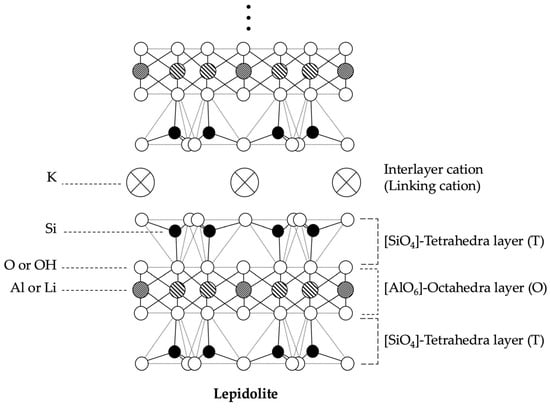
Lepidolite consists of two sheets of [SiO4]-tetrahedra (T) sandwiching an [AlO6]-octahedra layer (O), which is termed a TOT or 2:1 layer structure [2,8]. As depicted in Figure 1, Li occupies the octahedral layer, together with aluminum (Al). Therefore, activation of the octahedral layer and liberation of the encapsulated Li with proper treatment is a key route for Li extraction [1,2,7,8]. This structural constraint has driven considerable development into efficient Li extraction processes from lepidolite in various routes and one-step roasting and acid digestion methods are the most widely studied approaches [1,3,4,6].
Figure 1.
The tetrahedra-octahedra-tetrahedra (TOT) structure of lepidolite.
Acid digestion with sulfuric acid (H2SO4) concentrate followed by water leaching is among the most efficient extraction methods, achieving high metal leaching efficiency without a high roasting temperature [4,5,8,9]. Typically, H2SO4 digestion requires a high acid concentration between 50 and 70%, a long reaction time, and a leaching temperature close to 160 °C (the boiling point of concentrated H2SO4) to achieve a high Li leaching efficiency above 90% [9,10,11,12]. Alternative acid treatments involve adding fluorine-based chemicals (e.g., hydrofluoric acid (HF), fluorosilicic acid (H2SiF6)) to diluted H2SO4, which is based on the observation that 2–8% of fluorine (F) is contained in lepidolite [8,13,14,15]. Fluorine-based chemicals, particularly HF, are capable of dissolving crystalline silicate minerals and achieving high Li leaching efficiency with a fast reaction rate at a temperature below 100 °C [5,8,14,15]. However, the formation of insoluble fluoride with valuable elements (e.g., lithium fluoride (LiF)) is reported to make the process complex [5,6,13,14]. Although the acid treatment method effectively extracts Li from lepidolite, the development of a more efficient, eco-friendly, and economical process is still desired to reduce acid consumption and mitigate difficulties caused by handling acid during operation.
As a strategy to mitigate the harsh acid treatment conditions and enhance the elemental leaching efficiency, mechanical activation has been introduced as a pre-treatment stage, and its effectiveness has been demonstrated for various refractory materials [7,16,17,18,19,20,21]. The main factor improving the elemental leaching efficiency is the mechanically induced improvement of material reactivity resulting from increased internal and surface energies, a decrease in the crystal coherence energy, and the generation of lattice defects that weaken the structural integrity of the feed material [22,23]. A representative study using lepidolite with the mechanical activation-H2SO4 digestion process was reported by Vieceli et al. [7]. They observed a significant improvement in Li leaching efficiency, from less than 60% (1 min activation), to 87% (30 min activation) under 165 °C and 0.65 H2SO4 g/lepidolite g for 4 h [7]. However, beyond this representative study with lepidolite, most related works have focused primarily on acid-treatment parameters rather than on elucidating the specific role of mechanical activation [17,18]. Moreover, despite the improvements by mechanical activation, the subsequent process still involves highly corrosive conditions.
Therefore, in the study reported here, the metal leaching behavior from mechanically activated lepidolite using 2 M H2SO4 solution at a mild leaching temperature (<80 °C) was investigated. To elucidate the effect of mechanical activation, various solid analyses, including X-ray diffraction (XRD) and field emission scanning electron microscopy (FE-SEM) with energy dispersive spectroscopy (EDS), were conducted and these solid-state analysis characterization results were correlated with the leaching result. In addition, a kinetic analysis was conducted to interpret the leaching behavior and to identify the rate-controlling mechanism governing Li dissolution from mechanically activated lepidolite. By clarifying the influence of mechanically induced structural changes and their kinetic implications, this study seeks to identify the factors limiting Li extraction under mild H2SO4 leaching conditions and to provide insight into how the Li leaching efficiency can be further improved without the introduction of harsh processing environments.
2. Materials and Methods
2.1. Materials
Lepidolite concentrate was used as the feed material in this study. The chemical composition of the lepidolite concentrate was analyzed by an independent analysis center, Bureau Veritas (Perth, Australia), using an inductively coupled plasma mass spectrometer (ICP-MS) for Li and Rb and an atomic emission spectrometer (ICP-AES) for Al, Fe, K, Si, and Mn, and the result is recorded in Table 1.
Table 1.
Chemical composition of lepidolite concentrate analyzed by ICP-MS and ICP-AES.
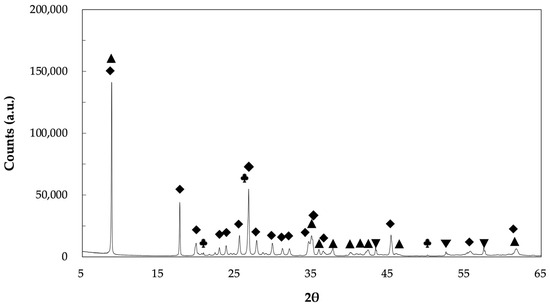
The XRD pattern of the lepidolite concentrate in Figure 2 was identified using a D8 Advance XRD diffractometer (Bruker Instrument, Billerica, MA, USA) with Cu Kα radiation (40 kV, 40 mA, and λ = 0.15406 nm), with 0.02° at 1.25 s of scanning speed, and it showed that it mainly consists of the lepidolite phase (60.90%) and a minor amount of muscovite (KAl2(AlSi3O10)(OH)2) (3.49%) and quartz (SiO2) (1.54%).
Figure 2.
The XRD pattern of the lepidolite concentrate used in this study, where ◆: lepidolite (K(Li,Al)3(Al,Si)4O10(F,OH)2); ▲: muscovite (KAl2(AlSi3O10)(OH)2); ♣: quartz (SiO2); and ▼: corundum (Al2O3, standard).
2.2. Methodology
2.2.1. Mechanical Activation Test
Lepidolite concentrate was crushed in a jaw crusher and sieved to a size smaller than 1.0 mm before the mechanical activation test. A high-energy planetary ball mill (PBM) (PM-100, Retsch, Germany) was used throughout this study for the mechanical activation test. The mechanical activation test was run with 10 g of lepidolite concentrate and 200 g of 5 mm diameter zirconia (ZrO2) balls (approximately 500 balls) charged in a 250 mL of ZrO2 grinding jar, which was equivalent to a 20:1 of ball-to-feed weight ratio (BFR, ball g:feed g) and the grinding speed was fixed at 400 RPM. Under these conditions, the milling intensity was sufficient to completely break down all coarse particles, yielding a fully powdered feed at the lowest mechanical activation time. The activation time varied between 10 and 60 min.
The mechanical activation test was stopped for 10 min after every 10 min of activation to avoid the accumulation of heat in the grinding system and the inner temperature of the grinding jar was maintained between 50 and 70 °C. The mechanically activated lepidolite was separated from the ZrO2 balls by sieving and collected for solid analysis and a leaching test. A separate sample of the crushed lepidolite (approximately 50 g per batch) was pulverized for 15 sec using a ring mill (C+PB, ROCKLAB Ltd., Auckland, New Zealand) to provide a baseline (unactivated lepidolite) in the subsequent leaching test; the short milling time was selected to completely pulverize the coarse feed while minimizing the effect of mechanical activation, although minor structural modification cannot be fully excluded due to the high-energy input of the ring mill.
2.2.2. Leaching Test
The unactivated and mechanically activated lepidolite samples were leached immediately after either ring mill pulverization or the mechanical activation test to avoid a relaxation effect. A weight of 5 g of the prepared solid samples was leached in 50 mL of 2 M H2SO4 (10% (w/v) solid/liquid (S/L) ratio) in a 150 mL Erlenmeyer flask with a magnetic stirrer. The leaching test was performed on a hot plate at three different temperatures (25, 50, and 80 °C) by varying the leaching time (30–180 min). All leaching tests were conducted as single-batch experiments without intermediate sampling. To evaluate reproducibility, selected leaching experiments were repeated using composite leaching feed samples prepared from independent mechanical activation batches collected under same conditions.
The leaching solution was filtered using a 0.20 μm polyvinylidene fluoride (PVDF) syringe filter and then the leaching residue was washed with deionized (DI) water and dried in the oven at 50 °C overnight. The filtrate was diluted with 2% nitric acid (HNO3). The concentration of elements, including Al, Li, potassium (K), and silicon (Si), in the filtrate was analyzed by ICP-OES (Agilent 5100, Agilent Technologies Inc., Santa Clara, CA, USA). The leaching efficiency of each element was determined using the following equation:
where LE is leaching efficiency, MSolution is the concentration of elements in the leaching solution, and MFeed is the concentration of elements in the feed materials, respectively.
LE (%) = (MSolution/MFeed) × 100
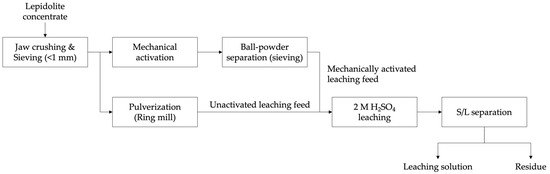
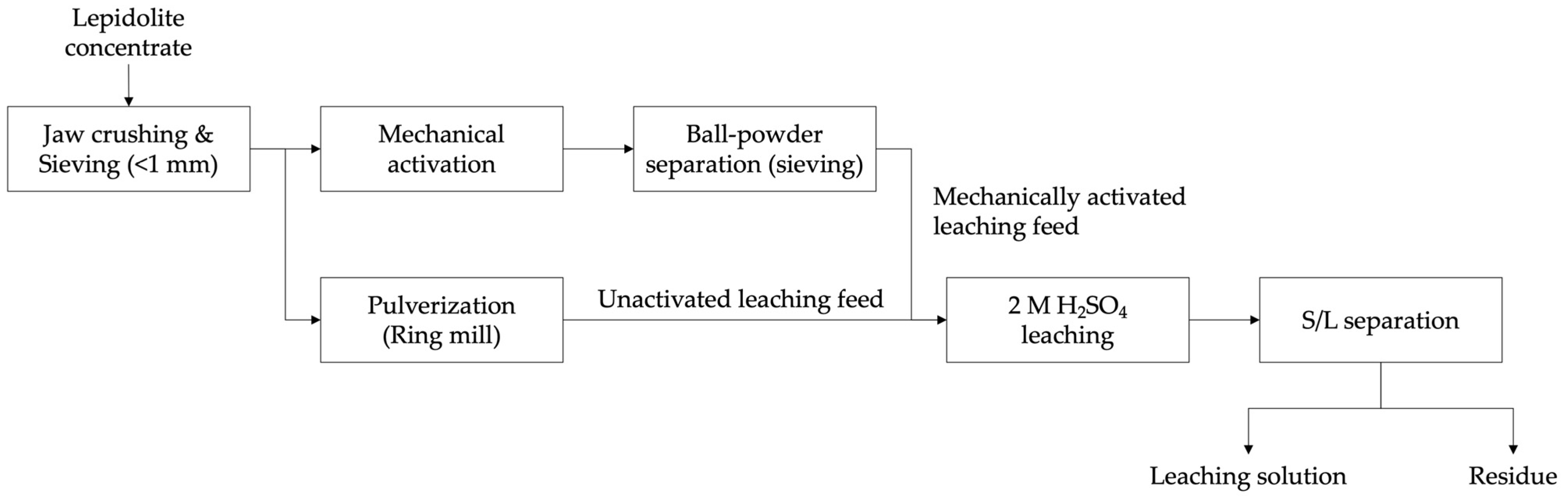
The overall experimental procedure used in this study is presented in Figure 3.
Figure 3.
Experimental procedure used in this study.
2.2.3. Sample Characterization
The X-ray diffraction analysis of the leaching feed (mechanically activated lepidolite) was carried out with a D8 Advance XRD diffractometer with Cu Kα radiation (40 kV, 40 mA, and λ = 0.15406 nm), with 0.02° at 1.25 s of scanning speed. The fraction of the amorphous phase was assessed by the Rietveld method using a known amount of internal standard.
The particle size distribution of the leaching feed was analyzed using a laser diffraction analyzer (Mastersizer 3000, Malvern Instrument, Worcestershire, UK).
The morphological changes in the leaching feed were characterized using SEM (Clara FE-SEM, field emission scanning electron microscope, Tescan, Brno, Czech Republic) and elemental mapping images of leaching feed and residue were obtained using an EDS detector (Oxford Instruments, High Wycombe, UK) installed on the FE-SEM controlled by AZtec software version 3.1 to identify the metal leaching behavior.
3. Results and Discussion
3.1. The Morphological Changes in Lepidolite by Mechanical Activation
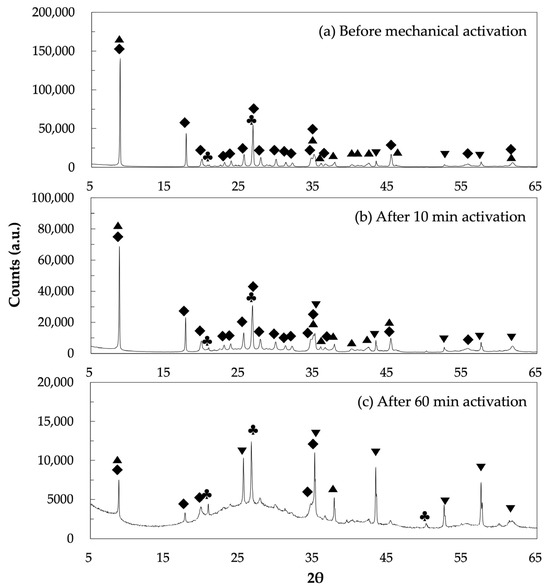
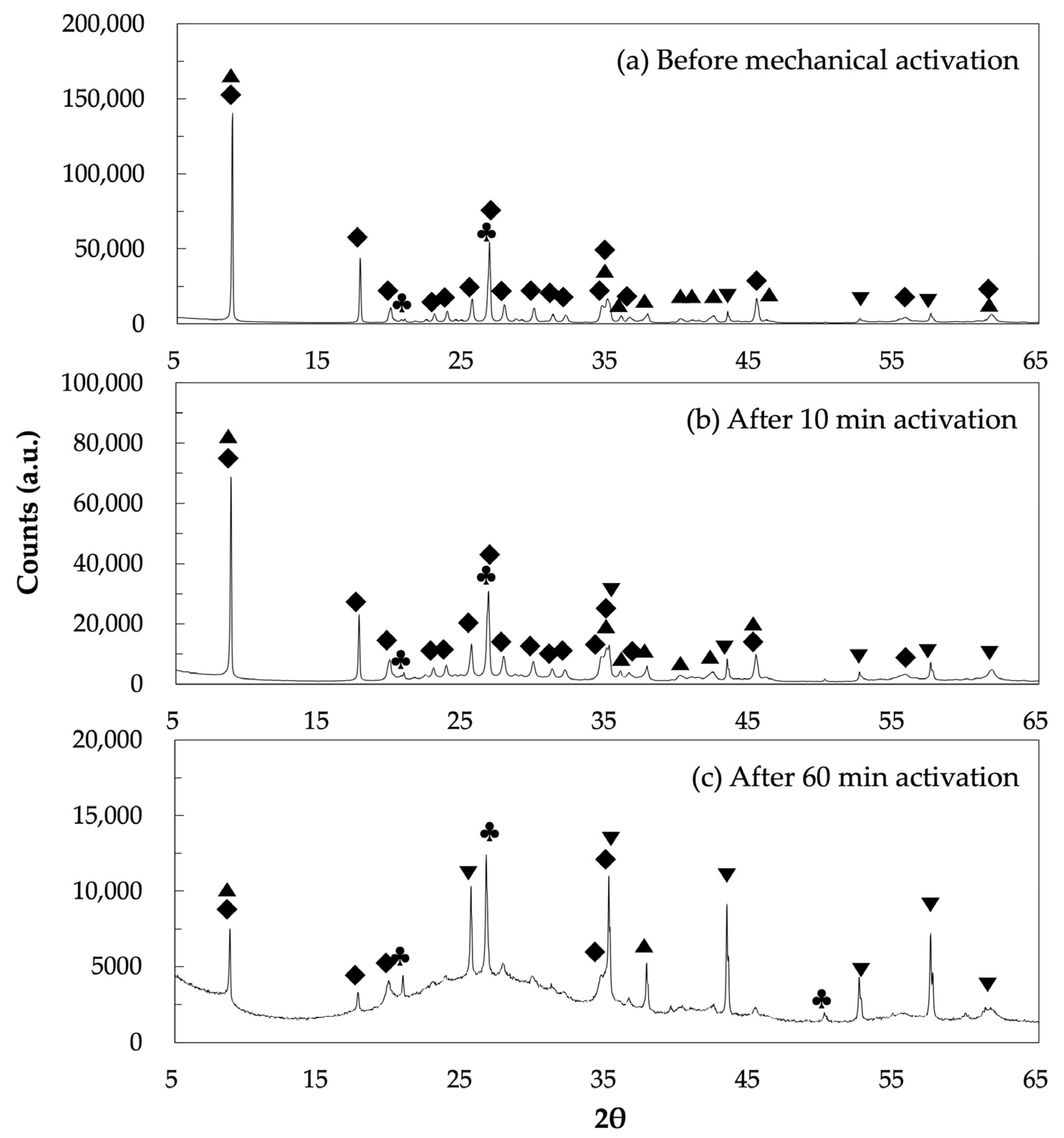
Figure 4 shows XRD diffractograms of unactivated (0 min) and mechanically activated lepidolite (10 and 60 min) with a value of 2θ between 5 and 65 XRD diffractograms; the main peak intensities for lepidolite and muscovite significantly reduced. However, these peaks remain relatively sharp, which suggests the reduction in particle size (i.e., crystalline size) accompanied by the generation of defects (e.g., lattice defects and dislocations) mainly occurred during early mechanical activation time (Figure 4b) [24,25]. The accumulation of defects and the distortion of the long-range periodicity of the crystal lattice by extended mechanical activation can be consequently attributed to the amorphization of lepidolite, and a similar phenomenon has also been commonly reported by mechanical activation studies [7,17,23]. After 60 min, substantial broadening and elevated background of the diffraction peaks were observed and the main peaks are internal standard and quartz—which is likely a contaminant introduced during the micronizing process for XRD sample preparation. In accordance with these structural changes, the amorphous fraction also increased markedly with mechanical activation time from 34.1 (±1.9) % (feed lepidolite) to 48.6 (±1.1) (10 min) and then 81.39 (±0.5) % (60 min).
Figure 4.
The XRD patterns of lepidolite (a) before mechanical activation and after mechanical activation for (b) 10 and (c) 60 min at 400 RPM and 20:1 BFR, where ◆: lepidolite (K(Li,Al)3(Al,Si)4O10(F,OH)2); ▲: muscovite (KAl2(AlSi3O10)(OH)2); ♣: quartz (SiO2); and ▼: corundum (Al2O3, standard).
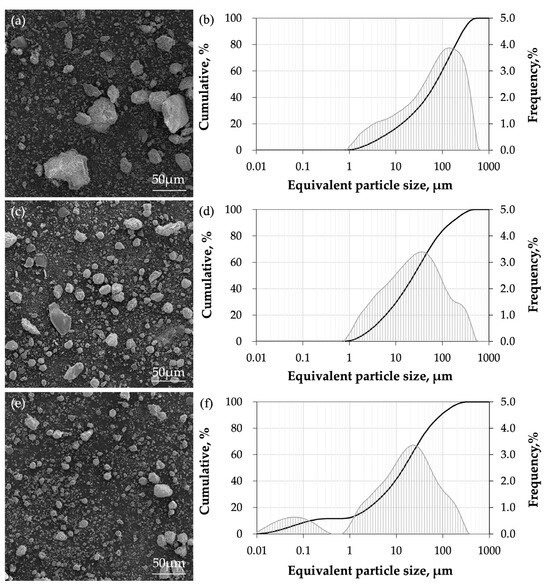
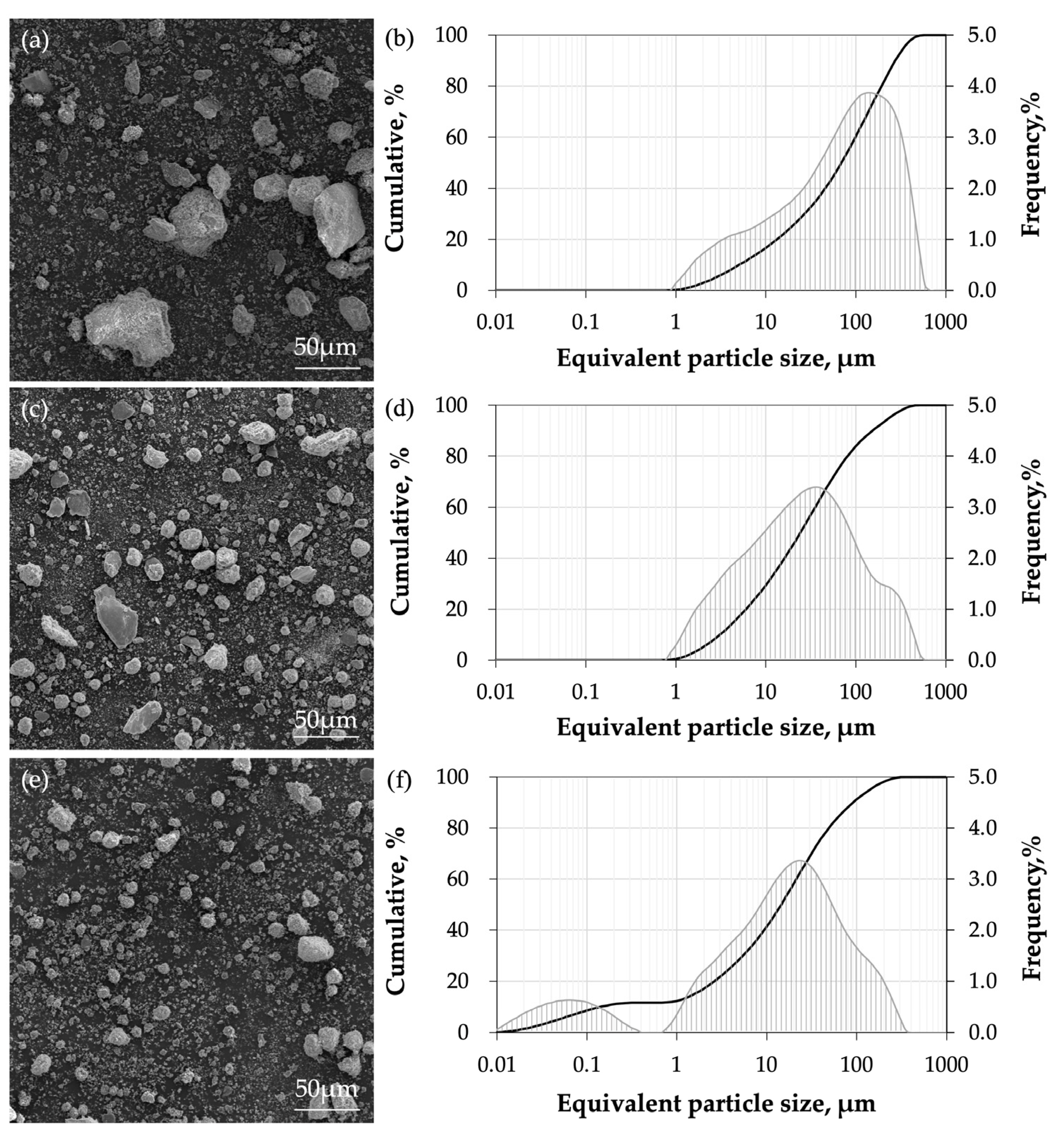
A transformation of the morphology and particle size of mechanically activated lepidolite for activation times of 10, 30, and 60 min was observed using the FE-SEM (Figure 5a,c,e) and a laser diffraction analyzer (Figure 5b,d,f). The FE-SEM images show the distribution of particle size at the same magnification. A remarkable particle size reduction was observed between 10 and 30 min, but many fine particles (less than 50 μm) maintained a layered structure. After 60 min of mechanical activation, typical bimodal distribution is observed, which indicates inhomogeneous grinding and the agglomeration of fine particles [26,27]. The characteristic particle sizes (D10, D50, and D90) of unactivated and mechanically activated lepidolite are summarized in Table 2.
Figure 5.
The FE-SEM images and particle size distributions of mechanically activated lepidolite for (a,b) 10, (c,d) 30, and (e,f) 60 min at 400 RPM and 20:1 BFR (the FE-SEM images were acquired at the same magnification).
Table 2.
D10, D50, and D90 values of unactivated and mechanically activated lepidolite (10, 30, and 60 min) obtained from a laser diffraction analyzer (Unit: μm).
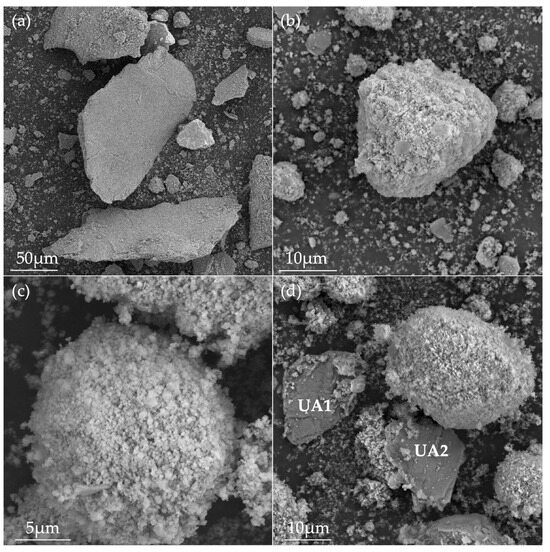
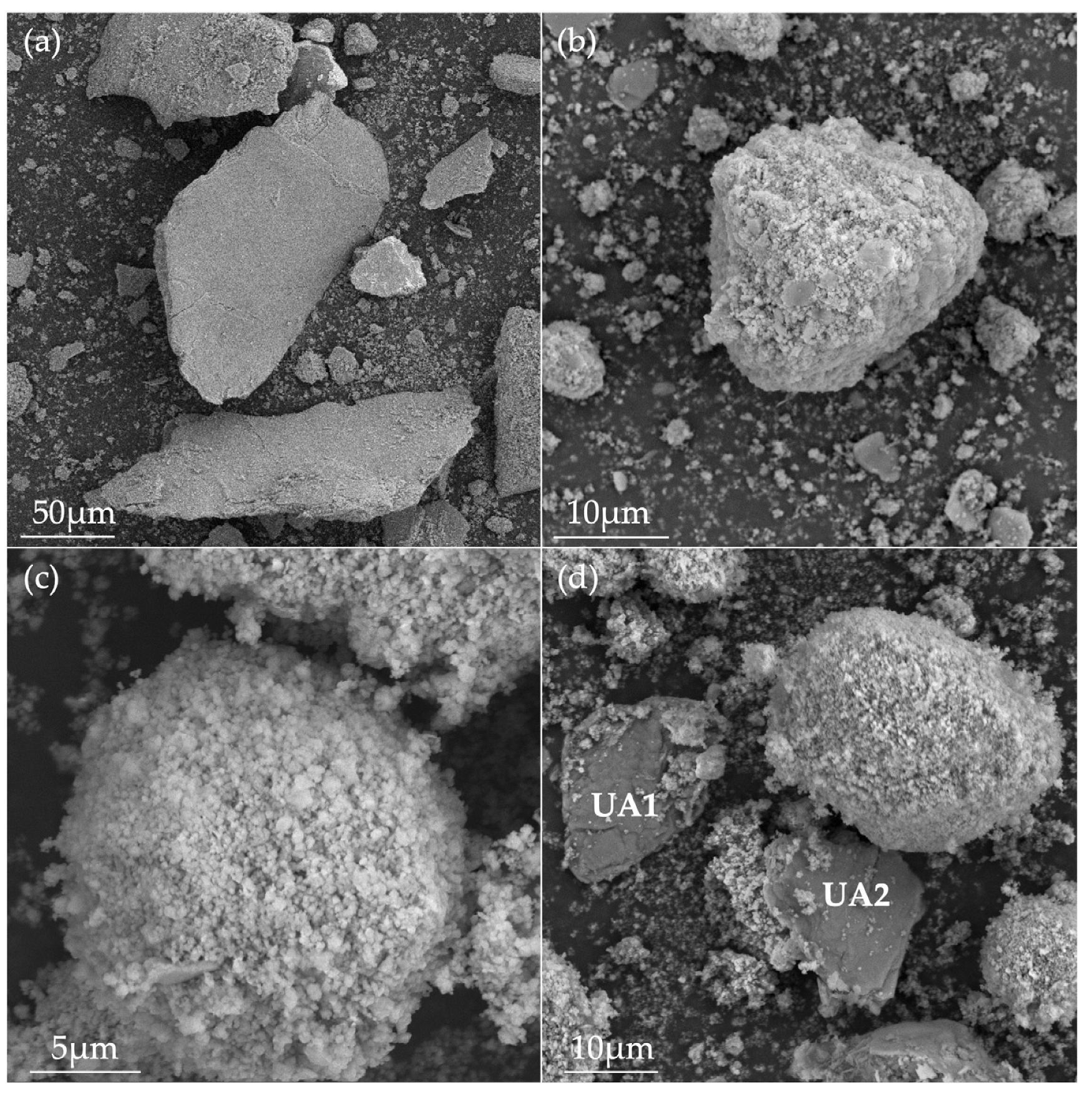
The morphological detail of the mechanically activated lepidolite was observed at a higher magnification (Figure 6). Many particles maintained a layered structure after 10 min of mechanical activation (Figure 6a). The continuous mechanical actions trimmed off the particles and made them more rounded and the submicron-sized particles started to attach to the surface of the bulk particles. After 60 min of mechanical activation, the majority of particles were agglomerated, rounded, and had a fluffy shape (Figure 6c), although some of the ultrafine particles (UA1–2, Figure 6d) were only delaminated and maintained the original lamellar structure. The irregular and flaky particles after long and intensive grinding are attributed to two contrasting effects, breakage and agglomeration, and extended mechanical activation time does not necessarily result in further deformation [27,28]. The formation of these flaky particles owing to the relatively stronger bonding forces of Si/Al–O in the lepidolite structure can result in lamellar cleavage (delamination) in the size-reduction process [7]. However, these delaminated particles have been reported to exhibit very low metal extractability under ambient acid-leaching conditions, because metal dissolution primarily occurs at the particle edges [29,30].
Figure 6.
The FE-SEM images of mechanically activated lepidolite for (a) 10, (b) 30, and (c,d) 60 min at 400 RPM and 20:1 BFR.
Typically, particle size reduction before the leaching stage is important for liberating valuable minerals and achieving high metal recovery under optimum operating conditions. The breakage along the basal plane observed in Figure 6d, however, will retain Li in the octahedron layer, and Li will therefore not be extracted in the subsequent leaching stage while K atoms located between tetrahedron layers will be preferentially extracted [2,15,31,32]. Thus, delamination without structural deformation should be avoided in the mechanical activation stage to achieve high metal extraction. Delaminated particles are regarded as unactivated in this study for this reason. The difference in metal dissolution behavior between delaminated (unactivated) and activated particles was observed through the EDS analysis and the result is presented in the leaching results Section 3.2.1.
3.2. Leaching Result
3.2.1. The Effect of Mechanical Activation Time on Elemental Leaching Efficiency
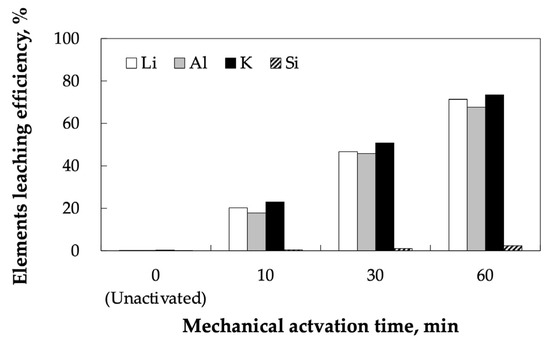
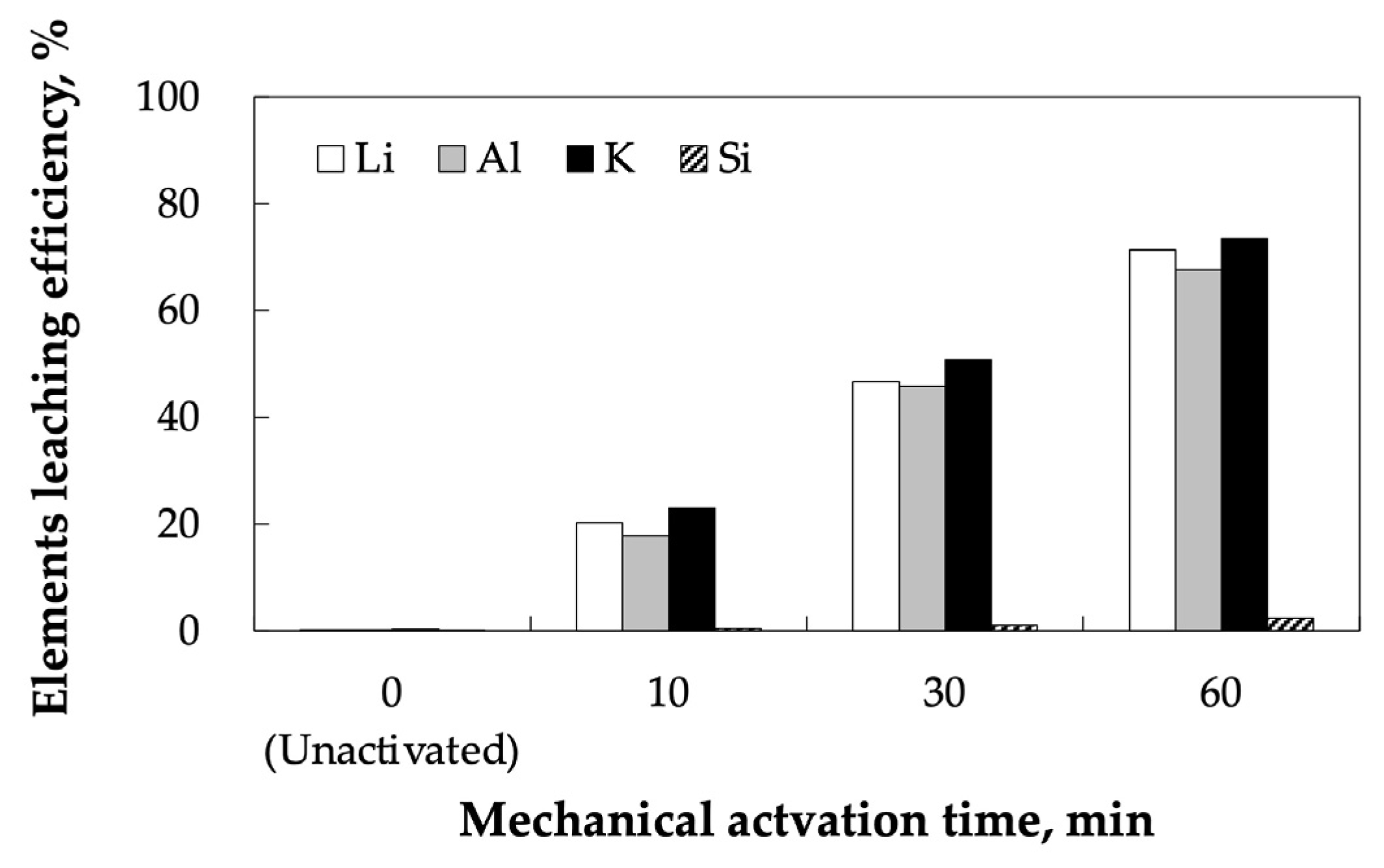
Figure 7 shows the leaching efficiencies of Li, Al, K, and Si at different mechanical activation times (0–60 min). Hardly any of these elements were extracted from the unactivated lepidolite (0 min). The leaching efficiency of Li, Al, and K gradually improved with the longer mechanical activation time. Regarding Li, the leaching efficiency was improved to 20.3% (10 min), 46.7% (30 min), and then 71.3% (60 min) as the mechanical activation time increased. In addition, Al and K also showed similar leaching trends at corresponding mechanical activation times, which is assumed to result from their similar placement within the lepidolite lattice (Figure 1). The highest leaching efficiencies of Li, Al, and K were 71.3%, 67.7%, and 73.5%, respectively, at the highest mechanical activation time (60 min). In contrast, the Si leaching efficiency remained low, not exceeding 2.4%.
Figure 7.
The leaching efficiencies of Li, Al, K, and Si from unactivated (0 min) and mechanically activated lepidolite (10, 30, and 60 min) under the following test conditions: mechanical activation at 400 RPM and 20:1 BFR followed by 2 M H2SO4 leaching at 25 °C and 10% (w/v) S/L ratio for 30 min.
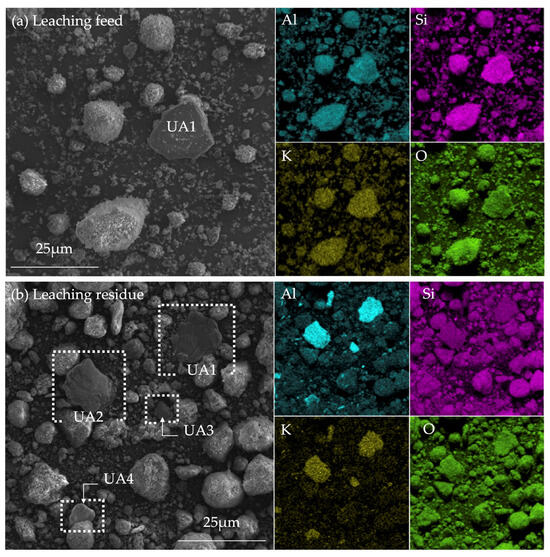
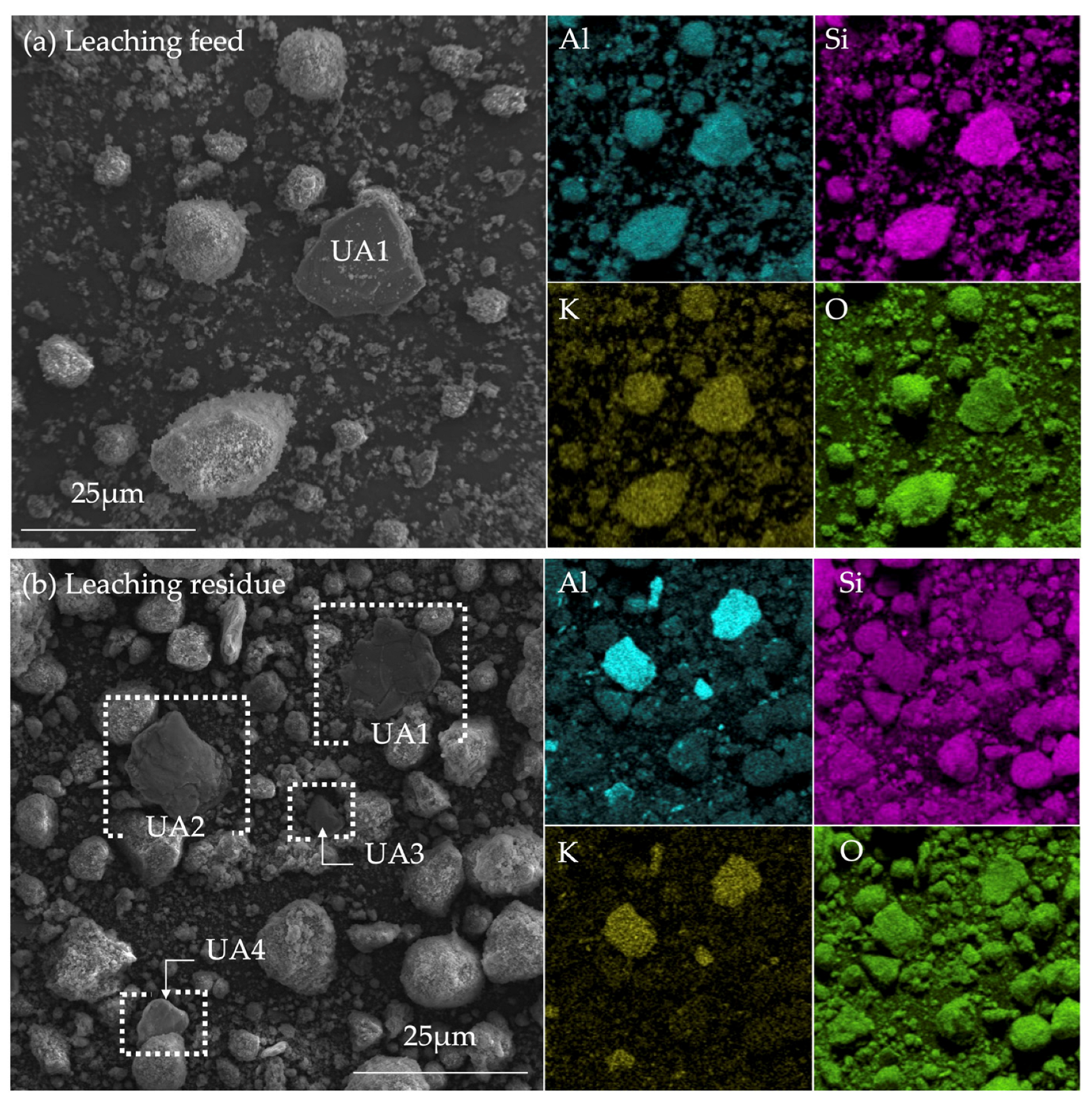
To identify the elements’ leaching behavior from mechanically activated lepidolite, elemental mapping images of mechanically activated lepidolite (leaching feed) (Figure 8a) and leaching residue (Figure 8b) were obtained using EDS. As discussed in Section 3.1, unactivated particles (lamellar structure with smooth surfaces and edged corners) and activated particles (agglomerated, rounded, and fluffy shapes) can be distinguished by their morphology in Figure 8a,b. In Figure 8a, Al, K, Si, and O are evenly distributed on unactivated (UA1) and activated particles in the leaching feed. However, unactivated particles (UA1–4) have much stronger signals from Al and K than the activated particles in the leaching residue (Figure 8b).
Figure 8.
The elemental mapping images of (a) mechanically activated lepidolite (leaching feed) and (b) leaching residue under the following test conditions: mechanical activation at 400 RPM and 20:1 BFR for 60 min followed by 2 M H2SO4 leaching at 25 °C and 10% (w/v) S/L ratio for 30 min (the FE-SEM images were acquired at the same magnification, ×2500) (where Al = blue, K = yellow, Si = purple, O = green).
These results indicate that metal elements in the octahedra layer are easily extracted from the activated particle. Although Li was not detected using EDS, Li is assumed to be extracted mainly from mechanically activated particles along with Al and K. In other words, amorphization of lepidolite by mechanical activation enhances its chemical reactivity and improves the elemental extraction efficiency. Therefore, reducing the amount of unactivated particles during the mechanical activation process is the key to upgrading the elemental extraction efficiency and further investigation on the effect of activation variables (e.g., BFR, grinding speed, and ball size) should be addressed in future studies for the optimization of mechanical activation process.
3.2.2. The Effect of Leaching Time and Temperature on Li and Al Leaching Efficiency
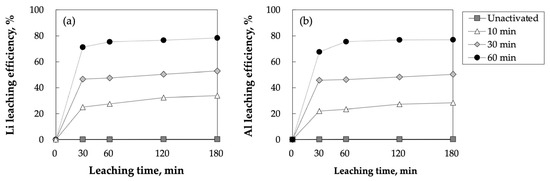
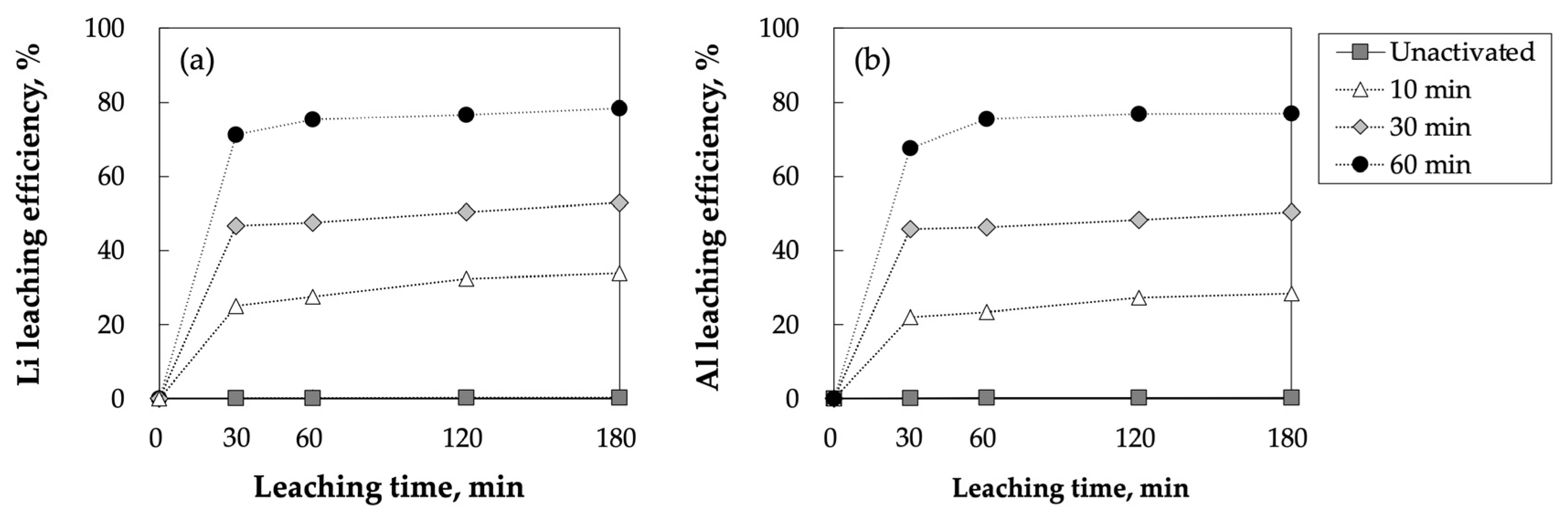
Figure 9 shows the leaching efficiency of Li and Al as a function of mechanical activation time and leaching time. The Li and Al leaching efficiencies increased with increasing leaching time, but most reactions were completed after 30 min of leaching time regardless of mechanical activation time. The gradual enhancement after 30 min was assumed to be due to Li and Al dissolution from unactivated particles as H2SO4 penetrated them and reacted with the metals layer-by-layer, starting at the surface and eventually reaching the interfacial area [9,33].
Figure 9.
(a) Li and (b) Al leaching efficiency of unactivated and mechanically activated lepidolite (10, 30, and 60 min) by leaching time (30–180 min) under the following test conditions: mechanical activation at 400 RPM and 20:1 BFR followed by 2 M H2SO4 leaching at 25 °C and 10% (w/v) S/L ratio.
This lepidolite leaching behavior is different from the previously reported results with unactivated lepidolite [9,12,33], but it is consistent with previous findings that mechanical activation accelerated the leaching reaction [23,34]. The maximum Li and Al leaching efficiencies were 78.4% and 77.0%, respectively, after 180 min of leaching time, but these were not significantly higher than the metal extraction after 30 min.
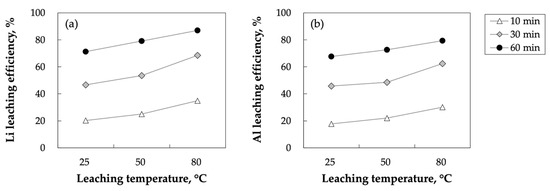
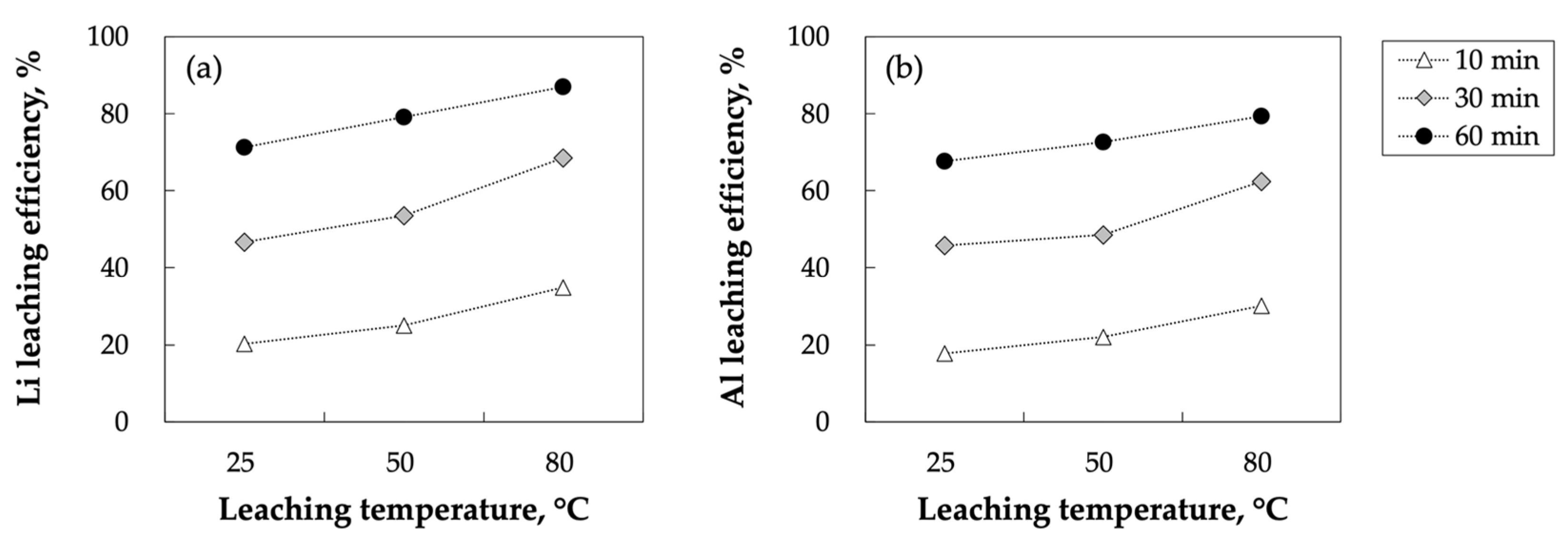
Figure 10 shows the effect of leaching temperature in the range of 25–80 °C with the same feed used in Figure 9. The highest Li and Al leaching efficiencies were 87.0% and 79.4%, respectively, at 80 °C after 60 min activation, but these were only 34.9% and 30.1%, respectively, after 10 min of activation. Even though the effect of leaching temperature on metal leaching efficiency was insignificant compared to that of mechanical activation time, Li leaching efficiency was improved as leaching temperature increased. This result indicates the formation of other Li compounds connected to Li sulfate (Li2SO4) as the main Li soluble compound, because the solubility of Li2SO4 is higher at a lower temperature [18].
Figure 10.
(a) Li and (b) Al leaching efficiency with mechanically activated lepidolite (10, 30, and 60 min) by leaching temperature (25–80 °C) under the following test conditions: mechanical activation at 400 RPM and 20:1 BFR followed by 2 M H2SO4 leaching at 10% (w/v) S/L ratio for 30 min.
Although the exact structure composition and chemical formula of mechanically activated lepidolite cannot be determined because the mineral becomes amorphous phase and a lot of nanoscale crystalline particles are generated, below, two possible leaching reactions were proposed to approximate the chemical reaction between mechanically activated lepidolite and H2SO4 by Vieceli et al. [18] (Equations (2) and (3)). On the other hand, the effect of F is not considered in the proposed chemical reaction as the previous studies by Vieceli et al. [7] revealed that the defluorination effect is occurred during mechanical activation process [7,18].
K2(Li,Al)3(Al,Si)4O10(OH)2 + 5.5H2SO4 = 1.5Li2SO4 + K2SO4 + 3Al(SO4)(OH) + Al2O3·6SiO2 + 6H2
K2(Li,Al)3(Al,Si)4O10(OH)2 + 7.5H2SO4 = 1.5Li2SO4 + K2SO4 + 5Al(SO4)(OH) + 6SiO2 + 7H2O
3.3. Kinetic Analysis of Li Leaching from Mechanically Activated Lepidolite
In order to evaluate the effect of mechanical activation on the leaching behavior of lepidolite, a kinetic model was applied to interpret the experimental results. In the present work, the Avrami–Erofeev equation (Equation (4)) was adopted to describe the reaction kinetics.
where
−ln(1 − ɑ) = ktn
- ɑ is leaching result, k is the rate constant, t is reaction time, and n is Avrami exponent. The value of the Avrami exponent enables the identification of the rate-controlling mechanism, with 1 > n ≥ 0.5 indicating a mixed chemical reaction–diffusion control and n < 0.5 indicating diffusion-controlled [35].
Although this model was originally developed to describe nucleation and growth processes during solid-state phase transformation [36,37,38], it has been widely used in leaching studies by reinterpreting the original crystallization framework as a reversed process [35]. From this perspective, mechanical activation is regarded as a structural degradation process that generates reactive sites and the Avrami–Erofeev model provides a useful empirical description of leaching kinetics in mechanically activated material, where both mechanical activation and reagent attack contribute to progressive crystalline destruction.
For kinetic analysis, Equation (4) was rearranged into the logarithmic form:
ln(−ln(1 − ɑ)) = lnk + nlnt
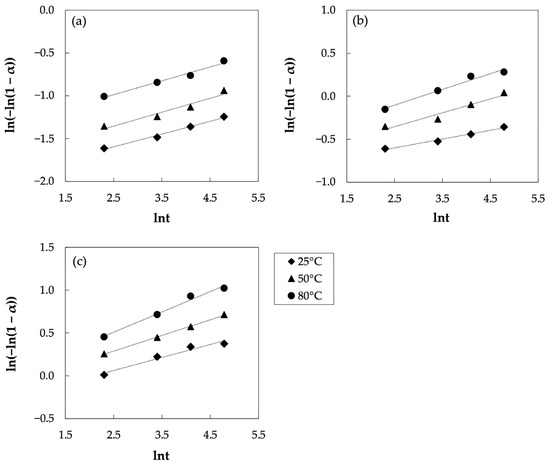
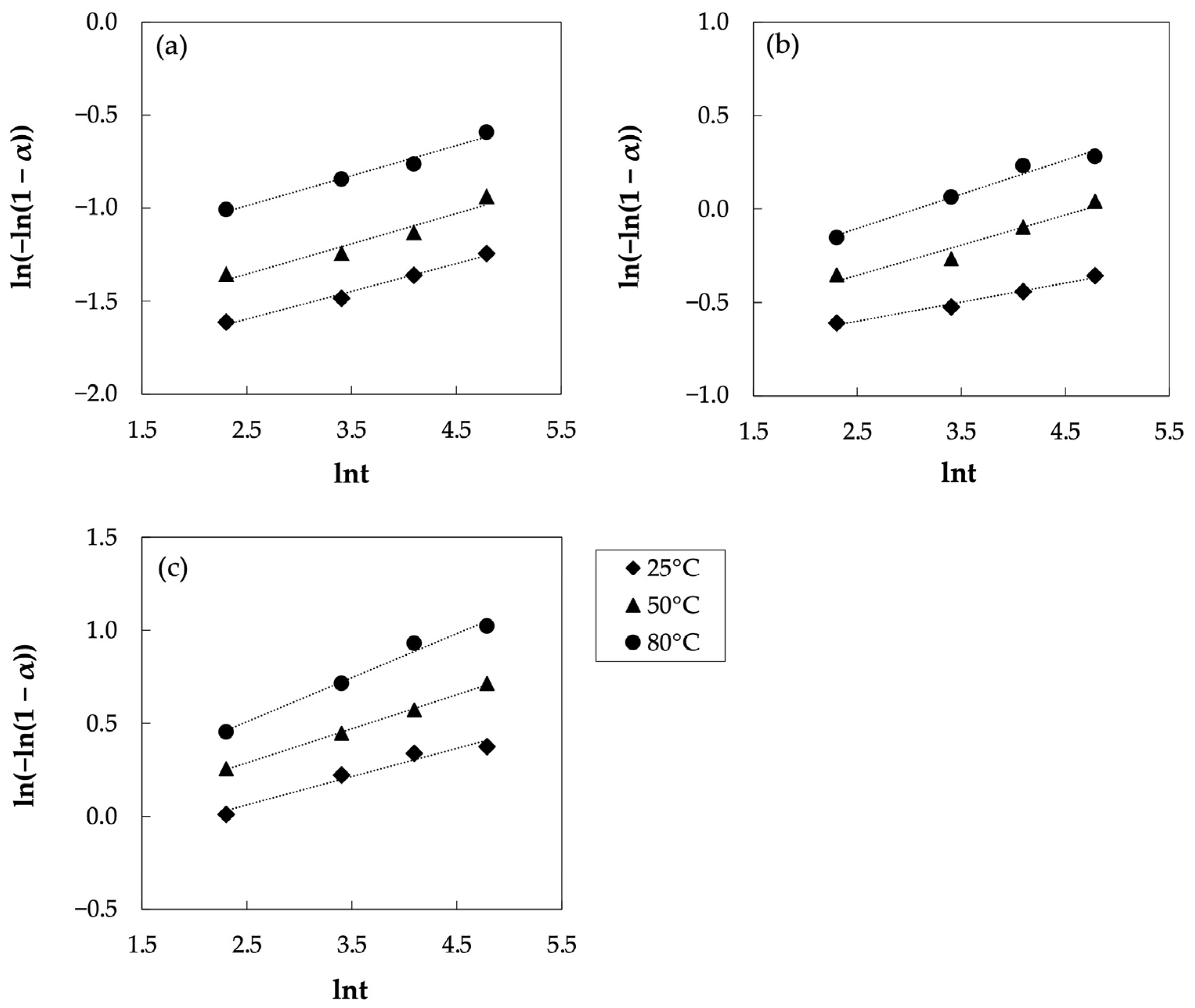
The selected kinetic model was applied to determine the apparent activation energies for samples mechanically activated for 10, 30, and 60 min. The values of n and k were obtained from a linear plot of ln(−ln(1−ɑ)) versus lnt, as shown in Figure 11, with the calculation results presented in Table 3. Although the leaching efficiency approached a plateau after 60 min (Figure 9), the leaching data up to 120 min were included in the kinetic analysis to improve fitting reliability.
Figure 11.
ln(−ln(1 − ɑ)) versus lnt plots at different temperatures (25–80 °C) during the leaching of mechanically activated lepidolite for (a) 10, (b) 30, and (c) 60 min.
Table 3.
Avrami–Erofeev model fitting parameters (n and lnk) and correlation coefficient (R2) for Li leaching from mechanically activated lepidolite at different temperatures.
As shown in Figure 11 and Table 3, the Avrami–Erofeev model exhibits a correlation coefficient (R2) greater than 0.90, indicating a good fit to the leaching data. Furthermore, the value of n ranges from 0.10 to 0.24, which is lower than 0.5, confirming that the leaching process is diffusion-controlled.
The apparent activation energy was subsequently determined using the following Arrhenius equation:
where
k = Ae−Ea/RT
- A is frequency factor, Ea is apparent activation energy (J·mol−1), R is the ideal gas constant (8.314 J·mol−1·K−1), and T is the absolute temperature, K.
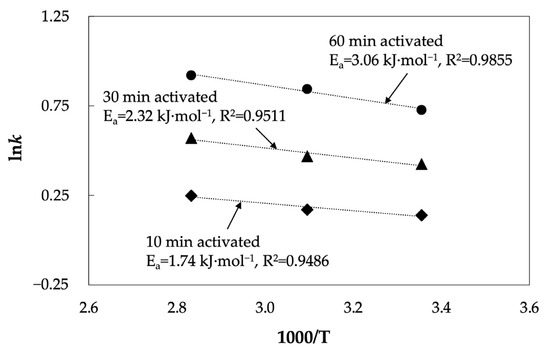
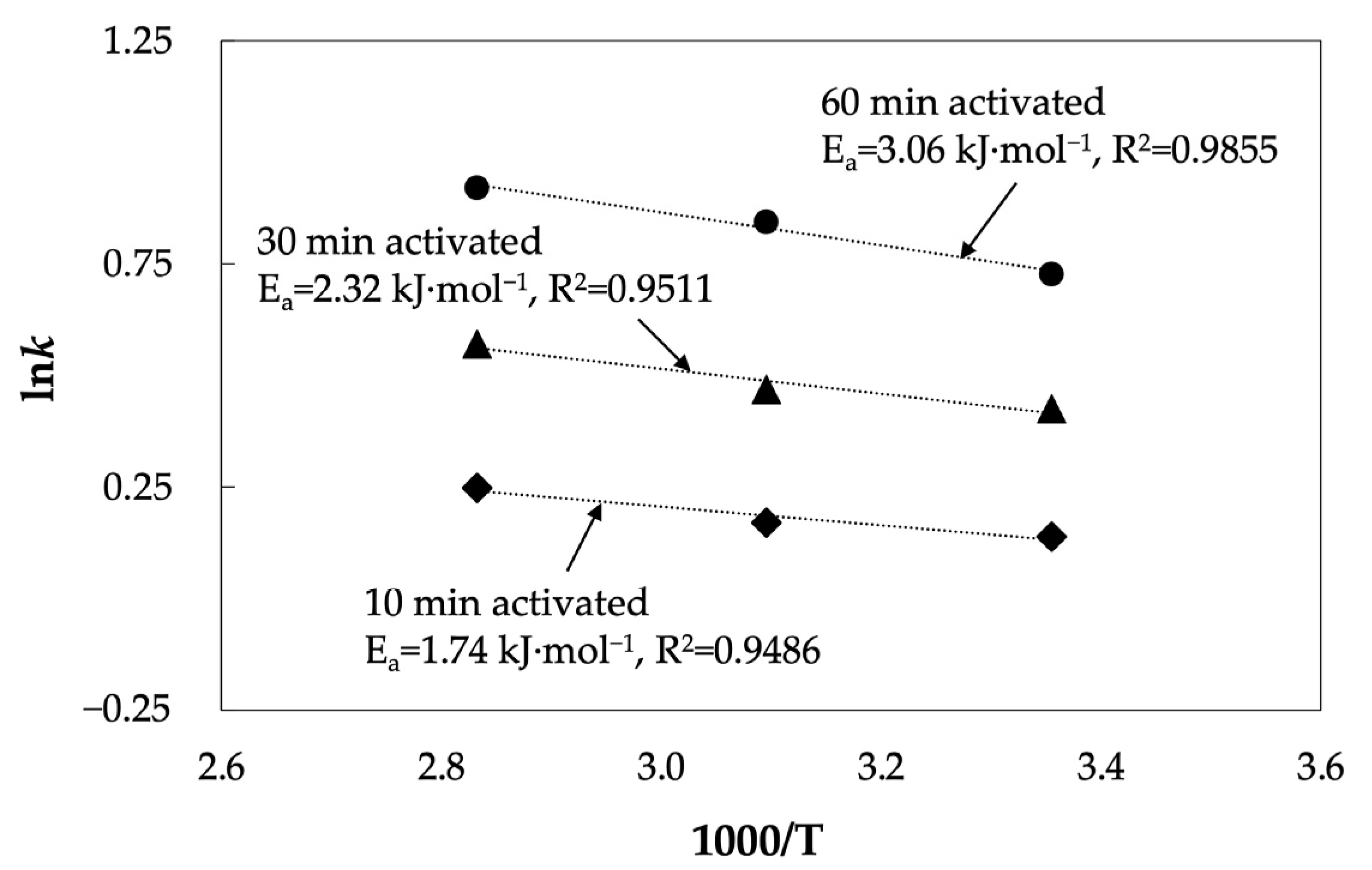
The Arrhenius plots of lnk versus 1000/T are presented in Figure 12. The apparent activation energies obtained for 10, 30, and 60 min mechanically activated lepidolites were 1.74, 2.32, and 3.06 kJ·mol−1, respectively.
Figure 12.
The Arrhenius plots obtained from leaching data up to 120 min for mechanically activated lepidolites for (◆) 10, (▲) 30, and (●) 60 min.
The very low apparent activation energies observed even at the shortest mechanical activation time indicate that the leaching reaction proceeds predominantly via mechanically activated sites, which is consistent with the observations shown in Figure 8. Increasing the mechanical activation time increases the number of such sites and thereby enhances the Li leaching efficiency, while the temperature dependence of the reaction remains weak. Although the apparent activation energies obtained in this study are significantly lower than lepidolite’s previously reported apparent activation energy (~17 kJ·mol−1) [12], this difference reflects the dominant role of mechanically induced defects and amorphous regions rather than a change in the fundamental rate-controlling mechanism.
4. Conclusions
This study demonstrated the effect of mechanical activation on the physicochemical changes in lepidolite and the leaching efficiencies of Li, Al, and K by varying mechanical activation time and leaching conditions.
XRD analysis revealed that mechanical activation induced significant structural changes in lepidolite. Initial activation (10 min activation) primarily reduced the crystal size accompanied by lattice defects, while prolonged activation caused substantial peak broadening and an increase in the amorphous fraction, reaching 81.4% after 60 min activation. The longest activation time was obtained from the mechanically activated lepidolite; morphological differences in ultrafine particles (lamellar-angular and spherical-agglomerated morphologies) were observed in SEM images. These morphological differences between unactivated and activated particles are not restricted to morphology alone, but reflect underlying structural disruption and amorphization. Consequently, these changes by mechanical activation provided more accessible sites for element extraction.
In the following leaching test, a higher metal leaching efficiency was obtained from samples that underwent a longer mechanical activation time, which contains a higher amorphous phase, and the elemental leaching efficiency improved from less than 1.0% (unactivated) to 71.3% Li, 67.7% Al, and 73.5% K (60 min activated). The leaching efficiencies of Li, Al, and K were gradually improved with leaching times up to 180 min, but this improvement was insignificant and most reactions were completed within 30 min. These leaching behaviors indicate that the amorphization process of lepidolite enabled rapid and efficient access of the leaching reagent during the leaching process. In addition, the SEM and elemental mapping images of mechanically activated leaching feed and residue demonstrated that the metal extraction mainly occurred from activated particles, and kinetic analysis also suggests that leaching occurs strongly at these activated sites, with low apparent activation energy and diffusion-controlled behavior reaching a plateau once the majority of reactive sites are accessed.
This result suggests that reducing the amount of unactivated particles during the mechanical activation process is the key to further improvement of the element extraction efficiency. Moreover, decreasing the fraction of unactivated particles can also be expected to reduce acid consumption and other leaching demands (time and temperature), while maintaining the element leaching efficiency.
Author Contributions
Conceptualization, Y.E.; methodology, Y.E.; formal analysis, Y.E.; investigation, Y.E.; resources, A.N.N. and R.D.A.; data curation, Y.E.; writing—original draft preparation, Y.E.; writing—review and editing, Y.E., L.D., A.N.N., and R.D.A.; visualization, Y.E.; supervision, L.D., A.N.N., and R.D.A. All authors have read and agreed to the published version of the manuscript.
Funding
This paper was prepared as part of the Lithium Beneficiation and Chemical Processing of Lithium Minerals project funded by the Future Battery Industries Cooperative Research Centre as part of the Australian Government Cooperative Research Centres Program.
Data Availability Statement
The original contributions presented in this study are included in the article. Further inquiries can be directed to the corresponding author.
Acknowledgments
The authors acknowledge the use of the Field Emission Scanning Electron Microscope (Clara FE-SEM, Tescan, Czech Republic) and Energy Dispersive Spectroscopy (EDS), at John De Laeter Centre at Curtin University, Australia.
Conflicts of Interest
The authors declare that they have no known competing financial interests or personal relationships that could have appeared to influence the work reported in this paper.
References
- Choubey, P.K.; Kim, M.S.; Srivastava, R.R.; Lee, J.C.; Lee, J.Y. Advance review on the exploitation of the prominent energy-storage element: Lithium. Part I: From mineral and brine resources. Miner. Eng. 2016, 89, 119–137. [Google Scholar] [CrossRef] [Scilit]
- Necke, T.; Stein, J.; Kleebe, H.J.; Balke-Grünewald, B. Lithium extraction and zeolite synthesis via mechanochemical treatment of the silicate minerals lepidolite, spodumene, and petalite. Minerals 2023, 13, 1030. [Google Scholar] [CrossRef] [Scilit]
- Eom, Y.; Dyer, L.; Nikoloski, A.N.; Alorro, R.D. Mechanochemical treatment for the extraction of lithium from hard rock minerals: A comprehensive review. Metals 2024, 14, 1260. [Google Scholar] [CrossRef] [Scilit]
- Meshram, P.; Pandey, B.D.; Mankhand, T.R. Extraction of lithium from primary and secondary sources by pre-treatment, leaching and separation: A comprehensive review. Hydrometallurgy 2014, 150, 192–208. [Google Scholar] [CrossRef] [Scilit]
- Rosales, G.D.; Pinna, E.G.; Suarez, D.S.; Rodriguez, M.H. Recovery process of Li, Al and Si from lepidolite by leaching with HF. Minerals 2017, 7, 36. [Google Scholar] [CrossRef] [Scilit]
- Luong, V.T.; Kang, D.J.; An, J.W.; Kim, M.J.; Tran, T. Factors affecting the extraction of lithium from lepidolite. Hydrometallurgy 2013, 134–135, 54–61. [Google Scholar] [CrossRef] [Scilit]
- Vieceli, N.; Nogueira, C.A.; Pereira, M.F.; Dias, A.P.S.; Durão, F.O.; Guimarães, C.; Margarido, F. Effects of mechanical activation on lithium extraction from a lepidolite ore concentrate. Miner. Eng. 2017, 102, 1–14. [Google Scholar] [CrossRef] [Scilit]
- Guo, H.; Kuang, G.; Wan, H.; Yang, Y.; Yu, H.Z.; Wang, H.D. Enhanced acid treatment to extract lithium from lepidolite with a fluorine-based chemical method. Hydrometallurgy 2019, 183, 9–19. [Google Scholar] [CrossRef] [Scilit]
- Gao, L.; Wang, H.; Li, J.; Wang, M. Recovery of lithium from lepidolite by sulfuric acid and separation of Al/Li by nanofiltration. Minerals 2020, 10, 981. [Google Scholar] [CrossRef] [Scilit]
- Onalbaeva, Z.S.; Samoilov, V.I.; Kulenova, N.A.; Zhakupova, G.B.; Adylkanova, M.A.; Kokaeva, G.A.; Abdulina, S.A. Procedure for lepidolite concentrate processing. Russ. J. Appl. Chem. 2016, 89, 1728–1730. [Google Scholar] [CrossRef] [Scilit]
- Samoilov, V.I.; Onalbaeva, Z.S.; Adylkanova, M.A.; Kokaeva, G.A.; Abdulina, S.A. Complex loosening of lepidolite concentrate by sulfuric acid. Metallurgist 2018, 62, 29–33. [Google Scholar] [CrossRef] [Scilit]
- Liu, J.L.; Yin, Z.L.; Li, X.H.; Hu, Q.Y.; Liu, W. Recovery of valuable metals from lepidolite by atmosphere leaching and kinetics on dissolution of lithium. Trans. Nonferrous. Met. Soc. China 2019, 29, 641–649. [Google Scholar] [CrossRef] [Scilit]
- Wang, H.D.; Zhou, A.A.; Guo, H.; Lü, M.H.; Yu, H.Z. Kinetics of leaching lithium from lepidolite using mixture of hydrofluoric and sulfuric acid. J. Cent. South. Univ. 2020, 27, 27–36. [Google Scholar] [CrossRef] [Scilit]
- Guo, H.; Kuang, G.; Li, H.; Pei, W.T.; Wang, H.D. Enhanced lithium leaching from lepidolite in continuous tubular reactor using H2SO4+H2SiF6 as lixiviant. Trans. Nonferrous Met. Soc. China 2021, 31, 2165–2173. [Google Scholar] [CrossRef] [Scilit]
- Zhao, X.; Zhang, Y.; Xue, N.; Hu, P.; Zheng, Q.; Hu, Y. Effect of mechano-chemical activation with NaF on improved acid leaching of vanadium-bearing shale. Hydrometallurgy 2023, 221, 106126. [Google Scholar] [CrossRef] [Scilit]
- Baláž, P. Mechanical activation in hydrometallurgy. Int. J. Miner. Process. 2003, 72, 341–354. [Google Scholar] [CrossRef] [Scilit]
- Vieceli, N.; Nogueira, C.A.; Pereira, M.F.C.; Durão, F.O.; Guimarães, C.; Margarido, F. Optimization of an innovative approach involving mechanical activation and acid digestion for the extraction of lithium from lepidolite. Int. J. Miner. Metall. Mater. 2018, 25, 11–19. [Google Scholar] [CrossRef] [Scilit]
- Vieceli, N.; Nogueira, C.A.; Pereira, M.F.; Durão, F.O.; Guimarães, C.; Margarido, F. Recovery of lithium carbonate by acid digestion and hydrometallurgical processing from mechanically activated lepidolite. Hydrometallurgy 2018, 175, 1–10. [Google Scholar] [CrossRef] [Scilit]
- Wei, L.; Hu, H.; Chen, Q.; Tan, J. Effects of mechanical activation on the HCl leaching behavior of plagioclase, ilmenite and their mixtures. Hydrometallurgy 2009, 99, 39–44. [Google Scholar] [CrossRef] [Scilit]
- Wang, Y.; Jia, X.; Liu, H. Effect of mechanical activation on acid leaching of molybdenum from low-grade refractory ore. Min. Metall. Explor. 2025, 42, 1877–1888. [Google Scholar] [CrossRef] [Scilit]
- Segura-Bailón, B.; Rouquette, L.; Vieceli, N.; Bogusz, K.; Moreau, C.; Petranikova, M. Recycling of Li-ion batteries: The effects of mechanical activation on valuable metals leachability from the black mass of NMC 111. Min. Metall. Explor. 2025, 42, 3237–3247. [Google Scholar] [CrossRef] [Scilit]
- Baláž, P.; Takacs, L.; Luxová, M.; Godočíková, E.; Ficeriová, J. Mechanochemical processing of sulphidic minerals. Int. J. Miner. Process. 2004, 74, S365–S371. [Google Scholar] [CrossRef] [Scilit]
- Zhang, Y.; Zheng, S.L.; Du, H.; Xu, H.B.; Zhang, Y. Effect of mechanical activation on alkali leaching of chromite ore. Trans. Nonferrous Met. Soc. China 2010, 20, 888–891. [Google Scholar] [CrossRef] [Scilit]
- Zaara, K.; Optasanu, V.; Le Gallet, S.; Escoda, L.; Saurina, J.; Bernard, F.; Khitouni, M.; Suñol, J.J.; Chemingui, M. Study of structural, compression, and soft magnetic properties of Fe65Ni28Mn7 alloy prepared by arc melting, mechanical alloying, and spark plasma sintering. Materials 2023, 16, 7244. [Google Scholar] [CrossRef] [Scilit]
- Soliz, A.; Guzmán, D.; Cáceres, L.; Madrid, F.M.G. Electrochemical kinetic analysis of carbon steel powders produced by high-energy ball milling. Metals 2022, 12, 665. [Google Scholar] [CrossRef] [Scilit]
- Mañosa, J.; Alvarez-Coscojuela, A.; Maldonado-Alameda, A.; Chimenos, J.M. A lab-scale evaluation of parameters influencing the mechanical activation of kaolin using the design of experiments. Materials 2024, 17, 4651. [Google Scholar] [CrossRef] [Scilit]
- Guzzo, P.L.; de Barros, F.B.M.; Soares, B.R.; Santos, J.B. Evaluation of particle size reduction and agglomeration in dry grinding of natural quartz in a planetary ball mill. Powder Technol. 2020, 368, 149–159. [Google Scholar] [CrossRef] [Scilit]
- Baki, V.A.; Ke, X.; Heath, A.; Calabria-Holley, J.; Terzi, C.; Sirin, M. The impact of mechanochemical activation on the physicochemical properties and pozzolanic reactivity of kaolinite, muscovite and montmorillonite. Cem. Concr. Res. 2022, 162, 106962. [Google Scholar] [CrossRef] [Scilit]
- Gaines, G.L., Jr.; Rutkowski, C.P. The extraction of aluminum and silicon from muscovite mica by aqueous solutions. J. Phys. Chem. 1957, 61, 1439–1441. [Google Scholar] [CrossRef] [Scilit]
- Osman, M.A.; Caseri, W.R.; Suter, U.W. H+/Li+ and H+/K+ exchange on delaminated muscovite mica. J. Colloid Interface Sci. 1998, 198, 157–163. [Google Scholar] [CrossRef] [Scilit]
- Kurganskaya, I.; Arvidson, R.S.; Fischer, C.; Luttge, A. Does the stepwave model predict mica dissolution kinetics? Geochim. Cosmochim. Acta 2012, 97, 120–130. [Google Scholar] [CrossRef] [Scilit]
- Terzić, A.; Pezo, L.; Andrić, L. Chemometric analysis of the influence of mechanical activation on the mica quality parameters. Ceram. Int. 2015, 41, 8894–8903. [Google Scholar] [CrossRef] [Scilit]
- Olaoluwa, D.T.; Baba, A.A.; Oyewole, A.L. Beneficiation of a Nigerian lepidolite ore by sulfuric acid leaching. Miner. Process. Extr. Metall. 2023, 132, 134–140. [Google Scholar] [CrossRef] [Scilit]
- Li, C.; Liang, B.; Guo, L.H.; Wu, Z.B. Effect of mechanical activation on the dissolution of Panzhihua ilmenite. Miner. Eng. 2006, 19, 1430–1438. [Google Scholar] [CrossRef] [Scilit]
- Ma, F.; Zeng, Y.; Yu, X.; Chen, K.; Ren, S. The leaching behavior of potassium extraction from polyhalite ore in water. ACS Omega 2023, 8, 37162–37175. [Google Scholar] [CrossRef] [Scilit]
- Zhang, Y.; Li, X.; Pan, L.; Wei, Y.; Liang, X. Effect of mechanical activation on the kinetics of extracting indium from indium-bearing zinc ferrite. Hydrometallurgy 2010, 102, 95–100. [Google Scholar] [CrossRef] [Scilit]
- Sheibani, S.; Ataie, A.; Heshmati-Manesh, S. Kinetics analysis of mechano-chemically and thermally synthesized Cu by Johnson–Mehl–Avrami model. J. Alloys Compd. 2008, 455, 447–453. [Google Scholar] [CrossRef] [Scilit]
- Liu, C.L.; Chen, Z.F.; Zhu, Y.; Yu, J.G. Fundamental study of leaching kinetics and mechanism of spodumene assisted by mechanical activation. Miner. Eng. 2024, 218, 108936. [Google Scholar] [CrossRef] [Scilit]

Disclaimer/Publisher’s Note: The statements, opinions and data contained in all publications are solely those of the individual author(s) and contributor(s) and not of MDPI and/or the editor(s). MDPI and/or the editor(s) disclaim responsibility for any injury to people or property resulting from any ideas, methods, instructions or products referred to in the content. |
© 2026 by the authors. Licensee MDPI, Basel, Switzerland. This article is an open access article distributed under the terms and conditions of the Creative Commons Attribution (CC BY) license.