Article

Orbital-Scale Climate Control on Facies Architecture and Reservoir Heterogeneity: Evidence from the Eocene Fourth Member of the Shahejie Formation, Bonan Depression, China

1
School of Geosciences, China University of Petroleum (East China), Qingdao 266580, China
2
Department of Geology, University of Malakand, Chakdara Dir Lower, Chakdara 18000, Pakistan
3
State Key Laboratory for Critical Mineral Research and Exploration, Institute of Geochemistry, Chinese Academy of Sciences, Guiyang 550081, China
*
Authors to whom correspondence should be addressed.
Minerals 2026, 16(1), 48; https://doi.org/10.3390/min16010048
Submission received: 5 November 2025 / Revised: 4 December 2025 / Accepted: 19 December 2025 / Published: 31 December 2025
(This article belongs to the Section Mineral Geochemistry and Geochronology)

Abstract

The Eocene fourth member of the Shahejie formation (Es4x) in the Bonan Depression, Bohai Bay Basin, records syn-rift sedimentation under alternating arid and humid climates. It provides insight into how orbital-scale climatic fluctuations influenced tectonics, facies patterns, and reservoir distribution. This study integrates 406 m of core data, 92 thin sections, 450 km2 of 3D seismic data, and multiple geochemical proxies, leading to the recognition of five facies associations (LFA): (1) alluvial fans, (2) braided rivers, (3) floodplain mudstones, (4) fan deltas, and (5) saline lacustrine evaporites. Three major depositional cycles are defined within the Es4x. Seismic reflections, well-log patterns, and thickness trends suggest that these cycles represent fourth-order lake-level fluctuations (0.8–1.1 Myr) rather than short 21-kyr precession rhythms. This implies long-term climate and tectonic modulation, likely linked to eccentricity-scale monsoon variability. Hyperarid phases are marked by Sr/Ba > 4, δ18O > +4‰, and thick evaporite accumulations. In contrast, Sr/Ba < 1 and δ18O < −8‰ reflect humid conditions with larger lakes and enhanced fluvial input. During wet periods, rivers produced sand bodies nearly 40 times thicker than in dry intervals. Reservoir quality is highest in braided-river sandstones (LFA 2) with 12%–19% porosity, preserved by chlorite coatings that limit quartz cement. Fan-delta sands (LFA 4) have <8% porosity due to calcite cementation, though fractures (10–50 mm) improve permeability. Floodplain mudstones (LFA 3) and evaporites (LFA 5) act as seals. This work presents a predictive depositional and reservoir model for arid–humid rift systems and highlights braided-river targets as promising exploration zones in climate-sensitive basins worldwide.

1. Introduction

Syn-rift lacustrine basins are a significant area of study in petroleum geology, and such systems account for more than 30% of the world’s conventional hydrocarbon resources. The Bohai Bay Basin, located in eastern China, can be regarded as an analog for global rift studies due to its complex multi-phase rift history, its well-preserved stratigraphic record, and its status as the third largest oil-producing area in China. In this basin, a key exploration target is the Eocene Es4x of the Bonan Depression, where discoveries have challenged conventional, tectonically dominated depositional models and revealed high climatic cyclicity. The lithology of this interval, alternating hematite-rich mudstones and evaporites, forming visually distinctive red-bed sequences, records paleoenvironmental changes throughout the Eocene Climatic Optimum (ECO) of East Asia, a period of significant global warmth. A well-preserved record of paleoenvironmental changes through the Eocene Climatic Optimum (ECO) of East Asia, which experienced substantial global warmth [1,2].
Further studies of sediment provenance analysis and sequence stratigraphy have been insufficient to fill essential knowledge gaps regarding the hierarchies of influences on depositional architecture in continental rifts. Conventional theories emphasize subsidence and fault kinematics as the main factors shaping the architecture [3]. However, the availability of high-resolution datasets reveals that the Milankovitch-scale dynamics of climatic oscillation can occasionally temporarily obscure structural influences on sediment routing, facies distribution, and reservoir quality [4,5]. It is a emerging perspective that requires integrated solutions to reconcile the structural inheritances with atmospheric forcing, especially in transitional arid–humid systems, such as the Eocene Fourth Member (Es4x), where evaporite deposition and the interaction between fluvial aerosol systems result in complex heterogeneity in reservoirs [5,6].
The Es4x provides an ideal natural laboratory for examining how tectonics and climate interact to shape rift-lacustrine deposition and reservoir distribution [7,8]. This unit records multiple complete depositional cycles within a syn-rift setting, allowing changes in facies patterns, lake evolution, and sediment supply to be traced through time. The alternation between humid-lacustrine and arid-evaporitic conditions, coupled with active fault-controlled basin relief, created strong spatial and temporal gradients in accommodation, sediment routing, and lake chemistry [9,10]. This climate-facilitated bypass represents a previously under-recognized mechanism for forming reservoirs at segmented rifts with relief-controlled topography.
Diagenetic alteration also differentiates reservoir potential between facies associations. While chlorite coatings retain 12%–19% porosity in sands of a braided river (LFA 2), calcite cementation (51–52 m) reduces fan delta reservoirs (LFA 4) to less than 8% porosity [10,11]. Local increases in permeability by up to two orders of magnitude over commonly tight lithologies are due to natural fracture networks connected to basement-involved faults, so-called fracture-controlled high-permeability corridors [12,13]. Understanding these combined depositional diagenetic systems is economically essential; the Bonan Depression Eocene Fourth Member (Es4x) alone has proven reserves of over 500 million barrels of oil equivalent (MMBOE), and significant untapped potential exists in deep-burial fracture reservoirs (more than 3 km) [14].
This study comprehensively examines the Eocene Es4x in the Bonan Depression, Bohai Bay Basin, utilizing conventional core measurements (406 m plus 39 petrographic thin sections), 3D seismic data, and 39 geochemical proxies. The aim is to differentiate the impacts of synrift tectonics and orbital-scale climate variability on stratigraphic architecture, facies distribution, and reservoir heterogeneity. The influence of Milankovitch-scale precession cycles is assessed through sequence boundary mapping and orbital cyclostratigraphy. At the same time, lithogeochemical and heavy mineral analyses help reconstruct sediment provenance and routing patterns across the northern (Chenjiazhuang and Qingtuozi), southern (Guangrao and Luxi), and western (Wudi) uplifts. Diagenetic development from eogenesis to telogenesis is detailed, focusing on porosity preservation via chlorite grain coatings and permeability enhancement through fault-related facies. Based on these findings, the paper established the Bonan predictive model, a predictive model of facies and reservoir distribution in this arid–humid transition rift environment. We conclude that short-period (≈21 kyr) precession-driven humidity oscillations act as a climatic overprint on long-term tectonic processes and, at times, are sufficiently strong to generate temporary facies compartmentalization within the basin. This provides a high-resolution stratigraphy valuable for hydrocarbon exploration in climatically sensitive lacustrine basins worldwide [11,15,16,17], Such as that of the Precaspian Basin and the Gulf of Suez.

2. Geological Setting

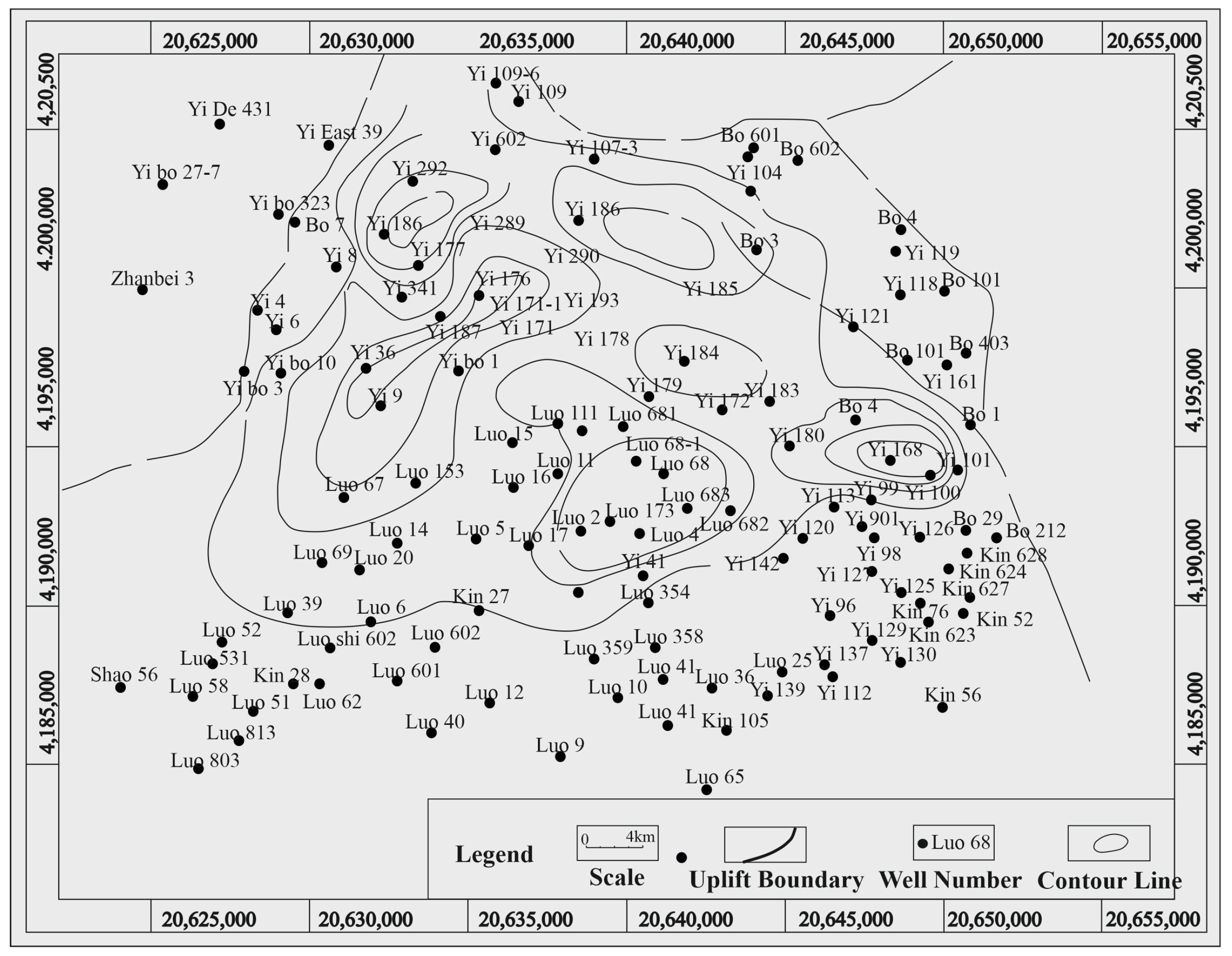
The Bonan Depression is the largest hydrocarbon-bearing sub-basin in the Jiyang Depression, Bohai Bay Basin (eastern China). The Late Mesozoic to Cenozoic extensional tectonics was driven NW-SE and was linked to the rollback of the Pacific plate beneath the Eurasian continental margin [18,19], which formed this Cenozoic rift basin. The Depression covers an area of about 2800 km2 and contains more than 5 km of syn-rift Cenozoic deposits (Figure 1). The Eocene Es4x (53.5–50.0 Ma) is a crucial period of rapid tectonic subsidence and increasing climate variability [20,21]. Structurally, the Bonan Depression is characterized by a half-graben structure that has the Chenjiazhuang Boundary Fault on the north and the Qingtuozi Uplift on the northeast [22]. The Eocene Fourth Member (Es4x) interval experienced contemporaneous faulting that created three zone structures and influenced the sediment distribution and facies architecture. The steep northern slope is characterized by listric normal faults with dips of 15° and 25°, which control the deposition of coarse-grained alluvial fans (LFA 1) [23,24]. The central deep trough experienced high rates of subsidence (150–220 m/Myr), leading to the deposition of thick lacustrine and evaporite deposits [25]. The southern gentle slope, in contrast, is composed of low-angle slopes (20–50°) that enabled the progradation of a fan delta, which was generated in the Luxi and Guangrao uplifts [25,26]. The seismic interpretations reveal NE-oriented incised valleys that contained clastic material transported from the southern sources to the central basin, emphasizing the strong influence of tectonic controls on sediment pathways [27].
The Es4x is unconformably overlain by the Palaeozoic marine carbonate basement and subsequently overlain by the lacustrine shales of the Dongying Formation. Based on regional well-log correlations and 3D seismic data, three high-frequency sequences (Sq1–Sq3) within a third-order sequence of approximately 3.2 million years can be identified. These packages are separated by significant unconformities (SB1 and SB4) and maximum flooding surfaces (MFS1 and MFS2), along with unusual facies stacking patterns [23]. The alluvial fans (LFA 1) and evaporites (LFA 5) dominate in Sq1 (53.5–52.4 Ma; 80–120 m), characterized by the basal sequence boundary (SB1) and MFS1. Sequence Sq2 (52.4–51.2 Ma; 100–160 m) includes braided rivers (LFA 2) as well as floodplain mudstones (LFA 3), marked by a transgressive surface (SB2) and MFS2. Sequence Sq3 (51.2–51.20 Ma; 70–110 m) comprises fan deltas (LFA 4) and evaporitic facies (LFA 5), with the top Eocene Fourth Member (Es4x) exposure surface (SB4) [28].
The paleoclimate of Eocene Fourth Member (Es4x) deposition indicated a period of intense monsoon seasonality at a paleolatitude of 13–15° N [29]. It was during this period that the Early Eocene Climatic Optimum (EECO; ~53–50 Ma) occurred worldwide and was characterized by a warm climate with an average surface temperature approximately 12 °C higher than the present [30]. The geochemical indicators, such as 18O stable isotopes and pollen assemblages, revealed the cyclic shifts between the hyperarid (MAP < 200 mm/yr) and humid (MAP > 800 mm/yr) conditions, likely driven by Earth’s orbital precession [31,32]. Reconstructed paleodrainage shows that the fluvial input was perennial in the Luxi Uplift during wet conditions, whereas during flood pulses, the coarse sediments were supplied by the highlands in the north [33].
Based on petroleum system analysis, the Bonan Depression is divided into four principal rifting stages. The Es4x was deposited during Rift Phase II (55–45 Ma) at the peak of extension, with a rate of 0.81.2 mm/yr [34]. The source rocks are the underlying Es4xu lacustrine shales with the TOC values 2.0%–5.7% and hydrogen index 450–650 mg HC/g TOC [27,29].

3. Database and Methods

The study combines multi-scale data to examine tectono-climatic influences on sedimentation and reservoir development in the Es4x of the Bonan Depression. A 406 m core from six wells, divided into structural domains, was systematically analyzed for sedimentary facies, grain size, and clues to the ancient current directions. Mineralogy, porosity, and diagenetic phases were quantified using the Gazzi Dickinson method, with 52 thin sections prepared and tested. A 3D seismic volume (25 × 25 m bin size, 35 Hz frequency) was interpreted to identify sequence boundaries, depositional geometries, and fault patterns. To reconstruct paragenetic sequences, reservoir quality evolution was assessed through cathodoluminescence, SEM-EDS, and fluid inclusions. Porosity and permeability data (n = 216), obtained under reservoir conditions (25 MPa), indicated that fracture properties were measured via core and FMI records. Lithofacies classification and porosity–permeability mapping based on sequential Gaussian simulation in Petrel were supported by multivariate analyses such as PCA and cluster analysis.

4. Results

4.1. Lithofacies Associations

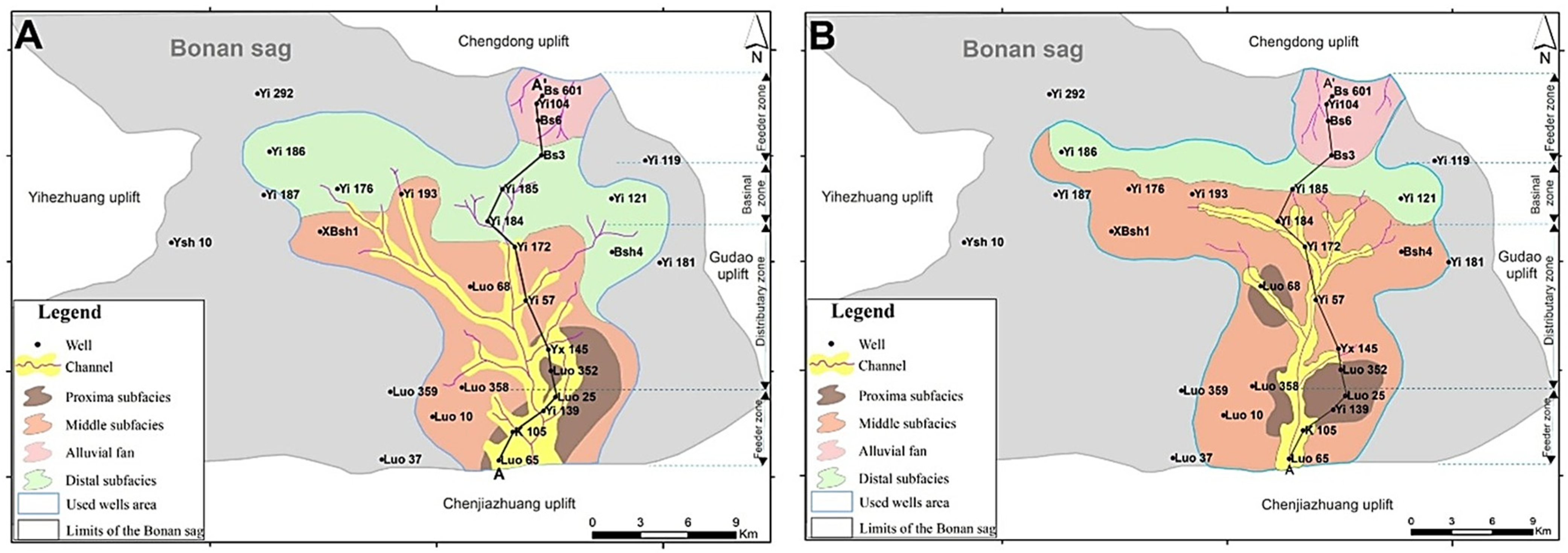
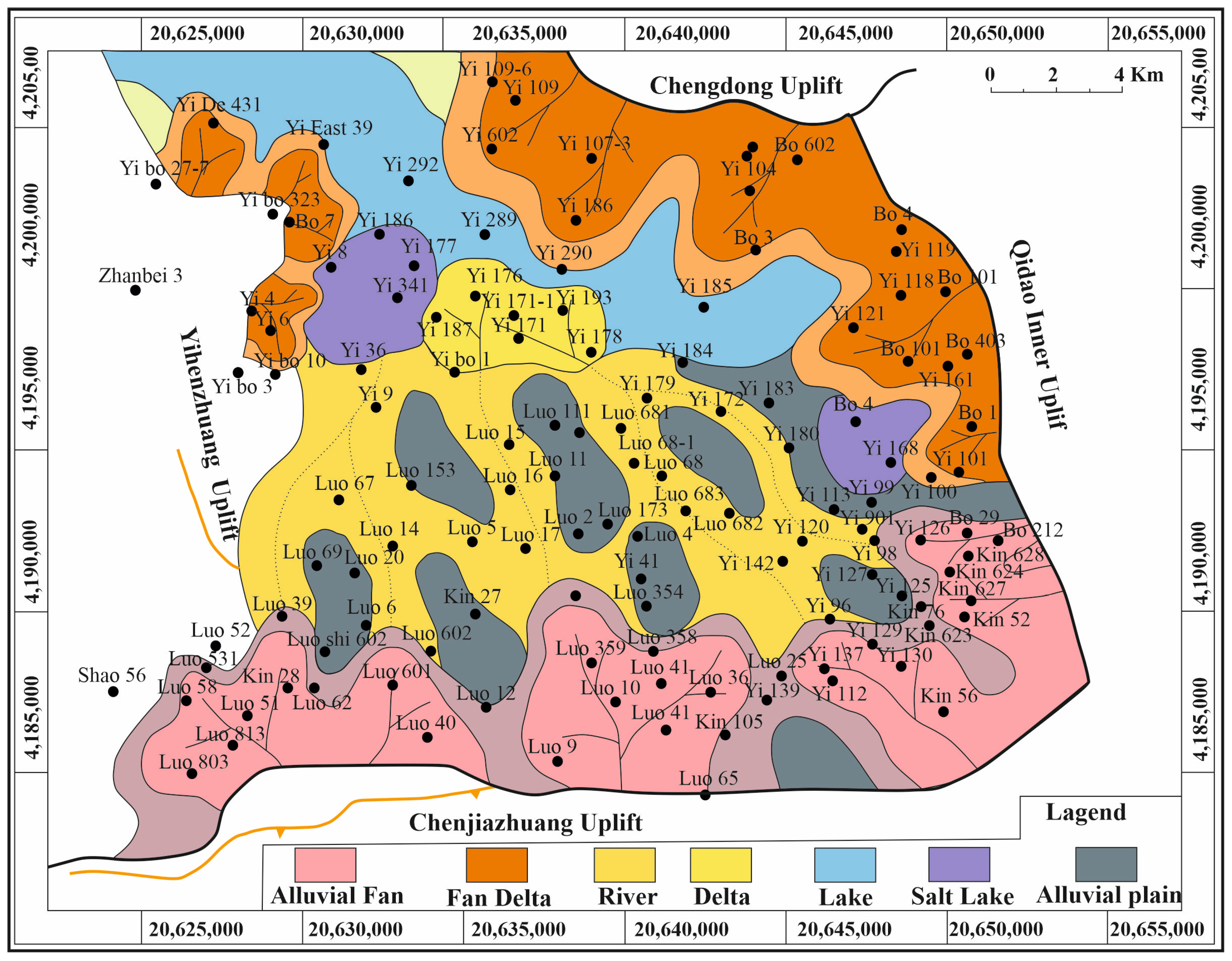
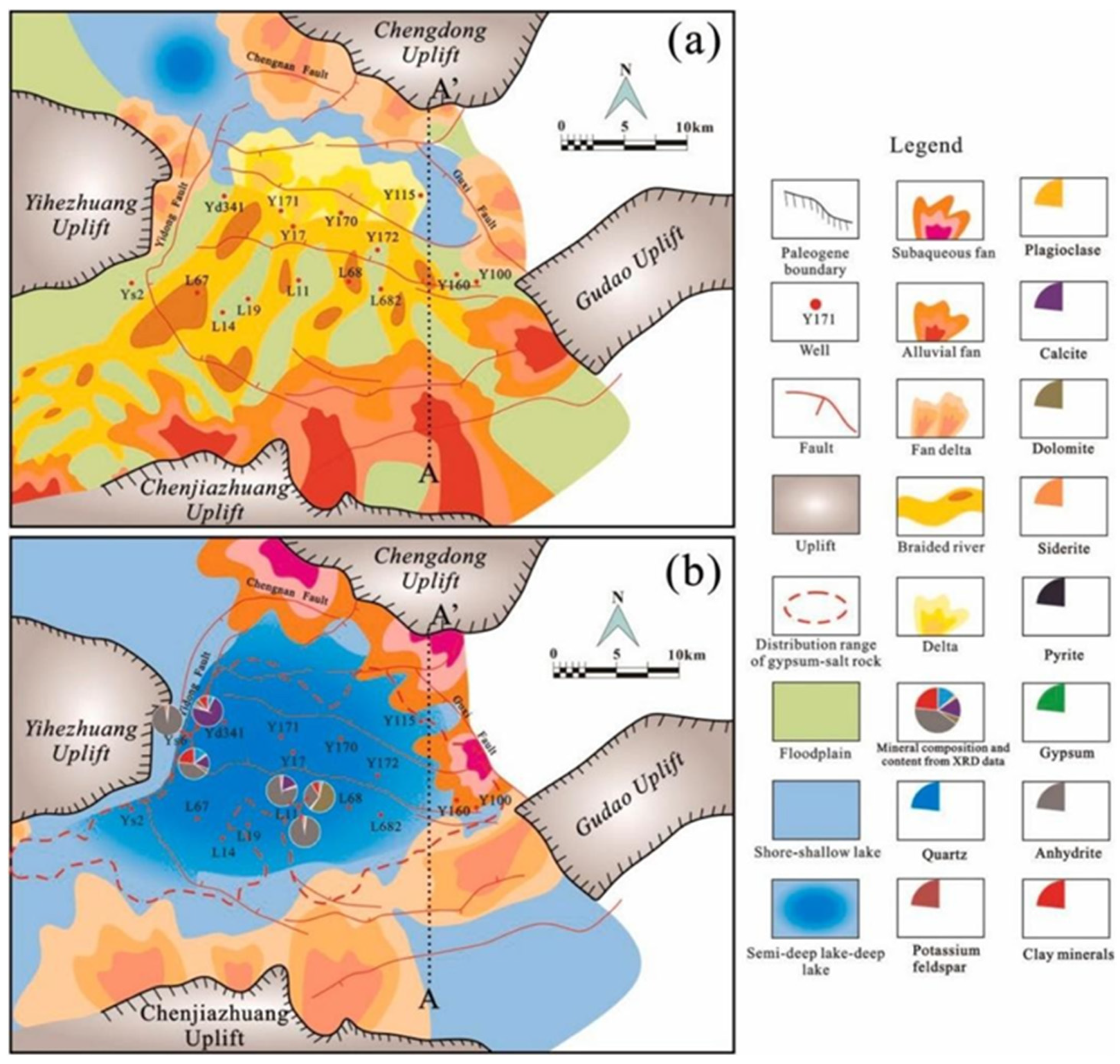
The Es4x in the Bonan Depression has a complicated sedimentary structure impacted by early Eocene syn-rift tectonic processes, along with early Eocene changes in paleoclimate. A total of 406 m of core in six wells, 52 thin-section analyses, 3D seismic interpretation, and geochemical data were used in the identification of five different lithofacies associations (LFA). These LFAs record depositional responses to arid–humid climatic fluctuations in a continental rift basin (Figure 2).

4.1.1. Alluvial Fans (LFA 1)

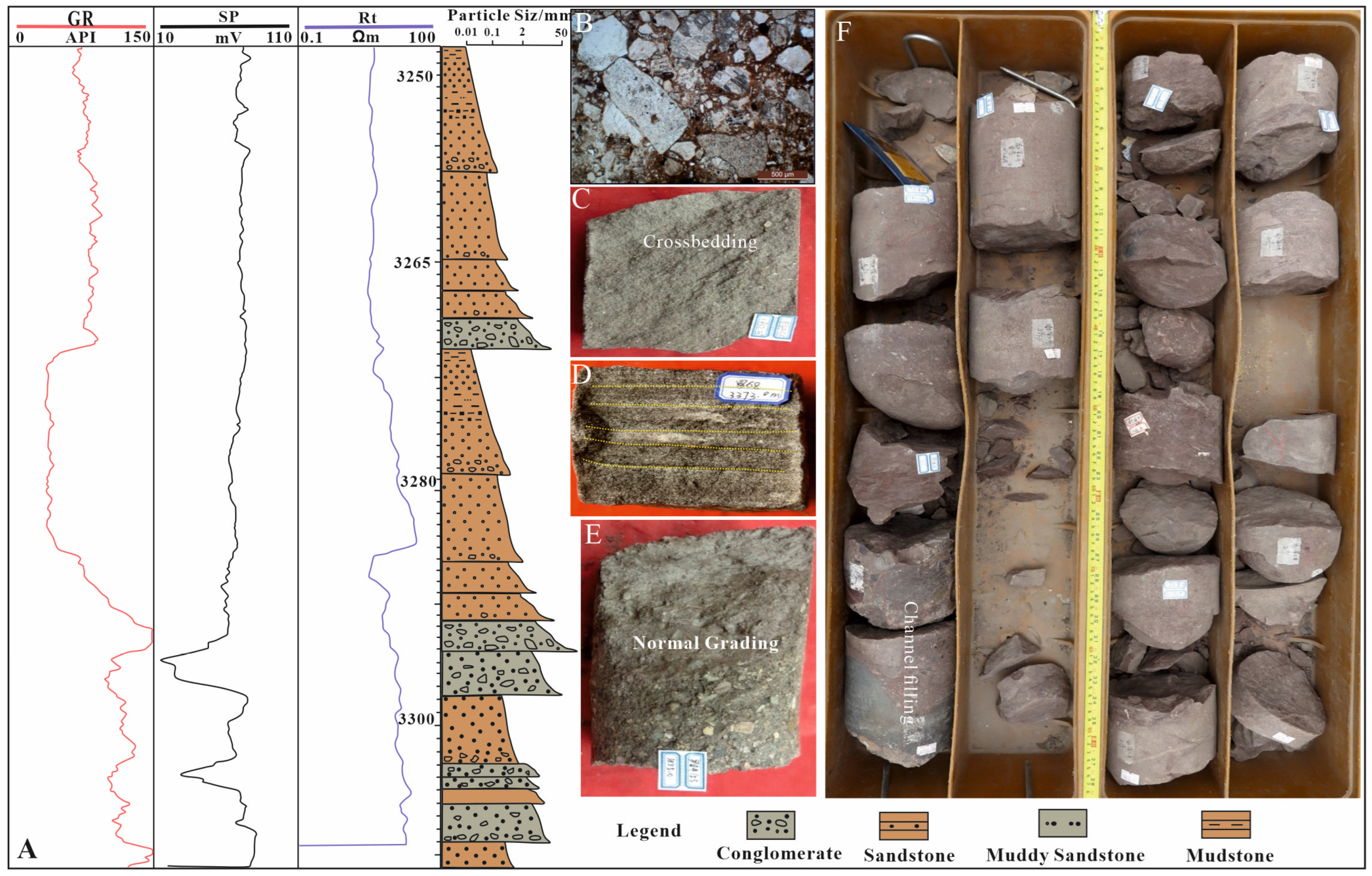
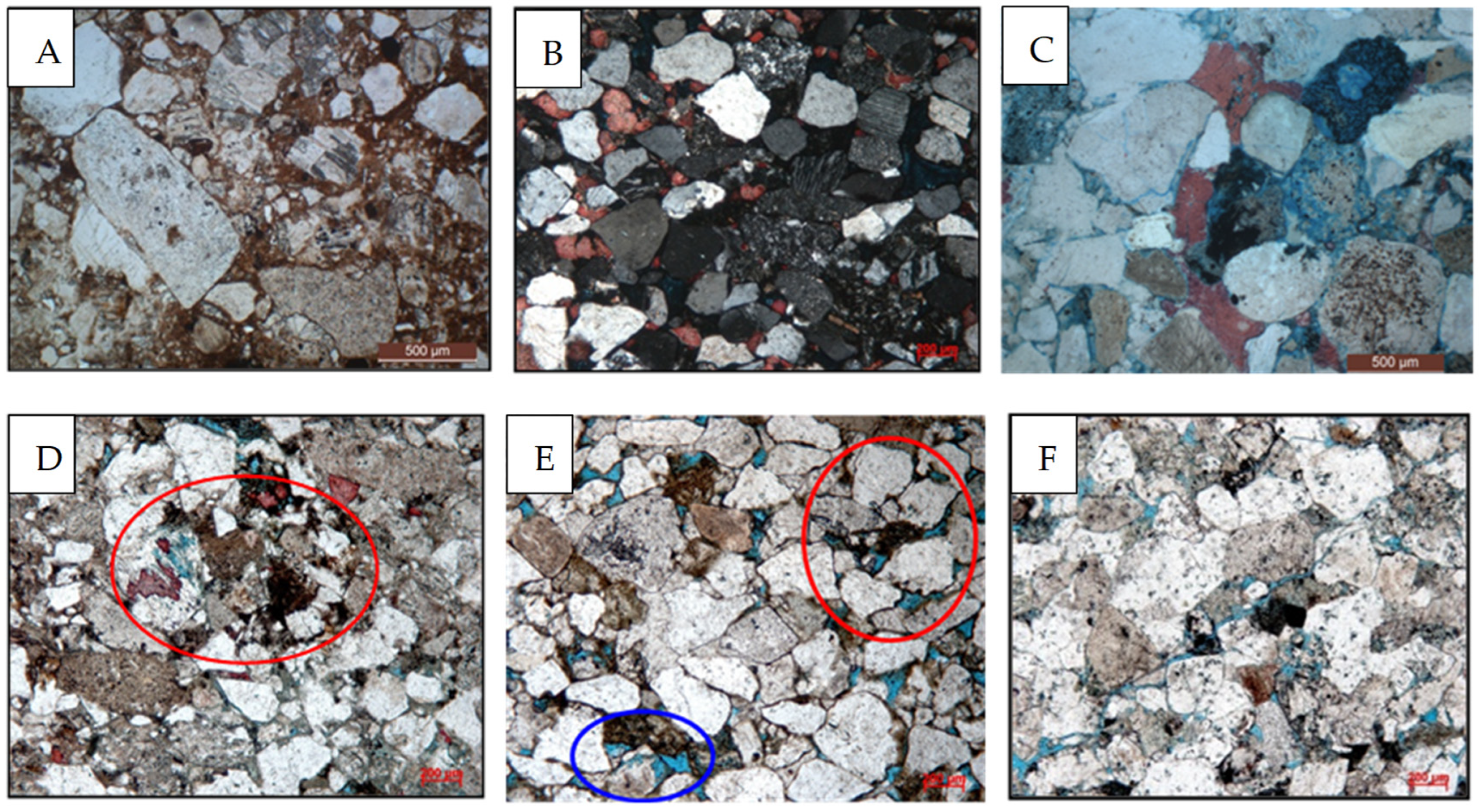
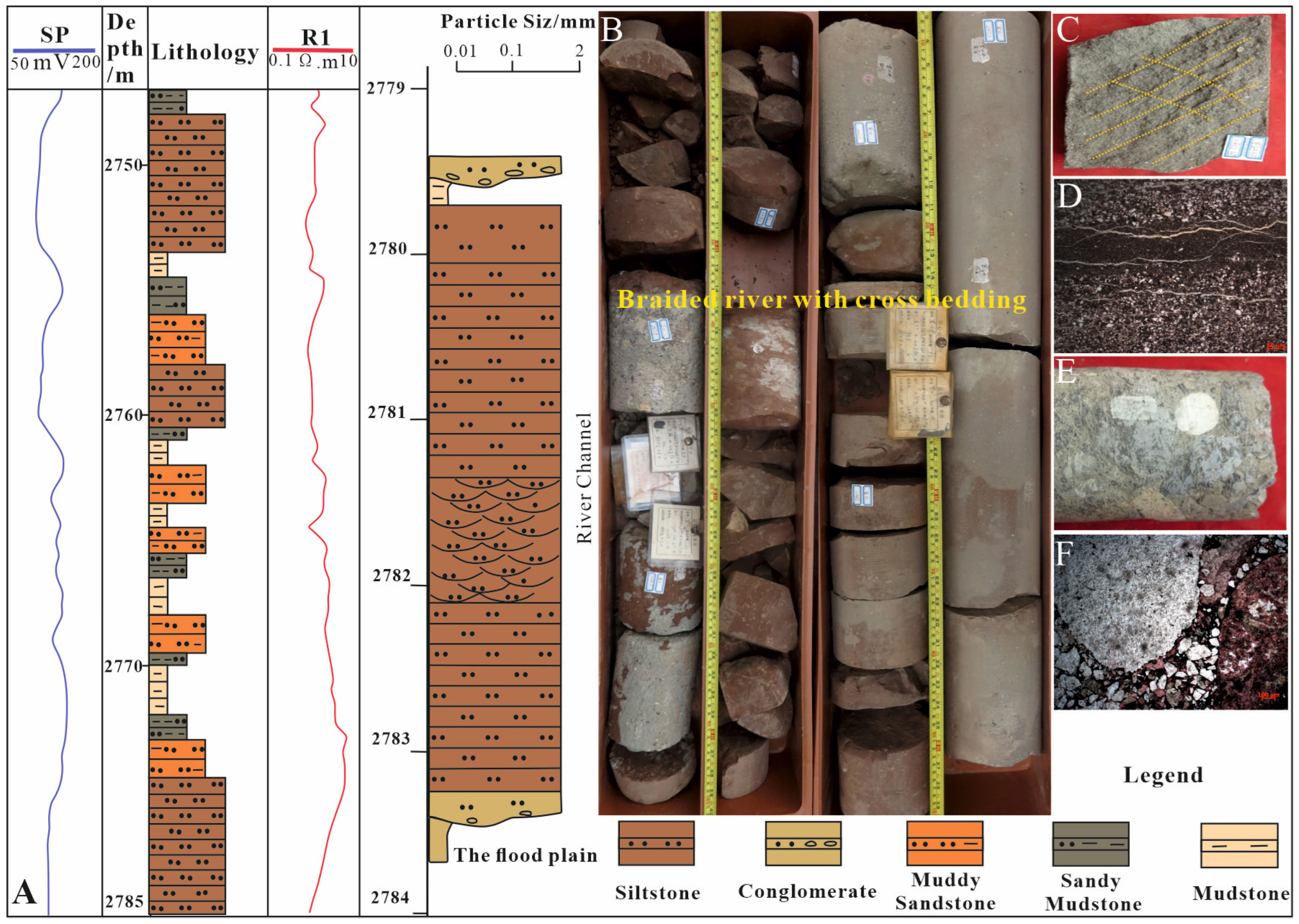
This lithofacies appears on the steep slopes of the North basin and particularly in the Chenjiazhuang and Qingtuozi Uplifts, with its distribution moderated by NW-trending boundary faults (Figure 2). These deposits mainly consist of matrix-supported conglomerates containing sub-angular clasts of gneiss and dolomite ranging from 2 to 60 mm in size. These are coarse-bedded sediments, as observed in Well Luo 358 at 2782.4 m (Figure 3A), exhibiting chaotic bedding and massive textures. Such features are typical of non-cohesive debris flow deposits, with sorting coefficients between 1.8 and 2.5. The clast assemblage dominated by gneiss and dolomite matches the composition of the adjacent uplifts, indicating erosion of local basement highs as the primary source. Seismically, these deposits are represented by progradational wedge-shaped bodies with high-amplitude chaotic reflections, especially around the Qingtuozi Uplift (Figure 2B). Their stratigraphy and geometry suggest deposition during tectonic pulses associated with early rifting [35].

4.1.2. Braided Rivers (LFA 2)

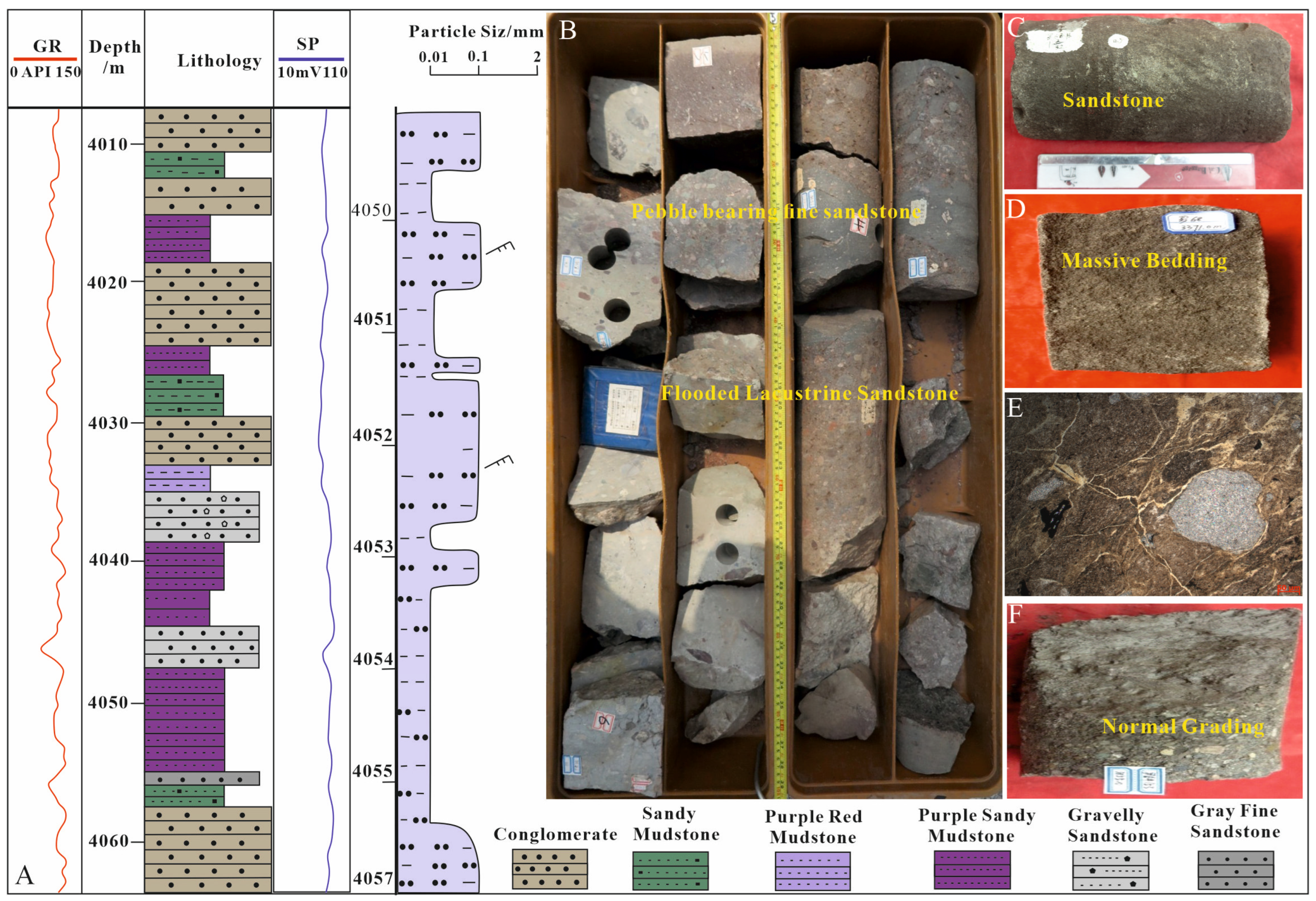
LFA 2 builds up on the northwestern low-relief gradient along the Wudi Uplift, occurring where it becomes distal in finer lacustrine deposits (Figure 2A). It is made up of purple-red feldspathic lithic sandstones that have 20%–35% quartz, 30%–45% feldspar and 25%–40% volcanic and metamorphic lithic fragments. These include in Well Luo 10 (Figure 4A). They are also characterized by trough cross-bedding (Figure 3B), scour-and-fill complexities, and low bioturbation, implying that they were deposited in high-energy, laterally moving braided channels. The probability curves of grain size are steep and bimodal. The rollability index is between 0.25 and 0.45 and the saltation fractions are more than 60%. Medium-grained sandstones (0.250.5mm) contain 12%–19% porosity, which is supported by a sorting coefficient less than 1.6 (Figure 3B). Detrital quartz grains are coated in chlorite rims, 5–100m thick, preventing quartz overgrowth and maintaining intergranular porosity [36]. Red deposition is more common when it is arid, which is revealed by oxidized coloration (Fe3+/Fe2+ > 3) and the lack of organic matter. These characteristics collectively suggest deposition during episodic flash-flood events within a braided-channel system [36].

4.1.3. Floodplain Mudstones (LFA 3)

The LFA 3 deposits are highly distributed in the central depression, primarily through the seasonal floodwater of the southern Luxi Uplift [36]. These facies have three subfacies, which include: mud-dominated, sandbar, and sandy beach (Figure 2A). The mud-dominated subfacies are mainly made of purple-red gypsiferous mudstones that have blocky bedding and abundant root traces as observed in Well Luo 158 (Figure 5A). These features indicate irregular subaerial exposure and vegetation colonization. Geochemically, a ratio of Sr/Ba less than 1 is a sign of significant freshwater input. Coarse-grained sandstones in the sandbar subfacies feature wash cross-bedding with inverse grading, typically related to funnel-shaped gamma-ray patterns (Figure 5B), indicating prograding crevasse splay or mouth bars of distributaries. The sand beach subfacies comprise wave-rippled purplish-red siltstones with flaser bedding, including similar rippled silts at Well Luo 173, consistent with periodic shoreline reworking. Overall, the facies pattern displays rhythmic (meter-scale) alternations of sand and mud, likely linked to precession-driven humidity cycles. These patterns are supported by orbital δ18O records with 2%–4% variation, implying climate primarily influenced lake level fluctuations and sediment supply [37].

4.1.4. Fan Deltas (LFA 4)

The association of lithofacies is observed along the east and south margins of the Bonan Depression, particularly around the Guangrao and Luxi Uplifts. Sediment was diverted towards NE-trending incised valleys that had been eroded from Palaeozoic basement highs to form narrow fan-delta systems (Figure 2A). The lithic sandstones are predominant throughout the deposits, with occasional gravel lags in between. The modal framework composition is indicated as Q30, F40, L30 (Figure 3B) in Well Yi 126. Depositional textures in these fan delta lobes exhibit a variety of fan delta types, with interfan areas typically containing calcite cement of 5–15 percent, which significantly reduces porosity to 8 percent [38,39].
Seismically, LFA 4 features high-continuity sigmoid oblique clinoforms, which typically form in lenticular shapes due to sediment trapping within fault-controlled depressions (Figure 2B). Existing Palaeozoic structural highs influence channel trapping, demonstrating the significant role of basement topography in affecting sediment routing and deposition [38].

4.1.5. Saline Lacustrine (LFA 5)

The final lithofacies association comprises saline lacustrine mineral deposits situated along the northern depocentre of the Bonan Depression, specifically within the Lijin Minfeng Depression, an area undergoing maximum tectonic subsidence (see Figure 2A). These evaporitic lacustrine sediments consist of interbedded layers of gray–black halite and organic-rich algal mudstones, with total organic carbon (TOC) values ranging from 0.8% to 2.1%, as determined by Well Luo 10 (refer to Figure 3C). The geochemical data indicate the chemistry of hypersaline lakes, with average Sr/Ba ratios of 3.07 and Na/K ratios persistently exceeding 2. Field evidence of synsedimentary framboidal pyrite, characterized by δ34S values between −15‰ and −20‰, suggests sulfate reduction activity in the reducing bottom waters, most probably driven by the degradation of organic matter during lake stratification [39,40]. These deposits are spatially arranged within the classic bull’s-eye evaporite, which forms through the surrounding carbonates and subsequently deposits into the mid-vein gypsum and the bull’s-eye halite (Figure 2B). This represents a vertical and horizontal facies succession characteristic of closed-basin hydrology, marked by periodic brine concentration and localized evaporite formation during extended dry periods.

4.2. Vertical and Lateral Facies Distributions

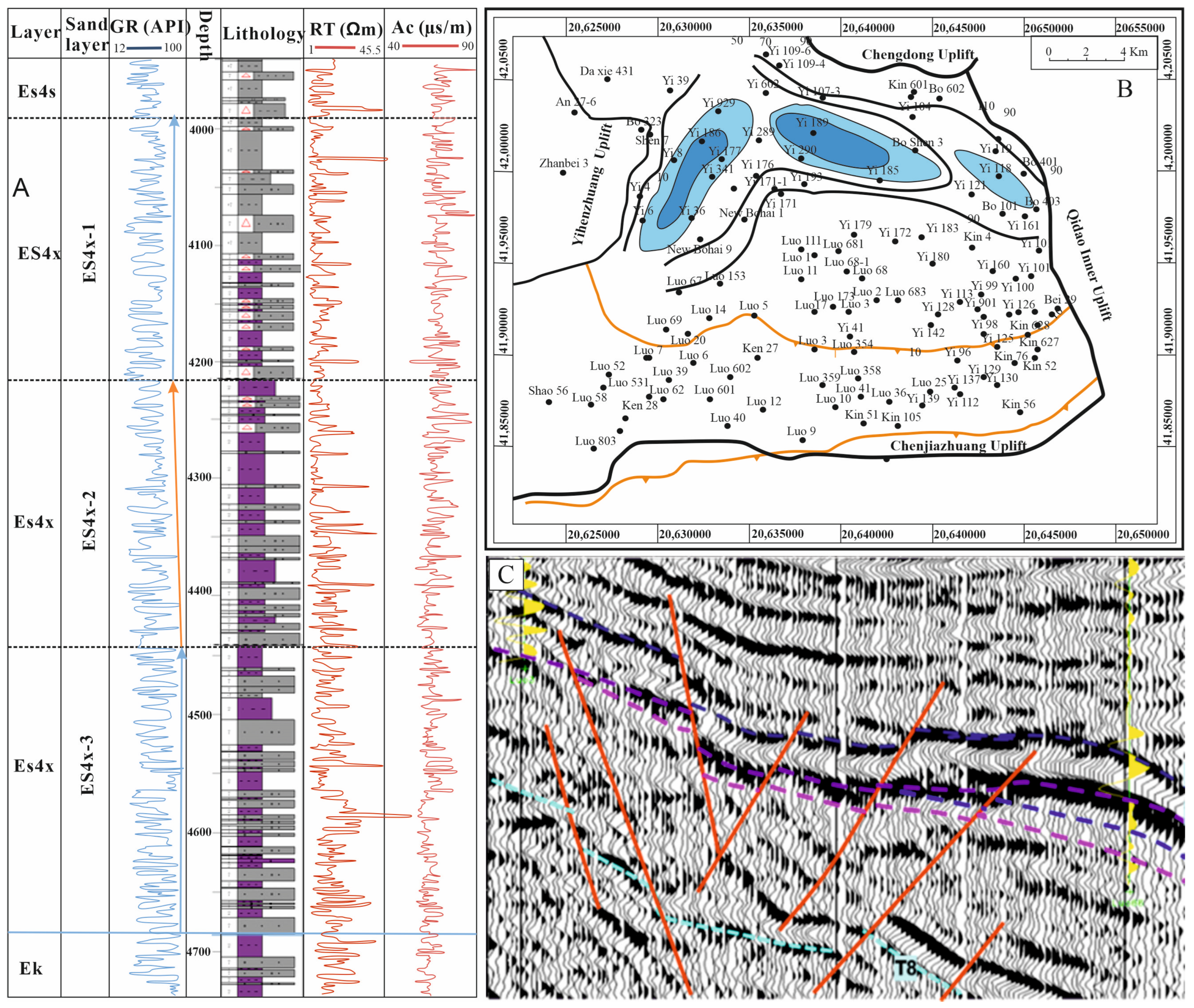
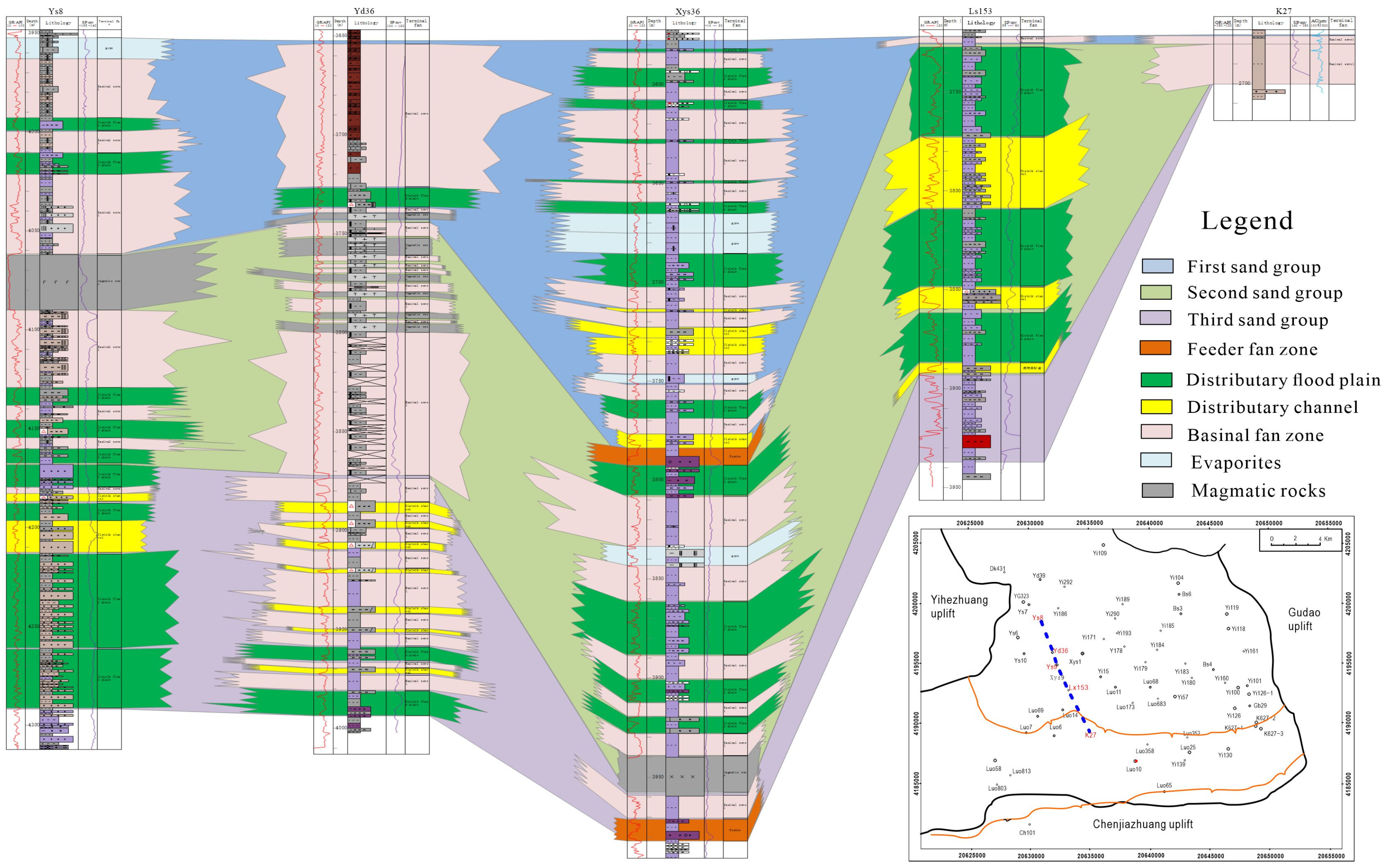
The Eocene Fourth Member (Es4x) facies evolution varies both spatially and temporally and is influenced by a combination of synrift tectonics and climate-induced cyclicity. Well correlations, seismic charts, and thickness diagrams provide ideal information about both vertical segmentation and the areal distribution of facies within the Bonan Depression (Figure 6).

4.2.1. Vertical Distribution

The Eocene Fourth Member (Es4x) interval, with an approximate thickness between 150 and 300 m, contains three depositional cycles: Cycle I, Cycle II, and Cycle III, each representing different stages of climatic and tectonic evolution (Figure 6A).
The alluvial fans (LFA 1) and saline lacustrine deposits (LFA 5) dominate the lower part of the Eocene Fourth Member (Es4x) sequence. The maximum thickness of 20–35 m of evaporites is recorded in the Lijin Minfeng Depression, especially in well Luo 10 (Figure 2B). Geochemical records, such as a Sr/Ba ratio greater than four and δ18O less than 20%, indicate a state of hyperaridity over a long period [41].
The middle phase shifts to more humid conditions, leading to the development of floodplain mudstones (LFA 3) and braided rivers (LFA 2). This rhythm is characterized by interbedded gray–green mudstone (TOC: 1.2%–1.8%) and red beds, which indicate the succession of humid pulses, as shown by δ13C values below −24%. Accommodation spaces and sediment supply tend to increase by about 40%, reflected in the sand thickness within the sand bodies in the central Depression of this cycle (Figure 6B).
The late cycle is characterized by a return to salty lacustrine conditions (LFA 5), with halite beds once again becoming prominent. The seismic data show basinward onlap surfaces (Figure 6C), indicating the growth of evaporitic deposits as the environment reverts to arid conditions.
The basin exhibits varied depositional histories across its key wells. Well Luo 10 in the northern part of the basin contains the full sequence from Cycle I to Cycle III, with the greatest evaporite thickness recorded in Cycle I. Well Luo 173, located in the central Depression, primarily reflects Cycle II, with sandbars reaching thicknesses of 8–12 m. Conversely, Well Yi 126 in the southern basin reveals transected fan deltas from Cycle I, suggesting a transition from arid to humid conditions during part of Cycle II.

4.2.2. Lateral Distribution

In the Es4x, facies distribution is laterally influenced by three structural zones that show different facies geometries. These zones reflect the effects of local tectonics, subsidence, and available accommodation space during deposition (Figure 7).
The northern steep slope, characterized by alluvial fans (LFA 1) dominance within 5 km of fault zones, is controlled by fault boundaries. The seismic data show chaotic reflections with dips of 15–20 km, which correspond to fault-controlled deformation (Figure 2B). The geometry of the sand bodies in this zone is narrow (23 km) and lens-shaped, indicating limited deposition spread near fault-controlled accommodation gaps.
The central Depression also features complex interactions between floodplain mudstones (LFA 3) and braided rivers (LFA 2), creating a transition zone between the two facies. The sand bodies here are sheets and sandbars that are laterally extensive (10–15 km). The seismic reflection has been shown to have sub-parallel trends with modest amplitudes, indicating a stable, subsidence-driven environment in the central basin.
Fan deltas (LFA 4), prograding basinward, extend along the southern gentle slope for 20–25 km (Figure 2B). The cross-section profile shows sigmoidal clinoforms that exhibit lateral migration and progradation. The sands are lobate sandbodies ranging from 30 to 40 m in relief, indicating active sedimentation prograding slope.

4.2.3. Paleogeographic Evolution

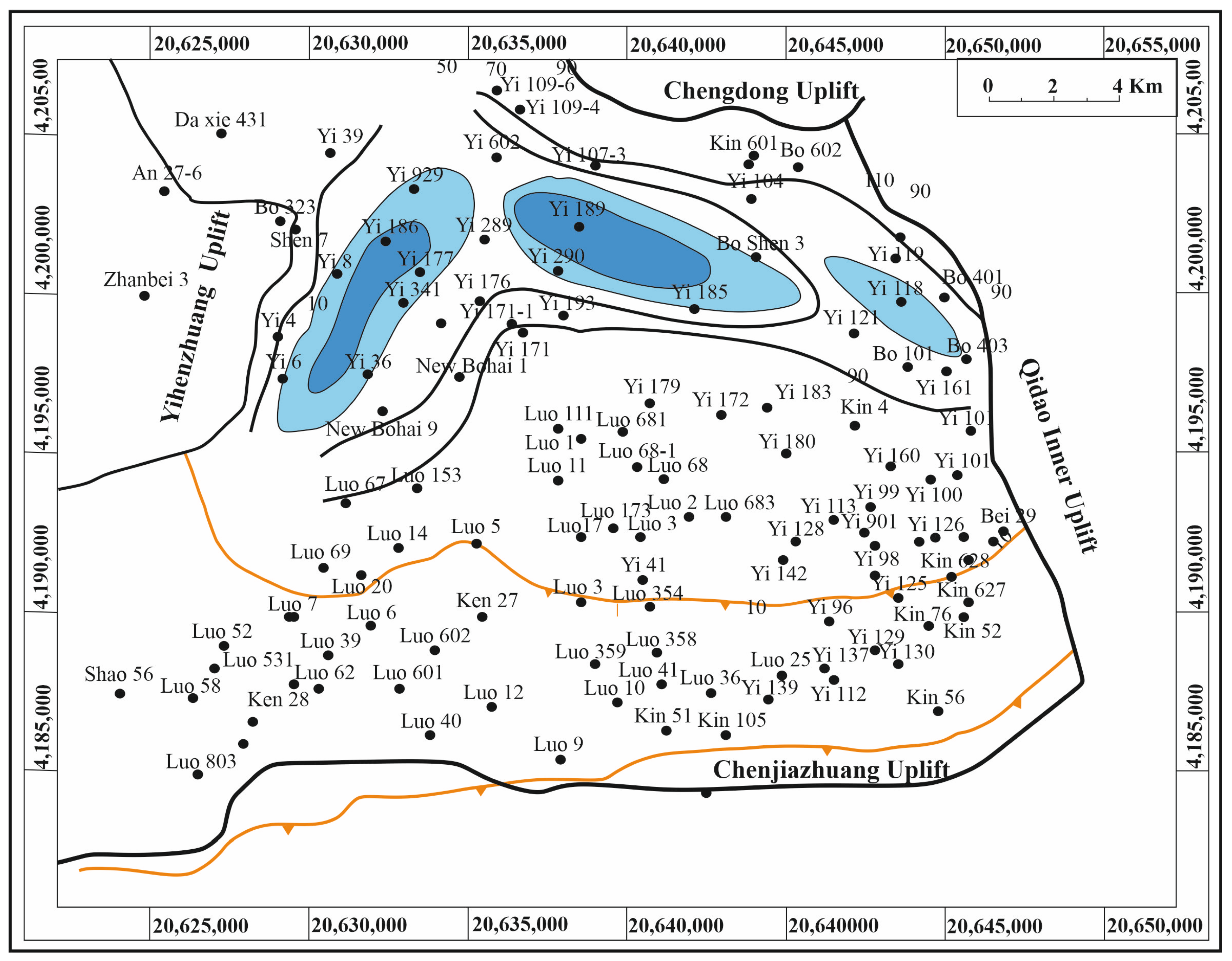
In the initial period of Es4x deposition, the climate was predominantly arid, which restricted the extent of the lacustrine system. Lake development was focused within the northern depocenter, where it interfingered with coarse alluvial fans derived from adjacent uplifts [42]. These fans transported coarse clastic material basinward, depositing it along the proximal margins. In contrast, the mid- to northern areas of the depression record widespread saline lacustrine facies, indicating elevated evaporation and a limited freshwater supply (Figure 8) Overall, this stage reflects a hydrologically closed basin with an evaporitic lake regime.
As the climate shifted to a more humid stage, the depositional setting adjusted accordingly, and numerous lakes became perennial throughout the basin. Braided rivers cut across the older fan deposits and carried a larger mass of sediment into the Central depression. This created an inflow of fluvial material that led to the formation of sandbars, floodplain mudstones, and coarse-grained overbank deposits, indicating a significant increase in both water supply and sediment supply (Figure 7). The resulting shift from a restricted, arid lake to a more open and interconnected fluvial–lacustrine system represents a major paleogeographic reorganization. This change was likely driven by regionally wetter climate conditions that enhanced runoff, sediment transport, and basin connectivity.
During the final phase of Eocene Fourth Member (Es4x) deposition, arid conditions occurred again. The retreat of perennial lake systems and the decrease in fluvial activity led to the re-establishment of evaporitic environments across much of the basin. The observed backstepping of fan deltas indicates an imbalance between accommodation creation and sediment supply potentially reflecting reduced sediment influx, or alternatively, continued subsidence that generated accommodation faster than available sediment could fill (Figure 7). This stage indicates a shift back to closed-basin processes and a diminished ability to connect with other basins, which could be linked to climatic drying of the basins as well as a tectonic shift in subsidence patterns [41]. Generally, the Es4x paleogeographic reconstruction shows repetitive patterns of lake expansion and retreat caused by climatic and tectonic forces. These changes, along with their influence on sedimentary facies distribution, also impacted the basin’s hydrocarbon development as both a source and reservoir.

4.3. Sequence Stratigraphic Architecture

The Es4x of the Bonan Depression is a third-order sequence lasting about 3.2 million years, bounded by regional unconformities at its top and bottom. This sequence is divided into three fourth-order sequences (Sq1–Sq3) (Figure 9) with durations ranging from 0.8 to 1.1 million years. These sequences are defined by seismic onlap and truncation surfaces, well-log stacking patterns, and paleoclimate proxy indicators. They reflect variations in lake levels driven by orbital processes, including eccentricity and precession cycles [43].

4.3.1. Sequence Boundaries

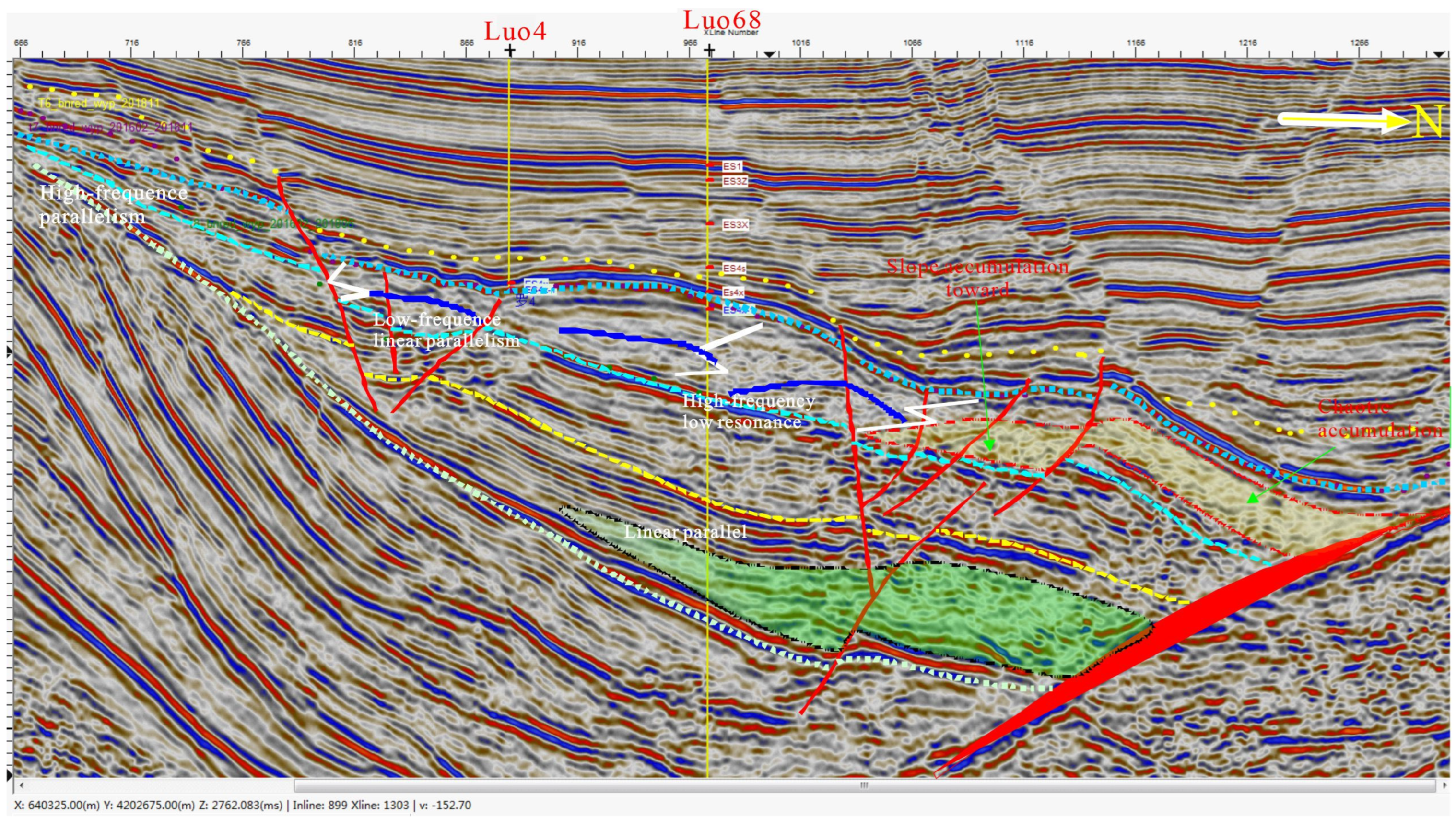
The Es4x contains several key sequence stratigraphic surfaces formed under the combined influence of depositional processes, basin architecture, and paleoclimatic shifts. These sequence boundaries, constrained through seismic reflection data, sedimentology, and geochemical profiles, provide a framework for reconstructing stratigraphic evolution. The basal boundary of the Es4x (SB1) represents a major regional unconformity. It is marked by coarse purple-red alluvial fan conglomerates overlying the eroded Palaeozoic basement. Seismic reflection geometries clearly show incision below this surface, indicating erosion followed by renewed deposition during early Eocene rifting (Figure 10). This boundary reflects a phase of uplift and non-deposition prior to the onset of Es4x sedimentation (Figure 10).
Two internal sequence boundaries (SB2 and SB3) are interpreted as transgressive surfaces produced during intervals of lake expansion. They are recognized by abrupt vertical facies shifts from braided-river sandstones (LFA 2) into gray–green lacustrine mudstones (LFA 3). A sharp lithologic break is well expressed in Well Luo-10 at 2775 m and is accompanied by a positive 0.2‰ isotopic excursion (Figure 4B). These boundaries do not represent geochemical anomalies themselves, but rather stratigraphic surfaces whose expression is supported by geochemical indicators. They most likely correspond to periods of increased humidity or enhanced subsidence that expanded lake accommodation.
The top of the Es4x (SB4) forms a distinct sequence boundary overlain by organic-rich lacustrine shale at the base of the Dongying Formation. In places, this surface records subaerial exposure and evaporative lake drawdown. In Well Luo-173, evaporite dissolution breccias (Figure 5E) indicate that the boundary represents a local exposure surface that may have formed during late-stage aridification and lake level fall. The term basin desiccation is better described here as progressive drying and hydrological restriction, consistent with reduced inflow and heightened evaporation.

4.3.2. Systems Tracts

The Es4x is subdivided into three systems tracts, Lowstand Systems Tract (LST), Transgressive Systems Tract (TST), and Highstand Systems Tract (HST), each reflecting contrasting lake-level fluctuations driven primarily by climatic variability and associated hydrological responses.
(a) 
Lowstand Systems Tract
During lowstand conditions, coarse-grained deposits including alluvial fans (LFA1) and braided-river sandstones (LFA2) were concentrated along basin margins. Depositional geometries in seismic profiles show progradational wedge-shaped reflections, indicating basinward advance of clastic material and a rapid infilling stage characterized by high sediment supply rates (Figure 11a). Gamma-ray curves from Well Luo-68 exhibit a bell-shaped motif, consistent with coarsening-upward cycles produced by repeated flooding and channel migration (Figure 3A). Geochemical evidence, including gypsum nodules and Sr/Ba ratios greater than 2, suggests deposition under hypersaline and evaporative conditions [44].
(b) 
Transgressive Systems Tract
The transgressive stage is marked by landward migration of facies belts, with lacustrine mudstones (LFA3) and saline lacustrine deposits (LFA5) encroaching toward the basin center. Retrogradational stacking patterns record rapid deepening from marginal bars into deeper lacustrine settings (Figure 4). Organic-rich black shales define the maximum flooding surface (MFS), displaying TOC values of 1.5%–4.0% and δ18O minima near –8‰, which indicate intensified humidity and enhanced freshwater influx [45]. Interpretation of this humid interval is supported by elevated kaolinite/illite ratios within clay mineral assemblages, reflecting enhanced chemical weathering under warm-humid conditions (Figure 11b).
(c) 
Highstand Systems Tract
Fan deltas (LFA4) prograded into a relatively stabilized, shallowing lake during highstand conditions. Sigmoidal clinoforms visible in seismic cross-sections, together with high-angle foreset reflections, indicate ongoing basinward progradation and delta lobe advancement (Figure 10). Gamma-ray logs show funnel-shaped patterns consistent with coarsening-upward deltaic successions (Figure 5). Paleoclimate indicators, including caprock evaporitic layers and Na/K ratios exceeding 3, suggest a transition back toward relatively arid and saline lacustrine conditions.

4.4. Paleoclimate Proxies

The combined geochemical, mineralogical, and sedimentological data of the Es4x offer a clear view of major aridification events during the early Eocene, driven by global climate variability at the orbital scale. The key proxies related to Well Luo 10 and other correlation sections provide insights into these climate changes.
(a) 
Geochemical Proxies
The Sr/Ba ratio within Well Luo 10 ranged from 0.16 to 10.03, with an average of 3.07, based on 39 samples. A ratio above 1 indicates saline conditions, and peaks exceeding 5 are strongly associated with thick halite layers (Figure 10). Such high values confirm the presence of saline, evaporative conditions during dry periods, as previously noted in the literature [46]. The ratios of Na/K are always above 2 and can even reach 8.7, indicating that evaporation has concentrated these elements in the arid conditions. Such high ratios are typical of a hypersaline environment where evaporation greatly exceeds precipitation [47]. The δ18O values of carbonates are notably high, ranging from +4% to +8% (VPDB). This elevated δ18O signature indicates increased evaporation, which is a common indicator of dry climate conditions, supporting the idea of climate-driven desiccation in the basin.
(b) 
Mineralogical Indicators
The Isopach Map of Gypsum (Figure 12) shows that 15%–40% of the northern Lijin Minfeng Depression consists of evaporite layers, mainly gypsum and halite. The characteristic feature of the zonation pattern, called the bull’s-eye zonation, with carbonates transitioning to dolomites, gypsum, and then halite toward the basin’s center, demonstrates the presence of closed basin hydrology, evaporation-driven concentration of solutions, and periodic basin drying [48]. The typical combination of clay minerals in floodplain mudstones mainly includes illite-smectite (70%–85%), which suggests alkaline conditions with a pH above 9. These clay minerals are generally associated with arid and evaporating environments, further supporting the idea of widespread and extensive aridification during these periods.
(c) 
Sedimentological Signatures
The basin margins are dominated by hematite-rich purple-red mudstones with Fe3+ to Fe2+ ratios exceeding 3. These red beds indicate past periods of subaerial oxidation during dry conditions, where exposure of sediments to atmospheric oxygen promoted hematite formation [41]. The groundwater reflux during desiccation is recorded by dissolution breccias in halite layers, especially in Well Luo 10. These breccias indicate periods of groundwater movement in the evaporite deposits, likely caused by changes in lake levels during dry periods, providing further evidence of episodic desiccation [43]. In Well Luo 173, well-sorted fine sands are characterized by adhesion ripples, which indicate the reworking of this material by the winds in the playa environments. Such aeolian textures are typical of regimes experiencing wind erosion and deposition in arid, evaporative lakes; thus, they provide first-hand evidence of the effect of wind during dry climatic intervals.
(d) 
Cyclostratigraphic Framework
The geochemical, mineralogical, and sedimentological proxies indicate that lake level changes related to climate shifts were closely linked to orbital forcing. High eccentricity correlates with humid periods and lake formation deposits, which appear as gray–green mudstones containing total organic carbon (TOC) levels of 0.8 and 2.1%. Conversely, low eccentricity aligns with arid phases and the deposition of evaporites, such as halite and gypsum layers. The 21-kyr precession cycle periodicity matches lamina counts in gypsum-mudstone couplets, averaging 20 laminae per centimeter, supporting the idea that climate variations and lake level fluctuations during the formation of Eocene Fourth Member (Es4x) were driven by orbital forcing, primarily precession [48].

4.5. Provenance Signatures and Sediment Supply Pathways

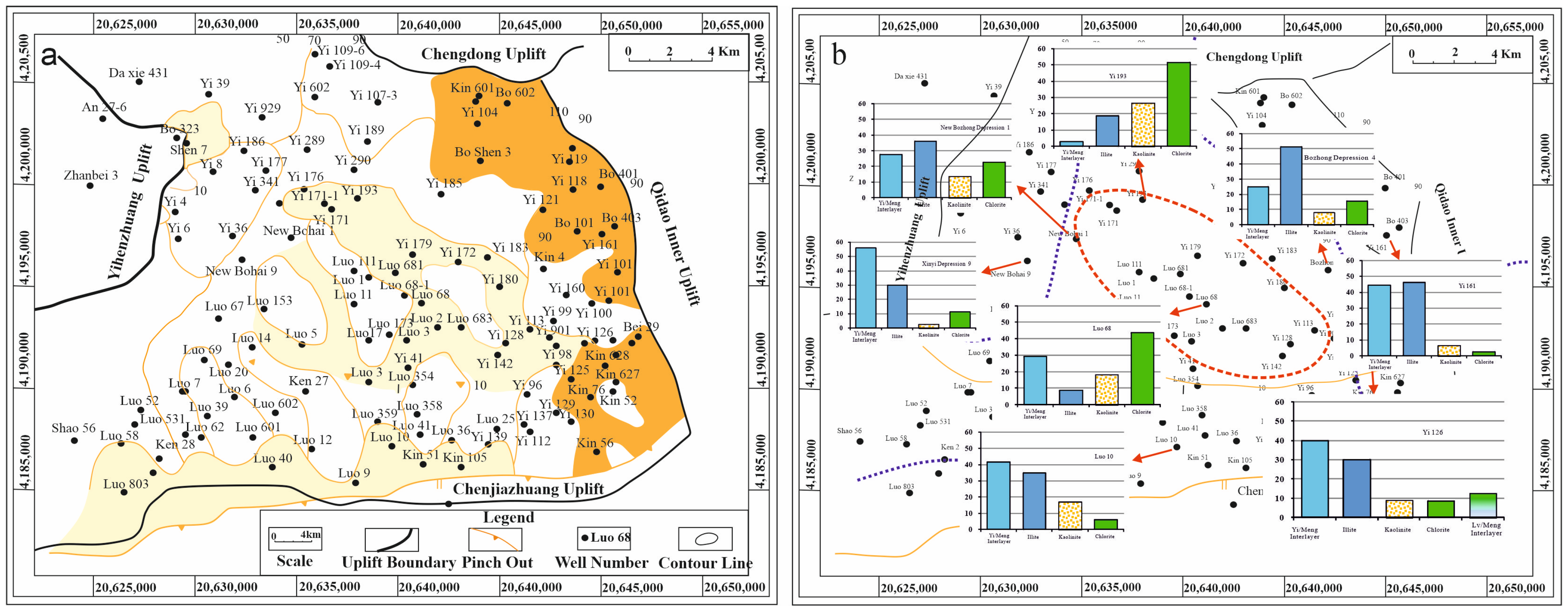
The Eocene Fourth Member (Es4x) red beds provenance study identifies three distinct regions as sources of the sediments, which were further influenced by the complex interaction between rift tectonics and palaeogeography. Combined petrographic, seismic, and compositional data outline sediment pathways across the northern, southern, and western uplifts to the Bonan Depression depocenter (Figure 13).

4.5.1. Provenance Signatures

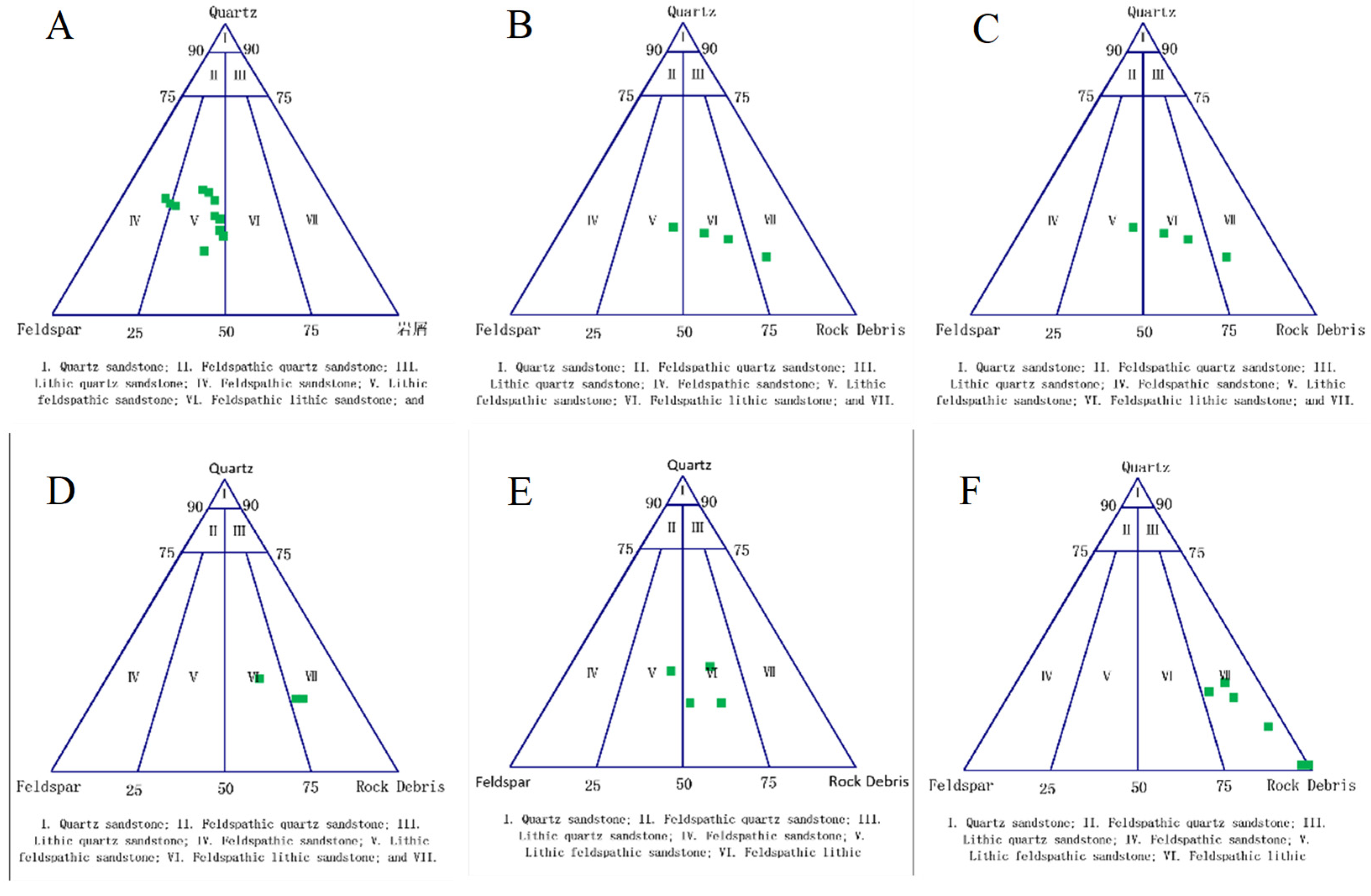
The lithic mixture of gneiss and dolomite clasts (60%–80%), which formed the conglomerates in the northern uplifts, is evident in Well Luo 358 (Figure 5C). These clasts seem to correspond accurately to the Precambrian basement of the Chenjiazhuang Uplift [43]. Sandstones from this region are characterized by an extremely high concentration of volcanic lithic clasts (Lv: 25%–40%) (Figure 14A), indicating a source rock of igneous origin, which in this case is the intermediate volcanic rocks of the nearby uplifts. The mafic origin of the clastic material is supported by geochemical tracers such as higher Cr/Zr ratio values (1.2 to 1.8) and Cr/Ni values greater than 1, of source regions with predominant volcanic rocks.
The southern uplifts produced feldspathic lithic sandstones with a composition of 30%–45% feldspar and 20%–30% quartz (Figure 14B). These sandstones, found in Well Yi 126 (Figure 5D), include metamorphic quartzite lithics, indicating input from the surrounding metamorphic terrain [43]. The southern provenance is characterized by heavy mineral suites of zircon and epidote, and the ZTR (zircon, tourmaline, rutile) index is measured between 70 and 85 percent, indicating that the source rocks are medium-grade metamorphic.
The western uplift produces braided river sandstones with higher quartz content (35%–40%) and lower lithic content (15%–25%) than those in the north (Figure 14C). This composition suggests longer transport and recycling of sediments from older Palaeozoic formations [49].

4.5.2. Sediment Supply Pathways

The Northern Steep Slope, NW trend, incised gullies on steep faults, focused sediments along the main NW trending faults, such as the Pingnan Fault, and diverted coarse debris into both alluvial and subaqueous fans (Figure 11a). V-shaped channels supplying fan aprons, characteristic of fault-controlled deposition, are visible in seismic data (Figure 11a). Proximal conglomerates, composed of clasts up to 60 mm in diameter, represent sediment flux down this corridor. These deposits grade distally into pebbly sandstones (2–8 mm) at Well Luo-68, indicating short transport distances of less than 5 km.

4.6. Diagenetic Modifications and Impact on Reservoir Properties

The reservoir quality of the Eocene Fourth Member (Es4x) red beds has been significantly influenced by diagenesis; however, the spatial variability is governed by sedimentary facies, burial, and fluid effects. The main changes during diagenesis are summarized below based on data from 92 core samples that include thin-section, geochemical, and petrophysical analyses.

4.6.1. Diagenetic Processes

(a) Compaction
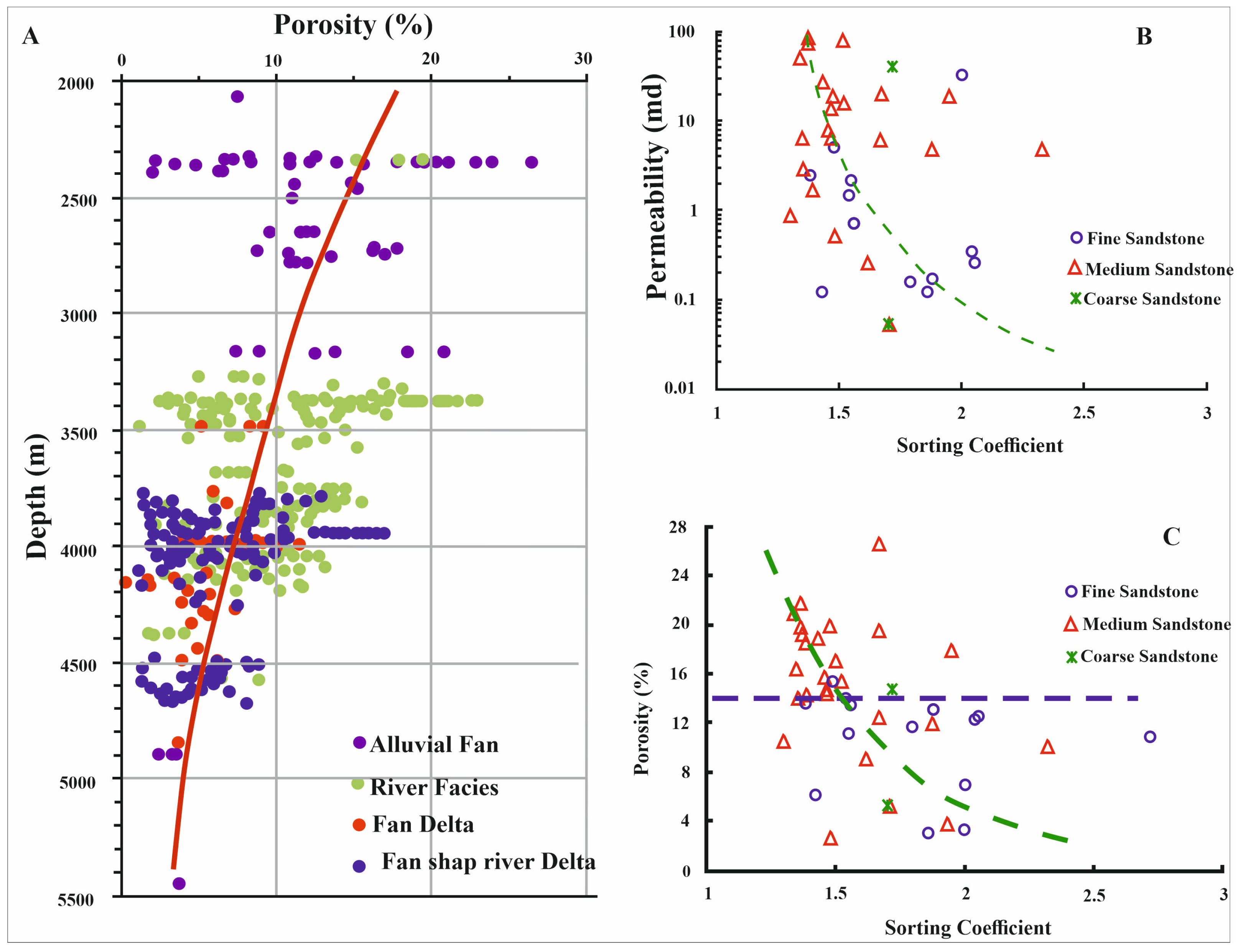
The dominant factor in porosity reduction was mechanical compaction, averaging 13.3% or ranging from 8 to 22% (Figure 15A). The mudstones of the floodplain (LFA 3) and fan deltas (LFA 4), which contained over 25% ductile lithics, became highly compacted and thus had low porosity values below 6%. In overpressured zones, the presence of overpressured fluids prevented compaction, allowing porosity to be maintained at 12%–15% in reservoirs at well Luo 68, 3371.9 m [50].
(b) Cementation
Pore-filling calcite cement, ranging from 5% to 15%, played a crucial role in reducing porosity, especially in braided river (LFA 2) and fan delta (LFA 4) deposits. This calcite originates from microbial CO2 and carbonate in solution and has a 13C value of 2 to 1000. Cementation mainly occurred on structural highs, including the Yihezhuang Uplift (Figure 15B). They also formed chlorite-rimmed (5 to 10 μm thick) quartz grains in facies of braided river environments, preventing quartz overgrowth and helping to preserve porosity (Figure 15B) [50]. Conversely, lithic-smectite in floodplain lake facies (LFA 3) exhibits low permeability, averaging less than 1 mD, which occludes the pore throats. During uplift periods, evaporite cements like nodular gypsum and anhydrite in saline lacustrine facies (LFA 5) dissolved, creating secondary porosity that enhances reservoir quality.
(c) Dissolution
In braided river sandstones (LFA 2), feldspar dissolution contributed 4%–8% secondary porosity due to the presence of Eocene organic sources with TOC above 1.5% (Figure 15C). The overpressure zone dissolved carbonates in Well Luo 173 at 3379.9 m, which further increased porosity by 3%–55%. Moreover, in the overpressured zone, the reservoir potential was enhanced (Figure 15D).
(d) Fracturing
Fracture widths of 10 to 50 μm (Figure 15F) also significantly enhanced permeability in both fan deltas (LFA 4) and alluvial fans (LFA 1). The presence of these fractures is closely associated with basement-involved faults that facilitated fluid movement and increased reservoir potential.

4.6.2. Diagenetic Facies Zonation

Diagenesis varies greatly across different areas, with variations controlled by provenance and facies. Most of the soil in the northern steep slope (LFA 1, 4) is cemented by calcite, with porosity below 8%. In the central Depression (LFA 3), mixed clay and illite cementation occurs, and localized dissolution creates porosity-enhancing sweet spots. The deposits of the Northwestern braided rivers (LFA 2) have the highest porosity (14%–19%) (Figure 16) in chlorite-coated sands, which experience minor compaction, allowing the primary pore space to remain preserved.

4.6.3. Reservoir Quality Evolution

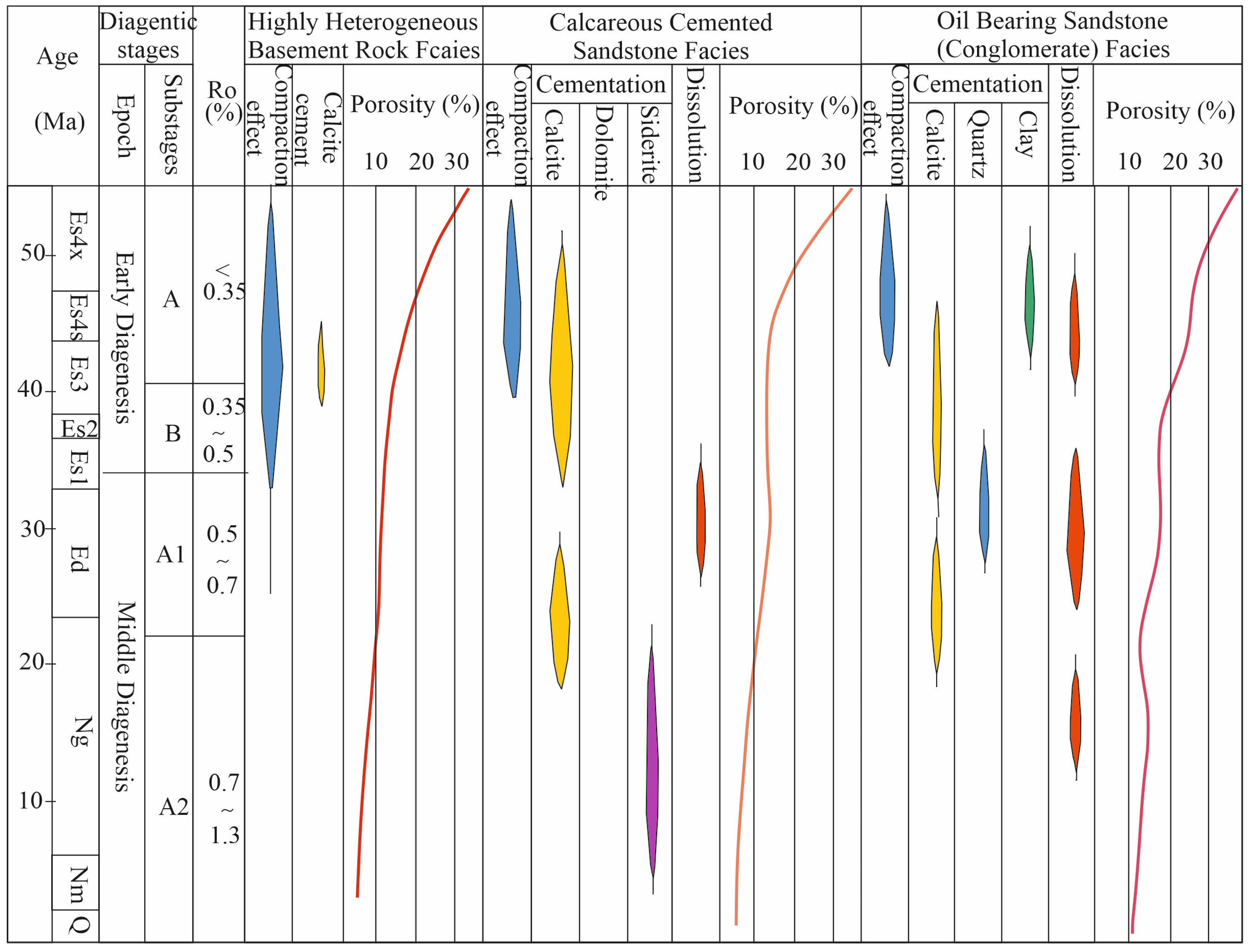
The paragenetic sequence of the Es4x (Figure 17) clearly illustrates the order of diagenetic processes experienced during different burial stages, with major changes in reservoir quality occurring at each stage: Early burial caused initial porosity loss due to the formation of chlorite rims around the braided river facies (LFA 2) and gypsum cementation in saline lacustrine facies (LFA 5) (Figure 17). These late diagenetic changes marked the first significant alterations in reservoir properties.
During intermediate burial, hydrocarbon charging within the temperature range of 50 °C to 60 °C halted further cementation in LFA 2 and LFA 3 (Figure 17). This process not only prevented additional cementation but also stabilized the dissolution of organic acids, which created secondary porosity. As a result, reservoir quality improved, especially in terms of porosity and fluid storage capacity. In the deeper burial zones, extensive fracture reopening significantly increased permeability (Figure 17) in the Es4x, enhancing fluid movement. This process was crucial in boosting reservoir productivity by improving its ability to allow hydrocarbon and fluid flow.

5. Discussion

5.1. Sedimentary Evolution of the Eocene Fourth Member (Lower Submember of the Fourth Member of the Shahejie Formation)

In the Es4x, a vigorous three-part evolution is observed as a result of synrift tectonic flexing interfering with orbital-scale climate oscillations [40]. Our depositional history is reconstructed in three stages by integrating sedimentological, geochemical, and seismic data (Figure 2, Figure 6 and Figure 8).

5.1.1. Stage I

The basin was extremely dry during the early rifting stage. Alluvial fans (LFA 1) located at the northern fault edges and evaporitic lacustrine units (LFA 5) of the sinking Lijin Minfeng Depression (Figure 2B) best represent this phase, with the alluvial fans being the dominant feature and the evaporitic lacustrine deposits also present. This stage was marked, among other things, by a prolonged period of intense aridity (Sr/Ba > 4 and δ18O < −20%) that limited the maximum water level and encouraged the formation of evaporating salts [5]. These evaporative conditions are directly recorded in layers of halite that are 20 to 35 m thick. Faces of this stage can be observed in the fault-controlled conglomerates, with sorting coefficients ranging from 1.8 to 2.5 (Figure 3A), and wedge-shaped forms in seismic profiles indicating deposition during active rifting. The key lesson from this stage is that the basin’s architecture was mainly governed by tectonic control on partitioning, although climatic conditions played a significant role in thickness of evaporite deposits/succession in fault-controlled depositions.

5.1.2. Stage II

During the middle rift stage, the climate became more humid, leading to the expansion of lakes and the formation of floodplain mudstones. Braided rivers (LFA 2) flowing off the Wudi Uplift and floodplain mudstones (LFA 3), which had meter-scale rhythms of sand and mud, were the dominant facies of this period, as seen at Well Luo 173 (Figure 5B). Increased humidity, indicated by delta δ13C values below −24 (p) and Sr/Ba ratios less than one, caused lakes to expand and promoted the deposition of high-TOC mudstones (1.2%–1.8%). The tectonic response during this phase is evident in the significant thickening of sandbodies (a 40% increase in the central Depression) (Figure 6B), which may be accompanied by improved accommodation space as subsidence continued. This phase is typical for the climatic humidity influenced the character of sedimentation patterns, overriding the topographic effects of synrift faulting and allowing for widespread floodplain lake development [37].

5.1.3. Stage III

Arid climatic conditions, along with the saline lacustrine environments, also characterized the late rift stage. The most common facies during this period were the halite-layered saline lakes (LFA 5) and backstepping fan deltas (LFA 4) [33]. evaporate deposition reappeared due to a return to aridity, as indicated by the high Na/K ratio (Figure 6C), the appearance of basinward onlap surfaces (Figure 6C), and aeolian reworking of sediments suggested by adhesion ripples observed in Well Luo 173. The sustained progradation of fan deltas and associated sigmoid clinoforms (Figure 2B) reflects persistent sediment transport and deposition along fault-controlled pathways, even under fluctuating climatic conditions. The main takeaway at this stage is that orbital forcing, especially 21 kyr precession cycles, caused a rid-humid-arid fluctuations. In contrast, tectonic activity had counteracting effects on the routing of sediments across the basin.

5.2. Depositional Model for Eocene Red Beds

The Es4x of the Bonan Depression represents a tectonically driven, climate-influenced depositional system, in which arid alluvial, humid fluvial-lacustrine, and evaporative lacustrine facies display systematic spatial and temporal distributions (Figure 2, Figure 7 and Figure 13). The integrated depositional model comprises three main systems, illustrating the interplay between tectonics and climate throughout the basin.
1. Arid Alluvial Systems (Dominant in Early and Late Stages)
During the arid phases of the Es4x, deposition was dominated by alluvial fans (LFA 1) and braided rivers (LFA 2), driven by interactions between tectonic faulting and climate aridification.
(a) Alluvial Fans (LFA 1)
Alluvial fan deposits formed fan-shaped, matrix-supported conglomerates with clast diameters ranging from 2 to 60 mm (Figure 3A). Fault-controlled debris flows along NW-striking boundary faults, including the Qingtuozi Uplift, formed these fans. Sediments were derived locally from basement rocks, mainly gneiss and dolomite. Upstream progradation created wedge-shaped bodies with high-amplitude chaotic reflections in seismic data, typical of regions with active rifting and fault-controlled deposition (Figure 2B) [48].
(b) Braided Rivers (LF2)
Braided river deposits consist of medium- to coarse-grained sandstones (0.25–0.5 mm) with trough cross-bedding and preserved primary porosity (12%–19%) maintained by chlorite coatings. Pebble layers indicate short transport distances (<5 km) from local uplifts (e.g., Wudi Uplift). Arid proxies include Fe3+/Fe2+ ratios >3 and low bioturbation, reflecting deposition under low-humidity conditions [49].
2. Humid Lacustrine Systems (Dominant in Mid-Rift Stage)
During the humid mid-rift stage, floodplain mudstones and saline lacustrine deposits accumulated across the basin. These systems display distinct spatial zoning and rhythmic stratification, largely controlled by orbital-scale climatic cycles.
(a) Floodplain Mudstones (LFA 3)
Floodplain deposits include mud-dominated units with gypsiferous mudstones and root traces (Well Luo-158; Figure 5A). Freshwater influence is indicated by Sr/Ba values <1 [11]. Sand bars within these systems exhibit cross-bedding, and gamma-ray logs show funnel-shaped trends (Figure 5B). Wave-rippled siltstones with flaser bedding are also present (Well Luo-173). Rhythmic variations in sand and mud are consistent with ~21 kyr precession cycles, and δ18O variance (0‰–4‰) records the climatic control on lake levels and sedimentation.
(b) Saline Lacustrine Facies (LFA 5)
Evaporative lacustrine environments developed in marginal-to-central zones, forming a “bullseye” pattern of facies (Figure 12). Marginal carbonates grade into mid-basin gypsum and halite. Evidence for hypersaline, anoxic conditions includes abundant framboidal pyrite with δ34S values of 15‰–20‰ (Well Luo-10), Sr/Ba ratios > 3, and Na/K ratios > 2. This zonation reflects closed-basin hydrology moderated by climate.
3. Deltaic Systems (Fan Deltas, LFA 4)
Fan deltas were prominent during later Es4x deposition. Their progradation was controlled by both tectonic faulting and climatic conditions.
(a) Fan Deltas (LFA 4)
Fan deltas prograded into NE-oriented incised valleys, forming sigmoid-oblique clinoforms (Figure 2B) [34]. Sandstones are composed of ~30% quartz, 40% feldspar, and 30% lithic fragments (Well Yi-126). Diagenetic calcite cement (5%–15%) reduced porosity to <8%. Basement topography confined sediment lobes near the Guangrao and Luxi Uplifts. Faulting influenced the lateral confinement and routing of sediments, while climate modulated the rate and extent of progradation.

5.3. Tectonic and Climatic Controls on Deposition

Sedimentation in the Es4x is organized within a hierarchical control system where synrift subsidence mainly drove physiographic basin development. Meanwhile, climate cycles on the Milankovitch scale played a dominant role in facies stacking and geochemical characteristics. The combination of seismic geometries, facies distributions, and paleoclimate proxies (Figure 2, Figure 6, Figure 8 and Figure 12) allows for distinguishing their individual and combined influences in shaping the depositional environment.

5.3.1. Tectonic Dominance

The deposition of thick, 2035 m, of evaporites (LFA 5) was localized by the maximum subsidence in the Lijin-Minfeng Depression, northern depocenter, such as in Well Luo 10. Analysis of the seismic data shows that the geometries are wedge-shaped with dips of 15 to 20 km (Figure 2B), indicating that fault-steered deposition occurred during the rifting process [50]. Alluvial fans (LFA 1) were also limited to fault-controlled areas, highlighting the impact of tectonic subsidence on sedimentary facies distribution.
Fan deltas (LFA 4) were limited to NE-oriented incised valleys on the Luxi Guangrao Uplifts, which further shows how basement topography influences sediment pathways, as indicated by the well data in Well Yi 126 (Figure 13).
The Es4x subsidence played a significant role in shaping facies zoning. LFA 2 and LFA 3 sands were sheet-like and extended 10–15 km in the central Depression, indicating consistent subsidence rates during deposition (Figure 8). Conversely, fan deltas on the southern gentle slope prograded 20–25 km with lobate shapes and 30–40 m of relief. In contrast, on the northern steep slope, alluvial fans were confined to a 5 km range from the faults. This distribution emphasizes the accommodation gradients caused by the asymmetry of the rift basin, where tectonics primarily controlled deposition in fault-bounded areas [51].

5.3.2. Climate Overprint

The Es4x sedimentary record clearly shows periods of dry and wet climate caused by orbital-scale climatic changes. During hyperarid cycles (Cycle I and Cycle III), with Sr/Ba ratios above four and 5‰, respectively, evaporite precipitation (LFA 5) was common, and alluvial fans (LFA 1) expanded across the basin. In contrast, humid periods (Cycle II) with δ13C values less than 24A and Sr/Ba ratios below one were marked by lake expansion (LFA 3) and braided channel patterns (landscape incision), leading to a 40 percent increase in sand thickness in the central Depressions (Figure 6B), regardless of the oceanic water cycle [50].
The interaction between climate and tectonics further influenced sedimentation. The lowering of lake levels by evaporation during dry periods increased the steepness of fault-margin slopes, enhancing debris flow efficiency and leading to the formation of matrix-supported conglomerates with a range of sorting coefficients from 1.8 to 2.5, as observed in Well Luo 358. In contrast, floodplain mudstones in Cycle II could extend beyond high points within the basin, notably over the Depression sandbars in the center, due to humid pulses (Figure 12). These increased sediment flows temporarily overran topographic barriers, allowing lacustrine facies to extend into previously elevated areas, illustrating the active interplay between lake expansion driven by climate changes and topographic confinement caused by tectonics.

5.4. Facies Model for Arid Humid Transitional Basins

The Es4x presents a synrift inferential facies pattern for sites affected by orbital-scale climatic oscillations in the basins. This model combines spatial facies patterns (Figure 8) and vertical cycles (Figure 6), reflecting the dynamic interaction between tectonic activity and climate. The model is based on three main aspects.

5.4.1. Climate-Driven Vertical Successions

During the arid period, evaporitic-controlled bullseye zoned is characteristic of the sedimentary record in saline lacustrine deposits (LFA 5). These deposits consist of a core of halite (2035 m in Well Luo 10), a rim of gypsum (Figure 12), and sections of red beds containing a large amount of hematite around the basin, where the Fe3+/Fe2+ ratio exceeds 3. Early phases of alluvial fan progradation (LFA 1) at the C-line and aeolian reworking are linked to aridity indices indicated by Sr/Ba ratios greater than 4 and δ18O values over +40 [51], preserved either as adhesion ripples as identified in Well Luo 173.
During the humid phase, the basin sees the expansion of organic-rich floodplain mudstones (LFA 3), with TOC values between 1.2% and 1.8% and Sr/Ba ratios below 1, along with braided river deposits (LFA 2) (Figure 8). The characteristic meter-scale sand-mud rhythms in Well Luo 173 indicate precession-driven lake level fluctuations, as shown by δ18O variations of 2‰–4‰ and 21 kyr lamina cycles [29].
In Cycle I, the transitional phase is characterized by braided rivers (LFA 2) and saline lakes (LFA 5) (Figure 8). These transitions result from seasonal flood pulses, which are evidenced by minor bioturbation of the sandstones and dissolution breccias in evaporites, further supporting the shift between arid and humid environments. [25].

5.4.2. Tectonically Partitioned Facies Belts

The tectonic structure of the Bonan Depression played a key role in shaping the spatial pattern of the deposition environment in the Es4x. The basin’s tectonic division into three main structural zones steep slope, central Depression, and gentle slope led to the formation of different facies assemblages due to variations in subsidence rates, fault movements, and sediment routing. (Table 1).

5.4.3. Diagenetic Zonation

The Es4x shows a reservoir with both vertical and lateral variations, heavily shaped by depositional facies and post-depositional diagenetic changes. Reservoir quality differs greatly among structural zones, reflecting the interaction between original sedimentary textures, mineral content, and fluid-rock interactions.
Braided river sands (LFA 2) with chlorite rims retain porosity of 12%–19% due to inhibited quartz cementation. Additionally, overpressure zones in the central Depression (e.g., Well Luo 68) show an increase in secondary porosity (3%–5%) from feldspar dissolution, improving reservoir quality. Fan deltas (LFA 4) experience calcite cementation (5%–15%), which lowers porosity to below 8%. Likewise, floodplain mudstones (LFA 3) show illite-smectite pore occlusion, resulting in permeability under 1 mD, thus reducing reservoir potential [43]. Facies near basement faults, like those in LFA 1 and LFA 4, exhibit fracture-enhanced permeability, with fracture widths from 10 to 50 μm. These fractures are closely linked to fault zones and notably improve fluid migration in these areas [44].

5.5. Reservoir Implications

The reservoir quality of the Eocene Fourth Member (Es4x) red beds results from a complex interaction of depositional facies, provenance traits, and burial diagenetic processes. Depositional textures and grain arrangements mainly influence initial porosity, while mineralogy is set by provenance and is more susceptible to cementation or compaction [36]. Additional effects on pore networks during burial history, such as overpressure and fluid-rock interaction, further alter pore structures through dissolution, cementation, and mechanical processes. A combination of key observations, petrographic analysis, and petrophysical measurements (Figure 15 and Figure 17) emphasizes the following important constraints related to hydrocarbon exploration and reservoir forecasts.

5.5.1. Facies Dominated Reservoir Zonation

All the lithofacies associations (LFA) in the Es4x display different reservoir characteristics, reflecting the influence of depositional energy, sediment composition, and diagenetic maturation (Table 2). Understanding these differences is crucial for applying effective exploration strategies.

5.5.2. Diagenetic Pathways

Diagenesis significantly impacts the reservoir quality of the Es4x by either preserving or damaging porosity. [14]. Braided river sands (LFA 2) retain 12%–19% porosity, which opposes cementation of quartz, as indicated by the chlorite coatings (5–10 m) that induce this effect (Figure 15B). Dissolution of feldspar produces 4% to 8% secondary porosity, especially in overpressured areas with source rock containing TOC > 1.5 percent (Figure 15C). In basement faults across LFA 1 and LFA 4, fractures increase permeability by up to two orders of magnitude (Well Yi 126) (Figure 15F).
Conversely, fan deltas (LFA 4) show early calcite cementation with porosity below 8 percent and 8–13C values ranging from 2 to 1, indicating meteoric or mixed water sources. A porosity reduction of 8%–22% occurs due to mechanical compaction, especially in LFA 3 and LFA 4, which contain more than 25% ductile grains. These processes emphasize the importance of targeting chlorite-coated sands and fractures without focusing on highly cemented or compacted sections [47].

5.6. Synthesis of Sedimentological Controls

The Es4x of the Bonan Depression displays a sedimentary system that was influenced by the combined effects of syn-depositional tectonics, climate variations on a Milankovitch scale, and provenance-driven diagenesis. These factors together control sequence architecture, facies distribution, and reservoir heterogeneity, as evidenced by sedimentological, seismic, and geochemical data (Figure 6, Figure 8, and Figure 15).
Basin-scale accommodation was controlled by tectonics, including alluvial fans (LFA 1) and evaporites (LFA 5), especially in the Lijin Minfeng Depression, and faults. Seismic profiles show wedge-shaped geometries with dips of 15–20°, indicating fault-directed deposition. Orbital climatic rhythms, observed in the variation in Sr/Ba and δ18O, overlay this framework, leading to the rhythmic stacking of facies and alternating humid and arid conditions on precession (30–60 cal. Kyr) timescales [42]. The diagenesis was influenced by provenance at the facies level; in LFA 2, chlorite coating preserved porosity, whereas in LFA 4, calcite cement reduced quality. The basin’s evolution progressed through three stages. In the first cycle, rifts began in hyperarid environments and contained evaporative lakes and alluvial fans along fault margins. Humid phases dominated during the rift thrust climax and involved lake expansion and the deposition of high-quality braided river sand (LFA 2), which is observed in cycle II, where there was a 40 percent increase in sand thickness across structural levels. During cycle III, evaporite resurgence and fan delta backstepping caused by aridification and a declining subsidence front, along with an increasing diagenetic contrast between LFA 2 and LFA 4 [1].
This model questions conventional tectonic-based interpretations, suggesting that short-term, climate-driven oscillations can exert basin-scale control over facies patterns. Linking orbit-scale climate variations to sequence stratigraphy offers a more sensitive approach to understanding rift basin evolution (Figure 12). From an exploration perspective, during humid intervals (Cycle II), the most promising sands are those of braided rivers, as chlorite rims and feldspar dissolution help preserve porosity. Calcite cementation poses a threat, but fractured fan deltas also have potential, especially near fault lines [51]. Lakes in floodplains are not reservoirs, unless fractured, whilst the evaporites in LFA 5 can provide effective seals, mainly where they occur in sequence boundaries.
The Bonan Depression has become a model for other climate-sensitive rift basins that show similar facies influencing tectono-climatic interactions, such as in the Gulf of Suez and the Precaspian Basin. This combination improves the accuracy of basin analysis and hydrocarbon exploration in synrift environments [33].

6. Conclusions

This article highlights and demonstrates how the combination of three processes tectonics, climate, and diagenesis controlled the filling of the reservoir and the sediment contents of the Eocene Es4x of the Bonan Depression. Syn-rift subsidence defined basin geometry and sediment migration, while the orbital climate cycle, mainly precession and eccentricity mediated vertical facies stacking. Dry episodes promoted the formation of alluvial fans and evaporites (LFAs 1 and 5). When precipitation increased, lakes became more numerous (LFA 3), and sand deposits expanded, especially in Cycle II.
A depositional system model, called the Bonan predictive model, is proposed, where vertical cyclicity is combined with lateral facies zonation. The steep slopes mainly consist of alluvial fans, while the gentle slopes host braided rivers with sand coated in chlorite and high porosity (LFA 2). The central Depression is filled with floodplain mudstones that are rhythmically bedded. Reservoir studies identify braided river sands (LFA 2) as excellent targets (12% to 19% porosity), further enhanced by chlorite coatings and feldspar dissolution. Broken fan deltas (LFA 4) near faults present additional prospects, and floodplain and evaporitic facies offer good seals.
These observations emphasize that the Milankovitch-scale climate cycle can temporarily override tectonic controls, affecting both facies architecture and reservoir distribution in rift basins. The Es4x thus serves as a valuable analog for understanding such climatically sensitive arid and humid rift systems worldwide.

Author Contributions

S.A.e.R. conducted the majority of the research and made the primary contributions to this study, including conceptualization, methodology development, data analysis, interpretation of results, and preparation of the original manuscript. L.Z. contributed to study conceptualization, supervised the research, administered the project, and acquired funding. Y.Y. assisted with data acquisition and data curation. W.A. and P.J.N. contributed to formal analysis and critically reviewed and edited the manuscript. A.K. assisted with visualization and data interpretation. S.A.e.R. and L.Z. served as the corresponding authors and are responsible for communication with the journal. All authors have read and agreed to the published version of the manuscript.

Funding

This research was funded by the Strategic Priority Research Program of the China University of Petroleum (East China), (Grant No. XDA14010202), the National Natural Science Foundation of China (Grant No. 42002145), and the National Science and Technology Major Project of the People’s Republic of China (Special Grant No. 2017ZX05009-004). The PhD study of the first author was financially supported by these funding sources. The Article Processing Charge (APC) was funded by the above-mentioned grants.

Data Availability Statement

The original contributions presented in this study are included in the article. Further inquiries can be directed to the corresponding authors.

Acknowledgments

The authors gratefully acknowledge the Geosciences Institute of the Shengli Oilfield, SINOPEC, China, for providing core samples, granting access to their in-house database, and supplying essential background geological data of the Bonan Depression, which were crucial for the completion of this study. The authors also thank Shengli Oilfield, SINOPEC, for their continued technical support and data access. We are grateful to the anonymous reviewers for their constructive comments, which significantly improved the quality of the manuscript. Special thanks are extended to Zhang Liqiang for his valuable supervision and insightful feedback throughout the research process. We also express our appreciation to Yiming Ying of the China University of Petroleum (Qingdao) for his helpful suggestions and assistance in refining the manuscript.

Conflicts of Interest

The authors declare no conflict of interest.

References

  1. Qi, Z.C.; Li, P.; Wu, J.J.; Gamisch, A.; Yang, T.; Zhao, Y.P.; Xu, W.Q.; Chen, S.C.; Cameron, K.M.; Qiu, Y.X. Climatic niche evolution in Smilacaceae (Liliales) drives patterns of species diversification and richness between the Old and New World. J. Syst. Evol. 2023, 61, 733–747. [Google Scholar] [CrossRef]
  2. Xie, Y.; Wu, F.; Jiang, Y.; Yang, L. Stepwise hydroclimate changes in Northeast China linked to proto-Paratethys Sea retreats and global cooling during the Eocene. Palaeogeogr. Palaeoclimatol. Palaeoecol. 2024, 648, 112306. [Google Scholar] [CrossRef]
  3. Froemchen, M. Inheritance Across the Scales–Assessing the Relative Importance of Crustal and Lithospheric Structures During Rift Evolution. Ph.D. Thesis, Durham University, Durham, UK, 2024. Available online: https://etheses.dur.ac.uk/15825/ (accessed on 30 November 2025).
  4. Zhou, Z.; Zhu, H.; Liu, Q.; Qin, L. The Segmented Multi-Source Sediment Routing System on the Hangingwall Dipslope of the Xihu Depression, East China Sea Shelf Basin: Insights From Palaeogeomorphology, U–Pb Ages and Heavy Minerals. Basin Res. 2024, 36, e70007. [Google Scholar] [CrossRef]
  5. Liao, C.; Chen, L.; Lu, C.; Chen, K.; Zheng, J.; Chen, X.; Wang, G.; Cao, J. Depositional and Paleoenvironmental Controls on Shale Reservoir Heterogeneity in the Wufeng–Longmaxi Formations: A Case Study from the Changning Area, Sichuan Basin, China. Minerals 2025, 15, 677. [Google Scholar] [CrossRef]
  6. Al-Qayim, B.A. The Paleogene Forebulge Carbonate Banks, Zagros Foreland Basin, Northern Iraq: Their Paleogeography, Basin Evolution, and Economic Implications. Iraqi Geol. J. 2024, 57, 230–253. [Google Scholar] [CrossRef]
  7. Zhang, Q.; Shen, L.; Fu, X.; Wang, J.; Zeng, S.; Ruebsam, W.; Ahmed, M.S.; Shen, H.; Mansour, A. Eocene climate and hydrology of eastern Asia controlled by orbital forcing and Tibetan Plateau uplift. Earth Planet. Sci. Lett. 2024, 646, 118981. [Google Scholar] [CrossRef]
  8. Zhang, Q.; Zhang, J.; Ma, C.; Feng, Z.; Tang, W.; Fang, X. Tibetan plateau uplift changed the Asian climate and regulated its responses to orbital forcing during the late Eocene to early Miocene. J. Geophys. Res. Atmos. 2025, 130, e2024JD042872. [Google Scholar] [CrossRef]
  9. Xu, S.; Wang, Y.; Bai, N.; Wu, S.; Liu, B. Organic matter enrichment mechanism in saline lacustrine basins: A review. Geol. J. 2024, 59, 155–168. [Google Scholar] [CrossRef]
  10. Sun, L.; Wu, S.; Yue, D.; Cui, W. Paleosalinity reconstruction in offshore lacustrine basins based on elemental geochemistry: A case study of Middle-Upper Eocene Shahejie Formation, Zhanhua Sag, Bohai Bay Basin. J. Oceanol. Limnol. 2024, 42, 1087–1105. [Google Scholar] [CrossRef]
  11. Jiang, W.; Yan, X.; Tan, X.; Garzanti, E.; Li, W.; Liu, J.; Luo, L. Lacustrine hydrochemical variations and carbon sequestration under hyperthermal climates: Insights from the Lower Eocene Kongdian Formation (Bohai Bay Basin, NE China). Int. J. Earth Sci. 2025, 114, 497–510. [Google Scholar] [CrossRef]
  12. Wang, G.; Liu, Y.; Shi, Z.; Li, Z.; Huang, L.; Qu, Y.; Zhang, J. Characteristics and controlling factors of deep-seated reservoir: A case study from the Fukang Sag of Junggar Basin. Front. Earth Sci. 2025, 1–13. [Google Scholar] [CrossRef]
  13. Mehrabi, M.; Fatemi Aghda, S.M.; Sarkheil, H.; Teshnehlab, M.; Salehi, E.; Kamrani, K.; Yamini, A. A systematic review to identify carbonate rock exploration paradigms and examine current and future research directions: A case study at one of the southwest oil fields of Iran. J. Pet. Explor. Prod. Technol. 2025, 15, 34. [Google Scholar] [CrossRef]
  14. Chen, J.; Liu, H.; Fang, X.; Hu, X.; Meng, T.; Yu, L.; Guo, Z.; Liu, G.; Liu, K. Strong Reservoir Wettability Heterogeneities of an Eocene Tight Oil Play from the Bonan Sag, Bohai Bay Basin as Revealed by an Integrated Multiscale Wettability Evaluation. Appl. Sci. 2025, 15, 3079. [Google Scholar] [CrossRef]
  15. Ayyat, A.M.E.; Obaidalla, N.A. Sequence stratigraphy, sea-level dynamics, and syn-sedimentary tectonic evolution of the Late Cretaceous/Paleocene basin on the western shoulder of the Gulf of Suez, Egypt. Arab. J. Geosci. 2025, 18, 95. [Google Scholar] [CrossRef]
  16. Li, Z.; Liu, B.; Liu, Y.; Yuan, J.; Zhou, Q.; Li, S.; Guan, Q.; Wang, G. Mesozoic to Cenozoic tectonic evolution in the central Bohai Bay Basin, East China. Geol. Soc. Am. Bull. 2024, 136, 4965–4984. [Google Scholar] [CrossRef]
  17. Yu, J.; Tong, D.; Hu, C.; Xu, Y.; Ren, J. Two Stages of Rifting Control the Crust Thinning and Basin Evolution: Insights from the Southern Qiongdongnan Basin, NW South China Sea. Basin Res. 2025, 37, e70030. [Google Scholar] [CrossRef]
  18. Lin, W.-J.; Wang, Y.-R.; Lu, R.; Zhang, S.-S.; Wang, G.-L. Geology, carbon emission reduction potential, and development progress of hot dry rock in China. China Geol. 2025, 8, 1–20. [Google Scholar]
  19. Yang, Z.; Zhang, G.; Fan, G.; Lu, Y.; Shao, D.; Liu, S.; Wang, W. Tectonic Subsidence and Its Response to Geological Evolution in the Xisha Area, South China Sea. Appl. Sci. 2023, 13, 7268. [Google Scholar] [CrossRef]
  20. Zhu, S.; Cao, Y.; Huang, Q.; Yu, H.; Chen, W.; Zhong, Y.; Chen, W. Impact of Pore Structure on Seepage Capacity in Tight Reservoir Intervals in Shahejie Formation, Bohai Bay Basin. J. Mar. Sci. Eng. 2024, 12, 1496. [Google Scholar] [CrossRef]
  21. Zhang, Q. Fault Families Around Salt Structures: Implications for Fluid Flow, Storage and Production. Ph.D. Thesis, Cardiff University, Cardiff, UK, 2023. Available online: https://orca.cardiff.ac.uk/id/eprint/165655/1/2023zhangqphd.pdf (accessed on 18 January 2024).
  22. Gao, M.; Yu, X.; Li, S.; Zhang, W.; Hu, S.; Zhang, M. Control of slope-pattern on the deposition of fan-delta systems: A case study of the Upper Karamay Formation, Junggar Basin. Front. Earth Sci. 2024, 18, 384–399. [Google Scholar] [CrossRef]
  23. Xu, B.; Li, J.; Wu, Z.; Zhang, Y.; Cui, J. Sedimentary cycles of evaporites and their application in sequence division in the upper member of the Xiaganchaigou Formation in Yingxi Area, Southwestern Qaidam Basin, China. Carbonates Evaporites 2020, 35, 66. [Google Scholar] [CrossRef]
  24. Guo, X.; Liu, K.; He, S.; Song, G.; Wang, Y.; Hao, X.; Wang, B. Petroleum generation and charge history of the northern Dongying Depression, Bohai Bay Basin, China: Insight from integrated fluid inclusion analysis and basin modelling. Mar. Pet. Geol. 2012, 32, 21–35. [Google Scholar] [CrossRef]
  25. Li, Q.; Li, Y.; Wang, X.; Jia, D.; Li, R.; Mao, Y. Drainage evolution in accretionary thrust systems as responses to tectono-climatic variability: Insights from sandbox modelling. Earth Surf. Process. Landf. 2025, 50, e70099. [Google Scholar] [CrossRef]
  26. Xu, C.; Huan, L.; Zhangqiang, S.; Donghui, J. Sequence stratigraphy of the lacustrine rift basin in the Paleogene system of the Bohai Sea area: Architecture mode, deposition filling pattern, and response to tectonic rifting processes. Interpretation 2020, 8, SF57–SF79. [Google Scholar] [CrossRef]
  27. Yang, T.; Cao, Y.; Wang, Y.; Cai, L.; Liu, H.; Jin, J. Sedimentary characteristics and depositional model of hyperpycnites in the gentle slope of a lacustrine rift basin: A case study from the third member of the Eocene Shahejie Formation, Bonan Sag, Bohai Bay Basin, Eastern China. Basin Res. 2023, 35, 1590–1618. [Google Scholar] [CrossRef]
  28. Wu, R.; Wang, J.; He, R.; Wang, S.; Xie, J.; Li, Y. Application of Principal Component Analysis to Diagenetic Facies Division of Lake Gravity Flow Sandstone Reservoirs in Dongying Depression of Bohai Bay Basin, China. Arab. J. Sci. Eng. 2024, 49, 883–897. [Google Scholar] [CrossRef]
  29. Zhang, L.-F.; Dong, D.-Z. Thickening-upward cycles in deep-marine and deep-lacustrine turbidite lobes: Examples from the Clare Basin and the Ordos Basin. J. Palaeogeogr. 2020, 9, 11. [Google Scholar] [CrossRef]
  30. Xiaomin, Z.; Xiaolin, W.; Xin, H.; Xiang, W.; Zijie, G. Frontiers and future prospects of international sedimentological research: Review on the 37th International Meeting of Sedimentology. Oil Gas Geol. 2025, 46, 685–704. Available online: https://www.sciopen.com/article/10.11743/ogg20250301 (accessed on 30 November 2025).
  31. Wu, T.; Lei, L.; Luo, Y.; Zhang, H.; Jie, Y.; Liu, H. Erosion processes and sediment source tracing on heterogeneous slopes in the red soil region of southern China. Earth Surf. Process. Landf. 2024, 49, 1969–1986. [Google Scholar] [CrossRef]
  32. Li, S.; Tan, C.; Shan, X.; Yu, X.; Shi, X. Modern Fluvial-Deltaic Deposits in Daihai Lake Basin, Northern China. In Field Trip Guidebook on Chinese Sedimentary Geology; Springer: Berlin/Heidelberg, Germany, 2024; pp. 1–30. [Google Scholar] [CrossRef]
  33. Wu, H.; Ji, Y.; Wu, C.; Duclaux, G.; Wu, H.; Gao, C.; Li, L.; Chang, L. Stratigraphic response to spatiotemporally varying tectonic forcing in rifted continental basin: Insight from a coupled tectonic-stratigraphic numerical model. Basin Res. 2019, 31, 311–336. [Google Scholar] [CrossRef]
  34. Liu, L.; Chen, H.; Wen, H.; Xu, W.; Zhong, Y.; Wang, X.; Wang, Z. Facies architecture and sediment infilling processes in intrabasinal slope belts of lacustrine rift basins, Zhanhua Depression, Bohai Bay Basin. Mar. Pet. Geol. 2020, 112, 104089. [Google Scholar] [CrossRef]
  35. Chen, H.; Zhu, X.; Wood, L.J.; Shi, R. Evolution of drainage, sediment-flux and fluvio-deltaic sedimentary systems response in hanging wall depocentres in evolving non-marine rift basins: Paleogene of Raoyang Sag, Bohai Bay Basin, China. Basin Res. 2020, 32, 116–145. [Google Scholar] [CrossRef]
  36. Zhang, X.; Zhu, X.; Lu, Z.; Lin, C.; Wang, X.; Pan, R.; Geng, M.; Xue, Y. An early Eocene subaqueous fan system in the steep slope of lacustrine rift basins, Dongying Depression, Bohai Bay Basin, China: Depositional character, evolution and geomorphology. J. Asian Earth Sci. 2019, 171, 28–45. [Google Scholar] [CrossRef]
  37. Yang, X.-Y.; Shi, B.-H.; Ping, Z.-Y.; Li, Z.-Q.; Sun, B. Characteristics of Lacustrine Carbonate Reservoirs: A Case Study of Es4s Layers of Shahejie Formation in Zhanhua Sag, Jiyang Depression. In Proceedings of the International Field Exploration and Development Conference, Xi’an, China, 12–14 September 2024; pp. 53–70. [Google Scholar] [CrossRef]
  38. Jia, Y.; Cao, Y.; Wang, H.; Ma, B. Influence of multiphase carbonate cementations on the Eocene delta sandstones of the Bohai Bay Basin, China. J. Pet. Sci. Eng. 2021, 205, 108866. [Google Scholar] [CrossRef]
  39. Ma, B.; Cao, Y.; Eriksson, K.A.; Jia, Y.; Wang, Y. Burial evolution of evaporites with implications for sublacustrine fan reservoir quality: A case study from the Eocene Es4x interval, Dongying depression, Bohai Bay Basin, China. Mar. Pet. Geol. 2016, 76, 98–114. [Google Scholar] [CrossRef]
  40. Liu, J.; Wang, J.; Cao, Y.; Song, G. Sedimentation in a continental high-frequency oscillatory lake in an arid climatic background: A case study of the Lower Eocene in the Dongying depression, China. J. Earth Sci. 2017, 28, 628–644. [Google Scholar] [CrossRef]
  41. Xu, Q.; Wang, Y.; Ma, L.; Meng, T.; Bi, J.; Jiang, C. The character and origin of sequence architecture in the arid climate zone: A case of the Lower Submember of the Fourth Member of Shahejie Formation in the Bonan Sub-Sag. IOP Conf. Ser. Earth Environ. Sci. 2021, 804, 022033. [Google Scholar] [CrossRef]
  42. Xu, Q.; Wang, Y.; Meng, T.; Zhang, B.; Wang, H. The sedimentary evolution of distributive fluvial system in arid and low accommodation space sag: A case study of the lower fourth sub-member of Shahejie Formation from Bonan Sag in Zhanhua Depression, Bohai Bay Basin. J. Phys. Conf. Ser. 2025, 2958, 012003. [Google Scholar] [CrossRef]
  43. Zhu, J.-C.; Zou, C.-N.; Feng, Y.-L.; Jiang, S.; Wu, W.-A.; Zhu, R.-x.; Yuan, M. Distribution and controls of petroliferous plays in subtle traps within a Paleogene lacustrine sequence stratigraphic framework, Dongying Depression, Bohai Bay Basin, Eastern China. Pet. Sci. 2020, 17, 1–22. [Google Scholar] [CrossRef]
  44. Xu, Q.; Wang, Y.; Ma, L.; Yue, Y.; Meng, T.; Bi, J.; Jiang, C. Paleoclimate quantitative reconstruction and characteristics of continental red beds: A case study of the lower fourth sub-member of Shahejie Formation in the Bonan Sag. J. Pet. Explor. Prod. Technol. 2023, 13, 1993–2014. [Google Scholar] [CrossRef]
  45. Liang, C.; Wu, J.; Jiang, Z.; Cao, Y.; Song, G. Sedimentary environmental controls on petrology and organic matter accumulation in the upper fourth member of the Shahejie Formation (Paleogene, Dongying depression, Bohai Bay Basin, China). Int. J. Coal Geol. 2018, 186, 1–13. [Google Scholar] [CrossRef]
  46. Ma, P.; Lin, C.; Li, G.; Dong, C.; Jiang, L.; Du, X.; Ren, M.; Liu, W.; Zhao, Z.; Yuan, Y. Lithofacies Characteristics and Sweet Spot Distribution of Lacustrine Shale Oil: A Case Study from the Dongying Depression, Bohai Bay Basin, China. Lithosphere 2022, 2022, 3135681. [Google Scholar] [CrossRef]
  47. Yu, L.; Peng, J.; Xu, T.; Han, H.; Yang, Y. Analysis of Organic Matter Enrichment and Influences in Fine-grained Sedimentary Strata in Saline Lacustrine Basins of Continental Fault Depressions: Case study of the upper sub-section of the upper 4th member of the Shahejie Formation in the Dongying Sag. Acta Sedimentol. Sin. 2024, 42, 701–722. [Google Scholar] [CrossRef]
  48. Jia, Y.; Cao, Y.; Lin, C.; Wang, J. Diagenetic evolution and its implication for reservoir quality: A case study from the Eocene Es4 interval, Dongying Depression, Bohai Bay Basin, China. Geosci. J. 2018, 22, 91–103. [Google Scholar] [CrossRef]
  49. Chen, H.; Xu, S.; Cai, C.e.; Shang, W.; Mao, J.; Xu, Z.; Li, X.; Liu, J.; Yin, N.; Luo, K. Fault control on sedimentation in the southern gentle slope of the Dongying Sag, Bohai Bay Basin. Mar. Pet. Geol. 2024, 166, 106904. [Google Scholar] [CrossRef]
  50. Fletcher, W.J.; Goñi, M.F.S. Orbital-and sub-orbital-scale climate impacts on vegetation of the western Mediterranean basin over the last 48,000 yr. Quat. Res. 2008, 70, 451–464. [Google Scholar] [CrossRef]
  51. Shi, J.; Jin, Z.; Liu, Q.; Huang, Z.; Hao, Y. Terrestrial sedimentary responses to astronomically forced climate changes during the Early Paleogene in the Bohai Bay Basin, eastern China. Palaeogeogr. Palaeoclimatol. Palaeoecol. 2018, 502, 1–12. [Google Scholar] [CrossRef]
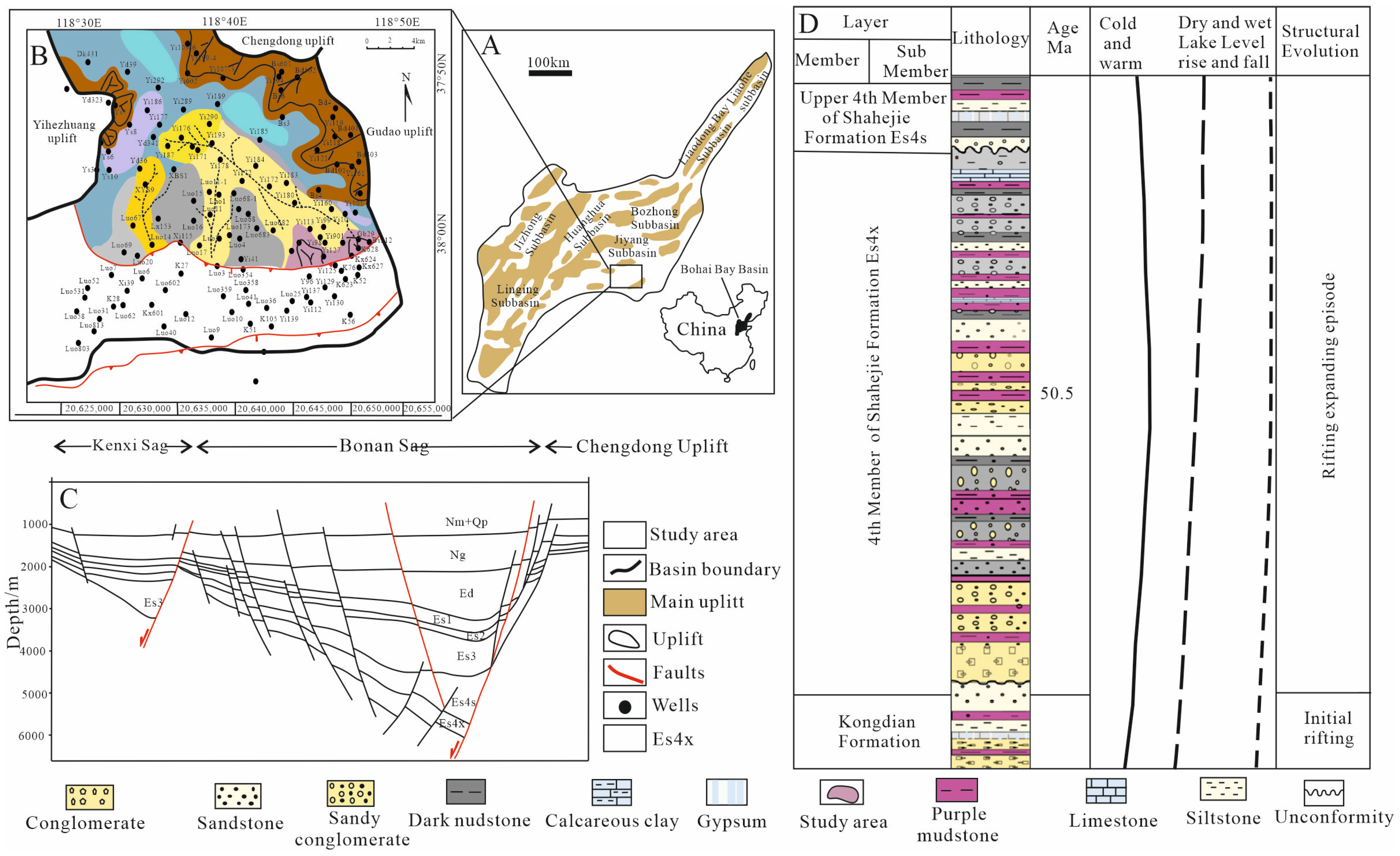
Figure 1. Geological maps of the study area. (A) Location of the Bohai Bay Basin with other subbasins in Bohai Bay in East China; (B) location of the Bonan Sag in the Zhanhua Depression with structural features of the study area, Different colors represent distinct structural domains within the basin, including uplifts, sags, and transitional zones; black lines indicate basin boundaries, red lines represent major faults, and black dots denote wells used in this study.; (C) SW-NE trending cross-section A-A′ in the Bonan sag; (D) Paleogene stratigraphic column of the Bonan Sag, and tectonic evolution (modified after [19,20,21]).
Minerals 16 00048 g001
Figure 2. Facies associations spatial distribution and the provenance systems of the Es4x Mem, Bonan Sag. (A) Geologic map with the five lithofacies associations indicated: alluvial fans (LFA 227 1) predominate in northern, steep-slope areas and saline lacustrine deposits (LFA 5) occur in the 228 northern depocenter; fan deltas (LFA 4) fringe the eastern and southern borders; floodplain lakes 229 (LFA 3) occupy the central sag; and (LFA 5) saline lacustrine deposits. The provenance systems Es4x 230 deposition had three directions of origin which included, northeast direction, south direction, and 231 the northwest direction. (B) Depositional model illustrating catchment routing and sediment transport pathways. Coarse clastics were funneled through fault-controlled topographic lows into proximal fan and fan-delta belts, where channelized flow dispersed sediments basinward. Middle and distal lacustrine facies expanded during reduced inflow or higher lake levels, forming widespread sag-center muds, whereas saline lacustrine deposits accumulated in the deepest northern depocenter. This panel highlights the spatial migration of facies belts and the interaction between sediment source areas and accommodation during Es4x deposition.
Minerals 16 00048 g002
Figure 3. Sedimentary features and sedimentary sequence, (A) debris flow deposits (B) High matrix content, 2594.3 m, well Luo 68; (C) channel deposits with cross bedding, 2591.4 m, well Luo 68; (D) channel deposits with parallel bedding, 2807.3 m, well Luo 68; (E) sheet flow deposits with Parallel bedding, 2602.6 m, well Luo 68. (F) Core photograph showing channel-fill deposits dominated by muddy sandstone and mudstone, Well Luo 68.
Minerals 16 00048 g003
Figure 4. Sedimentary structures and sequence of the braided river, (A) trough cross bedding, 2 750.1 m, well Luo 10; (B) horizontal bedding, 2770.4 m, well Luo 10; (C) tabular cross bedding, 2760.7 m, 272 well Luo 10; (D) dwelling burrow, 2775.3 m, well Luo 10; (E) scoured surface, 2780.0 m, well Luo 10–273 (F) sedimentary sequence of the braided river, well Luo 10, a whole sequence is present between the 274 yellow dotted lines.
Minerals 16 00048 g004
Figure 5. Sedimentary characteristics and sequences of the flooded lacustrine sandstones, (A) pebble bearing fine sandstone in a sandy bar, 4010.4 m, well Luo 173; (B) swash cross bedding, 4030.2 m, well Luo 173; (C) sedimentary sequence of the sandy bar, well Luo 173. (D) shows the massive bedding, 4047.5 m. Well Luo 173, (E) pebble bearing fine sandstone in a sandy bar, 4138.4 m, well Luo 173, (F) normal grading at depth 4045, Well Luo 173.
Minerals 16 00048 g005
Figure 6. Stratigraphic architecture and vertical facies cyclicity of the Es4x Member. (A) SW NE well correlation panel indicates three depositional cycles: Cycle I (alluvial fans (LFA 1), saline lacustrine evaporite maxima (LFA 5, Well Luo 10); Cycle II primarily braided streams (LFA 2) and floodplain lake sandbars (LFA 3) with beds of gray-green shales (Well Luo 173); Cycle III saline lacustrine rebound and halite beds. Yellow arrows show onlap surface. (B) The cycle II sandbody thickness isopach map, with thickest (>15 m) thickness centered in the sag area around Well Luo 173. Cycles III terminations (onlap terminations) of seismic section with onlap terminations and evaporate expansion. (C) Interpreted seismic reflection profile illustrating Cycle III stratigraphic terminations characterized by onlap geometries (red arrows) toward the basin margin, accompanied by evaporite expansion and syn-depositional fault activity.
Minerals 16 00048 g006
Figure 7. The Es4x Member lateral facies distribution and geometry of sandbodies. Facies distribution map with indications of fault-control structure: alluvial fans (LFA 1; orange) in the north within steep slope on the north of the Chenjiazhuang Fault, braided rivers (LFA 2; blue and floodplain lakes (LFA 3; light blue in the central sag and fan deltas (LFA 4; blue) in the south, in the slack slope.
Minerals 16 00048 g007
Figure 8. Paleogeographic history of the Bonan Sag through Es4x deposition. Early Es4x (Cycle I): Aridity period with a shallow, evaporite-bearing lake (gray) and alluvial fans (brown) around it. Mid Es4x (Cycle II): The period of increased moisture was epitomized by an enlarged perennial lake (blue), braided rivers (tan), and sandbars. Late Es4x (Cycle III): Reversion arid conditions, with evaporite expansion, with fan delta backstepping.
Minerals 16 00048 g008
Figure 9. Well-log correlation (GR/SP) of the sequence stratigraphic framework of Es4x member across key wells showing stacking patterns. The inset map shows the structural framework of the study area; the blue dashed line denotes the well-correlation profile, and red arrows indicate the main sediment-transport direction.
Minerals 16 00048 g009
Figure 10. Seismic section with interpretation of sequence boundaries and important stratigraphic surfaces in Es4x submember. At Es4x base, a prominent basal onlap, termed as Sequence Boundary 1 (SB1), has been noted, which is characteristic of down-cutting in the Esgravado basin.
Minerals 16 00048 g010
Figure 11. Characteristics of the Lowstand Systems Tract (LST). (a) Spatial distribution of LST deposits across the study area. The orange-shaded regions represent the areal extent of LST depositional bodies, including alluvial fan wedges developed along the steep northern slope. These deposits are characterized by chaotic seismic facies, reflecting rapid sediment accumulation and gravity-driven processes adjacent to uplifted structural highs. Major uplifts, structural boundaries, well locations, and contour lines are shown for reference. (b) Spatial variation in clay mineral assemblages within the LST. The map integrates well-based clay mineral percentages with structural and geomorphological features, illustrating regional variations in illite, smectite, kaolinite, and chlorite distributions. Bar charts at each well location show relative clay mineral abundances, while dashed arrows and outlined zones indicate inferred sediment dispersal pathways and areas of mineralogical transition. The results highlight the influence of depositional environment, sediment provenance, and proximity to uplifts on clay mineral composition during the lowstand stage.
Minerals 16 00048 g011
Figure 12. Climate cycles at the orbital scale that caused aridification events in Es4x deposition, indicating the correlation of sedimentary patterns with orbital forcing.
Minerals 16 00048 g012
Figure 13. Plan view of sedimentary facies distribution, provenance terranes, and sediment transport pathways of the Es4 member in the Bonan Sag. (a) Distribution of sedimentary facies in Es4x, showing the spatial relationships among alluvial fan, fan delta, braided river, delta, floodplain, and lacustrine facies, as well as major faults, uplifts, provenance areas, and sediment conveyance pathways controlling basin infill. (b) Paleogeographic reconstruction of the Es4 depositional system, illustrating lake-depth zonation (shore–shallow lake, semi-deep to deep lake), the distribution range of gypsum-salt rocks, and highlighting their relationship with sediment sources and depositional environments.
Minerals 16 00048 g013
Figure 14. Ternary diagram showing detrital and lithic components in different facies (A,B) braided river; (C,D) sandy bar of flooded lacustrine; (E) sandy beach of the flooded lacustrine; (F) coastal beach-bar.
Minerals 16 00048 g014
Figure 15. Diagenetic characteristics of Es4x sandstones. (A) Strong mechanical compaction characterized by intensely deformed ductile grains, indicating significant porosity reduction (Well Yi 126, depth 3171.25 m). (B) Quartz grains with chlorite-coated rims (arrowed), which inhibit quartz overgrowth cementation and help preserve primary porosity (Well Luo 68, depth 3371.9 m). (C) Intragranular secondary porosity formed by feldspar dissolution (Well Luo 173, depth 3379.9 m). (DF) Secondary pores generated by calcite cement dissolution, illustrated under cathodoluminescence microscopy, enhancing reservoir quality (Well Luo 68, depth 3376.55 m). In addition, structural fractures are locally developed and contribute to increased permeability (Well Boshen 6).
Minerals 16 00048 g015
Figure 16. Diagenetic controls on reservoir quality of Es4x sandstones. (A) Relationship between porosity and burial depth for different depositional facies. Braided river facies (LFA 2) and related fluvial sandstones commonly exhibit relatively high porosity (14–19%) at depths shallower than ~2500 m, attributed to chlorite coatings on grain surfaces that inhibit quartz overgrowth cementation. The solid red curve represents the general porosity depth compaction trend. (B) Relationship between permeability and sorting coefficient for different sandstone textures. The green dashed curve indicates the overall decreasing permeability trend with increasing sorting coefficient, reflecting combined effects of grain sorting and diagenetic cementation. (C) Relationship between porosity and sorting coefficient. The green dashed curve shows the overall porosity reduction trend with poorer sorting, whereas the horizontal purple dashed line represents the average porosity level of chlorite-coated sandstones, highlighting their porosity preservation relative to other diagenetic facies. Data points are differentiated by grain size (fine-, medium-, and coarse-grained sandstones).
Minerals 16 00048 g016
Figure 17. Diagenetic evolution and porosity variation of Es4x lithofacies in the Shahejie Formation. This figure summarizes the diagenetic development of different lithofacies from the Paleogene Ed to Es4x intervals, illustrating the timing and relative intensity of compaction, cementation, dissolution, and associated porosity evolution. Diagenetic stages (early and middle diagenesis; substages A, B, A1, and A2) are defined based on thermal maturity (Ro%) and burial history. For each lithofacies, colored symbols represent dominant diagenetic processes: blue indicates mechanical compaction, yellow represents carbonate (calcite or dolomite) cementation, green denotes clay mineral cementation, orange indicates quartz cementation, and purple/red represents dissolution processes. The width of each colored symbol qualitatively reflects the relative intensity of the corresponding diagenetic process through time. Red curves show the evolution of porosity (%) for each lithofacies, highlighting progressive porosity loss due to compaction and cementation during early burial, followed by partial porosity enhancement associated with dissolution during middle diagenesis. The comparison among highly heterogeneous basement rock facies, calcareous-cemented sandstone facies, and oil-bearing sandstone (conglomerate) facies emphasizes the contrasting diagenetic pathways and their impacts on reservoir quality.
Minerals 16 00048 g017
Table 1. Structural Zones and Dominant Facies and Depositional Characteristics of the Es4x.
Structural ZoneDominant FaciesDiagnostic Features
Steep Slope (Fault-Controlled)Alluvial Fans (LFA 1)Conglomerates raised on a matrix that has low sorting (sorting coefficient: 1.8–2.5); Seismic wedge geometries exhibit dips of 1520, and this shows progradation of fans along the fault scarp.
Central Depression (Subsidence-Dominated)Floodplain mudstones (LFA 3)Sand-mud rhythmic alternating sequences, root-marked paleosols and sheet-like sandbars with continuity of over 10–15 km, indicating long lake-time stability.
Gentle Slope (Progradational Margin)Braided Rivers (LFA 2)/Fan Deltas (LFA 4)Chlorite-coated sands containing intact porosity (12%–19%) sigmoid clinoforms indicating progradational stacking patterns, as well as lobate geometries of deltas that had an interval of vertical relief of 30 to 40 m.
Table 2. Facies Controlled Reservoir Properties and Exploration Significance in the Es4x.
Facies AssociationAvg. PorosityKey ControlsExploration Significance
Braided Rivers (LFA 2)12%–19%Chlorite grain coatings (5–10 μm) inhibit quartz overgrowth; moderate mechanical compaction (8% loss)High-priority targets, especially on gentle slopes (e.g., Wudi Uplift); overpressure enhances secondary porosity by +3%–5%
Fan Deltas (LFA 4)<8%Calcite cementation (5%–15%); high ductile lithic content leads to severe compactionTarget fracture corridors near fault zones (10–50 μm); avoid interfan areas with high cementation
Floodplain mudstones (LFA 3)6%–9%Illite-smectite pore-filling clays; permeability typically < 1 mDNon-reservoir under normal conditions; may act as an effective seal unless fractured
Alluvial Fans (LFA 1)4%–7%Matrix-supported conglomerates; intense compaction dominates diagenetic historyPoor reservoir potential; viable only with artificial stimulation or natural fracturing
Saline Lacustrine (LFA 5)3%–5%Halite/gypsum dissolution creates localized secondary porosityPotential secondary porosity zones near sequence boundaries (e.g., SB4); limited lateral continuity
Disclaimer/Publisher’s Note: The statements, opinions and data contained in all publications are solely those of the individual author(s) and contributor(s) and not of MDPI and/or the editor(s). MDPI and/or the editor(s) disclaim responsibility for any injury to people or property resulting from any ideas, methods, instructions or products referred to in the content.