Article

Hydrocarbon Accumulation Evolution of the Cambrian Longwangmiao Formation in the Penglai Gas-Bearing Area, Sichuan Basin


School of Geosciences, Yangtze University, Wuhan 430100, China
*
Author to whom correspondence should be addressed.
Minerals 2025, 15(12), 1269; https://doi.org/10.3390/min15121269
Submission received: 29 October 2025 / Revised: 26 November 2025 / Accepted: 28 November 2025 / Published: 30 November 2025
(This article belongs to the Section Mineral Geochemistry and Geochronology)

Abstract

Research on hydrocarbon accumulation in the Cambrian of the Penglai gas-bearing area of paleo-uplift within the central Sichuan Basin remains relatively insufficient. In this study, the hydrocarbon charging history and accumulation evolution model of the Longwangmiao Formation of the Penglai gas-bearing area were established through the integration of petrography, fluid inclusion geochemistry (including microthermometry and Laser Raman spectroscopy), and basin simulation techniques. The findings indicate that the pores in the Longwangmiao reservoirs are extensively filled with solid bitumen. Additionally, multiple generations of diagenetic minerals, such as dolomite, quartz, and pyrite, indicate a complex fluid evolution history. The simulation of the hydrocarbon generation history, combined with homogenization temperatures and salinities of fluid inclusions within diagenetic minerals, reveals that the study area has undergone three crucial hydrocarbon accumulation evolution stages: (1) From the Early Triassic to the Early Jurassic (250–175 Ma), mature oil charged the reservoir, leading to paleo-oil accumulation. (2) From the Late Jurassic to the Late Cretaceous (159–98 Ma), crude oil underwent thermal cracking into gas. (3) From the Late Cretaceous to the present (82–0 Ma), continuous uplift has led to the adjustment of the gas reservoirs. These findings provide critical insights into the gas accumulation patterns and offer guidance for identifying high-potential exploration targets of the paleo-uplift within the central Sichuan Basin.

1. Introduction

The discovery of the Anyue giant gas field within the Sichuan Basin represents a major breakthrough in marine carbonate exploration in China, demonstrating substantial potential for oil and gas resources in the ancient Sinian-Cambrian system of the central Sichuan Basin [1,2,3]. The Sinian-Cambrian system, as the main production layer of the Anyue gas field, is characterized by deep burial, extensive gas-bearing extent, large reserve scale, and high single-well productivity [4]. Among these, the proven reserves in the Cambrian Longwangmiao Formation reach 4403.8 × 108 m3, making it currently the largest single marine carbonate gas reservoir in China [5]. At present, the focus of exploration in the central Sichuan Basin has shifted to the peripheral area of the Deyang-Anyue rift trough. Recent drilling from the Penglai gas-bearing area on the north slope of the paleo-uplift reveals that the Longwangmiao Formation contains high-quality carbonate reservoirs, with significant gas shows observed in multiple wells [6,7]. Nevertheless, understanding of the hydrocarbon accumulation process in the Cambrian Longwangmiao Formation of the Penglai gas-bearing area remains inadequate. This study utilizes the latest drilling core data and employs the PetroMod software (2012) to reconstruct the thermal evolution history in the Cambrian Longwangmiao Formation of the Penglai gas-bearing area. Integrated with the temperature measurements from reservoir fluid inclusions, the period and stages of hydrocarbon accumulation are determined. Finally, based on the regional tectonic evolution history, a hydrocarbon accumulation model for the Longwangmiao Formation on the north slope of the paleo-uplift in the central Sichuan Basin is established. This model clarifies the dynamic evolution of the petroleum system, providing the foundational understanding upon which integrated assessments of seal and fault integrity can be built to optimize exploration targets.

2. Geologic Setting

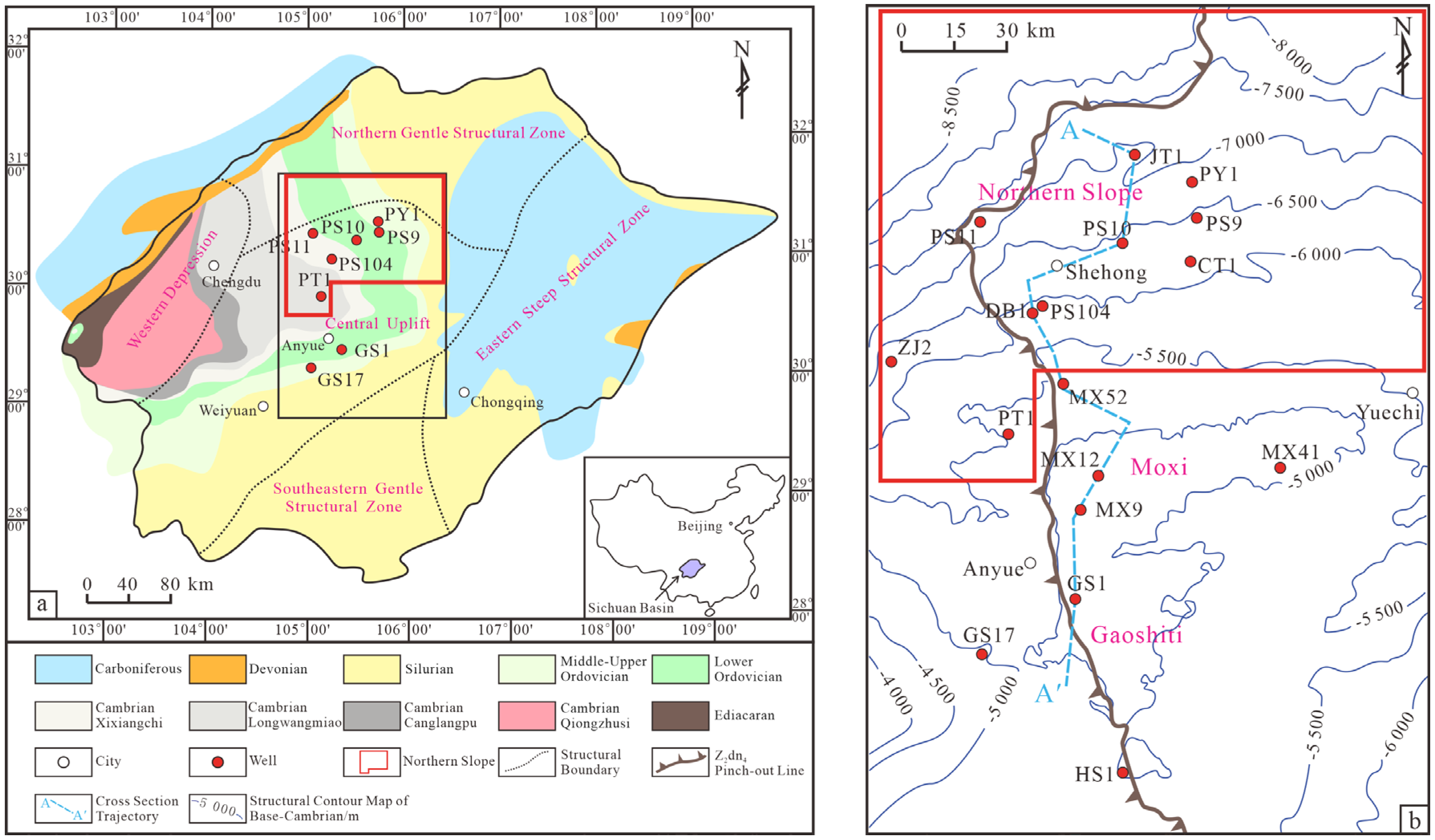
The Sichuan Basin, a large composite petroliferous basin, covers an area of approximately 1.8 × 10⁵ km2 and exhibits a generally rhomboidal geometry at present (Figure 1a) [4,8]. The Penglai gas-bearing area is located in the gentle structural belt of the central Sichuan Basin, occupying the north slope zone of the paleo-uplift. It is bounded to the north by the Jiulongshan basement uplift, adjacent to the Anyue gas field to the south, and adjoining the Deyang-Anyue rift trough to the west (Figure 1a) [9].
The study area, located on the north slope of the paleo-uplift in the central Sichuan Basin (Figure 1a), has undergone the superimposition and modification of multiple tectonic movements. Among these, the Tongwan Movement led to gradual uplift and slight erosion in the central Sichuan Basin [10,11], forming a gently undulating structural form that established the initial structural pattern of the paleo-uplift. Subsequently, the Late Caledonian Movement induced significant uplift in the region, resulting in the fundamental formation of the paleo-uplift. During the Indosinian period, early-stage tectonic inversion caused uplift of the southeastern wing of the paleo-uplift and concurrent subsidence of its northwestern wing. In the Early Yanshanian period, due to the tilting of the Longmenshan, the north slope of the central Sichuan uplift experienced intense compression and subsidence [12]. By the Himalayan period, differential tectonic uplift occurred in the Sichuan Basin, leading to extensive erosion of the Jurassic overlying strata throughout the basin [13,14]. Ultimately, the Penglai area formed the current monoclinal structure, characterized by higher topography in the south and lower elevation in the north (Figure 1b) [4,9].
Figure 1. (a) Structural location of the north slope of paleo-uplift in the central Sichuan Basin. (b) structural map in the Cambrian of the Penglai gas-bearing area within the central Sichuan Basin (modified after [15]).
Minerals 15 01269 g001
The Cambrian succession in the study area consists of the Lower Cambrian Maidiping, Qiongzhusi, Canglangpu, and Longwangmiao Formations, the Middle Cambrian Gaotai Formation, and the Middle-Upper Cambrian Xixiangchi Formation (Figure 2) [9]. Among them, the Canglangpu Formation is deposited in a relatively high-energy sedimentary environment [16], mainly developing granular dolomite, crystalline dolomite and gray sandstone. The overlying Longwangmiao Formation has a thickness of 80–200 m [11]. It is composed mainly of fine—to medium-grained dolomite, with thin interlayers of argillaceous dolomite, siltstone, and other terrigenous clastic rocks [9,17]. It represents a relatively stable depositional setting of a shallow-water carbonate platform.
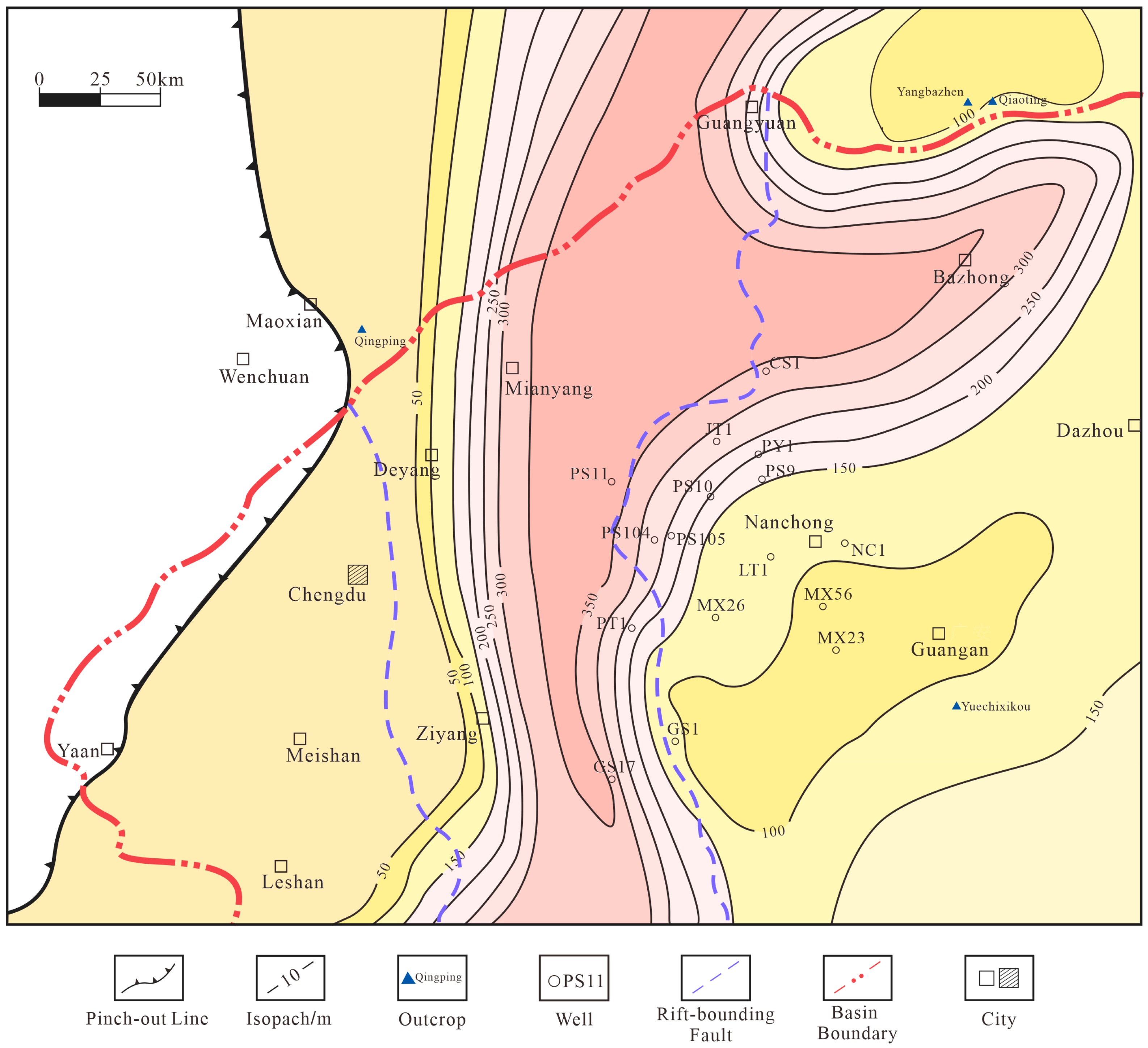
Geochemical evidence indicates that the gas in the Cambrian reservoirs of the Penglai gas-bearing area is primarily sourced from the Qiongzhusi Formation (Figure 3). This source rock is characterized by a thickness of 300–500 m and is rich in organic matter [7]. Among them, the Qiongzhusi Formation source rocks within the rift contain primarily Type I and II1 kerogen [18], with an average TOC content of 3.5% [19]. These source rocks have high thermal maturity and high gas generation intensity [4].
The Longwangmiao Formation reservoirs in the Penglai gas-bearing area are characterized by well-developed dissolution pores [20]. The measured physical properties indicate that the porosity of the grain beach reservoirs of the Longwangmiao Formation ranges from 0.34% to 10.11% (average 2.36%), and the permeability ranges from 0.000572 to 9.56 × 10⁻³ μm2 (average 0.38 × 10⁻³ μm2) [5]. The reservoirs exhibit moderate to low porosity and permeability [21].
Furthermore, the Longwangmiao Formation reservoirs are effectively sealed by gypsum—salt rocks and mudstone within the overlying Gaotai Formation [22].
In summary, the north slope of the paleo-uplift in the central Sichuan Basin possesses favorable conditions for hydrocarbon accumulation [23,24]: the organic—rich black shale of the Lower Cambrian Qiongzhusi Formation serves as an excellent source rock [25,26,27]. The high-quality dolomite reservoirs in the Longwangmiao Formation contain well-developed dissolution pores and excellent reservoir physical properties. The dense argillaceous dolomite of the overlying Gaotai Formation, in combination with regional gypsum layers, forms an effective seal that ensures the long-term preservation of the gas accumulations [28]. The high-quality source-reservoir-seal assemblage provides favorable conditions for large-scale gas accumulation in the Penglai gas-bearing area [19].

3. Samples and Methods

This study systematically sampled cores from five wells (PS11, PS10, PS104, PS9, and PS105) in the Longwangmiao Formation of the Penglai gas-bearing area in the central Sichuan Basin. A total of 89 samples were collected, primarily composed of granular dolomite and medium—fine crystalline dolomite. Some representative samples were selected to prepare thin sections. The thin sections were analyzed using a German Axio Scope A1 (Carl Zeiss Microscopy GmbH, Jena, Germany) polarizing microscope and a cathodoluminescence (CL) instrument for diagenetic mineral observations. Fluid inclusion analysis was conducted using a Linkam THMSG600 heating—freezing stage (Linkam Scientific Instruments, Epsom, United Kingdom), which was equipped with a Nikon 80i dual—channel fluorescence microscope (Nikon Corporation, Tokyo, Japan) and a 100× long-working-distance objective. The measurements were performed with an accuracy of ±0.1 °C. The composition of the inclusions was analyzed using a Renishaw InVia Qontor Raman spectrometer (Renishaw plc, Wotton-under-Edge, UK) equipped with a 532 nm Ar+ laser. All the above experiments were completed in the Organic Geochemistry Laboratory of Yangtze University.

4. Characteristics of Fluid Inclusions

4.1. Diagenetic Mineral Petrographic Characteristics

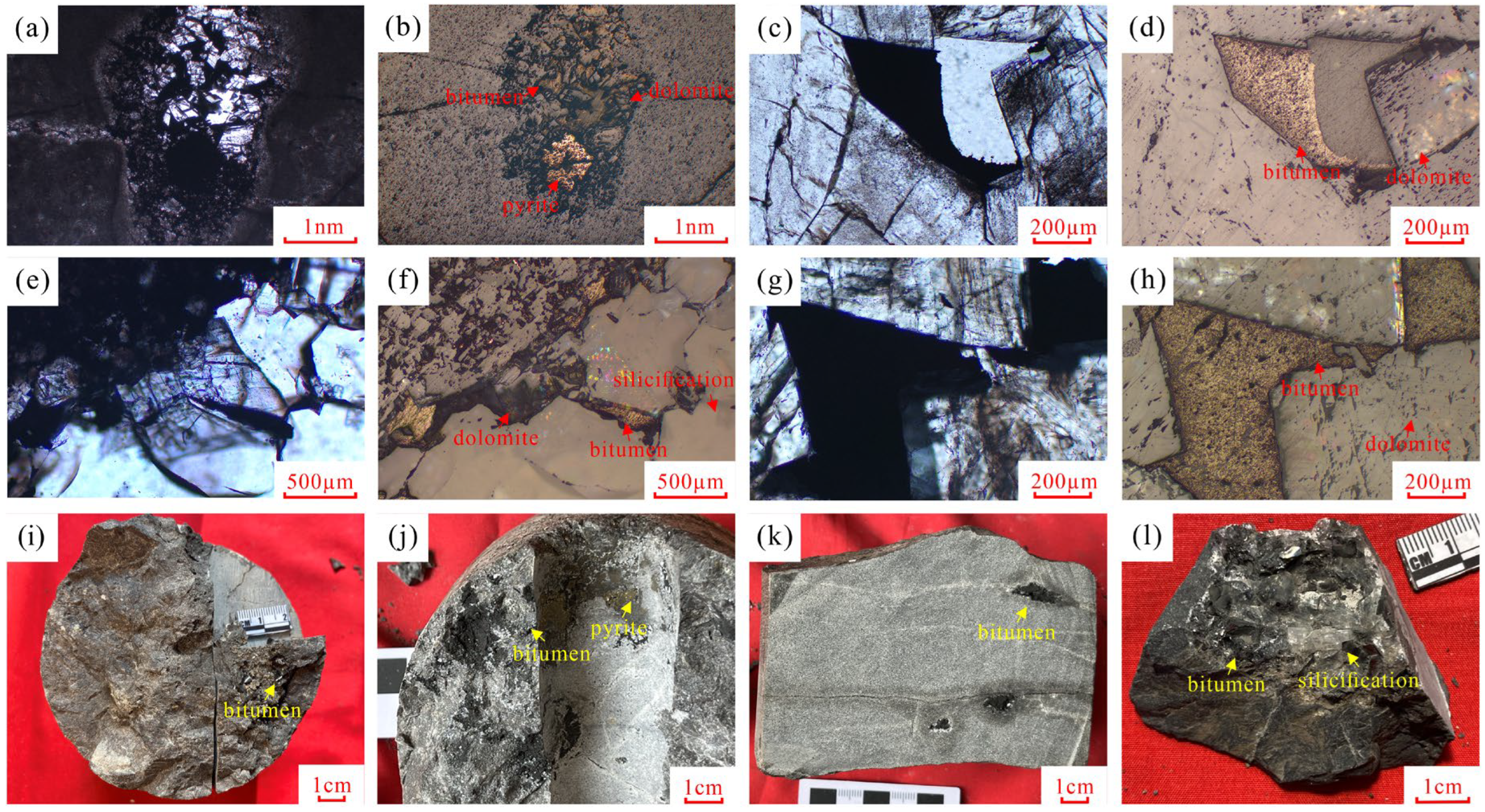
Petrographic analysis indicates that the Lower Cambrian Longwangmiao Formation reservoirs in the study area contain abundant secondary dissolution pores, which are occluded by multiple phases of diagenetic minerals (Figure 4). Petrographic observations reveal three key characteristics: (1) The dissolution pores exhibit a heterogeneous distribution of fill, ranging from partially to completely; (2) the pores are occluded by multiple diagenetic mineral phases, including dolomite, quartz, pyrite, and bitumen; (3) the paragenetic sequence evolved from dolomite cementation to silicification, followed by bitumen and pyrite emplacement [29,30].

4.2. Microscopic Characteristics of Fluid Inclusions

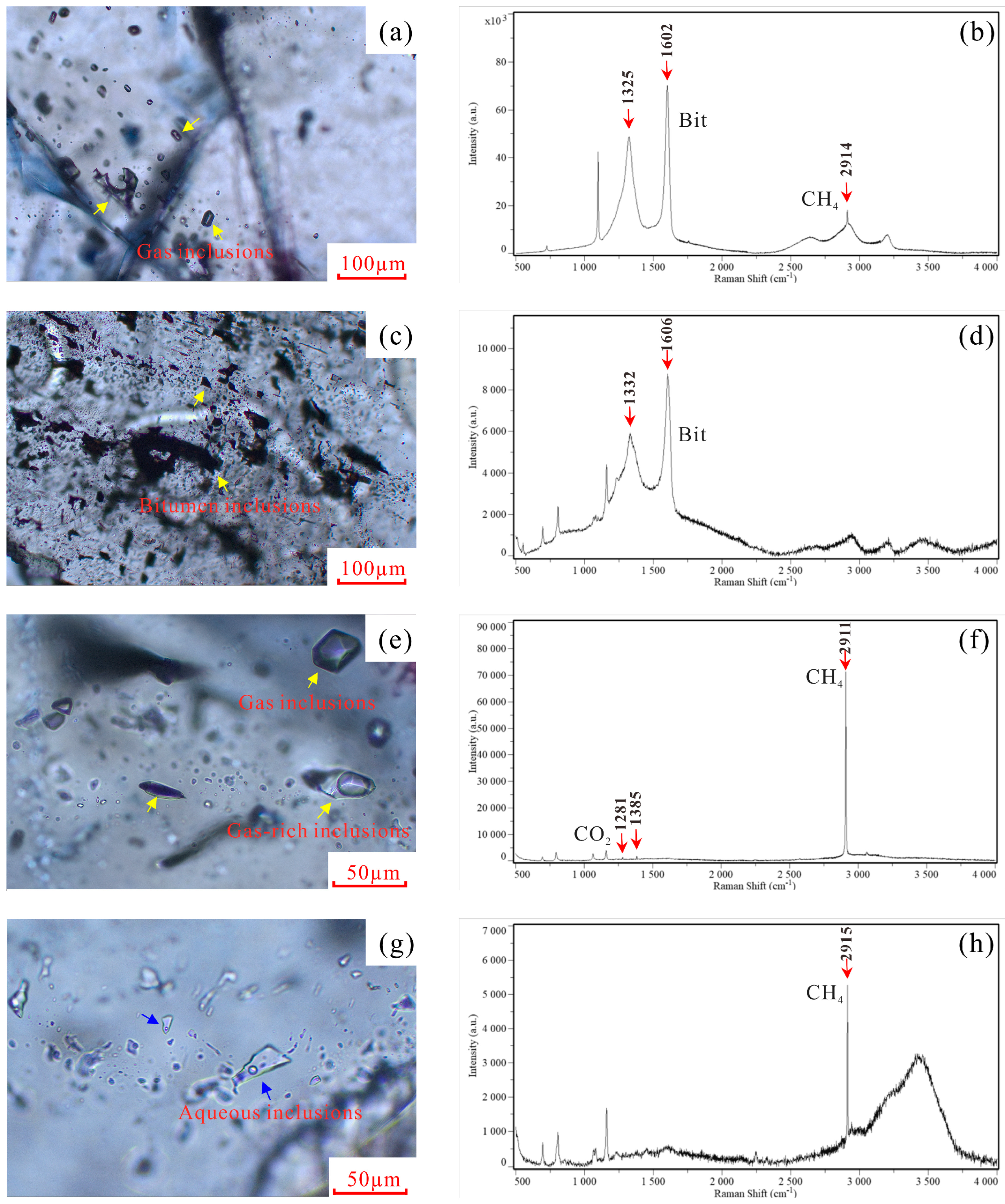
Microscopic observation indicates that fluid inclusions in the Longwangmiao reservoirs of the Penglai gas-bearing area are primarily hosted in the cements within dissolution pores and fractures [31]. These inclusions can be categorized into aqueous inclusions, gas inclusions, and bitumen inclusions (Figure 5). They exhibit predominantly circular, elliptical, and irregular, with sizes generally ranging from 10 to 50 μm. Under transmitted light, the gas inclusions appear black, whereas the associated aqueous inclusions are mostly transparent. Laser Raman spectroscopy reveals that the gas inclusions are predominantly composed of CH4, with minor CO2 and H2S also present. The associated aqueous inclusions also contain CH4 (Figure 5). These findings collectively suggest the occurrence of significant hydrocarbon fluid activity in the study area.
Under the microscope, solid bitumen is also found within the pore spaces of the Penglai Longwangmiao Formation reservoirs, including dissolution pores and intercrystalline pores. The distribution of this bitumen provides direct evidence for the thermal cracking process by which crude oil cracked into gas. Notably, both solid bitumen and bitumen inclusions are widely observed in the dolomite reservoirs of the study area. Raman spectroscopy analysis of the bitumen inclusions reveals a significant carbon structure, characterized by a typical double—peak spectrum with a D peak (~1350 cm−1) and a G peak (~1580 cm−1). Additionally, Raman spectroscopy confirms the presence of bitumen within some gas inclusions. The presence of this bitumen suggests that its formation is related to the cracking of crude oil into gas; that is, after the cracking of crude oil, bitumen and gas are simultaneously trapped as inclusions [32,33].

4.3. Microthermometric Results

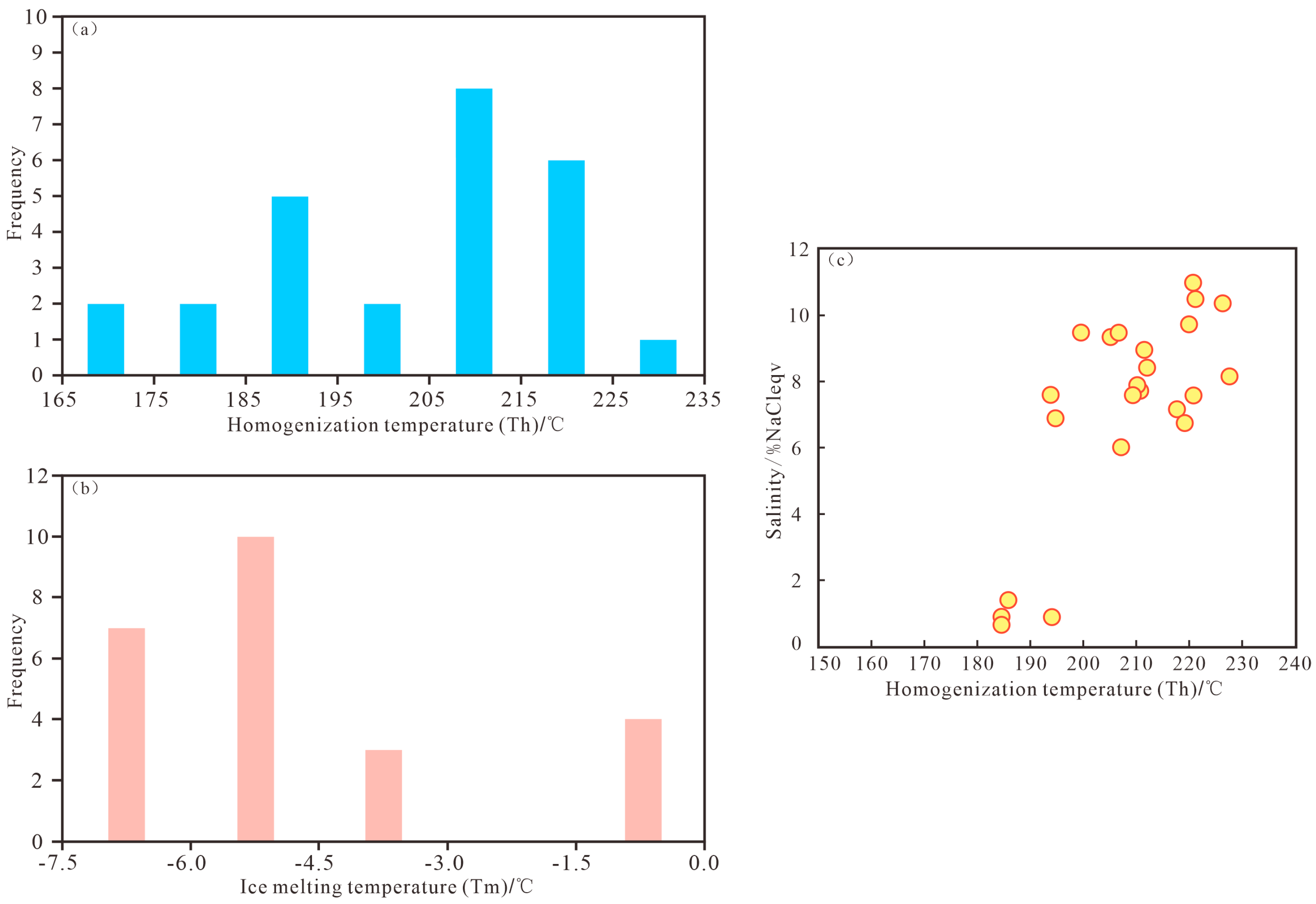
Fluid inclusions preserve the original temperatures of fluid activities [34,35,36,37,38]. Microthermometric measurements of fluid inclusions were conducted on core samples from the Longwangmiao Formation in Well PS104, located on the north slope of the paleo-uplift. The fluid inclusions were primarily hosted in quartz that fills dissolution pores and fractures. By integrating petrographic characteristics and Laser Raman spectroscopic data, 31 hydrocarbon—bearing aqueous inclusions were selected for microthermometric measurements (Figure 6a,b). These aqueous inclusions are associated with hydrocarbon activities. Raman spectroscopy detected hydrocarbons within these aqueous inclusions, suggesting that they were trapped during hydrocarbon charging events. The same hydrocarbons were also present in co-existing gas inclusions. Based on homogenization temperature and salinity (calculated from ice-point melting temperature), the fluid inclusions in the Longwangmiao Formation reservoirs can be classified into two major categories: the first comprises medium—to high-salinity inclusions (6–11 wt% NaCl eqv.), and the second, low-salinity inclusions (0.5–1.5 wt% NaCl eqv.) (Figure 6c). The homogenization temperatures of the medium—high salinity fluid inclusions range from 195 to 230 °C, whereas those of the low salinity fluid inclusions range from 180 to 195 °C.

5. Characteristics of Hydrocarbon Charging

5.1. Simulation of Burial-Thermal Evolution History

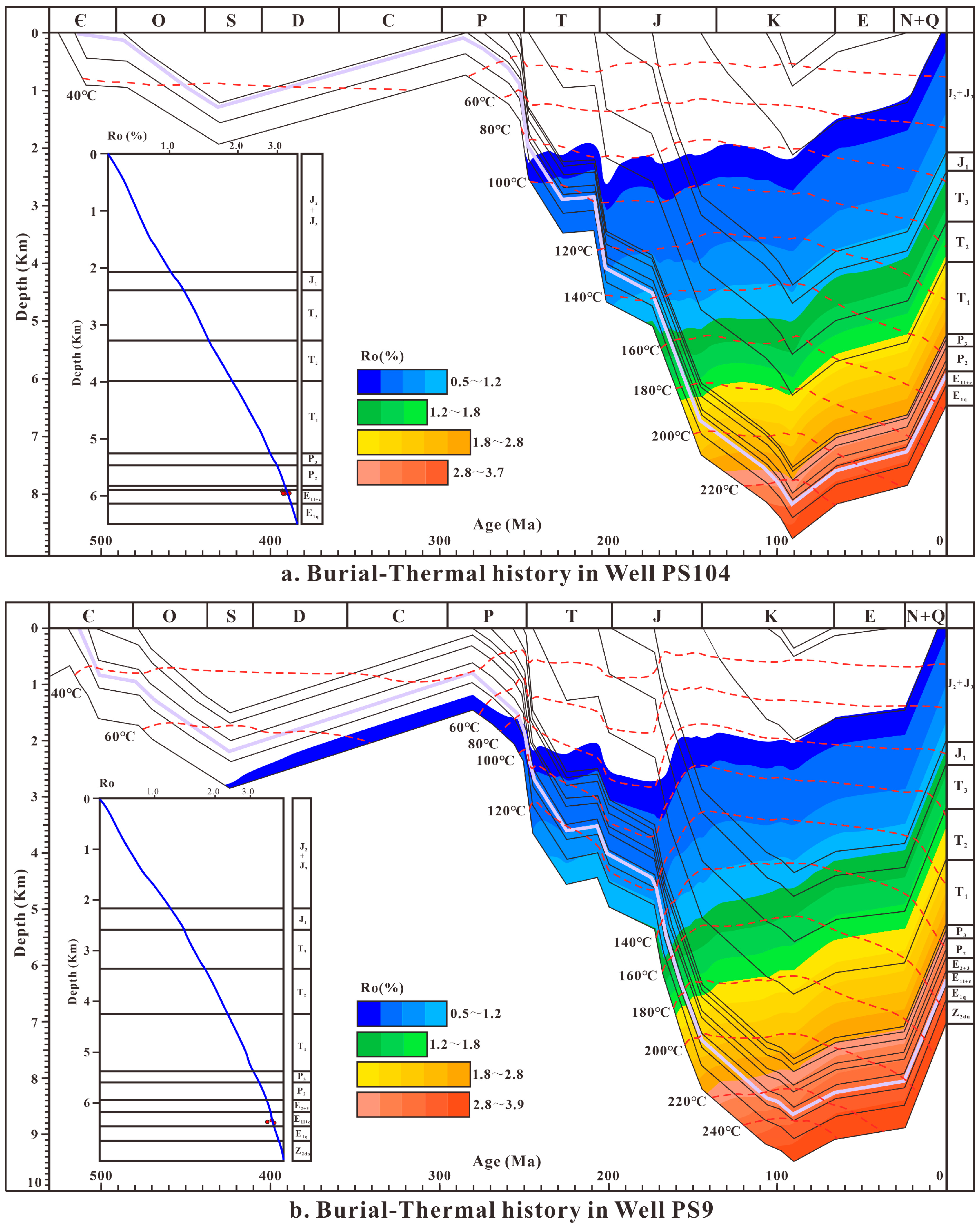
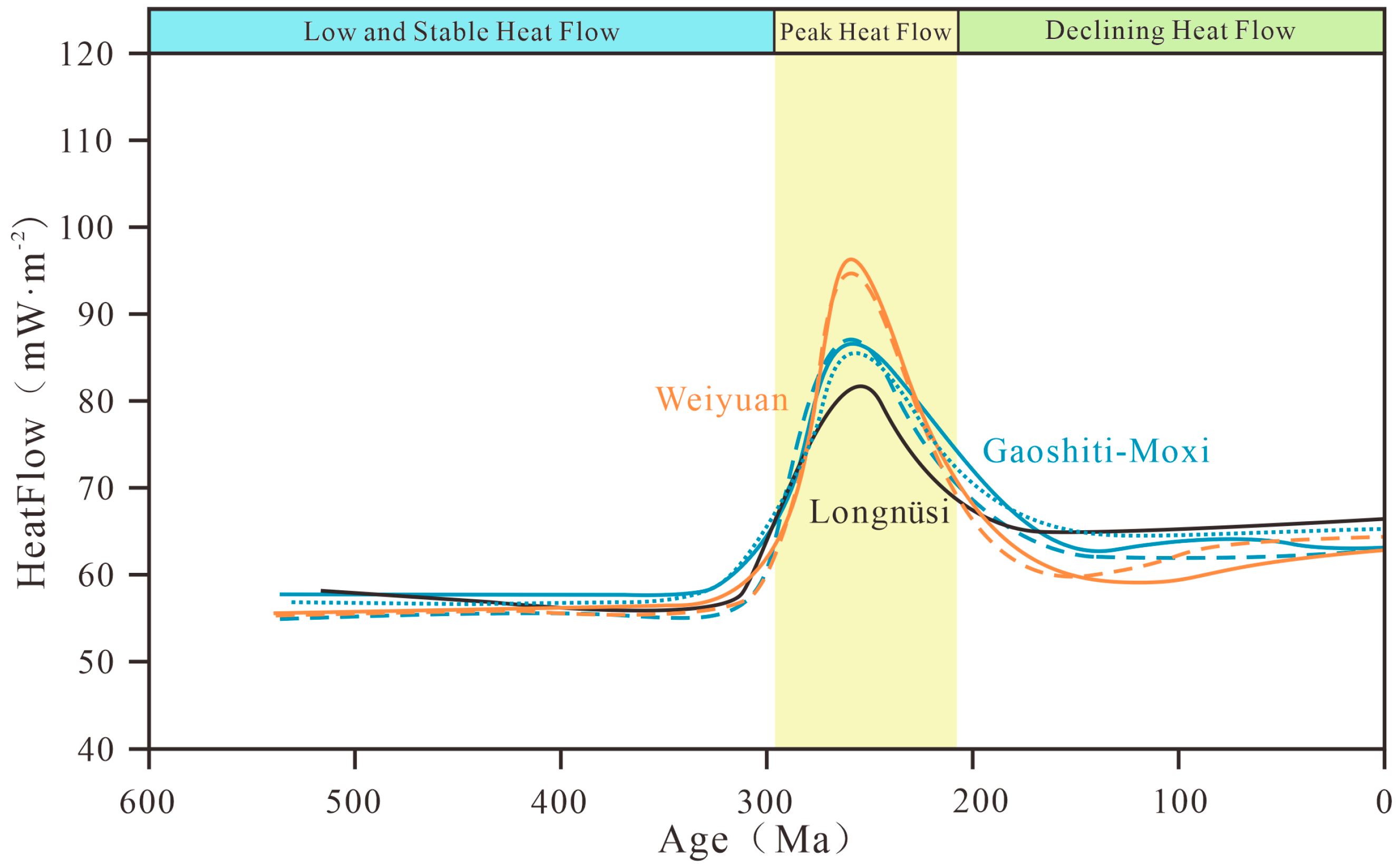
This study utilized PetroMod 1D to conduct a single-well numerical simulation and employed the backstripping inversion method to reconstruct the burial history of the Penglai gas-bearing area [39]. The paleo-heat flow values used in the model are derived from a thermal history model based on thermal indicators and the geodynamic method [40]. The regional tectonic-thermal evolution of the Sichuan Basin is divided into three stages [41]: Pre-Permian heat flow values in the Sichuan Basin were generally stable, with paleo-heat flow ranging from 45 to 60 mW/m2. Peak heat flow occurred during the Permian period, potentially influenced by the Emeishan mantle plume, with values reaching 90 mW/m2 in the central Sichuan [42,43,44,45,46]. After the Indosinian movement, the basin evolved into a foreland basin, with a concomitant gradual decrease in paleo-heat flow to the present-day level (Figure 7).
A numerical simulation was conducted based on data from Well PS104 and Well PS9 on the north slope of the paleo-uplift in the central Sichuan Basin. The simulation aimed to restore the regional burial history and the thermal evolution history of the source rocks, as well as to determine the hydrocarbon accumulation time of the Cambrian Longwangmiao Formation. The present-day thickness and lithology for the model were obtained directly from drilling reports, while the proportions of mixed lithologies in each interval were calculated using software. The north slope of the paleo-uplift in the central Sichuan Basin underwent four major regional tectonic events. The erosion thickness for each period was estimated with reference to previous studies that applied the stratigraphic trend method [47]. The Tongwan movement resulted in a regional parallel unconformity between the base of the Cambrian and the top of the Sinian Dengying Formation. The related erosion in the north slope of the central Sichuan Basin ranged from 50 to 200 m. The Caledonian movement led to a regional angular unconformity between the Middle Permian and Lower Paleozoic strata, with an erosion thickness of 800–1200 m. The Indosinian movement produced a disconformity between the Middle and Upper Triassic strata, resulting in erosion of 0–50 m. Since the Yanshanian-Himalayan period, the region has experienced continuous uplift and significant erosion ranging from 1600 to 3000 m.
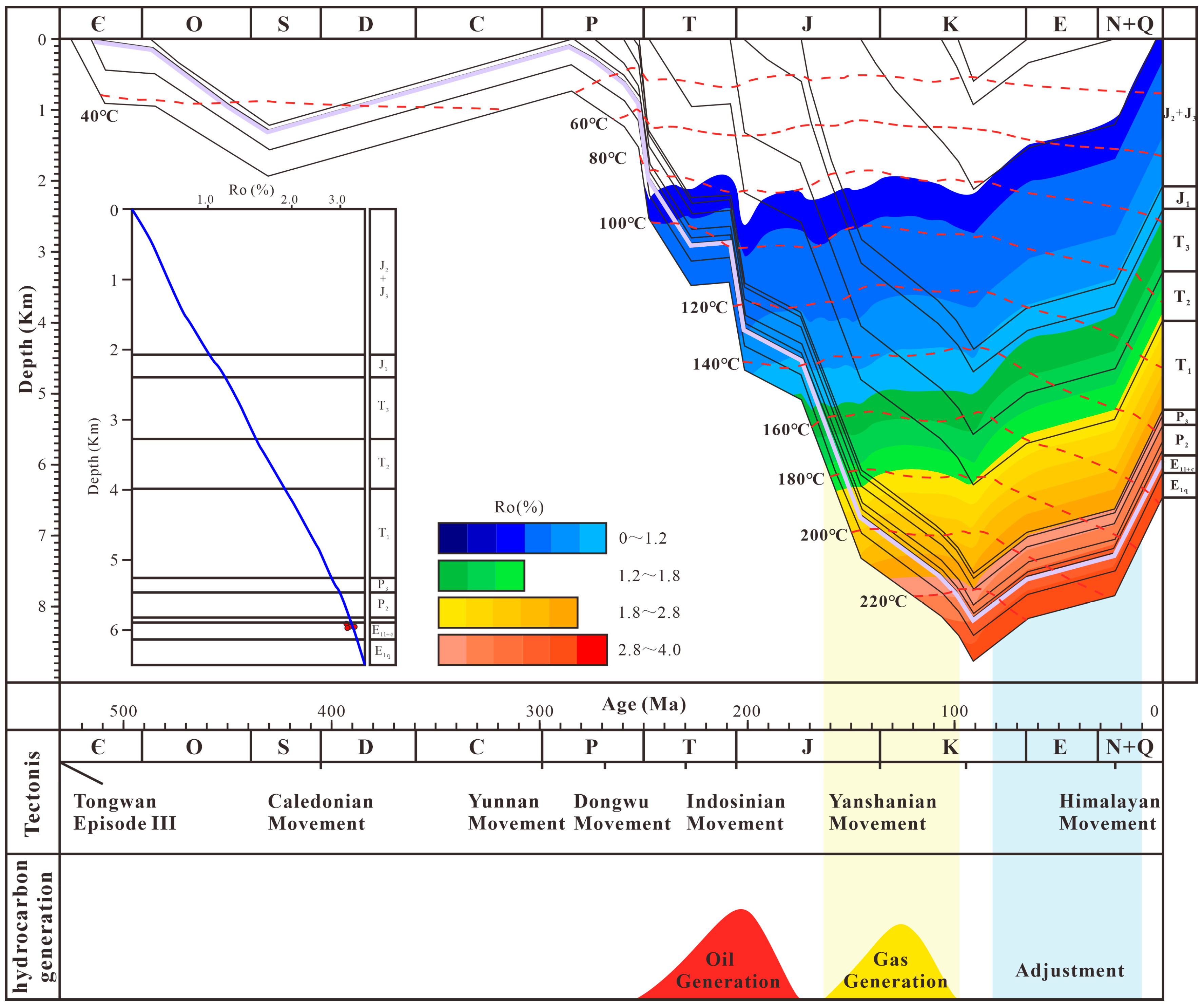
Burial history simulations for Well PS104 and Well PS9 (Figure 8) indicate that the north slope of the Sichuan Basin underwent two primary sedimentary-uplift cycles. The first tectonic cycle extended from the Sinian to the Permian (~553.6–284.8 Ma), comprising stable subsidence from the Sinian to the Silurian and subsequent stable uplift until the Permian. The second tectonic cycle extended from the Permian to the present (~284.8–0 Ma). It commenced with rapid subsidence during the Middle Permian (~ 284.8–259.1 Ma), followed by a relatively stable subsidence phase from the Permian to Triassic (~259.1–227 Ma). Rapid subsidence occurred again during the Late Triassic to Early Jurassic (~208–201.3 Ma), after which stable subsidence prevailed in the Middle Jurassic (~201.3–174.1 Ma). Since the Late Jurassic, a new phase of rapid subsidence commenced, with rapid uplift continuing until the Late Cenozoic (~90–0 Ma).

5.2. Simulated Hydrocarbon Generation History

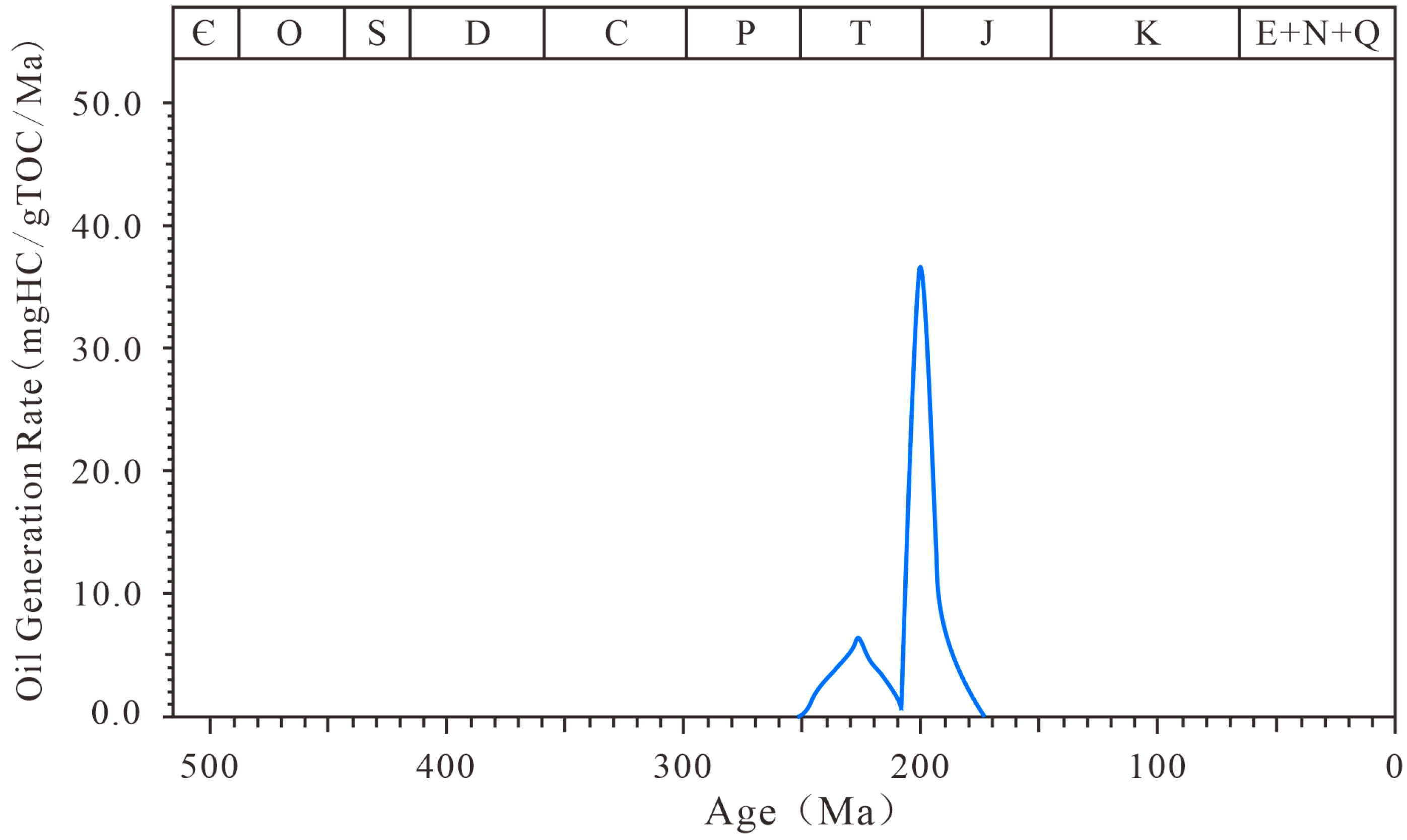
This study is based on the EASY%Ro kinetic model proposed by Sweeney and Burnham [48] and systematically analyzes the maturity evolution process of the Cambrian source rocks in the Penglai area of Sichuan Basin. The simulated maturity evolution curves show a good fit with measured Ro values, indicating the applicability of the EASY%Ro model for reconstructing the thermal maturity history of source rocks in the study area. Hydrocarbon generation modeling of the Qiongzhusi Formation source rocks in Well PS104 of the Penglai gas-bearing area reveals a single hydrocarbon generation peak occurring between 250 and 175 Ma (Figure 9). Among them, the Indosinian tectonic uplift caused a short-lived cessation of hydrocarbon generation during the Late Triassic. For the source rocks of the Qiongzhusi Formation, hydrocarbon generation commenced in the Triassic, peaked from the Late Triassic to Early Jurassic, declined rapidly in the Middle Jurassic, and ultimately ceased.

5.3. Hydrocarbon Accumulation Stages and Time

Currently, no oil inclusions have been found in the Cambrian reservoirs of the Penglai gas-bearing area. These oil inclusions may have undergone thermal cracking, transforming into bitumen inclusions or bitumen-bearing gas inclusions during the process of gradual burial. Similar conclusions have been drawn in studies in the Cambrian dolomite reservoirs of the Gaoshiti-Moxi area [49]. However, hydrocarbon generation history modeling (Figure 8) indicates that the source rocks in the Penglai gas-bearing area experienced a single phase of oil generation between the Early Triassic to the Early Jurassic (250–175 Ma). The entrapment time of fluid inclusions was determined by integrating homogenization temperatures with burial-thermal history modeling [50,51,52,53], which in turn reveals the timing and episodes of hydrocarbon charging in the Cambrian Longwangmiao Formation in the Penglai gas-bearing area of the central Sichuan. Microthermometric measurements of fluid inclusions in Well PS104 reveal two distinct types of aqueous inclusions coeval with gas inclusions based on salinity: relatively low-salinity and medium-high salinity inclusions. This difference suggests that fluid inclusions were trapped at different times. Therefore, the Longwangmiao Formation reservoir underwent two phases of gas migration. Due to the high salinity of the present-day formation water in the Longwangmiao Formation of the study area, it is considered that these medium-high salinity inclusions were trapped during the adjustment and re-migration of gas in the late uplift stage, while the low-salinity inclusions were trapped during crude oil cracking and gas generation during the deep burial process. The timing of gas charging and remigration during uplift was determined by projecting fluid inclusion homogenization temperatures onto the burial history model (Figure 10). Following crude oil charging from the Early Triassic to the Early Jurassic (250–175 Ma), the Longwangmiao Formation underwent continuous burial, which progressively raised the formation temperature to the threshold for oil cracking. This led to large-scale cracking of the paleo-oil reservoirs, converting crude oil to gas between the Late Jurassic and the Late Cretaceous (159–98 Ma). The combined effects of the Late Yanshanian and Himalayan movements caused the gas reservoirs, triggering their adjustment and the remigration of gas. Homogenization temperature data from fluid inclusions show that this phase predominantly occurred from the Late Cretaceous to the present (82 Ma to present).

5.4. Hydrocarbon Accumulation Evolution Model

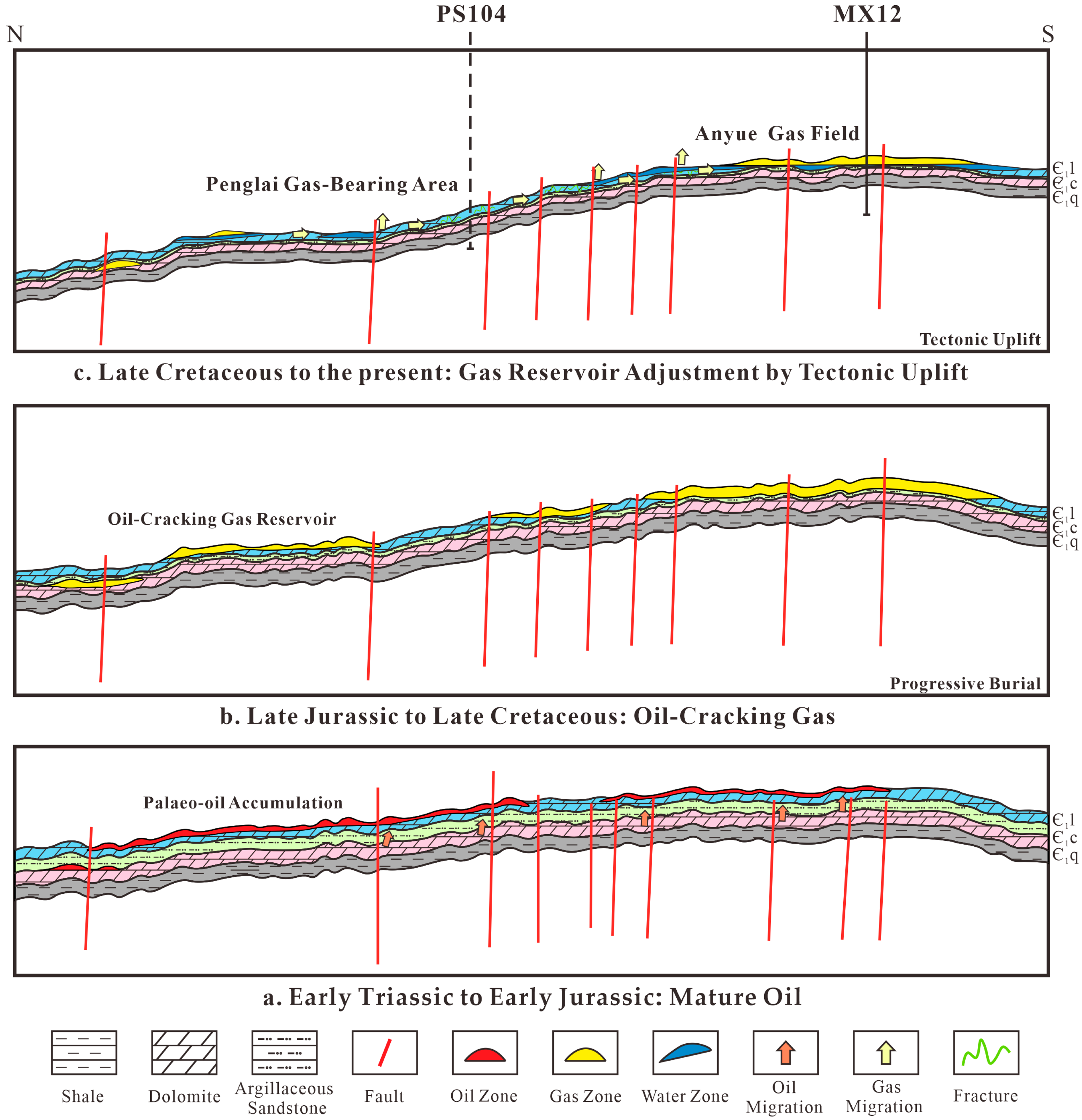
By integrating fluid inclusion microthermometry, burial-thermal history modeling, and hydrocarbon generation history, we reconstructed the dynamic hydrocarbon accumulation evolution in the Cambrian Longwangmiao Formation of the slope of paleo-uplift within the central Sichuan Basin, thereby revealing three key stages in its formation and evolution (Figure 11).
(1) Mature Oil Charging (Early Triassic to Early Jurassic): Following the Caledonian uplift, the basin underwent renewed subsidence and burial. During this period, the Qiongzhusi Formation source rocks entered the main oil window, generating and expelling significant volumes of hydrocarbons. As both the Anyue gas Field and the Penglai gas-bearing area are situated on inherited structural highs, the expelled crude oil migrated along strike-slip faults and accumulated in the dolomite reservoirs of the Longwangmiao Formation, forming paleo-oil reservoirs.
(2) Oil-Cracking Gas Charge (Late Jurassic to Late Cretaceous): During this period, under the effect of deep burial and high temperature, the paleo-oil reservoirs in the Longwangmiao Formation of both the Anyue Gas Field and the Penglai gas-bearing area underwent in situ thermal cracking. This process generated dry gas, forming methane-dominated dry gas reservoirs.
(3) Gas Reservoir Adjustment by Tectonic Uplift (Late Cretaceous to Present): From the Late Yanshanian to Himalayan period, the paleo-uplift in central Sichuan experienced significant differential uplift, which reactivated faults. Compared to the Penglai gas-bearing area, the Gaoshiti-Moxi area underwent greater uplift and possesses better reservoir properties in the Longwangmiao Formation, leading to faster pressure dissipation. Consequently, a significant fluid potential difference was established, driving the large-scale lateral migration of cracked gas from the Penglai area toward the structural highs in the Gaoshiti-Moxi area. This migration utilized high-quality tidal flat reservoirs and fracture networks as the primary pathways [21,46]. The large-scale remigration since the Late Cretaceous is likely a key reason why substantial gas reservoirs have not formed in the Penglai gas-bearing area.

6. Conclusions

(1) The presence of abundant bitumen in the Longwangmiao Formation reservoirs of the Penglai gas-bearing area indicates that paleo-oil reservoirs developed there, similar to the situation in the Gaoshiti-Moxi area. The paragenetic sequence indicates bitumen emplacement after dolomite and silica cementation, suggesting a relatively late timing of crude oil charging. However, the oil inclusions in the reservoirs underwent thermal cracking and destruction under deep-burial and high-temperature conditions. Nevertheless, simulation of the hydrocarbon generation history indicates that the Longwangmiao Formation in the Penglai gas-bearing area experienced a single phase of crude oil charging from the Early Triassic to the Early Jurassic.
(2) The reservoirs of the Longwangmiao Formation in the Penglai gas-bearing area contain abundant gas inclusions, aqueous inclusions, and bitumen inclusions. Laser Raman spectroscopy indicates that the fluid inclusions contain hydrocarbons, predominantly methane. The homogenization temperature and salinity of the fluid inclusions identify two types of coeval aqueous inclusions. Integration with the burial history indicates that the Longwangmiao Formation experienced charging of oil-cracking gas from the Late Jurassic to the Late Cretaceous. Subsequently, from the Late Cretaceous to the present, it underwent adjustment and remigration under tectonic uplift.
(3) The Penglai gas-bearing area possesses favorable conditions for hydrocarbon accumulation. However, the large-scale remigration since the Late Cretaceous is likely a key reason why substantial gas reservoirs have not formed in the Penglai gas-bearing area. The well-preserved gas reservoirs after uplift constitute the most promising exploration targets.

Author Contributions

Conceptualization, S.Z.; Writing—original draft, S.Z.; Writing—review & editing, A.S.; Project administration, A.S. All authors have read and agreed to the published version of the manuscript.

Funding

This research was financially supported by project “Study on the hydrocarbon accumulation evolution of the Cambrian Canglangpu and Longwangmiao Formations in the Penglai gas-bearing area” (Grant No. JS2023-051, Exploration and Development Research Institute of PetroChina Southwest Oil & Gas field Company).

Data Availability Statement

The original contributions presented in this study are included in the article. Further inquiries can be directed to the corresponding author.

Acknowledgments

We thank Exploration and Development Research Institute of PetroChina Southwest Oil & Gas Field Company, Sichuan, China for their core samples, data and funding used to conduct this study.

Conflicts of Interest

The authors declare that they have no competing financial interests or personal relationships that could have appeared to influence the work reported in this paper.

References

  1. Zou, C.N.; Wei, G.Q.; Xu, C.C.; Du, J.H.; Xie, Z.Y.; Wang, Z.C.; Hou, L.H.; Yang, C.; Li, J.; Yang, W. Geochemistry of the Sinian-Cambrian gas system in the Sichuan Basin, China. Org. Geochem. 2014, 74, 13–21. [Google Scholar] [CrossRef]
  2. Zhu, G.Y.; Wang, T.S.; Xie, Z.Y.; Xie, B.H.; Liu, K.Y. Giant gas discovery in the Precambrian deeply buried reservoirs in the Sichuan Basin, China: Implications for gas exploration in old cratonic basins. Precambrian Res. 2015, 262, 45–66. [Google Scholar] [CrossRef]
  3. Wei, G.Q.; Wang, Z.H.; Li, J.; Yang, W.; Xie, Z.Y. Characteristics of source rocks, resource potential and exploration direction of Sinian-Cambrian in Sichuan Basin, China. J. Nat. Gas Geos. 2017, 2, 289–302. (In Chinese) [Google Scholar] [CrossRef]
  4. Yang, Y.; Wen, L.; Song, Z.Z.; Zhang, B.J.; Yan, W.; Zhou, G.; Tian, X.W.; Zhong, Y.; He, Y.; Ma, K.; et al. Exploration Breakthrough and potential of natural gas exploration in multi-layer system of Penglai gas area in the north of central Sichuan paleo-uplift. Acta Pet. Sin. 2022, 43, 1351–1368, 1394. (In Chinese) [Google Scholar]
  5. Xing, F.C.; Liu, Z.Q.; Qian, H.S.; Li, Y.; Zhou, G.; Zhang, Y.; Huang, M.X.; Li, C.L.; Long, H.Y. Characteristics of Longwangmiao reservoirs in Penglai gas area and comparison with those in Moxi-Gaoshiti area, central Sichuan Basin. Pet. Geol. Exp. 2024, 46, 510–521. (In Chinese) [Google Scholar]
  6. Chen, H.W.; Wang, S.L.; Mansour, A.; Qin, Q.R.; Ahmed, M.S.; Cen, Y.J.; Liang, F.; He, Y.; Fan, Y.; Gentzis, T. Key Characteristics and Controlling Factors of the Gas Reservoir in the Fourth Member of the Ediacaran Dengying Formation in the Penglai Gas Field, Sichuan Basin. Minerals 2025, 15, 98. [Google Scholar] [CrossRef]
  7. Zhang, Z.; Zhao, L.; Zhang, D.; Li, Q.; Xie, J.; Wen, L.; Zhang, B.; Zhou, G.; Zhong, Y. Formation mechanism of deep to ultra-deep carbonate reservoir: A case study of the Ediacaran Dengying Formation, Penglai area, Sichuan Basin. Aust. J. Earth Sci. 2024, 71, 875–896. [Google Scholar] [CrossRef]
  8. Lu, G.; He, D.F.; Kai, B. Tectonic subsidence characteristics of Sichuan Basin and its enlightenment to basin genesis. Chin. J. Geol. 2023, 58, 86–104. [Google Scholar]
  9. Su, G.P. Study on Structural Characteristics and Tectonic Evolution in the Northern Slope of Central Sichuan Paleo-Uplift and Their Influences on Hydrocarbon Accumulation. Ph.D. Thesis, Chengdu University of Technology, Chengdu, China, 2021. (In Chinese). [Google Scholar]
  10. Hu, Y.J.; Cai, C.F.; Pederson, C.L.; Liu, D.W.; Jiang, L.; He, X.Y.; Shi, S.Y.; Immenhauser, A. Dolomitization history and porosity evolution of a giant, deeply buried Ediacaran gas field (Sichuan Basin, China). Precambrian Res. 2020, 338, 105595. [Google Scholar] [CrossRef]
  11. Su, A.; Chen, H.H.; Feng, Y.X.; Zhao, J.X.; Wang, Z.C.; Hu, M.Y.; Jiang, H.; Nguyen, A.D. In situ U-Pb dating and geochemical characterization of multi-stage dolomite cementation in the Ediacaran Dengying Formation, Central Sichuan Basin, China: Constraints on diagenetic, hydrothermal and paleo-oil filling events. Precambrian Res. 2022, 368, 106481. [Google Scholar] [CrossRef]
  12. Chen, J.X. Fluid Evolution and Hydrocarbon Accumulation Processes of the Sinian Dengying Formation in the Central and Eastern Sichuan Basin. Ph.D. Thesis, China University of Geosciences, Wuhan, China, 2023. (In Chinese). [Google Scholar]
  13. Richardson, N.J.; Densmore, A.L.; Seward, D.; Fowler, A.; Wipf, M.; Ellis, M.A.; Li, Y.; Zhang, Y. Extraordinary denudation in the Sichuan Basin: Insights from low-temperature thermochronology adjacent to the eastern margin of the Tibetan Plateau. J. Geophys. Res. 2008, 113, B04409. [Google Scholar] [CrossRef]
  14. Su, A.; Wang, Z.C.; Chen, H.H.; Feng, Y.X.; Zhao, J.X.; Jiang, H.; Nguyen, A.D.; Sun, P. Temporal constraints on hydrothermal circulation associated with strike-slip faulting in the Permian Maokou carbonates, central Sichuan Basin (SW China). Mar. Pet. Geol. 2023, 160, 106643. [Google Scholar] [CrossRef]
  15. Li, Q.; Liu, G.D.; Song, Z.Z.; Sun, M.L.; Zhu, L.Q.; Tian, X.W.; Ma, K.; Yang, D.L.; Wang, Y.L.; Cao, Y.S.; et al. Influence of tectonic evolution of the northern slope in the central Sichuan paleo-uplift on the Sinian-Cambrian hydrocarbon accumulations. Pet. Geol. Exp. 2022, 44, 997–1007. [Google Scholar]
  16. Zhou, G.; Yang, D.L.; Sun, Y.T.; Yan, W.; Zhang, Y.; Wen, H.G.; He, Y.; Liu, S.Y. Sedimentary filling process and petroleum geological significance of Cambrian Canglangpu Formation in Sichuan Basin and adjacent areas. Lith. Res. 2024, 36, 25–34. (In Chinese) [Google Scholar]
  17. Zhang, B.J.; Zhou, G.; Song, Z.Z.; Yan, W.; Wang, H.; Tao, J.L.; Tian, X.W.; Ding, X.H.; Zhong, Y.; Ma, K.; et al. Multi-layers three-dimensional natural gas accumulation of the Upper Sinian-Lower Cambrian marine carbonate rocks in Penglai gas area, north slope of central Sichuan paleo-uplift. Mar. Orig. Pet. Geol. 2023, 28, 401–412. (In Chinese) [Google Scholar]
  18. Shi, C.H.; Cao, J.; Tan, X.C.; Luo, B.; Zeng, W.; Hong, H.T.; Huang, X.; Wang, Y. Hydrocarbon generation capability of Sinian-Lower Cambrian shale, mudstone, and carbonate rocks in the Sichuan Basin, southwestern China: Implications for contributions to the giant Sinian Dengying natural gas accumulation. AAPG Bull. 2018, 102, 817–853. [Google Scholar] [CrossRef]
  19. Wei, G.Q.; Xie, Z.Y.; Yang, Y.; Li, J.; Yang, W.; Zhao, L.Z.; Yang, C.L.; Zhang, L.; Xie, W.R.; Jiang, H.; et al. Formation conditions of Sinian-Cambrian large lithologic gas reservoirs in the north slope area of central Sichuan Basin, SW China. Pet. Explor. Dev. 2022, 49, 835–846. [Google Scholar] [CrossRef]
  20. Ma, K.; Shen, P.; Wang, Z.C.; Tian, X.W.; Peng, H.L.; Wang, H.; Zhang, X.H.; Sun, Y.T.; Luo, B.; Wang, Y.L.; et al. Natural gas exploration potential of Longwangmiao Formation on the north slope of Chuanzhong paleo-uplift from the characteristics of “Four Paleo”. Nat. Gas Geos. 2019, 30, 1451–1464. (In Chinese) [Google Scholar]
  21. Zhang, Y.; Wu, L.Y.; Li, Y.; Zhou, G.; Su, A.; Zhang, C.; He, Y.; Long, H.Y.; Li, C.L.; Chen, Y. Natural gas accumulation mechanism of the Cambrian Longwangmiao Formation in the Penglai area on the northern slope of Central Sichuan paleouplift. Nat. Gas Ind. 2025, 45, 81–95. (In Chinese) [Google Scholar]
  22. Lu, K.L.; Wu, K.J.; Li, Z.J.; Sun, Y.H.; Xu, S.H.; Liang, F.; Liu, L.; Li, S. Characteristics and evolution model of hydrocarbon accumulation of Cambrian Longwangmiao Formation in the north slope of central Sichuan paleo-uplift. Lith. Res. 2024, 36, 159–168. (In Chinese) [Google Scholar]
  23. Huang, S.P.; Jiang, H.; Wang, T.S.; Wen, L.; Guan, S.W.; Zeng, F.Y.; Zhu, G.Y.; Tian, X.W.; Zhang, T.Y. Accumulation conditions and favorable exploration zones for natural gas in 8000 meters marine ultra-deep strata in the Sichuan basin. Acta Geol. Sin. 2023, 97, 1544–1560. (In Chinese) [Google Scholar]
  24. Yang, Y.M.; Wang, W.Z.; Wen, L.; Luo, B.; Zhang, X.; Chen, X.; Jia, M.; Long, H.Y. Sedimentary evolution characteristics and large-scale natural gas accumulation pat-tern of microbial carbonate in the slope area of major paleouplift, the Sichuan Basin. Nat. Gas Ind. 2021, 41, 38–47. (In Chinese) [Google Scholar]
  25. Liu, W.; Qiu, N.S.; Xu, Q.C.; Liu, Y.F. Precambrian temperature and pressure system of Gaoshiti-Moxi block in the central paleo-uplift of Sichuan Basin, southwest China. Precambrian Res. 2018, 313, 91–108. [Google Scholar] [CrossRef]
  26. Su, A.; Chen, H.H.; Feng, Y.X.; Wang, Z.C.; Jiang, H.; Zhao, J.X. Tracking multiple paleo oil charges in the Precambrian dolomite reservoirs of the central Sichuan Basin, China. Mar. Pet. Geol. 2023, 156, 106423. [Google Scholar] [CrossRef]
  27. Yang, H.X.; Geng, C.; Zheng, M.J.; Zheng, Z.W.; Long, H.; Chang, Z.J.; Li, J.K.; Pang, H.; Yang, J. Application of the Hydrocarbon Generation Potential Method in Resource Potential Evaluation: A Case Study of the Qiongzhusi Formation in the Sichuan Basin, China. Processes 2024, 12, 2928. [Google Scholar] [CrossRef]
  28. Xie, Z.Y.; Li, J.; Yang, C.L.; Tian, X.W.; Zhang, L.; Li, J.; Li, Z.S.; Guo, J.Y.; Xie, W.R.; Guo, Z.Q.; et al. Geochemical characteristics of Sinian-Cambrian natural gas in central Sichuan paleo-uplift and exploration potential of Taihe gas area. Nat. Gas Ind. 2021, 41, 1–14. (In Chinese) [Google Scholar]
  29. Gao, P.; Liu, G.D.; Lash, G.G.; Li, B.Y.; Yan, D.T.; Chen, C. Occurrences and origin of reservoir solid bitumen in Sinian Dengying Formation dolomites of the Sichuan Basin, SW China. Int. J. Coal Geol. 2018, 200, 135–152. [Google Scholar] [CrossRef]
  30. Su, A.; Chen, H.H.; Feng, Y.X.; Zhao, J.X.; Nguyen, A.D.; Wang, Z.C.; Long, X.P. Dating and characterizing primary gas accumulation in Precambrian dolomite reservoirs, Central Sichuan Basin, China: Insights from pyrobitumen Re-Os and dolomite U-Pb geochronology. Precambrian Res. 2020, 350, 105897. [Google Scholar] [CrossRef]
  31. Zou, X.J.; Xiao, H.; Cheng, L.B. Determination of hydrocarbon accumulation stages using fluorescence spectrum of hydrocarbon inclusions: A case study of Sinian Dengying Formation in central Sichuan paleo-uplift area. Unconv. Oil Gas. 2024, 11, 49–57. [Google Scholar]
  32. Niu, S.Q.; Liu, G.D.; Wang, Y.L.; Song, Z.Z.; Zhu, L.Q.; Zhao, W.Z.; Tian, X.W.; Yang, D.L.; Li, Y.S. Occurrence characteristics and genesis mechanism of pyrobitumen in Sinian Dengying to Cambrian Longwangmiao reservoirs in central Sichuan Basin. Pet. Geol. Exp. 2024, 46, 1039–1049. (In Chinese) [Google Scholar]
  33. Hao, B.; Zhao, W.Z.; Hu, S.Y.; Shi, S.Y.; Gao, P.; Wang, T.S.; Huang, S.P.; Jiang, H. Bitumen genesis and hydrocarbon accumulation history of the Cambrian Longwangmiao Formation in Central Sichuan Basin. Acta Pet. Sin. 2017, 38, 863–875. (In Chinese) [Google Scholar]
  34. Randive, K.R.; Hari, K.R.; Dora, M.L.; Malpe, D.B.; Bhondwe, A.A. Study of fluid inclusions: Methods, techniques and applications. Geol. Mag. 2014, 151, 19–28. [Google Scholar]
  35. Bourdet, J.; Pironon, J.; Levresse, G.; Tritlla, J. Petroleum accumulation and leakage in a deeply buried carbonate reservoir, Níspero field (Mexico). Mar. Pet. Geol. 2010, 27, 126–142. [Google Scholar] [CrossRef]
  36. Chi, G.; Diamond, L.W.; Lu, H.; Lai, J.H.; Chu, H.X. Common problems and pitfalls in fluid inclusion study: A review and discussion. Minerals 2021, 11, 7. [Google Scholar] [CrossRef]
  37. Su, A.; Chen, H.H.; Zhao, J.X.; Feng, Y.X. Integrated fluid inclusion analysis and petrography constraints on the petroleum system evolution of the central and southern Biyang Sag, Nanxiang Basin, Eastern China. Mar. Pet. Geol. 2020, 118, 104437. [Google Scholar] [CrossRef]
  38. Zheng, H.F.; Ma, Y.S.; Chi, G.X.; Qing, H.R.; Liu, B.; Zhang, X.F.; Shen, Y.C.; Liu, J.Q.; Wang, Y.C. Stratigraphic and structural control on hydrothermal dolomitization in the Middle Permian carbonates, southwestern Sichuan Basin (China). Minerals 2019, 9, 32. [Google Scholar] [CrossRef]
  39. Hantschel, T.; Kauerauf, A. Fundamentals of Basin and Petroleum Systems Modeling; Springer: Heidelberg, Germany, 2009; 476p. [Google Scholar]
  40. Qiu, N.S.; Liu, W.; Fu, X.D.; Li, W.Z.; Xu, Q.C.; Zhu, C.Q. Maturity evolution of Lower Cambrian Qiongzhusi Formation shale of the Sichuan Basin. Mar. Pet. Geol. 2021, 128, 105061. [Google Scholar] [CrossRef]
  41. Zhu, C.Q.; Hu, S.B.; Qiu, N.S.; Rao, S.; Yuan, Y.S. Thermal history of the Sichuan Basin, SW China: Evidence from deep boreholes. Sci. China Earth Sci. 2016, 59, 70–82. (In Chinese) [Google Scholar] [CrossRef]
  42. He, B.; Xu, Y.G.; Chung, S.L.; Xiao, L.; Wang, Y.M. Sedimentary evidence for a rapid, kilometer-scale crustal doming prior to the eruption of the Emeishan flood basalts. Earth Planet. Sci. Lett. 2003, 213, 391–405. [Google Scholar] [CrossRef]
  43. Feng, Q.Q.; Qiu, N.S.; Fu, X.D.; Li, W.Z.; Xu, Q.; Li, X.; Wang, J.S. Permian geothermal units in the Sichuan Basin: Implications for the thermal effect of the Emeishan mantle plume. Mar. Pet. Geol. 2021, 132, 105226. [Google Scholar] [CrossRef]
  44. Zhu, C.Q.; Hu, S.B.; Qiu, N.S.; Jiang, Q.; Rao, S.; Liu, S. Geothermal constraints on Emeishan mantle plume magmatism: Paleotemperature reconstruction of the Sichuan Basin, SW China. Int. J. Earth Sci. 2018, 107, 71–88. [Google Scholar] [CrossRef]
  45. Ni, Z.Y.; Zhu, C.Q.; Liu, H.C.; Yang, C.Y.; Shao, G.G.; Zhang, W.; Luo, B. The role of the Emeishan large igneous province in hydrocarbon formation in the Anyue Gas Field, Sichuan Basin, China. Minerals 2024, 14, 1266. [Google Scholar] [CrossRef]
  46. Li, S.J.; Gao, J.; Yang, T.B.; Li, T.Y.; Liu, T.J.; Hao, Y.Q.; He, Z.L.; Liu, E.T. Source and U-Pb chronology of diagenetic fluids in the Permian Maokou Formation dolomite reservoir, Eastern Sichuan Basin, China. Minerals 2024, 14, 803. [Google Scholar] [CrossRef]
  47. Mei, Q.H. Tectonic Evolution and Formation Mechanism of Leshan-Longnüsi Paleo-Uplift, Sichuan Basin. Ph.D. Thesis, China University of Geosciences (Beijing), Beijing, China, 2015. (In Chinese). [Google Scholar]
  48. Sweeney, J.J.; Burnham, A.K. Evaluation of a simple model of vitrinite reflectance based on chemical kinetics. AAPG Bull. 1990, 74, 1559–1570. [Google Scholar] [CrossRef]
  49. Su, A.; Chen, H.H.; Feng, Y.X.; Zhao, J.X.; Wang, Z.C. Paleo fluid system change from deep burial to exhumation of the Precambrian petroleum reservoirs in the Sichuan Basin, China: Evidence from PTX records. Mar. Pet. Geol. 2023, 155, 106404. [Google Scholar] [CrossRef]
  50. Bhullar, A.G.; Karlsen, D.A.; Backer-Owe, K.; Seland, R.T.; Le Tran, K. Dating reservoir filling—A case history from the North Sea. Mar. Pet. Geol. 1999, 16, 581–603. [Google Scholar] [CrossRef]
  51. Munz, I.A.; Wangen, M.; Girard, J.P.; Lacharpagne, J.C.; Johansen, H. Pressure-temperature-time-composition (P-T-t-X) constraints of multiple petroleum charges in the Hild field, Norwegian North Sea. Mar. Pet. Geol. 2004, 21, 1043–1060. [Google Scholar] [CrossRef]
  52. Volk, H.; George, S.C. Using petroleum inclusions to trace petroleum systems—A review. Org. Geochem. 2019, 129, 99–123. [Google Scholar] [CrossRef]
  53. Tseng, H.-Y.; Pottorf, R.J. Fluid inclusion constraints on petroleum PVT and compositional history of the Greater Alwyn-South Brent petroleum system, northern North Sea. Mar. Pet. Geol. 2002, 19, 797–809. [Google Scholar] [CrossRef]
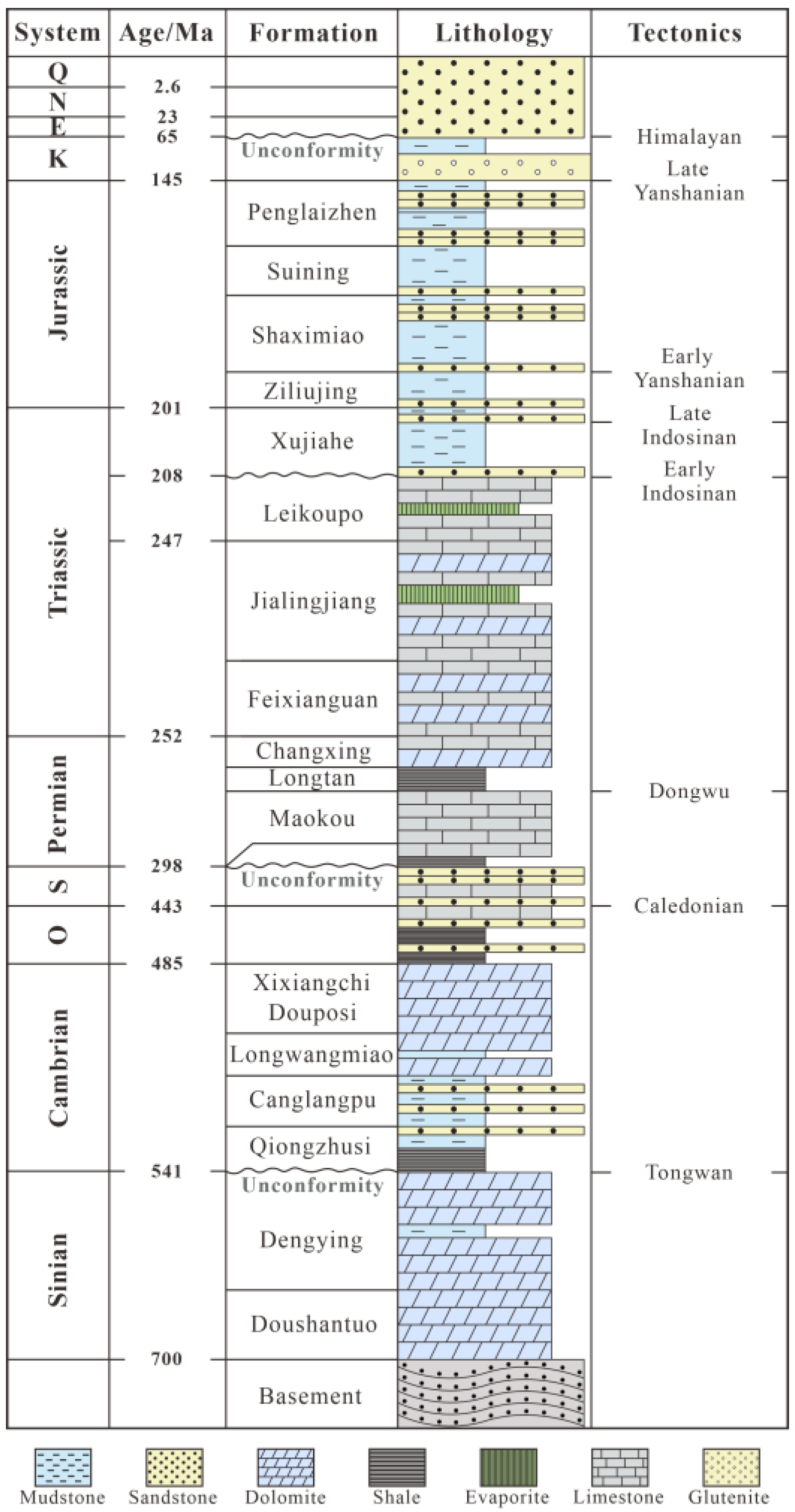
Figure 2. Generalized comprehensive stratigraphic framework in the Sichuan Basin showing lithology and main tectonic movements. (modified after [14]).
Minerals 15 01269 g002
Figure 3. Thickness map of Qiongzhusi source rocks in the northwestern-central Sichuan Basin (modified after [20]).
Minerals 15 01269 g003
Figure 4. Typical reservoir core and microscopic characteristics of Longwangmiao Formation in the Penglai area, central Sichuan Basin. (a,b) Transmitted-light and Reflected-light photomicrographs showing dissolution pores fully occluded by dolomite, bitumen, and pyrite. Sample from Well PS10 at 6271 m. (c,d) Transmitted-light and Reflected-light photomicrographs showing dissolution pores partially occluded by dolomite and bitumen. Sample from Well PS104 at 5937 m. (e,f) Transmitted-light and Reflected-light photomicrographs showing bitumen filling the remaining pores among quartz cement. Sample from Well PS10 at 6271 m. (g,h) Transmitted-light and Reflected-light photomicrographs showing dissolution pores fully occluded by dolomite and bitumen. Sample from Well PS104 at 5891 m. (i) Core photograph showing dissolution pores filled with bitumen. Sample from Well PS104 at 5930 m. (j) Core photograph showing dissolution pores filled with bitumen and pyrite. Sample from Well PS11 at 6730 m. (k) Core photograph showing dissolution pores filled with bitumen. Sample from Well PS9 at 6320 m. (l) Core photograph showing dissolution pores filled with quartz and bitumen. Sample from Well LT1 at 5472 m.
Minerals 15 01269 g004
Figure 5. Typical fluid inclusions and Laser Raman spectral signatures in the Longwangmiao Formation, Penglai gas-bearing area. (a,b) Raman spectrum showing gas inclusions containing bitumen. Sample from Well PS104 at 5894 m. (c,d) Raman spectrum showing bitumen inclusions. Sample from Well LT1 at 5475 m. (e,f) Raman spectrum showing gas inclusions and gas-rich inclusions. Sample from Well PS104 at 5894 m. (g,h) Raman spectrum showing aqueous inclusions. Sample from Well PS104 at 5896 m.
Minerals 15 01269 g005
Figure 6. (a) Histograms showing the distribution of homogenization temperatures for fluid inclusions. (b) Histograms displaying the distribution of ice-melting temperatures for the fluid inclusions. (c) Plot of homogenization temperature versus salinity for coeval aqueous inclusions in the Longwangmiao Formation reservoir, Well PS104, Penglai gas-bearing area, central Sichuan Basin.
Minerals 15 01269 g006
Figure 7. Thermal Evolution Modeling Results of Structural Units in the central Sichuan Basin.
Minerals 15 01269 g007
Figure 8. (a) Burial-Thermal history in Well PS104 in the north slope of paleo-uplift in the central Sichuan Basin. (b) Burial-Thermal history in Well PS9 in the north slope of paleo-uplift in the central Sichuan Basin.
Minerals 15 01269 g008
Figure 9. Hydrocarbon generation history of the Qiongzhusi source rocks in Well PS104 in the north slope of paleo-uplift, central Sichuan Basin.
Minerals 15 01269 g009
Figure 10. Burial-Thermal history in Well PS104 in the north slope of paleo-uplift in the central Sichuan Basin.
Minerals 15 01269 g010
Figure 11. Hydrocarbon evolution of the Sinian-Lower Paleozoic sequences in the slope of paleo-uplift, central Sichuan Basin.
Minerals 15 01269 g011
Disclaimer/Publisher’s Note: The statements, opinions and data contained in all publications are solely those of the individual author(s) and contributor(s) and not of MDPI and/or the editor(s). MDPI and/or the editor(s) disclaim responsibility for any injury to people or property resulting from any ideas, methods, instructions or products referred to in the content.