Article

Phase Transformation of the Analytic Signal for Enhancing the Resolution of Potential Field Data †

by
Saulo Pomponet Oliveira
1,*,
Milton José Porsani
2,
Maximilian Fries
3 and
Marieli Machado Zago
4
1
Departmento de Matemática, Universidade Federal of Paraná, Curitiba 81531-980, Brazil
2
Centro de Pesquisa em Geofísica e Geologia, Universidade Federal da Bahia, Salvador 40170-290, Brazil
3
Laboratório de Geofísica Aplicada, Universidade Federal do Pampa, Caçapava do Sul 96570-000, Brazil
4
Programa de Pós-Graduação em Geologia, Universidade Federal of Paraná, Curitiba 81531-980, Brazil
*
Author to whom correspondence should be addressed.
This article is a revised and expanded version of a paper entitled [Phase transformations of the analytic signal—application to aeromagnetic data from Jinchuan sulfide deposit, China], which was presented at 6th Conference on Geophysics for Mineral Exploration and Mining, Naples, Italy, 7–11 September 2025.
Minerals 2025, 15(12), 1266; https://doi.org/10.3390/min15121266
Submission received: 6 November 2025 / Revised: 23 November 2025 / Accepted: 27 November 2025 / Published: 29 November 2025
(This article belongs to the Special Issue Feature Papers in Mineral Exploration Methods and Applications 2025)

Abstract

Enhancement methods based on first-order derivatives are well established tools for gravity and magnetic data processing. Higher-resolution filters have been developed using high-order derivatives, but they are generally more sensitive to noise. Based on a transformation that sharpens the instantaneous phase of the complex analytic signal, which corresponds to the tilt angle map, we obtain an enhancement filter that improves the resolution of the total horizontal gradient (THG) without the need for additional derivative calculations. The steps of the proposed method are as follows: (1) compute the horizontal and vertical derivatives of the data; (2) compute the tilt angle and the analytic signal amplitude; (3) apply a sigmoidal-type transformation to the tilt angle; and (4) reconstruct the THG from the analytic signal amplitude and the transformed tilt angle. The reconstructed THG provides sharper boundary estimates than the true THG, as qualitatively shown with noise-corrupted synthetic data and aeromagnetic data from the Seival copper mining area in Caçapava do Sul, Brazil.

1. Introduction

The complex analytic signal is a theoretical concept that is useful in geophysical data processing. In the context of seismic methods, the analytic signal of a seismic trace can provide information on the reflection strength and the instantaneous phase [1]. For gravity and magnetic data, the complex analytic signal is usually defined from horizontal derivatives of the anomalous field [2,3]. Its amplitude and instantaneous phase, which are known as the analytic signal amplitude [4] and the tilt angle [5], respectively, are well-known enhancement filters.
Porsani and Ursin [6] have recently proposed a transformation that sharpens the instantaneous phase of the analytic signal, improving the temporal and spatial resolution of reflections in seismic traces (see also [7]). We noted that this transformation is effective for potential field maps as well.
In fact, the transformed instantaneous phase turns out to enhance the tilt angle filter. Enhancements of the tilt angle have been previously obtained, e.g., by multiplicative factors [8,9] or when the horizontal tilt angle [10] and the tilt angle are combined [11]. The novelty of our work is to use the transformed tilt angle to reconstruct the components of the complex analytic signal, namely the vertical derivative [12] and the total horizontal gradient [13,14]. The resolution of the latter was significantly improved by the phase transformation, and is comparable to enhancements of the total horizontal gradient based on high-order derivatives, such as the enhanced horizontal derivative [15,16], the tilt angle of the horizontal gradient [17] and nonlinear transformations of this filter [18,19,20,21,22], the enhanced horizontal gradient amplitude [23], and the modified horizontal gradient amplitude [24].
To test the proposed methodology, we consider an example with synthetic anomalies generated by interfering sources and corrupted with Gaussian noise. Moreover, to illustrate its potential for processing potential field data in the context of mineral exploration, we employ aeromagnetic data from a copper mineralization area near Caçapava do Sul, southern Brazil. In both synthetic and field examples, the reconstructed total horizontal gradient provides sharper boundary estimates than the true one.

2. Method

Let us recall that Roest et al. [4] defined the analytic signal for potential field data f = f ( x , y , z ) as follows (see also [3,25]):
AS = ( f x , f y , i f z ) ,
whose amplitude and instantaneous phase are
A = f x 2 + f y 2 + f z 2 , θ = tan 1 f z f h f h = f x 2 + f y 2 .
The analytic signal may be written in terms of A and θ as
AS = A ^ h f cos θ + i sin θ k , ^ h f = 1 f h h f ,
where h f = f x i + f y j is the horizontal gradient and i , j , k are unit vectors in the positive x-, y-, and z-directions, respectively. Regarding the analytic signal components,
f z = A sin ( θ ) , h f = A ^ h f cos ( θ ) .
The maps of A and θ in Equation (2) are very popular enhancement filters in potential field data processing, being known as the analytic signal amplitude (ASA) and the tilt angle (TA), respectively. The former is known for being independent of the magnetization direction for tabular sources (but not in general for 3D sources [26]), while the latter highlights the centers of the sources when applied to gravity or reduced-to-the pole (RTP) magnetic data and equalizes anomalies from shallow and deep sources [5,17,27]. Moreover, f h is the horizontal gradient magnitude, or total horizontal gradient (THG), which is helpful in delineating source boundaries in the cases of gravity or RTP magnetic data [28].
Similarly to [6], we transform the instantaneous phase as follows:
θ ˜ = 1 2 π p α q α p α + q α , p = 1 + 2 θ π , q = 1 2 θ π ,
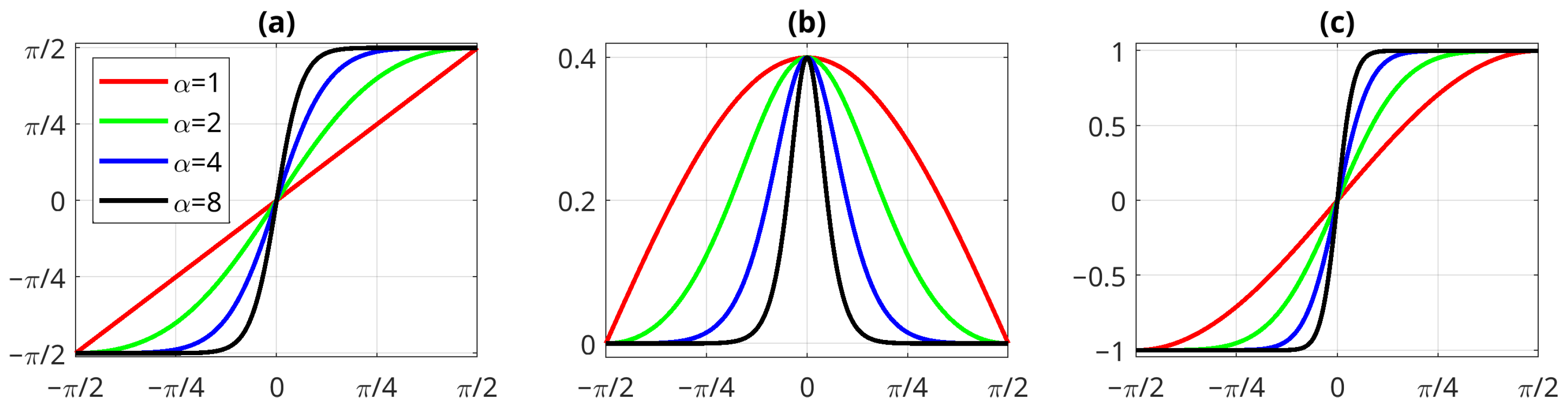
where the parameter α > 1 controls the degree of the phase transformation. As shown in Figure 1a, it is a sigmoid-type transformation where the higher the value of α , the sharper the transformed instantaneous phase θ ˜ is. If α = 1 , then θ ˜ = θ . The cosine and sine of θ ˜ , which are employed to reconstruct the analytic signal components in Equation (6), are shown in Figure 1b and Figure 1c, respectively. It is remarkable that the transformed cosine develops a peak at is maximum; this property will enhance the resolution of THG near its peaks.
As in Equation (4), we reconstruct the vertical derivative f z and the horizontal gradient h f as follows:
f ˜ z = A sin ( θ ˜ ) , ˜ h f = A ^ h f cos ( θ ˜ ) .
Moreover, as | ^ h f | = 1 , it readily follows that the reconstructed THG (rTHG) is
f ˜ h = | ˜ h f | = A cos ( θ ˜ ) .
In summary, we compute the rTHG from a potential field data f and a phase transformation parameter α using the following steps:
  • compute the horizontal and vertical derivatives of the data, f x , f y , and f z ;
  • compute TA and ASA, Equation (3);
  • compute the transformed instantaneous phase θ ˜ from TA, Equation (5);
  • reconstruct the THG from ASA and the transformed TA, Equation (7).
We compute the x- and y-derivatives with centered finite differences in the spatial domain [14], while the vertical derivative (VDR) is computed in the wavenumber domain ([29], p. 326). As we aim to emphasize noise sensitivity, we do not employ any regularization or filtering in our calculations.

3. Results and Discussion

3.1. Synthetic Data

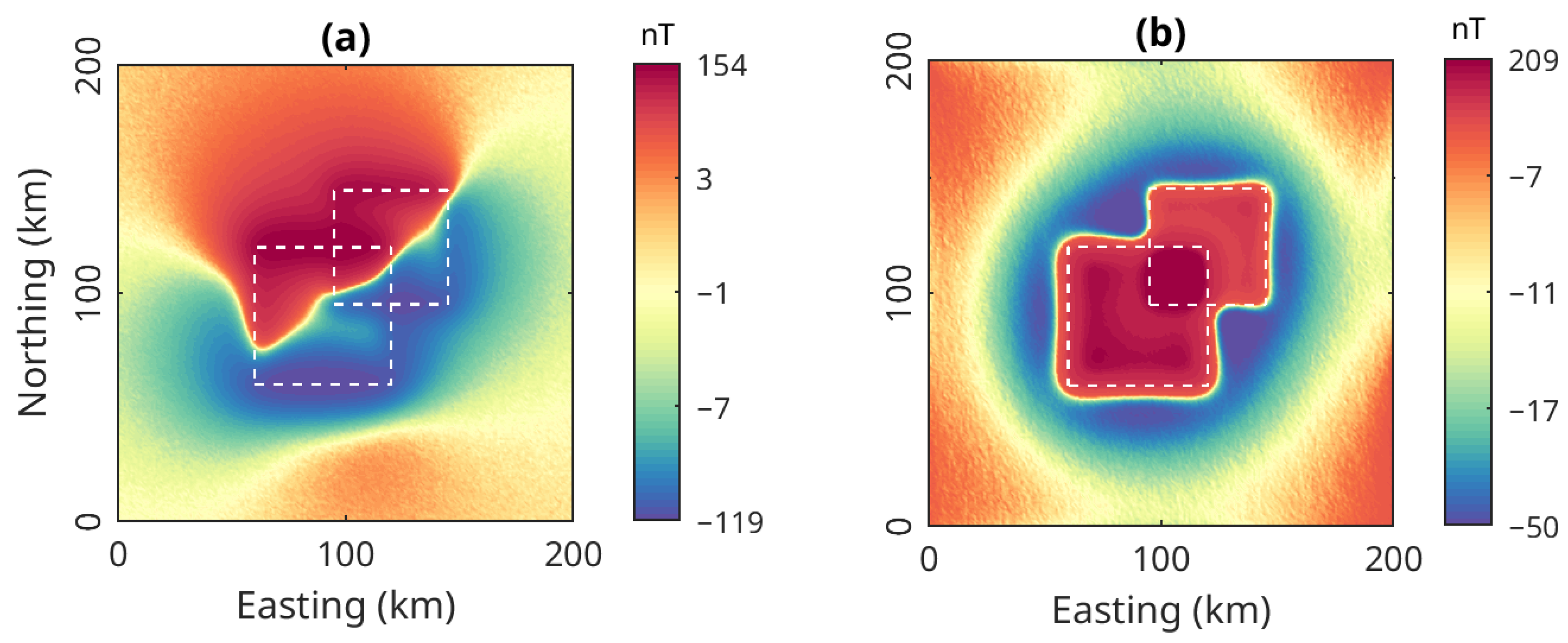
We illustrate the proposed approach with a synthetic example from [30]. The theoretical model consists of two magnetic prisms defined by the parameters shown in Table 1. Figure 2a shows the total-field anomaly with declination D = 13 . 6 , inclination I = 37 . 2 , and grid spacing Δ x = Δ y = 1 km, contaminated with Gaussian random noise with a standard deviation corresponding to 1% of the maximum absolute value of the anomaly. Afterwards, we apply the RTP transformation to these data (Figure 2b).
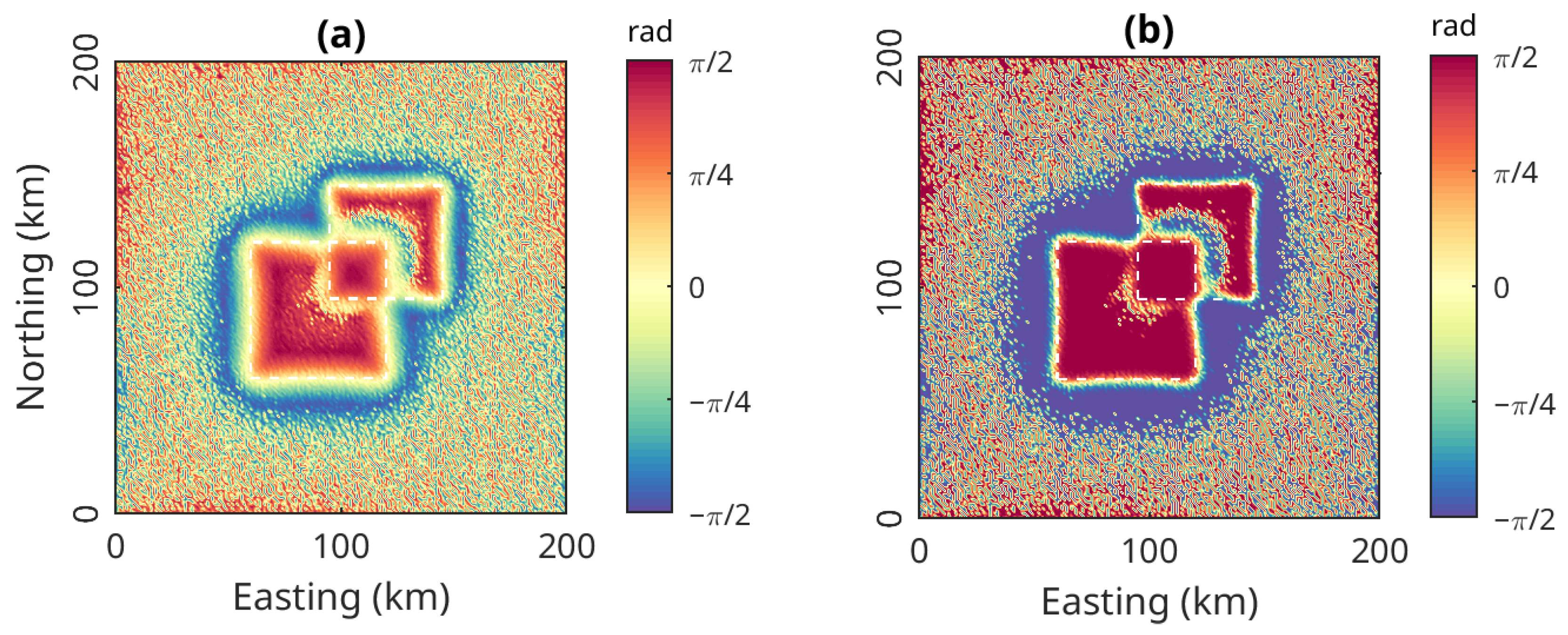
The original TA and transformed TA of the RTP data are shown in Figure 3. Both maps are dominated by noise around the sources, but the transformed TA (Figure 3b) is sharper.
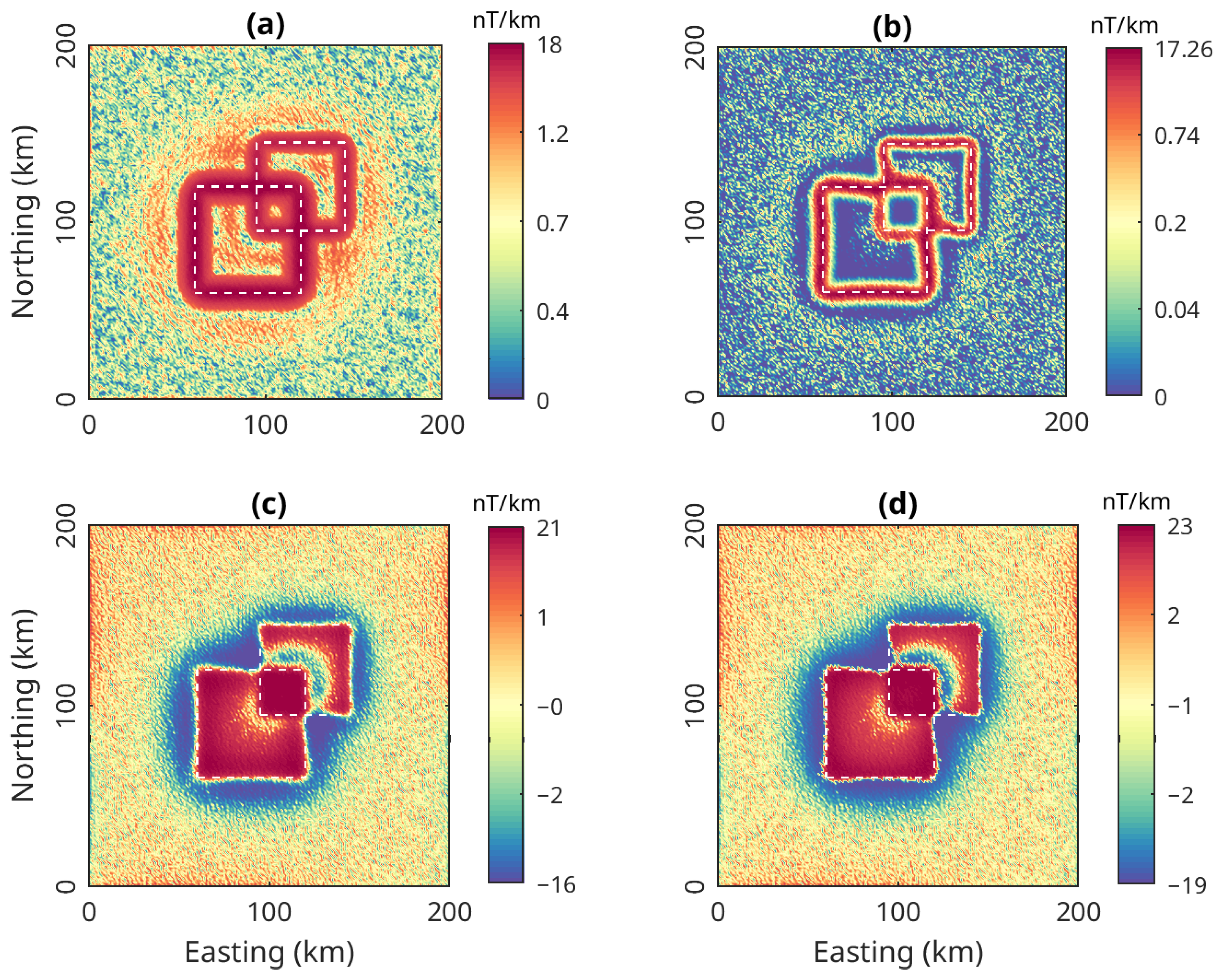
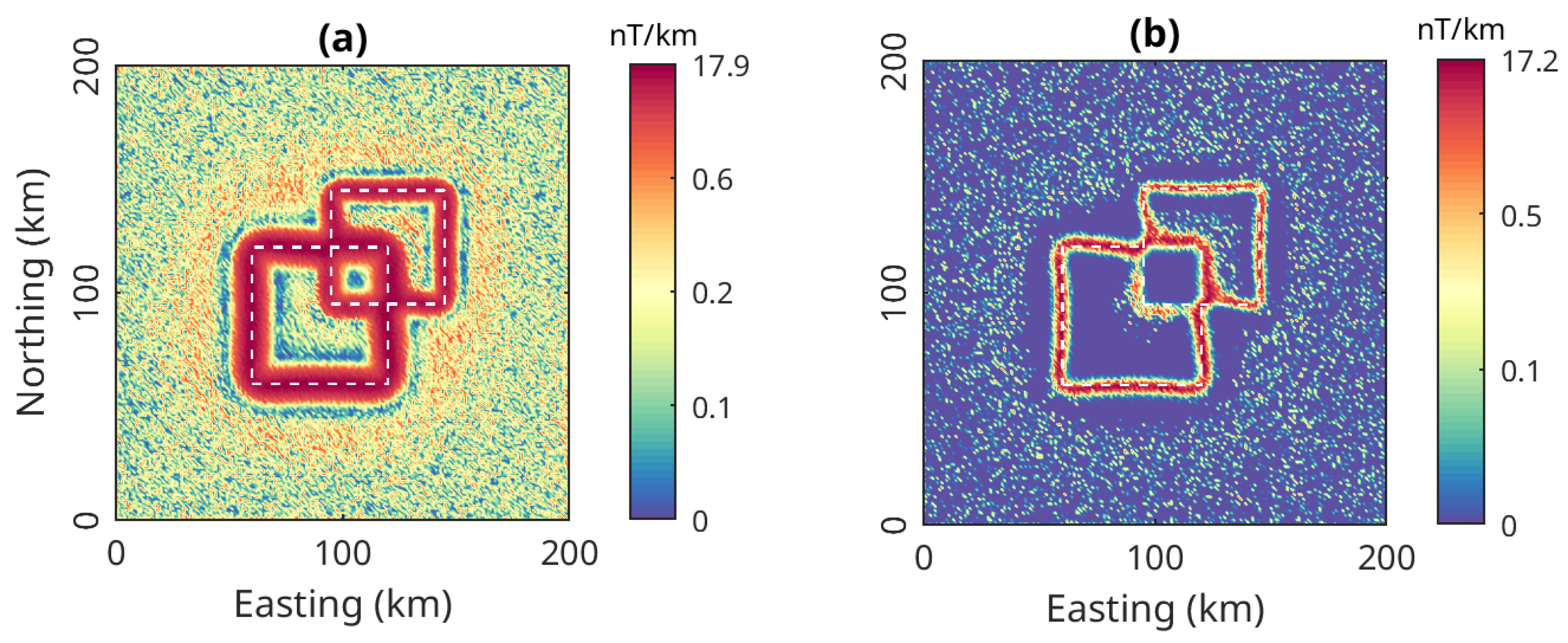
Figure 4 shows the original and transformed horizontal ( f h and f ˜ h ) and vertical ( f z and f ˜ z ) derivatives of the noisy data. The VDR is not significantly changed by the phase transformation, but a sharper map is obtained for THG, Figure 4b, which can be compared with the transformation with different values of the parameter α (Figure 5). In particular, Figure 5b represents a substantial improvement of the f h map, both in terms of resolution and signal-to-noise ratio.
For the sake of comparison, we present enhanced maps obtained by two high-order methods, the enhanced horizontal derivative (EHD) and the modified horizontal gradient amplitude (MHGA). We have chosen these approaches as they have the same purpose as rTHG, namely the improvement of the THG method. We implemented the EHD as follows:
EHD = ϕ x 2 + ϕ z 2 , ϕ = i = 0 m w i i f z i .
We use w i = k i as in [16], where k equals to the grid spacing [30], and consider the order m = 4 . The MHGA is defined as
MHGA = | R + 1 | | R 1 | 2 , R = f h z f h x 2 + f h y 2 π 3 ,
where f h x , f h y , and f h z are the derivatives of THG in the x-, y- and z- directions, respectively [24].
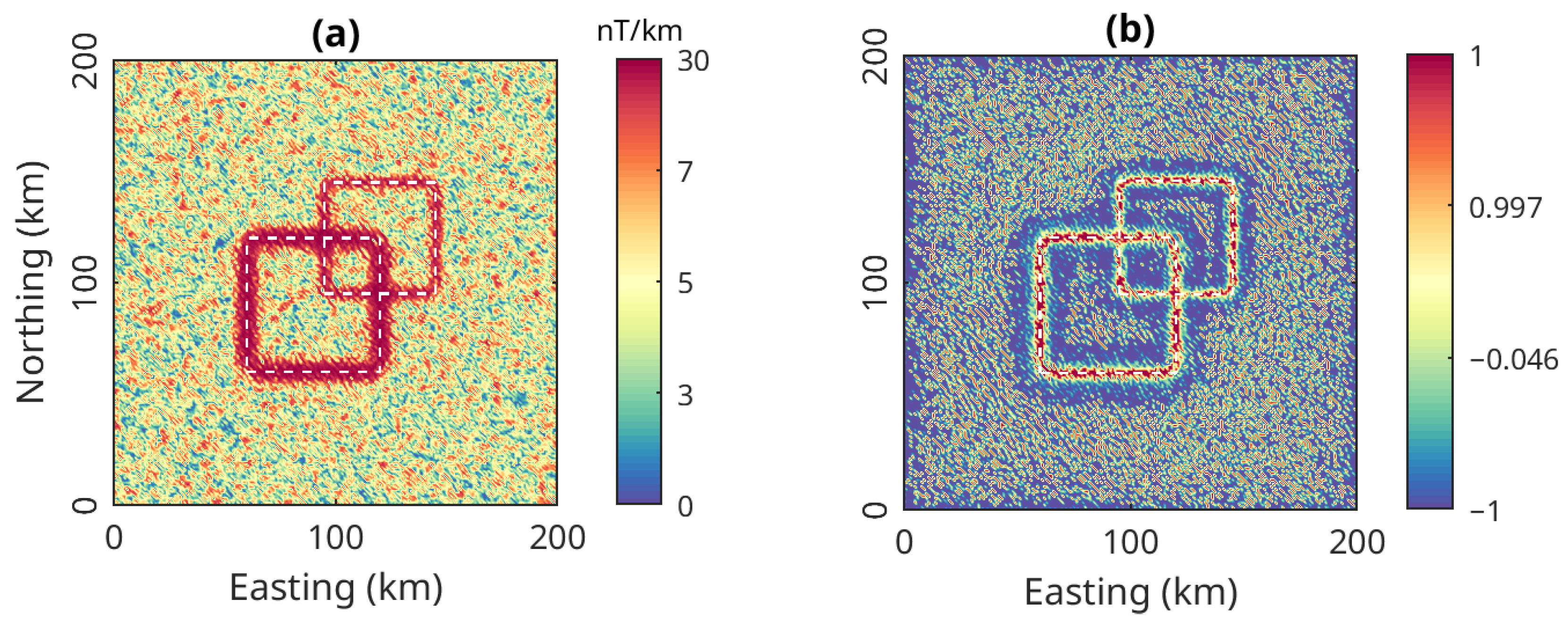
The maps of EHD and MHGA, shown in Figure 6, are comparable to the rTHG maps, especially those in Figure 4b and Figure 5b. The higher order of these filters leads to more accurate edges than rTHG, but they are more sensitive to noise. In fact, they depend on stable vertical differentiation [15,31] of prior data filtering [32,33,34] to reduce the noise sensitivity.
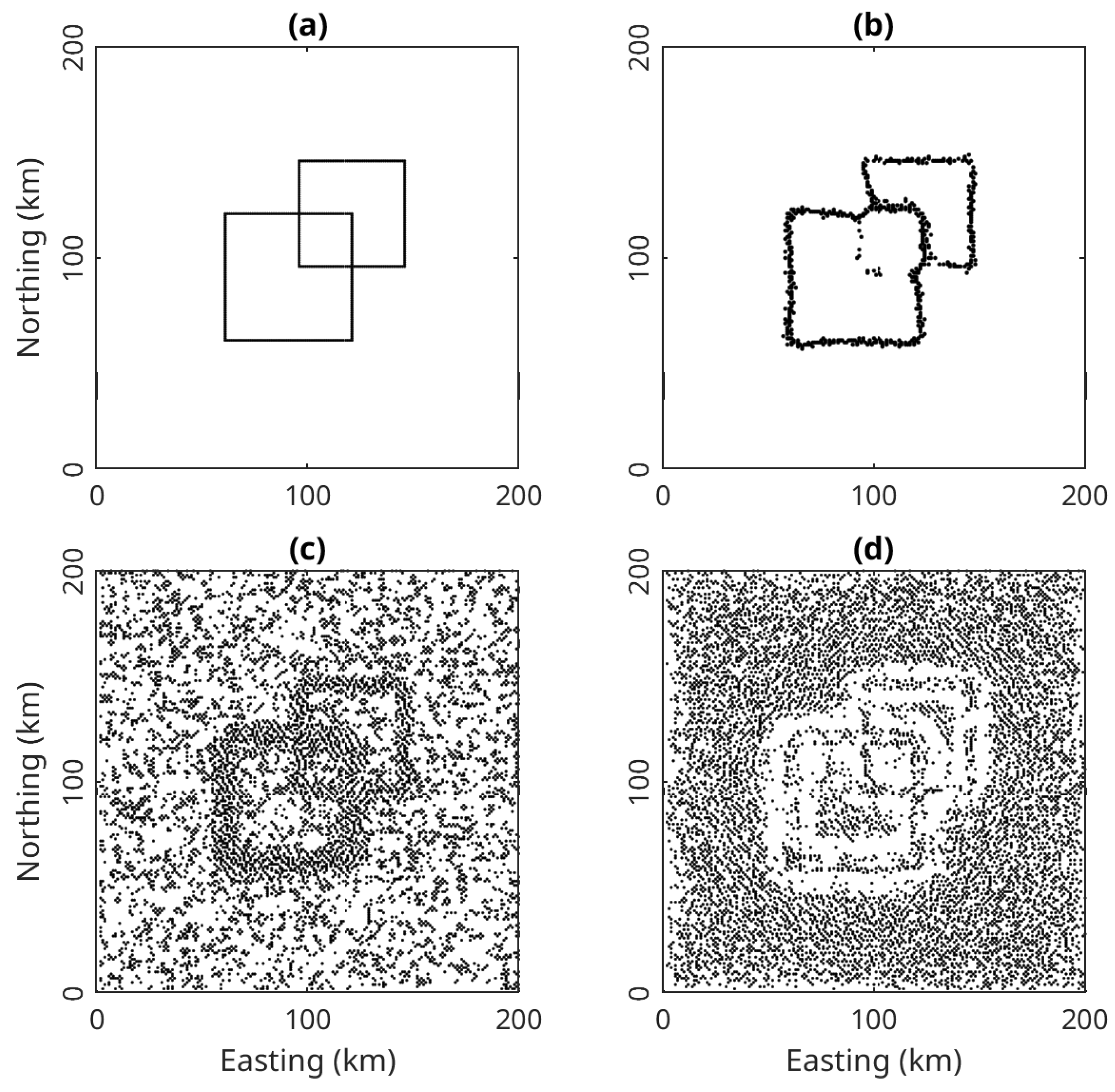
To have an accuracy measure of a given enhancement map, we generate a binary map from its peaks and compute the RMS error of this map with respect to the binary map containing the true edges (Figure 7a).
Similarly to [35], we select the peaks at grid points ( x i , j , y i , j ) where the enhancement map value z i , j satisfies at least two of the following four conditions,
z i , j > z i 1 , j and z i , j > z i + 1 , j , z i , j > z i 1 , j + 1 and z i , j > z i + 1 , j 1 , z i , j > z i , j 1 and z i , j > z i , j + 1 , z i , j > z i + 1 , j + 1 and z i , j > z i 1 , j 1 ,
In addition, z i , j must be greater than 25% of the global maximum. The selected peaks of rTHG with α = 8 , EHD, and MHGA are shown in Figure 7b–d, and their RMS errors are 0.0640, 0.1794, and 0.2096, respectively. An acceptable value of the RMS error should be less than the error of a blank (null) binary map, which is 0.0712.
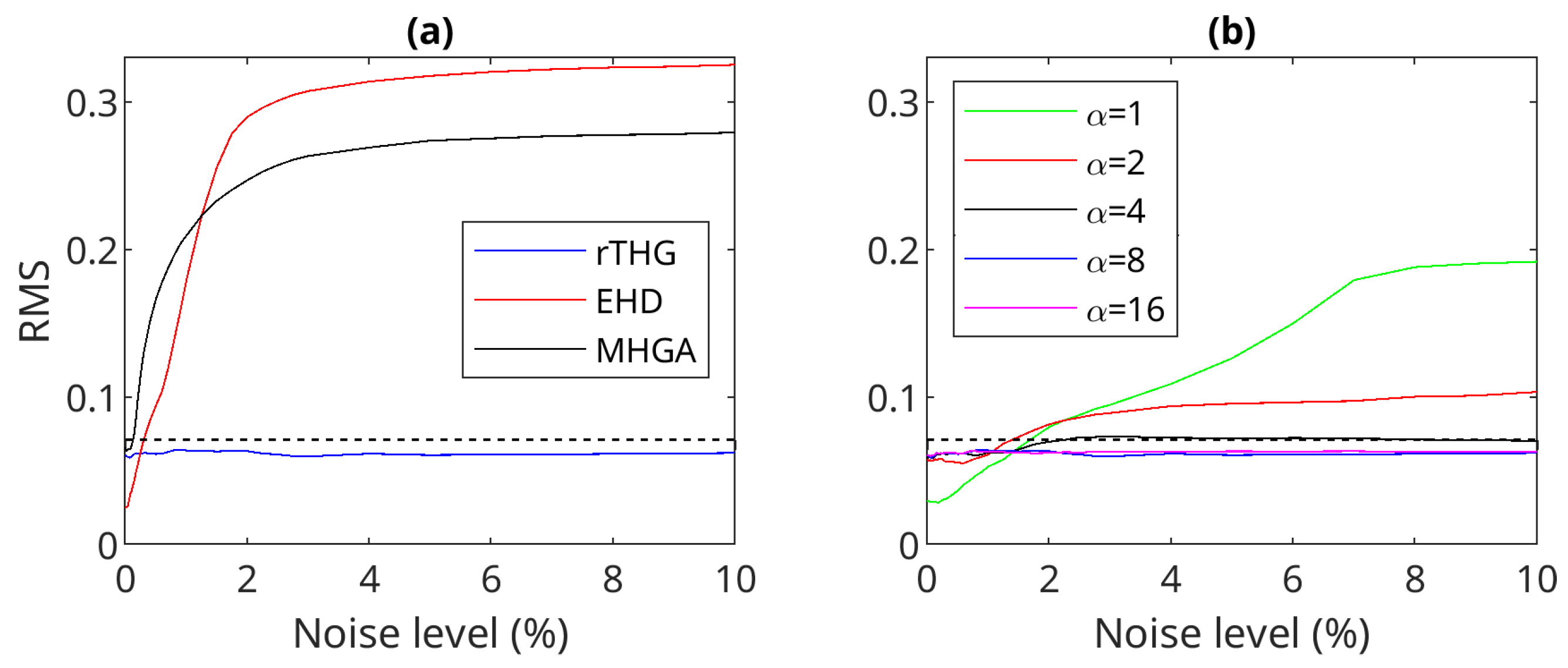
We study the dependence of the RMS error on the data noise level in Figure 8. The data are contaminated with Gaussian random noise with standard deviation varying from 0% to 10% of the maximum absolute value of the anomaly. Figure 8a compares the rTHG with α = 8 with EHD and MHGA. The RMS errors of the latter two are lower than the one of rTHG in the absence of noise, but they quickly increase beyond the reference value 0.0712 as the noise increases, while the RMS error of rTHG is less sensitive to noise. Figure 8b illustrates the dependence of the RMS error on the phase transformation parameter α , showing that α > 2 provides qualitatively accurate results.

3.2. Field Data

3.2.1. Magnetometric Database

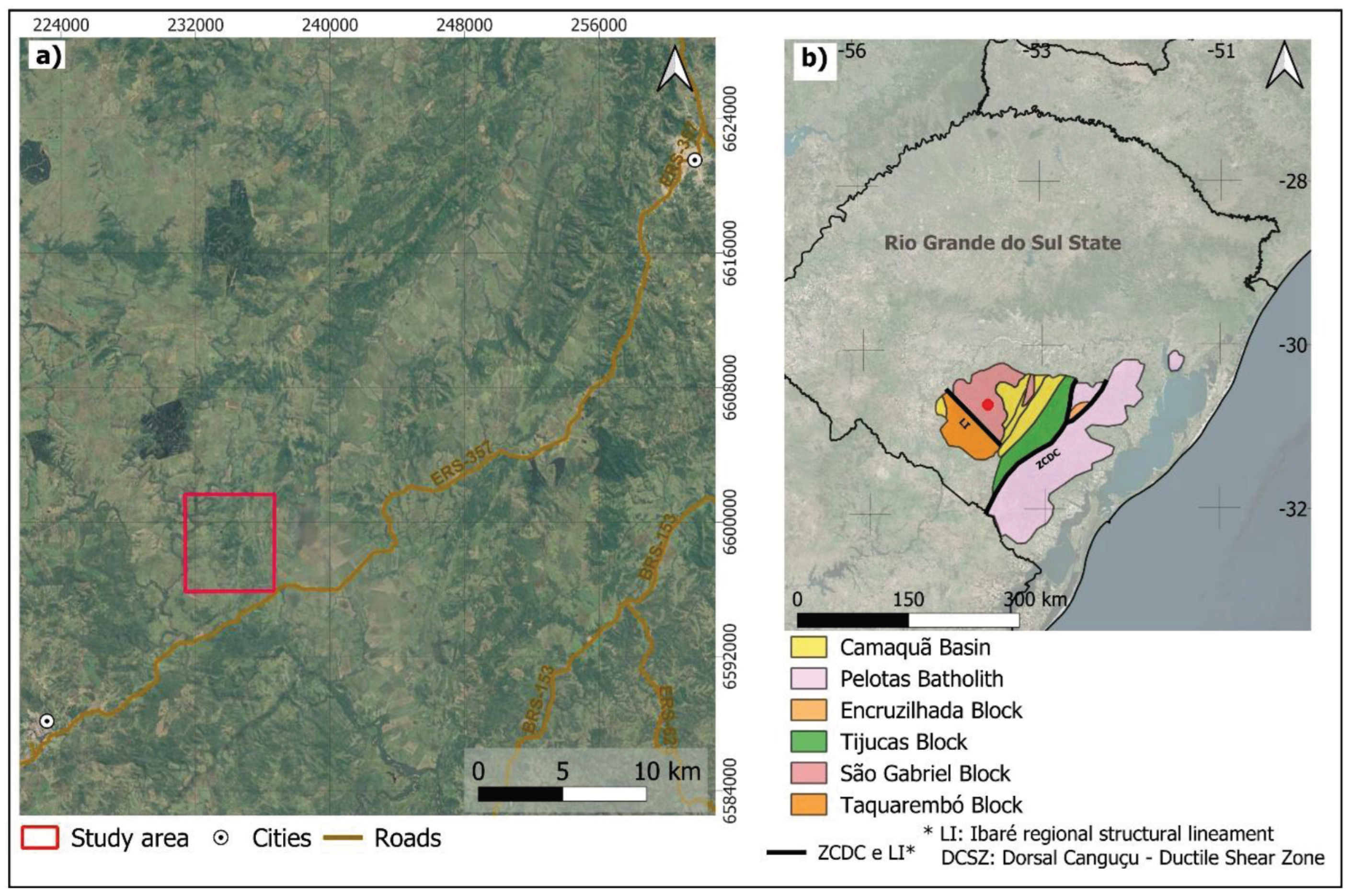
The proposed approach has also been tested with aeromagnetic anomalies from the Seival mining area, in Caçapava do Sul, Brazil, which were the object of study in [36]. The primary objective of that study was to investigate the geophysical signature of copper mineralization within volcanic rocks of the Hilário Formation, situated in the Lavras do Sul and Caçapava do Sul regions of Rio Grande do Sul state, Brazil (Figure 9a). The analysis focused on understanding the subsurface distribution and geometry of mineralized bodies through 3D inversion of aeromagnetic data.

3.2.2. Geological Settings

The geological setting and lithologies are situated in the southern portion of the Mantiqueira Province [38,39], commonly referred to as the Southern Rio Grande Shield (SRGS). The SRGS encompasses geological units that form part of the Dom Feliciano Belt, which was established during the Neoproterozoic. It is represented by the São Gabriel and Tijucas terranes, as well as the Pelotas Batholith. Paleoproterozoic units are also present, including the Taquarembó and Tijucas terranes [37] (Figure 9b).
São Gabriel Terrane, which hosts the study area, is notable as an accretionary prism, characterized by petrotectonic associations typical of passive margin and back-arc environments. It includes ophiolites, volcanic–sedimentary sequences, and plutonic magmatic arcs [37]. Zircon ages, determined using TIMS and SHRIMP methods, range from 735 to 680 Ma [40,41,42].
Additionally, the region hosts a suite of sedimentary and volcanogenic units formed in elongated tectonic basins, dated to the late Neoproterozoic and early Paleozoic. These basin deposits consist of thick successions of conglomerates, sandstones, and shales, developed in continental, coastal, and marine environments. They are frequently associated with volcanogenic rocks of alkaline affinity. These sequences, known as the Camaquã Basin, overlie the Precambrian basement and are predominantly composed of siliciclastic and volcanogenic rocks [39,43].

3.2.3. The Seival Copper Mining Area

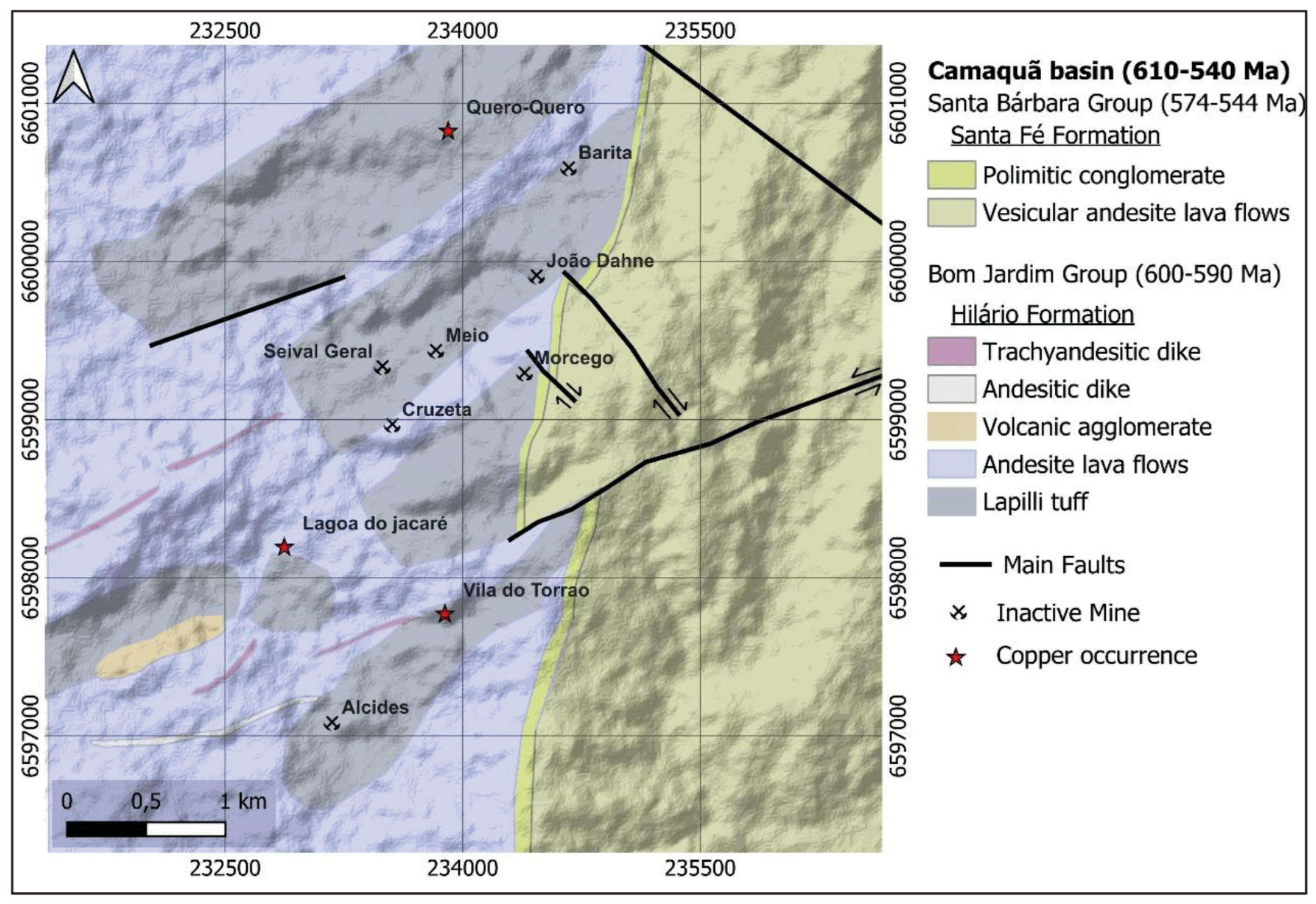
The mining area is located in a region that gained prominence in the early 20th century due to the Seival Mine, which played a significant role in copper production in southern Brazil. Currently, the deposit is considered economically exhausted due to the high concentration of oxidized copper. The region also contains records of several formerly exploited, now inactive mines, as well as mineral occurrences known as Quero-Quero, Lagoa do Jacaré, and Vila do Torrão [44] (Figure 10).
Reischel [46] and Lopes [47] provided detailed descriptions of the inactive mines:
  • Barita Mine: The largest of the mines, consisting of a lenticular body oriented NE. It contains chalcocite associated with fault zones, with estimated reserves of approximately 64,000 tons and a copper grade of 1.7%;
  • João Dahne Mine: A small body also oriented NE, but with low copper grades;
  • Morcego Mine: Characterized by disseminated sulfides (chalcocite and malachite), with NS and NE orientations, located near fracture zones in andesite;
  • Meio Mine: Displays irregular concentrations of malachite, tectonically controlled by a fracture pattern in andesitic tuff, with NS–NE orientations and a steep SW dip;
  • Cruzeta Mine: Defined by the presence of chalcocite in veins along fractures in porphyritic andesite, with NW orientations and subvertical dip;
  • Alcides Mine: Composed of disseminated sulfides (chalcocite) within volcanic breccias, with barite as the gangue mineral.

3.2.4. Airborne Data—Main Characteristics

The aerogeophysical database used in this study, compiled by [36], consists of aeromagnetic and gamma-ray spectrometric data acquired during the Primavera Project, carried out in 2010. Data acquisition and initial processing were performed by LASA Prospecções S.A. The project area is located in the southernmost region of Brazil, covering the municipalities of Caçapava do Sul and Lavras do Sul, with a total survey coverage of approximately 12,681 km2. The technical parameters applied in the aerogeophysical survey were as follows:
  • Flight lines direction: N14W;
  • Flight lines spacing: 200 m;
  • Flight average altitude: 100 m.
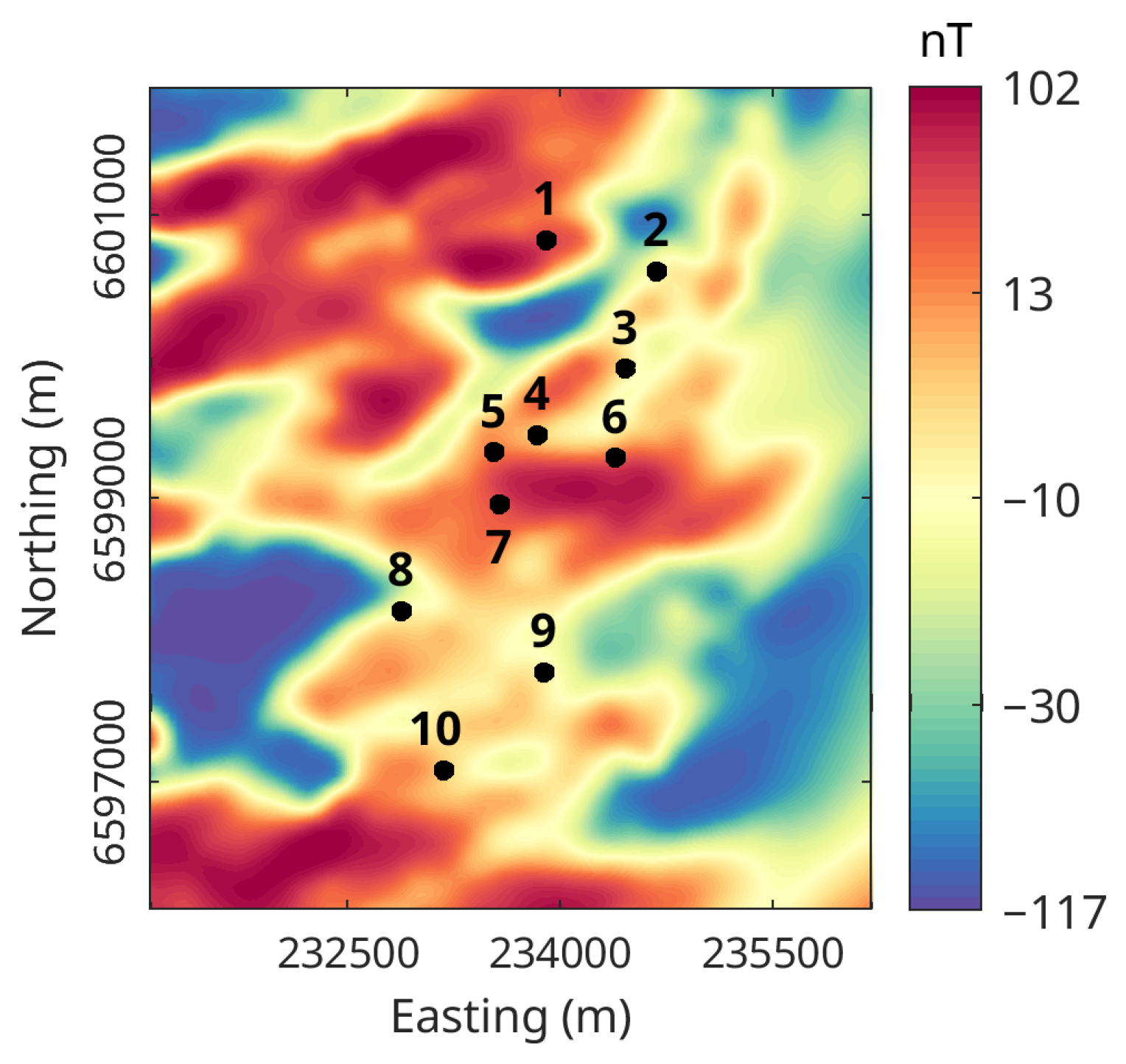
The RTP total-field anomaly was interpolated to a rectangular grid with spacing Δ x = Δ y = 50 m by a least-squares interpolation using finite elements with B-splines [48] and is shown in Figure 11, where the copper mines and occurrences are numbered according to Table 2.

3.2.5. Phase Transformation of the Analytic Signal

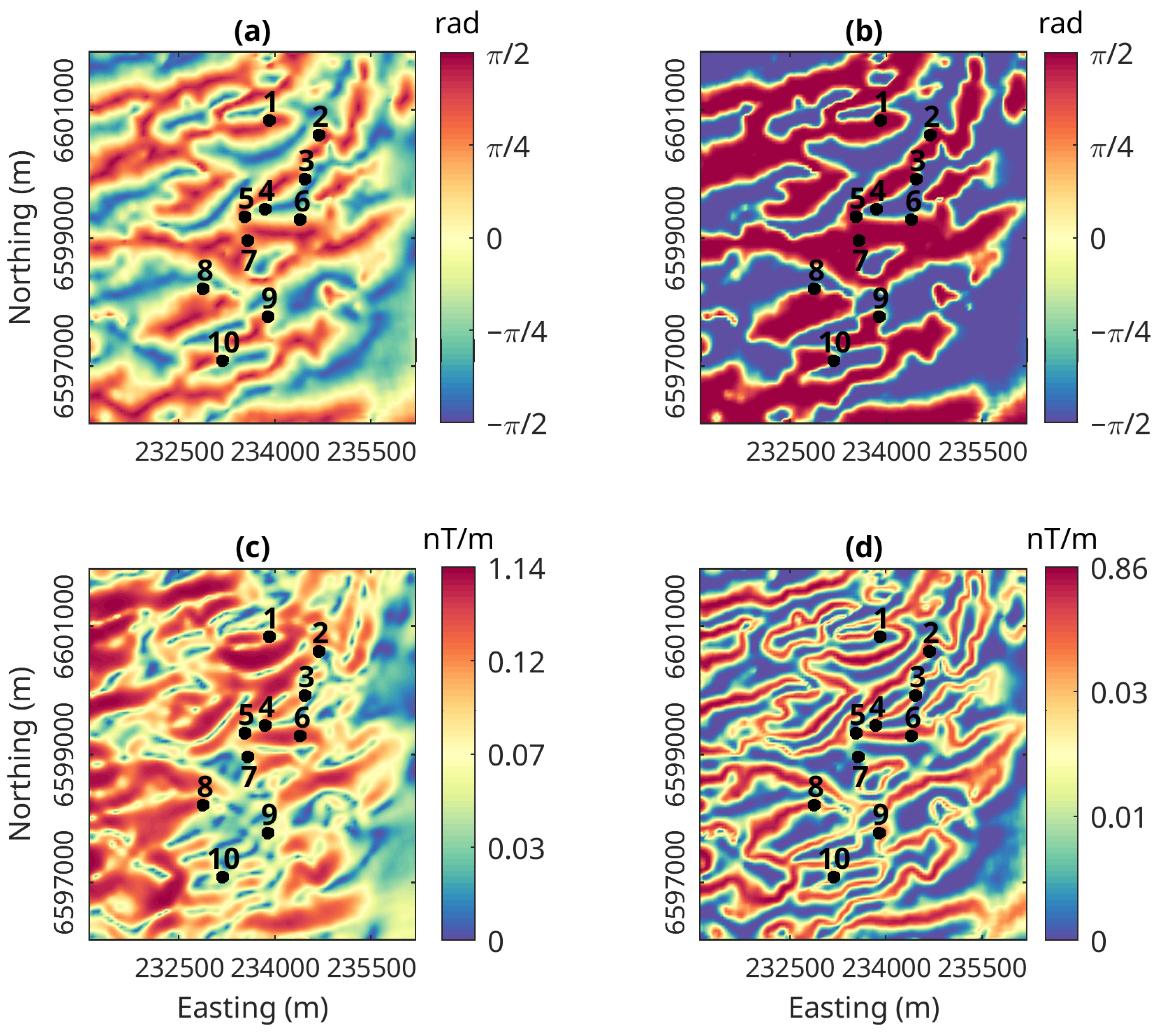
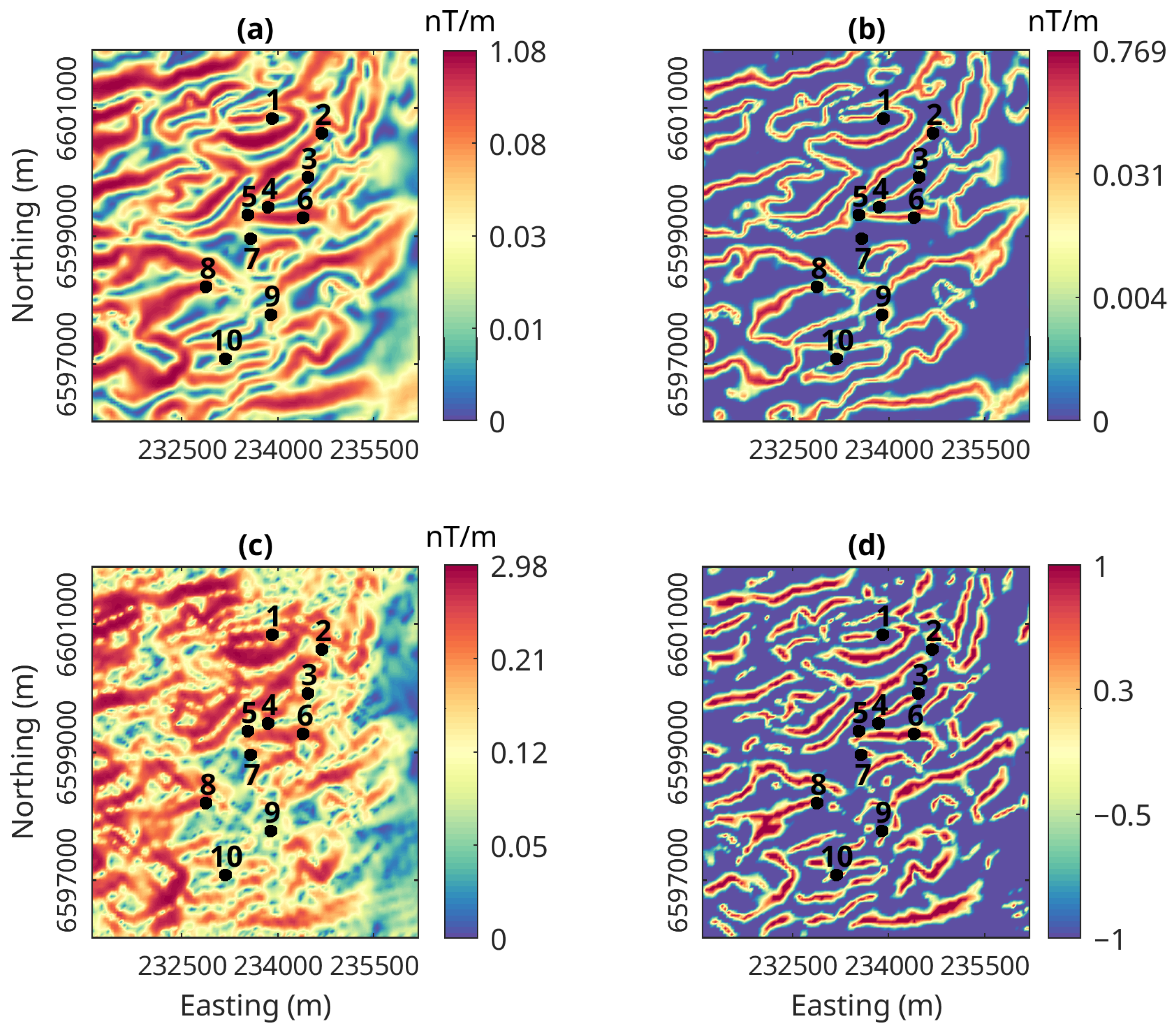
The original TA and THG maps of the aeromagnetic data are shown in Figure 12a,c, whereas the corresponding reconstructed maps using α = 4 are shown in Figure 12b,d. Figure 13a,b show the rTHG maps with α = 2 ,   8 , as in the synthetic data, while Figure 13c,d show the EHD and MHGA maps (Equations (8) and (9), respectively).
The MHGA map (Figure 13d) is the sharpest one, but the anomalies have low lateral continuity and there are some high-frequency anomalies. The EHD map (Figure 13c) shows higher continuity at the peaks but is more affected by noise. On the other hand, the rTHG maps (Figure 12d and Figure 13c,d) were not significantly affected by high-frequency content and showed high continuity, making the boundaries highlighted by standard THG clearer (Figure 12c).
Regarding the copper mineralization sites, the transformed tilt angle map (Figure 12b) was able to delimit most of them in the same positive anomalous area, whereas the remaining ones are in adjacent positive anomalies. Furthermore, they are concentrated at the edges of the anomalies as shown in the rTHG with α = 8 (Figure 13b), where the lateral continuity of the edges is a great aid to visualization. The edges of the high-order filters (Figure 13c,d) are also correlated with the mineralization occurrences. In particular, Cruzeta Mine (number 7) is more clearly linked to an edge than in the rTHG map of Figure 13b.

3.2.6. Analysis and Comparison with Geological and Structural Data

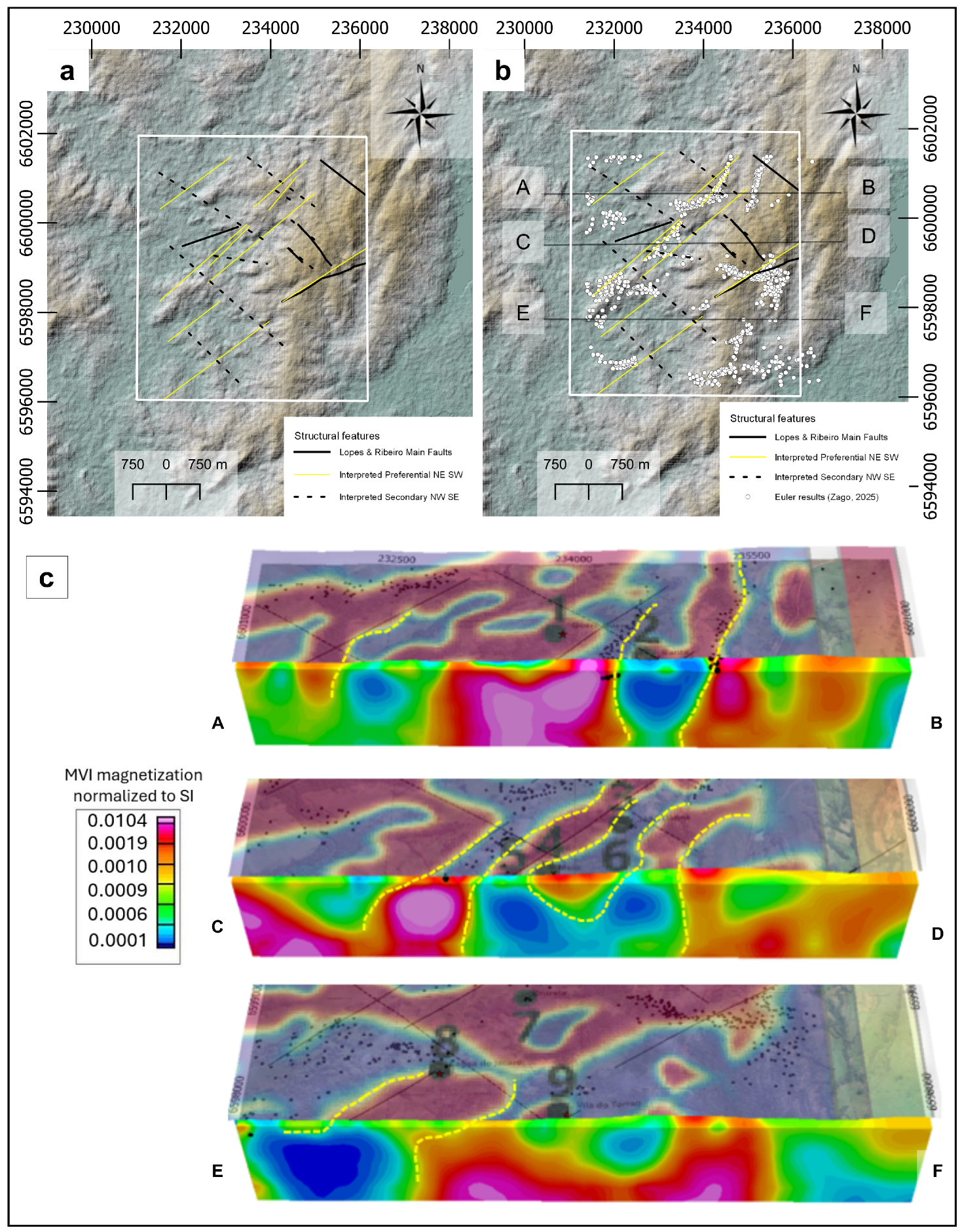
The results obtained from the phase transformation of the analytic signal (Section 3.2.5) were integrated with direct field data, including geological information and the main structures described in [36]. The filters rTHG with α = 4 (Figure 12d), rTHG with α = 8 (Figure 13b), and MHGA (Figure 13d) enabled the comparison of the interpreted discontinuities and alignments. Furthermore, the method provides a significant contribution to the analysis and interpretation, enhancing the detection of anomalies’ limits when compared with the TA and ASA maps reported in [36] (Figure 14a).
When comparing the Euler results with the filters proposed herein, it becomes evident that the main occurrences are concentrated along the borders of the strong anomalies, corroborating the genetic mineralization model, which proposes that the main occurrences develop in hydrothermal systems where magnetization is subtle due to alteration processes (Figure 14b). This interpretation is supported by the results overlaid on the 3D magnetization vector inversion (MVI), which was applied using the same airborne database. Figure 14c presents three main generated profiles (A–B, C–D, and E–F), where limits of the reconstructed TA (Figure 12b) are clearly coincident with the limits observed in the MVI model. This approach assists in delineating structural boundaries at depth, as well as outlining mines 2, 4, 5, 6, and 9, proving effective when integrated with 3D models and Euler solutions for the detailed characterization of subsurface features.
The phase transformation of the analytic signal in an area with a recognized presence of mineralization (inactive mines), where structural controls play a major role in the distribution of mineral occurrences, supports previous research in the region that emphasized the importance of NE-trending faults as primary controls on copper mineralization and hydrothermal alteration. Moreover, this method provided a significant tool for analysis and interpretation, enhancing the delineation of anomaly magnitudes and limits.

4. Conclusions

We adapted a non-linear transformation of the phase of the analytic signal, which was originally proposed to seismic data, to potential-field data, and our results indicate that reconstructed THG obtained by the proposed transformation is a qualitative enhancement filter that is able to highlight anomaly boundaries, without using high-order derivatives. For field data, the known copper mineralization areas were highly correlated with the edges of rTHG.
Even though the rTHG can have very sharp boundaries, depending on the phase parameter α , we must keep in mind that it remains a first-order method; thus, higher-order approaches can delineate the edges more accurately, as shown in the synthetic results. The actual advantage of rTHG is its lower sensitivity to noise; thus, it constitutes an attractive choice when data smoothing or stabilized differentiation cannot be employed.

Author Contributions

Conceptualization, M.J.P.; methodology, M.J.P. and S.P.O.; software, S.P.O.; validation, S.P.O., M.F. and M.M.Z.; formal analysis, S.P.O.; data curation, M.F. and M.M.Z.; writing—original draft preparation, S.P.O. and M.F.; writing—review and editing, S.P.O., M.J.P., M.F. and M.M.Z. All authors have read and agreed to the published version of the manuscript.

Funding

This research was funded by National Council for Scientific and Technological Development—CNPq, grant number 306516/2024-1 and National Institute of Science and Technology of Petroleum Geophysics (INCT-GP/CNPq), Project number: 465517/2014-5.

Data Availability Statement

The data presented in this article are not readily available because the data are private, and the authors have had permission to use them in this work but not to distribute them. Requests to access the datasets should be directed to the corresponding author.

Acknowledgments

This article is a revised and expanded version of a paper entitled “Phase transformations of the analytic signal—application to aeromagnetic data from Jinchuan sulfide deposit, China” [49], which was presented at 6th Conference on Geophysics for Mineral Exploration and Mining, held in Naples (Italy) from 7 to 11 September 2025.

Conflicts of Interest

The authors declare no conflicts of interest. The funders had no role in the design of the study; in the collection, analyses, or interpretation of data; in the writing of the manuscript; or in the decision to publish the results.

Abbreviations

The following abbreviations are used in this manuscript:
ASAAnalytic signal amplitude
EHDEnhanced horizontal derivative
MHGAModified horizontal gradient amplitude
MVIMagnetization vector inversion
rTHGReconstructed total horizontal gradient
RTPReduced to the pole
TATilt angle
THGTotal horizontal gradient
VDRVertical derivative

References

  1. Taner, M.T.; Koehler, F.; Sheriff, R.E. Complex seismic trace analysis. Geophysics 1979, 44, 1041–1063. [Google Scholar] [CrossRef]
  2. Nabighian, M.N. The analytic signal of two-dimensional magnetic bodies with polygonal cross-section: Its properties and use for automated anomaly interpretation. Geophysics 1972, 37, 507–517. [Google Scholar] [CrossRef]
  3. Nabighian, M.N. Toward a three-dimensional automatic interpretation of potential field data via generalized Hilbert transforms: Fundamental relations. Geophysics 1984, 49, 780–786. [Google Scholar] [CrossRef]
  4. Roest, W.R.; Verhoef, J.; Pilkington, M. Magnetic interpretation using the 3-D analytic signal. Geophysics 1992, 57, 116–125. [Google Scholar] [CrossRef]
  5. Miller, H.G.; Singh, V. Potential field tilt—A new concept for location of potential field sources. J. Appl. Geophys. 1994, 32, 213–217. [Google Scholar] [CrossRef]
  6. Porsani, M.J.; Ursin, B. Signal Resolution Enhancement with a Non-Linear Phase Transformation. In Proceedings of the 85th EAGE Annual Conference & Exhibition, Oslo, Norway, 10–13 June 2024; EAGE: Bunnik, The Netherlands, 2024. [Google Scholar] [CrossRef]
  7. Porsani, M.P. Improving seismograms’ resolution by using a phase-shrinkage filtering method. Braz. J. Geophys. 2022, 40, 21–33. [Google Scholar] [CrossRef]
  8. Cooper, G.R.J. The downward continuation of the tilt angle. Surf. Geophys. 2016, 14, 385–390. [Google Scholar] [CrossRef]
  9. Pham, L.T. A stable method for detecting the edges of potential field sources. IEEE Trans. Geosci. Remote Sens. 2024, 62, 5912107. [Google Scholar] [CrossRef]
  10. Cooper, G.R.J.; Cowan, D.R. Enhancing potential field data using filters based on the local phase. Comput. Geosci. 2006, 32, 1585–1591. [Google Scholar] [CrossRef]
  11. Castro, F.R.; Oliveira, S.P.; de Souza, J.; Ferreira, F.J.F. Combining tilt derivative filters: New approaches to enhance magnetic anomalies. Rev. Bras. Geofísica 2018, 36, 335–343. [Google Scholar] [CrossRef][Green Version]
  12. Evjen, H.M. The place of the vertical gradient in gravitational interpretations. Geophysics 1936, 1, 127–136. [Google Scholar] [CrossRef]
  13. Cordell, L. Gravimetric expression of graben faulting in Santa Fe country and the Espanola Basin, New Mexico. In Guidebook to Santa Fe County: 30th Field Conference; Ingersoll, R.V., Ed.; New Mexico Geological Society: Socorro, NM, USA, 1979; pp. 59–64. [Google Scholar]
  14. Cordell, L.; Grauch, V.J.S. Mapping basement magnetization zones from aeromagnetic data in the San Juan Basin, New Mexico. In The Utility of Regional Gravity and Magnetic Anomaly Maps; Hinze, W.J., Ed.; SEG: Randwick, NSW, Australia, 1985; pp. 181–197. [Google Scholar] [CrossRef]
  15. Fedi, M.; Florio, G. Detection of potential fields source boundaries by enhanced horizontal derivative method. Geophys. Prospect. 2001, 49, 40–58. [Google Scholar] [CrossRef]
  16. Fedi, M. Multiscale derivative analysis: A new tool to enhance detection of gravity source boundaries at various scales. Geophys. Res. Lett. 2002, 29, 16-1–16-4. [Google Scholar] [CrossRef]
  17. Ferreira, F.J.F.; de Souza, J.; Bongiolo, A.B.S.; Castro, L.G. Enhancement of the total horizontal gradient of magnetic anomalies using the tilt angle. Geophysics 2013, 78, J33–J41. [Google Scholar] [CrossRef]
  18. Pham, L.T.; Oksum, E.; Do, T.D. Edge enhancement of potential field data using the logistic function and the total horizontal gradient. Acta Geod. Et Geophys. 2019, 54, 143–155. [Google Scholar] [CrossRef]
  19. Oksum, E.; Le, D.V.; Vu, M.D.; Nguyen, T.H.T.; Pham, L.T. A novel approach based on the fast sigmoid function for interpretation of potential field data. Bull. Geophys. Oceanogr. 2021, 62, 543–556. [Google Scholar] [CrossRef]
  20. Pham, L.T.; Oliveira, S.P.; Le, C.V.A.; Bui, N.T.; Vu, A.H.; Nguyen, D.A. Gravity Data Enhancement Using the Exponential Transform of the Tilt Angle of the Horizontal Gradient. Minerals 2023, 13, 1539. [Google Scholar] [CrossRef]
  21. Deniz Toktay, H.; Ai, H.; Alvandi, A.; Su, K.; Li, J. MTAHG and MTBHG: Modified Approaches for Interpreting Gravity Data. Earth Space Sci. 2025, 12, e2024EA003900. [Google Scholar] [CrossRef]
  22. Ai, H.; Huang, Q.; Ekinci, Y.L.; Alvandi, A.; Narayan, S. Robust Edge Detection for Structural Mapping Beneath the Aristarchus Plateau on the Moon Using Gravity Data. Earth Space Sci. 2025, 12, e2025EA004379. [Google Scholar] [CrossRef]
  23. Pham, L.T.; Eldosouky, A.M.; Oksum, E.; Saada, S.A. A new high resolution filter for source edge detection of potential field data. Geocarto Int. 2022, 37, 3051–3068. [Google Scholar] [CrossRef]
  24. Ai, H.; Deniz Toktay, H.; Alvandi, A.; Pašteka, R.; Su, K.; Liu, Q. Advancing potential field data analysis: The Modified Horizontal Gradient Amplitude method (MHGA). Contrib. Geophys. Geod. 2024, 54, 119–143. [Google Scholar] [CrossRef]
  25. Gunn, P.J.; FitzGerald, D.; Yassi, N. Complex attributes: New tools for enhancing aeromagnetic data. AGSO Res. Newsl. 1997, 25, 16–17. [Google Scholar]
  26. Li, X. Understanding 3D analytic signal amplitude. Geophysics 2006, 71, L13–L16. [Google Scholar] [CrossRef]
  27. Ejiga, E.G.; Ismail, N.E.H.; Yusoff, I. Implementing Digital Edge Enhancers on Improved High-Resolution Aeromagnetic Signals for Structural-Depth Analysis around the Middle Benue Trough, Nigeria. Minerals 2021, 11, 1247. [Google Scholar] [CrossRef]
  28. Nabighian, M.N.; Grauch, V.J.S.; Hansen, R.O.; LaFehr, T.R.; Li, Y.; Peirce, J.W.; Phillips, J.D.; Ruder, M.E. The historical development of the magnetic method in exploration. Geophysics 2005, 70, 33ND–61ND. [Google Scholar] [CrossRef]
  29. Blakely, R.J. Potential Theory in Gravity and Magnetic Applications; Cambridge University Press: Cambridge, UK, 1996. [Google Scholar]
  30. Oliveira, S.P.; Bongiolo, A.B.S.; Pham, L.T.; de Castro, L.G.; Jorge, V.T. On the practical implementation of the enhanced horizontal derivative filter for potential field data. Contrib. Geophys. Geod. 2023, 53, 319–331. [Google Scholar] [CrossRef]
  31. Pašteka, R.; Richter, F.P.; Karcol, R.; Brazda, K.; Hajach, M. Regularized derivatives of potential fields and their role in semi-automated interpretation methods. Geophys. Prospect. 2009, 57, 507–516. [Google Scholar] [CrossRef]
  32. Pham, L.T.; Oksum, E.; Le, D.V.; Ferreira, F.J.; Le, S.T. Edge detection of potential field sources using the softsign function. Geocarto Int. 2022, 37, 4255–4268. [Google Scholar] [CrossRef]
  33. Ai, H.; Alvandi, A.; Ghanati, R.; Pham, L.T.; Alarifi, S.S.; Nasui, D.; Eldosouky, A.M. Modified non-local means: A novel denoising approach to process gravity field data. Open Geosci. 2023, 15, 20220551. [Google Scholar] [CrossRef]
  34. Pham, L.T.; Oliveira, S.P.; Pašteka, R.; de Souza, J. Reducing the noise in potential field data using an approximation based on vertical continuation filters. J. Appl. Geophys. 2025, 241, 105841. [Google Scholar] [CrossRef]
  35. Blakely, R.J.; Simpson, R.W. Approximating edges of source bodies from magnetic or gravity anomalies. Geophysics 1986, 51, 1494–1498. [Google Scholar] [CrossRef]
  36. Zago, M.M. Prospecção Cuprífera no Escudo Sul-Rio-Grandense: Análise Geofísica, Interpretação Geológica e Estratégias para Redução de Custos e Aumento da Eficiência na Seleção de Alvos. Ph.D. Thesis, Federal University of Paraná, Curitiba, Brazil, 2025. (In Portuguese). [Google Scholar]
  37. Hartmann, L.A.; Chemale Jr, F.; Philipp, R.P. Evoluҫão geotectônica do Rio Grande do Sul no Pré-Cambriano. In 50 anos de Geologia: Instituto de Geociências. Contribuições; Comunicação e Identidade: Porto Alegre, Brazil, 2007; pp. 97–123. (In Portuguese) [Google Scholar]
  38. Hasui, Y.; Carneiro, C.D.R.; Coimbra, A.M. The Ribeira folded belt. Rev. Bras. Geociências 1975, 5, 257–266. [Google Scholar]
  39. Almeida, F.F.M. Diferenciação tectônica da plataforma brasileira. In Proceedings of the 23º Congresso Brasileiro de Geologia, Salvador, Brazil, 26 October–2 November 1969; pp. 29–46. (In Portuguese). [Google Scholar]
  40. Babinski, M.; Farid, C., Jr.; Hartmann, L.A.; Van Schmus, W.R.; da Silva, L.C. Juvenile accretion at 750–700 Ma in southern Brazil. Geology 1996, 24, 439–442. [Google Scholar] [CrossRef]
  41. Hartmann, L.A.; Leite, J.A.D.; Da Silva, L.C.; Remus, M.V.D.; McNaughton, N.J.; Groves, D.I.; Fletcher, I.R.; Santos, J.O.S.; Vasconcellos, M.A.Z. Advances in SHRIMP geochronology and their impact on understanding the tectonic and metallogenic evolution of southern Brazil. Aust. J. Earth Sci. 2000, 47, 829–844. [Google Scholar] [CrossRef]
  42. Hartmann, L.A.; Philipp, R.P.; Santos, J.O.S.; McNaughton, N.J. Time frame of 753–680 Ma juvenile accretion during the São Gabriel orogeny, southern Brazilian Shield. Gondwana Res. 2011, 19, 84–99. [Google Scholar] [CrossRef]
  43. Fambrini, G.L.; Fragoso-Cesar, A.R.S. Análise estratigráfica do Grupo Santa Bárbara (Ediacarano) na Sub-Bacia Camaquã Oriental, RS. Rev. Bras. Geociências 2006, 36, 663–678. (In Portuguese) [Google Scholar] [CrossRef][Green Version]
  44. Ribeiro, M.J. Mapa previsional do cobre no Escudo Sul Rio-Grandense: Nota explicativa. In Boletim Geológico; Ministério das Minas e Energia, Departamento Nacional da Produção Mineral: Brasília, Brazil, 1978; Volume 3, 104p. (In Portuguese) [Google Scholar]
  45. Lopes, R.W.; Mexias, A.S.; Philipp, R.P.; Bongiolo, E.M.; Renac, C.; Bicca, M.M.; Fontana, E. Au-Cu-Ag mineralization controlled by brittle structures in Lavras do Sul Mining District and Seival Mine deposits, Camaquã Basin, southern Brazil. J. S. Am. Earth Sci. 2018, 88, 197–215. [Google Scholar] [CrossRef]
  46. Reischl, J.L. Mineralizações cupríferas associadas a vulcânicas na Mina Seival–RS. In Proceedings of the 30º Congresso Brasileiro de Geologia, Recife, Brazil, 1–7 November 1978; Volume 4, pp. 1568–1582. (In Portuguese). [Google Scholar]
  47. Lopes, R.W. Caracterização Petrográfica e Geoquímica da Mina do Seival, Bacia do Camaquã, RS. Master’s Thesis, Federal University of Rio Grande do Sul, Porto Alegre, Brazil, 2013. (In Portuguese). [Google Scholar]
  48. Inoue, H. A least-squares smooth fitting for irregularly spaced data: Finite-element approach using the cubic B-spline basis. Geophysics 1986, 51, 2051–2066. [Google Scholar] [CrossRef]
  49. Oliveira, S.P.; Porsani, M.J.; Pham, L.T. Phase Transformations of the Analytic Signal—Application to Aeromagnetic Data from Jinchuan Sulfide Deposit, China. In Proceedings of the NSG 2025: 6th Conference on Geophysics for Mineral Exploration and Mining, Naples, Italy, 7–11 September 2025; European Association of Geoscientists & Engineers: Bunnik, The Netherlands, 2025; Volume 2025, pp. 1–5. [Google Scholar] [CrossRef]
Figure 1. (a) Transformed instantaneous phase θ ˜ defined by Equation (5); (b) cosine of θ ˜ ; (c) sine of θ ˜ .
Minerals 15 01266 g001
Figure 2. (a) Noise-corrupted total-field anomaly of the model defined by Table 1; (b) RTP transformation of the data in (a). Dashed white lines indicate the true edges.
Minerals 15 01266 g002
Figure 3. TA of the data in Figure 2b: (a) orignal TA, θ ; (b) transformed TA, θ ˜ , with α = 4 . Dashed white lines indicate the true edges.
Minerals 15 01266 g003
Figure 4. Horizontal and vertical derivatives of the data in Figure 2b: (a) f h ; (b) f ˜ h with α = 4 ; (c) f z ; (d) f ˜ z with α = 4 . Dashed white lines indicate the true edges.
Minerals 15 01266 g004
Figure 5. rTHG of the data in Figure 2b with α = 2 (a) and α = 8 (b). Dashed white lines indicate the true edges.
Minerals 15 01266 g005
Figure 6. EHD (a) and MHGA (b) maps of the data in Figure 2b. Dashed white lines indicate the true edges.
Minerals 15 01266 g006
Figure 7. Binary maps containing the true edges of the synthetic example (a) and the peaks of rTHG with α = 8 (b), EHD (c), and MHGA (d).
Minerals 15 01266 g007
Figure 8. RMS errors in terms of the data noise level: (a) Errors of rTHG with α = 8 , EHD, and MHGA; (b) Errors of rTHG with different values of the parameter α . We recall that α = 1 corresponds to THG. The black, dashed lines correspond to the RMS error of a blank map, 0.0712.
Minerals 15 01266 g008
Figure 9. (a) Location map of the study area near the municipality of Caçapava do Sul [36]; (b) Regional geological context and main structural domains (Modified from Google Earth and [37]). The red dot in (b) indicates the location of the study area.
Minerals 15 01266 g009
Figure 10. Geological context of the study area and locations of inactive mines (Modified from [44,45]).
Minerals 15 01266 g010
Figure 11. RTP aeromagnetic data from Seival mining area. Black dots refer to copper mines and occurrences, numbered according to Table 2.
Minerals 15 01266 g011
Figure 12. Phase transformation maps with α = 4 of the data in Figure 11: (a) TA, θ ; (b) reconstructed TA, θ ˜ ; (c) THG, f h ; (d) rTHG, f ˜ h . Black dots refer to copper mines and occurrences, numbered according to Table 2.
Minerals 15 01266 g012
Figure 13. Enhancement maps of the data in Figure 11: (a) rTHG with α = 2 ; (b) rTHG with α = 8 ; (c) EHD; (d) MHGA. Black dots refer to copper mines and occurrences, numbered according to Table 2.
Minerals 15 01266 g013
Figure 14. Data integration and interpretation based on field data [36]. (a) Structural features from previous studies, showing interpreted preferential and secondary structures in the area; (b) Euler deconvolution results and locations of the main 3D profiles presented and interpreted in C; (c) profiles of the MVI model. On the top of the profiles, a portion of map shows the Euler deconvolution solutions and the reconstructed TA (Figure 12b).
Minerals 15 01266 g014
Table 1. Parameters of the magnetic model of two prismatic sources.
ParameterP1P2
Easting coordinates of center (km)12090
Northing coordinates of center (km)12090
Width (km)5060
Length (km)5060
Depth of top (km)79
Depth of bottom (km)913
Magnetization (A/m)1.52
Table 2. Cooper mines and occurrences in the Seival mining area.
NumberMine/Occurrence
1Quero-quero
2Barita
3João Dahne
4Meio
5Seival Geral
6Morcego
7Cruzeta
8Lagoa do Jacaré
9Vila do Torrão
10Alcides
Disclaimer/Publisher’s Note: The statements, opinions and data contained in all publications are solely those of the individual author(s) and contributor(s) and not of MDPI and/or the editor(s). MDPI and/or the editor(s) disclaim responsibility for any injury to people or property resulting from any ideas, methods, instructions or products referred to in the content.