Article

From Clay to Pottery: Microanalytical Insights into Raw Materials, Paste Recipes, and Ceramic Traditions in Neolithic West Lithuania


by
Eglė Šatavičė
1,*,
Gražina Skridlaitė
2,
Lukas Gaižauskas
3,
Laurynas Šiliauskas
2,
Olga Demina
2 and
Adomas Butrimas
1
1
Institute of Art Research, Vilnius Academy of Arts, Maironio 6, LT-01124 Vilnius, Lithuania
2
State Scientific Research Institute Nature Research Centre, Akademijos 2, LT-08412 Vilnius, Lithuania
3
Lithuanian Institute of History, Tilto 17, LT-01101 Vilnius, Lithuania
*
Author to whom correspondence should be addressed.
Minerals 2025, 15(11), 1173; https://doi.org/10.3390/min15111173
Submission received: 26 September 2025 / Revised: 2 November 2025 / Accepted: 5 November 2025 / Published: 7 November 2025
(This article belongs to the Special Issue From Clay Minerals to Ceramics: Progress and Challenges)

Abstract

This study analyzes clay sources, ceramic paste recipes, and technological choices in Neolithic pottery from west Lithuania, where local hunter–fisher–gatherer groups encountered incoming communities of the Globular Amphora (GAC) and Corded Ware cultures (CWC) during the fourth to third millennium BCE. Thirty sherds from coastal Šventoji and the inland Biržulis region were analyzed by optical microscopy and SEM–EDS, revealing that most ceramic pastes comprise variegated hydromicaceous clay with quartz and feldspar. In Narva Culture pottery, vessels from the Biržulis region (Daktariškė 5) are dominated by fine-grained clay, whereas Šventoji examples are more variegated and diatom-bearing; both assemblages show organic inclusions (mussel shell, bone, charred plant material) and very low firing temperatures (<650 °C). GAC exhibits cross-site coherence, characterized by crushed, deformed, cataclastic muscovite granite in fine lacustrine clay and low firing temperatures (~650–750 °C). CWC from Daktariškė 5 geochemically clusters with Narva and hybrid-type pottery, while CWC at Šventoji aligns with GAC; both show low firing temperatures (~650–750 °C). Ceramic pastes contain argillaceous clasts partly diffused or intertwined with the main matrix; only a few show traits typical of grog. All pottery was made from local Quaternary glacial sediments, with cultural traditions and environmental context shaping clay selection and manipulation.

1. Introduction

Pottery represents one of the most significant technological innovations of the Neolithic period, offering insight not only into daily practices but also into broader cultural, economic, and environmental dynamics. As both a functional tool and symbolic artifact, ceramic material preserves evidence of technological knowledge, resource use, and social identity. In the East Baltic region, the fourth to third millennium BCE was marked by major cultural and technological transitions, shaped by the movement of people and the diffusion of knowledge systems [1,2]. This transformation is particularly evident in the ceramic traditions of west Lithuania, where local hunter–fisher–gatherer Narva Culture (NC) communities encountered or were replaced by incoming pastoralist groups associated with the Globular Amphora (GAC) and Corded Ware cultures (CWC) [3,4,5]. These contrasting lifeways, rooted in different economies and worldviews, are reflected in distinct pottery styles, production techniques, and raw material choices.
This study examines Neolithic pottery from two key sites in west Lithuania: Šventoji, located on the Baltic coast, and Daktariškė 5, situated inland in the Biržulis Lake region [6,7,8] (Figure 1). Both sites contain ceramics from all three cultural traditions, enabling a comparative analysis. The occurrence of the same traditions in contrasting landscapes offers a unique opportunity to examine how environmental settings influenced technological choices and, conversely, how different cultural practices were expressed within a shared ecological context. Favorable preservation conditions at both sites, particularly waterlogged and low-oxygen environments, enabled the exceptional preservation of organic residues and inclusions within the ceramic paste, facilitating detailed microstructural and compositional analyses.
Previous research on Neolithic pottery in west Lithuania has primarily focused on stylistic classification and organic residue analysis [6,7,8,9,10,11], with only limited petrographic and geochemical investigations conducted in neighboring regions [12,13,14,15,16,17]. While these approaches have provided valuable insights into vessel typologies and functional use, they offer limited information about the technological processes underlying pottery production. Several critical aspects remain poorly understood, including the provenance of raw materials, whether vessels were made locally or imported, the specific paste recipes, the use of grog (crushed pottery) and pigments, and the chaînes opératoires encompassing production, use, and abandonment, as well as how technological practices were transferred, maintained, or transformed through cultural interaction.
To address these gaps, this study uses optical stereomicroscopy and scanning electron microscopy with energy-dispersive spectroscopy (SEM–EDS) to perform mineralogical, geochemical, and microstructural analyses on thin sections of selected ceramic fragments. The aim is to identify ceramic paste recipes associated with different cultural traditions and assess how geological setting and resource availability shaped technological choices.
The results indicate that Neolithic potters in west Lithuania largely adapted to local clay resources, developing distinct paste recipes influenced by both cultural affiliation and environmental conditions. No evidence was found for large-scale ceramic importation; instead, pottery appears to have been made locally, with technological knowledge transferred, preserved, or hybridized across communities. The persistence of hunter–fisher–gatherer ceramic traditions beyond the introduction of GAC and CWC indicates either a limited duration of incoming groups or gradual cultural integration, rather than complete technological replacement.

2. Materials and Methods

2.1. Study Area

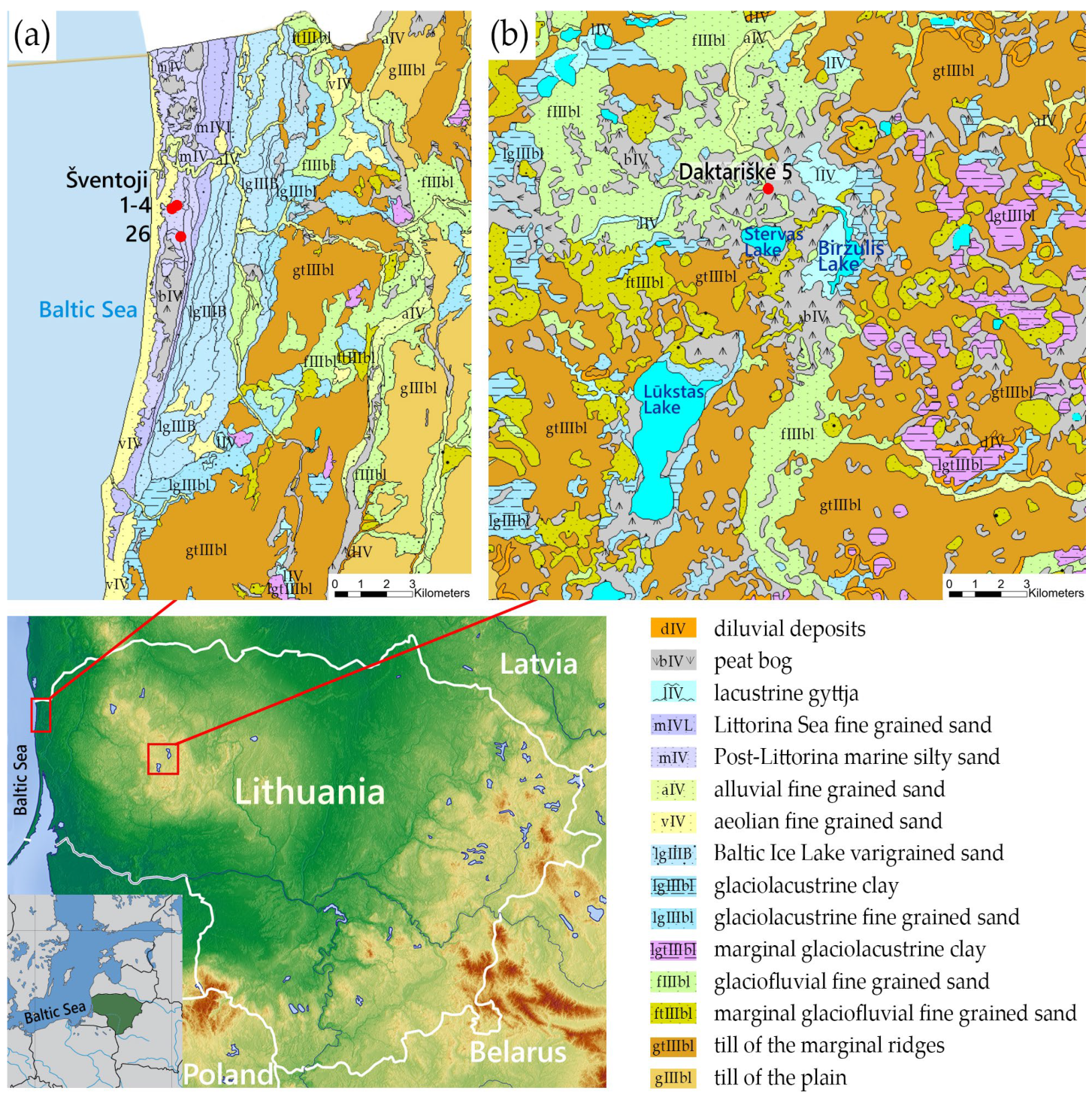
The surface of west Lithuania, including both the Šventoji archaeological complex and the Biržulis Lake region, is covered with Quaternary sediments shaped by the last Weichselian glaciation and subsequent postglacial processes [18].
At the Šventoji sites, coastal landforms were further modified during the earliest (Baltic Ice Lake) and later (Littorina Sea) stages of Baltic Sea evolution, with marine and glaciolacustrine deposits forming the geomorphological setting on which the archaeological sites are located [18] (Figure 1a). In the surroundings of a former shallow lagoon and freshwater lake that formed on a low-lying Littorina Sea terrace around 6000 BCE, approximately 60 archaeological sites dating from 4000 to 500 BCE have been identified [6,19]. The terrace is predominantly composed of fine-grained sand, while its lower-lying areas are covered with lagoonal silt, gyttja, and bog peat sediments. Potential ceramic-grade clay is scarce, occurring only as clayey gyttja interlayers, which were documented during excavations of the Šventoji wetland sites [7].
The Šventoji 1–4 wetland sites (56°00′51″ N, 21°04′59″ E) are among the most thoroughly investigated archaeological areas in Lithuania, with a total of 6750 m2 excavated until 2014—primarily by Rimutė Rimantienė, with subsequent investigations carried out by other researchers [6,19,20]. Interpreted as fishing stations, these sites were located along a 2.5 m deep channel-like feature within the shallower paleolake. Waterlogged gyttja deposits yielded abundant fishing implements, freshwater fish remains, and ceramic fragments. In the upper stratigraphic horizon (ca. 2720–2620 BCE), ceramics of both the Globular Amphora Culture (GAC) and hunter–fisher–gatherer Narva Culture (NC) were recovered, whereas the lower horizons (ca. 2800–2650 BCE and 3100–2900 BCE) yielded only NC pottery (also termed Porous Ware in more recent studies) [7]. The Šventoji 1 site (56°01′05″ N, 21°05′28″ E), in addition to NC, also contained Corded Ware Culture (CWC) pottery [6], from which two sherds were sampled.
The Šventoji 26 site (56°00′14″ N, 21°05′28″ E) was located on the eastern bank of the paleolake, on a sandy shore formed during the maximal Littorina Sea transgression. Between 1966 and 2005, a total of 736 m2 was excavated by various researchers [6,20,21].
Inland, the Biržulis Lake region represents another major concentration of Stone Age occupation, with 56 recorded archaeological sites, including settlements, cemeteries, and offering places. The present lake, covering 114 ha, is a remnant of a much larger glacial water body situated between moraine hills and connected to neighboring lakes by small streams (Figure 1b). During the Neolithic, the paleolake was about twenty times larger, but its extent has been greatly reduced, particularly after drainage works initiated in 1930 [22]. The substrate consists of carbonaceous glaciofluvial sand and glacial till containing Ordovician–Silurian limestone transported from present-day Estonia by the Weichselian ice sheet. Flat hilltops are mantled with clay deposited during the highest stage of the glaciolacustrine lake, while lower slopes expose an abraded till of marginal ridges. Boulders, predominantly pink granites, as well as quartz porphyry and diabase, are widespread across the moraine hills [23].
Daktariškė 5 (55°47′31″ N, 22°23′38″ E) is the largest known Neolithic wetland settlement in the Biržulis Lake region, situated on a former island within a narrow waterway connecting the Biržulis and Stervas lakes—an area notable for its high diversity of fish species. Excavations conducted by Adomas Butrimas between 1987 and 1990 (648 m2) [22] and by Gytis Piličiauskas in 2016 (49 m2) [24] revealed a long occupation sequence, beginning around 4460 BCE and continuing until the end of the third millennium BCE. Thanks to the waterlogged conditions, many artifacts were remarkably well preserved, including osseous tools, amber objects, and more than 11,000 pottery sherds. The assemblage is dominated by shell-tempered NC Ware, with smaller numbers of GAC and CWC pottery, as well as hybrid forms combining elements of NC and CWC [8].
Figure 1. Geomorphological maps of the Šventoji (a) and Biržulis Lake (b) microregions showing the studied Neolithic sites (reprinted with permission from [18], © 2024 Lithuanian Geological Survey under Ministry of Environment).
Minerals 15 01173 g001

2.2. Materials

The sampling strategy captured ceramic variability across Neolithic cultural groups in west Lithuania that differ in paste structure, texture, decoration, and forming technique. Sherds were selected by typology and stratigraphy, guided by age–depth models [7,24]. In total, 30 hand-built pottery sherds were chosen from the National Museum of Lithuania for microstructural, geochemical, and mineralogical analyses: 18 from Daktariškė 5 and 12 from Šventoji. The sample set is equally divided by subsistence tradition: 15 sherds from hunter–fisher–gatherer NC and 15 from early farming communities (6 GAC, 7 CWC, and 2 hybrid forms). Detailed information is provided in Table 1.
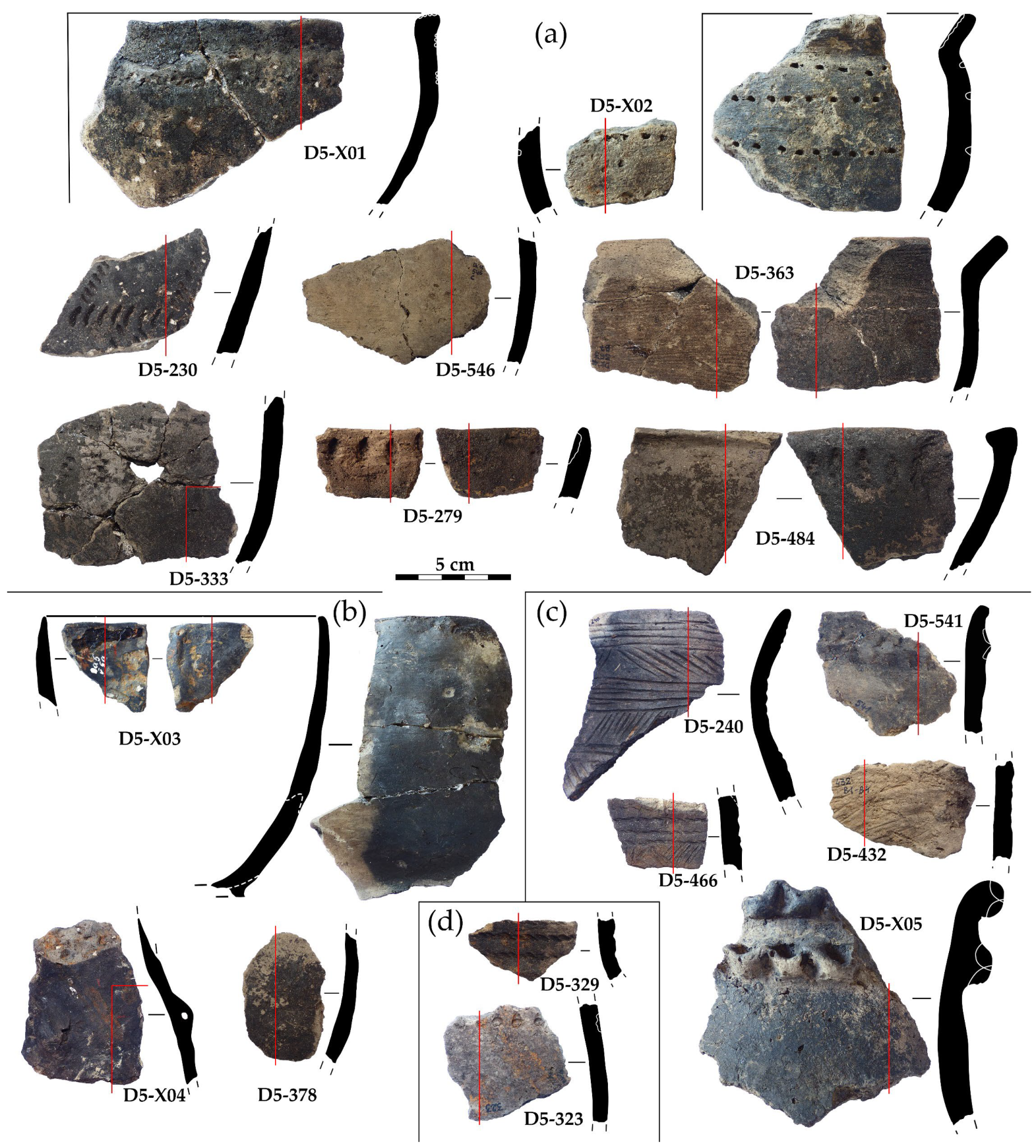
Pottery from the Daktariškė 5 settlement is notable for the abundance of decorated vessels. Selected NC samples exhibit characteristic decorative motifs, including small pits, as well as knot and elliptical impressions made with shell edges (Figure 2a). D5-230 and D5-546 were the oldest sherds based on their stratigraphic position. Although stylistically distinct, they also illustrate different tempering practices (Table 1). Other samples, decorated with knot impressions, are stylistically typical of late NC. The color of the vessel surfaces ranges from light brownish gray to black. They often retain soot and charred residues, indicating that, despite their decoration, the vessels were used for cooking. The rims indicate wide-mouthed forms; bases are rarely preserved, but analogies suggest that most were pointed. Wall thickness varies from 7 to 9.5 mm and shows no correlation with vessel size; the smallest rimmed, plant-tempered vessel (D5-X02) has the thickest walls.
GAC samples from Daktariškė 5 (Figure 2b) are among the thinnest-walled vessels at the site, despite being tempered with coarse crushed rock fragments, with wall thickness ranging from 5.2 to 5.9 mm. The cup (D5-X03) and the amphora with lug (D5-X04), differs from other Daktariškė 5 pottery by its black, glossy surfaces, which may have been produced by slip application or burnishing [25].
CWC pottery from Daktariškė 5 displays considerable diversity, ranging from a beaker to a thick-walled short-wave molded pot (Figure 2c). Two beakers are the most elaborately decorated: D5-240, with horizontal and oblique incised herringbone, and D5-466, combining incisions with five cord-impressed lines. Charred residues were observed on the surfaces of several vessels, including beaker D5-240, indicating their use in cooking.
Hybrid-type pottery from Daktariškė 5 (Figure 2d) combines CWC motifs—cord (D5-329) and bird-bone (D5-323) impressions—with NC ceramic pastes—shell- and organic-tempered fabrics clearly visible in cross-section.
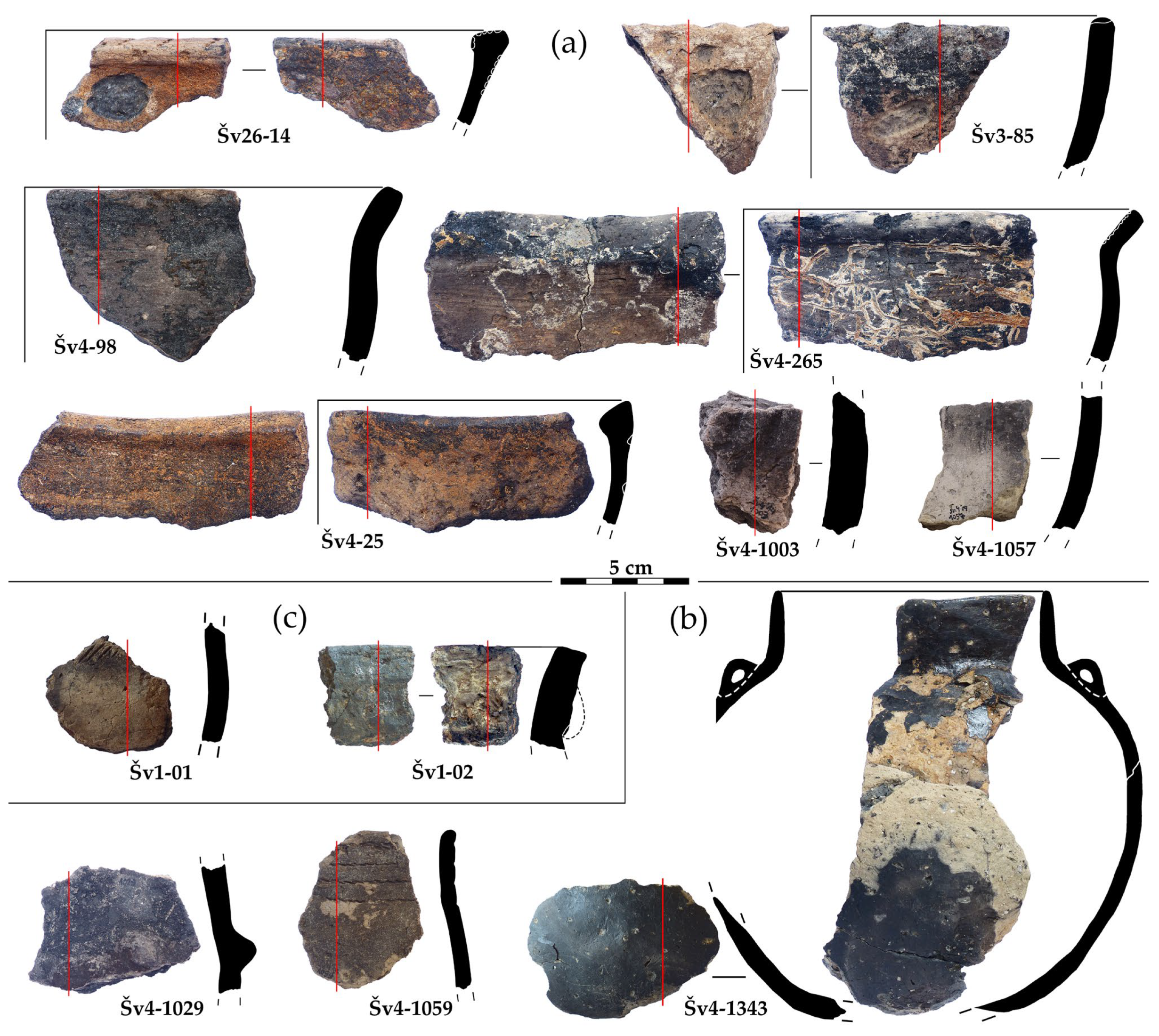
NC sherds from the Šventoji sites show wide-mouthed pot profiles and motifs, including knot impressions and small pits (Figure 3a), similar to those from Daktariškė 5. Surfaces range from light gray and reddish orange to dark brown, often variegated, likely from post-depositional effects.
Sample Šv26-14 stands out due to its rim profile and toothed-stamp ornamentation (Figure 3a), resembling Combed-like Ware of the East Baltic. Food residue on this sherd was dated to 3697–3527 BCE, and despite a possible offset from the aquatic reservoir effect [21], it represents some of the earliest pottery in coastal Lithuania.
GAC samples from Šventoji 4 (Figure 3b), similarly as at Daktariškė 5, represent the thinnest-walled vessels, with wall thicknesses of 6.5–8.1 mm and coarse ceramic pastes. Sample Šv4-1059 is decorated with five lines of cord impressions, whereas the amphora and the lugged pot fragments are distinguished by their black, glossy surfaces.
Two samples recovered during the 1967–1968 excavations at Šventoji 1 represent CWC (Figure 3c): the wall of beaker Šv1-01 and the rim of short-wave molded pot Šv1-02.

2.3. Methods

To investigate the techniques of vessel production, raw materials and paste recipes, 30 sherds were subjected to petrographic analysis by optical microscopy. Each was cut vertically and prepared as a polished thin section without a coverslip. Polished sections and freshly sectioned sherd surfaces were examined at 5×–50× using a ZEISS Stemi 508 stereo microscope fitted with a polarized analyzer and an Axiocam 212 camera (both ZEISS, Oberkochen, Germany). Stereomicroscopy was employed for its wide field of view and suitability for samples rich in organics and voids; the morphology of these features supports reconstruction of the chaîne opératoire (e.g., clay processing and forming). The polarizer/analyzer also aided rapid recognition of major mineral phases and assessment of matrix fabrics.
Entire thin sections were then systematically mapped on a Nikon Eclipse LV100N POL polarizing microscope with episcopic illumination (Nikon Corporation, Tokyo, Japan) at the State Scientific Research Institute Nature Research Centre (Lithuania). Each section was surveyed (to 100×) first in cross-polarized light (XPL) to document anisotropic mineral grains, clay fabrics, and preferred orientations, and then in reflected light with epi-illumination (EPI) to register opaque/ore minerals, vitrified or altered domains, firing-affected rims, and sooting. The paired XPL–EPI mappings provided section-wide datasets linking transparent-phase textures to opaque-phase distributions and alteration features.
A quantitative and qualitative evaluation of the ceramic microstructure—including voids and aplastic inclusions—was performed via digital image analysis using JMicroVision v1.3.5 [26], following established criteria [27,28,29]. Mineral grain sizes were described using the Udden–Wentworth scale [30]. The same carbon-coated sections were analyzed by a scanning electron microscopy (SEM) at the Nature Research Centre (Quanta 250, FEI Company, Hillsboro, OR, USA). Backscattered electron (BSE) imaging at magnifications of 100×–5000× documented ceramic fabrics, inclusions, matrix features, and firing indicators. The chemical analyses were acquired using an energy dispersive spectrometer (EDS) silicon-drifted detector (SSD) X-Max (large area) 20 mm2 (liquid and nitrogen-free), using the INCA x-stream digital pulse processor and the INCA Energy EDS software, version 4.15 (Oxford Instruments, High Wycombe, UK). The point analyses targeted individual minerals, organic fragments, and aggregates within the clay matrix and inclusions [31]. Operating conditions were a 20 kV accelerating voltage with a current of 1.1–1.2 nA, under ultra-high vacuum, and a 10.0 mm working distance.
Elemental area analyses followed previously applied protocols [12,14,17,32]. The ten major crustal elements (Na, Mg, Al, Si, P, K, Ca, Ti, Mn, Fe) and S were measured at 500× within 200 × 200 μm homogeneous, inclusion-free fields of the clay matrix. For each matrix type within a sample, 5–8 spots were acquired. In CWC sherds, both the vessel matrix and argillaceous clasts/grog were analyzed to compare paste and temper compositions. Semi-quantitative elemental data were checked for consistency, converted stoichiometrically to oxides with INCA software, and summarized as average wt%. Oxide data were normalized to 100 wt% prior to analysis. To address closure, data were transformed using centered log-ratio (CLR) [33,34]. Principal component analysis (PCA) (correlation) was performed on the CLR data (variables mean-centered) and hierarchical clustering used Ward’s minimum-variance method with Euclidean distance [12,32,35]. All computations were carried out in PAST v5.2.1 [36].

3. Results

3.1. Ceramic Petrographic Analysis by Optical Microscopy

The samples derive from hand-built vessels. In several thin sections, the preferred alignment of elongate inclusions and planar voids parallel to the vessel wall, together with junction lines, indicate predominantly coil-built construction. Three main ceramic fabric groups were identified: A—with organic temper, typical of the hunter–fisher–gatherer Narva Culture (NC) and hybrid pottery; B—with rock fragments, characteristic of Globular Amphora Culture (GAC); C—with argillaceous clasts/grog, broadly aligning with Corded Ware Culture (CWC). Given regional differences between the Šventoji coast and the inland Biržulis Lake basin, the two assemblages are presented separately.

3.1.1. Samples from the Daktariškė 5 Settlement

The largest subset (n = 6) corresponds to fabric A1_D5, characterized by a fine non-calcareous clay matrix with abundant coarse shell temper. Fabric A2_D5 (n = 3) is rich in charred organic matter (mostly plant remains). Fabric B1_D5 (n = 3) includes coarse crushed rock fragments in a homogeneous clay matrix. Fabric C1_D5 (n = 5) contains argillaceous clasts/grog, with an outlier C2_D5 (n = 1) dominated by sand.
The petrographic description, following Quinn [37]—covering the matrix–voids–inclusions ratio, matrix optical activity, and the abundance and types of inclusions—is presented in Table 2.
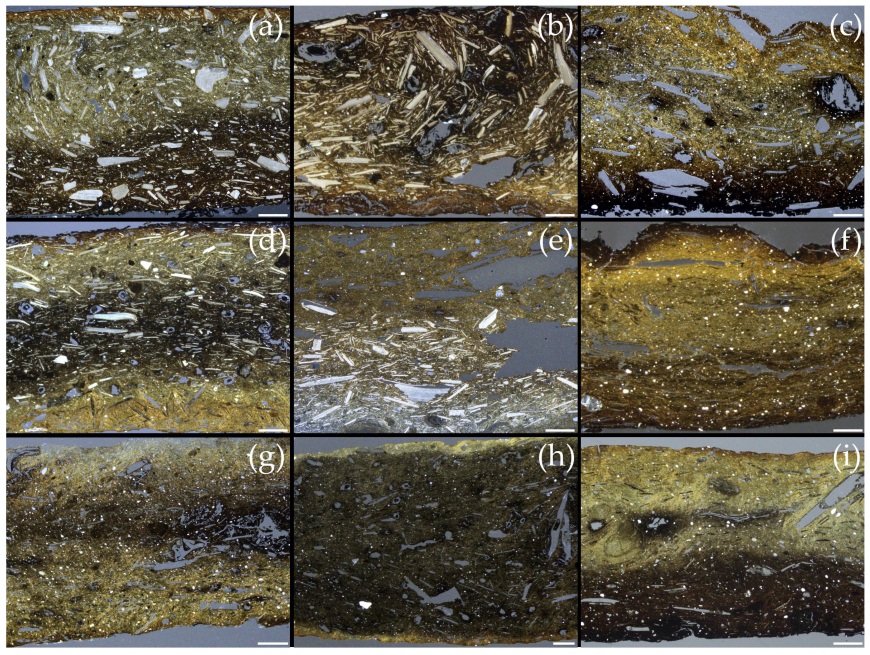
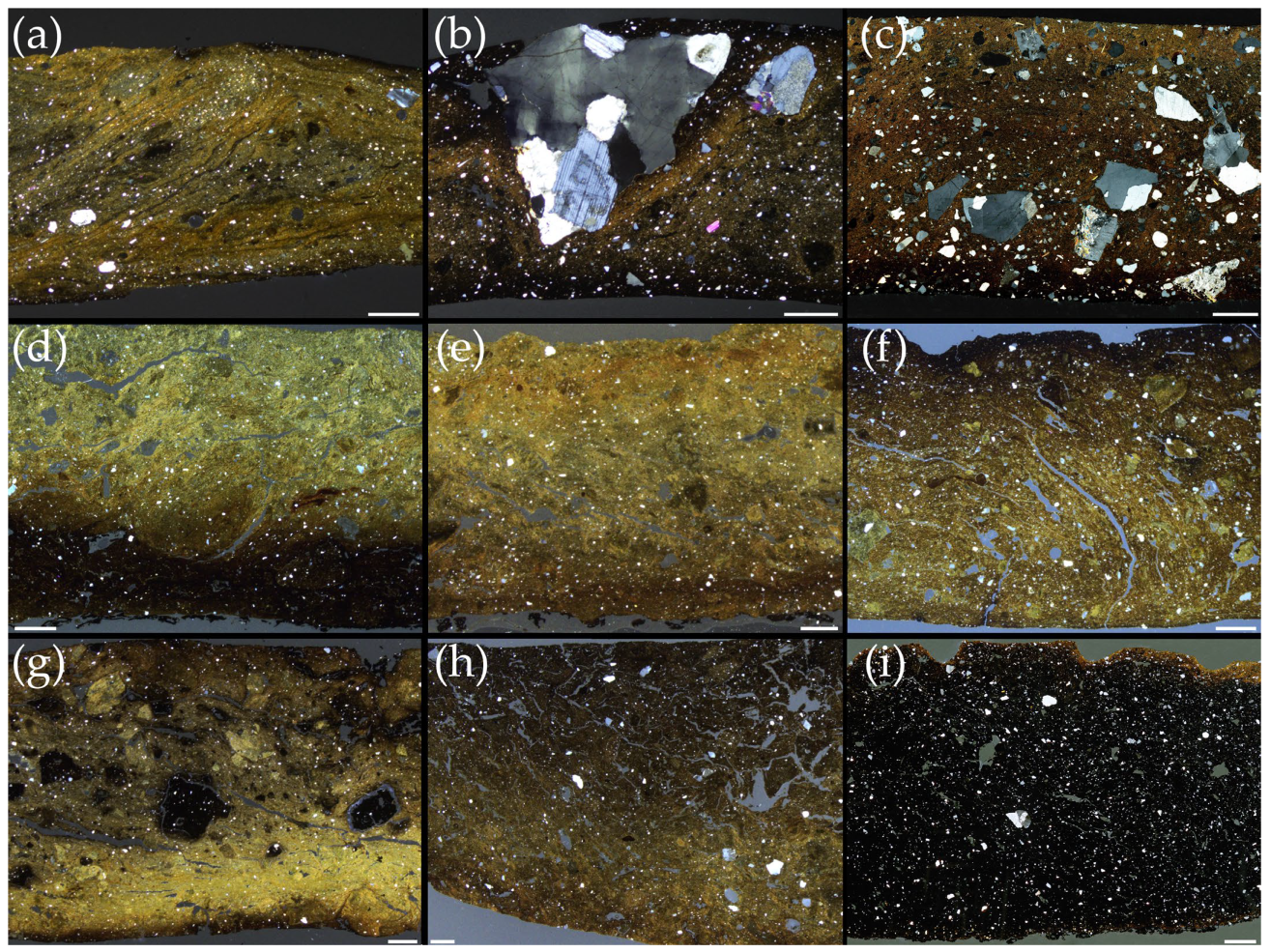
Fabric A1_D5 (D5-230, D5-X01, D5-279, D5-363, D5-484, D5-329) (Table 2) is shell-tempered, with common organic inclusions, along with naturally occurring silt–fine sand, and discrete clay pellets (Figure 4a–f). The inclusion proportion is highly variable (11–40% of the paste). Shell fragments (up to 3.0 mm) are dominant to predominant, moderately well sorted, mainly platy and elongated, and often oriented parallel to vessel/coil margins. Organic matter occurs as irregular vughs and ovoid pores with charred plant remains or small-fauna fragments (up to 1.8 mm) (Figure 4a). The fraction of silt–fine sand (≤0.25 mm; mode ≈ 0.02 mm) is very few to frequent, with the fabric consisting mostly of subrounded to well-rounded quartz, with rare feldspar and very rare mica. Clay pellets (≤0.7 mm) are rare, with clear to diffuse boundaries and neutral to high optical density.
The matrix (47–86%) is slightly to moderately optically active and fairly homogeneous. In PPL it appears yellowish brown to brown, often with a dark-brown band along the inner or outer margin (soot/char penetration); in XPL, it shows orange to yellowish-brown to dark-brown colors. Voids (1–13%) include micro–meso-planar forms (often parallel to coil margins), abundant ovoid pores, and irregular meso–macro-vughs, many with charred organics; some retain anatomical features (Figure 4b). Voids from dissolved shell are also present.
Fabric A2_D5 (D5-333, D5-X02, D5-323) (Table 2) shares the A1_D5 matrix but is organics-rich rather than shell-dominated. Inclusions (8–15%) mainly comprise charred plant and small-fauna remains, preserved as ovoid pores and vughs with anatomical features (up to 3.2 × 1.3 mm) (Figure 4g–i). Shell fragments are few to common and usually dissolved. Well-sorted sand is more common and coarser than in A1_D5 (≤0.4 mm; mode ≈ 0.05 mm). The matrix (78–85%) is moderately optically active and generally homogeneous; only D5-323 shows localized unmixed domains (Figure 4i). In PPL, it appears brownish yellow along one or both surfaces with a dark-brown core or inner margin. D5-X02 has an exceptionally dark core with only a thin yellowish surface band (Figure 4h). Voids (5–15%) are mainly meso–macro-ovoid pores, channels, and vughs from organics; a second set comprises elongated platy voids from dissolved shell.
Fabric B1_D5 (D5-X03, D5-X04, D5-378) (Table 2) is characterized by a compact paste with coarse rock fragments. Inclusions (5–27%) range from poorly sorted (D5-X03) to weakly bimodal (D5-X04, D5-378) and are locally aligned parallel to coil margins. The coarse fraction is dominated by angular to subangular felsic igneous-rock fragments (up to 5.2 mm) (Figure 5a–c), whose detailed mineralogy is present in Section 3.3. The sand fraction (≤0.12 mm; mode ≈ 0.09 mm) is common—dominant in D5-X03—and consists mainly of rounded to well-rounded quartz and feldspar, with some mica flakes.
The matrix (72–93%) is highly optically active and generally homogeneous, but locally laminated near coil boundaries. In PPL, it appears grayish brown to strong brown, often with thin dark bands along one or both surfaces (Figure 5a–c). Voids (1–2%) include planar forms (moderately parallel between coarse clasts), randomly dispersed meso-vughs, and ring voids around clay pellets and some crushed rock fragments.
Fabric C1_D5 occurs in four CWC samples (D5-432, D5-466, D5-541, D5-X05) and one NC sample (D5-546) (Table 2). It is characterized by a fine clay matrix with argillaceous clasts/grog and sand (Figure 5d–h). Inclusions (10–30%) mainly comprise subangular to rounded argillaceous clasts/grog (up to 3.25 mm). They exhibit neutral to low optical density and a mineralogy similar to the matrix, but are distinguished by slightly lighter hues, ring voids, and locally higher fine sand content. D5-541, in addition to fine-clay argillaceous clasts/grog, contains a few carbonized aggregates—charred, dough-like organic clasts (Figure 5g). Compared with other Daktariškė 5 fabrics, clay pellets are most abundant, ranging from few (≤0.5 mm) to frequent (≤1.5 mm in D5-432); however, they are difficult to distinguish from argillaceous clasts/grog [38]. The sand fraction (≤0.5 mm; mode ≈ 0.08 mm) is few, but common and coarser in D5-X05 (≤1.0 mm; mode ≈ 0.15 mm). The matrix (65–87%) is slightly to moderately optically active and moderately homogeneous, with some textural domains. Voids (3–7%) include planar forms (parallel to coil margins and oblique to walls), meso–macro-vughs left by charred organics, and ring voids around inclusions. Only in the porous D5-X05 do voids comprise 11% of the paste, with macro-vughs up to 2.0 mm.
Fabric C2_D5 is represented by a single outlier (D5-240) and differs from C1_D5 by a higher proportion of sand inclusions and a very dark clay matrix (Figure 5i). Inclusions (8%) are moderately sorted. The fine–medium-sand fraction, with a few coarse grains (≤0.85 mm; mode ≈ 0.09 mm), predominates and consists mainly of subrounded quartz and plagioclase, with some microcline and very little mica and epidote. Reliable quantification of argillaceous clasts/grog is hindered by the very dark matrix; they are inferred from a few moderately fine (≤0.5 mm) domains along the lighter margins of the section.
The matrix (83%, including argillaceous clasts) is moderately optically active and fairly homogeneous, with minor textural domains. In PPL it appears brownish black; in XPL, it appears black (Figure 5g). Voids (9%) consist of planar forms and vughs with oblique orientation.

3.1.2. Samples from the Šventoji Sites

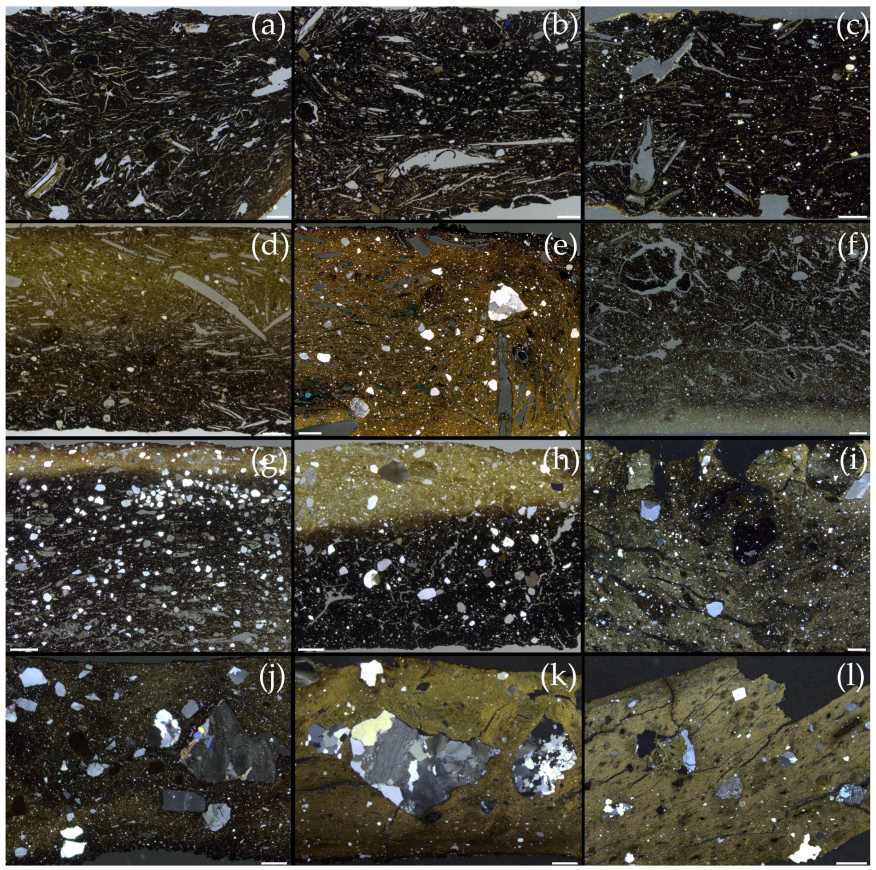
Compared with Daktariškė 5, the Šventoji assemblage is more heterogeneous, though analogous fabric groups are present. The largest subset (n = 5) is A1_Šv, with abundant shell temper, while A2_Šv (n = 2) is rich in charred organic matter, B1_Šv (n = 3) contains coarse crushed granite fragments, and C1_Šv (n = 2) includes argillaceous clasts/grog. Petrographic descriptions of the Šventoji ceramic fabrics are provided in Table 3, with micrographs in Figure 6.
Fabric A1_Šv (Šv26-14, Šv3-85, Šv4-25, Šv4-265, Šv4-1057) (Table 3) usually showed only traces of decayed inclusions—elongated voids from shell—unlike Daktariškė 5, where shell fragments are often intact. Inclusions (20–44%) are poorly sorted, mostly very elongate, subangular, and measure up to 5 mm. The sand fraction (very fine–coarse) is more abundant when in fabric A1_D5 samples and ranges from well sorted (≤0.4 mm, Šv4-1057) to poorly sorted (≤1.7 mm, Šv3-85). It comprises mainly rounded–well-rounded quartz and feldspar with occasional subangular grains (Šv4-25, Šv4-265). Šv26-14 is notable for the presence of frequent, large (≤1.5 mm), dark clay pellets surrounded by ring voids, resembling grog.
The matrix (50–75%) is moderately optically active and fairly homogeneous, with minor textural domains (Figure 6a–e). Voids (2–7%) consist of ovoid mesopores with some vughs, often containing charred plant material with visible anatomical features.
Fabric A2_Šv (Šv4-98, Šv4-1003) (Table 3) is distinguished by abundant organic matter. Inclusions (20–28%) consist of moderately sorted charred plant and small-faunal remains, preserved as ovoid pores and vughs with anatomical features. Shell fragments are common (up to 3.5 mm) but fully dissolved. In Šv4-1003, the size of individual organic inclusions is difficult to define because the clay is densely enriched with plant and small-faunal remains (Figure 6f). The mineral fraction is highly variable; Šv4-1003 contains only fine sand–silt (≤0.2 mm; mode ≈ 0.07 mm), whereas Šv4-98 is bimodal, comprising medium–coarse and fine sand (≤0.6 mm; modes ≈ 0.35 and 0.10 mm) (Figure 6g).
The matrix (60–73%) is slightly optically active in Šv4-1003 and moderate in Šv4-98, being fairly homogeneous with few textural domains (Figure 6f,g). Voids (7–12%) are ovoid meso-pores or meso–macro-vughs. Numerous narrow elongate micro–meso-channels and ring voids create a distinctive texture in both samples.
Fabric B1_Šv (Šv4-1029, Šv4-1059, Šv4-1343) (Table 3) is similar to fabric B1_D5 and is characterized by coarse crushed rock and a medium-sand fraction. Inclusions (10–36%) are dominated by moderately to poorly sorted angular–subangular felsic igneous rock fragments (up to 5.2 mm) (Figure 6j–l), whose detailed mineralogy is presented in Section 3.3. The fine- to medium-sand fraction (≤0.87 mm; mode ≈ 0.09 mm) is common but more frequent in Šv4-1029; this sample also contains coarse clay pellets (up to 2.25 mm).
The matrix (56–85%) is moderately to highly optically active, homogeneous in color and texture, with varying domains of color in XPL (Šv4-1029) (Figure 6j–l). Voids (5–8%) consist of micro–meso-planar voids and channels with a moderately parallel orientation, forming dense bands near the surface or around inclusions. Some meso-vughs contain charred organic material.
Fabric C1_Šv (Šv1-01, Šv1-02) (Table 3) is distinguished by moderately to poorly sorted mineral inclusions and argillaceous clasts/grog. The total inclusion content is difficult to quantify because grog grades into the matrix. Argillaceous clasts/grog are angular to subrounded, reaching up to 1.5 mm in Šv1-01 and 4.3 mm in Šv1-02. Individual clasts vary in internal texture and in the amount of natural sand; they range from low to high optical density and are colors similar to the matrix or slightly paler/darker. Šv1-01 includes one clast that may contain crushed rock temper. Mineral inclusions, compared with fabric C1_D5, are more abundant, accounting for ~25% (Šv1-01) and ~15% (Šv1-02) of the paste, and show a slight parallel orientation. The fine- to coarse-sand fraction (≤1.3 mm; mode ≈ 0.09 mm) is dominant in Šv1-01, while Šv1-02 also contains angular to subangular crushed felsic igneous rock fragments (up to 2 mm), whose detailed mineralogy is presented in Section 3.3. Clay pellets (≤0.42 mm) are very few to rare and resemble grog.
The matrix (45–52%) in Šv1-01 is moderately optically active (in very small domains) and moderately homogeneous, whereas in Šv1-02, it is highly optically active and homogeneous (Figure 6h,i). Voids (14–15%) include meso–macro-channels, -vughs, and -planar voids, showing a parallel orientation. In Šv1-02, some vughs contain charred organic matter. Ring voids are common around argillaceous clasts/grog and crushed rock fragments.

3.2. Organic and Biogenic Inclusions

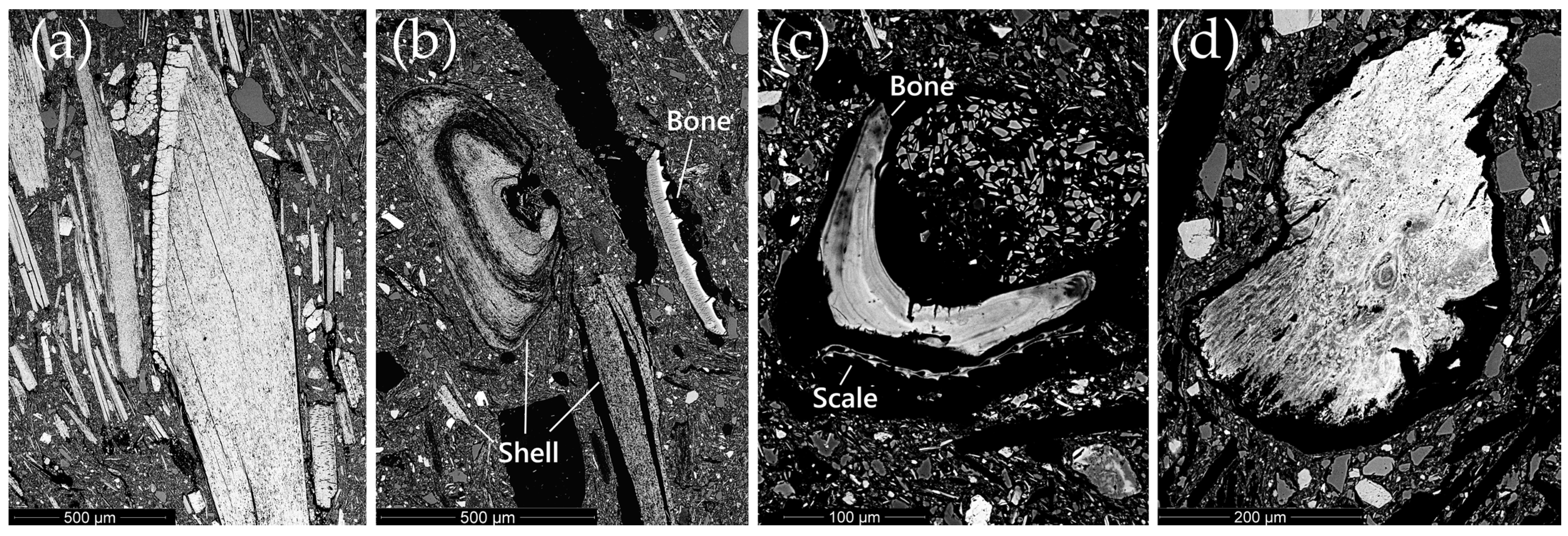
Organic and biogenic inclusions are found in the majority of the studied ceramic samples, but fabrics A1,2_D5 and A1,2_Šv represent intentional temper, such as crushed mussel shell fragments (Figure 7a,b) and decayed or herbivore-digested plant matter (probable dung) [39] (Figure 5h–i and Figure 6g). Terrestrial animal bones are very rare in hunter–fisher–gatherer NC pottery and likely accidental (Figure 7d). Fish bones and scales are commonly found alongside shell fragments (Figure 7b,c), often with voids preserving distinctive anatomical features of small-bodied animals or aquatic plants. Fish scales and bones are readily distinguished from crushed aragonitic shell debris by their phosphorus signatures in SEM–EDS spectra. These features occur not only in hunter–fisher–gatherer NC vessels but also—though in lower quantities—in crushed-rock-tempered GAC pastes. Such inclusions most likely entered the clay accidentally and provide clues as to the manufacturing environment, presumably near lake or lagoon shores.
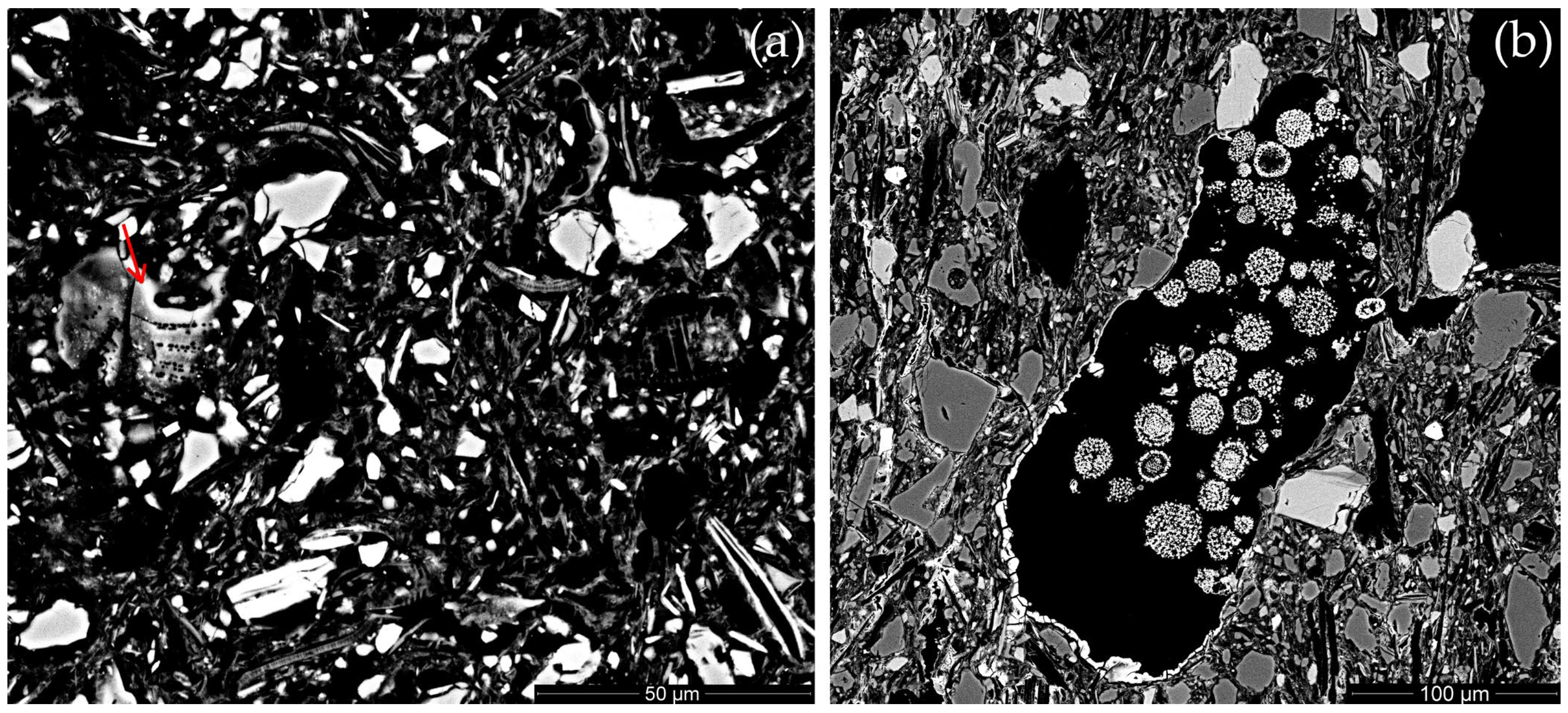
Hunter–fisher–gatherer NC pottery from the Šventoji site (fabrics A1,2_Šv) is distinguished by a clay matrix heavily enriched with organic remains, including silicified plant xylem and planktonic microfossils, most clearly visible in Šv4-1003 (Figure 8a). Diatom frustule fragments are also present in the matrix of samples Šv26-14, Šv4-1003, Šv4-98, and Šv4-265 (Figure 8a). Together, these features suggest the use of lacustrine (gyttja-type) sediments as the raw clay source. Diatoms were also observed in CWC and GAC samples from the Šventoji site (fabrics B1_Šv and C1_Šv); however, they occur in voids rather than in the clay matrix, suggesting post-depositional infilling in an underwater environment (Figure 8b). In iron-rich, organic settings, silica frustules underwent chemical alteration. Under reducing conditions, pyrite framboids (FeS2) formed within voids of rock-tempered sherds and between chlorite laths in granite clasts (Šv4-1029, Šv4-1059, Šv4-1343); under more oxidizing conditions, barite (BaSO4) (Šv4-1029, Šv4-265, Šv1-01) and gypsum (CaSO4) (Šv4-98) precipitated. In samples Šv3-85, Šv4-25, and Šv4-265, diatom-like morphologies were observed in which the original α-quartz of the frustules is replaced by iron (III) phosphate, i.e., FePO4 pseudomorphs after diatoms (Figure 8b).

3.3. Mineral Inclusions

By combining optical microscopy (PPL, XPL, and reflected light) with SEM–EDS point analyses and BSE imaging of rock fragments and individual silt–sand grains across all samples, the principal minerals identified are quartz, feldspar, and mica, with rare amphibole, epidote, and accessory minerals.
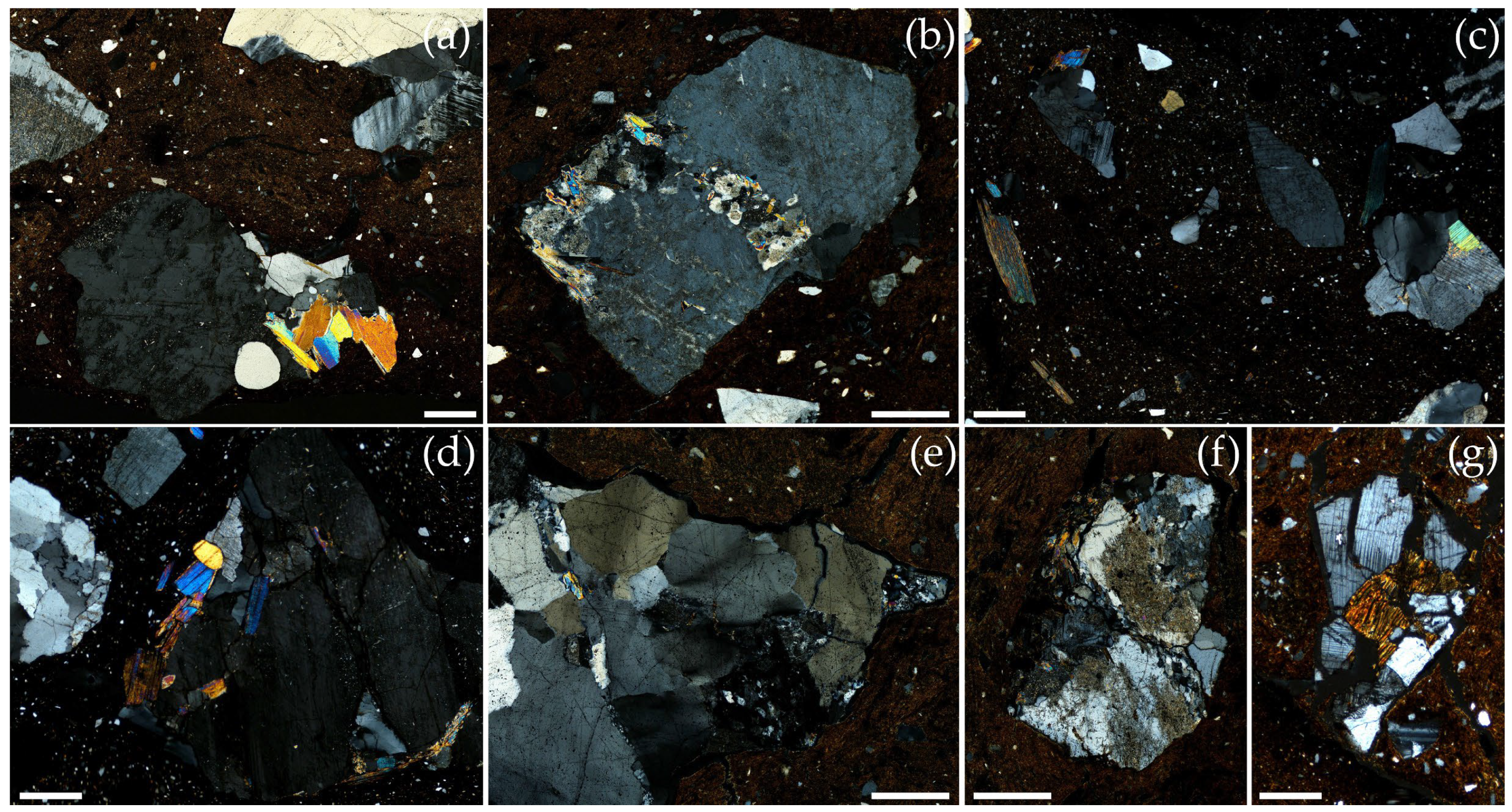
Crushed rock fragments were observed in fabrics B1_D5 and B1_Šv (GAC) and in sample Šv1-02 (CWC) (Figure 9a–g). The assemblage is dominated by intrusive felsic igneous fragments, chiefly granites with abundant coarse muscovite lamellae in feldspar.
Granite clasts are deformed, showing a dynamic metamorphic overprint with local development of cataclastic granite. In XPL, deformation indicators range from quartz with pronounced undulatory extinction—a mylonitic overprint (Figure 9c,e) [40]—to shear-parallel, vein-like bands of fine quartz–mica that wrap around feldspar clasts (Figure 9b,d–f). Muscovite occurs as fragmented/kinked flakes smeared along microfaults and as secondary sericite on fractured feldspar (Figure 9a–f). Large muscovite—some showing plastic deformation, banded extinction, and probable thermal alteration—occurs only in Šv4-1029, where epidote and a few monazite grains are also present (Figure 9c,d).
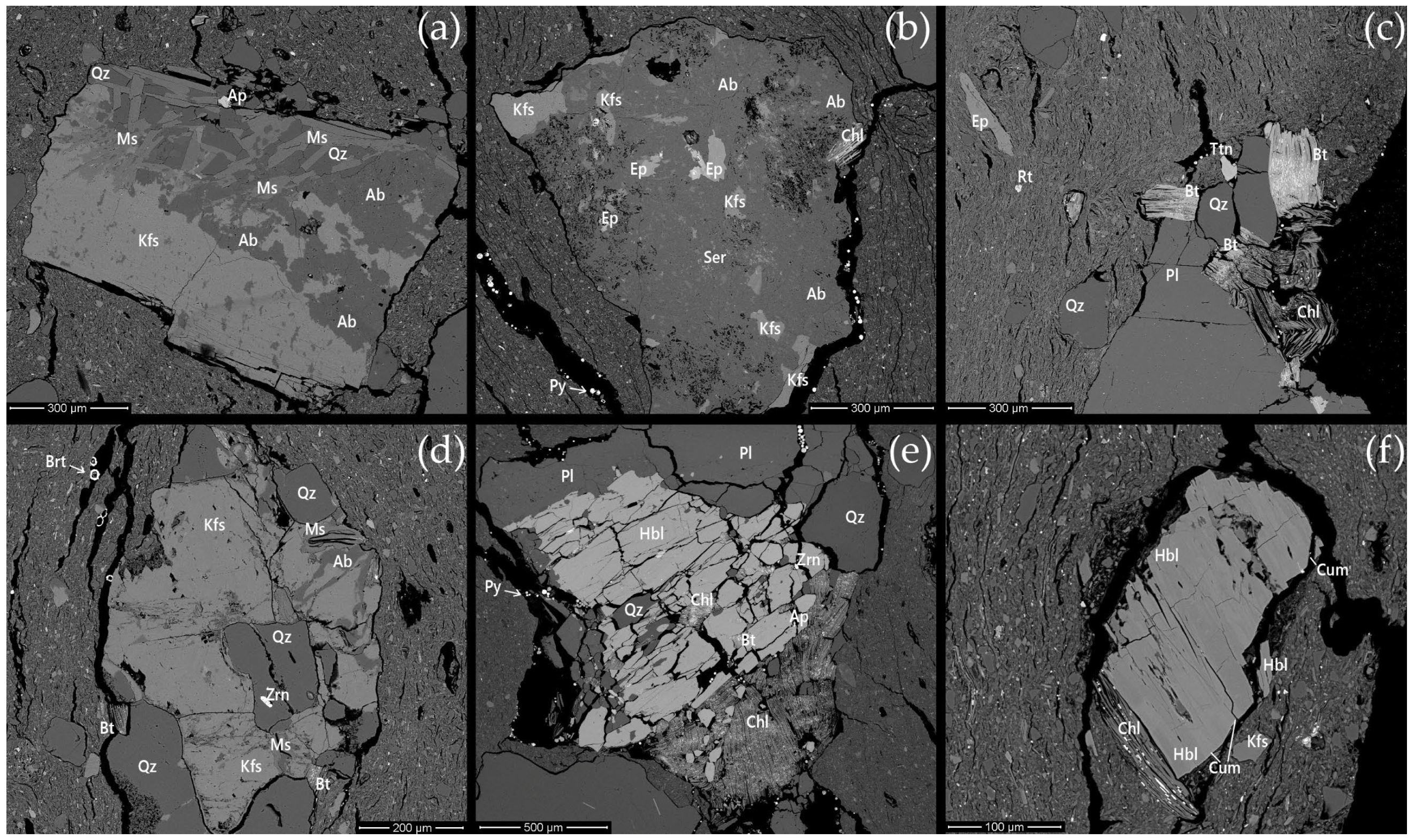
BSE imaging reveals cataclastic deformation in greater detail. Along cracks and rims, sericitization and albitization produce muscovite–albite replacement fronts (Figure 10a,d) with thin quartz intergrowths (Figure 10a). Sample Šv4-1343 differs slightly in its cataclastic granitoid fragments: as in the other samples, the crushed rock clasts consist mainly of sericitized plagioclase, fractured K-feldspar with patchy albitization, quartz, and accessory minerals (apatite, rutile, titanite, zircon, epidote) (Figure 10b–d). This sample also contains amphibole-bearing granitoids (Figure 10e,f). The dominant mica is biotite, whereas muscovite is rare here. Biotite is often partially replaced by chlorite; the associated alteration includes the formation of pyrite framboids both between chlorite laths and within ceramic voids (Figure 10b–f). Sample Šv4-1343, with amphibole-bearing granitoids and biotite, resemble the CWC sample Šv1-02 (Figure 9g).
In all ceramic samples, quartz occurs mainly as detrital silt–fine sand and as a constituent of granitoid lithic clasts. The grains are effectively pure SiO2 (≈100 wt.% SiO2) and commonly display clear boundaries. Silt- to fine-sand-sized quartz is abundant, whereas coarse sand grains and rock fragments are less frequent. Within granitoid lithic clasts, quartz is strained to granulated (Figure 9b,d–f and Figure 10a), showing pronounced undulatory extinction (Figure 9c–e). Contraction voids around quartz grains in rock fragments (Figure 10c,e) likely reflect thermal effects from firing or prior heating; the α–β transition of quartz at ~573 °C involves a significant volume change [42].
Feldspar is the most common mineral within granitoid clasts and also occurs as single angular to subangular coarse grains in crushed rock-tempered samples, indicating derivation from parental granitoids. As single grains in the fine sand–silt fraction, feldspar is less common than quartz. No thermally induced changes [31] were detected in feldspar, although coarse feldspar in lithic clasts records dynamic metamorphism (fracturing, alteration). Plagioclase is more common than K-feldspar. In coarse fragments, plagioclase is widely overgrown by sericite (Table A1). Reliable analyses of individual fine sand–grain plagioclase indicates a range from sodium-rich albite (Ab ~ 95%) to andesine (An to ~32%); in rock fragments; plagioclase varies from pure albite (Ab 100%) to andesine–labradorite (An to ~48%) (Table A1). Alkali feldspar is mostly K-feldspar, commonly showing albite replacement or lamellae in SEM–EDS [43]. Single fine-sand-grain K-feldspar is typically weathered and slightly enriched in Fe and/or Mg, whereas in rock fragments K-feldspar ranges in composition from pure orthoclase (Or 100%) to orthoclase with ~9% albite component (Table A1).
Isolated mica laths occur only rarely in the silt–fine sand fraction; most mica is associated with feldspar and/or quartz, together with other accompanying minerals. Muscovite is most frequently observed within or adjacent to granitoid fragments (Figure 9a–d and Figure 10a,d). Only a few muscovite grains in rock fragments are compositionally “pure”; the vast majority are Mg–Fe-enriched (Table A2), consistent with alteration of biotite [44]. The Mg/(Mg+Fe) ratio in muscovite varies widely from 0.31 to 0.86. Biotite is uncommon—both as single grains and within rock fragments (Figure 9g and Figure 10c,d)—and is mostly altered to chlorite. Their chemical analyses show progressive biotite → chlorite alteration accompanied by K depletion [44] (Figure 10c,e). The most common varieties are Fe-rich biotite and its product, Fe-rich chlorite (chamosite). Fe-rich biotite has Mg/(Mg+Fe) = 0.24–0.42, and Fe-rich chlorite has Mg/(Mg+Fe) = 0.25–0.50. Mg-rich biotite is rare (Mg/(Mg+Fe) = 62), whereas Mg-rich chlorite is more common (Mg/(Mg+Fe) = 0.58–0.67) (Table A3).
Weathered amphibole occurs in the silt–very fine sand fraction in most samples, while coarser fragments were found only in Šv4-1343. One intensely deformed, cracked hornblende grain occurs in a granitoid fragment with plagioclase and quartz; quartz, zircon, apatite, biotite, and chlorite occupy the hornblende cracks, and the portion in contact with the clay matrix is chloritized (Figure 10e). Chemical analyses indicate a heavily weathered Fe-rich hornblende with Mg/(Mg+Fe) = 0.23–0.28 (Table A3). In Šv4-1343 a second prismatic amphibole shows cleavage-parallel fracturing and marginal chloritization (Figure 10f); its composition is Mg-rich hornblende (Mg/(Mg+Fe) = 0.57–0.69) with local Mg-rich amphibole (cummingtonite/anthophyllite) (Mg/(Mg+Fe) = 0.63)—patterns consistent with deformation and retrograde alteration (Table A3).
Accessory minerals are most common in samples containing rock fragments, and in the sand fraction of D5-240; in other samples, they are only rarely observed in the clay matrix. The observed accessory minerals are listed in Table 4.

3.4. Clay Minerals and Argillaceous Inclusions

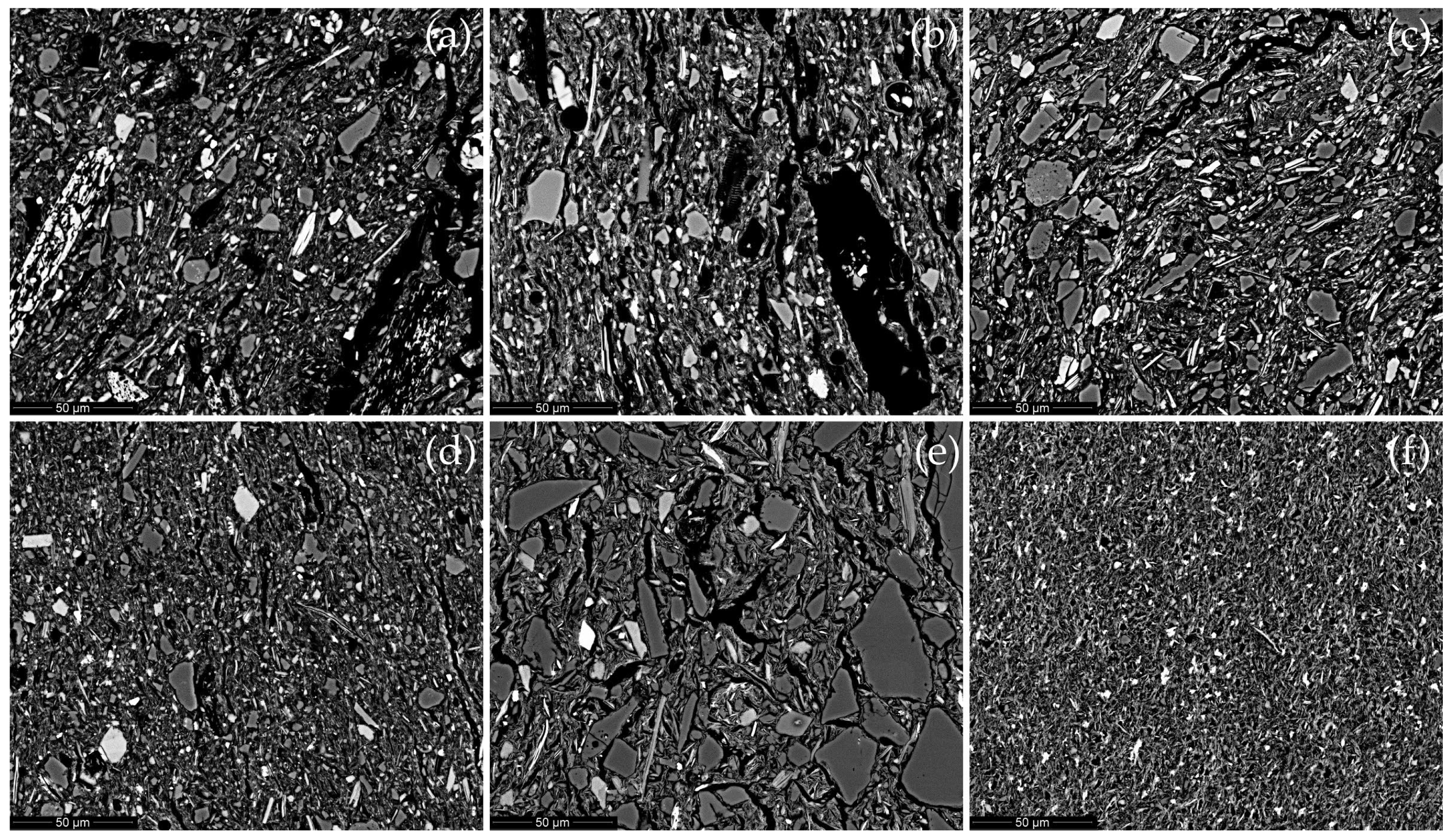
BSE imaging combined with point and area chemical analyses (on homogeneous domains) at 1000×–5000× was used to characterize the clay minerals. Despite differences in biogenic inclusions—well-preserved shell fragments down to fine-silt size at Daktariškė 5, fabric A1_D5 (Figure 11a) versus diatoms and silicified organic remains at Šventoji, fabrics A1,2_Šv (Figure 11b)—all hunter–fisher–gatherer NC pottery exhibit a plastic, variably weathered hydromicaceous clay containing fine-grained quartz and feldspar with lath-like mica. Within the clay matrix, preserved muscovite (Table A2) and biotite/chlorite (Table A3) flakes commonly display a preferred (parallel) orientation (Figure 11a–c).
Rock-tempered GAC fabrics B1_D5 and B1_Šv exhibit a very fine-grained clay matrix (Figure 11d). However, sample Šv-1029 differs; its coarse clay matrix contains abundant sand-sized quartz and relatively unweathered, chaotically oriented micas (Figure 11e), whereas its clay pellets consist of very fine, mature, highly weathered illitic clay [45] (Figure 11f).
The CWC samples display the widest range of matrix textures, from mature, very fine clay (e.g., D5-432 (fabric C1_D5), resembling the pellets in Šv4-1029; Figure 12d) to coarser matrix (e.g., D5-240 (fabric C2_D5), D5-466 (fabric C1_D5); Figure 11c). The clay matrix is particularly coarse in fabric C1_Šv, supplemented by even coarser argillaceous clasts/grog (Figure 12f).
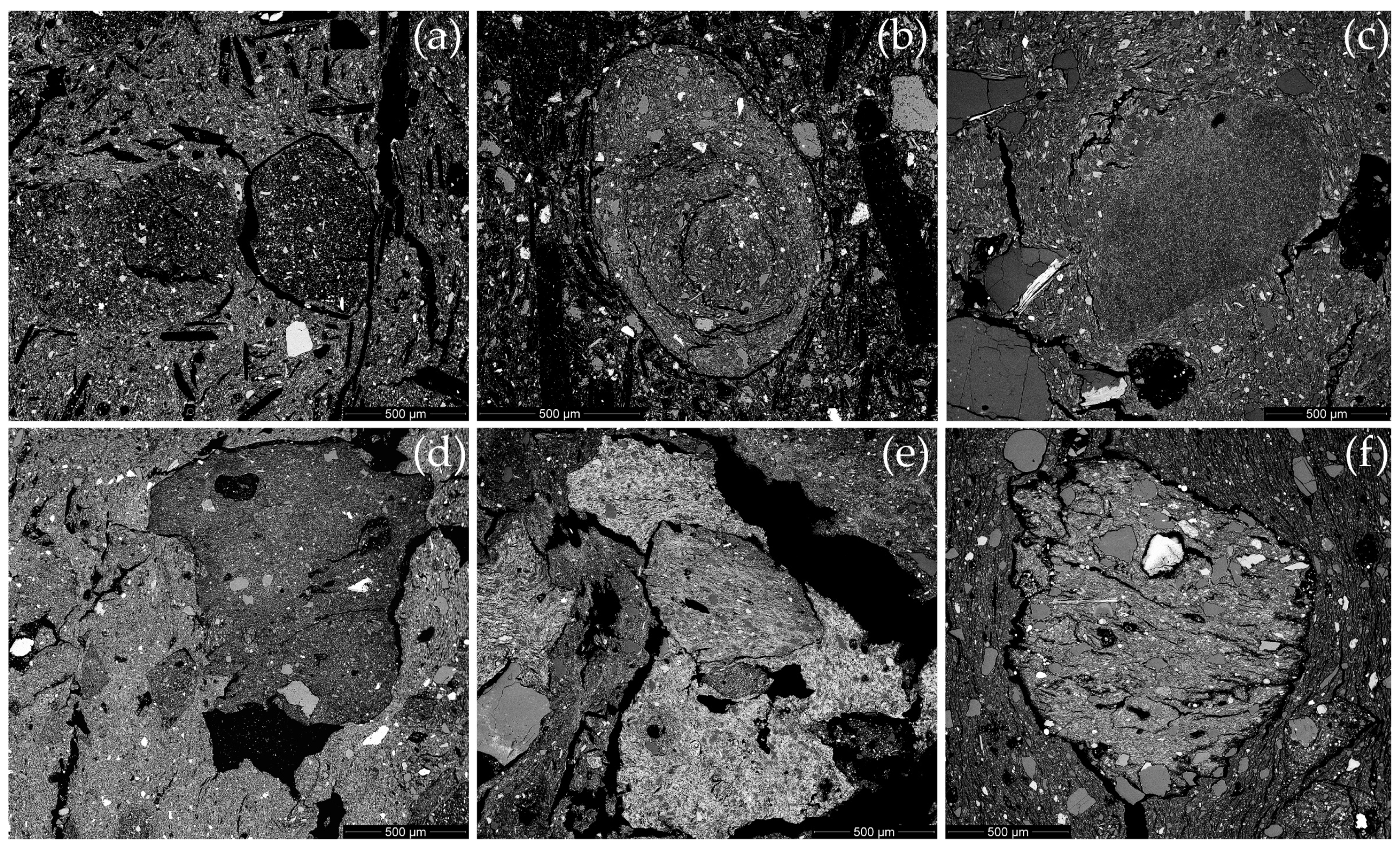
Clay pellets occur across all studied fabrics; in Daktariškė 5, they are rarer, concentrating in CWC pottery (fabric C1_D5), whereas in Šventoji they are more common, especially in NC fabrics A1,2_Šv. They are rounded to well-rounded, with clear to diffuse boundaries and, owing to shrinkage mismatch with the surrounding paste, commonly display ring voids [38]. Petrographically they often correlate with lacustrine silt–clay. BSE imaging shows that pellets often comprise well-sorted, weathered, quartz-poor illitic clay. Area chemical analyses show that pellets are Al-richer—also with slightly elevated K and Fe—and have lower Si than the per-sample matrix mean (Table A4). The highest Fe enrichments (FeO 8.27–9.57 wt%), accompanied by slightly elevated P2O5 (~0.63–1.3 wt%), occur in pellets from Šv4-1057 and Šv4-1029 (Table A4). BSE imagining indicates mature clay pellets with only weak heavy-element enrichment (Figure 12b,c), consistent with minor Fe hydroxidation/goethitization—far less pronounced than in Neolithic pottery made from morainic till in southeast Lithuania [17].
Pellets in other samples show no marked Fe enrichment. Sample Šv26-14, already notable in thin-section petrography for its abundant large pellets (Figure 6a), exhibits a fine, compact internal structure in BSE images (Figure 12a) and a chemical composition slightly poorer in Fe and K but markedly richer in Al and P than the per-sample matrix mean (Table A4).
CWC pottery is traditionally associated with grog temper (crushed pottery) [12,16]; therefore, detailed analyses of fabrics C1,2_D5 and C1_Šv were undertaken to examine the nature of the argillaceous clasts/grog. Such clasts display substantial textural and compositional variability (Figure 12d–f; Table A4). Frequently, their texture is similar to the host matrix, slightly finer or coarser. For example, in D5-432 the clast shows an exceptionally fine texture identical to the matrix, and larger clasts enclose smaller fragments of the same fabric, interpreted as second-generation grog (grog-in-grog) (Figure 12d). By contrast, Šv1-02 contains argillaceous clasts/grog that are even coarser than its already coarse matrix (Figure 12f) and also contains several second-generation grog clasts. D5-X05 is notable for the wide range of textures and compositions among its argillaceous clasts; they are large and intertwined, making the main clay matrix difficult to identify. It also contains several second-generation grog clasts (Figure 12e). Often these clasts can be recognized only by small contraction voids or a discordant orientation relative to the surrounding fabric; occasionally they appear plastic, partly diffused into the matrix.

3.5. Geochemistry of the Clay Matrix

SEM–EDS area analyses indicate that, despite low concentrations, P and S are highly variable and dominate the variance structure, artificially separating Šventoji from Daktariškė 5 due to P–S enrichment in the former (Table A5). To avoid this bias, P2O5, SOx, and MnO were excluded from subsequent multivariate compositional data analyses, as Mn was near or below detection limits in most measurements.
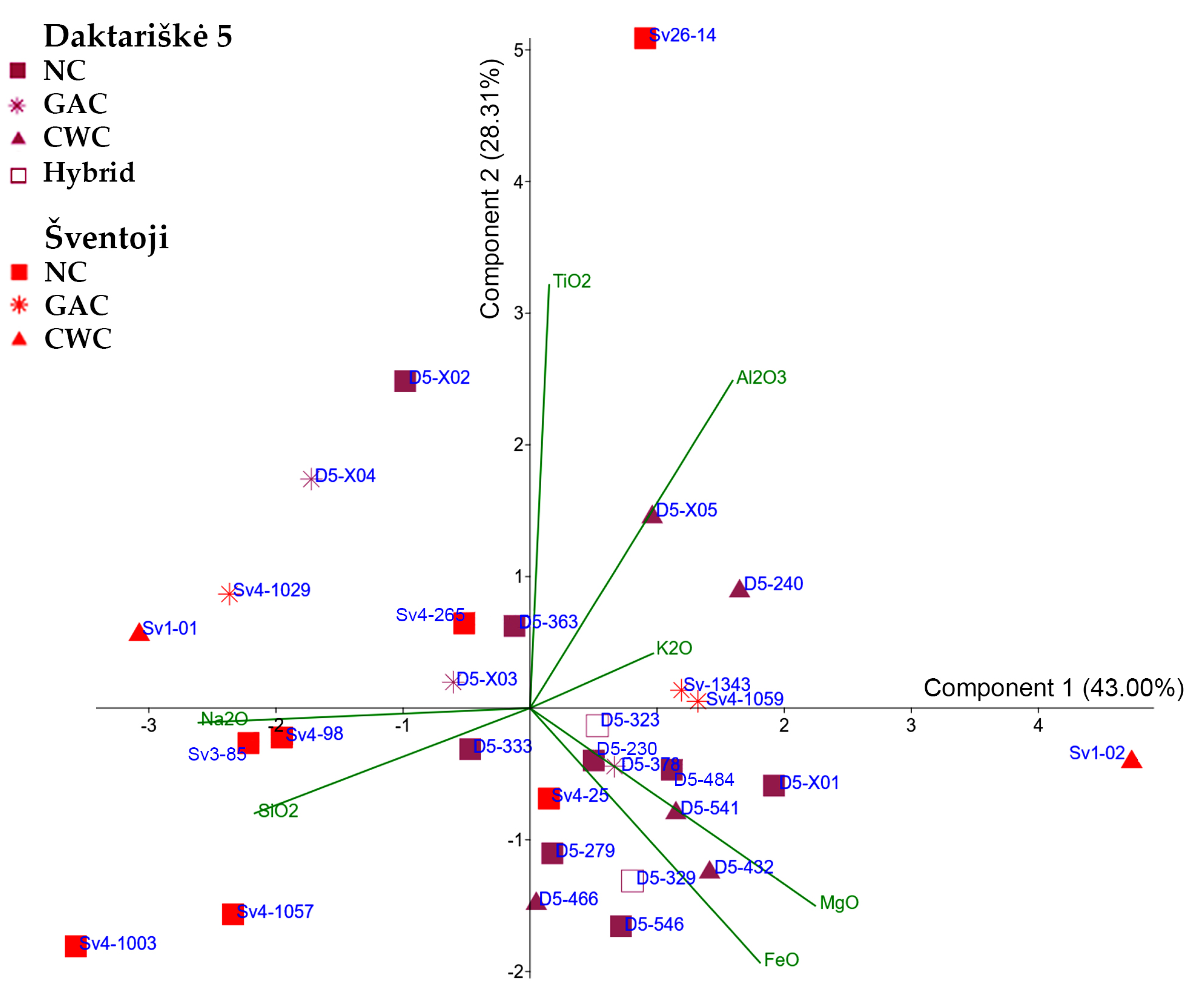
To assess compositional variation in the clay matrix across all samples, a PCA (correlation mode) was performed on CLR-transformed, per-sample clay matrix means. Several Daktariškė 5 hunter–fisher–gatherer NC samples (D5-230, D5-363, D5-484, D5-X01) retain finely comminuted shell in the fine silt fraction, yielding elevated Ca that dominated the variance. To avoid this bias, CaO was excluded from this PCA (in addition to P2O5, SOx, and MnO), and the remaining oxides were renormalized to 100% prior to CLR transformation. Model dimensionality, evaluated using the broken-stick and Guttman–Kaiser criteria, identified three principal components (PC1 = 43.00%, PC2 = 28.31%, PC3 = 16.08%) (Figure 13).
The score plot shows Daktariškė 5 samples (both NC and CWC) clustering tightly on the positive side of PC1, aligned with FeO and MgO loadings (Figure 13). The largest outliers are the Šventoji NC samples, with Šv26-14 (Combed-like Ware) differing most strongly from the grand mean (±SD) of the 30 per-sample matrix means (Table A5) by having markedly higher Al2O3 (25.23 wt% vs. 17.90 ± 2.30 wt%), elevated TiO2 (1.25 wt% vs. 0.94 ± 0.12 wt%), and lower SiO2 (55.83 wt% vs. 64.55 ±4.28 wt%) and FeO (4.23 wt% vs. 5.82 ± 1.01 wt%)—not typical of local iron-rich illitic clay. In the opposite direction from Šv26-14, the organic-rich samples Šv4-1003 and Šv4-1057 have the lowest Al2O3 (12.95 and 13.95 wt% vs. 17.90 ± 2.30 wt%) and highest SiO2 (74.68 and 70.61 wt% vs. 64.55 ± 4.28 wt%) (Table A5), consistent with a petrographically observed matrix poor in clay minerals and rich in fine quartz (Figure 6d,f). Additional outliers are the Šventoji CWC samples: Šv1-01 shows high Na2O (1.19 wt% vs. 0.70 ± 0.18 wt%) and low MgO (1.48 wt% vs. 2.34 ± 0.46 wt%), whereas Šv1-02 displays low Na2O (0.16 wt% vs. 0.70 wt% ± 0.18 wt%) and high MgO (3.45 wt% vs. 2.34 ± 0.46 wt%) and K2O (5.43 wt% vs. 4.10 ± 0.54 wt%), consistent with greater feldspar abundance in the former and Mg-rich biotite in the latter.
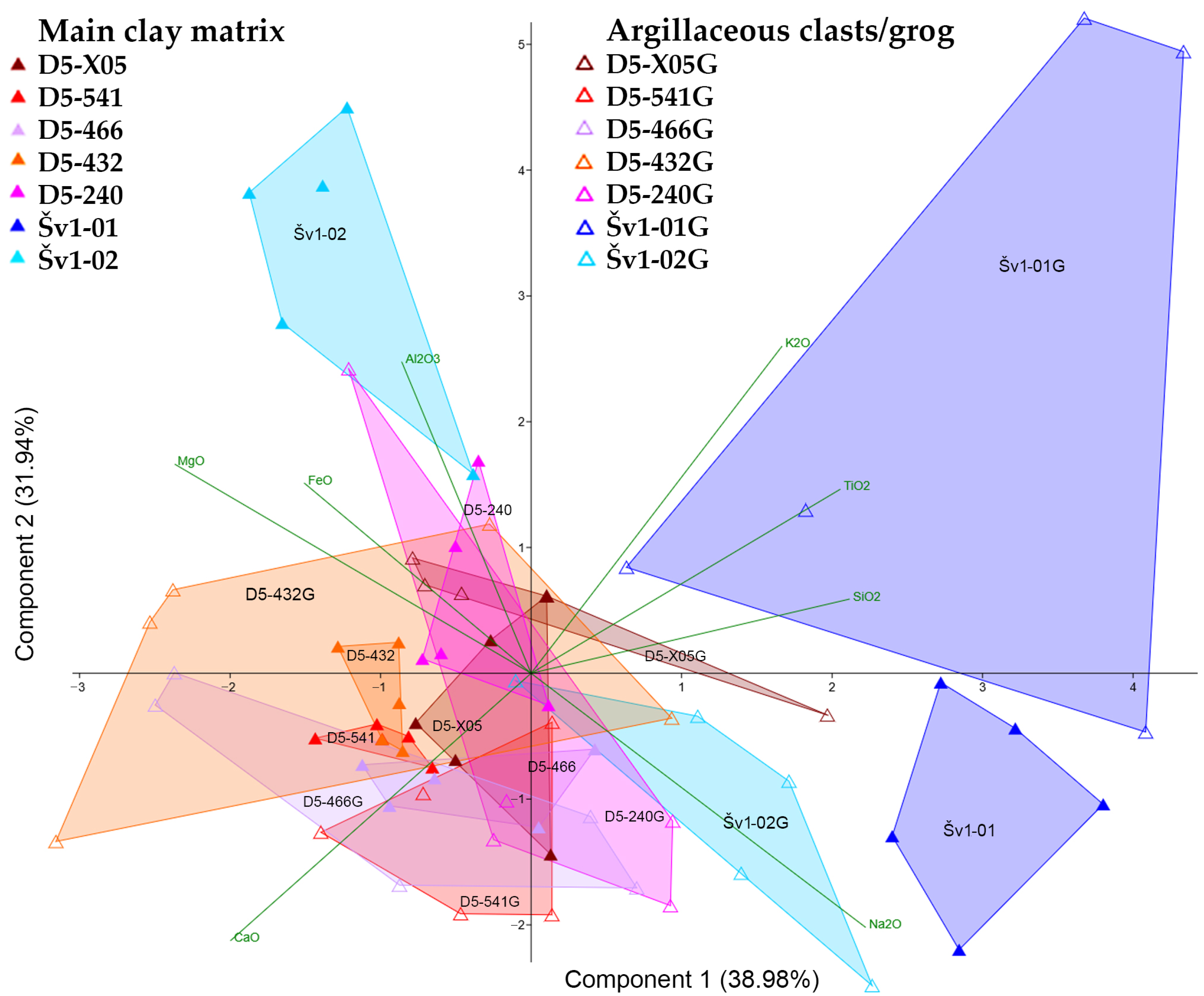
To compare the geochemistry of the argillaceous clasts/grog and the main clay matrix in CWC ceramic samples (fabrics C1,2_D5 and C1_Šv), a second PCA (correlation mode) was performed on normalized and CLR-transformed SEM–EDS area data. For each sample, five representative analyses of both the matrix and argillaceous clasts/grog were retained (Table A4). In the PCA plot, two polygons per sample delineate the dispersion of each group—one for the matrix and one for the inclusions (Figure 14). Model dimensionality, evaluated using the same criteria, identified three principal components (PC1 = 38.98%, PC2 = 31.94%, and PC3 = 15.60%). Results show substantial overlap between the main clay matrix and argillaceous clasts/grog within individual samples, although the argillaceous clasts/grog group consistently displays greater dispersion. At the inter-site scale, Daktariškė 5 samples partly overlap, whereas Šventoji samples—particularly their argillaceous clasts/grog—plot as outliers relative to Daktariškė 5.
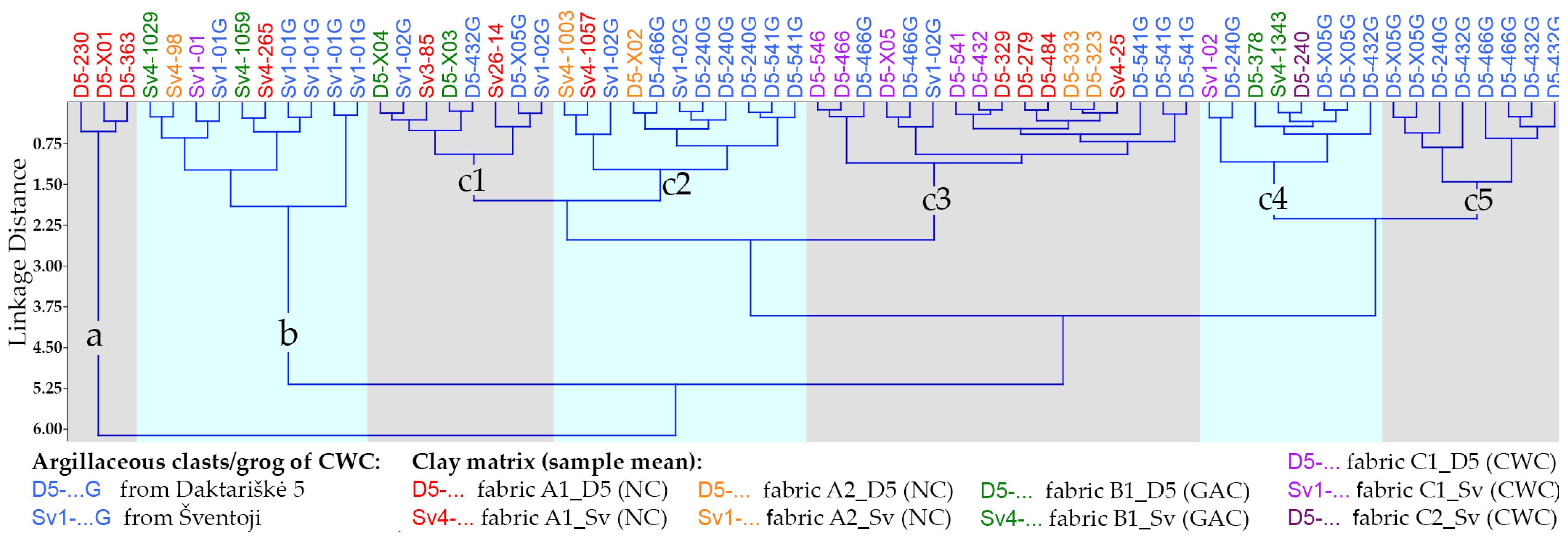
Given that argillaceous clasts/grog in CWC pottery are commonly interpreted as non-local crushed pottery [12], provenance was evaluated by clustering five grog area analyses per each of the seven CWC samples together with the mean composition of each sample’s clay matrix. Oxide data (CaO retained; MnO, SOx, and P2O5 excluded) were CLR-transformed and clustered hierarchically (Euclidean distance; Ward’s minimum variance), yielding a cophenetic correlation coefficient of 0.69 (Figure 15). This design—mixing individual grog measurements with per-sample matrix means—served two purposes: (i) to test whether grog fragments could derive from other vessels and (ii) to assess how clay matrices from different fabrics/cultural traditions group relative to one another. While this approach combines data with different variance structures, it enables an efficient visual comparison of inclusions to potential source pastes and of cross-fabric affinities.
In the hierarchical clustering, seven groups were resolved (Figure 15). Samples cluster primarily by location and secondarily by fabric/cultural tradition, reflecting differences in ceramic microstructure, mineralogy, clay processing, and tempering.
  • Branch a (n = 3) aggregates outliers—NC samples (fabric A1_D5) from Daktariškė 5 with preserved shell fragments (D5-230, D5-363 and D5-X01), characterized by elevated CaO associated with calcareous shell temper;
  • Branch b (n = 10) comprises exclusively Šventoji samples, including two GAC (Šv4-1029, D5-1059), two NC (Šv4-98, Šv4-265), and one CWC (Šv1-01) vessel, along with all analyses of its argillaceous clasts/grog;
  • Branch c1 (n = 8) links, in close proximity, two GAC samples from Daktariškė 5 (D5-X03, D5-X04) with argillaceous clasts/grog from both sites, and two NC samples from Šventoji—including Šv26-14, which joins at a greater distance due to its chemical and stylistic distinctiveness;
  • Branch c2 (n = 11) closely linked to c1, joins fine sand-rich NC samples (D5-X02, Šv4-1003, Šv4-1057) together with argillaceous clasts/grog from both locations;
  • Branch c3 (n = 17) includes the majority of NC, CWC, and hybrid pottery from Daktariškė 5, together with their argillaceous clasts/grog, and a single NC sample (Šv4-25) from Šventoji, all characterized by fine clay matrix;
  • Branch c4 (n = 8) groups coarser clay matrices of CWC (D5-240, Šv1-02) and GAC (D5-378, Šv4-1323) from both sites, together with coarse-textured argillaceous clasts/grog from Daktariškė 5;
  • Branch c5 (n = 8) contains only argillaceous clasts/grog from four CWC samples of Daktariškė 5, petrographically confirmed as grog fragments.
Overall, the clustering aligns with petrographic and mineralogical observations and primarily reflects differences in clay processing and local sources. Using per-sample matrix means, a Daktariškė 5-centered cluster emerges that combines NC and CWC from that site, whereas Šventoji NC samples are dispersed across multiple groups, reflecting a lack of a single good clay source rather than non-local pottery. Additionally, CWC from Šventoji and GAC from both sites show cross-site coherence, clustering with counterparts from the other location. Argillaceous clasts/grog analyses remain more dispersed, but occasionally form sub-groups or group with the clay matrix mean of the same sample.

4. Discussion

4.1. Raw Material Selection

From a techno-functional perspective, potters select clays according to availability and performance properties (plasticity, impurities, drying shrinkage, and hardness of the fired body) [46]. Ethnographic studies indicate that clay procurement balances time, distance, and energy; most clays are gathered locally, at or near the workspace, with additional sources typically within about an hour’s walk (≈3–4 km) [47].
In the Neolithic, potters likewise exploited locally accessible raw materials; however mixed Quaternary sediments deposited by several glaciations complicate provenance assessment. Nevertheless, environmental variation between the studied regions allows tracing distinct geochemical signatures and microstructural differences in the clay matrix. The Biržulis Lake region, where the Daktariškė 5 settlement is situated, is rich in glaciolacustrine deposits (Figure 1b), offering favorable clay sources. In this region the earliest pottery in west Lithuania was found [8,21], and while rich fishing grounds likely encouraged settlement, its emergence may also have been facilitated by the ready availability of suitable lacustrine clays. At the Daktariškė 5 settlement, the ceramic paste is dominated by fine-grained, weathered, occasionally layered or laminated hydromicaceous clay with clay pellets—features that collectively indicate a lacustrine origin. Unweathered mica flakes occur only in Globular Amphora Culture (GAC), likely introduced with crushed muscovite granite temper. Narva Culture (NC) and hybrid-type ceramic pastes also preserve fine plant residues, small-bodied faunal remains, and fish scales/bones. Such organic remains are common in the earliest pottery from Eastern Europe and are associated with lake-shore sediments [48,49]. In the earliest NC shell-tempered pottery from neighboring Latvia, fish bones and scales were also found [13,50]; however, researchers comparing these ceramics with the earliest Ertebølle Culture rock-tempered pottery in the southern and western Baltic noted the absence of such remains in Ertebølle vessels, suggesting that fish scales and bones derive from the shell temper [51]. Nevertheless, in our material, these organic impurities occasionally occur along with fine plant residues and small-bodied faunal remains that were not charred prior to incorporation, indicating that—unlike shell temper, which is typically pre-burnt—they were introduced accidentally during ceramic paste preparation or derived directly from natural clay.
By contrast, the Šventoji sites lie on a sandy, low-lying Littorina Sea terrace adjacent to a former shallow freshwater lake, where suitable clay sources are scarce. Excavations at Šventoji 4 exposed freshwater gyttja layers interpreted as fishing stations, with freshwater–brackish planktonic and epiphytic diatoms and fish bones densely packed in sandy gyttja lenses, along with burnt bones and charcoal, indicating anthropogenic inputs [7]. This context suggests that NC ceramics at Šventoji may have been produced using clayey gyttja sourced at or near these locations, also explaining the frequency fish bones/scales and occasional burnt terrestrial bone in the ceramic paste (Figure 7b–d). The case is clearest in Šv4-1003 sample; its clay matrix is very slightly optically active (Figure 6f) and consists largely of gyttja with abundant biogenic and organic matter (Figure 8a). Other NC sherds from the Šventoji sites are dominated by variegated hydromicaceous clay but also show components of the same lacustrine environment, including abundant diatom fragments and fragmented organic/biogenic matter. One Combed-like Ware sherd, Šv26-14, stands out due to its fine-grained clay with diatoms, containing coarse pellets of the same texture (Figure 12a), and for markedly higher Al2O3—typical of well-illitic clay [45]—than in other Šventoji hunter–fisher–gatherer ceramics, also exceeding values from Daktariškė 5 (Table A5). At the Šventoji sites, the occurrence of Combed-like Ware is linked to the influence of Typical Comb Ware, which emerged around 4000 BCE in Latvia, Estonia, and Finland [14,15,21]. In Riņņukalns (Latvia), where NC and Comb Ware were found, SEM–EDS clay matrix area measurements yield per-sample mean Al2O3 of 14.6–20.6 wt% [14]; these values are similar to those at Šventoji but do not exceed Šv26-14. In Eastern Europe, early hunter–fisher–gatherer pottery shows even leaner clay (Al2O3 13.0–17.4 wt%) [52]. However, a fat clay matrix, chemically similar to Šv26-14, was observed in hunter–fisher–gatherer pottery from Southeast Lithuania (Al2O3 20.1–25.8 wt%) [17], but with markedly higher iron content (Fe2O3 10.67–12.38 wt%). A texturally similar clay matrix with coarse clay pellets was observed in hunter–fisher–gatherer pottery from the Imerka III settlement (Russia) [52] and in a Corded Ware Culture (CWC) sample from Poland [16], suggesting analogous clay sources rather than direct cultural or exchange links. The largest SEM–EDS database of Neolithic pottery from the Baltic region is based on CWC [12], which shows differences in clay sources across regions of Estonia, Finland, and Sweden. These differences appear to represent inter-site and cross-Baltic Sea pottery exchange patterns [12]; however, taking into account several glaciations that shaped the Baltic region, similar geochemistry may also reflect glacial reworking and dispersal of Quaternary sediments.
Studies using geochemical comparisons of Neolithic pottery from local hunter–fisher–gatherer and early farming communities in the Netherlands [53], Denmark, and Sweden [54] show that ceramics of hunter–fisher–gatherers are more heterogeneous and sometimes exhibit leaner clay. Similarly, at Šventoji, in contrast to the generally lean NC clay, GAC pottery exhibits fine-grained, weathered, plastic lacustrine clay with texture (Figure 6k,l), geochemistry, and mineralogy similar to those at Daktariškė 5 (Figure 5a–c). Even Šv4-1029, although coarser in clay matrix texture, contains large clay pellets of mature illitic clay, again pointing to a lacustrine source (Figure 11e,d and Figure 12c). Given that GAC communities are often interpreted as short-term incomers [5], their apparent access to high-quality clays is noteworthy. A familiar landscape template may have guided raw-material selection; however, the close chemical similarity between GAC clay matrices at Šventoji and Daktariškė 5 also does not preclude production by the same or closely related communities with vessel transport between locales. Testing this hypothesis will require a larger comparative assemblage.

4.2. Ceramic Paste Recipes and Production Technologies

If raw-material selection is largely determined by environmental availability, then the remaining technological choices—raw-material processing, paste preparation recipes, vessel forming, surface treatment/decoration, firing, and preparation for the use of a vessel with its specific performance properties—require specialized skills and culturally transmitted knowledge [55,56]. Harvested clays commonly need pre-treatment (crushing, sieving, levigation [57], souring, and microbial/acid additions) to improve plasticity. Conversely, non-plastic additives (temper) are introduced to control shrinkage, firing behavior, and mechanical durability [58]. Tempers can carry not only functional roles but also symbolic meanings of cultural identity [59]; this is especially discussed for grog [60].
NC pottery marks the earliest ceramic technology in the East Baltic, where it was transmitted among Eastern European hunter–fisher–gatherer communities [15,61], distinct from the ceramic tradition diffusion zone in Southeastern Europe linked to agrarian groups of the northern Balkans and Pannonian Basin [32,62,63]. NC ceramic pastes in the studied samples (fabrics A1_D5 and A1_Šv) are mainly characterized by shell temper with charred organic material (Figure 4a–e and Figure 6a–e). Shell tempering is widely documented at hunter–fisher–gatherer sites across the East Baltic (Northeast Poland, East Lithuania, Belarus, Latvia and Estonia [13,14,15,50,51,64,65,66]; it is also common in Neolithic settlements elsewhere in Europe—for example, the Pitted Ware Culture of East Sweden [54], the Cucuteni–Tripolye Culture, and the Funnel Beaker Culture of Central and Southeastern Europe [67].
The addition of shell improves the workability of soft, sticky clays; platy shell fragments aligned parallel to the walls act as a structural armature, facilitating the forming of large, wide-mouthed vessels typical of the NC tradition. In Daktariškė 5, surviving shell fragments show cracks consistent with pre-burning. Firing is critical; between ~650–750 °C, the CaCO3 in shell fragments decomposes to CaO and upon cooling and moisture uptake, CaO hydrates to Ca(OH)2, inducing volumetric expansion, which causes spalling of the ceramic. Pre-fired shells easily crumble and remain essentially dimensionally stable, thereby preserving the desired temper properties [68]. Shell-tempered pottery from both locations show very low firing temperatures (<650 °C) [69]: dark cores, unburned plant matter (which would oxidize at ~600–750 °C [46]), and—at 5000× BSE—a non-vitrified, flaky microstructure resembling unfired raw clay [17].
Such practical knowledge of shell behavior and adapted firing regimes was likely socially transmitted. The selection and processing of specific raw materials, and their possible handling in communal settings, may have fostered technological homogeneity. Shell tempering may reflect a combination of functional requirements, resource constraints (limited temper options and fuel scarcity potentially constraining firing temperatures), and raw-material availability [70]. It also appears consistent with culinary traditions and fishing-oriented subsistence strategies, with NC pottery food-residue analyses suggesting intensive use of aquatic resources [10]. Shell temper at Daktariškė 5 is dominant in early NC pottery, but following the late NC tradition of various organic tempers, it re-emerges in later hybrid types [8,9]—for example, sample D5-329, whose decoration resembles CWC (Figure 2d and Figure 4f). Food-residue analyses of GAC, CWC, and hybrid pottery from this site indicate sustained exploitation of freshwater resources, consistent with similar aquatic-focused subsistence strategies over time [11]. In Latvia, hunter–fisher–gatherer Comb Ware—also based on freshwater resources—adopted the NC tradition of shell tempering, often in combination with rock temper [15]. Furthermore, some CWC vessels contain grog from earlier pottery combining granite and shell tempers [13]. These features point to technological exchange networks not only among hunter–fisher–gatherer communities but also with incoming CWC groups. Overall, shell tempering represents a socio-technical choice shaped by local ecology, resource access, and community practices.
Hunter–fisher–gatherer NC ceramic pastes in fabrics A2_D5 and A2_Šv are distinguished by abundant organic matter—plants and small-bodied faunal remains—preserved as voids infilled with charred residues (Figure 4g–i and Figure 6f,g). Plant tempering is the most widespread practice among Neolithic hunter–fisher–gatherer and early farming communities [15,39,61,62,63,70]. Agrarian potters typically used cereal by-products, especially chaff [39,63]. Analyses of hunter–fisher–gatherer pottery from the Pannonian Basin indicate chopped grasses [62], whereas in Eastern Europe, water plants predominate [71]. Similar coarse plant inclusions also dominate in Neman Culture ceramics from Southeast Lithuania [59]; however, NC ceramic pastes often display a fine organic fraction, consistent with digested plant material (dung) [6,8,9,61,64,66]. Dung is common in early agrarian ceramics [39], but it remains under discussion how digested plant matter could have been gathered by hunter–fisher–gatherers [59]. This tempering practice was likely contingent on specific conditions (e.g., seasonality, hunting, or related activities) and did not replace the shell-tempering tradition. Such fine organic material, expressed as round pores with charred matter, together with naturally occurring sand and very dark sherd cores, was found in D5-X02 and Šv4-98 (Figure 4h and Figure 6g). Digested plant material (dung)—in contrast to shell—enhances plasticity [58], which may be important for sandy clay. All vessels of this fabric are thick-walled, implying that forming such pastes was technically demanding. The preserved charred organics also indicate very low firing temperatures (<650 °C).
GAC pottery in the East Baltic is linked to incoming pastoralist groups from Central Europe, attracted in part by Baltic Sea amber [72]. It is characterized by vessel forms with rounded bodies, flat bases, and frequent cord decoration [5,8]. Petrographic datasets from neighboring countries remain scarce; however, six analyzed samples, together with one specimen from Southeast Lithuania [17], provide initial insights into this ceramic tradition. Evidence for a local origin of GAC ceramic production is supported by the use of distinct local clay sources; the studied west Lithuanian samples (fabrics B1_D5 and B1_Šv) indicate the selection of lacustrine clays, whereas in southeast Lithuania, glacial till was used [17]. GAC vessels from both sites of west Lithuania share a similar deformed, cataclastic muscovite granite temper recording dynamic metamorphism, while the sample from southeast Lithuania lacks any coarse mica and instead contains a distinctive granite dominated by weathered plagioclase with kaolinite [17]. Such granites are uncommon at the surface in Lithuania, where pink, microcline-rich granites prevail [23]. Although mylonitic granites used as temper are known from Central European Neolithic contexts [73], a direct Central European provenance here is unlikely. A more plausible interpretation is the local occurrence of deformed muscovite granites, selected either due to limited local options or a deliberate preference for white muscovite–orthoclastic lithologies. A preference for white granites over the usual pink varieties is likewise noted in the Southeast Lithuanian GAC sample [17]. Pre-burning granite facilitates disintegration via the α–β quartz transition at ~573 °C, which produces a volume change [17,42]. Quartz contraction voids are evident only in Šv4-1343, and coarse quartz grains isolated from feldspar were observed in the sample from Southeast Lithuania [17], suggesting pre-burning. In other samples, quartz grains remain tightly fitted to adjacent minerals, and coarse muscovite laths are preserved—features consistent with low pottery firing temperatures and the use of deformed, weathered granites that would crumble without pre-burning.
The clay matrix commonly shows lamination or layering, attributable to the selection of specific clay layers, levigation, or intentional mixing to enhance its plasticity [57]. However, these features, together with the presence of large, undissolved clay pellets texturally distinct from the matrix in Šv4-1029, likely reflect incomplete homogenization of variegated clay source [74].
Macroscopic and petrographic firing indicators point to a complex firing regime; grayish-brown cores suggest oxidizing conditions, whereas black burnished surfaces imply a final reducing stage [58]. Clay minerals in Daktariškė 5 samples indicate very low firing, whereas samples from Šventoji are non-vitrified but show deformed or buckled clay platelets [75], consistent with ~650–750 °C. Meanwhile, a higher, medium firing temperature of ~750–800 °C was detected in a GAC sample from Southeast Lithuania [17].
Overall, the clay processing, use of rock fragments, finishing, and especially firing procedures appear distinctive to the GAC tradition in west Lithuania, with no clear evidence of technological transfer from local NC or incoming CWC practices, suggesting a short period of occupation.
CWC pottery is associated with another wave of incoming pastoralist communities that spread across large areas of Central, Eastern, and Northern Europe during the third millennium BCE [1,2,3,4]. CWC ceramics are characterized primarily by the manipulation of argillaceous clasts/grog [8,16,53,60]; however, grog temper was used by agrarian potters as early as 5000 BCE [63], and it is also documented in hunter–fisher–gatherer pottery from Eastern Europe [49,52]. The fabric C1_D5 also includes D5-546, the stratigraphically oldest sherd; at first glance it appears grog-tempered, yet grog is atypical for NC, and the partly dissolved margins of its argillaceous grains point instead to a natural origin. In this study—consistent with observations from Southeast Lithuania [17]—CWC sherds commonly show argillaceous clasts that are partly diffused, intertwined with the matrix, or recognizable only by angular ring-voids, while sharing the same texture as the surrounding clay. Although very low firing can render ceramics partly plastic after prolonged wetting, the high textural variability observed here makes it unlikely that grog was systematically recycled from identical ceramic fabrics. The shape and structure of these clasts more plausibly reflect the use of dried lumps [57] of the same clay to adjust the workable moisture of the paste. This is especially evident at Daktariškė 5, where fat lacustrine clay was likely soft and sticky, and sand was added to temper and lean the paste (D5-X05; Figure 5h). Furthermore, some archaeologists view the use of grog as a symbolic act, highlighting the cyclical life and death of people and artifacts [60,70], which over time probably transformed into a tradition of using dried clay or charred organic dough-like lumps (as in D5-541; Figure 5g) to ensure the good workability of plastic clay. Notably, both Šventoji CWC samples (fabric C1_Šv; Figure 6h,i) contain texturally distinct grog that is also chemically distinct from the matrix (Figure 14). In Šv1-02, grog with crushed rock fragment is found—the one case that could suggest links to GAC practice or the reuse of a GAC vessel as temper.
CWC vessels generally indicate low firing regimes (~650–750 °C), with slightly higher temperatures inferred for the Šventoji samples. One sherd stands out from the other CWC samples: the thin-walled beaker D5-240 (fabric C2_D5; Figure 5i), which is very dark macroscopically and black in XPL. Its features imply reducing conditions at low temperature (~650–750 °C). A similar CWC beaker from southeast Lithuania shows even lower firing temperatures and, as in the Šventoji CWC sample Šv1-02, Mg-rich hornblende occurs in the grog [17]. Elaborately decorated beakers with incised herringbone or cord impressions—such as D5-240 and D5-466 (Figure 2c)—likely represent the earliest CWC pottery. Differences in ceramic paste and firing regimes, and the geochemical clustering of D5-240 with GAC samples (Figure 15), may suggest a non-local origin for beaker D5-240. Despite these differences, both beakers (D5-240 and D5-466) likely served a representative or prestige role yet functioned as individual-use vessels; notably, both yielded aquatic residues and the earliest detected traces of milk in the East Baltic [11].

5. Conclusions

Thirty ceramic samples dated to the fourth to third millennium BCE from the coastal Šventoji sites and the inland Daktariškė 5 settlement (Biržulis Lake region) were examined using petrographic, mineralogical, and geochemical analyses. The assemblage represents three cultural traditions—hunter–fisher–gatherer Narva Culture (NC) and the first incoming pastoralist communities of the Globular Amphora (GAC) and Corded Ware Cultures (CWC).
Petrographic and SEM–EDS analyses demonstrate the use of locally sourced lacustrine clays, although clay selection differed between regions. At Daktariškė 5, where suitable clays were readily available, early NC pottery shows a fine, plastic matrix with abundant crushed shell temper. In contrast, NC pottery from Šventoji—where clay sources were less accessible—displays heterogeneous fabrics enriched in natural sand and organic remains, including silicified plant xylem and diatoms, suggesting the use of lacustrine or lagoonal gyttja in paste preparation.
An additional NC tradition of tempering with fine, probably digested plant matter appears in a few samples but seems limited to thick-walled vessels. This practice did not replace shell tempering, which remained dominant. Its continuation in hybrid pottery combining NC and CWC traits indicates the persistence and transmission of local technological knowledge into the new cultural horizon.
One early NC sherd with grog-like argillaceous clasts offers a model for understanding CWC paste preparation, where initial grog temper was later replaced by dried clay or charred organic lumps. Geochemical clustering between NC and CWC ceramics at Daktariškė 5 reflects shared clay sources and technological adaptation. CWC pottery from Šventoji, however, shows affinities with GAC fabrics, possibly indicating indirect technological influence or shared raw-material zones, including the reuse of GAC pottery as grog temper.
GAC ceramics from both sites are characterized by similar ceramic pastes with deformed, cataclastic muscovite granite in fine lacustrine clay. Although GAC groups in the East Baltic are regarded as short-term incomers, their access to high-quality clay suggests targeted use of local lacustrine sources rather than imported materials.
Taken together, these results reveal technological continuity and selective hybridization within the contact zone of hunter–fisher–gatherer and early farming communities. Potters adapted available resources through socially transmitted knowledge, maintaining local ceramic traditions while gradually integrating new materials and techniques introduced by incoming groups.

Author Contributions

Conceptualization, E.Š., G.S. and L.G.; methodology, E.Š., G.S., L.G., O.D., L.Š. and A.B.; software, E.Š., G.S., L.G., O.D. and L.Š.; validation, E.Š., G.S., L.G., O.D., L.Š. and A.B.; formal analysis, E.Š., G.S., L.G., L.Š. and O.D.; investigation, E.Š., L.G. and G.S.; resources, L.G. and A.B.; data curation, E.Š. and G.S.; writing—original draft preparation, E.Š.; writing—review and editing, E.Š., G.S., L.G., O.D., L.Š. and A.B.; visualization, E.Š.; supervision, G.S. and A.B.; project administration, G.S. and A.B.; funding acquisition, A.B. All authors have read and agreed to the published version of the manuscript.

Funding

The APC was funded by the Art and Science Project Fund of the Vilnius Academy of Arts.

Data Availability Statement

The dataset is presented directly in the present study. Additional data (unpublished) are available upon request from the corresponding author (E.Š.).

Acknowledgments

The authors thank Dalia Ostrauskienė and the National Museum of Lithuania for the provision of ceramic samples and for her support. The authors would also like to thank the anonymous reviewers for their useful comments that helped in the revision of this manuscript. A ZEISS Stemi 508 stereo microscope, used for thin-section analysis, was kindly provided by Inospectra Ltd. A Nikon Eclipse LV100N POL polarizing microscope with epi-illumination, housed at the Nature Research Centre (Lithuania) and used for this study, was purchased under the PALEO project funded by the Research Council of Lithuania (LMTLT), agreement No. P-MIP-23-129.

Conflicts of Interest

The authors declare no conflicts of interest.

Abbreviations

The following abbreviations are used in this manuscript:
BSEBackscattered electron
CLRCentered log-ratio
CWCCorded Ware Culture
EPIReflected light with episcopic illumination
GACGlobular Amphora Culture
NCNarva Culture
PCAPrincipal component analysis
PPLPlane-polarized light
SEM–EDSScanning electron microscopy with energy-dispersive spectroscopy
XPLCross-polarized light

Appendix A

Table A1. Representative SEM–EDS analyses of the feldspar minerals. Abbreviations: Ab—albite; Ads—andesine; An—anorthite; Lab—labradorite; Olg—oligoclase; Or—orthoclase; Ser—sericite; r—in rock fragment; w—weathered; b.d.l.—below detection limit. * The number of ions in the chemical formulae for feldspar were calculated on an eight-oxygen basis.
SampleD5-240D5-363D5-546D5-323D5-240D5-378rD5-378rD5-378rD5-378rD5_432Sv-1323rSv-1323rSv-1323rSv-1323r
Wt. %AdsOlg–AdsOlgAbAbOrAbOlgAds–LabOr wOrOlgAbAb+Ser
SiO258.9357.5461.9765.9464.9265.5268.463.9455.250.9165.4763.5468.0962.1
TiO2b.d.l.b.d.l.b.d.l.b.d.l.b.d.l.b.d.l.b.d.l.b.d.l.b.d.l.0.64b.d.l.b.d.l.b.d.l.b.d.l.
Al2O324.3822.3723.1519.8220.8518.3319.0521.8627.4931.8717.8322.4619.3521.36
FeOb.d.l.0.54b.d.l.0.51b.d.l.b.d.l.b.d.l.b.d.l.b.d.l.1.44b.d.l.b.d.l.b.d.l.b.d.l.
MgOb.d.l.b.d.l.b.d.l.b.d.l.b.d.l.b.d.l.b.d.l.b.d.l.b.d.l.1.14b.d.l.b.d.l.b.d.l.b.d.l.
CaO6.65.854.870.582.08b.d.l.0.212.999.930.46b.d.l.3.69b.d.l.1.4
Na2O7.558.018.3811.2410.290.9811.9610.096.060.92b.d.l.9.4911.5910.5
K2O0.250.360.180.440.1714.98b.d.l.0.150.008.3816.47b.d.l.b.d.l.0.21
Total97.7294.6798.8198.5498.3199.899.6399.0498.6795.7699.7899.1799.0395.58
Number of ions in the chemical formulae *
Si2.692.722.782.942.903.013.002.852.522.413.032.823.002.86
Ti0.000.000.000.000.000.000.000.000.000.000.000.000.000.00
Al1.311.251.221.041.100.990.991.151.481.780.971.181.001.16
Fe+20.000.020.000.020.000.000.000.000.000.060.000.000.000.00
Mg0.000.000.000.000.000.000.000.000.000.080.000.000.000.00
Ca0.320.300.230.030.100.000.010.140.480.020.000.180.000.07
Na0.670.730.730.970.890.091.020.870.540.080.000.820.990.94
K0.010.020.010.030.010.880.000.010.000.510.970.000.000.01
Tot.cat.5.005.044.985.035.004.975.015.025.014.974.975.004.995.04
An32.1028.1624.052.709.950.000.9613.9547.523.800.0017.690.006.78
Ab66.4569.7874.8994.8589.089.0499.0485.2152.4813.760.0082.31100.092.01
Or1.452.061.062.440.9790.960.000.830.0082.44100.00.000.001.21
Table A2. Representative SEM–EDS analyses of the muscovite and illite minerals. Abbreviations: Ilt—illite; Ms—muscovite; b.d.l.—below detection limit. * The number of ions in the chemical formulae for the mica minerals were calculated on a 22-oxygen basis.
SampleD5-240D5-240D5-240D5-363D5-432D5-432D5-432D5-432D5-466D5-546D5-X01D5-X02D5-X02D5-X02D5-X02D5-X02D5-378D5-378Sv-1343Sv-1343Sv-1343
Wt. %MsMsMs to IltMsMsMsMsMs to IltMsMsMsMsMsMsMs to IltMs to IltMsMsMsMsMs
SiO249.6748.1849.5046.0248.3749.1650.2752.7846.9845.3047.6145.8448.4751.0945.8347.5446.3146.0545.452.4451.24
TiO20.490.920.340.620.83b.d.l.0.970.320.31b.d.l.1.400.550.810.320.500.440.34b.d.l.0.50b.d.l.b.d.l.
Al2O329.3727.6726.1628.6627.4728.0828.5727.7128.7735.9432.0730.4631.5529.5927.0421.9430.2535.0232.5732.5233.2
FeO5.094.935.454.353.414.864.893.434.570.002.273.432.960.945.644.472.980.821.750.880.73
MnOb.d.l.b.d.l.b.d.l.b.d.l.b.d.l.b.d.l.b.d.l.b.d.l.b.d.l.b.d.l.b.d.l.b.d.l.b.d.l.0.23b.d.l.b.d.l.b.d.l.b.d.l.b.d.l.b.d.l.b.d.l.
MgO1.922.222.391.551.952.121.582.461.310.171.352.361.323.261.401.711.480.650.981.951.53
CaOb.d.l.b.d.l.0.290.360.650.430.300.610.360.14b.d.l.0.20b.d.l.b.d.l.1.260.33b.d.l.b.d.l.b.d.l.0.28b.d.l.
Na2O0.31b.d.l.b.d.l.b.d.l.b.d.l.0.530.270.23b.d.l.0.390.890.44b.d.l.0.300.100.140.240.480.27b.d.l.b.d.l.
K2O10.9310.487.0810.676.828.629.577.719.0210.2010.128.9410.3710.947.686.8410.2210.7910.828.969.58
P2O5b.d.l.b.d.l.b.d.l.b.d.l.b.d.l.b.d.l.b.d.l.b.d.l.b.d.l.b.d.l.b.d.l.b.d.l.b.d.l.b.d.l.b.d.l.b.d.l.b.d.l.b.d.l.b.d.l.b.d.l.0.31
SO2b.d.l.b.d.l.b.d.l.b.d.l.b.d.l.b.d.l.b.d.l.b.d.l.b.d.l.b.d.l.b.d.l.b.d.l.b.d.l.b.d.l.b.d.l.b.d.l.b.d.l.b.d.l.b.d.l.b.d.l.b.d.l.
Total97.7894.4191.2092.2490.0593.8096.4295.2591.3293.1195.7292.2295.4896.6689.4783.4191.8293.8192.2997.0396.59
Number of ions in the chemical formulae *
Si6.576.596.866.466.766.696.686.946.576.176.346.346.466.696.577.186.456.216.276.716.62
Ti0.050.090.040.070.090.000.100.030.030.000.140.060.080.030.050.050.040.000.050.000.00
Al4.584.464.274.744.534.504.474.294.755.775.034.964.964.564.573.914.965.575.304.905.06
Fe+20.560.560.630.510.400.550.540.380.530.000.250.400.330.100.680.560.350.090.200.090.08
Mn0.000.000.000.000.000.000.000.000.000.000.000.000.000.030.000.000.000.000.000.000.00
Mg0.380.450.490.320.410.430.310.480.270.030.270.490.260.640.300.390.310.130.200.370.29
Ca0.000.000.040.050.100.060.040.090.050.020.000.030.000.000.190.050.000.000.000.040.00
Na0.080.000.000.000.000.140.070.060.000.100.230.120.000.080.030.040.060.130.070.000.00
K1.841.831.251.911.221.501.621.291.611.771.721.581.761.831.411.321.811.861.911.461.58
H4.004.004.004.004.004.004.004.004.004.004.004.004.004.004.004.004.004.004.004.004.00
Mg/(Mg+Fe)0.400.450.440.390.510.440.360.560.341.000.520.550.440.860.310.410.470.590.500.800.78
Table A3. Representative SEM–EDS analyses of the biotite, chlorite, and amphibole minerals. Abbreviations: Bt—biotite; Chl—chlorite; Cum—cummingtonite; Hbl—hornblende; w—weathered. * The number of ions in the chemical formulae for biotite and chlorite were calculated on a 22-oxygen basis, for amphibole on a 23-oxygen basis, respectively.
SampleD5-240D5-363D5-432D5-X01D5-X03Šv4-1323Šv4-1323D5-378D5-546D5-X03D5-240D5-466D5-546D5-X01D5-X03D5-X03Šv4-1323D5-240D5-240D5-363D5-X01D5-X03Šv4-1323Šv4-1323Šv4-1323Šv4-1323Šv4-1323
Wt. %BtBtBtBtBtBtBtBt to ChlBt to ChlBt to ChlChlChlChlChlChlChlChl wHblHblHblHblHblHblHblHbl wHbl wCum
SiO248.6137.4051.6147.9545.4938.1635.3731.0041.8534.7930.3127.3238.6133.8527.0027.7437.8249.5051.1146.6844.9550.1549.7251.7137.8239.0454.46
TiO20.551.980.300.590.542.362.520.602.270.810.15b.d.l.1.55b.d.l.b.d.l.b.d.l.0.360.550.380.480.66b.d.l.b.d.l.b.d.l.0.340.52b.d.l.
Al2O324.0318.1323.6827.2423.3519.4717.119.2521.4422.3124.1621.8121.1324.5323.3723.7718.268.046.038.139.826.226.894.9811.789.89b.d.l.
FeO7.6320.327.876.606.6912.1223.6930.7521.5520.7118.4125.8226.6020.3327.2920.7615.3413.610.2215.9417.3510.9712.2311.3724.1923.1820.55
MnO0.170.22b.d.l.b.d.l.b.d.l.b.d.l.b.d.l.0.360.22b.d.l.0.180.26b.d.l.b.d.l.0.32b.d.l.b.d.l.0.430.39b.d.l.0.470.370.370.390.901.170.87
MgO2.856.543.091.562.7211.326.2710.297.883.6421.1914.294.9117.4814.0717.7511.8513.2116.8611.849.7915.1515.3216.644.085.1319.45
CaOb.d.l.0.640.400.360.181.700.000.450.710.60b.d.l.b.d.l.0.930.350.160.110.9012.1812.3012.2212.0311.8011.2611.6810.7410.390.77
Na2O0.23b.d.l.b.d.l.b.d.l.b.d.l.0.310.370.300.250.170.44b.d.l.0.15b.d.l.b.d.l.b.d.l.0.380.750.910.841.321.02b.d.l.b.d.l.1.15b.d.l.b.d.l.
K2O10.807.008.9510.6510.114.498.821.503.053.051.110.861.760.490.070.610.770.280.710.801.030.400.320.201.761.17b.d.l.
P2O5b.d.l.b.d.l.b.d.l.b.d.l.b.d.l.1.38b.d.l.b.d.l.b.d.l.b.d.l.b.d.l.b.d.l.b.d.l.b.d.l.b.d.l.b.d.l.0.40b.d.l.b.d.l.b.d.l.b.d.l.b.d.l.b.d.l.b.d.l.b.d.l.b.d.l.b.d.l.
SO2b.d.l.b.d.l.b.d.l.b.d.l.b.d.l.1.11b.d.l.b.d.l.b.d.l.b.d.l.b.d.l.b.d.l.b.d.l.b.d.l.b.d.l.b.d.l.2.19b.d.l.b.d.l.b.d.l.b.d.l.b.d.l.b.d.l.b.d.l.b.d.l.b.d.l.b.d.l.
Total94.8792.2295.9094.9489.0892.4294.1494.599.2386.3595.9590.3695.9097.0392.2890.7488.2798.5498.9196.9397.4296.0896.1196.9792.7690.4996.1
Number of ions in the chemical formulae *
Si6.755.806.976.596.705.745.564.875.835.644.394.395.714.814.264.305.917.147.266.986.787.337.277.466.316.598.00
Ti0.060.230.030.060.060.270.300.070.240.100.020.000.170.000.000.000.040.060.040.050.070.000.000.001.690.070.00
Al3.933.313.774.424.053.463.173.563.524.264.134.133.684.114.344.353.361.371.011.431.741.071.190.850.671.970
Fe+20.892.630.890.760.821.523.124.042.512.812.233.473.292.423.602.692.001.641.211.992.191.341.501.373.383.272.52
Mn0.020.030.000.000.000.000.000.050.030.000.020.040.000.000.040.000.000.050.050.000.060.050.050.050.130.170.11
Mg0.591.510.620.320.602.541.472.411.640.884.583.421.083.703.314.102.762.843.572.642.203.303.343.581.021.294.26
Ca0.000.110.060.050.030.270.000.080.110.100.000.000.150.050.030.020.151.881.871.961.941.851.761.801.921.880.12
Na0.060.000.000.000.000.090.110.090.070.050.120.000.040.000.000.000.120.210.250.240.390.290.000.000.370.000.00
K1.911.381.541.871.900.861.770.300.540.630.210.180.330.090.010.120.150.050.130.150.200.070.060.040.370.250.00
H4.004.004.004.004.004.004.004.004.004.004.004.004.004.004.004.004.002.002.002.002.002.002.002.002.002.002.00
Mg/
(Mg+Fe)
0.400.360.410.300.420.620.610.370.390.240.670.500.250.320.480.600.580.630.750.720.500.710.570.690.230.280.63
Table A4. Representative normalized SEM–EDS area analyses (wt%) of clay pellets (P) and argillaceous clasts/grog (G); values in parentheses are ratios relative to the per-sample clay matrix mean. Abbreviations: NC—Narva Culture; GAC—Globular Amphora Culture; CWC—Corded Ware Culture.
SampleD5-323 P
(NC)
D5-X04 P
(NC)
Šv4-25 P
(NC)
Šv4-25 P
(NC)
Šv4-1029 P
(GAC)
Šv4-1029 P
(GAC)
Šv4-1029 P
(GAC)
Šv4-1057 P
(NC)
Šv4-1057 P
(NC)
Šv26-14 P
(NC)
Šv26-14 P
(NC)
Šv26-14 P
(NC)
Na2O0.53 (−0.17)1.04 (+0.18)0.49 (−0.10)0.41 (−0.18)0.31 (−0.58)0.69 (−0.20)0.38 (−0.51)1.04 (+0.11)0.72 (−0.21)0.80 (+0.24)0.87 (+0.31)0.65 (+0.09)
MgO3.20 (+0.65)1.38 (−0.45)1.46 (−0.89)3.58 (+1.23)2.49 (+0.85)1.73 (+0.09)2.70 (+1.06)2.38 (+0.10)2.09 (−0.19)0.70 (−1.20)1.15 (−0.75)1.24 (−0.66)
Al2O323.64 (+4.66)18.32 (+0.48)24.89 (+8.30)21.42 (+4.83)20.83 (+4.42)18.44 (+2.03)20.66 (+4.25)17.68 (+3.73)17.64 (+3.69)32.80 (+7.57)28.50 (+3.27)27.57 (+2.34)
SiO258.06 (−6.44)66.79 (−0.98)50.75 (−15.78)60.54 (−5.99)58.30 (−11.00)63.47 (−5.83)60.58 (−8.72)63.46 (−7.15)58.62 (−11.99)51.79 (−4.04)55.37 (−0.46)55.23 (−0.60)
P2O50.64 (+0.34)0.77 (+0.40)3.60 (+2.76)0.65 (−0.19)0.63 (+0.31)0.92 (+0.60)0.05 (−0.27)1.30 (+0.74)1.17 (+0.61)1.02 (−3.81)1.17 (−3.66)1.30 (−3.53)
SxOx0.07 (+0.07)0.00 (−0.04)1.69 (+1.16)0.19 (−0.34)2.00 (+0.90)2.99 (+1.89)1.21 (+0.11)0.56 (−0.11)4.69 (+4.02)1.69 (+0.83)1.70 (+0.84)2.04 (+1.18)
K2O3.72 (−0.14)3.94 (+0.27)4.64 (+0.77)4.26 (+0.39)4.15 (+0.68)3.61 (+0.14)4.37 (+0.90)4.32 (+0.39)4.79 (+0.86)4.02 (+0.11)3.93 (+0.02)3.70 (−0.21)
CaO1.97 (+0.43)1.60 (+0.28)3.25 (+1.72)1.38 (−0.15)0.73 (−0.09)0.59 (−0.23)0.75 (−0.07)1.48 (−0.10)0.64 (−0.94)2.17 (+0.76)1.29 (−0.12)1.54 (+0.13)
TiO21.05 (+0.06)0.99 (−0.14)1.98 (+1.06)0.87 (−0.05)0.99 (−0.01)0.93 (−0.07)0.96 (−0.04)0.79 (−0.03)0.91 (+0.09)1.60 (+0.35)1.69 (+0.44)1.20 (−0.05)
FeO7.11 (+0.56)5.16 (+0.17)7.25 (+0.99)6.87 (+0.62)9.57 (+4.52)6.63 (+1.58)8.39 (+3.34)6.98 (+2.30)8.28 (+3.60)3.41 (−0.82)4.33 (+0.10)5.53 (+1.30)
Total100.00100.00100.00100.00100.00100.00100.00100.00100.00100.00100.00100.00
SampleD5-240 G
(CWC)
D5-240 G
(CWC)
D5-240 G
(CWC)
D5-240 G
(CWC)
D5-240 G
(CWC)
D5-432 G (CWC)D5-432 G (CWC)D5-432 G (CWC)D5-432 G (CWC)D5-432 G (CWC)D5-466 G
(CWC)
D5-466 G
(CWC)
Na2O0.87 (+0.33)0.82 (+0.28)0.31 (−0.23)1.01 (+0.47)0.56 (+0.02)0.51 (−0.09)0.73 (+0.13)0.33 (−0.27)0.38 (−0.22)0.63 (+0.03)0.77 (−0.02)0.49 (−0.30)
MgO2.93 (+0.17)2.01 (−0.75)3.50 (+0.74)2.68 (−0.08)2.70 (−0.06)4.13 (+1.41)2.09 (−0.63)4.25 (+1.53)2.77 (+0.05)4.53 (+1.81)2.05 (−0.57)3.06 (+0.44)
Al2O320.04 (−0.31)20.57 (+0.22)21.94 (+1.59)19.13 (−1.22)20.56 (+0.21)20.53 (+1.43)16.40 (−2.70)21.17 (+2.06)18.94 (−0.17)19.62 (+0.51)17.26 (−0.95)19.83 (+1.62)
SiO261.20 (−1.38)62.48 (−0.10)59.61 (−2.97)63.37 (+0.79)59.38 (−3.20)54.34 (−8.63)68.09 (+5.12)56.89 (−6.14)62.71 (−0.32)55.10 (−7.93)66.16 (+0.65)62.24 (−3.26)
P2O51.26 (+0.42)2.21 (+1.37)0.68 (−0.16)1.50 (+0.66)3.29 (+2.45)1.28 (+0.71)0.33 (−0.24)1.50 (+0.93)0.63 (+0.06)1.57 (+1.00)0.78 (+0.60)0.32 (+0.14)
SxOx0.21 (+0.17)0.00 (−0.04)0.00 (−0.04)0.00 (−0.04)0.24 (+0.20)2.35 (+2.05)0.19 (−0.11)0.36 (+0.06)0.22 (−0.08)0.28 (−0.02)0.65 (+0.39)0.49 (+0.23)
K2O5.11 (+0.58)4.49 (−0.04)5.15 (+0.62)5.14 (+0.61)4.78 (+0.25)5.33 (+1.32)4.35 (+0.34)4.91 (+0.90)5.23 (+1.22)5.47 (+1.46)4.36 (+0.71)3.30 (−0.35)
CaO2.05 (+0.70)1.90 (+0.55)1.14 (−0.21)2.08 (+0.73)2.72 (+1.37)1.69 (+0.30)1.01 (−0.38)2.29 (+0.89)1.36 (−0.04)2.93 (+1.53)2.00 (+0.72)1.43 (+0.15)
TiO21.10 (+0.04)1.23 (+0.17)1.12 (+0.06)1.24 (+0.18)1.45 (+0.39)0.96 (+0.07)0.84 (−0.05)1.30 (+0.42)1.18 (+0.29)0.90 (+0.02)1.03 (+0.19)0.66 (−0.18)
FeO5.23 (−0.71)4.29 (−1.64)6.55 (+0.61)3.85 (−2.09)4.31 (−1.63)8.80 (+1.44)5.99 (−1.37)7.00 (−0.37)6.58 (−0.79)8.97 (+1.60)4.94 (−1.69)8.18 (+1.55)
Total100.00100.00100.00100.00100.00100.00100.00100.00100.00100.00100.00100.00
SampleD5-466 G
(CWC)
D5-466 G
(CWC)
D5-466 G
(CWC)
D5-541 G (CWC)D5-541 G
(CWC)
D5-541 G
(CWC)
D5-541 G
(CWC)
D5-541 G
(CWC)
D5-X05 G
(CWC)
D5-X05 G
(CWC)
D5-X05 G
(CWC)
D5-X05 G
(CWC)
Na2O0.84 (+0.05)0.97 (+0.18)0.25 (−0.54)0.89 (+0.28)0.68 (+0.07)0.64 (+0.03)0.53 (−0.08)0.75 (+0.14)0.50 (−0.10)0.46 (−0.14)0.58 (−0.02)0.39 (−0.21)
MgO2.62 (+0.00)2.93 (+0.31)3.79 (+1.17)3.14 (+0.23)3.37 (+0.46)2.73 (−0.18)2.73 (−0.18)3.07 (+0.17)2.92 (+0.65)2.61 (+0.34)1.61 (−0.66)2.05 (−0.21)
Al2O317.88 (−0.34)19.01 (+0.79)22.85 (+4.63)16.29 (−2.97)17.48 (−1.78)18.29 (−0.97)16.93 (−2.35)16.68 (−2.60)18.87(−2.01)23.79 (+2.91)17.36 (−3.52)23.55 (+2.68)
SiO265.49 (−0.04)64.21 (−1.32)57.22 (+4.63)66.26 (+2.22)62.80 (−1.24)65.80 (+1.76)67.27 (+3.17)65.08 (+0.98)62.47 (+0.77)56.41 (−5.29)67.61 (+5.91)56.33 (−5.33)
P2O50.00 (−0.17)0.43 (+0.25)0.38 (+0.20)0.00 (−0.08)0.32 (+0.24)0.00 (−0.08)0.00 (−0.08)0.27 (+0.19)0.00 (−0.94)1.16 (+0.22)1.27 (+0.33)1.98 (+1.04)
SxOx0.00 (−0.25)0.32 (+0.006)1.19 (+0.93)0.00 (−0.18)0.24 (+0.06)0.00 (−0.18)0.18 (0.00)0.34 (+0.16)0.00 (−0.31)0.47 (+0.16)0.00 (−0.31)0.86 (+0.55)
K2O3.52 (−0.14)4.19 (+0.54)3.05 (−0.60)4.86 (+0.90)4.69 (+0.73)4.16 (+0.20)3.97 (0.00)4.71 (+0.75)5.05 (+0.53)5.70 (+1.18)4.84 (+0.32)5.18 (+0.66)
CaO1.65 (+0.36)1.56 (+0.28)1.82 (+0.54)1.89 (+0.28)1.98 (+0.37)1.48 (−0.13)1.45 (−0.16)2.27 (+0.67)1.26 (−0.57)1.87 (+0.04)1.46 (−0.37)2.38 (+0.55)
TiO20.82 (−0.01)0.68 (−0.16)0.69 (−0.15)1.08 (+0.19)0.87 (−0.02)1.24 (+0.35)1.16 (+0.27)1.02 (+0.13)1.02 (−0.04)1.29 (+0.23)1.08 (+0.02)1.18 (+0.12)
FeO7.17 (+0.55)5.69 (−0.94)8.76 (+2.13)5.40 (−0.96)7.39 (+1.03)5.50 (−0.86)5.77 (−0.60)5.80 (−0.57)7.93 (+1.99)6.25 (+0.31)4.06 (−1.88)6.10 (+1.60)
Total100.00100.00100.00100.00100.00100.00100.00100.00100.00100.00100.00100.00
SampleD5-X05 G
(CWC)
Šv1-01 G (CWC)Šv1-01 G (CWC)Šv1-01 G (CWC)Šv1-01 G
(CWC)
Šv1-01 G (CWC)Šv1-02 G (CWC)Šv1-02 G (CWC)Šv1-02 G (CWC)Šv1-02 G (CWC)Šv1-02 G (CWC)
Na2O0.66 (+0.06)0.57 (−0.62)0.69 (−0.50)0.72 (−0.47)0.88 (−0.30)0.73 (−0.45)0.55 (+0.39)0.54 (+0.38)0.70 (+0.57)0.73 (+0.57)0.96 (+0.80)
MgO2.84 (+0.58)2.27 (+0.79)2.35 (+0.87)2.08 (+0.60)1.41 (−0.06)2.59 (+1.12)1.78 (−1.67)1.83 (−1.62)1.72 (−1.73)1.45 (−2.00)1.52 (−1.93)
Al2O319.42 (−1.45)17.77 (+2.65)17.94 (+2.82)16.72 (+1.60)13.92 (−1.17)18.11 (+3.02)16.55 (−3.23)16.42 (−3.36)15.74 (−4.04)14.95 (−4.83)15.03 (−4.75)
SiO261.49 (−0.17)61.26 (−6.41)62.25 (−5.42)62.99 (−4.68)69.79 (+2.25)58.80 (−8.74)57.44 (−1.94)62.77 (+3.39)64.57 (+5.19)65.40 (+6.02)68.41 (+9.03)
P2O50.68 (−0.26)1.89 (+0.50)1.32 (−0.07)2.86 (+1.47)1.09 (−0.29)2.03 (+0.65)1.26 (+0.22)3.48 (+2.44)3.58 (+2.54)3.18 (+2.14)3.10 (+2.06)
SxOx0.00 (−0.31)2.95 (+1.15)1.16 (−0.64)0.73 (−1.07)0.55 (−1.24)3.19 (+1.40)8.86 (+6.13)3.71 (+0.98)3.06 (+0.33)4.01 (+1.28)1.56 (−1.17)
K2O4.52 (0.00)6.44 (+1.70)6.76 (+2.02)6.02 (+1.28)5.81 (+1.08)6.41 (+1.68)4.30 (−1.13)4.16 (−1.27)4.15 (−1.28)3.97 (−1.46)4.25 (−1.18)
CaO1.59 (−0.24)0.02 (−0.80)0.04 (−0.78)0.61 (−0.21)0.84 (+0.01)0.88 (+0.05)1.22 (+0.31)1.37 (+0.46)1.24 (+0.33)1.05 (+0.14)1.74 (+0.83)
TiO21.11 (+0.05)1.24 (+0.30)1.75 (+0.80)0.97 (+0.03)1.23 (+0.29)0.94 (+0.00)0.79 (−0.06)1.03 (+0.18)0.96 (+0.11)0.94 (+0.09)0.69 (−0.16)
FeO7.69 (+1.75)5.62 (+0.78)5.79 (+0.95)6.29 (+1.46)4.18 (−0.66)6.33 (+1.49)7.25 (+0.98)4.69 (−1.58)4.28 (−1.99)4.32 (−1.95)2.74 (−3.53)
Total100.00100.00100.00100.00100.00100.00100.00100.00100.00100.00100.00
Table A5. Per-sample clay matrix means (wt%) with standard deviations in parentheses, computed from five SEM–EDS areas free of rock fragments. Bold and underlined values indicate the highest and lowest oxide contents, respectively. Abbreviations: NC—Narva Culture; GAC—Globular Amphora Culture; CWC—Corded Ware Culture.
SampleD5-230 (NC)D5-546 (NC)D5-X01 (NC)D5-X02 (NC)D5-363 (NC)D5-333 (NC)D5-279 (NC)D5-484 (NC)D5-X03 (GAC)D5-X04 (GAC)D5-378 (GAC)D5-240 (CWC)D5-432 (CWC)D5-466 (CWC)D5-541 (CWC)
Na2O0.58 (0.13)0.79 (0.12)0.59 (0.13)0.81 (0.17)0.73 (0.04)0.71 (0.08)0.66 (0.04)0.67 (0.05)0.75 (0.15)0.87 (0.26)0.53 (0.08)0.54 (0.17)0.60 (0.09)0.79 (0.11)0.61 (0.04)
MgO2.08 (0.21)2.63 (0.17)3.05 (0.29)1.91 (0.27)2.08 (0.15)2.46 (0.05)2.44 (0.11)2.79 (0.18)2.07 (0.21)1.83 (0.04)2.19 (0.16)2.76 (0.07)2.72 (0.06)2.62 (0.11)2.91 (0.05)
Al2O316.22 (1.03)18.16 (0.78)18.09 (0.82)20.23 (1.03)18.20 (0.88)16.45 (0.81)17.24 (0.52)18.26 (0.78)17.67 (1.46)17.84 (0.65)17.03 (0.83)20.35 (0.41)19.11 (0.28)18.22 (1.12)19.28 (0.64)
SiO256.97 (1.3)63.63 (0.91)56.98 (1.97)62.85 (1.59)58.97 (0.8)67.56 (1.38)65.53 (1.75)62.85 (1.48)66.91 (2.41)67.78 (1.46)66.06 (1.57)62.58 (0.77)63.03 (0.97)65.53 (2.15)64.10 (0.94)
P2O51.16 (0.12)0.39 (0.28)0.94 (0.32)2.55 (0.74)1.28 (0.37)0.31 (0.07)0.92 (0.24)0.22 (0.14)0.46 (0.12)0.37 (0.12)0.69 (0.24)0.84 (0.17)0.57 (0.20)0.18 (0.16)0.08 (0.19)
SxOx0.08 (0.18)0.16 (0.15)0.30 (0.31)0.10 (0.14)0.06 (0.13)0.22 (0.14)0.22 (0.13)0.20 (0.20)0.00 (0.00)0.04 (0.08)0.00 (0.00)0.04 (0.09)0.30 (0.32)0.26 (0.16)0.18 (0.10)
K2O3.71 (0.18)4.11 (0.07)4.08 (0.13)3.72 (0.36)3.90 (0.19)3.70 (0.26)3.67 (0.24)4.21 (0.20)4.02 (0.30)3.67 (0.39)5.44 (0.25)4.53 (0.22)4.01 (0.11)3.65 (0.13)3.97 (0.18)
CaO12.75 (2.6)1.34 (0.06)8.53 (2.41)2.09 (0.31)8.61 (1.55)1.47 (0.14)1.83 (0.20)2.55 (2.52)1.18 (0.12)1.32 (0.16)1.18 (0.19)1.35 (0.15)1.40 (0.13)1.28 (0.19)1.61 (0.08)
TiO20.81 (0.16)0.9 (0.07)0.94 (0.17)1.08 (0.2)0.90 (0.08)1.12 (0.65)0.88 (0.17)1.05 (0.15)0.97 (0.11)1.13 (0.17)0.87 (0.12)1.06 (0.17)0.89 (0.12)0.84 (0.09)0.89 (0.12)
FeO5.64 (1.09)7.88 (0.61)6.49 (0.42)4.65 (0.73)5.26 (0.39)6.01 (0.32)6.60 (0.98)7.19 (0.18)5.96 (0.95)5.16 (1.01)5.98 (0.09)5.94 (0.22)7.37 (0.16)6.63 (0.71)6.37 (0.42)
Total100.00100.00100.00100.00100.00100.00100.00100.00100.00100.00100.00100.00100.00100.00100.00
SampleD5-X05 (CWC)D5-323
(Hybrid)
D5-329
(Hybrid)
Šv26-14 (NC)Šv3-85
(NC)
Šv4-25
(NC)
Šv4-98
(NC)
Šv4-265 (NC)Šv4-1003 (NC)Šv4-1057 (NC)Šv4-1029 (GAC)Šv4-1059 (GAC)Šv4-1343 (GAC)Šv1-01 (CWC)Šv1-02 (CWC)
Na2O0.60 (0.06)0.70 (0.12)0.68 (0.24)0.56 (0.06)0.90 (0.14)0.59 (0.02)0.85 (0.15)0.60 (0.09)0.84 (0.18)0.93 (0.13)0.89 (0.31)0.62 (0.09)0.56 (0.05)1.19 (0.37)0.16 (0.23)
MgO2.26 (0.34)2.56 (0.16)2.61 (0.19)1.90 (0.19)1.71 (0.11)2.35 (0.09)2.14 (0.11)2.10 (0.07)1.81 (0.11)2.28 (0.23)1.64 (0.15)2.88 (0.15)2.58 (0.19)1.48 (0.19)3.45 (0.11)
Al2O320.87 (1.93)18.98 (0.73)18.23 (0.94)25.23 (0.49)15.36 (0.39)16.59 (0.82)15.80 (0.75)17.36 (0.47)12.95 (0.68)13.95 (1.23)16.41 (0.60)18.88 (0.57)19.04 (0.15)15.12 (1.19)19.78 (0.45)
SiO261.66 (2.49)64.50 (1.36)64.54 (1.25)55.83 (1.35)67.09 (0.75)66.53 (1.36)69.67 (1.11)68.47 (0.78)74.68 (0.97)70.61 (2.64)69.30 (2.37)62.02 (1.38)63.08 (0.56)67.67 (0.92)59.38 (0.69)
P2O50.94 (0.42)0.30 (0.22)0.25 (0.24)4.83 (1.22)4.01 (0.37)0.84 (0.28)0.56 (0.32)0.60 (0.39)0.17 (0.38)0.56 (0.55)0.32 (0.31)0.93 (0.33)0.96 (0.28)1.39 (0.84)1.04 (0.19)
SxOx0.31 (0.17)0.00 (0.00)0.09 (0.12)0.86 (0.24)0.00 (0.00)0.53 (0.33)0.87 (0.11)0.00 (0.00)0.75 (0.20)0.67 (0.73)1.10 (0.72)2.13 (0.38)1.03 (0.65)1.80 (2.74)2.73 (0.57)
K2O4.52 (0.55)3.87 (0.20)3.66 (0.15)3.91 (0.09)4.00 (0.34)3.87 (0.41)4.12 (0.34)4.30 (0.19)3.09 (0.24)3.93 (0.67)3.47 (0.21)5.09 (0.12)4.60 (0.27)4.74 (0.59)5.43 (0.11)
CaO1.83 (0.43)1.54 (0.10)1.57 (0.12)1.41 (0.27)1.21 (0.11)1.53 (0.20)0.82 (0.24)0.66 (0.06)1.14 (0.23)1.58 (0.23)0.82 (0.17)0.54 (0.31)1.07 (0.16)0.83 (0.12)0.91 (0.12)
TiO21.06 (0.12)0.99 (0.11)0.90 (0.09)1.25 (0.16)0.83 (0.12)0.92 (0.13)0.84 (0.05)0.95 (0.16)0.65 (0.10)0.82 (0.20)1.00 (0.39)0.99 (0.11)0.96 (0.06)0.94 (0.17)0.85 (0.14)
FeO5.94 (0.87)6.56 (0.64)7.47 (0.91)4.23 (0.32)4.89 (0.23)6.26 (0.64)4.33 (0.32)4.96 (0.30)3.93 (0.21)4.68 (0.58)5.05 (0.86)5.91 (0.27)6.12 (0.53)4.85 (0.92)6.27 (0.39)
Total100.00100.00100.00100.00100.00100.00100.00100.00100.00100.00100.00100.00100.00100.00100.00

References

  1. Furholt, M. Mobility and Social Change: Understanding the European Neolithic Period after the Archaeogenetic Revolution. J. Archaeol. Res. 2021, 29, 481–535. [Google Scholar] [CrossRef]
  2. Zvelebil, M. Mobility, contact, and exchange in the Baltic Sea basin 6000–2000 BC. J. Anthropol. Archaeol. 2006, 25, 178–192. [Google Scholar] [CrossRef]
  3. Rimantienė, R. The Neolithic of the eastern Baltic. J. World Prehist. 1992, 6, 97–143. [Google Scholar] [CrossRef]
  4. Piličiauskas, G.; Kluczynska, G.; Kisielienė, D.; Skipitytė, R.; Peseckas, K.; Matuzevičiūtė, S.; Lukešová, H.; Lucquin, A.; Craig, O.E.; Robson, H.K. Fishers of The Corded Ware Culture in The Eastern Baltic. Acta Archaeol. 2020, 91, 95–120. [Google Scholar] [CrossRef]
  5. Piličiauskas, G.; Skipitytė, R.; Oras, E.; Lucquin, A.; Craig, O.E.; Robson, H.K. The Globular Amphora Culture in the Eastern Baltic: New Discoveries. Acta Archaeol. 2023, 92, 203–227. [Google Scholar] [CrossRef]
  6. Rimantienė, R. Die Steinzeitfischer an der Ostseelagune in Litauen: Forschungen in Šventoji und Būtingė; National Museum of Lithuania: Vilnius, Lithuania, 2005. [Google Scholar]
  7. Piličiauskas, G.; Vaikutienė, G.; Kisielienė, D.; Damušytė, A.; Piličiauskienė, G.; Peseckas, K.; Gaižauskas, L. A closer look at Šventoji 2/4—A stratified stone age fishing site in coastal Lithuania, 3200–2600 cal BC. Liet. Archeol. 2019, 45, 105–143. [Google Scholar] [CrossRef]
  8. Butrimas, A.; Iršėnas, M.; Rimkus, T.; Šatavičė, E. Biržulis. In Hunters, Fishermen and Ancient Farmers 10,000–1000 BC. Vol. III: Pottery and Flint Tools; Vilnius Academy of Arts: Vilnius, Lithuania, 2024; (In Lithuanian with English Summary). [Google Scholar]
  9. Iršėnas, M.; Butrimas, A. Decoration of Ceramics with Organic Temper from the Settlement of Daktariškė 5. Liet. Archeol. 2000, 19, 125–138, (In Lithuanian with English Summary). [Google Scholar]
  10. Heron, C.; Craig, O.E.; Luquin, A.; Steele, V.J.; Thompson, A.; Piličiauskas, G. Cooking fish and drinking milk? Patterns in pottery use in the southeastern Baltic, 3300–2400 cal BC. J. Archaeol. Sci. 2015, 63, 33–43. [Google Scholar] [CrossRef]
  11. Robson, H.K.; Skipitytė, R.; Piličiauskienė, G.; Lucquin, A.; Heron, C.; Craig, O.E.; Piličiauskas, G. Diet, cuisine and consumption practices of the first farmers in the Southeastern Baltic. Archaeol. Anthropol. Sci. 2019, 11, 4011–4024. [Google Scholar] [CrossRef]
  12. Holmqvist, E.; Larsson, Å.M.; Kriiska, A.; Palonen, V.; Pesonen, P.; Mizohata, K.; Kouki, P.; Räisänen, J. Tracing grog and pots to reveal Neolithic Corded Ware Culture contacts in the Baltic Sea region (SEM-EDS, PIXE). J. Archaeol. Sci. 2018, 91, 77–91. [Google Scholar] [CrossRef]
  13. Haferberga (Visocka), V.; Kons, A.; Bērziņš, V. Insights into Neolithic pottery technologies in a coastal district of Latvia: Analysis of the ceramics from the Siliņupe and Slocene settlements. Arheoloģija Un Etnogrāfija 2024, 33, 87–121. [Google Scholar] [CrossRef]
  14. Spataro, M.; Oras, E.; Lucquin, A.; Bērziņš, V. Hunter-fisher-gatherer pottery production and use at the Neolithic shell-midden of Riņņukalns, Latvia. Antiquity 2021, 95, 1446–1463. [Google Scholar] [CrossRef]
  15. Stilborg, O. Pottery craft tradition in transition: From Neolithic central China to Bronze Age northern Sweden. J. Archaeol. Sci. Rep. 2017, 16, 658–664. [Google Scholar] [CrossRef]
  16. Rauba-Bukowska, A. Microscopic analysis of pottery fragments from the Corded Ware Culture at Sites 11, 15 and 20 in Święte, Jarosław District. Balt.-Pontic Stud. 2018, 23, 163–177. [Google Scholar] [CrossRef][Green Version]
  17. Šatavičė, E.; Skridlaitė, G.; Grigoravičiūtė-Puronienė, I.; Kareiva, A.; Selskienė, A.; Suzdalev, S.; Žalūdienė, G.; Taraškevičius, R. Corded Ware and Contemporary Hunter-Gatherer Pottery from Southeast Lithuania: Technological Insights through Geochemical and Mineralogical Approaches. Minerals 2022, 12, 1006. [Google Scholar] [CrossRef]
  18. Guobytė, R. Quaternary Geological Map of Lithuania, Scale 1: 200,000; Geological Survey of Lithuania: Vilnius, Lithuania, 1999. Available online: https://www.lgt.lt/epaslaugos/elpaslauga.xhtml (accessed on 21 July 2024).
  19. Piličiauskas, G. Coastal Lithuania during the Neolithic. In A Hundred Years of Archaeological Discoveries in Lithuania; Zabiela, G., Baubonis, Z., Marcinkevičiūtė, E., Eds.; Society of the Lithuanian Archaeology: Vilnius, Lithuania, 2016; pp. 96–109. [Google Scholar]
  20. Juodagalvis, V. Šventoji archaeological complex. In Archeologiniai Tyrinėjimai Lietuvoje 2005 Metais; Zabiela, G., Ed.; Society of the Lithuanian Archaeology: Vilnius, Lithuania, 2006; pp. 9–12, (In Lithuanian with English Summary). [Google Scholar]
  21. Piličiauskas, G.; Kisielienė, D.; Piličiauskienė, G.; Gaižauskas, L.; Kalinauskas, A. Comb Ware in Lithuania: New Evidence from Šventoji 43. Liet. Archeol. 2019, 45, 67–103. [Google Scholar] [CrossRef]
  22. Butrimas, A. Hunters, Fishermen and Ancient Farmers 10,000–1000 BC. Vol. I: Research of the Monuments; Vilnius Academy of Arts: Vilnius, Lithuania, 2019; (In Lithuanian with English Summary). [Google Scholar]
  23. Stančikaitė, M.; Baltrūnas, V.; Kisielienė, D.; Guobytė, R.; Ostrauskas, T. Natural environment and human activity history in the environs of Biržulis Lake throughout Holocene. Acta Acad. Artium Vilnensis 2004, 34, 45–66, (In Lithuanian with English Summary). [Google Scholar]
  24. Piličiauskas, G. Corded Ware Culture in Lithuania in 2800–2400 cal BC; Lithuanian Institute of History: Vilnius, Lithuania, 2018; (In Lithuanian with English Summary). [Google Scholar]
  25. Ionescu, C.; Hoeck, V. Ceramic technology. How to investigate surface finishing. Archaeol Anthropol Sci. 2020, 12, 204. [Google Scholar] [CrossRef]
  26. Roduit, N. JMicroVision: Image Analysis Toolbox for Measuring and Quantifying Components of High-Definition Images. Version 1.3.5. Available online: https://jmicrovision.github.io (accessed on 5 May 2025).
  27. Quinn, P.S. Thin Section Petrography, Geochemistry and Scanning Electron Microscopy of Archaeological Ceramics; Archaeopress: Oxford, UK, 2022. [Google Scholar]
  28. Whitbread, I.K. Fabric Description of Archaeological Ceramics. In The Oxford Handbook of Archaeological Ceramic Analysis; Hunt, A., Ed.; Oxford University Press: Oxford, UK, 2016; pp. 199–216. [Google Scholar]
  29. Montana, G. Ceramic Raw Materials: How to Recognize Them and Locate the Supply Basins—Mineralogy, Petrography. Archaeol. Anthropol. Sci. 2020, 12, 175. [Google Scholar] [CrossRef]
  30. Wentworth, C.K. A scale of grade and class terms for clastic sediments. J. Geol. 1922, 30, 377–392. [Google Scholar] [CrossRef]
  31. Ionescu, C.; Hoeck, V.; Ghergari, L. Electron microprobe analysis of ancient ceramics: A case study from Romania. Appl. Clay Sci. 2011, 53, 466–475. [Google Scholar] [CrossRef]
  32. Spataro, M. Continuity and Change in Pottery Manufacture between the Early and Middle Neolithic of Romania. Archaeol. Anthropol. Sci. 2014, 6, 175–197. [Google Scholar] [CrossRef]
  33. Aitchison, J. The Statistical Analysis of Compositional Data, Monographs on Satistics and Applied Probability; 1st ed.; Chapman & Hall Ltd.: London, UK, 1986. [Google Scholar]
  34. Baxter, M.J.; Freestone, I.C. Log-Ratio Compositional Data Analysis in Archaeometry. Archaeometry 2006, 48, 511–531. [Google Scholar] [CrossRef]
  35. Hein, A.; Kilikoglou, V. Ceramic raw materials: How to recognize them and locate the supply basins: Chemistry. Archaeol. Anthropol. Sci. 2020, 12, 180. [Google Scholar] [CrossRef]
  36. Hammer, Ø.; Harper, D.A.T.; Ryan, P.D. PAST: Paleontological statistics software package for education and data analysis. Palaeontol. Electron. 2001, 4, 9. [Google Scholar]
  37. Quinn, P.S. Ceramic Petrography: The Interpretation of Archaeological Pottery and Related Artefacts in Thin Section; Archaeopress: Oxford, UK, 2013. [Google Scholar]
  38. Whitbread, I.K. The characterisation of argillaceous inclusions in ceramic thin sections. Archaeometry 1986, 28, 79–88. [Google Scholar] [CrossRef]
  39. Dzhanfezova, T. Exploring the Broad Spectrum: Vegetal Inclusions in Early Neolithic Eastern Balkan Pottery. Open Archaeol. 2021, 7, 1138–1159. [Google Scholar] [CrossRef]
  40. Best, M.G. Igneous and Metamorphic Petrology, 2nd ed.; Blackwell Publishing: Malden, MA, USA, 2003. [Google Scholar]
  41. Warr, L.N. Recommended abbreviations for the names of clay minerals and associated phases. Clay Miner. 2020, 55, 261–264. [Google Scholar] [CrossRef]
  42. Deer, W.A.; Howie, R.A.; Zussman, J. An Introduction to the Rock-Forming Minerals, 3rd ed.; Mineralogical Society of Great Britain and Ireland: London, UK, 2013. [Google Scholar]
  43. Smith, J.V.; Brown, W.L. Feldspar Minerals. Crystal Structures, Physical, Chemical, and Microtextural Properties, 2nd ed.; Springer: Berlin/Heidelberg, Germany, 1988; Volume 1. [Google Scholar]
  44. Wilson, M.J. Weathering of the primary rock-forming minerals: Processes, products and rates. Clay Miner. 2004, 39, 233–266. [Google Scholar] [CrossRef]
  45. Wilson, M.J. Sheet Silicates: Clay Minerals, Rock-Forming Minerals; The Geological Society of London: London, UK, 2013; Volume 3C. [Google Scholar]
  46. Rice, P.M. Pottery Analysis: A Sourcebook, 1st ed.; The University of Chicago Press: Chicago, IL, USA, 1987; p. 559. [Google Scholar]
  47. Arnold, D. The Threshold Model for Ceramic Resources: A Refinement. In Ceramic Studies: Papers on the Social and Cultural Significance of Ceramics in Europe and Eurasia from Prehistoric to Historic Times; Gheorghiu, D., Ed.; BAR International Series, 1553; British Archaeological Reports; Archaeopress: Oxford, UK, 2006; pp. 3–9. [Google Scholar]
  48. Bobrinsky, A.A.; Vasilyeva, I.N. Plastic Raw Materials in Neolithic Pottery Production. Doc. Praehist. 2012, 39, 67–74. [Google Scholar] [CrossRef]
  49. Kulkova, M.; Mazurkevich, A.; Dolbunova, E. Paste Recipes and Raw Material Sources for Pottery-Making in Hunter-Gatherer Communities in the Forest Zone of Eastern Europe (Dnepr–Dvina Region, 7th–6th Millennia BC). J. Archaeol. Sci. Rep. 2018, 21, 962–972. [Google Scholar] [CrossRef]
  50. Bērziņš, V. Sārnate: Living by a Coastal Lake During the East Baltic Neolithic; Acta Universitatis Ouluensis. B: Humaniora, No. 86; Oulu University Press: Oulu, Finland, 2008. [Google Scholar]
  51. Dumpe, B.; Bērziņš, V.; Stilborg, O. A Dialogue across the Baltic on Narva and Ertebølle Pottery. In Early Pottery in the Baltic: Dating, Origin and Social Context. Papers of the Seminar, Schleswig, 20–21 October 2006; Hartz, S., Lüth, F., Terberger, T., Eds.; Bericht der Römisch-Germanischen Kommission 89; Römisch-Germanische Kommission des Deutschen Archäologischen Instituts: Frankfurt am Main, Germany, 2011; pp. 409–441. [Google Scholar]
  52. Spataro, M. First impressions of early Neolithic Russian pottery technology. Samara J. Sci. 2015, 4, 142–153. [Google Scholar] [CrossRef]
  53. Kroon, E.J.; Huisman, D.J.; Bourgeois, Q.P.J.; Braekmans, D.J.G.; Fokkens, H. The introduction of Corded Ware culture at a local level: An exploratory study of cultural change during the Late Neolithic of the Dutch west coast through ceramic technology. J. Archaeol. Sci. Rep. 2019, 26, 101873. [Google Scholar] [CrossRef]
  54. Brorsson, T.; Blank, M.; Bakunic Fridén, I. Mobility and exchange in the Middle Neolithic: Provenance studies of Pitted Ware and Funnel Beaker pottery from Jutland, Denmark and the west coast of Sweden. J. Archaeol. Sci. Rep. 2018, 20, 662–674. [Google Scholar] [CrossRef]
  55. Gosselain, O.P. Social and Technical Identity in a Clay Crystal Ball. In The Archaeology of Social Boundaries; Stark, M.T., Ed.; Smithsonian Institution Press: Washington, DC, USA, 1998; pp. 78–100. [Google Scholar]
  56. Sillar, B.; Tite, M.S. The Challenge of ‘Technological Choices’ for Materials Science Approaches in Archaeology. Archaeometry 2000, 42, 2–20. [Google Scholar] [CrossRef]
  57. Ho, J.W.I.; Quinn, P.S. Intentional clay-mixing in the production of traditional and ancient ceramics and its identification in thin section. J. Archaeol. Sci. Rep. 2021, 37, 102945. [Google Scholar] [CrossRef]
  58. Rye, O.S. Pottery Technology, Principles and Reconstruction (Manuals on Archaeology); Taraxacum: Washington, WA, USA, 1981. [Google Scholar]
  59. Šatavičė, E. Stone Age Pottery in Lithuania: Symbols and Rituals Embedded in Technological Processes. Acta Acad. Artium Vilnensis 2025, 116, 132–180. [Google Scholar] [CrossRef]
  60. Holmqvist-Sipilä, E. Why not let them rest in pieces? Grog-temper, its provenance and social meanings of recycled ceramics in the Baltic Sea region (2900–2300 BCE). Archaeometry 2022, 64 (Suppl. S1), 8–25. [Google Scholar] [CrossRef]
  61. Piezonka, H. Jäger, Fischer, Töpfer: Wildbeutergruppen mit Früher Keramik in Nordosteuropa im 6. und 5. Jahrtausend v. Chr.; Archäologie in Eurasien, 30; Habelt Verlag: Bonn, Germany, 2015. [Google Scholar]
  62. Petřík, J.; Slavíček, K.; Adameková, K.; Jaques, V.A.J.; Košťál, M.; Tóth, P.; Petr, L.; Všianský, D.; Zikmund, T.; Kaiser, J.; et al. Technology and provenience of the oldest pottery in the northern Pannonian Basin indicates its affiliation to hunter-gatherers. Sci. Rep. 2024, 14, 19226. [Google Scholar] [CrossRef]
  63. Kreiter, A.; Pető, Á.; Bajnóczi, B.; Tóth, M.; Köhler, K.; Brummy, Á.; Czukor, P. Entangled Traditions: Lengyel and Tisza Ceramic Technology in a Late Neolithic Settlement in Northern Hungary. J. Archaeol. Sci. Rep. 2017, 16, 589–603. [Google Scholar] [CrossRef]
  64. Brazaitis, D. Styles of Narva Pottery in East Lithuania. Liet. Archeol. 2002, 23, 51–72, (In Lithuanian with English Summary). [Google Scholar]
  65. Gumiński, W. The oldest pottery of the Para-Neolithic Zedmar culture at the site Szczepanki, Masuria, NE-Poland. Doc. Praehist. 2020, 47, 126–154. [Google Scholar] [CrossRef]
  66. Girininkas, A. Origin of the Baltic Culture; Savastis: Vilnius, Lithuania, 1994; (In Lithuanian with English Summary). [Google Scholar]
  67. Sobkowiak-Tabaka, I.; Kurzawska, A.; Szczepaniak, M.; Grześkowiak, M.; Fleszar, M.; Levinzon, Y.; Sokół, A.; Diachenko, A. Shell-tempered ceramics: A case study of Western Tripolye kitchen ware in the Middle Dniester region. J. Archaeol. Sci. Rep. 2023, 51, 104207. [Google Scholar] [CrossRef]
  68. Bronitsky, G.; Hamer, R. Experiments in Ceramic Technology: The Effects of Various Tempering Materials on Impact and Thermal-Shock Resistance. Am. Antiq. 1986, 51, 89–101. [Google Scholar] [CrossRef]
  69. Mentesana, R.; Kilikoglou, V.; Todaro, S.; Day, P.M. Reconstructing change in firing technology during the Final Neolithic–Early Bronze Age transition in Phaistos, Crete. Just the tip of the iceberg? Archaeol. Anthropol. Sci. 2019, 11, 871–894. [Google Scholar] [CrossRef]
  70. Albero Santacreu, D. Materiality, Techniques and Society in Pottery Production: The Technological Study of Archaeological Ceramics Through Paste Analysis; Walter de Gruyter GmbH & Co KG: Berlin, Germany; Boston, MA, USA, 2014. [Google Scholar]
  71. Kulkova, M.; Kulkov, A. The identification of organic temper in Neolithic pottery from Russia and Belarus. Old Potter’s Alm. 2016, 21, 2–12. [Google Scholar] [CrossRef]
  72. Butrimas, A. Amber Discs with Cross Decoration in the South Eastern Baltic; Vilnius Academy of Arts Press: Vilnius, Lithuania, 2018. [Google Scholar]
  73. Gabriele, M.; Binder, D.; Convertini, F.; Dubar, M.; Durrenmath, G.; Lardeaux, J.-M.; Vérati, C. An assessment of Early Farmers’ pottery, pastes and raw materials transfers in the Ligurian–Provençal region (Impressa, first half of the 6th millennium BCE). In Céramiques Imprimées de Méditerranée Occidentale (VIe Millénaire AEC): Données, Approches et Enjeux Nouveaux/Western Mediterranean Impressed Wares (6th Millennium BCE): New Data, Approaches and Challenges; Binder, D., Manen, C., Eds.; Séances de la Société Préhistorique Française, 18; Société Préhistorique Française: Paris, France, 2022; pp. 177–211. [Google Scholar]
  74. Eramo, G. Ceramic technology: How to recognize ceramic processing. Archaeol Anthr. Sci. 2020, 12, 164. [Google Scholar] [CrossRef]
  75. Amicone, S.; Forte, V.; Solard, B.; Berthold, C.; Memmesheimer, A.; Mirković-Marić, N. Playing with fire: Exploring ceramic pyrotechnology in the Late Neolithic Balkans through an archaeometric and experimental approach. J. Archaeol. Sci. Rep. 2021, 37, 102878. [Google Scholar] [CrossRef]
Figure 2. Selected ceramic samples from Daktariškė 5: (a) Narva Culture (NC); (b) Globular Amphora Culture (GAC); (c) Corded Ware Culture (CWC); (d) hybrid-type pottery.
Minerals 15 01173 g002
Figure 3. Selected ceramic samples from Šventoji sites: (a) Narva Culture (NC); (b) Globular Amphora Culture (GAC); (c) Corded Ware Culture (CWC).
Minerals 15 01173 g003
Figure 4. Micrographs of ceramic fabrics (af) A1_D5 and (gi) A2_D5. Samples: (a) D5-230, (b) D5-X01, (c) D5-279, (d) D5-363, (e) D5-484, (f) D5-329, (g) D5-333, (h) D5-X02, (i) D5-323. Images acquired under crossed polars (XPL) using a stereomicroscope equipped with polarizing filters. Scale bar = 1 mm.
Minerals 15 01173 g004
Figure 5. Micrographs of ceramic fabrics (ac) B1_D5, (dh) C1_D5 and (i) C2_D5. Samples: (a) D5-X03, (b) D5-X04, (c) D5-378, (d) D5-546, (e) D5-432, (f) D5-466, (g) D5-541, (h) D5-X05, (i) D5-240. Images acquired under crossed polars (XPL) using a stereomicroscope equipped with polarizing filters. Scale bar = 1 mm.
Minerals 15 01173 g005
Figure 6. Micrographs of ceramic fabrics A1_Šv (ad), A2_Šv (eg), C1_Šv (h,i) and B1_Šv (jl). Samples: (a) Šv26-14, (b) Šv4-25, (c) Šv-265, (d) Šv4-1057, (e) Šv3-85, (f) Šv4-1003, (g) Šv4-98, (h) Šv1-01, (i) Šv1-02, (j) Šv4-1029, (k) Šv4-1059, (l) Šv4-1343. Images acquired under crossed polars (XPL) using a stereomicroscope equipped with polarizing filters. Scale bar = 1 mm.
Minerals 15 01173 g006
Figure 7. Backscattered electron (BSE) images of shell (a,b), fish bone (b,c), fish scale (c), and terrestrial animal bone (d) in the samples: (a) D5-X01; (b) D5-484; (c) D5-333; (d) Šv4-25.
Minerals 15 01173 g007
Figure 8. Backscattered electron (BSE) images of matrix (a) and void (b) containing diatoms: (a) Šv4-1003—red arrow marks a silica diatom fragment; (b) Šv3-85—void with numerous diatom frustules.
Minerals 15 01173 g008
Figure 9. Micrographs of felsic igneous rock fragments in samples: (a) D5-X04; (b) D5-378; (c,d) Šv4-1029; (e,f) Šv4-1059, (g) Šv1-02. Images under crossed polarized light (XPL). Scale bar = 0.5 mm.
Minerals 15 01173 g009
Figure 10. Backscattered electron (BSE) images of rock fragments in the samples: (a) D5-378; (bf) Šv4-1343. Mineral abbreviations after [41]: Ab—albite; Ap—apatite; Brt—barite growth; Bt—biotite; Chl—chlorite; Cum—cummingtonite (lighter-colored bands within Hbl); Ep—epidote; Hbl—hornblende; Kfs—K-feldspar; Ms—muscovite; Pl—plagioclase; Py—pyrite framboid; Ser—sericite; Qz—quartz; Rt—rutile; Ttn—titanite; Zrn—zircon.
Minerals 15 01173 g010
Figure 11. Backscattered electron (BSE) images of the clay matrix from samples, all at 1500×: (a) D5-363 (fabric A1_D5, with shell fragments); (b) Šv3-85 (fabric A1_Šv, with diatom frustules); (c) D5-466 (fabric C1_D5); (d) Šv4-1059 (fabric B1_Šv); (e,f) Šv-1029 (fabric B1_Šv). Compare the coarser clay matrix (e) with the very fine texture within a clay pellet (f) from the same sample.
Minerals 15 01173 g011
Figure 12. Backscattered electron (BSE) images of the clay pellets (ac) and argillaceous clasts/grog (df) from samples (a) Šv26-14 (fabric A1_Šv); (b) Šv4-1057 (fabric A1_Šv); (c) Šv4-1029 (fabric B1_Šv); (d) D5-432 (fabric C1_D5); (e) D5-X05 (fabric C1_D5); and (f) Šv1-01 (fabric C1_Šv).
Minerals 15 01173 g012
Figure 13. Principal component analysis (PCA) of per-sample clay matrix means (Table A5). Data were normalized to 100 wt% and CLR-transformed. Variables: major oxides Na2O, MgO, Al2O3, SiO2, K2O, TiO2, FeO; P2O5, SOx, MnO, and CaO excluded. Abbreviations: NC—Narva Culture; GAC—Globular Amphora Culture; CWC—Corded Ware Culture.
Minerals 15 01173 g013
Figure 14. Principal component analysis (PCA) of individual SEM–EDS area analyses for seven Corded Ware Culture (CWC) samples (fabrics C1,2_D5 and C1_Šv): main clay matrix vs. argillaceous clast/grog (Table A4). Data were normalized to 100 wt% and CLR-transformed. Variables: major oxides Na2O, MgO, Al2O3, SiO2, K2O, CaO, TiO2, FeO; P2O5, SOx−, and MnO excluded.
Minerals 15 01173 g014
Figure 15. Hierarchical clustering (Ward’s linkage, Euclidean distance) of CLR-transformed, normalized oxide data from clay matrix means and individual SEM–EDS area analyses of argillaceous clasts/grog. Variables: Na2O, MgO, Al2O3, SiO2, K2O, CaO, TiO2, FeO; P2O5, SOx−, and MnO excluded. Abbreviations: NC—Narva Culture; GAC—Globular Amphora Culture; CWC—Corded Ware Culture.
Minerals 15 01173 g015
Table 1. Ceramic samples from west Lithuania. Labels: D5—Daktariškė 5; Šv—Šventoji (with site number); numbering follows archaeological reports. Last column: excavation year and leader. Abbreviations: NC—Narva Culture; GAC—Globular Amphora Culture; CWC—Corded Ware Culture.
Sample IDSiteType, DateVessel,
Fragment
Thickness,
mm
Soot/CharRim Ø,
cm
Temper/
Inclusions
Excavations
D5-546Daktariškė 5NC,
3800–3400 BCE
Pot, wall7.5inside-Grog (?)Piličiauskas 2016
D5-230Daktariškė 5NC
3800–3400 BCE
Pot, wall (decor.)7.1inside-ShellPiličiauskas 2016
D5-X01Daktariškė 5NC
3400–2600 BCE
Pot, rim (decor.)7.1outside32Shell + org.Butrimas 1987
D5-X02Daktariškė 5NC
3400–2600 BCE
Pot, wall (decor.)9.5-26PlantButrimas 1988
D5-279Daktariškė 5NC
3400–2600 BCE
Pot, rim (decor.)8.1outside-Shell + org.Piličiauskas 2016
D5-333Daktariškė 5NC
3400–2600 BCE
Pot, wall (decor.)7.5both-Shell + org.Piličiauskas 2016
D5-363Daktariškė 5NC
3400–2600 BCE
Pot, rim8outside41Shell + org.Piličiauskas 2016
D5-484Daktariškė 5NC
3400–2600 BCE
Pot, rim (decor.)8.3both40Shell + org.Piličiauskas 2016
D5-X03Daktariškė 5GAC
3000–2700 BCE
Bowl, rim5.2-12Sand +
granite
Butrimas 1987
D5-X04Daktariškė 5GAC
3000–2700 BCE
Amphora,
lugged wall
5.6--GraniteButrimas 1988
D5-378Daktariškė 5GAC
3000–2700 BCE
Pot/Amphora,
wall
5.9both-GranitePiličiauskas 2016
D5-240Daktariškė 5CWC
2800–2500 BCE
Beaker,
rim (decor.)
8.9inside18Sand +
grog
Piličiauskas 2016
D5-432Daktariškė 5CWC
2800–2500 BCE
Pot,
wall (striated)
8.3inside-GrogPiličiauskas 2016
D5-466Daktariškė 5CWC
2800–2500 BCE
Beaker,
wall (decor.)
7.5--GrogPiličiauskas 2016
D5-541Daktariškė 5CWC
2800–2500 BCE
Short-wave molded pot, rim10.8inside28GrogPiličiauskas 2016
D5-X05Daktariškė 5CWC
2800–2500 BCE
Short-wave molded pot, rim14.2outside32GrogButrimas 1989
D5-323Daktariškė 5Hybrid
2600–2000 BCE
Pot,
wall (decor.)
7.5inside-OrganicPiličiauskas 2016
D5-329Daktariškė 5Hybrid
2600–2000 BCE
Pot,
wall (decor.)
7.9both-Shell + org.Piličiauskas 2016
Šv26-14Šventoji 26Combed-like Ware
3350–3100 BCE
Pot,
rim (decor.)
7.5inside36Shell + org.Juodagalvis 2005
Šv3-85Šventoji 3NC
3100–2900 BCE
Pot,
rim (decor.)
10.4outside38Shell + org.Juodagalvis 2005
Šv4-25Šventoji 4NC
3100–2600 BCE
Pot,
rim (decor.)
8.4both24Shell + org.Juodagalvis 2005
Šv4-98Šventoji 4NC
3100–2600 BCE
Pot, rim10.9outside32PlantJuodagalvis 2003
Šv4-265Šventoji 4NC
3100–2600 BCE
Pot,
rim (decor.)
7.1outside32Shell + org.Juodagalvis 2005
Šv4-1003Šventoji 4NC
3100–2600 BCE
Pot,
wall (decor.)
17.1both-Shell + org.Piličiauskas 2014
Šv4-1057Šventoji 4NC
3100–2600 BCE
Pot,
wall (decor.)
9.2inside-Shell + org.Piličiauskas 2014
Šv4-1029Šventoji 4GAC
2900–2700 BCE
Lugged pot,
wall with lug
8.1both-GranitePiličiauskas 2014
Šv4-1059Šventoji 4GAC
2900–2700 BCE
Pot,
rim (decor.)
6.5both-GranitePiličiauskas 2014
Šv4-1343Šventoji 4GAC
2900–2700 BCE
Amphora,
wall/base
7.5-11GraniteJuodagalvis 2003
Šv1-01Šventoji 1CWC
2800–2400 BCE
Beaker,
wall (decor.)
8.3inside-Sand + grogRimantienė 1967
Šv1-02Šventoji 1CWC
2800–2400 BCE
Short-wave molded pot, rim15.6outside-Grog + sandRimantienė 1968
Table 2. Petrographic summary of ceramic fabrics from the Daktariškė 5 settlement. Abbreviations: NC—Narva Culture; GAC—Globular Amphora Culture; CWC—Corded Ware Culture.
SampleTypeFabricMatrix (%)Optical
Activity
Voids (%)Inclusions *
(%)ShellBoneOrg.GrogPelletsSiltSandGranite
D5-230NCA1_D577slight122P-VR-RFF-
D5-X01NCA1_D547moderate1340PRC-RVFVF-
D5-279NCA1_D573slight320D-C-RFrC-
D5-363NCA1_D560moderate1228D-C-VFFVF-
D5-484NCA1_D575moderate421P-C-VRFVF-
D5-329HybridA1_D586slight311D-C-VFCC-
D5-X02NCA2_D577moderate158F-Fr-RCC-
D5-333NCA2_D580moderate515CRFr-RFrC-
D5-323HybridA2_D585moderate69CRFr-FCFr-
D5-X03GACB1_D593high25--VR-VFCDFr
D5-X04GACB1_D573high225-VRVR-VFCCP
D5-378GACB1_D572high127--VR-VRCFrD
D5-432CWCC1_D570slight424--VFDFrFF-
D5-466CWCC1_D565moderate530--RPFFF-
D5-546NCC1_D587slight310--VFDFCF-
D5-541CWCC1_D569moderate724-VRFDFFF-
D5-X05CWCC1_D566moderate1123--FDFCC-
D5-240CWCC2_D583moderate89--RFRFrD-
* Inclusion abundance codes after [37]: P = predominant (>70% of inclusions); D = dominant (50–70%); Fr = frequent (30–50%); C = common (15–30%); F = few (5–15%); VF = very few (2–5%); R = rare (0.5–2%); VR = very rare (<0.5%).
Table 3. Petrographic summary of ceramic fabrics from the Šventoji sites. Abbreviations: NC—Narva Culture; GAC—Globular Amphora Culture; CWC—Corded Ware Culture.
SampleTypeFabricMatrix (%)Optical ActivityVoids (%)Inclusions *
(%)ShellBoneOrg.GrogPelletsSiltSandGranite
Šv26-14NCA1_Šv60moderate733DRVF-FrFR-
Šv3-85NCA1_Šv50moderate644DRR-FCFr-
Šv4-25NCA1_Šv51moderate742DRVF-FCC-
Šv4-265NCA1_Šv75moderate520DRC-CCFr-
Šv4-1057NCA1_Šv63slight235D-R-FCC-
Šv4-98NCA2_Šv60moderate1228C-Fr-VRCD-
Šv4-1003NCA2_Šv73slight720C-D-CCF-
Šv4-1029GACB1_Šv56moderate836--VR-FCFrD
Šv4-1059GACB1_Šv73high720--R-VRCCP
Šv4-1343GACB1_Šv85high510-VRR-VFCFrD
Šv1-01CWCC1_Šv52moderate1434--VRFrVFCDVR
Šv1-02CWCC1_Šv45high1540--RDRCCC
* Inclusion abundance codes after [27]: P = predominant (>70%); D = dominant (50–70%); Fr = frequent (30–50%); C = common (15–30%); F = few (5–15%); VF = very few (2–5%); R = rare (0.5–2%); VR = very rare (<0.5%).
Table 4. Accessory minerals observed in the clay matrix by SEM–EDS. Abbreviations: NC—Narva Culture; GAC—Globular Amphora Culture; CWC—Corded Ware Culture. Mineral abbreviations after [41]: Ap—apatite; Dol—dolomite; Ep—epidote; Hem—hematite; Ilm—ilmenite; Mnz—monazite; Py—pirite, Cpx—clinopyroxene; Rt—rutile; Ttn—titanite; Zrn—zircon. “x” indicates the presence of a mineral.
SampleTypeFabricApDolEpHemIlmMnzPyCpxRtTtnZrn
D5-230NCA1_D5x x x x
D5-X01NCA1_D5x xx xxx
D5-279NCA1_D5x x x x
D5-363NCA1_D5xx x x xx
D5-484NCA1_D5x x x x
D5-329HybridA1_D5 xx
D5-X02NCA2_D5xxxxx xxx
D5-333NCA2_D5x x x xx
D5-323HybridA2_D5 x x x
D5-X03GACB1_D5x x xx
D5-X04GACB1_D5 x x
D5-378GACB1_D5x xxx x
D5-466CWCC1_D5 xxxx x xx
D5-541CWCC1_D5xx x x
D5-546NCC1_D5 x x
D5-X05CWCC1_D5 xx
D5-240CWCC2_D5xxx xxxx
Šv26-14NCA1_D5 x x
Šv3-85NCA1_Švx x xx x
Šv4-25NCA1_Šv x x
Šv4-265NCA1_Šv x x xx
Šv4-1057NCA1_Švx x x x x
Šv4-98NCA2_Šv x
Šv4-1003NCA2_Švx x xx
Šv4-1029GACB1_Šv x xxx x x
Šv4-1059GACB1_Šv xx x xxx
Šv4-1343GACB1_Švxxx x x xxx
Šv1-01CWCC1_Švx xx
Šv1-02CWCC1_Švx x x
Disclaimer/Publisher’s Note: The statements, opinions and data contained in all publications are solely those of the individual author(s) and contributor(s) and not of MDPI and/or the editor(s). MDPI and/or the editor(s) disclaim responsibility for any injury to people or property resulting from any ideas, methods, instructions or products referred to in the content.