Geochronology and Geochemistry of the Uhelchulu Quartz Diorite-Granodiorite in Inner Mongolia of China: Implications for Evolution of the Hegenshan Ocean in the Early-Middle Devonian


Abstract
1. Introduction
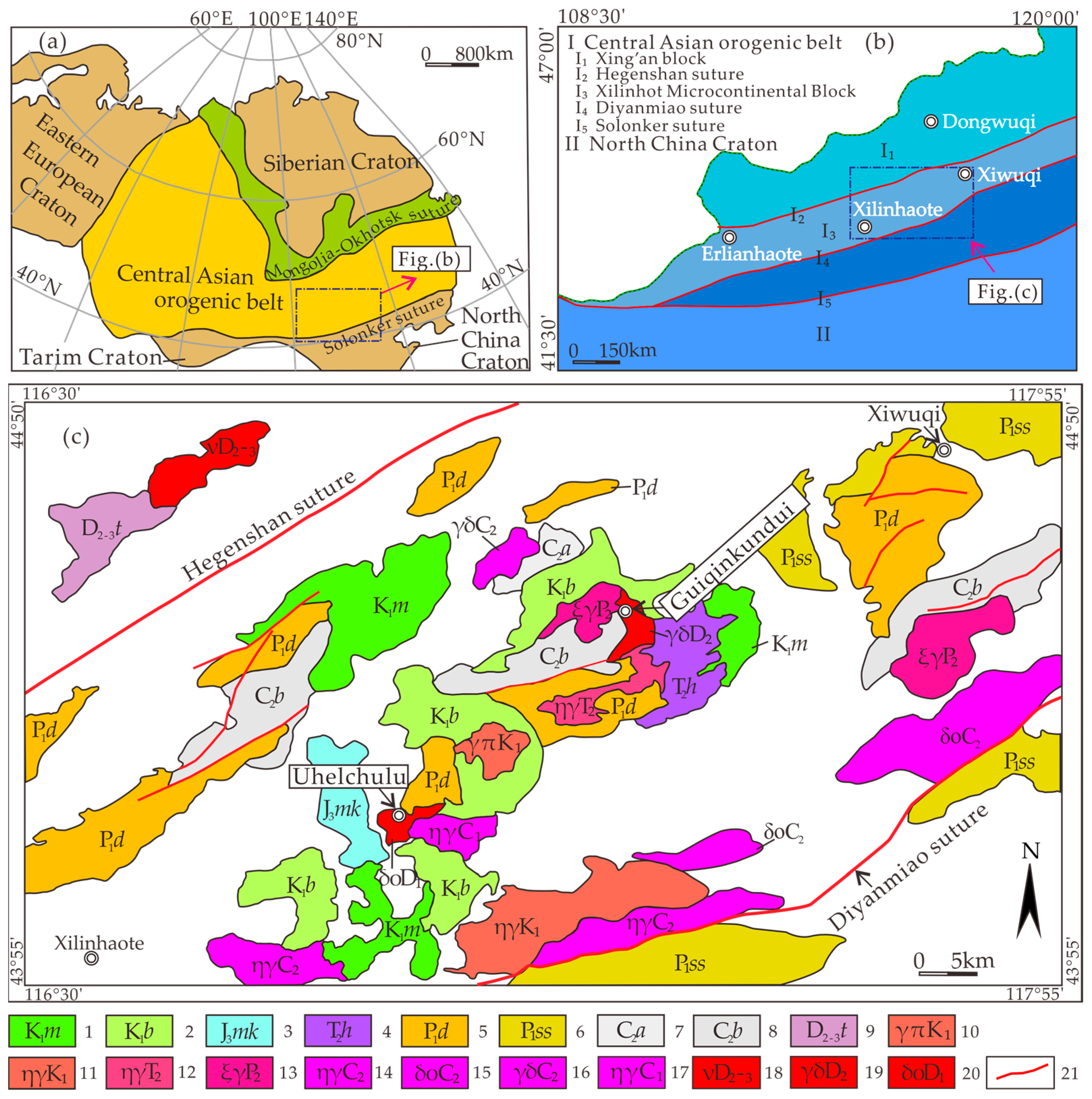
2. Regional Geological Background and Petrological Characteristics
3. Sampling and Analytical Methods
3.1. Sampling
3.2. Analytical Techniques
4. Results
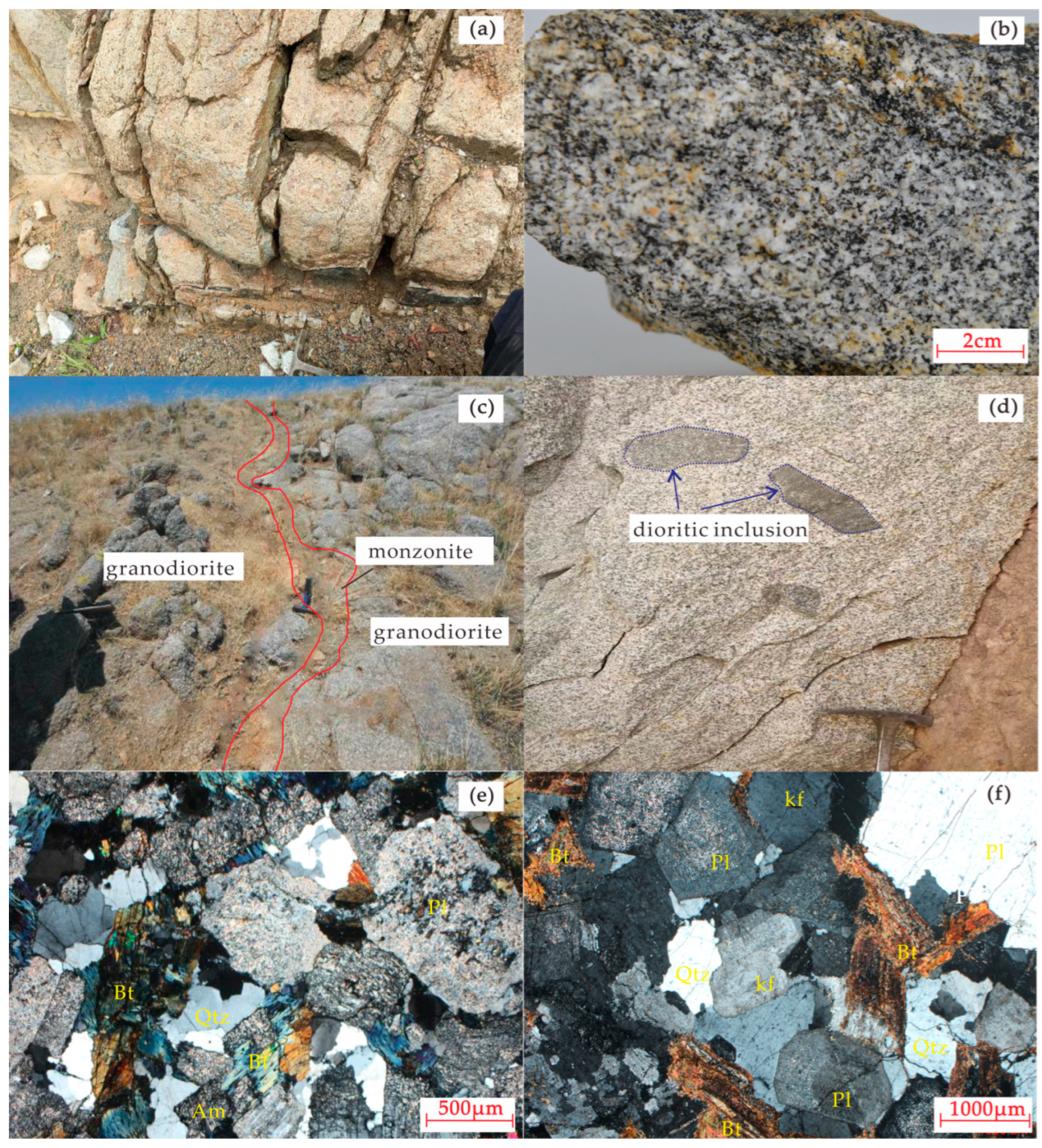
4.1. Mineralogical Characteristics
4.1.1. Uhelchulu Quartz Diorite
4.1.2. Guiqinkundui Granodiorite
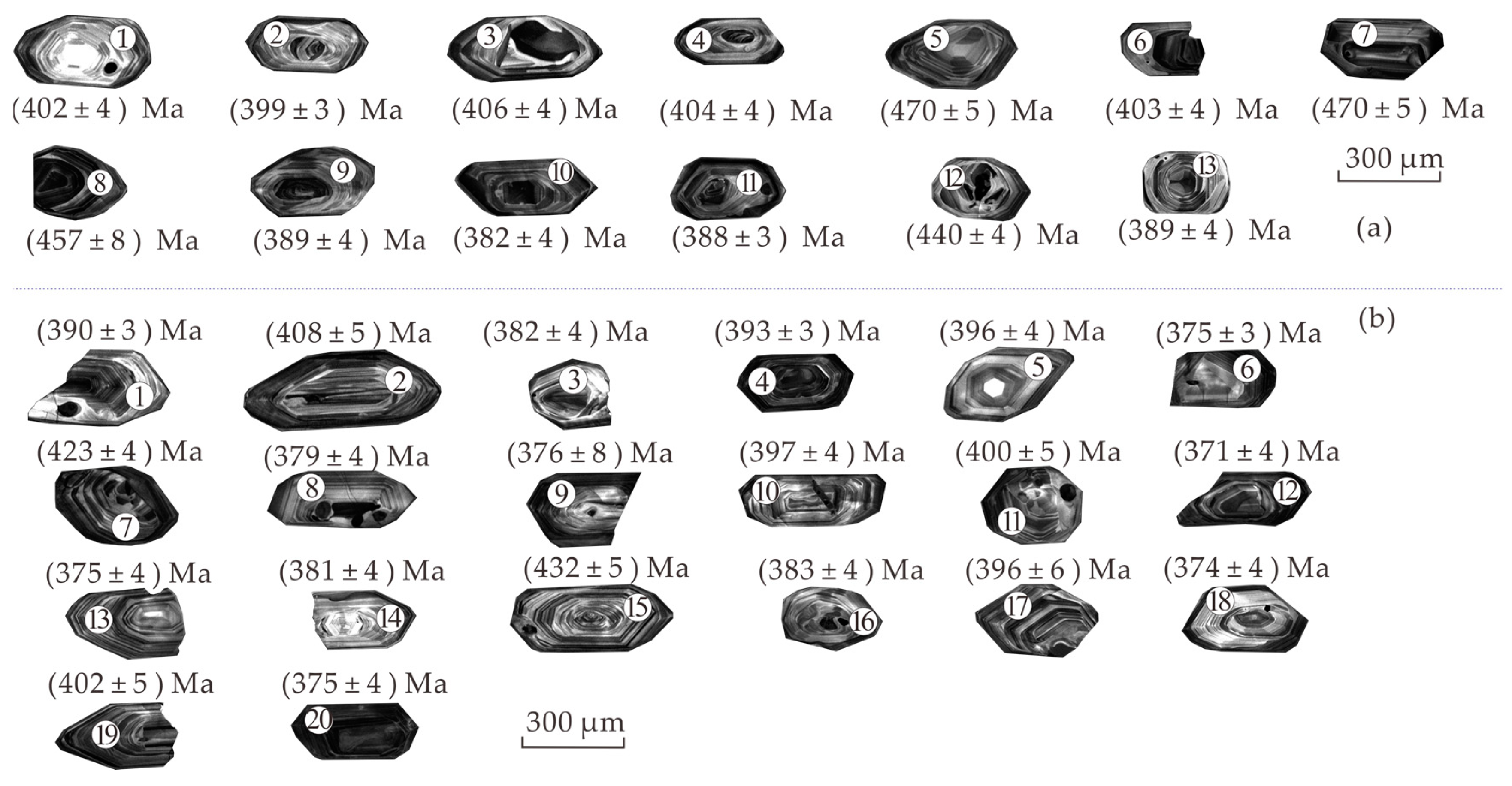
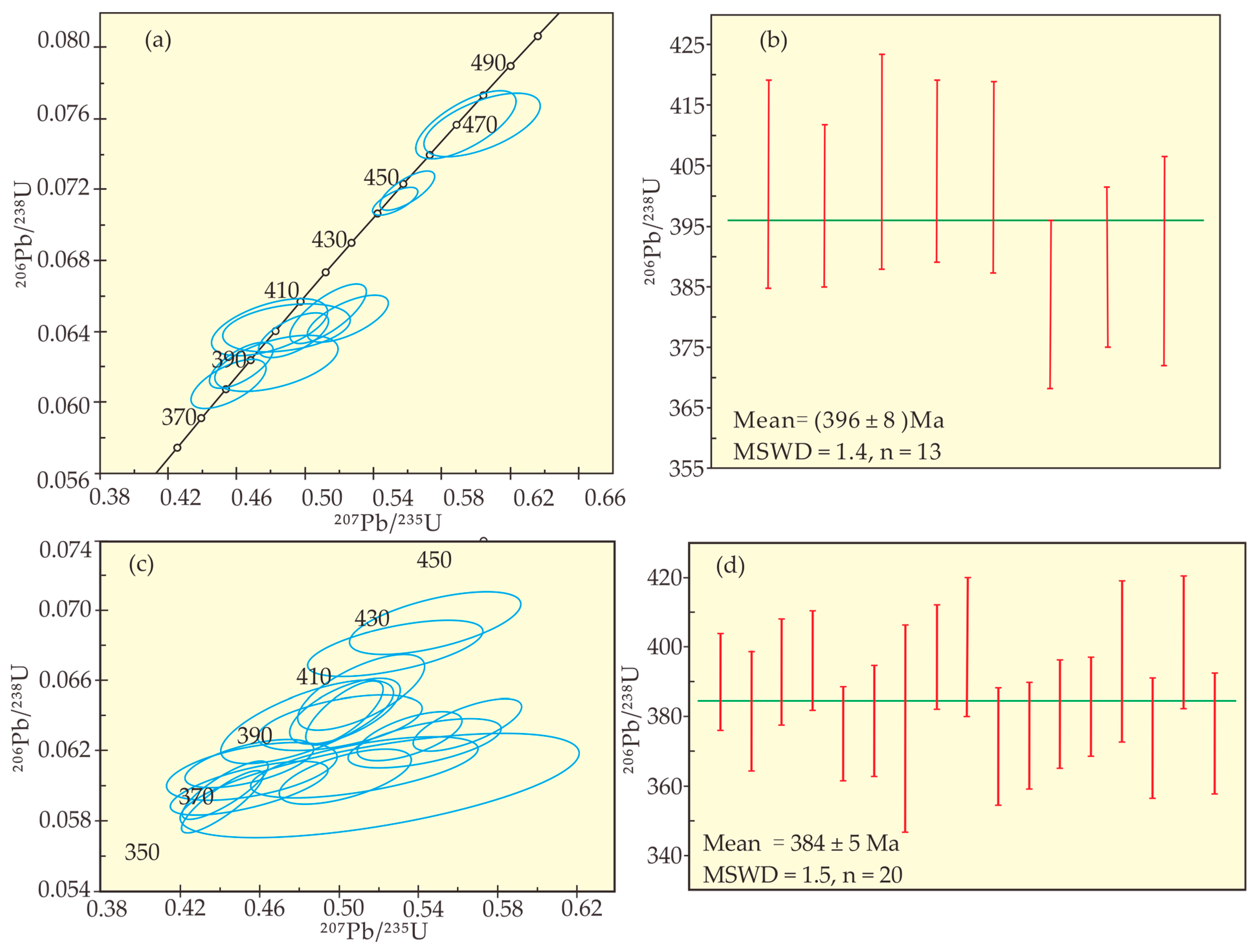
4.2. Geochronology
4.3. Whole-Rock Geochemistry
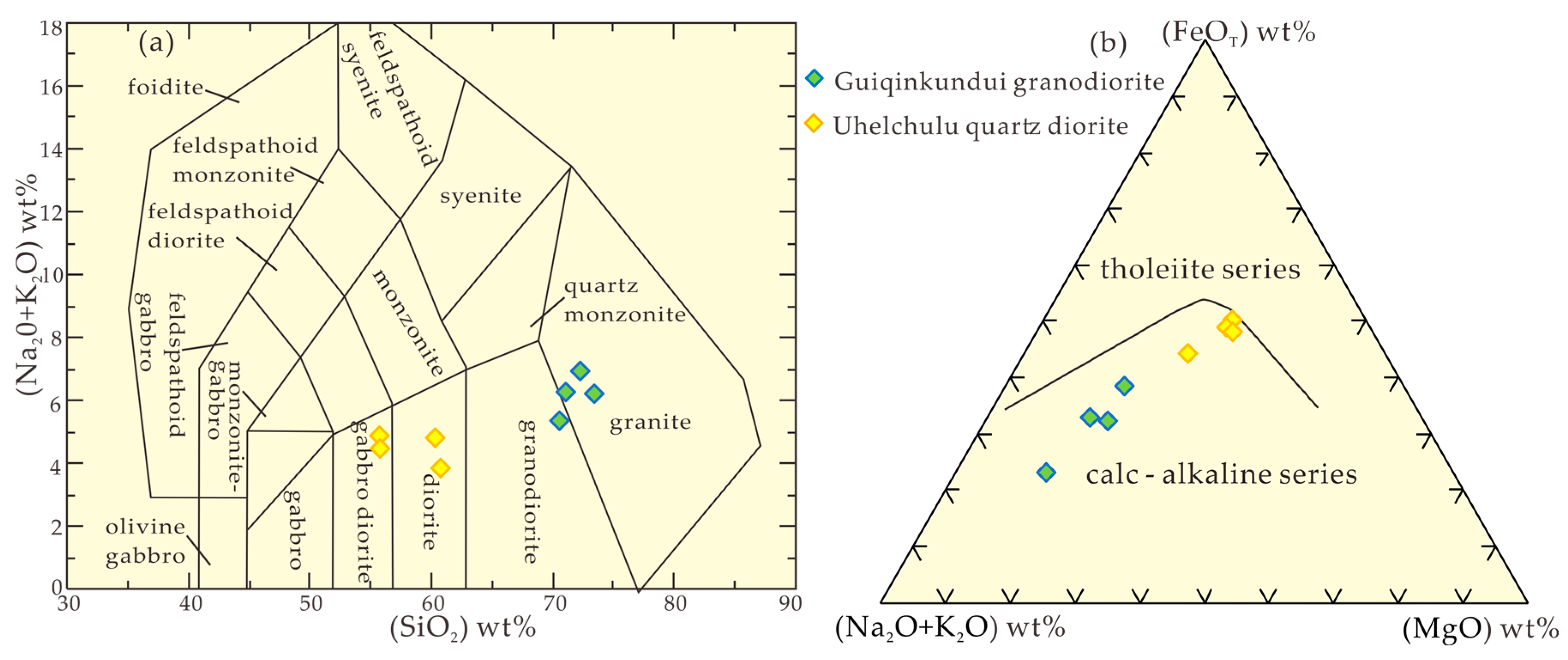
4.3.1. Major Elements
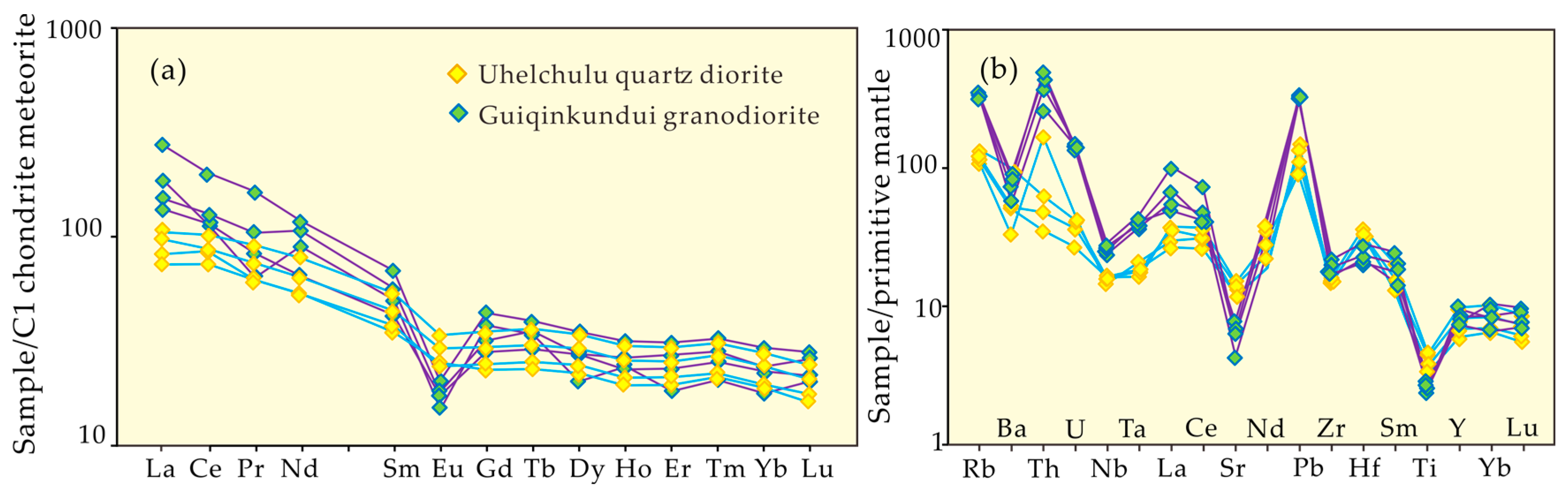
4.3.2. Trace Elements
5. Discussion
5.1. Intrusion Age
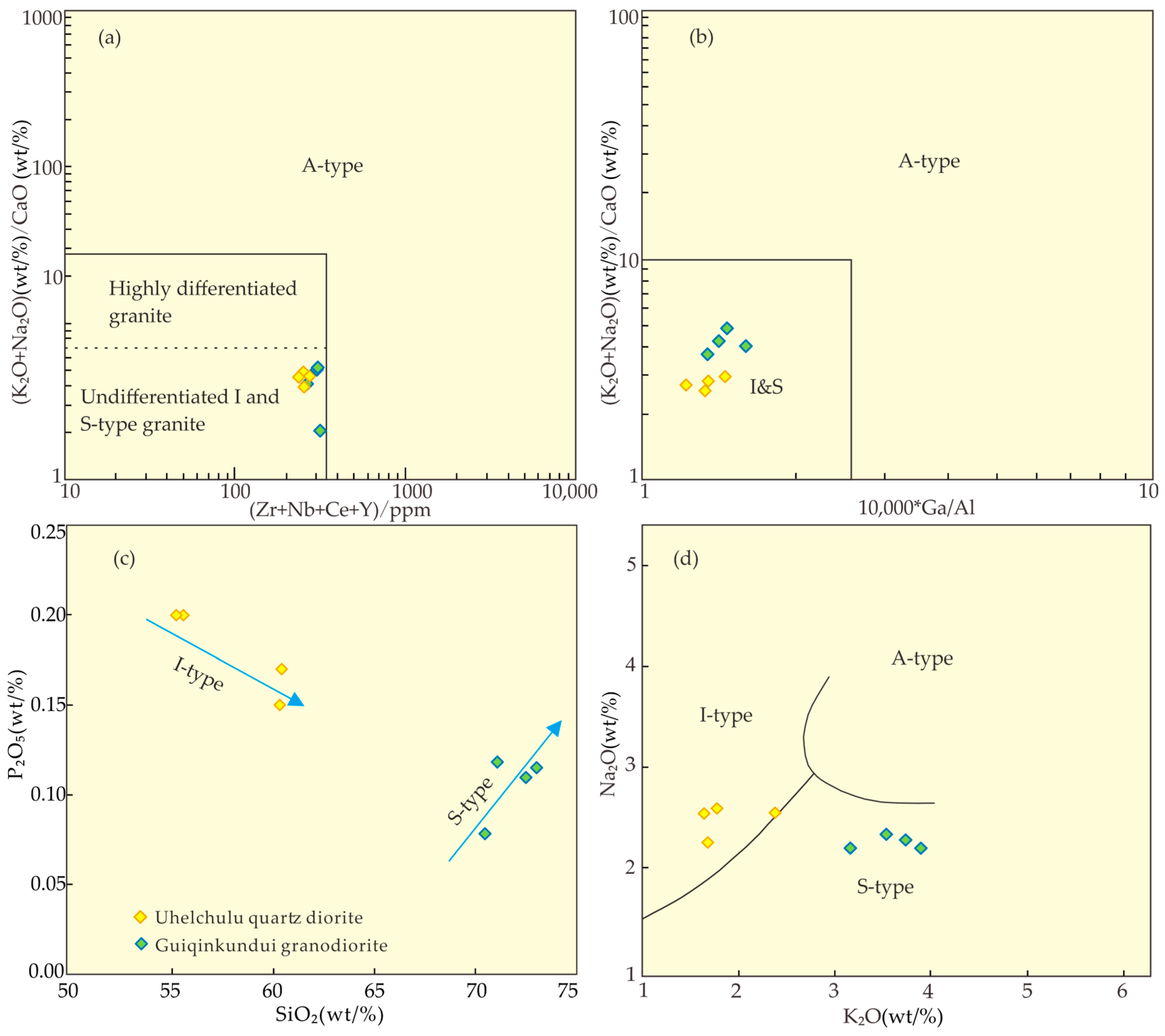
5.2. Petrogenesis

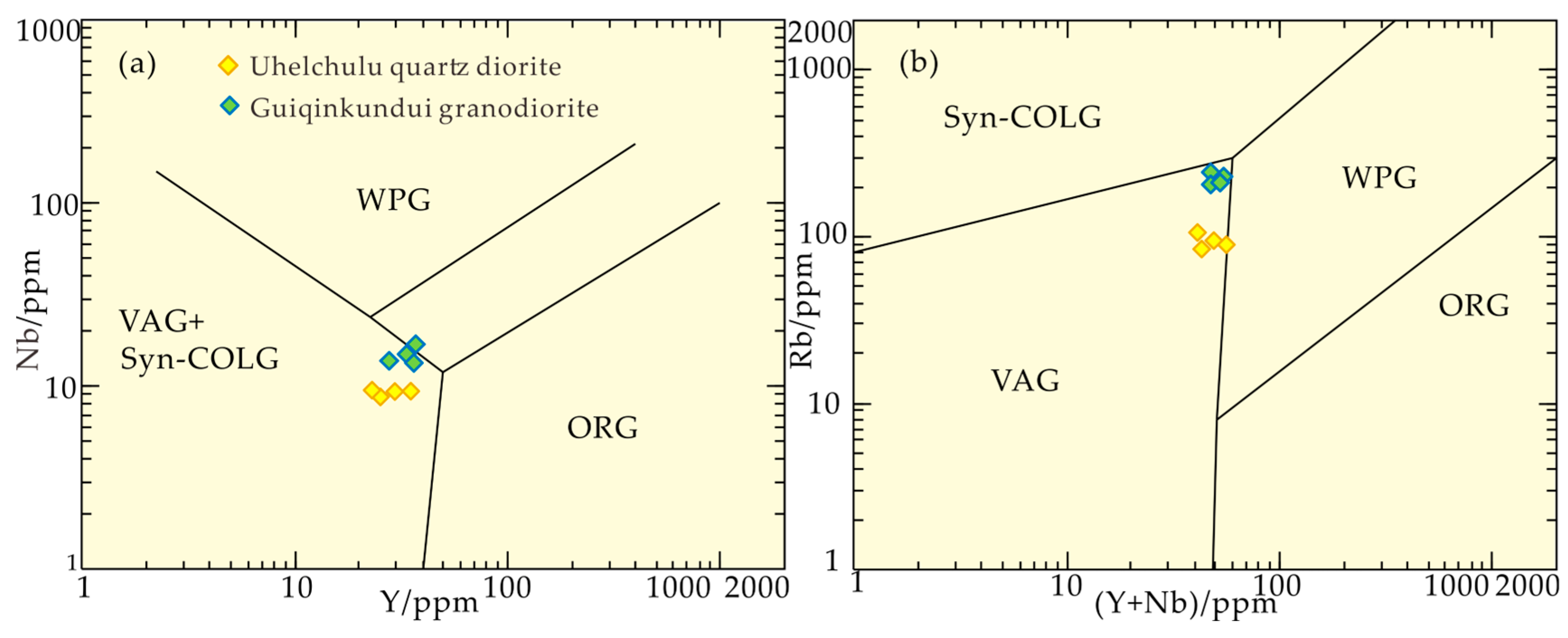
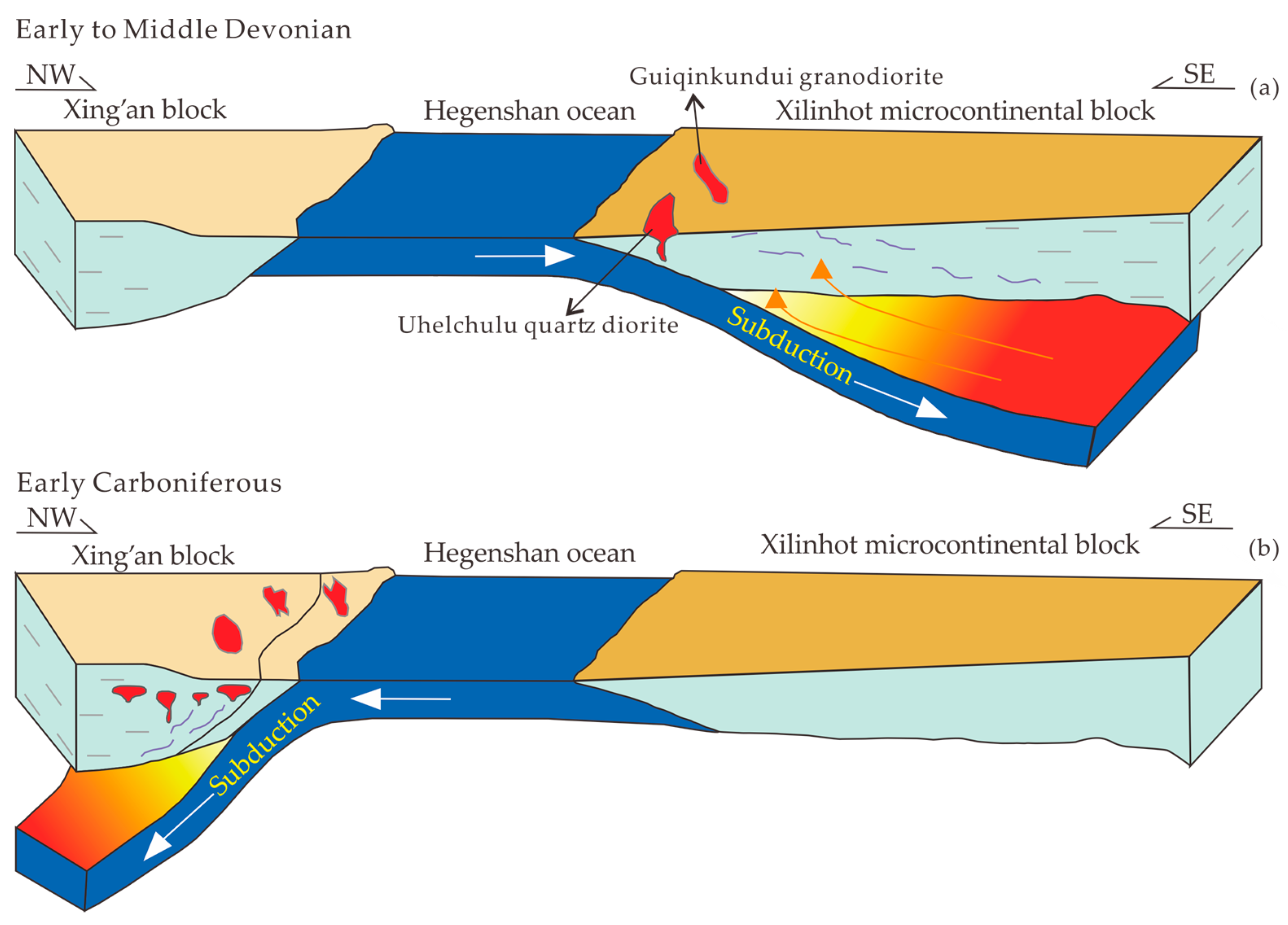
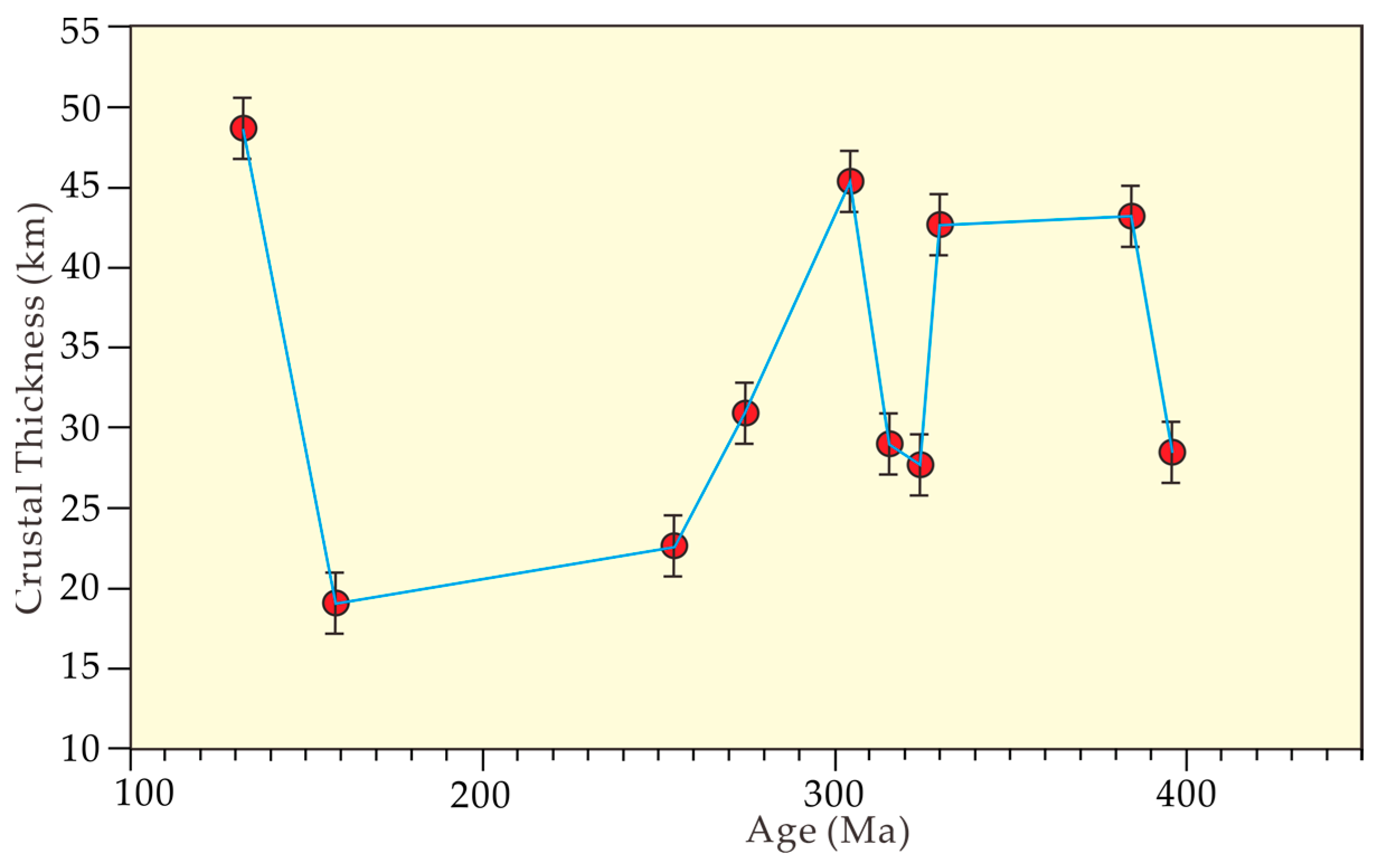
5.3. Tectonic Implications
6. Conclusions
Author Contributions
Funding
Data Availability Statement
Acknowledgments
Conflicts of Interest
References
- Sengör, A.M.C.; Natalin, B.A.; Burtman, V.S. Evolution of the Altaid tectonic collage and Palaeozoic crustal growth in Eurasia. Nature 1993, 364, 299–307. [Google Scholar] [CrossRef]
- Xiao, W.; Song, D.; Windley, B.F.; Li, J.; Han, C.; Wan, B.; Zhang, J.; Ao, S.; Zhang, Z. Research progresses of the accretionary processes and metallogenesis of the Central Asian Orogenic Belt. Sci. China Earth Sci. 2019, 63, 329–361. [Google Scholar] [CrossRef]
- Windley, B.F.; Allen, M.B.; Zhang, C.; Zhao, Z.Y.; Wang, G.R. Paleozoic accretion and Cenozoic redeformation of the Chinese Tian Shan range, central Asia. Geology 1990, 18, 128–131. [Google Scholar] [CrossRef]
- Windley, B.F.; Alexeiev, D.; Xiao, W.; Kröner, A.; Badarch, G. Tectonic models for accretion of the Central Asian orogenic belt. J. Geol. Soc. 2007, 164, 31–47. [Google Scholar] [CrossRef]
- Windley, B.F.; Xiao, W. Ridge subduction and slab windows in the Central Asian orogenic belt: Tectonic implications for the evolution of an accretionary orogen. Gondwana Res. 2018, 61, 73–87. [Google Scholar] [CrossRef]
- Xiao, W.; Windley, B.F.; Han, C.; Liu, W.; Wan, B.; Zhang, J.; Ao, S.; Zhang, Z.; Song, D. Late Paleozoic to early Triassic multiple roll-back and oroclinal bending of the Mongolia collage in central Asia. Earth-Sci. Rev. 2018, 186, 94–128. [Google Scholar] [CrossRef]
- Xiao, W.; Windley, B.F.; Sun, S.; Li, J.; Huang, B.; Han, C.; Yuan, C.; Sun, M.; Chen, H. A tale of amalgamation of Permo-Triassic collage systems in central Asia: Oroclines, sutures, and terminal accretion. Annu. Rev. Earth Planet. Sci. 2015, 43, 477–507. [Google Scholar] [CrossRef]
- Zhang, K.J. Genesis of the Late Mesozoic Great Xing’an Range Large Igneous Province: A Mongol-OKhotsk slab window model. Int. Geol. Rev. 2014, 56, 1557–1583. [Google Scholar] [CrossRef]
- Zhang, K.J.; Ji, C.; Zhou, Y.Z.; Zhang, Y.J. Tracing oceanic plateau relics in the basement of mainland China: A synthesis of aeromagnetic and seismic refraction data. Earth-Sci. Rev. 2024, 255, 104849. [Google Scholar] [CrossRef]
- Hui, J.; Zhang, K.-J.; Zhang, J.; Qu, J.; Zhang, B.; Zhao, H.; Niu, P. Middle–late Permian high-K adakitic granitoids in the NE Alxa block, northern China: Orogenic record following the closure of the Paleo-Asian oceanic branch? Lithos, 1063. [Google Scholar]
- Zhang, K.J.; Yan, L.L.; Ji, C. Switch of NE Asia from extension to contraction at the mid-Cretaceous: A tale of the Okhotsk oceanic plateau from initiation by the Perm Anomaly to extrusion in the Mongol–Okhotsk ocean? Earth-Sci. Rev. 2019, 198, 102941. [Google Scholar] [CrossRef]
- Li, G.Z.; Wang, Y.J.; Li, C.Y. Discovery of Early Permian radiolarian fauna in the Solon Obo ophiolite belt, Inner Mongolia and its geological significance. Chin. Sci. Bull. 2017, 62, 400–406. (In Chinese) [Google Scholar] [CrossRef]
- Liu, J.F.; Li, J.Y.; Chi, X.G.; Qu, J.F.; Hu, Z.C. A late-Carboniferous to early early-Permian subduction-accretion complex in Daqing pasture, southeastern Inner Mongolia: Evidence of northward subduction beneath the Siberian paleoplate southern margin. Lithos 2013, 177, 285–296. [Google Scholar] [CrossRef]
- Xiao, W.J.; Windley, B.F.; Hao, J. Accretion leading to collision and the Permian Solonker suture, Inner Mongolia, China: Termination of the central Asian orogenic belt. Tectonics 2003, 22, 1069–1089. [Google Scholar] [CrossRef]
- Zhang, Z.C.; Li, K.; Li, J.F.; Tangy, W.H.; Chen, Y.; Luo, Z.W. Geochronology and geochemistry of the eastern Erenhot ophiolitic complex: Implications for the tectonic evolution of the Inner Mongolia-Daxinganling Orogenic Belt. J. Asian Earth Sci. 2015, 97, 279–293. [Google Scholar] [CrossRef]
- Badarch, G.; Cunningham, W.D.; Windley, B.F. A new terrane subdivision for Mongolia: Implications for the Phanerozoic crustal growth of Central Asia. J. Asian Earth Sci. 2002, 21, 87–110. [Google Scholar] [CrossRef]
- Eizenhöfer, P.R.; Zhao, G.; Sun, M. Geochronological and hf isotopic variability of detrital zircons in paleozoic strata across the accretionary collision zone between the north China craton and Mongolian arcs and tectonic implications. Geol. Soc. Am. Bull. 2015, 65, 487–508. [Google Scholar] [CrossRef]
- Jahn, B.M.; Capdevila, R.; Liu, D.Y. Sources of Phanerozoic granitoids in the transect Bayanhongor-Ulaan Baatar, Mongolia: Geochemical and Nd isotopic evidence, and implications for Phanerozoic crustal growth. J. Asian Earth Sci. 2004, 23, 629–653. [Google Scholar] [CrossRef]
- Khain, E.V.; Bibikova, E.V.; Salnikova, E.B. The Palaeo-Asian Ocean in the Neoproterozoic and Early Palaeozoic: New geochronologic data and palaeotectonic reconstructions. Precambrian Res. 2003, 122, 329–358. [Google Scholar] [CrossRef]
- Li, S.C.; Wang, H.T.; Li, G.; Wang, X.; Yang, X.P.; Zhao, Z.R. Northward plate subduction process of the Paleo-Asian Ocean in the middle part of the Central Asian orogenic belt: Evidence from adakites. Acta Petrol. Siniea 2020, 36, 2521–2536. [Google Scholar]
- Li, Y.J.; Wang, G.H.; Santosh, M.; Wang, J.F.; Dong, P.P.; Li, H.Y. Supra-subduction zone ophiolites from Inner Mongolia, North China: Implications for the tectonic history of the southeastern Central Asian orogenic belt. Gondwana Res. 2018, 59, 126–143. [Google Scholar] [CrossRef]
- Jian, P.; Kröner, A.; Windley, B.F. Carboniferous and Cretaceous mafic-ultramafic massifs in Inner Mongolia (China): A SHRIMP zircon and geochemical study of the previously presumed integral “Hegenshan ophiolite”. Lithos 2012, 142–143, 48–66. [Google Scholar] [CrossRef]
- Miao, L.C.; Fan, W.M.; Liu, D.Y.; Zhang, F.Q.; Shi, Y.R.; Guo, F. Geochronology and geochemistry of the Hegenshan ophiolitic complex: Implications for late-stage tectonic evolution of the Inner Mongolia-Daxinganling Orogenic Belt, China. J. Asian Earth Sci. 2008, 32, 348–370. [Google Scholar] [CrossRef]
- Kröner, A.; Kovach, V.; Belousova, E. Reassessment of continental growth during the accretionary history of the Central Asian Orogenic Belt. Gondwana Res. 2014, 25, 103–125. [Google Scholar] [CrossRef]
- Jahn, B.M.; Windley, B.; Natal’ in, B.; Dobretsov, N. Phanerozoic continental growth in Central Asia. J. Asian Earth Sci. 2004, 23, 599–603. [Google Scholar] [CrossRef]
- Shao, J.A.; Tian, W.; Tang, K.D.; Wang, Y. Petrogenesis and tectonic settings of the late carboniferous high-Mg basalts of Inner Mongolia. Earth Sci. Front. 2015, 22, 171–181. [Google Scholar]
- Xu, W.L.; Hergt, J.M.; Gao, S. Interaction of adakitic melt-peridotite: Implications for the high-Mg signature of Mesozoic adakitic rocks in the eastern North China Craton. Earth Planet. Sci. Lett. 2008, 265, 123–137. [Google Scholar] [CrossRef]
- Wang, S.; Liu, Y. Geological and Mineral Survey Report on the Xiwuqi-Bainaimiao Areas of the Erlian Dongwuqi Metallogenic Belt. Tianjin Geol. Surv. Cent. China Geol. Surv. 2020, 1–530. [Google Scholar]
- Li, Y.J.; Wang, J.F.; Wang, G.H. Discovery and significance of the Dahate fore-arc basalts from the Diyanmiao ophiolite in Inner Mongolia. Acta Petrol. Sin. 2018, 34, 469–482. [Google Scholar]
- Wang, J.; Li, Y.; Li, H. Discovery of the Late Carboniferous adakite in the Erenhot-Hegenshan suture zone and intra-oceanic subduction of the Paleo-Asian ocean. Geol. China 2021, 48, 520–535, (In Chinese with English Abstract). [Google Scholar]
- Wang, J.; Li, Y.; Li, H. Late Carboniferous TTG magmatic event in the Hegenshan suture zone: Zircon U-Pb geochronology and geochemical constraints from the Huduge trondhjemite. Acta Geol. Sin. 2021, 95, 396–412. [Google Scholar]
- Wang, J.; Li, Y.; Li, H. Late Carboniferous intraoceanic subduction of the Paleo-Asian Ocean: New evidences from the Zagayin high-Mg andesite in the Meilaotewula SSZ ophiolite. Geol. Rev. 2020, 66, 289–306. [Google Scholar]
- Yang, Z.L.; Zhang, X.H.; Gao, Y.L. Late Carboniferous gabbro-granite suite from West Ujimqin of central Inner Mongolia: Petrogenesis and geodynamic implication. Actor Petrol. Sin. 2022, 38, 830–854. [Google Scholar]
- Zhang, X.F.; Liu, J.L.; Feng, J.L. Geochronological and geochemical features of volcanic rocks of Dashizhai Formation in UralSutai of XilinHot, Inner Mongolia, and their geological significance. Geol. Bull. China 2016, 35, 766–775. [Google Scholar]
- Li, H.; Zhou, Z.; Li, P. A Late Carboniferous-Early Permian Extensional Event in Xi UjimqinQi, Inner Mongolia: Evidence from Volcanic Rocks of Dashizhai Formation. Geotecton. Metallog. 2016, 40, 996–1013. [Google Scholar]
- Fan, Y.; Li, T.; Xiao, Q. Zircon U-Pb Ages, Geochemical Characteristics of Late Permian Granite in West UjimqinBanner, Inner Mongolia, and Tectonic Significance. Geol. Rev. 2019, 65, 248–266. [Google Scholar]
- Wu, Y.; Tian, Q.G.; Wang, Z.Q. The Early Carboniferous volcanic rocks in Engeriyinpeng area of Sonid Left Banner, Inner Mongolia: Discovery and its tectonic significance. Geol. Bull. China 2019, 38, 1170–1182. [Google Scholar]
- Zhang, X.; Cheng, Y.; Li, Y. Zircon U-Pb dating and geochemistry of the Late Carboniferous hornblendite in Dong Ujimqi Inner Mongolia and its tectonic significance. Acta Geol. Sin. 2021, 95, 1495–1507. [Google Scholar]
- Liu, J.; Chi, X.; Zhang, X. Geochemical Characteristic of Carboniferous Quartz-Diorite in the Southern Xiwuqi Area, Inner Mongolia and Its Tectonic Significance. Acta Geol. Sin. 2009, 83, 365–376. [Google Scholar]
- Niu, X.; Liu, F.; Feng, G. Petrogenesis of the Late Silurian to Early Devonian potassic alkaline rocks on the northern margin of the North China Craton and their constraints on the tectonic evolution. Actor Petrol. Sin. 2021, 40, 835–858. [Google Scholar]
- Huang, B.; Fu, D.; Li, S.C. The age and tectonic implications of the Hegenshan ophiolite in Inner Mongolia. Acta Petrol. Sin. 2016, 32, 158–176. [Google Scholar]
- He, Y.; Xu, B.; Zhang, L.Y. Discovery of a Late Devonian retroarc foreland basin Mongolia and its tectonic implications. Acta Petrol. Sin. 2018, 34, 3071–3082. [Google Scholar]
- Li, M.T.; Tang, J.; Wang, Z.W. Geochronology and geochemistry of the Early Carboniferous volcanic rocks in SonidZuoqi, Inner Mongolia: Implication for the Carboniferous tectonic evolution and crustal nature of the eastern Central Asia orogenic belt. Acta Petrol. Sircica 2020, 36, 799–819. [Google Scholar]
- Li, B.; Shi, Y.; Yang, F. Middle Silurian-Late Devonian tectonic evolution in the eastern segment of the northern margin of the North China Plate: Evidence from magmatic rocks in Gongzhuling area. Actor Petrol. Sircica 2022, 38, 2364–2396. [Google Scholar]
- Andersen, T. Correction of common lead in U-Pb analyses that do not report 204Pb. Chem. Geol. 2002, 192, 59–79. [Google Scholar] [CrossRef]
- Ludwig, K.R. Isoplot 3.00: A Geochronological Toolkit for Microsoft Excel; Special Publication No.4; Berkeley Geochronology 608 Center: Berkeley, CA, USA, 2003; pp. 1–70. [Google Scholar]
- Liu, Y.S.; Hu, Z.C.; Gao, S. In situ analysis of major and trace elements of anhydrous minerals by LA-ICP-MS without applying an internal standard. Chem. Geol. 2008, 257, 34–43. [Google Scholar] [CrossRef]
- Liu, Y.S.; Gao, S.; Hu, Z.C. Continental and Oceanic Crust Re-cycling-induced Melt-Peridotite Interactions in the Trans-North China Orogen: U-Pb Dating, Hf Isotopes and Trace Elements in Zircons from Mantle Xenoliths. J. Petrol. 2010, 51, 537–571. [Google Scholar] [CrossRef]
- Liu, Y.S.; Hu, Z.C.; Zong, K.Q. Reappraisement and refinement of zircon U-Pb isotope and trace element analyses by LA-ICP-MS. Chin. Sci. Bull. 2010, 55, 1535–1546. [Google Scholar] [CrossRef]
- Middlemost, E.A.K. Naming materials in the magma/igneous rock system. Earth-Sci. Rev. 1994, 37, 215–224. [Google Scholar] [CrossRef]
- Irvine, T.N.; Barager, W.R.A. A guide to the chemical classification of the common volcanic rocks. Can. J. Earth Sci. 1971, 8, 523–548. [Google Scholar] [CrossRef]
- Boynton, W.V. Cosmochemistry of the Rare Earth Elements: Meteorite Studies. Rare Earth Elem. Geochem. 1984, 2, 63–114. [Google Scholar]
- Sun, S.S.; Mc Donough, W.F. Chemical and isotopic systematics of oceanic basalts: Implications for mantle compositions and processes. Geol. Soc. Lond. Spec. Publ. 1989, 42, 313–345. [Google Scholar] [CrossRef]
- Bureau of Inner Mongolia Geology. 1:200,000 Maodeng regional geological survey report. 1976; 1–184. [Google Scholar]
- Institute of Inner Mongolia Autonomous Region Geological Survey. 1:250,000 Chaokewula regional geological survey report. 2008; 1–256. [Google Scholar]
- Wu, F.Y.; Li, X.H.; Yang, J.H. Discussions on the petrogenesis of granites. Acta Petrol. Sin. 2007, 23, 1217–1238. [Google Scholar]
- Chappell, B.W. Aluminium saturation in I- and S-type granites and the characterization of fractionated haplogranites. Lithos 1999, 46, 535–551. [Google Scholar] [CrossRef]
- Watson, E.B. Zircon saturation in felsic liquids: Experimental results and applications to trace element geochemistry. Contrib. Mineral. Petrol. 1979, 70, 407–419. [Google Scholar] [CrossRef]
- Watson, E.B.; Harrison, T.M. Zircon saturation revisited: Temperature and composition effects in a variety of crustal magma types. Earth Planet. Sci. Lett. 1983, 64, 295–304. [Google Scholar] [CrossRef]
- King, P.L.; Chappell, B.W.; Allen, C.M. Are A-type granites the high-temperature felsic granites? Evidence from fractionated granites of the Wangrah Suite. Aust. J. Earth Sci. 2001, 48, 501–514. [Google Scholar] [CrossRef]
- Whalen, J.B.; Currie, K.L.; Chappell, B.W. A-type granites: Geochemical characteristics, discrimination and petrogenesis. Contrib. Mineral. Petrol. 1987, 95, 407–419. [Google Scholar] [CrossRef]
- Liu, C.; Chen, X.; Chen, P. Subdivision Discrimination Criteria and Genesis for A-Type Rock Suites. Geol. J. China Univ. 2003, 9, 573–591. [Google Scholar]
- Pichavant, M.; Montel, J.M.; Richard, L.R. Apatite solubility in peraluminous liquids: Experimental data and an extension of the Harrison-Watson model. Geochim. Cosmochim. Acta 1992, 56, 3855–3861. [Google Scholar] [CrossRef]
- Collins, W.J.; Beams, S.D.; White, A.J.R. Nature and origin of A-type granites with particular reference to Southeastern Australia. Contrib. Mineral. Petrol. 1982, 80, 189–200. [Google Scholar] [CrossRef]
- Chappell, B.W.; White, A.J.R.; Wyborn, D. The improtance of residual source material (restite) in granite petrogenesis. J. Pet. 1987, 28, 1111–1138. [Google Scholar] [CrossRef]
- Kemp, A.I.S.; Hawkesworth, C.J.; Paterson, B.A.; Kinny, P.D. Episodic growth of the Gondwana supercontinent from hafnium and oxygen isotopes in zircon. Nature 2006, 439, 580–583. [Google Scholar] [CrossRef]
- Kemp, A.I.S.; Hawkesworth, C.J.; Foster, G.L.; Paterson, B.A.; Woodhead, J.D.; Hergt, J.M.; Gray, C.M.; Whitehouse, M.J. Magmatic and crustal differentiation history of granitic rocks from Hf-O isotopes in zircon. Science 2007, 315, 980–983. [Google Scholar] [CrossRef] [PubMed]
- Shao, J.A.; Zhang, L.L.; Zhou, X.H. A further study on the ophiolite in Hegenshan, Inner Mongolia. Acta Petrol. Sin. 2019, 35, 2864–2872. [Google Scholar]
- Pearce, J.A.; Harris, N.B.W.; Tindle, A.G. Trace element discrimination diagrams for the tectonic interpretation of granitic rocks. J. Petrol. 1984, 25, 956–983. [Google Scholar] [CrossRef]
- Profeta, L.; Ducea, M.N.; Chapman, J.B.; Paterson, S.R.; Gonzales, S.M.H.; Kirsch, M.; Petrescu, L.; DeCelles, P.G. Quantifying crustal thickness over time in magmatic arcs. Sci. Rep. 2016, 5, 17786. [Google Scholar] [CrossRef] [PubMed]
- Tang, M.; Ji, W.Q.; Chu, X.; Wu, A.B.; Chen, C. Reconstructing crustal thickness evolution from europium anomalies in detrital zircons. Geology 2021, 49, 76–80. [Google Scholar] [CrossRef]
- Zhu, Z.Y.; Campbell, I.H.; Allen, C.M.; Burnham, A.D. S-type granites: Their origin and distribution through time as determined from detrital zircons. Earth Planet. Sci. Lett. 2020, 536, 116140. [Google Scholar] [CrossRef]
- Wang, J.; Li, Y.; Li, H.; Dong, P. The Asagetu shoshonitic volcanic rocks in the Hegenshan suture: Zircon LA-ICP-MS U-Pb ages, geochemical features and its tectonic significance. Geol. Rev. 2021, 4, 918–935. [Google Scholar]
- Wang, J.F.; Li, Y.J.; Li, H.Y.; Dong, P.P. Zircon U-Pb dating of the Shijiangshan Late Jurassic-Early Cretaceous A-type granite in Xi Ujimqin Banner of Inner Mongolia and its tectonic setting. Geol. Bull. China 2018, 37, 382–396. [Google Scholar]
- Guo, X.; Sun, H.; Dong, A.; Ren, J.; Xu, R.; Gao, B. The genesis and dating of the Early Permian granitic rock in the north of XilinHot, Inner Mongolia. Geol. China 2019, 46, 1396–1409, (In Chinese with English Abstract). [Google Scholar]
- Yuan, J.; Ren, Y.; Jiang, Z.; Qu, Y.; Wei, H. Zircon U-Pb Dating and Geochemistry of Granites in Early Carboniferous in Maodeng of XilinHot, Inner Mongolia and Their Geological Implications. Geoscience 2017, 6, 1131–1145. [Google Scholar]
- Pang, C.J.; Wang, X.C.; Wen, S.N.; Krapez, B.; Wang, Y.Y.; Liao, W. Petrogenesis of Late Carboniferous gabbroic intrusions in the Xilinhot region of Inner Mongolia: Products of partial melting of a hydrous mantle source in an intra-continental extensional setting. Acta Petrol. Sin. 2018, 34, 2956–2972. [Google Scholar]

| Spot | Content (×10−6) | Isotope Ratio | Age (Ma) | |||||||||||||
|---|---|---|---|---|---|---|---|---|---|---|---|---|---|---|---|---|
| U01 | Pb | Th | U | 206Pb/238U | 1σ | 207Pb/235U | 1σ | 207Pb/206Pb | 1σ | 232Th/238U | 206Pb/238U | 1σ | 207Pb/235U | 1σ | 207Pb/206Pb | 1σ |
| 1 | 9 | 55 | 136 | 0.0643 | 0.0007 | 0.4792 | 0.0136 | 0.0540 | 0.0015 | 0.41 | 402 | 4 | 398 | 11 | 371 | 63 |
| 2 | 17 | 70 | 272 | 0.0638 | 0.0005 | 0.4936 | 0.0083 | 0.0561 | 0.0009 | 0.26 | 399 | 3 | 407 | 7 | 457 | 36 |
| 3 | 15 | 40 | 237 | 0.0649 | 0.0007 | 0.5159 | 0.0091 | 0.0559 | 0.0010 | 0.17 | 406 | 4 | 422 | 7 | 447 | 38 |
| 4 | 18 | 69 | 277 | 0.0647 | 0.0006 | 0.5257 | 0.0095 | 0.0572 | 0.0010 | 0.25 | 404 | 4 | 429 | 8 | 498 | 39 |
| 5 | 16 | 97 | 198 | 0.0757 | 0.0008 | 0.6044 | 0.0134 | 0.0579 | 0.0013 | 0.50 | 470 | 5 | 480 | 11 | 527 | 48 |
| 6 | 11 | 87 | 154 | 0.0645 | 0.0006 | 0.5007 | 0.0198 | 0.0563 | 0.0021 | 0.58 | 403 | 4 | 412 | 16 | 463 | 84 |
| 7 | 14 | 40 | 158 | 0.0757 | 0.0008 | 0.5950 | 0.0119 | 0.1278 | 0.0024 | 0.26 | 470 | 5 | 474 | 9 | 2068 | 33 |
| 8 | 5 | 31 | 62 | 0.0735 | 0.0013 | 0.8845 | 0.0606 | 0.0867 | 0.0059 | 0.52 | 457 | 8 | 643 | 44 | 1355 | 131 |
| 9 | 19 | 104 | 281 | 0.0622 | 0.0006 | 0.6960 | 0.0111 | 0.0811 | 0.0013 | 0.38 | 389 | 4 | 536 | 9 | 1225 | 31 |
| 10 | 18 | 116 | 286 | 0.0610 | 0.0006 | 0.4551 | 0.0087 | 0.0541 | 0.0010 | 0.42 | 382 | 4 | 381 | 7 | 375 | 42 |
| 11 | 23 | 182 | 351 | 0.0621 | 0.0005 | 0.4628 | 0.0077 | 0.0541 | 0.0009 | 0.53 | 388 | 3 | 386 | 6 | 374 | 37 |
| 12 | 23 | 135 | 307 | 0.0707 | 0.0006 | 0.5431 | 0.0090 | 0.0557 | 0.0009 | 0.45 | 440 | 3 | 440 | 7 | 442 | 36 |
| 13 | 12 | 73 | 183 | 0.0622 | 0.0007 | 0.4835 | 0.0153 | 0.0563 | 0.0017 | 0.41 | 389 | 4 | 400 | 13 | 466 | 68 |
| Spot | Content (×10−6) | Isotope Ratio | Age (Ma) | |||||||||||||
|---|---|---|---|---|---|---|---|---|---|---|---|---|---|---|---|---|
| U02 | Pb | Th | U | 206Pb/238U | 1σ | 207Pb/235U | 1σ | 207Pb/206Pb | 1σ | 232Th/238U | 206Pb/238U | 1σ | 207Pb/235U | 1σ | 207Pb/206Pb | 1σ |
| 1 | 33 | 204 | 516 | 0.0624 | 0.0006 | 0.5424 | 0.0163 | 0.0630 | 0.0018 | 0.41 | 390 | 4 | 440 | 13 | 709 | 62 |
| 2 | 29 | 55 | 462 | 0.0654 | 0.0009 | 0.5113 | 0.0128 | 0.0567 | 0.0015 | 0.12 | 408 | 5 | 419 | 11 | 481 | 59 |
| 3 | 15 | 45 | 248 | 0.0610 | 0.0007 | 0.5133 | 0.0236 | 0.0610 | 0.0027 | 0.19 | 382 | 4 | 421 | 19 | 640 | 96 |
| 4 | 48 | 128 | 778 | 0.0629 | 0.0006 | 0.5356 | 0.0103 | 0.0618 | 0.0011 | 0.17 | 393 | 4 | 436 | 8 | 667 | 38 |
| 5 | 31 | 186 | 449 | 0.0634 | 0.0006 | 0.5654 | 0.0116 | 0.0647 | 0.0013 | 0.42 | 396 | 4 | 455 | 9 | 764 | 42 |
| 6 | 28 | 122 | 472 | 0.0599 | 0.0005 | 0.4604 | 0.0112 | 0.0557 | 0.0013 | 0.27 | 375 | 3 | 385 | 9 | 440 | 54 |
| 7 | 24 | 162 | 329 | 0.0678 | 0.0007 | 0.5284 | 0.0182 | 0.0565 | 0.0019 | 0.51 | 423 | 4 | 431 | 15 | 472 | 76 |
| 8 | 23 | 117 | 365 | 0.0605 | 0.0006 | 0.5041 | 0.0136 | 0.0604 | 0.0017 | 0.33 | 379 | 4 | 414 | 11 | 618 | 60 |
| 9 | 19 | 61 | 303 | 0.0600 | 0.0012 | 0.5227 | 0.0403 | 0.0632 | 0.0043 | 0.21 | 376 | 8 | 427 | 33 | 714 | 143 |
| 10 | 30 | 100 | 481 | 0.0636 | 0.0006 | 0.5001 | 0.0174 | 0.0570 | 0.0019 | 0.21 | 397 | 4 | 412 | 14 | 493 | 75 |
| 11 | 59 | 834 | 888 | 0.0640 | 0.0008 | 0.5034 | 0.0082 | 0.0571 | 0.0010 | 0.96 | 400 | 5 | 414 | 7 | 495 | 39 |
| 12 | 49 | 212 | 827 | 0.0593 | 0.0007 | 0.4424 | 0.0080 | 0.0541 | 0.0010 | 0.26 | 371 | 4 | 372 | 7 | 376 | 43 |
| 13 | 20 | 138 | 321 | 0.0598 | 0.0006 | 0.4556 | 0.0167 | 0.0552 | 0.0020 | 0.44 | 375 | 4 | 381 | 14 | 421 | 81 |
| 14 | 19 | 118 | 297 | 0.0608 | 0.0006 | 0.4560 | 0.0178 | 0.0544 | 0.0020 | 0.41 | 381 | 4 | 382 | 15 | 386 | 84 |
| 15 | 32 | 245 | 410 | 0.0692 | 0.0007 | 0.5485 | 0.0176 | 0.0575 | 0.0019 | 0.61 | 432 | 5 | 444 | 14 | 509 | 74 |
| 16 | 38 | 158 | 614 | 0.0612 | 0.0006 | 0.4543 | 0.0132 | 0.0538 | 0.0015 | 0.26 | 383 | 4 | 380 | 11 | 364 | 63 |
| 17 | 15 | 87 | 242 | 0.0633 | 0.0009 | 0.4780 | 0.0153 | 0.0547 | 0.0017 | 0.37 | 396 | 6 | 397 | 13 | 401 | 70 |
| 18 | 42 | 227 | 700 | 0.0597 | 0.0007 | 0.4470 | 0.0080 | 0.0543 | 0.0009 | 0.33 | 374 | 4 | 375 | 7 | 383 | 39 |
| 19 | 24 | 67 | 387 | 0.0643 | 0.0008 | 0.5039 | 0.0113 | 0.0569 | 0.0013 | 0.18 | 401 | 5 | 414 | 9 | 487 | 49 |
| 20 | 45 | 246 | 745 | 0.0599 | 0.0007 | 0.4543 | 0.0088 | 0.0550 | 0.0010 | 0.34 | 375 | 4 | 380 | 7 | 411 | 43 |
| Sample | Uhelchulu Quartz Diorite | Guiqinkundui Granodiorite | ||||||
|---|---|---|---|---|---|---|---|---|
| A01 | A02 | A03 | A04 | A05 | A06 | A07 | A08 | |
| SiO2 | 60.44 | 55.71 | 55.39 | 60.53 | 73.01 | 70.48 | 72.27 | 71.04 |
| TiO2 | 0.73 | 0.99 | 0.96 | 0.81 | 0.64 | 0.67 | 0.61 | 0.69 |
| Al2O3 | 14.66 | 15.15 | 15.43 | 14.33 | 11.70 | 12.89 | 13.24 | 12.53 |
| Fe2O3 | 1.76 | 2.55 | 2.50 | 2.01 | 0.88 | 0.59 | 0.93 | 0.83 |
| FeO | 4.67 | 6.27 | 6.32 | 5.56 | 2.84 | 3.71 | 1.56 | 3.03 |
| MnO | 0.13 | 0.17 | 0.18 | 0.16 | 0.06 | 0.07 | 0.04 | 0.05 |
| MgO | 3.73 | 5.23 | 5.62 | 4.58 | 1.71 | 2.12 | 1.44 | 2.24 |
| CaO | 5.59 | 6.76 | 6.01 | 5.11 | 1.27 | 1.75 | 1.30 | 1.51 |
| Na2O | 2.48 | 2.47 | 2.63 | 2.18 | 2.15 | 2.29 | 2.23 | 2.16 |
| K2O | 2.39 | 1.72 | 1.87 | 1.77 | 3.94 | 3.10 | 3.75 | 3.47 |
| P2O5 | 0.15 | 0.20 | 0.20 | 0.17 | 0.11 | 0.08 | 0.11 | 0.12 |
| LOI | 3.08 | 2.60 | 2.75 | 2.68 | 1.55 | 2.16 | 1.50 | 1.68 |
| Total | 99.81 | 99.81 | 99.84 | 99.86 | 99.85 | 99.91 | 99.88 | 99.95 |
| FeOt | 6.25 | 8.56 | 8.57 | 7.37 | 3.63 | 4.24 | 2.40 | 3.78 |
| FeO*/MgO | 1.68 | 1.64 | 1.53 | 1.61 | 2.13 | 2.00 | 1.66 | 1.69 |
| Na2O/K2O | 1.04 | 1.44 | 1.41 | 1.23 | 0.55 | 0.74 | 0.59 | 0.62 |
| A/CNK | 0.87 | 0.83 | 0.89 | 0.97 | 1.16 | 1.25 | 1.31 | 1.24 |
| A/NK | 2.20 | 2.56 | 2.43 | 2.61 | 1.50 | 1.81 | 1.71 | 1.71 |
| Ti | 4359 | 5918 | 5744 | 4833 | 3813 | 4029 | 3064 | 3726 |
| Y | 28.2 | 43.3 | 36.3 | 31.0 | 34.1 | 45.9 | 34.5 | 37.3 |
| V | 170 | 184 | 199 | 162 | 76 | 94 | 72 | 74 |
| Cr | 119 | 117 | 154 | 116 | 50 | 63 | 49 | 59 |
| Co | 24.8 | 29.9 | 31.5 | 23.5 | 11.0 | 12.5 | 10.8 | 11.9 |
| Ga | 20.05 | 19.99 | 19.66 | 16.78 | 16.06 | 19.03 | 16.90 | 17.12 |
| Rb | 82.8 | 70.3 | 74.1 | 66.1 | 212.0 | 194.5 | 205.7 | 208.5 |
| Sr | 257 | 298 | 321 | 242 | 89 | 134 | 143 | 158 |
| Ba | 683 | 340 | 350 | 224 | 481 | 377 | 592 | 483 |
| Zr | 163 | 174 | 168 | 165 | 195 | 234 | 187 | 197 |
| Nb | 11.3 | 11.2 | 11.1 | 10.4 | 16.3 | 20.0 | 18.6 | 18.5 |
| Hf | 10.20 | 11.40 | 9.85 | 9.55 | 7.07 | 8.61 | 6.28 | 7.13 |
| Ta | 0.76 | 0.65 | 0.71 | 0.85 | 1.50 | 1.85 | 1.78 | 1.55 |
| Pb | 10.3 | 6.3 | 7.7 | 9.4 | 20.0 | 22.0 | 22.7 | 20.3 |
| Th | 5.16 | 2.94 | 3.96 | 13.81 | 22.01 | 41.22 | 30.88 | 38.17 |
| U | 0.87 | 0.56 | 0.76 | 0.94 | 3.07 | 2.90 | 2.79 | 3.05 |
| La | 17.97 | 25.47 | 23.72 | 20.05 | 33.02 | 67.62 | 46.37 | 37.49 |
| Ce | 46.51 | 64.36 | 54.91 | 54.14 | 72.66 | 127.08 | 72.3 | 81.4 |
| Pr | 6.08 | 8.89 | 7.28 | 6.06 | 8.12 | 15.97 | 6.21 | 10.17 |
| Nd | 25.38 | 37.91 | 31.07 | 25.48 | 31.36 | 57.60 | 43.11 | 51.22 |
| Sm | 5.53 | 8.49 | 6.97 | 5.87 | 6.65 | 10.86 | 7.85 | 8.91 |
| Eu | 1.46 | 2.01 | 1.75 | 1.42 | 1.03 | 1.19 | 0.88 | 1.07 |
| Gd | 4.88 | 7.48 | 6.28 | 5.15 | 5.98 | 9.09 | 7.98 | 6.72 |
| Tb | 0.89 | 1.37 | 1.16 | 0.96 | 1.11 | 1.51 | 1.32 | 1.36 |
| Dy | 5.82 | 8.98 | 7.53 | 6.34 | 7.17 | 9.13 | 5.21 | 7.15 |
| Ho | 1.14 | 1.74 | 1.49 | 1.22 | 1.35 | 1.83 | 1.40 | 1.53 |
| Er | 3.29 | 5.09 | 4.33 | 3.60 | 3.95 | 5.31 | 3.09 | 4.61 |
| Tm | 0.55 | 0.82 | 0.71 | 0.58 | 0.66 | 0.85 | 0.54 | 0.74 |
| Yb | 3.30 | 4.89 | 4.15 | 3.42 | 4.00 | 5.10 | 3.09 | 4.16 |
| Lu | 0.42 | 0.64 | 0.54 | 0.46 | 0.56 | 0.73 | 0.53 | 0.68 |
| δEu | 0.84 | 0.75 | 0.80 | 0.77 | 0.49 | 0.36 | 0.34 | 0.41 |
| (La/Yb)N | 3.67 | 3.51 | 3.85 | 3.96 | 5.57 | 8.94 | 10.12 | 6.08 |
| ΣLREE | 103 | 147 | 126 | 113 | 153 | 280 | 177 | 190 |
| ΣHREE | 20 | 31 | 26 | 22 | 25 | 34 | 23 | 27 |
| ΣLREE/ΣHREE | 5.07 | 4.75 | 4.80 | 5.20 | 6.17 | 8.36 | 7.63 | 7.06 |
| ΣREE | 123 | 178 | 152 | 135 | 178 | 314 | 2008 | 217 |
| TZr (℃) | 748 | 734 | 740 | 762 | 817 | 839 | 808 | 813 |
| 10,000 × Ga/Al | 1.58 | 1.49 | 1.41 | 1.21 | 1.59 | 1.79 | 1.41 | 1.58 |
| Zr +Nb + Ce + Y | 249 | 293 | 270 | 260 | 318 | 427 | 270 | 260 |
| Quartz(Q) | 18.63 | 11.23 | 9.56 | 21.03 | 39.53 | 37.02 | 34.50 | 34.32 |
| Anorthite(An) | 22.54 | 25.93 | 25.52 | 24.81 | 5.64 | 8.34 | 5.82 | 6.83 |
| albite(Ab) | 21.7 | 21.46 | 22.91 | 18.94 | 18.53 | 19.82 | 27.75 | 23.77 |
| orthoclase(Or) | 14.6 | 10.44 | 11.37 | 10.74 | 23.69 | 18.73 | 22.50 | 20.87 |
| diopside(Di) | 4.14 | 5.86 | 3.14 | 0.1 | ||||
| hyersthene(Hy) | 13.95 | 18.87 | 21.42 | 19.4 | 7.93 | 10.87 | 4.82 | 9.58 |
| ilmenite(Il) | 1.43 | 1.93 | 1.87 | 1.58 | 1.23 | 1.31 | 1.18 | 1.33 |
| magnetite(Mt) | 2.64 | 3.81 | 3.73 | 3 | 1.3 | 0.88 | 1.37 | 1.22 |
| apatite(Ap) | 0.37 | 0.48 | 0.47 | 0.41 | 0.27 | 0.19 | 0.26 | 0.28 |
| corundum (C) | 1.89 | 2.85 | 1.79 | 1.81 | ||||
| Source | Uhelchulu Quartz Diorite | Guiqinkundui Granodiorite | [59] | [23] | [60] | [14] | [58] | [20] | [57] | [56] | ||||||||
|---|---|---|---|---|---|---|---|---|---|---|---|---|---|---|---|---|---|---|
| Sample | A01 | A02 | A03 | A04 | A05 | A06 | A07 | A08 | PM2 | JG21 | 14NM | PS1-8 | PS1-1 | P37 | SEB1 | ST01 | PT1 | PT2 |
| SiO2 | 60.44 | 55.71 | 55.39 | 60.53 | 73.01 | 70.48 | 72.27 | 71.04 | 66.37 | 54.36 | 51.71 | 66.58 | 67.92 | 74.22 | 65.96 | 74.68 | 60.40 | 63.23 |
| Th/U | 0.41 | 0.41 | 0.41 | 0.41 | 0.41 | 0.41 | 0.41 | 0.41 | 0.55 | 0.75 | 2.07 | 0.30 | 0.30 | 0.42 | 0.48 | 0.35 | 0.33 | 0.33 |
| La | 17.97 | 25.47 | 23.72 | 20.05 | 33.02 | 67.62 | 46.37 | 37.49 | 8.70 | 9.04 | 8.40 | 10.89 | 14.57 | 31.50 | 17.03 | 24.49 | 32.00 | 22.20 |
| Yb | 3.30 | 4.89 | 4.15 | 3.42 | 4.00 | 5.10 | 3.09 | 4.16 | 0.86 | 1.80 | 1.57 | 0.91 | 1.33 | 5.41 | 0.54 | 7.30 | 2.19 | 1.78 |
| (La/Yb)N | 3.67 | 3.51 | 3.85 | 3.96 | 5.57 | 8.94 | 10.12 | 6.08 | 7.26 | 3.60 | 3.84 | 8.58 | 7.86 | 4.18 | 22.62 | 2.41 | 10.48 | 8.95 |
| H | 28.52 | 43.13 | 42.60 | 27.68 | 29.00 | 45.23 | 30.84 | 22.62 | 19.11 | 48.74 | ||||||||
| Age (Ma) | 396 | 385 | 330 | 325 | 316 | 305 | 275 | 255 | 159 | 132 | ||||||||
Disclaimer/Publisher’s Note: The statements, opinions and data contained in all publications are solely those of the individual author(s) and contributor(s) and not of MDPI and/or the editor(s). MDPI and/or the editor(s) disclaim responsibility for any injury to people or property resulting from any ideas, methods, instructions or products referred to in the content. |
© 2024 by the authors. Licensee MDPI, Basel, Switzerland. This article is an open access article distributed under the terms and conditions of the Creative Commons Attribution (CC BY) license (https://creativecommons.org/licenses/by/4.0/).
Share and Cite
Cheng, T.; Yang, W.; Teng, C.; Yang, X.; Xiao, D. Geochronology and Geochemistry of the Uhelchulu Quartz Diorite-Granodiorite in Inner Mongolia of China: Implications for Evolution of the Hegenshan Ocean in the Early-Middle Devonian. Minerals 2024, 14, 835. https://doi.org/10.3390/min14080835
Cheng T, Yang W, Teng C, Yang X, Xiao D. Geochronology and Geochemistry of the Uhelchulu Quartz Diorite-Granodiorite in Inner Mongolia of China: Implications for Evolution of the Hegenshan Ocean in the Early-Middle Devonian. Minerals. 2024; 14(8):835. https://doi.org/10.3390/min14080835
Chicago/Turabian StyleCheng, Tianshe, Wenjing Yang, Chao Teng, Xinjie Yang, and Deng Xiao. 2024. "Geochronology and Geochemistry of the Uhelchulu Quartz Diorite-Granodiorite in Inner Mongolia of China: Implications for Evolution of the Hegenshan Ocean in the Early-Middle Devonian" Minerals 14, no. 8: 835. https://doi.org/10.3390/min14080835
APA StyleCheng, T., Yang, W., Teng, C., Yang, X., & Xiao, D. (2024). Geochronology and Geochemistry of the Uhelchulu Quartz Diorite-Granodiorite in Inner Mongolia of China: Implications for Evolution of the Hegenshan Ocean in the Early-Middle Devonian. Minerals, 14(8), 835. https://doi.org/10.3390/min14080835