Article

Study on Electrochemical Behavior of Oxidized Pyrite in Alkaline Electrolyte

1
School of Chemical Engineering, Zhengzhou University, Zhengzhou 410001, China
2
Henan Academy of Geology, Zhengzhou 450016, China
3
Zhongyuan Critical Metals Laboratory, Zhengzhou 410001, China
*
Author to whom correspondence should be addressed.
Minerals 2023, 13(8), 1070; https://doi.org/10.3390/min13081070
Submission received: 3 July 2023 / Revised: 5 August 2023 / Accepted: 7 August 2023 / Published: 12 August 2023
(This article belongs to the Special Issue Valuable Metals Recovery by Mineral Processing and Hydrometallurgy)

Abstract

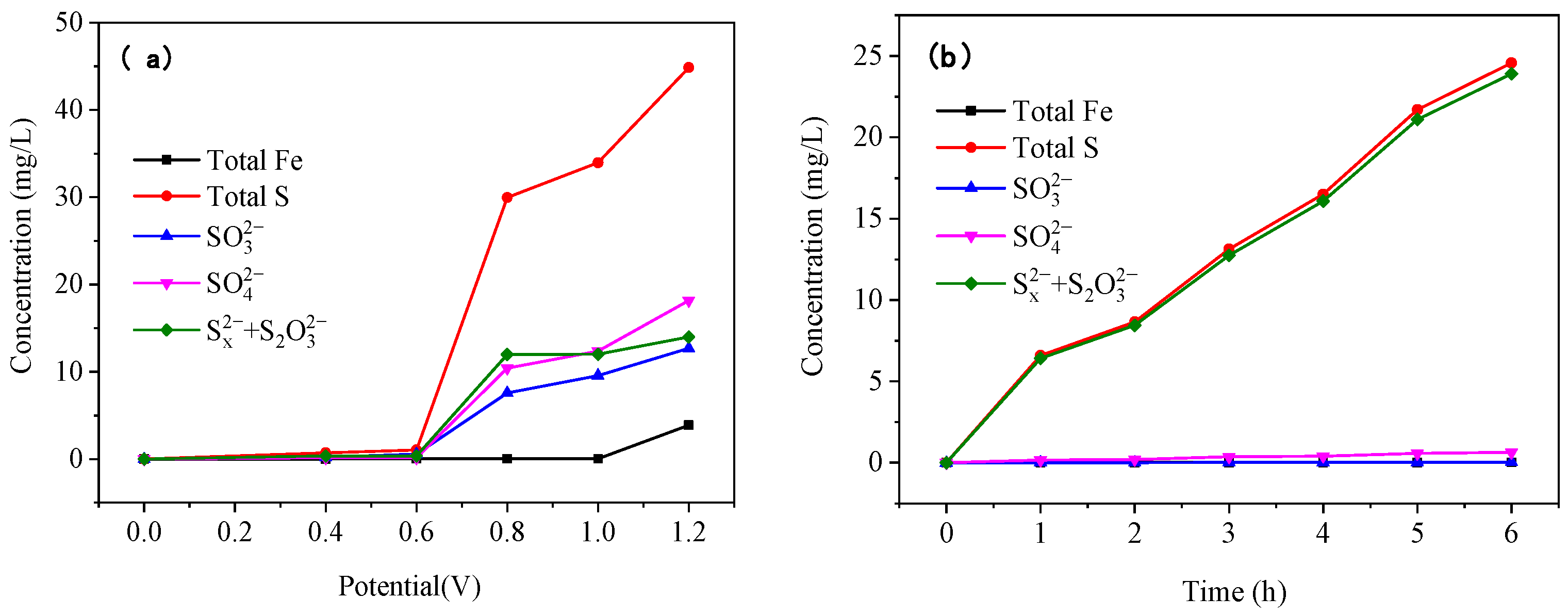
Nowadays, refractory gold ore production around the world accounts for about 30% of total gold production, and the low leaching rate of such gold concentrate seriously limits the efficient utilization of gold resources. The alkaline preoxidation process can improve the leaching rate of this kind of gold deposit and has good development and application prospects. Therefore, it is of great significance to study the oxidation and dissolution behavior of pyrite in an alkaline environment. In this paper, the oxidation process of gold-bearing pyrite in an alkaline electrolyte was studied using electrochemical techniques, and the oxidation products of a pyrite electrode in an alkaline solution were characterized using XPS, SEM, and other analytical methods. The results show that the optimum pH for pyrite electrochemical oxidative dissolution is about 12, and the oxidation potential of pyrite should be above 0.8 V. In the process of alkaline oxidative dissolution of pyrite, part of the S element enters the electrolyte in the forms of Sx2−, S2O32−, SO32−, and SO42−, and a small amount of the S element is adsorbed on the surface of the electrode in the form of S0 and becomes a part of the passive layer. The Fe element is adsorbed on the surface of the electrode in the forms of Fe(OH)2, Fe2O3, and Fe2(SO4)3, which become the main components of the passivation layer. This study provides a theoretical basis and reference data for the chemical preoxidation treatment of gold-bearing sulfide ores.
Keywords: pyrite; alkaline oxidation; electrochemical technique; surface passivation; chemical preoxidation pyrite; alkaline oxidation; electrochemical technique; surface passivation; chemical preoxidation