


Reduction of Chlorinated Ethenes by Ag- and Cu-Amended Green Rust


Abstract
1. Introduction
2. Materials and Methods
2.1. Chemicals
2.2. Experimental Setup
3. Results and Discussion
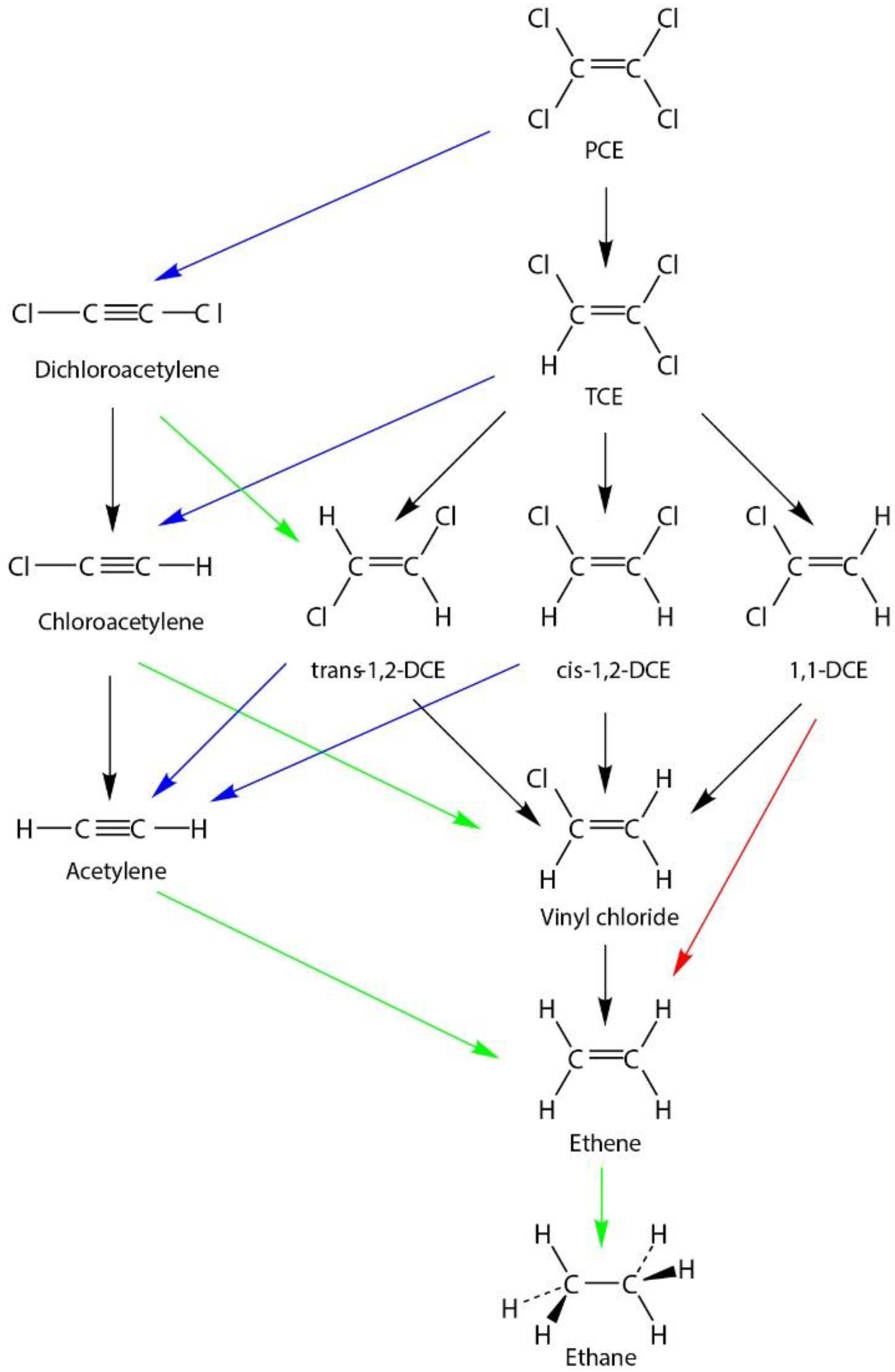
3.1. Reduction of Chlorinated Ethenes by GRSO4
3.2. Reduction of Chlorinated Ethenes by Ag-Amended GRSO4
3.3. Reduction of Chlorinated Ethenes by Cu-Amended GRSO4
3.4. Comparrison with Other Studies of Chlorinated Ethenes by Metal-Amended Green Rust
3.5. Potential Utility of Metal-Amended Green Rusts for Remediation of Chlorinated Ethenes
Supplementary Materials
Author Contributions
Funding
Data Availability Statement
Acknowledgments
Conflicts of Interest
References
- Usman, M.; Byrne, J.M.; Chaudhary, A.; Orsetti, S.; Hanna, K.; Ruby, C.; Kappler, A.; Haderlein, S.B. Magnetite and Green Rust: Synthesis, Properties, and Environmental Applications of Mixed-Valent Iron Minerals. Chem. Rev. 2018, 118, 3251–3304. [Google Scholar] [CrossRef] [Scilit]
- Fredrickson, J.K.; Zachara, J.M.; Kennedy, D.W.; Dong, H.; Onstott, T.C.; Hinman, N.W.; Li, S.-M. Biogenic iron mineralization accompanying the dissimilatory reduction of hydrous ferric oxide by a groundwater bacterium. Geochim. Cosmochim. Acta 1998, 62, 3239–3257. [Google Scholar] [CrossRef] [Scilit]
- Hansel, C.M.; Benner, S.G.; Neiss, J.; Dohnalkova, A.; Kukkadapu, R.K.; Fendorf, S. Secondary mineralization pathways induced by dissimilatory iron reduction of ferrihydrite under advective flow. Geochim. Cosmochim. Acta 2003, 67, 2977–2992. [Google Scholar] [CrossRef] [Scilit]
- Borch, T.; Masue, Y.; Kukkadapu, R.K.; Fendorf, S. Phosphate imposed limitations on biological reduction and alteration of ferrihydrite. Environ. Sci. Technol. 2007, 41, 166–172. [Google Scholar] [CrossRef] [Scilit] [PubMed]
- Shimizu, M.; Zhou, J.; Schroder, C.; Obst, M.; Kappler, A.; Borch, T. Dissimilatory reduction and transformation of ferrihydrite-humic acid coprecipitates. Environ. Sci. Technol. 2013, 47, 13375–13384. [Google Scholar] [CrossRef] [Scilit] [PubMed]
- Ona-Nguema, G.; Abdelmoula, M.; Jorand, F.; Benali, O.; Géhin, A.; Block, J.-C.; Génin, J.-M.R. Iron (II,III) hydroxycarbonate green rust formation and stabilization from lepidocrocite bioreduction. Environ. Sci. Technol. 2002, 36, 16–20. [Google Scholar] [CrossRef] [Scilit] [PubMed]
- Jorand, F.; Zegeye, A.; Landry, F.; Ruby, C. Reduction of ferric green rust by Shewanella putrefaciens. Lett. Appl. Microbiol. 2007, 45, 515–521. [Google Scholar] [CrossRef] [Scilit]
- Jung, J.; Bae, S.; Lee, W. Indirect contact of bio-transformation of lepidocrocite: Role of electron transfer mediator. Sustain. Environ. Res. 2012, 23, 193–198. [Google Scholar]
- Boyanov, M.I.; O’Loughlin, E.J.; Kemner, K.M. Iron phase transformations resulting from the respiration of Shewanella putrefaciens on a mixed mineral phase. In Journal of Physics: Conference Series; IOP Publishing: Bristol, UK, 2009; Volume 190, p. 012193. [Google Scholar] [CrossRef] [Scilit]
- O’Loughlin, E.J.; Boyanov, M.I.; Flynn, T.M.; Gorski, C.; Hofmann, S.M.; McCormick, M.L.; Scherer, M.M.; Kemner, K.M. Effects of bound phosphate on the bioreduction of lepidocrocite (g-FeOOH) and maghemite (g-Fe2O3) and formation of secondary minerals. Environ. Sci. Technol. 2013, 47, 9157–9166. [Google Scholar] [CrossRef] [Scilit]
- Dong, Y.; Sanford, R.A.; Boyanov, M.I.; Flynn, T.M.; O’Loughlin, E.J.; Kemner, K.M.; George, S.; Fouke, K.E.; Li, S.; Huang, D.; et al. Controls on iron reduction and biomineralization over broad environmental conditions as suggested by the Firmicutes Orenia metallireducens strain Z6. Environ. Sci. Technol. 2020, 54, 10128–10140. [Google Scholar] [CrossRef] [Scilit]
- O’Loughlin, E.J.; Boyanov, M.I.; Gorski, C.A.; Scherer, M.M.; Kemner, K.M. Effects of Fe(III) oxide mineralogy and phosphate on Fe(II) secondary mineral formation during microbial iron reduction. Minerals 2021, 11, 149. [Google Scholar] [CrossRef] [Scilit]
- Chaudhuri, S.K.; Lack, J.G.; Coates, J.D. Biogenic magnetite formation through anaerobic biooxidation of Fe(II). Appl. Environ. Microbiol. 2001, 67, 2844–2848. [Google Scholar] [CrossRef] [Scilit]
- Pantke, C.; Obst, M.; Benzerara, K.; Morin, G.; Ona-Nguema, G.; Dippon, U.; Kappler, A. Green rust formation during Fe(II) oxidation by the nitrate-reducing Acidovorax sp. strain BoFeN1. Environ. Sci. Technol. 2012, 46, 1439–1446. [Google Scholar] [CrossRef] [Scilit]
- Etique, M.; Jorand, F.P.; Zegeye, A.; Gregoire, B.; Despas, C.; Ruby, C. Abiotic process for Fe(II) oxidation and green rust mineralization driven by a heterotrophic nitrate reducing bacteria (Klebsiella mobilis). Environ. Sci. Technol. 2014, 48, 3742–3751. [Google Scholar] [CrossRef] [Scilit]
- Nordhoff, M.; Tominski, C.; Halama, M.; Byrne, J.M.; Obst, M.; Kleindienst, S.; Behrens, S.; Kappler, A. Insights into nitrate-reducing Fe(II) oxidation mechanisms through analysis of cell-mineral associations, cell encrustation, and mineralogy in the chemolithoautotrophic enrichment culture KS. Appl. Environ. Microbiol. 2017, 83. [Google Scholar] [CrossRef] [Scilit]
- Bigham, J.M.; Tuovinen, O.H. Mineralogical, morphological, and microbiological characteristics of tubercles in cast iron water mains as related to their chemical activity. In Planetary Ecology; Caldwell, D.E., Brierley, J.A., Brierley, C.L., Eds.; Van Nostrand Reinhold Co.: New York, NY, USA, 1985; pp. 239–250. [Google Scholar]
- Génin, J.-M.R.; Refait, P.; Olowe, A.A.; Abdelmoula, M.; Fall, I.; Drissi, S.H. Identification of green rust compounds in the aqueous corrosion processes of steels; the case of microbially induced corrosion and use of 78 K CEMS. Hyperfine Interact. 1998, 112, 47–50. [Google Scholar] [CrossRef] [Scilit]
- Kumar, A.V.R.; Singh, R.; Nigam, R.K. Mössbauer spectroscopy of corrosion products of mild steel due to microbiologically influenced corrosion. J. Radioanal. Nucl. Chem. 1999, 242, 131–137. [Google Scholar] [CrossRef] [Scilit]
- Refait, P.; Abdelmoula, M.; Génin, J.-M.R. Mechanisms of formation and structure of green rust one in aqueous corrosion of iron in the presence of chloride ions. Corros. Sci. 1998, 40, 1547–1560. [Google Scholar] [CrossRef] [Scilit]
- Zegeye, A.; Bonneville, S.; Benning, L.G.; Sturm, A.; Fowle, D.A.; Jones, C.; Canfield, D.E.; Ruby, C.; MacLean, L.C.; Nomosatryo, S.; et al. Green rust formation controls nutrient availability in a ferruginous water column. Geology 2012, 40, 599–602. [Google Scholar] [CrossRef] [Scilit]
- Christiansen, B.C.; Balic-Zunic, T.; Dideriksen, K.; Stipp, S.L.S. Identification of green rust in groundwater. Environ. Sci. Technol. 2009, 43, 3436–3441. [Google Scholar] [CrossRef] [Scilit]
- Johnson, C.A.; Freyer, G.; Fabisch, M.; Caraballo, M.A.; Küsel, K.; Hochella, M.F. Observations and assessment of iron oxide and green rust nanoparticles in metal-polluted mine drainage within a steep redox gradient. Environ. Chem. 2014, 11, 377. [Google Scholar] [CrossRef] [Scilit]
- Feder, F.; Trolard, F.; Klingelhöfer, G.; Bourrié, G. In situ Mössbauer spectroscopy: Evidence for green rust (fougerite) in a gleysol and its mineralogical transformations with time and depth. Geochim. Cosmochim. Acta 2005, 69, 4463–4483. [Google Scholar] [CrossRef] [Scilit]
- Génin, J.-M.R.; Bourrié, G.; Trolard, F.; Abdelmoula, M.; Jaffrezic, A.; Refait, P.; Maitre, V.; Humbert, B.; Herbillon, A. Thermodynamic equilibria in aqueous suspensions of synthetic and natural Fe(II)-Fe(III) green rusts: Occurrences of the mineral in hydromorphic soils. Environ. Sci. Technol. 1998, 32, 1058–1068. [Google Scholar] [CrossRef] [Scilit]
- Refait, P.; Abdelmoula, M.; Trolard, F.; Génin, J.-M.R.; Ehrhardt, J.J.; Bourrié, G. Mössbauer and XAS study of a green rust mineral: The partial substitution of Fe2+ by Mg2+. Am. Mineral. 2001, 86, 731–739. [Google Scholar] [CrossRef] [Scilit]
- Trolard, F.; Génin, J.-M.R.; Abdelmoula, M.; Bourrié, G.; Humbert, B.; Herbillon, A. Identification of a green rust mineral in a reductomorphic soil by Mössbauer and Raman spectroscopies. Geochim. Cosmochim. Acta 1997, 61, 1107–1111. [Google Scholar] [CrossRef] [Scilit]
- Weatherington-Rice, J.; Bigham, J.M. Buried pre-Illinoian-age lacustrine deposits with “green rust” colors in Clermont County, Ohio. Ohio J. Sci. 2006, 106, 35–44. [Google Scholar]
- Latta, D.E.; Boyanov, M.I.; Kemner, K.M.; O’Loughlin, E.J.; Scherer, M.M. Abiotic reduction of uranium by Fe(II) in soil. Appl. Geochem. 2012, 27, 1512–1524. [Google Scholar] [CrossRef] [Scilit]
- Bearcock, J.M.; Perkins, W.T.; Dinelli, E.; Wade, S.C. Fe(II)/Fe(III) ‘green rust’ developed within ocherous coal mine drainage sediment in South Wales, UK. Mineral. Mag. 2006, 70, 731–741. [Google Scholar] [CrossRef] [Scilit]
- Bender Koch, C.; Mørup, S. Identification of green rust in an ochre sludge. Clay Miner. 1991, 26, 577–582. [Google Scholar] [CrossRef] [Scilit]
- Root, R.A.; Dixit, S.; Campbell, K.M.; Jew, A.D.; Hering, J.G.; O’Day, P.A. Arsenic sequestration by sorption processes in high-iron sediments. Geochim. Cosmochim. Acta 2007, 71, 5782–5803. [Google Scholar] [CrossRef] [Scilit]
- Gu, B.; Phelps, T.J.; Liang, L.; Dickey, M.J.; Roh, Y.; Kinsall, B.L.; Palumbo, A.V.; Jacobs, G.K. Biogeochemical dynamics in zero-valent iron columns: Implications for permeable reactive barriers. Environ. Sci. Technol. 1999, 33, 2170–2177. [Google Scholar] [CrossRef] [Scilit]
- Johnson, T.L.; Tratnyek, P.G. A column study of the geochemical factors affecting reductive dechlorination of chlorinated solvents by zero-valent iron. In Proceedings of the In-Situ Remediation: Scientific Basis for Current and Future Technologies. Thirty-Third Hanford Symposium on Health and the Environment, Pasco, WA, USA, 7–11 November 1994; Gee, G.W., Wing, N.R., Eds.; Battelle Press: Columbus, OH, USA, 1994; Volume 2, pp. 931–947. [Google Scholar]
- Roh, Y.; Lee, S.Y.; Elless, M.P. Characterization of corrosion products in the permeable reactive barriers. Environ. Geol. 2000, 40, 184–194. [Google Scholar] [CrossRef] [Scilit]
- Vogan, J.L.; Butler, B.J.; Odziemkowski, M.S.; Friday, G.; Gillham, R.W. Inorganic and biological evaluation of cores from permeable iron reactive barriers. In Designing and Applying Treatment Technolgies: Remediation of Chlorinated and Recalcitrant Compounds; Wickramanayake, G.B., Hinchee, R.E., Eds.; Battelle Press: Columbus, OH, USA, 1998; pp. 163–168. [Google Scholar]
- Furukawa, Y.; Kim, J.-W.; Watkins, J.; Wilkin, R.T. Formation of ferrihydrite and associated iron corrosion products in permeable reactive barriers of zero-valent iron. Environ. Sci. Technol. 2002, 36, 5469–5475. [Google Scholar] [CrossRef] [Scilit]
- Phillips, D.H.; Watson, D.B.; Roh, Y.; Gu, B. Mineralogical characteristics and transformation during long-term operation of a zerovalent iron reactive barrier. J. Environ. Qual. 2003, 32, 2033–2045. [Google Scholar] [CrossRef] [Scilit]
- Trolard, F.; Bourrié, G.; Abdelmoula, M.; Refait, P.; Feder, F. Fougerite, a new mineral of the pyroaurite-iowaite group: Description and crystal structure. Clays Clay Miner. 2007, 55, 323–334. [Google Scholar] [CrossRef] [Scilit]
- Mills, S.J.; Christy, A.G.; Génin, J.M.R.; Kameda, T.; Colombo, F. Nomenclature of the hydrotalcite supergroup: Natural layered double hydroxides. Mineral. Mag. 2012, 76, 1289–1336. [Google Scholar] [CrossRef] [Scilit]
- Génin, J.M.R.; Mills, S.J.; Christy, A.G.; Guérin, O.; Herbillon, A.J.; Kuzmann, E.; Ona-Nguema, G.; Ruby, C.; Upadhyay, C. Mössbauerite, Fe63+O4(OH)8[CO3]·3H2O, the fully oxidized ‘green rust’ mineral from Mont Saint-Michel Bay, France. Mineral. Mag. 2014, 78, 447–465. [Google Scholar] [CrossRef] [Scilit]
- Lee, W.; Batchelor, B. Reductive capacity of natural reductants. Environ. Sci. Technol. 2003, 37, 535–541. [Google Scholar] [CrossRef] [Scilit]
- Bond, D.L.; Fendorf, S. Kinetics and structural constraints of chromate reduction by green rusts. Environ. Sci. Technol. 2003, 37, 2750–2757. [Google Scholar] [CrossRef] [Scilit]
- Christiansen, B.C.; Geckeis, H.; Marquardt, C.M.; Bauer, A.; Römer, J.; Wiss, T.; Schild, D.; Stipp, S.L.S. Neptunyl (NpO2+) interaction with green rust, GRNa,SO4. Geochim. Cosmochim. Acta 2011, 75, 1216–1226. [Google Scholar] [CrossRef] [Scilit]
- Elsner, M.; Schwarzenbach, R.P.; Haderlein, S.B. Reactivity of Fe(II)-bearing minerals toward reductive transformation of organic contaminants. Environ. Sci. Technol. 2004, 38, 799–807. [Google Scholar] [CrossRef] [Scilit] [PubMed]
- Erbs, M.; Hansen, H.C.B.; Olsen, C.E. Reductive dechlorination of carbon tetrachloride using iron(II) iron(III) hydroxide sulfate (green rust). Environ. Sci. Technol. 1999, 33, 307–311. [Google Scholar] [CrossRef] [Scilit]
- Hansen, H.C.B.; Bender Koch, C.; Nancke-Krogh, H.; Borggaard, O.K.; Sorensen, J. Abiotic nitrate reduction to ammonium: Key role of green rust. Environ. Sci. Technol. 1996, 30, 2053–2056. [Google Scholar] [CrossRef] [Scilit]
- Hansen, H.C.B.; Guldberg, S.; Erbs, M.; Bender Koch, C. Kinetics of nitrate reduction by green rusts—Effects of interlayer anion and Fe(II):Fe(III) ratio. Appl. Clay Sci. 2001, 18, 81–91. [Google Scholar] [CrossRef] [Scilit]
- Heasman, D.M.; Sherman, D.M.; Ragnarsdottir, K.V. The reduction of aqueous Au3+ by sulfide minerals and green rust phases. Am. Mineral. 2003, 88, 725–738. [Google Scholar] [CrossRef] [Scilit]
- Kone, T.; Hanna, K.; Abdelmoula, M.; Ruby, C.; Carteret, C. Reductive transformation and mineralization of an azo dye by hydroxysulphate green rust preceding oxidation using H2O2 at neutral pH. Chemosphere 2009, 75, 212–219. [Google Scholar] [CrossRef] [Scilit]
- Larese-Casanova, P.; Scherer, M.M. Abiotic transformation of hexahydro-1,3,5-trinitro-1,3,5-triazine (RDX) by green rusts. Environ. Sci. Technol. 2008, 42, 3975–3981. [Google Scholar] [CrossRef] [Scilit]
- Latta, D.E.; Boyanov, M.I.; Kemner, K.M.; O’Loughlin, E.J.; Scherer, M.M. Reaction of uranium(VI) with green rusts: Effect of interlayer anion. Curr. Inorg. Chem. 2015, 5, 156–168. [Google Scholar] [CrossRef] [Scilit]
- Lee, W.; Batchelor, B. Abiotic reductive dechlorination of chlorinated ethylenes by iron-bearing soil minerals. 2. Green rust. Environ. Sci. Technol. 2002, 36, 5348–5354. [Google Scholar] [CrossRef] [Scilit]
- Legrand, L.; El Figuigui, A.; Mercier, F.; Chausse, A. Reduction of aqueous chromate by Fe(II)/Fe(III) carbonate green rust: Kinetic and mechanistic studies. Environ. Sci. Technol. 2004, 38, 4587–4595. [Google Scholar] [CrossRef] [Scilit]
- Loyaux-Lawniczak, S.; Refait, P.; Lecomte, P.; Ehrhardt, J.-J.; Génin, J.-M.R. The reduction of chromate ions by Fe(II) layered hydroxides. Hydrol. Earth Syst. Sci. 1999, 3, 593–599. [Google Scholar] [CrossRef] [Scilit]
- Myneni, S.C.B.; Tokunaga, T.K.; Brown, G.E., Jr. Abiotic selenium redox transformations in the presence of Fe(II,III) oxides. Science 1997, 278, 1106–1109. [Google Scholar] [CrossRef] [Scilit]
- O’Loughlin, E.J.; Burris, D.R. Reduction of halogenated ethanes by green rust. Environ. Toxicol. Chem. 2004, 23, 41–48. [Google Scholar] [CrossRef] [Scilit] [PubMed]
- O’Loughlin, E.J.; Kelly, S.D.; Kemner, K.M.; Csencsits, R.; Cook, R.E. Reduction of AgI, AuIII, CuII, and HgII by FeII/FeIII hydroxysulfate green rust. Chemosphere 2003, 53, 437–446. [Google Scholar] [CrossRef] [Scilit]
- Pepper, S.E.; Bunker, D.J.; Bryan, N.D.; Livens, F.R.; Charnock, J.M.; Pattrick, R.A.D.; Collison, D. Treatment of radioactive wastes: An X-ray adsorption spectroscopy study of the treatment of technetium with green rust. J. Colloid Interface Sci. 2003, 268, 408–412. [Google Scholar] [CrossRef] [Scilit]
- Refait, P.; Simon, L.; Génin, J.-M.R. Reduction of SeO42− anions and anoxic formation of iron(II)-iron(III) hydroxy-selenate green rust. Environ. Sci. Technol. 2000, 34, 819–825. [Google Scholar] [CrossRef] [Scilit]
- Skovbjerg, L.L.; Stipp, S.L.S.; Utsunomiya, S.; Ewing, R.C. The mechanisms of reduction of hexavalent chromium by green rust sodium sulphate: Formation of Cr-goethite. Geochim. Cosmochim. Acta 2006, 70, 3582–3592. [Google Scholar] [CrossRef] [Scilit]
- Williams, A.G.B.; Scherer, M.M. Kinetics of Cr(VI) reduction by carbonate green rust. Environ. Sci. Technol. 2001, 35, 3488–3494. [Google Scholar] [CrossRef] [Scilit]
- Yan, S.; Boyanov, M.I.; Mishra, B.; Kemner, K.M.; O’Loughlin, E.J. U(VI) reduction by biogenic and abiotic hydroxycarbonate green rusts: Impacts on U(IV) speciation and stability over time. Environ. Sci. Technol. 2018, 52, 4601–4609. [Google Scholar] [CrossRef] [Scilit]
- Etique, M.; Zegeye, A.; Gregoire, B.; Carteret, C.; Ruby, C. Nitrate reduction by mixed iron(II-III) hydroxycarbonate green rust in the presence of phosphate anions: The key parameters influencing the ammonium selectivity. Water Res. 2014, 62, 29–39. [Google Scholar] [CrossRef] [Scilit]
- O’Loughlin, E.J.; Boyanov, M.I.; Kemner, K.M. Reduction of vanadium(V) by iron(II)-bearing minerals. Minerals 2021, 11, 316. [Google Scholar] [CrossRef] [Scilit]
- Moran, M.J.; Zogorski, J.S.; Squillace, P.J. Chlorinated solvents in groundwater of the United States. Environ. Sci. Technol. 2007, 41, 74–81. [Google Scholar] [CrossRef] [Scilit] [PubMed]
- Doherty, R.E. A History of the production and use of carbon tetrachloride, tetrachloroethylene, trichloroethylene and 1,1,1-trichloroethane in the United States: Part 1—Historical background; carbon tetrachloride and tetrachloroethylene. Environ. Forensics 2000, 1, 69–81. [Google Scholar] [CrossRef] [Scilit]
- Doherty, R.E. A History of the production and use of carbon tetrachloride, tetrachloroethylene, trichloroethylene and 1,1,1-trichloroethane in the United States: Part 2—Trichloroethylene and 1,1,1-trichloroethane. Environ. Forensics 2000, 1, 83–93. [Google Scholar] [CrossRef] [Scilit]
- Henschler, D. Toxicity of chlorinated organic compounds: Effects of the introduction of chlorine in organic molecules. Angew. Chem. Int. Ed. Engl. 1994, 33, 1920–1935. [Google Scholar] [CrossRef] [Scilit]
- Xiao, Z.; Jiang, W.; Chen, D.; Xu, Y. Bioremediation of typical chlorinated hydrocarbons by microbial reductive dechlorination and its key players: A review. Ecotoxicol. Environ. Saf. 2020, 202, 110925. [Google Scholar] [CrossRef] [Scilit]
- Ebrahimbabaie, P.; Pichtel, J. Biotechnology and nanotechnology for remediation of chlorinated volatile organic compounds: Current perspectives. Environ. Sci. Pollut. Res. Int. 2021, 28, 7710–7741. [Google Scholar] [CrossRef] [Scilit]
- Maithreepala, R.A.; Doong, R.-A. Enhanced dechlorination of chlorinated methanes and ethenes by chloride green rust in the presence of copper(II). Environ. Sci. Technol. 2005, 39, 4082–4090. [Google Scholar] [CrossRef] [Scilit]
- O’Loughlin, E.J.; Kemner, K.M.; Burris, D.R. Effects of AgI, AuIII, and CuII on the reductive dechlorination of carbon tetrachloride by green rust. Environ. Sci. Technol. 2003, 37, 2905–2912. [Google Scholar] [CrossRef] [Scilit]
- Scherer, M.M.; O’Loughlin, E.; Parkin, G.F.; Valentine, R.; Al-Hosney, H.; Handler, R.; Just, C.; Larese-Casanova, P.; Pasakarnis, T.; Smith, S.L. Sustainability of Long-Term Abiotic Attenuation of Chlorinated Ethenes; SERDP Project ER-1369; Department of Defense Strategic Environmental Research and Development Program (SERDP): Alexandria, VA, USA, 2007; pp. 1–47. [Google Scholar]
- Choi, J.; Lee, W. Enhanced degradation of tetrachloroethylene by green rusts with platinum. Environ. Sci. Technol. 2008, 42, 3356–3362. [Google Scholar] [CrossRef] [Scilit]
- Liang, X.; Philp, R.P.; Butler, E.C. Kinetic and isotope analyses of tetrachloroethylene and trichloroethylene degradation by model Fe(II)-bearing minerals. Chemosphere 2009, 75, 63–69. [Google Scholar] [CrossRef] [Scilit] [PubMed]
- Mangayayam, M.C.; Dideriksen, K.; Tobler, D.J. Can or cannot green rust reduce chlorinated ethenes? Energy Procedia 2018, 146, 173–178. [Google Scholar] [CrossRef] [Scilit]
- Ai, J.; Yin, W.; Hansen, H.C.B. Fast dechlorination of chlorinated ethylenes by green rust in the presence of bone char. Environ. Sci. Technol. Lett. 2019, 6, 191–196. [Google Scholar] [CrossRef] [Scilit]
- Choi, J.; Batchelor, B.; Chung, J. Reductive dechlorination of tetrachloroethylene by green rusts modified with copper. Water Air Soil Pollut. 2010, 212, 407–417. [Google Scholar] [CrossRef] [Scilit]
- Ayala-Luis, K.B.; Cooper, N.G.; Koch, C.B.; Hansen, H.C. Efficient dechlorination of carbon tetrachloride by hydrophobic green rust intercalated with dodecanoate anions. Environ. Sci. Technol. 2012, 46, 3390–3397. [Google Scholar] [CrossRef] [Scilit] [PubMed]
- Huang, L.Z.; Yin, Z.; Cooper, N.G.A.; Yin, W.; Bjerglund, E.T.; Strobel, B.W.; Hansen, H.C.B. Copper-mediated reductive dechlorination by green rust intercalated with dodecanoate. J. Hazard. Mater. 2018, 345, 18–26. [Google Scholar] [CrossRef] [Scilit]
- Huang, L.Z.; Hansen, H.C.; Daasbjerg, K. Graphene oxide-mediated rapid dechlorination of carbon tetrachloride by green rust. J. Hazard. Mater. 2017, 323, 690–697. [Google Scholar] [CrossRef] [Scilit]
- O’Loughlin, E.J.; Kelly, S.D.; Csencsits, R.; Cook, R.E.; Kemner, K.M. Reduction of uranium(VI) by mixed iron(II)/iron(III) hydroxide (green rust): Formation of UO2 nanoparticles. Environ. Sci. Technol. 2003, 37, 721–727. [Google Scholar] [CrossRef] [Scilit]
- Campbell, T.J.; Burris, D.R. Analysis of chlorinated ethene reduction products in vapor/water phase systems by dual-column, single detector gas chromatography. Int. J. Environ. Anal. Chem. 1996, 63, 119–126. [Google Scholar] [CrossRef] [Scilit]
- Campbell, T.J.; Burris, D.R.; Roberts, A.L.; Wells, J.R. Trichloroethylene and tetrachloroethylene in a metallic iron-water vapor batch system. Environ. Toxicol. Chem. 1997, 16, 625–630. [Google Scholar] [CrossRef] [Scilit]
- Roberts, A.L.; Totten, L.A.; Arnold, W.A.; Burris, D.R.; Campbell, T.J. Reductive elimination of chlorinated ethylenes, by zero-valent metals. Environ. Sci. Technol. 1996, 30, 2654–2659. [Google Scholar] [CrossRef] [Scilit]
- Glod, G.; Brodmann, U.; Angst, W.; Holliger, C.; Schwarzenbach, R. Cobalamin-mediated reduction of cis- and trans-dichloroethene, 1,1-dichloroethene, and vinyl chloride in homogeneous aqueous solution: Reaction kinetics and mechanistic considerations. Environ. Sci. Technol. 1997, 31, 3154–3160. [Google Scholar] [CrossRef] [Scilit]
- Han, Y.S.; Hyun, S.P.; Jeong, H.Y.; Hayes, K.F. Kinetic study of cis-dichloroethylene (cis-DCE) and vinyl chloride (VC) dechlorination using green rusts formed under varying conditions. Water Res. 2012, 46, 6339–6350. [Google Scholar] [CrossRef] [Scilit] [PubMed]
- Arnold, W.A.; Roberts, A.L. Pathways of chlorinated ethylene and chlorinated acetylene reaction with Zn(0). Environ. Sci. Technol. 1998, 32, 3017–3025. [Google Scholar] [CrossRef] [Scilit]
- O’Loughlin, E.J.; Ma, H.; Burris, D.R. Catalytic effects of Ni-humic complexes on the reductive dehalogenation of chlorinated C1 and C2 hydrocarbons. In Humic Substances: Nature’s Most Versatile Materials; Ghabbour, E.A., Davies, G., Eds.; Taylor and Francis, Inc.: New York, NY, USA, 2004; pp. 295–322. [Google Scholar]
- Bakac, A.; Espenson, J.H. Mechanistic investigation of carbon-carbon bond formation in the reduction of alkyl halides by organonickel complexes in aqueous solution. J. Am. Chem. Soc. 1986, 108, 719–723. [Google Scholar] [CrossRef] [Scilit]
- Arnold, W.A.; Roberts, A.L. Pathways and kinetics of chlorinated ethylene and chlorinated acetylene reaction with Fe(0) particles. Environ. Sci. Technol. 2000, 34, 1794–1805. [Google Scholar] [CrossRef] [Scilit]
- O’Loughlin, E.J.; Burris, D.R. Reductive dehalogenation of trichloroethene mediated by wetland DOC-transition metal complexes. In Wetlands and Remediation; Means, J.L., Hinchee, R.E., Eds.; Battelle Press: Columbus, OH, USA, 2000; pp. 1–8. [Google Scholar]
- Cheng, S.-F.; Wu, S.-C. The enhancement methods for the degradation of TCE by zero-valent metals. Chemosphere 2000, 41, 1263–1270. [Google Scholar] [CrossRef] [Scilit]
- Xu, Y.; Zhang, W.-X. Subcolloidal Fe/Ag particles for reductive dehalogenation of chlorinated benzenes. Ind. Eng. Chem. Res. 2000, 39, 2238–2244. [Google Scholar] [CrossRef] [Scilit]
- Zhang, W.-X.; Wang, C.-B.; Lien, H.-L. Treatment of chlorinated organic contaminants with nanoscale bimetallic particles. Catal. Today 1998, 40, 387–395. [Google Scholar] [CrossRef] [Scilit]
- Lien, H.-L.; Zhang, W.-X. Transformation of chlorinated methanes by nanoscale iron particles. J. Environ. Eng. 1999, 125, 1042–1047. [Google Scholar] [CrossRef] [Scilit]
- Muftikian, R.; Fernando, Q.; Korte, N. A method for the rapid dechlorination of low molecular weight chlorinated hydrocarbons in water. Water Res. 1995, 29, 2434–2439. [Google Scholar] [CrossRef] [Scilit]
- Wan, C.; Chen, Y.H.; Wei, R. Dechlorination of chloromethanes on iron an palladium-iron bimetallic surface in aqueous systems. Environ. Toxicol. Chem. 1999, 18, 1091–1096. [Google Scholar] [CrossRef]
- O’Carroll, D.; Sleep, B.; Krol, M.; Boparai, H.; Kocur, C. Nanoscale zero valent iron and bimetallic particles for contaminated site remediation. Adv. Water Resour. 2013, 51, 104–122. [Google Scholar] [CrossRef] [Scilit]
- Elliott, D.W.; Zhang, W.-X. Field assessment of nanoscale bimetallic particles for groundwater treatment. Environ. Sci. Technol. 2001, 35, 4922–4926. [Google Scholar] [CrossRef] [Scilit]
- Liu, Z.; Arnold, R.G.; Betterton, E.A.; Festa, K.D. Electrolytic reduction of CCl4—Effects of cathode material and potential on kinetics, selectivity, and product stoichiometry. Environ. Eng. Sci. 1999, 16, 1–13. [Google Scholar] [CrossRef] [Scilit]


| Compound a | System | Final Sampling (h) | Compound Remaining | Products a | Carbon Recovery b |
|---|---|---|---|---|---|
| PCE | GR | 502 | 85.7% | ND | 85.7% |
| AgGR | 189 | 1.5% | TCE(87.4%), t12DCE(7.3%), AC(7.4%), and EE(0.5%) | 104.2% | |
| CuGR | 627 | 67.9% | TCE(6.3%), EE(3.3%), and EA(0.3%) | 77.7% | |
| TCE | GR | 501 | 97.4% | ND | 97.4% |
| AgGR | 501 | 87.6% | AC(1.8%) and EE(1.1%) | 89.9% | |
| CuGR | 625 | 79.9% | EE(11.1%) and EA(1.1%) | 92.1% | |
| 11DCE | GR | 499 | 95.7% | ND | 95.7% |
| AgGR | 501 | 93.8% | EE(0.3%) | 94.1% | |
| CuGR | 624 | 66.1% | EE(30.2%) and EA(2.8%) | 99.1% | |
| c12DCE | GR | 500 | 100.0% | ND | 100.0% |
| AgGR | 501 | 97.4% | EE(0.1%) | 97.5% | |
| CuGR | 625 | 83.1% | VC(1.0%), EE(14.9%), and EA(1.5%) | 100.5% | |
| t12DCE | GR | 504 | 95.2% | ND | 95.2% |
| AgGR | 499 | 94.2% | AC(0.8%), EE(0.3%), and EA(0.1%) | 95.3% | |
| CuGR | 623 | 48.9% | EE(42.6%) and EA(4.5%) | 96.9% | |
| VC | GR | 497 | 100.0% | ND | 100.0% |
| AgGR | 501 | 99.5% | ND | 99.5% | |
| CuGR | 622 | 34.2% | EE(58.2%) and EA(7.4%) | 99.8% |
| Compound a | Products a,b | This Study c AgGRSO4 | Choi and Lee [79] d PtGRF, Cl, SO4, CO3 | This Study e CuGRSO4 | Maithreepala and Doong [72] f CuGRCl |
|---|---|---|---|---|---|
| PCE | 2.30 ± 0.09 × 10⁻² h−1 g | 9.93 ± 0.58 × 10⁻² h−1 | 5.96 ± 0.69 × 10⁻⁴ h−1 | 3.06 ± 0.39 × 10⁻¹ h−1 | |
| PCE | 1.5% | ~1–15% | 67.9% | 12.4% | |
| TCE | 87.4% | - | 6.3% | 16.6% | |
| t12DCE | 7.3% | - | - | - | |
| acetylene | 7.4% | ~71–90% | - | - | |
| ethene | 0.5% | - | 3.3% | 31.9% | |
| ethane | - | - | 0.3% | 0.1% | |
| Carbon recovery | 104.2% | 81-95% | 77.7% | 61.0% | |
| TCE | 2.44 ± 0.53 × 10⁻⁴ h−1 | - | 3.59 ± 0.23 × 10⁻⁴ h−1 | ~9.58 × 10⁻⁴ h−1 | |
| TCE | 87.6% | - | 79.9% | 51.0% | |
| acetylene | 1.8% | - | - | - | |
| ethene | 1.1% | - | 11.1% | 11.0% | |
| ethane | - | - | 1.1% | 1.0% | |
| Carbon recovery | 89.9% | - | 92.1% | 63.0% |
Publisher’s Note: MDPI stays neutral with regard to jurisdictional claims in published maps and institutional affiliations. |
© 2022 by the authors. Licensee MDPI, Basel, Switzerland. This article is an open access article distributed under the terms and conditions of the Creative Commons Attribution (CC BY) license (https://creativecommons.org/licenses/by/4.0/).
Share and Cite
O’Loughlin, E.J.; Burris, D.R. Reduction of Chlorinated Ethenes by Ag- and Cu-Amended Green Rust. Minerals 2022, 12, 138. https://doi.org/10.3390/min12020138
O’Loughlin EJ, Burris DR. Reduction of Chlorinated Ethenes by Ag- and Cu-Amended Green Rust. Minerals. 2022; 12(2):138. https://doi.org/10.3390/min12020138
Chicago/Turabian StyleO’Loughlin, Edward J., and David R. Burris. 2022. "Reduction of Chlorinated Ethenes by Ag- and Cu-Amended Green Rust" Minerals 12, no. 2: 138. https://doi.org/10.3390/min12020138
APA StyleO’Loughlin, E. J., & Burris, D. R. (2022). Reduction of Chlorinated Ethenes by Ag- and Cu-Amended Green Rust. Minerals, 12(2), 138. https://doi.org/10.3390/min12020138

