Radioactive Isotopes as a Tool for Pairing Identification of the HAH 346—Hammadah al Hamra 346—Ordinary Chondrites from Two Separate Find Areas


Abstract
1. Introduction
2. Material and Methods
2.1. Samples
2.2. Method of Analysis
2.3. Quality Assurance
2.4. Chemometric Approach
3. Results
4. Conclusions
- A unique low-background gamma-ray spectrometric system was applied to obtain high measurement precision with a low counting rate in chondrite samples. The activities of the radioactive isotopes 54Mn, 26Al, 40K, 22Na, and 60Co in the chondrites collected during two different expeditions were analyzed and compared.
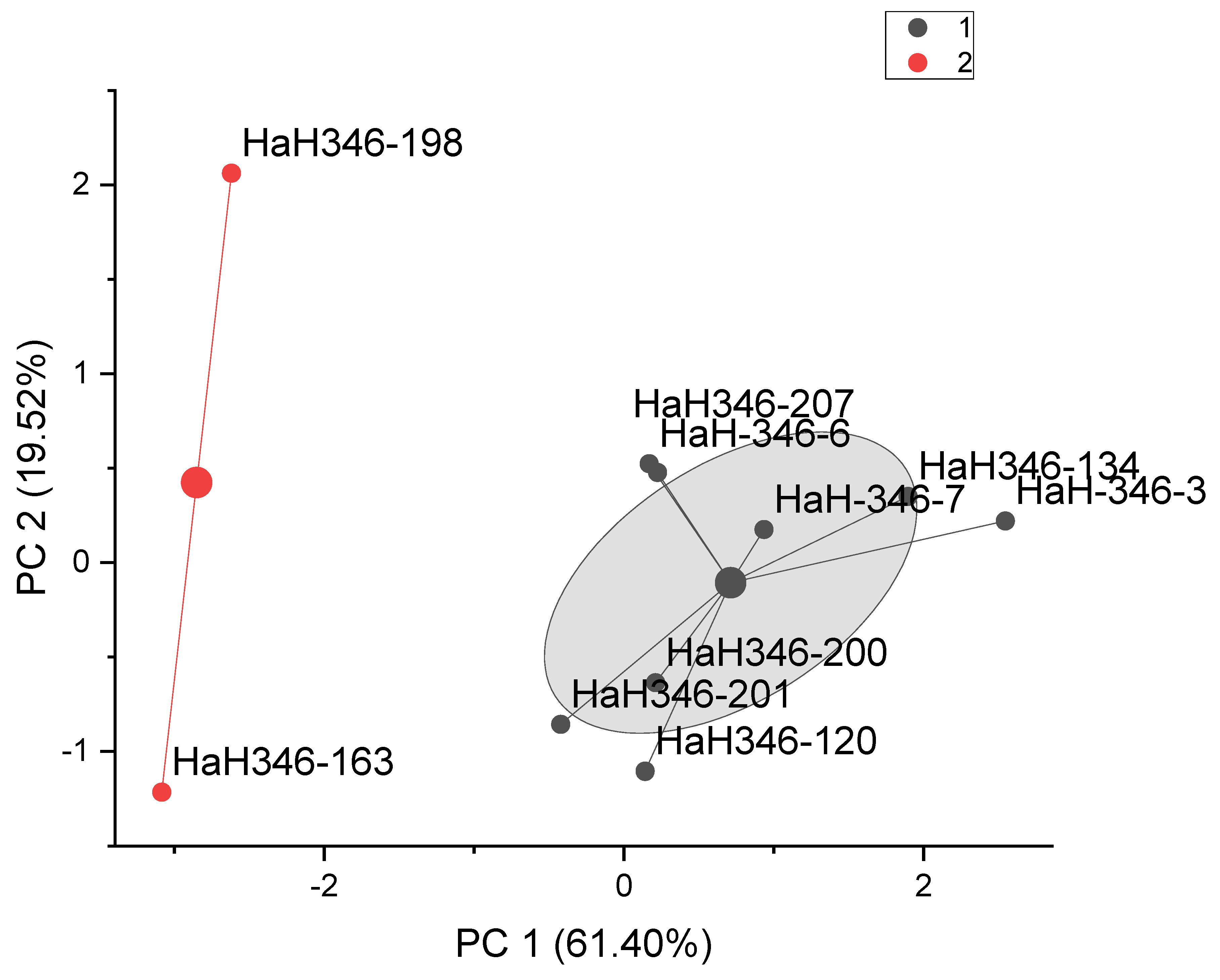
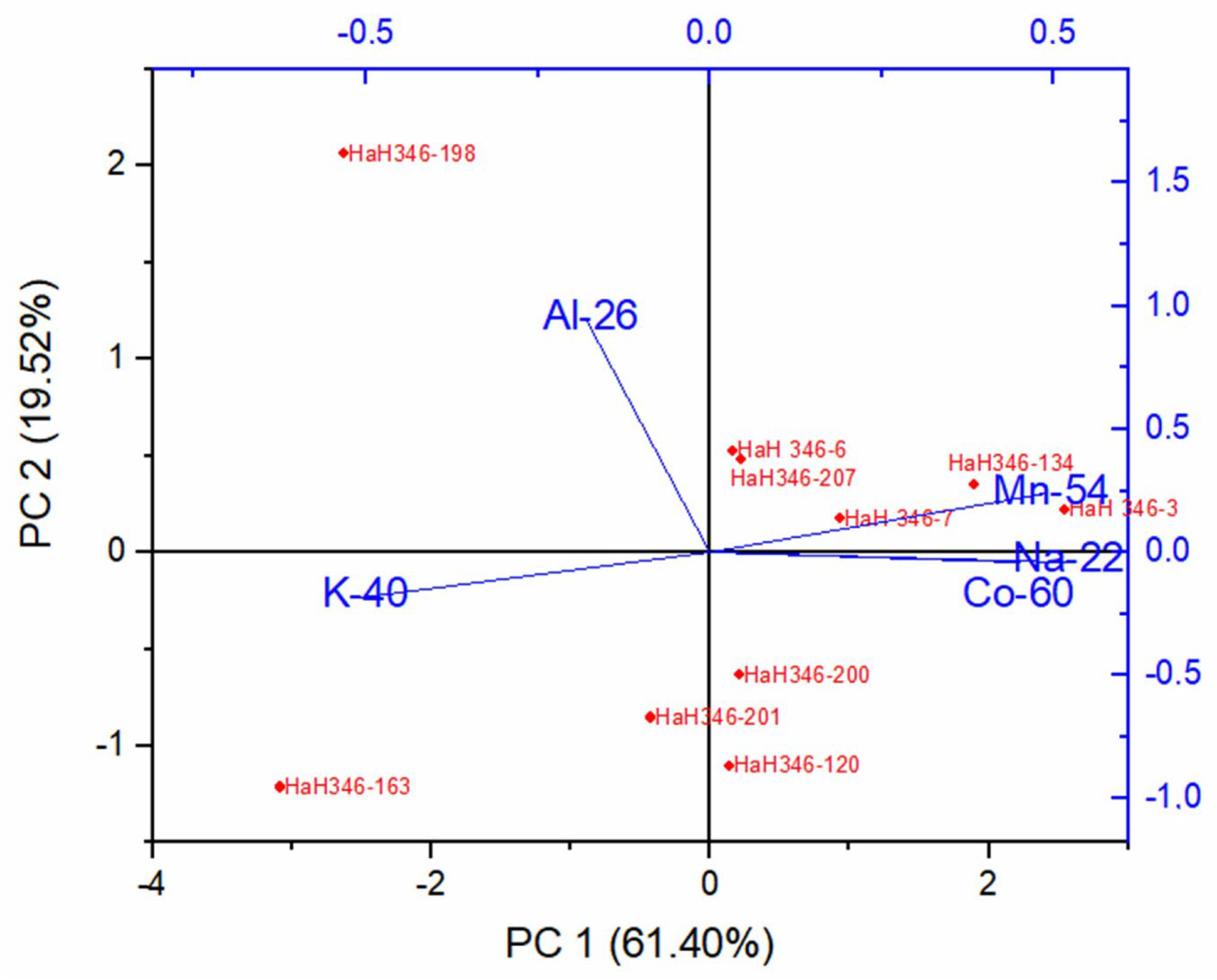
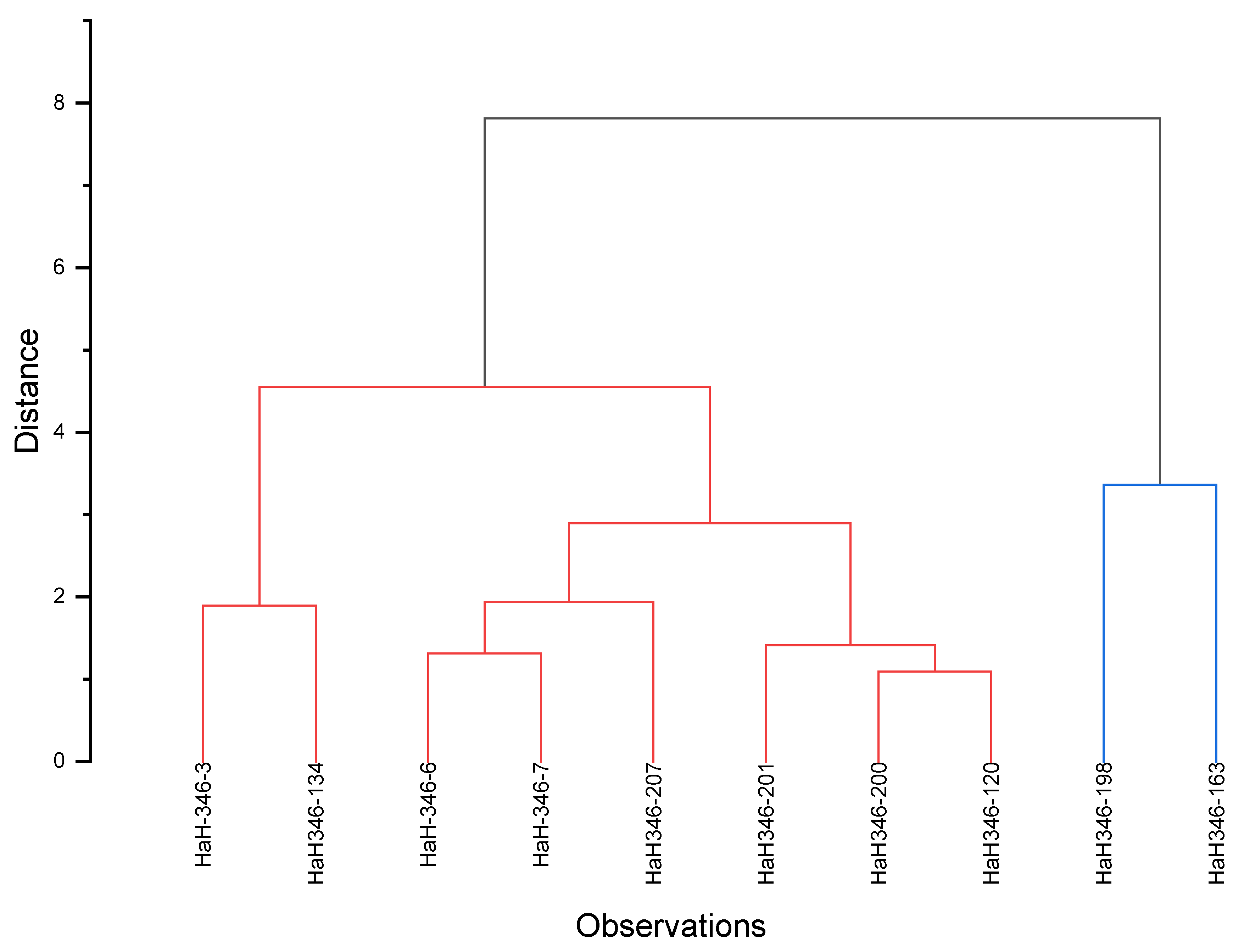
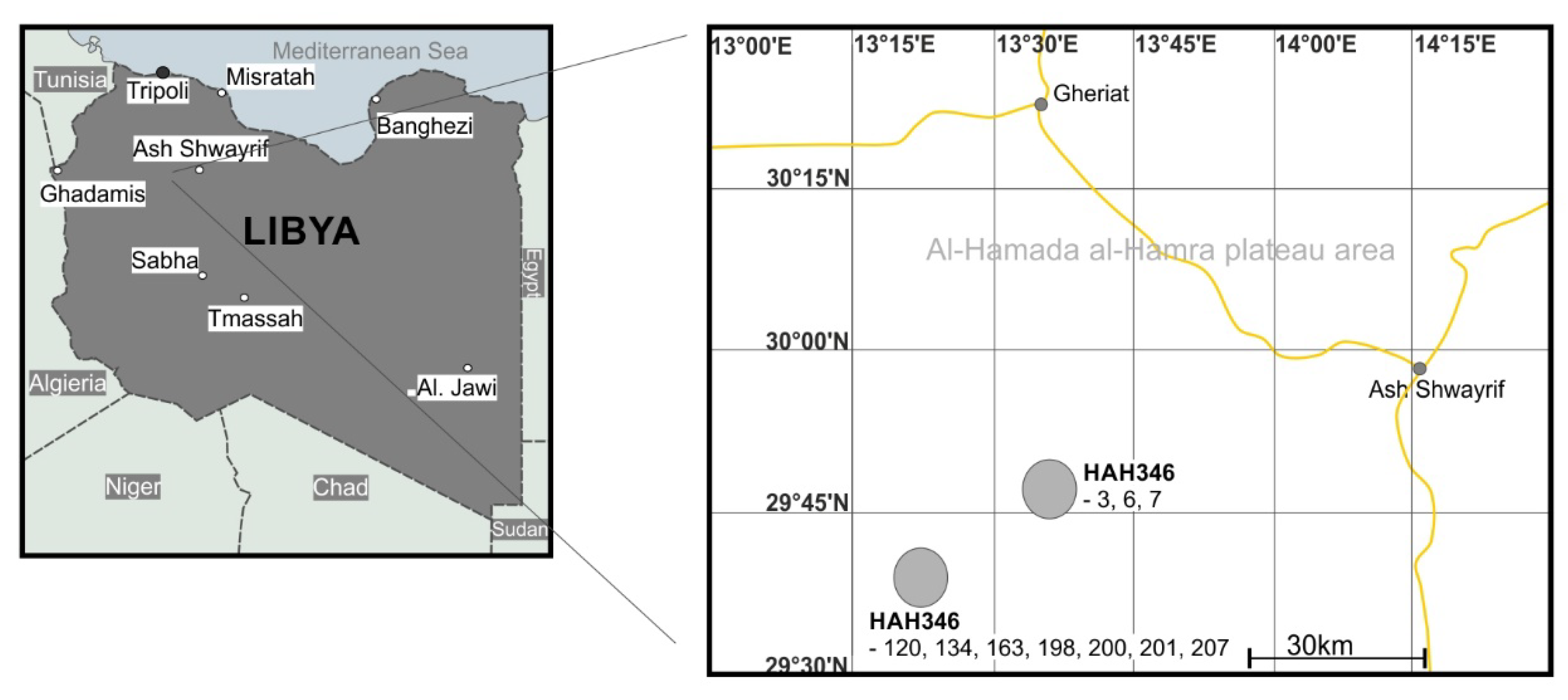
- Several statistical approaches, including K-means, PCA, and cluster analysis, have been applied to confirm the origins of all specimens from two different campaigns. A chemometric analysis based on a multivariate analysis of short-lived nuclides concentrations confirmed the lack of an affinity of two from a total of ten investigated ordinary chondrites. A chemometric analysis with many variables of short-lived radionuclides is more appropriate for handling a scientific investigation, but statistical (significant) differences do not explain the reason for such a difference between specimens; therefore, other more detailed analysis should be applied for the confirmation of the reason of difference.
- The dissimilar chondrites are: HaH 346-163 and HaH 346-198, which seem to be statistically different than the other eight chondrites (HAH 346-3, HAH 346-6, HAH 346-7, HaH 346-134, HaH 346-200, HaH 346-201, HaH 346-207, and HaH 346-120, all classified as ordinary chondrite L5). The difference in radionuclide concentrations could be the result of various physical or chemical parameters, especially fluctuating with the pre-atmospheric size of the object (various nuclear channel efficiencies, changes in the energy of particles interacting with the object, inhomogeneity of the structure) and volatility of various elements (boiling point K > Na > Mn > Al > Co).
- Short-lived radionuclides are sensitive tools to estimate the terrestrial age of chondrites, even if the fall took place in a relatively short time interval. With a short half-life of 312 days, 54Mn is the most representative for a comparison of specimens originating from different falls. Radioactivity levels of 54Mn in HaH 346-163 and HaH 346-198, is on average, twice lower than in the case of other specimens and are equal to 13.3 and 22.5 Bq/kg, while the average value for other specimens is equal to 35.9 ± 7.2 Bq/kg. The short-lived radioactivity levels in the HaH 346 chondrites are consistent with a recent fall (the observed fireball of November 2017).
Author Contributions
Funding
Data Availability Statement
Acknowledgments
Conflicts of Interest
References
- Schlüter, J.; Schultz, L.K.; Thiedig, F.; Al-Mahdi, B.O.; Aghreb, A.E. The Dar al Gani meteorite field (Libyan Sahara): Geological setting, pairing of meteorites, and recovery density. Meteorit. Planet. Sci. 2002, 37, 1079–1093. [Google Scholar] [CrossRef]
- Reedy, R.C.; Arnold, J.R.; Lal, D. Cosmic-ray record in solar system matter. Annu. Rev. Nucl. Part Sci. 1983, 33, 505–537. Available online: www.annualreviews.org (accessed on 18 November 2021). [CrossRef]
- Leya, I.; Masarik, J. Cosmogenic nuclides in stony meteorites revisited. Meteorit. Planet. Sci. 2009, 44, 1061–1086. [Google Scholar] [CrossRef]
- Povinec, P.P.; Sýkora, I.; Macke, R.J.; Tóth, J.; Kornoš, L.; Porubčan, V. Radionuclides in Chassigny and Nakhla meteorites of Mars origin: Implications for their pre-atmospheric sizes and cosmic-ray exposure ages. Planet. Space Sci. 2020, 186, 104914. [Google Scholar] [CrossRef]
- Alexeev, V.A.; Laubenstein, M.; Povinec, P.P.; Ustinova, G.K. Variations of cosmogenic radionuclide production rates along the meteorite orbits. Adv. Space Res. 2015, 56, 766–771. [Google Scholar] [CrossRef]
- Gladysheva, O.G. Disintegration of the Chelyabinsk cosmic body. Planet. Space Sci. 2019, 178, 104709. [Google Scholar] [CrossRef]
- Taricco, C.; Bhandari, N.; Colombetti, P.; Verma, N.; Vivaldo, G. Experimental set-up and optimization of a gamma-ray spectrometer for measurement of cosmogenic radionuclides in meteorites. Nucl. Instrum. Methods Phys. Res. Sect. A Accel. Spectrom. Detect. Assoc. Equip. 2007, 572, 241–243. [Google Scholar] [CrossRef]
- Guan, Y.; Huss, G.R.; Leshin, L.A. SIMS analyses of Mg, Cr, and Ni isotopes in primitive meteorites and short-lived radionuclides in the early solar system. Appl. Surf. Sci. 2004, 231–232, 899–902. [Google Scholar] [CrossRef]
- Hsu, W. Short-lived radionuclides in the early solar system—A meteoritic perspective of the solar system formation. Chin. Astron. Astrophys. 2003, 27, 365–373. [Google Scholar] [CrossRef]
- Johnston, P.N.; Hulta, M.; Altzitzoglou, T. Measurement of low levels of 26Al from meteorite samples. Appl. Radiat. Isot. 2002, 56, 399–403. [Google Scholar] [CrossRef]
- Arnold, D.; Neumaiera, S.; Sima, O. Deep underground gamma spectrometric measurement of 26Al in meteorite samples. Appl. Radiat. Isot. 2002, 56, 405–408. [Google Scholar] [CrossRef] [PubMed]
- Anderson, S.; Benedi, G.K.; Forman, L.V.; Daly, L.; Greenwood, R.C.; Franchi, I.A.; Friedrich, J.M.; Macke, R.; Wiggins, S.; Britt, D.; et al. Mineralogy, petrology, geochemistry, and chronology of the Murrili (H5) meteorite fall: The third recovered fall from the Desert Fireball Network. Meteorit. Planet. Sci. 2021, 56, 241–259. [Google Scholar] [CrossRef]
- Eugster, O.; Beer, J.; Burger, M.; Finkel, R.C.; Hofmann, H.J.; Krähenbühl, U.; Michel Th Synal, H.A.; Wölfli, W. History of the paired lunar meteorites MAC88104 and MAC88105 derived from noble gas isotopes, radionuclides, and some chemical abundances. Geochim. Cosmochim. Acta 1991, 55, 3139–3148. [Google Scholar] [CrossRef]
- Evans, J.C.; Reeves, J.H.; Rancitelli, L.A.; Bogard, D.D. Cosmogenic nuclides in recently fallen meteorites: Evidence for galactic cosmic ray variations during the period 1967–1978. J. Geophys. Res. 1982, 87, 5577–5591. [Google Scholar] [CrossRef]
- Bischoff, A.; Barrat, J.A.; Berndt, J.; Borovicka, J.; Burkhardt, C.; Busemann, H.; Hakenmüller, J.; Heinlein, D.; Hertzog, J.; Kaiser, J.; et al. The Renchen L5-6 chondrite breccia—The first confirmed meteorite fall from Baden-Württemberg (Germany). Geochemistry 2019, 79, 125525. [Google Scholar] [CrossRef]
- Ogurtsov, M.G. Cosmogenic 44Ti in meteorites—A divergence with 14C and 10Be data. Adv. Space Res. 2021, 68, 1519–1524. [Google Scholar] [CrossRef]
- Dilg, W.; Mannhart, W.; Steichele, E.; Arnold, P. Precision Neutron Total Cross Section Measurements On Gold And Cobalt In The 40micro-Ev To 5 Milli-EVZeitschriftfuer. Physik 1973, 264, 427. [Google Scholar] [CrossRef]
- Laubenstein, M.; Giampaoli, A.; Janowski, P.; Mietelski, J.W. Cosmogenic Radionuclides In The Sołtmany L6 Meteorite. Meteorites 2012, 2, 45–51. [Google Scholar] [CrossRef]
- Beno, J.; Breier, R.; Masarik, J. Effects of solar activity on production rates of short-lived cosmogenic radionuclides. Meteorit. Planet. Sci. 2020, 55, 1048–1056. [Google Scholar] [CrossRef]
- Welten, K.C.; Caffee, M.W.; Hillegonds, D.J.; Masarik, J.; Nishiizumi, K. Identifying large chondrites using cosmogenic radionuclides. Nucl. Instrum. Methods Phys. Res. Sect. B Beam Interact. Mater. At. 2010, 268, 1185–1188. [Google Scholar] [CrossRef]
- Mahajan, R.R. Noble gases, cosmic ray exposure and radiogenic ages in selected ordinary chondrites. Adv. Space Res. 2022, 70, 2112–2132. [Google Scholar] [CrossRef]
- Peplowski, P.N.; Wilson, J.T.; Burks, M.; Beck, A.W.; Jun, I.; Lawrence, D.J.; Yokley, Z.W. Cosmogenic radionuclide production modeling with Geant4: Experimental benchmarking and application to nuclear spectroscopy of asteroid (16) Psyche. Nucl. Inst Methods Phys. Res. B 2019, 446, 43–57. [Google Scholar] [CrossRef]
- Howard, C.; Ferm, M.; Cesaratto, J.; Daigle, S.; Iliadis, C. Radioisotope studies of the Farmville meteorite using γγ-coincidence spectrometry. Appl. Radiat. Isot. 2014, 94, 23–29. [Google Scholar] [CrossRef] [PubMed]
- Welten, K.C.; Nishiizumi, K.; Finkel, R.C.; Hillegonds, D.J.; Jull, A.J.T.; Franke, L.; Schultz, L. Exposure history and terrestrial ages of ordinary chondrites from The Dar Al Gani Region, Libya. Meteorit. Planet. Sci. 2004, 39, 481–498. [Google Scholar] [CrossRef]
- Reedy, R.C. Recent advances in studies of meteorites using cosmogenic radionuclides. Nucl. Instrum. Methods Phys. Res. B 2004, 223–224, 587–590. [Google Scholar] [CrossRef]
- Li, S.; Wang, S.; Leya, I.; Li, Y.; Li, X.; Smith, T. Petrology, mineralogy, porosity, and cosmic-ray exposure history of Huaxi ordinary chondrite. Meteorit. Planet. Sci. 2017, 52, 937–948. [Google Scholar] [CrossRef]
- Herpers, U.; Vogt, S.; Beer, J.; Suter, M.; Wölfli, W. Determination of spallogenic long-lived radionuclides in chondrites by nuclear analytical techniques. Analyst 1989, 114, 303. [Google Scholar] [CrossRef]
- Girault, F.; Perrier, F.; Moreira, M.; Zanda, B.; Rochette, P.; Teitler, Y. Effective radium-226 concentration in meteorites. Geochim. Cosmochim. Acta 2017, 208, 198–219. [Google Scholar] [CrossRef]
- Tymiński, Z.; Miśta EKalbarczyk, P. The Oslo meteorite research for cosmogenic radionuclides and the interpretation of the results. Acta Soc. Metheoriticae Pol. 2013, 4, 115. (In Polish) [Google Scholar]
- Jull, A.; Giscard, M.; Hutzler, A.; Schnitzer, C.; Zahn, D.; Burr, G.; Hill, D. Radionuclide Studies of Stony Meteorites from Hot Deserts. Radiocarbon 2013, 55, 1779–1789. [Google Scholar] [CrossRef]
- Bonino, G.; Cini Castagnoli, G.; Taricco, C.; Bhandari, N.; Killgore, M. Cosmogenic radionuclides in four fragments of the portales valley meteorite shower: Influence of different element Abundances and Shielding. Adv. Space Res. 2002, 29, 771–782. [Google Scholar] [CrossRef]
- Alexeeva, V.A.; Laubenstein, M.; Povinec, P.P.; Ustinova, G.K. Cosmogenic Radionuclides In Meteorites and Solar Modulation of Galactic Cosmic Rays In the Internal Heliosphere. Sol. Syst. Res. 2019, 53, 98–115. [Google Scholar] [CrossRef]
- Długosz-Lisiecka, M. Comparison of two spectrometric counting modes for fast analysis of selected radionuclides activity. J. Radioanal. Nucl. Chem. 2016, 309, 941–945. [Google Scholar] [CrossRef][Green Version]
- Długosz-Lisiecka, M. Application of modern anticoincidence (AC) system in HPGe γ-spectrometry for the detection limit lowering of the radionuclides in air filters. J. Environ. Radioact. 2017, 169–170, 104–108. [Google Scholar] [CrossRef]
- Długosz-Lisiecka, M. Chemometric methods for source apportionment of 210Pb, 210Bi and 210Po for 10 years of urban air radioactivity monitoring in Lodz city, Poland. Chemosphere 2019, 220, 163–168. [Google Scholar] [CrossRef]
- Tillett, A.; Dermigny, J.; Emamian, M.; Tonin, Y.; Bucay, I.; Smith, R.L.; Darken, M.; Dearing, C.; Orbon, M.; Iliadis, C. A low-background γγ-coincidence spectrometer for radioisotope studies. Nucl. Inst Methods Phys. Res. 2017, 871, 66–71. [Google Scholar] [CrossRef]
- Colombetti, P.; Taricco, C.; Bhandari, N.; Sinha, N.; DiMartino, M.; Cora, A.; Vivaldo, G. Low γ activity measurement of meteorites using HPGe–NaI detector system. Nucl. Instrum. Methods Phys. Res. A 2013, 718, 140–142. [Google Scholar] [CrossRef]
- Konki, J.; Greenlees, P.T.; Jakobsson, U.; Jones, P.; Julin, R.S.; Juutinen, S.; Ketelhut, K.; Hauschild, R.; Kontro, A.-P.; Leppänen, A.; et al. Comparison of gamma-ray coincidence and low-background gamma-ray singles spectrometry. Appl. Radiat. Isot. 2012, 70, 392–396. [Google Scholar] [CrossRef]
- Sharma, M.K.; Burnett, J.L. Sensitivity and low-energy response of the Small Anode Germanium well detector with ceramic insert. Nucl. Instrum. Methods Phys. Res. Sect. A Accel. Spectrom. Detect. Assoc. Equip. 2021, 988, 164943. [Google Scholar] [CrossRef]
- Britton, R.; Jackson, M.J.; Davies, A.V. Quantifying radionuclide signatures from a γ–γ coincidence system. J. Environ. Radioact. 2015, 149, 158–163. [Google Scholar] [CrossRef]
- Suárez-Navarro, J.A.; Moreno-Reyes, A.M.; Gascó, C.; Alonso, M.M.; Puertas, F. Gamma spectrometry and LabSOCS-calculated efficiency in the radiological characterisation of quadrangular and cubic specimens of hardened portland cement paste. Radiat. Phys. Chem. 2020, 171, 108709. [Google Scholar] [CrossRef]
- Stanić, G.; Nikolov, J.; Tucaković, I.; Mrđa, D.; Todorović, N.; Grahek, Ž.; Coha, I.; Vraničar, A. Angle vs. LabSOCS for HPGe efficiency calibration. Nucl. Instrum. Methods Phys. Res. Sect. A Accel. Spectrom. Detect. Assoc. Equip. 2019, 920, 81–87. [Google Scholar] [CrossRef]
- Kanellopoulos, C.; Argyraki, A. Multivariate statistical assessment of groundwater in cases with ultramafic rocks and anthropogenic activities influence. Appl. Geochem. 2022, 141, 105292. [Google Scholar] [CrossRef]
- Rosen, A.V.; Hofmann, B.A.; Von Sivers, M.; Schumann, M. Radionuclide Activities In Recent Chondrite Falls Determined By Gamma-Ray Spectrometry: Implications For Terrestrial Age Estimates. Meteorit. Planet. Sci. 2020, 55, 149–163. [Google Scholar] [CrossRef]



| Laboratory Code of the Specimen | Sample Mass [g] | Date of the Sample Collection from the Desert | |
|---|---|---|---|
| Bulk Sample | Powder | ||
| HaH 346-3 | 23 | 50 | 2018 |
| HaH 346-6 | 141 | - | 2018 |
| HaH 346-7 | 221 | - | 2018 |
| HaH 346-134 | 134 | - | 2019 |
| HaH 346-198 | 198 | - | 2019 |
| HaH 346-201 | 201 | - | 2019 |
| HaH 346-200 | 200 | - | 2019 |
| HaH 346-207 | 207 | - | 2019 |
| HaH 346-163 | 163 | - | 2019 |
| HaH 346-120 | 120 | - | 2019 |
| Isotope | Gamma Energy Peaks (keV) | Yield of Gamma Emission (%) | T1/2 | MDA [dpm/kg] |
|---|---|---|---|---|
| 22Na | 1274 | 99.94 | 2.602 years | 1.11 |
| 26Al | 1808 | 99.76 | 7.17·105 years | 1.44 |
| 40K | 1460 | 10.66 | 1.25·109 years | 11.54 |
| 54Mn | 834 | 99.97 | 312.2 days | 0.43 |
| 60Co | 1173 1332 | 99.85 99.98 | 5.30 years | 1.04 1.15 |
| Activity Concentration of Radionuclides [Bq/kg] | |||||
|---|---|---|---|---|---|
| Id | 22Na | 26Al | 54Mn | 40K | 60Co |
| HaH 346-3 | 59.3 ± 5.1 | 44.3 ± 4.1 | 44.4 ± 4.4 | 1440 ± 71 | 156 ± 10 |
| HaH 346-6 | 50.9 ± 4.9 | 46.6 ± 4.3 | 43.4 ± 3.9 | 1532 ± 70 | 17.2 ± 1.5 |
| HaH 346-7 | 50.3 ± 4.4 | 43.6 ± 4.2 | 43.0 ± 3.8 | 1475 ± 72 | 70.6 ± 6 |
| HaH 346-134 | 59.6 ± 5.3 | 45.1 ± 4.4 | 36.8 ± 3.3 | 1336 ± 66 | 85.4 ± 7.9 |
| HaH 346-198 | 37.1 ± 3.5 | 63.1 ± 6.1 | 22.5 ± 2.0 | 1630 ± 80 | 7.1 ± 0.5 |
| HaH 346-201 | 53.2 ± 5.1 | 39.6 ± 3.1 | 26.7 ± 2.1 | 1584 ± 75 | 28.4 ± 2.1 |
| HaH 346-200 | 48.7 ± 4.3 | 39.3 ± 3.3 | 27.5 ± 2.5 | 1420 ± 70 | 52.0 ± 5.1 |
| HaH 346-207 | 58.1 ± 5.6 | 48.0 ± 4.5 | 31.9 ± 2.9 | 1477 ± 73 | 13.4 ± 0.9 |
| HaH 346-163 | 37.8 ± 3.5 | 41.0 ± 3.8 | 13.3 ± 0.9 | 1799 ± 89 | 15.0 ± 1.2 |
| HaH 346-120 | 49.1 ± 4.6 | 35.6 ± 3.2 | 33.3 ± 2.9 | 1517 ± 70 | 43.5 ± 4.2 |
| Coefficient of PC1 | Coefficient of PC2 | |
|---|---|---|
| 54Mn | 0.490 | 0.241 |
| 22Na | 0.516 | −0.038 |
| 60Co | 0.451 | −0.042 |
| 40K | −0.507 | −0.181 |
| 26Al | −0.179 | 0.952 |
Publisher’s Note: MDPI stays neutral with regard to jurisdictional claims in published maps and institutional affiliations. |
© 2022 by the authors. Licensee MDPI, Basel, Switzerland. This article is an open access article distributed under the terms and conditions of the Creative Commons Attribution (CC BY) license (https://creativecommons.org/licenses/by/4.0/).
Share and Cite
Długosz-Lisiecka, M.; Jakubowski, T.; Krystek, M.; ElMallul, A. Radioactive Isotopes as a Tool for Pairing Identification of the HAH 346—Hammadah al Hamra 346—Ordinary Chondrites from Two Separate Find Areas. Minerals 2022, 12, 1553. https://doi.org/10.3390/min12121553
Długosz-Lisiecka M, Jakubowski T, Krystek M, ElMallul A. Radioactive Isotopes as a Tool for Pairing Identification of the HAH 346—Hammadah al Hamra 346—Ordinary Chondrites from Two Separate Find Areas. Minerals. 2022; 12(12):1553. https://doi.org/10.3390/min12121553
Chicago/Turabian StyleDługosz-Lisiecka, Magdalena, Tomasz Jakubowski, Marcin Krystek, and Ahmed ElMallul. 2022. "Radioactive Isotopes as a Tool for Pairing Identification of the HAH 346—Hammadah al Hamra 346—Ordinary Chondrites from Two Separate Find Areas" Minerals 12, no. 12: 1553. https://doi.org/10.3390/min12121553
APA StyleDługosz-Lisiecka, M., Jakubowski, T., Krystek, M., & ElMallul, A. (2022). Radioactive Isotopes as a Tool for Pairing Identification of the HAH 346—Hammadah al Hamra 346—Ordinary Chondrites from Two Separate Find Areas. Minerals, 12(12), 1553. https://doi.org/10.3390/min12121553